WO2012153648A1 - ポジ型感光性組成物及びその硬化物 - Google Patents
ポジ型感光性組成物及びその硬化物 Download PDFInfo
- Publication number
- WO2012153648A1 WO2012153648A1 PCT/JP2012/061246 JP2012061246W WO2012153648A1 WO 2012153648 A1 WO2012153648 A1 WO 2012153648A1 JP 2012061246 W JP2012061246 W JP 2012061246W WO 2012153648 A1 WO2012153648 A1 WO 2012153648A1
- Authority
- WO
- WIPO (PCT)
- Prior art keywords
- general formula
- group
- compound
- photosensitive composition
- positive photosensitive
- Prior art date
- Legal status (The legal status is an assumption and is not a legal conclusion. Google has not performed a legal analysis and makes no representation as to the accuracy of the status listed.)
- Ceased
Links
- 0 CCC(CC)(N*(C)C)OC Chemical compound CCC(CC)(N*(C)C)OC 0.000 description 11
- GDOPTJXRTPNYNR-UHFFFAOYSA-N CC1CCCC1 Chemical compound CC1CCCC1 GDOPTJXRTPNYNR-UHFFFAOYSA-N 0.000 description 3
- LQNDUBBDSMTQCE-UHFFFAOYSA-N Cc(cc1)ccc1C1=CC1 Chemical compound Cc(cc1)ccc1C1=CC1 LQNDUBBDSMTQCE-UHFFFAOYSA-N 0.000 description 1
Classifications
-
- G—PHYSICS
- G03—PHOTOGRAPHY; CINEMATOGRAPHY; ANALOGOUS TECHNIQUES USING WAVES OTHER THAN OPTICAL WAVES; ELECTROGRAPHY; HOLOGRAPHY
- G03F—PHOTOMECHANICAL PRODUCTION OF TEXTURED OR PATTERNED SURFACES, e.g. FOR PRINTING, FOR PROCESSING OF SEMICONDUCTOR DEVICES; MATERIALS THEREFOR; ORIGINALS THEREFOR; APPARATUS SPECIALLY ADAPTED THEREFOR
- G03F7/00—Photomechanical, e.g. photolithographic, production of textured or patterned surfaces, e.g. printing surfaces; Materials therefor, e.g. comprising photoresists; Apparatus specially adapted therefor
- G03F7/004—Photosensitive materials
- G03F7/075—Silicon-containing compounds
- G03F7/0757—Macromolecular compounds containing Si-O, Si-C or Si-N bonds
-
- C—CHEMISTRY; METALLURGY
- C07—ORGANIC CHEMISTRY
- C07F—ACYCLIC, CARBOCYCLIC OR HETEROCYCLIC COMPOUNDS CONTAINING ELEMENTS OTHER THAN CARBON, HYDROGEN, HALOGEN, OXYGEN, NITROGEN, SULFUR, SELENIUM OR TELLURIUM
- C07F7/00—Compounds containing elements of Groups 4 or 14 of the Periodic Table
- C07F7/02—Silicon compounds
- C07F7/21—Cyclic compounds having at least one ring containing silicon, but no carbon in the ring
-
- C—CHEMISTRY; METALLURGY
- C08—ORGANIC MACROMOLECULAR COMPOUNDS; THEIR PREPARATION OR CHEMICAL WORKING-UP; COMPOSITIONS BASED THEREON
- C08G—MACROMOLECULAR COMPOUNDS OBTAINED OTHERWISE THAN BY REACTIONS ONLY INVOLVING UNSATURATED CARBON-TO-CARBON BONDS
- C08G77/00—Macromolecular compounds obtained by reactions forming a linkage containing silicon with or without sulfur, nitrogen, oxygen or carbon in the main chain of the macromolecule
- C08G77/04—Polysiloxanes
- C08G77/045—Polysiloxanes containing less than 25 silicon atoms
-
- C—CHEMISTRY; METALLURGY
- C08—ORGANIC MACROMOLECULAR COMPOUNDS; THEIR PREPARATION OR CHEMICAL WORKING-UP; COMPOSITIONS BASED THEREON
- C08G—MACROMOLECULAR COMPOUNDS OBTAINED OTHERWISE THAN BY REACTIONS ONLY INVOLVING UNSATURATED CARBON-TO-CARBON BONDS
- C08G77/00—Macromolecular compounds obtained by reactions forming a linkage containing silicon with or without sulfur, nitrogen, oxygen or carbon in the main chain of the macromolecule
- C08G77/04—Polysiloxanes
- C08G77/12—Polysiloxanes containing silicon bound to hydrogen
-
- C—CHEMISTRY; METALLURGY
- C08—ORGANIC MACROMOLECULAR COMPOUNDS; THEIR PREPARATION OR CHEMICAL WORKING-UP; COMPOSITIONS BASED THEREON
- C08G—MACROMOLECULAR COMPOUNDS OBTAINED OTHERWISE THAN BY REACTIONS ONLY INVOLVING UNSATURATED CARBON-TO-CARBON BONDS
- C08G77/00—Macromolecular compounds obtained by reactions forming a linkage containing silicon with or without sulfur, nitrogen, oxygen or carbon in the main chain of the macromolecule
- C08G77/04—Polysiloxanes
- C08G77/38—Polysiloxanes modified by chemical after-treatment
-
- C—CHEMISTRY; METALLURGY
- C08—ORGANIC MACROMOLECULAR COMPOUNDS; THEIR PREPARATION OR CHEMICAL WORKING-UP; COMPOSITIONS BASED THEREON
- C08G—MACROMOLECULAR COMPOUNDS OBTAINED OTHERWISE THAN BY REACTIONS ONLY INVOLVING UNSATURATED CARBON-TO-CARBON BONDS
- C08G77/00—Macromolecular compounds obtained by reactions forming a linkage containing silicon with or without sulfur, nitrogen, oxygen or carbon in the main chain of the macromolecule
- C08G77/80—Siloxanes having aromatic substituents, e.g. phenyl side groups
-
- C—CHEMISTRY; METALLURGY
- C09—DYES; PAINTS; POLISHES; NATURAL RESINS; ADHESIVES; COMPOSITIONS NOT OTHERWISE PROVIDED FOR; APPLICATIONS OF MATERIALS NOT OTHERWISE PROVIDED FOR
- C09D—COATING COMPOSITIONS, e.g. PAINTS, VARNISHES OR LACQUERS; FILLING PASTES; CHEMICAL PAINT OR INK REMOVERS; INKS; CORRECTING FLUIDS; WOODSTAINS; PASTES OR SOLIDS FOR COLOURING OR PRINTING; USE OF MATERIALS THEREFOR
- C09D183/00—Coating compositions based on macromolecular compounds obtained by reactions forming in the main chain of the macromolecule a linkage containing silicon, with or without sulfur, nitrogen, oxygen, or carbon only; Coating compositions based on derivatives of such polymers
- C09D183/04—Polysiloxanes
-
- G—PHYSICS
- G03—PHOTOGRAPHY; CINEMATOGRAPHY; ANALOGOUS TECHNIQUES USING WAVES OTHER THAN OPTICAL WAVES; ELECTROGRAPHY; HOLOGRAPHY
- G03F—PHOTOMECHANICAL PRODUCTION OF TEXTURED OR PATTERNED SURFACES, e.g. FOR PRINTING, FOR PROCESSING OF SEMICONDUCTOR DEVICES; MATERIALS THEREFOR; ORIGINALS THEREFOR; APPARATUS SPECIALLY ADAPTED THEREFOR
- G03F7/00—Photomechanical, e.g. photolithographic, production of textured or patterned surfaces, e.g. printing surfaces; Materials therefor, e.g. comprising photoresists; Apparatus specially adapted therefor
- G03F7/004—Photosensitive materials
- G03F7/022—Quinonediazides
- G03F7/0226—Quinonediazides characterised by the non-macromolecular additives
-
- G—PHYSICS
- G03—PHOTOGRAPHY; CINEMATOGRAPHY; ANALOGOUS TECHNIQUES USING WAVES OTHER THAN OPTICAL WAVES; ELECTROGRAPHY; HOLOGRAPHY
- G03F—PHOTOMECHANICAL PRODUCTION OF TEXTURED OR PATTERNED SURFACES, e.g. FOR PRINTING, FOR PROCESSING OF SEMICONDUCTOR DEVICES; MATERIALS THEREFOR; ORIGINALS THEREFOR; APPARATUS SPECIALLY ADAPTED THEREFOR
- G03F7/00—Photomechanical, e.g. photolithographic, production of textured or patterned surfaces, e.g. printing surfaces; Materials therefor, e.g. comprising photoresists; Apparatus specially adapted therefor
- G03F7/004—Photosensitive materials
- G03F7/022—Quinonediazides
- G03F7/023—Macromolecular quinonediazides; Macromolecular additives, e.g. binders
- G03F7/0233—Macromolecular quinonediazides; Macromolecular additives, e.g. binders characterised by the polymeric binders or the macromolecular additives other than the macromolecular quinonediazides
-
- G—PHYSICS
- G03—PHOTOGRAPHY; CINEMATOGRAPHY; ANALOGOUS TECHNIQUES USING WAVES OTHER THAN OPTICAL WAVES; ELECTROGRAPHY; HOLOGRAPHY
- G03F—PHOTOMECHANICAL PRODUCTION OF TEXTURED OR PATTERNED SURFACES, e.g. FOR PRINTING, FOR PROCESSING OF SEMICONDUCTOR DEVICES; MATERIALS THEREFOR; ORIGINALS THEREFOR; APPARATUS SPECIALLY ADAPTED THEREFOR
- G03F7/00—Photomechanical, e.g. photolithographic, production of textured or patterned surfaces, e.g. printing surfaces; Materials therefor, e.g. comprising photoresists; Apparatus specially adapted therefor
- G03F7/004—Photosensitive materials
- G03F7/039—Macromolecular compounds which are photodegradable, e.g. positive electron resists
- G03F7/0392—Macromolecular compounds which are photodegradable, e.g. positive electron resists the macromolecular compound being present in a chemically amplified positive photoresist composition
-
- G—PHYSICS
- G03—PHOTOGRAPHY; CINEMATOGRAPHY; ANALOGOUS TECHNIQUES USING WAVES OTHER THAN OPTICAL WAVES; ELECTROGRAPHY; HOLOGRAPHY
- G03F—PHOTOMECHANICAL PRODUCTION OF TEXTURED OR PATTERNED SURFACES, e.g. FOR PRINTING, FOR PROCESSING OF SEMICONDUCTOR DEVICES; MATERIALS THEREFOR; ORIGINALS THEREFOR; APPARATUS SPECIALLY ADAPTED THEREFOR
- G03F7/00—Photomechanical, e.g. photolithographic, production of textured or patterned surfaces, e.g. printing surfaces; Materials therefor, e.g. comprising photoresists; Apparatus specially adapted therefor
- G03F7/26—Processing photosensitive materials; Apparatus therefor
- G03F7/40—Treatment after imagewise removal, e.g. baking
Definitions
- the present invention relates to a positive photosensitive composition using a polysiloxane compound, further relates to a cured product using the positive photosensitive composition, and a method for producing a permanent resist using the positive photosensitive composition. It is.
- liquid crystal display devices and organic EL display devices are increasing due to the progress of the information society and the spread of multimedia systems.
- an active matrix substrate provided with a switching element such as a thin film transistor (TFT) for each pixel is used.
- TFT thin film transistor
- On the active matrix substrate a large number of scanning wirings and signal wirings intersecting these scanning wirings through an insulating film are formed.
- the scanning wiring, signal wiring, insulating film, etc. of the active matrix substrate are formed by repeating patterning by photolithography on a conductive film or insulating film formed by sputtering, CVD, coating, or the like (for example, patents) References 1 and 2).
- a photoresist is used for photolithography, and a resist (permanent resist) that is used as an insulating film or a protective film without being peeled after patterning has also been developed.
- a permanent resist is used for an active matrix substrate, not only chemical resistance (acid resistance, alkali resistance, solvent resistance) but also high heat resistance and chemical resistance after a high heat history are required. This is due to the following reasons. That is, in an active matrix substrate, a TFT having a polycrystalline silicon thin film as an active layer is formed on a glass substrate which is an insulating substrate, and the polycrystalline silicon thin film is covered with an insulating film.
- the heat resistance in the conventional permanent resist is a heat resistance that can withstand soldering on a printed wiring board at a temperature of 260 ° C. for several minutes (see, for example, Patent Document 4). It differs greatly from the heat resistance required for resists and the chemical resistance after high heat history.
- silicone resins are excellent in transparency, insulation, heat resistance, chemical resistance, etc.
- photoresists based on silicone resins have also been developed.
- a photoresist based on a silicone resin into which a phenolic hydroxyl group or a cyclic siloxane structure is introduced has been studied.
- a conventionally known photoresist based on a silicone resin into which a phenolic hydroxyl group or a cyclic siloxane structure is introduced is excellent in heat resistance and chemical resistance after high-temperature heat history, but the film loss during development is large.
- the development margin in the development process (the width of time for which the development time is optimal) is narrow. Since the developer permeates easily and peels off, it is necessary to strictly control the development time, which is problematic in terms of product yield.
- an object of the present invention is to provide a positive photosensitive composition that is excellent in heat resistance and chemical resistance after high temperature thermal history, has little film loss during development, and has a large development margin in the development process, and this positive photosensitive composition
- An object of the present invention is to provide a permanent resist using an object and a method for producing the permanent resist.
- the present invention (A) Silanol group-containing polysiloxane having a structure obtained by hydrolyzing and condensing a cyclic siloxane compound represented by the following general formula (1) and an alkoxysilane compound represented by the following general formula (2) as the component (A) Compound, (B) As a component, a compound having at least two epoxy-containing organic groups, The object is achieved by providing a positive photosensitive composition characterized by containing diazonaphthoquinones as component (C) and an organic solvent as component (D).
- this invention achieves the said objective by providing the hardened
- the positive photosensitive composition is applied to a target material, pre-baked, exposed, alkali developed, then bleached, and then post-baked at a temperature of 120 to 400 ° C.
- the above object is achieved by providing a method for producing a permanent resist characterized by the following.
- the present invention also provides a liquid crystal display device and an organic EL display device having an active matrix substrate having a permanent resist obtained by using the positive photosensitive composition as an insulating layer or a planarizing film. To do.
- a positive photosensitive composition having excellent heat resistance and chemical resistance after high-temperature heat history, little film loss during development, and a large development margin in the development process, and the positive photosensitive composition It is possible to provide a method for producing a permanent resist using A permanent resist made of a cured product of the positive-type positive-type photosensitive composition is suitable as an insulating layer or a planarizing film for liquid crystal display devices and organic EL display devices having an active matrix substrate.
- the component (A) according to the present invention has a structure obtained by subjecting the cyclic siloxane compound represented by the general formula (1) and the arylalkoxysilane compound represented by the general formula (2) to a hydrolysis / condensation reaction. It is a silanol group-containing polysiloxane compound.
- the cyclic siloxane compound represented by the general formula (1) will be described.
- a plurality of R 1 s may be the same as or different from each other, and R 2 , R 3 and X may be the same or different from each other when there are a plurality of R 1 s. May be.
- R 1 represents an alkyl group having 1 to 4 carbon atoms or an aryl group having 6 to 10 carbon atoms.
- alkyl group having 1 to 4 carbon atoms include methyl, ethyl, propyl, isopropyl, butyl, isobutyl, secondary butyl, t-butyl and the like.
- aryl group having 6 to 10 carbon atoms include phenyl, ethylphenyl, tolyl, cumenyl, xylyl, pseudocumenyl, mesityl, t-butylphenyl, benzyl, phenethyl and the like.
- R 1 is preferably methyl, ethyl, propyl, isopropyl, butyl, isobutyl, t-butyl, or phenyl, more preferably methyl, ethyl, or phenyl, and most preferably methyl in view of industrial availability.
- R 2 represents a divalent hydrocarbon group having 2 to 10 carbon atoms.
- the divalent hydrocarbon group having 2 to 10 carbon atoms include ethylene, propylene, 1-methylethylene, 2-methylethylene, tetramethylene, pentamethylene, 3-methylpentamethylene, hexamethylene, octamethylene, decamethylene, cyclohexane 1,4-diyl, 2-phenylethane-1,2'-diyl, 2-phenylethane-1,4'-diyl, 2-phenylpropane-1,4'-diyl, etc. From the viewpoint of availability and heat resistance, ethylene, 2-methylethylene and 2-phenylethane-1,4′-diyl are preferable, ethylene and 2-methylethylene are more preferable, and ethylene is most preferable.
- R 3 represents a divalent saturated aliphatic hydrocarbon group having 2 to 10 carbon atoms.
- the divalent saturated aliphatic hydrocarbon group having 2 to 10 carbon atoms include ethylene, propylene, 1-methylethylene, 2-methylethylene, tetramethylene, pentamethylene, 3-methylpentamethylene, hexamethylene, octamethylene, Decamethylene and the like are mentioned, and R 3 is preferably ethylene, 2-methylethylene or propylene, more preferably ethylene, from the viewpoint of industrial availability and heat resistance.
- Position of the phenolic hydroxyl groups of the benzene ring linked to the R 3, relative to R 3, ortho, meta-position may be either para-position, heat resistance higher, easy industrial availability of raw materials For this reason, it is preferably in the ortho or para position relative to R 3 , and more preferably in the para position.
- X represents a group represented by the general formula (3), a group represented by the general formula (4), or a group represented by the general formula (5).
- R 6 represents an alkyl group having 1 to 4 carbon atoms.
- Examples of the alkyl group having 1 to 4 carbon atoms include methyl, ethyl, propyl, isopropyl, butyl, isobutyl, secondary butyl, and t-butyl.
- R 6 represents an alkoxysilane compound represented by the general formula (2) Methyl and ethyl are preferable, and methyl is more preferable.
- R 7 represents an alkyl group having 1 to 4 carbon atoms or an aryl group having 6 to 10 carbon atoms.
- Examples of the alkyl group having 1 to 4 carbon atoms and the aryl group having 6 to 10 carbon atoms include the groups exemplified for R 1 , and R 7 is preferably methyl or phenyl because the heat resistance is further improved. More preferred is methyl.
- b represents a number of 1 to 3, preferably 2 to 3, and more preferably 3 because of good reaction with the alkoxysilane compound represented by the general formula (2).
- R 9 represents an alkyl group having 1 to 4 carbon atoms
- R 10 represents an alkyl group having 1 to 4 carbon atoms or a phenyl group.
- the alkyl group having 1 to 4 carbon atoms include the alkyl groups exemplified for R 1 .
- R 9 is preferably methyl or ethyl, more preferably methyl, because of good reactivity with the alkoxysilane compound represented by the general formula (2).
- R 10 is preferably methyl or phenyl, more preferably methyl, because the heat resistance is further improved.
- c represents a number of 1 to 3, preferably 2 to 3, and more preferably 3, because of good reaction with the alkoxysilane compound represented by the general formula (2).
- d represents a number of 1 or 2, and when R 10 represents a residue obtained by removing a vinyl group from a divinyl compound having a molecular weight of 1000 or less, d is 1, and R 10 represents a vinyl group from a trivinyl compound having a molecular weight of 1000 or less. In the case of representing an excluded residue, d is 2.
- R 8 represents a residue obtained by removing a vinyl group from a divinyl compound or trivinyl compound having a molecular weight of 1000 or less.
- a divinyl compound or trivinyl compound is a compound represented by the following general formula (4a), and examples thereof include compounds represented by the following general formulas (6) to (12).
- R 13 to R 16 each independently represents an alkyl group having 1 to 4 carbon atoms or an aryl group having 6 to 10 carbon atoms.
- alkyl group having 1 to 4 carbon atoms and the aryl group having 6 to 10 carbon atoms include groups exemplified by R 1 , and methyl, ethyl, propyl, and phenyl are preferable because of better heat resistance. Methyl, ethyl, and phenyl are more preferable, and methyl is most preferable.
- f represents a number from 0 to 6, and is preferably a number from 0 to 2, more preferably a number from 0 to 1, since industrial availability is easy.
- preferred compounds include dimethyldivinylsilane, diethyldivinylsilane, diphenyldivinylsilane, 1,1,3,3-tetramethyl-1,3-divinyldisiloxane, 1,1,3,3-tetraethyl-1,3-divinyldisiloxane, 1,1,3,3-tetraphenyl-1,3-divinyldisiloxane, 1,1,3,3,5,5-hexamethyl- 1,5-divinyltrisiloxane, 1,1,3,3,5,5-hexaethyl-1,5-divinyltrisiloxane, 1,1,3,3,5,5-hexaphenyl-1,5-divinyl And trisiloxane, 1,1,3,3,5,5,7,7-octamethyl-1,7-divinyltetrasiloxane, and the like.
- 1,1,3,3-tetramethyl-1,3-divinyl More preferred are disiloxane, 1,1,3,3-tetraethyl-1,3-divinyldisiloxane, 1,1,3,3,5,5-hexamethyl-1,5-divinyltrisiloxane, More preferred is 3,3-tetramethyl-1,3-divinyldisiloxane.
- R 17 to R 19 each independently represents an alkyl group having 1 to 4 carbon atoms or an aryl group having 6 to 10 carbon atoms.
- alkyl group having 1 to 4 carbon atoms and the aryl group having 6 to 10 carbon atoms include groups exemplified by R 1 , and methyl, ethyl, propyl, and phenyl are preferable because of better heat resistance. Methyl, ethyl, and phenyl are more preferable, and methyl is most preferable.
- g represents a number from 1 to 4
- h represents a number from 0 to 4.
- g is a number of 1 to 2 and h is a number of 0 to 2, more preferably a number of g is 1 and h is 0 to 1.
- preferable compounds include tris (dimethylvinylsiloxy) methylsilane, tris (dimethylvinylsiloxy) phenylsilane, tris ⁇ (dimethylvinylsiloxy) dimethylsiloxy ⁇ methylsilane, and the like. Tris (dimethylvinylsiloxy) methylsilane is more preferable.
- R 20 and R 21 each independently represents an alkyl group having 1 to 10 carbon atoms or an aryl group having 6 to 10 carbon atoms
- d has the same meaning as in the general formula (4).
- the alkyl group having 1 to 10 carbon atoms and the aryl group having 6 to 10 carbon atoms include groups exemplified by R 1 , and methyl and ethyl are preferable because of better heat resistance. preferable.
- preferred compounds are 1,2-bis (dimethylvinylsilyl) benzene, 1,3-bis (dimethylvinylsilyl) benzene, and 1,4-bis (dimethylvinyl).
- Silyl) benzene 1,2-bis (diethylvinylsilyl) benzene, 1,3-bis (diethylvinylsilyl) benzene, 1,4-bis (diethylvinylsilyl) benzene, 1,3,5-tris (dimethylvinyl) Silyl) benzene), 1,3,5-tris (diethylvinylsilyl) benzene) and the like, and are easy to obtain industrially and have better heat resistance. More preferred are vinylsilyl) benzene and 1,4-bis (dimethylvinylsilyl) benzene, and 1,4-bis (dimethylvinylsilyl) benzene. A further preferred.
- d is synonymous with General formula (4).
- Examples of the compound represented by the general formula (9) include 1,2-divinylbenzene, 1,3-divinylbenzene, 1,4-divinylbenzene, 1,2,4-trivinylbenzene, 1,3,5-tri Examples thereof include vinylbenzene, and 1,4-divinylbenzene is preferred because it is easily available industrially and has better heat resistance.
- d is synonymous with General formula (4).
- Examples of the compound represented by the general formula (10) include 1,2-divinylcyclohexane, 1,3-divinylcyclohexane, 1,4-divinylcyclohexane, 1,2,4-trivinylcyclohexane, 1,3,5-tri Examples thereof include vinylcyclohexane, and 1,4-divinylcyclohexane is preferred because it is easily available industrially and has better heat resistance.
- R 22 represents an alkyl group having 1 to 4 carbon atoms, an aryl group having 6 to 10 carbon atoms, or an allyl group.
- Examples of the alkyl group having 1 to 4 carbon atoms and the aryl group having 6 to 10 carbon atoms include the groups exemplified for R 1 .
- R 22 is preferably methyl, ethyl, or allyl, more preferably methyl or allyl, because of better heat resistance.
- preferable compounds include diallyl methyl isocyanurate, diallyl ethyl isocyanurate, triallyl isocyanurate, and triallyl isocyanurate is more preferable.
- R 23 to R 25 each independently represents an alkyl group having 1 to 10 carbon atoms or an aryl group having 6 to 10 carbon atoms.
- alkyl group having 1 to 10 carbon atoms and the aryl group having 6 to 10 carbon atoms include the groups exemplified as R 1 , and methyl, ethyl, propyl, and phenyl are preferable because of better heat resistance. Methyl, ethyl, and phenyl are more preferable, and methyl is most preferable.
- d has the same meaning as in the general formula (4), and i represents a number from 0 to 4 where d + i is 3 to 6.
- d + i is preferably a number of 4 to 5, more preferably 4.
- preferred compounds include 2,2,4,6-tetramethyl-4,6-divinylcyclotrisiloxane, 2,2,4,4,6,8- Hexamethyl-6,8-divinylcyclotetrasiloxane, 2,2,4,4,6,6,8,10-octamethyl-8,10-divinylsilopentasiloxane, 2,4,6-trimethyl-2,4 Examples thereof include 6-trivinylcyclotrisiloxane and 2,2,4,6,8-pentamethyl-4,6,8-trivinylcyclotetrasiloxane.
- the divinyl compound or trivinyl compound having a molecular weight of 1000 or less capable of providing the group represented by R 8 in the general formula (4) has been described in detail above.
- compounds represented by the general formulas (9) to (11) are preferable, 1,4-divinylbenzene, 1,2,4-trivinylcyclohexane, triallyl isocyanurate are more preferable, and 1,4 -Divinylbenzene is most preferred.
- R 11 and R 12 represent an alkyl group having 1 to 4 carbon atoms or an aryl group having 6 to 10 carbon atoms.
- Examples of the alkyl group having 1 to 4 carbon atoms and the aryl group having 6 to 10 carbon atoms include the groups exemplified for R 1 in the general formula (1), and the aryl having 6 to 10 carbon atoms is easy to produce. Group is preferred, with phenyl being preferred.
- e represents a number of 1 to 10 and is preferably a number of 1 to 5 and more preferably a number of 1 to 3 because production is easy.
- X is preferably a group represented by general formula (3) because it is easy to produce and has good heat resistance.
- the cyclic siloxane compound represented by the general formula (1) may be used alone or in combination of two or more. If the ratio of n to m is too small, the film loss during development is large and the development margin in the development process is small. If it is too large, the resist residue during development increases. Is preferably 10 to 10, more preferably 2.8 to 9, and most preferably 3 to 8.
- the cyclic siloxane compound represented by the general formula (1) includes, for example, a cyclic siloxane compound represented by the following general formula (1a), a carboxylic acid compound represented by the following general formula (13), and the following general formula (14).
- the phenol compound represented is hydrosilylated to obtain an intermediate represented by the general formula (1b), and the intermediate represented by the above general formulas (3) to (5) is further introduced into the intermediate. be able to.
- cyclic siloxane compounds represented by the general formula (1a) include, for example, 2,4,6-trimethylcyclotrisiloxane, 2,4,6-triethylcyclotrisiloxane, 2,4, 6-triphenylcyclotrisiloxane, 2,4,6,8-tetramethylcyclotetrasiloxane, 2,2,4,6,8-pentamethylcyclotetrasiloxane, 2,2,2,4,4,6, 8-hexamethylcyclotetrasiloxane, 2,4,6,8-tetraethylcyclotetrasiloxane, 2,4,6,8-tetraphenylcyclotetrasiloxane, 2-ethyl-4,6,8-trimethylcyclotetrasiloxane, 2-phenyl-4,6,8-trimethylcyclotetrasiloxane, 2,4,6,8,10-pentamethylcyclo 2,4,6,8,10-pentaethylcyclopentas
- carboxylic acid compound represented by the general formula (13) examples include acrylic acid, methacrylic acid, 3-butenoic acid, 4-pentenoic acid, 5-hexenoic acid, 6-heptenoic acid, 7-octenoic acid, 8- Nonenic acid, 9-decenoic acid, 10-undecenoic acid, 2-vinylbenzoic acid, 3-vinylbenzoic acid, 4-vinylbenzoic acid, 2-allylbenzoic acid, 3-allylbenzoic acid, 4-allylbenzoic acid, 2 -Isopropenyl benzoic acid, 3-isopropenyl benzoic acid, 4-isopropenyl benzoic acid and the like are listed, and are easily available industrially.
- Acrylic acid, methacrylic acid and 4-vinylbenzoic acid are preferred, and acrylic acid and methacrylic acid are more preferred. Only 1 type may be used for the carboxylic acid compound represented by General formula (13), and 2 or more types may be used for it.
- phenol compound represented by the general formula (14) examples include 2-vinylphenol, 3-vinylphenol, 4-vinylphenol, 2-allylphenol, 3-allylphenol, 4-allylphenol, 2-isopropenyl. Phenol, 3-isopropenylphenol, 4-isopropenylphenol, etc. are listed, and since they are easily available industrially, 2-vinylphenol, 3-vinylphenol, 4-vinylphenol, 4-isopropenylphenol are 2-vinylphenol and 4-vinylphenol are more preferable, and 4-vinylphenol is most preferable. Only 1 type may be used for the phenol compound represented by General formula (14), and 2 or more types may be used for it.
- the hydrosilylation reaction between the cyclic siloxane compound represented by the general formula (1a), the carboxylic acid compound represented by the general formula (13), and the phenol compound represented by the general formula (14) is preferably performed using a catalyst.
- the hydrosilylation catalyst include a platinum-based catalyst, a palladium-based catalyst, and a rhodium-based catalyst.
- platinum catalysts include chloroplatinic acid, complexes of chloroplatinic acid and alcohols, aldehydes, ketones, etc., platinum-olefin complexes, platinum-carbonylvinylmethyl complexes (Ossko catalysts), platinum-divinyltetramethyldisiloxane complexes.
- platinum-cyclovinylmethylsiloxane complex platinum-octylaldehyde complex
- platinum-phosphine complex for example, Pt [P (C 6 H 5 ) 3 ] 4 , PtCl [P (C 6 H 5 ) 3 ] 3 , Pt [P (C 4 H 9 ) 3 ) 4 ], platinum-phosphite complexes (eg Pt [P (OC 6 H 5 ) 3 ] 4 ), Pt [P (OC 4 H 9 ) 3 ] 4 ), Dicarbonyldichloroplatinum and the like.
- the palladium catalyst or rhodium catalyst include compounds containing a palladium atom or a rhodium atom instead of the platinum atom of the platinum catalyst. These may be used alone or in combination of two or more.
- the hydrosilylation catalyst is preferably a platinum-based catalyst from the viewpoint of reactivity, more preferably a platinum-divinyltetramethyldisiloxane complex and a platinum-carbonylvinylmethyl complex, and most preferably a platinum-carbonylvinylmethyl complex.
- the amount of the catalyst used is preferably 5% by mass or less, more preferably 0.0001 to 1.0% by mass, most preferably 0.001 to 0.1% by mass of the total amount of each raw material from the viewpoint of reactivity.
- the reaction conditions for the hydrosilylation are not particularly limited, and may be carried out under the conditions known in the art using the above catalyst. From the viewpoint of the reaction rate, it is preferably carried out at room temperature (25 ° C.) to 130 ° C.
- a conventionally known solvent such as hexane, methyl isobutyl ketone, cyclopentanone, propylene glycol monomethyl ether acetate may be used.
- preferable compounds among the alkoxysilane compounds represented by the general formula (3a) include vinyltrimethoxysilane, vinyltriethoxysilane, vinylmethyldimethoxysilane, vinylethyldimethoxysilane, vinylphenyldimethoxysilane and the like. In view of further improving heat resistance and adhesion, vinyltrimethoxysilane, vinyltriethoxysilane, and vinylmethyldimethoxysilane are preferable, and vinyltrimethoxysilane is more preferable. Only 1 type may be used for the alkoxysilane compound represented by General formula (3a), and 2 or more types may be used for it.
- preferable compounds among the alkoxysilane compounds represented by the general formula (4b) include, for example, trimethoxysilane, triethoxysilane, dimethoxymethylsilane, dimethoxyethylsilane, dimethoxyphenylsilane, and the like. Therefore, trimethoxysilane, triethoxysilane, methyldimethoxysilane, ethyldimethoxysilane, and phenyldimethoxysilane are preferable, trimethoxysilane and triethoxysilane are more preferable, and trimethoxysilane is most preferable. Only 1 type may be used for the alkoxysilane compound represented by General formula (4b), and 2 or more types may be used for it.
- the SiH group of the intermediate represented by the general formula (1b) is represented by the following general formula (5a). What is necessary is just to make the silanediol represented to react.
- silane diols represented by the general formula (5a) preferable examples include dimethyl silane diol, diethyl silane diol, diisopropyl silane diol, methyl phenyl silane diol, diphenyl silane diol, and the like. Diol and diphenylsilane diol are preferable, and diphenylsilane diol is more preferable.
- the reaction may be performed using an organometallic catalyst.
- organometallic catalyst include an organotin catalyst, an organoplatinum catalyst, an organozinc catalyst, and an organoaluminum catalyst, and an organotin catalyst is preferred.
- organic tin catalyst examples include tin octylate, tin naphthenate, tin stearate, tin versatate, dibutyltin laurate, triphenyltin acetate, and tributyltin chloride, and tin octylate, tin naphthenate, and tin stearate are preferable. Further, tin octylate is more preferable.
- the amount of the organometallic catalyst used is preferably 0.001 to 1% by mass, more preferably 0.002 to 0.1% by mass, based on the amount of each raw material used.
- R 4 represents an alkyl group having 1 to 4 carbon atoms or an aryl group having 6 to 10 carbon atoms
- R 5 represents an alkyl group having 1 to 4 carbon atoms.
- Examples of the alkyl group having 1 to 4 carbon atoms and the aryl group having 6 to 10 carbon atoms include the groups exemplified for R 1 in the general formula (1).
- R 4 is preferably methyl, ethyl, or phenyl, more preferably methyl or phenyl, and most preferably phenyl because heat resistance is further improved.
- R 5 is preferably methyl, ethyl or propyl, more preferably methyl, because of excellent reactivity.
- alkoxysilane compound represented by the general formula (2) examples include methyltrimethoxysilane, methyltriethoxysilane, methyltripropoxysilane, ethyltrimethoxysilane, ethyltriethoxysilane, ethyltripropoxysilane, and phenyltrimethoxy.
- Silane phenyltriethoxysilane, dimethyldimethoxysilane, dimethyldiethoxysilane, diethyldimethoxysilane, diethyldiethoxysilane, methylphenyldimethoxysilane, methylphenyldiethoxysilane, ethylphenyldimethoxysilane, ethylphenyldiethoxysilane, diphenyldimethoxysilane , Diphenyldiethoxysilane and the like, and the heat resistance and adhesion are further improved, so that phenyltrimethoxysilane, phenyltriethoxy Orchids, phenylmethyl dimethoxysilane and phenyl methyl diethoxy silane are preferable, phenyl trimethoxysilane and phenyl triethoxysilane are more preferable, phenyl trimethoxysilane is most preferred.
- the hydrolysis / condensation reaction of the cyclic siloxane compound represented by the general formula (1) and the arylalkoxysilane compound represented by the general formula (2) may be carried out by a so-called sol-gel reaction. And an alkoxysilyl group may be hydrolyzed and condensed.
- the solvent used at this time is not particularly limited, and specific examples include water, methanol, ethanol, n-propanol, isopropanol, n-butanol, isobutanol, acetone, methyl ethyl ketone, dioxane, tetrahydrofuran, toluene, and the like. These can be used alone or in combination of two or more.
- the alkoxysilyl groups are hydrolyzed with water to form silanol groups (Si—OH groups), and the generated silanol groups or silanol groups and alkoxysilyl groups condense. It progresses by.
- Examples of the acid and base catalyst used in the hydrolysis / condensation reaction include inorganic acids such as hydrochloric acid, phosphoric acid and sulfuric acid; formic acid, acetic acid, oxalic acid, citric acid, methanesulfonic acid, benzenesulfonic acid, p- Organic acids such as toluenesulfonic acid and monoisopropyl phosphate; inorganic bases such as sodium hydroxide, potassium hydroxide, lithium hydroxide and ammonia; amine compounds (organic bases) such as trimethylamine, triethylamine, monoethanolamine and diethanolamine Etc. These catalysts may be used alone or in combination of two or more.
- inorganic acids such as hydrochloric acid, phosphoric acid and sulfuric acid
- formic acid acetic acid, oxalic acid, citric acid, methanesulfonic acid, benzenesulfonic acid, p- Organic acids such as toluenesulfonic
- the temperature of the hydrolysis / condensation reaction varies depending on the type of solvent, the type and amount of the catalyst, etc., but is preferably 30 to 100 ° C., more preferably 40 to 80 ° C., and most preferably 45 to 70 ° C.
- the silanol group-containing polysiloxane compound which is the component (A) according to the present invention is characterized by having a silanol group.
- the content of the silanol group in the component (A) is preferably 1 to 30% by mass, more preferably 3 to 25% by mass, more preferably 5 to Most preferably, it is 20 mass%.
- the silanol group is quantified by trimethylsilylation of the silanol group with trimethylchlorosilane or the like and quantifying the amount of increase in mass before and after the reaction (TMS method), a near infrared spectrophotometer (JP 2001-208683 A, JP 2003 2003 A). -35667) and 29 Si-NMR (see JP 2007-217249 A) and the like.
- the solution is preferably used in the form of a solution containing the component (A) after solvent concentration or the like.
- the weight average molecular weight of the silanol group-containing polysiloxane compound is preferably from 1,000 to 50,000 because the solubility or dispersibility in an alkali developer is decreased and the resist residue on the substrate surface after alkali development is increased. More preferably, it is ⁇ 25000, and most preferably 3000-15000.
- the mass average molecular weight refers to a polystyrene-reduced mass average molecular weight when GPC analysis is performed using tetrahydrofuran (hereinafter referred to as THF) as a solvent.
- THF tetrahydrofuran
- the reaction ratio between the cyclic siloxane compound represented by the general formula (1) and the alkoxysilane compound represented by the general formula (2) is:
- the molar ratio of the alkoxysilane compound represented by the general formula (2) is preferably 0.5 to 10 with respect to the cyclic siloxane compound represented by the general formula (1), more preferably 1 to 7. Most preferred is 5-6. When this ratio is lower than 0.5, the hardness of the cured product may be insufficient. When it is higher than 10, the resist residue on the substrate surface after alkali development may increase.
- the silanol group-containing polysiloxane compound (A) is subjected to hydrolysis / condensation reaction with the cyclic siloxane compound represented by the general formula (1) and the arylalkoxysilane compound represented by the general formula (2). Although it is a compound consisting of the structure obtained, it is not always necessary to use the cyclic siloxane compound represented by the general formula (1) when producing the silanol group-containing polysiloxane compound of the component (A).
- a compound in which a group is masked with an acid-dissociable protecting group that is, a compound represented by the following general formula (1p) and an arylalkoxysilane compound represented by the general formula (2) are reacted to form an arylalkoxysilane compound
- (A) component silanol group-containing polysiloxane It is also possible to obtain a thing.
- the description in the case of using the cyclic siloxane compound represented by general formula (1) is applicable suitably. .
- Examples of the acid-dissociable protecting group for carboxyl group and phenol group include t-butyl group, 1-ethoxyethyl group, acetyl group, t-butoxycarbonyl group and the like, and t-butyl group is preferable.
- Such an acid dissociable protecting group can be removed under acidic conditions, and it is preferable to use hydrochloric acid, trifluoroacetic acid, boron trifluoride or the like as a catalyst.
- an organic solvent capable of dissolving 1% by mass or more of water at 25 ° C. is preferable.
- examples of such an organic solvent include methanol, ethanol, and propanol.
- Alcohols such as isopropanol; 1-methoxy-ethanol, 1-ethoxy-ethanol, 1-propoxy-ethanol, 1-isopropoxy-ethanol, 1-butoxy-ethanol, 1-methoxy-2-propanol, 3-methoxy- Ether alcohols such as 1-butanol and 3-methoxy-3-methyl-1-butanol; 1-methoxy-ethyl acetate, 1-ethoxy-ethyl acetate, 1-methoxy-2-propyl acetate, 3-methoxy-1- Butyl acetate, 3-methoxy-3-methyl-1-butyl Acetates of ether alcohols such as cetate; ketones such as acetone and methyl ethyl ketone; 4-hydroxy-2-butanone, 3-hydroxy
- methanol, ethanol, propanol, methyl ethyl ketone, 1,4-dioxane, tetrahydrofuran, and 1-methoxy-2-propanol acetate are preferable.
- the compound represented by the general formula (1p) is a compound represented by the following general formula (13p) instead of the compound represented by the general formula (13), instead of the cyclic siloxane compound represented by the general formula (1a), Instead of the compound represented by the general formula (14), a compound represented by the following general formula (14p) is hydrosilylated to form an intermediate represented by the following general formula (1 bp).
- the groups represented by the general formulas (3) to (5) may be introduced into the represented intermediate as in the case of the intermediate represented by the general formula (1b).
- the epoxy group of the compound having at least two epoxy-containing organic groups as the component (B) contained in the positive photosensitive composition of the present invention examples include aliphatic epoxy groups such as the following formulas (15) to (16), and the following formulas (17) to (19 ) And the like, and aromatic epoxy groups such as the following formulas (20) to (21), and the like.
- the fat A group epoxy group is preferred, and a 1,2-epoxypropyl group (glycidyl group) of the formula (15) is more preferred.
- the epoxy-containing organic group which the compound which is (B) component has should just contain these epoxy groups, for example, these epoxy groups themselves may be sufficient, and these epoxy groups are hydrocarbons. It may be a group formed by combining one or more linking groups such as a group, an ether group, and an ester group. Especially, it is preferable that the compound which is (B) component is a compound which has a glycidyl ether group as an epoxy-containing organic group.
- Preferred compounds having at least two glycidyl ether groups as component (B) include glycidyl ethers of polyhydric phenol compounds, glycidyl ethers of polyhydric alcohol compounds, siloxane compounds having glycidyl ether groups, and the like. Is more preferable, a siloxane compound having a glycidyl ether group is preferable.
- Examples of the siloxane compound having at least two glycidyl ether groups include a linear siloxane compound represented by the following general formula (22), a cyclic siloxane compound represented by the following general formula (23), and the following general formula (24 ), A hydrolyzed / condensed reaction product of an alkoxysilane having a glycidyl ether group, among others, a cyclic siloxane compound represented by the general formula (23) and a cyclic represented by the general formula (24).
- a siloxane compound is preferable, and a cyclic siloxane compound represented by the general formula (24) is more preferable.
- G represents a group having a glycidyl ether group
- R 26 to R 30 represent an alkyl group having 1 to 4 carbon atoms or a phenyl group which may be the same or different.
- Examples of the alkyl group having 1 to 4 carbon atoms include the alkyl groups exemplified as R 1 in the general formula (1). Methyl, ethyl and phenyl are preferable because of better heat resistance. More preferred is methyl.
- Y 1 represents a group having a glycidyl ether group or a methyl group
- j represents a number from 0 to 1000
- k represents a number from 0 to 1000.
- Y 1 represents a group having a glycidyl ether group.
- a compound having a carbon-carbon double bond and a glycidyl ether group having reactivity with the SiH group is added to the linear compound represented by the following general formula (22a). It can be produced by hydrosilylation reaction.
- the compound having a carbon-carbon double bond having reactivity with the SiH group and a glycidyl ether group include vinyl glycidyl ether, allyl glycidyl ether, 5-glycidoxypropyl-2-norbornene, and the like. Allyl glycidyl ether is preferred due to industrial availability and hydrosilylation reactivity.
- the conditions for the hydrosilylation reaction may be the same as those for obtaining the intermediate represented by the general formula (1b).
- the epoxy equivalent of the linear siloxane compound represented by General formula (22) is 1000 or less, More preferably, it is 700 or less, Most preferably, it is 350 or less.
- an epoxy equivalent means the mass (gram number) of the epoxy compound containing 1 equivalent of epoxy groups.
- the molecular weight of the linear siloxane compound represented by the general formula (22) is not particularly limited. However, when the molecular weight is too large, the solubility or dispersibility in an alkali developer is lowered, and a resist residue is formed on the substrate surface after alkali development. Since it may remain, the mass average molecular weight is preferably 20000 or less, more preferably 15000 or less, and most preferably 10,000 or less.
- R 31 to R 33 each represents an alkyl group having 1 to 4 carbon atoms or a phenyl group which may be the same or different.
- Examples of the alkyl group having 1 to 4 carbon atoms include the alkyl groups exemplified for R 1 .
- R 31 to R 33 are preferably methyl, ethyl and phenyl, more preferably methyl and phenyl, and most preferably methyl because of better heat resistance.
- q represents a number of 2 to 6, and r represents a number of 0 to 4 where q + r is 3 to 6. In view of industrial availability, q + r is preferably 4 to 6, more preferably 4 to 5, and most preferably 4.
- R is preferably 0.
- the cyclic siloxane compound represented by the general formula (23) is obtained by hydrolyzing a cyclic compound represented by the following general formula (23a) with a compound having a carbon-carbon double bond having reactivity with a SiH group and a glycidyl ether group. It can manufacture by making it react.
- the conditions for the hydrosilylation reaction may be the same as those for obtaining the intermediate represented by the general formula (1b).
- Examples of the cyclic compound represented by the general formula (23a) include compounds exemplified by the cyclic compound represented by the general formula (1a), 2,2,4,6-tetramethylcyclotrisiloxane, 2,2,4, 4,6,8-hexamethylcyclotetrasiloxane, 2,2,4,4,6,6,8,10-octamethylcyclopentasiloxane, 2,4,6-trimethylcyclotrisiloxane, 2,2,4 , 6,8-pentamethylcyclotetrasiloxane and the like.
- R 34 represents an alkyl group having 1 to 4 carbon atoms or a phenyl group.
- Examples of the alkyl group having 1 to 4 carbon atoms include the alkyl groups exemplified for R 1 .
- R 34 is preferably methyl, ethyl and phenyl, more preferably methyl and phenyl, and most preferably methyl, because of better heat resistance.
- R 35 represents a residue obtained by removing a vinyl group from a divinyl compound or trivinyl compound having a molecular weight of 1000 or less.
- divinyl compound or trivinyl compound having a molecular weight of 1000 or less a divinyl compound having a molecular weight of 1000 or less exemplified in the general formula (4) or A trivinyl compound etc. are mentioned.
- the divinyl compound or trivinyl compound providing the group represented by R 35 the compounds represented by the general formulas (9) to (11) are preferable from the viewpoint of industrial availability and heat resistance of the cured product. 1,4-divinylbenzene, 1,2,4-trivinylcyclohexane and triallyl isocyanurate are more preferred, and 1,4-divinylbenzene is most preferred.
- G represents a group having a glycidyl ether group
- s represents a number of 2 to 5.
- s is preferably a number of 2 to 4, and more preferably 3, because industrial raw materials are easily available.
- t represents a number of 1 or 2, and when R 35 is a residue obtained by removing a vinyl group from a divinyl compound having a molecular weight of 1000 or less, t is 1 and a residue obtained by removing the vinyl group from a trivinyl compound having a molecular weight of 1000 or less. In the case of a radical, t is 2.
- the cyclic siloxane compound represented by the general formula (24) is represented by the following general formula (24b) by subjecting the cyclic compound represented by the following general formula (24a) to a hydrosilylation reaction with a divinyl compound or trivinyl compound having a molecular weight of 1000 or less.
- the intermediate SiH group represented by the general formula (24b) is hydrosilylated with a compound having a carbon-carbon double bond reactive with the SiH group and a glycidyl ether group. can do.
- the conditions for the hydrosilylation reaction may be the same as those for obtaining the intermediate represented by the general formula (1b).
- Examples of the cyclic compound represented by the general formula (24a) include compounds exemplified by the cyclic compound represented by the general formula (1a), and examples of the divinyl compound or trivinyl compound having a molecular weight of 1000 or less include those represented by the general formula (4). Examples thereof include the compounds exemplified for R 8 .
- the hydrolysis / condensation reaction product of the alkoxysilane having the glycidyl ether group is obtained by hydrolyzing the alkoxysilane having a glycidyl ether group by a known method, for example, the method described in the hydrolysis / condensation reaction described in the component (A). It is a compound obtained by decomposition / condensation reaction.
- alkoxysilane having a glycidyl ether group examples include glycidylalkoxysilane compounds such as glycidyltrimethoxysilane and glycidyltriethoxysilane; glycidylalkoxysilane compounds such as 2-glycidoxyethyltrimethoxysilane and 2-glycidoxyethylmethyldimethoxysilane.
- Cidoxyethylalkoxysilane compound 3-glycidoxypropyltrimethoxysilane, 3-glycidoxypropylmethyldimethoxysilane, 3-glycidoxypropylethyldimethoxysilane, 3-glycidoxypropylphenyldimethoxysilane, bis (3 -Glycidoxypropyl) dimethoxysilane, 3-glycidoxypropyltriethoxysilane, 3-glycidoxypropylmethyldiethoxysilane, 3-glycidoxypropylethyldiethoxysila 3-glycidoxypropylalkoxysilane compounds such as 3-glycidoxypropylphenyldiethoxysilane and bis (3-glycidoxypropyl) diethoxysilane; 2- (4-glycidoxyphenyl) ethyltrimethoxysilane 2- (4-glycidoxyphenyl) ethylalkoxysilane compounds such
- 3-glycidoxypropylalkoxy Silane compounds are preferred.
- 3-glycidoxypropylalkoxysilane compounds 3-glycidoxypropyltrimethoxysilane, 3-glycidoxypropylmethyldimethoxysilane, bis (3-glycidoxypropyl) dimethoxysilane, 3-glycidoxypropyl Triethoxysilane is more preferable, 3-glycidoxypropyltrimethoxysilane and 3-glycidoxypropyltriethoxysilane are still more preferable, and 3-glycidoxypropyltrimethoxysilane is most preferable.
- alkoxysilane having a glycidyl ether group In addition to the alkoxysilane having a glycidyl ether group, another alkoxysilane compound having no glycidyl ether group may be used in combination. .
- the epoxy equivalent is preferably 1000 or less, more preferably 700 or less, and most preferably 350 or less.
- the molecular weight of the alkoxysilane hydrolysis / condensation reaction product having a glycidyl ether group is not particularly limited. However, if the molecular weight is too large, the solubility or dispersibility in an alkali developer decreases, and the substrate surface after alkali development. In view of the fact that a resist residue may remain, the mass average molecular weight is preferably 20000 or less, more preferably 15000 or less, and most preferably 10,000 or less.
- the hydrolysis / condensation reaction product of alkoxysilane having a glycidyl ether group preferably has a silanol group.
- the content of silanol groups in the hydrolysis / condensation reaction product of the alkoxysilane having a glycidyl ether group is preferably 1 to 30% by mass, and more preferably 3 to 25% by mass.
- a hydrolysis / condensation reaction product of an alkoxysilane having a glycidyl ether group using a trialkoxysilane compound in the reaction may have a bridged structure by Si—O—Si bond. There may be a ladder-like (ladder-like), cage-like or annular structure.
- the hydrolysis / condensation reaction product of the alkoxysilane having a glycidyl ether group is the same reaction as the hydrolysis / condensation reaction between the cyclic siloxane compound represented by the general formula (1) and the alkoxysilane compound represented by the general formula (2). It can be manufactured according to conditions.
- the content of the compound having at least two epoxy-containing organic groups as the component (B) is 1 to 50 parts by mass with respect to 100 parts by mass of the component (A). It is preferably 2 to 40 parts by mass, more preferably 5 to 30 parts by mass.
- the diazonaphthoquinones that are the component (C) of the present invention are not particularly limited as long as they are diazonaphthoquinones compounds that are known to be usable in photosensitive materials, but among them, hydrogen atoms of compounds having a phenolic hydroxyl group Is preferably a compound substituted with the following formula (25) (4-diazonaphthoquinonesulfonic acid ester) or a compound substituted with the following formula (26) (5-diazonaphthoquinonesulfonic acid ester).
- Preferred examples of such diazonaphthoquinones include, for example, compounds represented by the following formulas (27) to (32) and their positional isomers.
- the group represented by the formula (25) has absorption in the i-line (wavelength 365 nm) region, it is suitable for i-line exposure, and the group represented by the formula (26) has absorption in a wide wavelength range. Therefore, since it is suitable for exposure in a wide range of wavelengths, it is preferable to select either the group represented by the formula (25) or the group represented by the formula (26) depending on the wavelength to be exposed.
- the content of the diazonaphthoquinones as component (C) is 0.1 to 20 parts by weight, preferably 2 to 10 parts by weight, per 100 parts by weight of the silanol group-containing polysiloxane compound as component (A). However, it is preferable from the viewpoint of developability and fine processability of a permanent resist obtained from the positive photosensitive composition of the present invention.
- the organic solvent (D) that can be used in the present invention dissolves or disperses the above (A) silanol group-containing polysiloxane compound, (B) a compound having at least two epoxy-containing organic groups, and (C) diazonaphthoquinones.
- the organic solvent is not particularly limited as long as the organic solvent can be used, but an organic solvent capable of dissolving 1% by mass or more of water at 25 ° C. is preferable.
- ⁇ -butyrolactone, ⁇ -valerolactone, ⁇ -valerolactone, ethylene carbonate, propylene carbonate, dimethyl carbonate and the like can be mentioned.
- the organic solvent used in the elimination reaction of the protecting group is used as it is. It may be used as an organic solvent.
- the content of the organic solvent as component (D) is 10 to 10000 parts by weight, more preferably 100 to 1000 parts by weight, based on 100 parts by weight of the (A) silanol group-containing polysiloxane compound. From the viewpoints of formability when a permanent resist is formed using the positive photosensitive composition and physical properties of the obtained permanent resist.
- the positive photosensitive composition of the present invention dissolves or dissolves (A) a silanol group-containing polysiloxane compound, (B) a compound having at least two epoxy-containing organic groups, (C) diazonaphthoquinones and (D) an organic solvent. Although it is dispersed, if necessary, it can be used after being filtered through a filter having a pore diameter of about 0.2 ⁇ m, for example.
- the positive photosensitive composition of the present invention includes a plasticizer, a thixotropic agent, a photoacid generator, a thermal acid generator, a dispersant, and an antifoaming agent as necessary. And optional components such as pigments and dyes. From the viewpoint of not impairing the effects of the present invention, the total content of arbitrary components is preferably 30 parts by mass or less with respect to 100 parts by mass of the (A) silanol group-containing polysiloxane compound.
- the positive photosensitive composition of the present invention can be cured in the same manner as conventionally known positive photosensitive compositions. For example, if it is cured through the following steps (1) to (6), And a cured product having excellent chemical resistance after high-temperature heat history. A cured product obtained by curing the positive photosensitive composition of the present invention is suitable for a permanent resist. Below, the preferable method of manufacturing a permanent resist using the positive photosensitive composition of this invention is demonstrated.
- a method of directly applying the positive photosensitive composition of the present invention to the target material, and a support such as polyethylene terephthalate (PET) After applying to a body film, there is a method in which a solvent is evaporated to form a layer of a positive photosensitive composition to form a dry film resist (DFR), and the DFR is bonded to a target material.
- a method for direct application will be described. This method includes the following (1) coating film forming step, (2) pre-baking step, (3) exposure step, (4) development step, (5) bleaching exposure step, and (6) post-baking step.
- the positive photosensitive composition of this invention is apply
- the target material to which the positive photosensitive composition of the present invention is applied to form a coating film has chemical resistance to an organic solvent or the like in the positive photosensitive composition, and (4) development treatment with an alkaline solution in the development step (6)
- the material is not particularly limited as long as the material has resistance to heat treatment in the post-bake process, and glass, metal, semiconductor, and the like can be used as target materials.
- a TFT surface of a liquid crystal display that requires a permanent resist as an insulating layer can be exemplified as a preferable one.
- the application method is not particularly limited, and various methods such as spin coating, dip coating, knife coating, roll coating, spray coating, and slit coating can be used.
- pre-baking step After the step (1), pre-baking is performed to remove (D) the organic solvent from the positive photosensitive composition layer applied to the target material.
- the pre-baked positive-type photosensitive composition layer is hardly soluble in an alkaline solution, and the portion irradiated with light by irradiating light in the next exposure step (hereinafter sometimes referred to as an exposed portion) is alkaline. It becomes soluble.
- the pre-baking temperature varies depending on the type of organic solvent used. If the temperature is too low, the residual amount of the organic solvent increases, which may cause a reduction in exposure sensitivity and resolution, and the temperature is too high.
- the entire coating film is cured by pre-baking, so that the solubility in the alkaline developer in the portion irradiated with light is lowered, and as a result, the exposure sensitivity and resolution may be lowered. 70 to 120 ° C. is more preferable.
- the pre-baking time varies depending on the type of organic solvent used and the pre-baking temperature, but is preferably 30 seconds to 10 minutes, more preferably 1 to 5 minutes.
- Pre-baking may be carried out as it is after the positive photosensitive composition of the present invention is applied to the target material. However, since the physical properties and chemical resistance after the high heat history of the permanent resist are further improved, pre-baking is performed. In addition, the organic solvent is volatilized so that the concentration of the organic solvent in the positive photosensitive composition layer is 5% by mass or less at room temperature to less than 60 ° C. under normal pressure or reduced pressure, and then prebaked. It is preferable.
- the thickness of the positive photosensitive composition layer after pre-baking varies depending on the application in which the permanent resist is used, and is not particularly limited, but is preferably 0.1 ⁇ m to 100 ⁇ m, more preferably 0.3 ⁇ m to 10 ⁇ m.
- Exposure process is a process of irradiating patterned light with respect to the pre-baked positive photosensitive composition layer, and improving the alkali solubility of an exposed part.
- the pre-baked positive photosensitive composition layer is poorly soluble in alkaline solution, but diazonaphthoquinones in the exposed part are decomposed by light irradiation and converted into indenecarboxylic acid, which is dissolved and dispersed in the alkaline solution. Is possible.
- Irradiation light is not particularly limited, and may be light having an energy amount capable of improving the alkali solubility of the light irradiated portion of the pre-baked positive photosensitive composition layer, for example, 10 to 1000 mJ / cm 2 , 40 to 300 mJ / cm 2 is preferable.
- the wavelength of the irradiation light may be visible light or ultraviolet light, and is not particularly limited. However, when 4-diazonaphthoquinonesulfonic acid esters are used as (C) diazonaphthoquinones, the wavelength is narrow with i-line (365 nm) as the main component.
- i-line 365 nm
- h-line 405 nm
- g-line 436 nm
- Irradiation may be performed using a high-pressure mercury lamp or the like.
- the patterning method of the irradiation light is not particularly limited and may be a conventionally known method, for example, a light irradiation method through a photomask or the like, and a selective light irradiation method using laser light. But you can.
- the development step is a step of forming a predetermined pattern by removing a portion of the exposure step that has been irradiated with light and improved alkali solubility using a developer.
- a developing method for example, any method such as a liquid filling method, a dipping method, a shower method, a spray method, or the like can be used.
- the development time varies depending on the type and molecular weight of the (A) silanol group-containing polysiloxane compound and (B) the compound having at least two epoxy-containing organic groups, the temperature of the developer, and the like, but is usually 30 to 180 seconds.
- the developer used in the development step is not particularly limited as long as the exposed portion can be removed by dissolving or dispersing in the solution.
- sodium hydroxide, potassium hydroxide, sodium carbonate, potassium carbonate, sodium silicate Inorganic alkalis such as ammonia
- primary amines such as ethylamine and n-propylamine
- secondary amines such as diethylamine and di-n-propylamine
- tertiary amines such as trimethylamine, methyldiethylamine, dimethylethylamine and triethylamine
- Tertiary alkanolamines such as dimethylethanolamine, methyldiethanolamine, triethanolamine
- pyrrole piperidine, N-methylpiperidine, N-methylpyrrolidine, 1,8-diazabicyclo [5.4.0] -7-undecene 1,5-diazabicyclo 4.3.0] -5-nonene and other cyclic tertiary amine
- alkaline aqueous solutions may further contain an appropriate amount of a water-soluble organic solvent such as methanol and ethanol and / or a surfactant.
- a water-soluble organic solvent such as methanol and ethanol and / or a surfactant.
- the entire positive-type photosensitive composition layer (hereinafter sometimes referred to as a resist layer) remaining after the alkali solution treatment is irradiated with light so as to have visible light transmittance. It is a process to improve.
- the resist layer is colored light yellow to light brown because it contains (C) diazonaphthoquinones.
- the remaining unreacted (C) diazonaphthoquinones are photodegraded to change to indenecarboxylic acid which does not absorb in the visible light region, and the visible light transmittance is improved.
- Irradiating light in bleaching exposure step is not particularly limited, for example, 10 ⁇ 1000mJ / cm 2, preferably may be irradiated with light of 40 ⁇ 600mJ / cm 2.
- the wavelength of the irradiation light may be visible light or ultraviolet light, and is not particularly limited.
- the wavelength of the irradiation light can be selected according to the (C) diazonaphthoquinones used. preferable.
- the resist layer subjected to bleaching exposure has improved visible light transmittance but also improved alkali solubility.
- the bleaching-exposed resist layer is heat-treated at 120 ° C. or more to thermally cross-link the silicone resin in the resist layer, thereby requiring heat resistance and chemical resistance required as a permanent resist. , Imparts aging resistance.
- the compound having at least two epoxy groups as the component (B) of the positive photosensitive composition functions as a cross-linking agent and can obtain chemical resistance after a high heat history that has never been obtained.
- the post-bake is preferably performed in an inert gas atmosphere such as nitrogen, helium or argon.
- the post-baking is preferably performed at a temperature of 120 to 400 ° C., more preferably 120 to 350 ° C., most preferably 200 to 350 ° C. for 15 minutes to 2 hours.
- the positive photosensitive composition of the present invention may be directly applied to a target material such as a semiconductor substrate as described above.
- the positive photosensitive composition is applied to a support film to form a coating film, and a dry film resist.
- a support film for example, polyethylene terephthalate (PET), polyethylene, polypropylene, and the like can be used, but a PET film is preferable because of excellent thermal characteristics and mechanical characteristics as the support film.
- PET polyethylene terephthalate
- the film thickness of the support film is usually 1 ⁇ m to 5 mm, preferably 10 ⁇ m to 100 ⁇ m.
- the thickness of the coating film formed on the support film varies depending on the application and is not particularly limited, but is 0.1 ⁇ m to 100 ⁇ m, preferably 0.3 ⁇ m to 10 ⁇ m.
- pre-baking is performed in the same manner as in the above (2) pre-baking step to remove the solvent in the coating film, and a protective film is laminated on the coating film surface to prepare a dry film resist.
- the permanent resist obtained from the positive photosensitive composition of the present invention is not only excellent in transparency, insulation, heat resistance and chemical resistance, but also after a high-temperature heat history (high heat history) of about 300 to 350 ° C.
- Insulating film or planarizing film (especially interlayer insulating film) for active matrix substrates used in liquid crystal display devices, organic EL display devices, etc., especially polycrystalline silicon because of its excellent transparency, insulation and chemical resistance It is extremely useful as an interlayer insulating film for an active matrix substrate having a TFT having a thin film as an active layer.
- the permanent resist obtained from the positive photosensitive composition of the present invention can also be used for an interlayer insulating film of a semiconductor element. It can also be used for wafer coating materials (surface protective film, bump protective film, MCM (multi-chip module) interlayer protective film, junction coating) and package materials (sealing material, die bonding material) for semiconductor elements. .
- the permanent resist obtained from the positive photosensitive composition of the present invention is also useful as an insulating film for semiconductor elements, multilayer wiring boards and the like.
- semiconductor elements individual semiconductor elements such as diodes, transistors, compound semiconductors, thermistors, varistors, thyristors, DRAM (Dynamic Random Access Memory), SRAM (Static Random Access Memory), EPROM (Erasable Programmable) ⁇ Read only memory (ROM), mask ROM (mask read only memory), EEPROM (electrically erasable programmable read only memory), memory elements such as flash memory, microprocessor, DSP, ASIC, etc.
- Theoretical circuit elements integrated circuit elements such as compound semiconductors represented by MMIC (monolithic microwave integrated circuit), hybrid integrated circuits (hybrid IC), light emitting diodes Such a photoelectric conversion element such as a charge coupled device and the like.
- MMIC monolithic microwave integrated circuit
- hybrid IC hybrid integrated circuits
- light emitting diodes Such a photoelectric conversion element such as a charge coupled device and the like.
- the multilayer wiring board include a high-density wiring board such as MCM.
- the present invention will be further described with reference to examples below, but the present invention is not limited to these examples.
- the content of silanol groups was determined by reacting the sample with trimethylchlorosilane in a pyridine solution to change the silanol groups to trimethylsilyl ether groups, and then treating with a tetramethylammonium hydroxide ((CH 3 ) 4 NOH) aqueous solution. It was determined by hydrolyzing the —O—Si bond and calculating backward from the rate of mass increase after the reaction.
- Production Example 2 Intermediate a2 In Production Example 1, Production Example 1 was performed except that 102 g (0.5 mol) of 4-vinylbenzoic acid-t-butyl ester was used instead of 64.1 g (0.5 mol) of acrylic acid-t-butyl ester. Intermediate a2 was obtained by performing the same operation as in Example 1.
- Production Example 3 Intermediate a3
- the amount of acrylic acid-t-butyl ester used was 64.1 g (0.5 mol) to 38.4 g (0.3 mol), and the amount of 4-t-butoxystyrene used was 352 g (2 mol).
- Production Example 4 Intermediate a′1 In Production Example 1, 204 g (1 mol) of 4-vinylbenzoic acid-t-butyl ester was used instead of 64.1 g (0.5 mol) of acrylic acid-t-butyl ester, and 4-t-butoxystyrene Except having changed the usage-amount from 352g (2 mol) to 264g (1.5 mol), operation similar to manufacture example 1 was performed and intermediate a'1 was obtained.
- Production Example 5 Intermediate a′2
- the amount of acrylic acid-t-butyl ester used was changed from 64.1 g (0.5 mol) to 19.2 g (0.15 mol), and the amount of 4-tert-butoxystyrene used was 352 g (2 Mol) to 414 g (2.35 mol), and the same operation as in Production Example 1 was performed to obtain an intermediate a′2.
- Production Example 6 Polysiloxane compound A1 In a glass reaction vessel equipped with a thermometer and a stirrer, 200 g of toluene as a solvent, 65.6 g (0.1 mol) of intermediate a1, 22.1 g (0.15 mol) of trimethoxyvinylsilane, and platinum as a catalyst -0.001 g of divinyltetramethyldisiloxane complex (Karstedt catalyst) was added and reacted at 60 ° C. for 10 hours with stirring to introduce a group represented by the general formula (3).
- phenyltrimethoxysilane was added as a compound represented by the general formula (2), and 50 g of 5% oxalic acid aqueous solution was added while stirring with ice cooling to 5 to 10 ° C. The solution was added dropwise over 30 minutes and further stirred at 10 ° C. for 15 hours.
- Reflux dehydration and dealcoholization treatment at 50 ° C. under reduced pressure, and solvent exchange with 1-methoxy-2-propanol acetate (hereinafter referred to as PGMEA) was performed at 25 ° C. under reduced pressure to obtain a 25% PGMEA solution. .
- Production Example 7 Polysiloxane compound A2 In Production Example 6, instead of 65.6 g (0.1 mol) of Intermediate a1, the same operation as in Production Example 6 was carried out except that 69.4 g (0.1 mol) of Intermediate a2 was used. A 30% PGMEA solution of polysiloxane compound A2 as component (A) was obtained. The mass average molecular weight of the polysiloxane compound A2 by GPC analysis was 6500, and the silanol group content was 5.4% by mass.
- Production Example 8 Polysiloxane compound A3
- the same procedure as in Production Example 6 was performed, except that 65.4 g (0.1 mol) of intermediate a3 was used instead of 65.6 g (0.1 mol) of intermediate a1.
- a 30% PGMEA solution of polysiloxane compound A3 as component (A) was obtained.
- the polysiloxane compound A3 had a mass average molecular weight of 6,300 and a silanol group content of 5.4% by mass by GPC analysis.
- Production Example 9 Polysiloxane compound A4 In a glass reaction vessel equipped with a thermometer and a stirrer, 200 g of toluene as a solvent, 65.6 g (0.1 mol) of intermediate a1, and 39 g of divinylbenzene as a divinyl compound represented by the general formula (4a) (0 3 mol), and 0.001 g of platinum-divinyltetramethyldisiloxane complex (Karstedt catalyst) as a catalyst, and the mixture is allowed to react at 60 ° C. for 10 hours with stirring to obtain an intermediate represented by the general formula (1c) Got.
- Production Example 10 Polysiloxane compound A5 In a glass reaction vessel equipped with a thermometer and a stirrer, 200 g of dioxane as a solvent, 65.6 g (0.1 mol) of intermediate a1, 43.2 g (0.2 mol) of diphenylsilanediol, octylic acid as a catalyst After 0.025 g of tin was added and dissolved, the mixture was reacted at 60 ° C. for 10 hours to introduce a group represented by the general formula (5).
- Production Example 11 Polysiloxane compound A′1
- Production Example 6 the same procedure as in Production Example 6 was used, except that 70.8 g (0.1 mol) of intermediate a′1 was used instead of 65.6 g (0.1 mol) of intermediate a1.
- a comparative 30% PGMEA solution of polysiloxane compound A′1 was obtained.
- the mass average molecular weight of the polysiloxane compound A′1 by GPC analysis was 6500, and the silanol group content was 5.4% by mass.
- Production Example 12 Polysiloxane compound A′2
- the same procedure as in Production Example 6 was used, except that 67.3 g (0.1 mol) of intermediate a′2 was used instead of 65.6 g (0.1 mol) of intermediate a1.
- a comparative 30% PGMEA solution of polysiloxane compound A′2 was obtained.
- the mass average molecular weight of the polysiloxane compound A′2 by GPC analysis was 6400, and the silanol group content was 5.4% by mass.
- Epoxy compound B1 (compound represented by formula (23))
- 200 g of toluene as a solvent 120 g (0.5 mol) of 2,4,6,8-tetramethylcyclotetrasiloxane, 228 g (2 mol) of allyl glycidyl ether, and After adding 9 mg of platinum-divinyltetramethyldisiloxane complex (Karstedt catalyst) and reacting at 50-60 ° C. for 15 hours with stirring, the solvent is distilled off under reduced pressure at 60 ° C., and the epoxy compound as component (B) B1 was obtained.
- the analytical value of the epoxy equivalent of the epoxy compound B1 was 174.
- Epoxy compound B2 (compound represented by formula (24)) In a glass reaction vessel equipped with a thermometer and a stirring device, 250 g of toluene as a solvent, 144 g (0.6 mol) of 2,4,6,8-tetramethylcyclotetrasiloxane, 52 g (0.4 mol) of divinylbenzene, After adding 194 g (1.7 mol) of allyl glycidyl ether and 9 mg of platinum-divinyltetramethyldisiloxane complex (Karstedt catalyst), the mixture was reacted at 50-60 ° C. for 15 hours with stirring, and then the solvent was reduced in pressure at 60 ° C. It was distilled off to obtain an epoxy compound B2 as component (B). Epoxy compound B2 had a weight average molecular weight of 1500 and an analysis value of epoxy equivalent of 244.
- Epoxy compound B3 In a glass reaction vessel equipped with a thermometer and a stirrer, 200 g of toluene, 134 g (1 mol) of 1,1,3,3-tetramethyldisiloxane, 52 g (0.4 mol) of divinylbenzene, 194 g of allyl glycidyl ether ( 1.7 mol) and 9 mg of a platinum-divinyltetramethyldisiloxane complex (Karstedt catalyst) were added, and the mixture was reacted at 50-60 ° C. for 15 hours with stirring. The solvent was distilled off from this reaction solution under reduced pressure at 60 ° C. to obtain an epoxysilane compound B3 as component (B).
- Epoxy compound B3 had a weight average molecular weight of 1500 and an epoxy equivalent weight of 244.
- Examples 1 to 10 and Comparative Examples 1 to 3 Using the compounds obtained in the above production examples, the positive photosensitive compositions of Examples 1 to 10 and Comparative Examples 1 to 4 were prepared after blending in the proportions shown in Table 1 and filtering. In addition, the solvent was added so that it might become the value in a table
- (C) component and (D) component of Table 1 are as follows, respectively.
- test specimens were prepared by the following procedure for preparing test specimens.
- Method for preparing test piece A positive photosensitive composition is applied on a glass substrate by spin coating so that the film thickness becomes 3 to 4 ⁇ m, and then the solvent is volatilized and pre-baked at 100 ° C. for 3 minutes to obtain a test piece. Using.
- test pieces evaluation of optimum development time and development margin, evaluation of alkali resistance after high heat history, evaluation of resist residue, and evaluation of film reduction rate were performed by the following methods.
- a photomask having a line width of 5 ⁇ m was placed on the glass substrate, and 90 mJ with an ultrahigh pressure mercury lamp. / Cm 2 (wavelength 365 nm exposure conversion).
- the development time was changed from 30 seconds to every 5 seconds, and the evaluation of the optimum development time and development margin was evaluated according to the following procedure. That is, for each positive photosensitive composition, 15 test pieces were prepared and subjected to patterning exposure, and then these test pieces were immersed in a 2.38 mass% tetramethylammonium hydroxide aqueous solution at a liquid temperature of 25 ° C. After 30 seconds from the start of immersion, one sheet was taken out every 5 seconds. The taken-out test piece was immediately washed with running ultrapure water for 1 minute and air-dried.
- the air-dried test piece was observed, and the shortest development time necessary for the line width to be 5 ⁇ m was set as the optimal development time, and the time from the optimal development time until the 5 ⁇ m line pattern was peeled off was set as the development margin.
- the results are shown in Table 2.
- test piece of the positive photosensitive composition was subjected to patterning exposure, and then developed by a shower development method (shower pressure 0.05 MPa) using a 2.38 mass% tetramethylammonium hydroxide aqueous solution having a liquid temperature of 25 ° C.
- the development time was the optimum development time for each positive photosensitive composition determined in the previous evaluation.
- it was washed with running ultrapure water for 1 minute and air-dried.
- the air-dried test piece was subjected to bleaching exposure under the condition of 200 mJ / cm 2 (wavelength 365 nm exposure conversion) using an ultrahigh pressure mercury lamp.
- post-baking was performed by heating at 230 ° C. for 60 minutes in an air atmosphere to form a permanent resist film, and further, heat treatment was performed at 350 ° C. for 30 minutes in a nitrogen atmosphere.
- ⁇ Change rate of light transmittance is less than 3% and change rate of film thickness is less than 10%, and excellent in alkali resistance even after high heat history.
- ⁇ Change rate of light transmittance is less than 5% and change rate of film thickness is less than 20%, but change rate of light transmittance is less than 3% and change rate of film thickness is not less than 10%. Slightly inferior in alkali resistance after history.
- X Change rate of light transmittance is 5% or more or change rate of film thickness is 10% or more, and is inferior in alkali resistance after a high heat history.
- Each positive photosensitive composition was subjected to patterning exposure using three test pieces each, and then subjected to a shower development method (shower pressure 0. 0) using a 2.38 mass% tetramethylammonium hydroxide aqueous solution having a liquid temperature of 25 ° C. 05 MPa).
- the development time was the optimum development time for each positive photosensitive composition determined in the previous evaluation. Immediately after the development, it was washed with running ultrapure water for 1 minute and air-dried.
- the air-dried test piece was irradiated with 200 mJ / cm 2 (wavelength 365 nm exposure equivalent) of light using a super-high pressure mercury lamp as bleaching exposure, and then post-baked at 230 ° C. for 60 minutes in an air atmosphere to form a permanent resist film. Formed.
- Each test piece was cut, the cut surface was observed using a scanning electron microscope, the presence or absence of a resist residue in a portion where the glass substrate was exposed by development was examined, and the resist residue was evaluated according to the following evaluation criteria. The results are shown in Table 2 (Evaluation criteria) ⁇ : Resist residue is not seen in all three test pieces.
- X Resist residue is observed on 1 to 3 of the 3 test pieces.
Landscapes
- Chemical & Material Sciences (AREA)
- Physics & Mathematics (AREA)
- Organic Chemistry (AREA)
- Spectroscopy & Molecular Physics (AREA)
- General Physics & Mathematics (AREA)
- Chemical Kinetics & Catalysis (AREA)
- Polymers & Plastics (AREA)
- Health & Medical Sciences (AREA)
- Medicinal Chemistry (AREA)
- Materials Engineering (AREA)
- Wood Science & Technology (AREA)
- Engineering & Computer Science (AREA)
- Life Sciences & Earth Sciences (AREA)
- General Chemical & Material Sciences (AREA)
- Silicon Polymers (AREA)
- Materials For Photolithography (AREA)
- Photosensitive Polymer And Photoresist Processing (AREA)
- Exposure And Positioning Against Photoresist Photosensitive Materials (AREA)
- Organic Low-Molecular-Weight Compounds And Preparation Thereof (AREA)
Abstract
Description
すなわち、アクティブマトリクス基板では、絶縁基板であるガラス基板上に、多結晶シリコン薄膜を活性層とするTFTを形成し、多結晶シリコン薄膜を絶縁膜で覆うが、多結晶シリコン内部や、多結晶シリコン薄膜と絶縁基板や絶縁膜との界面にシリコン結合の欠陥であるダングリングボンドを生じやすく、トランジスタの特性が低下するという問題がある。ダングリングボンドの問題を解消するには、窒化ケイ素(SiNx)等の水素の拡散を防止する膜が存在する状態で、300~400℃程度の温度で水素化処理する必要がある(例えば、特許文献3参照)。従来の永久レジストでいう耐熱性は、プリント配線板におけるハンダ付けに耐えられる260℃に数分間耐えられる程度の耐熱性(例えば、特許文献4参照)であり、上述のようなアクティブマトリクス基板における永久レジストに要求される耐熱性及び高熱履歴後の耐薬品性とは大きく異なる。
(A)成分として、下記一般式(1)で表わされる環状シロキサン化合物と下記一般式(2)で表わされるアルコキシシラン化合物とを加水分解・縮合反応させて得られる構造からなるシラノール基含有ポリシロキサン化合物、
(B)成分として、エポキシ含有有機基を少なくとも2つ有する化合物、
(C)成分として、ジアゾナフトキノン類、及び
(D)成分として、有機溶剤を含有することを特徴とするポジ型感光性組成物
を提供することにより、上記目的を達成したものである。


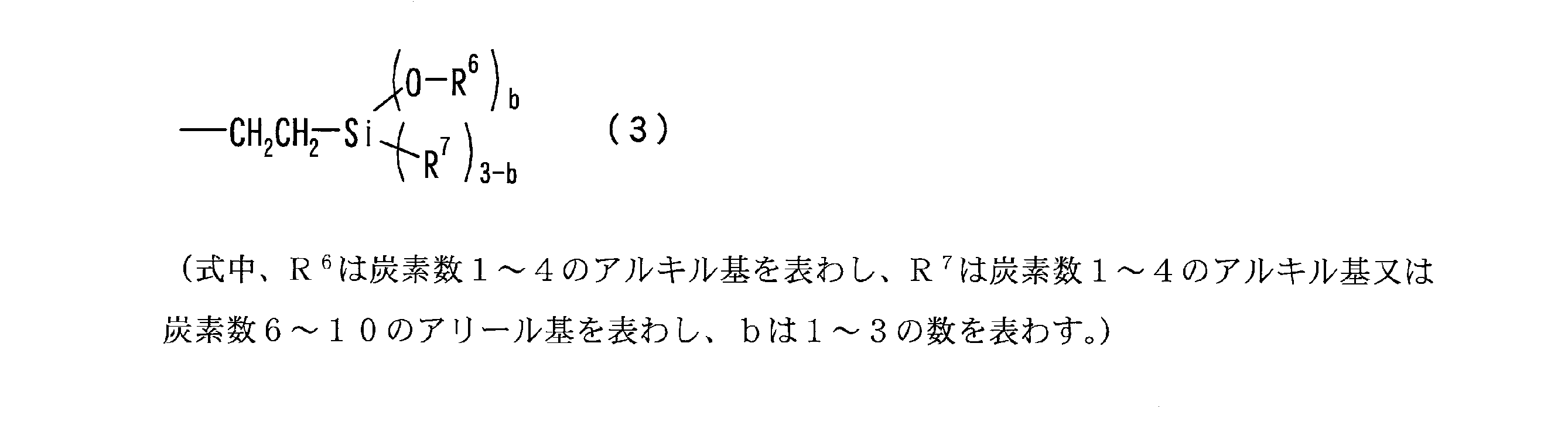
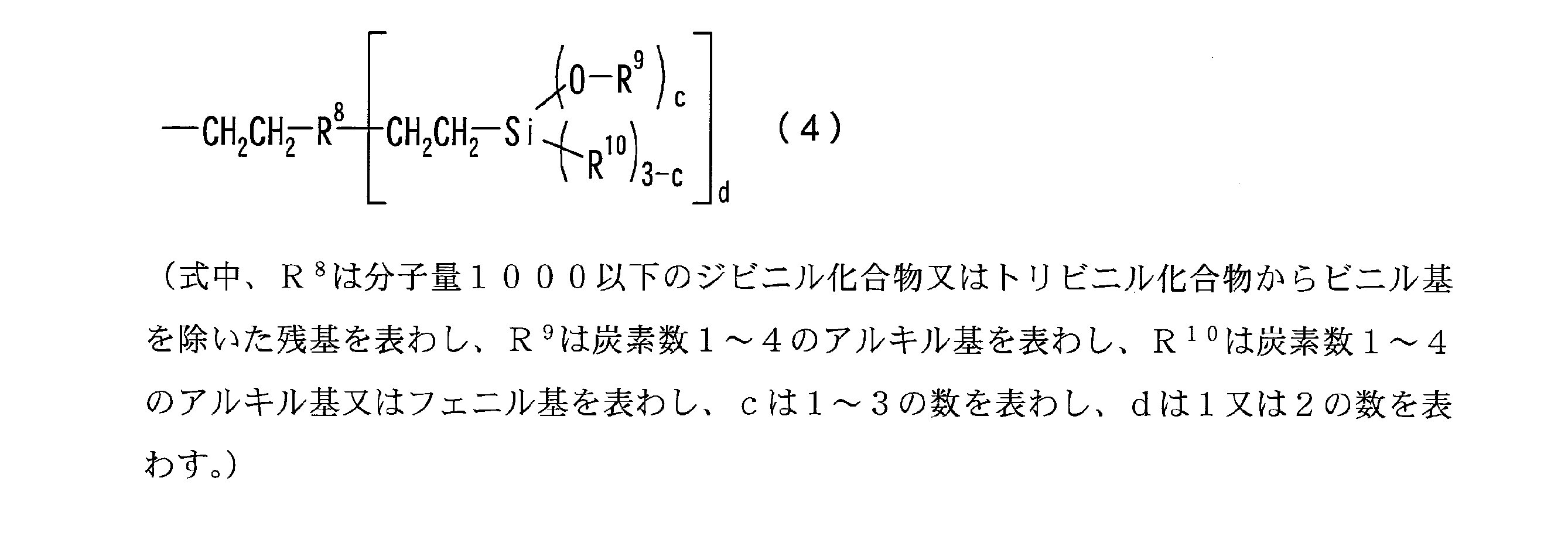

また、本発明は、上記ポジ型感光性組成物を対象材料に塗布し、プリベークした後、露光し、アルカリ現像し、次いで、ブリーチング露光した後、120~400℃の温度でポストベークすることを特徴とする永久レジストの製造方法を提供することにより、上記目的を達成したものである。
また、本発明は、上記ポジ型感光性組成物を用いて得られた永久レジストを絶縁層又は平坦化膜とするアクティブマトリクス基板を有することを特徴とする液晶表示装置及び有機EL表示装置を提供するものである。
始めに、一般式(1)で表わされる環状シロキサン化合物について説明する。なお、一般式(1)で表される環状シロキサン化合物において、複数あるR1は互いに同一でも異なってもよく、また、R2、R3及びXも、それぞれ、複数ある場合は互いに同一でも異なってもよい。
R1としては、工業的な入手の容易さから、メチル、エチル、プロピル、イソプロピル、ブチル、イソブチル、t-ブチル、フェニルが好ましく、メチル、エチル、フェニルが更に好ましく、メチルが最も好ましい。


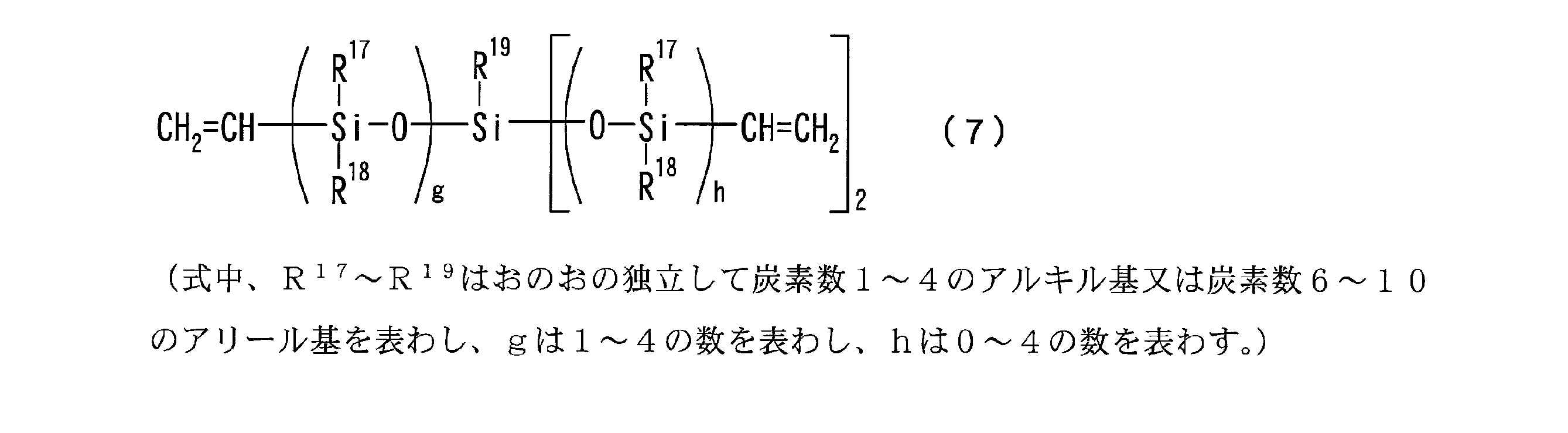


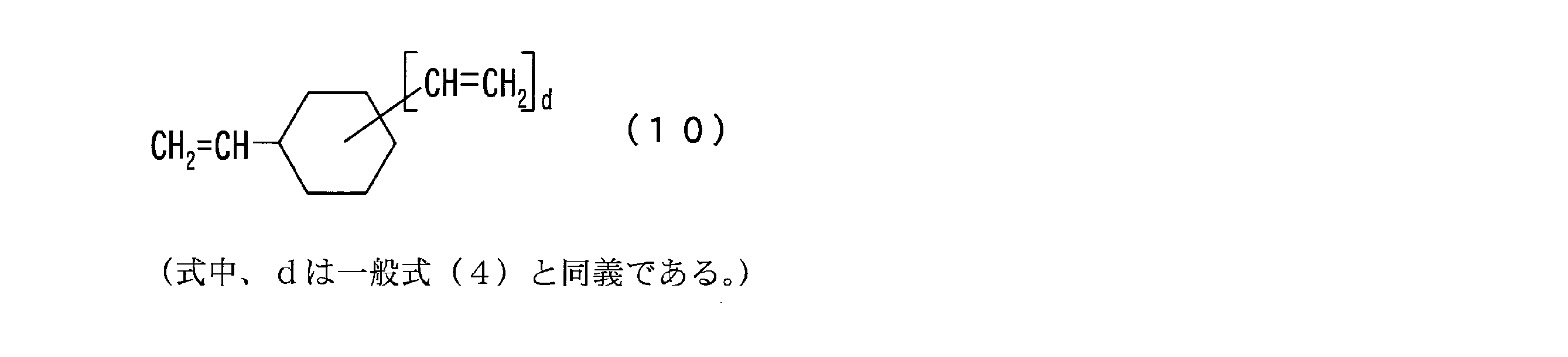

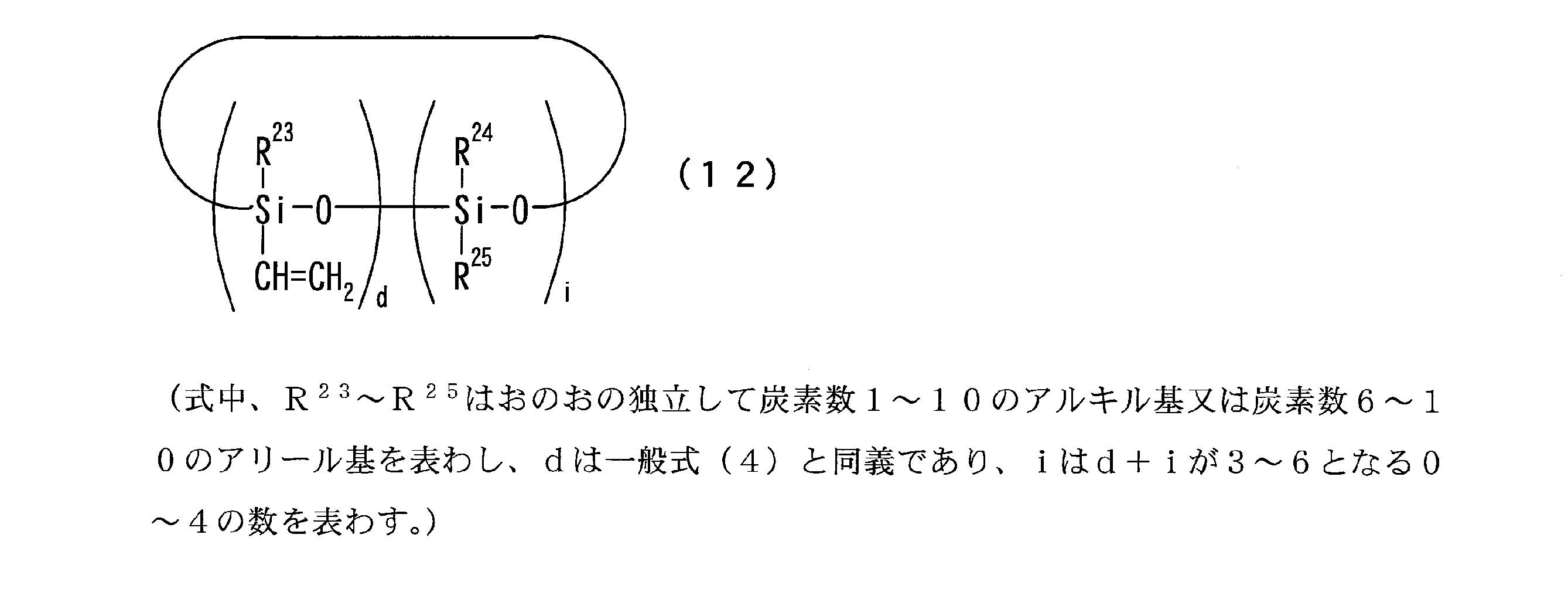
一般式(10)において、dは一般式(4)と同義である。一般式(10)で表わされる化合物としては、1,2-ジビニルシクロヘキサン、1,3-ジビニルシクロヘキサン、1,4-ジビニルシクロヘキサン、1,2,4-トリビニルシクロヘキサン、1,3,5-トリビニルシクロヘキサン等が挙げられ、工業的な入手が容易であり、耐熱性もより良好であることから、1,4-ジビニルシクロヘキサンが好ましい。


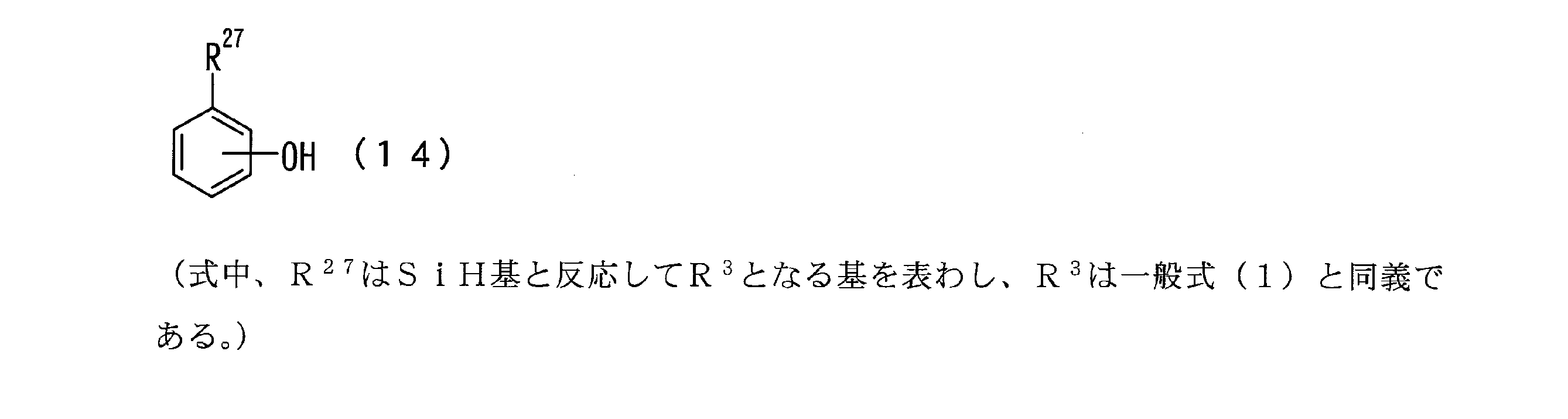


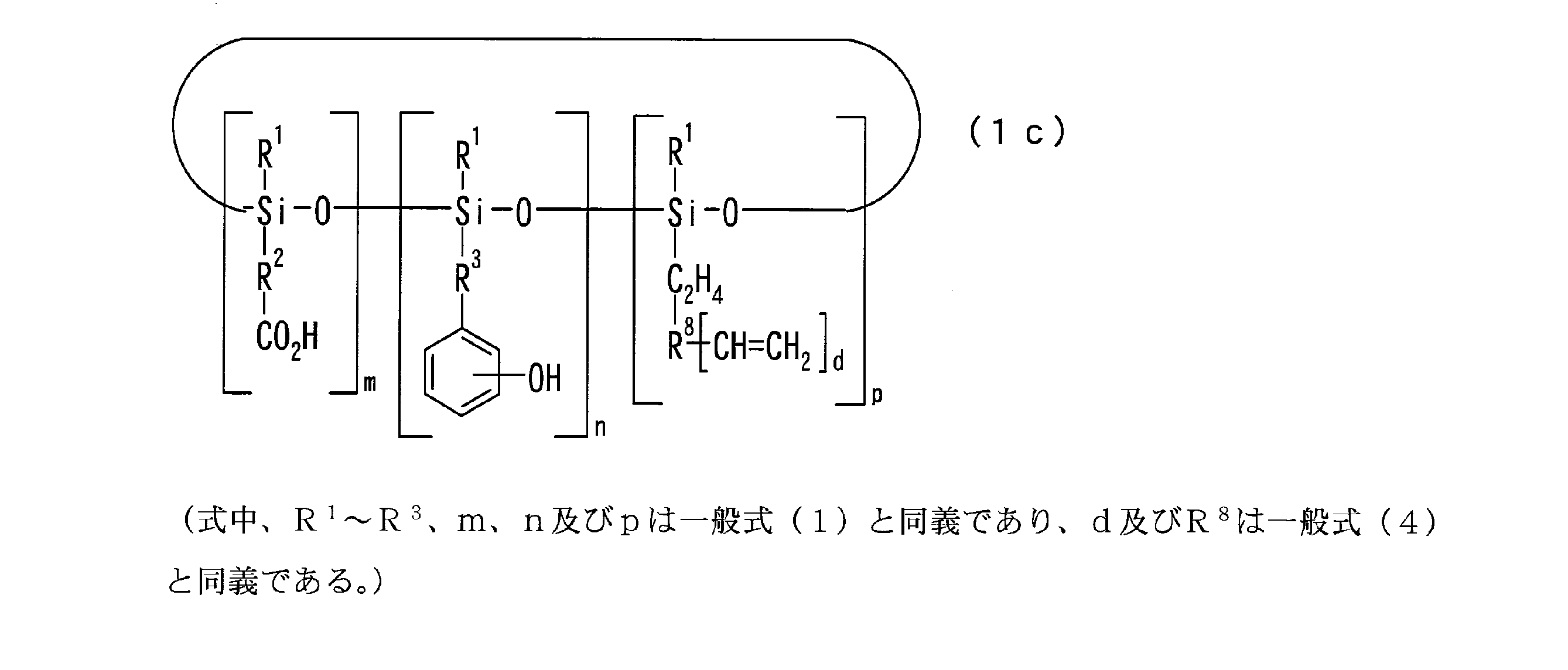


一般式(2)において、aは1~2の数を表わし、耐熱性がより向上することから、1が好ましい。R4は炭素数1~4のアルキル基又は炭素数6~10のアリール基を表わし、R5は炭素数1~4のアルキル基を表わす。炭素数1~4のアルキル基及び炭素数6~10のアリール基としては、一般式(1)のR1で例示した基が挙げられる。R4としては、耐熱性がより向上することから、メチル、エチル、フェニルが好ましく、メチル、フェニルが更に好ましく、フェニルが最も好ましい。R5としては、反応性に優れることから、メチル、エチル、プロピルが好ましく、メチルが更に好ましい。
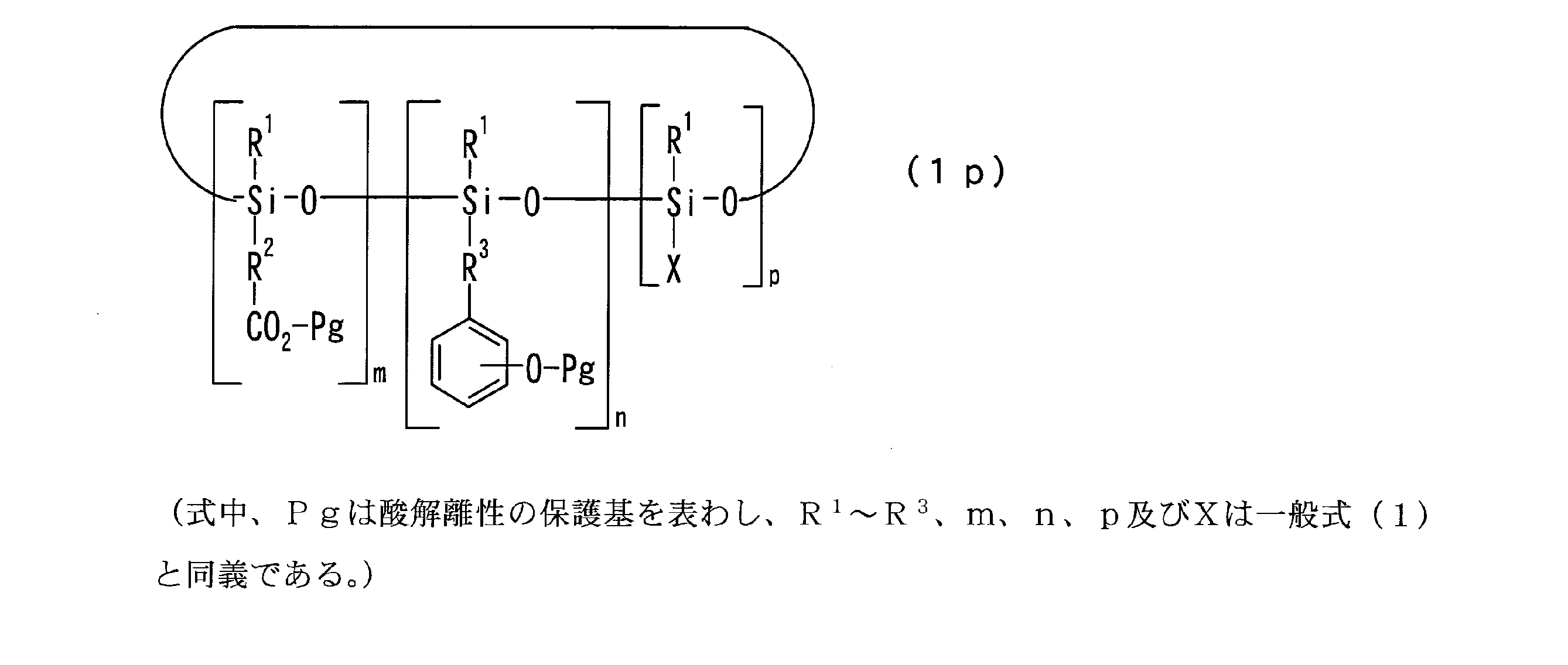

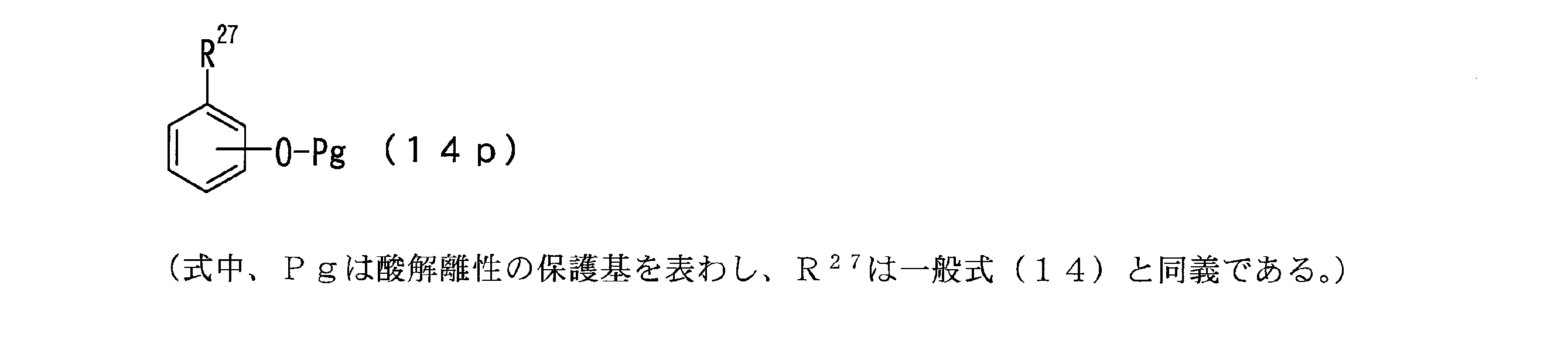

本発明に係る(B)成分であるエポキシ含有有機基を少なくとも2つ有する化合物のエポキシ基としては、下記式(15)~(16)等の脂肪族エポキシ基、下記式(17)~(19)等の脂環式エポキシ基、下記式(20)~(21)等の芳香族エポキシ基等が挙げられるが、本発明のポジ型感光性組成物の保存安定性が良好となることから脂肪族エポキシ基が好ましく、式(15)の1,2-エポキシプロピル基(グリシジル基)が更に好ましい。
(B)成分である化合物が有するエポキシ含有有機基は、これらのエポキシ基を含有するものであればよく、例えば、これらのエポキシ基そのものであってもよいし、これらのエポキシ基に、炭化水素基、エーテル基、エステル基等の連結基の1つ以上を組み合わせてなる基でもよい。中でも、(B)成分である化合物は、エポキシ含有有機基としてグリシジルエーテル基を有する化合物であることが好ましい。
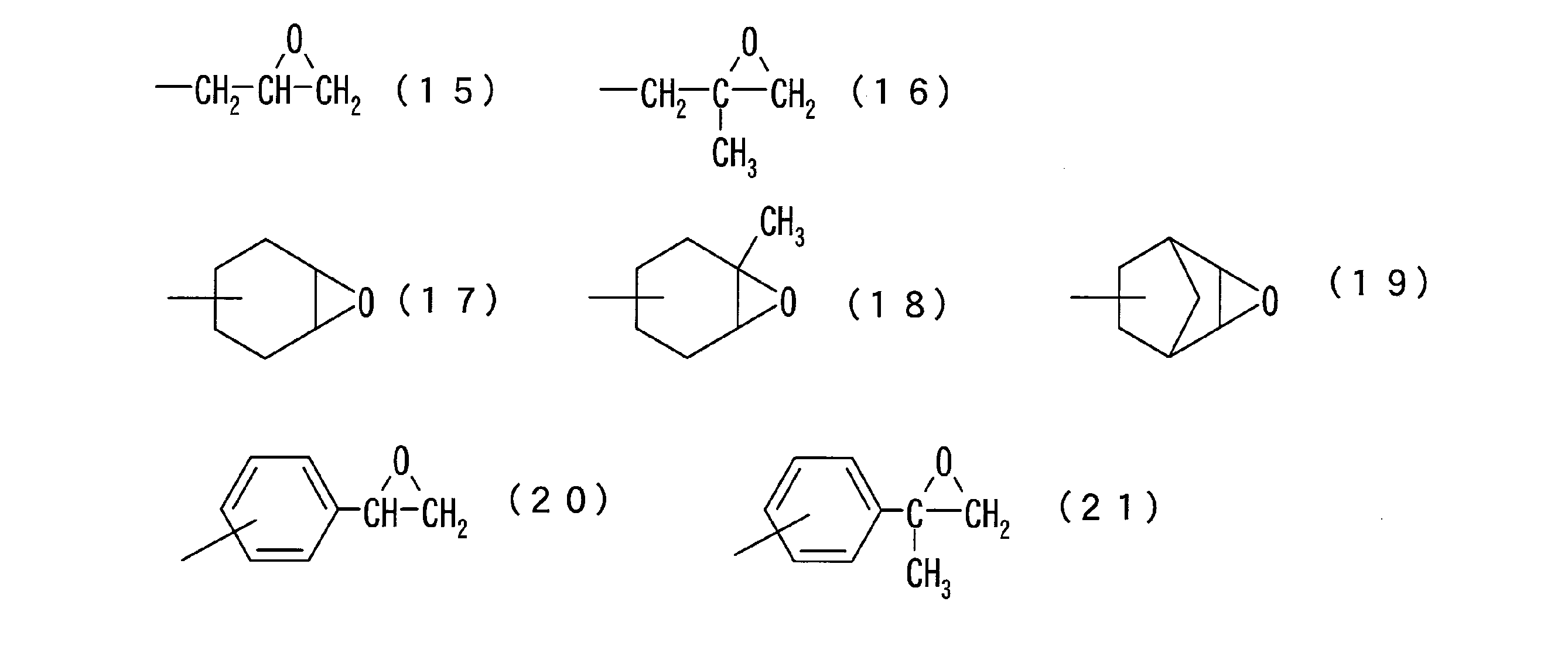
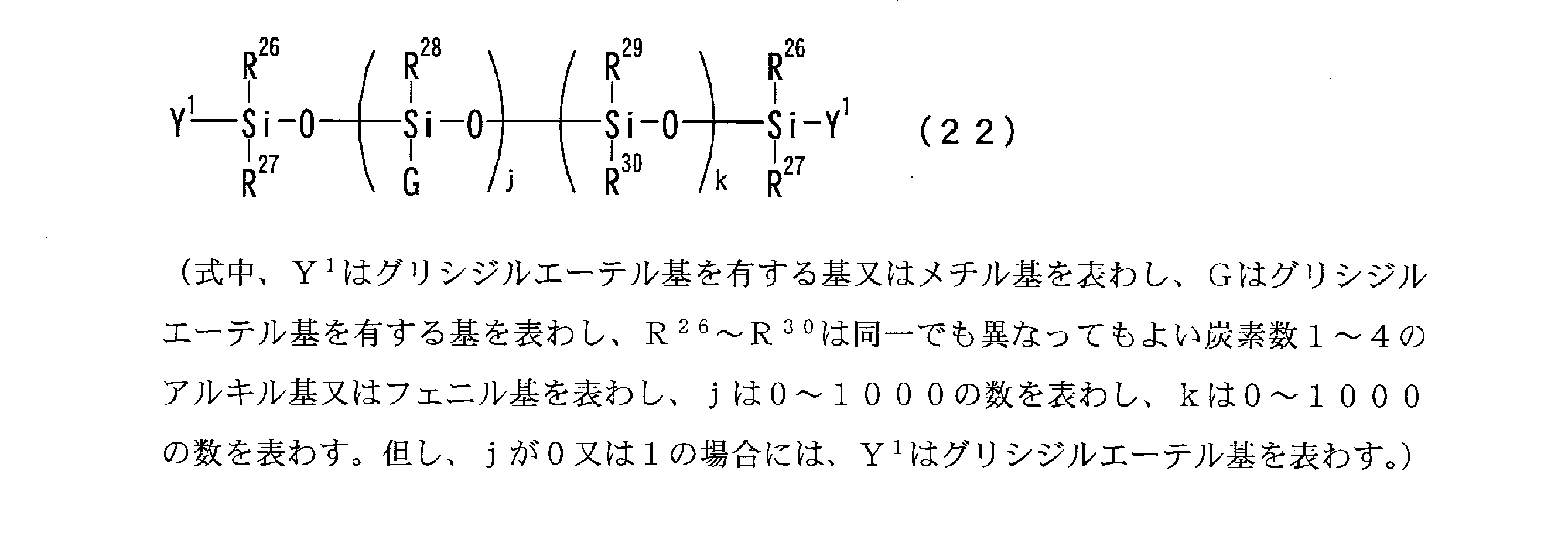
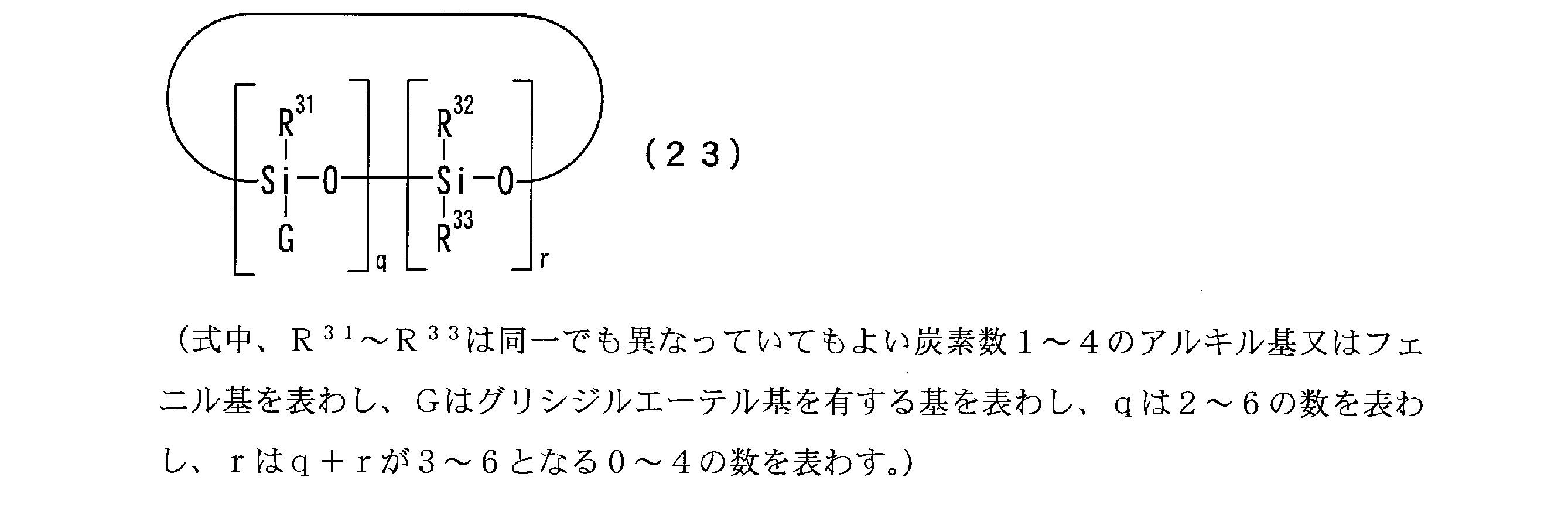

一般式(22)において、Gはグリシジルエーテル基を有する基を表わし、R26~R30は同一でも異なってもよい炭素数1~4のアルキル基又はフェニル基を表わす。炭素数1~4のアルキル基としては、一般式(1)のR1で例示したアルキル基が挙げられ、耐熱性がより良好であることから、メチル、エチル及びフェニルが好ましく、メチル及びフェニルが更に好ましく、メチルが最も好ましい。Y1はグリシジルエーテル基を有する基又はメチル基を表わし、jは0~1000の数を表わし、kは0~1000の数を表わす。但し、jが0又は1の場合には、Y1はグリシジルエーテル基を有する基を表わす。
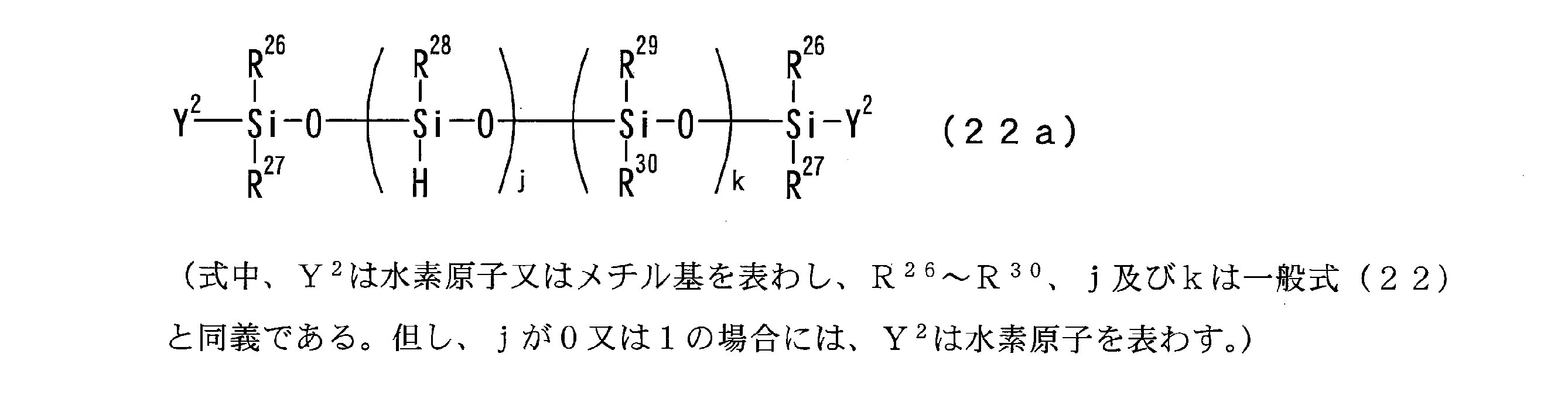
一般式(23)において、R31~R33は同一でも異なっていてもよい炭素数1~4のアルキル基又はフェニル基を表わす。炭素数1~4のアルキル基としては、R1で例示したアルキル基が挙げられる。R31~R33は、耐熱性がより良好であることから、メチル、エチル及びフェニルが好ましく、メチル及びフェニルが更に好ましく、メチルが最も好ましい。qは2~6の数を表わし、rはq+rが3~6となる0~4の数を表わす。工業的に入手が容易であることから、q+rは4~6が好ましく、4~5が更に好ましく、4が最も好ましい。また、rは、0であることが好ましい。

一般式(24)において、R34は炭素数1~4のアルキル基又はフェニル基を表わす。炭素数1~4のアルキル基としては、R1で例示したアルキル基が挙げられる。R34としては、耐熱性がより良好であることから、メチル、エチル及びフェニルが好ましく、メチル及びフェニルが更に好ましく、メチルが最も好ましい。R35は分子量1000以下のジビニル化合物又はトリビニル化合物からビニル基を除いた残基を表わし、分子量1000以下のジビニル化合物又はトリビニル化合物としては、一般式(4)で例示した分子量1000以下のジビニル化合物又はトリビニル化合物等が挙げられる。R35で表される基を提供するジビニル化合物又はトリビニル化合物としては、工業的な入手の容易さと硬化物の耐熱性から、前記一般式(9)~(11)で表わされる化合物が好ましく、1,4-ジビニルベンゼン、1,2,4-トリビニルシクロヘキサン、トリアリルイソシアヌレートが更に好ましく、1,4-ジビニルベンゼンが最も好ましい。Gはグリシジルエーテル基を有する基を表わし、sは2~5の数を表わす。sとしては、工業的な原料の入手が容易であることから2~4の数が好ましく、3が更に好ましい。tは1又は2の数を表わし、R35が分子量1000以下のジビニル化合物からビニル基を除いた残基の場合にはtは1であり、分子量1000以下のトリビニル化合物からビニル基を除いた残基の場合にはtは2である。

グリシジルエーテル基を有するアルコキシシランの加水分解・縮合反応物は、グリシジルエーテル基を有するアルコキシシランを、公知の方法、例えば、(A)成分で説明した加水分解・縮合反応で説明した方法等により加水分解・縮合反応して得られる化合物である。グリシジルエーテル基を有するアルコキシシランとしては、例えば、グリシジルトリメトキシシラン、グリシジルトリエトキシシラン等のグリシジルアルコキシシラン化合物;2-グリシドキシエチルトリメトキシシラン、2-グリシドキシエチルメチルジメトキシシラン等のグリシドキシエチルアルコキシシラン化合物;3-グリシドキシプロピルトリメトキシシラン、3-グリシドキシプロピルメチルジメトキシシラン、3-グリシドキシプロピルエチルジメトキシシラン、3-グリシドキシプロピルフェニルジメトキシシラン、ビス(3-グリシドキシプロピル)ジメトキシシラン、3-グリシドキシプロピルトリエトキシシラン、3-グリシドキシプロピルメチルジエトキシシラン、3-グリシドキシプロピルエチルジエトキシシラン、3-グリシドキシプロピルフェニルジエトキシシラン、ビス(3-グリシドキシプロピル)ジエトキシシラン等の3-グリシドキシプロピルアルコキシシラン化合物;2-(4-グリシドキシフェニル)エチルトリメトキシシラン、2-(4-グリシドキシフェニル)エチルトリエトキシシラン等の2-(4-グリシドキシフェニル)エチルアルコキシシラン化合物;5-(グリシドキシメチル)ノルボニルトリメトキシシラン、6-(グリシドキシメチル)ノルボニルトリメトキシシラン等のグリシドキシメチルノルボニルアルコキシシラン化合物等が挙げられ、加水分解・縮合反応の反応性と工業的な入手の容易さから、3-グリシドキシプロピルアルコキシシラン化合物が好ましい。3-グリシドキシプロピルアルコキシシラン化合物の中でも、3-グリシドキシプロピルトリメトキシシラン、3-グリシドキシプロピルメチルジメトキシシラン、ビス(3-グリシドキシプロピル)ジメトキシシラン、3-グリシドキシプロピルトリエトキシシランが更に好ましく、3-グリシドキシプロピルトリメトキシシラン、3-グリシドキシプロピルトリエトキシシランが更に一層好ましく、3-グリシドキシプロピルトリメトキシシランが最も好ましい。
本発明に使用することのできるジアゾナフトキノン類としては、感光性材料に使用するできることが知られているジアゾナフトキノン類化合物であれば、特に限定されないが、中でも、フェノール性水酸基を有する化合物の水素原子が下記式(25)で置換された化合物(4-ジアゾナフトキノンスルホン酸エステル)又は下記式(26)で置換された化合物(5-ジアゾナフトキノンスルホン酸エステル)が好ましい。

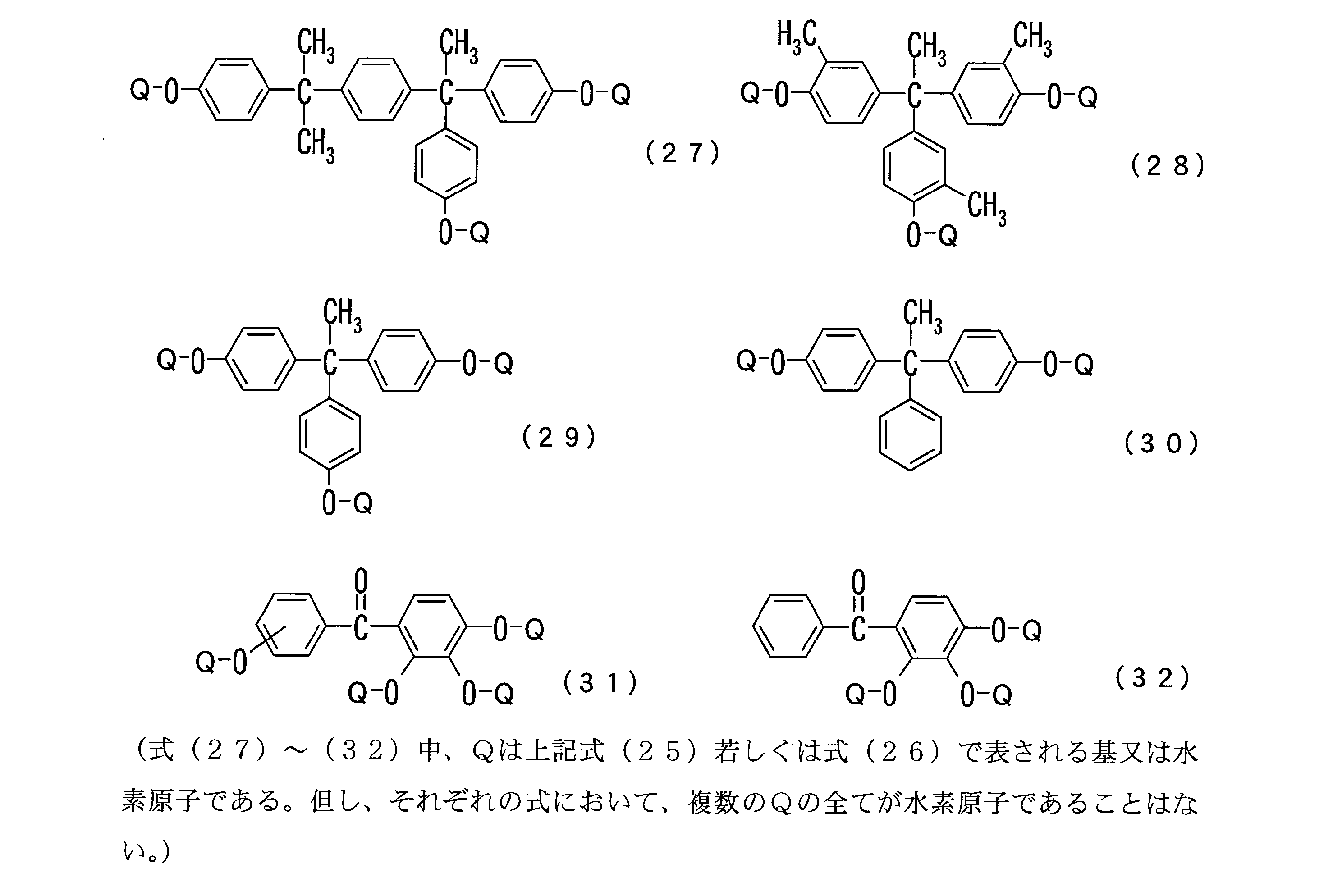
本発明に使用できる(D)有機溶剤は、上記(A)シラノール基含有ポリシロキサン化合物、(B)エポキシ含有有機基を少なくとも2つ有する化合物、及び(C)ジアゾナフトキノン類を溶解又は分散することのできる有機溶剤であれば、特に限定されないが、25℃において水を1質量%以上溶解することができる有機溶剤が好ましく、このような有機溶剤としては、保護基の脱離で挙げた有機溶剤の他に、γ-ブチロラクトン、γ-バレロラクトン、δ-バレロラクトン、エチレンカーボネート、プロピレンカーボネート、ジメチルカーボネート等が挙げられる。
まず、直接塗布する方法について説明する。この方法は、以下の(1)塗膜形成工程、(2)プリベーク工程、(3)露光工程、(4)現像工程、(5)ブリーチング露光工程、(6)ポストベーク工程を含む。
本工程においては、本発明のポジ型感光性組成物を対象材料(基材)に塗布して塗膜を形成する。本発明のポジ型感光性組成物を適用し、塗膜を形成する対象材料は、ポジ型感光性組成物中の有機溶剤等に対する耐薬品性、(4)現像工程のアルカリ性溶液による現像処理や(6)ポストベーク工程における加熱処理に対する耐性等を有する材料であれば特に限定されるものではなく、ガラス、金属、半導体等を対象材料とすることができる。特に、絶縁層としての永久レジストを必要とする液晶ディスプレーのTFT表面等を好ましいものとして例示することができる。塗布の方法は、特に限定されず、例えばスピンコート法、ディップコート法、ナイフコート法、ロールコート法、スプレーコート法、スリットコート法等の各種の方法を利用することができる。
上記(1)の工程の後、対象材料に塗布されたポジ型感光性組成物層から(D)有機溶剤を除去するためにプリベークを行なう。プリベークされたポジ型感光性組成物層は、アルカリ性溶液に対し難溶性であり、次の露光工程で光を照射することにより光が照射された部分(以下、露光部分という場合がある)がアルカリ可溶性となる。プリベークの温度は、使用した有機溶剤の種類によっても異なるが、温度が低すぎると、有機溶剤の残留分が多くなり、露光感度や解像度の低下の原因となる場合があり、また温度が高すぎると、プリベークにより塗膜の全体の硬化が進行し、光が照射された部分のアルカリ現像液に対する溶解性が低下し、結果として露光感度や解像度が低下する場合があることから、60~140℃が好ましく、70~120℃が更に好ましい。プリベークの時間は、使用した有機溶剤の種類とプリベークの温度により異なるが、30秒~10分が好ましく、1~5分が更に好ましい。
露光工程は、プリベークされたポジ型感光性組成物層に対して、パターン化された光を照射し、露光部分のアルカリ溶解性を向上させる工程である。プリベークされたポジ型感光性組成物層は、アルカリ性溶液に対し難溶性であるが、光照射により露光部分のジアゾナフトキノン類が分解されて、インデンカルボン酸に変化して、アルカリ性溶液に溶解・分散が可能になる。照射光は、特に限定されず、プリベークされたポジ型感光性組成物層の光照射部のアルカリ溶解性を向上させることのできるエネルギー量の光であればよく、例えば10~1000mJ/cm2、好ましくは40~300mJ/cm2がよい。また照射光の波長は可視光でも紫外光でも良く特に限定されないが、(C)ジアゾナフトキノン類として、4-ジアゾナフトキノンスルホン酸エステル類を使用した場合にはi線(365nm)を主体とする狭い波長の光を、5-ジアゾナフトキノンスルホン酸エステル類を使用した場合には、i線(365nm)、h線(405nm)及びg線(436nm)を含むブロードな波長の光を、高圧水銀灯、超高圧水銀灯等を用いて照射すればよい。上記照射光のパターン化の方法は、特に限定されず、従来知られている方法、例えば、フォトマスク等を介した光照射方法であってもよく、レーザー光を用いた選択的な光照射方法でもよい。
現像工程は、露光工程で、光が照射されてアルカリ溶解性が向上した部分を現像液を用いて除去することにより、所定のパターンを形成する工程である。
現像方法としては、例えば、液盛り法、浸漬法、シャワー法、スプレー法等のいずれの方法も利用することができる。現像時間は、(A)シラノール基含有ポリシロキサン化合物や(B)エポキシ含有有機基を少なくとも2つ有する化合物の種類や分子量、現像液の温度等によって異なるが、通常30~180秒間である。現像工程で用いられる現像液は、露光部分を液中に溶解又は分散して除去できるものであれば特に限定されず、例えば、水酸化ナトリウム、水酸化カリウム、炭酸ナトリウム、炭酸カリウム、ケイ酸ナトリウム、アンモニア等の無機アルカリ類;エチルアミン、n-プロピルアミン等の1級アミン類;ジエチルアミン、ジ-n-プロピルアミン等の2級アミン類;トリメチルアミン、メチルジエチルアミン、ジメチルエチルアミン、トリエチルアミン等の3級アミン類;ジメチルエタノールアミン、メチルジエタノールアミン、トリエタノールアミン等の3級アルカノールアミン類;ピロール、ピペリジン、N-メチルピペリジン、N-メチルピロリジン、1、8-ジアザビシクロ[5.4.0]-7-ウンデセン、1、5-ジアザビシクロ[4.3.0]-5-ノネン等の環状3級アミン類;ピリジン、コリジン、ルチジン、キノリン等の芳香族3級アミン類;テトラメチルアンモニウムヒドロキシド、テトラエチルアンモニウムヒドロキシド等の4級アンモニウム塩の水溶液等のアルカリ類の水溶液を用いることができ、その濃度は、従来のポジ型感光性組成物層の除去に用いられている現像液のアルカリ濃度でよい。これらアルカリ類の水溶液は、更に、メタノール、エタノール等の水溶性有機溶媒及び/又は界面活性剤を適当量含有してもよい。露光部分を現像液で除去した後、流水又はシャワーにより水でリンスすることが好ましく、必要により50~120℃の範囲で、脱水乾燥させてもよい。
ブリーチング露光工程は、アルカリ溶液処理にて残存したポジ型感光性組成物層(以下、レジスト層という場合がある)の全体に光を照射して可視光透過性を向上させる工程である。レジスト層は、(C)ジアゾナフトキノン類を含有していることから、淡黄色乃至淡褐色に着色している。レジスト層に光を照射することにより、残存する未反応の(C)ジアゾナフトキノン類が光分解して、可視光領域で吸収のないインデンカルボン酸に変化して可視光透過性が向上し、液晶表示装置、有機EL表示装置等に用いられるアクティブマトリクス基板用の永久レジストとして用いる場合に都合が良い。ブリーチング露光工程における照射光は、特に限定されず、例えば10~1000mJ/cm2、好ましくは40~600mJ/cm2の光を照射すればよい。また照射光の波長は、可視光でも紫外光でも良く、特に限定されないが、(2)露光工程と同様に、使用した(C)ジアゾナフトキノン類に応じて、照射光の波長を選択することが好ましい。
ブリーチング露光されたレジスト層は可視光透過性が向上するが、アルカリ溶解性も向上する。ポストベーク工程は、このようなブリーチング露光されたレジスト層に対して、120℃以上の熱処理を行い、レジスト層中のシリコーン樹脂を熱架橋させ、永久レジストとして要求される耐熱性、耐薬品性、耐経時変化性を付与するものである。本発明では、ポジ型感光性組成物の(B)成分であるエポキシ基を少なくとも2つ有する化合物が架橋剤として機能し、これまでにない高熱履歴後の耐薬品性が得られるものと考えられる。ポストベークは、好ましくは、窒素、ヘリウム、アルゴン等の不活性ガス雰囲気下で行われる。また、ポストベークは、好ましくは120~400℃、さらに好ましくは120~350℃、最も好ましくは200~350℃での温度で、15分~2時間行うことが好ましい。
なお、シラノール基の含量は、試料をピリジン溶液中でトリメチルクロロシランと反応させてシラノール基をトリメチルシリルエーテル基に変えた後、テトラメチルアンモニウムヒドロキシド((CH3)4NOH)水溶液で処理してC-O-Si結合を加水分解し、反応後の質量増加率から逆算して求めた。
温度計、攪拌装置を備えたガラス製反応容器に、溶剤としてトルエン300g、2,4,6,8-テトラメチルシクロテトラシロキサン240g(1モル)、アクリル酸-t-ブチルエステル64.1g(0.5モル)、4-t-ブトキシスチレン352g(2モル)及び触媒として白金-ジビニルテトラメチルジシロキサン錯体(Karstedt触媒)0.05gを加えて、攪拌しながら60℃で10時間反応させて、溶媒を留去し中間体a1を得た。中間体a1は、一般式(1bp)に相当する化合物である(R1=メチル、R2=R3=エチレン、Pg=t-ブチル、m=0.5、n=2、p=1.5、m:n:p=1:4:3)。
製造例1において、アクリル酸-t-ブチルエステル64.1g(0.5モル)の代わりに、4-ビニル安息香酸-t-ブチルエステル102g(0.5モル)を使用した以外は製造例1と同様の操作を行い中間体a2を得た。中間体a2は、一般式(1bp)に相当する化合物である(R1=メチル、R2=2-フェニルエタン-1,4’-ジイル、R3=エチレン、Pg=t-ブチル、m=0.5、n=2、p=1.5、m:n:p=1:4:3)。
製造例1において、アクリル酸-t-ブチルエステルの使用量を64.1g(0.5モル)から38.4g(0.3モル)、4-t-ブトキシスチレンの使用量を352g(2モル)から387g(2.2モル)に変更した以外は製造例1と同様の操作を行い中間体a3を得た。中間体a3は、一般式(1bp)に相当する化合物である(R1=メチル、R2=R3=エチレン、Pg=t-ブチル、m=0.3、n=2.2、p=1.5、m:n:p=1:7.3:5)。
製造例1において、アクリル酸-t-ブチルエステル64.1g(0.5モル)の代わりに4-ビニル安息香酸-t-ブチルエステル204g(1モル)を使用し、4-t-ブトキシスチレンの使用量を352g(2モル)から264g(1.5モル)に変更した以外は製造例1と同様の操作を行い、中間体a’1を得た。なお、中間体a’1は、R1=メチル、R2=2-フェニルエタン-1,4’-ジイル、R3=エチレン、Pg=t-ブチル、m=1、n=1.5、p=1.5であるが、m:n:p=1:1.5:1.5である点で、一般式(1bp)を満たさないものである。
製造例1において、アクリル酸-t-ブチルエステルの使用量を64.1g(0.5モル)から19.2g(0.15モル)に、4-t-ブトキシスチレンの使用量を352g(2モル)から414g(2.35モル)に変更した以外は製造例1と同様の操作を行い、中間体a’2を得た。なお、中間体a’2は、R1=メチル、R2=R3=エチレン、Pg=t-ブチル、m=0.15、n=2.35、p=1.5であるが、m:n:p=1:15.7:10である点で、一般式(1bp)を満たさないものである。
温度計、攪拌装置を備えたガラス製反応容器に、溶剤としてトルエン200g、中間体a1の65.6g(0.1モル)、トリメトキシビニルシラン22.1g(0.15モル)、及び触媒として白金-ジビニルテトラメチルジシロキサン錯体(Karstedt触媒)0.001gを加えて、攪拌しながら60℃で10時間反応させて、一般式(3)で表される基を導入した。
次いで、一般式(2)で表される化合物としてフェニルトリメトキシシラン45.6g(0.23モル)を添加し、5~10℃になるよう氷冷撹拌しながら、5%シュウ酸水溶液50gを30分かけて滴下し、更に10℃で15時間撹拌した。50℃、減圧下で還流脱水・脱アルコール処理し、50℃減圧下で溶媒のトルエンを1-メトキシ-2-プロパノールアセテート(以下PGMEAという)へと溶媒交換を行い、25%のPGMEA溶液とした。
t-ブチル基を脱離するために、三フッ化ホウ素ジエチルエーテル錯体3gを加えて、80℃で3時間攪拌の後、酸性物質の吸着剤(協和化学工業製、商品名:キョーワード500SH)を10g加えた後に80℃で1時間攪拌したスラリー溶液について、濾過により固形物を除去した。この後、80℃で溶剤の一部を留去して濃度を調整し、(A)成分であるポリシロキサン化合物A1の30%PGMEA溶液を得た。ポリシロキサン化合物A1のGPC分析による質量平均分子量は6400、シラノール基含量は5.4質量%であった。
製造例6において、中間体a1の65.6g(0.1モル)の代わりに、中間体a2の69.4g(0.1モル)を使用した以外は製造例6と同様の操作を行い、(A)成分であるポリシロキサン化合物A2の30%PGMEA溶液を得た。ポリシロキサン化合物A2のGPC分析による質量平均分子量は6500、シラノール基含量は5.4質量%であった。
製造例6において、中間体a1の65.6g(0.1モル)の代わりに、中間体a3の65.4g(0.1モル)を使用した以外は製造例6と同様の操作を行い、(A)成分であるポリシロキサン化合物A3の30%PGMEA溶液を得た。ポリシロキサン化合物A3のGPC分析による質量平均分子量は6300、シラノール基含量は5.4質量%であった。
温度計、攪拌装置を備えたガラス製反応容器に、溶剤としてトルエン200g、中間体a1の65.6g(0.1モル)、一般式(4a)で表されるジビニル化合物としてジビニルベンゼン39g(0.3モル)、及び触媒として白金-ジビニルテトラメチルジシロキサン錯体(Karstedt触媒)0.001gを加えて、攪拌しながら60℃で10時間反応させて、一般式(1c)で表される中間体を得た。溶媒を留去して、溶媒とともに未反応のジビニルベンゼンを60℃で減圧除去した後、改めて溶剤としてトルエン200g、及び一般式(4b)で表される化合物としてトリメトキシシラン19.5g(0.16モル)を添加し、攪拌しながら60℃で10時間反応させて、一般式(4)で表される基を導入した。
次いで、一般式(2)で表される化合物としてフェニルトリメトキシシラン45.5g(0.23モル)を添加し、5~10℃になるよう氷冷撹拌しながら、5%シュウ酸水溶液50gを30分かけて滴下し、更に10℃で15時間撹拌した。50℃、減圧下で還流脱水・脱アルコール処理し、50℃減圧下で溶媒のトルエンを1-メトキシ-2-プロパノールアセテート(以下PGMEAという)へと溶媒交換を行い、25%のPGMEA溶液とした。
t-ブチル基を脱離するために、三フッ化ホウ素ジエチルエーテル錯体3gを加えて、80℃で3時間攪拌の後、酸性物質の吸着剤(協和化学工業製、商品名:キョーワード500SH)を10g加えた後に80℃で1時間攪拌したスラリー溶液について、濾過により固形物を除去した。この後、80℃で溶剤の一部を留去して濃度を調整し、(A)成分であるポリシロキサン化合物A4の30%PGMEA溶液を得た。ポリシロキサン化合物A4のGPC分析による質量平均分子量は8300、シラノール基含量は6.2質量%であった。
温度計、攪拌装置を備えたガラス製反応容器に、溶剤としてジオキサン200g、中間体a1の65.6g(0.1モル)、ジフェニルシランジオール43.2g(0.2モル)、触媒としてオクチル酸スズ0.025gを加えて溶解した後、60℃で10時間反応させて、一般式(5)で表される基を導入した。
一般式(2)で表される化合物としてフェニルトリメトキシシラン45.5g(0.23モル)を添加し、5~10℃になるよう氷冷撹拌しながら、5%シュウ酸水溶液50gを30分かけて滴下し、更に10℃で15時間撹拌した。50℃、減圧下で還流脱水・脱アルコール処理し、50℃減圧下で溶媒のジオキサンを1-メトキシ-2-プロパノールアセテート(以下PGMEAという)へと溶媒交換を行い、25%のPGMEA溶液とした。
t-ブチル基を脱離するために、三フッ化ホウ素ジエチルエーテル錯体3gを加えて、80℃で3時間攪拌の後、酸性物質の吸着剤(協和化学工業製、商品名:キョーワード500SH)を10g加えた後に80℃で1時間攪拌したスラリー溶液について、濾過により固形物を除去した。この後、80℃で溶剤の一部を留去して濃度を調整し、(A)成分であるポリシロキサン化合物A5の30%PGMEA溶液を得た。ポリシロキサン化合物A5のGPC分析による質量平均分子量は5900、シラノール基含量は5.1質量%であった。
製造例6において、中間体a1の65.6g(0.1モル)の代わりに、中間体a’1の70.8g(0.1モル)を使用した以外は製造例6と同様の操作を行い比較のポリシロキサン化合物A’1の30%PGMEA溶液を得た。ポリシロキサン化合物A’1のGPC分析による質量平均分子量は6500、シラノール基含量は5.4質量%であった。
製造例6において、中間体a1の65.6g(0.1モル)の代わりに、中間体a’2の67.3g(0.1モル)を使用した以外は製造例6と同様の操作を行い比較のポリシロキサン化合物A’2の30%PGMEA溶液を得た。ポリシロキサン化合物A’2のGPC分析による質量平均分子量は6400、シラノール基含量は5.4質量%であった。
温度計、攪拌装置を備えたガラス製反応容器に、溶剤としてトルエン200g、2,4,6,8-テトラメチルシクロテトラシロキサン120g(0.5モル)、アリルグリシジルエーテル228g(2モル)、及び白金-ジビニルテトラメチルジシロキサン錯体(Karstedt触媒)9mgを加えて、攪拌しながら50~60℃で15時間反応させた後、溶媒を60℃で減圧留去させ、(B)成分であるエポキシ化合物B1を得た。エポキシ化合物B1のエポキシ当量の分析値は174であった。
温度計、攪拌装置を備えたガラス製反応容器に、溶剤としてトルエン250g、2,4,6,8-テトラメチルシクロテトラシロキサン144g(0.6モル)、ジビニルベンゼン52g(0.4モル)、アリルグリシジルエーテル194g(1.7モル)、及び白金-ジビニルテトラメチルジシロキサン錯体(Karstedt触媒)9mgを加えて、攪拌しながら50~60℃で15時間反応させた後、溶媒を60℃で減圧留去させ、(B)成分であるエポキシ化合物B2を得た。エポキシ化合物B2の質量平均分子量は1500、エポキシ当量の分析値は244であった。
温度計、攪拌装置を備えたガラス製反応容器に、トルエン200g、1,1,3,3-テトラメチルジシロキサン134g(1モル)、ジビニルベンゼン52g(0.4モル)、アリルグリシジルエーテル194g(1.7モル)、及び白金-ジビニルテトラメチルジシロキサン錯体(Karstedt触媒)9mgを加えて、攪拌しながら50~60℃で15時間反応させた。この反応液から溶媒を60℃で減圧留去させ、(B)成分であるエポキシシラン化合物B3を得た。エポキシ化合物B3の質量平均分子量は1500、エポキシ当量の分析値は244であった。
以上の製造例で得られた化合物を用い、表1に示す割合で配合後、ろ過して、実施例1~10及び比較例1~4のポジ型感光性組成物をそれぞれ調製した。なお、溶剤は、表中の値になるように追加した。
(C)ジアゾナフトキノン類(DNQ)
上記式(27)において全てのQが式(26)で表わされる基である化合物(ダイトーケミックス社製、商品名:PA-6)
(D)溶剤
PGMEA:1-メトキシ-2-プロパノールアセテート
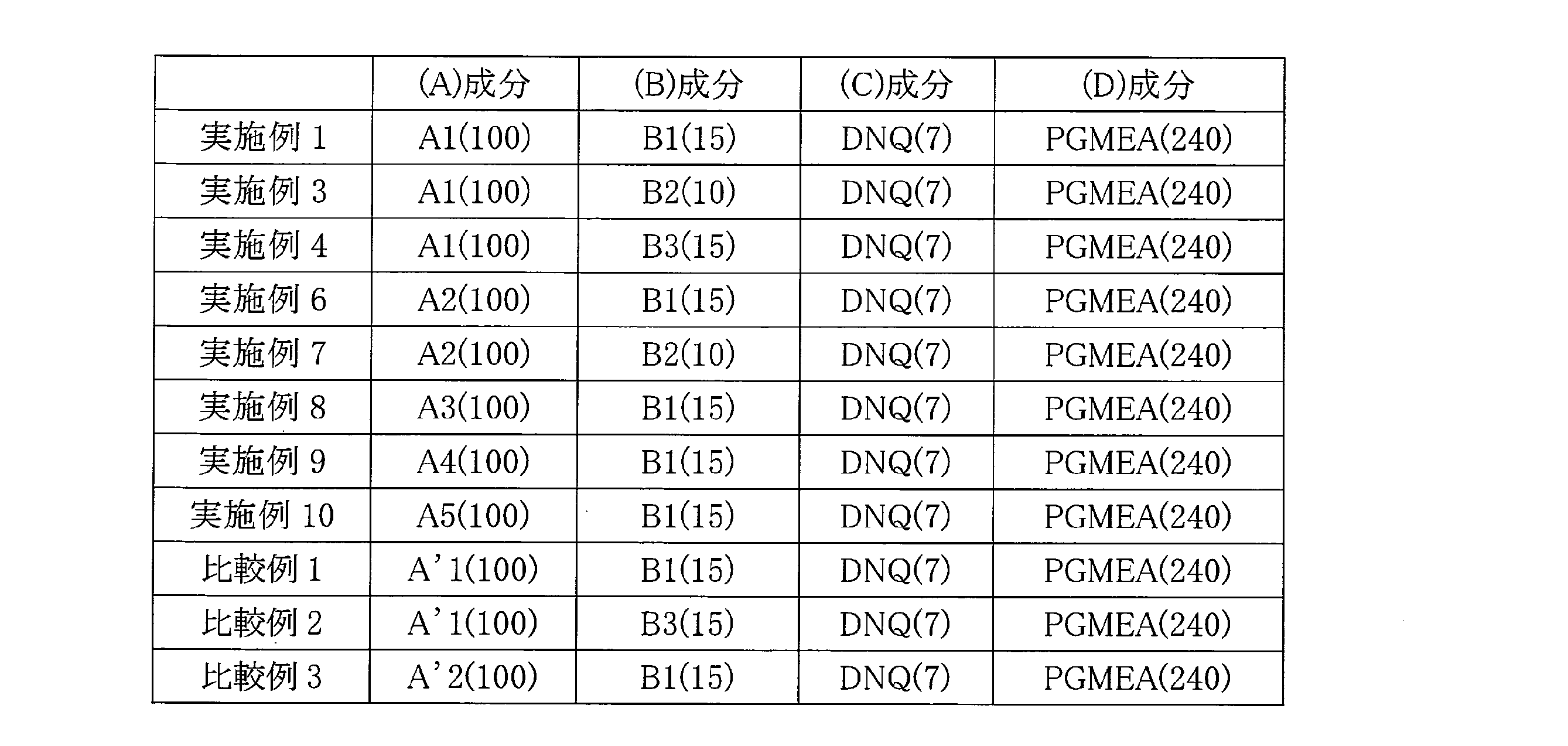
〔試験片の調製法〕
ポジ型感光性組成物を、ガラス基板上に、スピンコート法により塗膜の膜厚が3~4μmになるよう塗布した後、溶剤を揮発させ、100℃で3分間プリベークして、試験片として用いた。
現像時間を30秒から、5秒おきに変えて、最適現像時間及び現像マージンの評価を以下の手順で評価した。即ち、各ポジ型感光性組成物について、各15枚の試験片を準備し、パターニング露光した後、これらの試験片を液温25℃の2.38質量%テトラメチルアンモニウムヒドロキシド水溶液に浸漬し、浸漬を開始して30秒後から、5秒おきに1枚ずつ取り出した。取り出した試験片は、直ちに超純水により1分間流水洗浄を行い、風乾した。風乾した試験片を観察し、ライン線幅が5μmになるのに必要な最短の現像時間を最適現像時間とし、最適現像時間から5μmのライン・パターンが剥がれるまでの時間を現像マージンとした。結果を表2に示す。
ポジ型感光性組成物の試験片について、パターニング露光した後、液温25℃の2.38質量%テトラメチルアンモニウムヒドロキシド水溶液を用いてシャワー現像法(シャワー圧0.05MPa)により現像した。なお、現像時間は先の評価で求めた各ポジ型感光性組成物の最適現像時間とした。現像後、直ちに超純水により1分間流水洗浄を行い、風乾した。風乾した試験片に対し、超高圧水銀灯を用いて200mJ/cm2(波長365nm露光換算)の条件でブリーチング露光を行った。ブリーチング露光後、大気雰囲気下230℃で60分間の加熱によりポストベークを行い永久レジスト膜を形成し、更に、窒素雰囲気下350℃で30分間の加熱処理を行った。350℃の加熱処理を行なった試験片について、波長400nmの光の透過率の測定、及び触針式表面形状測定器を用いてレジストの膜厚の測定を行った後、40℃のアルカリ溶液(モノエタノールアミン:N-メチル-2-ピロリドン:ブチルジグリコール=10:30:60質量比)に30分浸漬した。浸漬後の各試験片について、波長400nmの光の透過率及びレジストの膜厚を測定し、アルカリ溶液に浸漬する前後の光透過率の変化率と膜厚の変化率から、下記の評価基準にて高熱履歴後の耐アルカリ性を評価した。結果を表2に示す。
○:光透過率の変化率が3%未満及び膜厚の変化率が10%未満であり、高熱履歴後でも耐アルカリ性に優れる。
△:光透過率の変化率が5%未満及び膜厚の変化率が20%未満であるが、光透過率の変化率が3%未満及び膜厚の変化率が10%未満ではなく、高熱履歴後の耐アルカリ性にやや劣る。
×:光透過率の変化率が5%以上又は膜厚の変化率が10%以上であり、高熱履歴後の耐アルカリ性に劣る。
各ポジ型感光性組成物について、各3枚の試験片を用い、パターニング露光した後、液温25℃の2.38質量%テトラメチルアンモニウムヒドロキシド水溶液を用いてシャワー現像法(シャワー圧0.05MPa)により現像した。なお、現像時間は先の評価で求めた各ポジ型感光性組成物の最適現像時間とした。
現像後、直ちに超純水により1分間流水洗浄を行い、風乾した。風乾した試験片に、ブリーチング露光として、超高圧水銀灯により200mJ/cm2(波長365nm露光換算)の光を照射した後、大気雰囲気下230℃で60分間のポストベークを行い、永久レジスト膜を形成させた。各試験片を切断し、走査型電子顕微鏡用いて切断面を観察し、現像によりガラス基板が露出した部分におけるレジスト残渣の有無を調べ、下記の評価基準にてレジスト残渣を評価した。結果を表2に示す
(評価基準)
○:3枚の試験片すべてにレジスト残渣が見られない。
×:3枚の試験片のうち、1~3枚にレジスト残渣が見られる。
各ポジ型感光性組成物について、各3枚の試験片について、パターニング露光及び現像をすることなく、レジスト残渣の評価と同条件で、ブリーチング露光、ポストベークを行い、永久レジスト層を形成させた。各試験片を切断し、走査型電子顕微鏡用いて永久レジスト層の厚さを測定した。また、レジスト残渣の評価で使用した試験片についても永久レジスト膜の厚さを測定し、以下の式により膜減り率(%)を求めた。なお、永久レジスト層の厚さは各3枚の試験片の平均値を用いた。結果を表2に示す
膜減り率(%)=100×TD/T0
TD:露光及び現像を行った試験片の永久レジスト層の厚さ
T0:露光及び現像を行わなかった試験片の永久レジスト層の厚さ
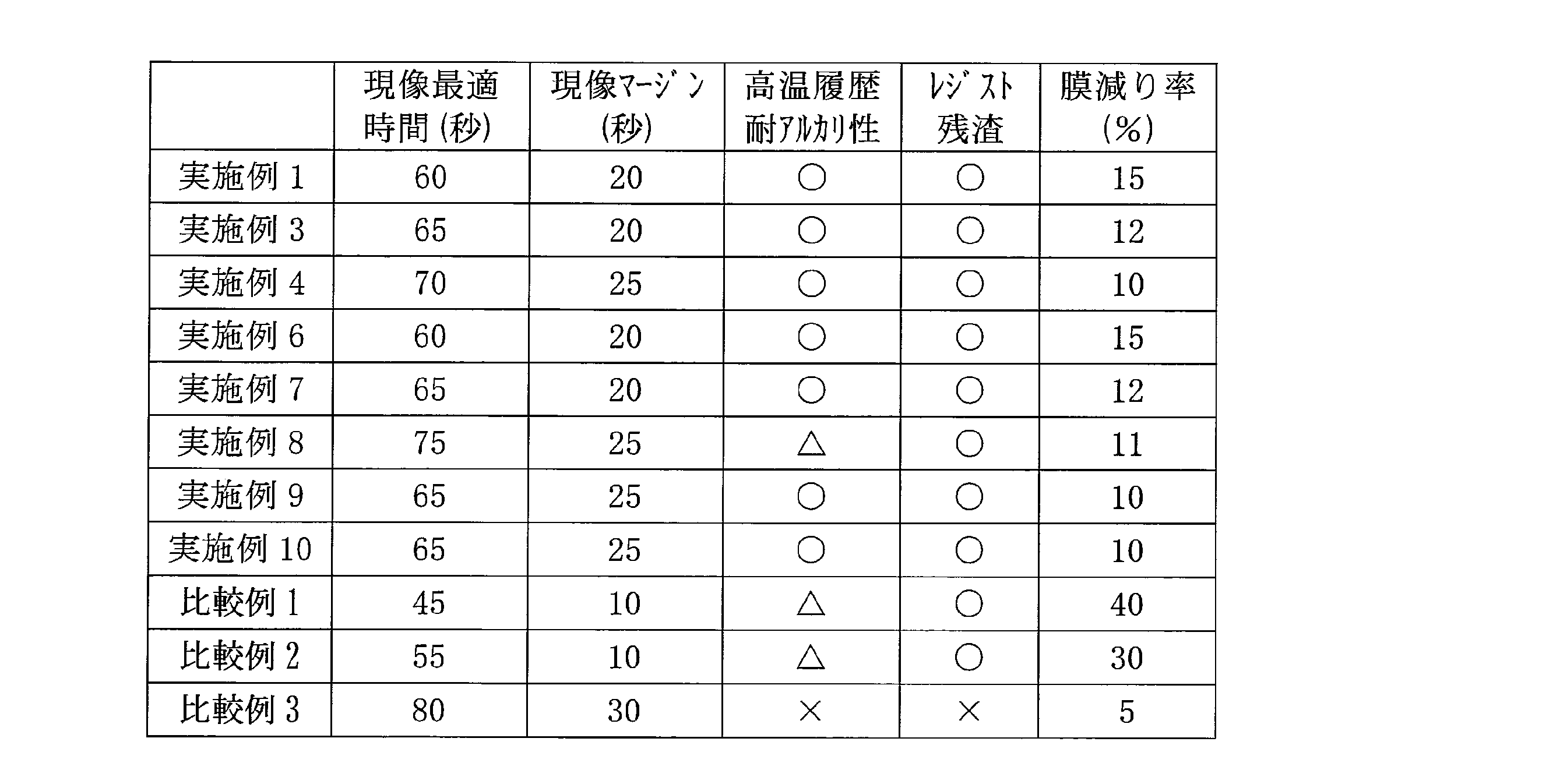
Claims (6)
- (A)成分として、下記一般式(1)で表わされる環状シロキサン化合物と下記一般式(2)で表わされるアルコキシシラン化合物とを加水分解・縮合反応させて得られる構造からなるシラノール基含有ポリシロキサン化合物、
(B)成分として、エポキシ含有有機基を少なくとも2つ有する化合物、
(C)成分として、ジアゾナフトキノン類、及び
(D)成分として、有機溶剤を含有することを特徴とするポジ型感光性組成物。


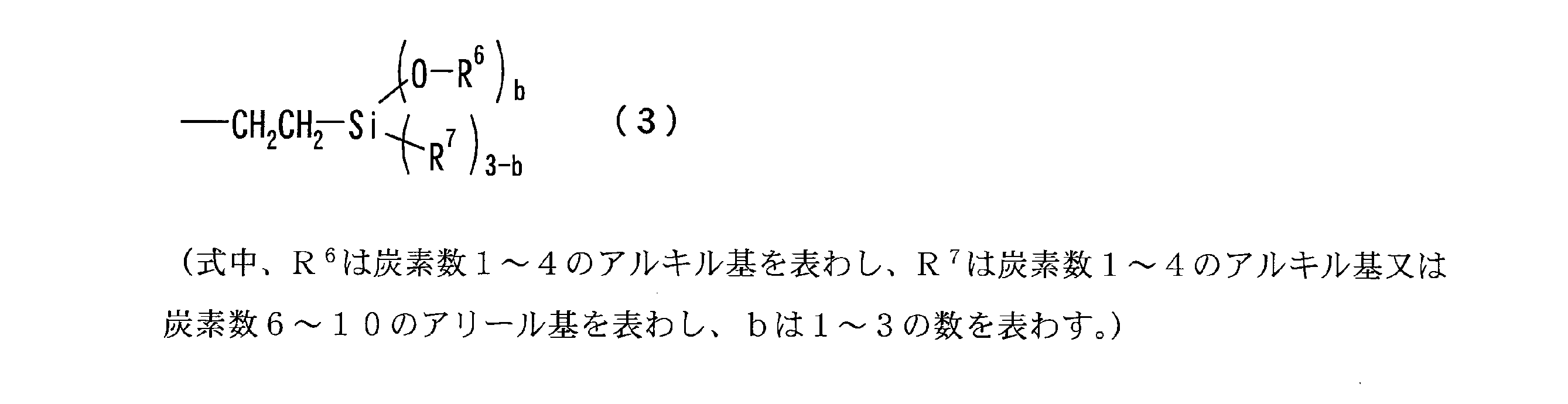
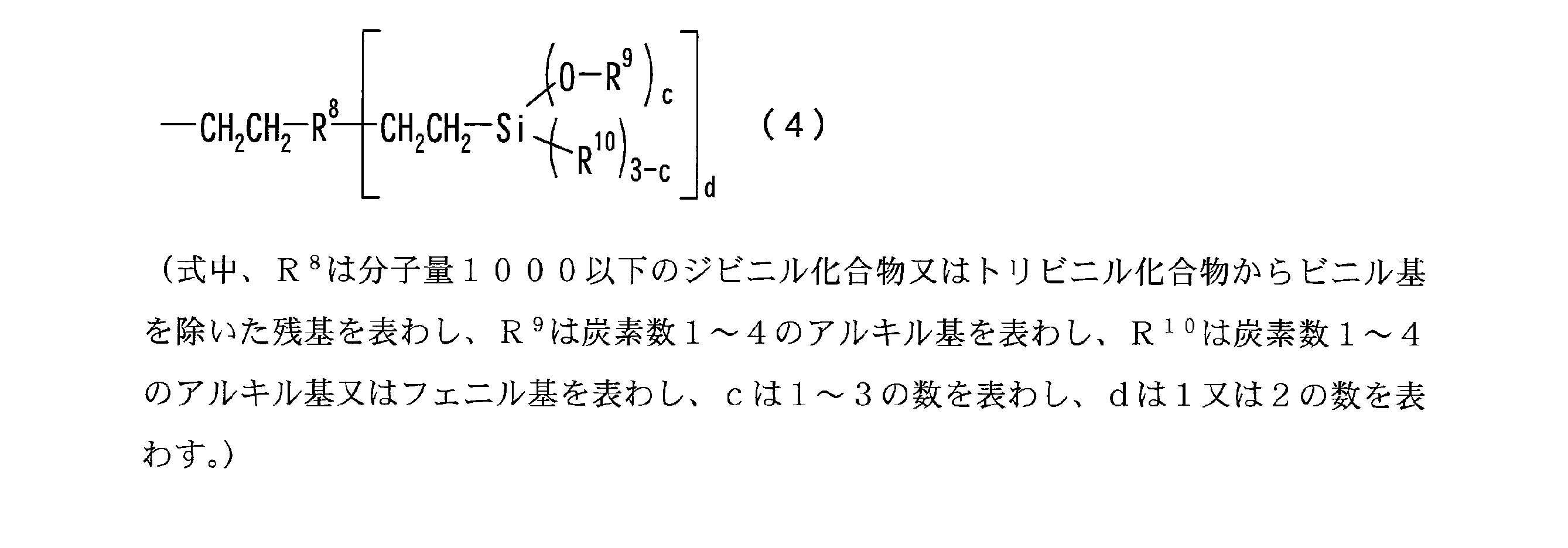

- 上記(B)成分としてのエポキシ含有有機基を少なくとも2つ有する化合物のエポキシ含有有機基が、グリシジル基を含有する基である請求項1記載のポジ型感光性組成物。
- 請求項1又は2に記載のポジ型感光性組成物を硬化させてなることを特徴とする硬化物。
- 請求項1又は2に記載のポジ型感光性組成物を対象材料に塗布し、プリベークした後、露光し、アルカリ現像し、次いで、ブリーチング露光した後、120~400℃の温度でポストベークすることを特徴とする永久レジストの製造方法。
- 請求項1又は2に記載に記載のポジ型感光性組成物を用いて得られた永久レジストを絶縁層又は平坦化膜とするアクティブマトリクス基板を有することを特徴とする液晶表示装置。
- 請求項1又は2に記載に記載のポジ型感光性組成物を用いて得られた永久レジストを絶縁層又は平坦化膜とするアクティブマトリクス基板を有することを特徴とする有機EL表示装置。
Priority Applications (2)
| Application Number | Priority Date | Filing Date | Title |
|---|---|---|---|
| CN201280007372.6A CN103380400B (zh) | 2011-05-11 | 2012-04-26 | 正型感光性组合物及其固化物 |
| KR1020137020225A KR20140006855A (ko) | 2011-05-11 | 2012-04-26 | 포지티브형 감광성 조성물 및 그 경화물 |
Applications Claiming Priority (2)
| Application Number | Priority Date | Filing Date | Title |
|---|---|---|---|
| JP2011106297A JP5698070B2 (ja) | 2011-05-11 | 2011-05-11 | ポジ型感光性組成物及びその硬化物 |
| JP2011-106297 | 2011-05-11 |
Publications (1)
| Publication Number | Publication Date |
|---|---|
| WO2012153648A1 true WO2012153648A1 (ja) | 2012-11-15 |
Family
ID=47139132
Family Applications (1)
| Application Number | Title | Priority Date | Filing Date |
|---|---|---|---|
| PCT/JP2012/061246 Ceased WO2012153648A1 (ja) | 2011-05-11 | 2012-04-26 | ポジ型感光性組成物及びその硬化物 |
Country Status (5)
| Country | Link |
|---|---|
| JP (1) | JP5698070B2 (ja) |
| KR (1) | KR20140006855A (ja) |
| CN (1) | CN103380400B (ja) |
| TW (1) | TWI530761B (ja) |
| WO (1) | WO2012153648A1 (ja) |
Cited By (2)
| Publication number | Priority date | Publication date | Assignee | Title |
|---|---|---|---|---|
| WO2024150635A1 (ja) * | 2023-01-10 | 2024-07-18 | 富士フイルム株式会社 | 処理液、処理液収容体 |
| WO2024150630A1 (ja) * | 2023-01-10 | 2024-07-18 | 富士フイルム株式会社 | 薬液、薬液収容体、パターン形成方法、電子デバイスの製造方法 |
Families Citing this family (9)
| Publication number | Priority date | Publication date | Assignee | Title |
|---|---|---|---|---|
| JP6086739B2 (ja) * | 2013-01-21 | 2017-03-01 | 東京応化工業株式会社 | 絶縁膜形成用組成物、絶縁膜の製造方法、及び絶縁膜 |
| JP6438259B2 (ja) * | 2014-10-01 | 2018-12-12 | 旭化成株式会社 | オルガノポリシロキサン、オルガノポリシロキサン組成物、オルガノポリシロキサンの製造方法、硬化性樹脂組成物、光半導体用封止材、光半導体用ダイボンド材、及び光半導体パッケージ |
| WO2016063649A1 (ja) * | 2014-10-21 | 2016-04-28 | 日産化学工業株式会社 | Led用封止材組成物 |
| JP6484428B2 (ja) | 2014-10-31 | 2019-03-13 | 東京応化工業株式会社 | レジストパターン形成装置およびレジストパターン形成方法 |
| JP2016092120A (ja) * | 2014-10-31 | 2016-05-23 | 東京応化工業株式会社 | レジストパターン形成装置およびレジストパターン形成方法 |
| US10620538B2 (en) * | 2015-02-04 | 2020-04-14 | Sakai Display Products Corporation | Positive type photosensitive siloxane composition, active matrix substrate, display apparatus, and method of manufacturing active matrix substrate |
| JP6683423B2 (ja) * | 2015-02-26 | 2020-04-22 | 旭化成株式会社 | 硬化性樹脂組成物及びその製造方法、並びに、光半導体用封止材、光半導体用ダイボンド材、及び光半導体パッケージ |
| JP6688003B2 (ja) * | 2015-02-26 | 2020-04-28 | 旭化成株式会社 | 硬化性樹脂組成物及びその製造方法、並びに、光半導体用封止材、光半導体用ダイボンド材、及び光半導体パッケージ |
| JP6518548B2 (ja) | 2015-08-10 | 2019-05-22 | 東京応化工業株式会社 | 紫外線照射装置、レジストパターン形成装置、紫外線照射方法及びレジストパターン形成方法 |
Citations (2)
| Publication number | Priority date | Publication date | Assignee | Title |
|---|---|---|---|---|
| JP2010101957A (ja) * | 2008-10-21 | 2010-05-06 | Adeka Corp | ポジ型感光性組成物及び永久レジスト |
| JP2011022173A (ja) * | 2009-07-13 | 2011-02-03 | Chisso Corp | ポジ型感光性組成物 |
Family Cites Families (3)
| Publication number | Priority date | Publication date | Assignee | Title |
|---|---|---|---|---|
| EP1662322B1 (en) * | 2004-11-26 | 2017-01-11 | Toray Industries, Inc. | Positive type photo-sensitive siloxane composition, curing film formed by the composition and device with the curing film |
| WO2009063887A1 (ja) * | 2007-11-13 | 2009-05-22 | Adeka Corporation | ポジ型感光性組成物、ポジ型永久レジスト及びポジ型永久レジストの製造方法 |
| JP5336161B2 (ja) * | 2008-12-11 | 2013-11-06 | 株式会社カネカ | 金属酸化物微粒子含有硬化性樹脂組成物、その硬化物、及び光拡散材 |
-
2011
- 2011-05-11 JP JP2011106297A patent/JP5698070B2/ja not_active Expired - Fee Related
-
2012
- 2012-04-26 CN CN201280007372.6A patent/CN103380400B/zh not_active Expired - Fee Related
- 2012-04-26 KR KR1020137020225A patent/KR20140006855A/ko not_active Ceased
- 2012-04-26 WO PCT/JP2012/061246 patent/WO2012153648A1/ja not_active Ceased
- 2012-05-07 TW TW101116248A patent/TWI530761B/zh not_active IP Right Cessation
Patent Citations (2)
| Publication number | Priority date | Publication date | Assignee | Title |
|---|---|---|---|---|
| JP2010101957A (ja) * | 2008-10-21 | 2010-05-06 | Adeka Corp | ポジ型感光性組成物及び永久レジスト |
| JP2011022173A (ja) * | 2009-07-13 | 2011-02-03 | Chisso Corp | ポジ型感光性組成物 |
Cited By (2)
| Publication number | Priority date | Publication date | Assignee | Title |
|---|---|---|---|---|
| WO2024150635A1 (ja) * | 2023-01-10 | 2024-07-18 | 富士フイルム株式会社 | 処理液、処理液収容体 |
| WO2024150630A1 (ja) * | 2023-01-10 | 2024-07-18 | 富士フイルム株式会社 | 薬液、薬液収容体、パターン形成方法、電子デバイスの製造方法 |
Also Published As
| Publication number | Publication date |
|---|---|
| TWI530761B (zh) | 2016-04-21 |
| JP5698070B2 (ja) | 2015-04-08 |
| KR20140006855A (ko) | 2014-01-16 |
| CN103380400B (zh) | 2016-03-30 |
| TW201250390A (en) | 2012-12-16 |
| JP2012237854A (ja) | 2012-12-06 |
| CN103380400A (zh) | 2013-10-30 |
Similar Documents
| Publication | Publication Date | Title |
|---|---|---|
| JP5698070B2 (ja) | ポジ型感光性組成物及びその硬化物 | |
| JP4960330B2 (ja) | ポジ型感光性組成物及び永久レジスト | |
| JP5105555B2 (ja) | ポジ型感光性組成物、ポジ型永久レジスト及びポジ型永久レジストの製造方法 | |
| JP5136777B2 (ja) | ポリオルガノシロキサン化合物、これを含む樹脂組成物及びこれらのパターン形成方法 | |
| CN103076721A (zh) | 正型感光性组合物 | |
| JP5479993B2 (ja) | ポジ型感光性組成物及び永久レジスト | |
| CN103229103B (zh) | 感光性树脂组合物 | |
| JP5734629B2 (ja) | ポジ型感光性樹脂組成物及び永久レジスト | |
| JP5666266B2 (ja) | ポジ型感光性樹脂組成物及び永久レジスト | |
| KR20120056773A (ko) | 포지티브형 감광성 수지 조성물 및 영구 레지스트 | |
| WO2025074731A1 (ja) | 分岐状オルガノポリシロキサン、それを含む組成物およびその用途 | |
| KR20090113183A (ko) | 폴리유기실록산 화합물, 이것을 포함하는 수지 조성물 및 이들의 패턴 형성 방법 |
Legal Events
| Date | Code | Title | Description |
|---|---|---|---|
| WWE | Wipo information: entry into national phase |
Ref document number: 201280007372.6 Country of ref document: CN |
|
| 121 | Ep: the epo has been informed by wipo that ep was designated in this application |
Ref document number: 12782923 Country of ref document: EP Kind code of ref document: A1 |
|
| ENP | Entry into the national phase |
Ref document number: 20137020225 Country of ref document: KR Kind code of ref document: A |
|
| NENP | Non-entry into the national phase |
Ref country code: DE |
|
| 122 | Ep: pct application non-entry in european phase |
Ref document number: 12782923 Country of ref document: EP Kind code of ref document: A1 |