WO2012144455A1 - 化学蒸着用の有機白金化合物及び該有機白金化合物を用いた化学蒸着方法 - Google Patents
化学蒸着用の有機白金化合物及び該有機白金化合物を用いた化学蒸着方法 Download PDFInfo
- Publication number
- WO2012144455A1 WO2012144455A1 PCT/JP2012/060255 JP2012060255W WO2012144455A1 WO 2012144455 A1 WO2012144455 A1 WO 2012144455A1 JP 2012060255 W JP2012060255 W JP 2012060255W WO 2012144455 A1 WO2012144455 A1 WO 2012144455A1
- Authority
- WO
- WIPO (PCT)
- Prior art keywords
- platinum
- platinum compound
- thin film
- vapor deposition
- chemical vapor
- Prior art date
- Legal status (The legal status is an assumption and is not a legal conclusion. Google has not performed a legal analysis and makes no representation as to the accuracy of the status listed.)
- Ceased
Links
Classifications
-
- C—CHEMISTRY; METALLURGY
- C23—COATING METALLIC MATERIAL; COATING MATERIAL WITH METALLIC MATERIAL; CHEMICAL SURFACE TREATMENT; DIFFUSION TREATMENT OF METALLIC MATERIAL; COATING BY VACUUM EVAPORATION, BY SPUTTERING, BY ION IMPLANTATION OR BY CHEMICAL VAPOUR DEPOSITION, IN GENERAL; INHIBITING CORROSION OF METALLIC MATERIAL OR INCRUSTATION IN GENERAL
- C23C—COATING METALLIC MATERIAL; COATING MATERIAL WITH METALLIC MATERIAL; SURFACE TREATMENT OF METALLIC MATERIAL BY DIFFUSION INTO THE SURFACE, BY CHEMICAL CONVERSION OR SUBSTITUTION; COATING BY VACUUM EVAPORATION, BY SPUTTERING, BY ION IMPLANTATION OR BY CHEMICAL VAPOUR DEPOSITION, IN GENERAL
- C23C16/00—Chemical coating by decomposition of gaseous compounds, without leaving reaction products of surface material in the coating, i.e. chemical vapour deposition [CVD] processes
- C23C16/06—Chemical coating by decomposition of gaseous compounds, without leaving reaction products of surface material in the coating, i.e. chemical vapour deposition [CVD] processes characterised by the deposition of metallic material
- C23C16/18—Chemical coating by decomposition of gaseous compounds, without leaving reaction products of surface material in the coating, i.e. chemical vapour deposition [CVD] processes characterised by the deposition of metallic material from metallo-organic compounds
-
- C—CHEMISTRY; METALLURGY
- C07—ORGANIC CHEMISTRY
- C07F—ACYCLIC, CARBOCYCLIC OR HETEROCYCLIC COMPOUNDS CONTAINING ELEMENTS OTHER THAN CARBON, HYDROGEN, HALOGEN, OXYGEN, NITROGEN, SULFUR, SELENIUM OR TELLURIUM
- C07F15/00—Compounds containing elements of Groups 8, 9, 10 or 18 of the Periodic Table
- C07F15/0006—Compounds containing elements of Groups 8, 9, 10 or 18 of the Periodic Table compounds of the platinum group
- C07F15/0086—Platinum compounds
Definitions
- the present invention relates to an organic platinum compound used as a raw material for producing a platinum thin film or a platinum compound thin film by a CVD method or a chemical vapor deposition method of an ALD method. Specifically, the present invention relates to an organic platinum compound which can form a platinum thin film even at a low temperature of 350 ° C. or less, which has a high vapor pressure.
- a three-dimensional Ni—Pt silicide electrode having a three-dimensional structure is known as an electrode material of a field effect transistor (FET) incorporated in an integrated circuit.
- FET field effect transistor
- This three-dimensional Ni-Pt silicide electrode adopts a three-dimensional structure to secure the surface area while maintaining high density for miniaturization of the FET, and adds Pt for the purpose of improving the thermal stability of the Ni silicide electrode. It is In the manufacture of the Ni--Pt silicide electrode having the above-described three-dimensional structure, it is necessary to form a Pt thin film and a Ni thin film on Si having a three-dimensional structure which has been previously manufactured. At this time, it is necessary to coat the Pt thin film and the Ni thin film electrode uniformly at the same ratio while following their shapes.
- a PVD method such as a sputtering method can not be applied as a method for producing a platinum thin film
- the PVD method is difficult to uniformly coat an electrode having a three-dimensional structure.
- chemical vapor deposition methods such as CVD method excellent in step coverage (step coverage)
- a metal thin film such as Ni-Pt silicide for the gate electrode of the FET will make it possible to miniaturize and improve the performance of the device.
- the conventional sputtering method is used to produce the metal electrode, the element is damaged, so it is necessary to form a metal thin film under physically mild conditions. If film formation at a low temperature is possible by the application of a chemical vapor deposition method such as a CVD method, such a device can also be manufactured.
- the raw material for CVD is required to have a high vapor pressure and a low decomposition temperature and to be able to reduce the film formation temperature in order to form a stable film.
- deposition at low temperature is important to maintain device performance. It can be said that the above-mentioned conventional platinum compounds have all of these properties.
- more stringent standards for these characteristics are required. For example, in terms of vapor pressure, when forming a uniform film on a three-dimensional electrode, it is effective to be able to supply the source gas at a high concentration, and for that purpose, a substance having a higher vapor pressure is preferable.
- the decomposition temperature is also preferably low in order to rapidly form a film from a high concentration source gas while suppressing damage to the substrate (electrode).
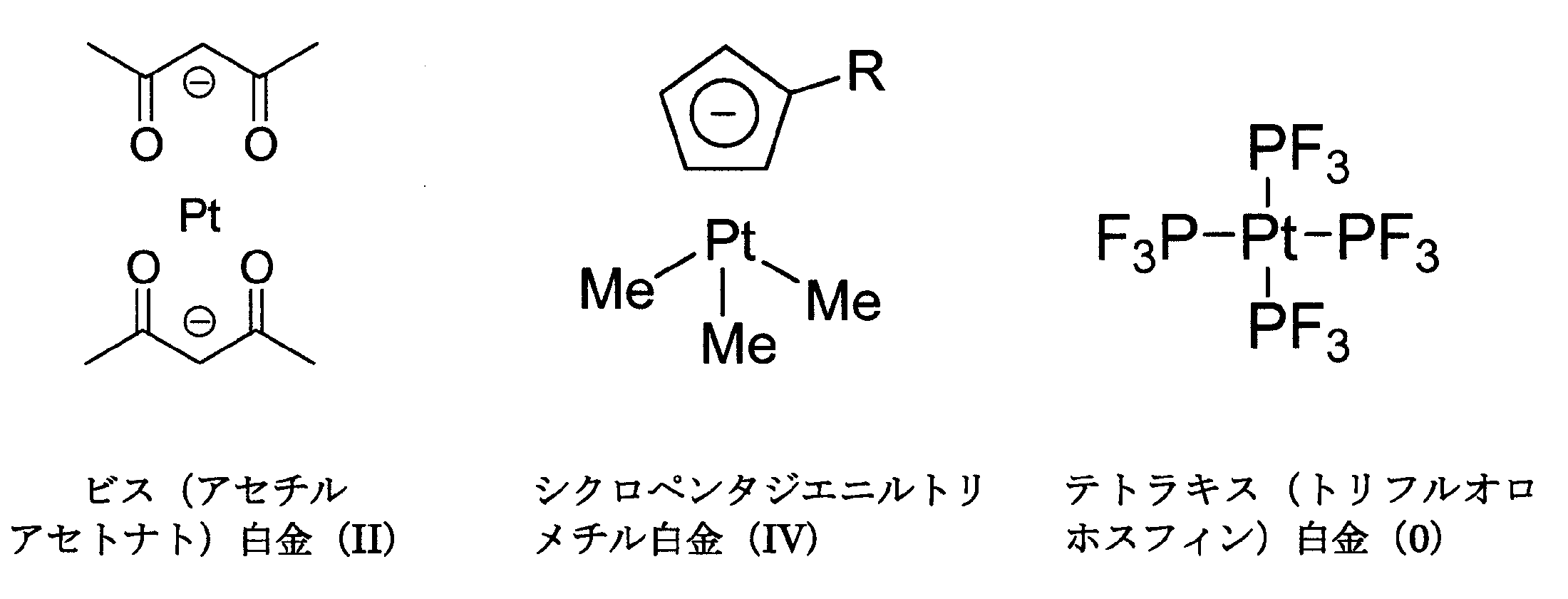
- tetrakis (trifluorophosphine) platinum (0) complex is capable of film formation at lower temperatures, but is not only unstable to air and moisture, but also light. Because it is unstable to heat and heat, it is usually necessary to store at low temperature under light shielding. Furthermore, it generates strong PF 3 toxic by deposition or during degradation. Also, in order to stabilize the amount of vapor and obtain a uniform film with good step coverage, it is necessary to use PF3, which is a ligand, in order to maintain the stability in the gas state before film deposition. is there.
- Necessity of platinum film formation on a substrate / base material having a three-dimensional structure is the platinum catalyst thin film for batteries such as platinum catalyst for fuel cell, platinum catalyst for dye-sensitized solar cell other than Pt-Ni electrode of the above FET
- platinum catalyst thin film for batteries such as platinum catalyst for fuel cell, platinum catalyst for dye-sensitized solar cell other than Pt-Ni electrode of the above FET
- thin film formation on the surface and the demand is many. Therefore, the present invention has been made based on the above background, has a high vapor pressure, enables film formation at low temperatures, facilitates film formation into a three-dimensional structure, and has stability and handleability. And provides platinum compounds for CVD raw materials.
- the present invention for solving the above problems is an organic platinum compound for producing a platinum thin film or a platinum compound thin film by a chemical vapor deposition method, which comprises a divalent platinum represented by the following formula, a hexadiene or hexadiene derivative, and an alkyl anion Is an organic platinum compound coordinated.
- R 1, R 2 is .R 1, R 2 may be one different from an alkyl group as a substituent.
- R 3, R 4 is hydrogen or an alkyl group .R 3, R 4 may be different.
- the platinum compound according to the present invention is obtained by coordinating bivalent platinum with hexadiene or a derivative thereof and an alkyl anion as a ligand.
- the present inventors have conceived of these platinum compounds based on the following reasons for each constitution of the central metal and the ligand coordinated to it.
- One of the ligands, diene is an electrically neutral ⁇ -bonded ligand having no charge at the bonding site to the metal atom.
- Being electrically neutral means that the bonding strength with the metal is weak, and a complex which is easily thermally decomposed at a low temperature can be obtained.
- the molecular weight is relatively small (hexadiene: 82.14) and the boiling point is also relatively low (hexadiene: 60 ° C.), there is an advantage that it is easy to evaporate after decomposition and is hard to remain as impurities in the metal film.
- platinum as a central metal
- many of platinum complexes having platinum as a central metal having a divalent or tetravalent positive charge are stable, but the present inventors have described the process of synthesis, purification and storage. Since it is also important that the compound is easily handled in the above, a bivalent platinum complex having a suitable stability is preferred.
- the platinum complex according to the present invention is obtained by coordinating bivalent platinum with hexadiene or a derivative thereof and an alkyl anion as a ligand.
- the two alkyl anions R 1 and R 2 coordinated to platinum are preferably any of a methyl group, an ethyl group and a propyl group. Since these alkyl anions have a small molecular weight, it is possible to suppress a drop in vapor pressure accompanying an increase in molecular weight even when forming a complex. In addition, since the stability of the platinum complex tends to decrease as the carbon chain of the alkyl group becomes longer, synthesis and handling of the complex become difficult when a long chain alkyl group having 4 or more carbon atoms is used as a ligand. Particularly preferred among the alkyl groups is a methyl group. The methyl group becomes methane having a low boiling point (boiling point: ⁇ 162 ° C.) after the decomposition of the complex, so that it can be released without leaving an impurity in the formed metal thin film.
- the reason for including the derivative thereof is that while maintaining the stability of the platinum complex in accordance with the two alkyl anions (R 1 , R 2 ) coordinated to platinum. This is to set the film formation temperature to a low temperature. This is because the stability of the platinum complex decreases as the two alkyl anions (R 1 , R 2 ) coordinated to platinum become substituents having a large molecular weight with ethyl and propyl groups, and decomposition occurs even at about room temperature It will affect the handleability as a CVD material. Therefore, by introducing a substituent into the other ligand, hexadiene, the coordination power of the ligand is changed to maintain the stability of the entire platinum complex, and the decomposability during film formation is good. It is assumed.
- Preferred examples of the platinum complex according to the present invention include the following compounds.
- the substituents R 1 and R 2 are all identical in any of a methyl group, an ethyl group and a propyl group, and the substituents R 3 and R 4 are organic platinum compounds in which one is a methyl group .
- a platinum salt as a starting material, hexadiene (1,5-hexadiene) or a hexadiene derivative (2-methyl-1,5-hexadiene, 2,5-methyl-1, It can be produced by sequentially reacting 5-hexadiene etc.) with an alkyl anion salt.
- a platinum salt for example, chloroplatinic acid salt (K 2 PtCl 4 or the like) can be used.
- the organic platinum compound according to the present invention is useful for forming a platinum thin film by a CVD method.
- an organic platinum compound as a raw material compound is vaporized to be a reaction gas, the reaction gas is introduced onto the surface of the substrate, and the organic platinum compound is decomposed to precipitate platinum.
- a reducing atmosphere is preferable.
- the formation of a nickel thin film is required together with platinum, and the oxidation thereof needs to be suppressed. is there. And, specifically, it is preferable to introduce hydrogen and ammonia as a reaction gas.
- An object of the present invention is to set the film formation temperature to a low temperature side.
- the heating temperature for the film forming reaction is preferably 200 ° C. to 350 ° C. If the temperature is less than 200 ° C., it is difficult for the film formation reaction to progress and the required film thickness is difficult to obtain. When the temperature exceeds 350 ° C., it is difficult not only to form a uniform thin film on a three-dimensional electrode but also to maintain the performance of the FET device.
- the platinum complex according to the present invention has a high vapor pressure and a low decomposition temperature, so that a platinum thin film can be produced at a low temperature.
- film formation to a three-dimensional structure is also possible.
- the organic platinum compound according to the present invention is also applicable to a chemical vapor deposition method such as an atomic layer deposition method (ALD method).
- a platinum complex in which two methyl groups are coordinated as a ligand alkyl anion and a hexadiene is coordinated as the other ligand (substituents R 1 and R 2 are A platinum complex: 1,5-hexadiene dimethyl platinum (II) (hereinafter referred to as HDMP) in which all are methyl groups and the substituents R 3 and R 4 are both hydrogen, was produced.
- the reaction formula of HDMP synthesis is as follows. The manufacturing steps will be described below for each step.
- Second Embodiment In this embodiment, two methyl groups are coordinated as an alkyl anion which is a ligand.
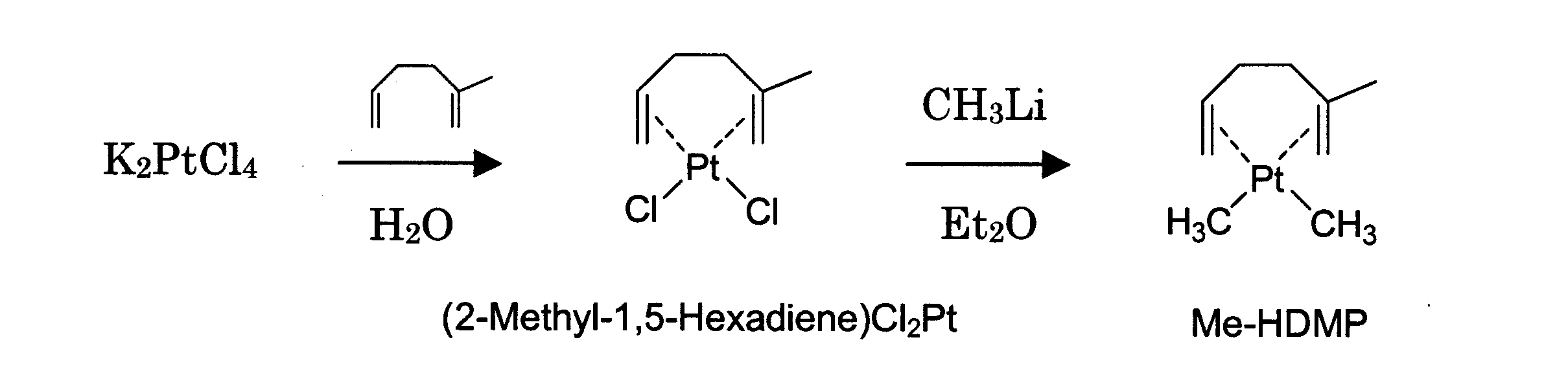
- a platinum complex in which 2-methyl-1,5-hexadiene is coordinated as the other ligand that is, each of the substituents R 1 and R 2 is a methyl group, and the substituent R 3 is hydrogen, R 4
- a platinum complex in which is a methyl group: 2-methyl-1,5-hexadienedimethylplatinum (II) (hereinafter referred to as Me-HDMP) was produced.
- the reaction formula of Me-HDMP synthesis is as follows. The manufacturing steps will be described below for each step.
- the black precipitate is removed by suction filtration, the diethyl ether layer is recovered, evaporated, dissolved in hexane, filtered by column chromatography (alumina / hexane), and then the solvent is evaporated.
- the obtained black liquid is purified by sublimation (heating temperature 36 to 39 ° C., cooling temperature 15 ° C., pressure 50 to 60 Pa, 11 hours), 6.45 g (2.01 ⁇ 10 -2 mol) of Me-HDMP as a white solid ) (Yield 61%).
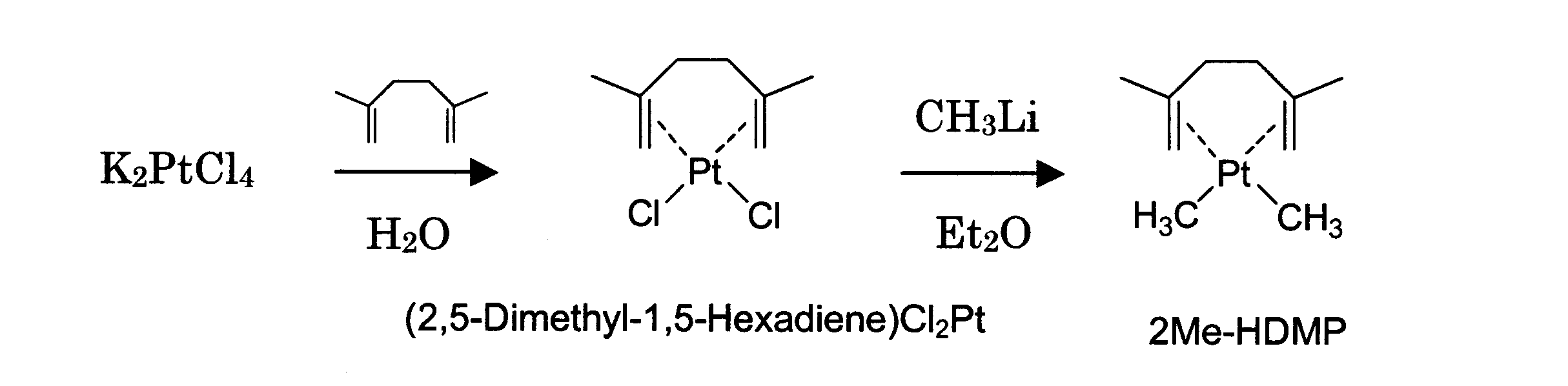
- two methyl groups are coordinated as an alkyl anion which is a ligand.
- a platinum complex in which 2,5-dimethyl-1,5-hexadiene is coordinated as the other ligand that is, each of substituents R 1 and R 2 is a methyl group, and substituents R 3 and R 4
- the reaction formula of 2Me-HDMP synthesis is as follows. The manufacturing steps will be described below for each step.
- the weight value of each sample after TG-DTA measurement was 35.73% (HDMP), 47.62% (Me-HDMP), 52.63% (2Me-HDMP) of the initial weight of the sample. .
- the theoretical content of platinum in each platinum complex is 63.48% (HDMP), 60.71% (Me-HDMP), 58.17% (2Me-HDMP), so during the measurement of TG-DTA It can be inferred that part of the platinum complex sublimes and evaporates.
- the difference from the theoretical content can be estimated as the weight of platinum scattered by sublimation of the platinum complex. This means that the platinum complex of 43.71% (HDMP), 21.56% (Me-HDMP) and 9.52% (2Me-HDMP) relative to the initial weight was sublimated.
- the sublimation amount observed this time is a value obtained by measurement under atmospheric pressure by TG-DTA. Since it is possible to generate steam at a temperature lower than the decomposition point under reduced pressure which is a normal film forming condition, it is possible to generate steam in a stable state without thermal decomposition.
- each platinum complex manufactured showed no change such as discoloration even when stored for one month at room temperature under the atmosphere. That is, these compounds are extremely stable at room temperature and can be stored in air.
- each platinum complex was 35 ° C. for HDMP, 31 ° C. for Me-HDMP, and 49 ° C. for 2 Me-HDMP.
- Me-HDMP having one of the hexadiene substituents as a methyl group has a melting point lower than that of HDMP. This is considered to be due to the fact that Me-HDMP has a lower melting point due to lower molecular symmetry than HDMP.
- the 2Me-MHDMP having methyl groups as both substituents of hexadiene has a melting point higher than that of HDMP, although both have the same molecular symmetry, but two methyl groups have been introduced into hexadiene and thus the molecular weight Is considered to have increased.
- These platinum complexes can be stored in the solid state at storage (room temperature), and can be stored more stably than in the liquid state.
- room temperature room temperature
- the film since the film is easily melted by heating during the film formation and becomes a liquid, it is possible to use a bubbler-type vaporizer capable of generating a stable vapor.
- Film forming test Next, a film forming test of a platinum thin film was conducted by a CVD method using each platinum complex as a raw material compound.
- the film forming apparatus used was a cold wall type apparatus in which only the substrate stage in the chamber was heated.
- a carrier gas (nitrogen) for transporting the vapor of the raw material compound onto the substrate is controlled to have a constant flow rate by a mass flow controller.
- a reactive gas (hydrogen) is sprayed onto the substrate at a constant flow rate using a mass flow controller.
- the platinum thin film was formed on a substrate (15 mm ⁇ 15 mm) on which a silicon oxide film was deposited on a silicon substrate using tetraethoxysilane (TEOS).
- TEOS tetraethoxysilane
- platinum thin films were able to be produced at all temperatures with any platinum complex raw material.
- the produced platinum thin film had a white metallic luster, and from the measurement by XPS, only a peak derived from platinum was observed, and no peak derived from an impurity such as carbon was observed. That is, it was confirmed that this platinum thin film was a pure platinum metal film.
- the platinum thin film was observed by SEM, it was confirmed that the thickness of the platinum thin film was 100 nm, and furthermore, the surface of the thin film was smooth and the roughness was 1 nm or less.
- the platinum complex according to each embodiment can form a film at a low temperature of 200 ° C. by using hydrogen as a reaction gas.
- these platinum complexes are stable compounds at room temperature, the thermal decomposition reaction proceeds rapidly upon heating, and they have the property of easily precipitating metallic platinum, and are suitable for the production of metal thin films by the CVD method.
- organic components ligands such as hexadiene and methane generated by thermal decomposition of a platinum complex have low boiling points and evaporate and diffuse rapidly under reduced pressure conditions for film formation, so the inside of the deposited metal thin film It was possible to produce a pure metal film without being incorporated into the
- the platinum complex according to each embodiment was capable of forming a platinum thin film under all conditions, the film forming property at low temperature was HDMP ⁇ Me-MHDMP ⁇ 2 Me-MHDMP The order was good. Also, regarding the specific resistance of the platinum thin film, a tendency was found to be HDMP> Me-MHDMP> 2 Me-MHDMP. This is because, as described above in the TG-DTA measurement, as the molecular weight of the complex increases, the start temperature and the end temperature of weight loss decrease and thermal decomposition easily occurs, and film formation at a lower temperature It is considered that the specific resistance is also lowered.
- cyclopentadienyltrimethylplatinum (IV complex was used as a conventional platinum compound, and film formation of a platinum thin film was attempted.
- the film forming conditions were a sample heating temperature of 25 ° C. and a substrate temperature of 300 ° C. A hydrogen of 10 sccm was used as a carrier gas and a reaction gas, the pressure at the film formation was 65 Pa. The film formation was performed for 30 minutes under these conditions, but the formation of the metal film was not observed on the substrate.
- the platinum complex of the present embodiment enables the formation of a platinum thin film at a low temperature unlike the conventional platinum compound.
- the platinum complex of the present embodiment is stable to air, moisture and light at room temperature and can be stored for a long time. Further, non-toxic and inexpensive argon or nitrogen can be used as a carrier gas at the time of vaporization. Furthermore, since no toxic substance is generated when the film formation is carried out, it can be said that it is a platinum compound for CVD which is easy to handle and is excellent in practicality.
Landscapes
- Chemical & Material Sciences (AREA)
- Organic Chemistry (AREA)
- General Chemical & Material Sciences (AREA)
- Chemical Kinetics & Catalysis (AREA)
- Engineering & Computer Science (AREA)
- Materials Engineering (AREA)
- Mechanical Engineering (AREA)
- Metallurgy (AREA)
- Chemical Vapour Deposition (AREA)
Abstract
Description
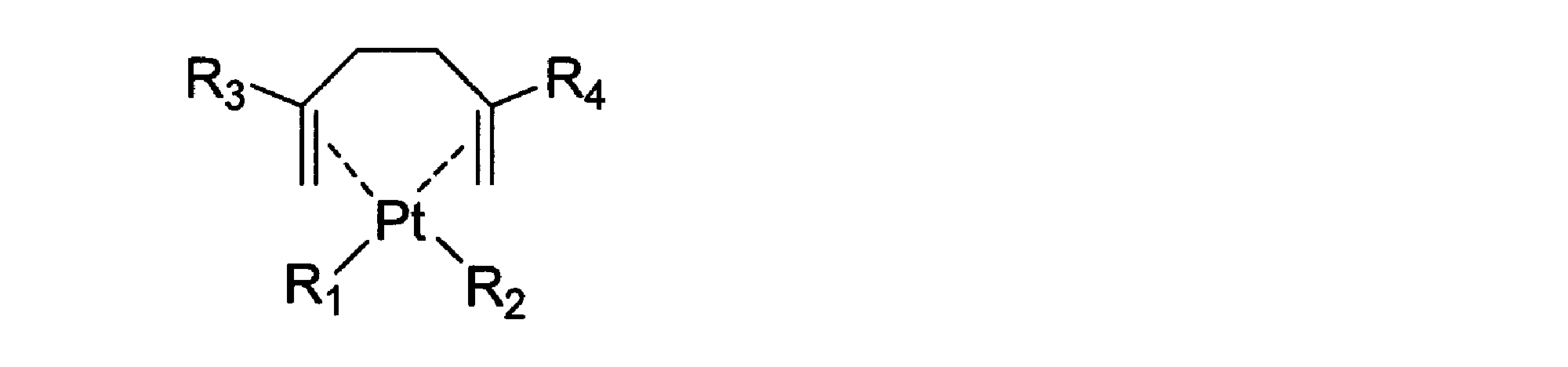
(i)置換基R1、R2は、いずれもメチル基であり、置換基R3、R4は、いずれも水素である有機白金化合物。



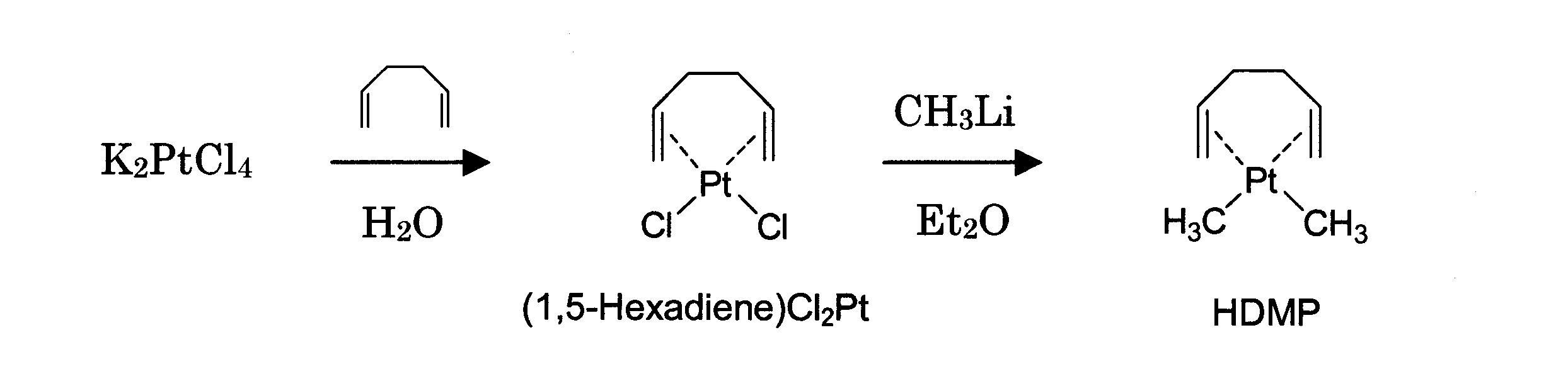
で再度、段階的に攪拌した(反応液45℃で3時間、50℃で20時間)。以上の反応後、反応液はほぼ透明となり、白色の沈殿が得られた。この白色沈殿物を吸引ろ過して回収し、水、エタノール、ジエチルエーテルで2回ずつ洗浄し、大気乾燥、真空乾燥して白色の1,5-ヘキサジエン白金(II)ジクロリド78.33g(0.225mol)を得た(収率93.4%)。
基板加熱温度200、225、250、275、300℃
キャリアガス(窒素)流量:10sccm
反応ガス(水素)流量:50sccm
圧力:50Pa
成膜時間:30分
Claims (8)
- 化学蒸着法により白金薄膜又は白金化合物薄膜を製造するための有機白金化合物において、
次式で示される、2価の白金に、ヘキサジエン又はヘキサジエン誘導体、及び、アルキルアニオンが配位した有機白金化合物。

- 置換基R1、R2は、少なくともいずれかがメチル基、エチル基、プロピル基のいずれかである請求項1記載の有機白金化合物。
- 置換基R3、R4は、少なくともいずれかがメチル基である請求項1又は請求項2記載の有機白金化合物。
- 置換基R1、R2は、いずれもメチル基であり、置換基R3、R4は、いずれも水素である請求項1記載の有機白金化合物。
- 置換基R1、R2は、メチル基、エチル基、プロピル基のいずれかでR1、R2が同一のものであり、置換基R3、R4は、少なくともいずれかがメチル基である請求項1記載の有機白金化合物。
- 原料化合物となる有機白金化合物を気化して反応ガスとし、前記反応ガスを基板表面に導入し、前記有機白金化合物を分解して白金を析出させる白金薄膜又は白金化合物薄膜の化学蒸着法において、
前記有機白金化合物として請求項1~請求項5のいずれかに記載の有機白金化合物を用い、前記有機白金化合物を分解する化学蒸着法。 - 有機白金化合物を分解するための反応雰囲気は、還元性雰囲気である請求項6記載の化学蒸着法。
- 還元性雰囲気として、水素、アンモニアを導入する請求項6又は請求項7記載の化学蒸着法。
Priority Applications (5)
| Application Number | Priority Date | Filing Date | Title |
|---|---|---|---|
| KR1020137030041A KR101606252B1 (ko) | 2011-04-20 | 2012-04-16 | 화학 증착용 유기 백금 화합물 및 그 유기 백금 화합물을 사용한 화학 증착방법 |
| US14/003,297 US8911827B2 (en) | 2011-04-20 | 2012-04-16 | Chemical vapor deposition method using an organoplatinum compound |
| CN201280019154.4A CN103492399B (zh) | 2011-04-20 | 2012-04-16 | 化学蒸镀用的有机铂化合物及使用该有机铂化合物的化学蒸镀方法 |
| EP12774783.0A EP2700646B1 (en) | 2011-04-20 | 2012-04-16 | Chemical vapor deposition method using organic platinum compound |
| JP2013510990A JP5865352B2 (ja) | 2011-04-20 | 2012-04-16 | 化学蒸着用の有機白金化合物及び該有機白金化合物を用いた化学蒸着方法 |
Applications Claiming Priority (2)
| Application Number | Priority Date | Filing Date | Title |
|---|---|---|---|
| JP2011-093671 | 2011-04-20 | ||
| JP2011093671 | 2011-04-20 |
Publications (1)
| Publication Number | Publication Date |
|---|---|
| WO2012144455A1 true WO2012144455A1 (ja) | 2012-10-26 |
Family
ID=47041561
Family Applications (1)
| Application Number | Title | Priority Date | Filing Date |
|---|---|---|---|
| PCT/JP2012/060255 Ceased WO2012144455A1 (ja) | 2011-04-20 | 2012-04-16 | 化学蒸着用の有機白金化合物及び該有機白金化合物を用いた化学蒸着方法 |
Country Status (7)
| Country | Link |
|---|---|
| US (1) | US8911827B2 (ja) |
| EP (1) | EP2700646B1 (ja) |
| JP (1) | JP5865352B2 (ja) |
| KR (1) | KR101606252B1 (ja) |
| CN (1) | CN103492399B (ja) |
| TW (1) | TWI439563B (ja) |
| WO (1) | WO2012144455A1 (ja) |
Cited By (3)
| Publication number | Priority date | Publication date | Assignee | Title |
|---|---|---|---|---|
| JP5960321B1 (ja) * | 2015-05-12 | 2016-08-02 | 田中貴金属工業株式会社 | 有機白金化合物からなる化学蒸着用原料及び該化学蒸着用原料を用いた化学蒸着法 |
| KR20170127499A (ko) | 2015-05-12 | 2017-11-21 | 다나카 기킨조쿠 고교 가부시키가이샤 | 유기 백금 화합물을 포함하는 화학 증착용 원료 및 그 화학 증착용 원료를 사용한 화학 증착법 |
| WO2019021836A1 (ja) * | 2017-07-25 | 2019-01-31 | 田中貴金属工業株式会社 | 有機白金化合物からなる気相蒸着用原料及び該気相蒸着用原料を用いた気相蒸着法 |
Families Citing this family (2)
| Publication number | Priority date | Publication date | Assignee | Title |
|---|---|---|---|---|
| US11440929B2 (en) | 2018-06-19 | 2022-09-13 | Versum Materials Us, Llc | Bis(diazadiene)cobalt compounds, method of making and method of use thereof |
| US11742151B2 (en) | 2019-05-29 | 2023-08-29 | King Fahd University Of Petroleum And Minerals | Aerosol assisted chemical vapor deposition methods useful for making dye-sensitized solar cells with platinum dialkyldithiocarbamate complexes |
Citations (6)
| Publication number | Priority date | Publication date | Assignee | Title |
|---|---|---|---|---|
| US3622367A (en) * | 1970-03-24 | 1971-11-23 | Mobil Oil Corp | Contact deposition of platinum and other metals |
| US3635761A (en) * | 1970-05-05 | 1972-01-18 | Mobil Oil Corp | Electroless deposition of metals |
| JPH11292889A (ja) | 1998-04-03 | 1999-10-26 | Kojundo Chem Lab Co Ltd | トリメチル(エチルシクロペンタジエニル)白金とそ の製造方法及びそれを用いた白金含有薄膜の製造方法 |
| JP2001504159A (ja) | 1996-06-28 | 2001-03-27 | アドバンスド テクノロジー マテリアルズ,インク. | 白金の化学蒸着のための白金ソース組成物 |
| US20070269981A1 (en) * | 2006-05-22 | 2007-11-22 | Lavoie Adrien R | Electroless treatment of noble metal barrier and adhesion layer |
| JP2008231473A (ja) | 2007-03-19 | 2008-10-02 | Tri Chemical Laboratory Inc | 膜形成方法および膜形成材料 |
Family Cites Families (6)
| Publication number | Priority date | Publication date | Assignee | Title |
|---|---|---|---|---|
| US5130172A (en) * | 1988-10-21 | 1992-07-14 | The Regents Of The University Of California | Low temperature organometallic deposition of metals |
| JP4162366B2 (ja) * | 2000-03-31 | 2008-10-08 | 田中貴金属工業株式会社 | Cvd薄膜形成プロセス及びcvd薄膜製造装置 |
| WO2009011425A1 (ja) * | 2007-07-19 | 2009-01-22 | Ube Industries, Ltd. | 有機白金錯体及び当該白金錯体を用いた化学気相蒸着法による白金含有薄膜の製造法 |
| US8636845B2 (en) * | 2008-06-25 | 2014-01-28 | L'Air Liquide, Société Anonyme pour l'Etude et l'Exploitation des Procédés Georges Claude | Metal heterocyclic compounds for deposition of thin films |
| FR2940980B1 (fr) * | 2009-01-15 | 2011-07-29 | Centre Nat Rech Scient | Complexes metalliques pour le depot chimique en phase vapeur de platine |
| WO2014060864A1 (en) * | 2012-08-31 | 2014-04-24 | Basf Se | Precursors for metal organic chemical vapor deposition process (mocvd) and use thereof |
-
2012
- 2012-04-16 WO PCT/JP2012/060255 patent/WO2012144455A1/ja not_active Ceased
- 2012-04-16 US US14/003,297 patent/US8911827B2/en active Active
- 2012-04-16 CN CN201280019154.4A patent/CN103492399B/zh active Active
- 2012-04-16 JP JP2013510990A patent/JP5865352B2/ja active Active
- 2012-04-16 EP EP12774783.0A patent/EP2700646B1/en active Active
- 2012-04-16 KR KR1020137030041A patent/KR101606252B1/ko active Active
- 2012-04-18 TW TW101113721A patent/TWI439563B/zh active
Patent Citations (6)
| Publication number | Priority date | Publication date | Assignee | Title |
|---|---|---|---|---|
| US3622367A (en) * | 1970-03-24 | 1971-11-23 | Mobil Oil Corp | Contact deposition of platinum and other metals |
| US3635761A (en) * | 1970-05-05 | 1972-01-18 | Mobil Oil Corp | Electroless deposition of metals |
| JP2001504159A (ja) | 1996-06-28 | 2001-03-27 | アドバンスド テクノロジー マテリアルズ,インク. | 白金の化学蒸着のための白金ソース組成物 |
| JPH11292889A (ja) | 1998-04-03 | 1999-10-26 | Kojundo Chem Lab Co Ltd | トリメチル(エチルシクロペンタジエニル)白金とそ の製造方法及びそれを用いた白金含有薄膜の製造方法 |
| US20070269981A1 (en) * | 2006-05-22 | 2007-11-22 | Lavoie Adrien R | Electroless treatment of noble metal barrier and adhesion layer |
| JP2008231473A (ja) | 2007-03-19 | 2008-10-02 | Tri Chemical Laboratory Inc | 膜形成方法および膜形成材料 |
Non-Patent Citations (3)
| Title |
|---|
| MOKUOLU, Q. F. ET AL.: "Early-late, mixed-metal compounds supported by amidophosphine", DALTON TRANS., no. 13, 2004, pages 1960 - 1970, XP055092493 * |
| See also references of EP2700646A4 * |
| VAUGHAN, T. F. ET AL.: "Comparison of the Reactivity of Platinum(II) and Platinum(0) Complexes with Iminophosphine and Phosphinocarbonyl Ligands", ORGANOMETALLICS, vol. 30, no. 19, October 2011 (2011-10-01), pages 5170 - 5180, XP055092504 * |
Cited By (10)
| Publication number | Priority date | Publication date | Assignee | Title |
|---|---|---|---|---|
| JP5960321B1 (ja) * | 2015-05-12 | 2016-08-02 | 田中貴金属工業株式会社 | 有機白金化合物からなる化学蒸着用原料及び該化学蒸着用原料を用いた化学蒸着法 |
| WO2016181915A1 (ja) * | 2015-05-12 | 2016-11-17 | 田中貴金属工業株式会社 | 有機白金化合物からなる化学蒸着用原料及び該化学蒸着用原料を用いた化学蒸着法 |
| KR20170122822A (ko) | 2015-05-12 | 2017-11-06 | 다나카 기킨조쿠 고교 가부시키가이샤 | 유기 백금 화합물을 포함하는 화학 증착용 원료 및 그 화학 증착용 원료를 사용한 화학 증착법 |
| KR20170127499A (ko) | 2015-05-12 | 2017-11-21 | 다나카 기킨조쿠 고교 가부시키가이샤 | 유기 백금 화합물을 포함하는 화학 증착용 원료 및 그 화학 증착용 원료를 사용한 화학 증착법 |
| US10077282B2 (en) | 2015-05-12 | 2018-09-18 | Tanaka Kikinzoku Kogyo K.K. | Raw material for chemical deposition composed of organoplatinum compound, and chemical deposition method using the raw material for chemical deposition |
| US10465283B2 (en) | 2015-05-12 | 2019-11-05 | Tanaka Kikinzoku Kogyo K.K. | Organoplatinum compound for use in the chemical deposition of platinum compound thin films |
| WO2019021836A1 (ja) * | 2017-07-25 | 2019-01-31 | 田中貴金属工業株式会社 | 有機白金化合物からなる気相蒸着用原料及び該気相蒸着用原料を用いた気相蒸着法 |
| JP2019023336A (ja) * | 2017-07-25 | 2019-02-14 | 田中貴金属工業株式会社 | 有機白金化合物からなる気相蒸着用原料及び該気相蒸着用原料を用いた気相蒸着法 |
| KR20200013712A (ko) | 2017-07-25 | 2020-02-07 | 다나카 기킨조쿠 고교 가부시키가이샤 | 유기 백금 화합물을 포함하는 기상 증착용 원료 및 해당 기상 증착용 원료를 사용한 기상 증착법 |
| US11149045B2 (en) | 2017-07-25 | 2021-10-19 | Tanaka Kikinzoku Kogyo K.K. | Raw material for vapor deposition including organoplatinum compound and vapor deposition method using the raw material for vapor deposition |
Also Published As
| Publication number | Publication date |
|---|---|
| JP5865352B2 (ja) | 2016-02-17 |
| US20130344243A1 (en) | 2013-12-26 |
| CN103492399B (zh) | 2016-03-30 |
| EP2700646A4 (en) | 2014-08-27 |
| KR20130138845A (ko) | 2013-12-19 |
| TW201311922A (zh) | 2013-03-16 |
| TWI439563B (zh) | 2014-06-01 |
| EP2700646A1 (en) | 2014-02-26 |
| CN103492399A (zh) | 2014-01-01 |
| EP2700646B1 (en) | 2015-10-14 |
| JPWO2012144455A1 (ja) | 2014-07-28 |
| US8911827B2 (en) | 2014-12-16 |
| KR101606252B1 (ko) | 2016-03-24 |
Similar Documents
| Publication | Publication Date | Title |
|---|---|---|
| JP2013545755A (ja) | ジアザジエン系金属化合物、これの製造方法及びこれを利用した薄膜形成方法 | |
| JP5865352B2 (ja) | 化学蒸着用の有機白金化合物及び該有機白金化合物を用いた化学蒸着方法 | |
| WO2008044478A1 (fr) | Composé organique de ruthénium pour dépôt chimique en phase vapeur, et procédé de dépôt chimique en phase vapeur utilisant le composé organique du ruthénium | |
| CN103874705B (zh) | 包含有机铂化合物的化学气相沉积用原料及使用该化学气相沉积用原料的化学气相沉积法 | |
| JP6027657B1 (ja) | 複核ルテニウム錯体からなる化学蒸着用原料及び該化学蒸着用原料を用いた化学蒸着法 | |
| JP5352024B1 (ja) | 有機ニッケル化合物からなる化学蒸着用原料及び該化学蒸着用原料を用いた化学蒸着法 | |
| WO2016052288A1 (ja) | 有機ルテニウム化合物からなる化学蒸着用原料及び該化学蒸着用原料を用いた化学蒸着法 | |
| TWI596078B (zh) | 由有機鉑化合物所成之化學蒸鍍用原料及使用該化學蒸鍍用原料之化學蒸鍍法 | |
| JP6321252B1 (ja) | イリジウム錯体からなる化学蒸着用原料及び該化学蒸着用原料を用いた化学蒸着法 | |
| JP6460847B2 (ja) | 有機ニッケル化合物からなる化学蒸着用原料及び該化学蒸着用原料を用いた化学蒸着法 | |
| TWI761257B (zh) | 有機金屬化合物、含有機金屬化合物之前驅組合物及用其製造薄膜的方法 | |
| JP6407370B1 (ja) | 有機白金化合物からなる気相蒸着用原料及び該気相蒸着用原料を用いた気相蒸着法 | |
| CN100425615C (zh) | 一种铱配合物的合成方法 | |
| JP2002114796A (ja) | 化学気相蒸着用のルテニウム化合物並びにルテニウム薄膜又はルテニウム化合物薄膜の化学気相蒸着方法 | |
| JP5952460B1 (ja) | 有機白金化合物からなる化学蒸着用原料及び該化学蒸着用原料を用いた化学蒸着法 |
Legal Events
| Date | Code | Title | Description |
|---|---|---|---|
| WWE | Wipo information: entry into national phase |
Ref document number: 201280019154.4 Country of ref document: CN |
|
| 121 | Ep: the epo has been informed by wipo that ep was designated in this application |
Ref document number: 12774783 Country of ref document: EP Kind code of ref document: A1 |
|
| ENP | Entry into the national phase |
Ref document number: 2013510990 Country of ref document: JP Kind code of ref document: A |
|
| WWE | Wipo information: entry into national phase |
Ref document number: 14003297 Country of ref document: US |
|
| NENP | Non-entry into the national phase |
Ref country code: DE |
|
| WWE | Wipo information: entry into national phase |
Ref document number: 2012774783 Country of ref document: EP |
|
| ENP | Entry into the national phase |
Ref document number: 20137030041 Country of ref document: KR Kind code of ref document: A |