WO2012137744A1 - 低反射膜付きガラス板 - Google Patents
低反射膜付きガラス板 Download PDFInfo
- Publication number
- WO2012137744A1 WO2012137744A1 PCT/JP2012/059002 JP2012059002W WO2012137744A1 WO 2012137744 A1 WO2012137744 A1 WO 2012137744A1 JP 2012059002 W JP2012059002 W JP 2012059002W WO 2012137744 A1 WO2012137744 A1 WO 2012137744A1
- Authority
- WO
- WIPO (PCT)
- Prior art keywords
- reflection film
- glass plate
- low reflection
- low
- fine particles
- Prior art date
- Legal status (The legal status is an assumption and is not a legal conclusion. Google has not performed a legal analysis and makes no representation as to the accuracy of the status listed.)
- Ceased
Links
Images

Classifications
-
- C—CHEMISTRY; METALLURGY
- C03—GLASS; MINERAL OR SLAG WOOL
- C03C—CHEMICAL COMPOSITION OF GLASSES, GLAZES OR VITREOUS ENAMELS; SURFACE TREATMENT OF GLASS; SURFACE TREATMENT OF FIBRES OR FILAMENTS MADE FROM GLASS, MINERALS OR SLAGS; JOINING GLASS TO GLASS OR OTHER MATERIALS
- C03C17/00—Surface treatment of glass, not in the form of fibres or filaments, by coating
- C03C17/22—Surface treatment of glass, not in the form of fibres or filaments, by coating with other inorganic material
- C03C17/23—Oxides
- C03C17/25—Oxides by deposition from the liquid phase
-
- B—PERFORMING OPERATIONS; TRANSPORTING
- B32—LAYERED PRODUCTS
- B32B—LAYERED PRODUCTS, i.e. PRODUCTS BUILT-UP OF STRATA OF FLAT OR NON-FLAT, e.g. CELLULAR OR HONEYCOMB, FORM
- B32B17/00—Layered products essentially comprising sheet glass, or glass, slag, or like fibres
- B32B17/06—Layered products essentially comprising sheet glass, or glass, slag, or like fibres comprising glass as the main or only constituent of a layer, next to another layer of a specific material
-
- B—PERFORMING OPERATIONS; TRANSPORTING
- B32—LAYERED PRODUCTS
- B32B—LAYERED PRODUCTS, i.e. PRODUCTS BUILT-UP OF STRATA OF FLAT OR NON-FLAT, e.g. CELLULAR OR HONEYCOMB, FORM
- B32B7/00—Layered products characterised by the relation between layers; Layered products characterised by the relative orientation of features between layers, or by the relative values of a measurable parameter between layers, i.e. products comprising layers having different physical, chemical or physicochemical properties; Layered products characterised by the interconnection of layers
- B32B7/02—Physical, chemical or physicochemical properties
-
- C—CHEMISTRY; METALLURGY
- C03—GLASS; MINERAL OR SLAG WOOL
- C03C—CHEMICAL COMPOSITION OF GLASSES, GLAZES OR VITREOUS ENAMELS; SURFACE TREATMENT OF GLASS; SURFACE TREATMENT OF FIBRES OR FILAMENTS MADE FROM GLASS, MINERALS OR SLAGS; JOINING GLASS TO GLASS OR OTHER MATERIALS
- C03C1/00—Ingredients generally applicable to manufacture of glasses, glazes, or vitreous enamels
- C03C1/006—Ingredients generally applicable to manufacture of glasses, glazes, or vitreous enamels to produce glass through wet route
- C03C1/008—Ingredients generally applicable to manufacture of glasses, glazes, or vitreous enamels to produce glass through wet route for the production of films or coatings
-
- C—CHEMISTRY; METALLURGY
- C03—GLASS; MINERAL OR SLAG WOOL
- C03C—CHEMICAL COMPOSITION OF GLASSES, GLAZES OR VITREOUS ENAMELS; SURFACE TREATMENT OF GLASS; SURFACE TREATMENT OF FIBRES OR FILAMENTS MADE FROM GLASS, MINERALS OR SLAGS; JOINING GLASS TO GLASS OR OTHER MATERIALS
- C03C17/00—Surface treatment of glass, not in the form of fibres or filaments, by coating
- C03C17/006—Surface treatment of glass, not in the form of fibres or filaments, by coating with materials of composite character
- C03C17/007—Surface treatment of glass, not in the form of fibres or filaments, by coating with materials of composite character containing a dispersed phase, e.g. particles, fibres or flakes, in a continuous phase
-
- C—CHEMISTRY; METALLURGY
- C03—GLASS; MINERAL OR SLAG WOOL
- C03C—CHEMICAL COMPOSITION OF GLASSES, GLAZES OR VITREOUS ENAMELS; SURFACE TREATMENT OF GLASS; SURFACE TREATMENT OF FIBRES OR FILAMENTS MADE FROM GLASS, MINERALS OR SLAGS; JOINING GLASS TO GLASS OR OTHER MATERIALS
- C03C2217/00—Coatings on glass
- C03C2217/20—Materials for coating a single layer on glass
- C03C2217/21—Oxides
- C03C2217/213—SiO2
-
- C—CHEMISTRY; METALLURGY
- C03—GLASS; MINERAL OR SLAG WOOL
- C03C—CHEMICAL COMPOSITION OF GLASSES, GLAZES OR VITREOUS ENAMELS; SURFACE TREATMENT OF GLASS; SURFACE TREATMENT OF FIBRES OR FILAMENTS MADE FROM GLASS, MINERALS OR SLAGS; JOINING GLASS TO GLASS OR OTHER MATERIALS
- C03C2217/00—Coatings on glass
- C03C2217/40—Coatings comprising at least one inhomogeneous layer
- C03C2217/43—Coatings comprising at least one inhomogeneous layer consisting of a dispersed phase in a continuous phase
- C03C2217/44—Coatings comprising at least one inhomogeneous layer consisting of a dispersed phase in a continuous phase characterized by the composition of the continuous phase
- C03C2217/45—Inorganic continuous phases
- C03C2217/452—Glass
-
- C—CHEMISTRY; METALLURGY
- C03—GLASS; MINERAL OR SLAG WOOL
- C03C—CHEMICAL COMPOSITION OF GLASSES, GLAZES OR VITREOUS ENAMELS; SURFACE TREATMENT OF GLASS; SURFACE TREATMENT OF FIBRES OR FILAMENTS MADE FROM GLASS, MINERALS OR SLAGS; JOINING GLASS TO GLASS OR OTHER MATERIALS
- C03C2217/00—Coatings on glass
- C03C2217/40—Coatings comprising at least one inhomogeneous layer
- C03C2217/43—Coatings comprising at least one inhomogeneous layer consisting of a dispersed phase in a continuous phase
- C03C2217/46—Coatings comprising at least one inhomogeneous layer consisting of a dispersed phase in a continuous phase characterized by the dispersed phase
- C03C2217/465—Coatings comprising at least one inhomogeneous layer consisting of a dispersed phase in a continuous phase characterized by the dispersed phase having a specific shape
-
- C—CHEMISTRY; METALLURGY
- C03—GLASS; MINERAL OR SLAG WOOL
- C03C—CHEMICAL COMPOSITION OF GLASSES, GLAZES OR VITREOUS ENAMELS; SURFACE TREATMENT OF GLASS; SURFACE TREATMENT OF FIBRES OR FILAMENTS MADE FROM GLASS, MINERALS OR SLAGS; JOINING GLASS TO GLASS OR OTHER MATERIALS
- C03C2217/00—Coatings on glass
- C03C2217/70—Properties of coatings
- C03C2217/76—Hydrophobic and oleophobic coatings
-
- C—CHEMISTRY; METALLURGY
- C03—GLASS; MINERAL OR SLAG WOOL
- C03C—CHEMICAL COMPOSITION OF GLASSES, GLAZES OR VITREOUS ENAMELS; SURFACE TREATMENT OF GLASS; SURFACE TREATMENT OF FIBRES OR FILAMENTS MADE FROM GLASS, MINERALS OR SLAGS; JOINING GLASS TO GLASS OR OTHER MATERIALS
- C03C2218/00—Methods for coating glass
- C03C2218/10—Deposition methods
- C03C2218/11—Deposition methods from solutions or suspensions
- C03C2218/113—Deposition methods from solutions or suspensions by sol-gel processes
Definitions
- the present invention relates to a glass plate with a low reflection film, a method for producing a glass plate with a low reflection film, a display device, and a glass plate with a low reflection film for a display device.
- a glass plate with a low reflection film having a low reflection film on the surface of the glass plate is used as a cover glass for solar cells, various displays and their front plates, various window glasses, or a cover glass for touch panels.
- a cover glass (protective glass) is provided on the front surface of a display member in a small display such as a mobile phone or a portable information terminal, a large display such as various televisions, or various display devices such as a touch panel in order to enhance the protection and aesthetics of the display. It is increasingly used. And in order to improve the visibility of the image displayed on a display apparatus, the glass plate with a low reflection film which has a visible light antireflection film is used as a cover glass.
- the glass plate with a low reflection film used for various displays, window glass for automobiles, touch panels, etc., or the glass plate with a low reflection film used in the display device is often touched by human hands.
- removability of oil stains such as fingerprints is required.
- Patent Document 1 As a method for imparting oil stain removal property to a glass plate with a low reflection film, a method for sticking an oil stain prevention film to its surface, or a method for applying a stain prevention layer on an antireflection layer (Patent Document 1). ) Is well known.
- the present invention produces a glass plate with a low-reflection film having a single-layer low-reflection film on the surface of the glass plate having a sufficiently low reflectivity and good removal of oil and fat stains, and the glass plate with the low-reflection film.
- the manufacturing method which can be performed, and the display apparatus which has the said glass plate with a low reflection film are provided.
- the glass plate with a low reflection film of the present invention is a glass plate with a low reflection film having a single-layer low reflection film containing a matrix and hollow fine particles on the surface of the glass plate, and has a wavelength in the range of 300 to 1,200 nm.
- the minimum reflectance of the low reflective film is 1.7% or less
- the water contact angle on the surface of the low reflective film is 97 ° or more
- the oleic acid contact angle on the surface of the low reflective film is The oleic acid falling angle on the surface of the low reflection film is 25 ° or less.
- the single-layer low-reflection film means a film that has a uniform, substantially homogeneous, or heterogeneous single layer structure that imparts a low-reflection function.
- the glass plate with a low reflection film of the present invention means a glass plate in which the low reflection film is formed on the outermost layer of at least one surface of the glass plate.
- a color tone adjusting film, an adhesion improving film, a durability improving film, an antistatic film, and various other desired functional films may be formed as a single layer or a multilayer.
- the proportion of fluorine element on the surface of the low reflection film measured by X-ray photoelectron spectroscopy is preferably 3 to 20 atomic%.
- the arithmetic average roughness (Ra) of the surface of the low reflection film measured by a scanning probe microscope device is preferably 3.0 to 5.0 nm.
- the refractive index of the low reflection film is preferably 1.30 to 1.46.
- the matrix is derived from a fluorine-containing ether compound having silica as a main component, having a poly (oxyperfluoroalkylene) chain in the main chain, and having a hydrolyzable silyl group at at least one end of the main chain. It preferably has a structure.
- the fluorine-containing ether compound is preferably a compound (A) represented by the following formula (A).
- R F1 O CF 2 CF 2 O) a CF 2- (Q) b (— (CH 2 ) d —SiL p R 3-p ) c (A).
- R F1 is a monovalent perfluoro saturated hydrocarbon group having 1 to 20 carbon atoms or a monovalent perfluoro saturated hydrocarbon having 2 to 20 carbon atoms in which an etheric oxygen atom is inserted between carbon atoms.
- a hydrogen group and a group not including the —OCF 2 O— structure a is an integer from 1 to 200; b is 0 or 1, Q is absent when b is 0, and is a divalent or trivalent linking group when b is 1, c is 1 when Q is not present or Q is a divalent linking group, and is 2 when Q is a trivalent linking group; d is an integer of 2 to 6, L is a hydrolyzable group, R is a hydrogen atom or a monovalent hydrocarbon group, p is an integer of 1 to 3.
- the hollow fine particles are preferably hollow silica fine particles.
- the method for producing a glass plate with a low-reflection film of the present invention is a method for producing a glass plate with a low-reflection film having a single-layer low-reflection film containing a matrix and hollow fine particles on the surface of the glass plate.
- a coating solution containing a solid body, hollow fine particles and a solvent is applied to the surface of the glass plate and baked.
- the matrix precursor has a silica precursor and a poly (oxyperfluoroalkylene) chain in the main chain.
- a fluorine-containing ether compound having a hydrolyzable silyl group at at least one end of the main chain and / or a hydrolyzed condensate thereof, and hollow fine particles and a silica precursor (in terms of SiO 2 ) in the coating solution ) mass ratio of the (hollow fine particles / SiO 2) is 6/4 to a 4/6, the ratio of the fluorine-containing ether compound in the coating solution, hollow fine particles and a silica precursor (S O 2 equivalent) to the sum of the relative (100 mass%), characterized in that 0.8 to 3.0 mass%.
- fluorinated ether compound and / or hydrolysis condensate thereof means at least one selected from the group consisting of a fluorinated ether compound and a hydrolyzed condensate of a fluorinated ether compound in the present specification. means.
- the fluorine-containing ether compound is preferably a compound (A) represented by the following formula (A).
- R F1 O (CF 2 CF 2 O) a CF 2- (Q) b (— (CH 2 ) d —SiL p R 3-p ) c (A).
- R F1 , a, b, Q, c, d, L, R and p have the same meaning as described above.
- the silica precursor is preferably an alkoxysilane hydrolysis condensate.
- compound (A) is added, and then a dispersion of hollow fine particles is added to form a coating liquid. It is preferable.
- the hollow fine particles are preferably hollow silica fine particles.
- the present invention is also a display device including a housing, a display member, and a glass plate with a low reflection film disposed on a display surface of the display member, the glass plate with a low reflection film comprising a matrix, hollow fine particles, Is a glass plate with a low-reflection film having a single-layer low-reflection film on the surface of the glass plate, and the minimum reflectance of the low-reflection film within a wavelength range of 300 to 1,200 nm is 1.7% or less
- the water contact angle on the surface of the low reflection film is 97 ° or more
- the oleic acid contact angle on the surface of the low reflection film is 50 ° or more
- oleic acid falls on the surface of the low reflection film
- a display device characterized by being a glass plate with a low reflection film having an angle of 25 ° or less.
- the present invention also provides a glass plate with a low reflection film having a single layer low reflection film containing a matrix and hollow fine particles on the surface of the glass plate, the low reflection film having a wavelength in the range of 300 to 1,200 nm.
- the minimum reflectance is 1.7% or less
- the water contact angle on the surface of the low reflection film is 97 ° or more
- the oleic acid contact angle on the surface of the low reflection film is 50 ° or more.
- a glass plate with a low reflection film for a display device wherein the oleic acid falling angle on the surface of the low reflection film is 25 ° or less.
- the display device of the present invention includes a housing, a display member, and the glass plate with a low reflection film disposed on the display surface of the display member. Moreover, this invention provides the said glass plate with a low reflection film for display apparatuses.
- the low reflection film is formed on the outer side of the display device, that is, on the outermost surface on the viewer side or the operator side. Is done.
- the glass plate with a low-reflection film of the present invention has a single-layer low-reflection film on the surface of the glass plate that has a sufficiently low reflectance and good oil and fat stain removability.
- the low reflection film having a single-layer low reflection film on the surface of the glass plate that has a sufficiently low reflectance and good oil and fat stain removability.
- a glass plate can be manufactured.
- the display device of the present invention is a display device having, as a cover glass, a glass plate having a single-layer low-reflection film that has a sufficiently low reflectivity and good oil and fat stain removability.
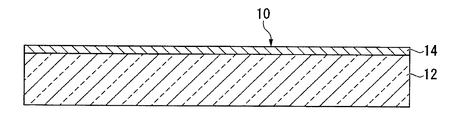
- FIG. 1 is a cross-sectional view showing an example of a glass plate with a low reflection film of the present invention and a glass plate with a low reflection film for a display device of the present invention (hereinafter also simply referred to as a glass plate with a low reflection film).
- the glass plate 10 with a low reflection film includes a glass plate 12 and a low reflection film 14 formed on the surface of the glass plate 12.
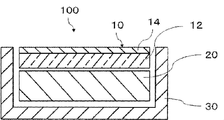
- FIG. 3 is a cross-sectional view showing an example of the display device 100 of the present invention.
- the display device 100 includes a glass plate 10 with a low reflection film for display devices (hereinafter also simply referred to as a glass plate 10 with a low reflection film), a display member 20, and a housing 30.
- the glass plate 10 with a low reflection film includes a glass plate 12 and a low reflection film 14 formed on the surface of the glass plate.
- the low reflection film 14 is formed in the surface on the opposite side to the surface facing the display member of a glass plate. 1 and 3, the upper surface side of the low reflection film 14 of the glass plate 10 with the low reflection film is the outside of the display device, that is, the viewer side or the operator side.
- the display device of the present invention includes various display devices such as a small display such as a mobile phone or a portable information terminal, a large display such as various televisions, or a touch panel.
- a small display such as a mobile phone or a portable information terminal
- a large display such as various televisions
- a touch panel a display device having a glass plate with a low reflection film that has excellent fingerprint removability. Preferred specific examples are mentioned.
- Examples of the display member include a liquid crystal display member, a plasma display member, and an organic EL display member.
- the housing is a box-shaped member that houses the display member 20 and the glass plate 10 with the low reflection film, and the material may be resin, metal, or the like.
- Glass plate 12 examples include soda lime glass, borosilicate glass, aluminosilicate glass, and alkali-free glass.
- molded by the float glass process etc. may be sufficient, and the template glass which has an unevenness
- the refractive index of the glass plate 12 is preferably 1.45 to 1.60 from the relationship between the low reflection film and the refractive index.
- Layers other than the low reflection film 14 such as an alkali barrier layer and a primer layer may be formed in advance on the surface of the glass plate 12.
- the low reflection film 14 is, for example, a single-layer film including a matrix and hollow fine particles formed by applying a coating liquid for forming a low reflection film described later once.
- the low-reflection film 14 may be formed by applying the coating liquid for forming the low-reflection film a plurality of times, and the single-layer configuration in which the film functions as the low-reflection film or substantially. Any material that can be regarded as a single-layer structure may be used.
- the matrix has a relatively low refractive index, low reflectivity, excellent chemical stability, and excellent adhesion to the glass plate 12, so that it contains silica as the main component and a small amount of a fluorine-containing ether compound. What has the component which has a structure derived from is preferable. Except for the component which has a structure derived from the fluorine-containing ether compound in a matrix, what consists of silica substantially is more preferable. “Silica as a main component” means that the proportion of silica is 90% by mass or more of the matrix (100% by mass), and substantially consisting of silica means a structure derived from the compound (A) described later and It means that it is composed only of silica excluding inevitable impurities.
- the matrix has a poly (oxyperfluoroalkylene) chain, which will be described later, in the main chain, and has a hydrolyzable silyl group at least at one end of the main chain, from the point that it is excellent in oil and fat stain removability. It preferably has a structure derived from a fluorine-containing ether compound.
- Examples of the matrix include a calcined product of at least one matrix precursor selected from the group of matrix precursors (a), (b) and (c) described below, and the like, from the point of excellent oil and oil stain removal properties.
- a fired product of the matrix precursor (a) is more preferable.
- a matrix precursor containing a silica precursor described later and a fluorine ether compound described later (B) A matrix precursor containing a silica precursor described later, a fluorine ether compound described later, and a hydrolysis condensate between the fluorine ether compounds. (C) A matrix precursor containing a silica precursor described later, a hydrolysis condensate of fluorine ether compounds described later, and a hydrolysis condensate of a silica precursor (alkoxysilane) and a fluorine ether compound.
- the material of the shell of the hollow fine particles Al 2 O 3 , SiO 2 , SnO 2 , TiO 2 , ZrO 2 , ZnO, CeO 2 , Sb-containing SnO X (ATO), Sn-containing In 2 O 3 (ITO), RuO 2 etc. are mentioned. Among these, one type may be used alone, or two or more types may be used in combination.
- the shape of the hollow fine particles include a spherical shape, an elliptical shape, a needle shape, a plate shape, a rod shape, a cone shape, a columnar shape, a cube shape, a rectangular shape, a diamond shape, a star shape, and an indefinite shape.
- the hollow fine particles may exist in a state where each fine particle is independent, each fine particle may be linked in a chain shape, or each fine particle may be aggregated.
- hollow silica fine particles are preferable because the low reflective film 14 has a low refractive index, a low reflectivity is obtained, chemical stability is excellent, and adhesion to the glass plate 12 is excellent.
- the average primary particle diameter of the hollow silica fine particles is preferably 5 to 150 nm, more preferably 50 to 100 nm.
- the average primary particle diameter of the hollow silica fine particles is 5 nm or more, the reflectance of the low reflective film 14 is sufficiently low. If the average primary particle diameter of the hollow silica fine particles is 150 nm or less, the haze of the low reflective film 14 can be suppressed low.
- the average primary particle size is obtained by randomly selecting 100 fine particles from an electron micrograph, measuring the particle size of each fine particle, and averaging the particle size of 100 fine particles.
- the minimum reflectance of the low reflective film 14 within the wavelength range of 300 to 1,200 nm is 1.7% or less, preferably 0.2 to 1.7%, more preferably 0.8 to 1.1%. 0.9 to 1.0% is more preferable. If the minimum reflectance of the low-reflection film 14 is 1.7% or less, the glass plate 10 with the low-reflection film sufficiently satisfies the low reflectance required for various displays, automotive window glasses, touch panels, and the like. . If the minimum reflectance of the low reflection film 14 is greater than 1.7%, the low reflection characteristics may be insufficient.
- the water contact angle on the surface of the low reflection film 14 is 97 ° or more, preferably 95 ° to 121 °, more preferably 97 ° to 109 °, and still more preferably 97 ° to 99 °.
- the contact angle of oleic acid on the surface of the low reflection film 14 is 50 ° or more, preferably 50 ° to 90 °, more preferably 52 ° to 87 °, and particularly preferably 55 ° to 85 °.
- the oleic acid tumbling angle on the surface of the low reflective film 14 is 25 ° or less, preferably 5 ° to 25 °, more preferably 5 ° to 20 °, and more preferably 6 ° to 10 °.
- the oil and fat stains on the surface of the low reflective film 14 can be easily removed.
- the ratio of the elemental fluorine on the surface of the low reflective film 14 measured by X-ray photoelectron spectroscopy is preferably 3 to 20 atomic%, more preferably 5 to 18 atomic%, and further preferably 5 to 16 atomic%.
- the ratio of the elemental fluorine on the surface of the low reflection film 14 indicates how much a structure derived from a fluorine-containing compound such as the compound (A) described later exists on the surface of the low reflection film 14 and in the vicinity thereof. If the ratio of the fluorine element on the surface of the low reflective film 14 is 3 atomic% or more, the oil and fat stain removability is further improved.
- X-ray photoelectron spectroscopy is a method of observing photoelectrons escaped from the sample surface by X-ray irradiation, and therefore the analysis result is the observable photoelectron escape depth, more specifically, low reflection. This is analysis information of the outermost surface layer having a depth of several nm to several tens of nm from the outermost surface on the air side of the film.
- the arithmetic average roughness (Ra) of the surface of the low reflection film 14 measured by a scanning probe microscope device is preferably 3.0 to 5.0 nm, more preferably 3.0 to 4.5 nm, and 3.0 to 4 More preferably, 0.0 nm. If the arithmetic average roughness (Ra) of the surface of the low reflective film 14 is 3.0 nm or more, it indicates that very fine irregularities are formed, and the water and oil repellency is easily improved. If the arithmetic mean roughness (Ra) of the surface of the low reflective film 14 is 5.0 nm or less, the oil and fat stain removability is further improved.
- the refractive index of the low reflection film 14 is preferably 1.20 to 1.46, more preferably 1.20 to 1.40, and further preferably 1.20 to 1.35. If the refractive index of the low reflective film 14 is 1.20 or more, the porosity of the low reflective film 14 does not become too high, and the durability is improved. When the refractive index of the low reflective film 14 is 1.46 or less, the reflectance of the low reflective film 14 is sufficiently low.
- the refractive index n of the low-reflection film 14 is in the range of 300 to 1,200 nm when a single-layer low-reflection film 14 is formed on the surface of the glass plate 12 and the single-layer low-reflection film 14 is measured with a spectrophotometer.
- the minimum reflectance (so-called bottom reflectance) Rmin and the refractive index ns of the glass plate 12 are calculated by the following equation (1).
- Rmin (n ⁇ ns) 2 / (n + ns) 2 (1).
- the thickness of the low reflection film 14 is preferably 80 to 100 nm, and more preferably 85 to 95 nm. When the thickness of the low reflection film 14 is 80 nm or more, the durability of the low reflection film 14 is expressed. If the thickness of the low reflection film 14 is 100 nm or less, it depends on the refractive index of the film to be used, but it is preferable because low reflectivity is exhibited as a single layer film.
- the thickness of the low reflection film 14 is measured from an image obtained by observing the cross section of the low reflection film 14 with a scanning electron microscope.
- the glass plate 10 with a low reflection film of the present invention can be manufactured, for example, by applying a coating solution for forming the low reflection film 14 to the surface of the glass plate 12, preheating as desired, and finally baking.
- the coating solution contains a matrix precursor, hollow fine particles, and a solvent.
- the coating solution may contain a surfactant for improving the leveling property, a metal compound for improving the durability of the low reflection film 14, or the like.
- the matrix precursor includes a silica precursor, a fluorine-containing ether compound having a poly (oxyperfluoroalkylene) chain in the main chain and a hydrolyzable silyl group at least at one end of the main chain, and / or its And hydrolyzed condensate.
- the hydrolyzed condensate of the fluorinated ether compound may be a hydrolyzed condensate between the fluorinated ether compounds, or may be a hydrolyzed condensate of an alkoxysilane that is a silica precursor and a fluorinated ether compound. Good.
- the matrix precursor include at least one matrix precursor selected from the group of the following matrix precursors (a), (b), and (c). From the viewpoint of excellent removability, the matrix precursor (a) is more preferable.
- a matrix precursor containing a silica precursor and a fluorine-containing ether compound A matrix precursor containing a silica precursor, a fluorine-containing ether compound, and a hydrolysis condensate of compound (A).
- B A matrix precursor containing a silica precursor, a hydrolysis condensate between fluorine-containing ether compounds, and a hydrolysis condensate of a silica precursor (alkoxysilane) and a fluorine-containing ether compound.
- silica precursor examples include alkoxysilane, alkoxysilane hydrolysis condensate (sol-gel silica), silazane, and the like. From the viewpoint of each characteristic of the low reflective film 14, an alkoxysilane hydrolysis condensate is preferable.
- alkoxysilane examples include tetraalkoxysilane (tetramethoxysilane, tetraethoxysilane, tetrapropoxysilane, or tetrabutoxysilane), alkoxysilane having a perfluoropolyether group (perfluoropolyether triethoxysilane, etc.), and a perfluoroalkyl group.
- Alkoxysilane (perfluoroethyltriethoxysilane, etc.) having a vinyl group alkoxysilane having a vinyl group (vinyltrimethoxysilane, vinyltriethoxysilane, etc.), alkoxysilane having an epoxy group (2- (3,4-epoxycyclohexyl) ethyl Trimethoxysilane, 3-glycidoxypropyltrimethoxysilane, 3-glycidoxypropylmethyldiethoxysilane, or 3-glycidoxypropyltrie Kishishiran etc.), or acryloyl alkoxysilane having an oxy group (3-acryloyloxy propyl trimethoxysilane and the like) and the like.
- hydrolysis of alkoxysilane is carried out using water at least 4 times the mole of alkoxysilane and an acid or alkali as a catalyst.
- the acid include inorganic acids (for example, nitric acid, sulfuric acid, or hydrochloric acid), or organic acids (for example, formic acid, oxalic acid, monochloroacetic acid, dichloroacetic acid, or trichloroacetic acid).
- the alkali include ammonia, sodium hydroxide, and potassium hydroxide.
- the catalyst is preferably an acid from the viewpoint of long-term storage stability of the alkoxysilane hydrolysis condensate.
- a catalyst used for hydrolysis of alkoxysilane a catalyst that does not hinder the dispersion of hollow fine particles is preferable.
- the fluorine-containing ether compound may have a hydrolyzable silyl group at one end of the main chain, or may have a hydrolyzable silyl group at both ends of the main chain. From the viewpoint of sufficiently imparting friction resistance to the low reflection layer, it is preferable to have a hydrolyzable silyl group only at one end of the main chain.
- the low reflection layer is a layer formed on the outermost surface of the film, and is the outermost surface portion of the film where fingerprints and dirt are in direct contact.
- the fluorine-containing ether compound may be a single compound, or may be a mixture of two or more different poly (oxyperfluoroalkylene) chains, terminal groups, or linking groups.
- the number average molecular weight of the fluorinated ether compound is preferably from 500 to 10,000, more preferably from 800 to 8,000. When the number average molecular weight is within the above range, the friction resistance is excellent. From the viewpoint of compatibility with the other components constituting the matrix precursor, the number average molecular weight of the compound is particularly preferably 800 to 2,000. In general, in a fluorine-containing ether compound, it is considered that the smaller the number average molecular weight, the stronger the chemical bond with the substrate. The reason for this is considered that the number of hydrolyzable silyl groups present per unit molecular weight increases. However, the present inventors have confirmed that if the number average molecular weight is less than the lower limit of the above range, the friction resistance tends to decrease.
- the fluorine-containing ether compound Since the fluorine-containing ether compound has a poly (oxyperfluoroalkylene) chain, the fluorine atom content is large. Therefore, the fluorine-containing ether compound has a high initial water and oil repellency and can form a low reflection layer excellent in friction resistance or fingerprint stain removability.
- a hydrolyzable silyl group (—SiL m R 3-m ) in the fluorine-containing ether compound undergoes a hydrolysis reaction to form a silanol group (Si—OH), and the silanol group reacts between molecules to form Si—
- An O—Si bond is formed, or the silanol group is subjected to a dehydration condensation reaction with a hydroxyl group (substrate —OH) on the surface of the substrate to form a chemical bond (substrate —O—Si). That is, the low reflective layer in the present invention contains the present compound in a state in which a part or all of the hydrolyzable silyl group of the present compound is hydrolyzed.
- the compound (A) is a compound represented by the following formula (A).
- R F1 represents a monovalent perfluoro saturated hydrocarbon group having 1 to 20 carbon atoms or a monovalent perfluoro saturated hydrocarbon group having 2 to 20 carbon atoms in which an etheric oxygen atom is inserted between the carbon atom and the carbon atom. And a group not containing the —OCF 2 O— structure.
- a is an integer of 1 to 200, preferably an integer of 2 to 100, more preferably an integer of 3 to 50, and still more preferably an integer of 5 to 25.
- b is 0 or 1, and 1 is preferable.
- Q is absent when b is 0 and is a divalent or trivalent linking group when b is 1.
- c is 1 when Q is not present or Q is a divalent linking group, and is 2 when Q is a trivalent linking group.
- d is an integer of 2 to 6.
- R is a hydrogen atom or a monovalent hydrocarbon group.
- L is a hydrolyzable group.
- the hydrolyzable group is a group that can form a Si—OH group by hydrolysis of a Si—L group.
- L examples include an alkoxy group, an acyloxy group, a ketoxime group, an alkenyloxy group, an amino group, an aminoxy group, an amide group, an isocyanate group, or a halogen atom, and the stability of the compound (A) and the ease of hydrolysis. From the viewpoint of balance, an alkoxy group, an isocyanate group, and a halogen atom (particularly a chlorine atom) are preferable. As the alkoxy group, an alkoxy group having 1 to 3 carbon atoms is preferable, and a methoxy group or an ethoxy group is more preferable. When two or more L are present in the fluorine-containing compound, L may be the same group or different groups, and the same group is preferable from the viewpoint of availability.
- P is an integer from 1 to 3.
- p is 1 or more, the structure derived from the compound (A) can be firmly bonded to the matrix by the condensation of Si—OH groups.
- p is preferably 2 or 3, particularly preferably 3.
- the following compound (A-1) or compound (A-2) is preferred from the viewpoint of oil and fat stain removability and ease of synthesis of the compound (A).
- a1 and a2 are integers of 5 to 25.
- the compound (A) has no —OCF 2 O— structure, the low reflection film 14 having excellent deterioration resistance can be formed even in the presence of an acid catalyst and under high temperature conditions.
- the (CF 2 CF 2 O) a structure of the compound (A) is an alkyleneoxy structure in which no CF 3 group that reduces molecular mobility exists. Therefore, the mobility of the molecule of the compound (A) itself is increased, and the low reflection film 14 formed from the matrix precursor containing the compound (A) is a film excellent in oil and fat stain removability.
- the mass ratio (hollow fine particles / SiO 2 ) between the hollow fine particles and the silica precursor (SiO 2 equivalent) in the coating solution is preferably 6/4 to 4/6. If the ratio of the hollow fine particles is less than 6/4, the arithmetic average roughness (Ra) of the surface of the low reflection film 14 is reduced, and the oil and dirt removal property of the low reflection film 14 is improved. If the ratio of the hollow fine particles is more than 4/6, the refractive index of the low reflective film 14 is low, and the reflectivity of the low reflective film 14 is sufficiently low.
- the ratio of the fluorine-containing ether compound in the coating solution is preferably 0.8 to 3.0% by mass with respect to the total (100% by mass) of the hollow fine particles and the silica precursor (in terms of SiO 2 ), 1.0 More preferably, it is -1.8 mass%. If the ratio of a fluorine-containing ether compound is 0.8 mass% or more, the removal property of fats and oils will improve further. When the ratio of the fluorinated ether compound is 2.0% by mass or less, the haze increase due to the local uneven distribution of the film surface of the fluorinated ether compound is not preferable.
- the solvent examples include a solvent for the matrix precursor solution and a dispersion medium for the dispersion of hollow fine particles.
- a mixed solvent of water and alcohols for example, methanol, ethanol, isopropanol, butanol, diacetone alcohol, etc. is preferable.
- the organic solvent may be a fluorinated organic solvent, a non-fluorinated organic solvent, or may include both solvents.
- Examples of the solvent include methanol or ethanol.
- dispersion medium for the hollow fine particle dispersion examples include water, alcohols, ketones, ethers, cellosolves, esters, glycol ethers, nitrogen-containing compounds, and sulfur-containing compounds.
- Examples of the method for preparing the coating liquid include the following methods ( ⁇ ) to ( ⁇ ).
- the fluorinated ether compound floats on the surface of the coating film and is fired.
- the method ( ⁇ ) is preferable since the structure derived from the fluorine-containing ether compound is later unevenly distributed on the surface of the low reflective film 14 and excellent removability of fat and oil stains is exhibited.
- the dispersion of hollow fine particles is preferably added after diluting the solution of the matrix precursor from the viewpoint of suppressing aggregation of the hollow fine particles.
- a known wet coating method for example, spin coating method, spray coating method, dip coating method, die coating method, curtain coating method, screen coating method, ink jet method, flow coating method, gravure coating method, bar coating method. , Flexo coat method, slit coat method, roll coat method, etc.).
- the coating temperature is preferably room temperature to 200 ° C, more preferably room temperature to 150 ° C.
- the firing temperature is preferably 30 ° C. or higher, more preferably 100 to 180 ° C., and may be appropriately determined according to the material of the glass plate, fine particles or matrix.
- the firing time is preferably 3 minutes or more, more preferably from 10 minutes to 60 minutes, and may be appropriately determined according to the material of the glass plate, fine particles or matrix.
- the glass plate with a low-reflection film of the present invention is a glass plate with a low-reflection film having a single-layer low-reflection film containing a matrix and hollow fine particles on the surface of the glass plate, wherein the matrix is the fluorine-containing ether compound.
- the hollow fine particles are preferably the hollow silica fine particles, and the fluorine-containing ether compound is more preferably a compound (A) represented by the following formula (A).
- the glass plate with a low reflection film of the present invention is produced by applying a coating solution containing a matrix precursor, hollow fine particles, and a solvent to the surface of the glass plate.
- the glass plate with a low reflection film of the present invention has a low reflection film on the surface, and the low reflection film contains a matrix precursor and hollow fine particles.
- the low reflection film is preferably formed of a coating liquid containing a silica precursor, a matrix precursor containing a fluorine-containing ether compound and / or a hydrolysis condensate thereof, hollow silica fine particles, and a solvent.
- a coating solution more preferably contains a matrix precursor containing a hydrolysis condensate of alkoxysilane and a compound (A) represented by the following formula (A), hollow silica fine particles, and a solvent. More preferably, it contains a matrix precursor containing a hydrolysis condensate of ethoxysilane and the compound (A) represented by the following formula (A), hollow silica fine particles, and a solvent.
- R F1 O (CF 2 CF 2 O) a CF 2- (Q) b (— (CH 2 ) d —SiL p R 3-p ) c (A).
- R F1 , a, b, Q, c, d, L, R and p have the same meaning as described above.
- the glass plate with a low reflection film of the present invention described above is a glass plate with a low reflection film having a single-layer low reflection film containing a matrix and hollow fine particles on the surface of the glass plate, and has a wavelength of 300 to 1,
- the minimum reflectance of the low reflection film within a range of 200 nm is 1.7% or less
- the water contact angle on the surface of the low reflection film is 97 ° or more
- oleic acid on the surface of the low reflection film Since the contact angle is 50 ° or more and the oleic acid tumbling angle on the surface of the low reflection film is 25 ° or less, the reflectivity in the low reflection film is sufficiently low, and the oil and fat stain removability is good. is there.
- the method for producing a glass plate with a low reflection film according to the present invention described above includes a step of applying a coating liquid containing a matrix precursor, hollow fine particles, and a solvent to the surface of the glass plate, followed by baking, and the matrix precursor.
- a coating liquid containing a matrix precursor, hollow fine particles, and a solvent has a silica precursor, a poly (oxyperfluoroalkylene) chain in the main chain, and a hydrolyzable silyl group at least at one end of the main chain and / or its hydrolytic condensation
- the mass ratio (hollow fine particles / SiO 2 ) between the hollow fine particles and the silica precursor (SiO 2 equivalent) in the coating solution is 6/4 to 4/6, and the fluorine-containing ether compound in the coating solution Is 0.8 to 3.0% by mass with respect to the total (100% by mass) of the hollow fine particles and the silica precursor (in terms of SiO 2 ). It is possible to produce a glass plate with a low reflection film having
- the display device of the present invention described above includes a glass plate with a low reflection film having a single-layer low reflection film containing a matrix and hollow fine particles on the surface of the glass plate. And in the glass plate with a low reflection film, the minimum reflectance of the low reflection film within a wavelength range of 300 to 1,200 nm is 1.7% or less, and the water contact angle on the surface of the low reflection film is Since it is 97 ° or more, the oleic acid contact angle on the surface of the low reflection film is 50 ° or more, and the oleic acid falling angle on the surface of the low reflection film is 25 ° or less, the reflection on the low reflection film The rate is sufficiently low, and the oil / fouling stain removability is good.
- Examples 15-18, 21-23, 26-28, 31-34, 37-42, 45-50, 53-58, and 61-66 are examples, examples 1-14, 19, 20, 24, Reference numerals 25, 29, 30, 35, 36, 43, 44, 51, 52, 59, and 60 are comparative examples.
- the reflectance of the low reflection film was measured using a spectrophotometer (manufactured by Hitachi, Ltd., model: U-4100).
- the luminous reflectance is a reflectance averaged by multiplying the reflectance at a wavelength of 380 to 780 nm by a weight function.
- the reflectance of the low reflection film at wavelengths of 300 to 1,200 nm was measured using a spectrophotometer (manufactured by Hitachi, Ltd., model: U-4100), and the minimum reflectance (minimum reflectance) was obtained.
- the arithmetic average roughness (Ra) of the surface of the low-reflection film was measured using a scanning probe microscope apparatus (SII Nano Technology, SPA400DFM).
- the refractive index n of the low-reflection film is calculated from the following formula (1) from the minimum reflectance Rmin in the wavelength range of 300 to 1,200 nm measured with a spectrophotometer for the single-layer low-reflection film and the refractive index ns of the glass plate. ).
- Rmin (n ⁇ ns) 2 / (n + ns) 2 (1).
- a straight line was drawn on the surface of the low reflection film using an oily marker (manufactured by Zebra, Mackey (registered trademark)), and evaluation was performed according to the following criteria.
- soda lime glass manufactured by Asahi Glass Co., Ltd., size: 100 mm ⁇ 100 mm, thickness: 3.2 mm, refractive index: 1.52, visible light transmittance: 90.4%
- soda lime glass manufactured by Asahi Glass Co., Ltd., size: 100 mm ⁇ 100 mm, thickness: 3.2 mm, refractive index: 1.52, visible light transmittance: 90.4%
- Compound (A) was prepared as compound (A).
- Compound (A-1) was produced using the method described in Examples 1 and 2 of WO2009 / 008380.
- TEOS tetraethoxysilane
- (Hollow particles) As the hollow fine particles the following were prepared. Dispersion of hollow silica fine particles (C-1): Asahi Glass Co., Ltd., hollow particle sol, SiO 2 equivalent solid content concentration: 20% by mass, average primary particle size: 10 nm, water: 40% by mass, alcohol: 40% by mass. Dispersion of hollow silica fine particles (C-2): manufactured by JGC Catalysts & Chemicals, Inc., hollow particle sol, solid content concentration in terms of SiO 2 : 20% by mass, average primary particle size: 20 nm, alcohol: 80% by mass.
- Example 1 To 10 g of the TEOS solution, 0.02 g of an 8 mol / L nitric acid aqueous solution was added and stirred for 2 hours to obtain a TEOS hydrolysis condensate solution.
- the coating liquid was applied to the surface of the glass plate by spin coating (180 rpm, 60 seconds) and then baked at 150 ° C. for 30 minutes to obtain a glass plate with a low reflection film.
- Table 2 shows the evaluation results of the glass plate with a low reflection film.
- Example 2 A glass plate with a low reflection film was obtained in the same manner as in Example 1 except that the rotation speed of the spin coat was changed from 180 rpm to 250 rpm. Table 1 shows the composition of the coating solution. The evaluation results of the glass plate with a low reflection film are shown in Table 1.
- Examples 3 to 12 A glass plate with a low reflection film was obtained in the same manner as in Example 1 or Example 2 except that the composition of the coating solution was changed to the composition shown in Table 1. The glass plate with a low reflection film was evaluated. The results are shown in Table 2.
- Example 13 to 23 A glass plate with a low reflection film was obtained in the same manner as in Examples 1 to 12 except that the ratio of the compound (A-1) was changed to the ratio shown in Table 3. The glass plate with a low reflection film was evaluated. The results are shown in Table 4.
- Example 24 to 34 A glass plate with a low reflection film was obtained in the same manner as in Examples 1 to 12, except that the ratio of the compound (A-1) was changed to the ratio shown in Table 5. The glass plate with a low reflection film was evaluated. The results are shown in Table 6.
- Examples 35 to 42 The glass plate with a low reflection film was changed in the same manner as in Examples 1 to 12 except that the composition of the coating solution was changed to the composition shown in Table 7 and the timing of addition of compound (A-1) was changed before the hydrolysis of TEOS. Got. The glass plate with a low reflection film was evaluated. The results are shown in Table 8.
- Example 43 to 50 A glass plate with a low reflection film was obtained in the same manner as in Examples 35 to 42 except that the timing of addition of compound (A-1) was changed after 1 hour of hydrolysis of TEOS. The glass plate with a low reflection film was evaluated. The results are shown in Table 8.
- Example 51 to 58 A glass plate with a low reflection film was obtained in the same manner as in Examples 35 to 42 except that the addition timing of the compound (A-1) was changed 2 hours after the hydrolysis of TEOS. The glass plate with a low reflection film was evaluated. The results are shown in Table 10.
- Example 59-66 A glass plate with a low reflection film was obtained in the same manner as in Examples 35 to 42 except that the addition timing of the compound (A-1) was changed 2 hours after the hydrolysis of TEOS and after the solvent was diluted. The glass plate with a low reflection film was evaluated. The results are shown in Table 10.
- FIG. 2 shows an SEM image at a magnification of 100,000 times in the film cross-sectional direction after cutting the glass with a low reflection film with a focused ion beam.
- the low reflection film has a film thickness of about 100 nm and is composed of hollow particles and a matrix component (silica and fluorine compound). The part where the void is confirmed in the membrane is a place where the hollow particle is cut and the void inside the hollow particle is visible.
- the glass plate with a low reflection film of the present invention and the glass plate with a low reflection film obtained by the production method of the present invention are useful as a glass plate used for various displays, automobile window glass, touch panels, and the like.
- the display device of the present invention is useful for various televisions, touch panels, mobile phones, portable information terminals, and the like.
- the entire contents of the specification, claims, drawings, and abstract of Japanese Patent Application No. 2011-081833 filed herewith are incorporated herein by reference as the disclosure of the present invention.
Landscapes
- Chemical & Material Sciences (AREA)
- Materials Engineering (AREA)
- Engineering & Computer Science (AREA)
- Chemical Kinetics & Catalysis (AREA)
- General Chemical & Material Sciences (AREA)
- Geochemistry & Mineralogy (AREA)
- Life Sciences & Earth Sciences (AREA)
- Organic Chemistry (AREA)
- Dispersion Chemistry (AREA)
- Composite Materials (AREA)
- Surface Treatment Of Glass (AREA)
- Liquid Crystal (AREA)
- Devices For Indicating Variable Information By Combining Individual Elements (AREA)
- Surface Treatment Of Optical Elements (AREA)
- Laminated Bodies (AREA)
Abstract
Description
上記した数値範囲を示す「~」とは、その前後に記載された数値を下限値及び上限値として含む意味で使用され、特段の定めがない限り、以下本明細書において「~」は、同様の意味をもって使用される。
本発明の低反射膜付きガラス板において、単層の低反射膜とは、低反射機能を付与する均質な、あるいは実質的に均質な、あるいは不均質な1層構成をなす膜を意味する。また、本発明の低反射膜付きガラス板とは、ガラス板の少なくとも一方の表面の最外層に前記低反射膜が形成されたガラス板を意味する。従って、前記低反射膜付きガラス板の低反射膜が形成されていない反対側のガラス面に、あるいは最外層に形成された低反射膜の下層に、導電膜、近赤外線カット膜、電磁波防止膜、色調調整膜、接着性改善膜、耐久性向上膜、帯電防止膜、その他各種の所望の機能膜を1層ないし複層層形成してもよい。
走査型プローブ顕微鏡装置によって測定した前記低反射膜の表面の算術平均粗さ(Ra)は、3.0~5.0nmであることが好ましい。
前記低反射膜の屈折率は、1.30~1.46であることが好ましい。
RF1O(CF2CF2O)aCF2-(Q)b(-(CH2)d-SiLpR3-p)c ・・・(A)。
ただし、RF1は、炭素数1~20の1価のペルフルオロ飽和炭化水素基、または、炭素原子-炭素原子間にエーテル性酸素原子が挿入された炭素数2~20の1価のペルフルオロ飽和炭化水素基であり、かつ-OCF2O-構造を含まない基であり、
aは、1~200の整数であり、
bは、0または1であり、
Qは、bが0である場合には存在せず、bが1である場合には2または3価の連結基であり、
cは、Qが存在しない、またはQが2価の連結基である場合には1であり、Qが3価の連結基である場合には2であり、
dは、2~6の整数であり、
Lは、加水分解性基であり、
Rは、水素原子または1価の炭化水素基であり、
pは、1~3の整数である。
前記中空微粒子は、中空シリカ微粒子であることが好ましい。
なお、上記した「含フッ素エーテル化合物および/またはその加水分解縮合物」とは、本明細書において、含フッ素エーテル化合物および含フッ素エーテル化合物の加水分解縮合物からなる群から選ばれる少なくとも1種を意味する。
RF1、a、b、Q、c、d、L、Rおよびpは前記と同じ意味を有する。
本発明の低反射膜付きガラス板の製造方法における塗布液の調整の工程においては、アルコキシシランを加水分解した後、化合物(A)を加え、ついで中空微粒子の分散液を加えて塗布液とすることが好ましい。
前記中空微粒子は、中空シリカ微粒子であることが好ましい。
また本発明は表示装置用である前記低反射膜付きガラス板を提供する。
前記した表示装置の低反射膜付きガラス板、および表示用の低反射膜付きガラス板において、前記低反射膜は、表示装置の外側、すなわち、視認者側、あるいは操作者側の最外面に形成される。
図1、3において、低反射膜付きガラス板10の低反射膜14の上面側が、表示装置の外側、すなわち、視認者側、あるいは操作者側となる。
ガラス板12としては、たとえば、ソーダライムガラス、ホウケイ酸ガラス、アルミノケイ酸塩ガラス、または無アルカリガラス等が挙げられる。また、フロート法等により成形された平滑なガラス板であってもよく、表面に凹凸を有する型板ガラスであってもよい。また、ガラス板12の屈折率は、低反射膜と屈折率との関係から、1.45~1.60であるのが好ましい。
低反射膜14は、たとえば、後述する低反射膜形成用の塗布液を1回塗布することによって形成される、マトリックスと中空微粒子とを含む単層の膜である。しかし、低反射膜14は、低反射膜形成用の塗布液を複数回重ねて塗布することによって膜が形成されても構わず、当該膜が低反射膜として機能する単層構成あるいは実質的に単層構成とみなすことができるものであれば良い。
(b)後述するシリカ前駆体と、後述するフッ素エーテル化合物と、フッ素エーテル化合物同士の加水分解縮合物とを含むマトリックス前駆体。
(c)後述するシリカ前駆体と、後述するフッ素エーテル化合物同士の加水分解縮合物と、シリカ前駆体(アルコキシシラン)とフッ素エーテル化合物との加水分解縮合物とを含むマトリックス前駆体。
なお、中空微粒子の形状としては、球状、楕円状、針状、板状、棒状、円すい状、円柱状、立方体状、長方体状、ダイヤモンド状、星状、不定形状等が挙げられる。
中空微粒子としては、低反射膜14の屈折率が低く、低反射率が得られ、化学的安定性に優れ、ガラス板12との密着性に優れる点から、中空シリカ微粒子が好ましい。
本発明の低反射膜付きガラス板10は、たとえば、低反射膜14を形成するための塗布液を、ガラス板12の表面に塗布し、所望により予熱し、最後に焼成することによって製造できる。
塗布液は、レベリング性向上のための界面活性剤、または低反射膜14の耐久性向上のための金属化合物等を含んでいてもよい。
(b)シリカ前駆体と、含フッ素エーテル化合物と、化合物(A)の加水分解縮合物とを含むマトリックス前駆体。
(c)シリカ前駆体と、含フッ素エーテル化合物同士の加水分解縮合物と、シリカ前駆体(アルコキシシラン)と含フッ素エーテル化合物との加水分解縮合物とを含むマトリックス前駆体。
前記低反射層とは、膜の最表面に形成されている層であり、指紋や汚れが直接接触する膜の最表面部分である。
含フッ素エーテル化合物は、単一化合物であってもよく、ポリ(オキシペルフルオロアルキレン)鎖、末端基、または連結基等が異なる2種類以上の混合物であってもよい。
通常、含フッ素エーテル化合物においては、数平均分子量が小さいほど、基材との化学結合が強固となると考えられる。この理由は、単位分子量当たりに存在する加水分解性シリル基の数が多くなるためと考えられる。しかしながら、数平均分子量が前記範囲の下限値未満であると、耐摩擦性が低下しやすいことを、本発明者等は確認した。また、数平均分子量が前記範囲の上限値を超えると、耐摩擦性が低下する。この理由は、単位分子量当たりに存在する加水分解性シリル基の数の減少による影響が大きくなるためであると考えられる。
化合物(A)は、下式(A)で表される化合物である。
bは、0または1であり、1が好ましい。
Qは、bが0である場合には存在せず、bが1である場合には2または3価の連結基である。
cは、Qが存在しない、またはQが2価の連結基である場合には1であり、Qが3価の連結基である場合には2である。
dは、2~6の整数である。
Rは、水素原子または1価の炭化水素基である。
焼成温度は、30℃以上が好ましく、100~180℃がより好ましく、ガラス板、微粒子またはマトリックスの材料に応じて適宜決定すればよい。
焼成時間は、3分以上が好ましく、10分~60分がより好ましく、ガラス板、微粒子またはマトリックスの材料に応じて適宜決定すればよい。
本発明の低反射膜付きガラス板は、マトリックス前駆体と、中空微粒子と、溶媒とを含む塗布液を、ガラス板の表面に塗布することによって製造される。
すなわち、本発明の低反射膜付きガラス板は、表面に低反射膜を有し、前記低反射膜は、マトリックス前駆体と、中空微粒子とを含む。前記低反射膜は、シリカ前駆体と、含フッ素エーテル化合物および/またはその加水分解縮合物と、を含むマトリックス前駆体と、中空シリカ微粒子と、溶媒とを含む塗布液により形成することが好ましく、かかる塗布液は、アルコキシシランと下式(A)で表される化合物(A)との加水分解縮合物とを含むマトリックス前駆体と、中空シリカ微粒子と、溶媒とを含むことがより好ましく、テトラエトキシシランと下式(A)で表される化合物(A)との加水分解縮合物とを含むマトリックス前駆体と、中空シリカ微粒子と、溶媒とを含むことがさらに好ましい。
RF1、a、b、Q、c、d、L、Rおよびpは前記と同じ意味を有する。
以上説明した本発明の低反射膜付きガラス板は、マトリックスと中空微粒子とを含む単層の低反射膜を、ガラス板の表面に有する低反射膜付きガラス板であって、波長300~1,200nmの範囲内における前記低反射膜の最低反射率が、1.7%以下であり、前記低反射膜の表面における水接触角が、97°以上であり、前記低反射膜の表面におけるオレイン酸接触角が、50°以上であり、前記低反射膜の表面におけるオレイン酸転落角が、25°以下であるため、低反射膜における反射率が充分に低く、かつ油脂汚れの除去性が良好である。
例15~18、21~23、26~28、31~34、37~42、45~50、53~58、および61~66は実施例であり、例1~14、19、20、24、25、29、30、35、36、43、44、51、52、59、および60は比較例である。
低反射膜の反射率は、分光光度計(日立製作所社製、型式:U-4100)を用いて測定した。視感反射率は、波長380~780nmの反射率に重み関数を乗じて平均化した反射率である。
波長300~1,200nmにおける低反射膜の反射率を、分光光度計(日立製作所社製、型式:U-4100)を用いて測定し、反射率の最小値(最低反射率)を求めた。
低反射膜付きガラス板のヘイズは、ヘイズ測定装置(BYK-Gardner社製、ヘイズガードプラス)を用いて測定した。
低反射膜の表面に、約48μLの蒸留水を3箇所に置き、それぞれの水接触角を、接触角計(協和界面科学社製、FAMAS)を用いて測定し、3つの値の平均値を求めた。
低反射膜の表面に、約48μLのオレイン酸を3箇所に置き、それぞれのオレイン酸接触角を、接触角計(協和界面科学社製、FACE SLIDING ANGLE METER)を用いて測定し、3つの値の平均値を求めた。
低反射膜付きガラス板を水平に保持し、低反射膜の表面に48μLのオレイン酸を滴下した後、低反射膜付きガラス板を徐々に傾け、オレイン酸が転落し始めたときの低反射膜付きガラス板と水平面との角度(転落角)を測定した。測定結果として、「測定不能」とは、オレイン酸が基板上に広がり、低反射膜付きガラス板を傾けてもオレイン酸の移動等が観測されない状態を示す。
例11、23、および35の3つの低反射膜付きガラス板について、X線光電子分光装置(アルバック・ファイ社製、Quantera SXM)を用いて、低反射膜の表面におけるフッ素元素の割合を求めた。3点の測定結果から、塗布液中の化合物(A)の割合に対する低反射膜の表面におけるフッ素元素の割合の検量線を作成した。例11、23、および35を除く、その他の例の低反射膜付きガラス板については、検量線を用いて塗布液中の化合物(A)の割合から、低反射膜の表面におけるフッ素元素の割合を求めた。
低反射膜の表面の算術平均粗さ(Ra)は、走査型プローブ顕微鏡装置(SIIナノテクノロジー社製、SPA400DFM)を用いて測定した。
低反射膜の屈折率nは、単層の低反射膜について分光光度計で測定した波長300~1,200nmの範囲内における最低反射率Rminと、ガラス板の屈折率nsとから下式(1)によって算出した。
油性マーカー(ゼブラ社製、マッキー(登録商標))を用いて低反射膜の表面に直線を描き、下記の基準にて評価した。
A:線が全て水滴状となり、全く明確に書けない状態。
B:線が一部水滴状となるが、線としては認識される状態。
C:線を書くことができ、明確に線が認識される。
油脂汚れの付着性の評価をした後、低反射膜の表面の油性インクをキムワイプ(kimwipe)紙で拭き取り、下記の基準にて評価した。
A:3回擦るのみで完全に油性インクがとれる。
B:10回擦るとほぼとれるが微かに油性インク跡が残る。
C:30回擦ると若干油性インクの色が薄くなるが、ほとんど取れない。
D:100回擦ると若干油性インクの色が薄くなるが、ほとんど取れない。
E:100回擦っても、油性インクの色の変化が全くない。
ガラス板として、ソーダライムガラス(旭硝子社製、サイズ:100mm×100mm、厚さ:3.2mm、屈折率:1.52、可視光線透過率:90.4%)を用意した。
化合物(A)として、化合物(A-1)を用意した。
化合物(A-1)は、国際公開第2009/008380号の実施例1、および2に記載の方法を用いて製造したものである。
アルコキシシランとしては、テトラエトキシシラン(以下、TEOSと記す。)の溶液(純正化学社製、SiO2換算固形分濃度:5質量%、イソプロピルアルコール:30質量%,2-ブタノール:25質量%、エタノール:8質量%、ジアセトンアルコール:15質量%、メタノール:17質量%)を用意した。
中空微粒子としては、下記のものを用意した。
中空シリカ微粒子(C-1)の分散液:旭硝子社製、中空粒子ゾル、SiO2換算固形分濃度:20質量%、平均一次粒子径:10nm、水:40質量%、アルコール:40質量%。
中空シリカ微粒子(C-2)の分散液:日揮触媒化成社製、中空粒子ゾル、SiO2換算固形分濃度:20質量%、平均一次粒子径:20nm、アルコール:80質量%。
TEOSの溶液の10gに、8mol/Lの硝酸水溶液の0.02gを加え、2時間撹拌し、TEOSの加水分解縮合物の溶液を得た。
スピンコートの回転数を180rpmから250rpmに変更した以外は、例1と同様にして低反射膜付きガラス板を得た。塗布液の組成を表1に示す。低反射膜付きガラス板の評価結果を表1に示す。
塗布液の組成を表1に示す組成に変更した以外は、例1または例2と同様にして低反射膜付きガラス板を得た。前記低反射膜付きガラス板を評価した。結果を表2に示す。

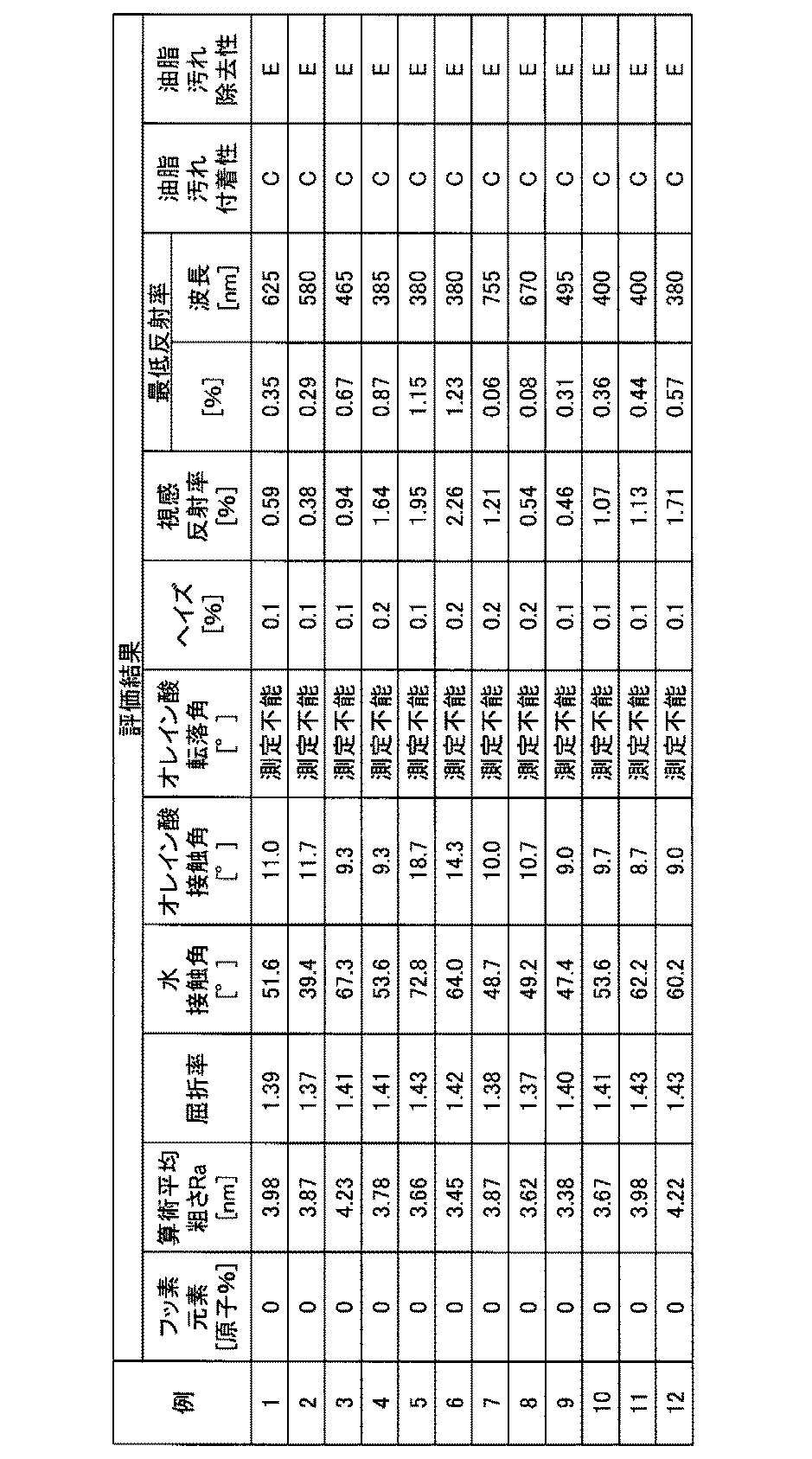
化合物(A-1)の割合を表3に示す割合に変更した以外は、例1~12と同様にして低反射膜付きガラス板を得た。前記低反射膜付きガラス板を評価した。結果を表4に示す。
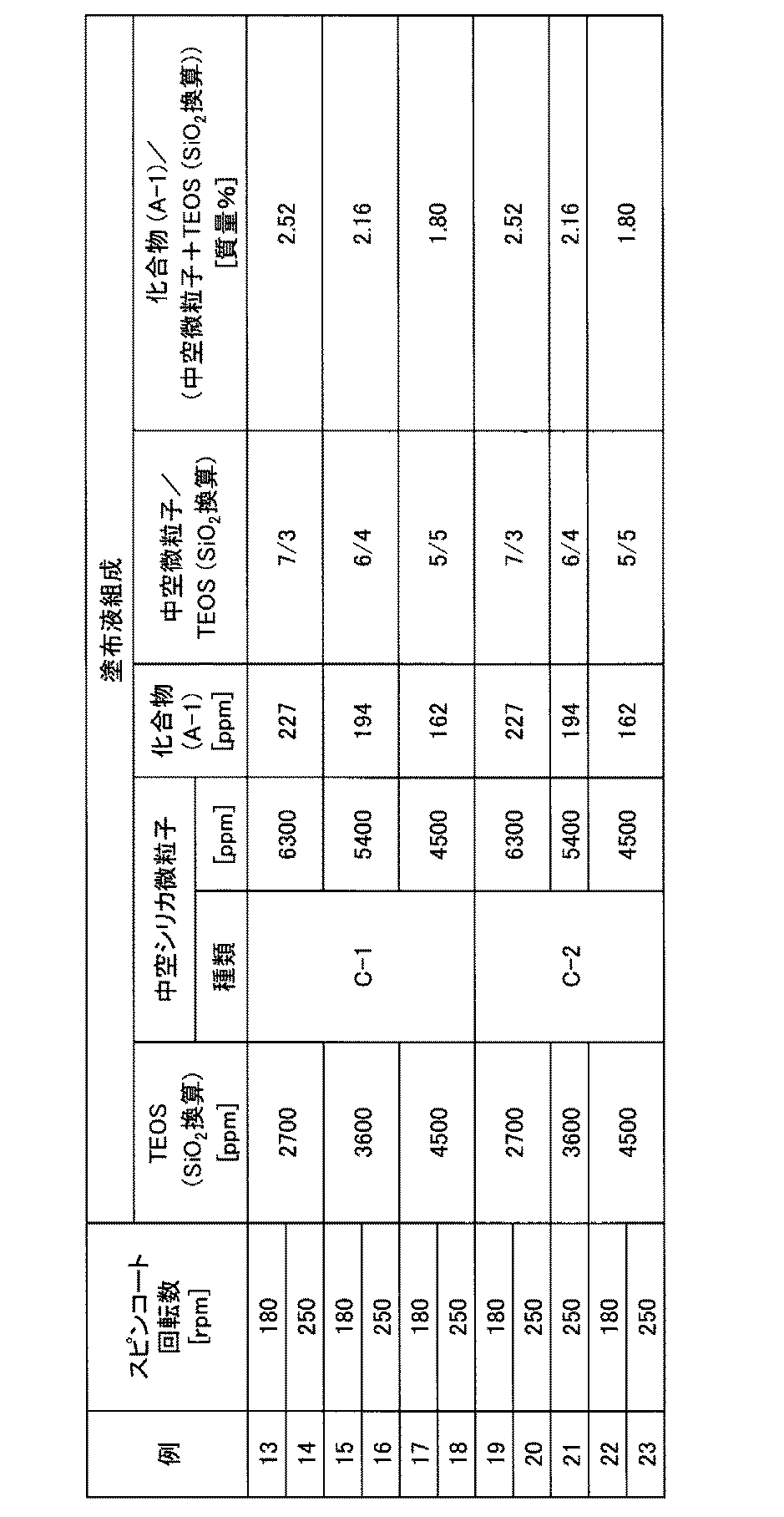
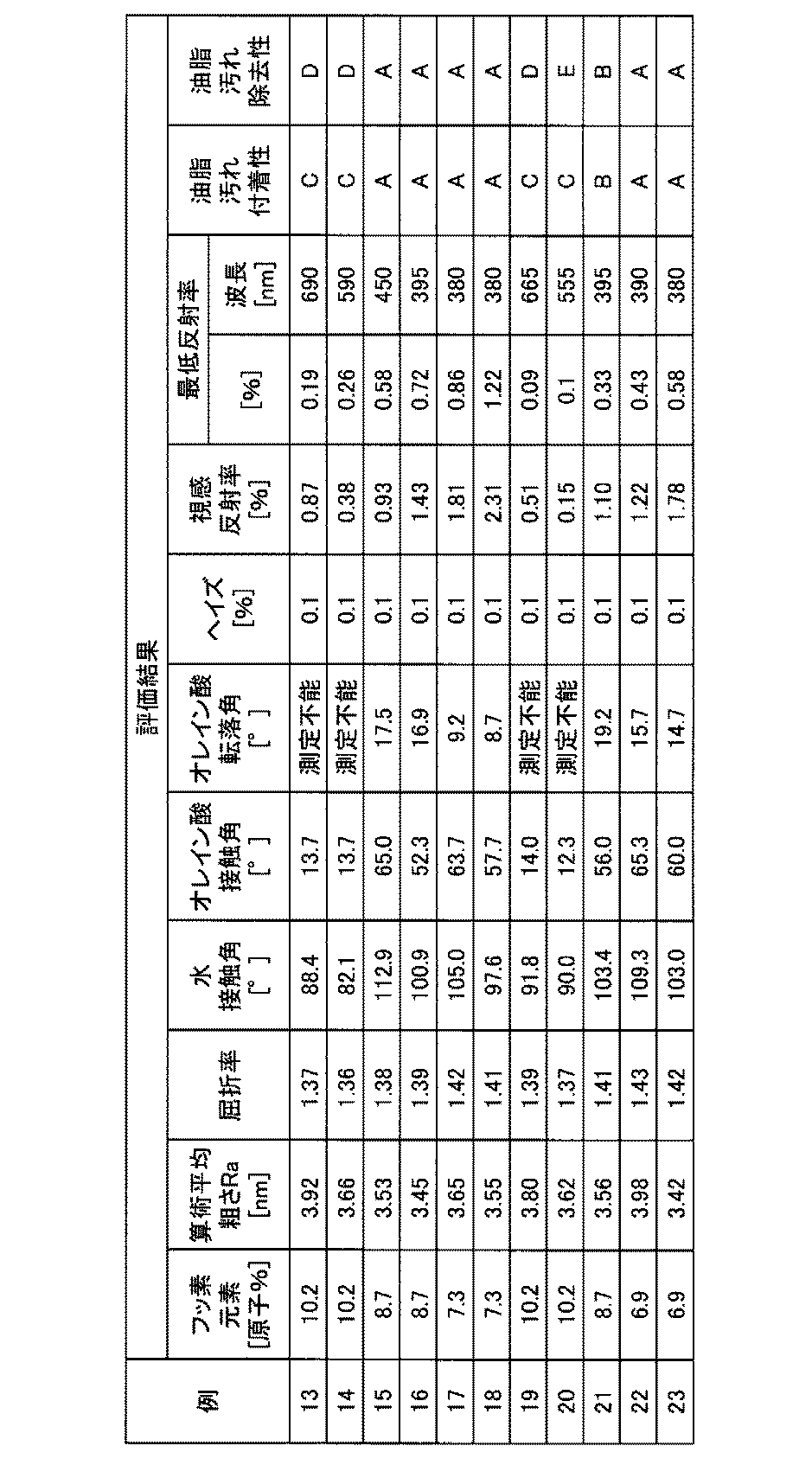
化合物(A-1)の割合を表5に示す割合に変更した以外は、例1~12と同様にして低反射膜付きガラス板を得た。前記低反射膜付きガラス板を評価した。結果を表6に示す。

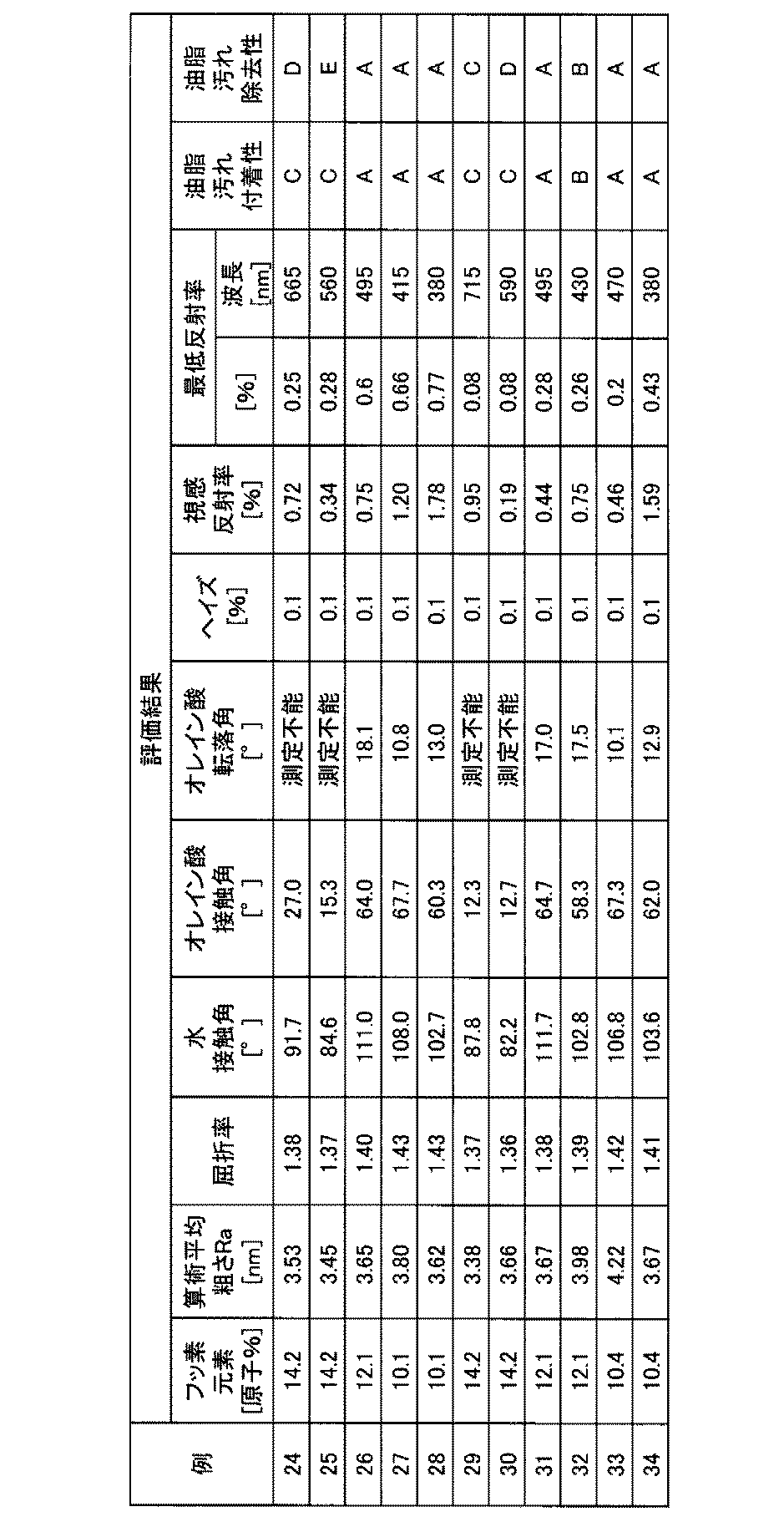
塗布液の組成を表7に示す組成に変更し、化合物(A-1)の添加のタイミングをTEOSの加水分解前に変更した以外は、例1~12と同様にして低反射膜付きガラス板を得た。前記低反射膜付きガラス板を評価した。結果を表8に示す。
化合物(A-1)の添加のタイミングをTEOSの加水分解の1時間後に変更した以外は、例35~42と同様にして低反射膜付きガラス板を得た。前記低反射膜付きガラス板を評価した。結果を表8に示す。

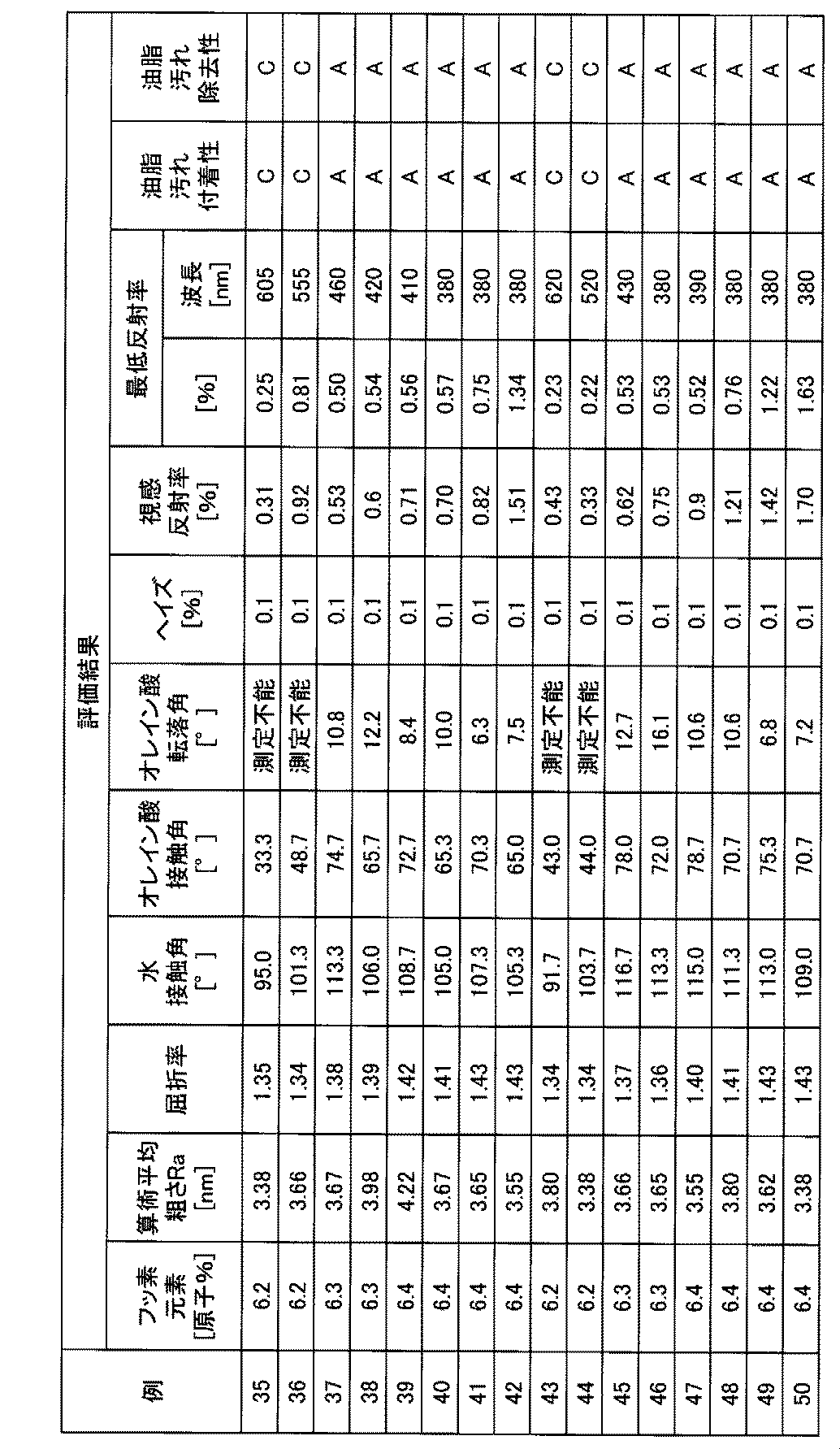
化合物(A-1)の添加のタイミングをTEOSの加水分解の2時間後に変更した以外は、例35~42と同様にして低反射膜付きガラス板を得た。前記低反射膜付きガラス板を評価した。結果を表10に示す。
化合物(A-1)の添加のタイミングをTEOSの加水分解の2時間後かつ溶媒希釈後に変更した以外は、例35~42と同様にして低反射膜付きガラス板を得た。前記低反射膜付きガラス板を評価した。結果を表10に示す。


なお、2011年4月1日に日本に出願された特願2011-081719号、2011年4月1日に日本に出願された特願2011-081720号、および2011年4月1日に日本に出願された特願2011-081833号の明細書、特許請求の範囲、図面及び要約書の全内容をここに引用し、本発明の開示として取り入れるものである。
12 ガラス板
14 低反射膜
100 表示装置
20 表示部材
30 筐体
Claims (15)
- マトリックスと中空微粒子とを含む単層の低反射膜を、ガラス板の表面に有する低反射膜付きガラス板であって、
波長300~1,200nmの範囲内における前記低反射膜の最低反射率が、1.7%以下であり、
前記低反射膜の表面における水接触角が、97°以上であり、
前記低反射膜の表面におけるオレイン酸接触角が、50°以上であり、
前記低反射膜の表面におけるオレイン酸転落角が、25°以下である、前記低反射膜付きガラス板。 - 前記ガラス板の少なくとも一方の面に、前記マトリックスと中空微粒子とを含む単層の低反射膜が、その最外層に形成されている、請求項1に記載の低反射膜付きガラス板。
- X線光電子分光法によって測定した前記低反射膜の表面におけるフッ素元素の割合が、3~20原子%である、請求項1または2に記載の低反射膜付きガラス板。
- 走査型プローブ顕微鏡装置によって測定した前記低反射膜の表面の算術平均粗さ(Ra)が、3.0~5.0nmである、請求項1~3のいずれか一項に記載の低反射膜付きガラス板。
- 前記低反射膜の屈折率が、1.20~1.46である、請求項1~4のいずれか一項に記載の低反射膜付きガラス板。
- 前記マトリックスが、シリカを主成分とし、かつポリ(オキシペルフルオロアルキレン)鎖を主鎖に有し、かつ前記主鎖の少なくとも一方の末端に加水分解性シリル基を有する、含フッ素エーテル化合物に由来する構造を有する、請求項1~5のいずれか一項に記載の低反射膜付きガラス板。
- 前記含フッ素エーテル化合物が、下式(A)で表される化合物(A)である、請求項1~6のいずれか一項に記載の低反射膜付きガラス板。
RF1O(CF2CF2O)aCF2-(Q)b(-(CH2)d-SiLpR3-p)c ・・・(A)。
ただし、RF1は、炭素数1~20の1価のペルフルオロ飽和炭化水素基、または、炭素原子-炭素原子間にエーテル性酸素原子が挿入された炭素数2~20の1価のペルフルオロ飽和炭化水素基であり、かつ-OCF2O-構造を含まない基であり、
aは、1~200の整数であり、
bは、0または1であり、
Qは、bが0である場合には存在せず、bが1である場合には2または3価の連結基であり、
cは、Qが存在しない、またはQが2価の連結基である場合には1であり、Qが3価の連結基である場合には2であり、
dは、2~6の整数であり、
Lは、加水分解性基であり、
Rは、水素原子または1価の炭化水素基であり、
pは、1~3の整数である。 - 前記中空微粒子が、中空シリカ微粒子である、請求項1~7のいずれか一項に記載の低反射膜付きガラス板。
- マトリックスと中空微粒子とを含む単層の低反射膜をガラス板の表面に有する低反射膜付きガラス板の製造方法であって、
マトリックス前駆体と中空微粒子と溶媒とを含む塗布液を、ガラス板の表面に塗布し、焼成する工程を有し、
前記マトリックス前駆体が、シリカ前駆体と、ポリ(オキシペルフルオロアルキレン)鎖を主鎖に有し、かつ前記主鎖の少なくとも一方の末端に加水分解性シリル基を有する、含フッ素エーテル化合物および/またはその加水分解縮合物とを含み、
前記塗布液中における中空微粒子とシリカ前駆体(SiO2換算)との質量比(中空微粒子/SiO2)が、6/4~4/6であり、
塗布液中における含フッ素エーテル化合物の割合が、中空微粒子とシリカ前駆体(SiO2換算)との合計(100質量%)に対して、0.8~3.0質量%である、前記低反射膜付きガラス板の製造方法。 - 前記含フッ素エーテル化合物が、下式(A)で表される化合物(A)である、請求項9に記載の低反射膜付きガラス板の製造方法。
RF1O(CF2CF2O)aCF2-(Q)b(-(CH2)d-SiLpR3-p)c ・・・(A)。
ただし、RF1は、炭素数1~20の1価のペルフルオロ飽和炭化水素基、または、炭素原子-炭素原子間にエーテル性酸素原子が挿入された炭素数2~20の1価のペルフルオロ飽和炭化水素基であり、かつ-OCF2O-構造を含まない基であり、
aは、1~200の整数であり、
bは、0または1であり、
Qは、bが0である場合には存在せず、bが1である場合には2または3価の連結基であり、
cは、Qが存在しない、またはQが2価の連結基である場合には1であり、Qが3価の連結基である場合には2であり、
dは、2~6の整数であり、
Lは、加水分解性基であり、
Rは、水素原子または1価の炭化水素基であり、
pは、1~3の整数である。 - 前記シリカ前駆体が、アルコキシシランの加水分解縮合物である、請求項9または10に記載の低反射膜付きガラス板の製造方法。
- アルコキシシランを加水分解した後、前記化合物(A)を加え、ついで中空微粒子の分散液を加えて塗布液を調製する工程をさらに有する、請求項11に記載の低反射膜付きガラス板の製造方法。
- 前記中空微粒子が、中空シリカ微粒子である、請求項9~12のいずれか一項に記載の低反射膜付きガラス板の製造方法。
- 筐体、表示部材、および前記表示部材の表示面に配置された請求項1~8のいずれか一項に記載の低反射膜付きガラス板を含む表示装置。
- 表示装置用である、請求項1~8のいずれか一項に記載の低反射膜付きガラス板。
Priority Applications (4)
| Application Number | Priority Date | Filing Date | Title |
|---|---|---|---|
| KR1020137025382A KR101884961B1 (ko) | 2011-04-01 | 2012-04-02 | 저반사막을 구비한 유리판 |
| JP2013508865A JP6020444B2 (ja) | 2011-04-01 | 2012-04-02 | 低反射膜付きガラス板 |
| CN201280016572.8A CN103476726B (zh) | 2011-04-01 | 2012-04-02 | 附有低反射膜的玻璃板 |
| DE112012001546.0T DE112012001546B4 (de) | 2011-04-01 | 2012-04-02 | Glasplatte mit einem film mit geringer reflexion |
Applications Claiming Priority (6)
| Application Number | Priority Date | Filing Date | Title |
|---|---|---|---|
| JP2011-081719 | 2011-04-01 | ||
| JP2011-081720 | 2011-04-01 | ||
| JP2011-081833 | 2011-04-01 | ||
| JP2011081833 | 2011-04-01 | ||
| JP2011081719 | 2011-04-01 | ||
| JP2011081720 | 2011-04-01 |
Publications (1)
| Publication Number | Publication Date |
|---|---|
| WO2012137744A1 true WO2012137744A1 (ja) | 2012-10-11 |
Family
ID=46969142
Family Applications (1)
| Application Number | Title | Priority Date | Filing Date |
|---|---|---|---|
| PCT/JP2012/059002 Ceased WO2012137744A1 (ja) | 2011-04-01 | 2012-04-02 | 低反射膜付きガラス板 |
Country Status (6)
| Country | Link |
|---|---|
| JP (1) | JP6020444B2 (ja) |
| KR (1) | KR101884961B1 (ja) |
| CN (1) | CN103476726B (ja) |
| DE (1) | DE112012001546B4 (ja) |
| TW (1) | TWI572481B (ja) |
| WO (1) | WO2012137744A1 (ja) |
Cited By (7)
| Publication number | Priority date | Publication date | Assignee | Title |
|---|---|---|---|---|
| US8817376B2 (en) | 2011-11-30 | 2014-08-26 | Corning Incorporated | Optical coating method, apparatus and product |
| WO2015170647A1 (ja) * | 2014-05-08 | 2015-11-12 | 旭硝子株式会社 | ガラス物品 |
| US9957609B2 (en) | 2011-11-30 | 2018-05-01 | Corning Incorporated | Process for making of glass articles with optical and easy-to-clean coatings |
| JP2018075783A (ja) * | 2016-11-10 | 2018-05-17 | 東レ株式会社 | 積層体 |
| US10077207B2 (en) | 2011-11-30 | 2018-09-18 | Corning Incorporated | Optical coating method, apparatus and product |
| WO2023234067A1 (ja) * | 2022-06-01 | 2023-12-07 | 日本板硝子株式会社 | 低反射部材、及び低反射膜用の塗工液 |
| WO2025173560A1 (ja) * | 2024-02-16 | 2025-08-21 | 日本板硝子株式会社 | コーティング液組成物、及びそれを用いた光制御部材の製造方法 |
Families Citing this family (10)
| Publication number | Priority date | Publication date | Assignee | Title |
|---|---|---|---|---|
| JP6174378B2 (ja) * | 2013-05-30 | 2017-08-02 | リンテック株式会社 | 防眩性ハードコートフィルム |
| US9206322B2 (en) | 2013-09-27 | 2015-12-08 | National Taiwan University Of Science And Technology | Non-fluorinated coating materials with anti-fingerprint property, and evaluation method thereof |
| WO2016010009A1 (ja) * | 2014-07-16 | 2016-01-21 | 旭硝子株式会社 | カバーガラス |
| CN105647363B (zh) * | 2016-01-18 | 2018-03-16 | 杭州启俄科技有限公司 | 一种低表面能组合物及其应用 |
| JP2018197183A (ja) * | 2017-05-23 | 2018-12-13 | Agc株式会社 | ガラス物品、および表示装置 |
| JP7067900B2 (ja) * | 2017-11-06 | 2022-05-16 | リンテック株式会社 | コートフィルム |
| KR102075687B1 (ko) * | 2019-06-05 | 2020-02-10 | 주식회사 이건창호 | 균일한 색상을 가지는 건축용 유리판넬 |
| JP7704733B2 (ja) * | 2020-03-11 | 2025-07-08 | 日本板硝子株式会社 | 温室、及びコーティング膜付きガラス板 |
| CN115551955B (zh) | 2020-05-14 | 2024-02-02 | 3M创新有限公司 | 氟化偶联剂和使用其制备的氟化(共)聚合物层 |
| KR20220147377A (ko) | 2021-04-27 | 2022-11-03 | 주식회사 에스폴리텍 | 자외선 차단 및 반사 방지 특성이 우수한 기능성 시트 |
Citations (5)
| Publication number | Priority date | Publication date | Assignee | Title |
|---|---|---|---|---|
| JPH11292571A (ja) * | 1999-01-11 | 1999-10-26 | Central Glass Co Ltd | 撥水性反射低減ガラス |
| JP2001233611A (ja) * | 2000-02-24 | 2001-08-28 | Catalysts & Chem Ind Co Ltd | シリカ系微粒子、該微粒子分散液の製造方法、および被膜付基材 |
| JP2006335881A (ja) * | 2005-06-02 | 2006-12-14 | Asahi Glass Co Ltd | 中空状SiO2を含有する分散液、塗料組成物及び反射防止塗膜付き基材 |
| WO2009008380A1 (ja) * | 2007-07-06 | 2009-01-15 | Asahi Glass Company, Limited | 表面処理剤、物品、および新規含フッ素エーテル化合物 |
| WO2010050263A1 (ja) * | 2008-10-31 | 2010-05-06 | 旭硝子株式会社 | 中空粒子、その製造方法、塗料組成物および物品 |
Family Cites Families (9)
| Publication number | Priority date | Publication date | Assignee | Title |
|---|---|---|---|---|
| JPH0269337A (ja) * | 1988-09-05 | 1990-03-08 | Matsushita Electric Ind Co Ltd | 表面処理ガラス |
| US5742118A (en) * | 1988-09-09 | 1998-04-21 | Hitachi, Ltd. | Ultrafine particle film, process for producing the same, transparent plate and image display plate |
| US6277485B1 (en) | 1998-01-27 | 2001-08-21 | 3M Innovative Properties Company | Antisoiling coatings for antireflective surfaces and methods of preparation |
| KR100775391B1 (ko) | 2000-06-20 | 2007-11-12 | 가무시키가이샤 도시바 | 투명 필름-코팅된 기재, 투명 필름 형성용 코팅 액제 및디스플레이 장치 |
| JP4031624B2 (ja) * | 2000-06-23 | 2008-01-09 | 株式会社東芝 | 透明被膜付基材、透明被膜形成用塗布液、および表示装置 |
| KR20070011650A (ko) * | 2001-10-25 | 2007-01-24 | 마츠시다 덴코 가부시키가이샤 | 코팅재 조성물 및 그것에 의해 형성된 피막을 가지는 물품 |
| TWI388876B (zh) * | 2003-12-26 | 2013-03-11 | Fujifilm Corp | 抗反射膜、偏光板,其製造方法,液晶顯示元件,液晶顯示裝置,及影像顯示裝置 |
| JP4792732B2 (ja) | 2004-11-18 | 2011-10-12 | 株式会社日立製作所 | 反射防止膜及び反射防止膜を用いた光学部品及び反射防止膜を用いた画像表示装置 |
| JP4969893B2 (ja) * | 2006-04-04 | 2012-07-04 | 新日本製鐵株式会社 | 被覆基材及びその製造方法 |
-
2012
- 2012-04-02 CN CN201280016572.8A patent/CN103476726B/zh not_active Expired - Fee Related
- 2012-04-02 TW TW101111693A patent/TWI572481B/zh not_active IP Right Cessation
- 2012-04-02 DE DE112012001546.0T patent/DE112012001546B4/de not_active Expired - Fee Related
- 2012-04-02 WO PCT/JP2012/059002 patent/WO2012137744A1/ja not_active Ceased
- 2012-04-02 KR KR1020137025382A patent/KR101884961B1/ko not_active Expired - Fee Related
- 2012-04-02 JP JP2013508865A patent/JP6020444B2/ja not_active Expired - Fee Related
Patent Citations (5)
| Publication number | Priority date | Publication date | Assignee | Title |
|---|---|---|---|---|
| JPH11292571A (ja) * | 1999-01-11 | 1999-10-26 | Central Glass Co Ltd | 撥水性反射低減ガラス |
| JP2001233611A (ja) * | 2000-02-24 | 2001-08-28 | Catalysts & Chem Ind Co Ltd | シリカ系微粒子、該微粒子分散液の製造方法、および被膜付基材 |
| JP2006335881A (ja) * | 2005-06-02 | 2006-12-14 | Asahi Glass Co Ltd | 中空状SiO2を含有する分散液、塗料組成物及び反射防止塗膜付き基材 |
| WO2009008380A1 (ja) * | 2007-07-06 | 2009-01-15 | Asahi Glass Company, Limited | 表面処理剤、物品、および新規含フッ素エーテル化合物 |
| WO2010050263A1 (ja) * | 2008-10-31 | 2010-05-06 | 旭硝子株式会社 | 中空粒子、その製造方法、塗料組成物および物品 |
Cited By (12)
| Publication number | Priority date | Publication date | Assignee | Title |
|---|---|---|---|---|
| US8817376B2 (en) | 2011-11-30 | 2014-08-26 | Corning Incorporated | Optical coating method, apparatus and product |
| US9013795B2 (en) | 2011-11-30 | 2015-04-21 | Corning Incorporated | Optical coating method, apparatus and product |
| US9957609B2 (en) | 2011-11-30 | 2018-05-01 | Corning Incorporated | Process for making of glass articles with optical and easy-to-clean coatings |
| US10077207B2 (en) | 2011-11-30 | 2018-09-18 | Corning Incorporated | Optical coating method, apparatus and product |
| US11180410B2 (en) | 2011-11-30 | 2021-11-23 | Corning Incorporated | Optical coating method, apparatus and product |
| US11208717B2 (en) | 2011-11-30 | 2021-12-28 | Corning Incorporated | Process for making of glass articles with optical and easy-to-clean coatings |
| WO2015170647A1 (ja) * | 2014-05-08 | 2015-11-12 | 旭硝子株式会社 | ガラス物品 |
| CN106458724A (zh) * | 2014-05-08 | 2017-02-22 | 旭硝子株式会社 | 玻璃物品 |
| JPWO2015170647A1 (ja) * | 2014-05-08 | 2017-04-20 | 旭硝子株式会社 | ガラス物品 |
| JP2018075783A (ja) * | 2016-11-10 | 2018-05-17 | 東レ株式会社 | 積層体 |
| WO2023234067A1 (ja) * | 2022-06-01 | 2023-12-07 | 日本板硝子株式会社 | 低反射部材、及び低反射膜用の塗工液 |
| WO2025173560A1 (ja) * | 2024-02-16 | 2025-08-21 | 日本板硝子株式会社 | コーティング液組成物、及びそれを用いた光制御部材の製造方法 |
Also Published As
| Publication number | Publication date |
|---|---|
| KR101884961B1 (ko) | 2018-08-02 |
| TW201244924A (en) | 2012-11-16 |
| JP6020444B2 (ja) | 2016-11-02 |
| KR20140011348A (ko) | 2014-01-28 |
| TWI572481B (zh) | 2017-03-01 |
| DE112012001546B4 (de) | 2023-02-16 |
| CN103476726B (zh) | 2016-06-01 |
| CN103476726A (zh) | 2013-12-25 |
| DE112012001546T5 (de) | 2014-01-16 |
| JPWO2012137744A1 (ja) | 2014-07-28 |
Similar Documents
| Publication | Publication Date | Title |
|---|---|---|
| JP6020444B2 (ja) | 低反射膜付きガラス板 | |
| CN107918167B (zh) | 带防眩膜的基体、用于形成防眩膜的液态组合物和带防眩膜的基体的制造方法 | |
| EP3179280B1 (en) | Translucent structure | |
| JP6939573B2 (ja) | 透光性構造体 | |
| US10450481B2 (en) | Invisible fingerprint coatings and process for forming same | |
| JP6586897B2 (ja) | 防眩膜付き基材、膜形成用塗布液およびその製造方法 | |
| WO2019078313A1 (ja) | 透明基板積層体およびその製造方法 | |
| JP2002317152A (ja) | 低屈折率コーティング剤および反射防止フィルム | |
| WO2015186753A1 (ja) | 機能膜付き化学強化ガラス板、その製造方法および物品 | |
| JP2016041481A (ja) | 防眩性反射防止膜付き透明基材および物品 | |
| JP5156393B2 (ja) | 被膜を備える車両用ガラス板及びその製造方法 | |
| JP2017021155A (ja) | 光散乱性被膜を有する透明スクリーン及び光散乱性被膜形成用塗布液 | |
| JP2017186205A (ja) | 低反射膜を有する物品 | |
| WO2018199120A1 (ja) | 膜付きガラス基板、物品、および膜付きガラス基板の製造方法 | |
| WO2020044821A1 (ja) | 積層体 | |
| JP7480780B2 (ja) | 防汚層付き透明基板 | |
| US20230150867A1 (en) | Glass substrate with silica film | |
| JP6617699B2 (ja) | ガラス物品 | |
| JP5369644B2 (ja) | 低屈折率コーティング剤及び反射防止フィルム | |
| JP2026079079A (ja) | ガラス物品、防眩膜付きガラス基材の製造方法 | |
| JP2007148201A (ja) | 反射防止フィルムの製造方法およびディスプレイ装置 | |
| WO2018154915A1 (ja) | 不透視膜付き部材 | |
| JP2008007786A (ja) | 反射防止フィルムの製造方法 |
Legal Events
| Date | Code | Title | Description |
|---|---|---|---|
| 121 | Ep: the epo has been informed by wipo that ep was designated in this application |
Ref document number: 12767347 Country of ref document: EP Kind code of ref document: A1 |
|
| ENP | Entry into the national phase |
Ref document number: 2013508865 Country of ref document: JP Kind code of ref document: A |
|
| ENP | Entry into the national phase |
Ref document number: 20137025382 Country of ref document: KR Kind code of ref document: A |
|
| WWE | Wipo information: entry into national phase |
Ref document number: 1120120015460 Country of ref document: DE Ref document number: 112012001546 Country of ref document: DE |
|
| 122 | Ep: pct application non-entry in european phase |
Ref document number: 12767347 Country of ref document: EP Kind code of ref document: A1 |