WO2012132682A1 - 剥離剤組成物およびセラミックグリーンシート成型用剥離フィルム - Google Patents
剥離剤組成物およびセラミックグリーンシート成型用剥離フィルム Download PDFInfo
- Publication number
- WO2012132682A1 WO2012132682A1 PCT/JP2012/054536 JP2012054536W WO2012132682A1 WO 2012132682 A1 WO2012132682 A1 WO 2012132682A1 JP 2012054536 W JP2012054536 W JP 2012054536W WO 2012132682 A1 WO2012132682 A1 WO 2012132682A1
- Authority
- WO
- WIPO (PCT)
- Prior art keywords
- polyorganosiloxane
- release agent
- agent composition
- group
- groups contained
- Prior art date
- Legal status (The legal status is an assumption and is not a legal conclusion. Google has not performed a legal analysis and makes no representation as to the accuracy of the status listed.)
- Ceased
Links
Classifications
-
- C—CHEMISTRY; METALLURGY
- C08—ORGANIC MACROMOLECULAR COMPOUNDS; THEIR PREPARATION OR CHEMICAL WORKING-UP; COMPOSITIONS BASED THEREON
- C08L—COMPOSITIONS OF MACROMOLECULAR COMPOUNDS
- C08L83/00—Compositions of macromolecular compounds obtained by reactions forming in the main chain of the macromolecule a linkage containing silicon with or without sulfur, nitrogen, oxygen or carbon only; Compositions of derivatives of such polymers
- C08L83/04—Polysiloxanes
-
- C—CHEMISTRY; METALLURGY
- C09—DYES; PAINTS; POLISHES; NATURAL RESINS; ADHESIVES; COMPOSITIONS NOT OTHERWISE PROVIDED FOR; APPLICATIONS OF MATERIALS NOT OTHERWISE PROVIDED FOR
- C09K—MATERIALS FOR MISCELLANEOUS APPLICATIONS, NOT PROVIDED FOR ELSEWHERE
- C09K3/00—Materials not provided for elsewhere
-
- B—PERFORMING OPERATIONS; TRANSPORTING
- B28—WORKING CEMENT, CLAY, OR STONE
- B28B—SHAPING CLAY OR OTHER CERAMIC COMPOSITIONS; SHAPING SLAG; SHAPING MIXTURES CONTAINING CEMENTITIOUS MATERIAL, e.g. PLASTER
- B28B1/00—Producing shaped prefabricated articles from the material
- B28B1/30—Producing shaped prefabricated articles from the material by applying the material on to a core or other moulding surface to form a layer thereon
-
- B—PERFORMING OPERATIONS; TRANSPORTING
- B32—LAYERED PRODUCTS
- B32B—LAYERED PRODUCTS, i.e. PRODUCTS BUILT-UP OF STRATA OF FLAT OR NON-FLAT, e.g. CELLULAR OR HONEYCOMB, FORM
- B32B27/00—Layered products comprising a layer of synthetic resin
-
- C—CHEMISTRY; METALLURGY
- C08—ORGANIC MACROMOLECULAR COMPOUNDS; THEIR PREPARATION OR CHEMICAL WORKING-UP; COMPOSITIONS BASED THEREON
- C08G—MACROMOLECULAR COMPOUNDS OBTAINED OTHERWISE THAN BY REACTIONS ONLY INVOLVING UNSATURATED CARBON-TO-CARBON BONDS
- C08G77/00—Macromolecular compounds obtained by reactions forming a linkage containing silicon with or without sulfur, nitrogen, oxygen or carbon in the main chain of the macromolecule
- C08G77/04—Polysiloxanes
- C08G77/20—Polysiloxanes containing silicon bound to unsaturated aliphatic groups
-
- C—CHEMISTRY; METALLURGY
- C08—ORGANIC MACROMOLECULAR COMPOUNDS; THEIR PREPARATION OR CHEMICAL WORKING-UP; COMPOSITIONS BASED THEREON
- C08G—MACROMOLECULAR COMPOUNDS OBTAINED OTHERWISE THAN BY REACTIONS ONLY INVOLVING UNSATURATED CARBON-TO-CARBON BONDS
- C08G77/00—Macromolecular compounds obtained by reactions forming a linkage containing silicon with or without sulfur, nitrogen, oxygen or carbon in the main chain of the macromolecule
- C08G77/80—Siloxanes having aromatic substituents, e.g. phenyl side groups
Definitions
- the present invention relates to a release agent composition and a release film for molding a ceramic green sheet using the release agent composition.
- a ceramic green sheet is molded, and a plurality of obtained ceramic green sheets are laminated and fired.
- the ceramic green sheet is formed by applying a ceramic slurry containing a ceramic material such as barium titanate or titanium oxide on a release film.
- a ceramic slurry containing a ceramic material such as barium titanate or titanium oxide
- a release film a film substrate in which a silicone-based compound such as polysiloxane is released is used (Patent Documents 1 to 8).
- the peelable film is required to have a peelability capable of peeling a thin ceramic green sheet molded on the peelable film without breaking the peelable film.
- the thickness of the ceramic green sheet is reduced to 3 ⁇ m or less after drying, when the ceramic slurry is applied and dried, the coating end portion of the ceramic slurry contracts, and the thickness of the coating end portion is reduced. So-called end shrinkage, pinholes, or uneven coating easily occur. Further, when the molded ceramic green sheet is peeled from the release film, problems such as breakage due to a decrease in strength of the ceramic green sheet are likely to occur.
- ceramic green sheets differ in materials such as inorganic substances, binder resins, dispersants, organic solvents, etc., depending on the intended use, and the coating properties of the ceramic slurry on the release film depend on the type of ceramic slurry. Change. Therefore, it has been difficult for the release film to achieve both the coating performance of the ceramic slurry and the release performance of the ceramic green sheet.
- the present invention has been made in view of such a situation, and it is excellent in the coating property of the ceramic slurry and the release film for forming a ceramic green sheet which is also excellent in the peelability of the ceramic green sheet, and the release film.
- An object is to provide a suitable release agent composition.
- the present invention provides a polyorganosiloxane having at least two alkenyl groups in one molecule and aryl groups on both side chains of at least one silicon atom in the siloxane skeleton.
- A polyorganosiloxane
- B polyorganosiloxane
- C branched organosiloxane oligomer
- the organosiloxane (A) has a solid component ratio of 40 to 98% by mass
- the polyorganosiloxane (A) A release agent composition, wherein a solid component ratio of the polyorganosiloxane (B) to the total amount of the polyorganosiloxane (B) and the branched organosiloxane oligomer (C) is 2 to 60% by mass.
- a solid component ratio of the polyorganosiloxane (B) to the total amount of the polyorganosiloxane (B) and the branched organosiloxane oligomer (C) is 2 to 60% by mass.
- the ceramic slurry is excellent in coating properties. Specifically, the ceramic slurry is applied to the surface of the release agent layer. When dried, the coating end portion of the ceramic slurry contracts and the thickness of the coating end portion increases, so-called end portion contraction is suppressed. Moreover, according to the said peeling film, it is excellent also in the peelability of the shape
- the polyorganosiloxane (A) preferably has a mass average molecular weight of 100,000 to 800,000 (Invention 2).
- the polyorganosiloxane (B) preferably has a mass average molecular weight of 50,000 to 800,000 (Invention 3).
- the branched organosiloxane oligomer (C) preferably has a mass average molecular weight of 1,000 to 50,000 (Invention 4).
- the number of alkenyl groups contained in the polyorganosiloxane (A) is 0.005 to 0 in molar ratio to the number of alkyl groups contained in the polyorganosiloxane (A). 1 is preferable (Invention 7).
- the number of the aryl groups which the said polyorganosiloxane (A) contains is 0.01 by molar ratio with respect to the number of the alkyl groups which the said polyorganosiloxane (A) contains. It is preferably 0.5 to 0.5 (Invention 8).
- the number of alkenyl groups contained in the polyorganosiloxane (B) is 0.0005 in molar ratio to the number of alkyl groups contained in the polyorganosiloxane (B). Is preferably 0.01 (Invention 9).
- the number of alkenyl groups contained in the branched organosiloxane oligomer (C) is a molar ratio with respect to the number of alkyl groups contained in the branched organosiloxane oligomer (C). It is preferably 0.05 to 0.35 (Invention 10).
- the content of the crosslinking agent (D) in the release agent composition is such that the polyorganosiloxane (A), the polyorganosiloxane (B), and the branched organosiloxane oligomer (C It is preferable that the number of hydrosilyl groups contained in the crosslinking agent (D) is 1.0 to 5.0 in molar ratio with respect to the number of alkenyl groups contained in (Invention 11).
- the present invention is a release film for molding a ceramic green sheet, comprising a base material and a release agent layer formed on at least one surface of the base material, wherein the release agent layer is A release film for molding a ceramic green sheet, characterized by being formed using a release agent composition (Invention 1 to 11) (Invention 12).
- the coating property of the ceramic slurry is excellent.
- the coating end portion of the ceramic slurry contracts and the thickness of the coating end portion increases, so-called end contraction is suppressed.
- the formed ceramic green sheet is also excellent in releasability and has a very low release. The ceramic green sheet can be peeled from the release agent layer by force.
- the release agent composition is A polyorganosiloxane (A) having at least two alkenyl groups in one molecule and having aryl groups on both side chains of at least one silicon atom in the siloxane skeleton; A polyorganosiloxane (B) having no aryl group and having an alkenyl group only at both ends in one molecule; A branched organosiloxane oligomer (C) having no aryl group, having a branched chain containing an organosiloxane skeleton, and having at least two alkenyl groups in one molecule; Preferably, it further contains a crosslinking agent (D) and / or a catalyst (E).
- a crosslinking agent D
- E a catalyst
- the polyorganosiloxane (A) is a polymer of a silicon-containing compound represented by the following general formula (a).
- R 1 and R 2 are alkyl groups having 1 to 12 carbon atoms, and examples thereof include a methyl group, an ethyl group, a propyl group, a butyl group, a pentyl group, a hexyl group, and an octyl group.
- R 1 and R 2 may be the same or different.
- R 1 and R 2 are preferably methyl groups.
- m is an integer of 1 or more.
- R 3 and R 4 are aryl groups, and R 3 and R 4 may be the same or different, but are preferably the same.
- polyorganosiloxane (A) will have an aryl group in the both side chain of the silicon atom in a siloxane skeleton.
- the release agent composition is applied to the substrate, the polyorganosiloxane (A) is unevenly distributed on the substrate side of the release agent layer with respect to the polyorganosiloxane (B) in the resulting release agent layer.
- the effects described later can be obtained.
- aryl group examples include a phenyl group, a benzyl group, a tolyl group, and an o-xylyl group, and among them, a phenyl group is preferable.
- n is an integer of 1 or more or 2 or more.
- At least two of R 5 to R 8 are alkenyl groups, that is, at least two in one molecule are alkenyl groups.
- both R 7 and R 8 may be an alkenyl group (n is 1 or more), one of R 7 and R 8 is an alkenyl group, and one or both of R 5 and R 6 are alkenyl groups (N is 1 or more), R 7 and R 8 are functional groups other than alkenyl groups, and both R 5 and R 6 are alkenyl groups (n is 1 or more), or R One of 5 and R 6 may be an alkenyl group (n is 2 or more). Note that both R 5 and R 6 may be alkenyl groups and one of R 5 and R 6 may be alkenyl groups.
- Each R 5 may be the same or different. Also, each R 6 may be the same or different.
- alkenyl group examples include a vinyl group, an allyl group, a propenyl group, a butenyl group, a pentenyl group, a hexenyl group, a heptenyl group, and an octenyl group, and among them, a vinyl group is particularly preferable.
- the functional group other than the alkenyl group in R 5 and R 6 is an alkyl group having 1 to 12 carbon atoms, and examples thereof include a methyl group, an ethyl group, a propyl group, a butyl group, a pentyl group, a hexyl group, and an octyl group. Preferably, it is a methyl group.
- Examples of the functional group other than the alkenyl group in R 7 and R 8 include the same alkyl group, silanol group, hydrosilyl group, and the like as R 5 and R 6 .
- the number of aryl groups contained in the polyorganosiloxane (A) is preferably 0.01 to 0.5 in terms of molar ratio with respect to the number of alkyl groups contained in the polyorganosiloxane (A), particularly 0. .05 to 0.3 is preferable.
- the number of aryl groups is within this range, when the release agent composition is applied to the substrate, the polyorganosiloxane (A) is released from the polyorganosiloxane (B) in the resulting release agent layer. It is considered that it is unevenly distributed on the base material side of the agent layer, thereby obtaining the effects described later.
- the number of alkenyl groups contained in the polyorganosiloxane (A) is preferably 0.005 to 0.1 in terms of molar ratio with respect to the number of alkyl groups contained in the polyorganosiloxane (A). In particular, it is preferably 0.01 to 0.05.
- the number of alkenyl groups is 2 or more in one molecule, and further within the above range, a crosslinked structure having a high crosslinking density that contributes to the effects described later can be formed.
- the mass average molecular weight of the polyorganosiloxane (A) needs to be 100,000 to 800,000, preferably 150,000 to 600,000, particularly preferably 200,000 to 380000.
- the mass mean molecular weight in this specification is the value of polystyrene conversion measured by the gel permeation chromatography (GPC) method.
- the polyorganosiloxane (A) has a mass average molecular weight of less than 100,000, when the release agent composition is applied to a substrate, repelling occurs and the coatability is inferior, and it is difficult to obtain a uniform surface state. Become. Moreover, when the mass average molecular weight of polyorganosiloxane (A) exceeds 800000, the viscosity of a release agent composition will rise and the solubility to a dilution solvent will become difficult.
- the polyorganosiloxane (B) is a polymer of a silicon-containing compound represented by the following general formula (b).
- R 9 and R 10 are each an alkyl group having 1 to 12 carbon atoms, such as a methyl group, an ethyl group, a propyl group, a butyl group, a pentyl group, a hexyl group, and an octyl group, and is an aryl group or an alkenyl group. must not.
- R 9 and R 10 may be the same or different.
- R 9 and R 10 are preferably methyl groups.
- this polyorganosiloxane (B) does not have an aryl group, when the release agent composition is applied to a substrate, the polyorganosiloxane (B) in the resulting release agent layer is polyorganosiloxane (A). ) Is unevenly distributed on the side opposite to the base material of the release agent layer (the surface side of the release agent layer), and it is considered that the effect described later is obtained.
- At least one of R 11 is an alkenyl group
- at least one of R 12 is an alkenyl group. That is, the polyorganosiloxane (B) has alkenyl groups at both ends.
- the alkenyl group include a vinyl group, an allyl group, a propenyl group, a butenyl group, a pentenyl group, a hexenyl group, a heptenyl group, and an octenyl group.
- a vinyl group is particularly preferable.
- the functional group other than the alkenyl group in R 12 is an alkyl group having 1 to 12 carbon atoms, and examples thereof include a methyl group, an ethyl group, a propyl group, a butyl group, a pentyl group, a hexyl group, and an octyl group. Is a methyl group.
- Each R 11 may be the same or different.
- each R 12 may be the same or different.
- the polyorganosiloxane (B) Since the polyorganosiloxane (B) has an alkenyl group only at both ends in one molecule, a crosslinked structure having a low crosslinking density that contributes to the effects described later can be formed.
- the number of alkenyl groups contained in the polyorganosiloxane (B) is preferably 0.0005 to 0.01 in terms of molar ratio with respect to the number of alkyl groups contained in the polyorganosiloxane (B). It is preferably 0.001 to 0.005.
- the mass average molecular weight of the polyorganosiloxane (B) is preferably 50,000 to 800,000, particularly preferably 100,000 to 700,000, and more preferably 300,000 to 500,000.
- the mass average molecular weight of the polyorganosiloxane (B) is less than 50000, it may be difficult to form a crosslinked structure having a low crosslinking density that contributes to the effects described below.
- the mass average molecular weight of polyorganosiloxane (B) exceeds 800000, there exists a possibility that the viscosity of a releasing agent composition may rise and it may become difficult to melt
- the branched organosiloxane oligomer (C) is an organosiloxane oligomer having a branched chain containing an organosiloxane skeleton, and is represented by the following general formula (c).
- R is not an aryl group, and at least two of R are alkenyl groups.
- alkenyl group include a vinyl group, an allyl group, a propenyl group, a butenyl group, a pentenyl group, a hexenyl group, a heptenyl group, and an octenyl group.
- a vinyl group is particularly preferable.
- the functional group other than the alkenyl group in R is an alkyl group having 1 to 12 carbon atoms, and examples thereof include a methyl group, an ethyl group, a propyl group, a butyl group, a pentyl group, a hexyl group, and an octyl group. It is a methyl group.
- Each R may be the same or different.
- the resulting release agent layer contains polyorganosiloxane (A). It is unevenly distributed on the base material side of the release agent layer, and does not prevent the polyorganosiloxane (B) from being unevenly distributed on the side opposite to the base material of the release agent layer (the surface side of the release agent layer). can get.
- the branched organosiloxane oligomer (C) has at least two alkenyl groups in one molecule, but the site where the alkenyl group exists may be a main chain or a branched chain. There may be both of them.
- the number of alkenyl groups contained in the branched organosiloxane oligomer (C) is 0.05 to 0.35 in molar ratio with respect to the number of alkyl groups contained in the branched organosiloxane oligomer (C). Particularly preferred is 0.1 to 0.2.
- the number of alkenyl groups is 2 or more in one molecule, and further within the above range, a crosslinked structure having a crosslinking density that contributes to the effects described later can be formed.
- the mass average molecular weight of the branched organosiloxane oligomer (C) is preferably 1000 to 50000, particularly preferably 2000 to 30000, and further preferably 3000 to 10000.
- the weight average molecular weight of the branched organosiloxane oligomer (C) is less than 1000, the viscosity of the coating solution of the release agent composition may be reduced. In that case, when the release agent composition is applied, There is a possibility that repelling or the like occurs and it becomes difficult to obtain a uniform coated surface. Moreover, when the mass average molecular weight of the branched organosiloxane oligomer (C) exceeds 50000, it may be difficult to form a crosslinked structure having a crosslinking density that contributes to the effects described below.
- the solid component ratio of the polyorganosiloxane (A) to the total amount of the polyorganosiloxane (A) and the branched organosiloxane oligomer (C) is 40 to 98% by mass, preferably 45 to 95% by mass, more Preferably, it is 50 to 90% by mass.
- the solid component ratio of the polyorganosiloxane (B) to the total amount of the polyorganosiloxane (A), polyorganosiloxane (B) and branched organosiloxane oligomer (C) is 2 to 60% by mass, preferably It is 2 to 55% by mass, and more preferably 5 to 50% by mass.
- the crosslinking agent (D) is not particularly limited as long as it can crosslink the polyorganosiloxane (A), polyorganosiloxane (B), or branched organosiloxane oligomer (C), but the polyorganosiloxane (A) ), Polyorganosiloxane (B) and branched organosiloxane oligomer (C) other than polyorganosiloxane having hydrogen atoms bonded to at least two silicon atoms in one molecule are preferable.
- polyorganosiloxane examples include dimethylhydrogensiloxy group end-capped dimethylsiloxane-methylhydrogensiloxane copolymer, trimethylsiloxy group end-capped dimethylsiloxane-methylhydrogensiloxane copolymer, and trimethylsiloxy group end-capped methylhydrol.
- polyorganohydrogensiloxanes such as genpolysiloxane and poly (hydrogensilsesquioxane).
- the mass average molecular weight of the polyorganosiloxane as the crosslinking agent (D) is preferably 500 to 5,000, particularly preferably 500 to 2,000.
- the content of the crosslinking agent (D) in the release agent composition according to this embodiment is the number of alkenyl groups contained in the polyorganosiloxane (A), the polyorganosiloxane (B), and the branched organosiloxane oligomer (C).
- the number of crosslinkable functional groups such as hydrosilyl groups contained in the crosslinking agent (D) is preferably 1.0 to 5.0 in terms of molar ratio, particularly 1.5 to 3.
- the amount is preferably 0, more preferably 1.8 to 2.0.
- the crosslinking agent (D) can impart stable release properties to the resulting release agent layer by crosslinking the polyorganosiloxane (A), polyorganosiloxane (B) or branched organosiloxane oligomer (C). it can.
- the catalyst (E) is not particularly limited as long as it can cure the release agent composition according to this embodiment, but among them, a platinum group metal compound is preferable.
- the platinum group metal compounds include fine platinum, fine platinum adsorbed on a carbon powder carrier, chloroplatinic acid, alcohol-modified chloroplatinic acid, olefin complexes of chloroplatinic acid, palladium, rhodium and the like. .
- the release agent composition contains such a catalyst (E)
- the curing reaction of the release agent composition can proceed more efficiently.
- the content of the catalyst (E) in the release agent composition according to this embodiment is preferably about 1 to 1000 ppm with respect to the total amount of components other than the catalyst (E).
- the release agent composition according to this embodiment may contain a reaction inhibitor, an adhesion improver, and the like in addition to the components (A) to (E).
- the release agent composition described above contains the polyorganosiloxane (A), polyorganosiloxane (B), and branched organosiloxane oligomer (C) in a predetermined blending ratio, thereby improving the coating properties of the ceramic slurry.
- A polyorganosiloxane
- B polyorganosiloxane
- C branched organosiloxane oligomer
- the ceramic green sheet can be released from the release agent layer with a very low release force without causing defects such as cracks and breakage. Can do.
- the polyorganosiloxane (A) has an aryl group as described above and the polyorganosiloxane (B) has an alkenyl group only at both ends, the polyorganosiloxane (A) It is expected that the polyorganosiloxane (B) is unevenly distributed on the base material side of the release agent layer, and the polyorganosiloxane (B) is unevenly distributed on the surface layer side of the release agent layer, and as a result, an effect of suppressing edge shrinkage, pinholes, coating unevenness, etc. is obtained. Conceivable.
- the crosslink density in the release agent layer is increased.
- the ceramic green sheet is thinned, the ceramic green sheet is peeled off without breaking. It becomes possible.
- a release film for molding a ceramic green sheet according to the present embodiment (hereinafter sometimes simply referred to as “release film”) includes a base material and a release agent layer formed on one surface of the base material.
- the base material is not particularly limited, and any one of conventionally known materials can be appropriately selected and used.
- a substrate include films made of polyesters such as polyethylene terephthalate and polyethylene naphthalate, polyolefins such as polypropylene and polymethylpentene, polycarbonates, and plastics such as polyvinyl acetate. It may be a multilayer of two or more of the same or different types. Among these, a polyester film is preferable, a polyethylene terephthalate film is particularly preferable, and a biaxially stretched polyethylene terephthalate film is more preferable.
- the polyethylene terephthalate film hardly generates dust or the like during processing or use, for example, it is possible to effectively prevent a ceramic slurry coating failure due to dust or the like. Furthermore, the effect which prevents a coating defect etc. can be heightened by performing an antistatic process to a polyethylene terephthalate film.
- a surface treatment by an oxidation method or a concavo-convex method or a primer treatment is performed on one side or both sides as desired.
- the oxidation method include corona discharge treatment, plasma discharge treatment, chromium oxidation treatment (wet), flame treatment, hot air treatment, ozone, ultraviolet irradiation treatment, and the like.
- Examples include a thermal spraying method.
- the thickness of the substrate is usually 10 to 300 ⁇ m, preferably 15 to 200 ⁇ m, and particularly preferably 20 to 125 ⁇ m.
- the release agent layer in this embodiment is formed by the release agent composition described above. Specifically, the release agent layer is formed by applying a release agent composition and a coating solution containing an organic solvent, if desired, on one surface of the base material, followed by drying and curing.
- a coating method for example, gravure coating method, bar coating method, spray coating method, spin coating method, knife coating method, roll coating method, die coating method and the like can be used.
- the organic solvent is not particularly limited, and various types can be used.
- hydrocarbon compounds such as toluene, hexane, heptane, acetone, ethyl acetate, methyl ethyl ketone, methyl isobutyl ketone, and mixtures thereof are used.
- the release agent composition coated as described above is preferably thermoset.
- the heating temperature is preferably 90 to 140 ° C.
- the heating time is preferably about 10 to 120 seconds.
- the thickness of the release agent layer is not particularly limited, but is preferably 0.01 to 3 ⁇ m, and more preferably 0.03 to 1 ⁇ m.
- the thickness of the release agent layer is less than 0.01 ⁇ m, the function as the release agent layer may not be sufficiently exhibited depending on the material constituting the release agent layer.
- the thickness of the release agent layer exceeds 3 ⁇ m, blocking may occur when the release film is wound up in a roll shape, resulting in problems in feeding.
- a ceramic green sheet is formed by applying a ceramic slurry to the surface of the release agent layer and drying using a slot die coating method, a doctor blade method, or the like.
- the coating end of the ceramic slurry contracts, the thickness of the coating end increases, so-called end contraction is suppressed, and a pinhole is also generated. And the occurrence of coating unevenness are also suppressed.
- even when a thin ceramic green sheet with low strength is molded into a release agent layer it does not cause defects such as cracks and breakage, and has a very low peel force, specifically a peel force of less than 10 mN / 100 mm.
- the ceramic green sheet can be peeled from the release agent layer.
- the peeling film which concerns on this embodiment, while being excellent in the coating property of a ceramic slurry, it is very excellent also in the peeling property of a ceramic green sheet.
- another layer such as an antistatic layer may be provided between the surface of the substrate 1 opposite to the release agent layer and between the substrate 1 and the release agent layer.
- Example 1 The portion having two or more vinyl groups in one molecule and having no vinyl group has 90.25 parts by mass of polyorganosiloxane (A) made of a dimethylsiloxane-diphenylsiloxane copolymer, and has an aryl group.
- A polyorganosiloxane
- polyorganosiloxane (B) having vinyl groups only at both ends in one molecule and other functional groups being methyl groups, and having no aryl group and containing an organosiloxane skeleton
- the trimethylsiloxy is mixed with 4.75 parts by mass of a branched organosiloxane oligomer (C) having a branched chain and having two or more vinyl groups in one molecule and the other functional groups being methyl groups.
- the solid component ratio (mass%) of polyorganosiloxane (A) with respect to the total amount of polyorganosiloxane (A) and branched organosiloxane oligomer (C), and polyorganosiloxane (A) and polyorganosiloxane (B) Table 1 shows the solid component ratio (% by mass) of the polyorganosiloxane (B) with respect to the total amount of the branched organosiloxane oligomer (C).
- the mass average molecular weight of the polyorganosiloxane (A) is 360,000, and the number of phenyl groups contained in the polyorganosiloxane (A) is based on the number of methyl groups contained in the polyorganosiloxane (A).
- the molar ratio was 0.125, and the number of vinyl groups contained in the polyorganosiloxane (A) was 0.025 in molar ratio with respect to the number of methyl groups contained in the polyorganosiloxane (A). .
- the mass average molecular weight of the polyorganosiloxane (B) is 440000, and the number of vinyl groups contained in the polyorganosiloxane (B) is in molar ratio to the number of methyl groups contained in the polyorganosiloxane (B). 0.0024.
- the weight average molecular weight of the branched organosiloxane oligomer (C) is 6000, and the number of vinyl groups contained in the branched organosiloxane oligomer (C) is equal to the number of methyl groups contained in the branched organosiloxane oligomer (C). On the other hand, the molar ratio was 0.13.
- the weight average molecular weight of the crosslinking agent (D) is 1000, and the content of the crosslinking agent (D) in the release agent composition is polyorganosiloxane (A), polyorganosiloxane (B), and branched organosiloxane.
- the number of hydrosilyl groups contained in the crosslinking agent (D) was 1.91 in a molar ratio with respect to the number of vinyl groups contained in the oligomer (C).
- Example 2 47.5 parts by mass of the polyorganosiloxane (A) used in Example 1, 50 parts by mass of the polyorganosiloxane (B), and 2.5 parts by mass of the branched organosiloxane oligomer (C) were mixed, and a crosslinking agent.
- the coating liquid was prepared like Example 1 and the peeling film was produced.
- Example 3 85.5 parts by mass of the polyorganosiloxane (A) used in Example 1, 5 parts by mass of the polyorganosiloxane (B), and 9.5 parts by mass of the branched organosiloxane oligomer (C) were mixed, and a crosslinking agent.
- the coating liquid was prepared like Example 1 and the peeling film was produced.
- Example 4 63 parts by mass of the polyorganosiloxane (A) used in Example 1, 30 parts by mass of the polyorganosiloxane (B), and 7 parts by mass of the branched organosiloxane oligomer (C) were mixed, and the crosslinking agent (D) was added.
- the number of hydrosilyl groups contained in the crosslinking agent (D) with respect to the number of vinyl groups contained in the polyorganosiloxane (A), polyorganosiloxane (B) and branched organosiloxane oligomer (C) is a molar ratio.
- a coating solution was prepared in the same manner as in Example 1 except that it was added to 1.93 to prepare a release film.
- Example 5 45 parts by mass of the polyorganosiloxane (A) used in Example 1, 50 parts by mass of the polyorganosiloxane (B), and 5 parts by mass of the branched organosiloxane oligomer (C) are mixed, and the crosslinking agent (D) is added.
- the number of hydrosilyl groups contained in the crosslinking agent (D) with respect to the number of vinyl groups contained in the polyorganosiloxane (A), polyorganosiloxane (B) and branched organosiloxane oligomer (C) is a molar ratio.
- a coating solution was prepared in the same manner as in Example 1 except that it was added to 1.98 to prepare a release film.
- Example 6 47.5 parts by mass of the polyorganosiloxane (A) used in Example 1, 5 parts by mass of the polyorganosiloxane (B), and 47.5 parts by mass of the branched organosiloxane oligomer (C) were mixed, and a crosslinking agent.
- the coating liquid was prepared like Example 1 and the peeling film was produced.
- Example 7 35 parts by mass of the polyorganosiloxane (A) used in Example 1, 30 parts by mass of the polyorganosiloxane (B), and 35 parts by mass of the branched organosiloxane oligomer (C) are mixed, and the crosslinking agent (D) is added.
- the number of hydrosilyl groups contained in the crosslinking agent (D) with respect to the number of vinyl groups contained in the polyorganosiloxane (A), polyorganosiloxane (B) and branched organosiloxane oligomer (C) is a molar ratio.
- a coating solution was prepared in the same manner as in Example 1 except that it was added to 1.92 to prepare a release film.
- Example 8 25 parts by mass of the polyorganosiloxane (A) used in Example 1, 50 parts by mass of the polyorganosiloxane (B), and 25 parts by mass of the branched organosiloxane oligomer (C) are mixed, and the crosslinking agent (D) is added.
- the number of hydrosilyl groups contained in the crosslinking agent (D) with respect to the number of vinyl groups contained in the polyorganosiloxane (A), polyorganosiloxane (B) and branched organosiloxane oligomer (C) is a molar ratio.
- a coating solution was prepared in the same manner as in Example 1 except that it was added to 1.94 to prepare a release film.
- Example 9 42.75 parts by mass of the polyorganosiloxane (A) used in Example 1, 5 parts by mass of the polyorganosiloxane (B), and 52.25 parts by mass of the branched organosiloxane oligomer (C) are mixed, and a crosslinking agent.
- the coating liquid was prepared like Example 1 and the peeling film was produced.
- Example 10 22.5 parts by mass of the polyorganosiloxane (A) used in Example 1, 50 parts by mass of the polyorganosiloxane (B), and 27.5 parts by mass of the branched organosiloxane oligomer (C) were mixed, and a crosslinking agent.
- the coating liquid was prepared like Example 1 and the peeling film was produced.
- a die coater (width) is formed on the surface of the release agent layer of a release film (width: 300 mm) that has been manufactured in Examples and Comparative Examples and stored at room temperature for 48 hours so that the film thickness after drying the ceramic slurry becomes 3 ⁇ m. 250 mm), and then dried at 80 ° C. for 1 minute in a dryer. In this way, a 300 m release film roll with ceramic green was produced.
- Test Example 2 Evaluation of green sheet peelability
- the ceramic slurry prepared in the same manner as in Test Example 1 is applied to the surface of the release agent layer of the release film obtained in the same manner as in Test Example 1 using a 25 ⁇ m applicator so that the film thickness after drying is 3 ⁇ m. Worked. Then, it was made to dry at 80 degreeC with a dryer for 1 minute, and the peeling film with a ceramic green was obtained.
- the obtained release film with ceramic green was allowed to stand in an atmosphere of room temperature 23 degrees and humidity 50% for 24 hours, and then cut into a size of 100 mm ⁇ 100 mm.
- a 100 mm acrylic adhesive tape (manufactured by Nitto Denko, 31B tape) was attached. This sample was fixed to the flat plate so that the peelable film surface side was in contact with the flat plate, and the peel side was tilted to 45 ° with the end side to which the acrylic adhesive tape was applied facing down, and a peel tester (manufactured by Shimadzu Corporation, AG-IS). 500N). And the peeling film of the edge which stuck the acrylic adhesive tape was peeled from the ceramic green sheet, and the acrylic adhesive tape side was attached to the jig
- the release films obtained in Examples 1 to 10 are excellent in the coating properties of the ceramic slurry and can peel the ceramic green sheet with a very low peeling force.
- the ceramic green sheet was excellent in releasability.
- the release films obtained in Comparative Examples 1, 2, 5 to 8 were excellent in the coating properties of the ceramic slurry, but could release the ceramic green sheet only with a relatively high release force. It was inferior to the peelability of the ceramic green sheet.
- the peeling film obtained by Comparative Examples 3 and 4 was excellent in the peelability of a ceramic green sheet, it was inferior to the coating property of a ceramic slurry.
- the release agent composition of the present invention is suitable for forming a release agent layer of a release film for forming a ceramic green sheet.
- the release film for molding a ceramic green sheet of the present invention is useful as a release film that is excellent in the coating property of the ceramic slurry and very excellent in the peelability of the ceramic green sheet.
Landscapes
- Chemical & Material Sciences (AREA)
- Organic Chemistry (AREA)
- Engineering & Computer Science (AREA)
- Health & Medical Sciences (AREA)
- Chemical Kinetics & Catalysis (AREA)
- Medicinal Chemistry (AREA)
- Polymers & Plastics (AREA)
- Manufacturing & Machinery (AREA)
- Materials Engineering (AREA)
- Ceramic Engineering (AREA)
- Mechanical Engineering (AREA)
- Compositions Of Macromolecular Compounds (AREA)
- Laminated Bodies (AREA)
- Paints Or Removers (AREA)
- Producing Shaped Articles From Materials (AREA)
- Lubricants (AREA)
Abstract
1分子中に少なくとも2個のアルケニル基を有し、かつシロキサン骨格における少なくとも1個のケイ素原子の両側鎖にアリール基を有するポリオルガノシロキサン(A)と、アリール基を有さず、かつ1分子中の両末端のみにアルケニル基を有するポリオルガノシロキサン(B)と、アリール基を有さず、オルガノシロキサン骨格を含む分岐鎖を有し、かつ1分子中に少なくとも2個のアルケニル基を有する分岐状オルガノシロキサンオリゴマー(C)とを含有し、ポリオルガノシロキサン(A)および分岐状オルガノシロキサンオリゴマー(C)の合計量に対するポリオルガノシロキサン(A)の固形成分比率が40~98質量%であり、ポリオルガノシロキサン(A)、ポリオルガノシロキサン(B)および分岐状オルガノシロキサンオリゴマー(C)の合計量に対するポリオルガノシロキサン(B)の固形成分比率が2~60質量%である剥離剤組成物。
Description
本発明は、剥離剤組成物および当該剥離剤組成物を使用したセラミックグリーンシート成型用の剥離フィルムに関するものである。
従来より、積層セラミックコンデンサや多層セラミック基板といった積層セラミック製品を製造するには、セラミックグリーンシートを成型し、得られたセラミックグリーンシートを複数枚積層して焼成することが行われている。
セラミックグリーンシートは、チタン酸バリウムや酸化チタンなどのセラミック材料を含有するセラミックスラリーを剥離フィルム上に塗工することにより成型される。剥離フィルムとしては、フィルム基材にポリシロキサン等のシリコーン系化合物が剥離処理されたものが使用されている(特許文献1~8)。この剥離フィルムには、当該剥離フィルム上に成型した薄いセラミックグリーンシートを当該剥離フィルムから破断等することなく剥離できる剥離性が要求される。
近年、電子機器の小型化および高性能化に伴い、積層セラミックコンデンサや多層セラミック基板の小型化および多層化が進み、セラミックグリーンシートの薄膜化が進んでいる。
セラミックグリーンシートが薄膜化して、その乾燥後の厚みが3μm以下となると、セラミックスラリーを塗工し乾燥させたときに、セラミックスラリーの塗工端部が収縮し、当該塗工端部の厚みが厚くなる、いわゆる端部収縮や、ピンホール、あるいは塗布むらが発生し易くなる。また、成型したセラミックグリーンシートを剥離フィルムから剥離するときに、セラミックグリーンシートの強度低下による破断等の不具合が発生し易くなる。
さらに、セラミックグリーンシートを使用する電子材料は、その使用用途により、無機物、バインダー樹脂、分散剤、有機溶剤等の材料が異なり、かかるセラミックスラリーの種類によって、剥離フィルムに対するセラミックスラリーの塗工性が変化する。そのため、剥離フィルムにおいて、セラミックスラリーの塗工性能とセラミックグリーンシートの剥離性能とを両立することは困難であった。
本発明は、このような実状に鑑みてなされたものであり、セラミックスラリーの塗工性に優れるとともに、セラミックグリーンシートの剥離性にも優れたセラミックグリーンシート成型用剥離フィルム、および当該剥離フィルムに好適な剥離剤組成物を提供することを目的とする。
上記目的を達成するために、第1に本発明は、1分子中に少なくとも2個のアルケニル基を有し、かつシロキサン骨格における少なくとも1個のケイ素原子の両側鎖にアリール基を有するポリオルガノシロキサン(A)と、アリール基を有さず、かつ1分子中の両末端のみにアルケニル基を有するポリオルガノシロキサン(B)と、アリール基を有さず、オルガノシロキサン骨格を含む分岐鎖を有し、かつ1分子中に少なくとも2個のアルケニル基を有する分岐状オルガノシロキサンオリゴマー(C)とを含有し、前記ポリオルガノシロキサン(A)および前記分岐状オルガノシロキサンオリゴマー(C)の合計量に対する前記ポリオルガノシロキサン(A)の固形成分比率が40~98質量%であり、前記ポリオルガノシロキサン(A)、前記ポリオルガノシロキサン(B)および前記分岐状オルガノシロキサンオリゴマー(C)の合計量に対する前記ポリオルガノシロキサン(B)の固形成分比率が2~60質量%であることを特徴とする剥離剤組成物を提供する(発明1)。
上記発明(発明1)に係る剥離剤組成物を使用して得られる剥離フィルムによれば、セラミックスラリーの塗工性に優れ、具体的には、剥離剤層の表面にセラミックスラリーを塗工し乾燥させたときに、セラミックスラリーの塗工端部が収縮し、当該塗工端部の厚みが厚くなる、いわゆる端部収縮が発生することが抑制される。また、上記剥離フィルムによれば、成型したセラミックグリーンシートの剥離性にも優れ、非常に低い剥離力でセラミックグリーンシートを剥離剤層から剥離することができる。
上記発明(発明1)においては、前記ポリオルガノシロキサン(A)の質量平均分子量が100000~800000であることが好ましい(発明2)。
上記発明(発明1,2)においては、前記ポリオルガノシロキサン(B)の質量平均分子量が50000~800000であることが好ましい(発明3)。
上記発明(発明1~3)においては、前記分岐状オルガノシロキサンオリゴマー(C)の質量平均分子量が1000~50000であることが好ましい(発明4)。
上記発明(発明1~4)においては、触媒として白金族金属系化合物をさらに含有することが好ましい(発明5)。
上記発明(発明1~5)においては、架橋剤(D)をさらに含有することが好ましい(発明6)。
上記発明(発明6)において、前記ポリオルガノシロキサン(A)が含有するアルケニル基の数は、前記ポリオルガノシロキサン(A)が含有するアルキル基の数に対して、モル比で0.005~0.1であることが好ましい(発明7)。
上記発明(発明6,7)において、前記ポリオルガノシロキサン(A)が含有するアリール基の数は、前記ポリオルガノシロキサン(A)が含有するアルキル基の数に対して、モル比で0.01~0.5であることが好ましい(発明8)。
上記発明(発明6~8)において、前記ポリオルガノシロキサン(B)が含有するアルケニル基の数は、前記ポリオルガノシロキサン(B)が含有するアルキル基の数に対して、モル比で0.0005~0.01であることが好ましい(発明9)。
上記発明(発明6~9)において、前記分岐状オルガノシロキサンオリゴマー(C)が含有するアルケニル基の数は、前記分岐状オルガノシロキサンオリゴマー(C)が含有するアルキル基の数に対して、モル比で0.05~0.35であることが好ましい(発明10)。
上記発明(発明6~10)において、前記剥離剤組成物における架橋剤(D)の含有量は、前記ポリオルガノシロキサン(A)、前記ポリオルガノシロキサン(B)および前記分岐状オルガノシロキサンオリゴマー(C)が含有するアルケニル基の数に対して、架橋剤(D)が含有するヒドロシリル基の数が、モル比で1.0~5.0となる量であることが好ましい(発明11)。
第2に本発明は、基材と、少なくとも前記基材の一方の面に形成された剥離剤層とを備えた、セラミックグリーンシート成型用の剥離フィルムであって、前記剥離剤層は、前記剥離剤組成物(発明1~11)を使用して形成されてなることを特徴とするセラミックグリーンシート成型用剥離フィルムを提供する(発明12)。
本発明に係る剥離剤組成物を使用して得られる剥離フィルムまたは本発明に係るセラミックグリーンシート成型用剥離フィルムによれば、セラミックスラリーの塗工性に優れ、具体的には、剥離剤層の表面にセラミックスラリーを塗工し乾燥させたときに、セラミックスラリーの塗工端部が収縮し、当該塗工端部の厚みが厚くなる、いわゆる端部収縮が発生することが抑制される。また、本発明に係る剥離剤組成物を使用して得られる剥離フィルムまたは本発明に係るセラミックグリーンシート成型用剥離フィルムによれば、成型したセラミックグリーンシートの剥離性にも優れ、非常に低い剥離力でセラミックグリーンシートを剥離剤層から剥離することができる。
以下、本発明の実施形態について説明する。
〔剥離剤組成物〕
本実施形態に係る剥離剤組成物は、
1分子中に少なくとも2個のアルケニル基を有し、かつシロキサン骨格における少なくとも1個のケイ素原子の両側鎖にアリール基を有するポリオルガノシロキサン(A)と、
アリール基を有さず、かつ1分子中の両末端のみにアルケニル基を有するポリオルガノシロキサン(B)と、
アリール基を有さず、オルガノシロキサン骨格を含む分岐鎖を有し、かつ1分子中に少なくとも2個のアルケニル基を有する分岐状オルガノシロキサンオリゴマー(C)と
を含有し、
好ましくはさらに架橋剤(D)および/または触媒(E)を含有する。
〔剥離剤組成物〕
本実施形態に係る剥離剤組成物は、
1分子中に少なくとも2個のアルケニル基を有し、かつシロキサン骨格における少なくとも1個のケイ素原子の両側鎖にアリール基を有するポリオルガノシロキサン(A)と、
アリール基を有さず、かつ1分子中の両末端のみにアルケニル基を有するポリオルガノシロキサン(B)と、
アリール基を有さず、オルガノシロキサン骨格を含む分岐鎖を有し、かつ1分子中に少なくとも2個のアルケニル基を有する分岐状オルガノシロキサンオリゴマー(C)と
を含有し、
好ましくはさらに架橋剤(D)および/または触媒(E)を含有する。
ポリオルガノシロキサン(A)は、下記の一般式(a)で示されるケイ素含有化合物の重合体である。
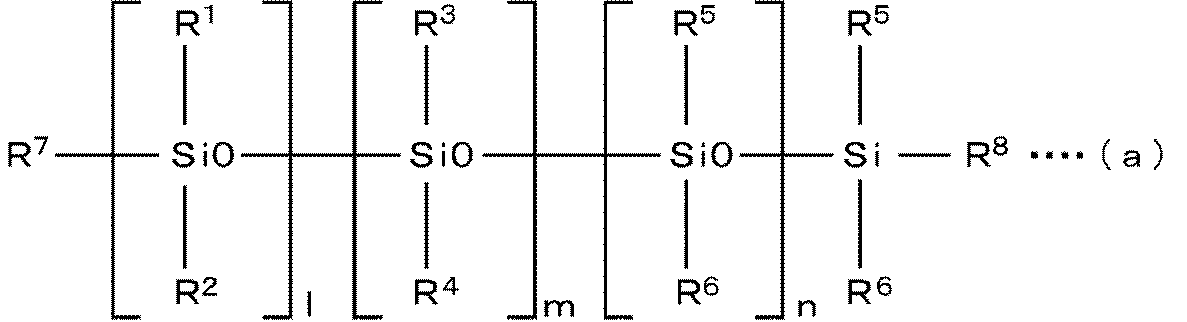
式(a)中、lは1以上の整数である。また、R1およびR2は炭素数1~12のアルキル基であり、例えば、メチル基、エチル基、プロピル基、ブチル基、ペンチル基、ヘキシル基、オクチル基等が挙げられる。R1およびR2は同一であっても異なっていてもよい。R1およびR2は、好ましくはメチル基である。
式(a)中、mは1以上の整数である。また、R3およびR4はアリール基であり、R3およびR4は同一であっても異なっていてもよいが、同一であることが好ましい。これにより、ポリオルガノシロキサン(A)は、シロキサン骨格におけるケイ素原子の両側鎖にアリール基を有することとなる。この構造により、剥離剤組成物を基材に塗布したときに、得られる剥離剤層においてポリオルガノシロキサン(A)は、ポリオルガノシロキサン(B)に対して、剥離剤層の基材側に偏在し、それによって後述する効果が得られると考えられる。
アリール基としては、フェニル基、ベンジル基、トリル基、o-キシリル基等が挙げられ、中でもフェニル基が好ましい。
式(a)中、nは1以上または2以上の整数である。R5~R8の少なくとも2個はアルケニル基であり、すなわち、1分子中では少なくとも2個はアルケニル基である。例えば、R7およびR8の両方がアルケニル基であってもよいし(nは1以上)、R7およびR8の片方がアルケニル基であり、R5およびR6の一方または両方がアルケニル基であってもよいし(nは1以上)、R7およびR8がアルケニル基以外の官能基の場合であって、R5およびR6の両方がアルケニル基(nは1以上)、またはR5およびR6の一方がアルケニル基(nは2以上)であってもよい。なお、R5およびR6の両方がアルケニル基のものと、R5およびR6の一方がアルケニル基のものとが混在していてもよい。各R5は、それぞれ同一であっても異なっていてもよい。また、各R6は、それぞれ同一であっても異なっていてもよい。
アルケニル基としては、ビニル基、アリル基、プロペニル基、ブテニル基、ペンテニル基、ヘキセニル基、ヘプテニル基、オクテニル基等が挙げられ、中でもビニル基が特に好ましい。
R5およびR6におけるアルケニル基以外の官能基は、炭素数1~12のアルキル基であり、例えば、メチル基、エチル基、プロピル基、ブチル基、ペンチル基、ヘキシル基、オクチル基等が挙げられ、好ましくはメチル基である。R7およびR8におけるアルケニル基以外の官能基としては、R5およびR6と同様のアルキル基、シラノール基、ヒドロシリル基等が挙げられる。
ポリオルガノシロキサン(A)が含有するアリール基の数は、ポリオルガノシロキサン(A)が含有するアルキル基の数に対して、モル比で0.01~0.5であることが好ましく、特に0.05~0.3であることが好ましい。アリール基の数がこの範囲にあることで、剥離剤組成物を基材に塗布したときに、得られる剥離剤層においてポリオルガノシロキサン(A)は、ポリオルガノシロキサン(B)に対して、剥離剤層の基材側に偏在し、それによって後述する効果が得られると考えられる。
また、ポリオルガノシロキサン(A)が含有するアルケニル基の数は、ポリオルガノシロキサン(A)が含有するアルキル基の数に対して、モル比で0.005~0.1であることが好ましく、特に0.01~0.05であることが好ましい。アルケニル基の数が1分子中に2個以上あることで、さらには上記範囲にあることで、後述する効果に寄与する架橋密度の高い架橋構造が形成され得る。
ポリオルガノシロキサン(A)の質量平均分子量は、100000~800000であることが必要であり、好ましくは150000~600000であり、特に好ましくは200000~380000である。なお、本明細書における質量平均分子量は、ゲルパーミエーションクロマトグラフィー(GPC)法により測定したポリスチレン換算の値である。
ポリオルガノシロキサン(A)の質量平均分子量が100000未満であると、剥離剤組成物を基材に塗布するときに、ハジキが発生するなど、塗工性が劣り、均一な面状態が得られ難くなる。また、ポリオルガノシロキサン(A)の質量平均分子量が800000を超えると、剥離剤組成物の粘度が上昇し、希釈溶剤への溶解性が困難となる。
一方、ポリオルガノシロキサン(B)は、下記の一般式(b)で示されるケイ素含有化合物の重合体である。
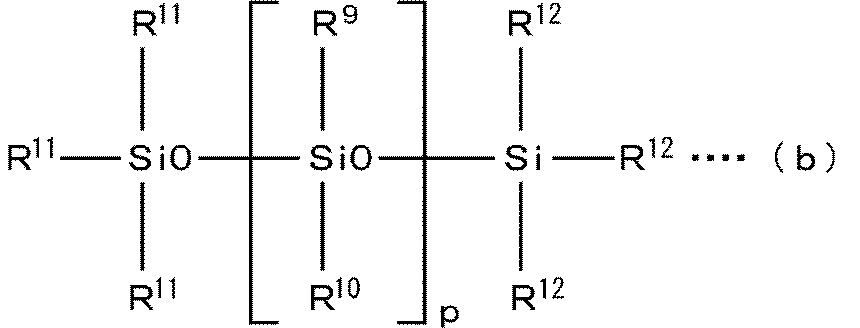
式(b)中、pは1以上の整数である。また、R9およびR10は炭素数1~12のアルキル基、例えば、メチル基、エチル基、プロピル基、ブチル基、ペンチル基、ヘキシル基、オクチル基等であり、アリール基またはアルケニル基であってはならない。R9およびR10は同一であっても異なっていてもよい。R9およびR10は、好ましくはメチル基である。このポリオルガノシロキサン(B)が、アリール基を有さないことで、剥離剤組成物を基材に塗布したときに、得られる剥離剤層においてポリオルガノシロキサン(B)は、ポリオルガノシロキサン(A)に対して、剥離剤層の基材と反対面側(剥離剤層の表面側)に偏在し、それによって後述する効果が得られると考えられる。
式(b)中、R11の少なくとも1個はアルケニル基であり、またR12の少なくとも1個はアルケニル基である。すなわち、ポリオルガノシロキサン(B)は、両末端にアルケニル基を有する。アルケニル基としては、ビニル基、アリル基、プロペニル基、ブテニル基、ペンテニル基、ヘキセニル基、ヘプテニル基、オクテニル基等が挙げられ、中でもビニル基が特に好ましい。R12におけるアルケニル基以外の官能基は、炭素数1~12のアルキル基であり、例えば、メチル基、エチル基、プロピル基、ブチル基、ペンチル基、ヘキシル基、オクチル基等が挙げられ、好ましくはメチル基である。各R11は、それぞれ同一であっても異なっていてもよい。また、各R12は、それぞれ同一であっても異なっていてもよい。
ポリオルガノシロキサン(B)が、その1分子中の両末端のみにアルケニル基を有することで、後述する効果に寄与する架橋密度の低い架橋構造が形成され得る。
ポリオルガノシロキサン(B)が含有するアルケニル基の数は、ポリオルガノシロキサン(B)が含有するアルキル基の数に対して、モル比で0.0005~0.01であることが好ましく、特に0.001~0.005であることが好ましい。
ポリオルガノシロキサン(B)の質量平均分子量は、好ましくは50000~800000、特に好ましくは100000~700000、さらに好ましくは300000~500000である。
ポリオルガノシロキサン(B)の質量平均分子量が50000未満であると、後述する効果に寄与する架橋密度の低い架橋構造が形成されにくくなるおそれがある。また、ポリオルガノシロキサン(B)の質量平均分子量が800000を超えると、剥離剤組成物の粘度が上昇し、希釈溶剤への溶解が困難となるおそれがある。また、剥離剤組成物の硬化性が悪くなり、セラミックグリーンシートへのシリコーン転移量が増加するおそれもある。
分岐状オルガノシロキサンオリゴマー(C)は、オルガノシロキサン骨格を含む分岐鎖を有するオルガノシロキサンオリゴマーであり、下記の一般式(c)で示される。
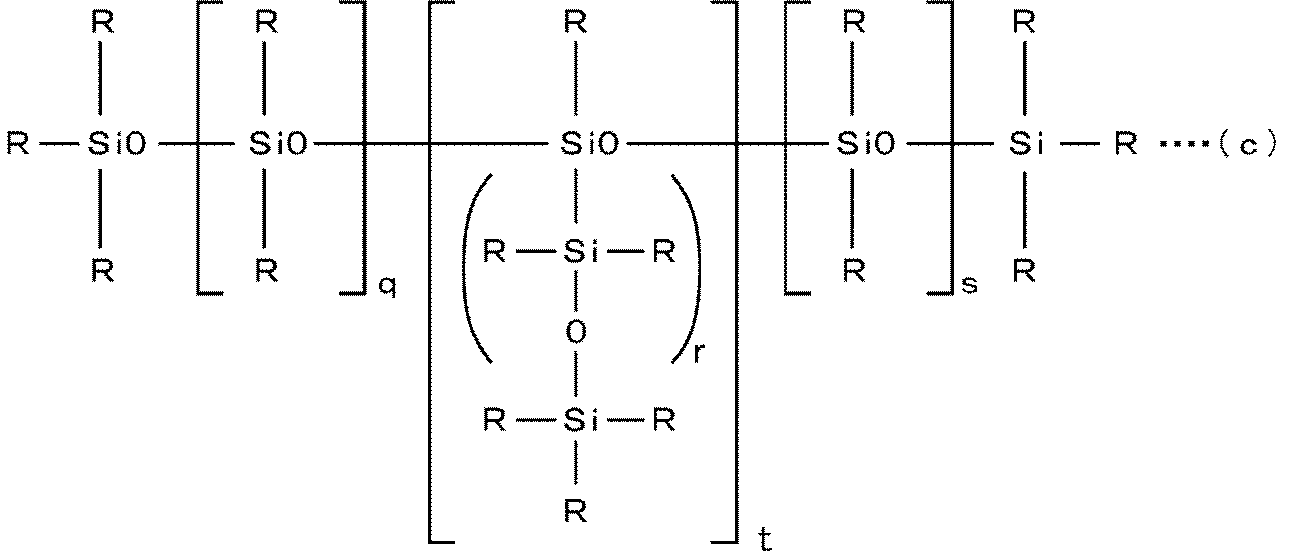
式(c)中、q、r、sおよびtは1以上の整数である。また、Rはアリール基ではなく、Rの少なくとも2個はアルケニル基である。アルケニル基としては、ビニル基、アリル基、プロペニル基、ブテニル基、ペンテニル基、ヘキセニル基、ヘプテニル基、オクテニル基等が挙げられ、中でもビニル基が特に好ましい。Rにおけるアルケニル基以外の官能基は、炭素数1~12のアルキル基であり、例えば、メチル基、エチル基、プロピル基、ブチル基、ペンチル基、ヘキシル基、オクチル基等が挙げられ、好ましくはメチル基である。各Rは、それぞれ同一であっても異なっていてもよい。
上記のように、分岐状オルガノシロキサンオリゴマー(C)がアリール基を有さないことで、剥離剤組成物を基材に塗布したときに、得られる剥離剤層において、ポリオルガノシロキサン(A)が剥離剤層の基材側に偏在し、ポリオルガノシロキサン(B)が剥離剤層の基材と反対面側(剥離剤層の表面側)に偏在することを妨げず、それによって後述する効果が得られる。
また、上記のように、分岐状オルガノシロキサンオリゴマー(C)は1分子中に少なくとも2個のアルケニル基を有するが、アルケニル基が存在する部位は、主鎖であってもよいし、分岐鎖であってもよいし、それら両方であってもよい。
分岐状オルガノシロキサンオリゴマー(C)が含有するアルケニル基の数は、分岐状オルガノシロキサンオリゴマー(C)が含有するアルキル基の数に対して、モル比で0.05~0.35であることが好ましく、特に0.1~0.2であることが好ましい。アルケニル基の数が1分子中に2個以上あることで、さらには上記範囲にあることで、後述する効果に寄与する架橋密度を有する架橋構造が形成され得る。
分岐状オルガノシロキサンオリゴマー(C)の質量平均分子量は、好ましくは1000~50000、特に好ましくは2000~30000、さらに好ましくは3000~10000である。
分岐状オルガノシロキサンオリゴマー(C)の質量平均分子量が1000未満であると、剥離剤組成物の塗工液の粘度を低下させる可能性があり、その場合、剥離剤組成物を塗工した際にハジキ等が発生し、均一な塗工面が得られ難くなるおそれがある。また、分岐状オルガノシロキサンオリゴマー(C)の質量平均分子量が50000を超えると、後述する効果に寄与する架橋密度を有する架橋構造が形成され難くなるおそれがある。
ポリオルガノシロキサン(A)および分岐状オルガノシロキサンオリゴマー(C)の合計量に対するポリオルガノシロキサン(A)の固形成分比率は、40~98質量%であり、好ましくは45~95質量%であり、より好ましくは50~90質量%である。また、ポリオルガノシロキサン(A)、ポリオルガノシロキサン(B)および分岐状オルガノシロキサンオリゴマー(C)の合計量に対するポリオルガノシロキサン(B)の固形成分比率は、2~60質量%であり、好ましくは2~55質量%であり、より好ましくは5~50質量%である。ポリオルガノシロキサン(A)またはポリオルガノシロキサン(B)の固形成分比率が上記範囲から外れると、セラミックスラリーの塗工性またはセラミックグリーンシートの剥離性が著しく低下する。
架橋剤(D)としては、ポリオルガノシロキサン(A)、ポリオルガノシロキサン(B)または分岐状オルガノシロキサンオリゴマー(C)を架橋することができるものであれば特に限定されないが、ポリオルガノシロキサン(A)、ポリオルガノシロキサン(B)および分岐状オルガノシロキサンオリゴマー(C)以外の、1分子中に少なくとも2個のケイ素原子に結合した水素原子を有するポリオルガノシロキサンが好ましい。かかるポリオルガノシロキサンとしては、例えば、ジメチルハイドロジェンシロキシ基末端封鎖ジメチルシロキサン-メチルハイドロジェンシロキサン共重合体、トリメチルシロキシ基末端封鎖ジメチルシロキサン-メチルハイドロジェンシロキサン共重合体、トリメチルシロキシ基末端封鎖メチルハイドロジェンポリシロキサン、ポリ(ハイドロジェンシルセスキオキサン)等のポリオルガノハイドロジェンシロキサンが挙げられる。
架橋剤(D)としてのポリオルガノシロキサンの質量平均分子量は、好ましくは500~5000、特に好ましくは500~2000である。
本実施形態に係る剥離剤組成物中における架橋剤(D)の含有量は、ポリオルガノシロキサン(A)、ポリオルガノシロキサン(B)および分岐状オルガノシロキサンオリゴマー(C)が含有するアルケニル基の数に対して、架橋剤(D)が含有するヒドロシリル基等の架橋性官能基の数が、モル比で1.0~5.0となる量であることが好ましく、特に1.5~3.0となる量であることが好ましく、さらには1.8~2.0となる量であることが好ましい。
架橋剤(D)は、ポリオルガノシロキサン(A)、ポリオルガノシロキサン(B)または分岐状オルガノシロキサンオリゴマー(C)を架橋することで、得られる剥離剤層に安定した剥離性を付与することができる。
触媒(E)としては、本実施形態に係る剥離剤組成物を硬化させることができるものであれば特に限定されないが、中でも白金族金属系化合物が好ましい。白金族金属系化合物としては、例えば、微粒子状白金、炭素粉末担体上に吸着された微粒子状白金、塩化白金酸、アルコール変性塩化白金酸、塩化白金酸のオレフィン錯体、パラジウム、ロジウム等が挙げられる。剥離剤組成物がかかる触媒(E)を含有することで、当該剥離剤組成物の硬化反応をより効率良く進行させることができる。
本実施形態に係る剥離剤組成物中における触媒(E)の含有量は、触媒(E)以外の成分の合計量に対し、1~1000ppm程度であることが好ましい。
本実施形態に係る剥離剤組成物は、上記成分(A)~(E)の他、反応抑制剤、密着向上剤等を含有していてもよい。
以上説明した剥離剤組成物は、上記ポリオルガノシロキサン(A)、ポリオルガノシロキサン(B)および分岐状オルガノシロキサンオリゴマー(C)を所定の配合比で含有することで、セラミックスラリーの塗工性に優れるとともに、セラミックグリーンシートの剥離性にも非常に優れた剥離剤層を形成することができる。したがって、本実施形態に係る剥離剤組成物によって形成した剥離剤層によれば、剥離剤層の表面にセラミックスラリーを塗工し乾燥させたときに、セラミックスラリーの塗工端部が収縮し、当該塗工端部の厚みが厚くなる、いわゆる端部収縮や、ピンホール、塗布むら等の発生を抑制することができる。また、強度の低い薄膜のセラミックグリーンシートを当該剥離剤層に成型した場合でも、ヒビ、破断等の不具合を発生させることなく、非常に低い剥離力でセラミックグリーンシートを剥離剤層から剥離することができる。この理由は必ずしも明らかではないが、上記のようにポリオルガノシロキサン(A)がアリール基を有し、ポリオルガノシロキサン(B)が両末端のみにアルケニル基を有すると、ポリオルガノシロキサン(A)が剥離剤層の基材側に偏在し、ポリオルガノシロキサン(B)が剥離剤層の表層側に偏在すると予想され、その結果、端部収縮、ピンホール、塗布むら等の抑制効果が得られると考えられる。さらに、分岐状ポリオルガノシロキサンオリゴマー(C)を含有することにより、剥離剤層における架橋密度が高まり、その結果、セラミックグリーンシートを薄膜化した場合でも、当該セラミックグリーンシートを破断させることなく、剥がすことが可能となる。
〔セラミックグリーンシート成型用剥離フィルム〕
本実施形態に係るセラミックグリーンシート成型用剥離フィルム(以下単に「剥離フィルム」という場合がある。)は、基材と、基材の一方の面に形成された剥離剤層とを備えて構成される。
本実施形態に係るセラミックグリーンシート成型用剥離フィルム(以下単に「剥離フィルム」という場合がある。)は、基材と、基材の一方の面に形成された剥離剤層とを備えて構成される。
基材としては、特に制限はなく、従来公知のものの中から任意のものを適宜選択して用いることができる。このような基材としては、例えば、ポリエチレンテレフタレートやポリエチレンナフタレート等のポリエステル、ポリプロピレンやポリメチルペンテン等のポリオレフィン、ポリカーボネート、ポリ酢酸ビニルなどのプラスチックからなるフィルムが挙げられ、単層であってもよいし、同種又は異種の2層以上の多層であってもよい。これらの中でもポリエステルフィルムが好ましく、特にポリエチレンテレフタレートフィルムが好ましく、さらには二軸延伸ポリエチレンテレフタレートフィルムが好ましい。ポリエチレンテレフタレートフィルムは、加工時、使用時等において、埃等が発生しにくいため、例えば、埃等によるセラミックスラリー塗工不良等を効果的に防止することができる。さらに、ポリエチレンテレフタレートフィルムに帯電防止処理を行うことで、塗工不良等を防止する効果を高めることができる。
また、この基材においては、その表面に設けられる剥離剤層との密着性を向上させる目的で、所望により片面または両面に、酸化法や凹凸化法などによる表面処理、あるいはプライマー処理を施すことができる。上記酸化法としては、例えばコロナ放電処理、プラズマ放電処理、クロム酸化処理(湿式)、火炎処理、熱風処理、オゾン、紫外線照射処理などが挙げられ、また、凹凸化法としては、例えばサンドブラスト法、溶射処理法などが挙げられる。これらの表面処理法は、基材フィルムの種類に応じて適宜選ばれるが、一般にコロナ放電処理法が効果および操作性の面から好ましく用いられる。
基材の厚さは、通常10~300μmであればよく、好ましくは15~200μmであり、特に好ましくは20~125μmである。
本実施形態における剥離剤層は、前述した剥離剤組成物によって形成される。具体的には、剥離剤層は、基材の一方の面に、剥離剤組成物および所望により有機溶剤を含有する塗工液を塗工した後、乾燥し、硬化させることにより形成される。塗工方法としては、例えば、グラビアコート法、バーコート法、スプレーコート法、スピンコート法、ナイフコート法、ロールコート法、ダイコート法などが使用できる。
上記有機溶剤としては特に制限はなく、様々なものを用いることができる。例えばトルエン、ヘキサン、ヘプタン等の炭化水素化合物をはじめ、アセトン、酢酸エチル、メチルエチルケトン、メチルイソブチルケトンおよびこれらの混合物等が用いられる。
上記のように塗工した剥離剤組成物は、熱硬化させることが好ましい。この場合の加熱温度は90~140℃であることが好ましく、加熱時間は10~120秒程度であることが好ましい。
剥離剤層の厚さは、特に限定されないが、0.01~3μmであるのが好ましく、0.03~1μmであるのがより好ましい。剥離剤層の厚さが0.01μm未満であると、剥離剤層を構成する材料等によっては、剥離剤層としての機能が十分に発揮されない場合がある。一方、剥離剤層の厚さが3μmを超えると、剥離フィルムをロール状に巻き取った際に、ブロッキングが発生し、繰り出しに不具合を生じる場合がある。
以上説明した剥離フィルムを使用するには、スロットダイ塗工方式やドクターブレード方式等を用いて、剥離剤層の表面にセラミックスラリーを塗工して乾燥させることにより、セラミックグリーンシートを成型する。このとき、本実施形態に係る剥離フィルムでは、セラミックスラリーの塗工端部が収縮し、当該塗工端部の厚みが厚くなる、いわゆる端部収縮が発生することが抑制され、また、ピンホールや塗布むらの発生も抑制される。一方、強度の低い薄膜のセラミックグリーンシートを剥離剤層に成型した場合でも、ヒビ、破断等の不具合を発生させることなく、非常に低い剥離力、具体的には10mN/100mm未満の剥離力でセラミックグリーンシートを剥離剤層から剥離することができる。このように、本実施形態に係る剥離フィルムによれば、セラミックスラリーの塗工性に優れるとともに、セラミックグリーンシートの剥離性にも非常に優れる。
以上説明した実施形態は、本発明の理解を容易にするために記載されたものであって、本発明を限定するために記載されたものではない。したがって、上記実施形態に開示された各要素は、本発明の技術的範囲に属する全ての設計変更や均等物をも含む趣旨である。
例えば、基材1における剥離剤層の反対側の面や、基材1と剥離剤層との間には、帯電防止層等の他の層が設けられてもよい。
以下、実施例等により本発明をさらに具体的に説明するが、本発明の範囲はこれらの実施例等に限定されるものではない。
〔実施例1〕
1分子中に2個以上のビニル基を有し、ビニル基を有さない部分は、ジメチルシロキサン-ジフェニルシロキサン共重合体からなるポリオルガノシロキサン(A)90.25質量部と、アリール基を有さず、かつ1分子中の両末端のみにビニル基を有し、その他の官能基はメチル基であるポリオルガノシロキサン(B)5質量部と、アリール基を有さず、オルガノシロキサン骨格を含む分岐鎖を有し、かつ1分子中に2個以上のビニル基を有し、その他の官能基はメチル基である分岐状オルガノシロキサンオリゴマー(C)4.75質量部とを混合し、トリメチルシロキシ基末端封鎖メチルハイドロジェンポリシロキサンからなる架橋剤(D)を添加した後、トルエンを主成分とする有機溶剤で希釈して、固形分濃度1.5質量%の剥離剤組成物の塗工液を調製した。なお、ポリオルガノシロキサン(A)および分岐状オルガノシロキサンオリゴマー(C)の合計量に対するポリオルガノシロキサン(A)の固形成分比率(質量%)、ならびにポリオルガノシロキサン(A)、ポリオルガノシロキサン(B)および分岐状オルガノシロキサンオリゴマー(C)の合計量に対するポリオルガノシロキサン(B)の固形成分比率(質量%)をそれぞれ表1に示す。
1分子中に2個以上のビニル基を有し、ビニル基を有さない部分は、ジメチルシロキサン-ジフェニルシロキサン共重合体からなるポリオルガノシロキサン(A)90.25質量部と、アリール基を有さず、かつ1分子中の両末端のみにビニル基を有し、その他の官能基はメチル基であるポリオルガノシロキサン(B)5質量部と、アリール基を有さず、オルガノシロキサン骨格を含む分岐鎖を有し、かつ1分子中に2個以上のビニル基を有し、その他の官能基はメチル基である分岐状オルガノシロキサンオリゴマー(C)4.75質量部とを混合し、トリメチルシロキシ基末端封鎖メチルハイドロジェンポリシロキサンからなる架橋剤(D)を添加した後、トルエンを主成分とする有機溶剤で希釈して、固形分濃度1.5質量%の剥離剤組成物の塗工液を調製した。なお、ポリオルガノシロキサン(A)および分岐状オルガノシロキサンオリゴマー(C)の合計量に対するポリオルガノシロキサン(A)の固形成分比率(質量%)、ならびにポリオルガノシロキサン(A)、ポリオルガノシロキサン(B)および分岐状オルガノシロキサンオリゴマー(C)の合計量に対するポリオルガノシロキサン(B)の固形成分比率(質量%)をそれぞれ表1に示す。
ここで、ポリオルガノシロキサン(A)の質量平均分子量は360000であり、ポリオルガノシロキサン(A)が含有するフェニル基の数は、ポリオルガノシロキサン(A)が含有するメチル基の数に対して、モル比で0.125であり、ポリオルガノシロキサン(A)が含有するビニル基の数は、ポリオルガノシロキサン(A)が含有するメチル基の数に対して、モル比で0.025であった。
ポリオルガノシロキサン(B)の質量平均分子量は440000であり、ポリオルガノシロキサン(B)が含有するビニル基の数は、ポリオルガノシロキサン(B)が含有するメチル基の数に対して、モル比で0.0024であった。
分岐状オルガノシロキサンオリゴマー(C)の質量平均分子量は6000であり、分岐状オルガノシロキサンオリゴマー(C)が含有するビニル基の数は、分岐状オルガノシロキサンオリゴマー(C)が含有するメチル基の数に対して、モル比で0.13であった。
一方、架橋剤(D)の質量平均分子量は1000であり、剥離剤組成物中における架橋剤(D)の含有量は、ポリオルガノシロキサン(A)、ポリオルガノシロキサン(B)および分岐状オルガノシロキサンオリゴマー(C)が含有するビニル基の数に対して、架橋剤(D)が含有するヒドロシリル基の数が、モル比で1.91となる量であった。
上記塗工液100質量部に白金系触媒(信越化学工業社製,PL-50T)を固形分比で10質量部加え、得られた塗工液を、乾燥後の膜厚が0.1μmとなるように、基材としての2軸延伸ポリエステルフィルム(三菱樹脂社製,ダイアホイルT-100,厚さ:38μm)上にマイヤーバーコート法により均一に塗工した。次いで、熱風循環式乾燥機にて、135℃で60秒間加熱処理し、シリコーン樹脂剥離剤を硬化させ、基材上に剥離剤層を形成した。その後、シリコーン剥離剤の架橋剤であるポリオルガノハイドロジェンシロキサンの残官能基の影響をなくすため、70℃・dryの条件下にて24時間保管し、剥離フィルムを得た。
〔実施例2〕
実施例1で使用したポリオルガノシロキサン(A)47.5質量部と、ポリオルガノシロキサン(B)50質量部と、分岐状オルガノシロキサンオリゴマー(C)2.5質量部とを混合し、架橋剤(D)を、ポリオルガノシロキサン(A)、ポリオルガノシロキサン(B)および分岐状オルガノシロキサンオリゴマー(C)が含有するビニル基の数に対して、架橋剤(D)が含有するヒドロシリル基の数が、モル比で1.91となるよう添加した以外、実施例1と同様にして塗工液を調製し、剥離フィルムを作製した。
実施例1で使用したポリオルガノシロキサン(A)47.5質量部と、ポリオルガノシロキサン(B)50質量部と、分岐状オルガノシロキサンオリゴマー(C)2.5質量部とを混合し、架橋剤(D)を、ポリオルガノシロキサン(A)、ポリオルガノシロキサン(B)および分岐状オルガノシロキサンオリゴマー(C)が含有するビニル基の数に対して、架橋剤(D)が含有するヒドロシリル基の数が、モル比で1.91となるよう添加した以外、実施例1と同様にして塗工液を調製し、剥離フィルムを作製した。
〔実施例3〕
実施例1で使用したポリオルガノシロキサン(A)85.5質量部と、ポリオルガノシロキサン(B)5質量部と、分岐状オルガノシロキサンオリゴマー(C)9.5質量部とを混合し、架橋剤(D)を、ポリオルガノシロキサン(A)、ポリオルガノシロキサン(B)および分岐状オルガノシロキサンオリゴマー(C)が含有するビニル基の数に対して、架橋剤(D)が含有するヒドロシリル基の数が、モル比で1.91となるよう添加した以外、実施例1と同様にして塗工液を調製し、剥離フィルムを作製した。
実施例1で使用したポリオルガノシロキサン(A)85.5質量部と、ポリオルガノシロキサン(B)5質量部と、分岐状オルガノシロキサンオリゴマー(C)9.5質量部とを混合し、架橋剤(D)を、ポリオルガノシロキサン(A)、ポリオルガノシロキサン(B)および分岐状オルガノシロキサンオリゴマー(C)が含有するビニル基の数に対して、架橋剤(D)が含有するヒドロシリル基の数が、モル比で1.91となるよう添加した以外、実施例1と同様にして塗工液を調製し、剥離フィルムを作製した。
〔実施例4〕
実施例1で使用したポリオルガノシロキサン(A)63質量部と、ポリオルガノシロキサン(B)30質量部と、分岐状オルガノシロキサンオリゴマー(C)7質量部とを混合し、架橋剤(D)を、ポリオルガノシロキサン(A)、ポリオルガノシロキサン(B)および分岐状オルガノシロキサンオリゴマー(C)が含有するビニル基の数に対して、架橋剤(D)が含有するヒドロシリル基の数が、モル比で1.93となるよう添加した以外、実施例1と同様にして塗工液を調製し、剥離フィルムを作製した。
実施例1で使用したポリオルガノシロキサン(A)63質量部と、ポリオルガノシロキサン(B)30質量部と、分岐状オルガノシロキサンオリゴマー(C)7質量部とを混合し、架橋剤(D)を、ポリオルガノシロキサン(A)、ポリオルガノシロキサン(B)および分岐状オルガノシロキサンオリゴマー(C)が含有するビニル基の数に対して、架橋剤(D)が含有するヒドロシリル基の数が、モル比で1.93となるよう添加した以外、実施例1と同様にして塗工液を調製し、剥離フィルムを作製した。
〔実施例5〕
実施例1で使用したポリオルガノシロキサン(A)45質量部と、ポリオルガノシロキサン(B)50質量部と、分岐状オルガノシロキサンオリゴマー(C)5質量部とを混合し、架橋剤(D)を、ポリオルガノシロキサン(A)、ポリオルガノシロキサン(B)および分岐状オルガノシロキサンオリゴマー(C)が含有するビニル基の数に対して、架橋剤(D)が含有するヒドロシリル基の数が、モル比で1.98となるよう添加した以外、実施例1と同様にして塗工液を調製し、剥離フィルムを作製した。
実施例1で使用したポリオルガノシロキサン(A)45質量部と、ポリオルガノシロキサン(B)50質量部と、分岐状オルガノシロキサンオリゴマー(C)5質量部とを混合し、架橋剤(D)を、ポリオルガノシロキサン(A)、ポリオルガノシロキサン(B)および分岐状オルガノシロキサンオリゴマー(C)が含有するビニル基の数に対して、架橋剤(D)が含有するヒドロシリル基の数が、モル比で1.98となるよう添加した以外、実施例1と同様にして塗工液を調製し、剥離フィルムを作製した。
〔実施例6〕
実施例1で使用したポリオルガノシロキサン(A)47.5質量部と、ポリオルガノシロキサン(B)5質量部と、分岐状オルガノシロキサンオリゴマー(C)47.5質量部とを混合し、架橋剤(D)を、ポリオルガノシロキサン(A)、ポリオルガノシロキサン(B)および分岐状オルガノシロキサンオリゴマー(C)が含有するビニル基の数に対して、架橋剤(D)が含有するヒドロシリル基の数が、モル比で1.90となるよう添加した以外、実施例1と同様にして塗工液を調製し、剥離フィルムを作製した。
実施例1で使用したポリオルガノシロキサン(A)47.5質量部と、ポリオルガノシロキサン(B)5質量部と、分岐状オルガノシロキサンオリゴマー(C)47.5質量部とを混合し、架橋剤(D)を、ポリオルガノシロキサン(A)、ポリオルガノシロキサン(B)および分岐状オルガノシロキサンオリゴマー(C)が含有するビニル基の数に対して、架橋剤(D)が含有するヒドロシリル基の数が、モル比で1.90となるよう添加した以外、実施例1と同様にして塗工液を調製し、剥離フィルムを作製した。
〔実施例7〕
実施例1で使用したポリオルガノシロキサン(A)35質量部と、ポリオルガノシロキサン(B)30質量部と、分岐状オルガノシロキサンオリゴマー(C)35質量部とを混合し、架橋剤(D)を、ポリオルガノシロキサン(A)、ポリオルガノシロキサン(B)および分岐状オルガノシロキサンオリゴマー(C)が含有するビニル基の数に対して、架橋剤(D)が含有するヒドロシリル基の数が、モル比で1.92となるよう添加した以外、実施例1と同様にして塗工液を調製し、剥離フィルムを作製した。
実施例1で使用したポリオルガノシロキサン(A)35質量部と、ポリオルガノシロキサン(B)30質量部と、分岐状オルガノシロキサンオリゴマー(C)35質量部とを混合し、架橋剤(D)を、ポリオルガノシロキサン(A)、ポリオルガノシロキサン(B)および分岐状オルガノシロキサンオリゴマー(C)が含有するビニル基の数に対して、架橋剤(D)が含有するヒドロシリル基の数が、モル比で1.92となるよう添加した以外、実施例1と同様にして塗工液を調製し、剥離フィルムを作製した。
〔実施例8〕
実施例1で使用したポリオルガノシロキサン(A)25質量部と、ポリオルガノシロキサン(B)50質量部と、分岐状オルガノシロキサンオリゴマー(C)25質量部とを混合し、架橋剤(D)を、ポリオルガノシロキサン(A)、ポリオルガノシロキサン(B)および分岐状オルガノシロキサンオリゴマー(C)が含有するビニル基の数に対して、架橋剤(D)が含有するヒドロシリル基の数が、モル比で1.94となるよう添加した以外、実施例1と同様にして塗工液を調製し、剥離フィルムを作製した。
実施例1で使用したポリオルガノシロキサン(A)25質量部と、ポリオルガノシロキサン(B)50質量部と、分岐状オルガノシロキサンオリゴマー(C)25質量部とを混合し、架橋剤(D)を、ポリオルガノシロキサン(A)、ポリオルガノシロキサン(B)および分岐状オルガノシロキサンオリゴマー(C)が含有するビニル基の数に対して、架橋剤(D)が含有するヒドロシリル基の数が、モル比で1.94となるよう添加した以外、実施例1と同様にして塗工液を調製し、剥離フィルムを作製した。
〔実施例9〕
実施例1で使用したポリオルガノシロキサン(A)42.75質量部と、ポリオルガノシロキサン(B)5質量部と、分岐状オルガノシロキサンオリゴマー(C)52.25質量部とを混合し、架橋剤(D)を、ポリオルガノシロキサン(A)、ポリオルガノシロキサン(B)および分岐状オルガノシロキサンオリゴマー(C)が含有するビニル基の数に対して、架橋剤(D)が含有するヒドロシリル基の数が、モル比で1.90となるよう添加した以外、実施例1と同様にして塗工液を調製し、剥離フィルムを作製した。
実施例1で使用したポリオルガノシロキサン(A)42.75質量部と、ポリオルガノシロキサン(B)5質量部と、分岐状オルガノシロキサンオリゴマー(C)52.25質量部とを混合し、架橋剤(D)を、ポリオルガノシロキサン(A)、ポリオルガノシロキサン(B)および分岐状オルガノシロキサンオリゴマー(C)が含有するビニル基の数に対して、架橋剤(D)が含有するヒドロシリル基の数が、モル比で1.90となるよう添加した以外、実施例1と同様にして塗工液を調製し、剥離フィルムを作製した。
〔実施例10〕
実施例1で使用したポリオルガノシロキサン(A)22.5質量部と、ポリオルガノシロキサン(B)50質量部と、分岐状オルガノシロキサンオリゴマー(C)27.5質量部とを混合し、架橋剤(D)を、ポリオルガノシロキサン(A)、ポリオルガノシロキサン(B)および分岐状オルガノシロキサンオリゴマー(C)が含有するビニル基の数に対して、架橋剤(D)が含有するヒドロシリル基の数が、モル比で1.94となるよう添加した以外、実施例1と同様にして塗工液を調製し、剥離フィルムを作製した。
実施例1で使用したポリオルガノシロキサン(A)22.5質量部と、ポリオルガノシロキサン(B)50質量部と、分岐状オルガノシロキサンオリゴマー(C)27.5質量部とを混合し、架橋剤(D)を、ポリオルガノシロキサン(A)、ポリオルガノシロキサン(B)および分岐状オルガノシロキサンオリゴマー(C)が含有するビニル基の数に対して、架橋剤(D)が含有するヒドロシリル基の数が、モル比で1.94となるよう添加した以外、実施例1と同様にして塗工液を調製し、剥離フィルムを作製した。
〔比較例1〕
実施例1で使用したポリオルガノシロキサン(A)27質量部と、ポリオルガノシロキサン(B)70質量部と、分岐状オルガノシロキサンオリゴマー(C)3質量部とを混合し、架橋剤(D)を、ポリオルガノシロキサン(A)、ポリオルガノシロキサン(B)および分岐状オルガノシロキサンオリゴマー(C)が含有するビニル基の数に対して、架橋剤(D)が含有するヒドロシリル基の数が、モル比で2.06となるよう添加した以外、実施例1と同様にして塗工液を調製し、剥離フィルムを作製した。
実施例1で使用したポリオルガノシロキサン(A)27質量部と、ポリオルガノシロキサン(B)70質量部と、分岐状オルガノシロキサンオリゴマー(C)3質量部とを混合し、架橋剤(D)を、ポリオルガノシロキサン(A)、ポリオルガノシロキサン(B)および分岐状オルガノシロキサンオリゴマー(C)が含有するビニル基の数に対して、架橋剤(D)が含有するヒドロシリル基の数が、モル比で2.06となるよう添加した以外、実施例1と同様にして塗工液を調製し、剥離フィルムを作製した。
〔比較例2〕
実施例1で使用したポリオルガノシロキサン(A)15質量部と、ポリオルガノシロキサン(B)70質量部と、分岐状オルガノシロキサンオリゴマー(C)15質量部とを混合し、架橋剤(D)を、ポリオルガノシロキサン(A)、ポリオルガノシロキサン(B)および分岐状オルガノシロキサンオリゴマー(C)が含有するビニル基の数に対して、架橋剤(D)が含有するヒドロシリル基の数が、モル比で1.98となるよう添加した以外、実施例1と同様にして塗工液を調製し、剥離フィルムを作製した。
実施例1で使用したポリオルガノシロキサン(A)15質量部と、ポリオルガノシロキサン(B)70質量部と、分岐状オルガノシロキサンオリゴマー(C)15質量部とを混合し、架橋剤(D)を、ポリオルガノシロキサン(A)、ポリオルガノシロキサン(B)および分岐状オルガノシロキサンオリゴマー(C)が含有するビニル基の数に対して、架橋剤(D)が含有するヒドロシリル基の数が、モル比で1.98となるよう添加した以外、実施例1と同様にして塗工液を調製し、剥離フィルムを作製した。
〔比較例3〕
実施例1で使用したポリオルガノシロキサン(B)を使用せずに、ポリオルガノシロキサン(A)90質量部と、分岐状オルガノシロキサンオリゴマー(C)10質量部とを混合し、架橋剤(D)を、ポリオルガノシロキサン(A)および分岐状オルガノシロキサンオリゴマー(C)が含有するビニル基の数に対して、架橋剤(D)が含有するヒドロシリル基の数が、モル比で1.90となるよう添加した以外、実施例1と同様にして塗工液を調製し、剥離フィルムを作製した。
実施例1で使用したポリオルガノシロキサン(B)を使用せずに、ポリオルガノシロキサン(A)90質量部と、分岐状オルガノシロキサンオリゴマー(C)10質量部とを混合し、架橋剤(D)を、ポリオルガノシロキサン(A)および分岐状オルガノシロキサンオリゴマー(C)が含有するビニル基の数に対して、架橋剤(D)が含有するヒドロシリル基の数が、モル比で1.90となるよう添加した以外、実施例1と同様にして塗工液を調製し、剥離フィルムを作製した。
〔比較例4〕
実施例1で使用したポリオルガノシロキサン(A)を使用せずに、ポリオルガノシロキサン(B)10質量部と、分岐状オルガノシロキサンオリゴマー(C)90質量部とを混合し、架橋剤(D)を、ポリオルガノシロキサン(B)および分岐状オルガノシロキサンオリゴマー(C)が含有するビニル基の数に対して、架橋剤(D)が含有するヒドロシリル基の数が、モル比で1.86となるよう添加した以外、実施例1と同様にして塗工液を調製し、剥離フィルムを作製した。
実施例1で使用したポリオルガノシロキサン(A)を使用せずに、ポリオルガノシロキサン(B)10質量部と、分岐状オルガノシロキサンオリゴマー(C)90質量部とを混合し、架橋剤(D)を、ポリオルガノシロキサン(B)および分岐状オルガノシロキサンオリゴマー(C)が含有するビニル基の数に対して、架橋剤(D)が含有するヒドロシリル基の数が、モル比で1.86となるよう添加した以外、実施例1と同様にして塗工液を調製し、剥離フィルムを作製した。
〔比較例5〕
実施例1で使用した分岐状オルガノシロキサンオリゴマー(C)を使用せずに、ポリオルガノシロキサン(A)95質量部と、ポリオルガノシロキサン(B)5質量部とを混合し、架橋剤(D)を、ポリオルガノシロキサン(A)およびポリオルガノシロキサン(B)が含有するビニル基の数に対して、架橋剤(D)が含有するヒドロシリル基の数が、モル比で1.91となるよう添加した以外、実施例1と同様にして塗工液を調製し、剥離フィルムを作製した。
実施例1で使用した分岐状オルガノシロキサンオリゴマー(C)を使用せずに、ポリオルガノシロキサン(A)95質量部と、ポリオルガノシロキサン(B)5質量部とを混合し、架橋剤(D)を、ポリオルガノシロキサン(A)およびポリオルガノシロキサン(B)が含有するビニル基の数に対して、架橋剤(D)が含有するヒドロシリル基の数が、モル比で1.91となるよう添加した以外、実施例1と同様にして塗工液を調製し、剥離フィルムを作製した。
〔比較例6〕
実施例1で使用した分岐状オルガノシロキサンオリゴマー(C)を使用せずに、ポリオルガノシロキサン(A)50質量部と、ポリオルガノシロキサン(B)50質量部とを混合し、架橋剤(D)を、ポリオルガノシロキサン(A)およびポリオルガノシロキサン(B)が含有するビニル基の数に対して、架橋剤(D)が含有するヒドロシリル基の数が、モル比で2.00となるよう添加した以外、実施例1と同様にして塗工液を調製し、剥離フィルムを作製した。
実施例1で使用した分岐状オルガノシロキサンオリゴマー(C)を使用せずに、ポリオルガノシロキサン(A)50質量部と、ポリオルガノシロキサン(B)50質量部とを混合し、架橋剤(D)を、ポリオルガノシロキサン(A)およびポリオルガノシロキサン(B)が含有するビニル基の数に対して、架橋剤(D)が含有するヒドロシリル基の数が、モル比で2.00となるよう添加した以外、実施例1と同様にして塗工液を調製し、剥離フィルムを作製した。
〔比較例7〕
実施例1で使用したポリオルガノシロキサン(B)および分岐状オルガノシロキサンオリゴマー(C)を使用せずに、ポリオルガノシロキサン(A)100質量部のみを使用し、架橋剤(D)を、ポリオルガノシロキサン(A)が含有するビニル基の数に対して、架橋剤(D)が含有するヒドロシリル基の数が、モル比で1.90となるよう添加した以外、実施例1と同様にして塗工液を調製し、剥離フィルムを作製した。
実施例1で使用したポリオルガノシロキサン(B)および分岐状オルガノシロキサンオリゴマー(C)を使用せずに、ポリオルガノシロキサン(A)100質量部のみを使用し、架橋剤(D)を、ポリオルガノシロキサン(A)が含有するビニル基の数に対して、架橋剤(D)が含有するヒドロシリル基の数が、モル比で1.90となるよう添加した以外、実施例1と同様にして塗工液を調製し、剥離フィルムを作製した。
〔比較例8〕
実施例1で使用したポリオルガノシロキサン(A)および分岐状オルガノシロキサンオリゴマー(C)を使用せずに、ポリオルガノシロキサン(B)100質量部のみを使用し、架橋剤(D)を、ポリオルガノシロキサン(B)が含有するビニル基の数に対して、架橋剤(D)が含有するヒドロシリル基の数が、モル比で3.00となるよう添加した以外、実施例1と同様にして塗工液を調製し、剥離フィルムを作製した。
実施例1で使用したポリオルガノシロキサン(A)および分岐状オルガノシロキサンオリゴマー(C)を使用せずに、ポリオルガノシロキサン(B)100質量部のみを使用し、架橋剤(D)を、ポリオルガノシロキサン(B)が含有するビニル基の数に対して、架橋剤(D)が含有するヒドロシリル基の数が、モル比で3.00となるよう添加した以外、実施例1と同様にして塗工液を調製し、剥離フィルムを作製した。
〔試験例1〕(セラミックスラリー塗工性の評価)
チタン酸バリウム(BaTiO3;堺化学工業社製,BT-03)100質量部、ポリビニルブチラール(積水化学工業社製,エスレックB・K BM-2)10質量部およびフタル酸ジオクチル(関東化学社製,フタル酸ジオクチル 鹿1級)5質量部に、トルエンおよびエタノールの混合液(質量比6:4)115質量部を加え、ボールミルにて混合分散させて、セラミックスラリーを調製した。
チタン酸バリウム(BaTiO3;堺化学工業社製,BT-03)100質量部、ポリビニルブチラール(積水化学工業社製,エスレックB・K BM-2)10質量部およびフタル酸ジオクチル(関東化学社製,フタル酸ジオクチル 鹿1級)5質量部に、トルエンおよびエタノールの混合液(質量比6:4)115質量部を加え、ボールミルにて混合分散させて、セラミックスラリーを調製した。
実施例および比較例にて製造してから常温で48時間保管した剥離フィルム(幅:300mm)の剥離剤層表面に、上記セラミックスラリーを乾燥後の膜厚が3μmになるようにダイコーター(幅250mm)を用いて均一に塗工し、その後、乾燥機にて80℃で1分間乾燥させた。このようにして、セラミックグリーン付剥離フィルムロール300mを製造した。
得られたセラミックグリーン付剥離フィルムロール300mにおいて、幅方向端部に端部収縮が発生したかどうかを、目視により確認した。その結果、端部収縮が発生しなかったものを○、端部収縮が発生したものを×とした。さらに、目視で確認できるセラミックスラリーの微少なハジキ、いわゆるピンホール、またはセラミックスラリーの塗工厚みが不均一であることに起因する塗布むらが発生したかどうかを、目視により確認した。目視可能なピンホールおよび塗布むらが発生しなかったものを○、ピンホールまたは塗布むらが発生したものを×とした。結果を表1に示す。
〔試験例2〕(グリーンシート剥離性の評価)
試験例1と同様にして得られた剥離フィルムの剥離剤層表面に、試験例1と同様にして調製したセラミックスラリーを、乾燥後の膜厚が3μmになるように、25μmアプリケーターを用いて塗工した。その後、乾燥機にて80℃で1分間乾燥させ、セラミックグリーン付剥離フィルムを得た。
試験例1と同様にして得られた剥離フィルムの剥離剤層表面に、試験例1と同様にして調製したセラミックスラリーを、乾燥後の膜厚が3μmになるように、25μmアプリケーターを用いて塗工した。その後、乾燥機にて80℃で1分間乾燥させ、セラミックグリーン付剥離フィルムを得た。
得られたセラミックグリーン付剥離フィルムを、室温23度、湿度50%の雰囲気下に24時間静置した後、100mm×100mmの大きさに裁断し、その一辺に、セラミックグリーンシート面側から長さ100mmのアクリル粘着テープ(日東電工社製,31Bテープ)を貼付した。このサンプルを、剥離フィルム面側が平板と接するように当該平板に固定し、アクリル粘着テープを貼付した端辺側を下側にして45°に傾け、剥離試験機(島津製作所社製,AG-IS 500N)に設置した。そして、アクリル粘着テープを貼付した端辺の剥離フィルムをセラミックグリーンシートから剥がし、アクリル粘着テープ側を剥離試験機の治具に取り付けた。この状態にて、剥離速度200mm/minでアクリル粘着テープを垂直上方向に引っ張り、剥離フィルムからセラミックグリーンシートを剥がしたときの剥離力(mN/100mm)を測定した。3回測定し、それらの平均値を評価対象としての剥離力とした。結果を表1に示す。
また、セラミックグリーンシート成型用剥離フィルムとして特に好ましい剥離力は10mN/100mm未満であるため、測定した剥離力が10mN/100mm未満のものを○、10mN/100mm以上のものを×として評価した。結果を表1に示す。
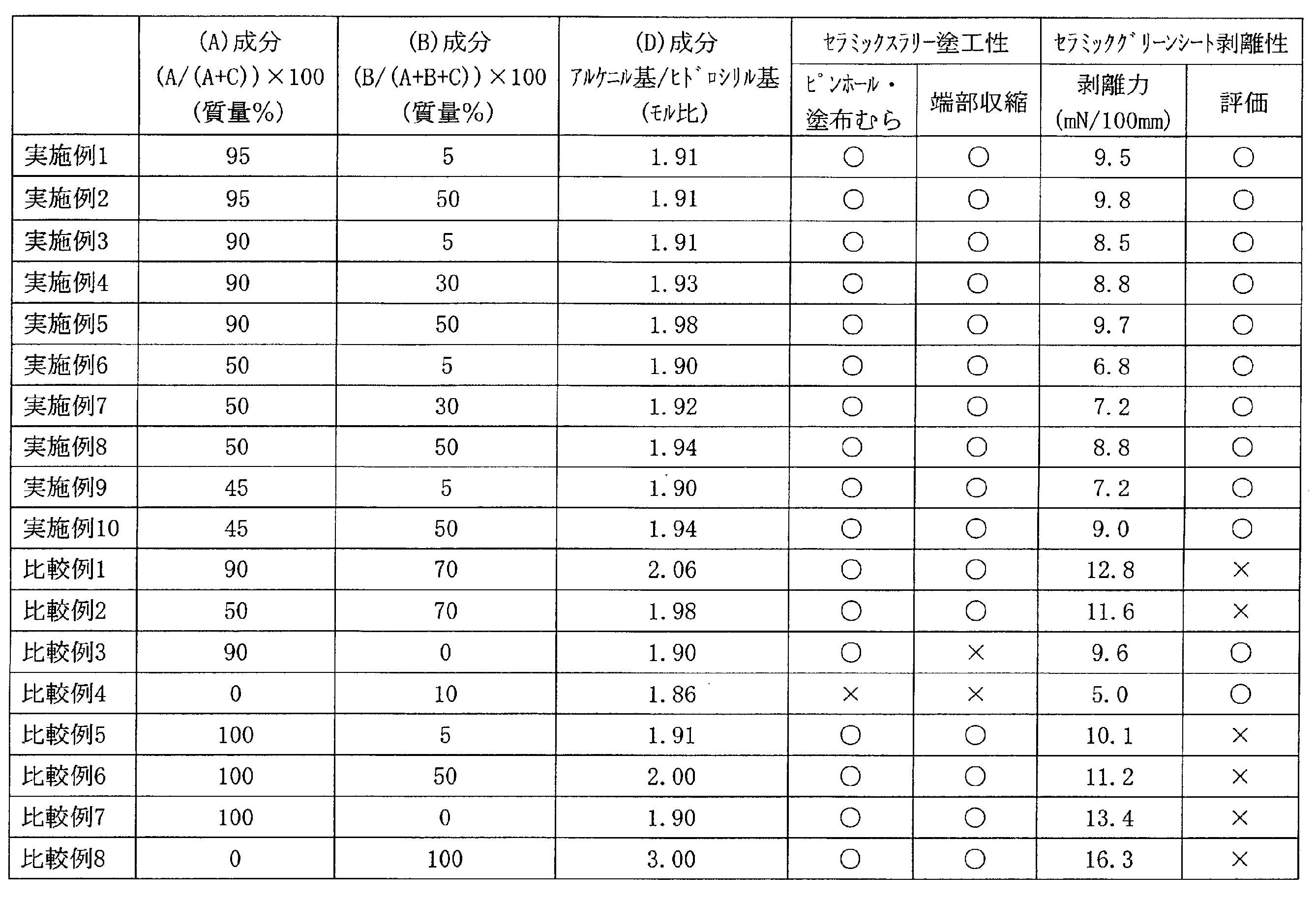
表1に示される結果から明らかなように、実施例1~10で得られた剥離フィルムは、セラミックスラリーの塗工性に優れるとともに、非常に低い剥離力でセラミックグリーンシートを剥離することができ、セラミックグリーンシートの剥離性にも優れるものであった。一方、比較例1,2,5~8で得られた剥離フィルムは、セラミックスラリーの塗工性には優れるものであったが、比較的高い剥離力でしかセラミックグリーンシートを剥離することができず、セラミックグリーンシートの剥離性に劣るものであった。また、比較例3,4で得られた剥離フィルムは、セラミックグリーンシートの剥離性には優れるが、セラミックスラリーの塗工性に劣るものであった。
本発明の剥離剤組成物は、セラミックグリーンシート成型用剥離フィルムの剥離剤層を形成するのに好適である。また、本発明のセラミックグリーンシート成型用剥離フィルムは、セラミックスラリーの塗工性に優れるとともに、セラミックグリーンシートの剥離性にも非常に優れた剥離フィルムとして有用である。
Claims (12)
- 1分子中に少なくとも2個のアルケニル基を有し、かつシロキサン骨格における少なくとも1個のケイ素原子の両側鎖にアリール基を有するポリオルガノシロキサン(A)と、
アリール基を有さず、かつ1分子中の両末端のみにアルケニル基を有するポリオルガノシロキサン(B)と、
アリール基を有さず、オルガノシロキサン骨格を含む分岐鎖を有し、かつ1分子中に少なくとも2個のアルケニル基を有する分岐状オルガノシロキサンオリゴマー(C)と
を含有し、
前記ポリオルガノシロキサン(A)および前記分岐状オルガノシロキサンオリゴマー(C)の合計量に対する前記ポリオルガノシロキサン(A)の固形成分比率が40~98質量%であり、
前記ポリオルガノシロキサン(A)、前記ポリオルガノシロキサン(B)および前記分岐状オルガノシロキサンオリゴマー(C)の合計量に対する前記ポリオルガノシロキサン(B)の固形成分比率が2~60質量%である
ことを特徴とする剥離剤組成物。 - 前記ポリオルガノシロキサン(A)の質量平均分子量が100000~800000であることを特徴とする請求項1に記載の剥離剤組成物。
- 前記ポリオルガノシロキサン(B)の質量平均分子量が50000~800000であることを特徴とする請求項1または2に記載の剥離剤組成物。
- 前記分岐状オルガノシロキサンオリゴマー(C)の質量平均分子量が1000~50000であることを特徴とする請求項1~3のいずれか一項に記載の剥離剤組成物。
- 触媒として白金族金属系化合物をさらに含有することを特徴とする請求項1~4のいずれか一項に記載の剥離剤組成物。
- 架橋剤(D)をさらに含有することを特徴とする請求項1~5のいずれか一項に記載の剥離剤組成物。
- 前記ポリオルガノシロキサン(A)が含有するアルケニル基の数は、前記ポリオルガノシロキサン(A)が含有するアルキル基の数に対して、モル比で0.005~0.1であることを特徴とする請求項6に記載の剥離剤組成物。
- 前記ポリオルガノシロキサン(A)が含有するアリール基の数は、前記ポリオルガノシロキサン(A)が含有するアルキル基の数に対して、モル比で0.01~0.5であることを特徴とする請求項6または7に記載の剥離剤組成物。
- 前記ポリオルガノシロキサン(B)が含有するアルケニル基の数は、前記ポリオルガノシロキサン(B)が含有するアルキル基の数に対して、モル比で0.0005~0.01であることを特徴とする請求項6~8のいずれか一項に記載の剥離剤組成物。
- 前記分岐状オルガノシロキサンオリゴマー(C)が含有するアルケニル基の数は、前記分岐状オルガノシロキサンオリゴマー(C)が含有するアルキル基の数に対して、モル比で0.05~0.35であることを特徴とする請求項6~9のいずれか一項に記載の剥離剤組成物。
- 前記剥離剤組成物における架橋剤(D)の含有量は、前記ポリオルガノシロキサン(A)、前記ポリオルガノシロキサン(B)および前記分岐状オルガノシロキサンオリゴマー(C)が含有するアルケニル基の数に対して、架橋剤(D)が含有するヒドロシリル基の数が、モル比で1.0~5.0となる量であることを特徴とする請求項6~10のいずれか一項に記載の剥離剤組成物。
- 基材と、少なくとも前記基材の一方の面に形成された剥離剤層とを備えた、セラミックグリーンシート成型用の剥離フィルムであって、
前記剥離剤層は、請求項1~11のいずれか一項に記載の剥離剤組成物を使用して形成されてなることを特徴とするセラミックグリーンシート成型用剥離フィルム。
Priority Applications (2)
| Application Number | Priority Date | Filing Date | Title |
|---|---|---|---|
| CN201280015624.XA CN103476896B (zh) | 2011-03-29 | 2012-02-24 | 剥离剂组合物及陶瓷生坯成型用剥离膜 |
| KR1020137026700A KR101908391B1 (ko) | 2011-03-29 | 2012-02-24 | 박리제 조성물 및 세라믹 그린 시트 성형용 박리 필름 |
Applications Claiming Priority (2)
| Application Number | Priority Date | Filing Date | Title |
|---|---|---|---|
| JP2011-073707 | 2011-03-29 | ||
| JP2011073707A JP5756315B2 (ja) | 2011-03-29 | 2011-03-29 | 剥離剤組成物およびセラミックグリーンシート成型用剥離フィルム |
Publications (1)
| Publication Number | Publication Date |
|---|---|
| WO2012132682A1 true WO2012132682A1 (ja) | 2012-10-04 |
Family
ID=46930442
Family Applications (1)
| Application Number | Title | Priority Date | Filing Date |
|---|---|---|---|
| PCT/JP2012/054536 Ceased WO2012132682A1 (ja) | 2011-03-29 | 2012-02-24 | 剥離剤組成物およびセラミックグリーンシート成型用剥離フィルム |
Country Status (6)
| Country | Link |
|---|---|
| JP (1) | JP5756315B2 (ja) |
| KR (1) | KR101908391B1 (ja) |
| CN (1) | CN103476896B (ja) |
| MY (1) | MY163177A (ja) |
| TW (1) | TWI525153B (ja) |
| WO (1) | WO2012132682A1 (ja) |
Cited By (2)
| Publication number | Priority date | Publication date | Assignee | Title |
|---|---|---|---|---|
| US20130224502A1 (en) * | 2012-02-23 | 2013-08-29 | Shin-Etsu Chemical Co., Ltd. | Addition curable silicone emulsion release composition and release film |
| WO2015030262A1 (en) * | 2013-08-28 | 2015-03-05 | Dow Corning Toray Co., Ltd. | Curable silicone composition, cured product thereof, and optical semiconductor device |
Families Citing this family (16)
| Publication number | Priority date | Publication date | Assignee | Title |
|---|---|---|---|---|
| WO2014042188A1 (ja) * | 2012-09-13 | 2014-03-20 | 信越ポリマー株式会社 | 帯電防止性剥離剤及び帯電防止性剥離フィルム |
| TWI599490B (zh) * | 2013-01-18 | 2017-09-21 | 財團法人工業技術研究院 | 離形層、應用其之可撓式裝置及可撓式基板的製造方法 |
| JP6091287B2 (ja) * | 2013-03-28 | 2017-03-08 | リンテック株式会社 | グリーンシート製造用剥離フィルム |
| JP6469122B2 (ja) * | 2013-11-11 | 2019-02-13 | 東レ・ダウコーニング株式会社 | 硬化性オルガノポリシロキサン組成物およびそれを用いた誘電体セラミック層成形材料用剥離フィルム |
| JP6208047B2 (ja) * | 2014-02-28 | 2017-10-04 | リンテック株式会社 | グリーンシート製造用剥離フィルム、グリーンシート製造用剥離フィルムの製造方法、グリーンシートの製造方法、およびグリーンシート |
| CN106103635A (zh) * | 2014-03-19 | 2016-11-09 | 琳得科株式会社 | 剥离剂组合物、剥离薄膜、剥离薄膜的卷绕体及该卷绕体的制造方法 |
| JP6285778B2 (ja) * | 2014-03-31 | 2018-02-28 | リンテック株式会社 | 剥離シート及び剥離シートの製造方法 |
| JP6519267B2 (ja) * | 2015-03-27 | 2019-05-29 | 東レフィルム加工株式会社 | 離型フィルム |
| KR102369112B1 (ko) * | 2016-07-11 | 2022-02-28 | 신에쓰 가가꾸 고교 가부시끼가이샤 | 실리콘 조성물, 박리지 및 박리 필름 |
| CN111300596B (zh) | 2017-03-01 | 2022-01-04 | 东洋纺株式会社 | 陶瓷生片制造用脱模薄膜和其制造方法 |
| KR20190119606A (ko) * | 2017-03-09 | 2019-10-22 | 린텍 가부시키가이샤 | 그린 시트 형성용 박리 필름 |
| PH12020500227B1 (en) * | 2017-08-24 | 2024-05-22 | Toyo Boseki | Release film for production of ceramic green sheet |
| JP6813124B2 (ja) | 2018-09-03 | 2021-01-13 | 東洋紡株式会社 | セラミックグリーンシート製造用離型フィルム |
| JP7176990B2 (ja) * | 2019-03-27 | 2022-11-22 | リンテック株式会社 | 剥離剤組成物の塗布液およびセラミックグリーンシート製造工程用剥離フィルムの製造方法 |
| CN120641269A (zh) | 2023-02-03 | 2025-09-12 | 东洋纺株式会社 | 脱模薄膜 |
| KR20250123870A (ko) | 2023-02-03 | 2025-08-18 | 도요보 가부시키가이샤 | 이형 필름 |
Citations (4)
| Publication number | Priority date | Publication date | Assignee | Title |
|---|---|---|---|---|
| JPH02187466A (ja) * | 1989-01-17 | 1990-07-23 | Shin Etsu Chem Co Ltd | 剥離性被覆用オルガノポリシロキサン組成物 |
| JP2005314510A (ja) * | 2004-04-28 | 2005-11-10 | Shin Etsu Chem Co Ltd | 硬化性シリコ−ン剥離剤組成物 |
| JP2008150515A (ja) * | 2006-12-19 | 2008-07-03 | Lintec Corp | 付加反応型シリコーン系剥離剤組成物、及び剥離フィルム |
| JP2010105384A (ja) * | 2008-09-30 | 2010-05-13 | Tdk Corp | 剥離フィルム、セラミック部品シート及びこれらの製造方法、並びにセラミック部品の製造方法 |
Family Cites Families (8)
| Publication number | Priority date | Publication date | Assignee | Title |
|---|---|---|---|---|
| JP3910344B2 (ja) | 2000-06-28 | 2007-04-25 | リンテック株式会社 | セラミックグリーンシート製造用工程フィルム |
| JP4220766B2 (ja) | 2002-12-02 | 2009-02-04 | 積水化学工業株式会社 | 離型シート及びセラミックグリーンシートの転写方法 |
| JP4173013B2 (ja) | 2003-01-10 | 2008-10-29 | 三菱樹脂株式会社 | 離型フィルム |
| JP4837613B2 (ja) | 2007-03-30 | 2011-12-14 | リンテック株式会社 | 剥離フィルムおよび剥離フィルムの製造方法 |
| JP4888722B2 (ja) | 2007-08-03 | 2012-02-29 | 東レフィルム加工株式会社 | 離型フィルム |
| JP5512149B2 (ja) | 2008-02-28 | 2014-06-04 | リンテック株式会社 | 剥離剤組成物および剥離シート |
| JP5281921B2 (ja) | 2008-02-28 | 2013-09-04 | リンテック株式会社 | 剥離剤組成物および剥離シート |
| JP2009215428A (ja) | 2008-03-11 | 2009-09-24 | Lintec Corp | 剥離剤組成物及び剥離シート |
-
2011
- 2011-03-29 JP JP2011073707A patent/JP5756315B2/ja active Active
-
2012
- 2012-02-24 KR KR1020137026700A patent/KR101908391B1/ko active Active
- 2012-02-24 CN CN201280015624.XA patent/CN103476896B/zh active Active
- 2012-02-24 WO PCT/JP2012/054536 patent/WO2012132682A1/ja not_active Ceased
- 2012-02-24 MY MYPI2013701683A patent/MY163177A/en unknown
- 2012-03-05 TW TW101107272A patent/TWI525153B/zh active
Patent Citations (4)
| Publication number | Priority date | Publication date | Assignee | Title |
|---|---|---|---|---|
| JPH02187466A (ja) * | 1989-01-17 | 1990-07-23 | Shin Etsu Chem Co Ltd | 剥離性被覆用オルガノポリシロキサン組成物 |
| JP2005314510A (ja) * | 2004-04-28 | 2005-11-10 | Shin Etsu Chem Co Ltd | 硬化性シリコ−ン剥離剤組成物 |
| JP2008150515A (ja) * | 2006-12-19 | 2008-07-03 | Lintec Corp | 付加反応型シリコーン系剥離剤組成物、及び剥離フィルム |
| JP2010105384A (ja) * | 2008-09-30 | 2010-05-13 | Tdk Corp | 剥離フィルム、セラミック部品シート及びこれらの製造方法、並びにセラミック部品の製造方法 |
Cited By (4)
| Publication number | Priority date | Publication date | Assignee | Title |
|---|---|---|---|---|
| US20130224502A1 (en) * | 2012-02-23 | 2013-08-29 | Shin-Etsu Chemical Co., Ltd. | Addition curable silicone emulsion release composition and release film |
| US9321936B2 (en) * | 2012-02-23 | 2016-04-26 | Shin-Etsu Chemical Co., Ltd. | Addition curable silicone emulsion release composition and release film |
| WO2015030262A1 (en) * | 2013-08-28 | 2015-03-05 | Dow Corning Toray Co., Ltd. | Curable silicone composition, cured product thereof, and optical semiconductor device |
| US10336913B2 (en) | 2013-08-28 | 2019-07-02 | Dow Corning Toray Co., Ltd. | Curable silicone composition, cured product thereof, and optical semiconductor device |
Also Published As
| Publication number | Publication date |
|---|---|
| JP5756315B2 (ja) | 2015-07-29 |
| TWI525153B (zh) | 2016-03-11 |
| CN103476896A (zh) | 2013-12-25 |
| CN103476896B (zh) | 2016-08-17 |
| TW201249932A (en) | 2012-12-16 |
| KR20140019368A (ko) | 2014-02-14 |
| MY163177A (en) | 2017-08-15 |
| JP2012207126A (ja) | 2012-10-25 |
| KR101908391B1 (ko) | 2018-10-16 |
Similar Documents
| Publication | Publication Date | Title |
|---|---|---|
| JP5756315B2 (ja) | 剥離剤組成物およびセラミックグリーンシート成型用剥離フィルム | |
| JP6619200B2 (ja) | セラミックグリーンシート製造工程用剥離フィルム | |
| JP5663365B2 (ja) | 剥離剤組成物およびセラミックグリーンシート成型用剥離フィルム | |
| JP6469122B2 (ja) | 硬化性オルガノポリシロキサン組成物およびそれを用いた誘電体セラミック層成形材料用剥離フィルム | |
| TWI693153B (zh) | 陶瓷生片製造製程用剝離薄膜 | |
| TWI741051B (zh) | 保護板片 | |
| JP7667744B2 (ja) | 硬化性オルガノポリシロキサン組成物、それからなる剥離コーティング剤、および積層体 | |
| JP6285778B2 (ja) | 剥離シート及び剥離シートの製造方法 | |
| JP2018020442A (ja) | 積層フィルム | |
| JP2011207106A (ja) | セラミックグリーンシート成型用剥離フィルムおよびその製造方法 | |
| JPWO2015141551A1 (ja) | 剥離剤組成物、剥離フィルム、剥離フィルムの巻取体および当該巻取体の製造方法 | |
| JP7176990B2 (ja) | 剥離剤組成物の塗布液およびセラミックグリーンシート製造工程用剥離フィルムの製造方法 | |
| JP5785706B2 (ja) | セラミックグリーンシート成型用剥離フィルムおよびその製造方法 | |
| JP6144942B2 (ja) | 剥離フィルム | |
| JP7645109B2 (ja) | セラミックグリーンシート製造工程用剥離フィルム | |
| JP2023053617A (ja) | セラミックグリーンシート製造工程用剥離フィルム |
Legal Events
| Date | Code | Title | Description |
|---|---|---|---|
| 121 | Ep: the epo has been informed by wipo that ep was designated in this application |
Ref document number: 12765284 Country of ref document: EP Kind code of ref document: A1 |
|
| NENP | Non-entry into the national phase |
Ref country code: DE |
|
| ENP | Entry into the national phase |
Ref document number: 20137026700 Country of ref document: KR Kind code of ref document: A |
|
| 122 | Ep: pct application non-entry in european phase |
Ref document number: 12765284 Country of ref document: EP Kind code of ref document: A1 |