WO2012121296A1 - 生分解性脂肪族ポリエステル樹脂粒状体組成物及びその製造方法 - Google Patents
生分解性脂肪族ポリエステル樹脂粒状体組成物及びその製造方法 Download PDFInfo
- Publication number
- WO2012121296A1 WO2012121296A1 PCT/JP2012/055842 JP2012055842W WO2012121296A1 WO 2012121296 A1 WO2012121296 A1 WO 2012121296A1 JP 2012055842 W JP2012055842 W JP 2012055842W WO 2012121296 A1 WO2012121296 A1 WO 2012121296A1
- Authority
- WO
- WIPO (PCT)
- Prior art keywords
- polyester resin
- aliphatic polyester
- biodegradable aliphatic
- pga
- average particle
- Prior art date
- Legal status (The legal status is an assumption and is not a legal conclusion. Google has not performed a legal analysis and makes no representation as to the accuracy of the status listed.)
- Ceased
Links
Classifications
-
- C—CHEMISTRY; METALLURGY
- C08—ORGANIC MACROMOLECULAR COMPOUNDS; THEIR PREPARATION OR CHEMICAL WORKING-UP; COMPOSITIONS BASED THEREON
- C08J—WORKING-UP; GENERAL PROCESSES OF COMPOUNDING; AFTER-TREATMENT NOT COVERED BY SUBCLASSES C08B, C08C, C08F, C08G or C08H
- C08J3/00—Processes of treating or compounding macromolecular substances
- C08J3/12—Powdering or granulating
- C08J3/124—Treatment for improving the free-flowing characteristics
-
- C—CHEMISTRY; METALLURGY
- C08—ORGANIC MACROMOLECULAR COMPOUNDS; THEIR PREPARATION OR CHEMICAL WORKING-UP; COMPOSITIONS BASED THEREON
- C08J—WORKING-UP; GENERAL PROCESSES OF COMPOUNDING; AFTER-TREATMENT NOT COVERED BY SUBCLASSES C08B, C08C, C08F, C08G or C08H
- C08J3/00—Processes of treating or compounding macromolecular substances
- C08J3/20—Compounding polymers with additives, e.g. colouring
-
- C—CHEMISTRY; METALLURGY
- C08—ORGANIC MACROMOLECULAR COMPOUNDS; THEIR PREPARATION OR CHEMICAL WORKING-UP; COMPOSITIONS BASED THEREON
- C08K—Use of inorganic or non-macromolecular organic substances as compounding ingredients
- C08K3/00—Use of inorganic substances as compounding ingredients
- C08K3/18—Oxygen-containing compounds, e.g. metal carbonyls
- C08K3/24—Acids; Salts thereof
- C08K3/26—Carbonates; Bicarbonates
-
- C—CHEMISTRY; METALLURGY
- C08—ORGANIC MACROMOLECULAR COMPOUNDS; THEIR PREPARATION OR CHEMICAL WORKING-UP; COMPOSITIONS BASED THEREON
- C08J—WORKING-UP; GENERAL PROCESSES OF COMPOUNDING; AFTER-TREATMENT NOT COVERED BY SUBCLASSES C08B, C08C, C08F, C08G or C08H
- C08J2367/00—Characterised by the use of polyesters obtained by reactions forming a carboxylic ester link in the main chain; Derivatives of such polymers
- C08J2367/04—Polyesters derived from hydroxy carboxylic acids, e.g. lactones
-
- C—CHEMISTRY; METALLURGY
- C08—ORGANIC MACROMOLECULAR COMPOUNDS; THEIR PREPARATION OR CHEMICAL WORKING-UP; COMPOSITIONS BASED THEREON
- C08J—WORKING-UP; GENERAL PROCESSES OF COMPOUNDING; AFTER-TREATMENT NOT COVERED BY SUBCLASSES C08B, C08C, C08F, C08G or C08H
- C08J2400/00—Characterised by the use of unspecified polymers
- C08J2400/16—Biodegradable polymers
-
- C—CHEMISTRY; METALLURGY
- C08—ORGANIC MACROMOLECULAR COMPOUNDS; THEIR PREPARATION OR CHEMICAL WORKING-UP; COMPOSITIONS BASED THEREON
- C08K—Use of inorganic or non-macromolecular organic substances as compounding ingredients
- C08K2201/00—Specific properties of additives
- C08K2201/013—Additives applied to the surface of polymers or polymer particles
-
- C—CHEMISTRY; METALLURGY
- C08—ORGANIC MACROMOLECULAR COMPOUNDS; THEIR PREPARATION OR CHEMICAL WORKING-UP; COMPOSITIONS BASED THEREON
- C08K—Use of inorganic or non-macromolecular organic substances as compounding ingredients
- C08K9/00—Use of pretreated ingredients
- C08K9/08—Ingredients agglomerated by treatment with a binding agent
-
- C—CHEMISTRY; METALLURGY
- C08—ORGANIC MACROMOLECULAR COMPOUNDS; THEIR PREPARATION OR CHEMICAL WORKING-UP; COMPOSITIONS BASED THEREON
- C08L—COMPOSITIONS OF MACROMOLECULAR COMPOUNDS
- C08L67/00—Compositions of polyesters obtained by reactions forming a carboxylic ester link in the main chain; Compositions of derivatives of such polymers
- C08L67/04—Polyesters derived from hydroxycarboxylic acids, e.g. lactones
Definitions
- the present invention relates to a biodegradable aliphatic polyester resin granule composition containing a biodegradable aliphatic polyester resin granule excellent in an antiblocking effect and a method for producing the same.
- Aliphatic polyester resins such as polyglycolic acid resin (hereinafter sometimes referred to as “PGA”) and polylactic acid resin (hereinafter sometimes referred to as “PLA”) are microorganisms that exist in nature such as soil and sea. Or since it is decomposed
- PGA polyglycolic acid resin
- PVA polylactic acid resin
- biodegradable aliphatic polyester resin examples include PLA composed of lactic acid repeating units, PGA composed of glycolic acid repeating units, lactone polyester resins such as poly- ⁇ -caprolactone, polyhydroxybutyrate polyester resins, and co-polymers thereof.
- a polymer for example, a copolymer comprising a glycolic acid repeating unit and a lactic acid repeating unit (hereinafter sometimes referred to as “PGLA”) is known.
- PGA has excellent degradability, mechanical properties such as heat resistance and tensile strength, and gas barrier properties particularly when used as a film or sheet. For this reason, PGA is expected to be used as agricultural materials, various packaging (container) materials and medical polymer materials, and has been developed for use alone or in combination with other resin materials.
- Methods for producing products from biodegradable aliphatic polyester resins such as PGA include extrusion molding, injection molding, compression molding, injection compression molding, transfer molding, cast molding, blow molding, stretched film molding, inflation Melt molding and other molding methods such as film molding, laminate molding, calendar molding, foam molding, RIM molding, FRP molding, powder molding or paste molding are employed.
- the biodegradable aliphatic polyester resin pellets used as a molding raw material for melt molding are melted in a strand form by blending various additives into the biodegradable aliphatic polyester resin using, for example, a twin screw extruder.
- the average particle diameter obtained by extrusion and cutting into a predetermined size is about several mm.
- a biodegradable aliphatic polyester resin granule prepared in a predetermined size and shape according to the application is used as the powder of the biodegradable aliphatic polyester resin used as a molding raw material for powder molding or paste molding.
- biodegradable aliphatic polyester resin granules such as PGA are focused on the properties of each resin such as heat resistance and mechanical properties, as well as its degradability, and paints, coating agents, inks, toners, agricultural chemicals, It is expected to be used as a raw material or additive in fields such as medicine, cosmetics, mining, and well drilling.
- a biodegradable aliphatic polyester resin granule to be applied to these fields a granule having particle characteristics such as a particle size, a particle size distribution, and a particle shape that meet the purpose is required.
- a bit attached to the tip of the drill advances through the well while rotating the rocks of the formation while rotating, and carries the broken rocks to the surface.
- bentonite, mica, slaked lime, carboxy, etc. are used for the purpose of reducing friction between the drill and the wall, cooling bits, carrying out crushed rocks, etc.
- a slurry-like drilling dispersion liquid (hereinafter sometimes referred to as “well fluid”) in which granular materials such as methylcellulose and silicone resin are dispersed in a liquid carrier such as water or an organic solvent is used.
- the dispersion for excavation uses the above granular material as water, or a diol or triol such as ethylene glycol, propylene glycol, glycerol, or trimethylene glycol; glyceryl triacetate (triacetin), glyceryl tripropionate (tripropionine), or glyceryl tributyrate.
- Liquid carriers selected from organic solvents such as glycerol esters such as (tributyrin); polyglycols such as polyethylene glycol; and the like, anti-sludge agents, specific gravity agents, dispersants, surfactants, viscosity modifiers, thickeners, etc. It is used by dispersing with additives.
- the granular material used for the excavation dispersion liquid has fluidity, heat resistance, chemical stability, mechanical properties, and other properties so as not to hinder excavation work. It is necessary to be able to discharge the dispersion and safely dispose of it, and there is a need for a granular composition and particle characteristics that satisfy these requirements.
- Biodegradable aliphatic polyester resin granules such as PGA have fluidity, heat resistance, and other properties that do not interfere with excavation work, and are also biodegradable and hydrolyzable, making disposal easy. Therefore, it is expected to be used as a dispersion liquid for excavation. Accordingly, there is a need for a biodegradable aliphatic polyester resin granule composition containing biodegradable aliphatic polyester resin granules that are optimal for a drilling dispersion in terms of granule composition and particle characteristics.
- a biodegradable aliphatic polyester resin granule As a biodegradable aliphatic polyester resin granule, a granule excellent in handleability and storage stability is required.
- a granular material having a small particle size has poor handleability, increased hygroscopicity, increased surface area, and has a large influence on the decomposition rate, which is superior to biodegradable aliphatic polyester resins.
- Patent Document 1 discloses a method for producing a polylactic acid resin powder in which a chip or block made of PLA resin is cooled to a low temperature of ⁇ 50 to ⁇ 180 ° C., impact pulverized and classified.
- Patent Document 2 discloses biodegradability in which an organic solvent solution of a biodegradable aliphatic polyester resin and aromatic hydrocarbons are mixed at a temperature of less than 60 ° C., and the precipitated solid is separated into solid and liquid.
- a method for producing a powdered polyester resin is disclosed, and in the examples, Mw 145,000 PLA, Mw 10.0 million polybutylene succinate, and Mw 17.2 million PLA and polybutylene succinate Coalescence is used as a raw material.
- PLA and a solvent a mixture of dimethyl adipate, dimethyl glutarate, and dimethyl succinate (DBE (registered trademark), manufactured by DuPont) have a dissolution temperature of 140.
- PLA particles having an average primary particle size of 250 nm or less, or, as Production Example 4, using PGA and a solvent (bis (2-methoxyethyl) ether) PGA particles having an average primary particle size of 150 nm or less obtained by setting the temperature to 150 ° C. and the cooling temperature to ⁇ 35 ° C. are disclosed.
- biodegradable aliphatic polyester resins such as PGA and PLA can be stored and used until they are used in products for the above-mentioned applications, even after obtaining granular materials having particle characteristics suitable for applications.
- the granular material sometimes aggregates (blocks).
- blocks When blocking of the granular material occurs, the handleability of the granular material deteriorates, and the average particle diameter, particle size distribution, and shape of the granular material manufactured so as to be suitable for the application are lost, and the desired characteristics are lost. May not be able to demonstrate.
- the biodegradable aliphatic polyester resin granule is likely to be blocked when a load is applied in a temperature environment near its glass transition temperature (Tg: about 40 ° C.
- the granular materials may be exposed to high temperatures near Tg or higher, so effective anti-blocking measures for biodegradable aliphatic polyester resin granular materials can be taken. It was sought after.
- the composition of the anti-blocking agent is limited in the use of the biodegradable aliphatic polyester resin granule, and for example, the anti-blocking agent is used after the well drilling operation or after the well drilling operation is completed. Consideration has arisen that there is a possibility of adversely affecting the discharge and disposal, and further improvement has been demanded.
- An object of the present invention is to provide a biodegradable aliphatic polyester resin granular composition such as PGA or PLA, which has an excellent anti-blocking effect, and a method for producing the same.
- biodegradable aliphatic polyester resin granules In order to solve the above-described problems, the present inventors have generated blocking of granules of biodegradable aliphatic polyester resin (hereinafter sometimes simply referred to as “biodegradable aliphatic polyester resin granules”).
- biodegradable aliphatic polyester resin granules obtained by the so-called impact pulverization method melt and soften the surface of the granular material due to the shearing force during pulverization. I found that the ratio was growing.
- a biodegradable aliphatic polyester resin granule composition obtained by adding an antiblocking agent to biodegradable aliphatic polyester resin granules having an average particle diameter of 0.01 to 1000 ⁇ m. Is provided.
- biodegradable aliphatic polyester resin granular compositions (1) to (6) are provided as embodiments.
- F1 A cylindrical shape obtained by molding the granular composition under molding conditions in which a load of 100 gf / cm 2 is applied for 24 hours at a glass transition temperature of the biodegradable aliphatic polyester resin of ⁇ 5 ° C. or higher. Normal fracture stress of tablets; However, the biodegradable aliphatic polyester resin granular composition satisfying the formula F1 ⁇ 1000 gf / cm 2 .
- biodegradable aliphatic polyester resin granular composition wherein the biodegradable aliphatic polyester resin is a polyglycolic acid resin.
- the said biodegradable aliphatic polyester resin granular material composition whose antiblocking agent is an organic substance containing an organic substance, especially a biodegradable aliphatic polyester resin.
- an antiblocking agent is added to the granules of the biodegradable aliphatic polyester resin having an average particle size of 0.01 to 1000 ⁇ m, and the biodegradable aliphatic polyester resin is at 0 ° C. or higher.
- a biodegradable aliphatic polyester resin granule composition obtained by adding an antiblocking agent to biodegradable aliphatic polyester resin granules having an average particle size of 0.01 to 1000 ⁇ m.
- an antiblocking agent is added to the granules of biodegradable aliphatic polyester resin having an average particle size of 0.01 to 1000 ⁇ m, and the biodegradable aliphatic polyester resin is at 0 ° C. or higher.
- the biodegradable aliphatic polyester resin granular composition can be easily produced.
- the biodegradable aliphatic polyester resin constituting the biodegradable aliphatic polyester resin granule of the present invention contains glycolide (GL) that is a bimolecular cyclic ester of glycolic acid and glycolic acid.
- GL glycolide
- Glycolic acid, lactic acid and lactic acid containing lactide which is a bimolecular cyclic ester of lactic acid, ethylene oxalate (ie, 1,4-dioxane-2,3-dione), lactones (eg, ⁇ -propiolactone, ⁇ -butyrolactone, pivalolactone, ⁇ -butyrolactone, ⁇ -valerolactone, ⁇ -methyl- ⁇ -valerolactone, ⁇ -caprolactone, etc.), carbonates (eg trimethylene carbonate, etc.), ethers (eg 1,3-dioxane, etc.) ), Cyclic monomers such as ether esters (such as dioxanone); -Hydroxycarboxylic acids such as hydroxypropanoic acid, 4-hydroxybutanoic acid and 6-hydroxycaproic acid or alkyl esters thereof; aliphatic diols such as ethylene glycol and 1,4-butan
- PLA such as L-lactic acid homopolymer, D-lactic acid homopolymer, copolymer having 50% by mass or more of repeating units of L-lactic acid or D-lactic acid, a mixture thereof, and the like; glycolic acid Homopolymers of the above, copolymers having a glycolic acid repeating unit of 50% by mass or more, PGA such as a mixture thereof; and further, a mixture of PLA and PGA is preferable.
- PGA excellent in decomposability, heat resistance, mechanical properties and the like.
- biodegradable aliphatic polyester resins can be synthesized, for example, by dehydration polycondensation of ⁇ -hydroxycarboxylic acids such as glycolic acid and lactic acid known per se.
- a method of synthesizing a bimolecular cyclic ester of ⁇ -hydroxycarboxylic acid and subjecting the cyclic ester to ring-opening polymerization is employed.
- PLA is obtained by ring-opening polymerization of lactide, which is a bimolecular cyclic ester of lactic acid.
- PGA is obtained by ring-opening polymerization of glycolide, which is a bimolecular cyclic ester of glycolic acid.
- PLA can be synthesized by the above-mentioned method, and commercially available products include, for example, “Lacia (registered trademark)” (Mitsui, Inc.) such as Lacia H-100, H-280, H-400, and H-440.
- “Ingeo (registered trademark)” manufactured by Nature Works
- "Eco-plastic U'z series” such as S-17 (manufactured by Toyota Motor Corporation), "Vairo Indiana (registered trademark)” (manufactured by Toyobo Co., Ltd.), etc.
- S-17 manufactured by Toyota Motor Corporation
- Vairo autoimmune (registered trademark)” manufactured by Toyobo Co., Ltd.
- etc. are compatible with strength and flexibility, and heat resistance From the viewpoint of, it is preferably selected.
- PGA an example of a biodegradable aliphatic polyester resin.
- PLA and other biodegradable aliphatic polyester resins also take a form for carrying out the invention according to PGA. be able to.
- PGA Polyglycolic acid resin
- a PGA copolymer containing 50% by mass or more of the glycolic acid repeating unit is included. .
- Examples of comonomers that give a PGA copolymer together with glycolic acid monomers such as glycolide include ethylene oxalate (ie, 1,4-dioxane-2,3-dione), lactides, lactones, carbonates, ethers.
- the glycolic acid repeating unit in the PGA of the present invention is 50% by mass or more, preferably 70% by mass or more, more preferably 85% by mass or more, still more preferably 95% by mass or more, particularly preferably 98% by mass or more. And most preferably a substantially PGA homopolymer of 99% by weight or more. If the proportion of glycolic acid repeating units is too small, the strength and degradability expected for PGA will be poor.
- the repeating unit other than the glycolic acid repeating unit is 50% by mass or less, preferably 30% by mass or less, more preferably 15% by mass or less, still more preferably 5% by mass or less, and particularly preferably 2% by mass or less. Most preferably, it is used in a proportion of 1% by mass or less, and may not contain any repeating unit other than the glycolic acid repeating unit.
- the PGA in the present invention is preferably a PGA obtained by polymerizing 50 to 100% by mass of glycolide and 50 to 0% by mass of the other comonomer described above in order to efficiently produce a desired high molecular weight polymer.
- the other comonomer may be a cyclic monomer between two molecules, or may be a mixture of both instead of the cyclic monomer, but in order to obtain the PGA granular material targeted by the present invention, the cyclic monomer Is preferred.
- PGA obtained by ring-opening polymerization of 50 to 100% by mass of glycolide and 50 to 0% by mass of other cyclic monomers will be described in detail.
- glycolide that forms PGA by ring-opening polymerization is a bimolecular cyclic ester of glycolic acid, which is a kind of hydroxycarboxylic acid.
- the manufacturing method of glycolide is not specifically limited, Generally, it can obtain by thermally depolymerizing a glycolic acid oligomer.
- a depolymerization method for glycolic acid oligomers for example, a melt depolymerization method, a solid phase depolymerization method, a solution depolymerization method, etc. can be adopted, and glycolide obtained as a cyclic condensate of chloroacetate should also be used. Can do.
- glycolide containing glycolic acid can be used up to 20% by mass of the glycolide amount.
- the PGA in the present invention may be formed by ring-opening polymerization of only glycolide, but may be formed by simultaneously ring-opening polymerization using another cyclic monomer as a copolymerization component.
- the proportion of glycolide is 50% by mass or more, preferably 70% by mass or more, more preferably 85% by mass or more, still more preferably 95% by mass or more, and particularly preferably 98% by mass. % Or more, and most preferably 99% by mass or more of a substantially PGA homopolymer.
- hydroxycarboxylic acids include L-lactic acid, D-lactic acid, ⁇ -hydroxybutyric acid, ⁇ -hydroxyisobutyric acid, ⁇ - Hydroxyvaleric acid, ⁇ -hydroxycaproic acid, ⁇ -hydroxyisocaproic acid, ⁇ -hydroxyheptanoic acid, ⁇ -hydroxyoctanoic acid, ⁇ -hydroxydecanoic acid, ⁇ -hydroxymyristic acid, ⁇ -hydroxystearic acid, and these Examples include alkyl-substituted products.
- Another particularly preferable cyclic monomer is lactide, which is a bimolecular cyclic ester of lactic acid, and may be any of L-form, D-form, racemate, and a mixture thereof.
- the other cyclic monomer is 50% by mass or less, preferably 30% by mass or less, more preferably 15% by mass or less, still more preferably 5% by mass or less, particularly preferably 2% by mass or less, and most preferably 1% by mass. Used in the following proportions.
- the melting point (crystal melting point) of PGA (copolymer) is lowered to lower the processing temperature, or the crystallization speed is controlled to control the extrusion processability and stretching. Workability can be improved.
- the ring-opening polymerization or ring-opening copolymerization of glycolide (hereinafter sometimes collectively referred to as “ring-opening (co) polymerization”) is preferably carried out in the presence of a small amount of a catalyst.
- the catalyst is not particularly limited.
- a tin-based compound such as tin halide (for example, tin dichloride, tin tetrachloride) and organic carboxylate (for example, tin octoate such as tin 2-ethylhexanoate).
- Titanium compounds such as alkoxy titanates; aluminum compounds such as alkoxy aluminum; zirconium compounds such as zirconium acetylacetone; antimony compounds such as antimony halide and antimony oxide;
- the amount of the catalyst used is preferably about 1 to 1000 ppm, more preferably about 3 to 300 ppm in terms of mass ratio with respect to the cyclic ester.
- Ring-opening (co) polymerization of glycolide uses alcohols such as lauryl alcohol as a higher alcohol and protic compounds such as water as molecular weight regulators in order to control physical properties such as melt viscosity and molecular weight of the produced PGA.
- Alcohols such as lauryl alcohol as a higher alcohol
- protic compounds such as water as molecular weight regulators in order to control physical properties such as melt viscosity and molecular weight of the produced PGA.
- Glycolide usually contains trace amounts of water and hydroxycarboxylic acid compounds composed of glycolic acid and linear glycolic acid oligomers as impurities, and these compounds also act on the polymerization reaction.
- the concentration of these impurities is quantified as a molar concentration by, for example, neutralization titration of carboxylic acids present in these compounds, and alcohols and water are added as protic compounds according to the target molecular weight,
- the molecular weight of the produced PGA can be adjusted by controlling the molar concentration of the active compound with respect to glycolide.
- the ring-opening (co) polymerization of glycolide may be bulk polymerization or solution polymerization, but in many cases, bulk polymerization is employed.
- bulk polymerization equipment for bulk polymerization, such as an extruder type, a vertical type with paddle blades, a vertical type with helical ribbon blades, a horizontal type such as an extruder type and a kneader type, an ampoule type, a plate type and a tubular type.
- the device can be selected as appropriate.
- various reaction tanks can be used for solution polymerization.
- the polymerization temperature can be appropriately set according to the purpose within a range from 120 ° C. to 300 ° C. which is a substantial polymerization start temperature.
- the polymerization temperature is preferably 130 to 270 ° C., more preferably 140 to 260 ° C., and particularly preferably 150 to 250 ° C. If the polymerization temperature is too low, the molecular weight distribution of the produced PGA tends to be wide. If the polymerization temperature is too high, the produced PGA is susceptible to thermal decomposition.
- the polymerization time is in the range of 3 minutes to 50 hours, preferably 5 minutes to 30 hours. If the polymerization time is too short, the polymerization does not proceed sufficiently and a predetermined weight average molecular weight cannot be realized. If the polymerization time is too long, the produced PGA tends to be colored.
- Solid phase polymerization means an operation of heat treatment while maintaining a solid state by heating at a temperature lower than the melting point of PGA.
- the solid phase polymerization is preferably performed for 1 to 100 hours, more preferably 2 to 50 hours, particularly preferably 3 to 30 hours.
- the weight average molecular weight (Mw) of PGA contained in the biodegradable aliphatic polyester resin granule composition of the present invention is usually preferably within the range of 5 to 1.5 million, more preferably 6 to 1.3 million, Preferably, one in the range of 7 to 1.1 million, particularly preferably in the range of 100,000 to 1,000,000 is selected.
- the weight average molecular weight (Mw) of PGA is determined by a gel permeation chromatography (GPC) apparatus.
- the weight average molecular weight (Mw) of PLA contained in the granular composition of the present invention is preferably in the range of 5 to 1,200,000, more preferably 6 to 1,000,000, still more preferably 70 to 800,000.
- the crystal melting point (Tm) of PGA contained in the biodegradable aliphatic polyester resin granular composition of the present invention is usually from 197 to 245 ° C., and the weight average molecular weight (Mw), molecular weight distribution, types of copolymer components and It can be adjusted by the content ratio or the like.
- the crystal melting point (Tm) of PGA is preferably 200 to 240 ° C, more preferably 205 to 235 ° C, and particularly preferably 210 to 230 ° C.
- the crystal melting point (Tm) of a homopolymer of PGA is usually about 220 ° C. If the crystal melting point (Tm) is too low, the heat resistance and strength may be insufficient.
- the crystal melting point (Tm) of PGA was determined in a nitrogen atmosphere using a differential scanning calorimeter (DSC). Specifically, the sample PGA was heated to about 280 ° C., held at this temperature for 2 minutes, and then rapidly cooled with liquid nitrogen (about 100 ° C./minute) to obtain an amorphous sample in a nitrogen atmosphere. In the middle, it means the temperature of the endothermic peak accompanying crystal melting detected in the process of reheating at around 20 ° C./min from around room temperature. When a plurality of endothermic peaks are observed, the peak having the largest endothermic peak area is defined as the crystalline melting point (Tm).
- DSC differential scanning calorimeter
- the crystal melting point (Tm) of PLA contained in the granular composition of the present invention is preferably in the range of 145 to 185 ° C., more preferably 150 to 180 ° C., and still more preferably 155 to 175 ° C.
- the crystalline PLA is not limited to this.
- the glass transition temperature (Tg) of PGA contained in the biodegradable aliphatic polyester resin granular composition of the present invention is usually 25 to 60 ° C., preferably 30 to 55 ° C., more preferably 32 to 52 ° C., Particularly preferred is 35 to 50 ° C.
- the glass transition temperature (Tg) of PGA can be adjusted by the weight average molecular weight (Mw), the molecular weight distribution, the type and content ratio of the copolymerization component, and the like.
- the glass transition temperature (Tg) of PGA was determined in a nitrogen atmosphere using a differential scanning calorimeter (DSC), similarly to the measurement of the crystal melting point (Tm).
- the sample PGA is heated to about 280 ° C., held at this temperature for 2 minutes, and then rapidly cooled with liquid nitrogen (about 100 ° C./min), and then an amorphous sample obtained by differential scanning is used.
- Secondary transition region corresponding to transition region from glass state to rubber state when reheating from near room temperature to 100 ° C. at a rate of temperature increase of 20 ° C./min in a nitrogen atmosphere using a calorimeter (DSC)
- DSC calorimeter
- the intermediate point between the start temperature and the end temperature of the secondary transition of the calorific value in the glass is the glass transition temperature (Tg) (hereinafter sometimes referred to as “intermediate glass transition temperature”).
- the glass transition temperature (Tg) is too low, the surface and internal crystallinity of the PGA granules may be lowered due to heat generated by the pulverization process described later, and the granules may be easily blocked.
- the glass transition temperature (Tg) is too high, the decomposability at the time of actual use becomes insufficient, and the required function may not be exhibited.
- the glass transition temperature (Tg) of PLA contained in the granular composition of the present invention is preferably in the range of 45 to 75 ° C, more preferably 50 to 70 ° C, and still more preferably 55 to 65 ° C.
- Biodegradable aliphatic polyester resin granules having an average particle size of 0.01 to 1000 ⁇ m The biodegradable aliphatic polyester resin granules forming the biodegradable aliphatic polyester resin granules of the present invention have an average particle size It is a biodegradable aliphatic polyester resin granule having a diameter (50% D) of 0.01 to 1000 ⁇ m.
- the biodegradable aliphatic polyester resin granule in the present invention is a granule mainly composed of the biodegradable aliphatic polyester resin, preferably a PLA granule or a PGA granule, particularly preferably a PGA granule. Is the body.
- the biodegradable aliphatic polyester resin which is a main component such as PGA or PLA
- the biodegradable aliphatic polyester resin granule may further contain other biodegradable materials as long as it does not contradict the purpose of the present invention.
- polyglycols such as polyethylene glycol and polypropylene glycol
- other resins such as modified polyvinyl alcohol, polyurethane and polyamides such as poly L-lysine
- plasticizers antioxidants
- end-capping agents Additions usually added such as heat stabilizers, light stabilizers, UV absorbers, lubricants, mold release agents, colorants, crystallization accelerators, hydrogen ion concentration regulators, antistatic agents, reinforcing fiber fillers, etc. If necessary, the agent may be blended by melt blending or direct mixing into resin granules.
- the compounding amount of these additives and the like is usually 30 parts by mass or less, preferably 20 parts by mass or less, more preferably 10 parts by mass or less, and 5 parts by mass or less or 1 part by mass or less with respect to 100 parts by mass of PGA.
- the amount may be fine.
- the average particle diameter (50% D) of the biodegradable aliphatic polyester resin granules such as PGA granules in the present invention is a granule dispersion obtained by dispersing the biodegradable aliphatic polyester resin granules in ion-exchanged water.
- the liquid means a value represented by a particle size at which the cumulative mass from the small particle size side becomes 50% using the particle size distribution of the granular material measured and determined using a laser diffraction particle size distribution measuring device. .
- the average particle diameter (50% D) of the biodegradable aliphatic polyester resin granules in the present invention is preferably 0.1 to 800 ⁇ m, more preferably 1 to 600 ⁇ m, still more preferably 5 to 500 ⁇ m, and particularly preferably 10 to The range is 400 ⁇ m. If the average particle size (50% D) is too small, the handleability and storage stability of the granular material will be poor. If the average particle size (50% D) is too large, for example, when applied to well fluids, the ability to prevent lost mud during well drilling will be insufficient, and the production fluid recovery efficiency will be due to clogging of the screen. It is not preferable because it may cause a decrease in the temperature.
- the fluidity of the biodegradable aliphatic polyester resin granules such as PGA granules is good, and the handleability and storage stability of the granules are good.
- excavation work of the well and the subsequent discharge of the well fluid can be performed efficiently.
- the production method of the biodegradable aliphatic polyester resin granules such as PGA granules in the present invention is not particularly limited as long as the average particle diameter (50% D) is in the range of 0.01 to 1000 ⁇ m.
- the average particle diameter (50% D) is in the range of 0.01 to 1000 ⁇ m.
- it was obtained from a polymer having a shape such as powder or flakes collected after the polymerization reaction for producing a biodegradable aliphatic polyester resin such as PGA, preferably by washing and classification as required. It may be a thing.
- the recovered biodegradable aliphatic polyester resin may be obtained by mechanically pulverizing or pulverizing and classifying as necessary.
- particles obtained by coagulation or precipitation from an organic solvent solution or dispersion of a biodegradable aliphatic polyester resin or particles of powdered biodegradable aliphatic polyester resin particles may be used.
- the pulverization method is preferably employed, and the granule obtained by the impact pulverization method can be classified as desired and used as a raw material for the biodegradable aliphatic polyester resin granule composition of the present invention.
- the biodegradable aliphatic polyester resin granules such as PGA granules are obtained by removing the biodegradable aliphatic polyester resin having a shape such as powder or flakes collected after the polymerization reaction from ⁇ 100 ° C. It can be produced by pulverizing at a temperature in the range of the glass transition temperature (Tg) of the degradable aliphatic polyester resin.
- Tg glass transition temperature
- the pulverization temperature varies depending on the type of biodegradable aliphatic polyester resin, but is preferably in the range of ⁇ 50 to 40 ° C., more preferably ⁇ 40 to 35 ° C., and still more preferably ⁇ 35 to 30 ° C.
- a hydrolyzable resin leads to a decrease in storage stability due to condensation and an increase in pulverization cost.
- the treatment temperature is too high, the surface of the biodegradable aliphatic polyester resin granules is softened or melted, and the surface properties of the biodegradable aliphatic polyester resin granules are not controlled, and the antiblocking agent described later Even if it adds, there exists a possibility that sufficient antiblocking effect may not be acquired, or a biodegradable aliphatic polyester resin granular material may aggregate depending on the case. Furthermore, adhesion of the resin to the apparatus due to melting may cause a significant reduction in grinding efficiency.
- the biodegradable aliphatic polyester resin By crushing the biodegradable aliphatic polyester resin, which is a raw material resin, in this temperature range, the biodegradable aliphatic polyester resin is pulverized in a state of low-temperature embrittlement. It is easy to obtain biodegradable aliphatic polyester resin granules such as PGA granules having an average particle diameter (50% D) of 0.01 to 1000 ⁇ m, without causing modification and with controlled fluctuation of crystallization characteristics. Can do.
- the biodegradable aliphatic polyester resin granules of the present invention may be prepared by classification so that the average particle size (50% D) is 0.01 to 1000 ⁇ m.
- An apparatus for pulverizing a biodegradable aliphatic polyester resin such as PGA as a raw material resin by an impact pulverization method at a temperature between ⁇ 100 ° C. and the glass transition temperature (Tg) of the biodegradable aliphatic polyester resin is a jet.
- a mill, a blade mill, a hammer mill, a pin mill, etc. can be used, but an apparatus having both a cooling unit and a pulverizing unit with an ultra-low temperature refrigerant such as liquid nitrogen, and more preferably a particle size adjusting unit is preferable. It is preferable to use a pin mill that can obtain particles having a desired particle size and shape by adjusting the clearance and rotation speed of the disk pin.
- the time for pulverizing the biodegradable aliphatic polyester resin, which is a raw material resin, from ⁇ 100 ° C. to the glass transition temperature (Tg) of the biodegradable aliphatic polyester resin depends on the treatment temperature at which impact pulverization is performed. However, it is usually in the range of 10 seconds to 20 minutes, preferably 20 seconds to 15 minutes, more preferably 30 seconds to 10 minutes, and particularly preferably 45 seconds to 5 minutes. Moreover, if it is in the said range, you may repeat a grinding
- an average particle size (50% D) is 0.01 to 1000 ⁇ m. It is particularly limited as long as it is added to the aliphatic polyester resin granules, can adhere to the granules, or can be interposed between the granules, and can exert an anti-blocking effect on the granules.
- the anti-blocking agent may be an inorganic substance or an organic substance, and may be in the form of granules, powders, granules, flat plates, fibers, needles, etc., or in the form of liquid, fluid or wax.
- the antiblocking agent a substance that dissolves or decomposes in a liquid carrier such as water or a substance that does not dissolve or decompose in a liquid carrier such as water can be used.
- a liquid carrier such as water
- a substance that does not dissolve or decompose in a liquid carrier such as water
- Inorganic substances include magnesium, calcium, barium, zinc, zirconium, molybdenum, silicon, antimony or titanium metal oxides, hydroxides, sulfates, carbonates or silicic acids. Examples thereof include salts and chlorides of metals such as sodium, potassium, magnesium, calcium or zinc.
- silica gel aluminum oxide, calcium hydroxide, calcium carbonate, magnesium oxide, magnesium hydroxide, magnesium carbonate, zinc oxide, lead oxide, diatomaceous earth, bentonite, zeolite, aluminosilicate, talc, white carbon, mica, Glass fiber, glass powder, glass beads, clay, wollastonite, iron oxide, antimony oxide, titanium oxide, silicon dioxide, lithopone, pumice powder, aluminum sulfate, zirconium silicate, barium carbonate, dolomite, disulfide Examples thereof include inorganic particles containing molybdenum, iron sand, carbon black, graphite, and metal halides such as sodium chloride and potassium chloride.
- the average particle size of the inorganic particles is determined by the adhesion to the biodegradable aliphatic polyester resin granules, the intervening performance between the granules, and further, for example, the biodegradable fat From the viewpoint of fluidity of the well fluid containing the group polyester resin granular composition, ease of discharge, etc., it is preferably 0.5 to 1000 ⁇ m, more preferably 1 to 800 ⁇ m, and still more preferably 2 to 600 ⁇ m.
- the method for measuring the average particle size of the inorganic particles is the same as the method for measuring the average particle size of the biodegradable aliphatic polyester resin granules.
- the antiblocking agent is a metal halide such as sodium chloride or potassium chloride
- it is not necessarily limited to the above average particle diameter, but is preferably 1000 ⁇ m or less from the viewpoint of an antiblocking effect.
- the average particle size of the inorganic antiblocking agent with respect to the average particle size of the biodegradable aliphatic polyester resin granules is preferably 0.000625 to 10,000, more preferably 0.00167 to 800, and still more preferably 0.005. A ratio range of ⁇ 60.
- Organic substances that can be used as anti-blocking agents include polymethyl methacrylate resin, polystyrene resin, nylon resin, melamine resin, benzoguanamine resin, phenol resin, urea resin, silicone resin, acrylate resin, other biodegradable aliphatics
- Polymer particles such as polyester resin; solid materials such as cellulose powder, nitrocellulose powder, wood powder, waste paper powder, rice husk powder, and starch; hydrocarbon waxes such as liquid paraffin, natural paraffin, micro wax, synthetic paraffin, and polyethylene wax
- Fatty acid-based waxes such as stearic acid; fatty acid amide-based waxes such as stearic acid amide, palmitic acid amide, methylene bisstearamide, ethylene bisstearamide, oleic acid amide, esylic acid amide; Ester waxes such as lower alcohol esters of fatty acids, polyhydric alcohol esters of fatty acids and fatty acid polyglycol esters; alcohol waxe
- the biodegradable aliphatic polyester resin granule composition of the present invention contains PGA granule as a main component, amorphous or crystalline polylactic acid (PLA) or polyhydroxyalkanoate resin (PHA) , Aliphatic polyesters such as polybutylene succinate resin (PBS), copolymer polyesters of aliphatic esters and aromatic esters such as “Biomax (registered trademark)” manufactured by DuPont, and polyester amides that are copolymers of polyester and polyamide Are preferred.
- PBS polybutylene succinate resin
- Biomax registered trademark
- the biodegradable aliphatic polyester resin granule composition of the present invention contains PLA granule as a main component, polyglycolic acid (PGA), polyhydroxyalkanoate resin (PHA), polybutylene succinate Particles of an aliphatic polyester such as a resin (PBS), a copolymerized polyester of an aliphatic ester and an aromatic ester such as “Biomax (registered trademark)” manufactured by DuPont, and a polyesteramide that is a copolymer of a polyester and a polyamide are preferred.
- the polymer particles containing these other biodegradable aliphatic polyester resins may be those having a modified surface by increasing the crystallinity of the particle surface or by performing a crosslinking treatment.
- the average particle size of the particle is determined by the adhesion to the biodegradable aliphatic polyester resin granules and the intervening performance between the granules, for example, the flow of well fluid From the viewpoint of the property and ease of discharge, the thickness is preferably 1 to 200 ⁇ m, more preferably 5 to 150 ⁇ m, still more preferably 10 to 100 ⁇ m.
- the method for measuring the average particle size of the polymer particles is the same as the method for measuring the average particle size of the biodegradable aliphatic polyester resin granules described above.
- the average particle size of the organic antiblocking agent with respect to the average particle size of the biodegradable aliphatic polyester resin granules is preferably 0.00125 to 2000, more preferably 0.0083 to 150, and still more preferably 0.025.
- the average particle size of the antiblocking agent with respect to the average particle size of the biodegradable aliphatic polyester resin granules is preferably 0.00125 to 10,000, more preferably 0.005 to 2000, and particularly preferably 0.025 to 800.
- the ratio range is preferably 0.00125 to 10,000, more preferably 0.005 to 2000, and particularly preferably 0.025 to 800.
- Biodegradable Aliphatic Polyester Resin Granule Composition The biodegradable aliphatic polyester resin granule composition of the present invention has the above-mentioned average particle diameter (50% D) of 0.01 to 1000 ⁇ m.
- the above-mentioned antiblocking agent is added to the polyester resin granules.
- the antiblocking agent may be substantially uniformly attached to the surface of the biodegradable aliphatic polyester resin granule, or may be partially included or impregnated inside.
- a thin film may be formed on the surface of the biodegradable aliphatic polyester resin granule, but without entering the inside or the surface of the granule, a plurality of biodegradable aliphatic polyester resin granules are simply formed. It may be interposed between them to prevent aggregation of the granular material. In short, it is only necessary that the surfaces of the biodegradable aliphatic polyester resin granules are prevented from sticking to each other and agglomerating by the presence of the anti-blocking agent, and the biodegradable aliphatic polyester resin granules.
- the addition amount of the anti-blocking agent is not particularly limited as long as the anti-blocking effect can be exhibited. However, in order to enhance the effect of preventing aggregation and the effect of eliminating aggregation of the biodegradable aliphatic polyester resin granules, The amount is preferably 0.01 to 15 parts by weight, more preferably 0.05 to 14 parts by weight, still more preferably 0.1 to 13 parts by weight, particularly preferably 100 parts by weight of the degradable aliphatic polyester resin granules.
- the addition amount of the antiblocking agent is extremely small, the effect of preventing aggregation and the effect of eliminating aggregation of the biodegradable aliphatic polyester resin granules cannot be obtained sufficiently. If the amount of the antiblocking agent added is too large, various adverse effects due to the remaining antiblocking agent may occur. For example, the resulting biodegradable aliphatic polyester resin granular composition is dispersed in a liquid carrier. There is a risk that the fluidity of the well fluid will be insufficient, and that the excavation dispersion liquid will be discharged and discarded at the end of excavation work simply and inexpensively.
- the biodegradable aliphatic polyester resin granular composition of the present invention is obtained by adding 100 gf / cm 2 of the granular composition at a glass transition temperature (Tg) of the biodegradable aliphatic polyester resin ⁇ 5 ° C. or higher.
- Tg glass transition temperature
- F1 vertical fracture stress
- the vertical fracture stress (F1) is more preferably 950 gf / cm 2 or less, more preferably 900 gf, in order to further enhance the effect of preventing aggregation and the effect of eliminating aggregation of the biodegradable aliphatic polyester resin granules. / Cm 2 or less, particularly preferably 850 gf / cm 2 or less.
- F1 exceeds 1000 gf / cm 2 , the anti-blocking effect by the anti-blocking agent during storage or transfer of the biodegradable aliphatic polyester resin granule composition is not sufficient, and the biodegradable aliphatic polyester resin granule Occurrence of blocking cannot be suppressed, and the aggregated state may not be resolved.
- the lower limit of the vertical fracture stress (F1) is not particularly limited, as viewed from the amount in the range of anti-blocking agent, is usually 30 gf / cm 2, it may be about 50gf / cm 2, 100gf / cm 2 of about It may be a thing.
- the biodegradable aliphatic polyester resin granular composition of the present invention is a columnar tablet formed by molding the above-mentioned vertical fracture stress (F1) and the above-mentioned granular material to which no antiblocking agent is added, under the above molding conditions.
- the vertical fracture stress (F0) satisfies the formula) F1 / F0 ⁇ 0.95, that is, when F1 / F0 is 0.95 or less, the effect of preventing aggregation of the biodegradable aliphatic polyester resin granules, This is preferable because the effect of eliminating aggregation is further increased.
- F1 / F0 is more preferably 0.9 or less, still more preferably 0.8 or less, and particularly preferably 0.6 or less.
- F1 / F0 exceeds 0.95, the anti-blocking effect of the granular material due to the anti-blocking agent during storage or transfer of the biodegradable polyester resin granular composition is not sufficient, and the occurrence of blocking cannot be suppressed, In addition, the aggregation state may not be resolved.
- the lower limit value of F1 / F0 is not particularly limited, but is usually 0.01 and may be about 0.05.
- the anti-blocking effect is particularly high. This is preferable.
- the vertical breaking stress of the biodegradable aliphatic polyester resin granule composition or the biodegradable aliphatic polyester resin granule is 1 cm in cross-sectional area prepared from the sample of the biodegradable aliphatic polyester resin granule composition or granule.
- the predetermined temperature of the glass transition temperature (Tg) ⁇ 5 ° C. or higher is preferably a specific temperature within the range of Tg ⁇ 4 ° C. or higher, more preferably Tg ⁇ 3 ° C. or higher, and further preferably Tg ⁇ 2 ° C. or higher.
- the temperature is usually set within a range of 120 ° C. or lower, preferably 110 ° C. or lower, more preferably 100 ° C. or lower.
- the biodegradable aliphatic polyester resin granule composition of the present invention contains, for example, water, a liquid carrier selected from organic solvents such as ethylene glycol and propylene glycol, a dispersant, a surfactant, a viscosity modifier, an increase agent. It can be dispersed with additives such as a sticking agent and used as a well fluid.
- Well fluids are drilling wells that extract oil, natural gas, hot springs, etc.
- a bit attached to the tip of the drill rotates and breaks the rocks in the formation while digging the wells. When carrying out, it is used for the purpose of reducing friction between the drill and the mine wall, cooling the bit, carrying out crushed rocks, etc., and preventing collapse of the mine wall formed by excavation.
- the biodegradable aliphatic polyester resin granule composition of the present invention contains a biodegradable aliphatic polyester resin such as PGA that is biodegradable, which facilitates disposal, and in some cases, a special disposal operation. Is no longer necessary. Moreover, disposal can be facilitated by hydrolyzing the biodegradable aliphatic polyester resin using an acidic compound or an alkaline compound.
- the method for producing the biodegradable aliphatic polyester resin granule composition of the present invention is such that the average particle diameter (50% D) is 0.01 to 1000 ⁇ m.
- the said antiblocking agent can be added with respect to a certain biodegradable aliphatic polyester resin granule and a biodegradable aliphatic polyester resin granule composition can be obtained, it is not limited, but average particle diameter (50 % D) 0.01 to 1000 ⁇ m of biodegradable aliphatic polyester resin granules, an antiblocking agent is added, and the glass transition temperature (Tg) -5 of the biodegradable aliphatic polyester resin is 0 ° C. or higher. It can be easily produced by stirring and mixing at a temperature in the range of 0 ° C. or lower for 5 minutes to 2 hours.
- the temperature at which stirring and mixing are performed is more preferably in the range of 3 ° C. or more and Tg ⁇ 8 ° C. or less, more preferably 5 ° C. or more and Tg ⁇ 10 ° C. or less. If the temperature for stirring and mixing is too low, the antiblocking agent may not adhere sufficiently to the surface of the biodegradable aliphatic polyester resin granules, or may not be effectively interposed between the biodegradable aliphatic polyester resin granules. There is a risk. If the temperature at which stirring and mixing are performed is too high, aggregation (blocking) of the biodegradable aliphatic polyester resin particles may occur due to heat generated by stirring and mixing, or once generated aggregation may not be easily resolved. There is a risk.
- the time for stirring and mixing depends on the predetermined temperature at which stirring and mixing are performed, but is usually 5 minutes to 2 hours, preferably 10 minutes to 1 hour 30 minutes, more preferably 15 minutes to 1 hour, and still more preferably 20 minutes. ⁇ 50 minutes. If the time for stirring and mixing is too short, the anti-blocking agent may not be sufficiently dispersed, and the anti-blocking effect of the biodegradable aliphatic polyester resin granules may not be obtained. If the time for stirring and mixing is too long, each component is unevenly distributed due to density difference and particle size distribution difference between the anti-blocking agent and the biodegradable polyester resin granular material, resulting in non-uniformity, and the expected anti-blocking effect It may not be obtained.
- the atmosphere for stirring and mixing is not particularly limited, and may be performed in dry air at normal pressure, but may be performed in an inert gas atmosphere such as nitrogen gas or helium gas, and may be slightly used for degassing. It may be a reduced pressure environment. However, if stirring and mixing is performed in a humid atmosphere, the biodegradable aliphatic polyester resin granules may be aggregated (blocking) or the aggregate once generated may not be easily eliminated. It is preferable to perform in an atmosphere of preferably 80% or less, more preferably 65% or less, and still more preferably 50% or less.
- the apparatus used for stirring and mixing is not particularly limited as long as it can mix the biodegradable aliphatic polyester resin granules and the antiblocking agent, and a normal powder mixing apparatus, Although a kneading device such as a Henschel mixer can be used, the device that gives excessive shearing force causes aggregation (blocking) of the biodegradable aliphatic polyester resin granules, and once generated aggregation easily resolves. This is not preferable because it may disappear.
- the measuring method of the physical property or characteristic of the biodegradable aliphatic polyester resin granular material in an Example and a comparative example is as follows.
- the weight average molecular weight (Mw) of the biodegradable aliphatic polyester resin was 10 ml by dissolving 10 mg of the sample in hexafluoroisopropanol (HFIP) in which sodium trifluoroacetate was dissolved at a concentration of 5 mM, and then the membrane filter. To obtain a sample solution, 10 ⁇ l of this sample solution was injected into a gel permeation chromatography (GPC) apparatus, and the molecular weight was measured under the following measurement conditions.
- HFIP hexafluoroisopropanol
- Glass transition temperature (Tg) A 10 mg sample of a biodegradable aliphatic polyester resin was heated to about 280 ° C. using a differential scanning calorimeter (DSC; TC-15 manufactured by METTLER TOLEDO), held at this temperature for 2 minutes, and then liquid nitrogen. The intermediate point when an amorphous sample obtained by rapid cooling (approximately 100 ° C./min) by reheating from a temperature near room temperature to 100 ° C. at a temperature rising rate of 20 ° C./min in a nitrogen atmosphere. The glass transition temperature was defined as the glass transition temperature (Tg).
- Average particle size (50% D) The average particle size (50% D) was determined by using a laser diffraction particle size distribution measuring apparatus (SALAD-3000S manufactured by Shimadzu Corporation) for a granular dispersion in which biodegradable aliphatic polyester resin granules were dispersed in ion-exchanged water. ) was used as the average particle size (50% D). The particle size at which the cumulative mass from the small particle size side was 50% was determined from the particle size distribution obtained using
- the vertical fracture stress was determined by using a cylindrical tablet with a cross-sectional area of 1 cm 2 prepared from a biodegradable aliphatic polyester resin granular composition or a granular sample at a speed of 1 mm / min using STA-1150 manufactured by ORIENTEC.
- the sample passes through the mesh of the sieve and can be taken out as a granular material.
- C When the above sieve is manually sieved for about 1 minute, it is observed that agglomerates of granular materials are partially present on the upper surface of the sieve. Aggregates remain.
- the contents were transferred to an apparatus equipped with a metal (SUS304) tube having an inner diameter of 28 mm.
- a heat medium oil at 170 ° C. was circulated through the main body and held for 7 hours to obtain a PGA lump.
- This lump was pulverized by a pulverizer.
- the obtained PGA pulverized product was put into a dryer in which dry air was blown, and dried at a temperature of 120 ° C. for 12 hours.
- the obtained PGA dry pulverized product was melt-extruded using a twin-screw extruder (“TEM-41SS” manufactured by Toshiba Machine Co., Ltd.) set at a cylinder temperature of 200 to 270 ° C. and a die temperature of 230 ° C. to have a diameter of about 2.8 mm.
- PGA pellets were obtained.
- the PGA pellets were put in a dryer in which dry nitrogen was blown, and heat treated at 170 ° C. for 17 hours to obtain PGA pellets A.
- the weight average molecular weight was 180,000, and the glass transition temperature (Tg) was 40 ° C.
- N, N-2,6-diisopropylphenylcarbodiimide (trade name “DIPC”) is 0.3 mass% with respect to PGLLA, and mono and distearyl acid to the obtained PGLLA dry pulverized product.
- PGLLA pellet C was obtained in the same manner as in Preparation Example 1 except that an approximately equimolar mixture of phosphate (“ADK STAB AX-71”) was added in an amount of 300 ppm with respect to PGLLA.
- the weight average molecular weight was 231,000, and the glass transition temperature (Tg) was 42 ° C.
- Preparation Example 4 Production of PGLLA pellet D As in Preparation Example 3, except that 375 kg of glycolide, 125 kg of L-lactide and 1700 g of n-dodecyl alcohol were added to a sealable SUS container. PGLLA pellet D was obtained. The weight average molecular weight was 255,000, and the glass transition temperature (Tg) was 44 ° C.
- Preparation Example 5 Production of PGLLA pellet E As in Preparation Example 3, except that 260 kg of glycolide and 240 kg of L-lactide and 1700 g of n-dodecyl alcohol were added to a sealable SUS container. PGLLA pellet E was obtained. The weight average molecular weight was 246,000, and the glass transition temperature (Tg) was 45 ° C.
- Example 1 [Production of Biodegradable Aliphatic Polyester Resin Granule Composition]
- the PGA pellet A prepared in Preparation Example 1 was cooled with liquid nitrogen using a pin mill capable of cooling with liquid nitrogen at the time of pulverization (“Ultrafine pulverized pin mill: Contraplex series”), the pulverization temperature After pulverization (cooling pulverization) for 2 minutes under conditions of 7.5 ° C. and a peripheral speed of 187 m / sec, the mixture was passed through a sieve having an aperture of 106 ⁇ m (150 mesh), and PGA granules passed through the sieve under the sieve were collected.
- the average particle diameter (50% D) of the recovered PGA granules was 49 ⁇ m.
- Example 2 Except that PGA pellet B prepared in Preparation Example 2 was used in place of PGA pellet A, cooling and pulverization were performed in the same manner as in Example 1 to obtain granules having an average particle size (50% D) of 78 ⁇ m. It was collected. Using 100 parts by mass of the obtained PGA granular material, a granular material composition was obtained in the same manner as in Example 1. The obtained granular composition was subjected to a vertical fracture stress test and a simple handling property evaluation test in the same manner as in Example 1 except that the tablet molding temperature was 70 ° C. Table 1 shows the composition and characteristics of the granular composition.
- Example 3 Except that the PGLLA pellet C prepared in Preparation Example 3 was used in place of the PGA pellet A, cooling pulverization was carried out in the same manner as in Example 1 to obtain granules having an average particle diameter (50% D) of 89 ⁇ m. It was collected. Using 100 parts by mass of the obtained PGLLA granular material, a granular material composition was obtained in the same manner as in Example 1. The obtained granular composition was subjected to a vertical fracture stress test and a simple handling property evaluation test in the same manner as in Example 1 except that the tablet molding temperature was 80 ° C. Table 1 shows the composition and characteristics of the granular composition.
- Example 4 Except that the PGLLA pellet D prepared in Preparation Example 4 was used instead of the PGA pellet A, cooling pulverization was performed in the same manner as in Example 1 to obtain a granule having an average particle size (50% D) of 102 ⁇ m. It was collected. Using 100 parts by mass of the obtained PGLLA granular material, a granular material composition was obtained in the same manner as in Example 1. The obtained granular composition was subjected to a vertical fracture stress test (tablet molding temperature 40 ° C.) and a simple handling property evaluation test. Table 1 shows the composition and characteristics of the granular composition.
- Example 5 Using PGLLA pellet E prepared in Preparation Example 5 instead of PGA pellet A, cooling and pulverizing, and cooling and pulverizing in the same manner as Example 1 except that it was passed through a sieve having an opening of 150 ⁇ m (100 mesh). Granules having an average particle diameter (50% D) of 131 ⁇ m were recovered. Using 100 parts by mass of the obtained PGLLA granular material, a granular material composition was obtained in the same manner as in Example 1. The obtained granular composition was subjected to a vertical fracture stress test (tablet molding temperature 40 ° C.) and a simple handling property evaluation test. Table 1 shows the composition and characteristics of the granular composition.
- Example 6 Except that the PGLLA pellet F prepared in Preparation Example 6 was used in place of the PGA pellet A, cooling pulverization was performed in the same manner as in Example 1 to obtain a granule having an average particle size (50% D) of 94 ⁇ m. It was collected. Using 100 parts by mass of the obtained PGLLA granular material, a granular material composition was obtained in the same manner as in Example 1. The obtained granular composition was subjected to a vertical fracture stress test and a simple handling property evaluation test in the same manner as in Example 1 except that the tablet molding temperature was 45 ° C. Table 1 shows the composition and characteristics of the granular composition.
- Example 2 In the same manner as in Example 2, a PGA granule was obtained. Without adding 5 parts by mass of CaCO 3 having an average particle size (50% D) of 5 ⁇ m, the obtained granular material was subjected to a vertical fracture stress test (tablet molding temperature of 70 ° C.) in the same manner as in Example 2. And the simple handling property evaluation test was done. Table 1 shows the characteristics of the granular material.
- Example 3 In the same manner as in Example 3, a PGLLA granular material was obtained. Without adding 5 parts by mass of CaCO 3 having an average particle diameter (50% D) of 5 ⁇ m, the obtained granular material was subjected to a vertical fracture stress test (tablet molding temperature of 80 ° C.) in the same manner as in Example 3. And the simple handling property evaluation test was done. Table 1 shows the characteristics of the granular material.
- Example 5 In the same manner as in Example 5, a PGLLA granular material was obtained. Without adding 5 parts by mass of CaCO 3 having an average particle size (50% D) of 5 ⁇ m, the obtained granular material was subjected to a vertical fracture stress test (tablet molding temperature 40 ° C.) in the same manner as in Example 5. And the simple handling property evaluation test was done. Table 1 shows the characteristics of the granular material.
- Example 6 In the same manner as in Example 6, a PGLLA granular material was obtained. Without adding 5 parts by mass of CaCO 3 having an average particle diameter (50% D) of 5 ⁇ m, the obtained granular material was subjected to a vertical fracture stress test (tablet molding temperature of 45 ° C.) in the same manner as in Example 6. And the simple handling property evaluation test was done. Table 1 shows the characteristics of the granular material.
- Example 7 In the same manner as in Example 2, a PGA granule was obtained. Without adding 5 parts by mass of CaCO 3 having an average particle diameter (50% D) of 5 ⁇ m, the obtained granular material was the same as in Example 2 except that the tablet molding temperature was 40 ° C. A vertical fracture stress test and a simple handling property evaluation test were conducted. Table 1 shows the characteristics of the granular material.
- Example 7 Instead of 5 parts by mass of CaCO 3 having an average particle diameter (50% D) of 5 ⁇ m, 5 parts by mass of talc (MICRO ACE P-6 manufactured by Nippon Talc Co., Ltd.) having an average particle diameter (50% D) of 4 ⁇ m Except having used, it carried out similarly to Example 2, and obtained the granular material composition.
- the obtained granular composition was subjected to a vertical fracture stress test and a simple handling property evaluation test in the same manner as in Example 2 except that the tablet molding temperature was changed to 40 ° C. Table 1 shows the composition and characteristics of the granular composition.
- Example 8 instead of 5 parts by mass of talc having an average particle size (50% D) of 4 ⁇ m, in the same manner as in Example 7, except that 5 parts by mass of potassium chloride (Kanto Chemical Co., Ltd. reagent grade) was used. A granular composition was obtained. The obtained granular composition was subjected to a vertical fracture stress test (tablet molding temperature 40 ° C.) and a simple handling property evaluation test. Table 1 shows the composition and characteristics of the granular composition.
- Example 9 Instead of 5 parts by mass of talc having an average particle diameter (50% D) of 4 ⁇ m, 5 parts by mass of graphite (SP-270 manufactured by Nippon Graphite Co., Ltd.) having an average particle diameter (50% D) of 3 ⁇ m was used. Except for, a granular composition was obtained in the same manner as in Example 7. The obtained granular composition was subjected to a vertical fracture stress test (tablet molding temperature 40 ° C.) and a simple handling property evaluation test. Table 1 shows the composition and characteristics of the granular composition.
- Example 10 Instead of 5 parts by mass of talc having an average particle diameter (50% D) of 4 ⁇ m, 5 parts by mass of graphite (SP-10 manufactured by Nippon Graphite Co., Ltd.) having an average particle diameter (50% D) of 12 ⁇ m was used. Except for, a granular composition was obtained in the same manner as in Example 7. The obtained granular composition was subjected to a vertical fracture stress test (tablet molding temperature 40 ° C.) and a simple handling property evaluation test. Table 1 shows the composition and characteristics of the granular composition.
- Example 11 Instead of using 5 parts by mass of talc having an average particle size (50% D) of 4 ⁇ m, 5 parts by mass of bentonite (Telgel manufactured by Ternite Co., Ltd.) having an average particle size (50% D) of 4 ⁇ m was used. In the same manner as in Example 7, a granular composition was obtained. The obtained granular composition was subjected to a vertical fracture stress test (tablet molding temperature 40 ° C.) and a simple handling property evaluation test. Table 1 shows the composition and characteristics of the granular composition.
- Example 12 Instead of 5 parts by mass of talc having an average particle diameter (50% D) of 4 ⁇ m, 5 parts by mass of SiO 2 (EGB731) having an average particle diameter (50% D) of 24.3 ⁇ m is used. Except that, a granular composition was obtained in the same manner as in Example 7. The obtained granular composition was subjected to a vertical fracture stress test (tablet molding temperature 40 ° C.) and a simple handling property evaluation test. Table 1 shows the composition and characteristics of the granular composition.
- Example 13 Instead of 5 parts by mass of talc having an average particle size (50% D) of 4 ⁇ m, 5 parts by mass of SiO 2 (Potters Barotini Co., Ltd. GB153T) having an average particle size (50% D) of 545 ⁇ m was used. Except for, a granular composition was obtained in the same manner as in Example 7. The obtained granular composition was subjected to a vertical fracture stress test (tablet molding temperature 40 ° C.) and a simple handling property evaluation test. Table 1 shows the composition and characteristics of the granular composition.
- Example 14 Instead of 5 parts by mass of talc having an average particle diameter (50% D) of 4 ⁇ m, 10 parts by mass of PLLA (Ingeo (registered trademark) 7000D manufactured by Nature Works) having an average particle diameter (50% D) of 86 ⁇ m was used. Except having used, it carried out similarly to Example 7, and obtained the granular material composition. The obtained granular composition was subjected to a vertical fracture stress test (tablet molding temperature 40 ° C.) and a simple handling property evaluation test. Table 1 shows the composition and characteristics of the granular composition.
- PLLA Ingeo (registered trademark) 7000D manufactured by Nature Works
- Example 15 Instead of 5 parts by mass of talc having an average particle size (50% D) of 4 ⁇ m, a polyhydroxyalkanoate resin having an average particle size (50% D) of 59 ⁇ m (Mirel (registered trademark) P4001 manufactured by Telles) 10 Except having used the mass part, it carried out similarly to Example 7, and obtained the granular material composition.
- the obtained granular composition was subjected to a vertical fracture stress test (tablet molding temperature 40 ° C.) and a simple handling property evaluation test. Table 1 shows the composition and characteristics of the granular composition.
- the granule compositions of Examples 1 to 15 in which various antiblocking agents were added to PGA granules or PGLLA granules having an average particle size (50% D) of 49 to 131 ⁇ m The result of the simple handling property evaluation test was SB evaluation, and the handleability was good. Further, the granular compositions of Examples 1 to 15 having good handleability were molded at a temperature of 40 to 80 ° C. included in the temperature range of the glass transition temperature (Tg) of the PGA or PGLLA of ⁇ 5 ° C. or higher.
- vertical fracture stress of cylindrical tablets (F1) is a 67 ⁇ 870gf / cm 2, it was found that shows the 1000 gf / cm 2 or less a small value.
- the granule compositions of Examples 1 to 15 have the above-mentioned vertical fracture stress (F1) and the formula of the vertical fracture stress (F0) of a cylindrical tablet formed from a granule to which no antiblocking agent is added) F1 It was found that / F0 is 0.05 to 0.62, and shows a small value of 0.95 or less.
- the granular compositions of Examples 9 to 13 have a very low vertical fracture stress (F1) of about 100 gf / cm 2 and the above formula) F1 / F0 of 0.1 or less. Therefore, the result of the simple handling property evaluation test was S evaluation, and the handleability was very good. Therefore, the granular compositions of Examples 1 to 15 do not contain blocked granular bodies, or even if blocking occurs once, the blocked state is very easily broken and has excellent particle characteristics. It turns out that it is obtained.
- Example 16 A granular composition was prepared in the same manner as in Example 2 except that 0.5 part by mass of CaCO 3 was used instead of 5 parts by mass of CaCO 3 having an average particle size (50% D) of 5 ⁇ m. Obtained. The obtained granular composition was subjected to a vertical fracture stress test and a simple handling property evaluation test in the same manner as in Example 2 except that the tablet molding temperature was 40 ° C. Table 2 shows the composition and characteristics of the granular composition.
- Example 17 A granular composition was prepared in the same manner as in Example 16 except that 1 part by mass of CaCO 3 was used instead of 0.5 part by mass of CaCO 3 having an average particle size (50% D) of 5 ⁇ m. Obtained. The obtained granular composition was subjected to a vertical fracture stress test (tablet molding temperature 40 ° C.) and a simple handling property evaluation test in the same manner as in Example 16. Table 2 shows the composition and characteristics of the granular composition.
- Example 18 A granular composition was prepared in the same manner as in Example 16 except that 10 parts by mass of CaCO 3 was used instead of 0.5 parts by mass of CaCO 3 having an average particle diameter (50% D) of 5 ⁇ m. Obtained. The obtained granular composition was subjected to a vertical fracture stress test (tablet molding temperature 40 ° C.) and a simple handling property evaluation test in the same manner as in Example 16. Table 2 shows the composition and characteristics of the granular composition.
- Example 19 After cooling and pulverizing the PGA pellet B prepared in Preparation Example 2 in the same manner as in Example 2, it was passed through a sieve having an opening of 106 ⁇ m (150 mesh), and the granular material that passed through the sieve under the sieve was collected. Classification was carried out through a sieve having an opening of 20 ⁇ m (500 mesh), and PGA granules having an average particle diameter (50% D) of 10 ⁇ m were recovered. Next, a granular material composition was obtained in the same manner as in Example 2 with respect to 100 parts by mass of the obtained PGA granular material. The obtained granular composition was subjected to a vertical fracture stress test and a simple handling property evaluation test in the same manner as in Example 2 except that the tablet molding temperature was 40 ° C. Table 2 shows the composition and characteristics of the granular composition.
- Example 20 The PGA pellet B prepared in Preparation Example 2 is put into a hammer mill (“POLYMIX, PX-MFC90D” manufactured by KINEMATIC AG) together with twice the amount of dry ice, and the pulverization temperature is 5 ° C. and the rotational speed is 6000 rpm for 1 minute. After pulverization, the sieve was passed through a sieve having an opening of 350 ⁇ m (40 mesh), and the granular material that passed through the sieve under the sieve was recovered. The average particle size (50% D) of the recovered PGA granules was 350 ⁇ m. A granule composition was obtained in the same manner as in Example 2 with respect to 100 parts by mass of the obtained PGA granule. The obtained granular composition was subjected to a vertical fracture stress test (tablet molding temperature 40 ° C.) and a simple handling property evaluation test in the same manner as in Example 19. Table 2 shows the composition and characteristics of the granular composition.
- Example 8 In the same manner as in Example 19, a PGA granule was obtained. Without adding 5 parts by mass of CaCO 3 having an average particle size (50% D) of 5 ⁇ m, the obtained granular material was subjected to a vertical fracture stress test (tablet molding temperature 40 ° C.) in the same manner as in Example 19. And the simple handling property evaluation test was done. Table 2 shows the characteristics of the granules.
- the PGA granule compositions of Examples 16 to 20 in which an antiblocking agent was added to the PGA granule having an average particle size (50% D) of 10 to 350 ⁇ m were subjected to a simple handling property evaluation test. The result was A or B evaluation, and the handleability was good.
- the granular compositions of Examples 16 to 20 having good handleability are cylindrical tablet tablets molded at a temperature of 40 ° C. included in the glass transition temperature (Tg) ⁇ 5 ° C. or more of the PGA.
- vertical fracture stress (F1) is a 360 ⁇ 947gf / cm 2, it was indicative of 1000 gf / cm 2 or less a small value.
- the granular compositions of Examples 16 to 20 have a formula (F1 and F0) F1 / F0 of 0.35 to 0.68 and a small value of 0.95 or less. I understood that. From this, the granule compositions of Examples 16 to 20 do not contain a blocked granule, or have excellent particle characteristics that the blocking state is extremely easily broken even if blocking once occurs. It was found to be a body composition.
- a biodegradable aliphatic polyester resin granule composition obtained by adding an antiblocking agent to biodegradable aliphatic polyester resin granules having an average particle size of 0.01 to 1000 ⁇ m.
- an antiblocking agent is added to the biodegradable aliphatic polyester resin granules having an average particle size (50% D) of 0.01 to 1000 ⁇ m, and the biodegradability is 0 ° C. or higher.
- Tg glass transition temperature
Landscapes
- Chemical & Material Sciences (AREA)
- Health & Medical Sciences (AREA)
- Chemical Kinetics & Catalysis (AREA)
- Medicinal Chemistry (AREA)
- Polymers & Plastics (AREA)
- Organic Chemistry (AREA)
- Compositions Of Macromolecular Compounds (AREA)
- Biological Depolymerization Polymers (AREA)
Abstract
平均粒子径が0.01~1000μmである生分解性脂肪族ポリエステル樹脂粒状体に対し、アンチブロッキング剤を添加してなる生分解性脂肪族ポリエステル樹脂粒状体組成物、好ましくは、該粒状体組成物を、前記樹脂のガラス転移温度-5℃以上の範囲の温度で、100gf/cm2の荷重を24時間負荷する成形条件で成形した円柱状タブレットの垂直破壊応力(F1)が1000gf/cm2以下、及び/または、前記粒状体を、前記の成形条件で成形した円柱状タブレットの垂直破壊応力(F0)が、F1/F0≦0.95である前記粒状体組成物、及び、該粒状体組成物の製造方法。
Description
本発明は、ブロッキング防止効果に優れた、生分解性脂肪族ポリエステル樹脂粒状体を含有する生分解性脂肪族ポリエステル樹脂粒状体組成物、及びその製造方法に関する。
ポリグリコール酸樹脂(以下、「PGA」ということがある。)やポリ乳酸樹脂(以下、「PLA」ということがある。)等の脂肪族ポリエステル樹脂は、土壌や海中などの自然界に存在する微生物または酵素により分解されるため、環境に対する負荷が小さい生分解性高分子材料として注目されている。これらの生分解性脂肪族ポリエステル樹脂は、生体内分解吸収性を有しているため、手術用縫合糸や人工皮膚などの医療用高分子材料としても利用されている。
生分解性脂肪族ポリエステル樹脂としては、乳酸繰り返し単位からなるPLA、グリコール酸繰り返し単位からなるPGA、ポリε-カプロラクトンのようなラクトン系ポリエステル樹脂、ポリヒドロキシブチレート系ポリエステル樹脂、及び、これらの共重合体、例えば、グリコール酸繰り返し単位と乳酸繰り返し単位からなる共重合体(以下、「PGLA」ということがある。)などが知られている。
生分解性脂肪族ポリエステル樹脂の中でも、PGAは、分解性が高いことに加えて、耐熱性、引張強度等の機械的特性、及び、特にフィルムまたはシートとしたときのガスバリア性も優れる。そのため、PGAは、農業資材、各種包装(容器)材料や医療用高分子材料としての利用が期待され、単独で、あるいは他の樹脂材料などと複合化して用途展開が図られている。
PGA等の生分解性脂肪族ポリエステル樹脂から製品を製造する方法としては、押出成形、射出成形、圧縮成形、射出圧縮成形、トランスファ成形、注型成形、スタンパブル成形、ブロー成形、延伸フィルム成形、インフレーションフィルム成形、積層成形、カレンダー成形、発泡成形、RIM成形、FRP成形、粉末成形またはペースト成形などの、溶融成形その他の成形方法が採用されている。溶融成形の成形原料として使用される生分解性脂肪族ポリエステル樹脂のペレットは、例えば、二軸押出機を用いて、生分解性脂肪族ポリエステル樹脂に種々の添加剤を配合してストランド状に溶融押出し、所定サイズに切断して得られる平均粒子径が数mm程度の大きさのものである。粉末成形またはペースト成形の成形原料として使用される生分解性脂肪族ポリエステル樹脂の粉末としては、用途に応じて所定の大きさと形状に調製された生分解性脂肪族ポリエステル樹脂粒状体が用いられる。
さらに、PGA等の生分解性脂肪族ポリエステル樹脂粒状体は、その分解性とともに、耐熱性や機械的特性などの各樹脂毎の性質に着目して、塗料、コーティング剤、インキ、トナー、農薬、医薬、化粧品、採鉱、坑井掘削などの分野における原料または添加剤などとしての使用が期待されている。これらの分野に適用する生分解性脂肪族ポリエステル樹脂粒状体としては、目的に合致した粒子径、粒径分布及び粒子形状等の粒子特性を有する粒状体が求められる。
例えば、石油、天然ガスや温泉等を採掘する坑井掘削においては、ドリル先端に取り付けたビットが、回転しながら地層の岩石を砕きつつ坑井を進み、砕かれた岩石を地表に運び出す。坑井掘削に際しては、ドリルと坑壁との摩擦の低減、ビットの冷却、砕かれた岩石等の搬出、掘進により形成される坑壁の崩壊防止などの目的で、ベントナイト、雲母、消石灰、カルボキシメチルセルロース、シリコーン樹脂等の粒状体を、水または有機溶剤等の液状担体に分散してなるスラリー状の掘削用分散液(「以下、「坑井流体」ということもある。)が使用される。掘削用分散液は、前記粒状体を、水、または、エチレングリコール、プロピレングリコール、グリセロール、トリメチレングリコール等のジオール若しくはトリオール;トリ酢酸グリセリル(トリアセチン)、トリプロピオン酸グリセリル(トリプロピオニン)若しくはトリ酪酸グリセリル(トリブチリン)等のグリセロールエステル;ポリエチレングリコール等のポリグリコール;などの有機溶剤から選ばれる液状担体に、逸泥防止剤、比重剤、分散剤、界面活性剤、粘度調整剤、増粘剤等の添加剤とともに分散させて、使用されるものである。該掘削用分散液に使用する粒状体としては、掘削作業を妨げないため、流動性、耐熱性、化学的安定性、機械的特性その他の性質を有すると同時に、掘削作業終了時には速やかに掘削用分散液を排出でき、安全に廃棄できることが必要であり、これらの要件を満足する粒状体組成及び粒子特性が求められている。
PGA等の生分解性脂肪族ポリエステル樹脂粒状体は、流動性、耐熱性その他の掘削作業を妨げない諸性質を有しているとともに、生分解性、加水分解性を有することから廃棄処理が簡便となるので、掘削用分散液への使用が期待されている。したがって、粒状体組成及び粒子特性などにおいて、掘削用分散液に最適な生分解性脂肪族ポリエステル樹脂粒状体を含有する生分解性脂肪族ポリエステル樹脂の粒状体組成物が求められている。
さらに、生分解性脂肪族ポリエステル樹脂粒状体としては、取り扱い性及び保存性に優れた粒状体が求められている。例えば、粒子径が小さい粒状体は、取り扱い性が不良となるとともに、吸湿性が大きくなり、表面積が大きくなることもあって、分解速度の影響が大きくなり、生分解性脂肪族ポリエステル樹脂の優れた特性が低下してしまうおそれがあるとともに、乾燥工程や成形加工において予期しないトラブルが生じるおそれが皆無ではなかった。
PGAやPLA等の生分解性脂肪族ポリエステル樹脂粒状体の製造方法は、種々提案されている。例えば、溶融固化物の切断または粉砕による粒状体の製造方法や、溶液または分散液からの析出による粒状体の製造方法が知られている。特許文献1には、PLA系樹脂からなるチップまたは塊状物を、-50~-180℃の低温に冷却して、衝撃粉砕し分級するポリ乳酸系樹脂粉末の製法が開示されている。特許文献2には、生分解性脂肪族ポリエステル樹脂の有機溶媒溶液と芳香族炭化水素類とを、60℃未満の温度で混合し、析出する固体状物を固液分離する、生分解性を有する粉状ポリエステル樹脂の製造方法が開示されており、実施例において、Mw14.5万のPLA、Mw10.0万のポリブチレンサクシネート、及びMw17.2万のPLAとポリブチレンサクシネートの共重合体が原料に用いられている。特許文献3には、製造例3として、PLAと、溶媒(アジピン酸ジメチル、グルタル酸ジメチル、コハク酸ジメチルの混合物(DBE(登録商標)、デュポン株式会社製))を用いて、溶解温度を140℃、冷却温度を-35℃として得た平均1次粒子径が250nm以下のPLA粒子、または、製造例4として、PGAと、溶媒(ビス(2-メトキシエチル)エーテル)を用いて、溶解温度を150℃、冷却温度を-35℃として得た平均1次粒子径が150nm以下のPGA粒子が開示されている。
しかし、PGAやPLA等の生分解性脂肪族ポリエステル樹脂は、用途に適する粒子特性を有する粒状体を得ても、その後、前記のような用途の製品に該粒状体を使用するまで、保管や輸送を行っている間に、粒状体が凝集(ブロッキング)することがあった。粒状体のブロッキングが生じると、粒状体の取り扱い性が悪化するとともに、用途に適するように制御されて製造された粒状体の平均粒子径、粒径分布及び形状等が失われ、所期の特性を発揮することができなくなることがある。生分解性脂肪族ポリエステル樹脂粒状体は、そのガラス転移温度(Tg:PGAでは約40℃程度、PLAでは約60℃程度)付近以上の温度環境下で、荷重が加わると、ブロッキングが生じやすい。例えば、夏場やコンテナでの粒状体の保管や輸送では、粒状体がTg付近またはそれ以上の高温に曝されることがあるので、有効な生分解性脂肪族ポリエステル樹脂粒状体のブロッキング防止対策が求められていた。
そのため、粒状体の保管方法を変更したり(低温保管、平積みを行う等)、アンチブロッキング剤を含有(特許文献4)させたりする対策が採られてきたが、保管方法の変更はコストアップに繋がり、またアンチブロッキング剤の配合は、生分解性脂肪族ポリエステル樹脂粒状体の用途が限定されるとともに、例えば、該アンチブロッキング剤が、坑井掘削作業の実施または坑井掘削作業終了後の排出や廃棄処理に好ましくない影響を与えたりするおそれがあるなどという検討課題が生じ、一層の改善が求められていた。
本発明の課題は、ブロッキング防止効果に優れた、PGAやPLA等の生分解性脂肪族ポリエステル樹脂粒状体組成物、及び、その製造方法を提供することにある。
本発明者らは、上記の課題を解決するために、生分解性脂肪族ポリエステル樹脂の粒状体(以下、単に「生分解性脂肪族ポリエステル樹脂粒状体」ということがある。)のブロッキングが発生する現象の解析を鋭意続けるなかで、特に、いわゆる衝撃粉砕法によって得られた生分解性脂肪族ポリエステル樹脂粒状体は、粉砕時のせん断力によって、粒状体の表面が溶融軟化し非晶部の割合が大きくなっていることを見いだした。更に該粒状体の表面の改質について検討を進めた結果、生分解性脂肪族ポリエステル樹脂粒状体にアンチブロッキング剤を添加して生分解性脂肪族ポリエステル樹脂粒状体組成物とすることによって、前記の課題を解決できることを見いだし、本発明を完成した。
すなわち、本発明によれば、平均粒子径が0.01~1000μmである生分解性脂肪族ポリエステル樹脂粒状体に対し、アンチブロッキング剤を添加してなる生分解性脂肪族ポリエステル樹脂粒状体組成物が提供される。
また、本発明によれば、実施の態様として、以下(1)~(6)の生分解性脂肪族ポリエステル樹脂粒状体組成物が提供される。
(1)F1:前記粒状体組成物を、前記生分解性脂肪族ポリエステル樹脂のガラス転移温度-5℃以上の温度で、100gf/cm2の荷重を24時間負荷する成形条件で成形した円柱状タブレットの垂直破壊応力;
が、式)F1≦1000gf/cm2を満たす前記の生分解性脂肪族ポリエステル樹脂粒状体組成物。
が、式)F1≦1000gf/cm2を満たす前記の生分解性脂肪族ポリエステル樹脂粒状体組成物。
(2)前記F1;及び
F0:前記粒状体を、前記の成形条件で成形した円柱状タブレットの垂直破壊応力;
が、式)F1/F0≦0.95を満たす前記の生分解性脂肪族ポリエステル樹脂粒状体組成物。
F0:前記粒状体を、前記の成形条件で成形した円柱状タブレットの垂直破壊応力;
が、式)F1/F0≦0.95を満たす前記の生分解性脂肪族ポリエステル樹脂粒状体組成物。
(3)前記生分解性脂肪族ポリエステル樹脂が、ポリグリコール酸樹脂である前記の生分解性脂肪族ポリエステル樹脂粒状体組成物。
(4)アンチブロッキング剤が無機物質である前記の生分解性脂肪族ポリエステル樹脂粒状体組成物。
(5)アンチブロッキング剤が有機物質、特に、生分解性脂肪族ポリエステル樹脂を含有する有機物質である前記の生分解性脂肪族ポリエステル樹脂粒状体組成物。
(6)生分解性脂肪族ポリエステル樹脂粒状体の平均粒子径に対するアンチブロッキング剤の平均粒子径が、0.00125~10000の比率の範囲である前記の生分解性脂肪族ポリエステル樹脂粒状体組成物。
さらに、本発明によれば、平均粒子径が0.01~1000μmである生分解性脂肪族ポリエステル樹脂の粒状体に対し、アンチブロッキング剤を添加し、0℃以上該生分解性脂肪族ポリエステル樹脂のガラス転移温度-5℃以下の範囲の温度で、5分間~2時間攪拌混合する前記の生分解性脂肪族ポリエステル樹脂粒状体組成物の製造方法が提供される。
本発明によれば、平均粒子径が0.01~1000μmである生分解性脂肪族ポリエステル樹脂粒状体に対し、アンチブロッキング剤を添加してなる生分解性脂肪族ポリエステル樹脂粒状体組成物であることによって、保管や移送によってもブロッキングが生じにくく、また、一旦ブロッキングが生じても極めて容易にブロッキングを解消して所要の粒子特性を有する生分解性脂肪族ポリエステル樹脂粒状体が得られるという効果が奏される。
また、本発明によれば、平均粒子径が0.01~1000μmである生分解性脂肪族ポリエステル樹脂の粒状体に対し、アンチブロッキング剤を添加し、0℃以上該生分解性脂肪族ポリエステル樹脂のガラス転移温度-5℃以下の範囲の温度で攪拌混合することによって、前記の生分解性脂肪族ポリエステル樹脂粒状体組成物を容易に製造することができるという効果が奏される。
1.生分解性脂肪族ポリエステル樹脂
本発明の生分解性脂肪族ポリエステル樹脂粒状体を構成する生分解性脂肪族ポリエステル樹脂は、グリコール酸及びグリコール酸の2分子間環状エステルであるグリコリド(GL)を含むグリコール酸類、乳酸及び乳酸の2分子間環状エステルであるラクチドを含む乳酸類、シュウ酸エチレン(すなわち、1,4-ジオキサン-2,3-ジオン)、ラクトン類(例えば、β-プロピオラクトン、β-ブチロラクトン、ピバロラクトン、γ-ブチロラクトン、δ-バレロラクトン、β-メチル-δ-バレロラクトン、ε-カプロラクトン等)、カーボネート類(例えばトリメチレンカーボネート等)、エーテル類(例えば1,3-ジオキサン等)、エーテルエステル類(例えばジオキサノン等)等の環状モノマー;3-ヒドロキシプロパン酸、4-ヒドロキシブタン酸、6-ヒドロキシカプロン酸等のヒドロキシカルボン酸またはそのアルキルエステル;エチレングリコール、1,4-ブタンジオール等の脂肪族ジオール類と、こはく酸、アジピン酸等の脂肪族カルボン酸類またはそのアルキルエステル類との実質的に等モルの混合物等の脂肪族エステルモノマー類;の単独重合体、または共重合体が含まれる。なかでも、式:(-O-CH(R)-C(O)-)[Rは、水素原子またはメチル基である。]で表わされるグリコール酸または乳酸繰り返し単位を50質量%以上有する生分解性脂肪族ポリエステル樹脂が好ましい。具体的には、L-乳酸の単独重合体、D-乳酸の単独重合体、L-乳酸若しくはD-乳酸の繰り返し単位を50質量%以上有する共重合体、これらの混合物等のPLA;グリコール酸の単独重合体、若しくは、グリコール酸繰り返し単位を50質量%以上有する共重合体、これらの混合物等のPGA;更には、PLAとPGAとの混合物が好ましい。特に好ましいのは、分解性、耐熱性、及び機械的特性等に優れたPGAである。
本発明の生分解性脂肪族ポリエステル樹脂粒状体を構成する生分解性脂肪族ポリエステル樹脂は、グリコール酸及びグリコール酸の2分子間環状エステルであるグリコリド(GL)を含むグリコール酸類、乳酸及び乳酸の2分子間環状エステルであるラクチドを含む乳酸類、シュウ酸エチレン(すなわち、1,4-ジオキサン-2,3-ジオン)、ラクトン類(例えば、β-プロピオラクトン、β-ブチロラクトン、ピバロラクトン、γ-ブチロラクトン、δ-バレロラクトン、β-メチル-δ-バレロラクトン、ε-カプロラクトン等)、カーボネート類(例えばトリメチレンカーボネート等)、エーテル類(例えば1,3-ジオキサン等)、エーテルエステル類(例えばジオキサノン等)等の環状モノマー;3-ヒドロキシプロパン酸、4-ヒドロキシブタン酸、6-ヒドロキシカプロン酸等のヒドロキシカルボン酸またはそのアルキルエステル;エチレングリコール、1,4-ブタンジオール等の脂肪族ジオール類と、こはく酸、アジピン酸等の脂肪族カルボン酸類またはそのアルキルエステル類との実質的に等モルの混合物等の脂肪族エステルモノマー類;の単独重合体、または共重合体が含まれる。なかでも、式:(-O-CH(R)-C(O)-)[Rは、水素原子またはメチル基である。]で表わされるグリコール酸または乳酸繰り返し単位を50質量%以上有する生分解性脂肪族ポリエステル樹脂が好ましい。具体的には、L-乳酸の単独重合体、D-乳酸の単独重合体、L-乳酸若しくはD-乳酸の繰り返し単位を50質量%以上有する共重合体、これらの混合物等のPLA;グリコール酸の単独重合体、若しくは、グリコール酸繰り返し単位を50質量%以上有する共重合体、これらの混合物等のPGA;更には、PLAとPGAとの混合物が好ましい。特に好ましいのは、分解性、耐熱性、及び機械的特性等に優れたPGAである。
これらの生分解性脂肪族ポリエステル樹脂は、例えば、それ自体公知のグリコール酸や乳酸などのα-ヒドロキシカルボン酸の脱水重縮合により合成することができる。また、高分子量の生分解性脂肪族ポリエステル樹脂を効率よく合成するには、一般に、α-ヒドロキシカルボン酸の二分子間環状エステルを合成し、該環状エステルを開環重合する方法が採用されている。例えば、乳酸の二分子間環状エステルであるラクチドを開環重合すると、PLAが得られる。グリコール酸の二分子間環状エステルであるグリコリドを開環重合すると、PGAが得られる。
PLAは、上記方法により合成することができるものであり、市販の製品としては、例えば、レイシアH-100、H-280、H-400、H-440等の「レイシア(登録商標)」(三井化学株式会社製)、3001D、3051D、4032D、4042D、6201D、6251D、7000D、7032D等の「Ingeo(登録商標)」(Nature Works社製)、エコプラスチックU’z S-09、S-12、S-17等の「エコプラスチックU’zシリーズ」(トヨタ自動車株式会社製)、「バイロエコール(登録商標)」(東洋紡績株式会社製)などが、強度と可撓性の両立、及び耐熱性の観点から、好ましく選択される。
以下、生分解性脂肪族ポリエステル樹脂として、PGAを例にとって、本発明を更に説明するが、PLAその他の生分解性脂肪族ポリエステル樹脂についても、PGAに準じて発明を実施するための形態をとることができる。
[ポリグリコール酸樹脂(PGA)]
本発明の生分解性脂肪族ポリエステル樹脂粒状体組成物の原料として、特に好ましく用いられるPGAは、式:(-O-CH2-C(O)-)で表わされるグリコール酸繰り返し単位のみからなるグリコール酸のホモポリマー(グリコール酸の2分子間環状エステルであるグリコリド(GL)の開環重合物を含む)に加えて、上記グリコール酸繰り返し単位を50質量%以上含むPGA共重合体を含むものである。
本発明の生分解性脂肪族ポリエステル樹脂粒状体組成物の原料として、特に好ましく用いられるPGAは、式:(-O-CH2-C(O)-)で表わされるグリコール酸繰り返し単位のみからなるグリコール酸のホモポリマー(グリコール酸の2分子間環状エステルであるグリコリド(GL)の開環重合物を含む)に加えて、上記グリコール酸繰り返し単位を50質量%以上含むPGA共重合体を含むものである。
上記グリコリド等のグリコール酸モノマーとともに、PGA共重合体を与えるコモノマーとしては、例えば、シュウ酸エチレン(即ち、1,4-ジオキサン-2,3-ジオン)、ラクチド類、ラクトン類、カーボネート類、エーテル類、エーテルエステル類、アミド類などの環状モノマー;乳酸、3-ヒドロキシプロパン酸、3-ヒドロキシブタン酸、4-ヒドロキシブタン酸、6-ヒドロキシカプロン酸などのヒドロキシカルボン酸またはそのアルキルエステル;エチレングリコール、1,4-ブタンジオール等の脂肪族ジオール類と、こはく酸、アジピン酸等の脂肪族ジカルボン酸類またはそのアルキルエステル類との実質的に等モルの混合物;またはこれらの2種以上を挙げることができる。これらコモノマーは、その重合体を、上記グリコリド等のグリコール酸モノマーとともに、PGA共重合体を与えるための出発原料として用いることもできる。
本発明におけるPGA中の上記グリコール酸繰り返し単位は50質量%以上であり、好ましくは70質量%以上、より好ましくは85質量%以上、更に好ましくは95質量%以上、特に好ましくは98質量%以上であり、最も好ましくは99質量%以上である実質的にPGAホモポリマーである。グリコール酸繰り返し単位の割合が小さ過ぎると、PGAに期待される強度や分解性が乏しくなる。グリコール酸繰り返し単位以外の繰り返し単位は、50質量%以下であり、好ましくは30質量%以下、より好ましくは15質量%以下、更に好ましくは5質量%以下、特に好ましくは2質量%以下であり、最も好ましくは1質量%以下の割合で用いられ、グリコール酸繰り返し単位以外の繰り返し単位を含まないものでもよい。
本発明におけるPGAとしては、所望の高分子量ポリマーを効率的に製造するために、グリコリド50~100質量%及び上記した他のコモノマー50~0質量%を重合して得られるPGAが好ましい。他のコモノマーとしては、2分子間の環状モノマーであってもよいし、環状モノマーでなく両者の混合物であってもよいが、本発明が目的とするPGA粒状体とするためには、環状モノマーが好ましい。以下、グリコリド50~100質量%及び他の環状モノマー50~0質量%を開環重合して得られるPGAについて詳述する。
〔グリコリド〕
開環重合によってPGAを形成するグリコリドは、ヒドロキシカルボン酸の1種であるグリコール酸の2分子間環状エステルである。グリコリドの製造方法は、特に限定されないが、一般的には、グリコール酸オリゴマーを熱解重合することにより得ることができる。グリコール酸オリゴマーの解重合法として、例えば、溶融解重合法、固相解重合法、溶液解重合法などを採用することができ、また、クロロ酢酸塩の環状縮合物として得られるグリコリドも用いることができる。なお、所望により、グリコリドとしては、グリコリド量の20質量%を限度として、グリコール酸を含有するものを使用することができる。
開環重合によってPGAを形成するグリコリドは、ヒドロキシカルボン酸の1種であるグリコール酸の2分子間環状エステルである。グリコリドの製造方法は、特に限定されないが、一般的には、グリコール酸オリゴマーを熱解重合することにより得ることができる。グリコール酸オリゴマーの解重合法として、例えば、溶融解重合法、固相解重合法、溶液解重合法などを採用することができ、また、クロロ酢酸塩の環状縮合物として得られるグリコリドも用いることができる。なお、所望により、グリコリドとしては、グリコリド量の20質量%を限度として、グリコール酸を含有するものを使用することができる。
本発明におけるPGAは、グリコリドのみを開環重合させて形成してもよいが、他の環状モノマーを共重合成分として同時に開環重合させて共重合体を形成してもよい。共重合体を形成する場合には、グリコリドの割合は、50質量%以上であり、好ましくは70質量%以上、より好ましくは85質量%以上、更に好ましくは95質量%以上、特に好ましくは98質量%以上であり、最も好ましくは99質量%以上である実質的にPGAホモポリマーである。
〔他の環状モノマー〕
グリコリドとの共重合成分として使用することができる他の環状モノマーとしては、ラクチドなど他のヒドロキシカルボン酸の2分子間環状エステルの外、ラクトン類(例えば、β-プロピオラクトン、β-ブチロラクトン、ピバロラクトン、γ-ブチロラクトン、δ-バレロラクトン、β-メチル-δ-バレロラクトン、ε-カプロラクトン等)、トリメチレンカーボネート、1,3-ジオキサンなどの環状モノマーを使用することができる。好ましい他の環状モノマーは、他のヒドロキシカルボン酸の2分子間環状エステルであり、ヒドロキシカルボン酸としては、例えば、L-乳酸、D-乳酸、α-ヒドロキシ酪酸、α-ヒドロキシイソ酪酸、α-ヒドロキシ吉草酸、α-ヒドロキシカプロン酸、α-ヒドロキシイソカプロン酸、α-ヒドロキシヘプタン酸、α-ヒドロキシオクタン酸、α-ヒドロキシデカン酸、α-ヒドロキシミリスチン酸、α-ヒドロキシステアリン酸、及びこれらのアルキル置換体などを挙げることができる。特に好ましい他の環状モノマーは、乳酸の2分子間環状エステルであるラクチドであり、L体、D体、ラセミ体、これらの混合物のいずれであってもよい。
グリコリドとの共重合成分として使用することができる他の環状モノマーとしては、ラクチドなど他のヒドロキシカルボン酸の2分子間環状エステルの外、ラクトン類(例えば、β-プロピオラクトン、β-ブチロラクトン、ピバロラクトン、γ-ブチロラクトン、δ-バレロラクトン、β-メチル-δ-バレロラクトン、ε-カプロラクトン等)、トリメチレンカーボネート、1,3-ジオキサンなどの環状モノマーを使用することができる。好ましい他の環状モノマーは、他のヒドロキシカルボン酸の2分子間環状エステルであり、ヒドロキシカルボン酸としては、例えば、L-乳酸、D-乳酸、α-ヒドロキシ酪酸、α-ヒドロキシイソ酪酸、α-ヒドロキシ吉草酸、α-ヒドロキシカプロン酸、α-ヒドロキシイソカプロン酸、α-ヒドロキシヘプタン酸、α-ヒドロキシオクタン酸、α-ヒドロキシデカン酸、α-ヒドロキシミリスチン酸、α-ヒドロキシステアリン酸、及びこれらのアルキル置換体などを挙げることができる。特に好ましい他の環状モノマーは、乳酸の2分子間環状エステルであるラクチドであり、L体、D体、ラセミ体、これらの混合物のいずれであってもよい。
他の環状モノマーは、50質量%以下、好ましくは30質量%以下、より好ましくは15質量%以下、更に好ましくは5質量%以下、特に好ましくは2質量%以下であり、最も好ましくは1質量%以下の割合で用いられる。グリコリドと他の環状モノマーとを開環共重合することにより、PGA(共重合体)の融点(結晶融点)を低下させて加工温度を下げたり、結晶化速度を制御して押出加工性や延伸加工性を改善することができる。しかし、これらの環状モノマーの使用割合が大きすぎると、形成されるPGA(共重合体)の結晶性が損なわれ、耐熱性、ガスバリア性、機械的特性などが低下する。なお、PGAが、グリコリド100質量%から形成される場合は、他の環状モノマーは0質量%であり、このPGAも本発明の範囲に含まれる。
〔開環重合反応〕
グリコリドの開環重合または開環共重合(以下、総称して、「開環(共)重合」ということがある。)は、好ましくは、少量の触媒の存在下に行われる。触媒は、特に限定されないが、例えば、ハロゲン化錫(例えば、二塩化錫、四塩化錫など)や有機カルボン酸錫(例えば、2-エチルヘキサン酸錫などのオクタン酸錫)などの錫系化合物;アルコキシチタネートなどのチタン系化合物;アルコキシアルミニウムなどのアルミニウム系化合物;ジルコニウムアセチルアセトンなどのジルコニウム系化合物;ハロゲン化アンチモン、酸化アンチモンなどのアンチモン系化合物;などがある。触媒の使用量は、環状エステルに対して、質量比で、好ましくは1~1000ppm、より好ましくは3~300ppm程度である。
グリコリドの開環重合または開環共重合(以下、総称して、「開環(共)重合」ということがある。)は、好ましくは、少量の触媒の存在下に行われる。触媒は、特に限定されないが、例えば、ハロゲン化錫(例えば、二塩化錫、四塩化錫など)や有機カルボン酸錫(例えば、2-エチルヘキサン酸錫などのオクタン酸錫)などの錫系化合物;アルコキシチタネートなどのチタン系化合物;アルコキシアルミニウムなどのアルミニウム系化合物;ジルコニウムアセチルアセトンなどのジルコニウム系化合物;ハロゲン化アンチモン、酸化アンチモンなどのアンチモン系化合物;などがある。触媒の使用量は、環状エステルに対して、質量比で、好ましくは1~1000ppm、より好ましくは3~300ppm程度である。
グリコリドの開環(共)重合は、生成するPGAの溶融粘度や分子量等の物性を制御するために、高級アルコールのラウリルアルコールなどのようなアルコール類や水などのプロトン性化合物を分子量調節剤として使用することができる。グリコリドには通常、微量の水分と、グリコール酸及び直鎖状のグリコール酸オリゴマーからなるヒドロキシカルボン酸化合物類が不純物として含まれていることがあり、これらの化合物も重合反応に作用する。そのため、これらの不純物の濃度を、例えばこれらの化合物に存在するカルボン酸の中和滴定などによりモル濃度として定量し、また目的の分子量に応じプロトン性化合物としてアルコール類や水を添加し、全プロトン性化合物のモル濃度をグリコリドに対して制御することにより生成PGAの分子量調整を実施することができる。また、物性改良のために、グリセリンなどの多価アルコールを添加してもよい。
グリコリドの開環(共)重合は、塊状重合でも、溶液重合でもよいが、多くの場合、塊状重合が採用される。塊状重合の重合装置としては、押出機型、パドル翼を持った縦型、ヘリカルリボン翼を持った縦型、押出機型やニーダー型の横型、アンプル型、板状型、管状型など様々な装置の中から、適宜選択することができる。また、溶液重合には、各種反応槽を用いることができる。
重合温度は、実質的な重合開始温度である120℃から300℃までの範囲内で目的に応じて適宜設定することができる。重合温度は、好ましくは130~270℃、より好ましくは140~260℃、特に好ましくは150~250℃である。重合温度が低すぎると、生成したPGAの分子量分布が広くなりやすい。重合温度が高すぎると、生成したPGAが熱分解を受けやすくなる。重合時間は、3分間~50時間、好ましくは5分間~30時間の範囲内である。重合時間が短すぎると重合が充分に進行し難く、所定の重量平均分子量を実現することができない。重合時間が長すぎると生成したPGAが着色しやすくなる。
生成したPGAを固体状態とした後、所望により、更に固相重合を行ってもよい。固相重合とは、PGAの融点未満の温度で加熱することにより、固体状態を維持したままで熱処理する操作を意味する。この固相重合により、未反応モノマー、オリゴマーなどの低分子量成分が揮発・除去される。固相重合は、好ましくは1~100時間、より好ましくは2~50時間、特に好ましくは3~30時間で行われる。
また、固体状態のPGAを、その結晶融点(Tm)以上、好ましくは結晶融点(Tm)から結晶融点(Tm)+100℃までの温度範囲内で溶融混練する工程により熱履歴を与えることによって、結晶性を制御してもよい。
〔重量平均分子量(Mw)〕
本発明の生分解性脂肪族ポリエステル樹脂粒状体組成物に含まれるPGAの重量平均分子量(Mw)は、通常5~150万の範囲内にあるものが好ましく、より好ましくは6~130万、更に好ましくは7~110万、特に好ましくは10~100万の範囲内にあるものを選択する。PGAの重量平均分子量(Mw)は、ゲルパーミエーションクロマトグラフィー(GPC)装置によって求めたものである。また、本発明の粒状体組成物に含まれるPLAの重量平均分子量(Mw)は、好ましくは5~120万、より好ましくは6~100万、更に好ましくは7~80万の範囲である。
本発明の生分解性脂肪族ポリエステル樹脂粒状体組成物に含まれるPGAの重量平均分子量(Mw)は、通常5~150万の範囲内にあるものが好ましく、より好ましくは6~130万、更に好ましくは7~110万、特に好ましくは10~100万の範囲内にあるものを選択する。PGAの重量平均分子量(Mw)は、ゲルパーミエーションクロマトグラフィー(GPC)装置によって求めたものである。また、本発明の粒状体組成物に含まれるPLAの重量平均分子量(Mw)は、好ましくは5~120万、より好ましくは6~100万、更に好ましくは7~80万の範囲である。
〔結晶融点(Tm)〕
本発明の生分解性脂肪族ポリエステル樹脂粒状体組成物に含まれるPGAの結晶融点(Tm)は、通常197~245℃であり、重量平均分子量(Mw)、分子量分布、共重合成分の種類及び含有割合等によって調整することができる。PGAの結晶融点(Tm)は、好ましくは200~240℃、より好ましくは205~235℃、特に好ましくは210~230℃である。PGAの単独重合体の結晶融点(Tm)は、通常220℃程度である。結晶融点(Tm)が低すぎると、耐熱性や強度が不十分であったりする。結晶融点(Tm)が高すぎると、加工性が不足したり、粒状体の形成を十分制御することができず、得られるPGA粒状体の粒子径が所望の範囲のものとならないことがある。PGAの結晶融点(Tm)は、示差走査熱量計(DSC)を用いて、窒素雰囲気中で求めたものである。具体的には、試料PGAを、約280℃まで加熱し、この温度で2分間保持した後、液体窒素により急速(約100℃/分)に冷却して得られた非晶試料を、窒素雰囲気中、室温付近から20℃/分の昇温速度で再加熱する過程で検出される結晶溶融に伴う吸熱ピークの温度を意味する。該吸熱ピークが複数みられる場合には、吸熱ピーク面積が最も大きいピークを結晶融点(Tm)とする。
本発明の生分解性脂肪族ポリエステル樹脂粒状体組成物に含まれるPGAの結晶融点(Tm)は、通常197~245℃であり、重量平均分子量(Mw)、分子量分布、共重合成分の種類及び含有割合等によって調整することができる。PGAの結晶融点(Tm)は、好ましくは200~240℃、より好ましくは205~235℃、特に好ましくは210~230℃である。PGAの単独重合体の結晶融点(Tm)は、通常220℃程度である。結晶融点(Tm)が低すぎると、耐熱性や強度が不十分であったりする。結晶融点(Tm)が高すぎると、加工性が不足したり、粒状体の形成を十分制御することができず、得られるPGA粒状体の粒子径が所望の範囲のものとならないことがある。PGAの結晶融点(Tm)は、示差走査熱量計(DSC)を用いて、窒素雰囲気中で求めたものである。具体的には、試料PGAを、約280℃まで加熱し、この温度で2分間保持した後、液体窒素により急速(約100℃/分)に冷却して得られた非晶試料を、窒素雰囲気中、室温付近から20℃/分の昇温速度で再加熱する過程で検出される結晶溶融に伴う吸熱ピークの温度を意味する。該吸熱ピークが複数みられる場合には、吸熱ピーク面積が最も大きいピークを結晶融点(Tm)とする。
また、本発明の粒状体組成物に含まれるPLAの結晶融点(Tm)は、好ましくは145~185℃、より好ましくは150~180℃、更に好ましくは155~175℃の範囲であるが、非晶性のPLAに関してはこれに限定されない。
〔ガラス転移温度(Tg)〕
本発明の生分解性脂肪族ポリエステル樹脂粒状体組成物に含まれるPGAのガラス転移温度(Tg)は、通例25~60℃であり、好ましくは30~55℃、より好ましくは32~52℃、特に好ましくは35~50℃である。PGAのガラス転移温度(Tg)は、重量平均分子量(Mw)、分子量分布、共重合成分の種類及び含有割合等によって調整することができる。PGAのガラス転移温度(Tg)は、結晶融点(Tm)の測定と同様に、示差走査熱量計(DSC)を用いて、窒素雰囲気中で求めたものである。具体的には、試料PGAを、約280℃まで加熱し、この温度で2分間保持した後、液体窒素により急速(約100℃/分)に冷却して得られた非晶試料を、示差走査熱量計(DSC)を用いて、窒素雰囲気中、室温付近から20℃/分の昇温速度で100℃まで再加熱するときの、ガラス状態からゴム状態への転移領域に相当する二次転移領域における熱量の二次転移の開始温度と終了温度の中間点をガラス転移温度(Tg)(以下、「中間点ガラス転移温度」ということがある。)とする。ガラス転移温度(Tg)が低すぎると、後述の粉砕処理に伴う発熱などによって、PGA粒状体の表面及び内部の結晶性が低くなり、粒状体のブロッキングが起きやすくなることがある。ガラス転移温度(Tg)が高すぎると、実使用時の分解性が不十分となり、求められる機能が発揮できないことがある。
本発明の生分解性脂肪族ポリエステル樹脂粒状体組成物に含まれるPGAのガラス転移温度(Tg)は、通例25~60℃であり、好ましくは30~55℃、より好ましくは32~52℃、特に好ましくは35~50℃である。PGAのガラス転移温度(Tg)は、重量平均分子量(Mw)、分子量分布、共重合成分の種類及び含有割合等によって調整することができる。PGAのガラス転移温度(Tg)は、結晶融点(Tm)の測定と同様に、示差走査熱量計(DSC)を用いて、窒素雰囲気中で求めたものである。具体的には、試料PGAを、約280℃まで加熱し、この温度で2分間保持した後、液体窒素により急速(約100℃/分)に冷却して得られた非晶試料を、示差走査熱量計(DSC)を用いて、窒素雰囲気中、室温付近から20℃/分の昇温速度で100℃まで再加熱するときの、ガラス状態からゴム状態への転移領域に相当する二次転移領域における熱量の二次転移の開始温度と終了温度の中間点をガラス転移温度(Tg)(以下、「中間点ガラス転移温度」ということがある。)とする。ガラス転移温度(Tg)が低すぎると、後述の粉砕処理に伴う発熱などによって、PGA粒状体の表面及び内部の結晶性が低くなり、粒状体のブロッキングが起きやすくなることがある。ガラス転移温度(Tg)が高すぎると、実使用時の分解性が不十分となり、求められる機能が発揮できないことがある。
なお、本発明の粒状体組成物に含まれるPLAのガラス転移温度(Tg)は、好ましくは45~75℃、より好ましくは50~70℃、更に好ましくは55~65℃の範囲内である。
2.平均粒子径が0.01~1000μmである生分解性脂肪族ポリエステル樹脂粒状体
本発明の生分解性脂肪族ポリエステル樹脂粒状体組成物を形成する生分解性脂肪族ポリエステル樹脂粒状体は、平均粒子径(50%D)が0.01~1000μmである生分解性脂肪族ポリエステル樹脂粒状体である。
本発明の生分解性脂肪族ポリエステル樹脂粒状体組成物を形成する生分解性脂肪族ポリエステル樹脂粒状体は、平均粒子径(50%D)が0.01~1000μmである生分解性脂肪族ポリエステル樹脂粒状体である。
本発明における生分解性脂肪族ポリエステル樹脂粒状体は、前記の生分解性脂肪族ポリエステル樹脂を主たる成分とする粒状体であり、好ましくはPLA粒状体またはPGA粒状体であり、特に好ましくはPGA粒状体である。生分解性脂肪族ポリエステル樹脂粒状体は、更に、所望により、PGAまたはPLA等の主たる成分である生分解性脂肪族ポリエステル樹脂に加えて、本発明の目的に反しない限度において、その他の生分解性脂肪族ポリエステル樹脂類、ポリエチレングリコール、ポリプロピレングリコールなどのポリグリコール類、変性ポリビニルアルコール、ポリウレタン、ポリL-リジン等のポリアミド類などの他の樹脂や、可塑剤、酸化防止剤、末端封止剤、熱安定剤、光安定剤、紫外線吸収剤、滑剤、離型剤、着色剤、結晶化促進剤、水素イオン濃度調節剤、帯電防止剤、補強繊維等の充填材などの通常配合される添加剤を必要に応じて溶融ブレンドまたは樹脂粒状体への直接混合などにより配合したものであってもよい。これら添加剤等の配合量は、PGA100質量部に対して、通常30質量部以下、好ましくは20質量部以下、より好ましくは10質量部以下であり、5質量部以下または1質量部以下の配合量でよい場合もある。
〔平均粒子径(50%D)〕
本発明におけるPGA粒状体等の生分解性脂肪族ポリエステル樹脂粒状体の平均粒子径(50%D)は、該生分解性脂肪族ポリエステル樹脂粒状体を、イオン交換水に分散させた粒状体分散液について、レーザー回折式粒度分布測定装置を用いて測定し求めた粒状体の粒径分布を用いて、小粒子径側からの累積質量が50%となる粒子径で表される値を意味する。
本発明におけるPGA粒状体等の生分解性脂肪族ポリエステル樹脂粒状体の平均粒子径(50%D)は、該生分解性脂肪族ポリエステル樹脂粒状体を、イオン交換水に分散させた粒状体分散液について、レーザー回折式粒度分布測定装置を用いて測定し求めた粒状体の粒径分布を用いて、小粒子径側からの累積質量が50%となる粒子径で表される値を意味する。
本発明における生分解性脂肪族ポリエステル樹脂粒状体の平均粒子径(50%D)は、好ましくは0.1~800μm、より好ましくは1~600μm、更に好ましくは5~500μm、特に好ましくは10~400μmの範囲である。平均粒子径(50%D)が小さすぎると、粒状体の取り扱い性や保存性が不良となる。平均粒子径(50%D)が大きすぎると、例えば、坑井流体に適用したとき、坑井掘削時の逸泥防止能などが不十分になるほか、スクリーンの目詰まりなどにより生産流体回収効率の低下を招くおそれがあり好ましくない。平均粒子径(50%D)が0.01~1000μmの範囲内にあることにより、PGA粒状体等の生分解性脂肪族ポリエステル樹脂粒状体の流動性がよく、粒状体の取り扱い性や保存性が良好であるとともに、例えば、坑井流体に適用したとき、坑井の掘削作業やその後の坑井流体の排出を効率的に行うことができる。
本発明におけるPGA粒状体等の生分解性脂肪族ポリエステル樹脂粒状体は、平均粒子径(50%D)が0.01~1000μmの範囲にある限り、その製造方法は特に限定されない。例えば、PGA等の生分解性脂肪族ポリエステル樹脂を製造する重合反応後に回収した粉末状またはフレーク状等の形状を有する重合体から、好ましくは洗浄を行って、必要に応じて分級して得たものでもよい。該回収した生分解性脂肪族ポリエステル樹脂を、機械的に粉砕または粉末化し、必要に応じて分級して得たものでもよい。また、生分解性脂肪族ポリエステル樹脂の有機溶剤溶液または分散液から、凝固または析出させて得た粒子または粉末状の生分解性脂肪族ポリエステル樹脂粒状体でもよい。生分解性脂肪族ポリエステル樹脂粒状体製造の効率性及び経済性の観点から、重合反応後に回収した生分解性脂肪族ポリエステル樹脂に、好ましくは冷却下で、機械的な衝撃を加えて粉砕する衝撃粉砕法が好ましく採用され、衝撃粉砕法によって得られた粒状体を、所望により分級して、本発明の生分解性脂肪族ポリエステル樹脂粒状体組成物の原料として使用することができる。
本発明におけるPGA粒状体等の生分解性脂肪族ポリエステル樹脂粒状体は、前記重合反応後に回収した粉末状またはフレーク状等の形状を有する生分解性脂肪族ポリエステル樹脂を、-100℃~該生分解性脂肪族ポリエステル樹脂のガラス転移温度(Tg)の範囲の温度で粉砕して製造することができる。粉砕の温度は、生分解性脂肪族ポリエステル樹脂の種類によって異なるが、好ましくは-50~40℃、より好ましくは-40~35℃、更に好ましくは-35~30℃の範囲である。衝撃粉砕を行う温度が低すぎると、加水分解性を有する樹脂では結露による保管性の低下や粉砕コストの上昇などに繋がる。処理温度が高すぎると、生分解性脂肪族ポリエステル樹脂粒状体の表面が軟化したり溶融したりして、生分解性脂肪族ポリエステル樹脂粒状体の表面特性が制御されず、後述のアンチブロッキング剤を添加しても、十分なブロッキング防止効果が得られなかったり、場合によっては、生分解性脂肪族ポリエステル樹脂粒状体が凝集したりするおそれがある。更には溶融による装置への樹脂の付着により粉砕効率の顕著な低下も引き起こすことがある。
この温度範囲で原料樹脂である生分解性脂肪族ポリエステル樹脂を粉砕することにより、生分解性脂肪族ポリエステル樹脂が低温脆化した状態で粉砕されるため、粉砕時の発熱が抑制され、熱的変性を生ぜず、結晶化特性の変動が制御されて、平均粒子径(50%D)が0.01~1000μmであるPGA粒状体等の生分解性脂肪族ポリエステル樹脂粒状体を容易に得ることができる。なお、本発明の生分解性脂肪族ポリエステル樹脂粒状体は、分級を行うことによって、平均粒子径(50%D)が0.01~1000μmであるように調製したものであってもよい。
原料樹脂であるPGA等の生分解性脂肪族ポリエステル樹脂を、-100℃~生分解性脂肪族ポリエステル樹脂のガラス転移温度(Tg)の温度で衝撃粉砕法により粉砕するための装置としては、ジェットミル、ブレードミル、ハンマーミル、ピンミル等を用いることができるが、液体窒素等の超低温冷媒による冷却部と粉砕部、更に好ましくは粒度調整部とを兼ね備えた装置が好ましく、高速回転する2枚のディスクピンのクリアランス及び回転速度の調節により所望の粒度や形状を有する粒子が得られるピンミルを使用することが好ましい。
原料樹脂である生分解性脂肪族ポリエステル樹脂を、-100℃~生分解性脂肪族ポリエステル樹脂のガラス転移温度(Tg)の温度で衝撃粉砕法により粉砕する時間は、衝撃粉砕を行う処理温度によっても異なるが、通例10秒間~20分間、好ましくは20秒間~15分間、より好ましくは30秒間~10分間、特に好ましくは45秒間~5分間の範囲とすればよい。また上記範囲内であれば粉砕工程を複数回繰り返してもよい。
3.アンチブロッキング剤
本発明の生分解性脂肪族ポリエステル樹脂粒状体組成物を形成するために添加されるアンチブロッキング剤としては、平均粒子径(50%D)が0.01~1000μmである生分解性脂肪族ポリエステル樹脂粒状体に対して添加され、該粒状体に付着したり、該粒状体間に介在したりすることができ、粒状体のブロッキング防止効果を奏することができるものであれば特に限定されない。アンチブロッキング剤は、無機物質でも、有機物質でもよく、粒状、粉末状、顆粒状、平板状、繊維状、針状等の形状のほか、液状、流体状、ワックス状などでもよい。また、添加の結果、スラリー状またはウェットケーキ状になるものも、ブロッキング防止効果を奏することができるものである限り、使用することができる。したがって、アンチブロッキング剤としては、水等の液状担体中で溶解または分解する物質でも、水等の液状担体中で溶解または分解しない物質でも使用することができる。アンチブロッキング剤は、これら1種または2種以上を選択して使用することができる。
本発明の生分解性脂肪族ポリエステル樹脂粒状体組成物を形成するために添加されるアンチブロッキング剤としては、平均粒子径(50%D)が0.01~1000μmである生分解性脂肪族ポリエステル樹脂粒状体に対して添加され、該粒状体に付着したり、該粒状体間に介在したりすることができ、粒状体のブロッキング防止効果を奏することができるものであれば特に限定されない。アンチブロッキング剤は、無機物質でも、有機物質でもよく、粒状、粉末状、顆粒状、平板状、繊維状、針状等の形状のほか、液状、流体状、ワックス状などでもよい。また、添加の結果、スラリー状またはウェットケーキ状になるものも、ブロッキング防止効果を奏することができるものである限り、使用することができる。したがって、アンチブロッキング剤としては、水等の液状担体中で溶解または分解する物質でも、水等の液状担体中で溶解または分解しない物質でも使用することができる。アンチブロッキング剤は、これら1種または2種以上を選択して使用することができる。
[無機物質]
アンチブロッキング剤として使用することができる無機物質としては、マグネシウム、カルシウム、バリウム、亜鉛、ジルコニウム、モリブデン、珪素、アンチモンまたはチタン等の金属の酸化物、水酸化物、硫酸塩、炭酸塩またはケイ酸塩や、ナトリウム、カリウム、マグネシウム、カルシウムまたは亜鉛等の金属の塩化物が挙げられる。具体例としては、シリカゲル、酸化アルミニウム、水酸化カルシウム、炭酸カルシウム、酸化マグネシウム、水酸化マグネシウム、炭酸マグネシウム、酸化亜鉛、鉛酸化物、珪藻土、ベントナイト、ゼオライト、アルミノシリケート、タルク、ホワイトカーボン、マイカ、ガラス繊維、ガラス粉末、ガラスビーズ、クレー、ワラストナイト(珪灰石)、酸化鉄、酸化アンチモン、酸化チタン、二酸化ケイ素、リトポン、軽石粉、硫酸アルミニウム、ケイ酸ジルコニウム、炭酸バリウム、ドロマイト、二硫化モリブデン、砂鉄、カーボンブラック、黒鉛などを含有する無機粒子や、塩化ナトリウム、塩化カリウム等の金属ハロゲン化物などが挙げられる。
アンチブロッキング剤として使用することができる無機物質としては、マグネシウム、カルシウム、バリウム、亜鉛、ジルコニウム、モリブデン、珪素、アンチモンまたはチタン等の金属の酸化物、水酸化物、硫酸塩、炭酸塩またはケイ酸塩や、ナトリウム、カリウム、マグネシウム、カルシウムまたは亜鉛等の金属の塩化物が挙げられる。具体例としては、シリカゲル、酸化アルミニウム、水酸化カルシウム、炭酸カルシウム、酸化マグネシウム、水酸化マグネシウム、炭酸マグネシウム、酸化亜鉛、鉛酸化物、珪藻土、ベントナイト、ゼオライト、アルミノシリケート、タルク、ホワイトカーボン、マイカ、ガラス繊維、ガラス粉末、ガラスビーズ、クレー、ワラストナイト(珪灰石)、酸化鉄、酸化アンチモン、酸化チタン、二酸化ケイ素、リトポン、軽石粉、硫酸アルミニウム、ケイ酸ジルコニウム、炭酸バリウム、ドロマイト、二硫化モリブデン、砂鉄、カーボンブラック、黒鉛などを含有する無機粒子や、塩化ナトリウム、塩化カリウム等の金属ハロゲン化物などが挙げられる。
アンチブロッキング剤が無機粒子である場合、該無機粒子の平均粒子径は、生分解性脂肪族ポリエステル樹脂粒状体に対する付着性や該粒状体間への介在性能、更には、例えば、生分解性脂肪族ポリエステル樹脂粒状体組成物を含有する坑井流体の流動性や排出の容易さ等の観点から、好ましくは0.5~1000μm、より好ましくは1~800μm、更に好ましくは2~600μmである。無機粒子の平均粒子径の測定方法は、生分解性脂肪族ポリエステル樹脂粒状体の平均粒子径の測定方法と同じである。なお、アンチブロッキング剤が塩化ナトリウム、塩化カリウム等の金属ハロゲン化物である場合は、必ずしも上記の平均粒子径に制限されないが、1000μm以下であることがブロッキング防止効果の観点から好ましい。したがって、生分解性脂肪族ポリエステル樹脂粒状体の平均粒子径に対する無機物質アンチブロッキング剤の平均粒子径は、好ましくは0.000625~10000、より好ましくは0.00167~800、更に好ましくは0.005~60の比率の範囲である。
[有機物質]
アンチブロッキング剤として使用することができる有機物質としては、ポリメチルメタクリレート樹脂、ポリスチレン樹脂、ナイロン樹脂、メラミン樹脂、ベンゾグアナミン樹脂、フェノール樹脂、尿素樹脂、シリコーン樹脂、アクリレート樹脂、他の生分解性脂肪族ポリエステル樹脂等のポリマー粒子;セルロースパウダー、ニトロセルロースパウダー、木粉、古紙粉、籾殻粉、澱粉などの固体物質;流動パラフィン、天然パラフィン、マイクロワックス、合成パラフィン、ポリエチレンワックス等の炭化水素系ワックス類;ステアリン酸等の脂肪酸系ワックス類;ステアリン酸アミド、パルミチン酸アミド、メチレンビスステアロアミド、エチレンビスステアロアミド、オレイン酸アミド、エシル酸アミド等の脂肪酸アミド系ワックス;脂肪酸の低級アルコールエステル、脂肪酸の多価アルコールエステル、脂肪酸ポリグリコールエステル等のエステル系ワックス;セチルアルコール、ステアリルアルコール、などのアルコール系ワックス;オレフィン系ワックス、カスターワックス、カルナバワックス等の天然物ワックス;炭素数12~30の脂肪酸から誘導される金属石鹸類などのワックス類;が挙げられる。なお、前記ワックス類は、滑剤としての目的で、アンチブロッキング剤としての無機粒子やポリマー粒子とともに配合されてもよい。
アンチブロッキング剤として使用することができる有機物質としては、ポリメチルメタクリレート樹脂、ポリスチレン樹脂、ナイロン樹脂、メラミン樹脂、ベンゾグアナミン樹脂、フェノール樹脂、尿素樹脂、シリコーン樹脂、アクリレート樹脂、他の生分解性脂肪族ポリエステル樹脂等のポリマー粒子;セルロースパウダー、ニトロセルロースパウダー、木粉、古紙粉、籾殻粉、澱粉などの固体物質;流動パラフィン、天然パラフィン、マイクロワックス、合成パラフィン、ポリエチレンワックス等の炭化水素系ワックス類;ステアリン酸等の脂肪酸系ワックス類;ステアリン酸アミド、パルミチン酸アミド、メチレンビスステアロアミド、エチレンビスステアロアミド、オレイン酸アミド、エシル酸アミド等の脂肪酸アミド系ワックス;脂肪酸の低級アルコールエステル、脂肪酸の多価アルコールエステル、脂肪酸ポリグリコールエステル等のエステル系ワックス;セチルアルコール、ステアリルアルコール、などのアルコール系ワックス;オレフィン系ワックス、カスターワックス、カルナバワックス等の天然物ワックス;炭素数12~30の脂肪酸から誘導される金属石鹸類などのワックス類;が挙げられる。なお、前記ワックス類は、滑剤としての目的で、アンチブロッキング剤としての無機粒子やポリマー粒子とともに配合されてもよい。
これらの有機物質の中でも、掘削用分散液の液状担体、特に、水による加水分解性や生分解を有するため廃棄処理が容易であることから、他の生分解性樹脂を含有する有機物質であるポリマー粒子であることが好ましい。例えば、本発明の生分解性脂肪族ポリエステル樹脂粒状体組成物がPGA粒状体を主たる成分として含有する場合は、非晶性または結晶性のポリ乳酸(PLA)やポリヒドロキシアルカノエート樹脂(PHA)、ポリブチレンサクシネート樹脂(PBS)などの脂肪族ポリエステル、DuPont社製「Biomax(登録商標)」などの脂肪族エステルと芳香族エステルの共重合ポリエステル、ポリエステルとポリアミドの共重合体であるポリエステルアミドの粒子が好ましい。同様に、本発明の生分解性脂肪族ポリエステル樹脂粒状体組成物がPLA粒状体を主たる成分として含有する場合は、ポリグリコール酸(PGA)やポリヒドロキシアルカノエート樹脂(PHA)、ポリブチレンサクシネート樹脂(PBS)などの脂肪族ポリエステル、DuPont社製「Biomax(登録商標)」などの脂肪族エステルと芳香族エステルの共重合ポリエステル、ポリエステルとポリアミドの共重合体であるポリエステルアミドの粒子が好ましい。これらの他の生分解性脂肪族ポリエステル樹脂を含有するポリマー粒子は、粒子表面の結晶化度を高めたり、架橋処理を施したりして表面を改質したものであってもよい。
アンチブロッキング剤がポリマー粒子である場合、当該粒子の平均粒子径は、生分解性脂肪族ポリエステル樹脂粒状体に対する付着性や該粒状体間への介在性能、更には、例えば、坑井流体の流動性や排出の容易さ等の観点から、好ましくは1~200μm、より好ましくは5~150μm、更に好ましくは10~100μmである。ポリマー粒子の平均粒子径の測定方法は、先に述べた生分解性脂肪族ポリエステル樹脂粒状体の平均粒子径の測定方法と同じである。したがって、生分解性脂肪族ポリエステル樹脂粒状体の平均粒子径に対する有機物質アンチブロッキング剤の平均粒子径は、好ましくは0.00125~2000、より好ましくは0.0083~150、更に好ましくは0.025~10の比率の範囲である。
よって、生分解性脂肪族ポリエステル樹脂粒状体の平均粒子径に対するアンチブロッキング剤の平均粒子径は、好ましくは0.00125~10000、より好ましくは0.005~2000、特に好ましくは0.025~800の比率の範囲である。
4.生分解性脂肪族ポリエステル樹脂粒状体組成物
本発明の生分解性脂肪族ポリエステル樹脂粒状体組成物は、前記の平均粒子径(50%D)が0.01~1000μmである生分解性脂肪族ポリエステル樹脂粒状体に対し、前記のアンチブロッキング剤を添加してなるものである。該アンチブロッキング剤は、該生分解性脂肪族ポリエステル樹脂粒状体の表面に略均一に付着、または部分的に内部に包含したり、含浸していてもよい。また、該生分解性脂肪族ポリエステル樹脂粒状体の表面に薄膜を形成していてもよいが、該粒状体の内部または表面に入り込むことなく、単に複数の生分解性脂肪族ポリエステル樹脂粒状体の間に介在して該粒状体の凝集を防止するものでもよい。要は、該アンチブロッキング剤が介在することによって、生分解性脂肪族ポリエステル樹脂粒状体の表面が相互に密着し凝集することが防止されればよく、また、生分解性脂肪族ポリエステル樹脂粒状体が一旦凝集しても極めて容易に凝集を解消することができるので、坑井掘削用を始めとする種々の用途に適した平均粒子径、粒径分布及び粒子形状等を有する生分解性脂肪族ポリエステル樹脂粒状体を容易に得ることができる。該アンチブロッキング剤の添加量は、ブロッキング防止効果を奏することができる限り特に制限はないが、生分解性脂肪族ポリエステル樹脂粒状体の凝集防止の効果や凝集解消の効果を高めるために、前記生分解性脂肪族ポリエステル樹脂粒状体100質量部に対して、好ましくは0.01~15質量部、より好ましくは0.05~14質量部、更に好ましくは0.1~13質量部、特に好ましくは0.3~12質量部である。アンチブロッキング剤の添加量が極端に少ないと、生分解性脂肪族ポリエステル樹脂粒状体の凝集防止の効果や凝集解消の効果が十分得られない。アンチブロッキング剤の添加量が多すぎると、残存するアンチブロッキング剤による種々の悪影響が生じるおそれがあり、例えば、得られる生分解性脂肪族ポリエステル樹脂粒状体組成物を液状担体に分散してなる坑井流体の流動性等が不足したり、掘削作業終了時の掘削用分散液の排出や廃棄が簡便かつ低廉でなくなったりするおそれがある。
本発明の生分解性脂肪族ポリエステル樹脂粒状体組成物は、前記の平均粒子径(50%D)が0.01~1000μmである生分解性脂肪族ポリエステル樹脂粒状体に対し、前記のアンチブロッキング剤を添加してなるものである。該アンチブロッキング剤は、該生分解性脂肪族ポリエステル樹脂粒状体の表面に略均一に付着、または部分的に内部に包含したり、含浸していてもよい。また、該生分解性脂肪族ポリエステル樹脂粒状体の表面に薄膜を形成していてもよいが、該粒状体の内部または表面に入り込むことなく、単に複数の生分解性脂肪族ポリエステル樹脂粒状体の間に介在して該粒状体の凝集を防止するものでもよい。要は、該アンチブロッキング剤が介在することによって、生分解性脂肪族ポリエステル樹脂粒状体の表面が相互に密着し凝集することが防止されればよく、また、生分解性脂肪族ポリエステル樹脂粒状体が一旦凝集しても極めて容易に凝集を解消することができるので、坑井掘削用を始めとする種々の用途に適した平均粒子径、粒径分布及び粒子形状等を有する生分解性脂肪族ポリエステル樹脂粒状体を容易に得ることができる。該アンチブロッキング剤の添加量は、ブロッキング防止効果を奏することができる限り特に制限はないが、生分解性脂肪族ポリエステル樹脂粒状体の凝集防止の効果や凝集解消の効果を高めるために、前記生分解性脂肪族ポリエステル樹脂粒状体100質量部に対して、好ましくは0.01~15質量部、より好ましくは0.05~14質量部、更に好ましくは0.1~13質量部、特に好ましくは0.3~12質量部である。アンチブロッキング剤の添加量が極端に少ないと、生分解性脂肪族ポリエステル樹脂粒状体の凝集防止の効果や凝集解消の効果が十分得られない。アンチブロッキング剤の添加量が多すぎると、残存するアンチブロッキング剤による種々の悪影響が生じるおそれがあり、例えば、得られる生分解性脂肪族ポリエステル樹脂粒状体組成物を液状担体に分散してなる坑井流体の流動性等が不足したり、掘削作業終了時の掘削用分散液の排出や廃棄が簡便かつ低廉でなくなったりするおそれがある。
[垂直破壊応力]
本発明の生分解性脂肪族ポリエステル樹脂粒状体組成物は、該粒状体組成物を、生分解性脂肪族ポリエステル樹脂のガラス転移温度(Tg)-5℃以上の温度で、100gf/cm2の荷重を24時間負荷する成形条件で成形した円柱状タブレットの垂直破壊応力(F1)が、式)F1≦1000gf/cm2を満たす、すなわち、F1が1000gf/cm2以下であると、粒状体の凝集防止の効果や凝集解消の効果が一層大きくなるので好ましい。前記垂直破壊応力(F1)は、生分解性脂肪族ポリエステル樹脂粒状体の凝集防止の効果や凝集解消の効果を更に高いものとするために、より好ましくは950gf/cm2以下、更に好ましくは900gf/cm2以下、特に好ましくは850gf/cm2以下である。F1が1000gf/cm2を超えると、生分解性脂肪族ポリエステル樹脂粒状体組成物の保管中または移送中におけるアンチブロッキング剤によるブロッキング防止効果が十分でなく、生分解性脂肪族ポリエステル樹脂粒状体のブロッキングの発生を抑制できず、また、凝集状態が解消しなかったりすることがある。該垂直破壊応力(F1)の下限値は特に限定されないが、アンチブロッキング剤の添加量の範囲からみて、通常30gf/cm2であり、50gf/cm2程度でもよいし、100gf/cm2程度のものでもよい。
本発明の生分解性脂肪族ポリエステル樹脂粒状体組成物は、該粒状体組成物を、生分解性脂肪族ポリエステル樹脂のガラス転移温度(Tg)-5℃以上の温度で、100gf/cm2の荷重を24時間負荷する成形条件で成形した円柱状タブレットの垂直破壊応力(F1)が、式)F1≦1000gf/cm2を満たす、すなわち、F1が1000gf/cm2以下であると、粒状体の凝集防止の効果や凝集解消の効果が一層大きくなるので好ましい。前記垂直破壊応力(F1)は、生分解性脂肪族ポリエステル樹脂粒状体の凝集防止の効果や凝集解消の効果を更に高いものとするために、より好ましくは950gf/cm2以下、更に好ましくは900gf/cm2以下、特に好ましくは850gf/cm2以下である。F1が1000gf/cm2を超えると、生分解性脂肪族ポリエステル樹脂粒状体組成物の保管中または移送中におけるアンチブロッキング剤によるブロッキング防止効果が十分でなく、生分解性脂肪族ポリエステル樹脂粒状体のブロッキングの発生を抑制できず、また、凝集状態が解消しなかったりすることがある。該垂直破壊応力(F1)の下限値は特に限定されないが、アンチブロッキング剤の添加量の範囲からみて、通常30gf/cm2であり、50gf/cm2程度でもよいし、100gf/cm2程度のものでもよい。
また、本発明の生分解性脂肪族ポリエステル樹脂粒状体組成物は、前記の垂直破壊応力(F1)と、アンチブロッキング剤を添加しない前記粒状体を、前記の成形条件で成形した円柱状タブレットの垂直破壊応力(F0)とが、式)F1/F0≦0.95を満たす、すなわち、F1/F0が0.95以下であると、生分解性脂肪族ポリエステル樹脂粒状体の凝集防止の効果や凝集解消の効果が一層大きくなるので好ましい。F1/F0は、より好ましくは0.9以下、更に好ましくは0.8以下、特に好ましくは0.6以下である。F1/F0が0.95を超えると、生分解性ポリエステル樹脂粒状体組成物の保管中または移送中におけるアンチブロッキング剤による粒状体のブロッキング防止効果が十分でなく、ブロッキングの発生を抑制できず、また、凝集状態が解消しなかったりすることがある。F1/F0の下限値は、特に限定されないが、通常0.01であり、0.05程度であってもよい。生分解性脂肪族ポリエステル樹脂粒状体組成物が、式)F1≦1000gf/cm2を満たし、かつ、式)F1/F0≦0.95を満たすものであると、ブロッキング防止効果が特に高いものとなるので好ましい。
生分解性脂肪族ポリエステル樹脂粒状体組成物または生分解性脂肪族ポリエステル樹脂粒状体の垂直破壊応力は、該生分解性脂肪族ポリエステル樹脂粒状体組成物または粒状体の試料から調製した断面積1cm2の円柱状タブレットを、ORIENTEC社製STA-1150を用いて、速度1mm/分にて垂直方向に圧縮し、該タブレットを破壊するに要した最大点荷重(N=3の平均値)を求めたものである。
円柱状タブレットは、前記試料を、ステンレス製の円筒状金型(内径11.3mm(内断面積1cm2))内に1g入れ、該試料の上部から円柱状重り(外径11.3mm、重さ100g)を挿入して、該試料に一定荷重(100gf/cm2)をかけた状態で、生分解性脂肪族ポリエステル樹脂のガラス転移温度(Tg)-5℃以上の所定温度に設定した恒温槽(相対湿度10~30%程度)内で、24時間負荷をかけながら静置することによって、上面積1cm2、下面積1cm2、高さ1.5cmの円柱状タブレットに成形して調製する。前記のガラス転移温度(Tg)-5℃以上の所定温度としては、好ましくはTg-4℃以上、より好ましくはTg-3℃以上、更に好ましくはTg-2℃以上の範囲内で特定の温度を設定すればよく、通常は120℃以下、好ましくは110℃以下、より好ましくは100℃以下の範囲内で温度を設定する。
本発明の生分解性脂肪族ポリエステル樹脂粒状体組成物は、例えば、水、または、エチレングリコール、プロピレングリコール等の有機溶剤から選ばれる液状担体に、分散剤、界面活性剤、粘度調整剤、増粘剤等の添加剤とともに分散させて、坑井流体として使用することができる。坑井流体は、石油、天然ガスや温泉等を採掘する坑井掘削において、ドリル先端に取り付けたビットが、回転しながら地層の岩石を砕きつつ坑井を掘進し、砕かれた岩石を地表に運び出す際、ドリルと坑壁との摩擦の低減、ビットの冷却、砕かれた岩石等の搬出、掘進によって形成される坑壁の崩壊防止などの目的で使用される。掘削作業が終了した後、速やかに坑井流体は坑井から排出され、廃棄される。本発明の生分解性脂肪族ポリエステル樹脂粒状体組成物は、生分解性であるPGA等の生分解性脂肪族ポリエステル樹脂を含有するので、廃棄処分が容易になり、場合によっては特別の廃棄操作が不要となる。また、酸性化合物またはアルカリ性化合物を使用して生分解性脂肪族ポリエステル樹脂の加水分解を行うことにより、廃棄処分を容易とすることもできる。
5.生分解性脂肪族ポリエステル樹脂粒状体組成物の製造方法
本発明の生分解性脂肪族ポリエステル樹脂粒状体組成物の製造方法は、前記の平均粒子径(50%D)が0.01~1000μmである生分解性脂肪族ポリエステル樹脂粒状体に対し、前記のアンチブロッキング剤を添加して生分解性脂肪族ポリエステル樹脂粒状体組成物を得ることができる限り、特に限定されないが、平均粒子径(50%D)が0.01~1000μmである生分解性脂肪族ポリエステル樹脂粒状体に対し、アンチブロッキング剤を添加し、0℃以上該生分解性脂肪族ポリエステル樹脂のガラス転移温度(Tg)-5℃以下の範囲の温度で、5分間~2時間攪拌混合することによって、容易に製造することができる。攪拌混合を行う温度は、より好ましくは3℃以上Tg-8℃以下、更に好ましくは5℃以上Tg-10℃以下の範囲である。攪拌混合を行う温度が低すぎると、アンチブロッキング剤が生分解性脂肪族ポリエステル樹脂粒状体の表面に十分付着しなかったり、生分解性脂肪族ポリエステル樹脂粒状体間に効果的に介在できなかったりするおそれがある。攪拌混合を行う温度が高すぎると、攪拌混合に付随して生じる発熱等によって、生分解性脂肪族ポリエステル樹脂粒状体の凝集(ブロッキング)が生じたり、一旦生じた凝集が容易に解消しなくなったりするおそれがある。
本発明の生分解性脂肪族ポリエステル樹脂粒状体組成物の製造方法は、前記の平均粒子径(50%D)が0.01~1000μmである生分解性脂肪族ポリエステル樹脂粒状体に対し、前記のアンチブロッキング剤を添加して生分解性脂肪族ポリエステル樹脂粒状体組成物を得ることができる限り、特に限定されないが、平均粒子径(50%D)が0.01~1000μmである生分解性脂肪族ポリエステル樹脂粒状体に対し、アンチブロッキング剤を添加し、0℃以上該生分解性脂肪族ポリエステル樹脂のガラス転移温度(Tg)-5℃以下の範囲の温度で、5分間~2時間攪拌混合することによって、容易に製造することができる。攪拌混合を行う温度は、より好ましくは3℃以上Tg-8℃以下、更に好ましくは5℃以上Tg-10℃以下の範囲である。攪拌混合を行う温度が低すぎると、アンチブロッキング剤が生分解性脂肪族ポリエステル樹脂粒状体の表面に十分付着しなかったり、生分解性脂肪族ポリエステル樹脂粒状体間に効果的に介在できなかったりするおそれがある。攪拌混合を行う温度が高すぎると、攪拌混合に付随して生じる発熱等によって、生分解性脂肪族ポリエステル樹脂粒状体の凝集(ブロッキング)が生じたり、一旦生じた凝集が容易に解消しなくなったりするおそれがある。
攪拌混合を行う時間は、攪拌混合を行う前記の所定温度にもよるが、通例5分間~2時間、好ましくは10分間~1時間30分間、より好ましくは15分間~1時間、更に好ましくは20~50分間である。攪拌混合を行う時間が短すぎると、アンチブロッキング剤の分散が十分でなく、生分解性脂肪族ポリエステル樹脂粒状体のブロッキング防止効果が得られないことがある。攪拌混合を行う時間が長すぎると、アンチブロッキング剤及び生分解性ポリエステル樹脂粒状体間の密度差、粒径分布差により、各成分が偏在して不均一性が生じ、想定のブロッキング防止効果が得られないことがある。また、攪拌混合を行う雰囲気は、特に限定されず、常圧の乾燥空気中で行えばよいが、窒素ガス、ヘリウムガス等の不活性気体雰囲気中で行ってもよく、脱気のために若干の減圧環境としてもよい。ただし、湿潤雰囲気下で攪拌混合を行うと、生分解性脂肪族ポリエステル樹脂粒状体の凝集(ブロッキング)が生じたり、一旦生じた凝集が容易に解消しなくなったりするおそれがあるので、相対湿度が、好ましくは80%以下、より好ましくは65%以下、更に好ましくは50%以下の雰囲気で行うとよい。攪拌混合を行うために使用する装置としては、生分解性脂肪族ポリエステル樹脂粒状体とアンチブロッキング剤とを混合することができるものであれば特に限定されず、通常の粉粒体混合装置や、ヘンシェルミキサー等の混練装置を使用することができるが、過度のせん断力を与える装置は、生分解性脂肪族ポリエステル樹脂粒状体の凝集(ブロッキング)が生じたり、一旦生じた凝集が容易に解消しなくなったりするおそれがあるので、好ましくない。
以下に実施例及び比較例を示して本発明を更に説明するが、本発明は、本実施例に限定されるものではない。実施例及び比較例における生分解性脂肪族ポリエステル樹脂粒状体の物性または特性の測定方法は、以下のとおりである。
[重量平均分子量(Mw)]
生分解性脂肪族ポリエステル樹脂の重量平均分子量(Mw)は、10mgの試料を、トリフルオロ酢酸ナトリウムを5mMの濃度で溶解させたヘキサフルオロイソプロパノール(HFIP)に溶解させて10mlとした後、メンブレンフィルターでろ過して試料溶液を得て、この試料溶液10μlをゲルパーミエーションクロマトグラフィー(GPC)装置に注入して、下記の測定条件で分子量を測定することによって求めた。
生分解性脂肪族ポリエステル樹脂の重量平均分子量(Mw)は、10mgの試料を、トリフルオロ酢酸ナトリウムを5mMの濃度で溶解させたヘキサフルオロイソプロパノール(HFIP)に溶解させて10mlとした後、メンブレンフィルターでろ過して試料溶液を得て、この試料溶液10μlをゲルパーミエーションクロマトグラフィー(GPC)装置に注入して、下記の測定条件で分子量を測定することによって求めた。
<GPC測定条件>
装置:昭和電工株式会社製GPC104
カラム:昭和電工株式会社製HFIP-806M 2本(直列接続)+プレカラム:HFIP-LG 1本
カラム温度:40℃
溶離液:トリフルオロ酢酸ナトリウムを5mMの濃度で溶解させたHFIP溶液
検出器:示差屈折率計
分子量校正:分子量の異なる標準分子量のポリメタクリル酸メチル5種(Polymer laboratories Ltd.製)を用いて作成した分子量の検量線データを使用した。
装置:昭和電工株式会社製GPC104
カラム:昭和電工株式会社製HFIP-806M 2本(直列接続)+プレカラム:HFIP-LG 1本
カラム温度:40℃
溶離液:トリフルオロ酢酸ナトリウムを5mMの濃度で溶解させたHFIP溶液
検出器:示差屈折率計
分子量校正:分子量の異なる標準分子量のポリメタクリル酸メチル5種(Polymer laboratories Ltd.製)を用いて作成した分子量の検量線データを使用した。
[ガラス転移温度(Tg)]
生分解性脂肪族ポリエステル樹脂の試料10mgを、示差走査熱量計(DSC;メトラー・トレド社製TC-15)を用いて、約280℃まで加熱し、この温度で2分間保持した後、液体窒素により急速(約100℃/分)に冷却して得られた非晶試料を、窒素雰囲気中、20℃/分の昇温速度で、室温付近の温度から100℃まで再加熱した際の中間点ガラス転移温度を、ガラス転移温度(Tg)とした。
生分解性脂肪族ポリエステル樹脂の試料10mgを、示差走査熱量計(DSC;メトラー・トレド社製TC-15)を用いて、約280℃まで加熱し、この温度で2分間保持した後、液体窒素により急速(約100℃/分)に冷却して得られた非晶試料を、窒素雰囲気中、20℃/分の昇温速度で、室温付近の温度から100℃まで再加熱した際の中間点ガラス転移温度を、ガラス転移温度(Tg)とした。
[平均粒子径(50%D)]
平均粒子径(50%D)は、生分解性脂肪族ポリエステル樹脂粒状体を、イオン交換水に分散させた粒状体分散液について、レーザー回折式粒度分布測定装置(株式会社島津製作所製SALAD-3000S)を使用して求めた粒子径分布から、小粒子径側からの累積質量が50%となる粒子径を平均粒子径(50%D)として求めた。
平均粒子径(50%D)は、生分解性脂肪族ポリエステル樹脂粒状体を、イオン交換水に分散させた粒状体分散液について、レーザー回折式粒度分布測定装置(株式会社島津製作所製SALAD-3000S)を使用して求めた粒子径分布から、小粒子径側からの累積質量が50%となる粒子径を平均粒子径(50%D)として求めた。
[垂直破壊応力]
垂直破壊応力は、生分解性脂肪族ポリエステル樹脂粒状体組成物または粒状体の試料から調製した断面積1cm2の円柱状タブレットを、ORIENTEC社製STA-1150を用いて、速度1mm/分にて垂直方向に圧縮し、該タブレットを破壊するに要した最大点荷重(N=3の平均値)を求めて、垂直破壊応力とした。
垂直破壊応力は、生分解性脂肪族ポリエステル樹脂粒状体組成物または粒状体の試料から調製した断面積1cm2の円柱状タブレットを、ORIENTEC社製STA-1150を用いて、速度1mm/分にて垂直方向に圧縮し、該タブレットを破壊するに要した最大点荷重(N=3の平均値)を求めて、垂直破壊応力とした。
円柱状タブレットは、前記試料を、ステンレス製の円筒状金型(内径11.3mm(内断面積1cm2))内に1g入れ、該試料の上部から円柱状重り(外径11.3mm、重さ100g)を挿入して、該試料に一定荷重(100gf/cm2)をかけた状態で、所定温度に設定した恒温槽(相対湿度20%)内で24時間負荷をかけ続けながら静置することによって、上面積1cm2、下面積1cm2、高さ1.5cmの円柱状タブレットに成形して調製した。なお、前記設定した所定温度を、以下、「タブレットの成形温度」という。
[取り扱い性]
粒状体組成物または粒状体の試料の取り扱い性は、以下の簡易ハンドリング性評価試験によって評価を行った。すなわち、チャック下70mm、袋幅50mm、厚み0.04mmのチャック付きポリエチレン袋に、各試料を約15g封入し、重さ400gの重りを乗せて荷重をかけ、40℃に設定した恒温槽内で1日(24時間)静置した後、以下の評価基準に基づいて、簡易ハンドリング性の評価を行った。S~B評価であれば、実用上支障がない。
粒状体組成物または粒状体の試料の取り扱い性は、以下の簡易ハンドリング性評価試験によって評価を行った。すなわち、チャック下70mm、袋幅50mm、厚み0.04mmのチャック付きポリエチレン袋に、各試料を約15g封入し、重さ400gの重りを乗せて荷重をかけ、40℃に設定した恒温槽内で1日(24時間)静置した後、以下の評価基準に基づいて、簡易ハンドリング性の評価を行った。S~B評価であれば、実用上支障がない。
<評価基準>
S: 袋を開けて、試料を目開き850μm(20メッシュ)の篩の上面に注ぐと、ほぼすべての試料が篩の網目を通り抜け、粒状体として取り出すことができる。
A: 袋を開けて、試料を目開き850μm(20メッシュ)の篩の上面に置き、該篩を約1分間手で篩ったとき、ほぼすべての試料が篩の網目を通り抜け、粒状体として取り出すことができる。
B: 上記の篩を約1分間手で篩ったとき、篩の上面に粒状体の凝集体が部分的に存在していることが観察されるが、指で押すと崩れて、ほぼすべての試料が篩の網目を通り抜け、粒状体として取り出すことができる。
C: 上記の篩を約1分間手で篩ったとき、篩の上面に粒状体の凝集体が部分的に存在していることが観察され、指で押しても、篩の上面に該粒状体の凝集体が残っている。
S: 袋を開けて、試料を目開き850μm(20メッシュ)の篩の上面に注ぐと、ほぼすべての試料が篩の網目を通り抜け、粒状体として取り出すことができる。
A: 袋を開けて、試料を目開き850μm(20メッシュ)の篩の上面に置き、該篩を約1分間手で篩ったとき、ほぼすべての試料が篩の網目を通り抜け、粒状体として取り出すことができる。
B: 上記の篩を約1分間手で篩ったとき、篩の上面に粒状体の凝集体が部分的に存在していることが観察されるが、指で押すと崩れて、ほぼすべての試料が篩の網目を通り抜け、粒状体として取り出すことができる。
C: 上記の篩を約1分間手で篩ったとき、篩の上面に粒状体の凝集体が部分的に存在していることが観察され、指で押しても、篩の上面に該粒状体の凝集体が残っている。
[生分解性脂肪族ポリエステル樹脂の調製]
(調製例1)PGAペレットAの製造
スチームジャケット構造で、撹拌機を有し、密閉可能なSUS製容器に、グリコリド(株式会社クレハ製、グリコール酸2量体360ppm、水分13ppm含有)500kgと、n-ドデシルアルコールを1700g加えた後、二塩化スズ二水和塩13.5g(30ppm)を加え、容器を密閉し、撹拌しながらジャケットにスチームを循環させ、内容物の温度が100℃になるまで加熱した。この内容物は、加熱途中で均一な液体になった。内容物を100℃に保持したまま、内径28mmの金属(SUS304)製管を備えた装置に移した。グリコリドの各管内への移送終了後、直ちに上板を取り付け、本体部に170℃の熱媒体油を循環させ、7時間保持し、PGAの塊状物を得た。この塊状物を粉砕機により粉砕した。得られたPGA粉砕品を乾燥空気が吹き込まれている乾燥機に入れて、120℃の温度で12時間乾燥した。
(調製例1)PGAペレットAの製造
スチームジャケット構造で、撹拌機を有し、密閉可能なSUS製容器に、グリコリド(株式会社クレハ製、グリコール酸2量体360ppm、水分13ppm含有)500kgと、n-ドデシルアルコールを1700g加えた後、二塩化スズ二水和塩13.5g(30ppm)を加え、容器を密閉し、撹拌しながらジャケットにスチームを循環させ、内容物の温度が100℃になるまで加熱した。この内容物は、加熱途中で均一な液体になった。内容物を100℃に保持したまま、内径28mmの金属(SUS304)製管を備えた装置に移した。グリコリドの各管内への移送終了後、直ちに上板を取り付け、本体部に170℃の熱媒体油を循環させ、7時間保持し、PGAの塊状物を得た。この塊状物を粉砕機により粉砕した。得られたPGA粉砕品を乾燥空気が吹き込まれている乾燥機に入れて、120℃の温度で12時間乾燥した。
得られたPGA乾燥粉砕品を、シリンダー温度200~270℃、ダイス温度230℃に設定した二軸押出機(東芝機械株式会社製「TEM-41SS」)を用いて溶融押出して径約2.8mmのPGAペレットを得た。このPGAペレットを乾燥窒素が吹き込まれている乾燥機に入れ、170℃において17時間熱処理しPGAペレットAを得た。その重量平均分子量は180,000、ガラス転移温度(Tg)は40℃であった。
(調製例2)PGAペレットBの製造
調製例1において得られたPGA粉砕品に対して、N,N-2,6-ジイソプロピルフェニルカルボジイミド(CDI)(川口化学工業株式会社製の商品名「DIPC」)をPGAに対して0.5質量%、及び、市販のモノ及びジステアリルアシッドホスフェートのほぼ等モル混合物(株式会社ADEKA製の商品名「アデカスタブAX-71」)をPGAに対して200ppm、それぞれ添加したことを除いて、上記調製例1と同様にして、PGAペレットBを得た。その重量平均分子量は220,000、ガラス転移温度(Tg)は39℃であった。
調製例1において得られたPGA粉砕品に対して、N,N-2,6-ジイソプロピルフェニルカルボジイミド(CDI)(川口化学工業株式会社製の商品名「DIPC」)をPGAに対して0.5質量%、及び、市販のモノ及びジステアリルアシッドホスフェートのほぼ等モル混合物(株式会社ADEKA製の商品名「アデカスタブAX-71」)をPGAに対して200ppm、それぞれ添加したことを除いて、上記調製例1と同様にして、PGAペレットBを得た。その重量平均分子量は220,000、ガラス転移温度(Tg)は39℃であった。
(調製例3)PGLLAペレットCの製造
密閉可能なSUS製容器に、上記のグリコリド450kgとL-ラクチド(株式会社武蔵野化学研究所製、「スコラットAL」)50kg、及び、n-ドデシルアルコール1700g加えたことを除いて、上記調製例1と同様にして、ポリグリコール酸-L-乳酸共重合体(PGLLA)の塊状物を得た。この塊状物を粉砕機により粉砕した。得られたPGLLA粉砕品を乾燥空気が吹き込まれている乾燥機に入れて、120℃の温度で12時間乾燥した。
密閉可能なSUS製容器に、上記のグリコリド450kgとL-ラクチド(株式会社武蔵野化学研究所製、「スコラットAL」)50kg、及び、n-ドデシルアルコール1700g加えたことを除いて、上記調製例1と同様にして、ポリグリコール酸-L-乳酸共重合体(PGLLA)の塊状物を得た。この塊状物を粉砕機により粉砕した。得られたPGLLA粉砕品を乾燥空気が吹き込まれている乾燥機に入れて、120℃の温度で12時間乾燥した。
得られたPGLLA乾燥粉砕品に対して、N,N-2,6-ジイソプロピルフェニルカルボジイミド(CDI)(商品名「DIPC」)をPGLLAに対して0.3質量%、及び、モノ及びジステアリルアシッドホスフェートのほぼ等モル混合物(「アデカスタブAX-71」)をPGLLAに対して300ppm、それぞれ添加したことを除いて、上記調製例1と同様にして、PGLLAペレットCを得た。その重量平均分子量は231,000、ガラス転移温度(Tg)は42℃であった。
(調製例4)PGLLAペレットDの製造
密閉可能なSUS製容器に、上記のグリコリド375kgとL-ラクチド125kg、及び、n-ドデシルアルコール1700g加えたことを除いて、上記調製例3と同様にして、PGLLAペレットDを得た。その重量平均分子量は255,000、ガラス転移温度(Tg)は44℃であった。
密閉可能なSUS製容器に、上記のグリコリド375kgとL-ラクチド125kg、及び、n-ドデシルアルコール1700g加えたことを除いて、上記調製例3と同様にして、PGLLAペレットDを得た。その重量平均分子量は255,000、ガラス転移温度(Tg)は44℃であった。
(調製例5)PGLLAペレットEの製造
密閉可能なSUS製容器に、上記のグリコリド260kgとL-ラクチド240kg、及び、n-ドデシルアルコール1700g加えたことを除いて、上記調製例3と同様にして、PGLLAペレットEを得た。その重量平均分子量は246,000、ガラス転移温度(Tg)は45℃であった。
密閉可能なSUS製容器に、上記のグリコリド260kgとL-ラクチド240kg、及び、n-ドデシルアルコール1700g加えたことを除いて、上記調製例3と同様にして、PGLLAペレットEを得た。その重量平均分子量は246,000、ガラス転移温度(Tg)は45℃であった。
(調製例6)PGLLAペレットFの製造
密閉可能なSUS製容器に、上記のグリコリド125kgとL-ラクチド375kg、及び、n-ドデシルアルコール1700g加えたことを除いて、上記調製例3と同様にして、PGLLAペレットEを得た。その重量平均分子量は238,000、ガラス転移温度(Tg)は49℃であった。
密閉可能なSUS製容器に、上記のグリコリド125kgとL-ラクチド375kg、及び、n-ドデシルアルコール1700g加えたことを除いて、上記調製例3と同様にして、PGLLAペレットEを得た。その重量平均分子量は238,000、ガラス転移温度(Tg)は49℃であった。
[生分解性脂肪族ポリエステル樹脂粒状体組成物の製造]
〔実施例1〕
調製例1で調製したPGAペレットAを、粉砕時の液体窒素冷却が可能なピンミル(槙野産業株式会社製「超微粉砕ピンミル:コントラプレックスシリーズ」)を用いて液体窒素で冷却しながら、粉砕温度7.5℃、周速187m/秒の条件で、2分間粉砕(冷却粉砕)した後、目開き106μm(150メッシュ)の篩にかけ、篩下の篩を通過したPGAの粒状体を回収した。回収したPGA粒状体の平均粒子径(50%D)は49μmであった。得られたPGA粒状体100質量部に対し、平均粒子径(50%D)が5μmであるCaCO3(関東化学株式会社製)5質量部を添加し、ヘンシェルミキサーを用いて、乾燥空気充填下にて常温(20℃:Tg-20℃に相当)で30分間攪拌混合し、粒状体組成物を得た。得られた粒状体組成物について、垂直破壊応力試験(タブレットの成形温度40℃)、及び、簡易ハンドリング性評価試験を行った。粒状体組成物の組成、及び、特性を表1に示す。
〔実施例1〕
調製例1で調製したPGAペレットAを、粉砕時の液体窒素冷却が可能なピンミル(槙野産業株式会社製「超微粉砕ピンミル:コントラプレックスシリーズ」)を用いて液体窒素で冷却しながら、粉砕温度7.5℃、周速187m/秒の条件で、2分間粉砕(冷却粉砕)した後、目開き106μm(150メッシュ)の篩にかけ、篩下の篩を通過したPGAの粒状体を回収した。回収したPGA粒状体の平均粒子径(50%D)は49μmであった。得られたPGA粒状体100質量部に対し、平均粒子径(50%D)が5μmであるCaCO3(関東化学株式会社製)5質量部を添加し、ヘンシェルミキサーを用いて、乾燥空気充填下にて常温(20℃:Tg-20℃に相当)で30分間攪拌混合し、粒状体組成物を得た。得られた粒状体組成物について、垂直破壊応力試験(タブレットの成形温度40℃)、及び、簡易ハンドリング性評価試験を行った。粒状体組成物の組成、及び、特性を表1に示す。
〔実施例2〕
PGAペレットAに代えて調製例2で調製したPGAペレットBを使用したことを除いて、実施例1と同様にして、冷却粉砕を行って、平均粒子径(50%D)78μmの粒状体を回収した。得られたPGA粒状体100質量部を用いて、実施例1と同様にして、粒状体組成物を得た。得られた粒状体組成物について、タブレットの成形温度を70℃としたことを除いて、実施例1と同様にして、垂直破壊応力試験、及び、簡易ハンドリング性評価試験を行った。粒状体組成物の組成、及び、特性を表1に示す。
PGAペレットAに代えて調製例2で調製したPGAペレットBを使用したことを除いて、実施例1と同様にして、冷却粉砕を行って、平均粒子径(50%D)78μmの粒状体を回収した。得られたPGA粒状体100質量部を用いて、実施例1と同様にして、粒状体組成物を得た。得られた粒状体組成物について、タブレットの成形温度を70℃としたことを除いて、実施例1と同様にして、垂直破壊応力試験、及び、簡易ハンドリング性評価試験を行った。粒状体組成物の組成、及び、特性を表1に示す。
〔実施例3〕
PGAペレットAに代えて調製例3で調製したPGLLAペレットCを使用したことを除いて、実施例1と同様にして、冷却粉砕を行って、平均粒子径(50%D)89μmの粒状体を回収した。得られたPGLLA粒状体100質量部を用いて、実施例1と同様にして、粒状体組成物を得た。得られた粒状体組成物について、タブレットの成形温度を80℃としたことを除いて、実施例1と同様にして、垂直破壊応力試験、及び、簡易ハンドリング性評価試験を行った。粒状体組成物の組成、及び、特性を表1に示す。
PGAペレットAに代えて調製例3で調製したPGLLAペレットCを使用したことを除いて、実施例1と同様にして、冷却粉砕を行って、平均粒子径(50%D)89μmの粒状体を回収した。得られたPGLLA粒状体100質量部を用いて、実施例1と同様にして、粒状体組成物を得た。得られた粒状体組成物について、タブレットの成形温度を80℃としたことを除いて、実施例1と同様にして、垂直破壊応力試験、及び、簡易ハンドリング性評価試験を行った。粒状体組成物の組成、及び、特性を表1に示す。
〔実施例4〕
PGAペレットAに代えて調製例4で調製したPGLLAペレットDを使用したことを除いて、実施例1と同様にして、冷却粉砕を行って、平均粒子径(50%D)102μmの粒状体を回収した。得られたPGLLA粒状体100質量部を用いて、実施例1と同様にして、粒状体組成物を得た。得られた粒状体組成物について、垂直破壊応力試験(タブレットの成形温度40℃)、及び、簡易ハンドリング性評価試験を行った。粒状体組成物の組成、及び、特性を表1に示す。
PGAペレットAに代えて調製例4で調製したPGLLAペレットDを使用したことを除いて、実施例1と同様にして、冷却粉砕を行って、平均粒子径(50%D)102μmの粒状体を回収した。得られたPGLLA粒状体100質量部を用いて、実施例1と同様にして、粒状体組成物を得た。得られた粒状体組成物について、垂直破壊応力試験(タブレットの成形温度40℃)、及び、簡易ハンドリング性評価試験を行った。粒状体組成物の組成、及び、特性を表1に示す。
〔実施例5〕
PGAペレットAに代えて調製例5で調製したPGLLAペレットEを使用し、冷却粉砕後、目開き150μm(100メッシュ)の篩にかけたことを除いて、実施例1と同様にして、冷却粉砕により、平均粒子径(50%D)131μmの粒状体を回収した。得られたPGLLA粒状体100質量部を用いて、実施例1と同様にして、粒状体組成物を得た。得られた粒状体組成物について、垂直破壊応力試験(タブレットの成形温度40℃)、及び、簡易ハンドリング性評価試験を行った。粒状体組成物の組成、及び、特性を表1に示す。
PGAペレットAに代えて調製例5で調製したPGLLAペレットEを使用し、冷却粉砕後、目開き150μm(100メッシュ)の篩にかけたことを除いて、実施例1と同様にして、冷却粉砕により、平均粒子径(50%D)131μmの粒状体を回収した。得られたPGLLA粒状体100質量部を用いて、実施例1と同様にして、粒状体組成物を得た。得られた粒状体組成物について、垂直破壊応力試験(タブレットの成形温度40℃)、及び、簡易ハンドリング性評価試験を行った。粒状体組成物の組成、及び、特性を表1に示す。
〔実施例6〕
PGAペレットAに代えて調製例6で調製したPGLLAペレットFを使用したことを除いて、実施例1と同様にして、冷却粉砕を行って、平均粒子径(50%D)94μmの粒状体を回収した。得られたPGLLA粒状体100質量部を用いて、実施例1と同様にして、粒状体組成物を得た。得られた粒状体組成物について、タブレットの成形温度を45℃としたことを除いて、実施例1と同様にして、垂直破壊応力試験、及び、簡易ハンドリング性評価試験を行った。粒状体組成物の組成、及び、特性を表1に示す。
PGAペレットAに代えて調製例6で調製したPGLLAペレットFを使用したことを除いて、実施例1と同様にして、冷却粉砕を行って、平均粒子径(50%D)94μmの粒状体を回収した。得られたPGLLA粒状体100質量部を用いて、実施例1と同様にして、粒状体組成物を得た。得られた粒状体組成物について、タブレットの成形温度を45℃としたことを除いて、実施例1と同様にして、垂直破壊応力試験、及び、簡易ハンドリング性評価試験を行った。粒状体組成物の組成、及び、特性を表1に示す。
〔参考例1〕
実施例1と同様にして、PGAの粒状体を得た。平均粒子径(50%D)が5μmであるCaCO35質量部を添加することなく、得られた粒状体について、垂直破壊応力試験(タブレットの成形温度40℃)、及び、簡易ハンドリング性評価試験を行った。粒状体の特性を表1に示す。
実施例1と同様にして、PGAの粒状体を得た。平均粒子径(50%D)が5μmであるCaCO35質量部を添加することなく、得られた粒状体について、垂直破壊応力試験(タブレットの成形温度40℃)、及び、簡易ハンドリング性評価試験を行った。粒状体の特性を表1に示す。
〔参考例2〕
実施例2と同様にして、PGAの粒状体を得た。平均粒子径(50%D)が5μmであるCaCO35質量部を添加することなく、得られた粒状体について、実施例2と同様にして、垂直破壊応力試験(タブレットの成形温度70℃)、及び、簡易ハンドリング性評価試験を行った。粒状体の特性を表1に示す。
実施例2と同様にして、PGAの粒状体を得た。平均粒子径(50%D)が5μmであるCaCO35質量部を添加することなく、得られた粒状体について、実施例2と同様にして、垂直破壊応力試験(タブレットの成形温度70℃)、及び、簡易ハンドリング性評価試験を行った。粒状体の特性を表1に示す。
〔参考例3〕
実施例3と同様にして、PGLLAの粒状体を得た。平均粒子径(50%D)が5μmであるCaCO35質量部を添加することなく、得られた粒状体について、実施例3と同様にして、垂直破壊応力試験(タブレットの成形温度80℃)、及び、簡易ハンドリング性評価試験を行った。粒状体の特性を表1に示す。
実施例3と同様にして、PGLLAの粒状体を得た。平均粒子径(50%D)が5μmであるCaCO35質量部を添加することなく、得られた粒状体について、実施例3と同様にして、垂直破壊応力試験(タブレットの成形温度80℃)、及び、簡易ハンドリング性評価試験を行った。粒状体の特性を表1に示す。
〔参考例4〕
実施例4と同様にして、PGLLAの粒状体を得た。平均粒子径(50%D)が5μmであるCaCO35質量部を添加することなく、得られた粒状体について、実施例4と同様にして、垂直破壊応力試験(タブレットの成形温度40℃)、及び、簡易ハンドリング性評価試験を行った。粒状体の特性を表1に示す。
実施例4と同様にして、PGLLAの粒状体を得た。平均粒子径(50%D)が5μmであるCaCO35質量部を添加することなく、得られた粒状体について、実施例4と同様にして、垂直破壊応力試験(タブレットの成形温度40℃)、及び、簡易ハンドリング性評価試験を行った。粒状体の特性を表1に示す。
〔参考例5〕
実施例5と同様にして、PGLLAの粒状体を得た。平均粒子径(50%D)が5μmであるCaCO35質量部を添加することなく、得られた粒状体について、実施例5と同様にして、垂直破壊応力試験(タブレットの成形温度40℃)、及び、簡易ハンドリング性評価試験を行った。粒状体の特性を表1に示す。
実施例5と同様にして、PGLLAの粒状体を得た。平均粒子径(50%D)が5μmであるCaCO35質量部を添加することなく、得られた粒状体について、実施例5と同様にして、垂直破壊応力試験(タブレットの成形温度40℃)、及び、簡易ハンドリング性評価試験を行った。粒状体の特性を表1に示す。
〔参考例6〕
実施例6と同様にして、PGLLAの粒状体を得た。平均粒子径(50%D)が5μmであるCaCO35質量部を添加することなく、得られた粒状体について、実施例6と同様にして垂直破壊応力試験(タブレットの成形温度45℃)、及び、簡易ハンドリング性評価試験を行った。粒状体の特性を表1に示す。
実施例6と同様にして、PGLLAの粒状体を得た。平均粒子径(50%D)が5μmであるCaCO35質量部を添加することなく、得られた粒状体について、実施例6と同様にして垂直破壊応力試験(タブレットの成形温度45℃)、及び、簡易ハンドリング性評価試験を行った。粒状体の特性を表1に示す。
〔参考例7〕
実施例2と同様にして、PGAの粒状体を得た。平均粒子径(50%D)が5μmであるCaCO35質量部を添加することなく、得られた粒状体について、タブレットの成形温度を40℃としたことを除いて、実施例2と同様にして、垂直破壊応力試験、及び、簡易ハンドリング性評価試験を行った。粒状体の特性を表1に示す。
実施例2と同様にして、PGAの粒状体を得た。平均粒子径(50%D)が5μmであるCaCO35質量部を添加することなく、得られた粒状体について、タブレットの成形温度を40℃としたことを除いて、実施例2と同様にして、垂直破壊応力試験、及び、簡易ハンドリング性評価試験を行った。粒状体の特性を表1に示す。
〔実施例7〕
平均粒子径(50%D)が5μmであるCaCO35質量部に代えて、平均粒子径(50%D)が4μmであるタルク(日本タルク株式会社製MICRO ACE P-6)5質量部を使用したことを除いて、実施例2と同様にして、粒状体組成物を得た。得られた粒状体組成物について、タブレットの成形温度を40℃に変更したことを除いて、実施例2と同様にして、垂直破壊応力試験、及び、簡易ハンドリング性評価試験を行った。粒状体組成物の組成、及び、特性を表1に示す。
平均粒子径(50%D)が5μmであるCaCO35質量部に代えて、平均粒子径(50%D)が4μmであるタルク(日本タルク株式会社製MICRO ACE P-6)5質量部を使用したことを除いて、実施例2と同様にして、粒状体組成物を得た。得られた粒状体組成物について、タブレットの成形温度を40℃に変更したことを除いて、実施例2と同様にして、垂直破壊応力試験、及び、簡易ハンドリング性評価試験を行った。粒状体組成物の組成、及び、特性を表1に示す。
〔実施例8〕
平均粒子径(50%D)が4μmであるタルク5質量部に代えて、塩化カリウム(関東化学株式会社製試薬グレード)5質量部を使用したことを除いて、実施例7と同様にして、粒状体組成物を得た。得られた粒状体組成物について、垂直破壊応力試験(タブレットの成形温度40℃)、及び、簡易ハンドリング性評価試験を行った。粒状体組成物の組成、及び、特性を表1に示す。
平均粒子径(50%D)が4μmであるタルク5質量部に代えて、塩化カリウム(関東化学株式会社製試薬グレード)5質量部を使用したことを除いて、実施例7と同様にして、粒状体組成物を得た。得られた粒状体組成物について、垂直破壊応力試験(タブレットの成形温度40℃)、及び、簡易ハンドリング性評価試験を行った。粒状体組成物の組成、及び、特性を表1に示す。
〔実施例9〕
平均粒子径(50%D)が4μmであるタルク5質量部に代えて、平均粒子径(50%D)が3μmである黒鉛(日本黒鉛株式会社製SP-270)5質量部を使用したことを除いて、実施例7と同様にして、粒状体組成物を得た。得られた粒状体組成物について、垂直破壊応力試験(タブレットの成形温度40℃)、及び、簡易ハンドリング性評価試験を行った。粒状体組成物の組成、及び、特性を表1に示す。
平均粒子径(50%D)が4μmであるタルク5質量部に代えて、平均粒子径(50%D)が3μmである黒鉛(日本黒鉛株式会社製SP-270)5質量部を使用したことを除いて、実施例7と同様にして、粒状体組成物を得た。得られた粒状体組成物について、垂直破壊応力試験(タブレットの成形温度40℃)、及び、簡易ハンドリング性評価試験を行った。粒状体組成物の組成、及び、特性を表1に示す。
〔実施例10〕
平均粒子径(50%D)が4μmであるタルク5質量部に代えて、平均粒子径(50%D)が12μmである黒鉛(日本黒鉛株式会社製SP-10)5質量部を使用したことを除いて、実施例7と同様にして、粒状体組成物を得た。得られた粒状体組成物について、垂直破壊応力試験(タブレットの成形温度40℃)、及び、簡易ハンドリング性評価試験を行った。粒状体組成物の組成、及び、特性を表1に示す。
平均粒子径(50%D)が4μmであるタルク5質量部に代えて、平均粒子径(50%D)が12μmである黒鉛(日本黒鉛株式会社製SP-10)5質量部を使用したことを除いて、実施例7と同様にして、粒状体組成物を得た。得られた粒状体組成物について、垂直破壊応力試験(タブレットの成形温度40℃)、及び、簡易ハンドリング性評価試験を行った。粒状体組成物の組成、及び、特性を表1に示す。
〔実施例11〕
平均粒子径(50%D)が4μmであるタルク5質量部に代えて、平均粒子径(50%D)が4μmであるベントナイト(株式会社テルナイト製テルゲル)5質量部を使用したことを除いて、実施例7と同様にして、粒状体組成物を得た。得られた粒状体組成物について、垂直破壊応力試験(タブレットの成形温度40℃)、及び、簡易ハンドリング性評価試験を行った。粒状体組成物の組成、及び、特性を表1に示す。
平均粒子径(50%D)が4μmであるタルク5質量部に代えて、平均粒子径(50%D)が4μmであるベントナイト(株式会社テルナイト製テルゲル)5質量部を使用したことを除いて、実施例7と同様にして、粒状体組成物を得た。得られた粒状体組成物について、垂直破壊応力試験(タブレットの成形温度40℃)、及び、簡易ハンドリング性評価試験を行った。粒状体組成物の組成、及び、特性を表1に示す。
〔実施例12〕
平均粒子径(50%D)が4μmであるタルク5質量部に代えて、平均粒子径(50%D)が24.3μmであるSiO2(ポッターズ・バロティーニ株式会社EGB731)5質量部を使用したことを除いて、実施例7と同様にして、粒状体組成物を得た。得られた粒状体組成物について、垂直破壊応力試験(タブレットの成形温度40℃)、及び、簡易ハンドリング性評価試験を行った。粒状体組成物の組成、及び、特性を表1に示す。
平均粒子径(50%D)が4μmであるタルク5質量部に代えて、平均粒子径(50%D)が24.3μmであるSiO2(ポッターズ・バロティーニ株式会社EGB731)5質量部を使用したことを除いて、実施例7と同様にして、粒状体組成物を得た。得られた粒状体組成物について、垂直破壊応力試験(タブレットの成形温度40℃)、及び、簡易ハンドリング性評価試験を行った。粒状体組成物の組成、及び、特性を表1に示す。
〔実施例13〕
平均粒子径(50%D)が4μmであるタルク5質量部に代えて、平均粒子径(50%D)が545μmであるSiO2(ポッターズ・バロティーニ株式会社GB153T)5質量部を使用したことを除いて、実施例7と同様にして、粒状体組成物を得た。得られた粒状体組成物について、垂直破壊応力試験(タブレットの成形温度40℃)、及び、簡易ハンドリング性評価試験を行った。粒状体組成物の組成、及び、特性を表1に示す。
平均粒子径(50%D)が4μmであるタルク5質量部に代えて、平均粒子径(50%D)が545μmであるSiO2(ポッターズ・バロティーニ株式会社GB153T)5質量部を使用したことを除いて、実施例7と同様にして、粒状体組成物を得た。得られた粒状体組成物について、垂直破壊応力試験(タブレットの成形温度40℃)、及び、簡易ハンドリング性評価試験を行った。粒状体組成物の組成、及び、特性を表1に示す。
〔実施例14〕
平均粒子径(50%D)が4μmであるタルク5質量部に代えて、平均粒子径(50%D)が86μmであるPLLA(Nature Works社製のIngeo(登録商標)7000D)10質量部を使用したことを除いて、実施例7と同様にして、粒状体組成物を得た。得られた粒状体組成物について、垂直破壊応力試験(タブレットの成形温度40℃)、及び、簡易ハンドリング性評価試験を行った。粒状体組成物の組成、及び、特性を表1に示す。
平均粒子径(50%D)が4μmであるタルク5質量部に代えて、平均粒子径(50%D)が86μmであるPLLA(Nature Works社製のIngeo(登録商標)7000D)10質量部を使用したことを除いて、実施例7と同様にして、粒状体組成物を得た。得られた粒状体組成物について、垂直破壊応力試験(タブレットの成形温度40℃)、及び、簡易ハンドリング性評価試験を行った。粒状体組成物の組成、及び、特性を表1に示す。
〔実施例15〕
平均粒子径(50%D)が4μmであるタルク5質量部に代えて、平均粒子径(50%D)が59μmであるポリヒドロキシアルカノエート樹脂(Telles社製のMirel(登録商標)P4001)10質量部を使用したことを除いて、実施例7と同様にして、粒状体組成物を得た。得られた粒状体組成物について、垂直破壊応力試験(タブレットの成形温度40℃)、及び、簡易ハンドリング性評価試験を行った。粒状体組成物の組成、及び、特性を表1に示す。
平均粒子径(50%D)が4μmであるタルク5質量部に代えて、平均粒子径(50%D)が59μmであるポリヒドロキシアルカノエート樹脂(Telles社製のMirel(登録商標)P4001)10質量部を使用したことを除いて、実施例7と同様にして、粒状体組成物を得た。得られた粒状体組成物について、垂直破壊応力試験(タブレットの成形温度40℃)、及び、簡易ハンドリング性評価試験を行った。粒状体組成物の組成、及び、特性を表1に示す。

表1の結果から、平均粒子径(50%D)が49~131μmであるPGA粒状体またはPGLLA粒状体に対して、種々のアンチブロッキング剤を添加した実施例1~15の粒状体組成物は、簡易ハンドリング性評価試験の結果がS~B評価であり、取り扱い性が良好であった。また、これら取り扱い性が良好な実施例1~15の粒状体組成物は、該PGAまたはPGLLAのガラス転移温度(Tg)-5℃以上の温度範囲に含まれる40~80℃の温度で成形した円柱状タブレットの垂直破壊応力(F1)が、67~870gf/cm2であり、1000gf/cm2以下の小さい値を示すものであることが分かった。さらに、実施例1~15の粒状体組成物は、前記の垂直破壊応力(F1)と、アンチブロッキング剤を添加しない粒状体から成形した円柱状タブレットの垂直破壊応力(F0)との式)F1/F0が、0.05~0.62であり、0.95以下という小さな値を示すものであることが分かった。特に、実施例9~13の粒状体組成物は、垂直破壊応力(F1)が概ね100gf/cm2と極めて小さく、また、前記の式)F1/F0が0.1以下と極めて小さいものであることにより、簡易ハンドリング性評価試験の結果がS評価であり、取り扱い性が極めて良好であった。このことから、実施例1~15の粒状体組成物は、ブロッキングした粒状体が含まれないか、または一旦ブロッキングが生じても極めて容易にブロッキング状態が破壊され優れた粒子特性を有する粒状体を得られることが分かった。
これに対して、アンチブロッキング剤を添加していない参考例1~7の粒状体は、簡易ハンドリング性評価試験の結果がC評価であり、取り扱い性が良好ではなく、また、前記の垂直破壊応力(F1)が1123gf/cm2以上であり、例えば、坑井掘削用の生分解性脂肪族ポリエステル粒状体として求められる粒子特性を有しないものとなることが分かった。
〔実施例16〕
平均粒子径(50%D)が5μmであるCaCO35質量部に代えて、該CaCO30.5質量部を使用したことを除いて、実施例2と同様にして、粒状体組成物を得た。得られた粒状体組成物について、タブレットの成形温度を40℃としたことを除いて、実施例2と同様にして、垂直破壊応力試験、及び、簡易ハンドリング性評価試験を行った。粒状体組成物の組成、及び、特性を表2に示す。
平均粒子径(50%D)が5μmであるCaCO35質量部に代えて、該CaCO30.5質量部を使用したことを除いて、実施例2と同様にして、粒状体組成物を得た。得られた粒状体組成物について、タブレットの成形温度を40℃としたことを除いて、実施例2と同様にして、垂直破壊応力試験、及び、簡易ハンドリング性評価試験を行った。粒状体組成物の組成、及び、特性を表2に示す。
〔実施例17〕
平均粒子径(50%D)が5μmであるCaCO30.5質量部に代えて、該CaCO31質量部を使用したことを除いて、実施例16と同様にして、粒状体組成物を得た。得られた粒状体組成物について、実施例16と同様にして、垂直破壊応力試験(タブレットの成形温度40℃)、及び、簡易ハンドリング性評価試験を行った。粒状体組成物の組成、及び、特性を表2に示す。
平均粒子径(50%D)が5μmであるCaCO30.5質量部に代えて、該CaCO31質量部を使用したことを除いて、実施例16と同様にして、粒状体組成物を得た。得られた粒状体組成物について、実施例16と同様にして、垂直破壊応力試験(タブレットの成形温度40℃)、及び、簡易ハンドリング性評価試験を行った。粒状体組成物の組成、及び、特性を表2に示す。
〔実施例18〕
平均粒子径(50%D)が5μmであるCaCO30.5質量部に代えて、該CaCO310質量部を使用したことを除いて、実施例16と同様にして、粒状体組成物を得た。得られた粒状体組成物について、実施例16と同様にして、垂直破壊応力試験(タブレットの成形温度40℃)、及び、簡易ハンドリング性評価試験を行った。粒状体組成物の組成、及び、特性を表2に示す。
平均粒子径(50%D)が5μmであるCaCO30.5質量部に代えて、該CaCO310質量部を使用したことを除いて、実施例16と同様にして、粒状体組成物を得た。得られた粒状体組成物について、実施例16と同様にして、垂直破壊応力試験(タブレットの成形温度40℃)、及び、簡易ハンドリング性評価試験を行った。粒状体組成物の組成、及び、特性を表2に示す。
〔実施例19〕
調製例2で調製したPGAペレットBを、実施例2と同様にして、冷却粉砕した後、目開き106μm(150メッシュ)の篩にかけ、篩下の篩を通過した粒状体を回収し、更に、目開き20μm(500メッシュ)の篩にかけて分級を行い、平均粒子径(50%D)10μmであるPGAの粒状体を回収した。次いで、得られたPGA粒状体100質量部に対し、実施例2と同様にして、粒状体組成物を得た。得られた粒状体組成物について、タブレットの成形温度を40℃としたことを除いて、実施例2と同様にして、垂直破壊応力試験、及び、簡易ハンドリング性評価試験を行った。粒状体組成物の組成、及び、特性を表2に示す。
調製例2で調製したPGAペレットBを、実施例2と同様にして、冷却粉砕した後、目開き106μm(150メッシュ)の篩にかけ、篩下の篩を通過した粒状体を回収し、更に、目開き20μm(500メッシュ)の篩にかけて分級を行い、平均粒子径(50%D)10μmであるPGAの粒状体を回収した。次いで、得られたPGA粒状体100質量部に対し、実施例2と同様にして、粒状体組成物を得た。得られた粒状体組成物について、タブレットの成形温度を40℃としたことを除いて、実施例2と同様にして、垂直破壊応力試験、及び、簡易ハンドリング性評価試験を行った。粒状体組成物の組成、及び、特性を表2に示す。
〔実施例20〕
調製例2で調製したPGAペレットBを、その2倍量のドライアイスとともにハンマーミル(KINEMATIC AG社製「POLYMIX,PX-MFC90D」)に投入し、粉砕温度5℃、回転数6000rpmにて1分間粉砕した後、目開き350μm(40メッシュ)の篩にかけ、篩下の篩を通過した粒状体を回収した。回収したPGAの粒状体の平均粒子径(50%D)は350μmであった。得られたPGA粒状体100質量部に対し、実施例2と同様にして、粒状体組成物を得た。得られた粒状体組成物について、実施例19と同様にして、垂直破壊応力試験(タブレットの成形温度40℃)、及び、簡易ハンドリング性評価試験を行った。粒状体組成物の組成、及び、特性を表2に示す。
調製例2で調製したPGAペレットBを、その2倍量のドライアイスとともにハンマーミル(KINEMATIC AG社製「POLYMIX,PX-MFC90D」)に投入し、粉砕温度5℃、回転数6000rpmにて1分間粉砕した後、目開き350μm(40メッシュ)の篩にかけ、篩下の篩を通過した粒状体を回収した。回収したPGAの粒状体の平均粒子径(50%D)は350μmであった。得られたPGA粒状体100質量部に対し、実施例2と同様にして、粒状体組成物を得た。得られた粒状体組成物について、実施例19と同様にして、垂直破壊応力試験(タブレットの成形温度40℃)、及び、簡易ハンドリング性評価試験を行った。粒状体組成物の組成、及び、特性を表2に示す。
〔参考例8〕
実施例19と同様にして、PGAの粒状体を得た。平均粒子径(50%D)が5μmであるCaCO35質量部を添加することなく、得られた粒状体について、実施例19と同様にして、垂直破壊応力試験(タブレットの成形温度40℃)、及び、簡易ハンドリング性評価試験を行った。粒状体の特性を表2に示す。
実施例19と同様にして、PGAの粒状体を得た。平均粒子径(50%D)が5μmであるCaCO35質量部を添加することなく、得られた粒状体について、実施例19と同様にして、垂直破壊応力試験(タブレットの成形温度40℃)、及び、簡易ハンドリング性評価試験を行った。粒状体の特性を表2に示す。
〔参考例9〕
実施例20と同様にして、PGAの粒状体を得た。平均粒子径(50%D)が5μmであるCaCO35質量部を添加することなく、得られた粒状体について、実施例20と同様にして、垂直破壊応力試験(タブレットの成形温度40℃)、及び、簡易ハンドリング性評価試験を行った。粒状体の特性を表2に示す。
実施例20と同様にして、PGAの粒状体を得た。平均粒子径(50%D)が5μmであるCaCO35質量部を添加することなく、得られた粒状体について、実施例20と同様にして、垂直破壊応力試験(タブレットの成形温度40℃)、及び、簡易ハンドリング性評価試験を行った。粒状体の特性を表2に示す。
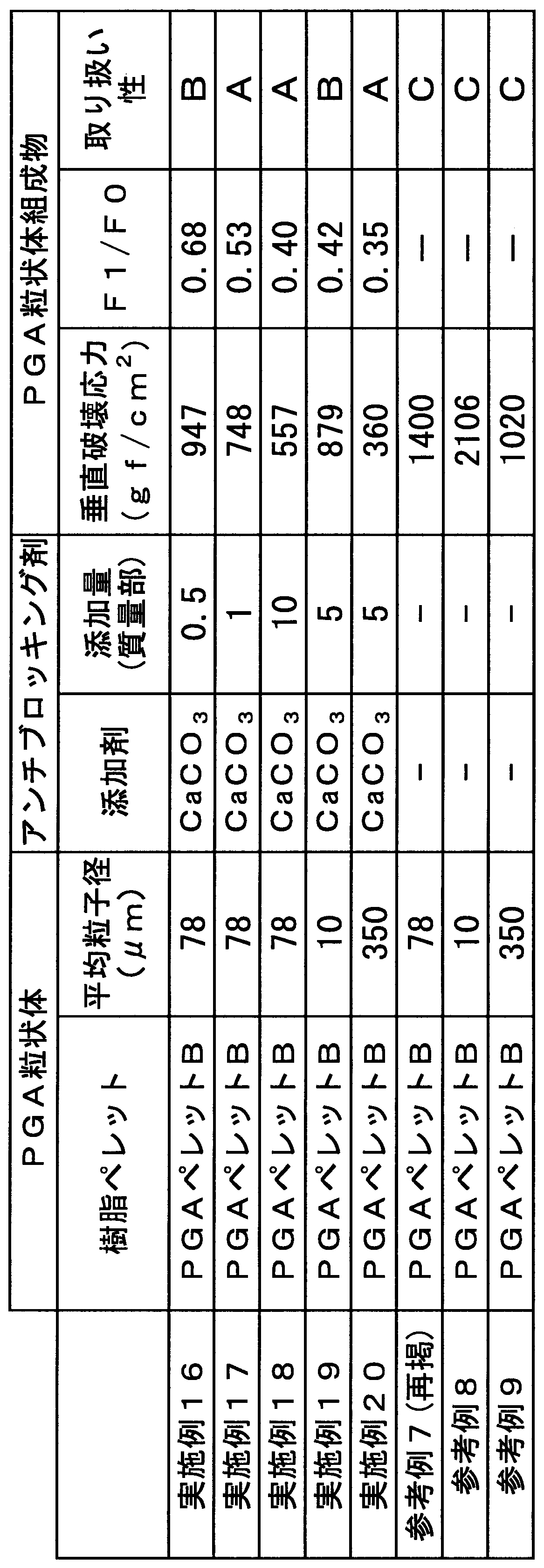
表2の結果から、平均粒子径(50%D)が10~350μmであるPGA粒状体に対してアンチブロッキング剤を添加した実施例16~20のPGA粒状体組成物は、簡易ハンドリング性評価試験の結果がAまたはB評価であり、取り扱い性が良好であった。また、これら取り扱い性が良好な実施例16~20の粒状体組成物は、該PGAのガラス転移温度(Tg)-5℃以上の温度範囲に含まれる40℃の温度で成形した円柱状タブレットの垂直破壊応力(F1)が、360~947gf/cm2であり、1000gf/cm2以下の小さい値を示すものであった。さらに、実施例16~20の粒状体組成物は、前記のF1とF0との式)F1/F0が、0.35~0.68であり、0.95以下の小さな値を示すものであることが分かった。このことから、実施例16~20の粒状体組成物は、ブロッキングした粒状体が含まれないか、または一旦ブロッキングが生じても極めて容易にブロッキング状態が破壊されるという優れた粒子特性を有する粒状体組成物であることが分かった。
これに対して、アンチブロッキング剤を添加していない参考例7~9の粒状体は、取り扱い性も良好ではなく、前記の垂直破壊応力(F1)が1020~2106gf/cm2であり、例えば、坑井掘削用の生分解性脂肪族ポリエステル粒状体として求められる粒子特性を有しないことが分かった。
本発明によれば、平均粒子径が0.01~1000μmである生分解性脂肪族ポリエステル樹脂粒状体に対し、アンチブロッキング剤を添加してなる生分解性脂肪族ポリエステル樹脂粒状体組成物であることによって、保管や移送によってもブロッキングが生じにくく、また、一旦ブロッキングが生じても極めて容易にブロッキングを解消して所要の粒子特性を有する生分解性脂肪族ポリエステル樹脂粒状体が得られるため、生分解性脂肪族ポリエステル樹脂粒状体を利用する粉末成形や坑井掘削作業等における効率が向上し、かつ、廃棄処分も容易となるので、産業上の利用可能性が高い。
また、本発明によれば、平均粒子径(50%D)が0.01~1000μmである生分解性脂肪族ポリエステル樹脂粒状体に対し、アンチブロッキング剤を添加し、0℃以上該生分解性脂肪族ポリエステル樹脂のガラス転移温度(Tg)-5℃以下の範囲の温度で攪拌混合することによって、前記の生分解性脂肪族ポリエステル樹脂粒状体組成物を容易に製造することができるので、産業上の利用可能性が高い。
Claims (9)
- 平均粒子径が0.01~1000μmである生分解性脂肪族ポリエステル樹脂粒状体に対し、アンチブロッキング剤を添加してなる生分解性脂肪族ポリエステル樹脂粒状体組成物。
- F1:前記粒状体組成物を、前記生分解性脂肪族ポリエステル樹脂のガラス転移温度-5℃以上の温度で、100gf/cm2の荷重を24時間負荷する成形条件で成形した円柱状タブレットの垂直破壊応力;
が、式)F1≦1000gf/cm2を満たす請求項1に記載の生分解性脂肪族ポリエステル樹脂粒状体組成物。 - F1:前記粒状体組成物を、前記生分解性脂肪族ポリエステル樹脂のガラス転移温度-5℃以上の温度で、100gf/cm2の荷重を24時間負荷する成形条件で成形した円柱状タブレットの垂直破壊応力;及び
F0:前記粒状体を、前記の成形条件で成形した円柱状タブレットの垂直破壊応力;
が、式)F1/F0≦0.95を満たす請求項1または2に記載の生分解性脂肪族ポリエステル樹脂粒状体組成物。 - 前記生分解性脂肪族ポリエステル樹脂が、ポリグリコール酸樹脂である請求項1乃至3のいずれか1項に記載の生分解性脂肪族ポリエステル樹脂粒状体組成物。
- アンチブロッキング剤が、無機物質である請求項1乃至4のいずれか1項に記載の生分解性脂肪族ポリエステル樹脂粒状体組成物。
- アンチブロッキング剤が、有機物質である請求項1乃至4のいずれか1項に記載の生分解性脂肪族ポリエステル樹脂粒状体組成物。
- 前記有機物質が、生分解性脂肪族ポリエステル樹脂を含有するものである請求項6に記載の生分解性脂肪族ポリエステル樹脂粒状体組成物。
- 生分解性脂肪族ポリエステル樹脂粒状体の平均粒子径に対するアンチブロッキング剤の平均粒子径が、0.00125~10000の比率の範囲である請求項1乃至7のいずれか1項に記載の生分解性脂肪族ポリエステル樹脂粒状体組成物。
- 平均粒子径が0.01~1000μmである生分解性脂肪族ポリエステル樹脂の粒状体に対し、アンチブロッキング剤を添加し、0℃以上該生分解性脂肪族ポリエステル樹脂のガラス転移温度-5℃以下の範囲の温度で、5分間~2時間攪拌混合することを特徴とする請求項1乃至8のいずれか1項に記載の生分解性脂肪族ポリエステル樹脂粒状体組成物の製造方法。
Applications Claiming Priority (2)
| Application Number | Priority Date | Filing Date | Title |
|---|---|---|---|
| JP2011050795 | 2011-03-08 | ||
| JP2011-050795 | 2011-03-08 |
Publications (1)
| Publication Number | Publication Date |
|---|---|
| WO2012121296A1 true WO2012121296A1 (ja) | 2012-09-13 |
Family
ID=46798252
Family Applications (1)
| Application Number | Title | Priority Date | Filing Date |
|---|---|---|---|
| PCT/JP2012/055842 Ceased WO2012121296A1 (ja) | 2011-03-08 | 2012-03-07 | 生分解性脂肪族ポリエステル樹脂粒状体組成物及びその製造方法 |
Country Status (1)
| Country | Link |
|---|---|
| WO (1) | WO2012121296A1 (ja) |
Cited By (8)
| Publication number | Priority date | Publication date | Assignee | Title |
|---|---|---|---|---|
| WO2014109347A1 (ja) * | 2013-01-11 | 2014-07-17 | 株式会社クレハ | ポリ-l-乳酸固化押出成形物及びその製造方法並びにその応用 |
| JP2018009107A (ja) * | 2016-07-14 | 2018-01-18 | 株式会社カネカ | 脂肪族ポリエステル樹脂組成物の製造方法 |
| EP3315553A4 (en) * | 2015-06-29 | 2019-03-06 | Toray Industries, Inc. | POLYESTER RESIN POWDER MIXTURE |
| JP2019530791A (ja) * | 2016-09-08 | 2019-10-24 | シェーファー・カーク・ゲーエムベーハー・ウント・コンパニー・カーゲーSchaefer Kalk Gmbh & Co. Kg | 微細構造粒子を有するカルシウム塩含有複合粉末 |
| US11441008B2 (en) | 2016-09-08 | 2022-09-13 | Schaefer Kalk Gmbh & Co. Kg | Composite powder containing calcium carbonate and having microstructured particles |
| CN115298243A (zh) * | 2020-04-06 | 2022-11-04 | 帝人株式会社 | 脂肪族聚酯的制造方法、脂肪族聚酯树脂和脂肪族聚酯树脂组合物 |
| US11548998B2 (en) | 2016-09-08 | 2023-01-10 | Schaefer Kalk Gmbh & Co. Kg | Inhibiting calcium carbonate additive |
| US11760874B2 (en) | 2016-09-08 | 2023-09-19 | Schaefer Kalk Gmbh & Co. Kg | Composite powder containing calcium carbonate and having microstructured particles having inhibiting calcium carbonate |
Citations (4)
| Publication number | Priority date | Publication date | Assignee | Title |
|---|---|---|---|---|
| JPS5038123B2 (ja) * | 1972-06-01 | 1975-12-08 | ||
| JPS63186776A (ja) * | 1987-01-28 | 1988-08-02 | Nippon Paint Co Ltd | 粉体塗料の製造方法 |
| JP2007197602A (ja) * | 2006-01-27 | 2007-08-09 | Asahi Kasei Chemicals Corp | 生分解性樹脂粉体及びその製造方法 |
| JP2009263663A (ja) * | 2008-03-31 | 2009-11-12 | Sanyo Chem Ind Ltd | ガラスチョップドストランドマット用バインダー |
-
2012
- 2012-03-07 WO PCT/JP2012/055842 patent/WO2012121296A1/ja not_active Ceased
Patent Citations (4)
| Publication number | Priority date | Publication date | Assignee | Title |
|---|---|---|---|---|
| JPS5038123B2 (ja) * | 1972-06-01 | 1975-12-08 | ||
| JPS63186776A (ja) * | 1987-01-28 | 1988-08-02 | Nippon Paint Co Ltd | 粉体塗料の製造方法 |
| JP2007197602A (ja) * | 2006-01-27 | 2007-08-09 | Asahi Kasei Chemicals Corp | 生分解性樹脂粉体及びその製造方法 |
| JP2009263663A (ja) * | 2008-03-31 | 2009-11-12 | Sanyo Chem Ind Ltd | ガラスチョップドストランドマット用バインダー |
Cited By (12)
| Publication number | Priority date | Publication date | Assignee | Title |
|---|---|---|---|---|
| WO2014109347A1 (ja) * | 2013-01-11 | 2014-07-17 | 株式会社クレハ | ポリ-l-乳酸固化押出成形物及びその製造方法並びにその応用 |
| JPWO2014109347A1 (ja) * | 2013-01-11 | 2017-01-19 | 株式会社クレハ | ポリ−l−乳酸固化押出成形物及びその製造方法並びにその応用 |
| US10072476B2 (en) | 2013-01-11 | 2018-09-11 | Kureha Corporation | Poly-L-lactic acid solid-state extrusion molded article, method for producing the same, and use applications of the same |
| EP3315553A4 (en) * | 2015-06-29 | 2019-03-06 | Toray Industries, Inc. | POLYESTER RESIN POWDER MIXTURE |
| JP2018009107A (ja) * | 2016-07-14 | 2018-01-18 | 株式会社カネカ | 脂肪族ポリエステル樹脂組成物の製造方法 |
| JP2019530791A (ja) * | 2016-09-08 | 2019-10-24 | シェーファー・カーク・ゲーエムベーハー・ウント・コンパニー・カーゲーSchaefer Kalk Gmbh & Co. Kg | 微細構造粒子を有するカルシウム塩含有複合粉末 |
| US11352491B2 (en) | 2016-09-08 | 2022-06-07 | Schaefer Kalk Gmbh & Co. Kg | Calcium-salt-containing composite powder having microstructured particles |
| US11441008B2 (en) | 2016-09-08 | 2022-09-13 | Schaefer Kalk Gmbh & Co. Kg | Composite powder containing calcium carbonate and having microstructured particles |
| US11548998B2 (en) | 2016-09-08 | 2023-01-10 | Schaefer Kalk Gmbh & Co. Kg | Inhibiting calcium carbonate additive |
| US11760874B2 (en) | 2016-09-08 | 2023-09-19 | Schaefer Kalk Gmbh & Co. Kg | Composite powder containing calcium carbonate and having microstructured particles having inhibiting calcium carbonate |
| CN115298243A (zh) * | 2020-04-06 | 2022-11-04 | 帝人株式会社 | 脂肪族聚酯的制造方法、脂肪族聚酯树脂和脂肪族聚酯树脂组合物 |
| CN115298243B (zh) * | 2020-04-06 | 2023-12-12 | 帝人株式会社 | 脂肪族聚酯的制造方法、脂肪族聚酯树脂和脂肪族聚酯树脂组合物 |
Similar Documents
| Publication | Publication Date | Title |
|---|---|---|
| WO2012121294A1 (ja) | 坑井掘削用ポリグリコール酸樹脂粒状体組成物及びその製造方法 | |
| JP5763402B2 (ja) | 生分解性脂肪族ポリエステル粒子、及びその製造方法 | |
| WO2012121296A1 (ja) | 生分解性脂肪族ポリエステル樹脂粒状体組成物及びその製造方法 | |
| CN104105758B (zh) | 聚酯树脂组合物及其成型体 | |
| CN102892817B (zh) | 聚乳酸系膜 | |
| JP5224815B2 (ja) | ポリグリコール酸樹脂粒状体組成物およびその製造方法 | |
| WO2014057969A1 (ja) | ポリグリコール酸樹脂組成物及びその製造方法 | |
| JP3359764B2 (ja) | 耐熱性乳酸系ポリマー成形物 | |
| JPWO2007034805A1 (ja) | ポリグリコール酸樹脂組成物の製造方法 | |
| CN101321829B (zh) | 聚乙醇酸树脂组合物 | |
| WO2012029448A1 (ja) | 顆粒状脂肪族ポリエステル粒子、及び、その製造方法 | |
| WO2023272569A1 (zh) | 一种用于制作降解膜的生物塑料及制备方法 | |
| JP3167411B2 (ja) | 多孔性フィルム | |
| WO2012017832A1 (ja) | ポリグリコール酸粒子、ポリグリコール酸粒子の製造方法、及び、その用途 | |
| WO2012133037A1 (ja) | 生分解性脂肪族ポリエステル粒子、及びその製造方法 | |
| JPH0827296A (ja) | 多孔性フィルムおよびその製造方法 | |
| TWI823967B (zh) | 聚乳酸共聚物及其製造方法 | |
| JP2007231154A (ja) | 粉末成形用生分解性樹脂組成物 | |
| WO2012133039A1 (ja) | 生分解性脂肪族ポリエステル粒子、及びその製造方法 | |
| JP2003252975A (ja) | 脂肪族ポリエステル及びその製造方法 | |
| WO2012144511A1 (ja) | 生分解性脂肪族ポリエステル粒子、及びその製造方法 | |
| JP3407519B2 (ja) | 脂肪族ポリエステル組成物およびその製造方法 | |
| WO2010134205A1 (ja) | ポリ乳酸系樹脂組成物及びその製造方法 | |
| JP2008248016A (ja) | 共重合ポリエステル微粒子およびその製造方法 | |
| KR100819729B1 (ko) | 초임계 유체를 이용한 점토/생분해성 폴리에스터나노복합체의 제조 방법 및 그로부터 제조된 나노복합체 |
Legal Events
| Date | Code | Title | Description |
|---|---|---|---|
| 121 | Ep: the epo has been informed by wipo that ep was designated in this application |
Ref document number: 12754601 Country of ref document: EP Kind code of ref document: A1 |
|
| NENP | Non-entry into the national phase |
Ref country code: DE |
|
| 122 | Ep: pct application non-entry in european phase |
Ref document number: 12754601 Country of ref document: EP Kind code of ref document: A1 |
|
| NENP | Non-entry into the national phase |
Ref country code: JP |