WO2012121144A1 - 生体試料中のl-トリプトファン分析方法およびそれに用いるキット - Google Patents
生体試料中のl-トリプトファン分析方法およびそれに用いるキット Download PDFInfo
- Publication number
- WO2012121144A1 WO2012121144A1 PCT/JP2012/055386 JP2012055386W WO2012121144A1 WO 2012121144 A1 WO2012121144 A1 WO 2012121144A1 JP 2012055386 W JP2012055386 W JP 2012055386W WO 2012121144 A1 WO2012121144 A1 WO 2012121144A1
- Authority
- WO
- WIPO (PCT)
- Prior art keywords
- tryptophan
- oxidase
- amino acid
- acid sequence
- activity
- Prior art date
- Legal status (The legal status is an assumption and is not a legal conclusion. Google has not performed a legal analysis and makes no representation as to the accuracy of the status listed.)
- Ceased
Links
Images





Classifications
-
- C—CHEMISTRY; METALLURGY
- C12—BIOCHEMISTRY; BEER; SPIRITS; WINE; VINEGAR; MICROBIOLOGY; ENZYMOLOGY; MUTATION OR GENETIC ENGINEERING
- C12Q—MEASURING OR TESTING PROCESSES INVOLVING ENZYMES, NUCLEIC ACIDS OR MICROORGANISMS; COMPOSITIONS OR TEST PAPERS THEREFOR; PROCESSES OF PREPARING SUCH COMPOSITIONS; CONDITION-RESPONSIVE CONTROL IN MICROBIOLOGICAL OR ENZYMOLOGICAL PROCESSES
- C12Q1/00—Measuring or testing processes involving enzymes, nucleic acids or microorganisms; Compositions therefor; Processes of preparing such compositions
- C12Q1/26—Measuring or testing processes involving enzymes, nucleic acids or microorganisms; Compositions therefor; Processes of preparing such compositions involving oxidoreductase
-
- C—CHEMISTRY; METALLURGY
- C12—BIOCHEMISTRY; BEER; SPIRITS; WINE; VINEGAR; MICROBIOLOGY; ENZYMOLOGY; MUTATION OR GENETIC ENGINEERING
- C12M—APPARATUS FOR ENZYMOLOGY OR MICROBIOLOGY; APPARATUS FOR CULTURING MICROORGANISMS FOR PRODUCING BIOMASS, FOR GROWING CELLS OR FOR OBTAINING FERMENTATION OR METABOLIC PRODUCTS, i.e. BIOREACTORS OR FERMENTERS
- C12M1/00—Apparatus for enzymology or microbiology
- C12M1/40—Apparatus specially designed for the use of free, immobilised, or carrier-bound enzymes, e.g. apparatus containing a fluidised bed of immobilised enzymes
-
- C—CHEMISTRY; METALLURGY
- C12—BIOCHEMISTRY; BEER; SPIRITS; WINE; VINEGAR; MICROBIOLOGY; ENZYMOLOGY; MUTATION OR GENETIC ENGINEERING
- C12N—MICROORGANISMS OR ENZYMES; COMPOSITIONS THEREOF; PROPAGATING, PRESERVING, OR MAINTAINING MICROORGANISMS; MUTATION OR GENETIC ENGINEERING; CULTURE MEDIA
- C12N15/00—Mutation or genetic engineering; DNA or RNA concerning genetic engineering, vectors, e.g. plasmids, or their isolation, preparation or purification; Use of hosts therefor
- C12N15/09—Recombinant DNA-technology
-
- C—CHEMISTRY; METALLURGY
- C12—BIOCHEMISTRY; BEER; SPIRITS; WINE; VINEGAR; MICROBIOLOGY; ENZYMOLOGY; MUTATION OR GENETIC ENGINEERING
- C12N—MICROORGANISMS OR ENZYMES; COMPOSITIONS THEREOF; PROPAGATING, PRESERVING, OR MAINTAINING MICROORGANISMS; MUTATION OR GENETIC ENGINEERING; CULTURE MEDIA
- C12N9/00—Enzymes; Proenzymes; Compositions thereof; Processes for preparing, activating, inhibiting, separating or purifying enzymes
- C12N9/0004—Oxidoreductases (1.)
- C12N9/0012—Oxidoreductases (1.) acting on nitrogen containing compounds as donors (1.4, 1.5, 1.6, 1.7)
-
- C—CHEMISTRY; METALLURGY
- C12—BIOCHEMISTRY; BEER; SPIRITS; WINE; VINEGAR; MICROBIOLOGY; ENZYMOLOGY; MUTATION OR GENETIC ENGINEERING
- C12Y—ENZYMES
- C12Y104/00—Oxidoreductases acting on the CH-NH2 group of donors (1.4)
- C12Y104/03—Oxidoreductases acting on the CH-NH2 group of donors (1.4) with oxygen as acceptor (1.4.3)
Definitions
- the present invention converts L-tryptophan in a biological sample into a quantifiable product, and uses L-tryptophan oxidase suitable for measuring the content of L-tryptophan by detecting or quantifying the product.
- the present invention relates to a tryptophan analysis method and a kit used therefor.
- Quantification of amino acid concentration in biological samples including blood serves as a marker for detecting various diseases, and development of the quantification method is strongly desired from a medical standpoint.
- the enzymatic quantification method of amino acid concentration has features superior to instrumental analysis such as quickness and simplicity, and is a method suitable for detecting various diseases in an actual medical field.
- Non-patent Document A L-tryptophan monooxygenase
- Patent Document A a method using L-amino acid oxidase
- Patent Document A Japanese Patent Laid-Open No. 2001-069974
- Non-Patent Document A Emanuele, J. J., Heasley, C. J., and Fitzpatrick, P. F. (1995) Arch Biochem Biophys 316, 241-248
- Non-Patent Document B Simonian, A. L., Rainina, E. I., Fitzpatrick, P. F., and Wild, J. R. (1997) Biosens Bioelectron 12, 363-371
- Non-Patent Document C Balibar, C. J., and Walsh, C. T. (2006) Biochemistry 45, 15444-15457
- Non-Patent Document D Onaka, H., Taniguchi, S., Igarashi, Y., and Furumai, T.
- Non-Patent Document E Tonismagi, K., Samel, M., Trummal, K., Ronnholm, G., Siigur, J., Kalkkinen, N., and Siigur, E. (2006) Toxicon 48, 227-237
- Non-Patent Document F Tan, N. H., and Saifuddin, M. N. (1991) Int J Biochem 23, 323-327
- Non-Patent Document G Yang, H., Johnson, P. M., Ko, K. C., Kamio, M., Germann, M. W., Derby, C. D., and Tai, P. C.
- Non-Patent Document H Ehara, T., Kitajima, S., Kanzawa, N., Tamiya, T., and Tsuchiya, T. (2002) FEBS Lett 531, 509-512
- Non-Patent Document I Geueke, B., and Hummel, W. (2002) Enzyme Microb Technol 31, 77-87
- Non-Patent Document J Tong, H., Chen, W., Shi, W., Qi, F., and Dong, X.
- Non-Patent Document K Onaka, H., Taniguchi, S., Ikeda, H., Igarashi, Y., and Furumai, T. (2003) J Antibiot 56, 950-956
- Non-Patent Document B The L-tryptophan monooxygenase exhibits a high relative activity of 83% for L-phenylalanine and 42% for L-methionine when the activity for L-tryptophan is defined as 100% (Non-patent Document A). Therefore, the method using this enzyme is unsuitable for simple and inexpensive detection with high L-tryptophan specificity.
- L-amino acid oxidase generally has low substrate specificity, and a plurality of L-amino acids other than L-tryptophan are used as reaction substrates. Therefore, there is no known example in which L-tryptophan-specific detection is performed with L-amino acid oxidase in the presence of impurities.
- L-amino acid oxidase a plurality of enzymes in snake venom are known. However, both enzymes have activity against a wide range of amino acid species (Non-Patent Documents E and F).
- the present invention searches for a new enzyme applicable to L-tryptophan-specific quantification even in a biological sample in which other amino acids coexist, and provides a new method for analyzing L-tryptophan using this enzyme. For the purpose.
- Another object of the present invention is to provide a measurement kit that can be used when carrying out the above enzymatic analysis method.
- an object of the present invention is to provide an enzyme sensor that can be used in the enzymatic analysis method.
- the present inventors have discovered L-tryptophan oxidase having a high substrate specificity for L-tryptophan from a gene in the bisindole antibiotic biosynthetic pathway of bacteria. This enzyme reacts with L-tryptophan contained in the biological sample to produce a detectable compound, and the enzyme is not affected by other amino acids present in the biological sample and is L-tryptophan specific. As a result, the present invention was completed.
- the present invention is as follows. [1] Mixing the sample, L-tryptophan oxidase and water (A), A step of leaving the reaction solution obtained by the mixing in the presence of oxygen for a predetermined time (B), Step (C) of confirming the presence of at least one reaction product due to the action of the enzyme present in the reaction solution after standing or measuring the amount of at least one reaction product
- a method for analyzing L-tryptophan in the specimen comprising:
- the L-tryptophan oxidase is (a1) having any one of the following amino acid sequences (1) to (3), and (a2) oxidase activity that acts on L-tryptophan in the presence of oxygen and water to produce hydrogen peroxide and ammonia.
- the oxidase activity for L-phenylalanine is in the range of 0 to 3% of the oxidase activity for L-tryptophan, and has no oxidase activity for protein-constituting amino acids other than L-tryptophan and L-phenylalanine, Method.
- L-tryptophan oxidase provided that the L-tryptophan oxidase has (a1) any one of the following amino acid sequences (1) to (3) and (a2) L- Has oxidase activity that acts on tryptophan to produce hydrogen peroxide and ammonia.
- L-phenylalanine oxidase activity is in the range of 0 to 3% of oxidase activity against L-tryptophan.
- L-tryptophan and L-phenylalanine does not have oxidase activity for the protein constituent amino acids of (1) the amino acid sequence set forth in SEQ ID NO: 1 or 2 in the sequence listing; (2) an amino acid sequence having a deletion, substitution and / or addition of 1 to 50 amino acids in the amino acid sequence set forth in SEQ ID NO: 1 or 2 in the sequence listing; or (3) Amino acid sequence having 90% or more identity to the amino acid sequence set forth in SEQ ID NO: 1 or 2 in the sequence listing [7]
- the kit according to [6] wherein the oxidase activity for L-phenylalanine in (a1) of the (K1) L-tryptophan oxidase is in the range of 0 to 1% of the oxidase activity for L-tryptophan.
- the stabilizer is at least one selected from the group consisting of glycerol, sucrose, sorbitol, and trehalose.
- Any one of [6] to [9], further comprising at least one of (K2) reaction buffer, (K3) hydrogen peroxide detection reagent, (K4) ammonia detection agent, and (K5) indole pyruvate detection agent A kit according to the above.
- An analytical composition for L-tryptophan containing L-tryptophan oxidase has (a1) any one of the following amino acid sequences (1) to (3), and (a2) acts on L-tryptophan in the presence of oxygen and water to react with hydrogen peroxide.
- An enzyme sensor for detecting or quantifying L-tryptophan using L-tryptophan oxidase is a hydrogen peroxide detection electrode, and the L-tryptophan oxidase has (a1) any one of the following amino acid sequences (1) to (3), and (a2) oxygen and water. In the presence of oxidase, it has an oxidase activity that acts on L-tryptophan to produce hydrogen peroxide and ammonia.
- the oxidase activity for L-phenylalanine is in the range of 0 to 3% of the oxidase activity for L-tryptophan.
- the said sensor which does not have oxidase activity with respect to protein structural amino acids other than tryptophan and L-phenylalanine.
- L-tryptophan by using tryptophan oxidase specific for L-tryptophan, L-tryptophan can be detected quickly and simply even in a sample containing many impurities such as other amino acids. Can do.
- the present invention is effective for biological samples such as plasma, serum, or urine, and not only can L-tryptophan be quantified by a coloring method or a fluorescence method by coupling with an enzyme such as peroxidase, but also an electrode-type enzyme.
- a sensor can also be provided.
- the activity of StaO in each L-tryptophan concentration is shown.
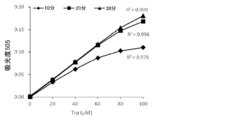
- the time-dependent change of the light absorbency of the L-tryptophan calibration curve preparation sample by StaO is shown.
- An L-tryptophan calibration curve prepared from a sample using StaO is shown.
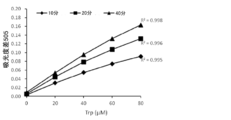
- the time-dependent change of the light absorbency of the L-tryptophan calibration curve preparation sample by VioA is shown.
- An L-tryptophan calibration curve prepared from a sample using VioA is shown.
- the results of L-tryptophan determination in human plasma samples by instrumental analysis or L-tryptophan oxidase are shown.
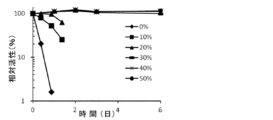
- the time-dependent change of StaO residual activity in the presence of various glycerol concentrations is shown.
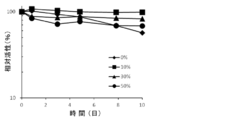
- the time-dependent change of VioA residual activity in the presence of various glycerol concentrations is shown.
- the residual activity after storage of VioA overnight at 4 ° C. or ⁇ 80 ° C. in the presence or absence of 10% glycerol is shown.
- the method for analyzing L-tryptophan of the present invention includes: Mixing the sample, L-tryptophan oxidase and water (A), A step of leaving the reaction solution obtained by the mixing in the presence of oxygen for a predetermined time (B), Step (C) of confirming the presence of at least one reaction product due to the action of the enzyme present in the reaction solution after standing or measuring the amount of at least one reaction product And the presence of L-tryptophan in the sample is confirmed or quantified through these steps.
- the biological sample used as the specimen in the method of the present invention may be any sample as long as it may contain L-tryptophan.
- a biological sample can be selected as appropriate depending on which product produced by the action of L-tryptophan oxidase on the biological sample is confirmed or quantified to confirm or measure the concentration of L-tryptophan in the biological sample.
- the above product is confirmed or quantified using a color former or a fluorescent agent, it is preferably a colorless aqueous solution, and examples thereof include serum and plasma.
- the L-tryptophan oxidase used in the present invention is: (a1) having any one of the following amino acid sequences (1) to (3), and (a2) oxidase activity that acts on L-tryptophan in the presence of oxygen and water to produce hydrogen peroxide and ammonia.
- the oxidase activity for L-phenylalanine is in the range of 0 to 3% of the oxidase activity for L-tryptophan, and it is an enzyme that does not have oxidase activity for protein constituent amino acids other than L-tryptophan and L-phenylalanine. is there.
- amino acid sequence set forth in SEQ ID NO: 1 or 2 in the sequence listing (1) the amino acid sequence set forth in SEQ ID NO: 1 or 2 in the sequence listing; (2) an amino acid sequence having a deletion, substitution and / or addition of 1 to 50 amino acids in the amino acid sequence set forth in SEQ ID NO: 1 or 2 in the sequence listing; or (3) Amino acid sequence having 90% or more identity to the amino acid sequence set forth in SEQ ID NO: 1 or 2 in the sequence listing
- oxidase activity for L-phenylalanine is in the range of 0 to 3% of the oxidase activity for L-tryptophan.
- Enzymes having no oxidase activity for protein-constituting amino acids other than L-tryptophan and L-phenylalanine are chromobacteria.
- VioA is an enzyme derived from Chromobacterium violaceum.
- VioA is an enzyme that has been identified as an enzyme that catalyzes a part of the biosynthetic pathway of the antibiotic violacein produced by the same bacterium, and has been reported to have L-tryptophan oxidation activity (Non-patent Document C). However, the enzymological properties including the substrate specificity of this enzyme have not been studied so far. Therefore, VioA acts on L-tryptophan in the presence of oxygen and water to produce hydrogen peroxide.
- the oxidase activity for L-phenylalanine is in the range of 0 to 3% of the oxidase activity for L-tryptophan, and the oxidase activity for amino acids other than L-tryptophan and L-phenylalanine It is the first time in the present invention that it is an enzyme that does not have an enzyme. Furthermore, there has never been a case where VioA has been reported for use in L-tryptophan quantification.
- oxidase activity for L-phenylalanine is in the range of 0 to 3% of the oxidase activity for L-tryptophan.
- Enzymes that do not have oxidase activity for protein-constituting amino acids other than L-tryptophan and L-phenylalanine are streptomycin. It is StaO, an enzyme derived from Streptomyces sp. TA-A0724.
- StaO is an enzyme whose gene was found in the biosynthetic gene cluster of the antibiotic staurosporine produced by the same bacterium (Non-patent Document D). Since this gene does not have significant homology with the above VioA gene, and there is no example of biochemical analysis of the gene product, the properties of the gene product remained unknown. Therefore, StaO has an oxidase activity that acts on L-tryptophan in the presence of oxygen and water to produce hydrogen peroxide and ammonia, and the oxidase activity for L-phenylalanine is 0-3 of the oxidase activity for L-tryptophan. It has been revealed for the first time in the present invention that the enzyme has no oxidase activity for amino acids other than L-tryptophan and L-phenylalanine.
- oxidase activity for L-phenylalanine and “oxidase activity for L-tryptophan” in “the oxidase activity for L-phenylalanine is in the range of 0 to 3% of the oxidase activity for L-tryptophan” are The relative activity obtained when L-phenylalanine and L-tryptophan are respectively used as protein-constituting amino acids in the test method of “4. Substrate specificity of L-tryptophan oxidase for amino acids” in Examples. Each of the activity values obtained by the test method of “4. Substrate specificity of L-tryptophan oxidase for amino acids” has a detection limit of 0.5%.
- the L-tryptophan oxidase used in the present invention preferably has an oxidase activity with respect to L-phenylalanine in the range of 0 to 2% of the oxidase activity with respect to L-tryptophan, from the viewpoint of improving analytical accuracy, and 0 to 1.5%. Is more preferable, and a range of 0 to 1% is more preferable.
- oxidase activity for amino acids other than L-tryptophan and L-phenylalanine in “having no oxidase activity for amino acids other than L-tryptophan and L-phenylalanine” is “4.
- L-tryptophan in the examples. It means the relative activity obtained when amino acids other than L-tryptophan and L-phenylalanine are used as protein-constituting amino acids in the test method of “Substrate specificity of oxidase for amino acids”.
- “having no oxidase activity” means that the relative activity is 1% or less, and preferably does not show a relative activity exceeding the detection limit (0.5%).
- the oxidase activity for L-phenylalanine is in the range of 0 to 3% of the oxidase activity for L-tryptophan.
- the absence of oxidase activity for protein-constituting amino acids other than L-phenylalanine can be confirmed by using the analytical methods (quantitative methods) described in the examples.
- Protein amino acids include L-tyrosine, L-alanine, L-cysteine, L-aspartic acid, L-glutamic acid, L-glycine, L-histidine, L-isoleucine, L-lysine, L-leucine, L -Methionine, L-asparagine, L-proline, L-glutamine, L-arginine, L-serine, L-threonine, L-valine, L-.
- the range of “1 to 50” in the “amino acid sequence having 1 to 50 amino acid deletions, substitutions and / or additions” referred to in this specification is the presence of oxygen and water in a protein having a deletion or the like.
- it has an oxidase activity that acts on L-tryptophan to generate hydrogen peroxide and ammonia
- the oxidase activity for L-phenylalanine is in the range of 0 to 3% of the oxidase activity for L-tryptophan, It means that the enzyme has no oxidase activity for amino acids other than L-phenylalanine.
- the range of “1 to 50” is, for example, 1 to 40, preferably 1 to 30, more preferably 1 to 20, more preferably, from the viewpoint that the ratio of the protein having the oxidase activity is high. 1 to 10, more preferably 1 to 7, even more preferably 1 to 5, and particularly preferably about 1 to 3.
- amino acid sequence having 90% or more identity to the amino acid sequence set forth in SEQ ID NO: 1 or 2 in the sequence listing” in the present specification means that the protein having the identity of the amino acid sequence is oxygen And oxidase activity that acts on L-tryptophan to produce hydrogen peroxide and ammonia in the presence of water, the oxidase activity for L-phenylalanine is in the range of 0-3% of the oxidase activity for L-tryptophan, There are no particular limitations on the amino acids other than L-tryptophan and L-phenylalanine as long as the enzyme does not have oxidase activity.
- the identity of the amino acid sequence is not particularly limited as long as it is 90% or more, but is preferably 95% or more, more preferably 96% or more, further preferably 97% or more, more preferably 98%, and particularly preferably 99%. That's it.
- the L-tryptophan oxidase used in the present invention is not limited to those produced from a specific species, but means an enzyme that produces hydrogen peroxide by specifically oxidatively deaminating the amino group of L-tryptophan. To do.
- the L-tryptophan oxidase used in the present invention can be derived from an organism isolated from the nature as long as it has the same activity, and the gene encoding this enzyme can be expressed in E. coli and other organisms as hosts. Also included are enzymes or proteins obtained in this way.
- a production method by heterologous expression for example, after constructing a plasmid vector in which the corresponding gene is amplified by PCR from genomic DNA extracted from a biological species having the same activity and incorporated into pET or pUC, BL21, Examples thereof include a method of transforming into a host strain such as JM109 and culturing. Other known methods other than these can also be used as appropriate.
- the method for obtaining L-tryptophan oxidase used in the present invention is not particularly limited, and may be a protein synthesized by chemical synthesis or a recombinant protein produced by a gene recombination technique.
- a gene (DNA) encoding the protein is obtained as described later.
- the L-tryptophan oxidase can be produced by introducing this DNA into an appropriate expression system.
- a gene encoding the L-tryptophan oxidase is mounted on a vector, a host cell is transformed with this vector, the transformed host cell is cultured, and the gene is introduced into the culture.
- the method for obtaining the gene encoding L-tryptophan oxidase is not particularly limited.
- the gene encoding L-tryptophan oxidase of the present invention can be obtained by, for example, chemical synthesis, genetic engineering method or the like based on the amino acid sequence shown in SEQ ID NO: 1 or 2 or the base sequence information shown in SEQ ID NO: 3 or 4. It can be made by any method known to those skilled in the art, such as mutagenesis.
- a method of contacting a DNA having the base sequence set forth in SEQ ID NO: 3 or 4 in the sequence listing with a mutagen agent a method of irradiating with ultraviolet rays, a genetic engineering method, etc.
- Site-directed mutagenesis which is one of genetic engineering techniques, is useful because it is a technique that can introduce a specific mutation at a specific position, and can be performed using a known method.
- Appropriate probes and primers are prepared based on the amino acid sequence described in SEQ ID NO: 1 or 2 of the sequence listing in this specification or the base sequence information shown in SEQ ID NO: 3 or 4, and using them, Chromobacterium
- the gene of the present invention can be isolated by screening a genomic library of Chromobacterium violaceum NBRC-12614 or Streptomyces sp. TA-A0724.
- a genomic library can be prepared from Chromobacterium violaceum NBRC 1412614 or Streptomyces sp. TA-A0724 by a conventional method.
- a gene encoding the L-tryptophan oxidase of the present invention can also be obtained by PCR.
- the genomic sequence of Chromobacterium violaceum umNBRC 12614 or Streptomyces sp. TA-A0724 can be used as a template to amplify the base sequence described in SEQ ID NO: 3 or 4.
- PCR is performed using a pair of primers designed in the above.
- PCR reaction conditions can be set as appropriate. For example, one cycle of a reaction step consisting of 94 ° C. for 30 seconds (denaturation), 55 ° C. for 30 seconds to 1 minute (annealing), and 72 ° C. for 2 minutes (extension) For example, after 30 cycles, a condition of reacting at 72 ° C. for 7 minutes can be exemplified.
- the amplified DNA fragment can then be cloned into a suitable vector that can be amplified in a host such as E. coli.
- the above L-tryptophan oxidase gene can be used by inserting it into an appropriate vector.
- the type of vector used in the present invention is not particularly limited.
- the vector may be a self-replicating vector (for example, a plasmid), or may be integrated into the host cell genome when introduced into the host cell. It may be replicated together with other chromosomes.
- the vector is an expression vector.
- elements necessary for transcription for example, a promoter and the like
- a promoter is a DNA sequence that exhibits transcriptional activity in a host cell, and can be appropriately selected depending on the type of host.
- Promoters that can operate in bacterial cells include the Bacillus stearothermophilus maltogenic amylase gene, the Bacillus licheniformis alpha-amylase gene, and the Bacillus amyloliquefaction.
- Enns-BAN amylase gene Bacillus amyloliquefaciens BAN amylase gene
- Bacillus subtilis alkaline protease gene Bacillus subtilis alkaline protease gene
- promoters of the Bacillus pumilus-xylosidase gene Bacillus pumilus-xylosidase gene
- phage lambda P R or P L promoters
- lac E. coli (E. coli) such as trp or tac promoter and the like.
- promoters that can operate in mammalian cells include the SV40 promoter, the MT-1 (metallothionein gene) promoter, and the adenovirus 2 major late promoter.
- promoters operable in insect cells include polyhedrin promoter, P10 promoter, autographa caliornica polyhedrosic basic protein promoter, baculovirus immediate early gene 1 promoter, or baculovirus 39K delayed early gene.
- Examples of a promoter operable in a yeast host cell include a promoter derived from a yeast glycolytic gene, an alcohol dehydrogenase gene promoter, a TPI1 promoter, an ADH2-4c promoter, and the like.
- promoters that can operate in filamentous fungal cells include the ADH3 promoter or the tpiA promoter.
- the L-tryptophan oxidase gene may be operably linked to an appropriate terminator as necessary.
- the recombinant vector containing the gene for L-tryptophan oxidase may further have elements such as a polyadenylation signal (for example, derived from SV40 or adenovirus 5E1b region), a transcription enhancer sequence (for example, SV40 enhancer), and the like.
- a recombinant vector containing the gene for L-tryptophan oxidase may further comprise a DNA sequence that allows the vector to replicate in the host cell, an example of which is the SV40 origin of replication (host cell is a mammalian cell). ).
- the recombinant vector containing the L-tryptophan oxidase gene may further contain a selection marker.
- Selectable markers include, for example, genes that lack their complement in host cells, such as dihydrofolate reductase (DHFR) or Schizosaccharomyces pombe TPI genes, or such as ampicillin, kanamycin, tetracycline, chloramphenicol, Mention may be made of drug resistance genes such as neomycin or hygromycin.
- a transformant can be prepared by introducing a recombinant vector containing the L-tryptophan oxidase gene into an appropriate host.
- the host cell into which the recombinant vector containing the L-tryptophan oxidase gene is introduced may be any cell as long as it can express the L-tryptophan oxidase gene, and examples thereof include bacteria, yeast, fungi, and higher eukaryotic cells.
- Examples of bacterial cells include Gram-positive bacteria such as Bacillus or Streptomyces, or Gram-negative bacteria such as E. coli. Transformation of these bacteria may be performed by using competent cells by a protoplast method or a known method.
- Examples of mammalian cells include HEK293 cells, HeLa cells, COS cells, BHK cells, CHL cells, or CHO cells. Methods for transforming mammalian cells and expressing DNA sequences introduced into the cells are also known, and for example, electroporation method, calcium phosphate method, lipofection method and the like can be used.
- yeast cells include cells belonging to Saccharomyces or Schizosaccharomyces, and examples thereof include Saccharomyces cerevisiae or Saccharomyces kluyveri.
- Examples of the method for introducing a recombinant vector into a yeast host include an electroporation method, a spheroblast method, and a lithium acetate method.
- filamentous fungi examples include Aspergillus, Neurospora, Fusarium, or Trichoderma.
- transformation can be performed by integrating the DNA construct into the host chromosome to obtain a recombinant host cell. Integration of the DNA construct into the host chromosome can be performed according to known methods, for example, by homologous recombination or heterologous recombination.
- a recombinant gene transfer vector and a baculovirus are co-introduced into insect cells using a known method to obtain a recombinant virus in the insect cell culture supernatant, followed by further recombination.
- the virus can infect insect cells and express proteins.
- baculovirus for example, Autographa californica nuclear polyhedrosis virus, which is a virus that infects Coleoptera insects, can be used.
- Insect cells include Sf9, Sf21 (Baculovirus Expression Vectors, A Laboratory Manual, WH Freeman and Company), New York, which is an ovarian cell of Spodoptera frugiperda (1992)], HiFive (manufactured by Invitrogen), which is an ovarian cell of Trichoplusia ni, can be used.
- Examples of the method for co-introducing a recombinant gene introduction vector into insect cells and the baculovirus for preparing a recombinant virus include the calcium phosphate method and the lipofection method.
- the above transformant is cultured in an appropriate nutrient medium under conditions that allow expression of the introduced gene.
- a normal protein isolation and purification method may be used. For example, when the L-tryptophan oxidase used in the present invention is expressed in a dissolved state in the cells, the cells are collected by centrifugation after culturing and suspended in an aqueous buffer, and then the cells are collected by an ultrasonic crusher or the like. To obtain a cell-free extract.
- an ordinary protein isolation and purification method that is, a solvent extraction method, a salting-out method using ammonium sulfate, a desalting method, a precipitation method using an organic solvent, Anion exchange chromatography using resin such as diethylaminoethyl (DEAE) Sepharose, cation exchange chromatography using resin such as S-Sepharose FF (Pharmacia), resin such as butyl sepharose and phenyl sepharose Using the hydrophobic chromatography method used, gel filtration method using molecular sieve, affinity chromatography method, chromatofocusing method, electrophoresis method such as isoelectric focusing etc. alone or in combination, the L- Tryptophan oxidase can be obtained as a purified preparation.
- a solvent extraction method such as diethylaminoethyl (DEAE) Sepharose
- cation exchange chromatography using resin such as S-Sepharose FF (Pharmacia)
- the L-tryptophan oxidase used in the present invention means an enzyme that catalyzes the reaction shown in the above formula A, and is not limited by its origin or amino acid sequence difference.
- the mixing amount of L-tryptophan oxidase in step (A) is suitably 10 mU / ml or more (the activity of consuming 1 ⁇ mol of tryptophan in 1 minute is 1 U), and the mixing amount of water is Although it can be appropriately determined according to the Trp concentration in the sample or the total mass in the reaction system, it can be, for example, in the range of 5 to 95% of the total mass in the reaction system, and the molar ratio is 1 mol of Trp. On the other hand, for example, 1 mol or more of water may be present. When the enzyme reaction is performed in an aqueous solution, an excessive amount of water is present in the reaction system.
- L-tryptophan oxidase there is no particular upper limit on the amount of L-tryptophan oxidase to be mixed, but practically, for example, it can be 100 mU / ml or less.
- the mixing amount of L-tryptophan oxidase and the mixing amount of water are not intended to be limited to this range, and can be appropriately adjusted.
- a buffer solution showing a pH considering the optimum pH of L-tryptophan oxidase can be preferably contained.
- water can also be supplied as a buffer solution.
- a stabilizer for L-tryptophan oxidase can be further included.
- the L-tryptophan oxidase stabilizer can be, for example, at least one selected from the group consisting of glycerol, sucrose, sorbitol, and trehalose.
- the reaction solution obtained by the mixing is left in the presence of oxygen for a predetermined time.
- indole-3-pyruvic acid which is an L-tryptophan deamination product
- ammonia NH 3
- hydrogen peroxide H 2 O 2
- the oxygen is supplied as dissolved oxygen in the reaction solution by performing the reaction in a state of being in contact with air. It is not usually necessary to forcibly supply an oxygen-containing gas such as air to the reaction solution for the purpose of supplying oxygen in the reaction solution.
- the standing time for the enzyme is, for example, in the range of 10 minutes to 1 hour, depending on the amount of enzyme used. However, it is not intended to be limited to this range, and can be adjusted as appropriate.
- step (C) the presence of at least one reaction product due to the action of the enzyme present in the reaction solution after standing is confirmed, or the amount of at least one reaction product is measured.
- the product used for the presence confirmation or determination is hydrogen peroxide
- the presence of hydrogen peroxide can be confirmed or quantified by a known method such as a method using a peroxidase reaction.
- the peroxidase which can be used should just be an enzyme which can be utilized for the presence confirmation or fixed_quantity
- a color former such as 4-aminoantipyrine and a fluorescent agent can be appropriately selected depending on the type of peroxidase used.
- Hydrogen peroxide which is a product of the L-tryptophan oxidase reaction, can also be measured using a current detection type sensor using a hydrogen peroxide electrode. By this measurement, it is possible to confirm the presence of hydrogen peroxide and to determine the amount of hydrogen peroxide.
- the hydrogen peroxide electrode include a sensor that uses a membrane in which peroxidase is immobilized in glutaraldehyde together with bovine serum albumin and a ferrocene in a carbon paste as an electrode.
- the product used for presence confirmation or determination is ammonia
- it can be measured using an ammonia detection agent.
- the ammonia detection agent include an indophenol method using a combination of phenol and hypochlorous acid.
- the presence of the sample can be confirmed by mixing the sample with a phenol / nitroprusside solution and a perchloric acid solution, and the amount of ammonia can be determined by measuring the absorbance at 635 nm. .
- indole pyruvate which is a deamination product of L-tryptophan
- 2-oxo acid reductase to confirm the presence or quantification of indole pyruvate. be able to.
- kits for analysis of L-tryptophan includes a kit for analyzing L-tryptophan containing the following reagents.
- K1 L-tryptophan oxidase The L-tryptophan oxidase is the same as the L-tryptophan oxidase described in the L-tryptophan quantification method.
- the analysis of L-tryptophan includes confirmation and quantification of L-tryptophan.
- the L-tryptophan oxidase can be a mixture with the L-tryptophan oxidase stabilizer.
- the stabilizer can be at least one selected from the group consisting of glycerol, sucrose, sorbitol and trehalose. It is preferable that the stabilizer is glycerol because of its excellent stabilizing effect on the enzyme.
- the kit of the present invention may further contain at least one of (K2) a reaction buffer, (K3) a hydrogen peroxide detection reagent, (K4) an ammonia detection agent, and (K5) an indole pyruvate detection agent.
- the reaction buffer solution is used to maintain the reaction solution at a pH suitable for the reaction such as quantification. Since L-tryptophan oxidase shown in the examples described later has an optimum pH in the range of 8 to 9, a buffer having a pH in this range is desirable.
- the hydrogen peroxide detection reagent is used when hydrogen peroxide is detected by, for example, color development or fluorescence.
- the hydrogen peroxide detection reagent can be, for example, a combination of a peroxidase and a color former that can be a substrate thereof. Specifically, a combination of horseradish peroxidase and 2-aminoantipyrine / phenol can be mentioned.
- ammonia detection agent examples include the indophenol method using a combination of phenol and hypochlorous acid.
- (K5) As the indole pyruvate detection agent, for example, 2-oxo acid reductase can be used.
- the present invention also includes a composition for analyzing L-tryptophan containing L-tryptophan oxidase.
- the L-tryptophan oxidase contained in this composition is the same as the L-tryptophan oxidase described in the L-tryptophan quantification method.
- the analysis of L-tryptophan includes confirmation and quantification of L-tryptophan.
- the analytical composition of the present invention can contain, for example, the enzyme stabilizer, buffer solution or buffering agent.
- the L-tryptophan oxidase stabilizer may be at least one selected from the group consisting of glycerol, sucrose, sorbitol and trehalose. It is preferable that the stabilizer is glycerol because of its excellent stabilizing effect on the enzyme.
- the mixing ratio of the enzyme and the stabilizer is preferably 10 to 70 parts by mass of the stabilizer with respect to 100 parts by mass of the enzyme, for example, from the viewpoint that the enzyme can be stably stored for a long period of time.
- the amount of the stabilizer is preferably in the range of 20 to 60 parts by mass, more preferably in the range of 30 to 50 parts by mass with respect to 100 parts by mass of the enzyme.
- the present invention includes an enzyme sensor for detecting or quantifying L-tryptophan using L-tryptophan oxidase.
- the L-tryptophan oxidase used in this enzyme sensor is the same as the L-tryptophan oxidase described in the L-tryptophan quantification method.
- the detection electrode is a hydrogen peroxide detection electrode.
- the hydrogen peroxide detection electrode can be an enzymatic hydrogen peroxide electrode or a diaphragm hydrogen peroxide electrode. Since hydrogen peroxide is generated by the reaction of L-tryptophan oxidase with L-tryptophan, this hydrogen peroxide can be detected by the hydrogen peroxide detection electrode.
- the enzyme-type hydrogen peroxide electrode include a sensor using, as an electrode, a film in which peroxidase is immobilized on glutaraldehyde together with bovine serum albumin and carbon paste containing ferrocene.
- the diaphragm type hydrogen peroxide electrode is a type of electrode in which an electrode that reacts with hydrogen peroxide is isolated by a diaphragm.
- the L-tryptophan oxidase is preferably disposed on the surface of the detection electrode or in the vicinity of the detection electrode from the viewpoint of performing detection or quantification of L-tryptophan with higher accuracy, and is disposed on the surface of the detection electrode. In this case, it may or may not be immobilized on the surface of the detection electrode. By being immobilized on the surface of the detection electrode, there is an advantage that the sensor of the present invention can be used repeatedly. Further, the L-tryptophan oxidase may be disposed on the surface of the detection electrode or in the vicinity of the detection electrode together with the enzyme stabilizer.
- the stabilizer may be at least one selected from the group consisting of glycerol, sucrose, sorbitol, and trehalose.
- TA-A0724 was inserted into vector pTYM19 (Non-patent Document K) treated with HincII.
- the L-tryptophan oxidase gene staO was subcloned.
- the staO gene was excised from this plasmid by treatment with NdeI and HindIII, and inserted into pET-26b treated with the same restriction enzymes to obtain a staO expression plasmid. Primers were designed so that a His-tag was added to the N-terminus or C-terminus of each enzyme.
- VioA-F ATTCTAGACATATGAAGCATTCTTCCGATATCTG (SEQ ID NO: 5)
- VioA-R AATAAGCTTCGCGGCGATGCGCTG (SEQ ID NO: 6)
- StaO-N-sense TACTGGAGGAAACATATGACGGCACCC (SEQ ID NO: 7)
- StaO-N-anti CAAGGGTGCCGTCATATGTTTCCTCCA (SEQ ID NO: 8)
- StaO-C-anti GCAGGTCGAAGAAAGCTTCGCCGACCGGT (SEQ ID NO: 10)
- Each heterologous expression strain was cultured by shaking culture at 37 ° C. until the OD 600 reached 0.6 to 0.8, and expression was induced by adding IPTG to a final concentration of 0.5 mM. Culture after induction of expression was performed at 16 ° C. for 16 hours, and the target enzyme was obtained in the soluble fraction. As for StaO, the yield was further improved by co-expression of the Takara chaperone plasmid pG-KJE8.
- Each expression strain disruption supernatant was loaded onto a GE Healthcare Ni-Sepharose column, washed with 20 mM Tris-HCl, 50 mM mMimidazole (pH 8.0) solution, then 20 mM Tris-HCl, 500 mM mMimidazole (pH 8.0).
- the target enzyme was purified and recovered by elution with a solution.
- the base sequences of these enzymes were determined and are shown in SEQ ID NOs: 3 and 4.
- the amino acid sequences of the enzymes are shown in SEQ ID NOs: 1 and 2.
- Example of conditions for measuring L-tryptophan oxidase activity 20 mM Tris-HCl buffer (pH 8.0), 5 mM L-tryptophan, 1 mM phenol, 1 mM 4-aminoantipyrine, 15 U / ml horseradish peroxidase, and any amount
- a reaction solution containing the L-tryptophan oxidase enzyme solution is prepared, and the change in absorbance at 505 nm at 30 ° C. is measured.
- the molar extinction coefficient of the quinoneimine dye is 6.4 mM ⁇ 1 ⁇ cm ⁇ 1 .
- the activity that produces 1 ⁇ mol of hydrogen peroxide per minute is defined as 1 U.
- the detection limit of this method is 0.5%.
- StaO is not reactive with amino acids other than L-tryptophan (relative activity was below the detection limit), and only relative to L-phenylalanine has a relatively low relative activity of 0.5% to 1% of L-tryptophan. was detected.
- VioA reactivity to amino acids other than L-tryptophan was not detected (relative activity was below the detection limit). As described above, it was shown that both StaO and VioA have extremely high substrate specificity for L-tryptophan.
- Km value of L-tryptophan oxidase for L-tryptophan 20 mM Tris-HCl buffer (pH 8.0), 1 mM phenol, 1 mM 4-aminoantipyrine, 15 U / ml horseradish peroxidase, 0.5 mU / ml L-tryptophan oxidase Then, a reaction solution containing 0, 6.3, 13, 25, 50, 100, 500 ⁇ M L-tryptophan was prepared, and the change in absorbance at 505 nm at 30 ° C. was measured.
- Fig. 1 shows the activity of StaO calculated at each L-tryptophan concentration. From this result, the Km value of StaO for L-tryptophan was calculated to be 19 ⁇ M. The Km value of VioA is reported to be 30 ⁇ M (Non-Patent Document C). These values are extremely low compared to the value of L-amino acid oxidase derived from Coprinus sp. (650 ⁇ M), and are also less than or equal to the Km value for the enzyme substrate generally used for amino acid determination. It is a low value. This indicates that StaO and VioA have excellent properties as quantitative enzymes even in samples with low L-tryptophan concentrations.
- L-tryptophan calibration curve 40 mM Tris-HCl buffer (pH 8.0), 2 mM phenol, 2 mM 4-aminoantipyrine, 30 U / ml horseradish peroxidase, 20 mU / ml L-tryptophan oxidase enzyme solution
- a reaction solution containing was prepared. Equivalent amounts of 0, 20, 40, 60, 80, and 100 ⁇ M L-tryptophan aqueous solution were mixed as standard samples. The reaction was allowed to proceed at 30 ° C., and the change with time in the absorbance at 505 nm at 30 ° C. was measured to monitor the progress of the reaction.
- L-tryptophan oxidase 40 mM Tris-HCl buffer (pH 8.0), 2 mM phenol, 2 mM 4-aminoantipyrine, 30 U / ml horseradish peroxidase, 20 mU / ml L -A reaction solution containing a tryptophan oxidase enzyme solution was prepared. Equivalent amounts of 0, 20, 40, 60, 80, 100 ⁇ M L-tryptophan aqueous solution or human plasma samples before and after deproteinization were mixed. The reaction was allowed to proceed at 30 ° C., and the absorbance at 505 nm was measured after 30 minutes. A calibration curve was prepared from the measured values of the L-tryptophan aqueous solution sample, and L-tryptophan in the plasma sample was quantified.
- Stability Glycerol was added to StaO, VioA purified enzyme solution to a final concentration of 0-50% (v / v). Each enzyme solution was stored at 4 ° C., and activity was measured by sampling over time. Changes in the residual activity of StaO or VioA over time in the presence of various glycerol concentrations are shown in FIG. 7 and FIG. StaO was unstable in a solution containing only buffer, but showed high stability under the condition of adding glycerol of 30% or more. VioA is relatively stable even when glycerol is not added, but its stability is further increased when 10% or more of glycerol is added.
- FIG. 9 shows the residual activity of the VioA enzyme solution in the presence or absence of 10% glycerol. Inactivation was observed when VioA was frozen and thawed, but such inactivation was not observed by the addition of 10% glycerol.
- StaO can be used as a stable enzyme solution with 30% glycerol added, and VioA not added (10% added when freeze-thawing).
- reaction temperature dependence The activity of StaO and VioA was measured at reaction temperatures of 20, 30, 40, 50, and 60 ° C. Activity measurement with 20 mM Tris-HCl buffer (pH 8.0), 1 mM L-tryptophan, 1 mM phenol, 1 mM 4-aminoantipyrine, 15 U / ml horseradish peroxidase, and L-tryptophan oxidase enzyme solution The reaction solution was used. Among the reaction solutions, those other than peroxidase and L-tryptophan oxidase enzyme solution were mixed and preincubated for 10 minutes at the various temperatures.
- Thermostability The StaO enzyme solution containing 20% glycerol and the VioA enzyme solution containing 10% glycerol were heat-treated at 30, 40, 50, 60, and 70 ° C. for 1 hour, and the activity was measured. Table 3 shows the residual activity of each enzyme solution after the heat treatment. Both enzymes showed significant heat inactivation when heat-treated at 40 ° C or higher, and the residual activity was below the detection limit when heat-treated at 50 ° C or higher.
- L-tryptophan is an essential amino acid, and it is known as endemic pellagra to show niacin deficiency symptoms when it is extremely deficient. In addition, it has been pointed out that excessive intake may cause eosinophilia and muscle pain syndrome. For this reason, L-tryptophan quantification can be used for food analysis, quality control of pharmaceuticals and supplements, blood tests in excess / deficiency, and enzyme sensors.
- the present invention can be commercialized in the form of an L-tryptophan quantification kit, an enzyme sensor, etc., and can be commercialized as an inexpensive and simple L-tryptophan quantification method.
Landscapes
- Chemical & Material Sciences (AREA)
- Life Sciences & Earth Sciences (AREA)
- Organic Chemistry (AREA)
- Health & Medical Sciences (AREA)
- Engineering & Computer Science (AREA)
- Wood Science & Technology (AREA)
- Zoology (AREA)
- Bioinformatics & Cheminformatics (AREA)
- Genetics & Genomics (AREA)
- General Engineering & Computer Science (AREA)
- General Health & Medical Sciences (AREA)
- Biochemistry (AREA)
- Biotechnology (AREA)
- Proteomics, Peptides & Aminoacids (AREA)
- Microbiology (AREA)
- Molecular Biology (AREA)
- Biophysics (AREA)
- Physics & Mathematics (AREA)
- Biomedical Technology (AREA)
- Analytical Chemistry (AREA)
- Immunology (AREA)
- Medicinal Chemistry (AREA)
- Sustainable Development (AREA)
- Plant Pathology (AREA)
- Measuring Or Testing Involving Enzymes Or Micro-Organisms (AREA)
- Enzymes And Modification Thereof (AREA)
- Apparatus Associated With Microorganisms And Enzymes (AREA)
Abstract
検体とL-トリプトファンオキシダーゼと水を混合する工程、得られた反応液を酸素の存在下に所定時間放置する工程、放置後の反応液中に存在する前記酵素の作用による反応生成物を計測する工程を含む、L-トリプトファンの定量方法を開示する。前記L-トリプトファンオキシダーゼは、所定アミノ酸配列を有し、かつ酸素及び水の存在下、L-トリプトファンに作用して過酸化水素とアンモニアを生成するオキシダーゼ活性を有し、L-フェニルアラニンに対するオキシダーゼ活性はL-トリプトファンに対するオキシダーゼ活性の0~3%の範囲であり、L-トリプトファン及びL-フェニルアラニン以外のタンパク質構成アミノ酸に対してはオキシダーゼ活性を有さない。上記L-トリプトファンオキシダーゼを含むL-トリプトファンの定量用キット及び上記L-トリプトファンオキシダーゼを用いる酵素センサーも開示する。本発明の方法、キットおよび酵素センサーは、L-トリプトファン特異的な酵素を用いるので、他のアミノ酸共存下でもL-トリプトファンを定量できる。
Description
本出願は、2011年3月4日出願の日本特願2011-48101号の優先権を主張し、その全記載は、ここに特に開示として援用される。
本発明は、生体試料中のL-トリプトファンを定量可能な生成物に変換し、その生成物の検出または定量によりL-トリプトファンの含有量を測定するのに適したL-トリプトファンオキシダーゼを用いるL-トリプトファン分析方法およびそれに用いるキットに関するものである。
血中をはじめとする生体試料中のアミノ酸濃度の定量は様々な疾病検出のマーカーとなり、その定量法の開発は医療的見地から強く望まれている。アミノ酸濃度の酵素的定量法は、その迅速さ・簡便さなど機器分析より優れた特長を有し、実際の医療現場で各種疾病検出を行うのに適した手法とされる。
L-トリプトファンを酵素学的に定量する従来技術としては、(i)L-トリプトファンモノオキシゲナーゼ(非特許文献A、非特許文献B)、および(ii)L-アミノ酸オキシダーゼを用いる方法(特許文献A)が知られている。
特許文献A:特開2001-069974号公報
非特許文献A:Emanuele, J. J., Heasley, C. J., and Fitzpatrick, P. F. (1995) Arch Biochem Biophys 316, 241-248
非特許文献B:Simonian, A. L., Rainina, E. I., Fitzpatrick, P. F., and Wild, J. R. (1997) Biosens Bioelectron 12, 363-371
非特許文献C:Balibar, C. J., and Walsh, C. T. (2006) Biochemistry 45, 15444-15457
非特許文献D:Onaka, H., Taniguchi, S., Igarashi, Y., and Furumai, T. (2002) J Antibiot 55, 1063-1071
非特許文献E:Tonismagi, K., Samel, M., Trummal, K., Ronnholm, G., Siigur, J., Kalkkinen, N., and Siigur, E. (2006) Toxicon 48, 227-237
非特許文献F:Tan, N. H., and Saifuddin, M. N. (1991) Int J Biochem 23, 323-327
非特許文献G:Yang, H., Johnson, P. M., Ko, K. C., Kamio, M., Germann, M. W., Derby, C. D., and Tai, P. C. (2005) J Exp Biol 208, 3609-3622
非特許文献H:Ehara, T., Kitajima, S., Kanzawa, N., Tamiya, T., and Tsuchiya, T. (2002) FEBS Lett 531, 509-512
非特許文献I:Geueke, B., and Hummel, W. (2002) Enzyme Microb Technol 31, 77-87
非特許文献J:Tong, H., Chen, W., Shi, W., Qi, F., and Dong, X. (2008) J Bacteriol 190, 4716-4721
非特許文献K:Onaka, H., Taniguchi, S., Ikeda, H., Igarashi, Y., and Furumai, T. (2003) J Antibiot 56, 950-956
非特許文献B:Simonian, A. L., Rainina, E. I., Fitzpatrick, P. F., and Wild, J. R. (1997) Biosens Bioelectron 12, 363-371
非特許文献C:Balibar, C. J., and Walsh, C. T. (2006) Biochemistry 45, 15444-15457
非特許文献D:Onaka, H., Taniguchi, S., Igarashi, Y., and Furumai, T. (2002) J Antibiot 55, 1063-1071
非特許文献E:Tonismagi, K., Samel, M., Trummal, K., Ronnholm, G., Siigur, J., Kalkkinen, N., and Siigur, E. (2006) Toxicon 48, 227-237
非特許文献F:Tan, N. H., and Saifuddin, M. N. (1991) Int J Biochem 23, 323-327
非特許文献G:Yang, H., Johnson, P. M., Ko, K. C., Kamio, M., Germann, M. W., Derby, C. D., and Tai, P. C. (2005) J Exp Biol 208, 3609-3622
非特許文献H:Ehara, T., Kitajima, S., Kanzawa, N., Tamiya, T., and Tsuchiya, T. (2002) FEBS Lett 531, 509-512
非特許文献I:Geueke, B., and Hummel, W. (2002) Enzyme Microb Technol 31, 77-87
非特許文献J:Tong, H., Chen, W., Shi, W., Qi, F., and Dong, X. (2008) J Bacteriol 190, 4716-4721
非特許文献K:Onaka, H., Taniguchi, S., Ikeda, H., Igarashi, Y., and Furumai, T. (2003) J Antibiot 56, 950-956
上記の(i)L-トリプトファンモノオキシゲナーゼを用いる方法では、L-トリプトファン酸化に伴う酸素減少量を検出する必要がある。そのため、原理的に複雑な装置が求められる(非特許文献B)。また上記L-トリプトファンモノオキシゲナーゼは、L-トリプトファンへの活性を100%としたとき、L-フェニルアラニンに対し83%、L-メチオニンに対し42%という高い相対活性を示す(非特許文献A)。よってこの酵素を用いる方法は、簡便・安価かつL-トリプトファン特異性の高い検出を行うのには不適である。
上記の(ii)L-アミノ酸オキシダーゼを用いる方法に関しては、公知のL-アミノ酸オキシダーゼは、一般的に基質特異性が低く、L-トリプトファン以外のL-アミノ酸複数種も反応基質とする。そのため、夾雑物存在下でL-トリプトファン特異的な検出をL-アミノ酸オキシダーゼにより行った例は知られていない。例えば、L-アミノ酸オキシダーゼとしては、ヘビ毒中の酵素が複数知られている。しかし、いずれの酵素も幅広いアミノ酸種に対し活性を有している(非特許文献E、F)。またこれ以外にも、軟体動物や細菌由来のL-アミノ酸オキシダーゼの報告例もある。しかし、これらも同様に基質特異性は広いことが知られており(非特許文献G, H, I, J)、これらの酵素を用いてL-トリプトファンを定量することは原理的に不可能である。
比較的L-トリプトファンへの基質特異性が高い酵素としては、担子菌Coprinus sp.由来のL-アミノ酸オキシダーゼの報告例がある(特許文献A)。ただし上記酵素は、L-フェニルアラニンなど他の種類のアミノ酸にも7%程度の反応性を示す。従って、依然として夾雑物の多い生体試料の測定には不適である。また上記酵素は、L-トリプトファンへのKm値が650 μMであり、血中で数十μMオーダーの濃度でしか存在しないL-トリプトファンを正確に定量するには基質親和性が低いことも問題となる。実際にL-アミノ酸オキシゲナーゼを用いて試料中のL-トリプトファンを定量した例はこれまでに知られていない。さらに上記酵素は遺伝子同定されておらず、担子菌の長期(約1ヶ月)に渡る培養および複雑な精製過程がその製造には必要となる。以上の理由から、上記酵素による生体試料中のL-トリプトファン定量、および大量の酵素を要する実用化は困難であった。
そこで本発明では、他のアミノ酸が共存する生体試料中においてもL-トリプトファン特異的な定量に応用可能な新たな酵素を探索し、この酵素を用いる、L-トリプトファンの新たな分析方法を提供することを目的とする。
さらに本発明は、上記酵素的分析法を実施する際に利用できる測定用のキットを提供することも目的とする。加えて本発明は、上記酵素的分析法に利用できる酵素センサーを提供することも目的とする。
本発明者らは、細菌のビスインドール系抗生物質生合成経路中の遺伝子から、L-トリプトファンに基質特異性の高いL-トリプトファンオキシダーゼを発見した。この酵素を生体試料中に含まれるL-トリプトファンと反応させることにより検出可能な化合物が生成すること、さらに、この酵素が生体試料中に混在する他のアミノ酸に影響を受けずL-トリプトファン特異的な定量が可能であることを見出し、本発明を完成した。
本発明は、以下に示す通りである。
[1]
検体とL-トリプトファンオキシダーゼと水を混合する工程(A)、
前記混合により得られた反応液を酸素の存在下に所定時間放置する工程(B)、
放置後の反応液中に存在する前記酵素の作用による反応生成物の少なくとも一種の存在を確認するか、または前記反応生成物の少なくとも一種の量を計測する工程(C)
を含む、前記検体中のL-トリプトファンの分析方法であって、
前記L-トリプトファンオキシダーゼが、
(a1)下記(1)~(3)の何れかのアミノ酸配列を有し、かつ(a2)酸素及び水の存在下、L-トリプトファンに作用して過酸化水素とアンモニアを生成するオキシダーゼ活性を有し、L-フェニルアラニンに対するオキシダーゼ活性はL-トリプトファンに対するオキシダーゼ活性の0~3%の範囲であり、L-トリプトファン及びL-フェニルアラニン以外のタンパク質構成アミノ酸に対してはオキシダーゼ活性を有さない、前記方法。
(1)配列表の配列番号1または2に記載のアミノ酸配列;
(2)配列表の配列番号1または2に記載のアミノ酸配列において1から50個のアミノ酸の欠失、置換及び/又は付加を有するアミノ酸配列;又は
(3)配列表の配列番号1または2に記載のアミノ酸配列に対して90%以上の同一性を有するアミノ酸配列
[2]
前記L-トリプトファンオキシダーゼの(a1)におけるL-フェニルアラニンに対するオキシダーゼ活性はL-トリプトファンに対するオキシダーゼ活性の0~1%の範囲である、[1]に記載の方法。
[3]
工程(A)において検体との混合に用いられる前記L-トリプトファンオキシダーゼは、前記酵素の安定化剤の存在下で保存されているものである、[1]または[2]に記載の方法。
[4]
前記安定化剤が、グリセロール、スクロース、ソルビトール及びトレハロースから成る群から選ばれる少なくとも1種である、[3]に記載の方法。
[5]
前記工程(C)で確認または計測する反応生成物が過酸化水素である[1]~[4]のいずれかに記載の方法。
[6]
以下の試薬を含むL-トリプトファンの定量用キット。
(K1)L-トリプトファンオキシダーゼ
但し、前記L-トリプトファンオキシダーゼは、(a1)下記(1)~(3)の何れかのアミノ酸配列を有し、かつ(a2)酸素及び水の存在下、L-トリプトファンに作用して過酸化水素とアンモニアを生成するオキシダーゼ活性を有し、L-フェニルアラニンに対するオキシダーゼ活性はL-トリプトファンに対するオキシダーゼ活性の0~3%の範囲であり、L-トリプトファン及びL-フェニルアラニン以外のタンパク質構成アミノ酸に対してはオキシダーゼ活性を有さない、
(1)配列表の配列番号1または2に記載のアミノ酸配列;
(2)配列表の配列番号1または2に記載のアミノ酸配列において1から50個のアミノ酸の欠失、置換及び/又は付加を有するアミノ酸配列;又は
(3)配列表の配列番号1または2に記載のアミノ酸配列に対して90%以上の同一性を有するアミノ酸配列
[7]
前記(K1)L-トリプトファンオキシダーゼの(a1)におけるL-フェニルアラニンに対するオキシダーゼ活性はL-トリプトファンに対するオキシダーゼ活性の0~1%の範囲である、[6]に記載のキット。
[8]
前記(K1)L-トリプトファンオキシダーゼは、前記酵素の安定化剤との混合物である、[6]または[7]に記載のキット。
[9]
前記安定化剤が、グリセロール、スクロース、ソルビトール及びトレハロースから成る群から選ばれる少なくとも1種である、[8]に記載のキット。
[10]
(K2)反応用緩衝液、(K3)過酸化水素検出用試薬、(K4)アンモニア検出薬および(K5)インドールピルビン酸検出薬の少なくとも一つをさらに含む、[6]~[9]のいずれかに記載のキット。
[11]
L-トリプトファンオキシダーゼを含むL-トリプトファンの分析用組成物であって、
前記L-トリプトファンオキシダーゼは、(a1)下記(1)~(3)の何れかのアミノ酸配列を有し、かつ(a2)酸素及び水の存在下、L-トリプトファンに作用して過酸化水素とアンモニアを生成するオキシダーゼ活性を有し、L-フェニルアラニンに対するオキシダーゼ活性はL-トリプトファンに対するオキシダーゼ活性の0~3%の範囲であり、L-トリプトファン及びL-フェニルアラニン以外のタンパク質構成アミノ酸に対してはオキシダーゼ活性を有さない、前記組成物。
(1)配列表の配列番号1または2に記載のアミノ酸配列;
(2)配列表の配列番号1または2に記載のアミノ酸配列において1から50個のアミノ酸の欠失、置換及び/又は付加を有するアミノ酸配列;又は
(3)配列表の配列番号1または2に記載のアミノ酸配列に対して90%以上の同一性を有するアミノ酸配列
[12]
前記L-トリプトファンオキシダーゼの(a1)におけるL-フェニルアラニンに対するオキシダーゼ活性はL-トリプトファンに対するオキシダーゼ活性の0~1%の範囲である、[11]に記載の組成物。
[13]
前記酵素の安定化剤を含有する、[11]または[12]に記載の組成物。
[14]
前記安定化剤が、グリセロール、スクロース、ソルビトール及びトレハロースから成る群から選ばれる少なくとも1種である、[13]に記載の組成物。
[15]
L-トリプトファンオキシダーゼを用いるL-トリプトファンの検出または定量用酵素センサーであって、
前記検出用電極は過酸化水素検出用電極であり、かつ
前記L-トリプトファンオキシダーゼは、(a1)下記(1)~(3)の何れかのアミノ酸配列を有し、かつ(a2)酸素及び水の存在下、L-トリプトファンに作用して過酸化水素とアンモニアを生成するオキシダーゼ活性を有し、L-フェニルアラニンに対するオキシダーゼ活性はL-トリプトファンに対するオキシダーゼ活性の0~3%の範囲であり、L-トリプトファン及びL-フェニルアラニン以外のタンパク質構成アミノ酸に対してはオキシダーゼ活性を有さない、前記センサー。
(1)配列表の配列番号1または2に記載のアミノ酸配列;
(2)配列表の配列番号1または2に記載のアミノ酸配列において1から50個のアミノ酸の欠失、置換及び/又は付加を有するアミノ酸配列;又は
(3)配列表の配列番号1または2に記載のアミノ酸配列に対して90%以上の同一性を有するアミノ酸配列
[16]
前記L-トリプトファンオキシダーゼの(a1)におけるL-フェニルアラニンに対するオキシダーゼ活性はL-トリプトファンに対するオキシダーゼ活性の0~1%の範囲である、[15]に記載の酵素センサー。
[17]
前記L-トリプトファンオキシダーゼは、前記酵素の安定化剤と共に用いられる、[15]または[16]に記載の酵素センサー。
[18]
前記安定化剤が、グリセロール、スクロース、ソルビトール及びトレハロースから成る群から選ばれる少なくとも1種である、[17]に記載の酵素センサー。
[19]
過酸化水素検出用電極は、酵素式過酸化水素電極または隔膜式過酸化水素電極である[15]~[18]のいずれかに記載の酵素センサー。
[1]
検体とL-トリプトファンオキシダーゼと水を混合する工程(A)、
前記混合により得られた反応液を酸素の存在下に所定時間放置する工程(B)、
放置後の反応液中に存在する前記酵素の作用による反応生成物の少なくとも一種の存在を確認するか、または前記反応生成物の少なくとも一種の量を計測する工程(C)
を含む、前記検体中のL-トリプトファンの分析方法であって、
前記L-トリプトファンオキシダーゼが、
(a1)下記(1)~(3)の何れかのアミノ酸配列を有し、かつ(a2)酸素及び水の存在下、L-トリプトファンに作用して過酸化水素とアンモニアを生成するオキシダーゼ活性を有し、L-フェニルアラニンに対するオキシダーゼ活性はL-トリプトファンに対するオキシダーゼ活性の0~3%の範囲であり、L-トリプトファン及びL-フェニルアラニン以外のタンパク質構成アミノ酸に対してはオキシダーゼ活性を有さない、前記方法。
(1)配列表の配列番号1または2に記載のアミノ酸配列;
(2)配列表の配列番号1または2に記載のアミノ酸配列において1から50個のアミノ酸の欠失、置換及び/又は付加を有するアミノ酸配列;又は
(3)配列表の配列番号1または2に記載のアミノ酸配列に対して90%以上の同一性を有するアミノ酸配列
[2]
前記L-トリプトファンオキシダーゼの(a1)におけるL-フェニルアラニンに対するオキシダーゼ活性はL-トリプトファンに対するオキシダーゼ活性の0~1%の範囲である、[1]に記載の方法。
[3]
工程(A)において検体との混合に用いられる前記L-トリプトファンオキシダーゼは、前記酵素の安定化剤の存在下で保存されているものである、[1]または[2]に記載の方法。
[4]
前記安定化剤が、グリセロール、スクロース、ソルビトール及びトレハロースから成る群から選ばれる少なくとも1種である、[3]に記載の方法。
[5]
前記工程(C)で確認または計測する反応生成物が過酸化水素である[1]~[4]のいずれかに記載の方法。
[6]
以下の試薬を含むL-トリプトファンの定量用キット。
(K1)L-トリプトファンオキシダーゼ
但し、前記L-トリプトファンオキシダーゼは、(a1)下記(1)~(3)の何れかのアミノ酸配列を有し、かつ(a2)酸素及び水の存在下、L-トリプトファンに作用して過酸化水素とアンモニアを生成するオキシダーゼ活性を有し、L-フェニルアラニンに対するオキシダーゼ活性はL-トリプトファンに対するオキシダーゼ活性の0~3%の範囲であり、L-トリプトファン及びL-フェニルアラニン以外のタンパク質構成アミノ酸に対してはオキシダーゼ活性を有さない、
(1)配列表の配列番号1または2に記載のアミノ酸配列;
(2)配列表の配列番号1または2に記載のアミノ酸配列において1から50個のアミノ酸の欠失、置換及び/又は付加を有するアミノ酸配列;又は
(3)配列表の配列番号1または2に記載のアミノ酸配列に対して90%以上の同一性を有するアミノ酸配列
[7]
前記(K1)L-トリプトファンオキシダーゼの(a1)におけるL-フェニルアラニンに対するオキシダーゼ活性はL-トリプトファンに対するオキシダーゼ活性の0~1%の範囲である、[6]に記載のキット。
[8]
前記(K1)L-トリプトファンオキシダーゼは、前記酵素の安定化剤との混合物である、[6]または[7]に記載のキット。
[9]
前記安定化剤が、グリセロール、スクロース、ソルビトール及びトレハロースから成る群から選ばれる少なくとも1種である、[8]に記載のキット。
[10]
(K2)反応用緩衝液、(K3)過酸化水素検出用試薬、(K4)アンモニア検出薬および(K5)インドールピルビン酸検出薬の少なくとも一つをさらに含む、[6]~[9]のいずれかに記載のキット。
[11]
L-トリプトファンオキシダーゼを含むL-トリプトファンの分析用組成物であって、
前記L-トリプトファンオキシダーゼは、(a1)下記(1)~(3)の何れかのアミノ酸配列を有し、かつ(a2)酸素及び水の存在下、L-トリプトファンに作用して過酸化水素とアンモニアを生成するオキシダーゼ活性を有し、L-フェニルアラニンに対するオキシダーゼ活性はL-トリプトファンに対するオキシダーゼ活性の0~3%の範囲であり、L-トリプトファン及びL-フェニルアラニン以外のタンパク質構成アミノ酸に対してはオキシダーゼ活性を有さない、前記組成物。
(1)配列表の配列番号1または2に記載のアミノ酸配列;
(2)配列表の配列番号1または2に記載のアミノ酸配列において1から50個のアミノ酸の欠失、置換及び/又は付加を有するアミノ酸配列;又は
(3)配列表の配列番号1または2に記載のアミノ酸配列に対して90%以上の同一性を有するアミノ酸配列
[12]
前記L-トリプトファンオキシダーゼの(a1)におけるL-フェニルアラニンに対するオキシダーゼ活性はL-トリプトファンに対するオキシダーゼ活性の0~1%の範囲である、[11]に記載の組成物。
[13]
前記酵素の安定化剤を含有する、[11]または[12]に記載の組成物。
[14]
前記安定化剤が、グリセロール、スクロース、ソルビトール及びトレハロースから成る群から選ばれる少なくとも1種である、[13]に記載の組成物。
[15]
L-トリプトファンオキシダーゼを用いるL-トリプトファンの検出または定量用酵素センサーであって、
前記検出用電極は過酸化水素検出用電極であり、かつ
前記L-トリプトファンオキシダーゼは、(a1)下記(1)~(3)の何れかのアミノ酸配列を有し、かつ(a2)酸素及び水の存在下、L-トリプトファンに作用して過酸化水素とアンモニアを生成するオキシダーゼ活性を有し、L-フェニルアラニンに対するオキシダーゼ活性はL-トリプトファンに対するオキシダーゼ活性の0~3%の範囲であり、L-トリプトファン及びL-フェニルアラニン以外のタンパク質構成アミノ酸に対してはオキシダーゼ活性を有さない、前記センサー。
(1)配列表の配列番号1または2に記載のアミノ酸配列;
(2)配列表の配列番号1または2に記載のアミノ酸配列において1から50個のアミノ酸の欠失、置換及び/又は付加を有するアミノ酸配列;又は
(3)配列表の配列番号1または2に記載のアミノ酸配列に対して90%以上の同一性を有するアミノ酸配列
[16]
前記L-トリプトファンオキシダーゼの(a1)におけるL-フェニルアラニンに対するオキシダーゼ活性はL-トリプトファンに対するオキシダーゼ活性の0~1%の範囲である、[15]に記載の酵素センサー。
[17]
前記L-トリプトファンオキシダーゼは、前記酵素の安定化剤と共に用いられる、[15]または[16]に記載の酵素センサー。
[18]
前記安定化剤が、グリセロール、スクロース、ソルビトール及びトレハロースから成る群から選ばれる少なくとも1種である、[17]に記載の酵素センサー。
[19]
過酸化水素検出用電極は、酵素式過酸化水素電極または隔膜式過酸化水素電極である[15]~[18]のいずれかに記載の酵素センサー。
本発明によれば、L-トリプトファンに対して特異的なトリプトファンオキシダーゼを用いることで、他のアミノ酸など多くの夾雑物を含む試料においても、L-トリプトファン特異的に迅速・簡便な検出を行うことができる。特に、血漿、血清または尿のような生体試料に対し本発明は有効であり、ペルオキシダーゼ等の酵素とカップリングさせることにより発色法や蛍光法でL-トリプトファンを定量できるのみならず、電極型酵素センサーを提供することもできる。
<L-トリプトファンの分析方法>
本発明のL-トリプトファンの分析方法は、
検体とL-トリプトファンオキシダーゼと水を混合する工程(A)、
前記混合により得られた反応液を酸素の存在下に所定時間放置する工程(B)、
放置後の反応液中に存在する前記酵素の作用による反応生成物の少なくとも一種の存在を確認するか、または前記反応生成物の少なくとも一種の量を計測する工程(C)
を含み、これらの工程を経ることで、検体中のL-トリプトファンの存在を確認するか、またはを定量する方法である。
本発明のL-トリプトファンの分析方法は、
検体とL-トリプトファンオキシダーゼと水を混合する工程(A)、
前記混合により得られた反応液を酸素の存在下に所定時間放置する工程(B)、
放置後の反応液中に存在する前記酵素の作用による反応生成物の少なくとも一種の存在を確認するか、または前記反応生成物の少なくとも一種の量を計測する工程(C)
を含み、これらの工程を経ることで、検体中のL-トリプトファンの存在を確認するか、またはを定量する方法である。
本発明の方法で、検体として用いられる生体試料は、L-トリプトファンを含む可能性のある試料であれば、如何なるものでもよい。生体試料にL-トリプトファンオキシダーゼを作用させて生じる、どの生成物を確認または定量することで生体試料中のL-トリプトファンを確認またはその濃度を測定するのかにより、生体試料は適宜選択することができる。例えば、発色剤や蛍光剤を利用して上記生成物を確認または定量する場合には無色の水溶液であることが好ましく、血清及び血漿などが例として挙げられる。
本発明に用いる前記L-トリプトファンオキシダーゼは、
(a1)下記(1)~(3)の何れかのアミノ酸配列を有し、かつ(a2)酸素及び水の存在下、L-トリプトファンに作用して過酸化水素とアンモニアを生成するオキシダーゼ活性を有し、L-フェニルアラニンに対するオキシダーゼ活性はL-トリプトファンに対するオキシダーゼ活性の0~3%の範囲であり、L-トリプトファン及びL-フェニルアラニン以外のタンパク質構成アミノ酸に対してはオキシダーゼ活性を有さない酵素である。
(1)配列表の配列番号1または2に記載のアミノ酸配列;
(2)配列表の配列番号1または2に記載のアミノ酸配列において1から50個のアミノ酸の欠失、置換及び/又は付加を有するアミノ酸配列;又は
(3)配列表の配列番号1または2に記載のアミノ酸配列に対して90%以上の同一性を有するアミノ酸配列
(a1)下記(1)~(3)の何れかのアミノ酸配列を有し、かつ(a2)酸素及び水の存在下、L-トリプトファンに作用して過酸化水素とアンモニアを生成するオキシダーゼ活性を有し、L-フェニルアラニンに対するオキシダーゼ活性はL-トリプトファンに対するオキシダーゼ活性の0~3%の範囲であり、L-トリプトファン及びL-フェニルアラニン以外のタンパク質構成アミノ酸に対してはオキシダーゼ活性を有さない酵素である。
(1)配列表の配列番号1または2に記載のアミノ酸配列;
(2)配列表の配列番号1または2に記載のアミノ酸配列において1から50個のアミノ酸の欠失、置換及び/又は付加を有するアミノ酸配列;又は
(3)配列表の配列番号1または2に記載のアミノ酸配列に対して90%以上の同一性を有するアミノ酸配列
(1)配列表の配列番号1に記載のアミノ酸配列を有し、かつ(a2)酸素及び水の存在下、L-トリプトファンに作用して過酸化水素とアンモニアを生成するオキシダーゼ活性を有し、L-フェニルアラニンに対するオキシダーゼ活性はL-トリプトファンに対するオキシダーゼ活性の0~3%の範囲であり、L-トリプトファン及びL-フェニルアラニン以外のタンパク質構成アミノ酸に対してはオキシダーゼ活性を有さない酵素は、クロモバクテリウム・ビオラセウム(Chromobacterium violaceum)由来酵素であるVioAである。VioAは、同菌の生産する抗生物質violaceinの生合成経路の一部を触媒する酵素として同定され、L-トリプトファン酸化活性を有することが報告されていた酵素である(非特許文献C)。しかし、本酵素の基質特異性をはじめとする酵素学的性質については、これまでに検討されておらず、従って、VioAが、酸素及び水の存在下、L-トリプトファンに作用して過酸化水素とアンモニアを生成するオキシダーゼ活性を有し、L-フェニルアラニンに対するオキシダーゼ活性はL-トリプトファンに対するオキシダーゼ活性の0~3%の範囲であり、L-トリプトファン及びL-フェニルアラニン以外のアミノ酸に対してはオキシダーゼ活性を有さない酵素であることは、本発明において初めて明らかになったことである。さらに、VioAをL-トリプトファンの定量に用いることを報告した例はこれまでになかった。
(1)配列表の配列番号2に記載のアミノ酸配列を有し、かつ(a2)酸素及び水の存在下、L-トリプトファンに作用して過酸化水素とアンモニアを生成するオキシダーゼ活性を有し、L-フェニルアラニンに対するオキシダーゼ活性はL-トリプトファンに対するオキシダーゼ活性の0~3%の範囲であり、L-トリプトファン及びL-フェニルアラニン以外のタンパク質構成アミノ酸に対してはオキシダーゼ活性を有さない酵素は、ストレプトマイセス・エスピー(Streptomyces sp.)TA-A0724由来酵素であるStaOである。StaOに関しては、同菌の生産する抗生物質staurosporineの生合成遺伝子クラスター中にその遺伝子が見出された酵素である(非特許文献D)。本遺伝子は上記VioAの遺伝子と有意な相同性を有しておらず、また遺伝子産物を生化学的に解析した例はないことから、その遺伝子産物の性状については未知のままであった。従って、StaOが、酸素及び水の存在下、L-トリプトファンに作用して過酸化水素とアンモニアを生成するオキシダーゼ活性を有し、L-フェニルアラニンに対するオキシダーゼ活性はL-トリプトファンに対するオキシダーゼ活性の0~3%の範囲であり、L-トリプトファン及びL-フェニルアラニン以外のアミノ酸に対してはオキシダーゼ活性を有さない酵素であることは、本発明において初めて明らかになったことである。
尚、本願明細書において、「L-フェニルアラニンに対するオキシダーゼ活性はL-トリプトファンに対するオキシダーゼ活性の0~3%の範囲である」における「L-フェニルアラニンに対するオキシダーゼ活性」及び「L-トリプトファンに対するオキシダーゼ活性」は、実施例における「4.L-トリプトファンオキシダーゼのアミノ酸に対する基質特異性」の試験方法においてタンパク質構成アミノ酸としてL-フェニルアラニン及びL-トリプトファンをそれぞれ用いた場合に得られる相対活性を意味する。上記「4.L-トリプトファンオキシダーゼのアミノ酸に対する基質特異性」の試験方法で得られる活性値は、何れも検出限界が0.5%である。また、本発明で用いるL-トリプトファンオキシダーゼは、分析精度が高まるという観点から、L-フェニルアラニンに対するオキシダーゼ活性がL-トリプトファンに対するオキシダーゼ活性の0~2%の範囲であることが好ましく、0~1.5%の範囲であることがより好ましく、0~1%の範囲であることがさらに好ましい。
さらに「L-トリプトファン及びL-フェニルアラニン以外のアミノ酸に対してはオキシダーゼ活性を有さない」における「L-トリプトファン及びL-フェニルアラニン以外のアミノ酸に対するオキシダーゼ活性」は、実施例における「4.L-トリプトファンオキシダーゼのアミノ酸に対する基質特異性」の試験方法においてタンパク質構成アミノ酸としてL-トリプトファン及びL-フェニルアラニン以外のアミノ酸をそれぞれ用いた場合に得られる相対活性を意味する。さらに、「オキシダーゼ活性を有さない」は、相対活性が、1%以下であること、好ましくは検出限界(0.5%)を超えた相対活性を示さないことを意味する。
尚、L-トリプトファンに作用して過酸化水素とアンモニアを生成するオキシダーゼ活性を有すること、L-フェニルアラニンに対するオキシダーゼ活性はL-トリプトファンに対するオキシダーゼ活性の0~3%の範囲であり、L-トリプトファン及びL-フェニルアラニン以外のタンパク質構成アミノ酸に対してはオキシダーゼ活性を有さないことは、それぞれ実施例に記載の分析方法(定量方法)を用いることにより確認できる。また、タンパク質構成アミノ酸とは、L-チロシン、L-アラニン、L-システイン、L-アスパラギン酸、L-グルタミン酸、L-グリシン、L-ヒスチジン、L-イソロイシン、L-リジン、L-ロイシン、L-メチオニン、L-アスパラギン、L-プロリン、L-グルタミン、L-アルギニン、L-セリン、L-スレオニン、L-バリン、L-を意味する。
本明細書で言う「1から50個のアミノ酸の欠失、置換及び/又は付加を有するアミノ酸配列」における「1から50個」の範囲は、欠失等を有するタンパク質が、酸素及び水の存在下、L-トリプトファンに作用して過酸化水素とアンモニアを生成するオキシダーゼ活性を有し、L-フェニルアラニンに対するオキシダーゼ活性はL-トリプトファンに対するオキシダーゼ活性の0~3%の範囲であり、L-トリプトファン及びL-フェニルアラニン以外のアミノ酸に対してはオキシダーゼ活性を有さない酵素であることを意味する。前記「1から50個」の範囲は、前記オキシダーゼ活性を有するタンパク質である割合が高いという観点から、例えば、1から40個、好ましくは1から30個、より好ましくは1から20個、さらに好ましくは1から10個、一層好ましくは1から7個、さらに一層好ましくは1から5個、特に好ましくは1から3個程度であることができる。
本明細書で言う「配列表の配列番号1または2に記載のアミノ酸配列に対して90%以上の同一性を有するアミノ酸配列」における同一性は、前記アミノ酸配列の同一性を有するタンパク質が、酸素及び水の存在下、L-トリプトファンに作用して過酸化水素とアンモニアを生成するオキシダーゼ活性を有し、L-フェニルアラニンに対するオキシダーゼ活性はL-トリプトファンに対するオキシダーゼ活性の0~3%の範囲であり、L-トリプトファン及びL-フェニルアラニン以外のアミノ酸に対してはオキシダーゼ活性を有さない酵素である限り、特に限定されない。前記アミノ酸配列の同一性は、90%以上であれば特に限定されないが、好ましくは95%以上、さらに好ましくは96%以上、さらに好ましくは97%以上、さらに好ましくは98%、特に好ましくは99%以上である。
本発明で用いるL-トリプトファンオキシダーゼは、特定の種より生産されるものに限らず、特異的にL-トリプトファンのアミノ基を酸化的脱アミノ化するのに伴い過酸化水素を生産する酵素を意味する。
さらに、本発明に用いるL-トリプトファンオキシダーゼは、同様の活性を有するものであれば、自然界より分離された生物に由来するもの、本酵素をコードする遺伝子を大腸菌や他の生物を宿主として発現させて得られる酵素またはタンパク質も含まれる。
また、異種発現による生産法としては、例えば、同様の活性を有する生物種より抽出したゲノムDNAから該当する遺伝子をPCRにて増幅しpETもしくはpUCなどに組み込んだプラスミドベクターを構築したのち、BL21、JM109などの宿主菌株に形質転換し、培養する方法が挙げられる。これら以外の公知の方法も適宜用いることができる。
本発明で用いるL-トリプトファンオキシダーゼの取得方法は特に制限されず、化学合成により合成したタンパク質でもよいし、遺伝子組換え技術により作製した組換えタンパク質でもよい。組換えタンパク質を作製する場合には、後述するように当該タンパク質をコードする遺伝子(DNA)を取得する。このDNAを適当な発現系に導入することにより、上記L-トリプトファンオキシダーゼを産生することができる。
上記L-トリプトファンオキシダーゼは、上記L-トリプトファンオキシダーゼをコードする遺伝子をベクター上に搭載し、このベクターによって宿主細胞を形質転換した後、形質転換させた宿主細胞を培養して培養物中に前記遺伝子がコードするタンパク質を蓄積し、蓄積したタンパク質を収集することを含む、生産方法により調製することができる。
上記L-トリプトファンオキシダーゼをコードする遺伝子の取得方法は特に限定されない。本発明のL-トリプトファンオキシダーゼをコードする遺伝子は、例えば、配列番号1若しくは2に記載のアミノ酸配列または配列番号3若しくは4に記載した塩基配列の情報に基づいて、化学合成、遺伝子工学的手法又は突然変異誘発などの当業者に既知の任意の方法で作製することができる。
例えば、配列表の配列番号3または4に記載の塩基配列を有するDNAに対し、変異原となる薬剤と接触作用させる方法、紫外線を照射する方法、遺伝子工学的手法等を用いて行うことができる。遺伝子工学的手法の一つである部位特異的変異誘発法は特定の位置に特定の変異を導入できる手法であることから有用であり、公知の方法を用いて行うことができる。
本明細書中の配列表の配列番号1若しくは2に記載したアミノ酸配列または配列番号3若しくは4に示す塩基配列の情報に基づいて適当なブローブやプライマーを調製し、それらを用いてクロモバクテリウム・ビオラセウム(Chromobacterium violaceum)NBRC 12614またはストレプトマイセス・エスピー(Streptomyces sp.)TA-A0724のゲノムライブラリーをスクリーニングすることにより本発明の遺伝子を単離することができる。ゲノムライブラリーは、クロモバクテリウム・ビオラセウム(Chromobacterium violaceum) NBRC 12614またはストレプトマイセス・エスピー(Streptomyces sp.)TA-A0724から常法により作製することができる。
PCR法により本発明のL-トリプトファンオキシダーゼをコードする遺伝子を取得することもできる。上記クロモバクテリウム・ビオラセウム(Chromobacterium violaceum) NBRC 12614またはストレプトマイセス・エスピー(Streptomyces sp.)TA-A0724のゲノムライブラリーを鋳型として使用し、配列番号3若しくは4に記載した塩基配列を増幅できるように設計した1対のプライマーを用いてPCRを行う。PCRの反応条件は適宜設定することができ、例えば、94℃で30秒間(変性)、55℃で30秒~1分間(アニーリング)、72℃で2分間(伸長)からなる反応工程を1サイクルとして、例えば30サイクル行った後、72℃で7分間反応させる条件などを挙げることができる。次いで、増幅されたDNA断片を、大腸菌(E. coli)等の宿主で増幅可能な適切なベクター中にクローニングすることができる。
上記したプローブ又はプライマーの調製、ゲノムライブラリーの構築、ゲノムライブラリーのスクリーニング、並びに目的遺伝子のクローニングなどの操作は当業者に既知の方法に準じて適宜行うことができる。
上記L-トリプトファンオキシダーゼの遺伝子は適当なベクター中に挿入して使用することができる。本発明で用いるベクターの種類は特に限定されず、例えば、自立的に複製するベクター(例えばプラスミド等)でもよいし、あるいは、宿主細胞に導入された際に宿主細胞のゲノムに組み込まれ、組み込まれた染色体と共に複製されるものであってもよい。好ましくは、ベクターは発現ベクターである。発現ベクターにおいて上記遺伝子は、転写に必要な要素(例えば、プロモーター等)が機能的に連結されている。プロモータは宿主細胞において転写活性を示すDNA配列であり、宿主の種類に応じて適宜選択することができる。
細菌細胞で作動可能なプロモータとしては、バチルス・ステアロテルモフィルス・マルトジェニック・アミラーゼ遺伝子(Geobacillus stearothermophilus maltogenic amylase gene)、バチルス・リケニホルミスαアミラーゼ遺伝子(Bacillus licheniformis alpha-amylase gene)、バチルス・アミロリケファチエンス・BANアミラーゼ遺伝子(Bacillus amyloliquefaciens BAN amylase gene)、バチルス・サブチリス・アルカリプロテアーゼ遺伝子(Bacillus subtilis alkaline protease gene)もしくはバチルス・プミルス・キシロシダーゼ遺伝子(Bacillus pumilus xylosidase gene)のプロモータ、またはファージ・ラムダのPR若しくはPLプロモータ、大腸菌(E. coli)のlac、trp若しくはtacプロモータなどが挙げられる。
哺乳動物細胞で作動可能なプロモータの例としては、SV40プロモータ、MT-1(メタロチオネイン遺伝子)プロモータ、またはアデノウイルス2主後期プロモータなどがある。昆虫細胞で作動可能なプロモータの例としては、ポリヘドリンプロモータ、P10プロモータ、オートグラファ・カリホルニカ・ポリヘドロシス塩基性タンパクプロモータ、バキュウロウイルス即時型初期遺伝子1プロモータ、またはバキュウロウイルス39K遅延型初期遺伝子プロモータ等がある。酵母宿主細胞で作動可能なプロモータの例としては、酵母解糖系遺伝子由来のプロモータ、アルコールデヒドロゲナーゼ遺伝子プロモータ、TPI1プロモータ、ADH2-4cプロモータなどが挙げられる。糸状菌細胞で作動可能なプロモータの例としては、ADH3プロモータまたはtpiAプロモータなどがある。
また、上記L-トリプトファンオキシダーゼの遺伝子は必要に応じて、適切なターミネータに機能的に結合されてもよい。L-トリプトファンオキシダーゼの遺伝子を含む組換えベクターは更に、ポリアデニレーションシグナル(例えばSV40またはアデノウイルス5E1b領域由来のもの)、転写エンハンサ配列(例えばSV40エンハンサ)などの要素を有していてもよい。L-トリプトファンオキシダーゼの遺伝子を含む組換えベクターは更に、該ベクターが宿主細胞内で複製することを可能にするDNA配列を具備してもよく、その一例としてはSV40複製起点(宿主細胞が哺乳類細胞のとき)が挙げられる。
L-トリプトファンオキシダーゼの遺伝子を含む組換えベクターはさらに選択マーカーを含有してもよい。選択マーカーとしては、例えば、ジヒドロ葉酸レダクターゼ(DHFR)またはシゾサッカロマイセス・ポンベTPI遺伝子等のようなその補体が宿主細胞に欠けている遺伝子、または例えばアンピシリン、カナマイシン、テトラサイクリン、クロラムフェニコール、ネオマイシン若しくはヒグロマイシンのような薬剤耐性遺伝子を挙げることができる。L-トリプトファンオキシダーゼの遺伝子、プロモータ、および所望によりターミネータおよび/または分泌シグナル配列をそれぞれ連結し、これらを適切なベクターに挿入する方法は当業者に周知である。
L-トリプトファンオキシダーゼの遺伝子を含む組換えベクターを適当な宿主に導入することによって形質転換体を作製することができる。L-トリプトファンオキシダーゼの遺伝子を含む組換えベクターを導入される宿主細胞は、L-トリプトファンオキシダーゼの遺伝子を発現できれば任意の細胞でよく、細菌、酵母、真菌および高等真核細胞等が挙げられる。
細菌細胞の例としては、バチルスまたはストレプトマイセス等のグラム陽性菌又は大腸菌(E. coli)等のグラム陰性菌が挙げられる。これら細菌の形質転換は、プロトプラスト法、または公知の方法でコンピテント細胞を用いることにより行えばよい。哺乳類細胞の例としては、HEK293細胞、HeLa細胞、COS細胞、BHK細胞、CHL細胞またはCHO細胞等が挙げられる。哺乳類細胞を形質転換し、該細胞に導入されたDNA配列を発現させる方法も公知であり、例えば、エレクトロポーレーション法、リン酸カルシウム法、リポフェクション法等を用いることができる。
酵母細胞の例としては、サッカロマイセスまたはシゾサッカロマイセスに属する細胞が挙げられ、例えば、サッカロマイセス・セレビシエ(Saccharomyces cerevisiae)またはサッカロマイセス・クルイベリ(Saccharomyces kluyveri)等が挙げられる。酵母宿主への組換えベクターの導入方法としては、例えば、エレクトロポレーション法、スフェロブラスト法、酢酸リチウム法等を挙げることができる。
他の真菌細胞の例は、糸状菌、例えばアスペルギルス、ニューロスポラ、フザリウム、またはトリコデルマに属する細胞である。宿主細胞として糸状菌を用いる場合、DNA構築物を宿主染色体に組み込んで組換え宿主細胞を得ることにより形質転換を行うことができる。DNA構築物の宿主染色体への組み込みは、公知の方法に従い、例えば相同組換えまたは異種組換えにより行うことができる。
昆虫細胞を宿主として用いる場合には、公知の方法を用いて組換え遺伝子導入ベクターおよびバキュロウイルスを昆虫細胞に共導入して昆虫細胞培養上清中に組換えウイルスを得た後、さらに組換えウイルスを昆虫細胞に感染させ、タンパク質を発現させることができる。
バキュロウイルスとしては、例えば、ヨトウガ科昆虫に感染するウイルスであるアウトグラファ・カリフォルニカ・ヌクレアー・ポリヘドロシス・ウイルス(Autographa californica nuclear polyhedrosis virus)等を用いることができる。
昆虫細胞としては、Spodoptera frugiperdaの卵巣細胞であるSf9、Sf21〔バキュロウイルス・エクスプレッション・ベクターズ、ア・ラボラトリー・マニュアル、ダブリュー・エイチ・フリーマン・アンド・カンパニー(W. H. Freeman and Company)、ニューヨーク(New York)、(1992)〕、Trichoplusia niの卵巣細胞であるHiFive(インビトロジェン社製)等を用いることができる。
組換えウイルスを調製するための、昆虫細胞への組換え遺伝子導入ベクターと上記バキュロウイルスの共導入方法としては、例えば、リン酸カルシウム法又はリポフェクション法等を挙げることができる。
昆虫細胞としては、Spodoptera frugiperdaの卵巣細胞であるSf9、Sf21〔バキュロウイルス・エクスプレッション・ベクターズ、ア・ラボラトリー・マニュアル、ダブリュー・エイチ・フリーマン・アンド・カンパニー(W. H. Freeman and Company)、ニューヨーク(New York)、(1992)〕、Trichoplusia niの卵巣細胞であるHiFive(インビトロジェン社製)等を用いることができる。
組換えウイルスを調製するための、昆虫細胞への組換え遺伝子導入ベクターと上記バキュロウイルスの共導入方法としては、例えば、リン酸カルシウム法又はリポフェクション法等を挙げることができる。
上記の形質転換体は、導入された遺伝子の発現を可能にする条件下で適切な栄養培地中で培養する。形質転換体の培養物から、本発明で用いるL-トリプトファンオキシダーゼを単離精製するには、通常のタンパク質の単離、精製法を用いればよい。例えば、本発明で用いるL-トリプトファンオキシダーゼが、細胞内に溶解状態で発現した場合には、培養終了後、細胞を遠心分離により回収し水系緩衝液に懸濁後、超音波破砕機等により細胞を破砕し、無細胞抽出液を得る。該無細胞抽出液を遠心分離することにより得られた上清から、通常のタンパク質の単離精製法、即ち、溶媒抽出法、硫安等による塩析法、脱塩法、有機溶媒による沈殿法、ジエチルアミノエチル(DEAE)セファロース等のレジンを用いた陰イオン交換クロマトグラフィー法、S-Sepharose FF(ファルマシア社製)等のレジンを用いた陽イオン交換クロマトグラフィー法、ブチルセファロース、フェニルセファロース等のレジンを用いた疎水性クロマトグラフィー法、分子篩を用いたゲルろ過法、アフィニティークロマトグラフィ一法、クロマトフォーカシング法、等電点電気泳動等の電気泳動法等の手法を単独あるいは組み合わせて用い、本発明のL-トリプトファンオキシダーゼを精製標品として得ることができる。
L-トリプトファンオキシダーゼによるL-トリプトファンの酸化反応を以下の反応式Aに示す。

本発明で用いるL-トリプトファンオキシダーゼとは、上記式Aに示す反応を触媒する酵素を意味し、従って、その由来やアミノ酸配列の違いで限定されることはない。
工程(A)
工程(A)におけるL-トリプトファンオキシダーゼの混合量は、10 mU/ml(トリプトファン1 μmolを1分間で消費する活性を1 Uとする)以上とすることが適当であり、水の混合量は、サンプル中のTrp濃度または反応系中の全質量に応じて適宜決定できるが、例えば、反応系中の全質量の5~95%の範囲とすることができ、モル比としては、1モルのTrpに対して、例えば、1モル以上の水が存在すればよい。酵素反応を水溶液中で行う場合には過剰量の水が反応系中に存在することになる。L-トリプトファンオキシダーゼの混合量の上限は特にないが、実用的には、例えば、100 mU/ml以下であることができる。しかし、L-トリプトファンオキシダーゼの混合量および水の混合量は、この範囲に限定する意図ではなく、適宜調整できる。
工程(A)におけるL-トリプトファンオキシダーゼの混合量は、10 mU/ml(トリプトファン1 μmolを1分間で消費する活性を1 Uとする)以上とすることが適当であり、水の混合量は、サンプル中のTrp濃度または反応系中の全質量に応じて適宜決定できるが、例えば、反応系中の全質量の5~95%の範囲とすることができ、モル比としては、1モルのTrpに対して、例えば、1モル以上の水が存在すればよい。酵素反応を水溶液中で行う場合には過剰量の水が反応系中に存在することになる。L-トリプトファンオキシダーゼの混合量の上限は特にないが、実用的には、例えば、100 mU/ml以下であることができる。しかし、L-トリプトファンオキシダーゼの混合量および水の混合量は、この範囲に限定する意図ではなく、適宜調整できる。
さらに、L-トリプトファンオキシダーゼおよび水に加えて、好ましくは、L-トリプトファンオキシダーゼの至適pHを考慮したpHを示す緩衝液を含むことができる。緩衝液を用いる場合には、水は緩衝液として供給することもできる。さらに、L-トリプトファンオキシダーゼの安定化剤をさらに含むこともできる。L-トリプトファンオキシダーゼの安定化剤は、例えば、グリセロール、スクロース、ソルビトール及びトレハロースから成る群から選ばれる少なくとも1種であることができる。
工程(B)
工程(B)では、前記混合により得られた反応液を酸素の存在下に所定時間放置する。
L-トリプトファンオキシダーゼによるL-トリプトファン酸化反応においては、反応式Aに示すように、L-トリプトファン脱アミノ化生成物であるインドール-3-ピルビン酸と共に、アンモニア(NH3)と過酸化水素(H2O2)が生成物として得られる。上記反応を、例えば、空気と接触する状態で実施することで、反応液中の溶存酸素として上記酸素は供給される。反応液中酸素を供給する目的で反応液に空気などの酸素含有気体を強制的に供給する必要は通常はない。酵素反応に必要とされる酸素量が微量であり、溶存酸素により十分に賄えるためである。酵素のための放置時間は、例えば、使用する酵素量にもよるが、例えば、10分~1時間の範囲とすることができる。しかし、この範囲に限定する意図ではなく、適宜調整できる。
工程(B)では、前記混合により得られた反応液を酸素の存在下に所定時間放置する。
L-トリプトファンオキシダーゼによるL-トリプトファン酸化反応においては、反応式Aに示すように、L-トリプトファン脱アミノ化生成物であるインドール-3-ピルビン酸と共に、アンモニア(NH3)と過酸化水素(H2O2)が生成物として得られる。上記反応を、例えば、空気と接触する状態で実施することで、反応液中の溶存酸素として上記酸素は供給される。反応液中酸素を供給する目的で反応液に空気などの酸素含有気体を強制的に供給する必要は通常はない。酵素反応に必要とされる酸素量が微量であり、溶存酸素により十分に賄えるためである。酵素のための放置時間は、例えば、使用する酵素量にもよるが、例えば、10分~1時間の範囲とすることができる。しかし、この範囲に限定する意図ではなく、適宜調整できる。
工程(C)
工程(C)では、放置後の反応液中に存在する前記酵素の作用による反応生成物の少なくとも一種の存在を確認するか、または反応生成物の少なくとも一種の量を計測する。
存在確認または定量に用いられる生成物が過酸化水素である場合、例えばペルオキシダーゼ反応を用いて測定する方法等の公知の方法により、過酸化水素の存在確認または定量可能である。ペルオキシダーゼ反応を用いて測定する場合、使用可能なペルオキシダーゼは過酸化水素の存在確認または定量に利用可能な酵素であればよく、例えば西洋わさび由来ペルオキシダーゼが挙げられる。また、使用するペルオキシダーゼの基質となり得るものであれば発色剤として使用可能であり、西洋わさび由来ペルオキシダーゼを用いる場合には4-アミノアンチピリン:フェノールなどが挙げられる。西洋わさび由来ペルオキシダーゼを用いる過酸化水素の存在確認または定量のための反応は以下に示す通りである。
工程(C)では、放置後の反応液中に存在する前記酵素の作用による反応生成物の少なくとも一種の存在を確認するか、または反応生成物の少なくとも一種の量を計測する。
存在確認または定量に用いられる生成物が過酸化水素である場合、例えばペルオキシダーゼ反応を用いて測定する方法等の公知の方法により、過酸化水素の存在確認または定量可能である。ペルオキシダーゼ反応を用いて測定する場合、使用可能なペルオキシダーゼは過酸化水素の存在確認または定量に利用可能な酵素であればよく、例えば西洋わさび由来ペルオキシダーゼが挙げられる。また、使用するペルオキシダーゼの基質となり得るものであれば発色剤として使用可能であり、西洋わさび由来ペルオキシダーゼを用いる場合には4-アミノアンチピリン:フェノールなどが挙げられる。西洋わさび由来ペルオキシダーゼを用いる過酸化水素の存在確認または定量のための反応は以下に示す通りである。

4-アミノアンチピリン等の発色剤や蛍光剤は、使用されるペルオキシダーゼの種類によって適宜選択することが可能である。
L-トリプトファンオキシダーゼ反応の生成物である過酸化水素は、過酸化水素電極を用いた電流検出型センサーを用いて測定することもできる。この測定により、過酸化水素の存在確認および定量の何れも可能である。過酸化水素電極としては、例えば、ペルオキシダーゼを牛血清アルブミンとともにグルタルアルデヒドに固定化した膜とフェロセンをカーボンペーストに含有させたものを電極として用いるセンサーを挙げることができる。
存在確認または定量に用いられる生成物がアンモニアである場合には、アンモニア検出薬を用いて測定することができる。アンモニア検出薬としては、例えば、フェノールと次亜塩素酸の組み合わせによるインドフェノール法を挙げることができる。具体的には、サンプルをフェノール・ニトロプルシド溶液および過塩素酸溶液と混合して発色させることで存在確認ができ、さらに、この発色を635 nmの吸光度を測定することにより、アンモニア定量が可能である。
存在確認または定量に用いられる生成物がL-トリプトファンの脱アミノ化生成物であるインドールピルビン酸である場合には、2-オキソ酸還元酵素を用いて、インドールピルビン酸の存在確認または定量を行うことができる。
<L-トリプトファンの分析用キット>
本発明は、以下の試薬を含むL-トリプトファンの分析用キットを包含する。
(K1)L-トリプトファンオキシダーゼ
上記L-トリプトファンオキシダーゼは、前記L-トリプトファンの定量方法で説明したL-トリプトファンオキシダーゼと同様のものである。L-トリプトファンの分析には、L-トリプトファンの存在確認および定量を含む。
本発明は、以下の試薬を含むL-トリプトファンの分析用キットを包含する。
(K1)L-トリプトファンオキシダーゼ
上記L-トリプトファンオキシダーゼは、前記L-トリプトファンの定量方法で説明したL-トリプトファンオキシダーゼと同様のものである。L-トリプトファンの分析には、L-トリプトファンの存在確認および定量を含む。
上記L-トリプトファンオキシダーゼは、このL-トリプトファンオキシダーゼの安定化剤との混合物であることもできる。安定化剤は、グリセロール、スクロース、ソルビトール及びトレハロースから成る群から選ばれる少なくとも1種であることができる。安定化剤は、グリセロールであることが、酵素に対する安定化効果に優れるため好ましい。
本発明のキットは、(K2)反応用緩衝液、(K3)過酸化水素検出用試薬、(K4)アンモニア検出薬および(K5) インドールピルビン酸検出薬の少なくとも一つをさらに含むことができる。
(K2)反応用緩衝液は、反応液中を定量等の反応に適したpHに維持するために用いられる。後述の実施例に示すL-トリプトファンオキシダーゼは、至適pHが8~9の範囲があるので、この範囲のpHを有する緩衝液であることが望ましい。
(K3)過酸化水素検出用試薬は、過酸化水素の検出を、例えば、発色もしくは蛍光によって行う場合に用いる。過酸化水素検出用試薬としては、例えば、ペルオキシダーゼとその基質となり得る発色剤の組合せであることができる。具体的には、西洋わさびペルオキシダーゼと2-アミノアンチピリン・フェノールの組み合わせを挙げることができる。
(K4)アンモニア検出薬としては、例えば、フェノールと次亜塩素酸の組み合わせによるインドフェノール法を挙げることができる。
(K5)インドールピルビン酸検出薬としては、例えば、2-オキソ酸還元酵素を用いることができる。
<L-トリプトファンの分析用組成物>
本発明は、L-トリプトファンオキシダーゼを含むL-トリプトファンの分析用組成物も包含する。この組成物に含まれるL-トリプトファンオキシダーゼは、前記L-トリプトファンの定量方法で説明したL-トリプトファンオキシダーゼと同様のものである。L-トリプトファンの分析には、L-トリプトファンの存在確認および定量を含む。本発明の分析用組成物は、前記L-トリプトファンに加えて、例えば、前記酵素の安定化剤、緩衝液または緩衝剤などを含有することができる。
本発明は、L-トリプトファンオキシダーゼを含むL-トリプトファンの分析用組成物も包含する。この組成物に含まれるL-トリプトファンオキシダーゼは、前記L-トリプトファンの定量方法で説明したL-トリプトファンオキシダーゼと同様のものである。L-トリプトファンの分析には、L-トリプトファンの存在確認および定量を含む。本発明の分析用組成物は、前記L-トリプトファンに加えて、例えば、前記酵素の安定化剤、緩衝液または緩衝剤などを含有することができる。
このL-トリプトファンオキシダーゼの安定化剤は、グリセロール、スクロース、ソルビトール及びトレハロースから成る群から選ばれる少なくとも1種であることができる。安定化剤は、グリセロールであることが、酵素に対する安定化効果に優れるため好ましい。
酵素と安定化剤との混合比は、例えば、酵素100質量部に対して、10~70質量部の安定化剤を含むことが、酵素を長期間安定に保存できるという観点から好ましい。安定化剤の量は、好ましくは、酵素100質量部に対して、20~60質量部の範囲であり、より好ましくは30~50質量部の範囲である。
<酵素センサー>
本発明は、L-トリプトファンオキシダーゼを用いたL-トリプトファンの検出または定量用酵素センサーを包含する。この酵素センサーに用いるL-トリプトファンオキシダーゼは、前記L-トリプトファンの定量方法で説明したL-トリプトファンオキシダーゼと同様のものである。
本発明は、L-トリプトファンオキシダーゼを用いたL-トリプトファンの検出または定量用酵素センサーを包含する。この酵素センサーに用いるL-トリプトファンオキシダーゼは、前記L-トリプトファンの定量方法で説明したL-トリプトファンオキシダーゼと同様のものである。
前記検出用電極は過酸化水素検出用電極である。過酸化水素検出用電極は、酵素式過酸化水素電極または隔膜式過酸化水素電極であることができる。L-トリプトファンオキシダーゼがL-トリプトファンと反応することで、過酸化水素が生成するので、この過酸化水素を過酸化水素検出用電極で検出することができる。酵素式過酸化水素電極としては、例えば、ペルオキシダーゼを牛血清アルブミンとともにグルタルアルデヒドに固定化した膜とフェロセンをカーボンペーストに含有させたものを電極として用いるセンサーを挙げることができる。隔膜式過酸化水素電極は、隔膜により過酸化水素と反応する電極が隔離されたタイプの電極である。
前記L-トリプトファンオキシダーゼは、L-トリプトファンの検出または定量をより高精度に行うという観点から、検出用電極の表面または検出用電極の近傍に配置されることが好ましく、検出用電極の表面に配置される場合には、検出用電極の表面に固定化されても固定化されなくてもよい。検出用電極の表面に固定化されることで、本発明のセンサーを繰り返し利用できる利点はある。さらに、前記L-トリプトファンオキシダーゼは、前記酵素の安定化剤と共に検出用電極の表面または検出用電極の近傍に配置されることもできる。前記安定化剤は、グリセロール、スクロース、ソルビトール及びトレハロースから成る群から選ばれる少なくとも1種であることができる。
以下に実施例を挙げて本発明を具体的に説明するが本発明はこれに限定されるものではない。
1.L-トリプトファンオキシダーゼの調製例
クロモバクテリウム・ビオラセウム(Chromobacterium violaceum)NBRC 12614ゲノムDNAを調製し、これを鋳型として塩基配列データベース上の各菌の配列(AF172851.1)を元に設計した配列番号5および6のプライマーを用いてPCRを行い、L-トリプトファンオキシダーゼ遺伝子vioAを増幅した。増幅産物をpET-28aに挿入し、vioA発現用プラスミドとした。また、ストレプトマイセス・エスピー(Streptomyces sp.)TA-A0724のゲノム断片を含むコスミドpTYMCsta(非特許文献D)をStuI処理した断片を、HincIIで処理したベクターpTYM19(非特許文献K)に挿入し、L-トリプトファンオキシダーゼ遺伝子staOをサブクローニングした。Stratagene社製QuikChange site-directed mutagenesis kitと配列番号7~10のプライマーを用い、上記サブクローニングプラスミドの配列を改変した。このプラスミドからNdeIおよびHindIII処理によりstaO遺伝子を切り出し、同制限酵素で処理したpET-26bに挿入し、staO発現用プラスミドとした。なお、各酵素のN末またはC末にHis-tagが付加されるようにプライマー設計を行った。各発現用プラスミドで大腸菌BL21 (DE3)株を形質転換し、VioAもしくはStaO異種発現株とした。プライマーの塩基配列は以下の通りである。
VioA-F: ATTCTAGACATATGAAGCATTCTTCCGATATCTG(配列番号5)
VioA-R: AATAAGCTTCGCGGCGATGCGCTG(配列番号6)
StaO-N-sense: TACTGGAGGAAACATATGACGGCACCC(配列番号7)
StaO-N-anti: CAAGGGTGCCGTCATATGTTTCCTCCA(配列番号8)
StaO-C-sense: GACCGGTCGGCGAAGCTTTCTTCGACCTG(配列番号9)
StaO-C-anti: GCAGGTCGAAGAAAGCTTCGCCGACCGGT(配列番号10)
クロモバクテリウム・ビオラセウム(Chromobacterium violaceum)NBRC 12614ゲノムDNAを調製し、これを鋳型として塩基配列データベース上の各菌の配列(AF172851.1)を元に設計した配列番号5および6のプライマーを用いてPCRを行い、L-トリプトファンオキシダーゼ遺伝子vioAを増幅した。増幅産物をpET-28aに挿入し、vioA発現用プラスミドとした。また、ストレプトマイセス・エスピー(Streptomyces sp.)TA-A0724のゲノム断片を含むコスミドpTYMCsta(非特許文献D)をStuI処理した断片を、HincIIで処理したベクターpTYM19(非特許文献K)に挿入し、L-トリプトファンオキシダーゼ遺伝子staOをサブクローニングした。Stratagene社製QuikChange site-directed mutagenesis kitと配列番号7~10のプライマーを用い、上記サブクローニングプラスミドの配列を改変した。このプラスミドからNdeIおよびHindIII処理によりstaO遺伝子を切り出し、同制限酵素で処理したpET-26bに挿入し、staO発現用プラスミドとした。なお、各酵素のN末またはC末にHis-tagが付加されるようにプライマー設計を行った。各発現用プラスミドで大腸菌BL21 (DE3)株を形質転換し、VioAもしくはStaO異種発現株とした。プライマーの塩基配列は以下の通りである。
VioA-F: ATTCTAGACATATGAAGCATTCTTCCGATATCTG(配列番号5)
VioA-R: AATAAGCTTCGCGGCGATGCGCTG(配列番号6)
StaO-N-sense: TACTGGAGGAAACATATGACGGCACCC(配列番号7)
StaO-N-anti: CAAGGGTGCCGTCATATGTTTCCTCCA(配列番号8)
StaO-C-sense: GACCGGTCGGCGAAGCTTTCTTCGACCTG(配列番号9)
StaO-C-anti: GCAGGTCGAAGAAAGCTTCGCCGACCGGT(配列番号10)
各異種発現株を37℃の振盪培養でOD600が0.6~0.8に達するまで培養し、IPTGを終濃度0.5 mMになるように添加することで発現誘導をかけた。発現誘導後の培養は16℃で16時間行い、可溶性画分に目的酵素が得られた。またStaOに関しては、Takara社製シャペロンプラスミドpG-KJE8を共発現させると収量がさらに向上した。
各発現株破砕液上清をGEヘルスケア社製Ni Sepharoseカラムにロードし、20 mM Tris-HCl, 50 mM imidazole (pH 8.0)溶液で洗浄後、20 mM Tris-HCl, 500 mM imidazole (pH 8.0)溶液で溶出させることによって目的酵素を精製・回収した。これらの酵素の塩基配列を決定し、配列番号3および4に示す。さらに酵素のアミノ酸配列を配列番号1および2に示す。
2.L-トリプトファンオキシダーゼの活性測定条件例
20 mM トリス-塩酸バッファー (pH 8.0)、5 mM L-トリプトファン、1 mMフェノール、1 mM 4-アミノアンチピリン、15 U/ml西洋わさび由来ペルオキシダーゼ、および任意の量のL-トリプトファンオキシダーゼ酵素液を含む反応液を調製し、30℃での505 nmの吸光度変化を測定する。キノンイミン色素のモル吸光係数は6.4 mM-1・cm-1とする。1分間に1 μmolの過酸化水素を生成する活性を1 Uと定義する。本法の検出限界は0.5%である。
20 mM トリス-塩酸バッファー (pH 8.0)、5 mM L-トリプトファン、1 mMフェノール、1 mM 4-アミノアンチピリン、15 U/ml西洋わさび由来ペルオキシダーゼ、および任意の量のL-トリプトファンオキシダーゼ酵素液を含む反応液を調製し、30℃での505 nmの吸光度変化を測定する。キノンイミン色素のモル吸光係数は6.4 mM-1・cm-1とする。1分間に1 μmolの過酸化水素を生成する活性を1 Uと定義する。本法の検出限界は0.5%である。
3.活性のpH依存性
リン酸カリウムバッファー (pH 6.5, 7.0, 7.5, 8.0, 8.5)およびトリス-塩酸バッファー (pH 8.0, 8.5, 9.0)をバッファーとして用い、各バッファー使用時のStaOの活性測定を行った。20 mMの上記のうちいずれかのバッファー、5 mM L-トリプトファン、1 mMフェノール、1 mM 4-アミノアンチピリン、15 U/ml西洋わさび由来ペルオキシダーゼ、およびStaO酵素液を含む反応液を調製し、30℃での505 nmの吸光度変化を測定した。その結果、StaOの酵素活性はpH8.0-9.0で最大になることが示された。尚、VioAの至適pHは非特許文献Cに9.25であることが報告されている。
リン酸カリウムバッファー (pH 6.5, 7.0, 7.5, 8.0, 8.5)およびトリス-塩酸バッファー (pH 8.0, 8.5, 9.0)をバッファーとして用い、各バッファー使用時のStaOの活性測定を行った。20 mMの上記のうちいずれかのバッファー、5 mM L-トリプトファン、1 mMフェノール、1 mM 4-アミノアンチピリン、15 U/ml西洋わさび由来ペルオキシダーゼ、およびStaO酵素液を含む反応液を調製し、30℃での505 nmの吸光度変化を測定した。その結果、StaOの酵素活性はpH8.0-9.0で最大になることが示された。尚、VioAの至適pHは非特許文献Cに9.25であることが報告されている。
4.L-トリプトファンオキシダーゼのアミノ酸に対する基質特異性
20 mM トリス-塩酸バッファー (pH 8.0)、1 mMフェノール、1 mM 4-アミノアンチピリン、15 U/ml西洋わさび由来ペルオキシダーゼ、0.2~20 mU/ml L-トリプトファンオキシダーゼと0.5 mMのアミノ酸(20種類のタンパク構成アミノ酸のうちいずれか1種)を含む反応液を調製し、30℃での505 nmの吸光度変化を測定した。得られた測定値から各アミノ酸との相対活性を算出し、表1のような結果となった。本法の検出限界は0.5%である。
20 mM トリス-塩酸バッファー (pH 8.0)、1 mMフェノール、1 mM 4-アミノアンチピリン、15 U/ml西洋わさび由来ペルオキシダーゼ、0.2~20 mU/ml L-トリプトファンオキシダーゼと0.5 mMのアミノ酸(20種類のタンパク構成アミノ酸のうちいずれか1種)を含む反応液を調製し、30℃での505 nmの吸光度変化を測定した。得られた測定値から各アミノ酸との相対活性を算出し、表1のような結果となった。本法の検出限界は0.5%である。
StaOはL-トリプトファン以外のアミノ酸とは反応性を示さず(相対活性は検出限界以下であった)、L-フェニルアラニンに対してのみ、L-トリプトファンの0.5%~1%というごく低い相対活性が検出された。またVioAに関してはL-トリプトファン以外のアミノ酸への反応性は検出されなかった(相対活性は検出限界以下であった)。以上のように、StaOとVioAいずれに関しても、L-トリプトファンに対してきわめて高い基質特異性を有していることが示された。
5.L-トリプトファンオキシダーゼのL-トリプトファンに対するKm値
20 mM トリス-塩酸バッファー (pH 8.0)、1 mMフェノール、1 mM 4-アミノアンチピリン、15 U/ml西洋わさび由来ペルオキシダーゼ、0.5 mU/ml L-トリプトファンオキシダーゼと、0, 6.3, 13, 25, 50, 100, 500μMのL-トリプトファンを含む反応液を調製し、30℃での505 nmの吸光度変化を測定した。
20 mM トリス-塩酸バッファー (pH 8.0)、1 mMフェノール、1 mM 4-アミノアンチピリン、15 U/ml西洋わさび由来ペルオキシダーゼ、0.5 mU/ml L-トリプトファンオキシダーゼと、0, 6.3, 13, 25, 50, 100, 500μMのL-トリプトファンを含む反応液を調製し、30℃での505 nmの吸光度変化を測定した。
各L-トリプトファン濃度で算出されたStaOの活性を図1に示す。この結果から、StaOのL-トリプトファンへのKm値は19μMと算出された。またVioAのKm値に関しては、30μMであると報告されている(非特許文献C)。これらの値は、Coprinus sp.由来のL-アミノ酸オキシダーゼの値(650μM)と比べてきわめて低く、また一般的にアミノ酸定量用に用いられている酵素の基質に対するKm値と比べても同等以下に低い値である。このことは、StaOおよびVioAはL-トリプトファン濃度の低いサンプルにおいても定量用酵素として優れた性質を有することを示している。
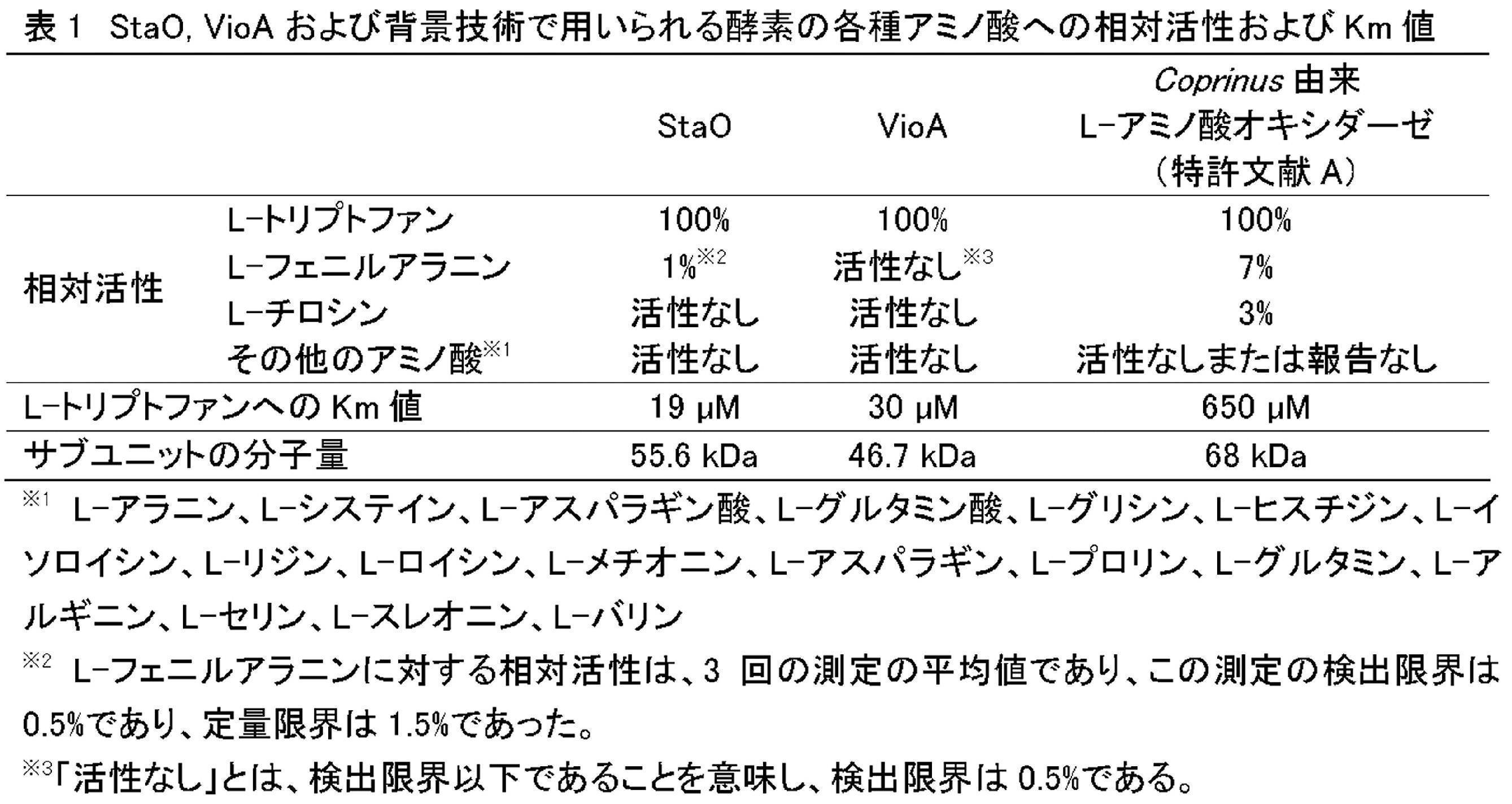
6.L-トリプトファンの検量線の作成
40 mM トリス-塩酸バッファー (pH 8.0)、2 mMフェノール、2 mM 4-アミノアンチピリン、30 U/ml西洋わさび由来ペルオキシダーゼ、20 mU/ml L-トリプトファンオキシダーゼ酵素液を含む反応液を調製した。これと等量の0, 20, 40, 60, 80, 100μMのL-トリプトファン水溶液を標準試料として混合した。30℃で反応を進行させ、30℃での505 nmの吸光度の経時的変化を測定し、反応の進行をモニタリングした。
40 mM トリス-塩酸バッファー (pH 8.0)、2 mMフェノール、2 mM 4-アミノアンチピリン、30 U/ml西洋わさび由来ペルオキシダーゼ、20 mU/ml L-トリプトファンオキシダーゼ酵素液を含む反応液を調製した。これと等量の0, 20, 40, 60, 80, 100μMのL-トリプトファン水溶液を標準試料として混合した。30℃で反応を進行させ、30℃での505 nmの吸光度の経時的変化を測定し、反応の進行をモニタリングした。
上述のように作製したサンプルの測定結果を図2~5に示す。StaO, VioAいずれを用いた場合でも、遅くとも反応開始20分後以降はL-トリプトファン濃度と吸光度の間に良好な直線関係が見られ、本反応系で検量線が作成可能であることが示された。また特にStaOサンプルに関しては、反応時間を過剰に長くした場合でも吸光度上昇はほぼ止まるという変化を示した。こうした性質は、たとえ反応時間がばらついたとしても誤差の出にくい、定量用酵素として適した性質と言える。
7.ヒト血漿サンプル中のL-トリプトファン定量
7-1.ヒト血漿試料の前処理
ヒト血漿試料はコージンバイオより購入し、-20℃で保管していた3検体を用いた。それぞれ使用直前に解凍し、そのまま、もしくはMicrocon YM-10で限外濾過による除タンパク処理後に、下記のL-トリプトファン定量に供した。
7-1.ヒト血漿試料の前処理
ヒト血漿試料はコージンバイオより購入し、-20℃で保管していた3検体を用いた。それぞれ使用直前に解凍し、そのまま、もしくはMicrocon YM-10で限外濾過による除タンパク処理後に、下記のL-トリプトファン定量に供した。
7-2.機器分析によるヒト血漿試料中L-トリプトファンの定量
酵素法による定量の比較対象として、超高速アミノ酸分析システムを用いたプレカラム誘導体化法による定量を行った。前述のようにヒト血漿試料を除タンパク質処理したものを超高速アミノ酸分析システムWaters UPLC Amino Acid Analysis Solution systemに供した。サンプルの誘導体化、分析操作などは上記システムの説明書の手順に従った。0, 20, 40, 60, 80, 100μMのL-トリプトファン水溶液を標準試料として検量線を作製し、血漿試料中L-トリプトファンの定量を行った。
酵素法による定量の比較対象として、超高速アミノ酸分析システムを用いたプレカラム誘導体化法による定量を行った。前述のようにヒト血漿試料を除タンパク質処理したものを超高速アミノ酸分析システムWaters UPLC Amino Acid Analysis Solution systemに供した。サンプルの誘導体化、分析操作などは上記システムの説明書の手順に従った。0, 20, 40, 60, 80, 100μMのL-トリプトファン水溶液を標準試料として検量線を作製し、血漿試料中L-トリプトファンの定量を行った。
7-3.L-トリプトファンオキシダーゼによるヒト血漿試料中L-トリプトファンの定量
40 mM トリス-塩酸バッファー (pH 8.0)、2 mMフェノール、2 mM 4-アミノアンチピリン、30 U/ml西洋わさび由来ペルオキシダーゼ、20 mU/ml L-トリプトファンオキシダーゼ酵素液を含む反応液を調製した。これと等量の0, 20, 40, 60, 80, 100μMのL-トリプトファン水溶液、もしくは除タンパク処理前後のヒト血漿試料を混合した。30℃で反応を進行させ、30分後に505 nmの吸光度を測定した。L-トリプトファン水溶液サンプルの測定値から検量線を作製し、血漿試料中L-トリプトファンの定量を行った。
40 mM トリス-塩酸バッファー (pH 8.0)、2 mMフェノール、2 mM 4-アミノアンチピリン、30 U/ml西洋わさび由来ペルオキシダーゼ、20 mU/ml L-トリプトファンオキシダーゼ酵素液を含む反応液を調製した。これと等量の0, 20, 40, 60, 80, 100μMのL-トリプトファン水溶液、もしくは除タンパク処理前後のヒト血漿試料を混合した。30℃で反応を進行させ、30分後に505 nmの吸光度を測定した。L-トリプトファン水溶液サンプルの測定値から検量線を作製し、血漿試料中L-トリプトファンの定量を行った。
7-4.機器分析もしくはL-トリプトファンオキシダーゼによるヒト血漿試料の定量結果の比較
上記の測定結果を図6に示す。StaO, VioAいずれの酵素を使った定量系でも、機器分析による測定値に近い値が得られた。よってL-トリプトファンオキシダーゼによる定量法がヒト血漿試料においても有効であることが裏付けられた。
上記の測定結果を図6に示す。StaO, VioAいずれの酵素を使った定量系でも、機器分析による測定値に近い値が得られた。よってL-トリプトファンオキシダーゼによる定量法がヒト血漿試料においても有効であることが裏付けられた。
一般的な酵素法による生体試料の分析では、あらかじめ除タンパク質処理を行わないと定量性が損なわれるという例が多い。この場合、生体試料の前処理として除タンパク処理が必要となる。一方StaO, VioAはいずれも、除タンパク質処理未処理の試料でも定量性に影響は見られなかった。よって、上記酵素による定量法には試料の前処理が不要であり、酵素法としても特に簡便かつ正確な定量法であることがわかった。
8.安定性
StaO, VioA精製酵素液に終濃度0~50% (v/v)となるようにグリセロールを添加した。各酵素液を4℃で保存し、経時的にサンプリングして活性測定を行った。各種グリセロール濃度存在下におけるStaOまたはVioAの残存活性の経時的変化を図7と図8に示す。StaOに関しては、バッファーのみを含む溶液中では不安定ではあるが、30%以上のグリセロール添加条件で高い安定性を示した。VioAはグリセロール非添加でも比較的安定であるが、10%以上のグリセロールを添加するとその安定性はさらに高まった。
StaO, VioA精製酵素液に終濃度0~50% (v/v)となるようにグリセロールを添加した。各酵素液を4℃で保存し、経時的にサンプリングして活性測定を行った。各種グリセロール濃度存在下におけるStaOまたはVioAの残存活性の経時的変化を図7と図8に示す。StaOに関しては、バッファーのみを含む溶液中では不安定ではあるが、30%以上のグリセロール添加条件で高い安定性を示した。VioAはグリセロール非添加でも比較的安定であるが、10%以上のグリセロールを添加するとその安定性はさらに高まった。
VioA精製酵素液に終濃度0または10% (v/v)となるようにグリセロールを添加した。各酵素液を4℃または-80℃で一晩保存した後、活性測定を行った。10%グリセロール存在下または非存在下におけるVioA酵素液の残存活性を図9に示す。VioAの凍結融解時には失活が見られたが、10% グリセロールの添加によりそのような失活は見られなくなった。
以上のように、StaOはグリセロール 30%添加、VioAは非添加(凍結融解を行うときには10%添加)で安定な酵素液として使用可能であることが示された。
9.反応温度依存性
反応温度20, 30, 40, 50, 60℃でのStaO, VioAの活性測定を行った。20 mM トリス-塩酸バッファー (pH 8.0)、1 mM L-トリプトファン、1 mMフェノール、1 mM 4-アミノアンチピリン、15 U/ml西洋わさび由来ペルオキシダーゼ、およびL-トリプトファンオキシダーゼ酵素液を組成とする活性測定反応液を用いた。上記反応液のうちペルオキシダーゼとL-トリプトファンオキシダーゼ酵素液以外を混合し、上記各種温度で10分間プレインキュベーションを行った。上記反応液の温度を保ったままペルオキシダーゼとL-トリプトファンオキシダーゼ酵素液を添加して反応を開始させ、速やかに505 nmの吸光度変化を測定した。測定結果から算出した、各温度におけるStaO, VioAの相対活性値を表2に示す。両酵素とも、反応温度の上昇と共に活性の上昇が見られた。なお、StaOでは60℃、VioAでは50℃以上で、高温による失活の影響が顕著となり正確な活性測定が困難になった。
反応温度20, 30, 40, 50, 60℃でのStaO, VioAの活性測定を行った。20 mM トリス-塩酸バッファー (pH 8.0)、1 mM L-トリプトファン、1 mMフェノール、1 mM 4-アミノアンチピリン、15 U/ml西洋わさび由来ペルオキシダーゼ、およびL-トリプトファンオキシダーゼ酵素液を組成とする活性測定反応液を用いた。上記反応液のうちペルオキシダーゼとL-トリプトファンオキシダーゼ酵素液以外を混合し、上記各種温度で10分間プレインキュベーションを行った。上記反応液の温度を保ったままペルオキシダーゼとL-トリプトファンオキシダーゼ酵素液を添加して反応を開始させ、速やかに505 nmの吸光度変化を測定した。測定結果から算出した、各温度におけるStaO, VioAの相対活性値を表2に示す。両酵素とも、反応温度の上昇と共に活性の上昇が見られた。なお、StaOでは60℃、VioAでは50℃以上で、高温による失活の影響が顕著となり正確な活性測定が困難になった。

10.熱安定性
20%グリセロールを含んだStaO酵素液、および10%グリセロールを含んだVioA酵素液を30, 40, 50, 60, 70℃で1時間熱処理した後、活性測定を行った。熱処理後の各酵素液の残存活性を表3に示す。いずれの酵素も40℃以上の熱処理では顕著な熱失活が見られ、50℃以上の熱処理では残存活性が検出限界以下となった。
20%グリセロールを含んだStaO酵素液、および10%グリセロールを含んだVioA酵素液を30, 40, 50, 60, 70℃で1時間熱処理した後、活性測定を行った。熱処理後の各酵素液の残存活性を表3に示す。いずれの酵素も40℃以上の熱処理では顕著な熱失活が見られ、50℃以上の熱処理では残存活性が検出限界以下となった。
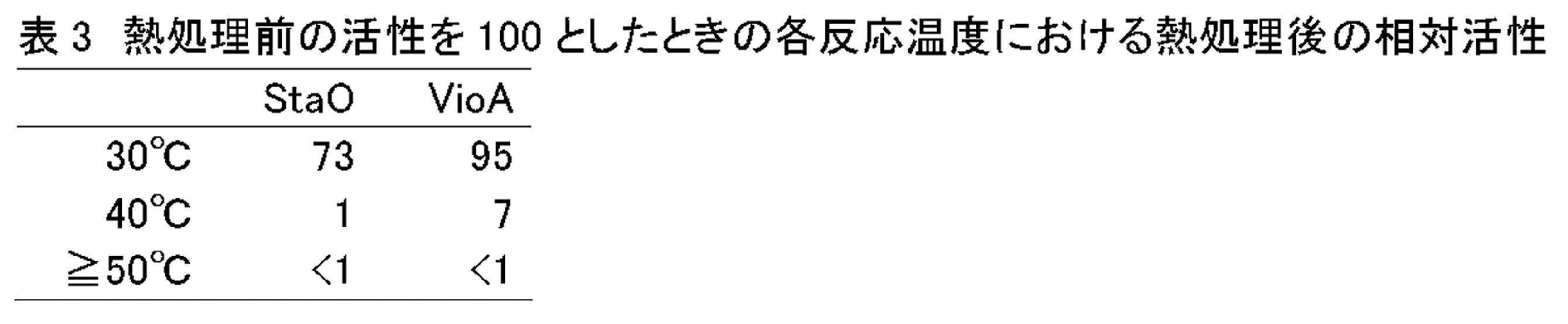
L-トリプトファンは、必須アミノ酸であり、極端に不足した場合、ナイアシン欠乏症状を示す事が風土病ペラグラとして知られている。また、過剰に摂取した場合、好酸球増加や筋肉痛症候群の原因になるか可能性が指摘されている。このため、L-トリプトファンの定量は、食品分析、医薬品・サプリメントの品質管理、過剰症・欠乏症時の血液検査及び酵素センサーとして利用が考えられる。また、代謝経路上、ナイアシンやNADなど生体内で重要な機能を持つ物質の原材料となることから、アミノグラムによる疾病診断「アミノインデックス」においても様々な疾病のバイオマーカーを構成する数値の一つとして活用できる。これらの理由から、食品や生体試料などについて、L-トリプトファン量を測定することは、産業的にも医学的にも重要な技術となると考えられるが、現状では、高速液体クロマトフラフィーをはじめとする非常に高価な機器及び試薬が必要となる方法しか実用化されていない。したがって、本発明は、L-トリプトファン定量用キットや酵素センサーなどの形態で商品化が可能であり、安価かつ簡便なL-トリプトファン定量法として事業化できる。
Claims (19)
- 検体とL-トリプトファンオキシダーゼと水を混合する工程(A)、
前記混合により得られた反応液を酸素の存在下に所定時間放置する工程(B)、
放置後の反応液中に存在する前記酵素の作用による反応生成物の少なくとも一種の存在を確認するか、または前記反応生成物の少なくとも一種の量を計測する工程(C)
を含む、前記検体中のL-トリプトファンの分析方法であって、
前記L-トリプトファンオキシダーゼが、
(a1)下記(1)~(3)の何れかのアミノ酸配列を有し、かつ(a2)酸素及び水の存在下、L-トリプトファンに作用して過酸化水素とアンモニアを生成するオキシダーゼ活性を有し、L-フェニルアラニンに対するオキシダーゼ活性はL-トリプトファンに対するオキシダーゼ活性の0~3%の範囲であり、L-トリプトファン及びL-フェニルアラニン以外のタンパク質構成アミノ酸に対してはオキシダーゼ活性を有さない、前記方法。
(1)配列表の配列番号1または2に記載のアミノ酸配列;
(2)配列表の配列番号1または2に記載のアミノ酸配列において1から50個のアミノ酸の欠失、置換及び/又は付加を有するアミノ酸配列;又は
(3)配列表の配列番号1または2に記載のアミノ酸配列に対して90%以上の同一性を有するアミノ酸配列 - 前記L-トリプトファンオキシダーゼの(a1)におけるL-フェニルアラニンに対するオキシダーゼ活性はL-トリプトファンに対するオキシダーゼ活性の0~1%の範囲である、請求項1に記載の方法。
- 工程(A)において検体との混合に用いられる前記L-トリプトファンオキシダーゼは、前記酵素の安定化剤の存在下で保存されているものである、請求項1または2に記載の方法。
- 前記安定化剤が、グリセロール、スクロース、ソルビトール及びトレハロースから成る群から選ばれる少なくとも1種である、請求項3に記載の方法。
- 前記工程(C)で確認または計測する反応生成物が過酸化水素である請求項1~4のいずれかに記載の方法。
- 以下の試薬を含むL-トリプトファンの分析用キット。
(K1)L-トリプトファンオキシダーゼ
但し、前記L-トリプトファンオキシダーゼは、(a1)下記(1)~(3)の何れかのアミノ酸配列を有し、かつ(a2)酸素及び水の存在下、L-トリプトファンに作用して過酸化水素とアンモニアを生成するオキシダーゼ活性を有し、L-フェニルアラニンに対するオキシダーゼ活性はL-トリプトファンに対するオキシダーゼ活性の0~3%の範囲であり、L-トリプトファン及びL-フェニルアラニン以外のタンパク質構成アミノ酸に対してはオキシダーゼ活性を有さない
(1)配列表の配列番号1または2に記載のアミノ酸配列;
(2)配列表の配列番号1または2に記載のアミノ酸配列において1から50個のアミノ酸の欠失、置換及び/又は付加を有するアミノ酸配列;又は
(3)配列表の配列番号1または2に記載のアミノ酸配列に対して90%以上の同一性を有するアミノ酸配列 - 前記(K1)L-トリプトファンオキシダーゼの(a1)におけるL-フェニルアラニンに対するオキシダーゼ活性はL-トリプトファンに対するオキシダーゼ活性の0~1%の範囲である、請求項6に記載のキット。
- 前記(K1)L-トリプトファンオキシダーゼは、前記酵素の安定化剤との混合物である、請求項6または7に記載のキット。
- 前記安定化剤が、グリセロール、スクロース、ソルビトール及びトレハロースから成る群から選ばれる少なくとも1種である、請求項8に記載のキット。
- (K2)反応用緩衝液、(K3)過酸化水素検出用試薬、(K4)アンモニア検出薬および(K5)インドールピルビン酸検出薬の少なくとも一つをさらに含む、請求項6~9のいずれかに記載のキット。
- L-トリプトファンオキシダーゼを含むL-トリプトファンの分析用組成物であって、
前記L-トリプトファンオキシダーゼは、(a1)下記(1)~(3)の何れかのアミノ酸配列を有し、かつ(a2)酸素及び水の存在下、L-トリプトファンに作用して過酸化水素とアンモニアを生成するオキシダーゼ活性を有し、L-フェニルアラニンに対するオキシダーゼ活性はL-トリプトファンに対するオキシダーゼ活性の0~3%の範囲であり、L-トリプトファン及びL-フェニルアラニン以外のタンパク質構成アミノ酸に対してはオキシダーゼ活性を有さない、前記組成物。
(1)配列表の配列番号1または2に記載のアミノ酸配列;
(2)配列表の配列番号1または2に記載のアミノ酸配列において1から50個のアミノ酸の欠失、置換及び/又は付加を有するアミノ酸配列;又は
(3)配列表の配列番号1または2に記載のアミノ酸配列に対して90%以上の同一性を有するアミノ酸配列 - 前記L-トリプトファンオキシダーゼの(a1)におけるL-フェニルアラニンに対するオキシダーゼ活性はL-トリプトファンに対するオキシダーゼ活性の0~1%の範囲である、請求項11に記載の組成物。
- 前記酵素の安定化剤を含有する、請求項11または12に記載の組成物。
- 前記安定化剤が、グリセロール、スクロース、ソルビトール及びトレハロースから成る群から選ばれる少なくとも1種である、請求項13に記載の組成物。
- L-トリプトファンオキシダーゼを用いるL-トリプトファンの検出または定量用酵素センサーであって、
前記検出用電極は過酸化水素検出用電極であり、かつ
前記L-トリプトファンオキシダーゼは、(a1)下記(1)~(3)の何れかのアミノ酸配列を有し、かつ(a2)酸素及び水の存在下、L-トリプトファンに作用して過酸化水素とアンモニアを生成するオキシダーゼ活性を有し、L-フェニルアラニンに対するオキシダーゼ活性はL-トリプトファンに対するオキシダーゼ活性の0~3%の範囲であり、L-トリプトファン及びL-フェニルアラニン以外のタンパク質構成アミノ酸に対してはオキシダーゼ活性を有さない、前記センサー。
(1)配列表の配列番号1または2に記載のアミノ酸配列;
(2)配列表の配列番号1または2に記載のアミノ酸配列において1から50個のアミノ酸の欠失、置換及び/又は付加を有するアミノ酸配列;又は
(3)配列表の配列番号1または2に記載のアミノ酸配列に対して90%以上の同一性を有するアミノ酸配列 - 前記L-トリプトファンオキシダーゼの(a1)におけるL-フェニルアラニンに対するオキシダーゼ活性はL-トリプトファンに対するオキシダーゼ活性の0~1%の範囲である、請求項15に記載の酵素センサー。
- 前記L-トリプトファンオキシダーゼは、前記酵素の安定化剤と共に用いられる、請求項15または16に記載の酵素センサー。
- 前記安定化剤が、グリセロール、スクロース、ソルビトール及びトレハロースから成る群から選ばれる少なくとも1種である、請求項17に記載の酵素センサー。
- 過酸化水素検出用電極は、酵素式過酸化水素電極または隔膜式過酸化水素電極である請求項15~18のいずれかに記載の酵素センサー。
Priority Applications (4)
| Application Number | Priority Date | Filing Date | Title |
|---|---|---|---|
| KR1020137024100A KR101916491B1 (ko) | 2011-03-04 | 2012-03-02 | 생체 시료 중의 l-트립토판 분석 방법 및 그것에 이용하는 키트 |
| CN201280011699.0A CN103635589B (zh) | 2011-03-04 | 2012-03-02 | 生物体试样中的l-色氨酸分析方法以及用于该方法的试剂盒 |
| US14/016,408 US9695460B2 (en) | 2011-03-04 | 2013-09-03 | Method of analyzing L-tryptophan in biological samples, and kit used therein |
| US15/608,460 US20170268033A1 (en) | 2011-03-04 | 2017-05-30 | Method of Analyzing L-Tryptophan in Biological Samples, and Kit Used Therein |
Applications Claiming Priority (2)
| Application Number | Priority Date | Filing Date | Title |
|---|---|---|---|
| JP2011048101 | 2011-03-04 | ||
| JP2011-048101 | 2011-03-04 |
Related Child Applications (1)
| Application Number | Title | Priority Date | Filing Date |
|---|---|---|---|
| US14/016,408 Continuation US9695460B2 (en) | 2011-03-04 | 2013-09-03 | Method of analyzing L-tryptophan in biological samples, and kit used therein |
Publications (1)
| Publication Number | Publication Date |
|---|---|
| WO2012121144A1 true WO2012121144A1 (ja) | 2012-09-13 |
Family
ID=46798108
Family Applications (1)
| Application Number | Title | Priority Date | Filing Date |
|---|---|---|---|
| PCT/JP2012/055386 Ceased WO2012121144A1 (ja) | 2011-03-04 | 2012-03-02 | 生体試料中のl-トリプトファン分析方法およびそれに用いるキット |
Country Status (5)
| Country | Link |
|---|---|
| US (2) | US9695460B2 (ja) |
| JP (1) | JP5212996B2 (ja) |
| KR (1) | KR101916491B1 (ja) |
| CN (1) | CN103635589B (ja) |
| WO (1) | WO2012121144A1 (ja) |
Cited By (1)
| Publication number | Priority date | Publication date | Assignee | Title |
|---|---|---|---|---|
| WO2018047976A1 (ja) * | 2016-09-12 | 2018-03-15 | 味の素株式会社 | トリプトファン酸化酵素およびその用途 |
Families Citing this family (7)
| Publication number | Priority date | Publication date | Assignee | Title |
|---|---|---|---|---|
| JP5234474B1 (ja) | 2012-01-30 | 2013-07-10 | 富山県 | 新規l−アミノ酸オキシダーゼ、l−リジンの測定方法、キット及び酵素センサ |
| KR102073066B1 (ko) | 2012-02-09 | 2020-02-04 | 아지노모토 가부시키가이샤 | 대상 물질의 정량 방법 |
| JP6362045B2 (ja) * | 2013-06-18 | 2018-07-25 | 池田食研株式会社 | L−トリプトファンの測定 |
| CN105802934B (zh) * | 2014-12-29 | 2020-09-18 | 丰益(上海)生物技术研发中心有限公司 | 一种磷脂酶c的保藏方法 |
| JP2022514594A (ja) * | 2018-12-20 | 2022-02-14 | スキルセル | 農薬または内分泌撹乱物質の存在および/またはレベルを決定するための生分解性生化学センサー:方法および組成物 |
| CN109946129A (zh) * | 2019-03-12 | 2019-06-28 | 江苏中济万泰生物医药有限公司 | 五分类血细胞分析仪用质控品制备方法 |
| CN116143870B (zh) * | 2022-09-24 | 2026-04-24 | 中国科学院亚热带农业生态研究所 | 一种用于色氨酸检测的肽适体以及基于该肽适体的比色型色氨酸检测方法 |
Citations (2)
| Publication number | Priority date | Publication date | Assignee | Title |
|---|---|---|---|---|
| JPH0670798A (ja) * | 1990-05-09 | 1994-03-15 | F Hoffmann La Roche Ag | 尿酸測定用試薬組成物 |
| JP2001069974A (ja) * | 1999-08-31 | 2001-03-21 | Ikeda Shokken Kk | L−トリプトファン用アミノ酸オキシダーゼ及びその製造方法 |
Family Cites Families (1)
| Publication number | Priority date | Publication date | Assignee | Title |
|---|---|---|---|---|
| JP2008169974A (ja) * | 2007-01-15 | 2008-07-24 | Jtekt Corp | 円錐ころ軸受 |
-
2012
- 2012-03-02 WO PCT/JP2012/055386 patent/WO2012121144A1/ja not_active Ceased
- 2012-03-02 CN CN201280011699.0A patent/CN103635589B/zh active Active
- 2012-03-02 JP JP2012046414A patent/JP5212996B2/ja active Active
- 2012-03-02 KR KR1020137024100A patent/KR101916491B1/ko active Active
-
2013
- 2013-09-03 US US14/016,408 patent/US9695460B2/en active Active
-
2017
- 2017-05-30 US US15/608,460 patent/US20170268033A1/en not_active Abandoned
Patent Citations (2)
| Publication number | Priority date | Publication date | Assignee | Title |
|---|---|---|---|---|
| JPH0670798A (ja) * | 1990-05-09 | 1994-03-15 | F Hoffmann La Roche Ag | 尿酸測定用試薬組成物 |
| JP2001069974A (ja) * | 1999-08-31 | 2001-03-21 | Ikeda Shokken Kk | L−トリプトファン用アミノ酸オキシダーゼ及びその製造方法 |
Non-Patent Citations (3)
| Title |
|---|
| DATABASE UNIPROTKB/SWISS-PROT [online] 31 October 2006 (2006-10-31), ONAKA, H. ET AL.: "Definition: L-amino acid oxidase.", retrieved from http://www.ncbi.nlm.nih. gov/protein/q83wg4 Database accession no. Q83WG4 * |
| DATABASE UNIPROTKB/SWISS-PROT [online] 8 February 2011 (2011-02-08), AUGUST, P.R. ET AL.: "Definition: RecName: Full=Probable L-tryptophan oxidase VioA.", retrieved from http://www.ncbi.nlm.nih. gov/protein/37999960?sat=14&satkey=6576691 Database accession no. Q9S3V1 * |
| MASAFUMI KAMEYA ET AL.: "Bisindole Kosei Busshitsu Seigosei-kei Yurai Trp oxidase o Mochiita Trp Teiryoho no Kaihatsu", JAPAN SOCIETY FOR BIOSCIENCE, BIOTECHNOLOGY, AND AGROCHEMISTRY TAIKAI KOEN YOSHISHU, vol. 2011, 5 March 2011 (2011-03-05), pages 39 * |
Cited By (4)
| Publication number | Priority date | Publication date | Assignee | Title |
|---|---|---|---|---|
| WO2018047976A1 (ja) * | 2016-09-12 | 2018-03-15 | 味の素株式会社 | トリプトファン酸化酵素およびその用途 |
| JPWO2018047976A1 (ja) * | 2016-09-12 | 2019-06-24 | 味の素株式会社 | トリプトファン酸化酵素およびその用途 |
| US10961560B2 (en) | 2016-09-12 | 2021-03-30 | Ajinomoto Co., Inc. | Tryptophan oxidase and use thereof |
| JP7081489B2 (ja) | 2016-09-12 | 2022-06-07 | 味の素株式会社 | トリプトファン酸化酵素およびその用途 |
Also Published As
| Publication number | Publication date |
|---|---|
| US9695460B2 (en) | 2017-07-04 |
| KR101916491B1 (ko) | 2018-11-07 |
| US20130344526A1 (en) | 2013-12-26 |
| CN103635589A (zh) | 2014-03-12 |
| KR20140020273A (ko) | 2014-02-18 |
| JP2012196207A (ja) | 2012-10-18 |
| US20170268033A1 (en) | 2017-09-21 |
| CN103635589B (zh) | 2016-10-12 |
| JP5212996B2 (ja) | 2013-06-19 |
Similar Documents
| Publication | Publication Date | Title |
|---|---|---|
| JP5212996B2 (ja) | 生体試料中のl−トリプトファン分析方法およびそれに用いるキット | |
| KR101726581B1 (ko) | 개변 류신 탈수소효소 | |
| US12146174B2 (en) | Mutated histidine decarboxylase and use thereof | |
| KR101843591B1 (ko) | L-트레오닌의 분석 방법 및 l-트레오닌 탈수소효소 | |
| US9976126B2 (en) | Modified glycine oxidase | |
| JP2012183018A (ja) | Nad+依存型脱水素酵素を用いたl−トリプトファン定量法およびそれに用いるキット | |
| US9181574B2 (en) | L-amino acid oxidase, method for measuring L-lysine, kit and enzyme sensor | |
| JP5043081B2 (ja) | 生体試料中のl−リジンの定量法 | |
| JP5216889B2 (ja) | 新規l−アミノ酸オキシダーゼ、l−リジンの測定方法、キット及び酵素センサー | |
| JP6130161B2 (ja) | 新規l−アルギニン酸化酵素、l−アルギニンの測定方法、l−アルギニンの測定用キットおよびl−アルギニン測定用の酵素センサ | |
| WO2014129523A1 (ja) | 新規l-トリプトファン脱水素酵素、l-トリプトファンの測定方法、キットおよび酵素センサ | |
| EP3511415B9 (en) | Tryptophan oxidase and use thereof | |
| JP2015165791A (ja) | L−リジン脱炭酸/酸化酵素およびその応用 |
Legal Events
| Date | Code | Title | Description |
|---|---|---|---|
| 121 | Ep: the epo has been informed by wipo that ep was designated in this application |
Ref document number: 12754981 Country of ref document: EP Kind code of ref document: A1 |
|
| NENP | Non-entry into the national phase |
Ref country code: DE |
|
| ENP | Entry into the national phase |
Ref document number: 20137024100 Country of ref document: KR Kind code of ref document: A |
|
| 122 | Ep: pct application non-entry in european phase |
Ref document number: 12754981 Country of ref document: EP Kind code of ref document: A1 |