WO2012114590A1 - 非水電解質二次電池用電極及びその製造方法並びに非水電解質二次電池 - Google Patents
非水電解質二次電池用電極及びその製造方法並びに非水電解質二次電池 Download PDFInfo
- Publication number
- WO2012114590A1 WO2012114590A1 PCT/JP2011/076640 JP2011076640W WO2012114590A1 WO 2012114590 A1 WO2012114590 A1 WO 2012114590A1 JP 2011076640 W JP2011076640 W JP 2011076640W WO 2012114590 A1 WO2012114590 A1 WO 2012114590A1
- Authority
- WO
- WIPO (PCT)
- Prior art keywords
- electrode
- secondary battery
- electrolyte secondary
- mass
- aqueous electrolyte
- Prior art date
- Legal status (The legal status is an assumption and is not a legal conclusion. Google has not performed a legal analysis and makes no representation as to the accuracy of the status listed.)
- Ceased
Links
Images


Classifications
-
- H—ELECTRICITY
- H01—ELECTRIC ELEMENTS
- H01M—PROCESSES OR MEANS, e.g. BATTERIES, FOR THE DIRECT CONVERSION OF CHEMICAL ENERGY INTO ELECTRICAL ENERGY
- H01M4/00—Electrodes
- H01M4/02—Electrodes composed of, or comprising, active material
- H01M4/62—Selection of inactive substances as ingredients for active masses, e.g. binders, fillers
- H01M4/624—Electric conductive fillers
- H01M4/625—Carbon or graphite
-
- H—ELECTRICITY
- H01—ELECTRIC ELEMENTS
- H01M—PROCESSES OR MEANS, e.g. BATTERIES, FOR THE DIRECT CONVERSION OF CHEMICAL ENERGY INTO ELECTRICAL ENERGY
- H01M4/00—Electrodes
- H01M4/02—Electrodes composed of, or comprising, active material
- H01M4/13—Electrodes for accumulators with non-aqueous electrolyte, e.g. for lithium-accumulators; Processes of manufacture thereof
- H01M4/131—Electrodes based on mixed oxides or hydroxides, or on mixtures of oxides or hydroxides, e.g. LiCoOx
-
- H—ELECTRICITY
- H01—ELECTRIC ELEMENTS
- H01M—PROCESSES OR MEANS, e.g. BATTERIES, FOR THE DIRECT CONVERSION OF CHEMICAL ENERGY INTO ELECTRICAL ENERGY
- H01M4/00—Electrodes
- H01M4/02—Electrodes composed of, or comprising, active material
- H01M4/13—Electrodes for accumulators with non-aqueous electrolyte, e.g. for lithium-accumulators; Processes of manufacture thereof
- H01M4/139—Processes of manufacture
- H01M4/1391—Processes of manufacture of electrodes based on mixed oxides or hydroxides, or on mixtures of oxides or hydroxides, e.g. LiCoOx
-
- H—ELECTRICITY
- H01—ELECTRIC ELEMENTS
- H01M—PROCESSES OR MEANS, e.g. BATTERIES, FOR THE DIRECT CONVERSION OF CHEMICAL ENERGY INTO ELECTRICAL ENERGY
- H01M4/00—Electrodes
- H01M4/02—Electrodes composed of, or comprising, active material
- H01M4/36—Selection of substances as active materials, active masses, active liquids
- H01M4/48—Selection of substances as active materials, active masses, active liquids of inorganic oxides or hydroxides
- H01M4/485—Selection of substances as active materials, active masses, active liquids of inorganic oxides or hydroxides of mixed oxides or hydroxides for inserting or intercalating light metals, e.g. LiTi2O4 or LiTi2OxFy
-
- H—ELECTRICITY
- H01—ELECTRIC ELEMENTS
- H01M—PROCESSES OR MEANS, e.g. BATTERIES, FOR THE DIRECT CONVERSION OF CHEMICAL ENERGY INTO ELECTRICAL ENERGY
- H01M4/00—Electrodes
- H01M4/02—Electrodes composed of, or comprising, active material
- H01M4/62—Selection of inactive substances as ingredients for active masses, e.g. binders, fillers
- H01M4/621—Binders
- H01M4/622—Binders being polymers
-
- H—ELECTRICITY
- H01—ELECTRIC ELEMENTS
- H01M—PROCESSES OR MEANS, e.g. BATTERIES, FOR THE DIRECT CONVERSION OF CHEMICAL ENERGY INTO ELECTRICAL ENERGY
- H01M4/00—Electrodes
- H01M4/02—Electrodes composed of, or comprising, active material
- H01M4/62—Selection of inactive substances as ingredients for active masses, e.g. binders, fillers
- H01M4/621—Binders
- H01M4/622—Binders being polymers
- H01M4/623—Binders being polymers fluorinated polymers
-
- Y—GENERAL TAGGING OF NEW TECHNOLOGICAL DEVELOPMENTS; GENERAL TAGGING OF CROSS-SECTIONAL TECHNOLOGIES SPANNING OVER SEVERAL SECTIONS OF THE IPC; TECHNICAL SUBJECTS COVERED BY FORMER USPC CROSS-REFERENCE ART COLLECTIONS [XRACs] AND DIGESTS
- Y02—TECHNOLOGIES OR APPLICATIONS FOR MITIGATION OR ADAPTATION AGAINST CLIMATE CHANGE
- Y02E—REDUCTION OF GREENHOUSE GAS [GHG] EMISSIONS, RELATED TO ENERGY GENERATION, TRANSMISSION OR DISTRIBUTION
- Y02E60/00—Enabling technologies; Technologies with a potential or indirect contribution to GHG emissions mitigation
- Y02E60/10—Energy storage using batteries
Definitions
- the present invention relates to an electrode for a nonaqueous electrolyte secondary battery containing carbon nanotubes, a method for producing the same, and a nonaqueous electrolyte secondary battery.
- nickel-hydrogen rechargeable batteries are generally widely used as power sources for hybrid electric vehicles, but the use of nonaqueous electrolyte secondary batteries as higher-capacity and high-output power sources is being studied. .
- a slurry is prepared by adding an active material, a conductive agent, and a binder to a solvent, and the slurry is applied to a current collector and dried. I use it.
- the dispersibility of the conductive agent is deteriorated, there arises a problem that the performance of the active material cannot be sufficiently obtained.
- Patent Document 1 discloses a method using a polyvinylpyrrolidone polymer as a dispersant.
- a fibrous carbon material can easily form a conductive path in the electrode because of its unique shape, and the internal resistance of the electrode can be reduced with a small amount.
- fibrous carbon materials carbon nanotubes, VGCF (registered trademark), and the like have been studied.
- Patent Document 2 discloses a method of modifying the surface with a polyvinylpyrrolidone polymer for the purpose of dispersing carbon nanotubes.
- Patent Document 3 discloses a method for improving uniformity by mixing fibrous carbon and non-fibrous carbon.
- Patent Document 3 has a problem that fibrous carbon agglomeration remains and peeling of the electrode mixture layer from the current collector tends to occur.
- An object of the present invention is to improve the dispersibility of a conductive agent in an electrode and to provide a good conductive network, a nonaqueous electrolyte secondary battery electrode and a method for producing the same, and output characteristics by using the electrode.
- the object is to provide an improved non-aqueous electrolyte secondary battery.
- Non-aqueous electrolyte secondary battery electrode of the present invention is a non-aqueous electrolyte secondary battery electrode comprising an active material, a binder, a carbon nanotube, and a non-fibrous conductive carbon material. Molecules are contained in the range of 5 to 25 parts by mass with respect to 100 parts by mass of the carbon nanotubes.
- the conductive agent contains carbon nanotubes and non-fibrous conductive carbon material.
- the surface of the carbon nanotube can be modified and the aggregation thereof can be released, whereby the carbon nanotube can be arranged on the surface of the active material. Furthermore, this makes it possible to dispose the non-fibrous conductive carbon material contained together with the carbon nanotubes between the active materials, and to complement the conductivity between the active materials. Therefore, according to the present invention, it is possible to enhance the current collecting property from the active material and to impart a good conductive network in the electrode.
- the polyvinyl pyrrolidone polymer is contained in the range of 5 to 25 parts by mass with respect to 100 parts by mass of the carbon nanotubes.
- the polyvinylpyrrolidone-based polymer in such a range, a good conductive network can be provided in the electrode, and a nonaqueous electrolyte secondary battery excellent in output characteristics can be obtained.
- polyvinyl pyrrolidone polymer used in the present invention examples include a vinyl pyrrolidone polymer and a copolymer of vinyl pyrrolidone and other vinyl compounds.
- the diameter of the carbon nanotube in the present invention is preferably 50 nm or less. By making the diameter of the carbon nanotube 50 nm or less, the contact property with the active material surface can be improved and the current can be collected efficiently.
- the lower limit value of the diameter of the carbon nanotube is not particularly limited, but is generally 0.4 nm or more.
- the carbon nanotube may have either a single-layer structure or a multilayer structure.
- the carbon nanotubes preferably have a multilayer structure.
- non-fibrous conductive carbon material in the present invention examples include carbon black such as furnace black, acetylene black and ketjen black, and graphite. Carbon black is particularly preferably used as the non-fibrous conductive carbon material.
- the ratio of the carbon nanotube to the non-fibrous conductive carbon material is preferably in the range of 1: 9 to 9: 1 in terms of mass ratio (carbon nanotube: non-fibrous conductive carbon material). Is more preferably in the range of 9 to 3: 2. By using in such a range, a more favorable conductive network can be formed.
- the active material in the present invention is not particularly limited as long as it is an active material that can be used for a nonaqueous electrolyte secondary battery electrode.
- a conventionally known positive electrode active material and negative electrode active material may be used. it can.
- the present invention can be preferably applied to an active material having poor conductivity because a good conductive network can be formed in the electrode.
- the positive electrode active material examples include lithium-containing transition metal composite oxides containing cobalt, nickel, manganese, or the like as the transition metal.
- lithium-containing transition metal complex oxides containing nickel and manganese as transition metals are generally positive electrode active materials that particularly require the effects of the present invention because of poor conductivity.
- lithium-containing transition metal composite oxides containing nickel and manganese include lithium-nickel composite oxides, lithium-nickel-cobalt composite oxides, lithium-nickel-cobalt-aluminum composite oxides, and lithium-nickel-cobalt. -Manganese complex oxides.
- Examples of the negative electrode active material include carbon materials such as graphite, and materials that are alloyed with lithium such as silicon and tin.
- the binder used in the present invention is not particularly limited, and examples thereof include those conventionally used as binders for non-aqueous electrolyte secondary battery electrodes.
- binders for non-aqueous electrolyte secondary battery electrodes For example, polyvinylidene fluoride And polyimide.
- the production method of the present invention is a method by which the electrode for a non-aqueous electrolyte secondary battery of the present invention can be produced, and an active material, a binder, a carbon nanotube, a non-fibrous conductive carbon material, a polyvinylpyrrolidone series
- the method includes a step of preparing a slurry containing a polymer and a solvent, and a step of applying the slurry onto a current collector and then drying the slurry.
- a slurry containing an active material, a binder, carbon nanotubes, a non-fibrous conductive carbon material, a polyvinylpyrrolidone polymer and a solvent is prepared.
- a polyvinylpyrrolidone polymer By containing a polyvinylpyrrolidone polymer, the dispersibility of carbon nanotubes and non-fibrous conductive carbon materials can be improved, the properties of the slurry can be kept good, and the coating property to the current collector Can be improved.
- the solvent for the slurry is not particularly limited as long as it can dissolve the binder, but N-methyl-2-pyrrolidone is particularly preferably used as the organic solvent.
- an aqueous solvent can be used.
- the order of addition when preparing the slurry is not particularly limited, but before adding the active material, carbon nanotubes, non-fibrous conductive carbon material, and polyvinylpyrrolidone-based polymer are mixed in advance. It is preferable to keep it.
- the electrode of the present invention may be a positive electrode or a negative electrode. Therefore, when manufacturing a positive electrode, the slurry containing a positive electrode active material is apply
- an aluminum foil or the like can be used as the positive electrode current collector. In general, a copper foil or the like can be used as the negative electrode current collector.
- an electrode for a non-aqueous electrolyte secondary battery capable of improving the dispersibility of the conductive agent in the electrode and imparting a good conductive network.
- the nonaqueous electrolyte secondary battery of the present invention is characterized in that the electrode of the present invention is used as a positive electrode or a negative electrode.
- the nonaqueous electrolyte secondary battery of the present invention includes a positive electrode, a negative electrode, and a nonaqueous electrolyte.
- the non-aqueous solvent used for the non-aqueous electrolyte is not particularly limited. Specific examples of the non-aqueous solvent preferably used include, for example, cyclic carbonates such as ethylene carbonate, propylene carbonate, butylene carbonate, and vinylene carbonate, chain carbonates such as dimethyl carbonate, methyl ethyl carbonate, and diethyl carbonate, and cyclic carbonates and chains. And a mixed solvent with a carbonate.
- solute used for the non-aqueous electrolyte include, for example, LiPF 6 , LiBF 4 , LiCF 3 SO 3 , LiN (CF 3 SO 2 ) 2 , LiN (C 2 F 5 SO 2 ) 2 , LiN (CF 3 SO 2) (C 4 F 9 SO 2), LiC (C 2 F 5 SO 2) 3, LiAsF 6, LiClO 4 , and the like.
- the present invention it is possible to improve the dispersibility of the conductive agent in the electrode and to provide a nonaqueous electrolyte secondary battery electrode that can provide a good conductive network.
- an electrode for a nonaqueous electrolyte secondary battery capable of improving the dispersibility of the conductive agent in the electrode and providing a good conductive network.
- the nonaqueous electrolyte secondary battery of the present invention uses the electrode for nonaqueous electrolyte secondary battery of the present invention, the output characteristics can be improved.
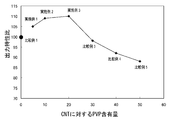
- FIG. 1 is a diagram showing output characteristics in an example and a comparative example according to the present invention.
- FIG. 2 is a diagram showing output characteristics in an example and a comparative example according to the present invention.
- FIG. 3 is a schematic diagram showing a three-electrode test cell.
- Example 1 [Preparation of conductive agent paste] A polyvinylpyrrolidone polymer (trade name “Pitzkor K-30”, manufactured by Daiichi Kogyo Seiyaku Co., Ltd.) was dissolved in N-methyl-2-pyrrolidone (NMP). Next, carbon nanotubes and acetylene black as a non-fibrous conductive carbon material were added to this solution so as to have a mass ratio (carbon nanotube: acetylene black) of 3: 2. The diameter (fiber diameter) of the carbon nanotube used was about 15 nm. Moreover, the polyvinyl pyrrolidone polymer is added so as to be 5 parts by mass with respect to 100 parts by mass of the carbon nanotubes. Therefore, the carbon nanotube: acetylene black: polyvinylpyrrolidone polymer is contained in a mass ratio of 3: 2: 0.15.
- NMP N-methyl-2-pyrrolidone
- a conductive agent paste was prepared as described above.
- Li 1.1 Ni 0.5 Co 0.2 Mn 0.3 O 2 was used as the positive electrode active material.
- a three-electrode test cell 10 shown in FIG. 3 was prepared using the positive electrode as a working electrode.
- the working electrode 11, the counter electrode 12, and the reference electrode 13 are immersed in the nonaqueous electrolytic solution 14.
- metallic lithium was used, respectively.
- the non-aqueous electrolyte solution 14 LiPF 6 was dissolved in a mixed solvent in which ethylene carbonate, methyl ethyl carbonate, and dimethyl carbonate were mixed at a volume ratio of 3: 3: 4 so as to have a concentration of 1 mol / liter. Further, 1% by weight of vinylene carbonate was used.
- Example 2 A three-electrode test cell was prepared in the same manner as in Example 1 except that the conductive agent paste was prepared so that the polyvinylpyrrolidone polymer was 10 parts by mass with respect to 100 parts by mass of the carbon nanotubes.
- Example 3 A three-electrode test cell was prepared in the same manner as in Example 1 except that the conductive agent paste was prepared so that the polyvinylpyrrolidone polymer was 20 parts by mass with respect to 100 parts by mass of the carbon nanotubes.
- Example 4 Carbon nanotubes and acetylene black are added and mixed so that the mass ratio (carbon nanotubes: acetylene black) is 1: 9, and 20 parts by mass of polyvinyl polyvinylpyrrolidone polymer is added to 100 parts by mass of carbon nanotubes.
- a three-electrode test cell was prepared in the same manner as in Example 1 except that the conductive agent paste was prepared so that
- Example 5 Carbon nanotubes and acetylene black are added and mixed so that the mass ratio (carbon nanotube: acetylene black) is 1: 4, and 20 parts by mass of polyvinyl polyvinylpyrrolidone polymer is added to 100 parts by mass of carbon nanotubes.
- a three-electrode test cell was prepared in the same manner as in Example 1 except that the conductive agent paste was prepared so that
- Example 6 Carbon nanotubes and acetylene black are added and mixed at a mass ratio (carbon nanotube: acetylene black) of 3: 7, and polyvinyl polyvinylpyrrolidone polymer is added in an amount of 20 parts by mass with respect to 100 parts by mass of carbon nanotubes.
- a three-electrode test cell was prepared in the same manner as in Example 1 except that the conductive agent paste was prepared so that
- Example 7 Carbon nanotubes and acetylene black are added and mixed at a mass ratio (carbon nanotube: acetylene black) of 2: 3, and polyvinyl polyvinylpyrrolidone polymer is added in an amount of 20 parts by mass with respect to 100 parts by mass of carbon nanotubes.
- a three-electrode test cell was prepared in the same manner as in Example 1 except that the conductive agent paste was prepared so that
- Example 8 Carbon nanotubes and acetylene black are added and mixed at a mass ratio (carbon nanotube: acetylene black) of 5: 5, and 20 parts by mass of polyvinyl polyvinylpyrrolidone polymer is added to 100 parts by mass of carbon nanotubes.
- a three-electrode test cell was prepared in the same manner as in Example 1 except that the conductive agent paste was prepared so that
- Example 9 Carbon nanotubes and acetylene black are added and mixed so that the mass ratio (carbon nanotubes: acetylene black) is 7: 3.
- a three-electrode test cell was prepared in the same manner as in Example 1 except that the conductive agent paste was prepared so that
- Example 10 Carbon nanotubes and acetylene black are added and mixed at a mass ratio (carbon nanotube: acetylene black) of 4: 1, and polyvinyl polyvinylpyrrolidone polymer is added in an amount of 20 parts by mass with respect to 100 parts by mass of carbon nanotubes.
- a three-electrode test cell was prepared in the same manner as in Example 1 except that the conductive agent paste was prepared so that
- Example 11 Carbon nanotubes and acetylene black are added and mixed so that the mass ratio (carbon nanotube: acetylene black) is 9: 1, and 20 parts by mass of polyvinyl polyvinylpyrrolidone polymer is added to 100 parts by mass of carbon nanotubes.
- a three-electrode test cell was prepared in the same manner as in Example 1 except that the conductive agent paste was prepared so that
- Example 1 A three-electrode test cell was prepared in the same manner as in Example 1 except that only acetylene black was used as the conductive agent and no polyvinylpyrrolidone polymer was added.
- Example 2 A three-electrode test cell was prepared in the same manner as in Example 1 except that the polyvinylpyrrolidone polymer was not added.
- Example 3 A three-electrode test cell was prepared in the same manner as in Example 1 except that the conductive agent paste was prepared so that the polyvinylpyrrolidone polymer was 30 parts by mass with respect to 100 parts by mass of the carbon nanotubes.
- Example 4 A three-electrode test cell was prepared in the same manner as in Example 1 except that the conductive agent paste was prepared so that the polyvinylpyrrolidone polymer was 40 parts by mass with respect to 100 parts by mass of the carbon nanotubes.
- Example 5 A three-electrode test cell was prepared in the same manner as in Example 1 except that the conductive agent paste was prepared so that the polyvinylpyrrolidone polymer was 50 parts by mass with respect to 100 parts by mass of the carbon nanotubes.
- Example 6 The same procedure as in Example 1 was repeated except that only carbon nanotubes were used as the conductive agent, and the polyvinyl pyrrolidone polymer was prepared so that the conductive agent paste was 20 parts by mass with respect to 100 parts by mass of the carbon nanotubes. An electrode type test cell was produced.
- Examples 1 to 3 containing a polyvinyl pyrrolidone polymer in the range of 5 to 25 parts by mass with respect to 100 parts by mass of the carbon nanotubes are used as conductive agents.
- Comparative Example 1 which uses only acetylene black and does not use a polyvinylpyrrolidone polymer, it exhibits high output characteristics.
- Comparative Examples 3 to 5 it can be seen that when the amount of the polyvinylpyrrolidone polymer added is too large, the output characteristics deteriorate. In Comparative Examples 3 to 5, the content of the polyvinyl pyrrolidone polymer is too large, so that the internal resistance of the electrode is increased and the output characteristics are considered to be deteriorated.
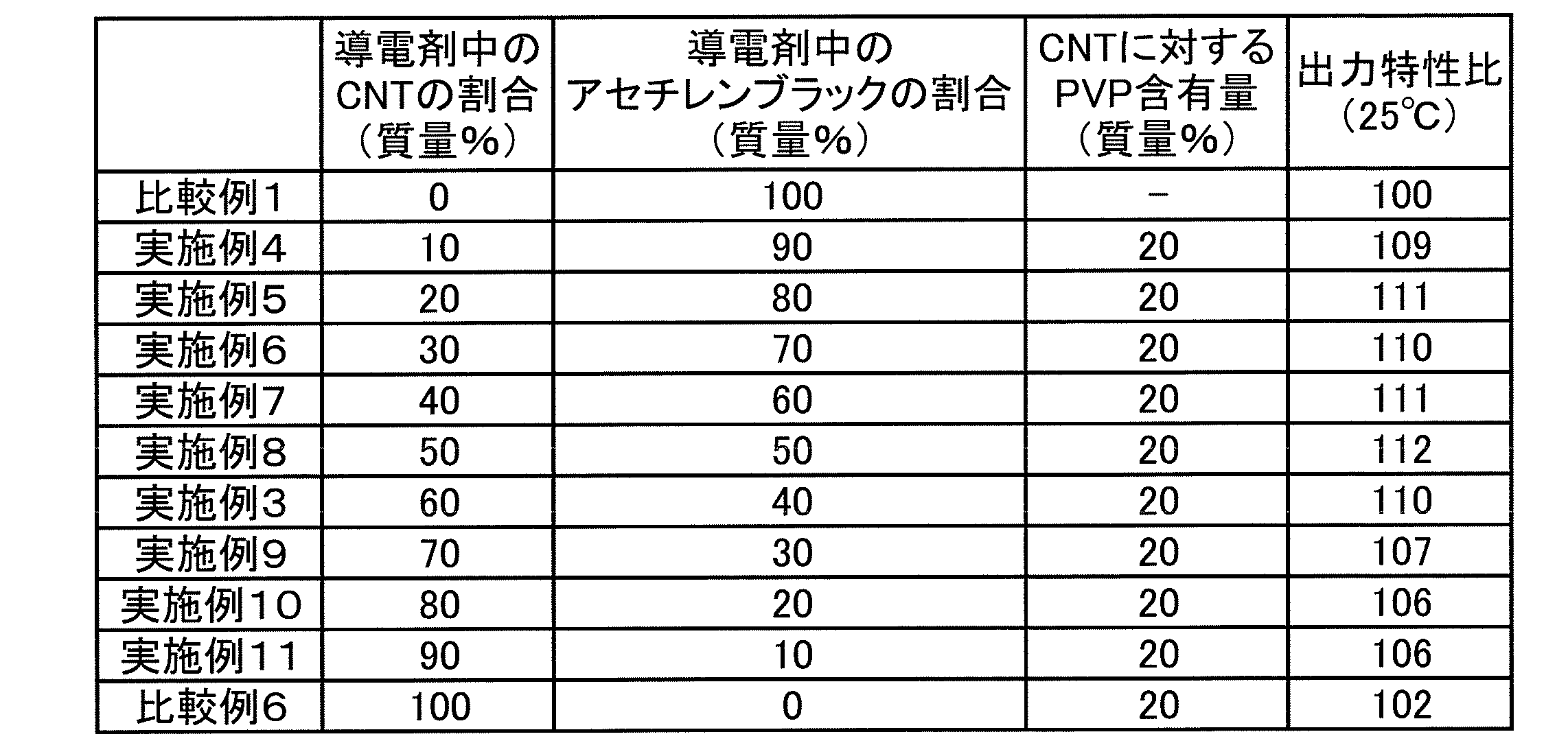
- the polyvinylpyrrolidone-based polymer is contained at 20 parts by mass with respect to 100 parts by mass of the carbon nanotubes, and the mass ratio of the carbon nanotubes to the non-fibrous conductive carbon material (carbon nanotubes: Examples 3 to 11 used together in the range of 1: 9 to 9: 1 for the non-fibrous conductive carbon material) show higher output characteristics than Comparative Examples 1 and 6 which were not used together.
- the mass ratio of the carbon nanotube to the non-fibrous conductive carbon material is particularly preferably 1: 9 to 3: 2, and it can be seen that a good conductive network can be imparted even if the content of the carbon nanotube is small.
Landscapes
- Chemical & Material Sciences (AREA)
- Chemical Kinetics & Catalysis (AREA)
- Electrochemistry (AREA)
- General Chemical & Material Sciences (AREA)
- Engineering & Computer Science (AREA)
- Materials Engineering (AREA)
- Manufacturing & Machinery (AREA)
- Inorganic Chemistry (AREA)
- Battery Electrode And Active Subsutance (AREA)
- Secondary Cells (AREA)
Abstract
Description
〔導電剤ペーストの作製〕
N-メチル-2-ピロリドン(NMP)に、ポリビニルピロリドン系高分子(商品名「ピッツコールK-30」、第一工業製薬株式会社製)を溶解した。次に、この溶液に、カーボンナノチューブと、非繊維状導電性炭素材料としてのアセチレンブラックとを、質量比(カーボンナノチューブ:アセチレンブラック)で3:2となるように添加して混合した。使用したカーボンナノチューブの径(繊維径)は約15nmであった。また、ポリビニルピロリドン系高分子は、カーボンナノチューブ100質量部に対し、5質量部となるように添加されている。従って、カーボンナノチューブ:アセチレンブラック:ポリビニルピロリドン系高分子は、質量比で、3:2:0.15となるように含有されている。
結着剤としてポリフッ化ビニリデンを用い、ポリフッ化ビニリデンをNMPに溶解させた溶液を調製した。この溶液と、上記導電剤ペーストと、正極活物質とを、正極活物質:導電剤(カーボンナノチューブ及びアセチレンブラック):結着剤の質量比が92:5:3となるように混合して、正極合剤スラリーを作製した。従って、正極合剤スラリー中における正極活物質:カーボンナノチューブ:アセチレンブラック:ポリビニルピロリドン系高分子:結着剤の質量比は、92:3:2:0.15:3の質量比である。
上記の正極合剤スラリーを、アルミニウム箔からなる正極集電体の上に塗布して乾燥した後、圧延ローラーにより圧延し、これにアルミニウムの集電タブを取りつけて正極を作製した。
上記正極を作用極として用いて、図3に示す三電極式試験セル10を作製した。
ポリビニルピロリドン系高分子を、カーボンナノチューブ100質量部に対し、10質量部となるように導電剤ペーストを調製した以外は、上記実施例1と同様にして三電極式試験セルを作製した。
ポリビニルピロリドン系高分子を、カーボンナノチューブ100質量部に対し、20質量部となるように導電剤ペーストを調製した以外は、上記実施例1と同様にして三電極式試験セルを作製した。
カーボンナノチューブとアセチレンブラックとを、質量比(カーボンナノチューブ:アセチレンブラック)で1:9となるように添加して混合し、ポリビニルポリビニルピロリドン系高分子を、カーボンナノチューブ100質量部に対し、20質量部となるように導電剤ペーストを調製した以外は、上記実施例1と同様にして三電極式試験セルを作製した。
カーボンナノチューブとアセチレンブラックとを、質量比(カーボンナノチューブ:アセチレンブラック)で1:4となるように添加して混合し、ポリビニルポリビニルピロリドン系高分子を、カーボンナノチューブ100質量部に対し、20質量部となるように導電剤ペーストを調製した以外は、上記実施例1と同様にして三電極式試験セルを作製した。
カーボンナノチューブとアセチレンブラックとを、質量比(カーボンナノチューブ:アセチレンブラック)で3:7となるように添加して混合し、ポリビニルポリビニルピロリドン系高分子を、カーボンナノチューブ100質量部に対し、20質量部となるように導電剤ペーストを調製した以外は、上記実施例1と同様にして三電極式試験セルを作製した。
カーボンナノチューブとアセチレンブラックとを、質量比(カーボンナノチューブ:アセチレンブラック)で2:3となるように添加して混合し、ポリビニルポリビニルピロリドン系高分子を、カーボンナノチューブ100質量部に対し、20質量部となるように導電剤ペーストを調製した以外は、上記実施例1と同様にして三電極式試験セルを作製した。
カーボンナノチューブとアセチレンブラックとを、質量比(カーボンナノチューブ:アセチレンブラック)で5:5となるように添加して混合し、ポリビニルポリビニルピロリドン系高分子を、カーボンナノチューブ100質量部に対し、20質量部となるように導電剤ペーストを調製した以外は、上記実施例1と同様にして三電極式試験セルを作製した。
カーボンナノチューブとアセチレンブラックとを、質量比(カーボンナノチューブ:アセチレンブラック)で7:3となるように添加して混合し、ポリビニルポリビニルピロリドン系高分子を、カーボンナノチューブ100質量部に対し、20質量部となるように導電剤ペーストを調製した以外は、上記実施例1と同様にして三電極式試験セルを作製した。
カーボンナノチューブとアセチレンブラックとを、質量比(カーボンナノチューブ:アセチレンブラック)で4:1となるように添加して混合し、ポリビニルポリビニルピロリドン系高分子を、カーボンナノチューブ100質量部に対し、20質量部となるように導電剤ペーストを調製した以外は、上記実施例1と同様にして三電極式試験セルを作製した。
カーボンナノチューブとアセチレンブラックとを、質量比(カーボンナノチューブ:アセチレンブラック)で9:1となるように添加して混合し、ポリビニルポリビニルピロリドン系高分子を、カーボンナノチューブ100質量部に対し、20質量部となるように導電剤ペーストを調製した以外は、上記実施例1と同様にして三電極式試験セルを作製した。
導電剤として、アセチレンブラックのみを用い、ポリビニルピロリドン系高分子を添加しなかったこと以外は、上記実施例1の場合と同様にして三電極式試験セルを作製した。
ポリビニルピロリドン系高分子を添加しなかったこと以外は、上記実施例1と同様にして三電極式試験セルを作製した。
ポリビニルピロリドン系高分子を、カーボンナノチューブ100質量部に対し、30質量部となるように導電剤ペーストを調製した以外は、上記実施例1と同様にして三電極式試験セルを作製した。
ポリビニルピロリドン系高分子を、カーボンナノチューブ100質量部に対し、40質量部となるように導電剤ペーストを調製した以外は、上記実施例1と同様にして三電極式試験セルを作製した。
ポリビニルピロリドン系高分子を、カーボンナノチューブ100質量部に対し、50質量部となるように導電剤ペーストを調製した以外は、上記実施例1と同様にして三電極式試験セルを作製した。
導電剤として、カーボンナノチューブのみを用い、ポリビニルピロリドン系高分子を、カーボンナノチューブ100質量部に対し、20質量部となるように導電剤ペーストを調製した以外は、上記実施例1と同様にして三電極式試験セルを作製した。
上記のようにして作製した実施例及び比較例の各三電極式試験セルについて、出力特性を以下のようにして評価した。


11…作用極(正極)
12…対極(負極)
13…参照極
14…非水電解液
Claims (7)
- 活物質と、結着剤と、カーボンナノチューブと、非繊維状導電性炭素材料とを含む非水電解質二次電池用電極において、
ポリビニルピロリドン系高分子が、前記カーボンナノチューブ100質量部に対し、5~25質量部の範囲で含まれていることを特徴とする非水電解質二次電池用電極。 - 前記カーボンナノチューブの径が、50nm以下であることを特徴とする請求項1に記載の非水電解質二次電池用電極。
- カーボンナノチューブと、非繊維状導電性炭素材料とが、質量比で1:9~9:1の範囲で混合されていることを特徴とする請求項1または2に記載の非水電解質二次電池用電極。
- 前記活物質が、遷移金属としてニッケル及びマンガンを含むリチウム含有遷移金属複合酸化物であることを特徴とする請求項1~3のいずれか一項に記載の非水電解質二次電池用電極。
- 前記非繊維状導電性炭素材料が、カーボンブラックであることを特徴とする請求項1~4のいずれか一項に記載の非水電解質二次電池用電極。
- 請求項1~5のいずれか一項に記載の非水電解質二次電池用電極を製造する方法であって、
前記活物質、前記結着剤、前記カーボンナノチューブ、前記非繊維状導電性炭素材料、前記ポリビニルピロリドン系高分子及び溶剤を含むスラリーを調製する工程と、
前記スラリーを集電体の上に塗布した後、乾燥する工程とを備えることを特徴とする非水電解質二次電池用電極の製造方法。 - 請求項1~5のいずれか一項に記載の電極を、正極または負極として用いたことを特徴とする非水電解質二次電池。
Priority Applications (3)
| Application Number | Priority Date | Filing Date | Title |
|---|---|---|---|
| JP2013500833A JPWO2012114590A1 (ja) | 2011-02-23 | 2011-11-18 | 非水電解質二次電池用電極及びその製造方法並びに非水電解質二次電池 |
| CN201180068466XA CN103392252A (zh) | 2011-02-23 | 2011-11-18 | 非水电解质二次电池用电极及其制造方法和非水电解质二次电池 |
| US13/984,144 US20130313486A1 (en) | 2011-02-23 | 2011-11-18 | Electrode for non-aqueous electrolyte secondary battery, method for producing same, and non-aqueous electrolyte secondary battery |
Applications Claiming Priority (2)
| Application Number | Priority Date | Filing Date | Title |
|---|---|---|---|
| JP2011036911 | 2011-02-23 | ||
| JP2011-036911 | 2011-02-23 |
Publications (1)
| Publication Number | Publication Date |
|---|---|
| WO2012114590A1 true WO2012114590A1 (ja) | 2012-08-30 |
Family
ID=46720393
Family Applications (1)
| Application Number | Title | Priority Date | Filing Date |
|---|---|---|---|
| PCT/JP2011/076640 Ceased WO2012114590A1 (ja) | 2011-02-23 | 2011-11-18 | 非水電解質二次電池用電極及びその製造方法並びに非水電解質二次電池 |
Country Status (4)
| Country | Link |
|---|---|
| US (1) | US20130313486A1 (ja) |
| JP (1) | JPWO2012114590A1 (ja) |
| CN (1) | CN103392252A (ja) |
| WO (1) | WO2012114590A1 (ja) |
Cited By (9)
| Publication number | Priority date | Publication date | Assignee | Title |
|---|---|---|---|---|
| DE102013213273A1 (de) | 2013-02-22 | 2014-08-28 | Bayer Materialscience Aktiengesellschaft | Kohlenstoffnanoröhren-haltige Dispersion und ihre Verwendung in der Herstellung von Elektroden |
| CN105280904A (zh) * | 2014-07-22 | 2016-01-27 | 天奈科技有限公司 | 电池用电极组合物 |
| JP2016134218A (ja) * | 2015-01-16 | 2016-07-25 | 日本電気株式会社 | リチウムイオン二次電池 |
| JP2018097961A (ja) * | 2016-12-09 | 2018-06-21 | 本田技研工業株式会社 | リチウムイオン二次電池用正極及びリチウムイオン二次電池 |
| WO2019073830A1 (ja) * | 2017-10-10 | 2019-04-18 | デンカ株式会社 | リチウムイオン二次電池用正極組成物、リチウムイオン二次電池用正極、及びリチウムイオン二次電池 |
| JP2020001960A (ja) * | 2018-06-28 | 2020-01-09 | 東洋インキScホールディングス株式会社 | カーボンナノチューブ分散液およびその利用 |
| JP2021517352A (ja) * | 2018-04-06 | 2021-07-15 | エルジー・ケム・リミテッド | 電極、該電極を含む二次電池、および該電極の製造方法 |
| WO2022118737A1 (ja) | 2020-12-04 | 2022-06-09 | 三洋電機株式会社 | 非水電解質二次電池用正極及び非水電解質二次電池 |
| WO2023026898A1 (ja) * | 2021-08-27 | 2023-03-02 | デンカ株式会社 | 正極組成物の製造方法及び正極の製造方法 |
Families Citing this family (6)
| Publication number | Priority date | Publication date | Assignee | Title |
|---|---|---|---|---|
| US11870068B2 (en) * | 2014-11-14 | 2024-01-09 | Sk On Co., Ltd. | Lithium ion secondary battery |
| JP2016131123A (ja) * | 2015-01-14 | 2016-07-21 | 株式会社日立製作所 | リチウム二次電池、リチウム二次電池を含む蓄電装置、およびリチウム二次電池の製造方法 |
| WO2018047454A1 (ja) * | 2016-09-07 | 2018-03-15 | デンカ株式会社 | 電極用導電性組成物およびそれを用いた電極、電池 |
| JP6756246B2 (ja) * | 2016-11-21 | 2020-09-16 | トヨタ自動車株式会社 | 造粒体集合物の製造方法、電極板の製造方法、及び電池の製造方法 |
| CN116031384A (zh) * | 2017-10-10 | 2023-04-28 | 江西理工大学 | 锂离子二次电池用正极组合物、锂离子二次电池用正极和锂离子二次电池 |
| CN111293312B (zh) * | 2020-02-21 | 2024-02-20 | 上海交通大学 | 一种柔性多功能的交联粘接剂及其制备方法和应用 |
Citations (5)
| Publication number | Priority date | Publication date | Assignee | Title |
|---|---|---|---|---|
| JP2003157846A (ja) * | 2001-11-19 | 2003-05-30 | Mikuni Color Ltd | カーボンブラックスラリー及びリチウム二次電池用電極 |
| JP2009176721A (ja) * | 2007-12-25 | 2009-08-06 | Kao Corp | リチウム電池正極用複合材料 |
| JP2010067436A (ja) * | 2008-09-10 | 2010-03-25 | Sumitomo Chemical Co Ltd | 非水電解質二次電池用電極合剤、電極および非水電解質二次電池 |
| JP2010238575A (ja) * | 2009-03-31 | 2010-10-21 | Ube Ind Ltd | リチウムイオン電池用電極およびその製造方法 |
| JP2011076948A (ja) * | 2009-09-30 | 2011-04-14 | Toray Ind Inc | 導電性複合体およびリチウムイオン電池用負極。 |
Family Cites Families (6)
| Publication number | Priority date | Publication date | Assignee | Title |
|---|---|---|---|---|
| JP4182215B2 (ja) * | 2003-12-02 | 2008-11-19 | 独立行政法人産業技術総合研究所 | カーボンナノチューブ分散極性有機溶媒及びその製造方法 |
| KR100796687B1 (ko) * | 2005-11-30 | 2008-01-21 | 삼성에스디아이 주식회사 | 리튬 이차 전지용 활물질, 이의 제조방법 및 이를 포함하는 리튬 이차 전지 |
| JP2008098009A (ja) * | 2006-10-12 | 2008-04-24 | Furukawa Battery Co Ltd:The | 鉛蓄電池用正極板 |
| CN101207204A (zh) * | 2006-12-22 | 2008-06-25 | 比亚迪股份有限公司 | 锂离子电池正极材料和含有该材料的正极和锂离子电池 |
| CN101651236B (zh) * | 2009-08-31 | 2011-07-06 | 杭州万马高能量电池有限公司 | 可快充的超高倍率磷酸铁锂聚合物锂离子电池及制备方法 |
| US8540902B2 (en) * | 2010-01-13 | 2013-09-24 | CNano Technology Limited | Carbon nanotube based pastes |
-
2011
- 2011-11-18 JP JP2013500833A patent/JPWO2012114590A1/ja active Pending
- 2011-11-18 CN CN201180068466XA patent/CN103392252A/zh active Pending
- 2011-11-18 WO PCT/JP2011/076640 patent/WO2012114590A1/ja not_active Ceased
- 2011-11-18 US US13/984,144 patent/US20130313486A1/en not_active Abandoned
Patent Citations (5)
| Publication number | Priority date | Publication date | Assignee | Title |
|---|---|---|---|---|
| JP2003157846A (ja) * | 2001-11-19 | 2003-05-30 | Mikuni Color Ltd | カーボンブラックスラリー及びリチウム二次電池用電極 |
| JP2009176721A (ja) * | 2007-12-25 | 2009-08-06 | Kao Corp | リチウム電池正極用複合材料 |
| JP2010067436A (ja) * | 2008-09-10 | 2010-03-25 | Sumitomo Chemical Co Ltd | 非水電解質二次電池用電極合剤、電極および非水電解質二次電池 |
| JP2010238575A (ja) * | 2009-03-31 | 2010-10-21 | Ube Ind Ltd | リチウムイオン電池用電極およびその製造方法 |
| JP2011076948A (ja) * | 2009-09-30 | 2011-04-14 | Toray Ind Inc | 導電性複合体およびリチウムイオン電池用負極。 |
Cited By (22)
| Publication number | Priority date | Publication date | Assignee | Title |
|---|---|---|---|---|
| DE102013213273A1 (de) | 2013-02-22 | 2014-08-28 | Bayer Materialscience Aktiengesellschaft | Kohlenstoffnanoröhren-haltige Dispersion und ihre Verwendung in der Herstellung von Elektroden |
| JP2016514080A (ja) * | 2013-02-22 | 2016-05-19 | バイエル・マテリアルサイエンス・アクチェンゲゼルシャフトBayer MaterialScience AG | カーボンナノチューブ含有分散液および電極の製造におけるその使用 |
| CN105280904A (zh) * | 2014-07-22 | 2016-01-27 | 天奈科技有限公司 | 电池用电极组合物 |
| KR20160011558A (ko) * | 2014-07-22 | 2016-02-01 | 크나노 테크놀로지 리미티드 | 배터리용 전극 조성물 |
| JP2016025077A (ja) * | 2014-07-22 | 2016-02-08 | シーナノ テクノロジー リミテッド | 電池用電極組成物 |
| KR102305509B1 (ko) * | 2014-07-22 | 2021-09-28 | 씨-나노 테크놀로지 리미티드 | 배터리용 전극 조성물 |
| CN105280904B (zh) * | 2014-07-22 | 2020-01-03 | 新奈科技有限公司 | 电池用电极组合物 |
| JP2016134218A (ja) * | 2015-01-16 | 2016-07-25 | 日本電気株式会社 | リチウムイオン二次電池 |
| JP2018097961A (ja) * | 2016-12-09 | 2018-06-21 | 本田技研工業株式会社 | リチウムイオン二次電池用正極及びリチウムイオン二次電池 |
| JPWO2019073830A1 (ja) * | 2017-10-10 | 2020-10-22 | デンカ株式会社 | リチウムイオン二次電池用正極組成物、リチウムイオン二次電池用正極、及びリチウムイオン二次電池 |
| WO2019073830A1 (ja) * | 2017-10-10 | 2019-04-18 | デンカ株式会社 | リチウムイオン二次電池用正極組成物、リチウムイオン二次電池用正極、及びリチウムイオン二次電池 |
| JP7223999B2 (ja) | 2017-10-10 | 2023-02-17 | デンカ株式会社 | リチウムイオン二次電池用正極組成物、リチウムイオン二次電池用正極、及びリチウムイオン二次電池 |
| US12176515B2 (en) | 2017-10-10 | 2024-12-24 | Denka Company Limited | Positive electrode composition for lithium ion secondary batteries, positive electrode for lithium ion secondary batteries, and lithium ion secondary battery |
| JP2021517352A (ja) * | 2018-04-06 | 2021-07-15 | エルジー・ケム・リミテッド | 電極、該電極を含む二次電池、および該電極の製造方法 |
| JP7164244B2 (ja) | 2018-04-06 | 2022-11-01 | エルジー エナジー ソリューション リミテッド | 電極、該電極を含む二次電池、および該電極の製造方法 |
| US11831006B2 (en) | 2018-04-06 | 2023-11-28 | Lg Energy Solution, Ltd. | Electrode, secondary battery including the electrode, and method of preparing the electrode |
| JP2020001960A (ja) * | 2018-06-28 | 2020-01-09 | 東洋インキScホールディングス株式会社 | カーボンナノチューブ分散液およびその利用 |
| WO2022118737A1 (ja) | 2020-12-04 | 2022-06-09 | 三洋電機株式会社 | 非水電解質二次電池用正極及び非水電解質二次電池 |
| WO2023026898A1 (ja) * | 2021-08-27 | 2023-03-02 | デンカ株式会社 | 正極組成物の製造方法及び正極の製造方法 |
| JPWO2023026898A1 (ja) * | 2021-08-27 | 2023-03-02 | ||
| JP7649866B2 (ja) | 2021-08-27 | 2025-03-21 | デンカ株式会社 | 正極組成物の製造方法及び正極の製造方法 |
| EP4333112A4 (en) * | 2021-08-27 | 2025-08-27 | Denka Company Ltd | METHOD FOR PRODUCING POSITIVE ELECTRODE COMPOSITION AND METHOD FOR PRODUCING POSITIVE ELECTRODE |
Also Published As
| Publication number | Publication date |
|---|---|
| US20130313486A1 (en) | 2013-11-28 |
| CN103392252A (zh) | 2013-11-13 |
| JPWO2012114590A1 (ja) | 2014-07-07 |
Similar Documents
| Publication | Publication Date | Title |
|---|---|---|
| JPWO2012114590A1 (ja) | 非水電解質二次電池用電極及びその製造方法並びに非水電解質二次電池 | |
| EP3451423B1 (en) | Negative electrode slurry, negative electrode plate and electrochemical energy storage device | |
| CN106935793B (zh) | 负极、制备负极的方法及包含该负极的锂二次电池 | |
| CN105308776B (zh) | 锂二次电池用负极活性材料、其制备方法和包含其的锂二次电池 | |
| JP5684226B2 (ja) | リチウム電池正極用のフッ素化バインダ複合材料およびカーボンナノチューブ | |
| US20120052386A1 (en) | Electrode for nonaqueous electrolyte secondary battery, nonaqueous electrolyte secondary battery, and method for manufacturing electrode for nonaqueous electrolyte secondary battery | |
| WO2020111201A1 (ja) | リチウムイオン二次電池用正極組成物、リチウムイオン二次電池用正極、及びリチウムイオン二次電池 | |
| CN114373889A (zh) | 二次电池用负极及包括其的二次电池 | |
| JP5230278B2 (ja) | 非水電解質二次電池用負極、それを備えた非水電解質二次電池及び非水電解質二次電池用負極の製造方法 | |
| JP2009048921A (ja) | 非水電解質電池用正極及びその製造方法と非水電解質電池及びその製造方法 | |
| CN110400923B (zh) | 电池负极材料、负极材料浆料、负极极片和电化学电池 | |
| JP2013077426A (ja) | 電極形成材およびその用途 | |
| CN107210424A (zh) | 锂离子二次电池用负极及锂离子二次电池 | |
| JP2020527290A (ja) | リチウムイオン電池用炭素導電性添加剤 | |
| US20230290955A1 (en) | Carbon-based conductive agent, secondary battery, and electrical device | |
| CN105474449A (zh) | 锂二次电池 | |
| US20250379232A1 (en) | Secondary battery and electric apparatus including such secondary battery | |
| CN107958997A (zh) | 正极浆料、正极极片及锂离子电池 | |
| WO2017216822A1 (en) | Fast chargeable lithium ion batteries with nano-carbon coated anode material and imide anion based lithium salt electrolyte | |
| CN101399337A (zh) | 负极活性材料及其制备方法和采用了该材料的负极及电池 | |
| JP4529288B2 (ja) | 非水電解質二次電池用電極 | |
| CN118867244A (zh) | 一种电极极片及电池 | |
| JP6229563B2 (ja) | リチウムイオン二次電池用負極活物質並びに該負極活物質を用いたリチウムイオン二次電池 | |
| Chen et al. | High rate performance of the composites of Li4Ti5O12–Ketjen Black and Li4Ti5O12–Ketjen Black–multi-walled carbon nanotubes for Li-ion batteries | |
| CN107078274A (zh) | 锂离子二次电池用正极以及使用该正极的锂离子二次电池 |
Legal Events
| Date | Code | Title | Description |
|---|---|---|---|
| 121 | Ep: the epo has been informed by wipo that ep was designated in this application |
Ref document number: 11859399 Country of ref document: EP Kind code of ref document: A1 |
|
| ENP | Entry into the national phase |
Ref document number: 2013500833 Country of ref document: JP Kind code of ref document: A |
|
| WWE | Wipo information: entry into national phase |
Ref document number: 13984144 Country of ref document: US |
|
| NENP | Non-entry into the national phase |
Ref country code: DE |
|
| 122 | Ep: pct application non-entry in european phase |
Ref document number: 11859399 Country of ref document: EP Kind code of ref document: A1 |