WO2012105612A1 - 食品中の動物肉由来タンパク質の免疫クロマト検出方法 - Google Patents
食品中の動物肉由来タンパク質の免疫クロマト検出方法 Download PDFInfo
- Publication number
- WO2012105612A1 WO2012105612A1 PCT/JP2012/052291 JP2012052291W WO2012105612A1 WO 2012105612 A1 WO2012105612 A1 WO 2012105612A1 JP 2012052291 W JP2012052291 W JP 2012052291W WO 2012105612 A1 WO2012105612 A1 WO 2012105612A1
- Authority
- WO
- WIPO (PCT)
- Prior art keywords
- immunochromatography
- detection
- substance
- extraction
- detected
- Prior art date
- Legal status (The legal status is an assumption and is not a legal conclusion. Google has not performed a legal analysis and makes no representation as to the accuracy of the status listed.)
- Ceased
Links
Images

Classifications
-
- G—PHYSICS
- G01—MEASURING; TESTING
- G01N—INVESTIGATING OR ANALYSING MATERIALS BY DETERMINING THEIR CHEMICAL OR PHYSICAL PROPERTIES
- G01N33/00—Investigating or analysing materials by specific methods not covered by groups G01N1/00 - G01N31/00
- G01N33/48—Biological material, e.g. blood, urine; Haemocytometers
- G01N33/50—Chemical analysis of biological material, e.g. blood, urine; Testing involving biospecific ligand binding methods; Immunological testing
- G01N33/53—Immunoassay; Biospecific binding assay; Materials therefor
- G01N33/543—Immunoassay; Biospecific binding assay; Materials therefor with an insoluble carrier for immobilising immunochemicals
- G01N33/54366—Apparatus specially adapted for solid-phase testing
- G01N33/54386—Analytical elements
- G01N33/54387—Immunochromatographic test strips
- G01N33/54388—Immunochromatographic test strips based on lateral flow
Definitions
- the present invention relates to an immunochromatographic detection method for detecting animal meat-derived protein contained in food, particularly food containing meat or processed meat.
- BSE bovine spongiform encephalopathy
- Typical foods that contain food allergens include cereals (buckwheat, wheat, etc.), eggs, meat (cattle, pigs, chickens, etc.), fish (mackerel, sardines, etc.), milk, shellfish (crabs, etc.) , Mollusks, beans (peanuts, soybeans, etc.), fruits (mangoes, etc.), vegetables (garlics, etc.), etc. are generally well known. It contains food allergy-inducing ingredients such as gelatin, casein, ovalbumin, ovomucoid, lysozyme, ⁇ -lactalbumin, ⁇ -lactoglobulin and the like. Processed foods contain a large number of foods and a large number of food allergens, but the current situation is that these cannot be easily detected and identified.
- immunoassays in the form of strips for immunoimmunochromatography have become increasingly important as simple in-vitro diagnostic kits or portable diagnostic devices that detect antigens in sample solutions using the specific reactivity of antibodies.
- pregnancy test kits are familiar immunoimmunochromatography devices that are also sold as over-the-counter drugs.
- research and development have also been conducted on simple testing tools based on immunochromatography for testing for the presence of infection with pathogens such as influenza viruses and bacteria.
- Immunochromatographic test reagents that support antibodies with gold nanoparticles and are used as a labeling reagent are inexpensive, easy to operate, and testing is completed in a short period of time, so detection of trace specific components in a diluted sample with little noise It is used for.
- operations for extracting a substance to be detected at a high concentration from meat or processed meat that contains a large amount of contaminants that cause noise, or food samples that contain them are complicated operations such as crushing and filtering the sample. There was a problem.
- even if extraction is performed simply and efficiently there has been a problem that it is difficult to suppress poor development due to aggregation of the labeling reagent and false positives due to non-specific reactions in immunochromatography detection.
- Food containing animal meat-derived protein includes non-processed foods such as raw meat consisting of only one animal species and raw minced meat mixed with two or more animal raw meats, especially processed (heated, pressurized)
- raw meat consisting of only one animal species and raw minced meat mixed with two or more animal raw meats
- processed heat-pressurized
- the animal meat protein components in the food are denatured or modified in the molecular structure due to processing, resulting in noise.
- Many extracted samples become more difficult to detect by immunochromatography.
- the processed and unprocessed raw components differ in noise species and noise content, so appropriate immunochromatography corresponding to each It is important to use an extract, a developing solution, a labeling reagent, etc., and the search and research have been advanced.
- an antibody against serum albumin or an antigen-binding fragment thereof obtained by heating the raw material derived from animal tissue at a temperature of 120 ° C. or higher a labeled antibody (labeling reagent) modified with a labeling substance, and the serum albumin
- An immunochromatographic detection reagent having a carrier having a detection region on which an antibody or antigen-binding fragment thereof is immobilized has been developed.
- a substance to be detected is extracted from a sample containing meat-and-bone meal with a solution containing 10% amount of 0.5% Tween 20 (nonionic surfactant) and 150 mM sodium chloride, and the extract is 100 to 5000 times larger.
- Detection by immunochromatography is performed by developing a diluted solution diluted at a dilution rate.
- 5 to 2.5M inorganic salt is contained, but before diluting the sample with the sample diluent, complicated operations such as extraction at a high temperature of 100 ° C with a solution containing potassium chloride and centrifugation are performed. Has been done.
- a nonionic surfactant such as Tween, 0% is used as a developing solution used when detecting meat-derived proteins such as pork in foods by immunochromatography.
- a protein component such as bovine serum albumin of 0.01 to 10 w / v% and an inorganic salt such as sodium chloride are contained, but non-specific reaction, development unevenness and reduction in development speed are not sufficiently suppressed.
- Japanese Unexamined Patent Publication No. 2006-317226 Japanese Unexamined Patent Publication No. 2009-85911 Japanese Unexamined Patent Publication No. 2010-156576
- the object of the present invention is to extract animal meat-derived proteins (substances to be detected) in foods quickly and easily, supply them directly to an immunochromatography apparatus, and develop them quickly and easily without causing non-specific reactions. It is to provide an immunochromatographic detection method capable of detecting with high performance and high sensitivity. More specifically, an extract containing a substance to be detected extracted by the extraction developing solution is developed together with a gold nanoparticle labeling reagent held dry in an immunochromatography apparatus, and the substance to be detected is detected by an immunochromatography detection system. It is to provide an immunochromatographic detection method that can be used.
- the present invention relates to immunochromatographic detection in which animal meat-derived protein in food is detected as a substance to be detected.
- the immunochromatography detection of the present invention is to detect and detect a target substance as an antigen by sandwich method with two detection substances having affinity for one target substance, and one or both of the detection substances are detected. What is necessary is just to have specific affinity with a substance.
- various antibodies such as an antibody against a conventionally used antigen can be used.
- a monoclonal antibody, a polyclonal antibody, or both can be used.
- the present inventors extract a substance to be detected of animal meat-derived protein in food as an extraction sample containing high-concentration impurities with a lot of noise, and supply the extracted extract to an immunochromatography apparatus.
- the detection system that is developed together with the gold nanoparticle labeling reagent and detects the substance to be detected
- the extraction development solution for immunochromatography with a specific composition is dried and held in the labeling substance holder in the immunochromatography device.
- the present invention provides the following immunochromatographic detection methods (a) to (c).
- (A) an immunochromatography detection kit comprising an immunochromatography apparatus comprising a sample supply part, a labeling reagent holding part, an immunochromatography medium part carrying a detection reagent, and a water absorption part, and an extraction developing solution for immunochromatography,
- the above extract developing solution has a nonionic surfactant having an HLB value of 12 to 18 at a concentration of 0.03 to 0.3 w / v%, an alkali metal inorganic salt at a concentration of 0.01 to 0.3 M, and a casein of 0.
- An immunochromatography detection method using an immunochromatography detection kit which is an aqueous solution containing a pH buffer of pH 7 to 9 and containing at a concentration of 0.05 to 0.5 w / v%, A process of extracting animal meat-derived protein in processed food with an extraction developing solution for immunochromatography as a detected substance, Supplying the extracted extract directly to the immunochromatography apparatus; A process in which the supplied liquid functions as a developing liquid constituting the mobile phase, and the substance to be detected is developed together with the gold nanoparticle labeling reagent; Including a step of capturing the target substance as a complex composed of the gold nanoparticle labeling reagent, the target substance and the detection reagent carried in the immunochromatography medium part in the detection part, and detecting the color development of the labeling substance in the detection part An immunochromatographic detection method for detecting animal meat-derived protein in processed foods.
- the gold nanoparticle labeling reagent is formed of a colloidal gold solution carrying the detection reagent, and the colloidal gold solution has an average particle size of 20 to 150 nm and is dispersed with a dispersity coefficient of 0.1 or less. It consists of nanoparticles,
- the immunochromatography detection method of the present invention By using the immunochromatography detection method of the present invention, a substance sufficient to be detected at room temperature can be extracted in a short time by the extraction developing solution, and the extracted extract can be directly developed on an immunochromatography apparatus. Since the gold nanoparticle labeling reagent held dry in the labeling reagent holding part can be eluted while elution, animal meat-derived protein in food can be detected as a substance to be detected by a quick and simple operation. Further, by using the immunochromatography detection method of the present invention, it is possible to suppress the extraction of contaminants that cause noise and to extract a substance to be detected at a high concentration. Since it can be suppressed, highly sensitive and accurate detection can be performed without inducing false determination (false positive) due to nonspecific reaction or nonspecific aggregation of the labeling reagent both during extraction and during development detection.
- the immunochromatography detection kit used in the present invention is used for labeling a substance to be detected, a sample supply part for supplying a sample solution containing animal meat-derived protein in food extracted as a substance to be detected in order from the upstream in the development direction.
- An immunochromatographic medium unit including a labeling reagent holding unit for drying and holding a gold nanoparticle labeling reagent on which a detection substance to be supported is supported, and a detection unit supporting a detection reagent for capturing the target substance, are developed.
- An immunochromatography device comprising a water absorption part for absorbing the liquid and an extraction developing solution for immunochromatography.
- the extraction and developing solution for immunochromatography provided in the immunochromatography detection kit of the present invention contains a nonionic surfactant having an HLB value of 12 to 18 at a concentration of 0.03 to 1 w / v%, and contains alkali metal inorganic.
- An aqueous solution containing a salt at a concentration of 0.01 to 0.5 M, and an extract containing the substance to be detected, extracted by the extract developer, is directly supplied to the immunochromatography apparatus to constitute a mobile phase.
- the gold nanoparticle labeling reagent dried and held in the labeling reagent holding part is eluted, and the substance to be detected is developed together with the eluted gold nanoparticle labeling reagent.
- the extraction development solution for immunochromatography contains a nonionic surfactant having an HLB value of 12 to 18 in an amount of 0.03 to 0.3 w / More preferably, it comprises an aqueous solution containing a concentration of v%, containing an alkali metal inorganic salt at a concentration of 0.01 to 0.3 M, and further containing casein at a concentration of 0.05 to 0.5 w / v%. Further, it is more preferable to contain a pH buffer of pH 7-9.
- a predetermined amount (usually 50 to 1000 ⁇ L) of a sample for example, an aqueous solution containing a substance to be detected of animal meat-derived protein extracted from a food containing animal meat by an extract developing solution
- a sample for example, an aqueous solution containing a substance to be detected of animal meat-derived protein extracted from a food containing animal meat by an extract developing solution
- the sample starts to move in the sample addition section, and is developed as a developing solution constituting the mobile phase.
- a sample for example, an aqueous solution containing a substance to be detected of protein derived from animal meat extracted from a food containing animal meat by an extract developing solution
- the gold nanoparticle labeling reagent held in the labeling reagent holding part dissolves in the moisture of the sample and moves together with the sample. 3.
- the labeling reagent dissolved in the moisture of the sample develops and passes through the detection part in the immunochromatographic medium part.
- the detection substance (antibody) held on the detection unit, that is, supported and fixed, and gold It reacts specifically with the nanoparticle labeling reagent so as to be sandwiched between the nanoparticles and the detection part is colored by the color of the gold nanoparticle.
- the labeling reagent dissolved in the sample water will not cause a binding reaction even if it passes through the detection part on the chromatography medium. Do not color. 4). Finally, the moisture of the sample and excess labeling reagent move to the water absorption part. In this way, the presence or absence of the target animal meat in the food can be accurately determined.
- the nonionic surfactant having an HLB value of 12 to 18 in the extraction developing solution used in the immunochromatography detection kit used in the present invention suppresses the extraction of contaminants, extracts a high concentration of a detected substance, It is added to promote elution and development speed of the nanoparticle labeling reagent and to suppress development unevenness.
- Nonionic surfactants having an HLB value of 12 to 18 include polyoxyethylene alkyl ether, polyoxyethylene / polyoxypropylene alkyl ether, polyoxyethylene sorbitan fatty acid ester (trade name “Tween” series), polyoxy Ethylene pt-octylphenyl ether (trade name “Triton” series), polyoxyethylene pt-nonylphenyl ether (trade name “Triton N” series), alkyl polyglucoside, fatty acid diethanolamide, alkyl monoglyceryl ether, etc. Can be mentioned.
- Tween 20 product name, HLB value 16.7
- Tween 40 product name, HLB value 15.6
- Tween 60 product name, HLB value 15.0
- Tween 80 product
- HLB value 14.9 “Triton” series, especially Triton X-100 (product name, HLB value 13.5), Nonidet P-40 (product name, HLB value 13.1)
- Triton X-102 product name, HLB14.6)
- TritonX-165 product name, HLB15.8)
- TritonX-405 product name, HLB17.9
- TritonN TritonN-101 (product name, HLB13.5)
- Triton N-111 trade name, HLB 13.8)
- Triton N-15 Trade name, HLB15.0
- Nonionic surfactants having an HLB value of 12 to 18 can be used alone or in admixture of two or more.
- “Tween” series Tween 20 product name, HLB value 16.7), Tween 40 (product name, HLB value 15.6), Tween 60 (product name, HLB value 15.0), Tween 80 (product name, The HLB value 14.9) is used alone.
- the above products can be purchased from Dow Chemical Company.
- the content of the nonionic surfactant having an HLB value of 12 to 18 used in the extraction developing solution used in the immunochromatography detection kit used in the present invention is 0.03 to The range is 1 w / v%. If it is less than 0.03 w / v% with respect to the extraction developing solution, the extraction efficiency of the substance to be detected at the time of extraction is reduced, the development speed at the time of development is reduced, and the discrimination of the judgment due to uneven development is reduced. When the concentration exceeds 1 w / v% with respect to the extraction developing solution, not only non-specific aggregation of the labeling reagent occurs during extraction and development, but also the affinity between the contaminant and the detection substance increases and non-specific reaction occurs. .
- the animal meat protein components in the food are denatured or molecularly modified by the processing, Since the extraction ratio of contaminants other than the substance to be detected is increased and the extracted sample has a lot of noise, false determination (false positive) due to non-specific reaction at the detection unit is likely to occur. Therefore, the content of the nonionic surfactant having an HLB value of 12 to 18 used in the extraction development solution for immunochromatography of the present invention is 0.03 to 0.3 w relative to the extraction development solution. A range of / v% is more preferably used.
- the alkali metal inorganic salt in the extraction developing solution used in the immunochromatography detection kit used in the present invention increases the extraction rate of protein components in foods and suppresses non-specific reactions between contaminants and detection substances during development.
- Examples of the alkali metal inorganic salt include halides, phosphates and sulfonates.
- the alkali metal inorganic salt is preferably an alkali metal halide inorganic salt, and examples of the halogenated alkali metal inorganic salt include sodium chloride, potassium chloride, cesium chloride, sodium bromide, potassium bromide and the like.
- sodium or potassium chloride or bromide more preferably sodium chloride or potassium chloride is used.
- the content of the alkali metal inorganic salt used in the extraction development solution for immunochromatography used in the present invention is in the range of 0.01 to 0.5 M with respect to the extraction development solution in molar concentration. If it is less than 0.01M, detection sensitivity will fall with the fall of the extraction efficiency at the time of extraction. If it exceeds 0.5M, the development speed is slow and uneven development tends to occur, and the extraction efficiency increases, but the reactivity between the substance to be detected and the detection reagent is remarkably lowered and the detection sensitivity is lowered.
- the animal meat protein components in the food are denatured or molecularly modified by the processing,
- the extraction ratio of contaminants other than the detected substance increases, resulting in a decrease in sensitivity due to nonspecific aggregation between the detected substance and contaminants during extraction and nonspecific aggregation between the labeling reagent and contaminants during development. It becomes easy. Therefore, the content of the alkali metal inorganic salt used in the extraction developing solution for immunochromatography used in the present invention is more preferably in the range of 0.01 to 0.3M with respect to the extraction developing solution.
- the extraction developing solution for immunochromatography used in the present invention has additives known to suppress side reactions based on biological affinity or to suppress nonspecific reactions, such as antigen-antibody reactions.
- Blocking agents such as proteins (for example, bovine serum albumin, casein, gelatin, etc.) and polymer compounds (for example, polyethylene glycol, methylcellulose, polyvinylpyrrolidone, polyvinyl alcohol, dextran, etc.) for accelerating or suppressing nonspecific reactions , Ionic surfactant or polyanion (for example, dextran sulfate, heparin, polystyrene sulfonic acid, chondroitin sulfate, etc.), pH buffer (for example, phosphate, carbonate, amino acid salt, or Tris, TES, Bicine, Tricine) , HEPES, PIPES, etc.
- proteins for example, bovine serum albumin, casein, gelatin, etc.
- polymer compounds for example, polyethylene glycol, methylcellulose, polyvin
- Head buffer or the like a possible and effective to use by adding or one or two etc. preservatives or antimicrobials does not prevent in any way.
- one or more of proteins, polymer compounds, ionic surfactants or polyanions, preservatives, antibacterial agents, etc. for promoting these antigen-antibody reactions or suppressing non-specific reactions are added to the stationary phase. It is possible and effective to keep it in the mobile phase movement path in the immunochromatography apparatus constituting the above, and it does not prevent anything.
- the protein derived from animal meat in the food is denatured or modified in molecular structure. Since the extraction rate of contaminants other than the detected substance increases and non-specific aggregation and non-specific reactions are likely to occur, proteins for promoting antigen-antibody reactions or suppressing non-specific reactions (for example, bovine serum albumin) It is preferable to further add a blocking agent or a commercially available synthetic polymer blocking agent. When casein is used, it has a higher inhibitory effect on non-specific reactions and is optimally used.
- casein when used, it is preferably used in the range of 0.05 to 0.5 w / v% in the extraction developing solution for immunochromatography. If it is less than 0.05 w / v% with respect to the extraction developing solution for immunochromatography, it becomes difficult to develop the detected substance due to nonspecific aggregation of the detected substance and other proteins in the food during the extraction of the immunochromatography. A decrease in sensitivity or the like is not sufficiently suppressed, and the effect of suppressing a non-specific reaction cannot be obtained at the time of development, and a false determination (false positive) may occur.
- the affinity between the substance to be detected and the substance to be detected is reduced, and the detection reaction may be suppressed, so that sufficient sensitivity may not be obtained.
- a protein blocking agent or a commercially available synthetic polymer blocking agent is added to a processed food detection system, it is more preferable to add a pH buffer of pH 7-9. Since the pH of the target food varies from acidic to basic, the addition of the pH buffering agent can suppress a decrease in sensitivity by controlling the pH to an optimum pH for detecting an immune reaction. Moreover, it also has a function of suppressing a decrease in the affinity between the substance to be detected and the substance to be detected due to the blocking agent.
- pH buffering agents of pH 7-9 include conventionally used phosphates, carbonates, amino acid salts, or good buffers such as Tris, Bicine, Tricine, PIPES, HEPES, etc., but buffered at pH 7-9. If it shows an effect
- the extraction development solution for immunochromatography used in the present invention extracts animal meat-derived protein at a high concentration as a substance to be detected, even in foods containing a large amount of impurities that cause noise, and immunizes the extracted extract.
- the extract extracted from the substance to be detected is directly added to the sample supply part in the immunochromatography apparatus, or the sample supply part in the immunochromatography apparatus is immersed in the extract, and the substance to be detected is added to the immunochromatography apparatus. It is possible to directly supply the contained sample, and there is no need to perform complicated operations such as dilution and filtration separation as in the conventional method.
- immunochromatography detection using the extraction and developing solution for immunochromatography is performed by developing it together with the gold nanoparticle labeling reagent that has been kept dry. Non-specific aggregation that tends to occur can be suppressed, and highly sensitive and accurate detection is possible.
- the colloidal gold solution before carrying the detection reagent and forming the gold nanoparticle labeling reagent has an average particle size of 20 to 150 nm and a dispersion coefficient of 0.1 or less. It is preferably used in a system using a gold nanoparticle labeling reagent comprising a gold nanoparticle. If the dispersity coefficient exceeds 0.1, the degree of color development per unit concentration may decrease and the immunochromatographic detection sensitivity may decrease, and the dried gold nanoparticle labeling reagent is eluted with the extraction developing solution. In particular, non-specific aggregation and false determination (false positive) due to non-specific reaction are likely to occur during detection.
- the immunochromatography detection kit used in the present invention is used in a system for immunochromatographic detection of various animal meat-derived proteins in foods, but is preferably used in a system for detecting pork-derived proteins that can be detected with higher sensitivity.
- the extraction developing solution provided in the immunochromatography detection kit used in the present invention is an aqueous solution constituting a mobile phase in the immunochromatography detection method of the present invention. In addition, it moves through an immunochromatography apparatus, which is a stationary phase, together with an extract containing a substance to be detected extracted from food and a gold nanoparticle labeling reagent.
- the amount of the extract developing solution used is preferably 1 to 7 times the weight of the food sample.
- sample supply section The sample supply unit 1 (also referred to as “sample pad”) is located at the most upstream in the development direction in the immunochromatography apparatus, and adds a sample containing a substance to be detected extracted by the extraction development solution for immunochromatography of the present invention. Or it is a site
- the material is not particularly limited as long as the sample is rapidly absorbed by capillary action, but the holding power is weak and the sample moves quickly to the reaction part.
- a plurality of porous substances such as nitrocellulose membrane, filter paper, glass fiber filter paper and the like are selected and used according to the purpose, and a part or all of the labeling reagent holding part 2 downstream in the development direction is connected by a capillary. Be placed. Moreover, you may use a labeling reagent holding
- the labeling reagent is a reagent for labeling and coloring the substance to be detected, and is a reagent in which the detection reagent is supported (sensitized) on a labeling substance made of gold nanoparticles.
- a known method for supporting the detection substance on the gold nanoparticles a known method such as physical adsorption or chemical bonding can be used.
- the antibody is added to a colloidally dispersed solution and physically adsorbed, followed by bovine serum albumin solution or the like.
- the labeling reagent can be prepared by adding a blocking protein to block the particle surface to which the antibody is not bound. Since the labeling reagent has a detection substance having an affinity for the substance to be detected, it becomes possible to form a complex with the substance to be detected and label the substance to be detected.
- the gold nanoparticles used for the labeling substance may be alloy particles with other metals or core / shell type particles as long as the particles are mainly composed of gold, and the color development varies depending on the shape and composition of the particles. Although it exhibits color, it is not particularly limited. Due to the discriminating power on the immunochromatographic medium, red, purple or blue particles are preferably used.
- the average particle diameter of the gold nanoparticles is more preferably 20 nm to 150 nm, and particularly preferably 30 nm to 100 nm, at which a particularly strong color tone can be obtained. Further, the particle size distribution of the gold nanoparticles is preferably a single peak.
- the average particle system can be measured, for example, by analyzing a gold colloidal solution in which gold nanoparticles are dispersed with a general dynamic light scattering particle size distribution analyzer.
- the labeling reagent holding unit 2 is located between the sample supply unit and the immunochromatography medium unit in the immunochromatography apparatus, and is a part for holding the labeling reagent carrying (sensitized) the detection substance on the labeling substance in a dry state It is.
- the material is not particularly limited as long as the sample is rapidly absorbed by capillarity, but the holding power is weak, and the sample reagent has the property of quickly eluting the labeling reagent and moving the sample.
- a sample supply unit upstream of the development direction and a chromatographic medium downstream of the development direction are selected from a plurality of porous materials such as nitrocellulose membranes, filter papers, and glass fiber filter papers according to the purpose. It arrange
- the immunochromatographic medium part 3 is an inert material composed of a microporous material exhibiting capillary action, and has a development speed that can provide sufficient sensitivity in a short period of time.
- the labeling reagent holding part upstream of the developing direction and the water absorbing part downstream of the developing direction are arranged so as to be connected by a capillary.
- ceramic fine particles such as silica, titania, zirconia, ceria, alumina or fine particles of organic polymer, polyurethane, polyester, polyethylene, polyvinyl chloride, polyvinylidene fluoride, nylon, Examples thereof include a fibrous or non-woven fibrous matrix composed of a cellulose derivative such as nitrocellulose or cellulose acetate, a membrane, a filter paper, a glass fiber filter paper, a cloth, and cotton. Even if the microparticles themselves are not porous, when filled, voids are generated between the microparticles and function as an immunochromatographic medium.
- the immunochromatographic media part is a detection that carries a detection reagent for detecting a detection substance that forms a complex with the labeling reagent, or a complex with a labeling reagent that is formed after capturing the detection substance.
- the detection reagent used for the detection unit may be the same as or different from the detection substance used for the labeling reagent as long as it has an affinity for the detection substance, and either one has a specific affinity for the detection substance. It is sufficient if it has properties.
- the immunochromatographic media part is used to confirm the presence or speed of the gold nanoparticle labeling reagent development and the downstream of the detection part with the labeling substance in the gold nanoparticle labeling reagent and the animal meat protein as the substance to be detected.
- the water absorption part 6 is located at the most downstream in the development direction of the immunochromatography apparatus, and is a part for absorbing the developed sample and excess labeling reagent.
- the material is not particularly limited as long as it is capable of quickly absorbing and retaining an excessive sample or labeling reagent, but filter paper or a pad containing water-absorbing fibers or particles such as cellulosic fibers or polyacrylic fibers may be used. It is preferable to use it.
- the form and size of the immunochromatography apparatus used for carrying out the present invention are not particularly limited, and may be appropriate in terms of actual operation and observation of reaction results.
- a support made of plastic, an aqueous solution-impermeable polymer sheet (backing sheet 7), or the like may be provided on the back surface of the chromatographic medium portion on which the reaction site is formed.
- the properties of the support are not particularly limited, but when the measurement result is observed by visual judgment, the support preferably has a color that is not similar to the color caused by the labeling substance. Usually, it is preferably colorless or white.
- the immunochromatographic detection method of the present invention includes a step of extracting animal meat-derived protein in food as a substance to be detected with an extraction developing solution for immunochromatography, a step of supplying the extracted extract to an immunochromatography apparatus,
- the liquid functions as a developing solution that constitutes the mobile phase, and the detection substance is loaded in the gold nanoparticle labeling reagent, the detection substance, and the immunochromatographic medium part in the process of developing the detection substance together with the gold nanoparticle labeling reagent.
- This is an immunochromatographic detection method comprising a step of capturing as a complex comprising a detection reagent and detecting color development of a labeling substance at a detection unit.
- the extraction and developing solution for immunochromatography used in the immunochromatography detection method of the present invention comprises a nonionic surfactant having an HLB value of 12 to 18 at a concentration of 0.03 to 1 w / v%, and an alkali metal.
- An aqueous solution containing an inorganic salt at a concentration of 0.01 to 0.5M is used, and an extract containing a substance to be detected extracted by the extract developing solution is directly supplied to an immunochromatography apparatus to constitute a mobile phase.
- the gold nanoparticle labeling reagent dried and held in the labeling reagent holding part is eluted and used together with the eluted gold nanoparticle labeling reagent.
- animal-derived proteins (substances to be detected) in foods can be quickly and easily extracted, and directly supplied to an immunochromatographic apparatus to develop a non-specific reaction. It can be detected quickly, easily, with high performance and with high sensitivity.
- the extraction of a substance to be detected in food is preferably performed using 0.1 g or more of the target food or a fragment thereof per 1 mL of the developed extract, and more preferably 0.2 g or more.
- the extraction operation can be performed quickly and easily by mixing the developed extract and food in a container such as a vial and stirring for 10 to 60 seconds. All operations can be performed at room temperature (10 ° C. to 40 ° C.).
- the extract containing the substance to be detected extracted by the developed extract may be dropped directly onto the sample supply unit in the immunochromatography apparatus, or the sample supply unit may be added to the extract. It may be supplied and deployed by soaking.
- the extraction development solution for immunochromatography contains a nonionic surfactant having an HLB value of 12 to 18 in an amount of 0.03 to 0.3 w / More preferably, it comprises an aqueous solution containing a concentration of v%, containing an alkali metal inorganic salt at a concentration of 0.01 to 0.3 M, and further containing casein at a concentration of 0.05 to 0.5 w / v%. Further, it is more preferable to contain a pH buffer of pH 7-9.
- Monoclonal antibodies and polyclonal antibodies or fragments thereof can be prepared by known methods. Examples of antibody-producing animal species are usually rabbits, goats, mice, rats and the like. Monoclonal antibodies are hybridized with spleen cells and myeloma cells of a mouse immunized with an antigen (protein extracted from animal meat of a small animal species) according to a conventional method, and a hybridoma that produces the target antibody is selected. Monoclonal antibodies produced from this hybridoma are obtained. See, for example, the Koehler and Milstein technique (Nature 256 (1975) 495-497).
- Polyclonal antibodies were obtained by immunizing production animals (eg, rabbits, goats, mice, rats, horses, pigs, chickens, etc.) with antigens (proteins extracted from animal meat of the species to be detected) by conventional techniques. Obtained by separating the target antibody from the antiserum. See, for example, Berger et al. (J. ASSOC. OFF. ANAL. CHEM. VOL. 71, NO. 2, 1988).
- the immunochromatography apparatus 10 used in the present invention will be described in detail with reference to FIG. 1, but it is shown as an example only, and the present invention is not limited to this.
- the gold nanoparticle labeling reagent in order to confirm the presence / absence and development speed of the gold nanoparticle labeling reagent, it has a wide affinity for the labeling substance in the gold nanoparticle labeling reagent and the animal meat protein that is the detection target in the downstream of the detection unit. Goat-derived antiserum was applied to the control part (control line). The diluted solution was dried at 40 to 50 ° C. for 60 minutes, and then dried overnight at room temperature to prepare a detection part and a control part in the immunochromatographic medium part.
- Gold colloid liquid gold nanoparticle suspension (Tanaka Kikinzoku Kogyo Co., Ltd.)
- Measurement by dynamic light scattering particle size distribution meter Malvern, Zetasizer Nano-ZS, the same applies hereinafter
- the particle size distribution curve shows a single peak, with an average particle size of 61.3 nm, a dispersity coefficient of 0.072, and a red color of 0.5 mL so that the concentration is 0.02 mg / mL with HEPES buffer (pH 8.5).
- 0.1 mL of diluted anti-pig protein polyclonal antibody was added, and left at room temperature for 10 minutes for sensitization.
- CE510 JSR Corporation
- 0.05 mL of 1% polyethylene glycol dissolved in a potassium phosphate solution pH 7.5
- a buffer solution pH 7.4
- bovine serum albumin a buffer solution containing 1% by weight of bovine serum albumin
- each extract developing solution shown in Table 1 shows the results of evaluation using Forms 1-8 and Comparative Forms 1-3).
- the ratio of the processed pork contained in each of the beef, chicken, lamb, or soybean heat-processed as the test processed food using the extract developing solution composition of Embodiment 2 is 0% by weight, 0.1% by weight.
- Table 3 shows the evaluation results for each case of 0.5 wt%.
- Comparative Example 1 when an appropriate amount of Tween 20 was added after extraction and before development, the development unevenness and the development speed were improved, but the improvement in detection sensitivity was small. In Comparative Example 2, no improvement in detection sensitivity was observed even when an appropriate amount of sodium chloride was added after extraction and before development. From the results in Table 3, using the immunochromatography detection kit of the present invention, the presence or absence of pork in various processed food species could be quickly and accurately confirmed by immunochromatography detection.
- Test Example 2 Detection of pork-derived protein in pork raw (unprocessed) meat-containing food.
- Production of detection part in immunochromatographic medium part It was produced in the same manner as in Test Example 1 except that an anti-porcine protein monoclonal antibody was used as a detection substance.
- Table 7 shows the evaluation results for the cases where the ratio of processed beef contained in pork and lamb, which were heat-processed as test processed foods, was 0% by weight, 0.3% by weight, and 1% by weight, respectively. Show.
- the immunochromatography detection kit of the present invention is based on the immunochromatography method, the use of the extraction and developing solution for immunochromatography of the present invention allows specific detection of animal meat to be detected in foods simply and quickly. Because the presence or absence can be detected, it can contribute to solving these problems for patients who cause an allergic reaction to animal meat and general consumers who do not eat specific animal meat because of their taste or food culture. . Since the detection method using the immunochromatography detection kit of the present invention can be carried out simply, rapidly and inexpensively compared with the PCR method and the ELISA method, it has great industrial applicability.
Landscapes
- Health & Medical Sciences (AREA)
- Immunology (AREA)
- Life Sciences & Earth Sciences (AREA)
- Engineering & Computer Science (AREA)
- Molecular Biology (AREA)
- Biomedical Technology (AREA)
- Chemical & Material Sciences (AREA)
- Hematology (AREA)
- Urology & Nephrology (AREA)
- Biotechnology (AREA)
- Microbiology (AREA)
- Cell Biology (AREA)
- Food Science & Technology (AREA)
- Medicinal Chemistry (AREA)
- Physics & Mathematics (AREA)
- Analytical Chemistry (AREA)
- Biochemistry (AREA)
- General Health & Medical Sciences (AREA)
- General Physics & Mathematics (AREA)
- Pathology (AREA)
- Peptides Or Proteins (AREA)
- Investigating Or Analysing Materials By The Use Of Chemical Reactions (AREA)
Abstract
加工食品中の動物肉由来タンパク質を被検出物質として免疫クロマト用抽出展開液により抽出された抽出液は、免疫クロマトグラフィー装置へ直接供給され、移動相を構成する展開液として免疫クロマト装置中の標識物質保持部に乾燥保持された金ナノ粒子標識試薬を溶出し、その溶出された金ナノ粒子標識試薬とともに展開されるものであって、抽出展開液はHLB値が12~18である非イオン界面活性剤を0.03~0.3w/v%、アルカリ金属無機塩を0.01~0.3M、カゼインを0.05~0.5w/v%、及び、pH7~9のpH緩衝剤を含有する水溶液からなることを特徴とする加工食品中の動物肉由来タンパク質を検出する免疫クロマト検出方法。
Description
本発明は、食品中、特に食肉あるいは加工肉を含む食品中に含まれる動物肉由来タンパク質を検出する為の免疫クロマト検出方法に関するものである。
ウシ海綿状脳症(BSE)といった牛感染症のヒトへの感染の危険性が、EU科学運営委員会の意見として報告されて以来、BSE感染牛の肉骨粉の家畜飼料への使用が問題視され、また、ブランド牛肉に対する偽装ブランド肉の問題や他の肉類の牛肉への偽装といった問題にも一般消費者の関心が集まってきている。
一方で、食品中に含まれる動物肉由来(牛、豚、鶏など)の食物アレルゲンに対して食物アレルギー患者は、喘息、皮膚炎、胃腸障害、アナフィラキシーショックといったさまざまなアレルギー症状を引き起こし、時には深刻な事態に至るケースもある。食物アレルギー患者は増加傾向にあることもあって、食品への安全性に関する消費者の関心は非常に高まっている。
一方で、食品中に含まれる動物肉由来(牛、豚、鶏など)の食物アレルゲンに対して食物アレルギー患者は、喘息、皮膚炎、胃腸障害、アナフィラキシーショックといったさまざまなアレルギー症状を引き起こし、時には深刻な事態に至るケースもある。食物アレルギー患者は増加傾向にあることもあって、食品への安全性に関する消費者の関心は非常に高まっている。
食物アレルゲン含有物質として代表的な食品としては、穀類(そば、小麦など)、卵類、肉類(牛、豚、鶏など)、魚類(サバ、イワシなど)、牛乳類、甲殻類(カニなど)、軟体動物類、豆類(落花生、大豆など)、果実類(マンゴーなど)、野菜類(ニンニクなど)などが一般的には良く知られており、これらの食物アレルギー誘発食品中には、グルテン、ゼラチン、カゼイン、オボアルブミン、オボムコイド、リゾチーム、α-ラクトアルブミン、β-ラクトグロブリンなどといった食物アレルギー誘発成分が含まれている。加工食品中には、多数の食品や多数の食物アレルゲンが含まれているが、これらを簡便に検出し識別することは出来ないのが現状である。
近年、免疫イムノクロマトグラフィー用ストリップ形式のイムノアッセイは、抗体の持つ特異的反応性を利用して、試料液中の抗原を検出する簡便な体外診断キットもしくは携帯用診断装置として重要性が高まっている。特に、妊娠検査キットは、一般用医薬品としても販売されている身近な免疫イムノクロマトグラフィー装置である。また、最近では、インフルエンザウィルスや細菌といった病原体に対する感染の有無を検査するための免疫クロマトグラフィー法に基づく簡便な検査具についても研究開発が進められてきた。
食品検査は、多数の食品試料を短時間で検査することが求められており、免疫クロマト検出法はその迅速性と簡便性から汎用性の高い手法である。金ナノ粒子で抗体を担持し標識試薬として用いるイムノクロマトグラフィー法検査薬は、安価で操作が簡便であり、検査も短時間で終わることから、ノイズが少ない希薄な抽出試料中の微量特定成分の検出に使われている。しかしながら、ノイズとなる夾雑物を多く含有する食肉や加工肉、あるいはそれらを含む食品試料中から被検出物質を高濃度で抽出するための操作は、試料の粉砕や濾過などの操作が煩雑であるという問題点があった。また、抽出が簡便に効率的に行われたとしても、免疫クロマト検出において標識試薬の凝集による展開不良や非特異反応による偽陽性を抑制することが困難となるという問題があった。
動物肉由来タンパク質を含む食品としては、1種のみの動物種からなる生肉や2種以上の動物生肉が混合された生ひき肉等の非加工食品が含まれるが、特に加工処理(加熱、加圧、酵素処理、凍結、乾燥、塩蔵など)された食品では、加工処理により食品中の動物肉タンパク質成分が分子構造的に変性もしくは分子修飾されノイズとなってしまうため、非加工食品以上のノイズが多い抽出試料となり、免疫クロマト検出がより困難となる。食品中の動物肉由来タンパク質を簡便に検出するには、加工処理された成分と加工処理されていない生の成分のノイズ種やノイズ含有量が異なることから、それぞれに対応した適切な免疫クロマト用抽出液、展開液あるいは標識試薬等を用いることが肝要であり、その模索と研究が進められてきた。
例えば、缶詰食品や家畜用飼料といった試料中に存在する高温、例えば100℃を超える温度条件で加熱処理された牛、豚、鶏に代表される動物性組織由来の原料を検出するための検出試薬として、前記動物性組織由来の原料を120℃以上の温度で加熱処理された血清アルブミンに対する抗体またはその抗原接合性フラグメントが、標識物質により修飾された標識抗体(標識試薬)と、前記血清アルブミンに対する抗体またはその抗原接合性フラグメントが固定された検出領域を備えた担体とを有する免疫クロマト検出試薬が開発されている。その検出系では、10倍量の0.5%Tween20(非イオン界面活性剤)と150mM塩化ナトリウム含む溶液により肉骨粉を含む試料から検出対象物質を抽出し、その抽出液を100~5000倍の希釈倍率で希釈した希釈液を展開し免疫クロマト法による検出が行われている。(特許文献1参照)
上記のこれまでの検出方法では、金ナノ粒子を標識試薬として用いる系で非特異反応を避けるため、ノイズが多い高濃度の抽出試料からノイズの少ない希薄な抽出試料へ返還させる等、煩雑な操作が必要であり、かつ、高温抽出等の特殊な処理を必要としていた。例えば、特許文献2では、食品中のアレルゲン物質(タンパク質)を免疫学的測定で検出する際に用いる検体希釈液として、0.05~0.5w/v%の非イオン界面活性剤と0.5~2.5Mの無機塩を含有させているが、その検体希釈液による試料の希釈の前に、塩化カリウムを含む溶液で100℃もの高温での抽出や、遠心分離などの煩雑な操作が行われている。
また、特許文献3では、食品中の豚肉などの肉由来タンパク質を免疫クロマトグラフィーで検出する際に用いる展開液に、0.05~0.5w%のTween等の非イオン性界面活性剤、0.01~10w/v%の牛血清アルブミン等のタンパク質成分、塩化ナトリウムなどの無機塩を含有させているが、非特異反応、展開ムラ及び展開速度の低下は十分に抑制されない。
また、特許文献3では、食品中の豚肉などの肉由来タンパク質を免疫クロマトグラフィーで検出する際に用いる展開液に、0.05~0.5w%のTween等の非イオン性界面活性剤、0.01~10w/v%の牛血清アルブミン等のタンパク質成分、塩化ナトリウムなどの無機塩を含有させているが、非特異反応、展開ムラ及び展開速度の低下は十分に抑制されない。
本発明の目的は、食品中の動物肉由来タンパク質(被検出物質)を、迅速で簡便に抽出し、直接免疫クロマト装置へ供給し展開しても非特異的反応を惹起すること無く迅速、簡便、高性能、かつ高感度に検出することが可能な免疫クロマト検出方法を提供することである。
さらに詳しくは、前記抽出展開液により抽出された被検出物質を含む抽出液を、免疫クロマトグラフィー装置中に乾燥保持された金ナノ粒子標識試薬とともに展開させ、被検出物質を免疫クロマト検出系によって検出することが可能な免疫クロマト検出方法を提供することである。
さらに詳しくは、前記抽出展開液により抽出された被検出物質を含む抽出液を、免疫クロマトグラフィー装置中に乾燥保持された金ナノ粒子標識試薬とともに展開させ、被検出物質を免疫クロマト検出系によって検出することが可能な免疫クロマト検出方法を提供することである。
本発明は、食品中の動物肉由来タンパク質を被検出物質として検出する免疫クロマト検出に係る。本発明の免疫クロマト検出は1つの被検出物質に対し親和性を有する2つの検出物質によりサンドイッチ法で抗原となる被検出物質を捕捉し検出するものであり、検出物質の一方又は両方が被検出物質と特異的親和性を有していれば良い。例えば、従来から汎用される抗原に対する抗体など種々用いられ、抗体の場合はモノクローナル抗体、ポリクローナル抗体、あるいはその両方を用いることができる。
本発明者等は、食品中の動物肉由来タンパク質の被検出物質を、ノイズが多い高濃度の夾雑物を含む抽出試料として抽出し、その抽出された抽出液を免疫クロマトグラフィー装置へ供給し、金ナノ粒子標識試薬とともに展開させ、被検出物質を検出する検出系において、特定の組成の免疫クロマト用抽出展開液を、免疫クロマトグラフィー装置中の標識物質保持部に金ナノ粒子標識試薬を乾燥保持させる免疫クロマト検出系で用いると、ノイズが多い高濃度の夾雑物を含む抽出試料であっても微量の被検出物質を、非特異反応を惹起することなく高感度に検出できることを知見したものである。
本発明は、下記の(a)~(c)の免疫クロマト検出方法を提供するものである。
(a)試料供給部、標識試薬保持部、検出試薬が担持された免疫クロマトグラフ媒体部、および吸水部からなる免疫クロマトグラフィー装置と免疫クロマト用抽出展開液を備える免疫クロマト検出キットであって、
上記抽出展開液はHLB値が12~18である非イオン界面活性剤を0.03~0.3w/v%の濃度、アルカリ金属無機塩を0.01~0.3Mの濃度、カゼインを0.05~0.5w/v%の濃度で含み、さらにpH7~9のpH緩衝剤を含有する水溶液である免疫クロマト検出キットを用いた免疫クロマト検出方法であって、
加工食品中の動物肉由来タンパク質を被検出物質として免疫クロマト用抽出展開液により抽出する工程、
その抽出された抽出液を免疫クロマトグラフィー装置へ直接供給する工程、
供給された液が移動相を構成する展開液として機能し、被検出物質を金ナノ粒子標識試薬とともに展開させる工程、
検出部において金ナノ粒子標識試薬、被検出物質及び免疫クロマトグラフ媒体部中に担持された検出試薬からなる複合体として被検出物質を捕捉し検出部での標識物質の発色を検出する工程
を含むことを特徴とする加工食品中の動物肉由来タンパク質を検出する免疫クロマト検出方法。
(b)上記金ナノ粒子標識試薬は上記検出試薬を担持する金コロイド液より形成され、該金コロイド液が、平均粒子径20~150nmであって分散度係数0.1以下で分散された金ナノ粒子からなることを特徴とする(a)に記載の免疫クロマト検出方法。
(c)動物肉が豚肉である(a)または(b)に記載の免疫クロマト検出方法。
(a)試料供給部、標識試薬保持部、検出試薬が担持された免疫クロマトグラフ媒体部、および吸水部からなる免疫クロマトグラフィー装置と免疫クロマト用抽出展開液を備える免疫クロマト検出キットであって、
上記抽出展開液はHLB値が12~18である非イオン界面活性剤を0.03~0.3w/v%の濃度、アルカリ金属無機塩を0.01~0.3Mの濃度、カゼインを0.05~0.5w/v%の濃度で含み、さらにpH7~9のpH緩衝剤を含有する水溶液である免疫クロマト検出キットを用いた免疫クロマト検出方法であって、
加工食品中の動物肉由来タンパク質を被検出物質として免疫クロマト用抽出展開液により抽出する工程、
その抽出された抽出液を免疫クロマトグラフィー装置へ直接供給する工程、
供給された液が移動相を構成する展開液として機能し、被検出物質を金ナノ粒子標識試薬とともに展開させる工程、
検出部において金ナノ粒子標識試薬、被検出物質及び免疫クロマトグラフ媒体部中に担持された検出試薬からなる複合体として被検出物質を捕捉し検出部での標識物質の発色を検出する工程
を含むことを特徴とする加工食品中の動物肉由来タンパク質を検出する免疫クロマト検出方法。
(b)上記金ナノ粒子標識試薬は上記検出試薬を担持する金コロイド液より形成され、該金コロイド液が、平均粒子径20~150nmであって分散度係数0.1以下で分散された金ナノ粒子からなることを特徴とする(a)に記載の免疫クロマト検出方法。
(c)動物肉が豚肉である(a)または(b)に記載の免疫クロマト検出方法。
本発明の免疫クロマト検出方法を用いれば、抽出展開液により室温での検出に十分な量の被検出物質が短時間で抽出され、抽出された抽出液は免疫クロマトグラフィー装置へ直接展開でき、装置中の標識試薬保持部に乾燥保持された金ナノ粒子標識試薬を溶出しながら展開できるため、迅速で簡便な操作で食品中の動物肉由来タンパク質を被検出物質として検出することができる。また、本発明の免疫クロマト検出方法を用いれば、ノイズとなる夾雑物の抽出を抑制し被検出物質を高濃度で抽出することができ、展開中の夾雑物と検出物質との非特異反応を抑制できるため、抽出時と展開検出時の双方において非特異反応や標識試薬の非特異的凝集による偽判定(偽陽性)を惹起すること無く、高感度で正確な検出が行える。
本発明に用いる免疫クロマト検出キットは、展開方向上流から順に、被検出物質として抽出された食品中の動物肉由来タンパク質を含む試料液を供給するための試料供給部、被検出物質の標識に用いられる検出物質が担持されてなる金ナノ粒子標識試薬を乾燥保持するための標識試薬保持部、被検出物質を捕捉するための検出試薬が担持された検出部を含む免疫クロマトグラフ媒体部、展開された液を吸収するための吸水部、からなる免疫クロマトグラフィー装置と、免疫クロマト用抽出展開液と、を備える。また、本発明の免疫クロマト検出キットに備えられる免疫クロマト用抽出展開液は、HLB値が12~18である非イオン界面活性剤を0.03~1w/v%の濃度で含み、アルカリ金属無機塩を0.01~0.5Mの濃度で含有する水溶液であり、その抽出展開液により抽出された被検出物質を含む抽出液を免疫クロマトグラフィー装置へ直接供給し、移動相を構成する展開液として標識試薬保持部に乾燥保持された金ナノ粒子標識試薬を溶出し、その溶出された金ナノ粒子標識試薬とともに被検出物質を展開する態様で用いられる。
食品が加工処理された加工食品の場合、加工処理により食品中の動物肉タンパク質成分が分子構造的に変性もしくは分子修飾されてしまい、被検出物質以外の夾雑物の抽出割合が増大し非特異的凝集や非特異反応が起こりやすくなるため、本発明の免疫クロマト検出キットが備える免疫クロマト用抽出展開液は、HLB値が12~18である非イオン界面活性剤を0.03~0.3w/v%の濃度で含み、アルカリ金属無機塩を0.01~0.3Mの濃度で含み、さらにカゼインを0.05~0.5w/v%の濃度で含有する水溶液からなることがより好ましい。また、pH7~9のpH緩衝剤を含有することがさらに好ましい。
検出の原理を概説すると、
1.試料(例えば、動物肉類を含む食品から抽出展開液により抽出される動物肉由来タンパク質の被検出物質を含む水溶液)を、試料添加部に所定量(通常、50~1000μL)供給する。試料が供給されると、試料添加部中を試料が移動を始め、移動相を構成する展開液として展開される。
2.その後、試料(例えば、動物肉類を含む食品から抽出展開液により抽出される動物肉由来タンパク質の被検出物質を含む水溶液)は、まず標識試薬保持部へと移動する。ここを試料が通過する際、標識試薬保持部に保持されていた金ナノ粒子標識試薬が試料の水分に溶解し、試料と共に移動する。
3.ついで、試料の水分に溶解した標識試薬は、免疫クロマトグラフ媒体部中の検出部を展開し通過する。ここでは、抗原・抗体の結合反応などにより、試料中に検出対象の動物肉由来タンパク質が含まれている場合には、検出部に保持、即ち、担持固定されている検出物質(抗体)と金ナノ粒子標識試薬とによってサンドイッチ状に挟まれるように特異的に反応結合して、検出部が金ナノ粒子の発色により着色する。試料中に対象の動物肉由来タンパク質が含まれていない場合には、試料の水分に溶解した標識試薬は、クロマトグラフィー媒体上の検出部を通過しても結合反応が起こらないので、検出部が着色しない。
4.最後に、試料の水分及び余剰の標識試薬は、吸水部へと移動する。
このようにして、食品中の対象の動物肉の有無を正確に判定することができる。
1.試料(例えば、動物肉類を含む食品から抽出展開液により抽出される動物肉由来タンパク質の被検出物質を含む水溶液)を、試料添加部に所定量(通常、50~1000μL)供給する。試料が供給されると、試料添加部中を試料が移動を始め、移動相を構成する展開液として展開される。
2.その後、試料(例えば、動物肉類を含む食品から抽出展開液により抽出される動物肉由来タンパク質の被検出物質を含む水溶液)は、まず標識試薬保持部へと移動する。ここを試料が通過する際、標識試薬保持部に保持されていた金ナノ粒子標識試薬が試料の水分に溶解し、試料と共に移動する。
3.ついで、試料の水分に溶解した標識試薬は、免疫クロマトグラフ媒体部中の検出部を展開し通過する。ここでは、抗原・抗体の結合反応などにより、試料中に検出対象の動物肉由来タンパク質が含まれている場合には、検出部に保持、即ち、担持固定されている検出物質(抗体)と金ナノ粒子標識試薬とによってサンドイッチ状に挟まれるように特異的に反応結合して、検出部が金ナノ粒子の発色により着色する。試料中に対象の動物肉由来タンパク質が含まれていない場合には、試料の水分に溶解した標識試薬は、クロマトグラフィー媒体上の検出部を通過しても結合反応が起こらないので、検出部が着色しない。
4.最後に、試料の水分及び余剰の標識試薬は、吸水部へと移動する。
このようにして、食品中の対象の動物肉の有無を正確に判定することができる。
本発明に用いる免疫クロマト検出キットに使用される抽出展開液中のHLB値が12~18である非イオン性界面活性剤は、夾雑物の抽出を抑制し被検出物質の高濃度の抽出、金ナノ粒子標識試薬の溶出と展開速度の促進、及び、展開ムラの抑制のために加える。HLB値が12~18である非イオン性界面活性剤としては、ポリオキシエチレンアルキルエーテル、ポリオキシエチレン/ポリオキシプロピレンアルキルエーテル、ポリオキシエチレンソルビタン脂肪酸エステル(商品名「Tween」シリーズ)、ポリオキシエチレンp-t-オクチルフェニルエーテル(商品名「Triton」シリーズ)、ポリオキシエチレンp-t-ノニルフェニルエーテル(商品名「TritonN」シリーズ)、アルキルポリグルコシド、脂肪酸ジエタノールアミド、アルキルモノグリセリルエーテル等を挙げることができる。
より具体的に「Tween」シリーズでは、特にTween20(商品名、HLB値16.7)、Tween40(商品名、HLB値15.6)、Tween60(商品名、HLB値15.0)、Tween80(商品名、HLB値14.9)、「Triton」シリーズでは、特にTriton X-100(商品名、HLB値13.5)、Nonidet P-40(商品名、HLB値13.1)、TritonX-102(商品名、HLB14.6)、TritonX-165(商品名、HLB15.8)、TritonX-405(商品名、HLB17.9)、「TritonN」シリーズでは、特にTritonN-101(商品名、HLB13.5)、TritonN-111(商品名、HLB13.8)、TritonN-150(商品名、HLB15.0)を挙げることができ好適に用いられる。HLB値が12~18である非イオン性界面活性剤は、単独でも2種以上を混合しても用いることが出来る。最適には、「Tween」シリーズのTween20(商品名、HLB値16.7)、Tween40(商品名、HLB値15.6)、Tween60(商品名、HLB値15.0)、Tween80(商品名、HLB値14.9)が単独で用いられる。
上記商品については、Dow Chemical Company社等で購入可能である。
より具体的に「Tween」シリーズでは、特にTween20(商品名、HLB値16.7)、Tween40(商品名、HLB値15.6)、Tween60(商品名、HLB値15.0)、Tween80(商品名、HLB値14.9)、「Triton」シリーズでは、特にTriton X-100(商品名、HLB値13.5)、Nonidet P-40(商品名、HLB値13.1)、TritonX-102(商品名、HLB14.6)、TritonX-165(商品名、HLB15.8)、TritonX-405(商品名、HLB17.9)、「TritonN」シリーズでは、特にTritonN-101(商品名、HLB13.5)、TritonN-111(商品名、HLB13.8)、TritonN-150(商品名、HLB15.0)を挙げることができ好適に用いられる。HLB値が12~18である非イオン性界面活性剤は、単独でも2種以上を混合しても用いることが出来る。最適には、「Tween」シリーズのTween20(商品名、HLB値16.7)、Tween40(商品名、HLB値15.6)、Tween60(商品名、HLB値15.0)、Tween80(商品名、HLB値14.9)が単独で用いられる。
上記商品については、Dow Chemical Company社等で購入可能である。
本発明に用いる免疫クロマト検出キットに使用される抽出展開液中に使用するHLB値が12~18である非イオン性界面活性剤の含有量としては、抽出展開液に対して、0.03~1w/v%の範囲である。抽出展開液に対して、0.03w/v%未満では、抽出時の被検出物質の抽出効率の低下、展開時の展開速度の低下や展開ムラによる判定の識別性の低下が生じてしまう。抽出展開液に対して、1w/v%を超えると抽出時及び展開時の標識試薬の非特異的凝集が生じるばかりか、夾雑物と検出物質の親和性が増大し非特異反応が生じてしまう。
食品が加工処理(加熱、加圧、酵素処理、凍結、乾燥、塩蔵など)された加工食品の場合、加工処理により食品中の動物肉タンパク質成分が分子構造的に変性もしくは分子修飾されてしまい、被検出物質以外の夾雑物の抽出割合が増大しノイズが多い抽出試料となるため、検出部での非特異反応に起因する偽判定(偽陽性)生じやすくなる。そのため、本発明の免疫クロマト用抽出展開液中に使用されるHLB値が12~18である非イオン性界面活性剤の含有量としては、抽出展開液に対して、0.03~0.3w/v%の範囲が更に好ましく用いられる。
本発明に用いる免疫クロマト検出キットに使用される抽出展開液中のアルカリ金属無機塩は、食品中のタンパク質成分の抽出率を高め、展開時の夾雑物と検出物質との非特異反応を抑制するために加える。アルカリ金属無機塩としては、ハロゲン化物、リン酸塩およびスルホン酸塩などが挙げられる。
アルカリ金属無機塩は、ハロゲン化アルカリ金属無機塩であることが好ましく、ハロゲン化アルカリ金属無機塩としては、塩化ナトリウム、塩化カリウム、塩化セシウム、臭化ナトリウム、臭化カリウム等を挙げることができる。好ましくはナトリウム、カリウムの塩化物あるいは臭化物、より好ましくは塩化ナトリウム、塩化カリウムが用いられる。
アルカリ金属無機塩は、ハロゲン化アルカリ金属無機塩であることが好ましく、ハロゲン化アルカリ金属無機塩としては、塩化ナトリウム、塩化カリウム、塩化セシウム、臭化ナトリウム、臭化カリウム等を挙げることができる。好ましくはナトリウム、カリウムの塩化物あるいは臭化物、より好ましくは塩化ナトリウム、塩化カリウムが用いられる。
本発明に用いる免疫クロマト用抽出展開液中に使用されるアルカリ金属無機塩の含有量としては、モル濃度で抽出展開液に対して、0.01~0.5Mの範囲である。0.01M未満では、抽出時の抽出効率の低下に伴い検出感度が低下してしまう。0.5Mを超えると展開速度が遅く展開ムラも生じやすくなり、また、抽出効率は増大するが、被検出物質と検出試薬との反応性が著しく低下し検出感度が低下してしまう。
食品が加工処理(加熱、加圧、酵素処理、凍結、乾燥、塩蔵など)された加工食品の場合、加工処理により食品中の動物肉タンパク質成分が分子構造的に変性もしくは分子修飾されてしまい、被検出物質以外の夾雑物の抽出割合が増大し抽出時の被検出物質と夾雑物との非特異的凝集や展開時の標識試薬と夾雑物との非特異的凝集に起因する感度低下が起こりやすくなる。そのため、本発明に用いる免疫クロマト用抽出展開液中に使用されるアルカリ金属無機塩の含有量としては、抽出展開液に対して、0.01~0.3Mの範囲が更に好ましく用いられる。
また、本発明に用いる免疫クロマト用抽出展開液には、生物学的親和性に基づく副反応を抑制したり、非特異的反応を抑制したりすることが公知の添加剤、例えば、抗原抗体反応の促進あるいは非特異的反応を抑制するためのタンパク質(例えば、牛血清アルブミン、カゼイン、ゼラチン等)や高分子化合物(例えば、ポリエチレングリコール、メチルセルロース、ポリビニルピロリドン、ポリビニルアルコール、デキストラン等)などのブロッキング剤、イオン性界面活性剤又はポリアニオン(例えば、デキストラン硫酸、ヘパリン、ポリスチレンスルホン酸、コンドロイチン硫酸等)、pH緩衝剤(例えば、リン酸塩、炭酸塩、アミノ酸塩、あるいは、Tris、TES、Bicine、Tricine、HEPES、PIPES等のグッドバッファー等)、防腐剤あるいは抗菌剤等々の1種もしくは2種以上を添加して使用することも可能かつ有効であって、何ら妨げるものではない。また、これらの抗原抗体反応の促進あるいは非特異的反応を抑制するためのタンパク質、高分子化合物、イオン性界面活性剤又はポリアニオン、防腐剤あるいは抗菌剤等々の1種もしくは2種以上を、固定相を構成する免疫クロマトグラフィー装置中の、移動相の移動経路中に保持させておくことも可能かつ有効であって、何ら妨げるものではない。
特に、食品が加工処理(加熱、加圧、酵素処理、凍結、乾燥、塩蔵など)された加工食品の場合、処理により食品中の動物肉由来タンパク質が分子構造的に変性もしくは分子修飾されてしまい、被検出物質以外の夾雑物の抽出割合が増大し非特異的凝集や非特異反応が起こりやすくなるため、抗原抗体反応の促進あるいは非特異的反応を抑制するためのタンパク質(例えば、牛血清アルブミン、カゼイン、ゼラチン等)ブロッキング剤や市販の合成高分子ブロッキング剤を更に加えることが好ましい。
カゼインを用いると非特異反応などの抑制効果がより高く、最適に用いられる。中でも、カゼインを用いる場合は、免疫クロマト用抽出展開液中の含有量が0.05~0.5w/v%の範囲で用いることが好ましい。免疫クロマト用抽出展開液に対して、0.05w/v%未満では、免疫クロマトの抽出時においては被検出物質と食品中の他のタンパク質の非特異的凝集により被検出物質が展開され難くなり感度の低下などが十分抑制されず、展開時においては非特異反応の抑制効果が得られず偽判定(偽陽性)が生じることがある。免疫クロマト用抽出展開液に対して、0.5w/v%を超えて用いると、被検出物質と検出物質との親和性が低下し検出反応が抑制され十分な感度が得られない場合がある。
また、加工処理された食品の検出系において、タンパク質ブロッキング剤や市販の合成高分子ブロッキング剤を加える場合は、pH7~9のpH緩衝剤を更に加えることがより好ましい。pH緩衝剤の添加は、対象食品のpHは酸性から塩基性まで様々なものがあるため、pHを免疫反応検出に最適なpHに制御することで感度の低下を抑制することができる。また、ブロッキング剤による被検出物質と検出物質との親和性の低下を抑制する機能も有している。pH7~9のpH緩衝剤としては、従来から用いられる、リン酸塩、炭酸塩、アミノ酸塩、あるいは、Tris、Bicine、Tricine、PIPES、HEPES等のグッドバッファー等が挙げられるがpH7~9で緩衝作用を示すものであればそれらに限らず用いられる。
カゼインを用いると非特異反応などの抑制効果がより高く、最適に用いられる。中でも、カゼインを用いる場合は、免疫クロマト用抽出展開液中の含有量が0.05~0.5w/v%の範囲で用いることが好ましい。免疫クロマト用抽出展開液に対して、0.05w/v%未満では、免疫クロマトの抽出時においては被検出物質と食品中の他のタンパク質の非特異的凝集により被検出物質が展開され難くなり感度の低下などが十分抑制されず、展開時においては非特異反応の抑制効果が得られず偽判定(偽陽性)が生じることがある。免疫クロマト用抽出展開液に対して、0.5w/v%を超えて用いると、被検出物質と検出物質との親和性が低下し検出反応が抑制され十分な感度が得られない場合がある。
また、加工処理された食品の検出系において、タンパク質ブロッキング剤や市販の合成高分子ブロッキング剤を加える場合は、pH7~9のpH緩衝剤を更に加えることがより好ましい。pH緩衝剤の添加は、対象食品のpHは酸性から塩基性まで様々なものがあるため、pHを免疫反応検出に最適なpHに制御することで感度の低下を抑制することができる。また、ブロッキング剤による被検出物質と検出物質との親和性の低下を抑制する機能も有している。pH7~9のpH緩衝剤としては、従来から用いられる、リン酸塩、炭酸塩、アミノ酸塩、あるいは、Tris、Bicine、Tricine、PIPES、HEPES等のグッドバッファー等が挙げられるがpH7~9で緩衝作用を示すものであればそれらに限らず用いられる。
本発明に用いる免疫クロマト用抽出展開液は、ノイズとなる夾雑物を多く含む食品中であっても、動物肉由来タンパク質を被検出物質として高濃度で抽出し、その抽出された抽出液を免疫クロマトグラフィー装置へ直接供給できる。例えば、被検出物質を抽出した抽出液を免疫クロマトグラフィー装置中の試料供給部へそのまま添加、または免疫クロマトグラフィー装置中の試料供給部を抽出液へ浸漬し、免疫クロマトグラフィー装置へ被検出物質を含む試料を直接供給が可能であり、従来法のように希釈や濾過分離などの煩雑な操作を行う必要がない。また、その免疫クロマト用抽出展開液を用いる免疫クロマト検出は、乾燥保持された金ナノ粒子標識試薬と共に展開させることで検出を行うため、標識試薬溶液と抽出展開液を予め混合し展開させる手法で生じやすい非特異的凝集などを抑制でき、高感度で正確な検出を可能とする。
本発明に用いる免疫クロマト検出キットは、検出試薬を担持し金ナノ粒子標識試薬を形成する前の金コロイド液が、平均粒子径が20~150nmであって、分散度係数0.1以下で分散された金ナノ粒子からなる金ナノ粒子標識試薬を用いる系で好ましく用いられる。分散度係数が0.1を超えると、単位濃度あたりの発色度が減少し免疫クロマト検出感度が低下することがあり、また、乾燥保持された金ナノ粒子標識試薬が抽出展開液で溶出される際に非特異的凝集や検出の際に非特異反応による偽判定(偽陽性)が生じやすくなる。また、検出試薬を担持し金ナノ粒子標識試薬を形成する前の金コロイド液が、分散度係数0.08以下で分散された金ナノ粒子を用いるとより発色性が向上するため最適である。
本発明に用いる免疫クロマト検出キットは、食品中の種々の動物肉由来タンパク質を免疫クロマト検出する系で用いられるが、より高感度な検出が可能な豚肉由来タンパク質を検出する系で好ましく用いられる。
以下、本発明に用いる免疫クロマト検出キットの構成について例示し詳細に説明する。
〔免疫クロマト用抽出展開液〕
本発明に用いる免疫クロマト検出キットに備えられる抽出展開液は、本発明の免疫クロマト検出法において移動相を構成する水溶液である。また、固定相である免疫クロマトグラフィー装置中を、食品中から抽出される被検出物質を含む抽出液及び金ナノ粒子標識試薬と共に移動するものである。抽出展開液使用量は、食品試料量に対し1~7倍重量で用いることが好ましい。
本発明に用いる免疫クロマト検出キットに備えられる抽出展開液は、本発明の免疫クロマト検出法において移動相を構成する水溶液である。また、固定相である免疫クロマトグラフィー装置中を、食品中から抽出される被検出物質を含む抽出液及び金ナノ粒子標識試薬と共に移動するものである。抽出展開液使用量は、食品試料量に対し1~7倍重量で用いることが好ましい。
〔試料供給部〕
試料供給部1(「サンプルパッド」とも言う)は、免疫クロマトグラフィー装置中の展開方向最上流に位置し、本発明の免疫クロマト用抽出展開液により抽出された被検出物質を含む試料を添加、あるいは試料に浸漬し供給するための部位である。その素材は、毛管現象により試料が迅速に吸収されるが、保持力は弱く、速やかに反応部へと試料が移動していくような性質のものであれば特に限定されず、一般的には、ニトロセルロース膜、濾紙、ガラス繊維濾紙等の複数の多孔性物質からその目的に応じたものを選択して用い、展開方向下流の標識試薬保持部2の一部もしくは全部が毛管で繋がるように配置される。また、標識試薬保持部を試料供給部として用いても良い。
試料供給部1(「サンプルパッド」とも言う)は、免疫クロマトグラフィー装置中の展開方向最上流に位置し、本発明の免疫クロマト用抽出展開液により抽出された被検出物質を含む試料を添加、あるいは試料に浸漬し供給するための部位である。その素材は、毛管現象により試料が迅速に吸収されるが、保持力は弱く、速やかに反応部へと試料が移動していくような性質のものであれば特に限定されず、一般的には、ニトロセルロース膜、濾紙、ガラス繊維濾紙等の複数の多孔性物質からその目的に応じたものを選択して用い、展開方向下流の標識試薬保持部2の一部もしくは全部が毛管で繋がるように配置される。また、標識試薬保持部を試料供給部として用いても良い。
〔標識試薬〕
標識試薬は、被検出物質を標識し発色させるための試薬であり、金ナノ粒子からなる標識物質に検出試薬が担持(感作)されてなる試薬である。金ナノ粒子に検出物質を担持する方法としては、物理吸着や化学結合などの公知の方法が使用できる。例えば、コロイド状金ナノ粒子に検出試薬として被検出物質に対する抗体を感作した標識試薬では、金粒子がコロイド状に分散した溶液に抗体を加えて物理吸着させた後、牛血清アルブミン溶液などのブロッキングタンパクを添加して抗体が未結合である粒子表面をブロッキングすることにより調製することができる。
標識試薬は、被検出物質に親和性を有する検出物質を有するため、被検出物質との複合体を形成し被検出物質を標識することが可能となる。標識物質に用いる金ナノ粒子は、金を主成分とする粒子であれば他の金属との合金粒子やコア・シェル型の粒子であっても良く、その発色は粒子の形状や組成により様々な色を呈するが特に限定されない。免疫クロマトグラフ媒体部上での識別力から、赤色、紫色あるいは青色の粒子が好ましく用いられる。金ナノ粒子の平均粒子径は、特に強い色調が得られる20nm~150nmがより好ましく、30~100nmの範囲内であることがさらに好ましい。また、その金ナノ粒子の粒度分布は単一ピークであることが好ましい。その平均粒子系は、例えば金ナノ粒子が分散された金コロイド液を、一般的な動的光散乱法粒度分布計などで分析し測定できる。
標識試薬は、被検出物質を標識し発色させるための試薬であり、金ナノ粒子からなる標識物質に検出試薬が担持(感作)されてなる試薬である。金ナノ粒子に検出物質を担持する方法としては、物理吸着や化学結合などの公知の方法が使用できる。例えば、コロイド状金ナノ粒子に検出試薬として被検出物質に対する抗体を感作した標識試薬では、金粒子がコロイド状に分散した溶液に抗体を加えて物理吸着させた後、牛血清アルブミン溶液などのブロッキングタンパクを添加して抗体が未結合である粒子表面をブロッキングすることにより調製することができる。
標識試薬は、被検出物質に親和性を有する検出物質を有するため、被検出物質との複合体を形成し被検出物質を標識することが可能となる。標識物質に用いる金ナノ粒子は、金を主成分とする粒子であれば他の金属との合金粒子やコア・シェル型の粒子であっても良く、その発色は粒子の形状や組成により様々な色を呈するが特に限定されない。免疫クロマトグラフ媒体部上での識別力から、赤色、紫色あるいは青色の粒子が好ましく用いられる。金ナノ粒子の平均粒子径は、特に強い色調が得られる20nm~150nmがより好ましく、30~100nmの範囲内であることがさらに好ましい。また、その金ナノ粒子の粒度分布は単一ピークであることが好ましい。その平均粒子系は、例えば金ナノ粒子が分散された金コロイド液を、一般的な動的光散乱法粒度分布計などで分析し測定できる。
〔標識試薬保持部〕
標識試薬保持部2は、免疫クロマトグラフィー装置内の試料供給部と免疫クロマトグラフ媒体部との間に位置し、標識物質に検出物質を担持(感作)した標識試薬を乾燥保持させるための部位である。その素材は、毛管現象により試料が迅速に吸収されるが、保持力は弱く、速やかに反応部へ標識試薬を溶出すると共に試料が移動していくような性質のものであれば特に限定されず、一般的には、ニトロセルロース膜、濾紙、ガラス繊維濾紙等の複数の多孔性物質からその目的に応じたものを選択して用い、展開方向上流の試料供給部と展開方向下流のクロマトグラフ媒体部との一部もしくは全部が毛管で繋がるように配置される。また、標識試薬保持部は、試料供給部として併用しても良い。
標識試薬保持部2は、免疫クロマトグラフィー装置内の試料供給部と免疫クロマトグラフ媒体部との間に位置し、標識物質に検出物質を担持(感作)した標識試薬を乾燥保持させるための部位である。その素材は、毛管現象により試料が迅速に吸収されるが、保持力は弱く、速やかに反応部へ標識試薬を溶出すると共に試料が移動していくような性質のものであれば特に限定されず、一般的には、ニトロセルロース膜、濾紙、ガラス繊維濾紙等の複数の多孔性物質からその目的に応じたものを選択して用い、展開方向上流の試料供給部と展開方向下流のクロマトグラフ媒体部との一部もしくは全部が毛管で繋がるように配置される。また、標識試薬保持部は、試料供給部として併用しても良い。
〔免疫クロマトグラフ媒体部〕
免疫クロマトグラフ媒体部3は、毛管現象を示す微細多孔性物質からなる不活性のものであって、短時間での判定で十分な感度が得られる展開速度を有していれば、特にその素材が限定されるものではなく、展開方向上流の標識試薬保持部及び展開方向下流の吸水部の一部もしくは全部が毛管で繋がるように配置される。
本発明において、免疫クロマトグラフ媒体部の素材としては、シリカ、チタニア、ジルコニア、セリア、アルミナ等のセラミック微粒子又は有機高分子の微粒子、ポリウレタン、ポリエステル、ポリエチレン、ポリ塩化ビニル、ポリフッ化ビニリデン、ナイロン、ニトロセルロース又は酢酸セルロース等のセルロース誘導体等で構成される繊維状又は不織繊維状マトリクス、膜、濾紙、ガラス繊維濾紙、布、綿等が挙げられる。微粒子はそれ自体が多孔性でなくとも、充填された状態では微粒子間に空隙が生じ免疫クロマトグラフ媒体として機能する。好ましくはセルロース誘導体やナイロンの膜、濾紙、ガラス繊維濾紙等であり、より好ましくはニトロセルロース膜、セルロースエステル混合物膜、ナイロン膜、濾紙である。
免疫クロマトグラフ媒体部は、標識試薬と複合体を形成した被検出物質、または、被検出物質を捕捉した後に形成される標識試薬との複合体、を検出するための検出試薬が担持された検出部4を有する。検出部に用いる検出試薬は、被検出物質と親和性を有していれば標識試薬に用いる検出物質と同一であっても異なっていても良く、どちらか一方が被検出物質と特異的な親和性を有しているものであれば良い。
免疫クロマトグラフ媒体部は、金ナノ粒子標識試薬の展開の有無や展開速度を確認するため、検出部の下流に、金ナノ粒子標識試薬中の標識物質や被検出物質である動物肉タンパク質などと広く親和性を有するヤギ由来抗血清を塗布したコントロール部5(コントロールライン)を設けても良い。検出キットが正常に機能し展開不良が無ければ、コントロール部では、陽性、陰性に関わらず検出部で捕捉されない金ナノ粒子標識試薬が捕捉され発色するため、展開の有無や展開速度を確認することができる。
免疫クロマトグラフ媒体部3は、毛管現象を示す微細多孔性物質からなる不活性のものであって、短時間での判定で十分な感度が得られる展開速度を有していれば、特にその素材が限定されるものではなく、展開方向上流の標識試薬保持部及び展開方向下流の吸水部の一部もしくは全部が毛管で繋がるように配置される。
本発明において、免疫クロマトグラフ媒体部の素材としては、シリカ、チタニア、ジルコニア、セリア、アルミナ等のセラミック微粒子又は有機高分子の微粒子、ポリウレタン、ポリエステル、ポリエチレン、ポリ塩化ビニル、ポリフッ化ビニリデン、ナイロン、ニトロセルロース又は酢酸セルロース等のセルロース誘導体等で構成される繊維状又は不織繊維状マトリクス、膜、濾紙、ガラス繊維濾紙、布、綿等が挙げられる。微粒子はそれ自体が多孔性でなくとも、充填された状態では微粒子間に空隙が生じ免疫クロマトグラフ媒体として機能する。好ましくはセルロース誘導体やナイロンの膜、濾紙、ガラス繊維濾紙等であり、より好ましくはニトロセルロース膜、セルロースエステル混合物膜、ナイロン膜、濾紙である。
免疫クロマトグラフ媒体部は、標識試薬と複合体を形成した被検出物質、または、被検出物質を捕捉した後に形成される標識試薬との複合体、を検出するための検出試薬が担持された検出部4を有する。検出部に用いる検出試薬は、被検出物質と親和性を有していれば標識試薬に用いる検出物質と同一であっても異なっていても良く、どちらか一方が被検出物質と特異的な親和性を有しているものであれば良い。
免疫クロマトグラフ媒体部は、金ナノ粒子標識試薬の展開の有無や展開速度を確認するため、検出部の下流に、金ナノ粒子標識試薬中の標識物質や被検出物質である動物肉タンパク質などと広く親和性を有するヤギ由来抗血清を塗布したコントロール部5(コントロールライン)を設けても良い。検出キットが正常に機能し展開不良が無ければ、コントロール部では、陽性、陰性に関わらず検出部で捕捉されない金ナノ粒子標識試薬が捕捉され発色するため、展開の有無や展開速度を確認することができる。
〔吸水部〕
吸水部6は、免疫クロマトグラフィー装置の展開方向の最下流に位置し、展開した試料、余剰の標識試薬を吸収するための部位である。その素材は、過剰の試料や標識試薬を迅速に吸収し保持する能力を有する材料であれば特に限られないが、セルロース系繊維やポリアクリル繊維などの吸水性繊維や粒子を含む濾紙やパッドを用いることが好ましい。
吸水部6は、免疫クロマトグラフィー装置の展開方向の最下流に位置し、展開した試料、余剰の標識試薬を吸収するための部位である。その素材は、過剰の試料や標識試薬を迅速に吸収し保持する能力を有する材料であれば特に限られないが、セルロース系繊維やポリアクリル繊維などの吸水性繊維や粒子を含む濾紙やパッドを用いることが好ましい。
本発明の実施に供される免疫クロマトグラフィー装置の形態及び大きさは特に制限されるものではなく、実際の操作の点及び反応結果の観察の点において適切であればよい。操作をより簡便にするためには、反応部位が表面に形成されているクロマトグラフ媒体部の裏面に、プラスチックや水溶液非透過性のポリマーシート(バッキングシート7)等よりなる支持体を設けることが好ましい。この支持体の性状は特に制限されるものではないが、目視判定によって測定結果の観察を行う場合には、支持体は、標識物質によりもたらされる色彩と類似しない色彩を有するものであることが好ましく、通常、無色又は白色であることが好ましい。
本発明の免疫クロマト検出方法は、食品中の動物肉由来タンパク質を被検出物質として免疫クロマト用抽出展開液により抽出する工程、その抽出された抽出液を免疫クロマトグラフィー装置へ供給する工程、供給された液が移動相を構成する展開液として機能し、被検出物質を金ナノ粒子標識試薬とともに展開させる工程、検出部において金ナノ粒子標識試薬、被検出物質及び免疫クロマトグラフ媒体部中に担持された検出試薬からなる複合体として捕捉し検出部での標識物質の発色を検出する工程、からなる免疫クロマト検出方法である。
また、本発明の免疫クロマト検出方法に用いられる免疫クロマト用抽出展開液は、HLB値が12~18である非イオン界面活性剤を0.03~1w/v%の濃度で、及び、アルカリ金属無機塩を0.01~0.5Mの濃度で含有する水溶液が用いられ、その抽出展開液により抽出された被検出物質を含む抽出液を免疫クロマトグラフィー装置へ直接供給し、移動相を構成する展開液として標識試薬保持部に乾燥保持された金ナノ粒子標識試薬を溶出し、その溶出された金ナノ粒子標識試薬とともに展開する態様で用いられる。
本発明の免疫クロマト検出方法を用いれば、食品中の動物肉由来タンパク質(被検出物質)を迅速で簡便に抽出し、直接免疫クロマト装置へ供給し展開することで非特異的反応を惹起すること無く迅速、簡便、高性能、かつ高感度に検出することができる。
また、本発明の免疫クロマト検出方法に用いられる免疫クロマト用抽出展開液は、HLB値が12~18である非イオン界面活性剤を0.03~1w/v%の濃度で、及び、アルカリ金属無機塩を0.01~0.5Mの濃度で含有する水溶液が用いられ、その抽出展開液により抽出された被検出物質を含む抽出液を免疫クロマトグラフィー装置へ直接供給し、移動相を構成する展開液として標識試薬保持部に乾燥保持された金ナノ粒子標識試薬を溶出し、その溶出された金ナノ粒子標識試薬とともに展開する態様で用いられる。
本発明の免疫クロマト検出方法を用いれば、食品中の動物肉由来タンパク質(被検出物質)を迅速で簡便に抽出し、直接免疫クロマト装置へ供給し展開することで非特異的反応を惹起すること無く迅速、簡便、高性能、かつ高感度に検出することができる。
本発明の免疫クロマト検出方法における食品中の被検出物質の抽出は、展開抽出液1mLに対し対象食品若しくはその断片0.1g以上用いることが好ましく、0.2g以上がより好ましい。抽出操作は、展開抽出液と食品をバイアルなどの容器内で混合し、10~60秒攪拌することで迅速で簡便に行うことができる。また、全ての操作は常温(10℃~40℃)で行うことができる。
本発明の免疫クロマト検出方法において、展開抽出液により抽出された被検出物質を含む抽出液は、そのまま免疫クロマトグラフィー装置中の試料供給部に滴下しても良いし、抽出液中に試料供給部を浸すことにより供給し展開させてもよい。
食品が加工処理された加工食品の場合、加工処理により食品中の動物肉タンパク質成分が分子構造的に変性もしくは分子修飾されてしまい、被検出物質以外の夾雑物の抽出割合が増大し非特異的凝集や非特異反応が起こりやすくなるため、本発明の免疫クロマト検出キットが備える免疫クロマト用抽出展開液は、HLB値が12~18である非イオン界面活性剤を0.03~0.3w/v%の濃度で含み、アルカリ金属無機塩を0.01~0.3Mの濃度で含み、さらにカゼインを0.05~0.5w/v%の濃度で含有する水溶液からなることがより好ましい。また、pH7~9のpH緩衝剤を含有することがさらに好ましい。
モノクローナル抗体およびポリクローナル抗体若しくはそのフラグメントは、公知の方法により調製することができる。抗体産生動物種としては、通常、ウサギ、ヤギ、マウス、ラット等々である。
モノクローナル抗体は、常法に従って、抗原(検出体小動物種の動物肉から抽出される蛋白質)で免疫したマウスの脾臓細胞と骨髄腫細胞をハイブリッドさせ、目的とする抗体を産生するハイブリドーマを選択し、このハイブリドーマから産生されてくるモノクローナル抗体を収得する。例えば、ケーラーとミルスタインの技法(Nature 256(1975)495-497)を参照。
モノクローナル抗体は、常法に従って、抗原(検出体小動物種の動物肉から抽出される蛋白質)で免疫したマウスの脾臓細胞と骨髄腫細胞をハイブリッドさせ、目的とする抗体を産生するハイブリドーマを選択し、このハイブリドーマから産生されてくるモノクローナル抗体を収得する。例えば、ケーラーとミルスタインの技法(Nature 256(1975)495-497)を参照。
ポリクローナル抗体は、常套手法により、抗原(検出対象動物種の動物肉から抽出される蛋白質)を産生動物(例えば、ウサギ、ヤギ、マウス、ラット、ウマ、ブタ、鶏等)に免疫して得た抗血清中から目的とする抗体を分離することにより収得する。例えば、ベルガーらの文献(J.ASSOC.OFF.ANAL.CHEM.VOL.71,NO.2,1988)を参照。
以下に、図1を参照して本発明で使用するイムノクロマトグラフィー装置10を詳細に説明するが、あくまでも一例として示すものであって、本発明はこれに限定されるものではない。
[試験例1:豚加工肉含有食品中の豚肉由来タンパク質の検出]
1.免疫クロマトグラフ媒体部中の検出部の作製
ニトロセルロースからなる25×2.5cmの免疫クロマトグラフ媒体(ミリポア社製:HF120)に、抗体塗布機(BioDot社製)を用いて2%のStabiliGuard(SurModics社)および5%のイソプロピルアルコール、炭酸緩衝液(pH9.0)で0.65mg/mLの濃度になるように希釈した抗豚タンパクポリクローナル抗体(検出物質)を検出部に塗布した。また、金ナノ粒子標識試薬の展開の有無や展開速度を確認するため、検出部の下流に、金ナノ粒子標識試薬中の標識物質や被検出物質である動物肉タンパク質などと広く親和性を有するヤギ由来抗血清をコントロール部(コントロールライン)に塗布した。希釈溶液を40~50℃で60分間乾燥させた後、室温で一晩乾燥させ、免疫クロマトグラフ媒体部中の検出部及びコントロール部を作製した。
1.免疫クロマトグラフ媒体部中の検出部の作製
ニトロセルロースからなる25×2.5cmの免疫クロマトグラフ媒体(ミリポア社製:HF120)に、抗体塗布機(BioDot社製)を用いて2%のStabiliGuard(SurModics社)および5%のイソプロピルアルコール、炭酸緩衝液(pH9.0)で0.65mg/mLの濃度になるように希釈した抗豚タンパクポリクローナル抗体(検出物質)を検出部に塗布した。また、金ナノ粒子標識試薬の展開の有無や展開速度を確認するため、検出部の下流に、金ナノ粒子標識試薬中の標識物質や被検出物質である動物肉タンパク質などと広く親和性を有するヤギ由来抗血清をコントロール部(コントロールライン)に塗布した。希釈溶液を40~50℃で60分間乾燥させた後、室温で一晩乾燥させ、免疫クロマトグラフ媒体部中の検出部及びコントロール部を作製した。
2.金ナノ粒子標識試薬溶液の作製
金コロイド液(金ナノ粒子懸濁液(田中貴金属工業(株)製):動的光散乱法粒度分布計(Malvern、ゼータサイザーナノーZS、以下同様)による測定で粒度分布曲線は単一ピークを示し、平均粒子径61.3nm、分散度係数0.072、赤色)0.5mLにHEPES緩衝液(pH8.5)で0.02mg/mLの濃度になるように希釈した抗豚タンパクポリクローナル抗体(検出物質)を0.1mL加え、室温で10分間静置し感作を行った。次いで、CE510(JSR Corporation)を0.1mL加え、リン酸カリウム溶液(pH7.5)に溶解した1%ポリエチレングリコールを0.05mL加えて十分撹拌した後、室温で10分間静置した。8000×gで15分間遠心分離を行った。上清を除去した後、1重量%の牛血清アルブミンを含む緩衝液(pH7.4)0.1mLを加え、金ナノ粒子標識試薬溶液とした。
金コロイド液(金ナノ粒子懸濁液(田中貴金属工業(株)製):動的光散乱法粒度分布計(Malvern、ゼータサイザーナノーZS、以下同様)による測定で粒度分布曲線は単一ピークを示し、平均粒子径61.3nm、分散度係数0.072、赤色)0.5mLにHEPES緩衝液(pH8.5)で0.02mg/mLの濃度になるように希釈した抗豚タンパクポリクローナル抗体(検出物質)を0.1mL加え、室温で10分間静置し感作を行った。次いで、CE510(JSR Corporation)を0.1mL加え、リン酸カリウム溶液(pH7.5)に溶解した1%ポリエチレングリコールを0.05mL加えて十分撹拌した後、室温で10分間静置した。8000×gで15分間遠心分離を行った。上清を除去した後、1重量%の牛血清アルブミンを含む緩衝液(pH7.4)0.1mLを加え、金ナノ粒子標識試薬溶液とした。
3.免疫クロマトグラフィー装置10の作製
上記作製した標識試薬溶液をグラスファイバー製パッドに均一になるように添加した後、真空乾燥機にて乾燥させ、標識試薬保持部2とした。次いで、バッキングシート7から成る基材に、上記調製した検出部4が作製された免疫クロマトグラフ媒体部3、標識試薬保持部、試料を添加する部分に用いるサンプルパッド(試料供給部1)、及び展開した試料や余剰の金ナノ粒子標識試薬を吸収するための吸収パッド(吸水部6)を貼り合わせた(図1)。最後にラミネートシールを貼り付けて裁断機で幅が5mmとなるように裁断し、免疫クロマトグラフィー装置とした。
上記作製した標識試薬溶液をグラスファイバー製パッドに均一になるように添加した後、真空乾燥機にて乾燥させ、標識試薬保持部2とした。次いで、バッキングシート7から成る基材に、上記調製した検出部4が作製された免疫クロマトグラフ媒体部3、標識試薬保持部、試料を添加する部分に用いるサンプルパッド(試料供給部1)、及び展開した試料や余剰の金ナノ粒子標識試薬を吸収するための吸収パッド(吸水部6)を貼り合わせた(図1)。最後にラミネートシールを貼り付けて裁断機で幅が5mmとなるように裁断し、免疫クロマトグラフィー装置とした。
4.免疫クロマト用抽出展開液の調製
0.9重量%のTricine緩衝液(pH7.7)にスキムミルク(80質量%カゼイン)、Tween20(HLB値16.7の非イオン界面活性剤)、塩化ナトリウムをそれぞれ展開液に対して表1に記載の含有量または濃度となるように加え、更に防腐剤としてアジ化ナトリウムを0.1重量%となるように加えて混和し調整した。
0.9重量%のTricine緩衝液(pH7.7)にスキムミルク(80質量%カゼイン)、Tween20(HLB値16.7の非イオン界面活性剤)、塩化ナトリウムをそれぞれ展開液に対して表1に記載の含有量または濃度となるように加え、更に防腐剤としてアジ化ナトリウムを0.1重量%となるように加えて混和し調整した。

5.抽出試料の作製
上述の4. 免疫クロマト用抽出展開液の調製に記載の抽出展開液0.5mLに対して、加工豚肉を各種重量含有率で含有する豚以外の動物加工肉または植物性タンパク質を含む加工食品(加工大豆)を0.1~0.2g程度を加えて手で30秒間振とうし、抽出試料を作製した。各種加工肉および加工大豆は、予め100℃以上の加熱で処理されたものを用いた。
上述の4. 免疫クロマト用抽出展開液の調製に記載の抽出展開液0.5mLに対して、加工豚肉を各種重量含有率で含有する豚以外の動物加工肉または植物性タンパク質を含む加工食品(加工大豆)を0.1~0.2g程度を加えて手で30秒間振とうし、抽出試料を作製した。各種加工肉および加工大豆は、予め100℃以上の加熱で処理されたものを用いた。
6.測定
上記作製した免疫クロマトグラフィー装置と免疫クロマト用抽出展開液を備える免疫クロマト検出キット用いて、以下の方法で食品中の豚肉の存在の有無を測定した。すなわち、上記作製した加工豚肉が含まれる加工食品の抽出試料を陽性検体、また上記作製した加工豚肉を含まない(豚肉含有量0重量%)加工肉または加工大豆からの抽出試料を陰性検体とし、サンプルパッドの先端を各抽出試料溶液に直接浸した。金ナノ粒子標識試薬がグラスファイバー製パッドから溶出するのを確認した後、浸していたクロマト媒体を溶液から取り出して水平な台に静置し、10分後に目視判定した。測定は同一の形態で3回繰返し実験を行った(N=3)。
試料供給後10分で目視判定を行い、検出部に金ナノ粒子の発色による赤い線(テストライン)を確認できるものを「+」、強く(濃い色で)よりはっきりと確認できるものを「++」、極めて強く確認されるものを「+++」、赤い線を確認できないものを「-」、弱く(薄い色で)確認されるものを(±)とした。展開ムラは、展開中の液の先端線形を目視する方法で評価した。展開ムラが無い場合は、先端線形が展開方向に垂直な直線形で展開され、展開ムラが有る場合は、展開方向垂直から傾いた直線形あるいは波状の線形で展開される。展開速度は抽出試料導入からコントロールラインに赤色の発色が目視で確認されるまでの時間を測定した。
上記作製した免疫クロマトグラフィー装置と免疫クロマト用抽出展開液を備える免疫クロマト検出キット用いて、以下の方法で食品中の豚肉の存在の有無を測定した。すなわち、上記作製した加工豚肉が含まれる加工食品の抽出試料を陽性検体、また上記作製した加工豚肉を含まない(豚肉含有量0重量%)加工肉または加工大豆からの抽出試料を陰性検体とし、サンプルパッドの先端を各抽出試料溶液に直接浸した。金ナノ粒子標識試薬がグラスファイバー製パッドから溶出するのを確認した後、浸していたクロマト媒体を溶液から取り出して水平な台に静置し、10分後に目視判定した。測定は同一の形態で3回繰返し実験を行った(N=3)。
試料供給後10分で目視判定を行い、検出部に金ナノ粒子の発色による赤い線(テストライン)を確認できるものを「+」、強く(濃い色で)よりはっきりと確認できるものを「++」、極めて強く確認されるものを「+++」、赤い線を確認できないものを「-」、弱く(薄い色で)確認されるものを(±)とした。展開ムラは、展開中の液の先端線形を目視する方法で評価した。展開ムラが無い場合は、先端線形が展開方向に垂直な直線形で展開され、展開ムラが有る場合は、展開方向垂直から傾いた直線形あるいは波状の線形で展開される。展開速度は抽出試料導入からコントロールラインに赤色の発色が目視で確認されるまでの時間を測定した。
試験非加工食品として加熱加工された牛肉中に豚肉が、0重量%、0.1重量%、1重量%の各含有量で含有する加工食品について、表1に記載の各抽出展開液(実施形態1~8、比較形態1~3)を用いて評価した結果を表2に示す。また、実施形態2の抽出展開液組成物を用い、試験加工食品として加熱加工された牛肉、鶏肉、ラム肉または大豆のそれぞれに含まれる加工豚肉の割合が、0重量%、0.1重量%、0.5重量%の各場合について、評価した結果を表3に示す。
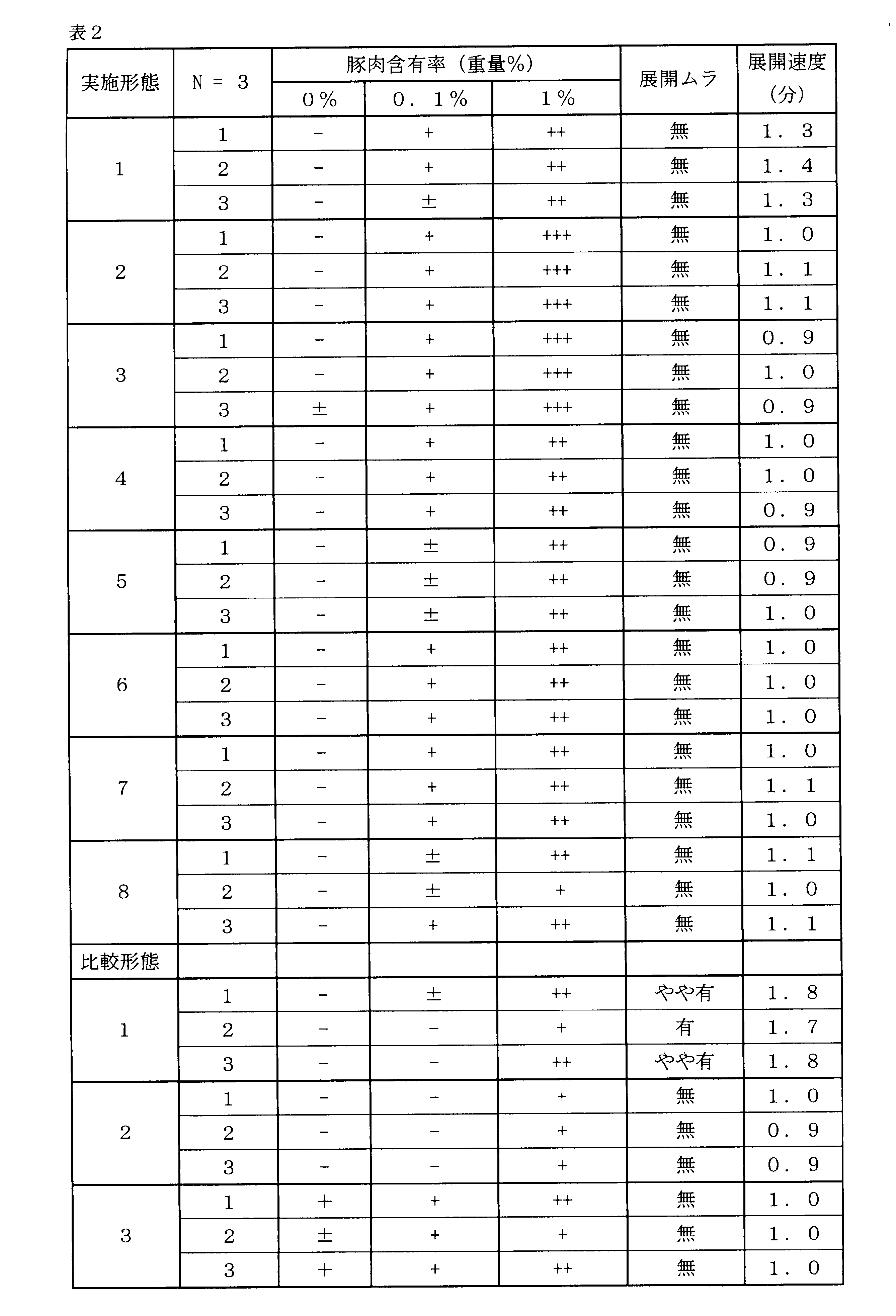

表2の結果から、実施形態1~8全てで、陰性検体での検出は殆ど無く、目視での検出は良好であった。また、展開時の展開ムラは無く、展開速度も10分後の判定が問題なく行える速度であった。比較形態1では、非イオン界面活性剤の含有量が不十分で、展開速度と感度が低下し、展開ムラも見られた。比較形態2では、塩化ナトリウムの含有量が不十分で、感度が大幅に低下した。比較形態3では、カゼインの含有量が不足し非特異反応による擬陽性が確認された。比較形態1において、抽出後、展開前にTween20を適量加えると、展開ムラと展開速度は改善されたが、検出感度の改善は少なかった。比較形態2において、抽出後、展開前に塩化ナトリウムを適量加えても検出感度の改善は見られなかった。
表3の結果から、本発明の免疫クロマト検出キットを用いれば、様々な加工食品種中の豚肉の有無が、免疫クロマト検出によって迅速で正確に確認できた。
表3の結果から、本発明の免疫クロマト検出キットを用いれば、様々な加工食品種中の豚肉の有無が、免疫クロマト検出によって迅速で正確に確認できた。
また、2.標識試薬溶液の作製において、金コロイド液に用いる金ナノ粒子が、平均粒子径60.6nm及び分散度係数0.202であること以外は、試験例1と同様に試験を行った場合、展開速度の低下や展開ムラは見られなかったが、検出感度はやや低下し(0.1%の豚肉含有率で±の判定)、標識試薬保持部での標識試薬の凝集による溶出不良が若干見られることがあった。
[試験例2:豚生(非加工)肉含有食品中の豚肉由来タンパク質の検出]
1.免疫クロマトグラフ媒体部中の検出部の作製
検出物質として抗豚タンパクモノクローナル抗体を用いたこと以外は、試験例1と同様に作製した。
1.免疫クロマトグラフ媒体部中の検出部の作製
検出物質として抗豚タンパクモノクローナル抗体を用いたこと以外は、試験例1と同様に作製した。
2.標識試薬溶液の作製
金コロイド液(金ナノ粒子懸濁液(田中貴金属工業(株)製):動的光散乱法粒度分布計による測定で粒度分布曲線は単一ピークを示し、平均粒子径40.5nm、分散度係数0.056、赤色)を用い、TES緩衝液(pH7.0)で0.05mg/mLの濃度になるように希釈した抗豚タンパクモノクローナル抗体(免疫クロマトグラフ媒体部中の検出部の作製で用いた抗体と異なるモノクローナル抗体)を用いたこと以外は、試験例1と同様に作製した。
金コロイド液(金ナノ粒子懸濁液(田中貴金属工業(株)製):動的光散乱法粒度分布計による測定で粒度分布曲線は単一ピークを示し、平均粒子径40.5nm、分散度係数0.056、赤色)を用い、TES緩衝液(pH7.0)で0.05mg/mLの濃度になるように希釈した抗豚タンパクモノクローナル抗体(免疫クロマトグラフ媒体部中の検出部の作製で用いた抗体と異なるモノクローナル抗体)を用いたこと以外は、試験例1と同様に作製した。
3.免疫クロマトグラフィー装置の作製
試験例1と同様に作製した。
試験例1と同様に作製した。
4.免疫クロマト用抽出展開液の調製
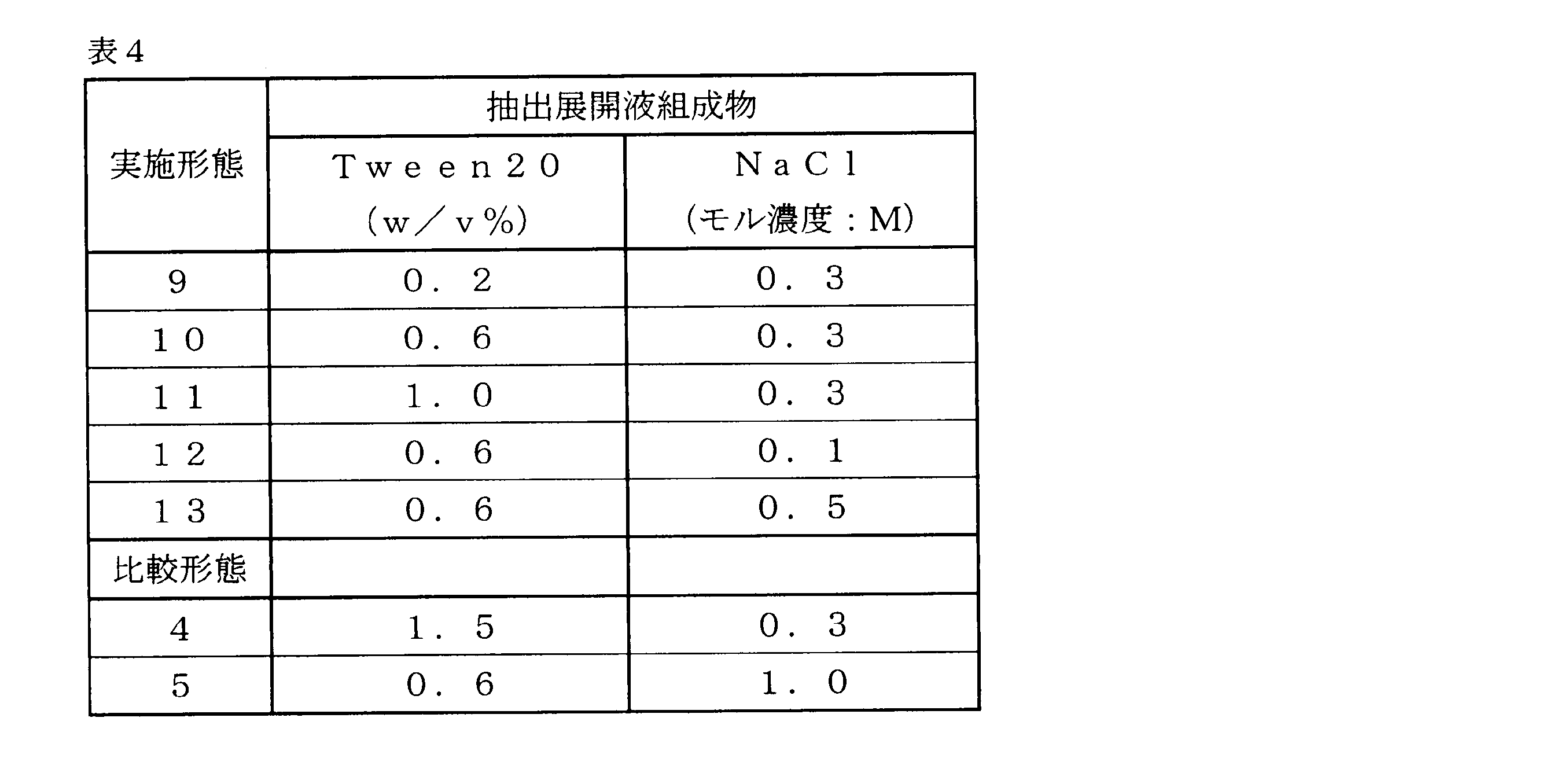
超純水に界面活性剤、塩化ナトリウムをそれぞれ表4に記載の含有量または濃度となるように加え、更に防腐剤としてアジ化ナトリウムを0.1重量%となるように加えて混和し調整した。
超純水に界面活性剤、塩化ナトリウムをそれぞれ表4に記載の含有量または濃度となるように加え、更に防腐剤としてアジ化ナトリウムを0.1重量%となるように加えて混和し調整した。
5.抽出試料の作製
上述4. 免疫クロマト用抽出展開液の調製に記載の抽出展開液0.5mLに対して、豚生肉(非加工豚肉)を各種重量含有率で含有する豚以外の動物種の生肉を含む食品を0.1~0.2g程度を加えて手で30秒間振とうし、抽出試料を作製した。
上述4. 免疫クロマト用抽出展開液の調製に記載の抽出展開液0.5mLに対して、豚生肉(非加工豚肉)を各種重量含有率で含有する豚以外の動物種の生肉を含む食品を0.1~0.2g程度を加えて手で30秒間振とうし、抽出試料を作製した。
6.測定は、試験例1と同様に作製し測定した。
試験非加工食品として牛生肉中に豚生肉が、0重量%、0.01重量%、0.1重量%の各含有量で含有する生肉食品について、表4に記載の各抽出展開液(実施形態9~13、比較形態4~5)を用いて評価した結果を表5に示す。また、実施形態10の抽出展開液組成物を用い、試験非加工食品として各種豚以外の生肉(牛肉、鶏肉、ラム肉)それぞれに豚生肉を、0重量%、0.01重量%、0.1重量%で含有する非加工食品について、評価した結果を表6に示す。
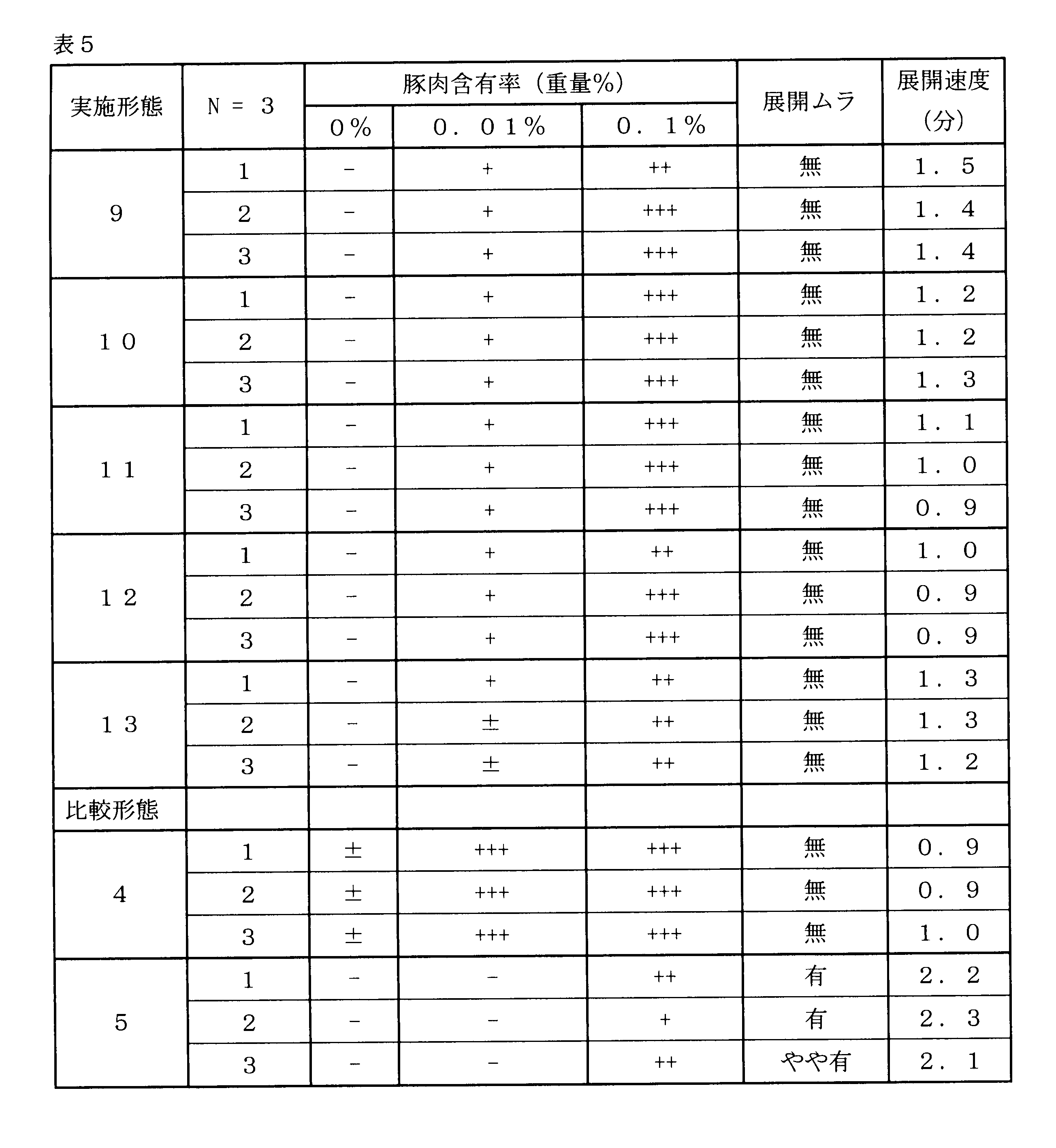
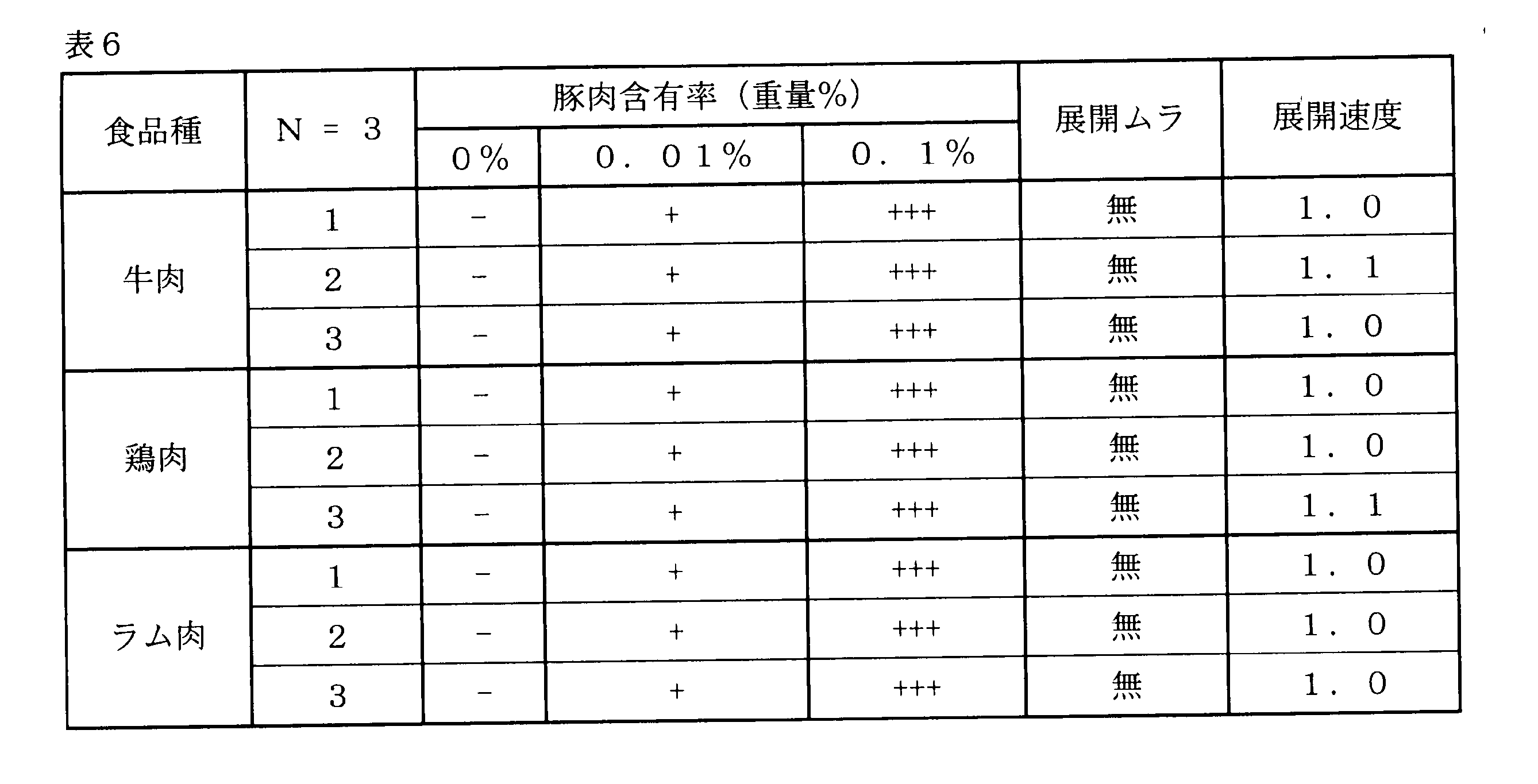
表5の結果から、実施形態9~13全てで、陰性検体での検出は無く、目視での検出は良好であった。また、展開時の展開ムラは無く、展開速度も10分後の判定が問題なく行える速度であった。比較形態4では、非イオン界面活性剤の含有量が超過し、陰性検体において非特異的反応による偽陽性見られた(偽判定)。比較形態5では、塩化ナトリウムの含有量が超過し、展開速度が低下し展開ムラが生じるばかりか、感度も大幅に低下した。
表6の結果から、本発明の免疫クロマト検出キットを用いれば、様々な非加工食品種中の豚肉の有無が、免疫クロマト検出によって迅速で正確に確認できた。
表6の結果から、本発明の免疫クロマト検出キットを用いれば、様々な非加工食品種中の豚肉の有無が、免疫クロマト検出によって迅速で正確に確認できた。
[試験例3:牛加工肉含有食品中の牛肉由来タンパク質の検出]
1.免疫クロマトグラフ媒体部中の検出部の作製
検出物質として抗牛タンパクポリクローナル抗体を用いたこと以外は、試験例1と同様に作製した。
1.免疫クロマトグラフ媒体部中の検出部の作製
検出物質として抗牛タンパクポリクローナル抗体を用いたこと以外は、試験例1と同様に作製した。
2.標識試薬溶液の作製
HEPES緩衝液(pH8.7)で0.04mg/mLの濃度になるように希釈した抗牛タンパクモノクローナル抗体を用いたこと以外は、試験例1と同様に作製した。
HEPES緩衝液(pH8.7)で0.04mg/mLの濃度になるように希釈した抗牛タンパクモノクローナル抗体を用いたこと以外は、試験例1と同様に作製した。
3.免疫クロマトグラフィー装置の作製
試験例1と同様に作製した。
試験例1と同様に作製した。
4.免疫クロマト用抽出展開液の調製
0.8重量%のBicine緩衝液(pH8.5)にスキムミルク(80質量%カゼイン)を0.3重量%、Tween20(HLB値16.7の非イオン界面活性剤)を0.3重量%、塩化ナトリウムを0.15Mとなるように加え、更に防腐剤としてアジ化ナトリウムを0.1重量%となるように加えて混和し調整した。
0.8重量%のBicine緩衝液(pH8.5)にスキムミルク(80質量%カゼイン)を0.3重量%、Tween20(HLB値16.7の非イオン界面活性剤)を0.3重量%、塩化ナトリウムを0.15Mとなるように加え、更に防腐剤としてアジ化ナトリウムを0.1重量%となるように加えて混和し調整した。
5.抽出試料の作製、及び6.測定は、試験例1と同様に作製し測定した。
試験加工食品としてそれぞれ加熱加工された豚肉、ラム肉中に含まれている加工牛肉の割合が、0重量%、0.3重量%、1重量%の各場合について、評価した結果を表7に示す。

表7の結果から、本発明の免疫クロマト検出キットを用いれば、様々な加工食品種中の牛肉の有無が、免疫クロマト検出によって迅速で正確に確認できた。
本発明を詳細にまた特定の実施態様を参照して説明したが、本発明の精神と範囲を逸脱することなく様々な変更や修正を加えることができることは当業者にとって明らかである。
本出願は、2011年2月1日出願の日本特許出願(特願2011-020207)に基づくものであり、その内容はここに参照として取り込まれる。すべての引用される参照は内容として取り込まれる。
本発明を詳細にまた特定の実施態様を参照して説明したが、本発明の精神と範囲を逸脱することなく様々な変更や修正を加えることができることは当業者にとって明らかである。
本出願は、2011年2月1日出願の日本特許出願(特願2011-020207)に基づくものであり、その内容はここに参照として取り込まれる。すべての引用される参照は内容として取り込まれる。
本発明の免疫クロマト検出キットは、免疫クロマトグラフィー法に基づくものであるため、本発明の免疫クロマト用抽出展開液を使用すれば、簡便かつ迅速に、特異的に食品中の検出対象動物肉の有無を検出できるので、動物肉に対してアレルギー反応を引き起こす患者さんや、嗜好上または食文化上、特定動物肉を食さない一般消費者の方々に対して、それらの問題の解決に貢献できる。
本発明の免疫クロマト検出キットを用いる検出方法は、PCR法やELISA法に比べて、簡便、迅速かつ安価に実施できるため、産業上の利用可能性が大である。
本発明の免疫クロマト検出キットを用いる検出方法は、PCR法やELISA法に比べて、簡便、迅速かつ安価に実施できるため、産業上の利用可能性が大である。
1 試料供給部
2 標識試薬保持部
3 免疫クロマトグラフ媒体部
4 検出部
5 コントロール部
6 吸水部
7 バッキングシート
10 免疫クロマトグラフィー装置
2 標識試薬保持部
3 免疫クロマトグラフ媒体部
4 検出部
5 コントロール部
6 吸水部
7 バッキングシート
10 免疫クロマトグラフィー装置
Claims (3)
- 試料供給部、標識試薬保持部、検出試薬が担持された免疫クロマトグラフ媒体部、および吸水部からなる免疫クロマトグラフィー装置と免疫クロマト用抽出展開液を備える免疫クロマト検出キットであって、
上記抽出展開液はHLB値が12~18である非イオン界面活性剤を0.03~0.3w/v%の濃度、アルカリ金属無機塩を0.01~0.3Mの濃度、カゼインを0.05~0.5w/v%の濃度で含み、さらにpH7~9のpH緩衝剤を含有する水溶液である免疫クロマト検出キットを用いた免疫クロマト検出方法であって、
加工食品中の動物肉由来タンパク質を被検出物質として免疫クロマト用抽出展開液により抽出する工程、
その抽出された抽出液を免疫クロマトグラフィー装置へ直接供給する工程、
供給された液が移動相を構成する展開液として機能し、被検出物質を金ナノ粒子標識試薬とともに展開させる工程、
検出部において金ナノ粒子標識試薬、被検出物質及び免疫クロマトグラフ媒体部中に担持された検出試薬からなる複合体として被検出物質を捕捉し検出部での標識物質の発色を検出する工程
を含むことを特徴とする加工食品中の動物肉由来タンパク質を検出する免疫クロマト検出方法。 - 上記金ナノ粒子標識試薬は上記検出試薬を担持する金コロイド液より形成され、該金コロイド液が、平均粒子径20~150nmであって分散度係数0.1以下で分散された金ナノ粒子からなることを特徴とする請求項1に記載の免疫クロマト検出方法。
- 動物肉が豚肉である請求項1または2に記載の免疫クロマト検出方法。
Applications Claiming Priority (2)
| Application Number | Priority Date | Filing Date | Title |
|---|---|---|---|
| JP2011-020207 | 2011-02-01 | ||
| JP2011020207A JP4895062B1 (ja) | 2011-02-01 | 2011-02-01 | 食品中の動物肉由来タンパク質の免疫クロマト検出方法 |
Publications (1)
| Publication Number | Publication Date |
|---|---|
| WO2012105612A1 true WO2012105612A1 (ja) | 2012-08-09 |
Family
ID=45907949
Family Applications (1)
| Application Number | Title | Priority Date | Filing Date |
|---|---|---|---|
| PCT/JP2012/052291 Ceased WO2012105612A1 (ja) | 2011-02-01 | 2012-02-01 | 食品中の動物肉由来タンパク質の免疫クロマト検出方法 |
Country Status (2)
| Country | Link |
|---|---|
| JP (1) | JP4895062B1 (ja) |
| WO (1) | WO2012105612A1 (ja) |
Cited By (3)
| Publication number | Priority date | Publication date | Assignee | Title |
|---|---|---|---|---|
| CN106461651A (zh) * | 2014-06-04 | 2017-02-22 | 田中贵金属工业株式会社 | 免疫学的测定试剂的前带现象的消除法 |
| CN111537723A (zh) * | 2020-05-12 | 2020-08-14 | 北京勤邦生物技术有限公司 | 一种检测牛羊肉中掺杂鸡肉的试纸条及方法 |
| CN113791205A (zh) * | 2021-09-10 | 2021-12-14 | 重庆创芯生物科技有限公司 | 用于异相体系免疫反应的即用型封闭液及制备和应用 |
Families Citing this family (8)
| Publication number | Priority date | Publication date | Assignee | Title |
|---|---|---|---|---|
| WO2014051141A1 (ja) * | 2012-09-28 | 2014-04-03 | 積水メディカル株式会社 | 無希釈系イムノクロマトグラフ法試薬において希釈試料を測定するための添加物 |
| JP6444377B2 (ja) * | 2014-03-31 | 2019-01-09 | 国立大学法人愛媛大学 | 機能性材料、機能性材料の製造方法および機能性液体 |
| US11517897B2 (en) | 2014-03-31 | 2022-12-06 | National University Corporation Ehime University | Functional material for testing liquid sample |
| JP5792859B1 (ja) * | 2014-04-04 | 2015-10-14 | 田中貴金属工業株式会社 | 免疫クロマト分析方法 |
| JP6143818B2 (ja) | 2015-06-01 | 2017-06-07 | 田中貴金属工業株式会社 | マイコプラズマ・ニューモニエ検出用免疫クロマト分析装置 |
| JP7101035B2 (ja) * | 2018-04-25 | 2022-07-14 | 株式会社ニップン | モノクローナル抗体を用いた検査法に適したアレルゲンの抽出液 |
| JP6586494B1 (ja) | 2018-08-20 | 2019-10-02 | キッコーマン株式会社 | ヒスタミン測定のためのサンプリング方法及びキット |
| JP7141458B2 (ja) * | 2018-08-29 | 2022-09-22 | 富士フイルム株式会社 | クロマトグラフキットおよびクロマトグラフ方法 |
Citations (5)
| Publication number | Priority date | Publication date | Assignee | Title |
|---|---|---|---|---|
| JP2002221522A (ja) * | 2001-01-24 | 2002-08-09 | Sekisui Chem Co Ltd | 測定キット及びそれを用いた測定方法 |
| JP2006112792A (ja) * | 2004-10-12 | 2006-04-27 | Onchip Cellomics Consortium | 走査型電子顕微鏡を用いる生体物質アッセイシステムおよびアッセイ法 |
| JP2007322310A (ja) * | 2006-06-02 | 2007-12-13 | Nippon Kayaku Co Ltd | 検体中の分析対象物質の検出あるいは測定方法 |
| JP2009120901A (ja) * | 2007-11-14 | 2009-06-04 | Ne Chemcat Corp | 金−白金コアシェルナノ粒子のコロイド、及びその製造法 |
| JP2010156576A (ja) * | 2008-12-26 | 2010-07-15 | Tanaka Holdings Kk | クロマトグラフ媒体 |
Family Cites Families (1)
| Publication number | Priority date | Publication date | Assignee | Title |
|---|---|---|---|---|
| JP5248264B2 (ja) * | 2008-10-22 | 2013-07-31 | 田中貴金属工業株式会社 | イムノクロマトグラフ法による高感度測定キット |
-
2011
- 2011-02-01 JP JP2011020207A patent/JP4895062B1/ja not_active Expired - Fee Related
-
2012
- 2012-02-01 WO PCT/JP2012/052291 patent/WO2012105612A1/ja not_active Ceased
Patent Citations (5)
| Publication number | Priority date | Publication date | Assignee | Title |
|---|---|---|---|---|
| JP2002221522A (ja) * | 2001-01-24 | 2002-08-09 | Sekisui Chem Co Ltd | 測定キット及びそれを用いた測定方法 |
| JP2006112792A (ja) * | 2004-10-12 | 2006-04-27 | Onchip Cellomics Consortium | 走査型電子顕微鏡を用いる生体物質アッセイシステムおよびアッセイ法 |
| JP2007322310A (ja) * | 2006-06-02 | 2007-12-13 | Nippon Kayaku Co Ltd | 検体中の分析対象物質の検出あるいは測定方法 |
| JP2009120901A (ja) * | 2007-11-14 | 2009-06-04 | Ne Chemcat Corp | 金−白金コアシェルナノ粒子のコロイド、及びその製造法 |
| JP2010156576A (ja) * | 2008-12-26 | 2010-07-15 | Tanaka Holdings Kk | クロマトグラフ媒体 |
Cited By (6)
| Publication number | Priority date | Publication date | Assignee | Title |
|---|---|---|---|---|
| CN106461651A (zh) * | 2014-06-04 | 2017-02-22 | 田中贵金属工业株式会社 | 免疫学的测定试剂的前带现象的消除法 |
| EP3153858A4 (en) * | 2014-06-04 | 2017-07-19 | Tanaka Kikinzoku Kogyo K.K. | Method for eliminating prozone phenomenon in immunoassay reagent |
| US10466237B2 (en) | 2014-06-04 | 2019-11-05 | Tanaka Kikinzoku Kogyo K.K. | Method for excluding prozone phenomenon in immunological measurement reagent |
| CN111537723A (zh) * | 2020-05-12 | 2020-08-14 | 北京勤邦生物技术有限公司 | 一种检测牛羊肉中掺杂鸡肉的试纸条及方法 |
| CN113791205A (zh) * | 2021-09-10 | 2021-12-14 | 重庆创芯生物科技有限公司 | 用于异相体系免疫反应的即用型封闭液及制备和应用 |
| CN113791205B (zh) * | 2021-09-10 | 2024-02-20 | 重庆创芯生物科技有限公司 | 用于异相体系免疫反应的即用型封闭液及制备和应用 |
Also Published As
| Publication number | Publication date |
|---|---|
| JP4895062B1 (ja) | 2012-03-14 |
| JP2012159440A (ja) | 2012-08-23 |
Similar Documents
| Publication | Publication Date | Title |
|---|---|---|
| JP4895062B1 (ja) | 食品中の動物肉由来タンパク質の免疫クロマト検出方法 | |
| KR101331817B1 (ko) | 면역크로마토그래피법에 의한 알레르겐 검출방법 | |
| JP6280567B2 (ja) | 乳汁中の大腸菌群を検出する方法 | |
| JP6314156B2 (ja) | 乳汁中のブドウ球菌を検出する方法 | |
| CN102687012B (zh) | 生猪肉检测法及其检测试剂盒 | |
| JP6370807B2 (ja) | 乳汁中のストレプトコッカス属の菌を検出する方法 | |
| Li et al. | Two fluorescence quenching immunochromatographic assays based on carbon dots and quantum dots as donor probes for the determination of enrofloxacin | |
| JP5826007B2 (ja) | 偽陽性反応を抑制する検体抽出液 | |
| JP4624477B1 (ja) | 加工食品中の豚肉検出法およびその検出キット | |
| CN104914222A (zh) | 检测孔雀石绿的胶体金免疫层析试纸条及其制备方法 | |
| CN109991412B (zh) | 一种检测油脂中辣椒碱成分的方法 | |
| JP6738888B2 (ja) | グリアジン検出用免疫クロマト分析装置、免疫クロマト分析キットおよび免疫クロマト分析方法 | |
| JP4514233B2 (ja) | イムノクロマトグラフィー用試験キット | |
| WO2025063270A1 (ja) | 検体中の被検出物質を検出する方法、及び食材検査用イムノクロマト法において偽陰性を抑制する方法 | |
| JP6325895B2 (ja) | 非特異反応抑制剤および免疫学的検査方法 | |
| JP2019219393A (ja) | イムノクロマトグラフィー装置、イムノクロマトキット並びにイムノクロマト検出方法 | |
| JP7458583B2 (ja) | プロゾーン現象の抑制方法 | |
| JP2019219394A (ja) | イムノクロマトグラフィー装置用パッド、これを用いたイムノクロマトグラフィー装置、イムノクロマトキット並びにイムノクロマト検出方法 |
Legal Events
| Date | Code | Title | Description |
|---|---|---|---|
| 121 | Ep: the epo has been informed by wipo that ep was designated in this application |
Ref document number: 12742273 Country of ref document: EP Kind code of ref document: A1 |
|
| NENP | Non-entry into the national phase |
Ref country code: DE |
|
| 122 | Ep: pct application non-entry in european phase |
Ref document number: 12742273 Country of ref document: EP Kind code of ref document: A1 |