WO2012105144A1 - 成形性および溶接性に優れた電池ケース用アルミニウム合金板 - Google Patents
成形性および溶接性に優れた電池ケース用アルミニウム合金板 Download PDFInfo
- Publication number
- WO2012105144A1 WO2012105144A1 PCT/JP2011/080130 JP2011080130W WO2012105144A1 WO 2012105144 A1 WO2012105144 A1 WO 2012105144A1 JP 2011080130 W JP2011080130 W JP 2011080130W WO 2012105144 A1 WO2012105144 A1 WO 2012105144A1
- Authority
- WO
- WIPO (PCT)
- Prior art keywords
- mass
- less
- aluminum alloy
- cold
- weldability
- Prior art date
- Legal status (The legal status is an assumption and is not a legal conclusion. Google has not performed a legal analysis and makes no representation as to the accuracy of the status listed.)
- Ceased
Links
Images


Classifications
-
- C—CHEMISTRY; METALLURGY
- C22—METALLURGY; FERROUS OR NON-FERROUS ALLOYS; TREATMENT OF ALLOYS OR NON-FERROUS METALS
- C22C—ALLOYS
- C22C21/00—Alloys based on aluminium
-
- H—ELECTRICITY
- H01—ELECTRIC ELEMENTS
- H01M—PROCESSES OR MEANS, e.g. BATTERIES, FOR THE DIRECT CONVERSION OF CHEMICAL ENERGY INTO ELECTRICAL ENERGY
- H01M50/00—Constructional details or processes of manufacture of the non-active parts of electrochemical cells other than fuel cells, e.g. hybrid cells
- H01M50/10—Primary casings; Jackets or wrappings
- H01M50/116—Primary casings; Jackets or wrappings characterised by the material
- H01M50/117—Inorganic material
- H01M50/119—Metals
-
- C—CHEMISTRY; METALLURGY
- C22—METALLURGY; FERROUS OR NON-FERROUS ALLOYS; TREATMENT OF ALLOYS OR NON-FERROUS METALS
- C22F—CHANGING THE PHYSICAL STRUCTURE OF NON-FERROUS METALS AND NON-FERROUS ALLOYS
- C22F1/00—Changing the physical structure of non-ferrous metals or alloys by heat treatment or by hot or cold working
-
- C—CHEMISTRY; METALLURGY
- C22—METALLURGY; FERROUS OR NON-FERROUS ALLOYS; TREATMENT OF ALLOYS OR NON-FERROUS METALS
- C22F—CHANGING THE PHYSICAL STRUCTURE OF NON-FERROUS METALS AND NON-FERROUS ALLOYS
- C22F1/00—Changing the physical structure of non-ferrous metals or alloys by heat treatment or by hot or cold working
- C22F1/04—Changing the physical structure of non-ferrous metals or alloys by heat treatment or by hot or cold working of aluminium or alloys based thereon
-
- H—ELECTRICITY
- H01—ELECTRIC ELEMENTS
- H01M—PROCESSES OR MEANS, e.g. BATTERIES, FOR THE DIRECT CONVERSION OF CHEMICAL ENERGY INTO ELECTRICAL ENERGY
- H01M10/00—Secondary cells; Manufacture thereof
- H01M10/05—Accumulators with non-aqueous electrolyte
- H01M10/052—Li-accumulators
- H01M10/0525—Rocking-chair batteries, i.e. batteries with lithium insertion or intercalation in both electrodes; Lithium-ion batteries
-
- H—ELECTRICITY
- H01—ELECTRIC ELEMENTS
- H01M—PROCESSES OR MEANS, e.g. BATTERIES, FOR THE DIRECT CONVERSION OF CHEMICAL ENERGY INTO ELECTRICAL ENERGY
- H01M50/00—Constructional details or processes of manufacture of the non-active parts of electrochemical cells other than fuel cells, e.g. hybrid cells
- H01M50/10—Primary casings; Jackets or wrappings
- H01M50/131—Primary casings; Jackets or wrappings characterised by physical properties, e.g. gas permeability, size or heat resistance
-
- Y—GENERAL TAGGING OF NEW TECHNOLOGICAL DEVELOPMENTS; GENERAL TAGGING OF CROSS-SECTIONAL TECHNOLOGIES SPANNING OVER SEVERAL SECTIONS OF THE IPC; TECHNICAL SUBJECTS COVERED BY FORMER USPC CROSS-REFERENCE ART COLLECTIONS [XRACs] AND DIGESTS
- Y02—TECHNOLOGIES OR APPLICATIONS FOR MITIGATION OR ADAPTATION AGAINST CLIMATE CHANGE
- Y02E—REDUCTION OF GREENHOUSE GAS [GHG] EMISSIONS, RELATED TO ENERGY GENERATION, TRANSMISSION OR DISTRIBUTION
- Y02E60/00—Enabling technologies; Technologies with a potential or indirect contribution to GHG emissions mitigation
- Y02E60/10—Energy storage using batteries
Definitions
- the present invention relates to an aluminum alloy plate excellent in formability and laser weldability, which is used for a secondary battery container such as a lithium ion battery.
- Al-Mn 3000 series alloys are relatively excellent in strength, formability, and laser weldability, and are therefore used as materials for manufacturing secondary battery containers such as lithium ion batteries. Yes. After forming into a desired shape, it is hermetically sealed by laser welding and used with a secondary battery container. Development has been made on an aluminum alloy plate for a secondary battery container, which is based on an existing 3000 series alloy together with the 3000 series alloy and has further improved strength and formability.
- the composition of the aluminum alloy plate is as follows: Si: 0.10 to 0.60 mass%, Fe: 0.20 to 0.60 mass%, Cu: 0.10 to 0.70 mass% , Mn: 0.60 to 1.50 mass%, Mg: 0.20 to 1.20 mass%, Zr: more than 0.12 and less than 0.20 mass%, Ti: 0.05 to 0.25 mass% B: 0.0010 to 0.02% by mass, the balance being Al and inevitable impurities, and 45 ° ear ratio in the rolling direction in a cylindrical container deep drawing method is 4 to 7%.
- An aluminum alloy plate for rectangular cross-section battery containers is described.
- JP 2010-126804 A Mn: 0.8% by mass or more and 1.8% by mass or less, Mg: more than 0.6% by mass and 1.2% by mass or less, Cu: more than 0.5% by mass 1.5% by mass or less, Fe as an impurity is regulated to 0.5% by mass or less, Si is controlled to 0.3% by mass or less, and has a composition consisting of the balance Al and inevitable impurities, ⁇ 001 ⁇
- the ratio (C / S) of the orientation density C in the ⁇ 100> orientation to the orientation density S in the ⁇ 123 ⁇ ⁇ 634> orientation is 0.65 or more and 1.5 or less, and the tensile strength after the final cold rolling. Describes an aluminum alloy plate for a prismatic battery container having a thickness of 250 MPa to 330 MPa and an elongation of 1% or more.
- an aluminum alloy plate based on a 3000 series alloy and improved in its composition may have insufficient weld penetration depth, which may cause abnormal beading and a problem in laser weldability. Yes.
- Japanese Patent Application Laid-Open No. 2009-127075 discloses an aluminum alloy material for pulse laser welding and a battery case that can prevent the occurrence of abnormal parts by pulse laser welding of an A1000 series aluminum material and can form a uniform good weld.
- Ti which has been added to suppress the coarsening of crystal grains in the casting process, has an adverse effect on the welded portion, and an abnormal portion is formed when A1000 series aluminum is welded by pulse laser welding.
- Ti contained in pure aluminum should be regulated to less than 0.01% by mass.
- Japanese Patent Application Laid-Open No. 2003-7260 discloses Mn: 0.3 to 1.5 mass%, Fe: 1.0 There has been proposed an aluminum alloy plate for a secondary battery case comprising more than 1.8% by mass, the balance Al and inevitable impurities. Further, Cu: 0.1 to 0.8% by mass and / or Mg: more than 0.10 to 1.0% by mass, and / or Cr: 0.05 to 0.2% by mass and / or Zr: 0.0. It may contain from 05 to 0.2% by mass. However, no detailed study has been made on weldability.
- the 1000 series has a problem that the weldability is stable (the number of abnormal beads is small) and the formability is excellent but the strength is low. Therefore, as the size of the lithium ion battery is increased, it is expected that high strength characteristics are required, and there is a problem in applying the 1000 series aluminum material as it is.
- a 3000 series alloy plate provides strength and deep penetration depth, it has a tendency to have inferior formability and a large number of abnormal beads compared to a 1000 series alloy plate.
- a 1000 series alloy plate is excellent in formability and the number of abnormal beads decreases, but there is a concern that the strength is insufficient.
- the present invention has been devised to solve such problems, has high strength applicable to large-sized lithium ion battery containers, is excellent in moldability, and further has laser weldability. Is intended to provide an excellent Al—Fe-based aluminum alloy sheet.
- the aluminum alloy plate for battery case having excellent formability and weldability according to the present invention is provided with Fe: 0.3 to 1.5 mass%, Mn: 0.3 to 1.0 mass%.
- the material When the material is cold-rolled, it exhibits an elongation value of 5% or more and a tensile strength of 90 MPa or more. Moreover, when it is set as a cold-rolled annealing material, it shall exhibit an elongation value of 20% or more.
- it may further contain Zr: 0.05 to 0.20 mass%.
- the aluminum alloy plate of the present invention has high strength, excellent formability, and excellent laser weldability. Therefore, a secondary battery container that is excellent in sealing performance and capable of suppressing swelling can be manufactured at low cost. Can be manufactured.
- a cold-rolled material in the case of a cold-rolled material, it has a tensile strength of 90 MPa or more, and in the case of a cold-rolled annealed material, the elongation value is 20% or more and exhibits excellent formability.
- FIG. 1 is a conceptual diagram for explaining a method for measuring / evaluating the number of abnormal beads, and is a graph showing (A) a top view of a weld bead and (B) a change in bead width along the bead length direction.
- FIG. 2 is a conceptual diagram for explaining a method for measuring / evaluating the penetration depth, (A) a top view of a weld bead and (B) a sectional view.
- Secondary batteries are manufactured by putting an electrode body in a container and then sealing it with a lid by welding or the like.
- a secondary battery when charging, the temperature inside the container may rise and the pressure inside the container may increase. For this reason, if the strength of the material forming the container is low, there is a problem that the produced container is greatly swollen. Therefore, a material having high strength is required as a material to be used. Further, since a press method is generally used as a method for forming a container, the material itself is required to have excellent press formability.
- a welding method is used as a method of sealing with a lid, it is also required to have excellent weldability.
- a laser welding method is used as a welding method for manufacturing a secondary battery container or the like.
- the weld bead width increases, the penetration depth tends to increase. For this reason, the weld bead width is locally wide at the abnormal bead portion and the penetration depth is deep, and if it is severe, penetration of the melted portion or the like occurs, leading to deterioration in battery performance and reliability.
- the present inventors have intensively studied to obtain an aluminum alloy plate having high strength and excellent press formability, as well as excellent laser weldability through investigation of the number of abnormal beads generated in the weld and the penetration depth in the weld. Again, the present invention has been reached. The contents will be described below.
- Fe 0.3 to 1.5% by mass Fe is an essential element for increasing the strength of the aluminum alloy plate and ensuring the penetration depth in laser welding. If the Fe content is less than 0.3% by mass, the strength of the aluminum alloy plate is lowered, and the penetration depth during laser welding is reduced, which is not preferable. When the Fe content exceeds 1.5% by mass, coarse intermetallic compounds such as Al— (Fe ⁇ Mn) —Si and Al 6 Fe crystallize during ingot casting, and formability in the final plate is reduced. These intermetallic compounds tend to evaporate during laser welding as compared to the Al matrix, and the number of abnormal beads increases and weldability decreases, which is not preferable.
- the Fe content is in the range of 0.3 to 1.5% by mass.
- a more preferable Fe content is in the range of 0.5 to 1.5% by mass.
- a more preferable Fe content is in the range of 0.7 to 1.5% by mass.
- Mn 0.3 to 1.0% by mass
- Mn is an essential element for increasing the strength of the aluminum alloy plate and ensuring the penetration depth in laser welding. If the Mn content is less than 0.3% by mass, the strength of the aluminum alloy plate is lowered, and the penetration depth during laser welding is reduced, which is not preferable.
- Mn content exceeds 1.0% by mass coarse intermetallic compounds such as Al— (Fe ⁇ Mn) —Si and Al 6 Mn crystallize during ingot casting, and formability in the final plate is reduced. These intermetallic compounds tend to evaporate during laser welding as compared to the Al matrix, and the number of abnormal beads increases and weldability decreases, which is not preferable.
- the Mn content is in the range of 0.3 to 1.0% by mass.
- a more preferable Mn content is in the range of 0.3 to 0.8% by mass.
- a more preferable Mn content is in the range of 0.4 to 0.7% by mass.
- Ti acts as a crystal grain refining agent during ingot casting and can prevent casting cracks.
- Ti may be added alone, but by coexisting with B, a more powerful grain refinement effect can be expected, so addition with a rod hardener such as Al-5% Ti-1% B There may be.
- the Ti content is less than 0.002% by mass, the effect of refining at the time of ingot casting is insufficient, which may cause casting cracks, which is not preferable.
- the Ti content exceeds 0.20% by mass, a coarse intermetallic compound such as TiAl3 is crystallized during ingot casting, which is not preferable because the formability in the final plate is lowered.
- the Ti content is in the range of 0.002 to 0.20 mass%.
- a more preferable Ti content is in the range of 0.002 to 0.15 mass%.
- a more preferable Ti content is in the range of 0.005 to 0.10% by mass.
- Zr 0.05-0.20 mass% Zr, like Ti, acts as a grain refiner during ingot casting and can prevent casting cracks. Further, when Ti and Zr coexist, cracking at the time of solidification of the weld bead portion accompanied by rapid solidification is prevented, and the speed of pulse laser welding can be increased. When Ti, Zr, and B coexist, the effect of preventing the occurrence of cracks during solidification of the weld bead portion accompanied by rapid solidification becomes more remarkable. For this reason, it contains as needed.
- the Zr content exceeds 0.20% by mass, a coarse intermetallic compound such as ZrAl 3 is crystallized at the time of ingot casting, which is not preferable. If the Zr content is less than 0.05% by mass, sufficient effects cannot be obtained. Therefore, the preferred Zr content is 0.05 to 0.20% by mass. A more preferable Zr content is in the range of 0.07 to 0.20 mass%. A more preferable Zr content is in the range of 0.07 to 0.18% by mass.
- B 0.0005 to 0.10% by mass B, like Ti and Zr, acts as a crystal grain refining agent during ingot casting and can prevent casting cracks, so B may be contained as necessary.
- the preferable B content is 0.0005 to 0.10% by mass.
- a more preferable B content is in the range of 0.001 to 0.05 mass%.
- a more preferable B content is in the range of 0.001 to 0.01% by mass.
- Si content as an inevitable impurity less than 0.30% by mass
- the content of Si as an inevitable impurity is preferably limited to less than 0.30% by mass.
- coarse intermetallic compounds such as Al— (Fe ⁇ Mn) —Si are crystallized at the time of ingot casting, and formability is deteriorated.
- a more preferable Si content is less than 0.25% by mass. Further preferable Si content is less than 0.20 mass%.
- the Si content is less than 0.20% by mass, properties such as formability and weldability do not deteriorate.
- Cu as an inevitable impurity less than 0.2% by mass Cu as an inevitable impurity may be contained in an amount of less than 0.2% by mass. In this invention, if Cu content is less than 0.2 mass%, it will not fall about characteristics, such as a moldability and weldability.
- Mg as an unavoidable impurity less than 0.2 mass% Mg as an unavoidable impurity may be contained less than 0.2 mass%. In this invention, if Mg content is less than 0.2 mass%, it will not fall about characteristics, such as a moldability and weldability.
- Mn / Fe mass ratio 0.2 to 1.0 If the Mn / Fe ratio is less than 0.2 within the range of the Fe and Mn contents within the scope of the present invention, the penetration depth during laser welding decreases, which is not preferable. If the Mn / Fe ratio exceeds 1.0 within the range of Fe and Mn contents within the scope of the present invention, the number of abnormal beads increases, which is not preferable.
- the mass ratio of Mn / Fe affects the type and amount of intermetallic compounds that crystallize during ingot casting. For example, it is also well known that when the Mn / Fe mass ratio increases, the number of Al 6 Mn intermetallic compounds increases.
- intermetallic compounds such as Al 6 Mn tend to evaporate and are unstable during laser welding as compared to intermetallic compounds such as Al—Fe—Si, Al 6 Fe, and Al 3 Fe. For this reason, when Mn / Fe ratio exceeds 1.0, it is thought that the number of abnormal beads at the time of laser welding increases and weldability deteriorates.
- Mn increases the thermal resistance of the material by being dissolved in an Al matrix
- Mn is an element more important than Fe in securing the penetration depth during laser welding. For this reason, it is thought that the penetration depth at the time of laser welding is insufficient when the Mn / Fe ratio is less than 0.2.
- Elongation value is 5% or more
- tensile strength is 90 MPa or more
- Cold- rolled annealing material Elongation value is 20% or more.
- the strength of the material can be known from the tensile strength when the tensile test is conducted, and the formability can be known from the elongation value at the tensile test.
- the elongation value is 5% or more in the cold-rolled material, And what has the characteristic that tensile strength is 90 Mpa or more is suitable for the cold-rolled annealed material that has the characteristic that the elongation value is 20% or more.
- the number of second phase particles having an equivalent circle diameter of 5 ⁇ m or more in the metal structure is less than 500 / mm 2
- the above-mentioned characteristics are that the metal structure of the Al—Fe-based aluminum alloy plate having the specific chemical composition is finely adjusted.
- the number of second phase particles having an equivalent circle diameter of 5 ⁇ m or more in the metal structure may be less than 500 / mm 2 .
- the metal structure there is no difference in the metal structure between the cold rolled material and the cold rolled annealed material. If it has the metal structure as described above, it exhibits an elongation value of 5% or more and a tensile strength of 90 MPa or more in the cold rolled material, and 20% or more in the cold rolled annealed material. It exhibits an elongation value.
- the flux is appropriately charged and stirred, and further, if necessary, degassing in the furnace using a lance or the like, Hold the sedation to separate the soot from the surface of the melt.
- the molten aluminum alloy melted in the melting furnace may be cast after it is once transferred to the holding furnace, but may be cast directly from the melting furnace.
- a more desirable sedation time is 45 minutes or more.
- ⁇ In-line degassing and filtering may be used as necessary.
- In-line degassing is mainly of a type in which an inert gas or the like is blown into a molten aluminum from a rotating rotor, and hydrogen gas in the molten metal is diffused and removed in bubbles of the inert gas.
- nitrogen gas is used as the inert gas, it is important to control the dew point to, for example, ⁇ 60 ° C. or lower.
- the amount of hydrogen gas in the ingot is preferably reduced to 0.20 cc / 100 g or less.
- hydrogen gas that is supersaturated in the ingot is deposited during laser welding after forming the final plate, depending on the conditions of the homogenization treatment before the hot rolling process, and a large number of blown gases are blown into the beads. In some cases, holes are generated. For this reason, the more preferable amount of hydrogen gas in the ingot is 0.15 cc / 100 g or less.
- the cast ingot is manufactured by semi-continuous casting (DC casting).
- DC casting semi-continuous casting
- the solidification cooling rate at the center portion of the ingot is about 1 ° C./sec.
- a relatively coarse intermetallic compound such as Al— (Fe ⁇ Mn) —Si is formed in the aluminum alloy at the center of the ingot.
- crystallize from the molten metal there is a tendency to crystallize from the molten metal.
- the casting speed in semi-continuous casting depends on the width and thickness of the ingot, it is usually 50 to 70 mm / min in consideration of productivity.
- the flow rate of molten aluminum depends on the degassing conditions such as the flow rate of the inert gas. The smaller the (supply amount), the better the degassing efficiency in the tank, and it is possible to reduce the amount of hydrogen gas in the ingot.
- a more desirable casting speed is 30 to 40 mm / min.
- productivity is lowered, which is not desirable.
- the casting speed is slower, the slope of the sump (solid phase / liquid phase interface) in the ingot becomes gentler, and casting cracks can be prevented.
- Homogenization treatment is performed on an ingot obtained by casting by a semi-continuous casting method at 420 to 600 ° C. for 1 hour or longer .
- the homogenization process is a process in which the ingot is kept at a high temperature to facilitate rolling, and casting segregation and elimination of residual stress inside the ingot are performed.
- it is necessary to hold at a holding temperature of 420 to 600 ° C. for 1 hour or longer.
- it is also a process for dissolving the transition elements constituting the intermetallic compound crystallized during casting to some extent in the matrix.
- the holding temperature is too low or the holding temperature is short, the solid solution of the transition element or the like does not advance, the recrystallized grains become coarse, and the appearance skin after DI molding may not be finished cleanly. If the holding temperature is too high, eutectic parts such as CuMgAl 2 which is the microscopic final solidified part of the ingot may melt, so-called burning may occur.
- a more preferable homogenization temperature is 420 to 590 ° C.
- the ingot held at a high temperature for a predetermined time in the hot rolling process is suspended by a crane after homogenization and brought to the hot rolling mill. Depending on the type of hot rolling mill, it is usually several times.
- the sheet is hot-rolled by such a rolling pass and wound on a roll as a hot-rolled sheet having a predetermined thickness, for example, about 4 to 8 mm.
- the roll on which the hot rolled sheet is wound is passed through a cold rolling machine and usually subjected to several passes of cold rolling.
- an intermediate annealing treatment is performed as necessary.
- the intermediate annealing is also a softening treatment, but depending on the material, a cold rolling roll may be inserted into the batch furnace and kept at a temperature of 300 to 450 ° C. for 1 hour or longer.
- the holding temperature is lower than 300 ° C., softening is not promoted, and when the holding temperature exceeds 450 ° C., the processing cost increases.
- the intermediate annealing can also serve as a solution treatment if it is maintained within a temperature of, for example, 450 ° C. to 550 ° C. within 15 seconds by a continuous annealing furnace and then rapidly cooled.
- a temperature of, for example, 450 ° C. to 550 ° C. within 15 seconds by a continuous annealing furnace and then rapidly cooled.
- the holding temperature is lower than 450 ° C., softening is not promoted, and when the holding temperature exceeds 550 ° C., burning may occur.
- the final annealing performed after the final cold rolling may be, for example, a batch process in which an annealing furnace is maintained at a temperature of 400 to 500 ° C. for 1 hour or longer. If it is kept at a temperature of 550 ° C. within 15 seconds and then cooled rapidly, it can also serve as a solution treatment.
- final annealing is not necessarily essential in the present invention, but it is desirable to make the final plate as soft as possible in view of formability in normal DI molding. Considering the moldability in the mold forming process, it is desirable to use an annealed material or a solution treated material.
- the material is provided as cold rolled.
- the final cold rolling rate is preferably in the range of 50 to 90%. If the final cold rolling rate is within this range, the average recrystallized grains in the final plate after annealing can be set to 20 to 100 ⁇ m, the elongation value can be set to 20% or more, and the appearance skin after molding can be finished beautifully. be able to. A more preferable final cold rolling rate is in the range of 60 to 90%.
- the final cold rolling ratio when the material is cold rolled without being subjected to final annealing is preferably in the range of 5 to 40%. If the ironing process increases during DI molding, it is necessary to provide a final plate that is slightly harder than the annealed material. If the final cold rolling rate is less than 5%, depending on the composition, it becomes difficult to make the tensile strength of the final plate 90 MPa or more. If the final cold rolling rate exceeds 40%, the final plate depends on the composition. It is difficult to set the elongation value at 5% or more.
- the value of elongation in the final plate can be 5% or more and the tensile strength can be 90 MPa or more with cold rolling.
- a more preferable final cold rolling rate is in the range of 10 to 30%.
- An aluminum alloy plate for a secondary battery container can be obtained through the normal steps as described above.
- the ingot was chamfered by 2 mm after cutting the hot water to a thickness of 26 mm.
- This ingot is inserted into an electric heating furnace, heated to 430 ° C. at a temperature rising rate of 100 ° C./hr, homogenized at 430 ° C. ⁇ 1 hour, and subsequently heated to a thickness of 6 mm with a hot rolling mill. It hot-rolled until it became.
- the cold-rolled sheet having a thickness of 1.25 mm was obtained by subjecting this hot-rolled sheet to cold rolling.
- the cold-rolled sheet was inserted into an annealer, and after annealing at 390 ° C. for 1 hour, the annealed sheet was taken out from the annealer and air-cooled. Next, this annealed plate was cold-rolled to obtain a cold-rolled plate having a thickness of 1.0 mm.
- the final cold rolling rate in this case was 20%.
- the cold-rolled annealed plate was cold-rolled without subjecting the hot-rolled plate to intermediate annealing to obtain a 1 mm cold-rolled plate.
- the final cold rolling rate in this case was 83.3%.
- the cold-rolled sheet was inserted into the annealer, and after annealing at 390 ° C. for 1 hour, the cold-rolled sheet was taken out from the annealer and air-cooled.
- test material having an elongation value of 5% or more was defined as good moldability ( ⁇ ), and the test material that was less than 5% was defined as poor moldability ( ⁇ ).
- good moldability ⁇
- poor moldability ⁇
- test material having an elongation value of 20% or more was considered as good moldability ( ⁇ ), and the test material that was less than 20% was considered as poor moldability ( ⁇ ). did.
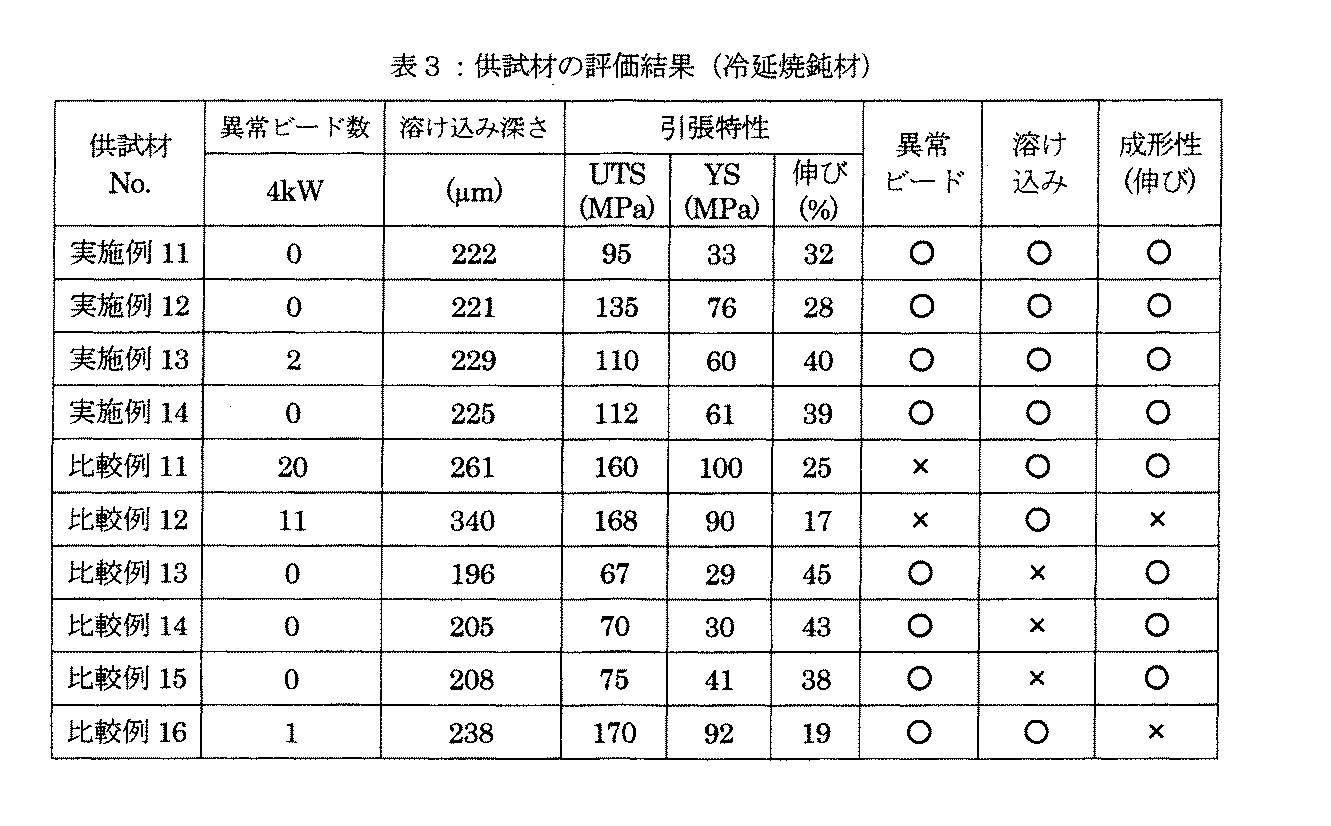
- the evaluation results are shown in Table 3.
- the final plate obtained was subjected to pulsed laser irradiation to evaluate laser weldability.
- LUMONICS YAG laser welder JK701 under conditions of frequency 37.5 Hz, welding speed 450 mm / min, energy per pulse 6.0 J, shield gas (nitrogen) flow rate 1.5 (L / min), Two plates of the test material were butted without gaps between the end portions, and pulse laser welding having a total length of 120 mm was performed along the portion.
- the width of the round molten bead formed by each pulse formed along the weld line having a length of 60 mm was continuously measured at intervals of 0.05 mm in the welding direction, and a length of 10 mm (1
- the “average weld bead width” for each section) was calculated, and the number of locations showing bead widths that deviated by 1.1 or more from the “average weld bead width” in each section was counted. This count was totaled for 60 mm (6 sections) to obtain the number of abnormal beads of the specimen.
- test material having an abnormal bead number of less than 10 was evaluated as being good (O), and the test material having an abnormal bead number of 10 or more was being evaluated as having an abnormal bead number evaluation (x). did.
- the evaluation results are shown in Table 2 for the cold-rolled materials and in Table 3 for the cold-rolled annealed plates.
- the intermetallic compound crystallized at the time of casting is heated to a high temperature by heating by pulse laser irradiation, dissolved in aluminum, and immediately after that, the molten bead is quenched, and elements such as Fe, Mn, and Si constituting the intermetallic compound becomes a supersaturated solid solution in the Al matrix.
- the area of only the Al matrix in which no intermetallic compound is observed in the cross section is a molten part, and by measuring the maximum depth from the surface of the final plate of the area, The penetration depth can be measured.
- the penetration depth of 5 sections was measured for one specimen, and the average value was defined as the penetration depth ( ⁇ m) in the specimen.
- the cross section of the above-described abnormal bead is not subject to measurement.
- a specimen having a penetration depth of 220 ⁇ m or more was regarded as good penetration evaluation ( ⁇ ), and a specimen having a penetration depth of less than 220 ⁇ m was regarded as poor penetration depth evaluation ( ⁇ ).
- the evaluation results are shown in Table 2 for the cold-rolled materials and in Table 3 for the cold-rolled annealed plates.
- Comparative Example 1 the Mn content was as high as 1.27% by mass, the Mn / Fe ratio was 2.59, which was out of the range of the present invention, and the penetration depth was good ( ⁇ ), but the moldability was poor. (X), abnormal bead number evaluation poor (x).
- Examples 11 to 14 in Table 3 showing the evaluation results for the cold-rolled annealed materials are annealed materials within the composition range of the present invention, both of laser weldability (evaluation of abnormal bead number, penetration depth evaluation) and formability. All were good ( ⁇ ).
- the Mn content is as high as 1.27% by mass, the Mn / Fe ratio is 2.59, which is out of the range of the present invention, the penetration depth evaluation is good ( ⁇ ), and the moldability is good ( ⁇ ).
- the abnormal bead number was poorly evaluated (x).
- Comparative Examples 13 to 15 both Fe and Mn were low and out of the scope of the present invention, and the moldability was good ( ⁇ ) and the abnormal bead number evaluation was good ( ⁇ ), but the penetration depth evaluation was poor ( ⁇ ). there were.
- Comparative Example 16 had a high Si content of 0.5% by mass and was outside the scope of the present invention. The penetration depth evaluation was good ( ⁇ ) and the abnormal bead number evaluation was good ( ⁇ ). (X).
- Measurement of the number of second phase particles in the metal structure A longitudinal section parallel to the rolling direction of the obtained final plate (section perpendicular to the LT direction) is cut out, embedded in a thermoplastic resin and mirror-polished, and the metal structure is observed. went. The micro metallographic structure is photographed with an optical microscope (area per field of view; 0.0334 mm 2 , 10 fields of view of each sample), image analysis of the photograph is performed, and the second phase with a circle equivalent diameter of 5 ⁇ m or more per unit area The number of particles was measured. The measurement results by image analysis are shown in Table 4 for the as-cold rolled materials and in Table 5 for the cold-rolled annealed plates.
- the number of second phase particles having an equivalent circle diameter of 5 ⁇ m or more in the metal structure needs to be less than 500 particles / mm 2 .
- an Al—Fe-based aluminum alloy plate having high strength applicable to a large-sized lithium ion battery container, excellent in formability, and excellent in laser weldability.
Landscapes
- Chemical & Material Sciences (AREA)
- Engineering & Computer Science (AREA)
- Chemical Kinetics & Catalysis (AREA)
- Electrochemistry (AREA)
- General Chemical & Material Sciences (AREA)
- Materials Engineering (AREA)
- Mechanical Engineering (AREA)
- Metallurgy (AREA)
- Organic Chemistry (AREA)
- Physics & Mathematics (AREA)
- Thermal Sciences (AREA)
- Crystallography & Structural Chemistry (AREA)
- Inorganic Chemistry (AREA)
- Manufacturing & Machinery (AREA)
- Sealing Battery Cases Or Jackets (AREA)
Abstract
Description
また、容器を形作る方法としてプレス法が用いられるのが一般的であるから、用いる材料自身に優れたプレス成形性を有することが要求される。
以下にその内容を説明する。
Feは、アルミニウム合金板の強度を増加させ、レーザー溶接における溶け込み深さを確保するため、必須の元素である。Fe含有量が0.3質量%未満であると、アルミニウム合金板の強度が低下するとともに、レーザー溶接時における溶け込み深さが減少するため、好ましくない。Feの含有量が1.5質量%を超えると、鋳塊鋳造時にAl-(Fe・Mn)-Si系、Al6Fe等の粗大な金属間化合物が晶出して、最終板における成形性が低下するとともに、これら金属間化合物はレーザー溶接時にAlマトリックスに比べ蒸発しやすく、異常ビード数が増加して溶接性が低下するため、好ましくない。
Mnは、アルミニウム合金板の強度を増加させ、レーザー溶接における溶け込み深さを確保するため、必須の元素である。Mn含有量が0.3質量%未満であると、アルミニウム合金板の強度が低下するとともに、レーザー溶接時における溶け込み深さが減少するため、好ましくない。Mnの含有量が1.0質量%を超えると、鋳塊鋳造時にAl-(Fe・Mn)-Si系、Al6Mn等の粗大な金属間化合物が晶出して、最終板における成形性が低下するとともに、これら金属間化合物はレーザー溶接時にAlマトリックスに比べ蒸発しやすく、異常ビード数が増加して溶接性が低下するため、好ましくない。
Tiは鋳塊鋳造時に結晶粒微細化剤として作用し、鋳造割れを防止することができる。
勿論、Tiは単独で添加してもよいが、Bと共存することによりさらに強力な結晶粒の微細化効果を期待できるので、Al-5%Ti-1%Bなどのロッドハードナーでの添加であってもよい。
ZrはTiと同様に鋳塊鋳造時に結晶粒微細化剤として作用し、鋳造割れを防止することができる。またTiとZrを共存させると、急冷凝固を伴う溶接ビード部の凝固時の割れ発生を防ぎ、パルスレーザー溶接の高速度化を可能とする。Ti、ZrおよびBを共存させると、急冷凝固を伴う溶接ビード部の凝固時の割れ発生を防止する効果がさらに顕著になる。このため、必要に応じて含有させる。
BもTi、Zrと同様に鋳塊鋳造時に結晶粒微細化剤として作用し、鋳造割れを防止することができるので、必要に応じて含有させてもよい。
不可避的不純物としてのSiの含有量は、0.30質量%未満に制限することが好ましい。Si含有量が0.30質量%以上であると、鋳塊鋳造時にAl-(Fe・Mn)-Si等の粗大な金属間化合物を晶出して、成形性が低下する。より好ましいSi含有量は、0.25質量%未満である。さらに好ましいSi含有量は、0.20質量%未満である。
不可避的不純物としてのCuは0.2質量%未満含有していてもよい。本発明において、Cu含有量が0.2質量%未満であれば、成形性および溶接性等の特性について低下することはない。
不可避的不純物としてのMgは0.2質量%未満含有していてもよい。本発明において、Mg含有量が0.2質量%未満であれば、成形性および溶接性等の特性について低下することはない。
不可避的不純物は原料地金、返り材等から不可避的に混入するもので、それらの許容できる含有量は、例えば、Znの0.25質量%未満、Niの0.20質量%未満、GaおよびVの0.05質量%未満、Pb、Bi、Sn、Na、Ca、Srについては、それぞれ0.02質量%未満、その他各0.05質量%未満であって、この範囲で管理外元素を含有しても本発明の効果を妨げるものではない。
本発明の範囲内のFe、Mn含有量の範囲内においてMn/Fe比が0.2未満であると、レーザー溶接時の溶け込み深さが減少するため、好ましくない。本発明の範囲内のFe、Mn含有量の範囲内においてMn/Fe比が1.0を超えると、異常ビード数が増加するため、好ましくない。
このため、Mn/Fe比が0.2未満であると、レーザー溶接時における溶け込み深さが不足すると考えられる。
冷延まま材:伸びの値が5%以上、且つ引張り強度が90MPa以上
冷延焼鈍材:伸びの値が20%以上
ところで、Al-Fe系アルミニウム合金板を大型リチウムイオン電池容器等に適用するに当たっては、高強度と優れたレーザー溶接性を有するだけでなく、成形性にも優れることが必要である。材料の強度は引張り試験を行った時の引張り強度で、また成形性は引張り試験時の伸びの値で知ることができる。
上記のような特性は、前記特定の化学組成を有するAl-Fe系アルミニウム合金板の金属組織を細かく調整することにより発現される。
溶解炉に原料を投入し、所定の溶解温度に到達したら、フラックスを適宜投入して攪拌を行い、さらに必要に応じてランス等を使用して炉内脱ガスを行った後、鎮静保持して溶湯の表面から滓を分離する。
不活性ガスとして窒素ガスを使用する場合には、露点を例えば-60℃以下に管理することが重要である。鋳塊の水素ガス量は、0.20cc/100g以下に低減することが好ましい。
鋳塊は、半連続鋳造(DC鋳造)によって製造する。通常の半連続鋳造の場合は、鋳塊の厚みが一般的には400~600mm程度であるため、鋳塊中央部における凝固冷却速度が1℃/sec程度である。このため、特にFe、Mnの含有量が高いアルミニウム合金溶湯を半連続鋳造する場合には、鋳塊中央部にはAl-(Fe・Mn)-Si等の比較的粗い金属間化合物がアルミニウム合金溶湯から晶出する傾向がある。
半連続鋳造法により鋳造して得た鋳塊に均質化処理を施す。
均質化処理は、圧延を容易にするために鋳塊を高温に保持して、鋳造偏析、鋳塊内部の残留応力の解消を行なう処理である。本発明において、保持温度420~600℃で1時間以上保持することが必要である。この場合、鋳造時に晶出した金属間化合物を構成する遷移元素等をマトリックスにある程度固溶させるための処理でもある。この保持温度が低すぎ、或いは保持温度が短い場合には、上記遷移元素等の固溶が進まず、再結晶粒が粗くなり、DI成形後の外観肌が綺麗に仕上がらない虞がある。また、保持温度が高すぎると、鋳塊のミクロ的な最終凝固部であるCuMgAl2等の共晶部分が溶融する、いわゆるバーニングを起こすおそれがある。より好ましい均質化処理温度は、420~590℃である。
所定時間高温に保持された鋳塊は、均質化処理後そのままクレーンで吊るされて、熱間圧延機に持ち来たされ、熱間圧延機の機種にもよるが、通常何回かの圧延パスによって熱間圧延されて所定の厚み、例えば4~8mm程度の熱延板としてロールに巻き取る。
熱間圧延板を巻き取ったロールは、冷延機に通され、通常何パスかの冷間圧延が施される。この際、冷間圧延によって導入される塑性歪により加工硬化が起こるため、必要に応じて、中間焼鈍処理が行なわれる。通常中間焼鈍は軟化処理でもあるので、材料にもよるがバッチ炉に冷延ロールを挿入し、300~450℃の温度で、1時間以上の保持を行なってもよい。保持温度が300℃よりも低いと、軟化が促進されず、保持温度が450℃をこえると、処理コストの増大を招く。また、中間焼鈍は、連続焼鈍炉によって例えば450℃~550℃の温度で15秒以内保持し、その後急速に冷却すれば、溶体化処理を兼ねることもできる。保持温度が450℃よりも低いと、軟化が促進されず、保持温度が550℃をこえると、バーニングを起こすおそれがある。
本発明において、最終冷間圧延の後に行なわれる最終焼鈍は、例えば焼鈍炉によって温度400~500℃で1時間以上保持するバッチ処理であってもよいが、連続焼鈍炉によって例えば500℃~550℃の温度で15秒以内保持し、その後急速に冷却すれば、溶体化処理を兼ねることもできる。
最終焼鈍を施す場合の最終冷延率は、50~90%の範囲であることが好ましい。最終冷延率がこの範囲であれば、焼鈍後の最終板における平均再結晶粒を20~100μmにして、伸びの値を20%以上にすることができ、成形後の外観肌を綺麗に仕上げることができる。さらに好ましい最終冷延率は、60~90%の範囲である。
所定の各種インゴットを計量、配合して、離型材を塗布した#20坩堝に6kgずつ(合計8つの供試材)のインゴットを挿入装填した。これら坩堝を電気炉内に挿入して、780℃で溶解して滓を除去し、その後、溶湯温度を760℃に保持し、次いで脱滓用フラックス各6gをアルミニウム箔に包んでフォスフォライザーにて押し込み添加した。

得られた最終板の成形性評価は、引張り試験の伸び(%)によって行った。
具体的には、引張り方向が圧延方向と平行になるようにJIS5号試験片を採取し、JISZ2241に準じて引張り試験を行って、引張強度(UTS)、0.2%耐力(YS)、伸び(破断伸び)を求めた。
得られた最終板について、パルスレーザー照射を行なって、レーザー溶接性の評価を行なった。LUMONICS社製YAGレーザー溶接機JK701を用いて、周波数37.5Hz、溶接速度450mm/min、パルス当たりのエネルギー6.0J、シールドガス(窒素)流量1.5(L/min)の条件にて、同供試材の2枚の板を端部同士隙間なく、突き合わせて当該部分に沿って全長120mm長さのパルスレーザー溶接を行なった。
次に、レーザー溶接性の評価として、溶接部に発生した異常ビード数を測定した。まず、上記120mm長さの溶接線のうち、中央部の60mm長さの溶接線を測定領域として決めた。次に、図1に示すように60mm長さの溶接線に沿って形成された各パルスによる丸い溶融ビードの幅を溶接方向に0.05mmの間隔で連続して測定し、10mm長さ(1区間)毎の「平均溶接ビード幅」を算出し、各区間における「平均溶接ビード幅」から比率として1.1以上乖離するビード幅を示す箇所の数をカウントした。このカウントを60mm(6区間)分合計して、その供試材の異常ビード数とした。
次に、レーザー溶接性の評価として、溶接部における溶け込み深さを測定した。図2に示すように、溶接方向と垂直な方向における板断面を切り出して、熱可塑性樹脂に埋め込み鏡面研磨して、溶接部垂直断面の金属組織観察を行なった。

冷延まま材についての評価結果を示す表2における実施例1~4は、本発明の組成範囲内の冷延材であり、レーザー溶接性(異常ビード数評価、溶け込み深さ評価)、成形性とも全て良好(○)であった。
比較例16は、Si含有量が0.5質量%と高く、本発明の範囲外であり、溶け込み深さ評価良好(○)、異常ビード数評価良好(○)であったが、成形性不良(×)であった。
得られた最終板の圧延方向に平行な縦断面(LT方向に垂直な断面)を切り出して、熱可塑性樹脂に埋め込んで鏡面研磨して、金属組織観察を行った。ミクロ金属組織を光学顕微鏡にて写真撮影し(1視野当たりの面積;0.0334mm2、各試料10視野撮影)、写真の画像解析を行い、単位面積当たりの円相当径5μm以上の第2相粒子数を測定した。画像解析による測定結果を、冷延まま材については表4に、冷延焼鈍板については表5に示す。
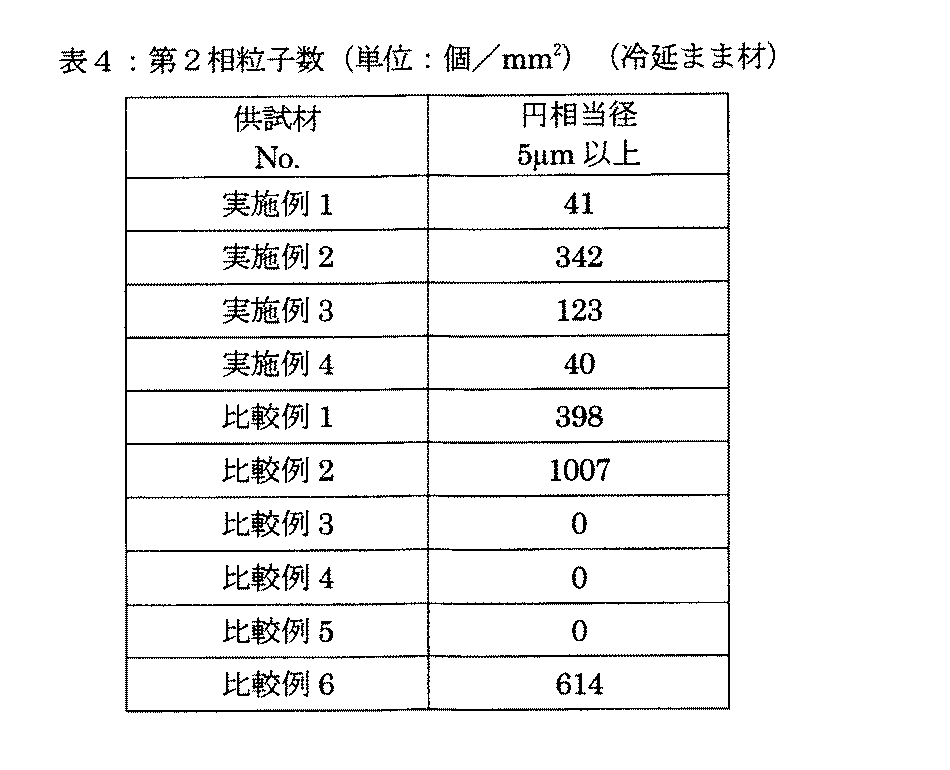
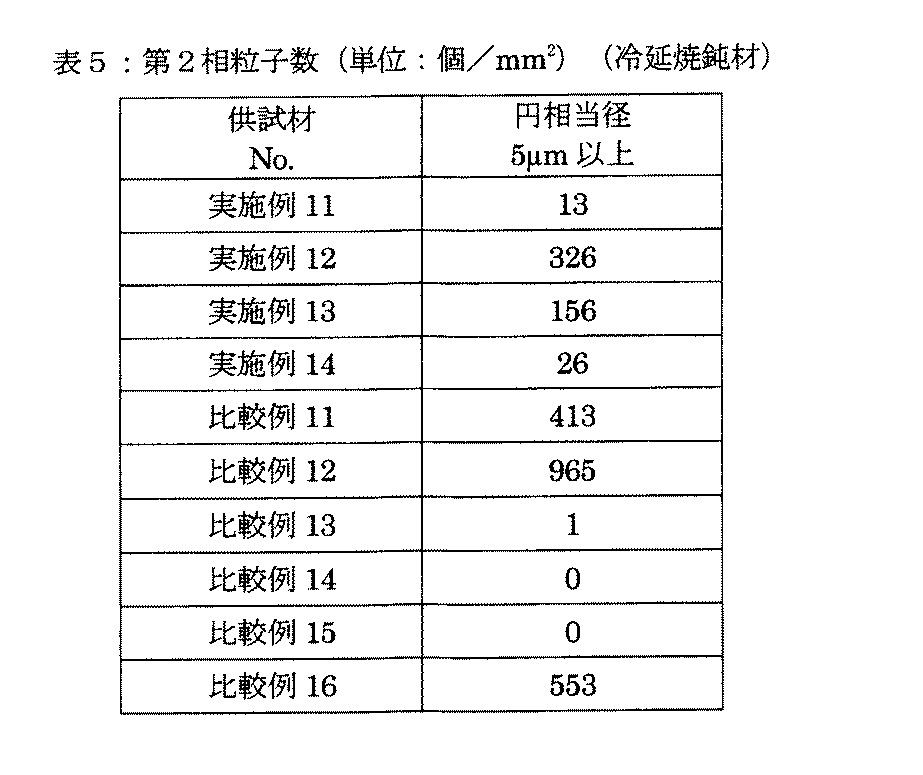
したがって、本発明において、伸びの値を5%以上とするためには、金属組織における円相当径5μm以上の第2相粒子数を500個/mm2未満とする必要があることが判る。
Claims (3)
- Fe:0.3~1.5質量%、Mn:0.3~1.0質量%、Ti:0.002~0.20質量%を含有し、Mn/Feの質量比が0.2~1.0であり、残部Alおよび不可避的不純物からなり、不可避的不純物としてのSi、Cu、MgがそれぞれSi:0.30質量%未満、Cu:0.20質量%未満、Mg:0.20質量%未満である化学組成と、円相当径5μm以上の第2相粒子数が500個/mm2未満である金属組織を有し、5%以上の伸びの値、且つ90MPa以上の引張り強度を呈する冷延まま材であることを特徴とする成形性および溶接性に優れた電池ケース用アルミニウム合金板。
- Fe:0.3~1.5質量%、Mn:0.3~1.0質量%、Ti:0.002~0.20質量%を含有し、Mn/Feの質量比が0.2~1.0であり、残部Alおよび不可避的不純物からなり、不可避的不純物としてのSi、Cu、MgがそれぞれSi:0.30質量%未満、Cu:0.20質量%未満、Mg:0.20質量%未満である化学組成と、円相当径5μm以上の第2相粒子数が500個/mm2未満である金属組織を有し、20%以上の伸びの値を呈する冷延焼鈍材であることを特徴とする成形性および溶接性に優れた電池ケース用アルミニウム合金板。
- さらに、Zr:0.05~0.20質量%を含有する請求項1または2に記載の成形性および溶接性に優れた電池ケース用アルミニウム合金板。
Priority Applications (3)
| Application Number | Priority Date | Filing Date | Title |
|---|---|---|---|
| CN201180055947.7A CN103328667B (zh) | 2011-02-02 | 2011-12-26 | 成形性和焊接性优异的电池壳体用铝合金板 |
| KR1020137019770A KR20130122651A (ko) | 2011-02-02 | 2011-12-26 | 성형성 및 용접성이 우수한 전지 케이스용 알루미늄 합금판 |
| KR1020157025504A KR20150111373A (ko) | 2011-02-02 | 2011-12-26 | 성형성 및 용접성이 우수한 전지 케이스용 알루미늄 합금판 |
Applications Claiming Priority (4)
| Application Number | Priority Date | Filing Date | Title |
|---|---|---|---|
| JP2011020900 | 2011-02-02 | ||
| JP2011-020900 | 2011-02-02 | ||
| JP2011106775A JP5725344B2 (ja) | 2011-02-02 | 2011-05-12 | 成形性、溶接性に優れた電池ケース用アルミニウム合金板 |
| JP2011-106775 | 2011-05-12 |
Publications (1)
| Publication Number | Publication Date |
|---|---|
| WO2012105144A1 true WO2012105144A1 (ja) | 2012-08-09 |
Family
ID=46602374
Family Applications (1)
| Application Number | Title | Priority Date | Filing Date |
|---|---|---|---|
| PCT/JP2011/080130 Ceased WO2012105144A1 (ja) | 2011-02-02 | 2011-12-26 | 成形性および溶接性に優れた電池ケース用アルミニウム合金板 |
Country Status (5)
| Country | Link |
|---|---|
| JP (1) | JP5725344B2 (ja) |
| KR (2) | KR20150111373A (ja) |
| CN (5) | CN103328667B (ja) |
| TW (3) | TWI509082B (ja) |
| WO (1) | WO2012105144A1 (ja) |
Cited By (6)
| Publication number | Priority date | Publication date | Assignee | Title |
|---|---|---|---|---|
| CN104838025A (zh) * | 2013-08-02 | 2015-08-12 | 日本轻金属株式会社 | 成形性、散热性和焊接性优良的电池壳体用铝合金板 |
| EP2835436A4 (en) * | 2012-10-12 | 2016-03-23 | Nippon Light Metal Co | ALUMINUM ALLOY PLATE FOR ELECTRIC CELL HOUSINGS WITH EXCELLENT FORMABILITY, HEAT DISPOSAL AND WELDABILITY |
| CN106521246A (zh) * | 2016-10-10 | 2017-03-22 | 上海华峰新材料研发科技有限公司 | 用于电池外壳铝合金防爆阀的材料及其制造方法 |
| US20210238720A1 (en) * | 2018-09-21 | 2021-08-05 | Nippon Light Metal Company, Ltd. | Aluminum alloy sheet for battery lid use for forming integrated explosion-proof valve and method of production of same |
| CN114752821A (zh) * | 2019-09-03 | 2022-07-15 | 南通恒金复合材料有限公司 | 一种动力电池壳体用铝合金带材及其制备方法 |
| CN121629286A (zh) * | 2026-02-04 | 2026-03-10 | 中南大学 | 一种基于afsd的2219铝合金高筋壁板的固溶方法 |
Families Citing this family (20)
| Publication number | Priority date | Publication date | Assignee | Title |
|---|---|---|---|---|
| JP6033141B2 (ja) | 2013-03-25 | 2016-11-30 | 株式会社神戸製鋼所 | 大型角筒電池ケース用アルミニウム合金板 |
| JP6355098B2 (ja) * | 2013-12-27 | 2018-07-11 | 三菱アルミニウム株式会社 | 熱伝導性に優れた高成形用アルミニウム合金板材およびその製造方法 |
| JP6456654B2 (ja) * | 2014-10-21 | 2019-01-23 | 三菱アルミニウム株式会社 | アルミニウム軟質箔およびその製造方法 |
| KR101629664B1 (ko) * | 2015-01-05 | 2016-06-21 | (주)케이에이치바텍 | 금속 외장 케이스의 제조방법 |
| CN105200270B (zh) * | 2015-09-21 | 2017-05-24 | 聊城万合工业制造有限公司 | 一种铝合金、微通道铝扁管及其制备方法、换热器 |
| CN105039797A (zh) * | 2015-09-22 | 2015-11-11 | 东北轻合金有限责任公司 | 一种可用于手机电池壳封口板铝合金带材的制造方法 |
| JP6087413B1 (ja) * | 2015-11-05 | 2017-03-01 | 株式会社神戸製鋼所 | レーザー溶接性に優れた自動車バスバー用アルミニウム合金板 |
| CN114156573B (zh) * | 2016-04-12 | 2025-04-01 | 大日本印刷株式会社 | 电池用包装材料、其制造方法和电池 |
| JP6780664B2 (ja) | 2017-12-05 | 2020-11-04 | 日本軽金属株式会社 | 一体型円形防爆弁成形用の電池蓋用アルミニウム合金板およびその製造方法 |
| CN108559878B (zh) * | 2018-03-08 | 2019-09-27 | 常州常发制冷科技有限公司 | 电池壳用铝合金板带及其制备方法 |
| JP6614292B1 (ja) | 2018-08-23 | 2019-12-04 | 日本軽金属株式会社 | 一体型防爆弁成形用の電池蓋用アルミニウム合金板およびその製造方法 |
| JP6614293B1 (ja) | 2018-08-23 | 2019-12-04 | 日本軽金属株式会社 | 一体型防爆弁成形用の電池蓋用アルミニウム合金板およびその製造方法 |
| JP6780680B2 (ja) | 2018-08-23 | 2020-11-04 | 日本軽金属株式会社 | 一体型防爆弁成形用の電池蓋用アルミニウム合金板およびその製造方法 |
| JP6780679B2 (ja) | 2018-08-23 | 2020-11-04 | 日本軽金属株式会社 | 一体型防爆弁成形用の電池蓋用アルミニウム合金板およびその製造方法 |
| JP6780685B2 (ja) | 2018-09-21 | 2020-11-04 | 日本軽金属株式会社 | 一体型防爆弁成形用の電池蓋用アルミニウム合金板及びその製造方法 |
| CN111263826A (zh) | 2018-10-01 | 2020-06-09 | 日本轻金属株式会社 | 一体型防爆阀成形用的电池盖用铝合金板及其制造方法 |
| CN111074110B (zh) * | 2020-01-10 | 2021-08-03 | 广西百矿润泰铝业有限公司 | 一种新能源动力电池壳用铝及铝合金板带材的生产方法 |
| CN113957295A (zh) * | 2021-10-21 | 2022-01-21 | 华北铝业有限公司 | 一种8006f空调用铝箔及其制备方法 |
| CN114182120A (zh) * | 2021-12-13 | 2022-03-15 | 桂林理工大学 | 一种变形铝铁合金及其制备方法 |
| CN114709550A (zh) * | 2022-03-31 | 2022-07-05 | 安徽力翔电池科技有限公司 | 一种高强度微晶粒一体成型安全铝壳结构 |
Citations (6)
| Publication number | Priority date | Publication date | Assignee | Title |
|---|---|---|---|---|
| JP2000336448A (ja) * | 1999-05-27 | 2000-12-05 | Furukawa Electric Co Ltd:The | 密閉型角型電池用アルミニウム合金製ケース材料および密閉型角型電池用アルミニウム合金製ケースの製造方法 |
| JP2003007260A (ja) * | 2001-06-19 | 2003-01-10 | Mitsubishi Alum Co Ltd | 二次電池ケース用アルミニウム合金板 |
| JP2007107048A (ja) * | 2005-10-13 | 2007-04-26 | Nippon Light Metal Co Ltd | 電池蓋用アルミニウム合金板 |
| JP2007262559A (ja) * | 2006-03-30 | 2007-10-11 | Sumitomo Light Metal Ind Ltd | 電池ケースフタ用アルミニウム合金板 |
| JP2008261008A (ja) * | 2007-04-12 | 2008-10-30 | Nippon Light Metal Co Ltd | 電池蓋用アルミニウム合金板及びその製造方法 |
| JP2011208230A (ja) * | 2010-03-30 | 2011-10-20 | Kobe Steel Ltd | 電池ケース用アルミニウム合金板および電池ケース |
Family Cites Families (1)
| Publication number | Priority date | Publication date | Assignee | Title |
|---|---|---|---|---|
| CN100491564C (zh) * | 2007-04-17 | 2009-05-27 | 东北轻合金有限责任公司 | 手机电池壳用的合金板带材及其制造方法 |
-
2011
- 2011-05-12 JP JP2011106775A patent/JP5725344B2/ja active Active
- 2011-12-26 CN CN201180055947.7A patent/CN103328667B/zh active Active
- 2011-12-26 CN CN201510362559.3A patent/CN105112730B/zh active Active
- 2011-12-26 CN CN201510266640.1A patent/CN105039786B/zh active Active
- 2011-12-26 KR KR1020157025504A patent/KR20150111373A/ko not_active Ceased
- 2011-12-26 WO PCT/JP2011/080130 patent/WO2012105144A1/ja not_active Ceased
- 2011-12-26 CN CN201510364737.6A patent/CN105063428B/zh active Active
- 2011-12-26 CN CN201510364739.5A patent/CN105112731B/zh active Active
- 2011-12-26 KR KR1020137019770A patent/KR20130122651A/ko not_active Ceased
-
2012
- 2012-01-20 TW TW101102540A patent/TWI509082B/zh active
- 2012-01-20 TW TW104123423A patent/TWI595097B/zh active
- 2012-01-20 TW TW103145770A patent/TWI516609B/zh active
Patent Citations (6)
| Publication number | Priority date | Publication date | Assignee | Title |
|---|---|---|---|---|
| JP2000336448A (ja) * | 1999-05-27 | 2000-12-05 | Furukawa Electric Co Ltd:The | 密閉型角型電池用アルミニウム合金製ケース材料および密閉型角型電池用アルミニウム合金製ケースの製造方法 |
| JP2003007260A (ja) * | 2001-06-19 | 2003-01-10 | Mitsubishi Alum Co Ltd | 二次電池ケース用アルミニウム合金板 |
| JP2007107048A (ja) * | 2005-10-13 | 2007-04-26 | Nippon Light Metal Co Ltd | 電池蓋用アルミニウム合金板 |
| JP2007262559A (ja) * | 2006-03-30 | 2007-10-11 | Sumitomo Light Metal Ind Ltd | 電池ケースフタ用アルミニウム合金板 |
| JP2008261008A (ja) * | 2007-04-12 | 2008-10-30 | Nippon Light Metal Co Ltd | 電池蓋用アルミニウム合金板及びその製造方法 |
| JP2011208230A (ja) * | 2010-03-30 | 2011-10-20 | Kobe Steel Ltd | 電池ケース用アルミニウム合金板および電池ケース |
Cited By (8)
| Publication number | Priority date | Publication date | Assignee | Title |
|---|---|---|---|---|
| EP2835436A4 (en) * | 2012-10-12 | 2016-03-23 | Nippon Light Metal Co | ALUMINUM ALLOY PLATE FOR ELECTRIC CELL HOUSINGS WITH EXCELLENT FORMABILITY, HEAT DISPOSAL AND WELDABILITY |
| CN107475570A (zh) * | 2012-10-12 | 2017-12-15 | 日本轻金属株式会社 | 成形性、散热性和焊接性优良的电池壳体用铝合金板 |
| US9885097B2 (en) | 2012-10-12 | 2018-02-06 | Nippon Light Metal Company, Ltd. | Aluminum alloy sheet for battery case use excellent in formability, heat dissipation, and weldability |
| CN104838025A (zh) * | 2013-08-02 | 2015-08-12 | 日本轻金属株式会社 | 成形性、散热性和焊接性优良的电池壳体用铝合金板 |
| CN106521246A (zh) * | 2016-10-10 | 2017-03-22 | 上海华峰新材料研发科技有限公司 | 用于电池外壳铝合金防爆阀的材料及其制造方法 |
| US20210238720A1 (en) * | 2018-09-21 | 2021-08-05 | Nippon Light Metal Company, Ltd. | Aluminum alloy sheet for battery lid use for forming integrated explosion-proof valve and method of production of same |
| CN114752821A (zh) * | 2019-09-03 | 2022-07-15 | 南通恒金复合材料有限公司 | 一种动力电池壳体用铝合金带材及其制备方法 |
| CN121629286A (zh) * | 2026-02-04 | 2026-03-10 | 中南大学 | 一种基于afsd的2219铝合金高筋壁板的固溶方法 |
Also Published As
| Publication number | Publication date |
|---|---|
| TWI516609B (zh) | 2016-01-11 |
| TW201514321A (zh) | 2015-04-16 |
| TW201235479A (en) | 2012-09-01 |
| CN105112730A (zh) | 2015-12-02 |
| JP5725344B2 (ja) | 2015-05-27 |
| CN105112731B (zh) | 2017-06-13 |
| CN105063428A (zh) | 2015-11-18 |
| CN103328667A (zh) | 2013-09-25 |
| CN105112730B (zh) | 2017-08-25 |
| JP2012177186A (ja) | 2012-09-13 |
| KR20130122651A (ko) | 2013-11-07 |
| CN103328667B (zh) | 2015-07-22 |
| CN105039786B (zh) | 2017-08-22 |
| TWI509082B (zh) | 2015-11-21 |
| TW201538742A (zh) | 2015-10-16 |
| CN105039786A (zh) | 2015-11-11 |
| TWI595097B (zh) | 2017-08-11 |
| CN105112731A (zh) | 2015-12-02 |
| KR20150111373A (ko) | 2015-10-05 |
| CN105063428B (zh) | 2017-08-08 |
Similar Documents
| Publication | Publication Date | Title |
|---|---|---|
| JP5725344B2 (ja) | 成形性、溶接性に優れた電池ケース用アルミニウム合金板 | |
| JP5725345B2 (ja) | 成形性、溶接性に優れた電池ケース用アルミニウム合金板 | |
| KR101900581B1 (ko) | 성형성, 방열성 및 용접성이 우수한 전지 케이스용 알루미늄 합금판 | |
| JPWO2019111970A1 (ja) | 一体型防爆弁成形用の電池蓋用アルミニウム合金板及びその製造方法 | |
| KR101585309B1 (ko) | 성형성, 용접성이 우수한 전지 케이스용 알루미늄 합금판 | |
| JP2020050889A (ja) | 一体型防爆弁成形用の電池蓋用アルミニウム合金板及びその製造方法 | |
| JP5929855B2 (ja) | 成形性、放熱性及び溶接性に優れた電池ケース用アルミニウム合金板 | |
| JP2020029599A (ja) | 一体型防爆弁成形用の電池蓋用アルミニウム合金板およびその製造方法 | |
| KR101668173B1 (ko) | 성형성, 용접성이 우수한 전지 케이스용 알루미늄 합금판 | |
| JP2020050890A (ja) | 一体型防爆弁成形用の電池蓋用アルミニウム合金板及びその製造方法 |
Legal Events
| Date | Code | Title | Description |
|---|---|---|---|
| 121 | Ep: the epo has been informed by wipo that ep was designated in this application |
Ref document number: 11857632 Country of ref document: EP Kind code of ref document: A1 |
|
| ENP | Entry into the national phase |
Ref document number: 20137019770 Country of ref document: KR Kind code of ref document: A |
|
| NENP | Non-entry into the national phase |
Ref country code: DE |
|
| WWE | Wipo information: entry into national phase |
Ref document number: 1301004273 Country of ref document: TH |
|
| 122 | Ep: pct application non-entry in european phase |
Ref document number: 11857632 Country of ref document: EP Kind code of ref document: A1 |