WO2012043782A1 - 研磨剤組成物 - Google Patents
研磨剤組成物 Download PDFInfo
- Publication number
- WO2012043782A1 WO2012043782A1 PCT/JP2011/072517 JP2011072517W WO2012043782A1 WO 2012043782 A1 WO2012043782 A1 WO 2012043782A1 JP 2011072517 W JP2011072517 W JP 2011072517W WO 2012043782 A1 WO2012043782 A1 WO 2012043782A1
- Authority
- WO
- WIPO (PCT)
- Prior art keywords
- agent
- abrasive composition
- abrasive
- scrubbing
- scrub
- Prior art date
- Legal status (The legal status is an assumption and is not a legal conclusion. Google has not performed a legal analysis and makes no representation as to the accuracy of the status listed.)
- Ceased
Links
Images


Classifications
-
- C—CHEMISTRY; METALLURGY
- C09—DYES; PAINTS; POLISHES; NATURAL RESINS; ADHESIVES; COMPOSITIONS NOT OTHERWISE PROVIDED FOR; APPLICATIONS OF MATERIALS NOT OTHERWISE PROVIDED FOR
- C09K—MATERIALS FOR MISCELLANEOUS APPLICATIONS, NOT PROVIDED FOR ELSEWHERE
- C09K3/00—Materials not provided for elsewhere
- C09K3/14—Anti-slip materials; Abrasives
- C09K3/1454—Abrasive powders, suspensions and pastes for polishing
- C09K3/1472—Non-aqueous liquid suspensions
Definitions
- the present invention relates to an abrasive composition. Specifically, the present invention relates to an abrasive composition that can maintain a state in which a scrub agent is uniformly dispersed, does not have a non-uniform scrubbing effect every time it is used, and has an excellent cleaning effect.
- the abrasive composition to be removed is used.
- This abrasive composition contains a scrubbing agent, and a good cleaning effect can be obtained even if it is stubborn dirt by scraping off the dirt adhered to the hard surface by the scrubbing agent.
- the scrub agent since the scrub agent is present in the form of particles, sedimentation of the scrub agent during storage often becomes a problem. If the scrubbing agent is taken out from the container in a state where the scrubbing agent is settled and unevenly distributed, the concentration of the scrubbing agent varies every use, and the desired scrubbing action may not be exhibited. Therefore, a technique for imparting viscosity to the abrasive composition by blending a thickener in order to uniformly disperse the scrub agent with the liquid abrasive composition is also known.
- the scrubbing agent can be stored during storage, even if the scrubbing agent can be temporarily maintained in a uniformly dispersed state by stirring at the time of use simply by blending a thickener to impart viscosity to the abrasive composition. Cannot be avoided. Therefore, in the conventional liquid abrasive composition, it is indispensable for the user to stir the abrasive composition in advance in order to suppress the variation in the scrubbing agent concentration for each use. If the abrasive composition is used without any change, it is still not possible to prevent the scrub agent concentration from being varied from use to use.
- a tube-shaped container by adjusting the pressure that pushes out the contents of a tube-shaped container, the amount used (poured-out quantity) can be easily adjusted, and the contents can be applied directly to the object, making it highly convenient. It is suitable for containing an abrasive composition.
- a tube-shaped container is not suitable for storing contents that are liable to drip or contents that need to be stirred in advance before pouring, and conventional abrasive compositions are stored in a tube-shaped container. It was not suitable for.
- the problem of the present invention is to solve the above-mentioned problems of the prior art. Specifically, the present invention provides an abrasive composition that can maintain a uniformly dispersed scrubbing agent, does not have a non-uniform scrubbing effect every use, and has an excellent cleaning effect. This is the issue.
- the present inventor has intensively studied to solve the above problems, and in the abrasive composition, selects a scrub agent having an average particle diameter of 75 ⁇ m or more, and sets the viscosity at 25 ° C. of the composition to 500 mPas or more.
- the scrub agent can be maintained in a uniformly dispersed state, and as a result, it can be found that the scrubbing action does not become uneven from use to use without stirring during use, and an excellent cleaning effect can be achieved. It was.
- an abrasive composition having the above characteristics has low fluidity, hardly causes dripping, and can be provided even when stored in a tube-shaped container.
- the present invention has been completed by further studies based on such knowledge.
- a polishing composition comprising a scrub agent having an average particle size of 75 ⁇ m or more and a viscosity at 25 ° C. of 500 mPas or more.
- Item 2. Item 2. The abrasive composition according to Item 1, wherein the viscosity at 25 ° C is 1500 mPas or more.
- Item 3. Item 3. The abrasive composition according to Item 1 or 2, wherein the viscosity at 25 ° C is 1500 mPas to 200000 mPas.
- Item 6. The abrasive composition according to any one of Items 1 to 5, wherein the scrub agent is water-soluble.
- the scrub agent is at least one selected from sodium bicarbonate and anhydrous citric acid.
- or 9 which is a cleaning agent for floors in which the flow path of water is formed by the unevenness
- Item 11 The abrasive
- the abrasive composition of the present invention can maintain a state in which the scrub agent is uniformly dispersed, the scrub agent does not disperse unevenly even when stored, and even if the scrub agent is not stirred during use, The action does not vary and a uniform cleaning effect can be maintained even after repeated use and storage.
- the abrasive composition of the present invention exhibits enhanced scrubbing action due to the scrubbing agent and has an excellent cleaning effect, so that the time and frequency of scrubbing can be reduced to remove dirt adhering to the hard surface. It can be easily removed.
- the abrasive composition of the present invention is difficult to drip and does not require stirring at the time of use, it can be accommodated in a tubular container.
- the abrasive composition of the present invention accommodated in a tube-shaped container can be easily adjusted because it can easily adjust the amount dispensed from the container and apply (attach) to the object to be cleaned. It can be provided as a product.
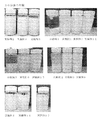
- FIG. 3 is a photograph of the appearances of Example 1-13 and Comparative Example 1-3 in Test Example 1 taken after 30 minutes from the start of standing.
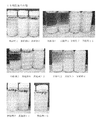
- FIG. 5 is a photograph of the appearances of Example 1-13 and Comparative Example 1-3 in Test Example 1 taken for appearance after 15 hours from standing.
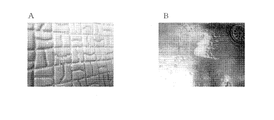
- the rugged bathroom floor surface was washed with the abrasive composition of Example 8 and then rinsed with running water (A in FIG. 3), and the abrasive composition of Example 8 It is the photograph which image
- the base B and the base G are attached on an uneven floor surface (A in FIG.
- the abrasive composition of the present invention contains a scrub agent having an average particle diameter of 75 ⁇ m or more and has a viscosity at 25 ° C. of 500 mPas or more.
- a scrub agent having an average particle diameter of 75 ⁇ m or more and has a viscosity at 25 ° C. of 500 mPas or more.
- the material is not particularly limited regardless of whether it is water-soluble or water-insoluble.
- water-soluble means that the solubility in 100 g of water at 25 ° C. is 1 g or more
- water-insoluble means that the solubility in 100 g of water at 25 ° C. is less than 1 g.
- water-soluble scrub agents include sodium bicarbonate, anhydrous citric acid, sodium carbonate, potassium sulfate, sodium triphosphate hexahydrate, sodium tetraborate. Examples include decahydrate.
- specific examples of the water-insoluble scrubbing agent include calcium carbonate, titanium oxide, aluminum oxide, aluminum hydroxide, magnesium oxide, calcium phosphate, calcium hydrogen phosphate, carbonization.
- Inorganic scrubbing agents such as silicon, silicon dioxide, chromium oxide, zeolite, silica, alumina, diatomaceous earth, clay, quartz sand, calcite and dolomite
- organic scrubbing agents such as polyethylene, polypropylene, polycarbonate and vinyl chloride
- walnut shell, pomegranate examples include plant pulverized products such as shells and sunflower seeds;
- Water-soluble scrubbing agent dissolves gradually in water during or after use, so there is an advantage that there is no worry of clogging the drain outlet when used around water in a bathroom, kitchen, washroom, etc. Further, in a floor with good drainage where water channels are formed by irregularities, the conventional abrasive composition has a problem that the scrub agent remains in the channels after cleaning. When a water-soluble scrubbing agent is used in the agent composition, there is also an advantage that the scrubbing agent hardly remains in the flow path of the floor after washing. In view of such advantages, a water-soluble scrub agent is exemplified as a suitable scrub agent.
- water-soluble scrub agents sodium bicarbonate and anhydrous citric acid are preferable, and sodium hydrogen carbonate is more preferable.
- sodium bicarbonate the washing water is changed to alkaline so that it is suitable for removing fat stains and is suitable for washing bathrooms (tubs, bathroom floors, bathroom walls, etc.).
- anhydrous citric acid the washing water is changed to acidic, so that it is suitable for removing scale dirt, and is suitable for washing around kitchens, washstands, toilets and the like.
- the scrub agent may be used alone or in combination of two or more.
- the particle size of the scrub agent used in the present invention is not particularly limited as long as the average particle size of 75 ⁇ m or more is satisfied, but the state in which the sedimentation in the abrasive composition is more effectively suppressed and dispersed uniformly. From the standpoint of maintaining, 200 ⁇ m or more is preferable, and a more specific range is 75 to 5000 ⁇ m, preferably 200 to 2000 ⁇ m.
- the scrub agent having the above particle diameter is used, an excellent scrubbing action can be exhibited, and a crisp feel can be realized at the time of scrubbing, and the usability can be improved.
- particles having a particle diameter of 75 ⁇ m or more are 30% by volume or more, preferably 50% by volume or more, and more preferably 80% by volume with respect to all particles constituting the scrub agent.
- particles having a particle diameter of 200 ⁇ m or more are 10% by volume or more, preferably 30% by volume or more, more preferably, based on all particles constituting the scrub agent. Examples of which occupy 50% by volume or more.
- the particle size of the scrub agent is measured by a laser diffraction / scattering particle size distribution analyzer.
- the average particle diameter of the scrub agent means the median diameter (d50).
- the blending ratio of the scrub agent is appropriately set according to the type of the scrub agent, the application target of the abrasive composition, etc., but usually scrubbing per total amount of the abrasive composition.
- the agent is 1 to 95% by weight, preferably 5 to 80% by weight, more preferably 25 to 75% by weight.
- the viscosity of the abrasive composition of the present invention at 25 ° C. is set to 500 mPas or more. If the viscosity at 25 ° C. is 1500 mPas or more, preferably 3000 mPas or more, the scrub agent can be more effectively suppressed and maintained in a uniformly dispersed state, and an excellent cleaning effect can be achieved. The agent composition becomes more difficult to spill and becomes more suitable for accommodation in a tube container.
- the upper limit of the viscosity is not particularly limited, and even when it comes into contact with water at the time of use, no further thickening or gelation occurs, and the scrub agent and the cleaning agent are washed. What is necessary is just to set suitably so that a target surface can be contacted favorable.
- examples of the abrasive composition of the present invention include those having a viscosity at 25 ° C. of 200000 mPas or less, preferably 100000 mPas or less, more preferably 70000 mPs or less.
- the viscosity at 25 ° C. is a value measured with a B-type viscometer (rotors M2 to M4, rotation speed 20 rpm, stirring time 100 seconds).
- the rotor is properly used according to the viscosity range. That is, the viscosity is measured using M2, when it is less than 1500 mPas, M3 when it is 1500 mPas or more and less than 10000 mPs, and M4 when it is 10000 mPas or more.
- the viscosity of the abrasive composition of the present invention is adjusted by blending an appropriate amount of a gelling agent or the like according to the type and blending ratio of blending components such as a scrub agent and a solvent.
- the gelling agent used for adjusting the viscosity is not particularly limited as long as it can be adjusted to the above viscosity range.
- (behenic acid / eicosanedioic acid) polyglyceryl -10 also known as decaglycerin fatty acid ester eicosane diacid condensate
- xanthan gum carrageenan
- agar locust bean gum
- polyvinyl alcohol polyvinyl alcohol
- gum arabic gellan gum
- gelatin carboxymethylcellulose
- carboxymethylcellulose sodium alginate, polyethylene glycol, etc.
- the blending ratio of the gelling agent in the abrasive composition of the present invention is appropriately set according to the viscosity to be set, the type of gelling agent to be used, etc., but usually the gel per total amount of the abrasive composition
- the agent is 0.01 to 30% by weight, preferably 0.1 to 30% by weight, more preferably 0.4 to 30% by weight.
- the viscosity can be adjusted by using a surfactant.
- a surfactant for example, the viscosity can be adjusted to the above range by containing a higher concentration of a higher alcohol nonionic surfactant (for example, about 50 to 99% by weight).
- the anionic surfactant and the amphoteric surfactant are combined in a weight ratio of 2: 1 to 8: 1, and the total concentration thereof is contained in an amount of about 5 to 75% by weight. It can also be adjusted.
- the abrasive composition of the present invention contains a solvent as a base for dispersing a blending component such as a scrub agent.
- the type of solvent used in the abrasive composition of the present invention is not limited.
- water monohydric alcohols such as methanol, ethanol, propanol and butanol
- many solvents such as ethylene glycol, propylene glycol and glycerin.
- monohydric alcohols examples thereof include monohydric alcohols.
- water, polyhydric alcohol, and combinations thereof are preferable, and water, glycerin, and combinations thereof are more preferable. By using these solvents, it becomes possible to more effectively exhibit the sedimentation suppressing action and scrubbing action of the scrub agent.
- the mixing ratio of the solvent in the abrasive composition of the present invention is usually 1 to 90% by weight, preferably 30 to 90% by weight, more preferably 40 to 80% by weight based on the total amount of the abrasive composition. Can be mentioned.
- the abrasive composition of the present invention may contain a surfactant in addition to the above-described blending components in order to enhance the cleaning effect.
- the surfactant used in the present invention is not particularly limited, and examples thereof include anionic surfactants, nonionic surfactants, amphoteric surfactants, and cationic surfactants.
- anionic surfactant examples include alkylbenzene sulfonic acid, alkane sulfonic acid, alkyl sulfuric acid, polyoxyalkylene alkyl phenyl ether sulfate, polyoxyalkylene alkyl ether sulfate, alkyl sulfoacetic acid, ⁇ Alkali metal salts such as glycerin monoalkyl ether- ⁇ '-sulfonic acid, ⁇ -sulfo fatty acid methyl, ⁇ -acyl- ⁇ '-sulfonyl diglyceride, N-acyl methyl taurine, fatty acid isopropanolamide sulfate, N-acyl glutamic acid ( Sodium salt, potassium salt, lithium salt, etc.).
- nonionic surfactant examples include polyoxyethylene alkyl ether, polyoxypropylene alkyl ether, polyoxyethylene polyoxypropylene alkyl ether, polyethylene glycol fatty acid ester, sorbitan fatty acid ester, and polyoxyethylene sorbitan fatty acid ester. Etc. are exemplified.
- amphoteric surfactants include alkyl dimethyl acetate betaine, alkyl dimethyl amine oxide, alkyl carboxymethyl hydroxyethyl imidazolium betaine, and alkylamidopropyl betaine.
- cationic surfactant examples include alkyltrimethylammonium salt, dialkyldimethylammonium salt, alkyltrimethylammonium salt, alkyldimethylammonium adipate, benzalkonium salt, benzethonium salt, pyridinium salt, imidazolinium salt, Examples include biguanide compounds.
- surfactants those that do not adversely affect the hardness that becomes the object to be cleaned are suitable, and from this viewpoint, when the object to be cleaned is made of plastic, preferably an amphoteric surfactant, Preferred examples include alkyldimethylaminoacetic acid betaine and alkylamidopropyl betaine.
- the blending ratio is not particularly limited.
- the surfactant is 0.1 to 80% by weight, preferably, based on the total amount of the abrasive composition. It is 0.1 to 40% by weight, more preferably 0.5 to 30% by weight.
- a chelating agent In the abrasive composition of the present invention, a chelating agent, a pH adjuster, an antifoaming agent, an antibacterial agent, an antiseptic, a fragrance, a coloring agent, an anti-oxidant, in addition to the above-described blending components, as long as the effects of the present invention are not hindered. Odorants, disinfectants, etc. may be included.
- the abrasive composition of the present invention is produced by mixing a desired amount of the above-described blending components.
- what is necessary is just to add another compounding component before the addition of a scrub agent, simultaneously with the addition of a scrub agent, or after the addition of a scrub agent when mix
- the abrasive composition of the present invention is provided by being contained in an arbitrary container.
- the abrasive composition of the present invention is difficult to drip and does not require stirring during use, and can therefore be stored in a tubular container.
- the abrasive composition of the present invention is used for cleaning dirt on hard surfaces such as bathrooms, kitchens, toilets, and washstands.
- the “hard surface” is the surface of an object holding a certain shape, specifically, glass, earthenware, plastic, metal, tile, brick, ceramics, concrete, cement, wood, etc.
- the surface of the constructed object is mentioned.
- the abrasive composition of the present invention is used as a kitchen cleaner, bathroom cleaner, floor cleaner, tableware cleaner, toilet cleaner, and the like.
- the abrasive composition of the present invention contains a water-soluble scrubbing agent, as described above, there is no fear of causing water clogging at the drain outlet when used around water, so that it can be used around kitchens and bathrooms. It is preferably used as a cleaning agent for water. Furthermore, when the abrasive composition of the present invention contains a water-soluble scrubbing agent, the scrubbing agent hardly remains in the channel after cleaning on a well-drained floor in which the channel of water is formed by unevenness. Therefore, it is suitably used as a cleaning agent for floors in which water passages are formed by unevenness, particularly as a cleaning agent for bathroom floors in which water passages are formed by unevenness.
- dirt can be removed by scrubbing the hard surface with dirt with a brush or cloth. Further, at the time of scrubbing, it is desirable that an appropriate amount of water be present on the hard surface or a brush or cloth in order to efficiently exert a scrubbing action against dirt.
- Test Example 1 Examination of dispersibility of scrub agent (1) Bases of various viscosities having the compositions shown in Table 1 were prepared, and their viscosities were measured. Next, each base and a scrub agent (sodium hydrogen carbonate, calcium carbonate, or citric acid) were mixed in the composition shown in Table 2 to prepare an abrasive composition, and their viscosities were measured.
- a scrub agent sodium hydrogen carbonate, calcium carbonate, or citric acid
- the viscosity at 25 ° C. was measured using a B-type viscometer (model number TV-10M, manufactured by Toki Sangyo Co., Ltd.) at a rotation speed of 20 rpm and a stirring time of 100 seconds. Moreover, M2 was used when the viscosity was less than 1500 mPas, M3 was used when the viscosity was 1500 mPas or more and less than 10000 mPs, and M4 was used when the viscosity was 10,000 mPas or more.
- the average particle size of the scrub agent used is 337 ⁇ m for sodium hydrogen carbonate (the proportion of particles of 75 ⁇ m or more is 100% by volume, the proportion of particles of 200 ⁇ m or more is 95% by volume or more), calcium carbonate is trade name “CFG” (manufactured by New Lime Co., Ltd .; average particle size 300-500 ⁇ m), citric acid is trade name “fuso citrate (anhydrous)” (Made by company; average particle size 700-800 ⁇ m).
- FIGS. 1-2 show photographs of the appearance of the respective abrasive compositions taken after 30 minutes and 15 hours from the start of standing.
- the scrub agent settles 30 minutes after the start of standing, and the scrub agent is contained in the abrasive composition. It became uneven.
- the abrasive composition Example 1-13
- Example 1-13 containing a scrub agent having an average particle diameter of 75 ⁇ m or more and having a viscosity at 25 ° C.
- the scrub agent settles even after 30 minutes from the start of standing.
- the scrub agent was able to maintain a uniform dispersion state in the abrasive composition.
- the abrasive composition (Example 4-13) having a viscosity at 25 ° C. of 1500 mPas or more, it was confirmed that the scrub agent could maintain a uniform dispersed state in the abrasive composition even after 15 hours.
- the appearance state was evaluated in the same manner as described above even after 48 hours from the start of standing, and no scrubbing agent settling was observed. A uniform dispersion state could be maintained.
- Test Example 2 Examination of dispersibility of scrub agent (2) Sodium bicarbonate having an average particle diameter of 90 ⁇ m (Baking soda P (manufactured by Tosoh Corporation); the proportion of particles of 75 ⁇ m or more accounts for 60% by volume and the proportion of particles of 250 ⁇ m or more accounts for 0% by volume) and the base C shown in Table 1 Were mixed at a weight ratio of 30:70 to prepare an abrasive composition (Example 14). As a result of measuring the viscosity at 25 ° C. of the abrasive composition of Example 14 under the same conditions as in Test Example 1, it was equivalent to the abrasive composition of Example 2 above.
- Table 1 shows sodium bicarbonate having an average particle size of 90 ⁇ m (sodium bicarbonate P (manufactured by Tosoh Corporation); the proportion of particles of 75 ⁇ m or more accounts for 60% by volume, and the proportion of particles of 250 ⁇ m or more accounts for 0% by volume).
- the agent D was mixed at a weight ratio of 30:70 to prepare an abrasive composition (Example 15).
- Example 15 As a result of measuring the viscosity at 25 ° C. of the abrasive composition of Example 15 under the same conditions as in Test Example 1, it was equivalent to the abrasive composition of Example 4 above.
- Table 1 shows sodium bicarbonate having an average particle diameter of 90 ⁇ m (sodium bicarbonate P (manufactured by Tosoh Corporation); the proportion of particles of 75 ⁇ m or more accounts for 50% by volume, and the proportion of particles of 250 ⁇ m or more accounts for 0% by volume).
- Agent A was mixed at a weight ratio of 30:70 to prepare an abrasive composition (Comparative Example 4).
- Comparative Example 4 As a result of measuring the viscosity at 25 ° C. of the abrasive composition of Comparative Example 4 under the same conditions as in Test Example 1, it was the same as the abrasive composition of Comparative Example 1 above.
- sodium bicarbonate having an average particle diameter of about 40 ⁇ m sodium bicarbonate C (manufactured by Tosoh Corporation); the proportion of particles of 75 ⁇ m or more occupies 0% by volume) and the base A shown in Table 1 at a weight ratio of 30:70
- An abrasive composition (Comparative Example 5) was prepared by mixing. As a result of measuring the viscosity at 25 ° C. of the abrasive composition of Comparative Example 5 under the same conditions as in Test Example 1, it was less than 500 mPas.
- the abrasive compositions of Examples 14-15 and Comparative Example 4-5 were allowed to stand indoors in the same manner as in Test Example 1 to evaluate the dispersion state of the scrub agent. As a result, the appearance properties of the abrasive composition were ⁇ in Example 14, ⁇ in Example 15, ⁇ in Comparative Example 4, and ⁇ in Comparative Example 5.
- the polishing composition of Comparative Example 5 although the viscosity at 25 ° C. was less than 500 mPas, the scrub agent did not settle even after storage, and a uniform dispersion state could be maintained. It was confirmed that a scrub agent having a small particle size does not cause a problem of sedimentation after storage. Further, in the polishing composition of Comparative Example 4, since the scrubbing agent was precipitated even after 30 minutes from the start of standing, the average particle size of the scrubbing agent was about 75 ⁇ m or more, and the viscosity at 25 ° C. was 500 mPas. If it is less than that, it was confirmed that the problem of settling of the scrub agent during storage could occur.
- an abrasive composition having a viscosity at 25 ° C. of 1500 mPas or more is particularly suitable for maintaining a uniform dispersion state of a scrub agent in which sedimentation during storage is a problem. I understood.
- Test Example 3 Evaluation of Usability and Rinsability of Abrasive Composition A bathroom in which water channels are formed by irregularities using the abrasive composition of Examples 7 and 8 prepared in Test Example 1 above. Floor and flat stainless steel surfaces were cleaned.
- the abrasive compositions of Examples 7 and 8 both exhibited excellent scrubbing action, and felt a crisp feel when rubbed, and exhibited an excellent cleaning effect.
- the abrasive compositions of Examples 14 and 15 contain a scrubbing agent having an average particle size of 90 ⁇ m and a relatively small particle size, so that the scrubbing agent dissolves in water during scrubbing, and scrubbing action is achieved. The cause is thought to be that it was not able to be used effectively.
- Reference Test Example 1 Examination of liquid dripping of abrasive composition Appropriate amount of base B (viscosity 450 mPas at 25 ° C.) and base G (viscosity 4700 mPas at 25 ° C.) prepared in Test Example 1 It was made to adhere on the surface (refer A of FIG. 4). Next, when the floor surface was tilted at an inclination angle of 35 °, dripping occurred in the base B, whereas in the base G, no dripping occurred and the liquid remained on the adhesion site on the floor surface (FIG. 4). B).
- Reference Test Example 2 Measurement of the particle size of the scrub agent in the abrasive composition About whether or not the particle size of the water-soluble scrub agent (sodium hydrogen carbonate) fluctuates before and after addition to the base.
- the particle diameter of sodium bicarbonate used as a raw material of Example 4 and sodium bicarbonate in the abrasive composition of Example 4 were measured.
- polishing agent composition of Example 4 was used for the measurement of the particle diameter of sodium hydrogencarbonate, after leaving still for 3 hours at 50 degreeC.
- sodium bicarbonate used as a raw material isopropyl alcohol was used as a dispersion medium, and for sodium bicarbonate in the abrasive composition of Example 4, a saturated aqueous solution of sodium bicarbonate was used as the dispersion medium. The measurement was performed.
- the median diameter of sodium bicarbonate used as a raw material was 337 ⁇ m
- the median diameter of sodium bicarbonate in the abrasive composition of Example 4 was 357 ⁇ m.
- polishing agent composition of Example 4 is shown in FIG. From this result, it was confirmed that sodium hydrogencarbonate was maintained almost unchanged even in the abrasive composition.
Landscapes
- Chemical & Material Sciences (AREA)
- Engineering & Computer Science (AREA)
- Materials Engineering (AREA)
- Organic Chemistry (AREA)
- Detergent Compositions (AREA)
Abstract
【課題】本発明の目的は、スクラブ剤を均一に分散させた状態を維持でき、使用毎にスクラブ作用が不均一にならず、優れた洗浄効果を奏することができる研磨剤組成物を提供することである。 【解決手段】研磨剤組成物において、平均粒子径75μm以上のスクラブ剤を選択し、且つ該組成物の25℃における粘度を500mPas以上に設定することによって、スクラブ剤を均一に分散させた状態を維持でき、その結果、使用時に撹拌せずとも使用毎にスクラブ作用が不均一にならず、しかも優れた洗浄効果を奏することができる。
Description
本発明は、研磨剤組成物に関する。詳細には、本発明は、スクラブ剤を均一に分散させた状態を維持でき、使用毎にスクラブ作用が不均一にならず、優れた洗浄効果を奏することができる研磨剤組成物に関する。
従来、台所や浴室等の硬質表面に固着した頑固な汚れは、界面活性剤を主成分とする洗浄剤では除去が困難であり、このような頑固な汚れの除去には、スクラブ作用で汚れを除去する研磨剤組成物が使用されている。この研磨剤組成物には、スクラブ剤が含まれており、スクラブ剤が硬質表面に固着した汚れを削り落とすことにより、頑固な汚れであっても良好な洗浄効果を得ることができる。
一方、液状の研磨剤組成物において、スクラブ剤は粒子状で存在するため、保存中のスクラブ剤の沈降がしばしば問題となる。スクラブ剤が沈降して不均一に分布した状態のまま容器から取り出すと、使用毎にスクラブ剤の濃度にばらつきが生じ、所望のスクラブ作用が発揮されないことがある。そこで、液状の研磨剤組成物でスクラブ剤を均一に分散させるために、増粘剤を配合することによって研磨剤組成物に粘性を付与する技術も知られている。しかしながら、単に増粘剤を配合して研磨剤組成物に粘性を付与するだけでは、使用時に撹拌することによってスクラブ剤を均一に分散した状態を一時的に維持できても、保存中にスクラブ剤が沈降するのを避けることができない。そのため、従来の液状の研磨剤組成物では、使用毎のスクラブ剤濃度のばらつきを抑制するために、使用者によって研磨剤組成物を事前に撹拌することが不可欠であり、事前に十分に撹拌せずに研磨剤組成物を使用した場合には、依然として使用毎にスクラブ剤濃度にばらつきが生じるのを防ぐことができない。
これまでに、スクラブ剤が均一に分散しているのを視認でき、斬新な外観性状を有する透明水性ゲル液体硬質表面研磨洗浄組成物が報告されている(特許文献1参照)。当該組成物では、スクラブ剤として、0.5mmより大きく2.5mmまでの平均粒子サイズであって、平均粒子サイズの±70%範囲内のものを使用することによって、スクラブ剤が均一に分散しているのを視認可能にしている。しかしながら、特許文献1の組成物でも、スクラブ剤を均一に分散させたままで長期間維持する課題については未だ解決されていない。
一方、チューブ状容器は、内容物を押し出す圧力を調節することにより、その使用量(注出量)を容易に調整でき、しかも内容物を目的物に直接塗り付けることができるので、利便性に優れ、研磨剤組成物の収容に適している。しかしながら、液だれし易い内容物や、注出前に事前に撹拌が必要な内容物の収容に対しては、チューブ状容器は不向きであり、従来の研磨剤組成物は、チューブ状容器への収容に適していなかった。
本発明の課題は、上記従来技術の問題点を解決することである。具体的には、本発明は、スクラブ剤を均一に分散させた状態を維持でき、使用毎にスクラブ作用が不均一にならず、優れた洗浄効果を奏することができる研磨剤組成物を提供することを課題とする。
本発明者は、上記課題を解決すべく鋭意検討を行ったところ、研磨剤組成物において、平均粒子径75μm以上のスクラブ剤を選択し、且つ該組成物の25℃における粘度を500mPas以上に設定することによって、スクラブ剤を均一に分散させた状態を維持でき、その結果、使用時に撹拌せずとも使用毎にスクラブ作用が不均一にならず、しかも優れた洗浄効果を奏することができることを見出した。更に、上記特性を備える研磨剤組成物は、流動性が低く、液だれを生じ難く、チューブ状容器に収容しても提供できることをも見出した。本発明は、かかる知見に基づいて更に検討を重ねることにより完成したものである。
即ち、本発明は、下記に掲げる態様の発明を提供する。
項1. 平均粒子径75μm以上のスクラブ剤を含有し、25℃における粘度が500mPas以上であることを特徴とする、研磨剤組成物。
項2. 25℃における粘度が1500mPas以上である、項1に記載の研磨剤組成物。
項3. 25℃における粘度が1500mPas~200000mPasである、項1又は2に記載の研磨剤組成物。
項4. スクラブ剤の平均粒子径が75~5000μmである、項1乃至3のいずれかに記載の研磨剤組成物。
項5. スクラブ剤の平均粒子径が200μm以上である、項1乃至4のいずれかに記載の研磨剤組成物。
項6. スクラブ剤が水溶性である、項1乃至5のいずれかに記載の研磨剤組成物。
項7. スクラブ剤が、炭酸水素ナトリウム及び無水クエン酸から選択される少なくとも1種である、項6に記載の研磨剤組成物。
項8. (ベヘン酸/エイコサン二酸)ポリグリセリル-10、及びキサンタンガムから選択される少なくとも1種のゲル化剤を含む、項1乃至7のいずれかに記載の研磨剤組成物。
項9. 水、及び多価アルコールから選択される少なくとも1種の溶媒を含む、項1乃至8のいずれかに記載の研磨剤組成物。
項10. 凹凸によって水の流路が形成されている床用の洗浄剤である、項1乃至9のいずれかに記載の研磨剤組成物。
項11. チューブ状容器に収容されている、項1乃至10のいずれかに記載の研磨剤組成物。
項1. 平均粒子径75μm以上のスクラブ剤を含有し、25℃における粘度が500mPas以上であることを特徴とする、研磨剤組成物。
項2. 25℃における粘度が1500mPas以上である、項1に記載の研磨剤組成物。
項3. 25℃における粘度が1500mPas~200000mPasである、項1又は2に記載の研磨剤組成物。
項4. スクラブ剤の平均粒子径が75~5000μmである、項1乃至3のいずれかに記載の研磨剤組成物。
項5. スクラブ剤の平均粒子径が200μm以上である、項1乃至4のいずれかに記載の研磨剤組成物。
項6. スクラブ剤が水溶性である、項1乃至5のいずれかに記載の研磨剤組成物。
項7. スクラブ剤が、炭酸水素ナトリウム及び無水クエン酸から選択される少なくとも1種である、項6に記載の研磨剤組成物。
項8. (ベヘン酸/エイコサン二酸)ポリグリセリル-10、及びキサンタンガムから選択される少なくとも1種のゲル化剤を含む、項1乃至7のいずれかに記載の研磨剤組成物。
項9. 水、及び多価アルコールから選択される少なくとも1種の溶媒を含む、項1乃至8のいずれかに記載の研磨剤組成物。
項10. 凹凸によって水の流路が形成されている床用の洗浄剤である、項1乃至9のいずれかに記載の研磨剤組成物。
項11. チューブ状容器に収容されている、項1乃至10のいずれかに記載の研磨剤組成物。
本発明の研磨剤組成物は、スクラブ剤を均一に分散させた状態を維持できるので、保存してもスクラブ剤が不均一に分散することがなく、使用時に撹拌せずとも、使用毎にスクラブ作用がばらつかず、使用と保存を繰り返しても、均質な洗浄効果を維持することができる。
また、本発明の研磨剤組成物は、スクラブ剤によるスクラブ作用が増強して発揮され、優れた洗浄効果を備えているので、擦り洗いの時間や回数を減じて、硬質表面に付着した汚れを簡便に除去することが可能になる。
更に、本発明の研磨剤組成物は、液だれし難く、使用時に撹拌の必要もないため、チューブ状容器に収容することも可能である。チューブ状容器に収容された本発明の研磨剤組成物は、容器からの注出量の調整や洗浄対象物への塗り付け(付着)を容易に行うことができるので、より利便性を高めた製品として提供が可能になる。
本発明の研磨剤組成物は、平均粒子径75μm以上のスクラブ剤を含有し、25℃における粘度が500mPas以上であることを特徴とする。以下、本発明の研磨剤組成物について詳細に説明する。
本発明の研磨剤組成物に含まれるスクラブ剤は、平均粒子径75μm以上の粒子である限り、水溶性又は非水溶性の別を問わず、その素材については特に制限されない。ここで、「水溶性」とは、25℃の水100gに対する溶解度が1g以上であり、「非水溶性」とは、25℃の水100gに対する溶解度が1g未満であることをいう。
本発明に使用されるスクラブ剤の内、水溶性スクラブ剤としては、具体的には、炭酸水素ナトリウム、無水クエン酸、炭酸ナトリウム、硫酸カリウム、三リン酸ナトリウム六水和物、四ホウ酸ナトリウム十水和物等が例示される。また、本発明に使用されるスクラブ剤の内、非水溶性スクラブ剤としては、具体的には、炭酸カルシウム、酸化チタン、酸化アルミニウム、水酸化アルミニウム、酸化マグネシウム、リン酸カルシウム、リン酸水素カルシウム、炭化ケイ素、二酸化ケイ素、酸化クロム、ゼオライト、シリカ、アルミナ、ケイソウ土、クレイ、石英砂、カルサイト、ドロマイト等の無機スクラブ剤;ポリエチレン、ポリプロピレン、ポリカーボネート、塩化ビニル等の有機スクラブ剤;クルミ殻、ザクロ殻、ひまわりの種子等の植物粉砕物;炭の粉砕物等が例示される。
水溶性スクラブ剤は、使用中又は後に水に徐々に溶解するので、浴室、台所、洗面所等の水回りでの使用時に、排水口に詰まる心配が無いという利点がある。更に、凹凸によって水の流路が形成されている、水はけの良い床では、従来の研磨剤組成物では、流路にスクラブ剤が洗浄後に残存するという問題点があったが、本発明の研磨剤組成物において、水溶性スクラブ剤を使用した場合には、洗浄後に当該床の流路にスクラブ剤が残存し難いという利点もある。このような利点に鑑みれば、好適なスクラブ剤として、水溶性スクラブ剤が例示される。
水溶性スクラブ剤の中でも、好ましくは炭酸水素ナトリウム及び無水クエン酸、更に好ましくは炭酸水素ナトリウムが例示される。特に、炭酸水素ナトリウムを使用する場合には、洗浄水をアルカリ性に変化させるので、脂汚れを除去するのに適しており、浴室(浴槽、浴室床、浴室壁等)の洗浄用として好適である。また、無水クエン酸を使用する場合には、洗浄水を酸性に変化させるので、水垢汚れを除去するのに適しており、台所周りや洗面台、便器等の洗浄用として好適である。
本発明において、スクラブ剤は、1種単独で使用してもよく、また2種以上を組み合わせて使用してもよい。
本発明に使用されるスクラブ剤の粒子径については、平均粒子径75μm以上を充足する限り特に制限されないが、研磨剤組成物中での沈降を一層有効に抑制して均一に分散させた状態を維持させるとの観点から、好ましくは200μm以上が挙げられ、より具体的な範囲としては75~5000μm、好ましくは200~2000μmが例示される。このような粒子径のスクラブ剤は、従来の研磨剤組成物中では、保存中に沈降してしまい、均一な分散状態を維持することができかったが、本発明の研磨剤組成物では、上記粒子径のスクラブ剤の課題である保存時の沈降を抑制することが可能になっている。また、上記粒子径のスクラブ剤を使用すると、優れたスクラブ作用を発揮できると共に、擦り洗い時にジャリジャリという感触を実感でき使用感を良好にすることもできる。
本発明に使用されるスクラブ剤の好適な一例として、スクラブ剤を構成する全粒子に対して、粒子径75μm以上の粒子が30体積%以上、好ましくは50体積%以上、更に好ましくは80体積%以上を占めているものが例示される。また、本発明に使用されるスクラブ剤の他の好適な一例として、スクラブ剤を構成する全粒子に対して、粒子径200μm以上の粒子が10体積%以上、好ましくは30体積%以上、更に好ましくは50体積%以上を占めているものが例示される。このような粒度分布を充足することにより、一層効果的に、スクラブ剤の沈降を抑制して均一な分散状態を維持すると共に、優れた洗浄効果を奏することが可能になる。
本発明において、スクラブ剤の粒子径は、レーザー回析散乱式粒度分布測定器によって測定される。また、本発明において、スクラブ剤の平均粒子径とは、メジアン径(d50)を意味する。
本発明の研磨剤組成物において、スクラブ剤の配合割合については、スクラブ剤の種類、研磨剤組成物の適用対象等に応じて適宜設定されるが、通常、研磨剤組成物の総量当たり、スクラブ剤が1~95重量%、好ましくは5~80重量%、更に好ましくは25~75重量%が挙げられる。
本発明の研磨剤組成物は、25℃での粘度が500mPas以上に設定される。25℃における粘度が1500mPas以上、好ましくは3000mPas以上であれば、スクラブ剤の沈降を一層有効に抑制して均一に分散させた状態を維持させ、優れた洗浄効果を奏させることができ、更に研磨剤組成物が一層液だれし難くなり、チューブ容器への収容にも一層適したものになる。
また、本発明の研磨剤組成物において、粘度の上限値は、特に制限されるものではなく、使用時に水と接触しても、更なる増粘やゲル化が生じることなく、スクラブ剤と洗浄対象表面を良好に接触できるように適宜設定すればよい。具体的には、本発明の研磨剤組成物として、25℃での粘度が200000mPas以下、好ましくは100000mPas以下、更に好ましくは70000mPs以下のものが例示される。
本発明において、25℃における粘度は、B型粘度計(ローターM2~M4、回転数20rpm、攪拌時間100秒)にて測定される値である。なお、粘度の測定において、ローターは粘度範囲に応じて使い分けられる。即ち、1500mPas未満の場合はM2、1500mPas以上10000mPs未満の場合はM3、10000mPas以上の場合はM4を使用して、上記粘度が測定される。
本発明の研磨剤組成物の粘度については、スクラブ剤や溶媒等の配合成分の種類や配合割合に応じて、ゲル化剤等を適量配合することにより調整される。
本発明の研磨剤組成物において、粘度の調整に使用されるゲル化剤は、上記粘度範囲に調整可能であることを限度として、特に制限されないが、例えば、(ベヘン酸/エイコサン二酸)ポリグリセリル-10(別名、デカグリセリン脂肪酸エステルエイコサン二酸縮合物)、キサンタンガム、カラギーナン、寒天、ローカストビーンガム、ポリビニルアルコール、アラビアガム、ジェランガム、ゼラチン、カルボキシメチルセルロース、アルギン酸ナトリウム、ポリエチレングリコール等が例示される。これらの中でも、好ましくは(ベヘン酸/エイコサン二酸)ポリグリセリル-10、及びキサンタンガムが例示される。
本発明の研磨剤組成物におけるゲル化剤の配合割合については、設定すべき粘度や使用するゲル化剤の種類等に応じて適宜設定されるが、通常、研磨剤組成物の総量当たり、ゲル化剤が0.01~30重量%、好ましくは0.1~30重量%、更に好ましくは0.4~30重量%が挙げられる。
また、本発明の研磨剤組成物において、粘度の調整には、界面活性剤を使用することによって行うこともできる。例えば、高級アルコール系非イオン性界面活性剤を高濃度(例えば、50~99重量%程度)含有させることによって、粘度を上記範囲に調整することができる。また、例えば、陰イオン性界面活性剤と両性界面活性剤を2:1~8:1の重量比で組み合わせて、これらの合計濃度として5~75重量%程度含有させることによって、粘度を上記範囲に調整することもできる。
本発明の研磨剤組成物には、スクラブ剤等の配合成分を分散させる基剤として溶媒が含まれる。本発明の研磨剤組成物に使用される溶媒としては、その種類については制限されないが、例えば、水;メタノール、エタノール、プロパノール、ブタノール等の1価アルコール;エチレングリコール、プロピレングリコール、グリセリン等の多価アルコール等が例示される。これらの溶媒の中でも、好ましくは、水、多価アルコール、及びこれらの組合せ、更に好ましくは、水、グリセリン、及びこれらの組合せが例示される。これらの溶媒を使用することによって、スクラブ剤の沈降抑制作用とスクラブ作用を一層効果的に発揮させることが可能になる。
本発明の研磨剤組成物における溶媒の配合割合としては、通常、研磨剤組成物の総量当たり、溶媒が1~90重量%、好ましくは30~90重量%、更に好ましくは40~80重量%が挙げられる。
本発明の研磨剤組成物には、上記配合成分の他に、洗浄効果を高めるために、界面活性剤を含んでいてもよい。
本発明に使用される界面活性剤としては、特に制限されないが、例えば、陰イオン性界面活性剤、非イオン性界面活性剤、両性界面活性剤、陽イオン性界面活性剤が例示される。
陰イオン性界面活性剤としては、具体的には、アルキルベンゼンスルホン酸、アルカンスルホン酸、アルキル硫酸、ポリオキシアルキレンアルキルフエニルエ一テル硫酸エステル、ポリオキシアルキレンアルキルエーテル硫酸エステル、アルキルスルホ酢酸、α-グリセリンモノアルキルエーテル-α′-スルホン酸、α-スルホ脂肪酸メチル、α-アシル-α′-スルホニルジグリセリド、N-アシルメチルタウリン、脂肪酸イソプロパノールアミド硫酸エステル、N-アシルグルタミン酸等のアルカリ金属塩(ナトリウム塩、カリウム塩、リチウム塩等)が例示される。
非イオン性界面活性剤としては、具体的には、ポリオキシエチレンアルキルエーテル、ポリオキシプロピレンアルキルエーテル、ポリオキシエチレンポリオキシプロピレンアルキルエーテル、ポリエチレングリコール脂肪酸エステル、ソルビタン脂肪酸エステル、ポリオキシエチレンソルビタン脂肪酸エステル等が例示される。
両性界面活性剤としては、具体的には、アルキルジメチル酢酸ベタイン、アルキルジメチルアミンオキシド、アルキルカルボキシメチルヒドロキシエチルイミダゾリウムベタイン、アルキルアミドプロピルベタイン等が例示される。
陽イオン性界面活性剤としては、具体的には、アルキルトリメチルアンモニウム塩、ジアルキルジメチルアンモニウム塩、アルキルトリメチルアンモニウム塩、アルキルジメチルアンモニウムアジペート、ベンザルコニウム塩、ベンゼトニウム塩、ピリジニウム塩、イミダゾリニウム塩、ビグアニド化合物等が例示される。
これらの界面活性剤の中でも、洗浄対象物となる硬質に悪影響を及ぼさないものが好適であり、かかる観点から、洗浄対象物がプラスチック製である場合には、好ましくは、両性界面活性剤、更に好ましくはアルキルジメチルアミノ酢酸ベタイン、アルキルアミドプロピルベタインが例示される。
本発明の研磨剤組成物に界面活性剤を配合する場合、その配合割合については特に制限されないが、例えば、研磨剤組成物の総量当たり、界面活性剤が0.1~80重量%、好ましくは0.1~40重量%、更に好ましくは0.5~30重量%が挙げられる。
本発明の研磨剤組成物には、本発明の効果を妨げない範囲で、前述する配合成分以外に、キレート剤、pH調整剤、消泡剤、抗菌剤、防腐剤、香料、着色料、消臭剤、除菌剤等が含まれていてもよい。
本発明の研磨剤組成物は、上記配合成分を所望量混合することにより製造される。本発明の研磨剤組成物の調製過程においてゲル化剤による塊を生じさせず、製造効率を高めるためには、先ず溶媒とゲル化剤を加温条件で混合し、次いでスクラブ剤を添加・混合するとよい。また、必要に応じて他の配合成分を配合する場合には、スクラブ剤の添加前、スクラブ剤の添加と同時、又はスクラブ剤の添加後に、他の配合成分を添加すればよい。
本発明の研磨剤組成物は、任意の容器に収容して提供される。本発明の研磨剤組成物は、液だれし難く、使用時に撹拌の必要もないため、チューブ状容器に収容することも可能である。
本発明の研磨剤組成物は、浴室、台所、便器、洗面台等の硬質表面の汚れの洗浄のために使用される。ここで、「硬質表面」とは、一定の形状を保持している物の表面であり、具体的には、ガラス、陶器、プラスチック、金属、タイル、レンガ、セラミックス、コンクリート、セメント、木材等で構成されている物の表面が挙げられる。本発明の研磨剤組成物は、具体的には、台所まわり用洗浄剤、浴室用洗浄剤、床用洗浄剤、食器用洗浄剤、トイレ用洗浄剤等として使用される。
特に、本発明の研磨剤組成物が水溶性スクラブ剤を含む場合には、前述するように、水回りでの使用時に排水口に水詰まりを生じさせる心配が無いので、台所まわりや浴室等の水回り用の洗浄剤として好適に使用される。更に、本発明の研磨剤組成物が水溶性スクラブ剤を含む場合は、凹凸によって水の流路が形成されている水はけの良い床において、洗浄後に流路にスクラブ剤が残存し難いという利点もあるので、凹凸によって水の流路が形成されている床用の洗浄剤、特に凹凸によって水の流路が形成されている浴室床用の洗浄剤として好適に使用される。
本発明の研磨剤組成物を用いて、汚れが付着した硬質表面を、ブラシ又は布等で擦り洗いすることによって汚れを除去することができる。また、擦り洗いの際には、汚れに対するスクラブ作用を効率的に発揮させるために、硬質表面、或いはブラシ又は布等に適量の水を存在させておくことが望ましい。
以下、実施例を挙げて、本発明を説明するが、本発明はこれらの実施例に限定されるものではない。
試験例1:スクラブ剤の分散性の検討(1)
表1に示す組成の各種粘度の基剤を調製し、それらの粘度を測定した。次いで、各基剤とスクラブ剤(炭酸水素ナトリウム、炭酸カルシウム、又はクエン酸)とを表2に示す組成で混合し、研磨剤組成物を調製し、それらの粘度を測定した。
試験例1:スクラブ剤の分散性の検討(1)
表1に示す組成の各種粘度の基剤を調製し、それらの粘度を測定した。次いで、各基剤とスクラブ剤(炭酸水素ナトリウム、炭酸カルシウム、又はクエン酸)とを表2に示す組成で混合し、研磨剤組成物を調製し、それらの粘度を測定した。
なお、25℃における粘度の測定は、B型粘度計(型番TV-10M、東機産業株式会社製)を用い、回転数20rpm、攪拌時間100秒にて行った。また、粘度測定時のローターは、粘度が1500mPas未満の場合はM2を、1500mPas以上10000mPs未満の場合はM3を、10000mPas以上の場合はM4を使用した。
また、使用したスクラブ剤の平均粒子径(レーザー回析式散乱粒度分布測定器にて測定)は、炭酸水素ナトリウムは337μm(75μm以上の粒子の割合が100体積%、200μm以上の粒子の割合が95体積%以上を占める)、炭酸カルシウムは商品名「CFG」(株式会社ニューライム社製;平均粒子径300~500μm)、クエン酸は商品名「クエン酸フソウ(無水)」(扶桑化学工業株式会社製;平均粒子径700~800μm)である。

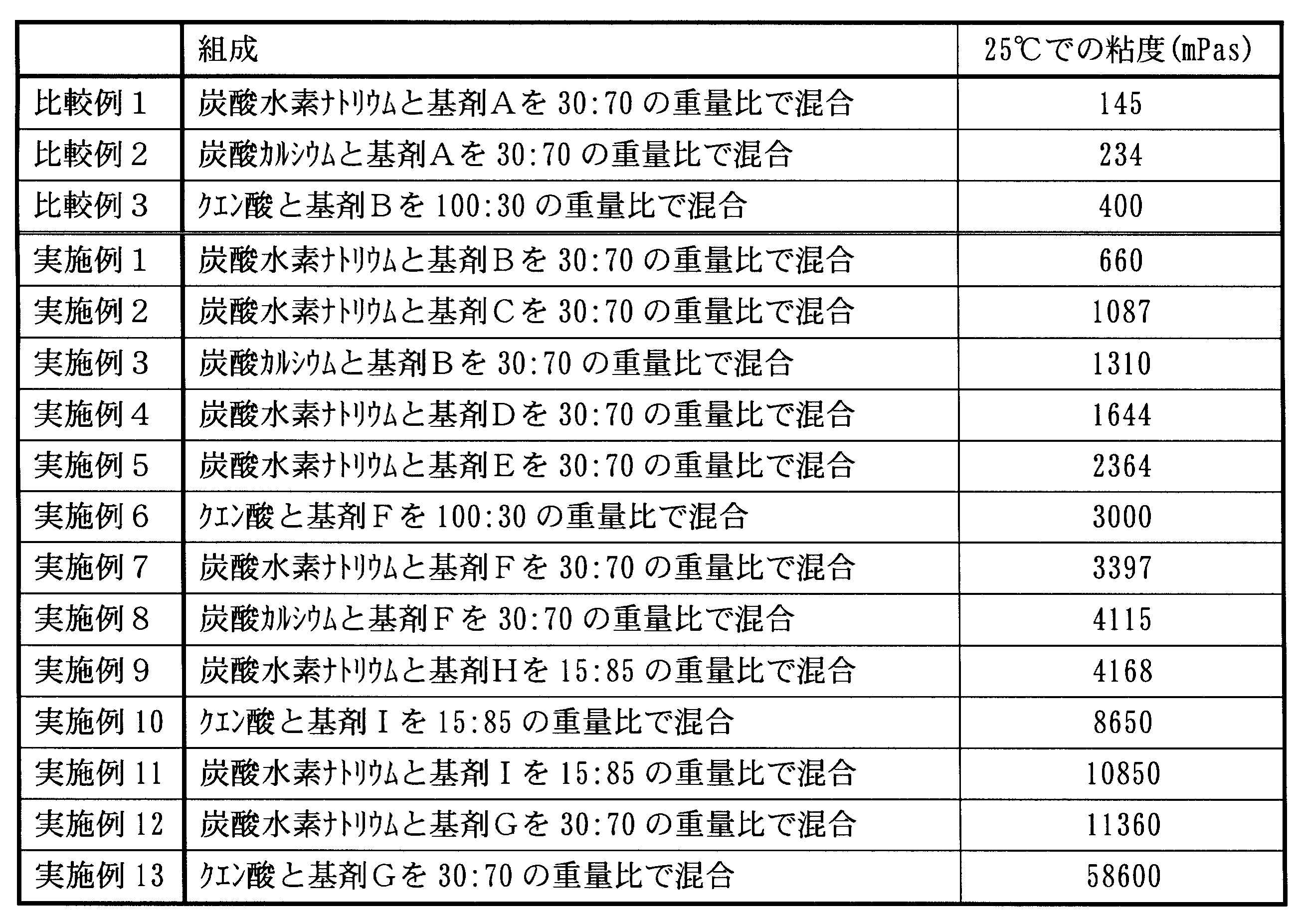
上記で得られた各研磨剤組成物50~70gを50ml容の透明ガラス容器に充填し、室温で静置した。静置開始から、30分後及び15時間後に、各研磨剤組成物の外観性状を観察し、下記の判定基準に従って、スクラブ剤の分散状態を評価した。
<判定基準>
×:30分後にスクラブ剤の沈降が認められ、スクラブ剤が不均一に分散している。
△:30分後ではスクラブ剤が均一に分散しているが、15時間後ではスクラブ剤の沈降が認められ、スクラブ剤が不均一に分散している。
○:15時間後でも、スクラブ剤の沈降は認められず、スクラブ剤が均一に分散している。
<判定基準>
×:30分後にスクラブ剤の沈降が認められ、スクラブ剤が不均一に分散している。
△:30分後ではスクラブ剤が均一に分散しているが、15時間後ではスクラブ剤の沈降が認められ、スクラブ剤が不均一に分散している。
○:15時間後でも、スクラブ剤の沈降は認められず、スクラブ剤が均一に分散している。
得られた結果を表3に示す。また、参考のために、それぞれの研磨剤組成物について、静置開始30分後及び15時間後の外観を撮影した写真を図1-2に示す。表3から明らかなように、25℃における粘度が500mPas未満の研磨剤組成物(比較例1-3)では、静置開始30分後にスクラブ剤が沈降し、研磨剤組成物中でスクラブ剤が不均一になった。これに対して、平均粒子径75μm以上のスクラブ剤を含み且つ25℃における粘度が500mPas以上の研磨剤組成物(実施例1-13)では、静置開始30分後でも、スクラブ剤が沈降せず、研磨剤組成物中でスクラブ剤が均一な分散状態を維持できていた。とりわけ、25℃における粘度が1500mPas以上の研磨剤組成物(実施例4-13)では、15時間後でも、研磨剤組成物中でスクラブ剤が均一な分散状態を維持できることが確認された。なお、実施例4-13の研磨剤組成物については、静置開始から48時間後にも上記と同様に外観状態を評価したところ、いずれも、スクラブ剤の沈降は認められず、依然としてスクラブ剤の均一な分散状態を保持できていた。

試験例2:スクラブ剤の分散性の検討(2)
平均粒子径90μmの炭酸水素ナトリウム(重曹P(東ソー株式会社製);75μm以上の粒子の割合が60体積%、250μm以上の粒子の割合が0体積%を占める)と表1に示す基剤Cを30:70の重量比で混合し研磨剤組成物(実施例14)を調製した。実施例14の研磨剤組成物の25℃での粘度を試験例1と同条件で測定した結果、上記実施例2の研磨剤組成物と同等であった。
平均粒子径90μmの炭酸水素ナトリウム(重曹P(東ソー株式会社製);75μm以上の粒子の割合が60体積%、250μm以上の粒子の割合が0体積%を占める)と表1に示す基剤Cを30:70の重量比で混合し研磨剤組成物(実施例14)を調製した。実施例14の研磨剤組成物の25℃での粘度を試験例1と同条件で測定した結果、上記実施例2の研磨剤組成物と同等であった。
また、平均粒子径90μmの炭酸水素ナトリウム(重曹P(東ソー株式会社製);75μm以上の粒子の割合が60体積%、250μm以上の粒子の割合が0体積%を占める)と表1に示す基剤Dを30:70の重量比で混合し研磨剤組成物(実施例15)を調製した。実施例15の研磨剤組成物の25℃での粘度を試験例1と同条件で測定した結果、上記実施例4の研磨剤組成物と同等であった。
また、平均粒子径90μmの炭酸水素ナトリウム(重曹P(東ソー株式会社製);75μm以上の粒子の割合が50体積%、250μm以上の粒子の割合が0体積%を占める)と表1に示す基剤Aを30:70の重量比で混合し研磨剤組成物(比較例4)を調製した。比較例4の研磨剤組成物の25℃での粘度を試験例1と同条件で測定した結果、上記比較例1の研磨剤組成物と同等であった。
更に、平均粒子径約40μmの炭酸水素ナトリウム(重曹C(東ソー株式会社製);75μm以上の粒子の割合が0体積%を占める)と表1に示す基剤Aを30:70の重量比で混合し研磨剤組成物(比較例5)を調製した。比較例5の研磨剤組成物の25℃での粘度を試験例1と同条件で測定した結果、500mPas未満であった。
実施例14-15及び比較例4-5の研磨剤組成物を上記試験例1と同様の方法で室内に静置してスクラブ剤の分散状態を評価した。この結果、研磨剤組成物の外観性状は、実施例14では△、実施例15では○、比較例4では×、比較例5では○であった。
即ち、比較例5の研磨剤組成物では、25℃の粘度が500mPas未満であるにも拘わらず、保存後でもスクラブ剤の沈降が認められず、均一な分散状態を維持できていたことから、粒子径の小さいスクラブ剤では保存後の沈降の問題が生じないことが確認された。また、比較例4の研磨剤組成物では、静置開始30分後でもスクラブ剤の沈降が認められたことから、スクラブ剤の平均粒子径が75μm程度以上であり、25℃での粘度が500mPas未満であれば、保存時のスクラブ剤の沈降の問題が生じ得ることが確認された。一方、実施例14-15の研磨剤組成物では、静置開始30分後におけるスクラブ剤の沈降が抑制されており、特に実施例15の研磨剤組成物では静置開始15時間後でもスクラブ剤の均一な分散状態を維持できていたことから、25℃における粘度が1500mPas以上の研磨剤組成物は、保存時の沈降が問題となるスクラブ剤の均一な分散状態の維持に特に適していることが分かった。
試験例3:研磨剤組成物の使用感、すすぎ性の評価
上記試験例1で調製した実施例7及び8の研磨剤組成物を使用して、凹凸によって水の流路が形成されている浴室床及び平らなステンレス面の洗浄を行った。
上記試験例1で調製した実施例7及び8の研磨剤組成物を使用して、凹凸によって水の流路が形成されている浴室床及び平らなステンレス面の洗浄を行った。
実施例7及び8の研磨剤組成物は、共に、優れたスクラブ作用が認められ、擦り洗い時にジャリジャリという感触を実感でき、優れた洗浄効果を発揮した。
一方、凹凸のある浴室床面の擦り洗い後に流水によってすすぎを行ったところ、実施例8の研磨剤組成物ではスクラブ剤(炭酸カルシウム)が床面の凹に残存し、流水だけでは十分なすすぎができなかった(図3のA参照)。また、平らなステンレス面の擦り洗い後に流水によってすすぎを1分間行っても、実施例8の研磨剤組成物ではスクラブ剤(炭酸カルシウム)を十分に洗い流すことができなかった(図3のB参照)。
これに対して、実施例7の研磨剤組成物では、凹凸のある浴室床面及び平らなステンレス面の双方共に、擦り洗い後に流水によってすすぎを行うと、スクラブ剤(炭酸水素ナトリウム)が残存することなく洗い流された。この結果から、スクラブ剤として水溶性のものを使用すると、擦り洗い後のすすぎが容易になり、凹凸のある浴室床面であっても、流水のみで簡便にすすぎを行えることが確認された。
更に、実施例14及び15の研磨剤組成物を使用して、凹凸によって水の流路が形成されている浴室床及び平らなステンレス面の洗浄を行った。この結果、実施例14及び15の研磨剤組成物では、擦り洗い開始時のスクラブ作用と、擦り洗い時のジャリジャリという感触は、実施例7程ではないものの認められたが、擦り洗いの時間の経過に伴って、スクラブ作用が弱まり、擦り洗い時にジャリジャリという感触を実感できなくなった。これは、実施例14及び15の研磨剤組成物では、平均粒子径が90μmの比較的粒子径の小さなスクラブ剤を配合しているため、擦り洗い時にスクラブ剤が水に溶解し、スクラブ作用を有効に発揮できなくなったことが原因と考えられる。
この結果から、スクラブ作用をより有効に発揮させるという観点からは、水溶性スクラブ剤を使用する場合は、平均粒子径が200μm以上のものが適していることが明らかとなった。
参考試験例1:研磨剤組成物の液だれの検討
試験例1で調製した基剤B(25℃での粘度450mPas)と基剤G(25℃での粘度4700mPas)の適量を凹凸のある床面上に付着させた(図4のA参照)。次いで、当該床面を傾斜角35°に傾斜させると、基剤Bでは液だれが生じたのに対して、基剤Gでは液だれせず床面上の付着部位に止まっていた(図4のB)。更に、当該床面を傾斜角35°に傾斜させた状態で、基剤B及び基剤Gを付着させた部位に流水を行ったところ、基剤Bは流れ落ちてしまったが、基剤Gでは床面上の付着部位に止まっていた(図4のC参照)。
試験例1で調製した基剤B(25℃での粘度450mPas)と基剤G(25℃での粘度4700mPas)の適量を凹凸のある床面上に付着させた(図4のA参照)。次いで、当該床面を傾斜角35°に傾斜させると、基剤Bでは液だれが生じたのに対して、基剤Gでは液だれせず床面上の付着部位に止まっていた(図4のB)。更に、当該床面を傾斜角35°に傾斜させた状態で、基剤B及び基剤Gを付着させた部位に流水を行ったところ、基剤Bは流れ落ちてしまったが、基剤Gでは床面上の付着部位に止まっていた(図4のC参照)。
この試験結果から、高粘度の組成物は、液だれが生じ難く、目的部位に的確に付着できることが確認された。この試験は、スクラブ剤が配合されていない基剤を用いて液だれを評価したものであるが、本結果から、高粘性を備える本発明の研磨剤組成物でも、液だれが生じにくく、洗浄対象物への塗り付けを的確に行えることが明らかとなった。
参考試験例2:研磨剤組成物中のスクラブ剤の粒子径の測定
水溶性のスクラブ剤(炭酸水素ナトリウム)について、基剤への添加前後で、その粒子径に変動が生じているか否かを確認するために、実施例4の原料として使用した炭酸水素ナトリウムと、実施例4の研磨剤組成物中の炭酸水素ナトリウムについて粒子径の測定を行った。なお、実施例4の研磨剤組成物は、調製直後に、50℃で3時間静置した後に、炭酸水素ナトリウムの粒子径の測定に供した。なお、粒子径は、レーザー回析式散乱粒度分布測定器(LMS-2000e、湿式ユニット2000S(A);株式会社セイシン企業社製)を用いた。また、原料として使用した炭酸水素ナトリウムについては、イソプロピルアルコールを分散媒体として使用し、実施例4の研磨剤組成物中の炭酸水素ナトリウムについては、炭酸水素ナトリウムの飽和水溶液を分散媒体として使用して、測定を行った。
水溶性のスクラブ剤(炭酸水素ナトリウム)について、基剤への添加前後で、その粒子径に変動が生じているか否かを確認するために、実施例4の原料として使用した炭酸水素ナトリウムと、実施例4の研磨剤組成物中の炭酸水素ナトリウムについて粒子径の測定を行った。なお、実施例4の研磨剤組成物は、調製直後に、50℃で3時間静置した後に、炭酸水素ナトリウムの粒子径の測定に供した。なお、粒子径は、レーザー回析式散乱粒度分布測定器(LMS-2000e、湿式ユニット2000S(A);株式会社セイシン企業社製)を用いた。また、原料として使用した炭酸水素ナトリウムについては、イソプロピルアルコールを分散媒体として使用し、実施例4の研磨剤組成物中の炭酸水素ナトリウムについては、炭酸水素ナトリウムの飽和水溶液を分散媒体として使用して、測定を行った。
この結果、原料として使用した炭酸水素ナトリウムのメジアン径は337μm、実施例4の研磨剤組成物中の炭酸水素ナトリウムのメジアン径は357μmであった。また、原料として使用した炭酸水素ナトリウムと、実施例4の研磨剤組成物中の炭酸水素ナトリウムの粒度分布を図5に示す。この結果から、研磨剤組成物中でも炭酸水素ナトリウムは殆ど変化することなく維持されていることが確認された。
Claims (11)
- 平均粒子径75μm以上のスクラブ剤を含有し、25℃における粘度が500mPas以上であることを特徴とする、研磨剤組成物。
- 25℃における粘度が1500mPas以上である、請求項1に記載の研磨剤組成物。
- 25℃における粘度が1500mPas~200000mPasである、請求項1又は2に記載の研磨剤組成物。
- スクラブ剤の平均粒子径が75~5000μmである、請求項1乃至3のいずれかに記載の研磨剤組成物。
- スクラブ剤の平均粒子径が200μm以上である、請求項1乃至4のいずれかに記載の研磨剤組成物。
- スクラブ剤が水溶性である、請求項1乃至5のいずれかに記載の研磨剤組成物。
- スクラブ剤が、炭酸水素ナトリウム及び無水クエン酸から選択される少なくとも1種である、請求項6に記載の研磨剤組成物。
- (ベヘン酸/エイコサン二酸)ポリグリセリル-10、及びキサンタンガムから選択される少なくとも1種のゲル化剤を含む、請求項1乃至7のいずれかに記載の研磨剤組成物。
- 水、及び多価アルコールから選択される少なくとも1種の溶媒を含む、請求項1乃至8のいずれかに記載の研磨剤組成物。
- 凹凸によって水の流路が形成されている床用の洗浄剤である、請求項1乃至9のいずれかに記載の研磨剤組成物。
- チューブ状容器に収容されている、請求項1乃至10のいずれかに記載の研磨剤組成物。
Applications Claiming Priority (2)
| Application Number | Priority Date | Filing Date | Title |
|---|---|---|---|
| JP2010-222882 | 2010-09-30 | ||
| JP2010222882A JP6091045B2 (ja) | 2010-09-30 | 2010-09-30 | 研磨剤組成物 |
Publications (1)
| Publication Number | Publication Date |
|---|---|
| WO2012043782A1 true WO2012043782A1 (ja) | 2012-04-05 |
Family
ID=45893219
Family Applications (1)
| Application Number | Title | Priority Date | Filing Date |
|---|---|---|---|
| PCT/JP2011/072517 Ceased WO2012043782A1 (ja) | 2010-09-30 | 2011-09-30 | 研磨剤組成物 |
Country Status (2)
| Country | Link |
|---|---|
| JP (1) | JP6091045B2 (ja) |
| WO (1) | WO2012043782A1 (ja) |
Citations (8)
| Publication number | Priority date | Publication date | Assignee | Title |
|---|---|---|---|---|
| JPH05112800A (ja) * | 1991-10-22 | 1993-05-07 | Dainippon Jochugiku Co Ltd | 研磨性ペースト状洗剤 |
| JP2004083569A (ja) * | 2002-07-05 | 2004-03-18 | Suzuki Yushi Kogyo Kk | 鉱物油、動植物油および塗料などによる汚れ用洗浄剤 |
| JP2004514026A (ja) * | 2000-11-03 | 2004-05-13 | ユニリーバー・ナームローゼ・ベンノートシヤープ | 硬質表面を洗浄するための組成物 |
| JP2006070215A (ja) * | 2004-09-03 | 2006-03-16 | Dai Ichi Kogyo Seiyaku Co Ltd | 洗浄剤組成物 |
| JP2006193733A (ja) * | 2004-12-16 | 2006-07-27 | Lion Corp | 無機系研磨剤含有液体洗浄剤組成物 |
| JP2006219465A (ja) * | 2005-02-08 | 2006-08-24 | Estate Chemical Kk | 化粧料 |
| JP2010121097A (ja) * | 2008-11-21 | 2010-06-03 | Asahipen Corp | クレンザー組成物 |
| WO2010100887A1 (ja) * | 2009-03-03 | 2010-09-10 | 日清オイリオグループ株式会社 | 化粧料、その製造方法、化粧料用組成物、前記化粧料用組成物を含む化粧料とその製造方法、及び工業用クレンザー |
Family Cites Families (2)
| Publication number | Priority date | Publication date | Assignee | Title |
|---|---|---|---|---|
| JP2003212753A (ja) * | 2002-01-23 | 2003-07-30 | Asahi Glass Co Ltd | スクラブ性洗浄剤組成物 |
| KR20090048518A (ko) * | 2006-08-30 | 2009-05-13 | 생-고뱅 세라믹스 앤드 플라스틱스, 인코포레이티드 | 농축된 연마재 슬러리 조성물, 이의 제조방법 및 이의 사용방법 |
-
2010
- 2010-09-30 JP JP2010222882A patent/JP6091045B2/ja active Active
-
2011
- 2011-09-30 WO PCT/JP2011/072517 patent/WO2012043782A1/ja not_active Ceased
Patent Citations (8)
| Publication number | Priority date | Publication date | Assignee | Title |
|---|---|---|---|---|
| JPH05112800A (ja) * | 1991-10-22 | 1993-05-07 | Dainippon Jochugiku Co Ltd | 研磨性ペースト状洗剤 |
| JP2004514026A (ja) * | 2000-11-03 | 2004-05-13 | ユニリーバー・ナームローゼ・ベンノートシヤープ | 硬質表面を洗浄するための組成物 |
| JP2004083569A (ja) * | 2002-07-05 | 2004-03-18 | Suzuki Yushi Kogyo Kk | 鉱物油、動植物油および塗料などによる汚れ用洗浄剤 |
| JP2006070215A (ja) * | 2004-09-03 | 2006-03-16 | Dai Ichi Kogyo Seiyaku Co Ltd | 洗浄剤組成物 |
| JP2006193733A (ja) * | 2004-12-16 | 2006-07-27 | Lion Corp | 無機系研磨剤含有液体洗浄剤組成物 |
| JP2006219465A (ja) * | 2005-02-08 | 2006-08-24 | Estate Chemical Kk | 化粧料 |
| JP2010121097A (ja) * | 2008-11-21 | 2010-06-03 | Asahipen Corp | クレンザー組成物 |
| WO2010100887A1 (ja) * | 2009-03-03 | 2010-09-10 | 日清オイリオグループ株式会社 | 化粧料、その製造方法、化粧料用組成物、前記化粧料用組成物を含む化粧料とその製造方法、及び工業用クレンザー |
Also Published As
| Publication number | Publication date |
|---|---|
| JP2012077173A (ja) | 2012-04-19 |
| JP6091045B2 (ja) | 2017-03-08 |
Similar Documents
| Publication | Publication Date | Title |
|---|---|---|
| JP5628982B2 (ja) | 改善されたグリース洗浄用液体洗剤組成物 | |
| JP6141874B2 (ja) | 粘着性の高粘度洗浄組成物 | |
| ES2795980T3 (es) | Limpiadores de superficies duras | |
| JP2022088493A (ja) | 洗浄組成物 | |
| BR112014030737B1 (pt) | Composições detergentes autoadesivas com sistemas de mudança de cor | |
| CN101191105B (zh) | 地板清洁水用助剂 | |
| CN109055031B (zh) | 一种具有抗结膜和成斑效果的自动洗碗机专用洗涤剂组合物 | |
| JP2009503132A (ja) | 洗浄組成物 | |
| JP5555182B2 (ja) | 液体洗剤組成物 | |
| JP6091045B2 (ja) | 研磨剤組成物 | |
| TWI235762B (en) | Liquid detergent composition | |
| CN105695130B (zh) | 一种洁具无痕中性清洁膏及其制备方法 | |
| EP2316914B1 (en) | Adhesive detergent composition | |
| JP2015131941A (ja) | 食器洗浄機用液体洗浄剤組成物 | |
| CA2597897A1 (en) | Cleaning compositions that provide grease removal and fragrance delivery | |
| CN108865471B (zh) | 一种具有防蚀效果的自动洗碗机专用洗涤剂组合物 | |
| CN108291174A (zh) | 硬表面清洁组合物 | |
| CN108026478B (zh) | 水性硬表面清洁组合物 | |
| JPH01261500A (ja) | 洗剤組成物 | |
| JP6937358B2 (ja) | 硬質表面の洗浄方法 | |
| CN110199012B (zh) | 水性硬表面清洁组合物 | |
| JP2021195554A (ja) | 硬質表面用洗浄剤組成物 | |
| WO2021251484A1 (ja) | 硬質表面用洗浄剤組成物 | |
| JP5702451B2 (ja) | 硬質表面用液体洗浄剤組成物 | |
| JP3635221B2 (ja) | 洗浄剤 |
Legal Events
| Date | Code | Title | Description |
|---|---|---|---|
| 121 | Ep: the epo has been informed by wipo that ep was designated in this application |
Ref document number: 11829335 Country of ref document: EP Kind code of ref document: A1 |
|
| NENP | Non-entry into the national phase |
Ref country code: DE |
|
| 122 | Ep: pct application non-entry in european phase |
Ref document number: 11829335 Country of ref document: EP Kind code of ref document: A1 |