WO2012033089A1 - 非水電解液電池 - Google Patents
非水電解液電池 Download PDFInfo
- Publication number
- WO2012033089A1 WO2012033089A1 PCT/JP2011/070255 JP2011070255W WO2012033089A1 WO 2012033089 A1 WO2012033089 A1 WO 2012033089A1 JP 2011070255 W JP2011070255 W JP 2011070255W WO 2012033089 A1 WO2012033089 A1 WO 2012033089A1
- Authority
- WO
- WIPO (PCT)
- Prior art keywords
- aqueous electrolyte
- battery
- phosphazene compound
- flame retardant
- electrolyte battery
- Prior art date
- Legal status (The legal status is an assumption and is not a legal conclusion. Google has not performed a legal analysis and makes no representation as to the accuracy of the status listed.)
- Ceased
Links
Images



Classifications
-
- H—ELECTRICITY
- H01—ELECTRIC ELEMENTS
- H01M—PROCESSES OR MEANS, e.g. BATTERIES, FOR THE DIRECT CONVERSION OF CHEMICAL ENERGY INTO ELECTRICAL ENERGY
- H01M10/00—Secondary cells; Manufacture thereof
- H01M10/05—Accumulators with non-aqueous electrolyte
- H01M10/056—Accumulators with non-aqueous electrolyte characterised by the materials used as electrolytes, e.g. mixed inorganic/organic electrolytes
-
- H—ELECTRICITY
- H01—ELECTRIC ELEMENTS
- H01M—PROCESSES OR MEANS, e.g. BATTERIES, FOR THE DIRECT CONVERSION OF CHEMICAL ENERGY INTO ELECTRICAL ENERGY
- H01M10/00—Secondary cells; Manufacture thereof
- H01M10/05—Accumulators with non-aqueous electrolyte
- H01M10/056—Accumulators with non-aqueous electrolyte characterised by the materials used as electrolytes, e.g. mixed inorganic/organic electrolytes
- H01M10/0564—Accumulators with non-aqueous electrolyte characterised by the materials used as electrolytes, e.g. mixed inorganic/organic electrolytes the electrolyte being constituted of organic materials only
- H01M10/0566—Liquid materials
- H01M10/0567—Liquid materials characterised by the additives
-
- H—ELECTRICITY
- H01—ELECTRIC ELEMENTS
- H01M—PROCESSES OR MEANS, e.g. BATTERIES, FOR THE DIRECT CONVERSION OF CHEMICAL ENERGY INTO ELECTRICAL ENERGY
- H01M10/00—Secondary cells; Manufacture thereof
- H01M10/05—Accumulators with non-aqueous electrolyte
- H01M10/052—Li-accumulators
-
- H—ELECTRICITY
- H01—ELECTRIC ELEMENTS
- H01M—PROCESSES OR MEANS, e.g. BATTERIES, FOR THE DIRECT CONVERSION OF CHEMICAL ENERGY INTO ELECTRICAL ENERGY
- H01M10/00—Secondary cells; Manufacture thereof
- H01M10/42—Methods or arrangements for servicing or maintenance of secondary cells or secondary half-cells
- H01M10/4235—Safety or regulating additives or arrangements in electrodes, separators or electrolyte
-
- H—ELECTRICITY
- H01—ELECTRIC ELEMENTS
- H01M—PROCESSES OR MEANS, e.g. BATTERIES, FOR THE DIRECT CONVERSION OF CHEMICAL ENERGY INTO ELECTRICAL ENERGY
- H01M50/00—Constructional details or processes of manufacture of the non-active parts of electrochemical cells other than fuel cells, e.g. hybrid cells
- H01M50/30—Arrangements for facilitating escape of gases
- H01M50/383—Flame arresting or ignition-preventing means
-
- H—ELECTRICITY
- H01—ELECTRIC ELEMENTS
- H01M—PROCESSES OR MEANS, e.g. BATTERIES, FOR THE DIRECT CONVERSION OF CHEMICAL ENERGY INTO ELECTRICAL ENERGY
- H01M50/00—Constructional details or processes of manufacture of the non-active parts of electrochemical cells other than fuel cells, e.g. hybrid cells
- H01M50/30—Arrangements for facilitating escape of gases
- H01M50/394—Gas-pervious parts or elements
-
- Y—GENERAL TAGGING OF NEW TECHNOLOGICAL DEVELOPMENTS; GENERAL TAGGING OF CROSS-SECTIONAL TECHNOLOGIES SPANNING OVER SEVERAL SECTIONS OF THE IPC; TECHNICAL SUBJECTS COVERED BY FORMER USPC CROSS-REFERENCE ART COLLECTIONS [XRACs] AND DIGESTS
- Y02—TECHNOLOGIES OR APPLICATIONS FOR MITIGATION OR ADAPTATION AGAINST CLIMATE CHANGE
- Y02E—REDUCTION OF GREENHOUSE GAS [GHG] EMISSIONS, RELATED TO ENERGY GENERATION, TRANSMISSION OR DISTRIBUTION
- Y02E60/00—Enabling technologies; Technologies with a potential or indirect contribution to GHG emissions mitigation
- Y02E60/10—Energy storage using batteries
Definitions
- the present invention relates to a non-aqueous electrolyte battery in which a flame retardant is added to a non-aqueous electrolyte.
- Non-aqueous electrolyte batteries using non-aqueous electrolytes such as lithium ion secondary batteries have high voltage, high energy density, and can be reduced in size and weight, so power supplies for information terminals such as personal computers and mobile phones It is widely spread around the world.
- a solution in which a supporting salt such as LiPF 6 is dissolved in an aprotic organic solvent such as an ester compound and an ether compound is used.
- the aprotic organic solvent is flammable, there is a problem that the battery ignites or expands when the battery is abnormally heated. Therefore, in the field of such a non-aqueous electrolyte battery, it is required to manufacture a highly safe non-aqueous electrolyte battery by suppressing ignition or rupture of the battery.
- Patent Documents 1 to 5 disclose a technique for suppressing ignition or rupture of a battery by adding a flame retardant material to the non-aqueous electrolyte as a technique for improving the safety of the non-aqueous electrolyte battery.
- phosphazene compounds are used as flame retardants.
- JP-A-6-13108 Japanese Patent Laid-Open No. 11-144757 JP 2000-30740 A Japanese Patent Laid-Open No. 2001-23687 JP 2000-173619 A
- a phosphazene compound used in a conventional non-aqueous electrolyte battery has a chemical structure containing a lot of halogen elements (particularly fluorine) in order to impart high flame retardancy to the non-aqueous electrolyte. Therefore, all of these phosphazene compounds are low in boiling point and liquid at room temperature because of their chemical structures.
- the liquid flame retardant volatilizes from the non-aqueous electrolyte, and the amount of the flame retardant present in the non-aqueous electrolyte decreases. There is a problem that the flame retardant effect is reduced.
- the negative electrode surface is coated with a flame retardant comprising a phosphazene monomer as in the technique disclosed in Patent Document 5
- a liquid phosphazene compound is vaporized when the temperature rises, and is formed on the negative electrode surface.
- the film of the flame retardant has a problem that the ion permeability is deteriorated, the internal resistance of the battery is increased, and the battery characteristics are deteriorated.
- An object of the present invention is to provide a non-aqueous electrolyte battery that can prevent ignition or rupture of a battery without deteriorating battery characteristics.
- Another object of the present invention is to provide a non-aqueous electrolyte battery that can reliably exhibit flame retardancy with respect to the non-aqueous electrolyte during abnormal heat generation of the battery.
- Still another object of the present invention is to provide a non-aqueous electrolyte battery in which a sufficient amount of a flame retardant can be added to the non-aqueous electrolyte to make the non-aqueous electrolyte flame-retardant. .
- the present invention is intended to improve a non-aqueous electrolyte battery in which a flame retardant that suppresses combustion of the non-aqueous electrolyte due to temperature rise inside the battery is added to the non-aqueous electrolyte.
- a flame retardant that suppresses combustion of the non-aqueous electrolyte due to temperature rise inside the battery is added to the non-aqueous electrolyte.
- a large number of flame retardant particles are added to the non-aqueous electrolyte as a flame retardant.
- This flame retardant particle is present as a solid at a temperature below the reference temperature at which the non-aqueous electrolyte is likely to ignite and does not exhibit a combustion suppressing function.
- the flame retardant particles used in the present invention may exist as a solid in the non-aqueous electrolyte when the battery is normal (when it is not necessary to exhibit the function of suppressing ignition of the non-aqueous electrolyte).
- the non-aqueous electrolyte when it is normal (when it is not necessary to exhibit the function of suppressing ignition of the non-aqueous electrolyte).
- at least a part of the non-aqueous electrolyte exists as a liquid.
- the solid flame retardant particles do not dissolve (or disperse) in the non-aqueous electrolyte battery at normal times when the temperature rise inside the battery is small, non-aqueous electrolysis is performed when the battery is normal or in the use environment.
- the viscosity of the liquid does not increase, and there is no problem that the battery characteristics deteriorate. If the temperature inside the battery rises to such an extent that the nonaqueous electrolyte ignites, all or part of the flame retardant particles become liquid and dissolve (or disperse) in the nonaqueous electrolyte battery. Exhibits the function of suppressing ignition of non-aqueous electrolyte during heat generation.
- the present invention only a part of the flame retardant particles is liquefied due to the temperature rise inside the battery (because the flame retardant particles that have not been liquefied remain in the non-aqueous electrolyte as a solid) Immediately after this, all the flame retardant does not volatilize (or vaporize) from the non-aqueous electrolyte. Therefore, a flame retardant in an amount necessary for suppressing ignition of the non-aqueous electrolyte can be present in the non-aqueous electrolyte during abnormal battery heat generation.
- the flame retardant particles used in the present invention are preferably those that exist as a solid in the non-aqueous electrolyte when the internal temperature of the non-aqueous electrolyte battery is 90 ° C. or lower. This is because a non-aqueous electrolyte that ignites at 90 ° C. or lower is never used. Further, as the flame retardant particles, those having a melting point in the range of 90 to 120 ° C. are preferably used.
- the thermal decomposition temperature of the nonaqueous electrolyte generally used is about 150 ° C. higher than 120 ° C.
- the melting point of the flame retardant particles is 90 to 120 ° C.
- many of the flame retardant particles are liquefied before the temperature of the non-aqueous electrolyte reaches the thermal decomposition temperature, thereby exhibiting an ignition suppression function. It becomes a state.
- phosphazene compound particles are preferably used.
- the phosphazene compound has a property of capturing (trapping) oxygen (for example, oxygen radicals released at the positive electrode when the battery is abnormally heated) due to its structure. By utilizing this property, the thermal runaway reaction of the battery can be suppressed by adding the phosphazene compound particles to the non-aqueous electrolyte.
- a cyclic phosphazene compound represented by the following general formula (I) can be used as a phosphazene compound suitable for use in the present invention.
- n is an integer of 3 or 4, and each R is independently composed of a halogen, an alkoxy group, an aryloxy group or an amino group. It is preferable to use a cyclic phosphazene compound.
- a compound in which n is an integer of 3, four of R are chloro groups, and the remaining two are aminomethyl groups can be used.
- those in which n is an integer of 3 and all R are phenoxy groups can be used.
- phosphazene compound When the above phosphazene compound is used, it is preferable to add 3.5% by weight or more of phosphazene compound particles to 100% by weight of the non-aqueous electrolyte.
- addition amount of the phosphazene compound is less than 3.5% by weight with respect to 100% by weight of the non-aqueous electrolyte, combustion of the non-aqueous electrolyte cannot be sufficiently suppressed.
- the upper limit of the amount of phosphazene compound added is determined according to the required battery characteristics and price.
- the addition amount of the phosphazene compound is 100% by weight of the non-aqueous electrolyte. It is preferably less than 14.0% by weight.
- phosphazene compound particles having an average particle size of 20 ⁇ m or less it is preferable to use.
- the phosphazene compound having an average particle size of 20 ⁇ m or less has a higher rate of change from solid to liquid (the rate of liquefaction) when the internal temperature of the nonaqueous electrolyte battery increases.
- the rate of liquefaction of the phosphazene compound (flame retardant) proceeds faster, the speed at which the liquefied phosphazene compound (flame retardant) dissolves or disperses in the non-aqueous electrolyte also increases.
- a phosphazene compound having an average particle diameter exceeding 20 ⁇ m has a low rate of change from solid to liquid (liquefaction rate) when the internal temperature of the nonaqueous electrolyte battery increases.
- the lower limit of the average particle diameter of the phosphazene compound particles is not particularly limited. However, under the present circumstances, since it is practically difficult to produce phosphazene compound particles having an average particle size of less than 5 ⁇ m, the lower limit of the average particle size of the phosphazene compound particles can be set to 5 ⁇ m.
- (A) is the schematic which showed the inside of the lithium ion secondary battery used as a nonaqueous electrolyte battery of this invention in the state seen through
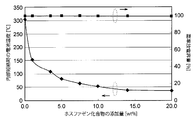
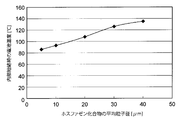
- (B) is the IB-IB sectional view taken on the line of (A). It is a figure which shows the relationship between the addition amount of the phosphazene compound at the time of the internal short circuit of the nonaqueous electrolyte battery of this invention, the flame retardance of a battery, and a battery characteristic. It is a figure which shows the relationship between the addition amount of the other phosphazene compound at the time of the internal short circuit of the nonaqueous electrolyte battery of this invention, and the flame retardance of a battery.
- FIG. 1 (A) is a schematic diagram showing the inside of a lithium ion secondary battery as an embodiment of the nonaqueous electrolyte battery of the present invention in a transparent state
- FIG. 2 is a cross-sectional view taken along line IB-IB in FIG.
- the lithium ion secondary battery 1 includes a positive electrode plate 3 including a positive electrode lead terminal 3a, a negative electrode plate 5 including a negative electrode lead terminal 5a, a separator 7 disposed between the positive electrode plate 3 and the negative electrode plate 5, lithium And a non-aqueous electrolyte solution 9 in which a salt is dissolved in an organic solvent.
- the positive electrode plate 3, the negative electrode plate 5, and the separator 7 are stacked to form a stacked body 11.
- the laminate 11 is housed in the case 13 in a state where the positive electrode lead terminal 3a and the negative electrode lead terminal 5a can be connected to the outside.
- the inside of the case 13 is evacuated with the nonaqueous electrolyte 9 filled.
- such a lithium ion secondary battery 1 was produced as follows.
- lithium cobalt composite oxide (LiCoO 2 ) is prepared as a positive electrode active material for the positive electrode plate.
- This lithium cobalt composite oxide, acetylene black as a conductive agent, and polyvinylidene fluoride as a binder are mixed at a mass ratio of 90: 5: 5 and dispersed in a solvent of N-methylpyrrolidone.
- a slurry was prepared. The slurry was applied to an aluminum foil as a positive electrode current collector and dried, followed by press working to produce a positive electrode sheet. This positive electrode sheet was cut out to 10 cm ⁇ 20 cm, and a current collecting tab of aluminum foil was welded to prepare a positive electrode plate 3.
- artificial graphite is prepared as a negative electrode active material.
- This artificial graphite and a polyvinylidene fluoride as a binder were mixed at a mass ratio of 90:10 and dispersed in a solvent of N-methylpyrrolidone to prepare a slurry.
- the slurry was applied to a copper foil negative electrode current collector and dried, followed by pressing to prepare a negative electrode sheet.
- the negative electrode sheet was cut to 10 cm ⁇ 20 cm, and a nickel foil current collecting tab was welded to the cut sheet to prepare the negative electrode plate 5.
- a laminate 11 was prepared so that the battery capacity was 8 Ah by stacking the positive electrode plate, the negative electrode plate and the separator sheet with a separator sheet made of polyethylene sandwiched between the positive electrode plate and the negative electrode plate thus prepared. .
- non-aqueous electrolyte a mixed solvent composed of 50% by volume of ethylene carbonate and 50% by volume of dimethyl carbonate was prepared. LiPF 6 was dissolved in this mixed solvent so that the concentration was 1 mol / L to prepare an electrolyte solution.
- a non-aqueous electrolyte 9 was prepared by appropriately adding the following cyclic phosphazene compound shown below as a flame retardant to the prepared electrolyte solution.
- the phosphazene compound A is a cyclic phosphazene compound (melting point: 99 ° C.) in which n is 3 in the general formula (I), 4 out of all Rs are chloro groups, and 2 are aminomethyl groups.
- the phosphazene compound B is a cyclic phosphazene compound (melting point: 110 to 111 ° C.) in which n is 3 and all 6 Rs are phenoxy groups in the above general formula (I).
- the phosphazene compound C is a cyclic phosphazene compound (melting point: 20 ° C.) in which n is 3 and 5 out of all R are chloro groups and 1 is a phenoxy group in the above general formula (I).
- the phosphazene compound D is a cyclic phosphazene compound (melting point: 90 ° C.) in which n is 3 and all six Rs are aminopropyl groups in the above general formula (I).
- the phosphazene compound E is a cyclic phosphazene compound (melting point: 120 ° C.) in which n is 3 and all six Rs are aminoethyl groups in the above general formula (I).
- the phosphazene compound F is a cyclic phosphazene compound (melting point: 132 ° C.) in which n is 3 in the above general formula (I), 2 out of all R are chloro groups, 2 are phenyl groups, and 2 are aminomethyl groups. ).
- the phosphazene compound G is a cyclic phosphazene compound (melting point: 145 ° C.) in which n is 3 and all 6 Rs are aminoethyl groups in the above general formula (I).
- the prepared laminate 11 is inserted into an exterior material (which will later become a case 13) made of a heat-sealing film (aluminum laminate film), and the prepared non-aqueous electrolyte 9 is placed in the exterior material. Injected. Then, the inside of the exterior material was evacuated, and the opening of the exterior material was quickly heat-sealed to produce a non-aqueous electrolyte battery (lithium ion secondary battery 1) having a flat laminate battery structure.
- an exterior material which will later become a case 13
- a heat-sealing film aluminum laminate film
- the non-aqueous electrolyte battery (laminated battery) produced as described above was evaluated for flame retardancy (battery safety).
- the flame retardancy was evaluated by a nail penetration test. In the nail penetration test, first, a charge / discharge cycle with a current density of 0.1 mA / cm 2 was repeated twice in a voltage range of 4.2 to 3.0 V in an environment of 25 ° C., and the battery was further reduced to 4.2 V. Was charged.
- the non-aqueous electrolyte battery to which phosphazene compound A is added in an amount of 3.5 to 20.0% by weight thermal runaway during an internal short circuit can be suppressed, and the safety of the non-aqueous electrolyte battery is increased.
- the amount of phosphazene compound A added is preferably at least 3.5% by weight with respect to 100% by weight of the non-aqueous electrolyte.
- the upper limit of the addition amount of the phosphazene compound A may not be defined.
- the addition amount of phosphazene compound A when the addition amount of phosphazene compound A is 3.5 to 14% by weight, a remarkable change is observed in the battery temperature at the time of internal short circuit, but the addition amount of phosphazene compound A is 14 to 20% by weight. % Shows no significant change in battery temperature during internal short circuit. Therefore, the upper limit of the addition amount of the phosphazene compound A can be set to 14% by weight in consideration of the flame retarding effect with respect to the addition amount of the flame retardant and the manufacturing cost of the battery.
- the non-aqueous electrolyte battery with an addition amount of 3.5 to 20.0% by weight can suppress thermal runaway at the time of internal short circuit, and non-aqueous electrolysis It has been found that the safety of the liquid battery is increased. That is, it was found that when the amount of phosphazene compound A added is less than 3.5% by weight, the effect of suppressing thermal runaway of the battery is insufficient. Therefore, the addition amount of the phosphazene compound B is also preferably at least 3.5% by weight with respect to 100% by weight of the non-aqueous electrolyte.
- the relationship between the addition amount of the cyclic phosphazene compound and the battery characteristics was confirmed when the particles of the cyclic phosphazene compound were added as flame retardant particles to the non-aqueous electrolyte.
- battery characteristics were evaluated (high-rate discharge test) for Experimental Examples 17 to 24 in which the phosphazene compound A was used as the cyclic phosphazene compound and the addition amount of the phosphazene compound A was changed. Also in this case, the addition amount of the phosphazene compound A was set to wt% of the phosphazene compound A with respect to 100 wt% of the non-aqueous electrolyte.
- the battery characteristics were as follows: the high rate discharge capacity of the example without addition of the phosphazene compound A (Experimental Example 17) was 100%, and the phosphazene compound A compared with this was added at 1.0 to 20.0% by weight (Experimental). The high rate discharge capacity (%) in Examples 18 to 24) is shown. The evaluation results of flame retardancy are as shown in Table 3 and FIG.
- the nonaqueous electrolyte battery to which the phosphazene compound A particles having an average particle diameter of 5.0 to 20 ⁇ m were added had an insufficient effect for suppressing the thermal runaway of the battery.
- the phosphazene compound A particles having an average particle size of 20 ⁇ m or less increase the rate at which a part of the phosphazene compound A changes from a solid to a liquid (liquefaction rate) when the battery is abnormally heated.
- the average particle size of the phosphazene compound A particles is preferably 20 ⁇ m or less.
- the average particle size of the phosphazene compound A particles is preferably in the range of 5 to 20 ⁇ m.
- the addition amount of any of the phosphazene compounds A to G was determined to be 3.5% by weight (minimum addition amount exhibiting the flame retardancy of the battery) with respect to 100% by weight of the non-aqueous electrolyte. Further, the battery characteristics are as follows. The high-rate discharge capacity of the phosphazene compound A (Experimental Example 32) having good battery characteristics shown in Table 3 and FIG. Expressed in volume (%). The evaluation results of flame retardancy and battery characteristics are as shown in Table 5 and FIG.
- the non-aqueous electrolyte battery to which a phosphazene compound having a melting point of 90 to 120 ° C. is added can suppress thermal runaway at the time of an internal short circuit without deteriorating battery characteristics (battery safety is increased). I understood that. That is, it was found that a battery characteristic or an effect of suppressing thermal runaway of a battery is insufficient in a non-aqueous electrolyte battery to which a phosphazene compound having a melting point of less than 90 ° C. (liquid at room temperature) or more than 120 ° C. is added.
- a phosphazene compound having a melting point of less than 90 ° C. liquid at room temperature
- the viscosity of the electrolytic solution increases due to the presence of the phosphazene compound dissolved in the electrolytic solution. For this reason, the movement of lithium ions in the electrolytic solution is hindered and the high rate discharge characteristics are deteriorated.
- a phosphazene compound having a melting point of less than 90 ° C. is liable to be liquefied and further volatilized (or vaporized) when the battery is abnormally heated (when it is necessary to exhibit the flame retardancy of the battery).
- Phosphazene compounds with a melting point exceeding 120 ° C are difficult to liquefy even when the battery is abnormally heated (when it is necessary to demonstrate the flame retardancy of the battery). Since it is difficult to dissolve (or disperse) in the liquid, it is considered that in any case, the effect of suppressing thermal runaway at the time of internal short-circuit is reduced. Furthermore, a phosphazene compound having a melting point of less than 90 ° C. (liquid at room temperature) is dissolved (or dispersed) in a non-aqueous electrolyte even when the battery is normal (when it is not necessary to exhibit the flame retardancy of the battery). It is considered that the battery characteristics were lowered by increasing the viscosity of the water electrolyte. Therefore, it is preferable to use a phosphazene compound having a melting point of 90 to 120 ° C. as the cyclic phosphazene used as a flame retardant.
- the temperature of the non-aqueous electrolyte is not higher than the reference temperature at which the non-aqueous electrolyte is more likely to start combustion, and the non-aqueous electrolyte does not exhibit a combustion suppressing function.
- the temperature exceeds the reference temperature a large number of flame retardant particles consisting of materials that at least partially liquefy and exhibit a combustion suppressing function are added to the non-aqueous electrolyte, so the battery characteristics are not significantly reduced and the temperature inside the battery is reduced. It is possible to provide a non-aqueous electrolyte battery that exhibits a function of suppressing ignition (rupture) of a non-aqueous electrolyte only when there is an increase.
Landscapes
- Chemical & Material Sciences (AREA)
- Chemical Kinetics & Catalysis (AREA)
- Electrochemistry (AREA)
- General Chemical & Material Sciences (AREA)
- Engineering & Computer Science (AREA)
- Manufacturing & Machinery (AREA)
- Inorganic Chemistry (AREA)
- Physics & Mathematics (AREA)
- Condensed Matter Physics & Semiconductors (AREA)
- General Physics & Mathematics (AREA)
- Secondary Cells (AREA)
Priority Applications (4)
| Application Number | Priority Date | Filing Date | Title |
|---|---|---|---|
| EP11823564.7A EP2615679A1 (en) | 2010-09-06 | 2011-09-06 | Nonaqueous electrolyte battery |
| KR1020137006533A KR20130108299A (ko) | 2010-09-06 | 2011-09-06 | 비수전해액 전지 |
| US13/820,878 US20130209870A1 (en) | 2010-09-06 | 2011-09-06 | Non-Aqueous Electrolyte Battery |
| CN201180042959.6A CN103081207B (zh) | 2010-09-06 | 2011-09-06 | 非水电解液电池 |
Applications Claiming Priority (2)
| Application Number | Priority Date | Filing Date | Title |
|---|---|---|---|
| JP2010-199036 | 2010-09-06 | ||
| JP2010199036A JP5656521B2 (ja) | 2010-09-06 | 2010-09-06 | 非水電解液電池 |
Publications (1)
| Publication Number | Publication Date |
|---|---|
| WO2012033089A1 true WO2012033089A1 (ja) | 2012-03-15 |
Family
ID=45810687
Family Applications (1)
| Application Number | Title | Priority Date | Filing Date |
|---|---|---|---|
| PCT/JP2011/070255 Ceased WO2012033089A1 (ja) | 2010-09-06 | 2011-09-06 | 非水電解液電池 |
Country Status (6)
| Country | Link |
|---|---|
| US (1) | US20130209870A1 (https=) |
| EP (1) | EP2615679A1 (https=) |
| JP (1) | JP5656521B2 (https=) |
| KR (1) | KR20130108299A (https=) |
| CN (1) | CN103081207B (https=) |
| WO (1) | WO2012033089A1 (https=) |
Cited By (2)
| Publication number | Priority date | Publication date | Assignee | Title |
|---|---|---|---|---|
| US20140199600A1 (en) * | 2011-09-26 | 2014-07-17 | Fujifilm Corporation | Nonaqueous electrolyte solution for secondary battery and secondary battery |
| US20150214529A1 (en) * | 2012-10-11 | 2015-07-30 | Fujifilm Corporation | Non-aqueous electrolytic solution secondary battery |
Families Citing this family (13)
| Publication number | Priority date | Publication date | Assignee | Title |
|---|---|---|---|---|
| JPWO2013151094A1 (ja) * | 2012-04-04 | 2015-12-17 | 新神戸電機株式会社 | リチウムイオン電池 |
| WO2015016187A1 (ja) * | 2013-07-29 | 2015-02-05 | 富士フイルム株式会社 | 非水二次電池用電解液および非水二次電池 |
| JP6047458B2 (ja) * | 2013-07-29 | 2016-12-21 | 富士フイルム株式会社 | 非水二次電池 |
| CN104425844A (zh) * | 2013-09-09 | 2015-03-18 | 浙江万向亿能动力电池有限公司 | 一种通过隔离式阻燃液体提高动力电池安全性的方法 |
| CN103762384B (zh) * | 2014-01-24 | 2016-05-04 | 福建创鑫科技开发有限公司 | 一种电池用安全型非水电解液 |
| WO2016074987A1 (en) * | 2014-11-13 | 2016-05-19 | Basf Se | Acetic acid 2-[(methoxycarbonyl)oxy] methyl ester as electrolyte component |
| WO2016160703A1 (en) | 2015-03-27 | 2016-10-06 | Harrup Mason K | All-inorganic solvents for electrolytes |
| US10050303B2 (en) * | 2016-03-10 | 2018-08-14 | Ford Global Technologies, Llc | Batteries including solid and liquid electrolyte |
| US10707531B1 (en) | 2016-09-27 | 2020-07-07 | New Dominion Enterprises Inc. | All-inorganic solvents for electrolytes |
| US11018371B1 (en) * | 2020-03-26 | 2021-05-25 | Enevate Corporation | Functional aliphatic and/or aromatic amine compounds or derivatives as electrolyte additives to reduce gas generation in li-ion batteries |
| CN112018390B (zh) * | 2020-07-17 | 2021-09-14 | 清华大学 | 夹心电极及电池 |
| CN113140863B (zh) * | 2021-03-10 | 2022-08-02 | 浙江吉利控股集团有限公司 | 一种电池阻燃盖板、锂离子电池及车辆 |
| CN117613407A (zh) * | 2023-12-22 | 2024-02-27 | 宁德新能源科技有限公司 | 一种二次电池和电子装置 |
Citations (10)
| Publication number | Priority date | Publication date | Assignee | Title |
|---|---|---|---|---|
| JPH0613108A (ja) | 1992-04-09 | 1994-01-21 | Bridgestone Corp | 非水電解質電池 |
| JPH1021958A (ja) * | 1996-07-04 | 1998-01-23 | Shin Kobe Electric Mach Co Ltd | リチウムイオン二次電池 |
| JPH11144757A (ja) | 1992-04-09 | 1999-05-28 | Bridgestone Corp | 非水電解質電池 |
| JP2000030740A (ja) | 1998-07-15 | 2000-01-28 | Toyota Central Res & Dev Lab Inc | リチウム二次電池 |
| JP2000100421A (ja) * | 1998-09-28 | 2000-04-07 | Hitachi Maxell Ltd | 非水電解液二次電池 |
| JP2000173650A (ja) * | 1998-12-04 | 2000-06-23 | Hitachi Maxell Ltd | 非水電解液二次電池 |
| JP2000173619A (ja) | 1998-09-29 | 2000-06-23 | Sanyo Electric Co Ltd | リチウムイオン電池 |
| JP2001023687A (ja) | 1999-07-09 | 2001-01-26 | Sony Corp | 非水電解質電池 |
| JP2006185829A (ja) * | 2004-12-28 | 2006-07-13 | Bridgestone Corp | 非水電解液二次電池 |
| JP2007115583A (ja) * | 2005-10-21 | 2007-05-10 | Sony Corp | 電解液および電池 |
Family Cites Families (3)
| Publication number | Priority date | Publication date | Assignee | Title |
|---|---|---|---|---|
| WO2003099928A1 (en) * | 2002-05-28 | 2003-12-04 | Asahi Kasei Kabushiki Kaisha | Flame retardant composition |
| WO2005036690A1 (ja) * | 2003-10-07 | 2005-04-21 | Gs Yuasa Corporation | 非水電解質二次電池 |
| EP1798792B1 (en) * | 2004-10-05 | 2011-01-05 | Bridgestone Corporation | Nonaqueous electrolyte solution, and nonaqueous electrolyte battery having same |
-
2010
- 2010-09-06 JP JP2010199036A patent/JP5656521B2/ja not_active Expired - Fee Related
-
2011
- 2011-09-06 WO PCT/JP2011/070255 patent/WO2012033089A1/ja not_active Ceased
- 2011-09-06 US US13/820,878 patent/US20130209870A1/en not_active Abandoned
- 2011-09-06 KR KR1020137006533A patent/KR20130108299A/ko not_active Withdrawn
- 2011-09-06 CN CN201180042959.6A patent/CN103081207B/zh not_active Expired - Fee Related
- 2011-09-06 EP EP11823564.7A patent/EP2615679A1/en not_active Withdrawn
Patent Citations (10)
| Publication number | Priority date | Publication date | Assignee | Title |
|---|---|---|---|---|
| JPH0613108A (ja) | 1992-04-09 | 1994-01-21 | Bridgestone Corp | 非水電解質電池 |
| JPH11144757A (ja) | 1992-04-09 | 1999-05-28 | Bridgestone Corp | 非水電解質電池 |
| JPH1021958A (ja) * | 1996-07-04 | 1998-01-23 | Shin Kobe Electric Mach Co Ltd | リチウムイオン二次電池 |
| JP2000030740A (ja) | 1998-07-15 | 2000-01-28 | Toyota Central Res & Dev Lab Inc | リチウム二次電池 |
| JP2000100421A (ja) * | 1998-09-28 | 2000-04-07 | Hitachi Maxell Ltd | 非水電解液二次電池 |
| JP2000173619A (ja) | 1998-09-29 | 2000-06-23 | Sanyo Electric Co Ltd | リチウムイオン電池 |
| JP2000173650A (ja) * | 1998-12-04 | 2000-06-23 | Hitachi Maxell Ltd | 非水電解液二次電池 |
| JP2001023687A (ja) | 1999-07-09 | 2001-01-26 | Sony Corp | 非水電解質電池 |
| JP2006185829A (ja) * | 2004-12-28 | 2006-07-13 | Bridgestone Corp | 非水電解液二次電池 |
| JP2007115583A (ja) * | 2005-10-21 | 2007-05-10 | Sony Corp | 電解液および電池 |
Cited By (2)
| Publication number | Priority date | Publication date | Assignee | Title |
|---|---|---|---|---|
| US20140199600A1 (en) * | 2011-09-26 | 2014-07-17 | Fujifilm Corporation | Nonaqueous electrolyte solution for secondary battery and secondary battery |
| US20150214529A1 (en) * | 2012-10-11 | 2015-07-30 | Fujifilm Corporation | Non-aqueous electrolytic solution secondary battery |
Also Published As
| Publication number | Publication date |
|---|---|
| JP2012059404A (ja) | 2012-03-22 |
| JP5656521B2 (ja) | 2015-01-21 |
| US20130209870A1 (en) | 2013-08-15 |
| EP2615679A1 (en) | 2013-07-17 |
| CN103081207A (zh) | 2013-05-01 |
| CN103081207B (zh) | 2016-04-13 |
| KR20130108299A (ko) | 2013-10-02 |
Similar Documents
| Publication | Publication Date | Title |
|---|---|---|
| JP5656521B2 (ja) | 非水電解液電池 | |
| JP2012059404A5 (https=) | ||
| JP5222496B2 (ja) | リチウムイオン二次電池 | |
| JP5314885B2 (ja) | 非水電解液及びそれを備えた非水電解液二次電源 | |
| JP5738011B2 (ja) | 二次電池の非水電解液用添加剤、二次電池用非水電解液及び非水電解液二次電池 | |
| JP5820662B2 (ja) | リチウムイオン二次電池 | |
| JP5868640B2 (ja) | 非水電解液二次電池 | |
| WO2010101177A1 (ja) | 非水電解液電池 | |
| JP2008258022A (ja) | 電池用非水電解液及びそれを備えた非水電解液電池 | |
| JP2010015719A (ja) | 電池用非水電解液及びそれを備えた非水電解液二次電池 | |
| JP2010050021A (ja) | 電池用非水電解液及びそれを備えた非水電解液二次電池 | |
| JP4458841B2 (ja) | 電池用非水電解液及びそれを備えた非水電解液電池 | |
| JP2010015717A (ja) | 電池用非水電解液及びそれを備えた非水電解液二次電池 | |
| JP5372584B2 (ja) | リチウム二次電池 | |
| WO2012120847A1 (ja) | 非水電解液用添加剤、非水電解液及び非水電解液二次電池 | |
| JP2004006301A (ja) | 非水電解液2次電池用の正極及びその製造方法、並びに該正極を備えた非水電解液2次電池 | |
| JP5896374B2 (ja) | 非水電解液電池 | |
| JP2013054969A5 (https=) | ||
| JP2008041296A (ja) | 電池用非水電解液及びそれを備えた非水電解液電池 | |
| JP2009021040A (ja) | 電池用非水電解液及びそれを備えた非水電解液電池 | |
| JP2010050026A (ja) | 電池用非水電解液及びそれを備えた非水電解液二次電池 | |
| JP2010015720A (ja) | 電池用非水電解液及びそれを備えた非水電解液二次電池 | |
| JP2010050023A (ja) | 電池用非水電解液及びそれを備えた非水電解液二次電池 | |
| JP2008047480A (ja) | 電池用非水電解液及びそれを備えた非水電解液電池 | |
| JP2006286570A (ja) | リチウム二次電池用非水電解液及びそれを備えたリチウム二次電池 |
Legal Events
| Date | Code | Title | Description |
|---|---|---|---|
| WWE | Wipo information: entry into national phase |
Ref document number: 201180042959.6 Country of ref document: CN |
|
| 121 | Ep: the epo has been informed by wipo that ep was designated in this application |
Ref document number: 11823564 Country of ref document: EP Kind code of ref document: A1 |
|
| DPE1 | Request for preliminary examination filed after expiration of 19th month from priority date (pct application filed from 20040101) | ||
| NENP | Non-entry into the national phase |
Ref country code: DE |
|
| WWE | Wipo information: entry into national phase |
Ref document number: 2011823564 Country of ref document: EP |
|
| ENP | Entry into the national phase |
Ref document number: 20137006533 Country of ref document: KR Kind code of ref document: A |
|
| WWE | Wipo information: entry into national phase |
Ref document number: 13820878 Country of ref document: US |