WO2012017859A1 - ステレオコンプレックス体及びその製造方法 - Google Patents
ステレオコンプレックス体及びその製造方法 Download PDFInfo
- Publication number
- WO2012017859A1 WO2012017859A1 PCT/JP2011/066926 JP2011066926W WO2012017859A1 WO 2012017859 A1 WO2012017859 A1 WO 2012017859A1 JP 2011066926 W JP2011066926 W JP 2011066926W WO 2012017859 A1 WO2012017859 A1 WO 2012017859A1
- Authority
- WO
- WIPO (PCT)
- Prior art keywords
- lactic acid
- polyolefin
- poly
- polymer
- stereocomplex
- Prior art date
- Legal status (The legal status is an assumption and is not a legal conclusion. Google has not performed a legal analysis and makes no representation as to the accuracy of the status listed.)
- Ceased
Links
Images



Classifications
-
- C—CHEMISTRY; METALLURGY
- C08—ORGANIC MACROMOLECULAR COMPOUNDS; THEIR PREPARATION OR CHEMICAL WORKING-UP; COMPOSITIONS BASED THEREON
- C08G—MACROMOLECULAR COMPOUNDS OBTAINED OTHERWISE THAN BY REACTIONS ONLY INVOLVING UNSATURATED CARBON-TO-CARBON BONDS
- C08G63/00—Macromolecular compounds obtained by reactions forming a carboxylic ester link in the main chain of the macromolecule
- C08G63/02—Polyesters derived from hydroxycarboxylic acids or from polycarboxylic acids and polyhydroxy compounds
- C08G63/06—Polyesters derived from hydroxycarboxylic acids or from polycarboxylic acids and polyhydroxy compounds derived from hydroxycarboxylic acids
- C08G63/08—Lactones or lactides
-
- C—CHEMISTRY; METALLURGY
- C08—ORGANIC MACROMOLECULAR COMPOUNDS; THEIR PREPARATION OR CHEMICAL WORKING-UP; COMPOSITIONS BASED THEREON
- C08F—MACROMOLECULAR COMPOUNDS OBTAINED BY REACTIONS ONLY INVOLVING CARBON-TO-CARBON UNSATURATED BONDS
- C08F8/00—Chemical modification by after-treatment
- C08F8/14—Esterification
-
- C—CHEMISTRY; METALLURGY
- C08—ORGANIC MACROMOLECULAR COMPOUNDS; THEIR PREPARATION OR CHEMICAL WORKING-UP; COMPOSITIONS BASED THEREON
- C08G—MACROMOLECULAR COMPOUNDS OBTAINED OTHERWISE THAN BY REACTIONS ONLY INVOLVING UNSATURATED CARBON-TO-CARBON BONDS
- C08G2261/00—Macromolecular compounds obtained by reactions forming a carbon-to-carbon link in the main chain of the macromolecule
- C08G2261/10—Definition of the polymer structure
- C08G2261/12—Copolymers
- C08G2261/126—Copolymers block
Definitions
- the present invention belongs to the technical field of polymer compounds, and particularly relates to a stereocomplex having excellent heat resistance and a method for producing the same.
- Lactic acid which is a raw material for polylactic acid, can be obtained through lactic acid fermentation from agricultural crops, so there is no worry about depletion.
- the carbon that constitutes lactic acid is carbon dioxide in the atmosphere fixed by plants, there is no effect on the total amount of carbon dioxide in the atmosphere even if polylactic acid is disposed of by incineration, etc. Can be considered. For this reason, active technological development is currently underway in various applications, and several products have been born.
- polylactic acid has a problem that it is easily deformed by heat due to its small molecular force due to its molecular structure.
- stereocomplex crystals can be obtained by mixing and molding poly (D-lactic acid) and poly (L-lactic acid), which are obtained by separately polymerizing optical isomers L-lactic acid and D-lactic acid, respectively. It is known that the heat resistance is improved (see, for example, Non-Patent Document 1).
- stereocomplex crystals of poly (D-lactic acid) and poly (L-lactic acid). See Patent Documents 1 to 3).
- the stereocomplex crystal is formed by complementarily filling poly (L-lactic acid) and poly (D-lactic acid) having different molecular chain spiral directions to form a complex.
- an object of the present invention is to provide a stereo complex having a novel structure.
- a polymer having a homopolylactic acid block and a polyolefin block, a homopolylactic acid reverse to the homopolylactic acid and / or a reverse polymorphic acid to the homopolylactic acid and the like.
- the inventors have found that a polymer having a homogeneous homopolylactic acid block and a polyolefin block can form a stereocomplex, thereby completing the present invention.
- the present invention relates to the following (1) to (5).
- the polymer (B) is a poly (L-lactic acid) -polyolefin block copolymer obtained by polymerizing L-lactic acid and / or L-lactide in the presence of a functional polyolefin having a hydroxyl group at the molecular chain end.
- the stereocomplex body according to (1) which is a coalescence.
- the functional polyolefin is obtained by thermal decomposition of a polyolefin having at least one selected from the structural units represented by the following general formula (i) as a structural unit, and the average number of terminal vinylidene groups per molecule is 1
- a functional polyolefin obtained by hydroxylating a terminal vinylidene group-containing polyolefin having a number average molecular weight (Mn) of 1,000 to 100,000 and a molecular weight distribution dispersity (Mw / Mw) of 3.0 or less.
- Mn number average molecular weight
- Mw / Mw molecular weight distribution dispersity
- R 1 represents a hydrogen atom, —CH 3 , —C 2 H 5 or —CH 2 CH (CH 3 ) 2.
- step of obtaining the functional polyolefin polypropylene, poly 1-butene, ethylene / propylene copolymer, ethylene / 1-butene copolymer, propylene / 1-butene copolymer, and poly 4- Melting one or more polyolefins selected from the group consisting of methyl-1-pentene, thermally decomposing under reduced pressure while bubbling an inert gas, and subsequently hydroxylating the pyrolysis product; The manufacturing method according to (4).
- the stereocomplex body provided by the present invention is presumed that the poly (D-lactic acid) block and the poly (L-lactic acid) block form a stereocomplex, and has excellent heat resistance due to the complex structure.
- poly includes the concept of “oligo”.
- the stereocomplex body according to the present invention comprises a polymer having a homopolylactic acid block and a polyolefin block, and a homopolylactic acid reversely asymmetric with the homopolylactic acid and / or a homopolylactic acid block and polyolefin block reversely asymmetric with the homopolylactic acid. (In some cases, it may further contain a homopolylactic acid that is asymmetric with the homopolylactic acid).
- “homopolylactic acid” refers to a polymer obtained by polymerizing L-form or D-form having an optical purity of 97% or more, preferably 100%.
- stereocomplex body As follows. A polymer having a poly (D-lactic acid) block and a polyolefin block, and a stereocomplex obtained by mixing poly (L-lactic acid) (in some cases, poly (D-lactic acid) may be further mixed) . ⁇ Poly (D-lactic acid) and a stereocomplex obtained by mixing a polymer having a poly (L-lactic acid) block and a polyolefin block (in some cases, poly (L-lactic acid) may be further mixed) ).
- poly (D-lactic acid) and / or poly (L-lactic acid) may be further mixed.
- polyolefins compatible with the stereo complex may be appropriately present together.
- the polymer (A) having a poly (D-lactic acid) block and a polyolefin block and the polymer (B) having a poly (L-lactic acid) block and a polyolefin block, according to the present application,
- the configured stereo complex body will be described in detail below.
- the polymer (A) is not particularly limited, but the functional group having at least one selected from the group represented by the following general formula (i) as a constituent unit and having a hydroxyl group at the molecular chain terminal.
- a poly (D-lactic acid) -polyolefin block copolymer obtained by polymerizing D-lactic acid and / or D-lactide in the presence of a functional polyolefin is preferred.
- the polymer (B) is not particularly limited, but the polymer (B) has at least one structural unit represented by the following general formula (i), and has a molecular chain terminal.
- a poly (L-lactic acid) -polyolefin block copolymer obtained by polymerizing L-lactic acid and / or L-lactide in the presence of a functional polyolefin having a hydroxyl group is preferred.
- R 1 represents a hydrogen atom, —CH 3 , —C 2 H 5 or —CH 2 CH (CH 3 ) 2 )
- the present inventors have described Macromolecules, 28, 7793 (1995). Preferred are those obtained by hydroxylating terminal vinylidene group-containing polyolefins obtained using the reported highly controlled pyrolysis techniques.
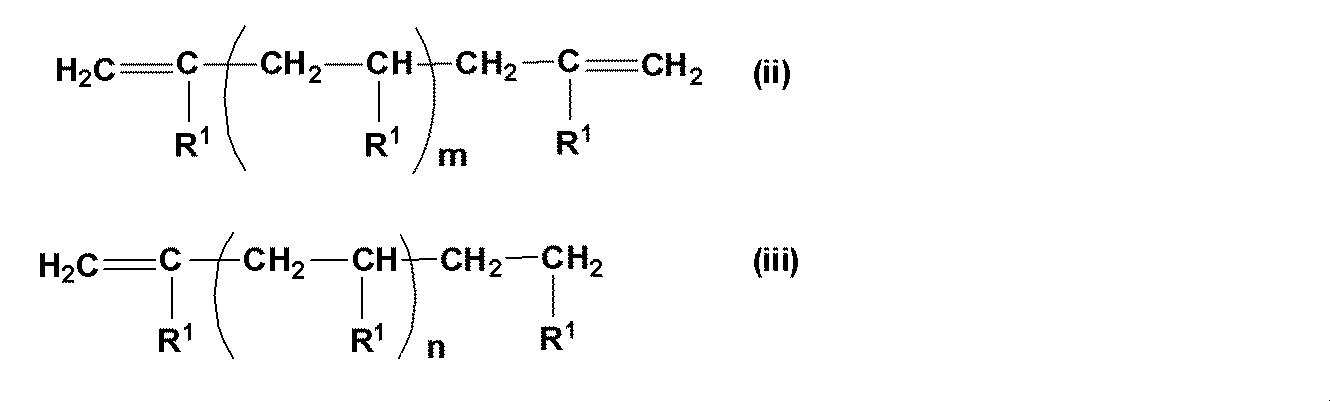
- the polyolefin thermal decomposition product (terminal vinylidene group-containing polyolefin) obtained by the highly controlled thermal decomposition method is represented by the following general formula (ii), a polyolefin having vinylidene groups at both ends of the molecular chain, and the following general formula: (Iii) is a mixture of polyolefins having a vinylidene group at one end of a molecular chain, usually having a number average molecular weight (Mn) of 1,000 to 100,000 and a dispersity (Mw / Mn) of 3.0 or less, The average number of vinylidene groups per molecule is in the range of 1.5 to 1.9, and the property is that the stereoregularity of the raw polyolefin before decomposition is maintained.
- general formula (ii) a polyolefin having vinylidene groups at both ends of the molecular chain
- (Iii) is a mixture of polyolefins having a vinylidene group
- each R 1 independently represents a hydrogen atom, —CH 3 , —C 2 H 5 or —CH 2 CH (CH 3 ) 2 ; m and n each independently represents an integer of 10 to 2000.
- the number average molecular weight of the raw material polyolefin before decomposition is preferably in the range of 10,000 to 1,000,000, more preferably in the range of 50,000 to 700,000, and still more preferably in the range of 100,000 to 500,000.
- the weight average molecular weight is preferably in the range of 10,000 to 1,000,000, more preferably in the range of 200,000 to 800,000.
- thermal decomposition apparatus an apparatus disclosed in Journal of Polymer Science: Polymer Chemistry Edition, 21, 703 (1983) can be used.
- the reaction vessel of the Pyrex (R) glass pyrolysis device for example, polypropylene is put, and under the reduced pressure, the molten polymer phase is vigorously bubbled with nitrogen gas to extract the volatile product, thereby suppressing the secondary reaction.
- the thermal decomposition reaction While performing the thermal decomposition reaction at a predetermined temperature for a predetermined time.
- the residue in the reaction vessel is dissolved in hot xylene, filtered while hot, and then reprecipitated with alcohol for purification.
- the re-precipitate is collected by filtration and dried in vacuum to obtain a terminal vinylidene group-containing polypropylene.
- the thermal decomposition conditions are adjusted by predicting the molecular weight of the product from the molecular weight of the polyolefin before decomposition and the primary structure of the final target block copolymer, and taking into consideration the results of experiments conducted in advance.
- the thermal decomposition temperature is preferably in the range of 300 ° C to 450 ° C. If the temperature is lower than 300 ° C., the thermal decomposition reaction of the polyolefin may not proceed sufficiently, and if the temperature is higher than 450 ° C., the thermal decomposition product may deteriorate.
- Polyolefin to be thermally decomposed is not particularly limited, but polypropylene, poly 1-butene, ethylene / propylene copolymer, ethylene / 1-butene copolymer, propylene / 1-butene copolymer, and poly 4-Methyl-1-pentene is preferred.
- the stereoregularity of the polyolefin is not particularly limited, and various polyolefins such as isotactic polypropylene, syndiotactic oligopropylene and atactic polypropylene can be thermally decomposed.
- the copolymer such as an ethylene / propylene copolymer may be either a random copolymer or a block copolymer.
- Hydroxylation is achieved by hydroxylating the double bond of the terminal vinylidene group-containing polyolefin obtained according to the above method by an oxidation reaction subsequent to hydroboration.
- tetrahydrofuran is first used as a solvent, and a boronation reagent is first added to hydroborate.
- the boration reagent 9-boranebicyclononane or borane-tetrahydrofuran complex can be used.
- a hydrogen peroxide solution is added to the reaction solution after hydroboration to cause an oxidation reaction, a functional polyolefin is obtained. Note that the average number of terminal hydroxy groups per molecule depends on the average number of vinylidene groups and is in the range of 1.5 to 1.9.
- the conditions for polymerizing lactic acid and / or lactide in the presence of the functional polyolefin obtained as described above are not particularly limited, and generally known conditions can be adopted. Specifically, a metal derivative is used as a polymerization catalyst.
- a method using a metal derivative is suitable for ring-opening polymerization of lactide (see Macromolecules 2000, 33, 7395-7403 and Macromolecules 1999, 32, 4794-4801, etc.).
- the metal derivative acting as a catalyst include metal derivatives such as tin, zinc, lead, titanium, bismuth, zirconium, germanium, antimony, and aluminum.
- Trialkylaluminum is preferred, and triethylaluminum is more preferred because of its reactivity and fewer impurities generated.
- the reaction solvent can be used without limitation as long as it is a solvent that dissolves the lactone polymer and does not deactivate the enzyme, such as acetonitrile, 1,4-dioxane, tetrahydrofuran, isopropyl ether, toluene, and benzene.
- the polymerization temperature can be 30 to 150 ° C., but it is particularly preferably performed within the range of 40 to 130 ° C. If it is lower than 30 ° C., the reaction rate becomes low, and if it exceeds 130 ° C., the reaction solution may boil.
- the progress of the reaction can be confirmed by qualitatively or quantitatively analyzing the product.
- Specific examples include gas chromatograph, liquid chromatograph, mass spectrometry, NMR, IR, UV-VIS, or a combination thereof.
- the molecular weight characteristics of the block copolymer to be produced can be measured by the GPC method, and the NMR and IR spectroscopic methods can be applied to the microstructure.
- the product After completion of the reaction, the product can be purified by reprecipitation with a poor solvent for the product. After purification, it is usually preferable to dry under reduced pressure.
- the polymer (A) and the polymer (B) thus obtained usually have a number average molecular weight (Mn) in the range of 5,000 to 500,000, preferably in the range of 10,000 to 200,000. It is.
- the weight average molecular weight (Mw) is usually in the range of 5,000 to 500,000, preferably in the range of 10,000 to 300,000.
- the degree of dispersion (Mn / Mw) is usually in the range of 1 to 3, preferably in the range of 1 to 2.
- the polymer (A) or the polymer (B) obtained in this manner is respectively a poly (D or L) -lactic acid-polyolefin block copolymer represented by the following general formula (iv): It is a mixture containing a poly (D or L) -lactic acid-polyolefin block copolymer represented by the following general formula (v).
- each R 1 independently represents a hydrogen atom, —CH 3 , —C 2 H 5 or —CH 2 CH (CH 3 ) 2 , m and n Each independently represents an integer of 10 to 2000.
- o, p, and q each independently represents an integer of 10 to 2000.
- * means an asymmetric carbon site by D-lactic acid or D-lactide (in the case of the polymer (A)) or an asymmetric carbon site by L-lactic acid or L-lactide (in the case of the polymer (B)) To do.
- the formation method of the stereo complex is not particularly limited, and a generally known method can be adopted. Specifically, for example, the powders of the polymer (A) and the polymer (B) are mixed, the mixture is melted by heating, and further cooled to be crystallized. In this case, a generally known melt-kneading apparatus such as a twin-screw extruder can be appropriately used.
- the melting / kneading temperature is preferably in the range of 210 to 260 ° C. If the melting / kneading temperature is less than 210 ° C, the formation of a stereocomplex may be insufficient, and if it exceeds 260 ° C, decomposition or coloring may occur.
- the stereocomplex body according to the present invention has excellent heat resistance (usually melting point of 180 to 240 ° C., typically 190 to 230 ° C.), it can be obtained by a molding method such as injection molding, blow molding or inflation molding. Can be formed into various products.
- the use of the stereocomplex body according to the present invention is not particularly limited, and can be formed into various products such as films and sheets. Further, the stereocomplex of the present invention exhibits extremely excellent compatibility when preparing a blend or alloy of polyolefin and poly-lactic acid. In particular, by adding to a blend of isotactic polypropylene and polylactic acid, these completely different polymers can be compatibilized.
- the method of using the stereocomplex of the present invention as a compatibilizing agent there is no particular limitation on the method of using the stereocomplex of the present invention as a compatibilizing agent. It is possible to prepare a blend by mixing the stereocomplex of the present invention, polylactic acid and polyolefin at an appropriate mixing ratio by melt mixing or the like. The compatibility can be evaluated by observing the cross section of the blend. For observation of the cross section, an apparatus or a method usually used in the field of polymer blends or alloys can be used. Specifically, it is preferable to observe a cross section of a sample obtained by eluting one of the blended polymers with a solvent.
- the molecular weight measurement conditions and the NMR measurement conditions are as follows.
- polypropylene having a terminal double bond 0.4 g
- 1,2,4-trichlorobenzene 2.1 mL
- deuterated benzene 0.7 mL
- HMDS HMDS
- the inside of the system was kept at a reduced pressure of about 2 mmHg, a conducting capillary was introduced into the molten polymer, and stirring was performed by bubbling nitrogen gas discharged from the capillary.
- the reactor was lifted from the metal bath, cooled to room temperature, the reaction system was brought to atmospheric pressure, the residue in the reactor was dissolved in hot xylene, and then added dropwise to methanol for reprecipitation purification.
- the obtained polymer had a yield of 96%, a number average molecular weight (Mn) of 35,000, a dispersity (Mw / Mn) of 2.9, and an average number of terminal double bonds per molecule (fTVD) of 1.7. there were.
- the reactor was charged with 20 g of polypropylene having a terminal double bond (Mn: 1000, Mw / Mn: 1.1, fTVD: 1.8) obtained by highly controlled pyrolysis as described above and 200 ml of tetrahydrofuran (THF).
- THF tetrahydrofuran
- 60 ml of borane-tetrahydrofuran complex (BH3-THF) in THF (1M) was added and heated under reflux for 5 hours.
- 60 ml of 5N aqueous sodium hydroxide solution was added in an ice bath, followed by 60 ml of 30% aqueous hydrogen peroxide solution, and heated under reflux for 12 hours.
- FIG. 1 shows a 1H-NMR chart of iPP-OH. As is clear from FIG. 1, since no peak due to a double bond is observed, it can be seen that all terminal vinylidene groups have been converted to hydroxyl groups.
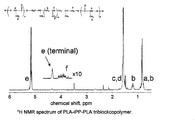
- FIG. 2 shows a 1H-NMR chart of iPP-PLLA obtained in Reference Example 3 (note that the same chart was applied to iPP-PDLA according to Reference Example 2).
- Synthesis Example 4 Synthesis of Polymer (A) (iPP-PDLA) and Polymer (B) (iPP-PLLA)
- Example 1 Preparation of stereocomplex body and melting point measurement 1 Put 2.5 mg of the polymer (A) obtained in Synthesis Example 2 and 2.5 mg of the polymer (B) obtained in Synthesis Example 3 into a dedicated aluminum pan, and use a differential scanning calorimeter (DSC6100) manufactured by Seiko Instruments Inc. The temperature was raised from room temperature to 250 ° C. at a rate of 10 ° C./min to melt. Next, by cooling from 250 ° C. to ⁇ 70 ° C. at 10 ° C./min, a stereocomplex (iPP-scPLA) was formed and crystallized.
- DSC6100 differential scanning calorimeter
- FIG. 3 is a DSC chart showing these results.
- FIG. 3 shows that the stereocomplex of the present invention has a melting point of 202 ° C. and has good heat resistance.
- Example 2 Preparation of stereocomplex body and melting point measurement 2
- the polymer (A) and the polymer (B) As the polymer (A) and the polymer (B), a stereocomplex was formed and the melting point was measured using the same method as in Example 1 except that the polymer (A) and the polymer (B) were used.
- the results are shown in FIG. In FIG. 4, the endothermic peak at 158 ° C. in iPP-OH is derived from iPP crystal melting.
- the endothermic peaks at 171 ° C. and 155 ° C. of iPP-PLLA are derived from crystal melting of PLLA and iPP, respectively.
- iPP-PDLA shoulder peak in iPP-PDLA are derived from crystal melting of PDLA and iPP, respectively.
- iPP-scPLA peaks derived from crystal melting of PDLA and PLLA almost disappeared, and a new endothermic peak appeared at 220 ° C. This is about 50 ° C. higher than the crystal melting of PDLA and PLLA, and is derived from the stereocomplex.
- the stereocomplex body according to the present invention has good heat resistance, it can be molded into various products by molding methods such as injection molding, blow molding and inflation molding.
- the polymer constituting the stereocomplex body according to the present invention has a polyolefin block, it has excellent mechanical properties (tensile strength, bending strength, resistance to resistance) compared to a stereocomplex body made of only conventional polylactic acid. Impact) and can be applied to various applications.
Landscapes
- Chemical & Material Sciences (AREA)
- Health & Medical Sciences (AREA)
- Chemical Kinetics & Catalysis (AREA)
- Medicinal Chemistry (AREA)
- Polymers & Plastics (AREA)
- Organic Chemistry (AREA)
- General Chemical & Material Sciences (AREA)
- Biological Depolymerization Polymers (AREA)
- Processes Of Treating Macromolecular Substances (AREA)
- Compositions Of Macromolecular Compounds (AREA)
- Addition Polymer Or Copolymer, Post-Treatments, Or Chemical Modifications (AREA)
- Polyesters Or Polycarbonates (AREA)
Abstract
新規な構造を有するステレオコンプレックス体、すなわち、ポリ(D又はL)-乳酸ブロック及び他の重合体ブロックを有するポリマーによるステレオコンプレックス体を提供する。 ポリ(D-乳酸)ブロックとポリオレフィンブロックとを有する重合体(A)と、ポリ(L-乳酸)ブロックとポリオレフィンブロックとを有する重合体(B)と、から得られるステレオコンプレックス体。
Description
本発明は、高分子化合物の技術分野に属し、特に、優れた耐熱性を有するステレオコンプレックス体及びその製造方法に関する。
近年、地球環境問題に強い関心が寄せられるようになり、地球温暖化問題における原因とされる温室効果ガスについて、その排出量を抑制する動きが活発になってきている。また、有限な埋蔵資源である石油の枯渇についても、深刻な不足となることが懸念されている。
石油を原料とした従来型のポリマーにおいては、その原料が不足すること及び消費・廃棄段階での温室効果ガス発生を抑制することは、当業界において重要な課題となっている。そのような状況の中で、非石油系原料を用いたポリ乳酸が一躍脚光を浴びている。
ポリ乳酸の原料である乳酸は、農作物からの乳酸発酵を経て得ることが出来るので、枯渇の心配はない。また、乳酸を構成する炭素は、植物によって大気中の炭酸ガスを固定化したものであることから、ポリ乳酸が焼却等により廃棄処分されても、大気中の炭酸ガス全体量への影響は無いと見なすことが出来る。このことから、現在さまざまな用途において活発な技術開発が進められており、いくつかの商品も生まれている。
しかしながら、ポリ乳酸はその分子構造上、分子間力が小さい事から、熱によって容易に変形してしまうという問題がある。
これを解決する手段として、光学異性体であるL-乳酸とD-乳酸をそれぞれ別々に重合したポリ(D-乳酸)とポリ(L-乳酸)を混合・成形することで、ステレオコンプレックス結晶を形成し、耐熱性が向上することが知られている(例えば、非特許文献1参照)。
また、ポリ(D-乳酸)とポリ(L-乳酸)によるステレオコンプレックス結晶の熱特性(融点等)、力学的特性(強度等)などを改善することを目的として、種々の試みがなされている(特許文献1~3参照)。ステレオコンプレックス結晶とは、分子鎖の螺旋の方向が異なる、ポリ(L-乳酸)及びポリ(D-乳酸)が相補的に充填されて複合体を形成してなるものである。
ステレオコンプレックス結晶を形成することにより、ホモ結晶と比較して融点が40℃程度上昇し、耐熱性が向上することが報告されている。
しかしながら、これら特許文献及び非特許文献に開示された試みは、いずれもポリ(D-乳酸)とポリ(L-乳酸)によるステレオコンプレックス体に向けられており、ポリ(D又はL)-乳酸ブロックとポリ(D又はL)-乳酸ブロック以外の重合体ブロックを有するポリマーによるステレオコンプレックス体については、ほとんど報告例が無い。
Takasaki,et.al.,Fiber Preprints(Annual Meeting)Japan,Vol.56,No.1(2001). 第67頁
そこで、本発明は、新規な構造を有するステレオコンプレックス体を提供することを課題とする。
上記課題を解決すべく、本発明者等が鋭意研究を重ねた結果、ホモポリ乳酸ブロック及びポリオレフィンブロックを有する重合体、並びに前記ホモポリ乳酸と逆不斉のホモポリ乳酸及び/又は前記ホモポリ乳酸と逆不斉のホモポリ乳酸ブロック及びポリオレフィンブロックを有する重合体がステレオコンプレックス体を形成し得ることを見出し、本発明を完成させた。特に、本発明は、以下の(1)~(5)に関する。
(1)ポリ(D-乳酸)ブロックと、ポリオレフィンブロックとを有する重合体(A)と、ポリ(L-乳酸)ブロックと、ポリオレフィンブロックとを有する重合体(B)と、から得られるステレオコンプレックス体。
(2)前記重合体(A)が、分子鎖末端にヒドロキシル基を有する官能性ポリオレフィンの存在下、D-乳酸及び/又はD-ラクチドを重合させることにより得られるポリ(D-乳酸)-ポリオレフィンブロック共重合体であり、
前記重合体(B)が、分子鎖末端にヒドロキシル基を有する官能性ポリオレフィンの存在下、L-乳酸及び/又はL-ラクチドを重合させることにより得られるポリ(L-乳酸)-ポリオレフィンブロック共重合体である、(1)記載のステレオコンプレックス体。
前記重合体(B)が、分子鎖末端にヒドロキシル基を有する官能性ポリオレフィンの存在下、L-乳酸及び/又はL-ラクチドを重合させることにより得られるポリ(L-乳酸)-ポリオレフィンブロック共重合体である、(1)記載のステレオコンプレックス体。
(3)前記官能性ポリオレフィンが、下記一般式(i)で表される構成単位から選択される少なくとも一種を構成単位とするポリオレフィンの熱分解によって得られ、1分子当たりの平均末端ビニリデン基数が1.5~1.9、数平均分子量(Mn)が1000~100000、分子量分布の分散度(Mw/Mw)が3.0以下である末端ビニリデン基含有ポリオレフィンをヒドロキシル化して得られる官能性ポリオレフィンである、(2)記載のステレオコンプレックス体。

(4)分子鎖末端にヒドロキシル基を有する官能性ポリオレフィンの存在下、D-乳酸及び/又はD-ラクチドを重合させることによりポリ(D-乳酸)-ポリオレフィンブロック共重合体を調製する工程と、分子鎖末端にヒドロキシル基を有する官能性ポリオレフィンの存在下、L-乳酸及び/又はL-ラクチドを重合させることによりポリ(L-乳酸)-ポリオレフィンブロック共重合体を調製する工程と、前記ポリ(D-乳酸)-ポリオレフィンブロック共重合体と前記ポリ(L-乳酸)-ポリオレフィンブロック共重合体を混合し、次いで該混合物を加熱により溶融し、さらに冷却することにより結晶化させる工程と、を有することを特徴とする、ステレオコンプレックス体の製造方法。
(5)さらに、前記官能性ポリオレフィンを得る工程として、ポリプロピレン、ポリ1-ブテン、エチレン・プロピレン共重合体、エチレン・1-ブテン共重合体、プロピレン・1-ブテン共重合体、及びポリ4-メチル-1-ペンテンからなる群から選択される一種又は二種以上のポリオレフィンを溶融させ、減圧下、不活性ガスをバブリングしつつ熱分解し、続いて当該熱分解生成物をヒドロキシル化する工程を有する、(4)に記載の製造方法。
本発明により提供されるステレオコンプレックス体は、ポリ(D-乳酸)ブロックとポリ(L-乳酸)ブロックとがステレオコンプレックスを形成していると推定され、係るコンプレックス構造により優れた耐熱性を有する。
以下、本発明を、実施形態に即して詳細に説明する。なお、本発明において、「ポリ」と表記した場合においては、「オリゴ」の概念も含まれるものとする。
本発明に係るステレオコンプレックス体は、ホモポリ乳酸ブロック及びポリオレフィンブロックを有する重合体、並びに前記ホモポリ乳酸と逆不斉のホモポリ乳酸及び/又は前記ホモポリ乳酸と逆不斉のホモポリ乳酸ブロック及びポリオレフィンブロックとを有する重合体から構成されているものである(場合により、さらに前記ホモポリ乳酸と同不斉のホモポリ乳酸を含んでも良い)。なお、ここで、「ホモポリ乳酸」とは、L体又はD体の光学純度が97%以上のもの、好ましくは100%のものを重合してなるものをいうものとする。
本発明に係るステレオコンプレックス体の具体例としては、以下の通りである。
・ポリ(D-乳酸)ブロック及びポリオレフィンブロックを有する重合体、並びにポリ(L-乳酸)を混合して得られるステレオコンプレックス体(場合により、ポリ(D-乳酸)をさらに混合しても良い)。
・ポリ(D-乳酸)、並びに、ポリ(L-乳酸)ブロック及びポリオレフィンブロックを有する重合体を混合して得られるステレオコンプレックス体(場合により、ポリ(L-乳酸)をさらに混合しても良い)。
・ポリ(D-乳酸)ブロックとポリオレフィンブロックとを有する重合体(A)と、ポリ(L-乳酸)ブロックとポリオレフィンブロックとを有する重合体(B)と、を混合して得られるステレオコンプレックス体(場合により、ポリ(D-乳酸)及び/又はポリ(L-乳酸)をさらに混合しても良い)。
なお、本発明において、上記ステレオコンプレックス体と相溶可能なポリオレフィン等を適宜共存させても良いことは言うまでもない。
・ポリ(D-乳酸)ブロック及びポリオレフィンブロックを有する重合体、並びにポリ(L-乳酸)を混合して得られるステレオコンプレックス体(場合により、ポリ(D-乳酸)をさらに混合しても良い)。
・ポリ(D-乳酸)、並びに、ポリ(L-乳酸)ブロック及びポリオレフィンブロックを有する重合体を混合して得られるステレオコンプレックス体(場合により、ポリ(L-乳酸)をさらに混合しても良い)。
・ポリ(D-乳酸)ブロックとポリオレフィンブロックとを有する重合体(A)と、ポリ(L-乳酸)ブロックとポリオレフィンブロックとを有する重合体(B)と、を混合して得られるステレオコンプレックス体(場合により、ポリ(D-乳酸)及び/又はポリ(L-乳酸)をさらに混合しても良い)。
なお、本発明において、上記ステレオコンプレックス体と相溶可能なポリオレフィン等を適宜共存させても良いことは言うまでもない。
これらのうち、本出願に係る、ポリ(D-乳酸)ブロックとポリオレフィンブロックとを有する重合体(A)と、ポリ(L-乳酸)ブロックとポリオレフィンブロックとを有する重合体(B)と、から構成されるステレオコンプレックス体について、以下詳細に説明する。
重合体(A)としては、特に制限されるものではないが、下記一般式(i)で表される群から選択される少なくとも一種を構成単位とし、かつ、分子鎖末端にヒドロキシル基を有する官能性ポリオレフィンの存在下、D-乳酸及び/又はD-ラクチドを重合させることにより得られるポリ(D-乳酸)-ポリオレフィンブロック共重合体が好ましい。
また、重合体(B)としては、特に制限されるものでないが、重合体(B)が、下記一般式(i)で表される構成単位の少なくとも一種を有し、かつ、分子鎖末端にヒドロキシル基を有する官能性ポリオレフィンの存在下、L-乳酸及び/又はL-ラクチドを重合させることにより得られるポリ(L-乳酸)-ポリオレフィンブロック共重合体が好適である。

(但し、式(i)中、R1は、水素原子、-CH3、-C2H5又は-CH2CH(CH3)2を表す。)
上記一般式(i)で表される構成単位の少なくとも一種を有し、かつ、分子鎖末端にヒドロキシル基を有する官能性ポリオレフィンとしては、本発明者等により、Macromolecules, 28, 7973(1995)に報告された高度制御熱分解技術を使用して得られる末端ビニリデン基含有ポリオレフィンを、ヒドロキシル化することにより得られるものが好適である。
高度制御熱分解法によって得られるポリオレフィンの熱分解生成物(末端ビニリデン基含有ポリオレフィン)は、下記一般式(ii)で表される、分子鎖両末端にビニリデン基を有するポリオレフィン、及び、下記一般式(iii)で表される、分子鎖片末端にビニリデン基を有するポリオレフィンの混合物であり、通常、数平均分子量(Mn)が1000~100000、分散度(Mw/Mn)が3.0以下、1分子当たりのビニリデン基の平均数が1.5~1.9の範囲であり、分解前の原料ポリオレフィンの立体規則性を保持しているという特性を有している。
分解前の原料のポリオレフィンの数平均分子量は、好ましくは1万~100万の範囲内、より好ましくは5万~70万の範囲内、さらに好ましくは10万~50万の範囲内である。また、重量平均分子量は、好ましくは1万~100万の範囲内、さらに好ましくは20万~80万の範囲内である。
熱分解装置としては、Journal of PolymerScience:Polymer Chemistry Edition, 21, 703(1983)に開示された装置を用いることができる。パイレックス(R)ガラス製熱分解装置の反応容器内に、例えばポリプロピレンを入れて、減圧下、溶融ポリマー相を窒素ガスで激しくバブリングし、揮発性生成物を抜き出すことにより、2次反応を抑制しながら、所定温度で所定時間、熱分解反応させる。熱分解反応終了後、反応容器中の残存物を熱キシレンに溶解し、熱時濾過後、アルコールで再沈殿させ精製する。再沈物を濾過回収して、真空乾燥することにより末端ビニリデン基含有ポリプロピレンが得られる。
熱分解条件は、分解前のポリオレフィンの分子量と最終目的物のブロック共重合体の1次構造から生成物の分子量を予測し、予め実施した実験の結果を勘案して調整する。熱分解温度は300℃~450℃の範囲が好ましい。300℃より低い温度では、ポリオレフィンの熱分解反応が充分に進行しない恐れがあり、450℃より高い温度では、熱分解生成物の劣化が進行する恐れがある。
熱分解するポリオレフィンとしては、特に制限されるものではないが、ポリプロピレン、ポリ1-ブテン、エチレン・プロピレン共重合体、エチレン・1-ブテン共重合体、プロピレン・1-ブテン共重合体、及びポリ4-メチル-1-ペンテンが好適である。
また、ポリオレフィンの立体規則性についても特に制限されるものではなく、イソタクチックポリプロピレン、シンジオタクチックオリゴプロピレン及びアタクチックポリプロピレン等、種々のポリオレフィンを熱分解することが出来る。また、エチレン・プロピレン共重合体等の共重合体に関しては、ランダム共重合体及びブロック共重合体のいずれであっても良い。
ヒドロキシル化は、上記方法に従って得られた末端ビニリデン基含有ポリオレフィンの二重結合を、ヒドロホウ素化に続く、酸化反応によってヒドロキシル化することにより達成される。例えば、テトラヒドロフランを溶媒とし、まずホウ素化試薬を加えてヒドロホウ素化する。ホウ素化試薬としては、9-ボランビシクロノナンやボラン-テトラヒドロフラン錯体を用いることができる。ヒドロホウ素化後の反応溶液に過酸化水素水を加え、酸化反応させると官能性ポリオレフィンが得られる。なお、1分子当たりの末端ヒドロキシ基の平均数は、上記ビニリデン基の平均数に依存するものであり、1.5~1.9の範囲となる。
上述のようにして得られた官能性ポリオレフィンの存在下、乳酸及び/又はラクチドを重合させる条件としては、特に制限されるものではなく、通常公知の条件を採用することが出来る。具体的には、重合触媒として金属誘導体を使用する方法である。
金属誘導体を使用する方法は、ラクチドの開環重合に好適である(Macromolecules 2000,33,7395-7403およびMacromolecules 1999,32,4794-4801等を参照)。触媒として作用する金属の誘導体としては、例えば、錫、亜鉛、鉛、チタン、ビスマス、ジルコニウム、ゲルマニウム、アンチモン、アルミニウムなどの金属の誘導体が挙げられる。反応性および生成する不純物が少ないことから、トリアルキルアルミニウムが好ましく、トリエチルアルミニウムの使用がより好ましい。
反応溶媒としては、アセトニトリル、1,4-ジオキサン、テトラヒドロフラン、イソプロピルエーテル、トルエン、ベンゼンなど、ラクトン重合体を溶解し、かつ酵素を失活させない溶媒であれば制限なく使用することができる。
重合温度は、30ないし150℃が可能であるが、特に40ないし130℃の範囲内で行うことが好ましい。30℃より低いと反応速度が小さくなり、また、130℃を超えると、反応溶液が沸騰するおそれがある。
反応の進行は、生成物を定性的若しくは定量的に分析することにより、確認することが可能である。具体的には、ガスクロマトグラフ、液体クロマトグラフ、質量分析、NMR、IR、UV-VIS又はこれらの組合せによる方法が挙げられる。また生成するブロック共重合体の分子量特性についてはGPC法で測定可能であり、ミクロ構造についてはNMRやIR分光学的方法が適用可能である。
反応終了後は、生成物の貧溶媒により再沈殿させて精製することができる。精製後は、通常、減圧乾燥により乾燥することが好ましい。
この様にして得られた重合体(A)及び重合体(B)は、それぞれ、通常、数平均分子量(Mn)が5千~50万の範囲内、好ましくは1万~20万の範囲内である。また、重量平均分子量(Mw)は、通常、5千~50万の範囲内、好ましくは1万~30万の範囲内である。更に、分散度(Mn/Mw)は、通常1~3の範囲内、好ましくは1~2の範囲内にある。
また、この様にして得られた重合体(A)又は重合体(B)は、それぞれ、下記一般式(iv)で表されるポリ(D又はL)-乳酸-ポリオレフィンブロック共重合体と、下記一般式(v)で表されるポリ(D又はL)-乳酸-ポリオレフィンブロック共重合体を含む混合物である。

ステレオコンプレックス体の形成方法としては、特に制限されるものではなく、通常公知の方法を採用することが出来る。具体的には、例えば、重合体(A)及び重合体(B)のパウダーを混合し、当該混合物を加熱により溶融し、さらに冷却することにより結晶化させることが出来る。この場合、適宜、2軸押出機などの通常公知の溶融混練装置を用いることが出来る。溶融・混練温度としては、210~260℃の範囲が好ましい。溶融・混練温度が210℃未満であると、ステレオコンプレックスの形成が不十分になるおそれがあり、260℃を超えると分解や着色のおそれがある。
本発明に係るステレオコンプレックス体は、優れた耐熱性(通常、融点が180~240℃、典型的には190~230℃)を有することから、射出成形、ブロー成形、インフレーション成形などの成形法によって、種々の製品に成形することができる。
また、本発明に係るステレオコンプレックス体の用途も特に制限されるものではなく、フィルム、シート等様々な製品に成形することが出来る。また、本発明のステレオコンプレックス体は、ポリオレフィンと、ポリ-乳酸とのブレンド又はアロイを調製する際に極めて優れた相溶性を示す。特にイソタクチックポリプロピレンとポリ乳酸とのブレンドに添加することで、これらの全く極性の相違するポリマーを相溶化させることができる。
相溶化剤としての本発明のステレオコンプレックス体の使用方法には特に制限はない。本発明のステレオコンプレックス体、ポリ乳酸及びポリオレフィンを適切な混合比で、溶融混合等により混合してブレンドを調製することが可能である。相溶性の評価は、当該ブレンドの断面を観察することで可能である。断面の観察には、ポリマーブレンド又はアロイの分野において通常使用される装置や方法が使用可能である。具体的には、ブレンドしたポリマーの一方を溶媒によって溶出して得られた試料の断面を観察することが好ましい。
以下、本発明を実施例によりさらに詳細に説明するが、本発明はこれら実施例に限定されるものではない。なお、各実施例において分子量の測定条件及びNMRの測定条件は以下の通りである。
<分子量測定条件>
測定装置:GPC分析装置(HLC-8220GPC(東ソー(株)製))
カラム:TOSOH TSKgel GMHXL,G3000HXL,G2000HXL
流速:1mL/min
溶媒:THF
溶質濃度:1mg/ml
標準物質:ポリスチレン
温度:40℃
<NMR>
測定装置:FT-NMR:JNM-GX400(日本電子(株)製)
溶媒:CDCl3
<末端ビニリデン基数の測定方法>
末端ビニリデン基数の測定は13C-NMRにより行い、21.5ppmの末端ビニリデン基隣接メチル炭素と12.5ppmの飽和末端メチル炭素のシグナル強度よりもとめた。例えば、末端二重結合含有ポリプロピレン(0.4g)、1,2,4-トリクロロベンゼン(2.1mL)、重水素化ベンゼン(0.7mL)、基準物質としてHMDSを用いて、10mm管で120℃で測定した。
測定装置:GPC分析装置(HLC-8220GPC(東ソー(株)製))
カラム:TOSOH TSKgel GMHXL,G3000HXL,G2000HXL
流速:1mL/min
溶媒:THF
溶質濃度:1mg/ml
標準物質:ポリスチレン
温度:40℃
<NMR>
測定装置:FT-NMR:JNM-GX400(日本電子(株)製)
溶媒:CDCl3
<末端ビニリデン基数の測定方法>
末端ビニリデン基数の測定は13C-NMRにより行い、21.5ppmの末端ビニリデン基隣接メチル炭素と12.5ppmの飽和末端メチル炭素のシグナル強度よりもとめた。例えば、末端二重結合含有ポリプロピレン(0.4g)、1,2,4-トリクロロベンゼン(2.1mL)、重水素化ベンゼン(0.7mL)、基準物質としてHMDSを用いて、10mm管で120℃で測定した。
(合成例1):官能性ポリプロピレン(iPP-OH)の合成
熱分解装置として試料量最大5kgのラボスケール高度制御熱分解装置を使用した。市販のイソタクチックポリプロピレン(ノバテックPP(日本ポリプロピレン株式会社製)、グレード:EA9A、メルトフローインデックス(MFR):0.5g/10min)2kgを反応器に仕込み、系内を窒素置換後、2mmHgに減圧して、反応器を200℃に加熱して溶融した。その後、390℃に設定されたメタルバスに反応器を沈め、熱分解を行った。熱分解中は、系内を2mmHg程度の減圧状態に保ち、溶融ポリマーに導キャピラリーを導入し、該キャピラリーから排出される窒素ガスのバブリングによって攪拌した。2時間経過後、反応器をメタルバスからあげ、室温まで冷却した後、反応系を常圧にし、反応器内の残渣を熱キシレンにて溶解した後、メタノールに滴下して再沈殿精製した。得られたポリマーは収率96%、数平均分子量(Mn)が35000、分散度(Mw/Mn)が2.9、一分子当たりの末端二重結合の平均数(fTVD)が1.7であった。
熱分解装置として試料量最大5kgのラボスケール高度制御熱分解装置を使用した。市販のイソタクチックポリプロピレン(ノバテックPP(日本ポリプロピレン株式会社製)、グレード:EA9A、メルトフローインデックス(MFR):0.5g/10min)2kgを反応器に仕込み、系内を窒素置換後、2mmHgに減圧して、反応器を200℃に加熱して溶融した。その後、390℃に設定されたメタルバスに反応器を沈め、熱分解を行った。熱分解中は、系内を2mmHg程度の減圧状態に保ち、溶融ポリマーに導キャピラリーを導入し、該キャピラリーから排出される窒素ガスのバブリングによって攪拌した。2時間経過後、反応器をメタルバスからあげ、室温まで冷却した後、反応系を常圧にし、反応器内の残渣を熱キシレンにて溶解した後、メタノールに滴下して再沈殿精製した。得られたポリマーは収率96%、数平均分子量(Mn)が35000、分散度(Mw/Mn)が2.9、一分子当たりの末端二重結合の平均数(fTVD)が1.7であった。
上記のような高度制御熱分解によって得られた末端二重結合含有ポリプロピレン(Mn:1000、Mw/Mn:1.1、fTVD:1.8)20gおよびテトラヒドロフラン(THF)200mlを反応器に仕込み、窒素置換後、60mlのボラン-テトラヒドロフラン錯体(BH3-THF)THF溶液(1M)を加え、環流下で5時間加熱した。その後、氷浴中で5N水酸化ナトリウム水溶液60mlを加え、続いて、30%過酸化水素水溶液60mlを加え、環流下で12時間加熱した。反応後、反応混合物をメタノールに注ぎ、再沈殿精製し、官能性ポリプロピレン(iPP-OH)を得た。図1に、iPP-OHの1H-NMRチャートを示す。図1から明らかなとおり、二重結合によるピークが観測されていないことから、すべての末端ビニリデン基がヒドロキシル基に変換されたことが分かる。
(合成例2):重合体(A)(iPP-PDLA)の合成
上記の官能性ポリプロピレン(Mn:1000)0.1gをシュレンク管に仕込み、窒素置換後、トルエン3mlを加えて加熱して溶解した後、トリエチルアルミニウム/トルエン1M溶液を0.2ml加え、10分間攪拌後、D-ラクチド1gを加え、100℃で12時間攪拌した。反応後、停止剤として1NHCl水溶液0.5mlを加え、200mlのメタノールで再沈殿精製した。得られた共重合体をGPCを用いて分析した結果、Mnが9900、Mw/Mnが1.22であった。
上記の官能性ポリプロピレン(Mn:1000)0.1gをシュレンク管に仕込み、窒素置換後、トルエン3mlを加えて加熱して溶解した後、トリエチルアルミニウム/トルエン1M溶液を0.2ml加え、10分間攪拌後、D-ラクチド1gを加え、100℃で12時間攪拌した。反応後、停止剤として1NHCl水溶液0.5mlを加え、200mlのメタノールで再沈殿精製した。得られた共重合体をGPCを用いて分析した結果、Mnが9900、Mw/Mnが1.22であった。
(合成例3):重合体(B)(iPP-PLLA)の合成
上記の官能性ポリプロピレン(Mn:1000)0.1gをシュレンク管に仕込み、窒素置換後、トルエン3mlを加えて加熱して溶解した後、トリエチルアルミニウム/トルエン1M溶液を0.2ml加え、10分間攪拌後、L-ラクチド1gを加え、100℃で12時間攪拌した。反応後、停止剤として1NHCl水溶液0.5mlを加え、200mlのメタノールで再沈殿精製した。得られた共重合体をGPCを用いて分析した結果、Mnが10900、Mw/Mnが1.26であった。図2は、参照例3で得られたiPP-PLLAの1H-NMRチャートを示す(なお、参照例2に係るiPP-PDLAについても同様のチャートとなった)。
上記の官能性ポリプロピレン(Mn:1000)0.1gをシュレンク管に仕込み、窒素置換後、トルエン3mlを加えて加熱して溶解した後、トリエチルアルミニウム/トルエン1M溶液を0.2ml加え、10分間攪拌後、L-ラクチド1gを加え、100℃で12時間攪拌した。反応後、停止剤として1NHCl水溶液0.5mlを加え、200mlのメタノールで再沈殿精製した。得られた共重合体をGPCを用いて分析した結果、Mnが10900、Mw/Mnが1.26であった。図2は、参照例3で得られたiPP-PLLAの1H-NMRチャートを示す(なお、参照例2に係るiPP-PDLAについても同様のチャートとなった)。
(合成例4):重合体(A)(iPP-PDLA)及び重合体(B)(iPP-PLLA)の合成
合成例1において、熱分解条件を変更することにより得られた分子量14,000のiPP-OHを用いて、合成例2及び合成例3と同様の方法で、iPP-PDLA(ポリ-D乳酸-iPP-ポリ-D乳酸のトリブロック共重合体と推定した場合に、Mn=15,000-14,000―15,000)及びiPP-PLLA(ポリ-L乳酸-iPP-ポリ-L乳酸のトリブロック共重合体と推定した場合に、Mn=16,000-14,000-16,000)を合成した。
合成例1において、熱分解条件を変更することにより得られた分子量14,000のiPP-OHを用いて、合成例2及び合成例3と同様の方法で、iPP-PDLA(ポリ-D乳酸-iPP-ポリ-D乳酸のトリブロック共重合体と推定した場合に、Mn=15,000-14,000―15,000)及びiPP-PLLA(ポリ-L乳酸-iPP-ポリ-L乳酸のトリブロック共重合体と推定した場合に、Mn=16,000-14,000-16,000)を合成した。
(実施例1):ステレオコンプレックス体の調製及び融点測定1
合成例2で得られた重合体(A)2.5mg及び合成例3で得られた重合体(B)2.5mgを専用アルミニウムパンに入れ、セイコーインスツルメンツ社製示差走査熱量計(DSC6100)を用いて、室温から250℃まで、10℃/分で昇温して溶融させた。次いで、250℃から-70℃まで10℃/分で冷却することにより、ステレオコンプレックス体(iPP-scPLA)を形成・結晶化させた。
合成例2で得られた重合体(A)2.5mg及び合成例3で得られた重合体(B)2.5mgを専用アルミニウムパンに入れ、セイコーインスツルメンツ社製示差走査熱量計(DSC6100)を用いて、室温から250℃まで、10℃/分で昇温して溶融させた。次いで、250℃から-70℃まで10℃/分で冷却することにより、ステレオコンプレックス体(iPP-scPLA)を形成・結晶化させた。
さらに、ステレオコンプレックス体を上記示差走査熱量計中で、-70℃の状態から250℃まで10℃/分で昇温させることにより、示差走査熱量測定(DSC)を行った。また、比較として、iPP-PDLA、iPP-PLLA及びiPP-OHについても同様にDSC測定を行った。図3は、これらの結果を示すDSCチャートである。図3から、本発明に係るステレオコンプレックス体の融点は、202℃となっており、良好な耐熱性を有することが分かる。
(実施例2):ステレオコンプレックス体の調製及び融点測定2
重合体(A)及び重合体(B)として、合成例4で得られたものを使用した以外は、実施例1と同様な方法を用いてステレオコンプレックス体の形成及び融点測定を行った。結果を図4に示す。図4において、iPP-OHにおける158℃の吸熱ピークはiPPの結晶融解に由来する。iPP-PLLAの171℃及び155℃の吸熱ピークはそれぞれPLLA及びiPPの結晶融解に由来する。iPP-PDLAにおける161℃のピーク及び154℃のショルダーピークはそれぞれPDLA及びiPPの結晶融解に由来する。これらに対して、iPP-scPLAではPDLA及びPLLAの結晶融解に由来するピークがほぼ消失し、220℃に新たに吸熱ピークが出現した。これはPDLA及びPLLAの結晶融解よりも約50℃高く、ステレオコンプレックスに由来するとものである。
重合体(A)及び重合体(B)として、合成例4で得られたものを使用した以外は、実施例1と同様な方法を用いてステレオコンプレックス体の形成及び融点測定を行った。結果を図4に示す。図4において、iPP-OHにおける158℃の吸熱ピークはiPPの結晶融解に由来する。iPP-PLLAの171℃及び155℃の吸熱ピークはそれぞれPLLA及びiPPの結晶融解に由来する。iPP-PDLAにおける161℃のピーク及び154℃のショルダーピークはそれぞれPDLA及びiPPの結晶融解に由来する。これらに対して、iPP-scPLAではPDLA及びPLLAの結晶融解に由来するピークがほぼ消失し、220℃に新たに吸熱ピークが出現した。これはPDLA及びPLLAの結晶融解よりも約50℃高く、ステレオコンプレックスに由来するとものである。
本発明に係るステレオコンプレックス体は、良好な耐熱性を有することから、射出成形、ブロー成形、インフレーション成形などの成形法によって、種々の製品に成形することができる。
また、本発明に係るステレオコンプレックス体を構成する重合体は、ポリオレフィンブロックを有することから、従来のポリ乳酸のみからなるステレオコンプレックス体と比較して優れた機械的物性(引張強度、曲げ強度、耐衝撃性など)を有し、種々の用途に適用することが出来る。
Claims (5)
- ポリ(D-乳酸)ブロックとポリオレフィンブロックとを有する重合体(A)と、
ポリ(L-乳酸)ブロックとポリオレフィンブロックとを有する重合体(B)と、から得られるステレオコンプレックス体。 - 前記重合体(A)が、分子鎖末端にヒドロキシル基を有する官能性ポリオレフィンの存在下、D-乳酸及び/又はD-ラクチドを重合させることにより得られるポリ(D-乳酸)-ポリオレフィンブロック共重合体であり、
前記重合体(B)が、分子鎖末端にヒドロキシル基を有する官能性ポリオレフィンの存在下、L-乳酸及び/又はL-ラクチドを重合させることにより得られるポリ(L-乳酸)-ポリオレフィンブロック共重合体である、請求項1記載のステレオコンプレックス体。 - 前記官能性ポリオレフィンが、下記一般式(i)で表される構成単位から選択される少なくとも一種を構成単位とするポリオレフィンの熱分解によって得られ、1分子当たりの平均末端ビニリデン基数が1.5~1.9、数平均分子量(Mn)が1000~100000、分子量分布の分散度(Mw/Mw)が3.0以下である末端ビニリデン基含有ポリオレフィンをヒドロキシル化して得られる官能性ポリオレフィンである、請求項2記載のステレオコンプレックス体。

- 分子鎖末端にヒドロキシル基を有する官能性ポリオレフィンの存在下、D-乳酸及び/又はD-ラクチドを重合させることによりポリ(D-乳酸)-ポリオレフィンブロック共重合体を調製する工程と、分子鎖末端にヒドロキシル基を有する官能性ポリオレフィンの存在下、L-乳酸及び/又はL-ラクチドを重合させることによりポリ(L-乳酸)-ポリオレフィンブロック共重合体を調製する工程と、前記ポリ(D-乳酸)-ポリオレフィンブロック共重合体と前記ポリ(L-乳酸)-ポリオレフィンブロック共重合体を混合し、次いで該混合物を加熱により溶融し、さらに冷却することにより結晶化させる工程と、を有することを特徴とする、ステレオコンプレックス体の製造方法。
- さらに、前記官能性ポリオレフィンを得る工程として、ポリプロピレン、ポリ1-ブテン、エチレン・プロピレン共重合体、エチレン・1-ブテン共重合体、プロピレン・1-ブテン共重合体、及びポリ4-メチル-1-ペンテンからなる群から選択される一種又は二種以上のポリオレフィンを溶融させ、減圧下、不活性ガスをバブリングしつつ熱分解し、続いて当該熱分解生成物をヒドロキシル化する工程を有する、請求項4に記載の製造方法。
Applications Claiming Priority (2)
| Application Number | Priority Date | Filing Date | Title |
|---|---|---|---|
| JP2010-173945 | 2010-08-02 | ||
| JP2010173945A JP5641519B2 (ja) | 2010-08-02 | 2010-08-02 | ステレオコンプレックス体及びその製造方法 |
Publications (1)
| Publication Number | Publication Date |
|---|---|
| WO2012017859A1 true WO2012017859A1 (ja) | 2012-02-09 |
Family
ID=45559362
Family Applications (1)
| Application Number | Title | Priority Date | Filing Date |
|---|---|---|---|
| PCT/JP2011/066926 Ceased WO2012017859A1 (ja) | 2010-08-02 | 2011-07-26 | ステレオコンプレックス体及びその製造方法 |
Country Status (2)
| Country | Link |
|---|---|
| JP (1) | JP5641519B2 (ja) |
| WO (1) | WO2012017859A1 (ja) |
Cited By (1)
| Publication number | Priority date | Publication date | Assignee | Title |
|---|---|---|---|---|
| CN103073708A (zh) * | 2013-01-20 | 2013-05-01 | 复旦大学 | 一种制备高分子量的聚乳酸立构嵌段共聚物的方法 |
Families Citing this family (4)
| Publication number | Priority date | Publication date | Assignee | Title |
|---|---|---|---|---|
| JP2014512438A (ja) * | 2011-04-25 | 2014-05-22 | サン−ゴバン パフォーマンス プラスティックス コーポレイション | ブレンド組成物、可撓性管材、およびそのブレンド物の製造方法 |
| JP6189630B2 (ja) * | 2013-05-13 | 2017-08-30 | 有限会社Nkリサーチ | ステレオコンプレックス結晶性ポリ乳酸プレポリマー組成物 |
| JP6915104B2 (ja) * | 2017-09-28 | 2021-08-04 | ヘルムホルツ−ツェントルム ヘレオン ゲーエムベーハー | 物理的に架橋されたラクチドベースのポリマーシステムの製造方法、当該方法により製造されたポリマーシステム、及びポリマーシステムからオブジェクトを製造するプロセス |
| CN111019109A (zh) * | 2019-12-26 | 2020-04-17 | 南京林业大学 | 一种聚d-乳酸-异丙叉基葡萄糖双嵌段共聚物材料及其制备方法 |
Citations (5)
| Publication number | Priority date | Publication date | Assignee | Title |
|---|---|---|---|---|
| JP2001270924A (ja) * | 2000-01-21 | 2001-10-02 | Mitsui Chemicals Inc | 環境崩壊性樹脂成形体 |
| JP2002316954A (ja) * | 2001-04-19 | 2002-10-31 | Univ Nihon | ポリエチレンから末端ビニルオリゴマーの製造法 |
| WO2005078017A1 (ja) * | 2004-02-16 | 2005-08-25 | Mitsui Chemicals, Inc. | 共重合体を含む脂肪族ポリエステル樹脂組成物 |
| JP2007177039A (ja) * | 2005-12-27 | 2007-07-12 | Mitsui Chemicals Inc | 耐熱性と透明性に優れた脂肪族ポリエステルブロック共重合体、脂肪族ポリエステル樹脂組成物、およびそれらの成形品、シート。 |
| WO2009107396A1 (ja) * | 2008-02-29 | 2009-09-03 | 学校法人日本大学 | 生分解性重合体ブロックを有するトリブロック共重合体およびその製造方法 |
Family Cites Families (1)
| Publication number | Priority date | Publication date | Assignee | Title |
|---|---|---|---|---|
| JP2007321141A (ja) * | 2006-05-01 | 2007-12-13 | Toray Ind Inc | ポリ乳酸セグメントを含むブロック共重合体、その製造方法、および樹脂組成物 |
-
2010
- 2010-08-02 JP JP2010173945A patent/JP5641519B2/ja not_active Expired - Fee Related
-
2011
- 2011-07-26 WO PCT/JP2011/066926 patent/WO2012017859A1/ja not_active Ceased
Patent Citations (5)
| Publication number | Priority date | Publication date | Assignee | Title |
|---|---|---|---|---|
| JP2001270924A (ja) * | 2000-01-21 | 2001-10-02 | Mitsui Chemicals Inc | 環境崩壊性樹脂成形体 |
| JP2002316954A (ja) * | 2001-04-19 | 2002-10-31 | Univ Nihon | ポリエチレンから末端ビニルオリゴマーの製造法 |
| WO2005078017A1 (ja) * | 2004-02-16 | 2005-08-25 | Mitsui Chemicals, Inc. | 共重合体を含む脂肪族ポリエステル樹脂組成物 |
| JP2007177039A (ja) * | 2005-12-27 | 2007-07-12 | Mitsui Chemicals Inc | 耐熱性と透明性に優れた脂肪族ポリエステルブロック共重合体、脂肪族ポリエステル樹脂組成物、およびそれらの成形品、シート。 |
| WO2009107396A1 (ja) * | 2008-02-29 | 2009-09-03 | 学校法人日本大学 | 生分解性重合体ブロックを有するトリブロック共重合体およびその製造方法 |
Cited By (1)
| Publication number | Priority date | Publication date | Assignee | Title |
|---|---|---|---|---|
| CN103073708A (zh) * | 2013-01-20 | 2013-05-01 | 复旦大学 | 一种制备高分子量的聚乳酸立构嵌段共聚物的方法 |
Also Published As
| Publication number | Publication date |
|---|---|
| JP5641519B2 (ja) | 2014-12-17 |
| JP2012031340A (ja) | 2012-02-16 |
Similar Documents
| Publication | Publication Date | Title |
|---|---|---|
| Ma et al. | Fully recyclable and tough thermoplastic elastomers from simple bio-sourced δ-valerolactones | |
| Lillie et al. | Structure/property relationships in copolymers comprising renewable isosorbide, glucarodilactone, and 2, 5-bis (hydroxymethyl) furan subunits | |
| Han et al. | Click chemistry synthesis, stereocomplex formation, and enhanced thermal properties of well-defined poly (l-lactic acid)-b-poly (d-lactic acid) stereo diblock copolymers | |
| JP5641519B2 (ja) | ステレオコンプレックス体及びその製造方法 | |
| JP6862357B2 (ja) | ポリマー組成物 | |
| Gigli et al. | Synthesis and characterization of novel poly (butylene succinate)‐based copolyesters designed as potential candidates for soft tissue engineering | |
| US7671140B2 (en) | Ring-opening polymerization of cyclic esters, polyesters formed thereby, and articles comprising the polyesters | |
| Abdelwahab et al. | Poly [(R)‐3‐hydroxybutyrate)]/poly (styrene) blends compatibilized with the relevant block copolymer | |
| Ladelta et al. | Non-covalent PS–SC–PI triblock terpolymers via polylactide stereocomplexation: synthesis and thermal properties | |
| JP5356698B2 (ja) | 生分解性重合体ブロックを有するトリブロック共重合体およびその製造方法 | |
| Song et al. | Functionalized Poly (ethylene-octene)/Linear Low-Density Polyethylene Prepared by Melt Free-radical Grafting Reaction and Its Potential in Toughening Poly (butylene terephthalate) Resins | |
| CN107849324B (zh) | 改进的多相聚丙烯 | |
| TW200932782A (en) | Copolymers comprising a trimethylene carbonate and poly (trimethylene ether) glycols | |
| JP6625990B2 (ja) | ポリオレフィンアイオノマーを生成するための方法及びそれによって生成されるアイオノマー | |
| Vinueza-Vaca et al. | Titanium-catalyzed synthesis of polymyrcene and polyanethol and application as sustainable additives for poly (lactic acid) | |
| JP5806890B2 (ja) | 半結晶性ポリラクチドの製造方法 | |
| JP2010202768A (ja) | オリゴオレフィン−ポリエステル系又はポリカーボネート系ブロック共重合体 | |
| Höferth et al. | Pushing Poly (Limonene Carbonate) Toward Commercial Applications: Bio‐Based Poly (Menth‐1‐Ene Carbonate)‐Graft‐Poly (n‐Butyl Acrylate) With Tailored Graft Density | |
| CN104114600A (zh) | 用于制备限定的官能性乳酸低聚物的方法 | |
| JP2008150472A (ja) | エチレン−プロピレン共重合体 | |
| Wu et al. | Branching Structured Poly (vinyl chloride-co-hydroxyethyl acrylate)-g-polycaprolactone as Nonmigratory Polymeric Plasticizers and Compatibilizers in Flexible PVC | |
| US7754826B1 (en) | Copolymers from lactide | |
| EP4372040A1 (en) | Polylactide resin composition and preparation method therefor | |
| US7452939B2 (en) | Polyesterified block copolymer and process for producing the same | |
| JP2011042733A (ja) | 含酸素ポリオレフィンの製造方法及びそれにより得られるカルボニル基含有ポリオレフィン |
Legal Events
| Date | Code | Title | Description |
|---|---|---|---|
| 121 | Ep: the epo has been informed by wipo that ep was designated in this application |
Ref document number: 11814487 Country of ref document: EP Kind code of ref document: A1 |
|
| NENP | Non-entry into the national phase |
Ref country code: DE |
|
| 122 | Ep: pct application non-entry in european phase |
Ref document number: 11814487 Country of ref document: EP Kind code of ref document: A1 |