WO2011132585A1 - リン含有メソポーラスシリカ及びその製造方法 - Google Patents
リン含有メソポーラスシリカ及びその製造方法 Download PDFInfo
- Publication number
- WO2011132585A1 WO2011132585A1 PCT/JP2011/059188 JP2011059188W WO2011132585A1 WO 2011132585 A1 WO2011132585 A1 WO 2011132585A1 JP 2011059188 W JP2011059188 W JP 2011059188W WO 2011132585 A1 WO2011132585 A1 WO 2011132585A1
- Authority
- WO
- WIPO (PCT)
- Prior art keywords
- mesoporous silica
- phosphorus
- silica
- containing mesoporous
- phosphorous
- Prior art date
- Legal status (The legal status is an assumption and is not a legal conclusion. Google has not performed a legal analysis and makes no representation as to the accuracy of the status listed.)
- Ceased
Links
Images


Classifications
-
- C—CHEMISTRY; METALLURGY
- C01—INORGANIC CHEMISTRY
- C01B—NON-METALLIC ELEMENTS; COMPOUNDS THEREOF; METALLOIDS OR COMPOUNDS THEREOF NOT COVERED BY SUBCLASS C01C
- C01B33/00—Silicon; Compounds thereof
- C01B33/113—Silicon oxides; Hydrates thereof
- C01B33/12—Silica; Hydrates thereof, e.g. lepidoic silicic acid
-
- B—PERFORMING OPERATIONS; TRANSPORTING
- B01—PHYSICAL OR CHEMICAL PROCESSES OR APPARATUS IN GENERAL
- B01J—CHEMICAL OR PHYSICAL PROCESSES, e.g. CATALYSIS OR COLLOID CHEMISTRY; THEIR RELEVANT APPARATUS
- B01J20/00—Solid sorbent compositions or filter aid compositions; Sorbents for chromatography; Processes for preparing, regenerating or reactivating thereof
- B01J20/02—Solid sorbent compositions or filter aid compositions; Sorbents for chromatography; Processes for preparing, regenerating or reactivating thereof comprising inorganic material
- B01J20/10—Solid sorbent compositions or filter aid compositions; Sorbents for chromatography; Processes for preparing, regenerating or reactivating thereof comprising inorganic material comprising silica or silicate
- B01J20/103—Solid sorbent compositions or filter aid compositions; Sorbents for chromatography; Processes for preparing, regenerating or reactivating thereof comprising inorganic material comprising silica or silicate comprising silica
-
- B—PERFORMING OPERATIONS; TRANSPORTING
- B01—PHYSICAL OR CHEMICAL PROCESSES OR APPARATUS IN GENERAL
- B01J—CHEMICAL OR PHYSICAL PROCESSES, e.g. CATALYSIS OR COLLOID CHEMISTRY; THEIR RELEVANT APPARATUS
- B01J20/00—Solid sorbent compositions or filter aid compositions; Sorbents for chromatography; Processes for preparing, regenerating or reactivating thereof
- B01J20/28—Solid sorbent compositions or filter aid compositions; Sorbents for chromatography; Processes for preparing, regenerating or reactivating thereof characterised by their form or physical properties
- B01J20/28054—Solid sorbent compositions or filter aid compositions; Sorbents for chromatography; Processes for preparing, regenerating or reactivating thereof characterised by their form or physical properties characterised by their surface properties or porosity
- B01J20/28078—Pore diameter
- B01J20/28083—Pore diameter being in the range 2-50 nm, i.e. mesopores
-
- B—PERFORMING OPERATIONS; TRANSPORTING
- B01—PHYSICAL OR CHEMICAL PROCESSES OR APPARATUS IN GENERAL
- B01J—CHEMICAL OR PHYSICAL PROCESSES, e.g. CATALYSIS OR COLLOID CHEMISTRY; THEIR RELEVANT APPARATUS
- B01J20/00—Solid sorbent compositions or filter aid compositions; Sorbents for chromatography; Processes for preparing, regenerating or reactivating thereof
- B01J20/28—Solid sorbent compositions or filter aid compositions; Sorbents for chromatography; Processes for preparing, regenerating or reactivating thereof characterised by their form or physical properties
- B01J20/28054—Solid sorbent compositions or filter aid compositions; Sorbents for chromatography; Processes for preparing, regenerating or reactivating thereof characterised by their form or physical properties characterised by their surface properties or porosity
- B01J20/28095—Shape or type of pores, voids, channels, ducts
- B01J20/28097—Shape or type of pores, voids, channels, ducts being coated, filled or plugged with specific compounds
-
- B—PERFORMING OPERATIONS; TRANSPORTING
- B01—PHYSICAL OR CHEMICAL PROCESSES OR APPARATUS IN GENERAL
- B01J—CHEMICAL OR PHYSICAL PROCESSES, e.g. CATALYSIS OR COLLOID CHEMISTRY; THEIR RELEVANT APPARATUS
- B01J20/00—Solid sorbent compositions or filter aid compositions; Sorbents for chromatography; Processes for preparing, regenerating or reactivating thereof
- B01J20/30—Processes for preparing, regenerating, or reactivating
- B01J20/32—Impregnating or coating ; Solid sorbent compositions obtained from processes involving impregnating or coating
- B01J20/3231—Impregnating or coating ; Solid sorbent compositions obtained from processes involving impregnating or coating characterised by the coating or impregnating layer
- B01J20/3242—Layers with a functional group, e.g. an affinity material, a ligand, a reactant or a complexing group
- B01J20/3244—Non-macromolecular compounds
- B01J20/3246—Non-macromolecular compounds having a well defined chemical structure
-
- C—CHEMISTRY; METALLURGY
- C01—INORGANIC CHEMISTRY
- C01B—NON-METALLIC ELEMENTS; COMPOUNDS THEREOF; METALLOIDS OR COMPOUNDS THEREOF NOT COVERED BY SUBCLASS C01C
- C01B37/00—Compounds having molecular sieve properties but not having base-exchange properties
- C01B37/02—Crystalline silica-polymorphs, e.g. silicalites dealuminated aluminosilicate zeolites
-
- C—CHEMISTRY; METALLURGY
- C01—INORGANIC CHEMISTRY
- C01P—INDEXING SCHEME RELATING TO STRUCTURAL AND PHYSICAL ASPECTS OF SOLID INORGANIC COMPOUNDS
- C01P2002/00—Crystal-structural characteristics
- C01P2002/70—Crystal-structural characteristics defined by measured X-ray, neutron or electron diffraction data
- C01P2002/72—Crystal-structural characteristics defined by measured X-ray, neutron or electron diffraction data by d-values or two theta-values, e.g. as X-ray diagram
-
- C—CHEMISTRY; METALLURGY
- C01—INORGANIC CHEMISTRY
- C01P—INDEXING SCHEME RELATING TO STRUCTURAL AND PHYSICAL ASPECTS OF SOLID INORGANIC COMPOUNDS
- C01P2004/00—Particle morphology
- C01P2004/01—Particle morphology depicted by an image
- C01P2004/03—Particle morphology depicted by an image obtained by SEM
-
- C—CHEMISTRY; METALLURGY
- C01—INORGANIC CHEMISTRY
- C01P—INDEXING SCHEME RELATING TO STRUCTURAL AND PHYSICAL ASPECTS OF SOLID INORGANIC COMPOUNDS
- C01P2006/00—Physical properties of inorganic compounds
- C01P2006/12—Surface area
-
- C—CHEMISTRY; METALLURGY
- C01—INORGANIC CHEMISTRY
- C01P—INDEXING SCHEME RELATING TO STRUCTURAL AND PHYSICAL ASPECTS OF SOLID INORGANIC COMPOUNDS
- C01P2006/00—Physical properties of inorganic compounds
- C01P2006/16—Pore diameter
Definitions
- the present invention relates to phosphorus-containing mesoporous silica and a method for producing the same.
- the phosphorus-containing mesoporous silica of the present invention is suitably used as, for example, various catalysts, adsorbents, drug delivery systems and the like.
- Mesoporous silica has a uniform pore size in the mesopore region and is expected to be used widely as a catalyst, an adsorbent and the like.
- Mesoporous silica can be obtained, for example, by reacting a silicic acid component using cetyltrimethylammonium bromide (CTAB) as a structure directing agent (SDA).
- CTAB cetyltrimethylammonium bromide
- SDA structure directing agent
- Attempts have been made to dope other elements from the viewpoint of improving various performances of the mesoporous silica.
- MCM-41 which is a kind of mesoporous silica, is doped with phosphorus (see Non-Patent Document 1).
- this document describes that the bioactivity of this mesoporous silica can be enhanced by doping MCM-41 with phosphorus.
- this mesoporous silica contains phosphorus on the surface of the pore wall structure and does not contain phosphorus inside the wall structure.
- Patent Document 1 proposes to increase the heat resistance of aluminum in ZSM-5, mordenite, or the like by replacing it with phosphorus.
- elements other than phosphorus for example, it has been proposed to dope beta-type zeolite with iron, manganese, or cobalt (see Patent Document 2).
- the beta zeolite described in this document is synthesized from MCM-41 which is a kind of mesoporous silica. According to these techniques, different elements can be contained in the framework of the zeolite, but there is no mention until the mesoporous silica itself contains different elements.
- an object of the present invention is to provide a mesoporous silica having various performances further improved than the above-described conventional mesoporous silica.
- the present invention provides a phosphorus-containing mesoporous silica characterized in that phosphorus is contained in the wall structure of the pores, and phosphorus is directly bonded to the SiO 2 repeating unit constituting the wall structure. .
- the present invention also provides, as a preferred method for producing the phosphorus-containing mesoporous silica, an ionic liquid composed of a quaternary phosphonium salt and a compound serving as a silicon source, which are reacted with each other, and the product obtained thereby is mixed with the atmosphere.
- the present invention provides a method for producing phosphorus-containing mesoporous silica, characterized by firing below.
- the present invention provides a method for producing an all-silica beta zeolite, comprising mixing phosphorus-containing mesoporous silica and a structure-directing agent, filling the mixture in an autoclave, and heating and reacting under autogenous pressure. It is to provide.
- mesoporous silica useful for catalysts, gas adsorption, drug delivery systems and the like is provided.
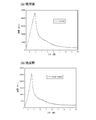
- FIG. 1 (a) is an X-ray diffraction diagram of the phosphorus-containing mesoporous silica obtained in Example 1
- FIG. 1 (b) is an X-ray diffraction diagram before firing.
- FIG. 2 is a pore size distribution diagram of the phosphorus-containing mesoporous silica obtained in Example 1.
- 3 is a transmission electron microscope image of the phosphorus-containing mesoporous silica obtained in Example 1.
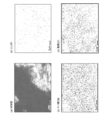
- FIG. FIG. 4 (a) is a scanning electron microscope image of the phosphorus-containing mesoporous silica obtained in Example 1.
- FIGS. 4 (b) to 4 (d) respectively show phosphorus in the observation field shown in FIG. 4 (a).
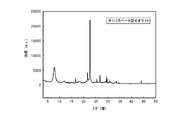
- FIG. 5 is an X-ray diffraction pattern of the all-silica beta zeolite obtained in Example 5.
- the mesoporous silica of the present invention contains phosphorus (P) in the pore wall structure.
- Phosphorus is directly bonded to the SiO 2 repeating unit constituting the pore wall structure by a covalent bond. Due to the presence of phosphorus in such a state, elution of phosphorus is less likely to occur in the mesoporous silica of the present invention.
- phosphorus is easily eluted because phosphorus is present on the surface of the pore wall structure. However, this does not exclude the presence of phosphorus on the surface of the pore wall structure in the present invention.
- the presence of phosphorus in the pore wall structure in the mesoporous silica of the present invention can be confirmed by, for example, 31 P-NMR.
- the phosphorus content in the mesoporous silica of the present invention is preferably 0.5 to 100, particularly 0.5 to 20, particularly 9 to 15 in terms of the atomic ratio of silicon to phosphorus (Si / P).
- the mesoporous silica of the present invention has higher amorphousness compared to zeolite, but low amorphousness compared to amorphous silica.
- the mesoporous silica of the present invention is composed of silicon and oxygen, and further contains phosphorus. Elements other than these may be contained in the mesoporous silica, but preferably the mesoporous silica of the present invention is substantially composed of these three elements.
- the term “substantially” is intended to exclude intentional inclusion of elements other than these three elements, and to allow trace amounts of impurity elements that are inevitably mixed.
- the mesoporous silica of the present invention has many mesopores.
- the mesopore size is preferably 2 to 50 nm, more preferably 2 to 10 nm.
- the volume of the mesopores is preferably 0.3 to 2 cm 3 / g, more preferably 0.5 to 1.5 cm 3 / g.
- the BET specific surface area of mesoporous silica is preferably 200 to 1800 m 2 / g, more preferably 800 to 1500 m 2 / g.
- the mesoporous silica of the present invention is preferably produced using a quaternary phosphonium salt as a structure-directing agent.
- This production method is roughly divided into (b) a step of mixing and reacting an ionic liquid composed of a quaternary phosphonium salt and a compound serving as a silicon source, and (b) a step of baking the reaction product in the atmosphere. Is done.
- each process will be described.
- the quaternary phosphonium salt used in the step (a) is liquid at room temperature (20 to 25 ° C.). That is, it is an ionic liquid.
- the use of an ionic liquid as a structure-directing agent has an advantage that phosphorus atoms can be directly contained in the mesoporous silica of the present invention.
- quaternary phosphonium salt a salt of a phosphonium ion having one long chain alkyl group and three short chain alkyl groups is preferably used.
- Particularly preferred quaternary phosphonium salts are those represented by the following formula (1).
- R 1 that is a long-chain alkyl group in formula (1) is preferably an octyl group, a decyl group, a dodecyl group, a tetradecyl group, a cetyl group, or the like.
- the short chain alkyl group R 2 to R 4 is preferably a methyl group, an ethyl group, an n-propyl group, an isopropyl group, an n-butyl group, or an isobutyl group.
- R 2 to R 4 may be the same group or different groups, but R 2 to R 4 are preferably the same group from the viewpoint of easy synthesis of the phosphonium salt.
- halide ions such as chloride ions and bromide ions, ammonium ions, hydroxide ions and the like can be used.
- the amount of the quaternary phosphonium salt made of an ionic liquid is used in relation to the amount of Si contained in the silicon source, and the number of moles of Si / quaternary phosphonium salt is 0.5 to 100, particularly 0.5 to 20, especially 9 to 15 is preferable from the viewpoint of easily obtaining mesoporous silica having high structure regularity.
- Examples of the silicon source (silicic acid source) used in the step (a) include tetraalkoxysilanes such as tetramethoxysilane, tetraethoxysilane, tetrapropoxysilane, and tetrabutoxysilane, water glass, fumed silica, and silica sol. Can be mentioned.
- water glass is used as the silicon source, the concentration is preferably 25 to 30% by weight in terms of SiO 2 .
- a silicon source is added to an aqueous solution containing a quaternary phosphonium salt.
- a silicon source is added to an aqueous solution containing a quaternary phosphonium salt.
- a quaternary phosphonium salt may be kept at a relatively low temperature, for example, 1 to 15 ° C., and the aqueous solution may be allowed to stand.
- the silicon source When a silicon source is added to an aqueous solution containing a quaternary phosphonium salt, the silicon source is also preferably added in a state cooled to a relatively low temperature, for example, 1 to 15 ° C. Further, it is preferable to gradually add the silicon source from the viewpoint that the mesoporous silica can be successfully synthesized.
- the pH of the reaction solution at this point is preferably 5 or less, particularly 2 or less.
- an acid such as sulfuric acid may be added to adjust the pH of the liquid to 9 to 11.5. It is preferable because dehydration condensation of silanol groups easily occurs.
- the precursor obtained in the step (b) is filtered off, washed with water, dried and then fired. Firing can generally be performed in the air, but it may not be in the air as long as it is in an oxygen-containing atmosphere.
- a firing temperature of 400 to 800 ° C., particularly 450 to 650 ° C. can reliably remove the quaternary phosphonium salt, which is a structure-directing agent, without adversely affecting the structure of the target mesoporous silica. It is preferable from the point of obtaining.
- the firing time is preferably 4 to 72 hours, particularly 10 to 24 hours, provided that the firing temperature is within the above range.
- the quaternary phosphonium salt is removed from the precursor, and the removed site becomes a mesopore.
- the quaternary phosphonium salt is removed, some phosphorus remains and is incorporated into the wall structure of the pores of the mesoporous silica.
- the target mesoporous silica contains phosphorus.
- the phosphorus-containing mesoporous silica thus obtained is suitably used as, for example, various catalysts and their carriers, adsorbents, drug delivery systems, molecular sieves, etc., taking advantage of the characteristics of mesopores.
- This phosphorus-containing mesoporous silica is also useful as a starting material when synthesizing all-silica beta zeolite.
- the all-silica beta-type zeolite is usually obtained by treating beta-type zeolite having an Si / Al atomic ratio of about 10 to 200 with an acid and leaching aluminum in the zeolite.
- the all-silica beta zeolite thus obtained generally has an Si / Al atomic ratio of 1500 or more. Due to this high Si / Al atomic ratio, the all-silica beta zeolite is also called high silica beta zeolite.
- Conventional all-silica beta zeolite obtained by leaching aluminum from zeolite has many defects due to its production method. On the other hand, when the following production method is carried out using the phosphorus-containing mesoporous silica of the present invention as a starting material, the total silica beta zeolite obtained thereby has few defects and high crystallinity.
- all-silica beta zeolite using the phosphorus-containing mesoporous silica of the present invention as a starting material it is preferable to use a so-called dry gel conversion method.
- a so-called dry gel conversion method By using this method, an all-silica beta zeolite with high crystallinity can be obtained.
- phosphorus-containing mesoporous silica and a structure-directing agent are used as starting materials. From the viewpoint of successfully obtaining beta-type zeolite, it is preferable to use tetraethylammonium hydroxide as the structure-directing agent.
- the structure directing agent is generally mixed with phosphorus-containing mesoporous silica in the form of an aqueous solution.
- the mixture of phosphorus-containing mesoporous silica and the structure-directing agent is allowed to stand in the atmosphere at a temperature of, for example, 20 to 70 ° C. and dried.
- the standing time is preferably 2 to 72 hours, more preferably 2 to 48 hours.
- the dried mixture is transferred into an autoclave and sealed. Under this condition, the autoclave is heated. By heating, water contained in the mixture volatilizes and the pressure in the autoclave rises. That is, a self-generated pressure is generated.
- the heating temperature is preferably set to 135 to 160 ° C., more preferably 140 to 150 ° C., and the reaction is allowed to occur under an autogenous pressure at that temperature.
- the reaction time is preferably 240 to 390 hours, particularly 264 to 288 hours, provided that the heating temperature is within the above range.
- the obtained all-silica beta zeolite has a structure-directing agent in its pores, and is removed by calcination. Firing may be performed at 450 to 850 ° C. for 450 to 550 hours in the air.
- the all-silica beta zeolite thus obtained has micropores and is highly crystalline.
- this beta-type zeolite contains phosphorus in its skeleton. The content ratio of phosphorus is preferably 5 or more, more preferably 10 to 700, expressed as an atomic ratio of Si / P.
- This all-silica beta zeolite is useful, for example, as a trap for hydrocarbons in the exhaust gas of automobiles; a carrier for metal catalysts; a heterogeneous catalyst in the petroleum field, petrochemical field and fine chemical field.
- Example 1 As the quaternary phosphonium salt, cetyl-tri-n-butylphosphonium chloride (Hishicolin (registered trademark) PX-416C, 51%, manufactured by Nippon Chemical Industry Co., Ltd.) was used. Tetraethoxysilane was used as the silicon source. In a 250 ml polypropylene container, 22 g of Hishicolin (registered trademark) PX-416C was placed, and 124 g of distilled water was added thereto for dilution. Next, 101 g of 36% hydrochloric acid aqueous solution was added and stirred at room temperature for 10 minutes, and then allowed to stand at 4 ° C. for about 30 minutes.
- Hishicolin (registered trademark) PX-416C 51%, manufactured by Nippon Chemical Industry Co., Ltd.
- Tetraethoxysilane was used as the silicon source.
- a 250 ml polypropylene container 22 g of Hishicolin (registere
- FIG. 10 An X-ray diffraction diagram of the phosphorus-containing mesoporous silica thus obtained is shown in FIG. Further, an X-ray diffraction diagram of the material before firing is shown in FIG. Furthermore, the pore size distribution of the mesoporous silica was measured using an autosorb 1 manufactured by Cantachrome. The result is shown in FIG. Further, a transmission electron microscope image of this mesoporous silica is shown in FIG. When the atomic ratio of silicon to phosphorus (Si / P) in this mesoporous silica was measured by the method described above, it was 9.1.
- Example 2 As the quaternary phosphonium salt, dodecyl-tri-n-butylphosphonium chloride (Hishicolin (registered trademark) PX-412C, 51%, manufactured by Nippon Chemical Industry Co., Ltd.) was used. Tetraethoxysilane was used as the silicon source. In a 250 ml polypropylene container, 14.7 g of Hishicolin (registered trademark) PX-412C was added, and 94 g of distilled water was added thereto for dilution. Next, 76 g of 36% hydrochloric acid aqueous solution was added and stirred at room temperature for 10 minutes, and then allowed to stand at 4 ° C. for about 30 minutes.
- Hishicolin (registered trademark) PX-412C 51%, manufactured by Nippon Chemical Industry Co., Ltd.
- Tetraethoxysilane was used as the silicon source.
- a 250 ml polypropylene container 14.7 g of Hish
- Example 3 As the quaternary phosphonium salt, cetyl-tri-n-butylphosphonium chloride (Hishicolin (registered trademark) PX-416C, 51%, manufactured by Nippon Chemical Industry Co., Ltd.) was used. Water glass was used as the silicon source. In a 100 ml polypropylene container, 28.3 g of Hishicolin (registered trademark) PX-416C was placed, diluted with 25 g of distilled water, and stirred for 15 minutes. Next, 12 g of water glass (SiO 2 min 29%) was added and stirring was continued for 30 min.
- Hishicolin (registered trademark) PX-416C 51%, manufactured by Nippon Chemical Industry Co., Ltd.
- Water glass was used as the silicon source.
- 28.3 g of Hishicolin (registered trademark) PX-416C was placed, diluted with 25 g of distilled water, and stirred for 15 minutes. Next, 12 g of water glass (Si
- the mesoporous silica When the pore size distribution of the mesoporous silica was measured, it had a distribution peak at about 2.6 nm.
- the atomic ratio of silicon to phosphorus (Si / P) in this mesoporous silica was 15.3 as measured by the method described above.
- Example 4 As the quaternary phosphonium salt, dodecyl-tri-n-butylphosphonium bromide (Hishicolin (registered trademark) PX-412B, 98%, manufactured by Nippon Chemical Industry Co., Ltd.) was used. Water glass was used as the silicon source. In a 100 ml polypropylene container, 7 g of Hishicolin (registered trademark) PX-412B was added, and 19 g of distilled water was added thereto for dilution. Next, 6 g of water glass (SiO 2 min 29%) was added and stirring was continued for 30 min.
- Hishicolin (registered trademark) PX-412B 98%, manufactured by Nippon Chemical Industry Co., Ltd.
- Water glass was used as the silicon source.
- 7 g of Hishicolin (registered trademark) PX-412B was added, and 19 g of distilled water was added thereto for dilution. Next, 6 g of water glass (SiO
- Example 5 all-silica beta zeolite was synthesized using the phosphorus-containing mesoporous silica obtained in Example 1 as a raw material. That is, 0.36 g of phosphorus-containing mesoporous silica obtained in Example 1 was placed in a polytetrafluoroethylene cup, and 1 g of tetraethylammonium hydroxide aqueous solution (36%) was added dropwise thereto. The water content in the mixture in this state was 0.697 g. This mixture was allowed to stand at room temperature for about 20 hours. The water content in the mixture in this state was 0.667 g. Next, the contents of the cup were transferred to an autoclave and a dry gel conversion method was performed.
- the conditions were under a self-generated pressure of 150 ° C.
- the reaction was carried out for about 12 days. No water was added during the reaction.
- the product obtained from this reaction was washed with distilled water, filtered off and dried at 100 ° C. overnight. Next, it was calcined at 550 ° C. for about 10 hours under air flow to obtain the target all silica beta zeolite.
- An X-ray diffraction pattern of the silica beta zeolite thus obtained is shown in FIG.
- the atomic ratio of silicon to phosphorus (Si / P) in this beta-type zeolite was 668 as measured by the method described above.
- the BET specific surface area was 455 m 2 / g
- the micropore surface area was 310 m 2 / g
- the micropore volume was 0.162 cm 3 / g
- the total pore volume was 0.352 cm 3 / g.
Landscapes
- Chemical & Material Sciences (AREA)
- Organic Chemistry (AREA)
- Chemical Kinetics & Catalysis (AREA)
- Analytical Chemistry (AREA)
- Inorganic Chemistry (AREA)
- Nanotechnology (AREA)
- Engineering & Computer Science (AREA)
- Life Sciences & Earth Sciences (AREA)
- General Life Sciences & Earth Sciences (AREA)
- Geology (AREA)
- Silicates, Zeolites, And Molecular Sieves (AREA)
- Solid-Sorbent Or Filter-Aiding Compositions (AREA)
- Silicon Compounds (AREA)
Abstract
本発明は、従来技術のメソポーラスシリカよりも各種性能がさらに向上した、各種触媒、吸着剤、ドラッグデリバリシステム等として好適に用いられるメソポーラスシリカの提供を課題とする。 本発明のリン含有メソポーラスシリカは、細孔の壁構造内にリンが含まれ、かつリンが該壁構造を構成するSiO2 繰り返し単位と直接結合していることを特徴とする。ここで、リンに対するケイ素の原子比(Si/P)は10~100であることが好適である。そして、このメソポーラスシリカは、第四級ホスホニウム塩からなるイオン液体とケイ素源となる化合物とを混合して反応させ、それによって得られた生成物を大気下に焼成することで好適に製造される。
Description
本発明は、リン含有メソポーラスシリカ及びその製造方法に関する。本発明のリン含有メソポーラスシリカは、例えば各種の触媒、吸着剤、ドラッグデリバリシステム等として好適に用いられる。
メソポーラスシリカは、メソポア領域に均一な細孔径を有し、触媒や吸着剤等として幅広い用途が期待されている。メソポーラスシリカは、例えばセチルトリメチルアンモニウムブロミド(CTAB)を構造規定剤(SDA)として用い、ケイ酸成分を反応させることによって得ることができる。このメソポーラスシリカの各種の性能を高める観点から、他の元素をドープさせる試みがなされている。例えばメソポーラスシリカの一種であるMCM-41にリンをドープさせることが提案されている(非特許文献1参照)。同文献には、MCM-41にリンをドープすることで、このメソポーラスシリカの生体活性を高めることができると記載されている。しかし、このメソポーラスシリカは、細孔の壁構造の表面にリンを含有するものであり、壁構造の内部にリンを含有するものではない。
ゼオライトに関しても、これにリンをドープする技術が知られている。例えば特許文献1には、ZSM-5やモルデナイト等におけるアルミニウムをリンで置換することで、その耐熱性を高めることが提案されている。リン以外の元素に関しては、例えばベータ型ゼオライトに鉄、マンガン又はコバルトをドープすることが提案されている(特許文献2参照)。同文献に記載のベータ型ゼオライトは、メソポーラスシリカの一種であるMCM-41から合成されている。これらの技術によれば、ゼオライトの骨格中に異種の元素を含有させることができるが、メソポーラスシリカそのものに異種元素を含有させることまでは言及されていない。
M. Vallet-Regi et al., Solid State Sciences, 7, 2005, pp.233-237
したがって本発明の課題は、前述した従来技術のメソポーラスシリカよりも更に各種の性能が向上したメソポーラスシリカを提供することにある。
本発明は、細孔の壁構造内にリンが含まれ、かつリンが該壁構造を構成するSiO2繰り返し単位と直接結合していることを特徴とするリン含有メソポーラスシリカを提供するものである。
また本発明は、前記のリン含有メソポーラスシリカの好適な製造方法として、第四級ホスホニウム塩からなるイオン液体とケイ素源となる化合物とを混合して反応させ、それによって得られた生成物を大気下に焼成することを特徴とするリン含有メソポーラスシリカの製造方法を提供するものである。
更に本発明は、リン含有メソポーラスシリカと構造規定剤とを混合し、その混合物をオートクレーブ内に充填し、加熱して自生圧力下で反応させることを特徴とする全シリカベータ型ゼオライトの製造方法を提供するものである。
本発明によれば、触媒、ガス吸着、ドラッグデリバリシステム等に有用なメソポーラスシリカが提供される。
本発明のメソポーラスシリカは、細孔の壁構造内にリン(P)を含有していることが特徴の一つである。リンは、細孔の壁構造を構成するSiO2繰り返し単位と直接に、共有結合によって結合している。リンがこのような状態で存在していることに起因して、本発明のメソポーラスシリカにおいては、リンの溶出が起こりにくくなっている。これに対して、先に背景技術の項で述べた特許文献1に記載のメソポーラスシリカでは、リンが細孔の壁構造の表面に存在しているので、リンの溶出が起こりやすくなっている。尤も、このことは、本発明において、細孔の壁構造の表面にリンが存在することを排除するものではない。
本発明のメソポーラスシリカにおいて、リンが細孔の壁構造内に存在していることは、例えば31P-NMRによって確認することができる。
本発明のメソポーラスシリカにおけるリンの含有量は、リンに対するケイ素の原子比(Si/P)で表して、0.5~100、特に0.5~20、とりわけ9~15であることが好ましい。また、本発明のメソポーラスシリカは、ゼオライトに比較すると非晶質性は高いが、アモルファスシリカに比較すると非晶質性は低い。
本発明のメソポーラスシリカは、ケイ素及び酸素から構成されており、更にリンを含むものである。これら以外の元素がメソポーラスシリカ中に含まれていてもよいが、好ましくは本発明のメソポーラスシリカは、実質的にこれら3種の元素から構成されている。「実質的に」とは、これら3種の元素以外の元素を意図的に含有させることを排除するとともに、不可避的に混入する微量の不純物元素は許容する趣旨である。
本発明のメソポーラスシリカは、メソ孔を多数有するものである。メソ孔のサイズは好ましくは2~50nm、更に好ましくは2~10nmである。またメソ孔の体積は、好ましくは0.3~2cm3/g、更に好ましくは0.5~1.5cm3/gである。更にメソポーラスシリカのBET比表面積は、好ましくは200~1800m2/g、更に好ましくは800~1500m2/gである。これらの物性値は、例えばカンタクローム社製のオートソーブ1を用いた窒素吸着法によって測定することができる。
本発明のメソポーラスシリカは、好適には、構造規定剤として第四級ホスホニウム塩を用いて製造される。この製造方法は、(イ)第四級ホスホニウム塩からなるイオン液体とケイ素源となる化合物とを混合して反応させる工程と、(ロ)反応生成物を大気下に焼成する工程とに大別される。以下、それぞれの工程について説明する。
(イ)の工程において用いられる第四級ホスホニウム塩は、室温(20~25℃)において液体のものである。すなわちイオン液体である。構造規定剤としてイオン液体を用いることには、本発明のメソポーラスシリカ中に、リン原子を直接含有させることができるという利点がある。
この第四級ホスホニウム塩としては、長鎖アルキル基を1個有し、かつ短鎖アルキル基を3個有するホスホニウムイオンの塩を用いることが好ましい。特に好ましい第四級ホスホニウム塩は以下の式(1)で表されるものである。
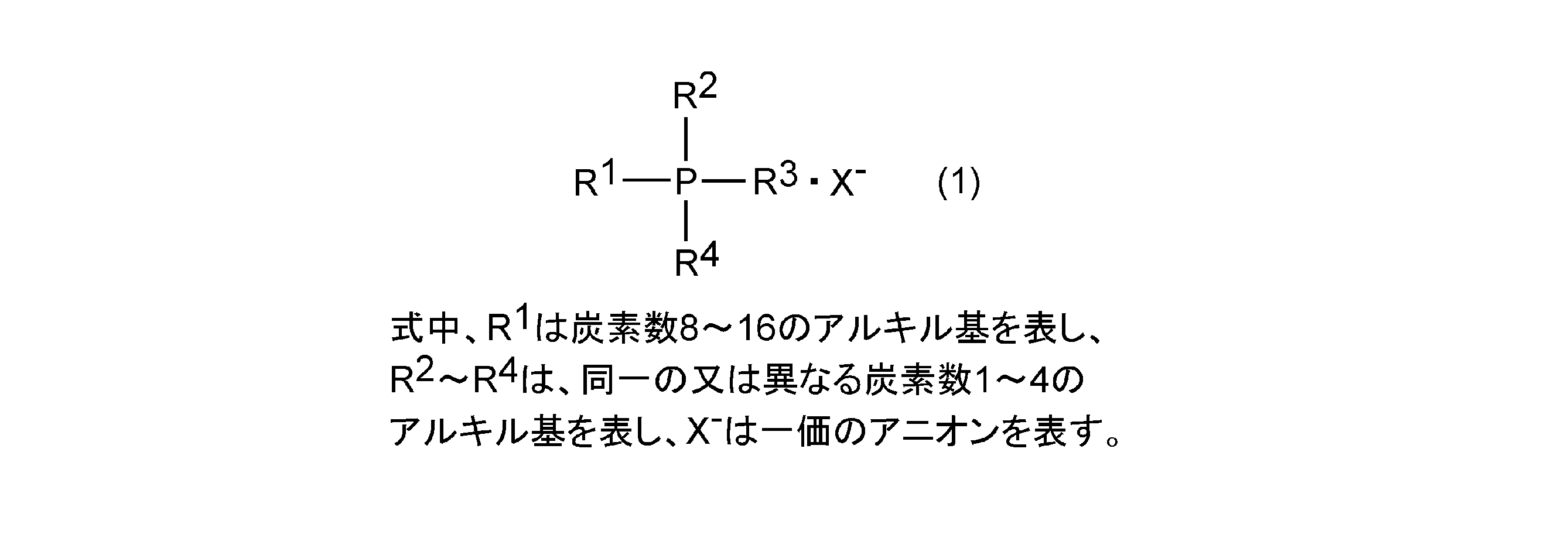
式(1)における長鎖アルキル基であるR1としては、好ましくはオクチル基、デシル基、ドデシル基、テトラデシル、セチル基等が挙げられる。短鎖アルキル基であるR2~R4としては、好ましくはメチル基、エチル基、n-プロピル基、イソプロピル基、n-ブチル基、イソブチル基等が挙げられる。R2~R4は同一の基でもよく、あるいは異なる基でもよいが、ホスホニウム塩の合成の容易さの点からは、R2~R4は同一の基であることが好ましい。
式(1)における一価のアニオンとしては、例えば塩化物イオン、臭化物イオン等のハロゲン化物イオンや、アンモニウムイオン、水酸化物イオンなどを用いることができる。
イオン液体からなる前記第4級ホスホニウム塩の使用量は、ケイ素源に含まれるSiの量との関係で、Si/第4級ホスホニウム塩のモル数を0.5~100、特に0.5~20、とりわけ9~15とすることが、構造規則性の高いメソポーラスシリカを得やすい点から好ましい。
(イ)の工程において用いられるケイ素源(ケイ酸源)としては、例えばテトラメトキシシラン、テトラエトキシシラン、テトラプロポキシシラン、テトラブトキシシラン等のテトラアルコキシシラン、水ガラス、ヒュームドシリカ、シリカゾルなどが挙げられる。ケイ素源として水ガラスを用いる場合には、その濃度はSiO2換算で25~30重量%とすることが好ましい。
(イ)の工程においては、第4級ホスホニウム塩を含む水溶液にケイ素源を添加する。ケイ素源として例えばテトラアルコキシシランを用いる場合には、その添加に先立ち、第4級ホスホニウム塩を含む水溶液に塩酸等の酸を添加して、系のpHを酸性域に調整することが、均一な形状で、かつ細孔の大きさも均一なメソポーラスシリカが得やすいので好ましい。また、ケイ素源の添加に先立ち、第4級ホスホニウム塩を含む水溶液を比較的低温、例えば1~15℃に保持し、かつ該水溶液を静置してもよい。
第4級ホスホニウム塩を含む水溶液にケイ素源を添加する場合には、該ケイ素源も、比較的低温、例えば1~15℃に冷却された状態で添加されることが好ましい。また、ケイ素源は徐々に添加することが、メソポーラスシリカを首尾よく合成できる点から好ましい。この時点での反応液のpHは5以下、特に2以下であることが好ましい。
ケイ素源として水ガラスを用いる場合には、第4級ホスホニウム塩を含む水溶液に水ガラスを添加した後に、硫酸等の酸を添加して液のpHを9~11.5に調整することが、シラノール基の脱水縮合が起こりやすくなる点から好ましい。
第4級ホスホニウム塩を含む水溶液にケイ素源を添加したら、所定の時間放置して反応を進行させる。これによって目的とするメソポーラスシリカの前駆体が生成する。この前駆体はまだリンを含有していない。
(ロ)の工程においては、(イ)の工程で得られた前駆体を濾別し、水で洗浄して乾燥させた後に焼成する。焼成は、一般に大気下に行うことができるが、含酸素雰囲気下であれば、大気下でなくてもよい。焼成温度は400~800℃、特に450~650℃とすることが、目的物であるメソポーラスシリカの構造に悪影響を与えることなく、構造規定剤である前記の第四級ホスホニウム塩を確実に除去し得る点から好ましい。焼成時間は、焼成温度が前記の範囲内であることを条件として、4~72時間、特に10~24時間とすることが好ましい。
焼成によって、第4級ホスホニウム塩が前駆体から除去され、除去された部位がメソ孔となる。第4級ホスホニウム塩が除去されるときに、一部のリンが残留して、それがメソポーラスシリカの細孔の壁構造内に取り込まれる。これによって、目的とするメソポーラスシリカはリンを含有したものとなる。
このようにして得られたリン含有メソポーラスシリカは、それが有するメソ孔の特徴を生かして、例えば各種の触媒及びその担体、吸着剤、ドラッグデリバリシステム、モレキュラーシーブ等として好適に用いられる。また、このリン含有メソポーラスシリカは、全シリカベータ型ゼオライトを合成するときの出発物質としても有用である。
全シリカベータ型ゼオライトは、通常、Si/Alの原子比が10~200程度のベータ型ゼオライトを酸で処理して、ゼオライト中のアルミニウムを浸出することで得られる。このようにして得られた全シリカベータ型ゼオライトは、一般にSi/Alの原子比が1500以上になる。Si/Alの原子比がこのように高いことから、全シリカベータ型ゼオライトは、ハイシリカベータ型ゼオライトとも呼ばれる。ゼオライトからアルミニウムを浸出して得られる従来の全シリカベータ型ゼオライトは、その製造方法に起因して多くの欠陥を有している。これに対して、本発明のリン含有メソポーラスシリカを出発物質として用い、以下の製造方法を実施すると、それによって得られる全シリカベータ型ゼオライトは欠陥が少なく、かつ結晶性の高いものとなる。
本発明のリン含有メソポーラスシリカを出発物質とする全シリカベータ型ゼオライトの製造においては、いわゆるドライゲルコンバージョン法を用いることが好ましい。この方法を用いることで、結晶性の高い全シリカベータ型ゼオライトを得ることができる。この方法においては、出発物質としてリン含有メソポーラスシリカと構造規定剤とを用いる。ベータ型ゼオライトを首尾よく得る観点からは、構造規定剤として、水酸化テトラエチルアンモニウムを用いることが好ましい。
構造規定剤とリン含有メソポーラスシリカとの比率(重量比)は、リン含有メソポーラスシリカに含まれるSiO2ユニットに換算して、構造規定剤/SiO2=0.5~3、特に0.75~1.8であることが好ましい。構造規定剤は、一般に水溶液の状態でリン含有メソポーラスシリカと混合される。
リン含有メソポーラスシリカと構造規定剤との混合物は、例えば20~70℃の温度下で、大気下に静置されて乾燥される。静置時間は2~72時間、特に2~48時間とすることが好ましい。乾燥後の混合物に含まれている水とリン含有メソポーラスシリカとの比率(重量比)は、リン含有メソポーラスシリカに含まれるSiO2ユニットに換算して、水/SiO2=1~5、特に1.4~3.7であることが好ましい。
乾燥後の混合物はオートクレーブ内に移されて、密閉される。この状態下にオートクレーブを加熱する。加熱によって混合物中に含まれる水が揮発してオートクレーブ内の圧力が上昇する。つまり自生圧力が発生する。加熱温度を好ましくは135から160℃、更に好ましくは140~150℃に設定して、その温度での自生圧力下に反応を起こさせる。反応時間は、加熱温度が前記の範囲内であることを条件として、240~390時間、特に264~288時間であることが好ましい。この反応によって、メソ孔がミクロ孔に転化し、かつ生成した全シリカベータ型ゼオライトの結晶性が高まる。なお、反応中は水の添加は行わない。
このようにして目的とする全シリカベータ型ゼオライトが得られる。得られた全シリカベータ型ゼオライトはその細孔内に構造規定剤を有しているので、焼成によってこれを除去する。焼成は、大気下に450~850℃で450~550時間行えばよい。このようにして得られた全シリカベータ型ゼオライトはミクロ孔を有し、かつ結晶性の高いものとなる。また、このベータ型ゼオライトは、その骨格中にリンを含むものである。リンの含有比率は、Si/Pの原子比で表して好ましくは5以上、更に好ましくは10~700である。
この全シリカベータ型ゼオライトは、例えば自動車の排気ガス中の炭化水素類のトラップ;金属触媒の担体;石油分野、石油化学分野及びファインケミカル分野における不均一系触媒などとして有用である。
以下、実施例により本発明を更に詳細に説明する。しかしながら本発明の範囲は、かかる実施例に制限されない。特に断らない限り、「%」は「重量%」を意味する。
〔実施例1〕
第4級ホスホニウム塩として、セチル-トリ-n-ブチルホスホニウムクロライド(日本化学工業(株)製のヒシコーリン(登録商標)PX-416C、51%)を用いた。また、ケイ素源としてテトラエトキシシランを用いた。250mlのポリプロピレン製容器に、22gのヒシコーリン(登録商標)PX-416Cを入れ、そこに124gの蒸留水を入れて希釈した。次に、36%塩酸水溶液を101g入れて室温下で10分間攪拌した後に、4℃で約30分間静置した。次に、この液に、予め4℃に冷却しておいた4gのテトラエトキシシラン(95%)を加えると、透明なゾルが生成した。このゾルを4℃で約3時間連続攪拌した。このゾルのpHは1未満であった。この反応によって白色の物質が生成した。この物質を濾別して多量の蒸留水で洗浄した。このようにして得られた固体物質を70℃で2時間乾燥させた。次いで、空気の流通下、550℃で約10時間焼成し、目的物であるリン含有メソポーラスシリカを得た。
第4級ホスホニウム塩として、セチル-トリ-n-ブチルホスホニウムクロライド(日本化学工業(株)製のヒシコーリン(登録商標)PX-416C、51%)を用いた。また、ケイ素源としてテトラエトキシシランを用いた。250mlのポリプロピレン製容器に、22gのヒシコーリン(登録商標)PX-416Cを入れ、そこに124gの蒸留水を入れて希釈した。次に、36%塩酸水溶液を101g入れて室温下で10分間攪拌した後に、4℃で約30分間静置した。次に、この液に、予め4℃に冷却しておいた4gのテトラエトキシシラン(95%)を加えると、透明なゾルが生成した。このゾルを4℃で約3時間連続攪拌した。このゾルのpHは1未満であった。この反応によって白色の物質が生成した。この物質を濾別して多量の蒸留水で洗浄した。このようにして得られた固体物質を70℃で2時間乾燥させた。次いで、空気の流通下、550℃で約10時間焼成し、目的物であるリン含有メソポーラスシリカを得た。
このようにして得られたリン含有メソポーラスシリカのX線回折図を図1(a)に示す。また、焼成前の物質のX線回折図を図1(b)に示す。更に、このメソポーラスシリカの細孔径の分布をカンタクローム社製のオートソーブ1を用いて測定した。その結果を図2に示す。また、このメソポーラスシリカの透過型電子顕微鏡像を図3に示す。このメソポーラスシリカにおけるリンに対するケイ素の原子比(Si/P)を、上述の方法で測定したところ9.1であった。更に、このメソポーラスシリカについて、SEM-EDS(エネルギー分散形X線分光器)による元素のマッピングをリン(P)、ケイ素(Si)及び酸素(O)について行った。その結果を図4(a)~(d)に示す。同図に示す結果から明らかなように、リンは、メソポーラスシリカの壁構造内に存在していることが判る。
〔実施例2〕
第4級ホスホニウム塩として、ドデシル-トリ-n-ブチルホスホニウムクロライド(日本化学工業(株)製のヒシコーリン(登録商標)PX-412C、51%)を用いた。
また、ケイ素源としてテトラエトキシシランを用いた。250mlのポリプロピレン製容器に、14.7gのヒシコーリン(登録商標)PX-412Cを入れ、そこに94gの蒸留水を入れて希釈した。次に、36%塩酸水溶液を76g入れて室温下で10分間攪拌した後に、4℃で約30分間静置した。次に、この液に、予め4℃に冷却しておいた3gのテトラエトキシシラン(95%)を加えると、透明なゾルが生成した。このゾルを4℃で約5時間連続攪拌した。このゾルのpHは1未満であった。この反応によって白色の物質が生成した。この物質を濾別して多量の蒸留水で洗浄した。このようにして得られた固体物質を70℃で2時間乾燥させた。次いで、空気の流通下、550℃で約10時間焼成し、目的物であるリン含有メソポーラスシリカを得た。このメソポーラスシリカの細孔径の分布を測定したところ、約2.2nmに分布のピークを有していた。このメソポーラスシリカにおけるリンに対するケイ素の原子比(Si/P)を、上述の方法で測定したところ9.1であった。
第4級ホスホニウム塩として、ドデシル-トリ-n-ブチルホスホニウムクロライド(日本化学工業(株)製のヒシコーリン(登録商標)PX-412C、51%)を用いた。
また、ケイ素源としてテトラエトキシシランを用いた。250mlのポリプロピレン製容器に、14.7gのヒシコーリン(登録商標)PX-412Cを入れ、そこに94gの蒸留水を入れて希釈した。次に、36%塩酸水溶液を76g入れて室温下で10分間攪拌した後に、4℃で約30分間静置した。次に、この液に、予め4℃に冷却しておいた3gのテトラエトキシシラン(95%)を加えると、透明なゾルが生成した。このゾルを4℃で約5時間連続攪拌した。このゾルのpHは1未満であった。この反応によって白色の物質が生成した。この物質を濾別して多量の蒸留水で洗浄した。このようにして得られた固体物質を70℃で2時間乾燥させた。次いで、空気の流通下、550℃で約10時間焼成し、目的物であるリン含有メソポーラスシリカを得た。このメソポーラスシリカの細孔径の分布を測定したところ、約2.2nmに分布のピークを有していた。このメソポーラスシリカにおけるリンに対するケイ素の原子比(Si/P)を、上述の方法で測定したところ9.1であった。
〔実施例3〕
第4級ホスホニウム塩として、セチル-トリ-n-ブチルホスホニウムクロライド(日本化学工業(株)製のヒシコーリン(登録商標)PX-416C、51%)を用いた。また、ケイ素源として水ガラスを用いた。100mlのポリプロピレン製容器に、28.3gのヒシコーリン(登録商標)PX-416Cを入れ、そこに25gの蒸留水を入れて希釈し、15分間攪拌した。次に、12gの水ガラス(SiO2分29%)を加えて30分間攪拌を継続した。更に、0.7gの濃硫酸(96%)を3gの蒸留水で希釈した水溶液を加えると、濃厚なゲルが約30分で均一化された。このゲルのpHは10.5であった。次いで、このゲルを100℃で24時間放置した。それによって白色の物質が生成した。この物質を濾別して多量の蒸留水で洗浄した。このようにして得られた固体物質を50℃で2時間乾燥させ、引き続き室温で約2日間乾燥させ、更に70℃で2時間乾燥させた。次いで、空気の流通下、550℃で約10時間焼成し、目的物であるリン含有メソポーラスシリカを得た。このメソポーラスシリカの細孔径の分布を測定したところ、約2.6nmに分布のピークを有していた。このメソポーラスシリカにおけるリンに対するケイ素の原子比(Si/P)を、上述の方法で測定したところ15.3であった。
第4級ホスホニウム塩として、セチル-トリ-n-ブチルホスホニウムクロライド(日本化学工業(株)製のヒシコーリン(登録商標)PX-416C、51%)を用いた。また、ケイ素源として水ガラスを用いた。100mlのポリプロピレン製容器に、28.3gのヒシコーリン(登録商標)PX-416Cを入れ、そこに25gの蒸留水を入れて希釈し、15分間攪拌した。次に、12gの水ガラス(SiO2分29%)を加えて30分間攪拌を継続した。更に、0.7gの濃硫酸(96%)を3gの蒸留水で希釈した水溶液を加えると、濃厚なゲルが約30分で均一化された。このゲルのpHは10.5であった。次いで、このゲルを100℃で24時間放置した。それによって白色の物質が生成した。この物質を濾別して多量の蒸留水で洗浄した。このようにして得られた固体物質を50℃で2時間乾燥させ、引き続き室温で約2日間乾燥させ、更に70℃で2時間乾燥させた。次いで、空気の流通下、550℃で約10時間焼成し、目的物であるリン含有メソポーラスシリカを得た。このメソポーラスシリカの細孔径の分布を測定したところ、約2.6nmに分布のピークを有していた。このメソポーラスシリカにおけるリンに対するケイ素の原子比(Si/P)を、上述の方法で測定したところ15.3であった。
〔実施例4〕
第4級ホスホニウム塩として、ドデシル-トリ-n-ブチルホスホニウムブロマイド(日本化学工業(株)製のヒシコーリン(登録商標)PX-412B、98%)を用いた。
また、ケイ素源として水ガラスを用いた。100mlのポリプロピレン製容器に、7gのヒシコーリン(登録商標)PX-412Bを入れ、そこに19gの蒸留水を入れて希釈した。次に、6gの水ガラス(SiO2分29%)を加えて30分間攪拌を継続した。更に、0.4gの濃硫酸(96%)を2gの蒸留水で希釈した水溶液を加えると、濃厚なゲルが約30分で均一化された。次いで、このゲルを100℃で24時間放置した。このゲルのpHは10.6であった。それによって白色の物質が生成した。この物質を濾別してエタノールで洗浄し、引く続き蒸留水で洗浄した。このようにして得られた固体物質を100℃で一晩乾燥させ、次いで、空気の流通下、550℃で約10時間焼成し、目的物であるリン含有メソポーラスシリカを得た。このメソポーラスシリカの細孔径の分布を測定したところ、約2.2nmに分布のピークを有していた。このメソポーラスシリカにおけるリンに対するケイ素の原子比(Si/P)を、上述の方法で測定したところ18.2であった。
第4級ホスホニウム塩として、ドデシル-トリ-n-ブチルホスホニウムブロマイド(日本化学工業(株)製のヒシコーリン(登録商標)PX-412B、98%)を用いた。
また、ケイ素源として水ガラスを用いた。100mlのポリプロピレン製容器に、7gのヒシコーリン(登録商標)PX-412Bを入れ、そこに19gの蒸留水を入れて希釈した。次に、6gの水ガラス(SiO2分29%)を加えて30分間攪拌を継続した。更に、0.4gの濃硫酸(96%)を2gの蒸留水で希釈した水溶液を加えると、濃厚なゲルが約30分で均一化された。次いで、このゲルを100℃で24時間放置した。このゲルのpHは10.6であった。それによって白色の物質が生成した。この物質を濾別してエタノールで洗浄し、引く続き蒸留水で洗浄した。このようにして得られた固体物質を100℃で一晩乾燥させ、次いで、空気の流通下、550℃で約10時間焼成し、目的物であるリン含有メソポーラスシリカを得た。このメソポーラスシリカの細孔径の分布を測定したところ、約2.2nmに分布のピークを有していた。このメソポーラスシリカにおけるリンに対するケイ素の原子比(Si/P)を、上述の方法で測定したところ18.2であった。
〔実施例5〕
本実施例では、実施例1で得られたリン含有メソポーラスシリカを原料として、全シリカベータ型ゼオライトを合成した。すなわち、実施例1で得られたリン含有メソポーラスシリカ0.36gをポリ四フッ化エチレンのカップに入れ、これに1gの水酸化テトラエチルアンモニウム水溶液(36%)を滴下した。この状態での混合物中における水の含有量は0.697gであった。この混合物を室温下で約20時間静置した。この状態での混合物中における水の含有量は0.667gであった。次にカップの内容物をオートクレーブに移し変え、ドライゲルコンバージョン法を行った。その条件は150℃の自生圧力下とした。反応は約12日間行った。反応中、水の添加は行わなかった。この反応によって得られた生成物を蒸留水で洗浄し、濾別し、100℃で一晩乾燥させた。次いで空気の流通下、550℃で約10時間焼成し、目的物である全シリカベータ型ゼオライトを得た。このようにして得られたシリカベータ型ゼオライトのX線回折図を図5に示す。このベータ型ゼオライトにおけるリンに対するケイ素の原子比(Si/P)を、上述の方法で測定したところ668であった。BET比表面積は455m2/g、ミクロ孔表面積は310m2/g、ミクロ孔体積は0.162cm3/g、全孔体積は0.352cm3/gであった。
本実施例では、実施例1で得られたリン含有メソポーラスシリカを原料として、全シリカベータ型ゼオライトを合成した。すなわち、実施例1で得られたリン含有メソポーラスシリカ0.36gをポリ四フッ化エチレンのカップに入れ、これに1gの水酸化テトラエチルアンモニウム水溶液(36%)を滴下した。この状態での混合物中における水の含有量は0.697gであった。この混合物を室温下で約20時間静置した。この状態での混合物中における水の含有量は0.667gであった。次にカップの内容物をオートクレーブに移し変え、ドライゲルコンバージョン法を行った。その条件は150℃の自生圧力下とした。反応は約12日間行った。反応中、水の添加は行わなかった。この反応によって得られた生成物を蒸留水で洗浄し、濾別し、100℃で一晩乾燥させた。次いで空気の流通下、550℃で約10時間焼成し、目的物である全シリカベータ型ゼオライトを得た。このようにして得られたシリカベータ型ゼオライトのX線回折図を図5に示す。このベータ型ゼオライトにおけるリンに対するケイ素の原子比(Si/P)を、上述の方法で測定したところ668であった。BET比表面積は455m2/g、ミクロ孔表面積は310m2/g、ミクロ孔体積は0.162cm3/g、全孔体積は0.352cm3/gであった。
Claims (6)
- 細孔の壁構造内にリンが含まれ、かつリンが該壁構造を構成するSiO2繰り返し単位と直接結合していることを特徴とするリン含有メソポーラスシリカ。
- リンに対するケイ素の原子比(Si/P)が、0.5~100である請求項1記載のリン含有メソポーラスシリカ。
- 請求項1記載のリン含有メソポーラスシリカの製造方法であって、
第四級ホスホニウム塩からなるイオン液体とケイ素源となる化合物とを混合して反応させ、それによって得られた生成物を大気下に焼成することを特徴とするリン含有メソポーラスシリカの製造方法。 - 第四級ホスホニウム塩が以下の式(1)で表される請求項3記載の製造方法。

- ケイ素源となる化合物がテトラエトキシシラン又は水ガラスである請求項3又は4記載の製造方法。
- 請求項1記載のリン含有メソポーラスシリカと構造規定剤とを混合し、その混合物をオートクレーブ内に充填し、加熱して自生圧力下で反応させることを特徴とする全シリカベータ型ゼオライトの製造方法。
Applications Claiming Priority (2)
| Application Number | Priority Date | Filing Date | Title |
|---|---|---|---|
| JP2010-097349 | 2010-04-20 | ||
| JP2010097349A JP2011225401A (ja) | 2010-04-20 | 2010-04-20 | リン含有メソポーラスシリカ及びその製造方法 |
Publications (1)
| Publication Number | Publication Date |
|---|---|
| WO2011132585A1 true WO2011132585A1 (ja) | 2011-10-27 |
Family
ID=44834108
Family Applications (1)
| Application Number | Title | Priority Date | Filing Date |
|---|---|---|---|
| PCT/JP2011/059188 Ceased WO2011132585A1 (ja) | 2010-04-20 | 2011-04-13 | リン含有メソポーラスシリカ及びその製造方法 |
Country Status (2)
| Country | Link |
|---|---|
| JP (1) | JP2011225401A (ja) |
| WO (1) | WO2011132585A1 (ja) |
Cited By (1)
| Publication number | Priority date | Publication date | Assignee | Title |
|---|---|---|---|---|
| CN112920464A (zh) * | 2021-04-06 | 2021-06-08 | 江苏科技大学 | 一种具有低介电常数的填料、环氧基复合材料及其制备方法 |
Families Citing this family (3)
| Publication number | Priority date | Publication date | Assignee | Title |
|---|---|---|---|---|
| US9370735B2 (en) * | 2012-10-01 | 2016-06-21 | Dow Global Technologies Llc | Ionic liquid grafted mesoporous silica compositions for polar gas/non-polar gas and olefin/paraffin separations |
| JP6158014B2 (ja) * | 2013-09-24 | 2017-07-05 | 株式会社東芝 | 放射性物質吸着剤、その製造方法およびその製造装置 |
| JP7011119B2 (ja) * | 2017-02-21 | 2022-02-10 | 株式会社 京都モノテック | モノリスフィルタとそれを利用した固体分離装置、および、そのモノリスフィルタ製造方法 |
Citations (5)
| Publication number | Priority date | Publication date | Assignee | Title |
|---|---|---|---|---|
| JPH0797209A (ja) * | 1993-09-29 | 1995-04-11 | Honda Motor Co Ltd | 耐熱性ゼオライト |
| JPH11171534A (ja) * | 1997-12-04 | 1999-06-29 | Mobil Oil Corp | 品質の向上したm41s触媒及びその製造方法 |
| JP2007209926A (ja) * | 2006-02-10 | 2007-08-23 | National Institute Of Advanced Industrial & Technology | 環状カーボネート合成用触媒 |
| JP2008073625A (ja) * | 2006-09-22 | 2008-04-03 | Mitsubishi Motors Corp | Hcトラップ触媒及びhcトラップ触媒の調製方法。 |
| JP2008100983A (ja) * | 2006-09-22 | 2008-05-01 | Sumitomo Chemical Co Ltd | シクロアルカノール及び/又はシクロアルカノンの製造方法 |
-
2010
- 2010-04-20 JP JP2010097349A patent/JP2011225401A/ja active Pending
-
2011
- 2011-04-13 WO PCT/JP2011/059188 patent/WO2011132585A1/ja not_active Ceased
Patent Citations (5)
| Publication number | Priority date | Publication date | Assignee | Title |
|---|---|---|---|---|
| JPH0797209A (ja) * | 1993-09-29 | 1995-04-11 | Honda Motor Co Ltd | 耐熱性ゼオライト |
| JPH11171534A (ja) * | 1997-12-04 | 1999-06-29 | Mobil Oil Corp | 品質の向上したm41s触媒及びその製造方法 |
| JP2007209926A (ja) * | 2006-02-10 | 2007-08-23 | National Institute Of Advanced Industrial & Technology | 環状カーボネート合成用触媒 |
| JP2008073625A (ja) * | 2006-09-22 | 2008-04-03 | Mitsubishi Motors Corp | Hcトラップ触媒及びhcトラップ触媒の調製方法。 |
| JP2008100983A (ja) * | 2006-09-22 | 2008-05-01 | Sumitomo Chemical Co Ltd | シクロアルカノール及び/又はシクロアルカノンの製造方法 |
Non-Patent Citations (1)
| Title |
|---|
| VALLET-REGI M. ET AL.: "Phosphorous-doped MCM-41 as bioactive material", SOLID STATE SCIENCES, vol. 7, 2005, pages 233 - 237, XP004752888, DOI: doi:10.1016/j.solidstatesciences.2004.10.038 * |
Cited By (1)
| Publication number | Priority date | Publication date | Assignee | Title |
|---|---|---|---|---|
| CN112920464A (zh) * | 2021-04-06 | 2021-06-08 | 江苏科技大学 | 一种具有低介电常数的填料、环氧基复合材料及其制备方法 |
Also Published As
| Publication number | Publication date |
|---|---|
| JP2011225401A (ja) | 2011-11-10 |
Similar Documents
| Publication | Publication Date | Title |
|---|---|---|
| CN1234456C (zh) | 具有中孔或复合的中孔和微孔的无机氧化物及其制备方法 | |
| CN102224104B (zh) | 分子筛ssz-83 | |
| CN107892309B (zh) | 一种超大孔硅酸盐分子筛的制备方法 | |
| CN105555711B (zh) | 制备沸石ssz‑35的方法 | |
| JP6596567B2 (ja) | 二酸化炭素吸収材料とその製造方法 | |
| JP2010202506A (ja) | 水酸化物媒介ゲルを使用したモレキュラー・シーブssz−74の合成 | |
| CN103626199A (zh) | 介孔沸石的制备方法 | |
| CN110291041B (zh) | 使用苄基类结构导向剂制备沸石的方法及其制备的沸石 | |
| CN100540470C (zh) | 利用阴离子效应合成有序介孔分子筛的方法 | |
| KR20200018638A (ko) | 변형된 반응 조성물을 이용한 ssz-39 합성 방법 | |
| JP2020055699A (ja) | 非晶質アルミノケイ酸塩粒子粉末及びその製造方法 | |
| Dudarko et al. | Microwave-assisted and conventional hydrothermal synthesis of ordered mesoporous silicas with P-containing functionalities | |
| CN105408254A (zh) | 外表面积增加的沸石ssz-70 | |
| JP6075896B2 (ja) | モレキュラーシーブssz−23の調製 | |
| JP2010260777A (ja) | リン含有ベータ型ゼオライトの製造方法 | |
| JP2011225401A (ja) | リン含有メソポーラスシリカ及びその製造方法 | |
| CN106608636A (zh) | 一种euo或nes结构分子筛的制备方法 | |
| KR20180072680A (ko) | 고도로 균질한 제올라이트 전구체 | |
| JP2018062450A (ja) | Kfi型ゼオライト及びその製造方法 | |
| JP6100361B2 (ja) | モレキュラーシーブssz−87及びその合成 | |
| WO2023284491A1 (zh) | 硅酸盐材料zeo-2和硅酸盐分子筛zeo-3,其合成方法及用途 | |
| JP6966087B2 (ja) | ゼオライトとその製造方法 | |
| JP5820526B2 (ja) | ゲルマノケイ酸塩ssz−75 | |
| RU2413573C1 (ru) | Нанокомпозитный материал и способ его получения | |
| JP2023103968A (ja) | シート状結晶性アルミノシリケート凝集体及びその製造方法 |
Legal Events
| Date | Code | Title | Description |
|---|---|---|---|
| 121 | Ep: the epo has been informed by wipo that ep was designated in this application |
Ref document number: 11771920 Country of ref document: EP Kind code of ref document: A1 |
|
| NENP | Non-entry into the national phase |
Ref country code: DE |
|
| 122 | Ep: pct application non-entry in european phase |
Ref document number: 11771920 Country of ref document: EP Kind code of ref document: A1 |