WO2011128972A1 - 車両の制御装置 - Google Patents
車両の制御装置 Download PDFInfo
- Publication number
- WO2011128972A1 WO2011128972A1 PCT/JP2010/056589 JP2010056589W WO2011128972A1 WO 2011128972 A1 WO2011128972 A1 WO 2011128972A1 JP 2010056589 W JP2010056589 W JP 2010056589W WO 2011128972 A1 WO2011128972 A1 WO 2011128972A1
- Authority
- WO
- WIPO (PCT)
- Prior art keywords
- cold storage
- storage
- heat
- vehicle
- heat storage
- Prior art date
- Legal status (The legal status is an assumption and is not a legal conclusion. Google has not performed a legal analysis and makes no representation as to the accuracy of the status listed.)
- Ceased
Links
Images




Classifications
-
- B—PERFORMING OPERATIONS; TRANSPORTING
- B60—VEHICLES IN GENERAL
- B60H—ARRANGEMENTS OF HEATING, COOLING, VENTILATING OR OTHER AIR-TREATING DEVICES SPECIALLY ADAPTED FOR PASSENGER OR GOODS SPACES OF VEHICLES
- B60H1/00—Heating, cooling or ventilating devices
- B60H1/00642—Control systems or circuits; Control members or indication devices for heating, cooling or ventilating devices
- B60H1/00735—Control systems or circuits characterised by their input, i.e. by the detection, measurement or calculation of particular conditions, e.g. signal treatment, dynamic models
- B60H1/00764—Control systems or circuits characterised by their input, i.e. by the detection, measurement or calculation of particular conditions, e.g. signal treatment, dynamic models the input being a vehicle driving condition, e.g. speed
- B60H1/00778—Control systems or circuits characterised by their input, i.e. by the detection, measurement or calculation of particular conditions, e.g. signal treatment, dynamic models the input being a vehicle driving condition, e.g. speed the input being a stationary vehicle position, e.g. parking or stopping
-
- B—PERFORMING OPERATIONS; TRANSPORTING
- B60—VEHICLES IN GENERAL
- B60H—ARRANGEMENTS OF HEATING, COOLING, VENTILATING OR OTHER AIR-TREATING DEVICES SPECIALLY ADAPTED FOR PASSENGER OR GOODS SPACES OF VEHICLES
- B60H1/00—Heating, cooling or ventilating devices
- B60H1/00357—Air-conditioning arrangements specially adapted for particular vehicles
- B60H1/00385—Air-conditioning arrangements specially adapted for particular vehicles for vehicles having an electrical drive, e.g. hybrid or fuel cell
- B60H1/00392—Air-conditioning arrangements specially adapted for particular vehicles for vehicles having an electrical drive, e.g. hybrid or fuel cell for electric vehicles having only electric drive means
-
- B—PERFORMING OPERATIONS; TRANSPORTING
- B60—VEHICLES IN GENERAL
- B60H—ARRANGEMENTS OF HEATING, COOLING, VENTILATING OR OTHER AIR-TREATING DEVICES SPECIALLY ADAPTED FOR PASSENGER OR GOODS SPACES OF VEHICLES
- B60H1/00—Heating, cooling or ventilating devices
- B60H1/00492—Heating, cooling or ventilating devices comprising regenerative heating or cooling means, e.g. heat accumulators
Definitions
- the present invention relates to a control device for a vehicle that performs cold storage and heat storage before starting the vehicle, for example, for air conditioning.
- the temperature in the passenger compartment is set to an appropriate temperature from the time of boarding. Therefore, as seen in Patent Document 1, the start time of the electric vehicle is predicted from the driving pattern of the vehicle, and at the predicted time, the air conditioner is installed before starting the vehicle so that the air conditioning is completed. There has been proposed a vehicle control apparatus that performs so-called pre-air conditioning. If such pre-air-conditioning is performed, the operating rate of the air-conditioning apparatus after starting the vehicle can be reduced to some extent.
- Patent Document 2 cold storage is performed during charging at night, and vehicle control is performed to cool the vehicle interior using cold water or ice stored cold after the start of vehicle operation. Devices have also been proposed. Even with such cold storage, the operating rate of the air conditioner after the vehicle is started can be reduced.
- An object of the present invention is made in view of such problems, and an object of the present invention is to provide a vehicle control device that can more efficiently perform cold storage and heat storage before starting the vehicle.
- a vehicle control device includes a cold storage / heat storage device that performs at least one of cold storage and heat storage, a switch that is operated by a user to select an execution mode of cold storage / heat storage, And a control unit that varies the execution mode of cold storage / heat storage by the cold storage / heat storage device before starting the vehicle according to the operation state of the switch.
- the execution mode of cold storage and heat storage is changed according to the user's switch operation. That is, in the vehicle control apparatus of the present invention, the user can arbitrarily select the execution mode of cold storage or heat storage. Therefore, when the user determines that it is unnecessary, it is possible to prevent cold storage or heat storage from being performed, or to reduce the amount of cold storage / heat storage. Therefore, according to the present invention, it is possible to suppress the execution of unnecessary cold storage and heat storage, and as a result, cold storage and heat storage can be performed more efficiently.
- the user can select whether or not to execute cold storage / heat storage before starting the vehicle. If the switch is configured so that the amount of cold storage / heat storage can be selected, the amount of cold storage / heat storage before starting the vehicle can be changed as necessary. Further, when the switch is configured so that the execution time of cold storage / heat storage can be selected, it becomes possible to select when the cold storage / heat storage is executed.
- cold storage or heat storage can be performed using a part of the electric power supplied for charging.
- the present invention that can effectively use cold storage / heat storage is suitable for application to such plug-in electric vehicles and hybrid vehicles.
- the present invention is applied to a plug-in type electric vehicle that is charged by power feeding from an external power source.
- FIG. 1 shows the overall structure of a vehicle control apparatus according to the present embodiment.
- the vehicle control apparatus of the present embodiment is configured with a control unit 1 as the center.
- the control unit 1 as a control unit operates even when the vehicle is stopped, and performs processing related to charging, cold storage heat, pre-air conditioning, and the like.
- the control unit 1 has a built-in timer 2 so that necessary processing can be performed at necessary time.
- a connector cable 3 is connected to the control unit 1. By connecting this connector cable 3 to an external power source 4, the battery 5 can be charged by power feeding from the outside of the vehicle.
- the control unit 1 is also connected with an air conditioner 6 that adjusts the temperature in the passenger compartment and a cold storage / heat storage device 7 that stores and cools heat, and operates them with power supplied from the external power source 4 even when the vehicle is stopped. Be able to.
- the control unit 1 also receives a signal from a control panel 8 provided for operating the setting of the air conditioner 6.
- Whether the cold storage / heat storage device 7 performs cold storage or heat storage is determined by the relationship between the outside air temperature and the set temperature of the air conditioning.
- the air conditioner 6 can perform air conditioning using the heat stored in the cold storage / heat storage device 7.
- FIG. 2 shows a planar structure of the control panel 8.
- the control panel 8 is provided with various switches for operating the setting of the air conditioner 6, including an air conditioner switch 9 for switching the air conditioner on and off.
- the control panel 8 is provided with a cold storage heat selection switch 10 and a pre-air conditioning selection switch 11 which will be described later.
- an operation button for inputting a planned cruising distance at the next driving of the vehicle and an operation for inputting a scheduled time until the next start of the vehicle are provided on the control panel 8. Buttons are also provided.
- cold storage / heat storage by the cold storage / heat storage device 7 and pre-air conditioning by the air conditioning device 6 are executed as necessary. ing. Whether the cold storage / heat storage can be performed at this time can be arbitrarily selected by the user by operating the cold storage heat selection switch 10. In addition, whether or not the pre-air conditioning can be performed at this time can be arbitrarily selected by the user by operating the pre-air conditioning selection switch 11.
- the battery 5 when the next planned cruising distance of the vehicle is input when getting off, the battery 5 is charged with enough power to travel for the planned cruising distance. Further, in the present embodiment, when a scheduled time until the next start of the vehicle is input when getting off, these are executed so that charging of the battery 5, cold storage / heat storage, and pre-air conditioning are completed at the scheduled time. It is like that.
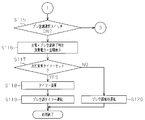
- FIGS. 3 to 5 show flowcharts of the charging / cold storage heat / pre-air conditioning setting routine employed in this embodiment. The processing of this routine is executed by the control unit 1 while the vehicle is stopped.
- step S100 the control unit 1 first determines in step S100 whether or not the charge signal is on.
- the charging signal is turned on when the connector cable 3 is connected to the external power supply 4 and the battery 5 can be charged by the power supply from the external power supply 4.
- the control unit 1 ends the processing of this routine as it is.
- step S101 the control unit 1 first confirms the user setting of the planned cruising distance at the next operation in step S101.
- step S102 the control unit 1 starts charging the battery 5 so as to obtain a charging rate (SOC) sufficient to enable traveling for the planned cruising distance. Note that, when the planned cruising distance is not set, the control unit 1 sets the maximum cruising distance of the electric vehicle as the planned cruising distance.
- step S103 the control unit 1 determines whether or not the air conditioner switch 9 is ON. If the air conditioner switch 9 is off (S103: NO), the control unit 1 displays the scheduled charging end time on the indicator of the control panel 8 in step S104, and then ends the processing of this routine. .
- the control unit 1 determines whether or not the cold storage heat selection switch 10 is on in step S105. Here, if the regenerative heat selection switch 10 is on (S105: YES), the control unit 1 moves the process to step S106, and if it is off (S105: NO), the process moves to step S115 in FIG. To do.
- step S106 the control unit 1 determines whether or not the pre-air conditioning selection switch 11 is turned on in step S106. If the pre-air conditioning selection switch 11 is on (S106: YES), the control unit 1 advances the process to step S107, and if it is off (S106: NO), the control unit 1 advances the process to step S121 of FIG.
- step S107 the control unit 1 displays the scheduled end time of charging, cold storage heat, and pre-air conditioning on the indicator of the control panel 8 in step S107.
- step S109 the control unit 1 determines whether the boarding timer is set, that is, whether the scheduled time until the next start of the vehicle is input.
- the control unit 1 calculates the scheduled time for the next boarding in step S110, and in steps S111 and S112, the regenerative heat is stored so as to be completed at the scheduled time. After executing the pre-air-conditioning timer operation, the processing of this routine is finished. In addition, the cold storage heat at this time is performed by the travel time for the planned cruising distance and the amount that can be air-conditioned with the stored cold heat.
- the control unit 1 performs the regenerative heat maintenance operation, the pre-air conditioning, and the maintenance operation in steps S113 and S114, and then performs this routine.
- the process ends.
- the cold storage heat maintenance operation is performed by operating the cold storage / heat storage device 7 so that the cold storage amount or the heat storage amount is maintained after the required amount of cold storage / heat storage is once performed.
- the pre-air conditioning maintenance operation is performed by operating the air conditioner 6 so that the vehicle room temperature is once maintained after the vehicle room temperature is once set as the set temperature.
- step S115 (FIG. 4) that is shifted to when the regenerative heat selection switch 10 is off in step S105
- the control unit 1 determines whether the pre-air conditioning selection switch 11 is on in step S115. Determine whether or not. If the pre-air-conditioning selection switch 11 is off (S115: NO), no cold storage heat or pre-air-conditioning is performed this time. Therefore, in this case, the control unit 1 advances the processing to step S104 (FIG. 3), displays the scheduled charging end time on the indicator of the control panel 8 in step S104, and then ends the processing of this routine. .
- step S115 the control unit 1 displays the scheduled end time of charging and pre-air conditioning on the indicator of the control panel 8 in step S116.
- step S117 the control unit 1 determines whether the boarding timer is set.
- the control unit 1 calculates the scheduled time for the next boarding in step S118, and in step S119, the pre-air conditioning timer is completed so as to be completed at the scheduled time. After performing the operation, the processing of this routine is terminated. On the other hand, if the boarding timer is not set (S117: NO), the control unit 1 performs the pre-air-conditioning maintenance operation in step S120, and then ends the processing of this routine.
- step S106 when the process proceeds to step S121 (FIG. 5) that shifts when the pre-air conditioning selection switch 11 is OFF, the control unit 1 displays the charging and cold storage on the indicator of the control panel 8 in step S121. Displays the scheduled end time of the heat. And control unit 1 determines whether the boarding timer is set in continuing step S122.
- the control unit 1 calculates the next boarding scheduled time in step S123, and in step S124, the cold storage heat timer is completed so as to be completed at the scheduled time. After performing the operation, the processing of this routine is terminated. On the other hand, if the boarding timer is not set (S122: NO), the control unit 1 ends the process of this routine after performing the operation for maintaining the cold storage heat in step S125.
- the vehicle control device of the present embodiment includes a cold storage / heat storage device 7 that performs cold storage and heat storage, and a cold storage heat selection switch 10 that is operated in order for the user to select an execution mode of cold storage / heat storage.
- the cold storage / heat storage execution mode by the cold storage / heat storage device 7 before starting the vehicle is made variable.
- the execution mode of cold storage and heat storage is changed according to the user's switch operation. That is, in the vehicle control apparatus of the present embodiment, the user can arbitrarily set the execution mode of cold storage and heat storage.
- the cold storage heat selection switch 10 is configured so that the necessity of cold storage / heat storage can be selected. Therefore, the user can arbitrarily select whether or not to perform cold storage / heat storage before starting the vehicle. That is, when the user determines that it is unnecessary, the cold storage heat before starting the vehicle can be omitted.
- the execution time of cold storage / heat storage can be selected. Therefore, the user can select when the cold storage / heat storage is executed.
- the execution time of cold storage / heat storage is changed according to the input of the scheduled time until the next start of the vehicle, but the execution time is not variable, and the cold storage heat selection switch 10 Only the necessity of cold storage / heat storage may be switched by operation. Even in such a case, when the user determines that it is unnecessary, the execution of the cold storage / heat storage is omitted, so that cold storage and heat storage before starting the vehicle can be performed more efficiently.
- the cold storage heat selection switch 10 is configured so that the necessity of cold storage / heat storage can be selected by turning on and off, but the switch is configured so that the cold storage amount / heat storage amount can be selected.
- the stages of selectable cold storage amount and heat storage amount are not limited to three stages, and any number of stages can be set.
- the pre-air conditioning is performed in addition to the cold storage heat before starting the vehicle, but only the cold storage heat may be performed without performing the pre-air conditioning. Even in such a case, if the cold storage / heat storage execution mode by the cold storage / heat storage device 7 before starting the vehicle is made variable according to the operation state of the cold storage heat selection switch, the cold storage and heat storage before starting the vehicle can be more It can be done efficiently.
- both cold storage and heat storage are performed, but the control device of the present invention can be similarly applied to a vehicle that performs only one of cold storage and heat storage.
- the case where the heat stored in the cold storage / heat storage device 7 is used for air conditioning has been described.
- the control device of the present invention is similarly applied to a vehicle that uses the stored heat for other purposes. Can be applied.
- the present invention can be similarly applied to a plug-in hybrid vehicle. Further, the present invention can be applied to any vehicle as long as the vehicle includes a cold storage / heat storage device that performs at least one of cold storage and heat storage and performs cold storage / heat storage before starting the vehicle.
- SYMBOLS 1 Control unit, 2 ... Timer, 3 ... Connector cable, 4 ... External power supply, 5 ... Battery, 6 ... Air conditioner, 7 ... Cold storage / heat storage device, 8 ... Control panel, 9 ... Air conditioner switch, 10 ... Cold storage heat selection Switch, 11 ... Pre-air conditioning selection switch.
Landscapes
- Engineering & Computer Science (AREA)
- Physics & Mathematics (AREA)
- Thermal Sciences (AREA)
- Mechanical Engineering (AREA)
- Life Sciences & Earth Sciences (AREA)
- Sustainable Development (AREA)
- Sustainable Energy (AREA)
- Electric Propulsion And Braking For Vehicles (AREA)
- Hybrid Electric Vehicles (AREA)
Abstract
蓄冷及び蓄熱を行う蓄冷/蓄熱装置7と、蓄冷/蓄熱の実行の可否をユーザーが選択するための蓄冷熱選択スイッチ10とを備えるとともに、その蓄冷熱選択スイッチ10の操作状況に応じて車両始動前に蓄冷/蓄熱装置7による蓄冷/蓄熱を実行するか否かを切り替えるようにした。そのため、ユーザーが不要と判断したときには、車両始動前の蓄冷/蓄熱が割愛されるようになり、車両始動前の蓄冷や蓄熱をより効率的に実施できるようになる。
Description
本発明は、例えば空調を行うためなどの目的で車両始動前に蓄冷や蓄熱を行う車両の制御装置に関するものである。
近年、夜間などの車両停止中に、外部からの給電によりバッテリーの充電を行うとともに、その充電された電気エネルギーで走行するプラグイン方式の電気自動車の実用に向けた開発が進められている。こうした電気自動車では、車室内の空調もバッテリーの電力を用いて行われており、空調装置の稼動状況に応じて車両の航続距離が変化する。そのため、こうした電気自動車では、燃料を燃やして走行する通常の自動車よりも、効率的な空調運転が求められている。
ところでユーザーの快適性を確保するには、乗車の時点から車室内の温度が適温に設定されていることが望ましい。そこで、特許文献1に見られるように、車両の運転パターンから電気自動車の運転開始時刻を予測するとともに、その予測された時刻には、空調が完了しているように車両始動前に空調装置を稼動させる、いわゆるプレ空調を行う車両の制御装置が提案されている。こうしたプレ空調を行えば、車両始動後の空調装置の稼働率をある程度に低減することができるようになる。
一方、従来には、特許文献2に見られるように、夜間充電中に蓄冷を行っておき、車両の運転開始後に蓄冷しておいた冷水又は氷を用いて車室内の冷房を行う車両の制御装置も提案されている。こうした蓄冷の実施によっても、車両始動後の空調装置の稼働率を低減することができる。
ところで、上記のような蓄冷は、電力を消費して行なわれることから、車両の航続距離に少なからぬ影響を与える。そのため、航続距離の延長が要望される電気自動車にあっては、蓄冷の更なる効率化が求められることになる。
なお、こうした問題は、外部からの電力供給により充電した電力を用いて空調を行うプラグイン方式のハイブリッド自動車などにおいても、概ね共通したものとなっている。
本発明の目的は、こうした問題に鑑みてなされたものであり、その目的は、車両始動前の蓄冷や蓄熱をより効率的に行うことのできる車両の制御装置を提供することにある。
本発明の目的は、こうした問題に鑑みてなされたものであり、その目的は、車両始動前の蓄冷や蓄熱をより効率的に行うことのできる車両の制御装置を提供することにある。
上記目的を達成するため、本発明に従う車両の制御装置は、蓄冷及び蓄熱の少なくとも一方を行う蓄冷/蓄熱装置と、蓄冷/蓄熱の実行態様をユーザーが選択するために操作されるスイッチと、そのスイッチの操作状況に応じて車両始動前の蓄冷/蓄熱装置による蓄冷/蓄熱の実行態様を可変とする制御部と、を備えたものとなっている。
こうした本発明では、蓄冷や蓄熱の実行態様がユーザーのスイッチ操作に応じて変更されるようになる。すなわち、本発明の車両の制御装置では、蓄冷や蓄熱の実行態様をユーザーが任意に選択可能となる。そのため、ユーザーが不必要と判断する場合には、蓄冷や蓄熱を実行しないようにしたり、蓄冷/蓄熱の量を低減させたりすることができるようになる。したがって、本発明によれば、不必要な蓄冷や蓄熱の実行を抑えることができるようになり、ひいては蓄冷や蓄熱をより効率的に行うことができるようになる。
なお、蓄冷/蓄熱の要否を選択可能に上記スイッチを構成すれば、車両始動前に蓄冷/蓄熱を実行するか否かをユーザーが選択きるようになる。また蓄冷量/蓄熱量を選択可能に上記スイッチを構成すれば、車両始動前における蓄冷/蓄熱の量を必要に応じて変更することができるようになる。更に蓄冷/蓄熱の実行時期を選択可能に上記スイッチを構成すれば、蓄冷/蓄熱を何時実行するかを選択することができるようになる。
ちなみに、車両停止中に外部からの給電により充電を行うプラグイン方式の電気自動車やハイブリッド自動車では、充電のために供給される電力の一部を用いて蓄冷や蓄熱を行うことができる。蓄冷/蓄熱をより有効に利用可能な本発明は、こうしたプラグイン方式の電気自動車やハイブリッド自動車への適用が好適なものとなっている。
以下、本発明の車両の制御装置を具体化した一実施の形態について、図1~図5を参照して詳細に説明する。なお本実施の形態は、外部電源からの給電により充電を行うプラグイン方式の電気自動車に本発明を適用したものとなっている。
図1は、本実施の形態の車両の制御装置の全体構造を示している。同図に示すように、本実施の形態の車両の制御装置は、制御ユニット1を中心に構成されている。
制御部としての前記制御ユニット1は、車両停止中も動作して、充電や蓄冷熱、プレ空調などに係る処理を実施する。制御ユニット1にはタイマー2が内蔵されており、必要な時刻に必要な処理を実施できるようになっている。
制御部としての前記制御ユニット1は、車両停止中も動作して、充電や蓄冷熱、プレ空調などに係る処理を実施する。制御ユニット1にはタイマー2が内蔵されており、必要な時刻に必要な処理を実施できるようになっている。
また制御ユニット1には、コネクターケーブル3が接続されている。そしてこのコネクターケーブル3を、外部電源4に接続することで、車両外部からの給電でバッテリー5を充電可能となっている。また制御ユニット1には、車室内の温度を調節する空調装置6と、蓄熱や蓄冷を行う蓄冷/蓄熱装置7が接続されており、車両停止中も外部電源4からの給電でこれらを動作させることができるようになっている。なお制御ユニット1には、空調装置6の設定を操作するために設けられたコントロールパネル8からの信号が入力されてもいる。
上記蓄冷/蓄熱装置7が、蓄冷、蓄熱のいずれを行うかは、外気温と空調の設定温度との高低関係により決定されるようになっている。また空調装置6は、こうした蓄冷/蓄熱装置7に蓄えられた熱を利用して冷暖房を行えるようになっている。
図2に、コントロールパネル8の平面構造を示す。同図に示すように、このコントロールパネル8には、エアコンのオン・オフを切り替えるエアコンスイッチ9を始め、空調装置6の設定を操作するための各種スイッチが設けられている。加えて、このコントロールパネル8には、後述する蓄冷熱選択スイッチ10とプレ空調選択スイッチ11とが設けられてもいる。なお、同図には図示を省略するが、このコントロールパネル8には、車両の次回運転時の予定航続距離を入力するための操作ボタンや車両の次回始動迄の予定時間を入力するための操作ボタンなども設けられている。
さて、こうした本実施の形態では、外部電源4からの給電によるバッテリー5の充電中に、蓄冷/蓄熱装置7による蓄冷や蓄熱、空調装置6によるプレ空調が必要に応じて実行されるようになっている。このときの蓄冷/蓄熱の実施の可否は、上記の蓄冷熱選択スイッチ10の操作によりユーザーが任意に選択できるようになっている。また、このときのプレ空調の実施の可否は、上記のプレ空調選択スイッチ11の操作によりユーザーが任意に選択できるようになっている。
なお、本実施の形態では、下車時に車両の次回の予定航続距離を入力しておくと、その予定航続距離分の走行が可能なだけの電力がバッテリー5に充電されるようになっている。また本実施の形態では、下車時に車両の次回始動迄の予定時間を入力しておくと、その予定時間にバッテリー5の充電や蓄冷/蓄熱、プレ空調が完了するように、それらが実施されるようになっている。
図3~図5は、こうした本実施の形態に採用される充電・蓄冷熱・プレ空調設定ルーチンのフローチャートを示している。本ルーチンの処理は、車両停止中に制御ユニット1により実行されるものとなっている。
さて本ルーチンが開始されると、制御ユニット1はまずステップS100において、充電信号がオンであるか否かの判定を行う。充電信号は、コネクターケーブル3が外部電源4に接続されて、外部電源4からの給電によるバッテリー5の充電が可能な状態となるときにオンとなる。ここで、充電信号がオフであれば(S100:NO)、制御ユニット1は、今回の本ルーチンの処理をそのまま終了する。
一方、充電信号がオンであれば(S100:YES)、制御ユニット1は、まずステップS101において、次回運転時の予定航続距離のユーザー設定を確認する。そして制御ユニット1は、続くステップS102において、予定航続距離分の走行を可能とするだけの充電率(SOC)が得られるようにバッテリー5の充電を開始する。なお、制御ユニット1は、予定航続距離が設定されていない場合には、当該電気自動車の最大航続距離を予定航続距離として設定するようにしている。
続くステップS103において制御ユニット1は、エアコンスイッチ9がオンであるか否かを判定する。ここでエアコンスイッチ9がオフであれば(S103:NO)、制御ユニット1は、ステップS104において、コントロールパネル8のインジケーターに充電終了の予定時刻を表示した後、今回の本ルーチンの処理を終了する。
エアコンスイッチ9がオンであれば(S103:YES)、制御ユニット1は、ステップS105において、蓄冷熱選択スイッチ10がオンであるか否かを判定する。ここで制御ユニット1は、蓄冷熱選択スイッチ10がオンであれば(S105:YES)、処理をステップS106に移行し、オフであれば(S105:NO)、処理を図4のステップS115に移行する。
処理がステップS106に進むと、制御ユニット1は、そのステップS106において、プレ空調選択スイッチ11がオンであるか否かを判定する。ここで制御ユニット1は、プレ空調選択スイッチ11がオンであれば(S106:YES)、処理をステップS107に進め、オフであれば(S106:NO)、処理を図5のステップS121に進める。
処理がステップS107に進むと制御ユニット1は、そのステップS107において、充電、蓄冷熱、プレ空調の予定終了時刻をコントロールパネル8のインジケーターに表示する。そして制御ユニット1は、続くステップS109において、乗車タイマーがセットされているか否かを、すなわち車両の次回始動迄の予定時間が入力されているか否かを判定する。
ここで乗車タイマーがセットされていれば(S109:YES)、制御ユニット1は、ステップS110において次回乗車の予定時刻を演算し、ステップS111及びS112において、その予定時刻に完了するように蓄冷熱とプレ空調のタイマー運転を実施した上で、今回の本ルーチンの処理を終了する。なおこのときの蓄冷熱は、予定航続距離分の走行時間、蓄えた冷熱で空調を実施可能な量だけ行われる。
一方、乗車タイマーがセットされていなければ(S109:NO)、制御ユニット1は、ステップS113及びS114において、蓄冷熱の維持運転とプレ空調と維持運転とを実施した上で、今回の本ルーチンの処理を終了する。蓄冷熱の維持運転は、一旦必要とされる量の蓄冷/蓄熱を行った後、その蓄冷量或いは蓄熱量が維持されるように蓄冷/蓄熱装置7を運転することで行われる。またプレ空調の維持運転は、車室温を一旦設定温度とした後、その車室温が維持されるように空調装置6を運転することで行われる。
ここで上記ステップS105において蓄冷熱選択スイッチ10がオフの場合に移行されるステップS115(図4)に処理が進むと、制御ユニット1はそのステップS115において、プレ空調選択スイッチ11がオンであるか否かの判定を行う。ここでプレ空調選択スイッチ11がオフであれば(S115:NO)、今回は、蓄冷熱もプレ空調も行わないことになる。そこでこの場合に制御ユニット1は、処理をステップS104(図3)に進め、そのステップS104において、コントロールパネル8のインジケーターに充電終了の予定時刻を表示した後、今回の本ルーチンの処理を終了する。
一方、プレ空調選択スイッチ11がオンであれば(S115:YES)、制御ユニット1は、ステップS116において、コントロールパネル8のインジケーターに、充電及びプレ空調の予定終了時刻を表示する。そして制御ユニット1は、続くステップS117において、乗車タイマーがセットされているか否かを判定する。
ここで乗車タイマーがセットされていれば(S117:YES)、制御ユニット1は、ステップS118において、次回乗車の予定時刻を演算し、ステップS119において、その予定時刻に完了するようにプレ空調のタイマー運転を実施した上で、今回の本ルーチンの処理を終了する。一方、乗車タイマーがセットされていなければ(S117:NO)、制御ユニット1は、ステップS120において、プレ空調の維持運転を実施した上で、今回の本ルーチンの処理を終了する。
また上記ステップS106において、プレ空調選択スイッチ11がオフの場合に移行するステップS121(図5)に処理が進むと、制御ユニット1は、そのステップS121において、コントロールパネル8のインジケーターに、充電及び蓄冷熱の予定終了時刻を表示する。そして制御ユニット1は、続くステップS122において、乗車タイマーがセットされているか否かを判定する。
ここで乗車タイマーがセットされていれば(S122:YES)、制御ユニット1は、ステップS123において、次回乗車の予定時刻を演算し、ステップS124において、その予定時刻に完了するように蓄冷熱のタイマー運転を実施した上で、今回の本ルーチンの処理を終了する。一方、乗車タイマーがセットされていなければ(S122:NO)、制御ユニット1は、ステップS125において、蓄冷熱の維持運転を実施した上で、今回の本ルーチンの処理を終了する。
以上説明した本実施の形態によれば、次の効果を奏することができる。
(1)本実施の形態の車両の制御装置は、蓄冷及び蓄熱を行う蓄冷/蓄熱装置7と、蓄冷/蓄熱の実行態様をユーザーが選択するために操作される蓄冷熱選択スイッチ10とを備え、蓄冷熱選択スイッチ10の操作状況に応じて車両始動前の蓄冷/蓄熱装置7による蓄冷/蓄熱の実行態様を可変とするようにしている。こうした本実施の形態では、蓄冷や蓄熱の実行態様がユーザーのスイッチ操作に応じて変更されるようになる。すなわち、本実施の形態の車両の制御装置では、蓄冷や蓄熱の実行態様をユーザーが任意に設定可能となる。そのため、ユーザーが不必要と考える場合には、蓄冷や蓄熱を実行しないようにしたり、蓄冷/蓄熱の量を低減させたりすることができるようになる。したがって、本発明によれば、不必要な蓄冷や蓄熱の実行を抑えることができるようになり、ひいては蓄冷や蓄熱をより効率的に行うことができるようになる。
(1)本実施の形態の車両の制御装置は、蓄冷及び蓄熱を行う蓄冷/蓄熱装置7と、蓄冷/蓄熱の実行態様をユーザーが選択するために操作される蓄冷熱選択スイッチ10とを備え、蓄冷熱選択スイッチ10の操作状況に応じて車両始動前の蓄冷/蓄熱装置7による蓄冷/蓄熱の実行態様を可変とするようにしている。こうした本実施の形態では、蓄冷や蓄熱の実行態様がユーザーのスイッチ操作に応じて変更されるようになる。すなわち、本実施の形態の車両の制御装置では、蓄冷や蓄熱の実行態様をユーザーが任意に設定可能となる。そのため、ユーザーが不必要と考える場合には、蓄冷や蓄熱を実行しないようにしたり、蓄冷/蓄熱の量を低減させたりすることができるようになる。したがって、本発明によれば、不必要な蓄冷や蓄熱の実行を抑えることができるようになり、ひいては蓄冷や蓄熱をより効率的に行うことができるようになる。
(2)夜間充電中に常に蓄冷を行うこととすれば、運転開始後に殆ど冷房を使わないときなどにも、蓄冷が不必要に行われてしまうことがあり、無駄な電力消費が発生する。特許文献1のように、車両の運転パターンから車両の運転開始時刻を予測し、その時刻に完了するように蓄冷を行えば、いつもと同じ時刻に運転を開始する場合には、効率良く蓄冷を行えるようにはなる。しかしながら、いつもとは異なる時刻に運転を開始する場合には、蓄冷に過不足が発生してしまうことになる。その点、本実施の形態では、蓄冷熱の実行態様をユーザーが任意に選択可能であり、必要に応じて蓄冷熱の実施の可否を切り替えたり、蓄冷熱の量を調整したりすることができる。そのため、ユーザーの判断により、過不足なく蓄冷熱を行うことが可能になる。
(3)本実施の形態では、蓄冷/蓄熱の要否を選択可能に蓄冷熱選択スイッチ10が構成されている。そのため、車両始動前に蓄冷/蓄熱を実行するか否かをユーザーが任意に選択することができるようになる。すなわち、ユーザーが不要と判断する場合には、車両始動前の蓄冷熱を割愛することができるようになる。
(4)本実施の形態では、蓄冷熱選択スイッチ10のオン操作とともに、車両の次回始動迄の予定時間を入力しておくことで、蓄冷/蓄熱の実行時期を選択可能となっている。そのため、蓄冷/蓄熱を何時実行するかをユーザーが選択できるようになる。
以上説明した本実施の形態は、次のように変更して実施することもできる。
・上記実施の形態では、車両の次回始動迄の予定時間の入力に応じて蓄冷/蓄熱の実行時期が変更されるようになっていたが、実行時期は可変とせず、蓄冷熱選択スイッチ10の操作により、蓄冷/蓄熱の要否のみを切り替えるようにしても良い。そうした場合にも、ユーザーが不要と判断したときには、蓄冷/蓄熱の実施が割愛されるため、車両始動前の蓄冷や蓄熱を、より効率的に行うことができるようになる。
・上記実施の形態では、車両の次回始動迄の予定時間の入力に応じて蓄冷/蓄熱の実行時期が変更されるようになっていたが、実行時期は可変とせず、蓄冷熱選択スイッチ10の操作により、蓄冷/蓄熱の要否のみを切り替えるようにしても良い。そうした場合にも、ユーザーが不要と判断したときには、蓄冷/蓄熱の実施が割愛されるため、車両始動前の蓄冷や蓄熱を、より効率的に行うことができるようになる。
・上記実施の形態では、そのオン、オフにより、蓄冷/蓄熱の要否を選択可能に蓄冷熱選択スイッチ10を構成していたが、蓄冷量/蓄熱量を選択可能に同スイッチを構成するようにしても良い。例えば図6に示す蓄冷熱選択スイッチの一例では、蓄冷量、蓄熱量の段階として低(LO)、中(MID)、高(HI)の3つの段階を選択可能となっている。勿論、選択可能な蓄冷量、蓄熱量の段階としては、3段階に限らず、任意に数の段階を設定することができる。
・上記実施の形態では、車両の始動前に、蓄冷熱に加え、プレ空調も実施するようにしていたが、プレ空調は行わず、蓄冷熱のみを行うようにしても良い。そうした場合であれ、蓄冷熱選択スイッチの操作状況に応じて車両始動前の蓄冷/蓄熱装置7による蓄冷/蓄熱の実行態様を可変とするようにすれば、車両始動前の蓄冷や蓄熱を、より効率的に行うことができるようになる。
・上記実施の形態では、蓄冷、蓄熱の双方を行うようにしていたが、蓄冷、蓄熱のいずれか一方のみを行う車両にも、本発明の制御装置を同様に適用することができる。
・上記実施の形態では、蓄冷/蓄熱装置7に蓄えられた熱を空調に利用する場合を説明したが、蓄えられた熱を他の用途に使用する車両にも本発明の制御装置を同様に適用することができる。
・上記実施の形態では、蓄冷/蓄熱装置7に蓄えられた熱を空調に利用する場合を説明したが、蓄えられた熱を他の用途に使用する車両にも本発明の制御装置を同様に適用することができる。
・上記実施の形態では、プラグイン方式の電気自動車に本発明の制御装置を適用した場合を説明したが、本発明は、プラグイン方式のハイブリッド自動車にも同様に適用することができる。また本発明は、蓄冷及び蓄熱の少なくとも一方を行う蓄冷/蓄熱装置を備えるとともに、車両始動前に蓄冷/蓄熱を行う車両であれば、任意の車両に適用することが可能である。
1…制御ユニット、2…タイマー、3…コネクターケーブル、4…外部電源、5…バッテリー、6…空調装置、7…蓄冷/蓄熱装置、8…コントロールパネル、9…エアコンスイッチ、10…蓄冷熱選択スイッチ、11…プレ空調選択スイッチ。
Claims (5)
- 蓄冷及び蓄熱の少なくとも一方を行う蓄冷/蓄熱装置と、
蓄冷/蓄熱の実行態様をユーザーが選択するために操作されるスイッチと、
そのスイッチの操作状況に応じて車両始動前の前記蓄冷/蓄熱装置による蓄冷/蓄熱の実行態様を可変とする制御部と、
を備える車両の制御装置。 - 前記スイッチは、蓄冷/蓄熱の要否を選択可能に構成されてなる請求項1に記載の車両の制御装置。
- 前記スイッチは、蓄冷量/蓄熱量を選択可能に構成されてなる請求項1に記載の車両の制御装置。
- 前記スイッチは、蓄冷/蓄熱の実行時期を選択可能に構成されてなる請求項1に記載の車両の制御装置。
- 当該車両が、車両停止中に外部からの給電により充電を行うように構成されており、前記蓄冷/蓄熱は、その充電のために供給される電力の一部を用いて行われる、請求項1~4のいずれか1項に記載の車両の制御装置。
Priority Applications (1)
| Application Number | Priority Date | Filing Date | Title |
|---|---|---|---|
| PCT/JP2010/056589 WO2011128972A1 (ja) | 2010-04-13 | 2010-04-13 | 車両の制御装置 |
Applications Claiming Priority (1)
| Application Number | Priority Date | Filing Date | Title |
|---|---|---|---|
| PCT/JP2010/056589 WO2011128972A1 (ja) | 2010-04-13 | 2010-04-13 | 車両の制御装置 |
Publications (1)
| Publication Number | Publication Date |
|---|---|
| WO2011128972A1 true WO2011128972A1 (ja) | 2011-10-20 |
Family
ID=44798366
Family Applications (1)
| Application Number | Title | Priority Date | Filing Date |
|---|---|---|---|
| PCT/JP2010/056589 Ceased WO2011128972A1 (ja) | 2010-04-13 | 2010-04-13 | 車両の制御装置 |
Country Status (1)
| Country | Link |
|---|---|
| WO (1) | WO2011128972A1 (ja) |
Cited By (3)
| Publication number | Priority date | Publication date | Assignee | Title |
|---|---|---|---|---|
| JP2013137125A (ja) * | 2011-12-28 | 2013-07-11 | Aisin Seiki Co Ltd | 化学蓄熱装置 |
| WO2015122006A1 (ja) * | 2014-02-17 | 2015-08-20 | 株式会社Fomm | 小型車両用冷房装置 |
| JP2022139081A (ja) * | 2021-03-11 | 2022-09-26 | トヨタ自動車株式会社 | 車両 |
Citations (4)
| Publication number | Priority date | Publication date | Assignee | Title |
|---|---|---|---|---|
| JPH0488301U (ja) * | 1990-11-30 | 1992-07-31 | ||
| JPH0865814A (ja) * | 1994-08-25 | 1996-03-08 | Honda Motor Co Ltd | 電気自動車用充電制御装置 |
| JP2004226046A (ja) * | 2003-01-27 | 2004-08-12 | Denso Corp | 車載用冷凍装置 |
| JP2010023527A (ja) * | 2008-07-15 | 2010-02-04 | Denso Corp | 車両用蓄熱制御装置及び車両用蓄冷制御装置。 |
-
2010
- 2010-04-13 WO PCT/JP2010/056589 patent/WO2011128972A1/ja not_active Ceased
Patent Citations (4)
| Publication number | Priority date | Publication date | Assignee | Title |
|---|---|---|---|---|
| JPH0488301U (ja) * | 1990-11-30 | 1992-07-31 | ||
| JPH0865814A (ja) * | 1994-08-25 | 1996-03-08 | Honda Motor Co Ltd | 電気自動車用充電制御装置 |
| JP2004226046A (ja) * | 2003-01-27 | 2004-08-12 | Denso Corp | 車載用冷凍装置 |
| JP2010023527A (ja) * | 2008-07-15 | 2010-02-04 | Denso Corp | 車両用蓄熱制御装置及び車両用蓄冷制御装置。 |
Cited By (4)
| Publication number | Priority date | Publication date | Assignee | Title |
|---|---|---|---|---|
| JP2013137125A (ja) * | 2011-12-28 | 2013-07-11 | Aisin Seiki Co Ltd | 化学蓄熱装置 |
| WO2015122006A1 (ja) * | 2014-02-17 | 2015-08-20 | 株式会社Fomm | 小型車両用冷房装置 |
| JP2022139081A (ja) * | 2021-03-11 | 2022-09-26 | トヨタ自動車株式会社 | 車両 |
| JP7533292B2 (ja) | 2021-03-11 | 2024-08-14 | トヨタ自動車株式会社 | 車両 |
Similar Documents
| Publication | Publication Date | Title |
|---|---|---|
| JP6015618B2 (ja) | 車両 | |
| JP5093300B2 (ja) | 車両制御システム | |
| US9969293B2 (en) | Battery thermal conditioning to extend battery useful life in electrified vehicles | |
| CN105584377B (zh) | 对预计在充电站再充电的牵引电池进行预冷的方法和系统 | |
| JP5263242B2 (ja) | 空調制御装置 | |
| JP5673474B2 (ja) | 電力切替装置 | |
| US9758055B2 (en) | Control system for hybrid vehicle | |
| US10293654B2 (en) | Passenger cabin preconditioning during DC fast charging events | |
| JP2012104458A (ja) | 電池の冷却システムおよび冷却方法 | |
| US10421366B2 (en) | Energy management of an electrified vehicle | |
| CN220787889U (zh) | 车辆的驱动系统和车辆 | |
| JP6123643B2 (ja) | 車両用の蓄電システム | |
| WO2011128972A1 (ja) | 車両の制御装置 | |
| JP2006315461A (ja) | 車両用空調装置 | |
| JP2013119355A (ja) | 車両 | |
| CN104999885A (zh) | 功率的控制方法及装置 | |
| JP6015620B2 (ja) | 車両 | |
| KR20160007211A (ko) | 자동차용 배터리 파워 공급 방법 | |
| JP2013258799A (ja) | 自動車及び連結車両 | |
| JP2013082416A (ja) | 車両の高電圧バッテリー冷却制御方法 | |
| KR101610401B1 (ko) | 급속 충전 시스템의 구동 방법 | |
| JP5772309B2 (ja) | 電力変換装置 | |
| JP5892461B2 (ja) | ハイブリッド車両 | |
| JP2015012793A (ja) | 車両の冷却装置 | |
| CN114274842B (zh) | 电动汽车能量源控制方法、装置、电动汽车及存储介质 |
Legal Events
| Date | Code | Title | Description |
|---|---|---|---|
| 121 | Ep: the epo has been informed by wipo that ep was designated in this application |
Ref document number: 10849810 Country of ref document: EP Kind code of ref document: A1 |
|
| NENP | Non-entry into the national phase |
Ref country code: DE |
|
| 122 | Ep: pct application non-entry in european phase |
Ref document number: 10849810 Country of ref document: EP Kind code of ref document: A1 |
|
| NENP | Non-entry into the national phase |
Ref country code: JP |