WO2011125825A1 - 溶解性ガラス質抗菌剤および水処理剤 - Google Patents
溶解性ガラス質抗菌剤および水処理剤 Download PDFInfo
- Publication number
- WO2011125825A1 WO2011125825A1 PCT/JP2011/058185 JP2011058185W WO2011125825A1 WO 2011125825 A1 WO2011125825 A1 WO 2011125825A1 JP 2011058185 W JP2011058185 W JP 2011058185W WO 2011125825 A1 WO2011125825 A1 WO 2011125825A1
- Authority
- WO
- WIPO (PCT)
- Prior art keywords
- water treatment
- water
- glass
- agent
- treatment agent
- Prior art date
- Legal status (The legal status is an assumption and is not a legal conclusion. Google has not performed a legal analysis and makes no representation as to the accuracy of the status listed.)
- Ceased
Links
Images


Classifications
-
- A—HUMAN NECESSITIES
- A01—AGRICULTURE; FORESTRY; ANIMAL HUSBANDRY; HUNTING; TRAPPING; FISHING
- A01N—PRESERVATION OF BODIES OF HUMANS OR ANIMALS OR PLANTS OR PARTS THEREOF; BIOCIDES, e.g. AS DISINFECTANTS, AS PESTICIDES OR AS HERBICIDES; PEST REPELLANTS OR ATTRACTANTS; PLANT GROWTH REGULATORS
- A01N59/00—Biocides, pest repellants or attractants, or plant growth regulators containing elements or inorganic compounds
- A01N59/16—Heavy metals; Compounds thereof
-
- C—CHEMISTRY; METALLURGY
- C02—TREATMENT OF WATER, WASTE WATER, SEWAGE, OR SLUDGE
- C02F—TREATMENT OF WATER, WASTE WATER, SEWAGE, OR SLUDGE
- C02F1/00—Treatment of water, waste water, or sewage
- C02F1/50—Treatment of water, waste water, or sewage by addition or application of a germicide or by oligodynamic treatment
Definitions
- the present invention relates to an antibacterial agent comprising a soluble glass capable of eluting silver ions into water, and the antibacterial agent has a high antibacterial effect, little discoloration, and low disintegration. Furthermore, this invention consists of said soluble glassy antibacterial agent, and is a granular water treatment agent excellent in filling property and water permeability.
- an antibacterial metal such as silver, copper and zinc supported on apatite, zeolite, glass, zirconium phosphate, silica gel or the like is known. These are safer than organic antibacterial agents, and have long-lasting antibacterial effects because active ingredients are less likely to volatilize or decompose, and also have excellent heat resistance. . Therefore, it is used for various applications as an antibacterial processed product processed into a fiber, film or various molded articles using an antibacterial resin composition obtained by mixing these antibacterial agents and various polymer compounds. ing.
- vitreous antibacterial agent containing antibacterial metals such as silver, copper, and zinc
- a method of supplying see, for example, Patent Document 7
- antibacterial glass for performing antibacterial treatment with silver ions during or after washing of an antibacterial object and having a maximum diameter (t1) in the range of 1 to 50 mm
- antibacterial glass characterized by a silver ion elution amount in the range of 0.5 to 100 mg / (g ⁇ 24 hours) It has been.
- JP 2004-262663 A Japanese Unexamined Patent Publication No. 01-313531 Japanese Patent Laid-Open No. 02-302451 Japanese Patent Application Laid-Open No. 07-25635 Japanese Patent Laid-Open No. 06-190369 Japanese Patent Laid-Open No. 06-126285 JP 2008-279056 A WO05 / 087675 International Publication Pamphlet JP-A-11-29343 Japanese Patent Laid-Open No. 11-60268
- the object of the present invention is to provide a soluble glassy antibacterial agent having sufficient antibacterial effect while suppressing disintegration and discoloration when used as a water treatment application, and a granular material excellent in filling processability It is to provide a water treatment agent.
- SiO 2 and / or P 2 O 5 is 0 to 5% in mass ratio in terms of oxide, and K 2 O and / or Na 2 O is 5%.
- a soluble glassy antibacterial agent containing 0 to 10% has high antibacterial performance, low disintegration, and low discoloration.
- the soluble glassy antibacterial agent molded into a particle size of 3 mm to 20 mm is found to have excellent filling properties and water permeability, and is highly useful as a water treatment agent, thus completing the invention. .
- the dissolvable glassy antibacterial agent of the present invention has low disintegration and discoloration while maintaining high antibacterial performance, and the above-mentioned dissolvable glassy antibacterial agent shaped into a granule has excellent filling properties and water permeability. It can be preferably used as a water treatment agent.
- the shapes of the water treatment agents of Examples 1 to 7, 9, and 10 and Comparative Examples 1 to 6, 8, and 9 are shown. Dimensional shapes of the water treatment agents of Examples 1 to 7, 9, 10 and Comparative Examples 1 to 6, 8, and 9 are shown.
- the present invention will be described below. In addition,% without a notice is mass%.
- the soluble glassy antibacterial agent of the present invention has SiO 2 and / or P 2 O 5 of 0 to 5%, K 2 O and / or Na 2 O of 5 to 10%, and Ag 2 O of 0.1 to 5 %, B 2 O 3 is 60 to 75%, Al 2 O 3 is 10 to 20%, and at least one selected from the group consisting of MgO, BaO and ZnO is made of glass containing 0 to 10%.
- the major difference between the conventionally known soluble glassy antibacterial agent and the glassy antibacterial agent of the present invention is that SiO 2 or P 2 which is a glass network forming component generally required to maintain a stable glass skeleton.
- O 5 is contained only at a low concentration of 5% or less, or not contained at all, and by selecting the ratio of the other components to be optimal, it is excellent. A glass with high solubility was realized.
- the surface disintegration in the case of repeated immersion / drying decreases as the content of SiO 2 and / or P 2 O 5 decreases. Therefore, the preferred content of SiO 2 and / or P 2 O 5 is 0 to 5%, more preferably 0 to 3%, more preferably 0%.
- P 2 O 5 is known as a component that stabilizes silver in glass and is preferable in that sense.
- P component is used. , Which may cause eutrophication of the waste water and cause deterioration of the water quality of the lake. Therefore, when selecting either SiO 2 or P 2 O 5 , SiO 2 is preferable, and P It is preferable that 2 O 5 is not included.
- B 2 O 3 also forms a glass skeleton, but it tends to increase the solubility and easily exhibits an antibacterial effect, so that the content is preferably large. However, if it is too much, the glass itself becomes brittle, so the preferred content is 60 to 75%, more preferably 65 to 70%.
- Al 2 O 3 forms the skeleton of glass with SiO 2 or B 2 O 3, the inclusion of Al 2 O 3 generally chemical durability improved when SiO 2 or B 2 O 3 is the main component Therefore, it is preferable to contain. However, if the content is too large, the solubility of the glass becomes too small and the antibacterial effect is difficult to appear, so the preferable content of Al 2 O 3 is 10% to 20%, more preferably 15 to 20%.
- Alkali metal oxides are included in order to improve the solubility of the glass.
- the raw material contains Na 2 O or K 2 O obtained at a low cost.
- K 2 O is more preferable than other alkali metal oxides because it can easily control the solubility of glass over a long period of time.
- the content is preferably 5 to 10%, more preferably 5 to 8%, more preferably 5 to 7%.
- MgO, BaO, and ZnO enter between the glass skeleton components and have the effect of stabilizing the glass.
- the preferable content of each component of MgO, BaO, and ZnO is 0 to 10%, and the total amount is 0 to 20%, more preferably 2 to 15%, more preferably 3 to 10% of the entire glass. It is.
- the soluble glassy antibacterial agent of the present invention can be used by kneading into a resin or fiber, or by adhering it to a fiber or article using a binder or an adhesive.
- a preferable application form is a water treatment agent. Since the dissolvable glassy antibacterial agent of the present invention has low disintegration and discoloration and excellent solubility, it can be used as an antibacterial agent for water treatment in a wide range of applications including general households.
- the water treatment agent When used as a water treatment agent, it is normal to use only water after bringing the water to be treated into contact with the water treatment agent. Therefore, store the water treatment agent in a fixed space such as a bag, column or treatment tank.
- the water treatment agent is generally treated by water, and at this time, the water treatment agent is required not only to have solubility but also to be filled in a fixed space and to be water-permeable in a filled state. .
- disintegration and when the water treatment agent disintegrates and generates fine powder, it can be clogged up with the water treatment line, or the fine powder can flow out and enter foreign food processing processes and other foreign object processes. There is also sex.
- the dissolvable glassy antibacterial agent of the present invention is excellent in that it is difficult to generate fine powder because of its low disintegration property, but when used as a water treatment agent, in consideration of the above conditions, as glass particles having a specific shape It is preferable to use it.
- glassy antibacterial agents such as cullet-like, flake-like, and square-shaped block shapes that are common as conventional soluble glass particles, fine glass fragments are likely to occur.
- fine cracks are likely to occur due to residual stress on the surface, and crushing proceeds from the cracked part during use of water so that fragments and fine powder are generated when dried.
- a preferable shape as the water treatment agent of the present invention is a hemispherical molding type. Since it is not crushed, there are no cracks, and there are no sharp parts. Therefore, glass fragments do not leak out even if dried after being used for immersion, and can be used safely.
- the water treatment agent of the present invention is one in which at least a part of the shape is hemispherical, substantially hemispherical, conical or frustoconical, and has a maximum diameter of 3 mm to 20 mm.
- an industrially inexpensive method for producing granular glass is to add a heated and melted high-temperature liquid glass into water and rapidly cool it to form an irregularly crushed cullet, or pass between metal parallel rollers to form a plate (flakes) ).
- cullet it is difficult to adjust the particle size, and fine particles and coarse particles are contained, so it is necessary to pulverize and classify.
- fine cracks are likely to occur.
- the antibacterial particles for water treatment according to the present invention are preferably granular in which a part of the shape has a hemispherical, substantially hemispherical or conical or frustoconical bulge. Since such a shape is easy to be separated at the thin part of the particle edge when taking a manufacturing method that separates into individual particles after batch forming in a continuous state of grains, the particle size of the obtained particles The weight tends to be uniform and control is easy. There is no limitation on the shape of the surface opposite to the bulge of a particle having a hemispherical, substantially hemispherical or conical, frustoconical bulge, but the bulge is also on the opposite surface or is flat.
- a flat surface is more preferable because it is easy to manufacture.
- the shape of a plane is circular from the point that it is easy to manufacture. That is, the most preferable shape is a hemispherical or conical shape with the bottom surface being a circular plane.
- the water treatment agent of the present invention is a granular molded body having a bulge on at least one side, so that coarse particles and fine particles are not mixed as in a cullet shape, and the planes of a large number of particles are in close contact as in a flake shape.
- they are industrially inexpensive compared to fused spherical glass such as glass beads.
- the maximum diameter of the water treatment agent particles of the present invention the better the water permeability and the longer the service life. However, if it is too large, it will be difficult to set it in a narrow place, but if it is too fine, it will be difficult to use. Wateriness tends to deteriorate. Accordingly, the maximum diameter is preferably 3 to 20 mm. Further, the maximum diameter is preferably 3 to 10 mm, more preferably 3 to 6 mm. It is also preferable to use water treatment agent particles having different particle diameters in combination.
- the particle height of the water treatment agent of the present invention is preferably 1 to 5 mm.
- the height is measured vertically from the horizontal plane where the maximum diameter was measured.
- a more preferred height is 1 to 4 mm, more preferably 1.5 to 3 mm. If the height is smaller than 1 mm, it is too thin and becomes a shape close to a flat plate, and like the flake shape, it may overlap and impair water permeability and solubility.
- the water treatment agent of the present invention preferably has a hemispherical shape, a substantially hemispherical shape, a conical shape, or a truncated cone shape on at least one side.
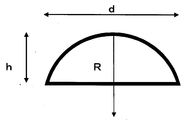
- the radius of curvature R of the apex can be defined for the maximum diameter D.
- the radius of curvature R is measured as an average of a range of 1 / 4D from the apex to the maximum diameter direction, that is, the range of the vicinity of the apex 1 / 2D, based on the projection viewed from the horizontal direction of the plane where the maximum diameter is measured.
- the shape of the water treatment agent approaches a flat plate and, like flakes, may overlap and impair water permeability and solubility, and as R decreases, it is difficult to remove from the mold during production. Is in the range of 1 / 16D to D, more preferably in the range of 1 / 8D to 5 / 8D.
- the average mass per grain of the water treatment agent of the present invention is 0.02 g to 0.5 g. If the average mass per grain is 0.02 g or less, it is too small, so that it becomes difficult to maintain a sufficient grain size, resulting in problems such as poor water permeability or short life. On the other hand, when the particle size is 0.5 g or more, the particle size becomes too large, so that the surface area per volume is decreased and the dissolution rate is decreased. Moreover, when several tens of grams are filled in a bag using an automatic filling machine, the variation in filling amount becomes large.
- the standard deviation of the mass of the water treatment agent is preferably as small as possible, and 1/10 or less of the average mass is preferable because stable solubility and variation in the filling amount can be reduced.
- the method for producing a water treatment agent used in the present invention is a predetermined mixed amount of a compound containing necessary components such as oxides, hydroxides, borates, chlorides, nitrates, sulfates and carbonates. After mixing well, it can be obtained by heating and melting in a melting pot and quenching.
- the glass is left out of the roller mold during production, and molding defects are likely to occur.
- the glass that has come out between the rollers becomes a thin plate-like part other than the hemisphere or conical shape, and easily breaks, so there is no need to adjust the particle size by pulverization or classification, so there is no loss and low cost.
- Antibacterial particles for water treatment can be produced at production cost.
- Both opposing two cold-formed rollers may have a hemispherical or conical depression, but during continuous operation, there is only a slight deviation between the two hemispheres or conical parts on both sides. , The particulate matter having a certain shape may not be formed, and crushing becomes difficult. Therefore, as illustrated in FIG. 3, it is preferable to use a cooling molding roller in which one is a smooth surface and the other is a depression. If only one of the rollers has a dent, even if molding particles remain on the dent side, the surface will not protrude, so there is no problem even if it is sandwiched in the gap again. This is because the attachment residue of the molded particles can be prevented by attaching S of 3).
- the formed particles that have passed through the cooling forming roller are further lightly crushed by a general crushing device such as a vibration mill or a ball mill, and then separated into particles.
- a general crushing device such as a vibration mill or a ball mill
- burrs around the hemisphere or conical shape are further removed by the ball mill. It is preferable to use in a shape without sharp corners, and it is also preferable to use after removing small pieces such as burrs separated by sieving after pulverization.
- the water treatment agent obtained in this way has an excellent antibacterial effect by adjusting the composition, shape and particle size of the water treatment agent. By doing so, an effect of efficiently reducing the number of bacteria contained in water is exhibited. Moreover, since the said water treatment agent shows low disintegration and low discoloration, it can be used as a water treatment agent over many uses.
- the use form of the water treatment agent of the present invention is not particularly limited, and can be used in a granular form, but when used for water treatment, several tens of grams are stored in a water-permeable container and installed. Is preferred. Specifically, the water treatment agent is filled into a non-woven bag and packed, packed into a mesh bag, packed into a resin container with a hole, used in a water-soluble container and used. Any method may be used as long as all or part of the vitreous antibacterial agent is in contact with water. In order to prevent leakage during use, it is preferable to fill and pack in a non-woven fabric or fine net, etc., but the water treatment agent has extremely low disintegration and does not easily generate microscopic fragments. Even a resin container or the like can be used without outflow of minute debris. Examples of the material of the container resin include nylon and polyester, but the material is not particularly limited as long as all or part of the vitreous antibacterial agent can come into contact with water.
- the water treatment agent of the present invention is used in various fields that require antifungal, antialgal and antibacterial properties, that is, for water treatment of electrical appliances, toiletries, kitchen utensils, toys, etc., in particular, measures against microbial contamination of drain water.
- More specific examples include electrical appliances such as dishwashers, refrigerators, washing machines, pots, rice cookers, air conditioners, air purifiers, dehumidifiers, humidifiers, and toiletry products such as toilet water and bathtubs.
- toys include water guns, bath toys, and cooking toys.
- Other uses include pools, ponds, water tanks, antibacterial sprays and the like.
- SiO 2 and B 2 O 3 forming the glass skeleton structure greatly affect the solubility of the glass.
- the solubility decreases, and when the proportion of B 2 O 3 increases. It is known that the solubility is improved, but on the other hand, it is known that a glass containing a large amount of B 2 O 3 is brittle and easily broken.
- the present invention has found a composition range of a soluble glass having high solubility but low disintegration.
- the Si—O—Si network structure remains undissolved on the glass surface, and only the network-modifying components such as alkali metal oxides elute first. It is thought that the surface collapse occurs because the SiO 2 rich layer is formed and peeled off.
- glass containing a large amount of B 2 O 3 is easily melted, so that only the network forming component does not remain and the melting proceeds uniformly.
- the weakness of the B 2 O 3 glass, which is easily broken, is suppressed by combining the glass having a large amount of B 2 O 3 with Al 2 O 3 which is another network forming component. It is.
- the amount of added ant potassium metal oxide added to improve the solubility of the glass in the conventional soluble glass is the same as that of the present invention.
- the small amount of the functional glass is the cause of the effect of less discoloration.
- Glass containing an alkali metal becomes alkaline by hydrolysis, and OH - is locally generated on the glass surface.
- the generated OH ⁇ reacts with silver and copper ions, and is assumed to be silver oxide and copper oxide via a hydroxide to be changed to black or brown.
- the soluble glass of the present invention is an alkali metal oxide. Since the content is as small as 5 to 10%, it is considered that there is an effect that discoloration is extremely small.
- the average mass of the water treatment agent particles was obtained by collecting 10 arbitrary particles, measuring the mass of 10 particles with an electronic balance to 0.01 mg, and calculating the average mass per particle.
- the amount of silver elution is about 5 g of water treatment agent added to 1 liter of deionized water at 40 ° C. and stirred for 6 hours at 250 rpm, and then the concentration of silver ions in the water is set to ICP (inductively coupled plasma emission spectrometer).
- the concentration was normalized to 1 g of water treatment agent, 1 liter of elution water, and elution time per hour, and expressed as the elution amount ( ⁇ g / L ⁇ g ⁇ time). More specifically, if the amount of the water treatment agent added to 1 liter of water is 5.0 g and the stirring time is 6.0 hours, the detected silver ion concentration is divided by 5.0 and 6.0. The obtained numerical value is the normalized elution amount ( ⁇ g / L ⁇ g ⁇ time).
- the filling property was good when the bag could be continuously operated for 1 hour when the bag was filled using an automatic filling machine, and poor when the filling machine stopped urgently within 1 hour due to clogging of fine powder.
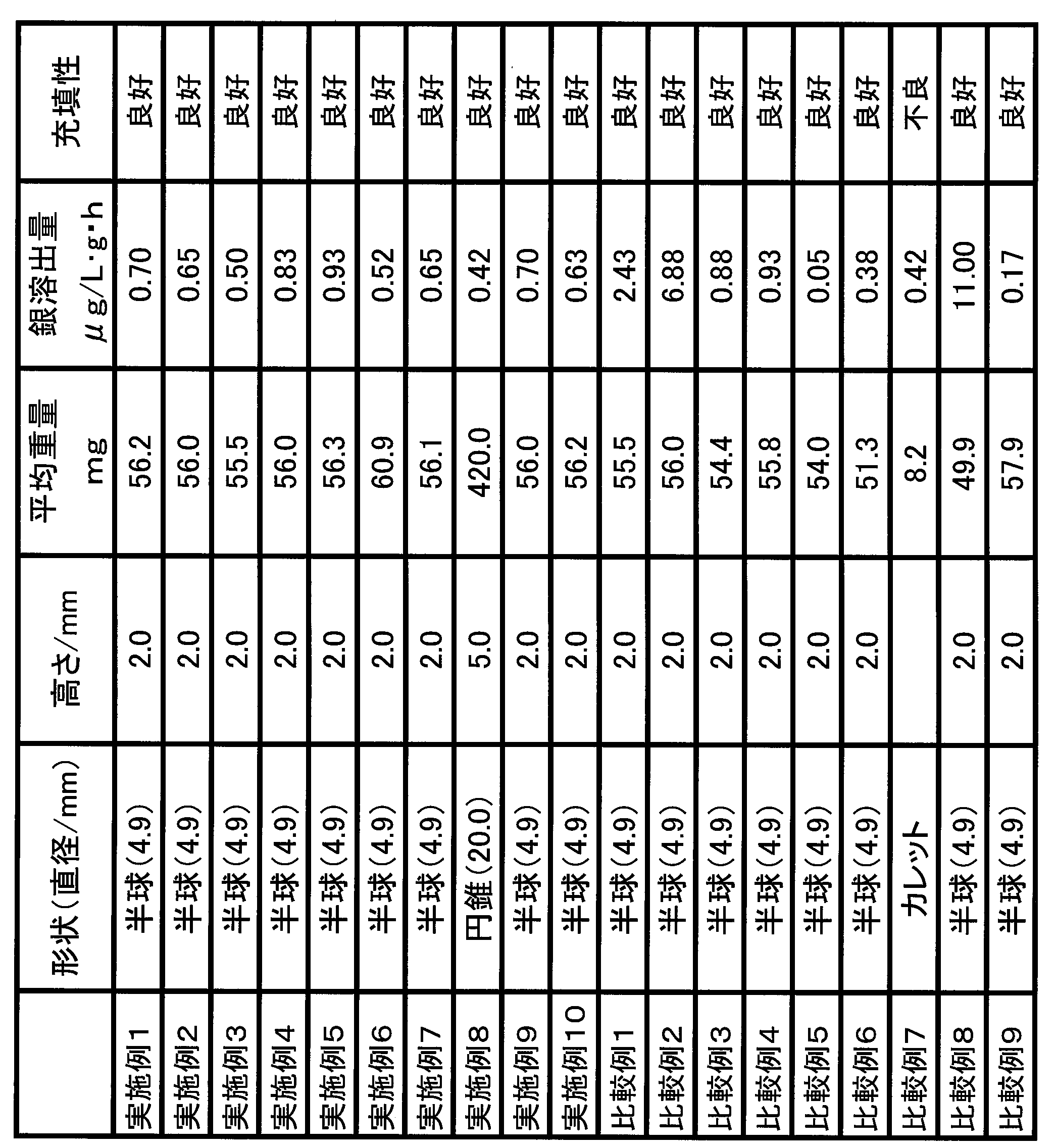
- Examples 1 to 10 Glass raw material formulations having the compositions of Examples 1 to 7, 9, and 10 shown in Table 1 were heated and melted at 1200 ° C. After melting, using a metal cooling molding roller with a hemispherical depression with a diameter of 5 mm on one side, it was cooled and molded, and the resulting glass was crushed by hitting it with a ball mill for 1 hour. After dry crushing, fine powders were screened off with a metal mesh having an opening of 2.8 mm to obtain Examples 1 to 7, 9, and 10 of water treatment agents. Table 10 shows the average mass, dimensions, silver elution concentration, and fillability of the water treatment agent obtained using an automatic filling machine.
- the water treatment agents obtained in Examples 1 to 7, 9, and 10 are hemispherical with a flat bottom, and the diameter obtained by measuring the maximum diameter D of the bottom of 10 grains with a caliper and averaging it is (diameter). Fill in Table 2. In addition, a number obtained by averaging the maximum height in the vertical direction with respect to the bottom of each 10 grains was entered in Table 2 as “height”. Also, the shape seen from the horizontal direction is a semicircle, and when taking a picture from a horizontal plane and selecting a 1 / 4D range from the apex to the left and right to fit the circumference, the shape matched the curvature radius of 2.5 mm Therefore, the radius of curvature was determined to be 2.5 mm.
- Example 2 After the glass raw material composition was heated and melted at 1200 ° C., the same operation as in Example 1 was carried out except that it was cooled and molded using a metal cooling molding roller with a conical depression disposed on one side, and subjected to water treatment.
- Antibacterial particle example 8 was obtained.
- the average mass, silver elution concentration, and filling property using an automatic filling machine of any 10 particles of the obtained antibacterial agent were evaluated and are shown in Table 2. The dimensions were measured in the same manner as in Examples 1 to 7, 9, and 10. The maximum diameter was 20 mm, the height was 5 mm, and the curvature radius was 10 mm.
- Comparative Examples 1 to 9 Comparative Examples 1 to 6, 8 and 9 were obtained by the same production method as in Example 1 except that glass raw material formulations having the glass compositions shown in Table 1 were used. The measurement method is the same.
- Comparative Example 7 the same raw material as in Example 1 was melted at 1200 ° C., then directly water-cooled without using a metal roller, and the resulting glass was coarsely crushed and then sieved to a particle size of 3.3 to 8.9 mm. By adjusting, a cullet-like water treatment agent was obtained. The average value was calculated by applying only calipers to 10 arbitrarily selected grains and measuring only the maximum grain size, but it was 5.3 mm, but there was no bottom plane, so there was no definition of the height, and the height was measured. Not done.
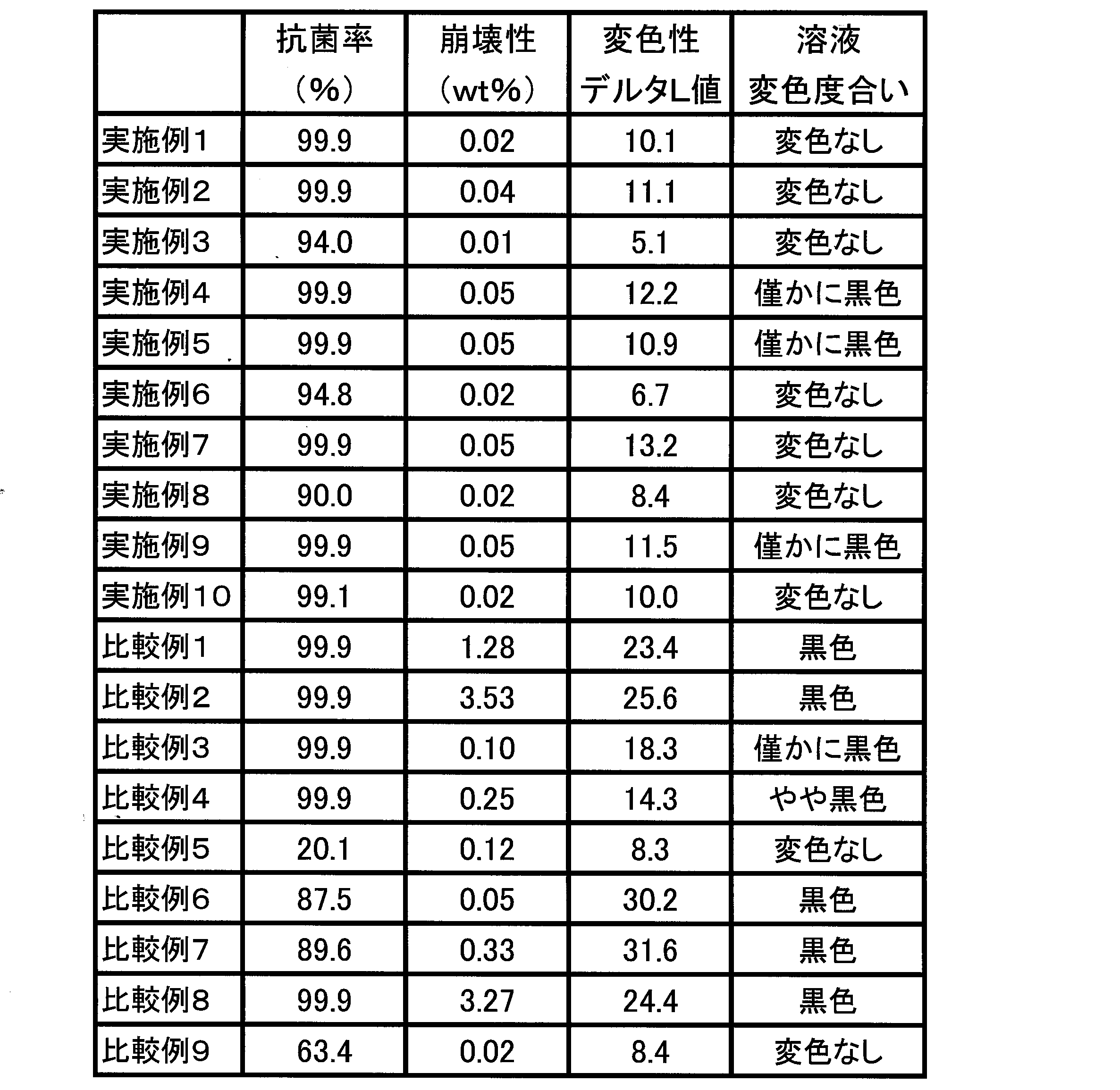
- ⁇ Antimicrobial test> 10 g of each of the water treatment agents of Examples 1 to 10 and Comparative Examples 1 to 9 was packed in 5 cm vertical and horizontal mesh bags, placed in a 1 L container together with an Escherichia coli dispersion adjusted to about 1 ⁇ 10 6 CFU / mL, and at 20 ° C. The number of E. coli after standing for 24 hours was measured by a plate smearing method using a normal agar medium. Compared to the case without water treatment agent, antibacterial rate with water treatment agent (antibacterial rate ((number of bacteria without water treatment agent-number of bacteria with water treatment agent) / Table 3 shows the number of bacteria without water treatment agent) ⁇ 100 (unit%)).
- ⁇ Disintegration confirmation test> The water treatment agents of Examples 1 to 10 and Comparative Examples 1 to 9 were each immersed in deionized water at 40 ° C. for 48 hours, dried at room temperature, and sieved with a sieve having an opening of 1.0 mm. Was measured, and the mass percentage with respect to the mass of the charged water treatment agent was calculated and shown in Table 3 as disintegration (unit: wt%).
- ⁇ Discoloration confirmation test> A sample of 20 g of the water treatment agents of Examples 1 to 10 and Comparative Examples 1 to 9 packed in a 5 cm vertical and horizontal mesh bag was placed in a 100 mL FRP polyester container, and the volume was made up to 100 mL with tap water, and allowed to stand for 10 days. The color (Delta L) of the FRP polyester container after the measurement was measured, and the degree of coloration of the solution was visually confirmed. The color L value of the FRP polyester container is measured with a colorimetric color difference meter Sigma 80 type manufactured by JEOL Ltd., and is displayed with the Hunter Lab color system specified in JISZ8730-1980. It is shown in Table 3. A larger delta L value indicates a greater degree of discoloration and poorer performance.
- the water treatment agent of the present invention has a high effect of reducing various germs contained in water, and is very useful as an antibacterial agent for water treatment because of its low disintegration and discoloration during use. Is expensive.
- the soluble glassy antibacterial agent of the present invention has excellent solubility, small disintegration, and little discoloration. Therefore, when it is brought into contact with water as a water treatment agent, it has the effect of efficiently reducing the number of bacteria contained in water. To express. Furthermore, the molded water treatment agent is excellent in filling property, does not generate fine powder, and does not cause discoloration in the vicinity of the treatment agent or in the treated water, and thus can be used for any antibacterial treatment of water.
- h Represents the height of the water treatment agent of the example.
- d Represents the diameter of the bottom of the water treatment agent of the example.
- R The curvature radius of the top part of the water treatment agent of an Example is represented.
- A Glass cooling molding roller (smooth surface)
- B Cooling roller for glass (those with dents)
- C Glass melted
- S Scraper
- G Molded glass
Landscapes
- Life Sciences & Earth Sciences (AREA)
- Engineering & Computer Science (AREA)
- Chemical & Material Sciences (AREA)
- Dentistry (AREA)
- Wood Science & Technology (AREA)
- Plant Pathology (AREA)
- Health & Medical Sciences (AREA)
- Inorganic Chemistry (AREA)
- Agronomy & Crop Science (AREA)
- General Health & Medical Sciences (AREA)
- Pest Control & Pesticides (AREA)
- Zoology (AREA)
- Environmental Sciences (AREA)
- Hydrology & Water Resources (AREA)
- Environmental & Geological Engineering (AREA)
- Water Supply & Treatment (AREA)
- Organic Chemistry (AREA)
- Glass Compositions (AREA)
- Agricultural Chemicals And Associated Chemicals (AREA)
Abstract
Description
<溶解性ガラス質抗菌剤>
本発明の溶解性ガラス質抗菌剤は、SiO2および/またはP2O5が0~5%、K2Oおよび/またはNa2Oが5~10%、Ag2Oが0.1~5%、B2O3が60~75%、Al2O3が10~20%、MgO、BaO、ZnOからなる群から選ばれる少なくとも1種以上が0~10%を含有するガラスからなる。従来公知の溶解性ガラス質抗菌剤と本発明のガラス質抗菌剤との大きな違いは、一般的に安定したガラス骨格を保持するために必要とされるガラス網目形成成分であるSiO2またはP2O5を、本発明のガラス質抗菌剤では、5%以下の低濃度しか含有しないか、または全く含有しないことであり、それ以外の成分の比率を最適となるように選択することにより、優れた溶解性を有するガラスを実現した。
この他に含まれても良い成分としてCaO、CoOなどは多少混在しても差し支えない。含まれる場合、好ましくは0~5%である。
従来の溶解性ガラス粒子として一般的な、カレット状、フレーク状、角型ブロック状などのガラス質抗菌剤では、ガラスの微小破片が生じ易い。例えば、カレット状では、表面に残留応力があるため微細クラックが発生しやすく、浸水使用時にクラック部分から破砕が進行していくので乾燥すると破片や細粉が発生する。また、フレーク状やブロック状では、鋭利部分や角またはバリ部分が存在するため、浸水して使用することにより部分的に膨潤したり、ガラス強度が低くなると、乾燥した際に鋭利部分や角等からひびが入ったりバリができたりして微小破片が生じ、容器から漏出するという問題が生じる。そこで、本発明の水処理剤として好ましい形状は半球状の成型タイプである。破砕したものではないため、クラックはなく、また、鋭利部分も存在しないため、浸水使用後に乾燥してもガラス破片が漏出することはなく、安全に使用することができる。
形状の一部が半球状、略半球状または円錐状、円錐台状の膨らみを有する粒子の、膨らみの反対面の形状に制限はないが、反対面にも膨らんでいるか、または平面であることが好ましく、さらに好ましくは製造し易い点で平面である。また、平面である場合は、製造し易いという点から平面の形状が円形であることが好ましい。すなわち、最も好ましい形状は底面を円形の平面とする半球状または円錐状の形状である。
本発明の水処理剤の使用形態は特に制限はなく、粒状のまま使用することも可能であるが、水処理用に使用する際には数十gを水透過性の容器に収納して設置する方法が好ましい。具体的には、水処理剤を不織布袋に充填して梱包する、メッシュ袋に充填して梱包する、穴の開いた樹脂性容器に充填して使用する、水可溶性の容器に充填して使用する等の方法が挙げられるが、当該ガラス質抗菌剤の全部または一部が水と接触する使用形態であればいずれの方法でも構わない。使用中の漏出を防ぐために、不織布や目の細かいネット等に充填、梱包して使用することが好ましいが、当該水処理剤は崩壊性が極めて低く、微小破片が発生しにくいため、メッシュ付の樹脂製容器等でも微小破片等の流出がなく使用することが可能である。容器樹脂の材質としては例えばナイロンやポリエステル等が挙げられるが、当該ガラス質抗菌剤の全部または一部が水と接触することができるような形態であれば特に材質の制限はない。
本発明の水処理剤は、防カビ、防藻及び抗菌性を必要とされる種々の分野、即ち電化製品、トイレタリー製品、台所用品、玩具、などの水処理用、特にドレン水の微生物汚染対策に有効に利用することができる。さらに具体的用途を例示すると、電化製品としては食器洗浄機、冷蔵庫、洗濯機、ポット、炊飯器、エアコン、空気清浄機、除湿機、加湿器等があり、トイレタリー製品としては、トイレ用水、浴槽、浴室、おまる、汚物いれ、風呂蓋等があり、台所用品としては生ゴミ容器、排水栓等があり、玩具としては、水鉄砲、お風呂用玩具、調理用玩具等がある。その他の使用方法としてプールやため池、水槽、抗菌スプレ-等がある。
ガラスの骨格構造を形成するSiO2およびB2O3は、ガラスの溶解性に大きく影響し、一般的にSiO2の割合が増えると溶解性が低下し、B2O3の割合が増えると溶解性が向上することが知られているが、一方でB2O3の多いガラスはもろくて割れやすいことが知られている。また、溶解性を向上させるためにはアルカリ金属酸化物の割合を高めることは良く知られた技術である。
水処理剤粒子の平均質量は、任意の10粒を採取し、10粒まとめての質量を電子天秤で0.01mgまで測量し、一粒当たりの平均質量を算出して表示した。銀の溶出量は、40℃の1リットルの脱イオン水に水処理剤を約5g添加し、250rpmで6時間撹拌したのちの水中の銀イオンの濃度をICP(誘導結合プラズマ発光分析装置)にて測定し、水処理剤1g、溶出水1リットルおよび溶出時間1時間あたりの濃度に規格化して溶出量(μg/L・g・時間)として表示した。より具体的には、水1リットルへの水処理剤の添加量が5.0gで、撹拌時間が6.0時間であれば、検出された銀イオン濃度を5.0および6.0で除した数値が規格化した溶出量(μg/L・g・時間)となる。
充填性は、自動充填機を用いて袋に充填した際に1時間連続運転可能であった場合を良好とし、微粉の詰まりなどにより充填機が1時間内に緊急停止した場合を不良とした。
表1に示した実施例1~7,9,10の組成からなるガラス原料調合物を1200℃で加熱溶融した。溶融後、直径5mmの半球状の窪みを片面に配した金属製の冷却成形ローラーを用いて、冷却、成形し、得られたガラスを叩いて破砕したものを、さらにボ-ルミルにて1時間乾式破砕した後、目開き2.8mmの金網で微粉をふるい落として水処理剤の実施例1~7,9,10を得た。得られた水処理剤の任意の10粒の平均質量、寸法、銀溶出濃度、自動充填機を用いての充填性を評価し、表2に示した。
比較例1~6および8ならびに9は、表1に示したガラス組成からなるガラス原料調合物を用いた以外は、実施例1と同様の製造方法により得た。測定方法も同様である。

実施例1~10および比較例1~9の水処理剤を各々縦横5cmのメッシュ袋に10g梱包し、約1×10⁶CFU/mLに調整した大腸菌分散液とともに1L容器に入れ、20℃で24時間静置した後の大腸菌数を普通寒天培地を用いた平板塗抹法で測定した。水処理剤を入れない場合と比較し、水処理剤を入れた場合の抗菌率(抗菌率=((水処理剤を入れない場合の菌数-水処理剤を入れた場合の菌数)/水処理剤を入れない場合の菌数)×100(単位%))を表3に示した。
実施例1~10および比較例1~9の水処理剤を各々40℃の脱イオン水に48時間浸水させた後に室温で乾燥させ、目開き1.0mmの篩でふるったときの篩下重量を測定し、仕込み水処理剤の質量に対する質量百分率を算出して崩壊性(単位wt%)として表3に示した。
容量100mLのFRPポリエステル容器に実施例1~10および比較例1~9の水処理剤を各々縦横5cmのメッシュ袋に20g梱包した検体を入れ、水道水で100mLにメスアップし、10日間静置した後のFRPポリエステル容器の色彩(デルタL)を測定し、さらに溶液の着色度合いを目視で確認した。FRPポリエステル容器の色彩L値は日本電子工業(株)製測色色差計シグマ80型によって測定し、JISZ8730-1980に規定するハンターLab表色系により表示し、また、目視による溶液の変色度合いを表3に示した。デルタL値が大きいほど、変色度が大きく、性能が劣ることを示す。
d:実施例の水処理剤の底部の直径を表す。
R:実施例の水処理剤の頂部の曲率半径を表す。
A:ガラスの冷却成形ローラー(平滑面)
B:ガラスの冷却成形ローラー(窪みのあるもの)
C:熔融したガラス
S:スクレーパー
G:成形されたガラス
Claims (7)
- 酸化物換算の質量比でSiO2および/またはP2O5が0~5%;K2Oおよび/またはNa2Oが5~10%;Ag2Oが0.1~5%;B2O3が60~75%;Al2O3が10~20%;MgO、BaO、ZnOからなる群から選ばれる少なくとも1種以上が0~10%を含有する溶解性ガラス質抗菌剤。
- 酸化物換算の質量比でSiO2が0~5%;K2Oが5~10%;Ag2Oが0.1~5%;B2O3が60~75%;Al2O3が10~20%;MgO、BaO、ZnOからなる群から選ばれる少なくとも1種以上が0~10%を含有する請求項1に記載の溶解性ガラス質抗菌剤
- 請求項1または2に記載の溶解性ガラス質抗菌剤からなり、質量が0.02~0.5g、最大直径が3mm~20mmの成型粒状体である水処理剤。
- 成形粒状体が、底部が平面で上方に膨らみを有する形状であり、底部平面に対する垂直高さが1~5mmである、請求項3に記載の水処理剤。
- 成形粒状体が、底部平面が円形であり、上方の膨らみの頂点の曲率半径Rが、最大直径Dに対して1/8D~5/8Dの範囲内である、請求項4に記載の水処理剤
- 40℃の脱イオン水に48時間浸水後乾燥させ、目開き1mmの篩で篩ったときの篩い下重量が0.05質量%以下である請求項3~5のいずれかに記載の水処理剤
- 請求項3~6のいずれかの水処理剤を用いた水処理方法
Priority Applications (3)
| Application Number | Priority Date | Filing Date | Title |
|---|---|---|---|
| CN201180016634.0A CN102834001B (zh) | 2010-04-02 | 2011-03-31 | 溶解性玻璃质抗菌剂以及水处理剂 |
| JP2012509565A JP5541356B2 (ja) | 2010-04-02 | 2011-03-31 | 溶解性ガラス質抗菌剤および水処理剤 |
| KR1020127028023A KR101869108B1 (ko) | 2010-04-02 | 2011-03-31 | 용해성 유리질 항균제 및 수처리제 |
Applications Claiming Priority (2)
| Application Number | Priority Date | Filing Date | Title |
|---|---|---|---|
| JP2010085922 | 2010-04-02 | ||
| JP2010-085922 | 2010-04-02 |
Publications (1)
| Publication Number | Publication Date |
|---|---|
| WO2011125825A1 true WO2011125825A1 (ja) | 2011-10-13 |
Family
ID=44762763
Family Applications (1)
| Application Number | Title | Priority Date | Filing Date |
|---|---|---|---|
| PCT/JP2011/058185 Ceased WO2011125825A1 (ja) | 2010-04-02 | 2011-03-31 | 溶解性ガラス質抗菌剤および水処理剤 |
Country Status (4)
| Country | Link |
|---|---|
| JP (1) | JP5541356B2 (ja) |
| KR (1) | KR101869108B1 (ja) |
| CN (1) | CN102834001B (ja) |
| WO (1) | WO2011125825A1 (ja) |
Cited By (4)
| Publication number | Priority date | Publication date | Assignee | Title |
|---|---|---|---|---|
| JP2013100278A (ja) * | 2011-10-21 | 2013-05-23 | Koa Glass Kk | 水処理剤および水処理剤の使用方法 |
| JP2015078085A (ja) * | 2013-10-16 | 2015-04-23 | 株式会社イチキコーポレーション | 水溶性ガラス組成物及び水質改善水処理方法 |
| JP2019074223A (ja) * | 2017-10-12 | 2019-05-16 | 興亜硝子株式会社 | 潜熱回収型給湯器及び給湯方法 |
| EP4484389A4 (en) * | 2022-03-03 | 2025-07-02 | Lg Electronics Inc | DETERGENT GLASS COMPOSITION AND METHOD FOR PREPARING DETERGENT GLASS POWDER USING SAME |
Families Citing this family (6)
| Publication number | Priority date | Publication date | Assignee | Title |
|---|---|---|---|---|
| CN104115868A (zh) * | 2014-06-30 | 2014-10-29 | 山东省泰和水处理有限公司 | 一种银离子硼硅化合物的合成及应用 |
| CN105776454A (zh) * | 2016-04-04 | 2016-07-20 | 北京师范大学 | 一种应用于循环水系统的无磷缓释型抑菌剂 |
| CN106564996A (zh) * | 2016-11-07 | 2017-04-19 | 南京悠谷知识产权服务有限公司 | 一种水处理抗菌材料及其制备方法 |
| CN108902178A (zh) * | 2018-06-27 | 2018-11-30 | 徐涌涛 | 一种玻璃载体抗菌剂组合物 |
| KR102498534B1 (ko) * | 2019-09-02 | 2023-02-10 | 엘지전자 주식회사 | 항균 유리 조성물 및 항균 유리의 제조방법 |
| CN116621461A (zh) * | 2023-05-24 | 2023-08-22 | 上海朗亿功能材料有限公司 | 一种玻璃抗菌剂及其制备方法与应用 |
Citations (4)
| Publication number | Priority date | Publication date | Assignee | Title |
|---|---|---|---|---|
| JPS62210098A (ja) * | 1986-03-07 | 1987-09-16 | Kyoritsu Glass Kk | ガラス水処理剤 |
| JPH01317133A (ja) * | 1988-06-15 | 1989-12-21 | Mitsubishi Rayon Eng Co Ltd | ガラス水処理剤 |
| JP2001247337A (ja) * | 1999-12-28 | 2001-09-11 | Ishizuka Glass Co Ltd | 抗菌性付与用ガラス組成物、及びそれを用いた抗菌性高分子複合材料、抗菌性高分子複合材料成形体 |
| JP2003119103A (ja) * | 2001-10-11 | 2003-04-23 | Toyo Glass Co Ltd | 忌避剤組成物、これを用いた忌避塗料及び忌避方法 |
Family Cites Families (10)
| Publication number | Priority date | Publication date | Assignee | Title |
|---|---|---|---|---|
| JPH0647625B2 (ja) | 1988-06-13 | 1994-06-22 | 近畿パイプ技研株式会社 | 合成樹脂成形体 |
| JPH02302451A (ja) | 1989-05-18 | 1990-12-14 | Ishizuka Glass Co Ltd | 抗菌性を有する樹脂フィルム |
| JPH0753274B2 (ja) | 1992-10-20 | 1995-06-07 | 石塚硝子株式会社 | 風呂水の浄化装置 |
| JPH06190369A (ja) | 1992-12-25 | 1994-07-12 | Daiwa Kagaku Kogyo Kk | 超音波加湿器に使用する水タンク内の水中微生物の 殺滅および増殖を防除する抗菌剤組成物 |
| JP3486919B2 (ja) | 1993-07-09 | 2004-01-13 | 日本板硝子株式会社 | 抗菌性を有するフレーク状ガラス |
| JP3845959B2 (ja) | 1997-07-07 | 2006-11-15 | 日本電気硝子株式会社 | 抗菌性ガラス粉末及び樹脂成形体 |
| JP3845975B2 (ja) | 1997-08-20 | 2006-11-15 | 日本電気硝子株式会社 | 抗菌性ガラス及び樹脂組成物 |
| JP4388282B2 (ja) | 2003-01-24 | 2009-12-24 | 東亞合成株式会社 | 抗菌効果に優れる銀系ガラス質抗菌剤 |
| WO2005087675A1 (ja) | 2004-03-15 | 2005-09-22 | Koa Glass Co., Ltd. | 抗菌性ガラスおよび抗菌性ガラスの製造方法 |
| JP4364256B2 (ja) | 2007-05-10 | 2009-11-11 | 株式会社東芝 | 衣類洗濯機 |
-
2011
- 2011-03-31 CN CN201180016634.0A patent/CN102834001B/zh active Active
- 2011-03-31 KR KR1020127028023A patent/KR101869108B1/ko active Active
- 2011-03-31 WO PCT/JP2011/058185 patent/WO2011125825A1/ja not_active Ceased
- 2011-03-31 JP JP2012509565A patent/JP5541356B2/ja active Active
Patent Citations (4)
| Publication number | Priority date | Publication date | Assignee | Title |
|---|---|---|---|---|
| JPS62210098A (ja) * | 1986-03-07 | 1987-09-16 | Kyoritsu Glass Kk | ガラス水処理剤 |
| JPH01317133A (ja) * | 1988-06-15 | 1989-12-21 | Mitsubishi Rayon Eng Co Ltd | ガラス水処理剤 |
| JP2001247337A (ja) * | 1999-12-28 | 2001-09-11 | Ishizuka Glass Co Ltd | 抗菌性付与用ガラス組成物、及びそれを用いた抗菌性高分子複合材料、抗菌性高分子複合材料成形体 |
| JP2003119103A (ja) * | 2001-10-11 | 2003-04-23 | Toyo Glass Co Ltd | 忌避剤組成物、これを用いた忌避塗料及び忌避方法 |
Cited By (4)
| Publication number | Priority date | Publication date | Assignee | Title |
|---|---|---|---|---|
| JP2013100278A (ja) * | 2011-10-21 | 2013-05-23 | Koa Glass Kk | 水処理剤および水処理剤の使用方法 |
| JP2015078085A (ja) * | 2013-10-16 | 2015-04-23 | 株式会社イチキコーポレーション | 水溶性ガラス組成物及び水質改善水処理方法 |
| JP2019074223A (ja) * | 2017-10-12 | 2019-05-16 | 興亜硝子株式会社 | 潜熱回収型給湯器及び給湯方法 |
| EP4484389A4 (en) * | 2022-03-03 | 2025-07-02 | Lg Electronics Inc | DETERGENT GLASS COMPOSITION AND METHOD FOR PREPARING DETERGENT GLASS POWDER USING SAME |
Also Published As
| Publication number | Publication date |
|---|---|
| CN102834001A (zh) | 2012-12-19 |
| KR101869108B1 (ko) | 2018-06-19 |
| JPWO2011125825A1 (ja) | 2013-07-11 |
| KR20130024899A (ko) | 2013-03-08 |
| JP5541356B2 (ja) | 2014-07-09 |
| CN102834001B (zh) | 2014-11-19 |
Similar Documents
| Publication | Publication Date | Title |
|---|---|---|
| JP5541356B2 (ja) | 溶解性ガラス質抗菌剤および水処理剤 | |
| KR101024417B1 (ko) | 혼합 항균성 유리 | |
| US8034732B2 (en) | Antimicrobial glass and method of producing antimicrobial glass | |
| JP5845209B2 (ja) | 抗菌性ガラスおよび抗菌性ガラスの製造方法 | |
| JP5392350B2 (ja) | 水処理用粒状抗菌剤 | |
| CN101665652A (zh) | 一种具有抗菌功能的粉末涂料及其制备方法和应用 | |
| WO2007004713A1 (ja) | 銀含有アルミニウム硫酸塩水酸化物粒子よりなる抗菌剤およびその利用 | |
| JP6604499B2 (ja) | 抗菌性ガラス及びこれを用いた樹脂成形品 | |
| JPS62210098A (ja) | ガラス水処理剤 | |
| CN104206420A (zh) | 一种非银粉状固溶体抗菌剂的制备方法及其应用 | |
| KR20210063092A (ko) | 항균 유리 조성물 및 이를 이용한 항균 유리 분말 제조 방법 | |
| KR20220085905A (ko) | 항균 유리 조성물 및 그 항균 유리 분말 제조 방법과, 이를 포함하는 가전제품 | |
| JP2019099514A (ja) | 抗ウィルス剤及びこれを用いた樹脂成型品 | |
| JP2003246645A (ja) | 防黴性ガラス、防黴性樹脂組成物および防黴性ガラスの製造方法 | |
| JP2828522B2 (ja) | 殺菌処理剤 | |
| KR102590818B1 (ko) | 비용출성 항균 유리 조성물 및 이를 이용한 항균 유리 분말 제조 방법 | |
| JP6088199B2 (ja) | 水処理剤および水処理剤の使用方法 | |
| WO2026048619A1 (ja) | 抗菌性ガラス、水処理剤、水処理方法 | |
| CN101926361A (zh) | 一种人造大理石用抗菌剂的制造方法 | |
| KR20060056065A (ko) | 나노 은 코팅 글라스비드 및 그 제조방법 | |
| KR20220109624A (ko) | 항균 유리를 포함하는 활성탄 필터 및 이를 이용한 가전기기 | |
| JP2008231005A (ja) | 抗菌剤、それを含む樹脂組成物及び成形品 |
Legal Events
| Date | Code | Title | Description |
|---|---|---|---|
| WWE | Wipo information: entry into national phase |
Ref document number: 201180016634.0 Country of ref document: CN |
|
| 121 | Ep: the epo has been informed by wipo that ep was designated in this application |
Ref document number: 11765725 Country of ref document: EP Kind code of ref document: A1 |
|
| WWE | Wipo information: entry into national phase |
Ref document number: 2012509565 Country of ref document: JP |
|
| NENP | Non-entry into the national phase |
Ref country code: DE |
|
| ENP | Entry into the national phase |
Ref document number: 20127028023 Country of ref document: KR Kind code of ref document: A |
|
| 122 | Ep: pct application non-entry in european phase |
Ref document number: 11765725 Country of ref document: EP Kind code of ref document: A1 |