WO2011125713A1 - 毛髪化粧料 - Google Patents
毛髪化粧料 Download PDFInfo
- Publication number
- WO2011125713A1 WO2011125713A1 PCT/JP2011/057971 JP2011057971W WO2011125713A1 WO 2011125713 A1 WO2011125713 A1 WO 2011125713A1 JP 2011057971 W JP2011057971 W JP 2011057971W WO 2011125713 A1 WO2011125713 A1 WO 2011125713A1
- Authority
- WO
- WIPO (PCT)
- Prior art keywords
- hair
- acrylic acid
- copolymer
- hair cosmetic
- group
- Prior art date
- Legal status (The legal status is an assumption and is not a legal conclusion. Google has not performed a legal analysis and makes no representation as to the accuracy of the status listed.)
- Ceased
Links
Classifications
-
- A—HUMAN NECESSITIES
- A61—MEDICAL OR VETERINARY SCIENCE; HYGIENE
- A61K—PREPARATIONS FOR MEDICAL, DENTAL OR TOILETRY PURPOSES
- A61K8/00—Cosmetics or similar toiletry preparations
- A61K8/18—Cosmetics or similar toiletry preparations characterised by the composition
- A61K8/72—Cosmetics or similar toiletry preparations characterised by the composition containing organic macromolecular compounds
- A61K8/84—Cosmetics or similar toiletry preparations characterised by the composition containing organic macromolecular compounds obtained by reactions otherwise than those involving only carbon-carbon unsaturated bonds
- A61K8/89—Polysiloxanes
- A61K8/896—Polysiloxanes containing atoms other than silicon, carbon, oxygen and hydrogen, e.g. dimethicone copolyol phosphate
- A61K8/898—Polysiloxanes containing atoms other than silicon, carbon, oxygen and hydrogen, e.g. dimethicone copolyol phosphate containing nitrogen, e.g. amodimethicone, trimethyl silyl amodimethicone or dimethicone propyl PG-betaine
-
- A—HUMAN NECESSITIES
- A61—MEDICAL OR VETERINARY SCIENCE; HYGIENE
- A61K—PREPARATIONS FOR MEDICAL, DENTAL OR TOILETRY PURPOSES
- A61K8/00—Cosmetics or similar toiletry preparations
- A61K8/18—Cosmetics or similar toiletry preparations characterised by the composition
- A61K8/30—Cosmetics or similar toiletry preparations characterised by the composition containing organic compounds
- A61K8/33—Cosmetics or similar toiletry preparations characterised by the composition containing organic compounds containing oxygen
- A61K8/34—Alcohols
-
- A—HUMAN NECESSITIES
- A61—MEDICAL OR VETERINARY SCIENCE; HYGIENE
- A61K—PREPARATIONS FOR MEDICAL, DENTAL OR TOILETRY PURPOSES
- A61K8/00—Cosmetics or similar toiletry preparations
- A61K8/18—Cosmetics or similar toiletry preparations characterised by the composition
- A61K8/72—Cosmetics or similar toiletry preparations characterised by the composition containing organic macromolecular compounds
- A61K8/81—Cosmetics or similar toiletry preparations characterised by the composition containing organic macromolecular compounds obtained by reactions involving only carbon-to-carbon unsaturated bonds
- A61K8/8141—Compositions of homopolymers or copolymers of compounds having one or more unsaturated aliphatic radicals, each having only one carbon-to-carbon double bond, and at least one being terminated by only one carboxyl radical, or of salts, anhydrides, esters, amides, imides or nitriles thereof; Compositions of derivatives of such polymers
- A61K8/8152—Homopolymers or copolymers of esters, e.g. (meth)acrylic acid esters; Compositions of derivatives of such polymers
-
- A—HUMAN NECESSITIES
- A61—MEDICAL OR VETERINARY SCIENCE; HYGIENE
- A61K—PREPARATIONS FOR MEDICAL, DENTAL OR TOILETRY PURPOSES
- A61K8/00—Cosmetics or similar toiletry preparations
- A61K8/18—Cosmetics or similar toiletry preparations characterised by the composition
- A61K8/72—Cosmetics or similar toiletry preparations characterised by the composition containing organic macromolecular compounds
- A61K8/84—Cosmetics or similar toiletry preparations characterised by the composition containing organic macromolecular compounds obtained by reactions otherwise than those involving only carbon-carbon unsaturated bonds
- A61K8/89—Polysiloxanes
- A61K8/895—Polysiloxanes containing silicon bound to unsaturated aliphatic groups, e.g. vinyl dimethicone
-
- A—HUMAN NECESSITIES
- A61—MEDICAL OR VETERINARY SCIENCE; HYGIENE
- A61Q—SPECIFIC USE OF COSMETICS OR SIMILAR TOILETRY PREPARATIONS
- A61Q5/00—Preparations for care of the hair
- A61Q5/12—Preparations containing hair conditioners
Definitions
- the present invention relates to a hair cosmetic composition that imparts a top rise or the like to thin hair or hair that does not have a firmness due to aging.
- gloss is the best hair quality that women regardless of age.
- Techniques for imparting gloss to hair include oil and silicone.
- oil, silicone, or the like is used for hair that is thin due to aging or the like, there is a problem that the top rise is impaired. From the above, there has been a demand for a hair cosmetic that gives the hair that has been thinned by aging or the like to give rise to the top and its sustainability, and is not stiff and glossy.
- the present invention has been made in view of the above circumstances, and it gives the hair that is thin due to aging etc. to give rise to the top and its sustainability, and is not stiff, gives the hair gloss, and also has good storage stability. It aims at providing hair cosmetics.
- the present inventor has (A) a specific acrylic acid-based polymer having acrylic acid as a structural unit, (B) a specific amino-modified silicone having an ether bond, and (C
- A a specific acrylic acid-based polymer having acrylic acid as a structural unit
- B a specific amino-modified silicone having an ether bond
- C By using together ethanol and a solvent comprising a hydroxyl group-containing compound other than the components (D) and (C), the hair that has become thin due to aging, etc. is given rise to the top and its durability, and there is no wrinkle.
- the present inventors have found that the hair can be glossy and that the storage stability is also good, leading to the present invention.
- the present invention provides the following hair cosmetics.
- Hair cosmetics containing the following components (A) to (D).
- (D) (C ) A solvent comprising a hydroxyl group-containing compound other than the component [2].
- a hair cosmetic composition which gives top rising and its sustainability to hair thinned by aging, etc., has no stiffness, gives gloss to the hair, and has good storage stability. can do. Furthermore, the softness of a hair tip can be provided by mix
- the hair cosmetic composition of the present invention is a hair cosmetic composition containing the following components (A) to (D).
- (C ) A solvent comprising a hydroxyl group-containing compound other than the component
- a component selected from acrylic acid / silicone copolymer, acrylic acid / methacrylic acid copolymer and acrylic acid / acrylamide copolymer By using the polymer, it is possible to give the top rise and its sustainability to hair that has become thin due to aging or the like.
- a component can be used individually by 1 type or in combination of 2 or more types as appropriate.
- Acrylic acid / silicone copolymer is a copolymer containing acrylic acid and siloxane as constituent units.
- (acrylates / ethylhexyl acrylate / dimethicone methacrylate) copolymers (acrylates / stearyl acrylate / dimethicone methacrylate) copolymers, (acrylates / tridecyl acrylate / triethoxysilylpropyl methacrylate / dimethicone methacrylate) copolymers, (acrylates) / Behenyl acrylate / dimethicone methacrylate) copolymer, (acrylates / polytrimethylsiloxy methacrylate) copolymer, and the like. These are expressed by “display names” decided in the cosmetics industry.
- (Acrylates / ethylhexyl acrylate / dimethicone methacrylate) copolymer is a copolymer of 2-ethylhexyl acrylate, dimethicone methacrylate, and one or more monomers consisting of acrylic acid, methacrylic acid or simple esters thereof.
- Examples of commercially available products include graft copolymers composed of an acrylic polymer and dimethylpolysiloxane (cyclopentasiloxane dissolved product): Shin-Etsu Chemical Co., Ltd .: KP-575).
- (Acrylates / stearyl acrylate / dimethicone methacrylate) copolymer is a copolymer of stearyl acrylate, dimethicone methacrylate, and one or more monomers composed of acrylic acid, methacrylic acid or simple esters thereof.
- Examples of commercially available products include Shin-Etsu Chemical: KP-561P.
- Copolymer is composed of tridecyl acrylate, triethoxysilylpropyl methacrylate, dimethicone methacrylate and acrylic acid, methacrylic acid or simple esters thereof. It is a copolymer with one or more types of monomers. Examples of commercially available products include Shin-Etsu Chemical: KP-574.
- (Acrylates / behenyl acrylate / methacrylic acid dimethicone) copolymer is a copolymer of at least one monomer composed of behenyl acrylate, dimethic acid methacrylate, and acrylic acid, methacrylic acid or simple esters thereof. Examples of commercially available products include Shin-Etsu Chemical: KP-562P.
- Acrylates / polytrimethylsiloxy methacrylate copolymer is a copolymer of at least one monomer comprising acrylic acid, methacrylic acid or a simple ester thereof and polytrimethylsiloxy methacrylate.
- Examples of commercially available products include Toray Dow Corning Co., Ltd .: FA-4001 (dissolved in a cyclic pentamer), FA-4002 (dissolved in isododecane), and the like.
- Acrylic acid / methacrylic acid copolymer is a copolymer having acrylic acid and methacrylic acid as constituent units.
- (acrylates / allyl methacrylate) copolymer AMP, (vinyl pyrrolidone / acrylates / lauryl methacrylate) copolymer and the like can be mentioned.
- (Acrylates / allyl methacrylate) copolymer AMP is a salt of acrylates / allyl methacrylate copolymer and 2-amino-2-methylpropanol (AMP).
- AMP 2-amino-2-methylpropanol
- Lubrizol Advanced Materials FIXATE G-100 POLYMER (26 mass% aqueous solution) etc. are mentioned.
- (Vinyl pyrrolidone / acrylates / lauryl methacrylate) copolymer is a copolymer comprising vinyl pyrrolidone (VP), lauryl methacrylate, and one or more monomers selected from acrylic acid, methacrylic acid or esters thereof. It is. As a commercial item, IPS Japan Co., Ltd .: STYLEZE 2000 etc. are mentioned.
- the proportion of the structural units of acrylic acid in (i) acrylic acid / silicone copolymer and (ii) acrylic acid / methacrylic acid copolymer is not particularly limited, but 50 mol% or less gives rise to the top without stiffness. Excellent effect.
- the weight average molecular weight is not particularly limited, but is preferably 10,000 to 200,000.
- Acrylic acid / acrylamide copolymer The acrylic acid / acrylamide copolymer is represented by 70 to 95 mol% of a monomer unit represented by the following general formula (1) and represented by the following general formula (2). Examples thereof include acrylic acid / acrylamide copolymers made of a copolymer containing 5 to 30 mol% of monomer units as structural units. These may be used alone or in appropriate combination of two or more.
- R 1 represents a hydrogen atom or a methyl group
- R 2 represents a hydrogen atom or a —CH 2 OH group
- A represents an oxygen atom or —NH—
- R 3 represents a hydrogen atom or a methyl group
- M represents a hydrogen atom, an alkali metal atom, ammonium or an amine.
- alkali metal atom examples include sodium atom, potassium atom, and amine include monoethanolamine, diethanolamine, triethanolamine and the like.
- M is an alkali metal atom, ammonium or amine, -COOM forms a salt. To do.
- R 1 is a hydrogen atom
- R 2 is a hydrogen atom
- A is —NH—
- R 3 is preferably a hydrogen atom
- M is preferably a hydrogen atom and / or a sodium atom.
- the proportion of the monomer unit represented by the general formula (1) is preferably 70 to 95 mol% in the acrylic acid / acrylamide copolymer (in 100 mol% of all monomer units), and 75 to 90 mol%. More preferably, the proportion of the monomer unit represented by the general formula (2) is preferably 5 to 30 mol%, preferably 10 to 25 mol, of acrylic acid / acrylamide copolymer (in 100 mol% of all monomer units). % Is more preferable. If the ratio of the monomer unit represented by the general formula (1) exceeds 95 mol%, the non-stickiness may be reduced, and if it is less than 70 mol%, the top rise may be reduced.
- the acrylic acid / acrylamide copolymer may contain monomer units other than the monomer unit represented by the general formula (1) or (2) as long as the effects of the present invention are not impaired.
- Examples of other monomer units include nonionic monomers, amphoteric monomers, semipolar monomers, and cationic monomers other than the monomer units represented by the general formula (1) or (2).
- monomer units corresponding to monomers and polysiloxane group-containing monomers are preferably 0 to 25 mol% in the acrylic acid / acrylamide copolymer.
- the acrylic acid / acrylamide copolymer of the present invention may be a random copolymer or a block copolymer, and the acrylic acid / acrylamide copolymer of the present invention is represented by the general formulas (1) and (2).
- An acrylic acid / acrylamide copolymer comprising a copolymer having monomer units as constituent units is preferred.
- nonionic monomers include esters of alcohols having 1 to 22 carbon atoms and (meth) acrylic acid, amides of alkylamines having 1 to 22 carbon atoms and (meth) acrylic acid, ethylene glycol, 1 1,3-propylene glycol and the like (meth) acrylic acid monoesters, esters obtained by etherifying the hydroxyl groups of these monoesters with methanol, ethanol, etc., (meth) acryloylmorpholine, etc.
- Examples of the body include betaine group-containing (meth) acrylic esters, betaine group-containing (meth) acrylamides, etc.
- examples of semipolar monomers include amine oxide group-containing (meth) acrylic esters and amine oxide groups (Meth) acrylamide and the like.
- examples of the cationic monomer include a quaternary amine. Sulfonium group-containing (meth) acrylic esters, quaternary ammonium group-containing (meth) acrylamide and the like.
- the polysiloxane group-containing monomer is a compound having a polysiloxane structure and a structure capable of being covalently linked to an acrylic acid / acrylamide copolymer.
- Such structural units have a high affinity with silicone oils commonly used in cosmetic compositions, and serve to bind silicone oils to other structural units in acrylic acid / acrylamide copolymers. It is thought that it has a function of increasing the adsorption power of silicone oil to hair, particularly damaged hair.
- the proportion of each monomer unit in the acrylic acid / acrylamide copolymer is the IR absorption of carbonyl group, amide bond, polysiloxane structure and various functional groups, and the methyl group or amide bond site of polydimethylsiloxane and It can be measured by 1 H-NMR of the methyl group, methylene group or the like adjacent to them, or 13 C-NMR thereof.
- the weight average molecular weight of the acrylic acid / acrylamide copolymer is preferably 3,000 to 100,000. If it is less than 3,000, the effect of improving the hair feel may not be sufficiently obtained, and if it exceeds 100,000, it may feel stiff.
- the weight average molecular weight is more preferably 10,000 to 30,000, more preferably 10,000 to 20,000, and more preferably 12,000 to 17,000 in view of the balance between the rise of the top and the non-stickiness. Is particularly preferred.
- the molecular weight of the acrylic acid / acrylamide copolymer can be adjusted, for example, by controlling the degree of polymerization of the polymer.
- the molecular weight and viscosity can also be controlled by increasing or decreasing the addition amount of a crosslinking agent such as a polyfunctional acrylate.
- a crosslinking agent such as a polyfunctional acrylate.
- the acrylic acid / acrylamide copolymer can be obtained according to the methods described in JP2007-137830A and JP2007-161986A. For example, it can be obtained by mixing monomers that give respective structural units or precursors thereof and copolymerizing them by a method such as solution polymerization, suspension polymerization, emulsion polymerization or the like.
- the counter ion in the general formula (2) can be subjected to polymerization by substituting a part or all of it for other than hydrogen ion by a neutralization reaction before polymerization, and neutralized after polymerization or other reaction. A part or all of the reaction can be replaced with other than hydrogen ions. These can be appropriately selected depending on the ease of synthesis.
- the polymerization reaction is preferably performed in a hydrophilic solvent such as ethanol.
- a known polymerization initiator such as dimethyl 2,2'-azobis (2-methylpropionate) can be used.
- each monomer is mix
- the proportion of the structural unit composed of each monomer in the copolymer of the present invention is the same as the blending amount of each monomer at the time of copolymerization.
- the polymerization reaction is preferably performed in a hydrophilic solvent.
- hydrophilic solvents include ketone solvents such as acetone, methyl ethyl ketone, and methyl isobutyl ketone, alcohol solvents such as methanol, ethanol, n-propanol, i-propanol, n-butanol, i-butanol, and sec-butanol, water, and the like Is mentioned. These can be used individually by 1 type or in combination of 2 or more types. Among them, it is preferable to use an alcohol solvent.
- peroxides such as benzoyl
- the polymerization reaction can be performed, for example, in an inert gas atmosphere such as nitrogen or argon, preferably at 30 to 120 ° C., more preferably at 40 to 100 ° C., usually for 1 to 30 hours.
- the produced copolymer may be isolated from the reaction solution by an appropriate means such as solvent distillation or addition of a poor solvent.
- This copolymer can be used as it is or after further purification, for example, in the production of cosmetics. Purification can be carried out by combining appropriate means such as reprecipitation, solvent washing, membrane separation and the like as necessary.
- acrylic acid-based polymer (iii) acrylic acid / acrylamide copolymer is preferable from the viewpoint of the sustainability of the rise at the top and storage stability, and among them, acrylic acid hydroxyethyl acrylamide copolymer is preferable.
- acrylic acid hydroxyethyl acrylamide Mitsubishi Chemical Corporation: PAN105 (22.2 mass% aqueous solution)
- the blending amount of the acrylic acid polymer is preferably 0.05 to 10% by mass in the hair cosmetic. By setting it within this range, it is possible to obtain the rise of the top and its sustainability, no stiffness, and good storage stability. More preferably, it is 0.1 to 5% by mass, and further preferably 0.3 to 3% by mass. If the blending amount is less than 0.05% by mass, the rise of the top may be insufficient, and if it exceeds 10% by mass, the product may become stiff and the storage stability may be insufficient.
- (B) Aminoglycol-modified silicone By using such a silicone having an alkoxy group in the structural unit, in a hair cosmetic containing (A), (C) and (D) components, The compatibility is improved, and the storage stability is improved. These can be used individually by 1 type or in combination of 2 or more types.
- the aminoglycol-modified silicone is a silicone having an amino group to which alkylene glycol is added. This amino group may be directly bonded to Si or may have a linking group. Further, the alkylene glycol group may be arranged in the repeating unit of the polymer, or both ends of the polymer main chain may be blocked. As a specific example, a type arranged in a repeating unit of a polymer is called a linear amino polyether-modified silicone, and a type in which both ends of the polymer are blocked with an alkylene glycol group is called an amino both-end polyether-modified silicone. .
- Linear amino polyether-modified silicone refers to a silicone having a siloxane structure having an amino functional group and a polyoxyethylene group in the main chain.
- a silicone comprising an amino-modified polysiloxane block having an amino functional group and a polyoxyalkylene block is preferable, and in particular, an amino functional group in the side chain represented by the following general formula (3):
- a block copolymer consisting of an amino-modified polysiloxane block having a group and a polyoxyalkylene block and having a terminal methyl group is preferred.
- R 4 each independently represents a hydrogen atom or a monovalent hydrocarbon group having 1 to 6 carbon atoms
- R 5 represents R 4 or E
- E represents —R 6 —Z
- Z represents a primary to tertiary amino group-containing group or an ammonium group-containing group
- X represents a divalent group
- a represents 2 or more.
- Number, b is a number of 1 or more
- n is a number of 2 to 10
- c is a number of 4 or more
- d is a number of 2 or more.
- the aminoglycol-modified silicone represented by the general formula (3) is preferably a hydrogen atom, an alkyl group having 1 to 6 carbon atoms or a phenyl group independently of each other as R 4 in the general formula (3).
- Group and ethyl group are more preferable, and methyl group is more preferable.
- Examples of the divalent hydrocarbon group having 1 to 20 carbon atoms of R 6 include methylene group, ethylene group, propylene group, butylene group, pentylene group, hexylene group, heptylene group, octylene group, decylene group, octadecylene group, etc.
- Methylene group, ethylene group, and propylene group are preferable.
- Z is preferably an amino group-containing group or an ammonium group-containing group represented by the following general formula (4) or (5).
- R 7 is And R 8 represents a hydrogen atom or a monovalent hydrocarbon group, and each R 8 may be the same or different.
- e and f each represents an integer of 0 to 6.
- T ⁇ represents a halide ion or an organic anion.
- Examples of the monovalent hydrocarbon group represented by R 8 in the general formulas (4) and (5) include a methyl group, an ethyl group, and a propyl group.
- Preferred E groups in the general formula (3) are — (CH 2 ) 3 —NH 2 , — (CH 2 ) 3 —N (CH 3 ) 2 , — (CH 2 ) 3 —NH— (CH 2 ) 2 —NH 2 , — (CH 2 ) 2 —NH— (CH 2 ) 2 —N (CH 3 ) 2 , — (CH 2 ) 3 —N + (CH 3 ) 3 Cl — , more preferably — (CH 2 ) 3 —NH— (CH 2 ) 2 —NH 2 .
- a preferable example of the divalent group represented by X is an alkylene group or an arylene group.
- an ethylene group, a propylene group, a trimethylene group, a tetramethylene group, or an isobutylene group may be used.
- a tetramethylene group and an isobutylene group are more preferable.
- a is preferably a number of 2 to 1,000
- b is a number of 1 to 50
- c is a number of 4 to 200
- d is a number of 2 to 100.
- the ratio of the siloxane block is preferably 25 to 97% by mass, more preferably 35 to 90% by mass, and still more preferably 50 to 80% by mass of the entire copolymer.
- the block copolymer has a weight average molecular weight of at least 1,200.
- all the weight average molecular weights of (B) component are the values measured by the usual method using GPC, chloroform as an eluent, and polystyrene as a standard substance.
- aminoglycol-modified silicones represented by the general formula (3) a more preferred example is an aminoglycol-modified polysiloxane / polyoxyalkylene block copolymer having a polymer unit represented by the general formula (6).
- i represents a number of 4 or more
- j represents a number from 0 to 200.
- a is a number of 2 to 1,000
- b is a number of 1 to 50
- i is a number of 4 to 200
- j is a number of 0 to 200, particularly 0 to 30, and
- d Is preferably a number from 2 to 100.
- the unit of —O (C 2 H 4 O) i (C 3 H 6 O) j — may be either block or random of polyoxyethylene and polyoxypropylene.
- Examples include Toray Dow Corning's FZ-3789, SS-3588, (Bisisobutyl PEG-14 / Amodimethicone) copolymers SILSTLE 104 and 201, and (Bisbutoxyoxydimethicone / PEG-60) copolymers SILSTLE 401. Can be mentioned.
- Amino-terminated polyether-modified silicone is a silicone having an amino group in which alkylene glycol is added to both ends of a polymer. This amino group may be directly bonded to Si or may have a linking group.
- Examples of the amino-terminated polyether-modified silicone include bis (C13-15alkoxy) PG amodimethicone (designated name), which has both ends of the polymer main chain blocked with long-chain alkoxy groups. A propylene glycol is added to the group.
- Commercially available products can be used as the amino-terminated polyether-modified silicone, and examples thereof include Toray Dow Corning JP8500.
- the aminoglycol-modified silicone is preferably (i) a linear aminopolyether-modified silicone from the viewpoints of no stickiness, storage stability and gloss.
- the blending amount of aminoglycol-modified silicone is preferably 0.1 to 10% by mass, more preferably 0.5 to 7% by mass, and further preferably 1 to 5% by mass in the hair cosmetic composition. If the amount is less than 0.1% by mass, there is a possibility that the effect of giving gloss is not sufficient, and if the amount exceeds 10% by mass, the rise of the top, its sustainability, and storage stability may be reduced.
- the mass ratio represented by (A) / (B) is preferably from 0.02 to 11, more preferably from 0.05 to 10, from the standpoint of the rise of the top, its sustainability, and no stickiness. 3 is preferable, and 0.3 to 3 is more preferable. If the ratio is less than 0.02, the top rise and sustainability may be reduced.
- the blending amount of ethanol is preferably 0.3 to 50% by mass in the hair cosmetic, and more preferably 5 to 30% by mass. If the blending amount is less than 0.3% by mass, it takes time to obtain the effect, and in particular, the storage stability at a low temperature may be insufficient. If it exceeds 50% by mass, the quick drying property is too high. Since there is a possibility that the coating cannot be performed uniformly, the effect may be uneven, and the storage stability at high temperatures may be insufficient.
- solvent consisting of a hydroxyl group-containing compound other than the component (C) By blending a solvent consisting of a hydroxyl group-containing compound other than ethanol, the non-stickiness can be improved.
- solvents include propylene glycol (PG), dipropylene glycol (DPG), butylene glycol (BG), glycerin, isoprene glycol (IG), benzyl alcohol, benzyloxyethanol, and the like. Or 2 or more types can be used in appropriate combination.
- propylene glycol, butylene glycol, and glycerin are preferable from the viewpoint of non-stickiness
- propylene glycol is preferable from the viewpoint of storage stability.
- the blending amount of the component (D) is preferably from 0.1 to 20% by mass in the hair cosmetic composition, and more preferably from 3 to 10% by mass from the standpoint of the top, its sustainability, and no stiffness. If the blending amount is less than 0.1% by mass, there will be no stiffness and the storage stability will be insufficient, and if it exceeds 20% by mass, the rise of the top, its sustainability and storage stability may be reduced.
- the hair cosmetic composition of the present invention may further contain a cationic surfactant.
- a cationic surfactant By blending a cationic surfactant, the softness of the hair tip can be imparted. When the top rise is improved, the softness of the hair ends is lost and the unity tends to deteriorate, but this problem can be solved by adding a cationic surfactant.
- Cationic surfactants include, but are not limited to, amine salts, ammonium salts, guanidine salts, benzethonium salts, pyridinium salts, pyrrolidone carboxylates, mono-N-long chain acyl basic amino acid lower alkyl ester salts, and the like. . These can be used individually by 1 type or in combination of 2 or more types.
- stearyl trimethyl ammonium chloride cetyl trimethyl ammonium chloride, behenyl trimethyl ammonium chloride, distearyl dimethyl ammonium chloride, dioleyl dimethyl ammonium chloride, didecyl dimethyl ammonium chloride, dimethylaminopropylamide stearate, dimethylamino laurate Propylamide, Palmitic acid dimethylaminopropylamide, Lauric acid amidobutylguanidine acetate, Myristic acid amidobutylguanidine acetate, Palmitic acid amidobutylguanidine, Distearyldimethylammonium sulfate, Stearylethyldihydroxyethylammonium ethyl sulfate, N-coconut oil fatty acid Examples include L-arginine ethyl and DL-pyrrolidone carboxylate. . Of these, stearyltrimethylammonium chloride, di
- the blending amount of the cationic surfactant is preferably 0.1 to 5% by mass, more preferably 0.5 to 2% by mass in the hair cosmetic. If it is less than 0.1% by mass, the softness of the bristles may be insufficient, and if it exceeds 5% by mass, the non-stiffness may be reduced.
- the hair cosmetic composition of the present invention may further contain a polyoxyalkylene compound.
- a polyoxyalkylene compound By blending a polyoxyalkylene compound, the spread of hair can be suppressed. Hair damaged by color or perm causes friction inside the hair and spreads the hair, but this problem can be solved by adding a polyoxyalkylene compound.
- polyoxyalkylene compound Polyethylene glycol, polypropylene glycol, polyoxyethylene (POE) polyoxypropylene (POP) glycol, polyoxyethylene (POE) polyoxypropylene (POP) cetyl ether, polyoxyethylene (POE) polyoxypropylene (POP) decyl tetradecyl ether, polyoxyethylene (POE) polyoxypropylene (POP) trimethylolpropane, polyoxyethylene (POE) polyoxypropylene (POP) butyl ether, polyoxyethylene (POE) Polyoxypropylene (POP) glyceryl ether, polyoxyethylene (POE) polyoxypropylene (POP) stearyl ether, polyoxyethylene POE) hexylene glycol ether to polyoxypropylene (POP), polyoxyethylene (POE) polyoxypropylene (POP) lauryl ether.
- the number of added moles of these ethylene oxide and propylene oxide groups is not particularly limited, but specific examples include 1 to 300 moles.
- POE (36) POP (36) butyl ether and POE (24) POP (24) glyceryl ether are mentioned from the point of non-expanding of hair.
- the blending amount is preferably from 0.1 to 10% by mass, more preferably from 0.5 to 10% by mass, and still more preferably from 1 to 7% by mass from the viewpoint of no hair spreading. If it is less than 0.1% by mass, the effect of suppressing the spread of hair may be reduced, and if it exceeds 10% by mass, the rise of the top may be reduced.
- the hair cosmetic of the present invention can be blended with various additive components that are widely used in hair cosmetics, as long as the effects of the present invention are not impaired.
- these components include nonionic surfactants, amphoteric surfactants, anionic surfactants, silicones other than the component (B), polymer compounds, amino acids, protein hydrolysates, and metal sequestering agents.
- the fragrance When the fragrance is blended with the hair cosmetic composition of the present invention, it conforms to the fragrance and fragrance composition described in JP-A-2003-95895.
- the pH of the hair cosmetic composition of the present invention is not particularly limited, but is preferably 3 to 10, more preferably 3 to 7.
- a measurement measures the pH of hair cosmetics directly at normal temperature (25 degreeC).
- the hair cosmetic composition of the present invention can be prepared based on a conventional method by mixing the above-mentioned essential and optional components and water residue as necessary.
- the hair cosmetic of the present invention include shampoos, rinses, conditioners, treatments, styling agents, etc., and their dosage forms are also selected as appropriate, for example, liquid, cream, mist, foam, gel, wax, etc.
- the hair cosmetic composition of the present invention is effective for fine hair such as aging, it is suitable as “a hair cosmetic composition for thin hair due to aging”.
- Example 1 50 g of a non-washing type treatment of Example 1 and Comparative Example 8 was filled in a 50 mL glass bottle, the appearance after one month was observed at room temperature (15 to 30 ° C.), and stability evaluation was performed based on the following evaluation criteria. It was.
- Example 1 was “ ⁇ ” and Comparative Example 8 was “x”.
- ⁇ Evaluation criteria> ⁇ : Equivalent to standard product (immediately after compounding), no separation or precipitation ⁇ : Slightly different from standard product in terms of coloring, separation and precipitation, but no problem in practical use
- ⁇ Coloring, separation, There is a difference from the reference product in terms of precipitation, but there is no problem in practical use.
- ⁇ There is a clear difference from the reference product in terms of coloring, separation, and precipitation, and there is a practical problem.
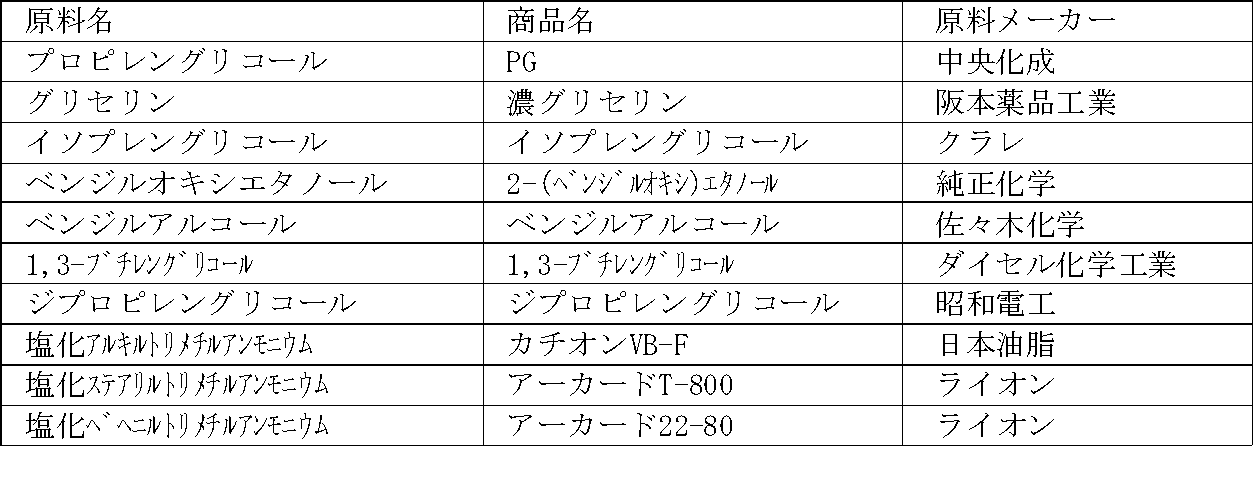
- the raw materials used are shown in the table below.
Landscapes
- Health & Medical Sciences (AREA)
- Life Sciences & Earth Sciences (AREA)
- Animal Behavior & Ethology (AREA)
- General Health & Medical Sciences (AREA)
- Public Health (AREA)
- Veterinary Medicine (AREA)
- Birds (AREA)
- Epidemiology (AREA)
- Dermatology (AREA)
- Emergency Medicine (AREA)
- Cosmetics (AREA)
Abstract
Description
[1].下記(A)~(D)成分を含有する毛髪化粧料。
(A)アクリル酸・シリコーン共重合体、アクリル酸・メタクリル酸共重合体及びアクリル酸・アクリルアミド共重合体から選ばれるアクリル酸系ポリマー
(B)アミノグリコール変性シリコーン
(C)エタノール
(D)(C)成分以外の水酸基含有化合物からなる溶剤
[2].(A)/(B)で表される含有質量比が0.02~11である[1]記載の毛髪化粧料。
[3].(B)成分が直鎖アミノポリエーテル変性シリコーンであり、配合量が0.1~10質量%である[1]又は[2]記載の毛髪化粧料。
[4].(C)成分の含有量が、0.3質量%以上である[1]~[3]のいずれかに記載の毛髪化粧料。
[5].(D)成分が、プロピレングリコール、ジプロピレングリコール、ブチレングルコール、グリセリン、イソプレングリコール、ベンジルアルコール、ベンジルオキシエタノールである[1]~[4]のいずれかに記載の毛髪化粧料。
[6].(D)成分が、プロピレングリコール、ブチレングルコール又はグリセリンである[1]~[5]のいずれかに記載の毛髪化粧料。
[7].洗い流さないタイプのトリートメントである[1]~[6]のいずれかに記載の毛髪化粧料。
[8].さらに、(E)カチオン界面活性剤を含有する[1]~[7]のいずれかに記載の毛髪化粧料。
[9].さらに、(F)ポリオキシアルキレン化合物を含有する[1]~[8]のいずれかに記載の毛髪化粧料。
本発明の毛髪化粧料は、下記(A)~(D)成分を含有する毛髪化粧料である。
(A)アクリル酸・シリコーン共重合体、アクリル酸・メタクリル酸共重合体及びアクリル酸・アクリルアミド共重合体から選ばれるアクリル酸系ポリマー
(B)アミノグリコール変性シリコーン
(C)エタノール
(D)(C)成分以外の水酸基含有化合物からなる溶剤
このような、アクリル酸を構成単位とする特定のアクリル酸系ポリマーを用いることで、加齢等により細った髪に、トップの立ち上がり及びその持続性を付与することができる。(A)成分は1種単独で又は2種以上を適宜組み合わせて用いることができる。
アクリル酸・シリコーン共重合体とは、アクリル酸とシロキサンとを構成単位として含む共重合体である。例えば、(アクリレーツ/アクリル酸エチルヘキシル/メタクリル酸ジメチコン)コポリマー、(アクリレーツ/アクリル酸ステアリル/メタクリル酸ジメチコン)コポリマー、(アクリレーツ/アクリル酸トリデシル/メタクリル酸トリエトキシシリルプロピル/メタクリル酸ジメチコン)コポリマー、(アクリレーツ/アクリル酸ベヘニル/メタクリル酸ジメチコン)コポリマー、(アクリレーツ/メタクリル酸ポリトリメチルシロキシ)コポリマー等が挙げられる。これらは、化粧品業界で取り決めている「表示名称」で表現したものである。
アクリル酸・メタクリル酸共重合体とは、アクリル酸とメタクリル酸とを構成単位とする共重合体である。例えば、(アクリレーツ/メタクリル酸アリル)コポリマーAMP、(ビニルピロリドン/アクリレーツ/メタクリル酸ラウリル)コポリマー等が挙げられる。
アクリル酸・アクリルアミド共重合体としては、下記一般式(1)で表される単量体単位70~95モル%と、下記一般式(2)で表される単量体単位5~30モル%とを、構成単位として含む共重合体からなるアクリル酸・アクリルアミド共重合体が挙げられ、1種単独で又は2種以上を適宜組み合わせて用いることができる。

(式中、R1は水素原子又はメチル基を示し、R2は水素原子又は-CH2OH基を示し、Aは酸素原子又は-NH-を示す。)

(式中、R3は水素原子又はメチル基を示し、Mは水素原子、アルカリ金属原子、アンモニウム又はアミンを示す。)
このような、構成単位中にアルコキシ基を有するシリコーンを用いることで、(A)、(C)及び(D)成分を含有する毛髪化粧料において、(A)成分との相溶性が良くなり、保存安定性が向上する。これらは1種単独で又は2種以上を適宜組み合わせて用いることができる。
直鎖アミノポリエーテル変性シリコーンとは、アミノ官能基を有するシロキサン構造と、ポリオキシエチレン基とを主鎖に有するシリコーンをいう。直鎖アミノポリエーテル変性シリコーンとしては、アミノ官能基を有するアミノ変性ポリシロキサンブロックとポリオキシアルキレンブロックとからなるシリコーンが好ましく、特に、下記一般式(3)で表される、側鎖にアミノ官能基を有するアミノ変性ポリシロキサンブロックとポリオキシアルキレンブロックとからなる、末端がメチル基のブロック共重合体が好ましい。
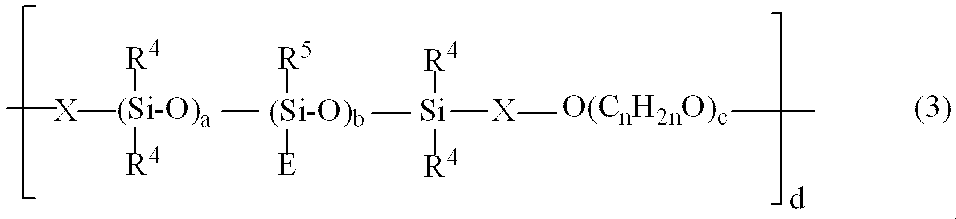
(R4は、それぞれ独立して水素原子又は炭素数1~6の1価の炭化水素基を示し、R5はR4又はEを示し、Eは-R6-Z(R6は直接結合手又は炭素数1~20の2価の炭化水素基)を示し、Zは1~3級アミノ基含有基又はアンモニウム基含有基を示す。Xは2価の基を示し、aは2以上の数、bは1以上の数、nは2~10の数、cは4以上の数、dは2以上の数を示す。)
R6の炭素数1~20の2価の炭化水素基としては、例えば、メチレン基、エチレン基、プロピレン基、ブチレン基、ペンチレン基、ヘキシレン基、ヘプチレン基、オクチレン基、デシレン基、オクタデシレン基等が挙げられ、メチレン基、エチレン基、プロピレン基が好ましい。
Zとしては、下記一般式(4)又は(5)で表されるアミノ基含有基又はアンモニウム基含有基が好ましい。
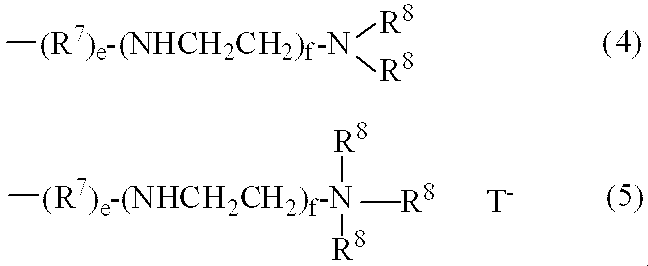
(式中、R7は

であり、R8は水素原子又は1価の炭化水素基を示し、それぞれのR8は同一でも異なっていてもよい。e及びfはそれぞれ0~6の整数を示す。T-はハロゲン化物イオン又は有機アニオンを示す。)

アミノ両末端ポリエーテル変性シリコーンとは、ポリマーの両末端にアルキレングリコールが付加されたアミノ基を有するシリコーンである。このアミノ基は直接Siに結合してもよいし、連結する基を有していてもよい。アミノ両末端ポリエーテル変性シリコーンとしては、例えば、ビス(C13-15アルコキシ)PGアモジメチコン(表示名称)が挙げられ、これはポリマー主鎖の両末端が長鎖アルコキシ基で封鎖されており、アミノ基にプロピレングリコールを付加したものである。アミノ両末端ポリエーテル変性シリコーンとしては、市販品を用いることもでき、例えば、東レ・ダウコーニングのJP8500等が挙げられる。
エタノールを配合することで、特に洗い流さない化粧料としたときに、塗布後すぐに効果を得ることができる。このメカニズムは不明であるが、エタノールを配合することによる速乾性により発現されるものと予想される。
エタノール以外の水酸基含有化合物からなる溶剤を配合することで、ごわつきのなさを改善することができる。このような溶剤としては、プロピレングリコール(PG)、ジプロピレングリコール(DPG)、ブチレングルコール(BG)、グリセリン、イソプレングリコール(IG)、ベンジルアルコール、ベンジルオキシエタノール等が挙げられ、1種単独で又は2種以上を適宜組み合わせて用いることができる。中でも、ごわつきのなさの点から、プロピレングリコール、ブチレングルコール、グリセリンが好ましく、保存安定性の点からはプロピレングリコールが好ましい。
本発明の毛髪化粧料には、カチオン界面活性剤をさらに配合するとよい。カチオン界面活性剤を配合することにより、毛先のやわらかさを付与することができる。トップの立ち上がりを向上させると、毛先のやわらかさが失われ、まとまりが悪くなりがちであるが、カチオン界面活性剤を配合することで、この問題を解決することができる。カチオン界面活性剤としては、特に限定されないが、アミン塩、アンモニウム塩、グアニジン塩、ベンゼトニウム塩、ピリジニウム塩、ピロリドンカルボン酸塩、モノ-N-長鎖アシル塩基性アミノ酸低級アルキルエステル塩等が挙げられる。これらは1種単独で又は2種以上を適宜組み合わせて使用することができる。
本発明の毛髪化粧料には、ポリオキシアルキレン化合物をさらに配合するとよい。ポリオキシアルキレン化合物を配合することにより、髪の広がりを抑えることができる。カラーやパーマで傷んだ毛髪は、毛髪内部摩擦が生じ、髪が広がってしまうが、ポリオキシアルキレン化合物を配合することで、この問題を解決することができる。ポリオキシアルキレン化合物としては、特に限定されないが、ポリエチレングリコール、ポリプロピレングリコール、ポリオキシエチレン(POE)ポリオキシプロピレン(POP)グリコール、ポリオキシエチレン(POE)ポリオキシプロピレン(POP)セチルエーテル、ポリオキシエチレン(POE)ポリオキシプロピレン(POP)デシルテトラデシルエーテル、ポリオキシエチレン(POE)ポリオキシプロピレン(POP)トリメチロールプロパン、ポリオキシエチレン(POE)ポリオキシプロピレン(POP)ブチルエーテル、ポリオキシエチレン(POE)ポリオキシプロピレン(POP)グリセリルエーテル、ポリオキシエチレン(POE)ポリオキシプロピレン(POP)ステアリルエーテル、ポリオキシエチレン(POE)ポリオキシプロピレン(POP)へキシレングリコールエーテル、ポリオキシエチレン(POE)ポリオキシプロピレン(POP)ラウリルエーテル等が挙げられる。
これらのエチレンオキサイド、プロピレンオキサイド基の付加モル数は、特に限定されるものではないが、具体的には1~300モルが挙げられる。
好ましくは、髪の広がりのなさの点から、POE(36)POP(36)ブチルエーテル、POE(24)POP(24)グリセリルエーテルが挙げられる。この配合量は、0.1~10質量%が好ましく、より好ましくは0.5~10質量%、更に好ましくは、髪の広がりのなさの点から、1~7質量%である。0.1質量%未満では、髪の広がりの抑制効果が低くなる場合があり、10質量%を超えると、トップの立ち上がりを低下させる場合がある。
[調製方法]
表1~9に示す組成に従い、洗い流さないタイプのトリートメントを常法により調製した。得られたトリートメントについて、下記評価を行った。結果を表中に併記する。
5g,10cmの人毛の毛束に、毛髪化粧料0.5gを均一塗布し、25℃,50%R.H.で1時間乾燥後、毛束を実験台に対して垂直方向にクリップで固定した。5分後の毛束の角度を測定した。結果を角度から下記評価基準で示す。
〈評価基準〉
◎:毛束の傾きが0~10度
○:毛束の傾きが11~30度
△:毛束の傾きが31~45度
×:毛束の傾きが46~90度
トップの立ち上がりを評価した毛束を、25℃,50%R.H.下で6時間経過した後、同様に毛束の角度を測定した。結果を角度から下記評価基準で示す。
〈評価基準〉
◎:毛束の傾きが0~30度
○:毛束の傾きが31~45度
△:毛束の傾きが46~70度
×:毛束の傾きが71~90度
上記「トップの立ち上がり」及び「トップの立ち上がりの持続性」を評価した毛束の根元を固定し、パネラーが触感を下記評価基準に基づき評価した。
〈評価基準〉
◎:ごわつきが極めて小さい
○:ごわつきが小さい
△:ごわつきある
×:ごわつきが大きい
上記「トップの立ち上がり」及び「トップの立ち上がりの持続性」を評価した毛束の反射率を、マイクログロス(ガードナー社製)を用いて反射角度60°における光沢度(グロスユニット)で測定した。結果を光沢度から下記評価基準で示す。
〈評価基準〉
◎:1.2GU(グロスユニット)以上
○:1.0GU以上1.2GU未満
△:0.8GU以上1.0GU未満
×:0.8GU未満
上記「トップの立ち上がり」及び「トップの立ち上がりの持続性」を評価した毛束の根元を固定し、パネラーが触感を下記評価基準に基づき評価した。
〈評価基準〉
◎:毛先が非常にやわらかい
○:毛先がやわらかい
△:毛先がやややわらかい
×:毛先にやわらかさがない
30cm、10gの毛束を市販パーマ剤で1回、市販ブリーチ剤で2回処理し、ダメージ毛束を作製した。
このダメージ毛束を水で濡らし、タオルドライした状態で、サンプルを0.7g均一塗布し、風乾した。その後、90%R.H.の湿度下に、1時間放置したときに、未塗布の毛束と比較して毛束の広がりの無さを評価した。
〈評価基準〉
◎:未塗布と比較して、かなり広がりが抑えられた。
○:未塗布と比較して、やや広がりが抑えられた。
△:未塗布と同じ程度の広がり。
×:未塗布と比較して、広がっていた。
サンプルを50mLのガラス瓶に入れ、40℃で1ヶ月保存したときの外観(着色)の変化を目視にて観察した。
〈評価基準〉
◎:着色が無かった。
○:わずかに着色の変化があった。
△:着色の変化があったが、実使用上問題がなかった。
×:着色の変化があり、実使用上問題があった。
サンプルを50mLのガラス瓶に入れ、-5℃で1ヶ月保存したときの外観(沈殿・析出)の変化を目視にて観察した。
〈評価基準〉
◎:沈殿・析出が無かった。
○:わずかに沈殿・析出があった。
△:沈殿・析出があったが、室温で再溶解し、実使用上問題がなかった。
×:沈殿・析出があり、室温で再溶解せず、実使用上問題があった。
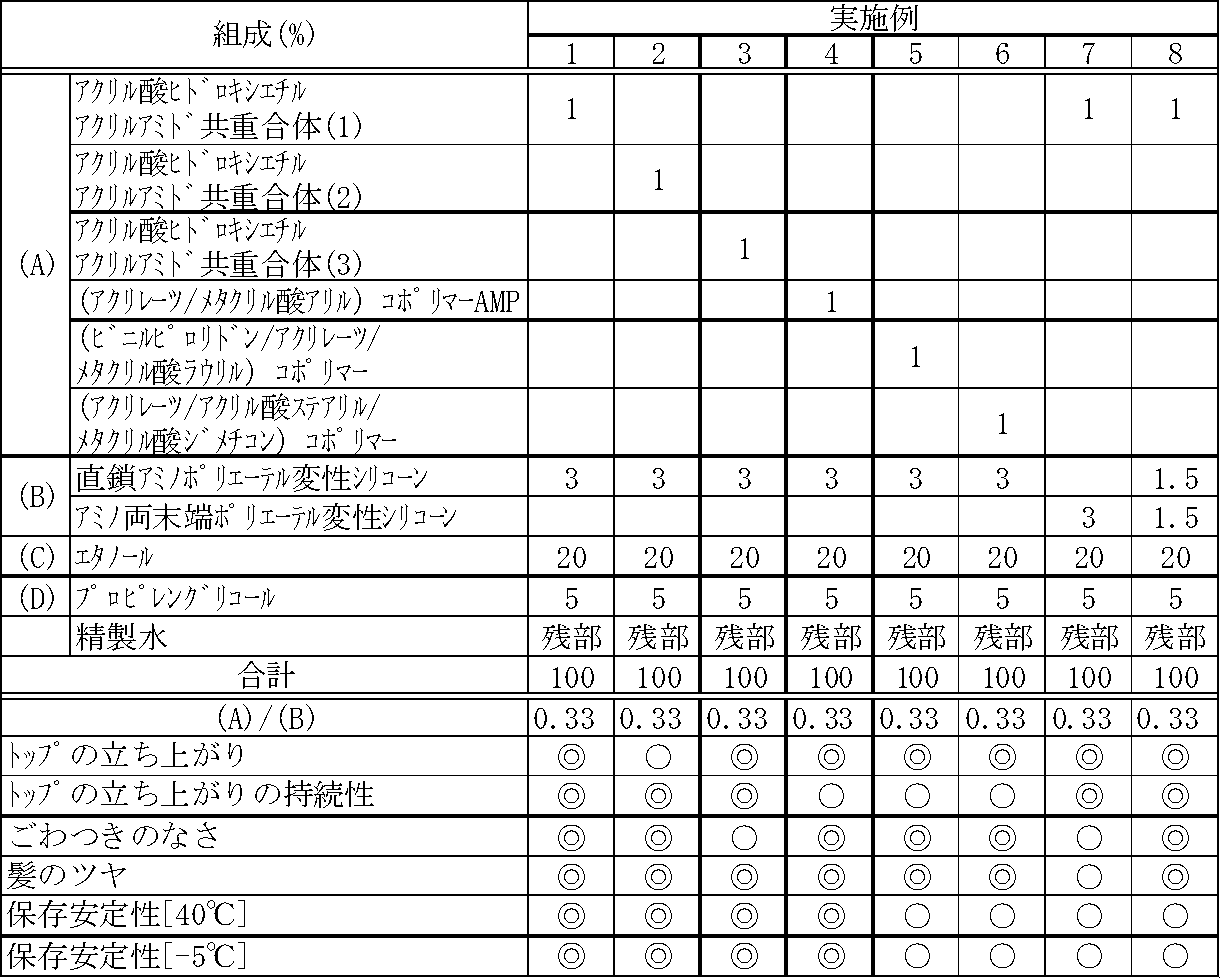
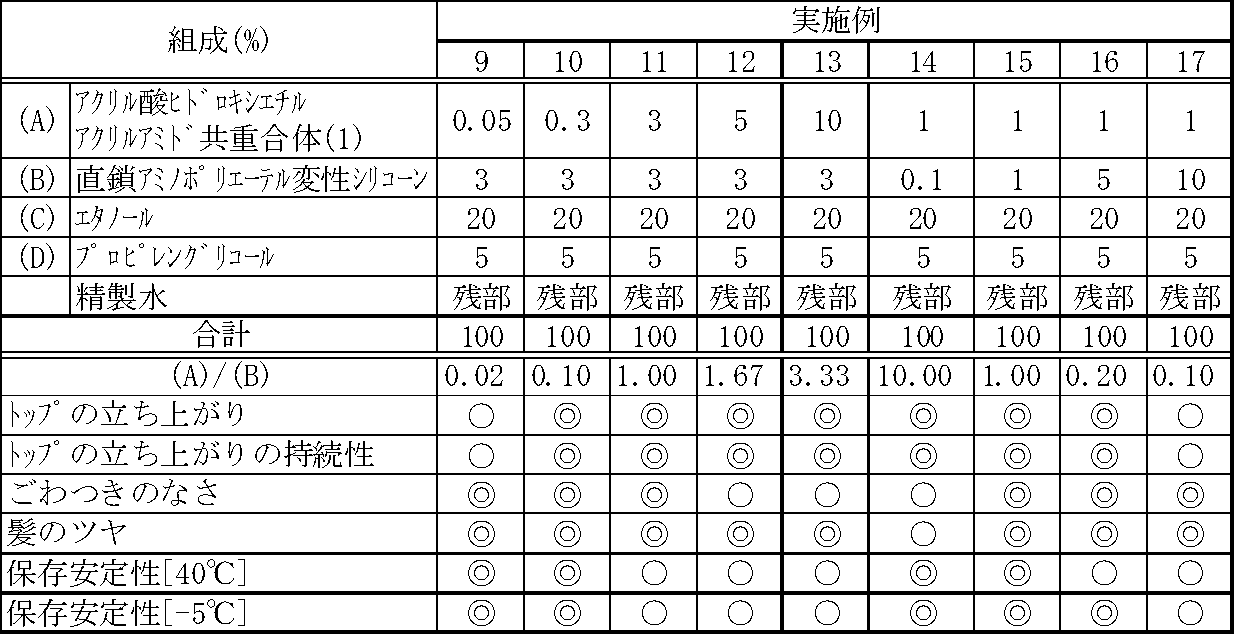
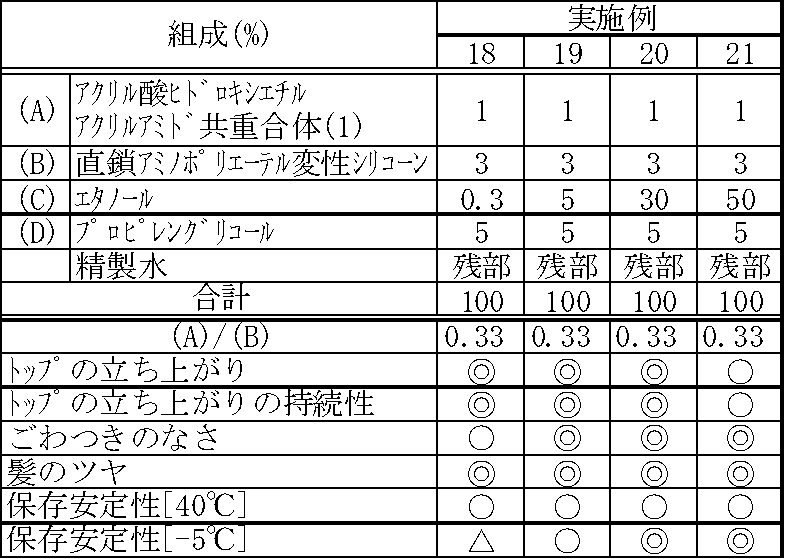


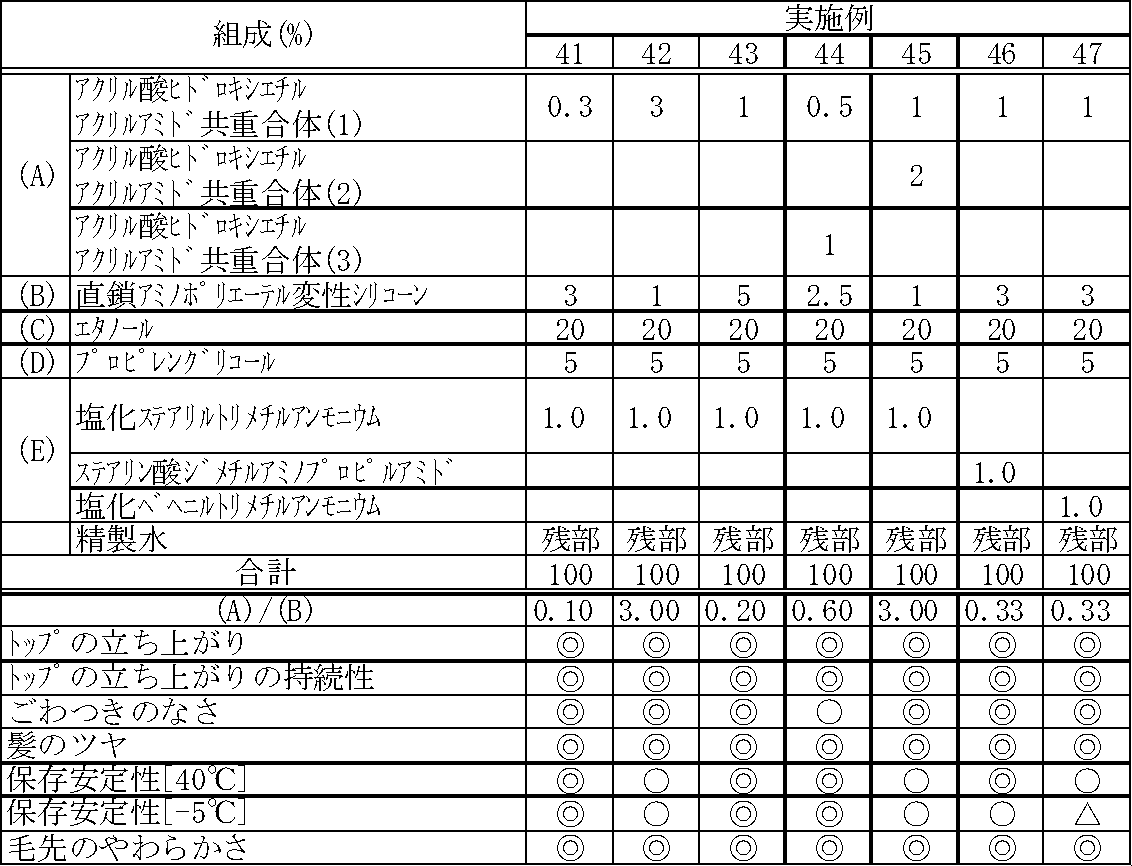

実施例1と比較例8の洗い流さないタイプのトリートメント50gを、50mLのガラス瓶に充填し、室温(15~30℃)で1ヶ月後の外観を観察し、下記評価基準に基づき安定性評価を行った。実施例1は「◎」、比較例8は「×」であった。
<評価基準>
◎:基準品(配合直後品)と同等であり、分離や析出がない
○:着色、分離、析出の点で、わずかに基準品と差があるが、実用上問題ない
△:着色、分離、析出の点で、基準品と差があるが、実用上問題ない
×:着色、分離、析出の点で、明らかに基準品と差があり、実用上問題ある
還流冷却器、滴下ロート、温度計、窒素ガス導入管及び撹拌装置を備えた反応器にエタノール100質量部を仕込み、滴下ロートに2-ヒドロキシエチルアクリルアミド88.6質量部、アクリル酸11.4質量部及びエタノール80質量部からなる単量体混合液を仕込み、反応器を窒素置換したのち80℃まで加熱した。反応器に、ジメチル2,2’-アゾビス(2-メチルプロピオネイト)(V-601;和光純薬工業(株)製)1質量部を投入後、単量体混合液を2時間かけて滴下した。滴下終了後から6時間反応させたのち冷却し、水酸化ナトリウムで中和してアクリル酸・ヒドロキシエチルアクリルアミド共重合体(1)を得た(2-ヒドロキシエチルアクリルアミド/アクリル酸ナトリウム=83モル%/17モル%)。
還流冷却器、滴下ロート、温度計、窒素ガス導入管及び撹拌装置を備えた反応器にエタノール100質量部を仕込み、滴下ロートに2,3-ジヒドロキシプロピルアクリルアミド82.5質量部、アクリル酸17.5質量部及びエタノール80質量部からなる単量体混合液を仕込み、反応器を窒素置換したのち80℃まで加熱した。反応器に、ジメチル2,2’-アゾビス(2-メチルプロピオネイト)(V-601;和光純薬工業(株)製)1質量部を投入後、単量体混合液を2時間かけて滴下した。滴下終了後から6時間反応させたのち冷却し、アクリル酸のモル比の半量に相当する水酸化ナトリウムを加え中和してアクリル酸・ヒドロキシエチルアクリルアミド共重合体(2)を得た(2,3-ジヒドロキシプロピルアクリルアミド/アクリル酸(ナトリウム)=70モル%/30モル%)。
還流冷却器、滴下ロート、温度計、窒素ガス導入管及び撹拌装置を備えた反応器にエタノール100質量部を仕込み、滴下ロートに2,3-ジヒドロキシプロピルアクリルアミド97.5質量部、アクリル酸2.5質量部及びエタノール80質量部からなる単量体混合液を仕込み、反応器を窒素置換したのち80℃まで加熱した。反応器に、ジメチル2,2’-アゾビス(2-メチルプロピオネイト)(V-601;和光純薬工業(株)製)1質量部を投入後、単量体混合液を2時間かけて滴下した。滴下終了後から6時間反応させたのち冷却し、アクリル酸のモル比の半量に相当する水酸化ナトリウムを加え中和してアクリル酸・ヒドロキシエチルアクリルアミド共重合体(3)を得た(2,3-ジヒドロキシプロピルアクリルアミド/アクリル酸(ナトリウム)=95モル%/5モル%)。
下記表1の構成単位となるように配合量を調整する以外は、上記調製例1と同様の方法で、アクリル酸・ヒドロキシエチルアクリルアミド共重合体(4)を得た。
下記表1の構成単位となるように配合量を調整する以外は、上記調製例1と同様の方法で、アクリル酸・ヒドロキシエチルアクリルアミド共重合体(5)を得た。

(ビニルピロリドン/アクリレーツ/メタクリル酸ラウリル)コポリマー:STYLEZE 2000 (スタビリーゼ 2000)(ISPジャパン)
(アクリレーツ/アクリル酸ステアリル/メタクリル酸ジメチコン)コポリマー:KP-561P(信越化学工業)
カルボマー:カルボポール Ultrez10
直鎖アミノポリエーテル変性シリコーン:SILSTYLE104(東レ・ダウコーニング)
アミノグリコール変性シリコーン:JP8500(東レ・ダウコーニングシリコーン)
アモジメチコン:SM8904(東レ・ダウコーニングシリコーン)
POE(24)POP(24)グリセリルエーテル:カーポールGH200(アデカ)
POE(36)POP(36)ブチルエーテル:ユニルーブ50MB-168L(日油)
[実施例54]
[洗い流さないタイプのトリートメント] (%)
アクリル酸・ヒドロキシエチルアクリルアミド共重合体(4)(A)
2
直鎖アミノポリエーテル変性シリコーン(B) 3
ジプロピレングリコール(D) 3
エタノール(C) 20
ヒドロキシエチルセルロース 0.7
塩化ステアリルトリメチルアンモニウム(E) 0.5
グリコール酸 0.1
オレンジ精油 0.2
精製水 残部
合計 100.0
(A)/(B)質量比=0.67
トップの立ち上がり:◎
トップの立ち上がりの持続性:◎
ごわつきのなさ:◎
髪のツヤ:◎
毛先のやわらかさ:◎
保存安定性(40℃):◎
保存安定性(-5℃):◎
[洗い流さないタイプのトリートメント] (%)
アクリル酸・ヒドロキシエチルアクリルアミド共重合体(3)(A)
2
直鎖アミノポリエーテル変性シリコーン(B) 2
アミノグリコール変性シリコーン(B) 1
ベンジルオキシエタノール(D) 3
エタノール(C) 20
ヒドロキシエチルセルロース 0.7
塩化ベヘニルトリメチルアンモニウム(E) 0.5
グリコール酸アンモニウム 0.1
ローズマリー精油 0.2
精製水 残部
合計 100.0
(A)/(B)質量比=0.67
トップの立ち上がり:◎
トップの立ち上がりの持続性:◎
ごわつきのなさ:○
髪のツヤ:◎
毛先のやわらかさ:◎
保存安定性(40℃):◎
保存安定性(-5℃):◎
[洗い流さないタイプのトリートメント] (%)
塩化アルキルトリメチルアンモニウム(E) 1
ステアリルアルコール 3
グリコール酸 0.3
ソルビトール 10
プロピレングリコール(D) 5
エタノール(C) 1
ベンジルアルコール(D) 2
アクリル酸・ヒドロキシエチルアクリルアミド共重合体(5)(A)
1
モノステアリン酸ポリエチレングリコール 0.3
ヒドロキシエチルセルロース 0.3
直鎖アミノポリエーテル変性シリコーン(B) 3
ジメチルシリコーン 1
ポリオキシエチレン・メチルポリシロキサン共重合体 0.2
ベントナイト 0.2
ヒドロキシプロピルメチルセルロース 0.3
水酸化ナトリウム 適量
香料 0.5
精製水 残部
合計 100.0
(A)/(B)質量比=0.33
トップの立ち上がり:◎
トップの立ち上がりの持続性:◎
ごわつきのなさ:◎
髪のツヤ:◎
毛先のやわらかさ:◎
保存安定性(40℃):◎
保存安定性(-5℃):◎
[洗い流さないタイプのトリートメント] (%)
アクリル酸・ヒドロキシエチルアクリルアミド共重合体(4)(A)
2
直鎖アミノポリエーテル変性シリコーン(B) 3
イソプレングリコール(D)(商品名イソプレングリコール、(株)クラレ
製) 3
エタノール(C) 20
ヒドロキシエチルセルロース 0.7
塩化ステアリルトリメチルアンモニウム(E) 0.5
グリコール酸 0.1
オレンジ精油 0.2
精製水 残部
合計 100.0
(A)/(B)質量比=0.67
トップの立ち上がり:◎
トップの立ち上がりの持続性:◎
ごわつきのなさ:○
髪のツヤ:◎
毛先のやわらかさ:◎
保存安定性(40℃):◎
保存安定性(-5℃):◎
Claims (9)
- 下記(A)~(D)成分を含有する毛髪化粧料。
(A)アクリル酸・シリコーン共重合体、アクリル酸・メタクリル酸共重合体及びアクリル酸・アクリルアミド共重合体から選ばれるアクリル酸系ポリマー
(B)アミノグリコール変性シリコーン
(C)エタノール
(D)(C)成分以外の水酸基含有化合物からなる溶剤 - (A)/(B)で表される含有質量比が0.02~11である請求項1記載の毛髪化粧料。
- (B)成分が直鎖アミノポリエーテル変性シリコーンであり、配合量が0.1~10質量%である請求項1又は2記載の毛髪化粧料。
- (C)成分の含有量が、0.3質量%以上である請求項1~3のいずれか1項記載の毛髪化粧料。
- (D)成分が、プロピレングリコール、ジプロピレングリコール、ブチレングルコール、グリセリン、イソプレングリコール、ベンジルアルコール、ベンジルオキシエタノールである請求項1~4のいずれか1項記載の毛髪化粧料。
- (D)成分が、プロピレングリコール、ブチレングルコール又はグリセリンである請求項1~5のいずれか1項記載の毛髪化粧料。
- 洗い流さないタイプのトリートメントである請求項1~6のいずれか1項記載の毛髪化粧料。
- さらに、(E)カチオン界面活性剤を含有する請求項1~7のいずれか1項記載の毛髪化粧料。
- さらに、(F)ポリオキシアルキレン化合物を含有する請求項1~8のいずれか1項記載の毛髪化粧料。
Priority Applications (1)
| Application Number | Priority Date | Filing Date | Title |
|---|---|---|---|
| JP2012509505A JP5900326B2 (ja) | 2010-04-06 | 2011-03-30 | 毛髪化粧料 |
Applications Claiming Priority (2)
| Application Number | Priority Date | Filing Date | Title |
|---|---|---|---|
| JP2010087899 | 2010-04-06 | ||
| JP2010-087899 | 2010-04-06 |
Publications (1)
| Publication Number | Publication Date |
|---|---|
| WO2011125713A1 true WO2011125713A1 (ja) | 2011-10-13 |
Family
ID=44762656
Family Applications (1)
| Application Number | Title | Priority Date | Filing Date |
|---|---|---|---|
| PCT/JP2011/057971 Ceased WO2011125713A1 (ja) | 2010-04-06 | 2011-03-30 | 毛髪化粧料 |
Country Status (2)
| Country | Link |
|---|---|
| JP (1) | JP5900326B2 (ja) |
| WO (1) | WO2011125713A1 (ja) |
Cited By (4)
| Publication number | Priority date | Publication date | Assignee | Title |
|---|---|---|---|---|
| JP2013227313A (ja) * | 2012-03-30 | 2013-11-07 | Kose Corp | 毛髪化粧料 |
| US11359156B2 (en) | 2019-10-21 | 2022-06-14 | Biocoat, Inc. | UV cure basecoatings for medical devices |
| US12037560B2 (en) | 2019-10-21 | 2024-07-16 | Biocoat, Incorporated | UV cure topcoatings for medical devices |
| US12214146B2 (en) | 2019-12-11 | 2025-02-04 | Biocoat, Incorporated | Controlled release of a hydrophilic agent from a coated surface |
Citations (4)
| Publication number | Priority date | Publication date | Assignee | Title |
|---|---|---|---|---|
| JPH1112152A (ja) * | 1997-06-19 | 1999-01-19 | Toshiba Silicone Co Ltd | 化粧料 |
| JP2007223931A (ja) * | 2006-02-22 | 2007-09-06 | Kao Corp | 毛髪化粧料 |
| JP2009249329A (ja) * | 2008-04-04 | 2009-10-29 | Lion Corp | 毛髪化粧料 |
| JP4468484B2 (ja) * | 2008-06-20 | 2010-05-26 | 株式会社資生堂 | 毛髪化粧料 |
Family Cites Families (14)
| Publication number | Priority date | Publication date | Assignee | Title |
|---|---|---|---|---|
| DE4421562C2 (de) * | 1994-06-20 | 1996-05-02 | Goldwell Gmbh | Haarspray |
| JPH09151119A (ja) * | 1995-09-29 | 1997-06-10 | Nippon Unicar Co Ltd | 毛髪化粧料 |
| JPH10203931A (ja) * | 1997-01-24 | 1998-08-04 | Kao Corp | 毛髪化粧料 |
| JP2002179535A (ja) * | 2000-12-14 | 2002-06-26 | Nippon Unicar Co Ltd | 毛髪用組成物 |
| JP2002193766A (ja) * | 2000-12-27 | 2002-07-10 | Nippon Unicar Co Ltd | 毛髪セット剤組成物 |
| JP4919540B2 (ja) * | 2001-05-01 | 2012-04-18 | 東レ・ダウコーニング株式会社 | 毛髪用組成物 |
| JP2004143094A (ja) * | 2002-10-24 | 2004-05-20 | Kose Corp | 整髪料組成物 |
| JP2004300081A (ja) * | 2003-03-31 | 2004-10-28 | Kose Corp | 毛髪化粧料 |
| JP2005022978A (ja) * | 2003-06-30 | 2005-01-27 | Kose Corp | 毛髪化粧料 |
| JP2005179338A (ja) * | 2003-11-28 | 2005-07-07 | Kose Corp | 整髪料 |
| FR2866232B1 (fr) * | 2004-02-12 | 2007-02-09 | Oreal | Procede de mise en forme des fibres keratiniques par application d'une composition cosmetique comprenant un polymere fixant anionique et un compose non-ionique et application d'un moyen chauffant, composition correspondante |
| JP4736741B2 (ja) * | 2005-11-18 | 2011-07-27 | 三菱化学株式会社 | 化粧料組成物 |
| JP5167601B2 (ja) * | 2005-11-18 | 2013-03-21 | 三菱化学株式会社 | 毛髪化粧料 |
| JP2010065022A (ja) * | 2008-08-12 | 2010-03-25 | Kao Corp | 毛髪処理用組成物 |
-
2011
- 2011-03-30 WO PCT/JP2011/057971 patent/WO2011125713A1/ja not_active Ceased
- 2011-03-30 JP JP2012509505A patent/JP5900326B2/ja not_active Expired - Fee Related
Patent Citations (4)
| Publication number | Priority date | Publication date | Assignee | Title |
|---|---|---|---|---|
| JPH1112152A (ja) * | 1997-06-19 | 1999-01-19 | Toshiba Silicone Co Ltd | 化粧料 |
| JP2007223931A (ja) * | 2006-02-22 | 2007-09-06 | Kao Corp | 毛髪化粧料 |
| JP2009249329A (ja) * | 2008-04-04 | 2009-10-29 | Lion Corp | 毛髪化粧料 |
| JP4468484B2 (ja) * | 2008-06-20 | 2010-05-26 | 株式会社資生堂 | 毛髪化粧料 |
Cited By (4)
| Publication number | Priority date | Publication date | Assignee | Title |
|---|---|---|---|---|
| JP2013227313A (ja) * | 2012-03-30 | 2013-11-07 | Kose Corp | 毛髪化粧料 |
| US11359156B2 (en) | 2019-10-21 | 2022-06-14 | Biocoat, Inc. | UV cure basecoatings for medical devices |
| US12037560B2 (en) | 2019-10-21 | 2024-07-16 | Biocoat, Incorporated | UV cure topcoatings for medical devices |
| US12214146B2 (en) | 2019-12-11 | 2025-02-04 | Biocoat, Incorporated | Controlled release of a hydrophilic agent from a coated surface |
Also Published As
| Publication number | Publication date |
|---|---|
| JP5900326B2 (ja) | 2016-04-06 |
| JPWO2011125713A1 (ja) | 2013-07-08 |
Similar Documents
| Publication | Publication Date | Title |
|---|---|---|
| JP5245397B2 (ja) | ブロックポリマー及びその製造方法と、このブロックポリマーを含有した化粧料組成物 | |
| JP5747519B2 (ja) | ブロックポリマー | |
| CN103179949B (zh) | 化妆品组合物、毛发化妆品及毛发用疗效化妆品 | |
| JP5042652B2 (ja) | 毛髪化粧料 | |
| JP5804665B2 (ja) | 毛髪化粧料 | |
| JP5262376B2 (ja) | シリコーン含有ブロックポリマーと、このシリコーン含有ブロックポリマーを含む化粧料組成物 | |
| JP2004189678A (ja) | 毛髪用被膜形成剤及びこれを含む毛髪用化粧料 | |
| JP4736741B2 (ja) | 化粧料組成物 | |
| JP5900326B2 (ja) | 毛髪化粧料 | |
| CN101193927B (zh) | 共聚物及应用该共聚物的清洗剂组合物 | |
| JP5470797B2 (ja) | 毛髪化粧料 | |
| JP5167601B2 (ja) | 毛髪化粧料 | |
| JP5515514B2 (ja) | 毛髪化粧料 | |
| JP6167635B2 (ja) | 共重合体、化粧料組成物及びコンディショニング剤 | |
| JP4454856B2 (ja) | カチオン性ポリマーとその使用 | |
| WO2010041530A1 (ja) | 毛髪化粧料 | |
| JP6167636B2 (ja) | 化粧料組成物及びコンディショニング剤 | |
| CA2871024C (en) | Cosmetic composition and conditioning agent | |
| JP5509533B2 (ja) | 毛髪洗浄剤及び洗浄剤製品 | |
| JP6032725B2 (ja) | 毛髪化粧料 | |
| JP4894240B2 (ja) | ポリマー及び化粧料組成物 | |
| HK1161678B (en) | Hair cosmetic | |
| JP2006219436A (ja) | 毛髪用化粧料組成物 | |
| HK1206237B (en) | Cosmetic composition and conditioning agent |
Legal Events
| Date | Code | Title | Description |
|---|---|---|---|
| 121 | Ep: the epo has been informed by wipo that ep was designated in this application |
Ref document number: 11765613 Country of ref document: EP Kind code of ref document: A1 |
|
| WWE | Wipo information: entry into national phase |
Ref document number: 2012509505 Country of ref document: JP |
|
| WWE | Wipo information: entry into national phase |
Ref document number: 1201005342 Country of ref document: TH |
|
| NENP | Non-entry into the national phase |
Ref country code: DE |
|
| 122 | Ep: pct application non-entry in european phase |
Ref document number: 11765613 Country of ref document: EP Kind code of ref document: A1 |