WO2011122617A1 - 硬化性樹脂組成物および発光装置 - Google Patents
硬化性樹脂組成物および発光装置 Download PDFInfo
- Publication number
- WO2011122617A1 WO2011122617A1 PCT/JP2011/057795 JP2011057795W WO2011122617A1 WO 2011122617 A1 WO2011122617 A1 WO 2011122617A1 JP 2011057795 W JP2011057795 W JP 2011057795W WO 2011122617 A1 WO2011122617 A1 WO 2011122617A1
- Authority
- WO
- WIPO (PCT)
- Prior art keywords
- group
- resin composition
- curable resin
- general formula
- mass
- Prior art date
- Legal status (The legal status is an assumption and is not a legal conclusion. Google has not performed a legal analysis and makes no representation as to the accuracy of the status listed.)
- Ceased
Links
Images

Classifications
-
- H—ELECTRICITY
- H10—SEMICONDUCTOR DEVICES; ELECTRIC SOLID-STATE DEVICES NOT OTHERWISE PROVIDED FOR
- H10H—INORGANIC LIGHT-EMITTING SEMICONDUCTOR DEVICES HAVING POTENTIAL BARRIERS
- H10H20/00—Individual inorganic light-emitting semiconductor devices having potential barriers, e.g. light-emitting diodes [LED]
- H10H20/80—Constructional details
- H10H20/85—Packages
- H10H20/852—Encapsulations
- H10H20/854—Encapsulations characterised by their material, e.g. epoxy or silicone resins
-
- C—CHEMISTRY; METALLURGY
- C08—ORGANIC MACROMOLECULAR COMPOUNDS; THEIR PREPARATION OR CHEMICAL WORKING-UP; COMPOSITIONS BASED THEREON
- C08L—COMPOSITIONS OF MACROMOLECULAR COMPOUNDS
- C08L83/00—Compositions of macromolecular compounds obtained by reactions forming in the main chain of the macromolecule a linkage containing silicon with or without sulfur, nitrogen, oxygen or carbon only; Compositions of derivatives of such polymers
- C08L83/04—Polysiloxanes
-
- C—CHEMISTRY; METALLURGY
- C08—ORGANIC MACROMOLECULAR COMPOUNDS; THEIR PREPARATION OR CHEMICAL WORKING-UP; COMPOSITIONS BASED THEREON
- C08G—MACROMOLECULAR COMPOUNDS OBTAINED OTHERWISE THAN BY REACTIONS ONLY INVOLVING UNSATURATED CARBON-TO-CARBON BONDS
- C08G77/00—Macromolecular compounds obtained by reactions forming a linkage containing silicon with or without sulfur, nitrogen, oxygen or carbon in the main chain of the macromolecule
- C08G77/04—Polysiloxanes
- C08G77/14—Polysiloxanes containing silicon bound to oxygen-containing groups
- C08G77/18—Polysiloxanes containing silicon bound to oxygen-containing groups to alkoxy or aryloxy groups
-
- H—ELECTRICITY
- H10—SEMICONDUCTOR DEVICES; ELECTRIC SOLID-STATE DEVICES NOT OTHERWISE PROVIDED FOR
- H10W—GENERIC PACKAGES, INTERCONNECTIONS, CONNECTORS OR OTHER CONSTRUCTIONAL DETAILS OF DEVICES COVERED BY CLASS H10
- H10W72/00—Interconnections or connectors in packages
- H10W72/01—Manufacture or treatment
- H10W72/015—Manufacture or treatment of bond wires
- H10W72/01515—Forming coatings
-
- H—ELECTRICITY
- H10—SEMICONDUCTOR DEVICES; ELECTRIC SOLID-STATE DEVICES NOT OTHERWISE PROVIDED FOR
- H10W—GENERIC PACKAGES, INTERCONNECTIONS, CONNECTORS OR OTHER CONSTRUCTIONAL DETAILS OF DEVICES COVERED BY CLASS H10
- H10W72/00—Interconnections or connectors in packages
- H10W72/071—Connecting or disconnecting
- H10W72/075—Connecting or disconnecting of bond wires
-
- H—ELECTRICITY
- H10—SEMICONDUCTOR DEVICES; ELECTRIC SOLID-STATE DEVICES NOT OTHERWISE PROVIDED FOR
- H10W—GENERIC PACKAGES, INTERCONNECTIONS, CONNECTORS OR OTHER CONSTRUCTIONAL DETAILS OF DEVICES COVERED BY CLASS H10
- H10W74/00—Encapsulations, e.g. protective coatings
Definitions
- the present invention relates to a curable resin composition and a light-emitting device obtained using the same.
- a light emitting device such as a light emitting diode (LED) is usually configured by covering the light emitting element with a sealing material in order to protect the light emitting element such as a light emitting diode (LED) element or to change the color. It is also known that the light extraction efficiency is increased by coating the light emitting element with a material having a high refractive index.
- an epoxy resin is generally used as a material for the sealing material.
- an epoxy resin (sealing material) in the vicinity of the light emitting element is caused by near ultraviolet light emitted from the blue LED element or ultraviolet light emitted from the ultraviolet LED element.
- yellowing or thermal degradation due to heat generation of the light emitting element.
- the amount of light emitted from blue LED elements and ultraviolet LED elements is large, and yellowing and thermal degradation are likely to occur.
- a sealing material that does not cause yellowing due to near-ultraviolet light or ultraviolet light and hardly undergoes thermal deterioration for example, a sealing material made of a silicone resin made of dimethylsiloxane has been developed.
- this sealing material has a low refractive index, and there is a problem that it is difficult to efficiently extract light emitted from the LED element.
- Patent Documents 1 and 2 disclose a silicone resin composition containing a silicone resin having an alkenyl group bonded to a silicon atom and an organohydrogenpolysiloxane having a Si—H bond.
- a silicone resin composition containing a silicone resin having an alkenyl group bonded to a silicon atom and an organohydrogenpolysiloxane having a Si—H bond.
- this silicone resin composition is crosslinked by a hydrosilylation reaction, a cured product is obtained.
- this cured product has a problem that the refractive index is low.
- the present invention solves the above-described problems of the prior art, and has a high refractive index, excellent transparency, curable resin composition excellent in heat resistance, and light emission excellent in luminous efficiency.
- An object is to provide an apparatus.
- the present inventors have intensively studied, and according to a curable resin composition containing a siloxane polymer having a specific structure and metal oxide particles such as zirconium oxide, the refractive index is low. It was found that a film having high transparency and heat resistance and excellent crack resistance was obtained, and the present invention was completed.
- a method for manufacturing a light emitting device comprising: [2] The method for manufacturing a light-emitting device according to [1], including (b) a step of irradiating the coating of the curable resin composition with ultraviolet rays before the step (c).
- a light emitting element [3] a light emitting element; (A) a siloxane-based polymer obtained from a silane compound containing a compound represented by the following general formula (1), formed on the surface of the light-emitting element; (R 1 ) P Si (X) 4-P (1) [In the general formula (1), R 1 is a polymerizable organic group having 2 to 12 carbon atoms, X is a hydrolyzable group, and p is an integer of 1 to 3. ],as well as, (B) a cured product of a curable resin composition containing metal oxide particles, wherein the amount of the component (B) is 50 to 2,000 parts by mass with respect to 100 parts by mass of the component (A).
- a light emitting device including a cured film.
- the curable resin composition according to [4], wherein the silane compound further includes a compound represented by the following general formula (2).
- the curable resin composition of the present invention has a high refractive index and is excellent in transparency, heat resistance, crack resistance and light resistance.
- the curable resin composition of this invention is used suitably as a material for forming a cured film on the surface of a light emitting element.
- a light emitting device in which a cured film, which is a cured body of the curable resin composition of the present invention, is formed on the surface of a light emitting element has high luminous efficiency.
- FIG. 1 is a cross-sectional view conceptually showing an example of a light emitting device of the present invention.
- the component (A) siloxane polymer is obtained from a silane compound containing a compound represented by the following general formula (1) and a compound represented by the following general formula (2), which is blended as necessary. . (R 1 ) P Si (X) 4-P (1) [In the general formula (1), R 1 is a polymerizable organic group having 2 to 12 carbon atoms, X is a hydrolyzable group, and p is an integer of 1 to 3.
- R 2 is a non-polymerizable organic group having 1 to 12 carbon atoms
- X is a hydrolyzable group
- p is an integer of 0 to 3.
- the hydrolyzable group represented by X in the general formulas (1) and (2) is usually heated within the temperature range of room temperature (25 ° C.) to 100 ° C. in the presence of non-catalyst and excess water.
- the hydrolyzable group can be further condensed after hydrolysis to form a siloxane condensate.
- the subscript p in the general formula (1) is an integer of 1 to 3, preferably an integer of 1 to 2.
- the subscript q in the general formula (2) is an integer of 0 to 3, preferably an integer of 0 to 2.
- the siloxane polymer may be one obtained by condensing at least two hydrolyzable silane compounds.
- the siloxane polymer may partially remain.
- the siloxane polymer may be a partial condensate in which some silanol groups or hydrolyzable groups are condensed.
- the hydrolyzable group X in the general formulas (1) and (2) is a hydrogen atom, a halogen atom, an alkoxy group having 1 to 12 carbon atoms, a halogenated alkoxy group having 1 to 12 carbon atoms, or an acyloxy group having 2 to 12 carbon atoms. And a halogenated acyloxy group having 2 to 12 carbon atoms.
- Preferable examples of the alkoxy group having 1 to 12 carbon atoms include methoxy group and ethoxy group.
- halogenated alkoxy group having 1 to 12 carbon atoms include trifluoromethoxy group, trichloromethoxy group, pentafluoroethoxy group, pentachloroethoxy and the like.
- halogen atom include fluorine, chlorine, bromine, iodine and the like.
- acyloxy group having 2 to 12 carbon atoms include an acetoxy group, a propionyloxy group, a butyroyloxy group and the like.
- halogenated acyloxy group having 2 to 12 carbon atoms include trifluoroacetoxy group, trichloroacetoxy group, pentafluoropropionyloxy group, pentachloropropionyloxy group, heptafluorobutyroyloxy group, heptachlorobutyroyloxy group Etc.
- the polymerizable organic group R 1 in the general formula (1) is non-hydrolyzable, and preferably has one or both of a radical polymerizable functional group and a cationic polymerizable functional group in the molecule. It is an organic group.
- non-hydrolyzable means that it is a property which exists stably as it is in the conditions where the hydrolyzable group X is hydrolyzed.
- the radical polymerizable functional group include an alkenyl group having 2 to 10 carbon atoms and an alkynyl group having 2 to 10 carbon atoms.
- the cationic polymerizable functional group include epoxy groups such as an oxiranyl group and an oxetanyl group.
- Compounds of general formula (1) include 2- (meth) acryloxyethyltrimethoxysilane, 2- (meth) acryloxyethyltriethoxysilane, 3- (meth) acryloxypropyltrimethoxysilane, 3- (meth) ) Acryloxypropyltriethoxysilane, 3- (meth) acryloyloxypropylmethyldimethoxysilane, 3- (meth) acryloyloxypropyltriisopropenyloxysilane, vinyltrimethoxysilane, 3-glycidoxypropyltrimethoxysilane, 3 -Glycidoxypropylmethyldiethoxysilane, 2- (3,4-epoxycyclohexyl) ethyltrimethoxysilane, [3-[(3-ethyl-3-oxetanyl) methoxy] propyltrimethoxysilane, 3- (3- Methyl-3-ox
- the polymerizable organic group R 2 in the general formula (2) is a non-hydrolyzable organic group having 1 to 12 carbon atoms.
- the organic group R 2 include a hydrocarbon group having 1 to 12 carbon atoms and a halogenated hydrocarbon group having 1 to 12 carbon atoms.
- the organic group R 1 may be linear, branched, cyclic, or a combination thereof. Further, the organic group R 1 may be a structural unit containing a hetero atom. Examples of such a structural unit include an ether bond, an ester bond, a sulfide bond, and the like.
- the hydrocarbon group having 1 to 12 carbon atoms is preferably a hydrocarbon group having 1 to 8 carbon atoms from the viewpoint of reactivity and crack resistance of the resulting film.
- the hydrocarbon group is more preferable.
- aliphatic hydrocarbon groups such as methyl group, ethyl group, n-propyl group, isopropyl group, n-butyl group, isobutyl group and t-butyl group, cyclopropyl group, cyclobutyl group, cyclopentyl group, cyclohexyl
- aromatic hydrocarbon groups such as phenyl group, methylphenyl group, ethylphenyl group and benzyl group, such as methyl group, ethyl group, n-propyl group, isopropyl group, A t-butyl group, a phenyl group, and a methylphenyl group are preferable, and a methyl group and an
- Examples of the hydrocarbon group having 1 to 12 carbon atoms substituted with a halogen atom in the organic group R 1 include a fluorinated hydrocarbon group, a chlorinated hydrocarbon group, and a brominated hydrocarbon group. More preferably, it is a group.
- the number of carbon atoms of the hydrocarbon group is preferably 1 to 4 from the viewpoint of reactivity and crack resistance of the resulting film.
- the silane compounds having four hydrolyzable groups include tetrachlorosilane, tetraaminosilane, tetraacetoxysilane, tetramethoxysilane, tetraethoxysilane, tetrabutoxysilane, tetraphenoxysilane, tetrabenzyloxysilane, trimethoxysilane, trimethoxysilane, An ethoxysilane etc. are mentioned.
- silane compounds having three hydrolyzable groups include methyltrichlorosilane, methyltrimethoxysilane, methyltriethoxysilane, methyltributoxysilane, ethyltrimethoxysilane, ethyltriisopropoxysilane, ethyltributoxysilane, butyl Examples include trimethoxysilane, pentafluorophenyltrimethoxysilane, phenyltrimethoxysilane, d 3 -methyltrimethoxysilane, nonafluorobutylethyltrimethoxysilane, and trifluoromethyltrimethoxysilane.
- silane compound having two hydrolyzable groups examples include dimethyldichlorosilane, dimethyldiaminosilane, dimethyldiacetoxysilane, dimethyldimethoxysilane, diphenyldimethoxysilane, methylphenyldimethoxysilane, and dibutyldimethoxysilane.
- silane compound having one hydrolyzable group examples include trimethylchlorosilane, hexamethyldisilazane, trimethylsilane, tributylsilane, trimethylmethoxysilane, and tributylethoxysilane.
- the molecular weight of the siloxane polymer as the component (A) will be described. Such molecular weight can be measured as a weight average molecular weight in terms of polystyrene using gel permeation chromatography (hereinafter abbreviated as GPC) using tetrahydrofuran as a mobile phase.
- GPC gel permeation chromatography
- the weight average molecular weight of the siloxane polymer is preferably 500 to 100,000, more preferably 800 to 30,000, and still more preferably 1,000 to 5,000. If the value is less than 500, the crack resistance during the formation of the cured film tends to decrease. When the value exceeds 100,000, the dispersibility of the metal oxide particles as the component (B) tends to decrease.
- the mass proportion of the compounding amount of the compound represented by the general formula (1) in the total amount of the compound represented by the general formula (1) and the compound represented by the general formula (2) is preferably 10 to 100% by mass, More preferably, it is 20 to 100% by mass, and particularly preferably 30 to 100% by mass. When the ratio is less than 10% by mass, crack resistance may be inferior.
- the siloxane-based polymer is usually a silane compound containing a compound represented by the general formula (1) and a compound represented by the following general formula (2) that is blended as necessary in the presence of a catalyst. , Obtained by hydrolysis and condensation.
- the catalyst for obtaining the siloxane polymer is preferably at least one compound selected from a metal chelate compound, an acidic compound, and a basic compound, and more preferably an acidic compound.
- the metal chelate compound which can be used as a catalyst is represented by the following general formula (3).
- R 15 e M (OR 16 ) fe (3) (Wherein R 15 represents a chelating agent, M represents a metal atom, R 16 represents an alkyl group or an aryl group, f represents a valence of metal M, and e represents an integer of 1 to f.)
- the metal M is preferably at least one metal selected from Group IIIB metals (aluminum, gallium, indium, thallium) and Group IVA metals (titanium, zirconium, hafnium). Titanium, aluminum, zirconium Is more preferable.
- Examples of the chelating agent represented by R 15 include CH 3 COCH 2 COCH 3 and CH 3 COCH 2 COOC 2 H 5 .
- Examples of the alkyl group represented by R 16 include a methyl group, an ethyl group, an n-propyl group, an isopropyl group, an n-butyl group, an isobutyl group, and a t-butyl group.
- the aryl group includes a phenyl group, Examples thereof include a methylphenyl group, an ethylphenyl group, and a benzyl group.
- the amount of the metal chelate compound is preferably 0.0001 to 10 parts by mass, more preferably 0.001 to 5 parts by mass with respect to 100 parts by mass (as calculated as a complete hydrolysis condensate) of the silane compound. . If the amount is less than 0.0001 part by mass, the coating property of the coating film may be inferior, and if it exceeds 10 parts by mass, the polymer growth cannot be controlled and gelation may occur.
- 0.5 to 20 mol of water is preferably used per 1 mol of the total amount of silane compounds, and 1 to 10 mol of water is used. Is particularly preferred.
- the hydrolysis reaction does not proceed sufficiently, which may cause problems in applicability and storage stability. If the amount exceeds 20 mol, the hydrolysis and condensation reaction may occur. Polymer precipitation or gelation may occur. Moreover, it is preferable that water is added intermittently or continuously.
- (B) Acidic compound examples of the acidic compound that can be used as the catalyst include organic acids and inorganic acids, and organic acids are preferred.
- organic acids include acetic acid, propionic acid, butanoic acid, pentanoic acid, hexanoic acid, heptanoic acid, octanoic acid, nonanoic acid, decanoic acid, oxalic acid, maleic acid, methylmalonic acid, adipic acid, sebacic acid, gallic acid Acid, butyric acid, meritic acid, arachidonic acid, shikimic acid, 2-ethylhexanoic acid, oleic acid, stearic acid, linoleic acid, linolenic acid, salicylic acid, benzoic acid, p-aminobenzoic acid, p-toluenesulfonic acid, benzenesulfone Acid, monochloroacetic acid, dichloroacetic acid, t
- inorganic acids examples include hydrochloric acid, nitric acid, sulfuric acid, hydrofluoric acid, and phosphoric acid.
- organic acids are preferable in that there is little risk of polymer precipitation or gelation during the reaction of hydrolysis condensation (hydrolysis and subsequent condensation), and among these, compounds having a carboxyl group are more preferable.
- compounds having a carboxyl group acetic acid, oxalic acid, maleic acid, formic acid, malonic acid, phthalic acid, fumaric acid, itaconic acid, succinic acid, mesaconic acid, citraconic acid, malic acid, malonic acid, glutaric acid, maleic anhydride
- Organic acids such as acid hydrolysates are particularly preferred. These acidic compounds can be used alone or in combination of two or more.
- the amount of the acidic compound is preferably 0.0001 to 10 parts by mass, more preferably 0.001 to 5 parts by mass with respect to 100 parts by mass (in terms of complete hydrolysis condensate) of the silane compound.
- the amount is less than 0.0001 parts by mass, the coating property of the coating film may be inferior, and when it exceeds 10 parts by mass, the hydrolysis and condensation reaction may proceed rapidly to cause gelation.
- hydrolyzing and condensing a hydrolyzable silane compound in the presence of an acidic compound 0.5 to 20 mol of water is preferably used per 1 mol of the total amount of silane compounds, and 1 to 10 mol of water is preferably used. Particularly preferred.
- the hydrolysis reaction does not proceed sufficiently, which may cause problems in coating properties and storage stability. If the amount exceeds 20 mol, precipitation of the polymer during the hydrolysis condensation reaction may occur. And gelation may occur. Moreover, it is preferable that water is added intermittently or continuously.
- (C) Basic compound examples include methanolamine, ethanolamine, propanolamine, butanolamine, N-methylmethanolamine, N-ethylmethanolamine, N-propylmethanolamine, N -Butylmethanolamine, N-methylethanolamine, N-ethylethanolamine, N-propylethanolamine N, N-dimethylmethanolamine, N, N-diethylmethanolamine, N, N-dipropylmethanolamine, N, N -Dibutylmethanolamine, N-methyldimethanolamine, N-ethyldimethanolamine, N-propyldimethanolamine, N-butyldimethanolamine, N- (aminomethyl) methanolamine, N- (aminomethyl) ethanolamine Min, N- (aminomethyl) propanolamine, N- (aminomethyl) butanolamine, methoxymethylamine, methoxyethylamine,
- metal oxide particles having a high refractive index are used.
- Such fine particles are not particularly limited as long as the refractive index of light at a wavelength of 400 nm at 25 ° C. is preferably 1.55 or more, more preferably 1.60 or more, and particularly preferably 1.70 or more.
- metal oxide particles such as zirconium oxide, titanium oxide, zinc oxide, tantalum oxide, indium oxide, hafnium oxide, tin oxide, niobium oxide, and composites thereof.
- fine particles of zirconium oxide (ZrO 2 ) are preferable.
- the titanium oxide is not particularly limited as long as it has a TiO 2 structure, and examples thereof include an anatase type, a rutile type, and a brookite type. These metal oxide particles can be used alone or in combination of two or more.
- the number average primary particle size of the metal oxide particles (B) is preferably 1 to 100 nm, more preferably 3 to 70 nm, and particularly preferably 5 to 50 nm.
- the number average primary particle diameter of the metal oxide particles can be measured, for example, as the number average particle diameter by observation with a transmission electron microscope.
- the average of the major axis and the minor axis is the particle diameter, and when the ratio of the major axis / minor axis is 2 or more, the minor axis is the particle diameter.
- the number average primary particle diameter is within the above range, a cured product having excellent transparency can be obtained.
- the metal oxide particles as the component (B) may be in the form of a powder or a solvent-dispersed sol before mixing with the component (A) and the component (C).
- the solvent for example, an organic solvent is used.
- the organic solvent include 2-butanol, methanol, methyl ethyl ketone, methyl isobutyl ketone, cyclohexanone, N-methyl-2-pyrrolidone, propylene glycol monomethyl ether, and the like.
- Component (B) is blended in an amount of 50 to 2,000 parts by weight, preferably 100 to 1,500 parts by weight, more preferably 150 to 1,000 parts by weight, per 100 parts by weight of component (A). . If the amount exceeds 2,000 parts by mass, sufficient crack resistance may not be obtained. If the amount is less than 50 parts by mass, the refractive index of the cured film (cured product of the composition) decreases, and light emission occurs. There is a possibility that the luminous efficiency of the device may be lowered.
- (B) component is solvent dispersion
- the quantity of the organic solvent as a solvent of (B) component shall comprise a part of compounding quantity of the organic solvent which is (C) component.
- Component (C); Organic solvent In the present invention, the storage stability of the composition can be improved and an appropriate viscosity can be imparted by blending an organic solvent.
- organic solvent include ether organic solvents, ester organic solvents, ketone organic solvents, hydrocarbon organic solvents, alcohol organic solvents, and the like.
- the organic solvent it is preferable to use an organic solvent having a boiling point in the range of 50 to 250 ° C. under atmospheric pressure (1,013 hPa) and capable of uniformly dispersing each component.
- organic solvents examples include aliphatic hydrocarbon solvents, aromatic hydrocarbon solvents, monoalcohol solvents, polyhydric alcohol solvents, ketone solvents, ether solvents, ester solvents, nitrogen-containing solvents. And sulfur-containing solvents. These organic solvents are used alone or in combination of two or more.
- organic solvents monoalcohol solvents, polyhydric alcohol solvents, and ketone solvents are preferable from the viewpoint of further improving the storage stability of the composition.
- preferable compounds of these solvents include propylene glycol monomethyl ether, ethyl lactate, methyl ethyl ketone, methyl isobutyl ketone, cyclohexanone, methyl amyl ketone, methanol, ethanol, 2-butanol and the like. These preferable compounds are used alone or in combination of two or more.
- the type of the organic solvent is preferably selected in consideration of the coating method of the composition.
- the organic solvent is a glycol ether such as ethylene glycol monoethyl ether or propylene glycol monomethyl ether.
- Ethylene glycol alkyl ether acetates such as ethyl cellosolve acetate, propylene glycol methyl ether acetate, propylene glycol ethyl ether acetate; Esters such as ethyl lactate and ethyl 2-hydroxypropionate; Diethylene glycol monomethyl ether, diethylene glycol dimethyl ether, diethylene glycol ethyl methyl Diethylene glycols such as ether; methyl ethyl ketone, methyl isobutyl ketone, 2-heptanone, cyclohexa It is preferred to use ⁇ - butyrolactone; emissions, ketones such as methyl amyl ketone.
- Particularly preferred organic solvents are ethyl cellosolve acetate, propylene glycol monomethyl ether, propylene glycol methyl ether acetate, ethyl lactate, methyl ethyl ketone, methyl isobutyl ketone, methyl amyl ketone and the like.
- the amount of component (C) is preferably 50 to 20,000 parts by weight, more preferably 100 to 1,000 parts by weight based on 100 parts by weight of the total amount of the components of the composition excluding the organic solvent. Part. Within the above preferred range, the storage stability of the composition can be improved, an appropriate viscosity can be imparted, and a high refractive index cured film having a uniform thickness can be easily formed. .
- the method for adding the component (C) is not particularly limited.
- the component (A) may be added when the component (A) is produced, or may be added when preparing the dispersion containing the component (B). Alternatively, it may be added when the component (A) and the component (B) are mixed.
- the curable resin composition of the present invention can use various dispersants in order to improve the dispersibility of the metal oxide particles.
- the dispersant for example, an aluminum compound can be used.
- the aluminum compound include aluminum alkoxide and aluminum ⁇ -diketonate complex.
- alkoxide compounds such as triethoxyaluminum, tri (n-propoxy) aluminum, tri (i-propoxy) aluminum, tri (n-butoxy) aluminum, tri (sec-butoxy) aluminum, aluminum tris (methylacetate) Acetate), aluminum tris (ethyl acetoacetate), tris (acetoacetonato) aluminum, aluminum monoacetylacetonatobis (methyl acetate), aluminum monoacetylacetonatobis (ethyl acetate) and the like ⁇ -diketonate complexes.
- alkoxide compounds such as triethoxyaluminum, tri (n-propoxy) aluminum, tri (i-propoxy) aluminum, tri (n-butoxy) aluminum, tri (sec-butoxy) aluminum, aluminum tris (methylacetate) Acetate), aluminum tris (ethyl acetoacetate), tris (acetoacetonato) aluminum, aluminum monoacetylacetonatobis (methyl acetate), aluminum monoace
- Aluminum compounds Commercial products of aluminum compounds include AIPD, PADM, AMD, ASBD, aluminum ethoxide, ALCH, ALCH-50F, ALCH-75, ALCH-TR, ALCH-TR-20, aluminum chelate M, aluminum chelate D, aluminum chelate A (W), surface treatment agent OL-1000, Algomer, Algomer 800AF, Algomer 1000SF (manufactured by Kawaken Fine Chemical Co., Ltd.) and the like can be used.
- a nonionic dispersant can also be used as the dispersant. Dispersibility can be improved by using a nonionic dispersant.
- the nonionic dispersant used in the present invention is preferably a phosphate ester nonionic dispersant having a polyoxyethylene alkyl structure.
- the blending amount of the dispersing agent is not particularly limited. When the dispersing agent is included, it is, for example, 0.1 to 20% by mass with respect to 100% by mass of the total component of the composition excluding the organic solvent.
- the curable resin composition of the present invention can further contain a dispersion aid in order to enhance dispersibility.
- a dispersion aid one or more selected from acetylacetone, N, N-dimethylacetoacetamide and the like can be preferably used.
- the blending amount of the dispersion aid is not particularly limited, but when the dispersion aid is included, it is, for example, 0.1 to 10% by mass with respect to 100% by mass of the total component of the composition excluding the organic solvent.
- (F) component; surfactant When applying the curable resin composition of this invention to a base material etc. by spin coating, it is preferable to mix
- surfactant used in the present invention include a silicone-based surfactant and a fluorine-based surfactant. Of these, silicone surfactants are preferred.
- silicone surfactants include, for example, SH28PA (Toray Dow Corning, dimethylpolysiloxane polyoxyalkylene copolymer), Paintad 19, 54 (Toray Dow Corning, dimethylpolysiloxane polyoxyalkylene copolymer).
- FM0411 silicaplane, manufactured by Chisso
- SF8428 manufactured by Toray Dow Corning, dimethylpolysiloxane polyoxyalkylene copolymer (containing side chain OH)
- BYKUV3510 manufactured by Big Chemie Japan, dimethylpolysiloxane) -Polyoxyalkylene copolymer
- DC57 manufactured by Toray Dow Corning Silicone, dimethylpolysiloxane-polyoxyalkylene copolymer
- DC190 manufactured by Toray Dow Corning Silicone, dimethylpolysiloxane
- Particularly preferred examples include Silaplane FM-7711, FM-7721, FM-7725, FM-0411, FM-0421, FM-0425, FM0711, FM0721, FM-0725, VPS-1001, and the like.
- TegoRad2300, 2200N made by Tego Chemie
- fluorosurfactant examples include, for example, MegaFuck F-114, F410, F411, F450, F493, F494, F443, F444, F445, F446, F470, F471, F472SF, F474, F475, R30, F477, F478, F479, F480SF, F482, F483, F484, F486, F487, F172D, F178K, F178RM, ESM-1, MCF350SF, BL20, R08, R61, R90 (manufactured by DIC) can be mentioned.
- the blending ratio of the component (F) is preferably 0 to 10% by mass, more preferably 0.1 to 5% by mass, and particularly preferably 0.5% with respect to 100% by mass of the total amount of the components excluding the organic solvent. To 3% by mass. If the amount exceeds 10% by mass, the refractive index of the cured product of the composition may be lowered.
- the curable resin composition of the present invention can also contain a dehydrating agent.
- a dehydrating agent By adding a dehydrating agent, the radiation curing reaction of the composition can be promoted, and the storage stability of the composition can be further improved.
- the dehydrating agent used in the present invention is a compound that converts water into a substance other than water by a chemical reaction, or a substance that does not affect radiation curability and storage stability by physical adsorption or inclusion. Is defined as a compound.
- the dehydrating agent effectively absorbs water entering from the outside, thereby improving the storage stability of the composition.
- the condensation reaction which is a radiation curing reaction
- the generated water is used as the dehydrating agent. It is considered that the radiation curable property of the composition is improved by sequentially absorbing.
- the curable resin composition of the present invention can also contain a polymerization initiator.
- the polymerization initiator is defined as a compound capable of generating an active species (radical or acid) capable of polymerizing the component (A) by light irradiation or heating.
- light irradiation means irradiation with ionizing radiation such as infrared rays, visible rays, ultraviolet rays, and X-rays, electron beams, ⁇ rays, ⁇ rays, and ⁇ rays.
- Examples of commercially available products include Irgacure 127, 184, 369, 379, 651, 500, 819, 907, 784, 2959, CGI-1700, -1750, -1850, CG24-61, Darocur 1116, 1173 (above, Ciba Specialty Chemicals); Lucirin TPO, LR8883, LR8970 (above, BASF); Ubekrill P36 (UCB), and the like.
- a radical photopolymerization initiator is used individually by 1 type or in combination of 2 or more types.
- the proportion of the radical photopolymerization initiator is preferably 0.1 to 10% by mass, more preferably 0.2 to 0.2%, based on 100% by mass of the total solid content of the curable resin composition. It is 7% by mass, more preferably 0.5 to 5% by mass. If the said mixture ratio is less than 0.1 mass%, hardening may not fully advance and the hardened
- photo-acid generator which can generate
- M is a metal or metalloid constituting the central atom of the halide complex [MX m + n ], for example, B, P, As, Sb, Fe, Sn, Bi, Al, Ca, In, Ti, Zn, Sc, V, Cr, Mn, or Co.
- Z is, for example, a halogen atom or an aryl group such as F, Cl, Br, etc.
- m is the net charge of the halide complex ion
- n is the valence of M.
- Q is a monovalent or divalent organic group
- R 6 is a monovalent organic group having 1 to 12 carbon atoms
- the subscript s is 0 or 1
- the subscript t is 1 or 2. is there. ]
- an onium salt that is a compound of the first group is a compound that can release an acidic active substance by receiving light.
- a more effective onium salt is an aromatic onium salt, and particularly preferably a diaryliodonium salt represented by the following general formula (6).
- R 7 -Ar 1 -I + -Ar 2 -R 8 [Y ⁇ ] (6)
- R 7 and R 8 are each a monovalent organic group and may be the same or different, and at least one of R 7 and R 8 represents an alkyl group having 4 or more carbon atoms.
- Each of Ar 1 and Ar 2 is an aromatic group, which may be the same or different, and Y 2 ⁇ is a monovalent anion, and is a group 3 or group 5 fluoride anion of the periodic table. Or, it is an anion selected from ClO 4 ⁇ and CF 3 —SO 3 — . ]
- Examples of the sulfonic acid derivative represented by the general formula (5) as the second group of compounds include disulfones, disulfonyldiazomethanes, disulfonylmethanes, sulfonylbenzoylmethanes, imidosulfonates, benzoin. Examples include sulfonates, sulfonates of 1-oxy-2-hydroxy-3-propyl alcohol, pyrogallol trisulfonates, and benzyl sulfonates. Of the sulfonic acid derivatives represented by the general formula (5), imide sulfonates are more preferable, and among imide sulfonates, trifluoromethyl sulfonate derivatives are more preferable.
- the amount (content ratio) of the photoacid generator will be described.
- the addition amount of the photoacid generator is not particularly limited, but it is preferable that the total amount of the solid content of the curable resin composition is 100 parts by mass, usually within 15 parts by mass. When the added amount exceeds 15 parts by mass, the weather resistance and heat resistance of the resulting cured product tend to be lowered.
- the curable resin composition of this invention can contain various additives other than the above within the range which does not impair the effect of this invention.
- additives include curable compounds other than the above components, antioxidants, ultraviolet absorbers, and the like.
- the curable resin composition of the present invention is prepared by mixing the above components (A) to (C) and other optional components to be blended as necessary.
- the component (A) a specific siloxane polymer, the component (B) metal oxide particles, and other components optionally added are mixed in a predetermined ratio in the organic solvent (C), thereby curable resin.
- a composition can be prepared.
- the refractive index of the cured film that is a cured product of the composition of the present invention is preferably 1.6 or more. When the refractive index is 1.6 or more, the light emission efficiency of the light emitting device is increased.
- the thickness of the cured film is not particularly limited, but can be appropriately determined within a range of 50 nm to 100 ⁇ m, for example, depending on the type of the light emitting element.
- the curable resin composition of the present invention is not particularly limited, for example, light emitting diodes, semiconductor lasers, photodiodes, phototransistors, electroluminescent elements and other light emitting elements, CCDs, CMOS image sensors, and other optical members, It can be used for an antireflection film of a solar cell, and is preferably used for a light emitting element such as a light emitting diode, a semiconductor laser, a photodiode, a phototransistor, and an electroluminescence element.
- the light emitting device of the present invention is not particularly limited, and examples thereof include a light emitting diode, a semiconductor laser, a photodiode, a phototransistor, an electroluminescence element, a CCD, a C-MOS, and a solar cell.
- the light emitting device of the present invention can be produced by coating and curing the curable resin composition of the present invention to form a cured film, and further sealing with a sealing material as necessary.
- the method for coating (coating) the curable resin composition of the present invention is not particularly limited, and is suitably selected from spin coating, dip coating, potting, inkjet, etc. in consideration of the shape of the light emitting device. be able to.
- the light emitting device shown in FIG. 1 includes a structure in which a cured film 2 made of the curable resin composition of the present invention is formed on the surface of a light emitting element 1 and sealed with a sealing material 5.
- reference numerals 3a and 3b denote electrode portions, 4a and 4b denote thin metal wires, and 6 denotes an insulating substrate.
- the light-emitting device is a light-emitting diode
- a light-emitting diode element manufactured using a compound such as GaAs, GaAlAs, AlGaInP, GaP, GaAsP, ZnSe, ZnS, GaN, or InGaN can be used.
- the light emission color of the light emitting diode is not particularly limited, and examples thereof include red, green, blue, yellow, orange, yellow green, and white.
- composition 1 As component (B), zirconium oxide (number average primary particle size: 15 nm) is 21.0 g, “A-1” is 29.7 g (solid content: 8.9 g), and propylene is added so that the total weight of the organic solvent becomes 70 g. Add glycol monomethyl ether to a container, add 350 g of zirconia beads having a particle size of 0.1 mm (made by Nikkato Co., Ltd.), and stir the mixture at 1500 rpm for 10 hours with a bead mill to obtain fine particles of zirconium oxide (component (B)). Dispersed.
- compositions “J-2”, “J-3”, “J-6”, “J-7” were the same as “J-1” except that the component composition was changed.
- Table 1 the compositions “J-2”, “J-3”, “J-6”, “J-7” were the same as “J-1” except that the component composition was changed.
- zirconium oxide fine particles (number average primary particle size: 15 nm) 15.91 g, PLAADD ED-151 (compound name: polyoxyethylene alkyl phosphate ester) 1.91 g, tri (sec-butoxy) ) 2.20 g of aluminum, 0.85 g of acetylacetone, 2.30 g of 2-butanol, and 70.00 g of methyl ethyl ketone were put in a container, and 350 g of zirconia beads having a particle size of 0.1 mm (manufactured by Nikkato Corporation) were added thereto.
- the mixture was stirred at 1500 rpm for 10 hours to disperse the zirconium oxide fine particles (component (B)).
- component (B) The mixture was stirred at 1500 rpm for 10 hours to disperse the zirconium oxide fine particles (component (B)).
- component (B) To 93.18 g of the resulting dispersion of zirconium oxide fine particles, 6.73 g of “A-4” and 0.1 g of dimethylpolysiloxane-polyoxyalkylene copolymer were added, and composition “J-4” was prepared. Obtained.
- zirconium oxide fine particles (number average primary particle size: 15 nm) 15.91 g, PLAD ED-151 1.91 g, tri (sec-butoxy) aluminum 2.20 g, acetylacetone 0.85 g, 2-butanol 2.30 g and 70.00 g of methyl ethyl ketone are put in a container, 350 g of zirconia beads having a particle diameter of 0.1 mm (manufactured by Nikkato Co., Ltd.) are added thereto, and the mixture is stirred at 1500 rpm for 10 hours by a bead mill to obtain zirconium oxide fine particles (B). Dispersed.
- compositions “J-1” to “J-7” were evaluated as follows. ⁇ Characteristic evaluation of composition> (1) Dispersed particle size About the fine particles in the obtained composition, the volume average particle size at 25 ° C. was measured by a dynamic light scattering particle size distribution measuring apparatus manufactured by Horiba. A sample having a volume average particle size of less than 50 nm was indicated by “ ⁇ ”, a sample having a volume average particle size of 50 nm or more and less than 100 nm was indicated by “ ⁇ ”, and a particle having a volume average particle size of 100 nm or more was indicated by “X”. The results are shown in Table 2.
- compositions “J-1” to “J-4”, “J-6”, “J-7” A forming composition is dispensed onto a 4 inch diameter fused quartz or silicon substrate, spin coated to a thickness of about 1 ⁇ m, and heated at 120 ° C. for 1 minute and 150 ° C. for 60 minutes to cure. A membrane was prepared.
- Composition “J-5” The forming composition was dispensed onto a 4 inch diameter fused silica or silicon substrate, spin coated to a thickness of about 1 ⁇ m, and heated at 120 ° C. for 1 minute. Thereafter, using a contact mask aligner, ultraviolet rays were irradiated in the air so that the exposure amount was 2000 mJ / cm 2, and then heated at 150 ° C. for 60 minutes to prepare a cured film.
- the cured product of the composition of the present invention has excellent transparency, high refractive index, high heat resistance, and high light resistance, and radiated light from a light emitting device provided with a light emitting element such as an LED element. It turns out that the effective use of can be expected.
Landscapes
- Chemical & Material Sciences (AREA)
- Health & Medical Sciences (AREA)
- Chemical Kinetics & Catalysis (AREA)
- Medicinal Chemistry (AREA)
- Polymers & Plastics (AREA)
- Organic Chemistry (AREA)
- Silicon Polymers (AREA)
- Compositions Of Macromolecular Compounds (AREA)
- Epoxy Resins (AREA)
- Led Device Packages (AREA)
Abstract
屈折率が高く、透明性、耐熱性等にも優れた硬化性樹脂組成物を提供する。 (A)一般式(1):(R1)PSi(X)4-P[一般式(1)中、R1は炭素数が2~12である重合性の有機基、Xは加水分解性基、およびpは1~3の整数である。]で示される化合物を含むシラン化合物から得られるシロキサン系重合体、(B)金属酸化物粒子、および、(C)有機溶媒を含み、(B)成分の配合量が、(A)成分100質量部に対して50~2,000質量部である、硬化性樹脂組成物。該硬化性樹脂組成物は、発光素子1を被覆する硬化膜2の材料である。
Description
本発明は、硬化性樹脂組成物およびそれを用いて得られる発光装置に関する。
発光ダイオード(LED)等の発光装置は、通常、発光ダイオード(LED)素子等の発光素子の保護や発色変更のために、発光素子を封止材で被覆して構成されている。また、発光素子を高屈折率の材料で被覆することによって光の取り出し効率が高くなることが知られている。
従来、この封止材の材料として、エポキシ樹脂が一般的に用いられている。しかし、発光素子として青色LED素子や紫外線LED素子を含むLEDは、発光素子の近傍のエポキシ樹脂(封止材)が、青色LED素子から発せられる近紫外光や紫外線LED素子から発せられる紫外光によって黄変したり、発光素子の発熱によって熱劣化したりするという問題があった。特に、電灯などの高輝度が要求される用途では、青色LED素子や紫外線LED素子からの発光量が多く、黄変や熱劣化が起こり易かった。
このため、高輝度が要求される用途においても、近紫外光や紫外光による黄変が発生せず、かつ熱劣化し難い封止材として、例えば、ジメチルシロキサンからなるシリコーン樹脂からなる封止材が開発されている。しかし、この封止材は、屈折率が低く、LED素子から発せられた光を効率的に取り出すことが難しいという問題がある。
特許文献1および2には、ケイ素原子に結合したアルケニル基を有するシリコーンレジンとSi-H結合を有するオルガノハイドロジェンポリシロキサンとを含有するシリコーン樹脂組成物が開示されている。このシリコーン樹脂組成物をヒドロシリル化反応により架橋させると、硬化物が得られる。しかしながら、この硬化物は屈折率が低いという問題がある。
本発明は、上記の従来技術の問題を解決するものであって、屈折率が高く、透明性に優れ、さらに耐熱性等にも優れた硬化性樹脂組成物、及び、発光効率に優れた発光装置を提供することを目的とする。
上記目的を達成するため、本発明者らは鋭意研究を行い、特定の構造を有するシロキサン系重合体及び酸化ジルコニウムなどの金属酸化物粒子を含有した硬化性樹脂組成物によれば、屈折率が高く、透明性および耐熱性も優れ、さらにはクラック耐性に優れた膜が得られることを見出し、本発明を完成させた。
すなわち、本発明は、以下の[1]~[9]を提供するものである。
[1] (a)(A)下記の一般式(1)で示される化合物を含むシラン化合物から得られるシロキサン系重合体、
(R1)PSi(X)4-P (1)
[一般式(1)中、R1は炭素数が2~12である重合性の有機基、Xは加水分解性基、およびpは1~3の整数である。]、
(B)金属酸化物粒子、および、
(C)有機溶媒
を含み、上記(B)成分の配合量が、上記(A)成分100質量部に対して50~2,000質量部である硬化性樹脂組成物によって、発光素子を被覆する工程、および、(c)上記発光素子を加熱する工程、
を含む、発光装置の製造方法。
[2] 上記(c)の工程の前に、(b)上記硬化性樹脂組成物の被覆に紫外線を照射する工程、を含む、前記[1]に記載の発光装置の製造方法。
[3] 発光素子と、
該発光素子の表面上に形成させた、(A)下記の一般式(1)で示される化合物を含むシラン化合物から得られるシロキサン系重合体、
(R1)PSi(X)4-P (1)
[一般式(1)中、R1は炭素数が2~12である重合性の有機基、Xは加水分解性基、およびpは1~3の整数である。]、及び、
(B)金属酸化物粒子、を含み、上記(B)成分の配合量が、上記(A)成分100質量部に対して50~2,000質量部である硬化性樹脂組成物の硬化体である硬化膜とを含む発光装置。
[4] (A)下記の一般式(1)で示される化合物を含むシラン化合物から得られるシロキサン系重合体、
(R1)PSi(X)4-P (1)
[一般式(1)中、R1は炭素数が2~12である重合性の有機基、Xは加水分解性基、およびpは1~3の整数である。]
(B)金属酸化物粒子、および、
(C)有機溶媒を含み、上記(B)成分の配合量が、上記(A)成分100質量部に対して50~2,000質量部である、硬化性樹脂組成物。
[5] 上記シラン化合物が、さらに下記の一般式(2)で示される化合物を含む、前記[4]に記載の硬化性樹脂組成物。
(R2)qSi(X)4-q (2)
[一般式(2)中、R2は炭素数が1~12である非重合性の有機基、Xは加水分解性基、およびqは0~3の整数である。]
[6] 上記一般式(1)で示される化合物と上記一般式(2)で示される化合物との合計量中の上記一般式(1)で示される化合物の配合量の質量割合が、10~100質量%である、前記[4]又は[5]に記載の硬化性樹脂組成物。
[7] 上記(B)成分は、数平均1次粒子径が1~100nmの微粒子である、前記[4]~[6]のいずれかに記載の硬化性樹脂組成物。
[8] 発光素子の被覆用であることを特徴とする、前記[4]~[7]のいずれかに記載の硬化性樹脂組成物。
[9] (A)下記の一般式(1)で示される化合物を含むシラン化合物から得られるシロキサン系重合体および(B)金属酸化物粒子を(C)有機溶媒中で混合して、前記[4]~[8]のいずれかに記載の硬化性樹脂組成物を製造することを特徴とする、硬化性樹脂組成物の製造方法。
(R1)PSi(X)4-P (1)
[一般式(1)中、R1は炭素数が2~12である重合性の有機基、Xは加水分解性基、およびpは1~3の整数である。]
[1] (a)(A)下記の一般式(1)で示される化合物を含むシラン化合物から得られるシロキサン系重合体、
(R1)PSi(X)4-P (1)
[一般式(1)中、R1は炭素数が2~12である重合性の有機基、Xは加水分解性基、およびpは1~3の整数である。]、
(B)金属酸化物粒子、および、
(C)有機溶媒
を含み、上記(B)成分の配合量が、上記(A)成分100質量部に対して50~2,000質量部である硬化性樹脂組成物によって、発光素子を被覆する工程、および、(c)上記発光素子を加熱する工程、
を含む、発光装置の製造方法。
[2] 上記(c)の工程の前に、(b)上記硬化性樹脂組成物の被覆に紫外線を照射する工程、を含む、前記[1]に記載の発光装置の製造方法。
[3] 発光素子と、
該発光素子の表面上に形成させた、(A)下記の一般式(1)で示される化合物を含むシラン化合物から得られるシロキサン系重合体、
(R1)PSi(X)4-P (1)
[一般式(1)中、R1は炭素数が2~12である重合性の有機基、Xは加水分解性基、およびpは1~3の整数である。]、及び、
(B)金属酸化物粒子、を含み、上記(B)成分の配合量が、上記(A)成分100質量部に対して50~2,000質量部である硬化性樹脂組成物の硬化体である硬化膜とを含む発光装置。
[4] (A)下記の一般式(1)で示される化合物を含むシラン化合物から得られるシロキサン系重合体、
(R1)PSi(X)4-P (1)
[一般式(1)中、R1は炭素数が2~12である重合性の有機基、Xは加水分解性基、およびpは1~3の整数である。]
(B)金属酸化物粒子、および、
(C)有機溶媒を含み、上記(B)成分の配合量が、上記(A)成分100質量部に対して50~2,000質量部である、硬化性樹脂組成物。
[5] 上記シラン化合物が、さらに下記の一般式(2)で示される化合物を含む、前記[4]に記載の硬化性樹脂組成物。
(R2)qSi(X)4-q (2)
[一般式(2)中、R2は炭素数が1~12である非重合性の有機基、Xは加水分解性基、およびqは0~3の整数である。]
[6] 上記一般式(1)で示される化合物と上記一般式(2)で示される化合物との合計量中の上記一般式(1)で示される化合物の配合量の質量割合が、10~100質量%である、前記[4]又は[5]に記載の硬化性樹脂組成物。
[7] 上記(B)成分は、数平均1次粒子径が1~100nmの微粒子である、前記[4]~[6]のいずれかに記載の硬化性樹脂組成物。
[8] 発光素子の被覆用であることを特徴とする、前記[4]~[7]のいずれかに記載の硬化性樹脂組成物。
[9] (A)下記の一般式(1)で示される化合物を含むシラン化合物から得られるシロキサン系重合体および(B)金属酸化物粒子を(C)有機溶媒中で混合して、前記[4]~[8]のいずれかに記載の硬化性樹脂組成物を製造することを特徴とする、硬化性樹脂組成物の製造方法。
(R1)PSi(X)4-P (1)
[一般式(1)中、R1は炭素数が2~12である重合性の有機基、Xは加水分解性基、およびpは1~3の整数である。]
本発明の硬化性樹脂組成物は、屈折率が高く、透明性、耐熱性、クラック耐性および耐光性に優れている。
本発明の硬化性樹脂組成物は、発光素子の表面上に硬化膜を形成するための材料として好適に用いられる。
本発明の硬化性樹脂組成物の硬化体である硬化膜を発光素子の表面に形成させてなる発光装置は、高い発光効率を有する。
本発明の硬化性樹脂組成物は、発光素子の表面上に硬化膜を形成するための材料として好適に用いられる。
本発明の硬化性樹脂組成物の硬化体である硬化膜を発光素子の表面に形成させてなる発光装置は、高い発光効率を有する。
本発明に用いられる各成分について詳細に説明する。
[(A)成分;特定のシロキサン系重合体]
(A)成分のシロキサン系重合体は、下記の一般式(1)で示される化合物と、必要に応じて配合される下記の一般式(2)で示される化合物とを含むシラン化合物から得られる。
(R1)PSi(X)4-P (1)
[一般式(1)中、R1は炭素数が2~12である重合性の有機基、Xは加水分解性基、およびpは1~3の整数である。]
(R2)qSi(X)4-q (2)
[一般式(2)中、R2は炭素数が1~12である非重合性の有機基、Xは加水分解性基、およびpは0~3の整数である。]
[(A)成分;特定のシロキサン系重合体]
(A)成分のシロキサン系重合体は、下記の一般式(1)で示される化合物と、必要に応じて配合される下記の一般式(2)で示される化合物とを含むシラン化合物から得られる。
(R1)PSi(X)4-P (1)
[一般式(1)中、R1は炭素数が2~12である重合性の有機基、Xは加水分解性基、およびpは1~3の整数である。]
(R2)qSi(X)4-q (2)
[一般式(2)中、R2は炭素数が1~12である非重合性の有機基、Xは加水分解性基、およびpは0~3の整数である。]
一般式(1)、(2)中のXで表される加水分解性基は、通常、無触媒かつ過剰の水の存在下で室温(25℃)~100℃の温度範囲内で加熱することにより、アルコキシ基が加水分解されてシラノール基を生成することができる基を指す。なお、加水分解性基は、加水分解後にさらに縮合してシロキサン縮合物を形成することができる。
一般式(1)中の添え字pは、1~3の整数、好ましくは1~2の整数である。
一般式(2)中の添え字qは、0~3の整数、好ましくは0~2の整数である。
シロキサン系重合体は、少なくとも2つの加水分解性シラン化合物が縮合したものであればよい。
シロキサン系重合体は、一部に未加水分解の加水分解性基が残っていても良い。また、シロキサン系重合体は、一部のシラノール基または加水分解性基同士が縮合した部分縮合物でも良い。
一般式(1)、(2)における加水分解性基Xは、水素原子、ハロゲン原子、炭素数1~12のアルコキシ基、炭素数1~12のハロゲン化アルコキシ基、炭素数2~12のアシルオキシ基、炭素数2~12のハロゲン化アシルオキシ基などが挙げられる。炭素数1~12のアルコキシ基の好ましい例としては、メトキシ基、エトキシ基等が挙げられる。炭素数1~12のハロゲン化アルコキシ基の好ましい例としては、トリフルオロメトキシ基、トリクロロメトキシ基、ペンタフルオロエトキシ基、ペンタクロロエトキシ等が挙げられる。ハロゲン原子の好ましい例としては、フッ素、塩素、臭素、ヨウ素等が挙げられる。炭素数2~12のアシルオキシ基の好ましい例としては、アセトキシ基、プロピオニルオキシ基、ブチロイルオキシ基等が挙げられる。炭素数2~12のハロゲン化アシルオキシ基の好ましい例としては、トリフルオロアセトキシ基、トリクロロアセトキシ基、ペンタフルオロプロピオニルオキシ基、ペンタクロロプロピオニルオキシ基、ヘプタフルオロブチロイルオキシ基、ヘプタクロロブチロイルオキシ基等が挙げられる。
一般式(1)中の添え字pは、1~3の整数、好ましくは1~2の整数である。
一般式(2)中の添え字qは、0~3の整数、好ましくは0~2の整数である。
シロキサン系重合体は、少なくとも2つの加水分解性シラン化合物が縮合したものであればよい。
シロキサン系重合体は、一部に未加水分解の加水分解性基が残っていても良い。また、シロキサン系重合体は、一部のシラノール基または加水分解性基同士が縮合した部分縮合物でも良い。
一般式(1)、(2)における加水分解性基Xは、水素原子、ハロゲン原子、炭素数1~12のアルコキシ基、炭素数1~12のハロゲン化アルコキシ基、炭素数2~12のアシルオキシ基、炭素数2~12のハロゲン化アシルオキシ基などが挙げられる。炭素数1~12のアルコキシ基の好ましい例としては、メトキシ基、エトキシ基等が挙げられる。炭素数1~12のハロゲン化アルコキシ基の好ましい例としては、トリフルオロメトキシ基、トリクロロメトキシ基、ペンタフルオロエトキシ基、ペンタクロロエトキシ等が挙げられる。ハロゲン原子の好ましい例としては、フッ素、塩素、臭素、ヨウ素等が挙げられる。炭素数2~12のアシルオキシ基の好ましい例としては、アセトキシ基、プロピオニルオキシ基、ブチロイルオキシ基等が挙げられる。炭素数2~12のハロゲン化アシルオキシ基の好ましい例としては、トリフルオロアセトキシ基、トリクロロアセトキシ基、ペンタフルオロプロピオニルオキシ基、ペンタクロロプロピオニルオキシ基、ヘプタフルオロブチロイルオキシ基、ヘプタクロロブチロイルオキシ基等が挙げられる。
一般式(1)中の重合性の有機基R1は、非加水分解性であって、好ましくは、分子中にラジカル重合性の官能基とカチオン重合性の官能基のいずれか一方または両方を有する有機基である。
なお、非加水分解性とは、加水分解性基Xが加水分解される条件において、そのまま安定に存在する性質であることを意味する。
ラジカル重合性の官能基としては、炭素原子数2~10のアルケニル基、炭素原子数2~10のアルキニル基を有する等が挙げられる。カチオン重合性の官能基としては、オキシラニル基、オキセタニル基等のエポキシ基が挙げられる。このような官能基を有機基R1中に導入することにより、ラジカル重合やカチオン重合を併用して、硬化性樹脂組成物をより速く硬化させることができる。
なお、非加水分解性とは、加水分解性基Xが加水分解される条件において、そのまま安定に存在する性質であることを意味する。
ラジカル重合性の官能基としては、炭素原子数2~10のアルケニル基、炭素原子数2~10のアルキニル基を有する等が挙げられる。カチオン重合性の官能基としては、オキシラニル基、オキセタニル基等のエポキシ基が挙げられる。このような官能基を有機基R1中に導入することにより、ラジカル重合やカチオン重合を併用して、硬化性樹脂組成物をより速く硬化させることができる。
一般式(1)の化合物としては、2-(メタ)アクリロキシエチルトリメトキシシラン、2-(メタ)アクリロキシエチルトリエトキシシラン、3-(メタ)アクリロキシプロピルトリメトキシシラン、3-(メタ)アクリロキシプロピルトリエトキシシラン、3-(メタ)アクリロイルオキシプロピルメチルジメトキシシラン、3-(メタ)アクリロイルオキシプロピルトリイソプロペニルオキシシラン、ビニルトリメトキシシラン、3-グリシドキシプロピルトリメトキシシラン、3-グリシドキシプロピルメチルジエトキシシラン、2-(3,4-エポキシシクロヘキシル)エチルトリメトキシシラン、[3-[(3-エチル-3-オキセタニル)メトキシ]プロピルトリメトキシシラン、3-(3-メチル-3-オキセタンメトキシ)プロピルトリメトキシシラン、オキサシクロヘキシルトリメトキシシラン等を挙げることができる。
一般式(2)中の重合性の有機基R2は、非加水分解性であって、炭素数が1~12である非重合性の有機基である。
有機基R2としては、炭素数1~12の炭化水素基、炭素数1~12のハロゲン化炭化水素基などが挙げられる。有機基R1は、直鎖状、分岐状、環状あるいはこれらの組み合わせであっても良い。また、有機基R1は、ヘテロ原子を含む構造単位でも良い。そのような構造単位としては、エーテル結合、エステル結合、スルフィド結合等を例示することができる。
有機基R1において炭素数1~12の炭化水素基としては、反応性および得られる膜のクラック耐性の観点から、炭素数1~8の炭化水素基であることが好ましく、炭素数1~4の炭化水素基であることがより好ましい。具体的には、メチル基、エチル基、n-プロピル基、イソプロピル基、n-ブチル基、イソブチル基、t-ブチル基などの脂肪族炭化水素基、シクロプロピル基、シクロブチル基、シクロペンチル基、シクロヘキシル基などの脂環族炭化水素基、フェニル基、メチルフェニル基、エチルフェニル基、ベンジル基などの芳香族炭化水素基を挙げることができ、メチル基、エチル基、n-プロピル基、イソプロピル基、t-ブチル基、フェニル基、メチルフェニル基であることが好ましく、メチル基、エチル基であることがより好ましい。
また、有機基R1においてハロゲン原子で置換された炭素数1~12の炭化水素基としては、フッ素化炭化水素基、塩素化炭化水素基、臭素化炭化水素基が挙げられ、フッ素化炭化水素基であることがより好ましい。該炭化水素基の炭素数は、反応性および得られる膜のクラック耐性の観点から、好ましくは1~4である。
具体的にはクロロメチル基、ジクロロメチル基、トリクロロメチル基、フルオロメチル基、ジフルオロメチル基、トリフルオロメチル基、2,2,2-トリフルオロエチル基、ペンタフルオロエチル基、ペルフルオロn-プロピル基、ペルフルオロイソプロピル基、ペルフルオロn-ブチル基、ペルフルオロイソブチル基、ペルフルオロt-ブチル基を挙げることができ、フルオロメチル基、ジフルオロメチル基、トリフルオロメチル基、2,2,2-トリフルオロエチル基、ペンタフルオロエチル基、ペルフルオロn-プロピル基、ペルフルオロイソプロピル基、ペルフルオロt-ブチル基であることが好ましく、フルオロメチル基、ジフルオロメチル基、トリフルオロメチル基、2,2,2-トリフルオロエチル基、ペンタフルオロエチル基であることがより好ましい。
有機基R2としては、炭素数1~12の炭化水素基、炭素数1~12のハロゲン化炭化水素基などが挙げられる。有機基R1は、直鎖状、分岐状、環状あるいはこれらの組み合わせであっても良い。また、有機基R1は、ヘテロ原子を含む構造単位でも良い。そのような構造単位としては、エーテル結合、エステル結合、スルフィド結合等を例示することができる。
有機基R1において炭素数1~12の炭化水素基としては、反応性および得られる膜のクラック耐性の観点から、炭素数1~8の炭化水素基であることが好ましく、炭素数1~4の炭化水素基であることがより好ましい。具体的には、メチル基、エチル基、n-プロピル基、イソプロピル基、n-ブチル基、イソブチル基、t-ブチル基などの脂肪族炭化水素基、シクロプロピル基、シクロブチル基、シクロペンチル基、シクロヘキシル基などの脂環族炭化水素基、フェニル基、メチルフェニル基、エチルフェニル基、ベンジル基などの芳香族炭化水素基を挙げることができ、メチル基、エチル基、n-プロピル基、イソプロピル基、t-ブチル基、フェニル基、メチルフェニル基であることが好ましく、メチル基、エチル基であることがより好ましい。
また、有機基R1においてハロゲン原子で置換された炭素数1~12の炭化水素基としては、フッ素化炭化水素基、塩素化炭化水素基、臭素化炭化水素基が挙げられ、フッ素化炭化水素基であることがより好ましい。該炭化水素基の炭素数は、反応性および得られる膜のクラック耐性の観点から、好ましくは1~4である。
具体的にはクロロメチル基、ジクロロメチル基、トリクロロメチル基、フルオロメチル基、ジフルオロメチル基、トリフルオロメチル基、2,2,2-トリフルオロエチル基、ペンタフルオロエチル基、ペルフルオロn-プロピル基、ペルフルオロイソプロピル基、ペルフルオロn-ブチル基、ペルフルオロイソブチル基、ペルフルオロt-ブチル基を挙げることができ、フルオロメチル基、ジフルオロメチル基、トリフルオロメチル基、2,2,2-トリフルオロエチル基、ペンタフルオロエチル基、ペルフルオロn-プロピル基、ペルフルオロイソプロピル基、ペルフルオロt-ブチル基であることが好ましく、フルオロメチル基、ジフルオロメチル基、トリフルオロメチル基、2,2,2-トリフルオロエチル基、ペンタフルオロエチル基であることがより好ましい。
一般式(2)で表される加水分解性シラン化合物の具体例を説明する。
4個の加水分解性基を有するシラン化合物としては、テトラクロロシラン、テトラアミノシラン、テトラアセトキシシラン、テトラメトキシシラン、テトラエトキシシラン、テトラブトキシシラン、テトラフェノキシシラン、テトラベンジロキシシラン、トリメトキシシラン、トリエトキシシラン等が挙げられる。
4個の加水分解性基を有するシラン化合物としては、テトラクロロシラン、テトラアミノシラン、テトラアセトキシシラン、テトラメトキシシラン、テトラエトキシシラン、テトラブトキシシラン、テトラフェノキシシラン、テトラベンジロキシシラン、トリメトキシシラン、トリエトキシシラン等が挙げられる。
3個の加水分解性基を有するシラン化合物としては、メチルトリクロロシラン、メチルトリメトキシシラン、メチルトリエトキシシラン、メチルトリブトキシシラン、エチルトリメトキシシラン、エチルトリイソプロポキシシラン、エチルトリブトキシシラン、ブチルトリメトキシシラン、ペンタフルオロフェニルトリメトキシシラン、フェニルトリメトキシシラン、d3-メチルトリメトキシシラン、ノナフルオロブチルエチルトリメトキシシラン、トリフルオロメチルトリメトキシシラン等が挙げられる。
2個の加水分解性基を有するシラン化合物としては、ジメチルジクロロシラン、ジメチルジアミノシラン、ジメチルジアセトキシシラン、ジメチルジメトキシシラン、ジフェニルジメトキシシラン、メチルフェニルジメトキシシラン、ジブチルジメトキシシラン等が挙げられる。
1個の加水分解性基を有するシラン化合物としては、トリメチルクロロシラン、ヘキサメチルジシラザン、トリメチルシラン、トリブチルシラン、トリメチルメトキシシラン、トリブチルエトキシシラン等が挙げられる。
1個の加水分解性基を有するシラン化合物としては、トリメチルクロロシラン、ヘキサメチルジシラザン、トリメチルシラン、トリブチルシラン、トリメチルメトキシシラン、トリブチルエトキシシラン等が挙げられる。
(A)成分であるシロキサン系重合体の分子量について説明する。かかる分子量は、移動相にテトラヒドロフランを使用したゲルパーミエーションクロマトグラフィー(以下、GPCと略記する。)を用い、ポリスチレン換算の重量平均分子量として測定することができる。
シロキサン系重合体の重量平均分子量は、好ましくは500~100,000、より好ましくは800~30,000、さらに好ましくは1,000~5,000である。該値が500未満では、硬化膜の形成時のクラック耐性が低下する傾向がある。該値が100,000を超えると、(B)成分である金属酸化物粒子の分散性が低下する傾向がある。
シロキサン系重合体の重量平均分子量は、好ましくは500~100,000、より好ましくは800~30,000、さらに好ましくは1,000~5,000である。該値が500未満では、硬化膜の形成時のクラック耐性が低下する傾向がある。該値が100,000を超えると、(B)成分である金属酸化物粒子の分散性が低下する傾向がある。
一般式(1)で示される化合物と一般式(2)で示される化合物との合計量中の一般式(1)で示される化合物の配合量の質量割合は、好ましくは10~100質量%、より好ましくは20~100質量%、特に好ましくは30~100質量%である、該割合が10質量%未満では、クラック耐性が劣る場合がある。
上記シロキサン系重合体は、通常、触媒存在下で、上記一般式(1)で示される化合物と、必要に応じて配合される下記の一般式(2)で示される化合物とを含むシラン化合物を、加水分解及び縮合して得られる。シロキサン系重合体を得る際の触媒は、金属キレート化合物、酸性化合物、および塩基性化合物から選ばれた少なくとも1種の化合物であることが好ましく、酸性化合物であることがより好ましい。
(a)金属キレート化合物
触媒として使用可能な金属キレート化合物は、下記一般式(3)で表される。
R15 eM(OR16)f-e ・・・・・(3)
(式中、R15はキレート剤、Mは金属原子、R16はアルキル基またはアリール基を示し、fは金属Mの原子価を示し、eは1~fの整数を示す。)
ここで、金属Mとしては、IIIB族金属(アルミニウム、ガリウム、インジウム、タリウム)およびIVA族金属(チタン、ジルコニウム、ハフニウム)より選ばれる少なくとも1種の金属であることが好ましく、チタン、アルミニウム、ジルコニウムがより好ましい。
R15で表されるキレート剤としては、CH3COCH2COCH3、CH3COCH2COOC2H5等を挙げることができる。
R16で表されるアルキル基としては、メチル基、エチル基、n-プロピル基、イソプロピル基、n-ブチル基、イソブチル基、t-ブチル基が挙げられ、またアリール基としては、フェニル基、メチルフェニル基、エチルフェニル基、ベンジル基などを挙げることができる。
触媒として使用可能な金属キレート化合物は、下記一般式(3)で表される。
R15 eM(OR16)f-e ・・・・・(3)
(式中、R15はキレート剤、Mは金属原子、R16はアルキル基またはアリール基を示し、fは金属Mの原子価を示し、eは1~fの整数を示す。)
ここで、金属Mとしては、IIIB族金属(アルミニウム、ガリウム、インジウム、タリウム)およびIVA族金属(チタン、ジルコニウム、ハフニウム)より選ばれる少なくとも1種の金属であることが好ましく、チタン、アルミニウム、ジルコニウムがより好ましい。
R15で表されるキレート剤としては、CH3COCH2COCH3、CH3COCH2COOC2H5等を挙げることができる。
R16で表されるアルキル基としては、メチル基、エチル基、n-プロピル基、イソプロピル基、n-ブチル基、イソブチル基、t-ブチル基が挙げられ、またアリール基としては、フェニル基、メチルフェニル基、エチルフェニル基、ベンジル基などを挙げることができる。
金属キレート化合物の好適な具体例としては、(CH3(CH3)HCO)4-tTi(CH3COCH2COCH3)t,(CH3(CH3)HCO)4-tTi(CH3COCH2COOC2H5)t,(C4H9O)4-tTi(CH3COCH2COCH3)t,(C4H9O)4-tTi(CH3COCH2COOC2H5)t,(C2H5(CH3)CO)4-tTi(CH3COCH2COCH3)t,(C2H5(CH3)CO)4-tTi(CH3COCH2COOC2H5)t,(CH3(CH3)HCO)4-tZr(CH3COCH2COCH3)t,(CH3(CH3)HCO)4-tZr(CH3COCH2COOC2H5)t,(C4H9O)4-tZr(CH3COCH2COCH3)t,(C4H9O)4-tZr(CH3COCH2COOC2H5)t,(C2H5(CH3)CO)4-tZr(CH3COCH2COCH3)t,(C2H5(CH3)CO)4-tZr(CH3COCH2COOC2H5)t,(CH3(CH3)HCO)3-tAl(CH3COCH2COCH3)t,(CH3(CH3)HCO)3-tAl(CH3COCH2COOC2H5)t,(C4H9O)3-tAl(CH3COCH2COCH3)t,(C4H9O)3-tAl(CH3COCH2COOC2H5)t,(C2H5(CH3)CO)3-tAl(CH3COCH2COCH3)t,(C2H5(CH3)CO)3-tAl(CH3COCH2COOC2H5)t等が挙げられる。
金属キレート化合物の量は、前記シラン化合物の合計量100質量部(完全加水分解縮合物換算)に対して、好ましくは0.0001~10質量部、より好ましくは0.001~5質量部である。該量が0.0001質量部未満では、塗膜の塗布性が劣る場合があり、10質量部を超えると、ポリマー成長を制御できず、ゲル化を起こす場合がある。
金属キレート化合物の存在下で加水分解性シラン化合物を加水分解縮合させる場合、シラン化合物の合計量1モル当たり0.5~20モルの水を用いることが好ましく、1~10モルの水を用いることが特に好ましい。水の量が0.5モル未満であると、加水分解反応が十分に進行せず、塗布性および保存安定性に問題が生じる場合があり、20モルを超えると、加水分解および縮合反応中のポリマーの析出やゲル化が生じる場合がある。また、水は断続的あるいは連続的に添加されることが好ましい。
金属キレート化合物の存在下で加水分解性シラン化合物を加水分解縮合させる場合、シラン化合物の合計量1モル当たり0.5~20モルの水を用いることが好ましく、1~10モルの水を用いることが特に好ましい。水の量が0.5モル未満であると、加水分解反応が十分に進行せず、塗布性および保存安定性に問題が生じる場合があり、20モルを超えると、加水分解および縮合反応中のポリマーの析出やゲル化が生じる場合がある。また、水は断続的あるいは連続的に添加されることが好ましい。
(b)酸性化合物
触媒として使用可能な酸性化合物としては、有機酸または無機酸が例示でき、有機酸が好ましい。
有機酸としては、例えば、酢酸、プロピオン酸、ブタン酸、ペンタン酸、ヘキサン酸、ヘプタン酸、オクタン酸、ノナン酸、デカン酸、シュウ酸、マレイン酸、メチルマロン酸、アジピン酸、セバシン酸、没食子酸、酪酸、メリット酸、アラキドン酸、シキミ酸、2-エチルヘキサン酸、オレイン酸、ステアリン酸、リノール酸、リノレイン酸、サリチル酸、安息香酸、p-アミノ安息香酸、p-トルエンスルホン酸、ベンゼンスルホン酸、モノクロロ酢酸、ジクロロ酢酸、トリクロロ酢酸、トリフルオロ酢酸、ギ酸、マロン酸、スルホン酸、フタル酸、フマル酸、クエン酸、酒石酸、無水マレイン酸、フマル酸、イタコン酸、コハク酸、メサコン酸、シトラコン酸、リンゴ酸、マロン酸、グルタル酸の加水分解物、無水マレイン酸の加水分解物、無水フタル酸の加水分解物等を挙げることができる。
無機酸としては、例えば、塩酸、硝酸、硫酸、フッ酸、リン酸等を挙げることができる。
中でも、加水分解縮合(加水分解及びそれに続く縮合)の反応中のポリマーの析出やゲル化のおそれが少ない点で有機酸が好ましく、このうち、カルボキシル基を有する化合物がより好ましい。
カルボキシル基を有する化合物の中でも、酢酸、シュウ酸、マレイン酸、ギ酸、マロン酸、フタル酸、フマル酸、イタコン酸、コハク酸、メサコン酸、シトラコン酸、リンゴ酸、マロン酸、グルタル酸、無水マレイン酸の加水分解物などの有機酸が特に好ましい。
これらの酸性化合物は1種を単独であるいは2種以上を組み合わせて用いることができる。
触媒として使用可能な酸性化合物としては、有機酸または無機酸が例示でき、有機酸が好ましい。
有機酸としては、例えば、酢酸、プロピオン酸、ブタン酸、ペンタン酸、ヘキサン酸、ヘプタン酸、オクタン酸、ノナン酸、デカン酸、シュウ酸、マレイン酸、メチルマロン酸、アジピン酸、セバシン酸、没食子酸、酪酸、メリット酸、アラキドン酸、シキミ酸、2-エチルヘキサン酸、オレイン酸、ステアリン酸、リノール酸、リノレイン酸、サリチル酸、安息香酸、p-アミノ安息香酸、p-トルエンスルホン酸、ベンゼンスルホン酸、モノクロロ酢酸、ジクロロ酢酸、トリクロロ酢酸、トリフルオロ酢酸、ギ酸、マロン酸、スルホン酸、フタル酸、フマル酸、クエン酸、酒石酸、無水マレイン酸、フマル酸、イタコン酸、コハク酸、メサコン酸、シトラコン酸、リンゴ酸、マロン酸、グルタル酸の加水分解物、無水マレイン酸の加水分解物、無水フタル酸の加水分解物等を挙げることができる。
無機酸としては、例えば、塩酸、硝酸、硫酸、フッ酸、リン酸等を挙げることができる。
中でも、加水分解縮合(加水分解及びそれに続く縮合)の反応中のポリマーの析出やゲル化のおそれが少ない点で有機酸が好ましく、このうち、カルボキシル基を有する化合物がより好ましい。
カルボキシル基を有する化合物の中でも、酢酸、シュウ酸、マレイン酸、ギ酸、マロン酸、フタル酸、フマル酸、イタコン酸、コハク酸、メサコン酸、シトラコン酸、リンゴ酸、マロン酸、グルタル酸、無水マレイン酸の加水分解物などの有機酸が特に好ましい。
これらの酸性化合物は1種を単独であるいは2種以上を組み合わせて用いることができる。
酸性化合物の量は、シラン化合物の合計量100質量部(完全加水分解縮合物換算)に対して、好ましくは0.0001~10質量部、より好ましくは0.001~5質量部である。該量が0.0001質量部未満では、塗膜の塗布性が劣る場合があり、10質量部を超えると、急激に加水分解縮合反応が進行しゲル化を起こす場合がある。
酸性化合物の存在下で加水分解性シラン化合物を加水分解縮合させる場合、シラン化合物の合計量1モル当たり0.5~20モルの水を用いることが好ましく、1~10モルの水を用いることが特に好ましい。水の量が0.5モル未満では、加水分解反応が十分に進行せず、塗布性および保存安定性に問題が生じる場合があり、20モルを超えると、加水分解縮合反応中のポリマーの析出やゲル化が生じる場合がある。また、水は断続的あるいは連続的に添加されることが好ましい。
酸性化合物の存在下で加水分解性シラン化合物を加水分解縮合させる場合、シラン化合物の合計量1モル当たり0.5~20モルの水を用いることが好ましく、1~10モルの水を用いることが特に好ましい。水の量が0.5モル未満では、加水分解反応が十分に進行せず、塗布性および保存安定性に問題が生じる場合があり、20モルを超えると、加水分解縮合反応中のポリマーの析出やゲル化が生じる場合がある。また、水は断続的あるいは連続的に添加されることが好ましい。
(c)塩基性化合物
触媒として使用可能な塩基性化合物としては、例えば、メタノールアミン、エタノールアミン、プロパノールアミン、ブタノールアミン、N-メチルメタノールアミン、N-エチルメタノールアミン、N-プロピルメタノールアミン、N-ブチルメタノールアミン、N-メチルエタノールアミン、N-エチルエタノールアミン、N-プロピルエタノールアN,N-ジメチルメタノールアミン、N,N-ジエチルメタノールアミン、N,N-ジプロピルメタノールアミン、N,N-ジブチルメタノールアミン、N-メチルジメタノールアミン、N-エチルジメタノールアミン、N-プロピルジメタノールアミン、N-ブチルジメタノールアミン、N-(アミノメチル)メタノールアミン、N-(アミノメチル)エタノールアミン、N-(アミノメチル)プロパノールアミン、N-(アミノメチル)ブタノールアミン、メトキシメチルアミン、メトキシエチルアミン、メトキシプロピルアミン、メトキシブチルアミン、N,N-ジメチルアミン、N,N-ジエチルアミン、N,N-ジプロピルアミン、N,N-ジブチルアミン、トリメチルアミン、トリエチルアミン、トリプロピルアミン、トリブチルアミン、テトラメチルアンモニウムハイドロキサイド、テトラエチルアンモニウムハイドロキサイド、テトラプロピルアンモニウムハイドロキサイド、テトラブチルアンモニウムハイドロキサイド、テトラメチルエチレンジアミン、テトラエチルエチレンジアミン、テトラプロピルエチレンジアミン、アンモニア、水酸化ナトリウム、水酸化カリウム、水酸化テトラメチルアンモニウム、水酸化テトラエチルアンモニウム、水酸化テトラ-n-プロピルアンモニウム、水酸化テトラ-n-ブチルアンモニウム、臭化テトラメチルアンモニウム、塩化テトラメチルアンモニウム、臭化テトラエチルアンモニウムが挙げられる。
塩基性化合物の量は、シラン化合物中の加水分解性基の合計量1モルに対して、好ましくは0.00001~10モル、より好ましくは0.00005~5モルである。
触媒として使用可能な塩基性化合物としては、例えば、メタノールアミン、エタノールアミン、プロパノールアミン、ブタノールアミン、N-メチルメタノールアミン、N-エチルメタノールアミン、N-プロピルメタノールアミン、N-ブチルメタノールアミン、N-メチルエタノールアミン、N-エチルエタノールアミン、N-プロピルエタノールアN,N-ジメチルメタノールアミン、N,N-ジエチルメタノールアミン、N,N-ジプロピルメタノールアミン、N,N-ジブチルメタノールアミン、N-メチルジメタノールアミン、N-エチルジメタノールアミン、N-プロピルジメタノールアミン、N-ブチルジメタノールアミン、N-(アミノメチル)メタノールアミン、N-(アミノメチル)エタノールアミン、N-(アミノメチル)プロパノールアミン、N-(アミノメチル)ブタノールアミン、メトキシメチルアミン、メトキシエチルアミン、メトキシプロピルアミン、メトキシブチルアミン、N,N-ジメチルアミン、N,N-ジエチルアミン、N,N-ジプロピルアミン、N,N-ジブチルアミン、トリメチルアミン、トリエチルアミン、トリプロピルアミン、トリブチルアミン、テトラメチルアンモニウムハイドロキサイド、テトラエチルアンモニウムハイドロキサイド、テトラプロピルアンモニウムハイドロキサイド、テトラブチルアンモニウムハイドロキサイド、テトラメチルエチレンジアミン、テトラエチルエチレンジアミン、テトラプロピルエチレンジアミン、アンモニア、水酸化ナトリウム、水酸化カリウム、水酸化テトラメチルアンモニウム、水酸化テトラエチルアンモニウム、水酸化テトラ-n-プロピルアンモニウム、水酸化テトラ-n-ブチルアンモニウム、臭化テトラメチルアンモニウム、塩化テトラメチルアンモニウム、臭化テトラエチルアンモニウムが挙げられる。
塩基性化合物の量は、シラン化合物中の加水分解性基の合計量1モルに対して、好ましくは0.00001~10モル、より好ましくは0.00005~5モルである。
[(B)成分;金属酸化物粒子]
本発明では、高屈折率を有する硬化体を得るために、高屈折率を有する金属酸化物粒子を使用する。このような微粒子は、25℃における波長400nmの光の屈折率が好ましくは1.55以上、より好ましくは1.60以上、特に好ましくは1.70以上の微粒子であれば特に制限されないが、例えば、酸化ジルコニウム、酸化チタン、酸化亜鉛、酸化タンタル、酸化インジウム、酸化ハフニウム、酸化スズ、酸化ニオブおよびこれらの複合体などの金属酸化物粒子が挙げられる。中でも、酸化ジルコニウム(ZrO2)の微粒子が好ましい。
上記酸化チタンは、TiO2構造を有するものであれば特に限定されず、例えばアナターゼ型、ルチル型、ブルッカイト型が挙げられる。
これらの金属酸化物粒子は、1種単独で、または2種以上を組み合わせて用いることができる。
本発明では、高屈折率を有する硬化体を得るために、高屈折率を有する金属酸化物粒子を使用する。このような微粒子は、25℃における波長400nmの光の屈折率が好ましくは1.55以上、より好ましくは1.60以上、特に好ましくは1.70以上の微粒子であれば特に制限されないが、例えば、酸化ジルコニウム、酸化チタン、酸化亜鉛、酸化タンタル、酸化インジウム、酸化ハフニウム、酸化スズ、酸化ニオブおよびこれらの複合体などの金属酸化物粒子が挙げられる。中でも、酸化ジルコニウム(ZrO2)の微粒子が好ましい。
上記酸化チタンは、TiO2構造を有するものであれば特に限定されず、例えばアナターゼ型、ルチル型、ブルッカイト型が挙げられる。
これらの金属酸化物粒子は、1種単独で、または2種以上を組み合わせて用いることができる。
(B)成分である金属酸化物粒子の数平均1次粒子径は、好ましくは1~100nm、より好ましくは3~70nm、特に好ましくは5~50nmである。金属酸化物粒子の数平均1次粒子径は、例えば、透過型電子顕微鏡観察による数平均粒径として測定することができる。粒子が球形でない場合は、長軸と短軸の平均を粒径とし、長軸/短軸の比が2以上の場合は短軸を粒径とする。数平均1次粒子径が上記範囲内であると、透明性に優れた硬化体を得ることができる。
(B)成分である金属酸化物粒子は、(A)成分および(C)成分との混合前に、粉体状であってもよいし、溶媒分散ゾルであってもよい。溶媒としては、例えば有機溶媒が用いられる。有機溶媒としては、例えば、2-ブタノール、メタノール、メチルエチルケトン、メチルイソブチルケトン、シクロヘキサノン、N-メチル-2-ピロリドン、プロピレングレコールモノメチルエーテル等が挙げられる。
(B)成分の配合量は、(A)成分100質量部に対して、50~2,000質量部、好ましくは100~1,500質量部、より好ましくは150~1,000質量部である。該量が2,000質量部を超えると、十分なクラック耐性が得られないおそれがあり、該量が50質量部未満では、硬化膜(組成物の硬化体)の屈折率が低下し、発光装置の発光効率が低下するおそれがある。
なお、(B)成分が溶媒分散ゾルである場合、(B)成分の配合量は、溶媒を含まない質量をいう。また、(B)成分が溶媒分散ゾルである場合、(B)成分の溶媒としての有機溶媒の量は、(C)成分である有機溶媒の配合量の一部を構成するものとする。
なお、(B)成分が溶媒分散ゾルである場合、(B)成分の配合量は、溶媒を含まない質量をいう。また、(B)成分が溶媒分散ゾルである場合、(B)成分の溶媒としての有機溶媒の量は、(C)成分である有機溶媒の配合量の一部を構成するものとする。
[(C)成分;有機溶媒]
本発明では、有機溶媒を配合することによって、組成物の保存安定性を向上させ、かつ適当な粘度を付与することができる。
有機溶媒としては、エーテル系有機溶媒、エステル系有機溶媒、ケトン系有機溶媒、炭化水素系有機溶媒、アルコール系有機溶媒等が挙げられる。有機溶媒としては、大気圧下(1,013hPa)での沸点が50~250℃の範囲内であり、各成分を均一に分散させることのできる有機溶媒を用いることが、好ましい。
このような有機溶媒としては、例えば脂肪族炭化水素系溶媒、芳香族炭化水素系溶媒、モノアルコール系溶媒、多価アルコール系溶媒、ケトン系溶媒、エーテル系溶媒、エステル系溶媒、含窒素系溶媒、含硫黄系溶媒等が挙げられる。これらの有機溶媒は、1種単独でまたは2種以上を組み合わせて用いられる。
本発明では、有機溶媒を配合することによって、組成物の保存安定性を向上させ、かつ適当な粘度を付与することができる。
有機溶媒としては、エーテル系有機溶媒、エステル系有機溶媒、ケトン系有機溶媒、炭化水素系有機溶媒、アルコール系有機溶媒等が挙げられる。有機溶媒としては、大気圧下(1,013hPa)での沸点が50~250℃の範囲内であり、各成分を均一に分散させることのできる有機溶媒を用いることが、好ましい。
このような有機溶媒としては、例えば脂肪族炭化水素系溶媒、芳香族炭化水素系溶媒、モノアルコール系溶媒、多価アルコール系溶媒、ケトン系溶媒、エーテル系溶媒、エステル系溶媒、含窒素系溶媒、含硫黄系溶媒等が挙げられる。これらの有機溶媒は、1種単独でまたは2種以上を組み合わせて用いられる。
有機溶媒の中では、組成物の保存安定性をより向上させる観点から、モノアルコール系溶媒、多価アルコール系溶媒、およびケトン系溶媒が好ましい。これらの溶媒の好ましい化合物の例としては、プロピレングリコールモノメチルエーテル、乳酸エチル、メチルエチルケトン、メチルイソブチルケトン、シクロヘキサノン、メチルアミルケトン、メタノール、エタノール、2-ブタノール等が挙げられる。これらの好ましい化合物は、1種単独でまたは2種以上を組み合わせて用いられる。
本発明において、有機溶媒の種類は、好ましくは、組成物の塗布方法を考慮して選択される。例えば、均一な厚さを有する硬化膜(組成物の硬化体)を容易に得るために、スピンコート法を用いる場合、有機溶媒としては、エチレングリコールモノエチルエーテル、プロピレングリコールモノメチルエーテル等のグリコールエーテル類;エチルセロソルブアセテート、プロピレングリコールメチルエーテルアセテート、プロピレングリコールエチルエーテルアセテート等のエチレングリコールアルキルエーテルアセテート類;乳酸エチル、2-ヒドロキシプロピオン酸エチル等のエステル類;ジエチレングリコールモノメチルエーテル、ジエチレングリコールジメチルエーテル、ジエチレングリコールエチルメチルエーテル等のジエチレングリコール類;メチルエチルケトン、メチルイソブチルケトン、2-ヘプタノン、シクロヘキサノン、メチルアミルケトン等のケトン類;γ-ブチロラクトン等を使用することが好ましい。
特に好ましい有機溶媒は、エチルセロソルブアセテート、プロピレングリコールモノメチルエーテル、プロピレングリコールメチルエーテルアセテート、乳酸エチル、メチルエチルケトン、メチルイソブチルケトン、メチルアミルケトン等である。
特に好ましい有機溶媒は、エチルセロソルブアセテート、プロピレングリコールモノメチルエーテル、プロピレングリコールメチルエーテルアセテート、乳酸エチル、メチルエチルケトン、メチルイソブチルケトン、メチルアミルケトン等である。
(C)成分(有機溶媒)の配合量は、当該有機溶媒を除く組成物の成分の全量100質量部に対して、好ましくは50~20,000質量部、より好ましくは100~1,000質量部である。前記の好ましい範囲内であると、組成物の保存安定性を向上させ、かつ適当な粘度を付与することができ、均一な厚さを有する高屈折率の硬化膜を容易に形成することができる。
(C)成分の添加方法は、特に制限されるものではないが、例えば、(A)成分を製造する際に添加してもよいし、(B)成分を含む分散液を調製する際に添加してもよいし、(A)成分と(B)成分を混合する際に添加してもよい。
(C)成分の添加方法は、特に制限されるものではないが、例えば、(A)成分を製造する際に添加してもよいし、(B)成分を含む分散液を調製する際に添加してもよいし、(A)成分と(B)成分を混合する際に添加してもよい。
[(D)成分;分散剤]
本発明の硬化性樹脂組成物は、金属酸化物粒子の分散性を向上させるために、各種の分散剤を用いることができる。
分散剤としては、例えば、アルミニウム化合物を用いることができる。アルミニウム化合物の例としては、アルミニウムアルコキシド、アルミニウムβ-ジケトナート錯体などを挙げることができる。具体的には、トリエトキシアルミニウム、トリ(n-プロポキシ)アルミニウム、トリ(i-プロポキシ)アルミニウム、トリ(n-ブトキシ)アルミニウム、トリ(sec-ブトキシ)アルミニウム等のアルコキシド化合物、アルミニウムトリス(メチルアセトアセテート)、アルミニウムトリス(エチルアセトアセテート)、トリス(アセトアセトナト)アルミニウム、アルミニウムモノアセチルアセトナトビス(メチルアセテート)、アルミニウムモノアセチルアセトナトビス(エチルアセテート)等のβ-ジケトナート錯体を挙げることができる。
アルミニウム化合物の市販品としては、AIPD、PADM、AMD、ASBD、アルミニウムエトキサイド、ALCH、ALCH-50F、ALCH-75、ALCH-TR、ALCH-TR-20、アルミキレートM、アルミキレートD、アルミキレートA(W)、表面処理剤OL-1000、アルゴマー、アルゴマー800AF、アルゴマー1000SF(以上、川研ファインケミカル社製)等を使用することができる。
分散剤としては、ノニオン型分散剤を用いることもできる。ノニオン型分散剤を用いることによって、分散性を高めることができる。本発明に使用するノニオン型分散剤は、好ましくは、ポリオキシエチレンアルキル構造を有するリン酸エステル系ノニオン型分散剤である。
分散剤の配合量は、特に限定されないが、分散剤を含む場合には、有機溶剤を除く組成物の成分全量100質量%に対して、例えば0.1~20質量%である。
本発明の硬化性樹脂組成物は、金属酸化物粒子の分散性を向上させるために、各種の分散剤を用いることができる。
分散剤としては、例えば、アルミニウム化合物を用いることができる。アルミニウム化合物の例としては、アルミニウムアルコキシド、アルミニウムβ-ジケトナート錯体などを挙げることができる。具体的には、トリエトキシアルミニウム、トリ(n-プロポキシ)アルミニウム、トリ(i-プロポキシ)アルミニウム、トリ(n-ブトキシ)アルミニウム、トリ(sec-ブトキシ)アルミニウム等のアルコキシド化合物、アルミニウムトリス(メチルアセトアセテート)、アルミニウムトリス(エチルアセトアセテート)、トリス(アセトアセトナト)アルミニウム、アルミニウムモノアセチルアセトナトビス(メチルアセテート)、アルミニウムモノアセチルアセトナトビス(エチルアセテート)等のβ-ジケトナート錯体を挙げることができる。
アルミニウム化合物の市販品としては、AIPD、PADM、AMD、ASBD、アルミニウムエトキサイド、ALCH、ALCH-50F、ALCH-75、ALCH-TR、ALCH-TR-20、アルミキレートM、アルミキレートD、アルミキレートA(W)、表面処理剤OL-1000、アルゴマー、アルゴマー800AF、アルゴマー1000SF(以上、川研ファインケミカル社製)等を使用することができる。
分散剤としては、ノニオン型分散剤を用いることもできる。ノニオン型分散剤を用いることによって、分散性を高めることができる。本発明に使用するノニオン型分散剤は、好ましくは、ポリオキシエチレンアルキル構造を有するリン酸エステル系ノニオン型分散剤である。
分散剤の配合量は、特に限定されないが、分散剤を含む場合には、有機溶剤を除く組成物の成分全量100質量%に対して、例えば0.1~20質量%である。
[(E)成分;分散助剤]
本発明の硬化性樹脂組成物は、分散性を高めるために、さらに分散助剤を含むことができる。分散助剤としては、アセチルアセトン、N,N-ジメチルアセトアセトアミドなどから選択される1種以上を好適に使用することができる。
分散助剤の配合量は、特に限定されないが、分散助剤を含む場合には、有機溶剤を除く組成物の成分全量100質量%に対して、例えば0.1~10質量%である。
本発明の硬化性樹脂組成物は、分散性を高めるために、さらに分散助剤を含むことができる。分散助剤としては、アセチルアセトン、N,N-ジメチルアセトアセトアミドなどから選択される1種以上を好適に使用することができる。
分散助剤の配合量は、特に限定されないが、分散助剤を含む場合には、有機溶剤を除く組成物の成分全量100質量%に対して、例えば0.1~10質量%である。
[(F)成分;界面活性剤]
本発明の硬化性樹脂組成物をスピンコートによって基材等に塗布する場合には、均一な厚さを有する塗膜を得る観点から、界面活性剤を配合することが好ましい。
本発明で用いられる界面活性剤としては、シリコーン系の界面活性剤、フッ素系の界面活性剤等が挙げられる。中でも、シリコーン系の界面活性剤が好ましい。
本発明の硬化性樹脂組成物をスピンコートによって基材等に塗布する場合には、均一な厚さを有する塗膜を得る観点から、界面活性剤を配合することが好ましい。
本発明で用いられる界面活性剤としては、シリコーン系の界面活性剤、フッ素系の界面活性剤等が挙げられる。中でも、シリコーン系の界面活性剤が好ましい。
シリコーン系の界面活性剤の例としては、例えば、SH28PA(東レダウコーニング社製、ジメチルポリシロキサンポリオキシアルキレン共重合体)、ペインタッド19、54(東レダウコーニング社製、ジメチルポリシロキサンポリオキシアルキレン共重合体)、FM0411(サイラプレーン、チッソ社製)、SF8428(東レダウコーニング社製、ジメチルポリシロキサンポリオキシアルキレン共重合体(側鎖OH含有))、BYKUV3510(ビックケミー・ジャパン社製、ジメチルポリシロキサン-ポリオキシアルキレン共重合体)、DC57(東レ・ダウコーニング・シリコーン社製、ジメチルポリシロキサン-ポリオキシアルキレン共重合体)、DC190(東レ・ダウコーニング・シリコーン社製、ジメチルポリシロキサン-ポリオキシアルキレン共重合体)、サイラプレーンFM-4411、FM-4421、FM-4425、FM-7711、FM-7721、FM-7725、FM-0411、FM-0421、FM-0425、FM-DA11、FM-DA21、FM-DA26、FM0711、FM0721、FM-0725、TM-0701、TM-0701T(チッソ社製)、UV3500、UV3510、UV3530(ビックケミー・ジャパン社製)、BY16-004、SF8428(東レ・ダウコーニング・シリコーン社製)、VPS-1001(和光純薬製)等が挙げられる。特に好ましい例としては、サイラプレーンFM-7711、FM-7721、FM-7725、FM-0411、FM-0421、FM-0425、FM0711、FM0721、FM-0725、VPS-1001等を挙げることができる。また、エチレン性不飽和基を有するシリコーン化合物の市販品としては、例えば、TegoRad2300、2200N(テゴ・ケミー社製)等を挙げることができる。
フッ素系の界面活性剤の例として、例えば、メガファックF-114、F410、F411、F450、F493、F494、F443、F444、F445、F446、F470、F471、F472SF、F474、F475、R30、F477、F478、F479、F480SF、F482、F483、F484、F486、F487、F172D、F178K、F178RM、ESM-1、MCF350SF、BL20、R08、R61、R90(DIC社製)が挙げられる。
(F)成分の配合割合は、有機溶剤を除く組成物の成分全量100質量%に対して、好ましくは0~10質量%、より好ましくは0.1~5質量%、特に好ましくは0.5~3質量%である。該量が10質量%を超えると、組成物の硬化体の屈折率が低下するおそれがある。
[(G)成分;脱水剤]
本発明の硬化性樹脂組成物は、脱水剤を含むこともできる。脱水剤を添加することによって、組成物の放射線硬化反応を促進させるとともに、組成物の保存安定性をより向上させることができる。
本発明で使用される脱水剤は、化学反応によって水を水以外の物質に変換する化合物、または、物理吸着または包接によって、水を放射線硬化性および保存安定性に影響を与えない物質に変換する化合物と定義される。脱水剤を含有することによって、組成物の耐光性や耐熱性を損なうことなく、保存安定性と放射線硬化性の相反する2つの特性を向上させることができる。この理由として、外部から侵入してくる水を、脱水剤が有効に吸収することによって、組成物の保存安定性が向上する一方、放射線硬化反応である縮合反応においては、生成した水を脱水剤が順次吸収することによって、組成物の放射線硬化性が向上することによると考えられる。
本発明の硬化性樹脂組成物は、脱水剤を含むこともできる。脱水剤を添加することによって、組成物の放射線硬化反応を促進させるとともに、組成物の保存安定性をより向上させることができる。
本発明で使用される脱水剤は、化学反応によって水を水以外の物質に変換する化合物、または、物理吸着または包接によって、水を放射線硬化性および保存安定性に影響を与えない物質に変換する化合物と定義される。脱水剤を含有することによって、組成物の耐光性や耐熱性を損なうことなく、保存安定性と放射線硬化性の相反する2つの特性を向上させることができる。この理由として、外部から侵入してくる水を、脱水剤が有効に吸収することによって、組成物の保存安定性が向上する一方、放射線硬化反応である縮合反応においては、生成した水を脱水剤が順次吸収することによって、組成物の放射線硬化性が向上することによると考えられる。
[(H)成分;重合開始剤]
本発明の硬化性樹脂組成物は、重合開始剤を含むこともできる。重合開始剤とは成分(A)を重合しうる活性種(ラジカルまたは酸)を光照射または加熱によって発生することのできる化合物と定義される。
ここで光照射とは、例えば赤外線、可視光線、紫外線、及びX線、電子線、α線、β線、γ線のような電離放射線の照射を意味する。
光照射によってラジカルを発生することのできる光ラジカル重合開始剤としては、例えばアセトフェノン、アセトフェノンベンジルケタール、1-ヒドロキシシクロヘキシルフェニルケトン、2,2-ジメトキシ-2-フェニルアセトフェノン、キサントン、フルオレノン、ベンズアルデヒド、フルオレン、アントラキノン、トリフェニルアミン、カルバゾール、3-メチルアセトフェノン、4-クロロベンゾフェノン、4,4’-ジメトキシベンゾフェノン、4,4’-ジアミノベンゾフェノン、ミヒラーケトン、ベンゾインプロピルエーテル、ベンゾインエチルエーテル、ベンジルジメチルケタール、1-(4-イソプロピルフェニル)-2-ヒドロキシ-2-メチルプロパン-1-オン、2-ヒドロキシ-1-{4-[4-(2-ヒドロキシ-2-メチル-プロピオニル)-ベンジル]-フェニル}-2-メチル-プロパン-1-オン、2-ヒドロキシ-2-メチル-1-フェニルプロパン-1-オン、チオキサントン、ジエチルチオキサントン、2-イソプロピルチオキサントン、2-クロロチオキサントン、2-メチル-1-[4-(メチルチオ)フェニル]-2-モルホリノ-プロパン-1-オン、2,4,6-トリメチルベンゾイルジフェニルフォスフィンオキサイド、ビス(2,6-ジメトキシベンゾイル)-2,4,4-トリメチルペンチルフォスフィンオキシド等が挙げられる。中でも1-ヒドロキシシクロヘキシルフェニルケトン等は、透明性、重合速度、溶液安定性の観点から好ましく用いられる。
本発明の硬化性樹脂組成物は、重合開始剤を含むこともできる。重合開始剤とは成分(A)を重合しうる活性種(ラジカルまたは酸)を光照射または加熱によって発生することのできる化合物と定義される。
ここで光照射とは、例えば赤外線、可視光線、紫外線、及びX線、電子線、α線、β線、γ線のような電離放射線の照射を意味する。
光照射によってラジカルを発生することのできる光ラジカル重合開始剤としては、例えばアセトフェノン、アセトフェノンベンジルケタール、1-ヒドロキシシクロヘキシルフェニルケトン、2,2-ジメトキシ-2-フェニルアセトフェノン、キサントン、フルオレノン、ベンズアルデヒド、フルオレン、アントラキノン、トリフェニルアミン、カルバゾール、3-メチルアセトフェノン、4-クロロベンゾフェノン、4,4’-ジメトキシベンゾフェノン、4,4’-ジアミノベンゾフェノン、ミヒラーケトン、ベンゾインプロピルエーテル、ベンゾインエチルエーテル、ベンジルジメチルケタール、1-(4-イソプロピルフェニル)-2-ヒドロキシ-2-メチルプロパン-1-オン、2-ヒドロキシ-1-{4-[4-(2-ヒドロキシ-2-メチル-プロピオニル)-ベンジル]-フェニル}-2-メチル-プロパン-1-オン、2-ヒドロキシ-2-メチル-1-フェニルプロパン-1-オン、チオキサントン、ジエチルチオキサントン、2-イソプロピルチオキサントン、2-クロロチオキサントン、2-メチル-1-[4-(メチルチオ)フェニル]-2-モルホリノ-プロパン-1-オン、2,4,6-トリメチルベンゾイルジフェニルフォスフィンオキサイド、ビス(2,6-ジメトキシベンゾイル)-2,4,4-トリメチルペンチルフォスフィンオキシド等が挙げられる。中でも1-ヒドロキシシクロヘキシルフェニルケトン等は、透明性、重合速度、溶液安定性の観点から好ましく用いられる。
市販品としては、例えば、Irgacure127、184、369、379、651、500、819、907、784、2959、CGI-1700、-1750、-1850、CG24-61、Darocur 1116、1173(以上、チバ・スペシャリテイ・ケミカルズ社製);Lucirin TPO、LR8893、LR8970(以上、BASF社製);ユベクリルP36(UCB社製)等が挙げられる。光ラジカル重合開始剤は、1種を単独で、あるいは2種以上を組み合わせて用いられる。
硬化性樹脂組成物中、光ラジカル重合開始剤の配合割合は、硬化性樹脂組成物の固形分の全量を100質量%として、好ましくは0.1~10質量%、より好ましくは0.2~7質量%、さらに好ましくは0.5~5質量%である。上記配合割合が0.1質量%未満では、硬化が十分に進行せず、十分な信頼性を有する硬化物が得られないことがある。また、上記配合割合が10質量%を超えると、光重合開始剤が、硬化物の長期の特性に悪影響を及ぼす可能性がある。
また、光照射によって酸を発生することのできる光酸発生剤としては、一般式(4)で表される構造を有するオニウム塩(第1群の化合物)や、一般式(5)で表される構造を有するスルフォン酸誘導体(第2群の化合物)を挙げることができる。
また、光照射によって酸を発生することのできる光酸発生剤としては、一般式(4)で表される構造を有するオニウム塩(第1群の化合物)や、一般式(5)で表される構造を有するスルフォン酸誘導体(第2群の化合物)を挙げることができる。
[R2
aR3
bR4
cR5
dW]m+[MZm+n]m- (4)
[一般式(4)中、カチオンはオニウムイオンであり、WはS、Se、Te、P、As、Sb、Bi、O、I、Br、Clまたは-N≡Nであり、R2、R3、R4およびR5は同一または異なる有機基であり、a、b、cおよびdはそれぞれ0~3の整数であって、(a+b+c+d)-nはWの価数に等しい。また、Mはハロゲン化物錯体[MXm+n]の中心原子を構成する金属またはメタロイドであり、例えばB、P、As、Sb、Fe、Sn、Bi、Al、Ca、In、Ti、Zn、Sc、V、Cr、Mn、またはCoである。Zは、例えばF、Cl、Br等のハロゲン原子またはアリール基であり、mはハロゲン化物錯体イオンの正味の電荷であり、nはMの原子価である。]
[一般式(4)中、カチオンはオニウムイオンであり、WはS、Se、Te、P、As、Sb、Bi、O、I、Br、Clまたは-N≡Nであり、R2、R3、R4およびR5は同一または異なる有機基であり、a、b、cおよびdはそれぞれ0~3の整数であって、(a+b+c+d)-nはWの価数に等しい。また、Mはハロゲン化物錯体[MXm+n]の中心原子を構成する金属またはメタロイドであり、例えばB、P、As、Sb、Fe、Sn、Bi、Al、Ca、In、Ti、Zn、Sc、V、Cr、Mn、またはCoである。Zは、例えばF、Cl、Br等のハロゲン原子またはアリール基であり、mはハロゲン化物錯体イオンの正味の電荷であり、nはMの原子価である。]
Qs-〔S(=O)2-R6〕t (5)
[一般式(5)中、Qは1価もしくは2価の有機基、R6は炭素数1~12の1価の有機基、添え字sは0又は1、添え字tは1又は2である。]
[一般式(5)中、Qは1価もしくは2価の有機基、R6は炭素数1~12の1価の有機基、添え字sは0又は1、添え字tは1又は2である。]
まず、第1群の化合物であるオニウム塩は、光を受けることにより酸性活性物質を放出することができる化合物である。このような第1群の化合物のうち、より有効なオニウム塩は芳香族オニウム塩であり、特に好ましくは下記一般式(6)で表されるジアリールヨードニウム塩である。
[R7-Ar1-I+-Ar2-R8][Y-] (6)
[一般式(6)中、R7およびR8は、それぞれ1価の有機基であり、同一でも異なっていてもよく、R7およびR8の少なくとも一方は炭素数が4以上のアルキル基を有しており、Ar1およびAr2はそれぞれ芳香族基であり、同一でも異なっていてもよく、Y-は1価の陰イオンであり、周期律表3族、5族のフッ化物陰イオンもしくは、ClO4 -、CF3-SO3 -から選ばれる陰イオンである。]
[R7-Ar1-I+-Ar2-R8][Y-] (6)
[一般式(6)中、R7およびR8は、それぞれ1価の有機基であり、同一でも異なっていてもよく、R7およびR8の少なくとも一方は炭素数が4以上のアルキル基を有しており、Ar1およびAr2はそれぞれ芳香族基であり、同一でも異なっていてもよく、Y-は1価の陰イオンであり、周期律表3族、5族のフッ化物陰イオンもしくは、ClO4 -、CF3-SO3 -から選ばれる陰イオンである。]
また、第2群の化合物としての一般式(5)で表されるスルフォン酸誘導体の例を示すと、ジスルホン類、ジスルホニルジアゾメタン類、ジスルホニルメタン類、スルホニルベンゾイルメタン類、イミドスルホネート類、ベンゾインスルホネート類、1-オキシ-2-ヒドロキシ-3-プロピルアルコールのスルホネート類、ピロガロールトリスルホネート類、ベンジルスルホネート類を挙げることができる。また、一般式(5)で表されるスルフォン酸誘導体のうち、より好ましくはイミドスルホネート類であり、さらに好ましくはイミドスルホネートのうち、トリフルオロメチルスルホネート誘導体である。
光酸発生剤の添加量(含有割合)について説明する。光酸発生剤の添加量は特に制限されるものではないが、硬化性樹脂組成物の固形分全量を100質量部として、通常15質量部以内の値とするのが好ましい。該添加量が15質量部を超えると、得られる硬化物の耐候性や耐熱性が低下する傾向がある。
[(I)成分;その他の添加剤]
本発明の硬化性樹脂組成物は、本発明の効果を損なわない範囲内で、上記以外の各種の添加剤を含むことができる。このような添加剤としては、例えば、上記成分以外の硬化性化合物、酸化防止剤、紫外線吸収剤等が挙げられる。
本発明の硬化性樹脂組成物は、本発明の効果を損なわない範囲内で、上記以外の各種の添加剤を含むことができる。このような添加剤としては、例えば、上記成分以外の硬化性化合物、酸化防止剤、紫外線吸収剤等が挙げられる。
[硬化性樹脂組成物の製造方法]
本発明の硬化性樹脂組成物は、上記成分(A)~(C)、および必要に応じて配合される他の任意成分を混合することによって調製される。通常、成分(A)特定のシロキサン系重合体と成分(B)金属酸化物粒子ならびに任意的に添加されるその他の成分を(C)有機溶媒中で所定の割合で混合することにより硬化性樹脂組成物を調製することができる。
本発明の硬化性樹脂組成物は、上記成分(A)~(C)、および必要に応じて配合される他の任意成分を混合することによって調製される。通常、成分(A)特定のシロキサン系重合体と成分(B)金属酸化物粒子ならびに任意的に添加されるその他の成分を(C)有機溶媒中で所定の割合で混合することにより硬化性樹脂組成物を調製することができる。
[硬化膜]
本発明の組成物の硬化体である硬化膜の屈折率は、好ましくは1.6以上である。該屈折率が1.6以上であると、発光装置の発光効率が高くなる。 硬化膜の膜厚は、特に限定されないが、発光素子の種類により、例えば50nm~100μmの範囲内で適宜定めることができる。
本発明の組成物の硬化体である硬化膜の屈折率は、好ましくは1.6以上である。該屈折率が1.6以上であると、発光装置の発光効率が高くなる。 硬化膜の膜厚は、特に限定されないが、発光素子の種類により、例えば50nm~100μmの範囲内で適宜定めることができる。
[用途]
本発明の硬化性樹脂組成物は、特に制限されず、例えば、発光ダイオード、半導体レーザー、フォトダイオード、フォトトランジスタ、エレクトロルミネセンス素子などの発光素子、CCD、CMOSイメージセンサーなどに用いられる光学部材、太陽電池の反射防止膜などに用いることができ、好適には、発光ダイオード、半導体レーザー、フォトダイオード、フォトトランジスタ、エレクトロルミネセンス素子などの発光素子に用いられる。
本発明の硬化性樹脂組成物は、特に制限されず、例えば、発光ダイオード、半導体レーザー、フォトダイオード、フォトトランジスタ、エレクトロルミネセンス素子などの発光素子、CCD、CMOSイメージセンサーなどに用いられる光学部材、太陽電池の反射防止膜などに用いることができ、好適には、発光ダイオード、半導体レーザー、フォトダイオード、フォトトランジスタ、エレクトロルミネセンス素子などの発光素子に用いられる。
[発光装置およびその製造方法]
本発明の発光装置は、特に制限されず、例えば、発光ダイオード、半導体レーザー、フォトダイオード、フォトトランジスタ、エレクトロルミネセンス素子、CCD、C-MOS、太陽電池等が挙げられる。
本発明の発光装置は、本発明の硬化性樹脂組成物を被覆して硬化させて硬化膜を形成し、さらに必要に応じて封止材で封止することによって製造することができる。
本発明の硬化性樹脂組成物を被覆(コ-ト)する方法は、特に限定されず、発光装置の形状等を考慮して、スピンコート、ディップコート、ポッティング、インクジェット等の中から適宜選択することができる。
硬化方法としては、公知の方法を適用することができる。具体的には、30~250℃で、1分~24時間加熱する方法が挙げられる。本発明の硬化性樹脂組成物が光酸発生剤を含有する場合は、上記加熱工程の前に光照射を行うことが好ましい。そのときの光照射は、例えば紫外線を100~5,000mJ/cm2のエネルギー量で照射することが好ましい。
図1に示す発光装置は、発光素子1の表面に、本発明の硬化性樹脂組成物からなる硬化膜2を形成させ、かつ、封止材5により封止された構造を含むものである。図1中、符号3a、3bは電極部、4a、4bは金属細線、6は絶縁基板を示す。
本発明の発光装置は、特に制限されず、例えば、発光ダイオード、半導体レーザー、フォトダイオード、フォトトランジスタ、エレクトロルミネセンス素子、CCD、C-MOS、太陽電池等が挙げられる。
本発明の発光装置は、本発明の硬化性樹脂組成物を被覆して硬化させて硬化膜を形成し、さらに必要に応じて封止材で封止することによって製造することができる。
本発明の硬化性樹脂組成物を被覆(コ-ト)する方法は、特に限定されず、発光装置の形状等を考慮して、スピンコート、ディップコート、ポッティング、インクジェット等の中から適宜選択することができる。
硬化方法としては、公知の方法を適用することができる。具体的には、30~250℃で、1分~24時間加熱する方法が挙げられる。本発明の硬化性樹脂組成物が光酸発生剤を含有する場合は、上記加熱工程の前に光照射を行うことが好ましい。そのときの光照射は、例えば紫外線を100~5,000mJ/cm2のエネルギー量で照射することが好ましい。
図1に示す発光装置は、発光素子1の表面に、本発明の硬化性樹脂組成物からなる硬化膜2を形成させ、かつ、封止材5により封止された構造を含むものである。図1中、符号3a、3bは電極部、4a、4bは金属細線、6は絶縁基板を示す。
発光装置が発光ダイオードの場合は、例えば、GaAs、GaAlAs、AlGaInP、GaP、GaAsP、ZnSe、ZnS、GaN、InGaN等の化合物を用いて製造された発光ダイオード素子を用いることができる。また、発光ダイオードの発光色も、特に限定されず、例えば、赤、緑、青、黄、橙、黄緑、白などが挙げられる。
以下、本発明を実施例によってさらに具体的に説明するが、本発明はこれらの実施例によって何ら制限されるものではない。
〔(A)成分の調製〕
〔合成例1〕
撹拌機、還流管付のフラスコに、グリシドキシプロピルトリメトキシシラン(47.52g)、テトラエトキシシラン(10.47g)、プロピレングリコールモノメチルエーテル(27.49g)、およびシュウ酸(0.04g)を添加、攪拌した後、溶液の温度を60℃に加熱した。次いで、蒸留水(14.48g)を滴下し、滴下終了後、溶液を80℃にて2時間攪拌した。そして、減圧下で濃縮を行い、最終的に固形分を30質量%に調整した(A)成分のプロピレングリコールモノメチルエーテル溶液を得た。これを「A-1」とする。
また、「A-2」~「A-5」は東亞合成社製のものを用いた。
〔(A)成分の調製〕
〔合成例1〕
撹拌機、還流管付のフラスコに、グリシドキシプロピルトリメトキシシラン(47.52g)、テトラエトキシシラン(10.47g)、プロピレングリコールモノメチルエーテル(27.49g)、およびシュウ酸(0.04g)を添加、攪拌した後、溶液の温度を60℃に加熱した。次いで、蒸留水(14.48g)を滴下し、滴下終了後、溶液を80℃にて2時間攪拌した。そして、減圧下で濃縮を行い、最終的に固形分を30質量%に調整した(A)成分のプロピレングリコールモノメチルエーテル溶液を得た。これを「A-1」とする。
また、「A-2」~「A-5」は東亞合成社製のものを用いた。
[組成物の調製1]
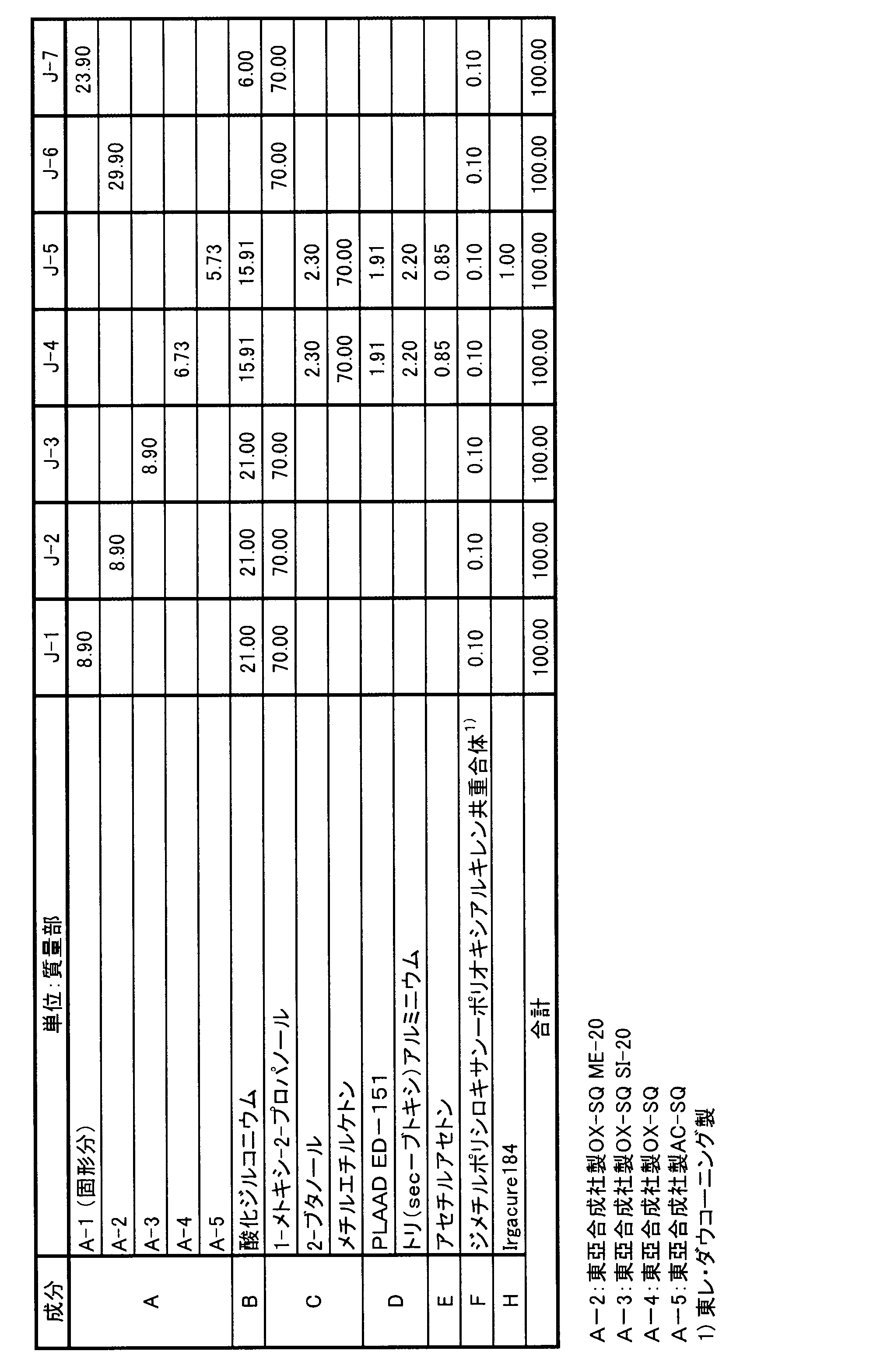
(B)成分として酸化ジルコニウム(数平均一次粒子径:15nm)を21.0g、「A-1」を29.7g(固形分8.9g)、有機溶媒の総重量が70gになるようにプロピレングリコールモノメチルエーテルを容器に入れ、これに粒径0.1mmのジルコニアビーズ(ニッカトー社製)350gを加えて、ビーズミルにより、1500rpm、10時間攪拌して、酸化ジルコニウムの微粒子((B)成分)を分散させた。
得られた酸化ジルコニウムの微粒子の分散液に、ジメチルポリシロキサン-ポリオキシアルキレン共重合体を0.10g加え、組成物「J-1」を得た。
また、表1に示すように成分組成を変えたこと以外は「J-1」と同様にして、組成物「J-2」、「J-3」、「J-6」、「J-7」を調製した。
(B)成分として酸化ジルコニウム(数平均一次粒子径:15nm)を21.0g、「A-1」を29.7g(固形分8.9g)、有機溶媒の総重量が70gになるようにプロピレングリコールモノメチルエーテルを容器に入れ、これに粒径0.1mmのジルコニアビーズ(ニッカトー社製)350gを加えて、ビーズミルにより、1500rpm、10時間攪拌して、酸化ジルコニウムの微粒子((B)成分)を分散させた。
得られた酸化ジルコニウムの微粒子の分散液に、ジメチルポリシロキサン-ポリオキシアルキレン共重合体を0.10g加え、組成物「J-1」を得た。
また、表1に示すように成分組成を変えたこと以外は「J-1」と同様にして、組成物「J-2」、「J-3」、「J-6」、「J-7」を調製した。
[組成物の調製2]
(B)成分として、酸化ジルコニウムの微粒子(数平均一次粒子径:15nm)を15.91g、PLADD ED-151(化合物名:ポリオキシエチレンアルキルリン酸エステル)を1.91g、トリ(sec-ブトキシ)アルミニウム2.20g、アセチルアセトン0.85g、2-ブタノール2.30g、メチルエチルケトン70.00gを容器に入れ、これに粒径0.1mmのジルコニアビーズ(ニッカトー社製)350gを加えて、ビーズミルにより、1500rpm、10時間攪拌して、酸化ジルコニウムの微粒子((B)成分)を分散させた。
得られた酸化ジルコニウムの微粒子の分散液93.18gに、「A-4」を6.73g、ジメチルポリシロキサンーポリオキシアルキレン共重合体0.1gを添加し、組成物「J-4」を得た。
(B)成分として、酸化ジルコニウムの微粒子(数平均一次粒子径:15nm)を15.91g、PLADD ED-151(化合物名:ポリオキシエチレンアルキルリン酸エステル)を1.91g、トリ(sec-ブトキシ)アルミニウム2.20g、アセチルアセトン0.85g、2-ブタノール2.30g、メチルエチルケトン70.00gを容器に入れ、これに粒径0.1mmのジルコニアビーズ(ニッカトー社製)350gを加えて、ビーズミルにより、1500rpm、10時間攪拌して、酸化ジルコニウムの微粒子((B)成分)を分散させた。
得られた酸化ジルコニウムの微粒子の分散液93.18gに、「A-4」を6.73g、ジメチルポリシロキサンーポリオキシアルキレン共重合体0.1gを添加し、組成物「J-4」を得た。
[組成物の調製3]
(B)成分として酸化ジルコニウム微粒子(数平均一次粒子径:15nm)を15.91g、PLADD ED-151を1.91g、トリ(sec-ブトキシ)アルミニウム2.20g、アセチルアセトン0.85g、2-ブタノール2.30g、メチルエチルケトン70.00gを容器に入れ、これに粒径0.1mmのジルコニアビーズ(ニッカトー社製)350gを加えて、ビーズミルにより、1500rpm、10時間攪拌して酸化ジルコニウム微粒子(B)を分散させた。
得られた酸化ジルコニウムの微粒子の分散液93.18gに、「A-5」を5.73g、光重合開始剤としてIrgacure184(BASF社製)を1.0g、ジメチルポリシロキサンーポリオキシアルキレン共重合体0.1gを添加し、組成物「J-5」を得た。
(B)成分として酸化ジルコニウム微粒子(数平均一次粒子径:15nm)を15.91g、PLADD ED-151を1.91g、トリ(sec-ブトキシ)アルミニウム2.20g、アセチルアセトン0.85g、2-ブタノール2.30g、メチルエチルケトン70.00gを容器に入れ、これに粒径0.1mmのジルコニアビーズ(ニッカトー社製)350gを加えて、ビーズミルにより、1500rpm、10時間攪拌して酸化ジルコニウム微粒子(B)を分散させた。
得られた酸化ジルコニウムの微粒子の分散液93.18gに、「A-5」を5.73g、光重合開始剤としてIrgacure184(BASF社製)を1.0g、ジメチルポリシロキサンーポリオキシアルキレン共重合体0.1gを添加し、組成物「J-5」を得た。
前記の組成物「J-1」~「J-7」の各々について、以下のように評価した。
<組成物の特性評価>
(1)分散粒径
得られた組成物中の微粒子について、25℃での体積平均粒径を堀場製作所製の動的光散乱式粒径分布測定装置により測定した。体積平均粒径が50nm未満のものを「○」、50nm以上で100nm未満のものを「△」、100nm以上のものを「×」とした。結果を表2に示す。
<硬化膜の作製>
・組成物「J-1」~「J-4」、「J-6」、「J-7」
4インチ径の溶融石英またはシリコン基板上に、形成用組成物をディスペンスし、厚さ約1μmになるようにスピンコート塗布し、120℃で1分間、及び150℃で60分間加熱して、硬化膜を作製した。
・組成物「J-5」
4インチ径の溶融石英またはシリコン基板上に、形成用組成物をディスペンスし、厚さ約1μmになるようにスピンコート塗布し、120℃で1分間加熱した。その後、コンタクトマスクアライナーを用いて、大気中で露光量が2000mJ/cm2となるように紫外線を照射し、次いで、150℃で60分間加熱して、硬化膜を作製した。
<組成物の特性評価>
(1)分散粒径
得られた組成物中の微粒子について、25℃での体積平均粒径を堀場製作所製の動的光散乱式粒径分布測定装置により測定した。体積平均粒径が50nm未満のものを「○」、50nm以上で100nm未満のものを「△」、100nm以上のものを「×」とした。結果を表2に示す。
<硬化膜の作製>
・組成物「J-1」~「J-4」、「J-6」、「J-7」
4インチ径の溶融石英またはシリコン基板上に、形成用組成物をディスペンスし、厚さ約1μmになるようにスピンコート塗布し、120℃で1分間、及び150℃で60分間加熱して、硬化膜を作製した。
・組成物「J-5」
4インチ径の溶融石英またはシリコン基板上に、形成用組成物をディスペンスし、厚さ約1μmになるようにスピンコート塗布し、120℃で1分間加熱した。その後、コンタクトマスクアライナーを用いて、大気中で露光量が2000mJ/cm2となるように紫外線を照射し、次いで、150℃で60分間加熱して、硬化膜を作製した。
<硬化膜の特性評価>
上記のようにして作製した硬化膜について、下記特性を測定し評価した。結果を表2に示す。
(2)硬化性
上記で得られた硬化膜表面を指で触り、べとつきがないものを「○」、べとつきがあるものを「×」とした。
(3)クラック耐性
上記で得られた硬化膜の外観を目視で観察し、クラックのないものを「○」、クラックがあるものを「×」とした。
(4)透明性
日本分光社製の分光光度計を使用して、上記で得られた硬化膜(膜厚1μm)の波長400nmにおける透過率(%)をそれぞれ測定した。透過率が90%以上の場合を「○」、90%未満の場合を「×」とした。
(5)屈折率
メトリコン社製のプリズムカップラーを使用して、23℃、波長633nmにおける屈折率を測定した。屈折率が1.6以上の場合を「○」、1.6未満の場合を「×」とした。
(6)耐熱性
オーブンを用いて、上記硬化膜を温度200℃で60分間処理を行った。処理前後の硬化膜の透過率の低下(透過率の減少の割合)が10%未満の場合を「○」、10%を超える場合を「×」とした。
(7)耐光性
朝日分光社製の光源システム(REX-1000)を使用して、上記で得られた硬化膜の耐光性を評価した。同光源を用いて10時間の光照射(放射照度1.5W/cm2、波長405nm以外の光をカット、試験温度23℃)を行い、試験前後の硬化膜の外観を目視で観察し、変化ないものを「○」、わずかに変色したものを「△」、黄変したものを「×」とした。
上記のようにして作製した硬化膜について、下記特性を測定し評価した。結果を表2に示す。
(2)硬化性
上記で得られた硬化膜表面を指で触り、べとつきがないものを「○」、べとつきがあるものを「×」とした。
(3)クラック耐性
上記で得られた硬化膜の外観を目視で観察し、クラックのないものを「○」、クラックがあるものを「×」とした。
(4)透明性
日本分光社製の分光光度計を使用して、上記で得られた硬化膜(膜厚1μm)の波長400nmにおける透過率(%)をそれぞれ測定した。透過率が90%以上の場合を「○」、90%未満の場合を「×」とした。
(5)屈折率
メトリコン社製のプリズムカップラーを使用して、23℃、波長633nmにおける屈折率を測定した。屈折率が1.6以上の場合を「○」、1.6未満の場合を「×」とした。
(6)耐熱性
オーブンを用いて、上記硬化膜を温度200℃で60分間処理を行った。処理前後の硬化膜の透過率の低下(透過率の減少の割合)が10%未満の場合を「○」、10%を超える場合を「×」とした。
(7)耐光性
朝日分光社製の光源システム(REX-1000)を使用して、上記で得られた硬化膜の耐光性を評価した。同光源を用いて10時間の光照射(放射照度1.5W/cm2、波長405nm以外の光をカット、試験温度23℃)を行い、試験前後の硬化膜の外観を目視で観察し、変化ないものを「○」、わずかに変色したものを「△」、黄変したものを「×」とした。
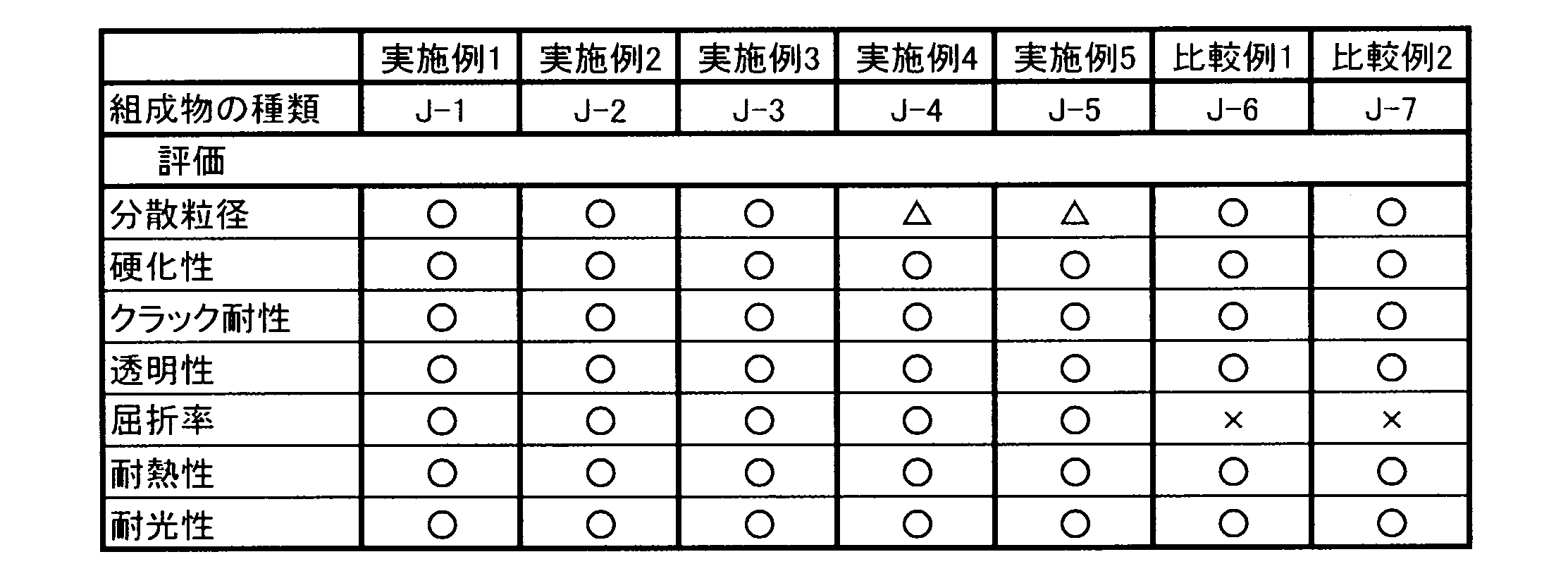
表2から、本発明の組成物の硬化物は、優れた透明性、高い屈折率、高い耐熱性、及び高い耐光性を有し、LED素子等の発光素子を備えた発光装置からの放射光の有効利用を期待しうることがわかる。
1 発光素子
2 硬化膜
3a 電極部
3b 電極部
4a 金属細線
4b 金属細線
5 封止材
6 絶縁基板
2 硬化膜
3a 電極部
3b 電極部
4a 金属細線
4b 金属細線
5 封止材
6 絶縁基板
Claims (9)
- (a)(A)下記の一般式(1)で示される化合物を含むシラン化合物から得られるシロキサン系重合体、
(R1)PSi(X)4-P (1)
[一般式(1)中、R1は炭素数が2~12である重合性の有機基、Xは加水分解性基、およびpは1~3の整数である。]、
(B)金属酸化物粒子、および、
(C)有機溶媒
を含み、上記(B)成分の配合量が、上記(A)成分100質量部に対して50~2,000質量部である硬化性樹脂組成物で、発光素子を被覆する工程、および、(c)上記発光素子を加熱する工程、
を含む、発光装置の製造方法。 - 上記(c)の工程の前に、(b)上記硬化性樹脂組成物の被覆に紫外線を照射する工程、を含む、請求項1に記載の発光装置の製造方法。
- 発光素子と、
該発光素子の表面上に形成させた、(A)下記の一般式(1)で示される化合物を含むシラン化合物から得られるシロキサン系重合体、
(R1)PSi(X)4-P (1)
[一般式(1)中、R1は炭素数が2~12である重合性の有機基、Xは加水分解性基、およびpは1~3の整数である。]、および、
(B)金属酸化物粒子、を含み、上記(B)成分の配合量が、上記(A)成分100質量部に対して50~2,000質量部である硬化性樹脂組成物の硬化体である硬化膜とを含む発光装置。 - (A)下記の一般式(1)で示される化合物を含むシラン化合物から得られるシロキサン系重合体、
(R1)PSi(X)4-P (1)
[一般式(1)中、R1は炭素数が2~12である重合性の有機基、Xは加水分解性基、およびpは1~3の整数である。]
(B)金属酸化物粒子、および、
(C)有機溶媒を含み、上記(B)成分の配合量が、上記(A)成分100質量部に対して50~2,000質量部である、硬化性樹脂組成物。 - 上記シラン化合物が、さらに下記の一般式(2)で示される化合物を含む、請求項4に記載の硬化性樹脂組成物。
(R2)qSi(X)4-q (2)
[一般式(2)中、R2は炭素数が1~12である非重合性の有機基、Xは加水分解性基、およびqは0~3の整数である。] - 上記一般式(1)で示される化合物と上記一般式(2)で示される化合物との合計量中の上記一般式(1)で示される化合物の配合量の質量割合が、10~100質量%である、請求項4又は5に記載の硬化性樹脂組成物。
- 上記(B)成分は、数平均1次粒子径が1~100nmの微粒子である、請求項4~6のいずれか1項に記載の硬化性樹脂組成物。
- 発光素子の被覆用であることを特徴とする、請求項4~7のいずれか1項に記載の硬化性樹脂組成物。
- (A)下記の一般式(1)で示される化合物を含むシラン化合物から得られるシロキサン系重合体および(B)金属酸化物粒子を(C)有機溶媒中で混合して請求項4~8のいずれか1項に記載の硬化性樹脂組成物を製造することを特徴とする、硬化性樹脂組成物の製造方法。
(R1)PSi(X)4-P (1)
[一般式(1)中、R1は炭素数が2~12である重合性の有機基、Xは加水分解性基、およびpは1~3の整数である。]
Priority Applications (1)
| Application Number | Priority Date | Filing Date | Title |
|---|---|---|---|
| JP2012508340A JPWO2011122617A1 (ja) | 2010-03-31 | 2011-03-29 | 硬化性樹脂組成物および発光装置 |
Applications Claiming Priority (2)
| Application Number | Priority Date | Filing Date | Title |
|---|---|---|---|
| JP2010-084573 | 2010-03-31 | ||
| JP2010084573 | 2010-03-31 |
Publications (1)
| Publication Number | Publication Date |
|---|---|
| WO2011122617A1 true WO2011122617A1 (ja) | 2011-10-06 |
Family
ID=44712312
Family Applications (1)
| Application Number | Title | Priority Date | Filing Date |
|---|---|---|---|
| PCT/JP2011/057795 Ceased WO2011122617A1 (ja) | 2010-03-31 | 2011-03-29 | 硬化性樹脂組成物および発光装置 |
Country Status (3)
| Country | Link |
|---|---|
| JP (1) | JPWO2011122617A1 (ja) |
| TW (1) | TW201139563A (ja) |
| WO (1) | WO2011122617A1 (ja) |
Citations (4)
| Publication number | Priority date | Publication date | Assignee | Title |
|---|---|---|---|---|
| JP2008084986A (ja) * | 2006-09-26 | 2008-04-10 | Matsushita Electric Works Ltd | 光半導体用封止材及び半導体光装置 |
| JP2008179756A (ja) * | 2006-12-28 | 2008-08-07 | Showa Denko Kk | 発光素子封止用樹脂組成物およびランプ |
| JP2008202008A (ja) * | 2007-02-22 | 2008-09-04 | Nagase Chemtex Corp | 光素子用封止樹脂組成物 |
| JP2009256662A (ja) * | 2008-03-26 | 2009-11-05 | Nagase Chemtex Corp | シルセスキオキサン誘導体及びその製造方法 |
-
2011
- 2011-03-29 WO PCT/JP2011/057795 patent/WO2011122617A1/ja not_active Ceased
- 2011-03-29 JP JP2012508340A patent/JPWO2011122617A1/ja active Pending
- 2011-03-31 TW TW100111349A patent/TW201139563A/zh unknown
Patent Citations (4)
| Publication number | Priority date | Publication date | Assignee | Title |
|---|---|---|---|---|
| JP2008084986A (ja) * | 2006-09-26 | 2008-04-10 | Matsushita Electric Works Ltd | 光半導体用封止材及び半導体光装置 |
| JP2008179756A (ja) * | 2006-12-28 | 2008-08-07 | Showa Denko Kk | 発光素子封止用樹脂組成物およびランプ |
| JP2008202008A (ja) * | 2007-02-22 | 2008-09-04 | Nagase Chemtex Corp | 光素子用封止樹脂組成物 |
| JP2009256662A (ja) * | 2008-03-26 | 2009-11-05 | Nagase Chemtex Corp | シルセスキオキサン誘導体及びその製造方法 |
Also Published As
| Publication number | Publication date |
|---|---|
| TW201139563A (en) | 2011-11-16 |
| JPWO2011122617A1 (ja) | 2013-07-08 |
Similar Documents
| Publication | Publication Date | Title |
|---|---|---|
| JP6908116B2 (ja) | 樹脂組成物、遮光膜および遮光膜の製造方法 | |
| KR100980270B1 (ko) | Led 봉지용 실록산 수지 | |
| JP2006316264A (ja) | 高屈折材料形成用組成物およびその硬化体、ならびに高屈折材料形成用組成物の製造方法 | |
| JP2008248239A (ja) | シロキサン樹脂組成物、それを用いた硬化膜および光学デバイス | |
| JP5034283B2 (ja) | 高屈折材料形成用組成物およびその硬化体、ならびに高屈折材料形成用組成物の製造方法 | |
| JP6937436B2 (ja) | 色変換パネルおよび色変換パネルの製造方法 | |
| JP2008020898A (ja) | 感光性シロキサン組成物、それから形成された硬化膜、および硬化膜を有する素子 | |
| JP2011173738A (ja) | 透明焼成体 | |
| CN115427514A (zh) | 树脂组合物、遮光膜和带有隔壁的基板 | |
| JP2011100975A (ja) | 発光素子、発光素子の製造方法、及び発光素子保護層形成用組成物 | |
| JP5824577B2 (ja) | 高屈折組成物 | |
| JP2016098245A (ja) | ポリシルセスキオキサン液体及びその製造方法、led封止用組成物、led封止材、及び半導体発光装置 | |
| JP2009292855A (ja) | 光半導体封止用重合体およびその製造方法、ならびに光半導体封止用組成物 | |
| JP2015081275A (ja) | 光半導体用シリコーン樹脂組成物およびその硬化物 | |
| WO2011125646A1 (ja) | 硬化性樹脂組成物および発光装置 | |
| JP5369553B2 (ja) | シロキサン樹脂組成物、硬化物およびこれを用いた光半導体 | |
| WO2011122617A1 (ja) | 硬化性樹脂組成物および発光装置 | |
| JP2012220556A (ja) | 反射防止膜、該反射防止膜の高屈折層形成用組成物および屋外設置用ディスプレイ | |
| JP6022870B2 (ja) | 感光性樹脂組成物 | |
| KR101855558B1 (ko) | 실록산 폴리머 경화용 조성물 및 이를 포함하는 투명 피막 형성용 조성물 | |
| JP2012022997A (ja) | 発光素子および粒子含有層形成用組成物 | |
| JP2011146674A (ja) | 光半導体素子及び光半導体素子保護層形成用組成物 | |
| WO2011013709A1 (ja) | 発光素子、発光素子の製造方法及び発光素子保護層形成用組成物 | |
| JP2010013619A (ja) | 光半導体封止用重合体およびその製造方法、ならびに光半導体封止用組成物 | |
| WO2015111717A1 (ja) | アルカリ溶解現像性の高屈折率膜形成組成物及びパターン形成方法 |
Legal Events
| Date | Code | Title | Description |
|---|---|---|---|
| 121 | Ep: the epo has been informed by wipo that ep was designated in this application |
Ref document number: 11762841 Country of ref document: EP Kind code of ref document: A1 |
|
| WWE | Wipo information: entry into national phase |
Ref document number: 2012508340 Country of ref document: JP |
|
| NENP | Non-entry into the national phase |
Ref country code: DE |
|
| 122 | Ep: pct application non-entry in european phase |
Ref document number: 11762841 Country of ref document: EP Kind code of ref document: A1 |