WO2011108577A1 - 光学ガラス - Google Patents
光学ガラス Download PDFInfo
- Publication number
- WO2011108577A1 WO2011108577A1 PCT/JP2011/054736 JP2011054736W WO2011108577A1 WO 2011108577 A1 WO2011108577 A1 WO 2011108577A1 JP 2011054736 W JP2011054736 W JP 2011054736W WO 2011108577 A1 WO2011108577 A1 WO 2011108577A1
- Authority
- WO
- WIPO (PCT)
- Prior art keywords
- glass
- mol
- optical glass
- platinum
- bromine
- Prior art date
- Legal status (The legal status is an assumption and is not a legal conclusion. Google has not performed a legal analysis and makes no representation as to the accuracy of the status listed.)
- Ceased
Links
Classifications
-
- C—CHEMISTRY; METALLURGY
- C03—GLASS; MINERAL OR SLAG WOOL
- C03C—CHEMICAL COMPOSITION OF GLASSES, GLAZES OR VITREOUS ENAMELS; SURFACE TREATMENT OF GLASS; SURFACE TREATMENT OF FIBRES OR FILAMENTS MADE FROM GLASS, MINERALS OR SLAGS; JOINING GLASS TO GLASS OR OTHER MATERIALS
- C03C3/00—Glass compositions
- C03C3/12—Silica-free oxide glass compositions
- C03C3/23—Silica-free oxide glass compositions containing halogen and at least one oxide, e.g. oxide of boron
Definitions
- the present invention relates to an optical glass, and more particularly to an optical glass having a high refractive index, a low yield point, hardly wetted by platinum, and a composition suitable for molding and fine structure transfer (glass imprint).
- aspherical lenses are increasingly used as optical devices are remarkably reduced in size and weight. This is because aspherical lenses can easily correct light aberration, reduce the number of lenses, and make the device compact.
- an optical element that exhibits a light wave control function that is, a light wave control element, by forming a nano-fine structure having a light wavelength level period on the glass surface.
- the light wave control function provides characteristics such as structural birefringence and surface reflection prevention.
- Such a light wave control element made of glass is frequently used as an optical element material because it has a wide selection range of optical properties, is stable against temperature changes, has good heat resistance, weather resistance, and light resistance. A wider application range than the resin used in the production can be expected.
- An aspherical lens or the like is manufactured by heating and softening a glass preform and precision molding it into a desired shape.
- a glass preform As for the production of the light wave control element, research and development of glass imprint by precision molding using a heat-resistant mold having a nano-structure with a period of 100 nm to 10 ⁇ m on the surface has been performed from the viewpoint of low cost.
- the optical glass constituting the preform can be molded at a relatively low temperature, and therefore has a low yield point (At).
- the glass system having a low yield point (At) include phosphate-based optical glass mainly composed of phosphate.
- P 2 O 5 —B 2 O 3 —Na 2 O—Nb 2 O 5 —TiO 2 glass disclosed in Patent Document 1 There is a P 2 O 5 —B 2 O 3 —R 2 O—R′O—WO 3 —Nb 2 O 5 —Bi 2 O 3 series glass disclosed in US Pat.
- R is an alkali metal
- R ′ is an alkaline earth metal.
- Patent Document 3 discloses a high-refractive index, high-dispersion optical glass for precision press molding of P 2 O 5 —Nb 2 O 5 —Bi 2 O 3 glass.
- the inventors of the present application have been energetically conducting research on phosphate-based optical glasses mainly composed of phosphate, particularly zinc bismuth phosphate-based glasses. ing.
- Patent applications are also filed according to Patent Document 4 and Patent Document 5.
- Patent Document 4 is an optical glass for glass imprinting, has a low yield point in the range of 340 to 450 ° C., and good transmittance at 400 nm.
- the optical glass described in Patent Document 5 is obtained by adding fluorine F to the glass composition described in Comparative Examples 1 to 4 of Patent Document 4, that is, a glass composition having a high refractive index (n d ) exceeding 1.82.
- the present inventors have found out that there is an effect in improving the transmittance and lowering the yield point (At), and have completed it.
- JP 2002-173336 A JP 2006-131480 A JP 2001-58845 A JP 2009-184900 A JP 2009-256170 A
- cemented carbide mainly composed of tungsten carbide (WC), silicon carbide (SiC), quartz glass, etc. are used.
- a release film is formed on the substrate.
- the release film includes a noble metal type containing a noble metal such as platinum as one of its components, a carbon type such as DLC (diamond-like carbon) or carbon, and a nitride type such as silicon nitride, boron nitride, and aluminum nitride. . Because of the large number of repeated use, a noble metal film mainly containing platinum as a main component is often used for mass production of aspherical lenses.
- the present invention eliminates the disadvantages of the above-mentioned conventional optical glass, and provides an optical glass having a low yield point, a high refractive index, and a high transmittance, and suitable for mold press molding, particularly for nano-structured glass imprint. Let it be an issue.
- the inventors of the present invention considered the composition in the P 2 O 5 —Bi 2 O 3 —ZnO system in the production of glass, and added this to chlorine Cl or bromine Br.
- the glass melt becomes difficult to get wet with platinum, and by obtaining a glass with improved releasability for a noble metal release film containing platinum, As a result, the present invention has been completed.
- the optical glass of the present invention contains P 2 O 5 : 15 to 30 mol%, Bi 2 O 3 : 5 to 35 mol%, ZnO: 40 to 75 mol% in terms of oxide, and chlorine Cl or bromine
- the first feature is that halogen X composed of one or more kinds of Br is contained in a molar ratio with oxygen of X / O: 0.005 to 0.5.
- the optical glass of the present invention contains at least one alkali metal element R selected from lithium, sodium, and potassium in an amount of 15 mol% or less in the form of R 2 O.
- the optical glass of the present invention has a third feature that a halogen X composed of one or more of chlorine Cl or bromine Br is added as ZnX 2 or RX. .
- the yield point and the refractive index can be increased, and that it is difficult to get wet with platinum. That is, the glass yield point (At) is 500 ° C. or less, the refractive index (n d ) is 1.82 to 1.89, and it is difficult to wet platinum, so that it has mold releasability for a mold having a noble metal release film containing platinum. We have completed an optical glass that can be expected to be good.
- the yield point (At) is the maximum point at which the expansion curve changes from rising to falling due to softening of the glass when the thermal expansion is measured with a thermomechanical analyzer (TMA).
- TMA thermomechanical analyzer
- the refractive index (n d ) refers to the refractive index of helium for the 587.6 nm emission line.
- the optical glass of the first aspect since it has the composition described therein, it has a low yield point (At) and a high refractive index (n d ) and is difficult to wet platinum, and is suitable for mold press molding. It has become possible to provide optical glass.
- at least one alkali metal element R selected from lithium, sodium and potassium is added to R 2. Since it is made to contain 15 mol% or less in the form of O, by adding the alkali metal element R, the yield point (At) of the glass can be further lowered.
- the halogen X containing at least one kind of chlorine Cl or bromine Br is added as ZnX 2 or RX. Therefore, the component composition of P, Bi, Zn and R in the P 2 O 5 —Bi 2 O 3 —ZnO—R 2 O—X system of the optical glass according to claim 1 or 2 is changed.
- the halogen X containing at least one kind of chlorine Cl or bromine Br can be easily added in the form of ZnX 2 or RX, and can be easily adjusted to a predetermined X / O molar ratio.
- the component P 2 O 5 is a component for forming a glass network structure, and is an essential component for imparting stability that can be produced to glass.
- P 2 O 5 is contained in an amount of 15 to 30 mol%. If it is less than 15 mol%, it is difficult to stably obtain a good glass. On the other hand, even if it exceeds 30 mol%, it is difficult to obtain a stable and good glass.
- P 2 O 5 is preferably contained in an amount of 17.5 to 29 mol%, more preferably 20 to 28 mol%.
- Component Bi 2 O 3 is a component that forms a network structure of glass, and is essential for bringing stability that can be produced to glass, increasing the refractive index (n d ) of the glass, and lowering the yield point (At). It is.
- Bi 2 O 3 is contained in an amount of 5 to 35 mol%. If Bi 2 O 3 is less than 5 mol%, it is difficult to obtain a stable and good glass, and if it exceeds 35 mol%, it is difficult to obtain a stable and good glass.
- Bi 2 O 3 is preferably contained in an amount of 10 to 32.5 mol%, more preferably 15 to 30 mol%.
- the component ZnO is an essential component that is effective in stabilizing the glass and lowering the yield point.
- ZnO is contained in an amount of 40 to 75 mol%. If it is less than 40 mol%, it is difficult to obtain a stable and good glass, and if it exceeds 75 mol%, it is difficult to obtain a stable and good glass.
- ZnO is preferably contained in an amount of 42 to 70 mol%, more preferably 44 to 65 mol%.
- R 2 O is an effective component for lowering the yield point of glass.
- R is at least one alkali metal element selected from lithium, sodium, and potassium.
- R 2 O is contained in an amount of 15 mol% or less. If R 2 O is contained in an amount exceeding 15 mol%, the stability of the glass is impaired, and it becomes difficult to stably obtain a good glass.
- R 2 O is preferably contained in an amount of 13 mol% or less, more preferably 12 mol% or less.
- the lower limit of content is preferably 1 mol%, more preferably 2 mol%.
- R 2 O is more preferably be contained at least two or more, more preferably be 3 types contained.
- Halogen X containing one or more of chlorine Cl or bromine Br is effective in making glass difficult to wet with platinum.
- X is considered to be present in the form of an anion in the glass.
- Typical halogens other than chlorine Cl or bromine Br include fluorine F or iodine I.
- fluorine F does not show the effect of making the glass difficult to get wet with platinum
- iodine I makes the glass unstable and makes it impossible to obtain a good glass. Therefore, as the halogen to be contained, chlorine Cl or bromine Br is preferable. In comparison between chlorine Cl and bromine Br, Br seems to have a greater effect of preventing the glass from getting wet with platinum than Cl, but is more volatile than Cl during glass production.
- Br has an effect of shifting the absorption edge of the glass to the long wavelength side higher than that of Cl, and by adding Br, the transmittance at 400 nm is lowered, and the glass tends to be colored. It is preferable to contain. Therefore, the content range of Cl is wider than that of Br.
- One or two halogens X are contained in a ratio with oxygen O of X / O: 0.005 to 0.5.
- O oxygen
- X / O is 0.005 or less, the effect of preventing the glass from getting wet with platinum becomes small.
- X / O is 0.5 or more, the glass becomes unstable, volatilization at the time of melting increases, and the variation in glass characteristics increases.
- X / O is preferably contained in an amount of 0.008 to 0.2, more preferably 0.009 to 0.1.
- X may be added by substitution with ammonium salts, hydrogen chloride, hydrogen bromide (HX), or the like, but may be contained using a chloride material or bromide material such as ZnX 2 or RX. Good. Chlorine or bromine may be contained by any method, but one or two of them in the molar ratio of oxygen O to X / O in the range of 0.005 to 0.5, preferably 0.008 to 0 .2 is more preferably contained so as to satisfy the range of 0.009 to 0.1.
- the zinc Zn it may be added to some of ZnO as ZnX 2.
- the total amount of ZnX 2 and ZnO is in the range of 40 to 75 mol%, preferably in the range of 42 to 70 mol%, more preferably in the range of 44 to 65 mol% in terms of Zn oxide (ZnO). It may be added as follows.
- the alkali metal element R it may be added to some or all of the R 2 O as RX.
- RX in order to contain 5 mol% of R in terms of oxide (R 2 O), 10 mol% of RX is added.
- the molar ratio X / O with oxygen O as a whole glass composition is adjusted to fall within the range of 0.005 to 0.5.
- the component P 2 O 5 , Zn (PO 3 ) 2 , R (PO 3 ), P 2 O 5 , H 3 PO 4, etc. are used for the component P 2 O 5 , Zn (PO 3 ) 2 , R (PO 3 ), P 2 O 5 , H 3 PO 4, etc.
- Bi 2 O 3 , Bi (NO 3 ) 3 , 5H 2 O, or the like can be used for the component Bi 2 O 3
- ZnO, Zn (PO 3 ) 2 can be used for the component ZnO.
- ZnCl 2 , ZnBr 2 can be used, and for the component R 2 O, R 2 CO 3 , R (NO 3 ), R (PO 3 ), etc.
- halogen X consisting of one or more of chlorine or bromine.
- the above raw materials are prepared and mixed so as to have the component ranges described above, melted at 800 to 1000 ° C., homogenized through the steps of clarification (gas removal) and stirring, and then poured into a mold and gradually cooled. As a result, a homogeneous glass can be obtained.
- the present invention will be further described below with reference to examples. Of course, the present invention is not limited to these examples.
- the raw materials were prepared and mixed so as to have the component compositions of Examples 1 to 10 and Comparative Examples 1 to 7 shown in Tables 1 to 3, and this was put into a platinum crucible and heated at 800 to 1000 ° C. in an electric furnace.
- Optical glass was obtained by melting in the temperature range and then pouring into a mold and slow cooling. For each optical glass obtained, yield point (At), measurement of refractive index (n d), and were evaluated wet difficulty to platinum glass.
- the yield point (At) is measured by heating a rod-shaped sample having a length of 15 to 20 mm and a diameter (side) of 3 to 5 mm at a constant rate of 10 ° C. And the thermal expansion curve obtained by measuring the temperature.
- the refractive index (n d ) was measured using the V block method.
- the difficulty of wetting the glass with platinum was determined by visually observing the glass state remaining in the platinum crucible after melting the glass and pouring it into the mold.
- Example 1, 3, 5, 6, and the comparative example 7 about the difficulty of wetting with platinum of glass.
- the results are shown in Table 4.
- this firing evaluation about 0.4 g of gob preform was placed on a platinum plate, fired for 30 minutes at a temperature 330 ° C. higher than the yield point (At) in a nitrogen atmosphere (40 ml / min), cooled in the furnace, The contact angle between the fired glass and platinum was examined. The larger the contact angle is, the more difficult the glass is to get wet with platinum.
- the glass of each of the examples of the present invention has a yield point (At) in a relatively low temperature range of 482 ° C. or less, molding is easy. Also, it has a high refractive index (n d ) in the range of 1.82 to 1.88. It can also be seen that it is difficult to get wet with platinum. This can also be seen from the contact angles in Table 4. Examples 1, 3, 5, and 6 are glasses that have a contact angle of 80 ° or more and are difficult to wet with platinum. From these facts, it can be seen that the optical glass of the present invention has preferable characteristics for precision molding using a noble metal release film containing platinum as a main component, particularly for transferring a fine structure by glass imprinting.
- Comparative Example 1 corresponds to Example 54 of Patent Document 1
- Comparative Example 2 corresponds to Example 3 of Patent Document 2
- Comparative Example 3 corresponds to Example 9 of Patent Document 3. Since these do not contain halogen X, they are easily wetted by platinum and have a yield point (At) of 490 ° C. or higher, which is disadvantageous from the glass of the present invention in terms of mold durability.
- Comparative Example 4 corresponds to Example 6 of Patent Document 4.
- Comparative Example 5 corresponds to Example 4 of Patent Document 5, which contains fluorine F as a halogen
- Comparative Example 6 contains iodine I as a halogen
- Comparative Example 7 represents the present invention. This corresponds to the case where chlorine Cl or bromine Br is not contained in Examples 1 to 8.
- Comparative Examples 5 and 7 achieve a low yield point (At) and a high refractive index (n d ) equivalent to those of the glass of the present invention. However, since they do not contain chlorine Cl or bromine Br, they easily get wet with platinum.
- the optical glass of the present invention has a low yield point (At), a high refractive index (n d ), is hardly wetted by platinum, is an aspheric lens, a light wave control element having a fine structure formed on the surface, etc.
Landscapes
- Chemical & Material Sciences (AREA)
- Life Sciences & Earth Sciences (AREA)
- Engineering & Computer Science (AREA)
- Chemical Kinetics & Catalysis (AREA)
- General Chemical & Material Sciences (AREA)
- Geochemistry & Mineralogy (AREA)
- Materials Engineering (AREA)
- Organic Chemistry (AREA)
- Glass Compositions (AREA)
Abstract
低屈伏点、高屈折率で、モールドプレス成形、特にナノ微細構造のガラスインプリントに適した光学ガラスの提供を課題とする。 酸化物換算で、P2O5:15~30モル%、Bi2O3:5~35モル%、ZnO:40~75モル%含有させ、且つ塩素Cl又は臭素Brの1種類以上よりなるハロゲンXを、酸素とのモル比で、X/O:0.005~0.5含有させてある光学ガラスである。またリチウム、ナトリウム、カリウムの中から選ばれる少なくとも1つ以上のアルカリ金属元素Rを、R2Oの形で15モル%以下含有させている。更に塩素Cl又は臭素Brの1種類以上よりなるハロゲンXを、ZnX2又はRXで添加している。
Description
本発明は光学ガラスに関し、特に高屈折率、低屈伏点で、白金に濡れ難い、モールド成形及び微細構造の転写(ガラスインプリント)に適した組成を有する光学ガラスに関する。
近年、光学機器の小型軽量化が著しく進展している中で、非球面レンズが多く用いられるようになってきている。これは、非球面レンズは光線収差の補正が容易であり、レンズの枚数を少なくし、機器をコンパクトにすることができるためである。
またガラス表面に光の波長レベルの周期をもつナノ微細構造を形成することにより、光波制御機能を発現させた光学素子、即ち光波制御素子への要求が高まってきている。光波制御機能により、構造性複屈折や表面反射の防止等の特性が得られる。このような光波制御素子をガラスで作製することは、光学物性の選択範囲が広く、温度変化に対して安定で、耐熱性、耐候性、耐光性がよいなどの理由から、光学素子材料として頻繁に用いられている樹脂よりも広い適用範囲が期待できる。
非球面レンズ等の製造は、ガラスのプリフォームを加熱軟化させ、これを所望形状に精密モールド成形することによってなされている。
また光波制御素子の作製についても、低コストの点から100nm~10μmレベルの周期のナノ微細構造を表面に形成した耐熱モールドを用いた、精密モールド成形によるガラスインプリントの研究開発がなされている。
精密モールド成形によってガラス成形品を得るためには、プリフォームの加圧成形を屈伏点(At)近傍の温度で行うことが必要である。このため、プリフォームの屈伏点(At)が高いほど、これに接する金型(モールド)が一層の高温に曝されることとなり、モールド表面が酸化消耗し、モールドのメンテナンスが必要となり、低コストでの大量生産が実現できなくなる。このため、プリフォームを構成する光学ガラスは、比較的低温で成形できること、従って屈伏点(At)が低いことが望まれている。
また屈折率(nd)が高いほど焦点距離を短くでき、光学系をコンパクトにできると共に光学設計の自由度が大きくなることから、1.8を超えるような高屈折率(nd)であることも望まれている。
屈伏点(At)の低いガラス系としては、リン酸塩を主体としたリン酸塩系光学ガラスをあげることができる。
またガラス表面に光の波長レベルの周期をもつナノ微細構造を形成することにより、光波制御機能を発現させた光学素子、即ち光波制御素子への要求が高まってきている。光波制御機能により、構造性複屈折や表面反射の防止等の特性が得られる。このような光波制御素子をガラスで作製することは、光学物性の選択範囲が広く、温度変化に対して安定で、耐熱性、耐候性、耐光性がよいなどの理由から、光学素子材料として頻繁に用いられている樹脂よりも広い適用範囲が期待できる。
非球面レンズ等の製造は、ガラスのプリフォームを加熱軟化させ、これを所望形状に精密モールド成形することによってなされている。
また光波制御素子の作製についても、低コストの点から100nm~10μmレベルの周期のナノ微細構造を表面に形成した耐熱モールドを用いた、精密モールド成形によるガラスインプリントの研究開発がなされている。
精密モールド成形によってガラス成形品を得るためには、プリフォームの加圧成形を屈伏点(At)近傍の温度で行うことが必要である。このため、プリフォームの屈伏点(At)が高いほど、これに接する金型(モールド)が一層の高温に曝されることとなり、モールド表面が酸化消耗し、モールドのメンテナンスが必要となり、低コストでの大量生産が実現できなくなる。このため、プリフォームを構成する光学ガラスは、比較的低温で成形できること、従って屈伏点(At)が低いことが望まれている。
また屈折率(nd)が高いほど焦点距離を短くでき、光学系をコンパクトにできると共に光学設計の自由度が大きくなることから、1.8を超えるような高屈折率(nd)であることも望まれている。
屈伏点(At)の低いガラス系としては、リン酸塩を主体としたリン酸塩系光学ガラスをあげることができる。
上記光学特性への要求を満たす従来のガラスとして、例えば特許文献1に開示されているP2O5-B2O3-Na2O-Nb2O5-TiO2系ガラスや、特許文献2に開示されているP2O5-B2O3-R2O-R’O-WO3-Nb2O5-Bi2O3系ガラスがある。ここでRはアルカリ金属、R’はアルカリ土類金属のことである。これらのガラスでは屈折率(nd)が1.75~2.0といったものもある。
また特許文献3には、P2O5-Nb2O5-Bi2O3系ガラスの高屈折率、高分散の精密プレス成形用光学ガラスが開示されている。
ところで本願発明者らは、リン酸塩を主体としたリン酸塩系光学ガラス、特にリン酸亜鉛ビスマス系ガラスに関して、精力的に研究を実施しており、例えば非特許文献1により外部発表を行っている。
また特許文献4及び特許文献5により特許出願も行っている。特許文献4はガラスインプリント用光学ガラスで、340~450℃の範囲の低い屈伏点を有し、400nmにおける透過率が良好である。更に特許文献5に記載された光学ガラスは、特許文献4の比較例1~4に記載のガラス組成、即ち1.82を超える高屈折率(nd)を有するガラス組成にフッ素Fを添加すると、透過率の向上、低屈伏点(At)化に効果があることを見出し、完成させたものである。
また特許文献3には、P2O5-Nb2O5-Bi2O3系ガラスの高屈折率、高分散の精密プレス成形用光学ガラスが開示されている。
ところで本願発明者らは、リン酸塩を主体としたリン酸塩系光学ガラス、特にリン酸亜鉛ビスマス系ガラスに関して、精力的に研究を実施しており、例えば非特許文献1により外部発表を行っている。
また特許文献4及び特許文献5により特許出願も行っている。特許文献4はガラスインプリント用光学ガラスで、340~450℃の範囲の低い屈伏点を有し、400nmにおける透過率が良好である。更に特許文献5に記載された光学ガラスは、特許文献4の比較例1~4に記載のガラス組成、即ち1.82を超える高屈折率(nd)を有するガラス組成にフッ素Fを添加すると、透過率の向上、低屈伏点(At)化に効果があることを見出し、完成させたものである。
「第48回ガラス及びフォトニクス材料討論会講演要旨集」社団法人日本セラミックス協会 2007年11月29日発行 p.164の2B20及びp.166の2B21
モールド材料としては、炭化タングステン(WC)を主体とする超硬合金、炭化ケイ素(SiC)、石英ガラス等が用いられるが、ガラスとの融着が発生する場合が多いため、一般的にモールド表面に離型膜を形成する。離型膜には白金などの貴金属を成分の1つとして含有する貴金属系、DLC(ダイヤモンドライクカーボン)又はカーボン等の炭素系、その他、窒化ケイ素、窒化ホウ素、窒化アルミ等の窒化物系がある。
繰り返しの使用回数が多い点から、非球面レンズの量産には、主に白金を主成分として含有させた貴金属系膜がよく用いられている。しかしながら、光波制御素子の作製のためにはモールドのナノ微細構造に入り込んだガラスを離型する必要があり、そのための離型膜として、貴金属系膜は、特許文献1~5にて示したような従来のリン酸塩系光学ガラスに対して十分な離型性を有しておらず、ナノ微細構造に入り込んだガラスがガラス本体から破壊離脱し、良好な微細構造をガラス表面に形成するのが困難であった。一方、炭素系膜、特にカーボン膜は離型性が良好で、モールドのナノ微細構造に入り込んだガラスを離型するには十分な離型性を有しているが、耐久性が十分でなく、離型性の低下による膜の除去、再成膜を頻繁にしなければならなかった。
繰り返しの使用回数が多い点から、非球面レンズの量産には、主に白金を主成分として含有させた貴金属系膜がよく用いられている。しかしながら、光波制御素子の作製のためにはモールドのナノ微細構造に入り込んだガラスを離型する必要があり、そのための離型膜として、貴金属系膜は、特許文献1~5にて示したような従来のリン酸塩系光学ガラスに対して十分な離型性を有しておらず、ナノ微細構造に入り込んだガラスがガラス本体から破壊離脱し、良好な微細構造をガラス表面に形成するのが困難であった。一方、炭素系膜、特にカーボン膜は離型性が良好で、モールドのナノ微細構造に入り込んだガラスを離型するには十分な離型性を有しているが、耐久性が十分でなく、離型性の低下による膜の除去、再成膜を頻繁にしなければならなかった。
そこで本発明は上記従来の光学ガラスにおける欠点を解消し、低屈伏点、高屈折率、高透過率を有し、モールドプレス成形、特にナノ微細構造のガラスインプリントに適した光学ガラスの提供を課題とする。
本発明者らは、上記課題を解決すべく鋭意研究を重ねた結果、ガラス製造にあたって、その組成をP2O5-Bi2O3-ZnO系で考慮すると共に、これに塩素Cl又は臭素Brを少なくとも1種類以上含むハロゲンXの適量を添加含有させることで、ガラス融液が白金に濡れ難くなり、白金を含有する貴金属系離型膜に対する離型性が向上したガラスを得ることで、上記の課題を解決できることを見出し、本発明を完成させた。
即ち本発明の光学ガラスは、酸化物換算で、P2O5:15~30モル%、Bi2O3:5~35モル%、ZnO:40~75モル%含有させ、且つ塩素Cl又は臭素Brの1種類以上よりなるハロゲンXを、酸素とのモル比で、X/O:0.005~0.5含有させてあることを第1の特徴としている。
また本発明の光学ガラスは、上記第1の特徴に加えて、リチウム、ナトリウム、カリウムの中から選ばれる少なくとも1つ以上のアルカリ金属元素Rを、R2Oの形で15モル%以下含有させることを第2の特徴としている。
また本発明の光学ガラスは、上記第1又は第2の特徴に加えて、塩素Cl又は臭素Brの1種類以上よりなるハロゲンXを、ZnX2又はRXで添加することを第3の特徴としている。
また本発明の光学ガラスは、上記第1の特徴に加えて、リチウム、ナトリウム、カリウムの中から選ばれる少なくとも1つ以上のアルカリ金属元素Rを、R2Oの形で15モル%以下含有させることを第2の特徴としている。
また本発明の光学ガラスは、上記第1又は第2の特徴に加えて、塩素Cl又は臭素Brの1種類以上よりなるハロゲンXを、ZnX2又はRXで添加することを第3の特徴としている。
このようにP2O5-Bi2O3-ZnO-R2O系ガラスの組成を調整し、これに更に塩素Cl又は臭素Brの1種類以上よりなるハロゲンXを適量含有させることにより、低屈伏点化、高屈折率化が可能になると共に、白金に濡れ難くなることを見出した。即ち、ガラス屈伏点(At)が500℃以下、屈折率(nd)が1.82から1.89、白金に濡れ難いため白金を含有する貴金属系離型膜を有するモールドに対する離型性がよいことが期待できる光学ガラスを完成させた。
なお上記において、屈伏点(At)とは熱機械分析装置(TMA)で熱膨張測定をしたとき、ガラスの軟化によって膨張曲線が上昇から下降に転じる極大点である。また屈折率(nd)とは、ヘリウムの587.6nmの輝線に対する屈折率を言う。
なお上記において、屈伏点(At)とは熱機械分析装置(TMA)で熱膨張測定をしたとき、ガラスの軟化によって膨張曲線が上昇から下降に転じる極大点である。また屈折率(nd)とは、ヘリウムの587.6nmの輝線に対する屈折率を言う。
請求項1に記載の光学ガラスによれば、そこに記載した組成としたので、低屈伏点(At)で、しかも高屈折率(nd)の、白金に濡れ難い、モールドプレス成形に適した光学ガラスを提供することができることが可能となった。
また請求項2に記載の光学ガラスによれば、上記請求項1に記載の構成による効果に加えて、リチウム、ナトリウム、カリウムの中から選ばれる少なくとも1つ以上のアルカリ金属元素Rを、R2Oの形で15モル%以下含有させることとしたので、アルカリ金属元素Rの添加によりガラスの屈伏点(At)を更に低くすることができる。
また請求項3に記載の光学ガラスによれば、上記請求項1又は2に記載の構成による効果に加えて、塩素Cl又は臭素Brを少なくとも1種類以上含むハロゲンXをZnX2又はRXで添加することとしたので、請求項1又は2に記載の光学ガラスの、P2O5-Bi2O3-ZnO-R2O-X系のP、Bi、Zn、Rの成分組成を変更することなく、塩素Cl又は臭素Brを少なくとも1種類以上含むハロゲンXをZnX2又はRXの形で容易に添加することができ、且つ所定のX/Oのモル比に容易に調整することができる。
また請求項2に記載の光学ガラスによれば、上記請求項1に記載の構成による効果に加えて、リチウム、ナトリウム、カリウムの中から選ばれる少なくとも1つ以上のアルカリ金属元素Rを、R2Oの形で15モル%以下含有させることとしたので、アルカリ金属元素Rの添加によりガラスの屈伏点(At)を更に低くすることができる。
また請求項3に記載の光学ガラスによれば、上記請求項1又は2に記載の構成による効果に加えて、塩素Cl又は臭素Brを少なくとも1種類以上含むハロゲンXをZnX2又はRXで添加することとしたので、請求項1又は2に記載の光学ガラスの、P2O5-Bi2O3-ZnO-R2O-X系のP、Bi、Zn、Rの成分組成を変更することなく、塩素Cl又は臭素Brを少なくとも1種類以上含むハロゲンXをZnX2又はRXの形で容易に添加することができ、且つ所定のX/Oのモル比に容易に調整することができる。
本発明の光学ガラスにおける成分とその含有量について説明する。
成分P2O5はガラスの網目構造形成成分であり、ガラスに製造可能な安定性をもたせるための必須成分である。
P2O5は15~30モル%含有させる。15モル%未満では、安定して良好なガラスを得難くなる。一方、30モル%を超えても安定して良好なガラスが得難くなる。
P2O5は、好ましくは17.5~29モル%、更に好ましくは20~28モル%含有させるのがよい。
成分P2O5はガラスの網目構造形成成分であり、ガラスに製造可能な安定性をもたせるための必須成分である。
P2O5は15~30モル%含有させる。15モル%未満では、安定して良好なガラスを得難くなる。一方、30モル%を超えても安定して良好なガラスが得難くなる。
P2O5は、好ましくは17.5~29モル%、更に好ましくは20~28モル%含有させるのがよい。
成分Bi2O3はガラスの網目構造形成成分であり、ガラスに製造可能な安定性をもたらし、ガラスの屈折率(nd)を高め、且つ屈伏点(At)を低下させるために必須の成分である。
Bi2O3は5~35モル%含有させる。Bi2O3が5モル%未満では安定して良好なガラスが得難くなり、また35モル%を超えても安定して良好なガラスが得難くなる。
Bi2O3は、好ましくは10~32.5モル%、更に好ましくは15~30モル%含有させるのがよい。
Bi2O3は5~35モル%含有させる。Bi2O3が5モル%未満では安定して良好なガラスが得難くなり、また35モル%を超えても安定して良好なガラスが得難くなる。
Bi2O3は、好ましくは10~32.5モル%、更に好ましくは15~30モル%含有させるのがよい。
成分ZnOはガラスの安定化、低屈伏点化に有効で、必須の成分である。ZnOは40~75モル%含有させる。
40モル%未満では安定して良好なガラスが得難くなり、75モル%を超えても安定して良好なガラスが得難くなる。
ZnOは、好ましくは42~70モル%、更に好ましくは44~65モル%含有させるのがよい。
40モル%未満では安定して良好なガラスが得難くなり、75モル%を超えても安定して良好なガラスが得難くなる。
ZnOは、好ましくは42~70モル%、更に好ましくは44~65モル%含有させるのがよい。
なおP2O5、Bi2O3、ZnOの何れもが上記の範囲にあることにより、三元系としてのガラス化が可能となる。
R2Oはガラスの低屈伏点化に有効な成分である。ここで、Rはリチウム、ナトリウム、カリウムの中から選ばれる少なくとも1つ以上のアルカリ金属元素である。R2Oは15モル%以下含有させる。R2Oを15モル%を超えて含有させると、ガラスの安定性が損なわれ、安定して良好なガラスが得難くなる。
R2Oは、好ましくは13モル%以下、更に好ましくは12モル%以下含有させるのがよい。またR2Oの効果を得るためには、含有の下限を、好ましくは1モル%、更に好ましくは2モル%とするのがよい。
またガラスを安定にするためには、アルカリ混合効果により、R2Oは少なくとも2種類以上含有させることがより好ましく、3種類含有させることが更に好ましい。
R2Oは、好ましくは13モル%以下、更に好ましくは12モル%以下含有させるのがよい。またR2Oの効果を得るためには、含有の下限を、好ましくは1モル%、更に好ましくは2モル%とするのがよい。
またガラスを安定にするためには、アルカリ混合効果により、R2Oは少なくとも2種類以上含有させることがより好ましく、3種類含有させることが更に好ましい。
塩素Cl又は臭素Brの1種類以上を含むハロゲンXは、ガラスが白金に濡れ難くするのに効果がある。
上記Xは、ガラス中では陰イオンの形態で存在していると考えられる。
塩素Cl又は臭素Br以外の典型的なハロゲンとして、フッ素F又はヨウ素Iがある。しかしながら、フッ素Fの添加によりガラスが白金に濡れ難くなる効果は見られず、またヨウ素Iを添加するとガラスが不安定になり、良好なガラスを得ることができない。よって含有させるハロゲンとしては、塩素Cl又は臭素Brが好ましい。
また塩素Clと臭素Brとの比較では、Brの方がClよりもガラスが白金に濡れ難くする効果が大きいようであるが、ガラス作製時にClよりも揮発し易い。更にBrはガラスの吸収端を長波長側にシフトさせる効果がClよりも高く、Brを添加することで400nmの透過率が低下し、ガラスが着色する傾向となり、光学ガラス向けとしては、少量を含有させるのが好ましい。よってClの方がBrよりも含有範囲をより広くとることができる。
上記Xは、ガラス中では陰イオンの形態で存在していると考えられる。
塩素Cl又は臭素Br以外の典型的なハロゲンとして、フッ素F又はヨウ素Iがある。しかしながら、フッ素Fの添加によりガラスが白金に濡れ難くなる効果は見られず、またヨウ素Iを添加するとガラスが不安定になり、良好なガラスを得ることができない。よって含有させるハロゲンとしては、塩素Cl又は臭素Brが好ましい。
また塩素Clと臭素Brとの比較では、Brの方がClよりもガラスが白金に濡れ難くする効果が大きいようであるが、ガラス作製時にClよりも揮発し易い。更にBrはガラスの吸収端を長波長側にシフトさせる効果がClよりも高く、Brを添加することで400nmの透過率が低下し、ガラスが着色する傾向となり、光学ガラス向けとしては、少量を含有させるのが好ましい。よってClの方がBrよりも含有範囲をより広くとることができる。
ハロゲンXは1種又は2種を、酸素Oとの比でX/O:0.005~0.5含有させる。X/Oが0.005以下では、ガラスが白金に濡れ難くする効果が小さくなる。またX/Oが0.5以上では、ガラスが不安定になったり、溶融時の揮発が多くなり、ガラス特性のバラツキが大きくなったりする。
X/Oは、好ましくは0.008~0.2含有させ、更に好ましくは0.009~0.1含有させる。
X/Oは、好ましくは0.008~0.2含有させ、更に好ましくは0.009~0.1含有させる。
上記Xは、これらのアンモニウム塩や塩化水素や臭化水素(HX)などによる置換により添加してもよいが、ZnX2、RXなどの塩化物原料や臭化物原料を用いて含有させるようにしてもよい。塩素又は臭素は何れの方法により含有させてもよいが、1種又は2種を酸素Oとのモル比でX/Oが0.005~0.5の範囲を、好ましくは0.008~0.2の範囲を、更に好ましくは0.009~0.1の範囲を満たすように含有させることになる。
上記亜鉛Znについて、ZnOの一部をZnX2として添加することができる。この場合、ZnX2はZnOとの合計がZnの酸化物(ZnO)換算で40~75モル%の範囲、好ましくは42~70モル%の範囲、更に好ましくは44~65モル%の範囲となるように添加すればよい。
またアルカリ金属元素Rについても、R2Oの一部又は全部をRXとして添加することができる。この場合、例えばRを酸化物(R2O)換算で5モル%含有させるためには、RXを10モル%添加させることになる。ただし、ガラス組成全体としての酸素Oとのモル比X/Oは0.005~0.5の範囲内に入るように調整する。
本発明の実施形態における光学ガラスの製造原料について、例えば成分P2O5のためには、Zn(PO3)2、R(PO3)、P2O5、H3PO4等を用いることができ、成分Bi2O3のためには、Bi2O3、Bi(NO3)3、5H2O等を用いることができ、成分ZnOのためには、ZnO、Zn(PO3)2、ZnCl2、ZnBr2を用いることができ、成分R2OのためにはR2CO3、R(NO3)、R(PO3)等を用いることができ、更に各成分の塩化物又は臭化物であるBiCl3、BiBr3、ZnCl2、ZnBr2、RCl、RBrを、塩素又は臭素の1種類以上よりなるハロゲンX添加のために用いることができる。
上記原料を既述した成分範囲となるように調合、混合し、800~1000℃で溶融し、清澄(ガス抜き)、攪拌の各工程を経て均質化させた後、金型に流し込み徐冷することにより均質なガラスが得られる。
上記原料を既述した成分範囲となるように調合、混合し、800~1000℃で溶融し、清澄(ガス抜き)、攪拌の各工程を経て均質化させた後、金型に流し込み徐冷することにより均質なガラスが得られる。
以下に、実施例をあげて本発明を更に説明する。勿論、本発明はこれらの実施例により何ら限定されるものではない。
表1~3に示した実施例1~10、比較例1~7の成分組成になるように、原料を調合、混合し、これを白金ルツボに入れて、電気炉中において800~1000℃の温度範囲で溶融し、その後に金型に流し込んで徐冷することで光学ガラスを得た。
得られた各光学ガラスについて、屈伏点(At)、屈折率(nd)の測定、及びガラスの白金への濡れ難さを評価した。
表1~3に示した実施例1~10、比較例1~7の成分組成になるように、原料を調合、混合し、これを白金ルツボに入れて、電気炉中において800~1000℃の温度範囲で溶融し、その後に金型に流し込んで徐冷することで光学ガラスを得た。
得られた各光学ガラスについて、屈伏点(At)、屈折率(nd)の測定、及びガラスの白金への濡れ難さを評価した。
実施例、比較例において、屈伏点(At)の測定は、長さ15~20mm、直径(辺)3~5mmの棒状試料を毎分10℃の一定速度で昇温加熱しつつ、試料の伸びと温度を測定して得られた熱膨張曲線から求めた。
屈折率(nd)の測定は、Vブロック法を用いて行った。
またガラスの白金との濡れ難さは、ガラス溶融を行い、金型に流し込んだ後の白金ルツボに残ったガラス状態を目視で観察し、判断した。
これらの測定結果を表1~3に示す。
屈折率(nd)の測定は、Vブロック法を用いて行った。
またガラスの白金との濡れ難さは、ガラス溶融を行い、金型に流し込んだ後の白金ルツボに残ったガラス状態を目視で観察し、判断した。
これらの測定結果を表1~3に示す。
更にガラスの白金との濡れ難さについて、実施例1、3、5、6、比較例7を用いて焼成評価を行った。結果を表4に示す。
この焼成評価では、約0.4gのゴブプリフォームを白金板上に設置し、窒素雰囲気(40ml/分)で屈伏点(At)より330℃高い温度で30分焼成した後、炉冷し、焼成後のガラスと白金との接触角を調べた。この接触角が大きいほど白金が濡れ難いガラスである。
この焼成評価では、約0.4gのゴブプリフォームを白金板上に設置し、窒素雰囲気(40ml/分)で屈伏点(At)より330℃高い温度で30分焼成した後、炉冷し、焼成後のガラスと白金との接触角を調べた。この接触角が大きいほど白金が濡れ難いガラスである。

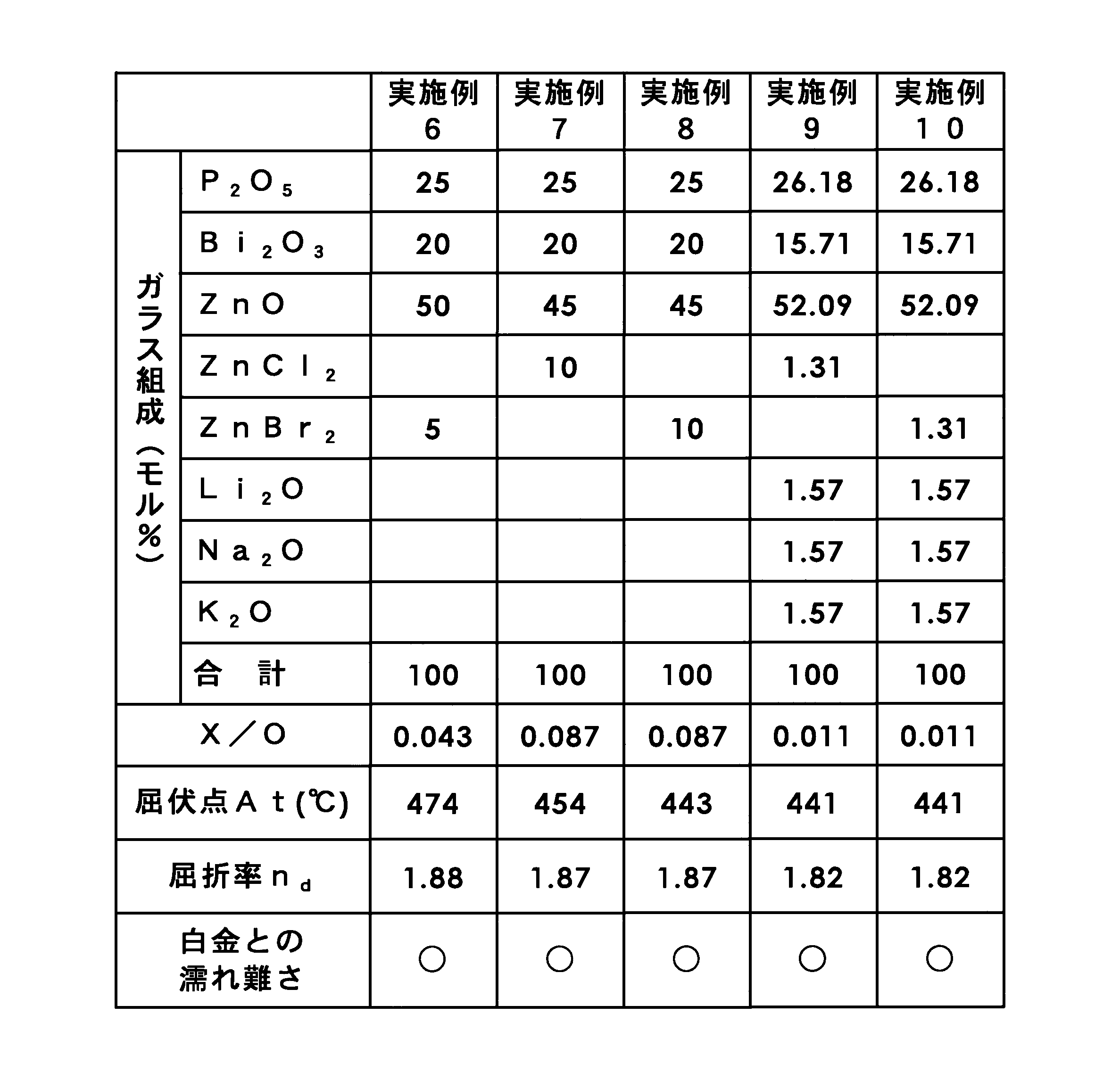
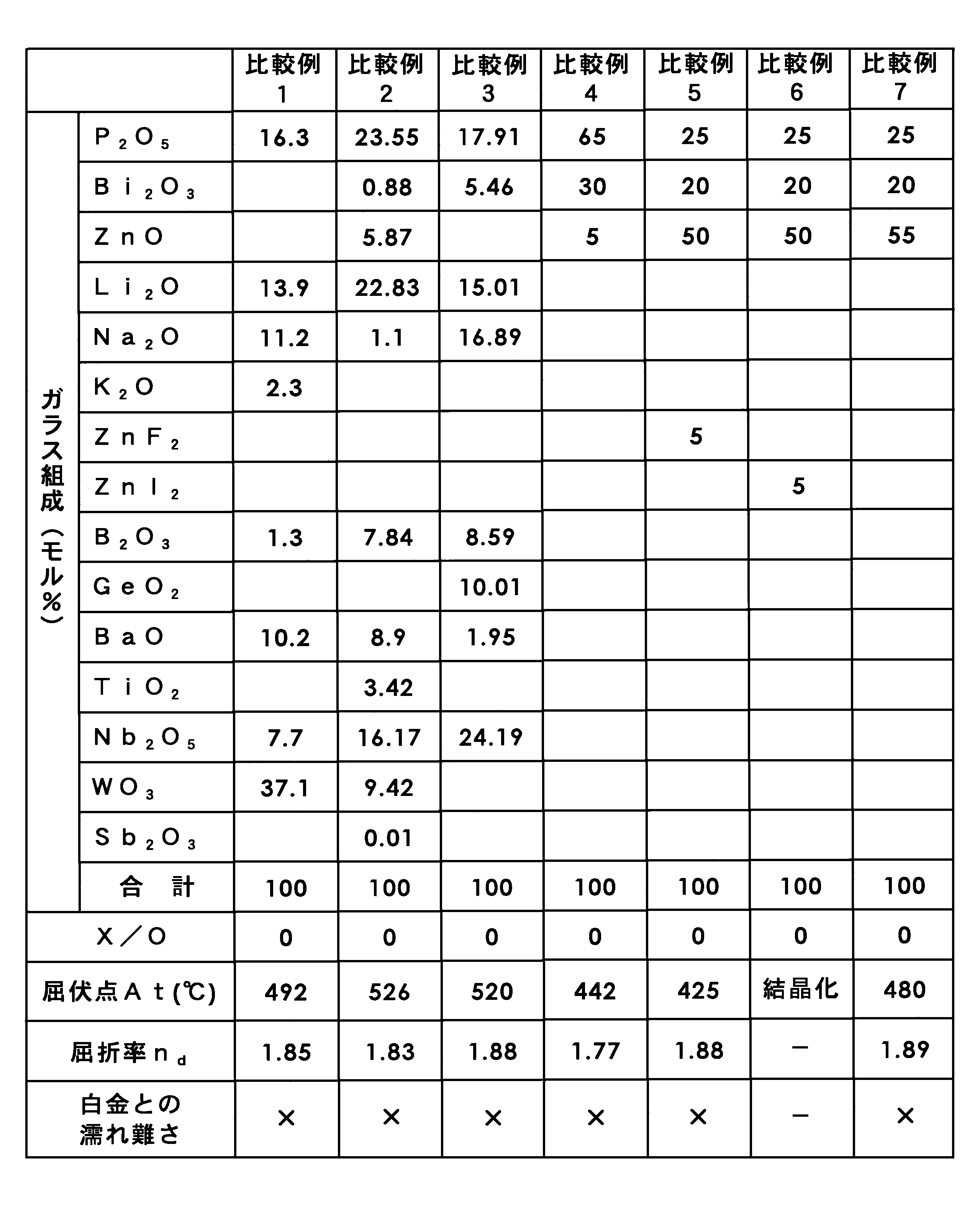
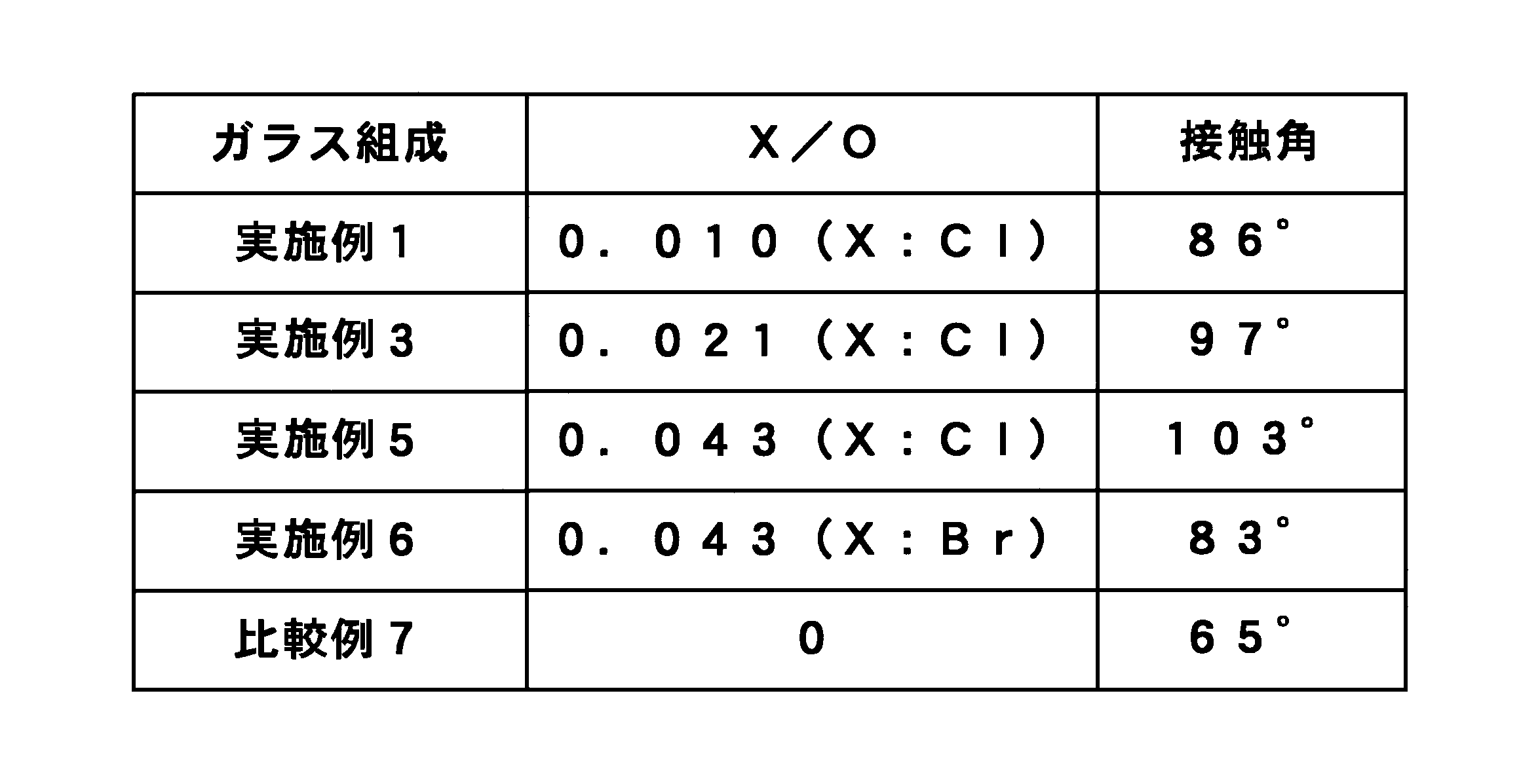
表1~表3より明らかなように、本発明の実施例のガラスは、何れも屈伏点(At)が482℃以下と比較的低い温度範囲にあるため、モールド成形が容易である。また1.82~1.88の範囲の高い屈折率(nd)を有する。更に白金に濡れ難いことも判る。これは表4の接触角からも判り、実施例1、3、5、6は接触角が80゜以上あり、白金に濡れ難いガラスである。これらのことから本発明の光学ガラスは、白金を主成分とした貴金属系離型膜を用いた精密モールド成形、特にガラスインプリントによる微細構造の転写に好ましい特徴を有していることが判る。
一方、比較例1~6のガラスは、何れも塩素又は臭素を少なくとも1つ含むハロゲンXを含まないため、白金に濡れ易く、白金を主成分とした貴金属系離型膜を用いた精密モールド成形、特にガラスインプリントによる微細構造の転写に適さないことが判る。
なお、比較例1は特許文献1の実施例54に相当し、比較例2は特許文献2の実施例3に相当し、比較例3は特許文献3の実施例9に相当する。これらは、何れもハロゲンXを含まないため白金に濡れ易いと共に、屈伏点(At)が490℃以上であり、モールドの耐久性の面からも本発明のガラスよりも不利である。
また比較例4は特許文献4の実施例6に相当する。このガラスはハロゲンXを含まないため白金に濡れ易いと共に、屈折率(nd)が1.77と本発明のガラスよりも低いことが判る。
更に比較例5は特許文献5の実施例4に相当し、ハロゲンとしてフッ素Fが含有されたものであり、比較例6はハロゲンとしてヨウ素Iが含有されたものであり、比較例7は本発明の実施例1~8において塩素Cl又は臭素Brが含まれない場合に相当する。
比較例5及び7は、本発明のガラスと同等の低屈伏点(At)、高屈折率(nd)を達成しているが、塩素Cl又は臭素Brを含まないため白金に濡れ易く、白金を主成分とした貴金属系離型膜を用いた精密モールド成形、特にガラスインプリントによる微細構造の転写に適さないことが判る。更に比較例6はヨウ素Iの添加によりガラスが不安定となり、結晶化し、良好なガラスが得られないことが判る。
また表4より、比較例7の接触角の測定結果が65゜しかないことからも、ハロゲンXを含まないため、ガラスが白金に濡れ易くなっており、白金を主成分とした貴金属系離型膜を用いた精密モールド成形、特にガラスインプリントによる微細構造の転写に適さないことが判る。
なお、比較例1は特許文献1の実施例54に相当し、比較例2は特許文献2の実施例3に相当し、比較例3は特許文献3の実施例9に相当する。これらは、何れもハロゲンXを含まないため白金に濡れ易いと共に、屈伏点(At)が490℃以上であり、モールドの耐久性の面からも本発明のガラスよりも不利である。
また比較例4は特許文献4の実施例6に相当する。このガラスはハロゲンXを含まないため白金に濡れ易いと共に、屈折率(nd)が1.77と本発明のガラスよりも低いことが判る。
更に比較例5は特許文献5の実施例4に相当し、ハロゲンとしてフッ素Fが含有されたものであり、比較例6はハロゲンとしてヨウ素Iが含有されたものであり、比較例7は本発明の実施例1~8において塩素Cl又は臭素Brが含まれない場合に相当する。
比較例5及び7は、本発明のガラスと同等の低屈伏点(At)、高屈折率(nd)を達成しているが、塩素Cl又は臭素Brを含まないため白金に濡れ易く、白金を主成分とした貴金属系離型膜を用いた精密モールド成形、特にガラスインプリントによる微細構造の転写に適さないことが判る。更に比較例6はヨウ素Iの添加によりガラスが不安定となり、結晶化し、良好なガラスが得られないことが判る。
また表4より、比較例7の接触角の測定結果が65゜しかないことからも、ハロゲンXを含まないため、ガラスが白金に濡れ易くなっており、白金を主成分とした貴金属系離型膜を用いた精密モールド成形、特にガラスインプリントによる微細構造の転写に適さないことが判る。
本発明の光学ガラスは、低屈伏点(At)、高屈折率(nd)で、白金に濡れ難く、非球面レンズ、表面に微細構造が形成された光波制御素子等の、白金を主成分とした貴金属系離型膜を用いた精密モールド成形に適した光学ガラスとして、産業上の利用性がある。
Claims (3)
- 酸化物換算で、
P2O5:15~30モル%
Bi2O3:5~35モル%
ZnO:40~75モル%
含有させ、且つ塩素Cl又は臭素Brの1種類以上よりなるハロゲンXを、酸素とのモル比で、
X/O:0.005~0.5
含有させてあることを特徴とする光学ガラス。 - リチウム、ナトリウム、カリウムの中から選ばれる少なくとも1つ以上のアルカリ金属元素Rを、R2Oの形で15モル%以下含有させることを特徴とする請求項1に記載の光学ガラス。
- 塩素Cl又は臭素Brの1種類以上よりなるハロゲンXを、ZnX2又はRXで添加することを特徴とする請求項1又は2に記載の光学ガラス。
Priority Applications (1)
| Application Number | Priority Date | Filing Date | Title |
|---|---|---|---|
| JP2012503208A JPWO2011108577A1 (ja) | 2010-03-02 | 2011-03-02 | 光学ガラス |
Applications Claiming Priority (2)
| Application Number | Priority Date | Filing Date | Title |
|---|---|---|---|
| JP2010044896 | 2010-03-02 | ||
| JP2010-044896 | 2010-03-02 |
Publications (1)
| Publication Number | Publication Date |
|---|---|
| WO2011108577A1 true WO2011108577A1 (ja) | 2011-09-09 |
Family
ID=44542224
Family Applications (1)
| Application Number | Title | Priority Date | Filing Date |
|---|---|---|---|
| PCT/JP2011/054736 Ceased WO2011108577A1 (ja) | 2010-03-02 | 2011-03-02 | 光学ガラス |
Country Status (2)
| Country | Link |
|---|---|
| JP (1) | JPWO2011108577A1 (ja) |
| WO (1) | WO2011108577A1 (ja) |
Cited By (1)
| Publication number | Priority date | Publication date | Assignee | Title |
|---|---|---|---|---|
| JP2018150216A (ja) * | 2017-03-15 | 2018-09-27 | 石塚硝子株式会社 | 亜鉛含有酸化物ガラスの製造方法及び亜鉛含有酸化物ガラス部材 |
Citations (6)
| Publication number | Priority date | Publication date | Assignee | Title |
|---|---|---|---|---|
| JPH02283635A (ja) * | 1988-12-22 | 1990-11-21 | Sumita Kogaku Glass:Kk | 紫外線透過フツリン酸塩ガラス |
| JPH07165436A (ja) * | 1991-05-06 | 1995-06-27 | Corning Inc | 高屈折率フッ素不含有リン酸塩ガラス |
| JP2004217513A (ja) * | 2002-12-27 | 2004-08-05 | Hoya Corp | 光学ガラス、プレス成形用プリフォームおよび光学素子 |
| JP2008013378A (ja) * | 2006-07-03 | 2008-01-24 | Hoya Corp | リン酸塩ガラス、フツリン酸塩ガラス、精密プレス成形用プリフォーム、光学素子およびそれぞれの製造方法 |
| JP2009256168A (ja) * | 2008-03-28 | 2009-11-05 | Hoya Corp | フツリン酸ガラス、精密プレス成形用プリフォーム、光学素子ブランクおよび光学素子とそれら製造方法 |
| JP2009256170A (ja) * | 2008-03-19 | 2009-11-05 | National Institute Of Advanced Industrial & Technology | 光学ガラス |
-
2011
- 2011-03-02 JP JP2012503208A patent/JPWO2011108577A1/ja not_active Withdrawn
- 2011-03-02 WO PCT/JP2011/054736 patent/WO2011108577A1/ja not_active Ceased
Patent Citations (6)
| Publication number | Priority date | Publication date | Assignee | Title |
|---|---|---|---|---|
| JPH02283635A (ja) * | 1988-12-22 | 1990-11-21 | Sumita Kogaku Glass:Kk | 紫外線透過フツリン酸塩ガラス |
| JPH07165436A (ja) * | 1991-05-06 | 1995-06-27 | Corning Inc | 高屈折率フッ素不含有リン酸塩ガラス |
| JP2004217513A (ja) * | 2002-12-27 | 2004-08-05 | Hoya Corp | 光学ガラス、プレス成形用プリフォームおよび光学素子 |
| JP2008013378A (ja) * | 2006-07-03 | 2008-01-24 | Hoya Corp | リン酸塩ガラス、フツリン酸塩ガラス、精密プレス成形用プリフォーム、光学素子およびそれぞれの製造方法 |
| JP2009256170A (ja) * | 2008-03-19 | 2009-11-05 | National Institute Of Advanced Industrial & Technology | 光学ガラス |
| JP2009256168A (ja) * | 2008-03-28 | 2009-11-05 | Hoya Corp | フツリン酸ガラス、精密プレス成形用プリフォーム、光学素子ブランクおよび光学素子とそれら製造方法 |
Cited By (1)
| Publication number | Priority date | Publication date | Assignee | Title |
|---|---|---|---|---|
| JP2018150216A (ja) * | 2017-03-15 | 2018-09-27 | 石塚硝子株式会社 | 亜鉛含有酸化物ガラスの製造方法及び亜鉛含有酸化物ガラス部材 |
Also Published As
| Publication number | Publication date |
|---|---|
| JPWO2011108577A1 (ja) | 2013-06-27 |
Similar Documents
| Publication | Publication Date | Title |
|---|---|---|
| JP4017832B2 (ja) | 光学ガラスおよび光学部品 | |
| TWI411590B (zh) | 光學玻璃、加壓成形用預成形物、和該製造方法、及光學元件和該製造方法 | |
| JP5358888B2 (ja) | 光学ガラス及び光学素子 | |
| US8183169B2 (en) | Phosphate glass, fluorophosphate glass, preform for precision press-molding, optical element and process for the production of thereof | |
| JP5570054B2 (ja) | 光学ガラス | |
| JP4408937B2 (ja) | ガラスの製造方法およびこのガラスから得られる精密プレス成形用プリフォームと光学素子 | |
| JP5108209B2 (ja) | 光学ガラス | |
| CN104854049A (zh) | 光学玻璃、压制成型用玻璃材料、光学元件 | |
| JP5744492B2 (ja) | 高屈折で高透明の光学ガラス | |
| JP4429295B2 (ja) | 光学ガラス | |
| JP6738243B2 (ja) | ガラス、プレス成形用ガラス素材、光学素子ブランクおよび光学素子 | |
| JP6480722B2 (ja) | ガラス、プレス成形用ガラス素材、光学素子ブランク、および光学素子 | |
| WO2013031385A1 (ja) | 光学ガラス | |
| JP2012229135A (ja) | 光学ガラス、プレス成形用ガラス素材、光学素子およびその製造方法、ならびに接合光学素子 | |
| JP4590386B2 (ja) | 光学ガラス | |
| JP5209897B2 (ja) | 光学ガラス | |
| JP5174373B2 (ja) | 光学ガラス | |
| CN106660859A (zh) | 光学玻璃 | |
| JP7134396B2 (ja) | 光学ガラス | |
| JP7132884B2 (ja) | 光学ガラスおよび光学素子 | |
| JP2019006643A (ja) | 光学ガラス | |
| TW202114956A (zh) | 光學玻璃及光學元件 | |
| CN110234612A (zh) | 光学玻璃、预制件以及光学元件 | |
| JPWO2011108577A1 (ja) | 光学ガラス | |
| JP2012206911A (ja) | 光学ガラス、精密プレス成型用プリフォーム、及び光学素子 |
Legal Events
| Date | Code | Title | Description |
|---|---|---|---|
| 121 | Ep: the epo has been informed by wipo that ep was designated in this application |
Ref document number: 11750686 Country of ref document: EP Kind code of ref document: A1 |
|
| WWE | Wipo information: entry into national phase |
Ref document number: 2012503208 Country of ref document: JP |
|
| NENP | Non-entry into the national phase |
Ref country code: DE |
|
| 122 | Ep: pct application non-entry in european phase |
Ref document number: 11750686 Country of ref document: EP Kind code of ref document: A1 |