WO2011108538A1 - 水/超臨界二酸化炭素マイクロエマルションを安定化するための界面活性剤 - Google Patents
水/超臨界二酸化炭素マイクロエマルションを安定化するための界面活性剤 Download PDFInfo
- Publication number
- WO2011108538A1 WO2011108538A1 PCT/JP2011/054620 JP2011054620W WO2011108538A1 WO 2011108538 A1 WO2011108538 A1 WO 2011108538A1 JP 2011054620 W JP2011054620 W JP 2011054620W WO 2011108538 A1 WO2011108538 A1 WO 2011108538A1
- Authority
- WO
- WIPO (PCT)
- Prior art keywords
- surfactant
- carbon dioxide
- water
- microemulsion
- group
- Prior art date
- Legal status (The legal status is an assumption and is not a legal conclusion. Google has not performed a legal analysis and makes no representation as to the accuracy of the status listed.)
- Ceased
Links
Images


Classifications
-
- C—CHEMISTRY; METALLURGY
- C01—INORGANIC CHEMISTRY
- C01B—NON-METALLIC ELEMENTS; COMPOUNDS THEREOF; METALLOIDS OR COMPOUNDS THEREOF NOT COVERED BY SUBCLASS C01C
- C01B32/00—Carbon; Compounds thereof
- C01B32/50—Carbon dioxide
-
- C—CHEMISTRY; METALLURGY
- C09—DYES; PAINTS; POLISHES; NATURAL RESINS; ADHESIVES; COMPOSITIONS NOT OTHERWISE PROVIDED FOR; APPLICATIONS OF MATERIALS NOT OTHERWISE PROVIDED FOR
- C09K—MATERIALS FOR MISCELLANEOUS APPLICATIONS, NOT PROVIDED FOR ELSEWHERE
- C09K23/00—Use of substances as emulsifying, wetting, dispersing, or foam-producing agents
-
- C—CHEMISTRY; METALLURGY
- C09—DYES; PAINTS; POLISHES; NATURAL RESINS; ADHESIVES; COMPOSITIONS NOT OTHERWISE PROVIDED FOR; APPLICATIONS OF MATERIALS NOT OTHERWISE PROVIDED FOR
- C09K—MATERIALS FOR MISCELLANEOUS APPLICATIONS, NOT PROVIDED FOR ELSEWHERE
- C09K23/00—Use of substances as emulsifying, wetting, dispersing, or foam-producing agents
- C09K23/02—Alkyl sulfonates or sulfuric acid ester salts derived from monohydric alcohols
-
- Y—GENERAL TAGGING OF NEW TECHNOLOGICAL DEVELOPMENTS; GENERAL TAGGING OF CROSS-SECTIONAL TECHNOLOGIES SPANNING OVER SEVERAL SECTIONS OF THE IPC; TECHNICAL SUBJECTS COVERED BY FORMER USPC CROSS-REFERENCE ART COLLECTIONS [XRACs] AND DIGESTS
- Y02—TECHNOLOGIES OR APPLICATIONS FOR MITIGATION OR ADAPTATION AGAINST CLIMATE CHANGE
- Y02P—CLIMATE CHANGE MITIGATION TECHNOLOGIES IN THE PRODUCTION OR PROCESSING OF GOODS
- Y02P20/00—Technologies relating to chemical industry
- Y02P20/50—Improvements relating to the production of bulk chemicals
- Y02P20/54—Improvements relating to the production of bulk chemicals using solvents, e.g. supercritical solvents or ionic liquids
Definitions
- the present invention relates to a surfactant, and more particularly to a surfactant for stabilizing a water / supercritical carbon dioxide microemulsion.
- Supercritical carbon dioxide (hereinafter also referred to as scCO 2 ) is a carbon dioxide fluid formed at a critical temperature (31.1 ° C.) and a critical pressure (73.8 bar) or higher, and is nonpolar such as hexane.
- ScCO 2 is expected as an environmentally friendly alternative solvent because of its relatively similar characteristics to the solvent.
- water (W) in scCO 2 is dispersed as fine droplets of nanometer level
- thermodynamically stable W / scCO 2 microemulsions (hereinafter sometimes expressed as W / scCO 2 ⁇ E) is It is expected to be applied to various fields such as dry cleaning, extraction of useful components such as metal ions and proteins, organic synthesis and fine particle synthesis by use as reaction fields.
- AOT Aralosol-OT [registered trademark]: sodium bis-2-ethyl-1-hexylsulfosuccinate
- W 0 c W 0 c is 10 or less at the maximum
- W 0 C is a value obtained by subtracting the molar ratio of water to surfactant 1 mole the amount of (W 0) from soluble in carbon dioxide water (moles), Micro surfactant in scCO 2 It is an indicator of the ability to form an emulsion (the ability to disperse water).
- TMN-6 Tegitol [registered trademark]: polyethylene glycol trimethylnonyl ether
- W / scCO 2 ⁇ E surfactant Non-patent Document 2, page 112, line 19. Line 29, or non-patent document 3).
- TMN-6 no other commercially available hydrocarbon surfactant has been reported.
- the present invention has been made in view of such circumstances, and an object thereof is to provide an excellent hydrocarbon surfactant for W / scCO 2 ⁇ E having a high water dispersion ability.
- the present invention relates to a surfactant for stabilizing a water / supercritical carbon dioxide microemulsion composed of a sulfate ester compound represented by the following formula (1).
- R 1 represents a hydrocarbon group having 6 to 30 carbon atoms having a branched chain
- M represents a hydrogen atom, an alkali metal, ammonium, a basic amino acid residue, a C 2 or 3 carbon atom, It represents an alkanolamine residue having a hydroxyalkyl group or an aliphatic alkanol ammonium.
- the R 1 relates to the surfactant according to the first aspect, which is a hydrocarbon group having 12 to 30 carbon atoms.
- the R 1 relates to the surfactant according to the first aspect, which is a hydrocarbon group having 12 to 24 carbon atoms.
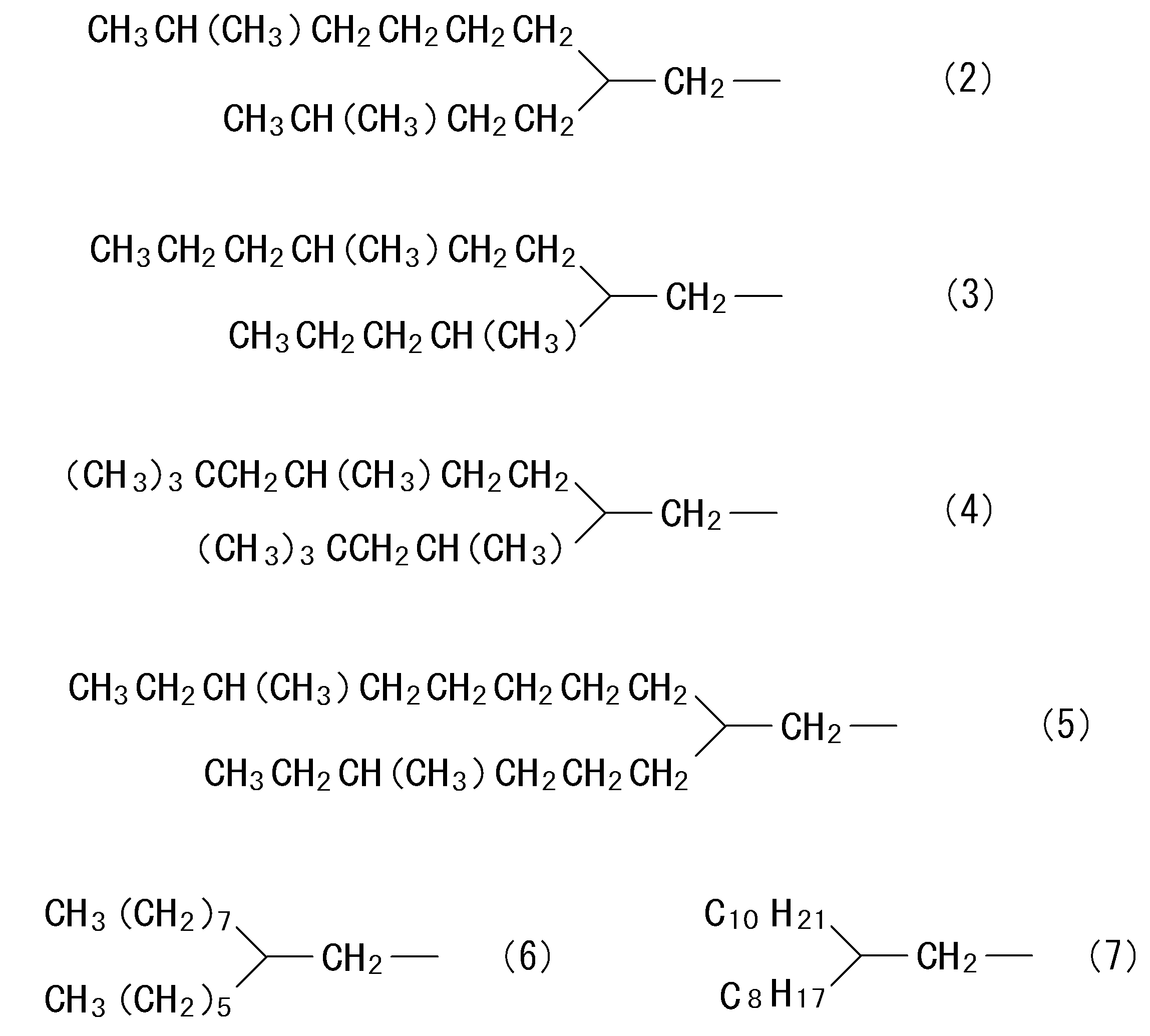
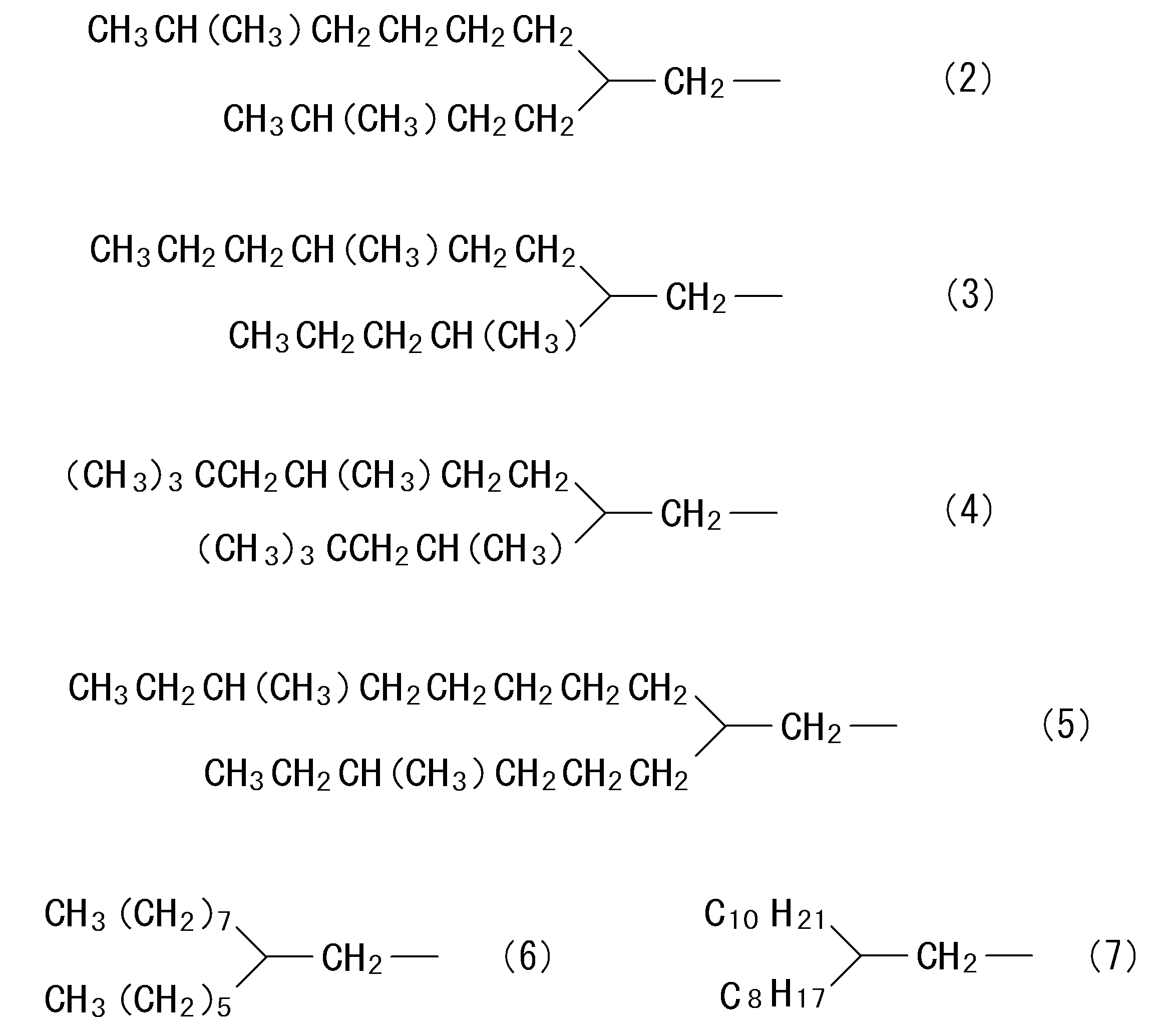
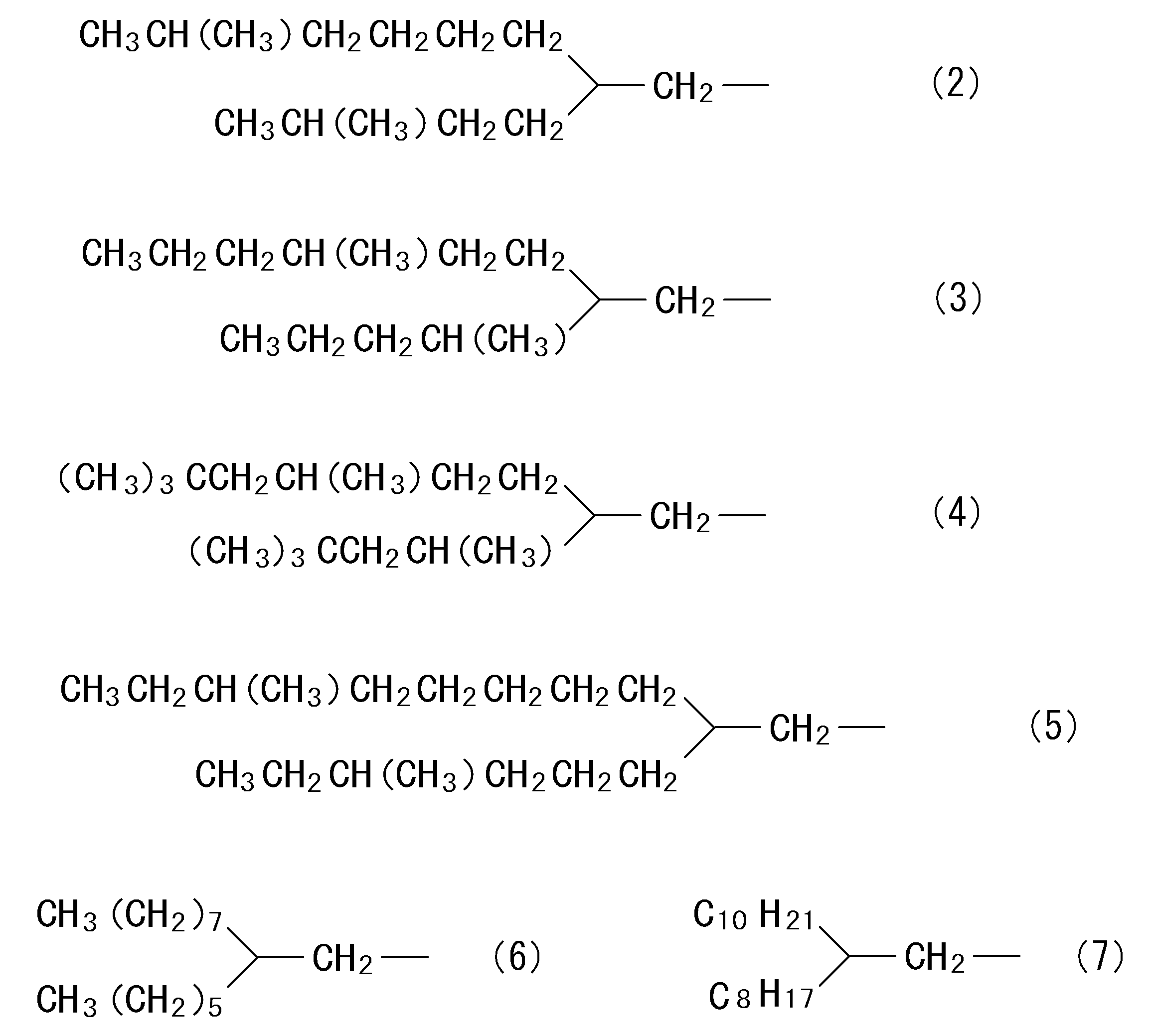
- the present invention relates to the surfactant according to the first aspect, wherein R 1 is any one of groups represented by the following formulas (2) to (7).
- the present invention relates to the surfactant according to the first aspect, characterized in that R 1 is a group represented by the above formula (4).
- the present invention relates to the surfactant according to the first aspect, wherein M is an alkali metal.
- water / supercritical carbon dioxide wherein the concentration of the surfactant described in the first aspect to the sixth aspect is 10 ⁇ 10 mol% to 10 2 mol% with respect to the molar amount of carbon dioxide. Relates to microemulsions.
- the amount of water (molar ratio (W 0 )) is 0.001 with respect to a molar amount of the surfactant described in the first to sixth aspects, a temperature of 75 ° C., and a pressure of 30 MPa. Relates to a water / supercritical carbon dioxide microemulsion, which is from 1,000 to 1,000.
- the surfactant of the present invention can remarkably improve the water-dispersing ability of the surfactant as compared with conventional hydrocarbon surfactants for W / scCO 2 ⁇ E.
- the surfactant of the present invention is a hydrocarbon-based surfactant, but has a water-dispersing ability comparable to or comparable to that of a fluorocarbon compound surfactant. Therefore, the surfactant of the present invention can be suitably used as a surfactant for W / scCO 2 ⁇ E.
- the sulfate ester compound which is the surfactant of the present invention can be easily synthesized from a cheap and versatile raw material that is industrially available by only one-step reaction.
- the surfactant of the present invention can maintain the effect as a surfactant even if unreacted raw materials remain in the synthesis.
- FIG. 1 is a diagram showing an outline of a phase behavior observation apparatus.
- FIG. 2 is a graph showing the relationship between the phase boundary pressure and the temperature at each W 0 obtained in Example 2.
- FIG. 3 is a phase diagram of the water / supercritical carbon dioxide / sodium isostearyl sulfate mixture obtained in Example 2, showing the relationship of temperature and supercritical carbon dioxide to W 0 C.
- FIG. 1 is a diagram showing an outline of a phase behavior observation apparatus.
- FIG. 2 is a graph showing the relationship between the phase boundary pressure and the temperature at each W 0 obtained in Example 2.
- FIG. 3 is a phase diagram of the water / supercritical carbon dioxide / sodium isostearyl sulfate mixture obtained in Example 2, showing the relationship of temperature and supercritical carbon dioxide to W
- 6 is a graph showing the change in absorbance at 318 nm in the UV-Vis absorption spectrum for W 0 or W 0 C obtained in Example 3.
- 6 is a graph showing the change in absorbance at 318 nm in the UV-Vis absorption spectrum for W 0 or W 0 C obtained in Example 3.
- the present invention is a surfactant for stabilizing a water / supercritical carbon dioxide microemulsion comprising a sulfate ester compound represented by the following formula (1).
- R 1 represents a hydrocarbon group having 6 to 30 carbon atoms having a branched chain
- M represents a hydrogen atom, an alkali metal, ammonium, a basic amino acid residue, a C 2 or 3 carbon atom
- It represents an alkanolamine residue having a hydroxyalkyl group or an aliphatic alkanol ammonium.
- hydrocarbon group having 6 to 30 carbon atoms having a branched chain examples include an isohexyl group, an isoheptyl group, an isooctyl group, an isononyl group, an isodecyl group, an isolauryl group, an isopalmityl group, an isomyristyl group, and an isostearyl group. And isoeicosyl group.
- a hydrocarbon group having 12 to 30 carbon atoms such as an isomyristyl group, an isopalmityl group, an isostearyl group, and an isoicosyl group is preferable. More preferred are hydrocarbon groups having 12 to 24 carbon atoms such as isomyristyl group, isopalmityl group, and isostearyl group.
- R 1 is preferably any one of groups represented by the following formulas (2) to (7).
- alkali metal examples include lithium, sodium, and potassium, and sodium or potassium is preferable.
- Examples of the basic amino acid residue include arginine residue, lysine residue, histidine residue, ornithine residue and the like.
- alkanolamine residue having a hydroxyalkyl group having 2 or 3 carbon atoms examples include a monoethanolamine residue, a diethanolamine residue, and a triethanolamine residue.
- Examples of the aliphatic alkanol ammonium include 2-amino-2-methyl-1-propanol and 2-amino-2-methyl-1,3-propanediol.
- the sulfate ester compound in the present invention can be synthesized by a known method. For example, it can be synthesized by reacting an alcohol having a hydrocarbon group having a branched chain with sulfur trioxide / pyridine in a pyridine solvent and treating with an aqueous sodium hydrogen carbonate solution.
- the alcohol having a hydrocarbon group having a branched chain As the alcohol having a hydrocarbon group having a branched chain, a commercially available product can be used. Specifically, trade names: Fine oxocol 140-N (FO140-N), Fine oxocol 1600 (FO -1600), fine oxocol 180 (FO-180), fine oxocol 180-N (FO180-N) and fine oxocol 2000 (FO-2000) (manufactured by Nissan Chemical Industries, Ltd.).
- trade names Fine oxocol 140-N (FO140-N), Fine oxocol 1600 (FO -1600), fine oxocol 180 (FO-180), fine oxocol 180-N (FO180-N) and fine oxocol 2000 (FO-2000) (manufactured by Nissan Chemical Industries, Ltd.).
- the concentration of the surfactant of the present invention is usually from 10 ⁇ 10 mol% to 10 2 mol%, or from 10 ⁇ 9 mol% to the molar amount of carbon dioxide. 10 mol%, or 10 ⁇ 8 mol% to 1 mol%.
- the concentration of the surfactant of the present invention may be at least the minimum concentration (referred to as c ⁇ c) that can form a microemulsion. For example, when the concentration is lower than 10 ⁇ 10 mol%, a water / supercritical carbon dioxide microemulsion is formed. Can not do it.
- the concentration of the surfactant can form a microemulsion without forming a liquid crystal phase, or may be equal to or less than the concentration of the upper limit which can be dissolved into carbon dioxide, for example, that it is higher concentration than 10 2 mol% of the liquid crystal phase formation Or may not be dissolved in carbon dioxide and may precipitate.
- the amount of water to be added (the molar ratio of water (W 0 )) is 1 for the molar amount of the surfactant of the present invention, 75 ° C., and 30 MPa in pressure. Usually 0.001 to 1,000, or 0.005 to 500, or 0.01 to 200.
- the mechanism of action of the surfactant of the present invention at W / scCO 2 ⁇ E particularly the water dispersion equivalent to or comparable to the surfactant of fluorocarbon compound when the surfactant of the present invention is W / scCO 2 ⁇ E.
- the reason for having the ability is not completely clear, but it is inferred as follows.
- the surfactant of the present invention has many methyl (CH 3- ) branched chains in a hydrophobic group, such as an isostearyl group. It is believed that this many methyl branched chains increase the free volume of supercritical carbon dioxide and promote solvation with small carbon dioxide molecules.
- the isostearyl group has as many as 18 carbon atoms in the hydrocarbon portion and is solidified as a single hydrophobic chain, TMN-6 (the hydrocarbon portion has 12 carbon atoms) or AOT4 ( The hydrocarbon portion has sufficient hydrophobicity compared to 9 ⁇ 2 carbon atoms). Therefore, it is considered that the isostearyl group has both high carbon dioxide affinity and hydrophobicity necessary for the hydrophobic group of the surfactant for W / scCO 2 ⁇ E.
- the sulfate group which is a hydrophilic group, has high hydrophilicity, but has a property that is not compatible with carbon dioxide (sparse carbon dioxide).
- the immobilization of the surfactant molecule at the water / carbon dioxide interface is strengthened. That is, it is considered that the amount of molecules dissolved in the water phase and the carbon dioxide phase decreases, the amount of adsorption to the interface increases, and the property of efficiently dispersing water in carbon dioxide is imparted.
- reverse micelle an important molecular assembly that maintains W / scCO 2 ⁇ E, which is a micelle with the hydrophilic group on the inside and the hydrophobic group on the outside
- sodium isostearyl sulfate is presumed to have realized the construction of W / scCO 2 ⁇ E in which a large amount of water is dispersed while being a hydrocarbon surfactant.
- an aqueous sodium bicarbonate solution prepared by dissolving reagent powder manufactured by Wako Pure Chemical Industries, Ltd. in 20 mL of water: 1.84 mol / L
- aqueous sodium bicarbonate solution prepared by dissolving reagent powder manufactured by Wako Pure Chemical Industries, Ltd. in 20 mL of water: 1.84 mol / L
- this reaction solution is transferred to a separatory funnel, saturated saline (40 mL) is added as an aqueous phase, and 1-butanol (40 mL, manufactured by Wako Pure Chemical Industries, Ltd.) is added as an organic phase, and the organic phase is separated. did.
- Example 2 [Phase observation of water / supercritical carbon dioxide / isostearyl sulfate mixture-1]
- a volume-variable pressure cell made by Tama Seiki Kogyo Co., Ltd., inner diameter: 24 mm
- a window that allows the inside to be seen
- water / supercritical carbon dioxide / isostearyl sodium sulfate The phase behavior of the mixture was observed.
- 0.143 g (0.386 mmol) of sodium isostearyl sulfate (containing 13.9% isostearyl alcohol as an impurity) obtained in Example 1 was charged in the piston front portion (window side) in the variable volume pressure cell.
- variable volume pressure cell After sealing, the inside of the variable volume pressure cell was dried using a vacuum pump. Next, the temperature in the variable volume pressure cell was set to 35 ° C., and 20 g of carbon dioxide (manufactured by Nippon Liquid Co., Ltd., purity 99.99% or more) 20 g (isostearyl sulfate) at the piston front of the variable volume pressure cell Sodium concentration (to carbon dioxide: 0.08 mol%) was injected. Then, after raising the temperature of the variable volume pressure cell to 75 ° C., the pressure at the rear of the piston of the variable volume pressure cell is increased to 34.3 MPa (350 kgf / cm 2 ) and stirred overnight to allow sodium isostearyl sulfate.
- carbon dioxide manufactured by Nippon Liquid Co., Ltd., purity 99.99% or more
- Sodium concentration to carbon dioxide: 0.08 mol%
- phase boundary pressure (expressed as pressure) was measured at 75 ° C. to 35 ° C. at 10 ° C. intervals (confirmed visually).
- the phase boundary pressure in this state is a limit pressure at which 0.08 mol% of sodium isostearyl sulfate can be dissolved in carbon dioxide.
- the pressure inside the variable volume pressure cell was gradually decreased again, and the phase boundary pressure was measured (at intervals of 10 ° C. from 75 ° C. to 35 ° C.).
- the same operation as described above was repeated by introducing 40 ⁇ L of water. This operation was performed at 75 ° C. and 34.3 MPa (350 kgf / cm 2 ) until no homogeneous phase was formed, and phase boundary pressure data was collected.
- the homogeneous phase is a microemulsion phase when there is an amount of water that should not dissolve in carbon dioxide, the cloudy phase that appears due to the pressure drop is the macroemulsion phase, and the phase boundary pressure is the boundary between these phases. Represents pressure.
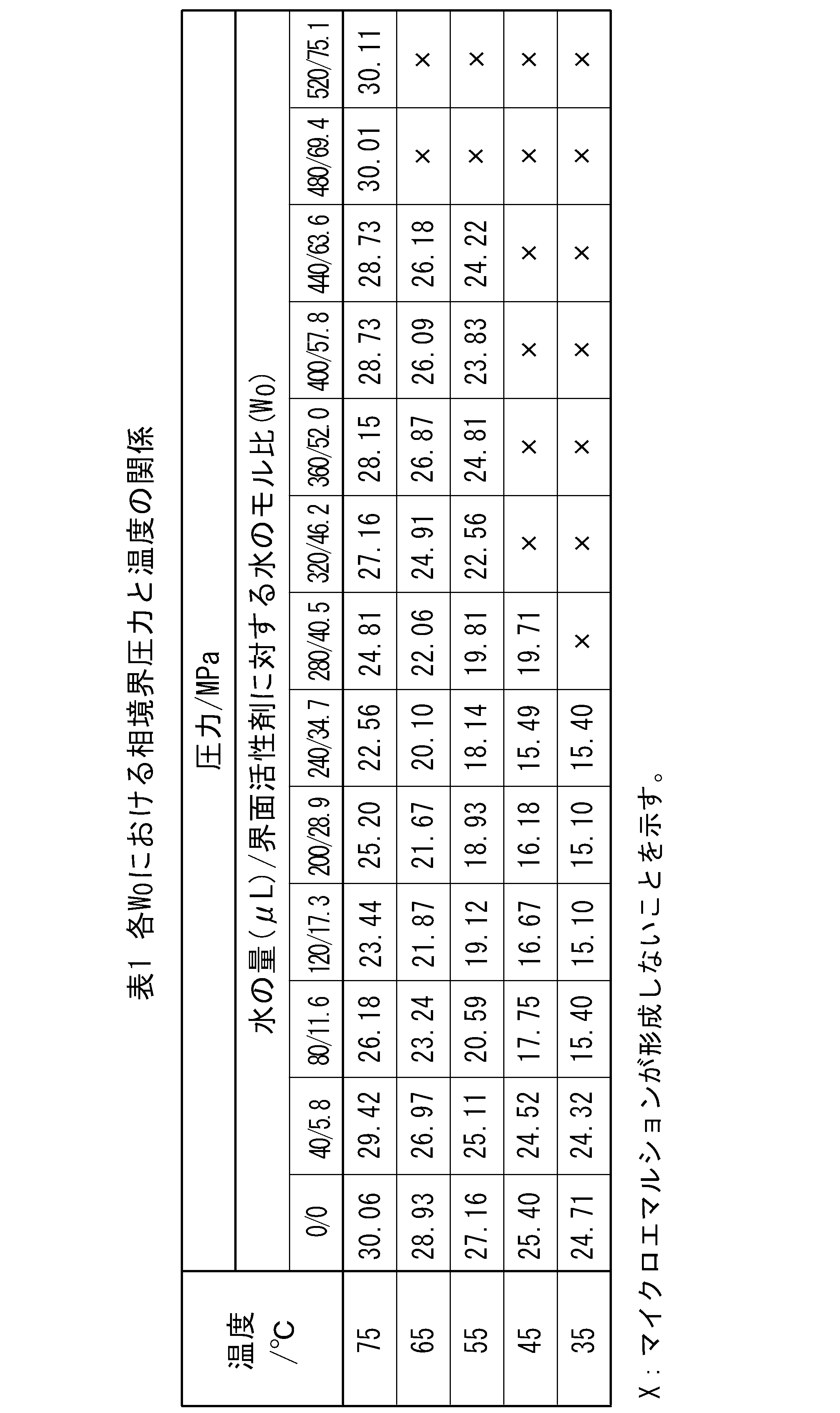
- the molar ratio of water to the surfactant (sodium isostearyl sulfate, 1 mol) present in the system is W 0, and the relationship between the phase boundary pressure and temperature at each W 0 is shown in Table 1 and FIG. Note that, under the condition where W 0 is larger than 75.1, the formation of the microemulsion phase was not confirmed in the temperature range of 35 to 75 ° C. and the pressure range of 40 MPa or less, and only the precipitated phase separated from the aqueous phase appeared.
- FIG. 3 shows the relationship of W 0 C to temperature / supercritical carbon dioxide density as a phase diagram of a water / supercritical carbon dioxide / sodium isostearyl sulfate mixture.
- W 0 C represents the molar ratio of water in which 1 mol of sodium isostearyl sulfate can be dispersed in supercritical carbon dioxide, and is a value obtained by subtracting the number of moles of water that can be dissolved in supercritical carbon dioxide from W 0. .
- ⁇ E shown in the figure means a microemulsion, and formation of a microemulsion was confirmed in a region indicated by ⁇ E, and a macroemulsion phase and an aqueous phase were precipitated in other regions indicated by E. A precipitated phase was formed.
- Microemulsions can be formed.
- the phase diagram of water / supercritical carbon dioxide / isostearyl sulfate sodium mixtures as the relationship W 0 C for density temperature and supercritical carbon dioxide in FIG. 3 is shown, until W 0 C higher region, Furthermore, formation of a microemulsion phase has been confirmed in a wide range, and it can be said that the microemulsion forming ability is higher than that of the surfactant (TMN-6).
- Example 3 [Phase behavior observation of water / supercritical carbon dioxide / isostearyl sulfate mixture-2] Similarly to Example 2, the phase behavior of the water / supercritical carbon dioxide / sodium isostearyl sulfate mixture was observed using the apparatus assembled as shown in FIG. In this system, sodium p-toluenesulfonate was used as a marker. 0.143 g (0.386 mmol) of sodium isostearyl sulfate (containing 13.9% isostearyl alcohol as an impurity) obtained in Example 1 was charged in the piston front portion (window side) in the variable volume pressure cell. After sealing, the inside of the variable volume pressure cell was dried using a vacuum pump.
- the temperature in the variable volume pressure cell was set to 35 ° C., and 20 g of carbon dioxide (manufactured by Nippon Liquid Co., Ltd., purity 99.99% or more) 20 g (isostearyl sulfate) at the piston front of the variable volume pressure cell Sodium concentration (to carbon dioxide: 0.08 mol%) was injected. Then, the temperature of the volume variable pressure cell was 75 ° C., the pressure at the rear part of the piston of the volume variable pressure cell was 37 MPa, and stirred to obtain a transparent and uniform sodium isostearyl sulfate / carbon dioxide solution.
- FIG. 6 shows the change in absorbance at 318 nm of the UV-Vis absorption spectrum for W 0 or W 0 C.
- W 0 57.6
- the water / supercritical carbon dioxide microemulsion formed with the surfactant of the present invention is expected to be applied in various fields such as synthesis of fine particles and nanocapsules, dry cleaning, and extraction of useful substances such as metal ions and proteins. Has been. Therefore, the surfactant of the present invention is industrially very advantageous.
Landscapes
- Chemical & Material Sciences (AREA)
- Organic Chemistry (AREA)
- Engineering & Computer Science (AREA)
- Materials Engineering (AREA)
- Chemical Kinetics & Catalysis (AREA)
- Inorganic Chemistry (AREA)
- Organic Low-Molecular-Weight Compounds And Preparation Thereof (AREA)
- Emulsifying, Dispersing, Foam-Producing Or Wetting Agents (AREA)
- Colloid Chemistry (AREA)
Abstract
Description
すなわち、第1観点として、下記式(1)で表される硫酸エステル化合物からなる、水/超臨界二酸化炭素マイクロエマルションを安定化するための界面活性剤に関する。

第2観点として、前記R1は、炭素原子数が12乃至30の炭化水素基であることを特徴とする、第1観点に記載の界面活性剤に関する。
第3観点として、前記R1は、炭素原子数が12乃至24の炭化水素基であることを特徴とする、第1観点に記載の界面活性剤に関する。
第4観点として、前記R1が、下記式(2)乃至式(7)で表される基のいずれかであることを特徴とする、第1観点に記載の界面活性剤に関する。
第6観点として、前記Mが、アルカリ金属であることを特徴とする、第1観点に記載の界面活性剤に関する。
第7観点として、第1観点乃至第6観点に記載の前記界面活性剤の濃度が、二酸化炭素のモル量に対して10-10mol%乃至102mol%である、水/超臨界二酸化炭素マイクロエマルションに関する。
第8観点として、前記水の量(モル比(W0))が、第1観点乃至第6観点に記載の前記界面活性剤のモル量1、温度75℃、圧力30MPaに対して0.001乃至1,000である、水/超臨界二酸化炭素マイクロエマルションに関する。
また、本発明の界面活性剤である硫酸エステル化合物は、工業的に入手し易い安価で汎用性に富む原料から1段階の反応のみで容易に合成することができる。
さらに、本発明の界面活性剤は、合成において、未反応の原料が残っていたとしても、界面活性剤としての効果を維持することができる。
本発明は、下記式(1)で表される硫酸エステル化合物からなる、水/超臨界二酸化炭素マイクロエマルションを安定化するための界面活性剤である。

本発明の界面活性剤は疎水基、例えばイソステアリル基に多くのメチル(CH3-)枝分れ鎖が存在する。この多くのメチル枝分れ鎖が、超臨界二酸化炭素の自由体積を増大させ、小さな二酸化炭素分子との溶媒和を促進させると考えられる。さらに、イソステアリル基は、炭化水素部分の炭素原子数が18個と多く、一本の疎水鎖として固まって存在するため、TMN-6(炭化水素部分の炭素原子数は12個)やAOT4(炭化水素部分の炭素原子数が9個×2本)に比べて十分な疎水性を持つ。したがって、イソステアリル基は、W/scCO2μE用界面活性剤の疎水基に必要な高い親二酸化炭素性と疎水性を併せ持つと考えられる。一方で、親水基である硫酸基は、高い親水性を持つが、二酸化炭素に全くなじまない性質(疎二酸化炭素)を持つ。このような全く相反する親媒性の2つの基(イソステアリル基と硫酸基)を併せ一つの界面活性剤分子とすることで、水/二酸化炭素界面への界面活性剤分子の固定化が強まる、すなわち、水相及び二酸化炭素相への分子溶解量が減り、界面への吸着量が増大し、効率的に水を二酸化炭素中に分散する性質が付与されると考えられる。また、親水基に対して非常に嵩高い疎水基を持つため、逆ミセル(親水基を内側、疎水基を外側にしたミセルであり、W/scCO2μEを維持させる重要な分子集合体)形態の分子充填を安定化させる。
以上のようなことが働き、イソステアリル硫酸ナトリウムは、炭化水素系界面活性剤でありながら多量の水を分散させたW/scCO2μEの構築を実現したものと推論される。
[界面活性剤:イソステアリル硫酸ナトリウム(C18H37OSO3Na)の合成]
100mLのナスフラスコにイソステアリルアルコール(日産化学工業(株)製、製品名:ファインオキソコール180、グレード:FO-180)5.32g(19.7mmol)及び三酸化硫黄/ピリジン錯体(Acros Organics製)3.79g(23.8mmol)を仕込み、ピリジン(関東化学(株)製)30.0mLを添加して内容物を溶解し、50℃で10時間攪拌した。次に氷水で冷やしながら、この反応溶液に炭酸水素ナトリウム水溶液20.0mL(和光純薬工業(株)製の試薬粉末を水20mLに溶解して調製:1.84mol/L)を添加し、そして50℃で10分間攪拌した。
その後、この反応溶液を分液ロートに移し、水相として飽和食塩水(40mL)を、有機相として1-ブタノール(和光純薬工業(株)製、40mL)を添加し、有機相を分取した。そして、残った水相に1-ブタノール40mLを添加し、有機相を分取するという操作を3回繰り返し、反応生成物を抽出した。次に、pH試験紙を用いて水相がアルカリ性であることを確認した後、脱水のため硫酸カルシウム(W.A.HAMMOND DRIERITE社製、DRIERITE[登録商標](ドライアライト)、10-20mesh)を有機相に添加し、その後硫酸カルシウムを濾過により除去した。得られた濾液を減圧濃縮し、固体(NaCl)が析出してくるたびに濾過により固体を除去しながら減圧濃縮を続けた。そして、80℃で真空乾燥させたシリカゲル(関東化学(株)製、シリカゲル60(球状)、粒径63-210μm)及び硫酸カルシウムであらかじめ脱水した展開溶媒(エタノール(和光純薬工業(株)製):ヘキサン(和光純薬工業(株)製)=1:10)を用いてカラムクロマトグラフィーで3回精製することで、目的物である下記式(8)で表されるイソステアリル硫酸ナトリウム1.77gを得た(収率:24.2%)。

[水/超臨界二酸化炭素/イソステアリル硫酸ナトリウム混合物の相挙動観察-1]
内部が見えるような窓を備えた容積可変型耐圧セル(多摩精器工業(株)製、内径:24mm)を図1に示すように装置として組み立て、水/超臨界二酸化炭素/イソステアリル硫酸ナトリウム混合物の相挙動観察を行った。
容積可変型耐圧セル内のピストン前部(窓側)に実施例1で得られたイソステアリル硫酸ナトリウム(不純物として13.9%のイソステアリルアルコールを含有する)0.143g(0.386mmol)を仕込み、密閉した後に真空ポンプを用いて容積可変型耐圧セル内を乾燥した。次に容積可変型耐圧セル内の温度を35℃に設定し、容積可変型耐圧セルのピストン前部に二酸化炭素(日本液炭(株)製、純度99.99%以上)20g(イソステアリル硫酸ナトリウム濃度(対二酸化炭素):0.08mol%)を圧入した。そして、容積可変型耐圧セルの温度を75℃まで上げた後、容積可変型耐圧セルのピストン後部の圧力を34.3MPa(350kgf/cm2)まで上げ、一晩撹拌することでイソステアリル硫酸ナトリウムを二酸化炭素中に溶解させ、透明な均一相が得られるのを目視で確認した。なお、以下に示す容積可変型耐圧セル内の圧力は、容積可変型耐圧セルのピストン後部の二酸化炭素を昇圧・減圧することで調節されるものである。
次にこの均一相の状態から、容積可変型耐圧セル内の圧力を徐々に低下させ、耐圧セル内が曇り始める(界面活性剤が析出し始め、不均一相となる)圧力(以下、相境界圧力と表記)を75℃から35℃まで10℃間隔で測定(目視で確認)した。なお、この状態の相境界圧力は、二酸化炭素中に0.08mol%のイソステアリル硫酸ナトリウムが溶解できる限界の圧力である。
そして、35℃までの相境界圧力を測定した後、6ポートバルブを使用して容積可変型耐圧セル内に水を40μL導入し、透明な均一相が得られるまで75℃、34.3MPa(350kgf/cm2)で撹拌を行った。
(測定)系内に存在する界面活性剤(イソステアリル硫酸ナトリウム、1モル)に対する水のモル比をW0とし、各W0における相境界圧力と温度の関係を表1及び図2に示す。なお、W0が75.1より大きい条件下では、35~75℃の温度範囲、40MPa以下の圧力範囲ではマイクロエマルション相の形成は確認されず、水相が分離した析出相のみが現れた。
[水/超臨界二酸化炭素/イソステアリル硫酸ナトリウム混合物の相挙動観察-2]
実施例2と同様に、図1のように組み立てた装置を用いて水/超臨界二酸化炭素/イソステアリル硫酸ナトリウム混合物の相挙動観察を行った。なお、本系ではマーカーとしてp-トルエンスルホン酸ナトリウムを用いた。
容積可変型耐圧セル内のピストン前部(窓側)に実施例1で得られたイソステアリル硫酸ナトリウム(不純物として13.9%のイソステアリルアルコールを含有する)0.143g(0.386mmol)を仕込み、密閉した後に真空ポンプを用いて容積可変型耐圧セル内を乾燥した。次に容積可変型耐圧セル内の温度を35℃に設定し、容積可変型耐圧セルのピストン前部に二酸化炭素(日本液炭(株)製、純度99.99%以上)20g(イソステアリル硫酸ナトリウム濃度(対二酸化炭素):0.08mol%)を圧入した。そして、容積可変型耐圧セルの温度を75℃、容積可変型耐圧セルのピストン後部の圧力を37MPaにして、撹拌することで透明・均一なイソステアリル硫酸ナトリウム/二酸化炭素溶液を得た。次にp-トルエンスルホン酸(和光純薬工業(株)製)0.0392gを水40mLに溶かし、その後、6ポートバルブと高圧ポンプを利用して炭酸水素ナトリウム(和光純薬工業(株)製)で中和することで調製した0.1wt%p-トルエンスルホン酸ナトリウム水溶液をマーカー溶液として40μL添加し、攪拌した。均一な一液相を得たところで、装置に接続した石英窓を有する耐圧分光セル((有)エルテックス製、光路長10mm)を通して分光光度計((株)日立ハイテクノロジーズ製、U-2810)によりUV-Vis吸収スペクトルを測定した。40μLのp-トルエンスルホン酸ナトリウム水溶液の添加・撹拌、UV-Vis吸収スペクトルの測定を繰り返し行うことで、W0=86.5(W0 C=71.5)までのデータを収集した。
以上の結果から、W0 C=35程度の水を確実にマイクロエマルションとしてイソステアリル硫酸ナトリウムにより分散できることが明らかであり、公知で炭化水素系の界面活性剤として最高水準であるTMN-6(W0 C=20程度)と比較して約1.5倍以上のマイクロエマルション形成能を有することが明らかである。
なお、マーカーのp-トルエンスルホン酸ナトリウムによりマイクロエマルションの形成が不安定化されていることが考えられ、実施例2のように純水を用いた場合にはより高いW0 Cまでマイクロエマルションを形成していると考えられる。
2:CCDカメラ
3:分光光度計
4:ポンプ
5:6-ポートバルブ+25μLサンプルループ
6:容積可変型耐圧セル
7:窓
8:攪拌子
9:可動ピストン
10:圧力計
11:スクリューボンベ
12:CO2ボンベ
Claims (8)
- 下記式(1)で表される硫酸エステル化合物からなる、水/超臨界二酸化炭素マイクロエマルションを安定化するための界面活性剤。

- 前記R1は、炭素原子数が12乃至30の炭化水素基であることを特徴とする、請求項1に記載の界面活性剤。
- 前記R1は、炭素原子数が12乃至24の炭化水素基であることを特徴とする、請求項1に記載の界面活性剤。
- 前記R1が、下記式(2)乃至式(7)で表される基のいずれかであることを特徴とする、請求項1に記載の界面活性剤。
- 前記R1が、上記式(4)で表される基であることを特徴とする、請求項1に記載の界面活性剤。
- 前記Mが、アルカリ金属であることを特徴とする、請求項1に記載の界面活性剤。
- 請求項1乃至請求項6に記載の前記界面活性剤の濃度が、二酸化炭素のモル量に対して10-10mol%乃至102mol%である、水/超臨界二酸化炭素マイクロエマルション。
- 前記水の量(モル比(W0))が、請求項1乃至請求項6に記載の前記界面活性剤のモル量1、温度75℃、圧力30MPaに対して0.001乃至1,000である、水/超臨界二酸化炭素マイクロエマルション。
Priority Applications (3)
| Application Number | Priority Date | Filing Date | Title |
|---|---|---|---|
| US13/582,580 US20130023687A1 (en) | 2010-03-04 | 2011-03-01 | Surfactant for stabilizing water/supercritical carbon dioxide microemulsion |
| JP2012503187A JP5727995B2 (ja) | 2010-03-04 | 2011-03-01 | 水/超臨界二酸化炭素マイクロエマルションを安定化するための界面活性剤 |
| US14/309,160 US9101894B2 (en) | 2010-03-04 | 2014-06-19 | Surfactant for stabilizing water/supercritical carbon dioxide microemulsion |
Applications Claiming Priority (2)
| Application Number | Priority Date | Filing Date | Title |
|---|---|---|---|
| JP2010048373 | 2010-03-04 | ||
| JP2010-048373 | 2010-03-04 |
Related Child Applications (2)
| Application Number | Title | Priority Date | Filing Date |
|---|---|---|---|
| US13/582,580 A-371-Of-International US20130023687A1 (en) | 2010-03-04 | 2011-03-01 | Surfactant for stabilizing water/supercritical carbon dioxide microemulsion |
| US14/309,160 Division US9101894B2 (en) | 2010-03-04 | 2014-06-19 | Surfactant for stabilizing water/supercritical carbon dioxide microemulsion |
Publications (1)
| Publication Number | Publication Date |
|---|---|
| WO2011108538A1 true WO2011108538A1 (ja) | 2011-09-09 |
Family
ID=44542188
Family Applications (1)
| Application Number | Title | Priority Date | Filing Date |
|---|---|---|---|
| PCT/JP2011/054620 Ceased WO2011108538A1 (ja) | 2010-03-04 | 2011-03-01 | 水/超臨界二酸化炭素マイクロエマルションを安定化するための界面活性剤 |
Country Status (3)
| Country | Link |
|---|---|
| US (2) | US20130023687A1 (ja) |
| JP (1) | JP5727995B2 (ja) |
| WO (1) | WO2011108538A1 (ja) |
Cited By (1)
| Publication number | Priority date | Publication date | Assignee | Title |
|---|---|---|---|---|
| JP2023547434A (ja) * | 2020-10-27 | 2023-11-10 | ビーエーエスエフ ソシエタス・ヨーロピア | 有害生物防除用マイクロエマルジョン組成物 |
Families Citing this family (2)
| Publication number | Priority date | Publication date | Assignee | Title |
|---|---|---|---|---|
| WO2011108538A1 (ja) | 2010-03-04 | 2011-09-09 | 日産化学工業株式会社 | 水/超臨界二酸化炭素マイクロエマルションを安定化するための界面活性剤 |
| JP5620198B2 (ja) * | 2010-09-01 | 2014-11-05 | 日産化学工業株式会社 | 界面活性剤 |
Citations (3)
| Publication number | Priority date | Publication date | Assignee | Title |
|---|---|---|---|---|
| JPS5762213A (en) * | 1980-10-03 | 1982-04-15 | Pola Chem Ind Inc | Cosmetic |
| JPH04505916A (ja) * | 1989-06-05 | 1992-10-15 | ヘンケル・コマンディットゲゼルシャフト・アウフ・アクチェン | 脂肪アルキルスルフェートおよび脂肪アルキルポリアルキレングリコールエーテルスルフェート、それらの製法並びにそれらの用途 |
| JP2006524566A (ja) * | 2003-04-25 | 2006-11-02 | エチファルム | 超臨界圧流体への水溶性又は親水性物質の分散方法 |
Family Cites Families (6)
| Publication number | Priority date | Publication date | Assignee | Title |
|---|---|---|---|---|
| US2654772A (en) * | 1950-05-06 | 1953-10-06 | Du Pont | 2-(1, 3, 3-trimethylbutyl)-5, 7, 7-trimethyl octanol-1-sulfate |
| PH11997056158B1 (en) * | 1996-04-16 | 2001-10-15 | Procter & Gamble | Mid-chain branched primary alkyl sulphates as surfactants |
| JP2004315675A (ja) | 2003-04-17 | 2004-11-11 | Daikin Ind Ltd | 二酸化炭素溶媒用界面活性剤 |
| WO2005113488A1 (ja) * | 2004-05-20 | 2005-12-01 | Daikin Industries, Ltd. | フルオロアルキル基と炭化水素基を有する分岐型界面活性剤 |
| WO2011108538A1 (ja) | 2010-03-04 | 2011-09-09 | 日産化学工業株式会社 | 水/超臨界二酸化炭素マイクロエマルションを安定化するための界面活性剤 |
| JP5620198B2 (ja) * | 2010-09-01 | 2014-11-05 | 日産化学工業株式会社 | 界面活性剤 |
-
2011
- 2011-03-01 WO PCT/JP2011/054620 patent/WO2011108538A1/ja not_active Ceased
- 2011-03-01 US US13/582,580 patent/US20130023687A1/en not_active Abandoned
- 2011-03-01 JP JP2012503187A patent/JP5727995B2/ja active Active
-
2014
- 2014-06-19 US US14/309,160 patent/US9101894B2/en active Active
Patent Citations (3)
| Publication number | Priority date | Publication date | Assignee | Title |
|---|---|---|---|---|
| JPS5762213A (en) * | 1980-10-03 | 1982-04-15 | Pola Chem Ind Inc | Cosmetic |
| JPH04505916A (ja) * | 1989-06-05 | 1992-10-15 | ヘンケル・コマンディットゲゼルシャフト・アウフ・アクチェン | 脂肪アルキルスルフェートおよび脂肪アルキルポリアルキレングリコールエーテルスルフェート、それらの製法並びにそれらの用途 |
| JP2006524566A (ja) * | 2003-04-25 | 2006-11-02 | エチファルム | 超臨界圧流体への水溶性又は親水性物質の分散方法 |
Non-Patent Citations (2)
| Title |
|---|
| MASANOBU SAGISAKA: "Preparation and Application of Organic Solvent-Free Supercritical Carbon Dioxide Microemulsions", JOURNAL OF THE JAPAN SOCIETY OF COLOUR MATERIAL, vol. 83, no. 2, 20 February 2010 (2010-02-20), pages 66 - 75 * |
| RYOO W: "Electrostatic Stabilization of Colloids in Carbon Dioxide: Electrophoresis and Dielectrophoresis", LANGMUIR, vol. 21, no. 13, 2005, pages 5914 - 23 * |
Cited By (1)
| Publication number | Priority date | Publication date | Assignee | Title |
|---|---|---|---|---|
| JP2023547434A (ja) * | 2020-10-27 | 2023-11-10 | ビーエーエスエフ ソシエタス・ヨーロピア | 有害生物防除用マイクロエマルジョン組成物 |
Also Published As
| Publication number | Publication date |
|---|---|
| JP5727995B2 (ja) | 2015-06-03 |
| US20130023687A1 (en) | 2013-01-24 |
| JPWO2011108538A1 (ja) | 2013-06-27 |
| US9101894B2 (en) | 2015-08-11 |
| US20140303062A1 (en) | 2014-10-09 |
Similar Documents
| Publication | Publication Date | Title |
|---|---|---|
| Queste et al. | Short chain glycerol 1-monoethers—a new class of green solvo-surfactants | |
| CA1248548A (fr) | Telomeres fluores a groupements hydrophiles, leur procede de preparation et leur utilisation comme agents tensioactifs en milieu aqueux | |
| JP5590798B2 (ja) | イオン液体 | |
| Pei et al. | Switchable oil–water phase separation of ionic liquid-based microemulsions by CO 2 | |
| Kattimuttathu I et al. | Synthesis and micellization properties of new anionic reactive surfactants based on hydrogenated cardanol | |
| US7811473B2 (en) | Branched surfactant having fluoroalkyl group and hydrocarbon group | |
| JP2012533543A (ja) | スルホネート界面活性剤及び製造方法及び使用 | |
| JP5620198B2 (ja) | 界面活性剤 | |
| JP5727995B2 (ja) | 水/超臨界二酸化炭素マイクロエマルションを安定化するための界面活性剤 | |
| Porada et al. | Microemulsions with hydrophobic ionic liquids: Influence of the structure of the anion | |
| CN111330513A (zh) | 一种具有pH响应性的新型乳状液 | |
| CN110585991B (zh) | 一种羧酸盐表面活性剂与纳米颗粒稳定的双相转变乳液 | |
| JPH10501810A (ja) | 高められた水溶性を有するフルオロアルキルエトキシレート組成物 | |
| CN107308883A (zh) | 一种由松香基氨基酸表面活性剂形成的稳定泡沫 | |
| CN102070680B (zh) | 一种烷基糖苷硫酸酯盐的制备方法 | |
| CN102993058A (zh) | 一种含氟的苯甲酰胺基硫酸盐阴离子表面活性剂的制备方法及其用途 | |
| Polavarapu et al. | Perfluoroalkylated poly (oxyethylene) thiols: Synthesis, adsorption dynamics and surface activity at the air/water interface, and bubble stabilization behaviour | |
| CN106669535B (zh) | 一种基于含羟基基团的双子表面活性剂的粘弹体系 | |
| JP4497297B2 (ja) | フルオロアルキル基と炭化水素基を有する分岐型界面活性剤 | |
| JPS5823387B2 (ja) | フツソガンユウスルホコハクサンノ セイゾウホウ | |
| Cao et al. | Preparation and properties of sodium sulfate of Modified fatty alcohol polyoxyethylene | |
| Feng et al. | A new separation method: combination of CO 2 and surfactant aqueous solutions | |
| JP2781870B2 (ja) | α―スルホ脂肪酸エステル塩の水性高濃度組成物 | |
| CN102974265B (zh) | 一种含氟氧杂的硫酸盐型阴离子表面活性剂的制备方法及其用途 | |
| CN116041193B (zh) | 一种新型烷基甘油胺双子表面活性剂及其制备方法与应用 |
Legal Events
| Date | Code | Title | Description |
|---|---|---|---|
| 121 | Ep: the epo has been informed by wipo that ep was designated in this application |
Ref document number: 11750648 Country of ref document: EP Kind code of ref document: A1 |
|
| WWE | Wipo information: entry into national phase |
Ref document number: 2012503187 Country of ref document: JP |
|
| NENP | Non-entry into the national phase |
Ref country code: DE |
|
| WWE | Wipo information: entry into national phase |
Ref document number: 13582580 Country of ref document: US |
|
| 122 | Ep: pct application non-entry in european phase |
Ref document number: 11750648 Country of ref document: EP Kind code of ref document: A1 |