WO2011108433A1 - 太陽電池モジュール用封止材シートおよび太陽電池モジュール - Google Patents
太陽電池モジュール用封止材シートおよび太陽電池モジュール Download PDFInfo
- Publication number
- WO2011108433A1 WO2011108433A1 PCT/JP2011/054110 JP2011054110W WO2011108433A1 WO 2011108433 A1 WO2011108433 A1 WO 2011108433A1 JP 2011054110 W JP2011054110 W JP 2011054110W WO 2011108433 A1 WO2011108433 A1 WO 2011108433A1
- Authority
- WO
- WIPO (PCT)
- Prior art keywords
- sealing material
- solar cell
- cell module
- organic peroxide
- sheet
- Prior art date
- Legal status (The legal status is an assumption and is not a legal conclusion. Google has not performed a legal analysis and makes no representation as to the accuracy of the status listed.)
- Ceased
Links
Images

Classifications
-
- C—CHEMISTRY; METALLURGY
- C08—ORGANIC MACROMOLECULAR COMPOUNDS; THEIR PREPARATION OR CHEMICAL WORKING-UP; COMPOSITIONS BASED THEREON
- C08J—WORKING-UP; GENERAL PROCESSES OF COMPOUNDING; AFTER-TREATMENT NOT COVERED BY SUBCLASSES C08B, C08C, C08F, C08G or C08H
- C08J5/00—Manufacture of articles or shaped materials containing macromolecular substances
- C08J5/18—Manufacture of films or sheets
-
- H—ELECTRICITY
- H10—SEMICONDUCTOR DEVICES; ELECTRIC SOLID-STATE DEVICES NOT OTHERWISE PROVIDED FOR
- H10F—INORGANIC SEMICONDUCTOR DEVICES SENSITIVE TO INFRARED RADIATION, LIGHT, ELECTROMAGNETIC RADIATION OF SHORTER WAVELENGTH OR CORPUSCULAR RADIATION
- H10F19/00—Integrated devices, or assemblies of multiple devices, comprising at least one photovoltaic cell covered by group H10F10/00, e.g. photovoltaic modules
- H10F19/80—Encapsulations or containers for integrated devices, or assemblies of multiple devices, having photovoltaic cells
- H10F19/804—Materials of encapsulations
-
- C—CHEMISTRY; METALLURGY
- C08—ORGANIC MACROMOLECULAR COMPOUNDS; THEIR PREPARATION OR CHEMICAL WORKING-UP; COMPOSITIONS BASED THEREON
- C08J—WORKING-UP; GENERAL PROCESSES OF COMPOUNDING; AFTER-TREATMENT NOT COVERED BY SUBCLASSES C08B, C08C, C08F, C08G or C08H
- C08J2323/00—Characterised by the use of homopolymers or copolymers of unsaturated aliphatic hydrocarbons having only one carbon-to-carbon double bond; Derivatives of such polymers
- C08J2323/02—Characterised by the use of homopolymers or copolymers of unsaturated aliphatic hydrocarbons having only one carbon-to-carbon double bond; Derivatives of such polymers not modified by chemical after treatment
- C08J2323/04—Homopolymers or copolymers of ethene
- C08J2323/08—Copolymers of ethene
-
- Y—GENERAL TAGGING OF NEW TECHNOLOGICAL DEVELOPMENTS; GENERAL TAGGING OF CROSS-SECTIONAL TECHNOLOGIES SPANNING OVER SEVERAL SECTIONS OF THE IPC; TECHNICAL SUBJECTS COVERED BY FORMER USPC CROSS-REFERENCE ART COLLECTIONS [XRACs] AND DIGESTS
- Y02—TECHNOLOGIES OR APPLICATIONS FOR MITIGATION OR ADAPTATION AGAINST CLIMATE CHANGE
- Y02E—REDUCTION OF GREENHOUSE GAS [GHG] EMISSIONS, RELATED TO ENERGY GENERATION, TRANSMISSION OR DISTRIBUTION
- Y02E10/00—Energy generation through renewable energy sources
- Y02E10/50—Photovoltaic [PV] energy
Definitions
- the present invention relates to a solar cell module sealing material sheet and a solar cell module.
- solar cells have attracted attention as a clean power generation technology that uses sunlight.
- a module in which solar cells are embedded and sealed in a sealing material layer, and both sides of the sealing material layer are protected by a surface protection member and a back surface protection member is known.
- a surface protection member, a sealing material sheet, a solar battery cell, a sealing material sheet and a back surface protection member were laminated in this order, and these were heated and deaerated in a vacuum. Later, a method is widely used in which heating is performed while applying a load of 1 atm in a vacuum so that the sealing resin is crosslinked and cured while embedding the solar battery cells and bonded and integrated.
- EVA ethylene / vinyl acetate copolymer
- a sealing material sheet for a solar cell one having a single layer structure is the most common, and at least an organic peroxide is added as a crosslinking agent (for example, Patent Documents 1 to 5).
- the organic peroxide By containing the organic peroxide, the organic peroxide is decomposed by heat to generate radicals, and EVA is crosslinked.
- a photovoltaic cell can be fixed in the sealing material layer of a solar cell module by bridge
- the encapsulant sheet often contains additives such as a crosslinking aid, a silane coupling agent, a light stabilizer, and an ultraviolet absorber at a certain ratio for the purpose of improving the durability.
- a manufacturing method of a sealing material sheet for example, a T-die method in which a resin forming a sealing material sheet is extruded in a molten state from a die having a linear slit, and rapidly cooled and solidified in a cooling roll or a water tank, or a calendar method is used.
- a film forming process is employed.
- a sealing material sheet having a thickness of about 500 ⁇ m is formed by the film forming step.
- corrugation to the sealing material sheet surface may be given in the said film forming process.
- Japanese Patent Laid-Open No. 9-27633 Japanese Patent Laid-Open No. 11-54768 JP 2000-183381 A JP 2005-126708 A JP 2006-186233 A
- the present invention can be molded without generating a gel, can form a sealing material layer with a high crosslinking rate even after use after transportation or storage for a certain period of time, and a high-quality solar cell module excellent in durability. It aims at provision of the sealing material sheet for solar cell modules which can be manufactured stably. Moreover, this invention aims at provision of the high quality solar cell module which has the outstanding durability using the said sealing material sheet for solar cell modules.
- a sealing material sheet for a solar cell module wherein the content of the organic peroxide is 0.4 to 1.0 part by mass with respect to 100 parts by mass of the ethylene / vinyl acetate copolymer.
- A The amount of volatilization when 0.15 g of organic peroxide is stored at 50 ° C. for 5 hours in a cylindrical container having a bottom with a radius of 1.8 cm and a depth of 0.9 cm is 15 It is below mass%.
- the decomposition temperature at which the organic peroxide is halved in 1 hour is 115 to 140 ° C.
- a solar battery cell, a sealing material layer that seals the solar battery cell, a surface protection member that protects the front surface side of the sealing material layer, and a back surface that protects the back surface side of the sealing material layer A solar cell module, wherein the sealing material layer is formed by the solar cell module sealing material sheet according to [1].
- the solar cell module encapsulant sheet of the present invention can be formed without generating gel, and can be used after transportation or after storage for a certain period of time to form an encapsulant layer with a high crosslinking rate, which is durable.
- An excellent high quality solar cell module can be manufactured stably.
- the solar cell module of the present invention uses the encapsulant sheet for solar cell modules of the present invention, an excellent encapsulant layer having a high crosslinking rate is stably formed, and the durability is improved. Excellent high quality.
- the solar cell module sealing material sheet of the present invention (hereinafter simply referred to as “sealing material sheet”) is a sheet used for forming a sealing material layer for sealing solar cells in a solar cell module, Contains an ethylene / vinyl acetate copolymer (EVA) and an organic peroxide.
- EVA ethylene / vinyl acetate copolymer
- EVA is used as a main component for the resin base material which forms the sealing material sheet of this invention.
- EVA is advantageous in that it has high transparency, is inexpensive, and has a particularly large past record of use.
- “Eva as a main component” means that EVA is 95% by mass or more based on the total amount of the resin base material.
- the sealing material sheet of the present invention may contain other resins in addition to EVA. Examples of other resins include polyolefins such as polyethylene and polypropylene; ionomers; ethylene-methacrylic acid copolymers; ethylene-acrylic acid copolymers; polyvinyl fluoride; polyvinyl chloride or copolymers thereof. 95 mass% or more is preferable, as for the ratio of EVA in the resin base material of the sealing material sheet of this invention, 97 mass% or more is more preferable, and 100 mass% is especially preferable.
- the MFR (melt flow rate) of the resin base material is preferably 20 to 40 g / 10 minutes. If MFR of a resin base material is a copolymer, it can be adjusted by adjusting the content rate of the unit derived from a copolymerization component.
- the MFR of EVA can be adjusted by adjusting the content of vinyl acetate units in 100% by mass of EVA.
- the content of vinyl acetate units in 100% by mass of all units of EVA is preferably 20 to 40% by mass, and more preferably 25 to 35% by mass.
- the MFR can also be adjusted by adjusting the molecular weight, and the MFR is decreased by increasing the molecular weight.
- the MFR is measured by a method based on ASTM D1238.
- the sealing material sheet of the present invention contains an organic peroxide that satisfies the following conditions (A) and (B) as a crosslinking agent (hereinafter referred to as “organic peroxide I”).
- organic peroxide I a crosslinking agent
- A The amount of volatilization when 0.15 g of organic peroxide is stored at 50 ° C. for 5 hours in a cylindrical container having a bottom with a radius of 1.8 cm and a depth of 0.9 cm is 15 It is below mass%.
- the decomposition temperature at which the organic peroxide is halved in 1 hour is 115 to 140 ° C.
- the crosslinking rate of the sealing material layer decreases, and the resulting solar cell module Durability may be significantly reduced.
- the organic peroxide contained in the encapsulant sheet is volatilized in the encapsulant sheet after transportation or after being stored for a certain period of time. , It turned out that the amount has decreased. Therefore, the present inventors suppress the organic peroxide from volatilizing from the encapsulant sheet by using the organic peroxide I that satisfies the condition (A), and after transportation or for a certain period of time. It has been found that a high-quality solar cell module can be stably produced even if the encapsulant sheet after storage is used.
- the organic peroxide I has a decomposition temperature of 115 to 140 ° C., which is halved in 1 hour. If the decomposition temperature of the organic peroxide I is 115 ° C. or higher, it is possible to suppress the occurrence of gel in the encapsulant sheet due to the progress of the crosslinking reaction during sheet molding. Further, if the decomposition temperature of the organic peroxide I is 140 ° C. or lower, the crosslinking reaction proceeds sufficiently during the production of the solar cell module, and the crosslinking material has a high crosslinking rate, so that it has excellent durability. A solar cell module having the property can be obtained.
- organic peroxide I t-butylperoxy-2-ethylhexyl monocarbonate (the volatilization amount of the condition (A): 7.2% by mass, the thermal decomposition temperature of the condition (B): 119 ° C.) is preferable.
- the organic peroxide I contained in the sealing material sheet of the present invention is preferably one type.
- each type of organic peroxide I in the encapsulant sheet after a certain period of time The ratio may change and become non-uniform.
- a solar cell is sandwiched between two encapsulant sheets, heated while applying a load in a vacuum, and encapsulating the solar cell while embedding the solar cell
- the organic peroxide I contained in each of the two sealing material sheets is preferably the same. If encapsulant sheets containing the same organic peroxide I are used, the amount of organic peroxide I between the two encapsulant sheets is almost the same even after a certain period of time. Since it is easy to suppress uniformization, it is easy to reduce the variation in the characteristics of the solar cell module.
- the content of the organic peroxide I in the sealing material sheet of the present invention is 0.4 to 1.0 part by mass, preferably 0.5 to 0.8 part by mass with respect to 100 parts by mass of EVA. If content of the organic peroxide I is 0.4 mass part or more with respect to 100 mass parts of EVA, a sealing material layer with a high crosslinking rate can be formed, and the solar cell module excellent in durability can be manufactured. If content of the organic peroxide I is 1.0 mass part or less with respect to 100 mass parts of EVA, it can suppress that a crosslinking reaction advances at the time of sheet
- the sealing material sheet of the present invention may contain a crosslinking aid for promoting the crosslinking reaction in addition to the organic peroxide.
- a crosslinking aid for promoting the crosslinking reaction in addition to the organic peroxide.
- the crosslinking aid include triallyl isocyanurate, diallyl phthalate, triallyl cyanurate and the like.
- the sealing material sheet of the present invention may contain a silane coupling agent in order to improve the adhesion between the sealing material layer, the surface protection member, and the back surface protection member.
- a silane coupling agent examples include ⁇ -methacryloxypropyltrimethoxysilane, limethoxypropylsilane, trimethoxymethylsilane, vinyltrimethoxysilane, vinyltriethoxysilane, trichloropropylsilane, triethoxyphenylsilane, and the like.
- the sealing material sheet of this invention may contain stabilizers, such as a ultraviolet absorber and antioxidant.
- stabilizers such as a ultraviolet absorber and antioxidant.
- ultraviolet absorbers used for improving light resistance include 2- (5-methyl-2-hydroxyphenyl) benzotriazole and 2- (3-t-butyl-5-methyl-2-hydroxyphenyl) -5.
- Antioxidants used for improving thermal stability include 1,6-hexanediol-bis [3- (3,5-di-t-butyl-4-hydroxyphenyl) propionate], pentaerythrityl- Tetrakis [3- (3,5-di-tert-butyl-4-hydroxyphenyl) propionate], tris (2,4-di-tert-butylphenyl) phosphite, 2,4-bis- (n-octylthio) -6- (4-hydroxy-3,5-di-t-butylanilino) -1,3,5-triazine, octadecyl-3- (3,5-di-t-butyl-4-hydroxyphenyl) propionate Can be mentioned.
- the encapsulant sheet of the present invention can be produced by a known production method except that the organic peroxide I described above is used as a crosslinking agent.
- a sealing material sheet is manufactured by a co-extrusion method in which a resin obtained by mixing an organic peroxide and an additive that is added as necessary to the resin base material and heat-melting the resin is extruded using a T die or the like.
- membrane is mentioned.
- the surface of the heat-melted resin sheet is brought into close contact with a roll (made of metal or rubber) on which a concavo-convex pattern is applied.
- the uneven pattern of the roll may be transferred to both sides, and the encapsulant sheet may be embossed.
- the generation of gel during sheet forming is suppressed. Further, it is possible to prevent the organic peroxide in the sheet from volatilizing and reducing its amount after transportation or after storage for a certain period. Therefore, if it is a sealing material sheet of the present invention, even if it is a sealing material sheet after a certain period of time, a high quality that stably forms a sealing material layer having a high crosslinking rate and has excellent durability A stable solar cell module can be manufactured.
- the solar battery module of the present invention includes a solar battery cell, a sealing material layer that seals the solar battery cell, a surface protection member that protects the surface side of the sealing material layer, and a back surface of the sealing material layer.
- the solar cell module 1 of the present embodiment includes solar cells 4 and 4, a sealing material layer 3 that seals the solar cells 4 and 4, and a surface side of the sealing material layer 3. And a back surface protection member 5 for protecting the back surface side of the sealing material layer 3.
- the solar battery cell 4 is a cell having a function of converting light incident on the light receiving surface into electricity by a photoelectric effect.
- a plurality (two in FIG. 1) of solar cells 4 are connected by electrodes (not shown) in the solar cell module 1.
- the number of solar cells 4 is not particularly limited. Examples of the material of the solar battery cell 4 include crystalline silicon. Among these, polycrystalline silicon is particularly preferable from the viewpoint of manufacturing simplicity and cost.
- the sealing material layer 3 is a layer that embeds and seals the solar cells 4 and 4 and is formed of the sealing material sheet of the present invention.
- the thickness of the sealing material layer 3 is preferably 0.3 to 0.6 mm.
- the surface protective material 2 As the surface protective material 2, those excellent in durability, weather resistance, and transparency are preferable, and examples thereof include a glass sheet, a resin sheet such as polyethylene terephthalate, and the like. Moreover, you may use resin sheets, such as a polycarbonate.
- the thickness of the surface protection member 2 is preferably 3 to 6 mm.
- back protection member 5 As the back surface protection member 5, those excellent in durability and weather resistance are preferable, and examples thereof include resin sheets such as polyethylene terephthalate, polyvinyl fluoride, EVA, and laminates thereof. Moreover, you may laminate
- the thickness of the back surface protection member 5 is preferably 0.2 to 0.4 mm.
- the manufacturing method of the said solar cell module 1 is demonstrated as an example of the manufacturing method of the solar cell module of this invention.
- the manufacturing method of the solar cell module of the present invention is not limited to the following method.
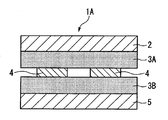
- the back surface protection member 2, the sealing material sheet 3A, the solar battery cells 4, 4, the sealing material sheet 3B, and the surface protection member 5 are laminated in this order to form a laminated body 1A.
- the laminated body 1A is vacuum-laminated by heating and pressurizing in a vacuum state, the solar battery cells 4 and 4 are embedded in the sealing material sheets 3A and 3B, and the transparent resin base material (EVA) of the sealing material sheets 3A and 3B is obtained.
- EVA transparent resin base material
- the sealing material sheet 3A and the sealing material sheet 3B are the sealing material sheets of the present invention, may be the same composition sealing material sheet, may be different composition sealing material sheet, but uniform It is preferable that the sealing material sheet has the same composition from the viewpoint that a good quality module is easily obtained by forming a crosslinked structure.
- the encapsulant layer Since the solar cell module described above uses the encapsulant sheet of the present invention, the encapsulant layer has a crosslinking rate even after the encapsulant sheet is transported or stored for a certain period of time. High, excellent durability and high quality.
- the volatilization amount (unit: mass%) of the organic peroxide used in this example was 0.15 g of the organic peroxide in a cylindrical container having a bottom radius of 1.8 cm and a depth of 0.9 cm. The sample was put in, stored at 50 ° C. for 5 hours, and calculated from the mass before and after storage.
- EVA-1 EVA having a vinyl acetate unit content of 30% by mass and an MFR of 30 g / 10 min
- Example 1 With respect to 100 parts by mass of EVA-1, 0.7 parts by mass of organic peroxide I-1, 0.5 parts by mass of crosslinking assistant III-1, and 0.5 parts by mass of silane coupling agent IV-1 Part, 0.1 part by weight of the UV absorber V-1, 0.1 part by weight of the antioxidant VI-1, and 0.2 part by weight of the light stabilizer VII-1. Subsequently, the composition was sheet-formed by an extrusion method at a molding temperature of 110 ° C. so as to have a thickness of 0.40 to 0.50 mm using an extrusion molding machine. The thickness of the obtained sealing material sheet was measured with an electronic micrometer (K351C manufactured by Anritsu).
- Example 2 to 3 A sealing material sheet was produced in the same manner as in Example 1 except that the amount of the organic peroxide I-1 was changed as shown in Table 1.
- the sealing material sheets obtained in the examples and comparative examples were placed in a mesh-shaped storage box in a constant temperature and humidity chamber at a temperature of 40 ° C. and a humidity of 20% RH without overlapping with other sheets. Stored for hours. Thereafter, the encapsulant sheet was taken out, allowed to stand for 6 hours in an environment of normal temperature and humidity, and then the crosslinking rate was measured by the same method as described in the initial crosslinking rate. Those with a crosslinking rate of 80% or more were marked with “ ⁇ ”, and those with less than 80% were marked with “x”.
- the organic peroxide I satisfying the condition (A) and the condition (B) was used in the range of 0.4 to 1.0 part by mass with respect to 100 parts by mass of EVA.
- the encapsulant sheet 3 had a high initial crosslinking rate and excellent storage stability.
- the sealing material sheet was of high quality without generating gel during molding.
- the sealing material sheet of Comparative Example 1 using an organic peroxide having a decomposition temperature of less than 115 ° C. under the condition (B) was inferior in quality because gel was generated during sheet molding.
- the sealing material sheet of Comparative Example 2 using an organic peroxide having a volatilization amount of more than 15% by mass under the condition (A) has a high initial crosslinking rate, the crosslinking rate after storage is greatly reduced and stored. Stability was low.
- the organic peroxide I satisfying the conditions (A) and (B) is used, the encapsulant sheet of Comparative Example 3 whose content is less than 0.4 parts by mass with respect to 100 parts by mass of EVA, The crosslinking rate was already as low as 80% or less in the initial state before storage.
- the encapsulant sheet had an initial crosslinking rate of less than 80% by mass, and thus the crosslinking rate after storage was less than 80% by mass regardless of storage stability.
- the organic peroxide I satisfying the conditions (A) and (B) is used, the encapsulant sheet of Comparative Example 4 whose content exceeds 1.0 part by mass with respect to 100 parts by mass of EVA is a sheet. Gel was generated during molding and the quality was poor.
Landscapes
- Chemical & Material Sciences (AREA)
- Engineering & Computer Science (AREA)
- Manufacturing & Machinery (AREA)
- Medicinal Chemistry (AREA)
- Health & Medical Sciences (AREA)
- Chemical Kinetics & Catalysis (AREA)
- Materials Engineering (AREA)
- Polymers & Plastics (AREA)
- Organic Chemistry (AREA)
- Photovoltaic Devices (AREA)
- Compositions Of Macromolecular Compounds (AREA)
- Sealing Material Composition (AREA)
- Manufacture Of Macromolecular Shaped Articles (AREA)
- Structures Or Materials For Encapsulating Or Coating Semiconductor Devices Or Solid State Devices (AREA)
Abstract
Description
また、封止材シートの製造においては、条件によってはシート中にゲルが発生することがあるため、シート成形時のゲルの発生を防止することが重要である。
[1]エチレン/酢酸ビニル共重合体と有機過酸化物とを含有する太陽電池モジュール用封止材シートであって、前記有機過酸化物が下記条件(A)及び条件(B)を満たし、かつ該有機過酸化物の含有量が前記エチレン/酢酸ビニル共重合体100質量部に対して0.4~1.0質量部である太陽電池モジュール用封止材シート。
(A)半径が1.8cmの底面を有し、深さが0.9cmの円筒容器内で、0.15gの有機過酸化物を50℃の条件で5時間保管したときの揮発量が15質量%以下である。
(B)有機過酸化物が1時間で半減する分解温度が115~140℃である。
[2]太陽電池セルと、前記太陽電池セルを封止する封止材層と、前記封止材層の表面側を保護する表面保護部材と、前記封止材層の裏面側を保護する裏面保護部材と、を有し、前記封止材層が、前記[1]に記載の太陽電池モジュール用封止材シートにより形成されている太陽電池モジュール。
また、本発明の太陽電池モジュールは、本発明の太陽電池モジュール用封止材シートを用いているため、高い架橋率を有する優れた封止材層が安定して形成されており、耐久性に優れ高品質である。
本発明の太陽電池モジュール用封止材シート(以下、単に「封止材シート」という。)は、太陽電池モジュールにおいて太陽電池セルを封止する封止材層の形成に用いるシートであって、エチレン/酢酸ビニル共重合体(EVA)と有機過酸化物とを含有する。
本発明の封止材シートには、EVAに加えて他の樹脂が含有されていてもよい。他の樹脂としては、ポリエチレン、ポリプロピレン等のポリオレフィン;アイオノマー;エチレン-メタクリル酸共重合体;エチレン-アクリル酸共重合体;ポリフッ化ビニル;ポリ塩化ビニル、またはこれらの共重合体等が挙げられる。
本発明の封止材シートの樹脂基材中のEVAの割合は、95質量%以上が好ましく、97質量%以上がより好ましく、100質量%が特に好ましい。
EVAが有する全単位100質量%中の酢酸ビニル単位の含有率は、20~40質量%が好ましく、25~35質量%がより好ましい。
また、MFRは、分子量を調節することでも調節でき、分子量を大きくすることでMFRが小さくなる。
前記MFRは、ASTMD1238に準拠した方法で測定される。
(A)半径が1.8cmの底面を有し、深さが0.9cmの円筒容器内で、0.15gの有機過酸化物を50℃の条件で5時間保管したときの揮発量が15質量%以下である。
(B)有機過酸化物が1時間で半減する分解温度が115~140℃である。
また、太陽電池モジュールの製造では、通常、2枚の封止材シートで太陽電池セルを挟んだ状態で、真空中で荷重をかけながら加熱し、太陽電池セルを包埋させつつ封止材樹脂を架橋させるが、それら2枚の封止材シートにそれぞれ含有される有機過酸化物Iは同一であることが好ましい。同一の有機過酸化物Iが含有されている封止材シートを用いれば、一定期間経過後であっても2枚の封止材シート間の有機過酸化物Iの量がほぼ同等で、不均一化することも抑制されやすいため、太陽電池モジュールの特性のばらつきを小さくしやすい。
耐光性の向上のために用いられる紫外線吸収剤としては、2-(5-メチル-2-ヒドロキシフェニル)ベンゾトリアゾール、2-(3-t-ブチル-5-メチル-2-ヒドロキシフェニル)-5-クロロベンゾトリアゾール、2-(4,6-ジフェニル-1,3,5-トリアジン-2-イル)-5-[(ヘキシル)オキシ]-フェノール、2,4-ジヒドロキシベンゾフェノン、2-ヒドロキシ-4-n-オクチルオキシベンゾフェノン等が挙げられる。
熱安定性の向上のために用いられる酸化防止剤としては、1,6-ヘキサンジオール-ビス[3-(3,5-ジ-t-ブチル-4-ヒドロキシフェニル)プロピオネート]、ペンタエリスリチル-テトラキス[3-(3,5-ジ-t-ブチル-4-ヒドロキシフェニル)プロピオネート]、トリス(2,4-ジ-t-ブチルフェニル)フォスファイト、2,4-ビス-(n-オクチルチオ)-6-(4-ヒドロキシ-3,5-ジ-t-ブチルアニリノ)-1,3,5-トリアジン、オクタデシル-3-(3,5-ジ-t-ブチル-4-ヒドロキシフェニル)プロピオネート等が挙げられる。
本発明の封止材シートは、架橋剤として、前述した有機過酸化物Iを用いる以外は、公知の製造方法で製造できる。例えば、前記樹脂基材に、有機過酸化物、及び必要に応じて添加する添加剤を混合して加熱溶融させた樹脂を、Tダイ等を用いて押し出す共押し出し法で封止材シートを製膜する製膜工程を有する方法が挙げられる。
また、前記製膜工程においては、ブロッキング防止のため、熱溶融した状態の樹脂シートの表面を、凹凸パターンが施されているロール(金属またはゴム製)に密着させることで、該樹脂シート片面もしくは両面に該ロールの凹凸パターンを転写させ、封止材シートにエンボス加工を施してもよい。
本発明の太陽電池モジュールは、太陽電池セルと、前記太陽電池セルを封止する封止材層と、前記封止材層の表面側を保護する表面保護部材と、前記封止材層の裏面側を保護する裏面保護部材と、を有し、前記封止材層が、前述した本発明の封止材シートにより形成されているモジュールである。以下、本発明の太陽電池モジュールの実施形態の一例を示して詳細に説明する。
(太陽電池セル)
太陽電池セル4は、光電効果により受光面に入射した光を電気に変換する機能を有するセルである。太陽電池セル4は、太陽電池モジュール1内において複数個(図1では2つ)が電極(図示省略)によって接続されている。太陽電池セル4の数は特に限定されない。
太陽電池セル4の材料としては、例えば、結晶系シリコンが挙げられる。なかでも、製造の簡便さとコスト面から、多結晶シリコンが特に好ましい。
封止材層3は、太陽電池セル4、4を包埋させて封止する層であり、本発明の封止材シートにより形成される。
封止材層3の厚さは、0.3~0.6mmが好ましい。
表面保護材2としては、耐久性、耐候性、透明性に優れたものが好ましく、例えば、ガラス板、ポリエチレンテレフタレート等の樹脂シート等が挙げられる。また、ポリカーボネート等の樹脂シートを用いてもよい。
表面保護部材2の厚さは、3~6mmが好ましい。
裏面保護部材5としては、耐久性、耐候性に優れたものが好ましく、例えば、ポリエチレンテレフタレート、ポリビニルフロライド、EVA等の樹脂シート、及びそれらの積層体等が挙げられる。また、前記樹脂シートや積層体には、水蒸気バリア性、酸素バリア性を付与するバリア層を積層してもよい。
裏面保護部材5の厚さは、0.2~0.4mmが好ましい。
以下、本発明の太陽電池モジュールの製造方法の一例として、前記太陽電池モジュール1の製造方法を説明する。ただし、本発明の太陽電池モジュールの製造方法は以下の方法には限定されない。
図2に示すように、裏面保護部材2、封止材シート3A、太陽電池セル4、4、封止材シート3B、表面保護部材5をこの順に積層して積層体1Aとする。次いで、積層体1Aを真空状態で加熱加圧する真空ラミネートを行い、封止材シート3A、3B内に太陽電池セル4、4を埋没させ、封止材シート3A、3Bの透明樹脂基材(EVA)を架橋硬化させて接着一体化することで封止材層3を形成させる。これにより、太陽電池モジュール1が得られる。
封止材シート3Aと封止材シート3Bは本発明の封止材シートであり、同じ組成の封止材シートであってもよく、異なる組成の封止材シートであってもよいが、均一に架橋構造が形成されることで良好な品質のモジュールが得られやすい点から、同じ組成の封止材シートであることが好ましい。
本実施例で用いた有機過酸化物の揮発量(単位:質量%)は、底面の半径が1.8cm、深さが0.9cmの円筒容器の中に、有機過酸化物を0.15g投入し、50℃の条件で5時間保管し、保管前後の質量から算出した。
本実施例で使用した原料を以下に示す。
(EVA)
EVA-1:酢酸ビニル単位の含有量が30質量%で、MFRが30g/10分のEVA
I-1:t-ブチルパーオキシ-2-エチルヘキシルモノカーボネート
II-1:1,1-ジ(t-ブチルパーオキシ)-3,3,5-トリメチルシクロヘキサン
II-2:2,5-ジメチル-2,5-ジ(t-ブチルパーオキシ)ヘキサン
III-1:トリアリルイソシアヌレート
IV-1:γ-メタクリロキシプロピルトリメトキシシラン
V-1:2-ヒドロキシ-4-n-オクチルオキシベンゾフェノン
VI-1:オクタデシル-3-(3,5-ジ-t-ブチル-4-ヒドロキシフェニル)プロピオネート
VII-1:ビス(2,2,6,6-テトラメチル-4-ピペリジル)セバケート
EVA-1の100質量部に対して、有機過酸化物I-1を0.7質量部、架橋助剤III-1を0.5質量部、シランカップリング剤IV-1を0.5質量部、紫外線吸収剤V-1を0.1質量部、酸化防止剤VI-1を0.1質量部、及び光安定剤VII-1を0.2質量部添加した。
次いで、押し出し成形機を用いて、前記組成物を0.40~0.50mmの厚みとなるように成形温度110℃で押し出し法によりシート成形した。得られた封止材シートの厚さは、電子マイクロメーター(アンリツ製K351C)により測定した。
有機過酸化物I-1の添加量を表1に示すように変更した以外は、実施例1と同様にして封止材シートを製造した。
用いる有機過酸化物の種類と添加量を表1に示す通りに変更した以外は、実施例1と同様にして封止材シートを製造した。
(初期架橋率)
実施例及び比較例において製造した封止材シートを用いて、常温常湿の環境で6時間放置後、架橋率を測定した。架橋率は以下の方法で測定した。
封止材シートを1気圧で加圧しながら150℃で10分間キュアしたものから、少量(0.3g程度)のサンプルを削り出してその質量を測定した(質量W1)。また、そのサンプルを50mLのキシレン中において110℃で6時間加熱した後、未溶解物の質量を測定した(質量W2)。質量W1に対する質量W2の割合(W2/W1)を架橋率(単位:%)とした。
実施例及び比較例で得られた封止材シートを、温度40℃-湿度20%RHの恒温恒湿槽の中のメッシュ状の保管箱に、他のシートと重ね合わせないで設置し、48時間保管した。その後、該封止材シートを取り出し、常温常湿の環境で6時間放置後、前記初期架橋率で説明した方法と同じ方法で架橋率を測定した。架橋率が80%以上のものを「○」、80%に満たなかったものを「×」とした。
実施例及び比較例で得られた封止材シートにおける1m2あたりのゲルの発生数を目視で計測した。計測するゲルは半径2mm以上のものとした。また、確認面積は2m2とした。1m2あたりのゲルの発生数が1個以上であったものを「×」、0個のものを「○」とした。
実施例及び比較例における初期架橋率、保存安定性及び加工時のゲルの発生の評価結果を表1に示す。

条件(A)の揮発量が15質量%を超える有機過酸化物を用いた比較例2の封止材シートは、初期架橋率は高いものの、保存後の架橋率が大きく低下しており、保存安定性が低かった。
条件(A)及び条件(B)を満たす有機過酸化物Iを用いているものの、その含有量がEVA100質量部に対して0.4質量部未満である比較例3の封止材シートは、保存前の初期の状態ですでに架橋率が80%以下と低かった。なお、該封止材シートは、初期架橋率が80質量%未満であったため、保存後の架橋率も保存安定性に関わらず80質量%未満であった。
条件(A)及び条件(B)を満たす有機過酸化物Iを用いているものの、その含有量がEVA100質量部に対して1.0質量部を超える比較例4の封止材シートは、シート成形時にゲルが発生し、品質が劣っていた。
2 表面保護部材
3 封止材層
3A、3B 封止材シート
4 太陽電池セル
5 裏面保護部材
Claims (2)
- エチレン/酢酸ビニル共重合体と有機過酸化物とを含有する太陽電池モジュール用封止材シートであって、
前記有機過酸化物が下記条件(A)及び条件(B)を満たし、かつ該有機過酸化物の含有量が前記エチレン/酢酸ビニル共重合体100質量部に対して0.4~1.0質量部である太陽電池モジュール用封止材シート。
(A)半径が1.8cmの底面を有し、深さが0.9cmの円筒容器内で、0.15gの有機過酸化物を50℃の条件で5時間保管したときの揮発量が15質量%以下である。
(B)有機過酸化物が1時間で半減する分解温度が115~140℃である。 - 太陽電池セルと、前記太陽電池セルを封止する封止材層と、前記封止材層の表面側を保護する表面保護部材と、前記封止材層の裏面側を保護する裏面保護部材と、を有し、
前記封止材層が、請求項1に記載の太陽電池モジュール用封止材シートにより形成されている太陽電池モジュール。
Priority Applications (2)
| Application Number | Priority Date | Filing Date | Title |
|---|---|---|---|
| JP2012503093A JPWO2011108433A1 (ja) | 2010-03-02 | 2011-02-24 | 太陽電池モジュール用封止材シートおよび太陽電池モジュール |
| CN2011800117081A CN102782022A (zh) | 2010-03-02 | 2011-02-24 | 太阳能电池组件用密封材料片以及太阳能电池组件 |
Applications Claiming Priority (2)
| Application Number | Priority Date | Filing Date | Title |
|---|---|---|---|
| JP2010045367 | 2010-03-02 | ||
| JP2010-045367 | 2010-03-02 |
Publications (1)
| Publication Number | Publication Date |
|---|---|
| WO2011108433A1 true WO2011108433A1 (ja) | 2011-09-09 |
Family
ID=44542087
Family Applications (1)
| Application Number | Title | Priority Date | Filing Date |
|---|---|---|---|
| PCT/JP2011/054110 Ceased WO2011108433A1 (ja) | 2010-03-02 | 2011-02-24 | 太陽電池モジュール用封止材シートおよび太陽電池モジュール |
Country Status (4)
| Country | Link |
|---|---|
| JP (1) | JPWO2011108433A1 (ja) |
| CN (1) | CN102782022A (ja) |
| TW (1) | TW201141930A (ja) |
| WO (1) | WO2011108433A1 (ja) |
Citations (4)
| Publication number | Priority date | Publication date | Assignee | Title |
|---|---|---|---|---|
| JP2002111036A (ja) * | 2000-09-29 | 2002-04-12 | Canon Inc | 太陽電池モジュール及びその施工方法 |
| JP2007134352A (ja) * | 2005-10-13 | 2007-05-31 | Sekisui Film Kk | 太陽電池用接着シート |
| JP2008098457A (ja) * | 2006-10-13 | 2008-04-24 | Sekisui Chem Co Ltd | 太陽電池用接着シートの製造方法 |
| JP2008205448A (ja) * | 2007-01-22 | 2008-09-04 | Bridgestone Corp | 太陽電池用封止膜及びこれを用いた太陽電池 |
-
2011
- 2011-02-24 JP JP2012503093A patent/JPWO2011108433A1/ja active Pending
- 2011-02-24 CN CN2011800117081A patent/CN102782022A/zh active Pending
- 2011-02-24 WO PCT/JP2011/054110 patent/WO2011108433A1/ja not_active Ceased
- 2011-02-25 TW TW100106319A patent/TW201141930A/zh unknown
Patent Citations (4)
| Publication number | Priority date | Publication date | Assignee | Title |
|---|---|---|---|---|
| JP2002111036A (ja) * | 2000-09-29 | 2002-04-12 | Canon Inc | 太陽電池モジュール及びその施工方法 |
| JP2007134352A (ja) * | 2005-10-13 | 2007-05-31 | Sekisui Film Kk | 太陽電池用接着シート |
| JP2008098457A (ja) * | 2006-10-13 | 2008-04-24 | Sekisui Chem Co Ltd | 太陽電池用接着シートの製造方法 |
| JP2008205448A (ja) * | 2007-01-22 | 2008-09-04 | Bridgestone Corp | 太陽電池用封止膜及びこれを用いた太陽電池 |
Also Published As
| Publication number | Publication date |
|---|---|
| TW201141930A (en) | 2011-12-01 |
| JPWO2011108433A1 (ja) | 2013-06-27 |
| CN102782022A (zh) | 2012-11-14 |
Similar Documents
| Publication | Publication Date | Title |
|---|---|---|
| KR101903197B1 (ko) | 태양 전지 봉지재 및 그것을 이용하여 제작된 태양 전지 모듈 | |
| CN101375409B (zh) | 太阳能电池密封材料 | |
| JP5639930B2 (ja) | 太陽電池封止材及びそれを用いて作製された太陽電池モジュール | |
| JP5594959B2 (ja) | 太陽電池素子封止材 | |
| CN101563786A (zh) | 包括聚烯烃共聚物的电子器件模块 | |
| JP5648169B1 (ja) | 太陽電池封止材用樹脂組成物および太陽電池封止材 | |
| JP2015211189A (ja) | 太陽電池封止材用樹脂組成物、並びにそれを用いた太陽電池封止材及び太陽電池モジュール | |
| WO2017090521A1 (ja) | 太陽電池モジュール | |
| JP2014212318A (ja) | 太陽電池モジュール用封止材組成物、太陽電池モジュール用封止材シート、および、太陽電池モジュール | |
| WO2013172023A1 (ja) | 太陽電池モジュール | |
| EP2770541B1 (en) | Solar cell sealing film and solar cell using same | |
| JP2015162498A (ja) | 太陽電池封止材用積層体、太陽電池封止材及び太陽電池モジュール | |
| JP6155680B2 (ja) | 太陽電池モジュールの製造方法及び該製造方法によって製造された太陽電池モジュール | |
| EP2485270A1 (en) | Sealing material sheet for solar battery module, and process for production of solar battery module | |
| JP2013060485A (ja) | 接着性フィルム、並びにこれを用いてなる太陽電池用封止フィルム、合わせガラス用中間フィルム、太陽電池及び合わせガラス | |
| CN107396640A (zh) | 密封片以及太阳能电池模块 | |
| JP6542782B2 (ja) | 太陽電池用封止材及び太陽電池モジュール | |
| WO2011108433A1 (ja) | 太陽電池モジュール用封止材シートおよび太陽電池モジュール | |
| JP2011066196A (ja) | 太陽電池モジュール | |
| JPWO2011114853A1 (ja) | 太陽電池モジュール用封止材シートおよび太陽電池モジュール | |
| WO2011108434A1 (ja) | 太陽電池モジュール用封止材シート及び太陽電池モジュール | |
| JP2012169472A (ja) | 太陽電池モジュール用封止材シートおよび太陽電池モジュール | |
| WO2014148056A1 (ja) | 太陽電池モジュール用封止材シートおよび太陽電池モジュール | |
| JP2012019135A (ja) | 太陽電池モジュール用封止材シートおよび太陽電池モジュール | |
| JP2011216655A (ja) | 太陽電池用封止シート及び太陽電池モジュール |
Legal Events
| Date | Code | Title | Description |
|---|---|---|---|
| WWE | Wipo information: entry into national phase |
Ref document number: 201180011708.1 Country of ref document: CN |
|
| 121 | Ep: the epo has been informed by wipo that ep was designated in this application |
Ref document number: 11750543 Country of ref document: EP Kind code of ref document: A1 |
|
| WWE | Wipo information: entry into national phase |
Ref document number: 2012503093 Country of ref document: JP |
|
| NENP | Non-entry into the national phase |
Ref country code: DE |
|
| 122 | Ep: pct application non-entry in european phase |
Ref document number: 11750543 Country of ref document: EP Kind code of ref document: A1 |