WO2011065324A1 - イオン選択性電極 - Google Patents
イオン選択性電極 Download PDFInfo
- Publication number
- WO2011065324A1 WO2011065324A1 PCT/JP2010/070793 JP2010070793W WO2011065324A1 WO 2011065324 A1 WO2011065324 A1 WO 2011065324A1 JP 2010070793 W JP2010070793 W JP 2010070793W WO 2011065324 A1 WO2011065324 A1 WO 2011065324A1
- Authority
- WO
- WIPO (PCT)
- Prior art keywords
- thin film
- electrode
- ion
- glass
- film
- Prior art date
- Legal status (The legal status is an assumption and is not a legal conclusion. Google has not performed a legal analysis and makes no representation as to the accuracy of the status listed.)
- Ceased
Links
Images

Classifications
-
- G—PHYSICS
- G01—MEASURING; TESTING
- G01N—INVESTIGATING OR ANALYSING MATERIALS BY DETERMINING THEIR CHEMICAL OR PHYSICAL PROPERTIES
- G01N27/00—Investigating or analysing materials by the use of electric, electrochemical, or magnetic means
- G01N27/26—Investigating or analysing materials by the use of electric, electrochemical, or magnetic means by investigating electrochemical variables; by using electrolysis or electrophoresis
- G01N27/28—Electrolytic cell components
- G01N27/30—Electrodes, e.g. test electrodes; Half-cells
- G01N27/36—Glass electrodes
Definitions
- the present invention relates to an ion-selective electrode that has improved alkali resistance and excellent durability and is less susceptible to alkali errors.
- SiO 2 and Li 2 O glasses used for response glass films such as pH electrodes have low alkali error, acid error, good response, and chemical durability including alkali resistance.
- Various properties such as excellence are required.
- Patent Document 1 describes a silicate glass containing an ion-sensitive glass thin film containing zirconia, and by adding zirconia to the silicate glass, It is disclosed that the alkali resistance of the glass is improved and the durability is increased.
- the present invention is intended to provide an ion-selective electrode that has improved alkali resistance and excellent durability and is less susceptible to alkali errors.
- the ion-selective electrode according to the present invention is characterized by comprising a response glass film composed of a glass film that responds to ions and a thin film containing zirconium dioxide formed on the surface of the glass film. To do.
- the thin film containing a zirconium dioxide is formed in the surface of the glass film which responds to ion, the alkali resistance of a response glass film can be improved, without producing an alkali error.
- the response glass film is irradiated with ultraviolet rays or the like to cause the zirconium dioxide in the thin film to exhibit a photocatalytic action, thereby preventing the adhesion of the dirt on the response glass film. Dirt can be removed.
- the thin film is preferably made of a porous material.
- the thin film may also contain titanium dioxide.
- the titanium dioxide may have a crystal structure such as anatase or rutile, or may be amorphous.
- the ion selective electrode according to the present invention may be one in which a thin film containing titanium dioxide is interposed between the glass film and the thin film. That is, a thin film containing titanium dioxide may be formed on the glass film, and a thin film containing zirconium dioxide may be further formed thereon.
- alkali resistance of the response glass film can be improved without causing an alkali error, and adhesion of dirt on the response glass film can be prevented and adhered dirt can be removed. can do.
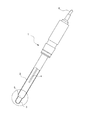
- the fragmentary broken view which shows 1 part of the internal structure of the glass electrode in one Embodiment of this invention.
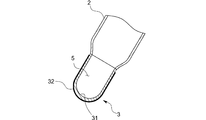
- membrane vicinity in FIG. Graph showing the results of potential measurement with pH electrode thin film made of ZrO 2 is formed.
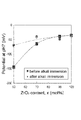
- pH electrode thin film is formed of various compositions, the graph showing the relationship between the content of ZrO 2 and asymmetry potential.
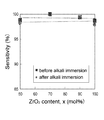
- pH electrode thin film having various compositions were formed, a graph showing the relationship between the content of ZrO 2 and pH sensitivity.
- the ion-selective electrode 1 includes a cylindrical glass support tube 2 and a response glass film 3 bonded to the tip of the support tube 2.
- Glass electrode for example, proton, chloride ion, fluoride ion, nitrate ion, potassium ion, calcium ion, sodium ion, ammonium ion, cyanide ion, sulfide ion, iodide ion, bromide ion, copper ion, It selectively responds to ion species such as cadmium ion, lead ion, thiocyanate ion, silver ion.
- the support tube 2 contains an internal electrode 4 and is filled with an internal liquid 5.
- a lead wire 6 is connected to the internal electrode 4, and the lead wire 6 extends outside from the base end portion of the support tube 2 and is connected to an ion concentration meter main body (not shown).
- the internal electrode 4 for example, a silver / silver chloride (Ag / AgCl) electrode is used, and as the internal liquid 5, for example, a potassium chloride (KCl) solution adjusted to pH 7 is used.
- a silver / silver chloride (Ag / AgCl) electrode is used, and as the internal liquid 5, for example, a potassium chloride (KCl) solution adjusted to pH 7 is used.
- KCl potassium chloride
- the response glass film 3 is composed of a glass film 31 that responds to ions and a thin film 32 formed on the surface of the glass film 31.
- the material glass of the glass film 31 is not particularly limited as long as it can generate a sufficient electromotive force.
- lithium (Li) can be used for silicate glass, phosphate glass, borate glass, and the like.
- a titanophosphate glass can be used for silicate glass, phosphate glass, borate glass, and the like.
- the glass film 31 has a cylindrical shape formed by blow-molding these material glasses so that the front end portion is substantially hemispherical.
- the material glass used for the glass film 31 is melted in, for example, a furnace maintained at a few hundred degrees, and the tip of the support tube 2 is placed there. After immersion, a method of pulling up at a predetermined speed is taken. Next, the tip of the glass film 31 can be made into a substantially hemispherical shape by performing blow molding.
- the thin film 32 contains zirconium dioxide and is formed on the surface of the substantially hemispherical tip of the glass film 31.
- the film thickness of the thin film 32 is preferably 200 to 600 nm, more preferably 200 to 300 nm. However, when the thin film 32 is 1000 nm or more, the asymmetric potential tends to increase and the sensitivity tends to deteriorate.
- the thin film 32 may entirely cover the surface of the glass film 31 without a gap, but may be a mesh-like one in which a gap is partially formed.
- the thin film 32 is formed on the surface of the glass film 31, alkali resistance of the response glass film 3 can be improved without causing an alkali error. Furthermore, the zirconium oxide in the thin film 32 functions as a photocatalyst to prevent the adhesion of dirt on the response glass film 3 and remove the attached dirt.
- the thin film 32 is continuously integrated as a whole. Since zirconium dioxide is negatively charged, if the zirconium dioxide film is discontinuously formed on the surface of the glass film 31, electrical unevenness occurs in the response glass film 3, and an asymmetric potential is generated. Accurate measurement may be disturbed. On the other hand, if the thin film 32 is one in which the entire film is continuously integrated, the entire film is also electrically connected via zirconium dioxide or the like, so that the zirconium dioxide is locally negative. Even if charged, the entire thin film 32 diffuses without being localized. For this reason, the ion-selective electrode 1 hardly generates an asymmetric potential, and the ion concentration can be measured with high accuracy.
- the thin film 32 may be dense or may be formed of a porous material in which voids or holes are formed.
- the porous means one having 1 to 10 or more voids or pores through which water molecules and ions can pass. If voids or holes are formed in the thin film 32, it is easy to ensure contact between the glass film 31 and the sample solution.
- the thin film 32 may contain zirconium dioxide fine particles separately from the zirconium dioxide forming the film structure.
- zirconium dioxide fine particles are dispersed in the thin film 32, the photocatalytic activity of the thin film 32 can be adjusted or enhanced.
- impurities may be mixed in the firing step.
- zirconium dioxide fine particles are separately added, the photocatalyst The activity can be complemented.
- the particle diameter and crystal density of the zirconium dioxide fine particles to be blended can be appropriately selected according to the use of the ion selective electrode 1.
- the thin film 32 may be made of only zirconium dioxide, but may further contain titanium dioxide. Since titanium dioxide exhibits a strong photocatalytic action, it is expected that the photocatalytic activity can be synergistically enhanced by blending titanium dioxide with zirconium oxide. Titanium dioxide may form a film structure (network structure) together with zirconium dioxide, but may be added as titanium dioxide fine particles.
- the particle size thereof is preferably 10 to 100 nm, more preferably 20 to 40 nm.
- the particle size is less than 10 nm, aggregation tends to occur, while when the particle size exceeds 100 nm, precipitation tends to occur.
- the thin film 32 may also contain a transition metal such as cobalt (Co), nickel (Ni), tungsten (W).
- a transition metal such as cobalt (Co), nickel (Ni), tungsten (W).
- the thin film 32 may further contain a noble metal such as copper (Cu), platinum (Pt), gold (Au), or silver (Ag).
- a noble metal such as copper (Cu), platinum (Pt), gold (Au), or silver (Ag).
- the method for forming the thin film 32 on the substantially hemispherical tip of the glass film 31 is not particularly limited.
- a sol-gel method can be used, and if necessary, a metal such as titanium alkoxide, cobalt, zirconium dioxide, or the like.
- a thin film 32 can be formed on the surface of the glass film 31 by applying a solution of zirconium alkoxide to which additional components such as fine particles and fine particles of titanium dioxide are added to the untreated glass film 31 and then baking the solution.
- zirconium salts such as ZrCl 2 O.8H 2 O and ZrO (NO 3 ) 2 .2H 2 O, Zr (OC 3 H 7 ) 4 , Zr (OC 4 H 9 ) 4 and the like.
- Alcohol is added to the zirconium alkoxide to prepare a mixed solution, and then water necessary for hydrolysis and nitric acid as a catalyst are added to the mixed solution to prepare a starting solution.
- the starting solution is stirred at a constant temperature to hydrolyze the alkoxide and perform a polycondensation reaction to produce zirconium hydroxide fine particles to obtain a zirconia sol.
- the obtained zirconia sol is applied to the surface of the glass film 31 using a dip coating method or the like, then dried and fired, whereby the thin film 32 made of zirconium dioxide can be formed.
- the thin film 32 can be made porous by controlling dip coating conditions (speed, number of times) and firing conditions (temperature, time).
- a resin such as polyvinylpyrrolidone (PVP) may be added to the zirconium alkoxide solution.
- PVP polyvinylpyrrolidone
- a zirconium alkoxide solution containing PVP is applied to the glass film 31 and baked, PVP and the like are decomposed and removed in the baking step.
- the thin film 32 in which voids or holes are formed can be formed.
- what is necessary is just to adjust the addition amount of PVP to a zirconium alkoxide solution suitably according to the use of the ion selective electrode 1.
- the thin film 32 When the thin film 32 is mixed with a metal such as cobalt or zirconium dioxide fine particles, it may be added to the zirconium alkoxide solution in the same manner.
- a metal such as cobalt or zirconium dioxide fine particles
- titanium alkoxide may be added to the zirconium alkoxide solution, or titanium dioxide fine particles may be added.
- an LED for the response glass film 3 having the thin film 32 formed on the surface of the glass film 31 thus obtained, an LED, a hydrogen discharge tube, a xenon discharge tube, a mercury lamp, a ruby laser, a YAG laser, an excimer laser, a dye
- light such as ultraviolet rays is irradiated using a laser as a light source, photocatalytic action such as zirconium dioxide is induced, the organic matter attached due to the oxidation action is decomposed, and the attached matter is easily peeled off due to the superhydrophilic action.
- a so-called self-cleaning function is exhibited.
- the response glass film 3 of the ion selective electrode 1 is immersed in the sample solution for which the ion concentration is to be obtained.
- An electromotive force corresponding to the difference in ion concentration between the internal solution 5 and the sample solution is generated in the film 3.
- This electromotive force is measured as a potential difference (voltage) between the internal electrode 4 of the ion selective electrode 1 and the internal electrode of the comparative electrode using a comparative electrode (not shown) to calculate the ion concentration. Since this electromotive force varies depending on temperature, it is preferable to use a temperature element, correct the potential difference using this output signal value as a parameter, calculate the ion concentration of the sample solution, and display it on the ion concentration meter main body.
- the thin film 32 containing zirconium dioxide is formed on the surface of the glass film 31 that responds to ions without causing an alkali error.
- the alkali resistance of the response glass film can be improved.
- the response glass film 3 is irradiated with ultraviolet rays or the like to cause the zirconium dioxide or the like in the thin film 32 to exhibit a photocatalytic action. While preventing the adhesion of dirt, the adhered dirt can be removed.
- the present invention is not limited to the above embodiment.
- a thin film made of titanium dioxide may be formed on the surface of the glass film 31, and a thin film 32 made of zirconium dioxide may be formed on the thin film. If it is such, since the thin film 32 which consists of zirconium dioxide has high hardness, it can also protect the thin film which consists of titanium dioxide.
- the ion selective electrode according to the present invention is not limited to the glass electrode 1 but may be a composite electrode in which the glass electrode and the reference electrode are integrated, or a single electrode in which the temperature compensation electrode is further added to the composite electrode. .
- the tip portion of the glass film 31 is not limited to a substantially hemispherical shape, and may be formed in any shape as long as it can exhibit an ion concentration measurement function.
- the light source such as ultraviolet rays may be provided separately from the ion selective electrode 1, but the ion selective electrode 1 itself may include a light source such as ultraviolet rays.
- the ion concentration measuring apparatus may be configured by combining the ion selective electrode 1, the comparison electrode, the ion concentration meter main body, and a light source such as ultraviolet rays.
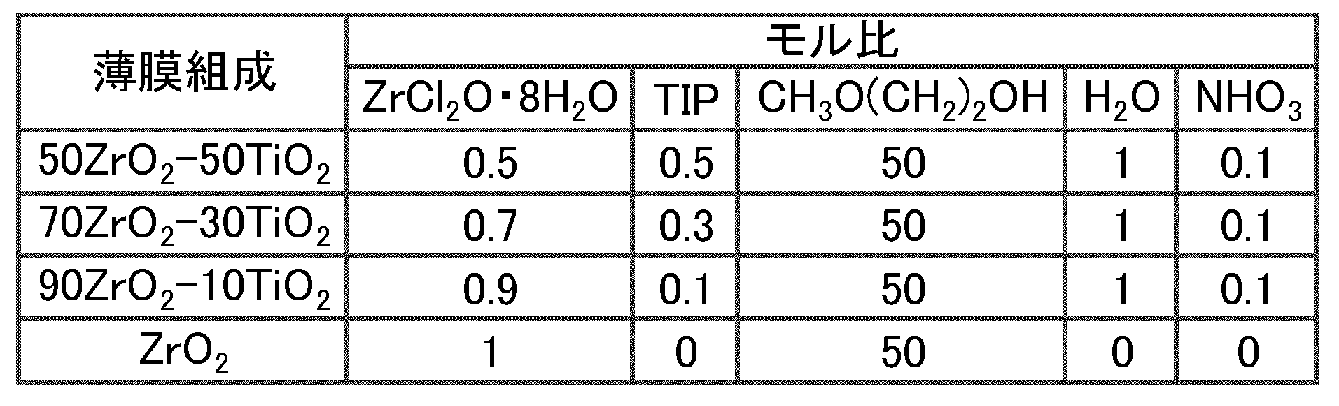
- ⁇ Evaluation 1 of thin film coated pH electrode> The thin film-coated pH electrode on which thin films having various compositions shown in Table 1 were formed was immersed in water for 48 hours, and the potential was measured three times in the order of pH 7 ⁇ pH 4 ⁇ pH 9. Since the potential was stabilized in about 3 minutes, the asymmetric potential at pH 7 and the pH sensitivity between pH 4-9 were determined using the value after 3 minutes from the start of the third measurement. At this time, Horiba Seisakusho (# 2565) was used as a reference electrode. Further, after being immersed in 0.01 M NaOH for 30 hours, the potential measurement was performed three times in the same manner. The result of the potential measurement (only the thin film made of ZrO 2 ) is shown in the graph of FIG. 3, and the measurement results of the asymmetric potential and pH sensitivity before and after immersion in the alkaline solution are shown in FIGS. 4 and 5, respectively.
- the “sensitivity” is a value that represents the theoretical value in the Nernst response as 100%.
- the pH responsiveness decreases.
- the pH response time is reduced.
- the alkali error electrode thin film made of the ZrO 2 was calculated in conformity with JIS Z 8805, was 11.0MV. This value is a value that sufficiently satisfies the JIS standard (18 mV), and it was confirmed that the alkali error of the electrode was sufficiently small.
- the higher the ZrO 2 content in the thin film the lower the asymmetric potential at pH 7. Further, the higher the ZrO 2 content in the thin film, the smaller the difference in the asymmetric potential before and after immersion in the alkaline solution. From this, when the content of ZrO 2 was 50 mol% or more, it was confirmed that the higher the content of ZrO 2 in the thin film, the better from the viewpoints of asymmetric potential and alkali resistance.
- ⁇ Evaluation 2 of thin film coated pH electrode> A thin film-coated pH electrode (ZrO 2 thin film) is immersed in 200 g / L of water or an aqueous albumin solution for a predetermined time, and then irradiated with ultraviolet rays (6 mW / cm 2 ) using a Xe lamp as necessary, so that pH 7 ⁇ pH 4 ⁇ The potential was measured three times in the order of pH 9, and the asymmetric potential at pH 7 and the pH sensitivity between pH 4-9 were determined using the value 3 minutes after the start of the third measurement. For comparison, the same measurement was performed using an untreated pH electrode (# 9621). The obtained results are shown in Table 2.
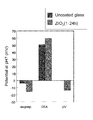
- FIG. 6 shows the asymmetric potential at pH 7 in the case of (BSA) and then, when ultraviolet irradiation (6 mW / cm 2 ) is performed using an Xe lamp (only for UV, thin film-coated pH electrode (ZrO 2 thin film)).
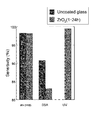
- the pH sensitivity between pH 4-9 is shown in FIG.
- the pH electrode in which a zirconium dioxide thin film was prepared on the surface of the response glass film by the sol-gel method was not inferior to the untreated pH electrode in terms of asymmetry potential and sensitivity.
- asymmetry potential is increased by soaking in an aqueous albumin solution for 72 hours, and the asymmetric potential and sensitivity are dramatically increased by irradiating a thin film-coated pH electrode whose sensitivity has been significantly reduced by irradiating ultraviolet rays. Recovered. From this, it was confirmed that by forming a zirconium dioxide thin film on the surface of the response glass film, an excellent antifouling function can be imparted without causing an increase in asymmetric potential or a decrease in sensitivity.
- an ion-selective electrode having a response glass membrane that is excellent in alkali resistance, hardly causes an alkali error, and is not easily soiled.
Landscapes
- Chemical & Material Sciences (AREA)
- Life Sciences & Earth Sciences (AREA)
- Health & Medical Sciences (AREA)
- Physics & Mathematics (AREA)
- Chemical Kinetics & Catalysis (AREA)
- Electrochemistry (AREA)
- Molecular Biology (AREA)
- Analytical Chemistry (AREA)
- Biochemistry (AREA)
- General Health & Medical Sciences (AREA)
- General Physics & Mathematics (AREA)
- Immunology (AREA)
- Pathology (AREA)
- Catalysts (AREA)
Abstract
本発明は、耐アルカリ性が向上し耐久性に優れるとともに、アルカリ誤差が生じにくいイオン選択性電極に関するものであり、イオン応答するガラス膜31と、前記ガラス膜の表面に形成された二酸化ジルコニウムを含有する薄膜32と、から構成された応答ガラス膜3を備えているイオン選択性電極1を提供するものである。
Description
この発明は、耐アルカリ性が向上し耐久性に優れるとともに、アルカリ誤差が生じにくいイオン選択性電極に関するものである。
例えばpH電極等の応答ガラス膜に用いられるSiO2系、Li2O系のガラスには、アルカリ誤差、酸誤差が小さいこと、応答性がよいこと、耐アルカリ性をはじめとする化学的耐久性に優れること等の諸性質が要求される。
このようなガラスとして、特許文献1には、ケイ酸塩系ガラスからなるイオン感応性ガラス薄膜にジルコニアを含有させたものが記載されており、ケイ酸塩系ガラスにジルコニアを添加することにより、当該ガラスの耐アルカリ性が向上して耐久性が高まることが開示されている。
しかしながら、特許文献1に記載のジルコニアを含有するケイ酸塩系ガラスは、アルカリ誤差が生じやすいという問題点を有する。
そこで本発明は、耐アルカリ性が向上し耐久性に優れるとともに、アルカリ誤差が生じにくいイオン選択性電極を提供すべく図ったものである。
本発明者が鋭意検討したところ、イオン選択性電極の応答ガラス膜表面に二酸化ジルコニウム(ZrO2、ジルコニア)を含有する薄膜を形成することにより、応答ガラス膜の耐アルカリ性が向上するとともに、アルカリ誤差も生じにくくなることが判明した。更に、予期せぬことに、このような二酸化ジルコニウムを含有する薄膜が形成された応答ガラス膜では、二酸化ジルコニウムが奏する光触媒作用に起因する、応答ガラス膜上への汚れ付着防止効果や、付着した汚れの除去効果も確認された。本発明は、このような新規な知見に基づき完成されたものである。
すなわち本発明に係るイオン選択性電極は、イオン応答するガラス膜と、前記ガラス膜の表面に形成された二酸化ジルコニウムを含有する薄膜と、から構成された応答ガラス膜を備えていることを特徴とする。
このようなものであれば、イオン応答するガラス膜の表面に、二酸化ジルコニウムを含有する薄膜が形成されていることにより、アルカリ誤差を生じずに、応答ガラス膜の耐アルカリ性を向上することができる。更に、本発明によれば、前記応答ガラス膜に紫外線等を照射して前記薄膜中の二酸化ジルコニウムに光触媒作用を発現させることにより、応答ガラス膜上への汚れの付着を防止するとともに、付着した汚れを除去することができる。
前記薄膜は、多孔質からなることが好ましい。
前記薄膜は、また、二酸化チタンを含有していてもよい。当該二酸化チタンは、アナターゼやルチル等の結晶構造を有するものであってもよく、アモルファスであってもよい。
本発明に係るイオン選択性電極は、前記ガラス膜と前記薄膜との間に、二酸化チタンを含有する薄膜が介在しているものであってもよい。すなわち、前記ガラス膜に二酸化チタンを含有する薄膜を形成し、その上に、更に二酸化ジルコニウムを含有する薄膜を形成してもよい。
このように本発明によれば、アルカリ誤差を生じずに、応答ガラス膜の耐アルカリ性を向上することができるとともに、応答ガラス膜上への汚れの付着を防止し、かつ、付着した汚れを除去することができる。
以下に本発明の一実施形態について図面を参照して説明する。
本実施形態に係るイオン選択性電極1は、図1及び図2に示すように、円筒状のガラス製支持管2と、その支持管2の先端部に接合した応答ガラス膜3とを備えたガラス電極であり、例えば、プロトン、塩化物イオン、フッ化物イオン、硝酸イオン、カリウムイオン、カルシウムイオン、ナトリウムイオン、アンモニウムイオン、シアン化物イオン、硫化物イオン、ヨウ化物イオン、臭化物イオン、銅イオン、カドミウムイオン、鉛イオン、チオシアン酸イオン、銀イオン等のイオン種に対して選択的に応答するものである。
以下に各部を説明する。
支持管2には、内部電極4が収容してあり、かつ、内部液5が充填してある。内部電極4には、リード線6が接続してあり、リード線6はこの支持管2の基端部から外部に延出し、図示しないイオン濃度計本体に接続されるようにしてある。
支持管2には、内部電極4が収容してあり、かつ、内部液5が充填してある。内部電極4には、リード線6が接続してあり、リード線6はこの支持管2の基端部から外部に延出し、図示しないイオン濃度計本体に接続されるようにしてある。
内部電極4としては、例えば銀/塩化銀(Ag/AgCl)電極等が用いられ、内部液5としては、例えばpH7に調整した塩化カリウム(KCl)溶液等が用いられる。
応答ガラス膜3は、イオン応答するガラス膜31と、当該ガラス膜31の表面に形成された薄膜32と、から構成されるものである。
ガラス膜31の素材ガラスとしては、充分な起電力を発生させることが可能なものであれば特に限定されず、例えば、ケイ酸塩ガラス、リン酸塩ガラス、ホウ酸塩ガラス等にリチウム(Li)を配合した多成分ガラスや、チタノリン酸塩ガラス等が挙げられる。
ガラス膜31は、これら素材ガラスを先端部が略半球状をなすようにブロー成形してなる円筒状のものである。このガラス膜31を支持管2に接合するには、ガラス膜31に用いられる素材ガラスを、例えば千数百度に保たれた炉内で溶融状態にしておき、そこに支持管2の先端部を浸漬した後、所定速度で引き上げるといった方法がとられる。次いで、ブロー成形を行うことによりガラス膜31の先端部を略半球状とすることができる。
薄膜32は、二酸化ジルコニウムを含有するものであり、ガラス膜31の略半球状の先端部表面に形成されている。薄膜32の膜厚としては、200~600nmであるのが好ましく、より好ましくは200~300nmであるが、薄膜32が1000nm以上であると不斉電位が大きくなり、感度が悪くなる傾向がある。当該薄膜32は、膜全体が隙間なくガラス膜31表面を覆っていてもよいが、部分的に隙間が形成された網目状のものであってもよい。
ガラス膜31の表面に、当該薄膜32が形成されていると、アルカリ誤差が生じずに、応答ガラス膜3の耐アルカリ性を向上することができる。更に、薄膜32中の酸化ジルコニウムが光触媒として機能して、応答ガラス膜3上への汚れの付着を防止するとともに、付着した汚れを除去することができる。
薄膜32は、膜全体が連続して一体となっていることが好ましい。二酸化ジルコニウムは負の電荷を帯びているので、ガラス膜31表面に不連続に二酸化ジルコニウム膜が形成されていると、応答ガラス膜3に電気的なむらが生じて、不斉電位が発生し、正確な測定が阻害されることがある。これに対して、薄膜32が、膜全体が連続して一体となっているものであると、膜全体が二酸化ジルコニウム等を介して電気的にも連絡するので、二酸化ジルコニウムが局所的に負に帯電していても、薄膜32全体としては電荷が局在せずに拡散する。このため、イオン選択性電極1では不斉電位が生じにくく、イオン濃度の測定も精度良く行うことができる。
薄膜32は、緻密なものであってもよいが、空隙又は空孔が形成された多孔質から形成されていてもよい。ここで、前記多孔質とは、水分子やイオンが通過可能な、1~10Å以上の空隙又は空孔を備えたものを意味する。薄膜32に空隙や空孔が形成されていると、ガラス膜31と試料溶液との接触を確保することが容易となる。
薄膜32は、膜構造を形成する二酸化ジルコニウムとは別個に二酸化ジルコニウム微粒子を含有していてもよい。薄膜32中に二酸化ジルコニウム微粒子が分散していると、薄膜32の光触媒活性を調節又は増強することが可能となる。また、例えば、薄膜32がゾルゲル法により形成されたものである場合は、その焼成工程において、不純物が混入することがあるが、このような場合に別途二酸化ジルコニウム微粒子が配合されていると、光触媒活性を補完することができる。なお、配合する二酸化ジルコニウム微粒子の粒径や結晶密度は、イオン選択性電極1の用途に合わせて適宜選択することができる。
薄膜32は、二酸化ジルコニウムのみからなるものであってもよいが、更に、二酸化チタンを含有していてもよい。二酸化チタンは強力な光触媒作用を奏するので、酸化ジルコニウムとともに二酸化チタンを配合すれば、光触媒活性を相乗的に増強しうることが予測される。なお、二酸化チタンは、二酸化ジルコニウムとともに渾然一体となって膜構造(ネットワーク構造)を形成していてもよいが、二酸化チタン微粒子として添加されていてもよい。
二酸化ジルコニウム微粒子や二酸化チタン微粒子を添加する場合、そのの粒径としては、10~100nmであるのが好ましく、より好ましくは20~40nmである。粒径が10nm未満であると凝集しやすくなり、一方、粒径が100nmを超えると沈殿しやすくなる。
薄膜32は、また、コバルト(Co)、ニッケル(Ni)、タングステン(W)等の遷移金属を含有していてもよい。これらの遷移金属を薄膜32に配合することにより、応答ガラス膜3のアルカリ誤差がより減少したり、二酸化ジルコニウム等の奏する光触媒活性が増強されたりする可能性がある。
薄膜32は、更に、銅(Cu)、白金(Pt)、金(Au)、銀(Ag)等の貴金属を含有していてもよい。これらの貴金属を薄膜32に配合することにより、薄膜32内に酸化還元サイトが形成され、二酸化ジルコニウム等の奏する光触媒活性が増強される可能性がある。また、鉄(Fe)等の遷移金属を配合することにより、二酸化ジルコニウム等が可視光まで分解応答する可能性がある。
ガラス膜31の略半球状の先端部に薄膜32を形成する方法としては特に限定されないが、例えば、ゾルゲル法を用いることができ、必要に応じて、チタンアルコキシドや、コバルト等の金属、二酸化ジルコニウム微粒子、二酸化チタン微粒子等の付加的成分を添加したジルコニウムアルコキシドの溶液を未処理のガラス膜31に塗布し、次いで焼成することにより、ガラス膜31表面上に薄膜32を形成することができる。
より具体的には、まず、ZrCl2O・8H2OやZrO(NO3)2・2H2O等のジルコニウム塩や、Zr(OC3H7)4やZr(OC4H9)4等のジルコニウムアルコキシドにアルコールを添加して混合溶液を調製し、次に、この混合溶液に加水分解に必要な水、触媒として硝酸等を加えて出発溶液を調製する。この出発溶液を一定温度で攪拌してアルコキシドの加水分解と重縮合反応とを行い、ジルコニウムの水酸化物微粒子を生成しジルコニアゾルを得る。得られたジルコニアゾルを、ディップコーティング法等を用いてガラス膜31表面に塗布した後、乾燥し、焼成することにより、二酸化ジルコニウムからなる薄膜32を形成することができる。そして、ディップコーティング条件(速度、回数)や焼成条件(温度、時間)を制御することにより、薄膜32を多孔質にすることができる。
薄膜32を多孔質にするには、ジルコニウムアルコキシド溶液にポリビニルピロリドン(PVP)等の樹脂を添加してもよい。そして、PVPを含むジルコニウムアルコキシド溶液をガラス膜31に塗布し、焼成すると、焼成工程においてPVP等が分解して除去される。このようにPVPを分解・除去することにより、空隙又は空孔が形成された薄膜32を形成することができる。なお、ジルコニウムアルコキシド溶液へのPVPの添加量は、イオン選択性電極1の用途に応じて適宜調節すればよい。
薄膜32にコバルト等の金属や二酸化ジルコニウム微粒子を配合する場合にも、同様にジルコニウムアルコキシド溶液に添加すればよい。
薄膜32に二酸化チタンを配合する場合は、ジルコニウムアルコキシド溶液にチタンアルコキシドを添加するか、又は、二酸化チタン微粒子を添加すればよい。
このようにして得られた、ガラス膜31表面に薄膜32が形成されてなる応答ガラス膜3に対し、LED、水素放電管、キセノン放電管、水銀ランプ、ルビーレーザ、YAGレーザ、エキシマレーザ、色素レーザ等を光源として、紫外線等の光を照射すると、二酸化ジルコニウム等の光触媒作用が誘起され、その酸化作用により付着した有機物等が分解され、かつ、超親水作用により付着物が剥離しやすい状態になる、いわゆるセルフクリーニング機能が発現する。
本実施形態に係るイオン選択性電極1を用いて試料溶液のイオン濃度を測定する際には、イオン選択性電極1の応答ガラス膜3を、イオン濃度を求めたい試料溶液に浸すと、応答ガラス膜3に内部液5と試料溶液との間のイオン濃度の差に応じた起電力が生じる。この起電力を、図示しない比較電極を用いて、イオン選択性電極1の内部電極4と比較電極の内部電極の電位差(電圧)として測定してイオン濃度を算出する。この起電力は温度によって変動するため、温度素子を用い、この出力信号値をパラメータとして前記電位差を補正して、試料溶液のイオン濃度を算出しイオン濃度計本体に表示することが好ましい。
このように構成した本実施形態に係るイオン選択性電極1によれば、イオン応答するガラス膜31の表面に、二酸化ジルコニウムを含有する薄膜32が形成されていることにより、アルカリ誤差を生じずに、応答ガラス膜の耐アルカリ性を向上することができる。更に、本実施形態に係るイオン選択性電極1によれば、応答ガラス膜3に紫外線等を照射して薄膜32中の二酸化ジルコニウム等に光触媒作用を発現させることにより、応答ガラス膜3上への汚れの付着を防止するとともに、付着した汚れを除去することができる。
なお、本発明は前記実施形態に限られるものではない。
例えば、ガラス膜31表面に、二酸化チタンからなる薄膜が形成され、その薄膜上に、二酸化ジルコニウムからなる薄膜32が形成されていてもよい。このようなものであれば、二酸化ジルコニウムからなる薄膜32は硬度が高いため、二酸化チタンからなる薄膜を保護することもできる。
本発明に係るイオン選択性電極はガラス電極1に限られず、ガラス電極と比較電極を一体化した複合電極や、複合電極に更に温度補償電極を加えて一体化した一本電極であってもよい。
ガラス膜31の先端部は略半球状に限定されず、イオン濃度測定機能を発揮しうる形状であればいずれの形状に成形されていてもよい。
紫外線等の光源は、イオン選択性電極1とは別個に設けてあってもよいが、イオン選択性電極1自体が紫外線等の光源を備えていてもよい。
またイオン選択性電極1と比較電極とイオン濃度計本体と紫外線等の光源とを組み合わせて、イオン濃度測定装置を構成してもよい。
その他、前述した実施形態や変形実施形態の一部又は全部を適宜組み合わせてもよく、本発明はその趣旨を逸脱しない範囲で種々の変形が可能であるのは言うまでもない。
以下に実施例を掲げて本発明を更に詳細に説明するが、本発明はこれら実施例のみに限定されるものではない。
<薄膜コートpH電極の作製>
堀場製作所製pH電極(#9621)の応答ガラス膜表面に、ゾルゲルディップコーティング法を用いて、表1に示すように組成を変えて、各種薄膜を形成した。当該薄膜の形成は、以下に示す条件下で行った。
堀場製作所製pH電極(#9621)の応答ガラス膜表面に、ゾルゲルディップコーティング法を用いて、表1に示すように組成を変えて、各種薄膜を形成した。当該薄膜の形成は、以下に示す条件下で行った。
原料:ZrCl2O・8H2O
Ti[OHC(CH3)2]4(TIP)
CH3O(CH2)2OH
HNO3
H2O
コーティング速度:6cm/min
コーティング回数:1回
焼成温度:500℃
焼成時間:24時間10分
Ti[OHC(CH3)2]4(TIP)
CH3O(CH2)2OH
HNO3
H2O
コーティング速度:6cm/min
コーティング回数:1回
焼成温度:500℃
焼成時間:24時間10分
<薄膜コートpH電極の評価1>
表1に示す各種組成の薄膜が形成された薄膜コートpH電極を、水に48時間浸漬し、pH7→pH4→pH9の順で電位測定を3回行なった。電位は約3分で安定するので、3回目の測定開始から3分経過後の値を用いて、pH7における不斉電位とpH4-9間のpH感度をそれぞれ求めた。この際、比較電極としては堀場製作所製(#2565)を使用した。更に、0.01M NaOHに30時間浸漬した後で、同様に電位測定を3回行った。電位測定の結果(ZrO2からなる薄膜のもののみ)を図3のグラフに示し、アルカリ溶液浸漬前後の不斉電位とpH感度の測定結果を、それぞれ図4及び図5に示した。なおここで、「感度」とは、ネルンスト応答における理論値を100%として表した値である。
表1に示す各種組成の薄膜が形成された薄膜コートpH電極を、水に48時間浸漬し、pH7→pH4→pH9の順で電位測定を3回行なった。電位は約3分で安定するので、3回目の測定開始から3分経過後の値を用いて、pH7における不斉電位とpH4-9間のpH感度をそれぞれ求めた。この際、比較電極としては堀場製作所製(#2565)を使用した。更に、0.01M NaOHに30時間浸漬した後で、同様に電位測定を3回行った。電位測定の結果(ZrO2からなる薄膜のもののみ)を図3のグラフに示し、アルカリ溶液浸漬前後の不斉電位とpH感度の測定結果を、それぞれ図4及び図5に示した。なおここで、「感度」とは、ネルンスト応答における理論値を100%として表した値である。
一般的に応答ガラス膜中に不純物が混入している場合はpH応答性が低下するが、図3のグラフに示すように、表面にZrO2からなる薄膜が形成されていても、pH応答時間は従来のpH電極と遜色なかった。また、このZrO2からなる薄膜が形成されている電極のアルカリ誤差を、JIS Z 8805に準拠して算出したところ、11.0mVであった。この値は、JIS規格(18mV)を充分に満たす値であり、当該電極のアルカリ誤差は充分に小さいことが確認された。
また、図4に示すように、薄膜中のZrO2の含有量が高いほど、pH7における不斉電位が減少した。また、薄膜中のZrO2の含有量が高いほど、アルカリ溶液浸漬前後における不斉電位の差が小さかった。このことから、ZrO2の含有量が50mol%以上である場合は、薄膜中のZrO2の含有量が高いものほど、不斉電位や耐アルカリ性の観点から優れていることが確認された。
更に、図5に示すように、全てのサンプルにおいて優れたpH応答性が確認され、また、アルカリ溶液浸漬後もpH応答性は低下せず、耐アルカリ性にも優れていることが確認された。
<薄膜コートpH電極の評価2>
薄膜コートpH電極(ZrO2薄膜)を、水又はアルブミン水溶液200g/Lに所定の時間浸漬し、その後、必要に応じてXeランプを用いて紫外線照射(6mW/cm2)を行い、pH7→pH4→pH9の順で電位測定を3回行ない、3回目の測定開始から3分経過後の値を用いて、pH7における不斉電位とpH4-9間のpH感度をそれぞれ求めた。また、比較のために、未処理のpH電極(#9621)を用いて、同様の測定を行った。得られた結果を表2に示した。また、薄膜コートpH電極(ZrO2薄膜)と未処理のpH電極(#9621)とについて、水に48時間浸漬した場合(as-prep.)と、アルブミン水溶液200g/Lに72時間浸漬した場合(BSA)と、その後、Xeランプを用いて紫外線照射(6mW/cm2)を行った場合(UV、薄膜コートpH電極(ZrO2薄膜)のみ)とにおける、pH7における不斉電位を図6に示し、pH4-9間のpH感度を図7に示した。
薄膜コートpH電極(ZrO2薄膜)を、水又はアルブミン水溶液200g/Lに所定の時間浸漬し、その後、必要に応じてXeランプを用いて紫外線照射(6mW/cm2)を行い、pH7→pH4→pH9の順で電位測定を3回行ない、3回目の測定開始から3分経過後の値を用いて、pH7における不斉電位とpH4-9間のpH感度をそれぞれ求めた。また、比較のために、未処理のpH電極(#9621)を用いて、同様の測定を行った。得られた結果を表2に示した。また、薄膜コートpH電極(ZrO2薄膜)と未処理のpH電極(#9621)とについて、水に48時間浸漬した場合(as-prep.)と、アルブミン水溶液200g/Lに72時間浸漬した場合(BSA)と、その後、Xeランプを用いて紫外線照射(6mW/cm2)を行った場合(UV、薄膜コートpH電極(ZrO2薄膜)のみ)とにおける、pH7における不斉電位を図6に示し、pH4-9間のpH感度を図7に示した。
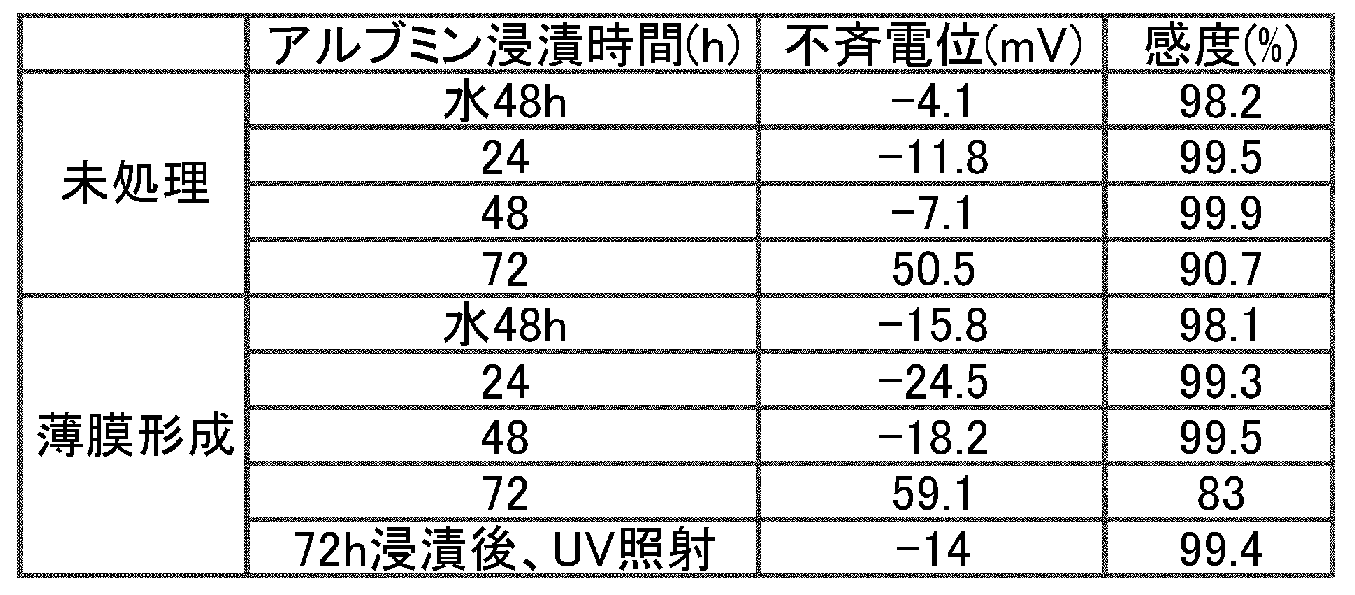
表2並びに図6及び7に示すように、応答ガラス膜表面に二酸化ジルコニウム薄膜をゾルゲル法で作製したpH電極は、不斉電位や感度に関し、未処理のpH電極と遜色がなかった。また、72時間アルブミン水溶液に浸漬することにより、不斉電位が上昇し、かつ、感度が大幅に低下した薄膜コートpH電極に、紫外線を照射することにより、その不斉電位や感度が劇的に回復した。これより、応答ガラス膜表面に二酸化ジルコニウム薄膜を形成することにより、不斉電位の上昇や感度の低下をもたらさずに、優れた防汚機能を付与しうることが確認された。
本発明によれば、耐アルカリ性に優れるとともに、アルカリ誤差が生じにくく、加えて、汚れにくい応答ガラス膜を備えたイオン選択性電極を提供することができる。
1…ガラス電極
2…支持管
3…応答ガラス膜
31…ガラス膜
32…薄膜
4…内部電極
5…内部液
6…リード線
2…支持管
3…応答ガラス膜
31…ガラス膜
32…薄膜
4…内部電極
5…内部液
6…リード線
Claims (4)
- イオン応答するガラス膜と、前記ガラス膜の表面に形成された二酸化ジルコニウムを含有する薄膜と、から構成された応答ガラス膜を備えていることを特徴とするイオン選択性電極。
- 前記薄膜は、多孔質からなる請求項1記載のイオン選択性電極。
- 前記薄膜は、二酸化チタンを含有している請求項1記載のイオン選択性電極。
- 前記ガラス膜と前記薄膜との間に、二酸化チタンを含有する薄膜が介在している請求項1記載のイオン選択性電極。
Priority Applications (1)
| Application Number | Priority Date | Filing Date | Title |
|---|---|---|---|
| JP2011500779A JPWO2011065324A1 (ja) | 2009-11-26 | 2010-11-22 | イオン選択性電極 |
Applications Claiming Priority (2)
| Application Number | Priority Date | Filing Date | Title |
|---|---|---|---|
| JP2009268560 | 2009-11-26 | ||
| JP2009-268560 | 2009-11-26 |
Publications (1)
| Publication Number | Publication Date |
|---|---|
| WO2011065324A1 true WO2011065324A1 (ja) | 2011-06-03 |
Family
ID=44066429
Family Applications (1)
| Application Number | Title | Priority Date | Filing Date |
|---|---|---|---|
| PCT/JP2010/070793 Ceased WO2011065324A1 (ja) | 2009-11-26 | 2010-11-22 | イオン選択性電極 |
Country Status (2)
| Country | Link |
|---|---|
| JP (1) | JPWO2011065324A1 (ja) |
| WO (1) | WO2011065324A1 (ja) |
Cited By (2)
| Publication number | Priority date | Publication date | Assignee | Title |
|---|---|---|---|---|
| WO2012093728A1 (ja) * | 2011-01-07 | 2012-07-12 | 国立大学法人三重大学 | イオン選択性電極 |
| DE102018123437A1 (de) * | 2018-09-24 | 2020-03-26 | Endress+Hauser Conducta Gmbh+Co. Kg | Diaphragma und Halbzelle mit Diaphragma für einen elektrochemischen Sensor und Herstellungsverfahren derselben |
Citations (6)
| Publication number | Priority date | Publication date | Assignee | Title |
|---|---|---|---|---|
| JPS5932858A (ja) * | 1982-08-19 | 1984-02-22 | Terumo Corp | 電極素子 |
| JPS6435356A (en) * | 1987-07-31 | 1989-02-06 | Shimadzu Corp | Ion sensor and its production |
| JPH1081541A (ja) * | 1996-09-05 | 1998-03-31 | Horiba Ltd | ガラス電極 |
| JP2000356617A (ja) * | 1999-06-15 | 2000-12-26 | Matsushita Electric Ind Co Ltd | ガラス電極及びその製造方法 |
| WO2008072612A1 (ja) * | 2006-12-11 | 2008-06-19 | Horiba, Ltd. | イオン電極用応答ガラス膜の製造方法、イオン電極用応答ガラス膜及びイオン電極 |
| JP2008241697A (ja) * | 2007-02-27 | 2008-10-09 | Mie Univ | 応答ガラス及びガラス電極 |
-
2010
- 2010-11-22 JP JP2011500779A patent/JPWO2011065324A1/ja active Pending
- 2010-11-22 WO PCT/JP2010/070793 patent/WO2011065324A1/ja not_active Ceased
Patent Citations (6)
| Publication number | Priority date | Publication date | Assignee | Title |
|---|---|---|---|---|
| JPS5932858A (ja) * | 1982-08-19 | 1984-02-22 | Terumo Corp | 電極素子 |
| JPS6435356A (en) * | 1987-07-31 | 1989-02-06 | Shimadzu Corp | Ion sensor and its production |
| JPH1081541A (ja) * | 1996-09-05 | 1998-03-31 | Horiba Ltd | ガラス電極 |
| JP2000356617A (ja) * | 1999-06-15 | 2000-12-26 | Matsushita Electric Ind Co Ltd | ガラス電極及びその製造方法 |
| WO2008072612A1 (ja) * | 2006-12-11 | 2008-06-19 | Horiba, Ltd. | イオン電極用応答ガラス膜の製造方法、イオン電極用応答ガラス膜及びイオン電極 |
| JP2008241697A (ja) * | 2007-02-27 | 2008-10-09 | Mie Univ | 応答ガラス及びガラス電極 |
Cited By (4)
| Publication number | Priority date | Publication date | Assignee | Title |
|---|---|---|---|---|
| WO2012093728A1 (ja) * | 2011-01-07 | 2012-07-12 | 国立大学法人三重大学 | イオン選択性電極 |
| CN103282767A (zh) * | 2011-01-07 | 2013-09-04 | 国立大学法人三重大学 | 离子选择性电极 |
| CN103282767B (zh) * | 2011-01-07 | 2015-03-04 | 国立大学法人三重大学 | 离子选择性电极 |
| DE102018123437A1 (de) * | 2018-09-24 | 2020-03-26 | Endress+Hauser Conducta Gmbh+Co. Kg | Diaphragma und Halbzelle mit Diaphragma für einen elektrochemischen Sensor und Herstellungsverfahren derselben |
Also Published As
| Publication number | Publication date |
|---|---|
| JPWO2011065324A1 (ja) | 2013-04-11 |
Similar Documents
| Publication | Publication Date | Title |
|---|---|---|
| JP5121012B2 (ja) | 応答ガラス及びガラス電極 | |
| CN103472104B (zh) | 一种基于银/硫酸钡的固体硫酸根电极及其制备方法 | |
| Noël et al. | Dissolution of Pt at moderately negative potentials during oxygen reduction in water and organic media | |
| CN101573611B (zh) | 离子电极用响应玻璃膜的制造方法、离子电极用响应玻璃膜和离子电极 | |
| JP7510766B2 (ja) | リチウムとニオブのペルオキソ錯体と亜硝酸とを含有する溶液およびその製造方法、並びに、リチウム二次電池用活物質の製造方法 | |
| CN103175878A (zh) | 参比半电池和具有参比半电池的电化学传感器 | |
| JP4900833B2 (ja) | イオン選択性電極用応答ガラス及びイオン選択性電極 | |
| CN104316581A (zh) | 一种基于可见光光电催化的cod传感器及其制备方法和应用 | |
| JP6326473B2 (ja) | イオン選択性電極 | |
| JP2011028918A (ja) | 色素増感太陽電池 | |
| JP5930974B2 (ja) | 比較電極 | |
| WO2011065324A1 (ja) | イオン選択性電極 | |
| JP7113511B2 (ja) | ブリッジ型の酸化スズ含有シートとその製造方法 | |
| Zhou et al. | Facile synthesis of a porous network-like silver film for electrocatalytic detection of nitrate. | |
| CN110361431A (zh) | 一种复合电极及其制备方法和用于氨氮检测的方法 | |
| JP4824609B2 (ja) | イオン選択性電極 | |
| CN1164937C (zh) | 适用于高温高压的溶解硫化氢电化学传感器 | |
| CN100368798C (zh) | 纳米管阵列化学需氧量传感器的制备方法及其应用 | |
| JP2007325995A (ja) | 光触媒皮膜及びその製造方法 | |
| CN111239211B (zh) | 一种银丝传感电极的电化学制备方法 | |
| JP2009270936A (ja) | 液絡部及びその製造方法 | |
| Mfon et al. | Electrodeposition of silver thin films on a gold substrate in the presence of Ocimum gratissimu (Og) and Vernonia amygdalina (Va) plant leaf extracts | |
| JP4815324B2 (ja) | 液絡部及び比較電極 | |
| KR101202362B1 (ko) | 백금-루테늄을 포함한 화학적 산소요구량 측정센서용 작용전극 촉매 및 그 제조방법 | |
| JP2004230314A (ja) | 貴金属被覆光触媒 |
Legal Events
| Date | Code | Title | Description |
|---|---|---|---|
| ENP | Entry into the national phase |
Ref document number: 2011500779 Country of ref document: JP Kind code of ref document: A |
|
| 121 | Ep: the epo has been informed by wipo that ep was designated in this application |
Ref document number: 10833170 Country of ref document: EP Kind code of ref document: A1 |
|
| NENP | Non-entry into the national phase |
Ref country code: DE |
|
| 122 | Ep: pct application non-entry in european phase |
Ref document number: 10833170 Country of ref document: EP Kind code of ref document: A1 |