WO2011027891A1 - 地盤注入用水硬性セメント組成物およびそれを用いた地盤改良工法 - Google Patents
地盤注入用水硬性セメント組成物およびそれを用いた地盤改良工法 Download PDFInfo
- Publication number
- WO2011027891A1 WO2011027891A1 PCT/JP2010/065279 JP2010065279W WO2011027891A1 WO 2011027891 A1 WO2011027891 A1 WO 2011027891A1 JP 2010065279 W JP2010065279 W JP 2010065279W WO 2011027891 A1 WO2011027891 A1 WO 2011027891A1
- Authority
- WO
- WIPO (PCT)
- Prior art keywords
- ground
- cement
- blast furnace
- parts
- alkali metal
- Prior art date
- Legal status (The legal status is an assumption and is not a legal conclusion. Google has not performed a legal analysis and makes no representation as to the accuracy of the status listed.)
- Ceased
Links
Classifications
-
- C—CHEMISTRY; METALLURGY
- C09—DYES; PAINTS; POLISHES; NATURAL RESINS; ADHESIVES; COMPOSITIONS NOT OTHERWISE PROVIDED FOR; APPLICATIONS OF MATERIALS NOT OTHERWISE PROVIDED FOR
- C09K—MATERIALS FOR MISCELLANEOUS APPLICATIONS, NOT PROVIDED FOR ELSEWHERE
- C09K17/00—Soil-conditioning materials or soil-stabilising materials
- C09K17/40—Soil-conditioning materials or soil-stabilising materials containing mixtures of inorganic and organic compounds
-
- C—CHEMISTRY; METALLURGY
- C09—DYES; PAINTS; POLISHES; NATURAL RESINS; ADHESIVES; COMPOSITIONS NOT OTHERWISE PROVIDED FOR; APPLICATIONS OF MATERIALS NOT OTHERWISE PROVIDED FOR
- C09K—MATERIALS FOR MISCELLANEOUS APPLICATIONS, NOT PROVIDED FOR ELSEWHERE
- C09K17/00—Soil-conditioning materials or soil-stabilising materials
- C09K17/40—Soil-conditioning materials or soil-stabilising materials containing mixtures of inorganic and organic compounds
- C09K17/42—Inorganic compounds mixed with organic active ingredients, e.g. accelerators
- C09K17/44—Inorganic compounds mixed with organic active ingredients, e.g. accelerators the inorganic compound being cement
-
- C—CHEMISTRY; METALLURGY
- C04—CEMENTS; CONCRETE; ARTIFICIAL STONE; CERAMICS; REFRACTORIES
- C04B—LIME, MAGNESIA; SLAG; CEMENTS; COMPOSITIONS THEREOF, e.g. MORTARS, CONCRETE OR LIKE BUILDING MATERIALS; ARTIFICIAL STONE; CERAMICS; REFRACTORIES; TREATMENT OF NATURAL STONE
- C04B18/00—Use of agglomerated or waste materials or refuse as fillers for mortars, concrete or artificial stone; Treatment of agglomerated or waste materials or refuse, specially adapted to enhance their filling properties in mortars, concrete or artificial stone
- C04B18/04—Waste materials; Refuse
- C04B18/14—Waste materials; Refuse from metallurgical processes
-
- C—CHEMISTRY; METALLURGY
- C04—CEMENTS; CONCRETE; ARTIFICIAL STONE; CERAMICS; REFRACTORIES
- C04B—LIME, MAGNESIA; SLAG; CEMENTS; COMPOSITIONS THEREOF, e.g. MORTARS, CONCRETE OR LIKE BUILDING MATERIALS; ARTIFICIAL STONE; CERAMICS; REFRACTORIES; TREATMENT OF NATURAL STONE
- C04B22/00—Use of inorganic materials as active ingredients for mortars, concrete or artificial stone, e.g. accelerators or shrinkage compensating agents
- C04B22/08—Acids or salts thereof
-
- C—CHEMISTRY; METALLURGY
- C04—CEMENTS; CONCRETE; ARTIFICIAL STONE; CERAMICS; REFRACTORIES
- C04B—LIME, MAGNESIA; SLAG; CEMENTS; COMPOSITIONS THEREOF, e.g. MORTARS, CONCRETE OR LIKE BUILDING MATERIALS; ARTIFICIAL STONE; CERAMICS; REFRACTORIES; TREATMENT OF NATURAL STONE
- C04B24/00—Use of organic materials as active ingredients for mortars, concrete or artificial stone, e.g. plasticisers
- C04B24/24—Macromolecular compounds
- C04B24/26—Macromolecular compounds obtained by reactions only involving carbon-to-carbon unsaturated bonds
-
- C—CHEMISTRY; METALLURGY
- C04—CEMENTS; CONCRETE; ARTIFICIAL STONE; CERAMICS; REFRACTORIES
- C04B—LIME, MAGNESIA; SLAG; CEMENTS; COMPOSITIONS THEREOF, e.g. MORTARS, CONCRETE OR LIKE BUILDING MATERIALS; ARTIFICIAL STONE; CERAMICS; REFRACTORIES; TREATMENT OF NATURAL STONE
- C04B28/00—Compositions of mortars, concrete or artificial stone, containing inorganic binders or the reaction product of an inorganic and an organic binder, e.g. polycarboxylate cements
- C04B28/24—Compositions of mortars, concrete or artificial stone, containing inorganic binders or the reaction product of an inorganic and an organic binder, e.g. polycarboxylate cements containing alkyl, ammonium or metal silicates; containing silica sols
- C04B28/26—Silicates of the alkali metals
-
- C—CHEMISTRY; METALLURGY
- C04—CEMENTS; CONCRETE; ARTIFICIAL STONE; CERAMICS; REFRACTORIES
- C04B—LIME, MAGNESIA; SLAG; CEMENTS; COMPOSITIONS THEREOF, e.g. MORTARS, CONCRETE OR LIKE BUILDING MATERIALS; ARTIFICIAL STONE; CERAMICS; REFRACTORIES; TREATMENT OF NATURAL STONE
- C04B2111/00—Mortars, concrete or artificial stone or mixtures to prepare them, characterised by specific function, property or use
- C04B2111/00474—Uses not provided for elsewhere in C04B2111/00
- C04B2111/00732—Uses not provided for elsewhere in C04B2111/00 for soil stabilisation
-
- Y—GENERAL TAGGING OF NEW TECHNOLOGICAL DEVELOPMENTS; GENERAL TAGGING OF CROSS-SECTIONAL TECHNOLOGIES SPANNING OVER SEVERAL SECTIONS OF THE IPC; TECHNICAL SUBJECTS COVERED BY FORMER USPC CROSS-REFERENCE ART COLLECTIONS [XRACs] AND DIGESTS
- Y02—TECHNOLOGIES OR APPLICATIONS FOR MITIGATION OR ADAPTATION AGAINST CLIMATE CHANGE
- Y02W—CLIMATE CHANGE MITIGATION TECHNOLOGIES RELATED TO WASTEWATER TREATMENT OR WASTE MANAGEMENT
- Y02W30/00—Technologies for solid waste management
- Y02W30/50—Reuse, recycling or recovery technologies
- Y02W30/91—Use of waste materials as fillers for mortars or concrete
Definitions
- the present invention relates to a hydraulic cement composition for ground injection and a ground improvement method using the same.
- a chemical solution injection method for injecting a curable drug into the ground through a rod in order to strengthen a soft ground
- many chemical solution injection materials are known.
- water glass type injection material, special silica type injection material, polymer type injection material, and suspension type injection materials such as cement, clay, and slag
- the chemical injection method using the above chemical injection material is characterized in that it can be improved without disturbing the ground as much as possible, and the equipment is compact, unlike the method of improving the ground while disturbing the ground with a high-pressure jet like the jet grout method. So there are many achievements.
- There are two types of chemical solution injection materials a solution type and a suspension type. When high permeability is required, a solution type may be used.
- the solution-type chemical solution injection material has high permeability, but the strength of the obtained cured body itself is small, and the shrinkage of the cured body is also large, so that there is a case where long-term durability is problematic.
- suspension-type chemical injection material which has hydraulic cement or slag as a component, can be expected to exhibit relatively high strength and has the advantage that long-term durability is easy to ensure, There was a problem that the permeability was low. Therefore, in the suspension type, development of improved permeability is mainly performed. However, the improvement of the ground in harbors and coastal areas has a trade-off problem that the higher the permeability of the drug, the easier it is for the injected drug to escape due to tides.
- an injection material composition containing a polycarboxylic acid-based dispersant as an essential component in a fine powdered cement clinker and blast furnace slag is known.
- Patent Documents 1, 2, and 3 These techniques provide an injection composition having improved permeability by using a specific polycarboxylic acid-based dispersant.
- an injecting material having gelation time an injecting material containing water glass, a solidifying agent, and a fine powder blast furnace slag having a Blaine specific surface area value of 8,000 cm 2 / g or more is known (for example, a patent) References 4, 5, and 6).
- patent document 4 has shown that the hardened
- Patent Document 5 discloses water glass having a molar ratio in the range of 2.8 to 4.0, fine particle slag having an average particle diameter of 10 ⁇ m or less and a brain specific surface area value of 5,000 cm 2 / g or more, preferably 8,000 cm 2 / g or more. This is a technique related to an injection material further containing cement as required.
- the amount of water glass used is large, and there is a description on compressive strength and permeability, but there is no description on the ability to prevent escape.
- Patent Document 6 is composed of a suspension type grout containing a mixture of fine particle slag and fine particle cement, each of these slag and cement having an average particle size of 10 ⁇ m or less and a brain specific surface area value of 5,000 cm 2 / g or more respectively.
- the mixing ratio is 50% or less, and the suspension grout further contains water glass and / or an alkali material.
- the amount of water glass used is large, and there is a description about permeability, but there is no description about the ability to prevent escape, and the evaluation of the cured body is only an evaluation of compressive strength.
- Patent Document 7 contains water, finely divided granulated slag, an alkali stimulant, a dispersant, a high molecular substance that dissolves or disperses in water to give viscosity, and, if necessary, a caking property improver.
- the technique regarding the suspension type ground improvement material characterized by this is shown.
- there is a description of permeability and anti-settling performance but no disclosure is made regarding the characteristics of the cured body, and the reinforcing performance and the ability to prevent current leakage when injected into the ground and consolidated are not known.
- Patent Document 8 discloses a technique relating to an injection material containing wet pulverized slag, a polyacrylic acid-based dispersant, and sodium silicate.
- improvement of injectability and compressive strength but there is no description regarding permeability and ability to prevent escape.
- the present invention has been made in view of the above problems, and is a hydraulic cement composition for ground injection that is excellent in permeability and escape prevention capability, and has sufficient strength and long-term durability, and uses the same. It is an object to provide an improved ground improvement method.
- the present invention employs the means of the present invention 1 to 5 described below.
- the present invention 1 includes a blast furnace slag fine powder, a classification cement, a polyacrylic acid-based dispersant, and an alkali metal silicate as an anti-slip agent, and the alkali metal silicate is represented by the following general formula (1 ) Is a hydraulic cement composition for ground injection, wherein the molar ratio n is 3.5 or more and is 0.2 to 7 parts with respect to a total of 100 parts of the blast furnace slag fine powder and classified cement.
- the present invention 2 is the hydraulic cement composition for ground injection according to the present invention 1, wherein the polyacrylic acid-based dispersant is a copolymer containing a monomer represented by the following general formula (2).
- CH 2 C (R 1) COO (R 2 O) nR 3 (2)
- R 1 is a hydrogen atom or a methyl group
- R 2 O is an oxyalkylene group having 2 to 4 carbon atoms
- n is an integer of 5 to 40
- R 3 is a hydrogen atom or an alkyl group having 1 to 5 carbon atoms.
- the present invention 3 is characterized in that the blast furnace slag fine powder and the classified cement each have a Blaine specific surface area value of 7.000 to 16,000 cm 2 / g and a median diameter of 1 to 7 ⁇ m. It is a hydraulic cement composition for ground injection.
- the present invention 4 is a ground improvement method for injecting the hydraulic cement composition for ground injection according to any one of the present invention 1 to 3 into the ground.
- This invention 5 is the ground improvement construction method of this invention 4 used for ground improvement for liquefaction prevention.
- “parts” and “%” mean “parts by mass” and “mass%” unless otherwise specified.
- the hydraulic cement composition for ground injection of the present invention is excellent in permeability and ability to prevent current flow, and can exhibit effects such as ground improvement.
- the hydraulic cement composition for ground injection comprises fine blast furnace slag powder, classified cement, a polyacrylic acid-based dispersant, and an alkali metal silicate as a current-carrying inhibitor. Fine powder blast furnace slag and classified cement are used to develop high strength, long-term durability and high permeability.
- Blast furnace slag fine powder is used as a general blast furnace cement or concrete admixture produced by grinding steel slag generated when pig iron is produced.
- Fineness of the ground granulated blast furnace slag is Blaine specific surface area value (hereinafter, referred to as Blaine value) is preferably at least 7,000cm 2 / g, the more preferably 7,000 ⁇ 16,000cm 2 / g, most preferably 9,000 ⁇ 13,000cm 2 / g . If it is less than 7,000 cm 2 / g, sufficient penetrability may not be obtained. If it exceeds 16,000 cm 2 / g, the production cost is too high and it is not practical.
- the brain value is a value measured with a JIS R 5201 brain air permeation device.
- the median diameter of the blast furnace slag fine powder is preferably 1 to 7 ⁇ m, and more preferably 2 to 5 ⁇ m.
- the median diameter can be measured with a laser diffraction particle size distribution measuring machine. If it is less than 1 ⁇ m, the production cost is too high and it is not practical, and if it exceeds 7 ⁇ m, the permeability may be impaired.
- the classified cement is obtained by adjusting the particle size of cement using a classification facility.
- portland cement such as ordinary portland cement, early-strength portland cement, low heat portland cement, medium heat portland cement and sulfate resistant cement can be used, and a mixture of fly ash cement, silica cement, etc.
- the classified cement includes dihydrate gypsum and calcium carbonate added in the cement manufacturing process in addition to the cement component. Those containing fine particles of calcium carbonate by classification are advantageous in terms of strength development.
- Fineness of classifying cement, blast furnace slag or Blaine 7,000cm 2 / g is preferably similar to the, more preferably 7,000 ⁇ 16,000cm 2 / g, and most preferably 9,000 ⁇ 13,000cm 2 / g. If it is less than 7,000 cm 2 / g, sufficient penetrability may not be obtained. If it exceeds 16,000 cm 2 / g, the production cost is too high and it is not practical.
- the median diameter of the classified cement is preferably 1 to 7 ⁇ m, more preferably 2 to 5 ⁇ m. For example, the median diameter can be measured with a laser diffraction particle size distribution measuring machine. If it is less than 1 ⁇ m, the production cost is too high and it is not practical, and if it exceeds 7 ⁇ m, the permeability may be hindered.
- the proportion of classified cement is preferably 5 to 30 parts, more preferably 10 to 25 parts, per 100 parts of blast furnace slag fine powder. If it is less than 5 parts, sufficient strength development may not be obtained, and if it exceeds 30 parts, the permeability may be impaired.
- a polyacrylic acid-based dispersant is used.
- the polyacrylic acid-based dispersant imparts the effect of suppressing sedimentation of particles when made into a suspension solution and permeability, and is a copolymer containing a monomer of the following general formula (2) It is characterized by.
- R 1 represents a hydrogen atom or a methyl group
- R 2 O represents an oxyalkylene group having 2 to 4 carbon atoms, such as —CH 2 CH 2 O—, —CH 2 CH 2 CH 2 O -, - CH 2 CH (CH 3) O -, - CH 2 CH (CH 2 CH 3) O-, and -CH 2 CH 2 CH 2 CH 2 O- and the like.
- n represents the number of added moles of the oxyalkylene group and is an integer of 5 to 40. When the added mole number n is too small, the dispersion force becomes insufficient.
- R 3 represents a hydrogen atom or an alkyl group having 1 to 5 carbon atoms, and examples thereof include a methyl group, an ethyl group, a propyl group, and a butyl group.
- Examples of the monomer include polyethylene glycol mono (meth) acrylate, polypropylene glycol mono (meth) acrylate, polybutylene glycol mono (meth) acrylate, methoxypolyethylene glycol (the number of added moles n of alkylene oxide is 5 to 40 mol) (Meth) acrylate, methoxypolypropylene glycol (meth) acrylate, methoxypolybutylene glycol (meth) acrylate, ethoxypolyethylene glycol (meth) acrylate, ethoxypolypropylene glycol (meth) acrylate, ethoxypolybutylene glycol (meth) acrylate, and propoxypolyethylene glycol (Meth) acrylate etc.
- the mass average molecular weight of the polyacrylic dispersant is preferably 5,000 to 100,000, more preferably 20,000 to 80,000.
- the amount of the polyacrylic acid-based dispersant used is not particularly limited, but is preferably 0.1 to 3 parts, more preferably 0.3 to 2 parts with respect to a total of 100 parts of blast furnace slag fine powder and classified cement.
- a melamine dispersant may be used in combination with the polyacrylic acid dispersant of the present invention.
- the alkali metal silicate salt imparts an escape preventing ability to the hydraulic cement composition for ground injection.
- the ability to prevent escape can be achieved by making the hydraulic cement composition for ground injection thixotropic.
- the thixotropy is a property that is difficult to flow like a solid at first, but is fluid like a liquid when a force is applied, and becomes a solid again when the force is removed. Therefore, in the chemical solution injection method, at the time of injection, the fluidity increases due to the injection pressure, and the high permeability that easily penetrates the ground. And after injection, since there is no pressure load, fluidity falls, and a drug does not escape at the hydrodynamic gradient of the tidal level.
- the alkali metal silicate is an alkali metal silicate having a molar ratio n of 3.5 or more in the following general formula (1).
- the alkali metal silicate include sodium silicate, potassium silicate, and lithium silicate. Among these, sodium silicate is most preferable in terms of supply stability and price.
- aqueous solutions and powders in the form of alkali metal silicates are the mainstream when used as chemical injection materials because they are more commercially available and have better workability. .
- the molar ratio n When the molar ratio n is less than 3.5, the provision of the ability to prevent escape is small, and since the amount of alkali is large, the hydration reaction of the cement is suppressed and the compressive strength may be lowered. Therefore, the molar ratio n needs to be 3.5 or more, and is preferably 3.7 to 5.0. In addition, when the molar ratio n is 3.5 or more, the amount of alkali in the alkali metal silicate salt is reduced and the burden on the environment is also reduced.
- the content of the alkali metal silicate is 0.2 to 7 parts (0.2 to 7 parts in solid content in the case of an aqueous solution) with respect to 100 parts in total of the blast furnace slag fine powder and the classified cement. Part is preferred. If less than 0.2 parts, the ability to prevent current flow is small. On the other hand, if it exceeds 7 parts, the viscosity decreases and the capacity to prevent current flow again decreases, and further, it penetrates by the aggregate formed by the alkali metal silicate and cement. Sex is reduced.
- a known cement admixture can be used in combination with the hydraulic cement composition for ground injection of the present invention as long as the original performance is not adversely affected.
- Known cement admixtures include, for example, AE agents, AE water reducing agents, high performance water reducing agents, high performance AE water reducing agents, fluidizing agents, setting retarders, early strengthening agents, antifoaming agents, thickeners. , Waterproofing agent (material), swelling agent (material), rapid hardening material, shrinkage reducing agent (material), rust preventive agent, cement emulsion polymer emulsion, clay mineral, and the like.
- the hydraulic cement composition for ground injection according to the present invention is applied in the form of milk by adding water.
- the optimum range of water to be used is preferably 400 to 1,500 parts, more preferably 700 to 1,200 parts, based on a total of 100 parts of blast furnace slag fine powder, classified cement, and polyacrylic acid dispersant.
- the ground improvement method of the present invention is not particularly limited as an injection site as long as it is a soft ground improvement.
- structures such as harbors, revetments, and airports, poor urban areas and mountainous areas. It can be applied to the ground where various structures are located, such as water-stopping and water-blocking grout, heaving-preventing grout, subsidence-preventing grout, blow-preventing grout, earth pressure-reducing grout, bearing capacity increasing grout, and suck-out preventing grout Can be used as a purpose. Because of its good permeability, it can be applied to sandy ground that includes gravel, and functions effectively as a liquefaction prevention measure.
- the construction method is not particularly limited, and construction equipment used in normal chemical solution injection can be used, and it is only necessary to comply with the injection design and construction method that are normally performed.
- the suspension solution prepared with the mixer is pumped through a hose with a pump, and the injection
- the rod used in that case is not particularly limited, but a single tube rod, a single tube strainer rod, a double tube rod, a double tube double packer rod, and the like can be used.
- the hydraulic cement composition for ground injection according to the present invention is basically injected in one shot. Depending on the condition and purpose of the ground, a commercially available setting accelerator and other various admixtures are separately pumped. It is also possible to construct by 1.5 shot or 2 shot method.
- Experimental example 1 Blast furnace slag fine powder, 20 parts classified cement for 100 parts blast furnace slag fine powder, 1 part polyacrylic acid dispersant for a total of 100 parts of blast furnace slag fine powder and classified cement, The water shown in 1 was mixed and kneaded with a grout mixer for 1 minute to obtain a kneaded product. Next, add 100 parts of blast furnace slag fine powder and classified cement to the solid content of sodium silicate A shown in Table 1 and knead with a grout mixer for 1 minute, and then inject the hydraulic cement composition for ground injection. A material was prepared.
- Table 1 also shows the results of the osmotic flow test for measuring the viscosity, compressive strength, penetrability, and the outflow situation, shape, and diameter of the cured product, which are evaluation indexes of the escape prevention ability.
- polyacrylic acid-based dispersant for 20 parts of classified cement for 100 parts of blast furnace slag fine powder and for 100 parts of blast furnace slag fine powder and classified cement in total 1.0 part was added.
- 966 parts of water was added to 100 parts of this mixture, and the mixture was kneaded with a grout mixer for 2 minutes to prepare an injection material for a hydraulic cement composition for ground injection, and the same test was performed.
- the results are also shown in Table 1.
- Blast furnace slag fine powder Commercial blast furnace slag fine powder, brain value 10,500cm 2 / g, median diameter 3.6 ⁇ m
- Classification cement Classification cement obtained by classifying ordinary Portland cement, Brain value 9,700cm 2 / g, Median diameter 4.1 ⁇ m, Calcium carbonate content 11.3%
- the mass average molecular weight was measured by the GPC method (standard substance: sodium polystyrene sulfonate / water system).
- Potassium silicate aqueous solution, molar ratio n3.69, SiO 2 concentration 21.2%, K 2 O concentration 9.0%, SiO 2 + K 2 O concentration 30.2%
- Viscosity The viscosity immediately after kneading was measured using a B-type rotational viscometer. The temperature during measurement is 25 ° C.
- Compressive strength 80 ml of the injected material was weighed into a mold having a diameter of 50 mm and a height of 100 mm, and then 306 g of No. 5 silica sand was added. Measurement material age is 28 days.
- Permeability Conforms to the specimen preparation method for stable treated soil by chemical solution injection shown in JGS0831-2000. The infiltration condition was observed when the injection material was injected at an injection pressure of 0.05 MPa into a simulated ground that was filled with silica sand No.
- Osmotic flow test Runout condition, shape, diameter of hardened body The test was conducted in accordance with the soil permeability test method shown in JGS0311-2000. As test conditions, a transparent acrylic container of ⁇ 10 ⁇ 23 cm was filled with No. 5 silica sand so that the porosity was 40.5%, and a simulated ground was prepared. In addition, a filter is set on the bottom surface of the acrylic container for producing the simulated ground so that water and injection material can flow out. The pipe was set so that the injection material was injected near the center of the prepared simulated ground, and the prepared simulated ground container was immersed in a container filled with water.
- Table 1 shows the following.
- the viscosity immediately after kneading was 29 to 52 mPa ⁇ s in Experiment No. 1-2 to Experiment No. 1-8 in which sodium silicate was 0.2 to 7 parts.
- the viscosity of Experiment No. 1-1 without sodium silicate was 4 mPa ⁇ s, and in Experiment No. 1-9 with 8 parts of sodium silicate, the viscosity was 5 mPa ⁇ s, which was lower than that of the Examples.
- the compressive strength was 0.6 to 1.4 N / mm 2 in Experiment No. 1-2 to Experiment No. 1-8.
- Experiment No. 1-9 which is a comparative example of 8 parts with a sodium silicate content of 0.2 parts to more than 0.2 parts to 7 parts for a total of 100 parts of ground granulated blast furnace slag and classified cement, permeability and compression
- the strength was slightly lower than in Experiment No. 1-5, and in the osmotic flow test, the injected material flowed out 10 minutes after injection, and the injected material did not penetrate uniformly, so that it was an amorphous cured body.
- Experiment No. 1-1 which is a comparative example that does not contain sodium silicate, the same results as in Experiment No. 1-5 were obtained, but the compressive strength was slightly reduced. The injected material flowed out 5 minutes after the injection, and there was no trace of the cured body, and the ground improvement (reinforcing) effect could not be obtained.
- Experimental example 2 The test was conducted in the same manner as in Experimental Example 1 except that 1.5 parts of sodium silicate shown in Table 2 was used as a solid content for a total of 100 parts of blast furnace slag fine powder and classified cement. The results are also shown in Table 2.
- Sodium silicate B aqueous solution, molar ratio n4.96, SiO 2 concentration 19.56%, Na 2 O concentration 4.07%, SiO 2 + Na 2 O concentration 23.63%
- Sodium silicate C aqueous solution, molar ratio n3.74, SiO 2 concentration 24.00%, Na 2 O concentration 6.62%, SiO 2 + Na 2 O concentration 30.62%
- Sodium silicate D aqueous solution, molar ratio n3.5, SiO 2 concentration 25.61%, Na 2 O concentration 7.55%, SiO 2 + Na 2 O concentration 33.16%
- Sodium silicate E aqueous solution, molar ratio n3.16, SiO 2 concentration 28.84%, Na 2 O concentration 9.43%, SiO 2 + Na 2 O concentration 38.27%
- Experiment No. 1 containing 1.5 parts of sodium silicate having a molar ratio n of 3.5 or more in the general formula (1) as a solid content of alkali metal silicate with respect to a total of 100 parts of blast furnace slag fine powder and classified cement -5 and Experiment No.2-2-
- the injection material of Experiment No.2-4 has a high viscosity of 25-41mPa ⁇ s immediately after kneading, and the compressive strength on the 28th of the material age is 0.5-0.8N / mm.
- No. 2 in the osmotic flow test where the hydrodynamic gradient was set to be relatively large, and the cured product was kept in a spherical shape, and was excellent in the ability to prevent escape.
- Experimental Example 4 Same as Experimental Example 2 except that 1.5 parts of sodium silicate A in solid content is used for 100 parts in total of ground granulated blast furnace slag and classified cement, and the ground granulated blast furnace slag and classified cement shown in Table 4 are used. Went to. The results are also shown in Table 4.
- Blaine value 7,300cm 2 / g, blast furnace slag and Blaine value of median diameter 6.3 ⁇ m is 9,700cm 2 / g
- permeability of the injection material median diameter using a classification cement 4.1 ⁇ m is at 900mm penetration The total penetration was not.
- the hydraulic cement composition for ground injection according to the present invention having a molar ratio n of 3.5 or more and 0.2 to 7 parts with respect to 100 parts of the blast furnace slag fine powder and classified cement in total, has permeability and ability to prevent current flow. It can be seen that it has excellent strength and long-term durability.
- the hydraulic cement composition for ground injection according to the present invention is excellent in permeability and escape prevention ability, and further has sufficient strength expression and long-term durability, so that it is liquid in sandy ground such as harbors and coastal areas. It can be applied to the reinforcement work of various soft grounds such as countermeasures against composting.
Landscapes
- Chemical & Material Sciences (AREA)
- Engineering & Computer Science (AREA)
- Ceramic Engineering (AREA)
- Materials Engineering (AREA)
- Organic Chemistry (AREA)
- Inorganic Chemistry (AREA)
- Structural Engineering (AREA)
- Chemical Kinetics & Catalysis (AREA)
- Soil Sciences (AREA)
- Life Sciences & Earth Sciences (AREA)
- General Life Sciences & Earth Sciences (AREA)
- Civil Engineering (AREA)
- Environmental & Geological Engineering (AREA)
- Consolidation Of Soil By Introduction Of Solidifying Substances Into Soil (AREA)
- Soil Conditioners And Soil-Stabilizing Materials (AREA)
- Curing Cements, Concrete, And Artificial Stone (AREA)
Abstract
Description
薬液注入材には、溶液型と懸濁型があり、高い浸透性が要求される場合は溶液型を用いる場合がある。しかし、溶液型の薬液注入材は、浸透性は高いが、得られる硬化体自体の強度が小さく、硬化体の収縮も大きいことから長期的な耐久性に課題が生じる場合があった。一方、懸濁型の薬液注入材は、水硬性を示すセメントやスラグなどを成分とするものは、比較的高い強度発現が期待でき、長期的な耐久性も確保しやすいという利点はあるが、浸透性が低いといった課題が生じていた。したがって懸濁型においては、浸透性の改善の開発が中心に行われている。しかしながら、港湾や沿岸部の地盤改良においては、高浸透性の薬剤であるほど注入した薬剤が、潮の干満により逸流し易いという二律背反の問題があった。
本発明1は、高炉スラグ微粉末、分級セメント、ポリアクリル酸系分散剤、及び逸流防止剤としてのケイ酸アルカリ金属塩を含有し、前記ケイ酸アルカリ金属塩は、下記の一般式(1)におけるモル比nが3.5以上であり、前記高炉スラグ微粉末と分級セメントの合計100部に対して0.2~7部であることを特徴とする地盤注入用水硬性セメント組成物である。
R2O・nSiO2(R:アルカリ金属) (1)
本発明2は、前記ポリアクリル酸系分散剤が下記一般式(2)の単量体を含む共重合体であることを特徴とする本発明1の地盤注入用水硬性セメント組成物である。
CH2=C(R1)COO(R2O)nR3 (2)
(式中、R1は水素原子又はメチル基、R2Oは炭素数2~4のオキシアルキレン基、nは5~40の整数、R3は水素原子又は炭素数1~5のアルキル基を示す。)
本発明3は、前記高炉スラグ微粉末および前記分級セメントが、いずれも、ブレーン比表面積値で7.000~16,000cm2/g、メジアン径で1~7μmであることを特徴とする本発明1又は2の地盤注入用水硬性セメント組成物である。
本発明4は、本発明1~3のいずれかの地盤注入用水硬性セメント組成物を地盤内に注入する地盤改良工法である。
本発明5は、液状化防止のための地盤改良に用いることを特徴とする本発明4の地盤改良工法である。
なお、本明細書中の部や%は、特記しない限り、質量部や質量%をいう。
高炉スラグ微粉末の粉末度はブレーン比表面積値(以下、ブレーン値という)で7,000cm2/g以上が好ましく、7,000~16,000cm2/gがより好ましく、9,000~13,000cm2/gが最も好ましい。7,000cm2/g未満であると、充分な浸透性を得ることができない場合があり、16,000cm2/gを超えると製造コストがかかり過ぎて実用的でない。ブレーン値はJIS R 5201のブレーン空気透過装置で測定した値である。
高炉スラグ微粉末のメジアン径は、1~7μmが好ましく、2~5μmがより好ましい。例えば、メジアン径はレーザー回折式粒度分布測定機により測定できる。1μm未満であると製造コストがかかりすぎ実用的でなく、7μmを超えると、浸透性を阻害するおそれがある。
分級セメントには、セメント成分以外にセメントの製造工程で加えられる二水セッコウや炭酸カルシウムを含有するものも含まれる。分級によって細かい粒子の炭酸カルシウムを含むものは強度発現性の点で有利となる。
分級セメントの粉末度は、高炉スラグ微粉末と同様にブレーン値7,000cm2/g以上が好ましく、7,000~16,000cm2/gがより好ましく、9,000~13,000cm2/gが最も好ましい。7,000cm2/g未満では、充分な浸透性を得ることができない場合があり、16,000cm2/gを超えると製造コストがかかり過ぎて実用的でない。
分級セメントのメジアン径は、1~7μmが好ましく、2~5μmがより好ましい。例えば、メジアン径はレーザー回折式粒度分布測定機により測定できる。1μm未満であると製造コストがかかりすぎ実用的でなく、7μmを超えると浸透性を阻害するおそれがある。
CH2=C(R1)COO(R2O)nR3 (2)
ここで、式(2)中、R1は水素原子又はメチル基を示し、R2Oは炭素数2~4のオキシアルキレン基、例えば、-CH2CH2O-、-CH2CH2CH2O-、-CH2CH(CH3)O-、-CH2CH(CH2CH3)O-、及び-CH2CH2CH2CH2O-などが挙げられる。nはオキシアルキレン基の付加モル数を示し、5~40の整数である。付加モル数nが小さすぎると分散力が不充分となる。一方、大きすぎると高融点の固体となり、ハンドリングが困難となる。
また、R3は水素原子又は炭素数1~5のアルキル基を示し、例えばメチル基、エチル基、プロピル基、及びブチル基等が挙げられる。
単量体の例としては、アルキレンオキサイドの付加モル数nが5~40モルのポリエチレングリコールモノ(メタ)アクリレート、ポリプロピレングリコールモノ(メタ)アクリレート、ポリブチレングリコールモノ(メタ)アクリレート、メトキシポリエチレングリコール(メタ)アクリレート、メトキシポリプロピレングリコール(メタ)アクリレート、メトキシポリブチレングリコール(メタ)アクリレート、エトキシポリエチレングリコール(メタ)アクリレート、エトキシポリプロピレングリコール(メタ)アクリレート、エトキシポリブチレングリコール(メタ)アクリレート、及びプロポキシポリエチレングリコール(メタ)アクリレートなどが挙げられ、これらの一種を単独で又は二種以上を組み合わせて用いることができる。一般式(2)で示される単量体が含まれていれば、他の化学構造を有する単量体成分と組み合わせた共重合体を使用してもよい。
これらの中では、沈降防止性能や浸透性能の面で、メトキシポリエチレングリコール(メタ)アクリレートやメトキシポリプロピレングリコール(メタ)アクリレートを含む共重合体等が好ましい。
ポリアクリル酸系分散剤の質量平均分子量は、5,000~100,000が好ましく、20,000~80,000がより好ましい。
ポリアクリル酸系分散剤の使用量は特に限定されるものではないが、高炉スラグ微粉末と分級セメントの合計100部に対して、0.1~3部が好ましく、0.3~2部がより好ましい。
本発明においては、メラミン系分散剤を本発明のポリアクリル酸系分散剤に併用して使用してもよい。
なお、チキソトロピーとは、最初は固体のように流動しにくいものであるが、力を加えると液体のように流動性が得られ、力を抜くとまた固体のようになる性質である。したがって、薬液注入工法において、注入時は注入圧により流動性が高くなり容易に地盤に浸透する高浸透性となる。そして注入後は圧力負荷がないため流動性が低下し、潮位の干満程度の動水勾配では薬剤が逸流しない。
動水勾配(水が流れる方向の単位距離あたりの水圧:動水勾配=水位差/水が流れる距離)が大きいほど薬剤が逸流しやすいが、ケイ酸アルカリ金属塩を併用しない場合は、動水勾配が0.1以上では薬剤が逸流する場合が多い。しかし、ケイ酸アルカリ金属塩を特定量併用することで、0.1以上でも薬剤の逸流を防止することができる。
R2O・nSiO2(R:アルカリ金属) (1)
ケイ酸アルカリ金属塩としては、ケイ酸ナトリウム、ケイ酸カリウム、及びケイ酸リチウムなどがある。この中でもケイ酸ナトリウムが供給の安定性および価格の面から最も好適である。また、ケイ酸アルカリ金属塩の形態としては、水溶液と粉末があるが、水溶液の方が市販品の種類も多く、作業性が良い理由から、薬液注入材に使用する場合は水溶液が主流である。
モル比nについては、3.5未満では逸流防止能の付与が小さく、さらにアルカリ量が多いためセメントの水和反応が抑制され圧縮強度の低下が懸念される。よってモル比nは、3.5以上である必要があり、3.7~5.0が好ましい。また、モル比nが3.5以上になるとケイ酸アルカリ金属塩中のアルカリ量が減少し環境への負荷も低減される。
加える水の量が多くなるほど浸透性が良くなるが材料分離が助長され、圧送ホース内で閉塞するおそれがあり、少なければ、セメントミルクの粘度が大きくなりすぎて浸透性を阻害する。使用する水の最適範囲は、高炉スラグ微粉末、分級セメント、及びポリアクリル酸系分散剤の合計100部に対して、400~1,500部が好ましく、700~1,200部がより好ましい。
本発明の地盤注入用水硬性セメント組成物は、基本的には1ショットで注入を行なうが、地盤の状態や目的に応じて、市販されている凝結促進剤や他の各種混和材を別に圧送して1.5ショットや2ショット方式で施工することもできる。
高炉スラグ微粉末と、高炉スラグ微粉末100部に対して、20部の分級セメントと、高炉スラグ微粉末と分級セメントの合計100部に対して、1部のポリアクリル酸系分散剤と、表1に示す水を混合して、1分間グラウトミキサーで練り混ぜ、混練物とした。次に、高炉スラグ微粉末と分級セメントの合計100部に対して、固形分で、表1に示すケイ酸ナトリウムAを加え、1分間グラウトミキサーで練り混ぜ、地盤注入用水硬性セメント組成物の注入材を調製した。
調製した注入材の粘度、圧縮強度、浸透性、並びに、逸流防止能の評価指標となる流出状況、形状、及び硬化体の直径を測定する浸透流下試験の結果を表1に併記する。
比較のため、ケイ酸ナトリウムAを加えないで、高炉スラグ微粉末100部に対して、分級セメントを20部、高炉スラグ微粉末と分級セメントの合計100部に対して、ポリアクリル酸系分散剤を1.0部加えた。次に、この混合物100部に対して、966部の水を加え、2分間グラウトミキサーで練り混ぜ地盤注入用水硬性セメント組成物の注入材を調製して、同様の試験を行った。結果を表1に併記する。
高炉スラグ微粉末:市販の高炉スラグ微粉末、ブレーン値10,500cm2/g、メジアン径3.6μm
分級セメント:普通ポルトランドセメントを分級した分級セメント、ブレーン値9,700cm2/g、メジアン径4.1μm、炭酸カルシウム含有量11.3%
ポリアクリル酸系分散剤:市販のポリアクリル酸系分散剤(メトキシポリエチレングリコールメタアクリレート系)、一般式(2)において、R1はメチル基、R2Oは炭素数2のオキシエチレン基、R3はメチル基、n=23、質量平均分子量は42,000。質量平均分子量はGPC法(標準物質:ポリスチレンスルホン酸ナトリウム/水系)により測定した。
水 :清水
ケイ酸ナトリウムA:水溶液、モル比n3.97、SiO223.38%、Na2O6.07%、SiO2+Na2O濃度29.45%
ケイ酸カリウム:水溶液、モル比n3.69、SiO2濃度21.2%、K2O濃度9.0%、SiO2+K2O濃度30.2%
粘度 :
B型回転粘度計を用いて練り上がり直後の粘度を測定した。測定時の温度は25℃。
圧縮強度 :
直径50mm、高さ100mmの型枠に注入材を80ml秤量し、その後、5号珪砂を306g投入した。測定材齢は28日。
浸透性 :
JGS0831-2000に示す薬液注入による安定処理土の供試体作成方法に準拠した。直径50mm、高さ1,000mmのアクリルパイプに珪砂5号を充填して水締めした模擬地盤に0.05MPaの注入圧で注入材を注入したときの浸透状況を観察した。
浸透流下試験:流出状況、形状、硬化体の直径
JGS0311-2000に示す土の透水試験方法に準拠して行なった。試験条件は、φ10×23cmの透明なアクリル容器に5号珪砂を間隙率40.5%になるように充填し模擬地盤を作製した。なお、模擬地盤を作製するアクリル容器の底面はフィルターをセットし、水や注入材が流れ出るようにしている。作製した模擬地盤の中心付近に注入材が注入されるようにパイプをセットし、作製した模擬地盤容器ごと水を満たした容器に浸漬した。浸漬した模擬地盤容器は、模擬地盤容器上端部と水を満たした容器の水位差を3.5cmになるようにし(動水勾配=0.152)、常に水を供給することで水が入れ替わるような条件とし、パイプより注入材を120ml注入し、模擬地盤からの注入材の流出状況を観察した。また、模擬地盤内に留まった注入材硬化体の状態は、材齢7日後に模擬地盤容器を解体し、内部から硬化体を取り出し、その形状と、ほぼ球形に硬化していた場合は、硬化体の直径を確認した。なお、注入材120mlが球形になった場合、硬化体の直径は6.1cmである。

練り上がり直後の粘度は、ケイ酸ナトリウムが0.2~7部である実験No.1- 2~実験No.1- 8においては、29~52mPa・sであった。一方、ケイ酸ナトリウムがない実験No.1- 1の粘度は4mPa・s、ケイ酸ナトリウムが8部の実験No.1-9においては、5mPa・sと、実施例より低い粘度であった。
圧縮強度については、実験No.1-2~実験No.1- 8においては、0.6~1.4N/mm2であった。一方、実験No.1-1の比較例は0.5N/mm2、実験No.1- 9の比較例は0.4N/mmであった。
浸透性について、実験No.1-2~実験No.1- 8および比較例である実験No.1- 1においては、高さ1,000mmのアクリルパイプを全浸透した。一方、比較例である実験No.1- 9においては、全浸透せず、760mmしか浸透しなかった。
ケイ酸ナトリウムを含有しない比較例である実験No.1-1においては、浸透性は、実験No.1- 5と同様な結果が得られたが、圧縮強度はやや低下し、浸透流下試験では注入材が注入から5分後に流出し硬化体の痕跡がなく、地盤改良(補強)効果が得られなかった。
高炉スラグ微粉末と分級セメントの合計100部に対して、表2に示すケイ酸ナトリウムを固形分で1.5部使用したこと以外は実験例1と同様に行った。結果を表2に併記する。
ケイ酸ナトリウムB:水溶液、モル比n4.96、SiO2濃度19.56%、Na2O濃度4.07%、SiO2+Na2O濃度23.63%
ケイ酸ナトリウムC:水溶液、モル比n3.74、SiO2濃度24.00%、Na2O濃度6.62%、SiO2+Na2O濃度30.62%
ケイ酸ナトリウムD:水溶液、モル比n3.5、SiO2濃度25.61%、Na2O濃度7.55%、SiO2+Na2O濃度 33.16%
ケイ酸ナトリウムE:水溶液、モル比n3.16、SiO2濃度28.84%、Na2O濃度9.43%、SiO2+Na2O濃度38.27%
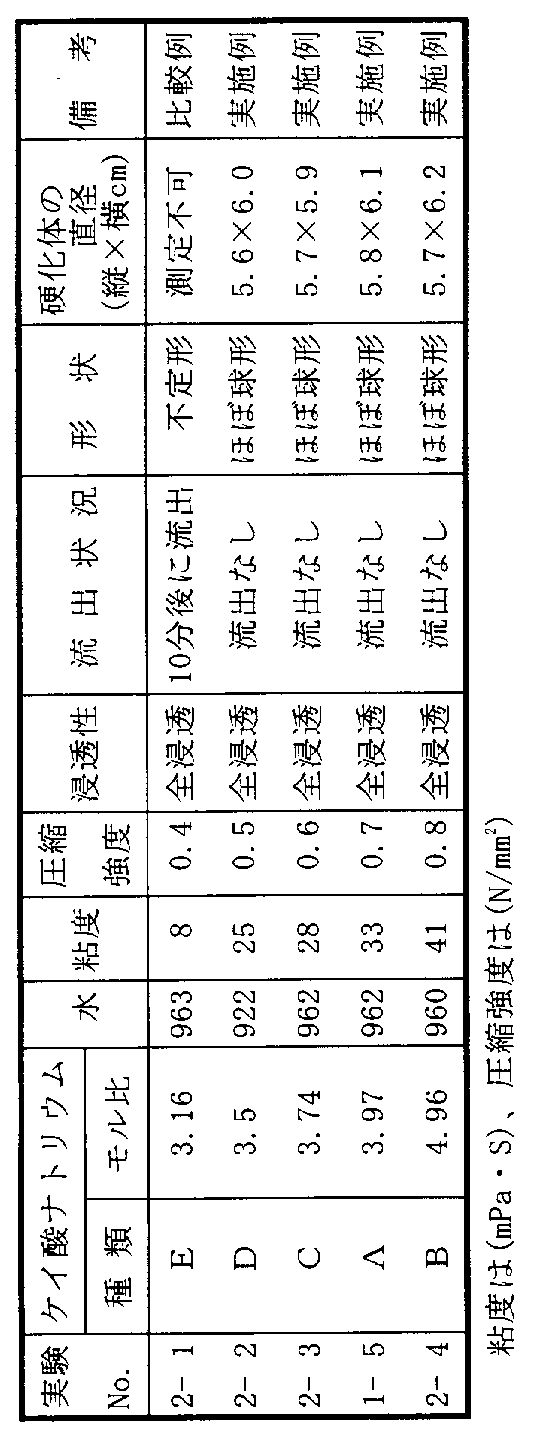
ケイ酸ナトリウムのモル比nが3.5未満の3.16である実験No.2- 1においては、浸透性は、実験No.1- 5と同様な結果が得られたが、圧縮強度はやや低下し、浸透流下試験では注入材が注入から10分後に流出し不定形な硬化体であった。
高炉スラグ微粉末と分級セメントの合計100部に対して、ケイ酸ナトリウムAを固形分で1.5部使用し、表3に示すポリアクリル酸系分散剤を用いたこと以外は実験例2と同様に行った。結果を表3に併記する。
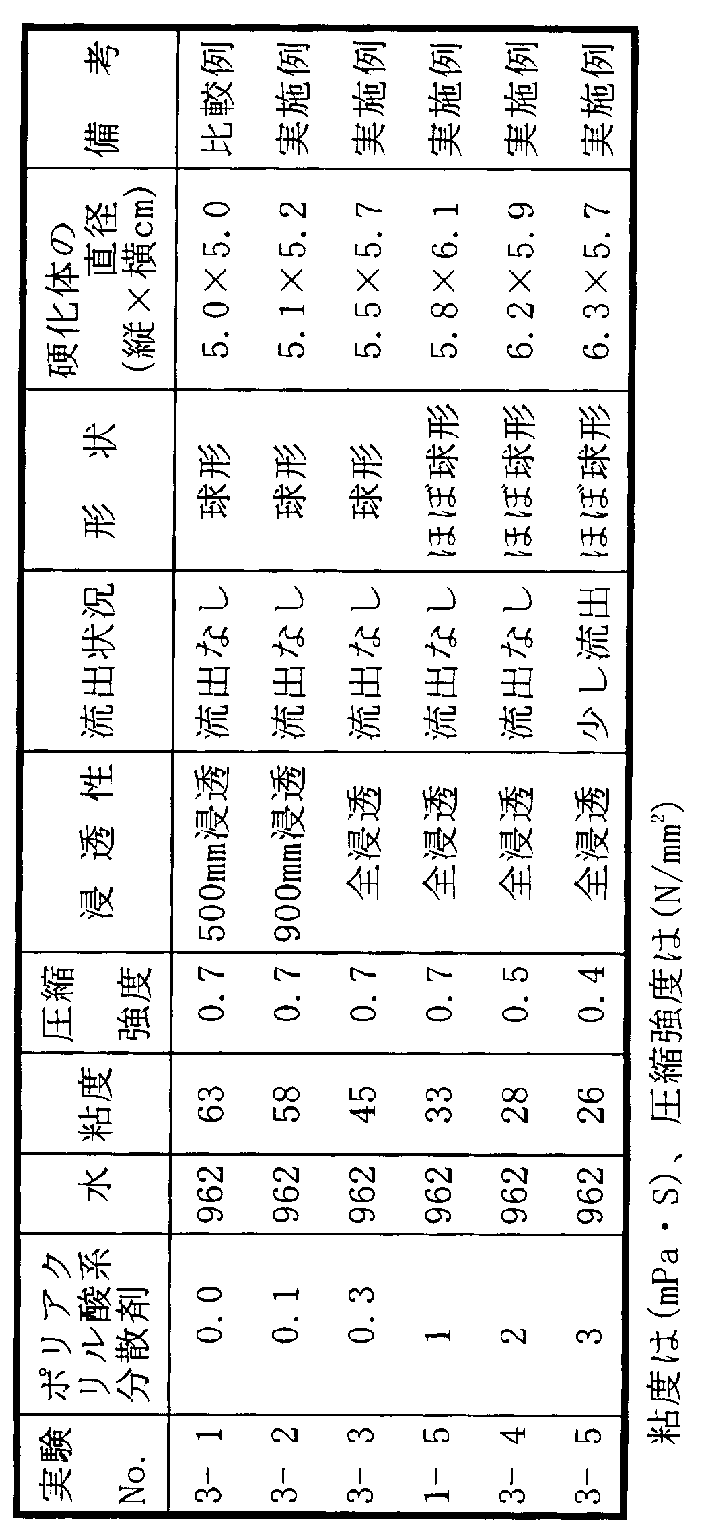
高炉スラグ微粉末と分級セメントの合計100部に対して、ケイ酸ナトリウムAを固形分で1.5部使用し、表4に示す高炉スラグ微粉末、分級セメントを使用したこと以外は実験例2と同様に行った。結果を表4に併記する。

高炉スラグ微粉末と分級セメントの合計100部に対して、ケイ酸ナトリウムAを固形分で1.5部使用し、高炉スラグ微粉末100部に対して、表5に示す分級セメントを使用したこと以外は実験例2と同様に行った。結果を表5に併記する。

Claims (5)
- 高炉スラグ微粉末、分級セメント、ポリアクリル酸系分散剤、及び逸流防止剤としてのケイ酸アルカリ金属塩を含有し、前記ケイ酸アルカリ金属塩は、下記の一般式(1)におけるモル比nが3.5以上であり、前記高炉スラグ微粉末と分級セメントの合計100部に対して、0.2~7部であることを特徴とする地盤注入用水硬性セメント組成物。
R2O・nSiO2(R:アルカリ金属) (1) - 前記ポリアクリル酸系分散剤が下記一般式(2)の単量体を含む共重合体であることを特徴とする請求項1記載の地盤注入用水硬性セメント組成物。
CH2=C(R1)COO(R2O)nR3 (2)
(式中、R1は水素原子又はメチル基、R2Oは炭素数2~4のオキシアルキレン基、nは5~40の整数、R3は水素原子又は炭素数1~5のアルキル基を示す。) - 前記高炉スラグ微粉末及び前記分級セメントが、いずれも、ブレーン比表面積値で7,000~16,000cm2/g、メジアン径で1~7μmであることを特徴とする請求項1記載の地盤注入用水硬性セメント組成物。
- 請求項1~3のいずれか1項記載の地盤注入用水硬性セメント組成物を地盤内に注入する地盤改良工法。
- 液状化防止のための地盤改良に用いることを特徴とする請求項4記載の地盤改良工法。
Priority Applications (5)
| Application Number | Priority Date | Filing Date | Title |
|---|---|---|---|
| HK12109853.3A HK1169434B (en) | 2009-09-07 | 2010-09-07 | Hydraulic cement composition for injection into soil, and method for improvement in soil using same |
| JP2011529974A JP5769198B2 (ja) | 2009-09-07 | 2010-09-07 | 地盤注入用水硬性セメント組成物およびそれを用いた地盤改良工法 |
| SG2012015764A SG179011A1 (en) | 2009-09-07 | 2010-09-07 | Hydraulic cement composition for soil injection, and soil improvement method using the same |
| KR1020127008785A KR101816937B1 (ko) | 2009-09-07 | 2010-09-07 | 지반주입용 수경성 시멘트조성물 및 이를 이용한 지반개량방법 |
| CN201080050149.0A CN102597164B (zh) | 2009-09-07 | 2010-09-07 | 地基注入用水硬性水泥组合物以及使用该组合物的地基改良方法 |
Applications Claiming Priority (4)
| Application Number | Priority Date | Filing Date | Title |
|---|---|---|---|
| JP2009205955 | 2009-09-07 | ||
| JP2009-205955 | 2009-09-07 | ||
| JP2010-116914 | 2010-05-21 | ||
| JP2010116914 | 2010-05-21 |
Publications (1)
| Publication Number | Publication Date |
|---|---|
| WO2011027891A1 true WO2011027891A1 (ja) | 2011-03-10 |
Family
ID=43649424
Family Applications (1)
| Application Number | Title | Priority Date | Filing Date |
|---|---|---|---|
| PCT/JP2010/065279 Ceased WO2011027891A1 (ja) | 2009-09-07 | 2010-09-07 | 地盤注入用水硬性セメント組成物およびそれを用いた地盤改良工法 |
Country Status (6)
| Country | Link |
|---|---|
| JP (1) | JP5769198B2 (ja) |
| KR (1) | KR101816937B1 (ja) |
| CN (1) | CN102597164B (ja) |
| MY (1) | MY158997A (ja) |
| SG (1) | SG179011A1 (ja) |
| WO (1) | WO2011027891A1 (ja) |
Cited By (4)
| Publication number | Priority date | Publication date | Assignee | Title |
|---|---|---|---|---|
| JP2012224766A (ja) * | 2011-04-20 | 2012-11-15 | Mitsubishi Rayon Co Ltd | 懸濁グラウト薬液の製造方法 |
| JP2013159697A (ja) * | 2012-02-03 | 2013-08-19 | Fuji Kagaku Kk | 地盤注入用薬液およびそれを用いた地盤改良工法 |
| JP6034530B1 (ja) * | 2016-07-01 | 2016-11-30 | 東曹産業株式会社 | 粘着性グラウトの製造方法及びグラウト注入工法 |
| JP2024516675A (ja) * | 2021-04-30 | 2024-04-16 | エコセム マテリアルズ リミテッド | 微細充填剤及び微細な粉砕された粒子状高炉スラグを含む結合材組成物 |
Citations (7)
| Publication number | Priority date | Publication date | Assignee | Title |
|---|---|---|---|---|
| JPH07286173A (ja) * | 1994-04-19 | 1995-10-31 | Kyokado Eng Co Ltd | 地盤注入液 |
| JP2002212556A (ja) * | 2001-01-23 | 2002-07-31 | Denki Kagaku Kogyo Kk | 注入材及びそれを用いた注入施工方法 |
| JP2004175989A (ja) * | 2002-11-28 | 2004-06-24 | Sumitomo Osaka Cement Co Ltd | 地盤改良セメント組成物用添加剤、それを用いる地盤改良セメント組成物及び地盤改良方法 |
| JP2007238925A (ja) * | 2006-02-07 | 2007-09-20 | Nittetsu Cement Co Ltd | 超微粒子注入材組成物 |
| JP2007238428A (ja) * | 2006-02-07 | 2007-09-20 | Nittetsu Cement Co Ltd | 極超微粒子注入材組成物 |
| JP2008169262A (ja) * | 2007-01-10 | 2008-07-24 | Mitsubishi Rayon Co Ltd | 土質安定用薬液 |
| JP2009155472A (ja) * | 2007-12-26 | 2009-07-16 | Mitsubishi Rayon Co Ltd | 土質安定用薬液 |
Family Cites Families (3)
| Publication number | Priority date | Publication date | Assignee | Title |
|---|---|---|---|---|
| JP4902356B2 (ja) * | 2004-11-11 | 2012-03-21 | 電気化学工業株式会社 | 地盤改良材用組成物、それを用いた注入材及びその使用方法 |
| KR100804807B1 (ko) * | 2007-08-30 | 2008-02-20 | 케이에스씨 엔지니어링 주식회사 | 친환경 지반 주입용 조성물 및 이의 주입공법 |
| KR100876222B1 (ko) * | 2007-09-06 | 2008-12-29 | 주식회사 동아지질 | 연약지반 개량용 기능성 고화재 |
-
2010
- 2010-09-07 MY MYPI2012001026A patent/MY158997A/en unknown
- 2010-09-07 CN CN201080050149.0A patent/CN102597164B/zh not_active Expired - Fee Related
- 2010-09-07 SG SG2012015764A patent/SG179011A1/en unknown
- 2010-09-07 KR KR1020127008785A patent/KR101816937B1/ko not_active Expired - Fee Related
- 2010-09-07 JP JP2011529974A patent/JP5769198B2/ja active Active
- 2010-09-07 WO PCT/JP2010/065279 patent/WO2011027891A1/ja not_active Ceased
Patent Citations (7)
| Publication number | Priority date | Publication date | Assignee | Title |
|---|---|---|---|---|
| JPH07286173A (ja) * | 1994-04-19 | 1995-10-31 | Kyokado Eng Co Ltd | 地盤注入液 |
| JP2002212556A (ja) * | 2001-01-23 | 2002-07-31 | Denki Kagaku Kogyo Kk | 注入材及びそれを用いた注入施工方法 |
| JP2004175989A (ja) * | 2002-11-28 | 2004-06-24 | Sumitomo Osaka Cement Co Ltd | 地盤改良セメント組成物用添加剤、それを用いる地盤改良セメント組成物及び地盤改良方法 |
| JP2007238925A (ja) * | 2006-02-07 | 2007-09-20 | Nittetsu Cement Co Ltd | 超微粒子注入材組成物 |
| JP2007238428A (ja) * | 2006-02-07 | 2007-09-20 | Nittetsu Cement Co Ltd | 極超微粒子注入材組成物 |
| JP2008169262A (ja) * | 2007-01-10 | 2008-07-24 | Mitsubishi Rayon Co Ltd | 土質安定用薬液 |
| JP2009155472A (ja) * | 2007-12-26 | 2009-07-16 | Mitsubishi Rayon Co Ltd | 土質安定用薬液 |
Cited By (4)
| Publication number | Priority date | Publication date | Assignee | Title |
|---|---|---|---|---|
| JP2012224766A (ja) * | 2011-04-20 | 2012-11-15 | Mitsubishi Rayon Co Ltd | 懸濁グラウト薬液の製造方法 |
| JP2013159697A (ja) * | 2012-02-03 | 2013-08-19 | Fuji Kagaku Kk | 地盤注入用薬液およびそれを用いた地盤改良工法 |
| JP6034530B1 (ja) * | 2016-07-01 | 2016-11-30 | 東曹産業株式会社 | 粘着性グラウトの製造方法及びグラウト注入工法 |
| JP2024516675A (ja) * | 2021-04-30 | 2024-04-16 | エコセム マテリアルズ リミテッド | 微細充填剤及び微細な粉砕された粒子状高炉スラグを含む結合材組成物 |
Also Published As
| Publication number | Publication date |
|---|---|
| JPWO2011027891A1 (ja) | 2013-02-04 |
| JP5769198B2 (ja) | 2015-08-26 |
| KR20120116388A (ko) | 2012-10-22 |
| SG179011A1 (en) | 2012-04-27 |
| CN102597164B (zh) | 2014-11-05 |
| HK1169434A1 (en) | 2013-01-25 |
| MY158997A (en) | 2016-11-30 |
| KR101816937B1 (ko) | 2018-01-09 |
| CN102597164A (zh) | 2012-07-18 |
Similar Documents
| Publication | Publication Date | Title |
|---|---|---|
| JP5121484B2 (ja) | 水中不分離性セメント組成物、プレミックスタイプ水中不分離性モルタル組成物、及び水中不分離性グラウトモルタル | |
| JP6359772B2 (ja) | セメント用添加剤、セメント組成物、およびセメント用添加剤用原料 | |
| JP2010235721A (ja) | 注入工法 | |
| JP5769197B2 (ja) | 地盤注入用水硬性セメント組成物およびそれを用いた地盤改良工法 | |
| JP2016130416A (ja) | 液状化防止用地盤注入剤組成物及びこれを用いた地盤改良工法 | |
| CN103193442A (zh) | 高钛重矿渣泵送混凝土及施工方法 | |
| JP5769198B2 (ja) | 地盤注入用水硬性セメント組成物およびそれを用いた地盤改良工法 | |
| JP6040424B2 (ja) | 地盤注入用薬液およびそれを用いた地盤改良工法 | |
| CN105189403A (zh) | 水硬性粉体用强度提高剂组合物和水硬性粉体硬化体的强度提高方法 | |
| JP7299869B2 (ja) | 地盤の改良工法 | |
| JP5689224B2 (ja) | 注入材及び注入工法 | |
| JP4270903B2 (ja) | 地盤改良工法用スラリー、該スラリーによって形成された地盤改良体及び地盤改良工法用スラリー分散剤 | |
| JP2011079990A (ja) | 注入材 | |
| JP5717945B2 (ja) | 注入材料、注入材及び注入工法 | |
| JP2008308612A (ja) | スラグ系注入材及びその注入工法 | |
| JP2015189634A (ja) | 事後発泡型充填グラウト材の製造方法 | |
| JP5294371B2 (ja) | 注入材 | |
| KR102821154B1 (ko) | 압송성능이 향상된 중유동 콘크리트 조성물 | |
| JP7693452B2 (ja) | 水硬性粉体用分散剤組成物 | |
| HK1169434B (en) | Hydraulic cement composition for injection into soil, and method for improvement in soil using same | |
| JP5655890B2 (ja) | スラグ系注入材及びその注入工法 | |
| JP5498695B2 (ja) | 地盤注入材及びそれを用いた地盤注入工法 | |
| JP6887739B2 (ja) | 水硬性組成物用表面美観向上剤組成物 | |
| JP2006182625A (ja) | セメント系グラウト組成物 | |
| JP7044535B2 (ja) | 杭工法用水硬性組成物 |
Legal Events
| Date | Code | Title | Description |
|---|---|---|---|
| WWE | Wipo information: entry into national phase |
Ref document number: 201080050149.0 Country of ref document: CN |
|
| 121 | Ep: the epo has been informed by wipo that ep was designated in this application |
Ref document number: 10813837 Country of ref document: EP Kind code of ref document: A1 |
|
| WWE | Wipo information: entry into national phase |
Ref document number: 2011529974 Country of ref document: JP |
|
| NENP | Non-entry into the national phase |
Ref country code: DE |
|
| ENP | Entry into the national phase |
Ref document number: 20127008785 Country of ref document: KR Kind code of ref document: A |
|
| 122 | Ep: pct application non-entry in european phase |
Ref document number: 10813837 Country of ref document: EP Kind code of ref document: A1 |