WO2011027885A1 - シクロデキストリンによるトランス脂肪酸類の選択的分離方法 - Google Patents
シクロデキストリンによるトランス脂肪酸類の選択的分離方法 Download PDFInfo
- Publication number
- WO2011027885A1 WO2011027885A1 PCT/JP2010/065235 JP2010065235W WO2011027885A1 WO 2011027885 A1 WO2011027885 A1 WO 2011027885A1 JP 2010065235 W JP2010065235 W JP 2010065235W WO 2011027885 A1 WO2011027885 A1 WO 2011027885A1
- Authority
- WO
- WIPO (PCT)
- Prior art keywords
- fatty acids
- cyclodextrin
- trans fatty
- methyl
- trans
- Prior art date
- Legal status (The legal status is an assumption and is not a legal conclusion. Google has not performed a legal analysis and makes no representation as to the accuracy of the status listed.)
- Ceased
Links
Images


Classifications
-
- B—PERFORMING OPERATIONS; TRANSPORTING
- B01—PHYSICAL OR CHEMICAL PROCESSES OR APPARATUS IN GENERAL
- B01J—CHEMICAL OR PHYSICAL PROCESSES, e.g. CATALYSIS OR COLLOID CHEMISTRY; THEIR RELEVANT APPARATUS
- B01J20/00—Solid sorbent compositions or filter aid compositions; Sorbents for chromatography; Processes for preparing, regenerating or reactivating thereof
- B01J20/22—Solid sorbent compositions or filter aid compositions; Sorbents for chromatography; Processes for preparing, regenerating or reactivating thereof comprising organic material
- B01J20/26—Synthetic macromolecular compounds
-
- B—PERFORMING OPERATIONS; TRANSPORTING
- B01—PHYSICAL OR CHEMICAL PROCESSES OR APPARATUS IN GENERAL
- B01D—SEPARATION
- B01D15/00—Separating processes involving the treatment of liquids with solid sorbents; Apparatus therefor
-
- B—PERFORMING OPERATIONS; TRANSPORTING
- B01—PHYSICAL OR CHEMICAL PROCESSES OR APPARATUS IN GENERAL
- B01J—CHEMICAL OR PHYSICAL PROCESSES, e.g. CATALYSIS OR COLLOID CHEMISTRY; THEIR RELEVANT APPARATUS
- B01J20/00—Solid sorbent compositions or filter aid compositions; Sorbents for chromatography; Processes for preparing, regenerating or reactivating thereof
- B01J20/22—Solid sorbent compositions or filter aid compositions; Sorbents for chromatography; Processes for preparing, regenerating or reactivating thereof comprising organic material
- B01J20/26—Synthetic macromolecular compounds
- B01J20/262—Synthetic macromolecular compounds obtained otherwise than by reactions only involving carbon to carbon unsaturated bonds, e.g. obtained by polycondensation
-
- C—CHEMISTRY; METALLURGY
- C07—ORGANIC CHEMISTRY
- C07C—ACYCLIC OR CARBOCYCLIC COMPOUNDS
- C07C67/00—Preparation of carboxylic acid esters
- C07C67/48—Separation; Purification; Stabilisation; Use of additives
- C07C67/56—Separation; Purification; Stabilisation; Use of additives by solid-liquid treatment; by chemisorption
-
- C—CHEMISTRY; METALLURGY
- C11—ANIMAL OR VEGETABLE OILS, FATS, FATTY SUBSTANCES OR WAXES; FATTY ACIDS THEREFROM; DETERGENTS; CANDLES
- C11B—PRODUCING, e.g. BY PRESSING RAW MATERIALS OR BY EXTRACTION FROM WASTE MATERIALS, REFINING OR PRESERVING FATS, FATTY SUBSTANCES, e.g. LANOLIN, FATTY OILS OR WAXES; ESSENTIAL OILS; PERFUMES
- C11B7/00—Separation of mixtures of fats or fatty oils into their constituents, e.g. saturated oils from unsaturated oils
- C11B7/0008—Separation of mixtures of fats or fatty oils into their constituents, e.g. saturated oils from unsaturated oils by differences of solubilities, e.g. by extraction, by separation from a solution by means of anti-solvents
- C11B7/0025—Separation of mixtures of fats or fatty oils into their constituents, e.g. saturated oils from unsaturated oils by differences of solubilities, e.g. by extraction, by separation from a solution by means of anti-solvents in solvents containing oxygen in their molecule
-
- Y—GENERAL TAGGING OF NEW TECHNOLOGICAL DEVELOPMENTS; GENERAL TAGGING OF CROSS-SECTIONAL TECHNOLOGIES SPANNING OVER SEVERAL SECTIONS OF THE IPC; TECHNICAL SUBJECTS COVERED BY FORMER USPC CROSS-REFERENCE ART COLLECTIONS [XRACs] AND DIGESTS
- Y02—TECHNOLOGIES OR APPLICATIONS FOR MITIGATION OR ADAPTATION AGAINST CLIMATE CHANGE
- Y02E—REDUCTION OF GREENHOUSE GAS [GHG] EMISSIONS, RELATED TO ENERGY GENERATION, TRANSMISSION OR DISTRIBUTION
- Y02E50/00—Technologies for the production of fuel of non-fossil origin
- Y02E50/10—Biofuels, e.g. bio-diesel
-
- Y—GENERAL TAGGING OF NEW TECHNOLOGICAL DEVELOPMENTS; GENERAL TAGGING OF CROSS-SECTIONAL TECHNOLOGIES SPANNING OVER SEVERAL SECTIONS OF THE IPC; TECHNICAL SUBJECTS COVERED BY FORMER USPC CROSS-REFERENCE ART COLLECTIONS [XRACs] AND DIGESTS
- Y02—TECHNOLOGIES OR APPLICATIONS FOR MITIGATION OR ADAPTATION AGAINST CLIMATE CHANGE
- Y02P—CLIMATE CHANGE MITIGATION TECHNOLOGIES IN THE PRODUCTION OR PROCESSING OF GOODS
- Y02P20/00—Technologies relating to chemical industry
- Y02P20/50—Improvements relating to the production of bulk chemicals
Definitions
- the present invention relates to an application technology of cyclodextrin. More specifically, the present invention relates to a method for selective adsorption separation of trans fatty acids with cyclodextrin.
- Vegetable oil is widely used for food, such as mayonnaise, dressing, tempura oil, margarine, and is an essential ingredient in our diet.
- the vegetable oil currently consumed for food in Japan is over 2 million tons per year.
- trans fatty acids trans fatty acids
- LDL cholesterol bad cholesterol
- HDL cholesterol good cholesterol
- Activated carbon Patent Document 1
- zeolite Patent Document 2
- Activated carbon Patent Document 1
- zeolite Patent Document 2
- adsorbents for separating and removing trans fatty acid components from edible oil, but the adsorption selectivity for trans fatty acids is not sufficient.
- it is difficult to desorb the adsorbed trans fatty acid with these adsorbents it is considered difficult to reuse the adsorbent.
- the present invention has been made in view of the above circumstances, and trans fatty acids and / or esters thereof (hereinafter referred to as “fatty acids and / or esters thereof” are referred to as “fatty acids”) in an organic solvent solution such as vegetable oil quickly and energy-saving. It is an object to provide a method capable of removing
- the present invention relates to a trans fatty acid cyclodextrin characterized by undergoing a step of adding cyclodextrin to an organic solvent solution containing trans fatty acid, and a step of contacting trans fatty acid with cyclodextrin.
- a selective removal method is provided.
- the trans fatty acid component can be selectively separated and removed from an organic solvent solution such as vegetable oil.
- trans fatty acid adsorbed simply by washing with an organic solvent can be recovered easily and with high yield, and the adsorbent can be reused.
- cyclodextrin which is a cyclic oligosaccharide to which 6 to 8 glucoses represented by the following chemical formula (I) are bound, is used as an adsorbent, whereby cis and trans fatty acids in an organic solvent are used. In this mixture, trans fatty acids are selectively separated and removed.
- R 1 and R 2 are a hydrogen atom, a methyl group or an acetyl group.
- n is an integer of 1, 2 or 3.
- R 1 and R 2 are hydrogen atoms or ⁇ -cyclodextrin, or R 1 and R 2 are both methyl groups.
- R 1 and R 2 are both methyl groups, or R 1 is an acetyl group and R 2 is a hydrogen atom.
- ⁇ -, ⁇ -, and ⁇ -cyclodextrin are commercially available from various companies, for example, as pure products from Wako Pure Chemical Industries, Ltd., Tokyo Chemical Industry, Nacalai Tesque, Sigma-Aldrich. It is available.
- methyl iodide methyl iodide
- trans fatty acids to be selectively separated and removed are trans fatty acids (and mixtures thereof) having one or two, preferably one, unsaturated double bonds having 16 to 24 carbon atoms, preferably 18 to 22 carbon atoms.
- trans fatty acids and mixtures thereof
- C1-C3 alkyl esters of trans fatty acids C2-C5 polyhydric alcohol esters, and mixtures thereof, in particular ethylene glycol esters (monoesters and / or diesters), glycerin esters (monoesters, diesters and / or triesters) ), And mixtures thereof, among them methyl esters, glycerin triesters and mixtures thereof.
- the fatty acid methyl ester having 16 carbon atoms is methyl palmitate, and the one having 18 carbon atoms is methyl elaidate represented by the following structural formula;
- the fatty acid methyl ester of the regioisomer having 18 carbon atoms (trans-11) is methyl vaccenate
- the fatty acid methyl ester having 20 carbon atoms is trans-11-eicosenoic acid methyl
- the fatty acid having 22 carbon atoms is methyl brassinate
- the cis isomer is referred to as methyl erucate
- the fatty acid having 24 carbon atoms is trans-15-tetracosenoate methyl (the cis isomer is referred to as methyl nervonate).
- glycerin ester composed of 3 molecules of elaidic acid which is a trans fatty acid
- glycerin ester composed of 3 molecules of oleic acid which is a cis isomer is triolein.
- the trans isomer can be selectively separated using the cyclodextrin.
- the isomer of methyl palmitate having 16 carbon atoms is methyl palmitoleate, and is present in, for example, cod liver oil, sardine oil, herring oil (so-called fish oil), beef tallow and lard.
- cod liver oil cod liver oil
- sardine oil herring oil (so-called fish oil)
- herring oil herring oil
- beef tallow and lard cod liver oil
- the isomer of methyl elaidate having 18 carbon atoms is methyl oleate and is present in vegetable oils such as rapeseed oil, safflower oil and sunflower oil.
- vegetable oils such as rapeseed oil, safflower oil and sunflower oil.
- the isomer of methyl trans-11-eicosenoate having 20 carbons is methyl cis-11-eicosenoate, and is present in, for example, fish oil and lard.
- the isomer of methyl brassinate having 22 carbon atoms is methyl erucate, and is present, for example, in peanut oil and fish oil.
- n 1 and R 1 and R 2 are hydrogen atoms or methyl groups in the above formula (I). preferable.
- a cyclodextrin may be selected according to the number of carbon atoms of the fatty acid described in the fatty acid methyl ester.
- triolein which is an isomer of trielaidin, which is a glycerin triester of a fatty acid having 18 carbon atoms, is present in, for example, olive oil and soybean oil.
- trans isomer can be selectively removed from the organic solvent solution containing the above trans fatty acids.
- the organic solvent means a solvent that can dissolve trans fatty acids but is not miscible with the cyclodextrin defined in the formula (I).
- “can be dissolved” means that the solubility is about 1% by weight or more at a temperature of 25 ° C.
- “not miscible” means that the solubility of cyclodextrin is 1% by weight at a temperature of 25 ° C. This means that the solubility is less than less.
- organic solvents examples include water-soluble organic solvents such as acetone, acetonitrile, tetrahydrofuran, 1,4-dioxane, 2-propanol, acetic acid, hexane, heptane, octane, cyclohexane, benzene, toluene, xylene, petroleum Hydrocarbon solvents such as ether, halogenated hydrocarbons such as dichloromethane, chloroform, 1,2-dichloroethane, carbon tetrachloride, chlorobenzene, and other edible oils, machine oils, including diethyl ether, ethyl acetate, carbon disulfide, or vegetable oils, Examples thereof include oils that are not mixed with water such as insulating oils, lubricating oils, and plasticizers.
- “not mixed with water” means that the solubility in water at 25 ° C. is less than 1% by weight.
- soybean oil does not originally contain trans fatty acids, but when used in cooking or the like, it isomerizes and produces trans fatty acids.
- the present invention is useful in separating and removing trans isomers from such waste oil. Of course, it is useful not only for waste oil but also for separating and removing trans fatty acids from edible oils containing trans fatty acids.
- Such edible oils (including waste oils) containing trans fatty acids correspond to “organic solvent solutions containing trans fatty acids” as defined in the present invention.
- a cyclodextrin represented by the formula (I) is added to an organic solvent solution containing trans fatty acids.
- the concentration of trans fatty acids is not particularly limited as long as the trans fatty acids are dissolved.
- the amount of cyclodextrin added may be determined based on the content of trans fatty acids and the amount of organic solvent. In the examples, the amount of cyclodextrin is about 0.003 to 1.0 g, preferably about 0.003 to 0.5 g per 0.5 to 3 mg of trans fatty acid. This is because if the amount is too large, the selectivity for removing the trans fatty acid relative to the cis fatty acid is lowered, and if it is too small, the removal rate of the trans fatty acid is lowered.
- the trans fatty acids are brought into contact with cyclodextrin. Since the cyclodextrin used in the present invention is not miscible with the organic solvent, the contact between the trans fatty acids and the cyclodextrin is a liquid-solid contact. In order to perform such contact efficiently, a mixture of an organic solvent solution containing trans fatty acids and cyclodextrin is stirred by a known mixing means such as a magnetic stirrer.
- the contact condition may be a room temperature (25 ° C.) atmospheric pressure environment condition, and depending on the contact means, it may be contacted for about 1 to 24 hours.
- a magnetic stirrer was used as a mixing means, and conditions of pressure: atmospheric pressure, temperature: 25 ° C. (room temperature), and stirring time: 6 hours were employed.
- the cyclodextrin is filtered and separated from the organic solvent solution.
- the separated organic solvent solution filtrate is one in which trans fatty acids are selectively removed from the organic solvent solution containing the trans fatty acids before adding cyclodextrin.
- “Selective” means that trans fatty acids are more adsorbed to cyclodextrins than cis fatty acids ”. This selective removal is confirmed by comparing the amount of trans fatty acid and cis fatty acid salt in the filtrate with the amount of trans fatty acid compared to the amount in the organic solvent solution containing them before adding cyclodextrin.
- the amount is less than that of fatty acids, and the amount of trans fatty acids and cis fatty acids adsorbed on the filtered cyclodextrin is measured. You may confirm by having more than the quantity of cis fatty acids.
- the amount of trans fatty acids and cis fatty acids in the organic solvent was analyzed by gas chromatography (GL-Sciences Inc. TC-70 column (0.25 mm ID x 30 m), column temperature constant 160 ° C., carrier gas: helium gas, detection Instrument: FID).
- the selective efficiency in the present invention varies depending on the fatty acid contained and the cyclodextrin used, but for example, ⁇ -cyclodextrin is used for an organic solvent solution containing the same amount of methyl elaidate and methyl oleate.
- methyl elaidate trans isomer
- methyl oleate cis isomer
- the present invention is carried out using hexakis (2,6-6-dimethyl) - ⁇ -cyclodextrin with respect to an organic solvent solution containing the same amount of methyl elaidate and methyl oleate.
- Methyl elaidate (trans form) is adsorbed and removed, but methyl oleate (cis form) is hardly adsorbed and removed.
- the present invention is carried out using ⁇ -cyclodextrin with respect to an organic solvent solution containing the same amount of methyl brassinate (trans isomer) and methyl erucate (cis isomer), In contrast, the trans isomer can be removed with twice or more efficiency.
- the filtered cyclodextrin is washed with ethanol to separate the adsorbed and removed fatty acid and cyclodextrin.
- the cyclodextrin can be reused in the method of the present invention, and the fatty acid can be used for biodiesel fuel and the like. .
- Example 1 ⁇ -CD (100 mg) was added to 5 mL of acetone containing methyl elaidate (5 mg) as a trans fatty acid and methyl oleate (5 mg) as a cis fatty acid, and stirred at room temperature for 6 hours.
- the solubility of methyl elaidate in acetone is 10% by weight or more, the solubility of methyl oleate is 10% by weight or more, and the solubility of ⁇ -CD is almost 0% by weight.
- ⁇ -CD was removed by filtration, and the fatty acid content in acetone was measured.
- the removal rate of methyl elaidate was 42% and the removal rate of methyl oleate was 10%.
- the result is shown in FIG. It can be seen that methyl elaidate is selectively removed over methyl oleate.
- the fatty acid content in acetone was determined by gas chromatography analysis (TC-70 column (0.25 mm ID x 30 m) manufactured by GL Sciences Inc., column temperature constant at 160 ° C., carrier gas: helium gas, detector: FID). And obtained by comparing the peak areas of the chromatograms.
- Example 2 Hexakis (2,6- ⁇ -dimethyl) - ⁇ -CD (300 mg) was added to 3 mL of hexane containing methyl elaidate (3.0 mg) as a trans fatty acid and methyl oleate (3.0 mg) as a cis fatty acid. Added and stirred at room temperature for 24 hours.
- solubility of elaidic acid methyl respect hexane 10 by weight% or more, the solubility of methyl oleate 10% by weight or more, hexakis (2, 6-o-dimethyl) solubility-.alpha.-CD is 0.14% by weight.
- Example 3 ⁇ -CD (100 mg) was added to 5 mL of acetone containing methyl brassinate (5.0 mg) as a trans fatty acid and methyl erucate (5.0 mg) as a cis fatty acid, and the mixture was stirred at room temperature for 24 hours.
- the solubility of methyl brassinate in acetone is 10% by weight or more, the solubility of methyl erucate is 10% by weight or more, and the solubility of ⁇ -CD is almost 0% by weight.
- ⁇ -CD was removed by filtration and the fatty acid content in acetone was measured.
- the removal rate of methyl brassinate was 84% and the removal rate of methyl erucate was 34%.
- the result is shown in FIG. It can be seen that methyl brassinate is selectively removed over methyl erucate.
- Example 4 Hexakis (2,6- ⁇ -dimethyl) in 5 mL of hexane containing methyl elaidate (5.0 mg) as a trans fatty acid and triolein (5.0 mg) as a triglyceride consisting of 3 molecules of oleic acid as a cis fatty acid - ⁇ -CD (300 mg) was added and stirred at room temperature for 24 hours.
- the solubility of methyl elaidate in hexane is 10% by weight or more, the solubility of triolein is 10% by weight or more, and the solubility of hexakis (2,6- ⁇ -dimethyl) - ⁇ -CD is 0.14% by weight.
- Example 5 ⁇ -CD (100 mg) was added to 3 mL of acetone containing trielaidin (3.0 mg) and triolein (3.0 mg), a triglyceride consisting of 3 molecules of elaidic acid, a trans fatty acid, and stirred at room temperature for 24 hours. did.
- the solubility of trielaidine in acetone is 10% by weight or more, the solubility of triolein is 10% by weight or more, and the solubility of ⁇ -CD is almost 0% by weight.
- ⁇ -CD was removed by filtration and the fatty acid content in acetone was measured.
- the removal rate of trielaidin was 39% and the removal rate of triolein was almost 0%.
- Example 6 ⁇ -CD (100 mg) was added to 3 mL of acetone containing trieridine (0.75 mg) and triolein (3.0 mg), and the mixture was stirred at room temperature for 24 hours.
- the solubility of trielaidine in acetone is 10% by weight or more, the solubility of triolein is 10% by weight or more, and the solubility of ⁇ -CD is almost 0% by weight.
- ⁇ -CD was removed by filtration, and the fatty acid content in acetone was measured.
- the removal rate of trielaidin was 78%, and the removal rate of triolein was approximately 12%.
- Example 7 Hexakis (2,6- ⁇ -dimethyl) - ⁇ -CD (100 mg) was added to soybean oil (810 mg) containing methyl elaidate (90 mg) and stirred at room temperature for 24 hours.
- the solubility of methyl elaidate in soybean oil is 10% by weight or more, and the solubility of hexakis (2,6- ⁇ -dimethyl) - ⁇ -CD is almost 0% by weight.
- trans fatty acid removal system it can be put into practical use in the food field.
Landscapes
- Chemical & Material Sciences (AREA)
- Organic Chemistry (AREA)
- Analytical Chemistry (AREA)
- Chemical Kinetics & Catalysis (AREA)
- Life Sciences & Earth Sciences (AREA)
- Engineering & Computer Science (AREA)
- Oil, Petroleum & Natural Gas (AREA)
- Wood Science & Technology (AREA)
- Fats And Perfumes (AREA)
- Treatment Of Liquids With Adsorbents In General (AREA)
- Solid-Sorbent Or Filter-Aiding Compositions (AREA)
- Organic Low-Molecular-Weight Compounds And Preparation Thereof (AREA)
Abstract
植物油等の有機溶媒溶液中から迅速かつ省エネルギー的にトランス脂肪酸類を除去できる方法を提供すること。 トランス脂肪酸類を含有する有機溶媒溶液に、シクロデキストリンを添加する工程、および トランス脂肪酸類とシクロデキストリンを接触させる工程 を経ることを特徴とする、トランス脂肪酸類のシクロデキストリンによる選択的除去方法。
Description
本発明は、シクロデキストリンの応用技術に関する。より詳しくは、シクロデキストリンによるトランス脂肪酸類の選択的吸着分離方法に関する。
植物油はマヨネーズ、ドレッシング、てんぷら油、マーガリンなど食用として広く利用されており、我々の食生活に欠くことができない食材となっている。現在我が国で食用として消費されている植物油は年間200万トン以上に上っている。
しかし、この植物油を加工、精製、調理する時に生成するトランス型の脂肪酸(トランス脂肪酸)がヒトの健康に深刻な影響を及ぼすことが世界規模で問題となっている。トランス脂肪酸はLDLコレステロール(悪玉コレステロール)を増加させ、HDLコレステロール(善玉コレステロール)を減少させる作用があり、また多量に摂取し続けた場合には動脈硬化などによる虚血性心疾患のリスクを高めることが報告されている。このようなことから、トランス脂肪酸を含む製品の使用を規制する国が増えており、我が国でも、健康に対する意識の高まりとともにトランス脂肪酸低減に取り組む企業が増加している。
食用油中からトランス脂肪酸成分を分離除去する吸着剤として、活性炭(特許文献1)やゼオライト(特許文献2)が知られているが、トランス脂肪酸に対する吸着選択性は十分でない。また、これらの吸着剤では吸着したトランス脂肪酸を脱離させることが困難であるため、吸着材の再利用は困難と考えられている。
本発明は上記事情に鑑みなされたもので、植物油等の有機溶媒溶液中から迅速かつ省エネルギー的にトランス脂肪酸および/またはそのエステル(以下、「脂肪酸および/またはそのエステル」を「脂肪酸類」という」)を除去できる方法を提供することを目的とする。
すなわち、本発明は、トランス脂肪酸類を含有する有機溶媒溶液に、シクロデキストリンを添加する工程、および
トランス脂肪酸類とシクロデキストリンを接触させる工程
を経ることを特徴とする、トランス脂肪酸類のシクロデキストリンによる選択的除去方法を提供するものである。
トランス脂肪酸類とシクロデキストリンを接触させる工程
を経ることを特徴とする、トランス脂肪酸類のシクロデキストリンによる選択的除去方法を提供するものである。
植物油等の有機溶媒溶液中からトランス脂肪酸成分を選択的に分離除去することができる。
有機溶媒による洗浄操作だけで吸着されたトランス脂肪酸を簡単かつ収率良く回収でき、また吸着材の再利用化が可能である。
本発明においては、下記化学式(I)で表される6~8個のグルコースが結合した環状オリゴ糖であるシクロデキストリン(CD)を吸着材に用いることにより、有機溶剤中のシス、トランス脂肪酸類の混合物中からトランス脂肪酸類を選択的に分離除去するものである。
シクロデキストリンの空孔内環境が親油性であることから、溶媒として大量に存在する油分子よりも有機ゲスト化合物を優先的にしかも選択的にその空孔内に取り込むのは至難の業であり、油中でのシクロデキストリン(誘導体)と有機ゲスト化合物間での選択的錯体形成はきわめて困難であると永く考えられてきていることを考えると、本発明の方法は極めて予期し得ない現象を利用した選択的除去方法といえる。
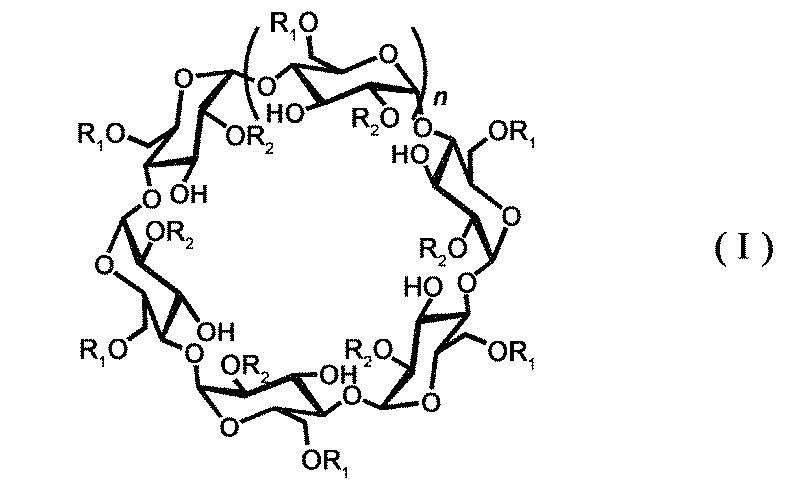
上記式中、R1,R2は、水素原子、メチル基またはアセチル基である。nは1、2または3の整数である。
n=1でR1,R2が共に水素原子の時をα-シクロデキストリン(α-CD)、n=2でR1,R2が共に水素原子の時をβ-シクロデキストリン(β-CD)、n=3でR1,R2が共に水素原子の時をγ-シクロデキストリン(γ-CD)という。
本発明においては、n=1のときは、R1,R2は水素原子であるα-シクロデキストリンまたはR1,R2が共にメチル基であることが好ましい。
n=2または3のときは、R1,R2は共にメチル基であるか、またはR1がアセチル基で、R2は水素原子であることが好ましい。
α-、β-、γ-シクロデキストリンは各社市販品が入手可能であり、例えば、和光純薬工業(株)、東京化成工業(株)、ナカライテスク(株)、Sigma-Aldrichから純品として入手可能である。
n=1で、R1,R2がメチル基であるシクロデキストリンは、α-シクロデキストリンの2位と6位の水酸基をヨウ化メチルを用いて選択的にメチル化することにより合成可能であるし、例えば純品として和光純薬工業(株)から入手可能である。
n=2で、R1,R2が共にメチル基であるシクロデキストリンは、β-シクロデキストリンの2位と6位の水酸基をヨウ化メチルを用いて選択的にメチル化することにより合成可能であるし、例えば純品として和光純薬工業(株)、東京化成工業(株)、ナカライテスク(株)、Sigma-Aldrichから入手可能である。
n=3で、R1,R2が共にメチル基であるシクロデキストリンは、γ-シクロデキストリンの2位と6位の水酸基をヨウ化メチルを用いて選択的にメチル化することにより合成可能である。
n=2または3で、R1はアセチル基で、R2は水素原子であるシクロデキストリンは、β-またはγ-シクロデキストリンから5段階の反応(β-またはγ-シクロデキストリンの6位水酸基のtert-ブチルジメチルシリル化、2,3位水酸基のベンジル化、6位tert-ブチルジメチルシリル基の除去、6位水酸基のアセチル化、脱ベンジル化)を経て合成可能である。
選択的分離除去の対象となるトランス脂肪酸類は、炭素数16~24、好ましくは18~22の不飽和二重結合を一つもしくは二つ、好ましくは1つ有するトランス脂肪酸類(およびそれらの混合物、好ましくはトランス脂肪酸のC1~C3アルキルエステル、C2~C5多価アルコールエステル、およびそれらの混合物、特にエチレングリコールエステル(モノエステルおよび/またはジエステル)、グリセリンエステル(モノエステル、ジエステルおよび/またはトリエステル)、およびそれらの混合物、中でも、メチルエステル、グリセリントリエステルおよびそれらの混合物である。
具体的には、炭素数16の脂肪酸メチルエステルはパルミテライジン酸メチル、炭素数18のものは下記構造式で表されるエライジン酸メチル;

炭素数18の位置異性体(トランス-11)の脂肪酸メチルエステルは、バクセン酸メチル、炭素数20の脂肪酸メチルエステルは、トランス-11-エイコセン酸メチル、炭素数22の脂肪酸は、ブラシジン酸メチル(シス体をエルカ酸メチルとよぶ)、炭素数24の脂肪酸は、トランス-15-テトラコセン酸メチル(シス体をネルボン酸メチルとよぶ)である。また、トランス脂肪酸であるエライジン酸3分子からなるグリセリンエステル(トリグリセリド)はトリエライジンであり、シス異性体であるオレイン酸3分子からなるグリセリンエステル(トリグリセリド)はトリオレインである。
炭素数18の位置異性体(トランス-11)の脂肪酸メチルエステルは、バクセン酸メチル、炭素数20の脂肪酸メチルエステルは、トランス-11-エイコセン酸メチル、炭素数22の脂肪酸は、ブラシジン酸メチル(シス体をエルカ酸メチルとよぶ)、炭素数24の脂肪酸は、トランス-15-テトラコセン酸メチル(シス体をネルボン酸メチルとよぶ)である。また、トランス脂肪酸であるエライジン酸3分子からなるグリセリンエステル(トリグリセリド)はトリエライジンであり、シス異性体であるオレイン酸3分子からなるグリセリンエステル(トリグリセリド)はトリオレインである。
上記のようなトランス脂肪酸類は、同族のシス体と共に存在するとき、上記シクロデキストリンを使用し、トランス体を選択的に分離することができる。
炭素数が16のパルミテライジン酸メチルの異性体は、パルミトレイン酸メチルであり、例えば、タラ肝油、イワシ油、ニシン油(いわゆる魚油)、牛脂、豚脂中に存在する。そのような混合物から、トランス体を選択的に分離するには、上記式(I)中、n=1であり、R1,R2が水素原子あるいはメチル基であるシクロデキストリンを使用することが好ましい。
炭素数が18のエライジン酸メチルの異性体は、オレイン酸メチルであり、例えば、なたね油やサフラワー油やひまわり油などの植物油中に存在する。そのような混合物から、トランス体を選択的に分離するには、上記式(I)中、n=1であり、R1,R2が水素原子あるいはメチル基であるシクロデキストリンを使用することが好ましい。
炭素数が20のトランス-11-エイコセン酸メチルの異性体は、シス-11-エイコセン酸メチルであり、例えば、魚油、豚脂中に存在する。そのような混合物から、トランス体を選択的に分離するには、上記式(I)中、n=1であり、R1,R2が水素原子あるいはメチル基であるシクロデキストリンを使用することが好ましい。
炭素数が22のブラシジン酸メチルの異性体は、エルカ酸メチルであり、例えば、落花生油、魚油中に存在する。そのような混合物から、トランス体を選択的に分離するには、上記式(I)中、n=1であり、R1,R2が水素原子あるいはメチル基であるシクロデキストリンを使用することが好ましい。
多価アルコールと脂肪酸エステルに対しては、上記脂肪酸メチルエステルで記述した脂肪酸の炭素数によりシクロデキストリンを選べばよい。例えば炭素数18の脂肪酸のグリセリントリエステルであるトリエライジンの異性体であるトリオレインは、例えば、オリーブ油、大豆油中に存在する。そのような混合物から、トランス体を選択的に分離するには、上記式(I)中、n=1であり、R1,R2が水素原子あるいはメチル基であるシクロデキストリンを使用することが好ましい。
本発明においては、上記のようなトランス脂肪酸類を含有する有機溶媒溶液から、トランス体を選択的に除去できる点が大きな特徴の一つである。
本発明において、有機溶媒とは、トランス脂肪酸類を溶解できるが、式(I)に規定するシクロデキストリンと混和性のない溶媒を意味している。ここで、「溶解できる」とは、25℃の温度で1重量%程度以上の溶解度がある場合をいい、「混和性がない」とは、シクロデキストリンの溶解度が25℃の温度で1重量%未満の溶解度しかない場合を意味している。
上記のような有機溶媒の例としては、アセトン、アセトニトリル、テトラヒドロフラン、1,4-ジオキサン、2-プロパノール、酢酸等の水溶性有機溶剤、ヘキサン、ヘプタン、オクタン、シクロヘキサン、ベンゼン、トルエン、キシレン、石油エーテル等の炭化水素溶媒、ジクロロメタン、クロロホルム、1,2-ジクロロエタン、四塩化炭素、クロロベンゼン等のハロゲン化炭化水素、その他ジエチルエーテル、酢酸エチル、二硫化炭素、または植物油を含む食用油、機械油、絶縁油、潤滑油、可塑剤等の水と混ざらない油等が挙げられる。ここで、「水と混ざらない」とは、25℃における水に対する溶解度が1重量%未満であることを意味している。
食用油の場合、例えば大豆油などは本来トランス脂肪酸類は含有されていないが、料理等で使用されると異性体化しトランス脂肪酸類が生成含有されてくる。本発明はそのような廃油から、トランス異性体を分離除去する際に有用である。もちろん廃油のみに限らず、トランス脂肪酸類を含む食用油からそのトランス脂肪酸類を分離除去することに有用でもある。このようなトランス脂肪酸類を含む食用油(廃油を含む)は、それ自体が本発明に規定する「トランス脂肪酸類を含有する有機溶媒溶液」に相当する。
本発明の方法においては、トランス脂肪酸類を含有する有機溶媒溶液に、式(I)で表されるシクロデキストリンを添加する。
トランス脂肪酸類の濃度は、トランス脂肪酸類が溶解している限り特に限定はない。シクロデキストリンの添加量は、トランス脂肪酸類の含有量と有機溶媒量を目安に決めればよい。実施例においては、トランス脂肪酸含有量0.5~3mgあたり、シクロデキストリン0.003~1.0g、好ましくは0.003~0.5g程度を目安におこなっている。その量が多すぎると、シス脂肪酸に対するトランス脂肪酸除去の選択性が低下し、少なすぎると、トランス脂肪酸の除去率が低下するからである。
次に、トランス脂肪酸類とシクロデキストリンを接触させる。本発明で使用するシクロデキストリンは、有機溶媒と混和性がないので、トランス脂肪酸類とシクロデキストリンの接触は、液―固接触である。そのような接触を効率よく行うために、トランス脂肪酸類を含有する有機溶媒溶液とシクロデキストリンとの混合物を、公知の混合手段、例えばマグネチックスターラー等の手段により攪拌するようにする。
接触条件は、室温(25℃)大気圧環境条件下でよく、接触させる手段にもよるが、1~24時間程度接触させればよい。実施例では、混合手段としてマグネチックスターラーを使用し、圧力:大気圧、温度:25℃(室温)、攪拌時間:6時間の条件を採用した。
上記接触工程の後、シクロデキストリンを濾過し、有機溶媒溶液から分離する。分離された有機溶媒溶液濾液は、シクロデキストリンを添加する前のトランス脂肪酸類を含有する有機溶媒溶液中からトランス脂肪酸類が選択的に除去されているものである。「選択的」とは、トランス脂肪酸類の方がシス脂肪酸類より、シクロデキストリンに、多く吸着されて」という意味である。この選択的除去の確認は、濾過液中のトランス脂肪酸、シス脂肪酸塩の量を、シクロデキストリンを添加する前のそれらを含有する有機溶媒溶液中の量と比較してトランス脂肪酸類の方がシス脂肪酸類より多く減少していることにより確認してもよいし、また、濾過したシクロデキストリンに吸着されたトランス脂肪酸類、シス脂肪酸類の量を測定し、吸着されたトランス脂肪酸類の方が、シス脂肪酸類の量よりも多いことにより確認してもよい。有機溶媒中のトランス脂肪酸類、シス脂肪酸類の量は、ガスクロマトグラフィ分析(GL Sciences Inc.製TC-70カラム(0.25mm I.D. x 30m)、カラム温度160℃一定、キャリアガス:ヘリウムガス、検出器:FID)することにより測定することができる。
本発明における選択的効率は、含まれる脂肪酸、使用するシクロデキストリンにより依存して異なるが、例えばエライジン酸メチルおよびオレイン酸メチルを同量含む有機溶媒溶液に対して、α-シクロデキストリンを使用して本発明を実施した場合、オレイン酸メチル(シス体)に対してエライジン酸メチル(トランス体)を4倍以上の効率で除去できる。また、別の例では、エライジン酸メチルおよびオレイン酸メチルを同量含む有機溶媒溶液に対して、ヘキサキス(2,6-Ο-ジメチル)-α-シクロデキストリンを使用して本発明を実施した場合、エライジン酸メチル(トランス体)は吸着除去されるが、オレイン酸メチル(シス体)はほとんど吸着除去されない。また、別の例では、ブラシジン酸メチル(トランス体)およびエルカ酸メチル(シス体)を同量含む有機溶媒溶液に対して、α-シクロデキストリンを使用して本発明を実施した場合、シス体に対してトランス体を2倍以上の効率で除去できる。
濾過されたシクロデキストリンは、エタノールで洗浄することにより、吸着除去した脂肪酸とシクロデキストリンを分離し、シクロデキストリンは本発明の方法に再利用でき、脂肪酸は、バイオディーゼル燃料などに使用することができる。
実施例1
トランス脂肪酸であるエライジン酸メチル(5mg)とシス脂肪酸であるオレイン酸メチル(5mg)を含むアセトン5mL中に、α-CD(100mg)を添加し、室温で6時間攪拌した。
トランス脂肪酸であるエライジン酸メチル(5mg)とシス脂肪酸であるオレイン酸メチル(5mg)を含むアセトン5mL中に、α-CD(100mg)を添加し、室温で6時間攪拌した。
アセトンに対するエライジン酸メチルの溶解度は10重量%以上、オレイン酸メチルの溶解度は10重量%以上、α-CDの溶解度はほぼ0重量%である。
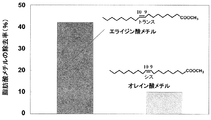
α-CDを濾過により除去し、アセトン中の脂肪酸含量を測定したところ、エライジン酸メチルの除去率は42%、オレイン酸メチルの除去率は10%であった。その結果を図1に示す。エライジン酸メチルが、オレイン酸メチルよりも選択的に除去されることがわかる。
なお、アセトン中の脂肪酸含量は、ガスクロマトグラフィ分析(GL Sciences Inc.製TC-70カラム(0.25mm I.D. x 30m)、カラム温度を160℃一定、キャリアガス:ヘリウムガス、検出器:FID)を用い、クロマトグラムの各ピーク面積を比較することにより得られる。
実施例2
トランス脂肪酸であるエライジン酸メチル(3.0mg)とシス脂肪酸であるオレイン酸メチル(3.0mg)を含むヘキサン3mL中に、ヘキサキス(2,6-Ο-ジメチル)-α-CD(300mg)を添加し、室温で24時間攪拌した。
トランス脂肪酸であるエライジン酸メチル(3.0mg)とシス脂肪酸であるオレイン酸メチル(3.0mg)を含むヘキサン3mL中に、ヘキサキス(2,6-Ο-ジメチル)-α-CD(300mg)を添加し、室温で24時間攪拌した。
ヘキサンに対するエライジン酸メチルの溶解度は10重量%以上、オレイン酸メチルの溶解度は10重量%以上、ヘキサキス(2,6-Ο-ジメチル)-α-CDの溶解度は0.14重量%である。
ヘキサキス(2,6-Ο-ジメチル)-α-CDを濾過により除去し、ヘキサン中の脂肪酸含量を測定したしたところ、エライジン酸メチルの除去率は約15%、オレイン酸メチルの除去率はほぼ0%であった。その結果を図2に示す。エライジン酸メチルが、オレイン酸メチルよりも選択的に除去されることがわかる。
実施例3
トランス脂肪酸であるブラシジン酸メチル(5.0mg)とシス脂肪酸であるエルカ酸メチル(5.0mg)を含むアセトン5mL中に、α-CD(100mg)を添加し、室温で24時間攪拌した。
トランス脂肪酸であるブラシジン酸メチル(5.0mg)とシス脂肪酸であるエルカ酸メチル(5.0mg)を含むアセトン5mL中に、α-CD(100mg)を添加し、室温で24時間攪拌した。
アセトンに対するブラシジン酸メチルの溶解度は10重量%以上、エルカ酸メチルの溶解度は10重量%以上、α-CDの溶解度はほぼ0重量%である。
α-CDを濾過により除去し、アセトン中の脂肪酸含量を測定したしたところ、ブラシジン酸メチルの除去率は84%、エルカ酸メチルの除去率は34%であった。その結果を図3に示す。ブラシジン酸メチルが、エルカ酸メチルよりも選択的に除去されることがわかる。
実施例4
トランス脂肪酸であるエライジン酸メチル(5.0mg)とシス脂肪酸であるオレイン酸3分子からなるトリグリセリドであるトリオレイン(5.0mg)を含むヘキサン5mL中に、ヘキサキス(2,6-Ο-ジメチル)-α-CD(300mg)を添加し、室温で24時間攪拌した。
トランス脂肪酸であるエライジン酸メチル(5.0mg)とシス脂肪酸であるオレイン酸3分子からなるトリグリセリドであるトリオレイン(5.0mg)を含むヘキサン5mL中に、ヘキサキス(2,6-Ο-ジメチル)-α-CD(300mg)を添加し、室温で24時間攪拌した。
ヘキサンに対するエライジン酸メチルの溶解度は10重量%以上、トリオレインの溶解度は10重量%以上、ヘキサキス(2,6-Ο-ジメチル)-α-CDの溶解度は0.14重量%である。
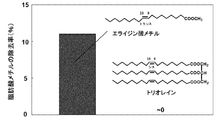
ヘキサキス(2,6-Ο-ジメチル)-α-CDを濾過により除去し、ヘキサン中の脂肪酸含量を測定したところ、エライジン酸メチルの除去率は約11%、トリオレインの除去率はほぼ0%であった。その結果を図4に示す。エライジン酸メチルが、トリオレインよりも選択的に除去されることがわかる。
実施例5
トランス脂肪酸であるエライジン酸3分子からなるトリグリセリドであるトリエライジン(3.0mg)とトリオレイン(3.0mg)を含むアセトン3mL中に、α-CD(100mg)を添加し、室温で24時間撹拌した。
トランス脂肪酸であるエライジン酸3分子からなるトリグリセリドであるトリエライジン(3.0mg)とトリオレイン(3.0mg)を含むアセトン3mL中に、α-CD(100mg)を添加し、室温で24時間撹拌した。
アセトンに対するトリエライジンの溶解度は10重量%以上、トリオレインの溶解度は10重量%以上、α-CDの溶解度はほぼ0重量%である。
α-CDを濾過により除去し、アセトン中の脂肪酸含量を測定したところ、トリエライジンの除去率は39%、トリオレインの除去率はほぼ0%であった。
実施例6
トリエライジン(0.75mg)とトリオレイン(3.0mg)を含むアセトン3mL中に、α-CD(100mg)を添加し、室温で24時間撹拌した。
トリエライジン(0.75mg)とトリオレイン(3.0mg)を含むアセトン3mL中に、α-CD(100mg)を添加し、室温で24時間撹拌した。
アセトンに対するトリエライジンの溶解度は10重量%以上、トリオレインの溶解度は10重量%以上、α-CDの溶解度はほぼ0重量%である。
α-CDを濾過により除去し、アセトン中の脂肪酸含量を測定したところ、トリエライジンの除去率は78%、トリオレインの除去率はほぼ12%であった。
実施例7
エライジン酸メチル(90mg)を含む大豆油(810mg)中に、ヘキサキス(2,6-Ο-ジメチル)-α-CD(100mg)を添加し、室温で24時間撹拌した。
エライジン酸メチル(90mg)を含む大豆油(810mg)中に、ヘキサキス(2,6-Ο-ジメチル)-α-CD(100mg)を添加し、室温で24時間撹拌した。
大豆油に対するエライジン酸メチルの溶解度は10重量%以上、ヘキサキス(2,6-Ο-ジメチル)-α-CDの溶解度はほぼ0重量%である。
ヘキサキス(2,6-Ο-ジメチル)-α-CDを濾過により除去し、大豆油中の脂肪酸含量を測定したところ、エライジン酸メチルの除去率は53%であった。
トランス脂肪酸を含有する植物油中からトランス脂肪酸を高選択的に分離除去することが可能となる。
シクロデキストリンをカラム内に充填し、その中をトランス脂肪酸を含有する植物油が通るシステムを組めば、トランス脂肪酸を含有する大量の植物油を短時間で環境に負荷を与えずに効率的に処理することができる「高効率トランス脂肪酸除去システム」として食品分野での実用化に繋がる。
シクロデキストリンをカラム内に充填し、その中をトランス脂肪酸を含有する植物油が通るシステムを組めば、トランス脂肪酸を含有する大量の植物油を短時間で環境に負荷を与えずに効率的に処理することができる「高効率トランス脂肪酸除去システム」として食品分野での実用化に繋がる。
Claims (12)
- トランス脂肪酸類を含有する有機溶媒溶液に、シクロデキストリンを添加する工程、および
トランス脂肪酸類とシクロデキストリンを接触させる工程
を経ることを特徴とする、トランス脂肪酸類のシクロデキストリンによる選択的除去方法。 - トランス脂肪酸類を含有する有機溶媒溶液に、シクロデキストリンを添加する工程、
トランス脂肪酸類とシクロデキストリンを接触させる工程、および
シクロデキストリンを濾過し、有機溶媒溶液から分離する工程、
を経ることを特徴とする、トランス脂肪酸類のシクロデキストリンによる選択的除去方法。 - シクロデキストリンが下記化学式(I)で表される、請求項1または2に記載の方法:

- 化学式(I)において、n=1であり、R1およびR2が水素原子、またはR1およびR2がメチル基である、請求項3に記載の方法。
- トランス脂肪酸類が、炭素数18~22の不飽和二重結合を一つ有するトランス脂肪酸類である、請求項1~4いずれかに記載の方法。
- トランス脂肪酸類が、トランス脂肪酸のC1~C3アルキルエステルである、請求項1~4いずれかに記載の方法。
- トランス脂肪酸類が、トランス脂肪酸のC2~C5多価アルコールエステルである、請求項1~4いずれかに記載の方法。
- トランス脂肪酸類が、エライジン酸メチル、トランス-11-エイコセン酸メチルまたはブラシジン酸メチルである、請求項1~4いずれかに記載の方法。
- トランス脂肪酸類が、エライジン酸メチルである、請求項1~4いずれかに記載の方法。
- トランス脂肪酸類がトリエライジンである、請求項1~4いずれかに記載の方法。
- シクロデキストリンが、α-シクロデキストリンである、請求項1~10いずれかに記載の方法。
- 化学式(I)において、n=1であり、R1およびR2がメチル基である、請求項1~10いずれかに記載の方法。
Priority Applications (1)
| Application Number | Priority Date | Filing Date | Title |
|---|---|---|---|
| JP2011529968A JP5470548B2 (ja) | 2009-09-07 | 2010-09-06 | シクロデキストリンによるトランス脂肪酸類の選択的分離方法 |
Applications Claiming Priority (2)
| Application Number | Priority Date | Filing Date | Title |
|---|---|---|---|
| JP2009205977 | 2009-09-07 | ||
| JP2009-205977 | 2009-09-07 |
Publications (1)
| Publication Number | Publication Date |
|---|---|
| WO2011027885A1 true WO2011027885A1 (ja) | 2011-03-10 |
Family
ID=43649418
Family Applications (1)
| Application Number | Title | Priority Date | Filing Date |
|---|---|---|---|
| PCT/JP2010/065235 Ceased WO2011027885A1 (ja) | 2009-09-07 | 2010-09-06 | シクロデキストリンによるトランス脂肪酸類の選択的分離方法 |
Country Status (2)
| Country | Link |
|---|---|
| JP (1) | JP5470548B2 (ja) |
| WO (1) | WO2011027885A1 (ja) |
-
2010
- 2010-09-06 WO PCT/JP2010/065235 patent/WO2011027885A1/ja not_active Ceased
- 2010-09-06 JP JP2011529968A patent/JP5470548B2/ja not_active Expired - Fee Related
Non-Patent Citations (3)
| Title |
|---|
| JOURNAL OF HOME ECONOMICS OF JAPAN, vol. 61, no. 4, 15 April 2010 (2010-04-15), pages 245 - 248 * |
| JOURNAL OF THE AMERICAN OIL CHEMISTS' SOCIETY, vol. 86, no. 4, April 2009 (2009-04-01), pages 337 - 342 * |
| METABOLISM, vol. 57, 2008, pages 1046 - 1051 * |
Also Published As
| Publication number | Publication date |
|---|---|
| JPWO2011027885A1 (ja) | 2013-02-04 |
| JP5470548B2 (ja) | 2014-04-16 |
Similar Documents
| Publication | Publication Date | Title |
|---|---|---|
| JP6527150B2 (ja) | グリセリド油からの遊離脂肪酸の除去 | |
| JP2019048902A (ja) | 高度不飽和脂肪酸アルキルエステル含有組成物の製造方法 | |
| JP2018517814A (ja) | クロロプロパノール及び/若しくはグリシドール、又はそれらの脂肪酸エステルをグリセリド油から除去する方法、並びにそれらを含む、改善された、グリセリド油を精製する方法 | |
| Dillon et al. | Purification of omega-3 polyunsaturated fatty acids from fish oil using silver-thiolate chromatographic material and high performance liquid chromatography | |
| AU2008283113A1 (en) | Use of ionic liquids for extraction or fractionation of lipids | |
| JP4038011B2 (ja) | 非グリセライド成分をクロマトグラフィー単離する方法 | |
| JP5606430B2 (ja) | トリグリセリド油脂を精製する方法 | |
| JP5700188B2 (ja) | 油脂からのトコトリエノールとバイオディーゼル燃料の同時生産方法 | |
| Squissato et al. | Eucalyptus pulp as an adsorbent for metal removal from biodiesel | |
| EP2017317B1 (en) | Use of selective adsorbents for halogenated aromatic compounds contained in organic media and method of capturing of said halogenated aromatic compounds | |
| JP5470548B2 (ja) | シクロデキストリンによるトランス脂肪酸類の選択的分離方法 | |
| JPWO2011004794A1 (ja) | リン脂質の製造方法 | |
| WO2011039776A1 (en) | High purity concentrates of polyunsaturated fatty acid and ester by copper complexation. | |
| JP6234908B2 (ja) | エイコサペンタエン酸及び/又はドコサヘキサエン酸含有組成物の製造方法 | |
| CN101743298A (zh) | 用于提纯用作润滑剂的长链酯的液-液萃取方法 | |
| JP2786748B2 (ja) | 高度不飽和脂肪酸類の精製方法 | |
| CN102660594B (zh) | 脂肪酶催化异Vc混合脂肪酸酯的制备方法 | |
| JP6256981B2 (ja) | 油からのビタミンe類の選択的な連続回収方法 | |
| JPWO2015129190A1 (ja) | ステアリドン酸の精製方法 | |
| JP5328308B2 (ja) | 脂溶性ビタミンの濃縮方法 | |
| JP7528054B2 (ja) | エイコサペンタエン酸アルキルエステル含有組成物の製造方法 | |
| AU2006313172B2 (en) | Method of refining episesamin | |
| JP6022854B2 (ja) | 脱臭スカム液状部分からセサモリンを分離製造する方法 | |
| JP2001240893A (ja) | エイコサペンタエン酸又はその誘導体の精製方法 | |
| CN111346623A (zh) | 复合吸附剂及其制备方法 |
Legal Events
| Date | Code | Title | Description |
|---|---|---|---|
| 121 | Ep: the epo has been informed by wipo that ep was designated in this application |
Ref document number: 10813831 Country of ref document: EP Kind code of ref document: A1 |
|
| WWE | Wipo information: entry into national phase |
Ref document number: 2011529968 Country of ref document: JP |
|
| NENP | Non-entry into the national phase |
Ref country code: DE |
|
| 122 | Ep: pct application non-entry in european phase |
Ref document number: 10813831 Country of ref document: EP Kind code of ref document: A1 |