WO2011024709A1 - アクリル樹脂組成物およびその製造方法、並びにそれを用いて形成した建築用材、身飾品および光学材料 - Google Patents
アクリル樹脂組成物およびその製造方法、並びにそれを用いて形成した建築用材、身飾品および光学材料 Download PDFInfo
- Publication number
- WO2011024709A1 WO2011024709A1 PCT/JP2010/064019 JP2010064019W WO2011024709A1 WO 2011024709 A1 WO2011024709 A1 WO 2011024709A1 JP 2010064019 W JP2010064019 W JP 2010064019W WO 2011024709 A1 WO2011024709 A1 WO 2011024709A1
- Authority
- WO
- WIPO (PCT)
- Prior art keywords
- acrylic resin
- resin composition
- colloidal particles
- silicon oxide
- acrylic
- Prior art date
- Legal status (The legal status is an assumption and is not a legal conclusion. Google has not performed a legal analysis and makes no representation as to the accuracy of the status listed.)
- Ceased
Links
Images


Classifications
-
- C—CHEMISTRY; METALLURGY
- C08—ORGANIC MACROMOLECULAR COMPOUNDS; THEIR PREPARATION OR CHEMICAL WORKING-UP; COMPOSITIONS BASED THEREON
- C08L—COMPOSITIONS OF MACROMOLECULAR COMPOUNDS
- C08L33/00—Compositions of homopolymers or copolymers of compounds having one or more unsaturated aliphatic radicals, each having only one carbon-to-carbon double bond, and only one being terminated by only one carboxyl radical, or of salts, anhydrides, esters, amides, imides or nitriles thereof; Compositions of derivatives of such polymers
- C08L33/04—Homopolymers or copolymers of esters
- C08L33/06—Homopolymers or copolymers of esters of esters containing only carbon, hydrogen and oxygen, which oxygen atoms are present only as part of the carboxyl radical
- C08L33/08—Homopolymers or copolymers of acrylic acid esters
-
- C—CHEMISTRY; METALLURGY
- C08—ORGANIC MACROMOLECULAR COMPOUNDS; THEIR PREPARATION OR CHEMICAL WORKING-UP; COMPOSITIONS BASED THEREON
- C08K—Use of inorganic or non-macromolecular organic substances as compounding ingredients
- C08K3/00—Use of inorganic substances as compounding ingredients
- C08K3/34—Silicon-containing compounds
- C08K3/36—Silica
-
- C—CHEMISTRY; METALLURGY
- C08—ORGANIC MACROMOLECULAR COMPOUNDS; THEIR PREPARATION OR CHEMICAL WORKING-UP; COMPOSITIONS BASED THEREON
- C08L—COMPOSITIONS OF MACROMOLECULAR COMPOUNDS
- C08L33/00—Compositions of homopolymers or copolymers of compounds having one or more unsaturated aliphatic radicals, each having only one carbon-to-carbon double bond, and only one being terminated by only one carboxyl radical, or of salts, anhydrides, esters, amides, imides or nitriles thereof; Compositions of derivatives of such polymers
-
- C—CHEMISTRY; METALLURGY
- C08—ORGANIC MACROMOLECULAR COMPOUNDS; THEIR PREPARATION OR CHEMICAL WORKING-UP; COMPOSITIONS BASED THEREON
- C08L—COMPOSITIONS OF MACROMOLECULAR COMPOUNDS
- C08L33/00—Compositions of homopolymers or copolymers of compounds having one or more unsaturated aliphatic radicals, each having only one carbon-to-carbon double bond, and only one being terminated by only one carboxyl radical, or of salts, anhydrides, esters, amides, imides or nitriles thereof; Compositions of derivatives of such polymers
- C08L33/04—Homopolymers or copolymers of esters
- C08L33/06—Homopolymers or copolymers of esters of esters containing only carbon, hydrogen and oxygen, which oxygen atoms are present only as part of the carboxyl radical
- C08L33/10—Homopolymers or copolymers of methacrylic acid esters
-
- C—CHEMISTRY; METALLURGY
- C08—ORGANIC MACROMOLECULAR COMPOUNDS; THEIR PREPARATION OR CHEMICAL WORKING-UP; COMPOSITIONS BASED THEREON
- C08L—COMPOSITIONS OF MACROMOLECULAR COMPOUNDS
- C08L33/00—Compositions of homopolymers or copolymers of compounds having one or more unsaturated aliphatic radicals, each having only one carbon-to-carbon double bond, and only one being terminated by only one carboxyl radical, or of salts, anhydrides, esters, amides, imides or nitriles thereof; Compositions of derivatives of such polymers
- C08L33/04—Homopolymers or copolymers of esters
- C08L33/06—Homopolymers or copolymers of esters of esters containing only carbon, hydrogen and oxygen, which oxygen atoms are present only as part of the carboxyl radical
- C08L33/10—Homopolymers or copolymers of methacrylic acid esters
- C08L33/12—Homopolymers or copolymers of methyl methacrylate
Definitions
- the present invention relates to an acrylic resin composition in which a polycrystal of colloidal particles made of silicon oxide is contained in an acrylic resin, a method for producing the same, and a building material, a decorative article, and an optical material formed using the acrylic resin composition.
- colloidal particles are dispersed in a solvent containing a polymerizable substance, and the polymerizable substance is polymerized, so that colloidal particles are regularly arranged without substantially contacting adjacent colloidal particles.
- An immobilized colloidal crystal is known (for example, see Patent Document 1).
- Patent Document 1 a polycrystal of colloidal particles made of silicon oxide is polymerized by mixing silicon oxide with ethylene dimethacrylate and methyl methacrylate so that silicon oxide having a particle size of 136 nm is 31% by weight. An immobilized colloidal crystal fixed by chain repulsion is described.
- the immobilized colloidal crystal described in Patent Document 1 has a peak wavelength of a reflection spectrum of about 530 nm, and exhibits an arbitrary color-playing effect from a wide wavelength range from violet to red (343 to 808 nm). could not.
- Patent Document 2 there is a method of filling colloidal particles composed of fine particles of silicon oxide or the like in a liquid such as water by a close-packing method (for example, see Patent Document 2).
- Patent Document 2 describes that colloidal particles can be filled with close packing in a short time by irradiating a liquid containing the fine particles with ultrasonic waves.
- the immobilized colloidal crystal is composed of a polycrystal including a large number of single crystals.
- the play-color effect means a hue change accompanying a change in viewing angle as seen in a gem opal.
- One of the reasons why the play effect is observed is considered to be that various crystal planes are observed in the polycrystal by a large number of the single crystals.
- the polycrystal may be composed of a small single crystal. When the size of the single crystal is too small, the visibility of the polycrystal is lowered, and a sufficient play-color effect cannot be shown. Colloidal crystals that do not show sufficient play-coloring effects are not suitable for building materials, jewelry or optical materials.
- An object of the present invention is to provide an acrylic resin composition capable of exhibiting any playful color effect from a wide wavelength range of purple to red, and relatively easy to manufacture, and a method for manufacturing the same, and an architecture formed using the acrylic resin composition To provide materials, jewelry and optical materials.
- the acrylic resin composition of the present invention contains colloidal particle polycrystals made of silicon oxide in an acrylic resin obtained by curing an acrylic monomer that is liquid at room temperature and / or an acrylic oligomer that is liquid at room temperature.
- the average distance between the colloidal particles in the polycrystal is 140 to 330 nm.
- the size of the single crystal constituting the polycrystal is controlled by adjusting the content of silicon oxide and / or the amount of impurities added.
- the building material of the present invention is formed using the acrylic resin composition.
- the jewelry of the present invention is formed using the acrylic resin composition.
- the optical material of the present invention is formed using the acrylic resin composition.
- the average distance between colloidal particles adjacent to each other can be set in a wide range of 140 to 330 nm, so that an arbitrary playable color effect can be obtained from a wide wavelength range from purple to red. Can do.
- the acrylic resin composition of the present invention contains a polycrystal of colloidal particles made of silicon oxide in an acrylic resin, a liquid as in the conventional close-packing method is evaporated or volatilized by ultrasonic waves.
- the acrylic resin composition can be efficiently formed in a relatively short period of about 1 hour to 3 days without any problem due to the production, which is advantageous in terms of cost and excellent in mass productivity.
- the size of the single crystal constituting the polycrystal is intentionally controlled by adjusting the content of silicon oxide and / or the amount of impurities added. Visibility can be improved, and a sufficient play color effect can be shown. Since the building material, jewelry and optical material of the present invention are formed using the acrylic resin composition, a good play-color effect can be exhibited.
- the acrylic resin composition 1 according to this embodiment includes a polycrystal 6 of colloidal particles 3 in an acrylic resin 2.
- the polycrystalline body 6 is composed of a large number of single crystal bodies 4.
- the single crystal bodies 4, 4 adjacent to each other have different orientations of the colloidal particles 3 constituting the single crystal bodies 4 at the boundary line 5. Adjacent colloidal particles 3 and 3 are repelled by electrostatic force 7.
- each structure of the acrylic resin composition 1 is demonstrated concretely.
- the acrylic resin 2 is formed by curing an acrylic monomer that is liquid at room temperature and / or an acrylic oligomer that is liquid at room temperature.
- the “normal temperature” means a temperature of 15 to 30 ° C., but is not limited to this temperature range.
- the colloidal particles 3 can be easily dispersed.
- the acrylic monomers and oligomers can be used alone or in combination.
- acrylic oligomer that is liquid at room temperature
- examples of the acrylic oligomer that is liquid at room temperature include homopolymers or copolymers of the monofunctional monomer, bifunctional monomer, and polyfunctional monomer.
- the weight average molecular weight of the acrylic oligomer is not particularly limited as long as it is liquid at room temperature.
- the content of the acrylic resin 2 is preferably 35 to 90% by weight with respect to the total amount of the acrylic resin composition 1.
- the visibility can be improved as a member exhibiting a playable color effect in a wide wavelength range mainly including purple or red.
- the electrostatic force 7 of the colloidal particles 3 can be exerted between the adjacent colloidal particles 3 and 3 so that the colloidal particles 3 can be regularly arranged. Visibility can be improved as a member exhibiting a play-color effect mainly composed of the polycrystalline body 6.
- the colloidal particles 3 are made of silicon oxide and are dispersed in the acrylic resin 2.
- the colloidal particles 3 may be a mixture of body-centered cubic single crystals with different orientations, a mixture of face-centered cubic single crystals with different orientations, or body-centered cubic single crystals and face-centered cubic single crystals.
- the polycrystalline body 6 is formed as a mixture of crystals, but is regularly arranged as a whole.
- a repulsive force acts between the adjacent colloidal particles 3 and 3 due to the electrostatic force 7, and as shown in FIG. 2, the average distance L between the colloidal particles 3 and 3 in the polycrystalline body 6 is 140 to The distance is maintained at 330 nm, preferably 150 to 300 nm, more preferably 160 to 290 nm.
- the average distance L between the colloidal particles 3 and 3 can be controlled to a desired value by adjusting the content of silicon oxide in the acrylic resin composition 1, for example.
- the content of the silicon oxide is preferably 10 to 65% by weight with respect to the total amount of the acrylic resin composition 1.
- the average distance L between the colloidal particles 3 and 3 tends to be reduced.
- the average between the colloidal particles 3 and 3 is decreased.
- the distance L tends to increase.
- the electrostatic force 7 of the colloidal particles 3 can be exerted between the adjacent colloidal particles 3 and 3 so that the colloidal particles 3 can be regularly arranged. Visibility can be improved as a member which exhibits the play-coloring effect which makes the body 6 the main.
- the average distance L between the colloidal particles 3 and 3 can be measured as follows. That is, a secondary electron composition image was observed at an acceleration voltage of 15 kV on an arbitrary fracture surface of the acrylic resin composition 1 using a scanning electron microscope (SEM: “S-4100” manufactured by Hitachi, Ltd.). It can measure on the SEM image obtained (refer Fig.2 (a)). More specifically, the average distance L between the colloidal particles 3 and 3 is arbitrarily selected as 10 distances from the center of one colloidal particle 3 adjacent to the center of the other colloidal particle 3 in the SEM image. It is possible to measure by calculating the average value and converting the average value according to the magnification in the SEM. A magnification of about 10,000 to 200,000 is appropriate.
- the average particle diameter R of the colloidal particles 3 is 70 to 238 nm, preferably 120 to 220 nm.
- the average particle diameter R of the colloidal particles 3 is 70 nm or more, the diffraction wavelength does not become shorter than the visible light wavelength, and the visibility is improved as a member that exhibits the play color effect mainly of the polycrystalline body 6. Can do.
- the average particle diameter R of the colloidal particles 3 is 238 nm or less, the diffraction wavelength does not become longer than the visible light wavelength, and the visibility is improved as a member that exhibits the play color effect mainly of the polycrystalline body 6. can do.
- the average particle size R of the colloidal particles 3 is the above SEM for the powder, and for the dispersion, for example, a particle size distribution such as a disk centrifugal particle size distribution measuring device (“DC24000” manufactured by CPS Instruments, Inc.). It can be measured by a measuring device.
- a particle size distribution such as a disk centrifugal particle size distribution measuring device (“DC24000” manufactured by CPS Instruments, Inc.). It can be measured by a measuring device.
- the colloidal particles 3 can be produced by a known method using water glass or silicon alkoxide as a raw material of silicon oxide.
- colloidal particles 3 having an arbitrary particle size can be obtained by hydrolyzing silicon alkoxide with an alkali or by laminating silicon oxide using water glass as a raw material.
- the silicon oxide powder constituting the colloidal particles 3 of the acrylic resin composition 1 can be prepared, for example, as follows. First, 100 to 300 g of colloidal silica and 100 to 300 g of alcohol such as methanol are weighed and mixed in a container. Examples of the material constituting the container include polypropylene.
- the mixture is centrifuged with a centrifuge to separate it into a solid component and a liquid component.
- the centrifugal separation is preferably performed at a rotational speed of about 8,000 to 10,000 rpm and a time of about 30 minutes to 1 hour and 30 minutes.
- the supernatant liquid produced in the container is discarded, and approximately the same amount of alcohol as discarded is weighed and placed in the container, and the solid component and the liquid component are separated again by the centrifuge. This process is repeated about 2 to 4 times. Thereby, the obtained silicon oxide powder is easily redispersed.
- the solid component is dried in a dryer at a temperature of 35 to 60 ° C. to obtain a silicon oxide powder. The drying can also be performed in a vacuum state.
- the average particle diameter of the silicon oxide powder is 70 to 238 nm, preferably 120 to 220 nm. Thereby, the particle diameter of the colloidal particle 3 and the distance between the adjacent colloidal particles 3 and 3 can be optimized, and the visibility can be improved as a member that exhibits the play color effect mainly using the polycrystalline body 6.
- the average particle diameter of the silicon oxide powder can be measured by the SEM.
- the obtained silicon oxide powder is added to and dispersed in the acrylic monomer that is liquid at room temperature and / or the acrylic oligomer that is liquid at room temperature.
- This dispersion is preferably performed using an ultrasonic dispersion apparatus.
- the ultrasonic conditions it is preferable that the frequency is about 10 to 50 kHz and the time is about 1 to 15 hours.
- the acrylic monomer and / or oligomer is cured by adding a polymerization initiator and photopolymerization by ultraviolet irradiation or heat polymerization by heating.
- the acrylic resin composition 1 in which the polycrystal 6 of the colloidal particles 3 is contained in the acrylic resin 2 is obtained.
- the acrylic resin composition 1 is usually formed in a relatively short time of about 1 hour to 3 days without requiring a long time for manufacturing as in the conventional close-packing method. This is advantageous in terms of cost and is excellent in mass productivity.
- the type of the polymerization initiator may be appropriately selected according to a curing method such as ultraviolet light or heat.
- Specific examples of the polymerization initiator include benzoin ethers such as benzyl, benzoin, and benzoin methyl ether; 2-hydroxy-2-methylpropiophenone, pt-butyltrichloroacetophenone, pt- Acetophenones such as butyldichloroacetophenone; benzophenones such as benzophenone, methyl o-benzoylbenzoate and 4-chlorobenzophenone; 2,2′-azobisisobutyronitrile, 2,2′-azobis [2-methyl-N Azo compounds such as — (2-hydroxyethyl) propionamide] and 2,2′-azobis (N-butyl-2-methylpropionamide); peroxides such as benzoyl peroxide, potassium persulfate and ammonium persulfate These may be used alone or in combination of two or more
- the size of the single crystal 4 constituting the polycrystalline body 6 can be controlled. That is, the content of the silicon oxide is reduced, that is, the distance between the adjacent colloidal particles 3 and 3 is increased, or impurities are added to the acrylic resin composition 1 to weaken the electrostatic force 7 of the colloidal particles 3.
- the single crystal body 4 constituting the crystal body 6 can be enlarged and the visibility of the polycrystalline body 6 can be improved. In addition, the following reasons are guessed as a reason why the single crystal body 4 becomes large by weakening the electrostatic force 7.
- the electrostatic force 7 when the electrostatic force 7 is weakened, the distance covered by the electrostatic force 7 is shortened, and the volume (apparent particle concentration) including the portion capable of electrostatic repulsion is reduced, so that nucleation of crystals is difficult to occur. For this reason, the number of crystal nuclei is reduced, and the single crystal 4 to be produced is enlarged.
- the size of the single crystal body 4 can be controlled to 5 mm or more, preferably 5 to 15 mm.
- the size of the single crystal body 4 means the diameter of the smallest circumscribed circle surrounding the single crystal body 4 when viewed from the vertical direction with respect to the single crystal body 4.
- the adjustment of the silicon oxide content and the addition of impurities can be performed individually or in combination.
- the impurities include inorganic salts such as sodium chloride, sodium bicarbonate, and potassium chloride; organic substances such as pyridine, quaternary ammonium, monoethanolamine, triethanolamine, and diethylamine; polymerizable substances, solvents, and average particle diameters described later. These colloidal particles may be used, and these may be used alone or in combination of two or more.
- the impurities can be added before and after the silicon oxide powder is added to and dispersed in the acrylic monomer and / or oligomer.
- the content of the impurities is preferably 90% by weight or less with respect to the total amount of the acrylic resin composition 1.
- FIG. 3 the same components as those in FIGS. 1 and 2 described above are denoted by the same reference numerals, and description thereof is omitted.
- the repulsion between adjacent colloidal particles 11 and 11 is a polymer chain repulsion. That is, the adjacent colloidal particles 11 and 11 are repelled by the polymer chain 12 modified to the colloidal particles 11.
- the polymer chain repulsion of the colloidal particles 11 can be caused by, for example, dispersing silicon oxide powder in a solvent containing a polymerizable substance.
- Examples of the polymerizable substance include methyl (meth) acrylate, vinyl acetate, styrene, 2-hydroxyethyl (meth) acrylate, 4-hydroxybutyl (meth) acrylate, methyl (meth) acrylate, di (meth) acrylate. ) Vinyl monomers or oligomers such as ethylene acrylate; cyclic ethers such as ethylene oxide, trimethylene oxide, tetrahydrofuran and tetrahydropyran; cyclic esters such as ⁇ -propionlactone; cyclic amides such as ⁇ -caprolactam; methylsilane, phenylsilane, etc. The monomer etc. which give polysilane are mentioned, These may be used 1 type or in mixture of 2 or more types.
- the content of the polymerizable substance is preferably 35 to 90% by weight with respect to the total amount of the acrylic resin composition 10.
- the solvent examples include water, acetonitrile, N, N-dimethylformamide, nitrobenzene, methanol, ethanol, acetone, isopropyl alcohol, ethylene glycol, glycerin, tetrahydrofuran, ethyl acetate, chloroform, dioxane, acrylonitrile, and the like. You may use 1 type or in mixture of 2 or more types.
- the silicon oxide powder a silicon oxide powder coated with organic molecules may be used as the silicon oxide powder.
- the affinity of the silicon oxide powder for the polymerizable substance can be increased.
- the total average particle size including the organic molecules is in the above range, that is, 70 to 238 nm.
- Examples of the organic molecule include poly (methyl (meth) acrylate), polystyrene, poly (maleic anhydride), poly (methyl (meth) acrylate) and copolymers thereof, and these are one kind. Alternatively, two or more kinds may be mixed and used.
- the exemplified organic molecule may have an appropriate functional group for increasing affinity with the particle surface. As such a functional group, for example, a trimethoxysilane group, a triethoxysilane group, or the like is effective.
- the amount of organic molecules covering the surface of the silicon oxide powder is preferably, for example, about 2 to 20% by weight with respect to the particle weight. Since the other structure is the same as that of the acrylic resin composition 1 according to the above-described embodiment, the description thereof is omitted.
- the acrylic resin composition according to the present invention described above is suitable for composite members used for building materials, jewelry or optical materials.
- building materials to which the acrylic resin composition according to the present invention can be applied include inner and outer wall materials and floor materials.
- an ornament which can apply the acrylic resin composition concerning this invention the ring, necklace, earring, brooch, etc. which used the opal-like jewelry are mentioned, for example.
- optical materials to which the acrylic resin composition according to the present invention can be applied include tunable photonic crystals for laser oscillators with variable wavelengths, various optical filters, and the like.
- the use of the acrylic resin composition according to the present invention is not limited to the above-described building materials, accessories, and optical materials, and can exhibit any playful color effect from a wide wavelength range from purple to red. It can be suitably used in a required field.
- the acrylic resin was identified using “IR Prestige-21”, a Fourier transform infrared spectrophotometer manufactured by Shimadzu Corporation.
- the average particle size of the colloidal particles in the acrylic resin composition was determined by changing the colloidal silica before powdering into CPS Instruments, Inc. The measurement was performed by a disk centrifugal particle size distribution measuring device “DC24000” manufactured by the company.
- the silicon oxide of the acrylic resin composition is specified and the weight% is measured by specifying the contained elements by fluorescent X-ray analysis using “SEA1200VX” manufactured by SII and using “DTG-60H” manufactured by Shimadzu Corporation. The weight percentage was measured by thermogravimetric analysis.
- the average distance between colloidal particles was measured based on SEM images.
- the SEM image was obtained by photographing an arbitrary fracture surface of the acrylic resin composition at a magnification of 150,000 using a scanning electron microscope “S-4100” manufactured by Hitachi, Ltd. The average distance was measured for any 10 points in the SEM image, and then the average value was calculated, and the average value was converted from the magnification.
- the acrylic monomers that are liquid at room temperature (15 to 30 ° C.) used for the preparation of the acrylic resin composition are as follows.
- 2-Hydroxyethyl acrylate trade name “HEMA” manufactured by Nippon Shokubai Co., Ltd.
- Methoxypolyethylene glycol # 400 methacrylate trade name “FA-400M” manufactured by Hitachi Chemical Co., Ltd.
- 4-Hydroxyacrylate Nippon Kasei Co., Ltd. trade name “4HBA”
- the obtained silicon oxide powders having various average particle diameters are mixed in the combinations shown in Table 1 in the range of 10 to 65% by weight and acrylic monomers in the range of 35 to 90% by weight, respectively. And dispersed to obtain a dispersion.
- the dispersion was performed by irradiating ultrasonic waves with a frequency of 24 kHz for 1 hour with an ultrasonic dispersion device.
- the “average particle diameter of silicon oxide powder” in Table 1 is an SEM image obtained in the same manner as the above-mentioned “average distance between colloidal particles”. After measuring 10 arbitrary points, the average value is calculated. It is the obtained value.
- pyridine which is an impurity was added together when the silicon oxide powder and the acrylic monomer were mixed. The pyridine was added at a ratio of 0.3 ppm with respect to the total amount of the acrylic resin composition.
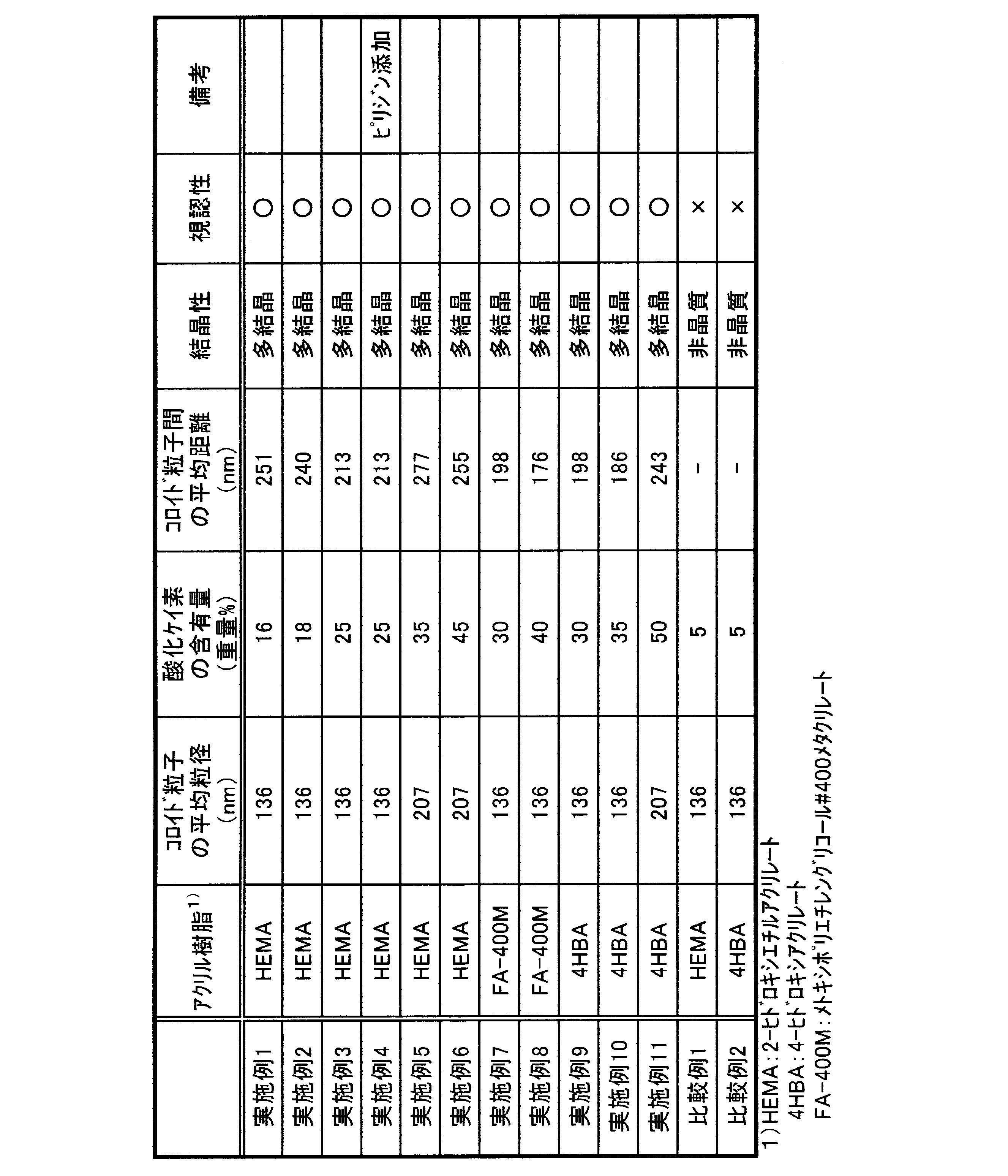
- Examples 1 to 11 contain polycrystals of colloidal particles made of silicon oxide in an acrylic resin, and the average distance between the colloidal particles is 140 to 330 nm. It turns out that it is excellent in property.
- Example 1 has a single crystal body 4a having a size of 10 mm or more at the maximum among the single crystal bodies constituting the polycrystalline body. As shown in FIG. 5, it was a polycrystal mainly consisting of red, green and blue. Further, Example 2 was a polycrystal formed of a uniform single crystal 4b of about 1 mm as shown in FIG. 4 (b).
- the reflection spectrum shown in FIG. 5 is obtained by measurement using a fiber multichannel spectrometer “USB2000” manufactured by Ocean Optics.
- Examples 3 and 4 have the same structure except for the presence or absence of pyridine as an impurity (see “Remarks” in Table 2).
- Example 3 although the visibility was excellent by controlling the average distance between colloidal particles to 140 to 330 nm, it was a polycrystal composed of a large number of single crystals that could not be visually confirmed.
- Example 4 the addition of pyridine resulted in a polycrystal mainly having a green color having a number of single crystals of 10 mm or more similar to those in Example 1.
- Example 5 polycrystals mainly containing red or green were obtained.
- Example 7 and 8 a polycrystal mainly having a green or purple color of about 1 mm was obtained.
- Example 9 and 10 it was a polycrystalline body mainly composed of green or purple of 1 mm or more, and the cured product was a soft rubbery product.
- Example 11 was a rubber-like cured product having an iris appearance composed of a fine single crystal.
- Comparative Examples 1 and 2 were both amorphous and a polycrystal could not be confirmed. The reason for this is presumed to be that the content of silicon oxide is lower than in Examples 1 to 11.
Landscapes
- Chemical & Material Sciences (AREA)
- Health & Medical Sciences (AREA)
- Chemical Kinetics & Catalysis (AREA)
- Medicinal Chemistry (AREA)
- Polymers & Plastics (AREA)
- Organic Chemistry (AREA)
- Compositions Of Macromolecular Compounds (AREA)
- Polymerisation Methods In General (AREA)
Abstract
Description
本発明の身飾品は、前記アクリル樹脂組成物を用いて形成したものである。
本発明の光学材料は、前記アクリル樹脂組成物を用いて形成したものである。
アクリル樹脂の特定は、島津製作所社製のフーリエ変換赤外分光光度計である「IR Prestige-21」を用いて分析した。
アクリル樹脂組成物におけるコロイド粒子の平均粒径は、粉末とする前のコロイダルシリカをCPS Instruments,Inc.社製のディスク遠心式粒度分布測定装置「DC24000」により測定した。
アクリル樹脂組成物の酸化ケイ素の特定および重量%の測定は、SII社製の「SEA1200VX」を用いた蛍光X線分析にて含有元素を特定し、島津製作所社製の「DTG-60H」を用いた熱重量分析にて重量%の測定を行った。
コロイド粒子間の平均距離は、SEM画像に基づいて測定した。SEM画像は、日立製作所社製の走査型電子顕微鏡「S-4100」を用いて、倍率を15万倍とし、アクリル樹脂組成物の任意の破断面を撮影することによって得た。平均距離は、SEM画像において任意の10点について測定した後にその平均値を算出し、その平均値を倍率から換算した値とした。
アクリル樹脂組成物の結晶性は、ハロゲンランプを光源とする日立ハイテク社製の分光光度計「U4100」にて分析した。
多結晶体の視認性の評価については、得られたアクリル樹脂組成物を目視にて観察し、主に紫色ないし赤色として認識される部分を多結晶体として評価した。判定基準は以下のものを用いた。
○:多結晶体がアクリル樹脂組成物の表面に見られた。
×:多結晶体がアクリル樹脂組成物の表面に全く見られなかった。
・2-ヒドロキシエチルアクリレート:日本触媒社製の商品名「HEMA」
・メトキシポリエチレングリコール#400メタクリレート:日立化成工業社製の商品名「FA-400M」
・4-ヒドロキシアクリレート:日本化成社製の商品名「4HBA」
<アクリル樹脂組成物の作製>
まず、ポリプロピレン製の容器にコロイダルシリカ200g、メタノール200gを量り取り、遠心分離機を用いて回転数9100rpmで1時間かけて遠心分離を行った。遠心分離後の前記容器内に出来た上澄み液を廃棄し、廃棄したのとほぼ同量のメタノールを前記容器に入れ、再度遠心分離機にて遠心分離を行った。この工程を、3回繰り返した。遠心分離が終了した後、固形成分を乾燥機にて45℃の温度で乾燥させて酸化ケイ素粉末を得た。
得られたアクリル樹脂組成物について、アクリル樹脂の特定、コロイド粒子の平均粒径、酸化ケイ素の特定およびその含有量、コロイド粒子間の平均距離、結晶性および視認性を前記した方法に従って評価した。その結果を、表2に示す。
酸化ケイ素粉末の添加量を5重量%、かつアクリル系モノマーの添加量を95重量%とし、これらを表1に示す組み合わせで混合して分散し、分散液を得た。この分散液を用いて、前記実施例と同様にしてアクリル樹脂組成物を得た。得られたアクリル樹脂組成物について、アクリル樹脂の特定、コロイド粒子の平均粒径、酸化ケイ素の特定およびその含有量、コロイド粒子間の平均距離、結晶性および視認性を前記した方法に従って評価した。その結果を、表2に示す。

Claims (10)
- 常温で液体のアクリル系モノマーおよび/または常温で液体のアクリル系オリゴマーを硬化させてなるアクリル樹脂中に、酸化ケイ素からなるコロイド粒子の多結晶体を含有させたアクリル樹脂組成物であって、
前記多結晶体における前記コロイド粒子間の平均距離が、140~330nmであるアクリル樹脂組成物。 - 前記コロイド粒子の平均粒径が、70~238nmである請求項1に記載のアクリル樹脂組成物。
- 隣接する前記コロイド粒子同士は、静電気力により互いに反発している請求項1に記載のアクリル樹脂組成物。
- 隣接する前記コロイド粒子同士は、該コロイド粒子に修飾されたポリマー鎖により互いに反発している請求項1に記載のアクリル樹脂組成物。
- 前記酸化ケイ素の含有量が、10~65重量%である請求項1に記載のアクリル樹脂組成物。
- 前記アクリル樹脂の含有量が、35~90重量%である請求項1に記載のアクリル樹脂組成物。
- 前記酸化ケイ素の含有量および/または不純物の添加量を調整することによって、前記多結晶体を構成する単結晶体の大きさを制御する請求項1に記載のアクリル樹脂組成物の製造方法。
- 請求項1に記載のアクリル樹脂組成物を用いて形成した建築用材。
- 請求項1に記載のアクリル樹脂組成物を用いて形成した身飾品。
- 請求項1に記載のアクリル樹脂組成物を用いて形成した光学材料。
Priority Applications (6)
| Application Number | Priority Date | Filing Date | Title |
|---|---|---|---|
| DE112010003375.7T DE112010003375B4 (de) | 2009-08-24 | 2010-08-19 | Acrylharzzusammensetzung, Verfahren zu deren Herstellung und Baumaterial, Modeaccessoire und optisches Material, gebildet unter deren Verwendung |
| GB1201331.4A GB2485089B (en) | 2009-08-24 | 2010-08-19 | Acrylic resin composition, method of manufacturing the same, and architectural material, fashion accessory and optical material formed using the same |
| US13/375,210 US9023961B2 (en) | 2009-08-24 | 2010-08-19 | Acrylic resin composition, method of manufacturing the same, and architectural material, fashion accessory, and optical material formed using the same |
| HK12108107.9A HK1167421B (en) | 2009-08-24 | 2010-08-19 | Acrylic resin composition and process for production thereof, and architectural material, fashion accessory and optical material each produced using the acrylic resin composition |
| CN201080031741.6A CN102482476B (zh) | 2009-08-24 | 2010-08-19 | 丙烯酸类树脂组合物,其制备方法,以及使用其形成的建筑材料、时尚配饰和光学材料 |
| JP2011528761A JP5622327B2 (ja) | 2009-08-24 | 2010-08-19 | アクリル樹脂組成物およびその製造方法、並びにそれを用いて形成した建築用材、身飾品および光学材料 |
Applications Claiming Priority (2)
| Application Number | Priority Date | Filing Date | Title |
|---|---|---|---|
| JP2009193171 | 2009-08-24 | ||
| JP2009-193171 | 2009-08-24 |
Publications (1)
| Publication Number | Publication Date |
|---|---|
| WO2011024709A1 true WO2011024709A1 (ja) | 2011-03-03 |
Family
ID=43627815
Family Applications (1)
| Application Number | Title | Priority Date | Filing Date |
|---|---|---|---|
| PCT/JP2010/064019 Ceased WO2011024709A1 (ja) | 2009-08-24 | 2010-08-19 | アクリル樹脂組成物およびその製造方法、並びにそれを用いて形成した建築用材、身飾品および光学材料 |
Country Status (6)
| Country | Link |
|---|---|
| US (1) | US9023961B2 (ja) |
| JP (1) | JP5622327B2 (ja) |
| CN (1) | CN102482476B (ja) |
| DE (1) | DE112010003375B4 (ja) |
| GB (1) | GB2485089B (ja) |
| WO (1) | WO2011024709A1 (ja) |
Cited By (4)
| Publication number | Priority date | Publication date | Assignee | Title |
|---|---|---|---|---|
| JP2013010924A (ja) * | 2011-05-30 | 2013-01-17 | Kyocera Corp | オパール複合材料およびその製造方法 |
| WO2016093121A1 (ja) * | 2014-12-12 | 2016-06-16 | 公立大学法人名古屋市立大学 | コロイド共晶、コロイド共晶固化体、及びそれらの製造方法 |
| JP2022128119A (ja) * | 2021-02-22 | 2022-09-01 | ユニチカ株式会社 | 樹脂組成物および該樹脂組成物からなるエラストマー材料 |
| US12072513B2 (en) | 2019-02-05 | 2024-08-27 | Panasonic Intellectual Property Management Co., Ltd. | Lighting device and optical member |
Families Citing this family (3)
| Publication number | Priority date | Publication date | Assignee | Title |
|---|---|---|---|---|
| JP2011245187A (ja) * | 2010-05-31 | 2011-12-08 | Kyocera Corp | オパール装飾品とその製造方法 |
| GB2510992B (en) * | 2011-10-03 | 2021-02-03 | Fuji Chemical Company Ltd | Epoxy resin composition, and method for producing same |
| CN105659118B (zh) * | 2013-08-06 | 2018-03-27 | 富士化学株式会社 | 树脂固定胶体晶体片、使用其对结构色进行显示的方法、使用其检测被测物的凹凸分布或硬度分布的方法、以及结构色片 |
Citations (7)
| Publication number | Priority date | Publication date | Assignee | Title |
|---|---|---|---|---|
| JPH06100432A (ja) * | 1992-08-05 | 1994-04-12 | Catalysts & Chem Ind Co Ltd | 微粒子分散液および化粧料 |
| JP2001191025A (ja) * | 1999-11-04 | 2001-07-17 | Dainippon Printing Co Ltd | 高分子−微粒子複合体の製造方法 |
| WO2003100139A1 (en) * | 2002-05-29 | 2003-12-04 | Bando Chemical Industries, Ltd. | Immobilized colloidal crystal and process for producing the same |
| JP2005325173A (ja) * | 2004-05-12 | 2005-11-24 | Toyota Central Res & Dev Lab Inc | コロイド結晶及びその製造方法 |
| JP2007510183A (ja) * | 2003-10-31 | 2007-04-19 | コーニング インコーポレイテッド | 大型コロイド結晶およびマクロポーラス・ポリマー並びにそれらの製造方法 |
| JP2008303261A (ja) * | 2007-06-06 | 2008-12-18 | Toyota Central R&D Labs Inc | ポリマーで固定化されたコロイド結晶の製造方法及びポリマーで固定化されたコロイド結晶 |
| JP2010132771A (ja) * | 2008-12-04 | 2010-06-17 | Toyota Central R&D Labs Inc | ポリマーで固定化されたコロイド結晶及びその製造方法 |
Family Cites Families (4)
| Publication number | Priority date | Publication date | Assignee | Title |
|---|---|---|---|---|
| JPS60100432A (ja) * | 1983-11-05 | 1985-06-04 | Oki Electric Ind Co Ltd | リフトオフ金属パタ−ン形成方法 |
| JP2006247915A (ja) | 2005-03-09 | 2006-09-21 | Institute Of Physical & Chemical Research | 3次元構造体の製造方法 |
| AU2006224748B2 (en) * | 2005-03-16 | 2010-05-13 | Unilever Plc | Colourant compositions and their use |
| CN101225179B (zh) * | 2008-02-05 | 2011-07-20 | 复旦大学 | 一种大面积有序多孔膜材料及其制备方法 |
-
2010
- 2010-08-19 GB GB1201331.4A patent/GB2485089B/en active Active
- 2010-08-19 WO PCT/JP2010/064019 patent/WO2011024709A1/ja not_active Ceased
- 2010-08-19 US US13/375,210 patent/US9023961B2/en active Active
- 2010-08-19 CN CN201080031741.6A patent/CN102482476B/zh active Active
- 2010-08-19 JP JP2011528761A patent/JP5622327B2/ja active Active
- 2010-08-19 DE DE112010003375.7T patent/DE112010003375B4/de active Active
Patent Citations (7)
| Publication number | Priority date | Publication date | Assignee | Title |
|---|---|---|---|---|
| JPH06100432A (ja) * | 1992-08-05 | 1994-04-12 | Catalysts & Chem Ind Co Ltd | 微粒子分散液および化粧料 |
| JP2001191025A (ja) * | 1999-11-04 | 2001-07-17 | Dainippon Printing Co Ltd | 高分子−微粒子複合体の製造方法 |
| WO2003100139A1 (en) * | 2002-05-29 | 2003-12-04 | Bando Chemical Industries, Ltd. | Immobilized colloidal crystal and process for producing the same |
| JP2007510183A (ja) * | 2003-10-31 | 2007-04-19 | コーニング インコーポレイテッド | 大型コロイド結晶およびマクロポーラス・ポリマー並びにそれらの製造方法 |
| JP2005325173A (ja) * | 2004-05-12 | 2005-11-24 | Toyota Central Res & Dev Lab Inc | コロイド結晶及びその製造方法 |
| JP2008303261A (ja) * | 2007-06-06 | 2008-12-18 | Toyota Central R&D Labs Inc | ポリマーで固定化されたコロイド結晶の製造方法及びポリマーで固定化されたコロイド結晶 |
| JP2010132771A (ja) * | 2008-12-04 | 2010-06-17 | Toyota Central R&D Labs Inc | ポリマーで固定化されたコロイド結晶及びその製造方法 |
Cited By (7)
| Publication number | Priority date | Publication date | Assignee | Title |
|---|---|---|---|---|
| JP2013010924A (ja) * | 2011-05-30 | 2013-01-17 | Kyocera Corp | オパール複合材料およびその製造方法 |
| WO2016093121A1 (ja) * | 2014-12-12 | 2016-06-16 | 公立大学法人名古屋市立大学 | コロイド共晶、コロイド共晶固化体、及びそれらの製造方法 |
| JPWO2016093121A1 (ja) * | 2014-12-12 | 2017-10-12 | 公立大学法人名古屋市立大学 | コロイド共晶、コロイド共晶固化体、及びそれらの製造方法 |
| US10675604B2 (en) | 2014-12-12 | 2020-06-09 | Public University Corporation Nagoya City University | Eutectic colloidal crystal, eutectic colloidal crystal solidified body, and methods for producing them |
| US12072513B2 (en) | 2019-02-05 | 2024-08-27 | Panasonic Intellectual Property Management Co., Ltd. | Lighting device and optical member |
| JP2022128119A (ja) * | 2021-02-22 | 2022-09-01 | ユニチカ株式会社 | 樹脂組成物および該樹脂組成物からなるエラストマー材料 |
| JP7696549B2 (ja) | 2021-02-22 | 2025-06-23 | ユニチカ株式会社 | 樹脂組成物および該樹脂組成物からなるエラストマー材料 |
Also Published As
| Publication number | Publication date |
|---|---|
| JPWO2011024709A1 (ja) | 2013-01-31 |
| DE112010003375B4 (de) | 2017-01-12 |
| US20120142860A1 (en) | 2012-06-07 |
| CN102482476A (zh) | 2012-05-30 |
| GB2485089A (en) | 2012-05-02 |
| JP5622327B2 (ja) | 2014-11-12 |
| US9023961B2 (en) | 2015-05-05 |
| GB201201331D0 (en) | 2012-03-14 |
| DE112010003375T5 (de) | 2012-06-14 |
| HK1167421A1 (en) | 2012-11-30 |
| CN102482476B (zh) | 2015-05-20 |
| GB2485089B (en) | 2014-03-12 |
Similar Documents
| Publication | Publication Date | Title |
|---|---|---|
| JP5622327B2 (ja) | アクリル樹脂組成物およびその製造方法、並びにそれを用いて形成した建築用材、身飾品および光学材料 | |
| TWI314589B (en) | Preparation of a mechanically durable single layer coating with anti-reflective properties | |
| JP7183150B2 (ja) | 高屈折率ナノ複合体 | |
| JP4682368B2 (ja) | 球状コアシェル型酸化セリウム/高分子ハイブリッドナノ粒子の集積体及びその製造方法 | |
| Lai et al. | Self-assembly of colloidal Poly (St-MMA-AA) core/shell photonic crystals with tunable structural colors of the full visible spectrum | |
| EP3570076A1 (en) | Cured product, and optical element, diffractive optical element, optical apparatus, and imaging device using the cured product | |
| CN101784914A (zh) | 光学用树脂材料及光学元件 | |
| JP6668489B2 (ja) | 重合体粒子分散液及びそれに用いる重合体粒子、分散剤及び分散媒体、並びにそれらの用途 | |
| CN111491997A (zh) | 包含具有不同折射率的颗粒的聚合物复合材料 | |
| JP2009228003A (ja) | エポキシ樹脂組成物、それを用いて形成した建築用材および身飾品 | |
| JP2011164469A (ja) | フォトニック結晶構造を有する成形体およびその製造方法 | |
| JP5842924B2 (ja) | エポキシ樹脂組成物およびその製造方法 | |
| HK1167421B (en) | Acrylic resin composition and process for production thereof, and architectural material, fashion accessory and optical material each produced using the acrylic resin composition | |
| JP2011202067A (ja) | ナノコンポジット材料およびナノコンポジット材料を備えた光学レンズ又は窓材とナノコンポジット材料の製造方法 | |
| JP5322298B2 (ja) | 樹脂組成物およびその製造方法、並びにそれを用いて形成した建築用材および身飾品 | |
| Chien et al. | Microwave-assisted synthesis and characterization of poly (acrylic)/SiO2–TiO2 core–shell nanoparticle hybrid thin films | |
| JP7618275B2 (ja) | 防眩フィルム、偏光板およびディスプレイ装置 | |
| WO2025199012A1 (en) | Seeded synthesis of low dispersity nanospheres and their assembly into photonic crystals | |
| Chang et al. | Preparation and characterization of spironaphthooxazine/polyacrylate photochromic hard coatings on plastic substrates | |
| KR20180138393A (ko) | 다공성 입자를 이용한 반사방지 필름 및 이의 제조방법 | |
| KR101426411B1 (ko) | 결함이 없는 대면적 나노 구조체의 제조방법 | |
| CN121758659A (zh) | 固化性组合物、固化膜和拍摄装置 | |
| CN120821151A (zh) | 光敏纳米复合物、氧化硅精密成型件及其制备方法与应用 | |
| HK1193122A (en) | Epoxy resin composition, and method for producing same | |
| Shamshiri et al. | Artificial latex-based opals prepared by spin casting of monodispersed nano particles |
Legal Events
| Date | Code | Title | Description |
|---|---|---|---|
| WWE | Wipo information: entry into national phase |
Ref document number: 201080031741.6 Country of ref document: CN |
|
| 121 | Ep: the epo has been informed by wipo that ep was designated in this application |
Ref document number: 10811759 Country of ref document: EP Kind code of ref document: A1 |
|
| WWE | Wipo information: entry into national phase |
Ref document number: 13375210 Country of ref document: US |
|
| WWE | Wipo information: entry into national phase |
Ref document number: 2011528761 Country of ref document: JP |
|
| ENP | Entry into the national phase |
Ref document number: 1201331 Country of ref document: GB Kind code of ref document: A Free format text: PCT FILING DATE = 20100819 |
|
| WWE | Wipo information: entry into national phase |
Ref document number: 1201331.4 Country of ref document: GB |
|
| WWE | Wipo information: entry into national phase |
Ref document number: 112010003375 Country of ref document: DE Ref document number: 1120100033757 Country of ref document: DE |
|
| 122 | Ep: pct application non-entry in european phase |
Ref document number: 10811759 Country of ref document: EP Kind code of ref document: A1 |