WO2011024507A1 - 脱臭材及び脱臭装置 - Google Patents
脱臭材及び脱臭装置 Download PDFInfo
- Publication number
- WO2011024507A1 WO2011024507A1 PCT/JP2010/056582 JP2010056582W WO2011024507A1 WO 2011024507 A1 WO2011024507 A1 WO 2011024507A1 JP 2010056582 W JP2010056582 W JP 2010056582W WO 2011024507 A1 WO2011024507 A1 WO 2011024507A1
- Authority
- WO
- WIPO (PCT)
- Prior art keywords
- deodorizing
- deodorizing material
- cotton
- volume
- urethane
- Prior art date
- Legal status (The legal status is an assumption and is not a legal conclusion. Google has not performed a legal analysis and makes no representation as to the accuracy of the status listed.)
- Ceased
Links
Images



Classifications
-
- B—PERFORMING OPERATIONS; TRANSPORTING
- B01—PHYSICAL OR CHEMICAL PROCESSES OR APPARATUS IN GENERAL
- B01D—SEPARATION
- B01D53/00—Separation of gases or vapours; Recovering vapours of volatile solvents from gases; Chemical or biological purification of waste gases, e.g. engine exhaust gases, smoke, fumes, flue gases, aerosols
- B01D53/34—Chemical or biological purification of waste gases
- B01D53/74—General processes for purification of waste gases; Apparatus or devices specially adapted therefor
- B01D53/84—Biological processes
- B01D53/85—Biological processes with gas-solid contact
-
- B—PERFORMING OPERATIONS; TRANSPORTING
- B01—PHYSICAL OR CHEMICAL PROCESSES OR APPARATUS IN GENERAL
- B01D—SEPARATION
- B01D53/00—Separation of gases or vapours; Recovering vapours of volatile solvents from gases; Chemical or biological purification of waste gases, e.g. engine exhaust gases, smoke, fumes, flue gases, aerosols
- B01D53/34—Chemical or biological purification of waste gases
- B01D53/46—Removing components of defined structure
- B01D53/54—Nitrogen compounds
- B01D53/58—Ammonia
-
- A—HUMAN NECESSITIES
- A61—MEDICAL OR VETERINARY SCIENCE; HYGIENE
- A61L—METHODS OR APPARATUS FOR STERILISING MATERIALS OR OBJECTS IN GENERAL; DISINFECTION, STERILISATION OR DEODORISATION OF AIR; CHEMICAL ASPECTS OF BANDAGES, DRESSINGS, ABSORBENT PADS OR SURGICAL ARTICLES; MATERIALS FOR BANDAGES, DRESSINGS, ABSORBENT PADS OR SURGICAL ARTICLES
- A61L9/00—Disinfection, sterilisation or deodorisation of air
- A61L9/01—Deodorant compositions
- A61L9/014—Deodorant compositions containing sorbent material, e.g. activated carbon
-
- B—PERFORMING OPERATIONS; TRANSPORTING
- B01—PHYSICAL OR CHEMICAL PROCESSES OR APPARATUS IN GENERAL
- B01D—SEPARATION
- B01D2257/00—Components to be removed
- B01D2257/90—Odorous compounds not provided for in groups B01D2257/00 - B01D2257/708
-
- B—PERFORMING OPERATIONS; TRANSPORTING
- B01—PHYSICAL OR CHEMICAL PROCESSES OR APPARATUS IN GENERAL
- B01D—SEPARATION
- B01D2258/00—Sources of waste gases
- B01D2258/02—Other waste gases
- B01D2258/0266—Other waste gases from animal farms
-
- Y—GENERAL TAGGING OF NEW TECHNOLOGICAL DEVELOPMENTS; GENERAL TAGGING OF CROSS-SECTIONAL TECHNOLOGIES SPANNING OVER SEVERAL SECTIONS OF THE IPC; TECHNICAL SUBJECTS COVERED BY FORMER USPC CROSS-REFERENCE ART COLLECTIONS [XRACs] AND DIGESTS
- Y02—TECHNOLOGIES OR APPLICATIONS FOR MITIGATION OR ADAPTATION AGAINST CLIMATE CHANGE
- Y02A—TECHNOLOGIES FOR ADAPTATION TO CLIMATE CHANGE
- Y02A50/00—TECHNOLOGIES FOR ADAPTATION TO CLIMATE CHANGE in human health protection, e.g. against extreme weather
- Y02A50/20—Air quality improvement or preservation, e.g. vehicle emission control or emission reduction by using catalytic converters
Definitions
- the present invention is a deodorizing material (hereinafter simply referred to as “deodorizing material”) used in a deodorizing apparatus that removes malodors (mainly ammonia) generated from compost houses or livestock houses, etc., and odors generated from garbage containing oil, etc. by a biological deodorization method. Deodorizing material).
- deodorizing material mainly ammonia
- Conventional deodorizing materials are mainly made of “rock wool granular cotton (fine cotton)” with a fine particle size of less than 6 mm, “urethane chips” for the purpose of reducing ventilation resistance, livestock manure, manure, Microbial active substances such as excess sludge, “chaff” as a carbon source for the purpose of maintaining microbial activity (decomposition and removal of malodorous substances by microorganisms), and “zeolite” for the purpose of adsorbing malodorous substances until microbial activity appears It is manufactured by mixing.
- Patent Document 1 “microbe active substance”, “rigid urethane foam piece”, and “fine urethane foam pieces” on fine cotton (rock wool aggregate containing 50% or more of particles having a particle size of 2.36 mm or more and less than 5.60 mm), A deodorizing material mixed with “chaff” and “zeolite” is disclosed. Further, Patent Document 2 discloses a deodorizing material in which “microbe active substance” and “zeolite” or “chaff” are mixed with fine cotton.
- the conventional deodorizing material as described above has the following problems.
- a commercially available urethane chip (new urethane chip) has a problem that the processing cost including raw material costs is soaring, and the urethane chip is deteriorated due to secular change, resulting in uneven ventilation. The ventilation resistance may increase.
- rice husks are seasonal in production and are difficult to secure stably throughout the year.
- mixing the three materials of urethane chips, rice husks, and zeolite, which are materials mixed with rock wool granular cotton has the problem of complicating the manufacturing process, and the specific gravity of the materials to be mixed is different.
- a deodorizing material (the invention of the present application) mainly composed of chips (obtained by pulverizing urethane foam elastic bodies as industrial wastes to a specific size) has been completed.
- the gist of the present invention is to use "woody chip” as a main material that can reduce environmental load as a cheap material for reducing ventilation resistance, carbon source and initial adsorption effect, or industrial waste.
- the “urethane chip” obtained by crushing the urethane foam elastic body is used as the main material.
- the first invention is mainly composed of a mixture of inorganic fiber granular cotton mixed with particles having a particle diameter of 1 mm or more and 40 mm or less, and wood chips, and includes only livestock manure, manure, surplus sludge alone or 2 It is a deodorizing material characterized by mixing the microbial active substance which consists of the above mixture.
- examples of the wood chip include a chip of a tree part such as a cedar chip, a palm tree chip, a kunugi tree chip, a cherry tree chip, a coconut chip, and a bark chip.
- the wood chip has an advantage that the oil and lignin contained in the chip are not easily decomposed and are not easily spoiled.
- the microbial active substance is usually used alone to simplify the processing step, but when a sufficient amount of the microbial active substance cannot be obtained alone, two or more microbial active substances are used. Even if they are used in a mixed manner, there is no significant difference in effect, and there is no problem (the same applies to the seventh invention).
- the inorganic fiber granular cotton is rock wool granular cotton, and is mainly composed of “medium cotton” containing 50% or more of particles having a particle size of 5.6 mm or more.
- the deodorizing material inorganic fiber granular cotton containing 50% or more of granular cotton having a particle size of 5.6 mm or more is referred to as “medium cotton”.
- the inorganic fiber granular cotton includes, for example, ceramic fiber granular cotton, glass fiber granular cotton, and the like.
- the same deodorizing material wherein the wood chip has a major axis of 10 to 50 mm.
- the length of the portion showing the largest value among the diameter, width, height, and length of the chip and the small piece is defined as “long diameter”.
- the ratio of the wood chip is 20 to 120 parts by volume (preferably 25 to 80 parts by volume, more preferably 40 to 70 parts by volume) with respect to 100 parts by volume of the inorganic fiber granular cotton. It is the deodorizing material characterized by this.
- the dry weight of the microbial active substance is 5 to 30 parts by weight (preferably 5 to 20 parts by weight, more preferably 100 parts by weight of the mixture of the inorganic fiber granular cotton and the wood chip. Is 5 to 15 parts by weight, particularly preferably 5 to 10 parts by weight).
- a sixth invention is the deodorizing material, wherein the wood chip has a malodor adsorption function and a nutrient supply function. Since the wood chip has a malodor adsorption function and a nutrient supply function, the deodorizing material can exert a deodorizing effect from the initial stage (before the expression of the microbial activity), and can supply nutrients to the microorganism to promote the activity of the microorganism. .
- the seventh invention is mainly composed of a mixture of inorganic fiber granular cotton having a particle size of 1 mm to 40 mm and urethane chips obtained by crushing a urethane foam elastic body to be discarded as industrial waste into a major axis of 10 mm to 50 mm. It is a deodorizing material characterized in that it is formed by mixing a microbially active substance consisting of livestock manure, manure, surplus sludge alone or a mixture of two or more.
- the “urethane chip” here is not a commercially available urethane product but a urethane foam elastic body that is discarded as industrial waste.
- a urethane foam elastic body that is discarded as a product that does not satisfy product standards in the manufacturing process is crushed to a major axis of 50 mm or less, preferably 10 mm to 50 mm or less, more preferably 20 mm to 30 mm.
- industrial waste can be used as a valuable resource.
- the scope of industrial waste is not limited to construction waste materials, but also includes urethane foam elastic bodies that come from LNG tankers, factory / plant piping heat insulating materials, and the like.
- the eighth invention is the same deodorizing material, wherein the proportion of the urethane chip is 25 to 66 parts by volume with respect to 100 parts by volume of the inorganic fiber granular cotton.
- the mixing ratio of the granular cotton is lower than 60% by volume with respect to the volume of the deodorizing tank, the deodorizing performance is lowered.
- the mixing ratio of the inorganic fiber granular cotton is higher than 80% with respect to the volume of the deodorization tank, the ventilation (bad odor blowing) in the deodorization tank will be hindered.
- the mixing ratio of the urethane chips is higher than 40% by volume with respect to the volume of the deodorizing tank, the number of voids increases, and the deodorizing performance decreases as the experimental results shown in FIG. Further, when the mixing ratio of the urethane chips is lower than 20% by volume with respect to the volume of the deodorization tank, the hydrophilic inorganic fiber granular cotton is intimately adhered and the ventilation (bad odor blowing) in the deodorization tank is blocked. Troubles such as doing.
- the inorganic fiber granular cotton mainly composed of “medium-sized cotton” in the above-mentioned second invention may be those in the mixing ratios of Examples 1 to 4, but is not limited thereto.
- the peak of the blending ratio does not necessarily have to be at the center of the blending range as in Example 1.
- Example 1 50% by weight or more of particles with a particle size of 1.70 to 37.50 mm (* 90% in total) Particle size 1.00-1.70mm ... 5% Particle size 1.70-2.36mm 5% * Particle size 2.36 ⁇ 3.35mm ... 30% * Particle size 3.35 ⁇ 5.60mm ... 10% * Particle size 5.60-11.20mm ... 10% * Particle size 11.20-19.00mm ...
- Example 2 50% or more of particles with a particle size of 2.36 to 31.50 mm (* 85% in total) Particle size 1.00-1.70mm ... 0% Particle size 1.70-2.36mm 5% Particle size 2.36 ⁇ 3.35mm ... 5% * Particle size 3.35 ⁇ 5.60mm ... 5% * Particle size 5.60-11.20mm ... 25% * Particle size 11.20-19.00mm 35% * Particle size 19.00-31.50mm ... 15% * Particle size 31.50-37.50mm ...
- Example 4 50% by weight or more of particles having a particle size of 5.60 to 11.20 mm (* 55% in total) Particle size 1.00-1.70mm ... 0% Particle size 1.70-2.36mm 5% Particle size 2.36-3.35mm 5% Particle size 3.35 ⁇ 5.60mm ... 15% Particle size 5.60-11.20mm ... 55% * Particle size 11.20-19.00mm ... 15% Particle size 19.00-31.50mm ... 5% Particle size 31.50-37.50mm ... 0% Particle size 37.50-40.00mm ... 0%
- the present invention has the following effects. (1) If the inorganic cotton made of inorganic fiber is too coarse, bad odors will not pass evenly over the entire deodorizing material due to the packing condition of the material. Also, if the inorganic fiber granular cotton is too fine, the malodor will pass evenly, but the ventilation resistance is too high and the running cost will be high (because a large blower is required), the amount of malodor treatment per unit area Therefore, the performance of the deodorizing device may not be exhibited efficiently. On the other hand, these problems can be avoided by using granular fiber cotton made of inorganic fibers in which particles having a particle size of 1 mm to 40 mm are mixed as in the present invention.
- the urethane chip elastic waste material that should be discarded as a wood chip or industrial waste, it can be recycled friendly to the environment, has a good deodorizing effect, and has a low material cost.
- the types of materials to be mixed are smaller than in the prior art, so the difference in specific gravity between each material can be reduced, facilitating uniform mixing, and the manufacture of deodorizing materials. Cost can be reduced.
- FIG. 1 shows an example of the present invention.
- a deodorizing apparatus 10 shown in FIG. 1 is filled with a deodorizing material 30 in a container (deodorizing tank) 20 made of high-density polyethylene, sends bad odors from an air supply port 21 at the top of the deodorizing tank 20, and from an exhaust port 22 at the bottom of the deodorizing tank 20.
- the structure is configured to take out deodorized air (note that although not shown in the figure, it is possible to send a bad odor from the lower part of the deodorizing tank 20 and take out the deodorized air from the upper part of the deodorizing tank 20).
- the deodorizing tank 20 in order to ensure the activity of microorganisms, water is sprinkled from the upper part of the deodorizing tank 20 and discharged from the exhaust port 22 at the lower part of the deodorizing tank 20 to a drainage sedimentation tank (drainage tank) 40.
- the water accumulated in the drain tank 40 is again used for watering.
- size of the container (deodorizing tank) 20 has a diameter of 1000 mm, a height of 1420 mm, and a diameter of the air supply port of 50 mm.
- the deodorizing material 30 includes “rock wool medium grain cotton 160 kg (1 m 3 )” as inorganic fiber granular cotton and “cedar chip 200 kg (0.5 m 3 )” adjusted to have a major axis of 10-50 mm as a wood chip.
- “chicken dung 30 kg (water content 15%)” (dry weight 25.5 kg) is mixed as a microbial active substance.
- the cedar chips are dry, sprinkle water to increase the activity of microorganisms.
- the “rock wool medium-sized cotton” used here is 50% or more of particles having a particle size of 5.6 mm or more and less than 11.2 mm, and 20% or less of particles having a particle size of 11.2 mm or more. It is.
- Samples of the conventional example are “rock wool medium grain cotton 163 kg (about 1 m 3 )”, “zeolite 41 kg”, microbial active substance “chicken dung 32 kg (water content 15%)” (dry weight 27.2 kg), “rice husk 13 kg” ”,“ Urethane chips 48.6 kg ”(major axis 10-50 mm) and water were mixed and adjusted.
- the deodorizing material 30 is packed in a container (deodorizing tank) 20 of the deodorizing apparatus 10 shown in FIG. 1 so that malodor with an ammonia concentration of about 200 ppm is passed through the deodorizing material 30 at a speed of about 20 mm per second.
- water is sprayed for about 15 minutes several times a day to keep the humidity.
- the surplus water is collected in a drainage sedimentation tank (drainage tank) 40 and used again for watering.
- FIG. 2 is a table comparing the deodorizing effect of ammonia gas in the first month after the start of operation by the deodorizing apparatus 10 shown in FIG. According to the list shown in FIG. 2, it was proved that the embodiment using the deodorizing material 30 according to the present invention reduced the malodor concentration (outlet concentration) to 2/3 as compared with the conventional example. . Even if the deodorizing material is simply changed without changing the deodorizing device, the outlet concentration is reduced by 1/3.
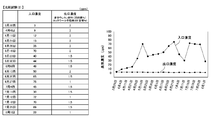
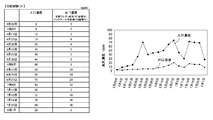
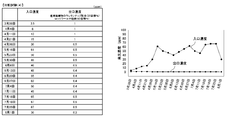
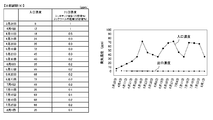
- FIG. 3 to FIG. 8 are tables and graphs showing test results of comparative tests on the deodorizing effect of the conventional deodorizing material and the deodorizing material according to the present invention.
- the following deodorizing effect comparison tests 1 to 6 were performed using a deodorizing apparatus having a diameter of 800 mm and a height of 4000 mm (not shown).
- the samples used in Comparative Tests 1 to 6 were ratios of “chicken dung 40 kg (water content 15%)” (dry weight 34 kg) as a microbial active substance to “rockwool medium grain cotton 160 kg (1 m 3 )”. However, since the same amount was used in all the comparative tests, the volume amount of each mixture is expressed with the volume excluding the microbial active substance as 100%.
- urethane chips used in Comparative Tests 1 to 4 were adjusted to a major axis of 10 to 50 mm, and the two wood chips used in Comparative Tests 5 and 6 were adjusted to a major axis of 10 to 50 mm. .
- Fig. 3 (Comparative Test 1): 20% by volume of conventional commercially available urethane chips and 80% by volume of rock wool medium-sized cotton Fig.
- Comparative Test 3 the ammonia concentration at the deodorizing tank inlet was 75 ppm at the maximum, and the ammonia concentration at the deodorizing tank outlet was 20 ppm at the maximum. From the above, considering the results of Comparative Tests 1 to 3, the deodorizing material (Comparative Test 2), which is a mixture of 35% by volume of conventional commercially available urethane chips and 65% by volume of rock wool medium-sized cotton, has the most excellent deodorizing effect. Turned out to be.
- the test was performed using “palm wood chips” instead of “coconut chips” as the wood chips.
- the palm tree is also a plant of the palm family, and as a result of using a deodorizing material mixed with "chips of palm tree” and rock wool medium cotton as the woody chip, the ammonia concentration at the deodorizing tank inlet is 72 ppm at maximum The ammonia concentration at the deodorizing tank outlet was 0.2 ppm or less at maximum.
- the adsorption ability of ammonia gas by the chip of the palm tree and the medium wool of rock wool is superior to the case of using the urethane chip.
- the same deodorizing effect can be obtained without using a commercially available urethane chip in which an expensive urethane foam elastic body is chipped or using a urethane chip discarded as industrial waste. It has been found. It has also been found that ammonia gas can be deodorized using wood chips such as coconut chips and palm chips as an alternative to urethane chips discarded as industrial waste.
- the present invention can be widely used as a deodorizing material used in a deodorizing apparatus that removes malodors exemplified below by a biological deodorizing method.
- Odor generated from compost or livestock mainly ammonia
- Odor generated from garbage containing oil including both commercial and household
- Other bad odors mainly ammonia
Landscapes
- Engineering & Computer Science (AREA)
- Chemical & Material Sciences (AREA)
- Biomedical Technology (AREA)
- Health & Medical Sciences (AREA)
- Environmental & Geological Engineering (AREA)
- Analytical Chemistry (AREA)
- General Chemical & Material Sciences (AREA)
- Oil, Petroleum & Natural Gas (AREA)
- Chemical Kinetics & Catalysis (AREA)
- Molecular Biology (AREA)
- Life Sciences & Earth Sciences (AREA)
- Treating Waste Gases (AREA)
- Disinfection, Sterilisation Or Deodorisation Of Air (AREA)
- Treatment Of Sludge (AREA)
- Housing For Livestock And Birds (AREA)
Abstract
Description
また、特許文献2では、細粒綿に「微生物活性物質」と、「ゼオライト」または「籾殻」を混合した脱臭材が開示されている。
(1)市販されているウレタンチップ(新品のウレタンチップ)は、原材料費を含む加工費用が高騰しているという課題があるとともに、ウレタンチップに経年変化による劣化が生じ、通気が不均等になったり、通気抵抗が増大したりすることがあった。
(2)また、籾殻は生産に季節性があり、年間を通じて安定的に確保することが難しい。
(3)さらに、ロックウール粒状綿に混合する資材であるウレタンチップ、籾殻、ゼオライトの3資材の混合は製造工程を煩雑にするという課題があり、また、混合する資材の比重が異なるため、無機繊維製粒状綿と分離しやすく、比重の軽い資材は上部に、比重の重い資材は下部に偏る傾向があって均一な混合が困難になるとともに、脱臭槽に均等に充填できず、通気が不均等になったりして十分な脱臭効果を発揮できないという課題もあった。
すなわち、第1の発明は、粒状物の粒径が1mm以上40mm以下の粒が混在する無機繊維製粒状綿と木質系チップの混合物を主体とし、家畜ふん尿・堆厩肥・余剰汚泥の単独あるいは2以上の混合物からなる微生物活性物質を混合してなることを特徴とする脱臭材である。
ここで、木質系チップには、例えば、杉チップ,シュロの木のチップ,クヌギの木のチップ,桜の木のチップ,ココナッツチップなどの樹木木部のチップや樹皮チップ等がある。なお、木質系チップは、その中に含まれる油分及びリグニンが分解しにくいため腐敗しにくいという利点がある。
また、通常、微生物活性物質は、加工工程を簡略化するために単独で使用されることがあるが、微生物活性物質が単独で十分な量を入手できない場合には、2つ以上の微生物活性物質を混合して用いても、効果に大きな差異はなく、差し支えない(第7の発明においても同じ)。
第2の発明は、前記無機繊維製粒状綿がロックウール粒状綿であり、粒径5.6mm以上の粒状物を50%以上含んだ「中粒綿」を主体とするものであることを特徴とする同脱臭材である。
ここで、以後、粒径5.6mm以上の粒状綿を50%以上含んだ無機繊維製粒状綿を「中粒綿」と表記する。
また、無機繊維製粒状綿には、ロックウール粒状綿以外に、例えば、セラミックファイバー製粒状綿、ガラス繊維製粒状綿,等がある。
第3の発明は、前記木質系チップの長径が10~50mmであることを特徴とする同脱臭材である。
ここで、本願では、チップおよび小片の径・幅・高さ・長さのうちもっとも大きい値を示す箇所の長さを「長径」と定義する。
第4の発明は、前記木質系チップの割合が、無機繊維製粒状綿100容積部に対し、20~120容積部(好ましくは25~80容積部、さらに好ましくは40~70容積部)であることを特徴とする同脱臭材である。
第5の発明は、前記微生物活性物質の乾燥重量が、前記無機繊維製粒状綿と前記木質系チップの混合物100重量部に対し、5~30重量部(好ましくは5~20重量部、さらに好ましくは5~15重量部、特に好ましくは5~10重量部)であることを特徴とする同脱臭材である。
第6の発明は、前記木質系チップが悪臭吸着機能と栄養供給機能を備えたことを特徴とする同脱臭材である。
前記木質系チップが悪臭吸着機能と栄養供給機能を備えることで、脱臭材が初期段階(微生物活性の発現前)から脱臭効果を発揮できるとともに、微生物に栄養を供給して微生物の活性を促進できる。
ここでの「ウレタンチップ」は、市販されるウレタン製品ではなく、産業廃棄物として廃棄されるウレタン発泡弾性体を使用するものである。例えば、製造工程で製品基準を満足しない状態のものとして廃棄されるウレタン発泡弾性体を長径50mm以下、好ましくは10mm~50mm以下、より好ましくは20mm~30mmに破砕加工したものである。これにより、産業廃棄物を有価物として使用できる。なお、産業廃棄物の範囲としては、建築廃材に限らず、LNGタンカーや工場・プラント用配管保温材などから出るウレタン発泡弾性体もその対象となる。
第8の発明は、前記ウレタンチップの割合が、前記無機繊維製粒状綿100容積部に対して、25~66容積部であることを特徴とする同脱臭材である。
これは、前記無機繊維製粒状綿と前記ウレタンチップとの混合比率を、前記無機繊維製粒状綿60乃至80容積%、前記ウレタンチップ40乃至20容積%にしたものであるが、前記無機繊維製粒状綿の混合比率を脱臭槽の容積に対して60容積%より低くすると脱臭性能が低下する。また、前記無機繊維製粒状綿の混合比率を脱臭槽の容積に対して80%より高くすると、脱臭槽内における通風(悪臭送風)に支障が出る。一方、前記ウレタンチップの混合比率を脱臭槽の容積に対して40容積%より高くすると空隙が多くなり、図5に示す実験結果の通り、脱臭性能が低下する。また、前記ウレタンチップの混合比率を脱臭槽の容積に対して20容積%より低くすると、親水性を有する前記無機繊維製粒状綿がふやけて密着し、脱臭槽内における通風(悪臭送風)が閉塞するなどの支障が出る。
[例示1]1.70~37.50mm粒径のものが50重量%以上(※合計90%)
粒径 1.00~ 1.70mm … 5%
粒径 1.70~ 2.36mm … 5%※
粒径 2.36~ 3.35mm … 30%※
粒径 3.35~ 5.60mm … 10%※
粒径 5.60~11.20mm … 10%※
粒径11.20~19.00mm … 10%※
粒径19.00~31.50mm … 20%※
粒径31.50~37.50mm … 5%※
粒径37.50~40.00mm … 5%
[例示2]2.36~31.50mm粒径のものが50重量%以上(※合計85%)
粒径 1.00~ 1.70mm … 0%
粒径 1.70~ 2.36mm … 5%
粒径 2.36~ 3.35mm … 5%※
粒径 3.35~ 5.60mm … 5%※
粒径 5.60~11.20mm … 25%※
粒径11.20~19.00mm … 35%※
粒径19.00~31.50mm … 15%※
粒径31.50~37.50mm … 5%
粒径37.50~40.00mm … 5%
[例示3]3.35~19.00mm粒径のものが50重量%以上(※合計75%)
粒径 1.00~ 1.70mm … 0%
粒径 1.70~ 2.36mm … 0%
粒径 2.36~ 3.35mm … 15%
粒径 3.35~ 5.60mm … 40%※
粒径 5.60~11.20mm … 30%※
粒径11.20~19.00mm … 5%※
粒径19.00~31.50mm … 5%
粒径31.50~37.50mm … 0%
粒径37.50~40.00mm … 5%
[例示4]5.60~11.20mm粒径のものが50重量%以上(※合計55%)
粒径 1.00~ 1.70mm … 0%
粒径 1.70~ 2.36mm … 5%
粒径 2.36~ 3.35mm … 5%
粒径 3.35~ 5.60mm … 15%
粒径 5.60~11.20mm … 55%※
粒径11.20~19.00mm … 15%
粒径19.00~31.50mm … 5%
粒径31.50~37.50mm … 0%
粒径37.50~40.00mm … 0%
(1)無機繊維製粒状綿が粗すぎると材料の詰め込み具合により、悪臭が脱臭材全体に対して均等に通過しなくなり、脱臭材に悪臭の通り道ができて十分な性能を発揮できない場合があり、また、無機繊維製粒状綿が細かすぎると悪臭は均等に通過するが、通気抵抗が高すぎてランニングコストが高くなったり(大型のブロワーを必要とするため)、単位面積当たりの悪臭処理量が少なくなるために、脱臭装置の性能を効率良く発揮できない場合がある。これに対して、本願発明のように粒状物の粒径が1mm以上40mm以下の粒を「混在」させた無機繊維製粒状綿を使用することにより、これらの不具合を回避できる。
(2)また、無機繊維製粒状綿としてロックウール粒状綿の「中粒綿」を多く使用することで、加工度合いが少なく、細粒綿を使用する場合に比べて製造コストを安く抑えることができる。
(3)無機繊維製粒状綿と、無機繊維製粒状綿と比べて大きな形状を有する木質系チップを混合使用することにより空隙が確保されて、通気抵抗は軽減される。また、木質系チップは炭素源としても利用できるため籾殻の混入も必要なくなった。
(4)木質系チップが持つ悪臭吸着効果により微生物活性が発現するまでの脱臭もできるため、ゼオライトの混入も必要なくなった。
(5)木質系チップや産業廃棄物として廃棄されるはずのウレタン発泡弾性体廃材を利用することで、環境に優しくリサイクルができ、脱臭効果も優れ、材料費も安価である。
(6)木質系チップの場合は、混合する資材の種類が従来技術と比較して少なくなるため、各資材間の比重の差を小さくできて均一な混合を容易にするとともに、脱臭材の製造費用も低減できる。また、従来の資材である籾殻と比べて一般的に年間を通じて入手しやすく、資材の安定供給に優れている。
(7)新たに製造されたウレタン発泡弾性体などの従来の資材と比較して木質系チップは比重の差が小さいために混合時や脱臭槽への充填時に無機繊維製粒状綿から分離しにくく、均一に混合された状態で脱臭槽を構成しやすい。これに加えて木質系チップが持つ微生物用の担体としての性能も活用することができるため、従来品と比較して脱臭性能は同等以上となる。
(8)産業廃棄物として廃棄されるウレタン発泡弾性体は、成型時の温度及び圧力により組成変形が生じており、脱臭材の材料として使用するときの圧密等による形状変化が少なく、従来品と比較してその強度は同等以上となり、悪臭の通気性を確保できる。
(9)木質系チップの場合は、樹皮繊維等に含まれる油分及びリグニンが分解しにくいため、散水による湿潤や、散水がない時の乾燥の繰り返しにも腐敗しにくいため、耐久性がある。
(10)杉チップ,シュロの木のチップ,クヌギのチップ,桜の木のチップ,ココナッツチップなどの樹木木部のチップや樹皮チップは好気性菌の活性化を抑制する「モノテルペンおよびその化合物」が微量のため、好気性菌を殺菌することがなく、むしろ堆肥槽等から悪臭を分解する好気性菌が増殖・活性化しやすい環境を実現できる。
図1に示す実施形態は、本願発明の一実施例を示すものである。
従来例の試料は、「ロックウール中粒綿163kg(約1m3)」に「ゼオライト41kg」、微生物活性物質として「鶏ふん32kg(含水率15%)」(乾燥重量27.2kg)、「籾殻13kg」、「ウレタンチップ48.6kg」(長径10~50mm)および水を混合し、調整した。
また、湿度を保つため一日に数回15分程度散水する。余った水は排水沈殿槽(排水タンク)40に溜まり、再度散水に使用される。
図2に示す一覧表によれば、本願発明に係る脱臭材30を使用した実施例が、従来例と比較して2/3に悪臭濃度(出口濃度)を減少させていることが証明された。脱臭装置を替えずに、単に脱臭材を替えただけで、1/3も出口濃度を低減させたことは極めて大きな効果である。
この比較試験では、寸法が直径800mm、高さ4000mmの脱臭装置を用いて(図示省略)、以下のような脱臭効果の比較試験1~6を行った。なお、比較試験1~6に用いた試料は、「ロックウール中粒綿160kg(1m3)」に対して、微生物活性物質として「鶏ふん40kg(含水率15%)」(乾燥重量34kg)の割合で配合してあるが、すべての比較試験で同一量を用いたため、微生物活性物質を除いた容積を100%として各混合物の容積量を表す。また、比較試験1~4に用いたウレタンチップは、長径10~50mmに調整したものであり、比較試験5及び6に用いた木質系チップ2種は、長径10~50mmに調整したものである。
図3(比較試験1):従来の市販のウレタンチップ20容積%とロックウール中粒綿80容積%の脱臭材
図4(比較試験2):従来の市販のウレタンチップ35容積%とロックウール中粒綿65容積%の脱臭材
図5(比較試験3):従来の市販のウレタンチップ41容積%とロックウール中粒綿59容積%の脱臭材
図6(比較試験4):産業廃棄物のウレタンチップ35容積%とロックウール中粒綿65容積%の脱臭材
図7(比較試験5):ココナッツ(木質系)チップ35容積%とロックウール中粒綿65容積%の脱臭材
図8(比較試験6):シュロの木(木質系)チップ35容積%とロックウール中粒綿65容積%の脱臭材
これによると、比較試験1では、試験開始から約2カ月後に通気路が閉塞し、その後通気路を確保して試験を継続したが、約1カ月後に再度通気路が閉塞した。このことから、脱臭槽の容積に対して、ロックウール中粒綿を80容積%以上充填した場合、散水された水とその水に濡れたロックウールの親水性が要因となり通気路が閉塞して、継続運転できなことが判明した。
一方、比較試験2では、脱臭槽入口のアンモニア濃度は最大で75ppmであり、脱臭槽出口のアンモニア濃度は最大で2ppmであった。また、比較試験3では、脱臭槽入口のアンモニア濃度は最大で75ppmであり、脱臭槽出口のアンモニア濃度は最大で20ppmであった。
以上より、比較試験1~3の結果を考察すると、従来の市販のウレタンチップ35容積%とロックウール中粒綿65容積%を混合した脱臭材(比較試験2)が最も優れた脱臭効果を備えていることが判明した。
比較試験4では、脱臭槽入口のアンモニア濃度は最大で67ppmであり、脱臭槽出口のアンモニア濃度は最大で1ppmであった。
以上により、比較試験2の「従来の市販のウレタンチップ35容積%」と、比較試験4の「産業廃棄物のウレタンチップ35容積%」との比較では、産業廃棄物のウレタンチップを用いても従来の市販のウレタンチップと同じ脱臭効果の得られることが判明した。
比較試験5では、木質系チップとして「ココナッツチップ」とロックウール中粒綿の混合した脱臭材を用いた結果、脱臭槽入口のアンモニア濃度は最大で75ppmであり、脱臭槽出口のアンモニア濃度は最大で0.5ppm以下であった。
以上により、ココナッツチップとロックウール中粒綿によるアンモニアガスの吸着能力が、ウレタンチップを用いる場合と比較して優れていることが判明した。
以上により、シュロの木のチップとロックウール中粒綿によるアンモニアガスの吸着能力が、ウレタンチップを用いる場合と比較して優れていることが判明した。
(1)堆肥舎や畜舎などから発生する(アンモニアを主体とする)悪臭
(2)油を含む生ゴミなどから発生する悪臭(業務用・家庭用の両方を含む)
(3)その他の悪臭
20 容器(脱臭槽) 21 送気口 22 排気口
30 脱臭材
40 排水沈殿槽(排水タンク)
Claims (9)
- 粒状物の粒径が1mm以上40mm以下の粒が混在する無機繊維製粒状綿と木質系チップの混合物を主体とし、家畜ふん尿・堆厩肥・余剰汚泥の単独あるいは2以上の混合物からなる微生物活性物質を混合してなることを特徴とする脱臭材。
- 前記無機繊維製粒状綿がロックウール粒状綿であり、粒径5.6mm以上の粒状物を50%以上含んだ中粒綿を主体とするものであることを特徴とする請求項1記載の脱臭材。
- 前記木質系チップの長径が10~50mmであることを特徴とする請求項1又は2記載の脱臭材。
- 前記木質系チップの割合が、無機繊維製粒状綿100容積部に対し、20~120容積部であることを特徴とする請求項1から3のいずれかに記載の脱臭材。
- 前記微生物活性物質の乾燥重量が、前記無機繊維製粒状綿と前記木質系チップの混合物100重量部に対し、5~30重量部であることを特徴とする請求項1から4のいずれかに記載の脱臭材。
- 前記木質系チップが悪臭吸着機能と栄養供給機能を備えたことを特徴とする請求項1から5のいずれかに記載の脱臭材。
- 粒状物の粒径が1mm以上40mm以下の無機繊維製粒状綿と産業廃棄物として廃棄されるウレタン発泡弾性体を長径10mm~50mmに破砕したウレタンチップとの混合物を主体とし、家畜ふん尿・堆厩肥・余剰汚泥の単独あるいは2以上の混合物からなる微生物活性物質を混合してなることを特徴とする脱臭材。
- 前記ウレタンチップの割合が、前記無機繊維製粒状綿100容積部に対して、25~66容積部であることを特徴とする請求項7記載の脱臭材。
- 請求項1,2,7又は8記載の脱臭材を備えたことを特徴とする脱臭装置。
Priority Applications (3)
| Application Number | Priority Date | Filing Date | Title |
|---|---|---|---|
| CN201080000886.XA CN102112204B (zh) | 2009-08-31 | 2010-04-13 | 脱臭材料和脱臭装置 |
| JP2011528674A JP5525533B2 (ja) | 2009-08-31 | 2010-04-13 | 脱臭材及び脱臭装置 |
| SG2012014288A SG178921A1 (en) | 2009-08-31 | 2010-04-13 | Deodorizing material and deodorizing device |
Applications Claiming Priority (2)
| Application Number | Priority Date | Filing Date | Title |
|---|---|---|---|
| JP2009-199519 | 2009-08-31 | ||
| JP2009199519 | 2009-08-31 |
Publications (1)
| Publication Number | Publication Date |
|---|---|
| WO2011024507A1 true WO2011024507A1 (ja) | 2011-03-03 |
Family
ID=43627621
Family Applications (1)
| Application Number | Title | Priority Date | Filing Date |
|---|---|---|---|
| PCT/JP2010/056582 Ceased WO2011024507A1 (ja) | 2009-08-31 | 2010-04-13 | 脱臭材及び脱臭装置 |
Country Status (5)
| Country | Link |
|---|---|
| JP (1) | JP5525533B2 (ja) |
| KR (1) | KR20120047295A (ja) |
| CN (1) | CN102112204B (ja) |
| SG (1) | SG178921A1 (ja) |
| WO (1) | WO2011024507A1 (ja) |
Cited By (3)
| Publication number | Priority date | Publication date | Assignee | Title |
|---|---|---|---|---|
| JP6445664B1 (ja) * | 2017-11-30 | 2018-12-26 | 新和産業株式会社 | 生物脱臭装置 |
| JP6445665B1 (ja) * | 2017-11-30 | 2018-12-26 | 新和産業株式会社 | 生物脱臭方法 |
| JP6445663B1 (ja) * | 2017-11-30 | 2018-12-26 | 新和産業株式会社 | 生物脱臭装置 |
Families Citing this family (1)
| Publication number | Priority date | Publication date | Assignee | Title |
|---|---|---|---|---|
| CN102674919B (zh) * | 2012-05-14 | 2014-01-29 | 中国科学院地理科学与资源研究所 | 一种用于堆肥的除臭材料及制法和应用 |
Citations (8)
| Publication number | Priority date | Publication date | Assignee | Title |
|---|---|---|---|---|
| JPS6427621A (en) * | 1987-07-21 | 1989-01-30 | Seibutsukei Tokutei Sangyo | Method for treating bad smelling gas |
| JPH11309334A (ja) * | 1998-04-28 | 1999-11-09 | Bio Oriented Technol Res Advancement Inst | 脱臭装置 |
| JP2002273155A (ja) * | 2001-03-21 | 2002-09-24 | Kochi Kansei Koken Kk | 微生物脱臭装置 |
| JP2004181382A (ja) * | 2002-12-04 | 2004-07-02 | Matsushita Ecology Systems Co Ltd | ヤシガラを用いた生物脱臭方法及び装置 |
| JP2005035811A (ja) * | 2003-07-16 | 2005-02-10 | National Agriculture & Bio-Oriented Research Organization | 悪臭の揮散を低減する堆肥化処理方法及び装置 |
| JP2006095500A (ja) * | 2004-09-30 | 2006-04-13 | Tokuzo Sato | 脱臭装置 |
| JP3829961B2 (ja) * | 1997-10-29 | 2006-10-04 | 独立行政法人農業・食品産業技術総合研究機構 | 脱臭材 |
| JP2006263531A (ja) * | 2005-03-23 | 2006-10-05 | Matsushita Electric Ind Co Ltd | 脱臭装置 |
Family Cites Families (2)
| Publication number | Priority date | Publication date | Assignee | Title |
|---|---|---|---|---|
| JP2883286B2 (ja) * | 1994-12-08 | 1999-04-19 | ダイワ工業株式会社 | 脱臭装置 |
| JP3202564B2 (ja) * | 1995-10-30 | 2001-08-27 | 東洋バイオリアクター株式会社 | 脱臭装置 |
-
2010
- 2010-04-13 KR KR1020127007364A patent/KR20120047295A/ko not_active Ceased
- 2010-04-13 JP JP2011528674A patent/JP5525533B2/ja active Active
- 2010-04-13 WO PCT/JP2010/056582 patent/WO2011024507A1/ja not_active Ceased
- 2010-04-13 SG SG2012014288A patent/SG178921A1/en unknown
- 2010-04-13 CN CN201080000886.XA patent/CN102112204B/zh not_active Expired - Fee Related
Patent Citations (8)
| Publication number | Priority date | Publication date | Assignee | Title |
|---|---|---|---|---|
| JPS6427621A (en) * | 1987-07-21 | 1989-01-30 | Seibutsukei Tokutei Sangyo | Method for treating bad smelling gas |
| JP3829961B2 (ja) * | 1997-10-29 | 2006-10-04 | 独立行政法人農業・食品産業技術総合研究機構 | 脱臭材 |
| JPH11309334A (ja) * | 1998-04-28 | 1999-11-09 | Bio Oriented Technol Res Advancement Inst | 脱臭装置 |
| JP2002273155A (ja) * | 2001-03-21 | 2002-09-24 | Kochi Kansei Koken Kk | 微生物脱臭装置 |
| JP2004181382A (ja) * | 2002-12-04 | 2004-07-02 | Matsushita Ecology Systems Co Ltd | ヤシガラを用いた生物脱臭方法及び装置 |
| JP2005035811A (ja) * | 2003-07-16 | 2005-02-10 | National Agriculture & Bio-Oriented Research Organization | 悪臭の揮散を低減する堆肥化処理方法及び装置 |
| JP2006095500A (ja) * | 2004-09-30 | 2006-04-13 | Tokuzo Sato | 脱臭装置 |
| JP2006263531A (ja) * | 2005-03-23 | 2006-10-05 | Matsushita Electric Ind Co Ltd | 脱臭装置 |
Cited By (6)
| Publication number | Priority date | Publication date | Assignee | Title |
|---|---|---|---|---|
| JP6445664B1 (ja) * | 2017-11-30 | 2018-12-26 | 新和産業株式会社 | 生物脱臭装置 |
| JP6445665B1 (ja) * | 2017-11-30 | 2018-12-26 | 新和産業株式会社 | 生物脱臭方法 |
| JP6445663B1 (ja) * | 2017-11-30 | 2018-12-26 | 新和産業株式会社 | 生物脱臭装置 |
| JP2019098232A (ja) * | 2017-11-30 | 2019-06-24 | 新和産業株式会社 | 生物脱臭装置 |
| JP2019098234A (ja) * | 2017-11-30 | 2019-06-24 | 新和産業株式会社 | 生物脱臭方法 |
| JP2019098233A (ja) * | 2017-11-30 | 2019-06-24 | 新和産業株式会社 | 生物脱臭装置 |
Also Published As
| Publication number | Publication date |
|---|---|
| JPWO2011024507A1 (ja) | 2013-01-24 |
| CN102112204B (zh) | 2014-07-16 |
| KR20120047295A (ko) | 2012-05-11 |
| JP5525533B2 (ja) | 2014-06-18 |
| CN102112204A (zh) | 2011-06-29 |
| SG178921A1 (en) | 2012-04-27 |
Similar Documents
| Publication | Publication Date | Title |
|---|---|---|
| CN101696137B (zh) | 一种畜禽粪便堆肥除臭保氮调理剂及使用方法 | |
| BR0206666B1 (pt) | Composição compreendendo uma mistura comprimida de medula de fibra de coco e material não fibra de coco/não turfa, e processos para sua produção | |
| WO2018020514A1 (en) | An activated aerobic composting media and production method thereof | |
| JP5525533B2 (ja) | 脱臭材及び脱臭装置 | |
| JP3919030B2 (ja) | 生ごみの処理方法 | |
| Hendrych et al. | Innovative packing material for waste gas biofiltration | |
| JP2001302366A (ja) | 軽量多孔質体およびその製造方法 | |
| CN102701433A (zh) | 一种生物滤池除臭填料及制备方法 | |
| Bello et al. | Co-composting of sawdust with food waste: effects of physical properties on composting process and products quality | |
| JP4670098B2 (ja) | 高含水有機廃棄物の処理方法 | |
| CN100429182C (zh) | 有机固体废弃物堆肥处理及生物除臭系统及其操作方法 | |
| JP2019098232A (ja) | 生物脱臭装置 | |
| JP2019098234A (ja) | 生物脱臭方法 | |
| CN101961501A (zh) | 恶臭气体消除剂 | |
| RU2407781C1 (ru) | Способ очистки воздуха от вредных веществ | |
| GB2439047A (en) | Granular deodorant for refuse and compost composition comprising humic substance, such as peat, on structural carrier | |
| JP3848958B2 (ja) | 脱臭装置 | |
| DE102009049346A1 (de) | Sorptionsgranulat zur Beseitigung von Geruchs- und Schadstoffen aus Abluft-, Abgasen und Abwasser aus Industrie und Haushalten | |
| JPH09286684A (ja) | 土壌改良材 | |
| EP4574887A1 (en) | Cellulosic composition | |
| JP2001129349A (ja) | 脱臭方法および脱臭装置 | |
| JP2019098233A (ja) | 生物脱臭装置 | |
| FI94495C (fi) | Turvepitoinen suodatinmateriaali, sitä sisältävä kaasunpuhdistin ja menetelmä kaasujen puhdistamiseksi | |
| JP2007229636A (ja) | 生ゴミ分解容器および分解方法 | |
| TW202402716A (zh) | 有機廢棄物處理用之固體酵素組成物、其製造方法及其用途 |
Legal Events
| Date | Code | Title | Description |
|---|---|---|---|
| WWE | Wipo information: entry into national phase |
Ref document number: 201080000886.X Country of ref document: CN |
|
| 121 | Ep: the epo has been informed by wipo that ep was designated in this application |
Ref document number: 10811560 Country of ref document: EP Kind code of ref document: A1 |
|
| WWE | Wipo information: entry into national phase |
Ref document number: 2011528674 Country of ref document: JP |
|
| NENP | Non-entry into the national phase |
Ref country code: DE |
|
| WWE | Wipo information: entry into national phase |
Ref document number: 1201000843 Country of ref document: TH |
|
| ENP | Entry into the national phase |
Ref document number: 20127007364 Country of ref document: KR Kind code of ref document: A |
|
| 122 | Ep: pct application non-entry in european phase |
Ref document number: 10811560 Country of ref document: EP Kind code of ref document: A1 |