WO2011001869A1 - ナノスフェアの製造方法、ナノスフェア、これを含有する皮膚外用組成物および化粧料 - Google Patents
ナノスフェアの製造方法、ナノスフェア、これを含有する皮膚外用組成物および化粧料 Download PDFInfo
- Publication number
- WO2011001869A1 WO2011001869A1 PCT/JP2010/060630 JP2010060630W WO2011001869A1 WO 2011001869 A1 WO2011001869 A1 WO 2011001869A1 JP 2010060630 W JP2010060630 W JP 2010060630W WO 2011001869 A1 WO2011001869 A1 WO 2011001869A1
- Authority
- WO
- WIPO (PCT)
- Prior art keywords
- emulsion
- solution
- dissolved
- primary
- polymer
- Prior art date
- Legal status (The legal status is an assumption and is not a legal conclusion. Google has not performed a legal analysis and makes no representation as to the accuracy of the status listed.)
- Ceased
Links
Images







Classifications
-
- A—HUMAN NECESSITIES
- A61—MEDICAL OR VETERINARY SCIENCE; HYGIENE
- A61K—PREPARATIONS FOR MEDICAL, DENTAL OR TOILETRY PURPOSES
- A61K9/00—Medicinal preparations characterised by special physical form
- A61K9/48—Preparations in capsules, e.g. of gelatin, of chocolate
- A61K9/50—Microcapsules having a gas, liquid or semi-solid filling; Solid microparticles or pellets surrounded by a distinct coating layer, e.g. coated microspheres, coated drug crystals
- A61K9/51—Nanocapsules; Nanoparticles
- A61K9/5107—Excipients; Inactive ingredients
- A61K9/513—Organic macromolecular compounds; Dendrimers
-
- A—HUMAN NECESSITIES
- A61—MEDICAL OR VETERINARY SCIENCE; HYGIENE
- A61K—PREPARATIONS FOR MEDICAL, DENTAL OR TOILETRY PURPOSES
- A61K47/00—Medicinal preparations characterised by the non-active ingredients used, e.g. carriers or inert additives; Targeting or modifying agents chemically bound to the active ingredient
- A61K47/30—Macromolecular organic or inorganic compounds, e.g. inorganic polyphosphates
- A61K47/34—Macromolecular compounds obtained otherwise than by reactions only involving carbon-to-carbon unsaturated bonds, e.g. polyesters, polyamino acids, polysiloxanes, polyphosphazines, copolymers of polyalkylene glycol or poloxamers
-
- A—HUMAN NECESSITIES
- A61—MEDICAL OR VETERINARY SCIENCE; HYGIENE
- A61K—PREPARATIONS FOR MEDICAL, DENTAL OR TOILETRY PURPOSES
- A61K47/00—Medicinal preparations characterised by the non-active ingredients used, e.g. carriers or inert additives; Targeting or modifying agents chemically bound to the active ingredient
- A61K47/30—Macromolecular organic or inorganic compounds, e.g. inorganic polyphosphates
- A61K47/36—Polysaccharides; Derivatives thereof, e.g. gums, starch, alginate, dextrin, hyaluronic acid, chitosan, inulin, agar or pectin
-
- A—HUMAN NECESSITIES
- A61—MEDICAL OR VETERINARY SCIENCE; HYGIENE
- A61K—PREPARATIONS FOR MEDICAL, DENTAL OR TOILETRY PURPOSES
- A61K8/00—Cosmetics or similar toiletry preparations
- A61K8/02—Cosmetics or similar toiletry preparations characterised by special physical form
- A61K8/11—Encapsulated compositions
-
- A—HUMAN NECESSITIES
- A61—MEDICAL OR VETERINARY SCIENCE; HYGIENE
- A61K—PREPARATIONS FOR MEDICAL, DENTAL OR TOILETRY PURPOSES
- A61K8/00—Cosmetics or similar toiletry preparations
- A61K8/18—Cosmetics or similar toiletry preparations characterised by the composition
- A61K8/72—Cosmetics or similar toiletry preparations characterised by the composition containing organic macromolecular compounds
- A61K8/90—Block copolymers
-
- A—HUMAN NECESSITIES
- A61—MEDICAL OR VETERINARY SCIENCE; HYGIENE
- A61K—PREPARATIONS FOR MEDICAL, DENTAL OR TOILETRY PURPOSES
- A61K9/00—Medicinal preparations characterised by special physical form
- A61K9/0012—Galenical forms characterised by the site of application
- A61K9/0014—Skin, i.e. galenical aspects of topical compositions
-
- A—HUMAN NECESSITIES
- A61—MEDICAL OR VETERINARY SCIENCE; HYGIENE
- A61K—PREPARATIONS FOR MEDICAL, DENTAL OR TOILETRY PURPOSES
- A61K9/00—Medicinal preparations characterised by special physical form
- A61K9/48—Preparations in capsules, e.g. of gelatin, of chocolate
- A61K9/50—Microcapsules having a gas, liquid or semi-solid filling; Solid microparticles or pellets surrounded by a distinct coating layer, e.g. coated microspheres, coated drug crystals
- A61K9/51—Nanocapsules; Nanoparticles
- A61K9/5192—Processes
-
- A—HUMAN NECESSITIES
- A61—MEDICAL OR VETERINARY SCIENCE; HYGIENE
- A61Q—SPECIFIC USE OF COSMETICS OR SIMILAR TOILETRY PREPARATIONS
- A61Q19/00—Preparations for care of the skin
-
- A—HUMAN NECESSITIES
- A61—MEDICAL OR VETERINARY SCIENCE; HYGIENE
- A61K—PREPARATIONS FOR MEDICAL, DENTAL OR TOILETRY PURPOSES
- A61K2800/00—Properties of cosmetic compositions or active ingredients thereof or formulation aids used therein and process related aspects
- A61K2800/40—Chemical, physico-chemical or functional or structural properties of particular ingredients
- A61K2800/41—Particular ingredients further characterized by their size
- A61K2800/412—Microsized, i.e. having sizes between 0.1 and 100 microns
Definitions
- the present invention includes, for example, a method for producing a nanosphere capable of enclosing one or both of a hydrophilic substance such as a protein, a nucleic acid, a drug and a contrast agent, or a hydrophobic substance such as a lipid and a drug.
- a hydrophilic substance such as a protein, a nucleic acid, a drug and a contrast agent
- a hydrophobic substance such as a lipid and a drug.
- the present invention relates to an external composition for skin and a cosmetic.
- DDS drug delivery system
- sustained drug release type that can increase a patient's QOL (Quality Of Life) by administering a polymer microparticle encapsulating a drug with a biodegradable polymer or the like and releasing a predetermined amount of the drug over a long period of time. DDS is also in the spotlight.
- QOL Quality Of Life
- Patent Document 1 discloses microspheres containing leuprorelin acetate in a polylactic acid or polylactic acid copolymer, and the microspheres containing such leuprorelin acetate have been put into practical use as a preparation for subcutaneous injection. Yes.
- the polylactic acid or polylactic acid copolymer (hereinafter simply referred to as a hydrophobic biodegradable polymer) is hydrophobic. Therefore, a W / O / W (Water in Oil Water) emulsion method or the like is used.
- a W / O / W Water in Oil Water
- microspheres encapsulating water-soluble polymers are produced using hydrophobic biodegradable polymers, the uniformity of the distribution of water-soluble polymers in the microspheres is reduced, and a drug sustained-release DDS preparation is obtained. In some cases, the sustainability (sustained release) of the water-soluble polymer was insufficient.
- the water-soluble polymer is a protein or nucleic acid, in the process of producing the microsphere, the three-dimensional structure may not be maintained or may be denatured and may be deactivated.
- Non-Patent Document 1 a technique is disclosed that can produce microspheres encapsulating water-soluble polymers by a W / O / W emulsion method by using amphiphilic polylactic acid grafted dextran as a biodegradable polymer.
- the microsphere described in Non-Patent Document 1 includes bovine serum albumin (hereinafter simply referred to as BSA) as a water-soluble polymer.
- BSA bovine serum albumin
- BSA bovine serum albumin
- Non-Patent Document 1 the polymer fine particles encapsulating the water-soluble polymer described in Non-Patent Document 1 are suitable for intravenous or arterial injection and percutaneous absorption because the sphere particle size is as large as micrometer order, that is, microspheres. Not.
- Non-Patent Document 2 discloses a technique for producing nanospheres using polylactic acid-grafted dextran by the O / W emulsion method
- Non-Patent Document 3 discloses an amphiphilic block co-polymer by the O / W emulsion method. Techniques for producing nanospheres using coalescence are disclosed. Japanese Patent Laid-Open No. 10-182496 Ouchi T, Saito T, Kontani T, Ohya Y, Macromol Biosci.
- the polymer containing the water-soluble polymer and having a nanometer order Development of fine particles is desired.
- the present invention is to produce polymer fine particles that contain either or both of a hydrophilic substance and a hydrophobic substance such as a water-soluble polymer and that have a particle size of nano-order. It is an object to provide a method for producing nanospheres, nanospheres, a composition for external use on skin containing the nanospheres, and a cosmetic.
- a method for producing nanospheres using a W / O / W emulsion method as an example of the present invention includes an aqueous solvent in which a hydrophilic substance is dissolved, a water-immiscible organic solvent in which an amphiphilic polymer is dissolved, and a hydrophobic property.
- a secondary solution generating step for adding a water-based solvent in which a hydrophilic polymer is dissolved to the primary emulsion to generate a secondary solution, and a secondary emulsion for generating a secondary emulsion by irradiating the secondary solution with ultrasonic waves Generating step.
- the nanosphere contains a hydrophilic substance.
- biodegradable polymers are used for amphiphilic polymers, hydrophobic polymers, and hydrophilic polymers, drugs that contain water-soluble (hydrophilic) high molecular weight drugs such as proteins, nucleic acids, and biologically active natural extracts.
- Sustained release cosmetics can be produced that contain pharmaceuticals such as sustained release DDS preparations and hydrophilic active substances.
- the polymer fine particles encapsulating the hydrophilic substance are on the nanometer order, it can be used for pharmaceutical preparations for intravenous or arterial injection, pharmaceutical preparations for percutaneous absorption, cosmetic compositions such as cosmetics, Systemic administration of drugs, targeting to affected areas and penetration into the skin are possible.
- Another method for producing nanospheres using the W / O / W emulsion method is to mix an aqueous solvent in which a hydrophilic substance is dissolved with a water-immiscible organic solvent in which an amphiphilic polymer is dissolved.
- a primary solution generation step for generating a primary emulsion a primary emulsion generation step for generating a primary emulsion by irradiating ultrasonic waves to the primary solution, and an aqueous solvent in which a hydrophilic polymer is dissolved in the primary emulsion
- a secondary solution generating step for generating a secondary solution and a secondary emulsion generating step for generating a secondary emulsion by irradiating the secondary solution with ultrasonic waves.
- the nanosphere contains a hydrophilic substance.
- aggregation is performed by irradiating ultrasonic waves to a secondary solution obtained by adding a hydrophilic polymer to a primary emulsion formed by irradiating ultrasonic waves to a primary solution containing an amphiphilic polymer and a hydrophilic substance. While suppressing, it becomes possible to produce polymer fine particles of a W / O / W emulsion encapsulating a hydrophilic substance on the nanometer order.
- a biodegradable polymer is used for an amphiphilic polymer and a hydrophilic polymer
- a pharmaceutical or hydrophilic drug containing a water-soluble (hydrophilic) polymer such as a protein, a nucleic acid, or a physiologically active natural extract is included.
- a sustained-release cosmetic that encapsulates an active substance can be produced.
- the polymer fine particles encapsulating the hydrophilic substance are on the nanometer order, it can be used for pharmaceutical preparations for intravenous or arterial injection, pharmaceutical preparations for percutaneous absorption, cosmetic compositions such as cosmetics, Systemic administration of drugs, targeting to affected areas and penetration into the skin are possible.
- the nanosphere manufacturing method using another O / W emulsion method includes a water-immiscible organic solvent in which a hydrophobic substance is dissolved, a water-immiscible organic solvent in which an amphiphilic polymer is dissolved, and a hydrophobic polymer.
- a water-immiscible organic solvent in which water is dissolved is mixed to form a primary solution, and a primary solution is generated.
- a water-based solvent in which a hydrophilic polymer is dissolved is added to the primary solution to form a secondary solution.
- the nanosphere contains a hydrophobic substance.
- a hydrophobic solution and a secondary solution obtained by adding a hydrophilic polymer to a primary solution obtained by adding an amphiphilic polymer to a hydrophobic substance are irradiated with ultrasonic waves, thereby suppressing aggregation and hydrophobicity. It becomes possible to produce polymer fine particles enclosing a substance on the nanometer order.
- the drug sustained-release DDS encapsulating a lipid or a polymer of a hydrophobic polymer such as a natural extract having physiological activity Sustained-release cosmetics containing pharmaceuticals such as pharmaceutical preparations and hydrophobic active substances can be produced.
- the polymer fine particles encapsulating the hydrophobic substance are on the order of nanometers, they can be used in pharmaceutical compositions for intravenous or arterial injection, pharmaceutical compositions for percutaneous absorption, cosmetic compositions such as cosmetics, Systemic administration of drugs, targeting to affected areas and penetration into the skin are possible.
- the method for producing nanospheres using another O / W emulsion method comprises mixing a water-immiscible organic solvent in which a hydrophobic substance is dissolved and a water-immiscible organic solvent in which an amphiphilic polymer is dissolved, A primary solution generating step for generating a primary solution, an aqueous solvent in which a hydrophilic polymer is dissolved is added to the primary solution, a secondary solution generating step for generating a secondary solution, and an ultrasonic wave is applied to the secondary solution.
- the nanosphere contains a hydrophobic substance.
- a secondary solution in which a hydrophilic polymer is further added to a primary solution containing an amphiphilic polymer and a hydrophobic substance is irradiated with ultrasonic waves, so that aggregation is suppressed and a hydrophobic substance is included. It becomes possible to produce molecular fine particles on the nanometer order.
- a biodegradable polymer is used for the amphiphilic polymer and the hydrophilic polymer
- a drug containing a hydrophobic polymer such as a lipid or a physiologically active natural drug or a hydrophobic active substance is included.
- a sustained-release cosmetic can be produced.
- the polymer fine particles encapsulating the hydrophobic substance are on the order of nanometers, they can be used in pharmaceutical compositions for intravenous or arterial injection, pharmaceutical compositions for percutaneous absorption, cosmetic compositions such as cosmetics, Systemic administration of drugs, targeting to affected areas and penetration into the skin are possible.
- the nanosphere manufacturing method using another W / O / W emulsion method involves dissolving an aqueous solvent in which a hydrophilic substance is dissolved, a water-immiscible organic solvent in which a hydrophobic substance is dissolved, and an amphiphilic polymer.
- the water-immiscible organic solvent thus prepared and the water-immiscible organic solvent in which the hydrophobic polymer is dissolved are mixed to form a primary solution generating step, and the primary solution is irradiated with ultrasonic waves.
- a primary emulsion generating step for generating a secondary emulsion, an aqueous solvent in which a hydrophilic polymer is dissolved is added to the primary emulsion, a secondary solution generating step for generating a secondary solution, and ultrasonic irradiation to the secondary solution And a secondary emulsion generating step of generating a secondary emulsion.
- the nanosphere includes a hydrophilic substance and a hydrophobic substance.
- biodegradable polymers are used for amphiphilic polymers, hydrophobic polymers, and hydrophilic polymers, water-soluble (hydrophilic) high molecular weight drugs such as proteins, nucleic acids, and biologically active natural extracts, and lipids And pharmaceuticals such as drug sustained-release DDS preparations that encapsulate hydrophobic polymers such as natural extracts with physiological activity, and sustained-release cosmetics that encapsulate hydrophilic and hydrophobic active substances Can do.
- the fine polymer particles encapsulating hydrophilic substances and hydrophobic substances are on the order of nanometers, they are used for compositions for external use in skin, such as pharmaceuticals for intravenous or arterial injection, pharmaceuticals for percutaneous absorption, and cosmetics. And allows systemic administration of the drug, targeting the affected area and penetration into the skin.
- the nanosphere manufacturing method using another W / O / W emulsion method involves dissolving an aqueous solvent in which a hydrophilic substance is dissolved, a water-immiscible organic solvent in which a hydrophobic substance is dissolved, and an amphiphilic polymer.
- the nanosphere includes a hydrophilic substance and a hydrophobic substance.
- biodegradable polymers are used for amphiphilic polymers and hydrophilic polymers, water-soluble (hydrophilic) high molecular weight drugs such as proteins, nucleic acids, and biologically active natural extracts, and lipids and physiological activities can be obtained. It is possible to produce pharmaceuticals that encapsulate hydrophobic polymers such as natural extracts, and sustained-release cosmetics that encapsulate hydrophilic and hydrophobic active substances.
- the fine polymer particles encapsulating hydrophilic substances and hydrophobic substances are on the order of nanometers, they are used for compositions for external use in skin, such as pharmaceuticals for intravenous or arterial injection, pharmaceuticals for percutaneous absorption, and cosmetics. And allows systemic administration of the drug, targeting the affected area and penetration into the skin.
- the amphiphilic polymer is a copolymer composed of a hydrophilic segment and a hydrophobic segment, and the hydrophilic segment is a polypeptide having three or more charged amino acids, polyethylene having a number average molecular weight of 500 to 100,000.
- the hydrophobic segment may include a biodegradable polyester including one or more selected from the group of glycols and polysaccharides.
- amphiphilic polymer one or more selected from the group consisting of a polypeptide having three or more charged amino acids, a polyethylene glycol having a number average molecular weight of 500 to 100,000, and a polysaccharide, and a biodegradable polyester
- a copolymer By using such a copolymer, it is possible to produce biodegradable nanospheres that include either or both of a hydrophilic substance and a hydrophobic substance.
- the amino acid constituting the polypeptide may be one or more amino acids selected from the group of lysine, arginine and histidine which are positively charged amino acids, and the group of aspartic acid and glutamic acid which are negatively charged amino acids. .
- amino acids of a polypeptide constituting an amphiphilic polymer as amino acids constituting a protein such as one or a plurality of amino acids selected from the group of lysine, arginine, histidine, aspartic acid, and glutamic acid.
- amino acids constituting a protein such as one or a plurality of amino acids selected from the group of lysine, arginine, histidine, aspartic acid, and glutamic acid.
- an amino acid of a polypeptide that constitutes an amphiphilic polymer is an amino acid that constitutes a protein
- nanospheres that enclose either or both of a hydrophilic substance and a hydrophobic substance are introduced into the blood. The possibility of being trapped as foreign matter by phagocytic cells such as macrophages can be reduced, and the circulation time in blood can be prolonged.
- polyethylene glycol is included in the amphiphilic polymer, so that when nanospheres that contain either or both of hydrophilic and hydrophobic substances are introduced into the blood, they are trapped as foreign matter in phagocytic cells such as macrophages. It is possible to reduce the possibility that the blood is circulated and prolong the circulation time in the blood.
- the polysaccharide constituting the amphiphilic polymer is selected from the group of hyaluronic acid, amylose, pullulan, chondroitin, chondroitin sulfate, dextran, dextran sulfate, dermatan sulfate, keratan sulfate, heparan sulfate, chitin, chitosan, and ⁇ -glucan. It may be one or more.
- the content of polysaccharide in the amphiphilic polymer may be 1 to 50% by mass.
- a biodegradable nanosphere containing either or both of a hydrophilic substance and a hydrophobic substance is produced. be able to.
- the structural unit of the biodegradable polyester may be one or more selected from the group of lactic acid, glycolic acid, and amino acid.
- biocompatibility can be improved when producing pharmaceuticals and cosmetics.
- the nanosphere may include stevia fermented extract or sphingomyelin as one or both of a hydrophilic substance and a hydrophobic substance.
- composition for external use on the skin containing nanospheres produced using the method for producing nanospheres is a substance that percutaneously absorbs a substance contained in the composition for external use of skin by bringing it into contact with human skin.
- the composition for external application to the skin such as a coating agent is applied to the skin surface by a composition containing nanospheres containing either or both of a hydrophilic substance and a hydrophobic substance produced by using the above-mentioned nanosphere production method.
- the nanospheres can be applied almost uniformly on the fine irregularities of the film.
- a biodegradable polymer as a polymer constituting the nanosphere, either one or both of the hydrophilic substance and the hydrophobic substance encapsulated in the nanosphere can be suitably and slowly released on the skin surface. In comparison with the prior art, it is possible to reduce the number of times of application while maintaining the effect of the external composition for skin.
- the nanospheres contained in the composition for external skin may contain stevia fermented extract or sphingomyelin as one or both of a hydrophilic substance and a hydrophobic substance.
- Stevia fermented extract and sphingomyelin have a high moisturizing effect, improve rough skin, suppress itching, suppress inflammation, and have an antihistaminic action. Therefore, the composition for external use of skin containing nanospheres containing stevia fermented extract or sphingomyelin can distribute stevia fermented extract or sphingomyelin substantially evenly on fine irregularities on the skin surface.
- a cosmetic containing nanospheres produced using the above-described method for producing nanospheres is provided.
- the cosmetic is a composition for treating the human body for the purpose of beautification, cleanliness, protection or deodorization.
- the composition containing nanospheres containing either or both of a hydrophilic substance and a hydrophobic substance produced by using the above-mentioned nanosphere production method the nanospheres are formed into fine irregularities on the skin surface. It can be applied substantially uniformly.
- a biodegradable polymer as a polymer constituting the nanosphere, either one or both of the hydrophilic substance and the hydrophobic substance encapsulated in the nanosphere can be suitably and slowly released on the skin surface. It is possible to obtain the same effect even if the number of times of applying the cosmetic is reduced as compared with the conventional case.
- the nanospheres contained in the cosmetic may contain stevia fermented extract or sphingomyelin as one or both of a hydrophilic substance and a hydrophobic substance.
- Stevia fermented extract and sphingomyelin have a high moisturizing effect, improve rough skin, suppress itching, suppress inflammation, and have an antihistaminic action. Therefore, with the constitution of the cosmetic containing nanospheres encapsulating stevia fermented extract or sphingomyelin, stevia fermented extract or sphingomyelin can be distributed almost uniformly on the fine irregularities of the skin surface.
- the constituent elements based on the technical idea of the method for producing nanospheres described above and the explanation thereof are also applicable to the nanospheres, compositions for external use on skin and cosmetics containing the nanospheres.
- polymer fine particles having a nano-order particle size including either or both of a hydrophilic substance and a hydrophobic substance such as a water-soluble polymer.
- FIG. 6 is an explanatory diagram for explaining a synthesis method of PLys + -b-PLLA according to Example 1.
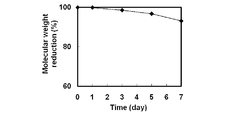
- FIG. 6 is an explanatory diagram for explaining the decomposability in the micelle state of PLys + -b-PLLA according to Example 1.
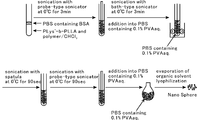
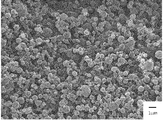
- FIG. 3 is an explanatory diagram for explaining Example 1; It is explanatory drawing for demonstrating the result of having observed the biodegradable nanosphere which includes BSA with the scanning electron microscope. It is explanatory drawing for demonstrating the type
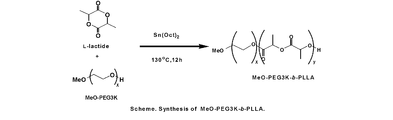
- FIG. 6 is an explanatory diagram for explaining a method of synthesizing PEG3K-b-PLLA according to Example 2.
- FIG. FIG. 6 is an explanatory diagram for explaining Example 2; It is explanatory drawing for demonstrating the result of having observed the biodegradable nanosphere which includes sphingomyelin with the scanning electron microscope.
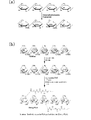
- FIG. 6 is an explanatory diagram for explaining a Dex-g-PLLA synthesis method according to Example 3; 6 is an explanatory diagram for explaining the degradability of Dex-g-PLLA according to Example 3.
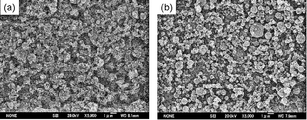
- FIG. 10 is an explanatory diagram for explaining Example 3; It is explanatory drawing for demonstrating the result of having observed the biodegradable nanosphere which includes sphingomyelin with the scanning electron microscope.
- FIG. 10 is an explanatory diagram for explaining Example 4; It is explanatory drawing for demonstrating the result of having observed the biodegradable nanosphere which includes BSA with the scanning electron microscope.
- Drawing 1 is an explanatory view for explaining the manufacturing method of the nanosphere concerning an embodiment.
- a solvent in which an encapsulating substance is dissolved, a water-immiscible organic solvent in which an amphiphilic polymer is dissolved, and a water-immiscible organic solvent in which a hydrophobic polymer is dissolved are mixed to form a primary solution ( S100: primary solution generation step).
- an aqueous solvent in which the hydrophilic substance is dissolved is used as a water-immiscible organic solvent in which the amphiphilic polymer is dissolved and water in which the hydrophobic polymer is dissolved. Mix with immiscible organic solvent to form primary solution.
- the substance to be included is a hydrophilic substance and a hydrophobic substance
- an aqueous solvent in which the hydrophilic substance is dissolved and a water-immiscible organic solvent in which the hydrophobic substance is dissolved are used as an amphiphile.
- a water-immiscible organic solvent in which the soluble polymer is dissolved and a water-immiscible organic solvent in which the hydrophobic polymer is dissolved are mixed to form a primary solution.
- the generated primary solution is irradiated with ultrasonic waves to generate a primary emulsion that is a reverse phase emulsion (W / O emulsion) (S102: primary emulsion generation step). Then, an aqueous solvent in which a hydrophilic polymer is dissolved is added to the primary emulsion to generate a secondary solution (S104: secondary solution generation step).
- the produced secondary solution is irradiated with ultrasonic waves to produce a secondary emulsion (S106: secondary emulsion production step), and the water-immiscible organic solvent is removed from the secondary emulsion (S108: organic solvent removal step).
- the primary solution generation step S100 when the encapsulating substance is a hydrophobic substance, in the primary solution generation step S100, the water-immiscible organic solvent in which the hydrophobic substance is dissolved is changed to the water-immiscible organic solvent in which the amphiphilic polymer is dissolved. The water-immiscible organic solvent is mixed with the soluble polymer to form a primary solution. Then, the primary emulsion generation step S102 is omitted, and an aqueous solvent in which the hydrophilic polymer is dissolved is added to the primary solution to generate a secondary solution (S104: secondary solution generation step).
- the generated secondary solution is irradiated with ultrasonic waves to generate an emulsion (O / W emulsion) (S106: emulsion generation step (secondary emulsion generation step)), and the water-immiscible organic solvent is removed from the emulsion (S108). : Organic solvent removal step).
- Primary solution generation step S100 A primary solution is produced by mixing a solvent in which the substance to be encapsulated is dissolved, a water-immiscible organic solvent in which the amphiphilic polymer is dissolved, and a water-immiscible organic solvent in which the hydrophobic polymer is dissolved.
- amphiphilic polymer 1 in primary solution generation step S100 is a copolymer composed of a hydrophilic segment and a hydrophobic segment, and the hydrophilic segment is a polypeptide having three or more charged amino acids or a number average. Polyethylene glycol having a molecular weight of 500 to 100,000 is included, and the hydrophobic segment includes a biodegradable polyester.
- the polymerized form of an amphiphilic polymer containing a polypeptide or an amphiphilic polymer containing polyethylene glycol is preferably a polypeptide having three or more charged amino acids or polyethylene glycol having a number average molecular weight of 500 to 100,000, Random copolymers, alternating copolymers, block copolymers, and graft copolymers with degradable polyesters, more preferably block copolymers or graft copolymers, and even more preferably block copolymers. It is a polymer.
- the polypeptide constituting the amphiphilic polymer may be positively or negatively charged, and the amino acid constituting such a polypeptide is preferably selected from the group of lysine, arginine, histidine, aspartic acid, and glutamic acid.
- One or more amino acids may be used, more preferably one or more amino acids selected from the group of lysine, arginine or histidine, more preferably lysine.
- a drug such as a drug sustained-release DDS formulation or a sustained-release type using nanospheres using the amphiphilic polymer. Biocompatibility can be improved when producing a composition for external use on skin and a sustained release cosmetic.
- an amino acid of a polypeptide that constitutes an amphiphilic polymer is an amino acid that constitutes a protein
- nanospheres that enclose either or both of a hydrophilic substance and a hydrophobic substance are introduced into the blood. The possibility of being trapped as foreign matter by phagocytic cells such as macrophages can be reduced, and the circulation time in blood can be prolonged.
- the number average molecular weight of the polyethylene glycol constituting the amphiphilic polymer is not particularly limited, but is preferably a number average molecular weight of 500 to 100,000, more preferably a number average molecular weight of 1,000 to 50,000, and still more preferably a number average.
- the molecular weight is 2000-20000.
- nanospheres that contain either or both of hydrophilic substances and hydrophobic substances are introduced into the blood, they are trapped by phagocytic cells such as macrophages as foreign substances. The possibility can be reduced and the circulation time in the blood can be extended.
- the structural unit of the biodegradable polyester is a polymer that becomes a biodegradable polyester when polymerized and can form a copolymer with the above polypeptide or polyethylene glycol.
- lactic acid L-lactic acid
- succinic acid and butanediol 1,2-butanediol, 1,3-butanediol, 1,4-butanediol, 2,3-butanediol, etc.
- These oligomers may be used, and more preferably lactic acid, glycolic acid and amino acid.
- Biodegradable polyesters include, for example, polylactic acid (PLA: Poly Lactic Acid), polyglycolic acid (PGA), polylactic acid-glycolic acid copolymer, polydepsipeptide (copolymer of amino acid and hydroxy acid) Can be used.
- PLA Poly Lactic Acid
- PGA polyglycolic acid
- PGA polylactic acid-glycolic acid copolymer
- polydepsipeptide copolymer of amino acid and hydroxy acid
- biocompatibility can be improved when producing pharmaceuticals, external compositions for skin, and cosmetics.
- amphiphilic polymer 2 in primary solution generation step S100 is a copolymer composed of a hydrophilic segment and a hydrophobic segment, the hydrophilic segment contains a polysaccharide, and the hydrophobic segment is a biodegradable polyester. It may be comprised including.
- the polymerization form of the amphiphilic polymer containing polysaccharide may be a random copolymer, alternating copolymer, block copolymer, or graft copolymer of polysaccharide and biodegradable polyester. It is a copolymer or a block copolymer, and more preferably a graft copolymer.
- the amphiphilic polymer is more preferably a graft copolymer having a polysaccharide as a main chain and a biodegradable polyester as a side chain.
- the content of the polysaccharide constituting the amphiphilic polymer is not particularly limited, but may be 1 to 50% by mass, preferably 1 to 30% by mass, and more preferably 4 to 25% by mass. It is.
- the degradation of the polysaccharides that make up the amphiphilic polymer is within this range. It can be adjusted to a degradation rate that does not cause an inflammatory reaction or the like associated with, and has disappeared from the living body after a period required in the living body.
- the period required in vivo is preferably 1 month to 10 months, more preferably 2 months to 10 months, and most preferably 2 months to 8 months.
- the polysaccharide constituting the amphiphilic polymer may be stable in vivo, preferably hyaluronic acid, amylose, pullulan, chondroitin, chondroitin sulfate, dextran, dextran sulfate, dermatan sulfate, keratan sulfate, heparan sulfate, chitin, One or more selected from the group of chitosan and ⁇ -glucan, more preferably one or more selected from the group of dextran, pullulan and hyaluronic acid, more preferably dextran.
- the structure in which the polysaccharide in the amphiphilic polymer is dextran allows nanospheres enclosing one or both of the hydrophilic substance and the hydrophobic substance to be stably present in the blood vessel.
- the weight average molecular weight of the polysaccharide is not particularly limited, but may be 1000 to 100,000 g / mol, preferably 5000 to 50000 g / mol, and more preferably 10,000 to 30000 g / mol.
- nanospheres containing either or both of hydrophilic substances and hydrophobic substances maintain high moldability and flexibility.
- cell adhesion can be reduced.
- the structural unit of the biodegradable polyester is that which becomes a biodegradable polyester when polymerized and can form a copolymer with the above-mentioned polysaccharide, preferably lactic acid (L-lactic acid, D- Lactic acid, DL-lactic acid), glycolic acid (hydroxyacetic acid), amino acids, caprolactone ( ⁇ -caprolactone, ⁇ -caprolactone, ⁇ -caprolactone, ⁇ -caprolactone, ⁇ -caprolactone, etc.), a mixture of succinic acid and ethylene glycol, succinic acid Or a mixture of butanediol (1,2-butanediol, 1,3-butanediol, 1,4-butanediol, 2,3-butanediol, etc.), or one or more thereof, or an oligomer thereof And more preferably one or more selected from the group of lactic acid, glycolic acid and amino acids
- biodegradable polyester for example, polylactic acid, polyglycolic acid, polylactic acid-glycolic acid copolymer, and polydepsipeptide can be used.
- biocompatibility can be improved when producing pharmaceuticals, external compositions for skin, and cosmetics.
- amphiphilic polymer that is a copolymer of the polysaccharide and the biodegradable polyester described above is preferably a graft copolymer in which the main chain is dextran and the side chain is L-lactic acid.
- an amphiphilic polymer which is a graft copolymer having dextran as a main chain and L-lactic acid as a side chain is referred to as Dex-g-PLLA (polylactic acid grafted dextran).
- the number of lactic acid grafts in the above Dex-g-PLLA molecule may be 1 to 100, preferably 1 to 50, and more preferably 2 to 30. With the configuration in which the number of lactic acid grafts in one molecule of Dex-g-PLLA is within the above range, it becomes possible to reduce the cell adhesion of nanospheres enclosing one or both of hydrophilic substances and hydrophobic substances. .
- the number average molecular weight of the Dex-g-PLLA is not particularly limited, but may be 1 ⁇ 10 4 to 100 ⁇ 10 4 / mol, and preferably 5 ⁇ 10 4 to 20 ⁇ 10 4 / mol. More preferably, it is 10 ⁇ 10 4 to 13 ⁇ 10 4 / mol.
- nanospheres containing either or both of hydrophilic substances and hydrophobic substances can maintain cell strength while maintaining high strength and flexibility. Can be reduced.
- the primary solution generation step S100 it is not necessary to add the water-immiscible organic solvent in which the hydrophobic polymer is dissolved, the solvent in which the substance to be included is dissolved, and the water-immiscible organic solvent in which the amphiphilic polymer is dissolved. May be mixed to form a primary solution.
- the polymerization form of the hydrophobic polymer may be a random copolymer, an alternating copolymer, a block copolymer, or a graft copolymer.
- the structural unit of the hydrophobic polymer is not particularly limited as long as it becomes a hydrophobic polymer when polymerized, preferably lactic acid (L-lactic acid, D-lactic acid, DL-lactic acid), glycolic acid (hydroxyacetic acid), amino acid, Caprolactone ( ⁇ -caprolactone, ⁇ -caprolactone, ⁇ -caprolactone, ⁇ -caprolactone, ⁇ -caprolactone, etc.), a mixture of succinic acid and ethylene glycol, succinic acid and butanediol (1,2-butanediol, 1,3-butane A mixture of diol, 1,4-butanediol, 2,3-butanediol, etc.), one or more, or an oligomer thereof, more preferably lactic acid, glycolic acid and amino acid, One or more selected from the group consisting of L-lactic acid and glycolic acid is there.
- hydrophobic polymer for example, polylactic acid, polyglycolic acid, polylactic acid-glycolic acid copolymer, and polydepsipeptide can be used.
- a random copolymer of L-lactic acid and glycolic acid is used as the hydrophobic polymer.
- the hydrophobic polymer of the random copolymer of L-lactic acid and glycolic acid is referred to as PLGA (polylactic acid- Glycolic acid random copolymer).
- the weight average molecular weight (Mw) of PLGA is not particularly limited, but is preferably 5000-75000.
- the substance to be included in the primary solution generation step S100 may be either a hydrophilic substance or a hydrophobic substance, or both, and stevia fermented extract or parents as either a hydrophilic substance or a hydrophobic substance or both.
- a medium substance may be used.
- amphiphile for example, sphingomyelin can be used.
- Stevia fermented extract a mixture of hydrophilic and hydrophobic substances, and sphingomyelin, an amphiphilic substance, are published in International Publication No. WO2008 / 126638A1 and “Study on Antihistamine Action of Stevia Fermented Extract” Pharmacology and Treatment vol.36 no As described in .8 2008, it has a high moisturizing effect, improves rough skin, suppresses itching, suppresses inflammation, and has antihistaminic activity.
- the aqueous solvent in the primary solution generation step S100 is water or an aqueous solution containing inorganic salts, sugars, organic salts, amino acids, etc., and it is sufficient if the hydrophilic segment of the hydrophilic substance or amphiphilic substance can be dissolved.
- the water-immiscible organic solvent in the primary solution generation step S100 is soluble in the hydrophobic polymer, the hydrophobic segment of the amphiphilic polymer, the hydrophobic substance, or the hydrophobic segment of the amphiphilic substance, and the amphiphile.
- the hydrophilic segment of the hydrophilic polymer may be hardly soluble or insoluble, but both the hydrophobic segment and the hydrophilic segment of the amphiphilic polymer may be hardly soluble or soluble.
- the solubility of the water-immiscible organic solvent in water is 10 g (water-immiscible organic solvent) / 100 ml (water) or less, preferably 1 g (water-immiscible organic solvent) / 100 ml (water) or less. More preferably, it is 0.1 g (water-immiscible organic solvent) / 100 ml (water) or less.
- the water-immiscible organic solvent is not particularly limited, and ethyl acetate, isopropyl acetate, butyl acetate, dimethyl carbonate, diethyl carbonate, methylene chloride (dichloromethane), chloroform and the like can be suitably used.
- the ratio of the water-immiscible organic solvent to the aqueous solvent may be 1: 1000 to 1: 1, preferably 1: 100 to 1: 3, more preferably 1:50 to 1:10. is there.
- the amount of the water-immiscible organic solvent is the amount of the water-immiscible organic solvent that dissolves these amphiphilic polymers when using an amphiphilic polymer containing a polypeptide or an amphiphilic polymer containing polyethylene glycol.
- the total amount of the water-immiscible organic solvent that dissolves the hydrophobic polymer is used.
- an amphiphilic polymer containing a polysaccharide is used, the amount of the water-immiscible organic solvent that dissolves the amphiphilic polymer containing the polysaccharide is used.
- the concentration of the amphiphilic polymer and the hydrophobic polymer in the water-immiscible organic solvent may be 1 to 500 mg / ml when using an amphiphilic polymer containing a polypeptide or an amphiphilic polymer containing polyethylene glycol. It is preferably 10 to 250 mg / ml, more preferably 50 to 100 mg / ml.
- the ratio of the hydrophobic polymer to the amphiphilic polymer may be 1: 1000 to 1: 1, preferably 1: 100 to 1: 3, more preferably 1:50 to 1: 5. is there.
- the concentration of the amphiphilic polymer in the water-immiscible organic solvent may be 1 to 500 mg / ml, preferably 10 to 250 mg / ml when an amphiphilic polymer containing a polysaccharide is used. More preferably, it is 50 to 100 mg / ml.
- Primary emulsion generation step S102 The produced primary solution is irradiated with ultrasonic waves to produce a primary emulsion which is a reverse phase emulsion (W / O emulsion).
- the ultrasonic irradiation time may be 0.5 to 15 minutes, preferably 1 to 10 minutes, and more preferably 3 to 5 minutes.
- the ultrasonic irradiation may be performed using a bus sonicator, a probe sonicator, or a bus sonicator and a probe sonicator.
- the primary solution which is a reverse phase emulsion is produced
- Stirring apparatuses such as a magnetic stirrer, turbine type You may produce
- the hydrophilic polymer may be chemically bonded or physically adsorbed with the hydrophobic segment or hydrophobic polymer of the above-described amphiphilic polymer. Further, the hydrophilic polymer may be one that prevents aggregation of the primary emulsion in the solvent or delays aggregation.
- the hydrophilic polymer may be chemically bonded or physically adsorbed with the hydrophobic segment or the hydrophobic polymer of the amphiphilic polymer in the secondary solution generation step S104. In the removal step S108, it may be chemically bonded or physically adsorbed with the hydrophobic segment or the hydrophobic polymer of the amphiphilic polymer when the solvent is removed.
- the hydrophilic polymer may be one or more selected from the group of polyvinyl alcohol, polyethylene glycol, polypeptide, protein, or polysaccharide, and is preferably polyvinyl alcohol.
- the hydrophilic polymer may be one or more analogs selected from the group of polyvinyl alcohol, polyethylene glycol, polypeptide, protein or polysaccharide.
- the aqueous solvent in the secondary solution generation step S100 only needs to dissolve the hydrophilic polymer, and is, for example, water or an aqueous solution containing inorganic salts, saccharides, organic salts, amino acids, and the like.
- the concentration of the hydrophilic polymer in the aqueous solvent may be 0.1 to 500 mg / ml, preferably 10 to 250 mg / ml, and more preferably 50 to 100 mg / ml.
- the ratio of the aqueous solvent in which the hydrophilic polymer in the secondary solution generation step S100 is dissolved to the primary solution in the primary solution generation step S100 may be 1: 500 to 1:10, and preferably 1: 300. To 1:50, more preferably 1: 200 to 1: 100.
- the ultrasonic irradiation time may be 0.5 to 20 minutes, preferably 1 to 15 minutes, and more preferably 3 to 7 minutes.
- the ultrasonic irradiation may be performed using a bus sonicator, a probe sonicator, or a bus sonicator and a probe sonicator.
- a secondary emulsion is produced
- Stirring apparatuses such as a magnetic stirrer, a turbine type stirring apparatus, a homogenizer, etc. You may produce
- Organic solvent removal step S108 Remove the water immiscible organic solvent from the secondary emulsion.
- in-liquid drying dialysis, centrifugation, freeze-drying, filtration, reprecipitation, etc. may be used, preferably in-liquid drying, centrifugation, or freeze-drying. To do.
- the secondary emulsion (in the case of including a hydrophobic substance, an emulsion) is introduced into an aqueous solvent, and further the water-immiscible organic solvent is removed to thereby remove the hydrophilic substance. Or it is good also as the aqueous solvent dispersion of the nanosphere which encloses any one or both of hydrophobic substances.
- a hydrophilic substance or a hydrophobic substance or An aqueous solvent dispersion of nanospheres enclosing both can be obtained.
- a biodegradable polymer is used for the amphiphilic polymer, hydrophobic polymer and hydrophilic polymer, a sustained release type skin external composition and active ingredient containing a drug or an active substance such as a drug sustained release type DDS formulation can be obtained. It is possible to obtain an aqueous solvent dispersion of biodegradable nanospheres that enclose either or both of a hydrophilic substance and a hydrophobic substance, which is suitable for a cosmetic to be encapsulated.
- the dispersion medium by removing the dispersion medium from the aqueous dispersion of nanospheres enclosing one or both of the hydrophilic substance and the hydrophobic substance obtained by the present embodiment, either the hydrophilic substance or the hydrophobic substance is obtained. It is also possible to form nanospheres that include either or both.
- the method for removing the dispersion medium is not particularly limited, and submerged drying, dialysis, centrifugation, lyophilization, filtration, reprecipitation, and the like can be used. Preferably, submerged drying, centrifuging, and lyophilization are performed. Is used.
- the primary emulsion is generated in the primary emulsion generation step S102, either one or both of the hydrophilic substance and the hydrophobic substance is added to the hydrophobic polymer by the configuration in which the amphiphilic polymer is added. Can be included.
- the primary emulsion produced by irradiating the hydrophobic polymer and the primary solution obtained by adding the amphiphilic polymer to one or both of the hydrophilic substance and the hydrophobic substance under the above-described conditions is hydrophilic.
- the polymer solution containing the hydrophilic polymer and / or the hydrophobic substance is incorporated into the secondary solution to which the hydrophilic polymer is added under the above-described conditions while the aggregation is suppressed. It becomes possible to manufacture by order.
- the primary solution containing the amphiphilic polymer and either one or both of the hydrophilic substance and the hydrophobic substance is used under the above-described conditions.
- a hydrophilic substance or a hydrophobic substance is suppressed while agglomeration is suppressed by a structure in which ultrasonic waves are applied to the secondary solution in which a hydrophilic polymer is added to a primary emulsion formed by irradiating sound waves under the above-described conditions. It is possible to produce polymer fine particles enclosing one or both on the nanometer order.
- a biodegradable polymer as an amphiphilic polymer, a hydrophobic polymer, and a hydrophilic polymer
- a water-soluble (hydrophilic) polymer drug such as a protein, a nucleic acid, or a natural extract having physiological activity
- Drugs encapsulating lipids and hydrophobic polymer drugs such as natural extracts having physiological activity and sustained-release cosmetics encapsulating hydrophilic and hydrophobic active substances
- polymer fine particles encapsulating either or both of hydrophilic substances and hydrophobic substances are on the order of nanometers, so skin for pharmaceuticals for intravenous or arterial injection, pharmaceuticals for percutaneous absorption, cosmetics, etc. It can be used as an external composition, and enables systemic administration of drugs, targeting of affected areas, and penetration into the skin.
- the composition for external use such as a coating agent can be applied to the fine irregularities on the skin surface substantially uniformly.
- a biodegradable polymer as a polymer constituting the nanosphere, either one or both of the hydrophilic substance and the hydrophobic substance encapsulated in the nanosphere can be suitably and slowly released on the skin surface. In comparison with the prior art, it is possible to reduce the number of times of application while maintaining the effect of the external composition for skin.
- nanospheres encapsulating either one or both of the hydrophilic substance and the hydrophobic substance produced by using the method for producing nanospheres encapsulating one or both of the hydrophilic substance and the hydrophobic substance With the constitution containing the nanosphere, the nanosphere can be applied substantially uniformly on the fine irregularities of the skin surface.
- a biodegradable polymer as a polymer constituting the nanosphere, either one or both of the hydrophilic substance and the hydrophobic substance encapsulated in the nanosphere can be suitably and slowly released on the skin surface. It is possible to obtain the same effect even if the number of times of applying the cosmetic is reduced as compared with the conventional case.
- stevia fermented extract which is a mixture of hydrophilic and hydrophobic substances, and nanospheres encapsulating sphingomyelin as an amphiphilic substance having the function of one or both of hydrophilic substances and hydrophobic substances It is also possible to produce a skin external composition and a cosmetic.
- Stevia fermented extract and sphingomyelin have high moisturizing effect and rough skin as described in International Publication No. WO2008 / 126638A1 and “Research on Antihistamine Action of Stevia Fermented Extract” Pharmacology and Treatment vol.36 no.8 2008 Improves it, suppresses itching, suppresses inflammation, and has an antihistamine effect. Therefore, it is possible to distribute the stevia fermented extract or sphingomyelin substantially evenly on the fine irregularities on the skin surface by using a composition for external skin or cosmetic containing nanospheres containing stevia fermented extract or sphingomyelin. it can.
- nanospheres containing either or both of stevia fermented extract and sphingomyelin are cosmetics for hair, hair styling, hair nourishing, scalp, hair coloring, hair washing, Hair rinse, skin cosmetics / skin, cosmetic liquid, cream, milky lotion, tanning, sunscreen, cleaning agent, shaving, dead hair shave, facial rinse, pack, cosmetic oil, body rinse, massage, finishing cosmetics and foundation , Makeup base, funny, lipstick, eye makeup, cheek cosmetics, body makeup, eau de cologne / perfume, bath cosmetics, nail cosmetics, body powders, etc., and in pharmaceuticals, powders / fine granules, granules, Tablets, capsules, pills, glazes, pencils, liquid contents, external liquids, extracts, plasters, suppositories Aerosol, gas chemistry, chemical adsorbents, ophthalmic agents, injections, bandages and the like are widely available.
- Example 1 a diblock copolymer of polylysine and L-lactic acid (hereinafter simply referred to as PLys + -b-PLLA) is used as an amphiphilic polymer, PLGA is used as a hydrophobic polymer, and polyvinyl is used as a hydrophilic polymer.
- BSA was used as a hydrophilic substance containing alcohol (hereinafter, simply referred to as PVA).
- FIG. 2 is an explanatory diagram for explaining the synthesis method of PLys + -b-PLLA according to the first example.
- the amino group of 2-aminoethanol was protected with a t-butoxycarbonyl (hereinafter simply referred to as Boc) group.
- Boc t-butoxycarbonyl
- the terminal hydroxyl group of Boc-aminoethanol was alkoxided with potassium naphthalene, and solution based anionic ring-opening polymerization of lactide was performed using this as an initiator.
- the protecting group (Boc group) of the terminal amino group of the obtained polymer was removed with 25% hydrobromic acetic acid (25% HBr / AcOH), desalting was performed using triethylamine (TEA).
- TEA triethylamine
- the PLys + -b-PLLA according to this example had a polymerization degree of lysine of 16 and a polymerization degree of lactic acid of 39.
- PLys + -b-PLLA according to this example has amphipathic properties and thus self-associates in water to form micelles.
- FIG. 3 is an explanatory diagram for explaining the decomposability in the micelle state of PLys + -b-PLLA according to the first example.
- PBS phosphate buffered saline
- FIG. 4 is an explanatory diagram for explaining the first embodiment.
- 20 mg of PLys + -b-PLLA and 180 mg of PLGA having a weight average molecular weight of 5000-75000 were placed in a test tube and dissolved in 2.5 ml of chloroform (CHCl 3 ).
- 100 ⁇ l of PBS in which 5 mg of BSA was dissolved as a hydrophilic substance was added to the test tube to produce a primary solution.
- ultrasonic irradiation was performed with a probe sonicator for 3 minutes to prepare a primary emulsion.
- UD-200 manufactured by Tommy Seiko Co., Ltd.
- UD-200 manufactured by Tommy Seiko Co., Ltd. and irradiating ultrasonic waves at levels 5 to 10 is simply referred to as irradiating ultrasonic waves with a probe sonicator.
- the primary emulsion was added to 300 ml of PBS containing 0.1% PVA to prepare a secondary solution.
- the secondary solution was irradiated with ultrasonic waves for 3 minutes with a bath sonicator, stirred vigorously with a spatula for 90 seconds, and further irradiated with ultrasonic waves for 90 seconds with a probe sonicator to prepare a secondary emulsion.
- US-2 manufactured by SND Co., Ltd. was used as a bath sonicator, and ultrasonic waves were applied with the level set to 5.
- the irradiation with ultrasonic waves set to level 5 using US-2 manufactured by SND Corporation is simply referred to as irradiating ultrasonic waves with a bath-type sonicator.
- the secondary emulsion was further added to 300 ml of PBS containing 0.1% PVA and dried in liquid to obtain a suspension from which chloroform was removed. Thereafter, the suspension was centrifuged at 20000 rpm for 10 minutes to obtain a precipitate containing biodegradable nanospheres containing BSA. The precipitate was washed with ultrapure water. After repeating this operation consisting of centrifugation and washing several times, the precipitate was freeze-dried to remove water, thereby obtaining biodegradable nanospheres containing BSA.
- the shape and particle size of the biodegradable nanosphere encapsulating BSA were examined using a scanning electron microscope (SEM). A carbon double-sided tape is affixed to a scanning electron microscope sample stage, and biodegradable nanospheres containing BSA after freeze-drying are placed on the sample. Created. The particle size of the biodegradable nanosphere encapsulating BSA was determined by measuring the particle size of a biodegradable nanosphere encapsulating randomly selected BSA.
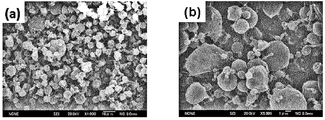
- FIG. 5 is an explanatory diagram for explaining the results of observation of biodegradable nanospheres containing BSA with a scanning electron microscope.
- the particle size of the biodegradable nanosphere encapsulating BSA was about 150 nm to about 800 nm. Further, aggregation was relatively suppressed, and a fine particle surface was obtained.
- biodegradable nanospheres containing either or both of hydrophilic substances and hydrophobic substances are used as pharmaceuticals for intravenous or arterial injection, pharmaceuticals for transdermal absorption And can be used for compositions for external use of skin such as cosmetics and the like, and enables systemic administration of drugs, targeting to affected areas and penetration into skin.
- the BSA encapsulation rate and BSA recovery rate of the biodegradable nanospheres were measured.
- six sample tubes were prepared, of which five sample tubes contained empty biodegradable nanospheres without inclusions, and the remaining one sample tube contained BSA whose inclusion rate was unknown. 20 mg of each biodegradable nanosphere was added.
- sample tubes containing empty biodegradable nanospheres contain 1N water containing BSA so that the BSA concentrations are 0, 0.3, 0.5, 0.7, and 0.9 mg / ml, respectively. 3 ml each of an aqueous sodium oxide solution was placed, and 3 ml of a 1N aqueous sodium hydroxide solution was placed in a sample tube containing biodegradable nanospheres containing BSA.
- a calibration curve was prepared by measuring absorbance at a wavelength of 290 nm using a solution obtained by decomposing empty biodegradable nanospheres having a BSA concentration of 0 mg / ml as a background. And the light absorbency of the solution which decomposed
- FIG. 6 is an explanatory diagram for explaining formulas for calculating the inclusion rate, recovery rate, yield, and inclusion efficiency in the examples.
- the encapsulation rate is the ratio (%) of the weight of the encapsulated substance (in this embodiment, hydrophilic substance) to the nanospheres per unit weight obtained
- the recovery rate is the encapsulated substance used. It is the ratio (%) of the collected encapsulated substance (in this example, hydrophilic substance) to the (in this example, hydrophilic substance), and the yield is the encapsulated used as a component of the nanosphere.
- the ratio of the recovered nanosphere weight to the weight of the substance (hydrophilic substance in this example), amphiphilic polymer, hydrophobic polymer and hydrophilic polymer, and the encapsulation efficiency is the encapsulated efficiency used.
- Nanospheres recovered with either or both of the included hydrophilic substance and / or hydrophobic substance with respect to the ratio of the substance to be used (hydrophilic substance in this example) and the total of the polymers used Shows the proportion of the polymer, the ratio of a percentage (%).
- the BSA encapsulation rate of the biodegradable nanosphere of Example 1 was 2.9%.
- the BSA recovery rate in Example 1 was calculated using the formula for calculating the recovery rate shown in FIG. 6 from the BSA concentration in the obtained supernatant. Asked. As a result, the recovery rate of BSA in Example 1 was 91.0%.
- the recovery rate of BSA is as high as 90% or more, even when expensive substances such as pharmaceuticals are included, it is possible to suitably recover expensive substances such as pharmaceuticals. Therefore, the collected substance can be reused, and an unnecessary increase in drug price can be suppressed.
- Example 2 a diblock copolymer of polyethylene glycol having a number average molecular weight of 3000 and L-lactic acid (hereinafter simply referred to as PEG3K-b-PLLA) as an amphiphilic polymer, PLGA as a hydrophobic polymer, Sphingomyelin was used as an amphiphilic substance having functions of a hydrophilic substance and a hydrophobic substance as a substance encapsulating PVA as a hydrophilic polymer.
- PEG3K-b-PLLA polyethylene glycol having a number average molecular weight of 3000 and L-lactic acid
- FIG. 7 is an explanatory diagram for explaining a method of synthesizing PEG3K-b-PLLA according to Example 2.
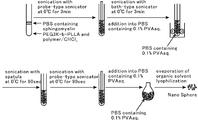
- FIG. 8 is an explanatory diagram for explaining the second embodiment.
- 20 mg of PEG3K-b-PLLA and 180 mg of PLGA having a weight average molecular weight of 5000-75000 were placed in a test tube and dissolved in 2.5 ml of chloroform.
- 5 mg of sphingomyelin was added to the test tube to produce a primary solution.
- the primary solution was vigorously stirred with a spatula, ultrasonic irradiation was performed with a probe sonicator for 3 minutes to prepare a primary emulsion.
- the primary emulsion was added to 300 ml of PBS containing 0.1% PVA to prepare a secondary solution.
- the secondary solution was irradiated with ultrasonic waves for 3 minutes with a bath sonicator, stirred vigorously with a spatula for 90 seconds, and further irradiated with ultrasonic waves for 90 seconds with a probe sonicator to prepare a secondary emulsion.
- the secondary emulsion was further added to 300 ml of PBS containing 0.1% PVA and dried in liquid to obtain a suspension from which chloroform was removed. Thereafter, the suspension was centrifuged at 20000 rpm for 10 minutes to obtain a precipitate containing biodegradable nanospheres encapsulating sphingomyelin as an amphiphilic substance. The precipitate was washed with ultrapure water. After repeating this operation consisting of centrifugation and washing several times, the precipitate was freeze-dried to remove water, thereby obtaining biodegradable nanospheres containing sphingomyelin.
- FIG. 9 is an explanatory diagram for explaining the results of observing biodegradable nanospheres containing sphingomyelin with a scanning electron microscope. As shown in FIG. 9, the particle size of the biodegradable nanosphere encapsulating sphingomyelin was relatively suppressed from aggregation and a fine particle surface was obtained.
- the concentration of sphingomyelin in Example 2 was calculated from the concentration of sphingomyelin in the obtained supernatant using the formula for calculating the yield shown in FIG. The rate was determined. As a result, the yield of sphingomyelin in Example 2 was 53.7%.
- nanospheres including not only hydrophilic substances but also amphiphile sphingomyelin having functions of hydrophilic substances and hydrophobic substances could be produced. Therefore, it has become possible to produce nanospheres that contain not only hydrophilic substances but also hydrophilic substances and hydrophobic substances.
- the fine polymer particles encapsulating sphingomyelin are on the order of nanometers, they can be used for pharmaceutical preparations for intravenous or arterial injection, pharmaceutical preparations for percutaneous absorption, cosmetic preparations, etc. Can be administered systemically, targeted to the affected area, and penetrated into the skin.
- a skin external composition or cosmetic containing nanospheres containing sphingomyelin is produced by the moisturizing effect based on ceramide of sphingomyelin
- the skin external composition or cosmetic can be applied to fine irregularities on the skin surface. Since it can be applied substantially uniformly, the moisturizing effect of the external composition for skin or cosmetic can be evenly applied to the skin.
- a biodegradable polymer as the polymer constituting the nanosphere, sphingomyelin can be suitably and slowly released on the skin surface, and the application of a composition for external skin or cosmetic compared to the conventional case Even if the number of times is reduced, a similar moisturizing effect can be obtained.
- Example 3 In this example, Dex-g-PLLA is used as an amphiphilic polymer, PVA is used as a hydrophilic polymer, and a stevia ferment extract is used as a mixture of a hydrophilic substance and a hydrophobic substance as an encapsulating substance, Hydrophobic polymer was not used.
- FIG. 10 is an explanatory diagram for explaining the Dex-g-PLLA synthesis method according to the third embodiment.
- TMS trimethylsilyl
- TMSDex trimethylsilyl dextran
- L-lactide and TMSDex obtained in FIG. 10 (a) were first dried under reduced pressure on the day before the synthesis.
- L-lactide was weighed into a Claisen flask and directly drawn under reduced pressure at room temperature.
- the hydroxyl group was alkoxided with potassium naphthalene, and this was used as an initiator for solution-based anionic ring-opening polymerization of lactide.
- TMSDex-g-PLLA was dissolved by adding DMSO (Dimethylsulfoxide) and stirring with a stirrer. After confirming that TMSDex-g-PLLA was completely dissolved, methanol was added. Then, acetic acid was added and stirred for 4 hours. After 4 hours, reprecipitation using methanol as a poor solvent was performed, ultracentrifugation was performed, and the precipitate was collected and dried under reduced pressure in a desiccator. Further purification was performed by reprecipitation using DMSO or chloroform as a good solvent and methanol as a poor solvent, depending on the sugar content. This was repeated several times to obtain Dex-g-PLLA.
- DMSO Dimethylsulfoxide
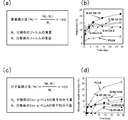
- FIG. 11 is an explanatory diagram for explaining the degradability of Dex-g-PLLA according to Example 3
- FIG. 12 is an explanatory diagram for explaining Dex-g-PLLA used in the decomposability experiment. is there.
- the mass of the Dex-g-PLLA film and PLLA film prepared by the casting method using chloroform was weighed with an electronic balance, immersed in PBS, incubated at 37 ° C., 1 day, 2 days, 4 days, 7 days After 14 days and after 28 days, the mass was measured after removing moisture by drying under reduced pressure. From the weight of the film before decomposition and the weight of the film after decomposition, the weight reduction rate of the film was determined using the formula shown in FIG.
- the molecular weight reduction rate of Dex-g-PLLA was determined using the formula shown in FIG. .
- Dex-g-PLLA has a higher weight reduction rate than the PLLA.
- the lower the degree of polymerization of L-lactide in Dex-g-PLLA the higher the weight reduction rate of the film.
- Dex-g-PLLA has a lower molecular weight reduction rate than PLLA. Further, the higher the sugar content in Dex-g-PLLA, the higher the molecular weight reduction rate. Therefore, by adjusting the polymerization degree or sugar content of L-lactide in Dex-g-PLLA as an amphiphilic polymer, when biodegradable nanospheres are placed in vivo, the inflammatory reaction associated with the degradation can be reduced. It can be adjusted to a biodegradation rate that does not occur and disappears from the living body after a lapse of a period required in the living body.
- FIG. 13 is an explanatory diagram for explaining the third embodiment.
- 200 mg of G45-12-20 or G80-9-16 which is Dex-g-PLLA
- G45-12-20 or G80-9-16 which is Dex-g-PLLA
- CHCl 3 chloroform
- 5 mg of stevia fermented extract was added to the test tube to produce a primary solution.
- a primary emulsion was prepared by irradiating ultrasonic waves with a bath sonicator for 5 minutes while stirring the primary solution vigorously with a spatula.
- the primary emulsion was added to 300 ml of PBS containing 0.1% PVA to prepare a secondary solution.
- a secondary emulsion was prepared by irradiating the secondary solution with ultrasonic waves for 3 minutes using a probe sonicator.
- the secondary emulsion was further added to 300 ml of PBS containing 0.1% PVA and dried in liquid to obtain a suspension from which chloroform was removed. Thereafter, the suspension was centrifuged at 20000 rpm for 10 minutes to obtain a precipitate containing biodegradable nanospheres containing stevia fermentation extract. The precipitate was washed with ultrapure water. After repeating this operation consisting of centrifugation and washing several times, the precipitate was freeze-dried and water was removed to obtain biodegradable nanospheres containing stevia fermentation extract.
- FIG. 14 is an explanatory diagram for explaining the result of observing the biodegradable nanosphere containing the stevia fermented extract with a scanning electron microscope. As shown in FIG. 14, the particle size of the biodegradable nanosphere encapsulating the stevia fermented extract was relatively suppressed from aggregation and a fine particle surface was obtained.
- the stevia fermented extract in Example 3 was calculated from the concentration of stevia fermented extract in the obtained supernatant using the formula for calculating the yield shown in FIG. The yield of was determined. As a result, the yield of stevia fermented extract in Example 3 was 65.8% for G45-12-20 and 63.7% for G80-9-16.
- Example 3 it was possible to produce nanospheres containing not only hydrophilic substances but also stevia fermented extract, which is a mixture of hydrophilic substances and hydrophobic substances. Therefore, it has become possible to produce nanospheres that include not only hydrophilic substances but also mixtures of hydrophilic substances and hydrophobic substances.
- the fine polymer particles encapsulating the stevia fermented extract are on the order of nanometers, and therefore can be used for pharmaceutical preparations for intravenous or arterial injection, pharmaceutical preparations for transdermal absorption, cosmetic compositions such as cosmetics, Systemic administration of drugs, targeting to affected areas and penetration into the skin are possible.
- the recovery rate of stevia fermented extract is as high as 60% or more, it is suitable even when encapsulating expensive substances such as effective substances used in pharmaceuticals, compositions for external use of skin, and cosmetics. Expensive substances such as active ingredients can be recovered. Therefore, the collected substance can be reused, and an unnecessary increase in drug price can be suppressed.
- Stevia fermented extract has a high moisturizing effect, improves rough skin, suppresses itching, suppresses inflammation, and has an antihistaminic action. Therefore, if a composition for external skin or cosmetics containing nanospheres containing stevia fermented extract is manufactured, stevia fermented extract can be distributed almost evenly on the fine irregularities of the skin surface, and the moisturizing effect of stevia fermented extract It is possible to uniformly apply rough skin improving effect, itching inhibiting effect, inflammation inhibiting effect and antihistamine effect to the skin surface.
- Example 4 In this example, Dex-g-PLLA was used as the amphiphilic polymer, EtO-PLLA was used as the hydrophobic polymer, PVA was used as the hydrophilic polymer, and BSA was used as the hydrophilic substance to be included.
- FIG. 15 is an explanatory diagram for explaining the fourth embodiment.
- 170 mg of EtO-PLLA and G71-13-13 which is Dex-g-PLLA (see FIG. 13B) were placed in a test tube, and methylene chloride (CH 2 Cl 2 ) It was dissolved in 2.4 ml.
- 100 ⁇ l of PBS in which 5 mg of BSA was dissolved was added to the test tube to form a primary solution.
- the primary solution was vigorously stirred with a spatula, ultrasonic waves were irradiated for 5 minutes with a bath sonicator and 1.5 minutes with a probe sonicator to prepare a primary emulsion.
- a secondary emulsion was prepared by irradiating the secondary solution with ultrasonic waves with a probe-type sonicator for 1.5 minutes.
- the secondary emulsion was added to 200 ml of PBS containing 0.1% PVA, stirred for 1 hour, and dried in liquid at about 40 ° C. for 2 hours to obtain a suspension from which methylene chloride was removed. Thereafter, the suspension was centrifuged at 20000 rpm for 10 minutes to obtain a precipitate containing biodegradable nanospheres containing BSA. The precipitate was washed with ultrapure water. After repeating this operation consisting of centrifugation and washing several times, the precipitate was freeze-dried to remove water, thereby obtaining biodegradable nanospheres containing BSA.
- FIG. 16 is an explanatory diagram for explaining the results of observation of biodegradable nanospheres containing BSA with a scanning electron microscope.
- the particle size of the biodegradable nanosphere encapsulating BSA was about 400 nm to about 600 nm. Further, aggregation was relatively suppressed, and a fine particle surface was obtained.
- the biodegradable nanosphere encapsulating a hydrophilic substance is used as a skin for pharmaceuticals for intravenous or arterial injection, pharmaceuticals for transdermal absorption, cosmetics, etc. It can be used as an external composition, and enables systemic administration of drugs, targeting of affected areas, and penetration into the skin.
- the BSA encapsulation rate and BSA recovery rate of the biodegradable nanospheres were measured.
- six sample tubes were prepared, of which five sample tubes contained empty biodegradable nanospheres without inclusions, and the remaining one sample tube contained BSA whose inclusion rate was unknown. 20 mg of each biodegradable nanosphere was added.
- sample tubes containing empty biodegradable nanospheres contain 1N water containing BSA so that the BSA concentrations are 0, 0.1, 0.15, 0.23, and 0.3 mg / ml, respectively. 3 ml each of an aqueous sodium oxide solution was placed, and 3 ml of a 1N aqueous sodium hydroxide solution was placed in a sample tube containing biodegradable nanospheres containing BSA.
- a calibration curve was prepared by measuring the absorbance at a wavelength of 291 nm using a solution obtained by decomposing empty biodegradable nanospheres having a BSA concentration of 0 mg / ml as a background. And the light absorbency of the solution which decomposed
- the BSA encapsulation efficiency of the biodegradable nanosphere of Example 4 was calculated to be 52.9%.
- the BSA recovery rate in Example 4 was calculated using the formula for calculating the recovery rate shown in FIG. 6 from the BSA concentration in the obtained supernatant. Asked. As a result, the recovery rate of BSA in Example 4 was 82.7%.
- BSA recovery rate of BSA is as high as 80% or more, even when expensive substances such as active ingredients used for pharmaceuticals, compositions for external use of skin, and cosmetics are encapsulated, the active ingredients etc. Expensive material can be recovered. Therefore, the collected substance can be reused, and an unnecessary increase in drug price can be suppressed.
- each process in the manufacturing method of the nanosphere of this specification does not necessarily need to process in time series along the order described as a flowchart, and may include the process by parallel or a subroutine.
- the present invention includes, for example, a method for producing a nanosphere capable of enclosing one or both of a hydrophilic substance such as a protein, a nucleic acid, a drug and a contrast agent, or a hydrophobic substance such as a lipid and a drug. It can be used for an external composition for skin and cosmetics.
- a hydrophilic substance such as a protein, a nucleic acid, a drug and a contrast agent
- a hydrophobic substance such as a lipid and a drug. It can be used for an external composition for skin and cosmetics.
Landscapes
- Health & Medical Sciences (AREA)
- Life Sciences & Earth Sciences (AREA)
- Chemical & Material Sciences (AREA)
- Animal Behavior & Ethology (AREA)
- Veterinary Medicine (AREA)
- Public Health (AREA)
- General Health & Medical Sciences (AREA)
- Epidemiology (AREA)
- Medicinal Chemistry (AREA)
- Pharmacology & Pharmacy (AREA)
- Engineering & Computer Science (AREA)
- Bioinformatics & Cheminformatics (AREA)
- Nanotechnology (AREA)
- Optics & Photonics (AREA)
- Physics & Mathematics (AREA)
- Biomedical Technology (AREA)
- Inorganic Chemistry (AREA)
- Birds (AREA)
- Dermatology (AREA)
- Proteomics, Peptides & Aminoacids (AREA)
- Medicinal Preparation (AREA)
- Cosmetics (AREA)
- Manufacturing Of Micro-Capsules (AREA)
- Colloid Chemistry (AREA)
Applications Claiming Priority (2)
| Application Number | Priority Date | Filing Date | Title |
|---|---|---|---|
| JP2009-157496 | 2009-07-02 | ||
| JP2009157496A JP5031001B2 (ja) | 2009-07-02 | 2009-07-02 | ナノスフェアの製造方法、ナノスフェア、これを含有する皮膚外用組成物および化粧料 |
Publications (1)
| Publication Number | Publication Date |
|---|---|
| WO2011001869A1 true WO2011001869A1 (ja) | 2011-01-06 |
Family
ID=43410944
Family Applications (1)
| Application Number | Title | Priority Date | Filing Date |
|---|---|---|---|
| PCT/JP2010/060630 Ceased WO2011001869A1 (ja) | 2009-07-02 | 2010-06-23 | ナノスフェアの製造方法、ナノスフェア、これを含有する皮膚外用組成物および化粧料 |
Country Status (2)
| Country | Link |
|---|---|
| JP (1) | JP5031001B2 (https=) |
| WO (1) | WO2011001869A1 (https=) |
Cited By (3)
| Publication number | Priority date | Publication date | Assignee | Title |
|---|---|---|---|---|
| CN109046194A (zh) * | 2018-08-21 | 2018-12-21 | 武汉佰玛生物科技有限公司 | 一种柠檬烯乳化制备壳聚糖微球的方法 |
| WO2022185082A1 (en) * | 2021-03-05 | 2022-09-09 | Uea Enterprises Limited | Functionalised biodegradable polyester polymers |
| CN115645545A (zh) * | 2022-09-13 | 2023-01-31 | 浙江大学 | 一种cRGD多肽修饰的红细胞膜包裹头发纳米颗粒的制备方法及应用 |
Families Citing this family (4)
| Publication number | Priority date | Publication date | Assignee | Title |
|---|---|---|---|---|
| JP2014051464A (ja) * | 2012-09-07 | 2014-03-20 | Panasonic Corp | 生体活性分子封入粒子、生体活性用薬剤、生体活性分子封入粒子の生体内への浸透方法、並びに生体活性分子封入粒子放散装置及び空気清浄装置 |
| EP4299058A3 (en) * | 2014-06-24 | 2024-03-27 | The Trustees of Princeton University | Process for encapsulating soluble biologics, therapeutics, and imaging agents |
| JP7097566B2 (ja) * | 2018-02-27 | 2022-07-08 | 国立大学法人 鹿児島大学 | 着色樹脂微粒子の製造方法 |
| KR102182794B1 (ko) * | 2019-09-04 | 2020-11-25 | (주)코스메디션 | 초음파유화 및 고압가스분사를 이용한 레스베라트롤 및 페룰산 균질유화 조성물 제조 방법 |
Citations (9)
| Publication number | Priority date | Publication date | Assignee | Title |
|---|---|---|---|---|
| JP2001226294A (ja) * | 2000-02-09 | 2001-08-21 | Nano Career Kk | 薬物が封入されたポリマーミセルの製造方法および該ポリマーミセル組成物 |
| JP2003026812A (ja) * | 2001-07-13 | 2003-01-29 | Nano Career Kk | 薬物含有高分子ミセルの製造方法 |
| JP2004285026A (ja) * | 2003-03-25 | 2004-10-14 | Kao Corp | 水中油型多相乳化組成物 |
| WO2006057429A1 (ja) * | 2004-11-24 | 2006-06-01 | Nanocarrier Co., Ltd. | ブロックコポリマーのモーフォロジ-の変化方法 |
| JP2006321763A (ja) * | 2005-05-20 | 2006-11-30 | Hosokawa Funtai Gijutsu Kenkyusho:Kk | 生体適合性ナノ粒子及びその製造方法 |
| JP2007099631A (ja) * | 2005-09-30 | 2007-04-19 | Hosokawa Funtai Gijutsu Kenkyusho:Kk | アニオン性薬物封入ナノ粒子の製造方法及びそれを用いた医薬製剤 |
| WO2007145276A1 (ja) * | 2006-06-14 | 2007-12-21 | Shalom Co., Ltd. | 化粧料及びその製造方法 |
| WO2008126638A1 (ja) * | 2007-04-06 | 2008-10-23 | Shalom Co., Ltd. | 抗ヒスタミン物質およびその製造方法 |
| JP2009107941A (ja) * | 2007-10-26 | 2009-05-21 | Hosokawa Funtai Gijutsu Kenkyusho:Kk | 頭皮用育毛剤 |
-
2009
- 2009-07-02 JP JP2009157496A patent/JP5031001B2/ja active Active
-
2010
- 2010-06-23 WO PCT/JP2010/060630 patent/WO2011001869A1/ja not_active Ceased
Patent Citations (9)
| Publication number | Priority date | Publication date | Assignee | Title |
|---|---|---|---|---|
| JP2001226294A (ja) * | 2000-02-09 | 2001-08-21 | Nano Career Kk | 薬物が封入されたポリマーミセルの製造方法および該ポリマーミセル組成物 |
| JP2003026812A (ja) * | 2001-07-13 | 2003-01-29 | Nano Career Kk | 薬物含有高分子ミセルの製造方法 |
| JP2004285026A (ja) * | 2003-03-25 | 2004-10-14 | Kao Corp | 水中油型多相乳化組成物 |
| WO2006057429A1 (ja) * | 2004-11-24 | 2006-06-01 | Nanocarrier Co., Ltd. | ブロックコポリマーのモーフォロジ-の変化方法 |
| JP2006321763A (ja) * | 2005-05-20 | 2006-11-30 | Hosokawa Funtai Gijutsu Kenkyusho:Kk | 生体適合性ナノ粒子及びその製造方法 |
| JP2007099631A (ja) * | 2005-09-30 | 2007-04-19 | Hosokawa Funtai Gijutsu Kenkyusho:Kk | アニオン性薬物封入ナノ粒子の製造方法及びそれを用いた医薬製剤 |
| WO2007145276A1 (ja) * | 2006-06-14 | 2007-12-21 | Shalom Co., Ltd. | 化粧料及びその製造方法 |
| WO2008126638A1 (ja) * | 2007-04-06 | 2008-10-23 | Shalom Co., Ltd. | 抗ヒスタミン物質およびその製造方法 |
| JP2009107941A (ja) * | 2007-10-26 | 2009-05-21 | Hosokawa Funtai Gijutsu Kenkyusho:Kk | 頭皮用育毛剤 |
Non-Patent Citations (2)
| Title |
|---|
| NOUVEL C ET AL.: "Biodegradable nanoparticles made from polyactide-grafted dextran copolymers", JOURNAL OF COLLOID AND INTERFACE SCIENCE, vol. 330, no. 2, 15 February 2009 (2009-02-15), pages 337 - 343, XP025799226, DOI: doi:10.1016/j.jcis.2008.10.069 * |
| OUCHI T ET AL.: "Encapsulation and/or Release Behavior of Bovine Serum Albumin within and from Polylactide-Grafted Dextran Microspheres", MACROMOL BIOSCI, vol. 4, no. 4, 19 April 2004 (2004-04-19), pages 458 - 463, XP002697192, DOI: doi:10.1002/mabi.200300106 * |
Cited By (4)
| Publication number | Priority date | Publication date | Assignee | Title |
|---|---|---|---|---|
| CN109046194A (zh) * | 2018-08-21 | 2018-12-21 | 武汉佰玛生物科技有限公司 | 一种柠檬烯乳化制备壳聚糖微球的方法 |
| WO2022185082A1 (en) * | 2021-03-05 | 2022-09-09 | Uea Enterprises Limited | Functionalised biodegradable polyester polymers |
| CN115645545A (zh) * | 2022-09-13 | 2023-01-31 | 浙江大学 | 一种cRGD多肽修饰的红细胞膜包裹头发纳米颗粒的制备方法及应用 |
| CN115645545B (zh) * | 2022-09-13 | 2024-01-30 | 浙江大学 | 一种cRGD多肽修饰的红细胞膜包裹头发纳米颗粒的制备方法及应用 |
Also Published As
| Publication number | Publication date |
|---|---|
| JP2011011144A (ja) | 2011-01-20 |
| JP5031001B2 (ja) | 2012-09-19 |
Similar Documents
| Publication | Publication Date | Title |
|---|---|---|
| Zhang et al. | In vivo inducing collagen regeneration of biodegradable polymer microspheres | |
| Afshar et al. | Preparation and characterization of sodium alginate/polyvinyl alcohol hydrogel containing drug-loaded chitosan nanoparticles as a drug delivery system | |
| Seo et al. | Injectable polymeric nanoparticle hydrogel system for long-term anti-inflammatory effect to treat osteoarthritis | |
| US11517538B2 (en) | Shear-thinning self-healing networks | |
| Jacobs et al. | Polypeptide nanoparticles obtained from emulsion polymerization of amino acid N-carboxyanhydrides | |
| Meng et al. | Biodegradable polymersomes | |
| JP5031001B2 (ja) | ナノスフェアの製造方法、ナノスフェア、これを含有する皮膚外用組成物および化粧料 | |
| Ravi Kumar et al. | Polymeric controlled drug-delivery systems: perspective issues and opportunities | |
| Abu Hajleh et al. | Nano, micro particulate and cosmetic delivery systems of polylactic acid: A mini review | |
| Zarekar et al. | Nanogel as a novel platform for smart drug delivery system | |
| KR101399341B1 (ko) | 피부흡수 촉진용 양친매성 트리블록 공중합체, 이의 제조방법 및 이를 함유하는 화장료 조성물 | |
| WO2019139380A1 (ko) | 비타민 c가 함유된 폴리카프로락톤 미립구 필러 및 그 제조방법 | |
| N Mengatto et al. | Recent advances in chitosan films for controlled release of drugs | |
| CN111298195A (zh) | 一种复合微米材料、皮肤填充剂及其制备方法和应用 | |
| SG190009A1 (en) | Method for encapsulating particles | |
| Clark et al. | Mechanical properties and dual drug delivery application of poly (lactic-co-glycolic acid) scaffolds fabricated with a poly (β-amino ester) porogen | |
| JP2013530235A (ja) | 核酸の送達を向上させるための組成物および方法 | |
| Jiang et al. | Multiple natural polymers in drug and gene delivery systems | |
| Papaneophytou et al. | Polyhydroxyalkanoates applications in drug carriers | |
| Mahalekshmi et al. | Recent advancement of nanosponges in pharmaceutical formulation for drug delivery systems | |
| Surya et al. | PLGA–the smart polymer for drug delivery | |
| Shrestha et al. | Versatile use of nanosponge in the pharmaceutical arena: a mini-review | |
| Verma | An insight into collagen-based nano biomaterials for drug delivery applications | |
| Rong et al. | Applications of polymeric nanocapsules in field of drug delivery systems | |
| Davarpanah et al. | Injectable smart hydrogel with dual pH/thermal responsiveness: A PCL–PEG–PCL/niosome synergistic platform for precision drug delivery |
Legal Events
| Date | Code | Title | Description |
|---|---|---|---|
| 121 | Ep: the epo has been informed by wipo that ep was designated in this application |
Ref document number: 10794038 Country of ref document: EP Kind code of ref document: A1 |
|
| NENP | Non-entry into the national phase |
Ref country code: DE |
|
| 122 | Ep: pct application non-entry in european phase |
Ref document number: 10794038 Country of ref document: EP Kind code of ref document: A1 |