WO2010147144A1 - 経口液剤 - Google Patents
経口液剤 Download PDFInfo
- Publication number
- WO2010147144A1 WO2010147144A1 PCT/JP2010/060204 JP2010060204W WO2010147144A1 WO 2010147144 A1 WO2010147144 A1 WO 2010147144A1 JP 2010060204 W JP2010060204 W JP 2010060204W WO 2010147144 A1 WO2010147144 A1 WO 2010147144A1
- Authority
- WO
- WIPO (PCT)
- Prior art keywords
- acid
- oral
- test
- blonanserin
- solution
- Prior art date
- Legal status (The legal status is an assumption and is not a legal conclusion. Google has not performed a legal analysis and makes no representation as to the accuracy of the status listed.)
- Ceased
Links
Images
Classifications
-
- A—HUMAN NECESSITIES
- A61—MEDICAL OR VETERINARY SCIENCE; HYGIENE
- A61K—PREPARATIONS FOR MEDICAL, DENTAL OR TOILETRY PURPOSES
- A61K31/00—Medicinal preparations containing organic active ingredients
- A61K31/33—Heterocyclic compounds
- A61K31/395—Heterocyclic compounds having nitrogen as a ring hetero atom, e.g. guanethidine or rifamycins
- A61K31/495—Heterocyclic compounds having nitrogen as a ring hetero atom, e.g. guanethidine or rifamycins having six-membered rings with two or more nitrogen atoms as the only ring heteroatoms, e.g. piperazine or tetrazines
- A61K31/496—Non-condensed piperazines containing further heterocyclic rings, e.g. rifampin, thiothixene or sparfloxacin
-
- A—HUMAN NECESSITIES
- A61—MEDICAL OR VETERINARY SCIENCE; HYGIENE
- A61K—PREPARATIONS FOR MEDICAL, DENTAL OR TOILETRY PURPOSES
- A61K47/00—Medicinal preparations characterised by the non-active ingredients used, e.g. carriers or inert additives; Targeting or modifying agents chemically bound to the active ingredient
- A61K47/06—Organic compounds, e.g. natural or synthetic hydrocarbons, polyolefins, mineral oil, petrolatum or ozokerite
- A61K47/08—Organic compounds, e.g. natural or synthetic hydrocarbons, polyolefins, mineral oil, petrolatum or ozokerite containing oxygen, e.g. ethers, acetals, ketones, quinones, aldehydes, peroxides
- A61K47/12—Carboxylic acids; Salts or anhydrides thereof
-
- A—HUMAN NECESSITIES
- A61—MEDICAL OR VETERINARY SCIENCE; HYGIENE
- A61K—PREPARATIONS FOR MEDICAL, DENTAL OR TOILETRY PURPOSES
- A61K47/00—Medicinal preparations characterised by the non-active ingredients used, e.g. carriers or inert additives; Targeting or modifying agents chemically bound to the active ingredient
- A61K47/06—Organic compounds, e.g. natural or synthetic hydrocarbons, polyolefins, mineral oil, petrolatum or ozokerite
- A61K47/26—Carbohydrates, e.g. sugar alcohols, amino sugars, nucleic acids, mono-, di- or oligo-saccharides; Derivatives thereof, e.g. polysorbates, sorbitan fatty acid esters or glycyrrhizin
-
- A—HUMAN NECESSITIES
- A61—MEDICAL OR VETERINARY SCIENCE; HYGIENE
- A61K—PREPARATIONS FOR MEDICAL, DENTAL OR TOILETRY PURPOSES
- A61K9/00—Medicinal preparations characterised by special physical form
- A61K9/0087—Galenical forms not covered by A61K9/02 - A61K9/7023
- A61K9/0095—Drinks; Beverages; Syrups; Compositions for reconstitution thereof, e.g. powders or tablets to be dispersed in a glass of water; Veterinary drenches
-
- A—HUMAN NECESSITIES
- A61—MEDICAL OR VETERINARY SCIENCE; HYGIENE
- A61K—PREPARATIONS FOR MEDICAL, DENTAL OR TOILETRY PURPOSES
- A61K9/00—Medicinal preparations characterised by special physical form
- A61K9/08—Solutions
-
- A—HUMAN NECESSITIES
- A61—MEDICAL OR VETERINARY SCIENCE; HYGIENE
- A61P—SPECIFIC THERAPEUTIC ACTIVITY OF CHEMICAL COMPOUNDS OR MEDICINAL PREPARATIONS
- A61P25/00—Drugs for disorders of the nervous system
- A61P25/18—Antipsychotics, i.e. neuroleptics; Drugs for mania or schizophrenia
-
- A—HUMAN NECESSITIES
- A61—MEDICAL OR VETERINARY SCIENCE; HYGIENE
- A61P—SPECIFIC THERAPEUTIC ACTIVITY OF CHEMICAL COMPOUNDS OR MEDICINAL PREPARATIONS
- A61P43/00—Drugs for specific purposes, not provided for in groups A61P1/00-A61P41/00
Definitions
- the present invention relates to 2- (4-ethyl-1-piperazinyl) -4- (4-fluorophenyl) -5,6,7,8,9,10-hexahydro used as a therapeutic agent for schizophrenia.
- the present invention relates to a medical solution for oral administration containing cycloocta [b] pyridine (hereinafter sometimes referred to as “blonanserin” or “active ingredient”) as an active ingredient.
- Blonanserin is a compound that has a strong blocking action on dopamine D 2 receptor and serotonin 5-HT 2 receptor, and has few side effects such as extrapyramidal symptoms, sleepiness, hypotension, and weight gain (Patent Literature) 1). Blonanserin is already marketed by Dainippon Sumitomo Pharma Co., Ltd. under the trade names “Lonacene Tablets” and “Lonacene San” as schizophrenia drugs. In recent years, as a dosage form for schizophrenia drugs, from the viewpoint of improving adherence adherence and increasing treatment options, there is an increasing need for not only conventional oral solid preparations but also single-use oral liquids. Some are already marketed as oral solutions.
- Blonanserin has a high solubility in water when it is acidic, but its solubility is extremely low in the neutral to alkaline pH range. Specifically, the solubility of blonanserin in each pH buffer solution is 200 mg / mL or more at pH 2.2, about 0.5 mg / mL at pH 5, and 0.001 mg / mL or less at pH 7.
- a pharmaceutical when designed as an oral solution, it is required to be a completely dissolved clear solution from the viewpoint of ensuring the uniformity of product content and accurate dosage.
- the preparation of the solution is not always easy considering the pH-dependent solubility of blonanserin.
- the amount of liquid for a single dose as an oral solution should be a small amount (for example, about ⁇ 6 mL) in consideration of the handling of the preparation container and the convenience of administration. Preparation in the following pH range is considered necessary.
- oral solutions with too low pH may cause a decrease in the stability of the preparation, and have a strong acidity and are problematic in terms of ingestion.
- the pH in the human digestive tract varies between sites and individuals, and may affect the solubility and absorbability of drugs in vivo.
- the pH in a human stomach is about pH 1.2 to 1.8 when fasting, but increases from pH 3.0 to 5.0 after a meal.
- the pH may be significantly lowered, and in patients with hypoacidosis and anacidosis, the gastric pH may be increased (Non-patent Document 1).
- Patent Document 1 discloses tablets, powders, and injections containing blonanserin as an active ingredient.
- formulation stability, solubility of blonanserin at various pH, and dissolution properties are not studied at all. So far, no preparation has been shown that has improved dissolution by solubilizing blonanserin, etc., and has stability while maintaining the solution state.
- An object of the present invention is to provide an oral preparation that contains blonanserin stably and does not depend on the dissolution characteristics of blonanserin itself and exhibits good dissolution behavior in a wide pH range.
- it is to provide an oral solution in which blonanserin is stably eluted from the preparation and maintained in a dissolved state for a certain time in an acidic to neutral pH range. .
- solubility and dissolution rate affect the gastrointestinal absorption of drugs.
- even the oral solution may affect the absorption rate and effects of the drug.
- blonanserin has a characteristic that its solubility is particularly low in the neutral region, there has been a demand for a preparation that exhibits a good dissolution state in the neutral region without being affected by the pH value in the digestive tract.
- the present inventors have dissolved blonanserin in water containing a specific solubilizing agent, so that it is not controlled by the solubility characteristics of blonanserin itself, and even in a neutral region where the solubility is originally extremely low.
- the inventors have found that a blonanserin-containing oral solution that exhibits good dissolution behavior and excellent formulation stability is obtained, and the present invention has been completed. That is, the present invention provides the following various aspects of the invention.
- the solubilizer (b) is an organic acid or an inorganic acid (preferably an organic acid).
- the solubilizer (b) is at least one selected from the group consisting of citric acid, malic acid, tartaric acid, lactic acid, maleic acid and acetic acid (preferably a group consisting of citric acid, malic acid and tartaric acid).
- a flavoring agent preferably at least one selected from the group consisting of sugar alcohols, saccharin, saccharin sodium hydrate, sucralose and trehalose
- a preservative preferably at least one selected from the group consisting of benzoic acid, sodium benzoate, sorbic acid, potassium sorbate, sodium dehydroacetate and paraoxybenzoates
- [14] (a) active ingredient, (b) at least one solubilizing agent selected from the group consisting of citric acid, malic acid and tartaric acid, (c) at least one selected from the group consisting of trehalose and sucralose And (d) an aqueous solution containing at least one preservative selected from benzoic acid and sodium benzoate, and the content of the active ingredient (a) is 0.5 mg / mL to 4 mg / mL An oral solution wherein the pH of the aqueous solution is 2-4.
- Cycloocta [b] pyridine may be a free base or a pharmacologically acceptable acid addition salt thereof, or a pharmacologically acceptable solvate thereof. Also good.
- the form which formed the salt with the acid and blonanserin which exist in a liquid agent is also contained.
- Blonanserin has extremely low solubility, particularly in the neutral region, and as a result, when administered orally, there was a risk that the absorption could be affected by the pH in the stomach. It was clarified that by using the solution, good solubility was exhibited even in a neutral region where the solubility of blonanserin was low. This is because the liquid preparation of the present invention is characterized by determining the dissolution rate in the dissolution test.
- the dissolution test is the paddle method (second method) of the dissolution test method defined as the 15th revised Japanese Pharmacopoeia general test method, and is a phosphate buffer that is the second solution of dissolution test. This means a method of determining the elution rate at 37 ° C.
- the second solution is a buffer solution having a pH of 6.8, and thus precipitates after the addition.
- the present inventors maintain a dissolved state for a certain period of time without precipitating even under the test condition of pH 6.8 by dissolving blonanserin in water containing a specific solubilizing agent to form a stable solution. I found.
- the oral solution of the present invention is a solution containing blonanserin as an active ingredient and having a dissolution rate of 50% or more 15 minutes after the start of the test when the dissolution test is performed using the second solution of dissolution test.
- the oral solution of the present invention is equivalent to 4 mg of blonanserin (free base) when the dissolution test (temperature: 37 ° C., test method: paddle method, rotation speed: 50 rpm) described in the 15th revised Japanese Pharmacopoeia is performed. It is desirable that the dissolution rate after 5 minutes from the start of the second dissolution test with the second solution is 80% or more, and that the dissolution rate after 15 minutes after the start of the test is 50% or more, 15 minutes after the start of the test. More preferably, the elution rate is 60% or more, and more preferably, the elution rate 15 minutes after the start of the test is 70% or more.
- Sampling of the test solution in the dissolution test in the present invention is performed according to the method of dissolution test described in the 15th revised Japanese Pharmacopoeia, and the dissolution rate of blonanserin is determined by a quantitative method in which the collected test solution is usually used, for example, absorbance. It can be determined by a measurement method, a liquid chromatography method, or the like.
- the second solution of dissolution test used in the dissolution test of the present invention means the second solution in the 15th revised Japanese Pharmacopoeia general test method and dissolution test method, 3.40 g of potassium dihydrogen phosphate and anhydrous This is a solution obtained by adding 1 volume of water to 1 volume of phosphate buffer in which 3.55 g of disodium hydrogen phosphate is dissolved in water to 1000 ml.
- the dissolution test method described in the 15th revision of the Japanese Pharmacopoeia refers to the case where tablets are used as test samples. Generally, one dosage unit (1 to several tablets) is placed in a 900 mL test solution for testing. However, since the oral liquid preparation of the present invention is a liquid preparation, the test sample was subjected to a test by introducing a liquid equivalent to 4 mg of blonanserin into a 900 mL test liquid as the amount of the liquid generally administered orally. Evaluation will be based on the results.
- the oral solution shown in the present specification has an appropriate quality as a pharmaceutical not only in terms of physical and chemical stability of the active ingredient contained, but also in terms of physical and chemical stability as an oral solution. It is desirable that the state of the solution does not change easily due to storage or the like. That is, in the present invention, the “liquid agent” means that the solution state can be maintained at room temperature for at least 24 hours and the property is clear.
- the oral solution of the present invention is stable at 40 ° C. even when stored for at least one month. Specifically, the oral liquid preparation of the present invention not only maintains a clear solution state even after storage at 40 ° C. for 6 months, but retains 90% or more of the active ingredient content compared to the preparation time. It has excellent physical and chemical stability as a pharmaceutical solution.
- the pH of the oral solution is desirably 2 to 5, but more preferably in the range of pH 2 to 4, and still more preferably in the range of pH 2 to 3.7.
- the pH of the solution exceeds 5, the physical stability as a solution containing blonanserin is lowered, and as a result, precipitation may be observed depending on storage conditions, and there is a possibility that good elution behavior cannot be exhibited.
- the pH of the liquid agent is less than 2 not only the stability as the liquid agent decreases, but also the acidity becomes strong and the feeling of dosing decreases.
- the content of blonanserin is 0.1 mg / mL to 10 mg / mL, preferably 0.1 mg / mL to 6 mg / mL, more preferably 0.1 mg / mL to 5 mg / mL. More preferably, it is in the range of 0.5 mg / mL to 4 mg / mL, particularly preferably 1 mg / mL to 3 mg / mL.
- the content of blonanserin is less than 0.1 mg / mL, the liquid volume of the oral solution at the clinically used drug dose becomes extremely large, and the dosage and portability are lowered.
- an acid is preferable.
- specific examples include inorganic acids such as hydrochloric acid and phosphoric acid, and organic acids such as citric acid, malic acid, tartaric acid, lactic acid, maleic acid and acetic acid, preferably hydrochloric acid or organic acid, more preferably organic An acid, more preferably citric acid, malic acid, and tartaric acid.
- the content of these solubilizing agents is not particularly limited, but may be an amount that can adjust the solution to pH 2 to 5, more preferably pH 2 to 4, particularly preferably pH 2 to 3.7.
- the oral solution of the present invention may contain an alkali metal salt such as a sodium salt or potassium salt of the above-mentioned inorganic acid or organic acid.
- the oral liquid preparation of the present invention contains various additive components generally used for medical oral liquid preparations in addition to the solubilizing agent as long as the composition of the present invention is satisfied and the effect as a liquid preparation is achieved.
- flavoring agents stabilizers, surfactants, buffers, sweeteners, antioxidants, fragrances, cooling agents, flavoring agents, coloring agents, tonicity agents, pH adjustment Agents, preservatives, preservatives, solvents and the like can be used.
- the corrigent (c) used in the oral liquid preparation of the present invention is not particularly limited, but erythritol, reduced maltose water candy, powdered reduced maltose water candy, xylitol, D-sorbitol, D-sorbitol solution, D-mannitol , Sugar alcohols such as maltitol, maltitol, aspartame, amateur extract, liquid glucose, fructose, fructose glucose liquid sugar, caramel, D-xylose, glycine, glycerin, trisodium glycyrrhizinate, diammonium glycyrrhizinate, glycyrrhizic acid Dipotassium, disodium glycyrrhizinate, brown sugar, saccharin, saccharin sodium hydrate, sucralose, stevia extract, stevia extract purified product, purified licorice extract powder, purified white sugar, simple syrup,
- sugar alcohols, saccharin, saccharin sodium hydrate, sucralose, trehalose and the like are desirable in consideration of the formulation stability of the oral solution of the present invention. More preferred are sucralose and trehalose.
- these addition amount changes with kinds of the selected flavoring agent, and can be changed in order to obtain desired dosing property.
- the oral solution of the present invention can contain a preservative to the extent that it inhibits the growth of microorganisms, as in the case of general oral solutions.
- a preservative to be used include, but are not limited to, benzoic acid, sodium benzoate, sorbic acid, potassium sorbate, sodium dehydroacetate, paraoxybenzoic acid esters, and the like, one or more of these.
- the water used in the present invention is not particularly limited as long as it can be used for pharmaceutical purposes.
- purified water sterilized purified water, water for injection and the like can be used.
- water in consideration of ingestion as an oral liquid, it is desirable to use water as a base solvent, but it contains a solvent other than water as long as the composition of the present invention is achieved and the effect is achieved. May be.
- the oral liquid preparation of the present invention usually contains blonanserin or a pharmacologically acceptable salt thereof or a pharmacologically acceptable solvate, a solubilizing agent, a corrigent, and any components added as necessary. It can be produced by adding each component to water and finally dissolving it by a conventional method that can be selected.
- the oral solution of the present invention is preferably (a) an active ingredient, (b) at least one solubilizing agent selected from the group consisting of citric acid, malic acid and tartaric acid, and (c) a group consisting of trehalose and sucralose. More preferably an aqueous solution containing at least one flavoring agent selected from the group consisting of the active ingredient (a) having a content of 0.1 mg / mL to 10 mg / mL and a pH of 2 to 5.
- active ingredient (A) active ingredient, (b) at least one solubilizer selected from the group consisting of citric acid, malic acid and tartaric acid, (c) at least one selected from the group consisting of trehalose and sucralose A flavoring agent and (d) one or more preservatives selected from benzoic acid and sodium benzoate, and the content of the active ingredient (a) is 0.5 mg / mL to 4 mg / mL What is an aqueous solution pH of 2-4.
- the oral solution of the present invention is excellent in stability as a pharmaceutical product, it is appropriately selected from commonly used glass bottles, polyethylene bottles, and packaging containers made of polyethylene or aluminum multilayer films. Can be used.
- the oral solution of the present invention can be further processed by holding or filling in an appropriate carrier or container to prepare an oral preparation having a substantially semi-solid or solid appearance.
- an appropriate carrier or container for example, gelatin, pectin, agar, xanthan gum, guar gum, gellan gum, tamarind gum, carrageenan and other gelling agents are added to the above oral solution and heated to form a uniform liquid containing the active ingredient.
- the oral preparation can be made into a jelly-like oral preparation (semi-solid preparation) by cooling after being divided so as to contain a unit amount, or by cooling and hardening and then dividing.
- the oral preparation may contain various additive components generally used in medical oral preparations, and if necessary, sweeteners, flavoring agents, fragrances, refreshing agents, antioxidants, stabilizers. , Preservatives and the like can be contained.
- blonanserin was manufactured by Sumitomo Dainippon Pharma Co., Ltd.
- citric acid anhydrous
- Hydrochloric acid is manufactured by Nacalai Tesque Co., Ltd.
- tartaric acid, lactic acid and malic acid are L-tartaric acid, 90% lactic acid (L-lactic acid) and DL-malic acid manufactured by Showa Kako Co., Ltd.
- Blonanserin can also be obtained by the following production method.
- the reaction mixture is cooled to 100 ° C. or lower, and toluene (150 to 200 mL) is added and dissolved under stirring.
- the toluene layer is concentrated to dryness under reduced pressure, ethanol (100 to 150 mL) is added to the concentrated dry residue, and the mixture is dissolved with stirring under reflux.
- the solution is gradually cooled to room temperature, and the crystals are filtered to obtain blonanserin (wet product). If necessary, add the entire amount of blonanserin (wet product), ethanol (100 to 150 mL), activated carbon (appropriate amount) and filter aid (appropriate amount), heat and stir, and remove insoluble matter by filtration.
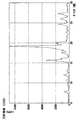
- the filtrate is cooled to room temperature, and the precipitated crystals are filtered and dried at 40-100 ° C. 9-16 g of blonanserin is obtained.
- the powder X-ray diffraction pattern of the blonanserin crystals is as shown in FIG.
- Examples 1 to 4 Citric acid (anhydrous) was added to purified water to prepare a 25 mM citric acid aqueous solution.
- blonanserin was added to this aqueous citric acid solution and stirred using a magnetic stirrer at room temperature until blonanserin was dissolved to prepare a blonanserin-containing liquid (Example 1). .
- the pH of the solution was measured.
- each component was charged in the amounts shown in Table 1 to prepare blonanserin-containing liquid agents (Examples 2 to 4), respectively.
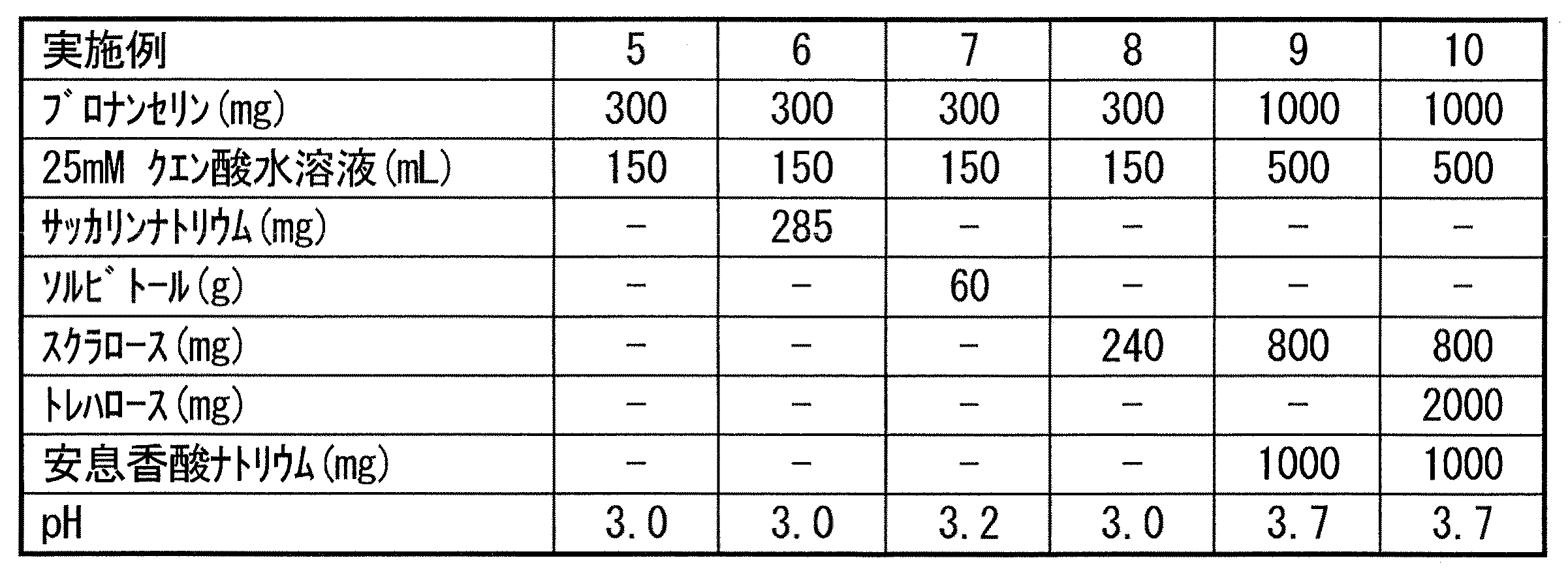
- Examples 5 to 10 A 25 mM citric acid aqueous solution was prepared in the same manner as in Example 1. Next, each component was added to this citric acid aqueous solution in the amounts shown in Table 2, and blonanserin-containing liquid agents (Examples 5 to 10) were prepared in the same manner as in Example 1.
- Examples 11-13 A 50 mM malic acid aqueous solution was prepared using purified water and malic acid. Next, each component was added to this malic acid aqueous solution in the amounts shown in Table 3, and blonanserin-containing liquid agents (Examples 11 to 13) were prepared in the same manner as in Example 1.
- Examples 14-18 Sucralose and sodium benzoate were added to purified water in the amounts shown in Table 4 and stirred using a magnetic stirrer until dissolved. Next, a small amount of blonanserin and various solubilizing agents (hydrochloric acid, tartaric acid, lactic acid, malic acid, or citric acid (anhydrous)) were added to this aqueous solution, and the mixture was stirred using a magnetic stirrer until blonanserin was completely dissolved. A solubilizing agent was appropriately added to adjust the pH to around 3, and the amount of liquid was adjusted by adding purified water to prepare blonanserin-containing liquid agents (Examples 14 to 18).
- solubilizing agent was appropriately added to adjust the pH to around 3, and the amount of liquid was adjusted by adding purified water to prepare blonanserin-containing liquid agents (Examples 14 to 18).
- Examples 19-21 Sucralose and sodium benzoate were added to purified water in the amounts shown in Table 5 and stirred using a magnetic stirrer until dissolved. Next, a small amount of blonanserin and various solubilizing agents (hydrochloric acid, tartaric acid, or lactic acid) were added to this aqueous solution, and the mixture was stirred using a magnetic stirrer until blonanserin was completely dissolved. A solubilizing agent was appropriately added to adjust the pH to around 4, and the amount of the solution was adjusted by adding purified water to prepare blonanserin-containing liquid agents (Examples 19 to 21).
- solubilizing agent was appropriately added to adjust the pH to around 4, and the amount of the solution was adjusted by adding purified water to prepare blonanserin-containing liquid agents (Examples 19 to 21).
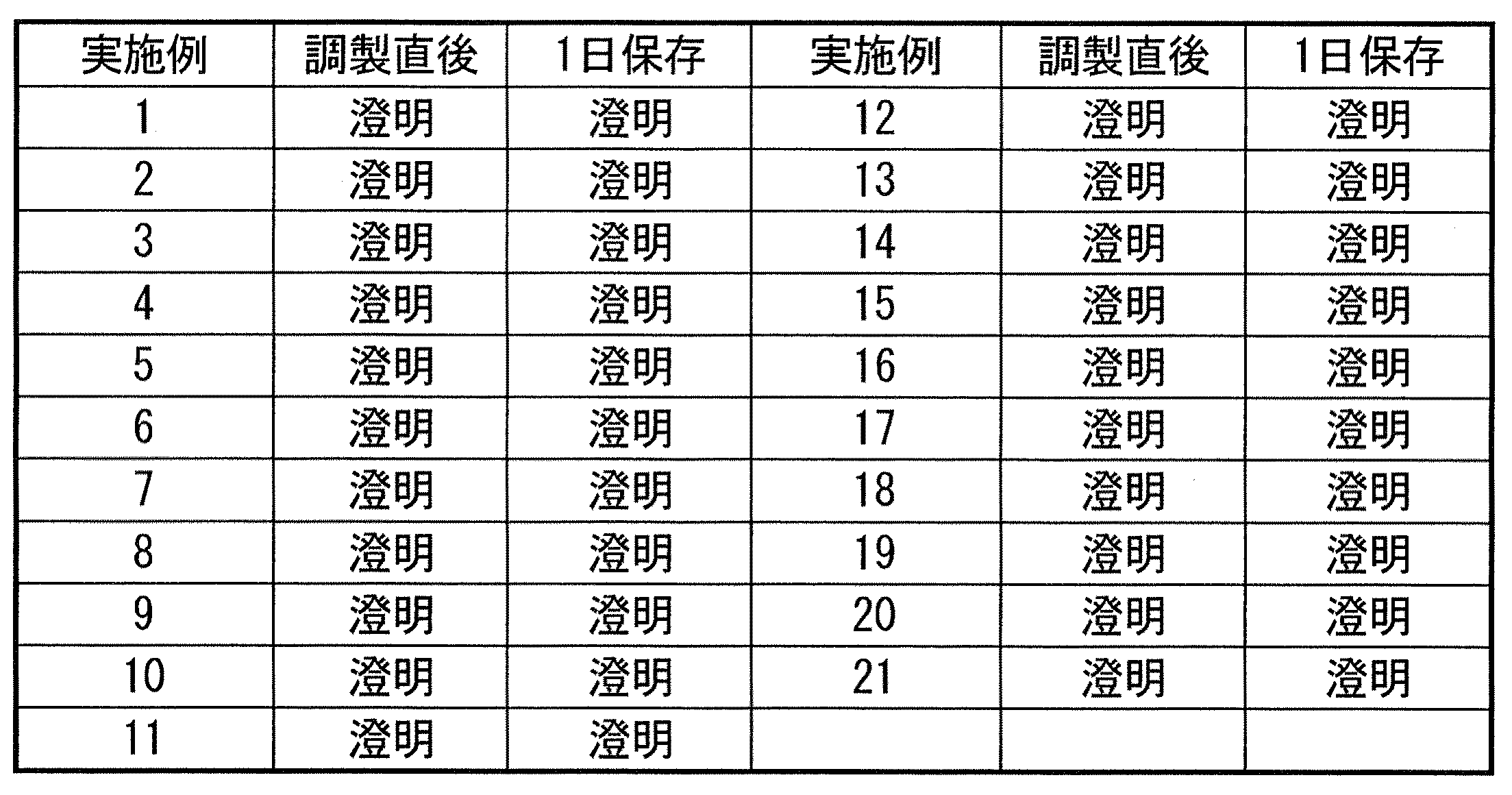
- Test Example 1 (Confirmation of properties during preparation) Table 6 shows the results obtained by visually observing the properties of the blonanserin-containing liquid preparations prepared in Examples 1 to 21 immediately after preparation and after storage at room temperature for 1 day. The properties were confirmed by a method in accordance with the 15th revised Japanese Pharmacopoeia General Rules.
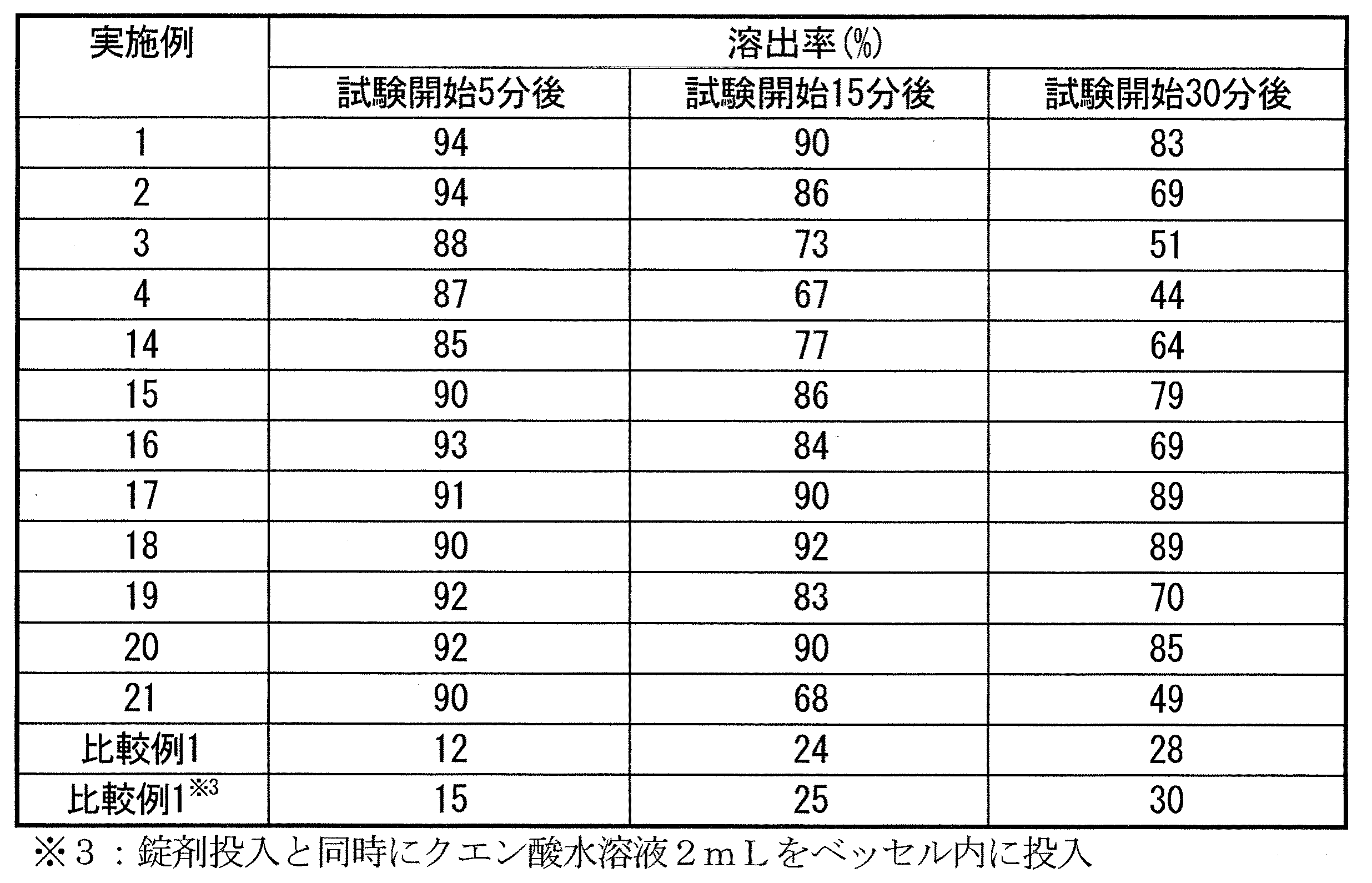
- Test example 2 (dissolution test 1) Using a sample corresponding to 4 mg of blonanserin collected from the blonanserin-containing solutions prepared in Examples 1 to 4 and 14 to 21 and one tablet prepared in Comparative Example 1, the dissolution test described in the 15th revised Japanese Pharmacopoeia ( Temperature: 37 ° C., test solution: second solution for dissolution test, test method: paddle method, rotation speed: 50 rpm). Further, the tablets prepared in Comparative Example 1 were subjected to the dissolution test under the same conditions using the tablets, and the dissolution test was similarly performed when 2 mL of 25 mM aqueous citric acid solution described in Examples 1 to 4 was simultaneously added. It was.
- Table 7 shows the dissolution rates after 5 minutes, 15 minutes and 30 minutes from the start of the test.
- the blonanserin-containing liquid preparations prepared in Examples 1 to 4 and 14 to 21 each had an elution rate of 60% or more 15 minutes after the start of the elution test, and had a high elution property that greatly exceeded the solubility of the drug. It became clear to show.
- the tablets corresponding to the same amount of 4 mg showed a low dissolution rate regardless of the presence or absence of citric acid, the characteristics of the present invention in which the dissolution property was improved by making a solution formulation of the present invention were shown.
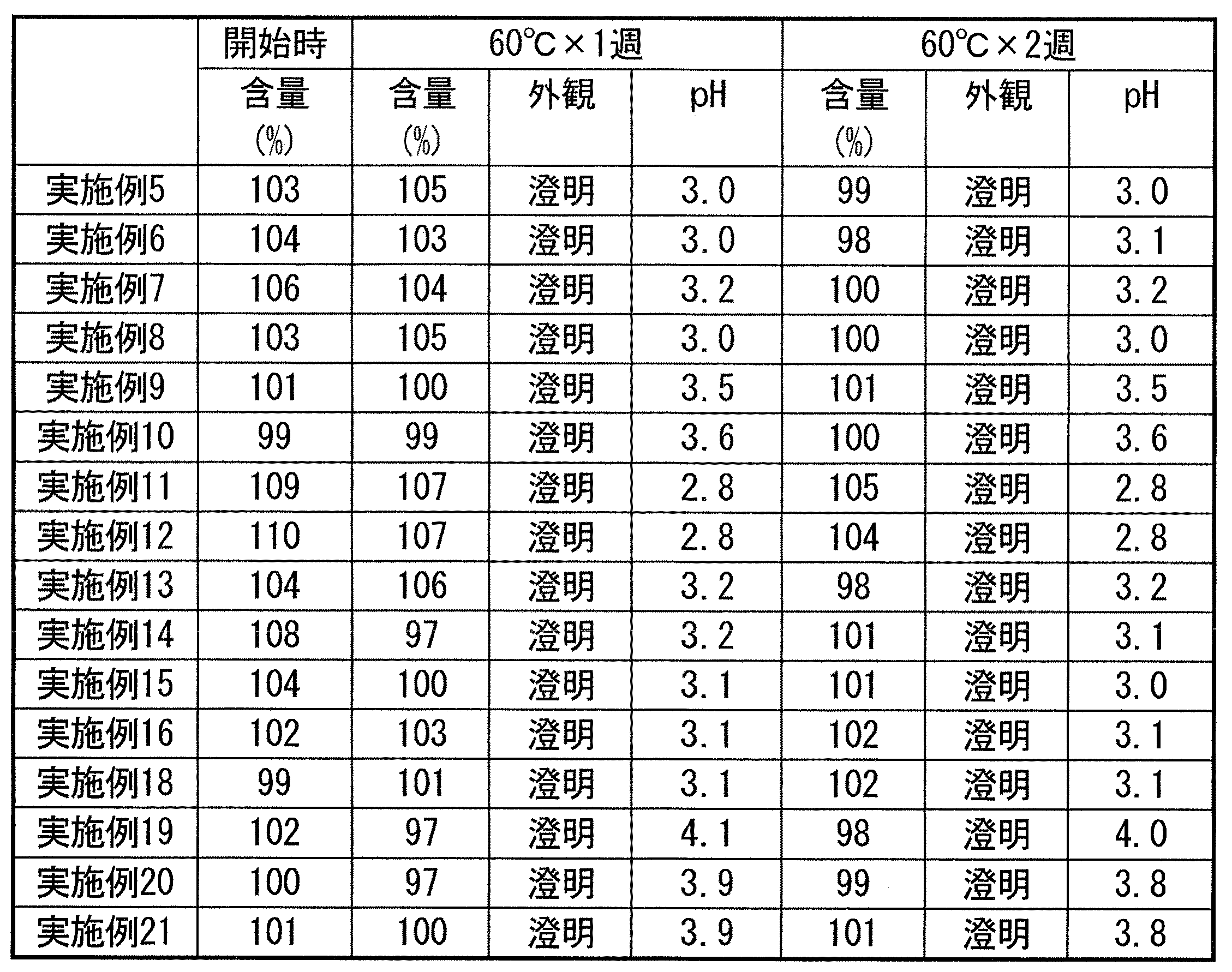
- Test Example 3 (Storage Stability Test 1) The blonanserin-containing liquid preparations prepared in Examples 5 to 16 and 18 to 21 were filtered using an appropriate filter, filled in a glass container and sealed, and stored at 60 ° C. for 2 weeks. The stability (content, properties, pH) was evaluated. Table 8 shows the evaluation results of each sample stored at 60 ° C. for 1 week and 2 weeks. The content was measured by liquid chromatography using a reverse phase column, and indicated as a relative value when the indicated amount of blonanserin was 100%. The properties were confirmed by a method according to the 15th revised Japanese Pharmacopoeia.
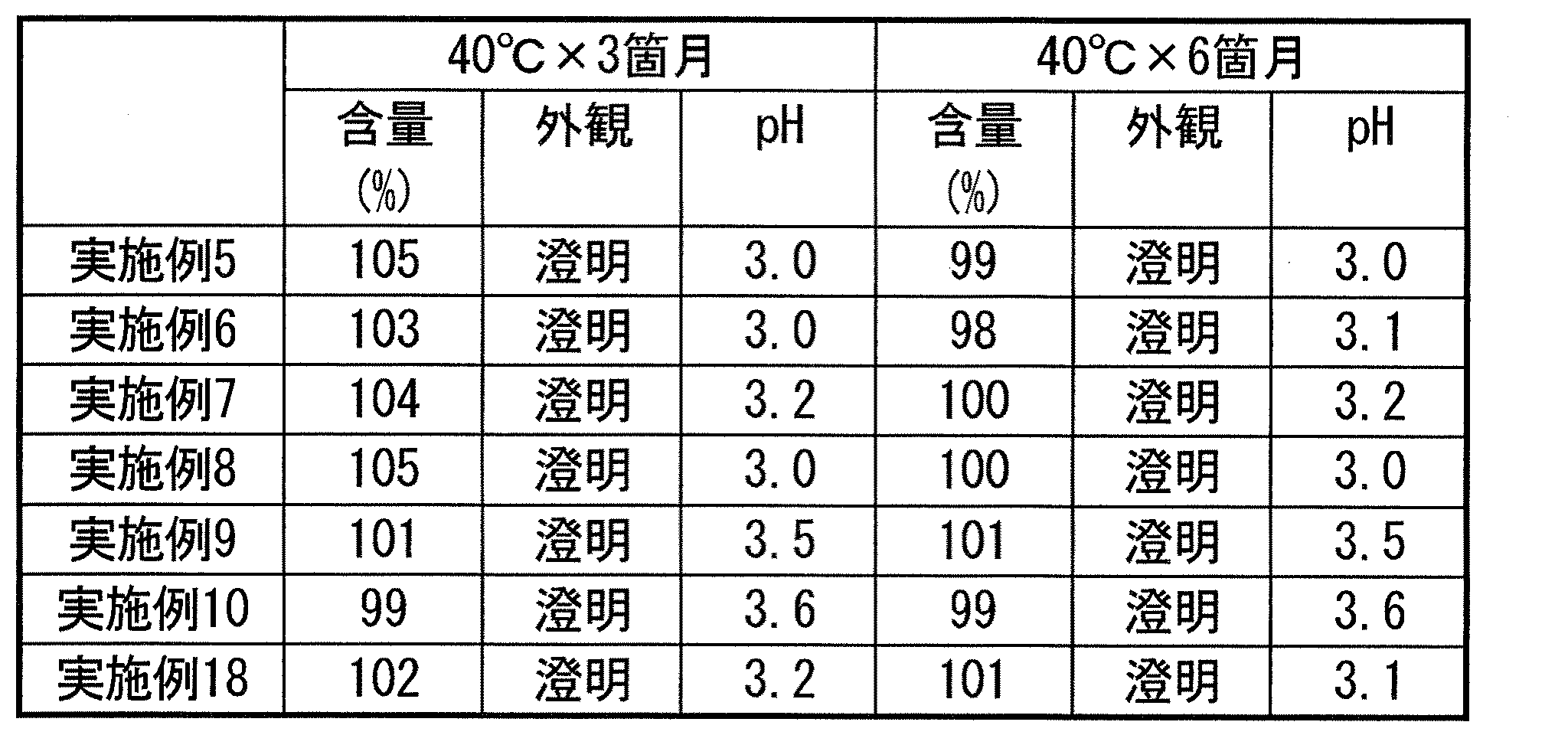
- Test Example 4 (Storage stability test 2) The blonanserin-containing solution prepared in Examples 5 to 10 and 18 was filtered using a suitable filter, then filled into a glass container and sealed, and stored at 40 ° C. for up to 6 months. Stable as in Test Example 3. Properties (content, properties, pH) were evaluated. Table 9 shows the evaluation results of each sample stored at 40 ° C. for 3 months and 6 months. As a result of the test, as shown in Tables 8 and 9, it was found that the oral solution of the present invention showed excellent stability in terms of formulation.
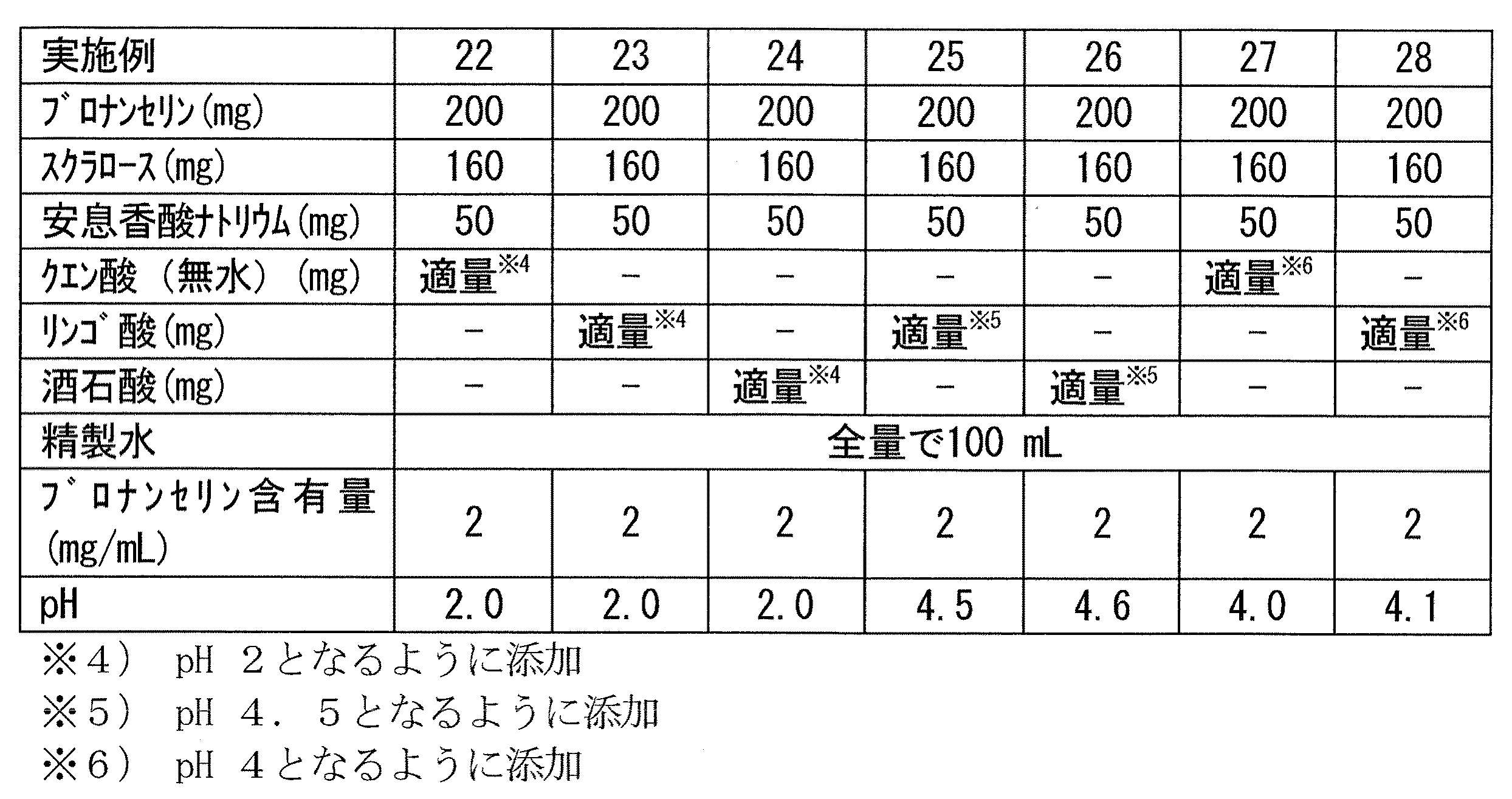
- Examples 22 to 28 Sucralose and sodium benzoate were added to purified water in the amounts shown in Table 10 and stirred using a magnetic stirrer until dissolved. Next, a small amount of blonanserin and various solubilizing agents (citric acid (anhydrous), malic acid or tartaric acid) were added to this aqueous solution, and the mixture was stirred using a magnetic stirrer until blonanserin was completely dissolved. A solubilizing agent was appropriately added to adjust to the pH shown in Table 10, and purified water was added to adjust the liquid volume to prepare blonanserin-containing liquid agents (Examples 22 to 28).
- solubilizing agent was appropriately added to adjust to the pH shown in Table 10
- purified water was added to adjust the liquid volume to prepare blonanserin-containing liquid agents (Examples 22 to 28).
- Test Example 5 (dissolution test 2) Using the sample corresponding to 4 mg of blonanserin collected from the blonanserin-containing solution prepared in Examples 22 to 28, the dissolution test (temperature: 37) described in the 15th revised Japanese Pharmacopoeia was carried out in the same manner as described in Test Example 2.
- C test solution: second solution for dissolution test, test method: paddle method, rotation speed: 50 rpm).
- Table 11 shows the dissolution rates after 5 minutes, 15 minutes and 30 minutes from the start of the test.
- Test Example 6 (Storage stability test 3) The blonanserin-containing solution prepared in Examples 22 to 28 was filtered using an appropriate filter, filled in a glass container and sealed, and stored at 60 ° C. for 2 weeks to evaluate the stability (content, appearance, pH). did. Table 12 shows the evaluation results of each sample stored at 60 ° C. for 1 week and 2 weeks. The content was measured by liquid chromatography using a reverse phase column, and indicated as a relative value when the indicated amount of blonanserin was 100%. The properties were confirmed by a method according to the 15th revised Japanese Pharmacopoeia.
- the solution prepared by adding malic acid and tartaric acid to pH 4.5 maintains clear properties up to the point of storage at 60 ° C for 1 week, but a small amount of precipitate was observed at the point of storage at 60 ° C for 2 weeks. The content was almost 100% at all storage levels.
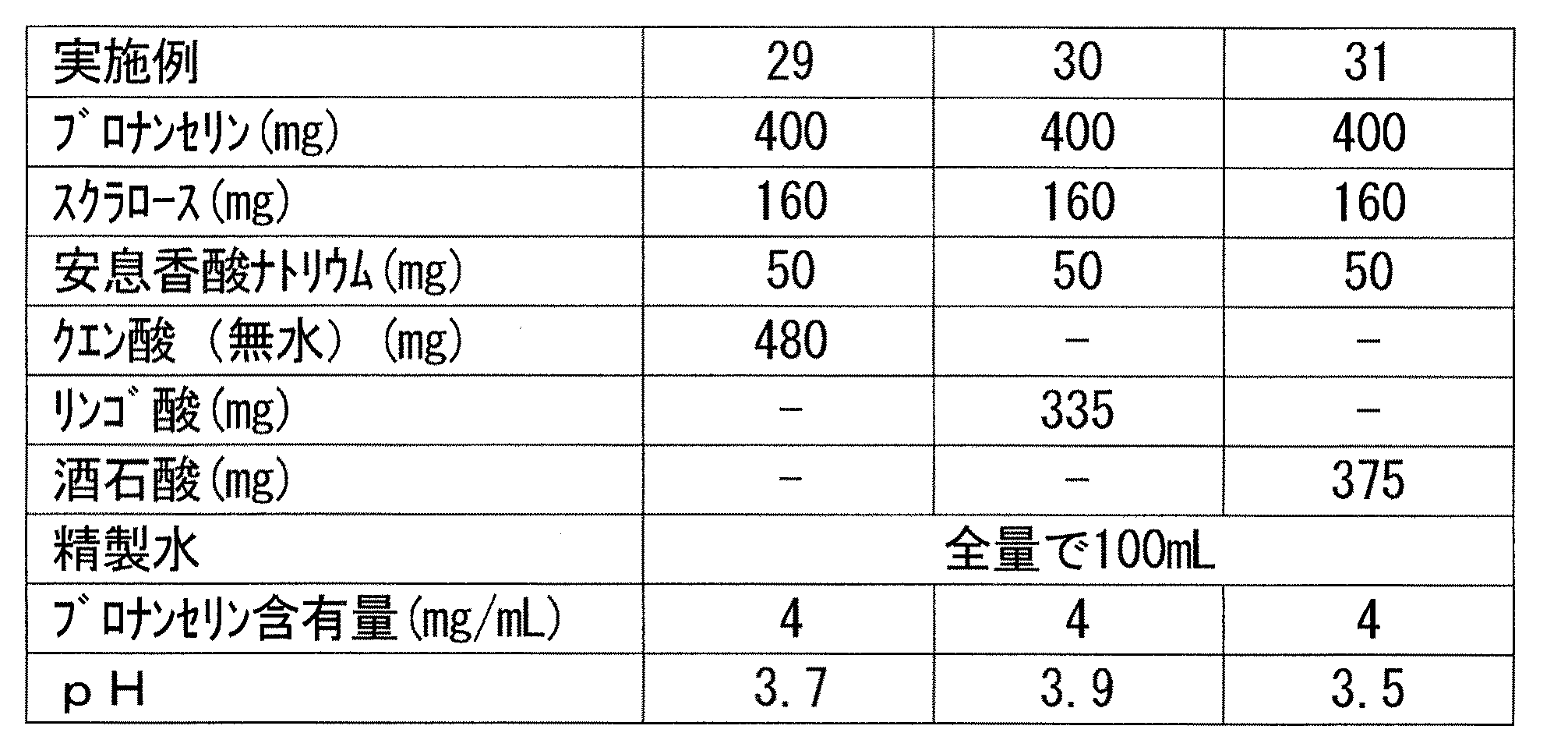
- Examples 29-31 Sucralose and sodium benzoate were added to the purified water in the amounts shown in Table 13, and stirred using a magnetic stirrer until dissolved. Next, blonanserin and various solubilizing agents (citric acid (anhydrous), malic acid or tartaric acid) were added to this aqueous solution so as to have a concentration of 25 mM, and the mixture was stirred using a magnetic stirrer until blonanserin was completely dissolved. A solubilizing agent was appropriately added to adjust the pH to the value shown in the following table, and purified water was added to adjust the liquid volume to prepare blonanserin 4 mg / mL-containing liquids (Examples 29 to 31).
- solubilizing agent was appropriately added to adjust the pH to the value shown in the following table, and purified water was added to adjust the liquid volume to prepare blonanserin 4 mg / mL-containing liquids (Examples 29 to 31).
- Test Example 7 (dissolution test 3) Using the sample corresponding to 4 mg of blonanserin collected from the blonanserin-containing liquid prepared in Examples 29 to 31 and 2 tablets prepared in Comparative Example 1, the same procedure as described in Test Example 2 was performed, and the 15th Revised Japanese Pharmacy The dissolution test (temperature: 37 ° C., test solution: second solution of dissolution test, test method: paddle method, rotation speed: 50 rpm) was performed. Table 14 shows the dissolution rates after 5 minutes, 15 minutes and 30 minutes from the start of the test.
- Test Example 8 (Storage stability test 4) The blonanserin-containing solution prepared in Examples 29 to 31 was filtered using an appropriate filter, filled in a glass container and sealed, and stored at 60 ° C. for 2 weeks to evaluate the stability (content, appearance, pH). did. Table 15 shows the evaluation results of each sample stored at 60 ° C. for 1 week and 2 weeks. The content was measured by liquid chromatography using a reverse phase column, and indicated as a relative value when the indicated amount of blonanserin was 100%. The properties were confirmed by a method according to the 15th revised Japanese Pharmacopoeia.
- Various gelling agents (xanthan gum and gellan gum) were added to the blonanserin-containing liquid prepared in Example 29 in the amounts shown in Table 16, and the liquid volume was adjusted with purified water. A semi-solid preparation containing blonanserin was obtained by cooling after heating and stirring.
- xanthan gum used Ketorol CG made by Sanki Co., Ltd.
- gellan gum used Kelco gel made by Sumitomo Dainippon Pharma Co., Ltd.
- the preparation of the present invention is a very useful solution because it contains blonanserin stably and does not depend on the dissolution characteristics of blonanserin itself and exhibits good dissolution behavior in a wide pH range.
Landscapes
- Health & Medical Sciences (AREA)
- Chemical & Material Sciences (AREA)
- Life Sciences & Earth Sciences (AREA)
- General Health & Medical Sciences (AREA)
- Veterinary Medicine (AREA)
- Public Health (AREA)
- Medicinal Chemistry (AREA)
- Animal Behavior & Ethology (AREA)
- Pharmacology & Pharmacy (AREA)
- Epidemiology (AREA)
- Engineering & Computer Science (AREA)
- General Chemical & Material Sciences (AREA)
- Chemical Kinetics & Catalysis (AREA)
- Bioinformatics & Cheminformatics (AREA)
- Organic Chemistry (AREA)
- Nuclear Medicine, Radiotherapy & Molecular Imaging (AREA)
- Oil, Petroleum & Natural Gas (AREA)
- Neurology (AREA)
- Neurosurgery (AREA)
- Biomedical Technology (AREA)
- Biochemistry (AREA)
- Molecular Biology (AREA)
- Psychiatry (AREA)
- Medicinal Preparation (AREA)
- Pharmaceuticals Containing Other Organic And Inorganic Compounds (AREA)
Abstract
Description
また、薬物の溶解状態の違いは、薬物の吸収のみならず、生物学的利用性に大きく影響することが考えられることから(非特許文献2)、ブロナンセリンを消化管から安定に吸収させるためには、ブロナンセリンの溶解度プロファイルを改善し、広いpH領域で安定に一定の溶解状態を発揮する製剤として設計することが必要であった。一般に、医薬品の溶出特性を評価する方法としては、日本薬局方に規定されている溶出試験法が知られており、経口製剤の製剤設計及び製法設計においても広く利用されている。
すなわち、本発明は下記の各種の態様の発明を提供するものである。
[2] 澄明な水溶液である[1]に記載の経口液剤。
[3] 第15改正日本薬局方に記載の溶出試験(パドル法、50rpm)を行うとき、溶出試験第2液による試験開始5分後の溶出率が80%以上であり、かつ15分後の溶出率が50%以上である[1]又は[2]に記載の経口液剤。
[4] 該水溶液のpHが2~5である、[1]~[3]のいずれかに記載の経口液剤。
[5] 水溶液中の活性成分(a)の含有量が、0.1mg/mL~10mg/mLである[1]~[4]のいずれかに記載の経口液剤。
[6] 溶解補助剤(b)が、酸である[1]~[5]のいずれかに記載の経口液剤。
[7] 溶解補助剤(b)が、有機酸または無機酸(好ましくは有機酸)である[6]に記載の経口液剤。
[8] 溶解補助剤(b)が、クエン酸、リンゴ酸、酒石酸、乳酸、マレイン酸及び酢酸からなる群(好ましくは、クエン酸、リンゴ酸及び酒石酸からなる群)から選択される少なくとも1種である[6]または[7]に記載の経口液剤。
[9] さらに、(c)矯味剤(好ましくは、糖アルコール類、サッカリン、サッカリンナトリウム水和物、スクラロース及びトレハロースからなる群から選ばれる少なくとも1種)を含む[1]~[8]のいずれかに記載の経口液剤。
[10] さらに、(d)保存剤(好ましくは、安息香酸、安息香酸ナトリウム、ソルビン酸、ソルビン酸カリウム、デヒドロ酢酸ナトリウム及びパラオキシ安息香酸エステル類からなる群から選ばれる少なくとも1種)を含む[1]~[9]のいずれかに記載の経口液剤。
[12] (a)活性成分、(b)クエン酸、リンゴ酸及び酒石酸からなる群から選択される少なくとも1種の溶解補助剤、及び(c)トレハロース及びスクラロースからなる群から選択される少なくとも1種の矯味剤を含有する水溶液であり、該活性成分(a)の含有量が0.1mg/mL~5mg/mLであって、該水溶液のpHが2~4である経口液剤。
[13] (a)活性成分、(b)クエン酸、リンゴ酸及び酒石酸からなる群から選択される少なくとも1種の溶解補助剤、及び(c)トレハロース及びスクラロースからなる群から選択される少なくとも1種の矯味剤を含有する水溶液であり、該活性成分(a)の含有量が0.5mg/mL~4mg/mLであって、該水溶液のpHが2~3.7である経口液剤。
[14] (a)活性成分、(b)クエン酸、リンゴ酸及び酒石酸からなる群から選択される少なくとも1種の溶解補助剤、(c)トレハロース及びスクラロースからなる群から選択される少なくとも1種の矯味剤、及び(d)安息香酸及び安息香酸ナトリウムから選択される1種以上の保存剤を含有する水溶液であり、該活性成分(a)の含有量が0.5mg/mL~4mg/mLであって、該水溶液のpHが2~4である経口液剤。
[15] (a)活性成分、(b)クエン酸、リンゴ酸及び酒石酸からなる群から選択される少なくとも1種の溶解補助剤、(c)スクラロース、及び(d)安息香酸及び安息香酸ナトリウムから選択される1種以上の保存剤を含有する水溶液であり、該活性成分(a)の含有量が0.5mg/mL~4mg/mLであって、該水溶液のpHが2~3.7である経口液剤。
[16] 活性成分(a)の4mg相当量の液を用いて第15改正日本薬局方に記載の溶出試験(パドル法、50rpm)を行うとき、溶出試験第2液による15分後の溶出率が50%以上である、[11]~[15]のいずれかに記載の経口液剤。
[17] 活性成分(a)の4mg相当量の液を用いて第15改正日本薬局方に記載の溶出試験(パドル法、50rpm)を行うとき、溶出試験第2液による試験開始5分後の溶出率が80%以上であり、かつ15分後の溶出率が60%以上である、[11]~[15]のいずれかに記載の経口液剤。
本発明における溶出試験での試験液のサンプリングは、第15改正日本薬局方に記載の溶出試験の方法に従って行い、また、ブロナンセリンの溶出率は、採取した試験液を通常用いられる定量法、例えば吸光度測定法、液体クロマトグラフ法などにより求めることができる。
本発明の経口液剤は、ブロナンセリン又はその薬理学的に許容される塩もしくはその薬理学的に許容される溶媒和物、溶解補助剤、矯味剤、及び必要に応じて添加する任意の成分を通常選択されうる慣用の方法によって各成分を水に添加し、最終的に溶解させることにより製造することができる。
本発明の経口液剤を、適当な担体あるいは容器中に保持あるいは充填することにより更に加工を加え、実質的に外観が半固形ないし固形の経口製剤を調製することもできる。たとえば、上記経口液剤に、ゼラチン、ペクチン、寒天、キサンタンガム、グアガム、ジェランガム、タマリンドガム、カラーギナンなどのゲル化剤を添加し、加温することで活性成分を含有する均一な液体とし、これを治療単位量含有するように分割した後冷却し、あるいは冷却し硬化させた後に分割することにより、たとえば、ゼリー状の経口製剤(半固形剤)とすることができる。当該経口製剤は、一般的に医療用経口製剤に用いられる各種の添加成分を含んでいてもよく、必要に応じて、甘味剤、矯味剤、香料、清涼化剤、抗酸化剤、安定化剤、保存剤等を含有することができる。
なお、以下の実施例において、ブロナンセリンは大日本住友製薬株式会社のものを、クエン酸(無水)はナカライテスク株式会社製又は昭和化工株式会社製のものを使用した。また、塩酸はナカライテスク株式会社製のものを、酒石酸、乳酸およびリンゴ酸はそれぞれ昭和化工株式会社製のL-酒石酸、90%乳酸(L-乳酸)およびDL-リンゴ酸を、ソルビトールは日研化成株式会社製のD-ソルビトールを、スクラロースは三栄源エフ・エフ・アイ株式会社製のものを、サッカリンナトリウムは大和化成株式会社製のものを、トレハロースは株式会社林原生物化学研究所製のものを、安息香酸ナトリウムは株式会社伏見製薬所製のものを、それぞれ使用した。
精製水にクエン酸(無水)を加え、25mMクエン酸水溶液を調製した。次に、表1の実施例1の処方に従い、このクエン酸水溶液にブロナンセリンを添加し、マグネティックスターラーを用いて室温下でブロナンセリンが溶解するまで攪拌し、ブロナンセリン含有液剤を調製した(実施例1)。調製後、液剤のpHを測定した。
同様に、実施例1の方法に準じて、表1に記載の分量で各成分を仕込み、ブロナンセリン含有液剤(実施例2~4)をそれぞれ調製した。

実施例1と同様にして、25mMクエン酸水溶液を調製した。次に、このクエン酸水溶液に表2に記載の分量で各成分を加え、実施例1と同様の方法で、ブロナンセリン含有液剤(実施例5~10)を調製した。
精製水及びリンゴ酸を用いて、50mMリンゴ酸水溶液を調製した。次に、このリンゴ酸水溶液に表3に記載の分量で各成分を加え、実施例1と同様の方法で、ブロナンセリン含有液剤(実施例11~13)を調製した。

精製水に表4に記載の分量でスクラロース、安息香酸ナトリウムを加え、マグネティックスターラーを用いて溶解するまで攪拌した。次に、この水溶液にブロナンセリン及び各種溶解補助剤(塩酸、酒石酸、乳酸、リンゴ酸、又はクエン酸(無水))を少量加え、ブロナンセリンが完全に溶解するまでマグネティックスターラーを用いて攪拌した。溶解補助剤を適宜追加してpHを3付近に調整後、精製水を加えて液量を調整し、ブロナンセリン含有液剤(実施例14~18)を調製した。

精製水に表5に記載の分量でスクラロース、安息香酸ナトリウムを加え、マグネティックスターラーを用いて溶解するまで攪拌した。次に、この水溶液にブロナンセリン及び各種溶解補助剤(塩酸、酒石酸、又は乳酸)を少量加え、ブロナンセリンが完全に溶解するまでマグネティックスターラーを用いて攪拌した。溶解補助剤を適宜追加してpHを4付近に調整後、精製水を加えて液量を調整し、ブロナンセリン含有液剤(実施例19~21)を調製した。

乳糖水和物、結晶セルロース、低置換度ヒドロキシプロピルセルロース、ヒドロキシプロピルセルロース、軽質無水ケイ酸、ステアリン酸マグネシウムを用い、ブロナンセリンを4mg含む錠剤を常法に従って製造した。
実施例1~21で調製したブロナンセリン含有液剤について、調製直後ならびに室温にて1日保存後の性状を目視で観察した結果を表6に示す。なお、性状確認は第15改正日本薬局方 通則に準じた方法で実施した。
実施例1~4、14~21で調製したブロナンセリン含有液剤から採取したブロナンセリン4mg相当の試料、ならびに比較例1で調製した錠剤1錠を用いて、第15改正日本薬局方に記載の溶出試験(温度:37℃、試験液:溶出試験第2液、試験法:パドル法、回転数:50rpm)を行った。さらに、比較例1で調製した錠剤については錠剤による同条件の溶出試験を行うと共に、実施例1~4に記載されている25mMクエン酸水溶液2mLを同時に投入した場合についても同様に溶出試験を行った。表7に試験開始5分後、15分後、30分後の溶出率を示す。
実施例5~16、18~21で調製したブロナンセリン含有液剤を、適当なフィルターを用いてろ過後、ガラス製容器に充填・密栓し、60℃で2週間保存し、安定性(含量、性状、pH)を評価した。表8に60℃で1週間ならびに2週間保存した各試料の評価結果を示す。なお、含量は、逆相カラムを用いた液体クロマトグラフィーによって測定し、ブロナンセリン表示量を100%としたときの相対値で示した。また、性状確認は、第15改正日本薬局方 通則に準じた方法で実施した。
実施例5~10、18で調製したブロナンセリン含有液剤を、適当なフィルターを用いてろ過後、ガラス製容器に充填・密栓し、40℃で最長6箇月間保存し、試験例3と同様に安定性(含量、性状、pH)を評価した。表9に40℃で3箇月間ならびに6箇月間保存した各試料の評価結果を示す。
精製水に表10に記載の分量でスクラロース、安息香酸ナトリウムを加え、マグネティックスターラーを用いて溶解するまで攪拌した。次に、この水溶液にブロナンセリン及び各種溶解補助剤(クエン酸(無水)、リンゴ酸又は酒石酸)を少量加え、ブロナンセリンが完全に溶解するまでマグネティックスターラーを用いて攪拌した。溶解補助剤を適宜追加して表10に記載のpHに調整後、精製水を加えて液量を調整し、ブロナンセリン含有液剤(実施例22~28)を調製した。
実施例22~28で調製したブロナンセリン含有液剤から採取したブロナンセリン4mg相当の試料を用いて、試験例2に記載の方法と同様にして、第15改正日本薬局方に記載の溶出試験(温度:37℃、試験液:溶出試験第2液、試験法:パドル法、回転数:50rpm)を行った。表11に試験開始5分後、15分後、30分後の溶出率を示す。

実施例22~28で調製したブロナンセリン含有液剤を、適当なフィルターを用いてろ過後、ガラス製容器に充填・密栓し、60℃で2週間保存し、安定性(含量、外観、pH)を評価した。表12に60℃で1週間ならびに2週間保存した各試料の評価結果を示す。なお、含量は、逆相カラムを用いた液体クロマトグラフィーによって測定し、ブロナンセリン表示量を100%としたときの相対値で示した。また、性状確認は、第15改正日本薬局方 通則に準じた方法で実施した。

精製水に表13に記載の分量でスクラロース、安息香酸ナトリウムを加え、マグネティックスターラーを用いて溶解するまで攪拌した。次に、この水溶液にブロナンセリン及び各種溶解補助剤(クエン酸(無水)、リンゴ酸又は酒石酸)を25mMとなるように加え、ブロナンセリンが完全に溶解するまでマグネティックスターラーを用いて攪拌した。溶解補助剤を適宜追加してpHを下記表に記載の値に調整後、精製水を加えて液量を調整し、ブロナンセリン4mg/mL含有液剤(実施例29~31)を調製した。
実施例29~31で調製したブロナンセリン含有液剤から採取したブロナンセリン4mg相当の試料ならびに比較例1で調製した錠剤2錠を用いて、試験例2に記載の方法と同様にして、第15改正日本薬局方に記載の溶出試験(温度:37℃、試験液:溶出試験第2液、試験法:パドル法、回転数:50rpm)を行った。表14に試験開始5分後、15分後、30分後の溶出率を示す。

実施例29~31で調製したブロナンセリン含有液剤を、適当なフィルターを用いてろ過後、ガラス製容器に充填・密栓し、60℃で2週間保存し、安定性(含量、外観、pH)を評価した。表15に60℃で1週間ならびに2週間保存した各試料の評価結果を示す。なお、含量は、逆相カラムを用いた液体クロマトグラフィーによって測定し、ブロナンセリン表示量を100%としたときの相対値で示した。また、性状確認は、第15改正日本薬局方 通則に準じた方法で実施した。


Claims (18)
- (a) 2-(4-エチル-1-ピペラジニル)-4-(4-フルオロフェニル)-5,6,7,8,9,10-ヘキサヒドロシクロオクタ[b]ピリジン(以下「活性成分」という)及び(b)溶解補助剤を含有する水溶液であって、第15改正日本薬局方に記載の溶出試験(パドル法、50rpm)を行うとき、溶出試験第2液による試験開始15分後の溶出率が50%以上である経口液剤。
- 澄明な水溶液である請求項1に記載の経口液剤。
- 第15改正日本薬局方に記載の溶出試験(パドル法、50rpm)を行うとき、溶出試験第2液による試験開始5分後の溶出率が80%以上であり、かつ15分後の溶出率が50%以上である請求項1又は2に記載の経口液剤。
- 該水溶液のpHが2~5である、請求項1~3のいずれかに記載の経口液剤。
- 水溶液中の活性成分(a)の含有量が、0.1mg/mL~10mg/mLである請求項4に記載の経口液剤。
- 溶解補助剤(b)が、酸である請求項1~3のいずれかに記載の経口液剤。
- 溶解補助剤(b)が、有機酸または無機酸である請求項6に記載の経口液剤。
- 溶解補助剤(b)が、クエン酸、リンゴ酸、酒石酸、乳酸、マレイン酸及び酢酸からなる群から選択される少なくとも1種である請求項6又は7に記載の経口液剤。
- 溶解補助剤(b)が、クエン酸、リンゴ酸及び酒石酸からなる群から選択される少なくとも1種である請求項6又は7に記載の経口液剤。
- 溶解補助剤(b)が、酸である請求項4または5に記載の経口液剤。
- 溶解補助剤(b)が、有機酸または無機酸である請求項10に記載の経口液剤。
- 溶解補助剤(b)が、クエン酸、リンゴ酸、酒石酸、乳酸、マレイン酸及び酢酸からなる群から選択される少なくとも1種である請求項10又は11に記載の経口液剤。
- 溶解補助剤(b)が、クエン酸、リンゴ酸及び酒石酸からなる群から選択される少なくとも1種である請求項10又は11に記載の経口液剤。
- さらに、(c)矯味剤を含む請求項1~13のいずれかに記載の経口液剤。
- (a)活性成分、
(b)クエン酸、リンゴ酸及び酒石酸からなる群から選択される少なくとも1種の溶解補助剤及び
(c)トレハロース及びスクラロースからなる群から選択される少なくとも1種の矯味剤
を含有する水溶液であって、該活性成分(a)の含有量が0.1mg/mL~10mg/mLであり、該水溶液のpHが2~5である経口液剤。 - (a)活性成分、
(b)クエン酸、リンゴ酸及び酒石酸からなる群から選択される少なくとも1種の溶解補助剤、
(c)トレハロース及びスクラロースからなる群から選択される少なくとも1種の矯味剤、及び
(d)安息香酸及び安息香酸ナトリウムから選択される1種以上の保存剤
を含有する水溶液であって、該活性成分(a)の含有量が0.5mg/mL~4mg/mLであって、該水溶液のpHが2~4である経口液剤。 - 活性成分(a)の4mg相当量の液を用いて第15改正日本薬局方に記載の溶出試験(パドル法、50rpm)を行うとき、溶出試験第2液による15分後の溶出率が50%以上である、請求項15または16に記載の経口液剤。
- 活性成分(a)の4mg相当量の液を用いて第15改正日本薬局方に記載の溶出試験(パドル法、50rpm)を行うとき、溶出試験第2液による試験開始5分後の溶出率が80%以上であり、かつ15分後の溶出率が60%以上である、請求項15または16に記載の経口液剤。
Priority Applications (2)
| Application Number | Priority Date | Filing Date | Title |
|---|---|---|---|
| JP2011519812A JP5718811B2 (ja) | 2009-06-17 | 2010-06-16 | 経口液剤 |
| CN2010800269713A CN102458406A (zh) | 2009-06-17 | 2010-06-16 | 口服液体制剂 |
Applications Claiming Priority (2)
| Application Number | Priority Date | Filing Date | Title |
|---|---|---|---|
| JP2009144719 | 2009-06-17 | ||
| JP2009-144719 | 2009-06-17 |
Publications (1)
| Publication Number | Publication Date |
|---|---|
| WO2010147144A1 true WO2010147144A1 (ja) | 2010-12-23 |
Family
ID=43356460
Family Applications (1)
| Application Number | Title | Priority Date | Filing Date |
|---|---|---|---|
| PCT/JP2010/060204 Ceased WO2010147144A1 (ja) | 2009-06-17 | 2010-06-16 | 経口液剤 |
Country Status (4)
| Country | Link |
|---|---|
| JP (1) | JP5718811B2 (ja) |
| KR (1) | KR20120031051A (ja) |
| CN (1) | CN102458406A (ja) |
| WO (1) | WO2010147144A1 (ja) |
Cited By (1)
| Publication number | Priority date | Publication date | Assignee | Title |
|---|---|---|---|---|
| JP2021191801A (ja) * | 2017-06-08 | 2021-12-16 | 高田製薬株式会社 | ブロナンセリン含有錠剤 |
Families Citing this family (3)
| Publication number | Priority date | Publication date | Assignee | Title |
|---|---|---|---|---|
| CN104511025B (zh) * | 2013-09-27 | 2017-09-12 | 北京诚济制药股份有限公司 | 羧甲司坦口服溶液及其制备方法 |
| CN105125479A (zh) * | 2015-07-07 | 2015-12-09 | 石家庄四药有限公司 | 布南色林口服液及其制备方法 |
| CN118987277B (zh) * | 2024-10-24 | 2025-02-28 | 苏州康纯医药科技有限公司 | 一种布南色林水基溶液制剂及其制备方法 |
Citations (1)
| Publication number | Priority date | Publication date | Assignee | Title |
|---|---|---|---|---|
| JPH0747574B2 (ja) * | 1989-03-03 | 1995-05-24 | 大日本製薬株式会社 | ピリジン誘導体及びそれを有効成分とする向精神剤 |
-
2010
- 2010-06-16 JP JP2011519812A patent/JP5718811B2/ja not_active Expired - Fee Related
- 2010-06-16 CN CN2010800269713A patent/CN102458406A/zh active Pending
- 2010-06-16 KR KR1020127000163A patent/KR20120031051A/ko not_active Withdrawn
- 2010-06-16 WO PCT/JP2010/060204 patent/WO2010147144A1/ja not_active Ceased
Patent Citations (1)
| Publication number | Priority date | Publication date | Assignee | Title |
|---|---|---|---|---|
| JPH0747574B2 (ja) * | 1989-03-03 | 1995-05-24 | 大日本製薬株式会社 | ピリジン誘導体及びそれを有効成分とする向精神剤 |
Non-Patent Citations (2)
| Title |
|---|
| LONASEN-JO ET AL.: "III. Yuko Seibun ni Kansuru Komoku 2. Butsuri Kagakuteki Seishitsu", IYAKUHIN INTERVIEW FORM, 2008 * |
| SDA ZAKKAN: "kyupin no Nikki Ki ga Mukeba Koshin (Seishinkai no Blog)", 11 September 2007 (2007-09-11), Retrieved from the Internet <URL:http://ameblo.jp/kyupin/theme3-10005991450.html> * |
Cited By (2)
| Publication number | Priority date | Publication date | Assignee | Title |
|---|---|---|---|---|
| JP2021191801A (ja) * | 2017-06-08 | 2021-12-16 | 高田製薬株式会社 | ブロナンセリン含有錠剤 |
| JP7226697B2 (ja) | 2017-06-08 | 2023-02-21 | 高田製薬株式会社 | ブロナンセリン含有錠剤 |
Also Published As
| Publication number | Publication date |
|---|---|
| CN102458406A (zh) | 2012-05-16 |
| JPWO2010147144A1 (ja) | 2012-12-06 |
| JP5718811B2 (ja) | 2015-05-13 |
| KR20120031051A (ko) | 2012-03-29 |
Similar Documents
| Publication | Publication Date | Title |
|---|---|---|
| TWI305148B (ja) | ||
| KR101568681B1 (ko) | 안정화된 카리스바메이트 소아용 현탁액 | |
| KR100841893B1 (ko) | 프레가발린 조성물 | |
| KR101420315B1 (ko) | 약학적 액제 조성물 | |
| AU2019259686B2 (en) | Solid formulation having excellent stability | |
| BR112015012460B1 (pt) | Formulação estabilizada de pemetrexede | |
| JP6731001B2 (ja) | ボルチオキセチンピログルタミン酸塩 | |
| JP2012533633A (ja) | 経口投与のための安定な薬学的オメプラゾール製剤 | |
| WO2010070705A1 (ja) | アムロジピンの安定な含水経口製剤 | |
| AU2023201826B2 (en) | Solid formulation having excellent stability | |
| JP5718811B2 (ja) | 経口液剤 | |
| JP5341282B1 (ja) | アリピプラゾールの経口医薬製剤 | |
| JP2021523202A (ja) | 経口溶液製剤 | |
| JP7534580B2 (ja) | 遅延性ゲル化組成物 | |
| CN104586756A (zh) | 一种含沃替西汀的口服溶液及其制备方法 | |
| TWI326684B (ja) | ||
| KR102667351B1 (ko) | 사쿠비트릴 및 아질사르탄 공형성화물, 및 이를 포함하는 약제학적 조성물 | |
| JP5072748B2 (ja) | アムロジピンの安定な液剤とゼリー剤 | |
| KR20150127483A (ko) | 몬테루카스트 또는 이의 약제학적으로 허용가능한 염을 포함하는 안정성이 개선된 액상 제제 및 이의 제조방법 | |
| JP6585193B2 (ja) | ゲフィチニブ含有錠剤 | |
| WO2024027549A1 (zh) | 一种含有吡咯类胃酸分泌抑制剂的药物组合物及其制备方法 | |
| JP5039871B2 (ja) | 溶出制御した経口液剤 | |
| HK1167333A (en) | Oral liquid preparation | |
| KR20190093999A (ko) | 용해성 및 안정성이 향상된 덱시부프로펜 시럽제제 | |
| JP2012188383A (ja) | ドネペジル塩酸塩の内用液剤 |
Legal Events
| Date | Code | Title | Description |
|---|---|---|---|
| WWE | Wipo information: entry into national phase |
Ref document number: 201080026971.3 Country of ref document: CN |
|
| 121 | Ep: the epo has been informed by wipo that ep was designated in this application |
Ref document number: 10789518 Country of ref document: EP Kind code of ref document: A1 |
|
| WWE | Wipo information: entry into national phase |
Ref document number: 2011519812 Country of ref document: JP |
|
| NENP | Non-entry into the national phase |
Ref country code: DE |
|
| ENP | Entry into the national phase |
Ref document number: 20127000163 Country of ref document: KR Kind code of ref document: A |
|
| 122 | Ep: pct application non-entry in european phase |
Ref document number: 10789518 Country of ref document: EP Kind code of ref document: A1 |