WO2010134627A1 - 多層被覆金属板の製造方法 - Google Patents
多層被覆金属板の製造方法 Download PDFInfo
- Publication number
- WO2010134627A1 WO2010134627A1 PCT/JP2010/058852 JP2010058852W WO2010134627A1 WO 2010134627 A1 WO2010134627 A1 WO 2010134627A1 JP 2010058852 W JP2010058852 W JP 2010058852W WO 2010134627 A1 WO2010134627 A1 WO 2010134627A1
- Authority
- WO
- WIPO (PCT)
- Prior art keywords
- coating
- surface tension
- paint
- metal sheet
- metal plate
- Prior art date
- Legal status (The legal status is an assumption and is not a legal conclusion. Google has not performed a legal analysis and makes no representation as to the accuracy of the status listed.)
- Ceased
Links
Classifications
-
- B—PERFORMING OPERATIONS; TRANSPORTING
- B05—SPRAYING OR ATOMISING IN GENERAL; APPLYING FLUENT MATERIALS TO SURFACES, IN GENERAL
- B05D—PROCESSES FOR APPLYING FLUENT MATERIALS TO SURFACES, IN GENERAL
- B05D1/00—Processes for applying liquids or other fluent materials
- B05D1/34—Applying different liquids or other fluent materials simultaneously
-
- B—PERFORMING OPERATIONS; TRANSPORTING
- B05—SPRAYING OR ATOMISING IN GENERAL; APPLYING FLUENT MATERIALS TO SURFACES, IN GENERAL
- B05D—PROCESSES FOR APPLYING FLUENT MATERIALS TO SURFACES, IN GENERAL
- B05D1/00—Processes for applying liquids or other fluent materials
- B05D1/30—Processes for applying liquids or other fluent materials performed by gravity only, i.e. flow coating
- B05D1/305—Curtain coating
-
- B—PERFORMING OPERATIONS; TRANSPORTING
- B05—SPRAYING OR ATOMISING IN GENERAL; APPLYING FLUENT MATERIALS TO SURFACES, IN GENERAL
- B05D—PROCESSES FOR APPLYING FLUENT MATERIALS TO SURFACES, IN GENERAL
- B05D7/00—Processes, other than flocking, specially adapted for applying liquids or other fluent materials to particular surfaces or for applying particular liquids or other fluent materials
- B05D7/14—Processes, other than flocking, specially adapted for applying liquids or other fluent materials to particular surfaces or for applying particular liquids or other fluent materials to metal, e.g. car bodies
-
- B—PERFORMING OPERATIONS; TRANSPORTING
- B05—SPRAYING OR ATOMISING IN GENERAL; APPLYING FLUENT MATERIALS TO SURFACES, IN GENERAL
- B05D—PROCESSES FOR APPLYING FLUENT MATERIALS TO SURFACES, IN GENERAL
- B05D7/00—Processes, other than flocking, specially adapted for applying liquids or other fluent materials to particular surfaces or for applying particular liquids or other fluent materials
- B05D7/14—Processes, other than flocking, specially adapted for applying liquids or other fluent materials to particular surfaces or for applying particular liquids or other fluent materials to metal, e.g. car bodies
- B05D7/16—Processes, other than flocking, specially adapted for applying liquids or other fluent materials to particular surfaces or for applying particular liquids or other fluent materials to metal, e.g. car bodies using synthetic lacquers or varnishes
-
- B—PERFORMING OPERATIONS; TRANSPORTING
- B05—SPRAYING OR ATOMISING IN GENERAL; APPLYING FLUENT MATERIALS TO SURFACES, IN GENERAL
- B05D—PROCESSES FOR APPLYING FLUENT MATERIALS TO SURFACES, IN GENERAL
- B05D7/00—Processes, other than flocking, specially adapted for applying liquids or other fluent materials to particular surfaces or for applying particular liquids or other fluent materials
- B05D7/50—Multilayers
- B05D7/52—Two layers
- B05D7/54—No clear coat specified
- B05D7/542—No clear coat specified the two layers being cured or baked together
Definitions
- the present invention relates to a method for producing a multi-layer coated metal sheet, and in a multi-layer simultaneous coating process in which an upper layer coating material and a lower layer coating material are simultaneously applied in a wet state on a metal plate, and a laminated wet state coating film is simultaneously dried.
- the present invention relates to a method for producing a multi-layer coated metal sheet that enables painting without causing coating defects or cissing defects.
- coated metal sheets have been used under harsh conditions for various applications, and have corrosion resistance, design, processability, corrosion resistance of processed parts, solvent resistance, alkali resistance, conductivity, wet adhesion, and scratch resistance. It is demanded to provide many functions at the same time at a high level.
- a method of applying by coating different paints from two or more parallel slits such as a slide hopper curtain coater, can be used.
- a technique has been used in the field of photographic light-sensitive materials having a multilayer structure (for example, Patent Document 2), but in recent years, it has also been applied in the paper manufacturing industry (for example, Patent Document 3) and the metal industry (for example, Patent Document 7).
- the biggest challenge is that the interface between the upper and lower paint layers (which should be generally flat) is disturbed before the laminated paint is cured, so that the lower paint enters the upper layer and the upper surface or A mixed layer phenomenon, which is a phenomenon that protrudes to the vicinity, occurs, and a coating defect occurs.
- Patent Document 2 mentions a method for defining the dynamic surface tension and static surface tension of a coating liquid with respect to curtain coating of a photographic photosensitive material.
- Patent Documents 3 to 6 there is a method for preventing coating defects such as a mixed layer by controlling the difference between the dynamic surface tension of the upper layer paint and the dynamic surface tension of the lower layer paint in relation to the simultaneous multi-layer coating. are listed.
- Patent Document 7 a method of applying by controlling the difference between the static surface tension of the lower layer coating and the dynamic surface tension of the upper layer coating in connection with the simultaneous multilayer coating of the multiple layers by the slide bead method or the slide curtain method. It has been.
- Patent Document 8 a method of controlling the static surface tension and the dynamic surface tension of the upper layer and the lower layer coating in relation to simultaneous multilayer coating of a plurality of ink absorbing layer coating liquids at the time of manufacturing an inkjet recording sheet. Is listed.
- Patent Documents 9 and 10 disclose a method of simultaneously applying a plurality of layers by controlling the surface tension of the upper layer paint and the lower layer paint
- Patent Document 11 discloses a barrier of an ultraviolet curable resin at the interface between the upper layer and the lower layer. There is a method of preventing the mixed layer at the time of multilayer simultaneous application by preparing the layer.
- the upper and lower layers do not mix on the slide surface, the curtain is stably formed when the curtain is falling, and the upper and lower layers remain even after being applied to the metal plate. It is necessary not to mix.
- Patent Document 2 there is a mixed layer on the slide surface, a curtain cannot be formed, or a coating defect due to a mixed layer of the upper layer and the lower layer occurs after application or during drying. Another problem is that repellency defects are likely to occur when applied on a metal plate.
- Patent Document 7 does not mention a method for stably forming a curtain film in a multilayer structure when a curtain coater is used. Therefore, the curtain film may not be stably formed according to the provisions of Patent Document 7.
- the technique disclosed in Patent Document 7 has a problem that a coating layer is formed on the slide surface, or a coating defect due to the mixing layer occurs between the time after application and until the drying furnace or during drying.
- Patent Document 8 when it is applied to a metal plate, the occurrence of a coating defect is a problem. Further, when the drying temperature is high, the occurrence of coating defects due to the mixed layer has been a problem.
- Patent Document 11 it is necessary to introduce an ultraviolet irradiation device in order to cure ultraviolet rays, ultraviolet rays are difficult to cure through a colored layer or a thick layer, and are cured by ultraviolet rays. There was a problem that the resin was hard and the workability deteriorated.
- the present invention has been made in view of the above-described prior art, and is simple and free from coating defects due to mixed layers from immediately after coating by a simultaneous multilayer coating apparatus such as a slide hopper curtain coater to after drying by high-temperature heating.
- Another object of the present invention is to provide a method for producing a multilayer coated metal sheet that can be produced at low cost.
- the inventors of the present invention have intensively studied to solve the above problems.
- the coating liquid is discharged onto the slide surface to form a surface.
- the dynamic surface tension is dominant in the time of 1 second or less after the coating liquid is applied to the object to be coated, and the static surface tension is several minutes after being applied to the object to be dried.
- the static surface tension is several minutes after being applied to the object to be dried.
- a multilayer including a multi-layer simultaneous coating step in which an upper layer coating material and a lower layer coating material are simultaneously curtain-coated on at least one surface of a metal plate in a wet state, and the laminated wet state upper layer coating film and lower layer coating film are simultaneously dried.
- the dynamic surface tension of the upper layer paint at 20 ° C. is on ⁇ D (mN / m)
- the dynamic surface tension of the lower layer paint at 20 ° C. is on ⁇ D (mN / m)
- the static surface tension at 20 ° C. of the upper layer paint is ⁇ S above (mN / m) and the static surface tension at 20 ° C.
- a method for producing a multilayer coated metal sheet 30 ⁇ ⁇ D top ⁇ 60 (A1) 30 ⁇ ⁇ D lower ⁇ 60 (A2) 20 ⁇ ⁇ S top ⁇ 50 (A3) 20 ⁇ ⁇ S lower ⁇ 50 (A4) ⁇ D upper ⁇ ⁇ D lower (A5) ⁇ S upper ⁇ ⁇ S lower (A6)
- the metal plate is a plated metal plate, and the plating of the metal plate and the simultaneous multi-layer application are continuously performed, and the multi-layer simultaneous application is performed within 300 seconds after the completion of the plating.
- the present invention it is possible to obtain a multilayer coated metal plate that can be produced easily and inexpensively without coating defects due to a mixed layer from immediately after coating to after drying by high-temperature heating. If the method of this invention is applied to the continuous coating equipment of the surface treatment metal plate represented by the plating metal plate, it will become possible to produce the surface treatment metal plate which gave multilayer coating efficiently.
- the dynamic surface tension of the upper layer coating material at 20 ° C. is expressed as ⁇ D (mN / m), the dynamic surface tension of the lower layer paint at 20 ° C. under ⁇ D (mN / m), the static surface tension of the upper layer paint at 20 ° C. on ⁇ S (mN / m), and the static viscosity of the lower layer paint at 20 ° C.
- the following formulas (A1) to (A6) are satisfied when the target surface tension is ⁇ S (mN / m).
- the coating solution will shrink after being applied to the metal plate, and the substrate cannot be sufficiently concealed. Paint defects are likely to occur. If the dynamic surface tension of the paint at 20 ° C. is less than 30 mN / m or the static surface tension at 20 ° C. is less than 20 mN / m, bubbles are likely to occur in the coating liquid and coating defects are likely to occur.
- both the upper layer coating and the lower layer coating have a dynamic surface tension at 20 ° C. of 35 mN / m to 55 mN / m and a static surface tension at 20 ° C. of 25 mN / m to 45 mN / m, particularly coating defects occur. It is harder and more suitable.
- the static surface tension of the lower layer paint at 60 ° C. exceeds the static surface tension of the upper layer paint at 60 ° C.
- the static surface tension at 60 ° C. of the upper layer paint is equal to or greater than the static surface tension at 60 ° C. of the lower layer paint, coating defects due to mixed layers are likely to occur during drying.
- the dynamic surface tension according to the present invention is the dynamic surface tension of the coating liquid in a time of 1 second or less from the formation of the surface of the coating liquid to be applied to the curtain until the coating liquid is applied to the object to be coated. Specifically, it is defined as the dynamic surface tension at 20 ° C. of the paint of each layer to be applied.
- a method for measuring the dynamic surface tension related to the present invention it can be measured by a known method, for example, meniscus method, dropping method, maximum bubble pressure method, curtain coater method, etc. The measurement was performed using the maximum bubble pressure method, and the value when the time from the minimum bubble pressure to the maximum bubble pressure was 100 ms was defined as the dynamic surface tension value.
- the static surface tension related to the present invention refers to the static surface tension of the coating liquid from when the coating liquid is applied to the object to be coated by curtain coating until it is dried. Is defined as the static surface tension at 20 ° C.
- a method for measuring the static surface tension related to the present invention it can be measured by a known method, and examples thereof include a platinum plate method, a platinum ring method, a pendant drop method, etc. In the present invention, the platinum ring method is used. And measured.
- the paint used in the present invention is preferably a water-based paint (a liquid paint in which necessary components are dissolved or dispersed in water) because the surface tension can be easily adjusted.
- the water-based paint may be any known water-based dispersion paint, water-based emulsion paint, or water-soluble paint.
- polyester resin-based, epoxy resin-based, urethane resin-based, olefin resin-based, acrylic resin-based paints, etc. Can be used alone or in combination of two or more.
- a commercially available product can be used.
- “Vaironal (registered trademark) series” manufactured by Toyobo Co., Ltd. can be used.
- epoxy resin system “jER (registered trademark)” manufactured by Japan Epoxy Resin Co., Ltd. can be used.
- urethane resin system “Takelac (registered trademark) series” manufactured by Mitsui Chemicals Polyurethane Co., Ltd. can be used.
- olefin resin system “Hitech (registered trademark) series” manufactured by Toho Chemical Industry Co., Ltd. can be used.
- acrylic resin system an acrylic resin “Acryset (registered trademark) series” manufactured by Nippon Shokubai Co., Ltd. can be used.
- the water-based paint contains a rust preventive agent because it can obtain better corrosion resistance.
- a rust preventive agent generally known ones can be used, for example, silica particles, phosphate compounds, vanadium compounds, niobium compounds, zirconium compounds, oxide fine particles (for example, silicon oxide, aluminum oxide, zirconium oxide, titanium oxide, Cerium oxide, antimony oxide, etc.), phosphate (eg, zinc phosphate, aluminum dihydrogen phosphate, zinc phosphite, etc.), molybdate, phosphomolybdate (eg, aluminum phosphomolybdate), vanadate Etc.
- Organic rust preventives include organic phosphoric acid and its salts (for example, phytic acid, phytate, phosphonic acid, phosphonate and their metal salts, alkali metal salts), organic inhibitors (for example, hydrazine derivatives, thiol compounds) , Dithiocarbamate, etc.), organic compounds (polyethylene glycol) and the like. Moreover, you may use 1 type or in mixture of 2 or more types among these. As the silica fine particles, either wet silica or dry silica may be used.
- Examples of the phosphoric acid compound include phosphoric acid, primary phosphate, secondary phosphate, tertiary phosphate, pyrophosphate, pyrophosphate, tripolyphosphate, tripolyphosphate, etc. Acid, phosphite, hypophosphorous acid, hypophosphite and the like can be mentioned. Moreover, 1 type, or 2 or more types can also be mixed and used among these.
- Examples of the vanadium compound include vanadium oxide, hydroxide, sulfide, sulfate, carbonate, halide, nitride, fluoride, carbide, cyanide (thiocyanide), and salts thereof. Moreover, you may use 1 type or in mixture of 2 or more types among these.
- a surfactant including an antifoaming agent and a leveling agent.
- the surfactant may be any known one, and examples of commercially available products include BYK-333 and BYK-307 from BYK, Ermagen from Kao, Surfynol from Air Products, and Neos footer. Gent etc. are known, but there are many others, and they are appropriately added depending on the paint.
- adjustment methods other than addition of surfactants such as dilution (change of the amount of water as a solvent) and mixing of other solvents other than water, may be used.
- the viscosity of the upper layer paint and the lower layer paint at 20 ° C. is particularly preferably 5 mPa ⁇ s to 10,000 mPa ⁇ s because of excellent workability. If it is less than 5 mPa ⁇ s, coating defects such as sagging are likely to occur between application and drying, and if it exceeds 10,000 mPa ⁇ s, the leveling property after application is poor and coating defects are likely to occur. It is more preferable that the viscosity of the lower layer coating is higher than the viscosity of the upper layer coating.
- the upper layer paint and the lower layer paint have a more preferable viscosity at 20 ° C. of 5 to 5000 mPa ⁇ s, and most preferably 5 to 1000 mPa ⁇ s.
- Multi-layer simultaneous application is a method in which a curtain coater or the like of a slide hopper method is used to simultaneously apply curtains to a substrate in a state where a plurality of layers of paint are laminated, and then dry and bake simultaneously.
- the metal material may be an alloy material.
- the metal plate may be a surface-treated metal plate.
- the surface of these materials may be plated.
- a plated metal plate is more suitable because it has good corrosion resistance. Examples of the plating include zinc plating, aluminum plating, copper plating, nickel plating, and the like, and may be alloy plating thereof.
- a galvanized steel plate a generally known steel plate and plating such as a hot dip galvanized steel plate, an electrogalvanized steel plate, a zinc-nickel alloy plated steel plate, a hot galvanized steel plate, an aluminum plated steel plate, an aluminum-zinc alloyed steel plate, etc. Steel plate can be applied. It is more preferable to apply a known chemical conversion treatment to the surface of the metal plate because adhesion between the metal plate and the coating layer is improved. As the chemical conversion treatment, zinc phosphate chemical conversion treatment, coating chromate treatment, electrolytic chromic acid treatment, reaction chromate treatment, chromate-free chemical conversion treatment, or the like can be used.
- the continuous plating line is generally a continuous electroplating line and a continuous hot dipping line.
- the production process of the coating line can be improved and the manufacturing cost can be reduced by manufacturing in the line having the multi-layer simultaneous application equipment after the electroplating cell in the line. Can be reduced. Moreover, if it is immediately after plating, the wettability of the surface of the metal plate is not deteriorated by an oxide film or the like, and coating defects are difficult to occur. In particular, it is preferable to provide a coating apparatus at a position where coating can be performed within 300 seconds after plating.
- the lower layer coating baking process can be omitted by manufacturing in the line with the multi-layer simultaneous coating equipment after the melting pot in the line, improving the productivity of the painting line and reducing the manufacturing cost. it can. Moreover, if it is immediately after plating, the wettability of the surface of the metal plate is not deteriorated by an oxide film or the like, and coating defects are difficult to occur. In particular, it is preferable to provide a coating apparatus at a position where coating can be performed within 300 seconds after plating.
- the contact angle at 20 ° C. between the metal plate and the lower layer coating is 50 degrees or less. If necessary, the contact angle can be reduced to 50 degrees or less, for example, by adding an additive (such as a surfactant) to the lower layer coating to reduce the surface tension.
- an additive such as a surfactant
- the contact angle can be reduced by applying it within 300 seconds after plating. Further, when the roughness of the metal plate surface is increased, the contact angle can be decreased.
- the contact angle between the metal plate and the lower layer coating is more than 50 degrees, the wettability is poor, and repellency defects (defects that cause dents in the coating film to expose the surface of the metal plate) occur, or poor adhesion occurs.
- the contact angle is 40 degrees or less, the adhesiveness is particularly excellent and suitable.
- dry baking methods such as a hot air oven, a direct type oven, a near infrared oven, an induction heating type oven and the like can be used.
- the heating temperature of the object to be coated is 50 to 250 ° C, preferably 70 to 220 ° C.
- the heating temperature is less than 50 ° C., the evaporation rate of water is slow and sufficient film forming properties cannot be obtained.
- the temperature exceeds 250 ° C., the resin is thermally decomposed, resulting in deterioration of the performance of the formed coating film or deterioration of the appearance such as yellowing.
- the drying time when heat drying after coating is preferably 1 second to 5 minutes.
- the film thickness to be applied is preferably 1.0 ⁇ m to 400.0 ⁇ m in terms of wet film thickness. If it is less than 1.0 ⁇ m, it is difficult to control the mixed layer, and coating defects due to the mixed layer occur. Moreover, when it becomes thicker than 400.0 ⁇ m, a coating defect such as a crack occurs.
- the roughness of the surface to be coated of the metal plate is preferably 0.02 ⁇ m or more as the center line average roughness Ra.
- Ra is measured according to JIS B 0601 with a cut-off value of 0.8 mm. If Ra is less than 0.02 ⁇ m, repelling defects are likely to occur.
- Ra is more preferably 0.1 ⁇ m or more because the adhesion is improved by the anchor effect. It is difficult to make Ra on the surface of the metal plate substantially larger than 2.0 ⁇ m, and this is a substantial upper limit value.
- the dynamic surface at 20 ° C. of the coating of the upper layer and the lower layer coating which is a requirement of (1), (2), (3), (8) of the gist of the present invention described above
- the relationship between tension and static surface tension, the relationship between static surface tension at 60 ° C., and the relationship between viscosity at 20 ° C. hold for two adjacent layers.
- the coating layer applied and laminated on the metal plate is the first layer, the second layer, and the third layer from directly above the metal plate, the coating layer between the first layer and the second layer and the second layer And the third layer paint satisfy the requirements (1), (2), (3), and (8), respectively.
- test piece (plate thickness 0.8 mm) of an electrogalvanized steel sheet was prepared by cutting a cold-rolled steel sheet into 10 cm ⁇ 10 cm and then electroplating.
- the plating conditions were such that the composition of the plating bath was ZnSO 4 ⁇ 7H 2 O 300 g / l, NaSO 4 50 g / l, H 2 SO 4 25 g / l, bath temperature 50 ° C., pH 1.2, plating time 30 seconds, The plating current density was 15 A / dm 2 , and the plating adhesion amount was 15 g / m 2 .
- the test piece was cooled to room temperature with water.
- the coating liquid was applied to the test piece after cooling with a slide hopper curtain coater at the same time, and was dried in an induction heating furnace in which hot air was blown under the condition that the maximum temperature reached 200 ° C.
- the center line average roughness Ra on the surface of the test piece of the electrogalvanized steel sheet was 0.3 ⁇ m.
- a test piece (plate thickness 0.8 mm) of a hot dip galvanized steel sheet was prepared by cutting a cold-rolled steel sheet into 10 cm ⁇ 10 cm and then plating it with a batch type hot dip galvanizing test apparatus manufactured by Reska.
- the plating conditions were a bath temperature of 500 ° C., an Al concentration in the bath of 0.10%, and an immersion time of 5 s.
- the basis weight was adjusted by air wiping, and the plating adhesion amount was 40 g / m 2 . After plating, the test piece was cooled to room temperature with N 2 gas.
- the coating liquid was applied to the test piece after cooling with a slide hopper curtain coater at the same time, and was dried in an induction heating furnace in which hot air was blown under the condition that the maximum temperature reached 200 ° C.
- the center line average roughness Ra of the surface of the test piece of the hot dip galvanized steel sheet was 0.5 ⁇ m.
- a coating solution was applied to the test piece in multiple layers using a slide hopper curtain coater, and dried in an induction heating furnace in which hot air was blown in a condition that the maximum temperature reached 200 ° C.
- the film thickness at the time of coating film drying of each test piece was calculated
- the time from when the test piece was brought to room temperature after plating until the time when the coating solution was applied onto the metal plate was t seconds, and this time was changed.
- Lower layer paint A A mass of 100% by mass of resin solid content of “AEROSIL (registered trademark) 200” (average particle size: about 12 nm) manufactured by Nippon Aerosil Co., Ltd. as a rust preventive agent on polyurethane paint “Bihydrol PR135” manufactured by Sumika Bayer Urethane Co., Ltd. 5 parts were added and prepared.
- AEROSIL registered trademark
- Paint B Toyobo Co., Ltd. polyester paint “Vaironal MD-1400”, silica “AEROSIL (registered trademark) 200” (average particle size: about 12 nm) manufactured by Nippon Aerosil Co., Ltd. as a rust preventive agent in mass parts with respect to 100 mass of resin solid content. 5 was added for preparation.
- Upper layer paint C A carbon black “AF Black” manufactured by Dainichi Seika Kogyo Co., Ltd. was added to a polyurethane paint “Bihydrol PR135” manufactured by Sumika Bayer Urethane Co., Ltd. in a part by mass based on 100 parts by mass of the resin solid content.
- Paint D The polyolefin paint “HITEC AR-2300” manufactured by Toho Chemical Industry Co., Ltd. was prepared by adding 5 parts by mass of carbon black “AF Black” manufactured by Dainichi Seika Kogyo Co., Ltd. with respect to 100 mass of resin solid content.
- the lower layer paint was dropped onto the plated surface using DM100 (manufactured by Kyowa Interface Science Co., Ltd.) 60 seconds later, and the contact angle between the plated surface and the lower layer paint was measured.
- a stylus type roughness meter manufactured by Mitutoyo, Surf Test SV-3100 S4 was used to measure the surface roughness of the metal plate.
- the center line average roughness was determined in accordance with JIS B 0601 with a cut-off value of 0.8 mm.
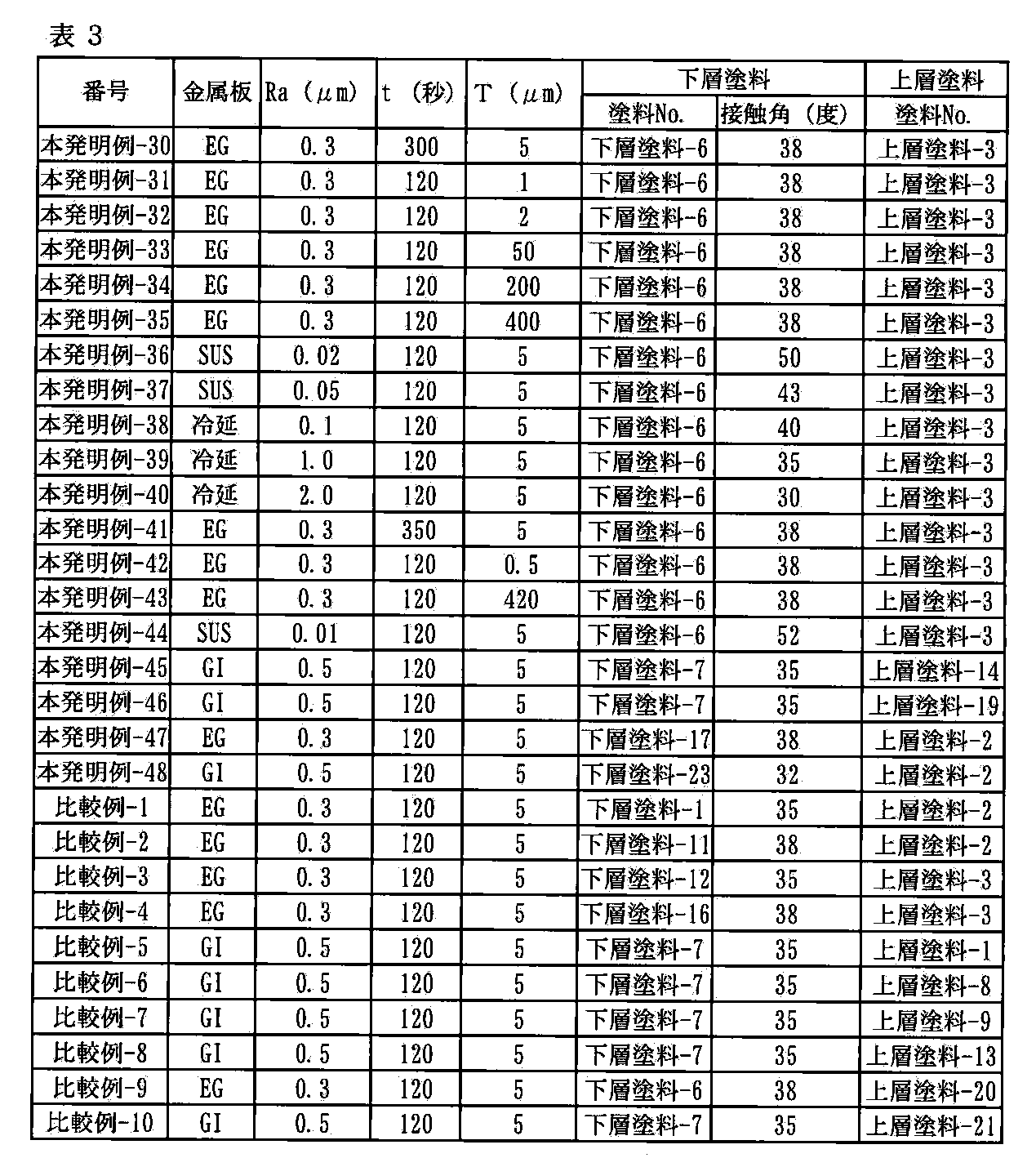
- the prepared test plates are summarized in Table 2 and Table 3.
- the abbreviations for the metal plates were “EG” for electrogalvanized steel sheets, “GI” for hot dip galvanized steel sheets, “cold rolled” for cold rolled steel sheets, and “SUS” for stainless steel sheets.
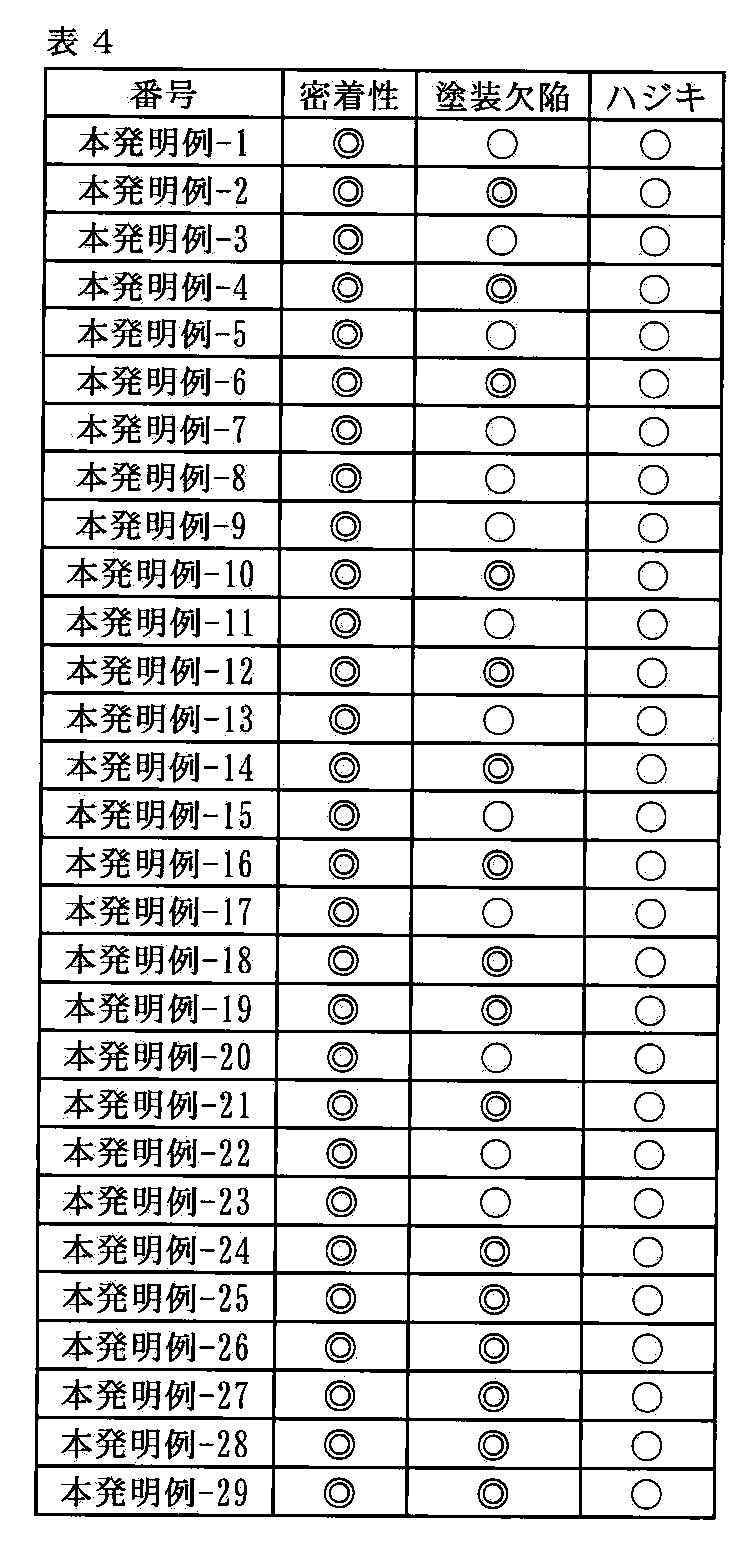
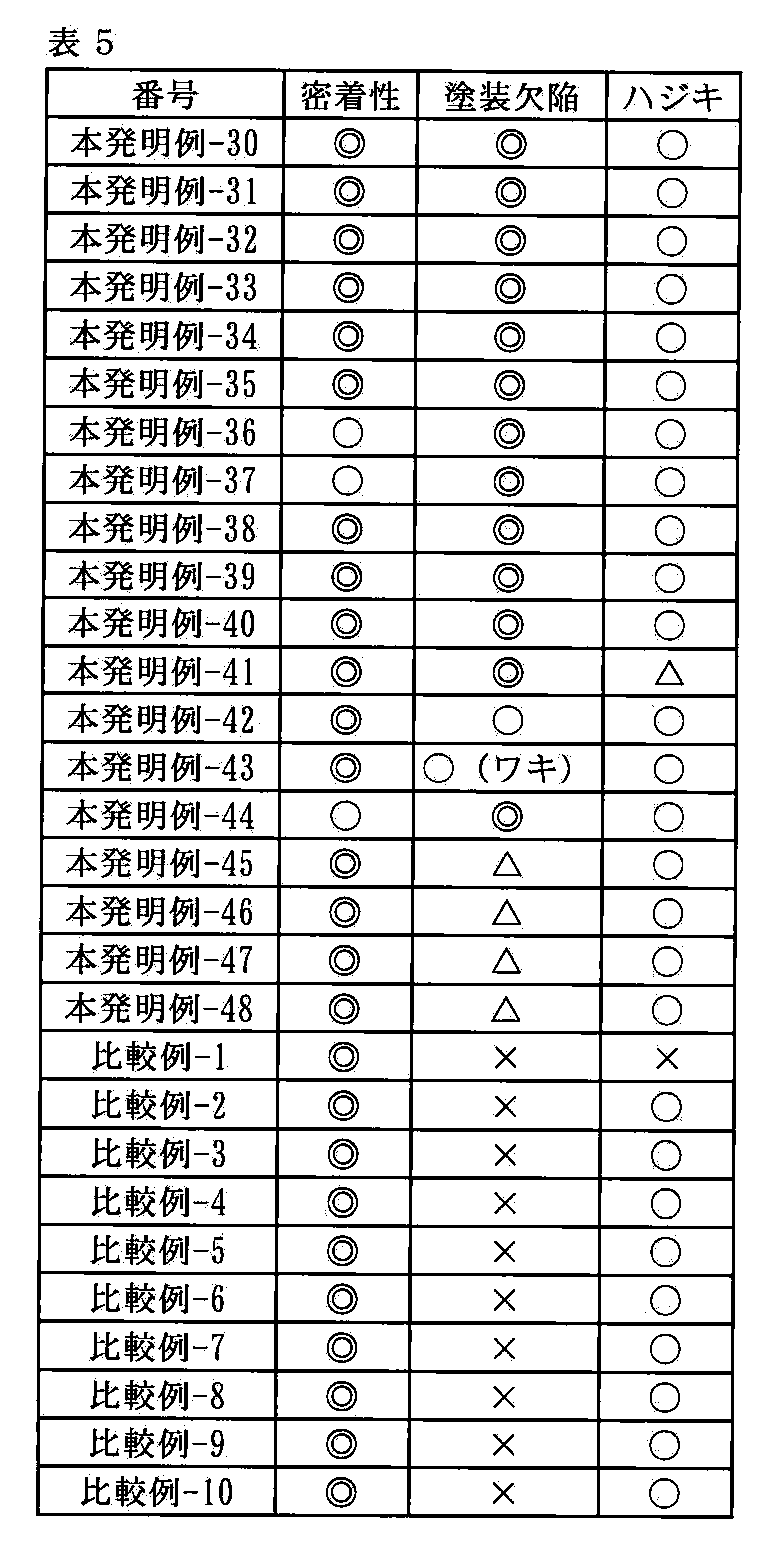
- Adhesion test Draw 100 1 mm square grids on the painted surface to reach the substrate (metal plate surface), and peel off with cello tape (registered trademark). The results were evaluated according to the following criteria. A: Number of remaining grids 100 ⁇ : Remaining crosscut number 95 to less than 100 ⁇ : Remaining crosscut number 80 to less than 95 ⁇ : Remaining crosscut number 80
- the metal plates of the present invention (Invention Examples 1 to 40) were excellent in adhesion and had a beautiful appearance free from coating defects and repelling defects due to mixed layers.
- the upper surface paint and the lower layer paint have a dynamic surface tension of 35 mN / m to 55 mN / m and a static surface tension of 25 mN / m to 45 mN / m, a beautiful appearance with no unevenness was obtained ( Invention Examples-2, 4, 6, 10, 12, 14, 16, 18, 19, 21, 24 to 40).
- the contact angle was 40 degrees or less, the adhesion was particularly excellent (Invention Examples 1 to 35, 38 to 40).
- the present invention it is possible to obtain a multilayer coated metal sheet that can be produced easily and inexpensively without a coating defect due to a mixed layer from immediately after coating to after drying by high-temperature heating, and has high industrial applicability.
- the method of the present invention is applied to a continuous coating facility for a surface-treated metal plate represented by a plated metal plate, a surface-treated metal plate with a multilayer coating can be produced efficiently.
Landscapes
- Life Sciences & Earth Sciences (AREA)
- Engineering & Computer Science (AREA)
- Wood Science & Technology (AREA)
- Application Of Or Painting With Fluid Materials (AREA)
- Other Surface Treatments For Metallic Materials (AREA)
- Laminated Bodies (AREA)
Abstract
Description
多層塗膜を作製する一般的な方法は、塗布と乾燥を繰り返す方法が挙げられる。しかし、塗膜の数だけ塗布と乾燥を繰り返す必要があり塗装ラインの設備費、製造時間等が課題である。多層塗膜を作製する場合、多層同時塗布方式(例えば、特許文献1)の場合は、塗膜の乾燥を一度で行うことができ、塗装ラインの設備費を低減できるとともに、省エネルギー化、ランニングタイムの短縮により生産性を向上させることができる。多層同時塗布方法としては、スライドホッパー式カーテンコーターに代表されるような、平行な2個以上のスリット等から異なる塗料を積層するように吐出させることで塗布する方法を用いることができる。こうした技術は従来、多層構造である写真感光材料分野(例えば特許文献2)で利用されてきたが、近年製紙業界(例えば特許文献3)や金属業界(例えば特許文献7)でも適用されている。
30≦γD上≦60 ・・・(A1)
30≦γD下≦60 ・・・(A2)
20≦γS上≦50 ・・・(A3)
20≦γS下≦50 ・・・(A4)
γD上≦γD下 ・・・(A5)
γS上≦γS下 ・・・(A6)
μ下≧μ上
であることを特徴とする、上記(1)または(2)に記載の多層被覆金属板の製造方法。
30≦γD上≦60 ・・・(A1)
30≦γD下≦60 ・・・(A2)
20≦γS上≦50 ・・・(A3)
20≦γS下≦50 ・・・(A4)
γD上≦γD下 ・・・(A5)
γS上≦γS下 ・・・(A6)
電気亜鉛めっき鋼板の試験片(板厚0.8mm)は、冷延鋼板を10cm×10cmに切断した後、電気めっきして作製した。めっきの条件は、めっき浴の組成をZnSO4・7H2O 300g/l、NaSO4 50g/l、H2SO4 25g/lとし、浴温50℃、pH1.2、めっき時間は30秒、めっき電流密度は15A/dm2、めっき付着量は15g/m2とした。めっき後、試験片を水冷で常温まで冷却した。冷却後の試験片にスライドホッパー式カーテンコーターにて塗液を多層同時塗布し、熱風を吹き込んだ誘導加熱炉にて最高到達板温が200℃となる条件で乾燥させた。電気亜鉛めっき鋼板の試験片表面の中心線平均粗さRaは0.3μmであった。
塗料A:
住化バイエルウレタン株式会社製のポリウレタン塗料「バイヒドロールPR135」に、防錆剤として日本アエロジル社製のシリカ「AEROSIL(登録商標)200」(平均粒径:約12nm)を樹脂固形分100質量に対する質量部で5添加し作製した。
東洋紡績社製ポリエステル塗料「バイロナールMD−1400」に、防錆剤として日本アエロジル社製のシリカ「AEROSIL(登録商標)200」(平均粒径:約12nm)を樹脂固形分100質量に対する質量部で5添加し作製した。
塗料C:
住化バイエルウレタン株式会社製のポリウレタン塗料「バイヒドロールPR135」に、大日精化工業株式会社製カーボンブラック「AFブラック」を樹脂固形分100質量に対する質量部で5添加し作製した。
東邦化学工業株式会社製のポリオレフィン塗料「ハイテックAR−2300」に、大日精化工業株式会社製カーボンブラック「AFブラック」を樹脂固形分100質量に対する質量部で5添加し作製した。
上下層の塗料A~DにBYK−333(BYK社製)、エルマゲン108(花王社製)および増粘剤BYK−425(BYK社製)を添加し、表面張力および粘度を変化させ、表1に記載の下層塗料−1~−23、上層塗料−1~−19を作製した。添加剤の質量部は、塗料A~Dを100質量としたときの質量部である。20℃および60℃における静的表面張力は、BYK社製ダイノメーター(白金リング引き上げ法)によって測定した。20℃における動的表面張力は、協和界面科学社製BP−D5(最大泡圧法)によって測定し、最小泡圧から最大泡圧になるまでの時間は100msとした。20℃における粘度は、B型粘度計(東京計器社製)にて測定した。試験片と下層塗料との接触角は、DM100(協和界面科学社製)を用いて試験片上に下層塗料を滴下して測定した。めっきした試験片の場合は、めっき処理した後、60秒後にDM100(協和界面科学社製)を用いてめっき表面に下層塗料を滴下し、めっき表面と下層塗料との接触角を測定した。金属板の表面粗度の測定には、触針式粗度計(ミツトヨ製、サーフテストSV−3100 S4)を用いた。中心線平均粗さはJIS B 0601に準拠し、カットオフ値0.8mmとして求めた。


素地(金属板表面)に達するように、塗装面に1mm四方の碁盤目を100個描き、セロテープ(登録商標)で剥離する。結果を次の規準により評価した。
◎:残存碁盤目数100
○:残存碁盤目数95以上100未満
△:残存碁盤目数80以上95未満
×:残存碁盤目数80未満
目視観察で外観が美麗なものを◎、わずかにむらがあるものを○、むらが見られるものを△、セル紋様等の塗装欠陥が見られるものを×として評価した。
目視観察で外観が美麗なものを○、ハジキ欠陥がわずかに見られるものを△、ハジキ欠陥による外観不良が見られるものを×として評価した。
Claims (8)
- 金属板の少なくとも一方の面に、上層塗料および下層塗料をウェット状態で同時にカーテン塗布し、積層されたウェット状態の上層塗膜および下層塗膜を同時に乾燥させる多層同時塗布工程を含む多層被覆金属板の製造方法において、前記上層塗料の20℃における動的表面張力をγD上(mN/m)、前記下層塗料の20℃における動的表面張力をγD下(mN/m)、前記上層塗料の20℃における静的表面張力をγS上(mN/m)、前記下層塗料の20℃における静的表面張力をγS下(mN/m)としたときに、次式(A1)~(A6)を満足させることを特徴とする、多層被覆金属板の製造方法。
30≦γD上≦60 ・・・(A1)
30≦γD下≦60 ・・・(A2)
20≦γS上≦50 ・・・(A3)
20≦γS下≦50 ・・・(A4)
γD上≦γD下 ・・・(A5)
γS上≦γS下 ・・・(A6) - (前記下層塗料の60℃における静的表面張力)>(前記上層塗料の60℃における静的表面張力)であることを特徴とする、請求項1に記載の多層被覆金属板の製造方法。
- 前記下層塗料の20℃における粘度をμ下(mPa・s)、前記上層塗料の20℃における粘度をμ上(mPa・s)として、
μ下≧μ上
であることを特徴とする、請求項1または2に記載の多層被覆金属板の製造方法。 - 前記上層塗料および前記下層塗料が水系塗料であることを特徴とする、請求項1~3のいずれか一つに記載の多層被覆金属板の製造方法。
- 前記金属板と前記下層塗料との20℃における接触角が50度以下であることを特徴とする、請求項1~4のいずれか一つに記載の多層被覆金属板の製造方法。
- 前記金属板がめっきされた金属板であり、前記金属板のめっきと多層同時塗布を連続で行うものであって、該めっき終了後300秒以内に該多層同時塗布を行い、その後に乾燥する工程を含む請求項1~5のいずれか一つに記載の多層被覆金属板の製造方法。
- 前記金属板の被塗装表面の粗さが、中心線平均粗さRaとして0.02μm以上であることを特徴とする請求項1~6のいずれか一つに記載の多層被覆金属板の製造方法。
- 前記上層塗料および前記下層塗料の粘度が共に5mPa・s~10000mPa・sであることを特徴とする請求項1~7のいずれか一つに記載の多層被覆金属板の製造方法。
Priority Applications (4)
| Application Number | Priority Date | Filing Date | Title |
|---|---|---|---|
| JP2010545715A JP4818465B2 (ja) | 2009-05-21 | 2010-05-19 | 多層被覆金属板の製造方法 |
| CN201080022142.8A CN102438762B (zh) | 2009-05-21 | 2010-05-19 | 多层包覆金属板的制造方法 |
| KR1020117027435A KR101161432B1 (ko) | 2009-05-21 | 2010-05-19 | 다층 피복 금속판의 제조 방법 |
| ZA2011/08437A ZA201108437B (en) | 2009-05-21 | 2011-11-17 | Process for producing multilayer-coated metal sheet |
Applications Claiming Priority (2)
| Application Number | Priority Date | Filing Date | Title |
|---|---|---|---|
| JP2009123274 | 2009-05-21 | ||
| JP2009-123274 | 2009-05-21 |
Publications (1)
| Publication Number | Publication Date |
|---|---|
| WO2010134627A1 true WO2010134627A1 (ja) | 2010-11-25 |
Family
ID=43126297
Family Applications (1)
| Application Number | Title | Priority Date | Filing Date |
|---|---|---|---|
| PCT/JP2010/058852 Ceased WO2010134627A1 (ja) | 2009-05-21 | 2010-05-19 | 多層被覆金属板の製造方法 |
Country Status (6)
| Country | Link |
|---|---|
| JP (1) | JP4818465B2 (ja) |
| KR (1) | KR101161432B1 (ja) |
| CN (1) | CN102438762B (ja) |
| TW (1) | TWI460026B (ja) |
| WO (1) | WO2010134627A1 (ja) |
| ZA (1) | ZA201108437B (ja) |
Cited By (5)
| Publication number | Priority date | Publication date | Assignee | Title |
|---|---|---|---|---|
| EP2830785A1 (en) * | 2012-03-28 | 2015-02-04 | Tarkett GDL | Multilayer surface covering |
| WO2016047649A1 (ja) * | 2014-09-25 | 2016-03-31 | 富士フイルム株式会社 | パターン形成体の製造方法 |
| JP2017194608A (ja) * | 2016-04-21 | 2017-10-26 | コニカミノルタ株式会社 | 光学フィルムの製造方法 |
| WO2022220188A1 (ja) * | 2021-04-16 | 2022-10-20 | 日本製鉄株式会社 | 有機溶剤系塗料及びプレコート金属板の製造方法 |
| US12509567B2 (en) | 2020-11-30 | 2025-12-30 | Ricoh Company, Ltd. | Liquid composition set, porous resin manufacturing apparatus, and porous resin manufacturing method |
Families Citing this family (2)
| Publication number | Priority date | Publication date | Assignee | Title |
|---|---|---|---|---|
| TW201519965A (zh) * | 2013-11-18 | 2015-06-01 | Qing-Chang Huang | 金屬板漆料塗佈方法 |
| KR102064527B1 (ko) | 2019-04-29 | 2020-01-10 | 류승호 | 부식, 차열 및 스크래치 기능이 개선된 금속패널 및 그 제조방법 |
Citations (3)
| Publication number | Priority date | Publication date | Assignee | Title |
|---|---|---|---|---|
| JPH0394871A (ja) * | 1989-09-05 | 1991-04-19 | Konica Corp | 塗布方法 |
| JPH06190335A (ja) * | 1992-12-24 | 1994-07-12 | Nippon Steel Corp | 高鮮映性塗装金属板の製造方法 |
| WO2006062214A1 (ja) * | 2004-12-08 | 2006-06-15 | Nippon Steel Corporation | プレコート金属板およびプレコート金属板の製造方法 |
Family Cites Families (3)
| Publication number | Priority date | Publication date | Assignee | Title |
|---|---|---|---|---|
| JP4493403B2 (ja) * | 2004-05-25 | 2010-06-30 | 大日本印刷株式会社 | 熱転写受像シートとその製造方法 |
| JP4762669B2 (ja) * | 2005-10-20 | 2011-08-31 | 新日本製鐵株式会社 | 耐汚染性と加工性に優れた塗装板の製造方法 |
| JP4874153B2 (ja) * | 2007-04-04 | 2012-02-15 | 新日本製鐵株式会社 | プレコート金属板、これを成形加工した金属成形体及びプレコート金属板の製造方法 |
-
2010
- 2010-05-19 WO PCT/JP2010/058852 patent/WO2010134627A1/ja not_active Ceased
- 2010-05-19 JP JP2010545715A patent/JP4818465B2/ja active Active
- 2010-05-19 KR KR1020117027435A patent/KR101161432B1/ko active Active
- 2010-05-19 CN CN201080022142.8A patent/CN102438762B/zh active Active
- 2010-05-20 TW TW099116121A patent/TWI460026B/zh active
-
2011
- 2011-11-17 ZA ZA2011/08437A patent/ZA201108437B/en unknown
Patent Citations (3)
| Publication number | Priority date | Publication date | Assignee | Title |
|---|---|---|---|---|
| JPH0394871A (ja) * | 1989-09-05 | 1991-04-19 | Konica Corp | 塗布方法 |
| JPH06190335A (ja) * | 1992-12-24 | 1994-07-12 | Nippon Steel Corp | 高鮮映性塗装金属板の製造方法 |
| WO2006062214A1 (ja) * | 2004-12-08 | 2006-06-15 | Nippon Steel Corporation | プレコート金属板およびプレコート金属板の製造方法 |
Cited By (10)
| Publication number | Priority date | Publication date | Assignee | Title |
|---|---|---|---|---|
| EP2830785A1 (en) * | 2012-03-28 | 2015-02-04 | Tarkett GDL | Multilayer surface covering |
| WO2016047649A1 (ja) * | 2014-09-25 | 2016-03-31 | 富士フイルム株式会社 | パターン形成体の製造方法 |
| JPWO2016047649A1 (ja) * | 2014-09-25 | 2017-07-06 | 富士フイルム株式会社 | パターン形成体の製造方法 |
| TWI626999B (zh) * | 2014-09-25 | 2018-06-21 | 日商富士軟片股份有限公司 | Method of manufacturing pattern forming body |
| JP2017194608A (ja) * | 2016-04-21 | 2017-10-26 | コニカミノルタ株式会社 | 光学フィルムの製造方法 |
| US12509567B2 (en) | 2020-11-30 | 2025-12-30 | Ricoh Company, Ltd. | Liquid composition set, porous resin manufacturing apparatus, and porous resin manufacturing method |
| WO2022220188A1 (ja) * | 2021-04-16 | 2022-10-20 | 日本製鉄株式会社 | 有機溶剤系塗料及びプレコート金属板の製造方法 |
| JPWO2022220188A1 (ja) * | 2021-04-16 | 2022-10-20 | ||
| JP7774262B2 (ja) | 2021-04-16 | 2025-11-21 | 日本製鉄株式会社 | 有機溶剤系塗料及びプレコート金属板の製造方法 |
| KR102937689B1 (ko) | 2021-04-16 | 2026-03-13 | 닛폰세이테츠 가부시키가이샤 | 유기 용제계 도료 및 프리코트 금속판의 제조 방법 |
Also Published As
| Publication number | Publication date |
|---|---|
| JP4818465B2 (ja) | 2011-11-16 |
| KR101161432B1 (ko) | 2012-07-02 |
| TW201103650A (en) | 2011-02-01 |
| CN102438762B (zh) | 2014-08-13 |
| ZA201108437B (en) | 2012-07-25 |
| TWI460026B (zh) | 2014-11-11 |
| JPWO2010134627A1 (ja) | 2012-11-12 |
| KR20120005038A (ko) | 2012-01-13 |
| CN102438762A (zh) | 2012-05-02 |
Similar Documents
| Publication | Publication Date | Title |
|---|---|---|
| JP4818465B2 (ja) | 多層被覆金属板の製造方法 | |
| CN103748253B (zh) | 表面处理热浸镀钢材 | |
| TWI534216B (zh) | Water - based metal surface treatment agent | |
| TWI779838B (zh) | 化成處理劑、金屬材料及其製造方法 | |
| CA2831402A1 (en) | Surface-treated steel sheet and method of manufacturing the same | |
| JP6455855B2 (ja) | 水性金属表面処理剤 | |
| JP6350768B1 (ja) | プレコート金属板 | |
| JP4850971B2 (ja) | 表面処理金属板 | |
| JP5369986B2 (ja) | 塗装金属材とそれを用いてなる筐体 | |
| JP4874153B2 (ja) | プレコート金属板、これを成形加工した金属成形体及びプレコート金属板の製造方法 | |
| CN113151745A (zh) | 一种耐酸碱腐蚀的镀铝锌预涂层板及其制造方法 | |
| WO2018123996A1 (ja) | 亜鉛系メッキ鋼板用表面処理剤 | |
| JP7099424B2 (ja) | 表面処理皮膜付き亜鉛系めっき鋼板及びその製造方法 | |
| JP2017179261A (ja) | 溶剤系金属用下塗り塗料、塗膜付き金属材料及びプレコート金属材料 | |
| JP4652933B2 (ja) | フッ素樹脂被覆鋼板およびその製造方法 | |
| JP4324093B2 (ja) | 加工性と耐汚染性に優れたプレコート金属板及びその製造方法 | |
| JP4460441B2 (ja) | 塗装金属板 | |
| JP4873974B2 (ja) | プレコート金属板及びその製造方法 | |
| WO2003068499A1 (en) | Etfe lining member | |
| JP7060178B1 (ja) | 有機樹脂被覆用表面処理鋼板及びその製造方法、並びに有機樹脂被覆鋼板及びその製造方法 | |
| JP2025161754A (ja) | プレコート金属板、部材及び表面処理金属板 | |
| JP6540279B2 (ja) | 黒色塗装鋼板の製造方法 |
Legal Events
| Date | Code | Title | Description |
|---|---|---|---|
| WWE | Wipo information: entry into national phase |
Ref document number: 201080022142.8 Country of ref document: CN |
|
| ENP | Entry into the national phase |
Ref document number: 2010545715 Country of ref document: JP Kind code of ref document: A |
|
| 121 | Ep: the epo has been informed by wipo that ep was designated in this application |
Ref document number: 10777854 Country of ref document: EP Kind code of ref document: A1 |
|
| ENP | Entry into the national phase |
Ref document number: 20117027435 Country of ref document: KR Kind code of ref document: A |
|
| NENP | Non-entry into the national phase |
Ref country code: DE |
|
| 122 | Ep: pct application non-entry in european phase |
Ref document number: 10777854 Country of ref document: EP Kind code of ref document: A1 |