WO2010125979A1 - 非水系顔料分散組成物 - Google Patents
非水系顔料分散組成物 Download PDFInfo
- Publication number
- WO2010125979A1 WO2010125979A1 PCT/JP2010/057269 JP2010057269W WO2010125979A1 WO 2010125979 A1 WO2010125979 A1 WO 2010125979A1 JP 2010057269 W JP2010057269 W JP 2010057269W WO 2010125979 A1 WO2010125979 A1 WO 2010125979A1
- Authority
- WO
- WIPO (PCT)
- Prior art keywords
- meth
- vinyl monomer
- functional group
- pigment dispersion
- dispersion composition
- Prior art date
- Legal status (The legal status is an assumption and is not a legal conclusion. Google has not performed a legal analysis and makes no representation as to the accuracy of the status listed.)
- Ceased
Links
Classifications
-
- C—CHEMISTRY; METALLURGY
- C09—DYES; PAINTS; POLISHES; NATURAL RESINS; ADHESIVES; COMPOSITIONS NOT OTHERWISE PROVIDED FOR; APPLICATIONS OF MATERIALS NOT OTHERWISE PROVIDED FOR
- C09D—COATING COMPOSITIONS, e.g. PAINTS, VARNISHES OR LACQUERS; FILLING PASTES; CHEMICAL PAINT OR INK REMOVERS; INKS; CORRECTING FLUIDS; WOODSTAINS; PASTES OR SOLIDS FOR COLOURING OR PRINTING; USE OF MATERIALS THEREFOR
- C09D17/00—Pigment pastes, e.g. for mixing in paints
- C09D17/002—Pigment pastes, e.g. for mixing in paints in organic medium
-
- C—CHEMISTRY; METALLURGY
- C09—DYES; PAINTS; POLISHES; NATURAL RESINS; ADHESIVES; COMPOSITIONS NOT OTHERWISE PROVIDED FOR; APPLICATIONS OF MATERIALS NOT OTHERWISE PROVIDED FOR
- C09B—ORGANIC DYES OR CLOSELY-RELATED COMPOUNDS FOR PRODUCING DYES, e.g. PIGMENTS; MORDANTS; LAKES
- C09B67/00—Influencing the physical, e.g. the dyeing or printing properties of dyestuffs without chemical reactions, e.g. by treating with solvents grinding or grinding assistants, coating of pigments or dyes; Process features in the making of dyestuff preparations; Dyestuff preparations of a special physical nature, e.g. tablets, films
- C09B67/006—Preparation of organic pigments
- C09B67/0063—Preparation of organic pigments of organic pigments with only macromolecular substances
-
- C—CHEMISTRY; METALLURGY
- C09—DYES; PAINTS; POLISHES; NATURAL RESINS; ADHESIVES; COMPOSITIONS NOT OTHERWISE PROVIDED FOR; APPLICATIONS OF MATERIALS NOT OTHERWISE PROVIDED FOR
- C09B—ORGANIC DYES OR CLOSELY-RELATED COMPOUNDS FOR PRODUCING DYES, e.g. PIGMENTS; MORDANTS; LAKES
- C09B67/00—Influencing the physical, e.g. the dyeing or printing properties of dyestuffs without chemical reactions, e.g. by treating with solvents grinding or grinding assistants, coating of pigments or dyes; Process features in the making of dyestuff preparations; Dyestuff preparations of a special physical nature, e.g. tablets, films
- C09B67/006—Preparation of organic pigments
- C09B67/0069—Non aqueous dispersions of pigments containing only a solvent and a dispersing agent
-
- G—PHYSICS
- G02—OPTICS
- G02B—OPTICAL ELEMENTS, SYSTEMS OR APPARATUS
- G02B5/00—Optical elements other than lenses
- G02B5/20—Filters
- G02B5/22—Absorbing filters
- G02B5/223—Absorbing filters containing organic substances, e.g. dyes, inks or pigments
Definitions
- the present invention relates to a non-aqueous pigment dispersion composition and a method for producing a non-aqueous pigment dispersion graft polymer.
- JP-A-7-140654 discloses (A) a binder polymer which is a copolymer of a monomer having an alcoholic hydroxyl group, a macromonomer, and another monomer copolymerizable therewith, (B) a pigment, and (C ) Radiation sensitive compositions containing radiation sensitive compounds are disclosed.
- Japanese Patent Application Laid-Open No. 10-339949 discloses an organic pigment, a polymerizable oligomer (macromonomer) having an ethylenically unsaturated double bond at the terminal, a nitrogen atom-containing group and an ethylenically unsaturated double bond in an organic solvent.
- JP-T-2003-517063 discloses a polymer composition suitable for a pigment dispersant, which is a graft copolymer obtained by grafting a macromonomer to a main chain, the main chain containing an amide functional group as a pigment fixing group, and A pigment dispersion using the same is disclosed.
- the present invention comprises a pigment (A), a non-aqueous solvent (B), and a graft polymer (C) comprising the following main chain and side chain, wherein the graft polymer (C) comprises the main chain and the side chain. It is related with the manufacturing method of the non-aqueous pigment dispersion composition and the graft polymer for non-aqueous pigment dispersion which are obtained by carrying out a coupling reaction.
- Main chain copolymer containing structural unit derived from vinyl monomer (a) containing nitrogen atom and structural unit derived from vinyl monomer (d) containing reactive functional group
- Side chain containing benzene ring (meth) Copolymer containing a structural unit derived from acrylic ester (b) and having a functional group capable of reacting with a reactive functional group of the main chain at one end
- the pigment dispersions described in JP-A-7-140654, JP-A-10-339949, and JP-T-2003-517063 can satisfy the dispersion stability to some extent, but the viscosity of the pigment dispersion is high. Handling properties and coating properties when producing the like are insufficient.
- the present invention relates to a non-aqueous pigment dispersion composition having a low viscosity, excellent handling properties and coating properties, and excellent dispersion stability, and a method for producing a graft polymer for non-aqueous pigment dispersion.
- the present inventors By using a graft polymer having a side chain containing a benzene ring as a pigment dispersant, the present inventors have a low viscosity, an excellent handling property and coating property, and a non-aqueous pigment dispersion composition excellent in dispersion stability. I found that I can get things. That is, the present invention relates to the following (1) and (2).
- a pigment (A), a non-aqueous solvent (B), and a graft polymer (C) containing the following main chain and side chain are contained, and the graft polymer (C) comprises the main chain and the side chain.
- a non-aqueous pigment dispersion composition obtained by a coupling reaction.
- Main chain copolymer containing structural unit derived from vinyl monomer (a) containing nitrogen atom and structural unit derived from vinyl monomer (d) containing reactive functional group
- Side chain containing benzene ring (meth)
- the non-aqueous pigment dispersion composition of the present invention contains a pigment (A), a non-aqueous solvent (B), and the graft polymer (C).
- the pigment (A) used in the present invention may be either an inorganic pigment or an organic pigment. If necessary, these and extender pigments can be used in combination.
- the inorganic pigment include carbon black, metal oxide, metal sulfide, and metal chloride.
- organic pigments include azo pigments, phthalocyanine pigments, condensed polycyclic pigments, and lake pigments.
- the azo pigment C.I. I. Insoluble azo pigments such as CI Pigment Red 3; I.
- Soluble red azo pigments such as CI Pigment Red 48: 1; I. And condensed azo pigments such as CI Pigment Red 144.
- the phthalocyanine pigment include C.I. I. And copper phthalocyanine pigments such as CI Pigment Blue 15: 6.
- the condensed polycyclic pigment include C.I. I. Anthraquinone pigments such as CI Pigment Red 177; I. Perylene pigments such as CI Pigment Red 123; I. Perinone pigments such as C.I. Pigment Orange 43; I. Quinacridone pigments such as C.I. Pigment Red 122; I. Dioxazine pigments such as CI Pigment Violet 23, C.I. I.
- Pigment Yellow 109 and other isoindolinone pigments C.I. I. Pigment Orange 66 and other isoindoline pigments, C.I. I. Quinophthalone pigments such as CI Pigment Yellow 138; I. Indigo pigments such as CI Pigment Red 88; I. Metal complex pigments such as C.I. Pigment Green 8; I. Pigment red 254, C.I. I. Pigment red 255, C.I. I. And diketopyrrolopyrrole pigments such as CI Pigment Orange 71.
- a diketopyrrolopyrrole pigment represented by the following general formula (1) is preferable from the viewpoint of more effectively expressing the effects of the present invention.
- X 1 and X 2 each independently represent a hydrogen atom or a halogen atom such as a fluorine atom or a chlorine atom
- Y 1 and Y 2 each independently represent a hydrogen atom or —SO 2 Indicates a 3 H group.
- the pigment (A) from the viewpoint of improving the brightness Y value, it is desirable to use an atomized product having an average primary particle diameter of preferably 100 nm or less, more preferably 20 to 60 nm.
- the average primary particle diameter of the pigment (A) can be determined by a method of directly measuring the size of primary particles from an electron micrograph. Specifically, the minor axis diameter and major axis diameter of each primary particle are measured and the average is taken as the particle diameter of the particle.
- the volume (weight) of each particle is The volume average particle diameter is obtained by approximating a rectangular parallelepiped of the obtained particle diameter, and is defined as the average primary particle diameter.
- the above-mentioned pigment (A), particularly diketopyrrolopyrrole pigment, can be used alone or in combination of two or more.
- Non-aqueous solvent (B) used in the present invention is not particularly limited, but particularly when used as an oil-based ink for a color filter, it is preferable to use a high-boiling organic solvent having a boiling point of 100 ° C. or higher.
- a high boiling point organic solvent include the following (i) to (v).
- Diethylene glycol alkyl ethers (carbitols): diethylene glycol monomethyl ether, diethylene glycol dimethyl ether, diethylene glycol (Iii) Propylene glycol dialkyl ethers: propylene glycol monomethyl ether, propylene glycol dimethyl ether, etc.
- Alkylene glycol monoalkyl ether acetates ethylene glycol monomethyl ether acetate, diethylene glycol monomethyl ether acetate, propylene glycol monomethyl Ether acetate, diethylene glycol monobutyl ether acetate, etc.
- Alcohols ethylene glycol, diethylene glycol, glycerin, etc.
- non-aqueous solvents (iv) alkylene glycol monoalkyl ether acetates are preferred, propylene glycol monomethyl ether acetate, diethylene glycol mono Butyl ether acetate and the like are particularly preferable.
- These non-aqueous solvents (B) can be used alone or in combination of two or more.
- the graft polymer (C) used in the present invention includes the following main chain and side chain.
- Main chain polymer containing structural unit derived from vinyl monomer (a) containing nitrogen atom
- Side chain polymer containing structural unit derived from (meth) acrylic acid ester (b) containing benzene ring Graft polymer (C ),
- the polymer containing the structural unit derived from the vinyl monomer (a) containing a nitrogen atom constituting the main chain is obtained by dispersing the pigment (A) in the non-aqueous solvent (B).
- the polymer containing the structural unit derived from the (meth) acrylic acid ester (b) containing a benzene ring constituting the side chain mainly improves the dispersion stability.
- the method for producing the graft polymer (C) includes (i) a polymer reaction method in which a polymer constituting the main chain portion and a polymer constituting the side chain portion are subjected to a coupling reaction, and (ii) the main chain portion.
- a polymer reaction method in which a monomer that is a structural unit and a macromonomer that constitutes a side chain portion are copolymerized. From the viewpoint of narrowing the composition distribution, in the present invention, a polymer reaction method is used. Is used.
- the production of the graft polymer by the polymer reaction method can be performed by coupling reaction of the following main chain and side chain.
- Main chain copolymer containing structural unit derived from vinyl monomer (a) containing nitrogen atom and structural unit derived from vinyl monomer (d) containing reactive functional group
- Side chain containing benzene ring (meth)
- the vinyl monomer containing a nitrogen atom (a) is preferably a vinyl monomer having an amide bond, and more specifically, (meth) acrylamides, vinyl pyrrolidones, vinyl pyridines, nitrogen-containing styrenic monomers, nitrogen-containing monomers.
- examples include (meth) acrylic acid esters.
- (meth) acrylamides include: (meth) acrylamide; N, N-dialkyl (meth) acrylamide, N-alkyl (meth) acrylamide, N, N-dialkylaminoalkyl (meth) acrylamide, etc.
- vinyl pyrrolidones include N-vinyl-2-pyrroli
- vinylpyridines examples include 2-vinylpyridine and 4-vinylpyridine
- nitrogen-containing styrene monomers include p-styrenesulfonamide, p-aminostyrene, and aminomethylstyrene.
- N, N-dialkyl (the carbon number of the alkyl group is preferably 1 to 8, more preferably 1 to 4) aminoalkyl (the carbon number of the alkyl group is preferably 1 to 6) ) (Meth) acrylate, 1- (N, N-dialkylamino) -1,1-dimethylmethyl (meth) acrylate (the alkyl group preferably has 1 to 8 carbon atoms, more preferably 1 to 4 carbon atoms), Morpholinoethyl (meth) acrylate, piperidinoethyl (meth) acrylate, 1-pyrrolidinoethyl (meth) acrylate, N, N-dimethyl-2-pyrrolidylaminoethyl (meth) acrylate, N, N-methylphenylaminoethyl (meth) ) Acrylate and the like.
- (meth) acrylamides and vinylpyrrolidones are preferable from the viewpoint of adsorptivity to pigments, and have 2 to 6 carbon atoms such as N-methoxymethyl (meth) acrylamide and N-ethoxymethyl (meth) acrylamide.
- (Meth) acrylamide having an alkoxyalkyl group of (meth) acrylamide having a hydroxyalkyl group having 1 to 3 carbon atoms such as N-hydroxymethyl (meth) acrylamide and 2-hydroxyethyl (meth) acrylamide
- N-vinyl- 2-pyrrolidone is more preferred, and N-vinyl-2-pyrrolidone is particularly preferred.
- ((Meth) acrylic acid ester containing benzene ring (b)) examples include benzyl (meth) acrylate, phenoxyethyl (meth) acrylate, phenoxypolyethylene glycol (meth) acrylate, and 2-hydroxy-3 (meth) acrylate. -One or more selected from phenoxypropyl and the like. Among these, a monomer having high solubility with the solvent to be used can be selected and used. For example, when diethylene glycol monobutyl ether acetate is used as the solvent, benzyl (meth) acrylate is preferred.
- “(meth) acrylic acid” means acrylic acid, methacrylic acid, or both.
- Vinyl monomer containing reactive functional group (d) examples include vinyl monomers containing an epoxy group, an isocyanate group, a carboxy group, a phosphoric acid group, a sulfonic acid group, and an amino group.
- vinyl monomers containing an epoxy group examples include (meth) acrylic acid esters such as glycidyl (meth) acrylate, 4-hydroxybutyl (meth) acrylate glycidyl ether, 3,4-epoxycyclohexylmethyl (meth) acrylate, N -(Meth) acrylamides such as glycidyl (meth) acrylamide, allyl ethers such as allyl glycidyl ether, 1,2-epoxy-5-hexene and the like.
- acrylic acid esters such as glycidyl (meth) acrylate, 4-hydroxybutyl (meth) acrylate glycidyl ether, 3,4-epoxycyclohexylmethyl (meth) acrylate, N -(Meth) acrylamides such as glycidyl (meth) acrylamide, allyl ethers such as allyl glycidyl ether, 1,2-epoxy
- vinyl monomers containing isocyanate groups include 2-methacryloyloxyethyl isocyanate (product name: Karenz MOI) and 2-[(3,5-dimethylpyrazolyl) carboxyamino] ethyl, which are isocyanate monomers manufactured by Showa Denko KK Methacrylate (product name: Karenz MOI-BP), 2-([1′-methylpropylideneamino] carboxyamino) ethyl methacrylate (Product name: Karenz MOI-BM), 2-acryloyloxyethyl isocyanate (Product name: Karenz) AOI) and the like.
- 2-methacryloyloxyethyl isocyanate product name: Karenz MOI
- 2-[(3,5-dimethylpyrazolyl) carboxyamino] ethyl which are isocyanate monomers manufactured by Showa Denko KK Methacrylate (product name: Karenz MOI-BP), 2-([1
- Examples of the vinyl monomer containing a carboxy group include (meth) acrylic acid, 2- (meth) acryloyloxyethyl succinic acid, 2- (meth) acryloyloxyethyl phthalic acid, and the like.
- Examples of the vinyl monomer containing a phosphoric acid group include mono (2-methacryloyloxyethyl) acid phosphate, mono (2-acryloyloxyethyl) acid phosphate, and the like.
- Examples of the vinyl monomer containing a sulfonic acid group include acrylamide 2-methylpropanesulfonic acid.
- vinyl monomer containing an amino group examples include dimethylaminoethyl (meth) acrylate, diethylaminoethyl (meth) acrylate, 2-vinylpyridine, 4-vinylpyridine and the like.
- the vinyl monomer containing an epoxy group is preferable from the surface of reactivity and a polymerization rate, (meth) acrylic acid ester containing a glycidyl group is preferable, and (meth) acrylic acid glycidyl is especially preferable.
- the main chain is a copolymer containing a structural unit derived from a vinyl monomer (a) containing a nitrogen atom and a structural unit derived from a vinyl monomer (d) containing a reactive functional group, but the effect of the present invention is inhibited. It is preferable to use a copolymer containing a structural unit derived from another monomer (e) that can be copolymerized with the monomer within the range not to be used.
- the other monomer (e) copolymerizable with the monomer methyl (meth) acrylate, ethyl (meth) acrylate, stearyl (meth) acrylate, benzyl (meth) acrylate, (meth) Isobornyl acrylate; vinyl monomer having one alcoholic hydroxyl group such as 2-hydroxyethyl (meth) acrylate and 2-hydroxypropyl (meth) acrylate; two alcoholic hydroxyl groups such as glycerol mono (meth) acrylate Vinyl monomers; (meth) acrylic esters such as perfluorooctylethyl (meth) acrylate, polyethylene glycol (meth) acrylate, methoxypolyethylene glycol (meth) acrylate; styrenes such as styrene; vinyl esters such as vinyl acetate , Butyl vinyl ether Like vinyl ethers, and the like.
- a vinyl monomer having one or two alcoholic hydroxyl groups is preferable, a vinyl monomer having one alcoholic hydroxyl group is more preferable, and in particular, (meth) acrylic acid 2 -The inclusion of (meth) acrylic acid ester having one alcoholic hydroxyl group having 1 to 5 carbon atoms, preferably 2 to 3 carbon atoms, such as hydroxyethyl, the polymer is detached from the pigment after adsorbing to the pigment. It is preferable from the viewpoint of suppressing the above.
- a vinyl monomer (a) containing a nitrogen atom, a vinyl monomer (d) containing a reactive functional group, and a vinyl monomer (e) further containing an alcoholic hydroxyl group It is preferable to produce a copolymer containing structural units derived from the vinyl monomers (a), (d) and (e) in the main chain.
- Each of the monomers (a), (d) and (e) can be used alone or in combination of two or more.
- the content of the structural unit derived from the monomers (a), (d) and (e) in the main chain is not particularly limited, but the structural unit derived from (a) is preferably 5 to 95% by weight, more preferably 10 to 70% by weight, the structural unit derived from (d) is preferably 5 to 95% by weight, more preferably 10 to 70% by weight, the structural unit derived from (e) is preferably 0 to 80% by weight, and the monomer (e ) Is preferably 2 to 60% by weight, more preferably 4 to 50% by weight, still more preferably 10 to 45% by weight.
- Step (I): Production of main chain There is no particular limitation on the method for producing the main chain, and a bulk polymerization method, a solution polymerization method, a suspension polymerization method and the like can be adopted, but a solution polymerization method is particularly preferable.
- Solvents used in the solution polymerization method include alcohols such as methanol, ethanol and isopropanol, ketones such as acetone and methyl ethyl ketone, esters such as ethyl acetate and butyl acetate, hydrocarbons such as hexane and cyclohexane, diethyl ether and tetrahydrofuran And ethers such as benzene, toluene and the like, and halogenated hydrocarbons such as dichloromethane and chloroform.
- alcohols such as methanol, ethanol and isopropanol
- ketones such as acetone and methyl ethyl ketone
- esters such as ethyl acetate and butyl acetate
- hydrocarbons such as hexane and cyclohexane
- diethyl ether and tetrahydrofuran And ethers such as benzene, tolu
- polymerization initiator examples include azo initiators such as 2,2′-azobisisobutyronitrile and 2,2′-azobis (2,4-dimethylvaleronitrile), and peroxyl such as lauroyl peroxide and benzoyl peroxide. Examples thereof include oxide-based initiators and persulfuric acids such as ammonium persulfate. Moreover, a chain transfer agent etc. can also be used as needed. Examples of chain transfer agents include mercaptans such as dodecyl mercaptan, mercaptoethanol, mercaptopropionic acid.
- the reaction temperature can be appropriately selected depending on the polymerization initiator used, the type of solvent, and the like, but is usually preferably in the range of 50 to 100 ° C.
- the number average molecular weight of the main chain is preferably 500 to 50,000, more preferably 1000 to 30,000, from the viewpoint of storage stability as a dispersion of the composition of the present invention and suppression of a decrease in pigment dispersion rate. Particularly preferred is 2000 to 20,000.
- the epoxy value of the main chain is preferably 19 to 375 mgKOH / g, more preferably 40 to 350 mgKOH / g, and particularly preferably 50 to 300 mgKOH / g from the viewpoint of reactivity with the side chain and the like.
- the number average molecular weight and epoxy value of the main chain can be obtained as desired by adjusting the copolymerization conditions of the monomers (a) and (d).
- the vinyl monomers (a) and (d) as raw materials and, if necessary, (e) may be added and reacted all at once, but may be added and reacted separately in order to control the composition. .
- the side chain is a copolymer containing a structural unit derived from (meth) acrylic acid ester (b) containing a benzene ring and having a functional group capable of reacting with a reactive functional group of the main chain at one end.
- the functional group capable of reacting with the reactive functional group of the main chain include a carboxy group, a hydroxyl group, an amino group, an epoxy group, an isocyanate group, and the like. You can choose.
- the side chain is a polymer having a carboxy group at one end (one-end carboxylic acid type polymer) or a polymer having an amino group at one end (one end An amino group-type polymer is preferable.
- the reactive functional group of the main chain is an isocyanate group
- the side chain is a polymer having a hydroxyl group at one end (one-end hydroxyl group type polymer) or a polymer having an amino group at one end (one end An amino group-type polymer is preferable.
- the side chain can be copolymerized with other monomers as required.
- monomers include methyl (meth) acrylate, ethyl (meth) acrylate, butyl (meth) acrylate, stearyl (meth) acrylate, isobornyl methacrylate, 2-hydroxyethyl (meth) acrylate, Glycerin mono (meth) acrylate, (meth) acrylic acid perfluorooctylethyl, (meth) acrylic acid ester such as methoxypolyethylene glycol, styrene such as styrene, vinyl esters such as vinyl acetate, butyl vinyl ether And vinyl ethers.
- the side chain production method is not particularly limited, and a bulk polymerization method, a solution polymerization method, a suspension polymerization method, or the like can be adopted, but a solution polymerization method is particularly preferable.
- the solvent, polymerization initiator, and chain transfer agent used in the solution polymerization method are the same as those described in the production of the main chain.
- a polymerization initiator containing a carboxylic acid such as 4,4′-azobis (4-cyanobutyric acid) or a chain transfer agent containing a carboxylic acid such as mercaptopropionic acid should be used.
- a chain transfer agent such as aminoethanethiol for introducing an amino group at one end
- a chain transfer agent such as mercaptoethanol for introducing a hydroxyl group at one end.
- the reaction temperature can be appropriately selected depending on the polymerization initiator used, the type of solvent, and the like, but is usually preferably in the range of 50 to 100 ° C.
- the number average molecular weight of the side chain is preferably 500 to 20,000, more preferably 700 to 10,000, and particularly preferably 700, from the viewpoint of storage stability as a dispersion of the composition of the present invention and suppression of thickening. ⁇ 6000.
- the molar ratio of the side chain functional group to the main chain reactive functional group [side chain functional group / main chain reactive functional group]] is 0.05 to from the viewpoint of suppressing unreacted side chains.
- 1.0 is preferable, 0.1 to 0.9 is more preferable, and 0.2 to 0.8 is particularly preferable.
- Step (II): Coupling reaction In the polymer reaction method, the reactive functional group of the main chain and the functional group of the side chain that can react with the reactive functional group are subjected to a coupling reaction.
- a catalyst may be used in the coupling reaction.
- the catalyst for the reaction between the epoxy group and the carboxylic acid include quaternary ammonium salts, tertiary amines, alkali metal hydroxides, inorganic acids, sulfonic acids, carboxylic acids, solid acids, solid bases and the like.
- Examples of the quaternary ammonium salt include halides such as tetraethylammonium bromide, tetrabutylammonium bromide, tetrabutylammonium iodide, tetramethylammonium chloride, trimethylbenzylammonium chloride, triethylbenzylammonium chloride.
- Examples thereof include triethylamine, dimethylbutylamine, diisopropylethylamine, 2,2,6,6-tetramethylpiperidine and the like.
- the amount of the catalyst added is not particularly limited, but is preferably 0.5 to 200 mol% with respect to the carboxylic acid.
- Examples of the catalyst for the reaction of an isocyanate group and a hydroxyl group include amines such as pyridine and organic metals such as dibutyltin dilaurate.
- the addition amount of the catalyst is not particularly limited, but is preferably 0.05 to 200 mol% with respect to the isocyanate group.
- the solvent is not particularly limited as long as it dissolves the main chain and the side chain.
- a solvent can be used individually or in combination of 2 or more types.
- the concentration of the reaction system is not particularly limited, but the total amount of the main chain and the side chain in the total amount is preferably 5 from the viewpoint of suppressing an increase in viscosity and ensuring good handling properties and shortening the reaction time. It is ⁇ 70% by weight, more preferably 10 to 50% by weight.
- the reaction temperature is not particularly limited, but is preferably 60 ° C. or higher from the viewpoint of the reaction rate. The progress of the coupling reaction can be confirmed by quantifying each reactive functional group.
- the acid value and epoxy group in the reaction system are measured, and when using a side chain having an amino group, the amine value is By measuring, the progress of the coupling reaction can be confirmed.
- the amounts are as follows.
- the content of the component derived from the component (a) in all the structural units is preferably 1 to 40% by weight, more preferably 2 to 35% by weight, and particularly preferably 5 to 30% by weight.
- the content of the component derived from the component (d) in all the structural units is preferably 0 to 65% by weight, more preferably 0 to 50% by weight, and particularly preferably 0 to 45% by weight.
- the content of the component derived from the component (e) in all the structural units is preferably 0 to 30% by weight, and when the component (e) is used, it is preferably 1 to 28% by weight, more preferably 2 to It is 25% by weight, more preferably 5 to 20% by weight.
- the content of the component derived from component (b) in all the structural units is preferably 30 to 95% by weight, more preferably 40 to 90% by weight, and particularly preferably 50 to 80% by weight.
- the content of structural units derived from side chains in all structural units is preferably 30 to 95% by weight, more preferably 40 to 90% by weight, and particularly preferably 50 to 80% by weight.
- the weight average molecular weight of the graft polymer (C) is preferably 1000 to 1,000,000, more preferably 2000 to 800,000, and particularly preferably 5000 to 700, from the viewpoint of adsorptivity to the pigment and suppression of increase in viscosity. , 000.
- the pigment dispersion composition of the present invention contains a pigment (A), a non-aqueous solvent (B), and a graft polymer (C).
- the proportion of the pigment (A) in the pigment dispersion composition is preferably 1 to 30% by weight and more preferably 2 to 20% by weight from the viewpoint of obtaining good colorability and viscosity.
- the content of the non-aqueous solvent (B) is preferably 100 to 10,000% by weight, more preferably 200 to 1000% by weight, based on the total solid content in the pigment dispersion composition, from the viewpoint of obtaining good colorability and viscosity. preferable.
- the content of the graft polymer (C) is preferably from 1 to 300% by weight, more preferably from 2 to 200% by weight, more preferably from 5 to 100% by weight, based on the pigment (A), from the viewpoint of obtaining good viscosity and physical properties of the coating film. Is particularly preferred.
- the volume median particle size (D50) in the pigment dispersion composition is preferably 80 nm or less, more preferably 20 to 70 nm, and even more preferably 20 to 60 nm in order to obtain a good contrast as a color material for a color filter.
- the volume median particle size (D50) means a particle size at which the cumulative volume frequency calculated by the volume fraction becomes 50% by accumulation from the small particle size side. The value of the volume median particle size (D50) can be measured by the method described in Examples.
- the pigment dispersion composition of the present invention may contain a binder, a polyfunctional monomer, a photopolymerization initiator, a thermal polymerization initiator, etc. in addition to the pigment (A), the non-aqueous solvent (B), and the graft polymer (C).
- Binders include copolymers of (meth) acrylic acid and (meth) acrylic acid esters, styrene / maleic anhydride copolymers, reaction products of styrene / maleic anhydride copolymers and alcohols, and epoxy groups.
- a polymer etc. can be mentioned.
- the weight average molecular weight is preferably 5000 to 200,000.
- the binder content is preferably 20 to 80% by weight based on the total solid content in the pigment dispersion composition.
- the polyfunctional monomer include (meth) acrylic acid ester, urethane (meth) acrylate, (meth) acrylic acid amide, allyl compound, and vinyl ester having two or more ethylenically unsaturated double bonds. Examples thereof include polyvalent carboxylic acid compounds having two or more carboxylic acids and derivatives thereof.
- the content of the polyfunctional monomer is preferably 10 to 60% by weight based on the total solid content in the pigment dispersion composition.
- the photopolymerization initiator include aromatic ketones, lophine dimers, benzoin, benzoin ethers, and polyhalogens.
- a photoinitiator can be used individually or in combination of 2 or more types.
- the content of the photopolymerization initiator is preferably 0.2 to 10% by weight based on the total solid content in the pigment dispersion composition.
- the pigment dispersion composition of the present invention can be obtained by mixing and dispersing the pigment (A), the non-aqueous solvent (B), the graft polymer (C), other binders, polyfunctional monomers and the like. There is no particular limitation on the mixing / dispersing method.
- kneaders such as paint shakers, roll mills, bead mills, kneaders and extruders, high pressure homogenizers (Izumi Food Machinery Co., Ltd., trade name), and high pressures of homovalve type represented by Minilab 8.3H type (Rannie Co., trade name) Homogenizer, Microfluidizer (trade name), Nanomizer (trade name), Ultimateizer (Sugino Machine Co., trade name), Genus PY (trade name), DeBEE2000 (Japan)
- a chamber type high-pressure homogenizer such as BEE Co., Ltd. (trade name).
- the mixing / dispersing process two or more kinds of the above apparatuses may be combined in a multistage manner.
- a media type dispersing machine examples include ceramics such as zirconia and titania, polymer materials, metals, and the like, but zirconia is preferable from the viewpoint of wear resistance.
- the particle size of the media is preferably 0.003 to 0.5 mm, more preferably 0.005 to 0.09 mm, and still more preferably 0.01 to 0.08 mm.
- the pigment dispersion composition can be further reduced in viscosity by further removing the graft polymer (C) not adsorbed on the pigment (A) from the pigment dispersion composition obtained above.
- the method for removing the unadsorbed polymer include centrifugal separation treatment and filtration treatment.
- the pigment dispersion obtained above is centrifuged using a centrifuge, separated into a liquid and a solid, and the liquid is removed to recover the solid. Since the graft polymer (C) not adsorbed on the pigment is present in the liquid (organic solvent), the pigment is removed by removing all or part of the liquid (supernatant) during or after centrifugation. Graft polymer (C) which is not adsorbed on can be appropriately removed.
- the recovered solid content is mainly composed of particles in which the graft polymer (C) is adsorbed to the pigment, and becomes a slurry or cake after centrifugation and remains on the side wall or bottom of the centrifuge.
- centrifuge there are no particular limitations on the centrifuge that can be used.
- the centrifugal sedimentation tube type described in Maruzen Co., Ltd., published by Chemical Society of Japan, “Chemical Equipment Handbook”, Second Revised Second Edition (see page 798), etc.
- Centrifuges such as a cylindrical type, a separator plate type, a basket type, and a scriber type can be used.
- a basket-type centrifuge is preferable, and a non-porous wall-type centrifuge is more preferable from the viewpoint of operability such that washing at the time of product type switching can be easily performed.
- the redispersion treatment aims to crush and stabilize the pigment aggregate. As the pigment is atomized, the surface area and surface energy increase, and the pigment starts to reagglomerate in an attempt to reduce the surface energy, so that the pigment is further crushed and the pigment particles are stabilized. It is preferable to perform redispersion processing.
- the redispersion method is not particularly limited, and the redispersion method can be mixed and dispersed using a dispersing machine such as the paint shaker or the high pressure homogenizer. Further, it can be redispersed using an ultrasonic homogenizer or the like.
- filtration treatment There is no particular limitation on the filtration method, and either a full-volume filtration method or a cross-flow filtration method may be used, but from the viewpoint of preventing the suspended substances in the supplied dispersion from depositing on the membrane surface, the Cruz flow filtration method. Is preferred.
- pore size of the filtration membrane to be used pore size regions such as microfiltration membrane (MF membrane), ultrafiltration membrane (UF membrane), reverse osmosis membrane (RO membrane), nanofilter (NF membrane) and the like can be used.
- the pore size of the filtration membrane is preferably 1 to 50 nm, more preferably 2 to 30 nm, and still more preferably 3 to 20 nm.
- the filtration membrane used is not particularly limited as long as it does not deteriorate with an organic solvent.
- PS polysulfone
- PP polypropylene
- PES polyethersulfone
- PET polyethylene terephthalate
- PVDF polyvinylidene fluoride
- filtration membranes mainly composed of various materials such as a membrane, a polycarbonate (PCTE) membrane, and polytetrafluoroethylene (PTFE).
- a polysulfone (PS) film a polytetrafluoroethylene (PTFE) film, a polyethersulfone (PES) film, a polyethylene terephthalate (PET) film, a polyvinylidene fluoride film, and a polycarbonate (PCTE) film are preferable.
- PES polysulfone
- PET polyethylene terephthalate
- PCTE polycarbonate
- % means “% by weight” unless otherwise specified.
- the measurement of the non-volatile content, epoxy value, acid value, molecular weight of the polymer, viscosity of the pigment dispersion composition, rate of change in viscosity, and volume median particle size (D50) obtained by the production examples were as follows. went. (1) Measurement of non-volatile content Weigh 10 g of a glass rod and dry anhydrous sodium sulfate in a petri dish, put 2 g of the polymer solution therein, mix with a glass rod, and dry for 2 hours with a vacuum dryer (pressure 8 kPa) at 150 ° C. .
- Nonvolatile content ⁇ [sample amount ⁇ (weight after drying ⁇ (Petri dish + glass rod + weight of anhydrous sodium sulfate))] / sample amount ⁇ ⁇ 100
- Measurement of epoxy value Hydrochloric acid, pyridine and phenolphthalein were added to the polymer solution, and the amount consumed by chlorohydrination was expressed in mg of potassium hydroxide.
- Measurement of acid value Toluene, ethanol mixed solvent, and phenolphthalein were added to the polymer solution, and expressed in mg of potassium hydroxide required for neutralization.
- Viscosity increase rate (viscosity after storage for 168 hours at 40 ° C./viscosity immediately after preparation) (7) Measurement of Volume Median Particle Size (D50)
- the prepared pigment dispersion composition (A) was diluted 300 times with diethylene glycol monobutyl ether acetate (BCA), and a particle size analyzer (manufactured by Sysmex Corporation, trade name: ZETASIZER Nano) -ZS), and as measurement conditions, the particle refractive index of diketopyrrolopyrrole pigment: 1.51 and its density: 1.45 g / cm 3 , the refractive index of BCA: 1.426 and its viscosity: 3. 60 cP was input and measured at 20 ° C.
- BCA diethylene glycol monobutyl ether acetate
- ZETASIZER Nano particle size analyzer
- HEMA 2-hydroxyethyl methacrylate
- chain transfer agent chain transfer agent
- 90.8 g of ethanol 2.3 g
- 2,2′-azobis (2,4-dimethylvaleronitrile) manufactured by Wako Pure Chemical Industries, Ltd., azo polymerization initiator, trade name: V-65
- Production Example 1-2 A polymer solution was obtained in the same manner as in Production Example 1-1 except that the conditions in Production Example 1-1 were changed to those shown in Table 1. The results are shown in Table 1.
- the acid value of the solution was 12 mg KOH / g, the number average molecular weight determined by gel permeation chromatography was 2100, the weight average molecular weight was 3900 (polystyrene conversion), and the nonvolatile content was 53%.
- Production Example 3-1 [Production of Graft Polymer by Coupling Reaction of Epoxy Group and Carboxylic Acid]
- a separable flask equipped with a reflux condenser, a thermometer, and a stirrer 71.3 g of the polymer solution of Production Example 1-1, 164.7 g of the polymer solution of Production Example 2-1, 46.2 g of DGMBA, 92.2 g of ethanol
- 2.7 g of tetrabutylammonium bromide (TBAB) (catalyst) was charged and stirred at 90 ° C. for 13 hours.
- TBAB tetrabutylammonium bromide
- Production Examples 3-2 to 3-3 [Production of Graft Polymer by Coupling Reaction of Epoxy Group and Carboxylic Acid] A polymer was obtained in the same manner as in Production Example 3-1, except that the conditions shown in Table 2 were changed in Production Example 3-1. The results are shown in Table 2.
- Comparative production example 2-1 [Production of graft polymer by coupling reaction of epoxy group and carboxylic acid] A polymer was obtained in the same manner as in Production Example 3-1, except that the conditions shown in Table 2 were changed in Production Example 3-1. The results are shown in Table 2.
- Comparative Production Example 4-1 [Production of Poly (HEMA-VP-BzMA) by Macromonomer Method] A separable flask equipped with a reflux condenser, a thermometer, a nitrogen inlet tube, and a stirrer was charged with 5.2 g of VP, 1.2 g of HEMA, 14.15 g of the polymer solution of Comparative Production Example 3-1, 23.64 g of DGMBA, and replaced with nitrogen. went. While stirring at 77 ° C., 0.6 g of 2,2′-azobis (2,4-dimethylvaleronitrile) (manufactured by Wako Pure Chemical Industries, Ltd., azo polymerization initiator, trade name: V-65) was added to DGMBA3.
- 2,2′-azobis (2,4-dimethylvaleronitrile) manufactured by Wako Pure Chemical Industries, Ltd., azo polymerization initiator, trade name: V-65
- a solution dissolved in 9 g was added. While stirring at 77 ° C., a solution prepared by mixing 7.8 g of VP, 6.0 g of HEMA, 70.75 g of the polymer solution of Comparative Production Example 3-1, 1 g of the polymerization initiator and 36 g of DGMBA was added dropwise over 90 minutes. . After completion of the dropwise addition, a solution in which 4.8 g of HEMA and 0.40 g of the polymerization initiator were mixed was added dropwise over 3 hours. Further, 0.1 g of the polymerization initiator and 3 g of DGMBA were added and stirred at 77 ° C. for 1 hour.
- 0.1 g of the polymerization initiator and 3 g of DGMBA were added and stirred at 77 ° C. for 1 hour. Thereafter, the mixture was cooled to obtain a DGMBA solution of poly (HEMA-VP-BzMA).
- the number average molecular weight determined by gel permeation chromatography was 8,800, the weight average molecular weight was 42900 (polystyrene conversion), and the non-volatile content was 40%.
- Example 1 (1) Production of pigment dispersion composition (A) C.I. I. 20 g of Pigment Red 254 (Toyo Ink Co., Ltd., LIONOGEN RED LX-8318), 60 g of the polymer solution of Production Example 3-1 (30 g as a polymer), and 120 g of diethylene glycol monobutyl ether acetate together with 400 g of zirconia beads having a diameter of 0.3 mm Weighed into a 500 cc plastic bottle, shaken with a paint shaker (manufactured by Asada Tekko Co., Ltd.) for 3 hours, filtered the zirconia beads with a wire mesh, and obtained a preliminary dispersion.
- A C.I. I. 20 g of Pigment Red 254 (Toyo Ink Co., Ltd., LIONOGEN RED LX-8318), 60 g of the polymer solution of Production Example 3-1 (30 g as a polymer), and 120 g of diethylene glycol
- the pigment dispersion composition (A) obtained in (1) above was obtained using a centrifuge (manufactured by Hitachi Koki Co., Ltd., trade name: himac CP56G). The supernatant was removed by centrifugation at 25000 rpm for 24 hours. Diethylene glycol monobutyl ether acetate was added so that the pigment concentration would be 12%, and redispersed by ultrasonic waves to obtain a pigment dispersion composition (B).
- Example 2 Example 1, except that the polymer used was changed to that shown in Table 3, the same operation as in Example 1 was performed to obtain pigment dispersion compositions (A) and (B). Comparative Example 2 In Example 1, the same operation as in Example 1 was performed except that the polymer used was changed to that shown in Table 3, the addition amount of the polymer solution was changed to 75 g, and the addition amount of diethylene glycol monobutyl ether acetate was changed to 105 g. And pigment dispersion compositions (A) and (B) were obtained.
- the pigment dispersion compositions of Examples 1 to 3 have equivalent or higher dispersion stability (viscosity increase rate) than the pigment dispersion compositions of Comparative Examples 1 and 2, and the viscosity is low. It turns out that it is excellent in the handling property and coating property in the manufacturing process of a color filter.
- a non-aqueous pigment dispersion composition having a low viscosity, excellent handling properties and coating properties, and excellent dispersion stability, and a method for producing a graft polymer (C) for non-aqueous pigment dispersion.
- the non-aqueous pigment dispersion composition of the present invention has a low viscosity, excellent handling properties and coating properties in the production process of the color filter, and excellent dispersion stability. It can be suitably used as a color material for a filter.
Landscapes
- Chemical & Material Sciences (AREA)
- Organic Chemistry (AREA)
- Chemical Kinetics & Catalysis (AREA)
- Dispersion Chemistry (AREA)
- Life Sciences & Earth Sciences (AREA)
- Engineering & Computer Science (AREA)
- Materials Engineering (AREA)
- Wood Science & Technology (AREA)
- Pigments, Carbon Blacks, Or Wood Stains (AREA)
- Other Resins Obtained By Reactions Not Involving Carbon-To-Carbon Unsaturated Bonds (AREA)
- Paints Or Removers (AREA)
Abstract
顔料(A)、非水系溶媒(B)、及び下記の主鎖と側鎖を含むグラフトポリマー(C)を含有し、該グラフトポリマー(C)が該主鎖と該側鎖とをカップリング反応させることにより得られるものである、粘度が低く、ハンドリング性や塗工性に優れ、分散安定性にも優れた非水系顔料分散組成物、及び非水系顔料分散用グラフトポリマー(C)の製造方法に関する。 主鎖:窒素原子を含有するビニルモノマー(a)由来の構成単位と反応性官能基を含有するビニルモノマー(d)由来の構成単位を含む共重合体 側鎖:ベンゼン環を含有する(メタ)アクリル酸エステル(b)由来の構成単位を含み、片末端に主鎖の反応性官能基と反応しうる官能基を有する共重合体
Description
本発明は、非水系顔料分散組成物、及び非水系顔料分散用グラフトポリマーの製造方法に関する。
固体顔料を有機溶剤中に分散するためにポリマー材料が有用であることは、従来から知られており、溶剤系ペイント組成物を調合するための顔料分散物を形成するために使用されてきた。そのような分散剤は、主に自動車の外装用の溶剤ペイントや、液晶ディスプレーのカラーフィルター用のインキに幅広く使用されている。特にカラーフィルターの分野においては、近年の液晶ディスプレーは高品質化のため高い彩度、明度が求められ、カラーフィルター中の顔料にも微細化及び顔料の高濃度化が要求されている。このような顔料分散用のポリマーとしては、グラフトポリマーが良好な性能を有することが知られている。
例えば、特開平7-140654号には、(A)アルコール性水酸基を有するモノマー、マクロモノマー及びこれらと共重合可能な他のモノマーの共重合体であるバインダーポリマー、(B)顔料、及び(C)感放射線性化合物を含有する感放射線性組成物が開示されている。
特開平10-339949号には、有機溶剤中に、有機顔料と、末端にエチレン性不飽和二重結合を有する重合性オリゴマー(マクロモノマー)と、窒素原子含有基及びエチレン性不飽和二重結合を有するモノマーとの共重合体とが分散されてなる顔料分散組成物が開示されている。
また、特表2003-517063号には、マクロモノマーを主鎖にグラフトさせたグラフトコポリマーであって、主鎖にアミド官能基を顔料固定基として含む、顔料分散剤に適したポリマー組成物、及びそれを用いた顔料分散物が開示されている。
特開平10-339949号には、有機溶剤中に、有機顔料と、末端にエチレン性不飽和二重結合を有する重合性オリゴマー(マクロモノマー)と、窒素原子含有基及びエチレン性不飽和二重結合を有するモノマーとの共重合体とが分散されてなる顔料分散組成物が開示されている。
また、特表2003-517063号には、マクロモノマーを主鎖にグラフトさせたグラフトコポリマーであって、主鎖にアミド官能基を顔料固定基として含む、顔料分散剤に適したポリマー組成物、及びそれを用いた顔料分散物が開示されている。
本発明は、顔料(A)、非水系溶媒(B)、及び下記の主鎖と側鎖を含むグラフトポリマー(C)を含有し、該グラフトポリマー(C)が該主鎖と該側鎖とをカップリング反応させることにより得られるものである、非水系顔料分散組成物、及び非水系顔料分散用グラフトポリマーの製造方法に関する。
主鎖:窒素原子を含有するビニルモノマー(a)由来の構成単位と反応性官能基を含有するビニルモノマー(d)由来の構成単位を含む共重合体
側鎖:ベンゼン環を含有する(メタ)アクリル酸エステル(b)由来の構成単位を含み、片末端に主鎖の反応性官能基と反応しうる官能基を有する共重合体
主鎖:窒素原子を含有するビニルモノマー(a)由来の構成単位と反応性官能基を含有するビニルモノマー(d)由来の構成単位を含む共重合体
側鎖:ベンゼン環を含有する(メタ)アクリル酸エステル(b)由来の構成単位を含み、片末端に主鎖の反応性官能基と反応しうる官能基を有する共重合体
特開平7-140654号、特開平10-339949号、及び特表2003-517063号に記載の顔料分散体は、分散安定性はある程度満足し得るが、顔料分散体の粘度が高いため、カラーフィルター等を製造する際のハンドリング性や塗工性が不十分である。
本発明は、粘度が低く、ハンドリング性や塗工性に優れ、分散安定性にも優れた非水系顔料分散組成物、及び非水系顔料分散用グラフトポリマーの製造方法に関する。
本発明者らは、ベンゼン環を含む側鎖を有するグラフトポリマーを顔料分散剤として用いることにより、粘度が低く、ハンドリング性や塗工性に優れ、分散安定性にも優れた非水系顔料分散組成物を得ることができることを見出した。
すなわち、本発明は、次の(1)及び(2)に関する。
(1)顔料(A)、非水系溶媒(B)、及び下記の主鎖と側鎖を含むグラフトポリマー(C)を含有し、該グラフトポリマー(C)が該主鎖と該側鎖とをカップリング反応させることにより得られるものである、非水系顔料分散組成物を提供する。
主鎖:窒素原子を含有するビニルモノマー(a)由来の構成単位と反応性官能基を含有するビニルモノマー(d)由来の構成単位を含む共重合体
側鎖:ベンゼン環を含有する(メタ)アクリル酸エステル(b)由来の構成単位を含み、片末端に主鎖の反応性官能基と反応しうる官能基を有する共重合体
(2)下記工程(I)及び(II)を有する、非水系顔料分散用グラフトポリマー(C)の製造方法。
工程(I):窒素原子を含有するビニルモノマー(a)と反応性官能基を含有するビニルモノマー(d)とを反応させて、該ビニルモノマー(a)及び(d)由来の構成単位を含む共重合体を製造する工程
工程(II):工程(I)で得られた共重合体と、ベンゼン環を含有する(メタ)アクリル酸エステル(b)由来の構成単位を含み、片末端に主鎖の反応性官能基と反応しうる官能基を有する共重合体とをカップリング反応させて、該(メタ)アクリル酸エステル(b)由来の構成単位が、該共重合体にグラフト結合したグラフトポリマーを製造する工程
本発明は、粘度が低く、ハンドリング性や塗工性に優れ、分散安定性にも優れた非水系顔料分散組成物、及び非水系顔料分散用グラフトポリマーの製造方法に関する。
本発明者らは、ベンゼン環を含む側鎖を有するグラフトポリマーを顔料分散剤として用いることにより、粘度が低く、ハンドリング性や塗工性に優れ、分散安定性にも優れた非水系顔料分散組成物を得ることができることを見出した。
すなわち、本発明は、次の(1)及び(2)に関する。
(1)顔料(A)、非水系溶媒(B)、及び下記の主鎖と側鎖を含むグラフトポリマー(C)を含有し、該グラフトポリマー(C)が該主鎖と該側鎖とをカップリング反応させることにより得られるものである、非水系顔料分散組成物を提供する。
主鎖:窒素原子を含有するビニルモノマー(a)由来の構成単位と反応性官能基を含有するビニルモノマー(d)由来の構成単位を含む共重合体
側鎖:ベンゼン環を含有する(メタ)アクリル酸エステル(b)由来の構成単位を含み、片末端に主鎖の反応性官能基と反応しうる官能基を有する共重合体
(2)下記工程(I)及び(II)を有する、非水系顔料分散用グラフトポリマー(C)の製造方法。
工程(I):窒素原子を含有するビニルモノマー(a)と反応性官能基を含有するビニルモノマー(d)とを反応させて、該ビニルモノマー(a)及び(d)由来の構成単位を含む共重合体を製造する工程
工程(II):工程(I)で得られた共重合体と、ベンゼン環を含有する(メタ)アクリル酸エステル(b)由来の構成単位を含み、片末端に主鎖の反応性官能基と反応しうる官能基を有する共重合体とをカップリング反応させて、該(メタ)アクリル酸エステル(b)由来の構成単位が、該共重合体にグラフト結合したグラフトポリマーを製造する工程
本発明の非水系顔料分散組成物は、顔料(A)、非水系溶媒(B)、及び前記グラフトポリマー(C)を含有する。以下、これらの各成分について説明する。
[顔料(A)]
本発明に用いられる顔料(A)は、無機顔料及び有機顔料いずれであってもよい。また必要に応じて、それらと体質顔料を併用することもできる。
無機顔料としては、例えばカーボンブラック、金属酸化物、金属硫化物、金属塩化物等が挙げられる。
有機顔料としては、アゾ顔料、フタロシアニン顔料、縮合多環顔料、レーキ顔料が挙げられる。アゾ顔料としてはC.I.ピグメントレッド3等の不溶性アゾ顔料、C.I.ピグメントレッド48:1等の溶性アゾ顔料、C.I.ピグメントレッド144等の縮合アゾ顔料が挙げられる。フタロシアニン顔料としては、C.I.ピグメントブルー15:6等の銅フタロシアニン顔料等が挙げられる。
縮合多環顔料としては、C.I.ピグメントレッド177等のアントラキノン系顔料、C.I.ピグメントレッド123等のペリレン系顔料、C.I.ピグメントオレンジ43等のペリノン系顔料、C.I.ピグメントレッド122等のキナクリドン系顔料、C.I.ピグメントバイオレット23等のジオキサジン系顔料、C.I.ピグメントイエロー109等のイソインドリノン系顔料、C.I.ピグメントオレンジ66等のイソインドリン系顔料、C.I.ピグメントイエロー138等のキノフタロン系顔料、C.I.ピグメントレッド88等のインジゴ系顔料、C.I.ピグメントグリーン8等の金属錯体顔料、C.I.ピグメントレッド254、C.I.ピグメントレッド255、C.I.ピグメントオレンジ71等のジケトピロロピロール系顔料等が挙げられる。
これらの中では、本発明の効果をより有効に発現させる観点から、下記一般式(1)で表される、ジケトピロロピロール系顔料が好ましい。
[顔料(A)]
本発明に用いられる顔料(A)は、無機顔料及び有機顔料いずれであってもよい。また必要に応じて、それらと体質顔料を併用することもできる。
無機顔料としては、例えばカーボンブラック、金属酸化物、金属硫化物、金属塩化物等が挙げられる。
有機顔料としては、アゾ顔料、フタロシアニン顔料、縮合多環顔料、レーキ顔料が挙げられる。アゾ顔料としてはC.I.ピグメントレッド3等の不溶性アゾ顔料、C.I.ピグメントレッド48:1等の溶性アゾ顔料、C.I.ピグメントレッド144等の縮合アゾ顔料が挙げられる。フタロシアニン顔料としては、C.I.ピグメントブルー15:6等の銅フタロシアニン顔料等が挙げられる。
縮合多環顔料としては、C.I.ピグメントレッド177等のアントラキノン系顔料、C.I.ピグメントレッド123等のペリレン系顔料、C.I.ピグメントオレンジ43等のペリノン系顔料、C.I.ピグメントレッド122等のキナクリドン系顔料、C.I.ピグメントバイオレット23等のジオキサジン系顔料、C.I.ピグメントイエロー109等のイソインドリノン系顔料、C.I.ピグメントオレンジ66等のイソインドリン系顔料、C.I.ピグメントイエロー138等のキノフタロン系顔料、C.I.ピグメントレッド88等のインジゴ系顔料、C.I.ピグメントグリーン8等の金属錯体顔料、C.I.ピグメントレッド254、C.I.ピグメントレッド255、C.I.ピグメントオレンジ71等のジケトピロロピロール系顔料等が挙げられる。
これらの中では、本発明の効果をより有効に発現させる観点から、下記一般式(1)で表される、ジケトピロロピロール系顔料が好ましい。

式(1)中、X1及びX2は、それぞれ独立して、水素原子又はフッ素原子、塩素原子等のハロゲン原子を示し、Y1及びY2は、それぞれ独立して、水素原子又は-SO3H基を示す。
顔料(A)は、明度Y値の向上の観点から、その平均一次粒子径を好ましくは100nm以下、更に好ましくは20~60nmにした微粒化処理品を用いることが望ましい。
顔料(A)の平均一次粒子径は、電子顕微鏡写真から一次粒子の大きさを直接計測する方法で求めることができる。具体的には、個々の一次粒子の短軸径と長軸径を計測してその平均をその粒子の粒子径とし、次に100個以上の粒子について、それぞれの粒子の体積(重量)を、求めた粒子径の直方体と近似して求め、体積平均粒子径を求めそれを平均一次粒子径とする。
上記の顔料(A)、特にジケトピロロピロール系顔料は、単独で又は2種以上を組み合わせて用いることができる。
顔料(A)は、明度Y値の向上の観点から、その平均一次粒子径を好ましくは100nm以下、更に好ましくは20~60nmにした微粒化処理品を用いることが望ましい。
顔料(A)の平均一次粒子径は、電子顕微鏡写真から一次粒子の大きさを直接計測する方法で求めることができる。具体的には、個々の一次粒子の短軸径と長軸径を計測してその平均をその粒子の粒子径とし、次に100個以上の粒子について、それぞれの粒子の体積(重量)を、求めた粒子径の直方体と近似して求め、体積平均粒子径を求めそれを平均一次粒子径とする。
上記の顔料(A)、特にジケトピロロピロール系顔料は、単独で又は2種以上を組み合わせて用いることができる。
[非水系溶媒(B)]
本発明に用いられる非水系溶媒(B)は特に限定されないが、特にカラーフィルター用の油性インクとして用いる場合、沸点が100℃以上の高沸点有機溶媒を用いることが好ましい。このような高沸点有機溶媒としては、以下の(i)~(v)等が挙げられる。
(i)エチレングリコールアルキルエーテル類(セロソルブ類):エチレングリコールモノメチルエーテル、エチレングリコールジエチルエーテル、エチレングリコールモノエチルエーテル等
(ii)ジエチレングリコールアルキルエーテル類(カルビトール類):ジエチレングリコールモノメチルエーテル、ジエチレングリコールジメチルエーテル、ジエチレングリコールモノエチルエーテル等
(iii)プロピレングリコールジアルキルエーテル類:プロピレングリコールモノメチルエーテル、プロピレングリコールジメチルエーテル等
(iv)アルキレングリコールモノアルキルエーテルアセテート類:エチレングリコールモノメチルエーテルアセテート、ジエチレングリコールモノメチルエーテルアセテート、プロピレングリコールモノメチルエーテルアセテート、ジエチレングリコールモノブチルエーテルアセテート等
(v)アルコール類:エチレングリコール、ジエチレングリコール、グリセリン等
上記非水系溶媒の中では、(iv)アルキレングリコールモノアルキルエーテルアセテート類が好ましく、プロピレングリコールモノメチルエーテルアセテート、ジエチレングリコールモノブチルエーテルアセテート等が特に好ましい。
これらの非水系溶媒(B)は、単独で又は2種以上を組み合わせて用いることができる。
本発明に用いられる非水系溶媒(B)は特に限定されないが、特にカラーフィルター用の油性インクとして用いる場合、沸点が100℃以上の高沸点有機溶媒を用いることが好ましい。このような高沸点有機溶媒としては、以下の(i)~(v)等が挙げられる。
(i)エチレングリコールアルキルエーテル類(セロソルブ類):エチレングリコールモノメチルエーテル、エチレングリコールジエチルエーテル、エチレングリコールモノエチルエーテル等
(ii)ジエチレングリコールアルキルエーテル類(カルビトール類):ジエチレングリコールモノメチルエーテル、ジエチレングリコールジメチルエーテル、ジエチレングリコールモノエチルエーテル等
(iii)プロピレングリコールジアルキルエーテル類:プロピレングリコールモノメチルエーテル、プロピレングリコールジメチルエーテル等
(iv)アルキレングリコールモノアルキルエーテルアセテート類:エチレングリコールモノメチルエーテルアセテート、ジエチレングリコールモノメチルエーテルアセテート、プロピレングリコールモノメチルエーテルアセテート、ジエチレングリコールモノブチルエーテルアセテート等
(v)アルコール類:エチレングリコール、ジエチレングリコール、グリセリン等
上記非水系溶媒の中では、(iv)アルキレングリコールモノアルキルエーテルアセテート類が好ましく、プロピレングリコールモノメチルエーテルアセテート、ジエチレングリコールモノブチルエーテルアセテート等が特に好ましい。
これらの非水系溶媒(B)は、単独で又は2種以上を組み合わせて用いることができる。
[グラフトポリマー(C)]
本発明に用いられるグラフトポリマー(C)は、下記の主鎖と側鎖を含む。
主鎖:窒素原子を含有するビニルモノマー(a)由来の構成単位を含む重合体
側鎖:ベンゼン環を含有する(メタ)アクリル酸エステル(b)由来の構成単位を含む重合体
グラフトポリマー(C)において、主鎖を構成する窒素原子を含有するビニルモノマー(a)由来の構成単位を含む重合体は、顔料(A)を非水系溶媒(B)中に分散させる際に、顔料(A)への吸着部分となるものであり、側鎖を構成するベンゼン環を含有する(メタ)アクリル酸エステル(b)由来の構成単位を含む重合体は、主として分散安定性を向上させるものである。
本発明に用いられるグラフトポリマー(C)は、下記の主鎖と側鎖を含む。
主鎖:窒素原子を含有するビニルモノマー(a)由来の構成単位を含む重合体
側鎖:ベンゼン環を含有する(メタ)アクリル酸エステル(b)由来の構成単位を含む重合体
グラフトポリマー(C)において、主鎖を構成する窒素原子を含有するビニルモノマー(a)由来の構成単位を含む重合体は、顔料(A)を非水系溶媒(B)中に分散させる際に、顔料(A)への吸着部分となるものであり、側鎖を構成するベンゼン環を含有する(メタ)アクリル酸エステル(b)由来の構成単位を含む重合体は、主として分散安定性を向上させるものである。
[グラフトポリマー(C)の製造方法]
グラフトポリマー(C)の製造方法としては、(i)主鎖部分を構成する重合体と側鎖部分を構成する重合体とをカップリング反応させる高分子反応法、及び(ii)主鎖部分の構成単位であるモノマーと側鎖部分を構成するマクロモノマーとを共重合するマクロモノマー法等が挙げられるが、組成分布を狭くするという観点から、本発明においては高分子反応法で製造されるものが用いられる。
グラフトポリマー(C)の製造方法としては、(i)主鎖部分を構成する重合体と側鎖部分を構成する重合体とをカップリング反応させる高分子反応法、及び(ii)主鎖部分の構成単位であるモノマーと側鎖部分を構成するマクロモノマーとを共重合するマクロモノマー法等が挙げられるが、組成分布を狭くするという観点から、本発明においては高分子反応法で製造されるものが用いられる。
<高分子反応法によるグラフトポリマー(C)の製造>
高分子反応法によるグラフトポリマーの製造は、下記主鎖と側鎖とをカップリング反応させることで行うことができる。
主鎖:窒素原子を含有するビニルモノマー(a)由来の構成単位と反応性官能基を含有するビニルモノマー(d)由来の構成単位を含む共重合体
側鎖:ベンゼン環を含有する(メタ)アクリル酸エステル(b)由来の構成単位を含み、片末端に主鎖の反応性官能基と反応しうる官能基を有する共重合体
主鎖が上記構成を有することにより、グラフトポリマーの顔料吸着性を維持しながら、残存する反応性官能基を利用して、ポリマー修飾等が可能となる。
高分子反応法によるグラフトポリマーの製造は、下記主鎖と側鎖とをカップリング反応させることで行うことができる。
主鎖:窒素原子を含有するビニルモノマー(a)由来の構成単位と反応性官能基を含有するビニルモノマー(d)由来の構成単位を含む共重合体
側鎖:ベンゼン環を含有する(メタ)アクリル酸エステル(b)由来の構成単位を含み、片末端に主鎖の反応性官能基と反応しうる官能基を有する共重合体
主鎖が上記構成を有することにより、グラフトポリマーの顔料吸着性を維持しながら、残存する反応性官能基を利用して、ポリマー修飾等が可能となる。
グラフトポリマー(C)の具体的な製造方法としては、下記工程(I)及び(II)を有する方法が、好ましく挙げられる。
工程(I):窒素原子を含有するビニルモノマー(a)と反応性官能基を含有するビニルモノマー(d)を含むモノマー混合物を反応させて共重合することにより、該ビニルモノマー(a)及び(d)由来の構成単位を含む共重合体を製造する工程
工程(II):工程(I)で得られた共重合体と、ベンゼン環を含有する(メタ)アクリル酸エステル(b)由来の構成単位を含み、片末端に主鎖の反応性官能基と反応しうる官能基を有する共重合体とをカップリング反応させて、該(メタ)アクリル酸エステル(b)由来の構成単位が、該共重合体にグラフト結合したグラフトポリマーを製造する工程
工程(I)により主鎖である共重合体が得られ、工程(II)のカップリング反応により、ベンゼン環を含有する(メタ)アクリル酸エステル(b)由来の構成単位を含む共重合体が主鎖にグラフト結合したグラフトポリマー(C)が得られる。
以下に、グラフトポリマー(C)の製造に用いられるモノマーについて説明する。
工程(I):窒素原子を含有するビニルモノマー(a)と反応性官能基を含有するビニルモノマー(d)を含むモノマー混合物を反応させて共重合することにより、該ビニルモノマー(a)及び(d)由来の構成単位を含む共重合体を製造する工程
工程(II):工程(I)で得られた共重合体と、ベンゼン環を含有する(メタ)アクリル酸エステル(b)由来の構成単位を含み、片末端に主鎖の反応性官能基と反応しうる官能基を有する共重合体とをカップリング反応させて、該(メタ)アクリル酸エステル(b)由来の構成単位が、該共重合体にグラフト結合したグラフトポリマーを製造する工程
工程(I)により主鎖である共重合体が得られ、工程(II)のカップリング反応により、ベンゼン環を含有する(メタ)アクリル酸エステル(b)由来の構成単位を含む共重合体が主鎖にグラフト結合したグラフトポリマー(C)が得られる。
以下に、グラフトポリマー(C)の製造に用いられるモノマーについて説明する。
(窒素原子を含有するビニルモノマー(a))
窒素原子を含有するビニルモノマー(a)としては、アミド結合を有するビニルモノマーが好ましく、より具体的には、(メタ)アクリルアミド類、ビニルピロリドン類、ビニルピリジン類、含窒素スチレン系モノマー、含窒素(メタ)アクリル酸エステル等が挙げられる。
(メタ)アクリルアミド類としては、(メタ)アクリルアミド;N,N-ジアルキル(メタ)アクリルアミド、N-アルキル(メタ)アクリルアミド、N,N-ジアルキルアミノアルキル(メタ)アクリルアミド等の炭素数1~8、好ましくは炭素数1~4のアルキル基を有する(メタ)アクリルアミド;N-メトキシメチル(メタ)アクリルアミド、N-エトキシメチル(メタ)アクリルアミド等の炭素数2~8、好ましくは炭素数2~6のアルコキシアルキル基を有する(メタ)アクリルアミド、N-ヒドロキシメチル(メタ)アクリルアミド、2-ヒドロキシエチル(メタ)アクリルアミド等の炭素数1~5、好ましくは炭素数1~3のヒドロキシアルキル基を有する(メタ)アクリルアミド、(メタ)アクリルアミド2-メチルプロピルスルホン酸、モルホリノ(メタ)アクリルアミド、ピペリジノ(メタ)アクリルアミド、N-メチル-2-ピロリジル(メタ)アクリルアミド、N,N-メチルフェニル(メタ)アクリルアミド等が挙げられる。
ビニルピロリドン類としては、N-ビニル-2-ピロリドン等が挙げられる。
窒素原子を含有するビニルモノマー(a)としては、アミド結合を有するビニルモノマーが好ましく、より具体的には、(メタ)アクリルアミド類、ビニルピロリドン類、ビニルピリジン類、含窒素スチレン系モノマー、含窒素(メタ)アクリル酸エステル等が挙げられる。
(メタ)アクリルアミド類としては、(メタ)アクリルアミド;N,N-ジアルキル(メタ)アクリルアミド、N-アルキル(メタ)アクリルアミド、N,N-ジアルキルアミノアルキル(メタ)アクリルアミド等の炭素数1~8、好ましくは炭素数1~4のアルキル基を有する(メタ)アクリルアミド;N-メトキシメチル(メタ)アクリルアミド、N-エトキシメチル(メタ)アクリルアミド等の炭素数2~8、好ましくは炭素数2~6のアルコキシアルキル基を有する(メタ)アクリルアミド、N-ヒドロキシメチル(メタ)アクリルアミド、2-ヒドロキシエチル(メタ)アクリルアミド等の炭素数1~5、好ましくは炭素数1~3のヒドロキシアルキル基を有する(メタ)アクリルアミド、(メタ)アクリルアミド2-メチルプロピルスルホン酸、モルホリノ(メタ)アクリルアミド、ピペリジノ(メタ)アクリルアミド、N-メチル-2-ピロリジル(メタ)アクリルアミド、N,N-メチルフェニル(メタ)アクリルアミド等が挙げられる。
ビニルピロリドン類としては、N-ビニル-2-ピロリドン等が挙げられる。
ビニルピリジン類としては、2-ビニルピリジン、4-ビニルピリジン等が挙げられ、含窒素スチレン系モノマーとしては、p-スチレンスルホンアミド、p-アミノスチレン、アミノメチルスチレン等が挙げられる。
含窒素(メタ)アクリル酸エステルとしては、N,N-ジアルキル(アルキル基の炭素数は好ましくは1~8、より好ましくは1~4)アミノアルキル(アルキル基の炭素数は好ましくは1~6)(メタ)アクリレート、1-(N,N-ジアルキルアミノ)-1,1-ジメチルメチル(メタ)アクリレート(アルキル基の炭素数は好ましくは1~8、より好ましくは1~4である)、モルホリノエチル(メタ)アクリレート、ピペリジノエチル(メタ)アクリレート、1-ピロリジノエチル(メタ)アクリレート、N,N-ジメチル-2-ピロリジルアミノエチル(メタ)アクリレート、N,N-メチルフェニルアミノエチル(メタ)アクリレート等が挙げられる。
これらの中では、顔料への吸着性の観点から、(メタ)アクリルアミド類、ビニルピロリドン類が好ましく、N-メトキシメチル(メタ)アクリルアミド、N-エトキシメチル(メタ)アクリルアミド等の炭素数2~6のアルコキシアルキル基を有する(メタ)アクリルアミド;N-ヒドロキシメチル(メタ)アクリルアミド、2-ヒドロキシエチル(メタ)アクリルアミド等の炭素数1~3のヒドロキシアルキル基を有する(メタ)アクリルアミド;N-ビニル-2-ピロリドンがより好ましく、N-ビニル-2-ピロリドンが特に好ましい。
含窒素(メタ)アクリル酸エステルとしては、N,N-ジアルキル(アルキル基の炭素数は好ましくは1~8、より好ましくは1~4)アミノアルキル(アルキル基の炭素数は好ましくは1~6)(メタ)アクリレート、1-(N,N-ジアルキルアミノ)-1,1-ジメチルメチル(メタ)アクリレート(アルキル基の炭素数は好ましくは1~8、より好ましくは1~4である)、モルホリノエチル(メタ)アクリレート、ピペリジノエチル(メタ)アクリレート、1-ピロリジノエチル(メタ)アクリレート、N,N-ジメチル-2-ピロリジルアミノエチル(メタ)アクリレート、N,N-メチルフェニルアミノエチル(メタ)アクリレート等が挙げられる。
これらの中では、顔料への吸着性の観点から、(メタ)アクリルアミド類、ビニルピロリドン類が好ましく、N-メトキシメチル(メタ)アクリルアミド、N-エトキシメチル(メタ)アクリルアミド等の炭素数2~6のアルコキシアルキル基を有する(メタ)アクリルアミド;N-ヒドロキシメチル(メタ)アクリルアミド、2-ヒドロキシエチル(メタ)アクリルアミド等の炭素数1~3のヒドロキシアルキル基を有する(メタ)アクリルアミド;N-ビニル-2-ピロリドンがより好ましく、N-ビニル-2-ピロリドンが特に好ましい。
(ベンゼン環を含有する(メタ)アクリル酸エステル(b))
ベンゼン環を含有する(メタ)アクリル酸エステル(b)としては、(メタ)アクリル酸ベンジル、(メタ)アクリル酸フェノキシエチル、(メタ)アクリル酸フェノキシポリエチレングリコール、(メタ)アクリル酸2-ヒドロキシー3-フェノキシプロピル等から選ばれる1種以上が挙げられる。これらの中から、使用する溶媒との溶解性が高いモノマーを選択して使用することができる。例えば、溶媒としてジエチレングリコールモノブチルエーテルアセテートを使用する際には、(メタ)アクリル酸ベンジルが好ましい。
なお、本明細書において、「(メタ)アクリル酸」とは、アクリル酸、メタクリル酸又はそれらの両方を意味する。
ベンゼン環を含有する(メタ)アクリル酸エステル(b)としては、(メタ)アクリル酸ベンジル、(メタ)アクリル酸フェノキシエチル、(メタ)アクリル酸フェノキシポリエチレングリコール、(メタ)アクリル酸2-ヒドロキシー3-フェノキシプロピル等から選ばれる1種以上が挙げられる。これらの中から、使用する溶媒との溶解性が高いモノマーを選択して使用することができる。例えば、溶媒としてジエチレングリコールモノブチルエーテルアセテートを使用する際には、(メタ)アクリル酸ベンジルが好ましい。
なお、本明細書において、「(メタ)アクリル酸」とは、アクリル酸、メタクリル酸又はそれらの両方を意味する。
(反応性官能基を含有するビニルモノマー(d))
反応性官能基を含有するビニルモノマー(d)としては、エポキシ基、イソシアネート基、カルボキシ基、リン酸基、スルホン酸基、アミノ基を含むビニルモノマー等が挙げられる。
エポキシ基を含有するビニルモノマーとしては、(メタ)アクリル酸グリシジル、4-ヒドロキシブチル(メタ)アクリレートグリシジルエーテル、3,4-エポキシシクロヘキシルメチル(メタ)アクリレート等の(メタ)アクリル酸エステル類、N-グリシジル(メタ)アクリルアミド等の(メタ)アクリルアミド類、アリルグリシジルエーテル等のアリルエーテル類、1,2-エポキシ-5-ヘキセン等が挙げられる。
イソシアネート基を含有するビニルモノマーとしては、昭和電工株式会社製のイソシアネートモノマーである、2-メタクリロイルオキシエチルイソシアネート(製品名:カレンズMOI)、2-[(3,5-ジメチルピラゾリル)カルボキシアミノ]エチルメタクリレート(製品名:カレンズMOI-BP)、メタクリル酸 2-([1'-メチルプロピリデンアミノ]カルボキシアミノ)エチル(製品名:カレンズMOI-BM)、2-アクリロイルオキシエチルイソシアネート(製品名:カレンズAOI)等が挙げられる。
反応性官能基を含有するビニルモノマー(d)としては、エポキシ基、イソシアネート基、カルボキシ基、リン酸基、スルホン酸基、アミノ基を含むビニルモノマー等が挙げられる。
エポキシ基を含有するビニルモノマーとしては、(メタ)アクリル酸グリシジル、4-ヒドロキシブチル(メタ)アクリレートグリシジルエーテル、3,4-エポキシシクロヘキシルメチル(メタ)アクリレート等の(メタ)アクリル酸エステル類、N-グリシジル(メタ)アクリルアミド等の(メタ)アクリルアミド類、アリルグリシジルエーテル等のアリルエーテル類、1,2-エポキシ-5-ヘキセン等が挙げられる。
イソシアネート基を含有するビニルモノマーとしては、昭和電工株式会社製のイソシアネートモノマーである、2-メタクリロイルオキシエチルイソシアネート(製品名:カレンズMOI)、2-[(3,5-ジメチルピラゾリル)カルボキシアミノ]エチルメタクリレート(製品名:カレンズMOI-BP)、メタクリル酸 2-([1'-メチルプロピリデンアミノ]カルボキシアミノ)エチル(製品名:カレンズMOI-BM)、2-アクリロイルオキシエチルイソシアネート(製品名:カレンズAOI)等が挙げられる。
カルボキシ基を含有するビニルモノマーとしては、(メタ)アクリル酸、2-(メタ)アクリロイルオキシエチルコハク酸、2-(メタ)アクリロイルオキシエチルフタル酸等が挙げられる。
リン酸基を含有するビニルモノマーとしては、モノ(2-メタクリロイルオキシエチル)アシッドホスフェート、モノ(2-アクリロイルオキシエチル)アシッドホスフェート等が挙げられる。
スルホン酸基を含有するビニルモノマーとしては、アクリルアミド2-メチルプロパンスルホン酸等が挙げられる。
アミノ基を含有するビニルモノマーとしては、(メタ)アクリル酸ジメチルアミノエチル、(メタ)アクリル酸ジエチルアミノエチル、2-ビニルピリジン、4-ビニルピリジン等が挙げられる。
これらの中では、反応性、重合速度の面から、エポキシ基を含有するビニルモノマーが好ましく、グリシジル基を含有する(メタ)アクリル酸エステル類が好ましく、特に(メタ)アクリル酸グリシジルが好ましい。
リン酸基を含有するビニルモノマーとしては、モノ(2-メタクリロイルオキシエチル)アシッドホスフェート、モノ(2-アクリロイルオキシエチル)アシッドホスフェート等が挙げられる。
スルホン酸基を含有するビニルモノマーとしては、アクリルアミド2-メチルプロパンスルホン酸等が挙げられる。
アミノ基を含有するビニルモノマーとしては、(メタ)アクリル酸ジメチルアミノエチル、(メタ)アクリル酸ジエチルアミノエチル、2-ビニルピリジン、4-ビニルピリジン等が挙げられる。
これらの中では、反応性、重合速度の面から、エポキシ基を含有するビニルモノマーが好ましく、グリシジル基を含有する(メタ)アクリル酸エステル類が好ましく、特に(メタ)アクリル酸グリシジルが好ましい。
(その他のモノマー(e))
主鎖は、窒素原子を含有するビニルモノマー(a)由来の構成単位と反応性官能基を含有するビニルモノマー(d)由来の構成単位を含む共重合体であるが、本発明の効果を阻害しない範囲内において、前記モノマーと共重合可能なその他のモノマー(e)由来の構成単位を含む共重合体とすることが好ましい。
ここで、前記モノマーと共重合可能なその他のモノマー(e)としては、(メタ)アクリル酸メチル、(メタ)アクリル酸エチル、(メタ)アクリル酸ステアリル、(メタ)アクリル酸ベンジル、(メタ)アクリル酸イソボルニル;(メタ)アクリル酸2-ヒドロキシエチル、(メタ)アクリル酸2-ヒドロキシプロピル等のアルコール性水酸基を1個有するビニルモノマー;グリセリンモノ(メタ)アクリレート等のアルコール性水酸基を2個有するビニルモノマー;(メタ)アクリル酸パーフルオロオクチルエチル、(メタ)アクリル酸ポリエチレングリコール、(メタ)アクリル酸メトキシポリエチレングリコール等の(メタ)アクリル酸エステル;スチレン等のスチレン類、酢酸ビニル等のビニルエステル類、ブチルビニルエーテル等のビニルエーテル類等が挙げられる。
これらの中では、グラフトポリマー(C)の構成単位として、アルコール性水酸基を1個又は2個有するビニルモノマーが好ましく、アルコール性水酸基を1個有するビニルモノマーがより好ましく、特に(メタ)アクリル酸2-ヒドロキシエチル等の炭素数1~5、好ましくは炭素数2~3のアルコール性水酸基を1個有する(メタ)アクリル酸エステルを含むことが、顔料に吸着した後の顔料からポリマーが脱離するのを抑制する観点から好ましい。
この場合、前記工程(I)においては、窒素原子を含有するビニルモノマー(a)と、反応性官能基を含有するビニルモノマー(d)と、更にアルコール性水酸基を含有するビニルモノマー(e)とを反応させて、主鎖に該ビニルモノマー(a)、(d)及び(e)由来の構成単位を含む共重合体を製造することが好ましい。
前記モノマー(a)、(d)及び(e)の各々は、単独で又は2種以上を組み合わせて用いることができる。
主鎖中のモノマー(a)、(d)及び(e)由来の構成単位の含有量は、特に制限はないが、(a)由来の構成単位は好ましくは5~95重量%、より好ましくは10~70重量%、(d)由来の構成単位は好ましくは5~95重量%、より好ましくは10~70重量%、(e)由来の構成単位は好ましくは0~80重量%、モノマー(e)を用いる場合は好ましくは2~60重量%、より好ましくは4~50重量%、更に好ましくは10~45重量%である。
主鎖は、窒素原子を含有するビニルモノマー(a)由来の構成単位と反応性官能基を含有するビニルモノマー(d)由来の構成単位を含む共重合体であるが、本発明の効果を阻害しない範囲内において、前記モノマーと共重合可能なその他のモノマー(e)由来の構成単位を含む共重合体とすることが好ましい。
ここで、前記モノマーと共重合可能なその他のモノマー(e)としては、(メタ)アクリル酸メチル、(メタ)アクリル酸エチル、(メタ)アクリル酸ステアリル、(メタ)アクリル酸ベンジル、(メタ)アクリル酸イソボルニル;(メタ)アクリル酸2-ヒドロキシエチル、(メタ)アクリル酸2-ヒドロキシプロピル等のアルコール性水酸基を1個有するビニルモノマー;グリセリンモノ(メタ)アクリレート等のアルコール性水酸基を2個有するビニルモノマー;(メタ)アクリル酸パーフルオロオクチルエチル、(メタ)アクリル酸ポリエチレングリコール、(メタ)アクリル酸メトキシポリエチレングリコール等の(メタ)アクリル酸エステル;スチレン等のスチレン類、酢酸ビニル等のビニルエステル類、ブチルビニルエーテル等のビニルエーテル類等が挙げられる。
これらの中では、グラフトポリマー(C)の構成単位として、アルコール性水酸基を1個又は2個有するビニルモノマーが好ましく、アルコール性水酸基を1個有するビニルモノマーがより好ましく、特に(メタ)アクリル酸2-ヒドロキシエチル等の炭素数1~5、好ましくは炭素数2~3のアルコール性水酸基を1個有する(メタ)アクリル酸エステルを含むことが、顔料に吸着した後の顔料からポリマーが脱離するのを抑制する観点から好ましい。
この場合、前記工程(I)においては、窒素原子を含有するビニルモノマー(a)と、反応性官能基を含有するビニルモノマー(d)と、更にアルコール性水酸基を含有するビニルモノマー(e)とを反応させて、主鎖に該ビニルモノマー(a)、(d)及び(e)由来の構成単位を含む共重合体を製造することが好ましい。
前記モノマー(a)、(d)及び(e)の各々は、単独で又は2種以上を組み合わせて用いることができる。
主鎖中のモノマー(a)、(d)及び(e)由来の構成単位の含有量は、特に制限はないが、(a)由来の構成単位は好ましくは5~95重量%、より好ましくは10~70重量%、(d)由来の構成単位は好ましくは5~95重量%、より好ましくは10~70重量%、(e)由来の構成単位は好ましくは0~80重量%、モノマー(e)を用いる場合は好ましくは2~60重量%、より好ましくは4~50重量%、更に好ましくは10~45重量%である。
(工程(I):主鎖の製造)
主鎖の製造方法に特に制限はなく、バルク重合法、溶液重合法、懸濁重合法等を採用しうるが、特に溶液重合法が好ましい。溶液重合法で用いる溶剤としては、メタノール、エタノール、イソプロパノール等のアルコール類、アセトン、メチルエチルケトン等のケトン類、酢酸エチル、酢酸ブチル等のエステル類、ヘキサン、シクロヘキサン等の炭化水素類、ジエチルエーテル、テトラヒドロフラン等のエーテル類、ベンゼン、トルエン等の芳香族化合物、ジクロロメタン、クロロホルム等のハロゲン化炭化水素等が挙げられる。
重合開始剤としては、2,2'-アゾビスイソブチロニトリル、2,2'-アゾビス(2,4-ジメチルバレロニトリル)等のアゾ系開始剤、過酸化ラウロイル、過酸化ベンゾイル等の過酸化物系開始剤、過硫酸アンモニウム等の過硫酸系等が挙げられる。また必要に応じて、連鎖移動剤等を用いることもできる。連鎖移動剤としては、ドデシルメルカプタン、メルカプトエタノール、メルカプトプロピオン酸等のメルカプタン類が挙げられる。
反応温度は、用いる重合開始剤、溶媒の種類等により適宜選択できるが、通常50~100℃の範囲が好ましい。
主鎖の製造方法に特に制限はなく、バルク重合法、溶液重合法、懸濁重合法等を採用しうるが、特に溶液重合法が好ましい。溶液重合法で用いる溶剤としては、メタノール、エタノール、イソプロパノール等のアルコール類、アセトン、メチルエチルケトン等のケトン類、酢酸エチル、酢酸ブチル等のエステル類、ヘキサン、シクロヘキサン等の炭化水素類、ジエチルエーテル、テトラヒドロフラン等のエーテル類、ベンゼン、トルエン等の芳香族化合物、ジクロロメタン、クロロホルム等のハロゲン化炭化水素等が挙げられる。
重合開始剤としては、2,2'-アゾビスイソブチロニトリル、2,2'-アゾビス(2,4-ジメチルバレロニトリル)等のアゾ系開始剤、過酸化ラウロイル、過酸化ベンゾイル等の過酸化物系開始剤、過硫酸アンモニウム等の過硫酸系等が挙げられる。また必要に応じて、連鎖移動剤等を用いることもできる。連鎖移動剤としては、ドデシルメルカプタン、メルカプトエタノール、メルカプトプロピオン酸等のメルカプタン類が挙げられる。
反応温度は、用いる重合開始剤、溶媒の種類等により適宜選択できるが、通常50~100℃の範囲が好ましい。
主鎖の数平均分子量は、本発明の組成物の分散体としての保存安定性及び顔料の分散速度の低下を抑制する観点から、好ましくは500~50,000、より好ましくは1000~30,000、特に好ましくは2000~20,000である。
主鎖のエポキシ価は、側鎖との反応性等の観点から、19~375mgKOH/gが好ましく、40~350mgKOH/gがより好ましく、50~300mgKOH/gが特に好ましい。主鎖の数平均分子量やエポキシ価は、モノマー(a)、(d)等の共重合条件を調節することにより所望のものを得ることができる。
原料となるビニルモノマー(a)及び(d)、更に必要に応じて(e)は、一括添加して反応させてもよいが、組成をコントロールするために、分割添加して反応させてもよい。
主鎖のエポキシ価は、側鎖との反応性等の観点から、19~375mgKOH/gが好ましく、40~350mgKOH/gがより好ましく、50~300mgKOH/gが特に好ましい。主鎖の数平均分子量やエポキシ価は、モノマー(a)、(d)等の共重合条件を調節することにより所望のものを得ることができる。
原料となるビニルモノマー(a)及び(d)、更に必要に応じて(e)は、一括添加して反応させてもよいが、組成をコントロールするために、分割添加して反応させてもよい。
(側鎖の製造)
側鎖は、ベンゼン環を含有する(メタ)アクリル酸エステル(b)由来の構成単位を含み、片末端に主鎖の反応性官能基と反応しうる官能基を有する共重合体である。
主鎖の反応性官能基と反応しうる官能基としては、カルボキシ基、ヒドロキシル基、アミノ基、エポキシ基、イソシアネート基等が挙げられ、主鎖の反応性官能基の種類を考慮して、適宜選択することができる。
主鎖の反応性官能基がエポキシ基であるとき、側鎖は、片末端にカルボキシ基を有する重合体(片末端カルボン酸型の重合体)又は片末端にアミノ基を有する重合体(片末端アミノ基型の重合体)であることが好ましい。
主鎖の反応性官能基がイソシアネート基であるとき、側鎖は、片末端にヒドロキシル基を有する重合体(片末端ヒドロキシル基型の重合体)又は片末端にアミノ基を有する重合体(片末端アミノ基型の重合体)であることが好ましい。
側鎖は、ベンゼン環を含有する(メタ)アクリル酸エステル(b)由来の構成単位を含み、片末端に主鎖の反応性官能基と反応しうる官能基を有する共重合体である。
主鎖の反応性官能基と反応しうる官能基としては、カルボキシ基、ヒドロキシル基、アミノ基、エポキシ基、イソシアネート基等が挙げられ、主鎖の反応性官能基の種類を考慮して、適宜選択することができる。
主鎖の反応性官能基がエポキシ基であるとき、側鎖は、片末端にカルボキシ基を有する重合体(片末端カルボン酸型の重合体)又は片末端にアミノ基を有する重合体(片末端アミノ基型の重合体)であることが好ましい。
主鎖の反応性官能基がイソシアネート基であるとき、側鎖は、片末端にヒドロキシル基を有する重合体(片末端ヒドロキシル基型の重合体)又は片末端にアミノ基を有する重合体(片末端アミノ基型の重合体)であることが好ましい。
側鎖には、必要に応じて、他のモノマーを共重合することもできる。これらのモノマーとしては、(メタ)アクリル酸メチル、(メタ)アクリル酸エチル、(メタ)アクリル酸ブチル、(メタ)アクリル酸ステアリル、メタ)アクリル酸イソボルニル、(メタ)アクリル酸2-ヒドロキシエチル、グリセリンモノ(メタ)アクリレート、(メタ)アクリル酸パーフルオロオクチルエチル、(メタ)アクリル酸メトキシポリエチレングリコール等の(メタ)アクリル酸エステル、スチレン等のスチレン類、酢酸ビニル等のビニルエステル類、ブチルビニルエーテル等のビニルエーテル類等が挙げられる。
側鎖の製造方法に特に制限はなく、バルク重合法、溶液重合法、懸濁重合法等を採用しうるが、特に溶液重合法が好ましい。溶液重合法で用いる溶剤、重合開始剤、連鎖移動剤は、主鎖の製造で記載したものと同じである。片末端にカルボン酸を導入するために、4,4'-アゾビス(4-シアノ酪酸)等のカルボン酸を含む重合開始剤や、メルカプトプロピオン酸等のカルボン酸を含む連鎖移動剤を使用することが好ましく、片末端にアミノ基を導入するために、アミノエタンチオール等の連鎖移動剤、片末端にヒドロキシル基を導入するために、メルカプトエタノール等の連鎖移動剤を使用することが好ましい。
反応温度は、用いる重合開始剤、溶媒の種類等により適宜選択できるが、通常50~100℃の範囲が好ましい。
側鎖の数平均分子量は、本発明の組成物の分散体としての保存安定性及び増粘抑制の観点から、好ましくは500~20,000、より好ましくは700~10,000、特に好ましくは700~6000である。
また、主鎖の反応性官能基に対する側鎖の官能基のモル比〔側鎖の官能基/主鎖の反応性官能基〕〕は、未反応側鎖を抑制する観点から、0.05~1.0が好ましく、0.1~0.9がより好ましく、0.2~0.8が特に好ましい。
反応温度は、用いる重合開始剤、溶媒の種類等により適宜選択できるが、通常50~100℃の範囲が好ましい。
側鎖の数平均分子量は、本発明の組成物の分散体としての保存安定性及び増粘抑制の観点から、好ましくは500~20,000、より好ましくは700~10,000、特に好ましくは700~6000である。
また、主鎖の反応性官能基に対する側鎖の官能基のモル比〔側鎖の官能基/主鎖の反応性官能基〕〕は、未反応側鎖を抑制する観点から、0.05~1.0が好ましく、0.1~0.9がより好ましく、0.2~0.8が特に好ましい。
(工程(II):カップリング反応)
高分子反応法においては、主鎖の反応性官能基と該反応性官能基と反応しうる側鎖の官能基とをカップリング反応させる。
カップリング反応の際には、触媒を用いてもよい。特にエポキシ基とカルボン酸の反応の場合やイソシアネート基とヒドロキシル基の反応の場合には、触媒を添加することが好ましい。エポキシ基とカルボン酸の反応の触媒としては、第四級アンモニウム塩、第三級アミン、アルカリ金属の水酸化物、無機酸、スルホン酸、カルボン酸、固体酸、固体塩基等が挙げられる。
第四級アンモニウム塩としては、テトラエチルアンモニウムブロマイド、テトラブチルアンモニウムブロマイド、テトラブチルアンモニウムアイオダイド、テトラメチルアンモニウムクロライド、トリメチルベンジルアンモニウムクロライド、トリエチルベンジルアンモニウムクロライド等のハロゲン化物が挙げられ、第三級アミンとしては、トリエチルアミン、ジメチルブチルアミン、ジイソプロピルエチルアミン、2,2,6,6-テトラメチルピペリジン等が挙げられる。
上記触媒の中では、第四級アンモニウム塩、第三級アミンが好ましく、第四級アンモニウムハライドがより好ましく、テトラブチルアンモニウムブロマイド等が特に好ましい。該触媒の添加量については特に制限はないが、カルボン酸に対して、0.5~200mol%が好ましい。
イソシアネート基とヒドロキシル基の反応の場合の触媒としては、ピリジン等のアミン類やジブチルスズジラウレート等の有機金属類等が挙げられる。該触媒の添加量については特に制限はないが、イソシアネート基に対して、0.05~200mol%が好ましい。
高分子反応法においては、主鎖の反応性官能基と該反応性官能基と反応しうる側鎖の官能基とをカップリング反応させる。
カップリング反応の際には、触媒を用いてもよい。特にエポキシ基とカルボン酸の反応の場合やイソシアネート基とヒドロキシル基の反応の場合には、触媒を添加することが好ましい。エポキシ基とカルボン酸の反応の触媒としては、第四級アンモニウム塩、第三級アミン、アルカリ金属の水酸化物、無機酸、スルホン酸、カルボン酸、固体酸、固体塩基等が挙げられる。
第四級アンモニウム塩としては、テトラエチルアンモニウムブロマイド、テトラブチルアンモニウムブロマイド、テトラブチルアンモニウムアイオダイド、テトラメチルアンモニウムクロライド、トリメチルベンジルアンモニウムクロライド、トリエチルベンジルアンモニウムクロライド等のハロゲン化物が挙げられ、第三級アミンとしては、トリエチルアミン、ジメチルブチルアミン、ジイソプロピルエチルアミン、2,2,6,6-テトラメチルピペリジン等が挙げられる。
上記触媒の中では、第四級アンモニウム塩、第三級アミンが好ましく、第四級アンモニウムハライドがより好ましく、テトラブチルアンモニウムブロマイド等が特に好ましい。該触媒の添加量については特に制限はないが、カルボン酸に対して、0.5~200mol%が好ましい。
イソシアネート基とヒドロキシル基の反応の場合の触媒としては、ピリジン等のアミン類やジブチルスズジラウレート等の有機金属類等が挙げられる。該触媒の添加量については特に制限はないが、イソシアネート基に対して、0.05~200mol%が好ましい。
溶媒としては、主鎖、及び側鎖を溶解するものであれば、特に制限はない。溶媒は、単独で又は2種以上を組み合わせて用いることができる。
反応系の濃度に特に制限はないが、全量中の主鎖と側鎖の合計量は、粘度上昇を抑制して良好なハンドリング性を確保する観点及び反応時間を短縮する観点から、好ましくは5~70重量%、より好ましくは10~50重量%である。反応温度も特に制限はないが、反応速度の観点から、60℃以上であることが好ましい。
カップリング反応の進行は、各反応性官能基を定量することにより確認することができる。例えばエポキシ基を有する主鎖とカルボキシ基を有する側鎖を用いる場合は、反応系中の酸価、エポキシ基を測定することにより、また、アミノ基を有する側鎖を用いる場合は、アミン価を測定することにより、カップリング反応の進行状況を確認できる。
反応系の濃度に特に制限はないが、全量中の主鎖と側鎖の合計量は、粘度上昇を抑制して良好なハンドリング性を確保する観点及び反応時間を短縮する観点から、好ましくは5~70重量%、より好ましくは10~50重量%である。反応温度も特に制限はないが、反応速度の観点から、60℃以上であることが好ましい。
カップリング反応の進行は、各反応性官能基を定量することにより確認することができる。例えばエポキシ基を有する主鎖とカルボキシ基を有する側鎖を用いる場合は、反応系中の酸価、エポキシ基を測定することにより、また、アミノ基を有する側鎖を用いる場合は、アミン価を測定することにより、カップリング反応の進行状況を確認できる。
顔料への吸着性の観点及び粘度上昇の抑制や分散粒径の適正化の観点から、上記の高分子反応法で得られたグラフトポリマー(C)における、全構成単位中の各構成成分の含有量は以下のとおりである。
全構成単位中の(a)成分由来の構成成分の含有量は、好ましくは1~40重量%、より好ましくは2~35重量%、特に好ましくは5~30重量%である。
全構成単位中の(d)成分由来の構成成分の含有量は、好ましくは0~65重量%、より好ましくは0~50重量%、特に好ましくは0~45重量%である。
全構成単位中の(e)成分由来の構成成分の含有量は、好ましくは0~30重量%であり、(e)成分を用いる場合は、好ましくは1~28重量%、より好ましくは2~25重量%、更に好ましくは5~20重量%である。
全構成単位中の(b)成分由来の構成成分の含有量は、好ましくは30~95重量%、より好ましくは40~90重量%、特に好ましくは50~80重量%である。
全構成単位中の側鎖由来の構成単位の含有量は、好ましくは30~95重量%、より好ましくは40~90重量%、特に好ましくは50~80重量%である。
グラフトポリマー(C)の重量平均分子量は、顔料への吸着性の観点及び粘度上昇の抑制の観点から、好ましくは1000~1000,000、より好ましくは2000~800,000、特に好ましくは5000~700,000である。
全構成単位中の(a)成分由来の構成成分の含有量は、好ましくは1~40重量%、より好ましくは2~35重量%、特に好ましくは5~30重量%である。
全構成単位中の(d)成分由来の構成成分の含有量は、好ましくは0~65重量%、より好ましくは0~50重量%、特に好ましくは0~45重量%である。
全構成単位中の(e)成分由来の構成成分の含有量は、好ましくは0~30重量%であり、(e)成分を用いる場合は、好ましくは1~28重量%、より好ましくは2~25重量%、更に好ましくは5~20重量%である。
全構成単位中の(b)成分由来の構成成分の含有量は、好ましくは30~95重量%、より好ましくは40~90重量%、特に好ましくは50~80重量%である。
全構成単位中の側鎖由来の構成単位の含有量は、好ましくは30~95重量%、より好ましくは40~90重量%、特に好ましくは50~80重量%である。
グラフトポリマー(C)の重量平均分子量は、顔料への吸着性の観点及び粘度上昇の抑制の観点から、好ましくは1000~1000,000、より好ましくは2000~800,000、特に好ましくは5000~700,000である。
[顔料分散組成物]
本発明の顔料分散組成物は、顔料(A)、非水系溶媒(B)、及びグラフトポリマー(C)を含有する。
顔料分散組成物中の顔料(A)の割合は、良好な着色性及び粘度を得る観点から、1~30重量%が好ましく、2~20重量%がより好ましい。
非水系溶媒(B)の含有量は、良好な着色性及び粘度を得る観点から、顔料分散組成物中の全固形分に対して、100~10000重量%が好ましく、200~1000重量%がより好ましい。
グラフトポリマー(C)の含有量は、良好な粘度及び塗膜物性を得る観点から、顔料(A)に対し1~300重量%が好ましく、2~200重量%がより好ましく、5~100重量%が特に好ましい。
顔料分散組成物中の体積中位粒径(D50)は、カラーフィルター用色材として良好なコントラストを得るために、80nm以下が好ましく、20~70nmがより好ましく、20~60nmが更に好ましい。
体積中位粒径(D50)とは、体積分率で計算した累積体積頻度が小粒径側から累積して50%になる粒径を意味する。体積中位粒径(D50)の値は、実施例に記載の方法で測定することができる。
本発明の顔料分散組成物は、顔料(A)、非水系溶媒(B)、及びグラフトポリマー(C)を含有する。
顔料分散組成物中の顔料(A)の割合は、良好な着色性及び粘度を得る観点から、1~30重量%が好ましく、2~20重量%がより好ましい。
非水系溶媒(B)の含有量は、良好な着色性及び粘度を得る観点から、顔料分散組成物中の全固形分に対して、100~10000重量%が好ましく、200~1000重量%がより好ましい。
グラフトポリマー(C)の含有量は、良好な粘度及び塗膜物性を得る観点から、顔料(A)に対し1~300重量%が好ましく、2~200重量%がより好ましく、5~100重量%が特に好ましい。
顔料分散組成物中の体積中位粒径(D50)は、カラーフィルター用色材として良好なコントラストを得るために、80nm以下が好ましく、20~70nmがより好ましく、20~60nmが更に好ましい。
体積中位粒径(D50)とは、体積分率で計算した累積体積頻度が小粒径側から累積して50%になる粒径を意味する。体積中位粒径(D50)の値は、実施例に記載の方法で測定することができる。
本発明の顔料分散組成物は、顔料(A)、非水系溶媒(B)、グラフトポリマー(C)以外に、バインダー、多官能モノマー、光重合開始剤、熱重合開始剤等を含有することもできる。
バインダーとしては、(メタ)アクリル酸と(メタ)アクリル酸エステルとの共重合体、スチレン/無水マレイン酸共重合体、スチレン/無水マレイン酸共重合体とアルコール類との反応物、エポキシ基含有重合体等を挙げることができる。その重量平均分子量は、5000~200,000が好ましい。バインダーの含有量は、顔料分散組成物中の全固形分に対して20~80重量%が好ましい。
多官能モノマーとしては、エチレン性不飽和二重結合を2個以上有する(メタ)アクリル酸エステル、ウレタン(メタ)アクリレート、(メタ)アクリル酸アミド、アリル化合物、ビニルエステル等を挙げることができる。カルボン酸を2個以上有する多価カルボン酸化合物及びその誘導体等も挙げることができる。多官能モノマーの含有量は、顔料分散組成物中の全固形分に対して10~60重量%が好ましい。
光重合開始剤としては、芳香族ケトン類、ロフィン2量体、ベンゾイン、ベンゾインエーテル類、ポリハロゲン類を挙げることができる。特に4,4'-ビス(ジエチルアミノ)ベンゾフェノンと2-(o-クロロフェニル)-4,5-ジフェニルイミダゾール2量体の組み合わせ、4-[p-N,N-ジ(エトキシカルボニルメチル)-2,6-ジ(トリクロロメチル)-s-トリアジン]が好ましい。光重合開始剤は、単独で又は2種以上を組み合わせて用いることができる。光重合開始剤の含有量は、顔料分散組成物中の全固形分に対して0.2~10重量%が好ましい。
バインダーとしては、(メタ)アクリル酸と(メタ)アクリル酸エステルとの共重合体、スチレン/無水マレイン酸共重合体、スチレン/無水マレイン酸共重合体とアルコール類との反応物、エポキシ基含有重合体等を挙げることができる。その重量平均分子量は、5000~200,000が好ましい。バインダーの含有量は、顔料分散組成物中の全固形分に対して20~80重量%が好ましい。
多官能モノマーとしては、エチレン性不飽和二重結合を2個以上有する(メタ)アクリル酸エステル、ウレタン(メタ)アクリレート、(メタ)アクリル酸アミド、アリル化合物、ビニルエステル等を挙げることができる。カルボン酸を2個以上有する多価カルボン酸化合物及びその誘導体等も挙げることができる。多官能モノマーの含有量は、顔料分散組成物中の全固形分に対して10~60重量%が好ましい。
光重合開始剤としては、芳香族ケトン類、ロフィン2量体、ベンゾイン、ベンゾインエーテル類、ポリハロゲン類を挙げることができる。特に4,4'-ビス(ジエチルアミノ)ベンゾフェノンと2-(o-クロロフェニル)-4,5-ジフェニルイミダゾール2量体の組み合わせ、4-[p-N,N-ジ(エトキシカルボニルメチル)-2,6-ジ(トリクロロメチル)-s-トリアジン]が好ましい。光重合開始剤は、単独で又は2種以上を組み合わせて用いることができる。光重合開始剤の含有量は、顔料分散組成物中の全固形分に対して0.2~10重量%が好ましい。
[顔料分散組成物の製造]
本発明の顔料分散組成物は、顔料(A)、非水系溶媒(B)、グラフトポリマー(C)、及びその他のバインダー、多官能モノマー等を混合・分散することにより得ることができる。その混合・分散方法に特に制限はない。例えば、ペイントシェーカー、ロールミル、ビーズミル、ニーダー、エクストルーダ等の混練機、高圧ホモゲナイザー(株式会社イズミフードマシナリ、商品名)、ミニラボ8.3H型(Rannie社、商品名)に代表されるホモバルブ式の高圧ホモジナイザー、マイクロフルイダイザー(Microfluidics社、商品名)、ナノマイザー(ナノマイザー株式会社、商品名)、アルティマイザー(スギノマシン株式会社、商品名)、ジーナスPY(白水化学株式会社、商品名)、DeBEE2000(日本ビーイーイー株式会社、商品名)等のチャンバー式の高圧ホモジナイザー等を用いて、各成分を混合することができる。混合・分散処理においては2種以上の上記装置を多段的に組み合わせてもよい。
混合・分散処理においてはメディア式分散機を用いることが好ましい。用いるメディアの材質としては、ジルコニア、チタニア等のセラミックス、高分子材料、金属等が挙げられるが、耐摩耗性の観点からジルコニアが好ましい。また、メディアの粒径としては、0.003~0.5mmが好ましく、0.005~0.09mmがより好ましく、0.01~0.08mmが更に好ましい。
また、上記で得られた顔料分散組成物から更に、顔料(A)に未吸着のグラフトポリマー(C)を除去することで、顔料分散組成物を更に低粘度化することもできる。未吸着ポリマーを除去する方法としては、例えば、遠心分離処理、ろ過処理等が挙げられる。
本発明の顔料分散組成物は、顔料(A)、非水系溶媒(B)、グラフトポリマー(C)、及びその他のバインダー、多官能モノマー等を混合・分散することにより得ることができる。その混合・分散方法に特に制限はない。例えば、ペイントシェーカー、ロールミル、ビーズミル、ニーダー、エクストルーダ等の混練機、高圧ホモゲナイザー(株式会社イズミフードマシナリ、商品名)、ミニラボ8.3H型(Rannie社、商品名)に代表されるホモバルブ式の高圧ホモジナイザー、マイクロフルイダイザー(Microfluidics社、商品名)、ナノマイザー(ナノマイザー株式会社、商品名)、アルティマイザー(スギノマシン株式会社、商品名)、ジーナスPY(白水化学株式会社、商品名)、DeBEE2000(日本ビーイーイー株式会社、商品名)等のチャンバー式の高圧ホモジナイザー等を用いて、各成分を混合することができる。混合・分散処理においては2種以上の上記装置を多段的に組み合わせてもよい。
混合・分散処理においてはメディア式分散機を用いることが好ましい。用いるメディアの材質としては、ジルコニア、チタニア等のセラミックス、高分子材料、金属等が挙げられるが、耐摩耗性の観点からジルコニアが好ましい。また、メディアの粒径としては、0.003~0.5mmが好ましく、0.005~0.09mmがより好ましく、0.01~0.08mmが更に好ましい。
また、上記で得られた顔料分散組成物から更に、顔料(A)に未吸着のグラフトポリマー(C)を除去することで、顔料分散組成物を更に低粘度化することもできる。未吸着ポリマーを除去する方法としては、例えば、遠心分離処理、ろ過処理等が挙げられる。
(遠心分離処理)
遠心分離処理においては、上記で得られた顔料分散体を、遠心分離機を用いて遠心分離し、液分と固形分とに分離し、液分を除去して固形分を回収する。顔料に吸着していないグラフトポリマー(C)は液分(有機溶剤)中に存在するため、遠心分離中ないし遠心分離後に、液分(上澄み液)の全部又は一部を除去することにより、顔料に吸着していないグラフトポリマー(C)を適切に取り除くことができる。また、回収される固形分は、主としてグラフトポリマー(C)が顔料に吸着した粒子からなり、遠心分離後にスラリー状ないしケーキ状となって、遠心分離機の側壁ないし底部に残存しているので、容易に回収することができる。
用いることのできる遠心分離機に特に制限はなく、例えば、丸善株式会社発行、化学工学会編「化学装置便覧」改訂二版第2刷(798頁参照)等に記載されている遠心沈降管型、円筒型、分離板型、バスケット型、スクリデカンター型等の遠心分離機を用いることができる。これらの中では、品種切り替え時の洗浄を容易に行うことができる等の操作性の観点から、バスケット型遠心分離機が好ましく、無孔壁バスケット型遠心分離機がより好ましく、特に、特開2003-93811号公報等に記載されているような、上澄み液にノズルを挿入し、該上澄み液を排出させる機能(スキミング機能)を備えているバスケット型遠心分離機が、上澄み液を連続的に排出することができるとともに、効率よく遠心分離を行うことができることから好ましい。
遠心分離処理においては、上記で得られた顔料分散体を、遠心分離機を用いて遠心分離し、液分と固形分とに分離し、液分を除去して固形分を回収する。顔料に吸着していないグラフトポリマー(C)は液分(有機溶剤)中に存在するため、遠心分離中ないし遠心分離後に、液分(上澄み液)の全部又は一部を除去することにより、顔料に吸着していないグラフトポリマー(C)を適切に取り除くことができる。また、回収される固形分は、主としてグラフトポリマー(C)が顔料に吸着した粒子からなり、遠心分離後にスラリー状ないしケーキ状となって、遠心分離機の側壁ないし底部に残存しているので、容易に回収することができる。
用いることのできる遠心分離機に特に制限はなく、例えば、丸善株式会社発行、化学工学会編「化学装置便覧」改訂二版第2刷(798頁参照)等に記載されている遠心沈降管型、円筒型、分離板型、バスケット型、スクリデカンター型等の遠心分離機を用いることができる。これらの中では、品種切り替え時の洗浄を容易に行うことができる等の操作性の観点から、バスケット型遠心分離機が好ましく、無孔壁バスケット型遠心分離機がより好ましく、特に、特開2003-93811号公報等に記載されているような、上澄み液にノズルを挿入し、該上澄み液を排出させる機能(スキミング機能)を備えているバスケット型遠心分離機が、上澄み液を連続的に排出することができるとともに、効率よく遠心分離を行うことができることから好ましい。
(再分散処理)
遠心分離処理後は、必要に応じて、得られた固形分を再分散処理することができる。再分散処理は、顔料の凝集体を解砕・安定化することを目的とする。顔料は、微粒化に伴って、表面積、表面エネルギーが増加し、この表面エネルギーを低下させようとして顔料は再凝集を始めることから、この顔料を更に解砕し、顔料粒子を安定化するため、再分散処理を行うことが好ましい。
再分散の方法に特に限定はなく、前記のペイントシェーカーや高圧ホモジナイザー等の分散機を用いて混合、分散させることができる。また、超音波ホモジナイザー等を用いて再分散することもできる。
遠心分離処理後は、必要に応じて、得られた固形分を再分散処理することができる。再分散処理は、顔料の凝集体を解砕・安定化することを目的とする。顔料は、微粒化に伴って、表面積、表面エネルギーが増加し、この表面エネルギーを低下させようとして顔料は再凝集を始めることから、この顔料を更に解砕し、顔料粒子を安定化するため、再分散処理を行うことが好ましい。
再分散の方法に特に限定はなく、前記のペイントシェーカーや高圧ホモジナイザー等の分散機を用いて混合、分散させることができる。また、超音波ホモジナイザー等を用いて再分散することもできる。
(ろ過処理)
ろ過処理の方式は特に制限はなく、全量ろ過方式でもクロスフローろ過方式でもよいが、供給する分散体中の懸濁物質等が膜面に堆積するのを防止等の観点から、クルスフローろ過方式が好ましい。用いるろ過膜の孔径としては、精密ろ過膜(MF膜)、限外ろ過膜(UF膜)、逆浸透膜(RO膜)、ナノフィルター(NF膜)等の孔径域を使用し得る。ろ過膜の孔径は、好ましくは1~50nm、より好ましくは2~30nm、更に好ましくは3~20nmである。
用いられるろ過膜としては、有機溶媒により劣化しないものであれば特に限定されない。例えば、セルロース膜、304及び316ステンレススチール膜、漂白コットン膜、ポリスルホン(PS)膜、ポリプロピレン(PP)膜、ポリエーテルサルフォン(PES)膜、ポリエチレンテレフタレート(PET)膜、ポリフッ化ビニルデン(PVDF)膜、ポリカーボネイト(PCTE)膜、ポリ4フッ化エチレン(PTFE)等の各種の材料を主原料とするろ過膜が挙げられる。これらの中でも、ポリスルホン(PS)膜、ポリ4フッ化エチレン(PTFE)膜、ポリエーテルサルフォン(PES)膜、ポリエチレンテレフタレート(PET)膜、ポリフッ化ビニルデン膜及びポリカーボネイト(PCTE)膜が好ましく、ポリエーテルサルフォン(PES)膜が更に好ましい。
ろ過処理の方式は特に制限はなく、全量ろ過方式でもクロスフローろ過方式でもよいが、供給する分散体中の懸濁物質等が膜面に堆積するのを防止等の観点から、クルスフローろ過方式が好ましい。用いるろ過膜の孔径としては、精密ろ過膜(MF膜)、限外ろ過膜(UF膜)、逆浸透膜(RO膜)、ナノフィルター(NF膜)等の孔径域を使用し得る。ろ過膜の孔径は、好ましくは1~50nm、より好ましくは2~30nm、更に好ましくは3~20nmである。
用いられるろ過膜としては、有機溶媒により劣化しないものであれば特に限定されない。例えば、セルロース膜、304及び316ステンレススチール膜、漂白コットン膜、ポリスルホン(PS)膜、ポリプロピレン(PP)膜、ポリエーテルサルフォン(PES)膜、ポリエチレンテレフタレート(PET)膜、ポリフッ化ビニルデン(PVDF)膜、ポリカーボネイト(PCTE)膜、ポリ4フッ化エチレン(PTFE)等の各種の材料を主原料とするろ過膜が挙げられる。これらの中でも、ポリスルホン(PS)膜、ポリ4フッ化エチレン(PTFE)膜、ポリエーテルサルフォン(PES)膜、ポリエチレンテレフタレート(PET)膜、ポリフッ化ビニルデン膜及びポリカーボネイト(PCTE)膜が好ましく、ポリエーテルサルフォン(PES)膜が更に好ましい。
以下の製造例、実施例及び比較例において、「%」は特記しない限り「重量%」を意味する。
なお、製造例で得られたポリマーの不揮発分、エポキシ価、酸価、ポリマーの分子量、顔料分散組成物の粘度、粘度変化率、体積中位粒径(D50)の測定は、以下の方法により行った。
(1)不揮発分の測定
シャーレにガラス棒と乾燥無水硫酸ナトリウム10gを量り取り、そこにポリマー溶液2gを入れ、ガラス棒で混合し、150℃の減圧乾燥機(圧力8kPa)で2時間乾燥する。乾燥後の重さを量り、次式より得られた値を不揮発分とした。
不揮発分={[サンプル量-(乾燥後の重さ-(シャーレ+ガラス棒+無水硫酸ナトリウムの重さ))]/サンプル量}×100
(2)エポキシ価の測定
ポリマー溶液に塩酸、ピリジン、フェノールフタレインを加え、クロルヒドリン化により消費された量を水酸化カリウムのmg数で表示した。
(3)酸価の測定
ポリマー溶液にトルエン、エタノール混合溶媒、フェノールフタレインを加え、中和に要する水酸化カリウムのmg数で表示した。
(4)ポリマーの数平均分子量及び重量平均分子量の測定(ポリスチレン換算)
ポリマーの数平均分子量及び重量平均分子量は、ゲル浸透クロマトグラフィーを用いて、以下の条件で測定した。
カラム:昭和電工製K-804L+K-804L(カチオン)、カラム温度:40℃
溶離液:1mmol/LファーミンDM20/CH3Cl、流量:1.0ml/min
検出器:示差屈折率計
なお、製造例で得られたポリマーの不揮発分、エポキシ価、酸価、ポリマーの分子量、顔料分散組成物の粘度、粘度変化率、体積中位粒径(D50)の測定は、以下の方法により行った。
(1)不揮発分の測定
シャーレにガラス棒と乾燥無水硫酸ナトリウム10gを量り取り、そこにポリマー溶液2gを入れ、ガラス棒で混合し、150℃の減圧乾燥機(圧力8kPa)で2時間乾燥する。乾燥後の重さを量り、次式より得られた値を不揮発分とした。
不揮発分={[サンプル量-(乾燥後の重さ-(シャーレ+ガラス棒+無水硫酸ナトリウムの重さ))]/サンプル量}×100
(2)エポキシ価の測定
ポリマー溶液に塩酸、ピリジン、フェノールフタレインを加え、クロルヒドリン化により消費された量を水酸化カリウムのmg数で表示した。
(3)酸価の測定
ポリマー溶液にトルエン、エタノール混合溶媒、フェノールフタレインを加え、中和に要する水酸化カリウムのmg数で表示した。
(4)ポリマーの数平均分子量及び重量平均分子量の測定(ポリスチレン換算)
ポリマーの数平均分子量及び重量平均分子量は、ゲル浸透クロマトグラフィーを用いて、以下の条件で測定した。
カラム:昭和電工製K-804L+K-804L(カチオン)、カラム温度:40℃
溶離液:1mmol/LファーミンDM20/CH3Cl、流量:1.0ml/min
検出器:示差屈折率計
(5)粘度の測定
調製した顔料分散組成物(A)及び(B)の粘度を、E型粘度計を用いて、測定温度20℃、測定時間1分、回転数20rpm、標準ローター(1°34′×R24)使用の条件下で、測定を行った。
(6)粘度増加率の算出
調製した顔料分散組成物(B)を40℃の条件下で168時間保存し、保存前後の粘度変化を対比して、下記計算式により粘度増加率を求め、分散安定性を評価した。
粘度増加率=(40℃で168時間保存後の粘度/調製直後の粘度)
(7)体積中位粒径(D50)の測定
調製した顔料分散組成物(A)をジエチレングリコールモノブチルエーテルアセテート(BCA)で300倍に希釈し、粒度分析計(シスメックス社製、商品名:ZETASIZER Nano-ZS)を用いて、測定条件として、ジケトピロロピロール系顔料の粒子屈折率:1.51とその密度:1.45g/cm3、BCAの屈折率:1.426とその粘度:3.60cPを入力して、20℃で測定した。
調製した顔料分散組成物(A)及び(B)の粘度を、E型粘度計を用いて、測定温度20℃、測定時間1分、回転数20rpm、標準ローター(1°34′×R24)使用の条件下で、測定を行った。
(6)粘度増加率の算出
調製した顔料分散組成物(B)を40℃の条件下で168時間保存し、保存前後の粘度変化を対比して、下記計算式により粘度増加率を求め、分散安定性を評価した。
粘度増加率=(40℃で168時間保存後の粘度/調製直後の粘度)
(7)体積中位粒径(D50)の測定
調製した顔料分散組成物(A)をジエチレングリコールモノブチルエーテルアセテート(BCA)で300倍に希釈し、粒度分析計(シスメックス社製、商品名:ZETASIZER Nano-ZS)を用いて、測定条件として、ジケトピロロピロール系顔料の粒子屈折率:1.51とその密度:1.45g/cm3、BCAの屈折率:1.426とその粘度:3.60cPを入力して、20℃で測定した。
(I.高分子反応法によるグラフトポリマーの合成)
製造例1-1〔ポリ(メタクリル酸グリシジル・メタクリル酸2-ヒドロキシエチル・N-ビニルピロリドン)(主鎖の合成)
還流冷却器、温度計、窒素導入管、攪拌装置を取り付けたセパラブルフラスコにN-ビニル-2-ピロリドン(以下、「VP」という)46.8g、メタクリル酸グリシジル(以下、「GMA」という)7.1g、メタクリル酸2-ヒドロキシエチル(以下、「HEMA」という)11.2g、メルカプトエタノール(連鎖移動剤)1.4g、エタノール90.8gを仕込み、窒素置換を行った。77℃で攪拌しながら、2,2'-アゾビス(2,4-ジメチルバレロニトリル)(和光純薬工業株式会社製、アゾ系重合開始剤、商品名:V-65)1.8gをエタノール11.7gに溶解した液を添加した。
77℃で攪拌しながら、VP 70.0g、GMA 35.6g、HEMA 56.1g、メルカプトエタノール3.2g、前記重合開始剤3g、エタノール207.9gを混合した溶液を、90分かけて滴下した。
滴下終了した後に更に、GMA 28.4g、HEMA 44.9g、メルカプトエタノール1.4g、前記重合開始剤1.2g、エタノール78gを混合した溶液を3時間かけて滴下した。更に1時間、77℃で攪拌後、前記重合開始剤0.3gとエタノール9gを加えた。更に77℃で1時間攪拌した後、前記重合開始剤0.3gとエタノール9gを加えた。更に1時間攪拌した後、冷却し、ポリ(GMA-HEMA-VP)のエタノール溶液を得た。ゲル浸透クロマトグラフィーにより求められた数平均分子量は3700(ポリスチレン換算)であり、不揮発分は42.1%、エポキシ価は39mgKOH/gであった。
製造例1-1〔ポリ(メタクリル酸グリシジル・メタクリル酸2-ヒドロキシエチル・N-ビニルピロリドン)(主鎖の合成)
還流冷却器、温度計、窒素導入管、攪拌装置を取り付けたセパラブルフラスコにN-ビニル-2-ピロリドン(以下、「VP」という)46.8g、メタクリル酸グリシジル(以下、「GMA」という)7.1g、メタクリル酸2-ヒドロキシエチル(以下、「HEMA」という)11.2g、メルカプトエタノール(連鎖移動剤)1.4g、エタノール90.8gを仕込み、窒素置換を行った。77℃で攪拌しながら、2,2'-アゾビス(2,4-ジメチルバレロニトリル)(和光純薬工業株式会社製、アゾ系重合開始剤、商品名:V-65)1.8gをエタノール11.7gに溶解した液を添加した。
77℃で攪拌しながら、VP 70.0g、GMA 35.6g、HEMA 56.1g、メルカプトエタノール3.2g、前記重合開始剤3g、エタノール207.9gを混合した溶液を、90分かけて滴下した。
滴下終了した後に更に、GMA 28.4g、HEMA 44.9g、メルカプトエタノール1.4g、前記重合開始剤1.2g、エタノール78gを混合した溶液を3時間かけて滴下した。更に1時間、77℃で攪拌後、前記重合開始剤0.3gとエタノール9gを加えた。更に77℃で1時間攪拌した後、前記重合開始剤0.3gとエタノール9gを加えた。更に1時間攪拌した後、冷却し、ポリ(GMA-HEMA-VP)のエタノール溶液を得た。ゲル浸透クロマトグラフィーにより求められた数平均分子量は3700(ポリスチレン換算)であり、不揮発分は42.1%、エポキシ価は39mgKOH/gであった。
製造例1-2
製造例1-1において、表1に示す条件に変えた以外は、製造例1-1と同様の操作を行い、ポリマー溶液を得た。結果を表1に示す。
製造例1-1において、表1に示す条件に変えた以外は、製造例1-1と同様の操作を行い、ポリマー溶液を得た。結果を表1に示す。
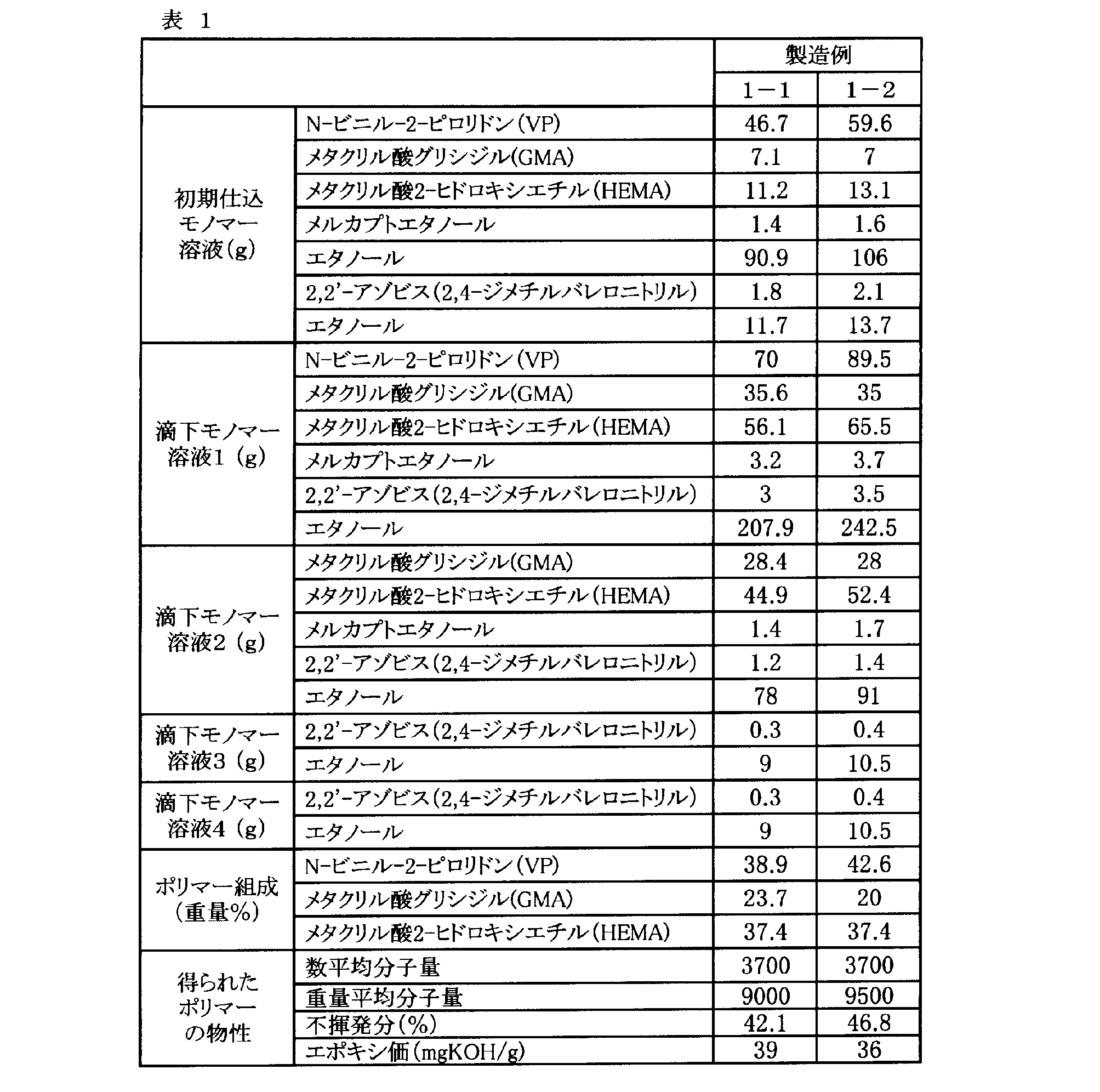
製造例2-1〔片末端カルボン酸型ポリメタクリル酸ベンジル(側鎖)の合成〕
還流冷却器、温度計、窒素ガス導入管及び攪拌装置を取り付けたセパラブルフラスコに、メタクリル酸ベンジル80g、3-メルカプトプロピオン酸(連鎖移動剤)3.2g、ジエチレングリコールモノブチルエーテルアセテート(以下、「DGMBA」という)40gを仕込み、窒素置換したあと、80℃で攪拌しながら、メタクリル酸ベンジル320g、3-メルカプトプロピオン酸12.8g、DGMBA160g、2,2'-アゾビス(2,4-ジメチルバレロニトリル)(重合開始剤)3.2gを3時間かけて滴下した。更に1時間、80℃で攪拌後、前記重合開始剤3.2g、3-メルカプトプロピオン酸1.44g、DGMBA160gを加えた。更に、80℃で2時間攪拌し、末端カルボン酸型ポリメタクリル酸メチル溶液を得た。溶液の酸価は12mgKOH/gであり、ゲル浸透クロマトグラフィーにより求めた数平均分子量は2100、重量平均分子量は3900(ポリスチレン換算)、不揮発分は53%であった。
還流冷却器、温度計、窒素ガス導入管及び攪拌装置を取り付けたセパラブルフラスコに、メタクリル酸ベンジル80g、3-メルカプトプロピオン酸(連鎖移動剤)3.2g、ジエチレングリコールモノブチルエーテルアセテート(以下、「DGMBA」という)40gを仕込み、窒素置換したあと、80℃で攪拌しながら、メタクリル酸ベンジル320g、3-メルカプトプロピオン酸12.8g、DGMBA160g、2,2'-アゾビス(2,4-ジメチルバレロニトリル)(重合開始剤)3.2gを3時間かけて滴下した。更に1時間、80℃で攪拌後、前記重合開始剤3.2g、3-メルカプトプロピオン酸1.44g、DGMBA160gを加えた。更に、80℃で2時間攪拌し、末端カルボン酸型ポリメタクリル酸メチル溶液を得た。溶液の酸価は12mgKOH/gであり、ゲル浸透クロマトグラフィーにより求めた数平均分子量は2100、重量平均分子量は3900(ポリスチレン換算)、不揮発分は53%であった。
製造例3-1〔エポキシ基とカルボン酸のカップリング反応によるグラフトポリマーの製造〕
還流冷却器、温度計、及び攪拌装置を取り付けたセパラブルフラスコに製造例1-1のポリマー溶液71.3g、製造例2-1のポリマー溶液164.7g、DGMBA 46.2g、エタノール92.2g、テトラブチルアンモニウムブロマイド(TBAB)(触媒)2.7gを仕込み、90℃で13時間攪拌した。冷却後、エバポレーターにて(バス温63℃、圧力11kPa)、エタノールを留去し、ポリ(HEMA-VP-BzMA)溶液を得た。エタノール留去前の溶液の酸価は0.2mgKOH/gであった(反応率98%)。ゲル浸透クロマトグラフィーにより求めた数平均分子量は6700、重量平均分子量は28000(ポリスチレン換算)であり、不揮発分は50%であった。計算によるポリマー組成と合わせて、結果を表2に示す。
還流冷却器、温度計、及び攪拌装置を取り付けたセパラブルフラスコに製造例1-1のポリマー溶液71.3g、製造例2-1のポリマー溶液164.7g、DGMBA 46.2g、エタノール92.2g、テトラブチルアンモニウムブロマイド(TBAB)(触媒)2.7gを仕込み、90℃で13時間攪拌した。冷却後、エバポレーターにて(バス温63℃、圧力11kPa)、エタノールを留去し、ポリ(HEMA-VP-BzMA)溶液を得た。エタノール留去前の溶液の酸価は0.2mgKOH/gであった(反応率98%)。ゲル浸透クロマトグラフィーにより求めた数平均分子量は6700、重量平均分子量は28000(ポリスチレン換算)であり、不揮発分は50%であった。計算によるポリマー組成と合わせて、結果を表2に示す。
製造例3-2~3-3〔エポキシ基とカルボン酸のカップリング反応によるグラフトポリマーの製造〕
製造例3-1において、表2に示す条件に変えた以外は、製造例3-1と同様の操作を行い、ポリマーを得た。結果を表2に示す。
製造例3-1において、表2に示す条件に変えた以外は、製造例3-1と同様の操作を行い、ポリマーを得た。結果を表2に示す。
比較製造例1-1〔片末端カルボン酸型ポリメタクリル酸メチル(側鎖)の合成〕
還流冷却器、温度計、窒素ガス導入管及び攪拌装置を取り付けたセパラブルフラスコに、メタクリル酸メチル700g、3-メルカプトプロピオン酸49.77g、ジエチレングリコールモノブチルエーテルアセテート(以下、「DGMBA」という)350gを仕込み、窒素置換したあと、75℃で攪拌しながら、メタクリル酸メチル2800g、3-メルカプトプロピオン酸199.1g、DGMBA 1400g、2,2'-アゾビス(2,4-ジメチルバレロニトリル)28gを3時間かけて滴下した。更に前記重合開始剤28g、3-メルカプトプロピオン酸12.6g、DGMBA 1400gを1時間かけて滴下した。更に、75℃で2時間攪拌し、目的のポリマー溶液を得た。溶液の酸価は20mgKOH/gであり、ゲル浸透クロマトグラフィーにより求めた数平均分子量は1700、重量平均分子量は3000(ポリスチレン換算)、不揮発分は53%であった。
比較製造例2-1〔エポキシ基とカルボン酸のカップリング反応によるグラフトポリマーの製造〕
製造例3-1において、表2に示す条件に変えた以外は、製造例3-1と同様の操作を行い、ポリマーを得た。結果を表2に示す。
還流冷却器、温度計、窒素ガス導入管及び攪拌装置を取り付けたセパラブルフラスコに、メタクリル酸メチル700g、3-メルカプトプロピオン酸49.77g、ジエチレングリコールモノブチルエーテルアセテート(以下、「DGMBA」という)350gを仕込み、窒素置換したあと、75℃で攪拌しながら、メタクリル酸メチル2800g、3-メルカプトプロピオン酸199.1g、DGMBA 1400g、2,2'-アゾビス(2,4-ジメチルバレロニトリル)28gを3時間かけて滴下した。更に前記重合開始剤28g、3-メルカプトプロピオン酸12.6g、DGMBA 1400gを1時間かけて滴下した。更に、75℃で2時間攪拌し、目的のポリマー溶液を得た。溶液の酸価は20mgKOH/gであり、ゲル浸透クロマトグラフィーにより求めた数平均分子量は1700、重量平均分子量は3000(ポリスチレン換算)、不揮発分は53%であった。
比較製造例2-1〔エポキシ基とカルボン酸のカップリング反応によるグラフトポリマーの製造〕
製造例3-1において、表2に示す条件に変えた以外は、製造例3-1と同様の操作を行い、ポリマーを得た。結果を表2に示す。
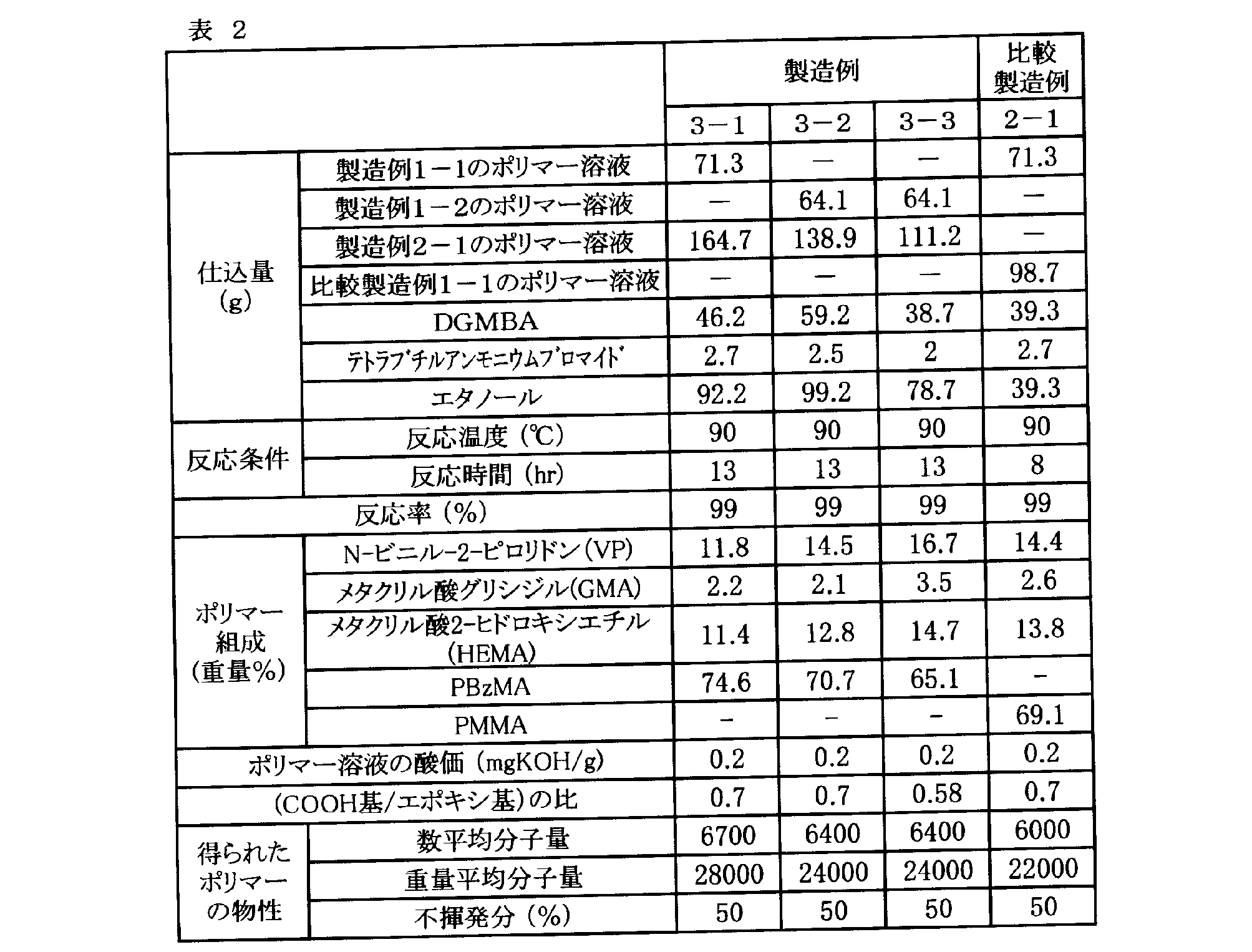
(II.マクロモノマー法によるグラフトポリマーの合成)
比較製造例3-1(片末端メタクリロイル型ポリメタクリル酸ベンジルの合成)
製造例2-1と同様にして得られた末端カルボン酸型ポリメタクリル酸ベンジル溶液450g、メタクリル酸グリシジル(GMA)13.9g、テトラブチルアンモニウムブロマイド(TBAB)(触媒)4.7g、メトキシフェノール0.5g、DGMBA10gを、還流冷却器、温度計、空気導入管、攪拌装置を取り付けた4つ口フラスコに仕込み、空気バブリングを行いながら、90℃で12時間攪拌し、片末端メタクリロイル化ポリメタクリル酸ベンジルを得た。90℃で12時間後の溶液の酸価は0.31mgKOH/gであった。GPCにより求めた数平均分子量は2200、重量平均分子量4000(ポリスチレン換算)であり、不揮発分は53%であった。
比較製造例3-1(片末端メタクリロイル型ポリメタクリル酸ベンジルの合成)
製造例2-1と同様にして得られた末端カルボン酸型ポリメタクリル酸ベンジル溶液450g、メタクリル酸グリシジル(GMA)13.9g、テトラブチルアンモニウムブロマイド(TBAB)(触媒)4.7g、メトキシフェノール0.5g、DGMBA10gを、還流冷却器、温度計、空気導入管、攪拌装置を取り付けた4つ口フラスコに仕込み、空気バブリングを行いながら、90℃で12時間攪拌し、片末端メタクリロイル化ポリメタクリル酸ベンジルを得た。90℃で12時間後の溶液の酸価は0.31mgKOH/gであった。GPCにより求めた数平均分子量は2200、重量平均分子量4000(ポリスチレン換算)であり、不揮発分は53%であった。
比較製造例4-1〔マクロモノマー法によるポリ(HEMA-VP-BzMA)の製造〕
還流冷却器、温度計、窒素導入管、攪拌装置を取り付けたセパラブルフラスコにVP5.2g、HEMA1.2g、比較製造例3-1のポリマー溶液14.15g、DGMBA23.64gを仕込み、窒素置換を行った。77℃で攪拌しながら、2,2’-アゾビス(2,4-ジメチルバレロニトリル)(和光純薬工業株式会社製、アゾ系重合開始剤、商品名:V-65)0.6gをDGMBA3.9gに溶解した液を添加した。
77℃で攪拌しながら、VP 7.8g、HEMA 6.0g、比較製造例3-1のポリマー溶液70.75g、前記重合開始剤1g、DGMBA 36gを混合した溶液を、90分かけて滴下した。
滴下終了した後に更に、HEMA 4.8g、前記重合開始剤0.40gを混合した溶液を3時間かけて滴下した。更に前記重合開始剤0.1gとDGMBA 3gを加えて77℃で1時間攪拌した。更に前記重合開始剤0.1gとDGMBA 3gを加えて77℃で1時間攪拌した。その後冷却し、ポリ(HEMA-VP-BzMA)のDGMBA溶液を得た。ゲル浸透クロマトグラフィーにより求めた数平均分子量は8800、重量平均分子量は42900(ポリスチレン換算)であり、不揮発分は40%であった。
還流冷却器、温度計、窒素導入管、攪拌装置を取り付けたセパラブルフラスコにVP5.2g、HEMA1.2g、比較製造例3-1のポリマー溶液14.15g、DGMBA23.64gを仕込み、窒素置換を行った。77℃で攪拌しながら、2,2’-アゾビス(2,4-ジメチルバレロニトリル)(和光純薬工業株式会社製、アゾ系重合開始剤、商品名:V-65)0.6gをDGMBA3.9gに溶解した液を添加した。
77℃で攪拌しながら、VP 7.8g、HEMA 6.0g、比較製造例3-1のポリマー溶液70.75g、前記重合開始剤1g、DGMBA 36gを混合した溶液を、90分かけて滴下した。
滴下終了した後に更に、HEMA 4.8g、前記重合開始剤0.40gを混合した溶液を3時間かけて滴下した。更に前記重合開始剤0.1gとDGMBA 3gを加えて77℃で1時間攪拌した。更に前記重合開始剤0.1gとDGMBA 3gを加えて77℃で1時間攪拌した。その後冷却し、ポリ(HEMA-VP-BzMA)のDGMBA溶液を得た。ゲル浸透クロマトグラフィーにより求めた数平均分子量は8800、重量平均分子量は42900(ポリスチレン換算)であり、不揮発分は40%であった。
実施例1
(1)顔料分散組成物(A)の製造
C.I.ピグメントレッド254(東洋インキ株式会社製、LIONOGEN RED LX-8318)20g、製造例3―1のポリマー溶液60g(ポリマーとして30g)、ジエチレングリコールモノブチルエーテルアセテート120gを直径0.3mmのジルコニアビーズ400gと一緒に500ccのポリ瓶に量り、ペイントシェーカー(浅田鉄工株式会社製)で3時間振とうし、金網でジルコニアビーズを濾過し、予備分散体を得た。更に得られた予備分散体100gを直径0.05mmのジルコニアビーズ100gと一緒に250ccのポリ瓶に量り、48時間振とうした。金網でジルコニアビーズを濾過し、顔料分散組成物(A)を得た。
(2)顔料分散組成物(B)の製造
上記(1)で得られた顔料分散組成物(A)を、遠心分離機(日立工機株式会社製、商品名:himac CP56G)を用いて、25000rpmで24時間遠心分離し上澄みを除去した。顔料濃度が12%となるようにジエチレングリコールモノブチルエーテルアセテートを加え、超音波により再分散させることで顔料分散組成物(B)を得た。
(1)顔料分散組成物(A)の製造
C.I.ピグメントレッド254(東洋インキ株式会社製、LIONOGEN RED LX-8318)20g、製造例3―1のポリマー溶液60g(ポリマーとして30g)、ジエチレングリコールモノブチルエーテルアセテート120gを直径0.3mmのジルコニアビーズ400gと一緒に500ccのポリ瓶に量り、ペイントシェーカー(浅田鉄工株式会社製)で3時間振とうし、金網でジルコニアビーズを濾過し、予備分散体を得た。更に得られた予備分散体100gを直径0.05mmのジルコニアビーズ100gと一緒に250ccのポリ瓶に量り、48時間振とうした。金網でジルコニアビーズを濾過し、顔料分散組成物(A)を得た。
(2)顔料分散組成物(B)の製造
上記(1)で得られた顔料分散組成物(A)を、遠心分離機(日立工機株式会社製、商品名:himac CP56G)を用いて、25000rpmで24時間遠心分離し上澄みを除去した。顔料濃度が12%となるようにジエチレングリコールモノブチルエーテルアセテートを加え、超音波により再分散させることで顔料分散組成物(B)を得た。
実施例2~3及び比較例1
実施例1において、用いたポリマーを表3に示すものに変えた以外は、実施例1と同様の操作を行い、顔料分散組成物(A)及び(B)を得た.
比較例2
実施例1において、用いたポリマーを表3に示すものに変え、ポリマー溶液の添加量を75gに変え、ジエチレングリコールモノブチルエーテルアセテートの添加量を105gに変えた以外は、実施例1と同様の操作を行い、顔料分散組成物(A)及び(B)を得た。
実施例1において、用いたポリマーを表3に示すものに変えた以外は、実施例1と同様の操作を行い、顔料分散組成物(A)及び(B)を得た.
比較例2
実施例1において、用いたポリマーを表3に示すものに変え、ポリマー溶液の添加量を75gに変え、ジエチレングリコールモノブチルエーテルアセテートの添加量を105gに変えた以外は、実施例1と同様の操作を行い、顔料分散組成物(A)及び(B)を得た。
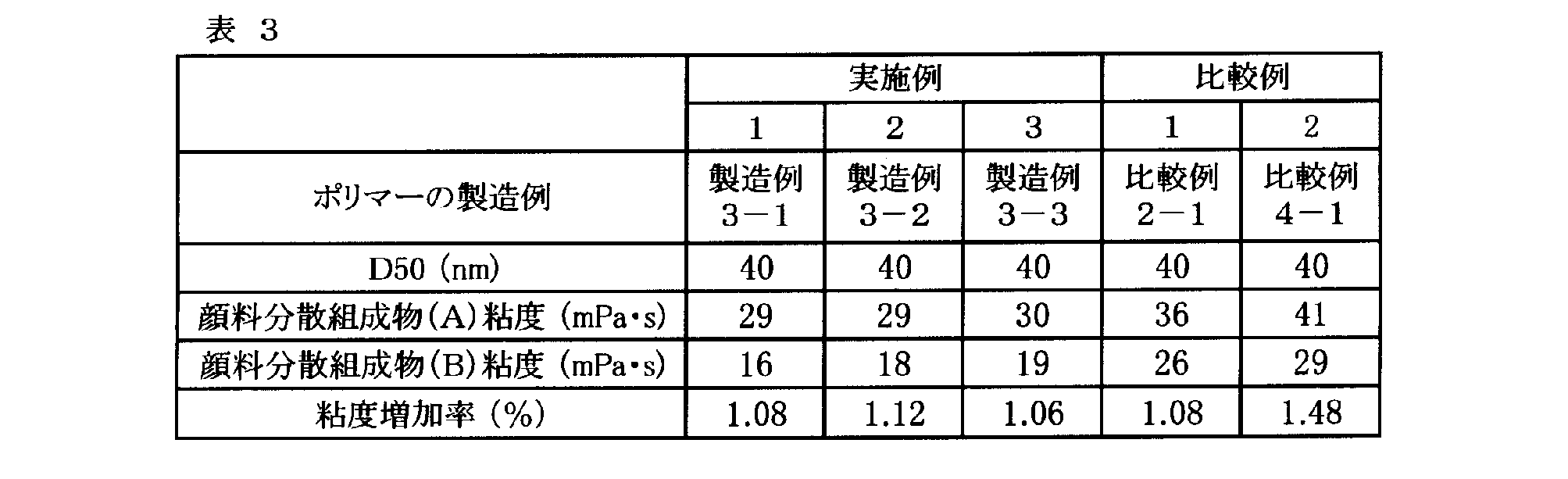
表3から、実施例1~3の顔料分散組成物は、比較例1、2の顔料分散組成物に比べて、分散安定性(粘度増加率)は同等又はそれ以上であり、粘度が低く、カラーフィルターの製造工程におけるハンドリング性や塗工性に優れることが分かる。
本発明によれば、粘度が低く、ハンドリング性や塗工性に優れ、分散安定性にも優れた非水系顔料分散組成物、及び非水系顔料分散用グラフトポリマー(C)の製造方法を提供することができる。
本発明の非水系顔料分散組成物は、粘度が低く、カラーフィルターの製造工程におけるハンドリング性や塗工性に優れ、分散安定性にも優れているため、液晶表示素子や固体撮像素子等のカラーフィルター用色材として好適に使用することができる。
本発明の非水系顔料分散組成物は、粘度が低く、カラーフィルターの製造工程におけるハンドリング性や塗工性に優れ、分散安定性にも優れているため、液晶表示素子や固体撮像素子等のカラーフィルター用色材として好適に使用することができる。
Claims (12)
- 顔料(A)、非水系溶媒(B)、及び下記の主鎖と側鎖を含むグラフトポリマー(C)を含有し、該グラフトポリマー(C)が該主鎖と該側鎖とをカップリング反応させることにより得られるものである、非水系顔料分散組成物。
主鎖:窒素原子を含有するビニルモノマー(a)由来の構成単位と反応性官能基を含有するビニルモノマー(d)由来の構成単位を含む共重合体
側鎖:ベンゼン環を含有する(メタ)アクリル酸エステル(b)由来の構成単位を含み、片末端に主鎖の反応性官能基と反応しうる官能基を有する共重合体 - 主鎖中の反応性官能基がエポキシ基であり、該エポキシ基と反応しうる側鎖中の官能基がヒドロキシル基、カルボキシ基又はアミノ基である、請求項1に記載の非水系顔料分散組成物。
- 反応性官能基を含有するビニルモノマー(d)がグリシジル基を有する(メタ)アクリル酸エステルである、請求項1又は2に記載の非水系顔料分散組成物。
- 窒素原子を含有するビニルモノマー(a)がN-ビニルピロリドンである、請求項1~3のいずれかに記載の非水系顔料分散組成物。
- ベンゼン環を含有する(メタ)アクリル酸エステル(b)が(メタ)アクリル酸ベンジルである、請求項1~4のいずれかに記載の非水系顔料分散組成物。
- グラフトポリマー(C)の全構成単位中の側鎖由来の構成単位の含有量が30~95重量%である、請求項1~5のいずれかに記載の非水系顔料分散組成物。
- グラフトポリマー(C)が、更にアルコール性水酸基を含有するビニルモノマー由来の構成単位を含む、請求項1~6のいずれかに記載の非水系顔料分散組成物。
- グラフトポリマー(C)の主鎖が、窒素原子を含有するビニルモノマー(a)由来の構成単位と反応性官能基を含有するビニルモノマー(d)由来の構成単位と、更にアルコール性水酸基を含有するビニルモノマー(e)由来の構成単位を含む共重合体である、請求項1~7のいずれかに記載の非水系顔料分散組成物。
- 顔料(A)、非水系溶媒(B)、及びグラフトポリマー(C)を混合・分散処理した後に、遠心分離処理及び/又はろ過処理して得られたものである請求項1~8のいずれかに記載の非水系顔料分散組成物。
- 下記工程(I)及び(II)を有する、非水系顔料分散用グラフトポリマー(C)の製造方法。
工程(I):窒素原子を含有するビニルモノマー(a)と反応性官能基を含有するビニルモノマー(d)とを反応させて、該ビニルモノマー(a)及び(d)由来の構成単位を含む共重合体を製造する工程
工程(II):工程(I)で得られた共重合体と、ベンゼン環を含有する(メタ)アクリル酸エステル(b)由来の構成単位を含み、片末端に主鎖の反応性官能基と反応しうる官能基を有する共重合体とをカップリング反応させて、該(メタ)アクリル酸エステル(b)由来の構成単位が、該共重合体にグラフト結合したグラフトポリマーを製造する工程 - 前記工程(I)が、窒素原子を含有するビニルモノマー(a)と、反応性官能基を含有するビニルモノマー(d)と、更にアルコール性水酸基を含有するビニルモノマー(e)とを反応させて、該ビニルモノマー(a)、(d)及び(e)由来の構成単位を含む共重合体を製造する工程である、請求項10に記載の製造方法。
- 請求項1に記載の非水系顔料分散組成物のカラーフィルター用色材としての使用。
Applications Claiming Priority (2)
| Application Number | Priority Date | Filing Date | Title |
|---|---|---|---|
| JP2009109537 | 2009-04-28 | ||
| JP2009-109537 | 2009-04-28 |
Publications (1)
| Publication Number | Publication Date |
|---|---|
| WO2010125979A1 true WO2010125979A1 (ja) | 2010-11-04 |
Family
ID=43032131
Family Applications (1)
| Application Number | Title | Priority Date | Filing Date |
|---|---|---|---|
| PCT/JP2010/057269 Ceased WO2010125979A1 (ja) | 2009-04-28 | 2010-04-23 | 非水系顔料分散組成物 |
Country Status (3)
| Country | Link |
|---|---|
| JP (1) | JP5612899B2 (ja) |
| TW (1) | TW201100498A (ja) |
| WO (1) | WO2010125979A1 (ja) |
Cited By (1)
| Publication number | Priority date | Publication date | Assignee | Title |
|---|---|---|---|---|
| JP2015138049A (ja) * | 2014-01-20 | 2015-07-30 | 東洋インキScホールディングス株式会社 | カラーフィルタ用顔料分散体の製造方法、カラーフィルタ用顔料分散体およびカラーフィルタ |
Families Citing this family (4)
| Publication number | Priority date | Publication date | Assignee | Title |
|---|---|---|---|---|
| JP5584585B2 (ja) * | 2010-10-19 | 2014-09-03 | 花王株式会社 | グラフトポリマー |
| JP5938177B2 (ja) * | 2011-08-04 | 2016-06-22 | 花王株式会社 | カラーフィルター用顔料分散体の製造方法 |
| CN104285167B (zh) * | 2012-07-12 | 2017-03-01 | 花王株式会社 | 滤色器用颜料分散体及其制造方法和用途、滤色器用着色组合物及其用途、滤色器 |
| JP6119763B2 (ja) | 2012-10-15 | 2017-04-26 | 大日本印刷株式会社 | 導電性基板用金属粒子分散体及びその製造方法、並びに導電性基板の製造方法 |
Citations (8)
| Publication number | Priority date | Publication date | Assignee | Title |
|---|---|---|---|---|
| JP2000234007A (ja) * | 1999-02-15 | 2000-08-29 | Fuji Photo Film Co Ltd | 顔料分散剤、それを含む顔料分散組成物及び着色感光性組成物 |
| JP2006225431A (ja) * | 2005-02-15 | 2006-08-31 | Sakata Corp | カルボジイミド系化合物及びそれを用いた顔料分散組成物の製造方法 |
| JP2007314771A (ja) * | 2006-04-28 | 2007-12-06 | Kao Corp | 顔料分散体 |
| JP2008179750A (ja) * | 2006-12-27 | 2008-08-07 | Kao Corp | 非水系顔料分散組成物 |
| WO2009054437A1 (ja) * | 2007-10-26 | 2009-04-30 | Kao Corporation | 非水系顔料分散組成物 |
| JP2009126915A (ja) * | 2007-11-21 | 2009-06-11 | Toyo Ink Mfg Co Ltd | インクジェットインキ組成物 |
| JP2009132747A (ja) * | 2007-11-02 | 2009-06-18 | Toyo Ink Mfg Co Ltd | グラフト型分散剤、及びそれを用いた顔料組成物 |
| JP2009149803A (ja) * | 2007-12-21 | 2009-07-09 | Toyo Ink Mfg Co Ltd | グラフト型分散剤、及びそれを用いた顔料組成物 |
Family Cites Families (1)
| Publication number | Priority date | Publication date | Assignee | Title |
|---|---|---|---|---|
| JP4866621B2 (ja) * | 2006-02-08 | 2012-02-01 | 花王株式会社 | 顔料分散体 |
-
2010
- 2010-04-23 WO PCT/JP2010/057269 patent/WO2010125979A1/ja not_active Ceased
- 2010-04-23 JP JP2010099792A patent/JP5612899B2/ja active Active
- 2010-04-26 TW TW99113111A patent/TW201100498A/zh unknown
Patent Citations (8)
| Publication number | Priority date | Publication date | Assignee | Title |
|---|---|---|---|---|
| JP2000234007A (ja) * | 1999-02-15 | 2000-08-29 | Fuji Photo Film Co Ltd | 顔料分散剤、それを含む顔料分散組成物及び着色感光性組成物 |
| JP2006225431A (ja) * | 2005-02-15 | 2006-08-31 | Sakata Corp | カルボジイミド系化合物及びそれを用いた顔料分散組成物の製造方法 |
| JP2007314771A (ja) * | 2006-04-28 | 2007-12-06 | Kao Corp | 顔料分散体 |
| JP2008179750A (ja) * | 2006-12-27 | 2008-08-07 | Kao Corp | 非水系顔料分散組成物 |
| WO2009054437A1 (ja) * | 2007-10-26 | 2009-04-30 | Kao Corporation | 非水系顔料分散組成物 |
| JP2009132747A (ja) * | 2007-11-02 | 2009-06-18 | Toyo Ink Mfg Co Ltd | グラフト型分散剤、及びそれを用いた顔料組成物 |
| JP2009126915A (ja) * | 2007-11-21 | 2009-06-11 | Toyo Ink Mfg Co Ltd | インクジェットインキ組成物 |
| JP2009149803A (ja) * | 2007-12-21 | 2009-07-09 | Toyo Ink Mfg Co Ltd | グラフト型分散剤、及びそれを用いた顔料組成物 |
Cited By (1)
| Publication number | Priority date | Publication date | Assignee | Title |
|---|---|---|---|---|
| JP2015138049A (ja) * | 2014-01-20 | 2015-07-30 | 東洋インキScホールディングス株式会社 | カラーフィルタ用顔料分散体の製造方法、カラーフィルタ用顔料分散体およびカラーフィルタ |
Also Published As
| Publication number | Publication date |
|---|---|
| JP5612899B2 (ja) | 2014-10-22 |
| JP2010275536A (ja) | 2010-12-09 |
| TW201100498A (en) | 2011-01-01 |
Similar Documents
| Publication | Publication Date | Title |
|---|---|---|
| CN101835843B (zh) | 非水系颜料分散组合物 | |
| JP5223082B2 (ja) | 顔料分散液、ブロックポリマーおよびその製造方法 | |
| JP5612899B2 (ja) | 非水系顔料分散組成物 | |
| JP2009161692A (ja) | カラーフィルター用顔料分散体 | |
| JP5280791B2 (ja) | カラーフィルター用顔料分散体 | |
| WO2007119462A1 (ja) | 非水系顔料分散組成物 | |
| JP5529508B2 (ja) | 非水系顔料分散体の製造方法 | |
| JP5037045B2 (ja) | 非水系顔料分散組成物 | |
| WO2015008734A1 (ja) | カラーフィルター用着色組成物 | |
| JP5134260B2 (ja) | 非水系顔料分散組成物 | |
| JP5820714B2 (ja) | カラーフィルター用顔料分散体 | |
| WO2014104289A1 (ja) | カラーフィルター用顔料分散体 | |
| JP5584585B2 (ja) | グラフトポリマー | |
| JP6373813B2 (ja) | カラーフィルター用着色剤組成物及び顔料分散剤の製造方法 | |
| JP2012098381A (ja) | カラーフィルター用赤色顔料分散体 | |
| JP7148488B2 (ja) | 顔料分散剤、顔料分散剤の製造方法、及び顔料分散液 | |
| JP5480584B2 (ja) | カラーフィルター用顔料分散体 | |
| JP5820715B2 (ja) | カラーフィルター用顔料分散体 | |
| JP2009161691A (ja) | カラーフィルター用顔料分散体 | |
| JP5576242B2 (ja) | カラーフィルター用顔料分散体の製造方法 | |
| JP2010138350A (ja) | 非水系顔料分散体の製造方法 | |
| JP5364321B2 (ja) | カラーフィルター用顔料分散体の製造方法 | |
| JP4963031B2 (ja) | 非水系顔料分散剤 | |
| JP5255363B2 (ja) | カラーフィルター用顔料分散体の製造方法 | |
| JP5820693B2 (ja) | カラーフィルター用顔料分散体の製造方法 |
Legal Events
| Date | Code | Title | Description |
|---|---|---|---|
| 121 | Ep: the epo has been informed by wipo that ep was designated in this application |
Ref document number: 10769678 Country of ref document: EP Kind code of ref document: A1 |
|
| NENP | Non-entry into the national phase |
Ref country code: DE |
|
| 122 | Ep: pct application non-entry in european phase |
Ref document number: 10769678 Country of ref document: EP Kind code of ref document: A1 |