WO2010117013A1 - 画素形成インク用着色組成物、顔料分散液、画素形成用インク、カラーフィルターおよびそれらの製造方法 - Google Patents
画素形成インク用着色組成物、顔料分散液、画素形成用インク、カラーフィルターおよびそれらの製造方法 Download PDFInfo
- Publication number
- WO2010117013A1 WO2010117013A1 PCT/JP2010/056305 JP2010056305W WO2010117013A1 WO 2010117013 A1 WO2010117013 A1 WO 2010117013A1 JP 2010056305 W JP2010056305 W JP 2010056305W WO 2010117013 A1 WO2010117013 A1 WO 2010117013A1
- Authority
- WO
- WIPO (PCT)
- Prior art keywords
- pigment
- color
- pixel
- aqueous
- paste
- Prior art date
- Legal status (The legal status is an assumption and is not a legal conclusion. Google has not performed a legal analysis and makes no representation as to the accuracy of the status listed.)
- Ceased
Links
Classifications
-
- C—CHEMISTRY; METALLURGY
- C09—DYES; PAINTS; POLISHES; NATURAL RESINS; ADHESIVES; COMPOSITIONS NOT OTHERWISE PROVIDED FOR; APPLICATIONS OF MATERIALS NOT OTHERWISE PROVIDED FOR
- C09B—ORGANIC DYES OR CLOSELY-RELATED COMPOUNDS FOR PRODUCING DYES, e.g. PIGMENTS; MORDANTS; LAKES
- C09B67/00—Influencing the physical, e.g. the dyeing or printing properties of dyestuffs without chemical reactions, e.g. by treating with solvents grinding or grinding assistants, coating of pigments or dyes; Process features in the making of dyestuff preparations; Dyestuff preparations of a special physical nature, e.g. tablets, films
- C09B67/0071—Process features in the making of dyestuff preparations; Dehydrating agents; Dispersing agents; Dustfree compositions
- C09B67/008—Preparations of disperse dyes or solvent dyes
-
- C—CHEMISTRY; METALLURGY
- C09—DYES; PAINTS; POLISHES; NATURAL RESINS; ADHESIVES; COMPOSITIONS NOT OTHERWISE PROVIDED FOR; APPLICATIONS OF MATERIALS NOT OTHERWISE PROVIDED FOR
- C09B—ORGANIC DYES OR CLOSELY-RELATED COMPOUNDS FOR PRODUCING DYES, e.g. PIGMENTS; MORDANTS; LAKES
- C09B67/00—Influencing the physical, e.g. the dyeing or printing properties of dyestuffs without chemical reactions, e.g. by treating with solvents grinding or grinding assistants, coating of pigments or dyes; Process features in the making of dyestuff preparations; Dyestuff preparations of a special physical nature, e.g. tablets, films
- C09B67/0071—Process features in the making of dyestuff preparations; Dehydrating agents; Dispersing agents; Dustfree compositions
- C09B67/0084—Dispersions of dyes
- C09B67/0085—Non common dispersing agents
- C09B67/009—Non common dispersing agents polymeric dispersing agent
-
- C—CHEMISTRY; METALLURGY
- C09—DYES; PAINTS; POLISHES; NATURAL RESINS; ADHESIVES; COMPOSITIONS NOT OTHERWISE PROVIDED FOR; APPLICATIONS OF MATERIALS NOT OTHERWISE PROVIDED FOR
- C09D—COATING COMPOSITIONS, e.g. PAINTS, VARNISHES OR LACQUERS; FILLING PASTES; CHEMICAL PAINT OR INK REMOVERS; INKS; CORRECTING FLUIDS; WOODSTAINS; PASTES OR SOLIDS FOR COLOURING OR PRINTING; USE OF MATERIALS THEREFOR
- C09D11/00—Inks
- C09D11/02—Printing inks
- C09D11/10—Printing inks based on artificial resins
- C09D11/101—Inks specially adapted for printing processes involving curing by wave energy or particle radiation, e.g. with UV-curing following the printing
-
- C—CHEMISTRY; METALLURGY
- C09—DYES; PAINTS; POLISHES; NATURAL RESINS; ADHESIVES; COMPOSITIONS NOT OTHERWISE PROVIDED FOR; APPLICATIONS OF MATERIALS NOT OTHERWISE PROVIDED FOR
- C09D—COATING COMPOSITIONS, e.g. PAINTS, VARNISHES OR LACQUERS; FILLING PASTES; CHEMICAL PAINT OR INK REMOVERS; INKS; CORRECTING FLUIDS; WOODSTAINS; PASTES OR SOLIDS FOR COLOURING OR PRINTING; USE OF MATERIALS THEREFOR
- C09D11/00—Inks
- C09D11/30—Inkjet printing inks
- C09D11/32—Inkjet printing inks characterised by colouring agents
- C09D11/322—Pigment inks
-
- C—CHEMISTRY; METALLURGY
- C09—DYES; PAINTS; POLISHES; NATURAL RESINS; ADHESIVES; COMPOSITIONS NOT OTHERWISE PROVIDED FOR; APPLICATIONS OF MATERIALS NOT OTHERWISE PROVIDED FOR
- C09D—COATING COMPOSITIONS, e.g. PAINTS, VARNISHES OR LACQUERS; FILLING PASTES; CHEMICAL PAINT OR INK REMOVERS; INKS; CORRECTING FLUIDS; WOODSTAINS; PASTES OR SOLIDS FOR COLOURING OR PRINTING; USE OF MATERIALS THEREFOR
- C09D17/00—Pigment pastes, e.g. for mixing in paints
- C09D17/003—Pigment pastes, e.g. for mixing in paints containing an organic pigment
-
- G—PHYSICS
- G02—OPTICS
- G02B—OPTICAL ELEMENTS, SYSTEMS OR APPARATUS
- G02B5/00—Optical elements other than lenses
- G02B5/20—Filters
- G02B5/201—Filters in the form of arrays
-
- G—PHYSICS
- G03—PHOTOGRAPHY; CINEMATOGRAPHY; ANALOGOUS TECHNIQUES USING WAVES OTHER THAN OPTICAL WAVES; ELECTROGRAPHY; HOLOGRAPHY
- G03F—PHOTOMECHANICAL PRODUCTION OF TEXTURED OR PATTERNED SURFACES, e.g. FOR PRINTING, FOR PROCESSING OF SEMICONDUCTOR DEVICES; MATERIALS THEREFOR; ORIGINALS THEREFOR; APPARATUS SPECIALLY ADAPTED THEREFOR
- G03F7/00—Photomechanical, e.g. photolithographic, production of textured or patterned surfaces, e.g. printing surfaces; Materials therefor, e.g. comprising photoresists; Apparatus specially adapted therefor
- G03F7/0005—Production of optical devices or components in so far as characterised by the lithographic processes or materials used therefor
- G03F7/0007—Filters, e.g. additive colour filters; Components for display devices
Definitions
- the present invention relates to a coloring composition for pixel forming ink, a pixel forming ink, a color filter, and methods for producing them.
- LCD color displays are used as information display members such as televisions, projectors, personal computers, mobile information devices, monitors, car navigation systems, mobile phones, electronic calculators and electronic dictionaries. It is widely used in various information display related devices such as information bulletin boards, information bulletin boards, displays such as function display boards and sign boards, and shooting screens of digital cameras and video cameras. As a result, color filters mounted on liquid crystal color displays are also required to have superior quality in terms of color characteristics and optical characteristics of image performance such as definition, color density, light transmission, and contrast. Yes.
- the color resist is an organic solvent-based composition, it cannot be used as an aqueous paste as a matter of course, so that the aqueous paste is dried and finely pulverized. Therefore, even if the primary particles are refined in advance in an ultra-fine process such as a salt milling process, the pigments are hardened by drying, causing strong secondary or higher-order aggregation (aggregation) and coarsening. Inevitable. It was very difficult to reduce the aggregates to the original primary particles during the dispersion process.
- Patent Document 1 Patent Document 2, and Patent Document 3, in order to prepare a resist ink used for a color filter, the average particle diameter of primary particles is 0 by salt milling a pigment together with a pigment derivative. 0.03 ⁇ m pigment is produced. It has also been proposed to flush the wet cake of pigment with an organic solvent or a binder resin. However, even after flushing, the pigment is finely aggregated (flocculated), and it is not intended to return it to the state of primary particles. In the examples, the salt milled fine pigment is dried. However, it is not sufficient from the viewpoint of pulverizing and using the pigment aggregate in a primary particle state to exhibit sufficient performance as a pixel of a color filter.
- the pigment when the pigment is ground by the impact force of media such as zirconia beads that rotate at high speed or vibrate in a media disperser, the pigment crystal collapses accordingly, and the stable type is metastable. It may cause phenomena such as shifting to a mold, or even partially shifting to an unstable or amorphous form. As a result, the physical properties of the dispersed pigment may be lowered and the color tone may be changed. Therefore, these pigments require means for restoring the crystals by, for example, relaxing the grinding conditions or, in some cases, aging after dispersion.
- the present inventors have now transferred a pigment that has been ultrafine in an aqueous phase from an aqueous composition to an organic medium phase without going through a drying step, and then the fine aggregate of the pigment in the organic medium phase is in a primary particle state. It was found that an organic solvent-based composition containing a pigment that substantially maintains the state of primary particles ultrafine in the aqueous phase can be obtained by redispersing in a water phase.
- the present invention is based on such knowledge. Therefore, the present invention can meet the demands of optical characteristics such as high density, high definition, and high contrast of the pixels required as a color filter installed in information display equipment such as liquid crystal color televisions.
- an object of the present invention is to provide a method for producing a coloring composition used for pixel forming ink of a color filter (CF). Furthermore, the object of the present invention is to provide a colored composition that can be obtained by the above production method. Another object of the present invention is to provide a pigment dispersion produced from the colored composition, a pigment ink for pixel formation, a color filter produced using the same, and a production method thereof.
- a method for producing a colored composition used in a CF pixel forming ink and the method is a method for producing a colored composition used in a CF pixel forming ink. And (a) preparing an aqueous pigment filter paste or aqueous slurry having an average particle diameter of the pigment of 5 to 100 nm, and (b) drying the pigment contained in the aqueous filter paste or aqueous slurry. Without passing, the water phase is transferred to an organic medium phase comprising an organic solvent medium or a molten resin medium, and then (c) the transferred pigment is finely dispersed to form a colored composition. .
- a coloring composition used for a CF pixel forming ink which can be obtained by the production method according to the present invention.
- a method for producing a pigment dispersion used in a CF pixel forming ink comprising adding a low molecular surfactant to the colored composition according to the present invention.
- One or more materials selected from the group consisting of a polymer-based dispersant, a film-forming material, and an organic solvent are added, mixed uniformly, and dispersed.
- a pigment dispersion used in a CF pixel forming ink which can be obtained by the production method according to the present invention.
- a method for producing a CF pixel forming ink comprising adding a low molecular surfactant, a polymeric dispersant, And at least one selected from the group consisting of film-forming materials and an organic solvent-based medium are added and mixed uniformly.
- a CF pixel forming ink is provided, which can be obtained by the manufacturing method according to the present invention.
- a CF manufacturing method and CF which are characterized in that the pixel is formed using the above-described CF pixel forming ink according to the present invention. Color filter.
- a colored composition containing an ultrafine pigment can be efficiently produced. Further, by using the pixel forming ink prepared by using the coloring composition obtained by the manufacturing method according to the present invention, optical properties such as high color density, high definition, high transparency, and high contrast of the pixel can be obtained. A color filter with improved mechanical properties can be obtained. In addition, a pixel display device equipped with this color filter has excellent performance in pixel characteristics such as high color density, high definition, high transparency, and high contrast.
- Step (a) This step is a step of preparing an aqueous pigment filter paste or aqueous slurry in which the average particle size of the pigment is 5 to 100 nm.
- the pigment to which the method according to the present invention is applied is a pigment that forms a CF pixel, and pigments such as red, green, blue or yellow, red, indigo, and intermediate colors such as orange and purple are used. Details of specific examples will be described later).
- the pigment is preferably as fine as possible in view of the optical demands of CF, such as sharpness, fineness, and contrast.
- the average particle diameter is 5 to 100 nm, preferably 5 to 50 nm, Preferably, it is 5 to 25 nm.
- Methods for measuring the average particle diameter of pigments include centrifugal sedimentation, light scattering, ultrasonic, image processing of pigment particle size in electron micrographs, and small-angle X-ray scattering.
- a particle size measuring instrument “Coulter Counter N-4” manufactured by Coulter, Inc.
- an electric resistance detection method is used to measure the average particle size of the dispersed pigment in the pigment dispersion.
- the aqueous filter paste or aqueous slurry of the pigment can be obtained by a conventionally known method suitable for the pigment used. Preferred examples thereof include the following (a-1) to (a-4).
- A-1) a salt milling method is preferably used as a method for forming ultrafine particles of a versatile pigment.
- the pigment to be ground by this method may be a pigment crude or a general purpose pigment, but a general purpose pigment having an average particle size of 10 ⁇ m to 0.5 ⁇ m is preferably used.
- water-soluble salts such as sodium chloride and sodium nitrate are added several times, preferably 4 to 10 times the amount of the pigment to be ground, and a viscous organic solvent such as diethylene glycol is added.
- A-2 As a method for obtaining an aqueous filter paste or aqueous slurry of a pigment, a method in which a pigment crude or general-purpose pigment is dissolved in a soluble liquid medium and precipitated in an insoluble liquid can also be used.
- a structurally stable pigment such as cyanine green pigment is dissolved in sulfuric acid or the like, finely precipitated in water or ice water, filtered and washed with water to obtain a pigment filtration paste or slurry. Furthermore, the crystal form may be adjusted as necessary.
- A-3 As another method, for azo pigments and the like, in the post-treatment step such as crystallization or the like, a temperature growth condition or treatment is added in a post-treatment step such as crystallization or the like in the synthesis step such as the coupling step. By adjusting the time, the growth of pigment particles can be suppressed by controlling the particle growth, and an aqueous filtration paste or aqueous slurry containing fine pigment particles can be obtained.
- vat dye-based pigments such as anthraquinone pigments, perinone / perylene pigments, indigo / thioindigo pigments, an alkaline aqueous solution with a reducing agent such as hydrosulfide
- a reducing agent such as hydrosulfide
- a polymeric dispersant particularly an ionic property such as a carboxyl group or a tertiary amino group.
- a solution or dispersion of a polymer-based dispersant having a group may be added, and the resulting fine particle pigment may be surface-treated with the polymer-based dispersant.
- Step (b) the pigment in the aqueous phase of the aqueous filtration paste or aqueous slurry obtained in the step (a) is transferred to an organic medium phase composed of an organic solvent-based medium or a molten resin-based medium.
- the following method is mentioned as the method.
- (B-1) A method of mixing an aqueous filter paste or aqueous slurry with an organic solvent having a boiling point higher than that of water, and distilling water in the presence of an organic solvent having a boiling point higher than that of water
- (B-2) A method of mixing an aqueous filter paste or aqueous slurry with an organic solvent having a boiling point higher than that of water, and simultaneously distilling off the water and the solvent in the presence of an organic solvent having a boiling point higher than that of water
- (B-3) A method of flushing an aqueous filter paste or aqueous slurry with an organic solvent and discharging moisture
- (B-4) A method of mixing the aqueous filter paste or aqueous slurry and the oil-in-water emulsion and transferring the pigment into the oil droplets of the emulsion to obtain a particulate material containing the pigment
- (B-5) A method of mixing an aqueous filtration paste or aqueous slurry with a
- the organic medium phase to which the pigment migrates means an organic solvent-based medium or a molten resin-based medium.
- the organic solvent-based medium include organic solvents having a boiling point higher than that of water used in the above steps (b-1) and (b-2), and preferred specific examples include petroleum solvent (for example, the main component is C8 to C10). ), Etc., aromatic solvents such as xylene and ethylbenzene, ester solvents such as butyl acetate, amyl acetate and ethyl lactate, glycol solvents such as ethylene glycol monoethyl ether acetate and ethylene glycol monobutyl ether acetate, etc. Is mentioned.
- the organic solvent-based medium may contain a resin, and as the resin, a resin component used in a color composition for a pixel forming ink of a color filter or a resin used for a pixel forming ink is used. Therefore, the resin used differs depending on the pixel forming method. As will be described later, a photosensitive resin varnish and a non-photosensitive resin varnish are used as the film forming material. In the case of a photosensitive resin, when a pixel is formed by a photolithography method or the like, a resin and a resin dispersant that do not interfere with photolithography are used.
- a polymer having a carboxylic acid group for development in an alkaline solution for example, benzyl methacrylate-methacrylic acid copolymer, benzyl methacrylate-styrene-methacrylic acid copolymer, benzyl methacrylate-hydroxypropyl Methacrylate-methacrylic acid copolymer, cyclohexyl methacrylate-hydroxypropyl methacrylate-methacrylic acid copolymer, polymethyl methacrylate macromonomer-methacrylic acid copolymer, polymethyl methacrylate macromonomer-hydroxypropyl methacrylate-methacrylic acid copolymer , Polybutyl acrylate macromonomer-benzyl methacrylate-methacrylic acid copolymer, polybutyl acrylate macromonomer-styrene-hydroxypropyl methacrylate Acrylate - like methacrylic acid copoly
- a non-photosensitive resin and a resin dispersant are used, and an acrylic polymer is non-reactive.
- Film-forming polymers or polymers having hydroxyl groups or carboxyl groups that can react with a crosslinking agent such as benzyl methacrylate-butyl methacrylate copolymer, benzyl methacrylate-styrene-butyl acrylate copolymer, benzyl methacrylate-ethyl methacrylate -Hydroxypropyl methacrylate copolymer, cyclohexyl methacrylate-hydroxypropyl methacrylate copolymer, polymethyl methacrylate macromonomer -Hydroxypropyl methacrylate copolymer, polybutyl acrylate macromonomer Styrene - hydroxypropyl methacrylate copolymers, polybutyl acrylate macromonomer - benzyl methacrylate - methacrylic acid copolymer, polybutyl acrylate macromonomer - styrene - hydroxy
- examples of the resin that can be used for resin flushing in the step (b-3) include the above-mentioned polymers, but according to a preferred embodiment, the flushing method differs depending on the melting temperature of the polymer used, and the resin melting When a resin having a temperature of 100 ° C. or lower, preferably 80 ° C. or lower is used, it is flushed at normal pressure, and a resin having a temperature of 100 ° C. or higher is also used for flushing in a closed system such as an extruder.
- a solvent that does not dissolve in water or substantially less is used as the organic solvent used for flushing.
- hydrocarbon solvents such as petroleum solvent, aromatic solvents such as xylol, ester solvents such as ethyl acetate and butyl acetate, ketone solvents such as diethyl ketone, ethylene glycol monobutyl ether acetate, diethylene glycol monobutyl ether acetate,
- Known solvents such as propylene glycol monomethyl ether acetate, propylene glycol monoethyl ether acetate, ethylene glycol dibutyl ether, diethylene glycol dibutyl ether, and propylene glycol dimethyl ether can be used, and these can be used alone or in combination. Can do.
- the order of addition of organic solvents, resin solutions, dispersion aids, smoothing agents, etc., the addition timing, or the divided addition of the charge amount, etc. take into account the properties of the materials and proceed with the flushing process. It is done appropriately according to. Depending on properties such as the boiling point and water solubility of the organic solvent, it is also preferable to add and mix after flushing.
- the emulsion used in the step (b-4) is an oil-in-water (O / W) type of a resin solution obtained by dissolving a hydrophobic organic solvent or the above-described resin dispersant or a film-forming resin described later in an organic solvent.
- the organic solvent used the organic solvent having substantially hydrophobicity mentioned in the step (b-3) is used.
- the resin used is a resin having a melting temperature of 100 ° C. or lower, preferably 80 ° C. or lower when flushing at normal pressure as described above.
- a resin having a melting temperature of 100 ° C. or higher is used depending on the heating condition of the extruder, but a resin having a melting temperature of 100 ° C. or lower, preferably 80 ° C. or lower is preferable.
- Step (b-6) is a method of evaporating moisture by heating.
- the resin used is, for example, the above-mentioned acrylic polymer, and the melting temperature is 100 ° C. or higher depending on the heating conditions of a kneader such as a roll. Although resin is also used, a resin of 100 ° C. or lower, preferably 80 ° C. or lower is preferable.
- the above steps (b-1) to (b-6) may be performed by a conventionally known apparatus.
- Specific examples include flashers, kneaders, reactors and mixing vessels equipped with a stirrer, roll kneaders and open roll continuous kneaders, continuous extrusion kneaders with water removal equipment, etc.
- a kneading device equipped with a heating device and a vacuum distillation device can be used. It may be implemented with one of these pigment transfer devices or a combination of a plurality of devices.
- the organic medium phase comprises a substantially hydrophobic organic solvent, a pigment dispersion functional polymer or oligomer, a film-forming polymer or oligomer, a crosslinking agent, a polymerizable macromolecule.
- a pigment dispersion functional polymer or oligomer e.g., a pigment dispersion functional polymer or oligomer
- a film-forming polymer or oligomer e.g., a crosslinking agent
- a polymerizable macromolecule e.g., a polymerizable polymer, polymerizable polymer, polymerizable polymer, a polymerizable macromolecule.
- One or two or more organic materials selected from the group consisting of monomers and polymerizable monomers are contained.
- Step (c) This step is a step of further finely dispersing the pigment transferred to the organic phase in the step (b). Since the primary particles of the pigment in the aqueous phase of the aqueous filter paste or aqueous slurry are hydrophobic fine particles, they tend to aggregate in the aqueous suspension and cause weak flocculation. Furthermore, it is easy to collect by the pressure of the filter press during filtration, and usually forms a weak aggregate or agglomeration. And it is easy to raise
- the following dispersion method is preferably used as the dispersion method in step (c).
- C-1 Horizontal and vertical medium (media) dispersers are used as the microbead medium (media) dispersers.
- the micro beads ceramic beads having an average particle diameter of 0.015 to 0.1 mm are preferable.
- C-2) An ultrasonic disperser is used. The frequency is not particularly limited, but is preferably about 15 to 50 kHz.
- These fine dispersion methods may be implemented by one type of method, or a plurality of methods may be combined.
- These dispersers are used as a means to loosen the weakly aggregated pigments as described above and improve the dispersion effect of the polymer dispersant, and thus break up the agglomerated particles used for dry pigment particles. There is no need for strong impact force and long-time dispersion.
- a weak force to the particles of the pigment aggregate (flocculation) body, the primary particle state of the individual pigments is loosened, and a liquid medium enters between the particles. As a result, the individual pigment particles are coated on the liquid medium, A stable dispersion of pigment.
- the kneader can loosen the aggregate with shear energy and weak impact energy and vibration energy.
- an ultrasonic disperser In particular, it is effective to use an ultrasonic disperser, and the effect of dispersion reaches the saturation point in a short time.
- the dispersion principle of an ultrasonic disperser is based on cavitation by an ultrasonic oscillator, so that the physical properties such as the crystallinity of the pigment are hardly deteriorated and the fastness is reduced. It can be done and is economical.
- This colored composition is usually obtained as a liquid, paste, moist or solid.
- Pigment Dispersion The colored composition obtained according to the present invention is used for producing a pigment dispersion. That is, one or more materials selected from the group consisting of a low molecular surfactant, a dispersant, a film-forming material and an organic solvent are added to the colored composition obtained by the present invention, and mixed and dispersed uniformly. Thus, a pigment dispersion used in the CF pixel forming ink is obtained.
- a known material is used as a dispersant added in the production of the pigment dispersion.
- pigment dispersants include low molecular surfactants for solvent systems, block copolymers having both a pigment-adsorptive parent pigment polymer chain segment and a solvent-soluble polymer chain segment, graft copolymers, and random Examples thereof include polymer dispersants such as copolymers.
- the low molecular surfactant used in the production of the pigment dispersion include known polyoxyethylene long chain alkyl (C 12 -C 18 ) ethers, polyethylene glycol mono higher fatty acid (C 11 -C 17 ) esters. Glycerol higher fatty acid ester, sorbitan higher fatty acid ester, polyoxyethylene long chain alkylamine and the like.
- the film forming material and the organic solvent used in the production of the pigment dispersion those described for the color filter described later are preferably used.
- a material that functions as a preservative stabilizer can be added in the production of the pigment dispersion.
- Specific examples thereof include cationic polymers that reduce the dispersibility of the pigment and the viscosity of the liquid in combination with the anionic pigment derivative mixed in the pigment, and are effective in physical properties such as long-term storage stability. Can be mentioned. Or an anionic polymer etc. which are effective in physical properties, such as long-term storage stability, reduce the dispersibility of a pigment and the viscosity of a liquid in combination with a cationic pigment derivative.
- a method in which these materials are added in advance to the organic solvent phase to be used when the pigment is transferred from the aqueous phase to the solvent phase.
- the pigment ink for pixel formation according to the present invention includes at least one selected from a low molecular surfactant, a polymeric dispersant, a film-forming material, and an organic solvent in the above-described coloring composition or pigment dispersion. It can be obtained by adding at least an organic solvent medium and mixing uniformly.
- a low molecular surfactant used here include those described for the pigment dispersion, and the polymer dispersant, the film-forming material, and the organic solvent are described for the color filter described later. Those are preferably used.
- pigments to which the method according to the present invention is applied include known red, green, blue, yellow, purple, orange, red, and indigo pigments used for CF pixel formation. Particularly for the formation of R pixels, an orange pigment and a yellow pigment may be used in combination with a red pigment as a main component. For the formation of the G pixel, a yellow pigment may be used together mainly with a green pigment. For the formation of the B pixel, a purple blue pigment may be used alone or a purple pigment may be used in combination.
- the structural classification of known pigments used includes quinacridone pigments, anthraquinone pigments, diketopyrrolopyrrole pigments, perylene pigments, indigo / thioindigo pigments, phthalocyanine blue pigments, phthalocyanine green pigments, isoindoline. Pigments, isoindolinone pigments, dioxazine pigments, quinophthalone pigments, nickel azo pigments, insoluble azo pigments, soluble azo pigments, and high molecular weight azo pigments. These pigments are used alone or in combination depending on the required color tone, optical properties, and the like.
- examples of the red pigment include a color index (CI) pigment red (PR) 56, 58, 122, 166, 168, 176, 177, 178, 224, 242, 254, and the like, and in the case of forming a green pixel pattern, as a green pigment, pigment green (PG) 7, 36, poly (12-15) brom-poly (4-1) Chlorozinc phthalocyanine, poly (14-16) bromocopper phthalocyanine, poly (12-15) bromo-poly (4-1) chlorocopper phthalocyanine, and the like.
- a complementary pigment or a multi-color pixel pigment for the above pigment as a yellow pigment, for example, Pigment Yellow (PY) 12, 13, 14, 17, 24, 55, 60, 74, 83, 90, 93 126, 128, 138, 139, 150, 154, 155, 180, 185, 216, 219 and the like, for example, Pigment Violet (PV) 19, 23 and the like can be used.
- PY Pigment Yellow
- V Pigment Violet
- the mass content of the pigment in the colored composition according to the present invention is not particularly limited by the production method to be carried out, but is about 20 to 80% by mass, preferably 30 to 60% by mass. preferable.
- the pigment dispersion according to the present invention is different from the density of the pigment and is not generally defined, but it is preferable to contain the pigment in an amount of about 10 to 40% by mass and 10 to 30% by mass.
- the mass content of the pigment in the pixel forming ink of the color filter according to the present invention is applied under optimum conditions depending on the application method to the color filter substrate and the required pixel requirements. However, it is about 3 to 20% by mass, preferably 5 to 10% by mass.
- an anionic or cationic pigment derivative imparted with ionicity to the pigment, or crystal growth is inhibited in order to stabilize the pigment crystal and improve the dispersion stability.
- a pigment derivative having a bulky substituent or the like may be added to the pigment when the pigment is ground or dispersed.
- anionic sulfonated copper phthalocyanine derivatives, cationic diethylaminomethyl copper phthalocyanine derivatives, 1-methylpiperazinylsulfonyl copper phthalocyanine derivatives, bulky (bulky) substituted phthalimidomethyl Copper phthalocyanine derivatives and the like can be added.
- a cationic or anionic polymer stabilizer that becomes each counter ion, particularly an anionic pigment derivative. It is also preferred to add an acrylic polymer having a known tertiary amino group or quaternary ammonium base in the side chain, polyethyleneimine (graft polyester), or the like. A (meth) acrylic polymer having an added carboxyl group acts on the cationic pigment derivative.
- the pigment dispersant include the above-described low molecular surfactants and polymer dispersants.
- Color filter As a film-forming material for fixing a pigment in the present invention, polymers, oligomers and monomers, which are known film-forming materials conventionally used for pigment inks for color filters, can be used in any combination. There is no particular limitation. In addition, a solvent medium suitable for the film forming material as the dispersion medium is used. Moreover, conventionally well-known additives, for example, a dispersion aid, a smoothing agent, an adhesive agent, and the like are appropriately added and used as necessary.
- organic solvent used to prepare the pigment dispersion or the pixel forming ink examples include diethylene glycol monoethyl ether, propylene glycol monomethyl ether, in addition to the substantially hydrophobic solvents used in the above-described flushing process, Conventionally known organic solvents such as diethylene glycol dimethyl ether, ethoxyethyl propionate, methyl ethyl ketone, methyl isobutyl ketone, cyclohexanone and N-methylpyrrolidone are used.
- photosensitive resin varnish and non-photosensitive resin varnish are used as the film forming material.
- the photosensitive resin varnish include photosensitive varnishes used for ultraviolet curable inks and electron beam curable inks.
- Non-photosensitive resin varnishes include, for example, resin varnishes used for printing inks and inkjet printing.
- the binder to be used, the binder used for a thermal transfer film or a ribbon, etc. are mentioned.
- the photosensitive resin varnish include, for example, photosensitive cyclized rubber resins, photosensitive phenol resins, photosensitive polyacrylate resins, photosensitive polyamide resins, photosensitive polyimide resins, and unsaturated polyesters. Resins, polyester acrylate resins, polyepoxy acrylate resins, polyurethane acrylate resins, polyether acrylate resins, polyol acrylate resins, etc., or varnishes to which low molecular weight monomers are further added as reactive diluents Is mentioned.
- a suitable photosensitive resin varnish used in the photolithography method an alkali developable polyacrylic acid ester copolymer having a free carboxylic acid group in the molecule is desirable.
- a known resin is used as the non-photosensitive resin varnish.
- examples include acrylic resins, acrylic-styrene copolymer resins, polyester resins, polyurethane resins, soluble polyamide resins, soluble polyimide resins, soluble polyesterimide resins, cellulose ester resins, and the like. Used in combination with more than one species.
- the above resin is a reactive resin into which a reactive group such as a hydroxyl group, a carboxyl group, a methylol group, a methoxymethyl group, an epoxy group, or an isocyanate group is introduced
- the reticulating agent may be a melamine resin or an epoxy. Resins, isocyanate resins and the like are used.
- the pixel forming method using the above-described photosensitive pigment ink is carried out by a conventionally known photolithography method or ink jet printing method.
- the photolithography method when a color filter pattern is formed on a substrate, the photosensitive pigment ink is used on a transparent substrate, for example, a spin coater, a low-speed rotation coater, a slit coater, a roll coater, a knife coater, or the like.
- the entire surface is coated, or the entire surface printing by various printing methods or partial printing slightly larger than the pattern is performed, and after pre-drying, the photomask is brought into close contact, and the pattern is printed by exposure using an ultrahigh pressure mercury lamp. Subsequently, development and washing are performed, and post-baking is performed as necessary to form a color filter pattern.
- These color filter pattern formation methods are known per se, and the color filter pattern formation method is not particularly limited in the present invention.
- pixel forming ink is jet printed in accordance with a preset pixel pattern, and the three primary color pixels are set for each single color.
- the three primary color pixels are jet-printed, dried, and then exposed to ultraviolet rays and cured.
- the non-photosensitive resin varnish is formed on a transparent substrate such as a glass substrate or a plastic substrate.
- Photosensitive pigment ink for example, a method of printing a pixel pattern directly on a substrate by the above-described various printing methods as a color filter printing ink, a method of forming a colored pattern on a substrate by inkjet printing as an inkjet ink, Alternatively, a method may be used in which a colored pattern is once formed on the transparent film base material or transferable film base material for pasting by the above-described method and then pasted or transferred to the color filter substrate.
- an RGB color filter can be obtained by forming a black matrix according to a conventional method.
- the manufacturing methods of these color filters are known per se, and the manufacturing method of the color filters is not particularly limited in the present invention.
- Example 1 (Preparation of blue pigment dispersion to be used for CF)
- A Refinement treatment of blue pigment used for CF Refinement treatment of PB15: 6 ( ⁇ -type copper phthalocyanine blue pigment, referred to as “blue pigment-1”) for use as a blue pigment for CF It was.
- ground product was put into 3000 parts of 2% sulfuric acid aqueous solution and stirred for 1 hour, then filtered with a filter press to remove sodium chloride and diethylene glycol, washed thoroughly with water, A filtration paste (solid content: 31.8%) was obtained.
- the average particle diameter of primary particles of the ground blue pigment was about 20 nm.
- said "blue pigment” shall mean the mixture of the pigment used above and a pigment derivative.
- the content of the pigment and the pigment derivative (hereinafter collectively referred to as “pigment”) in the blue pigment flash paste is 25%, and the content of the polymer dispersant is 12.5%. It was.
- the obtained paste is referred to as “blue pigment color paste-11”.
- the 40% XB solution of Polymer Dispersant-1 used above was 150 parts of XB solvent as a polymerization solvent, 35 parts of styrene (St) as a monomer, 10.0 parts of methyl methacrylate (MMA), ethyl methacrylate (EMA ) 20.0 parts, 2-ethylhexyl methacrylate (2EHMA) 25.0 parts, hydroxyethyl methacrylate (HEMA) 8.0 parts and methacrylic acid (Ma) 2 parts were used for polymerization reaction. .
- the cationic polymer dispersant-1 used above is a graft polymer type dispersant in which polycaprolactone is partially amide-bonded to polyethyleneimine.
- Example 2 (Preparation of pigment dispersion of each color)
- A Refining treatment of each color pigment used for CF
- Other pigments used for CF were ground in the same manner as in Example 1 (a).
- PR177 referred to as anthraquinone red pigment, “red pigment-1”, hereinafter the same
- PR254 (diketopyrrolopyrrole red pigment, “red pigment— 2 ”)
- PR242 high molecular weight disazo red pigment,“ red pigment-3 ”)
- PG36 bromine / chlorinated copper phthalocyanine green pigment,“ green pigment-1 ”)
- PG58 bromine / chlorinated zinc phthalocyanine green pigment
- Green pigment-2 poly (13-16) bromocopper phthalocyanine green pigment, “green pigment-3”)
- PG7 chlorinated copper phthalocyanine green pigment, “green pigment-4”)
- PY150 (nickel complex) Azo yellow pigment, “yello
- Example 1 (a) In the same manner as in Example 1 (a), 90 parts of each pigment was mixed with 10 parts of a sulfonated derivative of each pigment, charged into a kneader together with sodium chloride and diethylene glycol, premixed, and then kneaded and ground. It was. The obtained ground product was put into a 2% aqueous sulfuric acid solution, stirred, and then filtered and washed with a filter press to obtain a pigment filter paste. The average particle size of the primary particles of each ground pigment was approximately 10-25 nm.
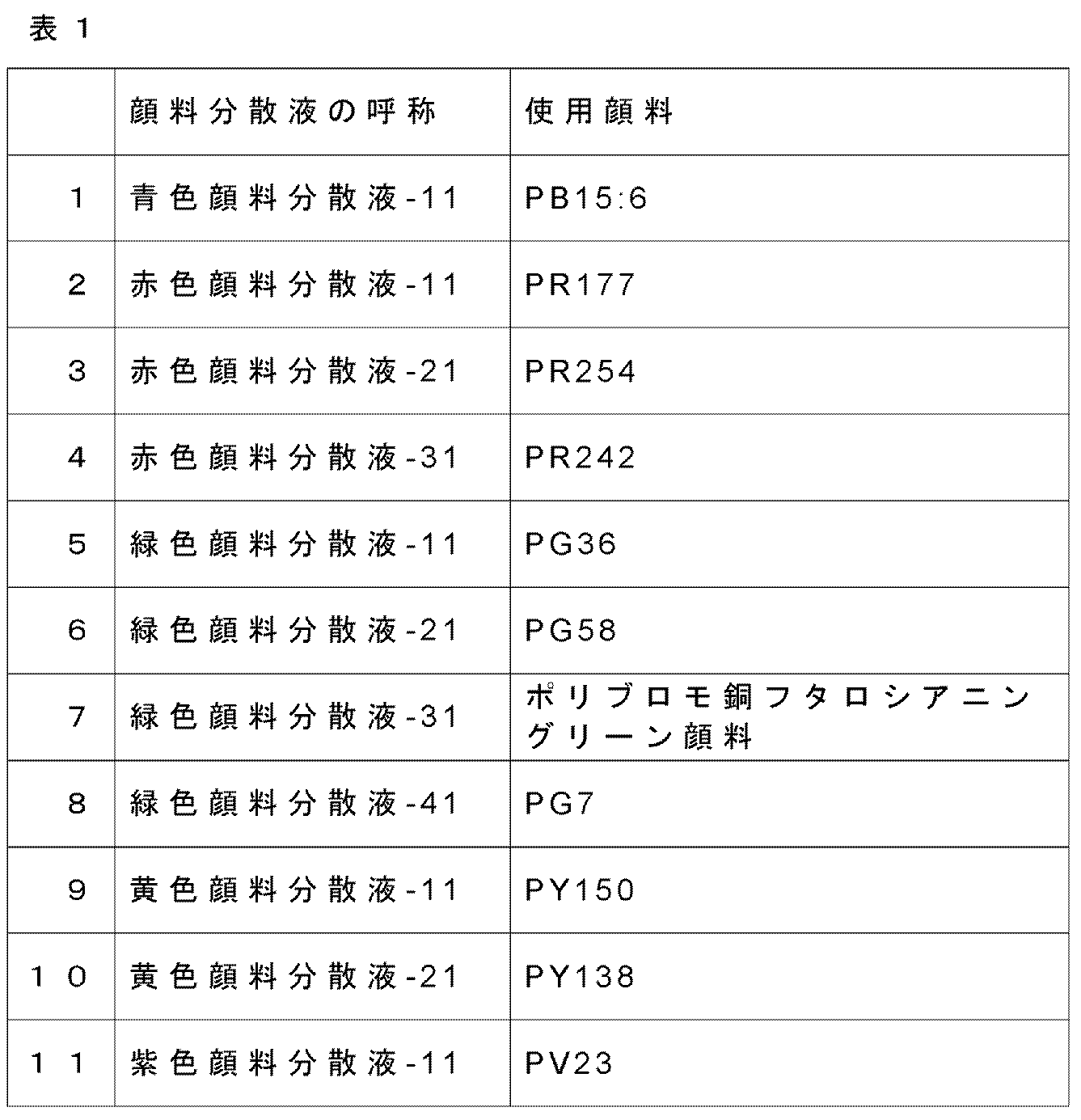
- Example 1 shows the names of the pigment dispersions obtained in Example 1 (c) and Example 2 (c) and the names of the pigments used.
- the pigment content in the pigment dispersion is 16%
- the polymer dispersant content is 8%
- the cationic polymer dispersant content is 3.2%.
- Example 3 Preparation of “Pigment Dispersion Liquid (2)” for Each Color Used for CF
- a heating apparatus and a vacuum distillation apparatus were used.
- 10 parts of XB solvent and 50 parts of 40% XB solution of Polymer Dispersant-1 were added and mixed uniformly.
- the filter paste was charged with 40 parts in terms of solid content, kneaded and flushed.
- the separated water was discharged out of the system, and the residual water was distilled off by operating the vacuum distillation apparatus while continuing kneading. Subsequently, the obtained flashid color of each color pigment was kneaded using a two-roll kneader to obtain a pigment color paste.
- the content of the pigment in the obtained color paste was 40.0%, and the content of the polymer dispersant was 20.0%.
- the pigment color pastes are respectively blue pigment color paste-12, red pigment color paste-12, -22, -32, green pigment color paste-12, These are referred to as green pigment color paste-22, -32, -42, yellow pigment color paste-12, -22 and purple pigment color paste-12.
- a three-roll kneader and an open roll continuous extruder were used and kneaded in the same manner to obtain a pigment color paste.
- the pigment content in the pigment dispersion was 16%, the polymer dispersant content was 8%, and the cationic polymer dispersant content was 3.2%.
- the pigment dispersions obtained above were respectively blue pigment dispersion-12, red pigment dispersion-12, -22, -32, green pigment dispersion-12, -22, -32, -42. And yellow pigment dispersions-12 and -22 and purple pigment dispersion-12.
- Example 4 (Preparation of “pigment dispersion (3)” of each color) Dispersion of each pigment using the aqueous filter paste of the blue pigment obtained in Example 1 (a) and the red, green, yellow and purple pigment filter pastes obtained in Example 2 (a) A liquid was prepared. First, the blue pigment filtration paste obtained in Example 1 (a) and the red pigment, green pigment, yellow pigment, and purple color obtained in Example 2 (a) on a vat (container) equipped with a high-speed dissolver. 20 parts of each finer pigment filter paste was added in terms of solid content, and the mixture was stirred with a dissolver while gradually adding water to peptize to obtain a fluid pigment slurry.
- a mixing vessel equipped with a stirrer, a material inlet, and a vacuum distillation apparatus equipped with a water bath as a heating device was prepared.
- DPGMA dipropylene glycol monomethyl ether acetate
- a DPGMA solution (40%) of Polymer Dispersant-2 shown below were charged and stirred uniformly. I made it.
- the pigment slurry for each color was gradually added thereto.
- the water bath was heated to bring the inner temperature to 40 ° C., and the vacuum distillation apparatus was operated while continuing the stirring to reduce the pressure, whereby the water in the container was gradually distilled off. After the removal of residual moisture was completed, the pressure was returned to normal pressure and cooled to room temperature. 4 parts of cationic polymer dispersant-1 and 21 parts of DPGMA were added thereto, and the mixture was stirred and thoroughly mixed.
- the pigment of the mixed solution obtained above was subjected to a fine dispersion treatment by connecting a 20 KHz ultrasonic disperser and a zirconia microbead horizontal medium disperser.
- the obtained liquid was filtered with a membrane filter.
- the average particle diameter of the pigment in the pigment dispersion was about 10 to 30 nm.
- the DPGMA solution of polymer dispersant-2 used above is a 40% polymer solution in which DPGMA is used as a solvent and a monomer having the same monomer composition as polymer dispersant-1 is polymerized.
- the pigment content was 16%
- the polymer dispersant content was 8%
- the cationic polymer dispersant content was 3.2%.
- the pigment dispersion obtained above was used in the same manner as in the above examples, depending on the pigment used, blue pigment dispersion-13, red pigment dispersion-13, -23, -33, green pigment dispersion-13, -23, respectively. , -33, -43, yellow pigment dispersion-13, -23, purple pigment dispersion-13.
- Example 5 (Preparation of “color pigment dispersion liquid (4)” for each color used for CF)
- A Preparation of colored granule containing pigment
- a vat equipped with a high-speed dissolver, an aqueous filter paste of the blue pigment obtained in Example 1 (a) and obtained in Example 2
- a) Prepare 20 parts of each of the red, green, yellow, and purple pigments as a solid pigment, and stir with a dissolver while gradually adding water. It was set as the slurry form with. Further, water was added to obtain a pigment aqueous dispersion having a pigment content of about 5%.
- Example 1 (b) 25 parts of the 40% XB solution of the polymer dispersant-1 used in Example 1 (b) was mixed with 35 parts of an XB solvent, and 180 parts of water containing 1.5 parts of a fatty acid sodium anionic dispersant. The mixture was added with stirring to prepare 240 parts of an oil-in-water emulsion of polymer dispersant-1XB solution.
- the pigment dispersion obtained above was stirred, and an oil-in-water emulsion of the polymer dispersant-1 solution obtained above was gradually added thereto. As stirring was continued, colored granules containing pigment were produced. The produced colored granular material was filtered, washed with water, and taken out.
- the pigment granules obtained in the above (a) were poured into a continuous extrusion kneader equipped with a moisture discharge device and kneaded to remove the remaining moisture.
- the pigment content of the pigmented paste of the obtained pigments was 25%, and the polymer dispersant content was 12.5%.
- the pigment content in the pigment dispersion was 16%, the polymer dispersant content was 8%, and the cationic polymer dispersant content was 3.2%.
- the pigment dispersions obtained above were respectively blue pigment dispersion-14, red pigment dispersions-14, -24, -34, green pigment dispersions-14, -24, -34, -44. And yellow pigment dispersions-14 and -24 and purple pigment dispersion-14.
- Example 6 Preparation of “Pigment Dispersion (5)” for Each Color to be Used for CF
- EGBA ethylene glycol monobutyl ether acetate
- a 40% XB solution of polymer dispersant-1 were added and mixed uniformly. Then, the blue pigment obtained in Example 1 (a), the red pigment, green pigment, yellow pigment, and purple pigment refined pigment paste obtained in Example 2 (a) were converted to solid content, respectively. 40 parts were used and stirred and flushed.
- the separated water was discharged out of the system, and the vacuum distillation apparatus was operated while continuing kneading to distill away the residual water and XB solvent, thereby obtaining a wet pigment resin composition.
- the mixture was kneaded using a two-roll kneader to obtain a moisture-type pigment resin composition.
- the pigment content in the pigment resin composition was 50%, and the polymer dispersant content was 25%.
- the pigment-type pigment resin composition obtained as described above has a blue pigment moisture color-11, a red pigment moisture color-11, -21, -31, a green pigment moisture color-11, -21, -31, -41, yellow pigment moist color-11, -21 and purple pigment moist color-11.
- the pigment content in the pigment dispersion was 16%, the polymer dispersant content was 8%, and the cationic polymer dispersant content was 3.2%.
- the pigment dispersions obtained above were respectively blue pigment dispersion-15, red pigment dispersions-15, -25, -35, green pigment dispersions-15, -25, -35, -45. And yellow pigment dispersions-15 and -25 and purple pigment dispersion-15.
- Example 7 Preparation of Each Color “Pigment Dispersion Liquid (6)” Used for CF
- a heating apparatus and a vacuum distillation apparatus 10 parts of XB solvent and 50 parts of a 40% XB solution of Polymer Dispersant-1 were added to the flasher attached with and mixed uniformly.
- the blue pigment obtained in Example 1 (a) the red pigment, green pigment, yellow pigment and violet pigment refined pigment paste obtained in Example 2 (a), respectively, in terms of solid content. 20 parts were used and stirred to flush.
- the separated water was discharged out of the system, and the residual water was distilled off by operating the vacuum distillation apparatus while continuing kneading. Subsequently, the solid color of the obtained pigment was desolvated with a vacuum dryer at 50 ° C. to 70 ° C. to obtain a solid pigment resin composition.
- the obtained pigment resin composition was kneaded with a heated three-roll kneader and taken out in the form of flakes. After allowing to cool, the mixture was pulverized to obtain a powder type pigment resin composition.
- the pigment content in the pigment resin composition was 50%, and the polymer dispersant content was 50%.
- the powder type pigment resin compositions obtained above are respectively blue pigment chip color-11, red pigment chip color-11, -21, -31, green pigment chip color-11, -21,- 31 and -41, yellow pigment chip color-11 and -21 and purple pigment chip color-11.
- the pigment content in the pigment dispersion is 16%, the polymer dispersant content is 8%, and the cationic polymer dispersant content is 3.2%.
- the pigment dispersions obtained above were blue pigment dispersion-16, red pigment dispersions-16, -26, -36, green pigment dispersions-16, -26, -36, -46, respectively. And yellow pigment dispersions-16 and -26 and purple pigment dispersion liquid-16.
- Example 8 (Preparation of CF Pixel by IJ Printing Method Using Thermosetting Inkjet (IJ) Ink)
- a thermosetting IJ ink for forming a color filter pixel was prepared using Pigment Dispersion-11, Yellow Pigment Dispersion-11, and Purple Pigment Dispersion-11.
- each color pigment dispersion 40% XB solution of thermosetting acrylic polymer-1 as a film-forming polymer, hexamethoxymethylmelamine (HMMM) methanol 50 as a cross-linking agent % Solution, coating solution leveling agent, silane coupling agent, XB solvent and EPE solvent were added and mixed thoroughly.
- the obtained liquid was filtered through a membrane filter having a pore size of 5 ⁇ m to prepare R, G and B IJ inks.
- the average particle size of the pigment dispersion of each color was measured with a particle size measuring instrument N-4, and was about 10 to 25 nm.
- Each ink was uniformly applied on a glass substrate with a spin coater, dried and baked.
- the resulting color glass substrate has excellent spectral curve characteristics, excellent fastness such as light resistance and heat resistance, and excellent optical characteristics such as light transmission and contrast ratio. It was shown to be excellent as a pigment ink for CF pixel formation.
- the acrylic polymer-1 solution used above was subjected to a polymerization reaction using 150 parts of an XB solvent as a polymerization solvent, 25 parts of St as a monomer, 35 parts of EMA, 30 parts of butyl methacrylate (BMA), 13 parts of HEMA and 2 parts of Ma. Is.
- the silane coupling agent is 3-glycidoxypropyltrimethoxysilane.
- CF glass substrate effective for the IJ method was prepared in advance. Specifically, in accordance with the description in Japanese Patent Application No. 2008-208487, a partition made of a positive resist is formed on a black resin type black matrix (BM) of a CF glass substrate to cope with pixels surrounded by the partition. Hole (pixel formation hole) was formed.
- the thickness of the BM is approximately 2 ⁇ m, the width is 20 ⁇ m, and the openings for the R, G, and B pixels are 280 ⁇ m long and 80 ⁇ m wide.
- the partition wall made of a positive resist is about 6 ⁇ m, and the height of the hole wall for pixel formation is about 8 ⁇ m.
- the CF substrate on which the pixel was formed by the IJ method was placed in a heat dryer, preliminarily dried at 80 ° C., and baked and cured at 180 ° C. Subsequently, in order to remove unnecessary partition walls, the partition walls were removed by washing by immersing in a 4% trisodium phosphate aqueous solution. Neutralized with dilute acid and washed with water to obtain a CF in which R color pixels, G color pixels and B color pixels were formed.
- the pixels on the CF substrate were independent of color mixing, had no uneven color density, had a smooth surface, and exhibited a three-color pixel with a clear mosaic pattern.
- the obtained liquid crystal color display using CF showed excellent video display characteristics.
- thermosetting color IJ ink In preparing the thermosetting color IJ ink described above, a red pigment dispersion-31, a green pigment dispersion-21, a green pigment dispersion-31, a green pigment dispersion-41, a yellow pigment instead of the pigment dispersion described above.
- the dispersion liquid-21 was used, and the “pigment dispersion liquid (2)” to “pigment dispersion liquid (6)” of each color prepared in Examples 3 to 7 were used to obtain CFs having RGB pixels. Obtained.
- the liquid crystal color display equipped with these also showed excellent video display characteristics.
- Example 9 (Production of CF by IJ printing method using ultraviolet curable IJ ink)
- A Preparation of UV curable color IJ ink
- the pigment dispersion liquid of each color obtained in Example 4 was used, and the materials were mixed thoroughly and filtered through a membrane filter. In this way, R, G and B ultraviolet curable IJ inks were prepared. The average particle size of the pigment of these ultraviolet curable IJ inks was about 10 to 25 nm.
- Each ink was uniformly applied on a glass substrate with a spin coater, dried, and then irradiated with ultraviolet rays to be cured.
- the resulting color glass substrate has excellent spectral curve characteristics, excellent fastness such as light resistance and heat resistance, and excellent optical characteristics such as light transmission and contrast ratio. It was shown to be excellent as a pigment ink for CF pixel formation.
- the ultraviolet curable acrylic resin solution was obtained by converting the hydroxyl group of EMA-BMA-St-HEMA (mass ratio; 3: 2: 3: 2) copolymer (weight average molecular weight: about 50,000) into an acrylate ester.
- MIBK Methylisobutylketone
- DPEHA dipentaerythritol hexaacrylate
- TMPTA is trimethylolpropane triacrylate
- both UV curable polyfunctional single monomer Is the body.
- Irgacure 369 (Ciba) and Irgacure 184 (Ciba) were used in combination (4: 1).
- the partition walls were washed and removed by dipping in a 4% trisodium phosphate aqueous solution, neutralized with dilute acid, and washed with water to obtain a CF on which R, G, and B color pixels were formed.
- the pixels on the CF substrate were independent of color mixing, had no uneven color density, had a smooth surface, and exhibited a three-color pixel with a clear mosaic pattern.
- the obtained liquid crystal color display using CF showed excellent video display characteristics.
- Example 10 (Preparation of pixels by photolithography)
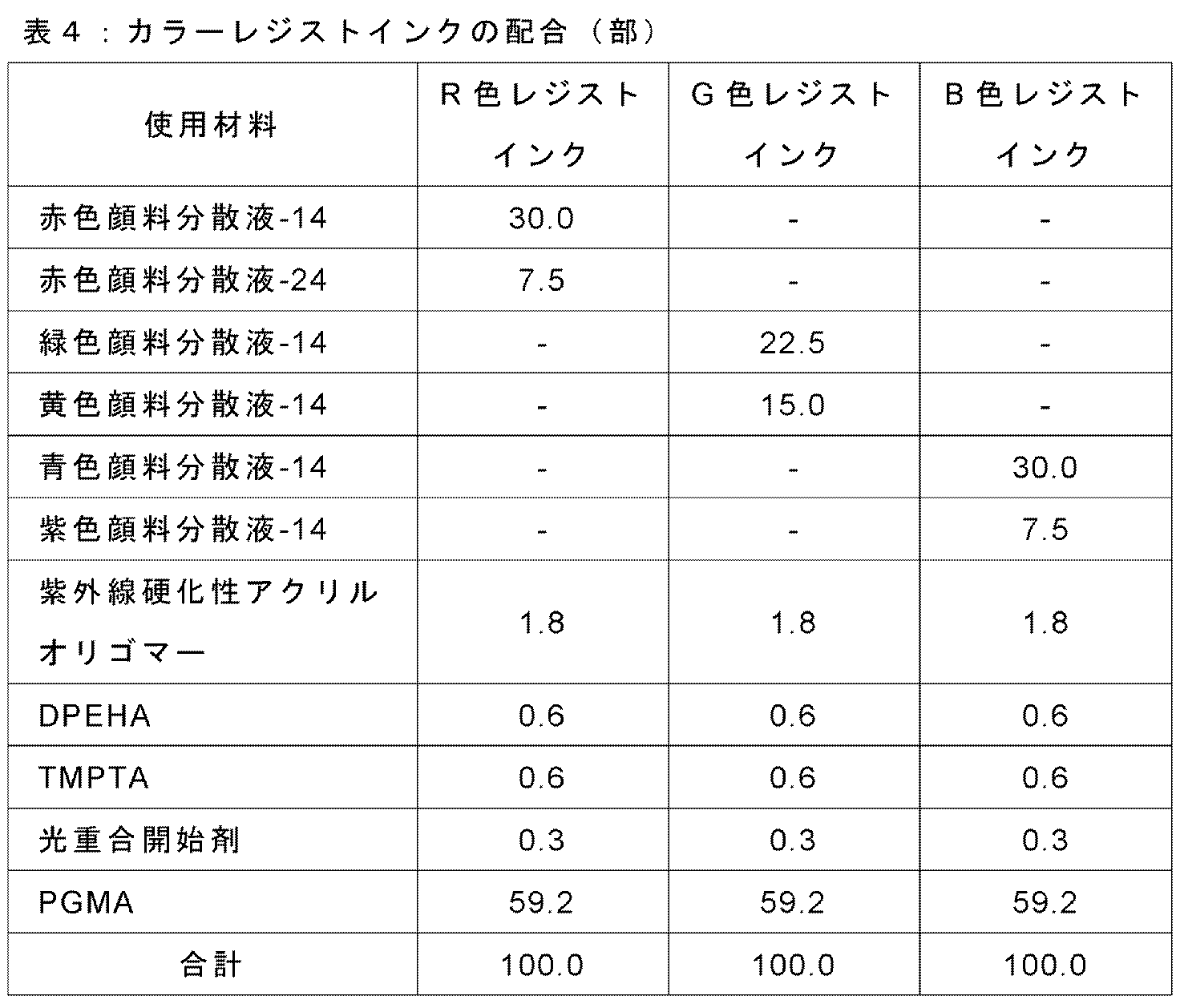
- A) Preparation of color resist ink According to the number of blending parts shown in Table 4 below, the pigment dispersion liquid of each color obtained in Example 5 was used, the materials were mixed well, filtered through a membrane filter, and R color , G and B color resist inks were prepared. The average particle size of these resist ink pigments was about 10 to 25 nm.
- Each ink was uniformly applied on a glass substrate with a spin coater, dried, and then irradiated with ultraviolet rays to be cured.
- the resulting color glass substrate has excellent spectral curve characteristics, excellent fastness such as light resistance and heat resistance, and excellent optical characteristics such as light transmission and contrast ratio. It was shown to be excellent as a resist ink for pixel formation for CF.
- the ultraviolet curable acrylic oligomer solution is an acrylate ester of hydroxyl groups of EMA-BMA-HEMA (mass ratio; 4: 4: 2) copolymer oligomer (weight average molecular weight: about 5,000).
- (B) Formation of CF RGB pixels A glass substrate treated with a silane coupling agent was set on a spin coater, and the R color resist ink prepared in (a) above was initially 300 rpm for 5 seconds and then 1200 rpm. Spin coating was performed for 5 seconds. Next, prebaking was performed at 80 ° C. for 10 minutes, a photomask having mosaic pixels was brought into close contact, and exposure was performed with an ultrahigh pressure mercury lamp at a light amount of 100 mJ / cm 2 . Next, development and washing were performed with a dedicated developer and a dedicated rinse to form red mosaic pattern R color pixels on the glass substrate.
Landscapes
- Chemical & Material Sciences (AREA)
- Organic Chemistry (AREA)
- Wood Science & Technology (AREA)
- Life Sciences & Earth Sciences (AREA)
- Engineering & Computer Science (AREA)
- Materials Engineering (AREA)
- Physics & Mathematics (AREA)
- Chemical Kinetics & Catalysis (AREA)
- General Physics & Mathematics (AREA)
- Dispersion Chemistry (AREA)
- Optics & Photonics (AREA)
- Optical Filters (AREA)
- Inks, Pencil-Leads, Or Crayons (AREA)
- Ink Jet (AREA)
- Ink Jet Recording Methods And Recording Media Thereof (AREA)
- Pigments, Carbon Blacks, Or Wood Stains (AREA)
Abstract
Description
従って、本発明は、液晶カラーテレビジョンなどの情報表示機器に装備されるカラーフィルターとして要求される画素の色の高濃度化、高精細性、高コントラスト性などの光学的特性の要求に対応可能な、すなわち、カラーフィルター(CF)の画素形成用インクに用いられる着色組成物の製造方法の提供をその目的としている。
さらに本発明は、上記製造方法によって得ることができる着色組成物の提供をその目的としている。
また本発明は、上記着色組成物から製造される顔料分散液、画素形成用顔料インク、それを用いて製造したカラーフィルターおよびそれらの製造方法の提供をその目的としている。
また、本発明の別の態様によれば、CFの画素形成用インクに用いられる顔料分散液の製造方法が提供され、その方法は、上記の本発明による着色組成物に、低分子界面活性剤、重合体系分散剤、皮膜形成材料、および有機溶剤からなる群から選ばれた1以上の材料を添加し、均一に混合し、分散することを特徴とする。
また、本発明の他の態様によれば、CFの画素形成用インクに用いられる顔料分散液が提供され、それは上記本発明による製造方法によって得ること出来るものである。
また、本発明の別の態様によれば、CFの画素形成用インクが提供され、それは上記本発明による製造方法によって得ること出来るものである。
さらに本発明の別の態様によれば、CFの製造方法およびCFが提供され、それは上記の本発明によるCFの画素形成用インクを用いて画素を形成することを特徴とし、さらにその方法によって得られたカラーフィルターである。
本発明によるカラーフィルター(CF)の画素形成用インクに用いられる着色組成物の製造方法は、上記した工程(a)、工程(b)、そして工程(c)から基本的になることを特徴とする。
工程(a)
この工程は、顔料の平均粒子径が5~100nmである、顔料水性ろ過ペーストまたは水性スラリーを用意する工程である。
本発明による方法が適用される顔料は、CFの画素を形成する顔料であり、赤色、緑色、青色あるいは黄色、紅色、藍色、それらの中間色の橙色、紫色などの顔料が使用される(その具体例等の詳細は後記する)。鮮明性、精細性、コントラスト性などのCFの光学的な要望から、顔料は出来るだけ微細であることが好ましく、具体的には、その平均粒子径が5~100nm、好ましくは5~50nm、更に好ましくは5~25nmである。
(a-1)まず、汎用性のある顔料の超微粒子化の方法として好ましくは、ソルトミリング法が挙げられる。この方法により磨砕される顔料としては顔料クルードであっても、汎用用途の顔料であってもよいが、好ましくは平均粒子径が10μm~0.5μmの汎用用途の顔料が使用される。具体的には、磨砕助材として、食塩やぼう硝などの水溶性塩類を、磨砕する顔料の数倍、好ましくは4~10倍量添加し、ジエチレングリコールなどの粘性のある有機溶剤を添加して混練磨砕する。磨砕後、希硫酸、水などに添加して、磨砕助剤を溶解させ、ろ過、水洗して、顔料のろ過ペーストあるいはスラリーを得る。この状態では顔料の磨砕された一次粒子は弱い集合体化(フロキュレーション)を起こしている。
(a-3)また、別の方法として、アゾ系顔料などについては、カップリング工程などの合成工程で粒子の成長阻害剤を添加したり、結晶化などの後処理工程において、温度条件や処理時間を調整したりすることによって、粒子成長を制御して顔料粒子の成長を抑え、微細な色素粒子を含む水性ろ過ペーストまたは水性スラリーを得ることもできる。
本発明の好ましい態様によれば、上記(a-1)~(a-4)の処理工程中にあるいはそれらに引き続いて、重合体系分散剤、特にカルボキシル基や3級アミノ基のようなイオン性基を有する重合体系分散剤の溶液あるいは分散液を添加し、生成した微粒子顔料を重合体系分散剤で表面処理してもよい。
上記工程(a)で得られた水性ろ過ペーストまたは水性スラリーの水相にある顔料を、有機溶剤系媒体または溶融樹脂系媒体からなる有機媒体相に移行させる工程である。その方法としては下記の方法が挙げられる。すなわち、
(b-1)水性ろ過ペーストまたは水性スラリーと、水より高沸点の有機溶剤を混合し、水より高沸点の有機溶剤の共存下で水分を溜去する方法、
(b-2)水性ろ過ペーストまたは水性スラリーと、水より高沸点の有機溶剤を混合し、水より高沸点の有機溶剤の共存下で水分と溶剤を同時に溜去する方法、
(b-3)水性ろ過ペーストまたは水性スラリーを、有機溶剤でフラッシングし、水分を排出させる方法、
(b-4)水性ろ過ペーストまたは水性スラリーと、水中油滴型エマルジョンとを混合し、顔料をエマルジョンの油滴中に移行させて顔料を含む粒状物を得る方法、
(b-5)水性ろ過ペーストまたは水性スラリーと、樹脂とを混合し、樹脂を加熱溶融させ、混練し、これをフラッシングして水分を排出する方法、
(b-6)水性ろ過ペーストまたは水性スラリーと、樹脂とを混合し、樹脂を加熱溶融させ混練し、水分を蒸発、除去する方法
などが挙げられ、それらの1種類の方法で実施してもあるいは2種類以上の方法を複合させて実施しても良い。
有機溶剤系媒体としては、上記工程(b-1)および(b-2)において用いられる水より高沸点の有機溶剤が挙げられ、好ましい具体例としては、石油ソルベント(例えば主成分がC8~C10)などの炭化水素系溶剤、キシレン、エチルベンゼンなどの芳香族系溶剤、酢酸ブチル、酢酸アミル、乳酸エチルなどのエステル系溶剤、エチレングリコールモノエチルエーテルアセテート、エチレングリコールモノブチルエーテルアセテートなどのグリコール系溶剤などが挙げられる。
この工程において、使用される樹脂としては、上記した如く、常圧でフラッシングする場合には樹脂の溶融温度が100℃以下、好ましくは80℃以下の樹脂が使用され、押出機など密閉された系でのフラッシングでは、押出機の加熱条件により溶融温度が100℃以上の樹脂でも使用されるが、やはり100℃以下、好ましくは80℃以下の樹脂が好ましい。
この工程は、工程(b)により有機体相に移行した顔料を、さらに微細分散する工程である。水性ろ過ペーストまたは水性スラリーの水相にある顔料の一次粒子は疎水性の微細な粒子であることから、水性懸濁液中で集合し易く、弱い凝集(フロキュレーション)を起こしている。更にろ過の際にフィルタープレスの圧力により集まり易く、通常は弱い集合体ないし凝集(フロキュレーション)体を形成している。そして、有機溶剤相へもその集合体のまま移行を起こし易い。したがって有機溶剤相へ移行した後にあっても、このような顔料の弱い集合体を元の一次粒子に戻す必要がある。
(c-1)マイクロビーズ媒体(メディア)分散機として、横型および縦型の媒体(メディア)分散機を使用する。マイクロビーズとしては平均粒子径が0.015~0.1mmのセラミックビーズが好ましい。
(c-2)超音波分散機を使用する。振動数は特に限定されないが、15~50kHz程度が好ましい。
(c-3)ロール混練機、オープンロール連続押出機、単軸または2軸連続押出型混練機で混練する。ペースト状、潤性、粒状あるいは固体状の着色組成物を分散加工するに好ましい。
これら微分散方法の1種類の方法で実施してもあるいは複数の方法を複合させて実施しても良い。
本発明により得られた着色組成物は、顔料分散液の製造に用いられる。すなわち、本発明により得られた着色組成物に、低分子界面活性剤、分散剤、皮膜形成材料および有機溶剤からなる群から選ばれた1以上の材料を添加し、均一に混合し、分散することにより、CFの画素形成用インクに用いられる顔料分散液が得られる。
本発明による画素形成用顔料インクは、上記した着色組成物または顔料分散液に、低分子界面活性剤、重合体系分散剤、皮膜形成材料、および有機溶剤から選択される少なくとも一種と、有機溶剤系媒体とを少なくとも添加し、均一に混合することにより得ることができる。ここで用いられる低分子界面活性剤の具体例としては、上記顔料分散液について説明したのが挙げられ、また重合体系分散剤、皮膜形成材料、および有機溶剤については、後記するカラーフィルターについて記載したものが好ましく用いられる。
本発明による方法が適用される顔料としては、CFの画素形成に使用される公知の赤色、緑色、青色、黄色、紫色、橙色、紅色、藍色顔料が挙げられる。特にR画素の形成に対しては、赤色顔料を主体に、橙色顔料、黄色顔料が併用される場合がある。G画素の形成に対しては、緑色顔料を主体に黄色顔料が併用される場合がある。B画素の形成に対しては、紫味青色顔料を単独に使用する場合あるいは紫色顔料が併用される場合がある。
また、本発明の好ましい態様によれば、イオン性を付与した顔料誘導体の作用を効果的にするため、それぞれの対イオンになるカチオン性あるいはアニオン性の重合体安定剤、特にアニオン性の顔料誘導体には公知の3級アミノ基や第4級アンモニウム塩基を側鎖に有するアクリル系重合体、ポリエチレンイミン-(グラフトポリエステル)などを添加することも好ましい。カチオン性顔料誘導体には、添加されているカルボキシル基を有する(メタ)アクリル系重合体が作用する。顔料分散剤としては、上記した低分子界面活性剤、重合体系分散剤などが挙げられる。
本発明において顔料を固定させる皮膜形成材料としては、従来からカラーフィルター用顔料インキに使用されている公知の皮膜形成材料である重合体、オリゴマーおよびモノマーが何れも任意の組み合わせで使用でき、特に限定されない。また、分散媒体としての皮膜形成材料に適切な溶剤媒体が使用される。また、必要に応じて従来公知の添加剤、例えば、分散助剤、平滑化剤、密着化剤などが適宜添加使用される。
実施例1(CF用の使用する青色顔料分散液の調製)
(a)CF用の使用する青色顔料の微細化処理
CF用青色顔料として使用するために、PB15:6(ε型銅フタロシアニンブルー顔料、「青色顔料-1」と称する)の微細化処理を行なった。PB15:6を90部、銅フタロシアニンモノスルホン化誘導体5部、および銅フタロシアニンフタルイミドメチル誘導体5部を混合し、塩化ナトリウム400部およびジエチレングリコール130部と共に、加圧蓋を装着したニーダーに仕込んだ。ニーダー内に均一に湿潤された塊ができるまで予備混合をし、次いで加圧蓋を閉じて圧力6kg/cm2で内容物を押さえ込みながら7時間混練・磨砕処理を行った。得られた磨砕物を3000部の2%硫酸水溶液中に投入して1時間の撹拌処理を行った後、フィルタープレスでろ過して塩化ナトリウムおよびジエチレングリコールを除去し、十分水洗して、青色顔料のろ過ペースト(固形分:31.8%)を得た。磨砕された青色顔料の一次粒子の平均粒子径は凡そ20nmであった。なお、上記の「青色顔料」とは、上記で使用された顔料と顔料誘導体の混合物を意味するものとする。
加熱装置および減圧蒸留装置をつけたフラッシャーに、キシロール-酢酸ブチル混合溶剤(質量比;6:4、以下「XB溶剤」あるいは単に「XB」と略称する)35部、および下記に示す重合体分散剤-1の40%XB溶液25部を添加し、均一に混合した。そこへ上記(a)で得られたPB15:6ろ過ペースト(固形分:31.8%)62.9部を添加し、撹拌してフラッシングをした。分離した水分は、フラッシャーから系外に排出させた。次いで、混練を続けながら減圧蒸留装置を作動させて減圧し、残留水分を溜去させた。青色顔料のフラッシドペースト中の、顔料と顔料誘導体(以下、両者を合わせて「顔料分」と称する)の含有率は25%であり、重合体分散剤の含有率は12.5%であった。以下、得られたペーストを、「青色顔料カラーペースト-11」と称する。
上記(b)で得られた「青色顔料カラーペースト-11」80部、分散液の低粘度化および保存安定性に有効なカチオン性重合体分散剤-1を4部、および3-エトキシプロピオン酸エチル(「EPE溶剤」と略称する)41部を配合し、ディゾルバーで撹拌して、ペーストを解膠した。次いで分散媒体(メディア)として0.02mm径のジルコニアマイクロビーズを使用した横型媒体(メディア)分散機を使用し、微分散化処理を行った。得られた液をポアサイズ5μmのメンブランフィルターでろ過を行なった。
また、別に、超音波分散機を使用し、20KHzで微分散化処理を行った。得られた液を同様にポアサイズ5μmのメンブランフィルターでろ過を行なった。両方法の微分散化処理による分散顔料の平均粒子径は共に凡そ20nmであった。以下、得られた分散液を「青色顔料分散液-11」と称する。
なお、上記で使用したカチオン性重合体分散剤-1はポリエチレンイミンにポリカプロラクトンを部分アミド結合させたグラフトポリマータイプの分散剤である。
(a)CF用の使用する各色顔料の微細化処理
実施例1(a)と同様にして、CF用に使用される他の顔料の磨砕を行なった。実施例1(a)で使用したPB15:6に代えて、PR177(アントラキノン系赤色顔料、「赤色顔料-1」と称する。以下同様)、PR254(ジケトピロロピロール系赤色顔料、「赤色顔料-2」)、PR242(高分子量ジスアゾ系赤色顔料、「赤色顔料-3」)、PG36(ブロム・クロル化銅フタロシアニングリーン顔料、「緑色顔料-1」)、PG58(ブロム・クロル化亜鉛フタロシアニングリーン顔料、「緑色顔料-2」)、ポリ(13~16)ブロモ銅フタロシアニングリーン顔料、「緑色顔料-3」)、PG7(クロル化銅フタロシアニングリーン顔料、「緑色顔料-4」)、PY150(ニッケル錯体アゾ系黄色顔料、「黄色顔料-1」)、PY138(キノフタロン系イエロー顔料、「黄色顔料-2」)およびPV23(ジオキサジンバイオレット顔料、「紫色顔料-1」)を使用した。
実施例1(b)と同様にして、フラッシャーにXB溶剤および重合体分散剤溶液を仕込み、そこへ上記(a)で得られた各顔料のろ過ペーストをそれぞれ添加し、フラッシングした。分離した水分は排出し、残留水分は減圧で溜去した。顔料分の含有率は25%および重合体分散剤の含有率は12.5%であった。
以下では、それぞれのフラッシドカラーを、使用した顔料により赤色顔料カラーペースト-11、-21、-31、緑色顔料カラーペースト-11、-21、-31、-41、黄色顔料カラーペースト-11、-21、紫色顔料カラーペースト-11と称する。
上記(b)で得られた各顔料のフラッシドカラーペースト80部に同様にしてカチオン性重合体分散剤4部およびEPE溶剤41部を配合し、ディゾルバーで撹拌して、ペーストを解膠した。次いで、分散媒体(メディア)として0.02mm径のジルコニアマイクロビーズを使用した横型媒体(メディア)分散機を使用し、微分散化処理を行った。得られた液をポアサイズ5μmのメンブランフィルターでろ過を行なった。
また、別に、超音波分散機を使用し、20KHzで微分散化処理を行った。得られた液を同様にポアサイズ5μmのメンブランフィルターでろ過を行なった。
両方法の微分散化処理による分散顔料の平均粒子径は共に凡そ10~25nmであった。
表1に実施例1(c)および実施例2(c)で得られた顔料分散液の呼称、使用顔料名を示した。顔料分散液中の顔料分含有率は16%、重合体分散剤含有率は8%、カチオン性重合体分散剤含有率は3.2%である。
(a)「顔料カラーペースト(2)」の調製
実施例1(b)と同様に、加熱装置および減圧蒸留装置をつけたフラッシャーに、XB溶剤10部及び重合体分散剤-1の40%XB溶液50部を添加し、均一に混合した。そこに実施例1(a)で得られた微細化青色顔料のろ過ペースト、および実施例2(a)で得られた赤色顔料、緑色顔料、黄色顔料、および紫色顔料のそれぞれの微細化顔料のろ過ペーストを、固形分換算で40部を仕込み、混練してフラッシングをした。分離した水分は系外に排出し、さらに、混練を続けながら減圧蒸留装置を作動させて残留水分を溜去させた。次いで、得られた各色顔料のフラッシドカラーを、2本ロール混練機を使用して混練し、顔料カラーペーストを得た。得られたカラーペースト中の顔料の含有率は40.0%、重合体分散剤の含有率は20.0%であった。
以下において、それぞれの顔料カラーペーストを表1に示したと同様に、使用した顔料により、それぞれ青色顔料カラーペースト―12、赤色顔料カラーペースト-12、-22、-32、緑色顔料カラーペースト-12、緑色顔料カラーペースト-22、-32、-42、黄色顔料カラーペースト-12、-22、紫色顔料カラーペースト-12と称する。
上記において2本ロール混練機に代えて3本ロール混練機、オープンロール連続押出機を使用して同様に混練し、顔料カラーペーストを得た。
実施例1(b)と同様にして、上記(a)で得られた各顔料の顔料カラーペースト40部に、カチオン性重合体分散剤3.2部およびEPE溶剤56.8部を配合し、ディゾルバーで撹拌して、ペーストを解膠した。次いで、20KHzの超音波分散機とジルコニアマイクロビーズの横型媒体分散機を連続させて使用し、微分散化処理を行った。得られた液をポアサイズ5μmのメンブランフィルターでろ過を行ない、顔料分散液を得た。分散顔料の平均粒子径は凡そ10~30nmであった。顔料分散液中の顔料含有率は16%、重合体分散剤含有率は8%、カチオン性重合体分散剤含有率は3.2%であった。
上記で得られた顔料分散液を、使用した顔料によりそれぞれ青色顔料分散液-12、赤色顔料分散液-12、-22、-32、緑色顔料分散液-12、-22、-32、-42、黄色顔料分散液-12、-22、紫色顔料分散液-12と称する。
実施例1(a)で得られた青色顔料の水性ろ過ペースト、および実施例2(a)で得られた赤色、緑色、黄色、紫色のそれぞれの顔料ろ過ペーストを使用し、それぞれの顔料の分散液を調製した。
先ず、高速ディゾルバーを装備したバット(容器)に実施例1(a)で得られた青色顔料のろ過ペースト、および実施例2(a)で得られた赤色顔料、緑色顔料、黄色顔料、および紫色顔料のそれぞれの微細化顔料のろ過ペーストを、固形分換算で20部を仕込み、徐々に水を加えつつディゾルバーで撹拌して解膠し、それぞれ流動性のある顔料スラリーとした。
なお、上記で使用した重合体分散剤-2のDPGMA溶液とは、溶剤としてDPGMA使用し、モノマーとして重合体分散剤-1と同じモノマー組成のものを重合させた40%重合体溶液である。
得られた顔料分散液中の顔料含有率は16%、重合体分散剤含有率は8%、カチオン性重合体分散剤含有率は3.2%であった。
上記で得られた顔料分散液を、上記例と同様に使用した顔料により、それぞれ青色顔料分散液-13、赤色顔料分散液-13、-23、-33、緑色顔料分散液-13、-23、-33、-43、黄色顔料分散液-13、-23、紫色顔料分散液-13と称する。
(a)顔料を含む着色粒状物の調製
高速ディゾルバーを装備したバット(容器)に、実施例1(a)で得られた青色顔料の水性ろ過ペースト、および実施例2(a)で得られた赤色顔料、緑色顔料、黄色顔料、および紫色顔料のそれぞれの微細化顔料の水性ろ過ペーストを、固形分換算で20部を仕込み、徐々に水を加えつつディゾルバーで撹拌して解膠し、流動性のあるスラリー状とした。さらに水を加えて顔料分がほぼ5%の顔料水分散液とした。
高速ディゾルバーを装備したバットに、上記(a)で得られた各顔料のフラッシドペースト64部を添加した。ディゾルバーで撹拌しつつ、カチオン性重合体分散剤3.2部およびPGMA32.8)部を添加し、撹拌、混合した。次いで、ジルコニアマイクロビーズを使用した縦型媒体(メディア)分散機および超音波分散機を続いて使用し、微分散化処理を行った。得られた液をメンブランフィルターでろ過を行なった。分散顔料の平均粒子径は凡そ10~25nmであった。顔料分散液中の顔料含有率は16%、重合体分散剤含有率は8%、カチオン性重合体分散剤含有率は3.2%であった。
上記で得られた顔料分散液を、使用した顔料によりそれぞれ青色顔料分散液-14、赤色顔料分散液-14、-24、-34、緑色顔料分散液-14、-24、-34、-44、黄色顔料分散液-14、-24、紫色顔料分散液-14と称する。
(a)各色「潤性顔料樹脂組成物(1)」の調製
実施例1(b)と同様に、加熱装置および減圧蒸留装置をつけたフラッシャーに、エチレングリコールモノブチルエーテルアセテート(EGBA)20部及び重合体分散剤-1の40%XB溶液50部を添加し、均一に混合した。そこに実施例1(a)で得られた青色顔料、実施例2(a)で得られた赤色顔料、緑色顔料、黄色顔料、および紫色顔料の微細化顔料のろ過ペーストを、それぞれ固形分換算で40部を使用し、撹拌してフラッシングをした。分離した水分は系外に排出し、さらに、混練を続けながら減圧蒸留装置を作動させて、残留水分およびXB溶剤を溜去させ、湿潤状態の顔料樹脂組成物を得た。次いで、2本ロール混練機を使用して混練し、潤性タイプの顔料樹脂組成物を得た。顔料樹脂組成物中の顔料分は50%、重合体分散剤分は25%であった。
高速ディゾルバーを装備したバットに、上記(a)で得られた各顔料の顔料潤性カラー32部を添加し、ディゾルバーで撹拌しつつ、カチオン性重合体分散剤3.2部およびプロピレングリコールモノメルエーテルアセテート(PGMA)64.8部を添加し、撹拌、混合した。次いでジルコニアマイクロビーズを使用した縦型媒体分散機と20kHzの超音波分散機を連続させて使用し、微分散化処理を行った。得られた液をメンブランフィルターでろ過を行なった。分散顔料の平均粒子径は凡そ10~25nmであった。顔料分散液中の顔料含有率は16%、重合体分散剤含有率は8%、カチオン性重合体分散剤含有率は3.2%であった。
上記で得られた顔料分散液を、使用した顔料によりそれぞれ青色顔料分散液-15、赤色顔料分散液-15、-25、-35、緑色顔料分散液-15、-25、-35、-45、黄色顔料分散液-15、-25、紫色顔料分散液-15と称する。
(a)各色「顔料樹脂粉末加工顔料-1」の調製
実施例1(b)と同様に、加熱装置および減圧蒸留装置をつけたフラッシャーに、XB溶剤10部及び重合体分散剤-1の40%XB溶液50部を添加し、均一に混合した。そこに実施例1(a)で得られた青色顔料、実施例2(a)で得られた赤色顔料、緑色顔料、黄色顔料および紫色顔料の微細化顔料のろ過ペーストを、それぞれ固形分換算で20部を使用し、撹拌してフラッシングをした。分離した水分は系外に排出し、さらに、混練を続けながら減圧蒸留装置を作動させて残留水分を溜去させた。次いで、得られた顔料のフラッシドカラーを50℃~70℃にて真空乾燥機にて脱溶剤させ、固体状の顔料樹脂組成物を得た。得られた顔料樹脂組成物を加熱3本ロール混練機にて混練し、フレーク状に取り出した。放冷後、粉砕して粉末タイプの顔料樹脂組成物を得た。顔料樹脂組成物中の顔料含有率は50%、重合体分散剤含有率は50%であった。
高速ディゾルバーを装備したバットにPGMA32部を仕込み、そこへ上記(a)で得られた各顔料の顔料チップカラー16部を添加し、ディゾルバーで撹拌しつつ、加温した。PGMA48.8部を追加して添加し、カチオン性重合体分散剤3.2部および撹拌、混合し、十分に均一になるように分散させた。次いでジルコニアマイクロビーズの縦型媒体分散機と20kHzの超音波分散機を連続して使用し、微分散化処理を行った。得られた液をメンブランフィルターでろ過を行なった。分散顔料の粒子径は凡そ10~25nmであった。顔料分散液中の顔料含有率は16%、重合体分散剤含有率は8%、カチオン性重合体分散剤含有率は3.2%である。上記で得られた顔料分散液を、使用した顔料によりそれぞれ青色顔料分散液-16、赤色顔料分散液-16、-26、-36、緑色顔料分散液-16、-26、-36、-46、黄色顔料分散液-16、-26、紫色顔料分散液-16と称する。
(a)熱硬化型カラーIJインクの調製
表1に記載の実施例1で調製した青色顔料分散液-11および実施例2で調製した赤色顔料分散液-11、赤色顔料分散液-21、緑色顔料分散液-11、黄色顔料分散液-11、紫色顔料分散液-11を使用してカラーフィルターの画素を形成する加熱硬化型IJインクを調製した。

予め、IJ方式に有効なCF用ガラス基板を準備した。具体的には、特願2008-208487号の記載に従って、CF用ガラス基板の黒色樹脂型ブラックマトリックス(BM)の上に、ポジレジストからなる隔壁を形成して、隔壁に囲まれた画素に対応する穴(画素形成用空孔)を形成した。BMの厚みは凡そ2μm、巾が20μmでR、G、B画素のための開口部が縦280μm、横80μmである。ポジレジストからなる隔壁は凡そ6μmで、画素形成の空孔壁の高さは凡そ8μmである。
ピエゾ方式IJプリンターに、上記(a)で調製されたR、GおよびB色の熱硬化型IJインクを充填したカートリッジを装填した。設定された画素のモザイクパターンに従い、CF基板上の画素形成用空孔にIJプリンターヘッドよりR、G、Bの各色インクを吐出し、空孔を充填した。引き続いてCF板の表面を紫外線露光して隔壁のポジレジストを光分解し、アルカリ可溶性に変性した。次いで、基板上の画素膜を硬化させるために、上記IJ法で画素形成されたCF基板を加熱乾燥機に入れ、80℃にて予備乾燥後、180℃にて焼き付け、硬化した。次いで、不要の隔壁を除去するために4%燐酸三ナトリウム水溶液に浸漬して洗浄し、隔壁を除去した。希酸で中和し、水洗し、R色画素、G色画素およびB色画素が形成されたCFを得た。CF基板上の画素はそれぞれ独立して混色はなく、色濃度の不均一さもなく、表面は平滑であり、鮮明なモザイクパターンの3色画素を示した。得られたCFを使用した液晶カラーディスプレイは優れた映像表示特性を示した。
(a)紫外線硬化性カラーIJインクの調製
下記の表3に記載の配合部数に従い、実施例4で得られた各色の顔料分散液を使用し、材料を充分に混合し、メンブランフィルターでろ過してR色、G色、B色の紫外線硬化性IJインクを調製した。これらの紫外線硬化性IJインクの顔料の平均粒子径は凡そ10~25nmであった。夫々のインクをガラス基板上にスピンコーターで均一に塗布し、乾燥後、紫外線を照射し、硬化させた。得られたカラーガラス基板は夫々優れた分光カーブ特性を有し、耐光性や耐熱性などの堅牢性に優れ、また、光の透過性、コントラスト比などの光学特性にも優れた性質を有し、CF用の画素形成用顔料インクとして優れていることを示した。

実施例5(b)で使用した画素形成用空孔を形成させたCF用ガラス基板を準備した。ピエゾ方式IJプリンターに上記(a)で調製されたR、GおよびB色の紫外線硬化型IJインクを充填したカートリッジを装填した。設定された画素のモザイクパターンに従い、上記ガラス基板上の画素形成用空孔にIJプリンターヘッドによりR、G、Bの各色インクを吐出させた。各色インクがプリントされた基板を赤外線乾燥機で乾燥した。CF板の表面を紫外線露光して、紫外線硬化性の画素膜を硬化させると共に隔壁のポジレジストを光分解し、アルカリ可溶性にした。次いで、4%燐酸三ナトリウム水溶液に浸漬して隔壁を洗浄、除去し、希酸で中和し、水洗し、R、G、B色画素が形成されたCFを得た。CF基板上の画素はそれぞれ独立して混色はなく、色濃度の不均一さもなく、表面は平滑であり、鮮明なモザイクパターンの3色画素を示した。得られたCFを使用した液晶カラーディスプレイは優れた映像表示特性を示した。
(a)カラーレジストインクの調製
下記の表4に記載の配合部数に従い、実施例5で得られた各色の顔料分散液を使用し、材料を充分に混合し、メンブランフィルターでろ過してR色、G色、B色のレジストインクを調製した。これらのレジストインクの顔料の平均粒子径は凡そ10~25nmであった。夫々のインクをガラス基板上にスピンコーターで均一に塗布し、乾燥後、紫外線を照射し、硬化させた。得られたカラーガラス基板は夫々優れた分光カーブ特性を有し、耐光性や耐熱性などの堅牢性に優れ、また、光の透過性、コントラスト比などの光学特性にも優れた性質を有し、CF用の画素形成用レジストインクとして優れていることを示した。
シランカップリング剤処理を行ったガラス基板をスピンコーターにセットし、上記(a)で調製したR色レジストインクを最初300rpmで5秒間、次いで1,200rpmで5秒間の条件でスピンコートした。次いで80℃で10分間プリベークを行い、モザイク状の画素を有するフォトマスクを密着させ、超高圧水銀灯を用い100mJ/cm2の光量で露光を行った。次いで専用現像液および専用リンスで現像および洗浄を行い、ガラス基板上に赤色のモザイクパターン状R色画素を形成させた。
Claims (18)
- カラーフィルター(CF)の画素形成用インクに用いられる着色組成物の製造方法であって、
(a)顔料の平均粒子径が5~100nmである、顔料水性ろ過ペーストまたは水性スラリーを用意し、
(b)前記水性ろ過ペーストまたは水性スラリー中に含有される顔料を、乾燥工程を経ることなく、水相から有機溶剤系媒体または溶融樹脂系媒体からなる有機媒体相に移行させ、その後
(c)前記移行した顔料を、微細分散して、着色組成物とすることを特徴とする、製造方法。 - 前記工程(b)が、
水性ろ過ペーストまたは水性スラリーと、水より高沸点の有機溶剤を混合し、水より高沸点の有機溶剤の共存下で水分を溜去する方法、
水性ろ過ペーストまたは水性スラリーと、水より高沸点の有機溶剤を混合し、水より高沸点の有機溶剤の共存下で水分と溶剤とを同時に溜去する方法、
水性ろ過ペーストまたは水性スラリーを、有機溶剤でフラッシングし、水分を排出させる方法、
水性ろ過ペーストまたは水性スラリーと、水中油滴型エマルジョンとを混合し、顔料をエマルジョンの油滴中に移行させて、顔料を含む粒状物を得る方法、
水性ろ過ペーストまたは水性スラリーと、樹脂とを混合し、樹脂を加熱溶融させ、混練し、これをフラッシングし、水分を排出させる方法、
水性ろ過ペーストまたは水性スラリーと、樹脂とを混合し、樹脂を加熱溶融させ、混練し、水分を蒸発、除去する方法、
からなる群から選ばれる1種または2種以上の方法により行われる、請求項1に記載の製造方法。 - 前記工程(b)が、フラッシャー、ニーダー、撹拌機を装備した反応装置または混合容器、ロール混練機、オープンロール連続混練機、および水分除去装備を有する連続押出型混練機からなる群から選ばれる装置により行われる、請求項1に記載の製造方法。
- 前記工程(c)が、マイクロビーズ媒体(メディア)分散機、超音波分散機、ロール混練機、オープンロール連続混練機および/または連続押出型混練機を使用する分散方法により行われる、請求項1に記載の製造方法。
- 前記工程(b)における有機媒体相が、実質的に疎水性の有機溶剤、顔料分散機能性の重合体やオリゴマー、皮膜形成性の重合体やオリゴマー、架橋剤、重合性マクロモノマー、および重合性モノマーからなる群から選ばれた1種または2種以上の有機材料を含有するものである、請求項1に記載の製造方法。
- 前記顔料が、CFの画素形成に使用される赤色、緑色、青色、黄色、紫色、橙色、紅色、および藍色顔料から選ばれたものである、請求項1に記載の製造方法。
- 前記顔料が、キナクリドン系顔料、アンスラキノン系顔料、ジケトピロロピロール顔料、ペリレン系顔料、フタロシアニンブルー系顔料、フタロシアニングリーン系顔料、イソインドリン系顔料、イソインドリノン系顔料、ジオキサジン系顔料、キノフタロン顔料、ニッケルアゾ顔料、不溶性アゾ系顔料、および溶性アゾ系顔料、高分子量アゾ系顔料からなる群から選ばれた顔料である、請求項1に記載の製造方法。
- 前記着色剤組成物が、液状、ペースト状、潤性または固体状のものとして得られる、請求項1に記載の製造方法。
- CFが、テレビジョン;プロジェクター;パーソナルコンピューター;モバイル情報機器;モニター;カーナビゲーション、携帯電話、電子計算機、および電子辞書の表示画面;情報掲示板、案内掲示板、機能表示板、または標識板のディスプレイ;またはデジタルカメラまたはビデオカメラの撮影画面の液晶カラーディスプレイに搭載されるカラーフィルターである、請求項1に記載の製造方法。
- 請求項1~9のいずれか一項に記載の製造方法によって得ることができる、CFの画素形成用インクに用いられる着色組成物。
- 請求項1~9のいずれか一項に記載の製造方法によって得ることができる着色組成物に、低分子界面活性剤、重合体系分散剤、皮膜形成材料、および有機溶剤からなる群から選ばれた1以上の材料を添加し、均一に混合し、分散することを特徴とする、CFの画素形成用インクに用いられる顔料分散液の製造方法。
- 請求項11に記載の製造方法によって得ることができる、CFの画素形成用インクに用いられる顔料分散液。
- 請求項1~9のいずれか一項に記載の製造方法によって得ることができる着色組成物、請求項12に記載の画素形成用インク用顔料分散液に、低分子界面活性剤、重合体系分散剤、および皮膜形成材料からなる群から選択される少なくとも一種と、有機溶剤系媒体とを少なくとも添加し、均一に混合することを特徴とする、CFの画素形成用インクの製造方法。
- 前記膜形成材料が、非反応性重合体、反応性重合体、反応性オリゴマー、架橋剤、重合性マクロモノマーおよび/または重合性モノマーである、請求項13に記載のCFの画素形成用インクの製造方法。
- 請求項13または14に記載の方法によって得ることができる、CFの画素形成用インク。
- 顔料の平均粒子径が5~100nmである、請求項15に記載の画素形成用インク。
- 請求項15または16に記載の画素形成用インクによりカラーフィルター基板上に、画素パターンを形成し、または貼付け用フィルムに画素パターンを形成し、これをカラーフィルター基板に転写またはフィルムを貼付けして画素形成を行なうことを特徴とする、カラーフィルターの画素形成方法。
- 請求項17に記載の方法によって画素が形成された、カラーフィルター。
Priority Applications (2)
| Application Number | Priority Date | Filing Date | Title |
|---|---|---|---|
| JP2011508376A JPWO2010117013A1 (ja) | 2009-04-08 | 2010-04-07 | 画素形成インク用着色組成物、顔料分散液、画素形成用インク、カラーフィルターおよびそれらの製造方法 |
| CN2010800154071A CN102369248A (zh) | 2009-04-08 | 2010-04-07 | 像素形成油墨用着色组合物、颜料分散液、像素形成用油墨、滤色器及它们的制造方法 |
Applications Claiming Priority (2)
| Application Number | Priority Date | Filing Date | Title |
|---|---|---|---|
| JP2009-093925 | 2009-04-08 | ||
| JP2009093925 | 2009-04-08 |
Publications (1)
| Publication Number | Publication Date |
|---|---|
| WO2010117013A1 true WO2010117013A1 (ja) | 2010-10-14 |
Family
ID=42936294
Family Applications (1)
| Application Number | Title | Priority Date | Filing Date |
|---|---|---|---|
| PCT/JP2010/056305 Ceased WO2010117013A1 (ja) | 2009-04-08 | 2010-04-07 | 画素形成インク用着色組成物、顔料分散液、画素形成用インク、カラーフィルターおよびそれらの製造方法 |
Country Status (5)
| Country | Link |
|---|---|
| JP (1) | JPWO2010117013A1 (ja) |
| KR (1) | KR20120007031A (ja) |
| CN (1) | CN102369248A (ja) |
| TW (1) | TW201041981A (ja) |
| WO (1) | WO2010117013A1 (ja) |
Cited By (5)
| Publication number | Priority date | Publication date | Assignee | Title |
|---|---|---|---|---|
| JP2011213999A (ja) * | 2010-03-18 | 2011-10-27 | Sanyo Shikiso Kk | 超易分散顔料分散体およびその製造方法 |
| JP2014002314A (ja) * | 2012-06-20 | 2014-01-09 | Sakata Corp | カラーフィルター用緑色着色組成物 |
| JP2017226760A (ja) * | 2016-06-22 | 2017-12-28 | 東洋インキScホールディングス株式会社 | 水性顔料分散体及びインクジェット用インキ |
| JP2018151456A (ja) * | 2017-03-10 | 2018-09-27 | 東洋インキScホールディングス株式会社 | カラーフィルタ用着色組成物、固体撮像素子用カラーフィルタ及び固体撮像素子の製造方法 |
| WO2020075569A1 (ja) * | 2018-10-11 | 2020-04-16 | 富士フイルム株式会社 | 着色組成物、膜、カラーフィルタ、カラーフィルタの製造方法、構造体、固体撮像素子及び画像表示装置 |
Families Citing this family (9)
| Publication number | Priority date | Publication date | Assignee | Title |
|---|---|---|---|---|
| EP2762970B1 (en) * | 2011-09-28 | 2017-08-16 | Toppan Printing Co., Ltd. | Electronic paper and method for manufacturing same |
| CN102558611A (zh) * | 2011-12-26 | 2012-07-11 | 上海捷虹颜料化工集团股份有限公司 | 一种颜料制备物及其制备方法 |
| CN103555070B (zh) * | 2013-10-25 | 2015-01-21 | 加圣(上海)新材料有限公司 | 加工超浓缩油性色浆的方法 |
| CN103666040B (zh) * | 2013-11-25 | 2016-04-13 | 铜陵方正塑业科技有限公司 | 一种流动好光泽好的紫外光固化油墨及其制备方法 |
| US12122926B2 (en) * | 2020-07-30 | 2024-10-22 | Nippon Kayaku Kabushiki Kaisha | Colored dispersion for inkjet, inkjet recording ink, and inkjet recording method |
| KR20220122397A (ko) | 2021-02-26 | 2022-09-02 | 동우 화인켐 주식회사 | 녹색 감광성 수지 조성물, 이를 이용하여 제조된 컬러필터 및 표시장치 |
| KR102926839B1 (ko) | 2021-02-26 | 2026-02-19 | 동우 화인켐 주식회사 | 적색 감광성 수지 조성물, 이를 이용하여 제조된 컬러필터 및 표시장치 |
| KR102926847B1 (ko) | 2021-02-26 | 2026-02-13 | 동우 화인켐 주식회사 | 착색 감광성 수지 조성물, 이를 이용하여 제조된 컬러필터 및 표시장치 |
| CN121294078A (zh) * | 2025-12-15 | 2026-01-09 | 山东科诺尔微纳新材料科技有限公司 | 一种玻璃清洗剂及其制备方法与应用 |
Citations (6)
| Publication number | Priority date | Publication date | Assignee | Title |
|---|---|---|---|---|
| JPH11293139A (ja) * | 1998-04-08 | 1999-10-26 | Dainippon Ink & Chem Inc | 紅顔料ウエットケーキ組成物および平版インキ |
| JP2000248190A (ja) * | 1999-03-04 | 2000-09-12 | Dainippon Ink & Chem Inc | 紅顔料ウエットケーキ組成物および平版インキ |
| JP2005120365A (ja) * | 2003-09-26 | 2005-05-12 | Nippon Shokubai Co Ltd | ポリマー被覆粒子の製造方法 |
| JP2007008990A (ja) * | 2005-06-28 | 2007-01-18 | Sumika Color Kk | 平版インキ用アゾ顔料組成物の製造方法 |
| JP2007191699A (ja) * | 2005-12-21 | 2007-08-02 | Toyo Ink Mfg Co Ltd | 顔料分散体および着色樹脂組成物 |
| JP2007193312A (ja) * | 2005-12-21 | 2007-08-02 | Toyo Ink Mfg Co Ltd | インクジェット方式カラーフィルタ用インキおよびインクジェット法により形成することができるフィルタセグメントを具備するカラーフィルタ |
Family Cites Families (1)
| Publication number | Priority date | Publication date | Assignee | Title |
|---|---|---|---|---|
| US7611572B2 (en) * | 2005-03-28 | 2009-11-03 | Dainichiseika Color & Chemicals Mfg. Co., Ltd. | Pixel-forming colorant compositions and their use |
-
2010
- 2010-04-07 JP JP2011508376A patent/JPWO2010117013A1/ja active Pending
- 2010-04-07 WO PCT/JP2010/056305 patent/WO2010117013A1/ja not_active Ceased
- 2010-04-07 KR KR1020117026248A patent/KR20120007031A/ko not_active Ceased
- 2010-04-07 CN CN2010800154071A patent/CN102369248A/zh active Pending
- 2010-04-08 TW TW099110856A patent/TW201041981A/zh unknown
Patent Citations (6)
| Publication number | Priority date | Publication date | Assignee | Title |
|---|---|---|---|---|
| JPH11293139A (ja) * | 1998-04-08 | 1999-10-26 | Dainippon Ink & Chem Inc | 紅顔料ウエットケーキ組成物および平版インキ |
| JP2000248190A (ja) * | 1999-03-04 | 2000-09-12 | Dainippon Ink & Chem Inc | 紅顔料ウエットケーキ組成物および平版インキ |
| JP2005120365A (ja) * | 2003-09-26 | 2005-05-12 | Nippon Shokubai Co Ltd | ポリマー被覆粒子の製造方法 |
| JP2007008990A (ja) * | 2005-06-28 | 2007-01-18 | Sumika Color Kk | 平版インキ用アゾ顔料組成物の製造方法 |
| JP2007191699A (ja) * | 2005-12-21 | 2007-08-02 | Toyo Ink Mfg Co Ltd | 顔料分散体および着色樹脂組成物 |
| JP2007193312A (ja) * | 2005-12-21 | 2007-08-02 | Toyo Ink Mfg Co Ltd | インクジェット方式カラーフィルタ用インキおよびインクジェット法により形成することができるフィルタセグメントを具備するカラーフィルタ |
Cited By (8)
| Publication number | Priority date | Publication date | Assignee | Title |
|---|---|---|---|---|
| JP2011213999A (ja) * | 2010-03-18 | 2011-10-27 | Sanyo Shikiso Kk | 超易分散顔料分散体およびその製造方法 |
| JP2014002314A (ja) * | 2012-06-20 | 2014-01-09 | Sakata Corp | カラーフィルター用緑色着色組成物 |
| JP2017226760A (ja) * | 2016-06-22 | 2017-12-28 | 東洋インキScホールディングス株式会社 | 水性顔料分散体及びインクジェット用インキ |
| JP2018151456A (ja) * | 2017-03-10 | 2018-09-27 | 東洋インキScホールディングス株式会社 | カラーフィルタ用着色組成物、固体撮像素子用カラーフィルタ及び固体撮像素子の製造方法 |
| WO2020075569A1 (ja) * | 2018-10-11 | 2020-04-16 | 富士フイルム株式会社 | 着色組成物、膜、カラーフィルタ、カラーフィルタの製造方法、構造体、固体撮像素子及び画像表示装置 |
| US20210222010A1 (en) * | 2018-10-11 | 2021-07-22 | Fujifilm Corporation | Coloring composition, film, color filter, method for manufacturing color filter, structure body, solid-state imaging element, and image display device |
| JPWO2020075569A1 (ja) * | 2018-10-11 | 2021-10-07 | 富士フイルム株式会社 | 着色組成物、膜、カラーフィルタ、カラーフィルタの製造方法、構造体、固体撮像素子及び画像表示装置 |
| JP7143431B2 (ja) | 2018-10-11 | 2022-09-28 | 富士フイルム株式会社 | 着色組成物、膜、カラーフィルタ、カラーフィルタの製造方法、構造体、固体撮像素子及び画像表示装置 |
Also Published As
| Publication number | Publication date |
|---|---|
| JPWO2010117013A1 (ja) | 2012-10-18 |
| CN102369248A (zh) | 2012-03-07 |
| KR20120007031A (ko) | 2012-01-19 |
| TW201041981A (en) | 2010-12-01 |
Similar Documents
| Publication | Publication Date | Title |
|---|---|---|
| WO2010117013A1 (ja) | 画素形成インク用着色組成物、顔料分散液、画素形成用インク、カラーフィルターおよびそれらの製造方法 | |
| JP5297527B2 (ja) | 緑色顔料、その製造方法、それを含んでなる着色剤およびそれを用いた着色方法 | |
| JP5662034B2 (ja) | カラーフィルター用赤色顔料分散物、その製造方法及びそれを含有するカラーフィルター用顔料分散レジスト組成物 | |
| JP4785222B2 (ja) | カラーフィルタ用顔料およびその製造方法、それを用いたカラーフィルタ用着色組成物ならびにカラーフィルタ | |
| WO2006011467A1 (ja) | 顔料 | |
| JP2005506434A (ja) | カラーフィルターおよびlcdに有用な緑色顔料組成物の製造方法 | |
| WO2006098261A1 (ja) | 処理顔料及びその用途 | |
| CN101809094A (zh) | 颜料分散助剂、含有该颜料分散助剂的颜料分散物及其用途 | |
| KR20160071375A (ko) | 컬러필터용 적색 안료 분산 레지스트 조성물 | |
| JP5490980B2 (ja) | 微細化顔料の製造方法および顔料着色剤 | |
| JP5493381B2 (ja) | カラーフィルタ用着色組成物、及びそれを用いたカラーフィルタ | |
| JP5114020B2 (ja) | 顔料組成物の製造方法 | |
| CN105446076B (zh) | 彩色滤光片用红色颜料分散抗蚀剂组合物 | |
| JP2010013562A (ja) | 有機顔料分散物、これを用いた着色感光性樹脂組成物、インクジェットインク、及び感光性樹脂転写材料、並びにカラーフィルタ及び液晶表示装置 | |
| JP2001264528A (ja) | カラーフィルタ用顔料、それを用いたカラーフィルタ用着色組成物およびカラーフィルタ | |
| JP3786748B2 (ja) | カラーフィルタ用着色組成物およびカラーフィルタ | |
| JPH0713016A (ja) | カラーフィルタ用着色組成物 | |
| JP2009217241A (ja) | カラーフィルタ用緑色着色組成物およびカラーフィルタ | |
| JP5297010B2 (ja) | 画素形成用着色組成物、カラーフィルターの製造方法およびカラーフィルター | |
| CN1847326B (zh) | 像素形成用着色剂及其使用 | |
| JP5086699B2 (ja) | 混合顔料の製造方法 | |
| JP4623500B2 (ja) | カラーフィルターの製造方法 | |
| JP2009280741A (ja) | 赤色顔料分散物、及びそれを含有するカラーフィルター用赤色顔料分散レジスト組成物 | |
| JP5233161B2 (ja) | 微細ポリハロゲン化フタロシアニン顔料、その製造方法及びそれを用いた着色組成物 | |
| JP4738214B2 (ja) | 画素形成用着色剤およびその使用 |
Legal Events
| Date | Code | Title | Description |
|---|---|---|---|
| WWE | Wipo information: entry into national phase |
Ref document number: 201080015407.1 Country of ref document: CN |
|
| 121 | Ep: the epo has been informed by wipo that ep was designated in this application |
Ref document number: 10761712 Country of ref document: EP Kind code of ref document: A1 |
|
| ENP | Entry into the national phase |
Ref document number: 2011508376 Country of ref document: JP Kind code of ref document: A |
|
| NENP | Non-entry into the national phase |
Ref country code: DE |
|
| ENP | Entry into the national phase |
Ref document number: 20117026248 Country of ref document: KR Kind code of ref document: A |
|
| 122 | Ep: pct application non-entry in european phase |
Ref document number: 10761712 Country of ref document: EP Kind code of ref document: A1 |