WO2010110154A1 - 吸収性物品 - Google Patents
吸収性物品 Download PDFInfo
- Publication number
- WO2010110154A1 WO2010110154A1 PCT/JP2010/054604 JP2010054604W WO2010110154A1 WO 2010110154 A1 WO2010110154 A1 WO 2010110154A1 JP 2010054604 W JP2010054604 W JP 2010054604W WO 2010110154 A1 WO2010110154 A1 WO 2010110154A1
- Authority
- WO
- WIPO (PCT)
- Prior art keywords
- sheet
- hydrophilic sheet
- disposable diaper
- hydrophilic
- waist
- Prior art date
- Legal status (The legal status is an assumption and is not a legal conclusion. Google has not performed a legal analysis and makes no representation as to the accuracy of the status listed.)
- Ceased
Links
Images





Classifications
-
- A—HUMAN NECESSITIES
- A61—MEDICAL OR VETERINARY SCIENCE; HYGIENE
- A61F—FILTERS IMPLANTABLE INTO BLOOD VESSELS; PROSTHESES; DEVICES PROVIDING PATENCY TO, OR PREVENTING COLLAPSING OF, TUBULAR STRUCTURES OF THE BODY, e.g. STENTS; ORTHOPAEDIC, NURSING OR CONTRACEPTIVE DEVICES; FOMENTATION; TREATMENT OR PROTECTION OF EYES OR EARS; BANDAGES, DRESSINGS OR ABSORBENT PADS; FIRST-AID KITS
- A61F13/00—Bandages or dressings; Absorbent pads
- A61F13/15—Absorbent pads, e.g. sanitary towels, swabs or tampons for external or internal application to the body; Supporting or fastening means therefor; Tampon applicators
- A61F13/45—Absorbent pads, e.g. sanitary towels, swabs or tampons for external or internal application to the body; Supporting or fastening means therefor; Tampon applicators characterised by the shape
- A61F13/49—Absorbent pads, e.g. sanitary towels, swabs or tampons for external or internal application to the body; Supporting or fastening means therefor; Tampon applicators characterised by the shape specially adapted to be worn around the waist, e.g. diapers, nappies
- A61F13/49007—Form-fitting, self-adjusting disposable diapers
- A61F13/49009—Form-fitting, self-adjusting disposable diapers with elastic means
- A61F13/49011—Form-fitting, self-adjusting disposable diapers with elastic means the elastic means is located at the waist region
-
- A—HUMAN NECESSITIES
- A61—MEDICAL OR VETERINARY SCIENCE; HYGIENE
- A61F—FILTERS IMPLANTABLE INTO BLOOD VESSELS; PROSTHESES; DEVICES PROVIDING PATENCY TO, OR PREVENTING COLLAPSING OF, TUBULAR STRUCTURES OF THE BODY, e.g. STENTS; ORTHOPAEDIC, NURSING OR CONTRACEPTIVE DEVICES; FOMENTATION; TREATMENT OR PROTECTION OF EYES OR EARS; BANDAGES, DRESSINGS OR ABSORBENT PADS; FIRST-AID KITS
- A61F13/00—Bandages or dressings; Absorbent pads
- A61F13/15—Absorbent pads, e.g. sanitary towels, swabs or tampons for external or internal application to the body; Supporting or fastening means therefor; Tampon applicators
- A61F13/45—Absorbent pads, e.g. sanitary towels, swabs or tampons for external or internal application to the body; Supporting or fastening means therefor; Tampon applicators characterised by the shape
- A61F13/49—Absorbent pads, e.g. sanitary towels, swabs or tampons for external or internal application to the body; Supporting or fastening means therefor; Tampon applicators characterised by the shape specially adapted to be worn around the waist, e.g. diapers, nappies
- A61F13/494—Absorbent pads, e.g. sanitary towels, swabs or tampons for external or internal application to the body; Supporting or fastening means therefor; Tampon applicators characterised by the shape specially adapted to be worn around the waist, e.g. diapers, nappies characterised by edge leakage prevention means
- A61F13/49466—Absorbent pads, e.g. sanitary towels, swabs or tampons for external or internal application to the body; Supporting or fastening means therefor; Tampon applicators characterised by the shape specially adapted to be worn around the waist, e.g. diapers, nappies characterised by edge leakage prevention means the edge leakage prevention means being at the waist region
Definitions
- This invention relates to the absorbent article provided with the expansion-contraction part, such as a disposable diaper.
- Patent Document 1 discloses a disposable diaper in which a breathable sweat-absorbing sheet is bonded to the inner surface of a waist flap.
- Patent Document 2 discloses a disposable diaper in which a hydrophilic web having long fibers oriented in the width direction is arranged on the inner surface of a waist flap.
- the sweat absorbing sheet is formed of an upper layer containing hydrophilic fibers and a lower layer made of hydrophobic fibers integrally laminated thereon, and the sweat absorbing sheet The sweat absorbed in the water tends to stay inside, and the sweat absorbent sheet tends to be in a wet state.
- a sweat-absorbing sheet comes into contact with the wearer's skin for a long time, there is a high possibility that the skin will be damaged.
- the waist flap has a structure in which a hydrophobic outer layer sheet, a hydrophobic inner layer sheet, and an elastic member are arranged between these sheets.
- the hydrophilic inner layer sheet is formed by arranging a hydrophilic web obtained by opening tow.
- the hydrophilic web is formed of long fibers, the distance between the long fibers is increased due to contraction by the elastic member during use, and the transferability of sweat in the hydrophilic web is reduced or used.
- the long fibers are separated from each other, it becomes difficult to follow the expansion and contraction, and the transferability of sweat in the hydrophilic web may be further deteriorated.
- an object of the present invention relates to an absorbent article that improves the diffusibility of sweat and prevents the occurrence of eczema, rash, rash and the like.
- the present invention is a disposable diaper having an absorbent body in the center of a disposable diaper from the back side to the abdomen and having a hydrophilic sheet disposed on the waist flap.
- the hydrophilic sheet includes an inner hydrophilic sheet forming a skin contact surface and an outer hydrophilic sheet disposed on the non-skin contact surface side of the inner hydrophilic sheet.
- the inner hydrophilic sheet and the outer hydrophilic sheet are disposed in a waist region including a region between the edge of the waist flap and the edge of the absorber on the back side portion.
- a gather is formed by a waist elastic member disposed in the waist flap in a state of being stretched in the width direction of the disposable diaper.
- the outer hydrophilic sheet has higher liquid diffusibility than the inner hydrophilic sheet.
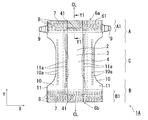
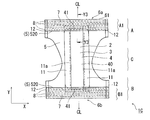
- FIG. 1 is a developed plan view showing a state where the unfolded disposable diaper according to the first embodiment of the present invention is unfolded and expanded.
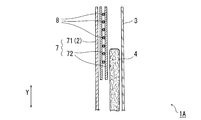
- 2 is a cross-sectional view taken along line Y1-Y1 of FIG.
- FIG. 3 is an enlarged plan view of an outer hydrophilic sheet used in the diaper shown in FIG.
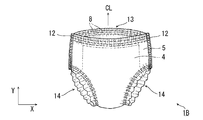
- FIG. 4 is a perspective view of a pants-type disposable diaper that is a second embodiment of the present invention.
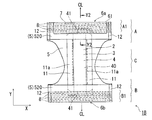
- FIG. 5 is a developed plan view showing a state where the pants-type disposable diaper shown in FIG. 4 is developed and extended.
- 6 is a cross-sectional view taken along line Y2-Y2 of FIG.
- FIG. 7 is an enlarged plan view of the inner hydrophilic sheet used in the diaper shown in FIG. FIG.
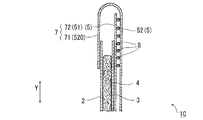
- FIG. 8 is an expanded plan view showing a state in which the pant-type disposable diaper according to the third embodiment of the present invention is expanded and expanded.
- 9 is a cross-sectional view taken along line Y3-Y3 of FIG.
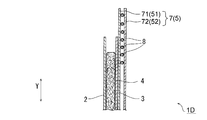
- FIG. 10 is a developed plan view showing a state in which the pants-type disposable diaper according to the fourth embodiment of the present invention is developed and extended.
- 11 is a cross-sectional view taken along line Y4-Y4 of FIG.
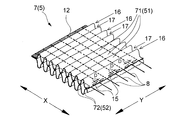
- FIG. 12 is a perspective view showing a partially broken outer packaging material of the pants-type disposable diaper shown in FIG. 10 in a natural state.
- 13 is a plan view showing a state in which the outer packaging material of the pants-type disposable diaper shown in FIG. 12 is extended.
- the disposable diaper 1A according to the first embodiment (hereinafter also referred to as “diaper 1A”) is, as shown in FIGS. 1 and 2, from the back side portion A located on the back side of the wearer when worn,
- the absorbent body 4 in the center in the width direction of the disposable diaper (hereinafter referred to as “X direction”.
- X direction a direction perpendicular to the center line CL extending in the longitudinal direction of the diaper 1A) across the ventral portion B located on the side.
- a hydrophilic sheet 7 is disposed on the waist flaps 6a and 6b. As shown in FIG.
- the hydrophilic sheet 7 includes an inner hydrophilic sheet 71 forming a skin contact surface and an outer hydrophilic sheet 72 disposed on the non-skin contact surface side of the inner hydrophilic sheet 71.
- the outer hydrophilic sheet 72 a sheet having higher liquid diffusibility than the inner hydrophilic sheet 71 is used.
- the inner hydrophilic sheet 71 and the outer hydrophilic sheet 72 are at least a region between the edge 61 of the waist flap 6a on the back side A and the edge 41 of the absorbent body 4.
- a gather is formed by the waist elastic member 8 arranged inside the waist flap 6a in a state of being stretched in the width direction (X direction) of the diaper 1A.
- the diaper 1A is formed symmetrically with respect to the center line CL. Therefore, in the following description, the right-side part shown in FIG.
- the diaper 1A is an unfolded disposable diaper, which is located on the back side A of the wearer when worn, and on the abdomen of the wearer. It has the crotch part C arrange
- the diaper 1 ⁇ / b> A has a pair of left and right fastening tapes 9, 9 connected to left and right edges of the back side portion A.
- the diaper 1 ⁇ / b> A has a target tape (not shown) for fastening the fastening tape 6 on the outer surface of the ventral side B.
- the diaper 1 ⁇ / b> A has a shape that is long in the same direction as the absorber 4 in a state where the diaper 1 ⁇ / b> A is expanded in a planar shape as shown in FIG. 1.
- the diaper 1A includes a liquid-permeable top sheet 2, a liquid-impermeable or water-repellent back sheet 3, and a liquid-retaining absorbent interposed between the two sheets 2 and 3. 4.
- the top sheet 2 and the back sheet 3 have both side edges at the center in the longitudinal direction (hereinafter referred to as “Y direction”; Y direction: a direction parallel to the center line CL), that is, the crotch part of the diaper 1.
- Y direction a direction parallel to the center line CL
- the region is curved in an hourglass shape bound inward in the width direction (X direction).
- the top sheet 2 and the back sheet 3 that forms the outer surface of the diaper 1 ⁇ / b> A are integrated by being joined together.
- the absorber 4 is also curved and formed in an hourglass shape confined in the width direction (X direction) in a region corresponding to the crotch portion C in accordance with the shape of the top sheet 2 and the back sheet 3.
- the absorber 4 is sandwiched between the top sheet 2 and the back sheet 3.
- the inner hydrophilic sheet 71 constituting the hydrophilic sheet 7 forms the top sheet 2. That is, in the diaper 1A, the topsheet 2 is an inner hydrophilic sheet 71 as shown in FIGS. Note that the inner hydrophilic sheet 71 and the outer hydrophilic sheet 72 described later of the hydrophilic sheet 7 are in a state where fibers are entangled, for example, a nonwoven fabric, and are not in a web state where fibers are not entangled. .
- the inner hydrophilic sheet 71 and the back sheet 3 extend outward in the longitudinal direction (Y direction) from both end edges 41, 41 in the longitudinal direction (Y direction) of the absorbent body 4, respectively.
- the extended portion forms a waist flap 6a on the back side A and a waist flap 6b on the abdominal side B.
- the outer hydrophilic sheet 72 is between the end edge 61 of the waist flap 6a on the back side A and the end edge 41 of the absorbent body 4 as shown in FIGS.
- the waist region A1 including the region and the waist region B1 including the region between the end edge 61 of the waist flap 6b on the ventral side B and the end edge 41 of the absorbent body 4 are disposed.
- the outer hydrophilic sheet 72 is inside the waist flap 6 a of the back side part A and the waist flap 6 b of the abdominal side part B, specifically, the inner hydrophilic sheet 71 and It is arranged between the back sheet 3.
- the outer hydrophilic sheet 72 on the back side A side extends in the width direction (X direction) between the fastening tapes 9, 9 provided on the left and right side edge portions in the width direction (X direction) of the back side A, respectively. In the longitudinal direction (Y direction), it extends from the edge 61 of the waist flap 6a of the back side portion A to the absorber 4 beyond the edge 41 of the absorber 4.
- the outer hydrophilic sheet 72 on the ventral side B side has the same width and the same length as the outer hydrophilic sheet 72 on the back side A described above.
- the outer hydrophilic sheet 72 is formed of two sheets as shown in FIG.
- the two outer hydrophilic sheets 72 have the same shape and the same size, and both have higher liquid diffusibility than the inner hydrophilic sheet 71 (surface sheet 2).
- the liquid diffusibility is measured by the following method for measuring the liquid diffusion area.
- ⁇ Measurement method of liquid diffusion area> A sample of each of the inner hydrophilic sheet 71 and the outer hydrophilic sheet 72 cut into 100 mm ⁇ 100 mm squares is placed on the acrylic plate, and 0.05 mL of colored water is dropped onto the acrylic plate from above 30 mm. After 10 minutes, the diffusion area of the colored water is measured using an image analyzer. The greater the measured value obtained, the higher the liquid diffusibility.
- the two outer hydrophilic sheets 72 have their constituent fibers oriented in the width direction (X direction) of the diaper 1A.
- the orientation of the fiber is preferably 1 or more, more preferably 1.2 or more, from the viewpoint of diffusibility in the width direction (X direction) and strength in the width direction (X direction). preferable.
- the degree of orientation is measured using a Microwave molecular orientation analyzer MOA-2001A manufactured by KANZAKI.
- MOA-2001A manufactured by KANZAKI.
- Each of the outer hydrophilic sheet 72 and the inner hydrophilic sheet 71 cut into a length of 100 mm and a width of 50 mm is used as a sample, and an average value of three points in each sample is measured to obtain an orientation degree.
- the inner hydrophilic sheet 71 (surface sheet 2) in the diaper 1A is oriented in the longitudinal direction (Y direction) (not shown).
- the waist elastic member 8 is disposed inside the waist flap 6 a on the back side A and the waist flap 6 b on the abdominal side B in a state of extending in the width direction (X direction).
- 1 to 10 thread-like plural elastic elastic members 8 are arranged between two outer hydrophilic sheets 72 and 72 as shown in FIGS. Are arranged intermittently in the longitudinal direction (Y direction). Gathers are formed on the waist flap 6a on the back side A and the waist flap 6b on the abdomen B including the inner hydrophilic sheet 71 and the outer hydrophilic sheet 72 by the waist elastic member 8 arranged in this way. Yes.
- the expansion ratio of the waist elastic member 8 is preferably 150% to 300% from the viewpoint of striking the wearer's body without any gap and expanding and contracting following changes in posture and abdominal circumference due to breathing, etc., 200% More preferably, it is ⁇ 250%.
- the top sheet 2 (inner hydrophilic sheet 71) and the back sheet 3 respectively extend outward in the width direction (X direction) as shown in FIG.
- the extended top sheet 2 and the extended back sheet 3 are joined to form a pair of left and right leg flaps 10, 10.
- the leg flaps 10 and 10 are provided with 1 to 5 thread-like elastic elastic members 10a for forming leg gathers.
- the elastic members 10a for forming leg gathers are formed of the top sheet 2 (inner hydrophilic sheet 71). And it is clamped and fixed by the back sheet 3. And the leg gathers are formed in the crotch part C of the diaper 1 because the elastic elastic member 10a contracts.
- Three-dimensional gather forming sheets 11 and 11 are arranged so as to cover the side portions of the topsheet 2 on both the left and right side portions in the longitudinal direction (Y direction) of the diaper 1A.
- Each three-dimensional guard forming sheet 11 is fixed to the top sheet 2 and in the width direction in a predetermined width region at both ends in the longitudinal direction (Y direction) and the outer edge in the width direction (X direction).
- the inner side (X direction) is in a free state.
- the three-dimensional guard forming sheet 11 has a three-dimensional guard-forming elastic member 11a at the inner edge in the width direction (X direction), that is, the edge near the center line CL. Due to the contraction force of the elastic member, the inner free state portion in the width direction (X direction) of the three-dimensional gather forming sheet 11 rises, and a three-dimensional gather is formed on the skin contact surface side of the heel wearer in the diaper 1A.
- the material for forming the disposable diaper 1A of the first embodiment will be described.
- the hydrophilic sheet 7 specifically, the top sheet 2 (inner hydrophilic sheet 71) and the outer hydrophilic sheet 72, a sheet material that is hydrophilic and can absorb and hold water is used.
- the “sheet material” means a material in which fibers are entangled, for example, a nonwoven fabric, except for a web in which fibers are not entangled.
- “Hydrophilic” includes both those in which the fibers themselves absorb and hold water and those that absorb and hold water in the space between the fibers. Examples thereof include a sheet of hydrophilic fibers, a sheet obtained by hydrophilizing hydrophobic fibers with an oil agent, and the like.
- non-woven fabrics containing hydrophilic fibers such as cotton, rayon and pulp (for example, spunlace nonwoven fabrics) and non-woven fabrics made of hydrophobic fibers such as polyethylene fibers and polypropylene fibers are subjected to a hydrophilization treatment with an oil or the like.
- a hydrophilization treatment with an oil or the like.
- the surface sheet 2 (inner hydrophilic sheet 71) and the outer hydrophilic sheet 72 either a sheet made of hydrophilic fibers or a sheet hydrophilized hydrophobic fibers can be used, and the combination thereof is also limited.
- the top sheet 2 (inner hydrophilic sheet) from the viewpoint of keeping the dry feeling on the skin side longer because the liquid retention of the sheet itself is low
- the basis weight of the hydrophilic sheet 7 is determined in consideration of its water absorption capacity.
- the surface sheet 2 (inner hydrophilic sheet 71) preferably has a basis weight of 10 to 100 g / m 2 , and 20 to 60 g / m 2. More preferably.
- the basis weight of the outer hydrophilic sheet 72 is preferably 10 to 80 g / m 2 , and more preferably 10 to 60 g / m 2 .
- the inner hydrophilic sheet 71 improves the softness, can easily form a fine gather by contraction of the waist elastic member 8, and the viewpoint of reducing the uncomfortable feeling given to the wearer when contacting the skin, From the viewpoint of facilitating the transfer of sweat accumulated in the gaps between fibers to the outer hydrophilic sheet 72 due to gather expansion and contraction, it is preferable to use a material that is more easily compressed and deformed than the outer hydrophilic sheet 72.
- the phrase “easy to compress and deform” refers to a sheet that is extremely easy to compress and deform with respect to compression in the thickness direction.
- the outer hydrophilic sheet 72 preferably has a higher density than the inner hydrophilic sheet 71 from the viewpoint of quickly transferring sweat from the skin contact surface side to the non-skin contact surface side by capillary force.
- the density of the outer hydrophilic sheet 72 is preferably 0.05 to 0.3 g / cm 3 , and preferably 0.1 to 0.2 g / cm 3. More preferably, it is 3 .
- the basis weight of the top sheet 2 (inner hydrophilic sheet 71) is preferably 0.01 to 0.2 g / cm 3 , and 0.02 to 0.1 g / cm 3. More preferably, it is 3 .
- the outer hydrophilic sheet 72 should have a higher transpiration property than the inner hydrophilic sheet 71 from the viewpoint of causing the outer hydrophilic sheet 72 to evaporate without causing the sweat transferred from the skin contact surface side to flow back. Is preferred.
- the liquid transpiration is measured by the following liquid transpiration measurement method.
- ⁇ Measurement method of liquid transpiration> Spray 0.2 g of distilled water on the acrylic plate.
- any sheet can be used without particular limitation as long as it is normally used for absorbent articles such as disposable diapers.
- a resin film or a laminate of a resin film and a nonwoven fabric can be used as the back sheet 3.
- the absorbent body 4 a fiber aggregate of fiber materials such as pulp or a material in which a superabsorbent polymer is supported on a fiber aggregate is used that is wrapped with a covering material such as tissue paper or a water-permeable nonwoven fabric. Can do.
- a stretchable film, a nonwoven fabric, a woven fabric, or a laminated sheet thereof can be used as the three-dimensional guard forming sheet 11, a stretchable film, a nonwoven fabric, a woven fabric, or a laminated sheet thereof can be used as the three-dimensional guard forming sheet 11, a stretchable film, a nonwoven fabric, a woven fabric, or a laminated sheet thereof can be used as the three-dimensional guard forming sheet 11, a stretchable film, a nonwoven fabric, a woven
- the waist elastic member 8, the leg gather forming elastic member 10a, and the three-dimensional guard forming elastic member 11a can be used without particular limitation as long as they are usually used in absorbent articles such as disposable diapers.
- a stretchable material made of natural rubber, polyurethane, polystyrene-polyisoprene copolymer, polystyrene-polybutadiene copolymer, polyethylene- ⁇ -olefin copolymer such as ethyl acrylate-ethylene, or the like can be used.
- the hook material for forming the fastening tape 9 can be used without particular limitation as long as it is usually used for absorbent articles such as disposable diapers.
- a hook material "Magic tape (registered trademark)” (manufactured by Kuraray), "Quicklon (registered trademark)” (manufactured by YKK), “Majikurosu (registered trademark)” (manufactured by Kanebo Bell Touch), etc.
- the male member etc. in can be used.
- the target tape is made of a loop material having a surface structure that can be engaged with an engagement protrusion of the hook material, and as such a loop material, a material that can fix the hook material by pressing the hook material is used. Can be used without limitation.
- the female member in the various well-known mechanical hook-and-loop fastener mentioned above can be used, for example.
- the outer surface (non-skin contact surface of the back sheet 3) of the abdominal side part B can also be comprised from the material which can be directly engaged with the engagement protrusion of a hook material, for example, a nonwoven fabric rich in engagement property.
- the diaper 1A has a hydrophilic sheet 7 (an inner hydrophilic sheet that forms a skin contact surface) on the skin contact surfaces of the waist flaps 6a and 6b that are likely to cause eczema, rash, rash and the like. 71 and the outer hydrophilic sheet 72) disposed on the non-skin contact surface side of the inner hydrophilic sheet 71, the sweat of the wearer can be transferred to the inner hydrophilic sheet 71. As shown in FIG.
- the diaper 1 ⁇ / b> A has a gather formed by a waist elastic member 8 on a waist flap 6 a, and is always expanded and contracted by the wearer's breathing and walking movements.
- the sweat transferred to the sheet 71 is easily transferred to the outer hydrophilic sheet 72. Since the outer hydrophilic sheet 72 of the diaper 1 ⁇ / b> A has a higher liquid diffusibility than the inner hydrophilic sheet 71, sweat that has migrated to the outer hydrophilic sheet 72 can be quickly diffused. In this way, the inner hydrophilic sheet 71 that forms the skin contact surface of the waist flap 6 is less likely to sweat and is less likely to be moistened, so that it is possible to prevent the occurrence of eczema, rash, rash, and the like.
- the inner hydrophilic sheet 71 and the outer hydrophilic sheet 72 of the diaper 1A are both sheets, the distance between the constituent fibers hardly changes due to gather expansion and contraction caused by the wearer's breathing or walking movement. Since the transferability of sweat from the adhesive sheet 71 to the outer hydrophilic sheet 72 is difficult to decrease, the effect of preventing the occurrence of eczema, rash, rash, etc. can be maintained.
- the constituent fibers of the two outer hydrophilic sheets 72 are both oriented in the width direction (X direction) of the diaper 1A. Therefore, the sweat transferred to the outer hydrophilic sheet 72 can be diffused more quickly. In this way, the inner hydrophilic sheet 71 that forms the skin contact surface of the waist flap 6 is less likely to sweat and is less likely to be moistened, so that it is possible to prevent the occurrence of eczema, rash, rash, and the like.
- a disposable diaper according to a second embodiment of the present invention will be described with reference to FIGS.
- a different point from the disposable diaper 1A of 1st Embodiment is demonstrated.
- the point which is not demonstrated especially is the same as that of 1 A of disposable diapers of 1st Embodiment, and description of 1 A of disposable diapers of 1st Embodiment is applied suitably.
- the disposable diaper 1B of the second embodiment (hereinafter also referred to as “diaper 1B”) is a pants-type disposable diaper as shown in FIGS.
- the inner hydrophilic sheet 71 and the outer hydrophilic sheet 72 of the diaper 1B are the skin contact of the folded portion 520 formed by folding the outer layer sheet 52 constituting the outer packaging material 5 of the diaper 1B in the waist region A1 of the back side portion A. On the contact surface, it is arranged in the width direction (X direction) of the diaper 1B.
- the waist elastic member 8 of the diaper 1 ⁇ / b> B is disposed between the outer layer sheet 52 and the inner layer sheet 51 disposed on the skin contact surface side of the outer layer sheet 52.
- the inner hydrophilic sheet 71 and the outer hydrophilic sheet 72 are separate sheets from the sheet constituting the outer packaging material 5 and the sheet constituting the absorbent main body 40 described later. It has a feature in a certain point.
- the diaper 1B includes an absorbent main body 40 having a top sheet 2, a back sheet 3, and an absorbent body 4 interposed between both sheets 2, 3. And an outer packaging material 5 that extends over the entire outer side of the absorbent main body 40 and is located on the non-skin contact surface side of the absorbent main body 40 and that bonds and fixes the absorbent main body 40. 5, the side edges of the back side A and the side edges of the ventral side B are joined to each other by known joining means such as heat seal, high frequency seal, ultrasonic seal, etc. to form side seal portions 12, 12. (See FIG. 4). Thereby, as shown in FIG. 4, the waist opening part 13 and a pair of leg opening parts 14 and 14 are formed in the diaper 1B. A crotch portion C is formed between the back side portion A and the ventral side portion B.
- the absorbent main body 40 has a vertically long rectangular shape, the longitudinal direction (Y direction) of which coincides with the longitudinal direction (Y direction) of the diaper 1, and the abdomen from the back side A of the diaper 1. It is joined to the width direction (X direction) center part of the outer packaging material 5 so that the side part B may be covered.
- three-dimensional guard forming sheets 11, 11 are disposed on the left and right side portions of the absorbent main body 40, and the width direction (X direction) of each of the three-dimensional guard forming sheets 11 is inward.
- the elastic member 11a for forming a three-dimensional guard is arranged in an extended state on the side edge, and when worn, a three-dimensional gather is formed on both the left and right sides of the absorbent main body 40 by the contraction force of the elastic member 11a. .
- the outer packaging material 5 is composed of two sheet materials as shown in FIG. Specifically, the outer packaging material 5 is composed of a laminate of an outer layer sheet 52 and an inner layer sheet 51.
- the outer layer sheet 52 forms the outermost surface of the diaper 1B.
- the inner layer sheet 51 is disposed on the inner surface side of the diaper 1 ⁇ / b> B adjacent to the outer layer sheet 52.
- the inner layer sheet 51 and the outer layer sheet 52 have the same shape at the side edges, but the shapes in the longitudinal direction (Y direction) are different.
- the outer layer sheet 52 has extending portions that extend in the front-rear direction from the longitudinal edge (Y direction) front-rear edge of the inner layer sheet 51.
- Each of the extending portions of the outer layer sheet 52 is folded back toward the absorbent main body 40 so as to cover the front and rear ends of the absorbent main body 40 after the absorbent main body 40 is arranged and fixed on the inner layer sheet 51 of the outer packaging material 5.
- a folded portion 520 is formed (see FIG. 6). As shown in FIG. 5, the free end edge of the folded portion 520 extends to the leg opening, that is, to a position covering the entire region of the side seal portion 12 and reaches the absorber 4.
- waist flaps 6a and 6b are formed on the diaper 1B by extending in the front-rear direction from the front and rear end edges 41 and 41 of the absorber 4, respectively (see FIG. 6).
- the inner hydrophilic sheet 71 and the outer hydrophilic sheet 72 constituting the hydrophilic sheet 7 are sheets of the same shape and the same size as shown in FIGS. It is arranged in the width direction (X direction) on the skin contact surface of the folded portion 520 on the side A side.
- the inner hydrophilic sheet 71 of the diaper 1 ⁇ / b> B is disposed on the skin contact surface of the outer hydrophilic sheet 72.
- the inner hydrophilic sheet 71 and the outer hydrophilic sheet 72 are located between the edge 61 of the waist flap 6a on the back side A and the edge 41 of the absorbent body 4 as shown in FIGS. It is arranged in the waist region A1 including the region.
- the inner hydrophilic sheet 71 and the outer hydrophilic sheet 72 are wider than the width of the absorbent main body 40 in the width direction (X direction) and are larger than the interval between the side seal portions 12 and 12. Also extends to be narrower.
- the inner hydrophilic sheet 71 and the outer hydrophilic sheet 72 are arranged in the longitudinal direction (Y direction) from the edge 61 of the waist flap 6 a of the back side A to the free edge of the folded portion 520. It extends to an area that does not exceed.
- each of the inner hydrophilic sheet 71 and the outer hydrophilic sheet 72 overlaps the folded portion 520 and does not exceed the free end portion of the folded portion 520, whereby the inner hydrophilic sheet 71 and the outer hydrophilic sheet 72 are each It is possible to prevent the excreted urine and feces from permeating into the inner hydrophilic sheet 71 and the outer hydrophilic sheet 72 without coming into contact with the top sheet 2.
- the inner hydrophilic sheet 71 and the outer hydrophilic sheet 72 are, as shown in FIGS. It extends from the end edge 61 of the waist flap 6a of the back side A to the end edge of the absorbent main body 40 and further to the upper end of the absorbent body 4 over the end edge 41 of the absorbent body 4.
- seat 72 are the waist flaps of the back side part A in a longitudinal direction (Y direction). It extends from the edge 61 of 6a to the vicinity of the edge of the absorptive main body 40.
- the inner hydrophilic sheet 71 and the outer hydrophilic sheet 72 of the disposable diaper 1B of the second embodiment are both oriented in the width direction (X direction) of the diaper 1A as shown in FIGS. is doing.
- the outer hydrophilic sheet 72 preferably has a higher density than the inner hydrophilic sheet 71 from the viewpoint of quickly transferring sweat from the skin contact surface side to the non-skin contact surface side by capillary force (FIG. 3, see Fig. 7)
- the waist elastic member 8 is the state of the waist flap 6a of the back side part A, and the abdominal side part B in the state extended in the width direction (X direction). It is arranged inside the waist flap 6b.
- a plurality of 1-30 thread-like waist elastic members 8 comprise an inner layer sheet 51 and an outer layer sheet constituting the outer packaging material 5, as shown in FIGS. 52 and is intermittently juxtaposed in the longitudinal direction (Y direction). Gathers are formed on the waist flap 6a on the back side A and the waist flap 6b on the abdomen B including the inner hydrophilic sheet 71 and the outer hydrophilic sheet 72 by the waist elastic member 8 arranged in this way. ing.
- the formation material of the disposable diaper 1B of 2nd Embodiment is demonstrated.
- About the underpants type disposable diaper 1B of 2nd Embodiment a different point from the underpants type disposable diaper 1A of 1st Embodiment is demonstrated.
- the point which is not demonstrated especially is the same as that of 1 A of underpants type disposable diapers of 1st Embodiment.
- the inner hydrophilic sheet 71 and the outer hydrophilic sheet 72 a sheet material that is hydrophilic and can absorb and retain water is used.
- a sheet of hydrophilic fibers can be mentioned.
- the hydrophilic sheet 7 of the diaper 1B the separate inner hydrophilic sheet 71 and outer hydrophilic sheet 72 are joined together by a known joining means such as adhesive, heat seal, high frequency seal, ultrasonic seal and the like. A sheet can be used.
- the outer layer sheet 51 and the inner layer sheet 52 constituting the outer packaging material 5 can be used without particular limitation as long as they are usually used for absorbent articles such as disposable diapers.
- a water-repellent nonwoven fabric or the like can be used as the outer layer sheet 51 and the inner layer sheet 52.
- the disposable diaper of 3rd Embodiment of this invention is demonstrated based on FIGS. 8-9.
- the difference from the disposable diaper 1A of 1st Embodiment or the disposable diaper 1B of 2nd Embodiment is demonstrated.
- the point which is not demonstrated in particular is the same as the disposable diaper 1A of the first embodiment or the disposable diaper 1B of the second embodiment, and the description of the disposable diaper 1A of the first embodiment or the disposable diaper 1B of the second embodiment is appropriately applied. Is done.
- the disposable diaper 1C of the third embodiment is a pants-type disposable diaper, as is the case with the diaper 1B (see FIGS. 4 and 8).
- the inner hydrophilic sheet 71 is formed by folding back the outer layer sheet 52 constituting the outer packaging material 5 of the diaper 1 ⁇ / b> C at the waist region A ⁇ b> 1 of the back side A and the waist region B ⁇ b> 1 of the abdominal side B.
- a folded portion 520 is formed.
- the outer hydrophilic sheet 72 forms an inner layer sheet 51 disposed on the skin contact surface side of the outer layer sheet 52.
- the waist elastic member 8 is disposed between the outer layer sheet 52 and the outer hydrophilic sheet 72.
- the inner hydrophilic sheet 71 is a folded portion 520 of the outer layer sheet 52 constituting the outer packaging material 5, and the outer hydrophilic sheet 72. Is characterized in that it is the inner layer sheet 51 constituting the outer packaging material 5.
- the diaper 1 ⁇ / b> C includes an outer packaging material 5 that extends over the entire outer side of the absorbent main body 40 as shown in FIGS. 8 and 9.
- the outer packaging material 5 is composed of a laminate of an outer layer sheet 52 and an inner layer sheet 51.
- the outer layer sheet 52 forms the outermost surface of the diaper 1B.
- the inner layer sheet 51 is disposed on the inner surface side of the diaper 1 ⁇ / b> B adjacent to the outer layer sheet 52.
- the inner sheet 51 is an outer hydrophilic sheet 72.
- the inner layer sheet 51 (outer hydrophilic sheet 72) and the outer layer sheet 52 have the same outline at the side edges, but the shapes in the longitudinal direction (Y direction) are different. ing.
- the outer layer sheet 52 has extending portions extending in the front-rear direction from the front-rear edge in the longitudinal direction (Y direction) of the inner layer sheet 51 (outer hydrophilic sheet 72). ing.
- Each of the extending portions of the outer layer sheet 52 is absorbent so as to cover the front and rear ends of the absorbent main body 40 after the absorbent main body 40 is arranged and fixed on the inner layer sheet 51 (outer hydrophilic sheet 72) of the outer packaging material 5.
- the folded portion 520 is the inner hydrophilic sheet 71.
- the free end edges of the folded portion 520 are the front and rear ends of the absorbent main body 40 from the end edge 61 of the waist flap 6a on the back side A and the end edge 61 of the waist flap 6b on the ventral side B, respectively. It extends beyond the respective edges and further beyond both front and rear end edges 41 of the absorbent body 4 and onto the absorbent body 4 (see FIGS. 8 and 9).
- the waist elastic member 8 is stretched in the width direction (X direction), and the waist flap 6a of the back side A and the ventral side B It is arranged inside each of the waist flaps 6b.
- a plurality of 1 to 30 thread-like waist elastic members 8 are formed into an inner layer sheet 51 (an outer hydrophilic sheet) constituting the outer packaging material 5 as shown in FIGS.
- the sheet 72) and the outer layer sheet 52 are arranged intermittently in the longitudinal direction (Y direction).
- the waist elastic member 8 By the waist elastic member 8 arranged in this way, the waist flap 6a on the back side A including the inner hydrophilic sheet 71 (the folded portion 520 of the outer layer sheet 52) and the outer hydrophilic sheet 72 (the inner layer sheet 51), and the belly A gather is formed on each of the waist flaps 6b of the side portion B.
- the forming material of the disposable diaper 1C of the third embodiment is the same as that of the pant-type disposable diaper 1A of the first embodiment or the pant-type disposable diaper 1B of the second embodiment. That is, the inner hydrophilic sheet 71 is the same as the outer layer sheet 52 constituting the outer packaging material 5, and the outer hydrophilic sheet 72 is the same as the inner layer sheet 51 constituting the outer packaging material 5.
- the effect at the time of using the disposable diaper 1C of 3rd Embodiment of this invention mentioned above is demonstrated.
- the disposable diaper 1C of the third embodiment has the same effects as the disposable diaper 1A of the first embodiment or the disposable diaper 1B of the second embodiment.
- effects different from the deployable disposable diaper 1A of the first embodiment or the disposable diaper 1B of the second embodiment will be described.
- the disposable diaper 1C of the third embodiment is smaller than the number of constituent members of the diaper 1A and the diaper 1B, the gathers formed on the waist flap 6a on the back side A and the waist flap 6b on the abdomen B respectively. Finely, the feeling of touch improves.
- the disposable diaper 1C of the third embodiment is smaller than the number of constituent members of the diaper 1A and the diaper 1B, the heat retaining properties of the waist flap 6a on the back side A and the waist flap 6b on the abdomen B are low and worn. Makes it difficult for people to sweat.
- the disposable diaper of 4th Embodiment of this invention is demonstrated based on FIGS. 10-13.
- the point which is different from the disposable diaper 1A of 1st Embodiment, the disposable diaper 1B of 2nd Embodiment, or the disposable diaper 1C of 3rd Embodiment is demonstrated.
- the points that are not particularly described are the same as the disposable diaper 1A of the first embodiment, the disposable diaper 1B of the second embodiment, or the disposable diaper 1C of the third embodiment, and the disposable diaper 1A of the first embodiment, the second embodiment.
- the description of the disposable diaper 1B or the disposable diaper 1C of the third embodiment is applied as appropriate.
- the disposable diaper 1D of the fourth embodiment is a pants-type disposable diaper, as in the diaper 1B and the diaper 1C (see FIGS. 4 and 10).
- the inner hydrophilic sheet 71 is an inner layer sheet 51 disposed on the skin contact surface side constituting the outer packaging material 5 of the diaper 1D
- the outer hydrophilic sheet 72 is an outer packaging material of the diaper 1D
- 5 is an outer layer sheet 52 that forms the outermost surface of the diaper 1D.
- the waist elastic member 8 is disposed between the inner hydrophilic sheet 71 (inner layer sheet 51) and the outer hydrophilic sheet 72 (outer layer sheet 52).
- the inner hydrophilic sheet 71 is the inner layer sheet 51 constituting the outer packaging material 5
- the outer hydrophilic sheet 72 is characterized in that it is the outer layer sheet 52 constituting the outer packaging material 5.
- the inner hydrophilic sheet 71 (inner layer sheet 51) and the outer hydrophilic sheet 72 (outer layer sheet 52) are side edge portions thereof. Have the same shape, and the shape in the longitudinal direction (Y direction) is also the same shape.
- the inner hydrophilic sheet 71 (inner layer sheet 51) and the outer hydrophilic sheet 72 (outer layer sheet 52) have a width direction (X direction) and a longitudinal direction (Y direction). ) In each case, they are intermittently joined to each other via the joint 15.
- the waist elastic member 8 is stretched in the width direction (X direction) as shown in FIGS. It is arranged inside each of the waist flaps 6b of the part B.
- a plurality of thread-like waist elastic members 8 having 2 to 30 threads form an inner layer sheet 51 (an inner hydrophilic sheet 71) and an outer layer constituting the outer packaging material 5 as shown in FIGS. It arrange
- each elastic waist member 8 of the fourth embodiment includes an inner layer sheet 51 (inner hydrophilic sheet 71) and an outer layer sheet 52 in both side seal portions 12 and 12. It is joined to the (outer hydrophilic sheet 72), and in the portions other than the side seal portions 12, 12, the inner layer sheet 51 (inner hydrophilic sheet 71) and the outer layer sheet 52 (outer hydrophilic sheet 72). It is not joined to.
- the waist elastic member 8 arranged in this way, the waist flap 6a of the back side A including the inner hydrophilic sheet 71 (inner layer sheet 51) and the outer hydrophilic sheet 72 (outer layer sheet 52), and the ventral side part B A gather is formed on each of the waist flaps 6b.
- the joining portion 15 that joins the inner hydrophilic sheet 71 (inner layer sheet 51) and the outer hydrophilic sheet 72 (outer layer sheet 52) to each other is in the width direction. They are arranged in a row in each of the (X direction) and the longitudinal direction (Y direction).
- the joint portions 15 constituting the row in the width direction (X direction) and the elastic members 8 extended in the width direction (X direction) are alternately arranged in the longitudinal direction (Y direction). It is arranged in.
- the waist elastic member 8 contracts in the natural state (the state where no external force is applied), and the inner hydrophilic sheet 71 (inner layer sheet 51) and the outer side
- Each of the hydrophilic sheets 72 (outer layer sheets 52) forms a plurality of walls (ridges) 16 and 16 extending continuously over the plurality of waist elastic members 8, respectively.
- each heel 16 of each of the inner hydrophilic sheet 71 (inner layer sheet 51) and the outer hydrophilic sheet 72 (outer layer sheet 52) is outside.
- a convex curved surface having an arcuate cross section is formed at the tip of each ridge 16 in the protruding direction. As shown in FIG. 12, the convex curved surface continuously extends in the longitudinal direction (Y direction).
- a heel ( ⁇ ) 16 is formed, and these ridges ( ⁇ ) 16 are continuously divided in the longitudinal direction (Y direction) without being divided at a portion overlapping the elastic member 4. That is, as shown in FIG. 12, in a natural state (a state in which no external force is applied), the waist elastic member 8 contracts, and the joint portion 15 that forms a row in the longitudinal direction (Y direction) forms a groove 17.
- the grooves 17 and ridges 16 are alternately formed in the width direction (X direction).
- disposable diaper 1D of 4th Embodiment it is the same as that of the underpants type disposable diaper 1A of 1st Embodiment, the underpants type disposable diaper 1B of 2nd Embodiment, or the underpants type disposable diaper 1C of 3rd Embodiment. . That is, the inner hydrophilic sheet 71 is the same as the inner layer sheet 51 constituting the outer packaging material 5, and the outer hydrophilic sheet 72 is the same as the outer layer sheet 52 constituting the outer packaging material 5.
- the joining part 15 may be formed by joining by heat sealing
- the disposable diaper 1D of 4th Embodiment of this invention has the same effects as the disposable diaper 1A of the first embodiment, the disposable diaper 1B of the second embodiment, or the disposable diaper 1C of the third embodiment.
- effects different from the deployable disposable diaper 1A of the first embodiment, the disposable diaper 1B of the second embodiment, or the disposable diaper 1C of the third embodiment will be described.
- the disposable diaper 1 ⁇ / b> D of the fourth embodiment has a waist flap 6 a on the back side A including the inner hydrophilic sheet 71 and the outer hydrophilic sheet 72, and the ventral part B by the waist elastic member 8. Since each of the waist flaps 6b has gathers in which ridges (16) and grooves 17 are alternately formed in the width direction (X direction), the outer packaging material 5 has a soft feel and looks very good. Become beautiful.
- the disposable diaper 1 ⁇ / b> D of the fourth embodiment has an inner layer sheet 51 (inner hydrophilic sheet 71) and an outer layer sheet 52 where the waist elastic member 8 is other than the side seal portions 12 and 12.
- the joining portion 15 constituting the longitudinal direction (Y direction) constitutes the groove 17, and the longitudinal direction in each groove 17 (Y direction).
- the inner hydrophilic sheet 71 (inner layer sheet 51) and the outer hydrophilic sheet 72 (outer layer sheet 52) are in contact with each other in a region D between the adjacent joint portions 15.
- the inner hydrophilic sheet 71 inner layer sheet 51, is transferred. Sweat can be efficiently transferred to the outer hydrophilic sheet 72 (outer layer sheet 52), and sweat can be efficiently evaporated.
- the disposable diaper of the present invention is not limited to the disposable diaper 1A of the first embodiment, the disposable diaper 1B of the second embodiment, the disposable diaper 1C of the third embodiment, and the disposable diaper 1D of the fourth embodiment. Instead, it can be changed as appropriate.
- the hydrophilic sheet 7 is shown in FIG. 6, 9, and 11, the inner hydrophilic sheet 71 and the outer hydrophilic sheet 72 are formed so as to be adjacent to each other, but the inner hydrophilic sheet 71 and the outer hydrophilic sheet are formed.
- Another water-permeable sheet may be interposed between the sheet 72 and the sheet 72.
- the outer hydrophilic sheet 72 is formed of two sheets of the same shape and the same size as shown in FIG.
- the outer hydrophilic sheet 72 on the non-skin contact surface side of the two sheets may be larger.
- the outer hydrophilic sheet 72 is formed of two sheets as shown in FIG. 2, and the two outer hydrophilic sheets 72 are either In addition, a liquid diffusibility higher than that of the inner hydrophilic sheet 71 (surface sheet 2) is used, but only one of the outer hydrophilic sheets 72 is more than the inner hydrophilic sheet 71 (surface sheet 2). Any material having a high liquid diffusibility may be used as long as liquid diffusibility is higher than that of the inner hydrophilic sheet 71 (surface sheet 2).
- the outer hydrophilic sheet 72 on the skin contact surface side may have a higher liquid diffusibility than the outer hydrophilic sheet 72 on the skin contact surface side.
- the two outer hydrophilic sheets 72 have their constituent fibers oriented in the width direction (X direction) of the diaper 1A. However, none of them may be oriented in the width direction (X direction), and only one of the outer hydrophilic sheets 72 may be oriented in the width direction (X direction).
- the inner hydrophilic sheet 71 and the outer hydrophilic sheet 72 constituting the hydrophilic sheet 7 are the same shape and size sheets as shown in FIGS. However, the sheet does not have to be the same shape and size.
- Example 1 uses a hydrophilic air-through nonwoven fabric (25 g / m 2 , length 60 mm ⁇ width 100 mm) made of PP / PE and PET / PE fibers as the inner hydrophilic sheet and PP fibers as the outer hydrophilic sheet.
- Two hydrophilic spunbonded nonwoven fabrics (10 g / m 2 , 60 mm long ⁇ 120 mm wide) were used. Further, ten natural rubbers (470 dtex) were used as waist elastic members.
- an inner hydrophilic sheet is disposed on a flat surface, one of the outer hydrophilic sheets is disposed on the inner hydrophilic sheet, and stretched at a stretch ratio of 200% on one outer hydrophilic sheet.
- Example 2 uses a weakly hydrophilic spunbond nonwoven fabric (19 g / m 2 , 60 mm long ⁇ 100 mm wide) made of PP fibers as the inner hydrophilic sheet, and hydrophilic SMMS made of PP fibers as the outer hydrophilic sheet.
- a gather was prepared in the same manner as in Example 1 except that (spun bond / melt blow / melt blow / spun bond) (10 g / m 2 , vertical width 60 mm ⁇ horizontal width 120 mm) was used.
- Example 3 is a concavo-convex shape hydrophilic air-through nonwoven fabric (36 g / m 2 , longitudinal width 60 mm ⁇ 1) formed by processing a hydrophilic air-through nonwoven fabric made of PET / PE fibers as an inner hydrophilic sheet.
- a gather was prepared in the same manner as in Example 1 except that a hydrophilic spunbond nonwoven fabric (10 g / m 2 , length 60 mm ⁇ width 120 mm) made of PP fibers was used as the outer hydrophilic sheet.
- Comparative Example 1 uses a hydrophilic air-through nonwoven fabric (25 g / m 2 , length 60 mm ⁇ width 100 mm) made of PP / PE and PET / PE fibers as the inner hydrophilic sheet, and from PP fibers as the outer hydrophilic sheet.
- a gather was prepared in the same manner as in Example 1 except that the water-repellent spunbond nonwoven fabric (15 g / m 2 , vertical width 60 mm ⁇ horizontal width 120 mm) was used.
- Comparative Example 2 uses a hydrophilic spunbond nonwoven fabric (10 g / m 2 , 60 mm long ⁇ 100 mm wide) made of PP fibers as the inner hydrophilic sheet, and PP / PE and PET / PE as the outer hydrophilic sheets.
- a gather was prepared in the same manner as in Example 1 except that a hydrophilic air-through nonwoven fabric (25 g / m 2 , vertical width 60 mm ⁇ horizontal width 120 mm) made of fibers was used.
- Comparative Example 3 uses a hydrophilic air-through nonwoven fabric (25 g / m 2 , length 60 mm ⁇ width 100 mm) made of PP / PE and PET / PE fibers as the inner hydrophilic sheet, and acetate as the outer hydrophilic sheet.
- a gather was prepared in the same manner as in Example 1 except that a hydrophilic web made of fibers (20 g / m 2 , 60 mm long ⁇ 120 mm wide) was used.
- the liquid diffusion areas of the inner hydrophilic sheet and the outer hydrophilic web used were measured in the same manner as in Example 1. The obtained measured values are shown in Table 1.
- Comparative Example 4 uses a hydrophilic air-through nonwoven fabric (30 g / m 2 , length 60 mm ⁇ width 120 mm) made of PET / PE fibers as the inner hydrophilic sheet, and hydrophilic made of PET / PE fibers as the outer hydrophilic sheet.
- a gather was prepared in the same manner as in Example 1 except that the air-through nonwoven fabric (25 g / m 2 , vertical width 60 mm ⁇ horizontal width 70 mm) was used.
- an acrylic plate (length 150 mm ⁇ width 150 mm) was placed on a horizontal plane, and the gathers of each example and each comparative example were placed on the acrylic plate.
- the inner hydrophilic sheet is disposed on the acrylic plate side.
- a weight of 1.0 kPa is placed on the center of the gathers of each example and each comparative example, that is, the center of the outer hydrophilic sheet on the side opposite to the acrylic plate, and the inner hydrophilicity of each gather of each example and each comparative example.
- 0.5 ml of water was injected between the adhesive sheet and the acrylic plate. After injecting water, the gathers of each example and each comparative example were stretched until the gathers stopped and then shrunk again to the original state.
- the qmax value is a peak value of a heat flow rate in which predetermined heat is stored in a heat plate having a constant area and a constant mass, and immediately after the heat is in contact with the sample surface, the stored heat amount is transferred to the low temperature side sample.
- the larger the qmax value the higher the body temperature taken away during clothing and the higher the feeling of cool contact.
- the contact cooling sensation greatly depends on the amount of water that the injected water diffuses into each sheet. Therefore, if the sample in which the qmax value at the time of drying and the qmax value after water absorption expansion / contraction are the same, the larger the ⁇ qmax (kW / m 2 ) value, the greater the amount of moisture.
- the absorbent article of the present invention since sweat is highly diffusible, the occurrence of eczema, rash, rash, etc. can be reduced.
Landscapes
- Health & Medical Sciences (AREA)
- Life Sciences & Earth Sciences (AREA)
- Engineering & Computer Science (AREA)
- Biomedical Technology (AREA)
- Heart & Thoracic Surgery (AREA)
- Vascular Medicine (AREA)
- Epidemiology (AREA)
- Animal Behavior & Ethology (AREA)
- General Health & Medical Sciences (AREA)
- Public Health (AREA)
- Veterinary Medicine (AREA)
- Absorbent Articles And Supports Therefor (AREA)
- Orthopedics, Nursing, And Contraception (AREA)
Abstract
Description
前記親水性シートは、肌当接面を形成する内側親水性シートと、該内側親水性シートの非肌当接面側に配される外側親水性シートとを有している。
前記内側親水性シート及び前記外側親水性シートは、前記背側部の前記ウエストフラップの端縁と前記吸収体の端縁との間の領域を含むウエスト領域に配されている。
前記外側親水性シート及び前記内側親水性シートを含む前記ウエストフラップには、前記使い捨ておむつの幅方向に伸張した状態で前記ウエストフラップの内部に配されたウエスト弾性部材によりギャザーが形成されている。
前記外側親水性シートは、前記内側親水性シートよりも、液体の拡散性が高いものである。
おむつ1Aは、図1に示すように、中心線CLに対して左右対称に形成されている。従って以下の説明では、左右対称な部分については、主に、図1に示す右側の部分について説明する。
尚、おむつ1Aは、図1に示すように、平面状に拡げた状態において、吸収体4と同方向に長い形状を有している。
尚、親水性シート7の有する内側親水性シート71及び後述する外側親水性シート72は、繊維を交絡させた状態のもの、例えば不織布であり、繊維を交絡させていないウェブの状態のものではない。
アクリル板の上に、100mm×100mm四方に切断した内側親水性シート71及び外側親水性シート72それぞれのサンプルを置き、その上に、30mm上方から着色した水0.05mLを滴下する。10分後、画像解析装置を用いて、着色した水の拡散面積を測定する。得られた測定値が大きいほど、液体の拡散性が高いものである。
尚、おむつ1Aにおける内側親水性シート71(表面シート2)は、長手方向(Y方向)に配向している(非図示)。
伸張倍率(%)=(B/A)×100
親水性シート7、具体的には、表面シート2(内側親水性シート71)及び外側親水性シート72としては、親水性であって水の吸収保持が可能なシート材料が用いられる。ここで、「シート材料」とは、繊維を交絡させていないウェブの状態のものを除き、繊維を交絡させた状態のもの、例えば不織布を意味する。また、「親水性」とは、繊維自体が水を吸収保持するもの、繊維同士の空間によって水を吸収保持するものの両方が含まれる。その例としては、親水性繊維のシート、疎水性繊維を油剤等により親水化処理したシート等が挙げられる。具体的には、コットン、レーヨン、パルプ 等の親水性繊維を含む不織布(例えばスパンレース不織布)やポリエチレン繊維やポリプロピレン繊維等の疎水性繊維から成る不織布を油剤等により親水化処理を施したものが好適に用いられる。表面シート2(内側親水性シート71)及び外側親水性シート72のそれぞれには、親水性繊維から成るシート及び疎水性繊維を親水化処理したシートの何れも用いることができ、その組み合わせにも制限はないが、多量に発汗した状態で長時間着用する場合には、シート自体の液保持性が低いために肌側のドライ感がより長く保たれる観点から、表面シート2(内側親水性シート71)には、疎水性繊維を親水化処理したシートを用いた方が好ましい。親水性シート7の坪量は、その吸水容量等を考慮して決定される。例えば親水性シート7として、親水性繊維のシートが用いられる場合、表面シート2(内側親水性シート71)の坪量は、10~100g/m2であることが好ましく、20~60g/m2であることが更に好ましい。親水性繊維のシートが用いられる場合、外側親水性シート72の坪量は、10~80g/m2であることが好ましく、10~60g/m2であることが更に好ましい。
アクリル板の上に、0.2gの蒸留水をスプレーする。100mm×100mm四方に切断した内側親水性シート71及び外側親水性シート72それぞれのサンプルをスプレーした蒸留水上に載せ、温度20℃、湿度65%RHの恒温環境下にて蒸留水が蒸散する量を重量変化で測定する。10分後の蒸留水の蒸散量(10分後の蒸留水を含んだサンプルの重量-サンプルの当初の重量)を初期の蒸留水(0.2g)で除し、その割合を液蒸散性の値とする。測定値は、n=3の平均値である。
おむつ1Aは、図1,2に示すように、湿疹、あせも、かぶれ等の発生し易いウエストフラップ6a,6bの肌当接面に親水性シート7(肌当接面を形成する内側親水性シート71と、内側親水性シート71の非肌当接面側に配される外側親水性シート72)を備えているため、着用者の汗を内側親水性シート71に移行することができる。おむつ1Aは、図1に示すように、ウエストフラップ6aに、ウエスト弾性部材8によりギャザーが形成されており、着用者の呼吸や歩行運動により、常に伸縮しており、この伸縮により、内側親水性シート71に移行した汗を、外側親水性シート72に移行し易い。おむつ1Aの外側親水性シート72は、内側親水性シート71よりも、液体の拡散性が高いので、外側親水性シート72に移行した汗を、素早く拡散できる。このように、ウエストフラップ6の肌当接面を形成する内側親水性シート71に汗を留め難く、湿潤した状態となり難いので、湿疹、あせも、かぶれ等の発生を防止することができる。また、おむつ1Aの内側親水性シート71及び外側親水性シート72は、何れもシートであるため、着用者の呼吸や歩行運動によるギャザーの伸縮により、構成繊維間の距離が変化し難く、内側親水性シート71から外側親水性シート72への汗の移行性が低下し難いので、湿疹、あせも、かぶれ等の発生の防止効果を維持することができる。
第2実施形態の使い捨ておむつ1Bについては、第1実施形態の使い捨ておむつ1Aと異なる点について説明する。特に説明しない点は、第1実施形態の使い捨ておむつ1Aと同様であり、第1実施形態の使い捨ておむつ1Aの説明が適宜適用される。
第2実施形態の使い捨ておむつ1Bにおいては、内側親水性シート71及び外側親水性シート72が、外包材5を構成するシート、及び後述する吸収性本体40を構成するシートとは別体のシートである点に特徴を有している。
第2実施形態のパンツ型使い捨ておむつ1Bについては、第1実施形態のパンツ型使い捨ておむつ1Aと異なる点について説明する。特に説明しない点は、第1実施形態のパンツ型使い捨ておむつ1Aと同様である。
第3実施形態の使い捨ておむつ1Bについては、第1実施形態の使い捨ておむつ1A又は第2実施形態の使い捨ておむつ1Bと異なる点について説明する。特に説明しない点は、第1実施形態の使い捨ておむつ1A又は第2実施形態の使い捨ておむつ1Bと同様であり、第1実施形態の使い捨ておむつ1A又は第2実施形態の使い捨ておむつ1Bの説明が適宜適用される。
第3実施形態の使い捨ておむつ1Cにおいては、第2実施形態の使い捨ておむつ1Bと異なり、内側親水性シート71が、外包材5を構成する外層シート52の折り返し部520であり、外側親水性シート72が、外包材5を構成する内層シート51である点に特徴を有している。
第3実施形態の使い捨ておむつ1Cは、第1実施形態の使い捨ておむつ1A又は第2実施形態の使い捨ておむつ1Bと同様の効果が得られる。以下、第1実施形態の展開型使い捨ておむつ1A又は第2実施形態の使い捨ておむつ1Bと異なる効果について説明する。
第4実施形態の使い捨ておむつ1Dについては、第1実施形態の使い捨ておむつ1A、第2実施形態の使い捨ておむつ1B又は第3実施形態の使い捨ておむつ1Cと異なる点について説明する。特に説明しない点は、第1実施形態の使い捨ておむつ1A、第2実施形態の使い捨ておむつ1B又は第3実施形態の使い捨ておむつ1Cと同様であり、第1実施形態の使い捨ておむつ1A、第2実施形態の使い捨ておむつ1B又は第3実施形態の使い捨ておむつ1Cの説明が適宜適用される。
第4実施形態の使い捨ておむつ1Dにおいては、第2実施形態の使い捨ておむつ1B及び第3実施形態の使い捨ておむつ1Cと異なり、内側親水性シート71が、外包材5を構成する内層シート51であり、外側親水性シート72が、外包材5を構成する外層シート52である点に特徴を有している。
第4実施形態の使い捨ておむつ1Dは、第1実施形態の使い捨ておむつ1A、第2実施形態の使い捨ておむつ1B又は第3実施形態の使い捨ておむつ1Cと同様の効果が得られる。以下、第1実施形態の展開型使い捨ておむつ1A、第2実施形態の使い捨ておむつ1B又は第3実施形態の使い捨ておむつ1Cと異なる効果について説明する。
実施例1は、内側親水性シートとしてPP/PE及びPET/PE繊維からなる親水性のエアスルー不織布(25g/m2、縦幅60mm×横幅100mm)を用い、外側親水性シートとしてPP繊維からなる2枚の親水性のスパンボンド不織布(10g/m2、縦幅60mm×横幅120mm)を用いた。また、ウエスト弾性部材として天然ゴム(470dtex)を10本用いた。実施例1においては、平面上に、内側親水性シートを配し、内側親水性シート上に外側親水性シートの一方を配し、一方の外側親水性シート上に、伸張倍率200%に伸張させた10本のウエスト弾性部材を5mm間隔で並置し、これらのウエスト弾性部材を挟んで他方の外側親水性シートを配し、吸収性物品に一般的に用いられる接着剤により一方の外側親水性シートと他方の外側親水性シートを全面的に接着させることによりギャザーを作成した。
用いた内側親水性シート及び外側親水性シートそれぞれの液拡散面積は、上記液拡散面積の測定方法により測定した。得られた測定値を表1に示す。測定値は、n=5の平均値である。
実施例2は、内側親水性シートとしてPP繊維からなる弱親水性のスパンボンド不織布(19g/m2、縦幅60mm×横幅100mm)を用い、外側親水性シートとしてPP繊維からなる親水性のSMMS(スパンボンド/メルトブロー/メルトブロー/スパンボンド)(10g/m2、縦幅60mm×横幅120mm)を用いる以外は実施例1と同様にしてギャザーを作成した。
用いた内側親水性シート及び外側親水性シートそれぞれの液拡散面積は、実施例1と同様にして測定した。得られた測定値を表1に示す。測定値は、n=5の平均値である。
実施例3は、内側親水性シートとしてPET/PE繊維からなる親水性のエアースルー不織布を加工して凹凸形状を附した凹凸形状の親水性のエアースルー不織布(36g/m2、縦幅60mm×横幅100mm)を用い、外側親水性シートとしてPP繊維からなる親水性のスパンボンド不織布(10g/m2、縦幅60mm×横幅120mm)を用いる以外は実施例1と同様にしてギャザーを作成した。
用いた内側親水性シート及び外側親水性シートそれぞれの液拡散面積は、実施例1と同様にして測定した。得られた測定値を表1に示す。測定値は、n=5の平均値である。
比較例1は、内側親水性シートとしてPP/PE及びPET/PE繊維からなる親水性のエアースルー不織布(25g/m2、縦幅60mm×横幅100mm)を用い、外側親水性シートとしてPP繊維からなる撥水性のスパンボンド不織布(15g/m2、縦幅60mm×横幅120mm)を用いる以外は実施例1と同様にしてギャザーを作成した。
用いた内側親水性シート及び外側親水性シートそれぞれの液拡散面積は、実施例1と同様にして測定した。得られた測定値を表1に示す。測定値は、n=5の平均値である。
比較例2は、内側親水性シートとしてPP繊維からなる親水性のスパンボンド不織布(10g/m2、縦幅60mm×横幅100mm)を用い、外側親水性シートとしてしてPP/PE及びPET/PE繊維からなる親水性のエアースルー不織布(25g/m2、縦幅60mm×横幅120mm)を用いる以外は実施例1と同様にしてギャザーを作成した。
用いた内側親水性シート及び外側親水性シートそれぞれの液拡散面積は、実施例1と同様にして測定した。得られた測定値を表1に示す。測定値は、n=5の平均値である。
比較例3は、内側親水性シートとしてしてPP/PE及びPET/PE繊維からなる親水性のエアースルー不織布(25g/m2、縦幅60mm×横幅100mm)を用い、外側親水性シートとしてアセテート繊維からなる親水性のウェブ(20g/m2、縦幅60mm×横幅120mm)を用いる以外は実施例1と同様にしてギャザーを作成した。
用いた内側親水性シート及び外側親水性ウェブそれぞれの液拡散面積は、実施例1と同様にして測定した。得られた測定値を表1に示す。測定値は、n=5の平均値である。
比較例4は、内側親水性シートとしてPET/PE繊維からなる親水性のエアスルー不織布(30g/m2、縦幅60mm×横幅120mm)を用い、外側親水性シートとしてPET/PE繊維からなる親水性のエアスルー不織布(25g/m2、縦幅60mm×横幅70mm)を用いる以外は実施例1と同様にしてギャザーを作成した。
用いた内側親水性シート及び外側親水性シートそれぞれの液拡散面積は、実施例1と同様にして測定した。得られた測定値を表1に示す。測定値は、n=5の平均値である。
実施例及び比較例で作成したギャザーについて、以下の方法で、液の拡散性を測定した。得られた結果を表1に示す。
ここで、qmax値とは、一定面積、一定質量の熱板に所定の熱を蓄え、これが試料表面に接触した直後、蓄えられた熱量が低温側の試料に移動する熱流量のピーク値であり、qmax値が大きいほど着衣時に奪われる体温が大きく、接触冷感が高くなる。本明細書における各実施例及び各比較例においては、接触冷感は、注入した水が各シートに拡散した水分量に大きく依存する。そのため、乾燥時qmax値と吸水伸縮後のqmax値とを測定したサンプルが同じであれば、Δqmax(kW/m2)値が大きいほど、水分量が大きく増加したことを意味する。

従って、実施例1~3のギャザーを備える使い捨ておむつは、内側親水性シートに吸収された汗は、外側親水性シートに移動し易く、湿潤した状態となり難いので、肌にあせも等を発生し難い。
Claims (8)
- 背側部から腹側部に亘って使い捨ておむつの中央に吸収体を備え、ウエストフラップに親水性シートが配されている使い捨ておむつであって、
前記親水性シートは、肌当接面を形成する内側親水性シートと、該内側親水性シートの非肌当接面側に配される外側親水性シートとを有し、これらのシートは、前記背側部の前記ウエストフラップの端縁と前記吸収体の端縁との間の領域を含むウエスト領域に配され、
前記外側親水性シート及び前記内側親水性シートを含む前記ウエストフラップに、前記使い捨ておむつの幅方向に伸張した状態で前記ウエストフラップの内部に配されたウエスト弾性部材によりギャザーが形成されており、
前記外側親水性シートは、前記内側親水性シートよりも、液体の拡散性が高い使い捨ておむつ。 - 前記外側親水性シートは、その構成繊維が前記使い捨ておむつの幅方向に配向している請求の範囲第1項記載の使い捨ておむつ。
- 前記内側親水性シートは、前記外側親水性シートよりも、圧縮変形し易い請求の範囲第1項又は第2項に記載の使い捨ておむつ。
- 前記外側親水性シートは、前記内側親水性シートよりも、密度が高い請求の範囲第1項乃至第3項の何れかに記載の使い捨ておむつ。
- 前記外側親水性シートは、前記内側親水性シートよりも、蒸散性が高い請求の範囲第1項乃至第3項の何れかに記載の使い捨ておむつ。
- 前記使い捨ておむつは、展開型の使い捨ておむつであって、
前記内側親水性シートは、液透過性の表面シートを形成し、
前記外側親水性シートは、前記背側部の左右両側縁部それぞれに設けられたファスニングテープ間に亘って配された2枚のシートからなり、
前記ウエスト弾性部材は、2枚の前記外側親水性シート間に配されている請求の範囲第1項乃至第5項の何れかに記載の使い捨ておむつ。 - 前記使い捨ておむつは、パンツ型の使い捨ておむつであって、
前記内側親水性シート及び前記外側親水性シートは、使い捨ておむつの外包材を構成する外層シートを前記ウエスト領域で折り返して形成された折り返し部の肌当接面上に、前記使い捨ておむつの幅方向に配されており、
前記ウエスト弾性部材は、前記外層シートと、該外層シートの肌当接面側に配された内層シートとの間に配されている請求の範囲第1項乃至第5項の何れかに記載の使い捨ておむつ。 - 前記使い捨ておむつは、パンツ型の使い捨ておむつであって、
前記内側親水性シートは、使い捨ておむつの外包材を構成する外層シートを前記ウエスト領域で折り返して形成された折り返し部を構成し、
前記外側親水性シートは、前記外層シートの肌当接面側に配された内層シートを形成し、
前記ウエスト弾性部材は、前記外層シートと前記外側親水性シートとの間に配されている請求の範囲第1項乃至第5項の何れかに記載の使い捨ておむつ。
Priority Applications (2)
| Application Number | Priority Date | Filing Date | Title |
|---|---|---|---|
| RU2011142775/12A RU2532727C2 (ru) | 2009-03-23 | 2010-03-17 | Поглощающее изделие |
| CN201080008212.4A CN102316838B (zh) | 2009-03-23 | 2010-03-17 | 吸收性物品 |
Applications Claiming Priority (2)
| Application Number | Priority Date | Filing Date | Title |
|---|---|---|---|
| JP2009-070155 | 2009-03-23 | ||
| JP2009070155 | 2009-03-23 |
Publications (1)
| Publication Number | Publication Date |
|---|---|
| WO2010110154A1 true WO2010110154A1 (ja) | 2010-09-30 |
Family
ID=42780847
Family Applications (1)
| Application Number | Title | Priority Date | Filing Date |
|---|---|---|---|
| PCT/JP2010/054604 Ceased WO2010110154A1 (ja) | 2009-03-23 | 2010-03-17 | 吸収性物品 |
Country Status (6)
| Country | Link |
|---|---|
| JP (1) | JP5560071B2 (ja) |
| CN (1) | CN102316838B (ja) |
| MY (1) | MY178178A (ja) |
| RU (1) | RU2532727C2 (ja) |
| TW (1) | TWI508715B (ja) |
| WO (1) | WO2010110154A1 (ja) |
Cited By (3)
| Publication number | Priority date | Publication date | Assignee | Title |
|---|---|---|---|---|
| WO2022022424A1 (en) * | 2020-07-31 | 2022-02-03 | The Procter & Gamble Company | Wearable article comprising an elastic laminate |
| US12318271B2 (en) | 2020-07-31 | 2025-06-03 | The Procter & Gamble Company | Wearable article comprising an elastic laminate having good wicking properties |
| US12485045B2 (en) | 2020-07-31 | 2025-12-02 | The Procter & Gamble Company | Wearable article comprising an elastic laminate |
Families Citing this family (36)
| Publication number | Priority date | Publication date | Assignee | Title |
|---|---|---|---|---|
| JP5889617B2 (ja) * | 2011-11-30 | 2016-03-22 | 花王株式会社 | 使い捨ておむつ |
| JP6139164B2 (ja) * | 2012-02-24 | 2017-05-31 | 花王株式会社 | パンツ型吸収性物品 |
| JP5940839B2 (ja) * | 2012-02-24 | 2016-06-29 | 花王株式会社 | 着用物品 |
| JP6080292B2 (ja) * | 2012-11-16 | 2017-02-15 | 花王株式会社 | 使い捨ておむつ |
| JP2015058034A (ja) * | 2013-09-17 | 2015-03-30 | 白十字株式会社 | 使い捨て吸収性物品 |
| JP6297437B2 (ja) * | 2014-07-17 | 2018-03-20 | 株式会社リブドゥコーポレーション | 使い捨て着用品 |
| WO2016093034A1 (ja) * | 2014-12-12 | 2016-06-16 | 山田 菊夫 | 使い捨て衣類 |
| JP6415319B2 (ja) * | 2014-12-26 | 2018-10-31 | ユニ・チャーム株式会社 | 使い捨てのおむつ |
| WO2016168997A1 (en) * | 2015-04-22 | 2016-10-27 | Kimberly-Clark (China) Co., Ltd. | Absorbent article with improved waist panels and side seams |
| CN107847367B (zh) * | 2015-08-31 | 2019-07-12 | 金伯利-克拉克环球有限公司 | 弹性复合物和包含弹性复合物的吸收制品 |
| JP6732367B2 (ja) * | 2015-12-22 | 2020-07-29 | 花王株式会社 | 使い捨ておむつ |
| JP6017081B1 (ja) * | 2016-05-10 | 2016-10-26 | ユニ・チャーム株式会社 | 吸収性物品 |
| JP6351685B2 (ja) * | 2016-10-21 | 2018-07-04 | 大王製紙株式会社 | パンツタイプ使い捨ておむつ |
| JP6960284B2 (ja) * | 2016-11-15 | 2021-11-05 | 花王株式会社 | 吸収性物品 |
| JP6966193B2 (ja) * | 2016-11-15 | 2021-11-10 | 花王株式会社 | 吸収性物品 |
| WO2018092541A1 (ja) * | 2016-11-15 | 2018-05-24 | 花王株式会社 | 吸収性物品 |
| JP6382481B1 (ja) * | 2016-12-22 | 2018-08-29 | 花王株式会社 | 使い捨ておむつ |
| JP6744206B2 (ja) * | 2016-12-22 | 2020-08-19 | 花王株式会社 | 使い捨ておむつ |
| CN110072499B (zh) * | 2016-12-22 | 2021-04-20 | 花王株式会社 | 吸收性物品 |
| JP7312542B2 (ja) * | 2017-12-27 | 2023-07-21 | 花王株式会社 | 吸収性物品 |
| WO2019131224A1 (ja) * | 2017-12-27 | 2019-07-04 | 花王株式会社 | 吸収性物品 |
| JP7017930B2 (ja) * | 2017-12-28 | 2022-02-09 | 花王株式会社 | 使い捨ておむつ |
| WO2019169989A1 (en) * | 2018-03-06 | 2019-09-12 | The Procter & Gamble Company | Wearable article comprising an elastic laminate |
| CN108743048A (zh) * | 2018-03-23 | 2018-11-06 | 爹地宝贝股份有限公司 | 一种纸尿裤弹力部件及纸尿裤 |
| JP7141285B2 (ja) * | 2018-09-11 | 2022-09-22 | 花王株式会社 | パンツ型使い捨ておむつ |
| JP7154968B2 (ja) * | 2018-11-15 | 2022-10-18 | 花王株式会社 | 吸収性物品 |
| JP6821721B2 (ja) * | 2019-02-07 | 2021-01-27 | ユニ・チャーム株式会社 | 吸収性物品 |
| WO2020164060A1 (en) | 2019-02-14 | 2020-08-20 | The Procter & Gamble Company | Pant-type wearable article |
| WO2020164061A1 (en) * | 2019-02-14 | 2020-08-20 | The Procter & Gamble Company | Pant-type wearable article |
| JP7366587B2 (ja) * | 2019-05-20 | 2023-10-23 | ユニ・チャーム株式会社 | パンツ型使い捨ておむつ |
| JP6934500B2 (ja) * | 2019-09-26 | 2021-09-15 | 大王製紙株式会社 | 使い捨ておむつ |
| CN113679534A (zh) * | 2020-05-19 | 2021-11-23 | 尤妮佳股份有限公司 | 吸收性物品 |
| CN115867239A (zh) * | 2020-07-31 | 2023-03-28 | 宝洁公司 | 包括具有亲水内部纤维网和外部纤维网的弹性带层合体的可穿着制品 |
| JP7025501B1 (ja) | 2020-09-28 | 2022-02-24 | ユニ・チャーム株式会社 | 吸収性物品 |
| JP2025519753A (ja) | 2022-06-30 | 2025-06-26 | ザ プロクター アンド ギャンブル カンパニー | 吸収性シャーシ及びベルト弾性構成及び脆弱経路を有する吸収性物品 |
| JP7413595B1 (ja) | 2023-08-04 | 2024-01-15 | ユニ・チャーム株式会社 | 吸収性物品 |
Citations (8)
| Publication number | Priority date | Publication date | Assignee | Title |
|---|---|---|---|---|
| JPS5611058A (en) * | 1979-07-10 | 1981-02-04 | Uni Charm Corp | Sanitary article forming material |
| JPH11511047A (ja) * | 1995-08-15 | 1999-09-28 | キンバリー クラーク ワールドワイド インコーポレイテッド | 改善されたウエスト領域乾燥度を有する吸収性物品とこれの製造方法 |
| JP2000189454A (ja) * | 1998-12-28 | 2000-07-11 | Uni Charm Corp | 使い捨ておむつ |
| JP2001327534A (ja) * | 2000-05-25 | 2001-11-27 | Uni Charm Corp | 使い捨て着用物品 |
| JP2002126000A (ja) * | 2000-10-27 | 2002-05-08 | Kao Corp | 吸収性物品 |
| JP2003235892A (ja) * | 2002-02-19 | 2003-08-26 | Kao Corp | 使い捨ておむつ |
| JP2006141549A (ja) * | 2004-11-17 | 2006-06-08 | Kao Corp | 吸収性物品 |
| JP2008229246A (ja) * | 2007-03-23 | 2008-10-02 | Kao Corp | 吸収性物品 |
Family Cites Families (4)
| Publication number | Priority date | Publication date | Assignee | Title |
|---|---|---|---|---|
| JPH0938133A (ja) * | 1995-08-01 | 1997-02-10 | Oji Paper Co Ltd | パンツ型使いすておむつ |
| US20100076394A1 (en) * | 2006-11-27 | 2010-03-25 | Kao Corporation | Absorbent article |
| JP4804321B2 (ja) * | 2006-12-08 | 2011-11-02 | 花王株式会社 | 吸収性物品 |
| JP5150159B2 (ja) * | 2007-08-03 | 2013-02-20 | ユニ・チャーム株式会社 | 使い捨ておむつ |
-
2010
- 2010-03-17 CN CN201080008212.4A patent/CN102316838B/zh active Active
- 2010-03-17 WO PCT/JP2010/054604 patent/WO2010110154A1/ja not_active Ceased
- 2010-03-17 MY MYPI2011003894A patent/MY178178A/en unknown
- 2010-03-17 JP JP2010061140A patent/JP5560071B2/ja active Active
- 2010-03-17 RU RU2011142775/12A patent/RU2532727C2/ru active
- 2010-03-23 TW TW099108565A patent/TWI508715B/zh not_active IP Right Cessation
Patent Citations (8)
| Publication number | Priority date | Publication date | Assignee | Title |
|---|---|---|---|---|
| JPS5611058A (en) * | 1979-07-10 | 1981-02-04 | Uni Charm Corp | Sanitary article forming material |
| JPH11511047A (ja) * | 1995-08-15 | 1999-09-28 | キンバリー クラーク ワールドワイド インコーポレイテッド | 改善されたウエスト領域乾燥度を有する吸収性物品とこれの製造方法 |
| JP2000189454A (ja) * | 1998-12-28 | 2000-07-11 | Uni Charm Corp | 使い捨ておむつ |
| JP2001327534A (ja) * | 2000-05-25 | 2001-11-27 | Uni Charm Corp | 使い捨て着用物品 |
| JP2002126000A (ja) * | 2000-10-27 | 2002-05-08 | Kao Corp | 吸収性物品 |
| JP2003235892A (ja) * | 2002-02-19 | 2003-08-26 | Kao Corp | 使い捨ておむつ |
| JP2006141549A (ja) * | 2004-11-17 | 2006-06-08 | Kao Corp | 吸収性物品 |
| JP2008229246A (ja) * | 2007-03-23 | 2008-10-02 | Kao Corp | 吸収性物品 |
Cited By (4)
| Publication number | Priority date | Publication date | Assignee | Title |
|---|---|---|---|---|
| WO2022022424A1 (en) * | 2020-07-31 | 2022-02-03 | The Procter & Gamble Company | Wearable article comprising an elastic laminate |
| US12274606B2 (en) | 2020-07-31 | 2025-04-15 | The Procter & Gamble Company | Wearable article comprising an elastic belt laminate |
| US12318271B2 (en) | 2020-07-31 | 2025-06-03 | The Procter & Gamble Company | Wearable article comprising an elastic laminate having good wicking properties |
| US12485045B2 (en) | 2020-07-31 | 2025-12-02 | The Procter & Gamble Company | Wearable article comprising an elastic laminate |
Also Published As
| Publication number | Publication date |
|---|---|
| RU2011142775A (ru) | 2013-04-27 |
| MY178178A (en) | 2020-10-06 |
| JP5560071B2 (ja) | 2014-07-23 |
| TW201039803A (en) | 2010-11-16 |
| TWI508715B (zh) | 2015-11-21 |
| CN102316838B (zh) | 2014-10-22 |
| RU2532727C2 (ru) | 2014-11-10 |
| CN102316838A (zh) | 2012-01-11 |
| JP2010246901A (ja) | 2010-11-04 |
Similar Documents
| Publication | Publication Date | Title |
|---|---|---|
| JP5560071B2 (ja) | 吸収性物品 | |
| JP7372768B2 (ja) | 吸収性物品 | |
| TWI484946B (zh) | 吸收性物品 | |
| JP5041840B2 (ja) | 吸収性物品 | |
| TWI566751B (zh) | Pant-type absorbent article | |
| WO2010055699A1 (ja) | 使い捨ての体液吸収性着用物品 | |
| JP5517682B2 (ja) | 吸収性物品 | |
| CN103179932B (zh) | 一次性尿布 | |
| CN102985040A (zh) | 一次性尿布 | |
| JP2021183279A (ja) | 吸収性物品 | |
| WO2015053057A1 (ja) | 吸収性物品 | |
| JP5587004B2 (ja) | 使い捨て吸収性物品及び使い捨て吸収性物品の製造方法 | |
| JP6219701B2 (ja) | 吸収性物品 | |
| WO2004037144A1 (ja) | 使い捨ておむつ | |
| TWI769241B (zh) | 吸收性物品 | |
| JP5515536B2 (ja) | 吸収性物品 | |
| JP2009254662A (ja) | 吸収性物品 | |
| JP4416721B2 (ja) | 使い捨ておむつ | |
| JP7315379B2 (ja) | 吸収性物品 | |
| JP6331190B2 (ja) | 吸収性物品 | |
| JP7215951B2 (ja) | テープ式使い捨ておむつ | |
| JP5237084B2 (ja) | 吸収性物品 | |
| JP7372769B2 (ja) | 吸収性物品 | |
| CN113891699B (zh) | 吸收性物品 | |
| JP7424811B2 (ja) | 使い捨て着用物品 |
Legal Events
| Date | Code | Title | Description |
|---|---|---|---|
| WWE | Wipo information: entry into national phase |
Ref document number: 201080008212.4 Country of ref document: CN |
|
| 121 | Ep: the epo has been informed by wipo that ep was designated in this application |
Ref document number: 10755952 Country of ref document: EP Kind code of ref document: A1 |
|
| NENP | Non-entry into the national phase |
Ref country code: DE |
|
| ENP | Entry into the national phase |
Ref document number: 2011142775 Country of ref document: RU Kind code of ref document: A |
|
| 122 | Ep: pct application non-entry in european phase |
Ref document number: 10755952 Country of ref document: EP Kind code of ref document: A1 |