WO2010101196A1 - 水性塗料用流動調整剤及びそれを含有する水性塗料組成物 - Google Patents
水性塗料用流動調整剤及びそれを含有する水性塗料組成物 Download PDFInfo
- Publication number
- WO2010101196A1 WO2010101196A1 PCT/JP2010/053472 JP2010053472W WO2010101196A1 WO 2010101196 A1 WO2010101196 A1 WO 2010101196A1 JP 2010053472 W JP2010053472 W JP 2010053472W WO 2010101196 A1 WO2010101196 A1 WO 2010101196A1
- Authority
- WO
- WIPO (PCT)
- Prior art keywords
- water
- parts
- methacrylate
- macromonomer
- meth
- Prior art date
- Legal status (The legal status is an assumption and is not a legal conclusion. Google has not performed a legal analysis and makes no representation as to the accuracy of the status listed.)
- Ceased
Links
Classifications
-
- C—CHEMISTRY; METALLURGY
- C09—DYES; PAINTS; POLISHES; NATURAL RESINS; ADHESIVES; COMPOSITIONS NOT OTHERWISE PROVIDED FOR; APPLICATIONS OF MATERIALS NOT OTHERWISE PROVIDED FOR
- C09D—COATING COMPOSITIONS, e.g. PAINTS, VARNISHES OR LACQUERS; FILLING PASTES; CHEMICAL PAINT OR INK REMOVERS; INKS; CORRECTING FLUIDS; WOODSTAINS; PASTES OR SOLIDS FOR COLOURING OR PRINTING; USE OF MATERIALS THEREFOR
- C09D7/00—Features of coating compositions, not provided for in group C09D5/00; Processes for incorporating ingredients in coating compositions
- C09D7/40—Additives
- C09D7/65—Additives macromolecular
-
- C—CHEMISTRY; METALLURGY
- C08—ORGANIC MACROMOLECULAR COMPOUNDS; THEIR PREPARATION OR CHEMICAL WORKING-UP; COMPOSITIONS BASED THEREON
- C08F—MACROMOLECULAR COMPOUNDS OBTAINED BY REACTIONS ONLY INVOLVING CARBON-TO-CARBON UNSATURATED BONDS
- C08F265/00—Macromolecular compounds obtained by polymerising monomers on to polymers of unsaturated monocarboxylic acids or derivatives thereof as defined in group C08F20/00
- C08F265/10—Macromolecular compounds obtained by polymerising monomers on to polymers of unsaturated monocarboxylic acids or derivatives thereof as defined in group C08F20/00 on to polymers of amides or imides
-
- C—CHEMISTRY; METALLURGY
- C08—ORGANIC MACROMOLECULAR COMPOUNDS; THEIR PREPARATION OR CHEMICAL WORKING-UP; COMPOSITIONS BASED THEREON
- C08F—MACROMOLECULAR COMPOUNDS OBTAINED BY REACTIONS ONLY INVOLVING CARBON-TO-CARBON UNSATURATED BONDS
- C08F283/00—Macromolecular compounds obtained by polymerising monomers on to polymers provided for in subclass C08G
- C08F283/04—Macromolecular compounds obtained by polymerising monomers on to polymers provided for in subclass C08G on to polycarbonamides, polyesteramides or polyimides
-
- C—CHEMISTRY; METALLURGY
- C08—ORGANIC MACROMOLECULAR COMPOUNDS; THEIR PREPARATION OR CHEMICAL WORKING-UP; COMPOSITIONS BASED THEREON
- C08F—MACROMOLECULAR COMPOUNDS OBTAINED BY REACTIONS ONLY INVOLVING CARBON-TO-CARBON UNSATURATED BONDS
- C08F283/00—Macromolecular compounds obtained by polymerising monomers on to polymers provided for in subclass C08G
- C08F283/06—Macromolecular compounds obtained by polymerising monomers on to polymers provided for in subclass C08G on to polyethers, polyoxymethylenes or polyacetals
-
- C—CHEMISTRY; METALLURGY
- C08—ORGANIC MACROMOLECULAR COMPOUNDS; THEIR PREPARATION OR CHEMICAL WORKING-UP; COMPOSITIONS BASED THEREON
- C08F—MACROMOLECULAR COMPOUNDS OBTAINED BY REACTIONS ONLY INVOLVING CARBON-TO-CARBON UNSATURATED BONDS
- C08F290/00—Macromolecular compounds obtained by polymerising monomers on to polymers modified by introduction of aliphatic unsaturated end or side groups
- C08F290/02—Macromolecular compounds obtained by polymerising monomers on to polymers modified by introduction of aliphatic unsaturated end or side groups on to polymers modified by introduction of unsaturated end groups
- C08F290/04—Polymers provided for in subclasses C08C or C08F
- C08F290/046—Polymers of unsaturated carboxylic acids or derivatives thereof
-
- C—CHEMISTRY; METALLURGY
- C09—DYES; PAINTS; POLISHES; NATURAL RESINS; ADHESIVES; COMPOSITIONS NOT OTHERWISE PROVIDED FOR; APPLICATIONS OF MATERIALS NOT OTHERWISE PROVIDED FOR
- C09D—COATING COMPOSITIONS, e.g. PAINTS, VARNISHES OR LACQUERS; FILLING PASTES; CHEMICAL PAINT OR INK REMOVERS; INKS; CORRECTING FLUIDS; WOODSTAINS; PASTES OR SOLIDS FOR COLOURING OR PRINTING; USE OF MATERIALS THEREFOR
- C09D201/00—Coating compositions based on unspecified macromolecular compounds
-
- C—CHEMISTRY; METALLURGY
- C09—DYES; PAINTS; POLISHES; NATURAL RESINS; ADHESIVES; COMPOSITIONS NOT OTHERWISE PROVIDED FOR; APPLICATIONS OF MATERIALS NOT OTHERWISE PROVIDED FOR
- C09D—COATING COMPOSITIONS, e.g. PAINTS, VARNISHES OR LACQUERS; FILLING PASTES; CHEMICAL PAINT OR INK REMOVERS; INKS; CORRECTING FLUIDS; WOODSTAINS; PASTES OR SOLIDS FOR COLOURING OR PRINTING; USE OF MATERIALS THEREFOR
- C09D5/00—Coating compositions, e.g. paints, varnishes or lacquers, characterised by their physical nature or the effects produced; Filling pastes
- C09D5/02—Emulsion paints including aerosols
- C09D5/024—Emulsion paints including aerosols characterised by the additives
-
- C—CHEMISTRY; METALLURGY
- C09—DYES; PAINTS; POLISHES; NATURAL RESINS; ADHESIVES; COMPOSITIONS NOT OTHERWISE PROVIDED FOR; APPLICATIONS OF MATERIALS NOT OTHERWISE PROVIDED FOR
- C09D—COATING COMPOSITIONS, e.g. PAINTS, VARNISHES OR LACQUERS; FILLING PASTES; CHEMICAL PAINT OR INK REMOVERS; INKS; CORRECTING FLUIDS; WOODSTAINS; PASTES OR SOLIDS FOR COLOURING OR PRINTING; USE OF MATERIALS THEREFOR
- C09D7/00—Features of coating compositions, not provided for in group C09D5/00; Processes for incorporating ingredients in coating compositions
- C09D7/40—Additives
- C09D7/43—Thickening agents
-
- C—CHEMISTRY; METALLURGY
- C08—ORGANIC MACROMOLECULAR COMPOUNDS; THEIR PREPARATION OR CHEMICAL WORKING-UP; COMPOSITIONS BASED THEREON
- C08L—COMPOSITIONS OF MACROMOLECULAR COMPOUNDS
- C08L33/00—Compositions of homopolymers or copolymers of compounds having one or more unsaturated aliphatic radicals, each having only one carbon-to-carbon double bond, and only one being terminated by only one carboxyl radical, or of salts, anhydrides, esters, amides, imides or nitriles thereof; Compositions of derivatives of such polymers
- C08L33/24—Homopolymers or copolymers of amides or imides
- C08L33/26—Homopolymers or copolymers of acrylamide or methacrylamide
Definitions
- the present invention relates to a graft copolymer that can be used as various functional materials and has stimuli responsiveness and is soluble in water at room temperature, and an aqueous coating composition containing the same as a thickener.
- the present invention shows that the main chain of the graft copolymer has a lower critical solution temperature (Lower Critical Solution Temperature: LCST), thereby exhibiting a high thickening effect due to intermolecular interaction (association) of the polymer dissolved at room temperature.
- the present invention relates to an aqueous coating composition using the polymer as a room temperature thickening type flow regulator by utilizing the fact that the polymer aggregates and does not exhibit interaction.
- stimuli-responsive substances as functional materials that can be used industrially has been widely studied.
- organic materials that are put to practical use, such as a leuco dye having a heat display property, a liquid crystal temperature display material, etc., for the response to heat, which is the most common stimulus form, that is, a heat sensitive response.
- Non-Patent Documents 1 and 2 are reviews on polymers having stimulus responsiveness, and mention is also made of graft polymers.
- Patent Document 1 discloses a polymer gel film using a heat-responsive graft polymer.
- Patent Document 2 discloses a composition containing an ABC type block polymer containing at least one stimulus-responsive block. In addition, the composition is used as an ink composition, an image forming method using the composition, and the like. Is disclosed.
- Patent Document 3 discloses that when Patent Document 2 is used in an aqueous solvent, it becomes a material having excellent dispersion stability.
- the state of the system undergoes a “critical change” by stimulation, and as a preferable change, for example, a sol-gel change due to temperature is described. Further, it is described that the temperature causing the critical change is about 20 ° C. for polyethoxyethyl vinyl ether and about 70 ° C. for polymethoxyethyl vinyl ether.
- Patent Document 4 discloses that one of a main chain segment and a side chain segment has an LCST of 30 to 80 ° C., and the other segment is water-soluble.
- graft polymers as thermal thickening compositions for coating papers is described.
- Patent Document 5 describes an aqueous composition having a structure in which a polymer chain having LCST is blocked or grafted on a water-soluble polymer chain.
- Patent Document 6 discloses a block copolymer thickener comprising a hydrophilic polymer and a polymer having LCST at 0 to 50 ° C. And the composition of patent document 5 and 6 is utilized as cosmetics.
- Patent Document 7 a graft copolymer composed of a hydrophilic main chain and a hydrophobic side chain is described in Patent Document 7.
- the graft copolymer described in Patent Document 7 is used as a pigment dispersant for water-based inks, and N-alkyl-substituted (meth) acrylamide is exemplified as a side chain constituent monomer. Not disclosed.
- Patent Document 7 does not mention heat sensitivity and functions provided thereby.
- Item 2 The flow control agent for water-based paint according to Item 1, wherein the graft copolymer is obtained by radical copolymerization of an N-substituted (meth) acrylamide compound, a hydrophobic macromonomer, and, if necessary, another unsaturated monomer. 3.
- the total amount of the monomers in the graft copolymer is 100 parts by mass, N-substituted (meth) acrylamide compound; 1 to 99 parts by mass, hydrophobic macromonomer; 1 to 30 parts by mass and other unsaturated monomers; 0 to Item 3.
- the flow modifier for water-based paints according to Item 2 which is obtained by 98 parts by mass of radical copolymerization. 4).
- Item 5 A water-based coating composition comprising the water-conditioning agent for water-based coating according to any one of Items 1 to 3. 5).
- the graft copolymer which is an active ingredient of the flow regulator for water-based paints according to the present invention has a very simple structure and is easy to manufacture. Moreover, the thickener which melt
- the lower critical solution temperature of the graft copolymer can be adjusted by selecting a constituent monomer of the main chain portion, it is possible to design and use a temperature at which the viscosity changes according to the use conditions.
- the coating has a high viscosity and excellent sagging resistance when heated at room temperature.
- the viscosity is sometimes reduced and the flowability is improved, a cured coating film having excellent finished smoothness can be obtained, and an aqueous paint having good coating workability can be obtained.
- the main chain portion contains an N-substituted (meth) acrylamide compound as an essential monomer component, and the lower critical solution temperature relative to water is 40 ° C. or higher.
- the side chain portion of the graft copolymer used in the present invention is hydrophobic.
- Such a main chain portion can be obtained by copolymerizing an N-substituted (meth) acrylamide compound and another unsaturated monomer.
- monomers used for the synthesis of the main chain portion will be described in order.
- N-substituted (meth) acrylamide compound In the present invention, an N-substituted (meth) acrylamide compound is used as an essential monomer component.
- the N-substituted (meth) acrylamide compound means N-alkylacrylamide, N-allylacrylamide, N-alkylmethacrylamide, N-allylmethacrylamide, N, N-dialkylacrylamide, N, N-diallylacrylamide. , N-alkyl, N-allylacrylamide, N, N-dialkylmethacrylamide, N, N-diallylmethacrylamide, N-alkyl, N-allylmethacrylamide and derivatives thereof.
- N-isopropylacrylamide (LCST is 30.9 ° C) and Nnpropylacrylamide (LCST is 21.5 ° C) are well known as homopolymers exhibiting LCST.
- N, N-diethylacrylamide (LCST is 32.0 ° C.) reference: Shoji Ito, Polymer Journal, 46 ( 7) 437-443 (1989)).
- a main chain exhibiting an LCST of 40 ° C. or higher can be synthesized by radical copolymerization of an N-substituted (meth) acrylamide compound and another unsaturated monomer.
- the N-substituted (meth) acrylamide must contain at least one monomer selected from N-isopropylacrylamide, Nnpropylacrylamide, N, N-dimethylacrylamide, and N, N-diethylacrylamide. Is preferable from the viewpoint of water solubility and the like.
- a known radical polymerizable unsaturated monomer can be suitably used as the monomer copolymerized with N-substituted (meth) acrylamide as required.
- the monomer containing one unsaturated group in the molecule include the following.
- C 1-24 alkyl acrylate such as methyl acrylate, ethyl acrylate, isopropyl acrylate, n-butyl acrylate, isobutyl acrylate, tert-butyl acrylate, 2-ethylhexyl acrylate, stearyl acrylate; acrylic acid; 2-hydroxyethyl Hydroxyalkyl acrylates such as acrylates; Epoxy group-containing acrylates such as glycidyl acrylate and 3,4-epoxycyclohexylmethyl acrylate; N, N-dimethylaminoethyl acrylate, N, N-diethylaminoethyl acrylate, N, N-dimethylaminopropyl methacrylate Aminoalkyl acrylates such as 3-ethyl-3-acryloyloxymethyloxetane, 3- And oxetane ring-containing
- methacryloyl monomer methyl methacrylate, ethyl methacrylate, n-propyl methacrylate, isopropyl methacrylate, n-butyl methacrylate, isobutyl methacrylate, tert-butyl methacrylate, 2-ethylhexyl methacrylate, n-octyl methacrylate, lauryl methacrylate, tridecyl methacrylate, C 1-24 alkyl methacrylate such as stearyl methacrylate; methacrylic acid; hydroxyalkyl methacrylate such as 2-hydroxyethyl methacrylate, hydroxypropyl methacrylate, 4-hydroxybutyl methacrylate; epoxy such as glycidyl methacrylate, 3,4-epoxycyclohexylmethyl methacrylate Group-containing methacrylate; N, N -Aminoalkyl methacrylates such as dimethyl
- radical polymerizable unsaturated monomer containing one unsaturated group examples include acrylonitrile, methacrylonitrile, styrene, vinyltoluene and the like.
- Monomers containing two or more unsaturated groups include ethylene glycol dimethacrylate, ethylene glycol diacrylate, 1,4-butanediol dimethacrylate, trimethylolpropane triacrylate, polyethylene glycol dimethacrylate, cyanuric acid triacrylate, and triacryl formal.
- (meth) acrylic polyfunctional monomers such as triallyl cyanurate, triallyl isocyanurate, triallylic acid triallyl, and allyl polyfunctional monomers such as diethylene glycol diallyl ether.
- a monomer containing two or more of these unsaturated groups cannot be used in many cases because the main chain of the graft polymer is branched and three-dimensionally gelled.
- the amount used is preferably 1% by mass or less, more preferably not used at all, with respect to the total monomers in the synthesis of the graft polymer.
- the graft polymer used in the present invention has a hydrophobic side chain.
- the side chain refers to a portion grafted to the main chain in the graft polymer.
- a hydrophobic monomer can be graft-polymerized to a polymer that becomes a main chain synthesized in advance by a known method. Also, a graft polymer can be obtained in one step by copolymerizing a hydrophobic macromonomer.
- a method of copolymerizing a hydrophobic macromonomer is preferable for easily obtaining a desired graft polymer.
- a method for synthesizing a hydrophobic macromonomer that can be preferably used in the present invention will be described below.
- Japanese Patent Publication No. 43-11224 discloses that a carboxylic acid group is introduced to the end of a polymer chain by using a chain transfer agent such as mercaptopropionic acid in the process of producing a macromonomer, and then glycidyl methacrylate is added. Describes a method for obtaining a macromonomer by introducing an ethylenically unsaturated group. Further, methods based on catalytic chain transfer polymerization (CCTP) using a cobalt complex are disclosed in Japanese Patent Publication Nos. 6-23209 and 7-35411.
- CCTP catalytic chain transfer polymerization
- JP-A-7-002954 discloses a macromonomer by radical polymerization using 2,4-diphenyl-4-methyl-1-pentene as an addition-cleavage type chain transfer agent, and then the macromonomer.
- a method is described in which a graft copolymer is obtained by copolymerizing the polymer with other ethylenically unsaturated monomers.
- the method using a chain transfer agent such as mercaptopropionic acid requires the use of a mercaptan-based chain transfer agent having a strong odor, and the functionality of the unsaturated monomer used for the production of the macromonomer.
- the macromonomer produced by the catalytic chain transfer polymerization method using a cobalt complex can be removed by removing the cobalt complex or chemically catalyzed so as not to cause catalytic chain transfer polymerization when radically polymerizing with other monomers. It is necessary to lose activity.
- a method of obtaining macromonomers by radical polymerization using 2,4-diphenyl-4-methyl-1-pentene as an addition-cleavage type chain transfer agent is preferable because of its few problems in industrial use.
- Examples of the starting monomer that is a raw material for the macromonomer include alkyl (meth) acrylate, hydroxyalkyl (meth) acrylate, and (meth) acrylic acid.
- the alkyl (meth) acrylates e.g., C 1 ⁇ 24 alkyl group, preferably the alkyl group include alkyl (meth) acrylates of C 4 ⁇ 18. Specifically, for example, n-butyl methacrylate, 2-ethylhexyl methacrylate, stearyl methacrylate and the like are included.
- hydroxyalkyl (meth) acrylate examples include an alkyl (meth) acrylate having an alkyl group of C 1-24 , preferably an alkyl group of C 1-8 and having 1-2 hydroxyl groups, preferably 1 hydroxyl group. Can be mentioned. Specifically, for example, 2-hydroxyethyl methacrylate and the like are included.
- the macromonomer is hydrophobic side chains of the graft polymer, preferably an alkyl group is an alkyl methacrylate of C 1 ⁇ 24, among them an alkyl group is an alkyl methacrylate of C 4 ⁇ 18 and more preferably.
- the weight average molecular weight of the macromonomer is preferably 1500 or more so that a graft polymer (an aqueous solution thereof) synthesized using the macromonomer exhibits a thickening effect.
- the blending ratio of the alkyl methacrylate in 100 parts by mass of the total amount of the monomer mixture as a starting material for the macromonomer is, for example, 30 to 100% by mass from the viewpoint of imparting hydrophobicity to the resulting macromonomer. Preferably, it can be set to 45 to 90% by mass.
- the weight ratio of the N-substituted (meth) acrylamide compound constituting the graft copolymer, the other monomer, and the macromonomer is 50 to 90/0 to 49/1 to 30 when the total amount is 100 parts by mass. (Parts by mass) is preferable, and 50 to 90/0 to 30/5 to 20 is particularly preferable. If there are more macromonomers than 30 parts by mass of the whole, the hydrophobic component becomes excessive and the water solubility of the graft polymer at room temperature may be insufficient. On the other hand, if the amount is less than 1 part by mass, the thickening effect at room temperature, which is considered to be due to the hydrophobic interaction between the paint and the graft polymer, may be insufficient when mixed with the aqueous paint.
- the ratio of the N-substituted (meth) acrylamide compound and the other monomer can be changed depending on the desired LCST.
- N-substituted (meth) acrylamide compound polymers have very clear dissolution behavior changes before and after LCST, but most other monomers have little or no change in dissolution behavior, which is clearly the object of the present invention.
- the amount of the N-substituted (meth) acrylamide compound is preferably 50 parts by mass or more of the total.
- the synthesis of the graft polymer can be carried out by arbitrarily using a known radical polymerization method such as a bulk polymerization method, a solution polymerization method or an emulsion polymerization method.
- a known radical polymerization method such as a bulk polymerization method, a solution polymerization method or an emulsion polymerization method.
- the polymerization method is simple, a normal solution polymerization method can be preferably used.
- the polymerization initiator include cyclohexanone peroxide, 3,3,5-trimethylcyclohexanone peroxide, methylcyclohexanone peroxide, 1,1-bis (tert-butylperoxy) -3,3,5-trimethylcyclohexane.
- the amount of the radical polymerization initiator used is not particularly limited, but is usually in the range of 0.1 to 20 parts by weight, preferably 0.5 to 10 parts by weight with respect to 100 parts by weight of the monomer component. It is appropriate that
- the solvent is preferably an organic solvent that hardly causes chain transfer to the solvent and is water-soluble.
- solvents examples include ester solvents such as ethylene glycol monomethyl ether acetate and diethylene glycol monobutyl ether acetate; ketone solvents such as methyl ethyl ketone, methyl isobutyl ketone, diisobutyl ketone, and cyclohexanone; methanol, ethanol, isopropanol, n-butanol, and sec-butanol. And alcohol solvents such as isobutanol; ether solvents such as n-butyl ether, dioxane, ethylene glycol monomethyl ether, and ethylene glycol monoethyl ether. These organic solvents can be used alone or in combination of two or more. At the time of radical polymerization, the organic solvent is usually used in a range of 400% by weight or less based on the total amount of monomer components.
- the weight average molecular weight of the graft polymer is preferably 20,000 or more, and more preferably 100,000 or more from the viewpoint of thickening.
- the weight average molecular weight of the graft polymer and the weight average molecular weight of the macromonomer are the standard of known molecular weight obtained by measuring the retention time (retention capacity) measured using a gel permeation chromatograph (GPC) under the same conditions. It is a value obtained by converting to the molecular weight of polystyrene by the retention time (retention capacity) of polystyrene.
- the weight average molecular weight of the graft polymer is “HLC-8120GPC” (trade name, manufactured by Tosoh Corporation) as a gel permeation chromatograph, and “TSKgel GMHHR-L” (trade name, manufactured by Tosoh Corporation) is used as a column.
- mobile phase N, N-dimethylformamide (containing 10 mM each of lithium bromide and phosphoric acid), measurement temperature: 25 ° C., flow rate: 1 mL / It can be measured under min conditions.
- the weight average molecular weight of the macromonomer was determined by using “HLC-8120GPC” (trade name, manufactured by Tosoh Corporation) as a gel permeation chromatograph, and “TSKgel G4000HXL”, “TSKgel G3000HXL”, “TSKgel” as columns.
- G2500HXL ”and“ TSKgel G2000HXL ” (trade names, all manufactured by Tosoh Corporation) were used, a differential refractometer was used as a detector, mobile phase: tetrahydrofuran, measurement temperature: 40 ° C., flow rate: It can be measured under the condition of 1 mL / min.
- the LCST of the main chain portion obtained by copolymerization can be obtained by measurement.
- the viscosity of a dilute aqueous solution of a copolymer is measured at a temperature of about 1 to 5% by weight while raising the temperature from room temperature using a temperature-variable viscosity measuring device.
- the peak temperature of the curve can be determined as the lower critical solution temperature.
- the transparency of the aqueous solution can be visually confirmed while raising the temperature, and the cloud point temperature (the liquid becomes cloudy due to the aggregation of the polymer) can be set as the lower critical solution temperature.
- the present invention is characterized in that a graft polymer having a main chain having LCST and a hydrophobic side chain is used as a flow regulator (thickening agent).
- a flow regulator thickening agent
- hydrophobic generally indicates a property having a low affinity for water, and in the present invention, it means that it is substantially insoluble in water at 20 ° C.
- the macromonomer is synthesized separately from the main chain and is made hydrophobic when the mass of the macromonomer dissolved in 100 g of water at 20 ° C. is 5 g or less, preferably 2 g or less, more preferably 1 g or less. There is also a method.
- the change in the solution viscosity before and after the LCST is not sufficient.
- the aqueous graft polymer solution having hydrophobic side chains of the present invention has a very large change in viscosity before and after LCST.
- the reason for this is not necessarily clear, but it is thought that the dissolved state is characteristic. That is, in a water-soluble state at a temperature below LCST, the side chain portion of the graft polymer of the present invention has a hydrophobic interaction with itself or the side chain of another graft polymer, so that the polymers in the solution have a pseudo network structure. It is thought to take. As a result, the solution viscosity at a temperature equal to or lower than the LCST is increased (the thickening effect is increased).
- LCST since a macromonomer is used as a comonomer, it is preferable to determine the LCST by measuring a so-called “polymer having only a main chain” in order to more accurately measure the LCST of the main chain portion.
- this effect is more pronounced when used in paints when the hydrophobic interaction with the binder also synergizes. From such a viewpoint, the effect becomes more remarkable in the case where the binder of the water-based paint is a water-dispersed resin containing a hydrophobic portion than in the case where the binder is a water-soluble resin.
- the room temperature thickening type heat-sensitive flow control agent of the present invention containing the above-mentioned graft polymer is a mixture of a paint or the like blended with the heat-sensitive flow control agent. At room temperature, it is a jelly-like or viscous liquid, and when heated to a temperature higher than the LCST of the graft polymer main chain, the viscosity is greatly reduced and the fluidity is increased.
- a room temperature thickening type heat-sensitive flow control agent comprising this graft polymer as a thickening agent for water-based paints.
- the viscosity of the applied paint is high when applied at room temperature, and the vertical It is possible to prevent so-called “sagging” in which the coating film slips off on the surface.
- the base water-based paint may be a one-pack type or a two-pack type, and may be a lacquer type or a thermosetting type.
- water-based paints In addition to water, which is a binder and diluent, water-based paints contain organic solvents, extender pigments, colored pigments, glittering materials, catalysts, and various additives that are commonly used as paints. Also good.
- the additive include a coating surface conditioner, a light absorber, an antioxidant, a dispersant, an antifungal agent, and an anti-sagging agent. If the water-based paint does not contain or contain a color pigment, it is a very small amount and the coating film shows transparency, clear paint, if it contains a color pigment, enamel paint, glittering material (and color pigment if necessary) ) Is sometimes called a metallic paint.
- the water-based paint is a lacquer type, it is often painted with brush or roller, but the surface after painting is heated with a warm air dryer (dryer), electric heater, infrared heater, etc. It can be erased to smooth the surface of the coating.
- a warm air dryer dryer
- electric heater infrared heater
- the water-based paint is a thermosetting type that is common in industrial paints, it is often spray-painted.
- the LCST of the main chain portion of the graft polymer of the present invention to a spray coating temperature (room temperature) or higher and a baking temperature or lower. Both sagging prevention, spray eyes, and vortex pattern elimination can be obtained.
- the room temperature thickening type heat-sensitive flow control agent comprising the graft polymer of the present invention is used as a thickening agent, in particular, the coating workability of the aqueous coating composition containing it and the smoothness of the finished film. Sex can be made compatible.
- Part and % are both based on mass.
- Synthesis of macromonomers forming hydrophobic side chain moieties Synthesis example 1
- a reaction vessel equipped with a thermometer, thermostat, stirrer, reflux condenser, nitrogen gas inlet tube and dropping device was charged with 83 parts of ethylene glycol monobutyl ether and 37 parts of butyl acetate, and 90 ° C. while blowing nitrogen gas into the gas phase.
- the mixture was mixed with 50 parts of n-butyl methacrylate, 50 parts of 2-hydroxyethyl methacrylate, 8 parts of mercaptopropionic acid and 2 parts of 2,2′-azobisisobutyronitrile at a uniform speed over 4 hours. was added dropwise to carry out a polymerization reaction.
- the reaction rate of glycidyl group of glycidyl methacrylate in this reaction was 96%.
- the obtained macromonomer had an average of about 1.0 polymerizable double bonds per molecule, was mainly composed of a terminal methacrylate type macromonomer, and had a weight average molecular weight of 3,000.
- Synthesis example 2 The methacrylic acid ester and the solvent used were degassed (deoxygenated) by passing nitrogen gas through them for at least 1 hour before use.
- the obtained oligomer solution was decompressed to remove xylene and ethyl acetate to a solid content of 98% or more, and then diluted with ethylene glycol monobutyl ether to obtain a macromonomer solution (MM-2) having a solid content of 65%.
- the obtained macromonomer had an average of about 1.0 polymerizable double bonds per molecule, was mainly composed of a terminal methacrylate type macromonomer, and had a weight average molecular weight of 2,000.
- Synthesis example 3 In a reaction vessel equipped with a thermometer, thermostat, stirrer, reflux condenser, nitrogen gas inlet tube and dropping device, 16 parts of ethylene glycol monobutyl ether and 2,4-diphenyl-4-methyl-1-pentene (hereinafter referred to as “ 9.15 parts) (sometimes abbreviated as “MSD”) was added and stirred at 160 ° C. while blowing nitrogen. Next, a mixed solution consisting of 50 parts of n-butyl methacrylate, 50 parts of 2-hydroxyethyl methacrylate and 7 parts of ditertiary mil peroxide was dropped into this over 3 hours and stirred as it was for 2 hours. Subsequently, the mixture was cooled to 30 ° C.
- MM-3 macromonomer solution having a solid content of 65%.
- the obtained macromonomer has a weight average molecular weight of 2,100, and according to analysis by proton NMR, 97% or more of the ethylenically unsaturated groups derived from MSD are present at the end of the polymer chain and 2% disappear. It was.
- deuterated chloroform was used as a solvent, the peaks (4.8 ppm, 5.1 ppm) based on the protons of the unsaturated group of MSD before and after the polymerization reaction, the ethylenic properties of the macromonomer chain ends.
- Synthesis Examples 4-7 Except for the monomer composition shown in Table 1, macromonomer solutions (MM-4 to MM-7) having a solid content of 65% were obtained in the same manner as in Synthesis Example 3.
- Synthesis example 8 A reaction vessel equipped with a thermometer, thermostat, stirring device, reflux condenser and dropping device was charged with 40 parts of ethylene glycol monobutyl ether, heated to 60 ° C. while passing nitrogen gas through the solution, and then N-isopropyl A mixture of 35 parts of acrylamide, 35 parts of N, N-dimethylacrylamide, 30 parts of 2-hydroxyethyl acrylate, 80 parts of ethylene glycol monobutyl ether and 2,2′-azobis (2,4-dimethylvaleronitrile) A mixture of 15 parts and 24 parts of methyl ethyl ketone was added dropwise to the flask over 4 hours, and aged for 1 hour after completion of the addition.
- Synthesis Example 14 In a reaction vessel equipped with a thermometer, thermostat, stirring device, reflux condenser and dropping device, 15.4 parts of a macromonomer solution (MM-1) with a solid content of 65%, 20 parts of ethylene glycol monobutyl ether and diethylene glycol monoethyl ether Charge 30 parts of acetate, raise the temperature to 85 ° C.
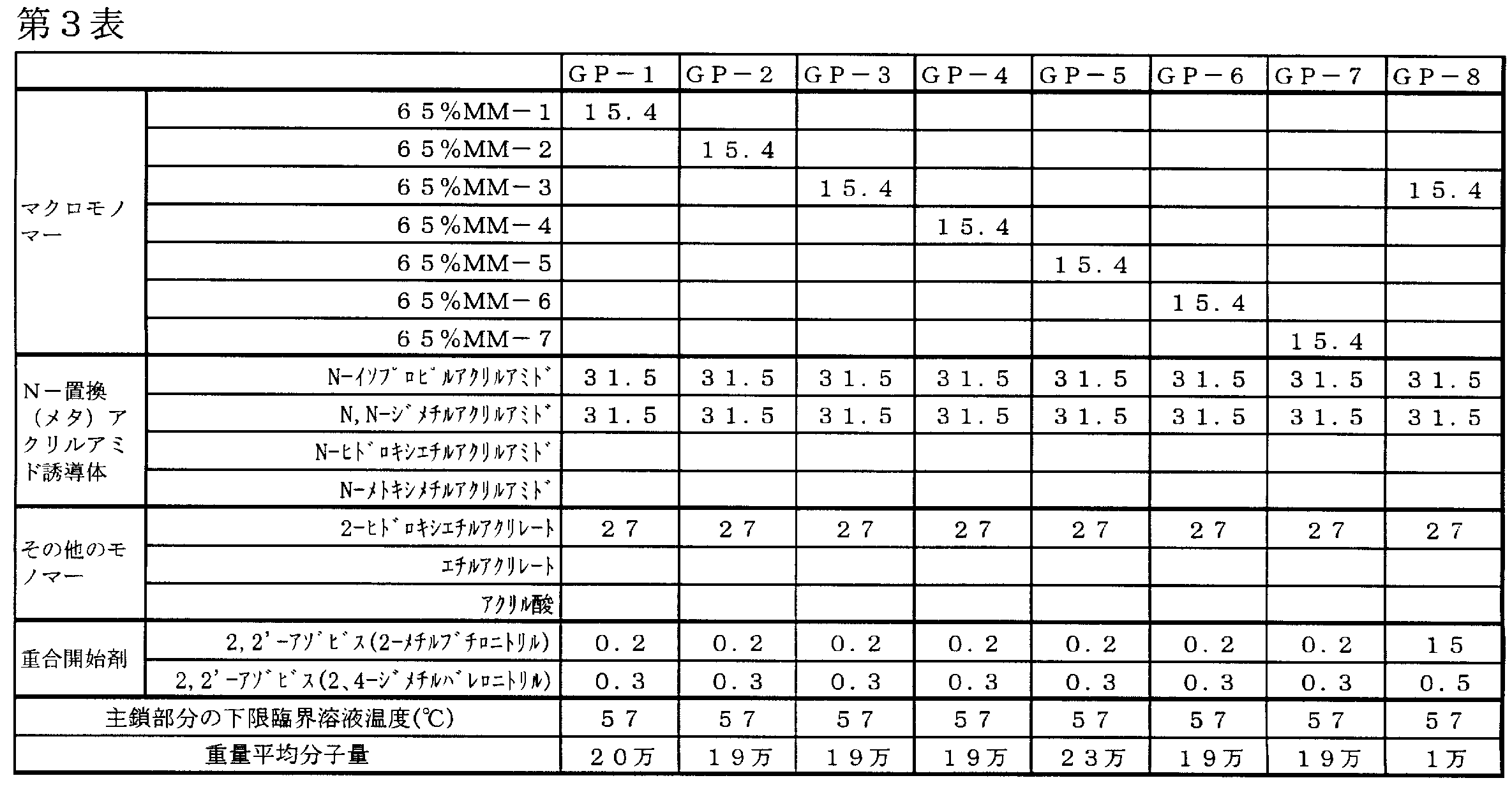
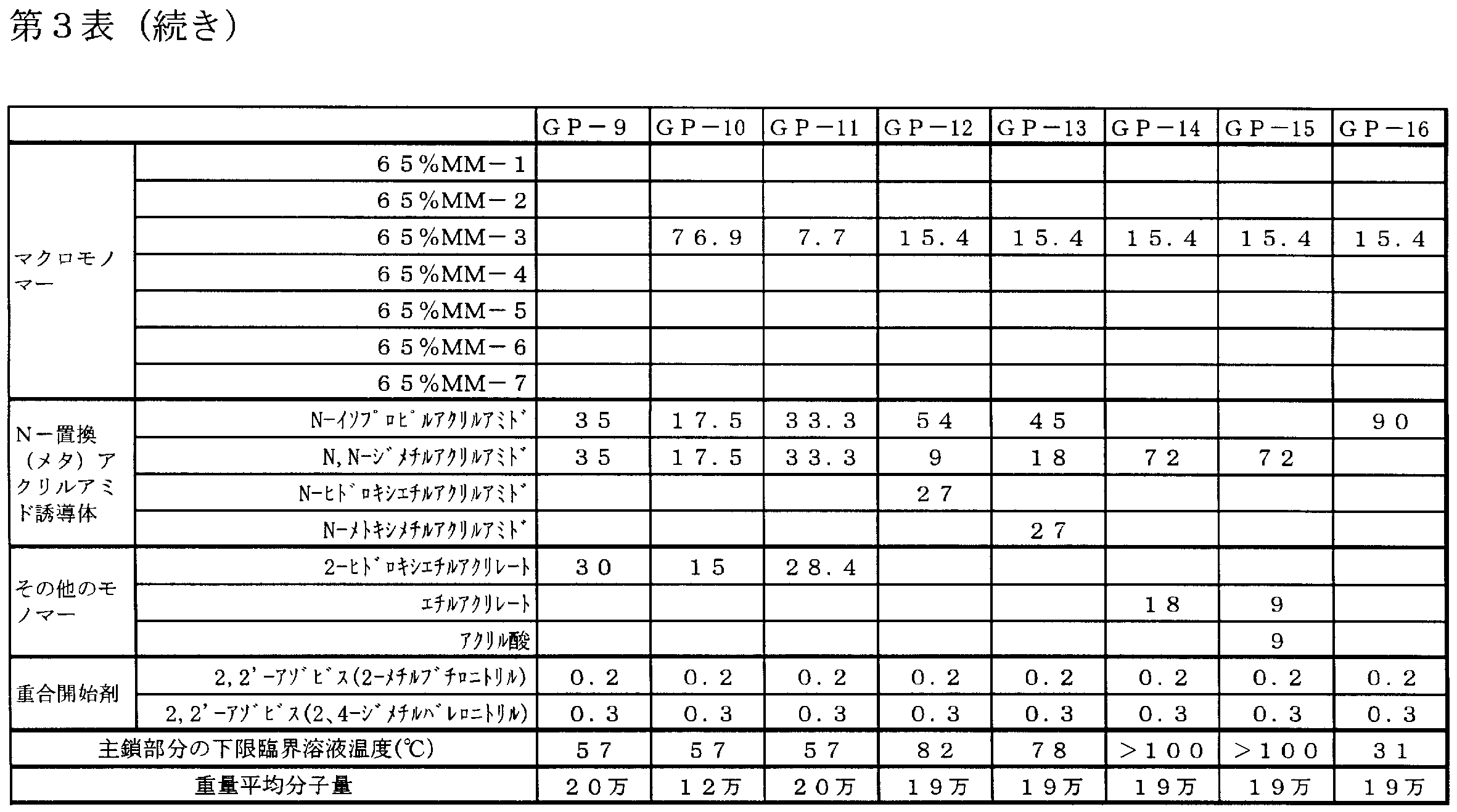
- Synthesis Examples 15 to 29 Except for the monomer composition shown in Table 3, graft polymers (GP-2 to GP-16) were obtained in the same manner as in Synthesis Example 14. The molecular weight of each graft polymer and the LCST of the main chain portion are also shown in Table 3.
- Synthesis Example 30 To a 4-liter flask having a capacity of 2 liters, 38.5 parts of deionized water and 0.1 part of Newcol 707SF (manufactured by Nippon Emulsifier Co., Ltd., an anionic surfactant having a polyoxyethylene chain, non-volatile content of 30%) are added, After replacement, it was kept at 85 ° C. In this, 52.3 parts of deionized water, 30 parts of methyl methacrylate, 10 parts of styrene, 20 parts of n-butyl acrylate, 30 parts of 2-ethylhexyl acrylate, 10 parts of hydroxyethyl acrylate, 1.6 parts of Newcol 707SF are emulsified.
- Newcol 707SF manufactured by Nippon Emulsifier Co., Ltd., an anionic surfactant having a polyoxyethylene chain, non-volatile content of 30%
- Example 1 1.5 g of the graft polymer GP-1 obtained in Synthesis Example 14 was dissolved in 17.0 g of deionized water to obtain a clear and viscous solution 1 at room temperature. The total amount of Solution 1 was added to 100 g of Emulsion I obtained in Synthesis Example 30 and mixed well to obtain the emulsion composition of Example 1.
- Examples 2-6 and Comparative Examples 1-2 Emulsion compositions of Examples 2 to 6 and Comparative Examples 1 to 2 were obtained in the same manner as in Example 1 except for the formulation shown in Table 4.
- Comparative Example 3 Comparative Example 3 was prepared by adding 1.6 g of commercially available urethane-associated reocon agent “Adecanol UH-756VF” (manufactured by ADEKA, 32% active ingredient) and 13.2 g of deionized water to 100 g of Emulsion I.
- Comparative Example 4 Comparative Example 4 was obtained by adding only 13.6 g of deionized water to 100 g of Emulsion I.
- Example 7 1.5 g of the graft polymer GP-3 obtained in Synthesis Example 16 was dissolved in 17.0 g of deionized water to obtain a clear and viscous solution 2 at room temperature. 100 g of binder-based water-based enamel paint “Asuka Bake TW-400 Black” (manufactured by Kansai Paint Co., Ltd., water-based emulsion paint, acrylic resin / melamine resin system) adjusted to a solid content concentration of 40% (the amount of binder component is 28. 4 g) was added to the total amount of Solution 2 and mixed well to obtain the aqueous enamel paint of Example 7.
- binder-based water-based enamel paint “Asuka Bake TW-400 Black” manufactured by Kansai Paint Co., Ltd., water-based emulsion paint, acrylic resin / melamine resin system
- Electrodeposition coating was performed, and “Amirac N-2 Sealer” (manufactured by Kansai Paint Co., Ltd., aminopolyester resin-based intermediate coating) was further applied thereon to a thickness of 30 ⁇ m. Furthermore, the colored paints of Examples and Comparative Examples were electrostatic spray-coated in an environment where the viscosity was adjusted to about 30 seconds (Ford Cup # 4, 20 ° C.) and the relative humidity was 70% at a temperature of 25 ° C. did. The coating film thickness was 45 ⁇ 5 ⁇ m based on the cured coating film.
- the coated plate was left horizontally and pre-dried at 80 ° C. for 5 minutes. Thereafter, the plate was fixed to 70 to 80 degrees from a horizontal surface using a coating plate stand, and baked at 150 ° C. for 20 minutes using a hot air dryer. The sagging property and finish of the coated plate after baking were evaluated.
- Sagging occurs on the coating surface
- Finishing property ⁇ : The coated surface is smooth and has a good finish with no turbidity, wrinkles, and flaws.
- ⁇ There is no turbidity, wrinkles, or fuzziness on the painted surface, but is slightly inferior in smoothness. Some of the defects occurred and the finish was poor. The finish was not evaluated for those with a sagging evaluation of x.
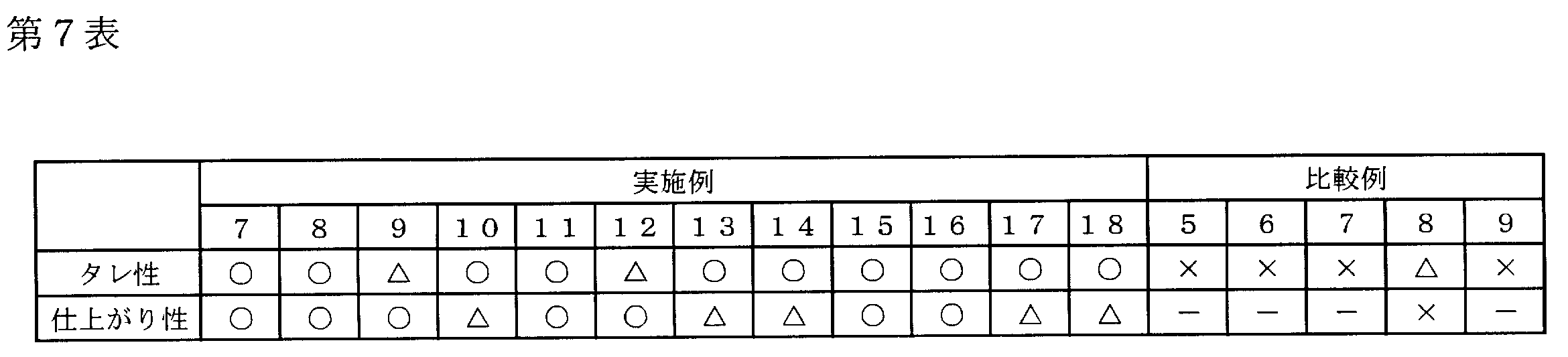
- Table 7 shows the evaluation results.
Landscapes
- Chemical & Material Sciences (AREA)
- Organic Chemistry (AREA)
- Life Sciences & Earth Sciences (AREA)
- Engineering & Computer Science (AREA)
- Materials Engineering (AREA)
- Wood Science & Technology (AREA)
- Medicinal Chemistry (AREA)
- Health & Medical Sciences (AREA)
- Chemical Kinetics & Catalysis (AREA)
- Polymers & Plastics (AREA)
- Dispersion Chemistry (AREA)
- Macromonomer-Based Addition Polymer (AREA)
- Graft Or Block Polymers (AREA)
- Paints Or Removers (AREA)
Abstract
Description
1.(A)モノマー成分にN-置換(メタ)アクリルアミド化合物を含み、かつ水に対する下限臨界溶液温度が40℃以上である主鎖と(B)疎水性の側鎖からなる構造を持つグラフトコポリマーを含有する事を特徴とする水性塗料用流動調整剤。
2.グラフトコポリマーがN-置換(メタ)アクリルアミド化合物と疎水性マクロモノマー、及び必要に応じて他の不飽和モノマーのラジカル共重合により得られたものである項1に記載の水性塗料用流動調整剤。
3.グラフトコポリマーが、モノマーの合計を100質量部としたときに、N-置換(メタ)アクリルアミド化合物;1~99質量部、疎水性マクロモノマー;1~30質量部及びその他の不飽和モノマー;0~98質量部のラジカル共重合により得られたものである項2に記載の水性塗料用流動調整剤。
4.項1~3のいずれか1項に記載の水性塗料用流動調整剤を含有することを特徴とする水性塗料組成物。
5.項4に記載の水性塗料組成物が塗装されてなる物品。
に関する。
本発明に用いられるグラフトポリマーは疎水性の側鎖を持つ。本発明において側鎖とは、グラフトポリマーにおいて主鎖にグラフトされている部分を示す。
前述のグラフトポリマーを含む、本発明の常温増粘型の感熱応答性流動調整剤は、該感熱応答性流動調整剤を配合された塗料等の混合物は常温ではゼリー状又は粘稠な液体であり、加熱によりグラフトポリマー主鎖のLCSTよりも高い温度になると粘度が大きく減少し流動性が高くなる特徴を持つ。その特に好ましい用途として、水性塗料の増粘剤としてこのグラフトポリマーを含んでなる常温増粘型の感熱応答性流動調整剤を用いることが挙げられる。塗料のバインダー固形分100質量部に対して本発明のグラフトポリマーを固形分にして0.1質量部~20質量部配合することにより、常温で塗装された時には塗着塗料の粘度が高く、垂直面で塗膜がズリ落ちてしまういわゆる「タレ」を防ぐことができる。
合成例1
温度計、サーモスタット、撹拌機、環流冷却器、窒素ガス導入管及び滴下装置を備え付けた反応容器に、エチレングリコールモノブチルエーテル83部、酢酸ブチル37部を仕込み、気相に窒素ガスを吹き込みながら90℃で攪拌し、n-ブチルメタクリレート50部、2-ヒドロキシエチルメタクリレート50部、メルカプトプロピオン酸8部及び2,2’-アゾビスイソブチロニトリル2部からなる混合液を、4時間かけて均一速度で滴下し、重合反応を行なった。その後、同温度で2時間熟成させた後、110℃で1時間加熱して固形分47%のプレポリマー溶液を得た。得られたプレポリマーの固形分あたりの酸価は39.2mgKOH/gであった。次いでこの中に重合禁止剤としてヒドロキノンモノメチルエーテル0.04部、及びグリシジルメタクリレート11部を加えた後、テトラブチルアンモニウムブロミド3部を加えて110℃で12時間反応させた後減圧し、酢酸エチルを除去して固形分65%のマクロモノマー溶液(MM-1)を得た。この反応におけるグリシジルメタクリレートのグリシジル基の反応率は96%であった。得られたマクロモノマーは、重合性二重結合を1分子当り平均して約1.0個有しており、末端メタクリレート型マクロモノマーを主体とし、重量平均分子量が3,000であった。
使用するメタクリル酸エステル及び溶媒は、いずれも使用前に、これらの中に窒素ガスを少なくとも1時間通送することにより、脱気(脱酸素)を行った。
温度計、サーモスタット、撹拌機、環流冷却器、窒素ガス導入管及び滴下装置を備え付けた反応容器にキシレン30部、酢酸エチル25部を仕込み、液中に窒素ガスを通送しながら105℃に加熱して、n-ブチルメタクリレート50部、2-ヒドロキシエチルメタクリレート50部、金属錯体としてビス(ボロンジフルオロジメチルグリオキシメイト)Co(II)0.01部、ラジカル開始剤として2、2’―アゾビス(2―メチルブチロニトリル)1部、添加溶剤として酢酸エチル15部の混合物を3時間かけて滴下した。滴下終了後105℃で1時間放置し、更に2、2’―アゾビス(2―メチルブチロニトリル)0.5部、キシレン12部を1時間かけて滴下し、滴下終了後105℃で1時間放置し、固形分55%のマクロモノマー溶液を得た。
得られたオリゴマー溶液を減圧し、キシレンと酢酸エチルを除去して固形分98%以上とした後、エチレングリコールモノブチルエーテルで希釈して固形分65%のマクロモノマー溶液(MM-2)を得た。得られたマクロモノマーは、重合性二重結合を1分子当り平均して約1.0個有しており、末端メタクリレート型マクロモノマーを主体とし、重量平均分子量が2,000であった。
温度計、サーモスタット、撹拌機、環流冷却器、窒素ガス導入管及び滴下装置を備え付けた反応容器に、エチレングリコールモノブチルエーテル16部及び2,4-ジフェニル-4-メチル-1-ペンテン(以下、「MSD」と略称することがある)9.15部を仕込み、160℃で窒素を吹き込みながら撹拌した。次いで、この中に、n-ブチルメタクリレート50部、2-ヒドロキシエチルメタクリレート50部及びジターシャリアミルパーオキシド7部からなる混合液を3時間かけて滴下し、そのまま、2時間撹拌した。次いで、30℃まで冷却し、エチレングリコールモノブチルエーテルで希釈して固形分65%のマクロモノマー溶液(MM-3)を得た。得られたマクロモノマーは、重量平均分子量が2,100であり、プロトンNMRでの解析によるとMSD由来のエチレン性不飽和基のうち97%以上がポリマー鎖末端に存在し、2%は消失していた。
なお、上記プロトンNMRでの解析は、溶媒として重クロロホルムを使用し、重合反応前後の、MSDの不飽和基のプロトンに基づくピーク(4.8ppm、5.1ppm)、マクロモノマー鎖末端のエチレン性不飽和基のプロトンに基づくピーク(5.0ppm、5.2ppm)及びMSDに由来する芳香族プロトン(7.2ppm)のピークを測定した後、上記MSDに由来する芳香族プロトン(7.2ppm)は重合反応前後で変化しないと仮定し、これを基準として、各不飽和基(未反応、マクロモノマー鎖末端、消失)を定量化することによって行なった。
第1表に示したモノマー組成以外は合成例3と同様にして固形分65%のマクロモノマー溶液(MM-4~MM-7)を得た。

温度計、サーモスタット、撹拌装置、還流冷却器及び滴下装置を備えた反応容器に、エチレングリコールモノブチルエーテル40部を仕込み、液中に窒素ガスを通送しながら60℃に昇温後、N-イソプロピルアクリルアミド35部、N,N-ジメチルアクリアミド35部、2-ヒドロキシエチルアクリレート30部、エチレングリコールモノブチルエーテル80部からなる混合液と2,2’-アゾビス(2,4-ジメチルバレロニトリル)0.15部、メトルエチルケトン24部の混合物をそれぞれ4時間かけてフラスコに滴下し、滴下終了後1時間熟成した。その後さらに2,2’-アゾビス(2,4-ジメチルバレロニトリル)0.15部、メトルエチルケトン6部の混合物を1時間かけてフラスコに滴下し、滴下終了後1時間熟成したのち、冷却して固形分40%のポリマー溶液を得た。得られたポリマー溶液はジエチルエーテルに沈澱させて、得られた沈殿物を減圧乾燥させることにより固形分99%以上のコポリマー(P-1)を得た。このコポリマーを1%水溶液として、曇点法により測定したLCSTは57℃であった。
第2表に示したモノマー組成以外は合成例8と同様にしてコポリマー(P-2~P-6)を得た。夫々のコポリマーの曇点法によるLCSTも第2表中に示した。

温度計、サーモスタット、撹拌装置、還流冷却器及び滴下装置を備えた反応容器に、固形分65%のマクロモノマー溶液(MM-1)15.4部、エチレングリコールモノブチルエーテル20部及びジエチレングリコールモノエチルエーテルアセテート30部を仕込み、液中に窒素ガスを通送しながら85℃に昇温後、N-イソプロピルアクリルアミド31.5部、N,N-ジメチルアクリルアミド31.5部、2-ヒドロキシエチルアクリレート27部、エチレングリコールモノブチルエーテル10部及びジエチレングリコールモノエチルエーテルアセテート40部からなる混合液と2,2’-アゾビス(2-メチルブチロニトリル)0.2部、エチレングリコールモノブチルエーテル20部の混合物をそれぞれ4時間かけてフラスコに滴下し、滴下終了後2時間熟成した。その後さらに2,2’-アゾビス(2,4-ジメチルバレロニトリル)0.3部、エチレングリコールモノブチルエーテル15部の混合物を1時間かけてフラスコに滴下し、滴下終了後1時間熟成したのち、エチレングリコールモノブチルエーテルで希釈して固形分35%のグラフトコポリマー溶液を得た。得られたポリマー溶液はジエチルエーテルに沈澱させて、得られた沈殿物を減圧乾燥させることにより固形分99%以上のグラフトコポリマー(GP-1)を得た。GPCにより求めたグラフトポリマーの分子量は20万であった。
第3表に示したモノマー組成以外は合成例14と同様にしてグラフトポリマー(GP-2~GP-16)を得た。夫々のグラフトポリマーの分子量及び主鎖部分のLCSTも第3表中に示した。
容量2リットルの4つ口フラスコに、脱イオン水38.5部、Newcol707SF(日本乳化剤社製、ポリオキシエチレン鎖を有するアニオン性界面活性剤、不揮発分30%)0.1部を加え、窒素置換後、85℃に保った。この中に、脱イオン水52.3部、メチルメタクリレート30部、スチレン10部、n-ブチルアクリレート20部、2-エチルヘキシルアクリレート30部、ヒドロキシエチルアクリレート10部、Newcol707SF1.6部をエマルション化してなるプレエマルションの3%分及び0.4部の過硫酸アンモニウムを10部の脱イオン水に溶解させた溶液10.4部の25%分を添加し、添加20分後から残りのプレエマルション及び残りの過硫酸アンモニウム水溶液を4時間かけて滴下した。 滴下終了後、これをさらに2時間85℃に保持した後、常温まで放冷して固形分50%のアクリル樹脂エマルションIを得た。
合成例14で得たグラフトポリマーGP-1 1.5gを脱イオン水17.0gに溶解して常温で透明・粘調な溶液1を得た。上記合成例30で得たエマルションI 100gに溶液1を全量加えよく混ぜ合わせて実施例1のエマルション組成物を得た。
第4表に示す配合以外は上記実施例1と同様にして実施例2~6及び比較例1~2のエマルション組成物を得た。
エマルションI 100gに市販のウレタン会合型レオコン剤「アデカノール UH-756VF」(株式会社ADEKA製、有効成分32%)を1.6g及び脱イオン水13.2gを加えて比較例3とした。
エマルションI 100gに脱イオン水13.6gのみを加えて比較例4とした。

実施例1~6及び比較例1~6について粘度の温度変化を測定し感熱応答性を評価した。粘度測定はコーン&プレート型粘度計「レオストレスRS150」(HAAKE社製、商品名)を用い、シアーレート5sec -1 で温度を変えて(30℃、50℃、70℃)測定した。第5表に夫々の温度での粘度(Pa・sec)の値と共に感熱応答性評価(下記)を示した。
○:30℃と50℃での粘度の減少度合い又は50℃と70℃での粘度の減少度合いが大幅(粘度が1/3以下になる)である。
×:粘度の減少度合いが大幅ではない。

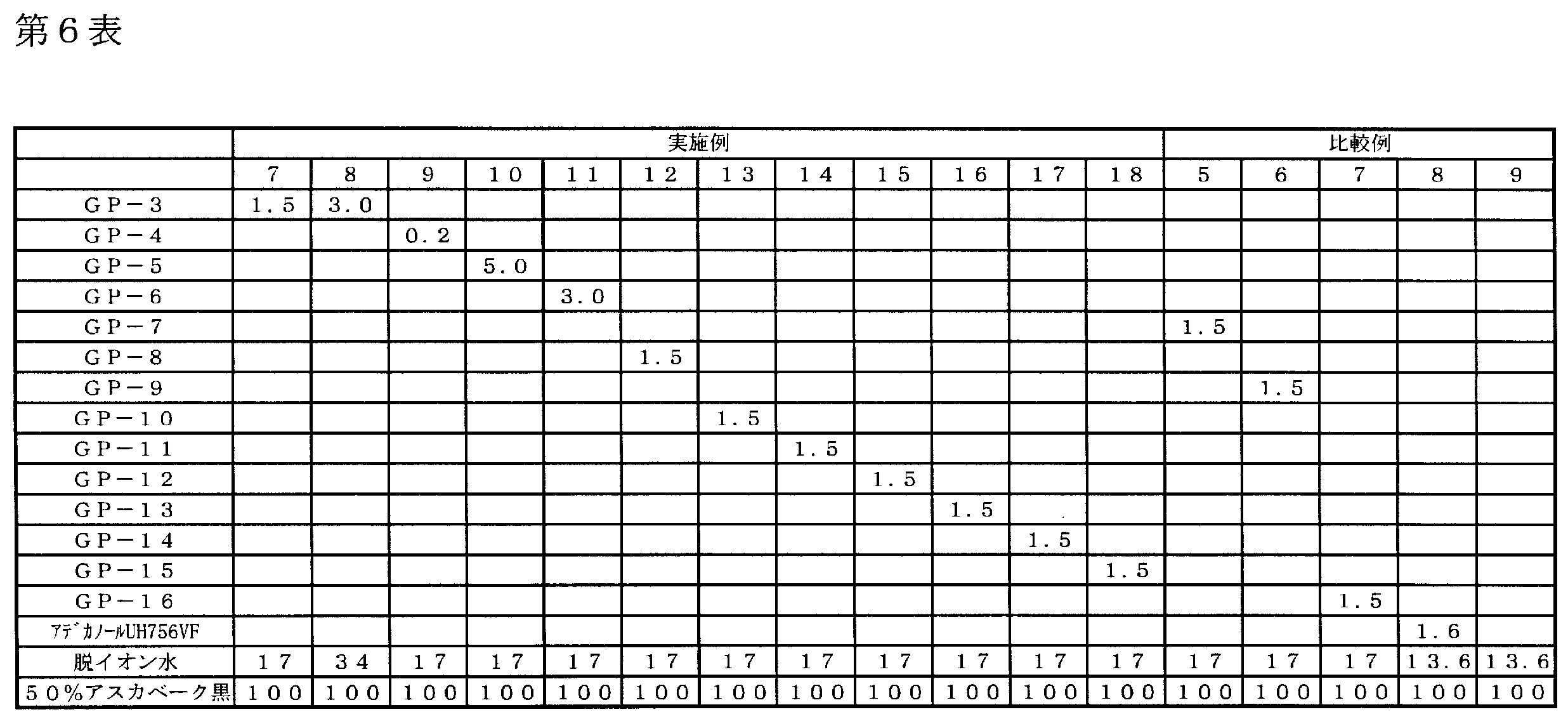
合成例16で得たグラフトポリマーGP-3 1.5gを脱イオン水17.0gに溶解して常温で透明・粘調な溶液2を得た。焼付け硬化型水性エナメル塗料「アスカベークTW-400黒」(関西ペイント(株)製、水性エマルジョン塗料、アクリル樹脂/メラミン樹脂系)を固形分濃度40%に調整したもの100g(バインダー成分量は28.4g)に溶液2を全量加えよく混ぜ合わせて実施例7の水性エナメル塗料を得た。
第6表に示す配合以外は上記実施例7と同様にして実施例8~18及び比較例5~9の水性エナメル塗料を得た。
被塗物として、「パルボンド#3030」(日本パーカライジング(株)製、リン酸亜鉛系)で表面処理した冷延鋼板(大きさ:7.5×15×0.2cm、板上縁から1.5cm下がった板中央位置に直径5mmの丸穴があいている。)に、「エレクロンGT-10」(関西ペイント(株)製、エポキシ系カチオン電着塗料)を乾燥膜厚20μmとなるように電着塗装し、更にこの上に「アミラックN-2シーラー」(関西ペイント(株)製、アミノポリエステル樹脂系中塗り塗料)を30μm塗装したものを用いた。その上に実施例及び比較例の着色塗料を、塗料粘度を約30秒(フォードカップ#4、20℃)に調整して、25℃ の温度で相対湿度が70%の環境で静電噴霧塗装した。塗装膜厚は、硬化塗膜に基づいて45±5μmとした。
タレ性
○:塗面にタレ跡はなく、均一に硬化している
△:塗面にタレ跡はないが丸穴下縁部分に僅かなタレが見られる
×:塗面にタレが生じている
仕上り性
○:塗面は平滑であり、濁り、ワキ、及びブツも無く良好に仕上がっている
△:塗面に濁り、ワキ、及びブツは無いがやや平滑性に劣る
×:塗面に濁り、ワキ又はブツのいずれかが生じており、仕上がりが悪い
なお、タレ性評価が×のものについては仕上がり性は評価しなかった。
Claims (5)
- (A)モノマー成分にN-置換(メタ)アクリルアミド化合物を含み、かつ水に対する下限臨界溶液温度が40℃以上である主鎖と(B)疎水性の側鎖とからなる構造を持つグラフトコポリマーを含有する、水性塗料用流動調整剤。
- グラフトコポリマーがN-置換(メタ)アクリルアミド化合物及び疎水性マクロモノマーを含む不飽和モノマー混合物のラジカル共重合により得られたものである請求項1に記載の水性塗料用流動調整剤。
- 不飽和モノマー混合物100質量部に対し、N-置換(メタ)アクリルアミド化合物の配合量が1~99質量部であり、かつ疎水性マクロモノマーの配合量が1~30質量部である、請求項2に記載の水性塗料用流動調整剤。
- 請求項1~3のいずれか1項に記載の水性塗料用流動調整剤を含有する、水性塗料組成物。
- 請求項4に記載の水性塗料組成物が塗装されてなる物品。
Priority Applications (4)
| Application Number | Priority Date | Filing Date | Title |
|---|---|---|---|
| GB201115942A GB2480414B (en) | 2009-03-03 | 2010-03-03 | Flow modifier for water-based coating material and water-based coating composition containing same |
| CA 2754402 CA2754402C (en) | 2009-03-03 | 2010-03-03 | Flow modifier for water-based coating material and water-based coating composition containing same |
| US13/203,781 US9139740B2 (en) | 2009-03-03 | 2010-03-03 | Flow modifier for water-based coating material and water-based coating composition containing same |
| JP2011502788A JP5570495B2 (ja) | 2009-03-03 | 2010-03-03 | 水性塗料用流動調整剤及びそれを含有する水性塗料組成物 |
Applications Claiming Priority (2)
| Application Number | Priority Date | Filing Date | Title |
|---|---|---|---|
| JP2009049808 | 2009-03-03 | ||
| JP2009-049808 | 2009-03-03 |
Publications (1)
| Publication Number | Publication Date |
|---|---|
| WO2010101196A1 true WO2010101196A1 (ja) | 2010-09-10 |
Family
ID=42709751
Family Applications (1)
| Application Number | Title | Priority Date | Filing Date |
|---|---|---|---|
| PCT/JP2010/053472 Ceased WO2010101196A1 (ja) | 2009-03-03 | 2010-03-03 | 水性塗料用流動調整剤及びそれを含有する水性塗料組成物 |
Country Status (5)
| Country | Link |
|---|---|
| US (1) | US9139740B2 (ja) |
| JP (1) | JP5570495B2 (ja) |
| CA (1) | CA2754402C (ja) |
| GB (1) | GB2480414B (ja) |
| WO (1) | WO2010101196A1 (ja) |
Cited By (7)
| Publication number | Priority date | Publication date | Assignee | Title |
|---|---|---|---|---|
| WO2011052304A1 (en) * | 2009-10-29 | 2011-05-05 | Kansai Paint Co., Ltd. | Copolymer, aqueous coating composition containing copolymer, and method for forming multilayer coating film |
| JP2011122113A (ja) * | 2009-12-14 | 2011-06-23 | Kansai Paint Co Ltd | エマルション樹脂系塗料 |
| JP2011148916A (ja) * | 2010-01-22 | 2011-08-04 | Kansai Paint Co Ltd | エマルション樹脂系塗料 |
| GB2510271A (en) * | 2009-10-29 | 2014-07-30 | Kansai Paint Co Ltd | Copolymer, aqueous coating composition containing copolymer, and method for forming multilayer coating film |
| JP2016194041A (ja) * | 2015-03-31 | 2016-11-17 | 東洋インキScホールディングス株式会社 | インクジェット用インク、印刷物、およびインクジェット記録方法 |
| JP2016209879A (ja) * | 2011-01-21 | 2016-12-15 | 学校法人福岡大学 | 分散剤,分散体,分散体の粘度の調整方法,可動装置,表面処理剤,電解液,セパレータ,およびリチウムイオン二次電池 |
| JP2020015892A (ja) * | 2018-07-13 | 2020-01-30 | 東ソー株式会社 | ブロック共重合体及び培養基材、幹細胞の製造方法 |
Families Citing this family (2)
| Publication number | Priority date | Publication date | Assignee | Title |
|---|---|---|---|---|
| WO2012032894A1 (ja) * | 2010-09-08 | 2012-03-15 | 関西ペイント株式会社 | 塗膜形成方法 |
| US10649613B2 (en) * | 2012-06-07 | 2020-05-12 | Wormhole Labs, Inc. | Remote experience interfaces, systems and methods |
Citations (6)
| Publication number | Priority date | Publication date | Assignee | Title |
|---|---|---|---|---|
| JPH03285903A (ja) * | 1990-04-03 | 1991-12-17 | W R Grace & Co | グラフト共重合体 |
| JPH06157689A (ja) * | 1992-11-19 | 1994-06-07 | Nippon Oil & Fats Co Ltd | 熱応答性高分子ゲル、熱応答性高分子ゲル膜及びその製造法 |
| JPH0931138A (ja) * | 1995-07-24 | 1997-02-04 | Sanyo Chem Ind Ltd | 増粘性バインダー組成物 |
| JPH10204409A (ja) * | 1997-01-16 | 1998-08-04 | Sanyo Chem Ind Ltd | 熱可逆性増粘剤 |
| JPH10323557A (ja) * | 1997-05-23 | 1998-12-08 | Shunsuke Hirotsu | 温度敏感性ゲル及びその製造方法 |
| JP2002121230A (ja) * | 2000-10-19 | 2002-04-23 | National Institute Of Advanced Industrial & Technology | 高温低粘度低温高粘度型感温性高分子材料 |
Family Cites Families (9)
| Publication number | Priority date | Publication date | Assignee | Title |
|---|---|---|---|---|
| US5708095A (en) | 1996-08-30 | 1998-01-13 | E. I. Du Pont De Nemours And Company | Graft copolymers containing sulfonate and phosphonate groups having particular utility as pigmented ink dispersants |
| FR2780422B1 (fr) | 1998-06-26 | 2000-09-08 | Rhodia Chimie Sa | Composition thermoepaississante pour bains de couchage a base d'un copolymere possedant une temperature critique inferieure de solubilite |
| US20040044130A1 (en) | 1998-06-26 | 2004-03-04 | Labeau Marie-Pierre | Heat thickening composition for coating slips based on a copolymer having a lower critical solubility temperature |
| FR2811995B1 (fr) | 2000-07-21 | 2003-06-06 | Oreal | Polymere comprenant des unites hydrosolubles et des unites a lcst, et composition aqueuse le comprenant |
| JP4743885B2 (ja) | 2001-03-23 | 2011-08-10 | キヤノン株式会社 | 刺激応答性ポリマーを含むインク組成物、並びに該インク組成物を用いた画像形成方法 |
| JP2003089752A (ja) | 2001-03-23 | 2003-03-28 | Canon Inc | 刺激応答性ポリマーを含む組成物、それを含むインク組成物、並びに該インク組成物を用いた画像形成方法および装置 |
| JP3595805B2 (ja) | 2001-08-07 | 2004-12-02 | キヤノン株式会社 | 刺激応答性組成物、並びに該組成物を用いた画像形成方法および装置 |
| FR2889194A1 (fr) * | 2005-07-27 | 2007-02-02 | Rhodia Chimie Sa | Copolymere a blocs comprenant un bloc lcst presentant une temperature inferieur critique de solubilite, formulations comprenant le copolymere et utilisation pour vectoriser un ingredient actif |
| JP2007217348A (ja) | 2006-02-17 | 2007-08-30 | Shiseido Co Ltd | 増粘剤並びにこれを含有する化粧料及び洗浄料 |
-
2010
- 2010-03-03 WO PCT/JP2010/053472 patent/WO2010101196A1/ja not_active Ceased
- 2010-03-03 JP JP2011502788A patent/JP5570495B2/ja active Active
- 2010-03-03 CA CA 2754402 patent/CA2754402C/en active Active
- 2010-03-03 US US13/203,781 patent/US9139740B2/en active Active
- 2010-03-03 GB GB201115942A patent/GB2480414B/en active Active
Patent Citations (6)
| Publication number | Priority date | Publication date | Assignee | Title |
|---|---|---|---|---|
| JPH03285903A (ja) * | 1990-04-03 | 1991-12-17 | W R Grace & Co | グラフト共重合体 |
| JPH06157689A (ja) * | 1992-11-19 | 1994-06-07 | Nippon Oil & Fats Co Ltd | 熱応答性高分子ゲル、熱応答性高分子ゲル膜及びその製造法 |
| JPH0931138A (ja) * | 1995-07-24 | 1997-02-04 | Sanyo Chem Ind Ltd | 増粘性バインダー組成物 |
| JPH10204409A (ja) * | 1997-01-16 | 1998-08-04 | Sanyo Chem Ind Ltd | 熱可逆性増粘剤 |
| JPH10323557A (ja) * | 1997-05-23 | 1998-12-08 | Shunsuke Hirotsu | 温度敏感性ゲル及びその製造方法 |
| JP2002121230A (ja) * | 2000-10-19 | 2002-04-23 | National Institute Of Advanced Industrial & Technology | 高温低粘度低温高粘度型感温性高分子材料 |
Cited By (13)
| Publication number | Priority date | Publication date | Assignee | Title |
|---|---|---|---|---|
| GB2510271B (en) * | 2009-10-29 | 2014-09-10 | Kansai Paint Co Ltd | Copolymer, aqueous coating composition containing copolymer, and method for forming multilayer coating film |
| GB2487020A (en) * | 2009-10-29 | 2012-07-04 | Kansai Paint Co Ltd | Copolymer, aqueous coating composition containing copolymer, and method for forming multilayer coating film |
| GB2487020B (en) * | 2009-10-29 | 2014-06-18 | Kansai Paint Co Ltd | Aqueous coating composition containing copolymer, and method for forming multilayer coating film |
| GB2510271A (en) * | 2009-10-29 | 2014-07-30 | Kansai Paint Co Ltd | Copolymer, aqueous coating composition containing copolymer, and method for forming multilayer coating film |
| WO2011052304A1 (en) * | 2009-10-29 | 2011-05-05 | Kansai Paint Co., Ltd. | Copolymer, aqueous coating composition containing copolymer, and method for forming multilayer coating film |
| US9221991B2 (en) | 2009-10-29 | 2015-12-29 | Kansai Paint Co., Ltd. | Copolymer, aqueous coating composition containing copolymer, and method for forming multilayer coating film |
| US9856393B2 (en) | 2009-10-29 | 2018-01-02 | Kansai Paint Co., Ltd. | Copolymer, aqueous coating composition containing copolymer, and method for forming multilayer coating film |
| JP2011122113A (ja) * | 2009-12-14 | 2011-06-23 | Kansai Paint Co Ltd | エマルション樹脂系塗料 |
| JP2011148916A (ja) * | 2010-01-22 | 2011-08-04 | Kansai Paint Co Ltd | エマルション樹脂系塗料 |
| JP2016209879A (ja) * | 2011-01-21 | 2016-12-15 | 学校法人福岡大学 | 分散剤,分散体,分散体の粘度の調整方法,可動装置,表面処理剤,電解液,セパレータ,およびリチウムイオン二次電池 |
| JP2016194041A (ja) * | 2015-03-31 | 2016-11-17 | 東洋インキScホールディングス株式会社 | インクジェット用インク、印刷物、およびインクジェット記録方法 |
| JP2020015892A (ja) * | 2018-07-13 | 2020-01-30 | 東ソー株式会社 | ブロック共重合体及び培養基材、幹細胞の製造方法 |
| JP7293683B2 (ja) | 2018-07-13 | 2023-06-20 | 東ソー株式会社 | ブロック共重合体及び培養基材、幹細胞の製造方法 |
Also Published As
| Publication number | Publication date |
|---|---|
| CA2754402A1 (en) | 2010-09-10 |
| GB2480414B (en) | 2013-03-13 |
| JP5570495B2 (ja) | 2014-08-13 |
| JPWO2010101196A1 (ja) | 2012-09-10 |
| US20120022205A1 (en) | 2012-01-26 |
| GB2480414A (en) | 2011-11-16 |
| US9139740B2 (en) | 2015-09-22 |
| CA2754402C (en) | 2014-02-18 |
| GB201115942D0 (en) | 2011-10-26 |
Similar Documents
| Publication | Publication Date | Title |
|---|---|---|
| JP5570495B2 (ja) | 水性塗料用流動調整剤及びそれを含有する水性塗料組成物 | |
| KR101560854B1 (ko) | 플루오로 레벨링제 | |
| JP3556189B2 (ja) | 水性グラフトコポリマー顔料分散剤 | |
| US5349036A (en) | Amphipathic copolymer pigment dispersants | |
| JP5156160B2 (ja) | 表面コーティング用レベリング剤 | |
| JP5697674B2 (ja) | 塗膜形成方法 | |
| JP5635799B2 (ja) | エマルション樹脂系塗料 | |
| JP5635797B2 (ja) | 2液型水性塗料組成物 | |
| JP7049000B1 (ja) | 樹脂エマルション及び樹脂エマルションの製造方法 | |
| JPH0753913A (ja) | 水性塗料組成物 | |
| JP3394588B2 (ja) | 水性被覆材組成物 | |
| KR100290596B1 (ko) | 양이온성 에멀젼의 제조방법 | |
| JPH1030010A (ja) | ノニオン系高分子界面活性剤、その製造方法、及びその顔料分散体 | |
| JP5128967B2 (ja) | 感熱応答性abaトリブロックポリマーおよびそれを含有する水性塗料組成物。 | |
| JP6664918B2 (ja) | 水性樹脂分散体の製造方法 | |
| JP5635845B2 (ja) | 水性塗料組成物 | |
| JP2963897B1 (ja) | 分散機能を有する両性樹脂の製造方法 | |
| JP5635798B2 (ja) | エマルション樹脂系塗料 | |
| CN113195564A (zh) | 聚丙烯酸酯聚合物 | |
| US20220275117A1 (en) | Emulsion particle-containing aqueous dispersion | |
| JP4384392B2 (ja) | 塗料用エマルジョン組成物の製造方法 | |
| JP2016188355A (ja) | 塗料用水性樹脂組成物 | |
| US20210179884A1 (en) | Redox chased suspension bead additives for paints and stains | |
| JP2003292509A (ja) | 水分散体およびその製造方法 | |
| JP2013082809A (ja) | 塗料用水性樹脂組成物 |
Legal Events
| Date | Code | Title | Description |
|---|---|---|---|
| 121 | Ep: the epo has been informed by wipo that ep was designated in this application |
Ref document number: 10748790 Country of ref document: EP Kind code of ref document: A1 |
|
| WWE | Wipo information: entry into national phase |
Ref document number: 2011502788 Country of ref document: JP |
|
| WWE | Wipo information: entry into national phase |
Ref document number: 13203781 Country of ref document: US |
|
| WWE | Wipo information: entry into national phase |
Ref document number: 2754402 Country of ref document: CA |
|
| NENP | Non-entry into the national phase |
Ref country code: DE |
|
| ENP | Entry into the national phase |
Ref document number: 1115942 Country of ref document: GB Kind code of ref document: A Free format text: PCT FILING DATE = 20100303 |
|
| WWE | Wipo information: entry into national phase |
Ref document number: 1115942.3 Country of ref document: GB |
|
| 122 | Ep: pct application non-entry in european phase |
Ref document number: 10748790 Country of ref document: EP Kind code of ref document: A1 |