WO2010098099A1 - 日焼け止め化粧料 - Google Patents
日焼け止め化粧料 Download PDFInfo
- Publication number
- WO2010098099A1 WO2010098099A1 PCT/JP2010/001268 JP2010001268W WO2010098099A1 WO 2010098099 A1 WO2010098099 A1 WO 2010098099A1 JP 2010001268 W JP2010001268 W JP 2010001268W WO 2010098099 A1 WO2010098099 A1 WO 2010098099A1
- Authority
- WO
- WIPO (PCT)
- Prior art keywords
- derivative
- component
- manufactured
- silicone
- mass
- Prior art date
- Legal status (The legal status is an assumption and is not a legal conclusion. Google has not performed a legal analysis and makes no representation as to the accuracy of the status listed.)
- Ceased
Links
Classifications
-
- A—HUMAN NECESSITIES
- A61—MEDICAL OR VETERINARY SCIENCE; HYGIENE
- A61Q—SPECIFIC USE OF COSMETICS OR SIMILAR TOILETRY PREPARATIONS
- A61Q17/00—Barrier preparations; Preparations brought into direct contact with the skin for affording protection against external influences, e.g. sunlight, X-rays or other harmful rays, corrosive materials, bacteria or insect stings
- A61Q17/04—Topical preparations for affording protection against sunlight or other radiation; Topical sun tanning preparations
-
- A—HUMAN NECESSITIES
- A61—MEDICAL OR VETERINARY SCIENCE; HYGIENE
- A61K—PREPARATIONS FOR MEDICAL, DENTAL OR TOILETRY PURPOSES
- A61K8/00—Cosmetics or similar toiletry preparations
- A61K8/18—Cosmetics or similar toiletry preparations characterised by the composition
- A61K8/19—Cosmetics or similar toiletry preparations characterised by the composition containing inorganic ingredients
- A61K8/27—Zinc; Compounds thereof
-
- A—HUMAN NECESSITIES
- A61—MEDICAL OR VETERINARY SCIENCE; HYGIENE
- A61K—PREPARATIONS FOR MEDICAL, DENTAL OR TOILETRY PURPOSES
- A61K8/00—Cosmetics or similar toiletry preparations
- A61K8/18—Cosmetics or similar toiletry preparations characterised by the composition
- A61K8/19—Cosmetics or similar toiletry preparations characterised by the composition containing inorganic ingredients
- A61K8/29—Titanium; Compounds thereof
-
- A—HUMAN NECESSITIES
- A61—MEDICAL OR VETERINARY SCIENCE; HYGIENE
- A61K—PREPARATIONS FOR MEDICAL, DENTAL OR TOILETRY PURPOSES
- A61K8/00—Cosmetics or similar toiletry preparations
- A61K8/18—Cosmetics or similar toiletry preparations characterised by the composition
- A61K8/30—Cosmetics or similar toiletry preparations characterised by the composition containing organic compounds
- A61K8/33—Cosmetics or similar toiletry preparations characterised by the composition containing organic compounds containing oxygen
- A61K8/37—Esters of carboxylic acids
Definitions
- the present invention relates to an oil-in-water or water-in-oil emulsified sunscreen cosmetic. More specifically, the present invention relates to an oil-in-water type or water-in-oil type sunscreen cosmetic that is excellent in usability, formulation stability, and cleanability after use and can achieve a high SPF value.
- UV-A 320-400 nm
- UV-B 290-320 nm
- UV-A causes erythema on the skin when exposed excessively, causing an acute inflammatory reaction. It is known to cause melanoma and then blacken, causing skin cancer.
- UV-B is weak in causing erythema, it has been clarified that the melanin pigmentation is caused by oxidizing the reduced melanin of the skin, which causes blackening or long-term exposure, causing premature aging of the skin.
- sunscreen cosmetics with a high ultraviolet blocking effect.
- an SPF Sun Protection Factor
- sunscreen cosmetics are blended with an ultraviolet absorber or an ultraviolet scattering agent in order to obtain a high SPF value by blocking ultraviolet irradiation on the skin.
- Ultraviolet absorbers block ultraviolet rays by absorbing light energy, but generally the absorption band of ultraviolet absorbers is highly unfavorable in terms of safety to the skin, such as having high polarity and skin irritation. For this reason, there is no irritation to the skin, and it is used in combination with silicone oil or the like having good usability.
- UV absorbers which are highly polar oils, and silicone oils, which are nonpolar oils
- problems such as poor oil phase uniformity, problems in emulsion stability, and uneven coating on the skin.
- the ultraviolet scattering agent shields ultraviolet rays by scattering ultraviolet rays
- conventionally inorganic pigments such as zinc oxide, titanium dioxide, kaolin and calcium carbonate have been used. These are capable of shielding ultraviolet rays over a wide band, and are inactive, so that they have high skin safety and are more useful ultraviolet shielding agents.
- Patent Document 4 a method using an isononanoic acid ester
- Patent Document 5 A method using 2-ethylhexyl 2-ethylhexanoate (Patent Document 5) has been found.
- the uniformity of the water phase and oil phase, the emulsion stability, and the dispersibility of zinc oxide / titanium dioxide were sufficient, but only in terms of usability, spreading and spreading to the skin, In terms of smooth, non-sticky usability, it was not completely satisfactory.
- Patent Documents 6 and 7 Japanese Examined Patent Publication No. 47-42502 JP 49-450 JP-A 64-7941 JP 2000-169353 A JP 2007-145722 A Japanese National Patent Publication No. 8-507081 JP 2000-128755 A
- the object of the present invention is to sufficiently exhibit the excellent ultraviolet shielding effect possessed by ultraviolet absorbers and ultraviolet scattering agents, to be well-familiar with the skin, to be non-sticky, and from the skin after use. It is an object of the present invention to provide a sunscreen cosmetic that can be easily removed (good cleanability). More specifically, the present invention provides an emulsion composition that is stable even in a combined system of a UV absorber that is a highly polar oil and a nonpolar oil such as silicone oil that is a usability improver, Even if some titanium dioxide or zinc oxide is blended, it can be dispersed stably and uniformly, and by improving the redispersibility, it is possible to achieve a high natural SPF value with a transparent finish without white floating.
- the object is to provide a cosmetic material that has a good fit to the skin, spreads well and has a refreshing and non-sticky feeling.
- the present inventors have intensively studied, and by preparing an oil-in-water type or water-in-oil type sunscreen cosmetic using isodecyl neopentanoate, a highly polar oil is used. It has been found that the compatibility between a certain ultraviolet absorber and silicone oil which is a non-polar oil as a usability improving agent is excellent, the emulsion stability is excellent, and the dispersibility of titanium dioxide and zinc oxide is excellent.
- the present invention provides an oil-in-water or water-in-oil emulsion sunscreen cosmetic containing (a) isodecyl neopentanoate, (b) an ultraviolet absorber, (c) an ultraviolet scattering agent, and (d) a silicone oil.
- I will provide a.
- the component (b) is a para-aminobenzoic acid derivative, a salicylic acid derivative, a cinnamic acid derivative, a ⁇ , ⁇ -diphenylacrylate derivative, a benzophenone derivative, a benzylidene camphor derivative, a phenylbenzimidazole derivative, a triazine derivative
- the above sunscreen cosmetic which is one or more selected from phenylbenzotriazole derivatives and 4,4-diarylbutadiene derivatives.
- this invention provides the said sunscreen cosmetics whose (c) component is zinc oxide and / or titanium dioxide.
- the present invention also provides the sunscreen cosmetic described above, wherein the zinc oxide has an average primary particle size of 5 to 40 nm.
- the present invention also provides the sunscreen cosmetic described above, wherein the average primary particle diameter of titanium dioxide is 5 to 30 nm.
- the total amount of the cosmetic composition is such that the component (a) is 1 to 60% by mass, the component (b) is 3 to 20% by mass, the component (c) is 0.5 to 50% by mass, the component (d)
- the sunscreen cosmetics containing 1 to 70% by mass of the above are provided.
- the present invention further provides the sunscreen cosmetic described above further comprising (e) one or more selected from silicone surfactants, glycerin or polyglycerin fatty acid esters.
- the silicone surfactant as the component (e) is a poly (oxyethylene / oxypropylene) methylpolysiloxane copolymer, a polyoxyethylenemethylpolysiloxane copolymer, a silicone chain-branched methylpolysiloxane.
- the sunscreen cosmetic is one or more selected from a polyglycerin-modified silicone, an alkyl group-containing crosslinked polyglycerin-modified silicone, and an alkyl group-branched polyglycerin-modified silicone.
- the present invention also provides the sunscreen cosmetic described above, which contains 0.01 to 20% by mass of component (e) in the total amount of the cosmetic.
- the ultraviolet ray shielding agent and the ultraviolet scattering agent have excellent ultraviolet shielding effects, and they are well-familiar with the skin and are not sticky, and also have excellent cleanability after use.
- a sunscreen cosmetic excellent in dispersibility and stability is provided.
- isodecyl neopentanoate represented by the following formula (1) is used as the component (a).
- (Chemical formula 1) As a commercial item of the component (a) used in the present invention, Neolite 100P [manufactured by Higher Alcohol Industry Co., Ltd.], AEC Isodecyl Neopentanoate (Bermel Chemical Company), Ceraphyl SLK [International Specialty Products], Dub VCI 10 [Sterinerie Dubois Fils].
- an ester of isononanoic acid having a carbon chain length of 9 or the like has been generally used for improving usability such as skin familiarity.
- the present inventors have used 2-ethylhexanoic acid having a shorter carbon chain length ( Among the esters having a carbon chain length of 8), 2-ethylhexyl 2-ethylhexanoate and isononyl 2-ethylhexanoate are particularly found. These are excellent in dispersibility of zinc oxide and titanium dioxide, and can provide sunscreen cosmetics that can feel moderate “freshness” and “freshness”, but in terms of cleanability after use, The present invention solves this point.
- the blending amount of the component (a) is preferably 1% by mass or more, more preferably 3% by mass or more, and particularly 5% by mass or more in the sunscreen cosmetic of the present invention.
- the upper limit is preferably 60% by mass or less, more preferably 40% by mass or less, and particularly preferably 30% by mass or less. If the blending amount is less than 1% by mass, the effects of emulsification stability, dispersibility, and usability are not sufficiently exhibited. .
- the ultraviolet absorber as the component (b), those generally used in cosmetics can be widely cited, and are not particularly limited, but preferably para-aminobenzoic acid derivatives, salicylic acid derivatives, cinnamic acid derivatives. , ⁇ , ⁇ -diphenyl acrylate derivatives, benzophenone derivatives, benzylidene camphor derivatives, phenylbenzimidazole derivatives, triazine derivatives, phenylbenzotriazole derivatives, anthranil derivatives, imidazoline derivatives, benzalmalonate derivatives, 4,4-diarylbutadiene derivatives, etc. Is exemplified. However, it is not limited to these.
- para-aminobenzoic acid derivative examples include para-aminobenzoic acid (hereinafter abbreviated as “PABA”), ethyl PABA, ethyl-dihydroxypropyl PABA, ethylhexyl-dimethyl PABA (for example, “Escalol 507”); ISP), glyceryl PABA, PEG-25-PABA (for example, “Ubinul P25”; BASF) and the like.
- PABA para-aminobenzoic acid
- salicylic acid derivative examples include homosalate (for example, “Eusolex HMS”; Rona / EM Industries), ethylhexyl salicylate (for example, “Neo Heliopan (Neo)”. Heliopan OS ”; Haarmann and Reimer), dipropylene glycol salicylate (eg“ Dipsal ”; Scher), TEA salicylate (eg“ Neo Heliopan TS ”) ; Herman & Reimer).
- homosalate for example, “Eusolex HMS”; Rona / EM Industries
- ethylhexyl salicylate for example, “Neo Heliopan (Neo)”. Heliopan OS ”; Haarmann and Reimer
- dipropylene glycol salicylate eg“ Dipsal ”; Scher
- TEA salicylate eg“ Neo Heliopan TS ”
- cinnamic acid derivatives examples include ethylhexyl methoxycinnamate (eg “Pulsol MCX”; Hoffman-La Roche), isopropyl methoxycinnamate, isoamyl methoxycinnamate (eg “Neo Heliopan E1000”; And Reimer), cinnoxate, DEA methoxycinnamate, diisopropyl methylcinnamate, glyceryl-ethylhexanoate-dimethoxycinnamate, and the like.
- ethylhexyl methoxycinnamate eg “Pulsol MCX”; Hoffman-La Roche
- isopropyl methoxycinnamate isoamyl methoxycinnamate (eg “Neo Heliopan E1000”; And Reimer)
- cinnoxate DEA methoxycinnamate
- Examples of the ⁇ , ⁇ -diphenyl acrylate derivative include octocrylene (eg “Ubinur N539”; BASF), etocrylene (eg “Ubinur N35”; BASF) and the like.
- benzophenone derivative examples include benzophenone-1 (for example, “Ubinur 400”; BASF), benzophenone-2 (for example, “Ubinur D50”; BASF), benzophenone-3 or oxybenzone (for example, “Ubinur M40”; BASF), Benzophenone-4 (eg “Ubinul MS40”; BASF), benzophenone-5, benzophenone-6 (eg “Helisorb 11”; Norquay), benzophenone-8 (eg “Spectra-sorb”) Sorb UV-24 "; American Cyanamide (American) Cyanamid)), benzophenone-9 (for example, “Ubinur DS-49”; BASF), benzophenone-12, and the like.
- benzophenone-1 for example, “Ubinur 400”; BASF
- benzophenone-2 for example, “Ubinur D50”; BASF
- benzophenone-3 or oxybenzone for example, “Ubinur M40”; BASF
- Benzophenone-4
- benzylidene camphor derivatives examples include 3-benzylidene camphor (eg “Mexoryl SD”; Simex), 4-methylbenzylidene camphor, benzylidene camphor sulfonic acid (eg “Megizolyl SL”; Simex), metho Camphor sulfate (eg, “Megizolyl SO”; Simex), terephthalidene dishowosulfonic acid (eg, “Megizolyl SX”; Simex), polyacrylamide methylbenzylidene camphor (eg, “Megizolyl SW”; Simex) Is exemplified.
- 3-benzylidene camphor eg “Mexoryl SD”; Simex
- 4-methylbenzylidene camphor benzylidene camphor sulfonic acid
- benzylidene camphor sulfonic acid eg “Megizolyl SL”; Simex
- phenylbenzimidazole derivative examples include phenylbenzimidazole sulfonic acid (for example, “Yusolex 232”; Merck), phenyldibenzimidazole tetrasulfonate disodium (for example, “Neo Heliopan AP”; Herman & Reimer), etc. Is exemplified.
- triazine derivative examples include anisotriazine (for example, “Tinosorb S”; Ciba Specialty Chemicals). Chemicals), ethylhexyltriazone (eg “Ubinur T150”; BASF), diethylhexylbutamide triazone (eg “Uvasorb HEB”; Sigma 3V (Sigma) 3V))), 2,4,6-tris (diisobutyl-4′-aminobenzalmalonate) -s-triazine and the like.
- anisotriazine for example, “Tinosorb S”; Ciba Specialty Chemicals). Chemicals
- ethylhexyltriazone eg “Ubinur T150”; BASF
- diethylhexylbutamide triazone eg “Uvasorb HEB”; Sigma 3V (Sigma) 3V)
- 2,4,6-tris diisobutyl-4′-aminobenzal
- phenylbenzotriazole derivatives examples include Drometrizole trisiloxane (eg, “Silatrizole”; Rhodia Chimie)), and methylene bis (benzotriazolyltetramethylbutylphenol) [for example, “Tinosorb M” (Ciba Specialty Chemicals Co., Ltd.), which is sold as a micronized form in an aqueous dispersion, Mixxim BB / 100 "(Fairmount Chemical) and the like are sold in solid form].
- Drometrizole trisiloxane eg, “Silatrizole”; Rhodia Chimie
- methylene bis (benzotriazolyltetramethylbutylphenol) for example, “Tinosorb M” (Ciba Specialty Chemicals Co., Ltd.), which is sold as a micronized form in an aqueous dispersion, Mixxim BB / 100 "(Fairmount Chemical) and the like are sold in
- anthranyl derivative examples include menthyl anthranilate (for example, “Neo Heliopan MA”; Herman & Reimer).
- imidazoline derivative examples include ethylhexyl dimethoxybenzylidene dioxoimidazoline propionate.
- benzalmalonate derivative examples include polyorganosiloxane having a benzalmalonate functional group (for example, “Pulsol SLX”; Hoffman-La Roche).
- 4,4-diarylbutadiene derivative examples include 1,1-dicarboxy (2,2′-dimethylpropyl) -4,4-diphenylbutadiene.
- ethylhexyl salicylate ethylhexyl methoxycinnamate, octocrylene
- benzophenone-3 benzophenone-4
- benzophenone-5 4-methylbenzylidene camphor, terephthalylidene camphor sulfonic acid, phenylbenzimidazolesulfonic acid , Phenyldibenzimidazole tetrasulfonic acid disodium, anisotriazine, ethylhexyltriazone, diethylhexylbutamide triazone, 2,4,6-tris (diisobutyl-4'-aminobenzalmalonate) -s-triazine, dolometry Zoletrisiloxane, methylenebis (benzotriazolyltetramethylbutylphenol), 1,1-dicarboxy (2,2′-dimethylpropyl) -4,4
- a component can use 1 type (s) or 2 or more types.
- the blending amount of the component (b) is preferably 3% by mass or more, and more preferably 5% by mass or more, in the sunscreen cosmetic of the present invention. Moreover, it is preferable that an upper limit shall be 20 mass% or less, More preferably, it is 15 mass% or less. If the blending amount is less than 3% by mass, it is difficult to obtain a sufficient SPF value. On the other hand, if the blending amount exceeds 20% by mass, an effect commensurate with the increase in the blending amount cannot be obtained.
- zinc oxide and titanium dioxide are preferably used.
- the zinc oxide used in the present invention is not particularly limited, and a wide range of zinc oxides commonly used in cosmetics can be mentioned. Preferably, it is more excellent in dispersibility, and for example, a surface treated by a known method can be used as necessary.
- silicone treatment such as methylhydrogenpolysiloxane and methylpolysiloxane; fluorine treatment with perfluoroalkyl phosphate ester, perfluoroalcohol and the like; amino acid treatment with N-acylglutamic acid and the like; other, lecithin treatment; Metal soap treatment; fatty acid treatment; alkyl phosphate ester treatment and the like.
- silicone treatment such as methylhydrogenpolysiloxane and methylpolysiloxane
- amino acid treatment with N-acylglutamic acid and the like
- other lecithin treatment
- Metal soap treatment fatty acid treatment
- alkyl phosphate ester treatment and the like.
- zinc oxide subjected to silicone surface treatment is preferable.
- the silicone used for the surface treatment is not particularly limited, but for example, methylpolysiloxane, methylphenylpolysiloxane, methylhydrogenpolysiloxane, methylcyclopolysiloxane, octamethylcyclotetrasiloxane, decamethylcyclopentasiloxane, dodecamethylcyclohexa Siloxane, octamethyltrisiloxane, tetradecamethylhexasiloxane, dimethylsiloxane-methyl (polyoxyethylene) siloxane-methyl (polyoxypropylene) siloxane copolymer, dimethylsiloxane-methyl (polyoxyethylene) siloxane copolymer, dimethyl Siloxane / methyl (polyoxypropylene) siloxane copolymer, dimethylsiloxane / methylcetyloxysiloxane copolymer, dimethylsiloxa
- the cosmetic of the present invention is a water-in-oil type emulsion sunscreen cosmetic
- zinc oxide that has been subjected to such a surface treatment
- oil-in-water type oxidative emulsification sunscreen cosmetics those not subjected to such hydrophobic surface treatment are preferably used.
- the amount of silicone used for the surface treatment of zinc oxide is usually about 1 to 20% by mass, preferably 2 to 14% by mass, more preferably 2 to 10% by mass, per 100% by mass of the silicone-treated zinc oxide. In particular, it is 2 to 5% by mass.
- the method for treating silicon oxide with zinc oxide is not particularly limited, and a conventionally known method can be selected as appropriate.
- zinc oxide used in the present invention examples include MZ-300 (no surface treatment agent, particle size 30 to 40 nm, manufactured by Teika), MZ-303S (methicone treatment, particle size 30 to 40 nm, taker) MZ-303M (dimethicone treatment, particle size 30 to 40 nm, manufactured by Teika), MZ-500 (no surface treatment agent, particle size 20 to 30 nm, manufactured by Teika), MZ- 505S (methicone treatment, particle size 20-30 nm, manufactured by Teika), MZ-505M (dimethicone treatment, particle size 20-30 nm, manufactured by Teica), MZ-700 (no surface treatment agent, particle size 10) ⁇ 20 nm, manufactured by Teika Co., Ltd.), MZ-707S (methicone treatment, particle size 10-20 nm, manufactured by Teika Co., Ltd.), FINEX-25 (no surface treatment agent, particle size 60 nm, manufactured by Sakai Chemical Co., Ltd.
- the zinc oxide used in the present invention preferably has an average primary particle diameter of 40 nm or less, more preferably 30 nm or less. This is because when the average primary particle diameter greatly exceeds 40 nm, there is a tendency to cause white floating or white remaining.
- the lower limit of the average primary particle size is not particularly limited, but the smaller the particle size, the higher the cost. Therefore, in consideration of economy, it may be 5 nm or more, and preferably 10 nm or more.
- the average primary particle diameter is not particularly limited and means the diameter of primary particles measured by a method generally used for zinc oxide and titanium dioxide, and specifically, a transmission electron microscope. From the photograph, it is obtained as an arithmetic average of the major axis and the minor axis of the particle.
- the form of the particles is not particularly limited, and may be in the form of primary particles or an aggregated secondary aggregate. Further, the shape such as a spherical shape, an elliptical shape, and a crushed shape is not particularly limited.
- a more preferred embodiment of the silicone-treated zinc oxide in the present invention is dimethylhydrogenpolysiloxane-treated zinc oxide (surface treatment of 1 to 5% by mass) having an average primary particle size of 5 to 40 nm.
- titanium dioxide As titanium dioxide used for this invention, what is normally used for cosmetics can be widely mentioned, without being restrict
- the crystal form of titanium dioxide is not particularly limited, and may be any of anatase, rutile or brookite.
- the ultraviolet shielding power is higher, and examples thereof include those that have been subjected to a surface treatment in order to enhance the ultraviolet scattering effect.
- any treatment usually used in cosmetics can be used without any particular limitation.
- Examples of such treatment include a method of adsorbing fats and oils on the surface of titanium dioxide, Fatty acid treatment method in which titanium dioxide that has been esterified or etherified using a functional group such as a hydroxyl group is treated with a fatty acid, in the above method, an aluminum salt of a fatty acid such as aluminum stearate or zinc stearate instead of the fatty acid And metal soap treatment using zinc salt, silicone treatment using methylpolysiloxane or methylhydrogenpolysiloxane instead of fatty acid, and treatment with fluorine compound having perfluoroalkyl group instead of fatty acid It is done.
- aluminum stearate-treated titanium dioxide treated with aluminum stearate.
- the proportion of aluminum stearate contained in the aluminum stearate-treated titanium dioxide is not particularly limited, but may be 1 to 20% by mass. Further, the preferred amount of titanium dioxide is 80 to 99% by mass.
- the cosmetic of the present invention is a water-in-oil type emulsion sunscreen cosmetic
- titanium dioxide that has been subjected to such a surface treatment
- oil-in-water type oxidative emulsification sunscreen cosmetics those not subjected to such hydrophobic surface treatment are preferably used.
- titanium dioxide used in the present invention include Taipei CR-50 (rutile type, aluminum oxide treatment, particle size 25 nm, manufactured by Ishihara Sangyo Co., Ltd.), Bayer Titanium R-KB-1 (rutile type, zinc oxide treatment).
- Typek TTO-M-1 rutile type, zirconium oxide, aluminum oxide treatment, particle size 10-25 nm, manufactured by Ishihara Sangyo Co., Ltd.
- Taipei TTO-D-1 rutile type, zirconium oxide treatment, aluminum oxide treatment, particle size 20-3 nm, manufactured by Ishihara Sangyo Co., Ltd.
- Taipei A-100 anatase type, surface untreated, particle size 0.4 ⁇ m
- Manufactured by Ishihara Sangyo Co., Ltd. Kronos KA-10 (anatase type, untreated, particle size: 0.3 to 0.5 ⁇ m, manufactured by Titanium Industry Co., Ltd.), Kronos KA-15 (anatase type, untreated, particle size 0.3 to 0.5 ⁇ m, manufactured by Titanium Industry Co., Ltd.), Kronos KA-20 (anatase type, aluminum
- titanium dioxide may be prepared in the form of fine particles in order to enhance the ultraviolet scattering effect.
- an average primary particle diameter is 30 nm or less, More preferably, a 20 nm or less thing can be mentioned. When the average primary particle diameter greatly exceeds 30 nm, it tends to cause white floating and white remaining.
- the lower limit of the average primary particle size is not particularly limited, but the smaller the particle size, the higher the cost. Therefore, in consideration of economy, it may be 5 nm or more, and preferably 10 nm or more.
- the total blending amount of the component (c) is preferably 0.5% by mass or more, more preferably 1% by mass or more, and particularly preferably 3% by mass or more in the sunscreen cosmetic of the present invention. Moreover, it is preferable that an upper limit shall be 50 mass% or less, More preferably, it is 40 mass% or less. When the blending amount is less than 0.5% by mass, it is difficult to obtain a sufficient SPF value. On the other hand, even if blending exceeds 50% by mass, an effect commensurate with the increase in the blending amount cannot be obtained, and formulation tends to be difficult. It is in. In particular, when zinc oxide or titanium dioxide is used as the component (c), an excessive amount is not preferable because it causes problems in terms of usability such as spreading on the skin and whitening, and stability.
- blending in the range of 5 to 40% by mass is preferable.
- titanium dioxide it is preferably blended in the range of 0.5 to 10% by mass.
- silicone oil as the component (d) examples include those generally used in cosmetics. Specific examples include methylpolysiloxane, octamethylsiloxane, decamethyltetrasiloxane, methylhydrogenpolysiloxane, methylphenylpolysiloxane, hexamethylcyclotrisiloxane, octamethylcyclotetrasiloxane, decamethylcyclopentasiloxane and the like. be able to. Preferred examples include octamethylcyclotetrasiloxane and decamethylcyclopentasiloxane. However, it is not limited to these examples.
- a component can use 1 type (s) or 2 or more types.
- the blending amount of component (d) is preferably 1% by mass or more, more preferably 3% by mass or more, and particularly preferably 5% by mass or more in the sunscreen cosmetic of the present invention.
- the upper limit is preferably 70% by mass or less, more preferably 50% by mass or less, and particularly preferably 30% by mass or less.
- the blending amount is less than 1% by mass, there is a tendency to become.
- the blending amount exceeds 70% by mass, an effect commensurate with the increase in the blending amount cannot be obtained, and stickiness is caused, which deteriorates the UV protection effect. Will be allowed to.
- the cosmetic composition of the present invention comprises the above components (a) to (d) as essential components, and further includes a silicone surfactant, glycerin or polyglycerin fatty acid as component (e) from the viewpoint of improving usability and stability. You may mix
- the silicone surfactant is not particularly limited.
- a nonionic silicone surfactant in which a siloxane skeleton is modified with a polyether group, an epoxy polyether group, a hydroxyl group, an amino group, an epoxy group, or the like examples include, but are not limited to, cationic silicone surfactants in which the siloxane skeleton is modified with an ammonium base; amphoteric silicone surfactants in which the siloxane skeleton is modified with a sulfobetaine group.
- the dispersibility and stability of titanium dioxide and zinc oxide in the preparation are significantly improved compared to the use of 2-ethylhexanoate alone.
- a cosmetic material excellent in formulation can be prepared.
- a polyether-modified silicone surfactant can be used in that the polarity can be adjusted over a wide range from hydrophilic to oleophilic.
- poly (oxyethylene / oxypropylene) methyl polysiloxane copolymer polyoxyethylene methyl polysiloxane copolymer, silicone chain branched methyl polysiloxane copolymer, alkyl chain branched polyoxyethylene methyl polysiloxane copolymer Copolymer, alkyl chain / silicone chain branched polyoxyethylene methyl polysiloxane copolymer, cross-linked polyoxyethylene methyl polysiloxane, alkyl group-containing cross-linked polyoxyethylene methyl polysiloxane, branched polyglycerin-modified silicone, cross-linked poly
- Preferable examples include glycerin-modified silicone, alkyl group-containing crosslinked polyglycerin-modified silicone, and alkyl group-branched poly
- Examples of the poly (oxyethylene / oxypropylene) methylpolysiloxane copolymer include PEG / PPG-20 / 22 butyl ether dimethicone (“KF-6012”; manufactured by Shin-Etsu Chemical Co., Ltd.), PEG / PPG-20 / 20.
- Dimethicone (“BY22-008M”; manufactured by Toray Dow Corning Silicone Co., Ltd.), lauryl PEG / PPG-18 methicone (“5200 Formulation Aid “; manufactured by Toray Dow Corning Co., Ltd.), PEG / PPG-19 / 19 dimethicone (" 5330 Fluid "; manufactured by Toray Dow Corning Co., Ltd.), PEG / PPG-15 / 15 dimethicone (" 5330 Fluid "; manufactured by Toray Dow Corning Co., Ltd.).
- Examples of the polyoxyethylene methylpolysiloxane copolymer include PEG-11 methyl ether dimethicone (“KF-6011”; manufactured by Shin-Etsu Chemical Co., Ltd.), PEG-9 dimethicone (“KF-6013”; Shin-Etsu Chemical Co., Ltd.).
- silicone chain-branched methylpolysiloxane copolymer examples include PEG-9 polydimethylsiloxyethyl dimethicone (“KF-6028”; manufactured by Shin-Etsu Chemical Co., Ltd.).
- alkyl chain branched polyoxyethylene methyl polysiloxane copolymer examples include PEG / PPG-10 / 3 oleyl ether dimethicone (“KF-6026”; manufactured by Shin-Etsu Chemical Co., Ltd.).
- alkyl chain / silicone chain branched polyoxyethylene methyl polysiloxane copolymer examples include lauryl PEG-9 polydimethylsiloxyethyl dimethicone (“KF-6038”; manufactured by Shin-Etsu Chemical Co., Ltd.).
- crosslinked polyoxyethylene methylpolysiloxane examples include dimethicone (dimethicone / (PEG-10 / 15)) crosspolymer (“KSG-210”; manufactured by Shin-Etsu Chemical Co., Ltd.), cyclomethicone / PEG-12 dimethicone dimethicone cross. Polymer (“9011 silicone elastomer blend”; manufactured by Toray Dow Corning Silicone Co., Ltd.).
- alkyl group-containing crosslinked polyoxyethylene methylpolysiloxane examples include mineral oil, PEG-15 lauryl dimethicone cross polymer (“KSG-310”, manufactured by Shin-Etsu Chemical Co., Ltd.), isododecane, PEG-15 lauryl dimethicone cross polymer ( “KSG-320”; manufactured by Shin-Etsu Chemical Co., Ltd.), trioctanoin / PEG-15 lauryl dimethicone cross polymer (“KSG-330”; manufactured by Shin-Etsu Chemical Co., Ltd.), squalane / PEG-15 lauryl dimethicone cross Examples include polymers and PEG-10 lauryl dimethicone crosspolymer (“KSG-340”; manufactured by Shin-Etsu Chemical Co., Ltd.).
- branched polyglycerin-modified silicone examples include polyglyceryl-3 disiloxane dimethicone (“KF-6100”; manufactured by Shin-Etsu Chemical Co., Ltd.), polyglyceryl-3 polydimethylsiloxyethyl dimethicone (“KF-6104”; Shin-Etsu Chemical ( Etc.).
- crosslinked polyglycerin-modified silicone examples include dimethicone / (dimethicone / polyglycerin-3) crosspolymer (“KSG-710”; manufactured by Shin-Etsu Chemical Co., Ltd.).
- alkyl group-containing crosslinked polyglycerin-modified silicone examples include mineral oil (lauryl dimethicone / polyglycerin 3) crosspolymer (“KSG-810”; manufactured by Shin-Etsu Chemical Co., Ltd.), isododecane (lauryl dimethicone / polyglycerin 3).
- Crosspolymer (“KSG-820; manufactured by Shin-Etsu Chemical Co., Ltd.”), trioctanoin (lauryl dimethicone / polyglycerin 3) crosspolymer (“KSG-830”; manufactured by Shin-Etsu Chemical Co., Ltd.), squalane -(Lauryl dimethicone / polyglycerin 3) crosspolymer (“KSG-840"; manufactured by Shin-Etsu Chemical Co., Ltd.)
- alkyl group-branched polyglycerin-modified silicone examples include lauryl polyglyceryl-3 polydimethylsiloxyethyl dimethicone (“KF-6105” manufactured by Shin-Etsu Chemical Co., Ltd.).
- polysiloxane copolymer poly (oxyethylene / oxypropylene) methyl polysiloxane copolymer, alkyl chain branched poly (oxyethylene / oxypropylene) methyl polysiloxane copolymer, silicone chain / alkyl chain branched poly (oxyethylene / oxypropylene) )
- a methylpolysiloxane copolymer is preferably used.
- glycerin or polyglycerol fatty acid esters examples include glyceryl undecylate, glyceryl myristate, glyceryl stearate, self-emulsifying glyceryl stearate, glyceryl isostearate, glyceryl oleate, glyceryl oliveate, glyceryl dioleate, stearic acid Polyglyceryl-2, polyglyceryl-2 oleate, polyglyceryl-2 dioleate, polyglyceryl-2 isostearate, polyglyceryl-2 diisostearate, polyglyceryl-2 triisostearate, polyglyceryl-4 stearate, polyglyceryl-4 oleate, tristearin polyglyceryl -4, polyglyceryl pentaoleate 4, polyglyceryl laurate-6, polyglyceryl-6 myristate,
- the cosmetic composition of the present invention can take either an oil-in-water type emulsion or a water-in-oil type emulsion.
- an oil-in-water emulsion sunscreen cosmetic polyoxyethylene methyl polysiloxane copolymer, glycerin or polyglycerin fatty acid esters are preferably used as the component (e).
- an alkyl chain / silicone chain branched polyoxyethylene methyl polysiloxane copolymer, a silicone chain branched polyoxyethylene methyl polysiloxane copolymer polyoxyethylene methyl polysiloxane copolymer and the like are preferably used.
- the blending amount of the component (e) is preferably 0.01% by mass or more, more preferably 0.1% by mass or more, and particularly preferably 0.5% by mass in the sunscreen cosmetic of the present invention. That's it.
- the upper limit is preferably 20% by mass or less, more preferably 10% by mass or less. If the blending amount is less than 0.01% by mass, the cosmetics tend to be less stable. On the other hand, if the blending amount greatly exceeds 20% by mass, the sticky feeling tends to occur and the usability tends to deteriorate.
- the cosmetic of the present invention in addition to the above components, other components usually used in cosmetics can be appropriately blended as necessary.
- examples of such components include water-soluble polymers, oil-soluble polymers, waxes, alcohols, hydrocarbon oils, fatty acids, higher alcohols, fatty acid esters, drugs, and the like. However, it is not limited to these examples.
- Examples of the water-soluble polymer include 2-acrylamide-2-methylpropanesulfonic acid (hereinafter abbreviated as “AMPS”) homopolymer or copolymer.
- the copolymer is a copolymer composed of a comonomer such as vinyl pyrrolidone, acrylic acid amide, sodium acrylate, or hydroxyethyl acrylate. That is, AMPS homopolymer, vinylpyrrolidone / AMPS copolymer, dimethylacrylamide / AMPS copolymer, acrylic amide / AMPS copolymer, sodium acrylate / AMPS copolymer and the like are exemplified.
- carboxyvinyl polymer ammonium polyacrylate, sodium polyacrylate, sodium acrylate / alkyl acrylate / sodium methacrylate / alkyl methacrylate copolymer, carrageenan, pectin, mannan, curdlan, chondroitin sulfate, starch, Glycogen, gum arabic, sodium hyaluronate, tragacanth gum, xanthan gum, mucoitin sulfate, hydroxyethyl guar gum, carboxymethyl guar gum, guar gum, dextran, kerato sulfate, locust bean gum, succinoglucan, chitin, chitosan, carboxymethyl chitin, agar etc. Illustrated.
- oil-soluble polymer examples include trimethylsiloxysilicic acid, alkyl-modified silicone, polyamide-modified silicone, dimethicone crosspolymer, (dimethicone / vinyl dimethicone) crosspolymer, polymethylsilsesquioxane, and the like.
- waxes examples include beeswax, candelilla wax, carnauba wax, lanolin, liquid lanolin, jojoballow and the like.
- alcohols examples include lower alcohols such as ethanol and isopropanol, higher alcohols such as isostearyl alcohol, octyldodecanol and hexyldecanol, ethylene glycol, propylene glycol, 1,3-butylene glycol, dipropylene glycol and polybutylene glycol. Examples thereof include monohydric alcohols.
- hydrocarbon oil examples include liquid paraffin, ozokerite, squalane, pristane, paraffin, ceresin, squalene, petrolatum, microcrystalline wax, polyethylene wax, and Fischer-Tropsch wax.
- fatty acids examples include lauric acid, myristic acid, palmitic acid, stearic acid, behenic acid, arachidonic acid, and the like.
- Higher alcohols include lauryl alcohol, myristyl alcohol, cetyl alcohol, stearyl alcohol, behenyl alcohol, aralkyl alcohol, batyl alcohol, chimyl alcohol, carnervir alcohol, ceryl alcohol, coryranyl alcohol, myricyl alcohol, lacteryl alcohol, elayl
- Illustrative examples include zircyl alcohol, isostearyl glyceryl ether, octyl alcohol, triacontyl alcohol, ceralkyl alcohol, cetostearyl alcohol, oleyl alcohol, lanolin alcohol, hydrogenated lanolin alcohol, hexyl decanol, and octyl decanol.
- fatty acid esters examples include myristyl myristate, cetyl palmitate, cholesteryl stearate, beeswax fatty acid 2-octyldodecyl, and the like.
- Examples of the drug include salts of L-ascorbic acid and its derivatives, glycyrrhizic acid and its derivatives such as dicarylum glycyrrhizinate and monoammonium glycyrrhizinate, glycyrrhetinic acid and its derivatives such as stearyl glycyrrhetinate, allantoin, tranexamic acid and its derivatives And salts of alkoxysalicylic acid and its derivatives, glutathione and its derivatives, allantoin, azulene and the like.
- the oil-in-water type or water-in-oil type emulsified sunscreen cosmetics of the present invention include milky products and creamy products. These products can be manufactured by a conventional method by mixing the above-described essential components and components usually blended in cosmetics.
- sunscreen cosmetics examples of Examples 1 to 18 and Comparative Examples 1 to 9
- sunscreen effect dispersibility immediately after preparation, and stability by severe test (temperature stability, transport stability), respectively
- stability by severe test temperature stability, transport stability
- Evaluation was performed according to the following evaluation criteria.
- 20 monitors were asked to use each cosmetic, and a questionnaire was conducted on five items, ie, spread / coating comfort, feeling of roughness, white residue, stickiness, and moist feeling, and the feeling of use was evaluated from the results.
- the results are shown in Tables 1 to 3, respectively.
- Discoloration / odor change, sedimentation and aggregation of powder, change in specific gravity, change in viscosity, and separation of sample are slightly observed.
- ⁇ Slightly inferior.
- Discoloration / odor change, sedimentation and aggregation of powder, change in specific gravity, change in viscosity, and separation of sample are clearly observed
- x Inferior.
- Discoloration / odor change, powder sedimentation aggregation, specific gravity change, viscosity change, and sample separation are remarkably observed.
- ⁇ Slightly good.
- polyglyceryl-2 diisostearate “Saracos 42V”; Nisshin Oilio Co., Ltd.
- Dimethylpolysiloxane “SH200cs-5cs”; manufactured by Toray Dow Corning Silicone Co., Ltd.
- the oil-in-water type or water-in-oil type emulsion sunscreen cosmetics of the present invention containing the components (a) to (d) are compared with the cosmetics of the comparative examples.
- the dispersibility and stability were significantly superior, and accordingly, the sunscreen effect and usability were excellent.
- the cosmetic of the present invention had good skin spread, no squeaky or rough feeling at the time of use, a smooth feel, no stickiness, and excellent usability. Furthermore, there was no white residue on the skin, the cosmetic finish was excellent, and the washability after use was also excellent.
- the titanium dioxide is sufficiently dispersed, and the oil phase part is added and emulsified using a homogenizer.
- the emulsion was cooled using a heat exchanger.
- the obtained oil-in-water emulsified sunscreen cosmetics had no squeaky or rough feeling at the time of use, and also had a smooth feel, non-stickiness and excellent use feeling. Furthermore, there was no white residue on the skin, and the cosmetic finish was excellent. Furthermore, it was excellent in cleanability after use.
- the SPF measurement described above also showed SPF value of 22, and PA + value.
- Example 20 Oil-in-water type emulsion sunscreen cosmetic (milky lotion type)] (Mixed component) (mass%) (Water phase) (1) Dipropylene glycol 6.0 (2) Ethanol 3.0 (3) Hydroxyethyl cellulose 0.3 (4) Phenylbenzimidazolesulfonic acid 1.5 Product name: “NEO HELIOPAN HYDRO”; manufactured by Simrise (5) Benzylidene camphor sulfonic acid 1.5 Product name: “Mexoryl SL”; manufactured by Chimex (6) Zinc oxide 3.0 Product name: “Zinc Oxide neutral”, particle size 40 nm, manufactured by Symrise (7) Titanium dioxide 3.0 Product name: “STR-100C”; manufactured by Sakai Chemical Co., Ltd.
- Example 21 Water-in-oil type emulsion sunscreen cosmetic (cream type)] (Mixed component) (mass%) (Water phase) (1) 1,3-butylene glycol 5.0 (2) Residual ion exchange water (oil phase) (3) Isodecyl neopentanoate 15.0 (4) Octocrylene 5.0 Product name: “NEO HELIOPAN 303”; manufactured by Simrise (5) Butylmethoxydibenzoylmethane 3.0 Product name: “NEO HELIOPAN”; manufactured by Simrise (6) 3- (4′-methylbenzylidene) -dl-camphor 3.0 Product name: “Eusolex 6300”; Merck (7) Hydrophobic treatment (alumina / fatty acid soap treatment) Titanium dioxide 3.0 Product name: “TTO-S-4”; manufactured by Ishihara Sangyo Co., Ltd.
- Example 22 Water-in-oil type emulsion sunscreen cosmetic (cream type)] (Mixed component) (mass%) (Water phase) (1) 1,3-butylene glycol 2.0 (2) Glycerin 2.0 (3) Residual ion exchange water (oil phase) (4) Isodecyl neopentanoate 23.0 (5) Isoamyl-p-methoxycinnamate 2.0 Product name: “Neo HELIOPAN E1000”; manufactured by Simrise (6) 2,4-bis- ⁇ [4- (2-ethylhexyloxy) -2- Hydroxy] phenyl ⁇ -6- (4-methoxyphenyl) -1,3,5- Triazine 3.0 Product name: “Tinosorb S”; Ciba Specialty Chemicals (Made by Specialty Chemicals) (7) 3- (4′-methylbenzylidene) -dl-camphor 3.0 Product name: “Eusolex 6300” (Merck) (8)
- the aqueous phase part is added while sufficiently dispersing titanium dioxide and performing a homogenizer treatment.
- the obtained water-in-oil emulsified sunscreen cosmetics had no squeaky or rough feeling at the time of use, had a smooth feel, was not sticky, and had excellent use feeling. Furthermore, there was no white residue on the skin, and the cosmetic finish was excellent. Furthermore, it was excellent in cleanability after use.
- the SPF measurement described above also showed an SPF value of 50 and a PA ++ value.
- Example 23 Water-in-oil emulsified sunscreen cosmetic (emulsion type)] (Mixed component) (mass%) (Water phase) (1) 1,3-butylene glycol 5.0 (2) Dipropylene glycol 2.0 (3) Residual ion exchange water (oil phase) (4) Isodecyl neopentanoate 4.0 (5) Etocrylene 5.0 Product name: “Uvinul N35”; BASF (6) ethylhexyl methoxycinnamate 5.0 Product name: “NEO HELIOPAN AV” (Symrise) (7) 1- (4-tert-butylphenyl) -3- (4-methoxyphenyl) Propane-1,3-dione 5.0 Product name: “Eusolex 9020” (Merck) (8) Hydrophobic treatment (dimethicone treatment) zinc oxide 5.0 Product name: “MT-FINEX-50LP”; manufactured by Sakai Chemical Co., Ltd.
- the aqueous phase part is added while sufficiently dispersing titanium dioxide and performing a homogenizer treatment.
- the obtained water-in-oil emulsified sunscreen cosmetics had no squeaky or rough feeling at the time of use, had a smooth feel, was not sticky, and had excellent use feeling. Furthermore, there was no white residue on the skin, and the cosmetic finish was excellent. Furthermore, it was excellent in cleanability after use.
- the SPF measurement described above also showed an SPF value of 40 and a PA ++ value. Example 24.
- Oil-in-water emulsified skin cosmetic (cream type) (Compounding ingredients) (Water phase) (1) Dipropylene glycol 5.0 (2) Glycerin 2.0 (3) Zinc oxide 5.0 Product name: “Nanofine-K-LP”; manufactured by Sakai Chemical Co., Ltd.
- the titanium dioxide is sufficiently dispersed, and the oil phase part is added and emulsified using a homogenizer.
- the emulsion was cooled using a heat exchanger.
- the obtained oil-in-water emulsified sunscreen cosmetics were free from squeaks and roughness during use, had a smooth feel, were not sticky, and were excellent in use feeling. Furthermore, there was no white residue on the skin, and the cosmetic finish was excellent. Furthermore, it was excellent in cleanability after use. Moreover, SPF value 20 and the value of PA + were shown by SPF measurement mentioned above.
Landscapes
- Health & Medical Sciences (AREA)
- Life Sciences & Earth Sciences (AREA)
- General Health & Medical Sciences (AREA)
- Veterinary Medicine (AREA)
- Public Health (AREA)
- Animal Behavior & Ethology (AREA)
- Birds (AREA)
- Epidemiology (AREA)
- Chemical & Material Sciences (AREA)
- Inorganic Chemistry (AREA)
- Emergency Medicine (AREA)
- Dermatology (AREA)
- Cosmetics (AREA)
Abstract
(a)ネオペンタン酸イソデシルと、(b)紫外線吸収剤と、(c)紫外線散乱剤と、(d)シリコーン油を含有する日焼け止め化粧料を提供する。 (b)成分としては、パラ-アミノ安息香酸誘導体、サリチル酸誘導体、ケイ皮酸誘導体、β,β-ジフェニルアクリラート誘導体、ベンゾフェノン誘導体、ベンジリデンショウノウ誘導体、フェニルベンゾイミダゾール誘導体、トリアジン誘導体、フェニルベンゾトリアゾール誘導体、アントラニル誘導体、イミダゾリン誘導体、ベンザルマロナート誘導体、4,4-ジアリールブタジエン誘導体の中から選ばれる1種または2種以上であり、(c)成分としては、酸化亜鉛および/または二酸化チタンであることが好ましい。また、(e)成分として、シリコーン系界面活性剤、グリセリンまたはポリグリセリン脂肪酸エステル類の中から選ばれる1種または2種以上を含むことがさらに好ましい。
Description
本発明は、水中油型または油中水型乳化日焼け止め化粧料に関する。さらに詳しくは、本発明は、使用性、製剤安定性、使用後の洗浄性に優れ、高いSPF値を実現できる水中油型または油中水型日焼け止め化粧料に関する。
地表に届く紫外線には、UV-A(320~400nm)およびUV-B(290~320nm)があるが、そのうち、UV-Aは過度に浴びると皮膚に紅斑を惹起させ、急性の炎症反応を起こし、その後黒化をもたらし、皮膚癌の原因の一つとなることが知られている。また、UV-Bは紅斑惹起は弱いが、皮膚の還元メラニンを酸化させてメラニン色素沈着をきたし、黒化させたり、長期暴露により皮膚の早期老化の原因になることが明らかになっている。このように皮膚に及ぼす紫外線の影響が明らかになるにつれて、紫外線遮断効果の高い日焼け止め化粧料に対する要求が高まってきている。紫外線から皮膚を守る指標として、一般にSPF(Sun Protection Factor)値が用いられ、SPF値が高いほど日焼け止め効果が高いとされている。
通常日焼け止め化粧料には、皮膚への紫外線照射を遮断して高いSPF値を得るために、紫外線吸収剤や紫外線散乱剤が配合されている。紫外線吸収剤は、光エネルギーを吸収することによって紫外線を遮蔽するものであるが、一般に紫外線吸収剤の吸収帯は、高極性で、皮膚刺激性を有する等、皮膚への安全性において好ましくない面を有しており、このため、皮膚への刺激がなく、使用性の良好なシリコーン油などとの併用が行われている。しかしながら、高極性油である紫外線吸収剤と非極性油であるシリコーン油を併用すると、油相の均一性に劣り、乳化安定性に問題が生じたり、皮膚に対して塗りむらを生じるといった問題が生じる。
一方、紫外線散乱剤は、紫外線を散乱させることによって紫外線を遮蔽するものであり、従来から酸化亜鉛、二酸化チタン、カオリン、炭酸カルシウム等の無機顔料が用いられている。これらは広帯域に亘って紫外線を遮蔽することができ、しかも不活性であるため皮膚安全性も高く、より有用な紫外線遮蔽剤である。
しかしながら、これらの無機顔料、特に二酸化チタンや酸化亜鉛は、前述するように紫外線遮蔽効果は高いものの、被覆力(隠蔽力)も大きいため、皮膚に塗布すると化粧膜が白くなり、白浮きの原因となる。このため、微粒子状にした二酸化チタンや酸化亜鉛を用いることが提案されている(例えば、特許文献1~3参照)。これらの粒子は微細であるほど紫外線の遮蔽効果は高く、かつ可視光線部での光透過性が高まり、透明性が高まることが知られている。
しかし、これらの無機顔料の微粒子は一般に凝集性が高く、化粧料等の配合系に微粒子状態で安定的に分散させることは困難である。そのため、期待されるほど紫外線遮蔽効果並びに透明性は得られていないのが現状である。また、これらの微粒子顔料は光の屈折率が高いため、多量に用いると隠蔽性が高くなり、白浮き等が生じて不自然な化粧仕上がりになってしまう。さらに、粒子の凝集によって、化粧料の延展性を妨げ、また皮膚に塗布した時にきしみ感を生じる等、使用性上の問題が生じる。
このため、これらの紫外線散乱剤は、配合量が自ずと制限され、所望の紫外線遮蔽効果を十分に発揮し得る日焼け止め化粧料を提供することが望まれている。この点を解決するため、油相分散剤、使用性に優れた日焼け止め化粧料を得る技術として、イソノナン酸エステルを用いる方法(特許文献4)が見出されており、また発明者らは、2-エチルヘキサン酸2-エチルヘキシルを用いる方法(特許文献5)を見出している。しかしながら、この方法によっても、水相・油相の均一性や乳化安定性、酸化亜鉛・二酸化チタンの分散性は十分であったが、唯一、使用性の面で、肌へののびや広がり、なめらかな、さらっとしたべたつきのない使用性といった面では、完全に十分であるとは言えなかった。
一方、本願で用いられるネオペンタン酸イソデシルは、二酸化チタンの微細分散物を得るための分散媒として使用できることは知られているが、有機系の紫外線吸収剤を配合し、乳化組成物とした場合の使用性、洗浄性の向上については検討されていない。(特許文献6,7)
特公昭47-42502号公報
特開昭49-450号公報
特開昭64-7941号公報
特開2000-169353号公報
特開2007-145722号公報
特表平8-507081号公報
特開2000-128755号公報
通常日焼け止め化粧料には、皮膚への紫外線照射を遮断して高いSPF値を得るために、紫外線吸収剤や紫外線散乱剤が配合されている。紫外線吸収剤は、光エネルギーを吸収することによって紫外線を遮蔽するものであるが、一般に紫外線吸収剤の吸収帯は、高極性で、皮膚刺激性を有する等、皮膚への安全性において好ましくない面を有しており、このため、皮膚への刺激がなく、使用性の良好なシリコーン油などとの併用が行われている。しかしながら、高極性油である紫外線吸収剤と非極性油であるシリコーン油を併用すると、油相の均一性に劣り、乳化安定性に問題が生じたり、皮膚に対して塗りむらを生じるといった問題が生じる。
一方、紫外線散乱剤は、紫外線を散乱させることによって紫外線を遮蔽するものであり、従来から酸化亜鉛、二酸化チタン、カオリン、炭酸カルシウム等の無機顔料が用いられている。これらは広帯域に亘って紫外線を遮蔽することができ、しかも不活性であるため皮膚安全性も高く、より有用な紫外線遮蔽剤である。
しかしながら、これらの無機顔料、特に二酸化チタンや酸化亜鉛は、前述するように紫外線遮蔽効果は高いものの、被覆力(隠蔽力)も大きいため、皮膚に塗布すると化粧膜が白くなり、白浮きの原因となる。このため、微粒子状にした二酸化チタンや酸化亜鉛を用いることが提案されている(例えば、特許文献1~3参照)。これらの粒子は微細であるほど紫外線の遮蔽効果は高く、かつ可視光線部での光透過性が高まり、透明性が高まることが知られている。
しかし、これらの無機顔料の微粒子は一般に凝集性が高く、化粧料等の配合系に微粒子状態で安定的に分散させることは困難である。そのため、期待されるほど紫外線遮蔽効果並びに透明性は得られていないのが現状である。また、これらの微粒子顔料は光の屈折率が高いため、多量に用いると隠蔽性が高くなり、白浮き等が生じて不自然な化粧仕上がりになってしまう。さらに、粒子の凝集によって、化粧料の延展性を妨げ、また皮膚に塗布した時にきしみ感を生じる等、使用性上の問題が生じる。
このため、これらの紫外線散乱剤は、配合量が自ずと制限され、所望の紫外線遮蔽効果を十分に発揮し得る日焼け止め化粧料を提供することが望まれている。この点を解決するため、油相分散剤、使用性に優れた日焼け止め化粧料を得る技術として、イソノナン酸エステルを用いる方法(特許文献4)が見出されており、また発明者らは、2-エチルヘキサン酸2-エチルヘキシルを用いる方法(特許文献5)を見出している。しかしながら、この方法によっても、水相・油相の均一性や乳化安定性、酸化亜鉛・二酸化チタンの分散性は十分であったが、唯一、使用性の面で、肌へののびや広がり、なめらかな、さらっとしたべたつきのない使用性といった面では、完全に十分であるとは言えなかった。
一方、本願で用いられるネオペンタン酸イソデシルは、二酸化チタンの微細分散物を得るための分散媒として使用できることは知られているが、有機系の紫外線吸収剤を配合し、乳化組成物とした場合の使用性、洗浄性の向上については検討されていない。(特許文献6,7)
本発明の目的は、紫外線吸収剤および紫外線散乱剤が有する、優れた紫外線遮蔽効果を十分に発揮し、かつ皮膚へのなじみがよく、べたつかないといった使用性にも優れ、かつ使用後の皮膚からの化粧料の除去が容易である(洗浄性が良い)日焼け止め化粧料を提供することである。
より詳細には、高極性油である紫外線吸収剤と、使用性改善剤であるシリコーン油のような非極性油の併用系でも安定な乳化組成物を提供すること、さらには、紫外線散乱剤である二酸化チタンや酸化亜鉛を配合しても安定して均一に分散し、さらに再分散性を向上させることによって、白浮きせず、透明感のある自然な仕上がりの高SPF値が実現可能で、皮膚へのなじみ、のびがよく、さっぱりとしてべたつかない使用感に優れた化粧料を提供することである。
本発明者らは、上記課題を解決するために、鋭意検討を行ったところ、ネオペンタン酸イソデシルを用いて水中油型あるいは油中水型の日焼け止め化粧料を調製することによって、高極性油である紫外線吸収剤と使用性改善剤の非極性油であるシリコーン油との相溶性がよく、乳化安定性に優れ、かつ二酸化チタン、酸化亜鉛の分散性に優れることを見出した。特に、一般に凝集性の強い微粒子状物に対しても優れた分散能があり、さらにシリコーン系界面活性剤の存在下では、日焼け止め化粧料として、安定性および皮膚へのなじみ、のびがよく、さっぱりとしてべたつかない等の使用性の両面において、優れた組成物が得られることを見出した。本発明は、かかる知見に基づいて開発されたものである。
より詳細には、高極性油である紫外線吸収剤と、使用性改善剤であるシリコーン油のような非極性油の併用系でも安定な乳化組成物を提供すること、さらには、紫外線散乱剤である二酸化チタンや酸化亜鉛を配合しても安定して均一に分散し、さらに再分散性を向上させることによって、白浮きせず、透明感のある自然な仕上がりの高SPF値が実現可能で、皮膚へのなじみ、のびがよく、さっぱりとしてべたつかない使用感に優れた化粧料を提供することである。
本発明者らは、上記課題を解決するために、鋭意検討を行ったところ、ネオペンタン酸イソデシルを用いて水中油型あるいは油中水型の日焼け止め化粧料を調製することによって、高極性油である紫外線吸収剤と使用性改善剤の非極性油であるシリコーン油との相溶性がよく、乳化安定性に優れ、かつ二酸化チタン、酸化亜鉛の分散性に優れることを見出した。特に、一般に凝集性の強い微粒子状物に対しても優れた分散能があり、さらにシリコーン系界面活性剤の存在下では、日焼け止め化粧料として、安定性および皮膚へのなじみ、のびがよく、さっぱりとしてべたつかない等の使用性の両面において、優れた組成物が得られることを見出した。本発明は、かかる知見に基づいて開発されたものである。
すなわち本発明は、(a)ネオペンタン酸イソデシルと、(b)紫外線吸収剤と、(c)紫外線散乱剤と、(d)シリコーン油を含有する水中油型または油中水型乳化日焼け止め化粧料を提供する。
また本発明は、(b)成分が、パラ-アミノ安息香酸誘導体、サリチル酸誘導体、ケイ皮酸誘導体、β,β-ジフェニルアクリラート誘導体、ベンゾフェノン誘導体、ベンジリデンショウノウ誘導体、フェニルベンゾイミダゾール誘導体、トリアジン誘導体、フェニルベンゾトリアゾール誘導体、4,4-ジアリールブタジエン誘導体の中から選ばれる1種または2種以上である上記日焼け止め化粧料を提供する。
また本発明は、(c)成分が、酸化亜鉛および/または二酸化チタンである上記日焼け止め化粧料を提供する。
また本発明は、酸化亜鉛の平均一次粒子径が5~40nmである上記日焼け止め化粧料を提供する。
また本発明は、二酸化チタンの平均一次粒子径が5~30nmである上記日焼け止め化粧料を提供する。
また本発明は、化粧料全量中に、(a)成分を1~60質量%、(b)成分を3~20質量%、(c)成分を0.5~50質量%、(d)成分を1~70質量%含有する上記日焼け止め化粧料を提供する。
また本発明は、さらに(e)シリコーン系界面活性剤、グリセリンまたはポリグリセリン脂肪酸エステル類の中から選ばれる1種または2種以上を含む上記日焼け止め化粧料を提供する。
また本発明は、(e)成分としてのシリコーン系界面活性剤が、ポリ(オキシエチレン・オキシプロピレン)メチルポリシロキサン共重合体、ポリオキシエチレンメチルポリシロキサン共重合体、シリコーン鎖分岐型メチルポリシロキサン共重合体、アルキル鎖・シリコーン鎖分岐型ポリオキシエチレンメチルポリシロキサン共重合体、架橋型ポリオキシエチレンメチルポリシロキサン、アルキル基含有架橋型ポリオキシエチレンメチルポリシロキサン、分岐型ポリグリセリン変性シリコーン、架橋型ポリグリセリン変性シリコーン、アルキル基含有架橋型ポリグリセリン変性シリコーン、アルキル基分岐型ポリグリセリン変性シリコーンの中から選ばれる1種または2種以上である、上記日焼け止め化粧料を提供する。
また本発明は、化粧料全量中に(e)成分を0.01~20質量%含有する、上記日焼け止め化粧料を提供する。
また本発明は、(b)成分が、パラ-アミノ安息香酸誘導体、サリチル酸誘導体、ケイ皮酸誘導体、β,β-ジフェニルアクリラート誘導体、ベンゾフェノン誘導体、ベンジリデンショウノウ誘導体、フェニルベンゾイミダゾール誘導体、トリアジン誘導体、フェニルベンゾトリアゾール誘導体、4,4-ジアリールブタジエン誘導体の中から選ばれる1種または2種以上である上記日焼け止め化粧料を提供する。
また本発明は、(c)成分が、酸化亜鉛および/または二酸化チタンである上記日焼け止め化粧料を提供する。
また本発明は、酸化亜鉛の平均一次粒子径が5~40nmである上記日焼け止め化粧料を提供する。
また本発明は、二酸化チタンの平均一次粒子径が5~30nmである上記日焼け止め化粧料を提供する。
また本発明は、化粧料全量中に、(a)成分を1~60質量%、(b)成分を3~20質量%、(c)成分を0.5~50質量%、(d)成分を1~70質量%含有する上記日焼け止め化粧料を提供する。
また本発明は、さらに(e)シリコーン系界面活性剤、グリセリンまたはポリグリセリン脂肪酸エステル類の中から選ばれる1種または2種以上を含む上記日焼け止め化粧料を提供する。
また本発明は、(e)成分としてのシリコーン系界面活性剤が、ポリ(オキシエチレン・オキシプロピレン)メチルポリシロキサン共重合体、ポリオキシエチレンメチルポリシロキサン共重合体、シリコーン鎖分岐型メチルポリシロキサン共重合体、アルキル鎖・シリコーン鎖分岐型ポリオキシエチレンメチルポリシロキサン共重合体、架橋型ポリオキシエチレンメチルポリシロキサン、アルキル基含有架橋型ポリオキシエチレンメチルポリシロキサン、分岐型ポリグリセリン変性シリコーン、架橋型ポリグリセリン変性シリコーン、アルキル基含有架橋型ポリグリセリン変性シリコーン、アルキル基分岐型ポリグリセリン変性シリコーンの中から選ばれる1種または2種以上である、上記日焼け止め化粧料を提供する。
また本発明は、化粧料全量中に(e)成分を0.01~20質量%含有する、上記日焼け止め化粧料を提供する。
本発明により、紫外線吸収剤および紫外線散乱剤が有する優れた紫外線遮蔽効果を十分に発揮し、かつ皮膚へのなじみがよく、べたつかないという使用性、さらには使用後の洗浄性にも優れ、しかも分散性、安定性に優れる日焼け止め化粧料が提供される。
以下に、本発明の最良の実施の形態について説明する。
以下、本発明について詳述する。
本発明の化粧料には、(a)成分として、下記式(1)で示されるネオペンタン酸イソデシルが用いられる。
(化1)
 (1)
(1)
本発明に用いられる(a)成分の市販品としては、ネオライト100P[高級アルコール工業(株)社製]、AEC
Isodecyl Neopentanoate[Bermel Chemical Company社製]、Ceraphyl SLK[International
Speciality Products]、Dub VCI 10[Sterinerie Dubois Fils]等が挙げられる。
以下、本発明について詳述する。
本発明の化粧料には、(a)成分として、下記式(1)で示されるネオペンタン酸イソデシルが用いられる。
(化1)
本発明に用いられる(a)成分の市販品としては、ネオライト100P[高級アルコール工業(株)社製]、AEC
Isodecyl Neopentanoate[Bermel Chemical Company社製]、Ceraphyl SLK[International
Speciality Products]、Dub VCI 10[Sterinerie Dubois Fils]等が挙げられる。
従来、肌なじみ等の使用性向上のために、炭素鎖長9のイソノナン酸のエステルなどが一般に用いられ、一方で、本発明者らは、さらに短い炭素鎖長をもつ2-エチルヘキサン酸(炭素鎖長8)のエステルの中から特に、2-エチルヘキサン酸2-エチルヘキシルや2-エチルヘキサン酸イソノニルを見出している。これらは、酸化亜鉛、二酸化チタンの分散性にも優れ、適度な「さっぱりさ」と「みずみずしさ」を感じることができる日焼け止め化粧料を提供できるが、使用後の洗浄性という点では、十分に満足されるものではなく、本発明はこの点を解決したものである。
(a)成分の配合量は、本発明の日焼け止め化粧料中に下限値を1質量%以上とするのが好ましく、より好ましくは3質量%以上、特には、5質量%以上とするのが好ましい。また上限値は、60質量%以下とするのが好ましく、より好ましくは40質量%以下、特には30質量%以下とするのが好ましい。配合量が1質量%未満では、乳化安定性、分散性、使用性における効果が十分に発現し難く、一方、60質量%を超えて配合しても配合量の増大に見合う効果が得られない。
(b)成分としての紫外線吸収剤としては、一般に化粧料に用いられるものを広く挙げることができ、特に限定されるものでないが、好ましくはパラ-アミノ安息香酸誘導体、サリチル酸誘導体、ケイ皮酸誘導体、β,β-ジフェニルアクリラート誘導体、ベンゾフェノン誘導体、ベンジリデンショウノウ誘導体、フェニルベンゾイミダゾール誘導体、トリアジン誘導体、フェニルベンゾトリアゾール誘導体、アントラニル誘導体、イミダゾリン誘導体、ベンザルマロナート誘導体、4,4-ジアリールブタジエン誘導体等が例示される。ただしこれらに限定されるものでない。
上記パラ-アミノ安息香酸誘導体としては、パラ-アミノ安息香酸(以下、「PABA」と略記する)、エチルPABA、エチル-ジヒドロキシプロピルPABA、エチルヘキシル-ジメチルPABA(例えば「エスカロール(Escalol)507」;ISP社)、グリセリルPABA、PEG-25-PABA(例えば「ユビヌルP25」;BASF社)などが例示される。
上記サリチル酸誘導体としては、ホモサラート(homosalate)(例えば「ユーソレックス(Eusolex)HMS」;ロナ(Rona)/EMインダストリーズ社)、エチルヘキシルサリチラート(例えば「ネオ・ヘリオパン(Neo
Heliopan)OS」;ハーマン・アンド・レイマー(Haarmann and Reimer)社)、ジプロピレングリコールサリチラート(例えば「ディピサル(Dipsal)」;スケル社(Scher))、TEAサリチラート(例えば「ネオ・ヘリオパンTS」;ハーマン・アンド・レイマー社)などが例示される。
Heliopan)OS」;ハーマン・アンド・レイマー(Haarmann and Reimer)社)、ジプロピレングリコールサリチラート(例えば「ディピサル(Dipsal)」;スケル社(Scher))、TEAサリチラート(例えば「ネオ・ヘリオパンTS」;ハーマン・アンド・レイマー社)などが例示される。
上記ケイ皮酸誘導体としては、メトキシケイ皮酸エチルヘキシル(例えば「パルソールMCX」;ホフマン-ラ・ロシュ社)、メトキシケイ皮酸イソプロピル、メトキシケイ皮酸イソアミル(例えば「ネオ・ヘリオパンE1000」;ハーマン・アンド・レイマー社)、シンノキサート、DEAメトキシシンナマート、メチルケイ皮酸ジイソプロピル、グリセリル-エチルヘキサノアート-ジメトキシシンナマートなどが例示される。
上記β,β-ジフェニルアクリラート誘導体としては、オクトクリレン(Octocrylene)(例えば「ユビヌルN539」;BASF社)、エトクリレン(Etocrylene)(例えば「ユビヌルN35」;BASF社)などが例示される。
上記ベンゾフェノン誘導体としては、ベンゾフェノン-1(例えば「ユビヌル400」;BASF社)、ベンゾフェノン-2(例えば「ユビヌルD50」;BASF社)、ベンゾフェノン-3またはオキシベンゾン(例えば「ユビヌルM40」;BASF社)、ベンゾフェノン-4(例えば「ユビヌルMS40」;BASF社)、ベンゾフェノン-5、ベンゾフェノン-6(例えば「ヘリソーブ(Helisorb)11」;ノルクアイ(Norquay)社)、ベンゾフェノン-8(例えば「スペクトラ-ソーブ(Spectra-Sorb)UV-24」;アメリカン・シアナミド(American
Cyanamid)社)、ベンゾフェノン-9(例えば「ユビヌルDS-49」;BASF社)、ベンゾフェノン-12などが例示される。
Cyanamid)社)、ベンゾフェノン-9(例えば「ユビヌルDS-49」;BASF社)、ベンゾフェノン-12などが例示される。
上記ベンジリデンショウノウ誘導体としては、3-ベンジリデンショウノウ(例えば「メギゾリル(Mexoryl)SD」;シメックス(Chimex)社)、4-メチルベンジリデンショウノウ、ベンジリデンショウノウスルホン酸(例えば「メギゾリルSL」;シメックス社)、メト硫酸ショウノウベンザルコニウム(例えば「メギゾリルSO」;シメックス社)、テレフタリリデンジショウノウスルホン酸(例えば「メギゾリルSX」;シメックス社)、ポリアクリルアミドメチルベンジリデンショウノウ(例えば「メギゾリルSW」;シメックス社)などが例示される。
上記フェニルベンゾイミダゾール誘導体としては、フェニルベンゾイミダゾールスルホン酸(例えば「ユーソレックス232」;メルク社)、フェニルジベンゾイミダゾールテトラスルホン酸二ナトリウム(例えば「ネオ・ヘリオパンAP」;ハーマン・アンド・レイマー社)などが例示される。
上記トリアジン誘導体としては、アニソトリアジン(例えば「チノソーブ(Tinosorb)S」;チバ・スペシャリティー・ケミカルズ(Ciba Specialty
Chemicals)社)、エチルヘキシルトリアゾン(例えば「ユビヌルT150」;BASF社)、ジエチヘキシルブタミドトリアゾン(例えば「ユバソーブ(Uvasorb)HEB」;シグマ3V(Sigma
3V)社)、2,4,6-トリス(ジイソブチル-4’-アミノベンザルマロナート)-s-トリアジンなどが例示される。
Chemicals)社)、エチルヘキシルトリアゾン(例えば「ユビヌルT150」;BASF社)、ジエチヘキシルブタミドトリアゾン(例えば「ユバソーブ(Uvasorb)HEB」;シグマ3V(Sigma
3V)社)、2,4,6-トリス(ジイソブチル-4’-アミノベンザルマロナート)-s-トリアジンなどが例示される。
上記フェニルベンゾトリアゾール誘導体としては、ドロメトリゾール(Drometrizole)トリシロキサン(例えば「シラトリゾール(Silatrizole)」;ロ-ディア・シミー(Rhodia
Chimie)社)、メチレンビス(ベンゾトリアゾリルテトラメチルブチルフェノール)〔例えば、「チノソーブM」(チバ・スペシャリティー・ケミカルズ社)として水性分散液におけるマイクロ化形態のものとして販売され、また、「ミキシム(Mixxim)BB/100」(フェアマウント・ケミカル(Fairmount
Chemical)社)として固体形態のものとして販売されている〕などが例示される。
Chimie)社)、メチレンビス(ベンゾトリアゾリルテトラメチルブチルフェノール)〔例えば、「チノソーブM」(チバ・スペシャリティー・ケミカルズ社)として水性分散液におけるマイクロ化形態のものとして販売され、また、「ミキシム(Mixxim)BB/100」(フェアマウント・ケミカル(Fairmount
Chemical)社)として固体形態のものとして販売されている〕などが例示される。
上記アントラニル誘導体としては、アントラニル酸メンチル(例えば「ネオ・ヘリオパンMA」;ハーマン・アンド・レイマー社)などが例示される。
上記イミダゾリン誘導体としては、エチルヘキシルジメトキシベンジリデンジオキソイミダゾリンプロピオナートなどが例示される。
上記イミダゾリン誘導体としては、エチルヘキシルジメトキシベンジリデンジオキソイミダゾリンプロピオナートなどが例示される。
上記ベンザルマロナート誘導体としては、ベンザルマロナート官能基を有するポリオルガノシロキサン(例えば「パルソールSLX」;ホフマン-ラ・ロシュ社)などが例示される。
上記4,4-ジアリールブタジエン誘導体としては、1,1-ジカルボキシ(2,2’-ジメチルプロピル)-4,4-ジフェニルブタジエンなどが例示される。
中でも、特に好ましくは、エチルヘキシルサリチラート、メトキシケイ皮酸エチルヘキシル、オクトクリレン、ベンゾフェノン-3、ベンゾフェノン-4、ベンゾフェノン-5、4-メチルベンジリデンショウノウ、テレフタリリデンジショウノウスルホン酸、フェニルベンゾイミダゾールスルホン酸、フェニルジベンゾイミダゾールテトラスルホン酸二ナトリウム、アニソトリアジン、エチルヘキシルトリアゾン、ジエチルヘキシルブタミドトリアゾン、2,4,6-トリス(ジイソブチル-4’-アミノベンザルマロナート)-s-トリアジン、ドロメトリゾールトリシロキサン、メチレンビス(ベンゾトリアゾリルテトラメチルブチルフェノール)、1,1-ジカルボキシ(2,2’-ジメチルプロピル)-4,4-ジフェニルブタジエン、およびそれらの混合物等が挙げられる。(b)成分は1種または2種以上を用いることができる。
(b)成分の配合量は、本発明日焼け止め化粧料中に下限値を3質量%以上とするのが好ましく、より好ましくは5質量%以上である。また上限値は20質量%以下とするのが好ましく、より好ましくは15質量%以下である。配合量が3質量%未満では十分なSPF値を得難く、一方、20質量%を超えて配合しても配合量の増大に見合う効果が得られない。
(b)成分の配合量は、本発明日焼け止め化粧料中に下限値を3質量%以上とするのが好ましく、より好ましくは5質量%以上である。また上限値は20質量%以下とするのが好ましく、より好ましくは15質量%以下である。配合量が3質量%未満では十分なSPF値を得難く、一方、20質量%を超えて配合しても配合量の増大に見合う効果が得られない。
(c)成分としての紫外線散乱剤としては、酸化亜鉛、二酸化チタンが好ましく用いられる。
[酸化亜鉛]
本発明で用いられる酸化亜鉛としては、特に制限されることなく化粧料に通常用いられる酸化亜鉛を広く挙げることができる。好ましくはより分散性に優れたものであり、例えば必要に応じて公知の方法で表面処理したものを用いることができる。
表面処理の方法としては、メチルハイドロジェンポリシロキサン、メチルポリシロキサン等のシリコーン処理;パーフルオロアルキルリン酸エステル、パーフルオロアルコール等によるフッ素処理;N-アシルグルタミン酸等によるアミノ酸処理;その他、レシチン処理;金属石鹸処理;脂肪酸処理;アルキルリン酸エステル処理等が挙げられる。なかでも、シリコーン表面処理を施した酸化亜鉛が好ましい。
表面処理に用いられるシリコーンは、特に制限されないが、例えばメチルポリシロキサン、メチルフェニルポリシロキサン、メチルハイドロジェンポリシロキサン、メチルシクロポリシロキサン、オクタメチルシクロテトラシロキサン、デカメチルシクロペンタシロキサン、ドデカメチルシクロヘキサシロキサン、オクタメチルトリシロキサン、テトラデカメチルヘキサシロキサン、ジメチルシロキサン・メチル(ポリオキシエチレン)シロキサン・メチル(ポリオキシプロピレン)シロキサン共重合体、ジメチルシロキサン・メチル(ポリオキシエチレン)シロキサン共重合体、ジメチルシロキサン・メチル(ポリオキシプロピレン)シロキサン共重合体、ジメチルシロキサン・メチルセチルオキシシロキサン共重合体、ジメチルシロキサン・メチルステアロキシシロキサン共重合体等の各種シリコーン油を挙げることができる。好ましくは、メチルハイドロジェンポリシロキサンである。かかるシリコーン処理酸化亜鉛の使用は、撥水性、紫外線遮蔽性、透明性、密着性、分散性に富み、優れた日焼け止め化粧料の提供に有用である。
[酸化亜鉛]
本発明で用いられる酸化亜鉛としては、特に制限されることなく化粧料に通常用いられる酸化亜鉛を広く挙げることができる。好ましくはより分散性に優れたものであり、例えば必要に応じて公知の方法で表面処理したものを用いることができる。
表面処理の方法としては、メチルハイドロジェンポリシロキサン、メチルポリシロキサン等のシリコーン処理;パーフルオロアルキルリン酸エステル、パーフルオロアルコール等によるフッ素処理;N-アシルグルタミン酸等によるアミノ酸処理;その他、レシチン処理;金属石鹸処理;脂肪酸処理;アルキルリン酸エステル処理等が挙げられる。なかでも、シリコーン表面処理を施した酸化亜鉛が好ましい。
表面処理に用いられるシリコーンは、特に制限されないが、例えばメチルポリシロキサン、メチルフェニルポリシロキサン、メチルハイドロジェンポリシロキサン、メチルシクロポリシロキサン、オクタメチルシクロテトラシロキサン、デカメチルシクロペンタシロキサン、ドデカメチルシクロヘキサシロキサン、オクタメチルトリシロキサン、テトラデカメチルヘキサシロキサン、ジメチルシロキサン・メチル(ポリオキシエチレン)シロキサン・メチル(ポリオキシプロピレン)シロキサン共重合体、ジメチルシロキサン・メチル(ポリオキシエチレン)シロキサン共重合体、ジメチルシロキサン・メチル(ポリオキシプロピレン)シロキサン共重合体、ジメチルシロキサン・メチルセチルオキシシロキサン共重合体、ジメチルシロキサン・メチルステアロキシシロキサン共重合体等の各種シリコーン油を挙げることができる。好ましくは、メチルハイドロジェンポリシロキサンである。かかるシリコーン処理酸化亜鉛の使用は、撥水性、紫外線遮蔽性、透明性、密着性、分散性に富み、優れた日焼け止め化粧料の提供に有用である。
特に本発明化粧料が油中水型乳化日焼け止め化粧料の場合、酸化亜鉛は、かかる表面処理を施したものが好ましく用いられる。一方、水中油型酸化乳化日焼け止め化粧料の場合は、このような疎水化表面処理を施さないものが好ましく用いられる。
酸化亜鉛の表面処理に用いられるシリコーンの量は、シリコーン処理酸化亜鉛100質量%あたり、通常約1~20質量%が用いられ、好ましくは2~14質量%、より好ましくは2~10質量%、特には2~5質量%である。酸化亜鉛のシリコーン処理方法は、特に制限されず、従来公知の方法を適宜選択して行うことができる。
本発明に用いられる酸化亜鉛の具体例を示せば、MZ-300(表面処理剤なし、粒径30~40nm、テイカ(株)製)、MZ-303S(メチコン処理、粒径30~40nm、テイカ(株)製)、MZ-303M(ジメチコン処理、粒径30~40nm、テイカ(株)製)、MZ-500(表面処理剤なし、粒径20~30nm、テイカ(株)製)、MZ-505S(メチコン処理、粒径20~30nm、テイカ(株)製)、MZ-505M(ジメチコン処理、粒径20~30nm、テイカ(株)製)、MZ-700(表面処理剤なし、粒径10~20nm、テイカ(株)製)、MZ-707S(メチコン処理、粒径10~20nm、テイカ(株)製)、FINEX-25(表面処理剤なし、粒径60nm、堺化学(株)製)、FINEX-25LP(ジメチコン処理、粒径60nm、堺化学(株)製)、FINEX-50(表面処理剤なし、粒径20nm、堺化学(株)製)、FINEX-50LP(ジメチコン処理、粒径20nm、堺化学(株)製)、FINEX-75(表面処理剤なし、粒径10nm、堺化学(株)製)などが挙げられる。ただしこれら例示に限定されるものでない。
本発明で用いられる酸化亜鉛は、通常、平均一次粒子径が40nm以下のものが好ましく、より好ましくは30nm以下である。平均一次粒子径が40nmを大きく超える場合は白浮きや白残りの原因となる傾向がみられるからである。平均一次粒子径の下限値は特に限定されるものでないが、粒径が小さくなればなるほど高価になるので、経済性を考慮すれば5nm以上でよく、好ましくは10nm以上である。
なお、本発明において平均一次粒子径とは、特に制限されず酸化亜鉛並びに二酸化チタンに関して一般的に用いられる方法で測定される一次粒子の径を意味するものであり、具体的には透過電子顕微鏡写真から、粒子の長軸と短軸の相加平均として求められるものである。
粒子の形態は、特に限定されるものでなく、一次粒子の状態であっても、凝集した二次集合体を形成したものでもよい。また球状、楕円形状、破砕状等の形状の別も特に限定されるものでない。
粒子の形態は、特に限定されるものでなく、一次粒子の状態であっても、凝集した二次集合体を形成したものでもよい。また球状、楕円形状、破砕状等の形状の別も特に限定されるものでない。
本発明におけるシリコーン処理酸化亜鉛のより好ましい態様は、平均一次粒子径が5~40nmのジメチルハイドロジェンポリシロキサン処理酸化亜鉛(1~5質量%の表面処理)である。
[二酸化チタン]
本発明に用いられる二酸化チタンとしては、特に制限されることなく化粧料に通常用いられるものを広く挙げることができる。二酸化チタンの結晶形態としては、特に問うものではなく、アナターゼ、ルチルまたはブルカイトのいずれであってもよい。
好ましくは紫外線遮蔽力がより高いものであり、かかるものとしては、例えば紫外線散乱効果を高めるために、表面処理が施されたものを挙げることができる。かかる表面処理法としては、通常化粧料で用いられている処理であれば特段の限定を受けずに用いることができ、この様な処理としては、例えば、二酸化チタン表面に油脂を吸着させる方法、水酸基等の官能基を利用しエステル化やエーテル化を起こさせた二酸化チタンを脂肪酸で処理する脂肪酸処理法、前記方法において、脂肪酸に代えてステアリン酸アルミニウムやステアリン酸亜鉛のような脂肪酸のアルミニウム塩や亜鉛塩を用いる金属石鹸処理法、また脂肪酸に代えてメチルポリシロキサンまたはメチルハイドロジェンポリシロキサンを用いるシリコーン処理法、さらに脂肪酸に代えてパーフルオロアルキル基を有するフッ素化合物で処理する方法等が挙げられる。
本発明に用いられる二酸化チタンとしては、特に制限されることなく化粧料に通常用いられるものを広く挙げることができる。二酸化チタンの結晶形態としては、特に問うものではなく、アナターゼ、ルチルまたはブルカイトのいずれであってもよい。
好ましくは紫外線遮蔽力がより高いものであり、かかるものとしては、例えば紫外線散乱効果を高めるために、表面処理が施されたものを挙げることができる。かかる表面処理法としては、通常化粧料で用いられている処理であれば特段の限定を受けずに用いることができ、この様な処理としては、例えば、二酸化チタン表面に油脂を吸着させる方法、水酸基等の官能基を利用しエステル化やエーテル化を起こさせた二酸化チタンを脂肪酸で処理する脂肪酸処理法、前記方法において、脂肪酸に代えてステアリン酸アルミニウムやステアリン酸亜鉛のような脂肪酸のアルミニウム塩や亜鉛塩を用いる金属石鹸処理法、また脂肪酸に代えてメチルポリシロキサンまたはメチルハイドロジェンポリシロキサンを用いるシリコーン処理法、さらに脂肪酸に代えてパーフルオロアルキル基を有するフッ素化合物で処理する方法等が挙げられる。
好ましくは、ステアリン酸アルミニウムで処理されたステアリン酸アルミニウム処理二酸化チタンである。ステアリン酸アルミニウム処理二酸化チタンに含まれるステアリン酸アルミニウムの割合は特に制限されないが、1~20質量%が挙げられる。また二酸化チタンの割合としては80~99質量%が好ましい配合量として挙げられる。
特に本発明化粧料が油中水型乳化日焼け止め化粧料の場合、二酸化チタンは、かかる表面処理を施したものが好ましく用いられる。一方、水中油型酸化乳化日焼け止め化粧料の場合は、このような疎水化表面処理を施さないものが好ましく用いられる。
本発明に用いられる二酸化チタンの具体例として、タイペークCR-50(ルチル型、酸化アルミニウム処理、粒径25nm、石原産業(株)製)、バイエルチタンR-KB-1(ルチル型、酸化亜鉛処理、酸化アルミニウム処理、二酸化ケイ素処理、粒径30~40nm、バイエル社製)、タイペークTTO-M-1(ルチル型、酸化ジルコニウム、酸化アルミニウム処理、粒径10~25nm、石原産業(株)製)、タイペークTTO-D-1(ルチル型、酸化ジルコニウム処理、酸化アルミニウム処理、粒径20~3nm、石原産業(株)製)、タイペークA-100(アナターゼ型、表面未処理、粒径0.4μm、石原産業(株)製)、クロノスKA-10(アナターゼ型、未処理、粒径0.3~0.5μm、チタン工業(株)製)、クロノスKA-15(アナターゼ型、未処理、粒径0.3~0.5μm、チタン工業(株)製)、クロノスKA-20(アナターゼ型、酸化アルミニウム処理、粒径0.3~0.5μm、チタン工業(株)製)、クロノスKA-30(アナターゼ型、未処理、粒径0.2~0.4μm、チタン工業(株)製)、クロノスKA-35(アナターゼ型、未処理、粒径0.2~0.4μm、チタン工業(株)製)、クロノスKA-80(アナターゼ型、酸化アルミニウム処理、二酸化ケイ素処理、粒径0.3~0.5μm、チタン工業(株)製)、クロノスKR-310(ルチル型、未処理、粒径0.3~0.5μm、チタン工業(株)製)、クロノスKR-380(ルチル型、酸化アルミニウム処理、二酸化ケイ素処理、粒径0.3~0.5μm、チタン工業(株)製)、クロノスKR-460(ルチル型、酸化アルミニウム処理、粒径0.2~0.4μm、チタン工業(株)製)、クロノスKR-480(ルチル型、酸化アルミニウム処理、二酸化ケイ素処理、粒径0.2~0.4μm、チタン工業(株)製)、クロノスKR-270(ルチル型、酸化亜鉛処理、酸化アルミニウム処理、粒径0.2~0.4μm、チタン工業(株)製)、チタニックスJR-301(ルチル型、酸化アルミニウム処理、粒径0.3μm、テイカ(株)製)、チタニックスJR-403(ルチル型、酸化アルミニウム処理、二酸化ケイ素処理、粒径0.25μm、テイカ(株)製)、チタニックスJR-405(ルチル型、酸化アルミニウム処理、粒径0.21μm、テイカ(株)製)、チタニックスJR-600A(ルチル型、酸化アルミニウム処理、粒径0.25μm、テイカ(株)製)、チタニックスJR-605(ルチル型、酸化アルミニウム処理、粒径0.25μm、テイカ(株)製)、チタニックスJR-600E(ルチル型、酸化アルミニウム処理、粒径0.27μm、テイカ(株)製)、チタニックスJR-603(ルチル型、酸化アルミニウム処理、酸化ジルコニウム処理、粒径0.28μm、テイカ(株)製)、チタニックスJR-805(ルチル型、酸化アルミニウム、二酸化ケイ素処理、粒径0.29μm、テイカ(株)製)、チタニックスJR-806(ルチル型、酸化アルミニウム処理、二酸化ケイ素処理、粒径0.25μm、テイカ(株)製)、チタニックスJR-701(ルチル型、酸化アルミニウム処理、二酸化ケイ素処理、酸化亜鉛処理、粒径0.27μm、テイカ(株)製)、チタニックスJRNC(ルチル型、酸化アルミニウム処理、二酸化ケイ素処理、酸化ジルコニウム処理、テイカ(株)製)、チタニックスJR-800(ルチル型、酸化アルミニウム処理、二酸化ケイ素処理、テイカ(株)製)、チタニックスJR(ルチル型、未処理、粒径0.27μm、テイカ(株)製)、チタニックスJA-1(アナターゼ型、未処理、粒径0.18μm、テイカ(株)製)、チタニックスJA-C(アナターゼ型、未処理、粒径0.18μm、テイカ(株)製)、チタニックスJA-3(アナターゼ型、未処理、粒径0.18μm、テイカ(株)製)、チタニックスJA-4(アナターゼ型、酸化アルミニウム処理、粒径0.18μm、テイカ(株)製)、チタニックスJA-5(アナターゼ型、未処理、粒径0.18μm、テイカ(株)製)等が挙げられる。ただしこれら例示に限定されるものでない
また、二酸化チタンは紫外線散乱効果を高めるために、微粒子状に調製されたものであってもよい。微粒子二酸化チタンとしては、制限はされないが、好ましくは平均一次粒子径が30nm以下、より好ましくは20nm以下のものを挙げることができる。平均一次粒子径が30nmを大きく超える場合は白浮きや白残りの原因となる傾向にある。平均一次粒子径の下限値は、特に限定されるものでないが、粒径が小さくなればなるほど高価になるので、経済性を考慮すれば5nm以上でよく、好ましくは10nm以上である。
また、二酸化チタンは紫外線散乱効果を高めるために、微粒子状に調製されたものであってもよい。微粒子二酸化チタンとしては、制限はされないが、好ましくは平均一次粒子径が30nm以下、より好ましくは20nm以下のものを挙げることができる。平均一次粒子径が30nmを大きく超える場合は白浮きや白残りの原因となる傾向にある。平均一次粒子径の下限値は、特に限定されるものでないが、粒径が小さくなればなるほど高価になるので、経済性を考慮すれば5nm以上でよく、好ましくは10nm以上である。
(c)成分の合計配合量は、本発明日焼け止め化粧料中に下限値を0.5質量%以上とするのが好ましく、より好ましくは1質量%以上、特には3質量%以上が好ましい。また上限値は50質量%以下とするのが好ましく、より好ましくは40質量%以下である。配合量が0.5質量%未満では十分なSPF値を得難く、一方、50質量%を超えて配合しても配合量の増大に見合う効果が得られず、また製剤化が困難になる傾向にある。特に(c)成分として酸化亜鉛、二酸化チタンを用いた場合、配合量が過多になると皮膚へののびや白浮きといった使用性の面、あるいは安定性の面で問題が生じるため、好ましくない。
なお、(c)成分として酸化亜鉛を配合する場合、5~40質量%の範囲で配合するのが好ましい。また二酸化チタンを配合する場合、0.5~10質量%の範囲で配合するのが好ましい。
(d)成分としてのシリコーン油としては、一般に化粧料に用いられるものを広く挙げることができる。具体的には、メチルポリシロキサン、オクタメチルシロキサン、デカメチルテトラシロキサン、メチルハイドロジェンポリシロキサン、メチルフェニルポリシロキサン、ヘキサメチルシクロトリシロキサン、オクタメチルシクロテトラシロキサン、デカメチルシクロペンタシロキサン等を例示することができる。好ましくは、オクタメチルシクロテトラシロキサンおよびデカメチルシクロペンタシロキサン等が例示される。ただしこれら例示に限定されるものでない。(d)成分は1種または2種以上を用いることができる。
(d)成分の配合量は、本発明日焼け止め化粧料中に下限値を1質量%以上とするのが好ましく、より好ましくは3質量%以上、特に好ましくは5質量%以上である。また上限値は70質量%以下とするのが好ましく、より好ましくは50質量%以下、特に好ましくは30質量%以下である。配合量が1質量%未満ではとなる傾向がみられ、一方、70質量%を超えて配合しても配合量の増大に見合う効果が得られず、また、べたつきを生じ、紫外線防御効果を劣化させることとなる。
本発明化粧料は、上記(a)~(d)成分を必須成分とするが、さらに(e)成分として、使用性、安定性向上の点から、シリコーン系界面活性剤、グリセリンまたはポリグリセリン脂肪酸エステル類の中から選ばれる1種または2種以上を配合してもよい。
[シリコーン系界面活性剤]
シリコーン系界面活性剤としては、特に限定されるものでなく、例えば、シロキサン骨格をポリエーテル基、エポキシポリエーテル基、水酸基、アミノ基およびエポキシ基などで変性した非イオン性シリコーン系界面活性剤;シロキサン骨格をアンモニウム塩基で変性したカチオン性シリコーン系界面活性剤;シロキサン骨格をスルホベタイン基で変性した両性シリコーン系界面活性剤などが挙げられるが、これらに限定されるものでない。
シリコーン系界面活性剤としては、特に限定されるものでなく、例えば、シロキサン骨格をポリエーテル基、エポキシポリエーテル基、水酸基、アミノ基およびエポキシ基などで変性した非イオン性シリコーン系界面活性剤;シロキサン骨格をアンモニウム塩基で変性したカチオン性シリコーン系界面活性剤;シロキサン骨格をスルホベタイン基で変性した両性シリコーン系界面活性剤などが挙げられるが、これらに限定されるものでない。
ポリシロキサン鎖に変性基を導入したシリコーン系界面活性剤を用いることによって、2-エチルヘキサン酸エステルだけの使用に比べて、製剤における二酸化チタンおよび酸化亜鉛の分散性および安定性を有意に向上することができ、さらに製剤化に優れた化粧料を調製することができる。
好ましくは、親水性から親油性まで広い範囲に亘って極性の調整が可能である点で、ポリエーテル変性シリコーン系界面活性剤を挙げることができる。中でも、ポリ(オキシエチレン・オキシプロピレン)メチルポリシロキサン共重合体、ポリオキシエチレンメチルポリシロキサン共重合体、シリコーン鎖分岐型メチルポリシロキサン共重合体、アルキル鎖分岐型ポリオキシエチレンメチルポリシロキサン共重合体、アルキル鎖・シリコーン鎖分岐型ポリオキシエチレンメチルポリシロキサン共重合体、架橋型ポリオキシエチレンメチルポリシロキサン、アルキル基含有架橋型ポリオキシエチレンメチルポリシロキサン、分岐型ポリグリセリン変性シリコーン、架橋型ポリグリセリン変性シリコーン、アルキル基含有架橋型ポリグリセリン変性シリコーン、アルキル基分岐型ポリグリセリン変性シリコーンを好適に挙げることができる。
上記ポリ(オキシエチレン・オキシプロピレン)メチルポリシロキサン共重合体としては、PEG/PPG-20/22ブチルエーテルジメチコン(「KF-6012」;信越化学工業(株)製)、PEG/PPG-20/20ジメチコン(「BY22-008M」;東レ・ダウコーニング・シリコーン(株)製)、ラウリルPEG/PPG-18メチコン(「5200
Formulation Aid」;東レ・ダウコーニング(株)製)、PEG/PPG-19/19ジメチコン(「5330 Fluid」;東レ・ダウコーニング(株)製)、PEG/PPG-15/15ジメチコン(「5330
Fluid」;東レ・ダウコーニング(株)製)等が挙げられる。
Formulation Aid」;東レ・ダウコーニング(株)製)、PEG/PPG-19/19ジメチコン(「5330 Fluid」;東レ・ダウコーニング(株)製)、PEG/PPG-15/15ジメチコン(「5330
Fluid」;東レ・ダウコーニング(株)製)等が挙げられる。
ポリオキシエチレンメチルポリシロキサン共重合体としては、PEG-11メチルエーテルジメチコン(「KF-6011」;信越化学工業(株)製)、PEG-9ジメチコン(「KF-6013」;信越化学工業(株)製)、PEG-3(「KF-6015」;信越化学工業(株)製)、PEG-9メチルエーテルジメチコン(「KF-6016」;信越化学工業(株)製)、PEG-10ジメチコン(「KF-6017」;信越化学工業(株)製)、PEG-11メチルエーテルジメチコン(「KF-6018」;信越化学工業(株)製)、PEG-9ジメチコン(「KF-6019」;信越化学工業(株)製)、PEG-12ジメチコン(「SH3771M」、「SH3772M」、「SH3773M」、「SH3775M」等。東レ・ダウコーニング(株)製)等が挙げられる。
シリコーン鎖分岐型メチルポリシロキサン共重合体としては、PEG-9ポリジメチルシロキシエチルジメチコン(「KF-6028」;信越化学工業(株)製)が挙げられる。
アルキル鎖分岐型ポリオキシエチレンメチルポリシロキサン共重合体としては、PEG/PPG-10/3オレイルエーテルジメチコン(「KF-6026」;信越化学工業(株)社製)等が挙げられる。
アルキル鎖・シリコーン鎖分岐型ポリオキシエチレンメチルポリシロキサン共重合体としては、ラウリルPEG-9ポリジメチルシロキシエチルジメチコン(「KF-6038」;信越化学工業(株)製)等が挙げられる。
架橋型ポリオキシエチレンメチルポリシロキサンとしては、ジメチコン(ジメチコン/(PEG-10/15))クロスポリマー(「KSG-210」;信越化学工業(株)製)、シクロメチコン・PEG-12ジメチコンジメチコンクロスポリマー(「9011シリコーンエラストマーブレンド」;東レ・ダウコーニング・シリコーン(株)製)が挙げられる。
アルキル基含有架橋型ポリオキシエチレンメチルポリシロキサンとしては、ミネラルオイル・PEG-15ラウリルジメチコンクロスポリマー(「KSG-310」;信越化学工業(株)製)、イソドデカン・PEG-15ラウリルジメチコンクロスポリマー(「KSG-320」;信越化学工業(株)製)、トリオクタノイン・PEG-15ラウリルジメチコンクロスポリマー(「KSG-330」;信越化学工業(株)製)、スクワラン・PEG-15ラウリルジメチコンクロスポリマー・PEG-10ラウリルジメチコンクロスポリマー(「KSG-340」;信越化学工業(株)製)等が挙げられる。
分岐型ポリグリセリン変性シリコーンとしては、ポリグリセリル-3 ジシロキサンジメチコン(「KF-6100」;信越化学工業(株)製)、ポリグリセリル-3 ポリジメチルシロキシエチルジメチコン(「KF-6104」;信越化学工業(株)製)等を挙げられる。
架橋型ポリグリセリン変性シリコーンとしては、ジメチコン・(ジメチコン/ポリグリセリン-3)クロスポリマー(「KSG-710」;信越化学工業(株)製)等が挙げられる。
アルキル基含有架橋型ポリグリセリン変性シリコーンとしては、ミネラルオイル・(ラウリルジメチコン/ポリグリセリン3)クロスポリマー(「KSG-810」;信越化学工業(株)製)、イソドデカン・(ラウリルジメチコン/ポリグリセリン3)クロスポリマー(「KSG-820;信越化学工業(株)製」)、トリオクタノイン・(ラウリルジメチコン/ポリグリセリン3)クロスポリマー(「KSG-830」;信越化学工業(株)製)、スクワラン・(ラウリルジメチコン/ポリグリセリン3)クロスポリマー(「KSG-840」;信越化学工業(株)製)等が挙げられる。
アルキル基分岐型ポリグリセリン変性シリコーンとしては、ラウリルポリグリセリル-3 ポリジメチルシロキシエチルジメチコン(「KF-6105」;信越化学工業(株)製)等が挙げられる。
中でも、ポリ(オキシエチレン・オキシプロピレン)メチルポリシロキサン共重合体、アルキル鎖分岐型ポリ(オキシエチレン・オキシプロピレン)メチルポリシロキサン共重合体、シリコーン鎖・アルキル鎖分岐型ポリ(オキシエチレン・オキシプロピレン)メチルポリシロキサン共重合体などが好適に用いられる。
[グリセリンまたはポリグリセリン脂肪酸エステル類]
グリセリンまたはポリグリセリン脂肪酸エステル類としては、グリセリルウンデシレネート、グリセリルミリステート、グリセリルステアレート、自己乳化型グリセリルステアレート、グリセリルイソステアレート、グリセリルオレエート、グリセリルオリベート、グリセリルジオレエート、ステアリン酸ポリグリセリル-2、オレイン酸ポリグリセリル-2、ジオレイン酸ポリグリセリル-2、イソステアリン酸ポリグリセリル-2、ジイソステアリン酸ポリグリセリル-2、トリイソステアリン酸ポリグリセリル-2、ステアリン酸ポリグリセリル-4、オレイン酸ポリグリセリル-4、トリステアリンポリグリセリル-4、ペンタオレイン酸ポリグリセリルー4、ラウリン酸ポリグリセリル-6、ミリスチン酸ポリグリセリル-6、ステアリン酸ポリグリセリル-6、オレイン酸ポリグリセリル-6、トリステアリン酸ポリグリセリル-6、テトラベヘン酸ポリグリセリル-6、ペンタステアリン酸ポリグリセリル-6、ペンタオレイン酸ポリグリセリル-6、ポリリシノレイン酸ポリグリセリル-6、ラウリン酸ポリグリセリル-10、ミリスチン酸ポリグリセリル-10、ステアリン酸ポリグリセリル-10、イソステアリン酸ポリグリセリル-10、オレイン酸ポリグリセリル-10、リノール酸ポリグリセリル-10、ジステアリン酸ポリグリセリル-10、ジイソステアリン酸ポリグリセリル-10、トリステアリン酸ポリグリセリル-10、トリオレイン酸ポリグリセリル-10、ペンタステアリン酸ポリグリセリル-10、ペンタヒドロキシステアリン酸ポリグリセリル-10、ペンタイソステアリン酸ポリグリセリル-10、ペンタオレイン酸ポリグリセリル-10、ヘプタステアリン酸ポリグリセリル-10、ヘプタオレイン酸ポリグリセリル-10、デカステアリン酸ポリグリセリル-10、デカイソステアリン酸ポリグリセリル-10、デカオレイン酸ポリグリセリル-10、デカマデミアナッツ脂肪酸ポリグリセリル-10、ポリリシノレイン酸ポリグリセリル-10等が挙げられる。
グリセリンまたはポリグリセリン脂肪酸エステル類としては、グリセリルウンデシレネート、グリセリルミリステート、グリセリルステアレート、自己乳化型グリセリルステアレート、グリセリルイソステアレート、グリセリルオレエート、グリセリルオリベート、グリセリルジオレエート、ステアリン酸ポリグリセリル-2、オレイン酸ポリグリセリル-2、ジオレイン酸ポリグリセリル-2、イソステアリン酸ポリグリセリル-2、ジイソステアリン酸ポリグリセリル-2、トリイソステアリン酸ポリグリセリル-2、ステアリン酸ポリグリセリル-4、オレイン酸ポリグリセリル-4、トリステアリンポリグリセリル-4、ペンタオレイン酸ポリグリセリルー4、ラウリン酸ポリグリセリル-6、ミリスチン酸ポリグリセリル-6、ステアリン酸ポリグリセリル-6、オレイン酸ポリグリセリル-6、トリステアリン酸ポリグリセリル-6、テトラベヘン酸ポリグリセリル-6、ペンタステアリン酸ポリグリセリル-6、ペンタオレイン酸ポリグリセリル-6、ポリリシノレイン酸ポリグリセリル-6、ラウリン酸ポリグリセリル-10、ミリスチン酸ポリグリセリル-10、ステアリン酸ポリグリセリル-10、イソステアリン酸ポリグリセリル-10、オレイン酸ポリグリセリル-10、リノール酸ポリグリセリル-10、ジステアリン酸ポリグリセリル-10、ジイソステアリン酸ポリグリセリル-10、トリステアリン酸ポリグリセリル-10、トリオレイン酸ポリグリセリル-10、ペンタステアリン酸ポリグリセリル-10、ペンタヒドロキシステアリン酸ポリグリセリル-10、ペンタイソステアリン酸ポリグリセリル-10、ペンタオレイン酸ポリグリセリル-10、ヘプタステアリン酸ポリグリセリル-10、ヘプタオレイン酸ポリグリセリル-10、デカステアリン酸ポリグリセリル-10、デカイソステアリン酸ポリグリセリル-10、デカオレイン酸ポリグリセリル-10、デカマデミアナッツ脂肪酸ポリグリセリル-10、ポリリシノレイン酸ポリグリセリル-10等が挙げられる。
本発明化粧料は、水中油型乳化、油中水型乳化のいずれの乳化形式も採り得る。水中油型乳化日焼け止め化粧料とする場合は、(e)成分としてポリオキシエチレンメチルポリシロキサン共重合体、グリセリンまたはポリグリセリン脂肪酸エステル類等が好ましく用いられる。また油中水型乳化日焼け止め化粧料とする場合は、(e)成分としてアルキル鎖・シリコーン鎖分岐型ポリオキシエチレンメチルポリシロキサン共重合体、シリコーン鎖分岐型ポリオキシエチレンメチルポリシロキサン共重合体、ポリオキシエチレンメチルポリシロキサン共重合体等が好ましく用いられる。
(e)成分の配合量は、本発明日焼け止め化粧料中に下限値を0.01質量%以上とするのが好ましく、より好ましくは0.1質量%以上、特に好ましくは0.5質量%以上である。また上限値は20質量%以下とするのが好ましく、より好ましくは10質量%以下である。配合量が0.01質量%未満では化粧料の安定性が悪くなる傾向がみられ、一方、配合量が20質量%を大きく超える場合はべとつき感が生じて使用感が悪くなる傾向がある。
本発明の化粧料には、上記成分の他に、通常化粧品に用いられる他の成分を必要に応じて適宜配合することができる。このような成分としては、水溶性高分子、油溶性高分子、ロウ類、アルコール類、炭化水素油、脂肪酸、高級アルコール、脂肪酸エステル、薬剤等が挙げられる。ただしこれら例示に限定されるものではない。
水溶性高分子としては、2-アクリルアミド-2-メチルプロパンスルホン酸(以下、「AMPS」と略記する)のホモポリマー、あるいはコポリマーが挙げられる。コポリマーは、ビニルピロリドン、アクリル酸アミド、アクリル酸ナトリウム、アクリル酸ヒドロキシエチル等のコモノマーとからなるコポリマーである。すなわち、AMPSホモポリマー、ビニルピロリドン/AMPS共重合体、ジメチルアクリルアミド/AMPS共重合体、アクリル酸アミド/AMPS共重合体、アクリル酸ナトリウム/AMPS共重合体等が例示される。
さらには、カルボキシビニルポリマー、ポリアクリル酸アンモニウム、ポリアクリル酸ナトリウム、アクリル酸ナトリウム/アクリル酸アルキル/メタクリル酸ナトリウム/メタクリル酸アルキル共重合体、カラギーナン、ペクチン、マンナン、カードラン、コンドロイチン硫酸、デンプン、グリコーゲン、アラビアガム、ヒアルロン酸ナトリウム、トラガントガム、キサンタンガム、ムコイチン硫酸、ヒドロキシエチルグアガム、カルボキシメチルグアガム、グアガム、デキストラン、ケラト硫酸、ローカストビーンガム、サクシノグルカン、キチン、キトサン、カルボキシメチルキチン、寒天等が例示される。
油溶性高分子としては、トリメチルシロキシケイ酸、アルキル変性シリコーン、ポリアミド変性シリコーン、ジメチコンクロスポリマー、(ジメチコン/ビニルジメチコン)クロスポリマー、ポリメチルシルセスキオキサン等が例示される。
ロウ類としては、例えば、ミツロウ、カンデリラロウ、カルナウバロウ、ラノリン、液状ラノリン、ジョジョバロウ等が例示される。
アルコール類としては、エタノール、イソプロパノールなどの低級アルコール、イソステアリルアルコール、オクチルドデカノール、ヘキシルデカノール等の高級アルコール、エチレングリコール、プロピレングリコール、1,3-ブチレングリコール、ジプロピレングリコール、ポリブチレングリコールなどの多価アルコール等が例示される。
炭化水素油としては、流動パラフィン、オゾケライト、スクワラン、プリスタン、パラフィン、セレシン、スクワレン、ワセリン、マイクロクリスタリンワックス、ポリエチレンワックス、フィッシャートロプッシュワックス等が例示される。
脂肪酸としては、ラウリン酸、ミリスチン酸、パルミチン酸、ステアリン酸、ベヘニン酸、アラキドン酸等が例示される。
高級アルコールとしては、ラウリルアルコール、ミリスチルアルコール、セチルアルコール、ステアリルアルコール、ベヘニルアルコール、アラキルアルコール、バチルアルコール、キミルアルコール、カルナービルアルコール、セリルアルコール、コリヤニルアルコール、ミリシルアルコール、ラクセリルアルコール、エライジルアルコール、イソステアリルグリセリルエーテル、オクチルアルコール、トリアコンチルアルコール、セラキルアルコール、セトステアリルアルコール、オレイルアルコール、ラノリンアルコール、水添ラノリンアルコール、ヘキシルデカノール、オクチルデカノール等が例示される。
脂肪酸エステルとしては、ミリスチン酸ミリスチル、パルミチン酸セチル、ステアリン酸コレステリル、ミツロウ脂肪酸2-オクチルドデシル等が例示される。
薬剤としては、L-アスコルビン酸およびその誘導体の塩、グリチルリチン酸ジカリルム、グリチルリチン酸モノアンモニウム等のグリチルリチン酸およびその誘導体、グリチルレチン酸ステアリルなどのグリチルレチン酸およびその誘導体、アラントイン、トラネキサム酸およびその誘導体の塩、アルコキシサリチル酸およびその誘導体の塩、グルタチオンおよびその誘導体の塩、アラントイン、アズレンなどが例示される。
本発明の水中油型または油中水型乳化日焼け止め化粧料は、乳液状製品やクリーム状の製品がある。これらの製品は、前記した必須成分および化粧料に通常配合される成分を混合して常法により製造することができる。
以下、本発明を実施例に基づきさらに詳細に説明するが、本発明は以下の実施例に限定されるものではない。なお、配合量はすべて質量%で示す。
実施例に先立ち、本発明で用いた試験法および評価法を説明する。
(実施例1~18および比較例)
下記表1~3に示す処方で、日焼け止め化粧料組成物を調製した。なお、実施例1~9(表1)は水中油型乳化タイプ、実施例10~18(表2)は油中水型乳化タイプである。また、表3中、比較例1,7は水中油型タイプ、比較例2~6、8、9は油中水型乳化タイプである。
実施例に先立ち、本発明で用いた試験法および評価法を説明する。
(実施例1~18および比較例)
下記表1~3に示す処方で、日焼け止め化粧料組成物を調製した。なお、実施例1~9(表1)は水中油型乳化タイプ、実施例10~18(表2)は油中水型乳化タイプである。また、表3中、比較例1,7は水中油型タイプ、比較例2~6、8、9は油中水型乳化タイプである。
得られた実施例1~18および比較例1~9の日焼け止め化粧料(試料)について、それぞれ日焼け止め効果、調製直後の分散性および苛酷試験による安定性(温度安定性、輸送安定性)について下記評価基準により評価した。またモニター20名に各化粧料を使用してもらい、のび・塗り心地、ざらつき感、白残り、べたつき、しっとり感の5項目についてアンケートをとって、その結果から、使用感を評価した。結果を表1~3にそれぞれ示す。
[日焼け止め効果]
日本化粧品工業連合会で策定した「SPF測定法基準」(2000年制定)に準じて、各試料のSPF値を測定した。
(評価基準)
◎:SPF値50以上および/またはPA+++
○:SPF値30以上50未満および/またはPA++
△:SPF値20以上30未満および/またはPA+
×:SPF値20未満
[製造直後の分散性]
各試料を調製した後、スライドガラス上に製剤の一部をとり、目視および顕微鏡により粉体の分散を観察した。
(評価基準)
◎:良好。粉体の凝集が認められない
○:やや良好。1mm未満の粉体の凝集体が認められる
△:やや劣る。1~2mmの粉体の凝集体が認められる
×:劣る。2mm以上の粉体の凝集体が認められる
[苛酷試験による安定性]
(1)温度安定性
各試料をガラス瓶並びにプラスチック容器に充填し、0℃、25℃、40℃および50℃の温度条件下に1ケ月保存して、各試料の変化の度合い(変色の有無、臭い、粉体の沈降凝集、比重、粘度、乳化状態)および振盪後の粉体の再分散性(分散に必要な振盪回数、分散性、比重、粘度)を観察した。
(2)ローリング安定性
各試料をスクリュー管に充填し、ローリング試験機にて、30回転/1分間するスピードで、5時間ローリング試験を行い、各試料の変化の度合い(変色の有無、臭い、粉体の沈降凝集、比重、粘度、乳化状態)およびローリング試験後の粉体の再分散性(分散に必要な振盪回数、分散性、比重、粘度)を観察した。
(評価基準)
(i)製剤の変化の度合い
◎:良好。製造時とほぼ同様の状態である
○:やや良好。変色・変臭、粉体の沈降凝集、比重変化、粘度変化、試料の分離がやや認められる
△:やや劣る。変色・変臭、粉体の沈降凝集、比重変化、粘度変化、試料の分離が明らかに認められる
×:劣る。変色・変臭、粉体の沈降凝集、比重変化、粘度変化、試料の分離が著しく認められる。
(ii)振盪後の粉体の再分散性
◎:良好。製造時とほぼ同様の状態まで速やかに回復する
○:やや良好。振盪回数を要するが製造時に近い状態まで回復する
△:やや劣る。振盪回数を増やすと回復はするが、製造時の状態に比べてやや悪い
×:劣る。振盪回数に関わらず、回復が認められず、粉体の再分散性が著しく悪い
[使用感]
上記5項目(のび・塗り心地、ざらつき感、白残り、べたつき、しっとり感)について、アンケートの結果から次の基準で評価した。
(評価基準)
◎:20名中、15名以上が良好と回答した
○:20名中、10~14名が良好と回答した
△:20名中、5~9名が良好と回答した
×:20名中、4名未満が良好と回答した
[洗浄性]
各モニターが、肌へ塗布後、6時間後にクレンジング剤を用いて、各サンプルの洗浄性を評価した。
(評価基準)
◎:20名中、15名以上が洗浄性が良好と回答した
○:20名中、10~14名が洗浄性が良好と回答した
△:20名中、5~9名が洗浄性が良好と回答した
×:20名中、4名未満が洗浄性が良好と回答した
日本化粧品工業連合会で策定した「SPF測定法基準」(2000年制定)に準じて、各試料のSPF値を測定した。
(評価基準)
◎:SPF値50以上および/またはPA+++
○:SPF値30以上50未満および/またはPA++
△:SPF値20以上30未満および/またはPA+
×:SPF値20未満
[製造直後の分散性]
各試料を調製した後、スライドガラス上に製剤の一部をとり、目視および顕微鏡により粉体の分散を観察した。
(評価基準)
◎:良好。粉体の凝集が認められない
○:やや良好。1mm未満の粉体の凝集体が認められる
△:やや劣る。1~2mmの粉体の凝集体が認められる
×:劣る。2mm以上の粉体の凝集体が認められる
[苛酷試験による安定性]
(1)温度安定性
各試料をガラス瓶並びにプラスチック容器に充填し、0℃、25℃、40℃および50℃の温度条件下に1ケ月保存して、各試料の変化の度合い(変色の有無、臭い、粉体の沈降凝集、比重、粘度、乳化状態)および振盪後の粉体の再分散性(分散に必要な振盪回数、分散性、比重、粘度)を観察した。
(2)ローリング安定性
各試料をスクリュー管に充填し、ローリング試験機にて、30回転/1分間するスピードで、5時間ローリング試験を行い、各試料の変化の度合い(変色の有無、臭い、粉体の沈降凝集、比重、粘度、乳化状態)およびローリング試験後の粉体の再分散性(分散に必要な振盪回数、分散性、比重、粘度)を観察した。
(評価基準)
(i)製剤の変化の度合い
◎:良好。製造時とほぼ同様の状態である
○:やや良好。変色・変臭、粉体の沈降凝集、比重変化、粘度変化、試料の分離がやや認められる
△:やや劣る。変色・変臭、粉体の沈降凝集、比重変化、粘度変化、試料の分離が明らかに認められる
×:劣る。変色・変臭、粉体の沈降凝集、比重変化、粘度変化、試料の分離が著しく認められる。
(ii)振盪後の粉体の再分散性
◎:良好。製造時とほぼ同様の状態まで速やかに回復する
○:やや良好。振盪回数を要するが製造時に近い状態まで回復する
△:やや劣る。振盪回数を増やすと回復はするが、製造時の状態に比べてやや悪い
×:劣る。振盪回数に関わらず、回復が認められず、粉体の再分散性が著しく悪い
[使用感]
上記5項目(のび・塗り心地、ざらつき感、白残り、べたつき、しっとり感)について、アンケートの結果から次の基準で評価した。
(評価基準)
◎:20名中、15名以上が良好と回答した
○:20名中、10~14名が良好と回答した
△:20名中、5~9名が良好と回答した
×:20名中、4名未満が良好と回答した
[洗浄性]
各モニターが、肌へ塗布後、6時間後にクレンジング剤を用いて、各サンプルの洗浄性を評価した。
(評価基準)
◎:20名中、15名以上が洗浄性が良好と回答した
○:20名中、10~14名が洗浄性が良好と回答した
△:20名中、5~9名が洗浄性が良好と回答した
×:20名中、4名未満が洗浄性が良好と回答した


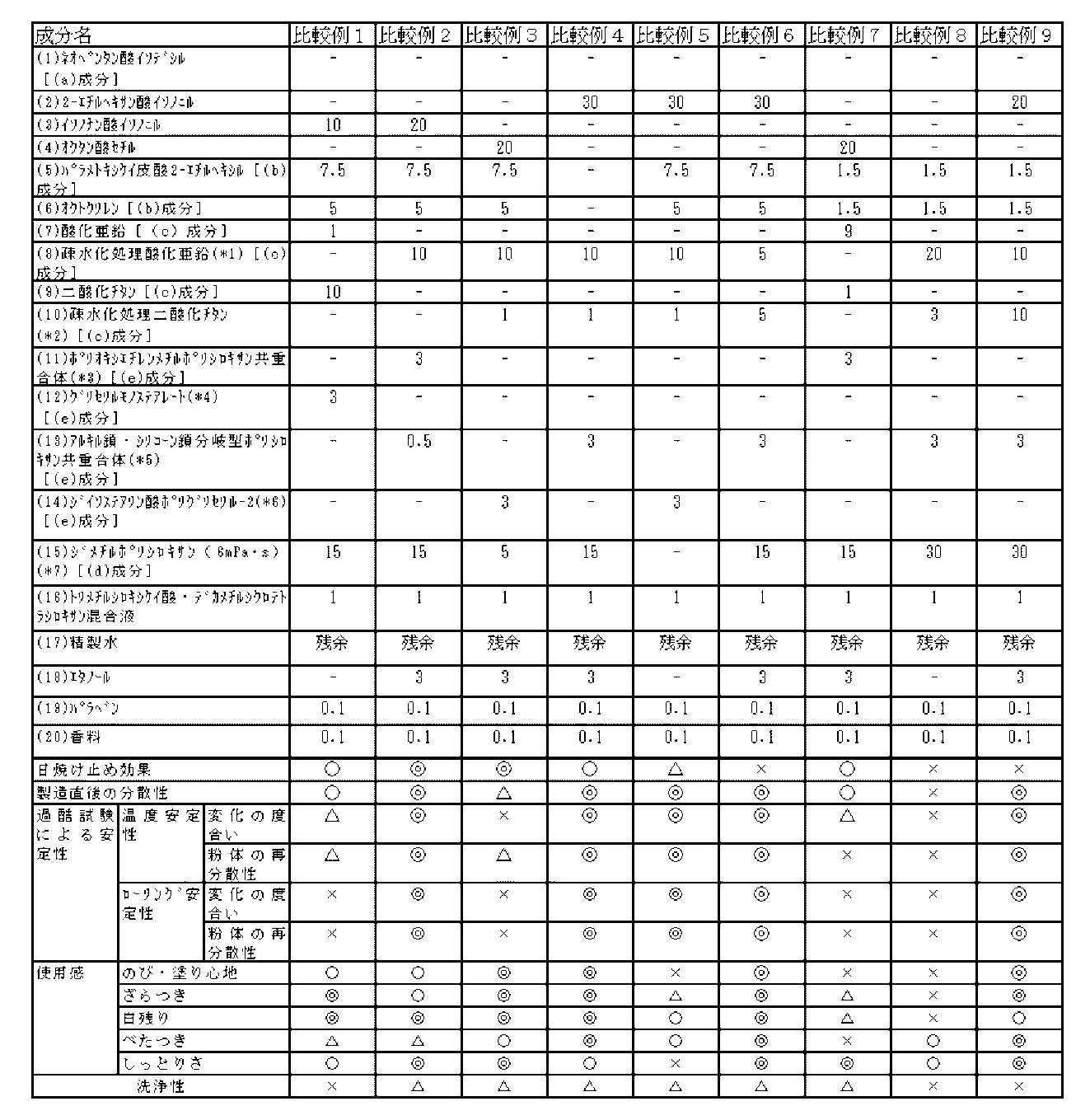
(*1)疎水化処理酸化亜鉛:メチルハイドロジェンポリシロキサン処理酸化亜鉛「SS-Activox
C80」;昭和電工(株)社製
(*2)疎水化処理二酸化チタン:ステアリン酸アルミニウム処理二酸化チタン「MT-014」;テイカ(株)社製
(*3)ポリオキシエチレンメチルポリシロキサン共重合体:PEG-11メチルエーテルジメチコン(「KF-6011」,HLB値=14.5;信越化学工業(株)社製
(*4)グリセリルモノステアレート:「ニッコールMGS-ASEV」,HLB値=6.0;日光ケミカルス゛(株)社製
(*5)アルキル鎖・シリコーン鎖分岐型ポリオキシエチレンメチルポリシロキサン共重合体:
ラウリルPEG-9ポリジメチルシロキシエチルジメチコン「KF-6038」,HLB値=3.0;信越化学工業(株)社製
(*6)ジイソステアリン酸ポリグリセリル-2:「サラコス42V」;日清オイリオ(株)社製
(*7)ジメチルポリシロキサン:「SH200cs-5cs」;東レ・ダウコーニングシリコーン(株)社製
表1~3の結果から明らかなように、(a)~(d)成分を含有する本発明の水中油型または油中水型乳化日焼け止め化粧料は、比較例の化粧料に比べて、有意に分散性並びに安定性に優れており、それに伴い、日焼け止め効果および使用感に優れていた。
本発明の化粧料は、皮膚へののびがよく、使用時のきしみやざらつき感がなく、しかもさらっとした感触で、べたつかず、使用感に優れたものであった。さらに、皮膚への白残りがなく、化粧仕上がりにも優れ、使用後の洗浄性にも優れていた。
これらの効果は、実施例と比較例との比較からわかるように、エステル油として、ネオペンタン酸イソデシルを用いることによって得られた特有の効果である。
以下に、本発明のその他の処方例を示す。
[実施例19 水中油型乳化日焼け止め化粧料(クリームタイプ)]
(配合成分) (質量%)
(水相部)
(1)1,3-ブチレングリコール 7.0
(2)酸化亜鉛 5.0
商品名:「ナノファイン(Nanofine)-K-LP」;堺化学(株)社製
(3)エデト酸ニナトリウム 0.05
(4)トリエタノールアミン 1.0
(5)2,2’-メチレンビス[6-(2H-ベンゾトリアゾール-2-イル)
-(1,1,3,3-テトラメチルブチル)フェノール]
商品名:「チノソーブ(Tinosorb)M」;チバ・スペシャリテリティ・ケミカルズ(Ciba Speciality Chemicals)社製 3.0
(6)イオン交換水 残余
(油相部)
(7)4-メチルベンジリデンカンファー 2.0
商品名:「ネオ・ヘリオパン(NEO HELIOPAN)MBC」;シムライズ(Symrise)社製
(8)サリチル酸オクチル 3.0
商品名:「ネオ・ヘリオパン(NEO HELIOPAN)OS」;シムライズ(Symrise)社製
(9)ネオペンタン酸イソデシル 10.0
(10)デカメチルシクロペンタシロキサン 10.0
(11)ワセリン 5.0
(12)ステアリルアルコール 3.0
(13)ステアリン酸 3.0
(14)グリセリルモノステアレート 3.0
(15)ポリアクリル酸エチル 1.0
(16)グルタチオン 適量
(17)パラベン 適量
(18)香料 適量
(製法)
油相部と水相部をそれぞれ70℃に加熱し、溶解させる。水相部は、二酸化チタンの分散を十分に行い、油相部を加え、ホモジナイザーを用い乳化する。乳化物を熱交換機を用い、冷却した。得られた水中油型乳化日焼け止め化粧料は、使用時のきしみやざらつき感がなく、しかもさらっとした感触で、べたつかず、使用感触に優れたものであった。さらに、皮膚への白残りがなく、化粧仕上がりにも優れていた。さらに、使用後の洗浄性にも優れたものであった。また、先に述べたSPF測定によってもSPF値22、PA+の値を示した。
[実施例19 水中油型乳化日焼け止め化粧料(クリームタイプ)]
(配合成分) (質量%)
(水相部)
(1)1,3-ブチレングリコール 7.0
(2)酸化亜鉛 5.0
商品名:「ナノファイン(Nanofine)-K-LP」;堺化学(株)社製
(3)エデト酸ニナトリウム 0.05
(4)トリエタノールアミン 1.0
(5)2,2’-メチレンビス[6-(2H-ベンゾトリアゾール-2-イル)
-(1,1,3,3-テトラメチルブチル)フェノール]
商品名:「チノソーブ(Tinosorb)M」;チバ・スペシャリテリティ・ケミカルズ(Ciba Speciality Chemicals)社製 3.0
(6)イオン交換水 残余
(油相部)
(7)4-メチルベンジリデンカンファー 2.0
商品名:「ネオ・ヘリオパン(NEO HELIOPAN)MBC」;シムライズ(Symrise)社製
(8)サリチル酸オクチル 3.0
商品名:「ネオ・ヘリオパン(NEO HELIOPAN)OS」;シムライズ(Symrise)社製
(9)ネオペンタン酸イソデシル 10.0
(10)デカメチルシクロペンタシロキサン 10.0
(11)ワセリン 5.0
(12)ステアリルアルコール 3.0
(13)ステアリン酸 3.0
(14)グリセリルモノステアレート 3.0
(15)ポリアクリル酸エチル 1.0
(16)グルタチオン 適量
(17)パラベン 適量
(18)香料 適量
(製法)
油相部と水相部をそれぞれ70℃に加熱し、溶解させる。水相部は、二酸化チタンの分散を十分に行い、油相部を加え、ホモジナイザーを用い乳化する。乳化物を熱交換機を用い、冷却した。得られた水中油型乳化日焼け止め化粧料は、使用時のきしみやざらつき感がなく、しかもさらっとした感触で、べたつかず、使用感触に優れたものであった。さらに、皮膚への白残りがなく、化粧仕上がりにも優れていた。さらに、使用後の洗浄性にも優れたものであった。また、先に述べたSPF測定によってもSPF値22、PA+の値を示した。
[実施例20 水中油型乳化日焼け止め化粧料(乳液タイプ)]
(配 合 成 分) (質量%)
(水相部)
(1)ジプロピレングリコール 6.0
(2)エタノール 3.0
(3)ヒドロキシエチルセルロース 0.3
(4)フェニルベンズイミダゾールスルホン酸 1.5
商品名:「ネオ・ヘリオパン・ハイドロ(NEO HELIOPAN HYDRO)」;シムライズ(Symrise)社製
(5)ベンジリデンショウノウスルホン酸 1.5
商品名:「メギゾリル(Mexoryl)SL」;シメックス(Chimex)社製
(6)酸化亜鉛 3.0
商品名:「Zinc Oxide neutral」、粒径40nm、シムライズ(Symrise)社製
(7)二酸化チタン 3.0
商品名:「STR-100C」;堺化学(株)社製
(8)イオン交換水 残 余
(油相)
(9)ネオペンタン酸イソデシル 4.0
(10)2,4-ビス{[4-(2-エチルヘキシルオキシ)-2-ヒドロキシ]
フェニル}-6-(4-メトキシフェニル)-1,3,5-トリアジン 0.5
商品名:「チノソーブ(Tinosorb)S」;チバ・スペシャリティ・ケミカルズ(Ciba
Speciality Chemicals)社製
(11)エチルヘキシルメトキシシンナメート 2.0
商品名:「パルソール(Parsol)MCX」;ホフマン-ラ-ロシュ(Hoffmann-La-Roche)社製
(12)4-tert-ブチル-4’-メトキシベンゾイルメタン 1.0
商品名:「パルソール(Palsol)1789」;ホフマン-ラ-ロシュ(Hoffmann-La-Roche)社製
(13)ベンゾフェノン-3 1.0
商品名:「ユビナール(Uvinul)M40」;BASF社製
(14)オレイルオレート 5.0
(15)ジメチルポリシロキサン(6mPa・s) 3.0
商品名:「KF-96A-6」;信越化学(株)製
(16)ワセリン 0.5
(17)セチルアルコール 1.0
(18)ソルビタンセスキオレイン酸エステル
0.8
(19)トコフェロール 適 量
(20)香料 適 量
(製法)
油相部と水相部をそれぞれ70℃に加熱し溶解させる。水相部は、二酸化チタンの分散を十分に行い、油相部を加え、ホモジナイザーを用い乳化する。乳化物を熱交換機を用い、冷却した。
得られた水中油型乳化日焼け止め化粧料は、使用時のきしみやざらつき感がなく、しかもさらっとした感触で、べたつかず、使用感触に優れたものであった。さらに、皮膚への白残りがなく、化粧仕上がりにも優れていた。さらに、使用後の洗浄性にも優れていた。また、先の述べたSPF測定によってもSPF値25、PA++の値を示した。
(配 合 成 分) (質量%)
(水相部)
(1)ジプロピレングリコール 6.0
(2)エタノール 3.0
(3)ヒドロキシエチルセルロース 0.3
(4)フェニルベンズイミダゾールスルホン酸 1.5
商品名:「ネオ・ヘリオパン・ハイドロ(NEO HELIOPAN HYDRO)」;シムライズ(Symrise)社製
(5)ベンジリデンショウノウスルホン酸 1.5
商品名:「メギゾリル(Mexoryl)SL」;シメックス(Chimex)社製
(6)酸化亜鉛 3.0
商品名:「Zinc Oxide neutral」、粒径40nm、シムライズ(Symrise)社製
(7)二酸化チタン 3.0
商品名:「STR-100C」;堺化学(株)社製
(8)イオン交換水 残 余
(油相)
(9)ネオペンタン酸イソデシル 4.0
(10)2,4-ビス{[4-(2-エチルヘキシルオキシ)-2-ヒドロキシ]
フェニル}-6-(4-メトキシフェニル)-1,3,5-トリアジン 0.5
商品名:「チノソーブ(Tinosorb)S」;チバ・スペシャリティ・ケミカルズ(Ciba
Speciality Chemicals)社製
(11)エチルヘキシルメトキシシンナメート 2.0
商品名:「パルソール(Parsol)MCX」;ホフマン-ラ-ロシュ(Hoffmann-La-Roche)社製
(12)4-tert-ブチル-4’-メトキシベンゾイルメタン 1.0
商品名:「パルソール(Palsol)1789」;ホフマン-ラ-ロシュ(Hoffmann-La-Roche)社製
(13)ベンゾフェノン-3 1.0
商品名:「ユビナール(Uvinul)M40」;BASF社製
(14)オレイルオレート 5.0
(15)ジメチルポリシロキサン(6mPa・s) 3.0
商品名:「KF-96A-6」;信越化学(株)製
(16)ワセリン 0.5
(17)セチルアルコール 1.0
(18)ソルビタンセスキオレイン酸エステル
0.8
(19)トコフェロール 適 量
(20)香料 適 量
(製法)
油相部と水相部をそれぞれ70℃に加熱し溶解させる。水相部は、二酸化チタンの分散を十分に行い、油相部を加え、ホモジナイザーを用い乳化する。乳化物を熱交換機を用い、冷却した。
得られた水中油型乳化日焼け止め化粧料は、使用時のきしみやざらつき感がなく、しかもさらっとした感触で、べたつかず、使用感触に優れたものであった。さらに、皮膚への白残りがなく、化粧仕上がりにも優れていた。さらに、使用後の洗浄性にも優れていた。また、先の述べたSPF測定によってもSPF値25、PA++の値を示した。
[実施例21 油中水型乳化日焼け止め化粧料(クリームタイプ)]
(配 合 成 分) (質量%)
(水相部)
(1)1,3-ブチレングリコール 5.0
(2)イオン交換水 残 余
(油相)
(3)ネオペンタン酸イソデシル 15.0
(4)オクトクリレン 5.0
商品名:「ネオヘリオパン(NEO HELIOPAN)303」;シムライズ(Symrise)社製
(5)ブチルメトキシジベンゾイルメタン 3.0
商品名:「ネオヘリオパン(NEO HELIOPAN)」;シムライズ(Symrise)社製
(6)3-(4’-メチルベンジリデン)-dl-カンファー
3.0
商品名:「ユーソレックス(Eusolex)6300」;メルク(Merck)社製
(7)疎水化処理(アルミナ・脂肪酸石鹸処理)二酸化チタン 3.0
商品名:「TTO-S-4」;石原産業(株)社製
(8)ジイソステアリン酸グリセリン 3.0
(9)有機変性モンモリロナイト 1.5
(10)デカメチルシクロペンタシロキサン 10.0
(11)パラベン 適 量
(12)香料 適 量
(製法)
油相部と水相部をそれぞれ70℃に加熱し、溶解させる。油相部は、二酸化チタンの分散を十分に行い、ホモジナイザー処理を行いながら水相部を添加する。
得られた油中水型乳化日焼け止め化粧料は、使用時のきしみやざらつき感がなく、しかもさらっとした感触で、べたつかず、使用感触に優れたものであった。さらに、皮膚への白残りがなく、化粧仕上がりにも優れていた。さらに、使用後の洗浄性にも優れていた。また、先の述べたSPF測定によってもSPF値40、PA++の値を示した。
(配 合 成 分) (質量%)
(水相部)
(1)1,3-ブチレングリコール 5.0
(2)イオン交換水 残 余
(油相)
(3)ネオペンタン酸イソデシル 15.0
(4)オクトクリレン 5.0
商品名:「ネオヘリオパン(NEO HELIOPAN)303」;シムライズ(Symrise)社製
(5)ブチルメトキシジベンゾイルメタン 3.0
商品名:「ネオヘリオパン(NEO HELIOPAN)」;シムライズ(Symrise)社製
(6)3-(4’-メチルベンジリデン)-dl-カンファー
3.0
商品名:「ユーソレックス(Eusolex)6300」;メルク(Merck)社製
(7)疎水化処理(アルミナ・脂肪酸石鹸処理)二酸化チタン 3.0
商品名:「TTO-S-4」;石原産業(株)社製
(8)ジイソステアリン酸グリセリン 3.0
(9)有機変性モンモリロナイト 1.5
(10)デカメチルシクロペンタシロキサン 10.0
(11)パラベン 適 量
(12)香料 適 量
(製法)
油相部と水相部をそれぞれ70℃に加熱し、溶解させる。油相部は、二酸化チタンの分散を十分に行い、ホモジナイザー処理を行いながら水相部を添加する。
得られた油中水型乳化日焼け止め化粧料は、使用時のきしみやざらつき感がなく、しかもさらっとした感触で、べたつかず、使用感触に優れたものであった。さらに、皮膚への白残りがなく、化粧仕上がりにも優れていた。さらに、使用後の洗浄性にも優れていた。また、先の述べたSPF測定によってもSPF値40、PA++の値を示した。
[実施例22 油中水型乳化日焼け止め化粧料(クリームタイプ)]
(配 合 成 分) (質量%)
(水相部)
(1)1,3-ブチレングリコール 2.0
(2)グリセリン 2.0
(3)イオン交換水 残 余
(油相)
(4)ネオペンタン酸イソデシル 23.0
(5)イソアミル-p-メトキシシンナメート 2.0
商品名:「ネオヘリオパン(NEO HELIOPAN)E1000」;シムライズ(Symrise)社製
(6)2,4-ビス-{[4-(2-エチルヘキシルオキシ)-2-
ヒドロキシ]フェニル}-6-(4-メトキシフェニル)-1,3,5-
トリアジン 3.0
商品名:「チノソーブ(Tinosorb)S」;チバ・スペシャリティ・ケミカルズ(Ciba
Speciality Chemicals社製)
(7)3-(4’-メチルベンジリデン)-dl-カンファー 3.0
商品名:「ユーソレックス(Eusolex)6300」;メルク(Merck)社製)
(8)疎水化処理(脂肪酸石鹸処理)二酸化チタン 3.0
商品名:「MT-014」;テイカ(株)製
(9)PEG-9 ポリジメチルシロキシエチルジメチコン 3.0
商品名:「KF-6028」;信越化学工業(株)製)
(10)ジメチコン・(ジメチコン/ポリグリセリン-3)クロスポリマー 1.5
商品名:「KSG-710」;信越化学工業(株)製
(11)デカメチルシクロペンタシロキサン 5.0
(12)ジメチルポリシロキサン 5.0
(13)パラベン 適 量
(14)香料 適 量
(製法)
油相部と水相部をそれぞれ70℃に加熱し、溶解させる。油相部は、二酸化チタンの分散を十分に行い、ホモジナイザー処理を行いながら水相部を添加する。
得られた油中水型乳化日焼け止め化粧料は、使用時のきしみやざらつき感がなく、しかもさらっとした感触で、べたつかず、使用感触に優れたものであった。さらに、皮膚への白残りがなく、化粧仕上がりにも優れていた。さらに、使用後の洗浄性にも優れていた。また、先の述べたSPF測定によってもSPF値50、PA+++の値を示した。
(配 合 成 分) (質量%)
(水相部)
(1)1,3-ブチレングリコール 2.0
(2)グリセリン 2.0
(3)イオン交換水 残 余
(油相)
(4)ネオペンタン酸イソデシル 23.0
(5)イソアミル-p-メトキシシンナメート 2.0
商品名:「ネオヘリオパン(NEO HELIOPAN)E1000」;シムライズ(Symrise)社製
(6)2,4-ビス-{[4-(2-エチルヘキシルオキシ)-2-
ヒドロキシ]フェニル}-6-(4-メトキシフェニル)-1,3,5-
トリアジン 3.0
商品名:「チノソーブ(Tinosorb)S」;チバ・スペシャリティ・ケミカルズ(Ciba
Speciality Chemicals社製)
(7)3-(4’-メチルベンジリデン)-dl-カンファー 3.0
商品名:「ユーソレックス(Eusolex)6300」;メルク(Merck)社製)
(8)疎水化処理(脂肪酸石鹸処理)二酸化チタン 3.0
商品名:「MT-014」;テイカ(株)製
(9)PEG-9 ポリジメチルシロキシエチルジメチコン 3.0
商品名:「KF-6028」;信越化学工業(株)製)
(10)ジメチコン・(ジメチコン/ポリグリセリン-3)クロスポリマー 1.5
商品名:「KSG-710」;信越化学工業(株)製
(11)デカメチルシクロペンタシロキサン 5.0
(12)ジメチルポリシロキサン 5.0
(13)パラベン 適 量
(14)香料 適 量
(製法)
油相部と水相部をそれぞれ70℃に加熱し、溶解させる。油相部は、二酸化チタンの分散を十分に行い、ホモジナイザー処理を行いながら水相部を添加する。
得られた油中水型乳化日焼け止め化粧料は、使用時のきしみやざらつき感がなく、しかもさらっとした感触で、べたつかず、使用感触に優れたものであった。さらに、皮膚への白残りがなく、化粧仕上がりにも優れていた。さらに、使用後の洗浄性にも優れていた。また、先の述べたSPF測定によってもSPF値50、PA+++の値を示した。
[実施例23 油中水型乳化日焼け止め化粧料(乳液タイプ)]
(配 合 成 分)
(質量%)
(水相部)
(1)1,3-ブチレングリコール 5.0
(2)ジプロピレングリコール 2.0
(3)イオン交換水 残 余
(油相)
(4)ネオペンタン酸イソデシル 4.0
(5)エトクリレン 5.0
商品名:「ユビナール(Uvinul)N35」;BASF社製
(6)エチルヘキシルメトキシシンナメート 5.0
商品名:「ネオヘリオパン(NEO HELIOPAN)AV」;シムライズ(Symrise)社製)
(7)1-(4-tert-ブチルフェニル)-3-(4-メトキシフェニル)
プロパン-1,3-ジオン 5.0
商品名:「ユーソレックス(Eusolex)9020」;メルク(Merck)社製)
(8)疎水化処理(ジメチコン処理)酸化亜鉛 5.0
商品名:「MT-FINEX-50LP」;堺化学(株)製
(9)疎水化処理(アルミナ・ジメチコン処理)二酸化チタン 2.0
商品名:「SAS-015」;三好化成(株)製
(10)PEG-3ジメチコン 1.0
商品名:「KF-6015」;信越化学工業(株)社製
(11)PEG-11 メチルエーテルジメチコン 2.5
商品名:「KF-6018」;信越化学工業(株)製
(12)デカメチルシクロペンタシロキサン 2.0
(13)ジメチルポリシロキサン 2.0
(14)パラベン 適 量
(15)香料 適 量
(製法)
油相部と水相部をそれぞれ70℃に加熱し、溶解させる。油相部は、二酸化チタンの分散を十分に行い、ホモジナイザー処理を行いながら水相部を添加する。
得られた油中水型乳化日焼け止め化粧料は、使用時のきしみやざらつき感がなく、しかもさらっとした感触で、べたつかず、使用感触に優れたものであった。さらに、皮膚への白残りがなく、化粧仕上がりにも優れていた。さらに、使用後の洗浄性にも優れていた。また、先の述べたSPF測定によってもSPF値40、PA++の値を示した。
実施例24.水中油型乳化皮膚化粧料(クリームタイプ)
(配合成分)
(水相部)
(1)ジプロピレングリコール 5.0
(2)グリセリン 2.0
(3)酸化亜鉛 5.0
商品名:「ナノファイン(Nanofine)-K-LP」;堺化学(株)社製
(4)エデト酸二ナトリウム 0.05
(5)トリエタノールアミン 1.0
(6)2,2‘-メチレンビス[6-(2H-ベンゾトリアゾール-2-イル)
-(1,1,3,3-テトラメチルブチル)フェノール] 1.0
商品名:「チノソーブ(Tinosorb)M」;チバ・スペシャリティ・ケミカルズ
(Ciba Speciality Chemicals)社製
(7)イオン交換水 残余
(8)緑茶エキス 0.1
(油相部)
(8)4-メチルベンジリデンカンファー 2.0
商品名:「ネオ・ヘリオパン(NEO HELIOPAN)MBC」;シムライズ(Symrise)社製
(9)サリチル酸オクチル 3.0
商品名:「ネオ・ヘリオパン(NEO HELIOPAN)OS」;シムライズ(Symrise)社製
(10)ネオペンタン酸イソデシル 8.0
(11)ジメチコン1.5mPa・s 5.0
(12)α-オレフィンオリゴマー 3.0
(13)ベヘニルアルコール 1.0
(14)ステアリルアルコール 0.5
(15)グリセリルモノステアレート 3.0
(16)ステアリン酸PEG-40 0.5
(17)(ジメチルアクリルアミド/アクリロイルジメチルタウリンナトリウム)
クロスポリマー 0.5
(18)パラベン 適量
(18)香料 適量
(製法)
油相部と水相部をそれぞれ70℃に加熱し、溶解させる。水相部は、二酸化チタンの分散を十分に行い、油相部を加え、ホモジナイザーを用い乳化する。乳化物を熱交換機を用い、冷却した。得られた水中油型乳化日焼け止め化粧料は、使用時のきしみやざらつきがなく、しかもさらっとした感触で、べたつかず、使用感触に優れたものであった。さらに、皮膚への白残りがなく、化粧仕上がりにも優れていた。さらに、使用後の洗浄性にも優れたものであった。また、先に述べたSPF測定によってSPF値20、PA+の値を示した。
(配 合 成 分)
(質量%)
(水相部)
(1)1,3-ブチレングリコール 5.0
(2)ジプロピレングリコール 2.0
(3)イオン交換水 残 余
(油相)
(4)ネオペンタン酸イソデシル 4.0
(5)エトクリレン 5.0
商品名:「ユビナール(Uvinul)N35」;BASF社製
(6)エチルヘキシルメトキシシンナメート 5.0
商品名:「ネオヘリオパン(NEO HELIOPAN)AV」;シムライズ(Symrise)社製)
(7)1-(4-tert-ブチルフェニル)-3-(4-メトキシフェニル)
プロパン-1,3-ジオン 5.0
商品名:「ユーソレックス(Eusolex)9020」;メルク(Merck)社製)
(8)疎水化処理(ジメチコン処理)酸化亜鉛 5.0
商品名:「MT-FINEX-50LP」;堺化学(株)製
(9)疎水化処理(アルミナ・ジメチコン処理)二酸化チタン 2.0
商品名:「SAS-015」;三好化成(株)製
(10)PEG-3ジメチコン 1.0
商品名:「KF-6015」;信越化学工業(株)社製
(11)PEG-11 メチルエーテルジメチコン 2.5
商品名:「KF-6018」;信越化学工業(株)製
(12)デカメチルシクロペンタシロキサン 2.0
(13)ジメチルポリシロキサン 2.0
(14)パラベン 適 量
(15)香料 適 量
(製法)
油相部と水相部をそれぞれ70℃に加熱し、溶解させる。油相部は、二酸化チタンの分散を十分に行い、ホモジナイザー処理を行いながら水相部を添加する。
得られた油中水型乳化日焼け止め化粧料は、使用時のきしみやざらつき感がなく、しかもさらっとした感触で、べたつかず、使用感触に優れたものであった。さらに、皮膚への白残りがなく、化粧仕上がりにも優れていた。さらに、使用後の洗浄性にも優れていた。また、先の述べたSPF測定によってもSPF値40、PA++の値を示した。
実施例24.水中油型乳化皮膚化粧料(クリームタイプ)
(配合成分)
(水相部)
(1)ジプロピレングリコール 5.0
(2)グリセリン 2.0
(3)酸化亜鉛 5.0
商品名:「ナノファイン(Nanofine)-K-LP」;堺化学(株)社製
(4)エデト酸二ナトリウム 0.05
(5)トリエタノールアミン 1.0
(6)2,2‘-メチレンビス[6-(2H-ベンゾトリアゾール-2-イル)
-(1,1,3,3-テトラメチルブチル)フェノール] 1.0
商品名:「チノソーブ(Tinosorb)M」;チバ・スペシャリティ・ケミカルズ
(Ciba Speciality Chemicals)社製
(7)イオン交換水 残余
(8)緑茶エキス 0.1
(油相部)
(8)4-メチルベンジリデンカンファー 2.0
商品名:「ネオ・ヘリオパン(NEO HELIOPAN)MBC」;シムライズ(Symrise)社製
(9)サリチル酸オクチル 3.0
商品名:「ネオ・ヘリオパン(NEO HELIOPAN)OS」;シムライズ(Symrise)社製
(10)ネオペンタン酸イソデシル 8.0
(11)ジメチコン1.5mPa・s 5.0
(12)α-オレフィンオリゴマー 3.0
(13)ベヘニルアルコール 1.0
(14)ステアリルアルコール 0.5
(15)グリセリルモノステアレート 3.0
(16)ステアリン酸PEG-40 0.5
(17)(ジメチルアクリルアミド/アクリロイルジメチルタウリンナトリウム)
クロスポリマー 0.5
(18)パラベン 適量
(18)香料 適量
(製法)
油相部と水相部をそれぞれ70℃に加熱し、溶解させる。水相部は、二酸化チタンの分散を十分に行い、油相部を加え、ホモジナイザーを用い乳化する。乳化物を熱交換機を用い、冷却した。得られた水中油型乳化日焼け止め化粧料は、使用時のきしみやざらつきがなく、しかもさらっとした感触で、べたつかず、使用感触に優れたものであった。さらに、皮膚への白残りがなく、化粧仕上がりにも優れていた。さらに、使用後の洗浄性にも優れたものであった。また、先に述べたSPF測定によってSPF値20、PA+の値を示した。
Claims (9)
- (a)ネオペンタン酸イソデシルと、(b)紫外線吸収剤と、(c)紫外線散乱剤と、
(d)シリコーン油を含有する水中油型または油中水型乳化日焼け止め化粧料。
- (b)成分が、パラ-アミノ安息香酸誘導体、サリチル酸誘導体、ケイ皮酸誘導体、β,β-ジフェニルアクリラート誘導体、ベンゾフェノン誘導体、ベンジリデンショウノウ誘導体、フェニルベンゾイミダゾール誘導体、トリアジン誘導体、フェニルベンゾトリアゾール誘導体、アントラニル誘導体、イミダゾリン誘導体、ベンザルマロナート誘導体、4,4-ジアリールブタジエン誘導体の中から選ばれる1種または2種以上である請求項1記載の日焼け止め化粧料。
- (c)成分が、酸化亜鉛および/または二酸化チタンである請求項1または2記載の日焼け止め化粧料。
- 酸化亜鉛の平均一次粒子径が5~40nmである請求項3記載の日焼け止め化粧料。
- 二酸化チタンの平均一次粒子径が5~30nmである請求項3記載の日焼け止め化粧料。
- 化粧料全量中に、(a)成分を1~60質量%、(b)成分を3~20質量%、(c)成分を0.5~50質量%、(d)成分を1~70質量%含有する請求項1~5のいずれかに記載の日焼け止め化粧料。
- さらに、(e)シリコーン系界面活性剤、グリセリンまたはポリグリセリン脂肪酸エステル類の中から選ばれる1種または2種以上を含む請求項1~6のいずれに記載の日焼け止め化粧料。
- (e)成分としてのシリコーン系界面活性剤が、ポリ(オキシエチレン・オキシプロピレン)メチルポリシロキサン共重合体、ポリオキシエチレンメチルポリシロキサン共重合体、シリコーン鎖分岐型メチルポリシロキサン共重合体、アルキル鎖・シリコーン鎖分岐型ポリオキシエチレンメチルポリシロキサン共重合体、架橋型ポリオキシエチレンメチルポリシロキサン、アルキル基含有架橋型ポリオキシエチレンメチルポリシロキサン、分岐型ポリグリセリン変性シリコーン、架橋型ポリグリセリン変性シリコーン、アルキル基含有架橋型ポリグリセリン変性シリコーン、アルキル基分岐型ポリグリセリン変性シリコーンの中から選ばれる1種または2種以上である請求項7記載の日焼け止め化粧料。
- 化粧料全量中に、(e)成分を0.1~10質量%含有する請求項7または8に記載の日焼け止め化粧料。
Applications Claiming Priority (4)
| Application Number | Priority Date | Filing Date | Title |
|---|---|---|---|
| JP2009045062 | 2009-02-27 | ||
| JP2009-045062 | 2009-02-27 | ||
| JP2010039564A JP2010222349A (ja) | 2009-02-27 | 2010-02-25 | 日焼け止め化粧料 |
| JP2010-039564 | 2010-02-25 |
Publications (1)
| Publication Number | Publication Date |
|---|---|
| WO2010098099A1 true WO2010098099A1 (ja) | 2010-09-02 |
Family
ID=42665314
Family Applications (1)
| Application Number | Title | Priority Date | Filing Date |
|---|---|---|---|
| PCT/JP2010/001268 Ceased WO2010098099A1 (ja) | 2009-02-27 | 2010-02-25 | 日焼け止め化粧料 |
Country Status (2)
| Country | Link |
|---|---|
| JP (1) | JP2010222349A (ja) |
| WO (1) | WO2010098099A1 (ja) |
Cited By (12)
| Publication number | Priority date | Publication date | Assignee | Title |
|---|---|---|---|---|
| JP2012140343A (ja) * | 2010-12-28 | 2012-07-26 | Kao Corp | 油中水型乳化化粧料 |
| EP2749265A4 (en) * | 2011-08-26 | 2015-05-06 | Shiseido Co Ltd | SUN PROTECTION COSMETIC ARTICLES IN THE FORM OF A WATER IN OIL EMULSION |
| EP2740462A4 (en) * | 2011-08-02 | 2015-07-22 | Shiseido Co Ltd | OIL-IN-WATER emulsified cosmetic |
| EP3087970A4 (en) * | 2013-12-26 | 2017-07-05 | Shiseido Company Ltd. | Water-in-oil emulsified sunscreen cosmetic |
| JP2018070556A (ja) * | 2016-11-02 | 2018-05-10 | 株式会社コーセー | 日焼け止め化粧料 |
| WO2020070194A1 (en) * | 2018-10-05 | 2020-04-09 | Basf Se | Methylene bis-benzotriazolyl tetramethylbutylphenol for fabric staining reduction |
| CN112842926A (zh) * | 2021-04-01 | 2021-05-28 | 科丝美诗(中国)化妆品有限公司 | 一种水包硅油化妆品及其制备方法 |
| CN113208940A (zh) * | 2021-04-30 | 2021-08-06 | 广州市科能化妆品科研有限公司 | 一种清爽稳定的防晒组合物及其制备方法 |
| CN114173758A (zh) * | 2019-07-26 | 2022-03-11 | 株式会社资生堂 | 水性组合物 |
| CN114245734A (zh) * | 2019-08-20 | 2022-03-25 | 株式会社Lg生活健康 | 具备彩色乳化体性状的防紫外线用化妆料组合物 |
| CN116710042A (zh) * | 2020-12-25 | 2023-09-05 | 株式会社资生堂 | 水包油型防晒化妆品 |
| CN117582386A (zh) * | 2022-08-19 | 2024-02-23 | 百达精密化学股份有限公司 | 乳剂组分、乳剂组分的用途及水包油型防晒乳液 |
Families Citing this family (19)
| Publication number | Priority date | Publication date | Assignee | Title |
|---|---|---|---|---|
| JP5694818B2 (ja) * | 2011-03-16 | 2015-04-01 | 株式会社ファンケル | 日焼け止め化粧料 |
| JP2012201664A (ja) * | 2011-03-28 | 2012-10-22 | Shiseido Co Ltd | 日焼け止め化粧料 |
| JP5554308B2 (ja) | 2011-10-27 | 2014-07-23 | 株式会社 資生堂 | 日焼け止め水中油型乳化化粧料 |
| JP5952047B2 (ja) * | 2012-03-23 | 2016-07-13 | 株式会社マンダム | 水中油型乳化組成物及び水中油型乳化組成物の製造方法 |
| JP6039250B2 (ja) * | 2012-06-11 | 2016-12-07 | 株式会社 資生堂 | 乳化化粧料 |
| JP6017241B2 (ja) * | 2012-09-20 | 2016-10-26 | 株式会社ナリス化粧品 | ふきとり用化粧水 |
| JP6133618B2 (ja) * | 2013-02-21 | 2017-05-24 | 株式会社ファンケル | 油中水型乳化組成物 |
| JP6445251B2 (ja) * | 2013-05-15 | 2018-12-26 | 株式会社コーセー | 乳化化粧料 |
| JP6279457B2 (ja) * | 2013-11-19 | 2018-02-14 | 株式会社 資生堂 | 水中油型乳化化粧料 |
| CN106572958B (zh) * | 2014-11-28 | 2020-11-06 | 株式会社资生堂 | 水包油型乳化化妆品 |
| CN107847410B (zh) * | 2015-06-19 | 2024-06-25 | 莱雅公司 | 包含高水平的脂溶性uv过滤剂的防晒组合物 |
| US20160367470A1 (en) * | 2015-06-19 | 2016-12-22 | L'oreal | Water-in-oil sunscreen composition having organic sunscreen actives |
| JP6965080B2 (ja) * | 2017-09-29 | 2021-11-10 | 株式会社マンダム | 水中油型皮膚化粧料 |
| KR20220097948A (ko) * | 2019-11-05 | 2022-07-08 | 디에스엠 아이피 어셋츠 비.브이. | 점착성이 적은 자외선 차단 조성물 |
| JP2021120365A (ja) * | 2020-01-31 | 2021-08-19 | 株式会社 資生堂 | 日焼け止め組成物 |
| KR20230098138A (ko) * | 2020-10-27 | 2023-07-03 | 가부시키가이샤 코세 | 유중수형 유화 화장료 |
| EP4284320A1 (en) * | 2021-01-29 | 2023-12-06 | L'oreal | Water-in-oil cosmetic sunscreen composition, use of a water-in-oil cosmetic sunscreen composition, and process for manufacturing a water-in-oil cosmetic sunscreen composition |
| KR20230132388A (ko) | 2022-03-08 | 2023-09-15 | 니치유 가부시키가이샤 | 화장용 기제, 그것을 포함하는 화장료, 및 유중수형 자외선 차단 화장료 |
| JP7803204B2 (ja) * | 2022-04-15 | 2026-01-21 | 日油株式会社 | 日焼け止め化粧料 |
Citations (7)
| Publication number | Priority date | Publication date | Assignee | Title |
|---|---|---|---|---|
| US4810490A (en) * | 1987-06-04 | 1989-03-07 | Carter-Wallace, Inc. | Sunscreen composition |
| JPH08507081A (ja) * | 1993-02-26 | 1996-07-30 | エスティー ローダー インコーポレーテッド | 二酸化チタン分散液、化粧品組成物およびそれを使用する方法 |
| DE10210337A1 (de) * | 2002-03-08 | 2003-09-25 | Beiersdorf Ag | Lippenpflegeprodukte mit UV-Schutz |
| JP2005206573A (ja) * | 2003-12-22 | 2005-08-04 | Nippon Fine Chem Co Ltd | ジエステル及び油剤、並びに化粧料及び皮膚外用剤 |
| JP2006290787A (ja) * | 2005-04-11 | 2006-10-26 | Nippon Fine Chem Co Ltd | 化粧料用油剤又は皮膚外用剤用油剤、並びに化粧料又は皮膚外用剤 |
| WO2006133828A1 (en) * | 2005-06-17 | 2006-12-21 | Dsm Ip Assets B.V. | Novel use 25-hydroxycholecalciferol in combination with uv-b screening agents |
| WO2009077356A2 (en) * | 2007-12-14 | 2009-06-25 | Basf Se | Sunscreen compositions comprising colour pigmens |
-
2010
- 2010-02-25 JP JP2010039564A patent/JP2010222349A/ja active Pending
- 2010-02-25 WO PCT/JP2010/001268 patent/WO2010098099A1/ja not_active Ceased
Patent Citations (7)
| Publication number | Priority date | Publication date | Assignee | Title |
|---|---|---|---|---|
| US4810490A (en) * | 1987-06-04 | 1989-03-07 | Carter-Wallace, Inc. | Sunscreen composition |
| JPH08507081A (ja) * | 1993-02-26 | 1996-07-30 | エスティー ローダー インコーポレーテッド | 二酸化チタン分散液、化粧品組成物およびそれを使用する方法 |
| DE10210337A1 (de) * | 2002-03-08 | 2003-09-25 | Beiersdorf Ag | Lippenpflegeprodukte mit UV-Schutz |
| JP2005206573A (ja) * | 2003-12-22 | 2005-08-04 | Nippon Fine Chem Co Ltd | ジエステル及び油剤、並びに化粧料及び皮膚外用剤 |
| JP2006290787A (ja) * | 2005-04-11 | 2006-10-26 | Nippon Fine Chem Co Ltd | 化粧料用油剤又は皮膚外用剤用油剤、並びに化粧料又は皮膚外用剤 |
| WO2006133828A1 (en) * | 2005-06-17 | 2006-12-21 | Dsm Ip Assets B.V. | Novel use 25-hydroxycholecalciferol in combination with uv-b screening agents |
| WO2009077356A2 (en) * | 2007-12-14 | 2009-06-25 | Basf Se | Sunscreen compositions comprising colour pigmens |
Cited By (19)
| Publication number | Priority date | Publication date | Assignee | Title |
|---|---|---|---|---|
| JP2012140343A (ja) * | 2010-12-28 | 2012-07-26 | Kao Corp | 油中水型乳化化粧料 |
| EP2740462A4 (en) * | 2011-08-02 | 2015-07-22 | Shiseido Co Ltd | OIL-IN-WATER emulsified cosmetic |
| EP2749265A4 (en) * | 2011-08-26 | 2015-05-06 | Shiseido Co Ltd | SUN PROTECTION COSMETIC ARTICLES IN THE FORM OF A WATER IN OIL EMULSION |
| EP3087970A4 (en) * | 2013-12-26 | 2017-07-05 | Shiseido Company Ltd. | Water-in-oil emulsified sunscreen cosmetic |
| JP7076941B2 (ja) | 2016-11-02 | 2022-05-30 | 株式会社コーセー | 日焼け止め化粧料 |
| JP2018070556A (ja) * | 2016-11-02 | 2018-05-10 | 株式会社コーセー | 日焼け止め化粧料 |
| US11617709B2 (en) | 2018-10-05 | 2023-04-04 | Basf Se | Methylene bis-benzotriazolyl tetramethylbutylphenol for fabric staining reduction |
| KR20210072793A (ko) * | 2018-10-05 | 2021-06-17 | 바스프 에스이 | 직물 착색 감소를 위한 메틸렌 비스-벤조트리아졸릴 테트라메틸부틸페놀 |
| CN112789025A (zh) * | 2018-10-05 | 2021-05-11 | 巴斯夫欧洲公司 | 用于减少织物染色的亚甲基双-苯并三唑基四甲基丁基苯酚 |
| WO2020070194A1 (en) * | 2018-10-05 | 2020-04-09 | Basf Se | Methylene bis-benzotriazolyl tetramethylbutylphenol for fabric staining reduction |
| KR102849831B1 (ko) | 2018-10-05 | 2025-08-26 | 바스프 에스이 | 직물 착색 감소를 위한 메틸렌 비스-벤조트리아졸릴 테트라메틸부틸페놀 |
| CN114173758A (zh) * | 2019-07-26 | 2022-03-11 | 株式会社资生堂 | 水性组合物 |
| CN114173758B (zh) * | 2019-07-26 | 2024-05-31 | 株式会社资生堂 | 水性组合物 |
| CN114245734A (zh) * | 2019-08-20 | 2022-03-25 | 株式会社Lg生活健康 | 具备彩色乳化体性状的防紫外线用化妆料组合物 |
| CN116710042A (zh) * | 2020-12-25 | 2023-09-05 | 株式会社资生堂 | 水包油型防晒化妆品 |
| CN112842926A (zh) * | 2021-04-01 | 2021-05-28 | 科丝美诗(中国)化妆品有限公司 | 一种水包硅油化妆品及其制备方法 |
| CN113208940A (zh) * | 2021-04-30 | 2021-08-06 | 广州市科能化妆品科研有限公司 | 一种清爽稳定的防晒组合物及其制备方法 |
| CN113208940B (zh) * | 2021-04-30 | 2022-12-23 | 广州市科能化妆品科研有限公司 | 一种清爽稳定的防晒组合物及其制备方法 |
| CN117582386A (zh) * | 2022-08-19 | 2024-02-23 | 百达精密化学股份有限公司 | 乳剂组分、乳剂组分的用途及水包油型防晒乳液 |
Also Published As
| Publication number | Publication date |
|---|---|
| JP2010222349A (ja) | 2010-10-07 |
Similar Documents
| Publication | Publication Date | Title |
|---|---|---|
| WO2010098099A1 (ja) | 日焼け止め化粧料 | |
| EP2243465B1 (en) | Water-in-oil emulsion type sunscreen cosmetic | |
| KR101354795B1 (ko) | 유중수형 유화 선스크린 화장료 | |
| JP5083801B2 (ja) | 油中水型乳化日焼け止め化粧料 | |
| US20110250248A1 (en) | External preparation for skin | |
| TWI394589B (zh) | 油中水型乳化防曬化粧料 | |
| JP2007145722A (ja) | 日焼け止め化粧料 | |
| CN101312706A (zh) | 皮肤外用剂 | |
| JP2010195694A (ja) | 粉体分散物とこの粉体分散物を含有する化粧料 | |
| US20130121939A1 (en) | Water-in-Oil Emulsified Cosmetic | |
| ES2954123T3 (es) | Composición fotoprotectora a base de éster de ácido carboxílico; uso de dicho compuesto para aumentar el factor de protección solar | |
| JP2026000657A (ja) | 化粧料 | |
| WO2022210145A1 (ja) | 化粧料 | |
| HK1122991B (en) | External preparation for skin | |
| HK1126686A (en) | Water-in-oil emulsified sunscreen cosmetic composition |
Legal Events
| Date | Code | Title | Description |
|---|---|---|---|
| 121 | Ep: the epo has been informed by wipo that ep was designated in this application |
Ref document number: 10745984 Country of ref document: EP Kind code of ref document: A1 |
|
| NENP | Non-entry into the national phase |
Ref country code: DE |
|
| 122 | Ep: pct application non-entry in european phase |
Ref document number: 10745984 Country of ref document: EP Kind code of ref document: A1 |