WO2010084541A1 - カルシウムイオンにより乳風味が改善された水中油型乳化物 - Google Patents
カルシウムイオンにより乳風味が改善された水中油型乳化物 Download PDFInfo
- Publication number
- WO2010084541A1 WO2010084541A1 PCT/JP2009/006072 JP2009006072W WO2010084541A1 WO 2010084541 A1 WO2010084541 A1 WO 2010084541A1 JP 2009006072 W JP2009006072 W JP 2009006072W WO 2010084541 A1 WO2010084541 A1 WO 2010084541A1
- Authority
- WO
- WIPO (PCT)
- Prior art keywords
- milk
- water
- oil
- calcium
- weight
- Prior art date
- Legal status (The legal status is an assumption and is not a legal conclusion. Google has not performed a legal analysis and makes no representation as to the accuracy of the status listed.)
- Ceased
Links
Classifications
-
- A—HUMAN NECESSITIES
- A23—FOODS OR FOODSTUFFS; TREATMENT THEREOF, NOT COVERED BY OTHER CLASSES
- A23D—EDIBLE OILS OR FATS, e.g. MARGARINES, SHORTENINGS OR COOKING OILS
- A23D7/00—Edible oil or fat compositions containing an aqueous phase, e.g. margarines
- A23D7/005—Edible oil or fat compositions containing an aqueous phase, e.g. margarines characterised by ingredients other than fatty acid triglycerides
- A23D7/0053—Compositions other than spreads
-
- A—HUMAN NECESSITIES
- A23—FOODS OR FOODSTUFFS; TREATMENT THEREOF, NOT COVERED BY OTHER CLASSES
- A23L—FOODS, FOODSTUFFS OR NON-ALCOHOLIC BEVERAGES, NOT OTHERWISE PROVIDED FOR; PREPARATION OR TREATMENT THEREOF
- A23L33/00—Modifying nutritive qualities of foods; Dietetic products; Preparation or treatment thereof
- A23L33/10—Modifying nutritive qualities of foods; Dietetic products; Preparation or treatment thereof using additives
- A23L33/17—Amino acids, peptides or proteins
- A23L33/19—Dairy proteins
-
- A—HUMAN NECESSITIES
- A23—FOODS OR FOODSTUFFS; TREATMENT THEREOF, NOT COVERED BY OTHER CLASSES
- A23L—FOODS, FOODSTUFFS OR NON-ALCOHOLIC BEVERAGES, NOT OTHERWISE PROVIDED FOR; PREPARATION OR TREATMENT THEREOF
- A23L9/00—Puddings; Cream substitutes; Preparation or treatment thereof
- A23L9/20—Cream substitutes
Definitions
- the present invention relates to an oil-in-water emulsion whose milk flavor is improved by calcium ions.
- Patent Document 1 Japanese Patent Application Laid-Open No. 2000-333602 states in claim 1 “An oil-in-water emulsified oil / fat composition comprising an oil phase of 20 to 50% by weight and an aqueous phase of 50 to 80% by weight, and nonfat milk An oil-in-water emulsified oil / fat composition comprising a milk component and a milk-derived phospholipid adjusted so that the calcium content per solid content is 200 to 950 mg% by weight.
- the amount of calcium is reduced as described in “Adjusted so that the calcium content per non-fat milk solids is 200 to 950 mg by weight”.
- Special milk components are required, and “milk-derived phospholipids” are also required, and the versatility is low.
- the calcium content per non-fat milk solid content of normal skim milk powder is described as 1100 mg% by weight, while “adjust the calcium content to be 200 to 950 mg% by weight” as a point of effect.
- there is no description on the flavor effect of increasing calcium is described in “Adjusted so that the calcium content per non-fat milk solids is 200 to 950 mg by weight”.
- An object of the present invention is to provide a product in which the milk flavor is improved by a simple method at a low cost in a foamable oil-in-water emulsion and a method for producing the same.
- the present invention (1) contains 0.5 to 3% by weight of milk-derived protein, and the calcium ion contained in the centrifuged aqueous phase is adjusted to 30 to 100 mg / 100 g. 50% by weight of a foamable oil-in-water emulsion.
- Raw material containing protein derived from milk is cream, butter, cheese, concentrated whey, concentrated milk, defatted concentrated milk, non-sugar condensed milk, non-sugar defatted condensed milk, sweetened condensed milk, sweetened defatted condensed milk, whole powdered milk, defatted powdered milk,
- the foamable water-in-oil according to (1) which is at least one selected from cream powder, whey powder, protein concentrated whey powder, buttermilk powder, sweetened powdered milk, prepared powdered milk, fermented milk, sodium caseinate, raw milk and skim milk Mold emulsion.
- milk flavor in an oil-in-water emulsion using a general raw material, milk flavor can be enhanced at low cost. That is, containing a certain amount of calcium ions in the centrifugal supernatant of the oil-in-water emulsion has the effect of enhancing the milky feeling of the oil-in-water emulsion. Moreover, the effect appears more notably by using deionized water together.
- ingredients containing “milk-derived protein” used in the present invention are not particularly limited, but cream, butter, cheese, concentrated whey, concentrated milk, defatted concentrated milk, sugar-free condensed milk, sugar-free defatted condensed milk, sweetened condensed milk, Use one or more kinds selected from sweetened skim milk, whole milk powder, skim milk powder, cream powder, whey powder, protein concentrated whey powder, buttermilk powder, sweetened powdered milk, prepared powdered milk, fermented milk, sodium caseinate, raw milk and skim milk More preferably, cream, concentrated milk, defatted concentrated milk, sugar-free condensed milk, sugar-free defatted condensed milk, sweetened condensed milk, sweetened defatted condensed milk, whole powdered milk, skimmed powdered milk, cream powder, whey powder, protein concentrated whey powder , One or more selected from buttermilk powder, sweetened powdered milk, prepared powdered milk, fermented milk, sodium case
- the amount of “milk-derived protein” in the blend is 0.5 to 3% by weight, more preferably 0.7 to 2.5% by weight. If the amount of “protein derived from milk” during blending is too small, the resulting foamable oil-in-water emulsion may have poor flavor. On the other hand, if the amount is too large, agglomerates are formed, which may adversely affect the texture and the like.
- the molten salt referred to in the present invention is also referred to as a melting agent, and is a citrate or phosphate used to promote dissolution of protein derived from milk.
- the type of molten salt is not particularly limited, but there are normal phosphate and condensed phosphate as phosphate, dibasic sodium phosphate as normal phosphate, sodium polyphosphate, hexametalin as condensed phosphate. Sodium acid is raised. Moreover, sodium citrate is mention
- the amount of the molten salt is desirably 0.05 to 0.3% by weight (excluding crystallization water) during blending, more desirably 0.07 to 0.25% by weight (excluding crystallization water), and even more desirably. 0.08 to 0.2% by weight (excluding crystallization water).
- dibasic sodium phosphate Na 2 HPO 4
- the molecular weight is about 142 for the former and about 358 or more for the latter.
- the amount of crystal water is defined by the amount excluded. Therefore, in actual use, whether it is an anhydrous crystal or a water-containing crystal, it can be used by changing the amount in terms of anhydrous crystal to the specified amount.
- the molten salt may not be necessary.
- the point of the present invention is the enhancement of milk flavor due to the presence of a certain amount of calcium ions, which requires a certain amount of milk protein, but the molten salt is a combination of proteins derived from milk. In the above, it is one means for promoting dissolution as required.
- the “centrifugated aqueous phase part” of the present invention refers to an aqueous phase part obtained by centrifuging the obtained oil-in-water emulsion.
- the method of centrifugation is not particularly limited, but the absorbance of the aqueous phase portion after centrifugation needs to be 10 or less at OD610. If the absorbance of the aqueous phase exceeds 10, the subsequent measurement of calcium ions may not be performed accurately.
- the amount of calcium ions in the aqueous phase is measured.
- “Viscolor ECO Calcium” central science trade treatment
- This is a measurement kit based on “complex titration after magnesium salt precipitation”, and is not limited to this kit, and can be applied to “complex titration after magnesium salt precipitation”.
- the calcium ion contained in the aqueous phase portion after centrifugation is 30 to 100 mg / 100 g, more preferably 34 to 80 mg / 100 g, and still more preferably 45 to 70 mg / 100 g.
- soybean oil, cottonseed oil, corn oil, safflower oil, olive oil, palm oil, sunflower oil, rapeseed oil, rice bran oil, sesame oil, kapok oil, coconut oil, palm kernel oil, milk fat, lard examples include various animal and vegetable oils and fats such as fish oil and whale oil, and processed oils and fats thereof (such as those having a melting point of about 1-5 ° C to 4 ° 0 ° 0 ° C) such as hardened oil, fractionated oil, and transesterified oil. These fats and oils are appropriately blended and used depending on the purpose.
- the amount of oil / fat is 15 to 50% by weight in the foamable oil-in-water emulsion, more preferably 20 to 45% by weight. When there is too little oil content, it may become a foamable oil-in-water emulsion with poor flavor. Moreover, when there is too much oil content, it may have a bad influence on physical properties, such as foaming property.
- sodium bicarbonate, a fragrance, an emulsifier, and the like can be appropriately used as long as they do not affect the effects of the present invention.
- a specific method for preparing an oil-in-water emulsion will be described. The preparation method varies slightly depending on the type of raw material used, but skim milk powder is used as a raw material containing “protein derived from milk” as a typical formulation, sodium hexametaphosphate is used as a molten salt, and calcium lactate is used as a calcium salt The case where it does is demonstrated.
- a and B before mixing with the emulsion D, and A and B should be added to and mixed with the emulsion D, respectively.
- a and B it is preferable to add to the emulsion D in order of A and B.
- the resulting preparation is stirred for about 30 minutes at 60-70 ° C. If necessary, this is homogenized by a homogenizer under conditions of 0 to 25 MP a.
- UHT ultra-high temperature instant sterilization
- the mixture is homogenized again with a homogenizer at 0 to 50 MPa, cooled, and then aged for about 24 hours or more. Examples are described below. % Is% by weight unless otherwise specified.
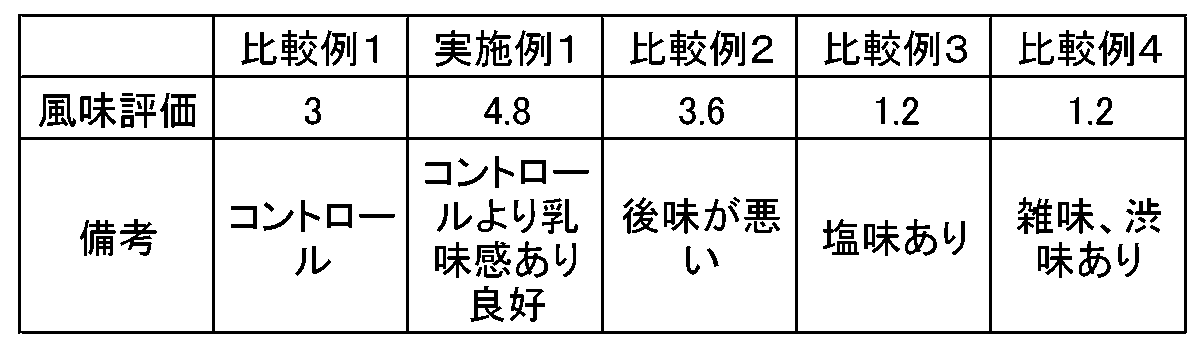
- Example 1 Examination of metal types “Example 1, Comparative Examples 1 to 4” An oil-in-water emulsion was prepared by adding equivalent amounts of various salts in the form of chlorides in the form of chlorides, and the flavor was confirmed. Comparative Example 1 is a blend of positioning as a control. In Example 1, Comparative Example 2, Comparative Example 3, and Comparative Example 4, calcium salt, potassium salt, sodium salt, and magnesium salt were added so that about 1.1 mmole of each metal was added to 100 g of the oil-in-water emulsion. It is a blend. The composition is as shown in Table 1. Deionized water is treated with an ion exchange resin.
- the ion exchange resin used is SK1B, SA11A and a mixture of SK1A and SA11A manufactured by Mitsubishi Plastics, Inc.
- the conductivity after treatment with the ion exchange resin was 0.006 mS / m at 25 ° C. Table 1 Effects of various metals
- Preparation procedure Deionized water was roughly divided into three equal parts (A, B, C), and calcium chloride, potassium chloride, sodium chloride, and magnesium chloride were dissolved in A, respectively.
- A calcium chloride, potassium chloride, sodium chloride, and magnesium chloride were dissolved in A, respectively.
- B sodium hexametaphosphate and sodium bicarbonate were dissolved.
- the fats and oils were completely dissolved at about 70 ° C. to dissolve lecithin.
- skim milk powder was added and dispersed. Further sugar ester (ester S570) was added. Water C was added and stirred there. Furthermore, after adding A, it stirred for about 5 minutes and B was added. Thereafter, the mixture was stirred at 60 to 70 ° C. for 30 minutes.
- the obtained preparation was subjected to ultra high temperature instantaneous sterilization at 144 ° C.
- the absorbance of this aqueous phase at 610 nm was measured with a spectrophotometer UV-1600 manufactured by Shimadzu Corporation using a cell having an optical path length of 1 cm, and found to be 7.1. Moreover, the solid content contained in the aqueous phase portion was 4.55% by weight. The amount of calcium ions in the aqueous phase was measured using “Viscolor ECO Calcium” (central science trade treatment).
- Table 2 Flavor evaluation results
- Test 2 Examination of types of calcium salts “Examples (1) to 2, Comparative Example 5” As shown in Table 3, oil-in-water emulsions were prepared using various calcium salts and evaluated. The preparation method and evaluation method are the same as in Test 1. The results are shown in Table 4. Table 3 Effect of calcium type Table 4 Effect of calcium type Results As shown in Table 4, among the calcium salts, calcium lactate and calcium chloride, which are water-soluble calcium salts, were suitable. As shown in Table 3, Comparative Example 5 using calcium carbonate, which is a poorly soluble calcium salt, is assumed to have a low calcium ion content in the aqueous phase portion and to have a low effect. On the other hand, even when the addition amount is 0.1%, the powdery taste is detected, and it is assumed that addition beyond this is difficult from the viewpoint of texture.
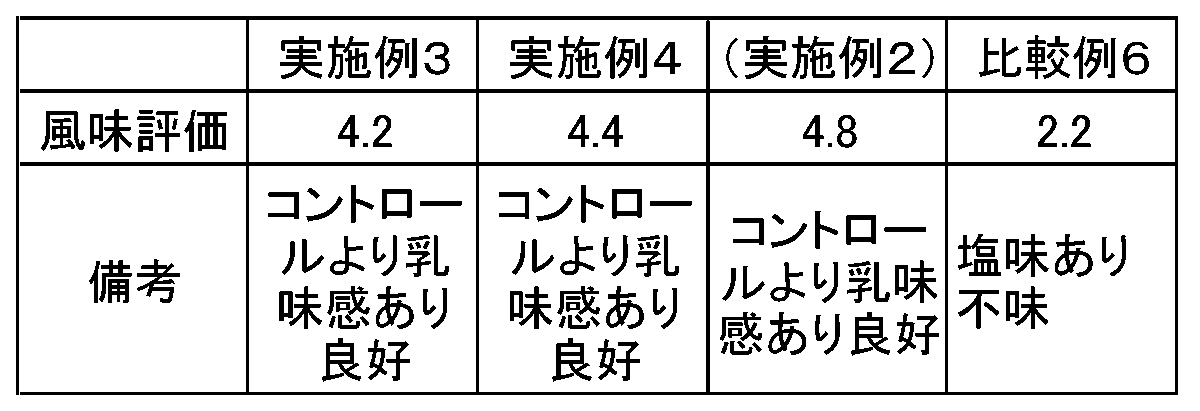
- Test 3 Examination of calcium content “Examples (2) to 4, Comparative Example 6” As shown in Table 5, oil-in-water emulsions were prepared by changing the amount of calcium and evaluated. The preparation method and evaluation method are the same as in Test 1. The results are shown in Table 6. Table 5 Effect of calcium content Table 6 Effect of calcium content Results As shown in Table 6, an oil-in-water emulsion having a preferred flavor was obtained in the range of 30 to 100 mg / 100 g of calcium ions contained in the centrifuged water phase part.
- Test 4 Examination of various molten salts “Examples 5 to 9” As shown in Table 7, the molten salt used was changed to prepare an oil-in-water emulsion. Moreover, it prepared by using a tap water instead of a deionized water. The preparation method and evaluation method are the same as in Test 1. The results are shown in Table 8. Table 7 Examination of “Other salts” Table 8 Results of the study on “Other salts” As shown in Table 8, even when sodium hexametaphosphate, trisodium citrate, dibasic sodium phosphate, or sodium polyphosphate was used as the molten salt, the effect of calcium ions was confirmed.
- Example 5 is a system which does not mix sodium bicarbonate, the effect of calcium ions was also confirmed. The effect of calcium ions was also confirmed for those using tap water instead of deionized water. In addition, the electrical conductivity in 25 degreeC of the used tap water was 7.06 mS / m.
- Test 5 Examination of various milk components “Examples 10 to 12” As shown in Table 9, an oil-in-water emulsion was prepared by using various milk components in combination with the present invention. The preparation method and the evaluation method are the same as in Test 1. The results are shown in Table 10. Table 9 Examination of various milk components Table 10 Examination results of various milk components As shown in Table 10, good flavor was obtained for all the milk components.
- Test 6 Examination of the amount of protein derived from milk “Examples 13 to 14, Comparative Example 7” As shown in Table 11, foamable oil-in-water emulsions were prepared with various addition amounts in skim milk powder. The preparation method and the evaluation method are the same as in Test 1. The results are shown in Table 12.
- Table 11 Examination of addition amount of skim milk powder
- Table 12 Examination results of addition amount of skim milk powder As shown in Table 12, when the milk-derived protein content in the blend was 1.0% (Example 13) and 2.7% (Example 14), a foamable oil-in-water emulsion having a good flavor was used. I was able to get it. On the other hand, when the amount of milk-derived protein in the formulation is 4.1% (Comparative Example 7), aggregates that are thought to be derived from milk protein are generated, and a foamable oil-in-water emulsion cannot be obtained. It was.
- Test 7 Examination with water containing calcium ions “Example 15” As shown in Table 13, a foamable oil-in-water emulsion was prepared using water containing calcium ions. The preparation method and the evaluation method are the same as in Test 1. The results are shown in Table 14. Table 13 Examination with water containing calcium ions Table 14 Examination results with water containing calcium ions As shown in Table 14, a foamable oil-in-water emulsion having good flavor could also be obtained by using water containing calcium ions.
- an oil-in-water emulsion in an oil-in-water emulsion, it is possible to reinforce the milky feeling at a low cost, and it is possible to supply an oil-in-water emulsion having a good price and good taste. It contributes greatly.
Landscapes
- Life Sciences & Earth Sciences (AREA)
- Chemical & Material Sciences (AREA)
- Engineering & Computer Science (AREA)
- Food Science & Technology (AREA)
- Polymers & Plastics (AREA)
- Health & Medical Sciences (AREA)
- Nutrition Science (AREA)
- Proteomics, Peptides & Aminoacids (AREA)
- Mycology (AREA)
- Oil, Petroleum & Natural Gas (AREA)
- Edible Oils And Fats (AREA)
- Grain Derivatives (AREA)
Abstract
Description
即ち、本発明は
(1)乳に由来する蛋白を0.5~3重量%含有し、遠心分離した水相部に含まれるカルシウムイオンが30~100mg/100gに調整された、油脂含量15~50重量%の起泡性水中油型乳化物。
(2)乳に由来する蛋白を含む原料がクリーム、バター、チーズ、濃縮ホエイ、濃縮乳、脱脂濃縮乳、無糖練乳、無糖脱脂練乳、加糖練乳、加糖脱脂練乳、全粉乳、脱脂粉乳、クリームパウダー、ホエイパウダー、たんぱく質濃縮ホエイパウダー、バターミルクパウダー、加糖粉乳、調製粉乳、発酵乳、カゼインナトリウム、生乳、脱脂乳から選ばれる1種以上である、(1)記載の起泡性水中油型乳化物。
(3)乳に由来する蛋白を0.5~3重量%、および溶融塩を0.05~0.3重量%(結晶水を除く)配合し、遠心分離した水相部に含まれるカルシウムイオンが30~100mg/100gに調整された、油脂含量15~50重量%の起泡性水中油型乳化物の製造法。
(4)溶融塩がヘキサメタリン酸ナトリウム、第二リン酸ナトリウム、ポリリン酸ナトリウム、クエン酸ナトリウムから選ばれる1種以上である、(3)に記載の起泡性水中油型乳化物の製造法。
(5)乳酸カルシウム、塩化カルシウムから選ばれる1種以上を原料として使用する、(3)~(4)いずれか1つに記載の起泡性水中油型乳化物の製造法。
(6)カルシウムを含む水を使用する、(3)~(5)いずれか1つに記載の、起泡性水中油型乳化物の製造法。
(7)原料を添加する前の水として、25℃での導電率0.00548~0.1mS/mに脱イオン処理された水を使用する、(3)~(6)いずれか1つに記載の起泡性水中油型乳化物の製造法。
に関するものである。
本発明で使用する、「乳に由来する蛋白」を含む成分は特に限定されないが、クリーム、バター、チーズ、濃縮ホエイ、濃縮乳、脱脂濃縮乳、無糖練乳、無糖脱脂練乳、加糖練乳、加糖脱脂練乳、全粉乳、脱脂粉乳、クリームパウダー、ホエイパウダー、たんぱく質濃縮ホエイパウダー、バターミルクパウダー、加糖粉乳、調製粉乳、発酵乳、カゼインナトリウム、生乳、脱脂乳から選ばれる1種以上を使用することが好適であり、より望ましくはクリーム、濃縮乳、脱脂濃縮乳、無糖練乳、無糖脱脂練乳、加糖練乳、加糖脱脂練乳、全粉乳、脱脂粉乳、クリームパウダー、ホエイパウダー、たんぱく質濃縮ホエイパウダー、バターミルクパウダー、加糖粉乳、調製粉乳、発酵乳、カゼインナトリウム、生乳、脱脂乳から選ばれる1種以上を使用することがより望ましく、さらに望ましくはクリーム、濃縮乳、脱脂濃縮乳、無糖練乳、無糖脱脂練乳、全粉乳、脱脂粉乳、クリームパウダー、ホエイパウダー、たんぱく質濃縮ホエイパウダー、バターミルクパウダー、発酵乳、カゼインナトリウム、生乳、脱脂乳から選ばれる1種以上を使用することが更に望ましい。配合中の「乳に由来する蛋白」の量は0.5~3重量%であり、より望ましくは0.7~2.5重量%である。配合中の「乳に由来する蛋白」の量が少なすぎると、得られる起泡性水中油型乳化物は風味の乏しいものとなる場合がある。また多すぎると、凝集物が発生し、食感等に悪影響を及ぼす場合もある。
なお、本願発明におけるカルシウムは、食する際にイオンとして存在することが重要である。食する際にイオンとして存在して初めて味蕾を刺激し、乳風味の向上につながると考えられる。
以下、具体的な水中油型乳化物の調製法を説明する。
使用する原材料の種類により、調製方法は若干異なるが、代表的な配合として「乳に由来する蛋白」を含む原材料として脱脂粉乳を、また溶融塩としてヘキサメタリン酸ナトリウムを、カルシウム塩として乳酸カルシウムを使用する場合を説明する。
得られた調合液は60~70℃の状態で約30分程度攪拌する。これを、必要によりホモゲナイザーにより0 ~ 2 5 MP a の条件下にて均質化する。次いで超高温瞬間殺菌処理(UHT)した後、再度、ホモゲナイザーにて0~50MPaの条件下にて均質化し、冷却後、約24時間以上エージングする。
以下に実施例を記載する。%は特に指定しない限り、重量%である。
「実施例1、比較例1~4」
各種塩類を塩化物の形で、各金属で同等程度量モル添加して水中油型乳化物を調製し、風味の確認を行った。
比較例1はコントロールとしての位置づけの配合である。実施例1、比較例2、比較例3、比較例4はそれぞれ、カルシウム塩、カリウム塩、ナトリウム塩、マグネシウム塩を、各金属が水中油型乳化物100gに約1.1mmole添加されるように配合したものである。
配合は表1の通り。
脱イオン水は、イオン交換樹脂により処理を行ったものである。使用したイオン交換樹脂は、三菱樹脂株式会社製SK1B,SA11AおよびSK1AとSA11A混合物である。イオン交換樹脂による処理後の導電率は25℃で0.006mS/mであった。
表1 各種金属の影響

脱イオン水は概略3等分(A,B,C)し、Aには塩化カルシウム、塩化カリウム、塩化ナトリウム、塩化マグネシウムをそれぞれ溶解した。Bにはヘキサメタリン酸ナトリウムおよび重曹を溶解した。
油脂は70℃程度で完全に溶解し、レシチンを溶解した。そこへ脱脂粉乳を添加し、分散した。さらにシュガーエステル(エステルS570)を添加した。そこへ水Cを加え攪拌した。さらに、Aを加えた後、5分程度攪拌し、Bを加えた。その後、60~70℃で30分間攪拌した。
得られた調合液を144℃4秒超高温瞬間殺菌処理した後、45MPaの圧力にてホモゲナイザー処理し、その後5℃へ冷却し24時間エージングした。
水相部に含まれるカルシウムイオンの定量
得られた水中油型乳化物を遠心分離チューブへ入れ、国産遠心器株式会社製遠心分離器H200を用い、9000rpmにて1時間遠心分離した後、3~7℃に設定した冷蔵庫に12時間保管した。その後、水相部をピペットを用い分離した。この水相部の610nmにおける吸光度を島津製作所製分光光度計UV-1600にて光路長1cmのセルを用い測定したところ、7.1であった。また、この水相部に含まれる固形分は4.55重量%であった。
この水相部のカルシウムイオン量を「Viscolor ECO Calcium」(セントラル科学貿易扱い)を用い測定した。
水中油型乳化物1Kgにグラニュー糖80g加えてホバートミキサー(HOBART CORPORATION製 MODEL N-5)3速(300rpm)にて、オーバーラン85~150%程度までホイップし、風味評価を行った。風味評価はパネラー5名にて、コントロールを3点とし、最も好ましいものを5点、最も好ましくないものを1点とし、その平均にて表した。4点以上を効果ありと判断した。
結果
表2の通り、カルシウム塩を加えたものが最も良好な風味を示し、好ましかった。それ以外のものは、乳味が弱かったり、不味であったりなど好ましくなかった。
表2 風味評価結果
「実施例(1)~2、比較例5」
表3に示すとおり各種のカルシウム塩を用い水中油型乳化物を調製し、評価を行った。調製方法および評価方法はテスト1と同様である。結果を表4に示す。
表3 カルシウムの種類の影響

表4 カルシウムの種類の影響 結果
表4に示すとおり、カルシウム塩の中でも水溶性カルシウム塩である乳酸カルシウム、塩化カルシウムが好適であった。難溶性カルシウム塩である炭酸カルシウムを使用した比較例5は、表3に示すとおり水相部中のカルシウムイオン量が低く、効果が低いと想定される。一方、添加量0.1%であっても粉っぽさが感知されており、これ以上の添加は食感の点から難しいと想定される。
「実施例(2)~4、比較例6」
表5に示すように、カルシウムの量を変えて水中油型乳化物を調製し、評価を行った。調製方法および評価方法はテスト1と同様である。結果を表6に示す。
表5 カルシウム量の影響

表6 カルシウム量の影響 結果
「実施例5~9」
表7に示すとおり、使用する溶融塩を変え、水中油型乳化物の調製を行った。また、脱イオン水の代わりに水道水を使用し調製を行った。調製方法および評価方法はテスト1と同様である。結果を表8に示す。
表7 「その他の塩類等」の検討
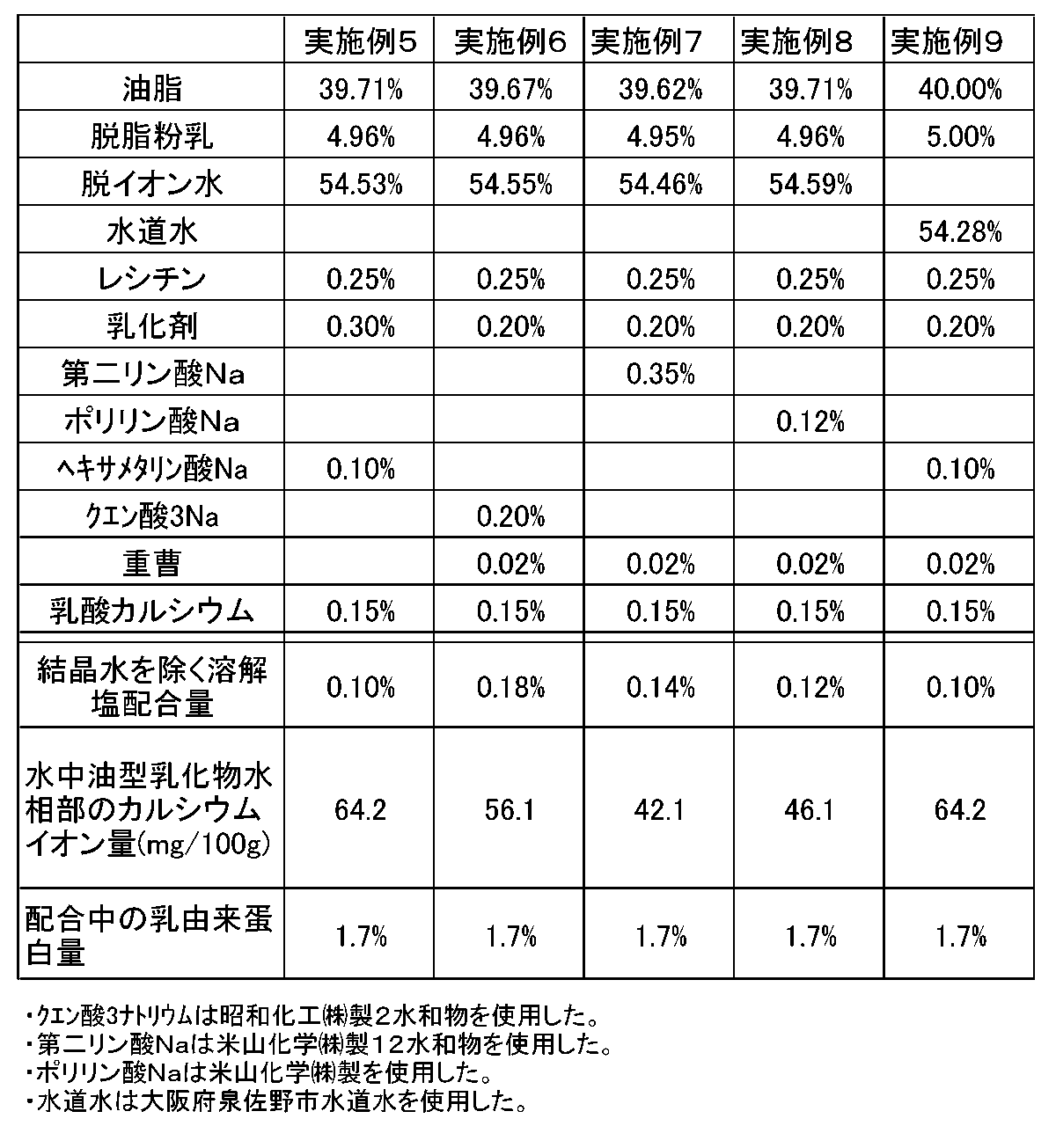
表8 「その他の塩類等」検討の結果

表8に示すとおり、溶融塩としてヘキサメタリン酸ナトリウム、クエン酸3ナトリウム、第二リン酸ナトリウム、ポリリン酸ナトリウムを使用したものでも、カルシウムイオンによる効果が確認された。また、実施例5は重曹を配合しない系であるが、これもカルシウムイオンによる効果が確認された。脱イオン水の代わりに水道水を使用したものも、カルシウムイオンによる効果が確認された。なお、使用した水道水の25℃における導電率は7.06mS/mであった。
「実施例10~12」
表9に示すとおり、本願発明へ各種乳成分を併用し水中油型乳化物を調製した。調製方法及び評価方法はテスト1と同様である。結果を表10に示す。
表9各種乳成分の検討
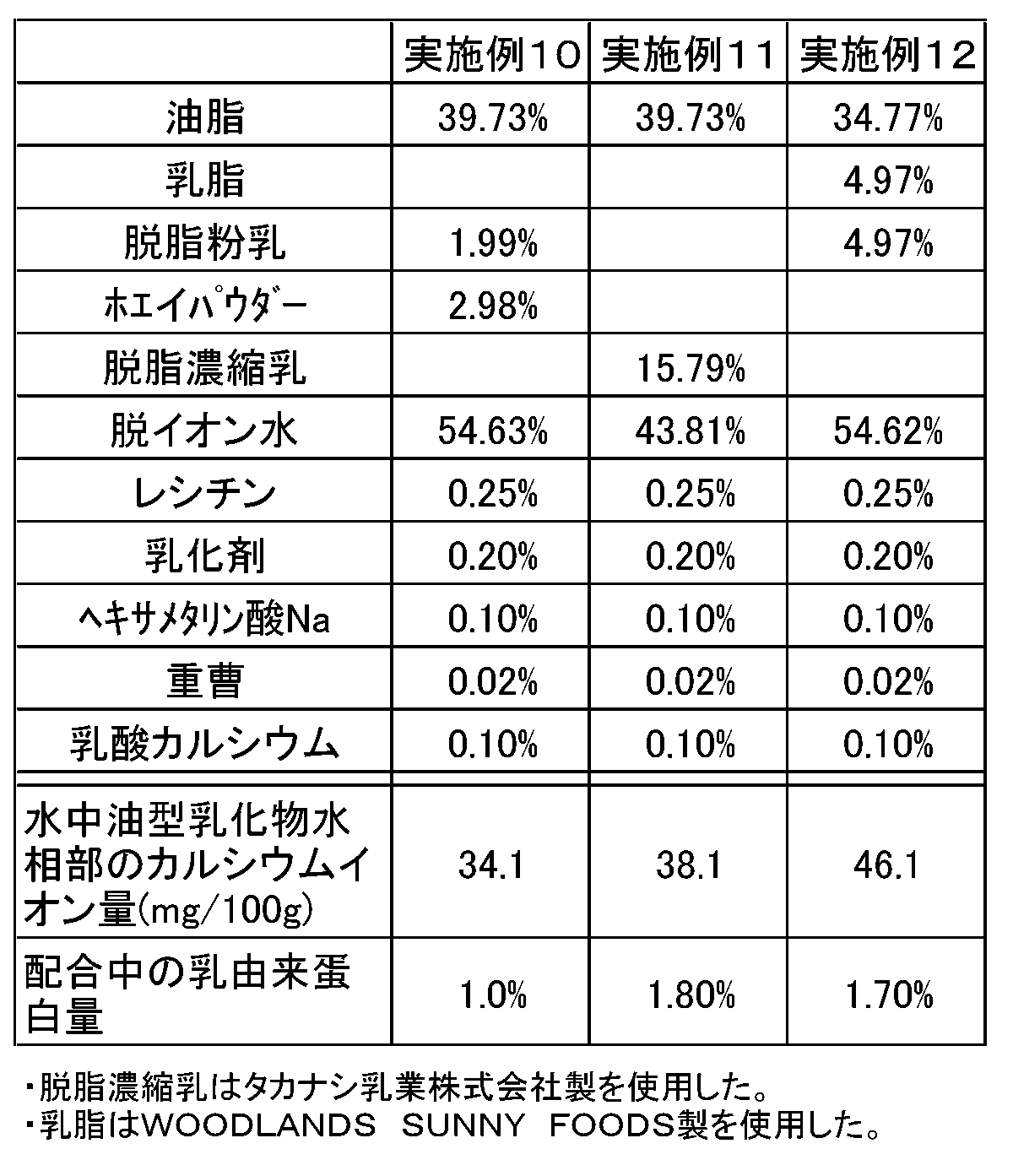
表10 各種乳成分の検討結果

テスト6:乳に由来する蛋白の量の検討
「実施例13~14、比較例7」
表11に示すとおり、脱脂粉乳にて各種添加量にて起泡性水中油型乳化物を調製した。調製方法及び評価方法はテスト1と同様である。結果を表12に示す。
表11 脱脂粉乳の添加量の検討

表12 脱脂粉乳の添加量の検討 結果

表12に示すとおり、配合中の乳由来蛋白量が1.0%(実施例13)、2.7%(実施例14)の場合には、風味良好な起泡性水中油型乳化物を得ることができた。一方、配合中の乳由来蛋白量が4.1%(比較例7)の場合は、乳蛋白に由来すると思われる凝集物が発生し、起泡性水中油型乳化物を得ることができなかった。
「実施例15」
表13に示すとおり、カルシウムイオンを含む水を使用して起泡性水中油型乳化物を調製した。調製方法及び評価方法はテスト1と同様である。結果を表14に示す。
表13 カルシウムイオンを含む水による検討
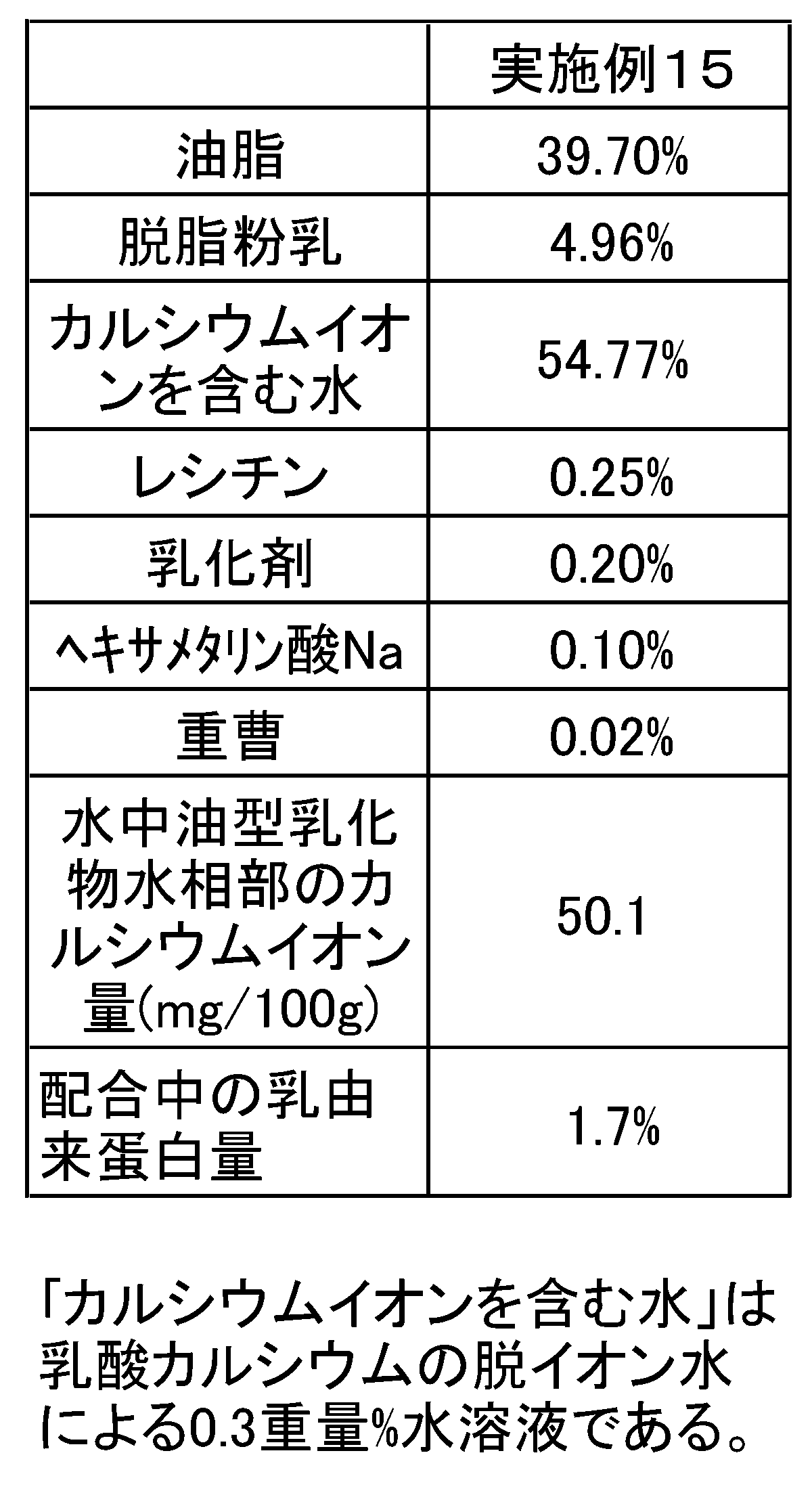
表14 カルシウムイオンを含む水による検討結果
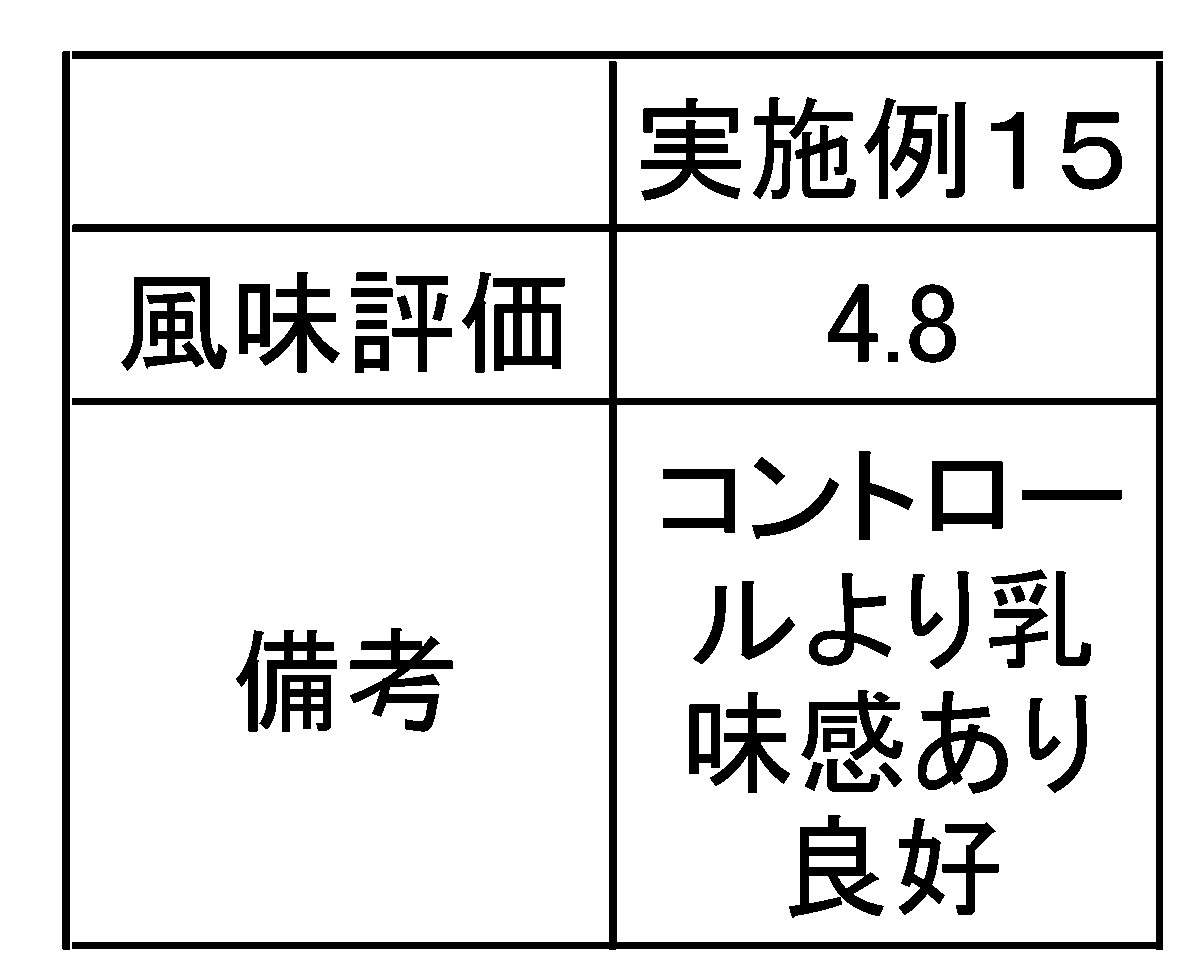
表14に示すとおり、カルシウムイオンを含む水を使用することによっても、風味良好な起泡性水中油型乳化物を得ることができた。
Claims (7)
- 乳に由来する蛋白を0.5~3重量%含有し、遠心分離した水相部に含まれるカルシウムイオンが30~100mg/100gに調整された、油脂含量15~50重量%の起泡性水中油型乳化物。
- 乳に由来する蛋白を含む原料がクリーム、バター、チーズ、濃縮ホエイ、濃縮乳、脱脂濃縮乳、無糖練乳、無糖脱脂練乳、加糖練乳、加糖脱脂練乳、全粉乳、脱脂粉乳、クリームパウダー、ホエイパウダー、たんぱく質濃縮ホエイパウダー、バターミルクパウダー、加糖粉乳、調製粉乳、発酵乳、カゼインナトリウム、生乳、脱脂乳から選ばれる1種以上である、請求項1記載の起泡性水中油型乳化物。
- 乳に由来する蛋白を0.5~3重量%、および溶融塩を0.05~0.3重量%(結晶水を除く)配合し、遠心分離した水相部に含まれるカルシウムイオンが30~100mg/100gに調整された、油脂含量15~50重量%の起泡性水中油型乳化物の製造法。
- 溶融塩がヘキサメタリン酸ナトリウム、第二リン酸ナトリウム、ポリリン酸ナトリウム、クエン酸ナトリウムから選ばれる1種以上である、請求項3に記載の起泡性水中油型乳化物の製造法。
- 乳酸カルシウム、塩化カルシウムから選ばれる1種以上を原料として使用する、請求項3~4いずれか1項に記載の起泡性水中油型乳化物の製造法。
- カルシウムを含む水を使用する、請求項3~5いずれか1項に記載の、起泡性水中油型乳化物の製造法。
- 原料を添加する前の水として、25℃での導電率0.00548~0.1mS/mに脱イオン処理された水を使用する、請求項3~6いずれか1項に記載の起泡性水中油型乳化物の製造法。
Priority Applications (2)
| Application Number | Priority Date | Filing Date | Title |
|---|---|---|---|
| CN200980155268XA CN102291994A (zh) | 2009-01-22 | 2009-11-13 | 利用钙离子改善了乳风味的水包油型乳化物 |
| JP2010547314A JPWO2010084541A1 (ja) | 2009-01-22 | 2009-11-13 | カルシウムイオンにより乳風味が改善された水中油型乳化物 |
Applications Claiming Priority (2)
| Application Number | Priority Date | Filing Date | Title |
|---|---|---|---|
| JP2009-011465 | 2009-01-22 | ||
| JP2009011465 | 2009-01-22 |
Publications (1)
| Publication Number | Publication Date |
|---|---|
| WO2010084541A1 true WO2010084541A1 (ja) | 2010-07-29 |
Family
ID=42355619
Family Applications (1)
| Application Number | Title | Priority Date | Filing Date |
|---|---|---|---|
| PCT/JP2009/006072 Ceased WO2010084541A1 (ja) | 2009-01-22 | 2009-11-13 | カルシウムイオンにより乳風味が改善された水中油型乳化物 |
Country Status (3)
| Country | Link |
|---|---|
| JP (1) | JPWO2010084541A1 (ja) |
| CN (1) | CN102291994A (ja) |
| WO (1) | WO2010084541A1 (ja) |
Cited By (2)
| Publication number | Priority date | Publication date | Assignee | Title |
|---|---|---|---|---|
| JP2021035339A (ja) * | 2019-08-30 | 2021-03-04 | 月島食品工業株式会社 | 水中油型乳化物 |
| WO2023182331A1 (ja) * | 2022-03-23 | 2023-09-28 | 味の素株式会社 | 油脂感増強剤および油脂感増強方法 |
Families Citing this family (2)
| Publication number | Priority date | Publication date | Assignee | Title |
|---|---|---|---|---|
| US10834935B2 (en) * | 2012-02-01 | 2020-11-17 | Koninklijke Douwe Egberts B.V. | Dairy mineral-fortified liquid dairy products and methods of making |
| CA3230512A1 (en) * | 2021-09-29 | 2023-04-06 | Adeka Corporation | Oil-in-water type emulsion |
Citations (4)
| Publication number | Priority date | Publication date | Assignee | Title |
|---|---|---|---|---|
| JPS58152457A (ja) * | 1982-03-08 | 1983-09-10 | Kanegafuchi Chem Ind Co Ltd | 凍結保存性を有する水中油型起泡性乳化状組成物およびその製造法 |
| JP2001321075A (ja) * | 2000-05-10 | 2001-11-20 | Asahi Denka Kogyo Kk | 水中油型乳化組成物及びその製造方法 |
| JP2004357699A (ja) * | 2003-05-13 | 2004-12-24 | Asahi Denka Kogyo Kk | 可塑性水中油型乳化組成物およびその製造方法 |
| JP2008118958A (ja) * | 2006-11-15 | 2008-05-29 | Miyoshi Oil & Fat Co Ltd | 水中油型乳化物及びクリーム |
-
2009
- 2009-11-13 JP JP2010547314A patent/JPWO2010084541A1/ja active Pending
- 2009-11-13 CN CN200980155268XA patent/CN102291994A/zh active Pending
- 2009-11-13 WO PCT/JP2009/006072 patent/WO2010084541A1/ja not_active Ceased
Patent Citations (4)
| Publication number | Priority date | Publication date | Assignee | Title |
|---|---|---|---|---|
| JPS58152457A (ja) * | 1982-03-08 | 1983-09-10 | Kanegafuchi Chem Ind Co Ltd | 凍結保存性を有する水中油型起泡性乳化状組成物およびその製造法 |
| JP2001321075A (ja) * | 2000-05-10 | 2001-11-20 | Asahi Denka Kogyo Kk | 水中油型乳化組成物及びその製造方法 |
| JP2004357699A (ja) * | 2003-05-13 | 2004-12-24 | Asahi Denka Kogyo Kk | 可塑性水中油型乳化組成物およびその製造方法 |
| JP2008118958A (ja) * | 2006-11-15 | 2008-05-29 | Miyoshi Oil & Fat Co Ltd | 水中油型乳化物及びクリーム |
Cited By (3)
| Publication number | Priority date | Publication date | Assignee | Title |
|---|---|---|---|---|
| JP2021035339A (ja) * | 2019-08-30 | 2021-03-04 | 月島食品工業株式会社 | 水中油型乳化物 |
| JP7346167B2 (ja) | 2019-08-30 | 2023-09-19 | 月島食品工業株式会社 | 水中油型乳化物 |
| WO2023182331A1 (ja) * | 2022-03-23 | 2023-09-28 | 味の素株式会社 | 油脂感増強剤および油脂感増強方法 |
Also Published As
| Publication number | Publication date |
|---|---|
| JPWO2010084541A1 (ja) | 2012-07-12 |
| CN102291994A (zh) | 2011-12-21 |
Similar Documents
| Publication | Publication Date | Title |
|---|---|---|
| JP6301252B2 (ja) | 低脂肪または無脂肪の気泡含有乳化物 | |
| JP6628606B2 (ja) | 生クリーム含有ホイップドコンパウンドクリーム | |
| JP4736893B2 (ja) | 水中油型乳化物の製造方法 | |
| US4882187A (en) | Edible spread and process for the preparation thereof | |
| WO2010084541A1 (ja) | カルシウムイオンにより乳風味が改善された水中油型乳化物 | |
| JP7574382B2 (ja) | 起泡性水中油型乳化物の製造方法及びホイップドクリームの製造方法 | |
| WO2017029802A1 (ja) | タンパク質を高濃度で含む発酵乳の製造方法 | |
| JP6371779B2 (ja) | 乳化塩フリーのチーズ、およびせん断された脂肪とせん断されていない脂肪の調合物を有する乳化塩フリーのチーズの製造方法 | |
| JP4357636B2 (ja) | 水中油型乳化油脂組成物 | |
| JP2010051231A (ja) | 低油分起泡性水中油型乳化物 | |
| JP2016007153A (ja) | 起泡性水中油型乳化油脂組成物 | |
| JP2007259784A (ja) | 豆腐ピューレを含有する冷菓 | |
| WO2006112138A1 (ja) | 起泡性水中油型乳化物 | |
| JPH07177858A (ja) | 水中油型乳化物の製造方法 | |
| JP2010081840A (ja) | 水中油型乳化組成物の製造方法 | |
| JP5941428B2 (ja) | ホイップ用クリーム及びその製造方法 | |
| JPS59173131A (ja) | W/o/w型複合エマルジヨンの製造方法 | |
| WO2001008503A1 (fr) | Émulsions du type huile dans l'eau | |
| JP4101720B2 (ja) | 弱酸性乳加工品の製造方法および弱酸性乳加工品 | |
| JP2003213290A (ja) | 二重乳化油脂組成物およびその製造法 | |
| JP2000262236A (ja) | 水中油型乳化物 | |
| JPH07177857A (ja) | 水中油型乳化物の製造方法 | |
| KR101559448B1 (ko) | 커피 크리머용 우유 단백질의 제조방법 및 이를 이용한 커피 크리머 제조방법 | |
| JP2024049835A (ja) | コンパウンドクリームおよびその製造方法 | |
| JPS59169531A (ja) | W/o/w型複合エマルジヨンの製造法 |
Legal Events
| Date | Code | Title | Description |
|---|---|---|---|
| WWE | Wipo information: entry into national phase |
Ref document number: 200980155268.X Country of ref document: CN |
|
| 121 | Ep: the epo has been informed by wipo that ep was designated in this application |
Ref document number: 09838735 Country of ref document: EP Kind code of ref document: A1 |
|
| WWE | Wipo information: entry into national phase |
Ref document number: 2010547314 Country of ref document: JP |
|
| NENP | Non-entry into the national phase |
Ref country code: DE |
|
| 122 | Ep: pct application non-entry in european phase |
Ref document number: 09838735 Country of ref document: EP Kind code of ref document: A1 |