WO2010073587A1 - 通信装置、通信履歴表示方法および通信履歴表示プログラムを記録したコンピュータ読み取り可能な記録媒体 - Google Patents
通信装置、通信履歴表示方法および通信履歴表示プログラムを記録したコンピュータ読み取り可能な記録媒体 Download PDFInfo
- Publication number
- WO2010073587A1 WO2010073587A1 PCT/JP2009/007067 JP2009007067W WO2010073587A1 WO 2010073587 A1 WO2010073587 A1 WO 2010073587A1 JP 2009007067 W JP2009007067 W JP 2009007067W WO 2010073587 A1 WO2010073587 A1 WO 2010073587A1
- Authority
- WO
- WIPO (PCT)
- Prior art keywords
- communication
- history
- information
- identification information
- displayed
- Prior art date
- Legal status (The legal status is an assumption and is not a legal conclusion. Google has not performed a legal analysis and makes no representation as to the accuracy of the status listed.)
- Ceased
Links
Images









Classifications
-
- H—ELECTRICITY
- H04—ELECTRIC COMMUNICATION TECHNIQUE
- H04B—TRANSMISSION
- H04B1/00—Details of transmission systems, not covered by a single one of groups H04B3/00 - H04B13/00; Details of transmission systems not characterised by the medium used for transmission
- H04B1/38—Transceivers, i.e. devices in which transmitter and receiver form a structural unit and in which at least one part is used for functions of transmitting and receiving
- H04B1/40—Circuits
-
- H—ELECTRICITY
- H04—ELECTRIC COMMUNICATION TECHNIQUE
- H04M—TELEPHONIC COMMUNICATION
- H04M1/00—Substation equipment, e.g. for use by subscribers
- H04M1/57—Arrangements for indicating or recording the number of the calling subscriber at the called subscriber's set
- H04M1/575—Means for retrieving and displaying personal data about calling party
-
- H—ELECTRICITY
- H04—ELECTRIC COMMUNICATION TECHNIQUE
- H04M—TELEPHONIC COMMUNICATION
- H04M1/00—Substation equipment, e.g. for use by subscribers
- H04M1/26—Devices for calling a subscriber
- H04M1/27—Devices whereby a plurality of signals may be stored simultaneously
- H04M1/274—Devices whereby a plurality of signals may be stored simultaneously with provision for storing more than one subscriber number at a time, e.g. using toothed disc
- H04M1/2745—Devices whereby a plurality of signals may be stored simultaneously with provision for storing more than one subscriber number at a time, e.g. using toothed disc using static electronic memories, e.g. chips
-
- H—ELECTRICITY
- H04—ELECTRIC COMMUNICATION TECHNIQUE
- H04M—TELEPHONIC COMMUNICATION
- H04M1/00—Substation equipment, e.g. for use by subscribers
- H04M1/26—Devices for calling a subscriber
- H04M1/27—Devices whereby a plurality of signals may be stored simultaneously
- H04M1/274—Devices whereby a plurality of signals may be stored simultaneously with provision for storing more than one subscriber number at a time, e.g. using toothed disc
- H04M1/2745—Devices whereby a plurality of signals may be stored simultaneously with provision for storing more than one subscriber number at a time, e.g. using toothed disc using static electronic memories, e.g. chips
- H04M1/275—Devices whereby a plurality of signals may be stored simultaneously with provision for storing more than one subscriber number at a time, e.g. using toothed disc using static electronic memories, e.g. chips implemented by means of portable electronic directories
-
- H—ELECTRICITY
- H04—ELECTRIC COMMUNICATION TECHNIQUE
- H04M—TELEPHONIC COMMUNICATION
- H04M1/00—Substation equipment, e.g. for use by subscribers
- H04M1/56—Arrangements for indicating or recording the called number at the calling subscriber's set
-
- H—ELECTRICITY
- H04—ELECTRIC COMMUNICATION TECHNIQUE
- H04M—TELEPHONIC COMMUNICATION
- H04M1/00—Substation equipment, e.g. for use by subscribers
- H04M1/26—Devices for calling a subscriber
- H04M1/27—Devices whereby a plurality of signals may be stored simultaneously
- H04M1/274—Devices whereby a plurality of signals may be stored simultaneously with provision for storing more than one subscriber number at a time, e.g. using toothed disc
- H04M1/2745—Devices whereby a plurality of signals may be stored simultaneously with provision for storing more than one subscriber number at a time, e.g. using toothed disc using static electronic memories, e.g. chips
- H04M1/2753—Devices whereby a plurality of signals may be stored simultaneously with provision for storing more than one subscriber number at a time, e.g. using toothed disc using static electronic memories, e.g. chips providing data content
-
- H—ELECTRICITY
- H04—ELECTRIC COMMUNICATION TECHNIQUE
- H04M—TELEPHONIC COMMUNICATION
- H04M2250/00—Details of telephonic subscriber devices
- H04M2250/60—Details of telephonic subscriber devices logging of communication history, e.g. outgoing or incoming calls, missed calls, messages or URLs
Definitions
- the present invention relates to a communication device, a communication history display method, and a communication history display program, and more particularly to a communication device that stores a history of communication with a communication partner in the past, a communication history display method and a communication history display program executed by the communication device.
- the present invention relates to a recorded computer-readable recording medium.
- a mobile phone stores a telephone directory in which a telephone number and a name are associated with each other.
- a PTT (Push To Talk) service is provided that can talk to a plurality of communication partners at the same time.
- Japanese Patent Application Publication No. 2007-513592 discloses a technique in which a plurality of telephone numbers registered in a telephone directory are grouped, and when a group is selected, the telephone numbers registered in the group are transmitted.
- the mobile phone has a function of storing the telephone number of the other party who has called in the past as a call history. It is convenient to be able to register a telephone number selected from the telephone numbers stored in the communication history as a group, similar to registering a telephone number selected from the telephone numbers registered in the telephone directory as a group. .
- the history information includes only the telephone number of the communication partner who has communicated in the past, it is included in the history information when a plurality of telephone numbers are assigned by the phone book to the user to whom the telephone number is assigned There is a problem that it is not possible to register a different phone number to the group. JP 2007-513592 A
- the present invention has been made to solve the above-mentioned problems, and one of the objects of the present invention is to provide a communication device that facilitates an operation of registering in a group from history information.
- Another object of the present invention is to provide a communication history display method that facilitates an operation of registering in a group from history information.
- Still another object of the present invention is to provide a computer-readable recording medium recording a communication history display program that facilitates an operation of registering to a group from history information.
- a communication device includes personal identification information for identifying an individual and at least one communication identification information assigned to the individual for communication.
- a personal information storage unit that stores personal information associated with the communication information
- a communication history storage unit that stores communication information including communication identification information of past communication partners, and that indicates communication history, and stored history information or stored.
- a grouping unit that generates a group in which at least one piece of communication identification information is collected based on the personal information, the grouping unit including a history display unit that displays stored history information, and a display
- a selection unit that selects one of the recorded history information as a processing target, a first communication identification information included in the history information for which personal information is selected, and a second communication identification different from the first communication identification information
- a display switching unit that switches the display to either the first communication identification information or the second communication identification information in response to an input of an operation for switching the display.
- a communication history display method in which a personal identification information for identifying a person is associated with at least one communication identification information assigned to the individual for communication. Storing at least one communication based on the stored history information or the stored personal information, the step of storing the information, the step of storing the history information indicating the communication history, including the communication identification information of the past communication partner Generating a group in which the identification information is combined into one, and the step of generating the group includes a step of displaying the stored history information and selecting one of the displayed history information as a processing target. If the step includes the first communication identification information included in the history information on which the personal information is displayed, and the second communication identification information different from the first communication identification information, the display is displayed.
- a computer-readable recording medium recording a communication history display program includes personal identification information for identifying an individual, and at least assigned to the individual for communication Storing personal information associated with one piece of communication identification information; storing historical information including communication identification information of a communication partner in the past and indicating communication history; stored history information or stored Generating a group in which at least one piece of communication identification information is combined based on personal information; and causing the computer to execute the step of generating the group, the step of displaying the stored history information, and the display Selecting one of the recorded history information as a processing target, and a first communication included in the history information on which the personal information is displayed.
- the first communication identification information and the second communication identification information different from the first communication identification information are included, the first communication identification information and the second communication identification information are changed according to an input of an operation for switching the display.
- a step of switching display to any one of the first communication identification information and the second communication identification information newly included in the history information to be processed when the processing target is changed in the selecting step. Including the step of displaying what was displayed when it was selected as the previous processing target in the step of selecting among the communication identification information.
- FIG. 1 is a perspective view showing an external appearance of a mobile phone according to one embodiment of the present invention.
- FIG. 1 is a diagram illustrating an appearance of a mobile phone in an open style state.
- a mobile phone 1 as a communication device includes an operation side portion 3 and a display side portion 2.
- the operation side unit 3 includes an operation key 14 including a numeric keypad and a call key, and a microphone 13 disposed on the inner surface.
- a liquid crystal display device (LCD) 15 In the display side section 2, a liquid crystal display device (LCD) 15, a speaker 11 constituting a receiver, and a camera 24 are arranged on the inner surface.
- LCD liquid crystal display device
- speaker 11 constituting a receiver
- a camera 24 are arranged on the inner surface.
- an organic EL (ElectroLuminescence) display may be used instead of the LCD 15.
- the operation side unit 3 and the display side unit 2 are rotatably connected by a hinge mechanism, and the operation side unit 3 and the display side unit 2 can be opened and closed.
- the state of the mobile phone 1 is the closed style, and the mobile phone 1 is opened to open the operation side portion 3 and the display side portion.
- the state of the mobile phone 1 when 2 is in the open state is the open style.
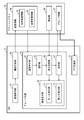
- FIG. 2 is a block diagram illustrating an example of a hardware configuration of the mobile phone according to the present embodiment.
- a mobile phone 1 includes a CPU 21 for controlling the entire mobile phone 1, a radio circuit 22 connected to an antenna 22A, and a codec unit 23 for encoding or decoding audio data.
- a voice control unit 28 for processing voice data, a camera 24, an operation unit 25 for receiving input of a user operation, a vibration unit 26 for notifying an incoming call, a program executed by the CPU 21, and the like are stored.
- RAM Random Access Memory
- the radio circuit 22 is controlled by the CPU 21 and communicates with the radio base station. Specifically, the radio circuit 22 receives the radio signal received by the antenna 22 ⁇ / b> A and outputs an audio signal obtained by demodulating the radio signal to the codec unit 23. The radio circuit 22 receives the audio signal from the codec unit 23 and outputs a radio signal obtained by modulating the audio signal to the antenna 22A.
- the codec unit 23 decodes the audio signal input from the radio circuit 22, converts the decoded digital audio signal into analog, and outputs the analog signal to the audio control unit 28.
- the codec unit 23 receives an analog audio signal from the audio control unit 28, converts the audio signal to digital, encodes it, and outputs the encoded audio signal to the radio circuit 22.
- the radio circuit 22 can perform data communication with a radio base station.
- the radio circuit 22 can communicate with an electronic mail server connected to the radio base station via the radio base station.
- the radio circuit 22 receives an email transmitted from the email server and outputs it to the CPU 21.
- the radio circuit 22 transmits an e-mail input from the CPU 21 to the e-mail server.
- the CPU 21 stores, in the flash memory 31, e-mail transmitted / received to / from the e-mail server.
- the operation unit 25 includes operation keys 14.
- the operation key 14 includes a plurality of keys, receives an operation input by the user, and outputs the received operation to the CPU 21.
- the voice control unit 28 is connected to the microphone 13 and receives an analog voice signal that is collected and output by the microphone 13.
- the audio control unit 28 outputs the audio signal input from the microphone 13 to the codec unit 23.
- the audio control unit 28 receives an audio signal from the codec unit 23 and outputs the audio signal input from the codec unit 23 to the speaker 11.
- a removable memory card 27A is attached to the card I / F 27.
- the memory card 27A has a nonvolatile memory such as a flash memory and can store a program.
- the CPU 21 can access the memory card 27A via the card I / F 27.
- the program is stored in the memory card 27A, the program is read from the memory card 27A, and is executed by the CPU 21. You may do it.
- the recording medium for storing the program is not limited to the memory card 27A, but a flexible disk, cassette tape, optical disk (CD-ROM (Compact Disc-ROM) / MO (Magnetic Optical Disc) / MD (Mini Disc) / DVD (Digital). Versatile Disc)), a semiconductor memory such as an optical card, mask ROM, EPROM, or EEPROM.
- the CPU 21 may download a program from a computer connected to the Internet via the wireless circuit 22 and execute the program.
- the program here includes not only a program directly executable by the CPU 21 but also a source program, a compressed program, an encrypted program, and the like.
- the camera 24 includes a lens and a photoelectric conversion element such as a CMOS (Complementary Metal Oxide Semiconductor) sensor, and focuses the light collected by the lens on a CMOS sensor.
- the CMOS sensor photoelectrically converts the received light to convert image data. It outputs to CPU21.
- the camera 24 is controlled by the CPU 21, starts imaging in response to an instruction from the CPU 21, and outputs the obtained still image data or moving image data to the CPU 21.
- the CPU 21 displays still image data or moving image data output from the camera 24 on the LCD 15 or encodes the still image data or moving image data by a predetermined compression encoding method and attaches it to the flash memory 31 or the card I / F 27. Stored in the memory card 27A.
- FIG. 3 is a functional block diagram showing an outline of the function of the CPU of the mobile phone according to one embodiment of the present invention, together with information stored in the flash memory.
- CPU 21 includes a communication control unit 51 that controls outgoing / incoming calls, and a history storage unit 53 that stores communication information including communication identification information of communication partners that have made and received calls in the past, and that indicates history information of outgoing and incoming calls. And a grouping unit 55 for grouping a plurality of telephone numbers into the same group, and a PTT transmission unit 57 for calling a plurality of telephone numbers included in the group.
- the communication control unit 51 controls incoming and outgoing calls and incoming and outgoing e-mails.
- the communication identification information of the communication partner is a telephone number assigned to the mobile phone of the communication partner.
- the communication identification information of the communication partner is sent to the communication partner's telephone or communication partner.
- the telephone includes a fixed telephone connected to PSTN (Public Switched Telephony Networks) and a mobile telephone connected to a wireless network.
- PSTN Public Switched Telephony Networks
- the communication control unit 51 When the wireless circuit 22 receives the incoming call signal from the base station, the communication control unit 51 outputs the telephone number included in the incoming call signal to the history storage unit 53 as the telephone number of the called party. When the communication control unit 51 detects that the user has pressed the off-hook key of the operation key 14 after receiving the incoming call signal, the communication control unit 51 connects the line with the other party's telephone through the base station, It becomes possible.
- the communication control unit 51 stores the e-mail in the flash memory 31 and sets the e-mail address of the called party included in the e-mail to the e-mail address of the called party. To the history storage unit 53. If the communication control unit 51 detects that the user has pressed the key assigned to the operation key 14 for viewing the e-mail after the e-mail is received, the communication control unit 51 stores the e-mail in the flash memory 31. The e-mail is displayed on the LCD 15.
- the communication control unit 51 when the user of the mobile phone 1 directly inputs a telephone number to the operation key 14, the communication control unit 51 outputs the input telephone number to the history storage unit 53 as the telephone number of the calling party. Further, when a telephone number is input from a history display unit 63 described later, the input telephone number is output to the history storage unit 53 as the telephone number of the caller.
- the communication control unit 51 detects that the off-hook key of the operation key 14 is pressed by the user after the telephone number of the calling party is input, the communication control unit 51 calls the calling party's telephone through the base station. If the telephone answers, the line with the other party's telephone is connected, and the telephone is ready.
- the communication control unit 51 when the user of the mobile phone 1 directly inputs an e-mail address to the operation key 14, the communication control unit 51 outputs the input e-mail address to the history storage unit 53 as the e-mail address of the caller. Further, when an e-mail address is input from a history display unit 63 described later, the input e-mail address is output to the history storage unit 53 as the e-mail address of the caller.
- the communication control unit 51 detects that the user has pressed the key assigned to the operation of sending an email out of the operation keys 14 after the email address of the other party is input, the communication control unit 51 transmits the email through the base station. Send email to the mail server.
- the flash memory 31 stores history information 81, a phone book 85, and group information 87.
- the history information 81 includes a telephone number as the communication identification information of the caller, and includes call history information 82 indicating the call history, and call history information 83 including the caller's phone number and indicating the call history.
- the outgoing call history information 82 includes the telephone number of the outgoing call partner, the outgoing time, and the number of outgoing calls.
- the call time is set to the time of the last call, and the number of calls is set to the number of calls made so far.
- the incoming call history information 83 includes a telephone number, an incoming time, and the number of incoming calls as communication identification information of the called party.
- the last incoming time is set as the incoming time, and the number of incoming calls is set as the number of incoming calls. Therefore, one each of the outgoing call history information 82 and the incoming call history information 83 is stored for one telephone number.
- the outgoing call history information 82 includes the number of outgoing calls and the incoming call history information 83 includes the incoming call number, but the outgoing call history information 82 including the telephone number and the outgoing time may be stored for each outgoing call.
- the incoming call history information 83 including the telephone number and the incoming time may be stored for each incoming call. In this case, the number of outgoing calls can be calculated from the number of outgoing call history information including the same telephone number, and the number of incoming calls can be calculated from the number of incoming call history information including the same telephone number.
- the telephone number of the communication partner included in the outgoing call history information 82 or the incoming call history information 83 is referred to as a first telephone number.
- the phone book 85 includes one phone book record for each individual.
- FIG. 4 is a diagram illustrating an example of a format of a telephone directory record.
- the phone book record includes a name item, a communication destination 1 item, a communication destination 2 item,..., A communication destination N item.
- N is a positive integer.
- user identification information for identifying an individual who is a communication partner is set.
- communication identification information assigned to an individual specified by the user identification information set in the name item is set.
- the communication identification information includes, for example, a telephone number assigned to a mobile phone, a telephone number assigned to a fixed telephone, a telephone number assigned to a facsimile machine, and an e-mail address assigned to an individual. That is, the telephone directory record associates one or more pieces of communication identification information with one person.
- the history storage unit 53 when the telephone number of the called party is input from the communication control unit 51, the history storage unit 53 generates incoming call history information including the input telephone number and stores it in the flash memory 31. As a result, the incoming call history information 83 is stored in the flash memory 31.
- the history storage unit 53 When the telephone number of the other party is input from the communication control unit 51, the history storage unit 53 generates transmission history information including the input telephone number and stores it in the flash memory 31. As a result, the transmission history information 82 is stored in the flash memory 31.
- the incoming call history information 83 including the same telephone number as the telephone number included in the generated incoming call history information is stored.
- the incoming call history information 83 is stored in the flash memory 31 without storing the generated incoming call history information in the flash memory 31 and includes the same telephone number as the telephone number included in the generated incoming call history information. Is changed to a value obtained by adding 1 to it, and the incoming time is changed to the time at that time.
- the history storage unit 53 stores the call history information 82 including the same telephone number as the phone number included in the generated call history information.
- the outgoing call history information 82 is stored in the flash memory 31 and includes the same telephone number as the telephone number included in the generated outgoing call history information. Is changed to a value obtained by adding 1 to it, and the transmission time is changed to the time at that time.
- the grouping unit 55 includes a history display unit 61 that displays history information, a selection unit 63 that selects one of the history information, a display switching unit 65, a registration unit 67 that registers a telephone number in a group, And a registration display unit 69 for displaying a mark indicating that the group is registered.
- the history display unit 63 reads the history information 81 and displays the read history information 81 as a list on the LCD 15. Specifically, when the user inputs a call history display instruction to the operation key 14, the call history information 82 is read out and rearranged in the order of the call time and displayed as a list. In addition, when the user inputs a history display instruction for an incoming call history to the operation key 14, the history display unit 63 reads the incoming call history information 83, and displays the list by rearranging in the order of the incoming time.
- the history display unit 63 refers to the telephone directory 85 stored in the flash memory 31, and includes the first information included in the incoming call history information 83 read from the flash memory 31. If the phone book record including one phone number is included in the phone book 85, the user identification information set in the name field of the phone book record is acquired. Then, the user identification information acquired from the telephone directory 85 and the first telephone number included in the incoming call history information 83 are displayed on the LCD 15. Similarly, when the outgoing call history information 82 is read from the flash memory 31, the history display unit 63 refers to the telephone directory 85 stored in the flash memory 31 and displays the outgoing call history information 82 read from the flash memory 31.
- the phone book record including the first telephone number is included in the phone book 85
- the user identification information set in the name field of the phone book record is acquired. Then, the user identification information acquired from the telephone directory 85 and the first telephone number included in the outgoing call history information 82 are displayed on the LCD 15.
- the history information display unit 63 outputs history identification information for identifying the incoming call history information 83 or the outgoing call history information 82 displayed on the LCD 15 to the selection unit 63.
- the selection unit 63 accepts selection of either the outgoing call history information 82 or the incoming call history information 83 displayed as a list on the LCD 15 by the history display unit 61. Specifically, when the user operates the selection key provided on the operation key 14, the outgoing call history at the position of the cursor moved by the selection key in the outgoing call history information 82 or the incoming call history information 83 displayed on the LCD 15 as a list. Select information or incoming call history information. The selection unit 63 outputs history identification information for identifying the selected outgoing call history information 82 or incoming call history information 83 to the display switching unit 65.
- the display switching unit 65 sets the outgoing history information or the incoming history information specified by the input history identification information as a processing target.
- the display switching unit 65 searches the telephone directory 85 using the first telephone number included in the outgoing call history information or incoming call history information set as the processing target as a key, A telephone directory record including one telephone number is extracted.
- the display switching unit 65 determines whether the extracted telephone directory record includes a second telephone number different from the first telephone number. To do.
- the telephone directory record may include a plurality of telephone numbers because one or more telephone numbers can be associated with one individual.
- the display switching unit 65 selects the outgoing call history information 82 selected by the selection unit 63 from the outgoing call history information 82 or the incoming call history information 83 displayed on the LCD 15 as a list. Instead of the first telephone number displayed as the incoming call history information 83, another second telephone number included in the extracted telephone directory record is displayed.
- the phone book record includes three or more phone numbers, there are a plurality of second phone numbers, but each time the switch key of the operation key 14 is pressed, a plurality of second phone numbers are displayed in order.
- the display switching unit 65 displays the second telephone number instead of the first telephone number, and when the switch key of the operation keys 14 is pressed, the selected outgoing call history information 82 or incoming call history information The first telephone number is displayed instead of the second telephone number displayed in place of the first telephone number included in 83.
- the display switching unit 65 temporarily stores a set of the history identification information and the first telephone number or the second telephone number displayed on the LCD 15 every time the display is switched, and the registration unit 67 and the registration unit The data is output to the display unit 69.
- the history display unit 61 displays a list of outgoing call history information 82 or incoming call history information 83 on the LCD 15, but the number of outgoing call history information 82 or incoming call history information 83 that can be displayed on the LCD 15 at a time is limited.
- the number of outgoing call history information 82 or incoming call history information 83 that can be displayed on LCD 15 at a time is limited to two will be described as an example. For this reason, when the outgoing call history information 82 or the incoming call history information 83 is 3 or more, the user needs to switch the screen to display what is not displayed.
- the history display unit 61 displays the display history information 82 or the incoming call history information 83 that has been displayed once when an instruction to display it again is received after it is no longer displayed on the LCD 15. While the outgoing call history information 82 or the incoming call history information 83 that is no longer displayed on the LCD 15 is displayed on the LCD 15, the display switching unit 65 may switch the display to the second telephone number. When the outgoing call history information 82 or the incoming call history information 83 including the first telephone number whose display is switched to the second telephone number by the display switching unit 65 is displayed again as it is, the first telephone before the display is switched by the display switching unit 65. The number is displayed.
- the display switching unit 65 when the history identification information of the outgoing call history information 82 or the incoming call history information 83 to be redisplayed is input by the history display unit 61, the display switching unit 65, among the first telephone number and the second telephone number. The information that is paired with the temporarily stored history identification information is displayed.
- the registration unit 67 receives the first telephone number or the second telephone number input from the display switching unit 65. Register the phone number with the group. For group registration, group information is generated and stored in the flash memory 31. The registration unit 67 outputs the first telephone number or the second telephone number registered in the group to the registration display unit 69.
- FIG. 5 is a diagram showing an example of the format of group information.
- the group information includes a group number item, a communication destination 1 item, a communication destination 2 item,..., And a communication destination M item.
- M is a positive integer.
- group identification information for identifying a group is set.
- communication identification information included in a group specified by the group identification information set in the group number item is set.
- the communication identification information includes, for example, a telephone number assigned to a cellular phone, a telephone number assigned to a fixed telephone key, a telephone number assigned to a facsimile machine, and an e-mail address assigned to a user. That is, the group information associates one or more pieces of communication identification information with one group.
- the registration unit 67 when the group information is not generated, the registration unit 67 generates new group information in which the new group identification information is set in the item of the group number, and the selected first telephone number Alternatively, the second telephone number is set in the communication destination 1 item and stored in the flash memory 31. As a result, the group information 87 is stored in the flash memory 31. If the group information 87 is generated and stored in the flash memory 31, the first selected as the unset item among the communication destination 2 to communication destination M items of the stored group information 87. A telephone number or a second telephone number is set and stored in the flash memory 31.
- the display may be switched by the display switching unit 65 after either the first telephone number or the second telephone number is registered in the group by the registration unit 67.
- the display switching unit 65 may switch the display to the second telephone number after the first telephone number is registered.
- the display switching unit 65 may switch the display to the first telephone number after the second telephone number is registered.
- the registration display unit 69 receives the first telephone number and the second telephone number displayed on the LCD 15 from the display switching unit 65, and the registration unit 67 assigns the first telephone number and the second telephone number to the group. What is registered is entered.
- the registration display unit 69 includes a first mark display unit 71 and a second mark display unit 73.
- the first mark display unit 71 displays the first telephone number and the second telephone number on the LCD 15 when the one displayed on the LCD 15 is registered in the group.
- a first mark is displayed in the vicinity of the current one.
- the first mark is a check mark.
- the second mark display unit 73 is a case where the first telephone number and the second telephone number that are displayed on the LCD 15 are not registered in the group, and those that are not displayed are registered in the group. In this case, a second mark is displayed in the vicinity of the first telephone number and the second telephone number displayed on the LCD 15. Here, the second mark is hatched.
- the first display unit 71 and the second display unit 73 are displayed on the LCD 15 out of the first phone number and the second phone number when neither the first phone number nor the second phone number is registered in the group. Do not display anything near the object.
- the PTT sending unit 57 When the PTT sending unit 57 receives an operation for designating one of the group information generated by the grouping unit 61, the PTT sending unit 57 reads the designated group information and sends it to all the telephone numbers included in the group information. Thereby, the PTT service can be used.
- the communication identification information is an e-mail address, an e-mail having the same content is transmitted to all e-mail addresses included in the group information.
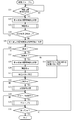
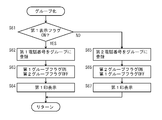
- FIG. 6 is a flowchart showing an example of the flow of the history grouping process.
- the history grouping process is a process executed by the CPU 21 when the CPU 21 executes a communication history display program.
- the history grouping process is a process of displaying either the incoming call history information 83 or the outgoing call history information 82 and registering the group. Since only the display of the incoming call history information 83 or the outgoing call history information 82 is different, here, the outgoing call history information 82 and the incoming call history information 83 are collectively referred to as history information, and the history information is displayed as an example. Explained.
- CPU 21 determines whether or not an instruction to display history information has been received (step S01). When it is detected that a key to which an operation for displaying history information is assigned among the operation keys 14 is pressed, an instruction to display history information is received. The process waits until an instruction to display history information is accepted (NO in step S01). If an instruction to display history information is accepted (YES in step S01), the process proceeds to step S02. Note that the instruction to display history information includes an instruction to display incoming call history information 83 and an instruction to display outgoing call history information 82.
- step S02 one piece of history information to be displayed is selected from the outgoing call history information 82 or the incoming call history information 83 stored in the flash memory 31. Then, a history display process is executed for the selected history information (step S03). Details of the history display processing will be described later.
- step S04 it is determined whether there is history information to be displayed next (step S04). If there is history information to be displayed, the process returns to step S02; otherwise, the process proceeds to step S05.
- the history information that can be displayed on the LCD 15 is two, if the history display processing is executed for the two history information in step S03, it is determined that the next history information does not exist. Accordingly, when the process proceeds to step S05, two pieces of history information are displayed on the LCD 15.
- step S05 the history information displayed first is set as a processing target.
- the history information set as the processing target is displayed in a display mode different from other history information, thereby informing the user of the history information set as the processing target. Can do.
- step S06 it is determined whether or not an instruction to change history information set as a processing target has been received.
- the selection key is an up / down arrow key included in the operation key 14 of the mobile phone 1. If an instruction to change history information is accepted, the process proceeds to step S07; otherwise, the process proceeds to step S12.
- step S07 it is determined whether or not history information to be set as a processing target is displayed on the LCD 15. If not displayed on the LCD, the process proceeds to step S08; otherwise, the process proceeds to step S11. For example, if the up arrow key is pressed while the history information displayed in the upper row is set as the processing target, the history information displayed in the lower row is the processing target. When the down arrow key is pressed in the state set to, it is determined that the history information to be set as the processing target is not displayed.
- step S08 a history information item to be set next as a processing target is selected. If the up arrow key is pressed while the history information displayed in the upper row is set as the processing target, the previous history information is selected and the history information displayed in the lower row is set as the processing target. If the down arrow key is pressed in the state where the current history information is pressed, the next history information is selected.
- step S09 a history display process is executed, and the process proceeds to step S12.
- step S10 the history information selected in step S08 is set as a processing target, and the process proceeds to step S12.
- step S11 among the history information already displayed on the LCD 15, designated history information is set as a processing target, and the process proceeds to step S12. If the down arrow key is pressed while the history information displayed in the upper row is set as the processing target, the history information displayed in the lower row is set as the processing target, and the history information displayed in the lower row is processed. When the up arrow key is pressed while the target is set, the history information displayed in the upper row is set as the processing target.
- step S12 it is determined whether a switching instruction has been accepted. When the user operates a switching key provided on the operation key 14, a switching instruction is accepted. If a switching instruction is accepted, the process proceeds to step S13; otherwise, step S13 is skipped and the process proceeds to step S14. In step S13, a telephone number change process is executed, and the process proceeds to step S14. The telephone number change process will be described later.
- step S14 it is determined whether a grouping instruction has been accepted.
- a grouping instruction is accepted. If a grouping instruction has been accepted, the process proceeds to step S15; otherwise, step S15 is skipped and the process proceeds to step S16.
- step S15 a grouping process is executed, and the process proceeds to step S16. Details of the grouping process will be described later.
- step S16 it is determined whether an end instruction has been accepted. When a key assigned with an operation for ending the display of history information among the operation keys 14 is pressed, an end instruction is accepted. If an end instruction is accepted, the process ends. If not, the process returns to step S06.
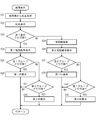
- FIG. 7 is a flowchart showing an example of the flow of history display processing.
- the history display process is a process executed in step S03 or step S09 in FIG. When the history display process is executed, one piece of history information is set as a processing target.
- the history display process is a process for displaying history information set as a processing target on the LCD 15.
- the first display flag is a flag indicating whether or not the first telephone number is set as a display target for each history information.
- the first display flag is ON when the first telephone number is set as a display target. Is set to OFF.
- the first display flag is set to ON in the initial state, and is set to OFF in a telephone number change process described later.
- the second display flag is a flag indicating whether or not the second telephone number is set as a display target for each history information. The second display flag is turned on when the second telephone number is set as a display target. Is set to OFF.
- the second display flag is set to OFF in the initial state, and is set to ON in a telephone number change process described later.
- the first display flag and the second display flag are exclusively set to ON, the second display flag is set to OFF when the first display flag is ON, and the first is displayed when the second display flag is ON.
- the display flag is set to OFF.
- the first group flag is a flag indicating whether or not the first telephone number is registered in the group for each history information.
- the first group flag is ON when the first telephone number is registered in the group, and otherwise. Set to OFF.
- the first group flag is set to OFF in the initial state, and is set to ON in the grouping process described later.
- the second group flag is a flag indicating whether or not the second telephone number is registered in the group for each history information.
- the second group flag is turned on when the second telephone number is registered in the group, and otherwise. Set to OFF.
- the second group flag is set to OFF in the initial state, and is set to ON in the grouping process described later.
- step S21 the name of the communication partner assigned with the first telephone number included in the history information set as the processing target is acquired. Specifically, the telephone directory 85 stored in the flash memory 31 is searched, and a telephone directory record including the first telephone number included in the history information set as the processing target is extracted. Then, the user identification information set in the name field of the extracted phone book record, here, the name is acquired. Then, the acquired name is displayed on the LCD 15, and the process proceeds to step S23.
- step S23 it is determined whether or not the first display flag corresponding to the history information set as the processing target is set to ON. If the first display flag is set to ON, the process proceeds to step S24; otherwise, the process proceeds to step S29.
- step S24 the first telephone number included in the history information set as the process target is displayed on the LCD 15, and the process proceeds to step S25.
- step S25 it is determined whether or not the first group flag corresponding to the history information set as the processing target is set to ON. If the first group flag is set to ON, the process proceeds to step S26; otherwise, the process proceeds to step S27.
- step S26 the first mark is displayed in the vicinity of the first telephone number displayed on LCD 15, and the process returns to the history grouping process.
- the first mark is a mark indicating that the telephone number displayed on the LCD 15, here the first telephone number included in the history information set as the processing target, is registered in the group. Yes. Since the first mark is displayed in the vicinity of the first telephone number, it is possible to notify the user that the first telephone number displayed on the LCD 15 is registered in the group.
- step S27 it is determined whether or not the second group flag corresponding to the history information set as the processing target is set to ON. If the second group flag is set to ON, the process proceeds to step S28; otherwise, the process returns to the history grouping process.
- step S28 the second mark is displayed in the vicinity of the first telephone number displayed on LCD 15, and the process returns to the history grouping process.
- the second mark indicates that a telephone number displayed on the LCD 15, here, a second telephone number different from the first telephone number included in the history information set as the processing target is registered in the group. It is a mark.
- the second mark is a mark including hatched hatching. Since the second mark is displayed in the vicinity of the first telephone number, the user is informed that the first telephone number displayed on the LCD 15 is not registered in the group and the second telephone number is registered in the group. You can be notified.
- step S27 When it is determined in step S27 that the second group flag corresponding to the history information set as the processing target is not set to ON, when both the first group flag and the second group flag are set to OFF It is. In this case, nothing is displayed near the first telephone number. Therefore, it is possible to notify the user that neither the first telephone number nor the second telephone number is registered in the group.
- step S29 the second display flag is set to ON.
- the telephone directory 85 stored in the flash memory 31 is searched (step S29), and the second telephone number is acquired.
- step S21 a phone book record including the first phone number included in the history information set as the processing target is extracted, and the second phone number included in the extracted phone book record is extracted. get.
- step S30 the process proceeds to step S31.
- step S31 it is determined whether or not the second group flag corresponding to the history information set as the processing target is set to ON. If the second group flag is set to ON, the process proceeds to step S32. If not, the process proceeds to step S33.
- step S32 the first mark is displayed in the vicinity of the second telephone number displayed on LCD 15, and the process returns to the history grouping process.
- the first mark is a mark indicating that the telephone number displayed on the LCD 15, here, the second telephone number is registered in the group, and is a check mark here. Since the first mark is displayed near the second telephone number, the user can be notified that the second telephone number displayed on the LCD 15 is registered in the group.
- step S33 it is determined whether or not the first group flag corresponding to the history information set as the processing target is set to ON. If the first group flag is set to ON, the process proceeds to step S34; otherwise, the process returns to the history grouping process.
- the second mark is displayed in the vicinity of the second telephone number displayed on LCD 15, and the process returns to the history grouping process.
- the second mark is a mark indicating that a telephone number displayed on the LCD 15, here, a first telephone number different from the second telephone number is registered in the group.
- the second mark is a mark including hatched hatching. Since the second mark is displayed in the vicinity of the second telephone number, the user is informed that the second telephone number displayed on the LCD 15 is not registered in the group and the first telephone number is registered in the group. You can be notified.
- step S33 When it is determined in step S33 that the first group flag corresponding to the history information set as the processing target is not set to ON, when both the first group flag and the second group flag are set to OFF It is. In this case, nothing is displayed near the second telephone number. Therefore, it is possible to notify the user that neither the first telephone number nor the second telephone number is registered in the group.
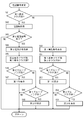
- FIG. 8 is a flowchart showing an example of the telephone number changing process.
- the telephone number change process is a process executed in step S13 of FIG. When the telephone number change process is executed, one piece of history information is set as a process target.
- the telephone number changing process is a process of switching the telephone number displayed on the LCD 15 from the first telephone number to the second telephone number or from the second telephone number to the first telephone number.
- CPU 21 determines whether or not the first display flag is set to ONO (step S41). If the first display flag is set to ON, the process proceeds to step S42; otherwise, the process proceeds to step S50.
- step S42 the telephone directory 85 stored in the flash memory 31 is searched, and a telephone directory record including the first telephone number included in the history information set as the processing target is extracted.
- step S43 it is determined whether or not the extracted telephone directory record includes the second telephone number.
- the second telephone number is another telephone number different from the first telephone number included in the history information among at least one telephone number included in the extracted telephone directory record. If the extracted telephone directory record includes the second telephone number, the process proceeds to step S44. If the telephone directory record is not extracted or does not include the second telephone number, the process is performed. Return to the history grouping process.
- step S44 the second telephone number included in the extracted telephone directory record is displayed on the LCD 15 in place of the first telephone number displayed so far.
- step S45 the second display flag is set to ON and the first display flag is set to OFF.
- step S46 it is determined whether or not the second group flag corresponding to the history information set as the processing target is set to ON. If the second group flag is set to ON, the process proceeds to step S47; otherwise, the process proceeds to step S48.
- step S47 the first mark is displayed near the second telephone number displayed on the LCD 15, and the process returns to the history grouping process. Since the first mark is displayed near the second telephone number, the user can be notified that the second telephone number displayed on the LCD 15 is registered in the group.
- step S48 it is determined whether or not the first group flag corresponding to the history information set as the processing target is set to ON. If the first group flag is set to ON, the process proceeds to step S49. If not, the process returns to the history grouping process.
- step S49 the second mark is displayed near the second telephone number displayed on the LCD 15, and the process returns to the history grouping process. Since the second mark is displayed in the vicinity of the second telephone number, the user is informed that the second telephone number displayed on the LCD 15 is not registered in the group and the first telephone number is registered in the group. You can be notified.
- step S48 When it is determined in step S48 that the first group flag corresponding to the history information set as the processing target is not set to ON, and both the first group flag and the second group flag are set to OFF It is. In this case, nothing is displayed near the second telephone number. Therefore, it is possible to notify the user that neither the first telephone number nor the second telephone number is registered in the group.
- the second display flag is set to ON. In this case, it is set as a processing target.
- the first telephone number included in the history information is displayed on the LCD 15 instead of the second telephone number displayed so far.
- the first display flag is set to ON and the second display flag is set to OFF.
- step S52 it is determined whether or not the first group flag corresponding to the history information set as the processing target is set to ON. If the first group flag is set to ON, the process proceeds to step S53. If not, the process proceeds to step S54.
- step S53 the first mark is displayed in the vicinity of the first telephone number displayed on LCD 15, and the process returns to the history grouping process. Since the first mark is displayed in the vicinity of the first telephone number, it is possible to notify the user that the first telephone number displayed on the LCD 15 is registered in the group.
- step S54 it is determined whether or not the second group flag corresponding to the history information set as the processing target is set to ON. If the second group flag is set to ON, the process proceeds to step S55; otherwise, the process returns to the history grouping process.
- step S55 the second mark is displayed near the first telephone number displayed on LCD 15, and the process returns to the history grouping process. Since the second mark is displayed in the vicinity of the first telephone number, the user is informed that the first telephone number displayed on the LCD 15 is not registered in the group and the second telephone number is registered in the group. You can be notified.
- step S54 When it is determined in step S54 that the second group flag corresponding to the history information set as the processing target is not set to ON, when both the first group flag and the second group flag are set to OFF It is. In this case, nothing is displayed near the first telephone number. Therefore, it is possible to notify the user that neither the first telephone number nor the second telephone number is registered in the group.
- FIG. 9 is a flowchart showing an example of the flow of grouping processing.
- the grouping process is a process executed in step S15 in FIG.
- the grouping process is executed when a grouping instruction is received in a state where one piece of history information is set as a processing target.
- the grouping process is a process of registering the first telephone number to the second telephone number displayed on the LCD 15 in the group.
- CPU 21 determines whether or not the first display flag is set to ON. If the first display flag is set to ON, the process proceeds to step S62; otherwise, the process proceeds to step S65 if the second display flag is set to ON.
- step S62 the first telephone number included in the history information set as the processing target is registered in the group, and the process proceeds to step S63.
- step S63 the first group flag is set to ON, the second group flag is set to OFF, and the process proceeds to step S64.
- step S64 the first mark is displayed in the vicinity of the position where the first telephone number of the LCD 15 is displayed, and the process returns to the history grouping process. Since the first mark is displayed in the vicinity of the first telephone number, it is possible to notify the user that the first telephone number displayed on the LCD 15 is registered in the group.
- step S65 the first telephone number included in the history information set as the processing target and the second telephone number associated with the telephone book record are registered in the group, and the process proceeds to step S66.
- step S63 the second group flag is set to ON, the first group flag is set to OFF, and the process proceeds to step S67.
- step S64 the first mark is displayed in the vicinity of the position where the second telephone number of the LCD 15 is displayed, and the process returns to the history grouping process. Since the first mark is displayed near the second telephone number, the user can be notified that the second telephone number displayed on the LCD 15 is registered in the group.
- the phone book 85 includes a phone book record in which “Alan Webb” is set in the name item and a phone book record in which “Bob Smith” is set in the name item.
- the phone book record in which “Alan Webb” is set in the name item the telephone number “111-111-1111” is set in the communication destination 1 item, and the telephone number “222-” is set in the communication destination 2 item. “222-2222” is set, and the phone book record in which “Alan Webb” is set in the name field, the telephone number “333-333-3333” is set in the communication destination 1 field.
- the incoming call history information 83 including the telephone number “111-111-1111” and the incoming call history information including the telephone number “333-333-3333” are stored.
- the telephone numbers “111-11111” and “333-333-3333” are the first telephone numbers.
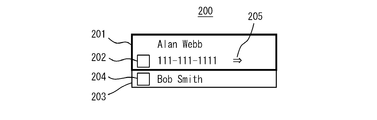
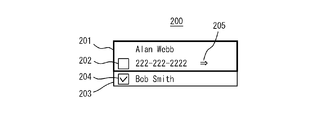
- FIG. 10 is a first diagram showing an example of a history display screen.
- history display screen 200 includes areas 201 and 203 for displaying a list of two pieces of history information.
- the name of the called party “Alan Webb” is displayed, the telephone number “111-111-1111” is displayed as communication identification information, and the right arrow key for inputting a switching instruction is displayed to the right of the telephone number.
- An arrow 205 is displayed.
- the name of the called party “Bob Smith” is displayed.
- the case where the history information displayed in the area 201 is selected and the area 201 is highlighted is shown as an example.
- the reverse display is represented by surrounding the area 201 with a bold frame.
- the display form in which the history information is selected is not limited to the reverse display, and for example, the character color or font may be different, or the background color or pattern may be different. However, the luminance may be varied.
- check boxes 202 and 204 are displayed at the left ends of the areas 201 and 203, respectively.
- Check boxes 202 and 204 are areas for a user to input a grouping instruction, and after being registered in the group, a first mark or a second mark indicating whether or not the group is registered is displayed. It is an area to be done. In the first stage where the history information is displayed, the areas 200 and 203 are blanks where nothing is displayed.
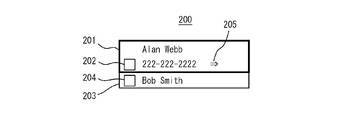
- FIG. 11 is a second diagram showing an example of a history display screen.
- the history display screen 200 shown in FIG. 11 is displayed when the right arrow key for inputting the switching instruction of the operation key 14 is pressed in the history display screen 200 shown in FIG.
- the first telephone number “111-111-1111” displayed in the area 201 on the history display screen 200 shown in FIG. 10 is changed to the second telephone number “222-222-2222”.
- the user can be informed that a second telephone number different from the first telephone number is registered in the telephone directory.
- the history information displayed in the area 201 is selected, and the area 201 is highlighted. Thereby, it is possible to notify the user that the history information displayed in the area 201 is selected as a processing target. Also, in the area 201, the check box 202 is blank without displaying anything. Thereby, it is possible to inform the user that neither the first telephone number nor the second telephone number of the history information displayed in the area 201 is registered in the group.
- the check box 204 is blank without displaying anything. Thereby, it is possible to inform the user that the first telephone number of the history information displayed in the area 203 is not registered in the group.
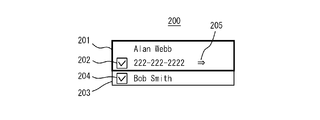
- FIG. 12 is a third diagram showing an example of a history display screen.
- a history display screen 200 shown in FIG. 12 is a screen displayed when a key for inputting a group registration instruction included in the operation keys 14 is pressed in the history display screen 200 shown in FIG.
- the first mark of the check mark is displayed in the check box 202 next to the second telephone number “222-222-2222” displayed in the area 201.
- the user can be informed that the second telephone number “222-222-2222” displayed is registered in the group.
- the history display screen 200 shown in FIG. 12 is displayed, when the key for inputting the group registration instruction of the operation key 14 is pressed, the history display screen 200 shown in FIG. 11 is displayed.
- the first mark of the check mark is displayed in the check box 202 next to the second telephone number “222-222-2222” displayed in the area 201.
- FIG. 13 is a fourth diagram illustrating an example of a history display screen.
- the history display screen 200 shown in FIG. 13 is displayed when the right arrow key for inputting the switching instruction of the operation key 14 is pressed in the history display screen 200 shown in FIG.
- the second telephone number “222-222-2222” displayed in the area 201 selected on the history display screen 200 shown in FIG. 12 is changed to the first telephone number “111-111-1111”.
- the check box 202 next to one telephone number “111-111-1111”, hatched hatching as a second mark is displayed. Thereby, it can be notified to the user that the second telephone number different from the first telephone number displayed is registered in the group.
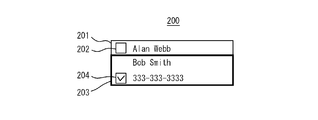
- FIG. 14 is a fifth diagram illustrating an example of a history display screen.
- the history display screen 200 shown in FIG. 14 is displayed when the down arrow key for inputting the selection instruction of the operation key 14 is pressed in the history display screen 200 shown in FIG.
- the first telephone number “333-333-3333” is displayed below the name “Bob Smith” of the called party displayed in the area 201 on the history display screen 200 shown in FIG.
- the history information displayed in the area 203 is selected, and the area 203 is highlighted. As a result, the user can be informed that the history information displayed in the area 203 is selected as a processing target.
- the check box 204 next to the first telephone number “333-333-3333” is blank without being displayed.
- the check box 202 is blank without displaying anything. Thereby, it is possible to inform the user that neither the first telephone number nor the second telephone number of the history information displayed in the area 201 is registered in the group.
- FIG. 15 is a sixth diagram illustrating an example of a history display screen.
- a history display screen 200 shown in FIG. 15 is a screen displayed when a key for inputting a group registration instruction included in the operation key 14 is pressed in the history display screen 200 shown in FIG.
- the user can be notified that the first telephone number “333-333-3333” has been registered in the group.
- FIG. 16 is a seventh diagram illustrating an example of a history display screen.
- the history display screen 200 shown in FIG. 16 is displayed when the up arrow key for inputting the selection instruction of the operation key 14 is pressed on the history display screen 200 shown in FIG.
- the second telephone number “222-222-2222” is displayed under the name “Alan Webb” of the called party displayed in the area 201 on the history display screen 200 shown in FIG. This is because, as shown in the history display screen 200 of FIG. 11, the second telephone number “222-222-2222” is selected as the display target.
- the history information displayed in the area 201 is selected, and the area 201 is highlighted. Thereby, it is possible to notify the user that the history information displayed in the area 201 is selected as a processing target. Further, in the area 201, the check box 202 is blank without displaying anything. As a result, the user can be informed that neither the first telephone number of the history information displayed in the area 201 nor the second telephone number corresponding thereto is registered in the group.
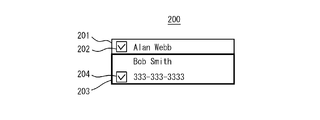
- the check box 204 displays a first mark of a check mark. Thereby, it can be notified that either the first telephone number or the second telephone number of the user whose name is displayed in the area 203 is registered in the group.
- FIG. 17 is an eighth diagram illustrating an example of a history display screen.
- the history display screen 200 shown in FIG. 17 is displayed when the down arrow key for inputting the selection instruction of the operation key 14 is pressed in the history display screen 200 shown in FIG.
- the first telephone number “333-333-3333” is displayed under the name “Bob Smith” of the called party displayed in the area 203 on the history display screen 200 shown in FIG.
- the history information displayed in the area 203 is selected, and the area 203 is highlighted.
- the user can be informed that the history information displayed in the area 203 is selected as a processing target.
- the check box 202 is blank without displaying anything. Thereby, it is possible to inform the user that the first telephone number of the history information displayed in the area 201 is not registered in the group.
- the check box 204 displays a first mark of a check mark. Thereby, it is possible to inform the user that either the first telephone number or the second telephone number of the history information displayed in the area 201 is registered in the group.
- FIG. 18 is a ninth diagram illustrating an example of a history display screen.
- a history display screen 200 shown in FIG. 18 is a screen displayed when a key for inputting a group registration instruction included in the operation key 14 is pressed in the history display screen 200 shown in FIG.
- the check box 202 remains displayed with the first mark of the check mark, so that either the first telephone number or the second telephone number of the history information displayed in the area 201 is registered with the group. Can be informed.
- FIG. 19 is a tenth view showing an example of a history display screen.
- the history display screen 200 shown in FIG. 19 is displayed when the up arrow key for inputting the selection instruction of the operation key 14 is pressed in the history display screen 200 shown in FIG.
- the second telephone number “222-222-2222” is displayed under the name “Alan Webb” of the called party displayed in the area 201 on the history display screen 200 shown in FIG. This is because, as shown in the history display screen 200 of FIG. 12, the second telephone number “222-222-2222” is selected as a display target.
- the history information displayed in the area 201 is selected, and the area 201 is highlighted. Thereby, it is possible to notify the user that the history information displayed in the area 201 is selected as a processing target.
- the check mark 204 in the area 201 remains displayed with the first mark of the check mark, the second telephone number “222-222-2222” displayed in the area 201 is registered to the group for the user. Can be informed.
- the check box 204 in the area 203 indicates that the first phone number of the user whose name is displayed in the area 203 is registered in the group because the first mark of the check mark is still displayed. Can do.
- the history display screen 200 shown in FIG. 19 When the history display screen 200 shown in FIG. 19 is displayed, when the down arrow key for inputting the selection instruction of the operation key 14 is pressed, the history display screen 200 shown in FIG. 18 is displayed. Is done.
- FIG. 20 is an eleventh view showing an example of the history display screen.
- the history display screen 200 shown in FIG. 20 is displayed when the down arrow key for inputting the selection instruction of the operation key 14 is pressed in the history display screen 200 shown in FIG.
- the second telephone number of the history information displayed in the first area is registered in the group and included in the history information displayed in the second area. Neither the first telephone number nor the second telephone number is registered in the group.
- the first telephone number “333-333-3333” is displayed under the name “Alan Smith” of the called party displayed in area 203 in FIG. Further, the history information displayed in the area 203 is selected, and the area 203 is highlighted. As a result, the user can be informed that the history information displayed in the area 203 is selected as a processing target.
- the check box 204 displays a first mark of a check mark. Thereby, the user can be notified that either the first telephone number or the second telephone number included in the history information displayed in the area 201 is registered in the group.
- the check box 204 in the area 203 is not displayed and is blank, the user can be informed that the first telephone number of the history information displayed in the area 203 is not registered in the group.
- the history display screen 200 shown in FIG. 20 When the history display screen 200 shown in FIG. 20 is displayed, when the up arrow key for inputting the selection instruction of the operation key 14 is pressed, the history display screen 200 shown in FIG. 13 is displayed. Is done.
- FIG. 21 is a twelfth diagram showing an example of a history display screen.
- a history display screen 200 shown in FIG. 21 is a screen displayed when a key for inputting a group registration instruction included in the operation key 14 is pressed in the history display screen 200 shown in FIG.
- the check box 202 remains displayed with the first mark of the check mark, so that either the first telephone number or the second telephone number of the history information displayed in the area 201 is registered with the group. Can be informed.
- FIG. 22 is a thirteenth view showing an example of the history display screen.
- the history display screen 200 shown in FIG. 22 is displayed when the up arrow key for inputting the selection instruction of the operation key 14 is pressed in the history display screen 200 shown in FIG.
- the first telephone number “111-111-1111” is displayed under the name “Alan Webb” of the called party displayed in the area 201 on the history display screen 200 shown in FIG. This is because the second telephone number “111-111-1111” is selected as the display target as shown in the history display screen 200 of FIG.
- the history information displayed in the area 201 is selected, and the area 201 is highlighted. Thereby, it is possible to notify the user that the history information displayed in the area 201 is selected as a processing target.
- the check box 202 displays a second mark of hatching. This is because the second telephone number “222-222-2222” is registered in the group as shown in the history display screen 200 of FIG. As a result, the user can be informed that a second telephone number different from the first telephone number “111-111-1111” displayed in the area 201 is registered in the group.
- the check box 204 in the area 203 keeps displaying the first mark of the check mark, so that the user can be notified that the first telephone number of the history information displayed in the area 203 is registered in the group. it can.
- the mobile phone 1 displays the outgoing call history information 82 or the incoming call history information 83 including the telephone number, and the first telephone number included in the outgoing call history information 82 or the incoming call history information 83 (
- the telephone directory record (personal information) including the communication identification information includes the second telephone number
- either the first telephone number or the second telephone number is input according to the input of the operation for changing the telephone number.
- the display is switched to and the displayed one is registered in the group. Therefore, a second telephone number different from the first telephone number stored as outgoing call history information 82 or incoming call history information 83 can be registered in the group.
- the outgoing call history information 82 or the incoming call history information 83 including the first telephone number is displayed, and the telephone directory record including the first telephone number included in the outgoing call history information 82 or the incoming call history information 83 selected as the processing target.
- the display is switched to either the first telephone number or the second telephone number in response to an input of an operation for switching the display, while the processing target is changed.
- the first telephone number included in the outgoing call history information 82 or the incoming call history information 83 to be newly processed and the second telephone number associated with the first telephone number are selected as the previous processing target. What is displayed when it is displayed. For this reason, since the previously displayed one of the first telephone number and the second telephone number is displayed, there is no need to repeat the previous operation.
- a check mark or hatching is displayed, so that either the first telephone number or the second telephone number is displayed. You can be notified that you are registered in the group. The telephone number registered in the group can be notified to the user.
- the displayed one of the first telephone number and the second telephone number is registered in the group, a check mark is displayed, and the first telephone number and the second telephone number are displayed. Since the hatching is displayed when the current one is not registered in the group, which of the first telephone number and the second telephone number is registered in the group, or both are registered in the group It is possible to notify the user whether or not it has been done.
- the mobile phone 1 is described as an example of the communication device.
- the communication history display method or the communication history display method for executing the processing shown in FIG. Needless to say, the present invention can be understood as a communication history display program to be executed by the CPU 21 to be controlled.
Landscapes
- Engineering & Computer Science (AREA)
- Signal Processing (AREA)
- Computer Networks & Wireless Communication (AREA)
- Telephone Function (AREA)
- Telephonic Communication Services (AREA)
Abstract
Description
Claims (11)
- 個人を識別するための個人識別情報と、該個人に対して通信のために割り当てられた少なくとも1つの通信識別情報とを関連付けた個人情報を記憶する個人情報記憶部と、
過去の通信相手の通信識別情報を含み、通信の履歴を示す履歴情報を記憶する通信履歴記憶部と、
前記記憶された履歴情報または前記記憶された個人情報に基づいて、少なくとも1つの通信識別情報を1つにまとめたグループを生成するグループ化部と、を備え、
前記グループ化部は、前記記憶された履歴情報を表示する履歴表示部と、
前記表示された履歴情報の1つを処理対象として選択する選択部と、
前記個人情報が前記選択された履歴情報に含まれる第1の通信識別情報と、前記第1通信識別情報とは別の第2の通信識別情報を含む場合、表示を切り換えるための操作の入力に応じて、前記第1の通信識別情報と前記第2の通信識別情報とのいずれかに表示を切り換える表示切換部と、を含み、
前記表示切換部は、前記選択部により処理対象が変更される場合、新たに処理対象となる履歴情報に含まれる前記第1の通信識別情報と前記第2の通信識別情報のうち前記選択部により前回処理対象として選択されていたときに表示していたものを表示する、通信装置。 - 前記グループ化部は、グループに登録する操作の入力に応じて、前記選択部により選択されている履歴情報に含まれる前記第1の通信識別情報または前記第2の通信識別情報のうち表示されているものをグループに登録する登録部をさらに含む、請求項1に記載の通信装置。
- 前記グループの指定を受け付けるグループ受付部と、
前記受け付けられた指定により特定されるグループに登録されている少なくとも1つの通信識別情報に発信する発信部と、をさらに備えた請求項1に記載の通信装置。 - 前記グループ化部は、前記第1の通信識別情報または前記第2の通信識別情報のいずれか一方がグループに登録されていることを示す印を表示する印表示部をさらに含む、請求項1に記載の通信装置。
- 前記印表示部は、前記第1の通信情報と第2の通信情報とのうち前記表示切換部により表示されているものが前記登録部により登録されている場合に第1の印を表示する第1印表示部と、
前記第1の通信情報と第2の通信情報とのうち前記表示切換部により表示されているものが前記登録部により登録されていない場合に第2の印を表示する第2印表示部と、を含む請求項4に記載の通信装置。 - 個人を識別するための個人識別情報と、該個人に対して通信のために割り当てられた少なくとも1つの通信識別情報とを関連付けた個人情報を記憶するステップと、
過去の通信相手の通信識別情報を含み、通信の履歴を示す履歴情報を記憶するステップと、
前記記憶された履歴情報または前記記憶された個人情報に基づいて、少なくとも1つの通信識別情報を1つにまとめたグループを生成するステップと、を含み、
前記グループを生成するステップは、前記記憶された履歴情報を表示するステップと、
前記表示された履歴情報の1つを処理対象として選択するステップと、
前記個人情報が前記表示された履歴情報に含まれる第1の通信識別情報と、前記第1通信識別情報とは別の第2の通信識別情報を含む場合、表示を切り換えるための操作の入力に応じて、前記第1の通信識別情報と前記第2の通信識別情報とのいずれかに表示を切り換えるステップと、を含み、
前記表示を切り換えるステップは、前記選択するステップにおいて処理対象が変更される場合、新たに処理対象となる履歴情報に含まれる前記第1の通信識別情報と前記第2の通信識別情報のうち前記選択するステップにおいて前回処理対象として選択されていたときに表示していたものを表示するステップを含む、通信履歴表示方法。 - 前記グループを生成するステップは、グループに登録する操作の入力に応じて、前記選択するステップにおいて選択されている履歴情報に含まれる前記第1の通信識別情報または前記第2の通信識別情報のうち表示されているものをグループに登録するステップをさらに含む、請求項6に記載の通信履歴表示方法。
- 前記グループの指定を受け付けるステップと、
前記受け付けられた指定により特定されるグループに登録されている少なくとも1つの通信識別情報に発信するステップと、をさらに含む請求項6に記載の通信履歴表示方法。 - 前記グループを生成するステップは、前記第1の通信識別情報または前記第2の通信識別情報のいずれか一方がグループに登録されていることを示す印を表示するステップをさらに含む、請求項6に記載の通信履歴表示方法。
- 前記印を表示するステップは、前記第1の通信情報と第2の通信情報とのうち前記表示を切り換えるステップにおいて表示されているものが前記登録するステップにおいて登録されている場合に第1の印を表示するステップと、
前記第1の通信情報と第2の通信情報とのうち前記表示を切り換えるステップにおいて表示されているものが前記登録するステップにおいて登録されていない場合に第2の印を表示するステップと、を含む請求項9に記載の通信履歴表示方法。 - 個人を識別するための個人識別情報と、該個人に対して通信のために割り当てられた少なくとも1つの通信識別情報とを関連付けた個人情報を記憶するステップと、
過去の通信相手の通信識別情報を含み、通信の履歴を示す履歴情報を記憶するステップと、
前記記憶された履歴情報または前記記憶された個人情報に基づいて、少なくとも1つの通信識別情報を1つにまとめたグループを生成するステップと、をコンピュータに実行させ、
前記グループを生成するステップは、前記記憶された履歴情報を表示するステップと、
前記表示された履歴情報の1つを処理対象として選択するステップと、
前記個人情報が前記表示された履歴情報に含まれる第1の通信識別情報と、前記第1通信識別情報とは別の第2の通信識別情報を含む場合、表示を切り換えるための操作の入力に応じて、前記第1の通信識別情報と前記第2の通信識別情報とのいずれかに表示を切り換えるステップと、を含み、
前記表示を切り換えるステップは、前記選択するステップにおいて処理対象が変更される場合、新たに処理対象となる履歴情報に含まれる前記第1の通信識別情報と前記第2の通信識別情報のうち前記選択するステップにおいて前回処理対象として選択されていたときに表示していたものを表示するステップを含む、通信履歴表示プログラムを記録したコンピュータ読み取り可能な記録媒体。
Priority Applications (2)
| Application Number | Priority Date | Filing Date | Title |
|---|---|---|---|
| US13/141,225 US8761837B2 (en) | 2008-12-22 | 2009-12-21 | Communication device, communication history display method, and computer-readable recording medium recorded with communication history display program |
| KR1020117017079A KR101252622B1 (ko) | 2008-12-22 | 2009-12-21 | 통신 장치, 통신 이력 표시 방법 및 통신 이력 표시 프로그램을 기록한 컴퓨터 판독 가능한 기록 매체 |
Applications Claiming Priority (2)
| Application Number | Priority Date | Filing Date | Title |
|---|---|---|---|
| JP2008-326612 | 2008-12-22 | ||
| JP2008326612A JP5297790B2 (ja) | 2008-12-22 | 2008-12-22 | 通信装置、通信履歴表示方法および通信履歴表示プログラム |
Publications (1)
| Publication Number | Publication Date |
|---|---|
| WO2010073587A1 true WO2010073587A1 (ja) | 2010-07-01 |
Family
ID=42287236
Family Applications (1)
| Application Number | Title | Priority Date | Filing Date |
|---|---|---|---|
| PCT/JP2009/007067 Ceased WO2010073587A1 (ja) | 2008-12-22 | 2009-12-21 | 通信装置、通信履歴表示方法および通信履歴表示プログラムを記録したコンピュータ読み取り可能な記録媒体 |
Country Status (4)
| Country | Link |
|---|---|
| US (1) | US8761837B2 (ja) |
| JP (1) | JP5297790B2 (ja) |
| KR (1) | KR101252622B1 (ja) |
| WO (1) | WO2010073587A1 (ja) |
Citations (4)
| Publication number | Priority date | Publication date | Assignee | Title |
|---|---|---|---|---|
| JPH10126484A (ja) * | 1996-10-21 | 1998-05-15 | Sony Corp | 通信端末装置、発信履歴記憶方法及び発信履歴表示方法 |
| JPH11196172A (ja) * | 1997-12-26 | 1999-07-21 | Sharp Corp | 通信装置 |
| JP2003169129A (ja) * | 2001-11-30 | 2003-06-13 | Nec Corp | 移動無線端末 |
| JP2004185434A (ja) * | 2002-12-04 | 2004-07-02 | Fujitsu Ten Ltd | 選択操作装置 |
Family Cites Families (3)
| Publication number | Priority date | Publication date | Assignee | Title |
|---|---|---|---|---|
| JP2001339535A (ja) * | 2000-05-30 | 2001-12-07 | Nec Corp | 各種情報の送信方法 |
| WO2005057890A2 (en) | 2003-12-08 | 2005-06-23 | Kyocera Wireless Corp. | Push to talk user interface for the management of contacts |
| US7280652B2 (en) * | 2004-09-13 | 2007-10-09 | Research In Motion Limited | Handheld electronic device having improved phone call log, and associated method |
-
2008
- 2008-12-22 JP JP2008326612A patent/JP5297790B2/ja not_active Expired - Fee Related
-
2009
- 2009-12-21 US US13/141,225 patent/US8761837B2/en not_active Expired - Fee Related
- 2009-12-21 KR KR1020117017079A patent/KR101252622B1/ko not_active Expired - Fee Related
- 2009-12-21 WO PCT/JP2009/007067 patent/WO2010073587A1/ja not_active Ceased
Patent Citations (4)
| Publication number | Priority date | Publication date | Assignee | Title |
|---|---|---|---|---|
| JPH10126484A (ja) * | 1996-10-21 | 1998-05-15 | Sony Corp | 通信端末装置、発信履歴記憶方法及び発信履歴表示方法 |
| JPH11196172A (ja) * | 1997-12-26 | 1999-07-21 | Sharp Corp | 通信装置 |
| JP2003169129A (ja) * | 2001-11-30 | 2003-06-13 | Nec Corp | 移動無線端末 |
| JP2004185434A (ja) * | 2002-12-04 | 2004-07-02 | Fujitsu Ten Ltd | 選択操作装置 |
Non-Patent Citations (1)
| Title |
|---|
| NTT DOCOMO GROUP: "FOMA N906imu Toriatsukai Setsumeisho, 2nd edition", June 2008 (2008-06-01), pages 83 - 85, Retrieved from the Internet <URL:http://www.nttdocomo.co.jp/binary/pdf/support/trouble/manual/download/n906imyu/N906imu_J_All.pdf> [retrieved on 20100317] * |
Also Published As
| Publication number | Publication date |
|---|---|
| US8761837B2 (en) | 2014-06-24 |
| US20110256908A1 (en) | 2011-10-20 |
| KR101252622B1 (ko) | 2013-04-09 |
| KR20110102916A (ko) | 2011-09-19 |
| JP2010148076A (ja) | 2010-07-01 |
| JP5297790B2 (ja) | 2013-09-25 |
Similar Documents
| Publication | Publication Date | Title |
|---|---|---|
| JP2010068060A (ja) | 通信機器、通信履歴表示方法および履歴表示プログラム | |
| JP4226055B2 (ja) | 通信端末装置及びプログラム | |
| JP2004187273A (ja) | 携帯電話端末、及び、発信履歴表示方法 | |
| KR101177418B1 (ko) | 휴대기기 및 조작접수방법 | |
| JP2006195592A (ja) | 通信端末、通信端末の表示方法、及び、コンピュータプログラム | |
| KR100582909B1 (ko) | 휴대통신단말 및 화상표시방법 | |
| JP2004147242A (ja) | 電子機器 | |
| JP5297790B2 (ja) | 通信装置、通信履歴表示方法および通信履歴表示プログラム | |
| JP2007311852A (ja) | 携帯通信端末およびモード切換方法 | |
| KR20060038787A (ko) | 이동통신단말기내 미디어 데이터를 삭제/재전송하는 방법 | |
| JP5082904B2 (ja) | 携帯端末装置 | |
| JP5491023B2 (ja) | 通信装置、通信履歴表示方法および通信履歴表示プログラム | |
| US20070298792A1 (en) | Mobile radio terminal device | |
| JP4493617B2 (ja) | 電話機 | |
| KR100557152B1 (ko) | 휴대 단말기의 멀티단축기능 수행방법 | |
| JP4569459B2 (ja) | 情報表示端末、情報表示方法及びプログラム | |
| JP2007266982A (ja) | 携帯情報端末 | |
| JP2003209596A (ja) | 通信端末、及びプログラム | |
| KR100630201B1 (ko) | 휴대용 단말기에서 데이터 선택 및 전송방법 | |
| JP4806067B2 (ja) | 移動体通信システム | |
| JP4467536B2 (ja) | 電話機 | |
| JP2004260686A (ja) | 携帯通信端末 | |
| JP2004015158A (ja) | 携帯電話通信システム | |
| JP2002199463A (ja) | 移動体通信装置及び発呼方法 | |
| JP2005151483A (ja) | 通信端末装置 |
Legal Events
| Date | Code | Title | Description |
|---|---|---|---|
| 121 | Ep: the epo has been informed by wipo that ep was designated in this application |
Ref document number: 09834398 Country of ref document: EP Kind code of ref document: A1 |
|
| WWE | Wipo information: entry into national phase |
Ref document number: 13141225 Country of ref document: US |
|
| NENP | Non-entry into the national phase |
Ref country code: DE |
|
| ENP | Entry into the national phase |
Ref document number: 20117017079 Country of ref document: KR Kind code of ref document: A |
|
| 122 | Ep: pct application non-entry in european phase |
Ref document number: 09834398 Country of ref document: EP Kind code of ref document: A1 |