WO2010064558A1 - シアノアクリレート系接着剤剥離用組成物、および該接着剤の除去方法 - Google Patents
シアノアクリレート系接着剤剥離用組成物、および該接着剤の除去方法 Download PDFInfo
- Publication number
- WO2010064558A1 WO2010064558A1 PCT/JP2009/069789 JP2009069789W WO2010064558A1 WO 2010064558 A1 WO2010064558 A1 WO 2010064558A1 JP 2009069789 W JP2009069789 W JP 2009069789W WO 2010064558 A1 WO2010064558 A1 WO 2010064558A1
- Authority
- WO
- WIPO (PCT)
- Prior art keywords
- adhesive
- article
- composition
- cyanoacrylate
- water
- Prior art date
- Legal status (The legal status is an assumption and is not a legal conclusion. Google has not performed a legal analysis and makes no representation as to the accuracy of the status listed.)
- Ceased
Links
Classifications
-
- C—CHEMISTRY; METALLURGY
- C11—ANIMAL OR VEGETABLE OILS, FATS, FATTY SUBSTANCES OR WAXES; FATTY ACIDS THEREFROM; DETERGENTS; CANDLES
- C11D—DETERGENT COMPOSITIONS; USE OF SINGLE SUBSTANCES AS DETERGENTS; SOAP OR SOAP-MAKING; RESIN SOAPS; RECOVERY OF GLYCEROL
- C11D7/00—Compositions of detergents based essentially on non-surface-active compounds
- C11D7/50—Solvents
- C11D7/5004—Organic solvents
- C11D7/5022—Organic solvents containing oxygen
-
- C—CHEMISTRY; METALLURGY
- C09—DYES; PAINTS; POLISHES; NATURAL RESINS; ADHESIVES; COMPOSITIONS NOT OTHERWISE PROVIDED FOR; APPLICATIONS OF MATERIALS NOT OTHERWISE PROVIDED FOR
- C09D—COATING COMPOSITIONS, e.g. PAINTS, VARNISHES OR LACQUERS; FILLING PASTES; CHEMICAL PAINT OR INK REMOVERS; INKS; CORRECTING FLUIDS; WOODSTAINS; PASTES OR SOLIDS FOR COLOURING OR PRINTING; USE OF MATERIALS THEREFOR
- C09D9/00—Chemical paint or ink removers
- C09D9/005—Chemical paint or ink removers containing organic solvents
-
- C—CHEMISTRY; METALLURGY
- C11—ANIMAL OR VEGETABLE OILS, FATS, FATTY SUBSTANCES OR WAXES; FATTY ACIDS THEREFROM; DETERGENTS; CANDLES
- C11D—DETERGENT COMPOSITIONS; USE OF SINGLE SUBSTANCES AS DETERGENTS; SOAP OR SOAP-MAKING; RESIN SOAPS; RECOVERY OF GLYCEROL
- C11D7/00—Compositions of detergents based essentially on non-surface-active compounds
- C11D7/22—Organic compounds
- C11D7/26—Organic compounds containing oxygen
- C11D7/263—Ethers
Definitions
- the present invention relates to a composition for removing a cyanoacrylate-based adhesive, and removes a cyanoacrylate-based adhesive from an article to be cleaned to which the cyanoacrylate-based adhesive is adhered using the composition for peeling. On how to do.
- the cyanoacrylate adhesive is a type of adhesive that forms an adhesive film by curing a monomer or oligomer by a chemical reaction, and is used in various applications. Specifically, in addition to general bonding applications, electronic / electrical components, optical components and the like can be used effectively because they can be bonded in a short time when temporary fixing is required.
- the lens is fixed to a jig using an adhesive when the lens surface is polished.
- a cyanoacrylate adhesive is used.
- chlorine-based release agents such as trichloroethylene and methylene chloride have been used when separating the lens from the jig or when removing (cleaning) the adhesive on the lens surface.
- alternatives to these chlorine-based release agents have been studied in an environment-friendly approach.
- acetone, dimethylformamide, and the like are known as a release agent for removing the cyanoacrylate adhesive.
- many investigations have been made on an improvement of the above-mentioned release agent due to a flash point problem and a peelability problem, and other release agents.
- a non-halogen organic solvent containing a nitrogen element such as dimethylformamide, a stripping composition containing a surfactant (Patent Document 1), N-methylpyrrolidone, and isopropyl alcohol are used for ultrasonic cleaning.
- a method for removing the adhesive (Patent Document 2) is known.
- Patent Documents 3 and 4 describe cyanoacrylate-based adhesive stripping compositions containing glycols and water.
- Patent Document 5 describes a cyanoacrylate adhesive peeling composition comprising an organic solvent, glycols and a predetermined amount of water.
- the cyanoacrylate-based adhesive stripping composition contains an organic solvent, the flash point becomes low. For this reason, the composition cannot be used for high-temperature cleaning, resulting in an increase in the cost of equipment such as equipment used for cleaning articles to be cleaned. Furthermore, as a countermeasure against recent environmental problems, a composition that contains as little organic solvent as possible has been demanded.
- an object of the present invention is to provide an aqueous solvent peeling composition capable of sufficiently peeling a cyanoacrylate adhesive.
- an object of the present invention is to provide a cyanoacrylate adhesive stripping composition that is excellent in stripping ability and has a low flash point. It is another object of the present invention to provide a water-solvent cyanoacrylate adhesive stripping composition that strips a cyanoacrylate adhesive adhered to a fluorophosphate glass article having low water resistance.
- the inventors of the present invention conducted intensive research to solve the above problems. As a result, investigations centered on detergents using propylene glycol alkyl ethers, which have particularly low toxicity, have found that the above problems can be solved by a composition containing specific propylene glycol alkyl ethers and water in predetermined amounts. The invention has been completed.
- the cyanoacrylate adhesive peeling composition of the present invention is compatible only with propylene glycol alkyl ether (A) that is uniformly compatible with water at 20 ° C. and with water at a ratio of 50% by volume or less at 20 ° C.
- the cyanoacrylate adhesive peeling composition of the present invention is a cyanoacrylate adhesive adhered to one type of article to be cleaned selected from the group consisting of fluorophosphate glass articles, silicon articles and ceramic articles. It can be suitably used when the adhesive is peeled off.
- the method for removing a cyanoacrylate adhesive of the present invention comprises removing the cyanoacrylate adhesive from the article to be cleaned by bringing the article to be cleaned to which the cyanoacrylate adhesive is attached into contact with the above-mentioned peeling composition. It is characterized by doing.
- the above-described method of the present invention is suitable for removing a cyanoacrylate adhesive adhered to an article to be cleaned such as a fluorophosphate glass article, a silicon article, and a ceramic article.
- the cyanoacrylate adhesive peeling composition of the present invention has an excellent peeling ability. Furthermore, since it contains a specific propylene glycol alkyl ether and water, it is a composition with low flammability and a highly safe stripping composition that can improve the adhesive stripping work environment.
- the cyanoacrylate adhesive of the present invention is an aqueous solvent, it can be suitably used for peeling off a cyanoacrylate adhesive attached to a fluorophosphate glass article, which is a kind of optical article.
- the fluorophosphate-based glass article has low water resistance, so that when a cleaning agent containing water is used, a lot of fine scratches may be generated.
- a cyanoacrylate-based adhesive using the peeling composition of the present invention may be used. According to the method for removing the agent, the occurrence of such scratches is suppressed.
- stripping composition of the present invention not only stripping of cyanoacrylate adhesive adhering to fluorophosphate glass articles, silicon articles, ceramic articles, etc., but also washing them Since it is possible to clean dirt such as fats and oils of articles, its industrial use value is high.
- the water (C) is contained in an amount of 10 to 250 parts by mass with respect to 100 parts by mass of the total amount of (A) and (B).
- the stripping composition of the present invention contains a propylene glycol alkyl ether (A) that is uniformly compatible with water at 20 ° C.
- the propylene glycol alkyl ether (A) that is uniformly compatible with water at 20 ° C. refers to a propylene glycol alkyl ether that is compatible with water at 20 ° C., regardless of the amount.
- this propylene glycol alkyl ether (A) is also simply referred to as a highly compatible component (A).
- the highly compatible component (A) examples include propylene glycol monomethyl ether, dipropylene glycol monomethyl ether, tripropylene glycol monomethyl ether, propylene glycol monoethyl ether, dipropylene glycol monoethyl ether, propylene glycol dimethyl ether and the like. Can be mentioned. These components can be used alone or in combination of two or more components.
- the stripping composition of the present invention contains a propylene glycol alkyl ether (B) that is compatible with water only at a ratio of 50% by volume or less at 20 ° C.
- the propylene glycol alkyl ether that is compatible with water at a rate of not more than 50% by volume at 20 ° C. means a propylene glycol alkyl ether having a solubility in water of not more than 50% by volume at 20 ° C.
- a water solubility of 5.2% by volume at 20 ° C. means that 5.2 ml or less of propylene glycol alkyl ether is uniformly compatible with 100 ml of water at 20 ° C.
- propylene glycol alkyl ether having a water solubility of 5.2 vol% at 20 ° C. is used in an amount exceeding 5.2 ml with respect to 100 ml of water at 20 ° C., it is not uniformly compatible with 100 ml of water at 20 ° C.
- this propylene glycol alkyl ether (B) is also simply referred to as a low compatibility component (B).
- the low compatibility component (B) examples include propylene glycol monopropyl ether, propylene glycol monobutyl ether, dipropylene glycol monopropyl ether, dipropylene glycol monobutyl ether, tripropylene glycol monopropyl ether, tripropylene glycol.
- Examples thereof include monobutyl ether, dipropylene glycol dimethyl ether, tripropylene glycol dimethyl ether, dipropylene glycol diethyl ether, dipropylene glycol dipropyl ether, and dipropylene glycol dibutyl ether. These components can be used alone or in combination of two or more components.
- propylene glycol monopropyl ether in consideration of the compatibility with the high compatibility component (A) and water (C) and the effect of peeling off the cyanoacrylate adhesive, propylene glycol monopropyl ether, propylene Glycol monobutyl ether, dipropylene glycol dimethyl ether, dipropylene glycol monopropyl ether, and dipropylene glycol monobutyl ether are preferred.
- dipropylene glycol monopropyl ether, dipropylene glycol monobutyl ether, and dipropylene glycol dimethyl ether are preferable.
- dipropylene glycol dimethyl ether is used for peeling a cyanoacrylate-based adhesive mainly composed of ethyl cyanoacrylate. It is preferable.
- the stripping composition of the present invention contains water (C).
- Water (C) reduces the flammability of the stripping composition, improves safety, and also effectively acts on stripping of the cyanoacrylate adhesive.
- the water (C) used in the present invention may be appropriately determined according to the following article to be cleaned and its use. For example, ultrapure water, pure water, ion-exchanged water, distilled water, or normal tap water is used. can do.
- the peeling composition of the present invention in addition to the high compatibility component (A), the low compatibility component (B), and water (C), it is within the range that does not impair the effects of the present invention, depending on the application to be used.
- An antiseptic, a rust inhibitor, a surfactant, an antioxidant, and an antifoaming agent can be blended.
- the peeling composition of this invention does not contain an organic solvent. If no organic solvent is contained, the flammability is low and the workability is excellent.
- the cyanoacrylate adhesive peeling composition of the present invention contains the high compatibility component (A), the low compatibility component (B), and the water (C) in the above proportions. .
- the high compatibility component (A) is less than 25% by mass and the low compatibility component (B) exceeds 75% by mass, the peeling effect of the cyanoacrylate adhesive may be reduced.
- water acts on the peeling of the cyanoacrylate adhesive. Therefore, when there is too little highly compatible component (A), in order to obtain the uniform peeling composition which does not isolate
- the highly compatible component (A) is reduced, it is difficult to obtain a safe peeling composition without risk of ignition and the like, and the workability when peeling the adhesive may be inferior.
- the peeling effect of the cyanoacrylate adhesive may be reduced.
- the low compatibility component (B) is considered to dissolve the cyanoacrylate adhesive. Therefore, if the amount of the low compatibility component (B) is too small, the performance of dissolving the cyanoacrylate adhesive of the peeling composition is lowered, so that the peeling effect is considered to be lowered.
- the high compatibility component (A) is 30% by mass or more and 85% by mass or less, and the low compatibility.
- the component (B) is preferably 15% by mass or more and 70% by mass or less, and further, the high compatibility component (A) is 55% by mass or more and 80% by mass or less, and the low compatibility component (B) is 20% by mass.
- the content is preferably 45% by mass or less.
- the composition for peeling has low flammability. It becomes difficult to get things. Furthermore, when the ratio of water (C) is less than 10 parts by mass, the peeling effect of the cyanoacrylate adhesive may be reduced. Moreover, when the ratio of water exceeds 250 mass parts, there exists a possibility that the peeling effect of a cyanoacrylate adhesive may fall.
- the article to be cleaned to which the cyanoacrylate adhesive is attached has low water resistance
- an optical article such as an article made of fluorophosphate glass, or a ceramic product made of aluminum nitride, cyanoacrylate
- the system adhesive is peeled off, the surfaces of the objects to be cleaned may be damaged.
- the blending ratio of water (C) is 100 in total of (A) and (B). It is preferably 10 parts by mass or more and 100 parts by mass or less, and more preferably 10 parts by mass or more and 50 parts by mass or less with respect to parts by mass.
- the mixture ratio of water (C) is 10 mass parts or more and less than 100 mass parts with respect to a total of 100 mass parts of said (A) and (B), Furthermore, 10 When it is at least 50 parts by mass, it can be suitably used for articles to be cleaned with low water resistance, specifically, articles made of fluorophosphate glass.
- the peeling composition of this invention can be manufactured by mixing the high compatibility component (A) which satisfies the said ratio, the low compatibility component (B), and water (C) by a well-known method. . If it is the said mixture ratio, each component can be mixed easily. ⁇ Method to remove cyanoacrylate adhesive from article to be cleaned ⁇ Next, a method for peeling a cyanoacrylate adhesive using the peeling composition of the present invention will be described.
- the cyanoacrylate adhesive can be peeled from the article to be cleaned by bringing the peeling composition into contact with the article to be cleaned to which the cyanoacrylate adhesive is attached.
- the method for bringing the peeling composition into contact with the article to be cleaned to which the cyanoacrylate adhesive is attached is not particularly limited, and a known method is employed. Specifically, a method of immersing the article to be cleaned in the peeling composition (an ultrasonic wave can be irradiated during the immersion, or the article to be cleaned can be swung during the immersion), a jet, or the like. For example, a method of immersing an article to be cleaned in a peeling composition having a flow of the above can be employed.
- the temperature at which the article to be cleaned, to which the cyanoacrylate adhesive is attached may be appropriately determined according to the target article to be cleaned, the amount of cyanoacrylate adhesive used, etc. 100 ° C., preferably 30 to 90 ° C., more preferably 50 to 80 ° C.
- the cyanoacrylate-based adhesive can be easily peeled from the article to be cleaned without causing scratches on the surface of the article to be cleaned.
- the article to be cleaned is dried. That's fine.
- the rinse liquid may contain an organic solvent in which the stripping composition is dissolved. Considering the removal of the rinsing liquid described later, it is preferable to use an organic solvent having a boiling point of 50 to 100 ° C.
- the method of rinsing is not particularly limited.
- the method of immersing the article to be cleaned after being brought into contact with the stripping composition in the rinsing liquid the method of immersing the article to be cleaned in the rinsing liquid, A method of irradiating a sound wave, a method of immersing the article to be cleaned in the rinsing liquid and swinging the article to be cleaned, a method of immersing the article to be cleaned in the rinsing liquid having a flow such as a jet can be adopted.
- the method for removing the rinsing liquid is not particularly limited, but it is preferable to carry out by vapor drying using the rinsing liquid for reasons of maintaining cleanliness such as elimination of liquid bleeding.
- the cyanoacrylate adhesive to be peeled is a known adhesive. Specifically, an adhesive mainly composed of methyl cyanoacrylate, ethyl cyanoacrylate, propyl cyanoacrylate, isobutyl cyanoacrylate, or the like is targeted. Among these, it is an adhesive mainly composed of methyl cyanoacrylate, ethyl cyanoacrylate, and propyl cyanoacrylate that exhibits the effect of the peeling composition of the present invention.
- the article to be cleaned (the article to be cleaned) is not particularly limited, and is an article that requires the removal of the cyanoacrylate adhesive.
- metal articles, glass optical articles, ceramic articles, and the like can be targeted. Further, metal parts such as circuits and electrodes in the electronic field, processing jigs made of ceramics, etc., and articles made of silicon or the like can be suitably washed.
- Examples of the ceramics include alumina, aluminum nitride, and silicon nitride.
- examples of the silicon include single crystal silicon and polycrystalline silicon.
- various articles including silicon wafers and the like can be cited.
- the silicon wafer may or may not have an oxide film formed on its surface.
- the peeling composition of this invention can be used conveniently also when removing the cyanoacrylate type adhesive agent used in the case of manufacture of a silicon type solar cell.
- the stripping composition of the present invention can also be suitably used for low-water-resistant fluorophosphate glass articles used for optical parts.
- a fluorophosphate glass article which is a kind of optical article, has low water resistance, and thus it has been avoided to use a detergent containing water. If used, even if the solvent is water, the cyanoacrylate adhesive attached to the fluorophosphate glass article can be peeled without damaging the fluorophosphate glass article.
- This fluorophosphate glass is a glass in which the total amount of metal fluoride and phosphorus oxide is 50% by mass or more in the mass (100% by mass) of the glass. Specifically, a glass in which the total amount of the alkaline earth metal fluoride and phosphorus oxide is 50% by mass or more, more specifically, barium oxide 0 to 2% by mass, aluminum oxide 2 to 10% by mass. Antimony oxide 0-2% by mass, strontium fluoride 20-30% by mass, phosphorus oxide 20-30% by mass, calcium fluoride 10-20% by mass, barium fluoride 10-20% by mass, aluminum fluoride 10-20% A glass composed of 2% by mass and 2 to 10% by mass of magnesium fluoride. Examples of such commercially available fluorophosphate glasses include OHARA Corporation trade names “S-FPL51”, “S-FPL52”, and “S-FPL53”.
- Example 1 (Production of test piece) About 0.02 g of commercially available cyanoacrylate-based adhesive A (adhesive mainly composed of propyl cyanoacrylate) was applied onto a slide glass having dimensions of 76 mm ⁇ 26 mm ⁇ thickness of 1.0 mm. Five sets of glass slides laminated and bonded to each other and cured with an adhesive were prepared as test pieces.
- cyanoacrylate-based adhesive A adhesive mainly composed of propyl cyanoacrylate
- a mixed liquid of propylene glycol alkyl ether composed of 60% by mass of dipropylene glycol monomethyl ether (DPM: high compatibility component) and 40% by mass of dipropylene glycol monopropyl ether (DPP: low compatibility component) was prepared, and the propylene A peeling composition was prepared by adding 35 parts by weight of water to 100 parts by weight of a mixed solution of glycol alkyl ether and mixing.
- test pieces (5 sets) were immersed in the stripping composition heated to 80 ° C. After being immersed for a predetermined time, a test piece was taken out from the peeling composition, and the peeling state was evaluated. In all five sets of test pieces, the glass slide could be peeled off. The results are shown in Table 1.
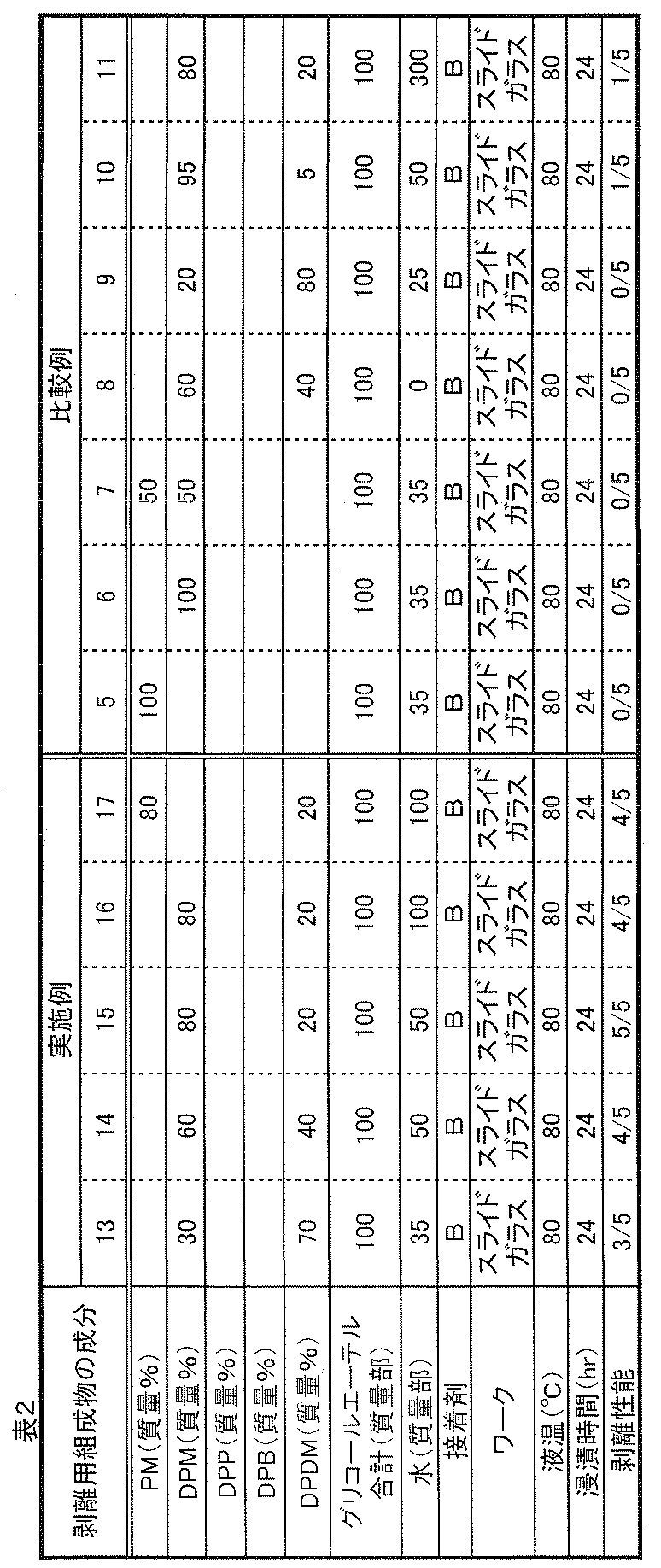
- Example 2 to 12 Comparative Examples 1 to 4 A peel test was conducted in the same manner as in Example 1 except that the stripping composition having the composition shown in Table 1 was used. The peeling performance was evaluated based on how many of the five test pieces were able to peel the slide glass. The results are shown in Table 1.
- Examples 13 to 17 and Comparative Examples 5 to 11 (Production of test piece) A test piece was prepared in the same manner as in Example 1 using a commercially available cyanoacrylate adhesive B (adhesive mainly composed of ethyl cyanoacrylate).
- Examples 18 to 20, Comparative Examples 12 to 14 (Production of test piece) About 0.02 g of commercially available cyanoacrylate adhesive A used in Example 1 was applied onto a slide glass having dimensions of 76 mm ⁇ 26 mm ⁇ thickness 1.0 mm, and then a commercially available silicon wafer was cut from the top ( Five sets of test pieces were prepared by overlapping and pasting the dimensions 25 mm ⁇ 20 mm) and curing the adhesive.
- Example 21 (Production of test piece)
- the commercially available cyanoacrylate adhesive A used in Example 1 was applied onto a slide glass A (dimensions 100 mm ⁇ 100 mm ⁇ thickness 1.0 mm), and then an aluminum nitride substrate (dimensions 76 mm ⁇ 76 mm ⁇ thickness) was formed thereon. 1.0 mm).
- the slide glass B (dimension 76 mm x 76 mm x thickness 0.3mm) was laminated
- the adhesive was cured, it was processed with a cutting machine from the slide glass B side, and the slide glass B and the aluminum nitride substrate were cut into chips (dimensions 3 mm ⁇ 3 mm, 64 pieces). At this time, the slide glass A was not cut into a chip shape, but was cut so as to be in a state where only a cut was made.
- test piece was immersed in the stripping composition heated to 80 ° C. After being immersed for 12 hours, a test piece was taken out from the peeling composition, and the state of peeling was evaluated. In all the test pieces, the aluminum nitride substrate could be peeled off. The results are shown in Table 4.
- Example 22 Comparative Examples 15 and 16 A peel test was conducted in the same manner as in Example 21 except that the stripping composition having the composition shown in Table 4 was used. The peeling performance was evaluated by how many of the 64 pieces of test pieces were able to peel the aluminum nitride substrate. The results are shown in Table 4.
- Example 23 (Preparation of test sample) In Example 1, two sets of test pieces were prepared in the same manner except that a fluorophosphate glass plate (“S-FPL51” manufactured by OHARA INC.) was used instead of the slide glass.
- S-FPL51 fluorophosphate glass plate
- test samples (2 sets) were immersed in the stripping composition heated to 80 ° C. After being immersed for 20 hours, a test sample was taken out of the stripping composition, and the stripped state was evaluated. In all the test samples, scratches on the surface of the fluorophosphate glass plate were observed. These results are shown in Table 5.
Landscapes
- Chemical & Material Sciences (AREA)
- Wood Science & Technology (AREA)
- Life Sciences & Earth Sciences (AREA)
- Engineering & Computer Science (AREA)
- Chemical Kinetics & Catalysis (AREA)
- Organic Chemistry (AREA)
- General Chemical & Material Sciences (AREA)
- Materials Engineering (AREA)
- Health & Medical Sciences (AREA)
- Emergency Medicine (AREA)
- Oil, Petroleum & Natural Gas (AREA)
- Detergent Compositions (AREA)
- Adhesives Or Adhesive Processes (AREA)
- Paints Or Removers (AREA)
Abstract
Description
本発明のシアノアクリレート系接着剤剥離用組成物(以下、単に剥離用組成物ともいう)は、20℃で水と均一に相溶するプロピレングリコールアルキルエーテル(A)と20℃で水と50容量%以下の割合でしか相溶しないプロピレングリコールアルキルエーテル(B)とを質量比で(A):(B)=25~90:10~75の割合(但し、両者の合計は100である。)で含有し、水(C)を、前記(A)と(B)との合計量100質量部に対し、10~250質量部含有することを特徴とする。
本発明の剥離用組成物は、20℃で水と均一に相溶するプロピレングリコールアルキルエーテル(A)を含む。20℃で水と均一に相溶するプロピレングリコールアルキルエーテル(A)とは、配合量に関係なく、20℃で水に相溶するプロピレングリコールアルキルエーテルを指す。
本発明の剥離用組成物は、20℃で水と50容量%以下の割合でしか相溶しないプロピレングリコールアルキルエーテル(B)を含む。20℃で水と50容量%以下の割合でしか相溶しないプロピレングリコールアルキルエーテルとは、20℃で水への溶解度が50容量%以下のプロピレングリコールアルキルエーテルであることを指し、20℃の水100mlに対して、均一に相溶することが可能なプロピレングリコールアルキルエーテル量が50ml以下のプロピレングリコールアルキルエーテルであることを指す。例えば、20℃で水への溶解度が5.2容量%とは、20℃の水100mlに対して、5.2ml以下のプロピレングリコールアルキルエーテルが均一に相溶することを意味する。なお、20℃で水への溶解度が5.2容量%のプロピレングリコールアルキルエーテルを20℃の水100mlに対し、5.2mlを超える量で用いると20℃の水100mlに均一に相溶しない。
以下、このプロピレングリコールアルキルエーテル(B)を単に低相溶性成分(B)ともいう。
本発明の剥離用組成物は、水(C)を含む。水(C)は、剥離用組成物の引火性を低下させ、安全性を向上させ、さらに、シアノアクリレート系接着剤の剥離にも有効に作用する。本発明で使用する水(C)は、下記被洗浄物品やその用途に応じて適宜決定すればよいが、例えば、超純水、純水、イオン交換水、蒸留水、通常の水道水を使用することができる。
本発明の剥離用組成物には、高相溶性成分(A)、低相溶性成分(B)、および水(C)の他、本発明の効果を阻害しない範囲で、使用する用途に応じて、防腐剤、防錆剤、界面活性剤、酸化防止剤、消泡剤を配合することもできる。なお、本発明の剥離用組成物は、有機溶剤を含まないことが好ましい。有機溶剤を含まないと、引火性が低く、作業性等に優れる。
本発明のシアノアクリレート系接着剤剥離用組成物は、前記高相溶性成分(A)、前記低相溶性成分(B)および前記水(C)を、前記の割合で含有することを特徴とする。高相溶性成分(A)が25質量%未満であって、低相溶性成分(B)が75質量%を超える場合は、シアノアクリレート系接着剤の剥離効果が低下する恐れがある。本発明においては、水がシアノアクリレート系接着剤の剥離に作用していると考えられる。そのため、高相溶性成分(A)が少なすぎると、分離しない均一な剥離用組成物を得るためには、剥離組成物中の水(C)の量を少なくする必要がある。そのため、剥離効果が低下する恐れがある。また、高相溶性成分(A)が少なくなると、引火等の危険性のない安全な剥離用組成物を得ることが難しくなり、接着剤を剥離する際の作業性に劣る恐れがある。
≪被洗浄物品からシアノアクリレート系接着剤を除去する方法≫
次に、本発明の剥離用組成物を使用してシアノアクリレート系接着剤を剥離する方法について説明する。
本発明において、剥離の対象となるシアノアクリレート系接着剤は、公知の接着剤である。具体的には、シアノアクリル酸メチル、シアノアクリル酸エチル、シアノアクリル酸プロピル、シアノアクリル酸イソブチルなどを主成分とする接着剤が対象となる。この中でも、本発明の剥離用組成物が特に効果を発揮するのは、シアノアクリル酸メチル、シアノアクリル酸エチルおよびシアノアクリル酸プロピルを主成分とする接着剤である。
(被洗浄物品)
本発明において、洗浄の対象となる物品(被洗浄物品)は、特に制限されるものではなく、シアノアクリレート系接着剤を除去する必要がある物品が対象となる。
〔プロピレングリコールアルキルエーテル〕
PM :プロピレングリコールモノメチルエーテル(高相溶性成分)
DPP :ジプロピレングリコールモノプロピルエーテル(低相溶性成分 20℃で水への溶解度(5.2容量%))
DPM :ジプロピレングリコールモノメチルエーテル(高相溶性成分)
DPB :ジプロピレングリコールモノブチルエーテル(低相溶性成分 20℃で水への溶解度(3.3容量%))
DPDM :ジプロピレングリコールジメチルエーテル(低相溶性成分 20℃で水への溶解度(40.8容量%))
実施例1
(テストピースの作製)
市販のシアノアクリレート系接着剤A(シアノアクリル酸プロピルを主成分とする接着剤)約0.02gを、寸法76mm×26mm×厚み1.0mmのスライドガラス上へ塗布した後、その上から同様のスライドガラスを重ね貼り合わせて接着剤を硬化させたものを5セット、テストピースとして準備した。
ジプロピレングリコールモノメチルエーテル(DPM:高相溶性成分)60質量%とジプロピレングリコールモノプロピルエーテル(DPP:低相溶性成分)40質量%とからなるプロピレングリコールアルキルエーテルの混合液を調製し、該プロピレングリコールアルキルエーテルの混合液100質量部に水を35質量部加えて、混合することにより剥離用組成物を調製した。
80℃に加温した前記剥離用組成物に前記テストピース(5セット)を浸漬させた。所定時間浸漬させた後、剥離用組成物中からテストピースを取り出し、剥離の状態を評価した。5セットのテストピース全てにおいて、スライドガラスを剥離することができた。結果を表1に示す。
表1に示す組成の剥離用組成物を用いた以外は実施例1と同様の方法により、剥離試験を行った。剥離性能は、5セットのテストピースのうち何セット、スライドガラスを剥離できたかで評価した。結果を表1に示す。

(テストピースの作製)
市販のシアノアクリレート系接着剤B(シアノアクリル酸エチルを主成分とする接着剤)を使用して、実施例1と同様にテストピースを準備した。
上記のテストピースを使用し、浸漬時間を24時間とし、表2に示す組成の剥離用組成物を用いた以外は実施例1と同様の方法により、剥離試験を行った。剥離性能は、5セットのテストピースのうち何セット、スライドガラスを剥離できたかで評価した。結果を表2に示す。
(テストピースの作製)
実施例1で使用した市販のシアノアクリレート系接着剤A約0.02gを、寸法76mm×26mm×厚み1.0mmのスライドガラス上へ塗布した後、その上から市販のシリコンウェハーをカットしたもの(寸法25mm×20mm)を重ね貼り合わせて接着剤を硬化させたものを5セット、テストピースとして準備した。
上記のテストピースを使用し、表3に示す組成の剥離用組成物を用いた以外は実施例1と同様の方法により、剥離試験を行った。剥離性能は、5セットのテストピースのうち何セット、シリコンウェハーを剥離できたかで評価した。結果を表3に示す。

(テストピースの作製)
実施例1で使用した市販のシアノアクリレート系接着剤Aを、スライドガラスA(寸法100mm×100mm×厚み1.0mm)の上へ塗布した後、その上から窒化アルミニウム基板(寸法76mm×76mm×厚み1.0mm)を重ね貼り合わせた。そして、貼り合わせた窒化アルミニウム基板の上にシアノアクリレート系接着剤Aを塗布した後、その上からスライドガラスB(寸法76mm×76mm×厚み0.3mm)を重ね貼り合わせ、接着剤を硬化させた。接着剤の硬化後、スライドガラスB側から切断機で加工し、スライドガラスBと窒化アルミニウム基板をチップ状(寸法3mm×3mm、64ピース)に切断した。この際、スライドガラスAはチップ状に切断されずに、切込みが入るだけの状態になるように切断した。
実施例1と同様に剥離用組成物を製造した。
80℃に加温した前記剥離用組成物に前記テストピースを浸漬させた。12時間浸漬させた後、剥離用組成物中からテストピースを取り出し、剥離の状態を評価した。テストピース全てにおいて、窒化アルミニウム基板を剥離することができた。結果を表4に示す。
表4に示す組成の剥離用組成物を用いた以外は、実施例21と同様の方法により剥離試験を行った。剥離性能は、64ピースのテストピースのうち何ピース、窒化アルミニウム基板を剥離できたかで評価した。結果を表4に示す。

(試験用サンプルの準備)
実施例1において、スライドガラスの代わりに弗リン酸塩系ガラス板(株式会社オハラ製「S-FPL51」)を使用した以外は、同様の方法で2セットのテストピースを準備した。
実施例1と同様に剥離用組成物を製造した。
80℃に加温した前記剥離用組成物に前記テストサンプル(2セット)を浸漬させた。20時間浸漬させた後、剥離用組成物中からテストサンプルを取り出し、剥離の状態を評価した。テストサンプル全てにおいて、弗リン酸塩系ガラス板表面の傷を観察した。これらの結果を表5に示す。
○:2セットとも剥離した。
△:1セット剥離し、1セット剥離しなかった。
×:2セットとも剥離しなかった。
の3段階の評価を行った。
表面の傷については、弗リン酸塩系ガラス板のシアノアクリレート系接着剤を付着させなかった面の任意の1cm2について、レーザー顕微鏡観察により、傷(大きさ0.1μm)の数が何個存在するかで評価した。表面の傷の状態は、
◎:1cm2当たり傷が存在しなかった。
○:1cm2当たり傷が1~20個存在した。
×:1cm2当たり20個を超える傷が存在した。又はクラックが発生した。
の3段階の評価を行った。結果を表5に示す。
実施例24~27、比較例17~19
表5に示す組成の剥離用組成物を用いた以外は、実施例23と同様の方法により剥離試験を行った。結果を表5に示す。

Claims (4)
- 20℃で水と均一に相溶するプロピレングリコールアルキルエーテル(A)と20℃で水と50容量%以下の割合でしか相溶しないプロピレングリコールアルキルエーテル(B)とを質量比で(A):(B)=25~90:10~75の割合(但し、両者の合計は100である。)で含有し、
水(C)を、前記(A)と(B)との合計量100質量部に対し、10~250質量部含有することを特徴とするシアノアクリレート系接着剤剥離用組成物。 - 弗リン酸塩系ガラス製物品、シリコン製物品およびセラミックス製物品からなる群から選ばれる1種の被洗浄物品に付着したシアノアクリレート系接着剤を剥離するための請求項1に記載のシアノアクリレート系接着剤剥離用組成物。
- シアノアクリレート系接着剤が付着した被洗浄物品と請求項1に記載の剥離用組成物とを接触させることにより、シアノアクリレート系接着剤を被洗浄物品から剥離することを特徴とするシアノアクリレート系接着剤の除去方法。
- 前記被洗浄物品が、弗リン酸塩系ガラス製物品、シリコン製物品およびセラミックス製物品からなる群から選ばれる1種の物品である請求項3に記載のシアノアクリレート系接着剤の除去方法。
Priority Applications (2)
| Application Number | Priority Date | Filing Date | Title |
|---|---|---|---|
| JP2010541297A JPWO2010064558A1 (ja) | 2008-12-01 | 2009-11-24 | シアノアクリレート系接着剤剥離用組成物、および該接着剤の除去方法 |
| CN2009801457295A CN102216405A (zh) | 2008-12-01 | 2009-11-24 | 氰基丙烯酸酯系粘接剂剥离用组合物、及除去该粘接剂的方法 |
Applications Claiming Priority (4)
| Application Number | Priority Date | Filing Date | Title |
|---|---|---|---|
| JP2008-305879 | 2008-12-01 | ||
| JP2008305879 | 2008-12-01 | ||
| JP2009-041634 | 2009-02-25 | ||
| JP2009041634 | 2009-02-25 |
Publications (1)
| Publication Number | Publication Date |
|---|---|
| WO2010064558A1 true WO2010064558A1 (ja) | 2010-06-10 |
Family
ID=42233210
Family Applications (1)
| Application Number | Title | Priority Date | Filing Date |
|---|---|---|---|
| PCT/JP2009/069789 Ceased WO2010064558A1 (ja) | 2008-12-01 | 2009-11-24 | シアノアクリレート系接着剤剥離用組成物、および該接着剤の除去方法 |
Country Status (4)
| Country | Link |
|---|---|
| JP (1) | JPWO2010064558A1 (ja) |
| CN (1) | CN102216405A (ja) |
| TW (1) | TW201026847A (ja) |
| WO (1) | WO2010064558A1 (ja) |
Cited By (1)
| Publication number | Priority date | Publication date | Assignee | Title |
|---|---|---|---|---|
| JP2012201748A (ja) * | 2011-03-24 | 2012-10-22 | Niitaka:Kk | 粘着ラベル剥離剤組成物及び粘着ラベルの剥離方法 |
Families Citing this family (1)
| Publication number | Priority date | Publication date | Assignee | Title |
|---|---|---|---|---|
| DE102015016338A1 (de) * | 2015-12-09 | 2017-06-14 | Kienle + Spiess Gmbh | Verfahren zur Herstellung von Lamellenpaketen |
Citations (5)
| Publication number | Priority date | Publication date | Assignee | Title |
|---|---|---|---|---|
| JPH07126695A (ja) * | 1993-11-01 | 1995-05-16 | Arakawa Chem Ind Co Ltd | ハンダペースト除去用洗浄剤 |
| JPH083592A (ja) * | 1994-06-24 | 1996-01-09 | Tokuyama Corp | 洗浄剤 |
| JPH08158081A (ja) * | 1994-10-06 | 1996-06-18 | Tokuyama Corp | 物品の洗浄方法 |
| JP2002038196A (ja) * | 2000-07-28 | 2002-02-06 | Japan Energy Corp | 光学部品用洗浄液組成物 |
| JP2003082390A (ja) * | 2001-09-12 | 2003-03-19 | Neos Co Ltd | レンズ及びプリズム製造工程用洗浄剤組成物 |
Family Cites Families (1)
| Publication number | Priority date | Publication date | Assignee | Title |
|---|---|---|---|---|
| GB9319125D0 (en) * | 1993-09-15 | 1993-11-03 | Dow Europ Sa | Cleaning composition |
-
2009
- 2009-11-24 JP JP2010541297A patent/JPWO2010064558A1/ja active Pending
- 2009-11-24 WO PCT/JP2009/069789 patent/WO2010064558A1/ja not_active Ceased
- 2009-11-24 CN CN2009801457295A patent/CN102216405A/zh active Pending
- 2009-11-30 TW TW98140782A patent/TW201026847A/zh unknown
Patent Citations (5)
| Publication number | Priority date | Publication date | Assignee | Title |
|---|---|---|---|---|
| JPH07126695A (ja) * | 1993-11-01 | 1995-05-16 | Arakawa Chem Ind Co Ltd | ハンダペースト除去用洗浄剤 |
| JPH083592A (ja) * | 1994-06-24 | 1996-01-09 | Tokuyama Corp | 洗浄剤 |
| JPH08158081A (ja) * | 1994-10-06 | 1996-06-18 | Tokuyama Corp | 物品の洗浄方法 |
| JP2002038196A (ja) * | 2000-07-28 | 2002-02-06 | Japan Energy Corp | 光学部品用洗浄液組成物 |
| JP2003082390A (ja) * | 2001-09-12 | 2003-03-19 | Neos Co Ltd | レンズ及びプリズム製造工程用洗浄剤組成物 |
Cited By (1)
| Publication number | Priority date | Publication date | Assignee | Title |
|---|---|---|---|---|
| JP2012201748A (ja) * | 2011-03-24 | 2012-10-22 | Niitaka:Kk | 粘着ラベル剥離剤組成物及び粘着ラベルの剥離方法 |
Also Published As
| Publication number | Publication date |
|---|---|
| JPWO2010064558A1 (ja) | 2012-05-10 |
| CN102216405A (zh) | 2011-10-12 |
| TW201026847A (en) | 2010-07-16 |
Similar Documents
| Publication | Publication Date | Title |
|---|---|---|
| JP6550123B2 (ja) | エッチング組成物 | |
| KR102773140B1 (ko) | 포스트 화학적-기계적-폴리싱 세정을 위한 조성물 | |
| KR101968780B1 (ko) | 기판의 세정 방법 | |
| TW201527523A (zh) | 用來移除表面殘餘物的清洗調配物 | |
| KR20100100841A (ko) | 반도체 디바이스용 기판의 세정 방법 및 세정액 | |
| CN101614970A (zh) | 一种光刻胶清洗剂组合物 | |
| KR20140082713A (ko) | 구리/아졸 중합체 억제를 갖는 마이크로일렉트로닉 기판 세정 조성물 | |
| KR20160087089A (ko) | 실리콘계 수지 제거용 조성물 및 이를 이용한 박막 기판 제조 방법 | |
| JP2023184483A (ja) | 半導体基板の製造方法 | |
| KR20180030581A (ko) | 세정 조성물 및 이의 사용 방법 | |
| KR102091543B1 (ko) | 망상형 고분자 용해용 조성물 | |
| KR102230865B1 (ko) | 구리 함유 기판용 세정액 | |
| KR20120005374A (ko) | 폴리이미드 제거용 세정제 조성물 | |
| CN101685272A (zh) | 一种光刻胶清洗剂 | |
| WO2010064558A1 (ja) | シアノアクリレート系接着剤剥離用組成物、および該接着剤の除去方法 | |
| KR102223781B1 (ko) | 경화 고분자 제거용 조성물 | |
| WO2023243661A1 (ja) | 接着剤用洗浄剤組成物 | |
| KR102506217B1 (ko) | 아크릴계 수지 제거용 조성물 | |
| KR20160070385A (ko) | 실리콘계 수지 제거용 조성물 | |
| KR20160044852A (ko) | 금속막용 세정제 조성물 | |
| KR20190113316A (ko) | 실록산계 접착제 제거용 조성물 및 이를 이용한 박형 웨이퍼의 제조방법 | |
| KR102265414B1 (ko) | 금속막용 세정제 조성물 | |
| KR20160033960A (ko) | 금속막용 세정제 조성물 | |
| KR20160032839A (ko) | 금속막용 세정제 조성물 | |
| KR20110008791A (ko) | 기판용 세정액 조성물 및 이를 이용한 기판의 세정방법 |
Legal Events
| Date | Code | Title | Description |
|---|---|---|---|
| WWE | Wipo information: entry into national phase |
Ref document number: 200980145729.5 Country of ref document: CN |
|
| 121 | Ep: the epo has been informed by wipo that ep was designated in this application |
Ref document number: 09830325 Country of ref document: EP Kind code of ref document: A1 |
|
| ENP | Entry into the national phase |
Ref document number: 2010541297 Country of ref document: JP Kind code of ref document: A |
|
| NENP | Non-entry into the national phase |
Ref country code: DE |
|
| 122 | Ep: pct application non-entry in european phase |
Ref document number: 09830325 Country of ref document: EP Kind code of ref document: A1 |