WO2010052851A1 - 体積型ホログラム記録用感光性組成物、及びその製造方法 - Google Patents
体積型ホログラム記録用感光性組成物、及びその製造方法 Download PDFInfo
- Publication number
- WO2010052851A1 WO2010052851A1 PCT/JP2009/005688 JP2009005688W WO2010052851A1 WO 2010052851 A1 WO2010052851 A1 WO 2010052851A1 JP 2009005688 W JP2009005688 W JP 2009005688W WO 2010052851 A1 WO2010052851 A1 WO 2010052851A1
- Authority
- WO
- WIPO (PCT)
- Prior art keywords
- hologram recording
- volume hologram
- photosensitive composition
- volume
- substrate
- Prior art date
- Legal status (The legal status is an assumption and is not a legal conclusion. Google has not performed a legal analysis and makes no representation as to the accuracy of the status listed.)
- Ceased
Links
Images

Classifications
-
- G—PHYSICS
- G03—PHOTOGRAPHY; CINEMATOGRAPHY; ANALOGOUS TECHNIQUES USING WAVES OTHER THAN OPTICAL WAVES; ELECTROGRAPHY; HOLOGRAPHY
- G03H—HOLOGRAPHIC PROCESSES OR APPARATUS
- G03H1/00—Holographic processes or apparatus using light, infrared or ultraviolet waves for obtaining holograms or for obtaining an image from them; Details peculiar thereto
- G03H1/02—Details of features involved during the holographic process; Replication of holograms without interference recording
-
- G—PHYSICS
- G11—INFORMATION STORAGE
- G11B—INFORMATION STORAGE BASED ON RELATIVE MOVEMENT BETWEEN RECORD CARRIER AND TRANSDUCER
- G11B7/00—Recording or reproducing by optical means, e.g. recording using a thermal beam of optical radiation by modifying optical properties or the physical structure, reproducing using an optical beam at lower power by sensing optical properties; Record carriers therefor
- G11B7/24—Record carriers characterised by shape, structure or physical properties, or by the selection of the material
- G11B7/241—Record carriers characterised by shape, structure or physical properties, or by the selection of the material characterised by the selection of the material
- G11B7/242—Record carriers characterised by shape, structure or physical properties, or by the selection of the material characterised by the selection of the material of recording layers
- G11B7/244—Record carriers characterised by shape, structure or physical properties, or by the selection of the material characterised by the selection of the material of recording layers comprising organic materials only
- G11B7/245—Record carriers characterised by shape, structure or physical properties, or by the selection of the material characterised by the selection of the material of recording layers comprising organic materials only containing a polymeric component
-
- G—PHYSICS
- G03—PHOTOGRAPHY; CINEMATOGRAPHY; ANALOGOUS TECHNIQUES USING WAVES OTHER THAN OPTICAL WAVES; ELECTROGRAPHY; HOLOGRAPHY
- G03H—HOLOGRAPHIC PROCESSES OR APPARATUS
- G03H1/00—Holographic processes or apparatus using light, infrared or ultraviolet waves for obtaining holograms or for obtaining an image from them; Details peculiar thereto
- G03H1/02—Details of features involved during the holographic process; Replication of holograms without interference recording
- G03H2001/026—Recording materials or recording processes
- G03H2001/0264—Organic recording material
-
- G—PHYSICS
- G03—PHOTOGRAPHY; CINEMATOGRAPHY; ANALOGOUS TECHNIQUES USING WAVES OTHER THAN OPTICAL WAVES; ELECTROGRAPHY; HOLOGRAPHY
- G03H—HOLOGRAPHIC PROCESSES OR APPARATUS
- G03H1/00—Holographic processes or apparatus using light, infrared or ultraviolet waves for obtaining holograms or for obtaining an image from them; Details peculiar thereto
- G03H1/04—Processes or apparatus for producing holograms
- G03H1/18—Particular processing of hologram record carriers, e.g. for obtaining blazed holograms
- G03H2001/186—Swelling or shrinking the holographic record or compensation thereof, e.g. for controlling the reconstructed wavelength
-
- G—PHYSICS
- G03—PHOTOGRAPHY; CINEMATOGRAPHY; ANALOGOUS TECHNIQUES USING WAVES OTHER THAN OPTICAL WAVES; ELECTROGRAPHY; HOLOGRAPHY
- G03H—HOLOGRAPHIC PROCESSES OR APPARATUS
- G03H2260/00—Recording materials or recording processes
- G03H2260/12—Photopolymer
-
- G—PHYSICS
- G11—INFORMATION STORAGE
- G11B—INFORMATION STORAGE BASED ON RELATIVE MOVEMENT BETWEEN RECORD CARRIER AND TRANSDUCER
- G11B7/00—Recording or reproducing by optical means, e.g. recording using a thermal beam of optical radiation by modifying optical properties or the physical structure, reproducing using an optical beam at lower power by sensing optical properties; Record carriers therefor
- G11B7/24—Record carriers characterised by shape, structure or physical properties, or by the selection of the material
- G11B7/2403—Layers; Shape, structure or physical properties thereof
- G11B7/24035—Recording layers
- G11B7/24044—Recording layers for storing optical interference patterns, e.g. holograms; for storing data in three dimensions [3D], e.g. volume storage
-
- G—PHYSICS
- G11—INFORMATION STORAGE
- G11B—INFORMATION STORAGE BASED ON RELATIVE MOVEMENT BETWEEN RECORD CARRIER AND TRANSDUCER
- G11B7/00—Recording or reproducing by optical means, e.g. recording using a thermal beam of optical radiation by modifying optical properties or the physical structure, reproducing using an optical beam at lower power by sensing optical properties; Record carriers therefor
- G11B7/24—Record carriers characterised by shape, structure or physical properties, or by the selection of the material
- G11B7/241—Record carriers characterised by shape, structure or physical properties, or by the selection of the material characterised by the selection of the material
- G11B7/242—Record carriers characterised by shape, structure or physical properties, or by the selection of the material characterised by the selection of the material of recording layers
- G11B7/244—Record carriers characterised by shape, structure or physical properties, or by the selection of the material characterised by the selection of the material of recording layers comprising organic materials only
- G11B7/246—Record carriers characterised by shape, structure or physical properties, or by the selection of the material characterised by the selection of the material of recording layers comprising organic materials only containing dyes
-
- G—PHYSICS
- G11—INFORMATION STORAGE
- G11B—INFORMATION STORAGE BASED ON RELATIVE MOVEMENT BETWEEN RECORD CARRIER AND TRANSDUCER
- G11B7/00—Recording or reproducing by optical means, e.g. recording using a thermal beam of optical radiation by modifying optical properties or the physical structure, reproducing using an optical beam at lower power by sensing optical properties; Record carriers therefor
- G11B7/24—Record carriers characterised by shape, structure or physical properties, or by the selection of the material
- G11B7/26—Apparatus or processes specially adapted for the manufacture of record carriers
Definitions
- the present invention relates to a photosensitive composition for volume hologram recording used for forming a volume hologram, a method for producing a volume hologram recording medium using the photosensitive composition for volume hologram recording, and the volume hologram.
- the present invention relates to a cured product obtained by photocationically curing a photosensitive composition for recording.
- the present invention also relates to a method for producing a photosensitive composition for volume hologram recording used for forming a volume hologram, a photosensitive composition for volume hologram recording obtained by the production method, and a photosensitive composition for volume hologram recording.
- the present invention relates to a method for producing a volume hologram recording medium using the composition, and a cured product obtained by photocationically curing the photosensitive composition for volume hologram recording.
- Volume holograms are widely used in applications such as design, security, and optical elements because they can represent objects in three dimensions, have high diffraction efficiency and wavelength selectivity, and require advanced manufacturing technology. ing. Volume holograms have high coherence (coherence), cause object light and reference light having the same wavelength to interfere with each other, enter the volume hologram recording material, and three-dimensional information about the object is interference fringes inside the material. It is produced by recording as. This interference fringe is recorded as a refractive index modulation corresponding to the bright and dark part of the interference light. In recent years, attention has been paid to dry-type photosensitive compositions for volume hologram recording, which do not require wet development in the production of volume holograms and can be mass-produced.
- Japanese Patent No. 2849021 discloses a volume hologram composition having high refractive index modulation and excellent transparency.
- This material system is mainly composed of a monomer having a diarylfluorene skeleton as a radically polymerizable compound having a high refractive index, a cationically polymerizable compound, and a binder resin.
- this photosensitive composition for hologram has a radical photopolymerizable group typified by acrylate and methacrylate as a photopolymerizable functional group, and therefore shrinkage due to polymerization is particularly required for dimensional stability. It was an obstacle when applied to optical elements and memories.
- Japanese Patent No. 3075082 discloses a composition comprising, as a high refractive index cationic polymerizable compound, a fluorene derivative oligomer having a glycidyl group, a polymerizable monomer having a refractive index different from that of the oligomer, a photoinitiator, and a sensitizer. It is disclosed.
- the epoxy oligomer becomes a crosslinked structure by cationic polymerization, so that the refractive index is increased, the refractive index modulation is enhanced, and a photosensitive recording medium for hologram having excellent transparency and heat resistance is obtained.
- this photosensitive composition for hologram uses an epoxy group which is a cationic polymerizable group, and although there is little shrinkage in photo radical polymerization, the reactivity of the fluorene derivative oligomer having a glycidyl group is low and there is a problem in sensitivity. there were.
- Japanese Patent No. 4142396 discloses a composition comprising a diarylfluorene derivative oligomer having an oxetanyl group, a binder resin, a photopolymerization initiator, and a sensitizing dye as a high refractive index cationically polymerizable compound. .
- a photosensitive recording medium for hologram having a crosslinked structure, less curing shrinkage, excellent transparency and heat resistance can be obtained by cationic polymerization utilizing the high reactivity of the oxetanyl group.
- this photosensitive composition for holograms is not always satisfactory in terms of volume change before and after photocuring and polymerization reactivity.
- An object of the present invention is to provide a photosensitive composition for volume hologram recording having excellent refractive index modulation ability, high polymerization reactivity, and extremely small volume shrinkage, and the photosensitive composition for volume hologram recording. It is an object of the present invention to provide a simple and efficient method for producing a volume hologram recording medium, and a cured product obtained from the photosensitive resin composition for volume hologram recording.
- Another object of the present invention is a method for easily and efficiently producing a photosensitive composition for volume hologram recording having excellent refractive index modulation ability, extremely small volume shrinkage, and high diffraction efficiency.
- Volume-type hologram recording photosensitive composition, volume-type hologram recording photosensitive composition using the volume-type hologram recording photosensitive composition, and photosensitive resin composition for volume-type hologram recording It is in providing the hardened
- the present inventors have found that in a photosensitive composition for volume hologram recording containing a binder polymer, a cationic photopolymerizable compound, a photopolymerization initiator, and a sensitizing dye, the binder polymer
- the photocationic polymerization reactivity is high, the volume change before and after photocuring is extremely small, and an excellent refractive index modulation ability is obtained.
- the present invention relates to a photosensitive composition for volume hologram recording comprising a binder polymer (A), a photocationically polymerizable compound (B), a photopolymerization initiator (C), and a sensitizing dye (D).
- a photosensitive composition (I) for volume hologram recording wherein the binder polymer (A) is a polymer having a naphthalene ring and having a weight average molecular weight of 10,000 to 1,000,000.
- the photocationically polymerizable compound (B) is preferably a compound having at least one cation polymerizable group selected from the group consisting of an epoxy group, a vinyl ether group and an oxetanyl group in the molecule.
- the refractive index of the binder polymer (A) is larger than the refractive index of the photocationically polymerizable compound (B), and the binder polymer (A) and the photocationic polymerizable property.
- the refractive index difference of the compound (B) is preferably in the range of 0.001 to 0.4.
- the volume shrinkage after hologram recording is 1% or less with reference to before hologram recording.
- the present invention also provides a volume hologram recording medium characterized in that the volume hologram recording layer is formed by applying the photosensitive composition (I) for volume hologram recording onto a substrate or a substrate. Provide a method.
- the same material as the substrate or substrate on which the volume hologram material layer formed or being formed is coated with the volume hologram recording photosensitive composition (I) is further provided.
- a step of coating with a base material or substrate may be included.
- the photosensitive composition (I) for volume hologram recording is applied onto a base material or a substrate so that the volume hologram material layer has a thickness of 10 to 2000 ⁇ m, and the coating layer is used for the volume hologram recording.
- a step of coating with a base material or substrate of the same material as the base material or substrate coated with the photosensitive composition (I) and sealing the peripheral portion may be aged for a predetermined time.
- the present invention further provides a cured product obtained by photocationically curing the photosensitive composition (I) for volume hologram recording.
- a photosensitive composition for volume hologram recording by blending a binder polymer, a photocationic polymerizable compound, a photopolymerization initiator, and a sensitizing dye, as a photocationic polymerizable compound, Using a material that has been heat-treated at a temperature below the boiling point in advance makes it easy to produce a volume hologram recording photosensitive composition (II) having excellent refractive index modulation ability, extremely small volume shrinkage, and high diffraction efficiency. And the present invention was completed.
- the present invention is a photosensitive for volume hologram recording comprising a binder polymer (A ′), a cationic photopolymerizable compound (B ′), a photopolymerization initiator (C ′), and a sensitizing dye (D ′).
- a photosensitive composition for volume type hologram recording characterized in that the photocationically polymerizable compound (B ′) is preheated at a temperature not higher than the boiling point.
- a method for producing the product (II) is provided.
- the photocationically polymerizable compound (B ′) is preferably a compound having at least one cation polymerizable group selected from the group consisting of an epoxy group, a vinyl ether group and an oxetanyl group in the molecule.
- the refractive index of the binder polymer (A ′) is larger than the refractive index of the cationic photopolymerizable compound (B ′), and the refractive index difference between the binder polymer (A ′) and the cationic photopolymerizable compound (B ′) is 0.
- a range of 0.001 to 0.5 is preferable.
- the present invention also provides a photosensitive composition (II) for volume hologram recording obtained by the above production method.
- the volumetric hologram recording photosensitive composition (II) has a volume shrinkage after hologram recording of 1% or less with respect to that before hologram recording.
- the present invention also provides a volume hologram recording medium characterized by forming the volume hologram material layer by coating the photosensitive composition (II) for volume hologram recording on a substrate or a substrate. Provide a method.
- the same material as the substrate or substrate on which the volume hologram material layer formed or being formed is coated with the volume hologram recording photosensitive composition (II) is further provided.
- a step of coating with a base material or substrate may be included.
- the photosensitive composition (II) for volume hologram recording is applied on a base material or a substrate so that the volume hologram material layer has a thickness of 10 to 2000 ⁇ m, and the coating layer is used for the volume hologram recording.
- a step of coating with a base material or a substrate of the same material as the base material or substrate coated with the photosensitive composition (II) and sealing the peripheral portion may be aged for a predetermined time.
- the present invention further provides a cured product obtained by photocationically curing the photosensitive composition (II) for volume hologram recording.
- the photosensitive composition (I) for volume hologram recording of the present invention has excellent refractive index modulation ability, high polymerization reactivity, and extremely small volume shrinkage. Therefore, a hologram having excellent diffraction efficiency and reproducibility can be produced. Further, according to the method for producing a volume hologram recording medium using the photosensitive composition (I) for volume hologram recording of the present invention, a volume hologram recording medium having excellent hologram characteristics such as diffraction efficiency can be easily obtained. Can be manufactured efficiently.
- volume hologram recording having excellent refractive index modulation ability, extremely small volume shrinkage, and high diffraction efficiency.
- Photosensitive composition (II) can be easily and efficiently produced. Therefore, a hologram having excellent diffraction efficiency and reproducibility can be produced.
- a volume hologram recording medium excellent in hologram characteristics such as diffraction efficiency can be easily obtained. Can be manufactured efficiently.
- FIG. 1 is a schematic diagram showing an optical system used for obtaining diffraction efficiency and shrinkage in Examples and Comparative Examples.
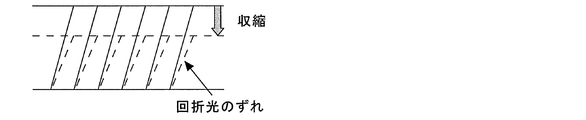
- FIG. 2 is an explanatory diagram showing a method for obtaining the shrinkage rate in Examples and Comparative Examples.
- the photosensitive composition (I) for volume hologram recording of the present invention contains a binder polymer (A), a photocationically polymerizable compound (B), a photopolymerization initiator (C), and a sensitizing dye (D). Yes.
- Binder polymer (A) In the photosensitive composition (I) for volume hologram recording of the present invention, a polymer having a weight average molecular weight of 10,000 to 1,000,000 having a naphthalene ring is used as the binder polymer (A). By using a binder polymer having a naphthalene ring, a large difference in refractive index can be obtained from the photocationically polymerizable compound (B) as a monomer.
- a binder polymer (A) can be used individually or in combination of 2 or more types.
- Examples of the polymer having a naphthalene ring include a monomer having a naphthalene ring or a copolymer thereof, and a copolymer of a monomer having a naphthalene ring and a monomer having no naphthalene ring.
- Examples of the monomer having a naphthalene ring include 1-vinylnaphthalene, 2-vinylnaphthalene, (meth) acrylic acid ester having a naphthalene ring [for example, 1-naphthyl (meth) acrylate, 2-naphthyl (meth) acrylate, etc.] Etc. Of these, 1-vinylnaphthalene and 2-vinylnaphthalene are preferable.
- Examples of the monomer having no naphthalene ring include styrene monomers such as styrene, ⁇ -methylstyrene, and vinyl toluene; (meth) methacrylate (methyl) acrylate, ethyl (meth) acrylate, butyl (meth) acrylate, ) (Meth) acrylic acid aryl esters such as phenyl (meth) acrylate [excluding naphthyl (meth) acrylate], (meth) acrylic acid aralkyl esters such as benzyl (meth) acrylate, (meth) ) (Meth) acrylic acid esters such as (meth) acrylic acid cycloalkyl esters such as cyclohexyl acrylate; cyano group-containing monomers such as (meth) acrylonitrile; (meth) acrylamide; (meth) acrylic acid, maleic anhydride, etc.
- styrene monomers
- Carboxyl or acid anhydride group-containing mono Chromatography vinyl esters such as vinyl acetate; vinyl chloride, ethylene, propylene, olefins such as isobutene; butadiene, and the like conjugated dienes such as isoprene.
- the ratio of the repeating structural unit having a naphthalene ring is, for example, 30% by weight or more, preferably 50% by weight or more, more preferably 80% by weight or more, with respect to the total amount of the repeating units constituting the polymer. It is.
- binder polymer (A) include poly-1-vinylnaphthalene, poly-2-vinylnaphthalene, vinylnaphthalene and (meth) acrylic acid esters [for example, methyl methacrylate, etc. Of (meth) acrylic acid alkyl ester, etc.].
- the weight average molecular weight of the binder polymer (A) is 10,000 to 1,000,000, preferably about 40,000 to 300,000.
- the refractive index of the binder polymer (A) is preferably larger than the refractive index of the photocationically polymerizable compound (B).
- the difference between the refractive index and the refractive index of the cationic photopolymerizable compound (B) is, for example, in the range of 0.001 to 0.4, particularly 0.1 to 0.3. Some are preferred.
- the compounding amount of the binder polymer (A) in the photosensitive composition for volume hologram recording is, for example, 10 to 200 parts by weight, preferably 30 to 100 parts by weight with respect to 100 parts by weight of the cationic photopolymerizable compound (B) (total amount). Used in a proportion of 100 parts by weight.
- the photocationically polymerizable compound (B) is not particularly limited as long as it is a compound having a photocationically polymerizable group, but at least one selected from the group consisting of an epoxy group, a vinyl ether group and an oxetanyl group in the molecule. A compound having a cationic polymerizable group is preferred.
- the number of cationically polymerizable groups in the molecule may be one or two or more.
- the photocationically polymerizable compound (B) can be used alone or in combination of two or more.
- Examples of the compound having an epoxy group include an alicyclic epoxy resin having a cyclic aliphatic group and an epoxy group in the molecule, and an epoxy resin having a glycidyl group.
- alicyclic epoxy resins are preferable, and compounds in which an epoxy group (oxirane ring) is formed including two adjacent carbon atoms constituting a cyclic aliphatic group are particularly preferable.
- the compound having an epoxy group may be either a monofunctional epoxy compound or a polyfunctional epoxy compound, but a polyfunctional epoxy compound is preferred.
- the compound which has an epoxy group can be used individually or in combination of 2 or more types.
- Examples of the alicyclic epoxy resin include 3,4,3 ′, 4′-diepoxybicyclohexyl, bis (3,4-epoxycyclohexyl) adipate, 3,4-epoxycyclohexylmethyl-3 ′, 4 ′.
- alicyclic epoxy resins include, for example, Celoxide 2000, Celoxide 2021, Celoxide 3000, EHPE 3150, manufactured by Daicel Chemical Industries, Ltd .; Epomic VG-3101, manufactured by Mitsui Chemicals; E-1031S manufactured by Yuka Shell Epoxy; For example, TETRAD-X and TETRAD-C manufactured by Mitsubishi Gas Chemical Company, Inc., EPB-13 and EPB-27 manufactured by Nippon Soda Co., Ltd. can be used.
- the compound having a vinyl ether group (vinyl ether compound) is not particularly limited as long as it is a compound having a vinyl ether group, and may be any of a monofunctional vinyl ether compound and a polyfunctional vinyl ether compound. preferable.
- the compounds having a vinyl ether group can be used alone or in combination of two or more.
- the compound having a vinyl ether group include cyclic ether type vinyl ethers such as isosorbite divinyl ether and oxynorbornene divinyl ether (vinyl ethers having a cyclic ether group such as oxirane ring, oxetane ring and oxolane ring); phenyl vinyl ether and the like Aryl vinyl ethers; alkyl vinyl ethers such as n-butyl vinyl ether and octyl vinyl ether; cycloalkyl vinyl ethers such as cyclohexyl vinyl ether; polyfunctional vinyl ethers such as hydroquinone divinyl ether, 1,4-butanediol divinyl ether, cyclohexane divinyl ether, and cyclohexane dimethanol divinyl ether Etc.
- cyclic ether type vinyl ethers such as isosorbite divinyl ether and oxynorbornene
- HEVE 2-hydroxyethyl vinyl ether
- DEGV diethylene glycol monovinyl ether
- HBVE 2-hydroxybutyl vinyl ether
- triethylene glycol divinyl ether etc. manufactured by Maruzen Petrochemical Co., Ltd.
- the vinyl ether compound which has substituents, such as an alkyl group and an allyl group, in alpha and / or beta position can also be used.
- the compound having an oxetanyl group is not particularly limited as long as it is a compound having an oxetanyl group, and may be any of a monofunctional oxetane compound and a polyfunctional oxetane compound. preferable.
- the compounds having an oxetanyl group can be used alone or in combination of two or more.
- Representative examples of the compound having an oxetanyl group include 3,3-dimethanol divinyl ether oxetane having an oxetanyl group and a vinyl ether group, 3-ethyl-3- (phenoxymethyl) oxetane (POX) manufactured by Toagosei Co., Ltd.
- the photocationically polymerizable compound (B) it is preferable to use a combination of one or more epoxy compounds and at least one compound selected from vinyl ether compounds and oxetane compounds from the viewpoint of obtaining high polymerization reactivity.
- the photopolymerization initiator (C) is not particularly limited as long as it is a compound that activates photocationic polymerization.
- ligand metal salts include ( ⁇ 6-benzene) ( ⁇ 5-cyclopentadienyl) iron (II), silanol-aluminum complex, and the like.
- a photoinitiator (C) can be used individually or in combination of 2 or more types.
- the photopolymerization initiator (C) is used at a ratio of, for example, 0.1 to 30 parts by weight, preferably 0.5 to 20 parts by weight with respect to 100 parts by weight of the photocationically polymerizable compound (B) (total amount).
- the photopolymerization initiator (C) is preferably one that is decomposed into a substance having no reaction activity after hologram recording from the viewpoint of stabilization of the recorded hologram.
- the sensitizing dye (D) is not particularly limited as long as it sensitizes the photopolymerization initiator (C), and known ones can be used.
- Examples of the sensitizing dye (D) include thiopyrylium salt dyes, merocyanine dyes, quinoline dyes, styrylquinoline dyes, ketocoumarin dyes, thioxanthene dyes, xanthene dyes, oxonol dyes, cyanine dyes, rhodamines.
- Illustrative examples include pigments and pyrylium salt pigments.
- the visible light sensitizing dye is preferably colorless and transparent when decomposed by a post-process after hologram recording, heating or ultraviolet irradiation when high transparency such as an optical element is required.
- the sensitizing dye (D) can be used alone or in combination of two or more.
- the sensitizing dye is used in a proportion of, for example, 0.01 to 20 parts by weight, preferably 0.01 to 10 parts by weight with respect to 100 parts by weight of the photocationically polymerizable compound (B) (total amount).
- the photosensitive composition (I) for volume hologram recording of the present invention may contain a solvent for improving the coating property.
- the solvent include acetone, methyl ethyl ketone, methyl isobutyl ketone, cyclohexanone and other ketones; benzene, toluene, xylene and other aromatic hydrocarbons; chlorobenzene and other halogenated aromatic hydrocarbons; tetrahydrofuran, 1,4-dioxane, Ethers such as diisopropyl ether (cyclic ether, chain ether); esters such as methyl cellosolve, ethyl cellosolve, methyl cellosolve acetate, ethyl cellosolve acetate, ethyl acetate, butyl acetate; halogenation such as 1,2-dichloroethane, dichloromethane, chloroform Aliphatic hydrocarbons; alcohols such as methanol,
- the photosensitive composition (I) for volume hologram recording of the present invention may contain various additives as required.
- the additive those commonly used can be used.
- the volume shrinkage after hologram recording is preferably 1% or less with reference to before hologram recording. That is, it is desirable that the volume shrinkage before and after curing is 1% or less.
- volume hologram recording medium In the method for producing a volume hologram recording medium of the present invention, the volume hologram recording layer of the present invention is coated on a substrate or a substrate to form a volume hologram material layer. And In the case where the photosensitive composition (I) for volume hologram recording contains a solvent, the volume hologram material layer is formed by applying the solvent on a substrate or a substrate and then drying.
- the substrate or substrate to which the volume hologram recording photosensitive composition (I) (coating liquid) is applied is not particularly limited as long as it has transparency, for example, a polyethylene film, a polypropylene film, a polyfluorinated ethylene film.
- Polyester film such as film, plastic film such as polyimide film (including sheet), polycarbonate film, COP film (cycloolefin polymer, Example, "TOPAS” of Daicel Chemical Industries, Ltd., Nippon Zeon Co., Ltd. “ZEONEX”, JSR Co., Ltd. “Arton”, etc.); such as a glass plate, and the like.
- the thickness of the base material or substrate is, for example, 2 to 2000 ⁇ m, preferably 10 to 1000 ⁇ m.
- the coating liquid does not flow out from the surface of the base material or the substrate.
- an appropriate sealing material for example, epoxy or acrylic thermosetting resin or photo-curable resin.
- a photosensitive medium can be produced.
- a spacer can be used as needed.
- a known method can be adopted, and for example, a spin coater, a gravure coater, a comma coater, a bar coater, a one-drop filling can be used.
- the coating amount of the coating solution is preferably such that the volume hologram material layer has a thickness of, for example, 1 to 2000 ⁇ m, preferably 10 to 1000 ⁇ m.
- the above-exemplified base material or substrate can be coated as a protective film.
- the contact surface of the coating material with the volume hologram material layer may be subjected to a release treatment so that it can be easily peeled off later.
- the volume hologram material layer formed or in the process of being formed is covered with a substrate or substrate of the same material as the substrate or substrate coated with the volume hologram recording photosensitive composition (I). May be.
- this base material or substrate those having transparency are preferable, and those similar to those exemplified as the base material or substrate to which the photosensitive composition (I) for volume hologram recording is applied can be used.
- the volume hologram material layer formed or being formed can be covered with the glass plate
- the base material or substrate to which the photosensitive composition (I) for volume hologram recording is applied is a polyethylene terephthalate (PET) film
- PET polyethylene terephthalate
- the volume hologram recording photosensitive composition (I) is applied onto a substrate or a substrate so that the volume hologram material layer has a thickness of 10 to 2000 ⁇ m, and After drying accordingly, the coating layer (volume hologram layer being formed) is covered with a base material or substrate made of the same material as the base material or substrate coated with the photosensitive composition for volume hologram recording (I). Then, after sealing the peripheral portion, the volume hologram material layer is formed by aging for a predetermined time to produce a volume hologram recording medium.
- a spacer having a thickness of 10 to 2000 ⁇ m may be installed in a frame shape on the peripheral edge of the substrate or substrate on which the volume hologram recording photosensitive material (I) is applied.
- the base material or substrate for coating the coating layer those having transparency are preferable, and those similar to those exemplified as the base material or substrate for coating the photosensitive composition for volume hologram recording (I) are used. it can.
- the aging temperature is, for example, 0 to 50 ° C., preferably about 10 to 40 ° C. Aging can be carried out at room temperature.
- the aging time is not particularly limited, but is usually about 0.1 to 48 hours, preferably about 0.2 to 10 hours, and more preferably about 0.5 to 5 hours. Aging is preferably performed under light-shielding conditions. By this aging, a smooth volume hologram recording layer can be constructed and stable hologram characteristics can be obtained.
- the method for recording a hologram on the volume hologram recording medium of the present invention is not particularly limited, and a known method can be used.
- the original plate is brought into close contact with the hologram recording material layer of the volume hologram recording medium, and the volume is obtained by performing interference exposure using ionizing radiation such as visible light, ultraviolet light, or electron beam from the transparent substrate film side.
- Type hologram recording method contact exposure method or when the medium is sandwiched between glass and film, the laser beam is incident from the medium side, and recording is performed by the interference between the reflected laser beam from the original and the incident laser beam Recording by dividing the laser light into two directions, one of which is directly incident on the photosensitive material, and the other is incident by entering light (information light) through an object having information to be recorded
- Examples include a method (two-beam interference), a method of irradiating information light and reference light from the same axis (collinear method), and the like.
- visible laser light such as argon ion laser (458 nm, 488 nm, 514.5 nm), krypton ion laser (647.1 nm), helium-neon ion laser (633 nm), semiconductor laser ( 405 nm, 532 nm) or the like can be used.
- Such a hologram recorded corresponds to a cured product obtained by photocuring the volume hologram recording photosensitive composition (I) of the present invention.
- the hologram recording mechanism using the photosensitive composition (I) for volume hologram recording in the present invention will be described.
- the photosensitive composition for volume hologram recording (I) volume hologram material layer
- cationic polymerization is initiated at a portion where the light is strong, and accordingly, photocationic polymerization is performed.
- a concentration gradient of the compound (B) is produced, and the diffusive transfer of the photocationically polymerizable compound (B) occurs from a weak light portion to a strong light portion.
- the photocationically polymerizable compound (B) can be made dense and dense depending on the strength of the interference fringes, and appears as a difference in refractive index.
- a hologram is recorded by the difference in refractive index between the photocationically polymerizable compound (B) and the binder polymer (A). After recording, fixing by exposure and / or heat treatment may be performed.
- the heating temperature close to the glass transition temperature of the binder polymer (A) during recording, the movement of the photocationically polymerizable compound (B) can be further promoted, and the refractive index modulation amount can be increased.
- the photosensitive composition for volume hologram recording is prepared by blending the dye-sensitive dye (D ′), the photocationically polymerizable compound (B ′) that has been previously heat-treated at a temperature equal to or lower than the boiling point is used. .
- binder polymer (A ′) examples include poly (meth) acrylic acid ester or a partially hydrolyzed product thereof, polyvinyl acetate or a hydrolyzed product thereof, polyvinyl alcohol or a partially acetalized product thereof, triacetyl cellulose, polyisoprene, and polybutadiene.
- Polychloroprene polyvinyl chloride, polyarylate, chlorinated polyethylene, chlorinated polypropylene, poly N-vinyl carbazole or derivatives thereof, poly N-pyrrolidone or derivatives thereof; monomers having a benzene ring such as styrene and naphthalene such as vinyl naphthalene Polymer of monomer having ring or copolymer thereof (for example, polystyrene, poly-1-vinylnaphthalene, poly-2-vinylnaphthalene, copolymer of vinylnaphthalene and acrylate, styrene and maleic anhydride Copolymer or half ester thereof); polymerizing at least one copolymerizable monomer group such as acrylic acid, acrylic ester, methacrylic acid, methacrylic ester, acrylamide, acrylonitrile, ethylene, propylene, vinyl chloride, vinyl acetate A copolymer or the like as
- the weight average molecular weight of the binder polymer (A ′) is, for example, 10,000 to 1,000,000, preferably about 40,000 to 300,000.
- the refractive index of the binder polymer (A ′) is preferably larger than the refractive index of the photocationically polymerizable compound (B ′). Further, as the binder polymer (A ′), the difference between the refractive index and the refractive index of the photocationically polymerizable compound (B ′) is, for example, 0.001 to 0.5, particularly 0.1 to 0.3. A range is preferred. By using the binder polymer (A ′) having such characteristics, good hologram characteristics can be obtained.
- the blending amount of the binder polymer (A ′) in the photosensitive composition for volume hologram recording is, for example, 10 to 200 parts by weight, preferably 100 parts by weight with respect to 100 parts by weight of the photocationically polymerizable compound (B ′) (total amount). Used in a proportion of 30 to 100 parts by weight.
- a photocationically polymerizable compound (B ′) that has been previously heat-treated at a temperature equal to or lower than the boiling point is used.
- the temperature is 80 ° C. or higher and the boiling point or lower (eg, 80 to 150 ° C.), preferably 85 ° C. or higher and the boiling point or lower (eg, 85 to 130 ° C.).
- the heating time is not particularly limited, but is usually about 0.1 to 24 hours, preferably about 0.2 to 10 hours, and more preferably about 0.5 to 5 hours.
- the heat treatment may be performed in an air atmosphere or an inert gas atmosphere such as nitrogen. Of these, an air atmosphere is preferred.
- the heat treatment may be performed under any conditions of normal pressure, reduced pressure, and increased pressure.
- a photocationically polymerizable compound (B ′) that has been previously heat-treated at a temperature below the boiling point is used, the hologram characteristics such as diffraction efficiency are remarkably improved, for example, to increase the compatibility between monomers.
- Photoinitiator (C ′) The compound of the photopolymerization initiator (C ′) is the same as the compound represented by the photopolymerization initiator (C).
- the photopolymerization initiator (C ′) is, for example, 0.1 to 30 weights with respect to 100 parts by weight of the photocationically polymerizable compound (B ′) (total amount). Parts, preferably 1 to 20 parts by weight.
- the photopolymerization initiator (C ′) is preferably one that is decomposed into a substance having no reaction activity after hologram recording from the viewpoint of stabilization of the recorded hologram.
- sensitizing dye (D ′) The compound of the sensitizing dye (D ′) and the blending amount thereof are the same as the compound represented by the sensitizing dye (D) and the blending amount thereof.
- the photocationically polymerizable compound (B ′) subjected to the heat treatment, a binder polymer (A ′), a photopolymerization initiator ( C ′) and a sensitizing dye (D ′) are blended to prepare a volume hologram recording photosensitive composition (II).
- the order of blending the above components is not particularly limited. Also, the mixing method and the like are not particularly limited.
- a solvent may be used as necessary for improving the coating property.
- the solvent examples include acetone, methyl ethyl ketone, methyl isobutyl ketone, cyclohexanone and other ketones; benzene, toluene, xylene and other aromatic hydrocarbons; chlorobenzene and other halogenated aromatic hydrocarbons; tetrahydrofuran, 1,4-dioxane, Ethers such as diisopropyl ether (cyclic ether, chain ether); esters such as methyl cellosolve, ethyl cellosolve, methyl cellosolve acetate, ethyl cellosolve acetate, ethyl acetate, butyl acetate; halogenation such as 1,2-dichloroethane, dichloromethane, chloroform Aliphatic hydrocarbons; alcohols such as methanol, ethanol and isopropanol; mixed solvents thereof.
- the volume shrinkage after hologram recording is preferably 1% or less with reference to before hologram recording. That is, it is desirable that the volume shrinkage before and after curing is 1% or less.
- volume hologram recording medium Manufacturing method of the present invention, the volume hologram recording photosensitive composition (II) of the present invention is applied onto a substrate or a substrate to form a volume hologram material layer. And When the photosensitive composition (II) for volume hologram recording contains a solvent, the volume hologram material layer is formed by applying the solvent on a substrate or a substrate and then drying.
- a volume hologram recording medium is produced by applying a photosensitive composition (II) for volume hologram recording onto a substrate or a substrate to form a volume hologram material layer. Except for using the volume hologram recording medium (II) instead of (I), the above volume hologram recording photosensitive composition (I) is applied onto a substrate or substrate, and a volume hologram material layer is formed. It is the same as the manufacturing method of the volume hologram recording medium characterized by forming.
- a method for recording a hologram on a volume hologram recording medium wherein the photosensitive composition (II) for volume hologram recording of the present invention is applied on a substrate or a substrate to form a volume hologram material layer.
- the hologram recorded by this method corresponds to a cured product obtained by photocuring the photosensitive composition (II) for volume hologram recording of the present invention.
- the hologram recording mechanism using the photosensitive composition (II) for volume hologram recording in the present invention is a photocationically polymerizable compound (B ′), a binder polymer (A) instead of the photocationically polymerizable compound (B).
- B ′ photocationically polymerizable compound
- A binder polymer
- FIG. 1 shows a schematic diagram of an optical system used in the experiment.
- the light source was a 532 nm semiconductor laser, which was divided into two lights by a beam splitter (BS) through a mirror (M), a spatial filter (OL and Ph), a plano-convex lens (PCL), and a wave plate (PP).
- BS beam splitter
- M mirror
- OLED spatial filter
- PCL plano-convex lens
- PP wave plate
- the diffraction efficiency and shrinkage rate were obtained by the following methods.
- the diffraction efficiency of a hologram recorded by the two-beam interference method was measured using a power meter. A 532 nm semiconductor laser having a diameter of 5 ⁇ was incident at an angle of 30 °, and transmitted light and diffracted light were detected. The hologram recording medium was axially rotated in the range of ⁇ 5 ° to 5 °, and the diffraction efficiency was calculated at the position where the diffracted light intensity was highest [Formula (1)].
- ⁇ L 1 / (L 0 + L 1 ) (Formula 1) (Transmitted light intensity: L 0 , diffracted light intensity: L 1 )
- the hologram recording medium was installed with an inclination of 10 °, and hologram recording was performed with the angles of the recording light and the reference light being 20 ° and 40 °, respectively. Thereafter, the reference light was incident at an angle of 40 °, and the angle indicating the maximum diffraction efficiency was detected ( ⁇ 1 ). When there is no shrinkage, the angle indicated by the maximum diffraction efficiency obtained at that time is 40 °, but the deviation from 40 ° occurs due to the shrinkage (FIG. 2). Similarly, only the recording light was incident at an angle of 20 °, and the angle ( ⁇ 2 ) indicating the maximum diffraction efficiency was detected.
- the grating vector (K 1 and K 2 ) in the thickness direction of the recording medium was obtained from the following (Equation 2) and (Equation 3), and the shrinkage was calculated from (Equation 4).
- K 1 (2 ⁇ / ⁇ ) ⁇ (n 2 ⁇ sin 2 ⁇ 1 ) 1/2 ) ⁇ (n 2 ⁇ sin 2 ⁇ 2 ) 1/2 ) ⁇ ...
- photosensitive solution X-1 The solution dissolved in 30 parts by weight was designated as photosensitive solution X-1.
- This photosensitive solution X-1 is dropped on a glass substrate and coated with an applicator so that the film thickness is 25 ⁇ m, and a PET film with a thickness of 50 ⁇ m is used so that the surface periphery of the glass plate does not touch the photosensitive solution.
- This hologram recording medium X-1 was exposed to light by a two- beam optical system using a semiconductor laser (532 nm, exposure amount 300 mJ / cm 2 ) to perform hologram recording. As a result, the diffraction efficiency was 22% and the shrinkage percentage was 0.4%.
- a binder polymer A
- B a bifunctional vinyl ether compound (oxynorbornene divinyl ether) in
- Photosensitive Solution X-2 The solution dissolved in 280 parts by weight was designated as Photosensitive Solution X-2.
- This photosensitive solution X-2 was dropped on a glass substrate, applied with an applicator so that the film thickness after drying was 25 ⁇ m, and the solvent was sufficiently removed in an oven at 100 ° C., as in Example X-1.
- a hologram recording medium X-2 (hologram material layer thickness 25 ⁇ m) was produced. Thereafter, hologram recording was performed in the same manner as in Example X-1.
- the diffraction efficiency was 35% and the shrinkage rate was -0.3%, indicating expansion.
- a binder polymer A
- B a bifunctional vinyl ether compound (isosorbite divin
- a solution dissolved in 280 parts by weight was designated as a photosensitive solution X-3.
- This photosensitive solution X-3 was dropped on a glass substrate, applied with an applicator so that the film thickness after drying was 25 ⁇ m, and the solvent was sufficiently removed in an oven at 100 ° C., as in Example X-1.
- a hologram recording medium X-3 was produced. Thereafter, hologram recording was performed in the same manner as in Example X-1. As a result, the diffraction efficiency was 33%, and the shrinkage rate was 0.2%.
- a binder polymer A
- B a bifunctional alicyclic epoxy compound
- phenyl vinyl ether so as to have a
- the solution dissolved in the part was designated as photosensitive solution X-4.
- This photosensitive solution X-4 was dropped on a glass substrate, applied with an applicator so that the film thickness after drying was 25 ⁇ m, and the solvent was sufficiently removed in an oven at 100 ° C., as in Example X-1.
- a hologram recording medium X-4 was produced. Thereafter, hologram recording was performed in the same manner as in Example X-1. As a result, the diffraction efficiency was 28%, and the shrinkage rate was 0.2%.
- This photosensitive solution X-5 was dropped on a glass substrate, applied with an applicator so that the film thickness after drying was 25 ⁇ m, and the solvent was sufficiently removed in an oven at 100 ° C., as in Example X-1.
- a hologram recording medium X-5 was produced. Thereafter, hologram recording was performed in the same manner as in Example X-1. As a result, the diffraction efficiency was 33% and the shrinkage rate was 0.8%.
- This photosensitive solution X-6 was dropped on a glass substrate, applied with an applicator so that the film thickness after drying was 25 ⁇ m, and the solvent was sufficiently removed in an oven at 100 ° C., as in Example X-1.
- a hologram recording medium X-6 was produced. Thereafter, hologram recording was performed in the same manner as in Example X-1. As a result, the diffraction efficiency was 25% and the shrinkage rate was 0.8%.
- This photosensitive solution X-7 was dropped on a glass substrate, applied with an applicator so that the film thickness after drying was 25 ⁇ m, and the solvent was sufficiently removed in an oven at 100 ° C., as in Example X-1. Thus, a hologram recording medium X-7 was produced. Thereafter, hologram recording was performed in the same manner as in Example X-1. As a result, the diffraction efficiency was 21% and the shrinkage rate was 0.9%.
- a cationically polymerizable compound (B) prepared by mixing a carboxylate, a trade name “CEL2021P”, manufactured by Daicel Chemical Industries, Ltd.) and a bifunctional vinyl ether compound (oxynorbornene divinyl ether) so that the molar ratio is 7: 1.
- a diphenyliodonium compound (trade name “PI2074”, manufactured by Rhodia) as a photopolymerization initiator (C), and a coumarin dye (trade name “NKX1658”, Hayashibara Biology) as a sensitizing dye (D) Chemical Laboratories) 0.5 parts by weight were prepared, and these were added to 280 parts by weight of cyclohexanone.
- Those obtained by the solution was photosensitive solution X-8.
- This photosensitive solution X-8 was dropped on a glass substrate, applied with an applicator so that the film thickness after drying was 25 ⁇ m, and the solvent was sufficiently removed in an oven at 100 ° C., as in Example X-1.
- a hologram recording medium X-8 was produced. Thereafter, hologram recording was performed in the same manner as in Example X-1. As a result, the diffraction efficiency was 16%, and the shrinkage percentage was 2.3%.
- Comparative Example X-1 70 parts by weight of polystyrene as a binder polymer (A), bifunctional alicyclic epoxy compound (3,4,3 ', 4'-diepoxybicyclohexyl) and bifunctional vinyl ether compound (oxynorbornene divinyl ether) 100 parts by weight of the cationically polymerizable compound (B) mixed so that the molar ratio is 7: 1, and 10 parts by weight of diphenyliodonium compound (trade name “PI2074”, manufactured by Rhodia) as the photopolymerization initiator (C).
- a coumarin-based dye (trade name “NKX1658”, manufactured by Hayashibara Biochemical Laboratories) was prepared as a sensitizing dye (D) and dissolved in 280 parts by weight of cyclohexanone. It was set to -9.
- This photosensitive solution X-9 was dropped on a glass substrate, applied with an applicator so that the film thickness after drying was 25 ⁇ m, and the solvent was sufficiently removed in an oven at 100 ° C., as in Example X-1.
- a hologram recording medium X-9 was produced. Thereafter, hologram recording was performed in the same manner as in Example X-1. As a result, the diffraction efficiency was 18%, and the shrinkage rate was 0.3%.
- Comparative Example X-2 70 parts by weight of polymethyl methacrylate as binder polymer (A), bifunctional alicyclic epoxy compound (3,4,3 ', 4'-diepoxybicyclohexyl) and bifunctional vinyl ether compound (oxynorbornene divinyl ether) ) And 100 parts by weight of a cationically polymerizable compound (B) mixed at a molar ratio of 7: 1, and a diphenyliodonium compound (trade name “PI2074”, manufactured by Rhodia) as a photopolymerization initiator (C).
- A polymethyl methacrylate
- B cationically polymerizable compound
- PI2074 diphenyliodonium compound manufactured by Rhodia
- Photosensitive solution X-10 was obtained. This photosensitive solution X-10 was dropped on a glass substrate, applied with an applicator so that the film thickness after drying was 25 ⁇ m, and the solvent was sufficiently removed in an oven at 100 ° C., as in Example X-1. Thus, a hologram recording medium X-10 was produced. Thereafter, hologram recording was performed in the same manner as in Example X-1. As a result, the diffraction efficiency was 5%, and the shrinkage rate was 0.2%.
- Comparative Example X-3 70 parts by weight of polyvinyl acetate as binder polymer (A), bifunctional alicyclic epoxy compound (3,4,3 ', 4'-diepoxybicyclohexyl) and bifunctional vinyl ether compound (oxynorbornene divinyl ether) 100 parts by weight of the cationically polymerizable compound (B) mixed so that the molar ratio is 7: 1, and a diphenyliodonium compound (trade name “PI2074”, manufactured by Rhodia) as a photopolymerization initiator (C).
- PI2074 diphenyliodonium compound
- Liquid X-11 was obtained.
- This photosensitive solution X-11 was dropped on a glass substrate, applied with an applicator so that the film thickness after drying was 25 ⁇ m, and the solvent was sufficiently removed in an oven at 100 ° C., as in Example X-1.
- a hologram recording medium X-11 was produced. Thereafter, hologram recording was performed in the same manner as in Example X-1. As a result, the diffraction efficiency was 15% and the shrinkage rate was 0.4%.
- Comparative Example X-4 (radical polymerization system) 100 parts by weight of a mixture of pentaerythritol triacrylate and neopentylglycol dimethacrylate (weight ratio 7: 3) as radical polymerizable monomers and 5 parts by weight of diphenyliodonium compound (trade name “PI2074”, manufactured by Rhodia)
- a photosensitizing solution X-12 was prepared by mixing 0.15 parts by weight of a coumarin dye (trade name “NKX1658”, manufactured by Hayashibara Biochemical Laboratories) as a dye and 20 parts by weight of diethyl sebacate as a plasticizer.
- a photosensitive solution X-12 hologram recording was performed in the same manner as in Example X-1. As a result, the diffraction efficiency was 30% and the shrinkage rate was 10.2%.
- Example Y-1 Molar ratio of bifunctional alicyclic epoxy compound (3,4,3 ', 4'-diepoxybicyclohexyl) and bifunctional vinyl ether compound (oxynorbornene divinyl ether) as the photocationically polymerizable compound (B') was mixed in an oil bath in an air atmosphere at 100 ° C. for 30 minutes.
- This photosensitive solution Y-1 is dropped on a glass substrate, applied with an applicator so that the film thickness becomes 50 ⁇ m, and a spacer film with a thickness of 50 ⁇ m is applied so that the surface periphery of the glass plate does not touch the photosensitive solution.
- PET photosensitive solution
- This hologram recording medium Y-1 was exposed by a two- beam optical system using a semiconductor laser (532 nm, exposure amount 300 mJ / cm 2 ) to perform hologram recording. As a result, the diffraction efficiency was 30%, and the shrinkage rate was 0.7%.
- Example Y-2 The photosensitive solution Y-1 obtained in Example Y-1 was dropped on a glass substrate, applied with an applicator so that the film thickness after drying was 50 ⁇ m, and dried at room temperature under light-shielding conditions for 20 hours. In the same manner as in Example Y-1, a hologram recording medium Y-2 was obtained. Thereafter, hologram recording was performed in the same manner as in Example Y-1. As a result, the diffraction efficiency was 45% and the shrinkage rate was 0.4%.
- Example Y-3 The photosensitive solution Y-1 obtained in Example Y-1 was dropped on a glass substrate, applied with an applicator so that the film thickness after drying was 300 ⁇ m, dried at room temperature for 20 hours under light shielding conditions, A hologram recording medium Y-3 was obtained in the same manner as in Example Y-1, except that a 300 ⁇ m spacer film (PET) was used. Thereafter, hologram recording was performed in the same manner as in Example Y-1. As a result, the diffraction efficiency was 20% and the shrinkage rate was 0.3%.
- PET spacer film
- Example Y-4 Molar ratio of bifunctional alicyclic epoxy compound (3,4,3 ', 4'-diepoxybicyclohexyl) and bifunctional vinyl ether compound (isosorbite divinyl ether) as the photocationically polymerizable compound (B') was mixed in an oil bath in an air atmosphere at 100 ° C. for 30 minutes.
- This photosensitive solution Y-2 is dropped on a glass substrate, applied with an applicator so that the film thickness after drying is 50 ⁇ m, dried at room temperature for 20 hours under light-shielding conditions, and the same as in Example Y-1.
- a hologram recording medium Y-4 was obtained.
- hologram recording was performed in the same manner as in Example Y-1.
- the diffraction efficiency was 40% and the shrinkage rate was 0.4%.
- Example Y-5 A bifunctional alicyclic epoxy compound (3,4,3 ', 4'-diepoxybicyclohexyl) and a monofunctional vinyl ether compound (phenyl vinyl ether) as the photocationically polymerizable compound (B') have a molar ratio of 7
- the liquid mixed so as to be 1 was heat-treated in an oil bath at 100 ° C. for 30 minutes in an air atmosphere.
- This photosensitive solution Y-3 is dropped on a glass substrate, applied with an applicator so that the film thickness after drying is 50 ⁇ m, dried at room temperature for 20 hours under light-shielding conditions, and the same as in Example Y-1.
- a hologram recording medium Y-5 was obtained.
- hologram recording was performed in the same manner as in Example Y-1.
- the diffraction efficiency was 38% and the shrinkage rate was 0.3%.
- This photosensitive solution Y-4 was dropped on a glass substrate, applied with an applicator so that the film thickness after drying was 50 ⁇ m, and dried at room temperature for 20 hours under light-shielding conditions, as in Example Y-1.
- a hologram recording medium Y-6 was obtained.
- hologram recording was performed in the same manner as in Example Y-1.
- the diffraction efficiency was 35% and the shrinkage rate was 0.7%.
- Example Y-7 Bifunctional alicyclic epoxy compound (3,4,3 ', 4'-diepoxybicyclohexyl) and monofunctional oxetane compound (3-ethyl-3- (phenoxymethyl) as photocationically polymerizable compound (B') ) Oxetane, manufactured by Toagosei Co., Ltd.) in a molar ratio of 2: 1 was heat-treated at 100 ° C. for 30 minutes in an oil bath in an air atmosphere.
- This photosensitive solution Y-5 was dropped on a glass substrate, applied with an applicator so that the film thickness after drying was 50 ⁇ m, and dried at room temperature for 20 hours under light-shielding conditions, as in Example Y-1.
- a hologram recording medium Y-7 was obtained.
- hologram recording was performed in the same manner as in Example Y-1.
- the diffraction efficiency was 32% and the shrinkage rate was 0.8%.
- This photosensitive solution Y-6 is dropped on a glass substrate, applied with an applicator so that the film thickness after drying is 50 ⁇ m, dried at room temperature for 20 hours under light-shielding conditions, and the same as in Example Y-1.
- a hologram recording medium Y-8 was obtained.
- hologram recording was performed in the same manner as in Example Y-1.
- the diffraction efficiency was 40% and the shrinkage rate was 0.8%.
- This photosensitive solution Y-7 is dropped on a glass substrate, applied with an applicator so that the film thickness after drying becomes 50 ⁇ m, and dried at room temperature for 20 hours under light-shielding conditions, as in Example Y-1.
- a hologram recording medium Y-9 was obtained.
- hologram recording was performed in the same manner as in Example Y-1.
- the diffraction efficiency was 10% and the shrinkage percentage was 2.4%.
- Comparative Example Y-1 A photosensitive solution Y-8 was prepared in the same manner as in Example Y-1, except that the photocationically polymerizable compound (B ′) was not subjected to heat treatment. Thereafter, a hologram recording medium was produced in the same manner as in Example Y-2, and hologram recording was performed. As a result, the diffraction efficiency was 25% and the shrinkage percentage was 0.5%.
- Comparative Example Y-2 A photosensitive solution Y-9 was prepared in the same manner as in Example Y-4 except that the heat treatment of the photocationically polymerizable compound (B ′) was not performed, and then a hologram was prepared in the same manner as in Example Y-4. A recording medium was prepared and hologram recording was performed. As a result, the diffraction efficiency was 23%, and the shrinkage rate was 0.4%.
- Comparative Example Y-3 A photosensitive solution Y-10 was prepared in the same manner as in Example Y-5, except that the heat treatment of the photocationically polymerizable compound (B ′) was not performed, and then a hologram was prepared in the same manner as in Example Y-5. A recording medium was prepared and hologram recording was performed. As a result, the diffraction efficiency was 23%, and the shrinkage rate was 0.4%.
- Comparative Example Y-4 A photosensitive solution Y-11 was prepared in the same manner as in Example Y-6, except that the photocationic polymerizable compound (B ′) was not heat-treated, and then a hologram was prepared in the same manner as in Example Y-6. A recording medium was prepared and hologram recording was performed. As a result, the diffraction efficiency was 15% and the shrinkage rate was 0.8%.
- Comparative Example Y-5 A photosensitive solution Y-12 was prepared in the same manner as in Example Y-7, except that the heat treatment of the photocationically polymerizable compound (B ′) was not performed, and then a hologram was prepared in the same manner as in Example Y-7. A recording medium was prepared and hologram recording was performed. As a result, the diffraction efficiency was 19% and the shrinkage percentage was 0.9%.
- Comparative Example Y-6 A photosensitive solution Y-13 was prepared in the same manner as in Example Y-8, except that the heat treatment of the photocationically polymerizable compound (B ′) was not performed, and then a hologram was prepared in the same manner as in Example Y-8. A recording medium was prepared and hologram recording was performed. As a result, the diffraction efficiency was 20% and the shrinkage rate was 1%.
- the photosensitive composition (I) for volume hologram recording according to the present invention has excellent refractive index modulation ability, high polymerization reactivity, and extremely small volume shrinkage.
- a volume hologram having an excellent refractive index modulation ability, extremely small volume shrinkage, and high expression efficiency can be easily and efficiently produced. Therefore, a hologram excellent in diffraction efficiency and reproducibility can be produced from the photosensitive composition (I) or (II) for volume hologram recording.
- a volume hologram recording medium having excellent hologram characteristics such as diffraction efficiency can be easily and efficiently manufactured.
Landscapes
- Physics & Mathematics (AREA)
- General Physics & Mathematics (AREA)
- Holo Graphy (AREA)
Abstract
Description
本発明の体積型ホログラム記録用感光性組成物(I)では、バインダーポリマー(A)として、ナフタレン環を有する重量平均分子量1万~100万のポリマーを用いる。ナフタレン環を有するバインダーポリマーを用いることで、モノマーである光カチオン重合性化合物(B)との間に大きな屈折率差を得ることができる。バインダーポリマー(A)は単独で又は2種以上を組み合わせて使用できる。
光カチオン重合性化合物(B)としては、光カチオン重合性基を有する化合物であれば特に限定されないが、分子内にエポキシ基、ビニルエーテル基及びオキセタニル基からなる群より選択された少なくとも1種以上のカチオン重合性基を有する化合物が好ましい。分子内のカチオン重合性基の数は1つであってもよく、2以上であってもよい。光カチオン重合性化合物(B)は単独で又は2種以上を組み合わせて使用できる。
光重合開始剤(C)としては、光カチオン重合を活性化する化合物であれば特に限定されず、例えば、芳香族ジアゾニウム塩、芳香族ヨードニウム塩、芳香族スルホニウム塩、芳香族ホスホニウム塩、混合配位子金属塩、例えば、(η6-ベンゼン)(η5-シクロペンタジエニル)鉄(II)、シラノール-アルミニウム錯体等が例示される。光重合開始剤(C)は単独で又は2種以上を組み合わせて使用できる。
増感色素(D)としては、光重合開始剤(C)を増感するものであれば特に限定されず、公知のものを使用できる。増感色素(D)として、例えば、チオピリリウム塩系色素、メロシアニン系色素、キノリン系色素、スチリルキノリン系色素、ケトクマリン系色素、チオキサンテン系色素、キサンテン系色素、オキソノール系色素、シアニン系色素、ローダミン系色素、ピリリウム塩系色素等が例示される。可視光増感色素は、光学素子のような高透明性が要求される場合には、ホログラム記録後の後工程、加熱や紫外線照射により分解し無色透明になるものが好ましい。増感色素(D)は単独で又は2種以上組み合わせて使用できる。
本発明の体積型ホログラム記録用感光性組成物(I)は、塗工性向上のため、溶剤を含んでいてもよい。溶剤としては、例えば、アセトン、メチルエチルケトン、メチルイソブチルケトン、シクロヘキサノン等のケトン;ベンゼン、トルエン、キシレン等の芳香族炭化水素;クロルベンゼン等のハロゲン化芳香族炭化水素;テトラヒドロフラン、1,4-ジオキサン、ジイソプロピルエーテル等のエーテル(環状エーテル、鎖状エーテル);メチルセロソルブ、エチルセロソルブ、メチルセロソルブアセテート、エチルセロソルブアセテート、酢酸エチル、酢酸ブチル等のエステル;1,2-ジクロロエタン、ジクロルメタン、クロロホルム等のハロゲン化脂肪族炭化水素;メタノール、エタノール、イソプロパノール等のアルコール;これらの混合溶剤などが挙げられる。
本発明の体積型ホログラム記録媒体の製造方法では、前記本発明の体積型ホログラム記録用感光性組成物(I)を基材又は基板上に塗布し、体積型ホログラム材料層を形成することを特徴とする。体積型ホログラム記録用感光性組成物(I)が溶剤を含む場合には、基材又は基板上に塗布した後、乾燥することにより体積型ホログラム材料層が形成される。
バインダーポリマー(A’)としては、例えば、ポリ(メタ)アクリル酸エステル又はその部分加水分解物、ポリ酢酸ビニル又はその加水分解物、ポリビニルアルコール又はその部分アセタール化物、トリアセチルセルロース、ポリイソプレン、ポリブタジエン、ポリクロロプレン、ポリ塩化ビニル、ポリアリレート、塩素化ポリエチレン、塩素化ポリプロピレン、ポリN-ビニルカルバゾール又はその誘導体、ポリN-ピロリドン又はその誘導体;スチレン等のベンゼン環を有するモノマーやビニルナフタレン等のナフタレン環を有するモノマーの重合物又はその共重合物(例えば、ポリスチレン、ポリ-1-ビニルナフタレン、ポリ-2-ビニルナフタレン、ビニルナフタレンとアクリレートとの共重合物、スチレンと無水マレイン酸との共重合体、又はその半エステル);アクリル酸、アクリル酸エステル、メタクリル酸、メタクリル酸エステル、アクリルアミド、アクリロニトリル、エチレン、プロピレン、塩化ビニル、酢酸ビニル等の共重合可能なモノマー群の少なくともひとつを重合成分とする共重合体等、またはそれらの混合物が用いられる。これらの中でも、ナフタレン環を有するモノマーの重合物又はその共重合物が好ましい。
光カチオン重合性化合物(B’)の化合物及び化合物を組み合わせて用いる場合の化合物の割合は、上記光カチオン重合性化合物(B)で表される化合物及び化合物を組み合わせて用いる場合の化合物の割合と同じである。
光重合開始剤(C’)の化合物は、上記光重合開始剤(C)で表される化合物と同じである。
増感色素(D’)の化合物及びその配合量は、上記増感色素(D)で表される化合物及びその配合量と同じである。
本発明の体積型ホログラム記録媒体の製造方法では、前記本発明の体積型ホログラム記録用感光性組成物(II)を基材又は基板上に塗布し、体積型ホログラム材料層を形成することを特徴とする。体積型ホログラム記録用感光性組成物(II)が溶剤を含む場合には、基材又は基板上に塗布した後、乾燥することにより体積型ホログラム材料層が形成される。
図1に実験で用いた光学系の概略図を示す。光源は532nm半導体レーザーを用い、ミラー(M)、スペーシャルフィルター(OL及びPh)、平凸レンズ(PCL)、波長板(PP)を介し、ビームスプリッター(BS)で2つの光に分けた。BSで分けられた2つの光をミラーを介し、サンプルに対してそれぞれ30°、30°で入射、干渉させた。回折光及び透過光の強度はパワーメーター(PM:株式会社エーディーシー社製)にてそれぞれ検出した。
(回折効率)
二光束干渉法で記録したホログラムの回折効率をパワーメーターを用いて測定した。口径5φの532nm半導体レーザーを30°の角度で入射し、透過光と回折光を検出した。ホログラム記録媒体を-5°~5°の範囲で軸回転させ、回折光強度が最も高くなる位置で回折効率を算出した[式(1)]。
η=L1/(L0+L1) … (式1)
(透過光強度:L0、回折光強度:L1)
ホログラム記録媒体を10°傾けて設置し、記録光と参照光の角度をそれぞれ20°と40°でホログラム記録を行った。その後、参照光を40°の角度で入射させ、最大回折効率を示す角度を検出した(θ1)。収縮がない場合には、その際に得られる最大回折効率の示す角度は40°であるが、収縮が起こることで40°からのずれが生じる(図2)。また、同様にして、記録光のみを20°の角度で入射させ、最大回折効率を示す角度(θ2)を検出した。これらの角度を用いて、以下の(式2)、(式3)より記録媒体の厚み方向のグレーティングベクトル(K1およびK2)を求め、(式4)より収縮率を算出した。
K1=(2π/λ){(n2-sin2θ1)1/2)-(n2-sin2θ2)1/2)}
… (式2)
(λ:記録波長、n:記録層の屈折率、θ1,θ2:記録前の入射角:40°,20°)
K2=(2π/λ){(n2-sin2θ1′)1/2)-(n2-sin2θ2′)1/2)}
… (式3)
(λ:記録波長、n:記録層の屈折率、θ1′,θ2′:回折効率が最大となる入射角)
収縮率(%)=(K1-K2)/K1x100 … (式4)
(記録前:K1、記録後:K2)
バインダーポリマー(A)としてポリ-2-ビニルナフタレン(Mw=93,000)を60重量部、2官能の脂環式エポキシ化合物(3,4,3′,4′-ジエポキシビシクロヘキシル)と、2官能ビニルエーテル化合物(オキシノルボルネンジビニルエーテル)とを、モル比が7:1になるように混合したカチオン重合性化合物(B)を100重量部、光重合開始剤(C)としてジフェニルヨードニウム化合物(商品名「PI2074」、Rhodia社製)を10重量部、増感色素(D)としてクマリン系色素(商品名「NKX1658」、林原生物化学研究所製)を0.5重量部準備し、これらをシクロヘキサノン30重量部に溶解させたものを感光液X-1とした。この感光液X-1をガラス基板上に滴下し、膜厚が25μmとなるようにアプリケーターにて塗布し、同ガラス板の表面周縁部に、感光液に触れないように、厚み50μmのPETフィルムを額縁状に設置した。その後、塗布層をもう一枚のガラス板で挟み込み、室温で1時間遮光条件下で熟成させることでホログラム記録媒体X-1(ホログラム材料層の厚み25μm)を得た。このホログラム記録媒体X-1に対して、二光束光学系により、半導体レーザー(532nm、露光量300mJ/cm2)を用いて露光しホログラム記録を行った。その結果、回折効率は22%、収縮率は0.4%であった。
バインダーポリマー(A)としてポリ-2-ビニルナフタレン(Mw=93,000)を70重量部、2官能の脂環式エポキシ化合物(3,4,3′,4′-ジエポキシビシクロヘキシル)と、2官能ビニルエーテル化合物(オキシノルボルネンジビニルエーテル)とを、モル比が7:1になるように混合したカチオン重合性化合物(B)を100重量部、光重合開始剤(C)としてジフェニルヨードニウム化合物(商品名「PI2074」、Rhodia社製)を10重量部、増感色素(D)としてクマリン系色素(商品名「NKX1658」、林原生物化学研究所製)を0.5重量部準備し、これらをシクロヘキサノン280重量部に溶解させたものを感光液X-2とした。この感光液X-2をガラス基板上に滴下し、乾燥後の膜厚が25μmとなるようにアプリケーターにて塗布し、100℃のオーブンで十分に溶剤を除去し、実施例X-1と同様にしてホログラム記録媒体X-2(ホログラム材料層の厚み25μm)を作製した。その後、実施例X-1と同様にしてホログラム記録を行った。その結果、回折効率は35%、収縮率は-0.3%であり膨張を示した。
バインダーポリマー(A)としてポリ-2-ビニルナフタレン(Mw=93,000)を70重量部、2官能の脂環式エポキシ化合物(3,4,3′,4′-ジエポキシビシクロヘキシル)と、2官能ビニルエーテル化合物(イソソルバイトジビニルエーテル)とを、モル比が7:1になるように混合したカチオン重合性化合物(B)を100重量部、光重合開始剤(C)としてジフェニルヨードニウム化合物(商品名「PI2074」、Rhodia社製)を10重量部、増感色素(D)としてクマリン系色素(商品名「NKX1658」、林原生物化学研究所製)を0.5重量部準備し、これらをシクロヘキサノン280重量部に溶解させたものを感光液X-3とした。この感光液X-3をガラス基板上に滴下し、乾燥後の膜厚が25μmとなるようにアプリケーターにて塗布し、100℃のオーブンで十分に溶剤を除去し、実施例X-1と同様にしてホログラム記録媒体X-3を作製した。その後、実施例X-1と同様にしてホログラム記録を行った。その結果、回折効率は33%、収縮率は0.2%であった。
バインダーポリマー(A)としてポリ-2-ビニルナフタレン(Mw=93,000)を70重量部、2官能の脂環式エポキシ化合物(3,4,3′,4′-ジエポキシビシクロヘキシル)と、単官能ビニルエーテル化合物(フェニルビニルエーテル)とを、モル比が7:1になるように混合したカチオン重合性化合物(B)を100重量部、光重合開始剤(C)としてジフェニルヨードニウム化合物(商品名「PI2074」、Rhodia社製)を10重量部、増感色素(D)としてクマリン系色素(商品名「NKX1658」、林原生物化学研究所製)を0.5重量部準備し、これらをシクロヘキサノン280重量部に溶解させたものを感光液X-4とした。この感光液X-4をガラス基板上に滴下し、乾燥後の膜厚が25μmとなるようにアプリケーターにて塗布し、100℃のオーブンで十分に溶剤を除去し、実施例X-1と同様にしてホログラム記録媒体X-4を作製した。その後、実施例X-1と同様にしてホログラム記録を行った。その結果、回折効率は28%、収縮率は0.2%であった。
バインダーポリマー(A)としてポリ-2-ビニルナフタレン(Mw=93,000)を70重量部、2官能の脂環式エポキシ化合物(3,4,3′,4′-ジエポキシビシクロヘキシル)と、2官能オキセタン化合物(ジ[1-エチル(3-オキセタニル)]メチルエーテル、東亞合成社製)とを、モル比が2:1になるように混合したカチオン重合性化合物(B)を100重量部、光重合開始剤(C)としてジフェニルヨードニウム化合物(商品名「PI2074」、Rhodia社製)を10重量部、増感色素(D)としてクマリン系色素(商品名「NKX1658」、林原生物化学研究所製)を0.5重量部準備し、これらをシクロヘキサノン280重量部に溶解させたものを感光液X-5とした。この感光液X-5をガラス基板上に滴下し、乾燥後の膜厚が25μmとなるようにアプリケーターにて塗布し、100℃のオーブンで十分に溶剤を除去し、実施例X-1と同様にしてホログラム記録媒体X-5を作製した。その後、実施例X-1と同様にしてホログラム記録を行った。その結果、回折効率は33%、収縮率は0.8%であった。
バインダーポリマー(A)としてポリ-2-ビニルナフタレン(Mw=93,000)を70重量部、2官能の脂環式エポキシ化合物(3,4,3′,4′-ジエポキシビシクロヘキシル)と、単官能オキセタン化合物(3-エチル-3-(フェノキシメチル)オキセタン、東亞合成社製)とを、モル比が2:1になるように混合したカチオン重合性化合物(B)を100重量部、光重合開始剤(C)としてジフェニルヨードニウム化合物(商品名「PI2074」、Rhodia社製)を10重量部、増感色素(D)としてクマリン系色素(商品名「NKX1658」、林原生物化学研究所製)を0.5重量部準備し、これらをシクロヘキサノン280重量部に溶解させたものを感光液X-6とした。この感光液X-6をガラス基板上に滴下し、乾燥後の膜厚が25μmとなるようにアプリケーターにて塗布し、100℃のオーブンで十分に溶剤を除去し、実施例X-1と同様にしてホログラム記録媒体X-6を作製した。その後、実施例X-1と同様にしてホログラム記録を行った。その結果、回折効率は25%、収縮率は0.8%であった。
バインダーポリマー(A)としてポリ-2-ビニルナフタレン(Mw=93,000)を70重量部、2官能の脂環式エポキシ化合物(3,4,3′,4′-ジエポキシビシクロヘキシル)と、2官能ビニルエーテル-単官能オキセタン化合物(3,3-ジメタノールジビニルエーテルオキセタン)とを、モル比が2:1になるように混合したカチオン重合性化合物(B)を100重量部、光重合開始剤(C)としてジフェニルヨードニウム化合物(商品名「PI2074」、Rhodia社製)を10重量部、増感色素(D)としてクマリン系色素(商品名「NKX1658」、林原生物化学研究所製)を0.5重量部準備し、これらをシクロヘキサノン280重量部に溶解させたものを感光液X-7とした。この感光液X-7をガラス基板上に滴下し、乾燥後の膜厚が25μmとなるようにアプリケーターにて塗布し、100℃のオーブンで十分に溶剤を除去し、実施例X-1と同様にしてホログラム記録媒体X-7を作製した。その後、実施例X-1と同様にしてホログラム記録を行った。その結果、回折効率は21%、収縮率は0.9%であった。
バインダーポリマー(A)としてポリ-2-ビニルナフタレン(Mw=93,000)を70重量部、2官能の脂環式エポキシ化合物(3,4-エポキシシクロへキシルメチル-3′,4′-エポキシシクロヘキサンカルボキシレート、商品名「CEL2021P」、ダイセル化学工業社製)と、2官能ビニルエーテル化合物(オキシノルボルネンジビニルエーテル)とを、モル比が7:1になるように混合したカチオン重合性化合物(B)を100重量部、光重合開始剤(C)としてジフェニルヨードニウム化合物(商品名「PI2074」、Rhodia社製)を10重量部、増感色素(D)としてクマリン系色素(商品名「NKX1658」、林原生物化学研究所製)を0.5重量部準備し、これらをシクロヘキサノン280重量部に溶解させたものを感光液X-8とした。この感光液X-8をガラス基板上に滴下し、乾燥後の膜厚が25μmとなるようにアプリケーターにて塗布し、100℃のオーブンで十分に溶剤を除去し、実施例X-1と同様にしてホログラム記録媒体X-8を作製した。その後、実施例X-1と同様にしてホログラム記録を行った。その結果、回折効率は16%、収縮率は2.3%であった。
バインダーポリマー(A)としてポリスチレンを70重量部、2官能の脂環式エポキシ化合物(3,4,3′,4′-ジエポキシビシクロヘキシル)と、2官能ビニルエーテル化合物(オキシノルボルネンジビニルエーテル)とを、モル比が7:1になるように混合したカチオン重合性化合物(B)を100重量部、光重合開始剤(C)としてジフェニルヨードニウム化合物(商品名「PI2074」、Rhodia社製)を10重量部、増感色素(D)としてクマリン系色素(商品名「NKX1658」、林原生物化学研究所製)を0.5重量部準備し、これらをシクロヘキサノン280重量部に溶解させたものを感光液X-9とした。この感光液X-9をガラス基板上に滴下し、乾燥後の膜厚が25μmとなるようにアプリケーターにて塗布し、100℃のオーブンで十分に溶剤を除去し、実施例X-1と同様にしてホログラム記録媒体X-9を作製した。その後、実施例X-1と同様にしてホログラム記録を行った。その結果、回折効率は18%、収縮率は0.3%であった。
バインダーポリマー(A)としてポリメタクリル酸メチルを70重量部、2官能の脂環式エポキシ化合物(3,4,3′,4′-ジエポキシビシクロヘキシル)と、2官能ビニルエーテル化合物(オキシノルボルネンジビニルエーテル)とを、モル比が7:1になるように混合したカチオン重合性化合物(B)を100重量部、光重合開始剤(C)としてジフェニルヨードニウム化合物(商品名「PI2074」、Rhodia社製)を10重量部、増感色素(D)としてクマリン系色素(商品名「NKX1658」、林原生物化学研究所製)を0.5重量部準備し、これらをシクロヘキサノン280重量部に溶解させたものを感光液X-10とした。この感光液X-10をガラス基板上に滴下し、乾燥後の膜厚が25μmとなるようにアプリケーターにて塗布し、100℃のオーブンで十分に溶剤を除去し、実施例X-1と同様にしてホログラム記録媒体X-10を作製した。その後、実施例X-1と同様にしてホログラム記録を行った。その結果、回折効率は5%、収縮率は0.2%であった。
バインダーポリマー(A)としてポリ酢酸ビニルを70重量部、2官能の脂環式エポキシ化合物(3,4,3′,4′-ジエポキシビシクロヘキシル)と、2官能ビニルエーテル化合物(オキシノルボルネンジビニルエーテル)とを、モル比が7:1になるように混合したカチオン重合性化合物(B)を100重量部、光重合開始剤(C)としてジフェニルヨードニウム化合物(商品名「PI2074」、Rhodia社製)を10重量部、増感色素(D)としてクマリン系色素(商品名「NKX1658」、林原生物化学研究所製)を0.5重量部準備し、これらをシクロヘキサノン280重量部に溶解させたものを感光液X-11とした。この感光液X-11をガラス基板上に滴下し、乾燥後の膜厚が25μmとなるようにアプリケーターにて塗布し、100℃のオーブンで十分に溶剤を除去し、実施例X-1と同様にしてホログラム記録媒体X-11を作製した。その後、実施例X-1と同様にしてホログラム記録を行った。その結果、回折効率は15%、収縮率は0.4%であった。
ラジカル重合性モノマーとしてペンタエリスリトールトリアクリレートとネオペンチルグリコールジメタクリレートの混合物(重量比7:3)を100重量部と、ジフェニルヨードニウム化合物(商品名「PI2074」、Rhodia社製)を5重量部、増感色素としてクマリン系色素(商品名「NKX1658」、林原生物化学研究所製)を0.15重量部、可塑剤としてジエチルセバケートを20重量部混合したものを感光液X-12とした。この感光液X-12を用い、実施例X-1と同様にしてホログラム記録を行った。その結果、回折効率は30%、収縮率は10.2%であった。
光カチオン重合性化合物(B’)としての2官能の脂環式エポキシ化合物(3,4,3′,4′-ジエポキシビシクロヘキシル)と2官能ビニルエーテル化合物(オキシノルボルネンジビニルエーテル)とをモル比が7:1になるように混合した液を、オイルバスで空気雰囲気下、100℃で30分間加熱処理した。この加熱処理を施したカチオン重合性化合物(B’)を100重量部、バインダーポリマー(A’)としてポリ-2-ビニルナフタレン(Mw=93,000)を60重量部、光重合開始剤(C’)としてジフェニルヨードニウム化合物(商品名「PI2074」、Rhodia社製)を10重量部、増感色素(D’)としてクマリン系色素(商品名「NKX1658」、林原生物化学研究所製)を0.5重量部準備し、これらをシクロヘキサノン30重量部に溶解させたものを感光液Y-1とした。この感光液Y-1をガラス基板上に滴下し、膜厚が50μmとなるようにアプリケーターにて塗布し、同ガラス板の表面周縁部に、感光液に触れないように、厚み50μmのスペーサーフィルム(PET)を額縁状に設置した。その後、塗布層をもう一枚のガラス板で挟み込み、1時間遮光条件の下、熟成させることでホログラム記録媒体Y-1(ホログラム材料層の厚み:50μm)を得た。このホログラム記録媒体Y-1に対して、二光束光学系により、半導体レーザー(532nm、露光量300mJ/cm2)を用いて露光しホログラム記録を行った。その結果、回折効率は30%、収縮率は0.7%であった。
実施例Y-1で得た感光液Y-1をガラス基板上に滴下し、乾燥後の膜厚が50μmとなるようにアプリケーターにて塗布し、室温で遮光条件の下20時間乾燥させ、実施例Y-1と同様にしてホログラム記録媒体Y-2を得た。その後、実施例Y-1と同様にしてホログラム記録を行った。その結果、回折効率は45%、収縮率は0.4%であった。
実施例Y-1で得た感光液Y-1をガラス基板上に滴下し、乾燥後の膜厚が300μmとなるようにアプリケーターにて塗布し、室温で遮光条件の下20時間乾燥させ、厚み300μmのスペーサーフィルム(PET)を用いた以外は実施例Y-1と同様にしてホログラム記録媒体Y-3を得た。その後、実施例Y-1と同様にしてホログラム記録を行った。その結果、回折効率は20%、収縮率は0.3%であった。
光カチオン重合性化合物(B’)としての2官能の脂環式エポキシ化合物(3,4,3′,4′-ジエポキシビシクロヘキシル)と2官能ビニルエーテル化合物(イソソルバイトジビニルエーテル)とをモル比が7:1になるように混合した液を、オイルバスで空気雰囲気下、100℃で30分間加熱処理した。この加熱処理を施したカチオン重合性化合物(B’)を100重量部、バインダーポリマー(A’)としてポリ-2-ビニルナフタレン(Mw=93,000)を60重量部、光重合開始剤(C’)としてジフェニルヨードニウム化合物(商品名「PI2074」、Rhodia社製)を10重量部、増感色素(D’)としてクマリン系色素(商品名「NKX1658」、林原生物化学研究所製)を0.5重量部準備し、これらをシクロヘキサノン30重量部に溶解させたものを感光液Y-2とした。この感光液Y-2をガラス基板上に滴下し、乾燥後の膜厚が50μmとなるようにアプリケーターにて塗布し、室温で遮光条件の下20時間乾燥させ、実施例Y-1と同様にしてホログラム記録媒体Y-4を得た。その後、実施例Y-1と同様にしてホログラム記録を行った。その結果、回折効率は40%、収縮率は0.4%であった。
光カチオン重合性化合物(B’)としての2官能の脂環式エポキシ化合物(3,4,3′,4′-ジエポキシビシクロヘキシル)と単官能ビニルエーテル化合物(フェニルビニルエーテル)とをモル比が7:1になるように混合した液を、オイルバスで空気雰囲気下、100℃で30分間加熱処理した。この加熱処理を施したカチオン重合性化合物(B’)を100重量部、バインダーポリマー(A’)としてポリ-2-ビニルナフタレン(Mw=93,000)を60重量部、光重合開始剤(C’)としてジフェニルヨードニウム化合物(商品名「PI2074」、Rhodia社製)を10重量部、増感色素(D’)としてクマリン系色素(商品名「NKX1658」、林原生物化学研究所製)を0.5重量部準備し、これらをシクロヘキサノン30重量部に溶解させたものを感光液Y-3とした。この感光液Y-3をガラス基板上に滴下し、乾燥後の膜厚が50μmとなるようにアプリケーターにて塗布し、室温で遮光条件の下20時間乾燥させ、実施例Y-1と同様にしてホログラム記録媒体Y-5を得た。その後、実施例Y-1と同様にしてホログラム記録を行った。その結果、回折効率は38%、収縮率は0.3%であった。
光カチオン重合性化合物(B’)としての2官能の脂環式エポキシ化合物(3,4,3′,4′-ジエポキシビシクロヘキシル)と2官能オキセタン化合物(ジ[1-エチル(3-オキセタニル)]メチルエーテル、東亞合成社製)とをモル比が2:1になるように混合した液を、オイルバスで空気雰囲気下、100℃で30分間加熱処理した。この加熱処理を施したカチオン重合性化合物(B’)を100重量部、バインダーポリマー(A’)としてポリ-2-ビニルナフタレン(Mw=93,000)を60重量部、光重合開始剤(C’)としてジフェニルヨードニウム化合物(商品名「PI2074」、Rhodia社製)を10重量部、増感色素(D’)としてクマリン系色素(商品名「NKX1658」、林原生物化学研究所製)を0.5重量部準備し、これらをシクロヘキサノン30重量部に溶解させたものを感光液Y-4とした。この感光液Y-4をガラス基板上に滴下し、乾燥後の膜厚が50μmとなるようにアプリケーターにて塗布し、室温で遮光条件の下20時間乾燥させ、実施例Y-1と同様にしてホログラム記録媒体Y-6を得た。その後、実施例Y-1と同様にしてホログラム記録を行った。その結果、回折効率は35%、収縮率は0.7%であった。
光カチオン重合性化合物(B’)としての2官能の脂環式エポキシ化合物(3,4,3′,4′-ジエポキシビシクロヘキシル)と単官能オキセタン化合物(3-エチル-3-(フェノキシメチル)オキセタン、東亞合成社製)とをモル比が2:1になるように混合した液を、オイルバスで空気雰囲気下、100℃で30分間加熱処理した。この加熱処理を施したカチオン重合性化合物(B’)を100重量部、バインダーポリマー(A’)としてポリ-2-ビニルナフタレン(Mw=93,000)を60重量部、光重合開始剤(C’)としてジフェニルヨードニウム化合物(商品名「PI2074」、Rhodia社製)を10重量部、増感色素(D’)としてクマリン系色素(商品名「NKX1658」、林原生物化学研究所製)を0.5重量部準備し、これらをシクロヘキサノン30重量部に溶解させたものを感光液Y-5とした。この感光液Y-5をガラス基板上に滴下し、乾燥後の膜厚が50μmとなるようにアプリケーターにて塗布し、室温で遮光条件の下20時間乾燥させ、実施例Y-1と同様にしてホログラム記録媒体Y-7を得た。その後、実施例Y-1と同様にしてホログラム記録を行った。その結果、回折効率は32%、収縮率は0.8%であった。
光カチオン重合性化合物(B’)としての2官能の脂環式エポキシ化合物(3,4,3′,4′-ジエポキシビシクロヘキシル)と2官能ビニルエーテル-単官能オキセタン化合物(3,3-ジメタノールジビニルエーテルオキセタン)とをモル比が2:1になるように混合した液を、オイルバスで空気雰囲気下、100℃で30分間加熱処理した。この加熱処理を施したカチオン重合性化合物(B’)を100重量部、バインダーポリマー(A’)としてポリ-2-ビニルナフタレン(Mw=93,000)を60重量部、光重合開始剤(C’)としてジフェニルヨードニウム化合物(商品名「PI2074」、Rhodia社製)を10重量部、増感色素(D’)としてクマリン系色素(商品名「NKX1658」、林原生物化学研究所製)を0.5重量部準備し、これらをシクロヘキサノン30重量部に溶解させたものを感光液Y-6とした。この感光液Y-6をガラス基板上に滴下し、乾燥後の膜厚が50μmとなるようにアプリケーターにて塗布し、室温で遮光条件の下20時間乾燥させ、実施例Y-1と同様にしてホログラム記録媒体Y-8を得た。その後、実施例Y-1と同様にしてホログラム記録を行った。その結果、回折効率は40%、収縮率は0.8%であった。
光カチオン重合性化合物(B’)としての2官能の脂環式エポキシ化合物(3,4-エポキシシクロへキシルメチル-3′,4′-エポキシシクロヘキサンカルボキシレート、商品名「CEL2021P」、ダイセル化学工業社製)と2官能ビニルエーテル化合物(オキシノルボルネンジビニルエーテル)とをモル比が7:1になるように混合した液を、オイルバスで空気雰囲気下、100℃で30分間加熱処理した。この加熱処理を施したカチオン重合性化合物(B’)を100重量部、バインダーポリマー(A’)としてポリ-2-ビニルナフタレン(Mw=93,000)を60重量部、光重合開始剤(C’)としてジフェニルヨードニウム化合物(商品名「PI2074」、Rhodia社製)を10重量部、増感色素(D’)としてクマリン系色素(商品名「NKX1658」、林原生物化学研究所製)を0.5重量部準備し、これらをシクロヘキサノン30重量部に溶解させたものを感光液Y-7とした。この感光液Y-7をガラス基板上に滴下し、乾燥後の膜厚が50μmとなるようにアプリケーターにて塗布し、室温で遮光条件の下20時間乾燥させ、実施例Y-1と同様にしてホログラム記録媒体Y-9を得た。その後、実施例Y-1と同様にしてホログラム記録を行った。その結果、回折効率は10%、収縮率は2.4%であった。
光カチオン重合性化合物(B’)の加熱処理を行わなかったこと以外は、実施例Y-1と同様にして、感光液Y-8を調製した。その後、実施例Y-2と同様にしてホログラム記録媒体を作製し、ホログラム記録を行った。その結果、回折効率は25%、収縮率は0.5%であった。
光カチオン重合性化合物(B’)の加熱処理を行わなかったこと以外は、実施例Y-4と同様にして感光液Y-9を調製し、その後、実施例Y-4と同様にしてホログラム記録媒体を作製し、ホログラム記録を行った。その結果、回折効率は23%、収縮率は0.4%であった。
光カチオン重合性化合物(B’)の加熱処理を行わなかったこと以外は、実施例Y-5と同様にして感光液Y-10を調製し、その後、実施例Y-5と同様にしてホログラム記録媒体を作製し、ホログラム記録を行った。その結果、回折効率は23%、収縮率は0.4%であった。
光カチオン重合性化合物(B’)の加熱処理を行わなかったこと以外は、実施例Y-6と同様にして感光液Y-11を調製し、その後、実施例Y-6と同様にしてホログラム記録媒体を作製し、ホログラム記録を行った。その結果、回折効率は15%、収縮率は0.8%であった。
光カチオン重合性化合物(B’)の加熱処理を行わなかったこと以外は、実施例Y-7と同様にして感光液Y-12を調製し、その後、実施例Y-7と同様にしてホログラム記録媒体を作製し、ホログラム記録を行った。その結果、回折効率は19%、収縮率は0.9%であった。
光カチオン重合性化合物(B’)の加熱処理を行わなかったこと以外は、実施例Y-8と同様にして感光液Y-13を調製し、その後、実施例Y-8と同様にしてホログラム記録媒体を作製し、ホログラム記録を行った。その結果、回折効率は20%、収縮率は1%であった。
Claims (17)
- バインダーポリマー(A)と、光カチオン重合性化合物(B)と、光重合開始剤(C)と、増感色素(D)とを含有する体積型ホログラム記録用感光性組成物であって、前記バインダーポリマー(A)がナフタレン環を有する重量平均分子量1万~100万のポリマーであることを特徴とする体積型ホログラム記録用感光性組成物(I)。
- 光カチオン重合性化合物(B)が、分子内にエポキシ基、ビニルエーテル基及びオキセタニル基からなる群より選択された少なくとも1種のカチオン重合性基を1又は2以上有する化合物である請求項1記載の体積型ホログラム記録用感光性組成物(I)。
- バインダーポリマー(A)の屈折率が光カチオン重合性化合物(B)の屈折率よりも大きく、且つバインダーポリマー(A)と光カチオン重合性化合物(B)の屈折率差が0.001~0.4の範囲である請求項1又は2記載の体積型ホログラム記録用感光性組成物(I)。
- ホログラム記録後における体積収縮率がホログラム記録前を基準として1%以下である請求項1~3の何れかの項に記載の体積型ホログラム記録用感光性組成物(I)。
- 請求項1~4の何れかの項に記載の体積型ホログラム記録用感光性組成物(I)を基材又は基板上に塗布し、体積型ホログラム材料層を形成することを特徴とする体積型ホログラム記録媒体の製造方法。
- さらに、形成された又は形成途中の体積型ホログラム材料層を、体積型ホログラム記録用感光性組成物(I)を塗布した基材又は基板と同一素材の基材又は基板で被覆する工程を含む請求項5記載の体積型ホログラム記録媒体の製造方法。
- 体積型ホログラム記録用感光性組成物(I)を基材又は基板上に、体積型ホログラム材料層の厚みが10~2000μmになるように塗布し、塗布層を、前記体積型ホログラム記録用感光性組成物(I)を塗布した基材又は基板と同一素材の基材又は基板で被覆し、周辺部を封止した後に所定時間熟成させる工程を含む請求項5又は6記載の体積型ホログラム記録媒体の製造方法。
- 請求項1~4の何れかの項に記載の体積型ホログラム記録用感光性組成物(I)を光カチオン硬化させた硬化物。
- バインダーポリマー(A’)、光カチオン重合性化合物(B’)、光重合開始剤(C’)、及び増感色素(D’)を配合して体積型ホログラム記録用感光性組成物を調製する方法であって、前記光カチオン重合性化合物(B’)として、予め沸点以下の温度で加熱処理を施したものを用いることを特徴とする体積型ホログラム記録用感光性組成物(II)の製造方法。
- 光カチオン重合性化合物(B’)が、分子内にエポキシ基、ビニルエーテル基及びオキセタニル基からなる群より選択された少なくとも1種のカチオン重合性基を1又は2以上有する化合物である請求項9記載の体積型ホログラム記録用感光性組成物(II)の製造方法。
- バインダーポリマー(A’)の屈折率が光カチオン重合性化合物(B’)の屈折率よりも大きく、且つバインダーポリマー(A’)と光カチオン重合性化合物(B’)の屈折率差が0.001~0.5の範囲である請求項9又は10記載の体積型ホログラム記録用感光性組成物(II)の製造方法。
- 請求項9~11の何れかの項に記載の製造方法により得られる体積型ホログラム記録用感光性組成物(II)。
- ホログラム記録後における体積収縮率がホログラム記録前を基準として1%以下である請求項12記載の体積型ホログラム記録用感光性組成物(II)。
- 請求項12又は13記載の体積型ホログラム記録用感光性組成物(II)を基材又は基板上に塗布し、体積型ホログラム材料層を形成することを特徴とする体積型ホログラム記録媒体の製造方法。
- さらに、形成された又は形成途中の体積型ホログラム材料層を、体積型ホログラム記録用感光性組成物(II)を塗布した基材又は基板と同一素材の基材又は基板で被覆する工程を含む請求項14記載の体積型ホログラム記録媒体の製造方法。
- 体積型ホログラム記録用感光性組成物(II)を基材又は基板上に、体積型ホログラム材料層の厚みが10~2000μmになるように塗布し、塗布層を、前記体積型ホログラム記録用感光性組成物(II)を塗布した基材又は基板と同一素材の基材又は基板で被覆し、周辺部を封止した後に所定時間熟成させる工程を含む請求項14又は15記載の体積型ホログラム記録媒体の製造方法。
- 請求項12又は13記載の体積型ホログラム記録用感光性組成物(II)を光カチオン硬化させた硬化物。
Priority Applications (2)
| Application Number | Priority Date | Filing Date | Title |
|---|---|---|---|
| US13/124,813 US20110200918A1 (en) | 2008-11-08 | 2009-10-28 | Photosensitive composition for volume hologram recording and producing method thereof |
| CN2009801442815A CN102209939A (zh) | 2008-11-08 | 2009-10-28 | 体全息记录用感光性组合物及其制造方法 |
Applications Claiming Priority (4)
| Application Number | Priority Date | Filing Date | Title |
|---|---|---|---|
| JP2008287228 | 2008-11-08 | ||
| JP2008-287229 | 2008-11-08 | ||
| JP2008-287228 | 2008-11-08 | ||
| JP2008287229 | 2008-11-08 |
Publications (1)
| Publication Number | Publication Date |
|---|---|
| WO2010052851A1 true WO2010052851A1 (ja) | 2010-05-14 |
Family
ID=42152664
Family Applications (1)
| Application Number | Title | Priority Date | Filing Date |
|---|---|---|---|
| PCT/JP2009/005688 Ceased WO2010052851A1 (ja) | 2008-11-08 | 2009-10-28 | 体積型ホログラム記録用感光性組成物、及びその製造方法 |
Country Status (5)
| Country | Link |
|---|---|
| US (1) | US20110200918A1 (ja) |
| KR (1) | KR20110093781A (ja) |
| CN (1) | CN102209939A (ja) |
| TW (1) | TW201027248A (ja) |
| WO (1) | WO2010052851A1 (ja) |
Cited By (1)
| Publication number | Priority date | Publication date | Assignee | Title |
|---|---|---|---|---|
| WO2014061559A1 (ja) * | 2012-10-15 | 2014-04-24 | 株式会社ダイセル | 体積ホログラム記録層形成用感光性組成物 |
Families Citing this family (5)
| Publication number | Priority date | Publication date | Assignee | Title |
|---|---|---|---|---|
| KR101724616B1 (ko) * | 2014-09-18 | 2017-04-07 | 주식회사 엘지화학 | 유리 대체용 경화성 조성물 |
| CN106634743B (zh) * | 2016-12-30 | 2019-01-01 | 沈阳万合胶业股份有限公司 | 具有信息记录功能的胶体材料、制备方法及用途 |
| EP3461636B1 (en) * | 2017-09-29 | 2021-05-19 | Wayray AG | Laminated holographic display and manufacturing thereof |
| CN108153133B (zh) * | 2017-11-17 | 2020-04-03 | 昆明理工大学 | 一种光致聚合物全息记录材料的封装体及其封装方法 |
| US20260029750A1 (en) | 2022-08-18 | 2026-01-29 | Alphalum Sa | Manufacturing method, apparatus and hologram plate |
Citations (7)
| Publication number | Priority date | Publication date | Assignee | Title |
|---|---|---|---|---|
| JPH04174886A (ja) * | 1990-11-08 | 1992-06-23 | Canon Inc | 染料ボレート錯体を含有するホログラム記録媒体及び記録方法 |
| JPH05210343A (ja) * | 1992-01-31 | 1993-08-20 | Fujitsu Ltd | ホログラム形成材料とホログラムの製造方法 |
| JP2005221793A (ja) * | 2004-02-06 | 2005-08-18 | Daiso Co Ltd | ホログラム記録材料用フォトポリマー組成物、ホログラム記録媒体およびその製造方法 |
| JP2006003388A (ja) * | 2004-06-15 | 2006-01-05 | Daiso Co Ltd | 体積位相型ホログラム記録用感光性組成物、ホログラム記録媒体とその製法、およびホログラム記録法 |
| JP2007101935A (ja) * | 2005-10-05 | 2007-04-19 | Fujifilm Corp | ホログラム記録媒体用組成物及びホログラム記録媒体、並びに、ホログラム記録方法及びホログラム再生方法 |
| JP2007233156A (ja) * | 2006-03-02 | 2007-09-13 | Fujifilm Corp | ホログラム記録材料、ホログラム記録方法、及び光記録媒体 |
| JP2008009099A (ja) * | 2006-06-29 | 2008-01-17 | Victor Co Of Japan Ltd | ホログラム用記録材料及びホログラム記録媒体 |
Family Cites Families (12)
| Publication number | Priority date | Publication date | Assignee | Title |
|---|---|---|---|---|
| US4942112A (en) * | 1988-01-15 | 1990-07-17 | E. I. Du Pont De Nemours And Company | Photopolymerizable compositions and elements for refractive index imaging |
| US4980430A (en) * | 1989-10-20 | 1990-12-25 | Gaf Chemicals Corporation | Epoxy vinyl ethers and synthesis of an epoxy vinyl ether from a hydroxylated vinyl ether and a diepoxide |
| US5453338A (en) * | 1992-03-31 | 1995-09-26 | Dai Nippon Printing Co., Ltd. | Hologram and method of and apparatus for producing the same |
| ATE193532T1 (de) * | 1993-09-16 | 2000-06-15 | Ciba Sc Holding Ag | Vinyletherverbindungen mit zusätzlichen von vinylethergruppen verschiedenen funktionellen gruppen und deren verwendung zur formulierung härtbarer zusammensetzungen |
| AU2003303482A1 (en) * | 2002-12-23 | 2004-07-22 | Aprilis, Inc. | Fluoroarylsulfonium photoacid generators |
| US7034064B2 (en) * | 2003-05-06 | 2006-04-25 | National Starch And Chemical Investment Holding Corporation | Method of attaching a die to a substrate using a hybrid oxetane compound |
| US20060223978A1 (en) * | 2005-04-04 | 2006-10-05 | Shengqian Kong | Radiation- or thermally-curable oxetane barrier sealants |
| JP4636469B2 (ja) * | 2005-09-02 | 2011-02-23 | ダイセル化学工業株式会社 | 体積型ホログラム記録用感光性組成物 |
| JP4675196B2 (ja) * | 2005-09-20 | 2011-04-20 | 富士フイルム株式会社 | ホログラム記録媒体用組成物、ホログラム記録媒体及びその製造方法、並びに、ホログラム記録方法及びホログラム再生方法 |
| EP2441761A1 (en) * | 2007-03-23 | 2012-04-18 | Daicel Chemical Industries, Ltd. | Oxetane-containing vinyl ether compounds and polymerizable compositions |
| JP5603023B2 (ja) * | 2009-04-28 | 2014-10-08 | 株式会社ダイセル | 透過型体積ホログラム記録媒体、及びその製造法 |
| US8703363B2 (en) * | 2011-02-16 | 2014-04-22 | Sabic Innovative Plastic Ip B.V. | Reflection hologram storage method |
-
2009
- 2009-10-28 CN CN2009801442815A patent/CN102209939A/zh active Pending
- 2009-10-28 US US13/124,813 patent/US20110200918A1/en not_active Abandoned
- 2009-10-28 KR KR1020117010393A patent/KR20110093781A/ko not_active Withdrawn
- 2009-10-28 WO PCT/JP2009/005688 patent/WO2010052851A1/ja not_active Ceased
- 2009-11-06 TW TW098137682A patent/TW201027248A/zh unknown
Patent Citations (7)
| Publication number | Priority date | Publication date | Assignee | Title |
|---|---|---|---|---|
| JPH04174886A (ja) * | 1990-11-08 | 1992-06-23 | Canon Inc | 染料ボレート錯体を含有するホログラム記録媒体及び記録方法 |
| JPH05210343A (ja) * | 1992-01-31 | 1993-08-20 | Fujitsu Ltd | ホログラム形成材料とホログラムの製造方法 |
| JP2005221793A (ja) * | 2004-02-06 | 2005-08-18 | Daiso Co Ltd | ホログラム記録材料用フォトポリマー組成物、ホログラム記録媒体およびその製造方法 |
| JP2006003388A (ja) * | 2004-06-15 | 2006-01-05 | Daiso Co Ltd | 体積位相型ホログラム記録用感光性組成物、ホログラム記録媒体とその製法、およびホログラム記録法 |
| JP2007101935A (ja) * | 2005-10-05 | 2007-04-19 | Fujifilm Corp | ホログラム記録媒体用組成物及びホログラム記録媒体、並びに、ホログラム記録方法及びホログラム再生方法 |
| JP2007233156A (ja) * | 2006-03-02 | 2007-09-13 | Fujifilm Corp | ホログラム記録材料、ホログラム記録方法、及び光記録媒体 |
| JP2008009099A (ja) * | 2006-06-29 | 2008-01-17 | Victor Co Of Japan Ltd | ホログラム用記録材料及びホログラム記録媒体 |
Cited By (2)
| Publication number | Priority date | Publication date | Assignee | Title |
|---|---|---|---|---|
| WO2014061559A1 (ja) * | 2012-10-15 | 2014-04-24 | 株式会社ダイセル | 体積ホログラム記録層形成用感光性組成物 |
| JP2014081423A (ja) * | 2012-10-15 | 2014-05-08 | Daicel Corp | 体積ホログラム記録層形成用感光性組成物 |
Also Published As
| Publication number | Publication date |
|---|---|
| TW201027248A (en) | 2010-07-16 |
| KR20110093781A (ko) | 2011-08-18 |
| US20110200918A1 (en) | 2011-08-18 |
| CN102209939A (zh) | 2011-10-05 |
Similar Documents
| Publication | Publication Date | Title |
|---|---|---|
| JP3075090B2 (ja) | ホログラム感光性記録材料およびホログラム感光性記録媒体並びにそれを用いたホログラム製造方法 | |
| WO2012026298A1 (ja) | 体積ホログラム記録用感光性組成物および媒体製造法 | |
| JP5603023B2 (ja) | 透過型体積ホログラム記録媒体、及びその製造法 | |
| WO2010052851A1 (ja) | 体積型ホログラム記録用感光性組成物、及びその製造方法 | |
| JP2011118363A (ja) | 体積ホログラム記録用感光性組成物、それから得られる記録媒体、その製造法ならびにそれを用いた記録方法 | |
| Ohe et al. | A novel dry photopolymer for volume‐phase holograms | |
| US20050185232A1 (en) | Volume hologram recording photosensitive composition and its use | |
| US20220091559A1 (en) | Hologram recording composition, hologram recording medium, hologram optical element, optical device and optical component using same, and method for forming hologram diffraction grating | |
| TWI603170B (zh) | 體積全像記錄層形成用感光性組成物 | |
| CN101253454B (zh) | 体积型全息图记录用感光性组合物 | |
| JP2003066816A (ja) | 体積型ホログラム記録用感光性組成物及びそれを用いた体積型ホログラム記録用感光性媒体 | |
| JP3075082B2 (ja) | ホログラム感光性記録材料およびホログラム感光性記録媒体並びにそれを用いたホログラム製造方法 | |
| JP2010134402A (ja) | 体積型ホログラム記録用感光性組成物の製造方法 | |
| JP2004318069A (ja) | 体積型ホログラム記録用感光性組成物および体積型ホログラム記録用感光性媒体 | |
| JP2010134403A (ja) | 体積型ホログラム記録用感光性組成物 | |
| JP2000047552A (ja) | 体積位相型ホログラム用感光性組成物およびホログラム用記録媒体 | |
| JP3180566B2 (ja) | ホログラム感光性記録材料およびホログラム感光性記録媒体並びにそれを用いたホログラム製造方法 | |
| JP4550616B2 (ja) | 体積ホログラム記録用感光性組成物およびそれを用いる体積ホログラム記録媒体の製造方法 | |
| JP2010237612A (ja) | 含フッ素体積型ホログラム光情報記録材料用組成物、および該組成物を用いた含フッ素体積型ホログラム光情報記録媒体 | |
| JP4423017B2 (ja) | 体積型ホログラム記録用感光性組成物および体積型ホログラム記録用感光性媒体 | |
| JP2013054280A (ja) | 体積型ホログラム記録用感光性組成物、及びこれを用いた体積型ホログラム記録媒体の製造方法 | |
| JP2004318068A (ja) | 体積型ホログラム記録用感光性組成物および体積型ホログラム記録用感光性媒体 | |
| JPH11161136A (ja) | ホログラム表示素子 | |
| JP2007071920A (ja) | ホログラム記録用感光性組成物 |
Legal Events
| Date | Code | Title | Description |
|---|---|---|---|
| WWE | Wipo information: entry into national phase |
Ref document number: 200980144281.5 Country of ref document: CN |
|
| 121 | Ep: the epo has been informed by wipo that ep was designated in this application |
Ref document number: 09824552 Country of ref document: EP Kind code of ref document: A1 |
|
| WWE | Wipo information: entry into national phase |
Ref document number: 13124813 Country of ref document: US |
|
| ENP | Entry into the national phase |
Ref document number: 20117010393 Country of ref document: KR Kind code of ref document: A |
|
| NENP | Non-entry into the national phase |
Ref country code: DE |
|
| 122 | Ep: pct application non-entry in european phase |
Ref document number: 09824552 Country of ref document: EP Kind code of ref document: A1 |