WO2010035571A1 - 反射防止層用組成物、反射防止フィルム、偏光板、及び画像表示装置 - Google Patents
反射防止層用組成物、反射防止フィルム、偏光板、及び画像表示装置 Download PDFInfo
- Publication number
- WO2010035571A1 WO2010035571A1 PCT/JP2009/063260 JP2009063260W WO2010035571A1 WO 2010035571 A1 WO2010035571 A1 WO 2010035571A1 JP 2009063260 W JP2009063260 W JP 2009063260W WO 2010035571 A1 WO2010035571 A1 WO 2010035571A1
- Authority
- WO
- WIPO (PCT)
- Prior art keywords
- acid
- film
- particles
- mass
- layer
- Prior art date
- Legal status (The legal status is an assumption and is not a legal conclusion. Google has not performed a legal analysis and makes no representation as to the accuracy of the status listed.)
- Ceased
Links
Classifications
-
- G—PHYSICS
- G02—OPTICS
- G02B—OPTICAL ELEMENTS, SYSTEMS OR APPARATUS
- G02B1/00—Optical elements characterised by the material of which they are made; Optical coatings for optical elements
- G02B1/10—Optical coatings produced by application to, or surface treatment of, optical elements
- G02B1/11—Anti-reflection coatings
- G02B1/111—Anti-reflection coatings using layers comprising organic materials
-
- C—CHEMISTRY; METALLURGY
- C09—DYES; PAINTS; POLISHES; NATURAL RESINS; ADHESIVES; COMPOSITIONS NOT OTHERWISE PROVIDED FOR; APPLICATIONS OF MATERIALS NOT OTHERWISE PROVIDED FOR
- C09D—COATING COMPOSITIONS, e.g. PAINTS, VARNISHES OR LACQUERS; FILLING PASTES; CHEMICAL PAINT OR INK REMOVERS; INKS; CORRECTING FLUIDS; WOODSTAINS; PASTES OR SOLIDS FOR COLOURING OR PRINTING; USE OF MATERIALS THEREFOR
- C09D5/00—Coating compositions, e.g. paints, varnishes or lacquers, characterised by their physical nature or the effects produced; Filling pastes
-
- C—CHEMISTRY; METALLURGY
- C09—DYES; PAINTS; POLISHES; NATURAL RESINS; ADHESIVES; COMPOSITIONS NOT OTHERWISE PROVIDED FOR; APPLICATIONS OF MATERIALS NOT OTHERWISE PROVIDED FOR
- C09D—COATING COMPOSITIONS, e.g. PAINTS, VARNISHES OR LACQUERS; FILLING PASTES; CHEMICAL PAINT OR INK REMOVERS; INKS; CORRECTING FLUIDS; WOODSTAINS; PASTES OR SOLIDS FOR COLOURING OR PRINTING; USE OF MATERIALS THEREFOR
- C09D7/00—Features of coating compositions, not provided for in group C09D5/00; Processes for incorporating ingredients in coating compositions
- C09D7/40—Additives
- C09D7/60—Additives non-macromolecular
- C09D7/61—Additives non-macromolecular inorganic
-
- C—CHEMISTRY; METALLURGY
- C09—DYES; PAINTS; POLISHES; NATURAL RESINS; ADHESIVES; COMPOSITIONS NOT OTHERWISE PROVIDED FOR; APPLICATIONS OF MATERIALS NOT OTHERWISE PROVIDED FOR
- C09D—COATING COMPOSITIONS, e.g. PAINTS, VARNISHES OR LACQUERS; FILLING PASTES; CHEMICAL PAINT OR INK REMOVERS; INKS; CORRECTING FLUIDS; WOODSTAINS; PASTES OR SOLIDS FOR COLOURING OR PRINTING; USE OF MATERIALS THEREFOR
- C09D7/00—Features of coating compositions, not provided for in group C09D5/00; Processes for incorporating ingredients in coating compositions
- C09D7/40—Additives
- C09D7/70—Additives characterised by shape, e.g. fibres, flakes or microspheres
-
- C—CHEMISTRY; METALLURGY
- C08—ORGANIC MACROMOLECULAR COMPOUNDS; THEIR PREPARATION OR CHEMICAL WORKING-UP; COMPOSITIONS BASED THEREON
- C08K—Use of inorganic or non-macromolecular organic substances as compounding ingredients
- C08K3/00—Use of inorganic substances as compounding ingredients
- C08K3/34—Silicon-containing compounds
- C08K3/36—Silica
-
- C—CHEMISTRY; METALLURGY
- C08—ORGANIC MACROMOLECULAR COMPOUNDS; THEIR PREPARATION OR CHEMICAL WORKING-UP; COMPOSITIONS BASED THEREON
- C08K—Use of inorganic or non-macromolecular organic substances as compounding ingredients
- C08K7/00—Use of ingredients characterised by shape
- C08K7/22—Expanded, porous or hollow particles
- C08K7/24—Expanded, porous or hollow particles inorganic
- C08K7/26—Silicon- containing compounds
-
- G—PHYSICS
- G02—OPTICS
- G02B—OPTICAL ELEMENTS, SYSTEMS OR APPARATUS
- G02B2207/00—Coding scheme for general features or characteristics of optical elements and systems of subclass G02B, but not including elements and systems which would be classified in G02B6/00 and subgroups
- G02B2207/107—Porous materials, e.g. for reducing the refractive index
-
- G—PHYSICS
- G02—OPTICS
- G02F—OPTICAL DEVICES OR ARRANGEMENTS FOR THE CONTROL OF LIGHT BY MODIFICATION OF THE OPTICAL PROPERTIES OF THE MEDIA OF THE ELEMENTS INVOLVED THEREIN; NON-LINEAR OPTICS; FREQUENCY-CHANGING OF LIGHT; OPTICAL LOGIC ELEMENTS; OPTICAL ANALOGUE/DIGITAL CONVERTERS
- G02F1/00—Devices or arrangements for the control of the intensity, colour, phase, polarisation or direction of light arriving from an independent light source, e.g. switching, gating or modulating; Non-linear optics
- G02F1/01—Devices or arrangements for the control of the intensity, colour, phase, polarisation or direction of light arriving from an independent light source, e.g. switching, gating or modulating; Non-linear optics for the control of the intensity, phase, polarisation or colour
- G02F1/13—Devices or arrangements for the control of the intensity, colour, phase, polarisation or direction of light arriving from an independent light source, e.g. switching, gating or modulating; Non-linear optics for the control of the intensity, phase, polarisation or colour based on liquid crystals, e.g. single liquid crystal display cells
- G02F1/133—Constructional arrangements; Operation of liquid crystal cells; Circuit arrangements
- G02F1/1333—Constructional arrangements; Manufacturing methods
- G02F1/1335—Structural association of cells with optical devices, e.g. polarisers or reflectors
- G02F1/133502—Antiglare, refractive index matching layers
Definitions
- the present invention relates to an antireflection composition, an antireflection film, a polarizing plate, and an image display device.
- an antireflection film is used for an image display device such as a cathode ray tube display device (CRT), a plasma display (PDP), an electroluminescence display (ELD), or a liquid crystal display device (LCD).
- CTR cathode ray tube display device
- PDP plasma display
- ELD electroluminescence display
- LCD liquid crystal display device
- it has a function of reducing the reflectance by the light interference of the multilayer thin film, and is disposed on the outermost surface of the display.
- a method is known in which a plurality of hollow silica particles having a porous or hollow interior are used, and a binder for a low refractive index layer is formed by a so-called sol-gel method while maintaining a low refractive index due to voids (Patent Document 1). ).
- Patent Document 2 a technique has been proposed in which a cured product by active energy rays is used as a binder instead of forming a binder by a sol-gel method.
- the present invention relates to an antireflective composition for achieving a low refractive index layer having a sufficiently low refractive index but also having excellent scratch resistance and adhesion, and a reflection having a layer obtained by curing the composition. It aims at providing a prevention film, a polarizing plate, and an image display apparatus.
- the object of the present invention was achieved by the following.
- An antireflection layer composition comprising (A) hollow silica particles, (B) a cationic polymerizable compound represented by the following general formula (1), and (C) a photocationic polymerization initiator.
- R 1 represents a cationically polymerizable group having 1 to 10 carbon atoms.
- R 2 represents a group selected from a methyl group, an ethyl group, and a propyl group.
- n represents 0, 1, or 2.
- R 1 of the compound represented by the general formula (1) is a group having an epoxy structure or an oxetane structure.
- An antireflection film comprising a layer obtained by curing the composition according to 1 or 2 above.
- an antireflective composition for achieving a low refractive index layer excellent in scratch resistance and adhesion while having a sufficiently low refractive index, a layer obtained by curing the composition, An antireflection film, a polarizing plate and an image display device can be provided.
- the antireflective composition of the present invention is a composition capable of producing an antireflective layer, particularly a low refractive index layer, by applying the composition to, for example, a film as a substrate and then curing the composition.
- the basic composition is characterized by containing (A) hollow silica particles, (B) a cationically polymerizable compound represented by the following general formula (1) and (C) a photocationic polymerization initiator.
- A) Hollow silica particles The hollow silica particles of the present invention are preferably hollow silica particles having an outer shell layer and porous or hollow inside.
- the hollow silica particles having an outer shell layer and the inside is porous or hollow
- Composite particles comprising porous particles and a coating layer provided on the surface of the porous particles
- Cavity particles having a cavity inside and filled with a solvent, a gas or a porous substance, It is.
- the cavity particles are particles having a cavity inside, and the cavity is surrounded by a particle wall.
- the cavity is filled with contents such as a solvent, a gas, or a porous material used at the time of preparation.
- the average particle size of such hollow silica particles is 5 to 200 nm, preferably 10 to 70 nm.
- the particle diameter of the hollow silica particles is preferably monodispersed with a coefficient of variation of 1 to 40%.
- the average particle diameter of the hollow silica particles used can be measured from an electron micrograph taken with a scanning electron microscope (SEM) or the like. You may measure by the particle size distribution meter etc. which utilize a dynamic light scattering method, a static light scattering method, etc.
- the average particle diameter of the hollow silica particles used in the present invention is appropriately selected according to the thickness of the transparent film of the low refractive index layer to be formed, and is preferably less than 100% of the film thickness of the low refractive index layer. .
- These hollow silica particles are preferably used in a state of being dispersed in a suitable medium in order to form a low refractive index layer.
- water for example, methanol, ethanol, isopropyl alcohol
- ketone for example, methyl ethyl ketone, methyl isobutyl ketone
- ketone alcohol for example, diacetone alcohol
- propylene monomethyl ether propylene glycol monomethyl ether acetate and the like
- the thickness of the coating layer of the composite particles or the thickness of the particle walls of the hollow particles is 1 to 40 nm, preferably 1 to 20 nm, more preferably 2 to 15 nm.
- the thickness of the coating layer is less than 1 nm, the particles may not be completely covered, and the coating liquid component can easily enter the composite particles to reduce the internal porosity. However, the effect of lowering the refractive index may not be obtained sufficiently.
- the thickness of the coating layer exceeds 20 nm, the coating liquid component does not enter the inside, but the porosity (pore volume) of the composite particles is lowered and the effect of lowering the refractive index cannot be sufficiently obtained. Sometimes.
- the particle wall thickness is less than 1 nm, the particle shape may not be maintained, and even when the thickness exceeds 20 nm, the effect of lowering the refractive index may not be sufficiently exhibited. is there.
- the coating layer of the composite particles or the particle wall of the hollow particles is preferably composed mainly of silica.
- components other than silica may be contained, specifically, Al 2 O 3 , B 2 O 3 , TiO 2 , ZrO 2 , SnO 2 , CeO 2 , P 2 O 3 , Sb 2 O 3 , sb 2 O 5, SbO 2, MoO 3, ZnO 2, WO 3 and the like.
- the porous particles constituting the composite particles include those made of silica, those made of silica and an inorganic compound other than silica, and those made of CaF 2 , NaF, NaAlF 6 , MgF, and the like.
- porous particles made of a composite oxide of silica and an inorganic compound other than silica are particularly preferable.
- inorganic compounds other than silica Al 2 O 3 , B 2 O 3 , TiO 2 , ZrO 2 , SnO 2 , CeO 2 , P 2 O 3 , Sb 2 O 3 , Sb 2 O 5 , SbO 2 , MoO 3 , ZnO 2 , or WO 3 and two or more.
- the molar ratio: MO x / SiO 2 is 0.0001 to 1.0 when silica is represented by SiO 2 and inorganic compounds other than silica are represented by oxides (MO x ).
- it is in the range of 0.001 to 0.3.
- Porous particles having a molar ratio of MO x / SiO 2 of less than 0.0001 are difficult to obtain, and even if obtained, the pore volume is small and particles having a low refractive index cannot be obtained. Further, when the molar ratio of the porous particles: MO x / SiO 2 exceeds 1.0, the ratio of silica decreases, so that the pore volume increases and it may be difficult to obtain a low refractive index. .
- the pore volume of such porous particles is desirably in the range of 0.1 to 1.5 ml / g, preferably 0.2 to 1.5 ml / g.
- the pore volume is less than 0.1 ml / g, particles having a sufficiently reduced refractive index cannot be obtained, and when the pore volume exceeds 1.5 ml / g, the strength of the particles is lowered and the strength of the resulting coating may be lowered. is there.
- the pore volume of such porous particles can be determined by a mercury intrusion method.
- contents of the hollow particles include a solvent, a gas, and a porous substance used at the time of preparing the particles.
- the solvent may contain an unreacted particle precursor used when preparing the hollow particles, the catalyst used, and the like.
- porous substance examples include those composed of the compounds exemplified for the porous particles. These contents may be composed of a single component or may be a mixture of a plurality of components.
- hollow silica particles As a method for producing such hollow silica particles, for example, the method for preparing composite oxide colloidal particles disclosed in paragraphs [0010] to [0033] of JP-A-7-133105 is preferably employed. Specifically, when the composite particles are composed of silica and an inorganic compound other than silica, hollow silica particles can be produced by carrying out the following first to third steps.
- First step Preparation of porous particle precursor
- an alkali aqueous solution of a silica raw material and an inorganic compound raw material other than silica is separately prepared in advance, or a mixed aqueous solution of a silica raw material and an inorganic compound raw material other than silica is prepared in advance.
- a porous particle precursor is prepared by gradually adding it to an alkaline aqueous solution having a pH of 10 or more while stirring.
- alkali metal, ammonium or organic base silicate is used as the silica raw material.
- Sodium silicate (water glass) or potassium silicate is used as the alkali metal silicate.
- the organic base include quaternary ammonium salts such as tetraethylammonium salt, and amines such as monoethanolamine, diethanolamine, and triethanolamine.
- the ammonium silicate or the organic base silicate includes an alkaline solution obtained by adding ammonia, a quaternary ammonium hydroxide, an amine compound or the like to a silicic acid solution.
- alkali-soluble inorganic compounds are used as raw materials for inorganic compounds other than silica.
- an oxo acid of an element selected from Al, B, Ti, Zr, Sn, Ce, P, Sb, Mo, Zn, W, etc. an alkali metal salt or alkaline earth metal salt of the oxo acid, ammonium And salts and quaternary ammonium salts. More specifically, sodium aluminate, sodium tetraborate, zirconyl ammonium carbonate, potassium antimonate, potassium stannate, sodium aluminosilicate, sodium molybdate, cerium ammonium nitrate, and sodium phosphate are suitable.
- the aqueous solution finally has a pH value determined by the type of inorganic oxide and the mixing ratio thereof. There is no restriction
- the seed particles are not particularly limited, but inorganic oxides such as SiO 2 , Al 2 O 3 , TiO 2 , or ZrO 2 or fine particles of these composite oxides are used, and usually these sols are used. be able to. Furthermore, the porous particle precursor dispersion obtained by the above production method may be used as a seed particle dispersion.
- the pH of the seed particle dispersion is adjusted to 10 or more, and then an aqueous solution of the above compound is added to the aqueous alkali solution while stirring. Also in this case, it is not always necessary to control the pH of the dispersion.
- seed particles are used in this way, it is easy to control the particle size of the porous particles to be prepared, and particles with uniform particle sizes can be obtained.
- silica raw material and the inorganic compound raw material described above have high solubility on the alkali side.
- solubility of oxo acid ions such as silicate ions and aluminate ions decreases, and these composites precipitate and grow into particles, or seed particles. It grows on the top and particle growth occurs. Therefore, it is not always necessary to perform pH control as in the conventional method for precipitation and growth of particles.
- the composite ratio of silica and inorganic compound other than silica in the first step is calculated by converting the inorganic compound to silica into an oxide (MO x ), and the molar ratio of MO x / SiO 2 is 0.05 to 2.0, Preferably it is in the range of 0.2 to 2.0. Within this range, the pore volume of the porous particles increases as the proportion of silica decreases. However, even when the molar ratio exceeds 2.0, the pore volume of the porous particles hardly increases. On the other hand, when the molar ratio is less than 0.05, the pore volume becomes small.
- the MO x / SiO 2 molar ratio is preferably in the range of 0.25 to 2.0.
- inorganic compound in the porous particle precursor is dissolved and removed using a mineral acid or an organic acid, or is contacted with a cation exchange resin for ion exchange removal.
- the porous particle precursor obtained in the first step is a particle having a network structure in which silicon and an inorganic compound constituent element are bonded through oxygen.
- fluorine-substituted obtained by dealkalizing an alkali metal salt of silica into the porous particle precursor dispersion obtained in the first step. It is preferable to add a silicic acid solution containing an alkyl group-containing silane compound or a hydrolyzable organosilicon compound to form a silica protective film.
- the thickness of the silica protective film may be 0.5 to 40 nm, preferably 0.5 to 15 nm. Even if a silica protective film is formed, the protective film in this step is porous and thin, so that it is possible to remove inorganic compounds other than silica from the porous particle precursor. is there.
- silica protective film By forming such a silica protective film, inorganic compounds other than silica described above can be removed from the porous particle precursor while maintaining the particle shape. Further, when forming the silica coating layer described later, the pores of the porous particles are not blocked by the coating layer, and therefore the silica coating layer described later is formed without reducing the pore volume. be able to.
- the inorganic compound is removed to obtain a hollow particle precursor composed of a silica protective film, a solvent in the silica protective film, and an undissolved porous solid content.
- a coating layer to be described later is formed on the body, the formed coating layer becomes a particle wall to form hollow particles.
- the amount of silica source added for forming the silica protective film is preferably small as long as the particle shape can be maintained. If the amount of the silica source is too large, the silica protective film becomes too thick, and it may be difficult to remove inorganic compounds other than silica from the porous particle precursor.
- an alkoxysilane represented by the following general formula (1) can be used as the hydrolyzable organosilicon compound used for forming the silica protective film.
- tetraalkoxysilanes such as fluorine-substituted tetramethoxysilane, tetraethoxysilane, and tetraisopropoxysilane are preferably used.
- R n Si (OR ′) 4-n (1)
- R and R ′ represent a hydrocarbon group such as an alkyl group, an aryl group, a vinyl group, and an acrylic group, and n represents 0, 1, 2, or 3.
- a solution obtained by adding a small amount of alkali or acid as a catalyst to a mixed solution of these alkoxysilane, pure water, and alcohol is added to the dispersion of porous particles, and then alkoxysilane, pure water, and alcohol are added.
- a solution obtained by adding a small amount of alkali or acid as a catalyst to a mixed solution of the above is added to a dispersion of porous particles, and a silicic acid polymer produced by hydrolyzing alkoxysilane is deposited on the surface of inorganic oxide particles. .
- alkoxysilane, alcohol, and catalyst may be simultaneously added to the dispersion.
- alkali catalyst ammonia, an alkali metal hydroxide, or an amine can be used.
- acid catalyst various inorganic acids and organic acids can be used.
- the dispersion medium of the porous particle precursor is water alone or when the ratio of water to the organic solvent is high, it is also possible to form a silica protective film using a silicic acid solution.
- a silicic acid solution is used, a predetermined amount of the silicic acid solution is added to the dispersion, and at the same time an alkali is added to deposit the silicic acid solution on the surface of the porous particles.
- a hydrolyzable organosilicon compound or silica containing a fluorine-substituted alkyl group-containing silane compound is added to the porous particle dispersion (in the case of hollow particles, a hollow particle precursor dispersion) prepared in the second step.
- the porous particle dispersion in the case of hollow particles, a hollow particle precursor dispersion
- an acid solution or the like the surface of the particles is coated with a hydrolyzable organosilicon compound or a polymer such as a silicic acid solution to form a silica coating layer.
- the silicic acid solution is an aqueous solution of a low polymer of silicic acid obtained by dealkalizing an aqueous solution of an alkali metal silicate such as water glass by ion exchange treatment.
- the amount of the organosilicon compound or silicic acid solution used for forming the coating layer may be such that the surface of the colloidal particles can be sufficiently covered, and the finally obtained silica coating layer has a thickness of 1 to 40 nm, Preferably, it is added in an amount of 1 to 20 nm in the dispersion of porous particles (in the case of hollow particles, hollow particle precursor).
- the organosilicon compound or the silicate solution is added in such an amount that the total thickness of the silica protective film and the silica coating layer is in the range of 1 to 40 nm, preferably 1 to 20 nm.
- the particle dispersion with the coating layer formed thereon is heat-treated.
- the heat treatment in the case of porous particles, the silica coating layer covering the surface of the porous particles is densified, and a dispersion of composite particles in which the porous particles are coated with the silica coating layer is obtained.
- the formed coating layer is densified to form hollow particle walls, and a dispersion of hollow particles having cavities filled with a solvent, gas, or porous solid content is obtained.
- the heat treatment temperature at this time is not particularly limited as long as it can close the fine pores of the silica coating layer, and is preferably in the range of 80 to 300 ° C.
- the heat treatment temperature is less than 80 ° C.
- the fine pores of the silica coating layer may not be completely closed and densified, and the treatment time may take a long time.
- the heat treatment temperature exceeds 300 ° C. for a long time, dense particles may be formed, and the effect of lowering the refractive index may not be obtained.
- the refractive index of the hollow silica particles thus obtained is as low as less than 1.42.
- Such hollow silica particles are presumed to have a low refractive index because the porosity inside the porous particles is maintained or the inside is hollow.
- the hollow silica particles are preferably hollow silica particles in which a polymer having a hydrocarbon main chain is covalently bonded to the surface.
- hollow silica particles in which a polymer having a hydrocarbon main chain is covalently bonded will be described.
- the polymer having a hydrocarbon main chain is a direct covalent bond, or a binder is interposed between the silica on the surface of the hollow silica particles and the polymer having the hydrocarbon main chain, and the silica and the binder are covalently bonded. It also refers to a covalent bond between a binder and a polymer.
- a coupling agent is preferably used as the binder.
- Hollow silica particles with a covalently bonded polymer having a hydrocarbon main chain can (1) form a covalent bond with the hollow silica particle surface in a state where the hollow silica particle surface is untreated or treated with a coupling agent.
- the polymer can be produced by polymerizing a polymer to grow a polymer chain and surface grafting. As a specific manufacturing method, the method described in JP-A-2006-257308 can be used.
- a method of polymerizing a monomer from the surface of the hollow silica particles to grow a polymer chain and surface grafting is preferable. More preferred is a method in which hollow silica particles are surface-treated with a coupling agent containing a functional group having a polymerization initiating ability or a chain transfer ability, monomers are polymerized therefrom, polymer chains are grown, and surface grafting is performed.
- an alkoxy metal compound for example, titanium coupling agent, alkoxysilane compound (silane coupling agent)
- titanium coupling agent for example, titanium coupling agent, alkoxysilane compound (silane coupling agent)
- alkoxysilane compound silane coupling agent
- the hollow silica particles may contain two or more types of hollow silica particles having different average particle diameters.
- hollow silica particles In the present invention, it is preferable to use hollow silica particles having a conductive metal oxide coating layer for the low refractive index layer because the conductivity can be increased.
- the metal oxide for forming the conductive metal oxide coating layer is not particularly limited.
- tin oxide, antimony tin oxide, indium tin oxide, antimony oxide, aluminum zinc oxide, gallium zinc oxide, and these The thing chosen from the mixture of these is mentioned.
- hollow silica particles coated with antimony oxide are particularly preferable.
- the average thickness of the conductive metal oxide coating layer is in the range of 1 to 40 nm, more preferably 1 to 20 nm, and the hollow silica particles can be sufficiently coated.
- the thickness of the coating layer is preferably 1 nm or more from the viewpoint of sufficient conductivity.
- the thickness of the coating layer is preferably 40 nm or less in that the effect of improving the conductivity is sufficient and the refractive index is sufficient even when the average particle size of the conductive metal oxide-coated hollow silica particles is small.
- hollow silica particles having a particularly preferable antimony oxide coating layer will be described.
- the antimony oxide may be any of Sb 2 O 3 , Sb 2 O 5 , SbO 2, etc., and the antimony oxide coating layer may contain tin oxide or the like. The total content of these antimony oxides in the antimony oxide coating layer is preferably 10% or more.
- the antimony oxide coating layer may be further coated with silica or the like.
- the volume resistance value of the antimony oxide-coated hollow silica particles is preferably 10 to 5000 ⁇ / cm, and more preferably 10 to 2000 ⁇ / cm.
- volume resistance value By making the volume resistance value within this range, it is possible to reduce the surface resistance of the low refractive index coating film while keeping the refractive index of the particles low.
- the volume resistance value can be controlled by adjusting the particle size of the core particles, the film thickness of the surface-coated metal oxide layer, and the composition.
- the volume resistance value was measured by the following method.
- a dispersion of porous silica-based particles or silica-based particles having cavities inside is prepared by the method described above.
- the solid concentration of the dispersion is preferably in the range of 0.1 to 40% by mass, more preferably 0.5 to 20% by mass.
- the solid content concentration is less than 0.1% by mass, the production efficiency is low, and when the solid content concentration exceeds 40% by mass, the obtained antimony oxide-coated hollow silica particles may be aggregated, and the transparency of the coating is low. It may decrease or haze may deteriorate.
- a dispersion (aqueous solution) of antimonic acid is prepared.
- the antimonic acid preparation method is not particularly limited as long as the antimony oxide coating layer can be formed on the particle surface without filling the pores and cavities of the porous silica particles or the silica particles having cavities inside. However, the following method is preferable because a uniform and thin antimony oxide coating layer can be formed.
- an antimonic acid (gel) dispersion is prepared by treating an alkali antimonate aqueous solution with a cation exchange resin, and then treated with an anion exchange resin.
- a cation exchange resin for example, an alkali antimonate aqueous solution described in JP-A-2-180717, which is used in a method for producing an antimony oxide sol, is suitable.
- the alkali antimonate aqueous solution is preferably obtained by reacting antimony trioxide (Sb 2 O 3 ), an alkali substance and hydrogen peroxide, and the molar ratio of antimony oxide, alkali substance and hydrogen peroxide is 1: 2.0 to 2.5: 0.8 to 1.5, preferably 1: 2.1 to 2.3: 0.9 to 1.2, and the system containing antimony trioxide and an alkaline substance is peroxidized. It is obtained by adding hydrogen at a rate of 0.2 mol / hr or less per mol of antimony trioxide.
- the antimony trioxide used at this time is preferably a powder, particularly a fine powder having an average particle size of 10 ⁇ m or less, and examples of the alkaline substance include LiOH, KOH, NaOH, Mg (OH) 2 , and Ca (OH). 2, etc. Among them, alkali metal hydroxides such as KOH and NaOH are preferable. These alkaline substances have the effect of stabilizing the resulting antimonic acid solution.
- an antimony trioxide suspension a predetermined amount of an alkaline substance and antimony trioxide are added to water to prepare an antimony trioxide suspension.
- the antimony trioxide concentration of the antimony trioxide suspension is preferably in the range of 3 to 15% by mass as Sb 2 O 3 .
- this suspension was heated to 50 ° C. or higher, preferably 80 ° C. or higher, and hydrogen peroxide having a concentration of 5 to 35% by mass was added to 0.2 mol / hr or less of antimony trioxide. Add at a rate.
- the alkali antimonate aqueous solution (when MHSbO 3 : M is an alkali metal) obtained by the above reaction is separated from an undissolved residue as necessary, and further diluted as necessary, and treated with a cation exchange resin. Then, an antimonic acid gel (HSbO 3 ⁇ ) n dispersion is prepared by removing alkali ions.
- the alkali antimonate aqueous solution may contain an aqueous solution containing a doping agent such as an alkali stannate aqueous solution or a sodium phosphate aqueous solution.
- a doping agent such as an alkali stannate aqueous solution or a sodium phosphate aqueous solution.
- the concentration of the alkali antimonate aqueous solution in the treatment with the cation exchange resin is preferably in the range of 0.01 to 5% by mass, more preferably 0.1 to 3% by mass as the solid content Sb 2 O 5 .
- the solid content is less than 0.01% by mass, the production efficiency is low, and when it exceeds 5% by mass, a large aggregate of antimonic acid may be formed, and it is difficult to coat the hollow silica particles with antimonic acid. May be non-uniform.
- the amount of the cation exchange resin used is preferably such that the resulting antimonic acid dispersion has a pH of 1 to 4, more preferably 1.5 to 3.5.
- the pH is less than 1, there is a tendency that aggregated particles are generated instead of chain particles, and when the pH exceeds 4, monodispersed particles tend to be generated.
- the pH is less than 1, it is difficult to coat a predetermined amount of antimony oxide because the solubility of antimony oxide is high.
- the pH exceeds 4 the obtained antimony oxide-coated hollow silica particles may become an aggregate. The dispersibility in the film may be lowered, and the antistatic effect may be insufficient.
- the antimonic acid dispersion and porous silica particles or a dispersion of silica particles having cavities inside are mixed and aged at a temperature of 50 to 250 ° C., preferably 70 to 120 ° C., usually for 1 to 24 hours.
- a temperature of 50 to 250 ° C. preferably 70 to 120 ° C., usually for 1 to 24 hours.
- the mixing ratio of the antimonic acid dispersion to the silica-based particle dispersion is 100 parts by mass with the silica-based particles as solids and 1 to 200 parts by mass, preferably 5 to 100 parts by mass with antimonic acid as Sb 2 O 5. Add as follows.
- the coating is uneven or the thickness of the coating layer becomes insufficient, and the effect of coating with antimony oxide, that is, the effect of imparting and improving conductivity is sufficient. May not be obtained.
- the mixing ratio of antimonic acid exceeds 200 parts by mass, the antimony oxide not contributing to the coating does not increase, and the conductivity of the obtained antimony oxide-coated hollow silica particles is not further improved, and the refractive index is 1.60. May be higher than
- the concentration of the mixed dispersion is preferably in the range of 1 to 40% by mass, more preferably 2 to 30% by mass as the solid content.
- concentration of the mixed dispersion is less than 1% by mass, the coating efficiency of antimony oxide is insufficient or the production efficiency is lowered.
- the obtained antimony oxide-coated hollow silica particles may aggregate when the amount of antimonic acid used is large.
- the amount of hollow silica particles added to the low refractive index layer is preferably 10% by mass to 60% by mass, and more preferably 20% by mass to 60% by mass with respect to the entire solid content of the low refractive index layer.
- the low refractive index layer of the present invention is characterized by containing a cationically polymerizable compound of the general formula (1).
- R 1 represents a cationically polymerizable group having 1 to 10 carbon atoms.
- R 2 represents a group selected from a methyl group, an ethyl group, and a propyl group.
- n represents 0, 1, or 2.
- the cationically polymerizable group of R 1 is preferably a group having a vinyl ether structure, a group having an epoxy structure, or a group having an oxetane structure, and more preferably any one of the following Ra, Rb, and Rc. More preferably, it is any of the following Ra and Rc.
- n is preferably 0 or 1.
- Examples of the compound represented by the general formula (1) are commercially available from Shin-Etsu Chemical Co., Ltd. as KBM-403, KBE-402, and KBE-403.
- the cationically polymerizable compound other than the general formula (1) include known compounds such as epoxy compounds, oxetane compounds, phenol compounds, aldehyde compounds, vinyl ether compounds, styrene compounds, cyclic ether compounds, lactone compounds, episulfide compounds, and silicones. It is done.
- the above cationic polymerizable compound is preferably 15% by mass or more and less than 70% by mass in the solid content of the low refractive index layer composition.
- ⁇ (C) Photocationic polymerization initiator Known compounds and photoacid generators can be used as the compound that functions as the photocationic polymerization initiator of the present invention.
- the photoacid generator include a cationic polymerization photoinitiator, a dye photodecoloring agent, a photochromic agent, a known compound used in a microresist, and a mixture thereof.
- onium compounds examples include onium compounds, organic halogen compounds, and disulfone compounds, and onium compounds are preferred.
- Onium compound diazonium salts, sulfonium salts, iodonium salts and the like represented by the following formulas are preferably used, and sulfonium salts are particularly preferable.
- Ar represents an aryl group
- R represents an alkyl group having an aryl group or having 1 to 20 carbon atoms, when appearing more than R are times in one molecule may be different from each other in the same
- Z - is Represents a non-basic and non-nucleophilic anion.
- the aryl group represented by Ar or R is also typically phenyl or naphthyl, and these may be substituted with an appropriate group.
- anion represented by Z ⁇ examples include tetrafluoroborate ion (BF 4 ⁇ ), tetrakis (pentafluorophenyl) borate ion (B (C 6 F 5 ) 4 ⁇ ), hexafluorophosphate ion. (PF 6 ⁇ ), hexafluoroarsenate ion (AsF 6 ⁇ ), hexafluoroantimonate ion (SbF 6 ⁇ ), hexachloroantimonate ion (SbCl 6 ⁇ ), hydrogen sulfate ion (HSO 4 ⁇ ), perchloric acid Ions (ClO 4 ⁇ ) and the like.
- onium compounds examples include ammonium salts, iminium salts, phosphonium salts, arsonium salts, selenonium salts, boron salts and the like.
- onium compounds examples include ammonium salts, iminium salts, phosphonium salts, arsonium salts, selenonium salts, boron salts and the like.
- diazonium salts iodonium salts, sulfonium salts, and iminium salts are preferable from the viewpoint of the material stability of the compound.
- onium salts that can be suitably used include, for example, an amylated sulfonium salt described in paragraph No. [0035] of JP-A No. 9-268205, and paragraph Nos. Of JP-A No. 2000-71366.
- Diaryl iodonium salts or triarylsulfonium salts described in [0010] to [0011] sulfonium salts of thiobenzoic acid S-phenyl ester described in paragraph [0017] of JP-A-2001-288205, JP-A-2001-133696 Examples thereof include onium salts described in paragraph numbers [0030] to [0033].
- the acid generator examples include a photoacid generator having an organometallic / organic halide and an o-nitrobenzyl type protecting group described in paragraphs [0059] to [0062] of JP-A-2002-29162. And compounds such as compounds that generate photosulfonic acid to generate sulfonic acid (iminosulfonate, etc.).
- initiators include, for example, “Syracure UVI-6990” (trade name) sold by Dow Chemical Japan Co., Ltd., and “Adekaoptomer SP-150” (trade name) sold by ADEKA Co., Ltd. Product name), “Adekaoptomer SP-300” (product name), “RHODORSIL PHOTOINITIAOR 2074” (product name) sold by Rhodia Japan Co., Ltd., and the like.
- a sulfonium salt in terms of curability, and examples of a preferable sulfonium salt include a sulfonium salt of the general formula (2), (3), (4) or (5). preferable.
- R 1 to R 17 each represent a hydrogen atom or a substituent
- R 1 to R 3 do not simultaneously represent a hydrogen atom
- R 4 to R 7 do not simultaneously represent a hydrogen atom
- R 8 to R 11 do not represent hydrogen atoms at the same time
- R 12 to R 17 do not represent hydrogen atoms at the same time.
- X ⁇ represents a non-nucleophilic anionic residue.
- acids that function as a cationic photopolymerization initiator in the present invention include inorganic acids such as hydrochloric acid, sulfuric acid, nitric acid, and phosphoric acid, or acetic acid, formic acid, methanesulfonic acid, trifluoromethanesulfonic acid, paratoluenesulfonic acid, and the like Examples include Bronsted acids such as organic acids, Lewis acids such as dibutyltin dilaurate, dibutyltin diacetate, dibutyltin dioctate, triisopropoxyaluminum, tetrabutoxyzirconium, and tetrabutoxytitanate.
- inorganic acids such as hydrochloric acid, sulfuric acid, nitric acid, and phosphoric acid, or acetic acid, formic acid, methanesulfonic acid, trifluoromethanesulfonic acid, paratoluenesulfonic acid, and the like
- Aromatic polycarboxylic acids such as pyromellitic acid, pyromellitic anhydride, trimellitic acid, trimellitic anhydride, phthalic acid, phthalic anhydride, or anhydrides thereof, maleic acid, maleic anhydride, succinic acid, succinic anhydride Aliphatic polyvalent carboxylic acid or anhydride thereof such as
- These acids and photoacid generators are preferably added in an amount of 0.1 to 20 parts by mass, more preferably 0.5 to 15 parts by mass, with respect to 100 parts by mass of the cationic polymerizable compound. is there.
- the addition amount is in the above range, it is preferable from the viewpoint of stability of the curable composition, polymerization reactivity and the like.
- ⁇ Antireflection layer composition other than (A), (B), (C)> In addition to (A), (B), and (C), it is preferable to add the following compounds to the composition for an antireflection layer of the present invention.
- the antireflection layer composition preferably contains a catalyst.
- the catalyst include inorganic bases such as sodium hydroxide, potassium hydroxide and ammonia, organic bases such as triethylamine and pyridine, metal alkoxides such as triisopropoxyaluminum and tetrabutoxyzirconium, and metal chelate compounds described later. Of these, metal chelate compounds are preferably used.
- a chelate compound having a metal selected from Zr, Ti, and Al as a central metal can be suitably used without particular limitation.
- Specific examples include tri-n-butoxyethyl acetoacetate zirconium, di-n-butoxybis (ethyl acetoacetate) zirconium, n-butoxy tris (ethyl acetoacetate) zirconium, tetrakis (n-propyl acetoacetate) zirconium, tetrakis ( Zirconium chelate compounds such as acetylacetoacetate) zirconium, tetrakis (ethylacetoacetate) zirconium, diisopropoxybis (ethylacetoacetate) titanium, diisopropoxybis (acetylacetate) titanium, diisopropoxybis (acetylacetone) titanium, etc.
- Titanium chelate compound diisopropoxyethyl acetoacetate aluminum, diisopropoxyacetylacetonatoal Ni, isopropoxy bis (ethyl acetoacetate) aluminum, isopropoxy bis (acetylacetonate) aluminum, tris (ethyl acetoacetate) aluminum, tris (acetylacetonate) aluminum, monoacetylacetonato bis (ethyl acetoacetate) aluminum, etc.
- aluminum chelate compound examples include titanium chelate compound, diisopropoxyethyl acetoacetate aluminum, diisopropoxyacetylacetonatoal Ni, isopropoxy bis (ethyl acetoacetate) aluminum, isopropoxy bis (acetylacetonate) aluminum, tris (ethyl acetoacetate) aluminum, tris (acetylacetonate) aluminum, monoacetylacetonato bis (ethyl acetoacetate
- metal chelate compounds tri-n-butoxyethyl acetoacetate zirconium, diisopropoxyethyl acetoacetate aluminum, and tris (ethyl acetoacetate) aluminum are particularly preferably used. These metal chelate compounds can be used either alone or in combination.
- the antireflective composition may contain an organosilicon compound represented by the following general formula (6), a hydrolyzate thereof, or a polycondensate thereof.
- R 0 is a substituted or unsubstituted alkyl group, or a substituted or unsubstituted aryl group
- X is a hydroxyl group or a hydrolyzable substituent
- m is an integer of 0 to 3.
- alkyl group examples include methyl group, ethyl group, propyl group, isopropyl group, t-butyl group, s-butyl group, hexyl group, decyl group, hexadecyl group and the like.
- aryl group examples include a phenyl group and a naphthyl group.
- Examples of the hydrolyzable substituent of X include an alkoxy group, a halogen group, and a carboxyl group.
- Specific examples include tetramethoxysilane, tetraethoxysilane, methyltrimethoxysilane, methyltriethoxysilane, dimethyldimethoxysilane, dimethyldiethoxysilane, phenyltrimethoxysilane, phenyltriethoxysilane, diphenyldimethoxysilane, diphenyldiethoxysilane.
- composition for an antireflection layer of the present invention preferably contains an organic solvent.
- organic solvents include alcohols (eg, methanol, ethanol, isopropanol, butanol, benzyl alcohol), ketones (eg, acetone, methyl ethyl ketone, methyl isobutyl ketone, cyclohexanone), esters (eg, methyl acetate, ethyl acetate).
- alcohols eg, methanol, ethanol, isopropanol, butanol, benzyl alcohol
- ketones eg, acetone, methyl ethyl ketone, methyl isobutyl ketone, cyclohexanone
- esters eg, methyl acetate, ethyl acetate.
- aliphatic hydrocarbons eg, hexane, cyclohexane
- halogenated hydrocarbons eg, methylene
- toluene methyl ethyl ketone, methyl isobutyl ketone, cyclohexanone, ethanol, isopropanol, and propylene glycol monomethyl ether are particularly preferable.
- the solid content concentration of the composition for the antireflection layer is preferably 1 to 4% by mass, and by setting the solid content concentration to 4% by mass or less, coating unevenness is less likely to occur and should be 1% by mass or more. As a result, the drying load is reduced.
- the coating composition for forming the low refractive index layer preferably contains a fluorine-based or silicone-based surfactant. Inclusion of the surfactant is effective for reducing coating unevenness and improving the antifouling property of the film surface.
- Fluorosurfactants include perfluoroalkyl group-containing monomers, oligomers, and polymers as the core, and include derivatives such as polyoxyethylene alkyl ether, polyoxyethylene alkyl allyl ether, and polyoxyethylene. It is done.
- fluorosurfactants can also be used.
- Surflon S-381, S-382, SC-101, SC-102, SC-103, SC-104 manufactured by Asahi Glass Co., Ltd.
- FLORARD FC-430, FC-431, FC-173 Fluorochemical-manufactured by Sumitomo 3M
- F-top EF352, EF301, EF303 manufactured by Shin-Akita Kasei Co., Ltd.
- Schwegau Fluer 8035, 8036 Manufactured by Schwegman
- BM1000, BM1100 manufactured by BM Himmy
- MegaFuck F-171, F-470 both manufactured by DIC Corporation
- the fluorine content of the fluorosurfactant is 0.05 to 2% by mass, preferably 0.1 to 1% by mass.
- One or two or more of the above fluorosurfactants can be used in combination.
- Silicone surfactants can be broadly classified into straight silicone oil and modified silicone oil depending on the type of organic group bonded to the silicon atom.
- the straight silicone oil refers to one in which a methyl group, a phenyl group, or a hydrogen atom is bonded as a substituent.
- a modified silicone oil is one having a component that is secondarily derived from a straight silicone oil. On the other hand, it can be classified from the reactivity of silicone oil.
- Silicone oil 1. Straight silicone oil 1-1.
- Non-reactive silicone oil dimethyl, methylphenyl substitution, etc.
- Reactive silicone oil methyl hydrogen substitution and the like.
- Modified silicone oil Modified silicone oil is born by introducing various organic groups into dimethyl silicone oil.
- Non-reactive modified silicone oil alkyl, alkyl / aralkyl, alkyl / polyether, polyether, higher fatty acid ester substitution, etc.
- Alkyl / aralkyl-modified silicone oil is a silicone oil in which a part of methyl group of dimethyl silicone oil is substituted with a long-chain alkyl group or a phenylalkyl group.
- Polyether-modified silicone oil is a surfactant in which hydrophilic polyoxyalkylene is introduced with hydrophobic dimethyl silicone.
- Higher fatty acid-modified silicone oil is a silicone oil in which a part of methyl group of dimethylsilicone oil is replaced with higher fatty acid ester.
- Amino-modified silicone oil is a silicone oil having a structure in which a part of methyl group of silicone oil is substituted with aminoalkyl group.
- the epoxy-modified silicone oil is a silicone oil having a structure in which a part of the methyl group of the silicone oil is substituted with an epoxy group-containing alkyl group.
- the carboxyl-modified or alcohol-modified silicone oil is a silicone oil having a structure in which a part of the methyl group of the silicone oil is substituted with a carboxyl group or a hydroxyl group-containing alkyl group.
- polyether-modified silicone oil is preferably added.
- the number average molecular weight of the polyether-modified silicone oil is, for example, 1,000 to 100,000, preferably 2,000 to 50,000. When the number average molecular weight is less than 1,000, the drying property of the coating film decreases, and conversely, the number average molecular weight is When it exceeds 100,000, it becomes difficult to bleed out to the coating film surface.
- Specific products include L-45, L-9300, FZ-3704, FZ-3703, FZ-3720, FZ-3786, FZ-3501, FZ-3504, FZ-3508, FZ- from Toray Dow Corning. 3705, FZ-3707, FZ-3710, FZ-3750, FZ-3760, FZ-3785, FZ-3785, Y-7499, Shin-Etsu Chemical KF96L, KF96, KF96H, KF99, KF54, KF965, KF968, KF56, KF995, KF351, KF351A, KF352, KF353, KF354, KF355, KF615, KF618, KF945, KF6004, FL100, BYK series surfactants BYK series, BYK-300 / 302, BYK-306, BYK-307, B K-310, BYK-315, BYK-320, BYK-322, BYK-323, BYK
- the silicone surfactant is a surfactant obtained by substituting a part of the methyl group of the silicone oil with a hydrophilic group.
- the position of substitution includes a side chain of silicone oil, both ends, one end, both end side chains, and the like.
- the hydrophilic group include polyether, polyglycerin, pyrrolidone, betaine, sulfate, phosphate, and quaternary salt.
- silicone surfactant a nonionic surfactant having a hydrophobic group composed of dimethylpolysiloxane and a hydrophilic group composed of polyoxyalkylene is preferable.
- a nonionic surfactant is a generic term for surfactants that do not have a group capable of dissociating into ions in an aqueous solution.
- a hydrophilic group includes a hydroxyl group of a polyhydric alcohol, a polyoxyalkylene chain (poly Oxyethylene) or the like as a hydrophilic group. The hydrophilicity becomes stronger as the number of alcoholic hydroxyl groups increases and as the polyoxyalkylene chain (polyoxyethylene chain) becomes longer.
- nonionic surfactant examples include silicone surfactants SILWET L-77, L-720, L-7001, L-7002, L-7604, Y-7006, FZ-2101, Toray Dow Corning, FZ-2104, FZ-2105, FZ-2110, FZ-2118, FZ-2120, FZ-2122, FZ-2123, FZ-2130, FZ-2154, FZ-2161, FZ-2162, FZ-2163, FZ- 2164, FZ-2166, FZ-2191, SUPERSILWET SS-2801, SS-2802, SS-2803, SS-2804, SS-2805, and the like.
- Preferred structures of these nonionic surfactants comprising a hydrophobic group of dimethylpolysiloxane and a hydrophilic group of polyoxyalkylene include linear structures in which dimethylpolysiloxane structural portions and polyoxyalkylene chains are alternately and repeatedly bonded.
- a block copolymer is preferred. It is preferable from unevenness suppression and leveling properties when a coating composition for forming a low refractive index layer is applied.
- Specific examples thereof include silicone surfactants ABN SILWET FZ-2203, FZ-2207, FZ-2208, FZ-2222, etc., manufactured by Toray Dow Corning.
- the coating composition for forming the low refractive index layer has a reactive modified silicone resin (also referred to as a reactive modified silicone oil) described below from the standpoint of easily exhibiting desirable performance after a durability test under more severe conditions. It is preferable to contain.
- a reactive modified silicone resin also referred to as a reactive modified silicone oil
- Reactive modified silicone oil amino, epoxy, carboxyl, alcohol substitution, etc.
- the reactive modified silicone resin is a reactive type modified silicone resin substituted with amino, epoxy, carboxyl, hydroxyl group, methacryl, mercapto, phenol or the like at the side chain, one end or both ends of polysiloxane.
- amino-modified silicone resins include KF-860, KF-861, X-22-161A, X-22-161B (above, manufactured by Shin-Etsu Chemical Co., Ltd.), FM-3311, FM-3325 (above, Manufactured by Chisso Corporation), epoxy-modified silicone resins such as KF-105, X-22-163A, X-22-163B, KF-101, KF-1001 (above, Shin-Etsu Chemical Co., Ltd.), polyether-modified X-22-4272 and X-22-4952 as silicone resins, X-22-3701E and X-22-3710 (above, Shin-Etsu Chemical Co., Ltd.) as carboxyl-modified silicone
- hydroxyl group-modified silicone resin examples include FM-4411, FM-4421, FM-DA21, FM-DA26 (manufactured by Chisso Corporation).
- X-22-170DX, X-22-2426, X-22-176F manufactured by Shin-Etsu Chemical Co., Ltd.
- the above-mentioned surfactants may be used in combination with other surfactants.
- anionic surfactants such as sulfonate-based, sulfate-based, phosphate-based, etc.
- You may use together with nonionic surfactants, such as an ether type
- the addition amount of the above-mentioned surfactant is 0.05 to 3.0% by mass in the low refractive index layer coating composition, not only improving the water repellency, oil repellency and antifouling property of the coating film. From the viewpoint of exerting an effect also on the scratch resistance of the surface.
- the surfactant described above can also be contained in the antistatic layer for the purpose of reducing coating unevenness.
- the antireflection film of the present invention is an antireflection film obtained by laminating a low refractive index layer having a refractive index lower than that of the base film directly or via another layer on the base film.
- the refractive index layer curing the composition for an antireflection layer containing (A) hollow silica particles, (B) a cationic polymerizable compound of the general formula (1), and (C) a cationic photopolymerization initiator.
- the layer is a produced layer.
- the adhesion is extremely excellent, and the reflection can withstand the light resistance test assuming use under severe conditions for a long period of time. It becomes possible to provide a prevention film.
- the base film contains a cellulose ester resin, or a cellulose ester resin and an acrylic resin, and further includes a cellulose ester resin, an acrylic resin, and acrylic particles, thereby providing a base material having further excellent adhesion. It becomes possible.
- ⁇ Layer structure of antireflection film> The example of the preferable layer structure of the antireflection film of this invention is shown below. Here, “/” indicates that they are stacked. However, the present invention is not limited to the following layer structure.
- cellulose ester films such as triacetyl cellulose film, cellulose acetate propionate ionate film, cellulose diacetate film, cellulose acetate butyrate film, polyethylene terephthalate, polyethylene naphthalate, etc.
- Polyester film such as phthalate, polycarbonate film, polyarylate film, polysulfone (including polyethersulfone) film, polyethylene film, polypropylene film, cellophane, polyvinylidene chloride film, polyvinyl alcohol film, ethylene vinyl alcohol film, Shinji Otectic polystyrene film, norbornene resin film, polymethylpentene
- examples include, but are not limited to, film, polyether ketone film, polyether ketone imide film, polyamide film, fluororesin film, nylon film, cycloolefin polymer film, polymethyl methacrylate film or acrylic film. Absent.
- cellulose ester films for example, Konica Minoltac KC8UX, KC4UX, KC5UX, KC8UCR3, KC8UCR4, KC8UCR5, KC8UY, KC4UE, KC4UE, and KC12UR (above, manufactured by Konica Minolta Opto, Polycarbonate Film)
- An olefin polymer film and a polyester film are preferable, and in the present invention, a cellulose ester film is particularly preferable in terms of production, cost, isotropy, adhesiveness, and the object effects of the present invention.
- the refractive index of the base film of the present invention is 1.30 to 1.70, preferably 1.40 to 1.65.
- the refractive index is measured by the method of JISK7142 using an Upe refractometer 2T manufactured by Atago Co., Ltd.
- a cellulose ester film (hereinafter, also referred to as a cellulose ester film) that is preferable as a base film will be described.
- the cellulose ester resin (hereinafter also referred to as cellulose ester) is preferably a lower fatty acid ester of cellulose.
- the lower fatty acid in the lower fatty acid ester of cellulose means a fatty acid having 6 or less carbon atoms, such as cellulose acetate, cellulose propionate, cellulose butyrate and the like, and JP-A-10-45804 and 08-231761.
- Mixed fatty acid esters such as cellulose acetate propionate and cellulose acetate butyrate as described in US Pat. No. 2,319,052 can be used.
- the lower fatty acid esters of cellulose that are particularly preferably used are cellulose triacetate and cellulose acetate propionate. These cellulose esters can be used alone or in combination.
- cellulose triacetate those having an average degree of acetylation (bound acetic acid amount) of 54.0 to 62.5% are preferably used, and more preferably an average degree of acetylation of 58.0 to 62.5%.
- Cellulose triacetate When the average degree of acetylation is small, the dimensional change is large, and the polarization degree of the polarizing plate is lowered. When the average degree of acetylation is large, the solubility in a solvent is lowered and the productivity is lowered.
- Preferred cellulose esters other than cellulose triacetate have an acyl group having 2 to 4 carbon atoms as a substituent, and when the substitution degree of acetyl group is X and the substitution degree of propionyl group or butyryl group is Y, the following formula ( It is a cellulose ester containing the cellulose ester which satisfy
- cellulose acetate propionate is preferably used, and it is particularly preferable that 1.9 ⁇ X ⁇ 2.5 and 0.1 ⁇ Y ⁇ 0.9.
- the portion that is not substituted with an acyl group usually exists as a hydroxyl group. These can be synthesized by known methods. The method for measuring the substitution degree of the acyl group can be measured according to ASTM-D817-96.
- the molecular weight of the cellulose ester is preferably a number average molecular weight (Mn) of 60,000 to 300,000, more preferably 70,000 to 200,000, particularly preferably 100,000 to 200,000.
- the cellulose ester used in the present invention preferably has a weight average molecular weight (Mw) / number average molecular weight (Mn) ratio of 4.0 or less, more preferably 1.4 to 2.3.
- the average molecular weight and molecular weight distribution of the cellulose ester can be measured using high performance liquid chromatography, the number average molecular weight (Mn) and the weight average molecular weight (Mw) can be calculated using this, and the ratio can be calculated.
- the measurement conditions are as follows.
- a cellulose ester synthesized using cotton linter, wood pulp, kenaf or the like as a raw material can be used alone or in combination.
- a cellulose ester synthesized from cotton linter hereinafter sometimes simply referred to as linter
- linter a cellulose ester synthesized from cotton linter
- the cellulose ester film preferably contains an acrylic resin and acrylic particles from the viewpoint that the objective effect of the present invention is better exhibited.
- Acrylic resin also includes methacrylic resin.
- the resin is not particularly limited, but a resin comprising 50 to 99% by mass of methyl methacrylate units and 1 to 50% by mass of other monomer units copolymerizable therewith is preferable.
- Examples of other copolymerizable monomers include alkyl methacrylates having 2 to 18 alkyl carbon atoms, alkyl acrylates having 1 to 18 carbon atoms, alkyl acrylates such as acrylic acid and methacrylic acid.
- Examples thereof include unsaturated nitrile, maleic anhydride, maleimide, N-substituted maleimide, glutaric anhydride, and the like. These can be used alone or in combination of two or more.
- methyl acrylate, ethyl acrylate, n-propyl acrylate, n-butyl acrylate, s-butyl acrylate, 2-ethylhexyl acrylate, and the like are preferable from the viewpoint of thermal decomposition resistance and fluidity of the copolymer.
- n-Butyl acrylate is particularly preferably used.
- the acrylic resin preferably has a weight average molecular weight (Mw) of 80,000 to 1,000,000 from the viewpoint of mechanical strength as a film and fluidity when the film is produced.
- Mw weight average molecular weight
- a weight average molecular weight (Mw) can be measured using said high performance liquid chromatography.
- the method for producing the acrylic resin (A) is not particularly limited, and any known method such as suspension polymerization, emulsion polymerization, bulk polymerization, or solution polymerization may be used.
- a polymerization initiator a normal peroxide type and an azo type can be used, and a redox type can also be used.
- the polymerization temperature may be 30 to 100 ° C. for suspension or emulsion polymerization, and 80 to 160 ° C. for bulk or solution polymerization. Further, in order to control the reduced viscosity of the produced copolymer, polymerization can be carried out using alkyl mercaptan or the like as a chain transfer agent.
- the cellulose ester film preferably contains an acrylic resin and further acrylic particles because the objective effect of the present invention is exhibited well and the pencil hardness is excellent.
- Acrylic particles for example, a PTFE membrane having a pore diameter less than the average particle diameter of acrylic particles when a predetermined amount of the prepared acrylic resin-containing film is collected, dissolved in a solvent, stirred, and sufficiently dissolved and dispersed. It is preferable that the weight of the insoluble matter filtered and collected using a filter is 90% by mass or more of the acrylic particles added to the acrylic resin-containing film.
- the acrylic particles are not particularly limited, but are preferably acrylic particles having a layer structure of two or more layers, and more preferably the following multilayer structure acrylic granular composite.
- the multilayer structure acrylic granular composite is formed by laminating the innermost hard layer polymer, the cross-linked soft layer polymer exhibiting rubber elasticity, and the outermost hard layer polymer from the central portion toward the outer peripheral portion.
- Preferred embodiments of the multilayer structure acrylic granular composite used in the acrylic resin composition include the following.
- (c) the innermost hard In the presence of a polymer comprising a layer and a crosslinked soft layer, a monomer mixture comprising 80 to 99% by mass of methyl methacrylate and 1 to 20% by mass of alkyl
- Outermost hard layer polymer obtained by And the obtained three-layer structure polymer has an innermost hard layer polymer (a) of 5 to 40% by mass, a soft layer polymer (b) of 30 to 60% by mass, and an outermost layer polymer.
- a hard layer polymer (c) comprising 20 to 50% by mass, having an insoluble part when fractionated with acetone, and an acrylic granular composite having a methyl ethyl ketone swelling degree of 1.5 to 4.0 in the insoluble part, Can be mentioned.
- the innermost hard layer polymer (a) constituting the multilayer structure acrylic granular composite is 80 to 98.9% by mass of methyl methacrylate and 1 to 20 mass of alkyl acrylate having 1 to 8 carbon atoms in the alkyl group. % And a monomer mixture consisting of 0.01 to 0.3% by mass of a polyfunctional grafting agent is preferred.
- examples of the alkyl acrylate having 1 to 8 carbon atoms in the alkyl group include methyl acrylate, ethyl acrylate, n-propyl acrylate, n-butyl acrylate, s-butyl acrylate, 2-ethylhexyl acrylate, and the like. And n-butyl acrylate are preferably used.
- the proportion of the alkyl acrylate unit in the innermost hard layer polymer (a) is 1 to 20% by mass.
- the thermal decomposability of the polymer is increased, while the unit is 20% by mass. If it exceeds 50%, the glass transition temperature of the innermost hard layer polymer (c) is lowered, and the impact resistance imparting effect of the three-layer structure acrylic granular composite is lowered.
- polyfunctional grafting agent examples include polyfunctional monomers having different polymerizable functional groups, such as allyl esters of acrylic acid, methacrylic acid, maleic acid, and fumaric acid, and allyl methacrylate is preferably used.
- the polyfunctional grafting agent is used to chemically bond the innermost hard layer polymer and the soft layer polymer, and the ratio used during the innermost hard layer polymerization is 0.01 to 0.3% by mass. .
- the crosslinked soft layer polymer (b) constituting the acrylic granular composite is an alkyl acrylate having from 9 to 8 carbon atoms having an alkyl group of 1 to 8 in the presence of the innermost hard layer polymer (a). What is obtained by polymerizing a monomer mixture consisting of 10% by mass, 0.01 to 5% by mass of a polyfunctional crosslinking agent and 0.5 to 5% by mass of a polyfunctional grafting agent is preferred.
- n-butyl acrylate or 2-ethylhexyl acrylate is preferably used as the alkyl acrylate having 4 to 8 carbon atoms in the alkyl group.
- Examples of other monofunctional monomers that can be copolymerized include styrene and substituted styrene derivatives. As the ratio of the alkyl acrylate having 4 to 8 carbon atoms in the alkyl group and styrene increases, the glass transition temperature of the produced polymer (b) decreases as the former increases, that is, it can be softened.
- the refractive index of the soft layer polymer (b) at room temperature is set to the innermost hard layer polymer (a), the outermost hard layer polymer (c), and the hard heat. It is more advantageous to make it closer to the plastic acrylic resin, and the ratio between them is selected in consideration of these.
- polyfunctional grafting agent those mentioned in the section of the innermost layer hard polymer (a) can be used.
- the polyfunctional grafting agent used here is used to chemically bond the soft layer polymer (b) and the outermost hard layer polymer (c), and the proportion used during the innermost hard layer polymerization is impact resistance. From the viewpoint of the effect of imparting properties, 0.5 to 5% by mass is preferable.
- polyfunctional crosslinking agent generally known crosslinking agents such as divinyl compounds, diallyl compounds, diacrylic compounds, dimethacrylic compounds and the like can be used, but polyethylene glycol diacrylate (molecular weight 200 to 600) is preferably used.
- the polyfunctional cross-linking agent used here is used to generate a cross-linked structure during the polymerization of the soft layer (b) and to exhibit the effect of imparting impact resistance.
- the polyfunctional crosslinking agent is not an essential component because the crosslinked structure of the soft layer (b) is generated to some extent. Is preferably 0.01 to 5% by weight from the viewpoint of imparting impact resistance.
- the outermost hard layer polymer (c) constituting the multilayer structure acrylic granular composite is 80 to 99 mass% of methyl methacrylate in the presence of the innermost hard layer polymer (a) and the soft layer polymer (b). % And a monomer mixture comprising 1 to 20% by mass of an alkyl acrylate having 1 to 8 carbon atoms in the alkyl group is preferred.
- the acrylic alkylate those described above are used, but methyl acrylate and ethyl acrylate are preferably used.
- the proportion of the alkyl acrylate unit in the outermost hard layer (c) is preferably 1 to 20% by mass.
- an alkyl mercaptan or the like can be used as a chain transfer agent to adjust the molecular weight for the purpose of improving compatibility with the acrylic resin.
- the outermost hard layer with a gradient such that the molecular weight gradually decreases from the inside toward the outside in order to improve the balance between elongation and impact resistance.
- the monomer mixture for forming the outermost hard layer is divided into two or more, and the molecular weight is increased from the inside by a method of sequentially increasing the amount of chain transfer agent added each time. It is possible to make it smaller toward the outside.
- the molecular weight formed at this time can also be examined by polymerizing the monomer mixture used each time under the same conditions, and measuring the molecular weight of the obtained polymer.
- the particle diameter of the acrylic granular composite that is a multilayer structure polymer is not particularly limited, but is preferably 10 nm or more and 1000 nm or less, and more preferably 20 nm or more and 500 nm or less. In particular, the thickness is most preferably from 50 nm to 400 nm.
- the mass ratio of the core and the shell is not particularly limited, but when the total multilayer structure polymer is 100 parts by mass, the core layer is 50 parts by mass.
- the content is preferably 90 parts by mass or less, and more preferably 60 parts by mass or more and 80 parts by mass or less.
- Examples of such commercially available multilayered acrylic granular composites include, for example, “Metablene” manufactured by Mitsubishi Rayon Co., “Kane Ace” manufactured by Kaneka Chemical Co., Ltd., “Paralloid” manufactured by Kureha Chemical Co., Ltd., Rohm and Haas “Acryloid” manufactured by KK, “Staffyroid” manufactured by Gantz Kasei Kogyo Co., Ltd., “Parapet SA” manufactured by Kuraray Co., Ltd., and the like can be used alone or in combination of two or more.
- acrylic particles (c-1) which are graft copolymers suitably used as the acrylic particles include an unsaturated carboxylic acid ester monomer, an unsaturated carboxylic acid in the presence of a rubbery polymer.
- examples thereof include a graft copolymer obtained by copolymerizing a monomer mixture comprising a monomer, an aromatic vinyl monomer, and, if necessary, other vinyl monomers copolymerizable therewith.
- the rubbery polymer used for the acrylic particles as the graft copolymer but diene rubber, acrylic rubber, ethylene rubber, and the like can be used.
- Specific examples include polybutadiene, styrene-butadiene copolymer, block copolymer of styrene-butadiene, acrylonitrile-butadiene copolymer, butyl acrylate-butadiene copolymer, polyisoprene, butadiene-methyl methacrylate copolymer.
- the refractive indexes of the acrylic resin and the acrylic particles are close to each other because the transparency of the base film can be obtained.
- the refractive index difference between the acrylic particles and the acrylic resin is preferably 0.05 or less, more preferably 0.02 or less, and particularly preferably 0.01 or less.
- the difference in refractive index referred to here is a solvent-soluble portion obtained by sufficiently dissolving an acrylic resin-containing film under a suitable condition in a solvent in which the acrylic resin is soluble to form a cloudy solution. And the soluble part (acrylic resin) and the insoluble part (acrylic particles) are purified respectively, and the difference in the measured refractive index (23 ° C., measurement wavelength: 550 nm) is shown.
- the method of blending acrylic particles with acrylic resin is not particularly limited, and after blending acrylic resin and other optional components in advance, usually at 200 to 350 ° C., a single or twin screw extruder while adding acrylic particles Thus, a method of uniformly melting and kneading is preferably used.
- acrylic particles can also be used.
- metabrene W-341 (manufactured by Mitsubishi Rayon Co., Ltd.)
- Chemisnow MR-2G (C3)
- MS-300X (manufactured by Soken Chemical Co., Ltd.) and the like can be mentioned.
- the acrylic particles preferably contain 0.5 to 45% by mass of acrylic particles based on the total mass of the cellulose ester resin and the acrylic resin.
- a film made of cellulose ester resin and acrylic resin is preferably a film having a tension softening point of 105 to 145 ° C. and not causing ductile fracture.
- Ductile fracture is caused by the application of a greater stress than the strength of a certain material, and is defined as a fracture that involves significant elongation or drawing of the material before final fracture.
- the tension softening point temperature for example, using a Tensilon tester (ORIENTEC, RTC-1225A), an acrylic resin-containing film is cut out at 120 mm (length) ⁇ 10 mm (width), and 10N The temperature can be raised at a rate of 30 ° C./min while pulling with tension, and the temperature at 9 N is measured three times, and the average value can be obtained.
- ORIENTEC Tensilon tester
- RTC-1225A Tensilon tester
- the film made of cellulose ester resin and acrylic resin preferably has a glass transition temperature (Tg) of 110 ° C. or higher. More preferably, it is 120 ° C. or higher. Especially preferably, it is 150 degreeC or more.
- Tg glass transition temperature
- the glass transition temperature is determined by using a differential scanning calorimeter (DSC-7, manufactured by Perkin Elmer) at a heating rate of 20 ° C./min, and determined in accordance with JIS K7121 (1987). Tmg).
- the film composed of a cellulose ester resin and an acrylic resin preferably has a breaking elongation of at least one direction of 10% or more, more preferably 20% or more, as measured in accordance with JIS-K7127-1999.
- the upper limit of the elongation at break is not particularly limited, but is practically about 250%. In order to increase the elongation at break, it is effective to suppress defects in the film caused by foreign matter and foaming.
- the thickness of the film made of cellulose ester resin and acrylic resin is preferably 20 ⁇ m or more.
- the upper limit of the thickness is not particularly limited, but in the case of forming a film by a solution casting method, the upper limit is about 250 ⁇ m from the viewpoint of applicability, foaming, solvent drying, and the like.
- the thickness of the film can be appropriately selected depending on the application.
- the film comprising a cellulose ester resin and an acrylic resin preferably contains an acrylic resin and a cellulose ester resin in a mass ratio of 95: 5 to 30:70 from the viewpoint of both workability and heat resistance.
- the acyl group has a total substitution degree (T) of 2.00 to 3.00, an acetyl group substitution degree (ac) of 0 to 1.89, and an acyl group other than the acetyl group has 3 to 7 carbon atoms, and the weight
- the average molecular weight (Mw) is preferably 75,000 to 280000.
- the total mass of the acrylic resin and the cellulose ester resin is 55 to 100% by mass, preferably 60 to 99% by mass of the acrylic resin-containing film.
- the film made of a cellulose ester resin and an acrylic resin may contain other acrylic resins.
- a cellulose ester film or a film made of a cellulose ester resin and an acrylic resin may be produced by a solution casting method or a melt casting method, but preferably at least stretched in the width direction. In particular, it is preferable that the film is stretched by 1.01 to 1.5 times in the width direction when the amount of residual solution after peeling is 3 to 40% by mass in the solution casting step.
- the draw ratio at this time is particularly preferably 1.03 to 1.45.
- the length of the base film is preferably 100 m to 5000 m and the width is preferably 1.2 m or more, more preferably 1.4 to 4 m.
- the cellulose ester film is preferably a transparent support having a light transmittance of 90% or more, more preferably 93% or more.
- the cellulose ester film or cellulose ester resin / acrylic resin film preferably contains the following plasticizer.
- plasticizers include phosphate ester plasticizers, phthalate ester plasticizers, trimellitic acid ester plasticizers, pyromellitic acid plasticizers, glycolate plasticizers, citrate ester plasticizers, and polyesters.
- a plasticizer, a polyhydric alcohol ester plasticizer, and the like can be preferably used.
- phosphate plasticizers triphenyl phosphate, tricresyl phosphate, cresyl diphenyl phosphate, octyl diphenyl phosphate, diphenylbiphenyl phosphate, trioctyl phosphate, tributyl phosphate, etc.
- phthalate ester plasticizers diethyl phthalate, dimethoxy Ethyl phthalate, dimethyl phthalate, dioctyl phthalate, dibutyl phthalate, di-2-ethylhexyl phthalate, butyl benzyl phthalate, diphenyl phthalate, dicyclohexyl phthalate, and other trimellitic plasticizers such as tributyl trimellitate, triphenyl trimellitate, triethyl
- trimellitate such as trimellitate, tetrabutyl pyromellitate, tetrafluoro
- glycolate plasticizers such as nilpyromellitate and tetraethylpyromellitate, triacetin, tributyrin, ethylphthalylethyl glycolate, methylphthalylethyl glycolate, butylphthalylbutyl glycolate, etc., citrate plasticizer
- carboxylic acid esters examples include butyl oleate, methylacetyl ricinoleate, dibutyl sebacate, and various trimellitic acid esters.
- polyester plasticizer a copolymer of a dibasic acid and a glycol such as an aliphatic dibasic acid, an alicyclic dibasic acid, or an aromatic dibasic acid can be used.
- the aliphatic dibasic acid is not particularly limited, and adipic acid, sebacic acid, phthalic acid, terephthalic acid, 1,4-cyclohexyl dicarboxylic acid and the like can be used.
- glycol ethylene glycol, diethylene glycol, 1,3-propylene glycol, 1,2-propylene glycol, 1,4-butylene glycol, 1,3-butylene glycol, 1,2-butylene glycol and the like can be used.
- dibasic acids and glycols may be used alone or in combination of two or more.
- the polyhydric alcohol ester plasticizer is composed of an ester of a dihydric or higher aliphatic polyhydric alcohol and a monocarboxylic acid.
- Examples of preferred polyhydric alcohols include the following, but the present invention is not limited to these.
- triethylene glycol triethylene glycol, tetraethylene glycol, dipropylene glycol, tripropylene glycol, sorbitol, trimethylolpropane, and xylitol are preferable.
- monocarboxylic acid used for polyhydric alcohol ester Well-known aliphatic monocarboxylic acid, alicyclic monocarboxylic acid, aromatic monocarboxylic acid, etc. can be used.
- an alicyclic monocarboxylic acid or an aromatic monocarboxylic acid in terms of improving moisture permeability and retention.
- preferred monocarboxylic acids include the following, but the present invention is not limited thereto.
- aliphatic monocarboxylic acid a straight-chain or side-chain fatty acid having 1 to 32 carbon atoms can be preferably used. More preferably, it has 1 to 20 carbon atoms, and particularly preferably 1 to 10 carbon atoms.
- acetic acid When acetic acid is contained, compatibility with the cellulose ester is increased, and it is also preferable to use a mixture of acetic acid and another monocarboxylic acid.
- Preferred aliphatic monocarboxylic acids include acetic acid, propionic acid, butyric acid, valeric acid, caproic acid, enanthic acid, caprylic acid, pelargonic acid, capric acid, 2-ethyl-hexanecarboxylic acid, undecylic acid, lauric acid, tridecylic acid, Saturated fatty acids such as myristic acid, pentadecylic acid, palmitic acid, heptadecylic acid, stearic acid, nonadecanoic acid, arachidic acid, behenic acid, lignoceric acid, serotic acid, heptacosanoic acid, montanic acid, melicic acid, and laccelic acid, undecylenic acid, olein Unsaturated fatty acids such as acid, sorbic acid, linoleic acid, linolenic acid and arachidonic acid can be raised.
- Examples of preferable alicyclic monocarboxylic acids include cyclopentanecarboxylic acid, cyclohexanecarboxylic acid, cyclooctanecarboxylic acid, and derivatives thereof.
- aromatic monocarboxylic acids examples include those in which an alkyl group is introduced into the benzene ring of benzoic acid such as benzoic acid and toluic acid, and two or more benzene rings such as biphenyl carboxylic acid, naphthalene carboxylic acid, and tetralin carboxylic acid. Aromatic monocarboxylic acids or derivatives thereof can be raised.
- the molecular weight of the polyhydric alcohol ester is not particularly limited, but is preferably in the range of 300 to 1500, and more preferably in the range of 350 to 750.
- the larger one is preferable in terms of improving the retention, and the smaller one is preferable in terms of moisture permeability and compatibility with the cellulose ester.
- the carboxylic acid used in the polyhydric alcohol ester may be one kind or a mixture of two or more kinds.
- all OH groups in the polyhydric alcohol may be esterified with carboxylic acid, or a part of the OH groups may be left as they are.
- These plasticizers are preferably used alone or in combination.
- the amount of these plasticizers used is preferably from 1 to 20% by weight, particularly preferably from 3 to 13% by weight, based on the cellulose ester, from the viewpoints of film performance and processability.
- the base film may contain an ultraviolet absorber. Next, the ultraviolet absorber will be described.
- the ultraviolet absorber those which are excellent in the ability to absorb ultraviolet rays having a wavelength of 370 nm or less and have little absorption of visible light having a wavelength of 400 nm or more are preferably used from the viewpoint of good liquid crystal display properties.
- Specific examples include, but are not limited to, oxybenzophenone compounds, benzotriazole compounds, salicylic acid ester compounds, benzophenone compounds, cyanoacrylate compounds, triazine compounds, nickel complex compounds, and the like.
- benzotriazole-based ultraviolet absorber examples include the following specific examples, but the present invention is not limited thereto.
- UV-1 2- (2'-hydroxy-5'-methylphenyl) benzotriazole
- UV-2 2- (2'-hydroxy-3 ', 5'-di-tert-butylphenyl) benzotriazole
- UV-3 2- (2'-hydroxy-3'-tert-butyl-5'-methylphenyl) benzotriazole
- UV-4 2- (2'-hydroxy-3 ', 5'-di-tert-butylphenyl)- 5-Chlorobenzotriazole
- UV-5 2- (2′-hydroxy-3 ′-(3 ′′, 4 ′′, 5 ′′, 6 ′′ -tetrahydrophthalimidomethyl) -5′-methylphenyl) benzotriazole
- UV-6 2,2-methylenebis (4- (1,1,3,3-tetramethylbutyl) -6- (2H-benzotriazol-2-yl) phenol)
- UV-7 2- (2'-hydroxy-3'-tert-butyl-5'-methylphenyl) -5-ch
- UV-10 2,4-dihydroxybenzophenone
- UV-11 2,2'-dihydroxy-4-methoxybenzophenone
- UV-12 2-hydroxy-4-methoxy-5-sulfobenzophenone
- UV-13 Bis (2-methoxy -4-hydroxy-5-benzoylphenylmethane)
- a benzotriazole UV absorber and a benzophenone UV absorber which are highly transparent and excellent in preventing the deterioration of polarizing plates and liquid crystals, are preferable, and benzotriazole UV absorption with less unnecessary coloring is preferable.
- An agent is particularly preferably used.
- an ultraviolet absorber having a distribution coefficient of 9.2 or more as described in Japanese Patent Application No. 11-295209 can be used, and in particular, an ultraviolet absorber having a distribution coefficient of 10.1 or more is suitable for the surface quality of the base film. Is preferable from the standpoint of maintaining good.
- polymer ultraviolet absorbers or ultraviolet rays described in the general formula (1) or general formula (2) of JP-A-6-148430 and the general formulas (3), (6), and (7) of Japanese Patent Application No. 2000-156039.
- Absorbable polymers are also preferably used.
- PUVA-30M manufactured by Otsuka Chemical Co., Ltd.
- PUVA-30M manufactured by Otsuka Chemical Co., Ltd.
- particle Internal haze, for example, by adding particles with a refractive index different from that of the base film to the base film, and controlling the addition amount and particle size of the particles, generating haze due to internal scattering, and adjusting this Can be achieved.
- Particles are classified into inorganic particles and organic particles.
- the inorganic particles are not particularly limited, and examples thereof include silicon oxide, titanium oxide, aluminum oxide, zinc oxide, tin oxide, calcium carbonate, barium sulfate, talc, kaolin, and calcium sulfate.
- the organic particles are not particularly limited.
- fluorinated acrylic resin powder, polystyrene resin powder, polymethacrylic acid methyl acrylate resin powder, silicone resin powder, polycarbonate resin powder, acrylic styrene resin powder, benzoguanamine resin examples thereof include powder, melamine resin powder, polyolefin resin powder, polyester resin powder, polyamide resin powder, polyimide resin powder, and polyfluoroethylene resin powder.
- inorganic particles and organic particles may be used in combination of two or more different types and average particle diameters, and those obtained by treating the surface of the particles with an organic substance are also preferably used.
- Particularly preferred inorganic particles are silicon dioxide among these.
- silicon dioxide include Aerosil 200V, Aerosil R972V, Aerosil R972, R974, R812, 200, 300, R202, OX50, TT600 (above Nippon Aerosil Co., Ltd.), Seahoster KE-P10, Seahoster KE-P30, Commercial products with trade names such as Seahoster KE-P50 (above, made by Nippon Shokubai Co., Ltd.), Silo Hovic 100 (made by Fuji Silysia), Nip Seal E220A (made by Nippon Silica Kogyo), Admafine SO (made by Admatechs), etc. Can be preferably used.
- the shape of the particles can be used without particular limitation such as indefinite shape, needle shape, flat shape, spherical shape, etc. However, the use of spherical particles is preferable because it is easy to adjust the haze.
- Fluorine-containing acrylic resin particles are particularly suitable as the organic particles.
- Fluorine-containing acrylic resin particles are, for example, particles formed from a fluorine-containing acrylic ester or methacrylic ester monomer or polymer.
- fluorine-containing acrylic acid ester or methacrylic acid ester include 1H, 1H, 3H-tetrafluoropropyl (meth) acrylate, 1H, 1H, 5H-octafluoropentyl (meth) acrylate, 1H, 1H, 7H- Dodecafluoroheptyl (meth) acrylate, 1H, 1H, 9H-hexadecafluorononyl (meth) acrylate, 2,2,2-trifluoroethyl (meth) acrylate, 2,2,3,3,3-pentafluoropropyl (Meth) acrylate, 2- (perfluorobutyl) ethyl (meth) acrylate, 2- (perfluorohexyl) ethyl (meth) acryl
- the vinyl monomer copolymerizable with fluorine-containing (meth) acrylic acid is not particularly limited as long as it has a vinyl group.
- alkyl methacrylates such as methyl methacrylate and butyl methacrylate, and methyl acrylate.
- Alkyl acrylates such as ethyl acrylate, and styrenes such as styrene and ⁇ -methylstyrene. These may be used alone or in combination.
- the crosslinking agent used in the polymerization reaction is not particularly limited, but those having two or more unsaturated groups are preferably used.
- bifunctional dimethacrylates such as ethylene glycol dimethacrylate and polyethylene glycol dimethacrylate are used.
- the polymerization reaction for producing the fluorine-containing polymethyl methacrylate particles may be either random copolymerization or block copolymerization. Specifically, for example, the method described in JP-A No. 2000-169658 can also be mentioned.
- fluorine-containing acrylic resin particles may be used alone or in combination of two or more. Moreover, the state of these fluorine-containing acrylic resin particles may be added in any state such as powder or emulsion.
- fluorine-containing crosslinked particles described in paragraphs 0028 to 0055 of JP-A-2004-83707 may be used.
- polystyrene particles examples include commercially available products such as those manufactured by Soken Kagaku; SX-130H, SX-200H, SX-350H), Sekisui Plastics, SBX series (SBX-6, SBX-8).
- melamine-based particles examples include a product made by Nippon Shokubai: benzoguanamine / melamine / formaldehyde condensate (trade name: eposter, grade; M30, product name: eposter GP, grade: H40 to H110), and made by Nippon Shokubai: melamine / formaldehyde condensation.
- Commercial products such as products (trade name: eposter, grade; S12, S6, S, SC4) can be mentioned.
- core-shell type spherical composite cured melamine resin particles in which the core is made of melamine resin and the shell is filled with silica are also exemplified. Specifically, it can be produced by the method described in JP-A No. 2006-171033, and commercially available products such as melamine resin / silica composite particles (trade name: Opto Beads) manufactured by Nissan Chemical Industries, Ltd. can be mentioned.
- poly ((meth) acrylate) particles and cross-linked poly ((meth) acrylate) particles include: Sokenken; MX150, MX300, Nippon Shokubai; Eposta MA, Grade; MA1002, MA1004, MA1006, MA1010, Eposter MX (Emulsion), grade: MX020W, MX030W, MX050W, MX100W, manufactured by Sekisui Plastics: MBX series (MBX-8, MBX12) and the like.
- crosslinked poly (acryl-styrene) particles include commercially available products such as FS-201 and MG-351 manufactured by Nippon Paint.
- benzoguanamine-based particles include a product manufactured by Nippon Shokubai Co., Ltd .: benzoguanamine / formaldehyde condensate (trade name: eposter, grade; L15, M05, MS, SC25).
- the average particle size of the particles added to the base film is preferably 0.3 to 1 ⁇ m, and more preferably 0.4 to 0.7 ⁇ m.
- the average particle size can be determined by visual observation from an image photograph of secondary electron emission obtained by scanning electron microscope (SEM) or the like of 500 particles or by image processing, or by dynamic light scattering, static It can be measured by a particle size distribution meter using an automatic light scattering method or the like.
- SEM scanning electron microscope
- the average particle diameter here refers to the number average particle diameter.
- an average particle diameter means the average particle diameter of an aggregate, when particle
- a particle when not spherical, it means the diameter of a circle corresponding to the projected area.
- the refractive index of the particles is preferably 1.45 to 1.70, more preferably 1.45 to 1.65.
- the refractive index of the particles is measured by measuring the turbidity by dispersing the same amount of particles in a solvent in which the refractive index is changed by changing the mixing ratio of two types of solvents having different refractive indexes.
- the refractive index of the solvent can be measured by measuring with an Abbe refractometer.
- the refractive index difference between the resin used for the base film and the particles is preferably 0.02 or more and 0.20 or less in order to increase the internal haze using the light scattering effect.
- a more preferable range of the refractive index difference is 0.05 or more and 0.15 or less.
- the content of the inorganic or organic particles is preferably 1 part by mass to 30 parts by mass with respect to 100 parts by mass of the resin for producing the base film, and more preferably 5 parts by mass to 25 parts by mass for obtaining the internal haze. Part.
- the particles may be dispersed together with cellulose ester, other additives and an organic solvent when preparing a composition (dope) for producing a base film, or may be dispersed alone in a solution. .
- the particles are preliminarily dispersed in an organic solvent and then finely dispersed with a disperser (high pressure disperser) having a high shearing force.
- a dope preparation method it is preferable to disperse particles in a large amount of organic solvent, merge with a cellulose ester solution, and mix with an in-line mixer to form a dope.
- an ultraviolet absorbent may be added to the particle dispersion to form an ultraviolet absorbent liquid.
- the above-mentioned deterioration inhibitor and ultraviolet absorber may be added together with a solvent, cellulose ester, cellulose ester resin and acrylic resin, It may be added during or after solution preparation.
- the dope preferably contains an organic solvent from the viewpoint of film forming properties and productivity.
- Any organic solvent can be used without limitation as long as it dissolves cellulose ester and other additives simultaneously.
- methylene chloride methyl acetate,
- the dope preferably contains 1 to 40% by mass of an alcohol having 1 to 4 carbon atoms in addition to the organic solvent.
- an alcohol having 1 to 4 carbon atoms include methanol, ethanol, n-propanol, iso-propanol, n-butanol, sec-butanol, and tert-butanol. Ethanol is preferred because of the stability, boiling point of these inner dopes, relatively good drying, and no toxicity.
- the concentration of cellulose ester in the dope is preferably adjusted to 15 to 40% by mass, and the dope viscosity is preferably adjusted to a range of 100 to 500 poise (P) in order to obtain good film surface quality.
- Cellulose ester film, and cellulose ester resin / acrylic resin film are produced by a solution casting method.
- a step of preparing a dope by dissolving cellulose ester or cellulose ester resin / acrylic resin and an additive in a solvent, and belting the dope A step of casting on a metal support in the form of a drum or a drum, a step of drying the cast dope as a web, a step of peeling from the metal support, a step of stretching or maintaining the width, a step of further drying, and a finished film It is performed by a winding process.
- the concentration of cellulose ester in the dope, and the concentration of cellulose ester resin / acrylic resin is preferably higher because the drying load after casting on a metal support can be reduced. The load increases, and the filtration accuracy deteriorates.
- the concentration that achieves both of these is preferably 10 to 35% by mass, and more preferably 15 to 25% by mass.
- the metal support in the casting process is preferably a mirror-finished surface, and a stainless steel belt or a drum whose surface is plated with a casting is preferably used as the metal support.
- the cast width can be 1 ⁇ 4m.
- the surface temperature of the metal support in the casting step is set to ⁇ 50 ° C. to below the temperature at which the solvent boils and does not foam. A higher temperature is preferred because the web can be dried faster, but if it is too high, the web may foam or the flatness may deteriorate.
- a preferable support temperature is appropriately determined at 0 to 100 ° C., and more preferably 5 to 30 ° C.
- the method for controlling the temperature of the metal support is not particularly limited, but there are a method of blowing hot air or cold air, and a method of contacting hot water with the back side of the metal support. It is preferable to use warm water because heat transfer is performed efficiently, so that the time until the temperature of the metal support becomes constant is short.
- the amount of residual solvent when peeling the web from the metal support is preferably 10 to 150% by mass, more preferably 20 to 40% by mass or 60 to 130% by mass. Particularly preferred is 20 to 30% by mass or 70 to 120% by mass.
- the amount of residual solvent is defined by the following formula.
- Residual solvent amount (% by mass) ⁇ (MN) / N ⁇ ⁇ 100 Note that M is the mass of a sample collected at any time during or after production of the web or film, and N is the mass after heating M at 115 ° C. for 1 hour.
- the web is peeled off from the metal support and further dried to make the residual solvent amount 1% by mass or less. Is 0.1% by mass or less, particularly preferably 0 to 0.01% by mass.
- a roll drying method (a method in which a plurality of rolls arranged at the top and bottom are alternately passed through the web for drying) or a tenter method for drying while transporting the web is employed.
- the cellulose ester film and the cellulose ester resin / acrylic resin film are also preferably formed by a melt film forming method.
- a melt film-forming method a composition containing a cellulose ester, a cellulose ester resin / acrylic resin, and an additive such as a plasticizer is heated and melted to a temperature showing fluidity, and then a melt containing a fluid cellulose ester. It means to cast.
- the molding method for heating and melting can be further classified into a melt extrusion molding method, a press molding method, an inflation method, an injection molding method, a blow molding method, a stretch molding method, and the like.
- melt extrusion method is excellent.
- a plurality of raw materials used for melt extrusion are usually kneaded and pelletized in advance.
- Pelletization may be performed by a known method. For example, dry cellulose ester, plasticizer, and other additives are fed to an extruder with a feeder and kneaded using a single-screw or twin-screw extruder, and formed into a strand from a die. It can be done by extrusion, water cooling or air cooling and cutting.
- Additives may be mixed before being supplied to the extruder, or may be supplied by individual feeders.
- a small amount of additives such as particles and antioxidants are preferably mixed in advance in order to mix uniformly.
- the extruder is preferably processed at as low a temperature as possible so that it can be pelletized so as to suppress the shearing force and prevent the resin from deteriorating (molecular weight reduction, coloring, gel formation, etc.).
- a twin screw extruder it is preferable to rotate in the same direction using a deep groove type screw. From the uniformity of kneading, the meshing type is preferable.
- Film formation is performed using the pellets obtained as described above.
- the raw material powder can be directly fed to the extruder by a feeder without being pelletized to form a film as it is.
- the melting temperature at the time of extrusion is about 200 to 300 ° C, filtered through a leaf disk type filter, etc. to remove foreign matter, and then formed into a film from the T die. And solidified on a cooling roll.
- the extrusion flow rate is preferably carried out stably by introducing a gear pump. Further, a stainless fiber sintered filter is preferably used as a filter used for removing foreign substances.
- the stainless steel fiber sintered filter is a united stainless steel fiber body that is intricately intertwined and compressed, and the contact points are sintered and integrated.
- the density of the fiber is changed depending on the thickness of the fiber and the amount of compression, and the filtration accuracy is improved. Can be adjusted.
- Additives such as plasticizers and particles may be mixed with the resin in advance, or may be kneaded in the middle of the extruder. In order to add uniformly, it is preferable to use a mixing apparatus such as a static mixer.
- the film temperature on the touch roll side when the film is nipped by the cooling roll and the elastic touch roll is preferably Tg or more and Tg + 110 ° C. or less of the film.
- a well-known roll can be used for the roll which has the elastic body surface used for such a purpose.
- the elastic touch roll is also called a pinching rotator.
- touch rolls disclosed in registered patent 3194904, registered patent 3422798, Japanese Patent Application Laid-Open No. 2002-36332, Japanese Patent Application Laid-Open No. 2002-36333, and the like can be preferably used. These can also use what is marketed.
- the film obtained as described above is stretched by the stretching operation after passing through the step of contacting the cooling roll.
- the stretching method a known roll stretching machine or tenter can be preferably used.
- the stretching temperature is usually preferably in the temperature range of Tg to Tg + 60 ° C. of the resin constituting the film.
- the ends Prior to winding, the ends may be slit and cut to the width of the product, and knurling (embossing) may be applied to both ends to prevent sticking or scratching during winding.
- the knurling method can process a metal ring having an uneven pattern on its side surface by heating or pressing.
- grip part of the clip of both ends of a film is cut out and reused.
- ⁇ Hard coat layer> In the antireflection film according to the present invention, it is possible to provide a layer containing an actinic radiation curable resin as a hard coat layer between the base film and the low refractive index layer. This is preferable because the film is less likely to be scratched in the step of forming the polarizing plate described later.
- the actinic radiation curable resin layer according to the present invention refers to a layer mainly composed of a resin that cures through a crosslinking reaction upon irradiation with actinic rays (also referred to as actinic energy rays) such as ultraviolet rays and electron beams.
- actinic radiation curable resin a component containing a monomer having an ethylenically unsaturated double bond is preferably used, and an actinic radiation curable resin layer is formed by curing by irradiation with actinic radiation such as ultraviolet rays or electron beams.
- Typical examples of the actinic radiation curable resin include an ultraviolet curable resin and an electron beam curable resin, but the resin that is cured by ultraviolet irradiation is excellent in mechanical film strength (abrasion resistance, pencil hardness). preferable.
- an ultraviolet curable urethane acrylate resin for example, an ultraviolet curable urethane acrylate resin, an ultraviolet curable polyester acrylate resin, an ultraviolet curable epoxy acrylate resin, an ultraviolet curable polyol acrylate resin, or an ultraviolet curable epoxy resin is preferable. Used. Of these, ultraviolet curable acrylate resins are preferred.
- polyfunctional acrylate is preferable.
- the polyfunctional acrylate is preferably selected from the group consisting of pentaerythritol polyfunctional acrylate, dipentaerythritol polyfunctional acrylate, pentaerythritol polyfunctional methacrylate, and dipentaerythritol polyfunctional methacrylate.
- the polyfunctional acrylate is a compound having two or more acryloyloxy groups and / or methacryloyloxy groups in the molecule.
- polyfunctional acrylate monomer examples include ethylene glycol diacrylate, diethylene glycol diacrylate, 1,6-hexanediol diacrylate, neopentyl glycol diacrylate, trimethylolpropane triacrylate, trimethylolethane triacrylate, and tetramethylolmethane triacrylate.
- the hard coat layer contains a photopolymerization initiator to accelerate the curing of the actinic radiation curable resin.
- photopolymerization initiator examples include acetophenone, benzophenone, hydroxybenzophenone, Michler ketone, ⁇ -amyloxime ester, thioxanthone, and derivatives thereof, but are not particularly limited thereto.
- the cured resin layer thus obtained may contain fine particles of an inorganic compound or an organic compound in order to adjust the scratch resistance, slipperiness and refractive index.
- silicon oxide, titanium oxide, aluminum oxide, tin oxide, indium oxide, ITO, zinc oxide, zirconium oxide, magnesium oxide, calcium carbonate, talc, clay, calcined kaolin, calcined calcium silicate, hydrated silicic acid Mention may be made of calcium, aluminum silicate, magnesium silicate and calcium phosphate.
- silicon oxide, titanium oxide, aluminum oxide, zirconium oxide, magnesium oxide and the like are preferably used.
- Organic particles include polymethacrylic acid methyl acrylate resin powder, acrylic styrene resin powder, polymethyl methacrylate resin powder, silicon resin powder, polystyrene resin powder, polycarbonate resin powder, benzoguanamine resin powder, and melamine resin. Powder, polyolefin resin powder, polyester resin powder, polyamide resin powder, polyimide resin powder, polyfluoroethylene resin powder, or the like can be added.
- Preferred fine particles include crosslinked polystyrene particles (for example, SX-130H, SX-200H, SX-350H manufactured by Soken Chemical), polymethyl methacrylate-based particles (for example, MX150 and MX300 manufactured by Soken Chemical), and fluorine-containing acrylic resin fine particles.
- fluorine-containing acrylic resin fine particles include commercially available products such as FS-701 manufactured by Nippon Paint.
- acrylic particles include Nippon Paint: S-4000, and examples of the acrylic-styrene particles include Nippon Paint: S-1200, MG-251.
- the average particle size of these fine particle powders is not particularly limited, but is preferably 0.01 to 5 ⁇ m, more preferably 0.1 to 5.0 ⁇ m, and even more preferably 0.1 to 4.0 ⁇ m. It is also preferable to contain two or more kinds of fine particles having different particle diameters. It is desirable that the proportion of the ultraviolet curable resin composition and fine particles is 0.1 to 30 parts by mass with respect to 100 parts by mass of the resin composition.
- the average particle diameter of the fine particles can be measured by, for example, a laser diffraction particle size distribution measuring apparatus.
- These hard coat layers are coated using a known method such as a gravure coater, dip coater, reverse coater, wire bar coater, die coater, ink jet method, and the like. And can be formed by UV curing.
- the coating amount is suitably 0.1 to 40 ⁇ m, preferably 0.5 to 30 ⁇ m, as the wet film thickness.
- the dry film thickness is from 0.1 to 30 ⁇ m, preferably from 1 to 20 ⁇ m, particularly preferably from 6 to 15 ⁇ m.
- any light source that generates ultraviolet rays can be used without limitation.
- a low pressure mercury lamp, a medium pressure mercury lamp, a high pressure mercury lamp, an ultrahigh pressure mercury lamp, a carbon arc lamp, a metal halide lamp, a xenon lamp, or the like can be used.
- Irradiation conditions vary depending on each lamp, but the irradiation amount of active rays is usually 5 to 500 mJ / cm 2 , preferably 5 to 200 mJ / cm 2 .
- irradiating active rays it is preferably performed while applying tension in the film transport direction, more preferably while applying tension in the width direction.
- the tension to be applied is preferably 30 to 300 N / m.
- the method for applying tension is not particularly limited, and tension may be applied in the conveying direction on the back roll, or tension may be applied in the width direction or biaxial direction by a tenter. Thereby, a film having further excellent flatness can be obtained.
- the hard coat layer of the present invention may contain a conductive agent in order to impart antistatic properties, and preferred conductive agents include metal oxide particles or ⁇ -conjugated conductive polymers.
- preferred conductive agents include metal oxide particles or ⁇ -conjugated conductive polymers.
- the ionic liquid mentioned later is also preferably used as a conductive compound.
- the type of metal oxide particles is not particularly limited, and Ti, Zr, Sn, Sb, Cu, Fe, Mn, Pb, Cd, As, Cr, Hg, Zn, Al, Mg, Si, P, and S A metal oxide having at least one element selected from can be used. Further, these metal oxide particles may be doped with a trace amount of atoms such as Al, In, Sn, Sb, Nb, a halogen element, and Ta.
- At least one metal oxide selected from antimony oxide, tin oxide, zinc oxide, tin-containing indium oxide (ITO), antimony-containing tin oxide (ATO), phosphorus-containing tin oxide (PTO), and zinc antimonate. It is preferable to use physical particles as the main component.
- PTO phosphorus-containing tin oxide
- zinc antimonate particles it is preferable to contain either phosphorus-containing tin oxide (PTO) or zinc antimonate particles.
- the average particle diameter of the primary particles of these metal oxide particles is in the range of 10 nm to 200 nm, more preferably 20 to 150 nm, and particularly preferably 30 to 100 nm.
- the average particle diameter of the metal oxide particles can be measured from an electron micrograph using a scanning electron microscope (SEM) or the like. Further, it may be measured by a particle size distribution meter using a dynamic light scattering method or a static light scattering method.
- SEM scanning electron microscope
- the shape of the metal oxide particles is preferably a rice grain shape, a spherical shape, a cubic shape, a spindle shape, a needle shape, or an indefinite shape.
- the metal oxide particles may be surface treated with an organic compound.
- an organic compound By modifying the surface of the metal oxide particles with an organic compound, the dispersion stability in an organic solvent is improved, the dispersion particle size can be easily controlled, and aggregation and sedimentation over time can be suppressed. .
- the surface modification amount with a preferable organic compound is 0.1 to 5% by mass, more preferably 0.5 to 3% by mass with respect to the metal oxide particles.
- organic compounds used for the surface treatment include polyols, alkanolamines, stearic acid, silane coupling agents, and titanate coupling agents. Among these, the silane coupling agent mentioned later is preferable. Two or more surface treatments may be combined.
- the metal oxide particles are supplied to a coating liquid for forming a hard coat layer in a dispersion state dispersed in a medium.
- a dispersion medium for metal oxide particles a liquid having a boiling point of 60 to 170 ° C. is preferably used.
- dispersion solvent examples include water, alcohol (eg, methanol, ethanol, isopropanol, butanol, benzyl alcohol), ketone (eg, acetone, methyl ethyl ketone, methyl isobutyl ketone, cyclohexanone), ketone alcohol (eg, diacetone alcohol).
- alcohol eg, methanol, ethanol, isopropanol, butanol, benzyl alcohol
- ketone eg, acetone, methyl ethyl ketone, methyl isobutyl ketone, cyclohexanone
- ketone alcohol eg, diacetone alcohol
- Esters eg, methyl acetate, ethyl acetate, propyl acetate, butyl acetate, methyl formate, ethyl formate, propyl formate, butyl formate
- aliphatic hydrocarbons eg, hexane, cyclohexane
- halogenated hydrocarbons eg, methylene) Chloride, chloroform, carbon tetrachloride
- aromatic hydrocarbons eg, benzene, toluene, xylene
- amides eg, dimethylformamide, dimethylacetamide, n-methylpyrrolidone
- ethers eg, diethyl ether, dioxane
- Tetrahydrofuran ether alcohols (e.g., 1-methoxy-2-propanol)
- propylene glycol monomethyl ether propylene glycol monomethyl ether
- the metal oxide particles can be dispersed in the medium using a disperser.
- a disperser include a sand grinder mill (eg, a bead mill with pins), a high-speed impeller mill, a pebble mill, a roller mill, an attritor, and a colloid mill.
- a sand grinder mill and a high-speed impeller mill are particularly preferred.
- preliminary dispersion processing may be performed.
- the disperser used for the preliminary dispersion treatment include a ball mill, a three-roll mill, a kneader, and an extruder. It is also preferable to contain a dispersant.
- metal oxide particles having a core / shell structure may be contained.
- One layer of the shell may be formed around the core, or a plurality of layers may be formed in order to further improve the light resistance.
- the core is preferably completely covered by the shell.
- the ⁇ -conjugated conductive polymer used in the present invention can be any organic polymer having a main chain composed of a ⁇ -conjugated system.
- examples thereof include polythiophenes, polypyrroles, polyanilines, polyphenylenes, polyacetylenes, polyphenylene vinylenes, polyacenes, polythiophene vinylenes, and copolymers thereof. From the viewpoint of ease of polymerization and stability, polythiophenes, polypyrroles, and polyanilines are preferred.
- the ⁇ -conjugated conductive polymer can provide sufficient conductivity and solubility in a binder resin even if it is not substituted, but in order to further improve conductivity and solubility, an alkyl group, a carboxy group, a sulfo group, an alkoxy group.
- a functional group such as a group, a hydroxy group, or a cyano group may be introduced.
- ⁇ -conjugated conductive polymers include polythiophene, poly (3-methylthiophene), poly (3-ethylthiophene), poly (3-propylthiophene), poly (3-butylthiophene), poly (3-hexylthiophene), poly (3-octylthiophene), poly (3-decylthiophene), poly (3-dodecylthiophene), poly (3-bromothiophene), poly (3-chlorothiophene), poly (3 -Cyanothiophene), poly (3-phenylthiophene), poly (3,4-dimethylthiophene), poly (3,4-dibutylthiophene), poly (3-hydroxythiophene), poly (3-methoxythiophene), poly (3-ethoxythiophene), poly (3-butoxythiophene), poly (3-hexyloxythio) Phen), poly (3-octyloxythi
- a dopant component may be added to these ⁇ -conjugated conductive polymers.
- the dopant component include low molecular weight dopants such as halogens, Lewis acids, proton acids, transition metal halides, and polymers such as polyanions.
- a polyanion is a polymer having an anionic group that functions as a dopant for a ⁇ -conjugated conductive polymer, and is a substituted or unsubstituted polyalkylene, a substituted or unsubstituted polyalkenylene, a substituted or unsubstituted polyimide, a substituted or unsubstituted Substituted polyamides, substituted or unsubstituted polyesters, and copolymers thereof, comprising a structural unit having an anionic group and a structural unit having no anionic group.
- Polyalkylene is a polymer whose main chain is composed of repeating methylene, and examples thereof include polyethylene, polypropylene, polybutene, polypentene, polyhexene, polyvinyl alcohol, polyvinylphenol, polyacrylonitrile, polyacrylate, polystyrene, and the like.
- Polyalkenylene is a polymer composed of structural units containing one or more unsaturated bonds in the main chain.
- propenylene 1-methylpropenylene, 1-butylpropenylene, 1-decylpropenylene, 1-cyanopropene Nylene, 1-phenylpropenylene, 1-hydroxypropenylene, 1-butenylene, 1-methyl-1-butenylene, 1-ethyl-1-butenylene, 1-octyl-1-butenylene, 2-methyl-1-butenylene, 2-ethyl-1-butenylene, 2-butyl-1-butenylene, 2-hexyl-1-butenylene, 2-octyl-1-butenylene, 2-decyl-1-butenylene, 2-phenyl-1-butenylene, 2- Butenylene, 1-methyl-2-butenylene, 1-ethyl-2-butenylene, 1-octyl-2-butenylene, -Methyl-2-
- polyimides examples include pyromellitic dianhydride, biphenyltetracarboxylic dianhydride, benzophenonetetracarboxylic dianhydride, 2,2 ', 3,3'-tetracarboxydiphenyl ether dianhydride, 2,2'-[4 , 4′-di (dicarboxyphenyloxy) phenyl] propane dianhydride and the like, and a polyimide comprising diamine such as oxydiamine, paraphenylenediamine, metaphenylenediamine, and benzophenonediamine.
- diamine such as oxydiamine, paraphenylenediamine, metaphenylenediamine, and benzophenonediamine.
- Polyamide includes polyamide 6, polyamide 6,6, polyamide 6,10 and the like.
- polyester examples include polyethylene terephthalate and polybutylene terephthalate.
- the anion group of the polyanion may be a functional group that can undergo chemical oxidation doping to the ⁇ -conjugated conductive polymer, but from the viewpoint of ease of production and stability, a monosubstituted sulfate group and a monosubstituted phosphate ester Group, phosphoric acid group, carboxy group, sulfo group and the like are preferable. Furthermore, from the viewpoint of the doping effect of the functional group on the ⁇ -conjugated conductive polymer, a sulfo group, a monosubstituted sulfate group, and a carboxy group are more preferable.
- polyanion examples include polyvinyl sulfonic acid, polystyrene sulfonic acid, polyallyl sulfonic acid, polyacrylic acid ethyl sulfonic acid, polyacrylic acid butyl sulfonic acid, poly (2-acrylamido-2-methylpropane sulfonic acid), polyisoprene.
- These homopolymers may be used, or two or more types of copolymers may be used.
- polystyrene sulfonic acid, polyisoprene sulfonic acid, polyacrylic acid ethyl sulfonic acid, and polyacrylic acid butyl sulfonic acid are preferable.
- These polyanions have high compatibility with the binder resin, and can further increase the conductivity of the obtained conductive layer.
- the following donor or acceptor dopants can be used.
- Donor dopants include alkali metals such as sodium and potassium, alkaline earth metals such as calcium and magnesium, quaternary compounds such as tetramethylammonium, tetraethylammonium, tetrapropylammonium, tetrabutylammonium, methyltriethylammonium and dimethyldiethylammonium. An amine compound etc. are mentioned.
- acceptor dopant examples include halogen compounds such as Cl 2 , Br 2 , I 2 , ICl, IBr, and IF, Lewis acids such as PF 5 , AsF 5 , SbF 5 , BF 5 , BCl 5 , BBr 5 , and SO 3 , Tetracyanoethylene, tetracyanoethylene oxide, tetracyanobenzene, dichlorodicyanobenzoquinone, tetracyanoquinodimethane, tetracyanoazanaphthalene and other organic cyano compounds, proton acids, organometallic compounds, fullerenes, hydrogenated fullerenes, hydroxylated fullerenes, Carboxy oxide fullerene, sulfonated fullerene and the like can be used.
- halogen compounds such as Cl 2 , Br 2 , I 2 , ICl, IBr, and IF
- Lewis acids such as PF 5 , AsF 5
- Examples of proton acids include inorganic acids and organic acids.
- Examples of the inorganic acid include hydrochloric acid, sulfuric acid, nitric acid, phosphoric acid, hydrofluoric acid, perchloric acid and the like.
- organic carboxylic acid, organic sulfonic acid, etc. are mentioned as an organic acid.
- organic carboxylic acid aliphatic, aromatic, cycloaliphatic or the like containing one or more carboxy groups
- organic sulfonic acid aliphatic, aromatic, cycloaliphatic or the like containing one or more sulfo groups or a polymer containing sulfo groups can be used.
- Examples of those containing one sulfo group include methanesulfonic acid, ethanesulfonic acid, 1-propanesulfonic acid, 1-butanesulfonic acid, 1-hexanesulfonic acid, 1-heptanesulfonic acid, 1-octanesulfonic acid, 1-nonanesulfonic acid, 1-decanesulfonic acid, 1-pentadecanesulfonic acid, 2-bromoethanesulfonic acid, 3-chloro-2-hydroxypropanesulfonic acid, trifluoromethanesulfonic acid, trifluoroethanesulfonic acid, colistin methanesulfone Acid, 2-acrylamido-2-methylpropanesulfonic acid, aminomethanesulfonic acid, 1-amino-2-naphthol-4-sulfonic acid, 2-amino-5-naphthol-7-sulfonic acid, 3-aminopropanesulf
- Examples of those containing two or more sulfo groups include ethanedisulfonic acid, butanedisulfonic acid, pentanedisulfonic acid, decanedisulfonic acid, o-benzenedisulfonic acid, m-benzenedisulfonic acid, p-benzenedisulfonic acid, and toluenedisulfonic acid.
- Xylene disulfonic acid chlorobenzene disulfonic acid, fluorobenzene disulfonic acid, dimethylbenzene disulfonic acid, diethylbenzene disulfonic acid, aniline-2,4-disulfonic acid, aniline-2,5-disulfonic acid, 3,4-dihydroxy-1,3 Benzenedisulfonic acid, naphthalene disulfonic acid, methyl naphthalene disulfonic acid, ethyl naphthalene disulfonic acid, pentadecyl naphthalene disulfonic acid, 3-amino-5-hydroxy-2,7-naphthalene disulfonic acid, 1 Acetamide-8-hydroxy-3,6-naphthalenedisulfonic acid, 2-amino-1,4-benzenedisulfonic acid, 1-amino-3,8-naphthalenedisulfonic acid, 3-amino-1,5-naphthalenedisulf
- an ionic liquid may be contained as a conductive agent.
- a compound consisting of an organic cation and an anion, and a compound having a melting point of 25 ° C. or less is preferable.
- examples of the organic cation include imidazolium, pyridinium, piperidinium, quaternary ammonium, and phosphonium.
- the conductive agent is preferably 0.01 part by weight to 300 parts by weight, more preferably 0.1 part by weight to 100 parts by weight with respect to 100 parts by weight of the ionizing radiation curable resin used as the binder.
- the coating composition for forming the hard coat layer may contain a solvent.
- the organic solvent contained in the coating composition include hydrocarbons (toluene, xylene), alcohols (methanol, ethanol, isopropanol, butanol, cyclohexanol), ketones (acetone, methyl ethyl ketone, methyl isobutyl ketone), These may be appropriately selected from esters (methyl acetate, ethyl acetate, methyl lactate), glycol ethers, and other organic solvents, or may be used by mixing them.
- organic solvent propylene glycol monoalkyl ether (1 to 4 carbon atoms of the alkyl group) or propylene glycol monoalkyl ether acetate (1 to 4 carbon atoms of the alkyl group) is preferable.
- the content of the organic solvent is preferably 5 to 80% by mass in the coating composition.
- the hard coat layer has a center line average roughness (Ra) defined by JIS B 0601 of 0.001 to 0.1 ⁇ m, or a fine layer or the like is added to adjust Ra to 0.1 to 1 ⁇ m.
- An antiglare hard coat layer may also be used.
- the center line average roughness (Ra) is preferably measured by an optical interference type surface roughness measuring instrument, and can be measured, for example, using a non-contact surface fine shape measuring device WYKO NT-2000 manufactured by WYKO.
- an uneven shape may be formed on the hard coat surface by embossing with a roll or a master.
- the hard coat layer contains the following silicone surfactant or polyoxyether compound described in the low refractive index layer. These enhance the applicability. Further, these components are preferably added in a range of 0.01 to 3% by mass with respect to the solid component in the coating solution.
- polyoxyether compound examples include polyoxyethylene alkyl ether, polyoxyethylene lauryl ether, polyoxyethylene cetyl ether, polyoxyethylene alkyl ether compounds such as polyoxyethylene stearyl ether, polyoxyethylene nonylphenyl ether, polyoxyethylene Polyoxyalkyl phenyl ether compounds such as ethylene octyl phenyl ether, polyoxyalkylene alkyl ether, polyoxyethylene higher alcohol ether, polyoxyethylene octyldodecyl ether and the like can be mentioned.
- polyoxyethylene alkyl ether Commercially available products of polyoxyethylene alkyl ether include Emulgen 1108, Emulgen 1118S-70 (above, manufactured by Kao Corporation), and commercially available products of polyoxyethylene lauryl ether include Emulgen 103, Emulgen 104P, Emulgen 105, Emulgen 106, Emulgen 108, Emulgen 109P, Emulgen 120, Emulgen 123P, Emulgen 147, Emulgen 150, Emulgen 130K (above, manufactured by Kao Corporation), and polyoxyethylene cetyl ether are commercially available products of Emulgen 210P, Emulgen 220 (above, Kao Corporation) As commercially available products of polyoxyethylene stearyl ether, Emulgen 220, Emulgen 306P (above, manufactured by Kao Corporation), and commercially available products of polyoxyalkylene alkyl ether include Examples of commercially available products of Rugen LS-106, Emulgen LS-110, Emulgen LS-
- polyoxyethylene oleyl ether compounds are preferable, and are compounds represented by the following general formula (3).
- n 2 to 40.
- the average number (n) of ethylene oxide added to the oleyl moiety is 2 to 40, preferably 2 to 10.
- the compound of the said General formula (3) is obtained by making ethylene oxide and oleyl alcohol react.
- Emulgen 404 [polyoxyethylene (4) oleyl ether], Emulgen 408 [polyoxyethylene (8) oleyl ether], Emulgen 409P [polyoxyethylene (9) oleyl ether], Emulgen 420 [polyoxy Ethylene (13) oleyl ether], Emulgen 430 [polyoxyethylene (30) oleyl ether] (above, manufactured by Kao Corporation), NOFBLEEAO-9905 (polyoxyethylene (5) oleyl ether) manufactured by NOF Corporation.
- () represents the number of n.
- Polyoxyether compounds may be used alone or in combination of two or more.
- the preferable content of the polyoxyether compound and the silicone surfactant in the hard coat layer is preferably 0.1 to 8.0% by mass, more preferably 0.2 to 4.0% by mass in terms of the total content of both. %, It is stably present in the hard coat layer by adding in this range.
- a fluorine surfactant an acrylic copolymer, an acetylene glycol compound or a nonionic surfactant, a radical polymerizable nonionic surfactant, or the like may be used in combination.
- Nonionic surfactants include polyoxyethylene monolaurate, polyoxyethylene monostearate, polyoxyalkyl ester compounds such as polyoxyethylene monooleate, sorbitan monolaurate, sorbitan monostearate, sorbitan monooleate, etc. Sorbitan ester compounds, and the like.
- acetylene glycol compounds examples include Surfinol 104E, Surfinol 104PA, Surfinol 420, Surfinol 440, Dinol 604 (manufactured by Nissin Chemical Industry Co., Ltd.) and the like.
- radical polymerizable nonionic surfactant examples include polyoxyalkylene alkylphenyl ether (meth) acrylates such as RMA-564, RMA-568, and RMA-1114 (above, trade name, manufactured by Nippon Emulsifier Co., Ltd.). Examples thereof include system polymerizable surfactants.
- the hard coat layer may contain a polyfunctional thiol compound as a curing aid, such as 1,4-bis (3-mercaptobutyryloxy) butane, pentaerythritol tetrakis (3-mercaptobutyrate), 1 , 3,5-tris (3-mercaptobutyloxyethyl) -1,3,5-triazine-2,4,6- (1H, 3H, 5H) -trione and the like.
- a polyfunctional thiol compound such as 1,4-bis (3-mercaptobutyryloxy) butane, pentaerythritol tetrakis (3-mercaptobutyrate), 1 , 3,5-tris (3-mercaptobutyloxyethyl) -1,3,5-triazine-2,4,6- (1H, 3H, 5H) -trione and the like.
- a polyfunctional thiol compound such as 1,4-bis (3-mercaptobutyryloxy)
- the polyfunctional thiol compound is preferably added in the range of 0.01 to 50 parts by mass, more preferably 0.05 to 30 parts by mass, with respect to 100 parts by mass of the ultraviolet curable resin. By adding in this range, it acts suitably as a curing aid, and also exists stably in the hard coat layer.
- the hard coat layer may have a multilayer structure of two or more layers.
- One of the layers may be, for example, a so-called clear hard coat layer that does not contain metal oxide particles, and a color tone adjusting agent (dye or pigment, etc.) having a color tone adjusting function as a color correction filter for various display elements. ), Or may contain an electromagnetic wave blocking agent or an infrared absorber so as to have each function.
- a back coat layer may be provided on the surface of the base film opposite to the side on which the hard coat layer and the low refractive index layer are provided.
- the back coat layer is provided in order to correct curling caused by providing a hard coat layer or a low refractive index layer. That is, the degree of curling can be balanced by imparting the property of being rounded with the surface on which the backcoat layer is provided facing inward.
- the backcoat layer is preferably applied also as an antiblocking layer, and in this case, particles of an inorganic compound or an organic compound are added to the backcoat layer coating composition in order to provide an antiblocking function. Is preferred.
- examples of inorganic compounds include silicon dioxide, titanium dioxide, aluminum oxide, zirconium oxide, calcium carbonate, calcium carbonate, talc, clay, calcined kaolin, calcined calcium silicate, tin oxide, and oxidation. Mention may be made of indium, zinc oxide, ITO, hydrated calcium silicate, aluminum silicate, magnesium silicate and calcium phosphate.
- These particles include, for example, Aerosil R972, R972V, R974, R812, 200, 200V, 300, R202, OX50, TT600 (manufactured by Nippon Aerosil Co., Ltd.), Seahoster KE-P10, KE-P30, KE- P50, KE-P100, KE-P150, KE-P250 (above, manufactured by Nippon Shokubai Co., Ltd.) are commercially available and can be used.
- organic compounds examples include silicone resin, fluororesin and acrylic resin. Silicone resins are preferable, and those having a three-dimensional network structure are particularly preferable. For example, Tospearl 103, 105, 108, 120, 145, 3120 and 240 (manufactured by GE Toshiba Silicone Co., Ltd.) It is marketed by name and can be used.
- Aerosil 200V, Aerosil R972V, Seahoster KE-P30, KE-P50, and KE-P100 are particularly preferred because they have a large anti-blocking effect while keeping haze low.
- the particles contained in the backcoat layer are 0.1 to 50% by mass, preferably 0.1 to 10% by mass with respect to the binder.
- the increase in haze is preferably 1.5% or less, more preferably 0.5% or less, and particularly preferably 0.1% or less.
- the coating composition used for coating the backcoat layer contains a solvent.
- the solvent include dioxane, acetone, methyl ethyl ketone, methyl isobutyl ketone, N, N-dimethylformamide, methyl acetate, ethyl acetate, trichloroethylene, methylene chloride, ethylene chloride, tetrachloroethane, trichloroethane, chloroform, water, methanol, ethanol, Examples include n-propyl alcohol, i-propyl alcohol, n-butanol, cyclohexanone, cyclohexanol, propylene glycol monomethyl ether, propylene glycol monoethyl ether, or hydrocarbons (toluene, xylene). .
- Examples of the resin used as the binder for the backcoat layer include vinyl chloride-vinyl acetate copolymer, vinyl chloride resin, vinyl acetate resin, vinyl acetate-vinyl alcohol copolymer, partially hydrolyzed vinyl chloride-vinyl acetate copolymer.
- Vinyl-based polymers or copolymers nitrocellulose, cellulose acetate propionate (preferably acetyl group substitution degree 1.8-2.3, propionyl group substitution degree 0.1-1.0), diacetylcellulose, cellulose Cellulose derivatives such as acetate butyrate resin, maleic acid and Or acrylic acid copolymer, acrylic ester copolymer, acrylonitrile-styrene copolymer, chlorinated polyethylene, acrylonitrile-chlorinated polyethylene-styrene copolymer, methyl methacrylate-butadiene-styrene copolymer, acrylic resin, Polyvinyl alcohol resin, polyvinyl acetal resin, polyvinyl butyral resin, urethane resin, polyester polyurethane resin, polyether polyurethane resin, polycarbonate polyurethane resin, polyester resin, polyether resin, polyamide resin, amino resin, styrene-butadiene resin, butadiene-acrylonitrile
- acrylic resin Acrypet MD, VH, MF, V (manufactured by Mitsubishi Rayon Co., Ltd.), Hyperl M-4003, M-4005, M-4006, M-4202, M-5000, M-5001, M -4501 (manufactured by Negami Kogyo Co., Ltd.), Dialnal BR-50, BR-52, BR-53, BR-60, BR-64, BR-73, BR-75, BR-77, BR-79, BR- 80, BR-82, BR-83, BR-85, BR-87, BR-88, BR-90, BR-93, BR-95, BR-100, BR-101, BR-102, BR-105, BR-106, BR-107, BR-108, BR-112, BR-113, BR-115, BR-116, BR-117, BR-118, etc. (made by Mitsubishi Rayon Co., Ltd.) And
- a resin used as a binder it is preferable to use a blend of cellulose ester such as cellulose diacetate and cellulose acetate prothionate and an acrylic resin, and the refractive index of the particles and the binder using particles made of an acrylic resin. By setting the difference to 0 to less than 0.02, a highly transparent back coat layer can be obtained.
- the dynamic coefficient of friction of the backcoat layer is preferably 0.9 or less, particularly preferably 0.1 to 0.9.
- the above-described coating composition for forming the backcoat layer is formed using a gravure coater, a dip coater, a reverse coater, a wire bar coater, a die coater, or spray coating, inkjet coating, or the like. It is preferable to apply a wet film thickness of 1 to 100 ⁇ m on the surface of the transparent resin film, but it is particularly preferable that the thickness is 5 to 30 ⁇ m.
- the back coat layer is formed by heating and drying after coating and curing as necessary.
- the content described in the low refractive index layer can be used for the curing treatment.
- the back coat layer can be applied in two or more steps. Further, the backcoat layer may also serve as an easy adhesion layer for improving the adhesion with the polarizer.
- the antistatic layer is provided between the film base and the hard coat layer, or between the hard coat layer and the low refractive index layer, thereby imparting antistatic properties to the antireflection film.
- the antistatic layer is a layer containing a conductive compound, and is preferably a layer having a surface specific resistance adjusted to 10 13 ⁇ / cm 2 (25 ° C., 55% RH) or less, More preferably, it is 10 10 ⁇ / cm 2 (25 ° C., 55% RH) or less, and particularly preferably 10 9 ⁇ / cm 2 (25 ° C., 55% RH) or less.
- the measurement of the surface specific resistance is a value measured using a resistivity meter after conditioning the sample for 24 hours under the conditions of 25 ° C. and 55% RH.
- a resistivity meter device for example, Hiresta UP MCP-HT450 manufactured by Mitsubishi Chemical Corporation can be used.
- the measurement of the surface specific resistance value is substantially the same as the surface specific resistance value of the outermost surface layer on the side where the antistatic layer is provided. It is defined as the surface specific resistance value.
- the aforementioned metal oxide fine particles, ⁇ -conjugated conductive polymer, ionic liquid, and the like are preferable compounds.
- the conductive compound is preferably 0.01 part by weight to 300 parts by weight, and more preferably 0.1 part by weight to 100 parts by weight with respect to 100 parts by weight of the ionizing radiation curable resin used as the binder.
- a curable resin is preferable, and among them, an actinic radiation curable resin is preferable from the viewpoint of excellent film-forming properties and physical characteristics of the coating film and adhesion to the laminated film.
- an actinic radiation curable resin a component containing a monomer having an ethylenically unsaturated double bond is preferably used, and actinic radiation curable resin layer is formed by curing by irradiating actinic radiation such as ultraviolet rays or electron beams.
- actinic radiation curable resin include an ultraviolet curable resin and an electron beam curable resin, and an ultraviolet curable resin is particularly preferable.
- the curable resin includes a thermosetting resin.
- thermosetting resin include unsaturated polyester resins, epoxy resins, vinyl ester resins, phenol resins, thermosetting polyimide resins, thermosetting polyamide imides, and the like.
- the unsaturated polyester resin for example, orthophthalic acid resin, isophthalic acid resin, terephthalic acid resin, bisphenol resin, propylene glycol-maleic acid resin, dicyclopentadiene or derivatives thereof are introduced into the unsaturated polyester composition.
- Low-shrinkage resin with low styrene volatile resin and thermoplastic resin polyvinyl acetate resin, styrene / butadiene copolymer, polystyrene, saturated polyester, etc.
- thermoplastic resin polyvinyl acetate resin, styrene / butadiene copolymer, polystyrene, saturated polyester, etc.
- Reactive types such as bromating unsaturated polyester directly with Br 2 or copolymerizing heptic acid or dibromoneopentyl glycol, halides such as chlorinated paraffin, tetrabromobisphenol, antimony trioxide, phosphorus compounds
- Additive-type flame retardant resin that uses sesame or aluminum hydroxide as an additive, toughness resin that is hybridized with polyurethane or silicone, or toughened with IPN (high strength, high elastic modulus, high elongation), etc. is there.
- epoxy resin examples include glycidyl ether type epoxy resins including bisphenol A type, novolak phenol type, bisphenol F type, brominated bisphenol A type, glycidyl amine type, glycidyl ester type, cyclic aliphatic type, and heterocyclic epoxy type.
- the special epoxy resin containing can be mentioned.
- vinyl ester resins include those obtained by dissolving an oligomer obtained by a ring-opening addition reaction between an ordinary epoxy resin and an unsaturated monobasic acid such as methacrylic acid in a monomer such as styrene. There are also special types such as vinyl monomers having vinyl groups at the molecular ends and side chains.
- vinyl ester resins of glycidyl ether type epoxy resins include bisphenol type, novolak type, brominated bisphenol type, etc.
- special vinyl ester resins include vinyl ester urethane type, isocyanuric acid vinyl type, side chain vinyl ester type, etc.
- the phenol resin is obtained by polycondensation using phenols and formaldehydes as raw materials, and there are a resol type and a novolac type.
- thermosetting polyimide resins include maleic acid-based polyimides such as polymaleimide amine, polyamino bismaleimide, bismaleimide, diallyl bisphenol-A resin, bismaleimide / triazine resin, nadic acid-modified polyimide, and acetylene-terminated polyimide. There is.
- the antistatic layer may contain the inorganic particles or organic particles.
- the average particle size of these particles is preferably 0.01 to 5 ⁇ m, more preferably 0.1 to 5.0 ⁇ m, and particularly preferably 0.1 to 4.0 ⁇ m.
- the particles are desirably blended so as to be 0.1 to 30 parts by mass with respect to 100 parts by mass of the curable resin.
- the antistatic layer has a vinyl group and a carboxyl group in the side chain of the polyurethane resin as a curing aid, has a weight average molecular weight of 10,000 to 30,000, and a double bond equivalent of 500 to 2,000.
- Examples of other functional thiol compounds include 1,4-bis (3-mercaptobutyryloxy) butane, pentaerythritol tetrakis (3-mercaptobutyrate), 1,3,5-tris (3-mercaptobutyloxyethyl)- 1,3,5-triazine-2,4,6 (1H, 3H, 5H) -trione and the like.
- Showa Denko Co., Ltd. make, brand name Karenz MT series, etc. are mentioned.
- a fluorine-acrylic copolymer resin may be contained.
- the fluorine-acrylic copolymer resin is a copolymer resin comprising a fluorine monomer and an acrylic monomer, and a block copolymer comprising a fluorine monomer segment and an acrylic monomer segment is particularly preferred.
- the molecular weight of the fluorine-acrylic copolymer resin is preferably 5,000 to 1,000,000 in terms of number average molecular weight, preferably 10,000 to 300,000, more preferably 10,000 to 100,000.
- polymeric peroxide was used as a polymerization initiator. It can be produced by a known production process (for example, Japanese Patent Publication No. 5-41668 and Japanese Patent Publication No. 5-59942).
- Polymeric peroxide is a compound having two or more peroxy bonds in one molecule.
- the polymer peroxide one or more of various polymer peroxides described in JP-B-5-59942 can be used.
- fluorine-acrylic copolymer resins examples include Nippon Oil & Fats Co., Ltd., Modiper F-200, Modiper F-600, and Modiper F-2020.
- the antistatic layer may contain the silicone surfactant described in the low refractive index layer, the fluorine compound, and the polyoxyether compound, or the nonionic surfactant described in the hard coat layer. It is preferable in that the productivity can be improved by giving high-speed coating suitability while improving the surface uniformity.
- the antistatic layer may contain a color tone adjusting agent (dye or pigment, etc.) having a color tone adjusting function as a color correction filter for various display elements, an electromagnetic wave blocking agent, an infrared absorber or the like.
- a color tone adjusting agent die or pigment, etc.
- an electromagnetic wave blocking agent an infrared absorber or the like.
- the antistatic layer preferably contains a cellulose ester resin or an acrylic resin in order to maintain easy adhesion with the overcoat layer.
- cellulose ester resin examples include cellulose derivatives such as cellulose diacetate, cellulose triacetate, cellulose acetate propionate, cellulose acetate butyrate, cellulose acetate phthalate, and cellulose nitrate.
- acrylic resins examples include Acrypet MD, VH, MF, V (Mitsubishi Rayon Co., Ltd.), Hyperl M4003, M-4005, M-4006, M-4202, M-5000, M -5001, M-4501 (manufactured by Negami Kogyo Co., Ltd.), Dialnal BR-50, BR-52, BR-53, BR-60, BR-64, BR-73, BR-75, BR-77, BR- 79, BR-80, BR-82, BR-83, BR-85, BR-87, BR-88, BR-90, BR-93, BR-95, BR-100, BR-101, BR-102, BR-105, BR-106, BR-107, BR-108, BR-112, BR-113, BR-115, BR-116, BR-117, BR-118, etc. (manufactured by Mitsubishi Rayon Co., Ltd.)
- the following solvents are preferably used.
- hydrocarbons, alcohols, ketones, esters, glycol ethers, and other solvents can be appropriately mixed and used, but are not particularly limited thereto.
- hydrocarbons examples include benzene, toluene, xylene, hexane, cyclohexane and the like
- examples of alcohols include methanol, ethanol, n-propyl alcohol, iso-propyl alcohol, n-butanol, 2-butanol, tert- Examples include butanol, pentanol, 2-methyl-2-butanol, and cyclohexanol.
- ketones examples include acetone, methyl ethyl ketone, methyl isobutyl ketone, and cyclohexanone.
- esters include methyl formate, ethyl formate, Examples thereof include methyl acetate, ethyl acetate, isopropyl acetate, amyl acetate, ethyl lactate, and methyl lactate.
- glycol ethers (C1 to C4) include methyl cellosolve, ethyl cellosolve, and propylene glycol monomethyl.
- propylene glycol monoethyl ether As propylene glycol monoethyl ether, propylene glycol mono-n-propyl ether, propylene glycol monoisopropyl ether, propylene glycol monobutyl ether, or propylene glycol mono (C1-C4) alkyl ether esters, propylene glycol monomethyl Ether acetate, propylene glycol monoethyl ether acetate, and other solvents include methylene chloride and N-methylpyrrolidone. Although not particularly limited to these, a solvent in which these are appropriately mixed is also preferably used.
- a wet film thickness of 0 is applied to one surface of the base film using a gravure coater, dip coater, reverse coater, wire bar coater, die coater, spray coating, ink jet coating or the like. .1 to 100 ⁇ m, preferably 0.5 to 30 ⁇ m, and the dry film thickness is an average film thickness of 0.1 to 30 ⁇ m, preferably 1 to 20 ⁇ m. Formed.
- the curing process is performed by heat treatment or UV curing treatment.
- any light source that generates ultraviolet rays can be used without limitation.
- a low pressure mercury lamp, a medium pressure mercury lamp, a high pressure mercury lamp, an ultrahigh pressure mercury lamp, a carbon arc lamp, a metal halide lamp, a xenon lamp, or the like can be used.
- Irradiation conditions vary depending on each lamp, but the irradiation amount of active rays is usually 5 to 500 mJ / cm 2 , preferably 5 to 200 mJ / cm 2 .
- tensile_strength in the conveyance direction of a film More preferably, it is performing applying tension
- the tension to be applied is preferably 30 to 500 N / m.
- the method for applying tension is not particularly limited, and tension may be applied in the transport direction on the back roll, or tension may be applied in the width direction or biaxial direction by a tenter. Thereby, a film having further excellent flatness can be obtained.
- the antistatic layer may be a single layer or a multilayer structure of two or more layers. ⁇ Coating and curing method of composition for antireflection layer>
- the low refractive index layer which is the antireflection layer of the present invention, is a composition that forms a low refractive index layer using a known method such as a gravure coater, dip coater, reverse coater, wire bar coater, die coater, and ink jet method. Is applied on each layer so as to have the above-described layer structure, and after coating, it is dried by heating and cured.
- each layer Before applying the composition for an antireflection layer of the present invention, it is also preferable to subject each layer to a surface treatment such as corona discharge or plasma discharge.
- the coating amount is suitably 0.05 to 100 ⁇ m, preferably 0.1 to 50 ⁇ m, as the wet film thickness. Moreover, the solid content concentration of the composition is adjusted so that the dry film thickness becomes the above-mentioned film thickness.
- the exposure amount of irradiation light is preferably 10 mJ / cm 2 to 10 J / cm 2 , and more preferably 100 mJ / cm 2 to 500 mJ / cm 2 .
- the wavelength range of the irradiated light is not particularly limited, but light having a wavelength in the ultraviolet region is preferably used.
- a low pressure mercury lamp, a medium pressure mercury lamp, a high pressure mercury lamp, an ultrahigh pressure mercury lamp, a carbon arc lamp, a metal halide lamp, a xenon lamp, or the like can be used.
- thermosetting by heating can be used in combination, and the heating temperature is preferably 50 to 300 ° C, preferably 60 to 250 ° C, more preferably 80 to 150 ° C.
- a step of performing heat treatment at a temperature of 50 to 160 ° C. after forming the low refractive index layer may be included.
- the period of the heat treatment may be appropriately determined depending on the set temperature. For example, if it is 50 ° C., it is preferably a period of 3 days or more and less than 30 days, and if it is 160 ° C., a range of 10 minutes or more and 1 day or less is preferable. .
- the substrate film is unwound in a roll form with a width of 1.4 to 4 m, applied, dried and cured, and then rolled. It is preferable to be wound around.
- the antireflection film can be manufactured by a manufacturing method in which an antireflection layer is laminated and then wound in a roll shape, and heat treatment is performed at a temperature of 50 to 160 ° C. This is preferable from the viewpoint of efficiency and stability.
- the heat treatment period may be appropriately determined depending on the set temperature. For example, if the temperature is 50 ° C., it is preferably 3 days or more, less than 30 days, if the temperature is 160 ° C., 10 minutes or more, 1 day The following ranges are preferred.
- it is preferably set at a relatively low temperature so that the heat treatment effect on the outside of the winding, the center of the winding, and the core is not biased, and is preferably performed at a temperature of about 50 to 60 ° C. for about 7 days.
- the winding core for winding the hard coat film and the antireflection film into a roll shape is not particularly limited as long as it is a cylindrical core, but is preferably a hollow plastic core, and the plastic material can withstand the heat treatment temperature.
- a heat resistant plastic is preferable, and examples thereof include resins such as phenol resin, xylene resin, melamine resin, polyester resin, and epoxy resin.
- thermosetting resin reinforced with a filler such as glass fiber is preferable.
- the number of windings on these winding cores is preferably 100 windings or more, more preferably 500 windings or more, and the winding thickness is preferably 5 cm or more.
- the refractive index of the low refractive index layer of the present invention is lower than that of the substrate film as the support, and is preferably in the range of 1.20 to 1.49 at 23 ° C. and wavelength of 550 nm, and is preferably in the range of 1.25 to 1.44. More preferably, the range of 1.30 to 1.38 is particularly preferable.
- the film thickness of the low refractive index layer is preferably from 5 nm to 0.5 ⁇ m, more preferably from 10 nm to 0.3 ⁇ m, and even more preferably from 30 nm to 0.2 ⁇ m, from the characteristics as an optical interference layer.
- the thickness of the protective film is preferably 10 to 500 ⁇ m. In particular, it is preferably 20 ⁇ m or more, and more preferably 35 ⁇ m or more. Moreover, 150 micrometers or less, Furthermore 120 micrometers or less are preferable. Particularly preferred is 25 to 90 ⁇ m.
- the polarizing plate can be produced by a general method.
- the back surface side of the antireflective film of the present invention is subjected to alkali saponification treatment, and a completely saponified polyvinyl alcohol aqueous solution is used on at least one surface of a polarizer produced by immersing and stretching the treated antireflective film in an iodine solution. It is preferable to bond them together.
- the antireflection film may be used on the other surface, or another polarizing plate protective film may be used.
- the polarizing plate protective film used on the other surface has an in-plane retardation Ro of 590 nm, 20 to 70 nm, and Rt of 70 to 400 nm. It is preferable to use a retardation film.
- polarizing plate protective film that also serves as an optical compensation film having an optically anisotropic layer formed by aligning a liquid crystal compound such as a discotic liquid crystal.
- the optically anisotropic layer can be formed by the method described in JP-A-2003-98348.
- a non-oriented film having a retardation Ro of 590 nm at 0 to 5 nm and an Rt of ⁇ 20 to +20 nm described in JP-A No. 2003-12859 is also preferably used.
- KC8UX2MW, KC4UX, KC5UX, KC4UY, KC8UY, KC12UR, KC4UEW, KC8UCR-3, KC8UCR-4, KC8UCR-5, KC4FR-1, KC4FR-1, -2, KC8UE, KC4UE (manufactured by Konica Minolta Opto Co., Ltd.) and the like are preferably used.
- a polarizer which is a main component of a polarizing plate, is an element that allows only light of a plane of polarization in a certain direction to pass.
- a typical polarizer currently known is a polyvinyl alcohol-based polarizing film, which is polyvinyl alcohol.
- iodine is dyed on a system film
- a dichroic dye is dyed, but it is not limited to this.
- a polyvinyl alcohol aqueous solution is formed into a film and dyed by uniaxial stretching or dyed or uniaxially stretched and then preferably subjected to a durability treatment with a boron compound.
- a polarizer having a thickness of 5 to 30 ⁇ m, preferably 8 to 15 ⁇ m is preferably used.
- one surface of the antireflection film of the present invention is bonded to form a polarizing plate. It is preferably bonded with an aqueous adhesive mainly composed of completely saponified polyvinyl alcohol or the like.
- the antireflection film of the present invention is incorporated in the polarizing plate, and is a reflection type, transmission type, transflective liquid crystal display device or TN type, STN type, OCB type, HAN type, VA type (PVA type, MVA type), IPS. It is preferably used in liquid crystal display devices of various driving systems such as a type and OCB type.
- the antireflection film of the present invention is also preferably used in various image display devices such as a plasma display, a field emission display, an organic EL display, an inorganic EL display, and electronic paper.
- Example 1 ⁇ Base film 1; Production of cellulose ester film 1>
- Dope composition 1 The following materials were sequentially put into a sealed container, the temperature in the container was raised from 20 ° C. to 80 ° C., and the mixture was stirred for 3 hours while maintaining the temperature at 80 ° C. to completely dissolve the cellulose ester. .
- the silicon oxide fine particles were added dispersed in a solution of a solvent to be added in advance and a small amount of cellulose ester.
- This dope was filtered using filter paper (Azumi filter paper No. 244, manufactured by Azumi Filter Paper Co., Ltd.) to obtain a dope composition 1.
- Cellulose triacetate 100 parts by weight Trimethylolpropane tribenzoate 5 parts by weight Ethylphthalylethyl glycolate 5 parts by weight Fine particles of silicon oxide 0.2 parts by weight (Aerosil R972V, manufactured by Nippon Aerosil Co., Ltd.) Tinuvin 109 (manufactured by Ciba Japan Co., Ltd.) 1 part by mass Tinuvin 171 (manufactured by Ciba Japan Co., Ltd.) 1 part by mass Methylene chloride 300 parts by mass Ethanol 40 parts by mass Butanol 5 parts by mass Next, the obtained dope composition 1 was obtained. The web was formed by casting on a support having a temperature of 35 ° C.
- the web after peeling is transported while being dried with 90 ° C drying air in a transport drying process using a plurality of rolls arranged on the top and bottom, and then grips both ends of the web with a tenter and then stretches in the width direction at a temperature of 130 ° C.
- the film was stretched to 1.1 times the previous size.
- After stretching with a tenter the web was dried with a drying air at a temperature of 135 ° C. in a transport drying process using a plurality of rolls arranged vertically.
- the film After heat-treating for 15 minutes in an atmosphere with an atmosphere substitution rate of 15 (times / hour) in the drying process, the film was cooled to room temperature and wound up, with a width of 1.5 m, a film thickness of 80 ⁇ m, a length of 4000 m, and a refractive index of 1.49. A long cellulose ester film 1 was produced. Further, the film was wound by applying a knurling process with a width of 1 cm and an average height of 10 ⁇ m at both ends.
- the draw ratio in the web conveyance direction immediately after peeling calculated from the rotational speed of the stainless steel band support and the operating speed of the tenter was 1.1 times.
- the atmosphere substitution rate in the drying process is a unit time determined by the following equation when the atmosphere capacity of the drying process (heat treatment chamber) is V (m 3 ) and the fresh air flow rate is FA (m 3 / hr). This is the number of times the atmosphere in the heat treatment chamber is replaced with Fresh-air.
- “Fresh-air” means that the air blown into the heat treatment chamber is not a wind that is recirculated and does not contain volatilized solvent or plasticizer, or means fresh air from which they are removed. Yes.
- Atmosphere replacement rate FA / V (times / hour) ⁇ Preparation of antireflection film 1>
- an antireflection film 1 was produced by the following procedure.
- the refractive index of the low refractive index layer was measured by the following method.
- the refractive index of the low refractive index layer was determined from the measurement result of the spectral reflectance of the spectrophotometer for the sample in which the low refractive index layer was coated on the hard coat film prepared below.
- the spectrophotometer is a U-4000 model (manufactured by Hitachi, Ltd.). After the surface on the measurement side of the sample is roughened, it is light-absorbed with a black spray to prevent reflection of light on the back surface. In the atmosphere of 23 ° C. and 55% RH, the reflectance in the visible light region (400 to 700 nm) was measured under the condition of regular reflection at 5 degrees.
- ⁇ Preparation of hard coat layer 1> The following hard coat layer composition 1 filtered through a polypropylene filter having a pore size of 0.4 ⁇ m is applied to the surface of the cellulose ester film 1 using a micro gravure coater, dried at a temperature of 80 ° C., and then subjected to an ultraviolet lamp.
- the illuminance of the used irradiation part was 100 mW / cm 2
- the irradiation amount was 0.2 J / cm 2
- the coating layer was cured to form a hard coat layer having a dry film thickness of 10 ⁇ m.
- the following back coat layer composition 1 was applied to the surface of the cellulose ester film 1 opposite to the surface on which the hard coat layer 1 was applied with an extrusion coater so as to have a wet film thickness of 14 ⁇ m. After drying, a back coat layer 1 was provided.
- the pH of the reaction solution was 12.0.
- 1125 g of pure water and 100 g of sodium sulfate having a concentration of 0.5% by mass were added to 500 g of the composite oxide fine particle dispersion having a solid concentration of 13% by washing with an ultrafiltration membrane, and concentrated hydrochloric acid (concentration 35). .5% by mass) was dropped to pH 1.0, and dealumination was performed.
- a silica coating layer was formed and washed with an ultrafiltration membrane while adding 5 L of pure water to obtain an aqueous dispersion of silica-based fine particles having a silica coating layer with a solid content concentration of 20% by mass.
- ammonia water is added to the silica-based fine particle dispersion with the silica coating layer formed thereon to adjust the pH to 10.5, aged at 150 ° C. for 11 hours, cooled to room temperature, and ionized by a cation exchange resin. Exchange and ion exchange with anion exchange resin were repeated, and then a hollow silica particle dispersion 1 having a solid content concentration of 20% by mass was prepared by replacing the solvent with ethanol using an ultrafiltration membrane.
- the thickness of the outer shell layer of the hollow silica particles was 10 nm, the average particle size was 55 nm, MO X / SiO 2 (molar ratio) was 0.0019, and the refractive index was 1.24.
- Example 2 An antireflection film 2 was produced in the same manner as in Example 1 except that the following low refractive index layer composition 2 was used as the low refractive index layer composition.
- Example 1 An antireflection film 3 was produced in the same manner as in Example 1 except that the low refractive index layer composition of Example 1 was used as the low refractive index layer composition 3 below.
- Example 3 Antireflection films 5 to 12 were produced in the same manner as in Example 1 except that the cationically polymerizable compound and the cationic polymerization initiator of the low refractive index layer composition 1 of Example 1 were changed to those shown in Table 2.
- Reflectance measurement Using a spectrophotometer V-550 (manufactured by JASCO), the specular reflection spectral reflectance in the wavelength range of 380 to 780 nm was measured at an incident angle of 5 °. In the evaluation of the reflectance, the lowest reflectance in the wavelength region of 450 to 650 nm was used. In addition, after roughening the back surface of the measurement surface of the sample, light absorption treatment was performed with black spray to prevent reflection of light on the back surface, and reflectance measurement was performed.
- the number of scratches is preferably 5 / cm width or less, more preferably 1 / cm width or less.
- a Shinto Kagaku Co., Ltd. friction and wear tester (Tribo Station TYPE: 32, moving speed 4000 mm / min.) was used.
- Adhesion test Using a super xenon weather meter (SX120, manufactured by Suga Test Instruments Co., Ltd.) on the surface of the antireflection film, the light quantity is 100 W / m 2 ; 300 to 400 nm, the black panel temperature is 50 ° C., the humidity is 65%, and the test time is 2000 hours.
- the UV irradiation test was conducted under the conditions of Thereafter, the scratch resistance was evaluated by the above method, and in accordance with the following JIS K 5600-5-6, a cross-cut tape peeling test was performed in an atmosphere of 23 ° C. and 55% RH to evaluate adhesion.
- the affected part is 5% or less ⁇ : The affected part exceeds 5%, but 30% or less ⁇ : The affected part exceeds 30%
- the low refractive index layer comprises (A) hollow silica particles, (B) a cationically polymerizable compound of the general formula (1), and (C) a photocationic polymerization initiator. It can be seen that the antireflection film, which is a layer composed of the curable composition contained, is excellent in both reflectance and scratch resistance.
- Example 4 Antireflective films 13-22 in the same manner as in Example 1 except that the hollow silica particles, the cationic polymerizable compound, and the cationic polymerization initiator of the low refractive index layer composition 1 of Example 1 were changed to those shown in Table 3. Was made.
- the produced antireflection films 13 to 22 were evaluated in the same manner as in Example 1 together with the antireflection film 5 produced in Example 3. The evaluation results are shown in Table 3.
- Example 5 Preparation of antireflection films 23 to 25>
- the hard coat layer composition and the low refractive index layer composition were changed as shown in Table 4 to produce antireflection films 23 to 25.
- Antistatic hard coat layer composition ANS1 90 parts by mass of dipentaerythritol hexaacrylate (NK ester A-DPH, manufactured by Shin-Nakamura Chemical Co., Ltd.) Pentaerythritol triacrylate 20 parts by mass Pentaerythritol tetraacrylate 60 parts by mass Urethane acrylate 10 parts by mass (trade name U-4HA manufactured by Shin-Nakamura Chemical Co., Ltd.) 90 parts by mass of methanol-dispersed phosphorus-doped tin oxide sol (50% solid content, product name Celnax CX-S501M, manufactured by Nissan Chemical Industries, Ltd.) Irgacure 184 (Ciba Japan Co., Ltd.) 10 parts by mass Silicone surfactant 3 parts by mass (Shin-Etsu Chemical Co., Ltd., trade name: KF-351A) Propylene glycol monomethyl ether 50 parts by weight Methanol 20 parts by weight Methyl e
- the solvent was evaporated from the peeled acrylic resin web at 35 ° C., slit to 1.6 m width, and then dried at a drying temperature of 135 ° C. while stretching 1.1 times in the width direction with a tenter. At this time, the residual solvent amount when starting stretching with a tenter was 10%.
- the draw ratio in the MD direction calculated from the rotational speed of the stainless steel band support and the operating speed of the tenter was 1.1 times.
- a small amount of the polymer latex thus obtained was collected, and the flat particle size was determined by the absorbance method, which was 0.10 ⁇ m.
- the remaining latex was poured into a 3% by mass sodium sulfate warm aqueous solution, salted out and coagulated, and then dried after repeated dehydration and washing to obtain acrylic particles having a three-layer structure.
- MMA methyl methacrylate MA; methyl acrylate BA; n-butyl acrylate ALMA; allyl methacrylate PEGDA; polyethylene glycol diacrylate (molecular weight 200) n-OM; n-octyl mercaptan APS; ammonium persulfate (production of cellulose ester resin / acrylic resin film 1 containing acrylic particles) (Dope solution composition 3) Dianar BR80 (Mitsubishi Rayon Co., Ltd.) 70 parts by mass CAP482-20 30 parts by mass The above prepared acrylic particles 20 parts by mass Tinuvin 109 (Ciba Japan Co., Ltd.) 1 part by mass Tinuvin 171 (Ciba Japan Co., Ltd.) ) 1 part by mass Methylene chloride 300 parts by mass Ethanol 40 parts by mass Butanol 5 parts by mass The above composition was sufficiently dissolved while heating to prepare a dope solution.
- cellulose ester C1 was synthesized by adjusting the addition amount of propionic acid and acetic acid to adjust the degree of acetyl group substitution and propionyl group substitution as follows. .
- the degree of substitution of the obtained cellulose ester was calculated based on ASTM-D817-96.
- the weight average molecular weight of the cellulose ester C1 was 130,000 as a result of measurement using the high performance liquid chromatography.
- a cellulose ester film 2 was produced by melt casting with the following composition.
- Cellulose ester film 2 composition Cellulose ester: C1 94 parts by mass Plasticizer: Glycerin tribenzoate 5 parts by mass Irganox 1010 (manufactured by Ciba Japan KK) 0.5 parts by mass Irgafos P-EPG (manufactured by Ciba Japan KK) 0.3 parts by mass HP- 136 (manufactured by Ciba Japan Co., Ltd.) 0.2 parts by mass
- the above cellulose ester was dried under reduced pressure at 70 ° C. for 3 hours and cooled to room temperature, and then each additive was mixed.
- the above mixture was formed into a film by a manufacturing apparatus using an elastic touch roll. In a nitrogen atmosphere, it was melted at 240 ° C., extruded from the casting die onto the first cooling roll, and molded by pressing the film between the first cooling roll and the touch roll. Further, silica particles (manufactured by Nippon Aerosil Co., Ltd.) were added as a slip agent from the hopper opening in the middle of the extruder so as to be 0.1 part by mass.
- the heat bolt was adjusted so that the gap width of the casting die was 0.5 mm within 30 mm from the end in the width direction of the film and 1 mm at other locations.
- 80 degreeC water was poured as cooling water in the inside.
- the length L along the surface was set to 20 mm.
- the temperature T of the melted portion immediately before being sandwiched between the first cooling roll and the touch roll is 1 mm upstream from the nip upstream end P2, and a thermometer (HA-200E manufactured by Anritsu Keiki Co., Ltd.) It was measured by. As a result of the measurement, the temperature T was 141 ° C.
- the linear pressure of the touch roll against the first cooling roll was 14.7 N / cm.
- the size of the winding core was 152 mm in inner diameter, 165 to 180 mm in outer diameter, and 1550 mm in length.
- a prepreg resin obtained by impregnating glass fibers and carbon fibers with an epoxy resin was used as the core material for the core.
- the surface of the core was coated with an epoxy conductive resin, the surface was polished, and the surface roughness Ra was finished to 0.3 ⁇ m.
- the film thickness was 40 micrometers
- the winding length was 3500 m
- the cellulose-ester film 2 of refractive index 1.49 was produced.
- the antireflection film 12 produced in Example 3 and the produced antireflection films 26 to 28 were evaluated by the method described in Example 1. Furthermore, each was cut into A4 size, the low refractive index layer was used as the surface, and it was stored for 700 hours in a high-temperature and high-humidity thermo at a temperature of 80 ° C. and a humidity of 90% RH to prepare a wet heat treatment sample. Next, the wet-heat-treated antireflection film was conditioned for 24 hours under conditions of a temperature of 23 ° C. and a relative humidity of 55%, and pencil hardness was evaluated according to the following method.
- Base film 1 cellulose ester film 1
- Base film 2 Cellulose ester resin / acrylic resin film 1
- Base film 3 Cellulose ester resin / acrylic resin film 2 containing acrylic particles
- Base film 4 Cellulose ester film 2 (Pencil hardness)
- the antireflection film was conditioned for 2 hours in an environment of 25 ° C. and 60% RH, and then a scratch test was performed in accordance with JIS K5600-5-4. Using a 1 kg weight, scratching with a pencil of each hardness was performed five times while changing the place, and the hardness until one scratch was found was measured.
- the term “scratches” here refers to tearing of the coating film, scratches and dents. Higher values indicate higher hardness, preferably 3H or higher.
- the substrate film is a cellulose ester film
- even if it is a cellulose ester resin / acrylic resin film, an acrylic particle-containing cellulose ester resin / acrylic resin film, or a cellulose ester film 2 Similarly, it can be seen that the film exhibits excellent low reflectivity and scratch resistance, and also has good light resistance.
- the base film is a film made of cellulose ester resin / acrylic resin rather than cellulose ester film, or a film composed of cellulose ester resin / acrylic resin and containing acrylic particles. It can be seen that the method is particularly excellent in pencil hardness.
- Example 7 Using the antireflection films 1 to 12 prepared in Example 1 and Example 2, polarizing plates were prepared as follows, and these polarizing plates were incorporated into a liquid crystal display panel (image display device) to improve visibility. evaluated.
- each of the antireflection films 1 to 12 produced in Examples 1 and 2 is a cellulose ester optical compensation film, Konica Minolta Tack KC8UCR5 (manufactured by Konica Minolta Opto), each with polarizing plate protection Polarizing plates 101 to 112 were respectively prepared as films.
- the obtained PVA film had an average thickness of 40 ⁇ m, a moisture content of 4.4%, and a film width of 3 m.
- the obtained PVA film was successively processed in the order of pre-swelling, dyeing, uniaxial stretching by a wet method, fixing treatment, drying, and heat treatment to produce a polarizer. That is, the PVA film was pre-swelled by immersing in water at a temperature of 30 ° C. for 30 seconds, and immersed in an aqueous solution having an iodine concentration of 0.4 g / liter and a potassium iodide concentration of 40 g / liter at a temperature of 35 ° C. for 3 minutes.
- the film was uniaxially stretched 6 times in a 50% aqueous solution with a boric acid concentration of 4% under the condition that the tension applied to the film was 700 N / m, and the potassium iodide concentration was 40 g / liter and the boric acid concentration was 40 g / liter. Then, it was immersed in an aqueous solution having a zinc chloride concentration of 10 g / liter and a temperature of 30 ° C. for 5 minutes for fixing.
- the obtained polarizer had an average thickness of 13 ⁇ m, a polarization performance of 43.0% transmittance, a polarization degree of 99.5%, and a dichroic ratio of 40.1.
- Step 1 The optical compensation film and the antireflection film were immersed in a 2 mol / L sodium hydroxide solution at a temperature of 60 ° C. for 90 seconds, then washed with water and dried. A surface of each antireflection film provided with a low refractive index layer was previously protected with a peelable protective film (PET).
- PET peelable protective film
- the above-mentioned optical compensation film was immersed in a 2 mol / L sodium hydroxide solution at a temperature of 60 ° C. for 90 seconds, then washed with water and dried.
- Step 2 The aforementioned polarizer was immersed in a storage tank of a polyvinyl alcohol adhesive solution having a solid content of 2% by mass for 1 to 2 seconds.
- Step 3 Excess adhesive adhered to the polarizer in Step 2 was lightly removed, and the polarizer was sandwiched between the optical compensation film and the antireflection film subjected to alkali treatment in Step 1 and laminated.
- Step 4 The laminate was laminated with two rotating rollers at a pressure of 20 to 30 N / cm 2 and a speed of about 2 m / min. At this time, it was carried out with care to prevent bubbles from entering.
- Step 5 The sample prepared in Step 4 was dried in a dryer at a temperature of 80 ° C. for 2 minutes to prepare polarizing plates 101 to 111.
- the polarizing plate on the outermost surface of a commercially available liquid crystal display panel (VA type) was carefully peeled off, and the polarizing plates 101 to 111 having the same polarization direction were attached thereto.
- the liquid crystal panels 201 to 211 thus obtained were placed on a desk 80 cm high from the floor, and a daylight direct tube fluorescent lamp (FLR40S • D / MX Matsushita Electric) was placed on the ceiling 3 meters high from the floor.
- FLR40S • D / MX Matsushita Electric was placed on the ceiling 3 meters high from the floor.
- Sangyo Co., Ltd. 40W ⁇ 2 were set as one set, and 10 sets were arranged at intervals of 1.5 m.
- the fluorescent lamp when the evaluator is in front of the display surface of the liquid crystal display panel, the fluorescent lamp is arranged so that the fluorescent lamp comes to the ceiling from the evaluator's overhead to the rear.
- Each liquid crystal panel was tilted by 25 ° from the vertical direction with respect to the desk, and a fluorescent lamp was reflected so that the visibility of the screen (visibility) was divided into the following ranks and subjected to sensory evaluation.
- A I don't care about the reflection of the nearest fluorescent lamp, and I can clearly read characters with a font size of 8 or less.
- B The reflection of a nearby fluorescent lamp is a little anxious, but I don't care about the distance. Can manage to read characters with a font size of 8 or less
- C It is difficult to read characters with a font size of 8 or less. Worried, the portion of the reflection cannot read characters with a font size of 8 or less.
- a liquid crystal panel using the antireflection films 3 to 4 of the comparative example and the polarizing plates 103 to 104 of the comparative example For 203 to 204, the evaluation was C or lower, and the antireflection films 1 to 2 and 5 to 12 of the present invention and the liquid crystal panels 201 to 202 and 205 to 120 using the polarizing plates 101 to 102 and 105 to 112 of the present invention were used. 212 is , Both were B or higher evaluation results, and the visibility was better.
Landscapes
- Chemical & Material Sciences (AREA)
- Materials Engineering (AREA)
- Life Sciences & Earth Sciences (AREA)
- Engineering & Computer Science (AREA)
- Wood Science & Technology (AREA)
- Organic Chemistry (AREA)
- Physics & Mathematics (AREA)
- Optics & Photonics (AREA)
- General Physics & Mathematics (AREA)
- Inorganic Chemistry (AREA)
- Surface Treatment Of Optical Elements (AREA)
- Polarising Elements (AREA)
- Compositions Of Macromolecular Compounds (AREA)
- Polyethers (AREA)
Abstract
本発明は、十分に低い屈折率を有しながらも、耐擦傷性、密着性にすぐれた低屈折率層を達成するための反射防止用組成物、その組成物を硬化させた層を有する反射防止フィルム、偏光板および画像表示装置を提供することを目的とする。 本発明の目的は、(A)中空シリカ粒子、(B)下記一般式(1)で表されるカチオン重合性化合物および(C)光カチオン重合開始剤を含有することを特徴とする反射防止層用組成物によって達成された。 一般式(1)ここでR1は、炭素数1~10のカチオン重合可能な基を表す。R2は、メチル基、エチル基、プロピル基から選択される基を表す。nは、0、1、2のいずれかを表す。
Description
本発明は、反射防止用組成物、反射防止フィルム、偏光板、及び画像表示装置に関するものである。
一般に、反射防止フィルムは、陰極管表示装置(CRT)、プラズマディスプレイ(PDP)、エレクトロルミネッセンスディスプレイ(ELD)や液晶表示装置(LCD)のような画像表示装置において、外光反射によるコントラスト低下や像の映り込みを防止するために、多層薄膜の光干渉によって、反射率を低減する機能を有しており、ディスプレイの最表面に配置される。
反射率を下げる技術として、最表面の低屈折率層の屈折率を低下させる方法があり、低屈折率素材や、空隙を多くして屈折率を下げる方式が提案されている。しかし、いずれの技術についても、膜強度、耐擦傷性が弱点となっている。
内部が多孔質または空洞となっている複数の中空シリカ粒子を用い、空隙による低屈折率を維持したまま低屈折率層のバインダーを所謂ゾルゲル法によって形成する方法が知られている(特許文献1)。
この方法では、屈折率を下げるために中空シリカ粒子を20質量%以上含有させた低屈折率層では、実用的な膜強度を確保できないという問題がある。
そこで、ゾルゲル法によるバインダーの形成の代わりに、活性エネルギー線による硬化物をバインダーとする技術が提案されている(特許文献2)。
この方法では、耐擦傷性は改良されるものの、バインダーとして選択可能な硬化物の屈折率がそれほど低くなく低屈折率層としては性能が不十分であり、また下層のハードコート層との密着性も問題であった。
本発明は、十分に低い屈折率を有しながらも、耐擦傷性、密着性にすぐれた低屈折率層を達成するための反射防止用組成物、その組成物を硬化させた層を有する反射防止フィルム、偏光板および画像表示装置を提供することを目的とする。
本発明の目的は、下記によって達成された。
1.(A)中空シリカ粒子、(B)下記一般式(1)で表されるカチオン重合性化合物および(C)光カチオン重合開始剤を含有することを特徴とする反射防止層用組成物。

ここでR1は、炭素数1~10のカチオン重合可能な基を表す。R2は、メチル基、エチル基、プロピル基から選択される基を表す。nは、0、1、2のいずれかを表す。
2.前記一般式(1)で表される化合物のR1が、エポキシ構造またはオキセタン構造を有する基であることを特徴とする前記1記載の反射防止層用組成物。
3.前記1または2記載の組成物を硬化した層を有することを特徴とする反射防止フィルム。
4.前記3記載の反射防止フィルムを使用することを特徴とする偏光板。
5.前記3記載の反射防止フィルムを使用することを特徴とする画像表示装置。
前記の本発明により、十分に低い屈折率を有しながらも、耐擦傷性、密着性にすぐれた低屈折率層を達成するための反射防止用組成物、その組成物を硬化させた層を有する反射防止フィルム、偏光板および画像表示装置を提供することができる。
以下本発明を実施するための最良の形態について詳細に説明するが、本発明はこれらに限定されるものではない。
<反射防止用組成物>
本発明の反射防止用組成物は、その組成物を、例えば基材となるフィルムに塗布、ついで硬化させることにより反射防止層、特に低屈折率層を作製することができる組成物である。
<反射防止用組成物>
本発明の反射防止用組成物は、その組成物を、例えば基材となるフィルムに塗布、ついで硬化させることにより反射防止層、特に低屈折率層を作製することができる組成物である。
そしてその基本構成は、(A)中空シリカ粒子、(B)下記一般式(1)で表されるカチオン重合性化合物および(C)光カチオン重合開始剤を含有することを特徴とする。
〈(A)中空シリカ粒子〉
本発明の中空シリカ粒子は、外殻層を有しかつ内部が多孔質または空洞である中空シリカ粒子であることが好ましい。
〈(A)中空シリカ粒子〉
本発明の中空シリカ粒子は、外殻層を有しかつ内部が多孔質または空洞である中空シリカ粒子であることが好ましい。
外殻層を有しかつ内部が多孔質または空洞である中空シリカ粒子の具体例としては、
(1)多孔質粒子と該多孔質粒子表面に設けられた被覆層からなる複合粒子、
(2)内部に空洞を有し、かつ内容物が溶媒、気体または多孔質物質で充填された空洞粒子、
である。
(1)多孔質粒子と該多孔質粒子表面に設けられた被覆層からなる複合粒子、
(2)内部に空洞を有し、かつ内容物が溶媒、気体または多孔質物質で充填された空洞粒子、
である。
なお、空洞粒子は、内部に空洞を有する粒子であり、空洞は粒子壁で囲まれている。空洞内には、調製時に使用した溶媒、気体または多孔質物質等の内容物で充填されている。このような中空シリカ粒子の平均粒径は5~200nm、好ましくは10~70nmが望ましい。中空シリカ粒子の粒径は変動係数が1~40%の単分散であることが好ましい。
本発明において、用いられる中空シリカ粒子の平均粒径は、走査電子顕微鏡(SEM)等による電子顕微鏡写真から計測することができる。動的光散乱法や静的光散乱法等を利用する粒度分布計等によって計測してもよい。
本発明で使用する中空シリカ粒子の平均粒径は、形成される低屈折率層の透明被膜の厚さに応じて適宜選択され、低屈折率層の膜厚の100%未満であることが好ましい。
これらの中空シリカ粒子は、低屈折率層の形成のため、適当な媒体に分散した状態で使用することが好ましい。
分散媒としては、水、アルコール(例えばメタノール、エタノール、イソプロピルアルコール)、及びケトン(例えばメチルエチルケトン、メチルイソブチルケトン)、ケトンアルコール(例えばジアセトンアルコール)、プロピレンモノメチルエーテル、プロピレングリコールモノメチルエーテルアセテート等が好ましい。
複合粒子の被覆層の厚さまたは空洞粒子の粒子壁の厚さは、1~40nm、好ましくは1~20nm、更に好ましくは2~15nmが望ましい。複合粒子の場合、被覆層の厚さが1nm未満の場合は、粒子を完全に被覆することができないことがあり、塗布液成分が容易に複合粒子の内部に進入して内部の多孔性が減少し、低屈折率化の効果が十分得られないことがある。また、被覆層の厚さが20nmを越えると、塗布液成分が内部に進入することはないが、複合粒子の多孔性(細孔容積)が低下し低屈折率化の効果が十分得られなくなることがある。
また空洞粒子の場合、粒子壁の厚さが1nm未満の場合は、粒子形状を維持できないことがあり、また厚さが20nmを越えても、低屈折率化の効果が十分に現れないことがある。
複合粒子の被覆層または空洞粒子の粒子壁は、シリカを主成分とすることが好ましい。また、シリカ以外の成分が含まれていてもよく、具体的にはAl2O3、B2O3、TiO2、ZrO2、SnO2、CeO2、P2O3、Sb2O3、Sb2O5、SbO2、MoO3、ZnO2、WO3等が挙げられる。複合粒子を構成する多孔質粒子としては、シリカからなるもの、シリカとシリカ以外の無機化合物とからなるもの、CaF2、NaF、NaAlF6、MgF等からなるものが挙げられる。このうち特にシリカとシリカ以外の無機化合物との複合酸化物からなる多孔質粒子が好適である。
シリカ以外の無機化合物としては、Al2O3、B2O3、TiO2、ZrO2、SnO2、CeO2、P2O3、Sb2O3、Sb2O5、SbO2、MoO3、ZnO2、WO3との1種または2種以上を挙げることができる。このような多孔質粒子では、シリカをSiO2で表し、シリカ以外の無機化合物を酸化物換算(MOx)で表したときのモル比:MOx/SiO2が、0.0001~1.0、好ましくは0.001~0.3の範囲にあることが望ましい。
多孔質粒子のモル比:MOx/SiO2が、0.0001未満のものは、得ることが困難であり、得られたとしても細孔容積が小さく、屈折率の低い粒子が得られない。また多孔質粒子のモル比:MOx/SiO2が1.0を越えると、シリカの比率が少なくなるので、細孔容積が大きくなり、更に屈折率が低いものを得ることが難しいことがある。
このような多孔質粒子の細孔容積は、0.1~1.5ml/g、好ましくは0.2~1.5ml/gの範囲であることが望ましい。細孔容積が0.1ml/g未満では、十分に屈折率の低下した粒子が得られず、1.5ml/gを越えると粒子の強度が低下し、得られる被膜の強度が低下することがある。
なお、このような多孔質粒子の細孔容積は水銀圧入法によって求めることができる。また、空洞粒子の内容物としては、粒子調製時に使用した溶媒、気体、多孔質物質等が挙げられる。溶媒中には空洞粒子調製する際に使用される粒子前駆体の未反応物、使用した触媒等が含まれていてもよい。
また多孔質物質としては、多孔質粒子で例示した化合物からなるものが挙げられる。これらの内容物は、単一の成分からなるものであってもよいが、複数成分の混合物であってもよい。
((A)中空シリカ粒子の製造方法)
このような中空シリカ粒子の製造方法としては、例えば特開平7-133105号公報の段落番号[0010]~[0033]に開示された複合酸化物コロイド粒子の調製方法が好適に採用される。具体的に、複合粒子が、シリカ、シリカ以外の無機化合物とからなる場合、以下の第1工程~第3工程を実施するこれによって中空シリカ粒子を製造することができる。
このような中空シリカ粒子の製造方法としては、例えば特開平7-133105号公報の段落番号[0010]~[0033]に開示された複合酸化物コロイド粒子の調製方法が好適に採用される。具体的に、複合粒子が、シリカ、シリカ以外の無機化合物とからなる場合、以下の第1工程~第3工程を実施するこれによって中空シリカ粒子を製造することができる。
(第1工程:多孔質粒子前駆体の調製)
第1工程では、予め、シリカ原料とシリカ以外の無機化合物原料のアルカリ水溶液を個別に調製するか、または、シリカ原料とシリカ以外の無機化合物原料との混合水溶液を調製しておき、この水溶液を目的とする複合酸化物の複合割合に応じて、pH10以上のアルカリ水溶液中に攪拌しながら徐々に添加して多孔質粒子前駆体を調製する。
第1工程では、予め、シリカ原料とシリカ以外の無機化合物原料のアルカリ水溶液を個別に調製するか、または、シリカ原料とシリカ以外の無機化合物原料との混合水溶液を調製しておき、この水溶液を目的とする複合酸化物の複合割合に応じて、pH10以上のアルカリ水溶液中に攪拌しながら徐々に添加して多孔質粒子前駆体を調製する。
シリカ原料としては、アルカリ金属、アンモニウムまたは有機塩基のケイ酸塩を用いる。アルカリ金属のケイ酸塩としては、ケイ酸ナトリウム(水ガラス)やケイ酸カリウムが用いられる。有機塩基としては、テトラエチルアンモニウム塩等の第4級アンモニウム塩、モノエタノールアミン、ジエタノールアミン、トリエタノールアミン等のアミン類を挙げることができる。なお、アンモニウムのケイ酸塩または有機塩基のケイ酸塩には、ケイ酸液にアンモニア、第4級アンモニウム水酸化物、アミン化合物等を添加したアルカリ性溶液も含まれる。
また、シリカ以外の無機化合物の原料としては、アルカリ可溶の無機化合物が用いられる。具体的には、Al、B、Ti、Zr、Sn、Ce、P、Sb、Mo、Zn、W等から選ばれる元素のオキソ酸、該オキソ酸のアルカリ金属塩またはアルカリ土類金属塩、アンモニウム塩、第4級アンモニウム塩を挙げることができる。より具体的には、アルミン酸ナトリウム、四硼酸ナトリウム、炭酸ジルコニルアンモニウム、アンチモン酸カリウム、錫酸カリウム、アルミノケイ酸ナトリウム、モリブデン酸ナトリウム、硝酸セリウムアンモニウム、燐酸ナトリウムが適当である。
これら水溶液の添加と同時に混合水溶液のpH値は変化するが、このpH値を所定の範囲に制御するような操作は特に必要ない。水溶液は、最終的に、無機酸化物の種類、及びその混合割合によって定まるpH値となる。このときの水溶液の添加速度には特に制限はない。また、複合酸化物粒子の製造に際して、シード粒子の分散液を出発原料と使用することも可能である。
当該シード粒子としては、特に制限はないが、SiO2、Al2O3、TiO2、またはZrO2等の無機酸化物またはこれらの複合酸化物の微粒子が用いられ、通常、これらのゾルを用いることができる。更に上記の製造方法によって得られた多孔質粒子前駆体分散液をシード粒子分散液としてもよい。
シード粒子分散液を使用する場合、シード粒子分散液のpHを10以上に調整した後、該シード粒子分散液中に上記化合物の水溶液を、アルカリ水溶液中に攪拌しながら添加する。この場合も、必ずしも分散液のpH制御を行う必要はない。このようにしてシード粒子を用いると、調製する多孔質粒子の粒径コントロールが容易であり、粒度の揃ったものを得ることができる。
上記したシリカ原料、及び無機化合物原料は、アルカリ側で高い溶解度を有する。しかしながら、この溶解度の大きいpH領域で両者を混合すると、ケイ酸イオン、及びアルミン酸イオン等のオキソ酸イオンの溶解度が低下し、これらの複合物が析出して粒子に成長したり、またはシード粒子上に析出して粒子成長が起る。従って、粒子の析出、成長に際して、従来法のようなpH制御は必ずしも行う必要がない。
第1工程におけるシリカとシリカ以外の無機化合物との複合割合は、シリカに対する無機化合物を酸化物(MOx)に換算し、MOx/SiO2のモル比が、0.05~2.0、好ましくは0.2~2.0の範囲内にあることが望ましい。この範囲内において、シリカの割合が少なくなる程、多孔質粒子の細孔容積が増大する。しかしながら、モル比が2.0を越えても、多孔質粒子の細孔の容積はほとんど増加しない。他方、モル比が0.05未満の場合は、細孔容積が小さくなる。
空洞粒子を調製する場合、MOx/SiO2のモル比は、0.25~2.0の範囲内にあることが望ましい。
(第2工程:多孔質粒子からのシリカ以外の無機化合物の除去)
第2工程では、第1工程で得られた多孔質粒子前駆体から、シリカ以外の無機化合物(珪素と酸素以外の元素)の少なくとも一部を選択的に除去する。具体的な除去方法としては、多孔質粒子前駆体中の無機化合物を鉱酸や有機酸を用いて溶解除去したり、または、陽イオン交換樹脂と接触させてイオン交換除去する。
第2工程では、第1工程で得られた多孔質粒子前駆体から、シリカ以外の無機化合物(珪素と酸素以外の元素)の少なくとも一部を選択的に除去する。具体的な除去方法としては、多孔質粒子前駆体中の無機化合物を鉱酸や有機酸を用いて溶解除去したり、または、陽イオン交換樹脂と接触させてイオン交換除去する。
なお、第1工程で得られる多孔質粒子前駆体は、珪素と無機化合物構成元素が酸素を介して結合した網目構造の粒子である。このように多孔質粒子前駆体から無機化合物(珪素と酸素以外の元素)を除去することにより、一層多孔質で細孔容積の大きい多孔質粒子が得られる。また、多孔質粒子前駆体から無機酸化物(珪素と酸素以外の元素)を除去する量を多くすれば、空洞粒子を調製することができる。
また、多孔質粒子前駆体からシリカ以外の無機化合物を除去するに先立って、第1工程で得られる多孔質粒子前駆体分散液に、シリカのアルカリ金属塩を脱アルカリして得られる、フッ素置換アルキル基含有シラン化合物を含有するケイ酸液または加水分解性の有機珪素化合物を添加して、シリカ保護膜を形成することが好ましい。シリカ保護膜の厚さは0.5~40nm、好ましくは0.5~15nmの厚さであればよい。なお、シリカ保護膜を形成しても、この工程での保護膜は多孔質であり、厚さが薄いので、上記したシリカ以外の無機化合物を、多孔質粒子前駆体から除去することは可能である。
このようなシリカ保護膜を形成することによって、粒子形状を保持したまま、上記したシリカ以外の無機化合物を、多孔質粒子前駆体から除去することができる。また、後述するシリカ被覆層を形成する際に、多孔質粒子の細孔が被覆層によって閉塞されてしまうことがなく、このため細孔容積を低下させることなく、後述するシリカ被覆層を形成することができる。
なお、除去する無機化合物の量が少ない場合は、粒子が壊れることがないので、必ずしも保護膜を形成する必要はない。
また、空洞粒子を調製する場合は、このシリカ保護膜を形成しておくことが望ましい。空洞粒子を調製する際には、無機化合物を除去すると、シリカ保護膜と、シリカ保護膜内の溶媒、未溶解の多孔質固形分とからなる空洞粒子の前駆体が得られ、空洞粒子の前駆体に後述の被覆層を形成すると、形成された被覆層が、粒子壁となり空洞粒子が形成される。
上記シリカ保護膜形成のために添加するシリカ源の量は、粒子形状を保持できる範囲で少ないことが好ましい。シリカ源の量が多すぎると、シリカ保護膜が厚くなりすぎるので、多孔質粒子前駆体からシリカ以外の無機化合物を除去することが困難となることがある。
シリカ保護膜形成用に使用される加水分解性の有機珪素化合物としては、下記の一般式(1)で表されるアルコキシシランを用いることができる。特に、フッ素置換したテトラメトキシシラン、テトラエトキシシラン、テトライソプロポキシシラン等のテトラアルコキシシランが好ましく用いられる。
RnSi(OR’)4-n ・・・(1)
式中、RとR’は、アルキル基、アリール基、ビニル基、アクリル基等の炭化水素基、nは0、1、2または3を表す。
式中、RとR’は、アルキル基、アリール基、ビニル基、アクリル基等の炭化水素基、nは0、1、2または3を表す。
添加方法としては、これらのアルコキシシラン、純水、及びアルコールの混合溶液に触媒としての少量のアルカリまたは酸を添加した溶液を、多孔質粒子の分散液に加え、アルコキシシラン、純水、及びアルコールの混合溶液に触媒としての少量のアルカリまたは酸を添加した溶液を、多孔質粒子の分散液に加え、アルコキシシランを加水分解して生成したケイ酸重合物を無機酸化物粒子の表面に沈着させる。
このとき、アルコキシシラン、アルコール、触媒を同時に分散液中に添加してもよい。アルカリ触媒としては、アンモニア、アルカリ金属の水酸化物、アミン類を用いることができる。また、酸触媒としては、各種の無機酸と有機酸を用いることができる。
多孔質粒子前駆体の分散媒が、水単独、または有機溶媒に対する水の比率が高い場合には、ケイ酸液を用いてシリカ保護膜を形成することも可能である。ケイ酸液を用いる場合には、分散液中にケイ酸液を所定量添加し、同時にアルカリを加えてケイ酸液を多孔質粒子表面に沈着させる。なお、ケイ酸液と上記アルコキシシランを併用してシリカ保護膜を作製してもよい。
(第3工程:シリカ被覆層の形成)
第3工程では、第2工程で調製した多孔質粒子分散液(空洞粒子の場合は空洞粒子前駆体分散液)に、フッ素置換アルキル基含有シラン化合物を含有する加水分解性の有機珪素化合物またはケイ酸液等を加えることにより、粒子の表面を加水分解性有機珪素化合物またはケイ酸液等の重合物で被覆してシリカ被覆層を形成する。
第3工程では、第2工程で調製した多孔質粒子分散液(空洞粒子の場合は空洞粒子前駆体分散液)に、フッ素置換アルキル基含有シラン化合物を含有する加水分解性の有機珪素化合物またはケイ酸液等を加えることにより、粒子の表面を加水分解性有機珪素化合物またはケイ酸液等の重合物で被覆してシリカ被覆層を形成する。
なお、ケイ酸液とは、水ガラス等のアルカリ金属ケイ酸塩の水溶液をイオン交換処理して脱アルカリしたケイ酸の低重合物の水溶液である。
被覆層形成用に使用される有機珪素化合物またはケイ酸液の添加量は、コロイド粒子の表面を十分被覆できる程度であればよく、最終的に得られるシリカ被覆層の厚さが1~40nm、好ましくは1~20nmとなるような量で、多孔質粒子(空洞粒子の場合は空洞粒子前駆体)分散液中で添加される。またシリカ保護膜を形成した場合はシリカ保護膜とシリカ被覆層の合計の厚さが1~40nm、好ましくは1~20nmの範囲となるような量で、有機珪素化合物またはケイ酸液は添加される。
ついで、被覆層が形成された粒子の分散液を加熱処理する。加熱処理によって、多孔質粒子の場合は、多孔質粒子表面を被覆したシリカ被覆層が緻密化し、多孔質粒子がシリカ被覆層によって被覆された複合粒子の分散液が得られる。また空洞粒子前駆体の場合、形成された被覆層が緻密化して空洞粒子壁となり、内部が溶媒、気体または多孔質固形分で充填された空洞を有する空洞粒子の分散液が得られる。
このときの加熱処理温度は、シリカ被覆層の微細孔を閉塞できる程度であれば特に制限はなく、80~300℃の範囲が好ましい。加熱処理温度が80℃未満では、シリカ被覆層の微細孔を完全に閉塞して緻密化できないことがあり、また処理時間に長時間を要してしまうことがある。また加熱処理温度が300℃を越えて長時間処理すると、緻密な粒子となることがあり、低屈折率化の効果が得られないことがある。
このようにして得られた中空シリカ粒子の屈折率は、1.42未満と低い。このような中空シリカ粒子は、多孔質粒子内部の多孔性が保持されているか、内部が空洞であるので、屈折率が低くなるものと推察される。
また、塗布組成物に添加したときの安定性の点から中空シリカ粒子としては、表面に炭化水素主鎖を有するポリマーが共有結合している中空シリカ粒子が好ましい。
次に、炭化水素主鎖を有するポリマーが共有結合している中空シリカ粒子について説明する。炭化水素主鎖を有するポリマーとは、直接共有結合、または中空シリカ粒子の表面のシリカと炭化水素主鎖を有するポリマーとの間に結合剤を介在させ、シリカと結合剤とを共有結合し、結合剤とポリマーとが共有結合しているものも言う。結合剤としては、カップリング剤が好ましく用いられる。
炭化水素主鎖を有するポリマーが共有結合している中空シリカ粒子は、(1)中空シリカ粒子表面を未処理、もしくはカップリング剤などで処理した状態で、中空シリカ粒子表面と共有結合を形成可能な官能基を有するポリマーを反応させ、中空シリカ粒子表面にポリマーをグラフトさせる方法、或いは(2)中空シリカ粒子表面を未処理、もしくはカップリング剤などで処理した状態で、中空シリカ粒子表面から単量体を重合することでポリマー鎖を生長させ、表面グラフトさせる方法等により製造することができる。具体的な製造方法としては、特開2006-257308号公報に記載の方法を用いることができる。
上記製造方法では、表面修飾率向上の観点から、中空シリカ粒子表面から単量体を重合することでポリマー鎖を生長させ、表面グラフトさせる方法が好ましい。重合開始能、もしくは連鎖移動能を有する官能基を含むカップリング剤で中空シリカ粒子を表面処理し、そこから単量体を重合し、ポリマー鎖を生長させて表面グラフトさせる方法が更に好ましい。重合開始能もしくは連鎖移動能を有する官能基を、中空シリカ粒子に導入するための表面処理剤(カップリング剤)としては、アルコキシ金属化合物(例えばチタンカップリング剤、アルコキシシラン化合物(シランカップリング剤))が好ましく用いられる。
中空シリカ粒子は平均粒径の異なる2種以上の中空シリカ粒子を含有していてもよい。
(その他の中空シリカ粒子)
本発明において、低屈折率層には、導電性金属酸化物被覆層を有する中空シリカ粒子を用いることも、導電性を高めることができ好ましい。
本発明において、低屈折率層には、導電性金属酸化物被覆層を有する中空シリカ粒子を用いることも、導電性を高めることができ好ましい。
導電性金属酸化物被覆層を形成する金属酸化物としては特に制限はないが、例えば、酸化スズ、アンチモンスズ酸化物、インジウムスズ酸化物、酸化アンチモン、アルミニウム亜鉛酸化物、ガリウム亜鉛酸化物及びこれらの混合物から選ばれるものが挙げられる。この中でも、酸化アンチモンにより被覆されている中空シリカ粒子が特に好ましい。
導電性金属酸化物被覆層の平均厚さとしては、1~40nm、より好ましくは1~20nmの範囲であり、中空シリカ粒子を十分に被覆でき、得られる導電性金属酸化物被覆中空シリカ粒子の導電性が十分となる点で、被覆層の厚さは1nm以上が好ましい。
導電性の向上効果が十分で、導電性金属酸化物被覆中空シリカ粒子の平均粒子径が小さい場合にも屈折率が十分である点で、被覆層の厚さは40nm以下が好ましい。
本発明において、特に好ましい酸化アンチモン被覆層を有する中空シリカ粒子について説明する。
酸化アンチモンは、Sb2O3、Sb2O5、SbO2等いずれでも良く、酸化アンチモン被覆層中には酸化スズなどを含有していても良い。酸化アンチモン被覆層中のこれらの酸化アンチモンの合計含有率は10%以上が好ましい。また、酸化アンチモン被覆層は、更にシリカ等で被覆されていても良い。
酸化アンチモン被覆中空シリカ粒子の体積抵抗値は、10~5000Ω/cmが好ましく、10~2000Ω/cmの範囲にあることがより好ましい。
体積抵抗値をこの範囲にすることで、粒子の屈折率を低く保ちつつ、低屈折率塗膜の表面抵抗を低下せしめることが可能となる。体積抵抗値は、核粒子の粒子サイズ、表面被覆金属酸化物層の膜厚、組成を調整することにより制御できる。
体積抵抗値については、以下の方法で測定した。
内部に円柱状のくりぬき(断面積0.5cm2)を有するセラミック製セルを用い、架台電極上にセルを置き、内部に試料粉体0.6gを充填し、円柱状突起を有する上部電極の突起を挿入し、油圧機にて上下電極を加圧し、100kg/cm2加圧時の抵抗値(Ω)と試料の高さ(cm)を測定し、抵抗値に高さを乗することによって求めた。
酸化アンチモン被覆中空シリカ粒子の製造方法について説明する。
まず、多孔質シリカ系粒子、または内部に空洞を有するシリカ系粒子の分散液を前述の方法等により調製する。分散液の固形分濃度として0.1~40質量%、更に0.5~20質量%の範囲にあることが好ましい。固形分濃度が0.1質量%未満の場合は、生産効率が低く、固形分濃度が40質量%を超えると、得られる酸化アンチモン被覆中空シリカ粒子が凝集することがあり、被膜の透明性が低下したり、ヘイズが悪化することがある。
また、アンチモン酸の分散液(水溶液)を調製する。アンチモン酸の調製方法としては、多孔質シリカ系粒子または内部に空洞を有するシリカ系粒子の細孔や空洞を埋めることなく、粒子表面に酸化アンチモンの被覆層を形成することができれば特に制限はないが、以下に示す方法は均一で薄い酸化アンチモン被覆層を形成することができるので好ましい。
具体的には、アンチモン酸アルカリ水溶液を陽イオン交換樹脂で処理してアンチモン酸(ゲル)分散液を調製し、ついで、陰イオン交換樹脂で処理する。アンチモン酸アルカリ水溶液としては、例えば特開平2-180717号公報に記載されている、酸化アンチモンゾルの製造方法に用いるアンチモン酸アルカリ水溶液は好適である。
アンチモン酸アルカリ水溶液は、三酸化アンチモン(Sb2O3)、アルカリ物質及び過酸化水素を反応させて得たものであることが好ましく、酸化アンチモンとアルカリ物質と過酸化水素のモル比を1:2.0~2.5:0.8~1.5、好ましくは1:2.1~2.3:0.9~1.2とし、三酸化アンチモンとアルカリ物質を含む系に、過酸化水素を三酸化アンチモン1モルあたり、0.2モル/hr以下の速度で添加して得られる。
この時使用される三酸化アンチモンは、粉末、特に平均粒子径が10μm以下の微粉末のものが好ましく、また、アルカリ物質としては、LiOH、KOH、NaOH、Mg(OH)2、Ca(OH)2等を挙げることができ、中でもKOH、NaOHなどのアルカリ金属水酸化物が好ましい。これらのアルカリ物質は、得られるアンチモン酸溶液を安定化させる効果を有する。
まず、水に所定量のアルカリ物質と三酸化アンチモンを加えて三酸化アンチモン懸濁液を調製する。この三酸化アンチモン懸濁液の三酸化アンチモン濃度は、Sb2O3として3~15質量%の範囲とすることが望ましい。ついで、この懸濁液を50℃以上、好ましくは80℃以上に加温し、これに濃度が5~35質量%の過酸化水素水を三酸化アンチモン1モルあたり0.2モル/hr以下の速度で添加する。
過酸化水素水の添加速度が0.2モル/hrより速い場合は、得られる酸化アンチモン粒子の粒子径が大きくなり、粒子径分布が広がるので好ましくない。また、過酸化水素水の添加速度が非常に遅い場合は生産性が悪いので、好ましい添加速度範囲としては、0.04~0.2モル/hrの範囲である。
上記反応で得られたアンチモン酸アルカリ(MHSbO3:Mがアルカリ金属の場合)水溶液を、必要に応じて未溶解の残渣を分離した後、更に必要に応じて希釈し、陽イオン交換樹脂で処理し、アルカリイオンを除去することによってアンチモン酸ゲル(HSbO3
-)n分散液を調製する。
また、アンチモン酸アルカリ水溶液には、スズ酸アルカリ水溶液、リン酸ナトリウム水溶液等のドーピング剤を含む水溶液が含まれていても良い。このようなドーピング剤が含まれていると更に導電性の高い酸化アンチモン被覆中空シリカ粒子が得られる。
ここで、アンチモン酸は、(HSbO3
-)n(n=2以上の重合体)で表すことができ、粒子径が1~5nm程度のアンチモン酸(HSbO3
-)の重合物からなり、微粒子が凝集し、ゲル状態を呈している。
陽イオン交換樹脂で処理する際のアンチモン酸アルカリ水溶液の濃度は、固形分Sb2O5として0.01~5質量%、更に0.1~3質量%の範囲にあることが好ましい。固形分として0.01質量%未満の場合は生産効率が低く、5質量%を超えるとアンチモン酸の大きな凝集体が生成することがあり、アンチモン酸による中空シリカ粒子の被覆ができにくく、できたとしても不均一になることがある。
陽イオン交換樹脂の使用量は、得られるアンチモン酸分散液のpHが1~4、更に1.5~3.5の範囲とすることが好ましい。pH1未満の場合は鎖状粒子にならず凝集粒子が生成する傾向にあり、pH4を超えると単分散粒子が生成する傾向がある。また、pH1未満の場合は、酸化アンチモンの溶解度が高いために所定量の酸化アンチモンの被覆が困難になり、pH4を超えると、得られる酸化アンチモン被覆中空シリカ粒子が凝集体となることがあり、被膜中での分散性が低下したり、帯電防止効果が不十分となることがある。
ついで、アンチモン酸分散液と多孔質シリカ系粒子、または内部に空洞を有するシリカ系粒子の分散液とを混合し、温度50~250℃、好ましくは70~120℃で、通常1~24時間熟成を行うことによって酸化アンチモン被覆中空シリカ粒子分散液を得ることができる。
アンチモン酸分散液とシリカ系粒子分散液との混合比率は、シリカ系粒子を固形分として100質量部に、アンチモン酸をSb2O5として1~200質量部、好ましくは5~100質量部となるように添加する。
アンチモン酸の混合比率が1質量部未満の場合は、被覆が不均一であったり被覆層の厚さが不十分となり、酸化アンチモンで被覆する効果、即ち、導電性を付与、向上する効果が十分に得られないことがある。
アンチモン酸の混合比率が200質量部を超えても、被覆に寄与しない酸化アンチモンが増加したり、得られる酸化アンチモン被覆中空シリカ粒子の導電性が更に向上することも無く、屈折率が1.60を超えて高くなることがある。
混合した分散液の濃度は、固形分として1~40質量%、更に2~30質量%の範囲にあることが好ましい。混合分散液の濃度が1質量%未満の場合は、酸化アンチモンの被覆効率が不十分であったり、生産効率が低下する。
一方、40質量%を超えると、アンチモン酸の使用量が多い場合に、得られる酸化アンチモン被覆中空シリカ粒子が凝集することがある。
中空シリカ粒子の低屈折率層への添加量は、低屈折率層の固形分全体に対して、10質量%~60質量%が好ましく、20質量%~60質量%がさらに好ましい。
中空シリカ粒子の添加量が多いほど低屈折率層の屈折率を低くすることができるため、反射防止フィルムの反射率を低くすることが出来るが、60質量%を超えると低屈折率層の強度が低下し耐擦傷性が著しく劣化する。また、5質量%未満の場合は中空シリカ粒子の添加による低屈折率化の効果が少なくなる。
<(B)一般式(1)で表されるカチオン重合性化合物>
また、本発明の低屈折率層は、一般式(1)のカチオン重合性化合物を含有することを特徴とする。
<(B)一般式(1)で表されるカチオン重合性化合物>
また、本発明の低屈折率層は、一般式(1)のカチオン重合性化合物を含有することを特徴とする。

ここでR1は、炭素数1~10のカチオン重合可能な基を表す。R2は、メチル基、エチル基、プロピル基から選択される基を表す。nは、0、1、2のいずれかを表す。
R1のカチオン重合可能な基としては、ビニルエーテル構造を有する基、エポキシ構造を有する基、オキセタン構造を有する基が好ましく、下記Ra、Rb、Rcのいずれかであることがさらに好ましい。下記Ra、Rcのいずれかであることがさらに特に好ましい。

密着性向上のためには、一般式(1)で示されるように、Si原子にアルコキシ基およびカチオン重合可能な基の両方が結合していることが有効であり、nは、好ましくは0または1である。
一般式(1)で表されるカチオン重合性化合物の好ましい具体例を示す。
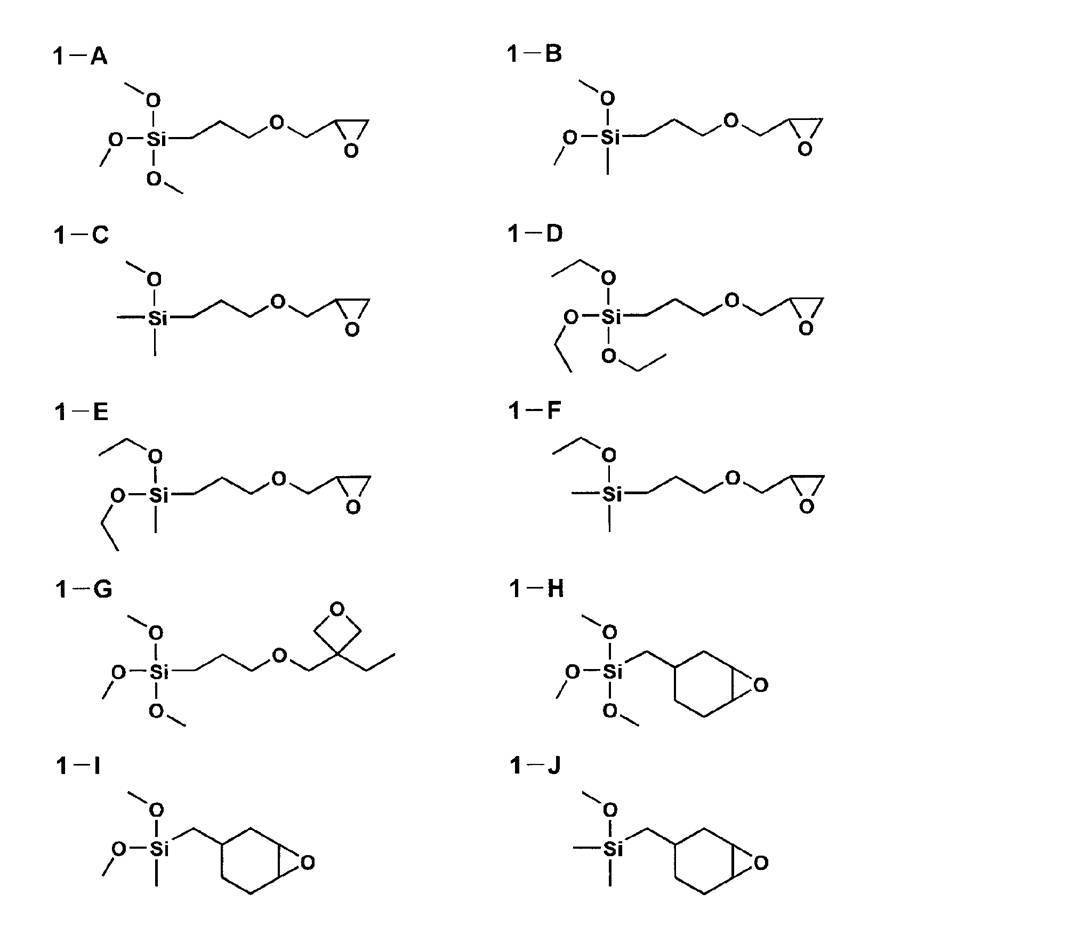
一般式(1)で表される化合物としては、例えば信越化学工業(株)社からKBM-403、KBE-402、KBE-403として市販されている。
〈一般式(1)のカチオン重合性化合物以外のカチオン重合性化合物〉
本発明では、一般式(1)のカチオン重合性化合物以外のカチオン重合性化合物を併用してもよい。一般式(1)以外のカチオン重合性化合物としては、エポキシ化合物、オキセタン化合物、フェノール化合物、アルデヒド化合物、ビニルエーテル化合物、スチレン化合物、環状エーテル化合物、ラクトン化合物、エピスルフィド化合物、シリコーン類等周知の化合物が挙げられる。
〈一般式(1)のカチオン重合性化合物以外のカチオン重合性化合物〉
本発明では、一般式(1)のカチオン重合性化合物以外のカチオン重合性化合物を併用してもよい。一般式(1)以外のカチオン重合性化合物としては、エポキシ化合物、オキセタン化合物、フェノール化合物、アルデヒド化合物、ビニルエーテル化合物、スチレン化合物、環状エーテル化合物、ラクトン化合物、エピスルフィド化合物、シリコーン類等周知の化合物が挙げられる。
上記したカチオン重合性化合物は、低屈折率層組成物では固形分中の15質量%以上70質量%未満であることが、低屈折率層組成物の安定性の点から、好ましい。
<(C)光カチオン重合開始剤>
本発明の光カチオン重合開始として機能する化合物として、公知の酸や光酸発生剤を挙げることができる。光酸発生剤としては、カチオン重合の光開始剤、色素類の光消色剤、光変色剤、或いは、マイクロレジスト等に使用されている公知の化合物及びそれらの混合物等が挙げられる。
<(C)光カチオン重合開始剤>
本発明の光カチオン重合開始として機能する化合物として、公知の酸や光酸発生剤を挙げることができる。光酸発生剤としては、カチオン重合の光開始剤、色素類の光消色剤、光変色剤、或いは、マイクロレジスト等に使用されている公知の化合物及びそれらの混合物等が挙げられる。
具体的には、例えば、オニウム化合物、有機ハロゲン化合物、ジスルホン化合物が挙げられ、好ましくは、オニウム化合物である。
〈オニウム化合物〉
オニウム化合物としては、以下の各式に示されるジアゾニウム塩、スルホニウム塩、ヨードニウム塩などが好適に使用され、特にスルホニウム塩が好ましい。
オニウム化合物としては、以下の各式に示されるジアゾニウム塩、スルホニウム塩、ヨードニウム塩などが好適に使用され、特にスルホニウム塩が好ましい。
ArN2
+Z-、
(R)3S+Z-、
(R)2I+Z-
式中、Arはアリール基を表し、Rはアリール基又は炭素数1~20のアルキル基を表し、一分子内にRが複数回現れる場合は、それぞれ同一でも異なっていてもよく、Z-は非塩基性でかつ非求核性の陰イオンを表す。
(R)3S+Z-、
(R)2I+Z-
式中、Arはアリール基を表し、Rはアリール基又は炭素数1~20のアルキル基を表し、一分子内にRが複数回現れる場合は、それぞれ同一でも異なっていてもよく、Z-は非塩基性でかつ非求核性の陰イオンを表す。
上記各式において、Ar又はRで表されるアリール基も、典型的にはフェニルやナフチルであり、これらは適当な基で置換されていてもよい。
また、Z-で表される陰イオンとして具体的には、テトラフルオロボレートイオン(BF4
-)、テトラキス(ペンタフルオロフェニル)ボレートイオン(B(C6F5)4
-)、ヘキサフルオロホスフェートイオン(PF6
-)、ヘキサフルオロアーセネートイオン(AsF6
-)、ヘキサフルオロアンチモネートイオン(SbF6
-)、ヘキサクロロアンチモネートイオン(SbCl6
-)、硫酸水素イオン(HSO4
-)、過塩素酸イオン(ClO4
-)などが挙げられる。
その他のオニウム化合物としては、アンモニウム塩、イミニウム塩、ホスホニウム塩アルソニウム塩、セレノニウム塩、ホウ素塩等が挙げられ、例えば特開2002-29162号公報の段落番号[0058]~[0059]に記載の化合物等が挙げられる。
中でも、ジアゾニウム塩、ヨードニウム塩、スルホニウム塩、イミニウム塩が、化合物の素材安定性等の点から好ましい。
好適に用いることのできるオニウム塩の具体例としては、例えば、特開平9-268205号公報の段落番号[0035]に記載のアミル化されたスルホニウム塩、特開2000-71366号公報の段落番号[0010]~[0011]に記載のジアリールヨードニウム塩又はトリアリールスルホニウム塩、特開2001-288205号公報の段落番号[0017]に記載のチオ安息香酸S-フェニルエステルのスルホニウム塩、特開2001-133696号公報の段落番号[0030]~[0033]に記載のオニウム塩等が挙げられる。
酸発生剤の他の例としては、特開2002-29162号公報の段落番号[0059]~[0062]に記載の有機金属/有機ハロゲン化物、o-ニトロベンジル型保護基を有する光酸発生剤、光分解してスルホン酸を発生する化合物(イミノスルフォネート等)等の化合物が挙げられる。
これら化合物の多くは市販されているので、そのような市販品を用いることができる。市販の開始剤としては、例えば、ダウケミカル日本(株)から販売されている“サイラキュアUVI-6990”(商品名)、各々(株)ADEKAから販売されている“アデカオプトマーSP-150”(商品名)、“アデカオプトマーSP-300”(商品名)、ローディアジャパン(株)から販売されている“RHODORSIL PHOTOINITIAOR2074”(商品名)などが挙げられる。
本発明においては、硬化性の面でスルホニウム塩を含有することが特に好ましく、好ましいスルホニウム塩の例としては、一般式(2)、(3)、(4)または(5)のスルホニウム塩が特に好ましい。

〔式中、R1~R17はそれぞれ水素原子、または置換基を表し、R1~R3が同時に水素原子を表すことがなく、R4~R7が同時に水素原子を表すことがなく、R8~R11が同時に水素原子を表すことがなく、R12~R17が同時に水素原子を表すことはない。X-は、非求核性のアニオン残基を表す。〕
〈酸〉
本発明において光カチオン重合開始剤として機能する公知の酸としては、塩酸、硫酸、硝酸、リン酸等の無機酸、又は酢酸、ギ酸、メタンスルホン酸、トリフロロメタンスルホン酸、パラトルエンスルホン酸等の有機酸等のブレンステッド酸、ジブチル錫ジラウレート、ジブチル錫ジアセテート、ジブチル錫ジオクテート、トリイソプロポキシアルミニウム、テトラブトキシジルコニウム、テトラブトキシチタネート等のルイス酸が挙げられる。
〈酸〉
本発明において光カチオン重合開始剤として機能する公知の酸としては、塩酸、硫酸、硝酸、リン酸等の無機酸、又は酢酸、ギ酸、メタンスルホン酸、トリフロロメタンスルホン酸、パラトルエンスルホン酸等の有機酸等のブレンステッド酸、ジブチル錫ジラウレート、ジブチル錫ジアセテート、ジブチル錫ジオクテート、トリイソプロポキシアルミニウム、テトラブトキシジルコニウム、テトラブトキシチタネート等のルイス酸が挙げられる。
ピロメリット酸、無水ピロメリット酸、トリメリット酸、無水トリメリット酸、フタル酸、無水フタル酸などの芳香族多価カルボン酸又はその無水物やマレイン酸、無水マレイン酸、コハク酸、無水コハク酸などの脂肪族多価カルボン酸又はその無水物なども挙げられる。
酸としては、1種のみを用いてもよいし、2種以上を併用してもよい。
これらの酸や光酸発生剤は、カチオン重合性化合物100質量部に対して、0.1~20質量部の割合が好ましく、より好ましくは0.5~15質量部の割合で添加することである。添加量が上記範囲において、硬化性組成物の安定性、重合反応性等から好ましい。<(A)、(B)、(C)以外の反射防止層用組成物>
本発明の反射防止層用組成物には、(A)、(B)、(C)以外に下記の化合物を添加することが好ましい。
本発明の反射防止層用組成物には、(A)、(B)、(C)以外に下記の化合物を添加することが好ましい。
(触媒)
本発明において、反射防止層用組成物には、触媒を含有することが好ましい。触媒としては、水酸化ナトリウム、水酸化カリウム、アンモニア等の無機塩基類、トリエチルアミン、ピリジン等の有機塩基類、トリイソプロポキシアルミニウム、テトラブトキシジルコニウム等の金属アルコキシド類、後述する金属キレート化合物等が挙げられるが、中でも金属キレート化合物が好ましく用いられる。
本発明において、反射防止層用組成物には、触媒を含有することが好ましい。触媒としては、水酸化ナトリウム、水酸化カリウム、アンモニア等の無機塩基類、トリエチルアミン、ピリジン等の有機塩基類、トリイソプロポキシアルミニウム、テトラブトキシジルコニウム等の金属アルコキシド類、後述する金属キレート化合物等が挙げられるが、中でも金属キレート化合物が好ましく用いられる。
金属キレート化合物としては、Zr、Ti、Alから選ばれる金属を中心金属とするキレート化合物が、特に制限なく好適に用いることができる。
具体例としては、トリ-n-ブトキシエチルアセトアセテートジルコニウム、ジ-n-ブトキシビス(エチルアセトアセテート)ジルコニウム、n-ブトキシトリス(エチルアセトアセテート)ジルコニウム、テトラキス(n-プロピルアセトアセテート)ジルコニウム、テトラキス(アセチルアセトアセテート)ジルコニウム、テトラキス(エチルアセトアセテート)ジルコニウムなどのジルコニウムキレート化合物、ジイソプロポキシビス(エチルアセトアセテート)チタニウム、ジイソプロポキシビス(アセチルアセテート)チタニウム、ジイソプロポキシビス(アセチルアセトン)チタニウムなどのチタニウムキレート化合物、ジイソプロポキシエチルアセトアセテートアルミニウム、ジイソプロポキシアセチルアセトナートアルミニウム、イソプロポキシビス(エチルアセトアセテート)アルミニウム、イソプロポキシビス(アセチルアセトナート)アルミニウム、トリス(エチルアセトアセテート)アルミニウム、トリス(アセチルアセトナート)アルミニウム、モノアセチルアセトナートビス(エチルアセトアセテート)アルミニウムなどのアルミニウムキレート化合物などが挙げられる。
これらの金属キレート化合物のうち、トリ-n-ブトキシエチルアセトアセテートジルコニウム、ジイソプロポキシエチルアセトアセテートアルミニウム、トリス(エチルアセトアセテート)アルミニウムが特に好ましく用いられる。また、これらの金属キレート化合物は、単独でも併用でも使用することができる。
(バインダー)
また、本発明において、反射防止用組成物には、下記一般式(6)で表される有機珪素化合物もしくはその加水分解物或いはその重縮合物を含有することができる。
また、本発明において、反射防止用組成物には、下記一般式(6)で表される有機珪素化合物もしくはその加水分解物或いはその重縮合物を含有することができる。
一般式(6)
R0 mSiX4-m
式中、R0は置換もしくは無置換のアルキル基、または置換もしくは無置換のアリール基、Xは水酸基または加水分解可能な置換基であり、mは0~3の整数である。
R0 mSiX4-m
式中、R0は置換もしくは無置換のアルキル基、または置換もしくは無置換のアリール基、Xは水酸基または加水分解可能な置換基であり、mは0~3の整数である。
アルキル基としては、メチル基、エチル基、プロピル基、イソプロピル基、t-ブチル基、s-ブチル基、ヘキシル基、デシル基、ヘキサデシル基等が挙げられる。アリール基としてはフェニル基、ナフチル基等が挙げられる。
Xの加水分解可能な置換基としては、アルコキシ基、ハロゲン基、カルボキシル基等が挙げられる。
具体例としては、テトラメトキシシラン、テトラエトキシシラン、メチルトリメトキシシラン、メチルトリエトキシシラン、ジメチルジメトキシシラン、ジメチルジエトキシシラン、フェニルトリメトキシシラン、フェニルトリエトキシシラン、ジフェニルジメトキシシラン、ジフェニルジエトキシシラン、ヘキシルトリメトキシシラン、ヘキシルトリエトキシシラン、デシルトリメトキシシラン、デシルトリエトキシシラン、イソブチルトリメトキシシラン、トリフルオロプロピルトリメトキシシラン、ビニルトリメトキシシラン、ビニルトリエトキシシラン、ビニルトリアセトキシシラン、ビニルトリメトキシエトキシシラン、3-クロロプロピルトリメトキシシラン、3-クロロプロピルトリエトキシシラン、3-アクリロキシプロピルトリメトキシシラン、3-メタクリロキシプロピルトリメトキシシラン、3-メタクリロキシプロピルトリエトキシシラン、3-メタクリロキシプロピルメチルジメトキシシラン、3-メタクリロキシプロピルメチルジエトキシシラン、3-アミノプロピルトリメトキシシラン、3-アミノプロピルトリエトキシシラン、N-2-アミノエチル-3-アミノプロピルメチルジメトキシシラン、N-2-アミノエチル-3-アミノプロピルトリメトキシシラン、N-2-アミノエチル-3-アミノプロピルトリエトキシシラン、3-トリエトキシシリル-N-1,3-ジメチルブチリデンプロピルアミン、N-フェニル-3-アミノプロピルトリメトキシシラン、3-メルカプトプロピルトリメトキシシラン、3-メルカプトプロピルメチルジメトキシシラン、3-イソシアネートプロピルトリエトキシシラン、p-スチリルトリメトキシシラン、ジエチルシラン等が挙げられ、これらを単独または2種以上を混合して用いられる。
(溶媒)
本発明の反射防止層用組成物には、有機溶媒を含有することが好ましい。
本発明の反射防止層用組成物には、有機溶媒を含有することが好ましい。
具体的な有機溶媒の例としては、アルコール(例、メタノール、エタノール、イソプロパノール、ブタノール、ベンジルアルコール)、ケトン(例、アセトン、メチルエチルケトン、メチルイソブチルケトン、シクロヘキサノン)、エステル(例、酢酸メチル、酢酸エチル、酢酸プロピル、酢酸ブチル、蟻酸メチル、蟻酸エチル、蟻酸プロピル、蟻酸ブチル)、脂肪族炭化水素(例、ヘキサン、シクロヘキサン)、ハロゲン化炭化水素(例、メチレンクロライド、クロロホルム、四塩化炭素)、芳香族炭化水素(例、ベンゼン、トルエン、キシレン)、アミド(例、ジメチルホルムアミド、ジメチルアセトアミド、n-メチルピロリドン)、エーテル(例、ジエチルエーテル、ジオキサン、テトラハイドロフラン)、エーテルアルコール(例、1-メトキシ-2-プロパノール)、プロピレングリコールモノメチルエーテル、プロピレングリコールモノメチルエーテルアセテートが挙げられる。中でも、トルエン、メチルエチルケトン、メチルイソブチルケトン、シクロヘキサノン、エタノール、イソプロパノール及びプロピレングリコールモノメチルエーテルが特に好ましい。
反射防止層用組成物の固形分濃度は、1~4質量%であることが好ましく、固形分濃度を4質量%以下とすることによって、塗布ムラが生じにくくなり、1質量%以上とすることによって、乾燥負荷が軽減される。
(界面活性剤)
低屈折率層を形成する塗布組成物には、フッ素系またはシリコーン系の界面活性剤を含有することが好ましい。上記界面活性剤を含有させることで、塗布ムラを低減したり膜表面の防汚性を向上させるのに有効である。
低屈折率層を形成する塗布組成物には、フッ素系またはシリコーン系の界面活性剤を含有することが好ましい。上記界面活性剤を含有させることで、塗布ムラを低減したり膜表面の防汚性を向上させるのに有効である。
フッ素系界面活性剤としては、パーフルオロアルキル基を含有するモノマー、オリゴマー、ポリマーを母核としたもので、ポリオキシエチレンアルキルエーテル、ポリオキシエチレンアルキルアリルエーテル、ポリオキシエチレン等の誘導体等が挙げられる。
フッ素系界面活性剤は市販品を用いることもでき、例えばサーフロンS-381、同S-382、同SC-101、同SC-102、同SC-103、同SC-104(旭硝子株式会社製)、フロラードFC-430、同FC-431、同FC-173(フロロケミカル-住友スリーエム製)、エフトップEF352、同EF301、同EF303(新秋田化成株式会社製)、シュベゴーフルアー8035、同8036(シュベグマン社製)、BM1000、BM1100(ビーエム・ヒミー社製)、メガファックF-171、同F-470(いずれもDIC株式会社製)等を挙げることができる。
フッ素系界面活性剤のフッ素含有割合は、0.05~2質量%、好ましくは0.1~1質量%である。上記のフッ素系界面活性剤は、1種または2種以上を併用することができる。
次に、シリコーン界面活性剤について説明する。
シリコーン界面活性剤は、ケイ素原子に結合した有機基の種類により、ストレートシリコーンオイルと変性シリコーンオイルに大別できる。
ここで、ストレートシリコーンオイルとは、メチル基、フェニル基、水素原子を置換基として結合したものをいう。変性シリコーンオイルとは、ストレートシリコーンオイルから二次的に誘導された構成部分をもつものである。一方、シリコーンオイルの反応性からも分類することができる。これらをまとめると、以下のようになる。
(シリコーンオイル)
1.ストレートシリコーンオイル
1-1.非反応性シリコーンオイル:ジメチル、メチルフェニル置換等。
1.ストレートシリコーンオイル
1-1.非反応性シリコーンオイル:ジメチル、メチルフェニル置換等。
1-2.反応性シリコーンオイル:メチル水素置換等。
2.変性シリコーンオイル
ジメチルシリコーンオイルに、さまざまな有機基を導入することで生まれたものが変性シリコーンオイルである。
2.変性シリコーンオイル
ジメチルシリコーンオイルに、さまざまな有機基を導入することで生まれたものが変性シリコーンオイルである。
2-1.非反応性変性シリコーンオイル:アルキル、アルキル/アラルキル、アルキル/ポリエーテル、ポリエーテル、高級脂肪酸エステル置換等。
アルキル/アラルキル変性シリコーンオイルは、ジメチルシリコーンオイルのメチル基の一部を長鎖アルキル基或いはフェニルアルキル基が置換したシリコーンオイルである。
ポリエーテル変性シリコーンオイルは、親水性のポリオキシアルキレンを疎水性のジメチルシリコーンを導入した界面活性剤である。
高級脂肪酸変性シリコーンオイルは、ジメチルシリコーンオイルのメチル基の一部を高級脂肪酸エステルに置換えたシリコーンオイルである。
アミノ変性シリコーンオイルは、シリコーンオイルのメチル基の一部をアミノアルキル基に置換えた構造をもつシリコーンオイルである。
エポキシ変性シリコーンオイルは、シリコーンオイルのメチル基の一部をエポキシ基含有アルキル基に置換えた構造をもつシリコーンオイルである。
カルボキシル変性或いはアルコール変性シリコーンオイルは、シリコーンオイルのメチル基の一部をカルボキシル基或いは水酸基含有アルキル基に置換えた構造をもつシリコーンオイルである。
これらのうち、ポリエーテル変性シリコーンオイルが好ましく添加される。ポリエーテル変性シリコーンオイルの数平均分子量は、例えば1000~100000、好ましくは2000~50000が適当であり、数平均分子量が1000未満では、塗膜の乾燥性が低下し、逆に、数平均分子量が100000を越えると、塗膜表面にブリードアウトしにくくなる。
具体的な商品としては、東レダウコーニング社のL-45、L-9300、FZ-3704、FZ-3703、FZ-3720、FZ-3786、FZ-3501、FZ-3504、FZ-3508、FZ-3705、FZ-3707、FZ-3710、FZ-3750、FZ-3760、FZ-3785、FZ-3785、Y-7499、信越化学社のKF96L、KF96、KF96H、KF99、KF54、KF965、KF968、KF56、KF995、KF351、KF351A、KF352、KF353、KF354、KF355、KF615、KF618、KF945、KF6004、FL100、ビックケミージャパン社製の界面活性剤BYKシリーズ、BYK-300/302、BYK-306、BYK-307、BYK-310、BYK-315、BYK-320、BYK-322、BYK-323、BYK-325、BYK-330、BYK-331、BYK-333、BYK-337、BYK-340、BYK-344、BYK-370、BYK-375、BYK-377、BYK-352、BYK-354、BYK-355/356、BYK-358N/361N、BYK-357、BYK-390、BYK-392、BYK-UV3500、BYK-UV3510、BYK-UV3570、BYK-Silclean3700、GE東芝シリコーン社製のジメチルシリコーンシリーズ、XC96-723、YF3800、XF3905、YF3057、YF3807、YF3802、YF3897等が挙げられる。
また、シリコーン界面活性剤は、シリコーンオイルのメチル基の一部を親水性基に置換した界面活性剤である。置換の位置は、シリコーンオイルの側鎖、両末端、片末端、両末端側鎖等がある。親水性基としては、ポリエーテル、ポリグリセリン、ピロリドン、ベタイン、硫酸塩、リン酸塩、4級塩等がある。
シリコーン界面活性剤としては、疎水基がジメチルポリシロキサン、親水基がポリオキシアルキレンから構成される非イオン界面活性剤が好ましい。
非イオン界面活性剤は、水溶液中でイオンに解離する基を有しない界面活性剤を総称していうが、疎水基のほか親水性基として多価アルコール類の水酸基、また、ポリオキシアルキレン鎖(ポリオキシエチレン)等を親水基として有するものである。親水性はアルコール性水酸基の数が多くなるに従って、またポリオキシアルキレン鎖(ポリオキシエチレン鎖)が長くなるに従って強くなる。疎水基がジメチルポリシロキサン、親水基がポリオキシアルキレンから構成される非イオン界面活性剤を用いると、低屈折率層のムラや膜表面の防汚性が向上する。ポリメチルシロキサンからなる疎水基が表面に配向し汚れにくい膜表面を形成するものと考えられる。
非イオン界面活性剤の具体例としては、例えば東レダウコーニング社のシリコーン界面活性剤SILWET L-77、L-720、L-7001、L-7002、L-7604、Y-7006、FZ-2101、FZ-2104、FZ-2105、FZ-2110、FZ-2118、FZ-2120、FZ-2122、FZ-2123、FZ-2130、FZ-2154、FZ-2161、FZ-2162、FZ-2163、FZ-2164、FZ-2166、FZ-2191、SUPERSILWET SS-2801、SS-2802、SS-2803、SS-2804、SS-2805等が挙げられる。
これら、疎水基がジメチルポリシロキサン、親水基がポリオキシアルキレンから構成される非イオン界面活性剤の好ましい構造としては、ジメチルポリシロキサン構造部分とポリオキシアルキレン鎖が交互に繰り返し結合した直鎖状のブロックコポリマーであることが好ましい。低屈折率層を形成する塗布組成物を塗布した際のムラ抑制やレベリング性から好ましい。これらの具体例としては、例えば東レダウコーニング社のシリコーン界面活性剤ABN SILWET FZ-2203、FZ-2207、FZ-2208、FZ-2222等が挙げられる。
低屈折率層を形成する塗布組成物には、より過酷な条件下での耐久試験後に好ましい性能を発揮しやすい点から、以下に説明する反応性変性シリコーン樹脂(反応性変性シリコーンオイルともいう)を含有することが好ましい。
2-2.反応性変性シリコーンオイル:アミノ、エポキシ、カルボキシル、アルコール置換等。
反応性変性シリコーン樹脂としては、ポリシロキサンの側鎖、片末端または両末端にアミノ、エポキシ、カルボキシル、水酸基、メタクリル、メルカプト、フェノール等で置換された反応性タイプの変性シリコーン樹脂である。アミノ変性シリコーン樹脂として、具体的にはKF-860,KF-861,X-22-161A、X-22-161B(以上、信越化学工業株式会社製)、FM-3311,FM-3325(以上、チッソ株式会社製)、エポキシ変性シリコーン樹脂としては、KF-105、X-22-163A、X-22-163B、KF-101、KF-1001(以上、信越化学工業株式会社製)、ポリエーテル変性シリコーン樹脂としてはX-22-4272、X-22-4952、カルボキシル変性シリコーン樹脂としてはX-22-3701E、X-22-3710(以上、信越化学工業株式会社製)、カルビノール変性シリコーン樹脂としてはKF-6001、KF-6003(以上、信越化学工業株式会社製)、メタクリル変性シリコーン樹脂としてはX-22-164C(以上、信越化学工業株式会社製)、メルカプト変性シリコーン樹脂としてはKF-2001(以上、信越化学工業株式会社製)、フェノール変性シリコーン樹脂としてはX-22-1821(以上、信越化学工業株式会社製)等が挙げられる。水酸基変性シリコーン樹脂としては、FM-4411、FM-4421、FM-DA21,FM-DA26(以上、チッソ株式会社製)等が挙げられる。その他、片末端反応性シリコーン樹脂のX-22-170DX、X-22-2426、X-22-176F(信越化学工業株式会社製)等も含まれる。
上記した界面活性剤は、他の界面活性剤と併用して用いてもよく、また適宜、例えばスルホン酸塩系、硫酸エステル塩系、リン酸エステル塩系等のアニオン界面活性剤、また、ポリオキシエチレン鎖親水基として有するエーテル型、エーテルエステル型等の非イオン界面活性剤等と併用しても良い。上記した界面活性剤の添加量は、低屈折率層塗布組成物中、0.05~3.0質量%であることが、塗膜の撥水、撥油性、防汚性を高めるばかりでなく、表面の耐擦り傷性にも効果を発揮する点から好ましい。
また、上記した界面活性剤は、塗布ムラを低減させる目的で、帯電防止層にも含有させることができる。
<反射防止フィルム>
本発明の反射防止フィルムは、基材フィルム上に、直接または他の層を介して該基材フィルムよりも屈折率が低い低屈折率層を積層してなる反射防止フィルムであって、該低屈折率層が、(A)中空シリカ粒子と、(B)一般式(1)のカチオン重合性化合物、及び(C)光カチオン重合開始剤を含有する反射防止層用組成物を硬化することにより作製した層であることを特徴とする。
<反射防止フィルム>
本発明の反射防止フィルムは、基材フィルム上に、直接または他の層を介して該基材フィルムよりも屈折率が低い低屈折率層を積層してなる反射防止フィルムであって、該低屈折率層が、(A)中空シリカ粒子と、(B)一般式(1)のカチオン重合性化合物、及び(C)光カチオン重合開始剤を含有する反射防止層用組成物を硬化することにより作製した層であることを特徴とする。
低屈折率層に一般式(1)のカチオン重合性化合物を含むことによって、密着性が非常に優れており、長期間の過酷な条件下での使用を想定した耐光性試験にも耐え得る反射防止フィルムを提供することが可能となる。
また、前記基材フィルムは、セルロースエステル樹脂、またはセルロースエステル樹脂とアクリル樹脂、更にセルロースエステル樹脂とアクリル樹脂とアクリル粒子を含有することで、更に優れた密着性を有する基材を提供することが可能となる。
〈反射防止フィルムの層構成〉
本発明の反射防止フィルムの好ましい層構成の例を下記に示す。なお、ここでは「/」は積層配置されていることを示している。但し、本発明は下記の層構成に限定されるものではない。
本発明の反射防止フィルムの好ましい層構成の例を下記に示す。なお、ここでは「/」は積層配置されていることを示している。但し、本発明は下記の層構成に限定されるものではない。
フィルム基材/低屈折率層
フィルム基材/ハードコート層/低屈折率層
バックコート層/フィルム基材/ハードコート層/低屈折率層
バックコート層/フィルム基材/帯電防止層/ハードコート層/低屈折率層
バックコート層/フィルム基材/ハードコート層/帯電防止層/低屈折率層
バックコート層/フィルム基材/防眩層/帯電防止層/低屈折率層
<基材フィルム>
基材フィルムは製造が容易であること、電離放射線硬化型樹脂層等と接着し易いこと、光学的に等方性であることが好ましい。これらの性質を有していれば何れでもよく、例えば、トリアセチルセルロースフィルム、セルロースアセテートプロピオネートオネートフィルム、セルロースジアセテートフィルム、セルロースアセテートブチレートフィルム等のセルロースエステル系フィルム、ポリエチレンテレフタレート、ポリエチレンナフタレート等のポリエステル系フィルム、ポリカーボネート系フィルム、ポリアリレート系フィルム、ポリスルホン(ポリエーテルスルホンも含む)系フィルム、ポリエチレンフィルム、ポリプロピレンフィルム、セロファン、ポリ塩化ビニリデンフィルム、ポリビニルアルコールフィルム、エチレンビニルアルコールフィルム、シンジオタクティックポリスチレン系フィルム、ノルボルネン樹脂系フィルム、ポリメチルペンテンフィルム、ポリエーテルケトンフィルム、ポリエーテルケトンイミドフィルム、ポリアミドフィルム、フッ素樹脂フィルム、ナイロンフィルム、シクロオレフィンポリマーフィルム、ポリメチルメタクリレートフィルムまたはアクリルフィルム等を挙げることができるが、これらに限定されるわけではない。これらの内、セルロースエステルフィルム(例えば、コニカミノルタタックKC8UX、KC4UX、KC5UX、KC8UCR3、KC8UCR4、KC8UCR5、KC8UY、KC4UY、KC4UE、及びKC12UR(以上、コニカミノルタオプト(株)製))、ポリカーボネートフィルム、シクロオレフィンポリマーフィルム、ポリエステルフィルムが好ましく、本発明においては、特にセルロースエステル系フィルムが、製造上、コスト面、等方性、接着性、及び本発明の目的効果が好適に得られることから好ましい。
フィルム基材/ハードコート層/低屈折率層
バックコート層/フィルム基材/ハードコート層/低屈折率層
バックコート層/フィルム基材/帯電防止層/ハードコート層/低屈折率層
バックコート層/フィルム基材/ハードコート層/帯電防止層/低屈折率層
バックコート層/フィルム基材/防眩層/帯電防止層/低屈折率層
<基材フィルム>
基材フィルムは製造が容易であること、電離放射線硬化型樹脂層等と接着し易いこと、光学的に等方性であることが好ましい。これらの性質を有していれば何れでもよく、例えば、トリアセチルセルロースフィルム、セルロースアセテートプロピオネートオネートフィルム、セルロースジアセテートフィルム、セルロースアセテートブチレートフィルム等のセルロースエステル系フィルム、ポリエチレンテレフタレート、ポリエチレンナフタレート等のポリエステル系フィルム、ポリカーボネート系フィルム、ポリアリレート系フィルム、ポリスルホン(ポリエーテルスルホンも含む)系フィルム、ポリエチレンフィルム、ポリプロピレンフィルム、セロファン、ポリ塩化ビニリデンフィルム、ポリビニルアルコールフィルム、エチレンビニルアルコールフィルム、シンジオタクティックポリスチレン系フィルム、ノルボルネン樹脂系フィルム、ポリメチルペンテンフィルム、ポリエーテルケトンフィルム、ポリエーテルケトンイミドフィルム、ポリアミドフィルム、フッ素樹脂フィルム、ナイロンフィルム、シクロオレフィンポリマーフィルム、ポリメチルメタクリレートフィルムまたはアクリルフィルム等を挙げることができるが、これらに限定されるわけではない。これらの内、セルロースエステルフィルム(例えば、コニカミノルタタックKC8UX、KC4UX、KC5UX、KC8UCR3、KC8UCR4、KC8UCR5、KC8UY、KC4UY、KC4UE、及びKC12UR(以上、コニカミノルタオプト(株)製))、ポリカーボネートフィルム、シクロオレフィンポリマーフィルム、ポリエステルフィルムが好ましく、本発明においては、特にセルロースエステル系フィルムが、製造上、コスト面、等方性、接着性、及び本発明の目的効果が好適に得られることから好ましい。
本発明の基材フィルムの屈折率は、1.30~1.70であり、1.40~1.65であることが好ましい。
屈折率は、屈折率は、アタゴ社製 アッペ屈折率計2Tを用いてJISK7142の方法で測定する。
〈セルロースエステル系フィルム〉
次に基材フィルムとして好ましいセルロースエステル系フィルム(以下、セルロースエステルフィルムともいう)について説明する。
次に基材フィルムとして好ましいセルロースエステル系フィルム(以下、セルロースエステルフィルムともいう)について説明する。
セルロースエステル樹脂(以下セルロースエステルともいう)は、セルロースの低級脂肪酸エステルであることが好ましい。セルロースの低級脂肪酸エステルにおける低級脂肪酸とは炭素原子数が6以下の脂肪酸を意味し、例えば、セルロースアセテート、セルロースプロピオネート、セルロースブチレート等や、特開平10-45804号、同08-231761号、米国特許第2,319,052号等に記載されているようなセルロースアセテートプロピオネート、セルロースアセテートブチレート等の混合脂肪酸エステルを用いることができる。
上記記載の中でも、特に好ましく用いられるセルロースの低級脂肪酸エステルはセルローストリアセテート、セルロースアセテートプロピオネートである。これらのセルロースエステルは単独或いは混合して用いることができる。
セルローストリアセテートの場合には、平均酢化度(結合酢酸量)54.0~62.5%のものが好ましく用いられ、更に好ましいのは、平均酢化度が58.0~62.5%のセルローストリアセテートである。平均酢化度が小さいと寸法変化が大きく、また偏光板の偏光度が低下する。平均酢化度が大きいと溶剤に対する溶解度が低下し生産性が下がる。
セルローストリアセテート以外で好ましいセルロースエステルは炭素原子数2~4のアシル基を置換基として有し、アセチル基の置換度をXとし、プロピオニル基又はブチリル基の置換度をYとした時、下記式(I)及び(II)を同時に満たすセルロースエステルを含むセルロースエステルである。
式(I) 2.6≦X+Y≦3.0
式(II) 0≦X≦2.5
この内特にセルロースアセテートプロピオネートが好ましく用いられ、中でも1.9≦X≦2.5、0.1≦Y≦0.9であることが好ましい。アシル基で置換されていない部分は通常水酸基として存在しているものである。これらは公知の方法で合成することができる。アシル基の置換度の測定方法はASTM-D817-96に準じて測定することができる。
式(II) 0≦X≦2.5
この内特にセルロースアセテートプロピオネートが好ましく用いられ、中でも1.9≦X≦2.5、0.1≦Y≦0.9であることが好ましい。アシル基で置換されていない部分は通常水酸基として存在しているものである。これらは公知の方法で合成することができる。アシル基の置換度の測定方法はASTM-D817-96に準じて測定することができる。
セルロースエステルの分子量は数平均分子量(Mn)で60000~300000のものが好ましく、70000~200000のものが更に好ましく、100000~200000のものが特に好ましい。本発明で用いられるセルロースエステルは重量平均分子量(Mw)/数平均分子量(Mn)比が4.0以下であることが好ましく、更に好ましくは1.4~2.3である。
セルロースエステルの平均分子量及び分子量分布は、高速液体クロマトグラフィーを用い測定できるので、これを用いて数平均分子量(Mn)、重量平均分子量(Mw)を算出し、その比を計算することができる。
測定条件は以下の通りである。
溶媒:メチレンクロライド
カラム:Shodex K806,K805,K803G(昭和電工(株)製を3本接続して使用した)
カラム温度:25℃
試料濃度:0.1質量%
検出器:RI Model 504(GLサイエンス社製)
ポンプ:L6000(日立製作所(株)製)
流量:1.0ml/min
校正曲線:標準ポリスチレンSTK standard ポリスチレン(東ソー(株)製)
Mw=1000000~500迄の13サンプルによる校正曲線を使用した。13サンプルは、ほぼ等間隔に用いることが好ましい。
カラム:Shodex K806,K805,K803G(昭和電工(株)製を3本接続して使用した)
カラム温度:25℃
試料濃度:0.1質量%
検出器:RI Model 504(GLサイエンス社製)
ポンプ:L6000(日立製作所(株)製)
流量:1.0ml/min
校正曲線:標準ポリスチレンSTK standard ポリスチレン(東ソー(株)製)
Mw=1000000~500迄の13サンプルによる校正曲線を使用した。13サンプルは、ほぼ等間隔に用いることが好ましい。
セルロースエステルは綿花リンター、木材パルプ、ケナフ等を原料として合成されたセルロースエステルを単独或いは混合して用いることができる。特に綿花リンター(以下、単にリンターとすることがある)から合成されたセルロースエステルを単独或いは混合して用いることが好ましい。
また、セルロースエステルフィルムは、本発明の目的効果がより良く発揮される点から、アクリル樹脂、アクリル粒子を含有することが好ましい。
(アクリル樹脂、アクリル粒子)
アクリル樹脂としては、メタクリル樹脂も含まれる。樹脂としては特に制限されるものではないが、メチルメタクリレート単位50~99質量%、及びこれと共重合可能な他の単量体単位1~50質量%からなるものが好ましい。
アクリル樹脂としては、メタクリル樹脂も含まれる。樹脂としては特に制限されるものではないが、メチルメタクリレート単位50~99質量%、及びこれと共重合可能な他の単量体単位1~50質量%からなるものが好ましい。
共重合可能な他の単量体としては、アルキル数の炭素数が2~18のアルキルメタクリレート、アルキル数の炭素数が1~18のアルキルアクリレート、アクリル酸、メタクリル酸等のα,β-不飽和酸、マレイン酸、フマル酸、イタコン酸等の不飽和基含有二価カルボン酸、スチレン、α-メチルスチレン、核置換スチレン等の芳香族ビニル化合物、アクリロニトリル、メタクリロニトリル等のα,β-不飽和ニトリル、無水マレイン酸、マレイミド、N-置換マレイミド、グルタル酸無水物等が挙げられ、これらは単独で、或いは2種以上を併用して用いることができる。
これらの中でも、共重合体の耐熱分解性や流動性の観点から、メチルアクリレート、エチルアクリレート、n-プロピルアクリレート、n-ブチルアクリレート、s-ブチルアクリレート、2-エチルヘキシルアクリレート等が好ましく、メチルアクリレートやn-ブチルアクリレートが特に好ましく用いられる。
アクリル樹脂は、フィルムとしての機械的強度、フィルムを生産する際の流動性の点から重量平均分子量(Mw)が80000~1000000であることが好ましい。重量平均分子量(Mw)は上記の高速液体クロマトグラフィーを用い測定できる。
アクリル樹脂(A)の製造方法としては、特に制限は無く、懸濁重合、乳化重合、塊状重合、或いは溶液重合等の公知の方法のいずれを用いても良い。ここで、重合開始剤としては、通常のパーオキサイド系及びアゾ系のものを用いることができ、また、レドックス系とすることもできる。
重合温度については、懸濁または乳化重合では30~100℃、塊状または溶液重合では80~160℃で実施しうる。更に、生成共重合体の還元粘度を制御するために、アルキルメルカプタン等を連鎖移動剤として用いて重合を実施することもできる。
この分子量とすることで、耐熱性と脆性の両立を図ることができる。アクリル樹脂としては、市販のものも使用することができる。例えば、デルペット60N、80N(旭化成ケミカルズ(株)製)、ダイヤナールBR52、BR80,BR83,BR85,BR88(三菱レイヨン(株)製)、KT75(電気化学工業(株)製)等が挙げられる。
次に、セルロースエステルフィルムは、本発明の目的効果が良好に発揮されるほか、鉛筆硬度にも優れることから、アクリル樹脂と更にアクリル粒子を含有することが好ましい。
アクリル粒子について、説明する。アクリル粒子は、例えば、作製したアクリル樹脂含有フィルムを所定量採取し、溶媒に溶解させて攪拌し、充分に溶解・分散させたところで、アクリル粒子の平均粒子径未満の孔径を有するPTFE製のメンブレンフィルターを用いて濾過し、濾過捕集された不溶物の重さが、アクリル樹脂含有フィルムに添加したアクリル粒子の90質量%以上あることが好ましい。
アクリル粒子は特に限定されるものではないが、2層以上の層構造を有するアクリル粒子であることが好ましく、特に下記多層構造アクリル系粒状複合体であることが好ましい。
多層構造アクリル系粒状複合体とは、中心部から外周部に向かって最内硬質層重合体、ゴム弾性を示す架橋軟質層重合体、及び最外硬質層重合体が、層状に重ね合わされてなる構造を有する粒子状のアクリル系重合体を言う。
アクリル系樹脂組成物に用いられる多層構造アクリル系粒状複合体の好ましい態様としては、以下の様なものが挙げられる。(a)メチルメタクリレート80~98.9質量%、アルキル基の炭素数が1~8のアルキルアクリレート1~20質量%、及び多官能性グラフト剤0.01~0.3質量%からなる単量体混合物を重合して得られる最内硬質層重合体、(b)上記最内硬質層重合体の存在下に、アルキル基の炭素数が4~8のアルキルアクリレート75~98.5質量%、多官能性架橋剤0.01~5質量%及び多官能性グラフト剤0.5~5質量%からなる単量体混合物を重合して得られる架橋軟質層重合体、(c)上記最内硬質層及び架橋軟質層からなる重合体の存在下に、メチルメタクリレート80~99質量%とアルキル基の炭素数が1~8であるアルキルアクリレート1~20質量%とからなる単量体混合物を重合して得られる最外硬層重合体、よりなる3層構造を有し、かつ得られた3層構造重合体が最内硬質層重合体(a)5~40質量%、軟質層重合体(b)30~60質量%、及び最外硬質層重合体(c)20~50質量%からなり、アセトンで分別したときに不溶部があり、その不溶部のメチルエチルケトン膨潤度が1.5~4.0であるアクリル系粒状複合体、が挙げられる。
なお、特公昭60-17406号或いは特公平3-39095号において開示されている様に、多層構造アクリル系粒状複合体の各層の組成や粒子径を規定しただけでなく、多層構造アクリル系粒状複合体の引張り弾性率やアセトン不溶部のメチルエチルケトン膨潤度を特定範囲内に設定することにより、更に充分な耐衝撃性と耐応力白化性のバランスを実現することが可能となる。
ここで、多層構造アクリル系粒状複合体を構成する最内硬質層重合体(a)は、メチルメタクリレート80~98.9質量%、アルキル基の炭素数が1~8のアルキルアクリレート1~20質量%及び多官能性グラフト剤0.01~0.3質量%からなる単量体混合物を重合して得られるものが好ましい。
ここで、アルキル基の炭素数が1~8のアルキルアクリレートとしては、メチルアクリレート、エチルアクリレート、n-プロピルアクリレート、n-ブチルアクリレート、s-ブチルアクリレート、2-エチルヘキシルアクリレート等が挙げられ、メチルアクリレートやn-ブチルアクリレートが好ましく用いられる。
最内硬質層重合体(a)におけるアルキルアクリレート単位の割合は1~20質量%であり、該単位が1質量%未満では、重合体の熱分解性が大きくなり、一方、該単位が20質量%を越えると、最内硬質層重合体(c)のガラス転移温度が低くなり、3層構造アクリル系粒状複合体の耐衝撃性付与効果が低下するので、いずれも好ましくない。
多官能性グラフト剤としては、異なる重合可能な官能基を有する多官能性単量体、例えば、アクリル酸、メタクリル酸、マレイン酸、フマル酸のアリルエステル等が挙げられ、アリルメタクリレートが好ましく用いられる。多官能性グラフト剤は、最内硬質層重合体と軟質層重合体を化学的に結合するために用いられ、その最内硬質層重合時に用いる割合は0.01~0.3質量%である。
アクリル系粒状複合体を構成する架橋軟質層重合体(b)は、上記最内硬質層重合体(a)の存在下に、アルキル基の炭素数が1~8のアルキルアクリレート75~98.5質量%、多官能性架橋剤0.01~5質量%及び多官能性グラフト剤0.5~5質量%からなる単量体混合物を重合して得られるものが好ましい。
ここで、アルキル基の炭素数が4~8のアルキルアクリレートとしては、n-ブチルアクリレートや2-エチルヘキシルアクリレートが好ましく用いられる。
また、これらの重合性単量体と共に、25質量%以下の共重合可能な他の単官能性単量体を共重合させることも可能である。
共重合可能な他の単官能性単量体としては、スチレン及び置換スチレン誘導体が挙げられる。アルキル基の炭素数が4~8のアルキルアクリレートとスチレンとの比率は、前者が多いほど生成重合体(b)のガラス転移温度が低下し、即ち軟質化できるのである。
一方、樹脂組生物の透明性の観点からは、軟質層重合体(b)の常温での屈折率を最内硬質層重合体(a)、最外硬質層重合体(c)、及び硬質熱可塑性アクリル樹脂に近づけるほうが有利であり、これらを勘案して両者の比率を選定する。
例えば、被覆層厚みの小さな用途においては、必ずしもスチレンを共重合しなくとも良い。
多官能性グラフト剤としては、前記の最内層硬質重合体(a)の項で挙げたものを用いることができる。
ここで用いる多官能性グラフト剤は、軟質層重合体(b)と最外硬質層重合体(c)を化学的に結合するために用いられ、その最内硬質層重合時に用いる割合は耐衝撃性付与効果の観点から0.5~5質量%が好ましい。
多官能性架橋剤としては、ジビニル化合物、ジアリル化合物、ジアクリル化合物、ジメタクリル化合物などの一般に知られている架橋剤が使用できるが、ポリエチレングリコールジアクリレート(分子量200~600)が好ましく用いられる。
ここで用いる多官能性架橋剤は、軟質層(b)の重合時に架橋構造を生成し、耐衝撃性付与の効果を発現させるために用いられる。
ただし、先の多官能性グラフト剤を軟質層の重合時に用いれば、ある程度は軟質層(b)の架橋構造を生成するので、多官能性架橋剤は必須成分ではないが、多官能性架橋剤を軟質層重合時に用いる割合は耐衝撃性付与効果の観点から0.01~5質量%が好ましい。
多層構造アクリル系粒状複合体を構成する最外硬質層重合体(c)は、上記最内硬質層重合体(a)及び軟質層重合体(b)の存在下に、メチルメタクリレート80~99質量%及びアルキル基の炭素数が1~8であるアルキルアクリレート1~20質量%からなる単量体混合物を重合して得られるものが好ましい。
ここで、アクリルアルキレートとしては、前述したものが用いられるが、メチルアクリレートやエチルアクリレートが好ましく用いられる。最外硬質層(c)におけるアルキルアクリレート単位の割合は、1~20質量%が好ましい。
また、最外硬質層(c)の重合時に、アクリル樹脂との相溶性向上を目的として、分子量を調節するためアルキルメルカプタン等を連鎖移動剤として用い、実施することも可能である。
とりわけ、最外硬質層に、分子量が内側から外側へ向かって次第に小さくなるような勾配を設けることは、伸びと耐衝撃性のバランスを改良するうえで好ましい。
具体的な方法としては、最外硬質層を形成するための単量体混合物を2つ以上に分割し、各回ごとに添加する連鎖移動剤量を順次増加するような手法によって、分子量を内側から外側へ向かって小さくすることが可能である。
この際に形成される分子量は、各回に用いられる単量体混合物をそれ単独で同条件にて重合し、得られた重合体の分子量を測定することによって調べることもできる。多層構造重合体であるアクリル系粒状複合体の粒子径については、特に限定されるものではないが、10nm以上、1000nm以下であることが好ましく、更に、20nm以上、500nm以下であることがより好ましく、特に50nm以上、400nm以下であることが最も好ましい。
多層構造重合体であるアクリル系粒状複合体において、コアとシェルの質量比は、特に限定されるものではないが、多層構造重合体全体を100質量部としたときに、コア層が50質量部以上、90質量部以下であることが好ましく、更に、60質量部以上、80質量部以下であることがより好ましい。
このような多層構造アクリル系粒状複合体の市販品の例としては、例えば、三菱レイヨン社製“メタブレン”、鐘淵化学工業社製“カネエース”、呉羽化学工業社製“パラロイド”、ロームアンドハース社製“アクリロイド”、ガンツ化成工業社製“スタフィロイド”及びクラレ社製“パラペットSA”などが挙げられ、これらは、単独ないし2種以上を用いることができる。
アクリル粒子として好適に使用されるグラフト共重合体であるアクリル粒子(c-1)の具体例としては、ゴム質重合体の存在下に、不飽和カルボン酸エステル系単量体、不飽和カルボン酸系単量体、芳香族ビニル系単量体、及び必要に応じてこれらと共重合可能な他のビニル系単量体からなる単量体混合物を共重合せしめたグラフト共重合体が挙げられる。
グラフト共重合体であるアクリル粒子に用いられるゴム質重合体には特に制限はないが、ジエン系ゴム、アクリル系ゴム及びエチレン系ゴムなどが使用できる。具体例としては、ポリブタジエン、スチレン-ブタジエン共重合体、スチレン-ブタジエンのブロック共重合体、アクリロニトリル-ブタジエン共重合体、アクリル酸ブチル-ブタジエン共重合体、ポリイソプレン、ブタジエン-メタクリル酸メチル共重合体、アクリル酸ブチル-メタクリル酸メチル共重合体、ブタジエン-アクリル酸エチル共重合体、エチレン-プロピレン共重合体、エチレン-プロピレン-ジエン系共重合体、エチレン-イソプレン共重合体、及びエチレン-アクリル酸メチル共重合体などが挙げられる。これらのゴム質重合体は、1種または2種以上の混合物で使用することが可能である。
また、アクリル樹脂及びアクリル粒子のそれぞれの屈折率が近似している場合、基材フィルムの透明性を得ることができるため、好ましい。具体的には、アクリル粒子とアクリル樹脂の屈折率差が0.05以下であることが好ましく、より好ましくは0.02以下、とりわけ0.01以下であることが好ましい。
このような屈折率条件を満たすためには、アクリル樹脂の各単量体単位組成比を調整する方法、またはアクリル粒子に使用されるゴム質重合体或いは単量体の組成比を調製する方法などにより、屈折率差を小さくすることができ、透明性に優れたアクリル樹脂含有フィルムを得ることができる。
なお、ここで言う屈折率差とは、アクリル樹脂が可溶な溶媒に、アクリル樹脂含有フィルムを適当な条件で十分に溶解させ白濁溶液とし、これを遠心分離等の操作により、溶媒可溶部分と不溶部分に分離し、この可溶部分(アクリル樹脂)と不溶部分(アクリル粒子)をそれぞれ精製した後、測定した屈折率(23℃、測定波長:550nm)の差を示す。
アクリル樹脂に、アクリル粒子を配合する方法には、特に制限はなく、アクリル樹脂とその他の任意成分を予めブレンドした後、通常200~350℃において、アクリル粒子を添加しながら一軸または二軸押出し機により均一に溶融混練する方法が好ましく用いられる。
アクリル粒子としては、市販のものも使用することができる。例えば、メタブレンW-341(C2)(三菱レイヨン(株)製)を、ケミスノーMR-2G(C3)、MS-300X(C4)(綜研化学(株)製)等を挙げることができる。
アクリル粒子はセルロースエステル樹脂とアクリル樹脂の総質量に対して、0.5~45質量%のアクリル粒子を含有することが好ましい。
また、セルロースエステル樹脂とアクリル樹脂からなるフィルム(以下、セルロースエステル樹脂・アクリル樹脂フィルムとも言う)は、張力軟化点が105~145℃で、かつ延性破壊が起こらないフィルムが好ましい。延性破壊とは、ある材料が有する強度よりも、大きな応力が作用することで生じるものであり、最終破断までに材料の著しい伸びや絞りを伴う破壊と定義される。
張力軟化点温度の具体的な測定方法としては、例えば、テンシロン試験機(ORIENTEC社製、RTC-1225A)を用いて、アクリル樹脂含有フィルムを120mm(縦)×10mm(幅)で切り出し、10Nの張力で引っ張りながら30℃/minの昇温速度で昇温を続け、9Nになった時点での温度を3回測定し、その平均値により求めることができる。
また、セルロースエステル樹脂とアクリル樹脂からなるフィルムは、ガラス転移温度(Tg)が110℃以上であることが好ましい。より好ましくは120℃以上である。特に好ましくは150℃以上である。
ガラス転移温度とは、示差走査熱量測定器(Perkin Elmer社製DSC-7型)を用いて、昇温速度20℃/分で測定し、JIS K7121(1987)に従い求めた中間点ガラス転移温度(Tmg)である。
セルロースエステル樹脂とアクリル樹脂からなるフィルムは、JIS-K7127-1999に準拠した測定において、少なくとも一方向の破断伸度が、10%以上であることが好ましく、より好ましくは20%以上である。
破断伸度の上限は特に限定されるものではないが、現実的には250%程度である。破断伸度を大きくするには異物や発泡に起因するフィルム中の欠点を抑制することが有効である。セルロースエステル樹脂とアクリル樹脂からなるフィルムの厚みは、20μm以上であることが好ましい。
より好ましくは30μm以上である。厚みの上限は特に限定される物ではないが、溶液製膜法でフィルム化する場合は、塗布性、発泡、溶媒乾燥などの観点から、上限は250μm程度である。なお、フィルムの厚みは用途により適宜選定することができる。
セルロースエステル樹脂とアクリル樹脂からなるフィルムは、加工性及び耐熱性の両立の点から、アクリル樹脂とセルロースエステル樹脂を95:5~30:70の質量比で含有することが好ましく、またセルロースエステル樹脂のアシル基の総置換度(T)が2.00~3.00、アセチル基置換度(ac)が0~1.89、アセチル基以外のアシル基の炭素数が3~7であり、重量平均分子量(Mw)が75000~280000であることが好ましい。また、アクリル樹脂とセルロースエステル樹脂の総質量は、アクリル樹脂含有フィルムの55~100質量%であり、好ましくは60~99質量%である。
セルロースエステル樹脂とアクリル樹脂からなるフィルムは、その他のアクリル樹脂を含有して構成されていても良い。
セルロースエステルフィルムやセルロースエステル樹脂とアクリル樹脂からなるフィルムは、溶液流延法で製造されたものでも、溶融流延法で製造されたものでもよいが、少なくとも幅手方向に延伸されたものが好ましく、特に溶液流延工程で剥離残溶量が3~40質量%である時に幅手方向に1.01~1.5倍に延伸されたものであることが好ましい。
より好ましくは幅手方向と長手方向に2軸延伸することであり、剥離残溶量が3~40質量%である時に幅手方向及び長手方向に、各々1.01~1.5倍に延伸されることが望ましい。このときの延伸倍率としては特に好ましくは、1.03~1.45倍である。
また、基材フィルムの長さは100m~5000m、幅は1.2m以上が好ましく、更に好ましくは1.4~4mである。基材フィルムの長さ及び幅を前記範囲とすることで、取り扱い性や生産性に優れる。
セルロースエステルフィルムは、光透過率が90%以上、より好ましくは93%以上の透明支持体であることが好ましい。
(可塑剤)
セルロースエステル系フィルムやセルロースエステル樹脂・アクリル樹脂フィルムには、下記のような可塑剤を含有することが好ましい。可塑剤としては、例えば、リン酸エステル系可塑剤、フタル酸エステル系可塑剤、トリメリット酸エステル系可塑剤、ピロメリット酸系可塑剤、グリコレート系可塑剤、クエン酸エステル系可塑剤、ポリエステル系可塑剤、多価アルコールエステル系可塑剤等を好ましく用いることができる。
セルロースエステル系フィルムやセルロースエステル樹脂・アクリル樹脂フィルムには、下記のような可塑剤を含有することが好ましい。可塑剤としては、例えば、リン酸エステル系可塑剤、フタル酸エステル系可塑剤、トリメリット酸エステル系可塑剤、ピロメリット酸系可塑剤、グリコレート系可塑剤、クエン酸エステル系可塑剤、ポリエステル系可塑剤、多価アルコールエステル系可塑剤等を好ましく用いることができる。
リン酸エステル系可塑剤では、トリフェニルホスフェート、トリクレジルホスフェート、クレジルジフェニルホスフェート、オクチルジフェニルホスフェート、ジフェニルビフェニルホスフェート、トリオクチルホスフェート、トリブチルホスフェート等、フタル酸エステル系可塑剤では、ジエチルフタレート、ジメトキシエチルフタレート、ジメチルフタレート、ジオクチルフタレート、ジブチルフタレート、ジ-2-エチルヘキシルフタレート、ブチルベンジルフタレート、ジフェニルフタレート、ジシクロヘキシルフタレート等、トリメリット酸系可塑剤では、トリブチルトリメリテート、トリフェニルトリメリテート、トリエチルトリメリテート等、ピロメリット酸エステル系可塑剤では、テトラブチルピロメリテート、テトラフェニルピロメリテート、テトラエチルピロメリテート等、グリコレート系可塑剤では、トリアセチン、トリブチリン、エチルフタリルエチルグリコレート、メチルフタリルエチルグリコレート、ブチルフタリルブチルグリコレート等、クエン酸エステル系可塑剤では、トリエチルシトレート、トリ-n-ブチルシトレート、アセチルトリエチルシトレート、アセチルトリ-n-ブチルシトレート、アセチルトリ-n-(2-エチルヘキシル)シトレート等を好ましく用いることができる。
その他のカルボン酸エステルの例には、オレイン酸ブチル、リシノール酸メチルアセチル、セバシン酸ジブチル、種々のトリメリット酸エステルが含まれる。
ポリエステル系可塑剤として脂肪族二塩基酸、脂環式二塩基酸、芳香族二塩基酸等の二塩基酸とグリコールの共重合ポリマーを用いることができる。脂肪族二塩基酸としては特に限定されないが、アジピン酸、セバシン酸、フタル酸、テレフタル酸、1,4-シクロヘキシルジカルボン酸等を用いることができる。グリコールとしては、エチレングリコール、ジエチレングリコール、1,3-プロピレングリコール、1,2-プロピレングリコール、1,4-ブチレングリコール、1,3-ブチレングリコール、1,2-ブチレングリコール等を用いることができる。
これらの二塩基酸及びグリコールはそれぞれ単独で用いてもよいし、2種以上混合して用いてもよい。
多価アルコールエステル系可塑剤は2価以上の脂肪族多価アルコールとモノカルボン酸のエステルよりなる。好ましい多価アルコールの例としては、例えば以下のようなものを挙げることができるが、本発明はこれらに限定されるものではない。
アドニトール、アラビトール、エチレングリコール、ジエチレングリコール、トリエチレングリコール、テトラエチレングリコール、1,2ープロパンジオール、1,3ープロパンジオール、ジプロピレングリコール、トリプロピレングリコール、1,2ーブタンジオール、1,3-ブタンジオール、1,4ーブタンジオール、ジブチレングリコール、1,2,4-ブタントリオール、1,5ーペンタンジオール、1,6ーヘキサンジオール、ヘキサントリオール、2-n-ブチル-2-エチル-1,3-プロパンジオール、ガラクチトール、マンニトール、3-メチルペンタン-1,3,5-トリオール、ピナコール、ソルビトール、トリメチロールプロパン、トリメチロールエタン、キシリトール、等を上げることができる。
特に、トリエチレングリコール、テトラエチレングリコール、ジプロピレングリコール、トリプロピレングリコール、ソルビトール、トリメチロールプロパン、キシリトール、であることが好ましい。多価アルコールエステルに用いられるモノカルボン酸としては特に制限はなく公知の脂肪族モノカルボン酸、脂環族モノカルボン酸、芳香族モノカルボン酸などを用いることができる。
脂環族モノカルボン酸、芳香族モノカルボン酸を用いると透湿性、保留性を向上させる点で好ましい。好ましいモノカルボン酸の例としては以下のようなものを上げることができるが、本発明はこれに限定されるものではない。
脂肪族モノカルボン酸としては炭素数1~32の直鎖または側鎖を持った脂肪酸を好ましく用いることができる。炭素数1~20であることが更に好ましく、炭素数1~10であることが特に好ましい。
酢酸を含有させるとセルロースエステルとの相溶性が増すため好ましく、酢酸と他のモノカルボン酸を混合して用いることも好ましい。
好ましい脂肪族モノカルボン酸としては酢酸、プロピオン酸、酪酸、吉草酸、カプロン酸、エナント酸、カプリル酸、ペラルゴン酸、カプリン酸、2-エチル-ヘキサンカルボン酸、ウンデシル酸、ラウリン酸、トリデシル酸、ミリスチン酸、ペンタデシル酸、パルミチン酸、ヘプタデシル酸、ステアリン酸、ノナデカン酸、アラキン酸、ベヘン酸、リグノセリン酸、セロチン酸、ヘプタコサン酸、モンタン酸、メリシン酸、ラクセル酸などの飽和脂肪酸、ウンデシレン酸、オレイン酸、ソルビン酸、リノール酸、リノレン酸、アラキドン酸などの不飽和脂肪酸などを上げることができる。
好ましい脂環族モノカルボン酸の例としては、シクロペンタンカルボン酸、シクロヘキサンカルボン酸、シクロオクタンカルボン酸、またはそれらの誘導体を上げることができる。
好ましい芳香族モノカルボン酸の例としては、安息香酸、トルイル酸などの安息香酸のベンゼン環にアルキル基を導入したもの、ビフェニルカルボン酸、ナフタリンカルボン酸、テトラリンカルボン酸などのベンゼン環を2個以上もつ芳香族モノカルボン酸、またはそれらの誘導体を上げることができる。
特に安息香酸であることが好ましい。多価アルコールエステルの分子量は特に制限はないが、分子量300~1500の範囲であることが好ましく、350~750の範囲であることが更に好ましい。
保留性向上の点では大きい方が好ましく、透湿性、セルロースエステルとの相溶性の点では小さい方が好ましい。
多価アルコールエステルに用いられるカルボン酸は一種類でもよいし、2種以上の混合であってもよい。
また、多価アルコール中のOH基はカルボン酸で全てエステル化してもよいし、一部をOH基のままで残してもよい。これらの可塑剤は単独または併用するのが好ましい。これらの可塑剤の使用量は、フィルム性能、加工性等の点で、セルロースエステルに対して1~20質量%が好ましく、特に好ましくは、3~13質量%である。
(紫外線吸収剤)
基材フィルムには紫外線吸収剤を含有させても良い。次に紫外線吸収剤について説明する。
基材フィルムには紫外線吸収剤を含有させても良い。次に紫外線吸収剤について説明する。
紫外線吸収剤としては、波長370nm以下の紫外線の吸収能に優れ、且つ良好な液晶表示性の観点から、波長400nm以上の可視光の吸収が少ないものが好ましく用いられる。
具体例としては、例えばオキシベンゾフェノン系化合物、ベンゾトリアゾール系化合物、サリチル酸エステル系化合物、ベンゾフェノン系化合物、シアノアクリレート系化合物、トリアジン系化合物、ニッケル錯塩系化合物等が挙げられるが、これらに限定されない。
ベンゾトリアゾール系紫外線吸収剤としては以下の具体例を挙げるが、本発明はこれらに限定されない。
UV-1:2-(2′-ヒドロキシ-5′-メチルフェニル)ベンゾトリアゾール
UV-2:2-(2′-ヒドロキシ-3′,5′-ジ-tert-ブチルフェニル)ベンゾトリアゾール
UV-3:2-(2′-ヒドロキシ-3′-tert-ブチル-5′-メチルフェニル)ベンゾトリアゾール
UV-4:2-(2′-ヒドロキシ-3′,5′-ジ-tert-ブチルフェニル)-5-クロロベンゾトリアゾール
UV-5:2-(2′-ヒドロキシ-3′-(3″,4″,5″,6″-テトラヒドロフタルイミドメチル)-5′-メチルフェニル)ベンゾトリアゾール
UV-6:2,2-メチレンビス(4-(1,1,3,3-テトラメチルブチル)-6-(2H-ベンゾトリアゾール-2-イル)フェノール)
UV-7:2-(2′-ヒドロキシ-3′-tert-ブチル-5′-メチルフェニル)-5-クロロベンゾトリアゾール
UV-8:2-(2H-ベンゾトリアゾール-2-イル)-6-(直鎖及び側鎖ドデシル)-4-メチルフェノール(TINUVIN171、チバ・ジャパン社製)
UV-9:オクチル-3-〔3-tert-ブチル-4-ヒドロキシ-5-(クロロ-2H-ベンゾトリアゾール-2-イル)フェニル〕プロピオネートと2-エチルヘキシル-3-〔3-tert-ブチル-4-ヒドロキシ-5-(5-クロロ-2H-ベンゾトリアゾール-2-イル)フェニル〕プロピオネートの混合物(TINUVIN109、チバ・ジャパン社製)
また、ベンゾフェノン系紫外線吸収剤としては以下の具体例を示すが、本発明はこれらに限定されない。
UV-2:2-(2′-ヒドロキシ-3′,5′-ジ-tert-ブチルフェニル)ベンゾトリアゾール
UV-3:2-(2′-ヒドロキシ-3′-tert-ブチル-5′-メチルフェニル)ベンゾトリアゾール
UV-4:2-(2′-ヒドロキシ-3′,5′-ジ-tert-ブチルフェニル)-5-クロロベンゾトリアゾール
UV-5:2-(2′-ヒドロキシ-3′-(3″,4″,5″,6″-テトラヒドロフタルイミドメチル)-5′-メチルフェニル)ベンゾトリアゾール
UV-6:2,2-メチレンビス(4-(1,1,3,3-テトラメチルブチル)-6-(2H-ベンゾトリアゾール-2-イル)フェノール)
UV-7:2-(2′-ヒドロキシ-3′-tert-ブチル-5′-メチルフェニル)-5-クロロベンゾトリアゾール
UV-8:2-(2H-ベンゾトリアゾール-2-イル)-6-(直鎖及び側鎖ドデシル)-4-メチルフェノール(TINUVIN171、チバ・ジャパン社製)
UV-9:オクチル-3-〔3-tert-ブチル-4-ヒドロキシ-5-(クロロ-2H-ベンゾトリアゾール-2-イル)フェニル〕プロピオネートと2-エチルヘキシル-3-〔3-tert-ブチル-4-ヒドロキシ-5-(5-クロロ-2H-ベンゾトリアゾール-2-イル)フェニル〕プロピオネートの混合物(TINUVIN109、チバ・ジャパン社製)
また、ベンゾフェノン系紫外線吸収剤としては以下の具体例を示すが、本発明はこれらに限定されない。
UV-10:2,4-ジヒドロキシベンゾフェノン
UV-11:2,2′-ジヒドロキシ-4-メトキシベンゾフェノン
UV-12:2-ヒドロキシ-4-メトキシ-5-スルホベンゾフェノン
UV-13:ビス(2-メトキシ-4-ヒドロキシ-5-ベンゾイルフェニルメタン)
上記紫外線吸収剤としては、透明性が高く、偏光板や液晶の劣化を防ぐ効果に優れたベンゾトリアゾール系紫外線吸収剤やベンゾフェノン系紫外線吸収剤が好ましく、不要な着色がより少ないベンゾトリアゾール系紫外線吸収剤が特に好ましく用いられる。
UV-11:2,2′-ジヒドロキシ-4-メトキシベンゾフェノン
UV-12:2-ヒドロキシ-4-メトキシ-5-スルホベンゾフェノン
UV-13:ビス(2-メトキシ-4-ヒドロキシ-5-ベンゾイルフェニルメタン)
上記紫外線吸収剤としては、透明性が高く、偏光板や液晶の劣化を防ぐ効果に優れたベンゾトリアゾール系紫外線吸収剤やベンゾフェノン系紫外線吸収剤が好ましく、不要な着色がより少ないベンゾトリアゾール系紫外線吸収剤が特に好ましく用いられる。
また、特願平11-295209号に記載されている分配係数が9.2以上の紫外線吸収剤を用いることができ、特に分配係数が10.1以上の紫外線吸収剤が基材フィルムの面品質を良好に維持できる点から好ましい。
また、特開平6-148430号の一般式(1)または一般式(2)、特願2000-156039の一般式(3)、(6)、(7)記載の高分子紫外線吸収剤(または紫外線吸収性ポリマー)も好ましく用いられる。高分子紫外線吸収剤としては、PUVA-30M(大塚化学(株)製)等が市販されている。
また、基材フィルムには、内部ヘーズを付与させても良い。
(粒子)
内部ヘーズは、例えば基材フィルムに基材フィルムと屈折率の異なる粒子を添加し、添加量や粒子の粒径等をコントロールすることで、内部散乱によるヘーズを発生させ、これを調整することで達成できる。
内部ヘーズは、例えば基材フィルムに基材フィルムと屈折率の異なる粒子を添加し、添加量や粒子の粒径等をコントロールすることで、内部散乱によるヘーズを発生させ、これを調整することで達成できる。
粒子としては、無機粒子と有機粒子に区別される。無機粒子としては特に限定されず、例えば、酸化珪素、酸化チタン、酸化アルミニウム、酸化亜鉛、酸化錫、炭酸カルシウム、硫酸バリウム、タルク、カオリン、硫酸カルシウム等が挙げられる。
また、有機粒子としては特に限定されず、例えば、フッ素化アクリル樹脂粉末、ポリスチレン樹脂粉末、ポリメタアクリル酸メチルアクリレート樹脂粉末、シリコーン系樹脂粉末、ポリカーボネート樹脂粉末、アクリルスチレン系樹脂粉末、ベンゾグアナミン系樹脂粉末、メラミン系樹脂粉末、更にポリオレフィン系樹脂粉末、ポリエステル系樹脂粉末、ポリアミド樹脂粉末、ポリイミド系樹脂粉末、ポリ弗化エチレン樹脂粉末等が挙げられる。
これらの無機粒子及び有機粒子は、種類、平均粒子径が異なる2種以上を併用してもよく、粒子の表面を有機物により表面処理したものも好ましく用いられる。
特に好ましい無機粒子は、これらの中でも二酸化珪素である。二酸化珪素の具体例としては、アエロジル200V、アエロジルR972V、アエロジルR972、R974、R812、200、300、R202、OX50、TT600(以上日本アエロジル(株)製)、シーホスターKE-P10、シーホスターKE-P30、シーホスターKE-P50(以上、株式会社日本触媒製)、サイロホービック100(富士シリシア製)、ニップシールE220A(日本シリカ工業製)、アドマファインSO(アドマテックス製)等の商品名を有する市販品などが好ましく使用できる。
粒子の形状としては、不定形、針状、扁平、球状等特に制限なく使用できるが、特に球状の粒子を用いるとヘーズを調整するのが容易であり好ましい。
有機粒子としては、フッ素含有アクリル樹脂粒子が特に好適である。
フッ素含有アクリル樹脂粒子としては、例えばフッ素含有のアクリル酸エステル或いはメタクリル酸エステルのモノマーまたはポリマーから形成された粒子である。フッ素含有のアクリル酸エステル或いはメタクリル酸エステルの具体例としては、1H,1H,3H-テトラフルオロプロピル(メタ)アクリレート、1H,1H,5H-オクタフルオロペンチル(メタ)アクリレート、1H,1H,7H-ドデカフルオロヘプチル(メタ)アクリレート、1H,1H,9H-ヘキサデカフルオロノニル(メタ)アクリレート、2,2,2-トリフルオロエチル(メタ)アクリレート、2,2,3,3,3-ペンタフルオロプロピル(メタ)アクリレート、2-(パーフルオロブチル)エチル(メタ)アクリレート、2-(パーフルオロヘキシル)エチル(メタ)アクリレート、2-(パーフルオロオクチル)エチル(メタ)アクリレート、2-パーフルオロデシルエチル(メタ)アクリレート、3-パーフルオロブチル-2-ヒドロキシプロピル(メタ)アクリレート、3-パーフルオロヘキシル-2-ヒドロキシプロピル(メタ)アクリレート、3-パーフルオロオクチル-2-ヒドロキシプロピル(メタ)アクリレート、2-(パーフルオロ-3-メチルブチル)エチル(メタ)アクリレート、2-(パーフルオロ-5-メチルヘキシル)エチル(メタ)アクリレート、2-(パーフルオロ-7-メチルオクチル)エチル(メタ)アクリレート、3-(パーフルオロ-3-メチルブチル-2-ヒドロキシプロピル(メタ)アクリレート、3-(パーフルオロ-5-メチルヘキシル)-2-ヒドロキシプロピル(メタ)アクリレート、3-(パーフルオロ-7-メチルオクチル)-2-ヒドロキシプロピル(メタ)アクリレート、1H-1-(トリフルオロメチル)トリフルオロエチル(メタ)アクリレート、1H,1H,3H-ヘキサフルオロブチル(メタ)アクリレート、トリフルオロエチルメタクリレート、テトラフルオロプロピルメタクリレート、パーフルオロオクチルエチルアクリレート、2-(パーフルオロブチル)エチル-α-フルオロアクリレートが挙げられる。また、フッ素含有アクリル樹脂粒子の中でも、2-(パーフルオロブチル)エチル-α-フルオロアクリレートからなる粒子、フッ素含有ポリメチルメタクリレート粒子、フッ素含有メタアクリル酸を架橋剤の存在下にビニル単量体と共重合させた粒子が好ましく、更に好ましくはフッ素含有ポリメチルメタクリレート粒子である。
フッ素含有(メタ)アクリル酸と共重合可能なビニル単量体としては、ビニル基を有するものであればよく、具体的にはメタクリル酸メチル、メタクリル酸ブチル等のメタクリル酸アルキルエステル、アクリル酸メチル、アクリル酸エチル等のアクリル酸アルキルエステル、及びスチレン、α-メチルスチレン等のスチレン類等が挙げられ、これらは単独でまたは混合して用いることができる。
重合反応の際に用いられる架橋剤としては、特に限定されないが、2個以上の不飽和基を有するものを用いることが好ましく、例えばエチレングリコールジメタクリレート、ポリエチレングリコールジメタクリレート等の2官能性ジメタクリレートや、トリメチロールプロパントリメタクリレート、ジビニルベンゼン等が挙げられる。
なお、フッ素含有ポリメチルメタクリレート粒子を製造するための重合反応は、ランダム共重合及びブロック共重合のいずれでもよい。具体的には、例えば特開2000-169658号公報に記載の方法なども挙げることができる。
市販品としては、根上工業製:MF-0043等の市販品が挙げられる。なお、これらのフッ素含有アクリル樹脂粒子は、単独で用いてもよいが、2種以上を組み合わせて用いてもよい。また、これらのフッ素含有アクリル樹脂粒子の状態は、粉体或いはエマルジョン等、どのような状態で加えられても良い。
また、特開2004-83707号公報の段落0028~0055に記載のフッ素含有架橋粒子を用いても良い。
ポリスチレン粒子としては、例えば綜研化学製;SX-130H、SX-200H、SX-350H)、積水化成品工業製、SBXシリーズ(SBX-6、SBX-8)等の市販品を挙げられる。
メラミン系粒子としては、例えば、日本触媒製:ベンゾグアナミン・メラミン・ホルムアルデヒド縮合物(商品名:エポスター、グレード;M30、商品名:エポスターGP、グレード;H40~H110)、日本触媒製:メラミン・ホルムアルデヒド縮合物(商品名:エポスター、グレード;S12、S6、S、SC4)等の市販品を挙げられる。また、コアがメラミン系樹脂からなり、シェルがシリカで充填されたコア-シェル型の球状複合硬化メラミン樹脂粒子等も挙げられる。具体的には特開2006-171033号公報に記載の方法で作製することができ、日産化学工業製:メラミン樹脂・シリカ複合粒子(商品名;オプトビーズ)等の市販品を挙げられる。
ポリ((メタ)アクリレート)粒子、架橋ポリ((メタ)アクリレート)粒子としては、例えば、綜研化学製;MX150、MX300、日本触媒製;エポスターMA、グレード;MA1002、MA1004、MA1006、MA1010、エポスターMX(エマルジョン)、グレード;MX020W、MX030W、MX050W、MX100W、積水化成品工業製:MBXシリーズ(MBX-8、MBX12)等の市販品を挙げられる。
架橋ポリ(アクリル-スチレン)粒子の具体例としては、例えば日本ペイント製:FS-201、MG-351等の市販品が挙げられる。ベンゾグアナミン系粒子としては、例えば日本触媒製:ベンゾグアナミン・ホルムアルデヒド縮合物(商品名:エポスター、グレード;L15、M05、MS、SC25)等が挙げられる。
基材フィルムに添加する粒子の平均粒子径は0.3~1μmが好ましく、0.4~0.7μmが更に好ましい。
上記平均粒子径は、500個の粒子を走査型電子顕微鏡(SEM)等により得られる二次電子放出のイメージ写真からの目視やイメージ写真を画像処理することにより、または動的光散乱法、静的光散乱法等を利用する粒度分布計等により計測することができる。
ここでいう平均粒子径は、個数平均粒子径をさす。なお、平均粒子径は、粒子が1次粒子の凝集体の場合は凝集体の平均粒子径を意味する。また、粒子が球状でない場合は、その投影面積に相当する円の直径を意味する。
また、粒子の屈折率は、1.45~1.70であることが好ましく、より好ましくは1.45~1.65である。
なお、粒子の屈折率は、屈折率の異なる2種類の溶媒の混合比を変化させて屈折率を変化させた溶媒中に粒子を等量分散して濁度を測定し、濁度が極小になった時の溶媒の屈折率をアッベ屈折計で測定することで測定できる。
また、基材フィルムに用いる樹脂と該粒子の屈折率差は、0.02以上0.20以下であることが光散乱効果を利用して内部ヘーズを高める上で好ましい。屈折率差のより好ましい範囲は、0.05以上0.15以下である。
上記無機または有機粒子の含有量は、基材フィルムの作製用の樹脂100質量部に対して、1質量部~30質量部が好ましく、内部ヘーズを得る上でより好ましくは5質量部~25質量部である。
前記粒子は、基材フィルムを作製する組成物(ドープ)の調製時にセルロースエステル、他の添加剤及び有機溶媒とともに含有させて分散させてもよく、また、単独で溶液中に分散させてもよい。
粒子の分散方法としては、前もって有機溶媒に浸してから高剪断力を有する分散機(高圧分散装置)で細分散させておくのが好ましい。
ドープ調製方法としては、多量の有機溶媒に粒子を分散しておき、セルロースエステル溶液と合流させ、インラインミキサーで混合してドープにすることが好ましい。この場合、粒子分散液に紫外線吸収剤を加え紫外線吸収剤液としてもよい。
また、上記の劣化防止剤、紫外線吸収剤は、セルロースエステルやセルロースエステル樹脂とアクリル樹脂からなる溶液の調製の際に、セルロースエステル、セルロースエステル樹脂とアクリル樹脂は溶媒と共に添加してもよいし、溶液調製中や調製後に添加してもよい。
(有機溶媒)
ドープには、製膜性や生産性の点から、有機溶媒を含有することが好ましい。有機溶媒としては、セルロースエステル、その他の添加剤を同時に溶解するものであれば制限なく用いることができる。例えば、塩化メチレン、酢酸メチル、酢酸エチル、酢酸アミル、アセトン、テトラヒドロフラン、1,3-ジオキソラン、1,4-ジオキサン、シクロヘキサノン、ギ酸エチル、2,2,2-トリフルオロエタノール、2,2,3,3-ヘキサフルオロ-1-プロパノール、1,3-ジフルオロ-2-プロパノール、1,1,1,3,3,3-ヘキサフルオロ-2-メチル-2-プロパノール、1,1,1,3,3,3-ヘキサフルオロ-2-プロパノール、2,2,3,3,3-ペンタフルオロ-1-プロパノール、ニトロエタン等を挙げることができる。これら有機溶媒の中でも塩化メチレン、酢酸メチル、酢酸エチル、アセトンが好ましく用いられる。
ドープには、製膜性や生産性の点から、有機溶媒を含有することが好ましい。有機溶媒としては、セルロースエステル、その他の添加剤を同時に溶解するものであれば制限なく用いることができる。例えば、塩化メチレン、酢酸メチル、酢酸エチル、酢酸アミル、アセトン、テトラヒドロフラン、1,3-ジオキソラン、1,4-ジオキサン、シクロヘキサノン、ギ酸エチル、2,2,2-トリフルオロエタノール、2,2,3,3-ヘキサフルオロ-1-プロパノール、1,3-ジフルオロ-2-プロパノール、1,1,1,3,3,3-ヘキサフルオロ-2-メチル-2-プロパノール、1,1,1,3,3,3-ヘキサフルオロ-2-プロパノール、2,2,3,3,3-ペンタフルオロ-1-プロパノール、ニトロエタン等を挙げることができる。これら有機溶媒の中でも塩化メチレン、酢酸メチル、酢酸エチル、アセトンが好ましく用いられる。
ドープには、上記有機溶媒の他に、1~40質量%の炭素原子数1~4のアルコールを含有させることが好ましい。ドープ中のアルコールの比率が高くなるとウェブがゲル化し、金属支持体からの剥離が容易になり、また、アルコールの割合が少ない時は非塩素系有機溶媒系でのセルロースエステルの溶解を促進する役割もある。炭素原子数1~4のアルコールとしては、メタノール、エタノール、n-プロパノール、iso-プロパノール、n-ブタノール、sec-ブタノール、tert-ブタノールを挙げることができる。これらの内ドープの安定性、沸点も比較的低く、乾燥性もよく、且つ毒性がないこと等からエタノールが好ましい。
ドープ中のセルロースエステルの濃度は15~40質量%、ドープ粘度は100~500ポアズ(P)の範囲に調整されることが良好なフィルム面品質を得る上で好ましい。
(溶液流延法)
セルロースエステルフィルム、及びセルロースエステル樹脂・アクリル樹脂フィルムは、溶液流延法による製造では、セルロースエステル或いはセルロースエステル樹脂・アクリル樹脂、及び添加剤を溶剤に溶解させてドープを調製する工程、ドープをベルト状もしくはドラム状の金属支持体上に流延する工程、流延したドープをウェブとして乾燥する工程、金属支持体から剥離する工程、延伸または幅保持する工程、更に乾燥する工程、仕上がったフィルムを巻き取る工程により行われる。
セルロースエステルフィルム、及びセルロースエステル樹脂・アクリル樹脂フィルムは、溶液流延法による製造では、セルロースエステル或いはセルロースエステル樹脂・アクリル樹脂、及び添加剤を溶剤に溶解させてドープを調製する工程、ドープをベルト状もしくはドラム状の金属支持体上に流延する工程、流延したドープをウェブとして乾燥する工程、金属支持体から剥離する工程、延伸または幅保持する工程、更に乾燥する工程、仕上がったフィルムを巻き取る工程により行われる。
ドープ中のセルロースエステル、及びセルロースエステル樹脂・アクリル樹脂の濃度は、濃度が高い方が金属支持体に流延した後の乾燥負荷が低減できて好ましいが、セルロースエステルの濃度が高過ぎると濾過時の負荷が増えて、濾過精度が悪くなる。これらを両立する濃度としては、10~35質量%が好ましく、更に好ましくは、15~25質量%である。
流延(キャスト)工程における金属支持体は、表面を鏡面仕上げしたものが好ましく、金属支持体としては、ステンレススティールベルト若しくは鋳物で表面をメッキ仕上げしたドラムが好ましく用いられる。
キャストの幅は1~4mとすることができる。流延工程の金属支持体の表面温度は-50℃~溶剤が沸騰して発泡しない温度以下に設定される。温度が高い方がウェブの乾燥速度が速くできるので好ましいが、余り高すぎるとウェブが発泡したり、平面性が劣化する場合がある。
好ましい支持体温度としては0~100℃で適宜決定され、5~30℃が更に好ましい。または、冷却することによってウェブをゲル化させて残留溶媒を多く含んだ状態でドラムから剥離することも好ましい方法である。
金属支持体の温度を制御する方法は特に制限されないが、温風または冷風を吹きかける方法や、温水を金属支持体の裏側に接触させる方法がある。温水を用いる方が熱の伝達が効率的に行われるため、金属支持体の温度が一定になるまでの時間が短く好ましい。
温風を用いる場合は溶媒の蒸発潜熱によるウェブの温度低下を考慮して、溶媒の沸点以上の温風を使用しつつ、発泡も防ぎながら目的の温度よりも高い温度の風を使う場合がある。
特に、流延から剥離するまでの間で支持体の温度及び乾燥風の温度を変更し、効率的に乾燥を行うことが好ましい。
セルロースエステルフィルムが良好な平面性を示すためには、金属支持体からウェブを剥離する際の残留溶媒量は10~150質量%が好ましく、更に好ましくは20~40質量%または60~130質量%であり、特に好ましくは、20~30質量%または70~120質量%である。
残留溶媒量は下記式で定義される。
残留溶媒量(質量%)={(M-N)/N}×100
なお、Mはウェブまたはフィルムを製造中または製造後の任意の時点で採取した試料の質量で、NはMを115℃で1時間の加熱後の質量である。
なお、Mはウェブまたはフィルムを製造中または製造後の任意の時点で採取した試料の質量で、NはMを115℃で1時間の加熱後の質量である。
また、セルロースエステルフィルム或いはセルロースエステル樹脂・アクリル樹脂からなるフィルムの乾燥工程においては、ウェブを金属支持体より剥離し、更に乾燥し、残留溶媒量を1質量%以下にすることが好ましく、更に好ましくは0.1質量%以下であり、特に好ましくは0~0.01質量%以下である。
フィルム乾燥工程では一般にロール乾燥方式(上下に配置した多数のロールをウェブを交互に通し乾燥させる方式)やテンター方式でウェブを搬送させながら乾燥する方式が採られる。
(溶融製膜法)
セルロースエステルフィルム、及びセルロースエステル樹脂・アクリル樹脂フィルムは、溶融製膜法によって製膜されることも好ましい。溶融製膜法は、セルロースエステル及びセルロースエステル樹脂・アクリル樹脂、及び可塑剤などの添加剤を含む組成物を、流動性を示す温度まで加熱溶融し、その後、流動性のセルロースエステルを含む溶融物を流延することをいう。
セルロースエステルフィルム、及びセルロースエステル樹脂・アクリル樹脂フィルムは、溶融製膜法によって製膜されることも好ましい。溶融製膜法は、セルロースエステル及びセルロースエステル樹脂・アクリル樹脂、及び可塑剤などの添加剤を含む組成物を、流動性を示す温度まで加熱溶融し、その後、流動性のセルロースエステルを含む溶融物を流延することをいう。
加熱溶融する成形法は、更に詳細には、溶融押出成形法、プレス成形法、インフレーション法、射出成形法、ブロー成形法、延伸成形法などに分類できる。
これらの中で、機械的強度及び表面精度などに優れるセルロースエステルフィルム、及びセルロースエステル樹脂・アクリル樹脂フィルムを得るためには、溶融押出し法が優れている。
溶融押出しに用いる複数の原材料は、通常予め混錬してペレット化しておくことが好ましい。
ペレット化は、公知の方法でよく、例えば、乾燥セルロースエステルや可塑剤、その他添加剤をフィーダーで押出し機に供給し1軸や2軸の押出し機を用いて混錬し、ダイからストランド状に押出し、水冷または空冷し、カッティングすることでできる。
添加剤は、押出し機に供給する前に混合しておいてもよいし、それぞれ個別のフィーダーで供給してもよい。
粒子や酸化防止剤等少量の添加剤は、均一に混合するため、事前に混合しておくことが好ましい。
押出し機は、剪断力を抑え、樹脂が劣化(分子量低下、着色、ゲル生成等)しないようにペレット化可能でなるべく低温で加工することが好ましい。例えば、2軸押出し機の場合、深溝タイプのスクリューを用いて、同方向に回転させることが好ましい。混錬の均一性から、噛み合いタイプが好ましい。
以上のようにして得られたペレットを用いてフィルム製膜を行う。もちろんペレット化せず、原材料の粉末をそのままフィーダーで押出し機に供給し、そのままフィルム製膜することも可能である。
上記ペレットを1軸や2軸タイプの押出し機を用いて、押出す際の溶融温度を200~300℃程度とし、リーフディスクタイプのフィルターなどで濾過し異物を除去した後、Tダイからフィルム状に流延し、冷却ロール上で固化させる。
供給ホッパーから押出し機へ導入する際は真空下または減圧下や不活性ガス雰囲気下にして酸化分解等を防止することが好ましい。
押出し流量は、ギヤポンプを導入するなどして安定に行うことが好ましい。また、異物の除去に用いるフィルターは、ステンレス繊維焼結フィルターが好ましく用いられる。
ステンレス繊維焼結フィルターは、ステンレス繊維体を複雑に絡み合った状態を作り出した上で圧縮し接触箇所を焼結し一体化したもので、その繊維の太さと圧縮量により密度を変え、濾過精度を調整できる。
可塑剤や粒子などの添加剤は、予め樹脂と混合しておいてもよいし、押出し機の途中で練り込んでもよい。均一に添加するために、スタチックミキサーなどの混合装置を用いることが好ましい。
冷却ロールと弾性タッチロールでフィルムをニップする際のタッチロール側のフィルム温度はフィルムのTg以上Tg+110℃以下にすることが好ましい。このような目的で使用する弾性体表面を有するロールは、公知のロールが使用できる。
弾性タッチロールは挟圧回転体ともいう。弾性タッチロールとしては、登録特許3194904号、登録特許3422798号、特開2002-36332、特開2002-36333などで開示されているタッチロールを好ましく用いることができる。これらは市販されているものを用いることもできる。
冷却ロールからフィルムを剥離する際は、張力を制御してフィルムの変形を防止することが好ましい。
また、上記のようにして得られたフィルムは、冷却ロールに接する工程を通過後、前記延伸操作により延伸することが好ましい。
延伸する方法は、公知のロール延伸機やテンターなどを好ましく用いることができる。延伸温度は、通常フィルムを構成する樹脂のTg~Tg+60℃の温度範囲で行われることが好ましい。
巻き取る前に、製品となる幅に端部をスリットして裁ち落とし、巻き中の貼り付きやすり傷防止のために、ナール加工(エンボッシング加工)を両端に施してもよい。ナール加工の方法は凸凹のパターンを側面に有する金属リングを加熱や加圧により加工することができる。なお、フィルム両端部のクリップの把持部分は通常、フィルムが変形しており製品として使用できないので切除されて、再利用される。
<基材フィルムと低屈折率層以外の層>
本発明の反射防止フィルムに設けることができる、ハードコート層、帯電防止層、バックコート層について述べる。
<基材フィルムと低屈折率層以外の層>
本発明の反射防止フィルムに設けることができる、ハードコート層、帯電防止層、バックコート層について述べる。
〈ハードコート層〉
本発明による反射防止フィルムには、基材フィルムと低屈折率層との間に、ハードコート層として、活性線硬化樹脂を含有する層を設けることが、反射防止フィルムの取り扱い性や、反射防止フィルムを後述する偏光板にする際の工程で、傷が付きにくくなることから好ましい。
本発明による反射防止フィルムには、基材フィルムと低屈折率層との間に、ハードコート層として、活性線硬化樹脂を含有する層を設けることが、反射防止フィルムの取り扱い性や、反射防止フィルムを後述する偏光板にする際の工程で、傷が付きにくくなることから好ましい。
本発明に係る活性線硬化樹脂層とは、紫外線や電子線のような活性線(活性エネルギー線ともいう。)照射により、架橋反応を経て硬化する樹脂を主たる成分とする層をいう。活性線硬化樹脂としては、エチレン性不飽和二重結合を有するモノマーを含む成分が好ましく用いられ、紫外線や電子線のような活性線を照射することによって硬化させて活性線硬化樹脂層が形成される。
活性線硬化樹脂としては紫外線硬化性樹脂や電子線硬化性樹脂等が代表的なものとして挙げられるが、紫外線照射によって硬化する樹脂が機械的膜強度(耐擦傷性、鉛筆硬度)に優れる点から好ましい。
紫外線硬化性樹脂としては、例えば、紫外線硬化型ウレタンアクリレート系樹脂、紫外線硬化型ポリエステルアクリレート系樹脂、紫外線硬化型エポキシアクリレート系樹脂、紫外線硬化型ポリオールアクリレート系樹脂、または紫外線硬化型エポキシ樹脂等が好ましく用いられる。中でも紫外線硬化型アクリレート系樹脂が好ましい。
紫外線硬化型アクリレート系樹脂としては、多官能アクリレートが好ましい。該多官能アクリレートとしては、ペンタエリスリトール多官能アクリレート、ジペンタエリスリトール多官能アクリレート、ペンタエリスリトール多官能メタクリレート、及びジペンタエリスリトール多官能メタクリレートよりなる群から選ばれることが好ましい。ここで、多官能アクリレートとは、分子中に2個以上のアクリロイルオキシ基及び/またはメタクロイルオキシ基を有する化合物である。
多官能アクリレートのモノマーとしては、例えばエチレングリコールジアクリレート、ジエチレングリコールジアクリレート、1,6-ヘキサンジオールジアクリレート、ネオペンチルグリコールジアクリレート、トリメチロールプロパントリアクリレート、トリメチロールエタントリアクリレート、テトラメチロールメタントリアクリレート、テトラメチロールメタンテトラアクリレート、ペンタグリセロールトリアクリレート、ペンタエリスリトールジアクリレート、ペンタエリスリトールトリアクリレート、ペンタエリスリトールテトラアクリレート、グリセリントリアクリレート、ジペンタエリスリトールトリアクリレート、ジペンタエリスリトールテトラアクリレート、ジペンタエリスリトールペンタアクリレート、ジペンタエリスリトールヘキサアクリレート、トリス(アクリロイルオキシエチル)イソシアヌレート、エチレングリコールジメタクリレート、ジエチレングリコールジメタクリレート、1,6-ヘキサンジオールジメタクリレート、ネオペンチルグリコールジメタクリレート、トリメチロールプロパントリメタクリレート、トリメチロールエタントリメタクリレート、テトラメチロールメタントリメタクリレート、テトラメチロールメタンテトラメタクリレート、ペンタグリセロールトリメタクリレート、ペンタエリスリトールジメタクリレート、ペンタエリスリトールトリメタクリレート、ペンタエリスリトールテトラメタクリレート、グリセリントリメタクリレート、ジペンタエリスリトールトリメタクリレート、ジペンタエリスリトールテトラメタクリレート、ジペンタエリスリトールペンタメタクリレート、ジペンタエリスリトールヘキサメタクリレート、イソボロニルアクリレート等が好ましく挙げられる。これらの化合物は、それぞれ単独または2種以上を混合して用いられる。また、上記モノマーの2量体、3量体等のオリゴマーであってもよい。
また、ハードコート層には活性線硬化樹脂の硬化促進のため、光重合開始剤を含有することが好ましい。光重合開始剤量としては、質量比で、光重合開始剤:活性線硬化樹脂=20:100~0.01:100で含有することが好ましい。
光重合開始剤としては、具体的には、アセトフェノン、ベンゾフェノン、ヒドロキシベンゾフェノン、ミヒラーケトン、α-アミロキシムエステル、チオキサントン等及びこれらの誘導体を挙げることができるが、特にこれらに限定されるものではない。
こうして得た硬化樹脂層には耐擦傷性、滑り性や屈折率を調整するために無機化合物または有機化合物の微粒子を含んでも良い。
無機微粒子としては、酸化珪素、酸化チタン、酸化アルミニウム、酸化スズ、酸化インジウム、ITO、酸化亜鉛、酸化ジルコニウム、酸化マグネシウム、炭酸カルシウム、タルク、クレイ、焼成カオリン、焼成ケイ酸カルシウム、水和ケイ酸カルシウム、ケイ酸アルミニウム、ケイ酸マグネシウム及びリン酸カルシウムを挙げることができる。特に、酸化珪素、酸化チタン、酸化アルミニウム、酸化ジルコニウム、酸化マグネシウム等が好ましく用いられる。
また、有機粒子としては、ポリメタアクリル酸メチルアクリレート樹脂粉末、アクリルスチレン系樹脂粉末、ポリメチルメタクリレート樹脂粉末、シリコン系樹脂粉末、ポリスチレン系樹脂粉末、ポリカーボネート樹脂粉末、ベンゾグアナミン系樹脂粉末、メラミン系樹脂粉末、ポリオレフィン系樹脂粉末、ポリエステル系樹脂粉末、ポリアミド系樹脂粉末、ポリイミド系樹脂粉末、またはポリ弗化エチレン系樹脂粉末等を添加することができる。
好ましい微粒子は、架橋ポリスチレン粒子(例えば、綜研化学製SX-130H、SX-200H、SX-350H)、ポリメチルメタクリレート系粒子(例えば、綜研化学製MX150、MX300)、フッ素含有アクリル樹脂微粒子が挙げられる。フッ素含有アクリル樹脂微粒子としては、例えば日本ペイント製:FS-701等の市販品が挙げられる。また、アクリル粒子として、例えば日本ペイント製:S-4000、アクリル-スチレン粒子として、例えば日本ペイント製:S-1200、MG-251等が挙げられる。
これらの微粒子粉末の平均粒径は特に制限されないが、0.01~5μmが好ましく、0.1~5.0μm、さらには、0.1~4.0μmであることが特に好ましい。また、粒径の異なる2種以上の微粒子を含有することも好ましい。紫外線硬化樹脂組成物と微粒子の割合は、樹脂組成物100質量部に対して、0.1~30質量部となるように配合することが望ましい。
微粒子の平均粒径は、例えばレーザー回折式粒度分布測定装置により測定することができる。
これらのハードコート層はグラビアコーター、ディップコーター、リバースコーター、ワイヤーバーコーター、ダイコーター、インクジェット法等公知の方法を用いて、ハードコート層を形成する塗布組成物を塗布し、塗布後、加熱乾燥し、UV硬化処理することで形成できる。
塗布量はウェット膜厚として0.1~40μmが適当で、好ましくは、0.5~30μmである。また、ドライ膜厚としては平均膜厚0.1~30μm、好ましくは1~20μm、特に好ましくは6~15μmである。
UV硬化処理の光源としては、紫外線を発生する光源であれば制限なく使用できる。例えば、低圧水銀灯、中圧水銀灯、高圧水銀灯、超高圧水銀灯、カーボンアーク灯、メタルハライドランプ、キセノンランプ等を用いることができる。
照射条件はそれぞれのランプによって異なるが、活性線の照射量は、通常5~500mJ/cm2、好ましくは5~200mJ/cm2である。
また、活性線を照射する際には、フィルムの搬送方向に張力を付与しながら行うことが好ましく、更に好ましくは幅方向にも張力を付与しながら行うことである。付与する張力は30~300N/mが好ましい。張力を付与する方法は特に限定されず、バックロール上で搬送方向に張力を付与してもよく、テンターにて幅方向、または2軸方向に張力を付与してもよい。これによって更に平面性の優れたフィルムを得ることができる。
さらに、本発明のハードコート層には、帯電防止性を付与するために導電剤を含んでも良く、好ましい導電剤としては、金属酸化物粒子またはπ共役系導電性ポリマーが挙げられる。また、後述するイオン液体も導電性化合物として好ましく用いられる。
まず、金属酸化物粒子について説明する。
金属酸化物粒子の種類は特に限定されるものではなく、Ti、Zr、Sn、Sb、Cu、Fe、Mn、Pb、Cd、As、Cr、Hg、Zn、Al、Mg、Si、P及びSから選択される少なくとも一種の元素を有する金属酸化物を用いることができる。また、これらの金属酸化物粒子はAl、In、Sn、Sb、Nb、ハロゲン元素、Taなどの微量の原子をドープしてあっても良い。
また、これらの混合物でもよい。本発明においては、酸化アンチモン、酸化スズ、酸化亜鉛、スズ含有酸化インジウム(ITO)、アンチモン含有酸化スズ(ATO)、リン含有酸化スズ(PTO)及びアンチモン酸亜鉛から選ばれる少なくとも1種の金属酸化物粒子を主成分として用いることが好ましい。
特に、リン含有酸化スズ(PTO)或いはアンチモン酸亜鉛粒子のいずれかを含有することが好ましい。
これら金属酸化物粒子の一次粒子の平均粒子径は10nm~200nmの範囲であり、20~150nmであることがより好ましく、30~100nmであることが特に好ましい。
金属酸化物粒子の平均粒子径は、走査電子顕微鏡(SEM)等による電子顕微鏡写真から計測することができる。また、動的光散乱法や静的光散乱法等を利用する粒度分布計等によって計測してもよい。
粒径が小さ過ぎると凝集しやすくなり、分散性が劣化する。粒径が大き過ぎるとヘイズが著しく上昇し好ましくない。金属酸化物粒子の形状は、米粒状、球形状、立方体状、紡錘形状、針状或いは不定形状であることが好ましい。
金属酸化物粒子は有機化合物により表面処理してもよい。金属酸化物粒子の表面を有機化合物で表面修飾することによって、有機溶媒中での分散安定性が向上し、分散粒径の制御が容易になるとともに、経時での凝集、沈降を抑えることもできる。
このため、好ましい有機化合物での表面修飾量は金属酸化物粒子に対して0.1~5質量%、より好ましくは0.5~3質量%である。
表面処理に用いる有機化合物の例には、ポリオール、アルカノールアミン、ステアリン酸、シランカップリング剤及びチタネートカップリング剤が含まれる。この中でも後述するシランカップリング剤が好ましい。2種以上の表面処理を組み合わせてもよい。
金属酸化物粒子は、媒体に分散した分散体の状態で、ハードコート層を形成するための塗布液に供される。金属酸化物粒子の分散媒体としては、沸点が60~170℃の液体を用いることが好ましい。
分散溶媒の具体例としては、水、アルコール(例、メタノール、エタノール、イソプロパノール、ブタノール、ベンジルアルコール)、ケトン(例、アセトン、メチルエチルケトン、メチルイソブチルケトン、シクロヘキサノン)、ケトンアルコール(例、ジアセトンアルコール)、エステル(例、酢酸メチル、酢酸エチル、酢酸プロピル、酢酸ブチル、蟻酸メチル、蟻酸エチル、蟻酸プロピル、蟻酸ブチル)、脂肪族炭化水素(例、ヘキサン、シクロヘキサン)、ハロゲン化炭化水素(例、メチレンクロライド、クロロホルム、四塩化炭素)、芳香族炭化水素(例、ベンゼン、トルエン、キシレン)、アミド(例、ジメチルホルムアミド、ジメチルアセトアミド、n-メチルピロリドン)、エーテル(例、ジエチルエーテル、ジオキサン、テトラハイドロフラン)、エーテルアルコール(例、1-メトキシ-2-プロパノール)、プロピレングリコールモノメチルエーテル、プロピレングリコールモノメチルエーテルアセテートが挙げられる。中でも、トルエン、キシレン、メチルエチルケトン、メチルイソブチルケトン、シクロヘキサノン、メタノール及びイソプロパノールが特に好ましい。
また金属酸化物粒子は、分散機を用いて媒体中に分散することができる。分散機の例としては、サンドグラインダーミル(例、ピン付きビーズミル)、高速インペラーミル、ペッブルミル、ローラーミル、アトライター及びコロイドミルが挙げられる。サンドグラインダーミル及び高速インペラーミルが特に好ましい。
また、予備分散処理を実施してもよい。予備分散処理に用いる分散機の例としては、ボールミル、三本ロールミル、ニーダー及びエクストルーダーが挙げられる。分散剤を含有させることも好ましい。
更にコア/シェル構造を有する金属酸化物粒子を含有させてもよい。シェルはコアの周りに1層形成させてもよいし、耐光性を更に向上させるために複数層形成させてもよい。コアは、シェルにより完全に被覆されていることが好ましい。
次に、π共役系導電性ポリマーについて説明する。
本発明において使用するπ共役系導電性ポリマーは、主鎖がπ共役系で構成されている有機高分子であれば使用することができる。例えば、ポリチオフェン類、ポリピロール類、ポリアニリン類、ポリフェニレン類、ポリアセチレン類、ポリフェニレンビニレン類、ポリアセン類、ポリチオフェンビニレン類、及びこれらの共重合体が挙げられる。重合の容易さや安定性の点からは、ポリチオフェン類、ポリピロール類、ポリアニリン類が好ましい。
π共役系導電性ポリマーは、無置換のままでも十分な導電性やバインダー樹脂への溶解性が得られるが、導電性や溶解性をより高めるために、アルキル基、カルボキシ基、スルホ基、アルコキシ基、ヒドロキシ基、シアノ基等の官能基を導入してもよい。
このようなπ共役系導電性ポリマーの具体例としては、ポリチオフェン、ポリ(3-メチルチオフェン)、ポリ(3-エチルチオフェン)、ポリ(3-プロピルチオフェン)、ポリ(3-ブチルチオフェン)、ポリ(3-ヘキシルチオフェン)、ポリ(3-オクチルチオフェン)、ポリ(3-デシルチオフェン)、ポリ(3-ドデシルチオフェン)、ポリ(3-ブロモチオフェン)、ポリ(3-クロロチオフェン)、ポリ(3-シアノチオフェン)、ポリ(3-フェニルチオフェン)、ポリ(3,4-ジメチルチオフェン)、ポリ(3,4-ジブチルチオフェン)、ポリ(3-ヒドロキシチオフェン)、ポリ(3-メトキシチオフェン)、ポリ(3-エトキシチオフェン)、ポリ(3-ブトキシチオフェン)、ポリ(3-ヘキシルオキシチオフェン)、ポリ(3-オクチルオキシチオフェン)、ポリ(3-デシルオキシチオフェン)、ポリ(3-ドデシルオキシチオフェン)、ポリ(3,4-ジヒドロキシチオフェン)、ポリ(3,4-ジメトキシチオフェン)、ポリ(3,4-ジエトキシチオフェン)、ポリ(3,4-ジプロポキシチオフェン)、ポリ(3,4-ジブトキシチオフェン)、ポリ(3,4-ジヘキシルオキシチオフェン)、ポリ(3,4-ジオクチルオキシチオフェン)、ポリ(3,4-ジデシルオキシチオフェン)、ポリ(3,4-ジドデシルオキシチオフェン)、ポリ(3,4-エチレンジオキシチオフェン)、ポリ(3,4-プロピレンジオキシチオフェン)、ポリ(3,4-ブテンジオキシチオフェン)、ポリ(3-メチル-4-メトキシチオフェン)、ポリ(3-メチル-4-エトキシチオフェン)、ポリ(3-カルボキシチオフェン)、ポリ(3-メチル-4-カルボキシチオフェン)、ポリ(3-メチル-4-カルボキシエチルチオフェン)、ポリ(3-メチル-4-カルボキシブチルチオフェン)、ポリピロール、ポリ(N-メチルピロール)、ポリ(3-メチルピロール)、ポリ(3-エチルピロール)、ポリ(3-N-プロピルピロール)、ポリ(3-ブチルピロール)、ポリ(3-オクチルピロール)、ポリ(3-デシルピロール)、ポリ(3-ドデシルピロール)、ポリ(3,4-ジメチルピロール)、ポリ(3,4-ジブチルピロール)、ポリ(3-カルボキシピロール)、ポリ(3-メチル-4-カルボキシピロール)、ポリ(3-メチル-4-カルボキシエチルピロール)、ポリ(3-メチル-4-カルボキシブチルピロール)、ポリ(3-ヒドロキシピロール)、ポリ(3-メトキシピロール)、ポリ(3-エトキシピロール)、ポリ(3-ブトキシピロール)、ポリ(3-ヘキシルオキシピロール)、ポリ(3-メチル-4-ヘキシルオキシピロール)、ポリアニリン、ポリ(2-メチルアニリン)、ポリ(3-イソブチルアニリン)、ポリ(2-アニリンスルホン酸)、ポリ(3-アニリンスルホン酸)等が挙げられる。これらはそれぞれ単独でも良いし、2種からなる共重合体でも好適に用いることができる。
これらのπ共役系導電性ポリマーには、ドーパント成分が添加されていても良い。ドーパント成分としては、例えば、ハロゲン類、ルイス酸、プロトン酸、遷移金属ハライドなどの低分子量ドーパントや、ポリアニオンのようなポリマー等が挙げられる。
ポリアニオンとは、π共役系導電性ポリマーに対するドーパントとして機能するアニオン基を有する高分子であり、置換もしくは未置換のポリアルキレン、置換もしくは未置換のポリアルケニレン、置換もしくは未置換のポリイミド、置換もしくは未置換のポリアミド、置換もしくは未置換のポリエステル及びこれらの共重合体であって、アニオン基を有する構成単位とアニオン基を有さない構成単位からなるものである。
ポリアルキレンとは主鎖がメチレンの繰り返しで構成されているポリマーであり、例えば、ポリエチレン、ポリプロピレン、ポリブテン、ポリペンテン、ポリヘキセン、ポリビニルアルコール、ポリビニルフェノール、ポリアクリロニトリル、ポリアクリレート、ポリスチレン等が挙げられる。
ポリアルケニレンとは主鎖に不飽和結合が1個以上含まれる構成単位からなるポリマーであり、例えば、プロペニレン、1-メチルプロペニレン、1-ブチルプロペニレン、1-デシルプロペニレン、1-シアノプロペニレン、1-フェニルプロペニレン、1-ヒドロキシプロペニレン、1-ブテニレン、1-メチル-1-ブテニレン、1-エチル-1-ブテニレン、1-オクチル-1-ブテニレン、2-メチル-1-ブテニレン、2-エチル-1-ブテニレン、2-ブチル-1-ブテニレン、2-ヘキシル-1-ブテニレン、2-オクチル-1-ブテニレン、2-デシル-1-ブテニレン、2-フェニル-1-ブテニレン、2-ブテニレン、1-メチル-2-ブテニレン、1-エチル-2-ブテニレン、1-オクチル-2-ブテニレン、2-メチル-2-ブテニレン、2-エチル-2-ブテニレン、2-ブチル-2-ブテニレン、2-ヘキシル-2-ブテニレン、2-オクチル-2-ブテニレン、2-デシル-2-ブテニレン、2-フェニル-2-ブテニレン、2-プロピレンフェニル-2-ブテニレン、2-ペンテニレン、4-エチル-2-ペンテニレン、4-プロピル-2-ペンテニレン、4-ブチル-2-ペンテニレン、4-ヘキシル-2-ペンテニレン、4-シアノ-2-ペンテニレン、3-メチル-2-ペンテニレン、3-フェニル-2-ペンテニレン、4-ヒドロキシ-2-ペンテニレン、ヘキセニレン等から選ばれる1種以上の構成単位を含む重合体が挙げられる。
ポリイミドとしてはピロメリット酸二無水物、ビフェニルテトラカルボン酸二無水物、ベンゾフェノンテトラカルボン酸二無水物、2,2’,3,3’-テトラカルボキシジフェニルエーテル二無水物、2,2’-[4,4’-ジ(ジカルボキシフェニルオキシ)フェニル]プロパン二無水物等の無水物と、オキシジアミン、パラフェニレンジアミン、メタフェニレンジアミン、ベンゾフェノンジアミン等のジアミンとからなるポリイミドが挙げられる。
ポリアミドとしてはポリアミド6、ポリアミド6,6、ポリアミド6,10等が挙げられる。
ポリエステルとしてはポリエチレンテレフタレート、ポリブチレンテレフタレート等が挙げられる。
ポリアニオンのアニオン基としては、π共役系導電性ポリマーへの化学酸化ドープが起こりうる官能基であれば良いが、製造の容易さや安定性の観点から、一置換硫酸エステル基、一置換リン酸エステル基、リン酸基、カルボキシ基、スルホ基等が好ましい。更に、官能基のπ共役系導電性ポリマーへのドープ効果の観点から、スルホ基、一置換硫酸エステル基、カルボキシ基がより好ましい。
ポリアニオンの具体例としては、ポリビニルスルホン酸、ポリスチレンスルホン酸、ポリアリルスルホン酸、ポリアクリル酸エチルスルホン酸、ポリアクリル酸ブチルスルホン酸、ポリ(2-アクリルアミド-2-メチルプロパンスルホン酸)、ポリイソプレンスルホン酸、ポリビニルカルボン酸、ポリスチレンカルボン酸、ポリアリルカルボン酸、ポリアクリルカルボン酸、ポリメタクリルカルボン酸、ポリ(2-アクリルアミド-2-メチルプロパンカルボン酸)、ポリイソプレンカルボン酸、ポリアクリル酸等が挙げられる。これらの単独重合体でも良く、2種以上の共重合体でも良い。これらのうち、ポリスチレンスルホン酸、ポリイソプレンスルホン酸、ポリアクリル酸エチルスルホン酸、ポリアクリル酸ブチルスルホン酸が好ましい。これらのポリアニオンは、バインダー樹脂との相溶性が高く、得られる導電層の導電性をより高めることができる。
本発明においては、ポリアニオンの他にも、π共役系導電性ポリマーを酸化還元することができれば、以下のようなドナー性或いはアクセプタ性のドーパントを用いることができる。
ドナー性ドーパントとしては、ナトリウム、カリウム等のアルカリ金属、カルシウム、マグネシウム等のアルカリ土類金属、テトラメチルアンモニウム、テトラエチルアンモニウム、テトラプロピルアンモニウム、テトラブチルアンモニウム、メチルトリエチルアンモニウム、ジメチルジエチルアンモニウム等の4級アミン化合物等が挙げられる。
アクセプタ性ドーパントとしては、Cl2、Br2、I2、ICl、IBr、IF等のハロゲン化合物、PF5、AsF5、SbF5、BF5、BCl5、BBr5、SO3等のルイス酸、テトラシアノエチレン、テトラシアノエチレンオキサイド、テトラシアノベンゼン、ジクロロジシアノベンゾキノン、テトラシアノキノジメタン、テトラシアノアザナフタレン等の有機シアノ化合物、プロトン酸、有機金属化合物、フラーレン、水素化フラーレン、水酸化フラーレン、カルボン酸化フラーレン、スルホン酸化フラーレン等を使用できる。
プロトン酸としては無機酸、有機酸が挙げられる。無機酸としては、例えば塩酸、硫酸、硝酸、リン酸、フッ化水素酸、過塩素酸等が挙げられる。また、有機酸としては、有機カルボン酸、有機スルホン酸等が挙げられる。
有機カルボン酸としては、脂肪族、芳香族、環状脂肪族等にカルボキシ基を1つまたは2つ以上を含むものを使用できる。例えば、ギ酸、酢酸、シュウ酸、安息香酸、フタル酸、マレイン酸、フマル酸、マロン酸、酒石酸、クエン酸、乳酸、コハク酸、モノクロロ酢酸、ジクロロ酢酸、トリクロロ酢酸、トリフルオロ酢酸、ニトロ酢酸、トリフェニル酢酸等が挙げられる。
有機スルホン酸としては、脂肪族、芳香族、環状脂肪族等にスルホ基を1つまたは2つ以上含むもの、またはスルホ基を含む高分子を使用できる。
スルホ基を1つ含むものとしては、例えば、メタンスルホン酸、エタンスルホン酸、1-プロパンスルホン酸、1-ブタンスルホン酸、1-ヘキサンスルホン酸、1-ヘプタンスルホン酸、1-オクタンスルホン酸、1-ノナンスルホン酸、1-デカンスルホン酸、1-ペンタデカンスルホン酸、2-ブロモエタンスルホン酸、3-クロロ-2-ヒドロキシプロパンスルホン酸、トリフルオロメタンスルホン酸、トリフルオロエタンスルホン酸、コリスチンメタンスルホン酸、2-アクリルアミド-2-メチルプロパンスルホン酸、アミノメタンスルホン酸、1-アミノ-2-ナフトール-4-スルホン酸、2-アミノ-5-ナフトール-7-スルホン酸、3-アミノプロパンスルホン酸、N-シクロヘキシル-3-アミノプロパンスルホン酸、ベンゼンスルホン酸、アルキルベンゼンスルホン酸、p-トルエンスルホン酸、キシレンスルホン酸、エチルベンゼンスルホン酸、プロピルベンゼンスルホン酸、ブチルベンゼンスルホン酸、ペンチルベンゼンスルホン酸、ヘキシルベンゼンスルホン酸、ヘプチルベンゼンスルホン酸、オクチルベンゼンスルホン酸、ノニルベンゼンスルホン酸、デシルベンゼンスルホン酸、ヘキサデシルベンゼンスルホン酸、2,4-ジメチルベンゼンスルホン酸、ジプロピルベンゼンスルホン酸、4-アミノベンゼンスルホン酸、o-アミノベンゼンスルホン酸、m-アミノベンゼンスルホン酸、4-アミノ-2-クロロトルエン-5-スルホン酸、4-アミノ-3-メチルベンゼン-1-スルホン酸、4-アミノ-5-メトキシ-2-メチルベンゼンスルホン酸、2-アミノ-5-メチルベンゼン-1-スルホン酸、4-アミノ-2-メチルベンゼン-1-スルホン酸、5-アミノ-2-メチルベンゼン-1-スルホン酸、4-アミノ-3-メチルベンゼン-1-スルホン酸、4-アセトアミド-3-クロロベンゼンスルホン酸、4-クロロ-3-ニトロベンゼンスルホン酸、p-クロロベンゼンスルホン酸、ナフタレンスルホン酸、メチルナフタレンスルホン酸、プロピルナフタレンスルホン酸、ブチルナフタレンスルホン酸、ペンチルナフタレンスルホン酸、4-アミノ-1-ナフタレンスルホン酸、8-クロロナフタレン-1-スルホン酸、ナフタレンスルホン酸ホルマリン重縮合物、メラミンスルホン酸ホルマリン重縮合物、アントラキノンスルホン酸、ピレンスルホン酸等が挙げられる。また、これらの金属塩も使用できる。
スルホ基を2つ以上含むものとしては、例えば、エタンジスルホン酸、ブタンジスルホン酸、ペンタンジスルホン酸、デカンジスルホン酸、o-ベンゼンジスルホン酸、m-ベンゼンジスルホン酸、p-ベンゼンジスルホン酸、トルエンジスルホン酸、キシレンジスルホン酸、クロロベンゼンジスルホン酸、フルオロベンゼンジスルホン酸、ジメチルベンゼンジスルホン酸、ジエチルベンゼンジスルホン酸、アニリン-2,4-ジスルホン酸、アニリン-2,5-ジスルホン酸、3,4-ジヒドロキシ-1,3-ベンゼンジスルホン酸、ナフタレンジスルホン酸、メチルナフタレンジスルホン酸、エチルナフタレンジスルホン酸、ペンタデシルナフタレンジスルホン酸、3-アミノ-5-ヒドロキシ-2,7-ナフタレンジスルホン酸、1-アセトアミド-8-ヒドロキシ-3,6-ナフタレンジスルホン酸、2-アミノ-1,4-ベンゼンジスルホン酸、1-アミノ-3,8-ナフタレンジスルホン酸、3-アミノ-1,5-ナフタレンジスルホン酸、8-アミノ-1-ナフトール-3,6-ジスルホン酸、4-アミノ-5-ナフトール-2,7-ジスルホン酸、4-アセトアミド-4’-イソチオシアノトスチルベン-2,2’-ジスルホン酸、4-アセトアミド-4’-マレイミジルスチルベン-2,2’-ジスルホン酸、ナフタレントリスルホン酸、ジナフチルメタンジスルホン酸、アントラキノンジスルホン酸、アントラセンスルホン酸等が挙げられる。また、これらの金属塩も使用できる。
また、導電剤としてイオン液体を含有しても良い。
本発明に用いられるイオン液体としては、有機陽イオンと陰イオンからなる化合物であり、その融点が25℃以下である化合物が好ましい。例えば、有機陽イオンとしては、イミダゾリウム系、ピリジニウム系、ピペリジニウム系、4級アンモニウム系、ホスホニウム系などが挙げられる。
導電剤は、バインダーとして用いられる電離放射線硬化型樹脂100質量部に対して、0.01質量部~300質量部が好ましく、更に好ましくは0.1質量部~100質量部である。
ハードコート層を形成する塗布組成物には溶媒が含まれていてもよい。塗布組成物に含有される有機溶媒としては、例えば、炭化水素類(トルエン、キシレン)、アルコール類(メタノール、エタノール、イソプロパノール、ブタノール、シクロヘキサノール)、ケトン類(アセトン、メチルエチルケトン、メチルイソブチルケトン)、エステル類(酢酸メチル、酢酸エチル、乳酸メチル)、グリコールエーテル類、その他の有機溶媒からも適宜選択し、またはこれらを混合し利用できる。
有機溶媒としては、プロピレングリコールモノアルキルエーテル(アルキル基の炭素原子数として1~4)またはプロピレングリコールモノアルキルエーテル酢酸エステル(アルキル基の炭素原子数として1~4)等が好ましい。また、有機溶媒の含有量としては塗布組成物中、5~80質量%が好ましい。
ハードコート層は、JIS B 0601で規定される中心線平均粗さ(Ra)が0.001~0.1μmのクリアハードコート層、または微粒子等を添加しRaが0.1~1μmに調整された防眩性ハードコート層であってもよい。中心線平均粗さ(Ra)は光干渉式の表面粗さ測定器で測定することが好ましく、例えばWYKO社製非接触表面微細形状計測装置WYKO NT-2000を用いて測定することができる。
また、防眩性ハードコート層では、ハードコート表面にロールや原盤でエンボスにて凹凸形状を形成してもよい。
更にハードコート層には、前述した低屈折率層で記載した下記のシリコーン系界面活性剤或いはポリオキシエーテル化合物を含有させることが好ましい。これらは塗布性を高める。また、これら成分は、塗布液中の固形分成分に対し、0.01~3質量%の範囲で添加することが好ましい。
ポリオキシエーテル化合物としては、例えば、ポリオキシエチレンアルキルエーテル、ポリオキシエチレンラウリルエーテル、ポリオキシエチレンセチルエーテル、ポリオキシエチレンステアリルエーテル等のポリオキシエチレンアルキルエーテル化合物、ポリオキシエチレンノニルフェニルエーテル、ポリオキシエチレンオクチルフェニルエーテル等のポリオキシアルキルフェニルエーテル化合物、ポリオキシアルキレンアルキルエーテル、ポリオキシエチレン高級アルコールエーテル、ポリオキシエチレンオクチルドデシルエーテル等が挙げられる。ポリオキシエチレンアルキルエーテルの市販品としては、エマルゲン1108、エマルゲン1118S-70(以上、花王社製)、ポリオキシエチレンラウリルエーテルの市販品としては、エマルゲン103、エマルゲン104P、エマルゲン105、エマルゲン106、エマルゲン108、エマルゲン109P、エマルゲン120、エマルゲン123P、エマルゲン147、エマルゲン150、エマルゲン130K(以上、花王社製)、ポリオキシエチレンセチルエーテルの市販品としては、エマルゲン210P、エマルゲン220(以上、花王社製)、ポリオキシエチレンステアリルエーテルの市販品としては、エマルゲン220、エマルゲン306P(以上、花王社製)、ポリオキシアルキレンアルキルエーテルの市販品としては、エマルゲンLS-106、エマルゲンLS-110、エマルゲンLS-114、エマルゲンMS-110(以上、花王社製)ポリオキシエチレン高級アルコールエーテルの市販品としては、エマルゲン705,エマルゲン707、エマルゲン709等が挙げられる。
これら非イオン性のポリオキシエーテル化合物の中でも好ましくは、ポリオキシエチレンオレイルエーテル化合物であり、下記の一般式(3)で表される化合物である。
C18H35-O(C2H4O)nH ・・・(3)
式中、nは2~40を表す。
式中、nは2~40を表す。
オレイル部分に対するエチレンオキシドの平均付加個数(n)は、2~40であり、好ましくは2~10である。また、上記一般式(3)の化合物はエチレンオキシドとオレイルアルコールとを反応させて得られる。
具体的商品としては、エマルゲン404〔ポリオキシエチレン(4)オレイルエーテル〕、エマルゲン408〔ポリオキシエチレン(8)オレイルエーテル〕、エマルゲン409P〔ポリオキシエチレン(9)オレイルエーテル〕、エマルゲン420〔ポリオキシエチレン(13)オレイルエーテル〕、エマルゲン430〔ポリオキシエチレン(30)オレイルエーテル〕(以上、花王社製)、日本油脂社製NOFABLEEAO-9905(ポリオキシエチレン(5)オレイルエーテル)等が挙げられる。なお、( )がnの数字を表す。
ポリオキシエーテル化合物は単独或いは2種以上を併用しても良い。
ハードコート層中のポリオキシエーテル化合物やシリコーン界面活性剤の好ましい含有量は、両者の総含有量で0.1~8.0質量%が好ましく、更に好ましくは、0.2~4.0質量%であり、該範囲で添加することでハードコート層の中で安定に存在する。
また、フッ素界面活性剤、アクリル系共重合物、アセチレングリコール系化合物または非イオン性界面活性剤、ラジカル重合性の非イオン性界面活性剤等を併用しても良い。
非イオン性界面活性剤としては、ポリオキシエチレンモノラウレート、ポリオキシエチレンモノステアレート、ポリオキシエチレンモノオレート等のポリオキシアルキルエステル化合物、ソルビタンモノラウレート、ソルビタンモノステアレート、ソルビタンモノオレート等のソルビタンエステル化合物、等が挙げられる。
アセチレングリコール系化合物としてはサーフィノール104E、サーフィノール104PA、サーフィノール420、サーフィノール440、ダイノール604(以上、日信化学工業株式会社製)などが挙げられる。
ラジカル重合性の非イオン性界面活性剤としては、例えば、RMA-564、RMA-568、RMA-1114(以上、商品名、日本乳化剤株式会社製)等のポリオキシアルキレンアルキルフェニルエーテル(メタ)アクリレート系重合性界面活性剤などを挙げることができる。
また、ハードコート層は、硬化助剤として多官能チオール化合物を含有しても良く、例えば1,4-ビス(3-メルカプトブチリルオキシ)ブタン、ペンタエリスリトールテトラキス(3-メルカプトブチレート)、1,3,5-トリス(3-メルカプトブチルオキシエチル)-1,3,5-トリアジン-2,4,6-(1H,3H,5H)-トリオン等が挙げられる。また、市販品としては昭和電工社製商品名カレンズMTシリーズ等が挙げられる。多官能チオール化合物は、紫外線硬化性樹脂100質量部に対して、0.01~50質量部の範囲で添加されることが好ましく、更に好ましくは0.05~30質量部である。この範囲で添加することで、硬化助剤として好適に作用し、また、ハードコート層の中でも安定に存在する。
ハードコート層は、2層以上の重層構造を有していてもよい。その中の1層は例えば金属酸化物粒子を含有しない、いわゆるクリアハードコート層としてもよいし、また、種々の表示素子に対する色補正用フィルターとして色調調整機能を有する色調調整剤(染料もしくは顔料等)を含有させてもよいし、また電磁波遮断剤または赤外線吸収剤等を含有させそれぞれの機能を有するようにしてもよい。
〈バックコート層〉
本発明の反射防止フィルムは、基材フィルムのハードコート層や低屈折率層を設けた側と反対側の面にバックコート層を設けてもよい。バックコート層は、ハードコート層や低屈折率層を設けることで生じるカールを矯正するために設けられる。即ち、バックコート層を設けた面を内側にして丸まろうとする性質を持たせることにより、カールの度合いをバランスさせることができる。なお、バックコート層は好ましくはブロッキング防止層を兼ねて塗設され、その場合、バックコート層塗布組成物には、ブロッキング防止機能を持たせるために無機化合物または有機化合物の粒子が添加されることが好ましい。
本発明の反射防止フィルムは、基材フィルムのハードコート層や低屈折率層を設けた側と反対側の面にバックコート層を設けてもよい。バックコート層は、ハードコート層や低屈折率層を設けることで生じるカールを矯正するために設けられる。即ち、バックコート層を設けた面を内側にして丸まろうとする性質を持たせることにより、カールの度合いをバランスさせることができる。なお、バックコート層は好ましくはブロッキング防止層を兼ねて塗設され、その場合、バックコート層塗布組成物には、ブロッキング防止機能を持たせるために無機化合物または有機化合物の粒子が添加されることが好ましい。
バックコート層に添加される粒子としては無機化合物の例として、二酸化珪素、二酸化チタン、酸化アルミニウム、酸化ジルコニウム、炭酸カルシウム、炭酸カルシウム、タルク、クレイ、焼成カオリン、焼成ケイ酸カルシウム、酸化錫、酸化インジウム、酸化亜鉛、ITO、水和ケイ酸カルシウム、ケイ酸アルミニウム、ケイ酸マグネシウム及びリン酸カルシウムを挙げることができる。
これらの粒子は、例えば、アエロジルR972、R972V、R974、R812、200、200V、300、R202、OX50、TT600(以上、日本アエロジル株式会社製)、シーホスターKE-P10、同KE-P30、同KE-P50、同KE-P100、同KE-P150、同KE-P250(以上、日本触媒株式会社製)の商品名で市販されており、使用することができる。
有機化合物の例として、シリコーン樹脂、フッ素樹脂及びアクリル樹脂を挙げることができる。シリコーン樹脂が好ましく、特に三次元の網状構造を有するものが好ましく、例えば、トスパール103、同105、同108、同120、同145、同3120及び同240(以上GE東芝シリコーン株式会社製)の商品名で市販されており、使用することができる。
これらの中でもアエロジル200V、アエロジルR972V、シーホスターKE-P30、同KE-P50、及び同KE-P100がヘイズを低く保ちながら、ブロッキング防止効果が大きいため特に好ましく用いられる。
バックコート層に含まれる粒子は、バインダーに対して0.1~50質量%、好ましくは0.1~10質量%である。バックコート層を設けた場合のヘイズの増加は1.5%以下であることが好ましく、0.5%以下であることが更に好ましく、特に0.1%以下であることが好ましい。
バックコート層の塗布に用いられる塗布組成物には溶媒が含まれることが好ましい。溶媒としては、例えば、ジオキサン、アセトン、メチルエチルケトン、メチルイソブチルケトン、N,N-ジメチルホルムアミド、酢酸メチル、酢酸エチル、トリクロロエチレン、メチレンクロライド、エチレンクロライド、テトラクロロエタン、トリクロロエタン、クロロホルム、水、メタノール、エタノール、n-プロピルアルコール、i-プロピルアルコール、n-ブタノール、シクロヘキサノン、シクロヘキサノール、プロピレングリコールモノメチルエーテル、プロピレングリコールモノエチルエーテル、または炭化水素類(トルエン、キシレン)等が挙げられ、適宜組み合わされて用いられる。
バックコート層のバインダーとして用いられる樹脂としては、例えば塩化ビニル-酢酸ビニル共重合体、塩化ビニル樹脂、酢酸ビニル樹脂、酢酸ビニルとビニルアルコールの共重合体、部分加水分解した塩化ビニル-酢酸ビニル共重合体、塩化ビニル-塩化ビニリデン共重合体、塩化ビニル-アクリロニトリル共重合体、エチレン-ビニルアルコール共重合体、塩素化ポリ塩化ビニル、エチレン-塩化ビニル共重合体、エチレン-酢酸ビニル共重合体等のビニル系重合体または共重合体、ニトロセルロース、セルロースアセテートプロピオネート(好ましくはアセチル基置換度1.8~2.3、プロピオニル基置換度0.1~1.0)、ジアセチルセルロース、セルロースアセテートブチレート樹脂等のセルロース誘導体、マレイン酸及び/またはアクリル酸の共重合体、アクリル酸エステル共重合体、アクリロニトリル-スチレン共重合体、塩素化ポリエチレン、アクリロニトリル-塩素化ポリエチレン-スチレン共重合体、メチルメタクリレート-ブタジエン-スチレン共重合体、アクリル樹脂、ポリビニルアルコール樹脂、ポリビニルアセタール樹脂、ポリビニルブチラール樹脂、ウレタン樹脂、ポリエステルポリウレタン樹脂、ポリエーテルポリウレタン樹脂、ポリカーボネートポリウレタン樹脂、ポリエステル樹脂、ポリエーテル樹脂、ポリアミド樹脂、アミノ樹脂、スチレン-ブタジエン樹脂、ブタジエン-アクリロニトリル樹脂等のゴム系樹脂、シリコーン系樹脂、フッ素系樹脂等を挙げることができるが、これらに限定されるものではない。
例えば、アクリル樹脂としては、アクリペットMD、VH、MF、V(三菱レイヨン株式会社製)、ハイパールM-4003、M-4005、M-4006、M-4202、M-5000、M-5001、M-4501(根上工業株式会社製)、ダイヤナールBR-50、BR-52、BR-53、BR-60、BR-64、BR-73、BR-75、BR-77、BR-79、BR-80、BR-82、BR-83、BR-85、BR-87、BR-88、BR-90、BR-93、BR-95、BR-100、BR-101、BR-102、BR-105、BR-106、BR-107、BR-108、BR-112、BR-113、BR-115、BR-116、BR-117、BR-118等(三菱レイヨン株式会社製)のアクリル及びメタクリル系モノマーを原料として製造した各種ホモポリマー並びにコポリマー等が市販されており、この中から好ましいものを適宜選択することもできる。
例えば、バインダーとして用いられる樹脂としてはセルロースジアセテート、セルロースアセテートプロヒオネートなどのセルロースエステルとアクリル樹脂のブレンド物を用いることが好ましく、アクリル樹脂からなる粒子を用いて、粒子とバインダーとの屈折率差を0~0.02未満とすることで透明性の高いバックコート層とすることができる。
また、バックコート層の動摩擦係数は0.9以下、特に0.1~0.9であることが好ましい。
バックコート層を形成する方法としては、上述したバックコート層を形成するための塗布組成物をグラビアコーター、ディップコーター、リバースコーター、ワイヤーバーコーター、ダイコーター、またはスプレー塗布、インクジェット塗布等を用いて透明樹脂フィルムの表面にウェット膜厚1~100μmで塗布するのが好ましいが、特に5~30μmであることが好ましい。
また、塗布後、加熱乾燥し、必要に応じて硬化処理することで、バックコート層は形成される。硬化処理は低屈折率層で記載した内容を用いることができる。
バックコート層は2回以上に分けて塗布することもできる。また、バックコート層は偏光子との接着性を改善するための易接着層を兼ねても良い。
〈帯電防止層〉
次に帯電防止層について説明する。帯電防止層はフィルム基材上とハードコート層との間、もしくはハードコート層と低屈折率層との間に設けることで、反射防止フィルムに帯電防止性を付与するものである。
次に帯電防止層について説明する。帯電防止層はフィルム基材上とハードコート層との間、もしくはハードコート層と低屈折率層との間に設けることで、反射防止フィルムに帯電防止性を付与するものである。
帯電防止層とは、具体的には導電性化合物を含有する層であり、表面比抵抗が1013Ω/cm2(25℃、55%RH)以下に調整された層であることが好ましく、更に好ましくは、1010Ω/cm2(25℃、55%RH)以下であり、特に好ましくは、109Ω/cm2(25℃、55%RH)以下である。
ここで、表面比抵抗の測定は、試料を25℃、55%RHの条件にて24時間調湿し、抵抗率計を用いて測定した値である。また、抵抗率計装置としては、例えば三菱化学株式会社製ハイレスタUP MCP-HT450を用いることができる。
また、帯電防止層上に、オーバーコート層を設けた場合の表面比抵抗値の測定は、帯電防止層が設けられている側の最表面層における表面比抵抗値を実質的に帯電防止層の表面比抵抗値として定義する。
導電性化合物としては、前述の金属酸化物微粒子やπ共役系導電性ポリマー、及びイオン液体等が好ましい化合物である。
導電性化合物は、バインダーとして用いられる電離放射線硬化型樹脂100質量部に対して、0.01質量部~300質量部が好ましく、更に好ましくは0.1質量部~100質量部である。
次に樹脂について説明する。帯電防止層の樹脂バインダーとしては硬化性樹脂が好ましく、中でも塗膜の製膜性や物理的特性、及び積層膜との密着性に優れる点から、活性線硬化樹脂が好ましい。活性線硬化樹脂としては、エチレン性不飽和二重結合を有するモノマーを含む成分が好ましく用いられ、紫外線や電子線のような活性線を照射することによって硬化して活性線硬化樹脂層が形成される。活性線硬化樹脂としては紫外線硬化性樹脂や電子線硬化性樹脂等が代表的なものとして挙げられるが、特に、紫外線硬化樹脂が好ましい。
また、硬化性樹脂には熱硬化性樹脂も含まれる。熱硬化性樹脂としては、不飽和ポリエステル樹脂、エポキシ樹脂、ビニルエステル樹脂、フェノール樹脂、熱硬化性ポリイミド樹脂、熱硬化性ポリアミドイミドなどを挙げることができる。
不飽和ポリエステル樹脂としては、例えばオルソフタル酸系樹脂、イソフタル酸系樹脂、テレフタル酸系樹脂、ビスフェノール系樹脂、プロピレングリコール-マレイン酸系樹脂、ジシクロペンタジエンないしその誘導体を不飽和ポリエステル組成に導入して低分子量化した、或いは被膜形成性のワックスコンパウンドを添加した低スチレン揮発性樹脂、熱可塑性樹脂(ポリ酢酸ビニル樹脂、スチレン・ブタジエン共重合体、ポリスチレン、飽和ポリエステルなど)を添加した低収縮性樹脂、不飽和ポリエステルを直接Br2でブロム化する、或いはヘット酸、ジブロムネオペンチルグリコールを共重合するなどした反応性タイプ、塩素化パラフィン、テトラブロムビスフェノール等のハロゲン化物と三酸化アンチモン、燐化合物の組み合わせや水酸化アルミニウムなどを添加剤として用いる添加タイプの難燃性樹脂、ポリウレタンやシリコーンとハイブリッド化、またはIPN化した強靭性(高強度、高弾性率、高伸び率)の強靭性樹脂等がある。
エポキシ樹脂としては、例えばビスフェノールA型、ノボラックフェノール型、ビスフェノールF型、臭素化ビスフェノールA型を含むグリシジルエーテル系エポキシ樹脂、グリシジルアミン系、グリシジルエステル系、環式脂肪系、複素環式エポキシ系を含む特殊エポキシ樹脂等を挙げることができる。
ビニルエステル樹脂としては、例えば普通エポキシ樹脂とメタクリル酸等の不飽和一塩基酸とを開環付加反応して得られるオリゴマーを、スチレン等のモノマーに溶解した物がある。また分子末端や側鎖にビニル基を持ちビニルモノマーを含有する等の特殊タイプもある。
グリシジルエーテル系エポキシ樹脂のビニルエステル樹脂としては、例えばビスフェノール系、ノボラック系、臭素化ビスフェノール系等があり、特殊ビニルエステル樹脂としては、ビニルエステルウレタン系、イソシアヌル酸ビニル系、側鎖ビニルエステル系等がある。フェノール樹脂は、フェノール類とホルムアルデヒド類を原料として重縮合して得られ、レゾール型とノボラック型がある。
熱硬化性ポリイミド樹脂としては、例えばマレイン酸系ポリイミド、例えばポリマレイミドアミン、ポリアミノビスマレイミド、ビスマレイミド、ジアリルビスフェノール-A樹脂、ビスマレイミド・トリアジン樹脂等、またナジック酸変性ポリイミド、及びアセチレン末端ポリイミド等がある。
帯電防止層には、前記無機粒子や有機粒子を含有しても良い。これら粒子の平均粒径としては、0.01~5μmが好ましく0.1~5.0μm、更に、0.1~4.0μmであることが特に好ましい。また、粒径の異なる2種以上の粒子を含有しても良い。粒子は硬化性樹脂100質量部に対して、0.1~30質量部となるように配合することが望ましい。
また、帯電防止層には硬化助剤としてポリウレタン樹脂の側鎖にビニル基とカルボキシル基を有し、重量平均分子量が10000以上30000以下であり、且つ、二重結合当量が500以上2000以下であるポリマーやポリマーの側鎖にビニル基を有し、重量平均分子量(Mw)が10000以上100000以下であり、二重結合当量が1000以下、ポリマーTgが-50℃以上120℃以下であるアクリルポリマー、他官能チオール化合物等を含有させてもよい。他官能チオール化合物としては例えば1,4-ビス(3-メルカプトブチリルオキシ)ブタン、ペンタエリスリトールテトラキス(3-メルカプトブチレート)、1,3,5-トリス(3-メルカブトブチルオキシエチル)-1,3,5-トリアジン-2,4,6(1H,3H,5H)-トリオン等が挙げられる。市販品としては昭和電工社製、商品名カレンズMTシリーズ等が挙げられる。
また、フッ素-アクリル共重合体樹脂を含有しても良い。フッ素-アクリル共重合体樹脂とは、フッ素単量体とアクリル単量体とからなる共重合体樹脂で、特にフッ素単量体セグメントとアクリル単量体セグメントとから成るブロック共重合体が好ましい。フッ素-アクリル共重合体樹脂の分子量は、数平均分子量で5000~1000000が良く、好ましくは10000~300000、更に好ましくは10000~100000である。フッ素-アクリル共重合体樹脂の製造は、ポリメリックペルオキシドを重合開始剤とした。公知の製造プロセス(例えば特公平5-41668号公報、特公平5-59942号公報)により製造できる。
ポリメリックペルオキシドとは1分子中に2個以上のペルオキシ結合を持つ化合物である。ポリメリックペルオキシドとしては、特公平5-59942号公報に記載されている各種ポリメリックペルオキシドの一種または二種以上を使用することができる。
フッ素-アクリル共重合体樹脂の市販品としては、日本油脂株式会社の商品名、モディパーF-200、モディパーF-600、モディパーF-2020等が挙げられる。
更に帯電防止層には、低屈折率層で記載のシリコーン系界面活性剤、フッ素系化合物、及び前記ポリオキシエーテル化合物や、ハードコート層で記載の非イオン性界面活性剤を含有させることが、面状均一性を高めつつ、高速塗布適性を持たせることにより生産性を高められる点で好ましい。
帯電防止層は、種々の表示素子に対する色補正用フィルターとして色調調整機能を有する色調調整剤(染料もしくは顔料等)、電磁波遮断剤、または赤外線吸収剤等を含有してもよい。
帯電防止層はオーバーコート層との易接着性を保持するため、セルロースエステル系樹脂またはアクリル系樹脂を含有することが好ましい。
セルロースエステル系樹脂としては、例えばセルロースジアセテート、セルローストリアセテート、セルロースアセテートプロピオネート、セルロースアセテートブチレート、セルロースアセテートフタレート、またはセルロースナイトレート等のセルロース誘導体が挙げられる。
また、アクリル系樹脂としては、例えば、アクリペットMD、VH、MF、V(三菱レーヨン(株)製)、ハイパールM-4003、M-4005、M-4006、M-4202、M-5000、M-5001、M-4501(根上工業株式会社製)、ダイヤナールBR-50、BR-52、BR-53、BR-60、BR-64、BR-73、BR-75、BR-77、BR-79、BR-80、BR-82、BR-83、BR-85、BR-87、BR-88、BR-90、BR-93、BR-95、BR-100、BR-101、BR-102、BR-105、BR-106、BR-107、BR-108、BR-112、BR-113、BR-115、BR-116、BR-117、BR-118等(三菱レーヨン(株)製)のアクリル及びメタクリル系モノマーを原料として製造した各種ホモポリマー並びにコポリマーなどが好ましく用いられる。
帯電防止層を塗設するための塗布組成物には、次の溶剤が好ましく用いられる。溶剤としては、炭化水素、アルコール類、ケトン類、エステル類、グリコールエーテル類、その他の溶媒(メチレンクロライド)を適宜混合して使用することができるが特にこれらに限定されるものではない。
上記炭化水素類としては、ベンゼン、トルエン、キシレン、ヘキサン、シクロヘキサン等が挙げられ、アルコール類としては、メタノール、エタノール、n-プロピルアルコール、iso-プロピルアルコール、n-ブタノール、2-ブタノール、tert-ブタノール、ペンタノール、2-メチル-2-ブタノール、シクロヘキサノール等が挙げられ、ケトン類としては、アセトン、メチルエチルケトン、メチルイソブチルケトン、シクロヘキサノン等が挙げられ、エステル類としては、蟻酸メチル、蟻酸エチル、酢酸メチル、酢酸エチル、酢酸イソプロピル、酢酸アミル、乳酸エチル、乳酸メチル等が挙げられ、グリコールエーテル(C1~C4)類としては、メチルセルソルブ、エチルセルソルブ、プロピレングリコールモノメチルエーテル(PGME)、プロピレングリコールモノエチルエーテル、プロピレングリコールモノ-n-プロピルエーテル、プロピレングリコールモノイソプロピルエーテル、プロピレングリコールモノブチルエーテル、またはプロピレングリコールモノ(C1~C4)アルキルエーテルエステル類としては、プロピレングリコールモノメチルエーテルアセテート、プロピレングリコールモノエチルエーテルアセテート、その他の溶媒としてメチレンクロライド、N-メチルピロリドンなどが挙げられる。特にこれらに限定されるものではないが、これらを適宜混合した溶媒も好ましく用いられる。
帯電防止層塗布組成物の塗布方法としては、グラビアコーター、ディップコーター、リバースコーター、ワイヤーバーコーター、ダイコーター、またはスプレー塗布、インクジェット塗布等を用いて基材フィルムの一方の面にウェット膜厚0.1~100μm、好ましくは、0.5~30μm、ドライ膜厚としては平均膜厚0.1~30μm、好ましくは1~20μmで塗布し、塗布後、加熱乾燥し、必要に応じて硬化して形成される。硬化工程は、加熱処理或いはUV硬化処理によって行われる。UV硬化処理の光源としては、紫外線を発生する光源であれば制限なく使用できる。例えば、低圧水銀灯、中圧水銀灯、高圧水銀灯、超高圧水銀灯、カーボンアーク灯、メタルハライドランプ、キセノンランプ等を用いることができる。照射条件はそれぞれのランプによって異なるが、活性線の照射量は、通常5~500mJ/cm2、好ましくは5~200mJ/cm2である。また、活性線を照射する際には、フィルムの搬送方向に張力を付与しながら行うことが好ましく、更に好ましくは幅方向にも張力を付与しながら行うことである。付与する張力は30~500N/mが好ましい。張力を付与する方法は特に限定されず、バックロール上で搬送方向に張力を付与してもよく、テンターにて幅方向、または2軸方向に張力を付与してもよい。これによって更に平面性の優れたフィルムを得ることができる。帯電防止層は1層でも2層以上の多層構造でも良い。
<反射防止層用組成物の塗設、硬化方法>
本発明の反射防止層である低屈折率層は、グラビアコーター、ディップコーター、リバースコーター、ワイヤーバーコーター、ダイコーター、インクジェット法等公知の方法を用いて、低屈折率層を形成する上記組成物を、前述の層構成となるようにそれぞれの層上に塗布し、塗布後、加熱乾燥し、硬化処理することで形成される。
<反射防止層用組成物の塗設、硬化方法>
本発明の反射防止層である低屈折率層は、グラビアコーター、ディップコーター、リバースコーター、ワイヤーバーコーター、ダイコーター、インクジェット法等公知の方法を用いて、低屈折率層を形成する上記組成物を、前述の層構成となるようにそれぞれの層上に塗布し、塗布後、加熱乾燥し、硬化処理することで形成される。
本発明の反射防止層用組成物を塗布する前に、各層上をコロナ放電、プラズマ放電等表面処理を施すことも好ましい。
塗布量は、ウェット膜厚として0.05~100μmが適当で、好ましくは、0.1~50μmである。また、ドライ膜厚が上記膜厚となるように組成物の固形分濃度は調整される。
硬化方法としては、光照射によって硬化させる場合、照射光の露光量は10mJ/cm2~10J/cm2であることが好ましく、100mJ/cm2~500mJ/cm2がより好ましい。
ここで、照射される光の波長域としては特に限定されないが、紫外線領域の波長を有する光が好ましく用いられる。具体的には、低圧水銀灯、中圧水銀灯、高圧水銀灯、超高圧水銀灯、カーボンアーク灯、メタルハライドランプ、キセノンランプ等を用いることができる。
加熱することによって熱硬化させる方法を併用することも可能であり、加熱温度は50~300℃が好ましく、好ましくは60~250℃、更に好ましくは80~150℃である。
また、低屈折率層を形成後、温度50~160℃で加熱処理を行う工程を含んでも良い。加熱処理の期間は、設定される温度によって適宜決定すればよく、例えば50℃であれば、好ましくは3日間以上30日未満の期間、160℃であれば10分以上1日以下の範囲が好ましい。
上記のように各層を塗布により形成するに際して、基材フィルムの幅が1.4~4mでロール状に巻き取られた状態から繰り出して、上記塗布を行い、乾燥・硬化処理した後、ロール状に巻き取られることが好ましい。
また、反射防止フィルムにおいては反射防止層を積層した後、ロール状に巻き取った状態で、温度50~160℃で加熱処理を行う製造方法によって製造されることが、反射防止フィルムを長尺塗布した際の効率性や安定性から好ましい。
加熱処理期間は、設定される温度によって適宜決定すればよく、例えば、温度50℃であれば、好ましくは3日間以上、30日未満の期間、温度160℃であれば、10分以上、1日以下の範囲が好ましい。
通常は、巻外部、巻中央部、巻き芯部の加熱処理効果が偏らないように、比較的低温に設定することが好ましく、温度50~60℃付近で、7日間程度行うことが好ましい。
加熱処理を安定して行うためには、温湿度が調整可能な場所で行うことが必要であり、塵のないクリーンルーム等の加熱処理室で行うことが好ましい。
ハードコートフィルム及び反射防止フィルムをロール状に巻き取る際の、巻きコアとしては、円筒上のコアであれば特に限定されないが、好ましくは中空プラスチックコアであり、プラスチック材料としては加熱処理温度に耐える耐熱性プラスチックが好ましく、例えばフェノール樹脂、キシレン樹脂、メラミン樹脂、ポリエステル樹脂、エポキシ樹脂などの樹脂が挙げられる。
またガラス繊維などの充填材により強化した熱硬化性樹脂が好ましい。これらの巻きコアへの巻き数は、100巻き以上であることが好ましく、500巻き以上であることが更に好ましく、巻き厚は5cm以上であることが好ましい。
<反射防止層である低屈折率層>
本発明の低屈折率層の屈折率は、支持体である基材フィルムより低く、23℃、波長550nmで1.20~1.49の範囲が好ましく、1.25~1.44の範囲がより好ましく、1.30~1.38の範囲が特に好ましい。
<反射防止層である低屈折率層>
本発明の低屈折率層の屈折率は、支持体である基材フィルムより低く、23℃、波長550nmで1.20~1.49の範囲が好ましく、1.25~1.44の範囲がより好ましく、1.30~1.38の範囲が特に好ましい。
低屈折率層の膜厚は、光学干渉層としての特性から、5nm~0.5μmが好ましく、10nm~0.3μmがより好ましく、30nm~0.2μmであることが更に好ましい。
<偏光板保護フィルム>
本発明の反射防止フィルムを偏光板保護フィルムとした場合、該保護フィルムの厚さは10~500μmが好ましい。特に20μm以上、更に35μm以上が好ましい。また、150μm以下、更に120μm以下が好ましい。特に好ましくは25以上~90μmが好ましい。
<偏光板>
本発明の反射防止フィルムを用いた偏光板について述べる。偏光板は一般的な方法で作製することができる。本発明の反射防止フィルムの裏面側をアルカリ鹸化処理し、処理した反射防止フィルムを、ヨウ素溶液中に浸漬延伸して作製した偏光子の少なくとも一方の面に、完全鹸化型ポリビニルアルコール水溶液を用いて貼り合わせることが好ましい。
<偏光板保護フィルム>
本発明の反射防止フィルムを偏光板保護フィルムとした場合、該保護フィルムの厚さは10~500μmが好ましい。特に20μm以上、更に35μm以上が好ましい。また、150μm以下、更に120μm以下が好ましい。特に好ましくは25以上~90μmが好ましい。
<偏光板>
本発明の反射防止フィルムを用いた偏光板について述べる。偏光板は一般的な方法で作製することができる。本発明の反射防止フィルムの裏面側をアルカリ鹸化処理し、処理した反射防止フィルムを、ヨウ素溶液中に浸漬延伸して作製した偏光子の少なくとも一方の面に、完全鹸化型ポリビニルアルコール水溶液を用いて貼り合わせることが好ましい。
もう一方の面に該反射防止フィルムを用いても、別の偏光板保護フィルムを用いてもよい。本発明の反射防止フィルムに対して、もう一方の面に用いられる偏光板保護フィルムは面内リターデーションRoが590nmで、20~70nm、Rtが70~400nmの位相差を有する光学補償フィルム(位相差フィルム)を用いることが好ましい。
これらは例えば、特開2002-71957号の方法で作製することができる。または、更にディスコチック液晶等の液晶化合物を配向させて形成した光学異方層を有している光学補償フィルムを兼ねる偏光板保護フィルムを用いることが好ましい。
例えば、特開2003-98348号記載の方法で光学異方性層を形成することができる。或いは、特開2003-12859号記載のリターデーションRoが590nmで0~5nm、Rtが-20~+20nmの無配向フィルムも好ましく用いられる。
本発明の反射防止フィルムと組み合わせて使用することによって、平面性に優れ、安定した視野角拡大効果を有する偏光板を得ることができる。
裏面側に用いられる偏光板保護フィルムとしては、市販のセルロースエステルフィルムとして、KC8UX2MW、KC4UX、KC5UX、KC4UY、KC8UY、KC12UR、KC4UEW、KC8UCR-3、KC8UCR-4、KC8UCR-5、KC4FR-1、KC4FR-2、KC8UE、KC4UE(コニカミノルタオプト(株)製)等が好ましく用いられる。
偏光板の主たる構成要素である偏光子とは、一定方向の偏波面の光だけを通す素子であり、現在知られている代表的な偏光子は、ポリビニルアルコール系偏光フィルムで、これはポリビニルアルコール系フィルムにヨウ素を染色させたものと二色性染料を染色させたものがあるがこれのみに限定されるものではない。偏光子は、ポリビニルアルコール水溶液を製膜し、これを一軸延伸させて染色するか、染色した後一軸延伸してから、好ましくはホウ素化合物で耐久性処理を行ったものが用いられている。偏光子の膜厚は5~30μm、好ましくは8~15μmの偏光子が好ましく用いられる。該偏光子の面上に、本発明の反射防止フィルムの片面を貼り合わせて偏光板を形成する。好ましくは完全鹸化ポリビニルアルコール等を主成分とする水系の接着剤によって貼り合わせる。
<画像表示装置>
本発明の反射防止フィルムを用いて作製した偏光板を表示装置に組み込むことによって、種々の視認性に優れた画像表示装置を作製することができる。
<画像表示装置>
本発明の反射防止フィルムを用いて作製した偏光板を表示装置に組み込むことによって、種々の視認性に優れた画像表示装置を作製することができる。
本発明の反射防止フィルムは前記偏光板に組み込まれ、反射型、透過型、半透過型液晶表示装置またはTN型、STN型、OCB型、HAN型、VA型(PVA型、MVA型)、IPS型、OCB型等の各種駆動方式の液晶表示装置で好ましく用いられる。
また、本発明の反射防止フィルムは、プラズマディスプレイ、フィールドエミッションディスプレイ、有機ELディスプレイ、無機ELディスプレイ、電子ペーパー等の各種画像表示装置にも好ましく用いられる。
以下に実施例を挙げて本発明を具体的に説明する。
実施例1
<基材フィルム1;セルロースエステルフィルム1の製造>
[ドープ組成物1]
下記の材料を、順次密閉容器中に投入し、容器内温度を20℃から80℃まで昇温した後、温度を80℃に保ったままで3時間攪拌を行って、セルロースエステルを完全に溶解した。酸化ケイ素微粒子は予め添加する溶媒と少量のセルロースエステルの溶液中に分散して添加した。このドープを濾紙(安積濾紙株式会社製、安積濾紙No.244)を使用して濾過し、ドープ組成物1を得た。
実施例1
<基材フィルム1;セルロースエステルフィルム1の製造>
[ドープ組成物1]
下記の材料を、順次密閉容器中に投入し、容器内温度を20℃から80℃まで昇温した後、温度を80℃に保ったままで3時間攪拌を行って、セルロースエステルを完全に溶解した。酸化ケイ素微粒子は予め添加する溶媒と少量のセルロースエステルの溶液中に分散して添加した。このドープを濾紙(安積濾紙株式会社製、安積濾紙No.244)を使用して濾過し、ドープ組成物1を得た。
セルローストリアセテート(アセチル基置換度2.95) 100質量部
トリメチロールプロパントリベンゾエート 5質量部
エチルフタリルエチルグリコレート 5質量部
酸化ケイ素微粒子 0.2質量部
(アエロジルR972V、日本アエロジル株式会社製)
チヌビン109(チバ・ジャパン株式会社製) 1質量部
チヌビン171(チバ・ジャパン株式会社製) 1質量部
メチレンクロライド 300質量部
エタノール 40質量部
ブタノール 5質量部
次に、得られたドープ組成物1を、温度35℃に保温した流延ダイを通じてステンレス鋼製エンドレスベルトよりなる温度35℃の支持体上に流延して、ウェブを形成した。ついで、ウェブを支持体上で乾燥させ、ウェブの残留溶媒量が80質量%になった段階で、剥離ロールによりウェブを支持体から剥離した。
トリメチロールプロパントリベンゾエート 5質量部
エチルフタリルエチルグリコレート 5質量部
酸化ケイ素微粒子 0.2質量部
(アエロジルR972V、日本アエロジル株式会社製)
チヌビン109(チバ・ジャパン株式会社製) 1質量部
チヌビン171(チバ・ジャパン株式会社製) 1質量部
メチレンクロライド 300質量部
エタノール 40質量部
ブタノール 5質量部
次に、得られたドープ組成物1を、温度35℃に保温した流延ダイを通じてステンレス鋼製エンドレスベルトよりなる温度35℃の支持体上に流延して、ウェブを形成した。ついで、ウェブを支持体上で乾燥させ、ウェブの残留溶媒量が80質量%になった段階で、剥離ロールによりウェブを支持体から剥離した。
剥離後のウェブを、上下に複数配置したロールによる搬送乾燥工程で90℃の乾燥風にて乾燥させながら搬送し、続いてテンターでウェブ両端部を把持した後、温度130℃で幅方向に延伸前の1.1倍となるように延伸した。テンターでの延伸の後、ウェブを上下に複数配置したロールによる搬送乾燥工程で、温度135℃の乾燥風にて乾燥させた。
乾燥工程の雰囲気置換率15(回/時間)とした雰囲気内で15分間熱処理した後、室温まで冷却して巻き取り、幅1.5m、膜厚80μm、長さ4000m、屈折率1.49の長尺のセルロースエステルフィルム1を作製した。またフィルムは、両端部に幅1cm、平均高さ10μmのナーリング加工を施して巻き取った。
ステンレスバンド支持体の回転速度とテンターの運転速度から算出される剥離直後のウェブ搬送方向の延伸倍率は、1.1倍であった。
乾燥工程の雰囲気置換率とは、乾燥工程(加熱処理室)の雰囲気容量をV(m3)、Fresh-air送風量をFA(m3/hr)とした場合、下式によって求められる単位時間あたり熱処理室の雰囲気をFresh-airで置換する回数である。
Fresh-airは熱処理室に送風される風のうち、循環再利用している風ではなく、揮発した溶媒若しくは可塑剤などを含まない、若しくはそれらが除去された新鮮な風のことを意味している。
雰囲気置換率=FA/V(回/時間)
<反射防止フィルム1の作製>
上記作製したセルロースエステルフィルム1上に、下記手順により反射防止フィルム1を作製した。
<反射防止フィルム1の作製>
上記作製したセルロースエステルフィルム1上に、下記手順により反射防止フィルム1を作製した。
なお、以下の実施例において、低屈折率層の屈折率は、下記方法により測定した。
(屈折率)
低屈折率層の屈折率は、下記で作製したハードコートフィルム上に低屈折率層を塗設したサンプルについて、分光光度計の分光反射率の測定結果から求めた。
低屈折率層の屈折率は、下記で作製したハードコートフィルム上に低屈折率層を塗設したサンプルについて、分光光度計の分光反射率の測定結果から求めた。
分光光度計はU-4000型(日立製作所製)を用いて、サンプルの測定側の裏面を粗面化処理した後、黒色のスプレーで光吸収処理を行って裏面での光の反射を防止して、23℃55%RHの雰囲気下、5度正反射の条件にて可視光領域(400~700nm)の反射率の測定を行った。
〈ハードコート層1の作製〉
下記のハードコート層組成物1を孔径0.4μmのポリプロピレン製フィルターで濾過したものを、マイクログラビアコーターを用いてセルロースエステルフィルム1の表面に塗布し、温度80℃で乾燥の後、紫外線ランプを用い照射部の照度が100mW/cm2で、照射量を0.2J/cm2として塗布層を硬化させ、ドライ膜厚10μmのハードコート層を形成した。
下記のハードコート層組成物1を孔径0.4μmのポリプロピレン製フィルターで濾過したものを、マイクログラビアコーターを用いてセルロースエステルフィルム1の表面に塗布し、温度80℃で乾燥の後、紫外線ランプを用い照射部の照度が100mW/cm2で、照射量を0.2J/cm2として塗布層を硬化させ、ドライ膜厚10μmのハードコート層を形成した。
次に、下記バックコート層組成物1をウェット膜厚14μmとなるように、セルロースエステルフィルム1のハードコート層1を塗布した面とは反対の面に押出しコーターで塗布し、温度50℃にて乾燥し、バックコート層1を設けた。
[ハードコート層組成物1]
ジペンタエリスリトールヘキサアクリレート 90質量部
(NKエステルA-DPH、新中村化学工業株式会社製)
ペンタエリスリトールトリアクリレート 20質量部
ペンタエリスリトールテトラアクリレート 60質量部
ウレタンアクリレート 10質量部
(新中村化学工業社製 商品名U-4HA)
イルガキュア184(チバ・ジャパン株式会社製) 10質量部
シリコーン系界面活性剤 3質量部
(信越化学工業社製 商品名:KF-351A)
プロピレングリコールモノメチルエーテル 10質量部
酢酸メチル 80質量部
メチルエチルケトン 100質量部
(バックコート層組成物1)
アセトン 54質量部
メチルエチルケトン 24質量部
メタノール 22質量部
セルロースアセテートプロピオネート 0.6質量部
(アセチル基置換度1.9、プロピオニル基置換度0.8)
超微粒子シリカ2%アセトン分散液 0.2質量部
(日本アエロジル株式会社製アエロジル200V)
〈反射防止層である低屈折率層の作製〉
上記作製したハードコート層表面に反射防止用組成物である低屈折率層組成物1(以下、低屈折率層組成物1と略す)を、乾燥後の膜厚が92nmとなるように、マイクログラビアコーターで塗布し、温度80℃で1分間乾燥させ、ついで紫外線ランプを用い照射部の照度が200mW/cm2、照射量を0.35J/cm2条件で硬化させて低屈折率層を形成し、反射防止フィルム1を作製した。
ジペンタエリスリトールヘキサアクリレート 90質量部
(NKエステルA-DPH、新中村化学工業株式会社製)
ペンタエリスリトールトリアクリレート 20質量部
ペンタエリスリトールテトラアクリレート 60質量部
ウレタンアクリレート 10質量部
(新中村化学工業社製 商品名U-4HA)
イルガキュア184(チバ・ジャパン株式会社製) 10質量部
シリコーン系界面活性剤 3質量部
(信越化学工業社製 商品名:KF-351A)
プロピレングリコールモノメチルエーテル 10質量部
酢酸メチル 80質量部
メチルエチルケトン 100質量部
(バックコート層組成物1)
アセトン 54質量部
メチルエチルケトン 24質量部
メタノール 22質量部
セルロースアセテートプロピオネート 0.6質量部
(アセチル基置換度1.9、プロピオニル基置換度0.8)
超微粒子シリカ2%アセトン分散液 0.2質量部
(日本アエロジル株式会社製アエロジル200V)
〈反射防止層である低屈折率層の作製〉
上記作製したハードコート層表面に反射防止用組成物である低屈折率層組成物1(以下、低屈折率層組成物1と略す)を、乾燥後の膜厚が92nmとなるように、マイクログラビアコーターで塗布し、温度80℃で1分間乾燥させ、ついで紫外線ランプを用い照射部の照度が200mW/cm2、照射量を0.35J/cm2条件で硬化させて低屈折率層を形成し、反射防止フィルム1を作製した。
[低屈折率層組成物1]
(カチオン重合性化合物)
例示化合物 1-H 9.0質量部
(光カチオン重合開始剤)
開始剤1:4-メチルフェニル[4-(1-メチルエチル)フェニル]ヨードニウムテトラキス(ペンタフルオロフェニル)ボレート 0.2質量部
(ロードシル2074、ローディアジャパン株式会社製)
(中空シリカ粒子)
中空シリカ粒子分散液D-1 15質量部
(添加剤)
シリコーン化合物(FZ-2207、東レダウコーニング株式会社製)の10%プロピレングリコールモノメチルエーテル液 0.9質量部
(溶媒)
メチルイソブチルケトン 30質量部
メチルエチルケトン 90質量部
〈中空シリカ粒子分散液D-1の調製〉
平均粒径25nm、SiO2・Al2O3濃度20質量%のシリカアルミナゾル100gと、純水3900gとの混合物を98℃に加温した。この温度を保持しながらSiO2として1.5質量%のケイ酸ナトリウム水溶液1750gとAl2O3として0.5質量%のアルミン酸ナトリウム水溶液1750gを添加して、SiO2・Al2O3一次粒子分散液を得た。反応液のpHは12.0であった。(工程d)
ついで、濃度1.5質量%の硫酸ナトリウム3300gを添加し、SiO2として1.5質量%のケイ酸ナトリウム水溶液6300gとAl2O3として0.5質量%のアルミン酸ナトリウム水溶液2100gを添加して複合酸化物微粒子分散液を得た。反応液のpHは12.0であった。(工程e)
ついで、限外濾過膜で洗浄して固形分濃度13質量%になった複合酸化物微粒子分散液500gに純水1125g、濃度0.5質量%の硫酸ナトリウム100gを加え、更に濃塩酸(濃度35.5質量%)を滴下してpH1.0とし、脱アルミニウム処理を行った。
(カチオン重合性化合物)
例示化合物 1-H 9.0質量部
(光カチオン重合開始剤)
開始剤1:4-メチルフェニル[4-(1-メチルエチル)フェニル]ヨードニウムテトラキス(ペンタフルオロフェニル)ボレート 0.2質量部
(ロードシル2074、ローディアジャパン株式会社製)
(中空シリカ粒子)
中空シリカ粒子分散液D-1 15質量部
(添加剤)
シリコーン化合物(FZ-2207、東レダウコーニング株式会社製)の10%プロピレングリコールモノメチルエーテル液 0.9質量部
(溶媒)
メチルイソブチルケトン 30質量部
メチルエチルケトン 90質量部
〈中空シリカ粒子分散液D-1の調製〉
平均粒径25nm、SiO2・Al2O3濃度20質量%のシリカアルミナゾル100gと、純水3900gとの混合物を98℃に加温した。この温度を保持しながらSiO2として1.5質量%のケイ酸ナトリウム水溶液1750gとAl2O3として0.5質量%のアルミン酸ナトリウム水溶液1750gを添加して、SiO2・Al2O3一次粒子分散液を得た。反応液のpHは12.0であった。(工程d)
ついで、濃度1.5質量%の硫酸ナトリウム3300gを添加し、SiO2として1.5質量%のケイ酸ナトリウム水溶液6300gとAl2O3として0.5質量%のアルミン酸ナトリウム水溶液2100gを添加して複合酸化物微粒子分散液を得た。反応液のpHは12.0であった。(工程e)
ついで、限外濾過膜で洗浄して固形分濃度13質量%になった複合酸化物微粒子分散液500gに純水1125g、濃度0.5質量%の硫酸ナトリウム100gを加え、更に濃塩酸(濃度35.5質量%)を滴下してpH1.0とし、脱アルミニウム処理を行った。
ついで、pH3の塩酸水溶液10Lと純水5Lを加えながら、限外濾過膜で溶解したアルミニウム塩を分離し、固形分濃度20質量%のシリカ系微粒子の水分散液を得た。(工程f)
上記シリカ系微粒子の水分散液150gと、純水500g、エタノール1750g、及び28%アンモニア水626gとの混合液を35℃に加温した後、エチルシリケート(SiO228質量%)140gを添加し、シリカ被覆層を形成し、純水5Lを加えながら限外濾過膜で洗浄して、固形分濃度20質量%のシリカ被覆層を形成したシリカ系微粒子の水分散液を得た。(工程g)
次に、上記シリカ被覆層を形成したシリカ系微粒子分散液にアンモニア水を添加してpHを10.5に調整し、150℃で11時間熟成した後常温に冷却し、陽イオン交換樹脂によるイオン交換と、陰イオン交換樹脂によるイオン交換を繰り返し行い、ついで、限外濾過膜を用いて溶媒をエタノールに置換した固形分濃度20質量%の中空シリカ粒子分散液1を調製した。
上記シリカ系微粒子の水分散液150gと、純水500g、エタノール1750g、及び28%アンモニア水626gとの混合液を35℃に加温した後、エチルシリケート(SiO228質量%)140gを添加し、シリカ被覆層を形成し、純水5Lを加えながら限外濾過膜で洗浄して、固形分濃度20質量%のシリカ被覆層を形成したシリカ系微粒子の水分散液を得た。(工程g)
次に、上記シリカ被覆層を形成したシリカ系微粒子分散液にアンモニア水を添加してpHを10.5に調整し、150℃で11時間熟成した後常温に冷却し、陽イオン交換樹脂によるイオン交換と、陰イオン交換樹脂によるイオン交換を繰り返し行い、ついで、限外濾過膜を用いて溶媒をエタノールに置換した固形分濃度20質量%の中空シリカ粒子分散液1を調製した。
この中空シリカ粒子の外殻層の厚さは10nm、平均粒径は55nm、MOX/SiO2(モル比)は0.0019、屈折率は1.24であった。
ここで、平均粒径は動的光散乱法により測定した。
実施例2
低屈折率層組成物を下記の低屈折率層組成物2を用いる以外は実施例1と同様にして反射防止フィルム2を作製した。
実施例2
低屈折率層組成物を下記の低屈折率層組成物2を用いる以外は実施例1と同様にして反射防止フィルム2を作製した。
[低屈折率層組成物2]
(カチオン重合性化合物)
例示化合物 1-J 7.5質量部
含フッ素エポキシ化合物1 1.5質量部
(光カチオン重合開始剤)
開始剤1:4-メチルフェニル[4-(1-メチルエチル)フェニル]ヨードニウムテトラキス(ペンタフルオロフェニル)ボレート 0.2質量部
(ロードシル2074、ローディアジャパン株式会社製)
(シリカ粒子)
中空シリカ粒子分散液D-1 15質量部
(添加剤)
シリコーン化合物(FZ-2207、東レダウコーニング株式会社製)の10%プロピ
レングリコールモノメチルエーテル液 0.9質量部
(溶媒)
メチルイソブチルケトン 30質量部
メチルエチルケトン 90質量部
〈含フッ素エポキシ化合物1の調製〉
1,3-ジヒドロキシヘキサフルオロイソプロピルベンゼン81.03gとエピクロロヒドリン185gを混合し、水酸化ナトリウム16.27gと水40mlを加え、撹拌下で加熱還流させた。130℃で3時間反応後、自然冷却し、生成した塩化ナトリウムを吸引濾過により除去した。得られた濾液をクロロホルム-水により抽出し、有機層を乾燥、濾過、濃縮することにより、含フッ素エポキシ化合物1を95.7g得た。
比較例1
実施例1の低屈折率層組成物を下記の低屈折率層組成物3を用いること以外は実施例1と同様にして反射防止フィルム3を作製した。
(カチオン重合性化合物)
例示化合物 1-J 7.5質量部
含フッ素エポキシ化合物1 1.5質量部
(光カチオン重合開始剤)
開始剤1:4-メチルフェニル[4-(1-メチルエチル)フェニル]ヨードニウムテトラキス(ペンタフルオロフェニル)ボレート 0.2質量部
(ロードシル2074、ローディアジャパン株式会社製)
(シリカ粒子)
中空シリカ粒子分散液D-1 15質量部
(添加剤)
シリコーン化合物(FZ-2207、東レダウコーニング株式会社製)の10%プロピ
レングリコールモノメチルエーテル液 0.9質量部
(溶媒)
メチルイソブチルケトン 30質量部
メチルエチルケトン 90質量部
〈含フッ素エポキシ化合物1の調製〉
1,3-ジヒドロキシヘキサフルオロイソプロピルベンゼン81.03gとエピクロロヒドリン185gを混合し、水酸化ナトリウム16.27gと水40mlを加え、撹拌下で加熱還流させた。130℃で3時間反応後、自然冷却し、生成した塩化ナトリウムを吸引濾過により除去した。得られた濾液をクロロホルム-水により抽出し、有機層を乾燥、濾過、濃縮することにより、含フッ素エポキシ化合物1を95.7g得た。
比較例1
実施例1の低屈折率層組成物を下記の低屈折率層組成物3を用いること以外は実施例1と同様にして反射防止フィルム3を作製した。
[低屈折率層組成物3]
(カチオン重合性化合物)
1,6-ヘキサンジオールのジグリシジルエーテル 7.5質量部
含フッ素エポキシ化合物1 1.5質量部
(光カチオン重合開始剤)
開始剤1:4-メチルフェニル[4-(1-メチルエチル)フェニル]ヨードニウムテトラキス(ペンタフルオロフェニル)ボレート 0.2質量部
(ロードシル2074、ローディアジャパン株式会社製)
(シリカ粒子)
中空シリカ粒子分散液D-1 15質量部
(添加剤)
シリコーン化合物(FZ-2207、東レダウコーニング株式会社製)の10%プロピレングリコールモノメチルエーテル液 0.9質量部
(溶媒)
メチルイソブチルケトン 30質量部
メチルエチルケトン 90質量部
比較例2
特開2008-26493号(先行文献2)の実施例1記載の(B)層(ハードコート層)、(C)層(低屈折率層)用塗工液を作製し、セルロースエステルフィルム1にコロナ放電をしたのち塗布し、特開2008-26493号実施例1の記載の硬化処理を行い、反射防止フィルム4を作製した。
実施例3
実施例1の低屈折率層組成物1のカチオン重合性化合物とカチオン重合開始剤を表2記載のものに変更した以外は実施例1と同様にして反射防止フィルム5~12を作製した。
(カチオン重合性化合物)
1,6-ヘキサンジオールのジグリシジルエーテル 7.5質量部
含フッ素エポキシ化合物1 1.5質量部
(光カチオン重合開始剤)
開始剤1:4-メチルフェニル[4-(1-メチルエチル)フェニル]ヨードニウムテトラキス(ペンタフルオロフェニル)ボレート 0.2質量部
(ロードシル2074、ローディアジャパン株式会社製)
(シリカ粒子)
中空シリカ粒子分散液D-1 15質量部
(添加剤)
シリコーン化合物(FZ-2207、東レダウコーニング株式会社製)の10%プロピレングリコールモノメチルエーテル液 0.9質量部
(溶媒)
メチルイソブチルケトン 30質量部
メチルエチルケトン 90質量部
比較例2
特開2008-26493号(先行文献2)の実施例1記載の(B)層(ハードコート層)、(C)層(低屈折率層)用塗工液を作製し、セルロースエステルフィルム1にコロナ放電をしたのち塗布し、特開2008-26493号実施例1の記載の硬化処理を行い、反射防止フィルム4を作製した。
実施例3
実施例1の低屈折率層組成物1のカチオン重合性化合物とカチオン重合開始剤を表2記載のものに変更した以外は実施例1と同様にして反射防止フィルム5~12を作製した。
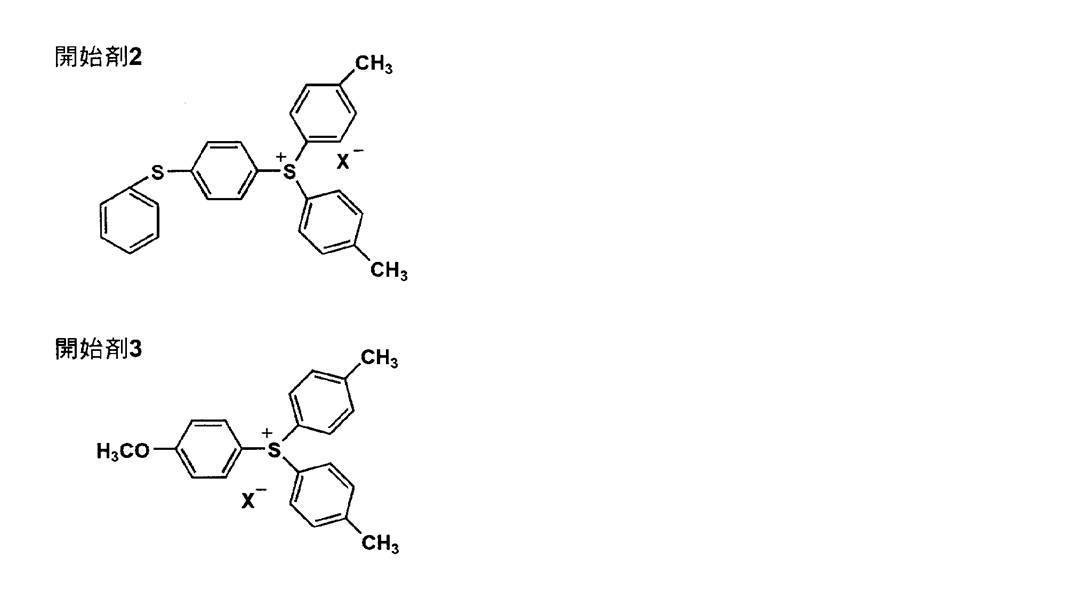
《評価》
上記作製した反射防止フィルム1~12について、下記方法により評価した。得られた結果を表1、表2に示した。
上記作製した反射防止フィルム1~12について、下記方法により評価した。得られた結果を表1、表2に示した。
(反射率測定)
分光光度計V-550(日本分光製)を用いて、入射角5°にて380~780nmの波長域の正反射分光反射率を測定した。反射率の評価においては、450~650nmの波長域の最低反射率を用いた。なお、サンプルの測定面の裏面を粗面化処理した後、黒色スプレーで光吸収処理を行って裏面での光の反射を防止して、反射率測定を行った。
分光光度計V-550(日本分光製)を用いて、入射角5°にて380~780nmの波長域の正反射分光反射率を測定した。反射率の評価においては、450~650nmの波長域の最低反射率を用いた。なお、サンプルの測定面の裏面を粗面化処理した後、黒色スプレーで光吸収処理を行って裏面での光の反射を防止して、反射率測定を行った。
(耐擦傷性)
23℃55%RHの雰囲気下で反射防止フィルムの低屈折率層面に、1000g/cm2の荷重をかけた日本スチールウール株式会社製の品番#0000のスチールウールを載せて20往復させ、20往復後の1cm幅当たりに生じた傷の本数を測定した。
23℃55%RHの雰囲気下で反射防止フィルムの低屈折率層面に、1000g/cm2の荷重をかけた日本スチールウール株式会社製の品番#0000のスチールウールを載せて20往復させ、20往復後の1cm幅当たりに生じた傷の本数を測定した。
傷の本数が5本/cm幅以下が好ましく、1本/cm幅以下が更に好ましい。スチールウールを往復させた装置は、新東科学株式会社摩擦摩耗試験機(トライボステーションTYPE:32、移動速度4000mm/min.)を使用した。
(密着性試験)
反射防止フィルムの表面に、スーパーキセノンウェザーメーター(SX120、スガ試験機(株)製)を用いて、光量100W/m2;300~400nm、ブラックパネル温度50℃、湿度65%、試験時間2000時間の条件にてUV照射試験を行った。その後、上記方法により耐擦傷性の評価と、下記JIS K 5600-5-6に準拠して、23℃55%RHの雰囲気下、碁盤目テープ剥離試験を行って密着性を評価した。
反射防止フィルムの表面に、スーパーキセノンウェザーメーター(SX120、スガ試験機(株)製)を用いて、光量100W/m2;300~400nm、ブラックパネル温度50℃、湿度65%、試験時間2000時間の条件にてUV照射試験を行った。その後、上記方法により耐擦傷性の評価と、下記JIS K 5600-5-6に準拠して、23℃55%RHの雰囲気下、碁盤目テープ剥離試験を行って密着性を評価した。
試料表面をカッターを用いて縦横1mm幅の傷を11本ずつ入れて1mm四方の正方形を100個作り(クロスカット)、ニチバン(株)製のセロテープ(登録商標)を用いて、テープを圧着してから剥離することを同じ場所で3回繰り返して行った。その後、テープ剥離後の試料表面を目視観察し、以下の基準で評価を行った。
密着性評価基準
○:影響を受けている部分が5%以下
△:影響を受けている部分が5%を超えるが30%以下
×:影響を受けている部分が30%を超える
○:影響を受けている部分が5%以下
△:影響を受けている部分が5%を超えるが30%以下
×:影響を受けている部分が30%を超える

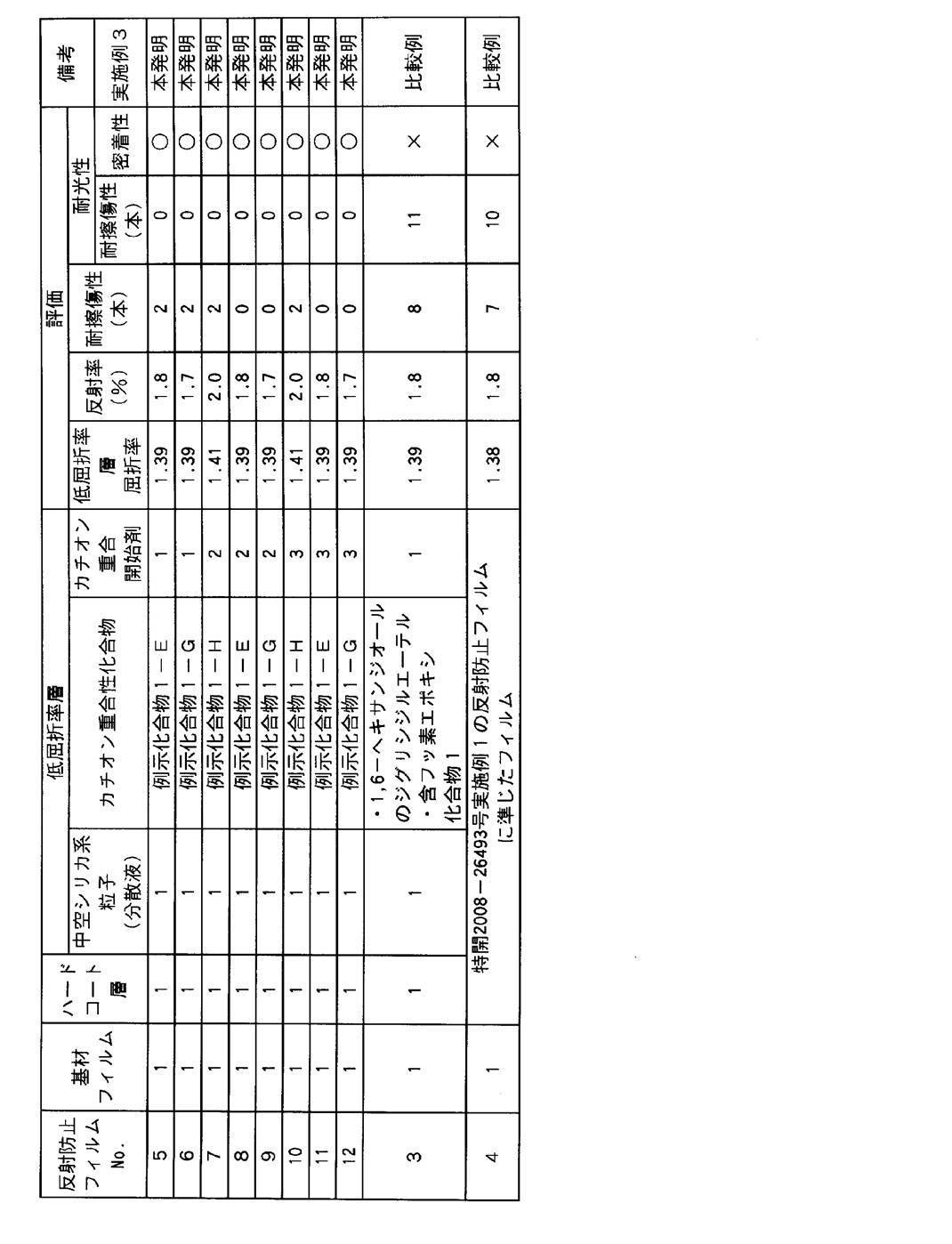
表1、表2の結果から明らかなように、低屈折率層が(A)中空シリカ粒子と、(B)一般式(1)のカチオン重合性化合物、及び(C)光カチオン重合開始剤を含有する硬化性組成物からなる層である反射防止フィルムは、反射率及び耐擦傷性がともに優れていることがわかる。
また、一般式(1)のカチオン重合性化合物を含むことによって、長期間の過酷な条件下での使用を想定した耐光性試験後においても優れた耐擦傷性及び密着性を有していることがわかる。
実施例4
実施例1の低屈折率層組成物1の中空シリカ粒子とカチオン重合性化合物とカチオン重合開始剤を表3記載のものに変更した以外は実施例1と同様にして、反射防止フィルム13~22を作製した。
実施例4
実施例1の低屈折率層組成物1の中空シリカ粒子とカチオン重合性化合物とカチオン重合開始剤を表3記載のものに変更した以外は実施例1と同様にして、反射防止フィルム13~22を作製した。
作製した反射防止フィルム13~22について、実施例3で作製した反射防止フィルム5とともに実施1と同様に評価を行った。評価結果を表3に記す。

実施例5
<反射防止フィルム23~25の作製>
反射防止フィルム1の作製において、ハードコート層組成物と低屈折率層組成物を表4のように変更して、反射防止フィルム23~25を作製した。
<反射防止フィルム23~25の作製>
反射防止フィルム1の作製において、ハードコート層組成物と低屈折率層組成物を表4のように変更して、反射防止フィルム23~25を作製した。
[帯電防止性ハードコート層組成物ANS1]
ジペンタエリスリトールヘキサアクリレート 90質量部
(NKエステルA-DPH、新中村化学工業株式会社製)
ペンタエリスリトールトリアクリレート 20質量部
ペンタエリスリトールテトラアクリレート 60質量部
ウレタンアクリレート 10質量部
(新中村化学工業社製 商品名U-4HA)
メタノール分散リンドープ酸化スズゾル 90質量部
(固形分50%、日産化学工業社製 商品名セルナックスCX-S501M)
イルガキュア184(チバ・ジャパン株式会社製) 10質量部
シリコーン系界面活性剤 3質量部
(信越化学工業社製 商品名:KF-351A)
プロピレングリコールモノメチルエーテル 50質量部
メタノール 20質量部
メチルエチルケトン 100質量部
[帯電防止性ハードコート層組成物ANS2]
ジペンタエリスリトールヘキサアクリレート 160質量部
(NKエステルA-DPH、新中村化学工業株式会社製)
テトラヒドロフルフリルアクリレート 20質量部
(ビスコート#150、大阪有機化学工業製)
ポリスチレンスルホン酸ドープ(3,4-エチレンジオキシチオフェン)2%溶液
(BAYTRON P ET V2、H.C.Stark社製)
20質量部
(固形分50%、日産化学工業社製 商品名セルナックスCX-S501M)
イルガキュア184(チバ・ジャパン株式会社製) 14質量部
シリコーン系界面活性剤 2質量部
(信越化学工業社製 商品名:KF-351A)
プロピレングリコールモノメチルエーテル 50質量部
メチルエチルケトン 100質量部
[防眩性ハードコート層組成物AG1]
シクロヘキサノン40質量部とメチルエチルケトン60質量部に、平均粒径3.5μmのフッ素含有アクリル樹脂粒子10質量部を混ぜた後、エアーディスパーにて20分間攪拌し、粒子分散液を得た。この粒子分散液に以下の材料を混合、攪拌し、防眩性ハードコート層組成物1を調製した。
ジペンタエリスリトールヘキサアクリレート 90質量部
(NKエステルA-DPH、新中村化学工業株式会社製)
ペンタエリスリトールトリアクリレート 20質量部
ペンタエリスリトールテトラアクリレート 60質量部
ウレタンアクリレート 10質量部
(新中村化学工業社製 商品名U-4HA)
メタノール分散リンドープ酸化スズゾル 90質量部
(固形分50%、日産化学工業社製 商品名セルナックスCX-S501M)
イルガキュア184(チバ・ジャパン株式会社製) 10質量部
シリコーン系界面活性剤 3質量部
(信越化学工業社製 商品名:KF-351A)
プロピレングリコールモノメチルエーテル 50質量部
メタノール 20質量部
メチルエチルケトン 100質量部
[帯電防止性ハードコート層組成物ANS2]
ジペンタエリスリトールヘキサアクリレート 160質量部
(NKエステルA-DPH、新中村化学工業株式会社製)
テトラヒドロフルフリルアクリレート 20質量部
(ビスコート#150、大阪有機化学工業製)
ポリスチレンスルホン酸ドープ(3,4-エチレンジオキシチオフェン)2%溶液
(BAYTRON P ET V2、H.C.Stark社製)
20質量部
(固形分50%、日産化学工業社製 商品名セルナックスCX-S501M)
イルガキュア184(チバ・ジャパン株式会社製) 14質量部
シリコーン系界面活性剤 2質量部
(信越化学工業社製 商品名:KF-351A)
プロピレングリコールモノメチルエーテル 50質量部
メチルエチルケトン 100質量部
[防眩性ハードコート層組成物AG1]
シクロヘキサノン40質量部とメチルエチルケトン60質量部に、平均粒径3.5μmのフッ素含有アクリル樹脂粒子10質量部を混ぜた後、エアーディスパーにて20分間攪拌し、粒子分散液を得た。この粒子分散液に以下の材料を混合、攪拌し、防眩性ハードコート層組成物1を調製した。
ジペンタエリスリトールヘキサアクリレート 90質量部
(NKエステルA-DPH、新中村化学工業株式会社製)
イルガキュア184(チバ・ジャパン株式会社製) 10質量部
シリコーン系界面活性剤 3質量部
(信越化学工業社製 商品名:KF-351A)
作製した反射防止フィルム23~25について実施1と同様に評価を行った。評価結果を表4に記す。
(NKエステルA-DPH、新中村化学工業株式会社製)
イルガキュア184(チバ・ジャパン株式会社製) 10質量部
シリコーン系界面活性剤 3質量部
(信越化学工業社製 商品名:KF-351A)
作製した反射防止フィルム23~25について実施1と同様に評価を行った。評価結果を表4に記す。

表4の結果から明らかなように、ハードコート層が帯電防止性ハードコート層や防眩性ハードコート層の場合でも、反射率及び耐擦傷性がともに優れていることがわかる。また、一般式(1)のカチオン重合性化合物を含むことによって、長期間の過酷な条件下での使用を想定した耐光性試験後においても優れた耐擦傷性及び密着性を有していることがわかる。
実施例6
反射防止フィルム11の作製において、基材フィルムを下記の基材フィルム2及び3に変更した以外は、同様にして、反射防止フィルム26及び27を作製した。
実施例6
反射防止フィルム11の作製において、基材フィルムを下記の基材フィルム2及び3に変更した以外は、同様にして、反射防止フィルム26及び27を作製した。
〈基材フィルム2の作製〉
〈セルロースエステル樹脂・アクリル樹脂フィルム1(基材フィルム2)の作製〉
[ドープ液組成2]
アクリル樹脂ダイヤナールBR80(三菱レイヨン(株)製)70質量部
(MW95000)
CAP482-20(アシル基総置換度2.75、アセチル基置換度0.19、プロ
ピオニル基置換度2.56、Mw=200000 イーストマンケミカル(
株)製) 30質量部
チヌビン109(チバ・ジャパン株式会社製) 1質量部
チヌビン171(チバ・ジャパン株式会社製) 1質量部
メチレンクロライド 300質量部
エタノール 40質量部
ブタノール 5質量部
上記組成物を、加熱しながら十分に溶解し、ドープ液を作製した。なお、CAPとはセルロースアセテートプロピオネート樹脂のことである。
〈セルロースエステル樹脂・アクリル樹脂フィルム1(基材フィルム2)の作製〉
[ドープ液組成2]
アクリル樹脂ダイヤナールBR80(三菱レイヨン(株)製)70質量部
(MW95000)
CAP482-20(アシル基総置換度2.75、アセチル基置換度0.19、プロ
ピオニル基置換度2.56、Mw=200000 イーストマンケミカル(
株)製) 30質量部
チヌビン109(チバ・ジャパン株式会社製) 1質量部
チヌビン171(チバ・ジャパン株式会社製) 1質量部
メチレンクロライド 300質量部
エタノール 40質量部
ブタノール 5質量部
上記組成物を、加熱しながら十分に溶解し、ドープ液を作製した。なお、CAPとはセルロースアセテートプロピオネート樹脂のことである。
〈セルロースエステル樹脂・アクリル樹脂フィルム1の製膜〉
上記作製したドープ液を、ベルト流延装置を用い、温度22℃、2m幅でステンレスバンド支持体に均一に流延した。ステンレスバンド支持体で、残留溶剤量が100%になるまで溶媒を蒸発させ、剥離張力162N/mでステンレスバンド支持体上から剥離した。
上記作製したドープ液を、ベルト流延装置を用い、温度22℃、2m幅でステンレスバンド支持体に均一に流延した。ステンレスバンド支持体で、残留溶剤量が100%になるまで溶媒を蒸発させ、剥離張力162N/mでステンレスバンド支持体上から剥離した。
剥離したアクリル樹脂のウェブを35℃で溶媒を蒸発させ、1.6m幅にスリットし、その後、テンターで幅方向に1.1倍に延伸しながら、135℃の乾燥温度で乾燥させた。このときテンターで延伸を始めたときの残留溶剤量は10%であった。
テンターで延伸後130℃で5分間緩和を行った後、120℃、130℃の乾燥ゾーンを多数のロールで搬送させながら乾燥を終了させ、1.5m幅にスリットし、フィルム両端に幅10mm高さ10μmのナーリング加工を施し、巻き取り、膜厚80μm、長さ4000m、屈折率1.50のルロースエステル樹脂・アクリル樹脂フィルム1(基材フィルム2)を得た。
ステンレスバンド支持体の回転速度とテンターの運転速度から算出されるMD方向の延伸倍率は1.1倍であった。
〈基材フィルム3の作製〉
基材フィルム2の作製において、以下のドープ液組成2に変更した以外は、同様にしてアクリル粒子含有のセルロースエステル樹脂・アクリル樹脂フィルム2(基材フィルム3)を作製した。
基材フィルム2の作製において、以下のドープ液組成2に変更した以外は、同様にしてアクリル粒子含有のセルロースエステル樹脂・アクリル樹脂フィルム2(基材フィルム3)を作製した。
(アクリル粒子の調製)
内容積60リットルの還流冷却器付反応器に、イオン交換水38.2リットル、ジオクチルスルホコハク酸ナトリウム111.6gを投入し、250rpmの回転数で攪拌しながら、窒素雰囲気下75℃に昇温し、酸素の影響が事実上無い状態にした。APS0.36gを投入し、5分間攪拌後にMMA1657g、BA21.6g、及びALMA1.68gからなる単量体混合物を一括添加し、発熱ピークの検出後更に20分間保持して最内硬質層の重合を完結させた。次に、APS3.48gを投入し、5分間攪拌後にBA8105g、PEGDA(200)31.9g、及びALMA264.0gからなる単量体混合物を120分間かけて連続的に添加し、添加終了後更に120分間保持して,軟質層の重合を完結させた。
内容積60リットルの還流冷却器付反応器に、イオン交換水38.2リットル、ジオクチルスルホコハク酸ナトリウム111.6gを投入し、250rpmの回転数で攪拌しながら、窒素雰囲気下75℃に昇温し、酸素の影響が事実上無い状態にした。APS0.36gを投入し、5分間攪拌後にMMA1657g、BA21.6g、及びALMA1.68gからなる単量体混合物を一括添加し、発熱ピークの検出後更に20分間保持して最内硬質層の重合を完結させた。次に、APS3.48gを投入し、5分間攪拌後にBA8105g、PEGDA(200)31.9g、及びALMA264.0gからなる単量体混合物を120分間かけて連続的に添加し、添加終了後更に120分間保持して,軟質層の重合を完結させた。
次に、APS1.32gを投入し、5分間攪拌後にMMA2106g、BA201.6gからなる単量体混合物を20分間かけて連続的に添加し、添加終了後更に20分間保持して最外硬質層1の重合を完結した。
ついで、APS1.32gを投入し、5分後にMMA3148g、BA201.6g、及びn-OM10.1gからなる単量体混合物を20分間かけて連続的に添加し、添加終了後に更に20分間保持した。ついで95℃に昇温し60分間保持して、最外硬質層2の重合を完結させた。
このようにして得られた重合体ラテックスを少量採取し、吸光度法により平粒子径を求めたところ0.10μmであった。残りのラテックスを3質量%硫酸ナトリウム温水溶液中へ投入して、塩析・凝固させ、ついで、脱水・洗浄を繰り返したのち乾燥し、3層構造のアクリル粒子を得た。
上記の略号は各々下記材料である。
MMA;メチルメタクリレート
MA;メチルアクリレート
BA;n-ブチルアクリレート
ALMA;アリルメタクリレート
PEGDA;ポリエチレングリコールジアクリレート(分子量200)
n-OM;n-オクチルメルカプタン
APS;過硫酸アンモニウム
(アクリル粒子含有のセルロースエステル樹脂・アクリル樹脂フィルム1の作製)
(ドープ液組成3)
ダイヤナールBR80(三菱レイヨン(株)製) 70質量部
CAP482-20 30質量部
上記調製したアクリル粒子 20質量部
チヌビン109(チバ・ジャパン株式会社製) 1質量部
チヌビン171(チバ・ジャパン株式会社製) 1質量部
メチレンクロライド 300質量部
エタノール 40質量部
ブタノール 5質量部
上記組成物を、加熱しながら十分に溶解し、ドープ液を作製した。
<基材フィルム4;セルロースエステルフィルム2の製造>
(セルロースエステルC1の合成)
特表平6-501040号公報の例Bを参考にして、プロピオン酸、酢酸の添加量を調整して、アセチル基置換度、プロピオニル基置換度を下記のように調整したセルロースエステルC1を合成した。
MA;メチルアクリレート
BA;n-ブチルアクリレート
ALMA;アリルメタクリレート
PEGDA;ポリエチレングリコールジアクリレート(分子量200)
n-OM;n-オクチルメルカプタン
APS;過硫酸アンモニウム
(アクリル粒子含有のセルロースエステル樹脂・アクリル樹脂フィルム1の作製)
(ドープ液組成3)
ダイヤナールBR80(三菱レイヨン(株)製) 70質量部
CAP482-20 30質量部
上記調製したアクリル粒子 20質量部
チヌビン109(チバ・ジャパン株式会社製) 1質量部
チヌビン171(チバ・ジャパン株式会社製) 1質量部
メチレンクロライド 300質量部
エタノール 40質量部
ブタノール 5質量部
上記組成物を、加熱しながら十分に溶解し、ドープ液を作製した。
<基材フィルム4;セルロースエステルフィルム2の製造>
(セルロースエステルC1の合成)
特表平6-501040号公報の例Bを参考にして、プロピオン酸、酢酸の添加量を調整して、アセチル基置換度、プロピオニル基置換度を下記のように調整したセルロースエステルC1を合成した。
C1:アセチル基置換度1.9、プロピオニル基置換度0.7、総アシル基置換度2.60
得られたセルロースエステルの置換度は、ASTM-D817-96に基づいて算出した。セルロースエステルC1の重量平均分子量は、前記高速液体クロマトグラフィーを用いて測定した結果130000であった。
得られたセルロースエステルの置換度は、ASTM-D817-96に基づいて算出した。セルロースエステルC1の重量平均分子量は、前記高速液体クロマトグラフィーを用いて測定した結果130000であった。
〈セルロースエステルフィルム2の作製〉
下記組成で、溶融流延によりセルロースエステルフィルム2を作製した。
下記組成で、溶融流延によりセルロースエステルフィルム2を作製した。
[セルロースエステルフィルム2組成物]
セルロースエステル:C1 94質量部
可塑剤:グリセリントリベンゾエート 5質量部
Irganox 1010(チバ・ジャパン株式会社製) 0.5質量部
Irgafos P-EPG(チバ・ジャパン株式会社製)0.3質量部
HP-136(チバ・ジャパン株式会社製) 0.2質量部
上記セルロースエステルを70℃、3時間減圧下で乾燥を行い室温まで冷却した後、各添加剤を混合した。
セルロースエステル:C1 94質量部
可塑剤:グリセリントリベンゾエート 5質量部
Irganox 1010(チバ・ジャパン株式会社製) 0.5質量部
Irgafos P-EPG(チバ・ジャパン株式会社製)0.3質量部
HP-136(チバ・ジャパン株式会社製) 0.2質量部
上記セルロースエステルを70℃、3時間減圧下で乾燥を行い室温まで冷却した後、各添加剤を混合した。
以上の混合物を弾性タッチロールを用いた製造装置で製膜した。窒素雰囲気下、240℃にて溶融して流延ダイから第1冷却ロール上に押し出し、第1冷却ロールとタッチロールとの間にフィルムを挟圧して成形した。また押出し機中間部のホッパー開口部から、滑り剤としてシリカ粒子(日本アエロジル社製)を、0.1質量部となるよう添加した。
流延ダイのギャップの幅がフィルムの幅方向端部から30mm以内では0.5mm、その他の場所では1mmとなるようにヒートボルトを調整した。タッチロールとしては、その内部に冷却水として80℃の水を流した。
流延ダイから押し出された樹脂が第1冷却ロールに接触する位置P1から第1冷却ロールとタッチロールとのニップの第1冷却ロール回転方向上流端の位置P2までの、第1冷却ローラの周面に沿った長さLを20mmに設定した。その後、タッチロールを第1冷却ロールから離間させ、第1冷却ロールとタッチロールとのニップに挟圧される直前の溶融部の温度Tを測定した。
第1冷却ロールとタッチロールとのニップに挟圧される直前の溶融部の温度Tは、ニップ上流端P2よりも更に1mm上流側の位置で、温度計(安立計器株式会社製HA-200E)により測定した。測定の結果、温度Tは141℃であった。タッチロールの第1冷却ロールに対する線圧は14.7N/cmとした。更に、テンターに導入し、巾方向に160℃で1.3倍延伸した後、巾方向に3%緩和しながら30℃まで冷却し、その後クリップから開放し、クリップ把持部を裁ち落とし、フィルム両端に幅20mm、高さ25μmのナーリング加工を施し、巻き取り張力220N/m、テーパー40%で巻芯に巻き取った。
巻芯の大きさは、内径152mm、外径165~180mm、長さ1550mmであった。この巻芯母材として、エポキシ樹脂をガラス繊維、カーボン繊維に含浸させたプリプレグ樹脂を用いた。巻芯表面にはエポキシ導電性樹脂をコーティングし、表面を研磨して、表面粗さRaは0.3μmに仕上げた。なお、膜厚は40μm、巻長は3500mとし、屈折率1.49のセルロースエステルフィルム2を作製した。
《評価》
実施例3で作製した反射防止フィルム12、及び上記作製した反射防止フィルム26~28について、実施例1に記載した方法で評価を行った。更に、それぞれA4サイズにカットし、低屈折率層を表面にして、温度80℃、湿度90%RHの高温高湿サーモにて700時間保存し、湿熱処理サンプルを作製した。ついで、湿熱処理した反射防止フィルムを、温度23℃、相対湿度55%の条件で24時間調湿して、下記の方法に従って鉛筆硬度について評価した。
実施例3で作製した反射防止フィルム12、及び上記作製した反射防止フィルム26~28について、実施例1に記載した方法で評価を行った。更に、それぞれA4サイズにカットし、低屈折率層を表面にして、温度80℃、湿度90%RHの高温高湿サーモにて700時間保存し、湿熱処理サンプルを作製した。ついで、湿熱処理した反射防止フィルムを、温度23℃、相対湿度55%の条件で24時間調湿して、下記の方法に従って鉛筆硬度について評価した。
以上より得られた結果を表5に示した。なお、表3に示した基材フィルムは以下の略称で示した。
基材フィルム1:セルロースエステルフィルム1
基材フィルム2:セルロースエステル樹脂・アクリル樹脂フィルム1
基材フィルム3:アクリル粒子含有のセルロースエステル樹脂・アクリル樹脂フィルム2
基材フィルム4:セルロースエステルフィルム2
(鉛筆硬度)
反射防止フィルムを25℃、60%RHの環境下で2時間調湿した後、JIS K5600-5-4に準拠して引っ掻き試験を行った。1kgのおもりを用いて各硬度の鉛筆で引っ掻きを5回場所を変えながら行い、傷が1本になるまでの硬度を測定した。なお、ここでいう傷とは、塗膜の破れ、擦り傷及びへこみを対象とした。数値が高いほど高硬度を示し、3H以上が好ましい。
基材フィルム2:セルロースエステル樹脂・アクリル樹脂フィルム1
基材フィルム3:アクリル粒子含有のセルロースエステル樹脂・アクリル樹脂フィルム2
基材フィルム4:セルロースエステルフィルム2
(鉛筆硬度)
反射防止フィルムを25℃、60%RHの環境下で2時間調湿した後、JIS K5600-5-4に準拠して引っ掻き試験を行った。1kgのおもりを用いて各硬度の鉛筆で引っ掻きを5回場所を変えながら行い、傷が1本になるまでの硬度を測定した。なお、ここでいう傷とは、塗膜の破れ、擦り傷及びへこみを対象とした。数値が高いほど高硬度を示し、3H以上が好ましい。

上記表5の結果から明らかなように、基材フィルムがセルロースエステル樹脂・アクリル樹脂フィルムや、アクリル粒子含有のセルロースエステル樹脂・アクリル樹脂フィルム、セルロースエステルフィルム2であっても、セルロースエステルフィルムのときと同様に、優れた低反射性と耐擦傷性を示し、良好な耐光性をも有していることがわかる。
また、過酷な湿熱処理後の評価では、基材フィルムが、セルロースエステルフィルムよりもセルロースエステル樹脂・アクリル樹脂からなるフィルムや、セルロースエステル樹脂・アクリル樹脂から構成され、かつアクリル粒子を含有するフィルムの方が、特に鉛筆硬度に優れていることがわかる。
実施例7
実施例1、実施例2で作製した反射防止フィルム1~12を用いて、下記のようにして偏光板を作製し、これらの偏光板を液晶表示パネル(画像表示装置)に組み込み、視認性を評価した。
実施例7
実施例1、実施例2で作製した反射防止フィルム1~12を用いて、下記のようにして偏光板を作製し、これらの偏光板を液晶表示パネル(画像表示装置)に組み込み、視認性を評価した。
下記の方法に従って、上記実施例1、実施例2で作製した反射防止フィルム1~12をセルロースエステル系光学補償フィルムであるコニカミノルタタックKC8UCR5(コニカミノルタオプト株式会社製)各々1枚を偏光板保護フィルムとして用いて、偏光板101~112をそれぞれ作製した。
(a)偏光子の作製
けん化度99.95モル%、重合度2400のポリビニルアルコール(以下、PVAと略記する)100質量部に、グリセリン10質量部、及び水170質量部を含浸させたものを溶融混練し、脱泡後、Tダイから金属ロール上に溶融押出し、製膜した。その後、乾燥・熱処理して、PVAフィルムを得た。得られたPVAフィルムは、平均厚みが40μm、水分率が4.4%、フィルム幅が3mであった。
けん化度99.95モル%、重合度2400のポリビニルアルコール(以下、PVAと略記する)100質量部に、グリセリン10質量部、及び水170質量部を含浸させたものを溶融混練し、脱泡後、Tダイから金属ロール上に溶融押出し、製膜した。その後、乾燥・熱処理して、PVAフィルムを得た。得られたPVAフィルムは、平均厚みが40μm、水分率が4.4%、フィルム幅が3mであった。
次に、得られたPVAフィルムを、予備膨潤、染色、湿式法による一軸延伸、固定処理、乾燥、熱処理の順番で、連続的に処理して、偏光子を作製した。即ち、PVAフィルムを温度30℃の水中に30秒間浸して予備膨潤し、ヨウ素濃度0.4g/リットル、ヨウ化カリウム濃度40g/リットルの温度35℃の水溶液中に3分間浸した。
続いて、ホウ酸濃度4%の50℃の水溶液中でフィルムにかかる張力が700N/mの条件下で、6倍に一軸延伸を行い、ヨウ化カリウム濃度40g/リットル、ホウ酸濃度40g/リットル、塩化亜鉛濃度10g/リットルの温度30℃の水溶液中に5分間浸漬して固定処理を行った。
その後、PVAフィルムを取り出し、温度40℃で熱風乾燥し、更に温度100℃で5分間熱処理を行った。得られた偏光子は、平均厚みが13μm、偏光性能については透過率が43.0%、偏光度が99.5%、2色性比が40.1であった。
(b)偏光板の作製
ついで、下記工程1~5に従って、偏光子と、偏光板用保護フィルムとを貼り合わせて反射防止フィルム1~12に対応する偏光板101~112を作製した。
ついで、下記工程1~5に従って、偏光子と、偏光板用保護フィルムとを貼り合わせて反射防止フィルム1~12に対応する偏光板101~112を作製した。
工程1:光学補償フィルムと反射防止フィルムを、2mol/Lの水酸化ナトリウム溶液に、温度60℃で、90秒間浸漬し、ついで水洗、乾燥させた。各反射防止フィルムの低屈折率層を設けた面には、予め剥離性の保護フィルム(PET製)を張り付けて保護した。
同様にして、前述した光学補償フィルムを2mol/Lの水酸化ナトリウム溶液に、温度60℃で、90秒間浸漬し、ついで水洗、乾燥させた。
工程2:前述の偏光子を、固形分2質量%のポリビニルアルコール接着剤溶液の貯留槽中に1~2秒間浸漬した。
工程3:工程2で偏光子に付着した過剰の接着剤を軽く取り除き、この偏光子を、工程1でアルカリ処理した光学補償フィルムと反射防止フィルムとで挟み込んで、積層配置した。
工程4:積層物を、2つの回転するローラにて20~30N/cm2の圧力で約2m/minの速度で貼り合わせた。このとき、気泡が入らないように注意して実施した。
工程5:工程4で作製した試料を、温度80℃の乾燥機中にて2分間乾燥処理し、偏光板101~111を作製した。
次に、市販の液晶表示パネル(VA型)の最表面の偏光板を注意深く剥離し、ここに偏光方向を合わせた各偏光板101~111を張り付けた。こうして得られた液晶パネル201~211を、床から80cmの高さの机上に配置し、床から3mの高さの天井部に、昼色光直管蛍光灯(FLR40S・D/M-X 松下電器産業株式会社製)40W×2本を1セットとして、1.5m間隔で10セット配置した。
この場合、評価者が液晶表示パネルの表示面の正面にいるときに、評価者の頭上より後方に向けて天井部に蛍光灯がくるように配置した。各液晶パネルは机に対する垂直方向から25°傾けて、蛍光灯が写り込むようにして画面の見易さ(視認性)を、下記のランクに分けて評価者による官能評価した。
A:最も近い蛍光灯の写り込みが気にならず、フォントの大きさ8以下の文字もはっきりと読める
B:近くの蛍光灯の写り込みはやや気になるが、遠くは気にならず、フォントの大きさ8以下の文字もなんとかと読める
C:遠くの蛍光灯の写り込みも気になり、フォントの大きさ8以下の文字を読むのは困難である
D:蛍光灯の写り込みがかなり気になり、写り込みの部分はフォントの大きさ8以下の文字を読むことはできない
評価の結果、比較例の反射防止フィルム3~4、及び比較例の偏光板103~104を用いた液晶パネル203~204はC以下の評価に対して、本発明の反射防止フィルム1~2及び5~12、並びに本発明の偏光板101~102及び105~112を用いた液晶パネル201~202及び205~212は、何れもB以上の評価結果であり、より視認性が良好であった。
B:近くの蛍光灯の写り込みはやや気になるが、遠くは気にならず、フォントの大きさ8以下の文字もなんとかと読める
C:遠くの蛍光灯の写り込みも気になり、フォントの大きさ8以下の文字を読むのは困難である
D:蛍光灯の写り込みがかなり気になり、写り込みの部分はフォントの大きさ8以下の文字を読むことはできない
評価の結果、比較例の反射防止フィルム3~4、及び比較例の偏光板103~104を用いた液晶パネル203~204はC以下の評価に対して、本発明の反射防止フィルム1~2及び5~12、並びに本発明の偏光板101~102及び105~112を用いた液晶パネル201~202及び205~212は、何れもB以上の評価結果であり、より視認性が良好であった。
Claims (5)
- (A)中空シリカ粒子、(B)下記一般式(1)で表されるカチオン重合性化合物および(C)光カチオン重合開始剤を含有することを特徴とする反射防止層用組成物。

ここでR1は、炭素数1~10のカチオン重合可能な基を表す。R2は、メチル基、エチル基、プロピル基から選択される基を表す。nは、0、1、2のいずれかを表す。 - 前記一般式(1)で表される化合物のR1が、エポキシ構造またはオキセタン構造を有する基であることを特徴とする請求項1記載の反射防止層用組成物。
- 請求項1または2記載の組成物を硬化した層を有することを特徴とする反射防止フィルム。
- 請求項3記載の反射防止フィルムを使用することを特徴とする偏光板。
- 請求項3記載の反射防止フィルムを使用することを特徴とする画像表示装置。
Priority Applications (1)
| Application Number | Priority Date | Filing Date | Title |
|---|---|---|---|
| JP2010530776A JPWO2010035571A1 (ja) | 2008-09-24 | 2009-07-24 | 反射防止層用組成物、反射防止フィルム、偏光板、及び画像表示装置 |
Applications Claiming Priority (2)
| Application Number | Priority Date | Filing Date | Title |
|---|---|---|---|
| JP2008243779 | 2008-09-24 | ||
| JP2008-243779 | 2008-09-24 |
Publications (1)
| Publication Number | Publication Date |
|---|---|
| WO2010035571A1 true WO2010035571A1 (ja) | 2010-04-01 |
Family
ID=42059578
Family Applications (1)
| Application Number | Title | Priority Date | Filing Date |
|---|---|---|---|
| PCT/JP2009/063260 Ceased WO2010035571A1 (ja) | 2008-09-24 | 2009-07-24 | 反射防止層用組成物、反射防止フィルム、偏光板、及び画像表示装置 |
Country Status (2)
| Country | Link |
|---|---|
| JP (1) | JPWO2010035571A1 (ja) |
| WO (1) | WO2010035571A1 (ja) |
Cited By (3)
| Publication number | Priority date | Publication date | Assignee | Title |
|---|---|---|---|---|
| WO2019187588A1 (ja) * | 2018-03-30 | 2019-10-03 | 太陽インキ製造株式会社 | 硬化性樹脂組成物、ドライフィルム、硬化物、および、電子部品 |
| JP2023032463A (ja) * | 2021-08-27 | 2023-03-09 | 信越ポリマー株式会社 | 導電性高分子含有液及び導電性積層体 |
| JP2024089970A (ja) * | 2022-12-22 | 2024-07-04 | 信越ポリマー株式会社 | 導電性複合体分散液及びその製造方法、並びに導電性積層体の製造方法 |
Citations (5)
| Publication number | Priority date | Publication date | Assignee | Title |
|---|---|---|---|---|
| JP2003255103A (ja) * | 2002-02-28 | 2003-09-10 | Fuji Photo Film Co Ltd | 反射防止フィルム、偏光板および画像表示装置 |
| JP2004170901A (ja) * | 2002-07-05 | 2004-06-17 | Fuji Photo Film Co Ltd | 反射防止フィルム、偏光板およびディスプレイ装置 |
| JP2005316415A (ja) * | 2004-03-31 | 2005-11-10 | Dainippon Printing Co Ltd | 反射防止積層体 |
| WO2005114271A1 (ja) * | 2004-05-20 | 2005-12-01 | Fujifilm Corporation | 反射防止機能付き偏光板、その製造方法、及びそれを用いた画像表示装置 |
| JP2007034213A (ja) * | 2005-07-29 | 2007-02-08 | Fujifilm Corp | 反射防止フィルム、それを用いた偏光板及びディスプレイ装置 |
-
2009
- 2009-07-24 WO PCT/JP2009/063260 patent/WO2010035571A1/ja not_active Ceased
- 2009-07-24 JP JP2010530776A patent/JPWO2010035571A1/ja active Pending
Patent Citations (5)
| Publication number | Priority date | Publication date | Assignee | Title |
|---|---|---|---|---|
| JP2003255103A (ja) * | 2002-02-28 | 2003-09-10 | Fuji Photo Film Co Ltd | 反射防止フィルム、偏光板および画像表示装置 |
| JP2004170901A (ja) * | 2002-07-05 | 2004-06-17 | Fuji Photo Film Co Ltd | 反射防止フィルム、偏光板およびディスプレイ装置 |
| JP2005316415A (ja) * | 2004-03-31 | 2005-11-10 | Dainippon Printing Co Ltd | 反射防止積層体 |
| WO2005114271A1 (ja) * | 2004-05-20 | 2005-12-01 | Fujifilm Corporation | 反射防止機能付き偏光板、その製造方法、及びそれを用いた画像表示装置 |
| JP2007034213A (ja) * | 2005-07-29 | 2007-02-08 | Fujifilm Corp | 反射防止フィルム、それを用いた偏光板及びディスプレイ装置 |
Cited By (5)
| Publication number | Priority date | Publication date | Assignee | Title |
|---|---|---|---|---|
| WO2019187588A1 (ja) * | 2018-03-30 | 2019-10-03 | 太陽インキ製造株式会社 | 硬化性樹脂組成物、ドライフィルム、硬化物、および、電子部品 |
| CN111936575A (zh) * | 2018-03-30 | 2020-11-13 | 太阳油墨制造株式会社 | 固化性树脂组合物、干膜、固化物和电子部件 |
| JP2023032463A (ja) * | 2021-08-27 | 2023-03-09 | 信越ポリマー株式会社 | 導電性高分子含有液及び導電性積層体 |
| JP7621222B2 (ja) | 2021-08-27 | 2025-01-24 | 信越ポリマー株式会社 | 導電性高分子含有液及び導電性積層体 |
| JP2024089970A (ja) * | 2022-12-22 | 2024-07-04 | 信越ポリマー株式会社 | 導電性複合体分散液及びその製造方法、並びに導電性積層体の製造方法 |
Also Published As
| Publication number | Publication date |
|---|---|
| JPWO2010035571A1 (ja) | 2012-02-23 |
Similar Documents
| Publication | Publication Date | Title |
|---|---|---|
| JP2010078642A (ja) | 反射防止フィルム、偏光板及び画像表示装置 | |
| JP5182521B2 (ja) | 反射防止層用組成物、反射防止フィルム、偏光板、及び画像表示装置 | |
| CN101253429B (zh) | 偏振片及使用该偏振片的液晶显示装置 | |
| CN100497448C (zh) | 拉伸纤维素酯膜、硬涂膜、防反射膜、光学补偿膜、以及使用其的偏振片和显示装置 | |
| JP2010085894A (ja) | 反射防止層用組成物、反射防止フィルム、偏光板、及び画像表示装置 | |
| KR101274848B1 (ko) | 반사 방지 필름, 반사 방지 필름의 제조 방법, 하드 코팅 필름, 편광판 및 표시 장치 | |
| CN101208383B (zh) | 纤维素酯膜、使用其的横向电场驱动式显示装置用偏振板及横向电场驱动式显示装置 | |
| JP4736562B2 (ja) | 偏光板及び表示装置 | |
| JPWO2009075201A1 (ja) | 防眩性フィルム、偏光板及び液晶表示装置 | |
| JP2009042351A (ja) | 光学フィルム、偏光板及び表示装置 | |
| JP5217906B2 (ja) | 偏光板、液晶表示装置、及びips(インプレーンスイッチング)モード型液晶表示装置 | |
| JP2009196202A (ja) | ハードコートフィルム、これを用いた反射防止フィルム、偏光板、及び表示装置 | |
| JP5479258B2 (ja) | セルロースアシレートフィルム及びその製造方法、並びにそれを用いた偏光板及び液晶表示装置 | |
| JP5168278B2 (ja) | 防眩性フィルム、これを用いた防眩性反射防止フィルム、偏光板、及び表示装置 | |
| JP2010191023A (ja) | 反射防止フィルム、偏光板及び画像表示装置 | |
| JP5158075B2 (ja) | 反射防止フィルム、それを用いた偏光板、及び表示装置 | |
| JP2009288413A (ja) | ハードコートフィルムの製造方法、ハードコートフィルム、反射防止フィルム、偏光板、及び画像表示装置 | |
| JP2009186760A (ja) | ハードコートフィルム、これを用いた偏光板、及び表示装置 | |
| WO2017077740A1 (ja) | 光学フィルム、偏光板および画像表示装置 | |
| JP2009186651A (ja) | 反射防止フィルムの製造方法、反射防止フィルム、偏光板及び画像表示装置 | |
| JP2010217699A (ja) | 反射防止層用組成物、反射防止フィルム、偏光板、および画像表示装置 | |
| JP2009210876A (ja) | 反射防止フィルムの製造方法、反射防止フィルム、偏光板及び画像表示装置 | |
| JP2010217504A (ja) | 反射防止フィルム | |
| JP2010134034A (ja) | 反射防止フィルム、偏光板及び画像表示装置 | |
| JP2005338549A (ja) | 反射防止フィルム、偏光板及び画像表示装置 |
Legal Events
| Date | Code | Title | Description |
|---|---|---|---|
| 121 | Ep: the epo has been informed by wipo that ep was designated in this application |
Ref document number: 09815988 Country of ref document: EP Kind code of ref document: A1 |
|
| WWE | Wipo information: entry into national phase |
Ref document number: 2010530776 Country of ref document: JP |
|
| NENP | Non-entry into the national phase |
Ref country code: DE |
|
| 122 | Ep: pct application non-entry in european phase |
Ref document number: 09815988 Country of ref document: EP Kind code of ref document: A1 |