WO2008018442A1 - Binder resin for near-infrared-ray-absorbable film - Google Patents
Binder resin for near-infrared-ray-absorbable film Download PDFInfo
- Publication number
- WO2008018442A1 WO2008018442A1 PCT/JP2007/065415 JP2007065415W WO2008018442A1 WO 2008018442 A1 WO2008018442 A1 WO 2008018442A1 JP 2007065415 W JP2007065415 W JP 2007065415W WO 2008018442 A1 WO2008018442 A1 WO 2008018442A1
- Authority
- WO
- WIPO (PCT)
- Prior art keywords
- meth
- weight
- molecular weight
- acrylic polymer
- acrylate
- Prior art date
- Legal status (The legal status is an assumption and is not a legal conclusion. Google has not performed a legal analysis and makes no representation as to the accuracy of the status listed.)
- Ceased
Links
Classifications
-
- C—CHEMISTRY; METALLURGY
- C08—ORGANIC MACROMOLECULAR COMPOUNDS; THEIR PREPARATION OR CHEMICAL WORKING-UP; COMPOSITIONS BASED THEREON
- C08L—COMPOSITIONS OF MACROMOLECULAR COMPOUNDS
- C08L33/00—Compositions of homopolymers or copolymers of compounds having one or more unsaturated aliphatic radicals, each having only one carbon-to-carbon double bond, and only one being terminated by only one carboxyl radical, or of salts, anhydrides, esters, amides, imides or nitriles thereof; Compositions of derivatives of such polymers
- C08L33/04—Homopolymers or copolymers of esters
- C08L33/14—Homopolymers or copolymers of esters of esters containing halogen, nitrogen, sulfur, or oxygen atoms in addition to the carboxy oxygen
-
- C—CHEMISTRY; METALLURGY
- C09—DYES; PAINTS; POLISHES; NATURAL RESINS; ADHESIVES; COMPOSITIONS NOT OTHERWISE PROVIDED FOR; APPLICATIONS OF MATERIALS NOT OTHERWISE PROVIDED FOR
- C09J—ADHESIVES; NON-MECHANICAL ASPECTS OF ADHESIVE PROCESSES IN GENERAL; ADHESIVE PROCESSES NOT PROVIDED FOR ELSEWHERE; USE OF MATERIALS AS ADHESIVES
- C09J133/00—Adhesives based on homopolymers or copolymers of compounds having one or more unsaturated aliphatic radicals, each having only one carbon-to-carbon double bond, and at least one being terminated by only one carboxyl radical, or of salts, anhydrides, esters, amides, imides, or nitriles thereof; Adhesives based on derivatives of such polymers
- C09J133/04—Homopolymers or copolymers of esters
- C09J133/14—Homopolymers or copolymers of esters of esters containing halogen, nitrogen, sulfur or oxygen atoms in addition to the carboxy oxygen
-
- C—CHEMISTRY; METALLURGY
- C08—ORGANIC MACROMOLECULAR COMPOUNDS; THEIR PREPARATION OR CHEMICAL WORKING-UP; COMPOSITIONS BASED THEREON
- C08L—COMPOSITIONS OF MACROMOLECULAR COMPOUNDS
- C08L2666/00—Composition of polymers characterized by a further compound in the blend, being organic macromolecular compounds, natural resins, waxes or and bituminous materials, non-macromolecular organic substances, inorganic substances or characterized by their function in the composition
- C08L2666/02—Organic macromolecular compounds, natural resins, waxes or and bituminous materials
- C08L2666/04—Macromolecular compounds according to groups C08L7/00 - C08L49/00, or C08L55/00 - C08L57/00; Derivatives thereof
-
- C—CHEMISTRY; METALLURGY
- C08—ORGANIC MACROMOLECULAR COMPOUNDS; THEIR PREPARATION OR CHEMICAL WORKING-UP; COMPOSITIONS BASED THEREON
- C08L—COMPOSITIONS OF MACROMOLECULAR COMPOUNDS
- C08L33/00—Compositions of homopolymers or copolymers of compounds having one or more unsaturated aliphatic radicals, each having only one carbon-to-carbon double bond, and only one being terminated by only one carboxyl radical, or of salts, anhydrides, esters, amides, imides or nitriles thereof; Compositions of derivatives of such polymers
- C08L33/04—Homopolymers or copolymers of esters
-
- G—PHYSICS
- G02—OPTICS
- G02B—OPTICAL ELEMENTS, SYSTEMS OR APPARATUS
- G02B5/00—Optical elements other than lenses
- G02B5/20—Filters
- G02B5/208—Filters for use with infrared or ultraviolet radiation, e.g. for separating visible light from infrared and/or ultraviolet radiation
Definitions
- the present invention relates to a binder resin for a near-infrared absorbing film. More specifically, the present invention is applied to the surface of a device that emits near-infrared rays, such as a plasma display panel, or a near-infrared ray that is affixed to a building glass.
- the present invention relates to a binder resin for a near-infrared absorbing film used for an infrared absorbing film. Background art
- NIR near-infrared rays
- NIR film is used.
- This NIR film has the following problems, which can be obtained by uniformly dispersing a NIR absorbent such as a pigment in a matrix resin and coating it on a transparent plastic film.
- Patent Document 2 a (meth) acrylic monomer and an alicyclic structure-containing monomer are copolymerized as a binder resin for NIR film having high dye stability and good substrate adhesion.
- a blend of MMA homopolymer with the acrylic polymer is described.
- the stability of the dye and adhesion to the substrate were not sufficient! /.
- Patent Document 1 JP-A-2004-182793
- Patent Document 2 JP 2005-239999
- an object of the present invention is to provide a binder resin for NIR that has good adhesion to PET widely used as a transparent film substrate and that can stably contain an NIR absorbent. It is.
- the inventors of the present invention have blended various polymers to solve the above-mentioned problems, and have been searching for the adhesiveness and anti-fading action of various NIR absorbing dyes, particularly under wet heat conditions.
- Resins that combine certain (meth) acrylic polymers have excellent adhesion and
- the present invention includes 1 to 30 parts by weight of the following high molecular weight (meth) acrylic polymer (B) with respect to 100 parts by weight of the low molecular weight (meth) acrylic polymer (A) below.
- This is a binder resin for NIR.
- the binder resin for NIR of the present invention improves the adhesion to PET while suppressing the fading of the NIR dye contained therein, so that the fading or peeling of the NIR film can be achieved even under wet heat conditions. Can be suppressed. Further, even when NIR dye is contained at a high concentration, the fading resistance is good, and the dye can be contained at a high concentration in the NIR film.
- the NIR binder resin of the present invention has improved workability such as coating property by blending with a high molecular weight polymer.
- a (meth) acrylic polymer having a weight average molecular weight (Mw) of 50,000, and 300,000 (hereinafter referred to as "component (A)" and! /) Used in the binder resin for NIR of the present invention Is a copolymer of 70% by mass or more of methyl methacrylate.
- methyl methacrylate hereinafter sometimes referred to as "monomer (a-1)"! /
- a polymer which is (co) polymerized in a proportion by weight is used.
- a monomer copolymerizable with this monomer (a-1) can be used for the (meth) acrylic polymer (A).
- the copolymerizable monomer can be used in the (meth) acrylic polymer (A) at a ratio of 0 to 20% by mass.
- Monomers that can be copolymerized with the monomer (a-1) include methyl acrylate, ethyl (meth) acrylate, n-butyl (meth) acrylate, i-butyl (meth) acrylate, t-butyl.
- (meth) acrylate it is preferable to use (meth) acrylate.
- the stability of near-infrared absorbing dyes is good, and alkyl (meth) acrylate, which is less susceptible to whitening of the resin layer when wet heat, especially t-butyl ( It is preferred to use (meth) acrylate.
- a second aspect of the (meth) acrylic polymer (A) includes a monomer (a-1) of methyl methacrylate 70 to 95% by mass, a monomer having a heterocyclic ring and / or an alicyclic structure (hereinafter referred to as “monomethacrylate”). Below, “monomer (a-2)" and! / May be included).
- the monomer (a-2) having a heterocyclic ring and / or an alicyclic structure includes isobornyl ( (Meth) acrylate, cyclohexyl (meth) acrylate, dicyclopentanyl (meth) acrylate, cyclododecyl (meth) acrylate, methyl cyclohexyl (meth) acrylate, trimethyl cyclohexyl (meth) acrylate rate, t Buchirushikuro hexyl (meth) Atari rate, Kishiru cyclohexane a ethoxy (meth) Atari rate, cyclohexyl phenyl (meth) Atari rate and the like cyclohexane, among others, dicyclopentanyl the (meth) Atari rate It is preferable to use it.
- a monomer copolymerizable with the above monomer (a-1) can be used.
- the (meth) acrylic polymer (A) is a polymer having a weight average molecular weight of 50,000 to 300,000, preferably a polymer having a weight average molecular weight of 50,000 to 200,000. If the molecular weight is less than 50,000, even if the polymer (B) is blended, sufficient flexibility cannot be obtained when it is formed into a film, cracking will occur, and if it floats due to poor adhesion to the substrate, peeling will occur If the molecular weight is greater than 300,000, the viscosity when blended with the polymer (B) becomes too high, resulting in poor workability and problems such as coating lines.
- the glass transition temperature (Tg) of the (meth) acrylic polymer (A) is in the range from 0 ° C to 110 ° C, but when Tg is high, the molecular weight is too large. Preferably not. Therefore, the (meth) acrylic polymer (A) used in the present invention has a molecular weight in the range of 50,000 to 300,000 when Tg is 0 ° C or higher and lower than 50 ° C, and Tg is 50 ° C or higher. When the temperature is less than 110 ° C, the molecular weight is preferably in the range of 50,000 to 200,000.
- This (meth) acrylic polymer (A) is a force (meth) acrylic polymer (B) that can be produced by a known method such as solution polymerization, suspension polymerization, emulsion polymerization, dispersion polymerization, or bulk polymerization. From the viewpoint of the workability of the blending process and the stability when adding a near-infrared absorbing dye, it is preferably produced by solution polymerization.
- the (meth) acrylic polymer (B) used in the present invention a polymer in which 90% by mass or more (co) polymerization of the monomer (a-1) is used.
- a monomer copolymerizable with this monomer can be used in addition to the monomer (a-1) which is methyl methacrylate.
- the copolymerizable monomers used in the production of the (meth) acrylic polymer (B) include methyl acrylate, ethyl (meth) acrylate (meth) acrylate, n-butyl (meth ) Atarylate (meth) acrylate, isobutyl (meth) acrylate, t-butyl (meth) acrylate, 2-ethyl hexyl (meth) acrylate, cyclohexyl (meth) acrylate
- alkyl (meth) acrylate alkoxy (meth) acrylate, aryl (which has good copolymerizability and compatibility with methyl methacrylate and good stability of near-infrared absorbing dyes) It is preferred to use (meth) acrylate.
- the (meth) acrylic polymer (B) is a polymer having a weight average molecular weight of 400,000 to 1,500,000, preferably a polymer having a weight average molecular weight of 600,000 to 1,000,000. If the molecular weight is less than 400,000, the flexibility of the film when formed into a film will result in poor adhesion to the substrate. If the molecular weight is greater than 1.5 million, the viscosity of the non-resin resin becomes too high, making it difficult to uniformly blend with (meth) acrylic polymer (A) or near-infrared absorbing dye, Moreover, workability
- This (meth) acrylic polymer (B) is a (meth) acrylic polymer (B) that is substantially uncrosslinked particles (PMMA particles). In view of dispersibility, particles having an average particle diameter of 1 to 100 m are preferable.
- the (meth) acrylic polymer (B) can be produced by a conventionally known method such as solution polymerization, suspension polymerization, dispersion polymerization, bulk polymerization, etc. In particular, it can be produced by suspension polymerization. It is preferable.
- the NIR binder resin of the present invention is blended and mixed by a conventional method with respect to 100 parts by weight of the above-mentioned component (A); component !! to 30 parts by weight, preferably 5 to 20 parts by weight. It is manufactured by doing.
- the blending amount of component (B) is 1 part by weight or less, adhesion to the base material and flexibility may be lacking, and when it exceeds 30 parts by weight, the viscosity of the binder resin becomes too high, In some cases, the workability is poor and a coating streak may occur, which is not preferable.
- the NIR binder resin has a more uniform composition and can prevent partial peeling and cracking at a higher level. It becomes.
- the NIR binder resin of the present invention obtained by force is, for example, dissolved or suspended in a suitable organic solvent, and then mixed with an NIR absorber (near infrared absorbing dye) or the like, and then supported. Apply force S to prepare NIR film by coating on support film and drying to remove organic solvent.
- NIR absorber near infrared absorbing dye
- Diimonium-based dyes are very easy to cause dye fading, and can be dispersed in the binder of the present invention. Color can be suppressed.
- diimonium dye it is preferable to use a compound represented by the following formula (I), which has a maximum absorption wavelength at 850 to 1200 nm.
- R is the same or different from each other, and represents hydrogen, an alkyl group, an aryl group, an alkoxy group, a hydroxyl group, a phenyl group, or a halogenated alkyl group, X represents an anion, n is a number of 1 or 2) Is)
- the alkyl group of R includes a methyl group, an ethyl group, an n propyl group, an iso propyl group, an n butyl group, an iso butyl group, a sec butyl group, a t butyl group, and an n pentyl group.
- Straight chain, branched or cyclic having 1 to 20 carbon atoms such as 2-methyl-1-isopropyl, l-tert-butyl-2-methylpropyl, n-noel, 3,5,5-trimethylhexyl, etc. Archi Group, and the like,
- the aryl group of the group R includes a phenyl group, a naphthyl group, a tolyl group, a furyl group, a pyridyl group, and the like.
- the halogenated alkyl group includes a fluorinated alkyl group, an alkyl chloride group, Examples of the alkoxy group include a methoxy group, an ethoxy group, a propoxy group, and a butoxy group. Examples of the alkoxyalkyl group include a methoxy group.
- Methyl group methoxyethyl group, ethoxyethyl group, propoxycetyl group, butoxychetyl group, 3-methoxypropyl group, 3-ethoxypropyl group, methoxyethoxymethyl group, ethoxyethoxyethyl group, dimethoxymethylinole group, diethoxymethylinole group, Examples thereof include a dimethoxyethynole group and a diethoxyethyl group.
- the anion of group X includes fluorine ion, chlorine ion, bromine ion, iodine ion, perchlorate ion, nitrate ion, benzenesulfonate ion, p-toluenesulfonate ion, methylsulfate ion, Ethyl sulfate ion, propyl sulfate ion, tetrafluoroborate ion, tetraphenylborate ion, hexafluorophosphate ion, benzenesulfate ion, acetate ion, trifluoroacetate ion, propionate acetate ion, benzoate ion, oxalate ion Succinate ion, malonate ion, oleate ion, stearate ion, citrate ion, pentachloro
- the support film is not particularly limited, but is polyester, acrylic, cellulose, polyethylene, polypropylene, polyolefin, polychlorinated bur, polycarbonate, phenol, urethane. Or a combination of any two or more of these plastic films.
- a polyester film having a good balance between heat resistance and flexibility is preferable, and a polyethylene terephthalate film is more preferable.
- the thickness of the NIR binder resin containing the NIR absorbent after coating and drying is preferably about 1 to 100 m in order to maintain high transparency, particularly 10 to 50. m is preferred.
- the NIR binder resin of the present invention has excellent adhesion to various films such as PET while preventing the NIR absorbent as a dye from fading, particularly in wet heat.
- the NIR binder resin of the present invention has a good anti-fading property even if it contains a high concentration of NIR absorber, and it is possible to prepare an NIR film having a high NIR absorption effect. is there.
- MMA methyl methacrylate
- HCHMA cyclohexyl methacrylate
- MEK methyl ethyl ketone
- MMA methyl methacrylate
- MAA methacrylic acid
- DCPMA dicyclopentanyl methacrylate
- 2EHA 2-ethylhexyl methacrylate
- a (meth) acrylic polymer was obtained in the same manner as in Production 1 except that 85 parts by weight of methyl methacrylate (HMMA) and 15 parts by weight of n-butyl acrylate (n-BMA) were used.
- the resulting (meth) acrylic polymer had a Tg of 84 ° C and a weight average molecular weight of 80,000.
- the obtained (meth) acrylic polymer had a Tg of 91 ° C and a weight average molecular weight of 80,000.
- a (meth) acrylic polymer was obtained in the same manner as in Production Example 1 except that 65 parts by weight of methyl methacrylate (MMA) and 35 parts by weight of ethylhexyl methacrylate (EHM A) were used.
- the resulting (meth) acrylic polymer had a Tg of 54 ° C and a weight average molecular weight of 80,000.
- a flask equipped with a stirrer, a reflux condenser, a thermometer and a nitrogen inlet pipe 80 parts by weight of methyl methacrylate (MMA) and 20 parts by weight of methyl acrylate (MA) and 133 parts by weight of methyl ethyl ketone (MEK) as a solvent and 100 parts by weight of ethyl acetate was charged, and the contents in the flask were heated to 69 ° C while introducing nitrogen gas into the flask.
- MMA methyl methacrylate
- MA methyl acrylate
- MEK methyl ethyl ketone
- the obtained (meth) acrylic polymer had a Tg of 80 ° C. and a weight average molecular weight of 400,000.
- a (meth) acrylic polymer was obtained in the same manner as in Production Example 6 except that 1.0 part by weight of initiator V601 (manufactured by Wako Pure Chemical Industries, Ltd.) was used and the reaction temperature was 85 to 90 ° C.
- the obtained (meth) acrylic polymer had a Tg of 80 ° C. and a weight average molecular weight of 10,000.
- a (meth) acrylic polymer was obtained in the same manner as in Production 1 except that 30 parts by weight of methyl methacrylate (MMA) and 70 parts by weight of cyclohexyl methacrylate (CHMA) were used.
- the obtained (meth) acrylic polymer had a Tg of 70 ° C. and a weight average molecular weight of 100,000.
- an uncrosslinked styrene polymer having an average particle diameter of 10 m was prepared in the same manner as in Production Example 9. Obtained.
- the polymer obtained had a Tg of 100 ° C. and a weight average molecular weight of 200,000.
- the average particle size was the same as in Production Example 9 except that 100 parts by weight of methyl metatalylate (MMA), 400 parts by weight of ion-exchanged water, 0.4 parts by weight of polybulu alcohol and 0.4 parts by weight of lauryl peroxide (LPO) were used.
- An uncrosslinked (meth) acrylic polymer having a diameter of 5 am was obtained.
- the obtained (meth) acrylic polymer had a Tg of 105 ° C. and a weight average molecular weight of 60,000.
- NIR resin A NIR binder resin (hereinafter sometimes referred to as “NIR resin”) was prepared with the composition shown in Table 1 below. About each obtained resin, the transmittance
- NIR resin resin Production example 1 Poly production example 1 1 C I R- 1 085 * 'Ma (1 00) Polymer (5) (4)
- CIR-1 085 Diimonium-based near-infrared absorbing dye, manufactured by Nippon Carlit * 2
- CIR-RL Diimonium-based near-infrared absorbing dye, manufactured by Nippon Rikiichi Ritto Co., Ltd.
- Each resin in Table 1 was coated on a PET film (thickness 25 m) to a dry thickness of 10 m to prepare an NIR film.
- the transmittance at llOOnm and 430 nm of this NIR film was measured with an UV-visible spectrophotometer UVmini-1240 (Shimadzu Corporation) to obtain the initial transmittance.
- UV-visible spectrophotometer UVmini-1240 Shiadzu Corporation
- the transmittance at 1100 nm and 430 nm was again measured with an ultraviolet-visible spectrophotometer UV mini-1240 (Shimadzu Corporation). The transmittance was measured after wet heat.
- the adhesion of the resin to the base film was evaluated by the base tape method.
- the resin obtained in Table 1 was applied to an equipment film (03PEEW, manufactured by Teijin Film Co., Ltd.) to a dry thickness of 25 m, and dried at 23 ° C for 24 hours.
- the base film side was fixed to a glass plate with double-sided tape.
- peeling was 0 to less than 15%, less than 15 to 35%, less than 35 to 65%, and 65% or more.
- the binder resin for NIR of the present invention has excellent adhesion to various films such as PET while preventing fading of the NIR absorbent at the time of wet heat, and also contains the NIR absorbent at a high concentration. It is possible to make it.
- the NIR film and the like prepared using the binder resin of the present invention has high utility value as a film for the purpose of shielding NIR including PDP display.
Landscapes
- Chemical & Material Sciences (AREA)
- Organic Chemistry (AREA)
- Health & Medical Sciences (AREA)
- Chemical Kinetics & Catalysis (AREA)
- Medicinal Chemistry (AREA)
- Polymers & Plastics (AREA)
- Compositions Of Macromolecular Compounds (AREA)
- Optical Filters (AREA)
Description
明 細 書
近赤外線吸収フィルム用バインダー樹脂
技術分野
[0001] 本発明は、近赤外線吸収フィルム用バインダー樹脂に関し、更に詳細には、プラズ マディスプレイパネルなどの近赤外線を放出するデバイスの表面や、建物のガラスに 貼付し、近赤外線を吸収する近赤外線吸収フィルムに使用される近赤外線吸収フィ ルム用バインダー樹脂に関する。 背景技術
[0002] 近年、プラズマディスプレイパネルや、液晶パネルを利用した薄型テレビが普及さ れつつある。このうち、プラズマディスプレイパネルは、大型の薄型テレビに有利に使 用されているが、このものは、近赤外線 (以下、「NIR」という)を不要輻射として放出 するという問題があり、テレビのリモコンなど周辺機器の誤作動を招くという問題があ つた。
[0003] この NIRを有効に遮蔽し、可視光のみを透過させるために、近赤外線吸収フィルム
(NIRフィルム)が使用されている。この NIRフィルムは、色素等の NIR吸収剤をマトリ ックス樹脂中に均一分散させ、これを透明プラスチックフィルム上に塗布することによ つて得られるものである力 以下のような問題があった。
[0004] すなわち、 NIRフィルムのマトリックス樹脂として、ポリエステル系、メタクリル系等の 透明性が高ぐかつ染料安定性の高いものを使用した場合、このものはガラス転移点 温度 (Tg)が高ぐ柔軟性に劣るため、クラックゃ基材への密着性 (浮き、ハガレ)の問 題が生じるという欠点があった。また、機能性フィルムとして多層化する必要があるた め、粘着材層をさらに積層する必要があるという問題もあった。
[0005] 一方、柔軟性が高ぐ粘着剤層の積層不要な低 Tgバインダー樹脂を使用し、その 粘着剤層に NIR染料を添加することも行われていたが、染料安定性が悪化し、近赤 外線吸収能が低下し、樹脂が着色するという問題が生じていた。
[0006] 最近、染料耐久性の良好なバインダー樹脂として、いくつかのものが報告されてい る。例えば、染料退色が少なぐ湿熱時の発泡、白濁、ハガレが抑制された NIRフィ
ルム用バインダー樹脂として、(メタ)アクリル系モノマーと脂環構造含有モノマーを共 重合したものが報告されている(特許文献 1)。しかし、本文献の実施例中での染料 濃度が低ぐその評価温度も 60°Cと低いため、十分な性能が得られていないものと 考えられる。
[0007] また、特許文献 2の実施例には、染料の安定性が高ぐ基材密着性の良好な NIR フィルム用バインダー樹脂として、(メタ)アクリル系モノマーと脂環構造含有モノマー を共重合したアクリル系ポリマーに MMAホモポリマーをブレンドしたものが記載され ている。しかし、本発明者らの確認したところでは、このものも特許文献 1と同様、染料 の安定性、基材密着性が十分ではな!/、ものであった。
[0008] 特許文献 1 :特開 2004— 182793
特許文献 2:特開 2005— 239999
発明の開示
発明が解決しょうとする課題
[0009] 従って、本発明の課題は、透明フィルム基材として広く使用される PETとの密着性 が良ぐし力、も NIR吸収剤を安定に含有することができる NIR用バインダー樹脂を提 供することである。
課題を解決するための手段
[0010] 本発明者らは、上記課題を解決すベぐ種々のポリマーをブレンドし、その接着性 や、各種 NIR吸収用染料に対する、特に湿熱条件下での褪色抑制作用を検索して いたところ、特定の (メタ)アクリル系ポリマーを組み合わせた樹脂は、優れた接着性と
NIR吸収用染料の褪色防止性に優れたものであることを見出し、本発明を完成した
〇
[0011] すなわち本発明は、下記 (A)の低分子量 (メタ)アクリル系ポリマー 100重量部に対 して、下記(B)の高分子量 (メタ)アクリル系ポリマーを 1〜30重量部含有せしめてな る NIR用バインダー樹脂である。
(A)メチルメタタリレートを 70質量%以上(共)重合した、重量平均分子量 5万〜 30万の低分子量 (メタ)アクリル系ポリマー、
(B)メチルメタタリレートを 90質量%以上(共)重合した、重量平均分子量 40万
〜; 150万の高分子量 (メタ)アクリル系ポリマー。
発明の効果
[0012] 本発明の NIR用バインダー樹脂は、これに含まれる NIR染料の退色を抑制しなが ら、 PETへの密着性が向上するため、湿熱条件下においても NIRフィルムの退色や その剥がれを抑制できる。また、高濃度に NIR染料を含有しても耐退色性が良好で、 NIRフィルム中に高濃度に染料を含有せしめることができる。
[0013] 更に、本発明の NIR用バインダー樹脂は、高分子量ポリマーをブレンドしたことによ り、塗工性などの作業性が向上したものである。
[0014] 更にまた、重量平均分子量 40から 150万のメチルメタタリレートポリマーとして PM MA粒子を用いると、より均一な組成となり、部分的な剥がれ、クラックが生じないなど 、より優れた性能のものとなる。
発明を実施するための最良の形態
[0015] 本発明の NIR用バインダー樹脂において使用される、重量平均分子量 (Mw) 5万 力、ら 30万の(メタ)アクリル系ポリマー(以下、「成分 (A)」と!/、う)は、メチルメタクリレー トを 70質量%以上共重合したものである。
[0016] この(メタ)アクリル系ポリマー(A)の第 1の様態としては、メチルメタタリレート(以下、 「モノマー(a— 1)」と!/、うことがある)を 80〜; 100質量%の割合で(共)重合したポリマ 一が使用される。この態様において、(メタ)アクリル系ポリマー(A)には、モノマー(a - 1)の他に、このモノマー(a— 1)と共重合可能なモノマーを使用することができる。 共重合可能なモノマーは、(メタ)アクリル系ポリマー(A)中に、 0〜20質量%の割合 で使用すること力できる。
[0017] モノマー(a— 1)と共重合可能なモノマーとしては、メチルアタリレート、ェチル(メタ) アタリレート、 n—ブチル(メタ)アタリレート、 i—ブチル(メタ)アタリレート、 t—ブチル( メタ)アタリレート、 2—ェチルへキシル(メタ)アタリレート、シクロへキシル(メタ)アタリ レート、ヘプチル (メタ)アタリレート、ォクチル (メタ)アタリレート、イソォクチル (メタ)ァ タリレート、ノニル (メタ)アタリレート、イソノニル (メタ)アタリレート、デシル (メタ)アタリ レート、ドデシル (メタ)アタリレート、アミノレ (メタ)アタリレート、 n—ラウリノレ (メタ)アタリ レート、ステアリル(メタ)アタリレート等のアルキル(メタ)アタリレート;メトキシェチル(メ
タ)アタリレート、エトキシェチル (メタ)アタリレート、ブトキシェチル (メタ)アタリレート等 のアルコキシ(メタ)アタリレート;ブトキシジエチレンギリコール(メタ)アタリレート、メト キシトリエチレングリコール(メタ)アタリレート等のアルコキシエチレングリコール(メタ) アタリレート;フエノキシェチルアタリレート(メタ)アタリレート、ベンジル (メタ)アタリレー ト等のァリール (メタ)アタリレート;(メタ)アクリル酸、 0—カルボキシェチル (メタ)ァク リレート、クロトン酸、ィタコン酸、フマル酸、マレイン酸等のカルボキシル基を含有す るモノマー;ジメチルアミノエチル (メタ)アタリレート、ジェチルアミノエチル (メタ)アタリ レート等のアミノ基を含有するモノマー;(メタ)アクリルアミド、ジメチル (メタ)アクリルァ ミド等のアミド基を含有するモノマー; 2—ヒドロキシェチル (メタ)アタリレート、 3—ヒド ロキシプロピル(メタ)アタリレート、 4—ヒドロキシブチル(メタ)アタリレート等の水酸基 を有するモノマー;酢酸ビュル、スチレン、アクリロニトリル、ジビュルベンゼン等が挙 げられる。
[0018] これら共重合可能なモノマーのうち、メチルメタタリレートであるモノマー(a— 1)との 共重合性、相溶性が良好なアルキル (メタ)アタリレート、アルコキシ (メタ)アタリレート 、ァリール (メタ)アタリレートを使用することが好ましぐさらには、近赤外線吸収染料 の安定性が良好であり、湿熱時に樹脂層の白化を起こしにくいアルキル (メタ)アタリ レート、中でも、 t—ブチル (メタ)アタリレートを使用することが好ましい。
[0019] なお、スチレンのようなモノマー(a— 1)と相溶性の悪いモノマーや、水酸基、ァミノ 基、アミド基など近赤外線吸収染料の安定性を悪化させる官能基含有モノマーを使 用すると、湿熱時の樹脂層の白化、近赤外線吸収染料の褪色、樹脂層の着色が生 じるおそれがあるため、このようなモノマーは、(メタ)アクリル系ポリマーの 5質量%以 下、さらには 1質量%以下の割合で使用することが好ましぐさらには使用しないこと が好ましい。
[0020] (メタ)アクリル系ポリマー(A)の第 2の態様としては、モノマー(a— 1)であるメチルメ タクリレート 70〜95質量%と、複素環および/または脂環構造を有するモノマー(以 下、「モノマー(a— 2)」と!/、うことがある) 5〜30質量%の割合で共重合したポリマー を挙げること力 Sでさる。
[0021] 複素環および/または脂環構造を有するモノマー(a— 2)としては、イソボル二ル(
メタ)アタリレート、シクロへキシル(メタ)アタリレート、ジシクロペンタニル(メタ)アタリレ ート、シクロドデシル(メタ)アタリレート、メチルシクロへキシル(メタ)アタリレート、トリメ チルシクロへキシル(メタ)アタリレート、 tーブチルシクロへキシル(メタ)アタリレート、 シクロへキシルー a エトキシ(メタ)アタリレート、シクロへキシルフェニル(メタ)アタリ レート等が挙げられ、なかでも、ジシクロペンタニル (メタ)アタリレートを使用すること が好ましい。
[0022] さらに、上記のモノマー(a— 1)と共重合可能なモノマーを使用することができる。
[0023] 上記(メタ)アクリル系ポリマー(A)は、重量平均分子量 5万〜 30万のポリマーであ り、好ましくは、重量平均分子量 5万〜 20万のポリマーである。分子量が 5万に満た ないと、ポリマー(B)をブレンドしても、フィルムに成形した場合に十分な柔軟性が得 られずクラックの発生や、基材との密着不良による浮きゃハガレが生じるおそれがあり 、分子量が 30万より大きいと、ポリマー(B)とブレンドした場合の粘度が高くなり過ぎ、 作業性が悪くなり、塗工すじなどの不具合が生じるおそれがある。
[0024] また、(メタ)アクリル系ポリマー(A)のガラス転移点温度 (Tg)は、 0°C〜; 110°Cの範 囲であるが、 Tgが高い場合は、その分子量はあまり大きくないことが好ましい。従って 、本発明で用いる(メタ)アクリル系ポリマー (A)は、 Tgが 0°C以上 50°C未満の場合は 、分子量が 5〜30万の範囲であることが、 Tgが 50°C以上 110°C未満である場合は、 分子量が 5〜20万の範囲であることが好ましい。
[0025] この (メタ)アクリル系ポリマー (A)は、溶液重合、懸濁重合、乳化重合、分散重合、 塊状重合等、公知の方法で製造することができる力 (メタ)アクリル系ポリマー(B)と のブレンド工程の作業性や、近赤外線吸収染料を添加するときの安定性の観点から 溶液重合で製造することが好ましレ、。
[0026] 一方、本発明で使用する(メタ)アクリル系ポリマー(B)としては、モノマー(a— 1)を 90質量%以上(共)重合したポリマーが使用される。この(メタ)アクリル系ポリマー(B )には、メチルメタタリレートであるモノマー(a— 1)の他に、このモノマーと共重合可能 なモノマーを使用することができる。
[0027] (メタ)アクリル系ポリマー(B)の製造に当たり使用される共重合可能なモノマーとし ては、メチルアタリレート、ェチル (メタ)アタリレート(メタ)アタリレート、 n ブチル (メタ
)アタリレート(メタ)アタリレート、イソブチル (メタ)アタリレート、 t ブチル (メタ)アタリ レート、 2—ェチルへキシル(メタ)アタリレート、シクロへキシル(メタ)アタリレート、へ
、ノニル (メタ)アタリレート、イソノニル (メタ)アタリレート、デシル (メタ)アタリレート、ド デシル (メタ)アタリレート、アミノレ (メタ)アタリレート、 n ラウリノレ (メタ)アタリレート、ス テアリル (メタ)アタリレート、イソボルニル (メタ)アタリレート、シクロへキシル (メタ)ァク リレート、ジシクロペンタニル(メタ)アタリレート、シクロドデシル(メタ)アタリレート、メチ ルシクロへキシル(メタ)アタリレート、トリメチルシクロへキシル(メタ)アタリレート、 t ブチルシクロへキシル(メタ)アタリレート等のアルキル(メタ)アタリレート;メトキシェチ ノレ (メタ)アタリレート、エトキシェチル (メタ)アタリレート、ブトキシェチル (メタ)アタリレ ート、シクロへキシル— a—エトキシ(メタ)アタリレート等のアルコキシ(メタ)アタリレー ト;ブトキシジエチレンギリコール(メタ)アタリレート、メトキシトリエチレングリコール(メ タ)アタリレート等のアルコキシエチレングリコール(メタ)アタリレート;フエノキシェチル アタリレート(メタ)アタリレート、シクロへキシルフェニル(メタ)アタリレート、ベンジル(メ タ)アタリレート等のァリール (メタ)アタリレート;(メタ)アクリル酸、 0—カルボキシェチ ル(メタ)アタリレート、クロトン酸、ィタコン酸、フマル酸、マレイン酸等のカルボキシル 基を含有するモノマージメチルアミノエチル (メタ)アタリレート、ジェチルアミノエチル (メタ)アタリレート等のアミノ基を含有するモノマー;(メタ)アクリルアミド、ジメチル (メ タ)アクリルアミド等のアミド基を含有するモノマー; 2—ヒドロキシェチル (メタ)アタリレ 等の水酸基を有するモノマー;酢酸ビュル、スチレン、アクリロニトリル、ジビュルベン ゼン等が挙げられる。
[0028] このうち、メチルメタタリレートとの共重合性、相溶性が良好で、近赤外線吸収染料 の安定性も良好な、アルキル (メタ)アタリレート、アルコキシ (メタ)アタリレート、ァリー ル (メタ)アタリレートを使用することが好ましい。
[0029] 上記(メタ)アクリル系ポリマー(B)は、重量平均分子量 40万〜 150万のポリマーで あり、好ましくは、重量平均分子量 60万〜 100万のポリマーである。分子量が 40万 に満たないと、フィルムに成形した場合にフィルムの柔軟性ゃ基材への密着性が不
十分となるおそれがあり、分子量が 150万より大きいと、ノ^ンダ一樹脂の粘度が高く なり過ぎ (メタ)アクリル系ポリマー(A)や近赤外線吸収染料との均一なブレンドが困 難となり、また、塗工時に塗工すじが生じるなど作業性が悪くなる。
[0030] この(メタ)アクリル系ポリマー(B)は、(メタ)アクリル系ポリマー(B)は、実質的に未 架橋の粒子(PMMA粒子)であること力 分子量の制御、溶剤やポリマー溶液への 分散性の点で好ましぐ平均粒子径 1〜; 100 mの粒子であることが好ましい。
[0031] 上記 (メタ)アクリル系ポリマー(B)は、溶液重合、懸濁重合、分散重合、塊状重合 等、従来公知の方法で製造することができる力 特に、懸濁重合で製造することが好 ましい。
[0032] 本発明の NIR用バインダー樹脂は、上記成分 (A) 100重量部に対し、;!〜 30重量 部、好ましくは、 5〜20重量部の成分 (B)を常法により配合、混合することにより製造 される。成分 (B)の配合量が、 1重量部以下では、基材との密着性および柔軟性に 欠ける場合があり、また、 30重量部を超える場合は、バインダー樹脂の粘度が高くな りすぎ、作業性が悪くなつて塗工すじなどを生じる場合があって、何れも好ましくない 。また、成分 (B)として、上記の PMMA粒子を使用した場合は、 NIR用バインダー樹 脂がより均一な組成となり、部分的な剥がれや、クラックの発生をより高いレベルで防 止することが可能となる。
[0033] 力べして得られる本発明の NIR用バインダー樹脂は、例えば、適当な有機溶媒に溶 解ないしは懸濁された後、 NIR吸収剤(近赤外線吸収染料)等と混合し、次いで、支 持体フィルムに塗工し、乾燥して有機溶媒を除去することにより、 NIRフィルムを調製 すること力 Sでさる。
[0034] 本発明のバインダー樹脂に混合して使用される NIR吸収剤としては、 800-1200 nmに吸収極大波長を有する近赤外線吸収染料が挙げられ、具体的には、フタロシ ァニン系色素、ジインモニゥム系色素、ジチオール金属錯体系色素、ナフタロシア二 ン系色素、アントラキノン系色素等が挙げられる。
[0035] 中でも、 NIR吸収剤として、近赤外線吸収性能が高ぐ可視光領域の透過率の高 い、ジインモニゥム系染料を使用することが好ましい。ジインモニゥム系染料は非常に 染料褪色を起こしやすい染料である力 S、本発明のバインダー中に分散することで、褪
色を抑えることができる。
[0036] 上記ジインモニゥム系染料としては、下記式(I)で表される、 850〜; 1200nmに吸 収極大波長を有する化合物を使用することが好ましい。
[0037] [化 1]
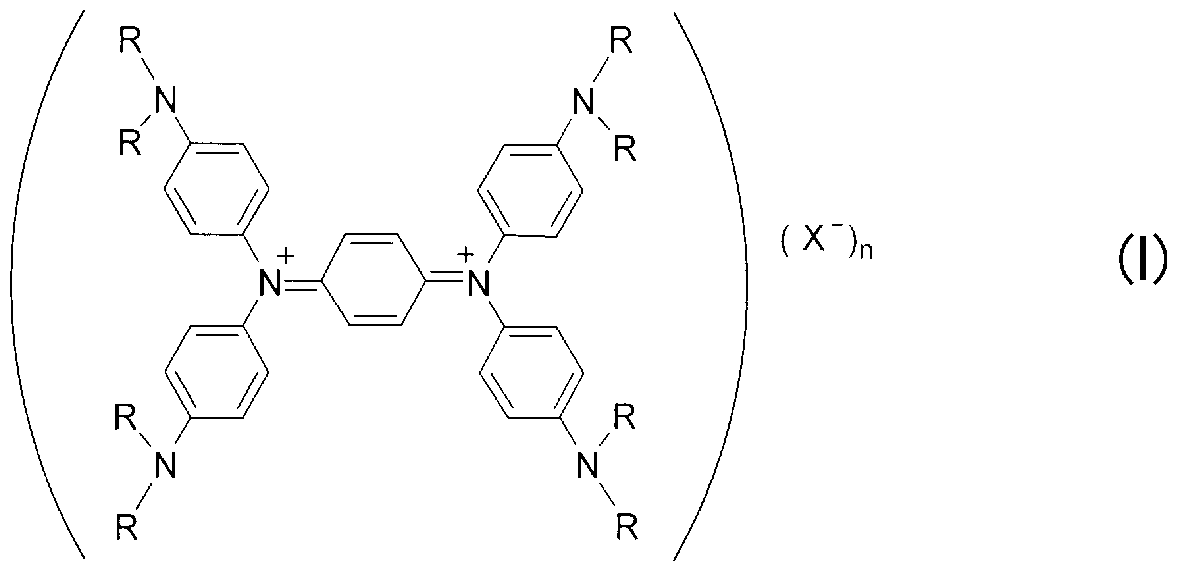
(式中、 Rは互いに同一もしくは異なって、水素、アルキル基、ァリール基、アルコキシ 基、ヒドロキシル基、フエニル基もしくはハロゲン化アルキル基を示し、 Xは陰イオンを 示す。 nは 1又は 2の数である)
[0038] 上記式(I)において、 Rのアルキル基としては、メチル基、ェチル基、 n プロピル基 、 iso プロピル基、 n ブチル基、 iso ブチル基、 sec ブチル基、 t ブチル基、 n ペンチル基、 iso ペンチル基、 neo ペンチル基、シクロペンチル基、 1 ,2—ジメ チルプロピル基、 n へキシル基、シクロへキシル基、 1 ,3—ジメチルブチル基、 1 -i so プロピルプロピル基、 1 ,2—ジメチルブチル基、 n へプチル基、 1 ,4 ジメチノレ ペンチル基、 2—メチルー 1 iso プロピルプロピル基、 1ーェチルー 3—メチルブ チル基、 n ォクチル基、 2 ェチルへキシル基、 3 メチル 1 iso プロピルブチ ノレ基、 2—メチルー 1—iso プロピル基、 l—tーブチルー 2—メチルプロピル基、 n ノエル基、 3,5, 5—トリメチルへキシル基等の炭素数 1〜20の直鎖、分岐または環 状のアルキル基が挙げられ、
[0039] また、基 Rのァリール基としては、フエニル基、ナフチル基、トリル基、フリル基、ピリ ジル基等が挙げられ、ハロゲン化アルキル基としては、フッ化アルキル基、塩化アル キル基、臭化アルキル基等が挙げられ、アルコキシ基としては、メトキシ基、エトキシ 基、プロポキシ基、ブトキシ基等が挙げられ、アルコキシアルキル基としては、メトキシ
メチル基、メトキシェチル基、エトキシェチル基、プロポキシェチル基、ブトキシェチル 基、 3—メトキシプロピル基、 3—エトキシプロピル基、メトキシエトキシメチル基、ェトキ シエトキシェチル基、ジメトキシメチノレ基、ジエトチキシメチノレ基、ジメトキシェチノレ基 、ジエトキシェチル基等が挙げられる。
[0040] 更に、基 Xの陰イオンとしては、フッ素イオン、塩素イオン、臭素イオン、ヨウ素イオン 、過塩素酸イオン、硝酸イオン、ベンゼンスルホン酸イオン、 p—トルエンスルホン酸ィ オン、メチル硫酸イオン、ェチル硫酸イオン、プロピル硫酸イオン、テトラフルォロホウ 酸イオン、テトラフェニルホウ酸イオン、へキサフルォロリン酸イオン、ベンゼンスルフ イン酸イオン、酢酸イオン、トリフルォロ酢酸イオン、プロピオン酢酸イオン、安息香酸 イオン、シユウ酸イオン、コハク酸イオン、マロン酸イオン、ォレイン酸イオン、ステアリ ン酸イオン、クェン酸イオン、ペンタクロロスズ酸イオン、クロロスルホン酸イオン、フル ォロスルホン酸イオン、トリフルォロメタンスルホン酸イオン、へキサフルォロヒ酸ィォ ン、へキサフルォロアンチモン酸イオン、モリブデン酸イオン、タングステン酸イオン、 チタン酸イオン、ジルコン酸イオン等が挙げられ、中でも、トリフルォロメタンスルホン 酸イオンなどの、ハロゲン含有陰イオンを使用することが好まし!/、。
[0041] また、支持体フィルムとしても特に制約はないが、ポリエステル系、アクリル系、セル ロース系、ポリエチレン系、ポリプロピレン系、ポリオレフイン系、ポリ塩化ビュル系、ポ リカーボネート系、フエノール系、ウレタン系等のプラスチックフィルム、またはこれらの 任意の 2種類以上を貼り合わせたものが挙げられる。好ましくは、耐熱性、柔軟性の バランスが良好なポリエステル系フィルムであり、より好ましくはポリエチレンテレフタレ 一トフイルムである。
[0042] なお、 NIR吸収剤を含む NIR用バインダー樹脂の、塗工、乾燥後の厚さは、透明 度を高く維持するためには、 1ないし 100 m程度が好ましぐ特に、 10ないし 50 mが好ましい。
[0043] 本発明の NIR用バインダー樹脂は、染料である NIR吸収剤の、特に湿熱時におけ る褪色を防止しながら、 PET等各種フィルムに対する優れた密着性を有するもので ある。しかも、本発明の NIR用バインダー樹脂は、高濃度で NIR吸収剤を含有しても 耐褪色性が良好であり、 NIR吸収効果が高い NIRフィルムを調製することが可能で
ある。
[0044] また、本発明の NIR用バインダー樹脂の調製において、成分(B)として PMMA粒 子を使用すると、より高い剥がれ防止作用、クラック防止作用を得ること力 Sできる。 実施例
[0045] 以下、製造例、実施例および比較例を挙げ、本発明を更に詳しく説明するが、本発 明は、これらに何ら制約されるものではない。
[0046] 製 造 例 1
撹拌機、環流冷却管、温度計および窒素道入管を備えたフラスコに、メチルメタタリ レート(MMA) 80重量部、シクロへキシルメタクリレー HCHMA) 20重量部および 溶剤としてメチルェチルケトン(MEK) 233重量部を仕込み、フラスコ内に窒素ガスを 導入しながらフラスコ内の内容物を 80°Cに昇温した。
[0047] 次いで、開始剤 V601 (和光純薬工業 (株)製) 0.65重量部を添加して、フラスコ内 の温度を 80°Cに保ったまま 6時間反応させ (メタ)アクリル系ポリマーを得た。得られ た(メタ)アクリル系ポリマーの Tgは 80°C、重量平均分子量は 8万であった。
[0048] 製 造 例 2
メチルメタタリレート(MMA) 55重量部、メタクリル酸(MAA) 2重量部、ジシクロぺ ンタニルメタアタリレート(DCPMA) 10重量部および 2—ェチルへキシルメタクリレー ト(2EHA) 33重量部を使用した以外は、製造製 1と同様にして (メタ)アクリル系ポリ マーを得た。得られた (メタ)アクリル系ポリマーの Tgは 44°C、重量平均分子量は 10 万であった。
[0049] 製 造 例 3
メチルメタクリレー HMMA) 85重量部および n—ブチルアタリレート(n— BMA) 15 重量部を使用した以外は、製造製 1と同様にして (メタ)アクリル系ポリマーを得た。得 られた (メタ)アクリル系ポリマーの Tgは 84°Cで、重量平均分子量は 8万であった。
[0050] 製 造 例 4
メチルメタクリレー HMMA) 60重量部、ジシクロペンタニルメタアタリレート(DCP MA) 15重量部、シクロへキシルメタクリレー HCHMA) 15重量部および 2—ェチル へキシルメタタリレート(2EHA) 10重量部を使用した以外は、製造製 1と同様にして(
メタ)アクリル系ポリマーを得た。得られた(メタ)アクリル系ポリマーの Tgは 91°C、重 量平均分子量は 8万であった。
[0051] 製 造 例 5
メチルメタクリレート(MMA) 65重量部およびェチルへキシルメタタリレート(EHM A) 35重量部を使用した以外は、製造例 1と同様にして (メタ)アクリル系ポリマーを得 た。得られた(メタ)アクリル系ポリマーの Tgは 54°C、重量平均分子量は 8万であった
〇
[0052] 製 造 例 6
撹拌機、環流冷却管、温度計および窒素道入管を備えたフラスコに、メチルメタタリ レート(MMA) 80重量部およびメチルアタリレート(MA) 20重量部と、溶剤としてメ チルェチルケトン(MEK) 133重量部および酢酸ェチル 100重量部を仕込み、フラ スコ内に窒素ガスを導入しながらフラスコ内の内容物を 69°Cに昇温した。
[0053] 次いで、開始剤 V601 (和光純薬工業 (株)製) 0.65重量部を添加して、反応温度を
69〜80°Cに保ち、 6時間反応させ (メタ)アクリル系ポリマーを得た。得られた (メタ)ァ クリル系ポリマーの Tgは 80°C、重量平均分子量は 40万であった。
[0054] 製 造 例 7
開始剤 V601 (和光純薬工業 (株)製) 1.0重量部使用し、反応温度を 85〜90°Cにし た以外は、製造例 6と同様にして (メタ)アクリル系ポリマーを得た。得られた (メタ)ァク リル系ポリマーの Tgは 80°C、重量平均分子量は 1万であった。
[0055] 製 造 例 8
メチルメタクリレート(MMA) 30重量部、シクロへキシルメタタリレート(CHMA) 70重 量部を使用した以外は、製造製 1と同様にして (メタ)アクリル系ポリマーを得た。得ら れた (メタ)アクリル系ポリマーの Tgは 70°C、重量平均分子量は 10万であった。
[0056] 製 造 例 9
撹拌機、環流冷却管および温度計を備えたフラスコに、メチルメタクリレー HMMA ) 100重量部、イオン交換水 200重量部、ポリビュルアルコール 0.2重量部および開 始剤ラウリルパーオキサイド (LPO) 1.0重量部を仕込み、分散させた。
[0057] 次いで、フラスコ内の温度を 68°Cに昇温し、反応温度を 68〜91°Cに保ちながら、
6時間反応させ、平均粒子径 511 mの未架橋の(メタ)アクリル系ポリマー粒子を得た 。得られた (メタ)アクリル系ポリマーの Tgは 105°C、重量平均分子量は 30万であつ た。
[0058] 製 造 例 10
スチレン 100重量部、イオン交換水 400重量部、開始剤ベンゾィルパーオキサイド (BPO) 5重量部を使用した以外は製造例 9と同様にして、平均粒子径 10 mの未 架橋のスチレン系ポリマーを得た。得られたポリマーの Tgは、 100°C、重量平均分子 量は、 20万であった。
[0059] 製 造 例 11
メチルメタアタリレート(MMA) 100重量部、イオン交換水 400重量部、ポリビュル アルコール 0.4重量部および開始剤ラウリルパーオキサイド(LPO) 0.4重量部を使用 した以外は製造例 9と同様にして、平均粒子径 5 a mの未架橋の (メタ)アクリル系ポリ マーを得た。得られた (メタ)アクリル系ポリマーの Tgは 105°C、重量平均分子量は 6 0万であった。
[0060] 製 造 例 12
メチルメタアタリレート(MMA) 100重量部、イオン交換水 400重量部、ポリビュル アルコール 0.4重量部および開始剤ラウリルパーオキサイド(LPO) 0.25重量部を使 用した以外は製造例 9と同様にして、平均粒子径 5 a mの未架橋の (メタ)アクリル系 ポリマーを得た。得られた (メタ)アクリル系ポリマーの Tgは 105°C、重量平均分子量 は 80万であった。
[0061] 実 施 例 1
下記表 1に示す組成で、 NIR用バインダー樹脂(以下、「NIR用樹脂」ということがあ る)を調製した。得られた各樹脂について、下記方法で透過率、密着性および塗工 性を調べた。この結果を表 2に示す。
[0062] NIR用樹脂組成:
[表 1]
ポリマ一 (A) ポリマ一 (B) 染 料
(重量部) (重量部)
N I R用樹脂 1 製造例 3のポリ 製造例 1 1の C I R- 1 085 * ' マ一 ( 1 00) ポリマ一 (5) (2)
N I R用樹脂 2 製造例 3のポリ 製造例 1 2の C I R- 1 085 * 1 マ一 ( 1 00) ポリマ一 ( 1 0) (2)
N I R用樹脂 3 製造例 3のポリ 製造例 1 1の C I R-R L* 2
マ一 ( 1 00) ポリマ一 (5) (2)
N I R用樹脂 4 製造例 3のポリ 製造例 1 1の C I R-R L* 2
マー ( 1 00) ポリマ一 (5) (4)
I R用樹脂 5 製造例 1のポリ 製造例 1 1の C I R- 1 085 * 1 マ一 ( 1 00) ポリマー (5) (2)
N I R用樹脂 6 製造例 1のポリ 製造例 1 2の C I R- 1 085 * ' マ一 ( 1 00) ポリマ一 (5) (2)
N I R用樹脂フ 製造例 1のポリ 製造例 1 1の C I R- 1 085 * ' マ一 ( 1 00) ポリマ一 (5) (4)
N I R用樹脂 8 製造例 2のポリ 製造例 1 2の C I R— 1 085 ' ' マー ( 1 00) ポリマ一 (20) (2) 比較樹脂 1 製造例 3のポリ 製造例 9のポリ C I R- 1 085 * ' マ一 ( 1 00) マ一 (5) (2) 比較樹脂 2 製造例 3のポリ 製造例 1 1の C I R- 1 085 * 1 マ一 ( 1 00) ポリマ一 (0.5) (2) 比較樹脂 3 製造例 3のポリ 製造例 1 1の C I R- 1 085 * 1 マ一 ( 1 00) ポリマ一 (35) (2) 比較樹脂 4 製造例 4のポリ 製造例 1 1の C I R- 1 085' ' マ一 ( 1 00) ポリマー (5) (2) 比較樹脂 5 製造例 5のポリ 製造例 1 1の C I R- 1 085 * 1 マ一 ( 1 00) ポリマ一 (5) (2) 比較樹脂 6 製造例 6のポリ 製造例 1 1の C I R - 1 085 * 1 マー ( 1 00) ポリマ一 (5) (2) 比較樹脂 フ 製造例 7のポリ 製造例 1 1の C I R- 1 085" マー ( 1 00) ポリマー (5) (2) 比較樹脂 8 製造例 3のポリ 製造例 1 0の C I R- 1 085 * ' マ一 ( 1 00) ポリマー (5) (2) 比較樹脂 9 製造例 8のポリ 製造例 1 1の C I R - 1 085 * ' マ一 ( 1 00) ポリマ一 (5) (2)
*1 C I R - 1 085 : ジインモニゥム系近赤外線吸収色素、 日本カーリット社製 *2 C I R - R L : ジインモニゥム系近赤外線吸収色素、 日本力一リット社製 評 価 方 法 :
< 透過率 〉
表 1の各樹脂を、 PETフィルム(厚さ 25 m)上に、乾燥厚が 10 mとなるように塗 ェし、 NIRフィルムを調製した。まず、この NIRフィルムの llOOnmおよび 430nmの 透過率を、紫外可視分光光度計 UVmini— 1240(島津製作所 (株))で測定し、初 期透過率とした。
[0064] 次いで、各 NIRフィルムを、 80°C X 90%RHで 300hr放置した後、再度 1100nm、 430nmの透過率を、紫外可視分光光度計 UV mini— 1240 (島津製作所 (株)で測 定し、湿熱後透過率とした。
[0065] < 密着性 〉
樹脂の基材フィルムへの密着性を基盤目テープ法により評価した。まず、表 1で得 られた樹脂を機材フィルム(03PEEW、帝人フィルム社製)に乾燥厚が 25 mになる ように塗工し、 23°Cで 24時間乾燥させた。次いで、樹脂塗膜側に幅 lmmの傷を基 盤目状(100マス)に作った後、基材フィルム側をガラス板に両面テープで固定した。 更に、基盤目状の傷の付いた塗膜に市販のテープ(Scotch 3M社製)を密着させ 、このテープを 90°剥離 (接着面に対し、垂直方向に引っ張り、剥離させる)で剥がし たときの塗膜の剥がれにより密着性を評価した。評価は、剥離が 0〜; 15%未満、 15 〜 35 %未満、 35〜 65 %未満および 65 %以上の 4段階で行った。
[0066] < 塗工性 〉
表 1の各樹脂を基材フィルム(03PEEW 帝人フィルム社製)に乾燥厚が 25 mに なるように塗工したときの、表面状態を目視で評価した。
[0067] 結 果 :
[表 2]
初期透過率 湿熱後透過率 密 着 性 塗 工 性
1100nm 430nm 1100nm 430nm 剥がれ%
N I R用樹脂 1 2. 37 88. 6 3. 31 フ 7. 6 5 ~ 15 〇
N I R用樹月旨 2 2. 1 6 85. 8 3. 22 77. 1 5 - 15 〇
I R用樹脂 3 2. 42 88. 3 2. 46 83. 3 5 ~ 15 〇
N I R用樹脂 4 1. 75 86. 3 2. 1 84. 1 5 ~ 15 〇
N I R用樹脂 5 2 64 90. 3 5. 42 7フ . 2 5 - 15 〇
N I R用樹脂 6 1 75 88. 7 6 23 70. 5 5〜 15 〇
N I R用樹脂 7 1 65 83. 2 4 32 70. 4 5〜 15 〇
N I R用樹脂 8 2 63 88. 9 6 3 75. 1 5 ~ 15 〇 比較樹脂 1 2 41 89 3 2 76. 2 15 ~ 35 〇 比較樹脂 2 2 33 87. 4 3 44 フ 8. 2 15 - 35 〇 比較樹脂 3 2 52 8フ. 2 3 32 77. 4 5 ~ 15 塗工すじ 比較樹脂 4 2 44 88. 5 3 36 フ 7. 6 > 65 〇 比較樹脂 5 2 55 88. 9 1 5 75 フ 0. 1 35 ~ 65 O 比較樹脂 6 2 45 88. 2 3 55 フ 6. 2 5〜 15 塗工すじ 比較樹脂 7 2 44 89. 2 5 8 フ 4. 1 35 ~ 65 〇 比較樹脂 8 塗膜の白化 塗膜の白化 > 65 〇 比較樹脂 9 塗膜の白化 塗膜の白化 > 65 〇 産業上の利用可能性
[0068] 本発明の NIR用バインダー樹脂は、湿熱時における NIR吸収剤の褪色を防止しな がら、 PET等各種フィルムに対する優れた密着性を有するもので、しかも、高濃度で NIR吸収剤を含有させることが可能なものである。
[0069] 従って、本発明のバインダー樹脂を用いて調製される NIRフィルム等は、 PDPディ スプレイを始め、 NIRを遮蔽する目的のフィルムとして利用価値の高いものである。
Claims
[1] 下記 (A)の低分子量 (メタ)アクリル系ポリマー 100重量部に対して、下記 (B)の高 分子量 (メタ)アクリル系ポリマーを 1〜30重量部含有せしめてなる近赤外線吸収フィ ルム用バインダー樹脂。
(A)メチルメタタリレートを 70質量%以上(共)重合した、重量平均分子量 5万〜 30万の低分子量 (メタ)アクリル系ポリマー、
(B)メチルメタタリレートを 90質量%以上(共)重合した、重量平均分子量 40万 〜; 150万の高分子量 (メタ)アクリル系ポリマー。
[2] 前記低分子量 (メタ)アクリル系ポリマー (A)が、メチルメタタリレートを 80質量%以 上(共)重合したポリマーである請求項 1記載の近赤外線吸収フィルム用バインダー 樹脂。
[3] 前記低分子量 (メタ)アクリル系ポリマー(A)が、 70〜95質量0 /0のメチルメタクリレー トと、 5〜30質量%の複素環及び/又は脂環構造を有するモノマーを共重合したポ リマーである請求項 1記載の近赤外線吸収フィルム用バインダー樹脂。
[4] 前記低分子量 (メタ)アクリル系ポリマー (A)力 ガラス転移温度が 0°C以上 50°C未 満のものである、請求項 3記載の近赤外線吸収フィルム用バインダー樹脂。
[5] 前記低分子量 (メタ)アクリル系ポリマー (A)が、ガラス転移温度が 50°C以上 110°C 未満であり、重量平均分子量が 5万〜 20万である、請求項 3記載の近赤外線吸収フ イルム用バインダー樹脂。
[6] 前記高分子量 (メタ)アタリレートポリマー(B)が、実質的に未架橋の粒子である請 求項 1〜5の何れかの項記載の近赤外線吸収フィルム用バインダー樹脂
[7] 更に、ジインモユウム系近赤外線吸収染料を含有する請求項;!〜 6の何れかの項 記載の近赤外線級フィルム用バインダー樹脂。
Applications Claiming Priority (2)
| Application Number | Priority Date | Filing Date | Title |
|---|---|---|---|
| JP2006-216553 | 2006-08-09 | ||
| JP2006216553A JP2008038068A (ja) | 2006-08-09 | 2006-08-09 | 近赤外線吸収フィルム用バインダー樹脂 |
Publications (1)
| Publication Number | Publication Date |
|---|---|
| WO2008018442A1 true WO2008018442A1 (en) | 2008-02-14 |
Family
ID=39032972
Family Applications (1)
| Application Number | Title | Priority Date | Filing Date |
|---|---|---|---|
| PCT/JP2007/065415 Ceased WO2008018442A1 (en) | 2006-08-09 | 2007-08-07 | Binder resin for near-infrared-ray-absorbable film |
Country Status (2)
| Country | Link |
|---|---|
| JP (1) | JP2008038068A (ja) |
| WO (1) | WO2008018442A1 (ja) |
Cited By (3)
| Publication number | Priority date | Publication date | Assignee | Title |
|---|---|---|---|---|
| GB2453669A (en) * | 2007-10-11 | 2009-04-15 | Kansai Paint Co Ltd | Water-based paint compositions |
| JP2009191224A (ja) * | 2008-02-18 | 2009-08-27 | Riken Technos Corp | 近赤外線カット粘着シート部材 |
| US10948745B2 (en) | 2014-12-05 | 2021-03-16 | 3M Innovative Properties Company | Vision-protecting filter lens having organic polymer multilayer and neutral-density optical filter |
Citations (6)
| Publication number | Priority date | Publication date | Assignee | Title |
|---|---|---|---|---|
| JPH05178808A (ja) * | 1992-04-15 | 1993-07-20 | Canon Inc | ジイモニウム塩化合物 |
| JPH05295967A (ja) * | 1992-04-15 | 1993-11-09 | Japan Carlit Co Ltd:The | 光線選択透過性ブラインド |
| JPH09310031A (ja) * | 1996-05-22 | 1997-12-02 | Nippon Kayaku Co Ltd | 熱線遮断性樹脂組成物およびコーティングフィルム |
| JP2000109771A (ja) * | 1998-10-07 | 2000-04-18 | Lintec Corp | 粘着シート |
| JP2001183528A (ja) * | 1999-10-14 | 2001-07-06 | Konica Corp | 光学フィルム及びその製造方法 |
| JP2004339442A (ja) * | 2003-05-19 | 2004-12-02 | Asahi Kasei Chemicals Corp | 樹脂組成物およびそれをもちいた車輌用ランプレンズ |
Family Cites Families (1)
| Publication number | Priority date | Publication date | Assignee | Title |
|---|---|---|---|---|
| JP3795444B2 (ja) * | 2002-10-04 | 2006-07-12 | 株式会社ニチベイ | ブラインド用の昇降コード巻取装置 |
-
2006
- 2006-08-09 JP JP2006216553A patent/JP2008038068A/ja active Pending
-
2007
- 2007-08-07 WO PCT/JP2007/065415 patent/WO2008018442A1/ja not_active Ceased
Patent Citations (6)
| Publication number | Priority date | Publication date | Assignee | Title |
|---|---|---|---|---|
| JPH05178808A (ja) * | 1992-04-15 | 1993-07-20 | Canon Inc | ジイモニウム塩化合物 |
| JPH05295967A (ja) * | 1992-04-15 | 1993-11-09 | Japan Carlit Co Ltd:The | 光線選択透過性ブラインド |
| JPH09310031A (ja) * | 1996-05-22 | 1997-12-02 | Nippon Kayaku Co Ltd | 熱線遮断性樹脂組成物およびコーティングフィルム |
| JP2000109771A (ja) * | 1998-10-07 | 2000-04-18 | Lintec Corp | 粘着シート |
| JP2001183528A (ja) * | 1999-10-14 | 2001-07-06 | Konica Corp | 光学フィルム及びその製造方法 |
| JP2004339442A (ja) * | 2003-05-19 | 2004-12-02 | Asahi Kasei Chemicals Corp | 樹脂組成物およびそれをもちいた車輌用ランプレンズ |
Cited By (5)
| Publication number | Priority date | Publication date | Assignee | Title |
|---|---|---|---|---|
| GB2453669A (en) * | 2007-10-11 | 2009-04-15 | Kansai Paint Co Ltd | Water-based paint compositions |
| GB2453669B (en) * | 2007-10-11 | 2010-03-10 | Kansai Paint Co Ltd | Water-based paint compositions |
| US8283405B2 (en) | 2007-10-11 | 2012-10-09 | Kansai Paint Co., Ltd. | Water-based paint compositions |
| JP2009191224A (ja) * | 2008-02-18 | 2009-08-27 | Riken Technos Corp | 近赤外線カット粘着シート部材 |
| US10948745B2 (en) | 2014-12-05 | 2021-03-16 | 3M Innovative Properties Company | Vision-protecting filter lens having organic polymer multilayer and neutral-density optical filter |
Also Published As
| Publication number | Publication date |
|---|---|
| JP2008038068A (ja) | 2008-02-21 |
Similar Documents
| Publication | Publication Date | Title |
|---|---|---|
| KR102284224B1 (ko) | 휴대 전자기기 부재 고정용 양면 점착 시트 및 휴대 전자기기의 제조 방법 | |
| EP2639275B1 (en) | Pressure-sensitive adhesive composition | |
| TWI512072B (zh) | 靜電容量方式觸控面板用黏著劑層、及靜電容量方式觸控面板用黏著片 | |
| CN103476890B (zh) | 粘合片 | |
| CN102812100B (zh) | 光学用丙烯酸类粘合剂组合物及光学用丙烯酸类粘合带 | |
| TWI535817B (zh) | 黏結劑膜、用於其的黏結劑組合物和包含其的顯示部件 | |
| TWI814994B (zh) | 黏著劑層及黏著片材 | |
| US20120064336A1 (en) | Ultraviolet-curable adhesive agent composite, adhesive agent layer, adhesive sheet, and manufacturing method therefor | |
| TW201543067A (zh) | 透明樹脂層、附黏著劑層之偏光薄膜及影像顯示裝置 | |
| TW200838922A (en) | (Meth)acrylic resin composition and films of same | |
| JP5791945B2 (ja) | 粘着シート | |
| CN101688936A (zh) | 近红外线吸收膜及使用该近红外线吸收膜的等离子体显示面板用滤光器 | |
| TW201233689A (en) | Methyl methacrylate polymer production method | |
| WO2008018442A1 (en) | Binder resin for near-infrared-ray-absorbable film | |
| JP4942540B2 (ja) | 近赤外線吸収フィルム及びこれを用いたプラズマディスプレイパネル用光学フィルタ | |
| JP2008156539A (ja) | 近赤外線吸収フィルム用バインダー樹脂およびこれを利用する近赤外線吸収フィルター | |
| JP5751906B2 (ja) | 粘着シート | |
| JP5751905B2 (ja) | 粘着シート | |
| WO2008018443A1 (fr) | Résine de liaison pour film absorbant le rayonnement infrarouge proche | |
| CN101511962A (zh) | 用于近红外线吸收性组合物的盐和近红外线吸收性压敏粘合剂组合物 | |
| CN110268288B (zh) | 带有光学功能层的光学构件 | |
| JP2008231325A (ja) | 近赤外線吸収性粘着剤組成物及びプラズマディスプレイパネル用光学フィルム | |
| KR102126678B1 (ko) | 비산 방지 필름 | |
| JP2013129701A (ja) | 粘着剤組成物、粘着フィルムおよび光学フィルタ | |
| JP6958180B2 (ja) | 無溶剤型粘着剤組成物、それを用いて得られる粘着剤、光学部材用粘着シート、光学部材用基材レス両面粘着シート、粘着剤層付き光学部材、画像表示装置 |
Legal Events
| Date | Code | Title | Description |
|---|---|---|---|
| 121 | Ep: the epo has been informed by wipo that ep was designated in this application |
Ref document number: 07792084 Country of ref document: EP Kind code of ref document: A1 |
|
| NENP | Non-entry into the national phase |
Ref country code: DE |
|
| NENP | Non-entry into the national phase |
Ref country code: RU |
|
| 122 | Ep: pct application non-entry in european phase |
Ref document number: 07792084 Country of ref document: EP Kind code of ref document: A1 |