WO2007148456A1 - 化合物、ポジ型レジスト組成物およびレジストパターン形成方法 - Google Patents
化合物、ポジ型レジスト組成物およびレジストパターン形成方法 Download PDFInfo
- Publication number
- WO2007148456A1 WO2007148456A1 PCT/JP2007/055661 JP2007055661W WO2007148456A1 WO 2007148456 A1 WO2007148456 A1 WO 2007148456A1 JP 2007055661 W JP2007055661 W JP 2007055661W WO 2007148456 A1 WO2007148456 A1 WO 2007148456A1
- Authority
- WO
- WIPO (PCT)
- Prior art keywords
- group
- equal
- compound
- alkyl group
- independently
- Prior art date
- Legal status (The legal status is an assumption and is not a legal conclusion. Google has not performed a legal analysis and makes no representation as to the accuracy of the status listed.)
- Ceased
Links
Classifications
-
- C—CHEMISTRY; METALLURGY
- C07—ORGANIC CHEMISTRY
- C07C—ACYCLIC OR CARBOCYCLIC COMPOUNDS
- C07C69/00—Esters of carboxylic acids; Esters of carbonic or haloformic acids
- C07C69/66—Esters of carboxylic acids having esterified carboxylic groups bound to acyclic carbon atoms and having any of the groups OH, O—metal, —CHO, keto, ether, acyloxy, groups, groups, or in the acid moiety
- C07C69/67—Esters of carboxylic acids having esterified carboxylic groups bound to acyclic carbon atoms and having any of the groups OH, O—metal, —CHO, keto, ether, acyloxy, groups, groups, or in the acid moiety of saturated acids
- C07C69/708—Ethers
- C07C69/712—Ethers the hydroxy group of the ester being etherified with a hydroxy compound having the hydroxy group bound to a carbon atom of a six-membered aromatic ring
-
- G—PHYSICS
- G03—PHOTOGRAPHY; CINEMATOGRAPHY; ANALOGOUS TECHNIQUES USING WAVES OTHER THAN OPTICAL WAVES; ELECTROGRAPHY; HOLOGRAPHY
- G03F—PHOTOMECHANICAL PRODUCTION OF TEXTURED OR PATTERNED SURFACES, e.g. FOR PRINTING, FOR PROCESSING OF SEMICONDUCTOR DEVICES; MATERIALS THEREFOR; ORIGINALS THEREFOR; APPARATUS SPECIALLY ADAPTED THEREFOR
- G03F7/00—Photomechanical, e.g. photolithographic, production of textured or patterned surfaces, e.g. printing surfaces; Materials therefor, e.g. comprising photoresists; Apparatus specially adapted therefor
- G03F7/004—Photosensitive materials
-
- G—PHYSICS
- G03—PHOTOGRAPHY; CINEMATOGRAPHY; ANALOGOUS TECHNIQUES USING WAVES OTHER THAN OPTICAL WAVES; ELECTROGRAPHY; HOLOGRAPHY
- G03F—PHOTOMECHANICAL PRODUCTION OF TEXTURED OR PATTERNED SURFACES, e.g. FOR PRINTING, FOR PROCESSING OF SEMICONDUCTOR DEVICES; MATERIALS THEREFOR; ORIGINALS THEREFOR; APPARATUS SPECIALLY ADAPTED THEREFOR
- G03F7/00—Photomechanical, e.g. photolithographic, production of textured or patterned surfaces, e.g. printing surfaces; Materials therefor, e.g. comprising photoresists; Apparatus specially adapted therefor
- G03F7/004—Photosensitive materials
- G03F7/0045—Photosensitive materials with organic non-macromolecular light-sensitive compounds not otherwise provided for, e.g. dissolution inhibitors
-
- G—PHYSICS
- G03—PHOTOGRAPHY; CINEMATOGRAPHY; ANALOGOUS TECHNIQUES USING WAVES OTHER THAN OPTICAL WAVES; ELECTROGRAPHY; HOLOGRAPHY
- G03F—PHOTOMECHANICAL PRODUCTION OF TEXTURED OR PATTERNED SURFACES, e.g. FOR PRINTING, FOR PROCESSING OF SEMICONDUCTOR DEVICES; MATERIALS THEREFOR; ORIGINALS THEREFOR; APPARATUS SPECIALLY ADAPTED THEREFOR
- G03F7/00—Photomechanical, e.g. photolithographic, production of textured or patterned surfaces, e.g. printing surfaces; Materials therefor, e.g. comprising photoresists; Apparatus specially adapted therefor
- G03F7/004—Photosensitive materials
- G03F7/0047—Photosensitive materials characterised by additives for obtaining a metallic or ceramic pattern, e.g. by firing
-
- G—PHYSICS
- G03—PHOTOGRAPHY; CINEMATOGRAPHY; ANALOGOUS TECHNIQUES USING WAVES OTHER THAN OPTICAL WAVES; ELECTROGRAPHY; HOLOGRAPHY
- G03F—PHOTOMECHANICAL PRODUCTION OF TEXTURED OR PATTERNED SURFACES, e.g. FOR PRINTING, FOR PROCESSING OF SEMICONDUCTOR DEVICES; MATERIALS THEREFOR; ORIGINALS THEREFOR; APPARATUS SPECIALLY ADAPTED THEREFOR
- G03F7/00—Photomechanical, e.g. photolithographic, production of textured or patterned surfaces, e.g. printing surfaces; Materials therefor, e.g. comprising photoresists; Apparatus specially adapted therefor
- G03F7/004—Photosensitive materials
- G03F7/039—Macromolecular compounds which are photodegradable, e.g. positive electron resists
- G03F7/0392—Macromolecular compounds which are photodegradable, e.g. positive electron resists the macromolecular compound being present in a chemically amplified positive photoresist composition
-
- G—PHYSICS
- G03—PHOTOGRAPHY; CINEMATOGRAPHY; ANALOGOUS TECHNIQUES USING WAVES OTHER THAN OPTICAL WAVES; ELECTROGRAPHY; HOLOGRAPHY
- G03F—PHOTOMECHANICAL PRODUCTION OF TEXTURED OR PATTERNED SURFACES, e.g. FOR PRINTING, FOR PROCESSING OF SEMICONDUCTOR DEVICES; MATERIALS THEREFOR; ORIGINALS THEREFOR; APPARATUS SPECIALLY ADAPTED THEREFOR
- G03F7/00—Photomechanical, e.g. photolithographic, production of textured or patterned surfaces, e.g. printing surfaces; Materials therefor, e.g. comprising photoresists; Apparatus specially adapted therefor
- G03F7/004—Photosensitive materials
- G03F7/039—Macromolecular compounds which are photodegradable, e.g. positive electron resists
- G03F7/0392—Macromolecular compounds which are photodegradable, e.g. positive electron resists the macromolecular compound being present in a chemically amplified positive photoresist composition
- G03F7/0397—Macromolecular compounds which are photodegradable, e.g. positive electron resists the macromolecular compound being present in a chemically amplified positive photoresist composition the macromolecular compound having an alicyclic moiety in a side chain
-
- H—ELECTRICITY
- H10—SEMICONDUCTOR DEVICES; ELECTRIC SOLID-STATE DEVICES NOT OTHERWISE PROVIDED FOR
- H10P—GENERIC PROCESSES OR APPARATUS FOR THE MANUFACTURE OR TREATMENT OF DEVICES COVERED BY CLASS H10
- H10P76/00—Manufacture or treatment of masks on semiconductor bodies, e.g. by lithography or photolithography
-
- H—ELECTRICITY
- H10—SEMICONDUCTOR DEVICES; ELECTRIC SOLID-STATE DEVICES NOT OTHERWISE PROVIDED FOR
- H10P—GENERIC PROCESSES OR APPARATUS FOR THE MANUFACTURE OR TREATMENT OF DEVICES COVERED BY CLASS H10
- H10P76/00—Manufacture or treatment of masks on semiconductor bodies, e.g. by lithography or photolithography
- H10P76/20—Manufacture or treatment of masks on semiconductor bodies, e.g. by lithography or photolithography of masks comprising organic materials
-
- C—CHEMISTRY; METALLURGY
- C07—ORGANIC CHEMISTRY
- C07C—ACYCLIC OR CARBOCYCLIC COMPOUNDS
- C07C2603/00—Systems containing at least three condensed rings
- C07C2603/56—Ring systems containing bridged rings
- C07C2603/58—Ring systems containing bridged rings containing three rings
- C07C2603/70—Ring systems containing bridged rings containing three rings containing only six-membered rings
- C07C2603/74—Adamantanes
Definitions
- the present invention relates to a compound that can be used as a resist composition, a positive resist composition containing the compound, and a resist pattern forming method using the positive resist composition.
- the wavelength of an exposure light source is generally shortened.
- the power used in the past typically ultraviolet rays such as g-line and i-line
- KrF excimer laser and ArF excimer laser have now begun mass production of semiconductor devices using KrF excimer laser and ArF excimer laser.
- these excimer lasers have shorter wavelength excimer lasers, electron beams, EUV (
- a chemically amplified resist containing a base material component capable of forming a film and an acid generator component that generates an acid upon exposure is known. It has been. Chemically amplified resists are classified into a negative type in which alkali solubility is reduced by exposure and a positive type in which alkali solubility is increased by exposure.
- polymers have been used as the base component of such chemically amplified resists.
- PHS polyhydroxystyrene
- a part of its hydroxyl group protected with an acid dissociable, dissolution inhibiting group For example, PHS-based resins such as those derived from (meth) acrylic acid esters, and resins prepared by protecting a part of the carboxy group with an acid dissociable, dissolution inhibiting group are used.
- polymers generally used as substrates have a large molecular size (average square radius per molecule) of around several nm.
- the dissolution behavior of the resist in the developing solution is usually carried out in units of one molecular component of the base material. Therefore, as long as a polymer is used as the base material component, further reduction in roughness is extremely difficult.
- Non-Patent Documents 1 and 2 propose low molecular weight materials having an alkali-soluble group such as a hydroxyl group or a forceful alkoxy group, and a part or all of which is protected with an acid dissociable, dissolution inhibiting group.
- Non-Patent Document 1 T. Hirayama, D. Shiono, H. Hada and J. Onodera: J. Photo polym. Sci. Technol. 17 (2004), p435
- Non-Patent Document 2 Jim— Baek Kim, Hyo-Jin Yun, Young— Gil Kwon: Chemis try Letters (2002), pl064-1065
- Such a low molecular weight material is expected to be able to reduce roughness due to a small molecular size because of its low molecular weight. Therefore, there is a growing demand for new low molecular weight materials that can be used for resist compositions.
- the present invention has been made in view of the above circumstances, and uses a compound that can be used as a resist composition, a positive resist composition containing the compound, and the positive resist composition.
- An object of the present invention is to provide a resist pattern forming method.
- a first aspect of the present invention for solving the above problems is a compound represented by the following general formula (A-1).
- R ′′ to R 17 are each independently an alkyl group having 1 to 10 carbon atoms or an aromatic hydrocarbon group, and may contain a hetero atom in the structure thereof; g, j Are independently integers greater than or equal to 1, k and q are integers greater than or equal to 0, and g + j + k + q is less than or equal to 5; b is an integer greater than or equal to 1, and m Are each independently an integer of 0 or more, and b + l + m is 4 or less; c is an integer of 1 or more, n and o are each independently an integer of 0 or more, and c + n + o is 4 or less; A has a trivalent aromatic cyclic group, a trivalent alkyl group, a trivalent aliphatic cyclic group, or an aromatic cyclic group or an aliphatic cyclic group 3 Z is a group represented by the following general formula (zl).]
- Y represents an alkylene group, a divalent aromatic hydrocarbon group, a divalent aliphatic cyclic group, or a divalent organic group having an aromatic hydrocarbon group or an aliphatic cyclic group.
- R ′ is an acid dissociable, dissolution inhibiting group.
- the second aspect of the present invention includes a base material component (A) whose alkali solubility is increased by the action of an acid, and an acid generator component (B) which generates an acid upon irradiation with radiation.
- a positive resist composition comprising:
- the positive resist composition is characterized in that the base component (A) contains a compound (A1) represented by the following general formula (A-1).
- [In Formula (A-1), 1 to! ⁇ 17 are each independently an alkyl group having 1 to 10 carbon atoms or an aromatic hydrocarbon group, and the structure thereof may contain a hetero atom; g, j Are independently integers greater than or equal to 1, k and q are integers greater than or equal to 0, and g + j + k + q is less than or equal to 5; b is an integer greater than or equal to 1, and m Are each independently an integer greater than or equal to 0 and b + l + m is less than or equal to 4; c is an integer greater than or equal to 1, n and o are each independently an integer greater than or equal to 0, and c + n + o is 4 or less; A has a trivalent aromatic cyclic group, a trivalent alkyl group, a trivalent aliphatic cyclic group, or an aromatic cyclic group or an aliphatic cyclic group 3 Z is a group represented by the following general formula (zl). ]
- Y represents an alkylene group, a divalent aromatic hydrocarbon group, a divalent aliphatic cyclic group, or a divalent organic group having an aromatic hydrocarbon group or an aliphatic cyclic group.
- R ′ is an acid dissociable, dissolution inhibiting group.
- a third aspect of the present invention includes a step of forming a resist film on a substrate using the positive resist composition of the second aspect, a step of exposing the resist film, and the resist A resist pattern forming method including a step of developing a film to form a resist pattern.
- alkyl group in the claims and the specification includes linear, branched and cyclic monovalent saturated hydrocarbon groups.
- “Aliphatic” is a relative concept with respect to aromatics, and means groups, compounds, etc. that do not have aromaticity.
- the “aliphatic cyclic group” means a monocyclic group or a polycyclic group having no aromaticity.
- aromatic cyclic group means a cyclic group having aromaticity.
- aromatic cyclic group indicates a monocyclic group or polycyclic group having aromaticity.
- the present invention provides a novel compound that can be used as a resist composition, a positive resist composition containing the compound, and a resist pattern forming method using the positive resist composition. .
- compound (A1) The compound of the present invention (hereinafter referred to as compound (A1)) is represented by the above general formula (A-1).
- ⁇ is a group represented by the above general formula (zl).
- Y is an alkylene group, a divalent aromatic hydrocarbon group, a divalent aliphatic cyclic group, or a divalent organic group having an aromatic hydrocarbon group or an aliphatic cyclic group.
- Y is an alkylene group, it is preferably a C 1-5 alkylene group, more preferably a C 1-3 carbon atom, a methylene group, an ethylene group, or a propylene group. Most preferred is a preferred methylene group.
- Y is a divalent aromatic hydrocarbon group
- an aromatic hydrocarbon group having 6 to 16 carbon atoms is Can be mentioned. Specific examples include groups in which two hydrogen atoms have been removed from benzene, naphthalene, anthracene, phenanthrene, pyrene, and the like.
- Y is a divalent organic group having an aromatic hydrocarbon group or an aliphatic cyclic group
- the aromatic hydrocarbon group and the aliphatic cyclic group are the same as described above, and the organic group includes carbon atoms And 15 alkylene groups.
- the acid dissociation and dissolution inhibiting group (R ') is a group that has an alkali dissolution inhibiting property that makes the compound (A1) insoluble in alkali before dissociation and changes the compound (A1) to alkali soluble after dissociation. . Therefore, in the compound (A1), when it is mixed with the acid generator component (B) in the positive resist composition as will be described later, the acid generated from the acid generator component (B) by exposure acts. Then, the acid dissociation and dissolution inhibiting group is dissociated, and the compound (A1) also changes its alkali insolubility to alkali soluble.
- a group having an acid dissociable, dissolution inhibiting group is also included in the concept of an acid dissociation, dissolution inhibiting group.
- the acid dissociable, dissolution inhibiting group is not particularly limited, and can be appropriately selected from the powers used in chemically amplified resist compositions for KrF and ArF.
- Specific examples include a tertiary alkyl group, a tertiary alkyloxycarbonyl group, an alkoxycarboalkyl group, an alkoxyalkyl group, and a cyclic ether group.
- tertiary alkyl groups include chain tertiary alkyl groups such as tert-butyl, tert-amyl, tert-pentyl, and tert-butyl groups, and 2-methyl-2-adamantyl groups. Aliphatic monocycles such as 2-ethyl-2-adamantyl group, 1-ethyl-1-cyclohexyl group, 1-methyl-1-cyclohexyl group, 1-ethyl-1-cyclopentyl group, 1-methyl-1-cyclopentyl group, etc. And tertiary alkyl groups containing a cyclic or polycyclic group. This tertiary alkyl group preferably has 420 carbon atoms.
- the aliphatic cyclic group may be saturated or unsaturated, but is usually preferably saturated.
- Examples of the tertiary alkyl group in the tertiary alkyloxycarbonyl group include the same groups as described above.
- Specific examples of the tertiary alkyloxycarbonyl group include a tert-butyloxycarboxyl group and a tert-amyloxycarboxyl group.
- Specific examples of the cyclic ether group include a tetrahydrovinyl group and a tetrahydrofuranyl group.
- the number of carbon atoms of the cyclic ether group is preferably 5 to: LO.
- R ′ is represented by the following general formula (p 1) and the following general formula (p2). It is preferable to have at least one acid dissociable, dissolution inhibiting group selected from the group consisting of alkoxyalkyl groups.
- R 1 and R 2 are each independently a straight-chain, alkyl groups der connexion branched or cyclic, its structure may contain a hetero atom in;
- R 3 represents a hydrogen atom or a lower alkyl group N is an integer from 1 to 3;
- n ′ is an integer of 1 to 3, and is preferably 1.
- R 1 is a linear, branched or cyclic alkyl group, and may contain a heteroatom in its structure. That is, in the alkyl group as R 1 , a part or all of the hydrogen atoms may be substituted with a group containing a hetero atom (including a hetero atom itself), and a part of the carbon atom of the alkyl group may be substituted. May be substituted with a heteroatom.
- Hetero atoms include oxygen atoms, sulfur atoms, nitrogen atoms, fluorine atoms, etc.
- the group containing hetero atoms may be a hetero atom itself, or a hetero atom, a carbon atom, and a Z or hydrogen atom. It may be a group consisting of, for example, an alkoxy group.
- alkyl groups in which some or all of the hydrogen atoms are substituted with groups containing heteroatoms For example, a fluorinated lower alkyl group having 1 to 5 carbon atoms in which some or all of the hydrogen atoms are replaced with fluorine atoms, or two hydrogen atoms bonded to the same carbon atom are replaced with one oxygen atom.
- Examples of the group in which a part of the carbon atoms of the alkyl group is substituted with a group containing a hetero atom include, for example, an example in which the carbon atom is substituted with a nitrogen atom (for example, branched or In a cyclic alkyl group, the CH— is replaced by —NH
- the linear alkyl group as R 1 preferably has 1 to 5 carbon atoms. Specifically, a methyl group, an ethyl group, an n propyl group, an n butyl group, an isobutyl group, an n A pentyl group, and a methyl group or an ethyl group is preferred.
- the branched alkyl group as R 1 preferably has 4 to 8 carbon atoms, more preferably 4 to 8 carbon atoms.
- Specific examples include an isobutyl group, a tert butyl group, an isopentyl group, a neopentyl group, a tert pentyl group, and the like, preferably a tert butyl group.
- the cyclic alkyl group as R 1 preferably has 3 to 20 carbon atoms, more preferably 4 to 14 carbon atoms, and most preferably 5 to 12 carbon atoms.
- the structure of the basic ring in the cyclic alkyl group may be monocyclic or polycyclic.
- the basic ring may be a hydrocarbon ring composed of carbon and hydrogen, or may be a heterocycle in which a part of carbon atoms constituting the hydrocarbon ring is substituted with a heteroatom.
- the basic ring is particularly preferably a hydrocarbon ring.
- Specific examples of the hydrocarbon ring include monocycloalkane, bicycloalkane, tricycloalkane, and tetracycloalkane.
- monocycloalkanes such as cyclopentane and cyclohexane, adamantane, norbornane, isobornane, tricyclo
- polycycloalkanes such as decane and tetracyclododecane.
- adamantane, norbornane, tricyclodecane, and tetracyclododecane are preferable, and adamantane is particularly preferable.
- These basic rings may or may not have a substituent on the ring.
- substituents include a lower alkyl group, a fluorine atom, a fluorinated lower alkyl group, an oxygen atom.
- Examples of the lower alkyl group include linear or branched alkyl groups having 1 to 5 carbon atoms such as a methyl group and an ethyl group.
- the number of substituents is preferably 1 to 3, and more preferably 1.
- “having a substituent” means that a hydrogen atom bonded to a carbon atom constituting the basic ring is substituted with a substituent.
- Examples of the cyclic alkyl group for R 1 include groups obtained by removing one hydrogen atom from these basic rings.
- the carbon atom to which the oxygen atom adjacent to R 1 is bonded is one of the carbon atoms constituting the basic ring as described above.
- the oxygen atom adjacent to R 1 The carbon atom bonded to is preferably a tertiary carbon atom formed by bonding a substituent such as a lower alkyl group, which is excellent in the effects of the present invention.
- Examples of the acid dissociable, dissolution inhibiting group having a cyclic alkyl group as R 1 include groups represented by the following formulas (pi-1) to (pi-7). Among these, those represented by the general formula (pi-1) are preferable.
- R 4 is a lower alkyl group, and n ′ is the same as described above. ]
- the lower alkyl group of R 4 is an alkyl group having 1 to 5 carbon atoms, and specifically includes a methyl group, an ethyl group, a propyl group, an isopropyl group, an n-butyl group, an isobutyl group, a tert- Examples thereof include a lower linear or branched alkyl group such as a butyl group, a pentyl group, an isopentyl group, and a neopentyl group.
- R 4 is more preferably a methyl group that is preferably a methyl group or an ethyl group in terms of industrial availability.
- R 1 especially, preferred is the acid dissociable, dissolution inhibiting group having a cyclic alkyl group.
- examples of R 2 include the same as R 1 described above. Among them, R 2 is preferably a linear alkyl group or a cyclic alkyl group.
- R 3 is a hydrogen atom or a lower alkyl group.
- the lower alkyl group of R 3 is an alkyl group having 1 to 5 carbon atoms, and specifically includes a methyl group, an ethyl group, a propyl group, an isopropyl group, an n-butyl group, an isobutyl group, a tert-butyl group, and a pentyl group.
- a lower linear or branched alkyl group such as a group, an isopentyl group and a neopentyl group.
- As the hydrogen atom or the methyl group a hydrogen atom that is preferable from the viewpoint of industrial availability is more preferable.
- Examples of the group represented by the formula (p2) in which R 2 is a linear alkyl group include, for example, 1 ethoxyethyl group, 1 ethoxymethyl group, 1-methoxyethyl group, 1-methoxymethyl group, 1-methoxypropyl group, Examples thereof include 1 ethoxypropyl group, l-n-butoxycetyl group, 1 pentafluoroethoxyethyl group, 1 trifluoromethoxyethyl group, 1 trifluoromethoxymethyl group and the like.
- Examples of the group represented by the formula (p2) in which R 2 is a cyclic alkyl group include a group represented by the following formula.
- R 3 is the same as defined above, n ′′ and m ′′ are each independently an integer of 0 to 2, and W is a hydrogen atom or an oxygen atom of 2 atoms.
- n "and m” are 0 or 1.
- the bonding position between the adamantyl group and —CHR 3 O— (CH 2) “— is not particularly limited.
- the adamantyl group is preferably bonded to the 1-position or the 2-position.
- the acid dissociable, dissolution inhibiting group is a cyclic group such as the groups represented by the above formulas 11) to 17) and (p2-1) to ( ⁇ 2-2).
- a group having a group is preferable because the effect of the present invention is excellent.
- the acid dissociable, dissolution inhibiting group is a group having a cyclic group, the alkali solubility of the compound (A1) is lower than when the acid dissociable, dissolution inhibiting group is a chain group. Therefore, when the compound (A1) is added to the positive resist composition, the resistance to an alkaline developer in an unexposed portion of the resist film formed using the positive resist composition is increased.
- the properties of the compound (A 1) such as alkali solubility, can be adjusted. That is, in the compound (A 1), when the acid dissociable, dissolution inhibiting group is introduced, the reactivity of the carboxy group is higher than that of the hydroxyl group, so that the acid dissociable, dissolution inhibiting group is a carboxy group in Z. Introduced into position. For this reason, the structure of the portion other than Z is constant, and the variation in structure between molecules is very small compared to the polymers and the like conventionally used as the base component of the positive resist composition.
- the properties of the compound (A1) as a whole can be adjusted by selecting the type of the acid dissociable, dissolution inhibiting group.
- a group having a polycyclic structure such as adamantane is selected as the acid dissociable, dissolution inhibiting group
- a group having a monocyclic structure such as cyclohexane
- a group having a chain structure is selected.
- the force-solubility of the compound (A1) is such that the group having a polycyclic structure ⁇ the group having a monocyclic structure ⁇ the group having a chain structure.
- the alkali solubility of the compound (A1) can be improved for a positive resist composition.
- R ′′ to R 17 are chain alkyl groups such as a methyl group
- the compound (A1) tends to have high alkali solubility, but acid dissociable dissolution inhibition.
- the alkali solubility of the compound (A1) can be lowered.
- R "to R 17 are In the case of a cyclic alkyl group such as a kilohexyl group or an aromatic hydrocarbon group, the compound (A1) has a tendency to have a low alkali solubility.
- an acid dissociable, dissolution inhibiting group in Z cyclohexane
- R U to R 17 are each independently a linear, branched or cyclic alkyl group or aromatic hydrocarbon group having 1 to 10 carbon atoms.
- the alkyl group is preferably a linear or branched lower alkyl group having 1 to 5 carbon atoms or a cyclic alkyl group having 5 to 6 carbon atoms.
- the lower alkyl group include linear or branched alkyl groups such as a methyl group, an ethyl group, a propyl group, an isopropyl group, an n-butyl group, an isobutyl group, a tert-butyl group, a pentyl group, an isopentyl group, and a neopentyl group. Group, and among these, a methyl group is preferable.
- the cyclic alkyl group include a cyclohexyl group and a cyclopentyl group, and a cyclohexyl group is preferable.
- aromatic hydrocarbon group examples include a furyl group, a tolyl group, a xylyl group, a mesityl group, a phenethyl group, and a naphthyl group.
- alkyl groups or aromatic hydrocarbon groups may contain a hetero atom such as an oxygen atom, a nitrogen atom, or a sulfur atom in the structure.
- g and j are each independently an integer of 1 or more, k and q are each independently an integer of 0 or more, and g + j + k + q is 5 or less.
- g and j are preferably 1 or 2, most preferably 1.
- k is preferably an integer of 0 to 2, and 0 or 1 is more preferable, and 1 is most preferable.
- q is preferably an integer of 0 to 2, and 0 or 1 is more preferable, and 0 is most preferable.
- b is an integer of 1 or more, 1 and m are each independently an integer of 0 or more, and less than b + 1 + m force.
- b is preferably 1 or 2, most preferably 1.
- 1 is preferably an integer from 0 to 2, and 0 or 1 is more preferred, most preferably 1. is there.
- n is preferably an integer of 0 to 2, and 0 or 1 is more preferred, and most preferably 0. 1 + m is particularly preferably 1.
- c is an integer greater than or equal to 1
- n and o are each independently an integer greater than or equal to 0 and less than c + n + o force.
- c is preferably 1 or 2, most preferably 1.
- n is preferably an integer of 0 to 2, and 0 or 1 is more preferable, and 1 is most preferable.
- o is preferably an integer from 0 to 2, and 0 or 1 is more preferred, and most preferably 0. n + o is particularly preferably 1.
- the bonding position of the group [-OZ] with the subscript b or c is not particularly limited, but at least --OZ is bonded to the para-position of A bonded to the benzene ring to which the —OZ is bonded. Bonding is preferred.
- a powerful compound a low molecular weight compound produced using the compound has advantages such as being suitable for a resist composition and being easy to synthesize.
- the bonding position of the hydroxyl group with the subscript g is not particularly limited! However, a low molecular weight compound produced using the obtained compound is suitable for a resist composition, It is preferable that it is bonded at least to the para position (position 4) of the phenyl group from the viewpoint of stability.
- R 11 is bonded to at least one of the carbon atoms adjacent to the carbon atom to which the hydroxyl group is bonded from the viewpoint of synthesis and the like. Is preferred.
- A represents a trivalent aromatic cyclic group, a trivalent alkyl group, a trivalent aliphatic cyclic group, or an aromatic cyclic group or an aliphatic cyclic group. It is a trivalent organic group.
- the organic group may or may not have a substituent.
- a trivalent aromatic cyclic group of A includes benzene, naphthalene, anthracene, phenanthrene.
- Aromatic compounds such as benzene and pyrene can also be used by removing three hydrogen atoms.
- Examples of the trivalent alkyl group of A include a group in which three hydrogen atoms are removed from an alkane having 1 to 5 carbon atoms. Either linear or branched may be used.
- the basic ring structure excluding the substituent is not limited to a group consisting of carbon and hydrogen (hydrocarbon group), but must be a hydrocarbon group. Is preferred. Further, the “hydrocarbon group” may be either saturated or unsaturated, but is usually preferably saturated. A polycyclic group is preferred.
- trivalent aliphatic cyclic groups are groups obtained by removing three hydrogen atoms from a monocycloalkane; three from a polycycloalkane such as a bicycloalkane, tricycloalkane, and tetracycloalkane. And the like, in which a hydrogen atom is removed. Specifically, three hydrogen atoms are removed from monocycloalkanes such as cyclopentane and cyclohexane, and three groups from polycycloalkanes such as adamantane, norbornane, isobornane, tricyclodecane, and tetracyclododecane. And the like, and the like. In these groups, some or all of the hydrogen atoms may be substituted with a substituent (for example, a lower alkyl group, a fluorine atom or a fluorinated alkyl group)! /.
- a substituent for example, a lower alkyl group, a
- the aliphatic cyclic group having 4 to 15 carbon atoms is preferred, and the adamantane force except for three hydrogen atoms is more preferred.
- the hydrogen atoms at the 1st and 3rd positions of adamantane are preferred. Excluded groups are preferred.
- A a trivalent organic group having an aromatic cyclic group or an aliphatic cyclic group can be used.
- the trivalent organic group having an aromatic cyclic group of A 1 to 3 lower alkyl groups having 1 to 5 carbon atoms are added to aromatic compounds such as benzene, naphthalene, anthracene, phenanthrene, and pyrene.
- aromatic compounds such as benzene, naphthalene, anthracene, phenanthrene, and pyrene.
- organic compounds organic groups in which three hydrogen atoms are removed from the lower alkyl group can be mentioned.
- the trivalent organic group having an aliphatic cyclic group of A among the organic compounds in which 1 to 3 lower alkyl groups having 1 to 5 carbon atoms are added to monocycloalkane, 3 from the lower alkyl group.
- the organic group in which hydrogen atoms are removed can be exemplified by polycycloalkanes such as bicycloalkanes, tricycloalkanes, and tetracycloalkanes.
- polycycloalkanes such as bicycloalkanes, tricycloalkanes, and tetracycloalkanes.
- organic compounds to which 1 to 3 kill groups have been added there can be mentioned organic groups obtained by removing 3 hydrogen atoms from the lower alkyl group.
- A is preferably a trivalent alkyl group or a trivalent organic group having an aromatic cyclic group.
- a trivalent organic group having an aromatic cyclic group is more preferable.
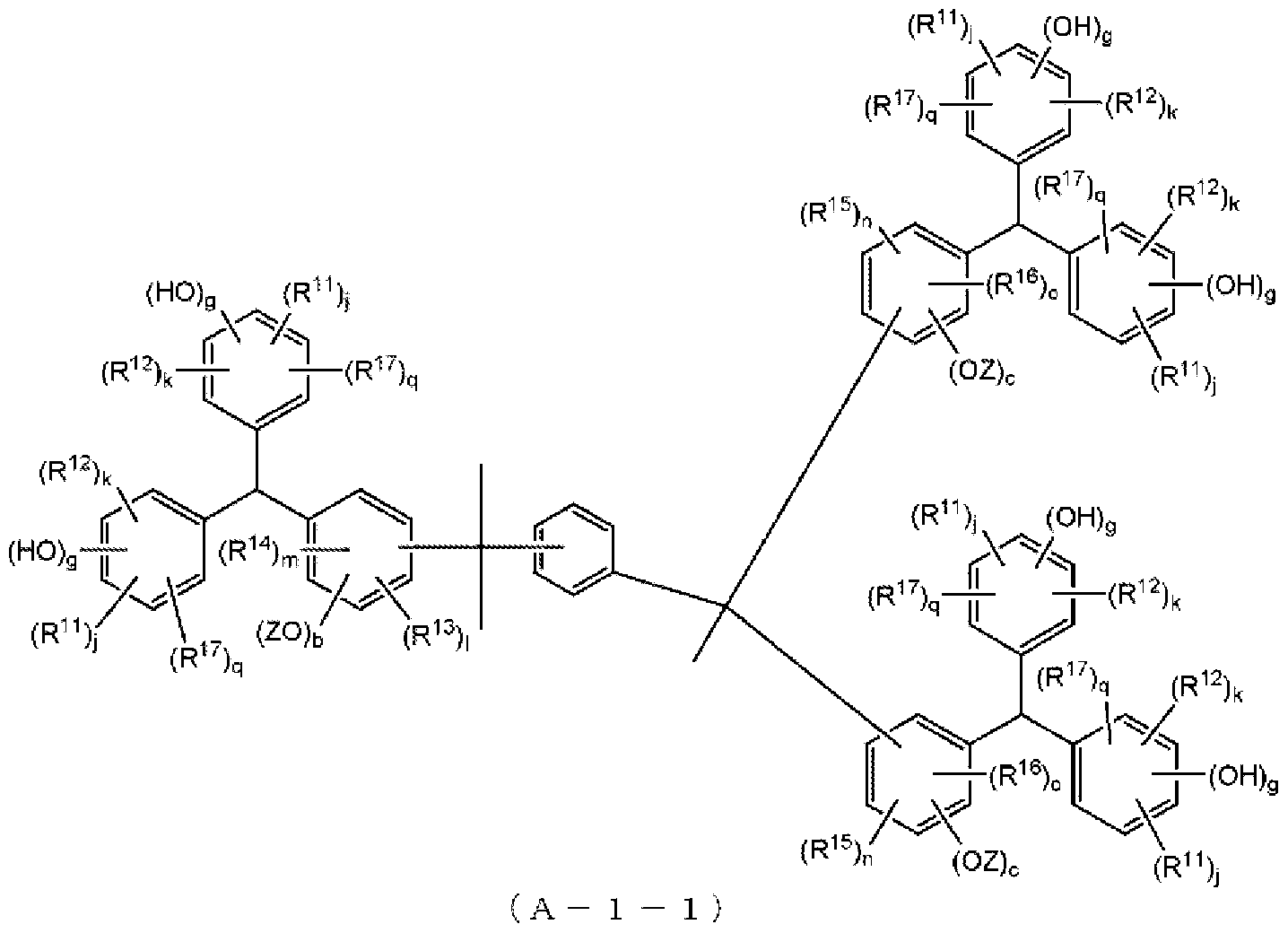
- the compound (A1) of the present invention in particular, a compound represented by the following general formula (A-1-1) or (A-2) is a compound produced using the compound, and the resist composition It is preferable because it is suitable for use in goods.
- R ⁇ R 17 , g, k, q, g + j + k + q, b, 1, m, b + l + m, c, n, o, c + n + o and Z have the same meaning as described above for (A-1). ]
- R 12 is preferably bonded to the 2 or 3 position of the phenyl group.
- OZ is preferably bonded to the 4-position of the phenyl group.
- R 13 and R 15 are preferably bonded to the 3-position of the phenyl group.
- the compound (A1) is a material that can form an amorphous film by a spin coating method.
- the amorphous film means an optically transparent film that does not crystallize.
- the spin coat method is one of the commonly used thin film formation methods.
- the compound (A1) is stable in the amorphous film formed as described above.
- the amorphous film is amorphous even after being left in a room temperature environment for 2 weeks. U, who prefers to be kept in good condition.
- Compound (A1) is produced by substituting the hydrogen atom at the terminal of the carboxyl group in Z 'of compound CF1) represented by the following general formula C with an acid dissociable, dissolution inhibiting group by a well-known method. it can.
- R to R, g, j, k, q, b, 1, m, c, n, o, and A are respectively R U to R in the above formula (A-1).
- 17 , g, j, k, q, b, 1, m, c, n, o, and A, Z is represented by the following general formula Ciz).
- Compound CF1 can be produced by a conventionally known method, for example, a trissalicylaldehyde derivative in which three salicylaldehydes (which may have a substituent) are bonded via A and The tristriphenylmethane derivative is obtained by dehydrating condensation with a phenol compound having a substituent under acidic conditions, and a halogenated carboxylic acid derivative such as Br—Y—COOH is reacted with the hydroxyl group of the tristriphenylmethane derivative. Can be produced by introducing Y—COOH groups.
- the compound CF1) is obtained by reacting the compound CF 1) represented by the following general formula CF 1) with the compound CF 2) represented by the following general formula CF 2).
- a process of obtaining a compound CF-3) represented by the following formula hereinafter referred to as compound CF-3) formation process and v)),
- Step of obtaining Compound CF 1) through a step of reacting Compound CF-3) and Compound CF-4) represented by the following general formula CF-4) under acidic conditions (hereinafter referred to as Compound CF 1) formation step And ⁇ ⁇ ) are preferably produced by a production method.
- X is a halogen atom
- R is a protecting group
- R ′′ to R ′′, g, j, k, q, b, 1, m, c, n, o and A are R 1 '-R 17 , g, j, k, q, b, 1, m, c, n, o in the above formulas (A-1) and (J), respectively.
- A is the same as above.
- examples of the halogen atom for X include a bromine atom, a chlorine atom, and a fluorine atom.
- a bromine atom or a chlorine atom is preferable because of excellent reactivity.
- the protecting group for R does not react when the compound CF-1) reacts with the compound CF-2), and the compound CF 3) reacts with the compound CF 1) during the next step of forming the compound Ci 1).
- the group is not particularly limited as long as it is an acid dissociable group that dissociates under acidic conditions or a group that dissociates by hydrolysis, and can be arbitrarily selected from those generally proposed as protecting groups.
- Examples of the protective group that can be used include the same groups as those exemplified as the acid dissociable, dissolution inhibiting group in the cocoon in the above formula (A-1).
- Compound (J1) and compound (J2) can be reacted by a known method.
- compound CF-1) is dissolved in an organic solvent such as acetone, and carbonic acid is dissolved in the solution.
- a base such as potassium can be added, and the reaction can be carried out by adding approximately 2 equivalents of the compound CF-2) to the compound Ci-1) to be used in the solution while stirring.
- any general organic solvent can be used as long as it can dissolve the compound CF-1) and the compound CF-2) and the resulting compound CF-3). Should be selected.
- Common organic solvents include, for example, ketones such as acetone, methyl ethyl ketone, methyl amyl ketone, and cyclohexanone; ethers such as THF, dioxane, gram, and propylene glycol monomethyl ether; ethyl acetate, lactate ethyl Esters such as propylene glycol methyl ether acetate; ratatones such as ⁇ -petit-mouthed ratatones, and the like. Or they can be used in combination.
- the reaction temperature is preferably 10 to 80 ° C, more preferably 40 to 80 ° C, and particularly preferably 60 to 80 ° C.
- the reaction time is preferably 1 to 24 hours, more preferably 4 to 15 hours.
- reaction solution may be used in the next step as it is! However, water Z ethyl acetate etc. is added and the organic phase (ethyl acetate phase etc.) is concentrated under reduced pressure to give compound CF-3) You can get it!
- the step of reacting compound CF-3) and compound CF-4) under acidic conditions is performed.
- the formyl group (one CHO) of compound (J-3) reacts with compound (J-4), and the protecting group R of compound CF-3) dissociates to form a carboxy group.
- an organic solvent such as methanol
- an acid such as hydrochloric acid
- the acid used at this time is not particularly limited as long as compound CF-3) reacts with compound CF-4) and the protecting group R dissociates.
- Preferred examples include hydrochloric acid, sulfuric acid, sulfuric anhydride, p-toluenesulfonic acid, methanesulfonic acid, trifluoromethanesulfonic acid, oxalic acid, formic acid, phosphoric acid, trichloroacetic acid, trifluoroacetic acid and the like. wear.
- hydrochloric acid is preferably used. Any one of these acids may be used alone, or two or more of these acids may be used in combination.
- the amount of acid added is 1 to 700 parts by mass, preferably 10 to: LOO parts by mass with respect to 100 parts by mass of the compound (J-3). .
- the reaction temperature is preferably 20 to 80 ° C, more preferably 30 to 65 ° C.
- the reaction time is preferably 2 to 96 hours, more preferably 5 to 72 hours.
- a base such as sodium hydroxide is added to the reaction solution to neutralize the acid in the reaction solution.
- a base such as sodium hydroxide
- the resulting carboxy group may be slightly esterified by the alcohol.
- the compound CF1 is dissolved as a salt. Therefore, for example, the reaction solution is transferred to a separatory funnel and washed with water Z methyl isobutyl ketone or water Z jetyl ether to remove the raw materials (compounds used in the reaction, etc.). Is extracted and neutralized with an aqueous hydrochloric acid solution to form a precipitate. The precipitate is recovered by filtration or the like to obtain compound CF1).
- This unpurified compound CF1) may be further subjected to a purification treatment such as reprecipitation.
- the compound (A1) contains a base component (A) whose alkali solubility is increased by the action of an acid, and an acid generator component (B) that generates an acid upon irradiation with radiation.
- a base component (A) whose alkali solubility is increased by the action of an acid
- an acid generator component (B) that generates an acid upon irradiation with radiation.
- the substrate component (A) it can be suitably used as the substrate component (A).
- a resist pattern with high resolution for example, an ultrafine resist pattern having a pattern dimension of 200 nm or less can be formed, and the color and roughness can be reduced.
- low molecular weight compounds considered as a solution to the above problem also protect alkali-soluble groups with acid-dissociable, dissolution-inhibiting groups as described in Non-Patent Documents 1 and 2 above.
- the properties also vary, resulting in the same problem as described above.
- compound (A1) has a low It is a non-polymer of molecular weight.
- the compound (J1) used for the production has a phenolic hydroxyl group and a carboxy group as alkali-soluble groups, and the alkali-soluble group is protected with an acid dissociable, dissolution inhibiting group. The more reactive carboxy group is selectively protected. Therefore, the resulting compound (A1) has less variation in its structure and molecular weight than when, for example, an equivalent amount of only a hydroxyl group as an alkali-soluble group is present. Therefore, the compound (A1) has a uniform property with little variation in properties such as alkali solubility and hydrophilicity / hydrophobicity for each molecule. A film can be formed. Therefore, it is presumed that by using the compound (A1), a resist film having a uniform property can be formed, whereby a high-resolution resist pattern can be formed and roughness can be reduced.
- the compound (A1) can also be used to reduce the differential.
- the differential is, for example, a general defect detected when a developed resist pattern is observed from directly above with a surface defect observation apparatus (trade name “KLA”) manufactured by KLA Tencor. Examples of such defects include scum, bubbles, dust, bridges between resist patterns, uneven color, and precipitates after development.
- the storage stability of the positive resist composition containing the compound (A1) is also improved.
- compound (A1) Since compound (A1) has three triphenylmethane skeletons, compound (A1) itself has a glass transition point (Tg) that is not protected by a high acid dissociable, dissolution inhibiting group. Tg is also high. Even if the purity is low, the superiority of these Tg can be maintained, so that it is more suitable as the base component (A) of the positive resist composition.
- Tg glass transition point
- the positive resist composition of the present invention comprises a substrate component (A) (hereinafter referred to as (A) component) whose alkali solubility is increased by the action of an acid, and an acid generator component (which generates an acid upon irradiation with radiation) (A positive resist composition containing B) (hereinafter referred to as component (B)), wherein compound (A1) is contained as component (A).
- a component a substrate component (A) (hereinafter referred to as (A) component) whose alkali solubility is increased by the action of an acid, and an acid generator component (which generates an acid upon irradiation with radiation)
- a positive resist composition containing B) hereinafter referred to as component (B)
- compound (A1) is contained as component (A).
- the positive resist composition containing the component (A) and the component (B) when the acid generated from the component (B) by exposure acts on the component (A) by exposure, the whole component (A) However, it is changed to alkali-soluble from Al-insoluble silica. Therefore, in the formation of the resist pattern, when the resist film having the positive resist composition strength is selectively exposed or heated after exposure in addition to the exposure, the exposed portion turns to be soluble in the Al force while the unexposed portion is changed. Since it remains insoluble in alkali, it does not change. Can be formed.
- the component (A) contains the compound (A1).
- one type may be used alone, or two or more types may be used in combination.
- the proportion of the compound (A1) is preferably more than 40% by mass, more preferably more than 50% by mass, more preferably more than 80% by mass, most preferably 100 % By mass.
- the proportion of compound (A1) in component (A) can be measured by means such as reverse phase chromatography.
- the component (A) is an optional resin component that has been proposed as a base material component of a chemically amplified resist so far as the effect of using the compound (A1) is not impaired. In the following, it may contain (A2) component).
- component (A2) examples include those proposed as base resins for conventional chemically amplified KrF positive resist compositions, ArF positive resist compositions, and the like. It can be suitably selected according to the type of exposure light source used sometimes.
- the content of the component (A) in the positive resist composition may be adjusted according to the resist film thickness to be formed.
- the component (B) is not particularly limited, and any component that has been proposed as an acid generator for chemical amplification resists can be used.
- acid generators examples include onium salt-based acid generators such as odonium salt and sulfo-um salt, oxime sulfonate-based acid generators, bisalkyl or bis-aryl sulfo-diazomethanes, There are various known diazomethane acid generators such as poly (bissulfol) diazomethanes, nitrobenzil sulfonate acid generators, iminosulfonate acid generators, disulfone acid generators and the like.
- onium salt-based acid generators such as odonium salt and sulfo-um salt, oxime sulfonate-based acid generators, bisalkyl or bis-aryl sulfo-diazomethanes
- diazomethane acid generators such as poly (bissulfol) diazomethanes, nitrobenzil sulfonate acid generators, iminosulfonate acid generators, disulfone acid
- Examples of the acid salt-based acid generator include an acid generator represented by the following general formula (b-0).
- 1 represents a linear, branched, or cyclic alkyl group, or a linear, branched, or cyclic fluorinated alkyl group
- R 52 represents a hydrogen atom, a hydroxyl group, a halogen atom, or a linear chain. Or a branched alkyl group, a linear or branched halogenated alkyl group, or a linear or branched alkoxy group
- R 53 is an aryl group that may have a substituent.
- U is an integer of 1 to 3.
- R 51 represents a linear, branched or cyclic alkyl group, or a linear, branched or cyclic fluorinated alkyl group.
- the linear or branched alkyl group preferably has 1 to 10 carbon atoms, more preferably 1 to 8 carbon atoms, and most preferably 1 to 4 carbon atoms.
- the cyclic alkyl group preferably has 4 to 12 carbon atoms, more preferably 5 to 10 carbon atoms, and still more preferably 6 to carbon atoms: LO.
- the fluorinated alkyl group is most preferably 1 to 4 carbon atoms, more preferably 1 to 8 carbon atoms, and more preferably 1 to 4 carbon atoms. Also.
- the fluorination rate of the alkyl group (the ratio of the number of substituted fluorine atoms to the total number of hydrogen atoms in the alkyl group) is preferably 10 to 100%, more preferably 50 to 100%, particularly hydrogen atoms. This is preferable because the strength of the acid increases.
- R 51 is most preferably a linear alkyl group or a fluorinated alkyl group.
- R 52 represents a hydrogen atom, a hydroxyl group, a halogen atom, a linear, branched or cyclic alkyl group, a linear or branched halogenoalkyl group, or a linear or branched alkoxy group. It is.
- examples of the halogen atom include a fluorine atom, a bromine atom, a chlorine atom, and an iodine atom, and a fluorine atom is preferable.
- the alkyl group is linear or branched, and the carbon number thereof is preferably 1 to 5, particularly 1 to 4, and more preferably 1 to 3.
- the halogenated alkyl group is a group in which part or all of the hydrogen atoms in the alkyl group are substituted with halogen atoms.
- the alkyl group here are the same as the “alkyl group” in R 52 .
- the halogen atom to be substituted include the same as those described above for the “norogen atom”.
- the alkoxy group is linear or branched, and the carbon number thereof is preferably 1 to 5, particularly 1 to 4, and more preferably 1 to 3.
- R 52 is preferably a hydrogen atom.
- R 53 is an aryl group which may have a substituent, and the structure of the basic ring (matrix ring) excluding the substituent includes a naphthyl group, a phenyl group, an anthracyl group, and the like.
- a phenol group is desirable.
- substituents examples include a hydroxyl group and a lower alkyl group (straight or branched chain, preferably having 5 or less carbon atoms, particularly preferably a methyl group).
- aryl group for R 53 those having no substituent are more preferable.
- u is an integer of 1 to 3, 2 or 3 is preferred and 3 is particularly desirable.
- Preferable examples of the acid generator represented by the general formula (b-O) include those represented by the following chemical formula.
- the acid generator represented by the general formula (b-0) can be used alone or in combination of two or more.
- onium salt acid generators of the acid generator represented by the general formula (b-0) include, for example, compounds represented by the following general formula (b-1) or (b-2) Can be mentioned.
- R 1 " ⁇ 3 " and R 5 "to” each independently represents an aryl group or an alkyl group; R 4 "represents a linear, branched or cyclic alkyl group or a fluorinated alkyl group; And at least one of R 1 "to R 3 , represents an aryl group, and at least one of R 5 " to R 6 "represents an aryl group.
- the most preferable " ⁇ " aryl group is not particularly limited, for example, an aryl group having 6 to 20 carbon atoms.
- part or all of the hydrogen atoms may or may not be substituted with an alkyl group, an alkoxy group, a halogen atom, or the like.
- the aryl group is preferably an aryl group having 6 to L0 carbon atoms because it can be synthesized at a low cost. Specific examples include a phenyl group and a naphthyl group.
- alkyl group on which the hydrogen atom of the aryl group may be substituted are a methyl group, an ethyl group, a propyl group, an n-butyl group, and a tert-butyl group, which are preferably alkyl groups having 1 to 5 carbon atoms. It is most preferred.
- alkoxy group that may be substituted with a hydrogen atom of the aryl group, a methoxy group and an ethoxy group are preferred, with an alkoxy group having 1 to 5 carbon atoms being preferred.
- the halogen atom that may be substituted for the hydrogen atom of the aryl group is preferably a fluorine atom.
- the “ ⁇ ” alkyl group is not particularly limited, and examples thereof include a linear, branched or cyclic alkyl group having 1 to 10 carbon atoms. From the viewpoint of excellent resolution, the number of carbon atoms is preferably 1 to 5. Methyl group, ethyl group, n-propyl group, isopropyl group, n-butyl group, isobutyl group, n-pentyl group, cyclopentyl group, hexyl group, cyclohexyl group, nonyl group, decanyl group, etc. A methyl group is preferable because it is excellent in image quality and can be synthesized at low cost.
- R lw to R 3 ′′ are a phenol group.
- R 4 ′′ represents a linear, branched or cyclic alkyl group or a fluorinated alkyl group.
- the linear alkyl group preferably has 1 to 10 carbon atoms. Most preferably, it is 1 to 4 carbon atoms.
- the cyclic alkyl group is a cyclic group as shown by the above R 1 ′′, preferably a carbon number of 4 to 15 carbon atoms, more preferably a carbon number of 4 to 10 carbon atoms. Most preferably, the number is from 6 to 10.
- the fluorinated alkyl group is most preferably 1 to 4 carbon atoms, more preferably 1 to 8 carbon atoms, and more preferably 1 to 4 carbon atoms. Also.
- the fluorine group alkyl group fluorination rate (ratio of fluorine atoms in the alkyl group) is preferably 10 to: L0 0%, more preferably 50 to 100%, and in particular, all hydrogen atoms are fluorine atoms. Replace Is preferable because the strength of the acid is increased.
- R 4 ′′ is most preferably a linear or cyclic alkyl group or a fluorinated alkyl group.
- R 5 ′′ to R 6 ′′ each independently represents an aryl group or an alkyl group. Of R 5, ⁇ ⁇ R 6 , at least one represents an aryl group. All of R 5 ′′ to R 6 , are preferably aryl groups.
- Examples of the aryl group of R 5 “to R 6 " include the same as the aryl group of,, ⁇ "
- Examples of the alkyl group for R 5 "to R 6 " include the same alkyl groups as for,, to ".
- R 5 ′′ to R 6 ′′ are phenol groups.
- Those similar to - "(1 b) R 4 in the formula is as" the like R 4 of formula (b-2) in.
- sodium salt acid generator represented by the formulas (b-1) and (b-2) include difluoro-rhodonium trifluoromethanesulfonate or nonafluorobutanesulfonate, Bis (4-tert-butylphenol) trifluoromethane sulfonate or nonafluorobutane sulfonate, trifluoromethane sulfonate of trifluorosulfone, heptafluoropropane sulfonate or nonafluorolob Tansusulfonate, tri (4 methylphenol) sulfurium trifluoromethanesulfonate, heptafluoropropanesulfonate or nonafluorobutanesulfonate, dimethyl (4-hydroxynaphthyl) sulfotrifluoromethane Lomethanesulfonate and its heptafluoropropanesulfonate Or its nonaflu
- ohmic salts in which the ionic part of these ohmic salts is replaced with methanesulfonate, n-propanesulfonate, n-butanesulfonate, or n-octanesulfonate can also be used.
- the anion part is replaced with a caron part represented by the following general formula (b-3) or (b-4).
- a -um salt-based acid generator can also be used (the cation moiety is the same as (b-1) or (b-2)).
- X represents a C 2-6 alkylene group in which at least one hydrogen atom is replaced by a fluorine atom; ⁇ ", ⁇ "each independently represents at least one hydrogen atom is fluorine. Represents an alkyl group having 1 to 10 carbon atoms substituted with an atom.
- X is a linear or branched alkylene group in which at least one hydrogen atom is substituted with a fluorine atom, and the alkylene group has 2 to 6 carbon atoms, preferably 3 to 3 carbon atoms. 5 and most preferably 3 carbon atoms.
- ⁇ "and ⁇ " are each independently a linear or branched alkyl group in which at least one hydrogen atom is substituted with a fluorine atom, and the alkyl group has 1 to 10 carbon atoms, preferably It is C1-C7, More preferably, it is C1-C3.
- the carbon number of the alkylene group of X "or the carbon number of the alkyl group of ⁇ " and ⁇ " is preferably as small as possible because it has good solubility in the resist solvent within the above carbon number range. ⁇ .
- the greater the number of hydrogen atoms substituted by fluorine atoms the stronger the acid strength and the higher the energy of 200 nm or less.
- U is preferred because of its improved transparency to electron beams, and the proportion of fluorine atoms in the alkylene group or alkyl group, that is, the fluorination rate is preferably 70 to 100%, more preferably 90 to L00%. Most preferably, it is a perfluoroalkylene group or a perfluoroalkyl group in which all hydrogen atoms are substituted with fluorine atoms.
- the oxime sulfonate-based acid generator is a compound having at least one group represented by the following general formula (B-1), and generates acid upon irradiation with radiation. It is what has.
- Such oxime sulfonate acid generators are widely used for chemically amplified resist compositions, and can be arbitrarily selected and used.
- R d R each independently represents an organic group.
- the organic group of R 31 and R 32 is a group containing a carbon atom, and an atom other than a carbon atom (for example, a hydrogen atom, an oxygen atom, a nitrogen atom, a sulfur atom, a halogen atom (a fluorine atom, a chlorine atom, etc. ) Etc.).
- a linear, branched or cyclic alkyl group or aryl group is preferable. These alkyl groups and aryl groups may have a substituent.
- the substituent is not particularly limited, and examples thereof include a fluorine atom and a linear, branched or cyclic alkyl group having 1 to 6 carbon atoms.
- “having a substituent” means that part or all of the hydrogen atoms of the alkyl group or aryl group are substituted with a substituent.
- 1 to 20 carbon atoms are preferable. 1 to 10 carbon atoms are more preferable. 1 to 8 carbon atoms are more preferable. 1 to 6 carbon atoms are particularly preferable.
- Alkyl groups include in particular partially or fully halogenated alkyl groups (hereinafter And sometimes referred to as a halogenated alkyl group).
- the partially halogenated alkyl group means an alkyl group in which a part of hydrogen atoms is substituted with a halogen atom, and the completely halogenated alkyl group means that all the hydrogen atoms are halogen atoms. It means an alkyl group substituted by.
- the halogen atom include a fluorine atom, a chlorine atom, an fluorine atom, and an iodine atom, and a fluorine atom is particularly preferable. That is, the halogenated alkyl group is preferably a fluorinated alkyl group! /.
- the aryl group is preferably 4 to 20 carbon atoms, preferably 4 to 20 carbon atoms, and most preferably 6 to 10 carbon atoms, more preferably L0.
- a partially or completely halogenated aryl group is particularly preferable.
- a partially halogenated aryl group means an aryl group in which a part of hydrogen atoms is substituted with a halogen atom, and a completely halogenated aryl group means that all hydrogen atoms are halogenated.
- R 31 is particularly preferably an alkyl group having 1 to 4 carbon atoms having no substituent or a fluorinated alkyl group having 1 to 4 carbon atoms.
- organic group for R 32 a linear, branched or cyclic alkyl group, aryl group or cyan group is preferable.
- alkyl group and aryl group for R 32 include the same alkyl groups and aryl groups as those described above for R 31 .
- R 32 is particularly preferably a cyano group, an alkyl group having 1 to 8 carbon atoms having no substituent, or a fluorinated alkyl group having 1 to 8 carbon atoms.
- More preferable examples of the oxime sulfonate acid generator include compounds represented by the following general formula (B-2) or (B-3).
- R 33 represents a cyano group, an alkyl group having no substituent, or a halogenalkyl group.
- R 34 is an aryl group.
- R 35 represents an alkyl group having no substituent or a halogenated alkyl group.
- R db represents a cyano group, an alkyl group having no substituent, or a halogen alkyl group.
- R 37 is a divalent or trivalent aromatic hydrocarbon group.
- R 38 is an alkyl group having no substituent or a halogenated alkyl group. p "is 2 or 3.]
- the alkyl group or the halogenated alkyl group has 1 to L0 carbon atoms. A preferred carbon number of 1-8 is more preferred. A carbon number of 1-6 is most preferred.
- R 33 is more preferably a fluorinated alkyl group, preferably a halogenated alkyl group.
- the fluorinated alkyl group in R 33 is preferably fluorinated with 50% or more of the hydrogen atom of the alkyl group, more preferably 70% or more, and even more preferably 90% or more. I like it! /
- the aryl group of R 3 includes aromatic carbon such as a phenyl group, a biphenyl group, a fluorenyl group, a naphthyl group, an anthracyl group, and a phenanthryl group.
- Etc Among these, a fluorenyl group is preferable.
- the aryl group of R 34 may have a substituent such as an alkyl group having 1 to 10 carbon atoms, a halogenated alkyl group, or an alkoxy group.
- the alkyl group or halogenated alkyl group in the substituent preferably has 1 to 4 carbon atoms, more preferably 1 to 8 carbon atoms, and the halogenated alkyl group is a fluorinated alkyl group. Is preferred.
- the alkyl group or halogenated alkyl group having no substituent of R 35 preferably has 1 to 10 carbon atoms, more preferably 1 to 8 carbon atoms, and more preferably 1 to 6 carbon atoms. Most preferred. R 35 is more preferably a fluorinated alkyl group, preferably a halogenated alkyl group.
- the fluorinated alkyl group in R d5 preferably has 50% or more of the hydrogen atom of the alkyl group fluorinated, more preferably 70% or more, and even more preferably 90% or more. This is preferable because the strength of the acid is increased. Most preferably, it is a fully fluorinated alkyl group in which a hydrogen atom is 100% fluorine-substituted.
- Examples of the divalent or trivalent aromatic hydrocarbon group for R 37 include groups in which the aryl group strength of R 34 is one or two hydrogen atoms removed.
- P is preferably 2.
- oxime sulfonate-based acid generators include ⁇ - (p-toluenesulfo-oxyximino) monobenzyl cyanide, ⁇ - ( ⁇ closed-mouth benzenesulfo-oxyoximino) -benzyl cyanide, ⁇ - ( 4-Nitrobenzenesulfo-luoxyimino) -Benzyl cyanide, Hiichi (4-troo 2 trifluoromethylbenzenesulfo-ruximino) Benzyl cyanide, ⁇ - (Benzenesulfo-ruximino) —4-Clorobenzoylcia-do , ⁇ (Benzenesulfo-ruximino) — 2, 4 dichlorobenzil cyanide, ⁇ — (Benzenesulfo-ruximino) — 2, 6 dichlorobenzil cyanide, ⁇ (Benzene
- bisalkyl or bisarylsulfol diazomethanes include bis (isopropylsulfol) diazomethane, bis (p toluenesulfol) diazomethane, bis (1, Examples thereof include 1-dimethylethylsulfol) diazomethane, bis (cyclohexylsulfol) diazomethane, and bis (2,4 dimethylphenylsulfol) diazomethane.
- diazomethane acid generators disclosed in JP-A-11-035551, JP-A-11-035552 and JP-A-11-035573 can also be suitably used.
- poly (bissulfol) diazomethanes include 1,3 bis (phenylsulfol diazomethylsulfol) pronone, 1, 4 disclosed in JP-A-11 322707.
- one type of these acid generators may be used alone, or two or more types may be used in combination.
- the content of the component (B) in the positive resist composition is preferably 1 to 15 parts by mass, more preferably 0.5 to 30 parts by mass with respect to 100 parts by mass of the component (A). Pattern formation is sufficiently performed when the amount falls within the above range. In addition, a uniform solution is obtained and storage stability is improved. Therefore, it is preferable.
- the positive resist composition further contains optional components to improve the resist pattern shape, post expo sure stability of the latent image formed by tne pattern-wise exposure of the resist 1 ayer, etc.
- a nitrogen-containing organic compound (D) hereinafter referred to as “component (D)” can be blended.
- Component (D) is usually used in the range of 0.01 to 5.0 parts by mass per 100 parts by mass of component (A).
- an organic carboxylic acid is further added as an optional component.
- Acid or phosphorus oxoacid or derivative thereof (E) (hereinafter referred to as component (E)) can be contained.
- the component (D) and the component (E) can be used in combination, or any one of them can be used.
- organic carboxylic acids examples include malonic acid, succinic acid, malic acid, succinic acid, and benzoic acid. Acid, salicylic acid and the like are preferred.
- Phosphoric acid or its derivatives include phosphoric acid, phosphoric acid di-n-butyl ester, phosphoric acid diphenol ester and other phosphoric acid or derivatives such as those esters, phosphonic acid, phosphonic acid dimethyl ester, phosphonic acid Phosphonic acid such as n-butyl ester, phenol phosphonic acid, diphosphoric phosphonic acid ester, dibenzyl phosphonic acid ester and derivatives thereof, phosphinic acid such as phosphinic acid, phenol phosphinic acid and the like And derivatives such as esters, of which phosphonic acid is particularly preferred.
- Component (E) is used in a proportion of 0.01 to 5.0 parts by mass per 100 parts by mass of component (A).
- miscible additives for example, an additional resin for improving the performance of the resist film, a surfactant for improving the coating property, and a dissolution inhibitor.
- An agent, a plasticizer, a stabilizer, a colorant, an antihalation agent, a dye, and the like can be added as appropriate.
- the material of the positive resist composition is sometimes referred to as an organic solvent (hereinafter referred to as "component (S)”.
- each component to be used it is sufficient if each component to be used can be dissolved into a uniform solution. Any one of conventionally known solvents for chemically amplified resists can be used. Two or more kinds can be appropriately selected and used.
- latones such as ⁇ -butyrolatatane
- ketones such as acetone, methyl ethyl ketone, cyclohexanone, methyl- ⁇ -amyl ketone, methyl isoamyl ketone, 2-heptanone
- Polyhydric alcohols such as glycol and derivatives thereof; compounds having an ester bond such as ethylene glycol monoacetate, diethylene glycol monoacetate, propylene glycol monoacetate, or dipropylene glycol monoacetate; the above polyhydric alcohols or the above Monomethyl ether, monoethylenoatenore, monopropinoreatenore, monobutenoleatenore, etc.
- Cyclic ethers such as Jiokisan
- - Hue polyvalent derivatives of alcohol such as compounds having an ether bond such as ether methyl lactate Echiru (E L), esters such as methyl acetate, ethyl acetate, butyl acetate, methyl pyruvate, ethyl pyruvate, methyl methoxypropionate, ethyl ethoxypropionate, etc .
- Aromatics such as methylenoatenore, diphene-noreatenore, dibenzinoreatenore, phenetinore, butinorefenenoreatenore, ethinorebenzene, jetinorebenzene, amylbenzene, isopropylbenzene, toluene, xylene, cymene, mesitylene An organic solvent etc. can be mentioned.
- organic solvents can be used alone or as a mixed solvent of two or more.
- PGMEA propylene glycol monomethyl ether acetate
- PGME propylene glycol monomethyl ether
- EL EL
- a mixed solvent in which PGMEA and a polar solvent are mixed is preferable.
- the mixing ratio may be appropriately determined in consideration of the compatibility between PGMEA and the polar solvent, but is preferably 1: 9 to 9: 1, more preferably 2: 8 to 8: 2. Preferably within range! /.
- the mass ratio of PGMEA: EL is preferably 1: 9 to 9: 1, more preferably 2: 8 to 8: 2.
- the mass ratio of PGMEA: PGME is preferably 1: 9 to 9: 1, more preferably 2: 8 to 8: 2, more preferably 3: 7 to 7: Three.
- a mixed solvent of at least one selected from among PGMEA and EL and ⁇ -petit-mouth rataton is also preferable.
- the mixing ratio of the former and the latter is preferably 70:30 to 95: 5.
- the amount of component (S) used is not particularly limited, but it is a concentration that can be applied to a substrate, etc., and can be appropriately set according to the coating film thickness. It is used so as to be in the range of 20% by mass, preferably 5 to 15% by mass.
- the positive resist composition includes a step of forming a resist film on a substrate using the positive resist composition, a step of exposing the resist film, and a step of developing the resist film to form a resist pattern. It can be used for the resist pattern formation method containing.
- the resist pattern forming method can be performed, for example, as follows. That is, first, the positive resist composition is applied onto a substrate such as a silicon wafer. And a pre-beta (PAB) is optionally applied to form a resist film.
- the formed resist film is drawn using an exposure apparatus such as an ArF exposure apparatus, an electron beam drawing apparatus, or an EUV exposure apparatus, for example, by exposure through a mask pattern or by direct irradiation of an electron beam without using a mask pattern.
- PEB post-exposure heating
- rinsing is performed, and the developer on the substrate and the resist composition dissolved by the developer are washed away and dried to obtain a resist pattern.
- These steps can be performed using a known method.
- the operating conditions and the like are preferably set as appropriate according to the composition and characteristics of the positive resist composition to be used.
- the exposure light source is not particularly limited. ArF excimer laser, KrF excimer laser, F
- the positive resist composition is effective for ArF excimer laser, electron beam or EUV, particularly ArF excimer laser or electron beam.
- a post-beta step after the alkali development may be included, and an organic or inorganic antireflection film may be provided between the substrate and the resist film.
- the compound (A1) can also be suitably used as a dissolution inhibitor for positive resist compositions.
- a compound (A1) strong dissolution inhibitor By using a compound (A1) strong dissolution inhibitor, the alkali solubility of the resist film (before exposure) obtained using the positive resist composition containing the dissolution inhibitor is suppressed. Therefore, when the resist film is selectively exposed, the difference in alkali solubility (dissolution contrast) between the exposed area and the unexposed area is increased, and a resist pattern with good resolution and shape can be formed.
- Such a dissolution inhibitor can be used by being added to a two-component chemically amplified resist composition containing a resin component having an acid dissociable dissolution inhibiting group and an acid generator component. It can also be used as a V-type three-component chemically amplified resist composition using a resin component, an acid generator component and a dissolution inhibitor that do not have a dissolution inhibitor group.
- N-methylpyrrolidone was added to 27.5 g (0.05 mol) of TRIF-TOCPA (see the following formula) and dissolved.
- TRIF-TOCPA see the following formula
- After raising the temperature to 50 ° C. 2.75 g (0.017 mol) of potassium iodide and 24.2 g (0.175 mol) of potassium carbonate were added thereto and stirred for 1 hour.
- the temperature was raised to 70 ° C, and 32.6 g (0.3 mol) of methyl chloroacetate was added dropwise over 1 hour, followed by stirring at 70 ° C for 6 hours.
- the upper layer was transferred to an eggplant flask, and the solvent was distilled off at 70 ° C. with an evaporator to obtain 37.3 g of a pale yellow powder (Hex25X-TRIFTOCPA-TC).
- the Tg was 159 ° C and the purity was 87.7% (HPLC).
- the obtained positive resist composition solution is uniformly applied on an 8-inch silicon substrate subjected to hexamethyldisilazane treatment using a spinner, and baked at 110 ° C for 90 seconds (PAB). To form a resist film (film thickness 150 nm).
- the resist film is drawn (exposed) at an accelerating voltage of 70 kV using an electron beam lithography machine HL-800D (VSB) (manufactured by Hitachi) !, and beta treatment for 90 seconds at 100 ° C ( PEB) to have a row, tetramethylammonium - after development for 60 seconds using a 2.38 mass 0/0 aqueous solution of Umuhidorokishido (TMAH) (23 ° C) , and rinsed for 30 seconds with pure water, A line and space (LZS) pattern was formed. As a result, a 120 nm LZS pattern (1: 1) could be formed.
- the amount of exposure (C / cm 2 ) was calculated and found to be 48 ⁇ CZcm 2
- the present invention provides a novel compound that can be used as a resist composition, a positive resist composition containing the compound, and a resist pattern forming method using the positive resist composition. is important.
Landscapes
- Physics & Mathematics (AREA)
- Spectroscopy & Molecular Physics (AREA)
- Chemical & Material Sciences (AREA)
- General Physics & Mathematics (AREA)
- Organic Chemistry (AREA)
- Engineering & Computer Science (AREA)
- Ceramic Engineering (AREA)
- Materials For Photolithography (AREA)
- Organic Low-Molecular-Weight Compounds And Preparation Thereof (AREA)
- Exposure And Positioning Against Photoresist Photosensitive Materials (AREA)
Description


Claims


Priority Applications (1)
| Application Number | Priority Date | Filing Date | Title |
|---|---|---|---|
| US12/299,371 US8017300B2 (en) | 2006-06-20 | 2007-03-20 | Compound, positive resist composition and method for forming resist pattern |
Applications Claiming Priority (2)
| Application Number | Priority Date | Filing Date | Title |
|---|---|---|---|
| JP2006169854A JP5031277B2 (ja) | 2006-06-20 | 2006-06-20 | ポジ型レジスト組成物およびレジストパターン形成方法 |
| JP2006-169854 | 2006-06-20 |
Publications (1)
| Publication Number | Publication Date |
|---|---|
| WO2007148456A1 true WO2007148456A1 (ja) | 2007-12-27 |
Family
ID=38833200
Family Applications (1)
| Application Number | Title | Priority Date | Filing Date |
|---|---|---|---|
| PCT/JP2007/055661 Ceased WO2007148456A1 (ja) | 2006-06-20 | 2007-03-20 | 化合物、ポジ型レジスト組成物およびレジストパターン形成方法 |
Country Status (5)
| Country | Link |
|---|---|
| US (1) | US8017300B2 (ja) |
| JP (1) | JP5031277B2 (ja) |
| KR (1) | KR20080112412A (ja) |
| TW (1) | TWI352696B (ja) |
| WO (1) | WO2007148456A1 (ja) |
Cited By (1)
| Publication number | Priority date | Publication date | Assignee | Title |
|---|---|---|---|---|
| US9522868B2 (en) | 2008-06-20 | 2016-12-20 | Honshu Chemical Industry Co., Ltd. | Tetrakis(ether-substituted formylphenyl) |
Families Citing this family (3)
| Publication number | Priority date | Publication date | Assignee | Title |
|---|---|---|---|---|
| JP5049935B2 (ja) | 2008-06-20 | 2012-10-17 | 東京応化工業株式会社 | ポジ型レジスト組成物およびレジストパターン形成方法 |
| JP5264404B2 (ja) * | 2008-10-17 | 2013-08-14 | 東京応化工業株式会社 | レジスト組成物、レジストパターン形成方法、化合物、酸発生剤 |
| KR101828095B1 (ko) * | 2009-12-15 | 2018-02-09 | 혼슈우 카가쿠고교 가부시키가이샤 | 신규한 다핵 폴리(페놀)류 |
Citations (3)
| Publication number | Priority date | Publication date | Assignee | Title |
|---|---|---|---|---|
| JP2001312055A (ja) * | 2000-02-18 | 2001-11-09 | Fuji Photo Film Co Ltd | ポジ型レジスト組成物 |
| JP2006039281A (ja) * | 2004-07-28 | 2006-02-09 | Tokyo Ohka Kogyo Co Ltd | ポジ型レジスト組成物およびレジストパターン形成方法 |
| JP2007031402A (ja) * | 2005-07-29 | 2007-02-08 | Tokyo Ohka Kogyo Co Ltd | 多価フェノール化合物、化合物、ポジ型レジスト組成物およびレジストパターン形成方法 |
Family Cites Families (11)
| Publication number | Priority date | Publication date | Assignee | Title |
|---|---|---|---|---|
| JPH06266109A (ja) | 1993-03-15 | 1994-09-22 | Fuji Photo Film Co Ltd | ポジ型感光性組成物 |
| JP3798458B2 (ja) | 1996-02-02 | 2006-07-19 | 東京応化工業株式会社 | オキシムスルホネート化合物及びレジスト用酸発生剤 |
| JP3865473B2 (ja) | 1997-07-24 | 2007-01-10 | 東京応化工業株式会社 | 新規なジアゾメタン化合物 |
| US5945517A (en) * | 1996-07-24 | 1999-08-31 | Tokyo Ohka Kogyo Co., Ltd. | Chemical-sensitization photoresist composition |
| JP3980124B2 (ja) | 1997-07-24 | 2007-09-26 | 東京応化工業株式会社 | 新規ビススルホニルジアゾメタン |
| JP3854689B2 (ja) | 1997-07-24 | 2006-12-06 | 東京応化工業株式会社 | 新規な光酸発生剤 |
| JPH10123703A (ja) | 1996-10-18 | 1998-05-15 | Fuji Photo Film Co Ltd | ポジ型感光性組成物 |
| JP3935267B2 (ja) | 1998-05-18 | 2007-06-20 | 東京応化工業株式会社 | 新規なレジスト用酸発生剤 |
| US6153733A (en) * | 1998-05-18 | 2000-11-28 | Tokyo Ohka Kogyo Co., Ltd. | (Disulfonyl diazomethane compounds) |
| WO2004074242A2 (en) | 2003-02-19 | 2004-09-02 | Ciba Specialty Chemicals Holding Inc. | Halogenated oxime derivatives and the use thereof as latent acids |
| JP2008056597A (ja) * | 2006-08-30 | 2008-03-13 | Tokyo Ohka Kogyo Co Ltd | 化合物、ポジ型レジスト組成物およびレジストパターン形成方法 |
-
2006
- 2006-06-20 JP JP2006169854A patent/JP5031277B2/ja not_active Expired - Fee Related
-
2007
- 2007-03-20 KR KR1020087028652A patent/KR20080112412A/ko not_active Ceased
- 2007-03-20 WO PCT/JP2007/055661 patent/WO2007148456A1/ja not_active Ceased
- 2007-03-20 US US12/299,371 patent/US8017300B2/en not_active Expired - Fee Related
- 2007-04-12 TW TW096112936A patent/TWI352696B/zh not_active IP Right Cessation
Patent Citations (3)
| Publication number | Priority date | Publication date | Assignee | Title |
|---|---|---|---|---|
| JP2001312055A (ja) * | 2000-02-18 | 2001-11-09 | Fuji Photo Film Co Ltd | ポジ型レジスト組成物 |
| JP2006039281A (ja) * | 2004-07-28 | 2006-02-09 | Tokyo Ohka Kogyo Co Ltd | ポジ型レジスト組成物およびレジストパターン形成方法 |
| JP2007031402A (ja) * | 2005-07-29 | 2007-02-08 | Tokyo Ohka Kogyo Co Ltd | 多価フェノール化合物、化合物、ポジ型レジスト組成物およびレジストパターン形成方法 |
Non-Patent Citations (2)
| Title |
|---|
| FUKUZAKI E. ET AL.: "Synthesis of dendritic, non-kekule- and nondisjoint-type triphenylmethanes terminated with galvinoxyl radicals", POLYMER JOURNAL, vol. 37, no. 4, 2005, pages 284 - 293, XP003020857 * |
| RAJCA A. ET AL.: "Synthesis of sterically hindered 1,3-connected polyarylmethanes", JOURNAL OF ORGANIC CHEMISTRY, vol. 59, no. 23, 1994, pages 7099 - 7107, XP003020858 * |
Cited By (1)
| Publication number | Priority date | Publication date | Assignee | Title |
|---|---|---|---|---|
| US9522868B2 (en) | 2008-06-20 | 2016-12-20 | Honshu Chemical Industry Co., Ltd. | Tetrakis(ether-substituted formylphenyl) |
Also Published As
| Publication number | Publication date |
|---|---|
| JP2008001604A (ja) | 2008-01-10 |
| JP5031277B2 (ja) | 2012-09-19 |
| TWI352696B (en) | 2011-11-21 |
| TW200804261A (en) | 2008-01-16 |
| US8017300B2 (en) | 2011-09-13 |
| US20090202939A1 (en) | 2009-08-13 |
| KR20080112412A (ko) | 2008-12-24 |
Similar Documents
| Publication | Publication Date | Title |
|---|---|---|
| JP5049935B2 (ja) | ポジ型レジスト組成物およびレジストパターン形成方法 | |
| JP5354420B2 (ja) | 環状化合物、フォトレジスト基材、フォトレジスト組成物、微細加工方法及び半導体装置 | |
| JP2011043749A (ja) | ポジ型レジスト組成物、レジストパターン形成方法、高分子化合物 | |
| JP5736189B2 (ja) | レジスト組成物、レジストパターン形成方法、高分子化合物 | |
| TWI286670B (en) | Positive resist composition and resist pattern formation method | |
| TWI519896B (zh) | A photoresist pattern forming method, and a negative developing photoresist composition | |
| WO2007148456A1 (ja) | 化合物、ポジ型レジスト組成物およびレジストパターン形成方法 | |
| JP2010097081A (ja) | レジスト組成物、レジストパターン形成方法、化合物、酸発生剤 | |
| JP4980078B2 (ja) | ポジ型レジスト組成物およびレジストパターン形成方法 | |
| JP2010197689A (ja) | ポジ型レジスト組成物及びレジストパターン形成方法 | |
| JP2008197387A (ja) | ポジ型レジスト組成物およびレジストパターン形成方法 | |
| JP4846332B2 (ja) | 化合物およびその製造方法、低分子化合物、ポジ型レジスト組成物およびレジストパターン形成方法 | |
| WO2007034719A1 (ja) | 化合物およびその製造方法、ポジ型レジスト組成物およびレジストパターン形成方法 | |
| JP4879559B2 (ja) | 化合物およびその製造方法 | |
| TWI534546B (zh) | 光阻圖型之形成方法 | |
| JP5373124B2 (ja) | 化合物 | |
| WO2006134814A1 (ja) | 化合物、ポジ型レジスト組成物およびレジストパターン形成方法 | |
| JP2008203612A (ja) | ネガ型レジスト組成物およびレジストパターン形成方法 | |
| JP5128105B2 (ja) | 化合物、ポジ型レジスト組成物およびレジストパターン形成方法 | |
| WO2006112446A1 (ja) | 化合物、溶解抑制剤、ポジ型レジスト組成物、レジストパターン形成方法 | |
| WO2007013471A1 (ja) | 化合物およびその製造方法、低分子化合物、ポジ型レジスト組成物およびレジストパターン形成方法 | |
| WO2006090667A1 (ja) | ポジ型レジスト組成物、レジストパターン形成方法および化合物 | |
| JP2007099727A (ja) | 化合物およびその製造方法 | |
| JP5000241B2 (ja) | 化合物、ポジ型レジスト組成物およびレジストパターン形成方法 | |
| WO2008026421A1 (fr) | Composé, composition de réserve de type positif et procédé de formation d'un motif de réserve |
Legal Events
| Date | Code | Title | Description |
|---|---|---|---|
| 121 | Ep: the epo has been informed by wipo that ep was designated in this application |
Ref document number: 07739104 Country of ref document: EP Kind code of ref document: A1 |
|
| WWE | Wipo information: entry into national phase |
Ref document number: 12299371 Country of ref document: US |
|
| WWE | Wipo information: entry into national phase |
Ref document number: 1020087028652 Country of ref document: KR |
|
| NENP | Non-entry into the national phase |
Ref country code: DE |
|
| 122 | Ep: pct application non-entry in european phase |
Ref document number: 07739104 Country of ref document: EP Kind code of ref document: A1 |