WO2007007601A1 - 平版印刷版材料および画像形成方法 - Google Patents
平版印刷版材料および画像形成方法 Download PDFInfo
- Publication number
- WO2007007601A1 WO2007007601A1 PCT/JP2006/313368 JP2006313368W WO2007007601A1 WO 2007007601 A1 WO2007007601 A1 WO 2007007601A1 JP 2006313368 W JP2006313368 W JP 2006313368W WO 2007007601 A1 WO2007007601 A1 WO 2007007601A1
- Authority
- WO
- WIPO (PCT)
- Prior art keywords
- group
- printing plate
- compound
- lithographic printing
- general formula
- Prior art date
- Legal status (The legal status is an assumption and is not a legal conclusion. Google has not performed a legal analysis and makes no representation as to the accuracy of the status listed.)
- Ceased
Links
Classifications
-
- G—PHYSICS
- G03—PHOTOGRAPHY; CINEMATOGRAPHY; ANALOGOUS TECHNIQUES USING WAVES OTHER THAN OPTICAL WAVES; ELECTROGRAPHY; HOLOGRAPHY
- G03F—PHOTOMECHANICAL PRODUCTION OF TEXTURED OR PATTERNED SURFACES, e.g. FOR PRINTING, FOR PROCESSING OF SEMICONDUCTOR DEVICES; MATERIALS THEREFOR; ORIGINALS THEREFOR; APPARATUS SPECIALLY ADAPTED THEREFOR
- G03F7/00—Photomechanical, e.g. photolithographic, production of textured or patterned surfaces, e.g. printing surfaces; Materials therefor, e.g. comprising photoresists; Apparatus specially adapted therefor
- G03F7/004—Photosensitive materials
- G03F7/0045—Photosensitive materials with organic non-macromolecular light-sensitive compounds not otherwise provided for, e.g. dissolution inhibitors
-
- G—PHYSICS
- G03—PHOTOGRAPHY; CINEMATOGRAPHY; ANALOGOUS TECHNIQUES USING WAVES OTHER THAN OPTICAL WAVES; ELECTROGRAPHY; HOLOGRAPHY
- G03F—PHOTOMECHANICAL PRODUCTION OF TEXTURED OR PATTERNED SURFACES, e.g. FOR PRINTING, FOR PROCESSING OF SEMICONDUCTOR DEVICES; MATERIALS THEREFOR; ORIGINALS THEREFOR; APPARATUS SPECIALLY ADAPTED THEREFOR
- G03F7/00—Photomechanical, e.g. photolithographic, production of textured or patterned surfaces, e.g. printing surfaces; Materials therefor, e.g. comprising photoresists; Apparatus specially adapted therefor
- G03F7/004—Photosensitive materials
- G03F7/027—Non-macromolecular photopolymerisable compounds having carbon-to-carbon double bonds, e.g. ethylenic compounds
- G03F7/028—Non-macromolecular photopolymerisable compounds having carbon-to-carbon double bonds, e.g. ethylenic compounds with photosensitivity-increasing substances, e.g. photoinitiators
- G03F7/029—Inorganic compounds; Onium compounds; Organic compounds having hetero atoms other than oxygen, nitrogen or sulfur
-
- G—PHYSICS
- G03—PHOTOGRAPHY; CINEMATOGRAPHY; ANALOGOUS TECHNIQUES USING WAVES OTHER THAN OPTICAL WAVES; ELECTROGRAPHY; HOLOGRAPHY
- G03F—PHOTOMECHANICAL PRODUCTION OF TEXTURED OR PATTERNED SURFACES, e.g. FOR PRINTING, FOR PROCESSING OF SEMICONDUCTOR DEVICES; MATERIALS THEREFOR; ORIGINALS THEREFOR; APPARATUS SPECIALLY ADAPTED THEREFOR
- G03F7/00—Photomechanical, e.g. photolithographic, production of textured or patterned surfaces, e.g. printing surfaces; Materials therefor, e.g. comprising photoresists; Apparatus specially adapted therefor
- G03F7/004—Photosensitive materials
- G03F7/027—Non-macromolecular photopolymerisable compounds having carbon-to-carbon double bonds, e.g. ethylenic compounds
- G03F7/028—Non-macromolecular photopolymerisable compounds having carbon-to-carbon double bonds, e.g. ethylenic compounds with photosensitivity-increasing substances, e.g. photoinitiators
- G03F7/029—Inorganic compounds; Onium compounds; Organic compounds having hetero atoms other than oxygen, nitrogen or sulfur
- G03F7/0295—Photolytic halogen compounds
-
- G—PHYSICS
- G03—PHOTOGRAPHY; CINEMATOGRAPHY; ANALOGOUS TECHNIQUES USING WAVES OTHER THAN OPTICAL WAVES; ELECTROGRAPHY; HOLOGRAPHY
- G03F—PHOTOMECHANICAL PRODUCTION OF TEXTURED OR PATTERNED SURFACES, e.g. FOR PRINTING, FOR PROCESSING OF SEMICONDUCTOR DEVICES; MATERIALS THEREFOR; ORIGINALS THEREFOR; APPARATUS SPECIALLY ADAPTED THEREFOR
- G03F7/00—Photomechanical, e.g. photolithographic, production of textured or patterned surfaces, e.g. printing surfaces; Materials therefor, e.g. comprising photoresists; Apparatus specially adapted therefor
- G03F7/004—Photosensitive materials
- G03F7/027—Non-macromolecular photopolymerisable compounds having carbon-to-carbon double bonds, e.g. ethylenic compounds
- G03F7/028—Non-macromolecular photopolymerisable compounds having carbon-to-carbon double bonds, e.g. ethylenic compounds with photosensitivity-increasing substances, e.g. photoinitiators
- G03F7/031—Organic compounds not covered by group G03F7/029
-
- G—PHYSICS
- G03—PHOTOGRAPHY; CINEMATOGRAPHY; ANALOGOUS TECHNIQUES USING WAVES OTHER THAN OPTICAL WAVES; ELECTROGRAPHY; HOLOGRAPHY
- G03F—PHOTOMECHANICAL PRODUCTION OF TEXTURED OR PATTERNED SURFACES, e.g. FOR PRINTING, FOR PROCESSING OF SEMICONDUCTOR DEVICES; MATERIALS THEREFOR; ORIGINALS THEREFOR; APPARATUS SPECIALLY ADAPTED THEREFOR
- G03F7/00—Photomechanical, e.g. photolithographic, production of textured or patterned surfaces, e.g. printing surfaces; Materials therefor, e.g. comprising photoresists; Apparatus specially adapted therefor
- G03F7/004—Photosensitive materials
- G03F7/038—Macromolecular compounds which are rendered insoluble or differentially wettable
Definitions
- the present invention relates to a lithographic printing plate material used in a computer toe plate system (CTP) and an image forming method using the same.
- CTP computer toe plate system
- a printing plate material having a negative photosensitive layer having an image recording layer containing a polymerizable compound on an aluminum support is provided. It is known to use.
- CTP using a violet laser is widely used as a laser light source, which is inexpensive, can perform plate making work with low running cost under a bright yellow safe light (for example, see Patent Document 1).
- a radical polymerization system is used for high sensitivity, and it is necessary to provide an oxygen blocking layer (forming the outermost layer), but this increases the cost during production. In addition, an extra pressure is required to remove the oxygen barrier layer during the development process, which increases the cost. From this point of view, a lithographic printing plate material is desired that does not require an extra layer such as an oxygen barrier layer.
- image forming materials having a photosensitive layer as an outermost layer containing a compound capable of generating an acid upon irradiation with actinic light and a compound polymerized with an acid are known (for example, Patent Documents 2 and 3). 4)), which uses UV curing or photothermal conversion with a red or infrared laser, and does not describe image formation with a violet laser.
- the above-mentioned image forming material has a problem that the sensitivity is! / Still insufficient, the raw plate is poorly stored at high humidity, and the reproduction of the illite portion is deteriorated.
- Patent Document 1 Japanese Unexamined Patent Publication No. 2000-35673
- Patent Document 2 JP-A-7-128850
- Patent Document 3 Japanese Patent Publication No. 7-103171
- Patent Document 4 Japanese Patent Laid-Open No. 2002-207293
- the present invention has been made in view of the above problems, and an object of the present invention is to provide a single-layer planographic printing that has high sensitivity, excellent storage stability at high humidity, and good reproduction of highlight areas when stored at high humidity.
- An object of the present invention is to provide a plate material and an image forming method using the same.
- composition containing an acid generator capable of generating an acid upon irradiation with a violet laser beam, a compound having at least one group capable of cationic polymerization with an acid, and an alkali-soluble polymer binder A lithographic printing plate material comprising a photosensitive layer, wherein the photosensitive layer is the outermost layer.
- the violet ′ acid generator composition capable of generating an acid upon irradiation with a laser beam contains an acid generator and a dye having an absorption maximum between 350 nm and 440 nm. Printing plate material.
- a hydrogen atom represents a hydrogen atom, a halogen atom, an alkyl group, an aryl group, an acyl group, an alkylsulfonyl group, an arylsulfonyl group, or a cyano group.
- R 3 represents a monovalent substituent.
- X represents —O— or —NR 4 —.
- R 4 represents a hydrogen atom or an alkyl group. R 3 and R 4 are bonded.
- Y may represent a halogen atom.
- R 1 to R 4 represent a hydrogen atom, an alkyl group, a cycloalkyl group, an alkenyl group, an alkynyl group, an aryl group, a heteroaryl group, a heterocyclic group, an alkoxy group, a cycloalkoxy group, an aryloxy group, and an alkylthio group, respectively.
- R z R z each independently represents a hydrogen atom or a substituent, and at least 1 and R 22 , or R 22 and R 23 may be linked to form a ring.
- A represents an S atom or NR
- R represents a substituted or unsubstituted alkyl group
- Z represents a substituted or unsubstituted aryl group, and Z represents a nonmetallic atomic group that forms a basic nucleus of dye together with adjacent A and carbon atoms.
- X and X are independent of each other
- 1 2 represents a monovalent non-metallic atomic group
- 1 and 2 may combine with each other to form an acidic nucleus of the dye.
- R dl represents an alkyl group, an aryl group, an alkyl group, a cycloalkyl group, an aralkyl group or a heterocyclic group.
- R 32 represents a hydrogen atom, an alkyl group, an aryl group, an alkenyl group
- R 33 to R 35 each independently represents a hydrogen atom, an alkyl group, an alkoxy group, an aryloxy group, an alkylthio group, an arylthio group, a dialkylamino group, or a diarylamino group, each of which represents a cycloalkyl group, an aralkyl group, or a heterocyclic group.
- the above substituents represented by R 31 to R 35 may further have a substituent.
- the photosensitive layer is 350 ⁇ ! 0.1 to 20% by weight of a dye having an absorption maximum between ⁇ 440 nm and 20% to 80% by weight of a compound having at least one group capable of cationic polymerization, 15% by mass to 70% by mass of the alkali-soluble polymer binder, and 0.1% by mass to 20% by mass of the acid generator with respect to the compound having at least one group capable of cationic polymerization.
- a single-layer planographic printing plate material and an image forming method using the same having high sensitivity, excellent storage stability at high humidity, and good reproduction of a highlight portion at high humidity storage. Can be provided.
- Examples of the compound having at least one group capable of cationic polymerization with an acid used in the present invention include, for example, JP-A-6-9714, JP-A-2001-31892, JP-A-2001-40068, JP-A-2001-55507, JP-A-2001-310938, JP-A-2001-310937, JP-A-2001-220526 [Epoxy compound shown in this column!] , Bull etheric compounds, oxetane compounds, and the like.
- Epoxy compounds include aromatic epoxides, alicyclic epoxides, and aliphatic epoxides.
- a preferable aromatic epoxide is a di- or polyglycidyl produced by reacting a polyhydric phenol having at least one aromatic nucleus or an alkylene oxide adduct thereof with epichlorohydrin.
- Ethers such as bisphenol A! / ⁇ is di- or polyglycidyl ethers of its alkylene oxide adducts, di- or polyglycidyl ethers of hydrogenated bisphenol A or its alkylene oxide adducts, and novolaks Type epoxy resin.
- examples of the alkylene oxide include ethylene oxide and propylene oxide.
- a compound having at least one cycloalkane ring such as cyclohexene or cyclopentene ring can be obtained by epoxy polymerization with an appropriate oxidizing agent such as hydrogen peroxide or peracid.
- an appropriate oxidizing agent such as hydrogen peroxide or peracid.
- Preferred is a compound containing cyclohexene oxide or cyclopentene oxide.
- Preferable aliphatic epoxides include aliphatic polyhydric alcohols or di- or polyglycidyl ethers of their alkylene oxide adducts, and typical examples thereof include diglycidyl ether of ethylene glycol.
- Polyglycerides such as diglycidyl ethers of propylene glycol or diglycidyl ethers of alkylene glycols such as diglycidyl ether of 1,6-hexanediol, di- or triglycidyl ethers of diglycidyl ether of glycerin or its alkylene oxide
- Polyalkylene group such as diglycidyl ether of glycidyl ether, polyethylene glycol or alkylene oxide-encased diglycidyl ether, polypropylene glycol or diglycidyl ether of alkylene-oxide encased oxide Examples include recalled diglycidyl ether. It is.
- examples of the alkylene oxide include ethylene oxide and propylene oxide.
- epoxides considering high sensitivity, aromatic epoxides and alicyclic epoxides are preferred, and alicyclic epoxides are particularly preferred.
- aromatic epoxides and alicyclic epoxides are preferred, and alicyclic epoxides are particularly preferred.
- one of the above epoxides may be used alone, or two or more may be used in appropriate combination.
- Examples of the burether compound include ethylene glycol dibule ether, diethyleneglycolinoresininoreatenore, triethyleneglycolinoresininoreatenore, propylene glycol divininoleether, dipropylene glycol divininoleether, Di- or tribule ether compounds such as butanediol divinyl ether, hexanediol divinyl ether, cyclohexane dimethanol divinyl ether, trimethylolpropane trivinyl ether, ethyl ether, n -butyl vinyl ether, isobutyl vinyl ether, octadecyl vinyl Ether, cyclohexyl vinyl etherate, hydroxybutynolevininoreethenole, 2-ethenorehexinolevinoreethenole, cyclohexane dime Nord monovinyl ether, n- propyl
- vinyl ether compounds in consideration of the reproducibility of the highlight portion, di- or trivinyl ether compounds are preferable, and divinyl ether compounds are particularly preferable.
- one of the above vinyl ether compounds may be used alone, or two or more may be used in appropriate combination.
- the oxetane compound is a compound having an oxetane ring, and any known oxetane compound as disclosed in JP-A-2001-220526 and JP-A-2001-310937 can be used.
- the oxetane compound used in the present invention is preferably a compound having 1 to 4 oxetane rings. If a compound having 5 or more oxetane rings is used, the reproducibility of the highlight part will not be sufficient.
- the R dish is an alkyl group having 1 to 6 carbon atoms such as a hydrogen atom, a methyl group, an ethyl group, a propyl group or a butyl group, or a fluoroalkyl having 1 to 6 carbon atoms.
- R 1G2 is an alkyl group having 1 to 6 carbon atoms, such as a methyl group, an ethyl group, a propyl group, or a butyl group, a 1 probe group, a 2-propylene group, or a 2-methyl-1 propylene.
- examples of the compound having two oxetane rings include a compound represented by the following general formula (102).
- R dish is the same group as in the general formula (101).
- R 1 is, for example, a linear or branched alkylene group such as an ethylene group, a propylene group or a butylene group, a linear or branched poly (alkylene group) such as a poly (ethyleneoxy) group or a poly (propyleneoxy) group.
- Xyl) group probelene group, methyl probelene group or butenylene group, linear or branched unsaturated hydrocarbon group, carbonyl group, alkylene group containing carboxyl group, carboxyl group An alkylene group containing, or an alkylene group containing a strong rubermoyl group.
- R 1 is also a divalent group selected from the groups represented by the following general formulas (103), (104) and (10 5).
- R 1U4 represents a hydrogen atom, a methyl group, an ethyl group, a propyl group, a propyl group or a butyl group, such as an alkyl group having 1 to 4 carbon atoms, a methoxy group, an ethoxy group, or a propoxy group.
- an alkoxy group having 1 to 4 carbon atoms such as a butoxy group, a chlorine atom or !, a halogen atom such as a bromine atom, a nitro group, a cyano group, a mercapto group, a lower alkoxy carbo group, a force ruxyl group, or a force A rubermoyl group.
- R 1C) 6 is an alkyl group having 1 to 4 carbon atoms such as a methyl group, an ethyl group, a propyl group, or a butyl group, or an aryl group.
- n is an integer from 0 to 2000.
- R 1G7 is a methyl group, Echiru group, propyl group or butyl alkyl group having 1 to 4 carbon atoms such as a group, or Ariru group.
- R 1C) 7 is also a group represented by the following general formula (106).
- R 1C) 8 is an alkyl group having 1 to 4 carbon atoms such as a methyl group, an ethyl group, a propyl group and a butyl group, or an aryl group.
- m is an integer from 0 to 100
- oxetane compounds 107 and 108 Specific examples of the compound having two oxetane rings include the following oxetane compounds 107 and 108. [0046] [Chemical 11] Aged xetane compound 107
- the oxetane compound 107 is a compound in which, in the general formula (102), the R dish is an ethyl group and R 1Ud is a carbonyl group.
- R dish is a compound R 1G6 and R 1G7 is 1 methyl radical, n in Echiru group, R UD general formula (105).
- Examples of the compound having 3 to 4 oxetane rings include compounds represented by the following general formula (110).
- R 1G1 is the same group as that in the general formula (101).
- R 1Q9 includes, for example, a trivalent or tetravalent group represented by the following formula (111), (112), (113), (114) or (115). j is 3 or 4.
- R is a lower alkyl group such as a methyl group, an ethyl group, or a propyl group.
- examples of the compound having 1 to 4 oxetane rings other than those described above include a compound represented by the following general formula (117).
- R 1 ′′ 8 is the same group as in Formula (106).
- R 111 has 1 to 4 carbon atoms such as a methyl group, an ethyl group, a propyl group, or a butyl group.
- R 1G1 is the same group as in formula (101), r is 1 to 4.
- oxetane compound used in the present invention include the following oxetane compounds 118, 119, and 120 force S.
- the method for producing the compound having an oxetane ring is not particularly limited, and may be a conventionally known method.
- Pattison DB Pattison, J. Am. Chem. Soc., 3455
- 79 (1957) discloses a method for synthesizing an oxetane ring from a diol.
- s is 20 to 200.
- the photosensitive layer contains at least one oxetane compound as the cationic polymerizable monomer, and at least one compound selected from the group consisting of epoxy compound and vinyl ether compound. Is preferred.
- the content of the cationically polymerizable monomer in the photosensitive layer with respect to the total weight of the photosensitive layer is favored properly, 20-80 mass 0/0, more preferably, is 40- 70 weight 0/0 .
- the acid generator composition capable of generating an acid upon irradiation with a violet laser beam according to the present invention will be described.
- the acid generator for example, a chemically amplified photoresist or a compound used for photopower thione polymerization is used (edited by Organic Electronics Materials Research Group, "Organic Materials for Imaging", Bunshin Publishing (1993). Year), pages 187-192). Examples of compounds suitable for the present invention are listed below.
- a material having a borate compound as a cation is preferable because of its high acid generation ability.
- a halogen compound capable of photogenerating halogenated hydrogen can also be used.
- this halogen compound is preferably used.
- halogen compound a halogen compound represented by the following general formula (1) is preferably used.
- a halogen compound represented by the following general formula (I) is particularly preferably used.
- R 1 represents a hydrogen atom, a halogen atom, an alkyl group, an aryl group, an acyl group, an alkylsulfol group, an arylaryl group or a cyano group.
- R 2 represents hydrogen or a monovalent substituent. R 1 and R 2 may combine to form a ring.
- Y is a halogen atom Represents.
- the monovalent substituent represented by R 2 is a substituted or unsubstituted alkyl group, a substituted or unsubstituted aryl group, a substituted or unsubstituted heterocyclic group, a substituted or unsubstituted alkoxy group, a substituted or unsubstituted group. It represents a substituted aryloxy group, a substituted or unsubstituted amino group, or a hydroxyl group.
- R 3 represents hydrogen or a monovalent substituent.
- X represents —O— or —NR 4 —.
- R 4 represents a hydrogen atom or an alkyl group. R 3 and R 4 may combine to form a ring.
- Y represents a halogen atom.
- the monovalent substituent represented by R 3 represents a substituted or unsubstituted alkyl group, a substituted or unsubstituted aryl group, or a substituted or unsubstituted heterocyclic group.
- Specific examples of the structure represented by the general formula (1) include compounds BR1 to BR66.
- compounds in which a halogen atom is replaced with bromine-powered chlorine can also be suitably used in the present invention.
- the iron arene complex compound used in the present invention is preferably a compound represented by the following general formula (a).
- A represents a cyclopentagel group or an alkyl-substituted cyclopentagel group.
- B represents alane. In the formula, it represents ⁇ anion.
- Allene represents a compound having an aromatic ring, and specific examples thereof include benzene, toluene, xylene, tamen, naphthalene, 1-methylnaphthalene, 2-methylnaphthalene, biphenyl, fluorene, and the like.
- Examples of the iron arene complex compound include the compounds described in JP-A-59-219307. More preferred specific examples include 7 ⁇ -benzene mono (7 ⁇ -cyclopentagel) Iron hexafluorophosphate, ⁇ -cumene ( ⁇ -cyclopentagel) iron hexafluorophosphate, 7 ⁇ -fluorene mono (7 ⁇ -cyclopentagel) iron hexafluorophosphate, —Naphthalene mono (—cyclopentagel) iron hexafluorophosphate, 7 ⁇ —Xylene mono (7 ⁇ -cyclopentagel) iron hexafluorophosphate, 7 ⁇ —Benzene mono (7 ⁇ —Cyclopentagel) iron tetrafluoroborate and the like.
- the content of the acid generator in the photosensitive layer is preferably from 0.1 to 20% by mass, more preferably from 0.1 to 10% by mass, based on the cationic polymerizable monomer.
- the compound represented by the general formula (2) is used as the dye having an absorption maximum between 350 and 440 nm according to the present invention.
- R U to R 16 represent a hydrogen atom or an alkyl group (for example, methyl group, ethyl group, propyl group, isopropyl group, tert-butyl group, pentyl group, hexyl group, octyl group, dodecyl group).
- ureido group eg methylureido group, ethylureido group, pentylureido group, cyclohexylureido group, octylureido group, dodecylureido group, Nylureido group, naphthylureido group, 2-pyridylaminoureido group, etc.
- sulfier group for example, methylsulfuryl group, ethylsulfuryl group, butylsulfyl group, cyclohexylsulfuryl
- coumarins having an amino group, alkylamino group, dialkylamino group, arylylamino group, dialylamino group, or alkylarylamino group as R 15 are particularly preferred.
- either one of the power of scale 11 or R 12 or both are alkyl groups (for example, methyl group, ethyl group, propyl group, isopropyl group, tert-butyl group, pentyl group, hexyl group, octyl group, dodecyl group).
- alkyl groups for example, methyl group, ethyl group, propyl group, isopropyl group, tert-butyl group, pentyl group, hexyl group, octyl group, dodecyl group.
- cycloalkyl group for example, cyclopentyl group, cyclohexyl group, etc.
- alkenyl group for example, beryl group, aryl group, etc.
- aryl group for example, phenol
- heteroary E.g., furyl, chenyl, pyridyl, pyridazyl, pyrimidyl, pyrazyl, triazyl, imidazolyl, pyrazolyl, thiazolyl, benzoimidazolyl, benzoxazolyl, quinazolyl, phthalazyl Group
- heterocyclic group for example, pyrrolidyl group, imidazolidyl group, morpholyl group, oxazolidyl group, etc.
- alkoxy carbo group for example, methyloxy carbo yl group, eth oxy carbo yl group, Butyloxycarbonyl group, octyloxycarbol group, dodecyloxycarbon group, etc.
- aryloxycarboro group for example, phenylcarbol group, naphthyloxycarboxyl group, etc.
- Acyl groups for example, furyl, chenyl, pyr
- the coumarin derivatives 1 to 56 of Kaikai 2002-363209 can also be preferably used.
- the addition amount of the dye having an absorption maximum between 350 to 440 nm represented by the general formula (2) according to the present invention in the photosensitive layer is such that the reflection density of the printing plate at the recording light source wavelength is 0
- the amount is preferably in the range of 1 to 1.2.
- R 21 , R 22 and R 23 each independently represents a hydrogen atom or a substituent, and at least R 21 and R 2 or R 22 and R 23 may be linked to form a ring.
- the substituent represented by R 21 , R 22 , R 23 is a substituted or unsubstituted alkyl group, a substituted or unsubstituted alkenyl group, a substituted or unsubstituted aryl group, or a substituted or unsubstituted heterocyclic ring. Represents a group.
- substituted or unsubstituted alkyl group examples include a methyl group, an ethyl group, and a propyl group.
- R 24 represents a hydrogen atom, a substituted or unsubstituted alkyl group, a substituted or unsubstituted alkenyl group, a substituted or unsubstituted aryl group, or a substituted or unsubstituted heterocyclic group.
- R 25 and R 26 represent a substituent that is linked to form a ring.
- X 1 and X 2 each independently represent —CR 27 R 28 —, — O—, — S—, —NR 29 —.
- R 27 , R 28 and R 29 each independently represent a hydrogen atom, a substituted or unsubstituted alkyl group, a substituted or unsubstituted alkenyl group, a substituted or unsubstituted aryl group, or a substituted or unsubstituted heterocyclic group.
- R 25 and R 26 represent a substituent that is linked to form a ring.
- the dye represented by the general formula (4) and having an absorption maximum between 350 to 440 nm is further a dye represented by the general formula (4 1), (4 2), or (4 3). U, more preferred.
- W each independently represents an O atom, S atom or NR, and R represents a substituted or unsubstituted
- R is a hydrogen atom
- substituted or unsubstituted alkyl group substituted or unsubstituted alkoxy group, substituted or unsubstituted Aryloxy group, substituted or unsubstituted arylcarbonyl group, substituted or unsubstituted arylthiothiol group, substituted or unsubstituted alkylthio group, substituted or unsubstituted arylthio group, substituted or unsubstituted
- R is a hydrogen atom, substituted or unsubstituted alkyl
- Group substituted or unsubstituted aryl group, substituted or unsubstituted heteroaryl group, substituted or unsubstituted alkoxy group, substituted or unsubstituted aryloxy group, substituted or unsubstituted alkylthio group, substituted or unsubstituted Represents an arylthio group, a substituted or unsubstituted alkylamino group or a substituted or unsubstituted arylyl group, and R represents water.
- 4 represents a elementary atom, a substituted or unsubstituted alkyl group, a substituted or unsubstituted aryl group or a substituted or unsubstituted heteroaryl group.
- A represents an S atom or NR, and R represents a substituted or unsubstituted alkyl group or a substituted group.
- Examples of preferable alkyl groups include linear, branched, and cyclic alkyl groups having 1 to 20 carbon atoms. Specific examples thereof include a methyl group, an ethyl group, Propyl, butyl, pentyl, hexyl, heptyl, octyl, nonyl, decyl, undecyl, dodecyl, tridecyl, hexadecyl, octadecyl, eicosyl, isopropyl, isobutyl Group, s butyl group, t butyl group
- linear alkyl groups having 1 to 12 carbon atoms, branched chains having 3 to 12 carbon atoms, and cyclic alkyl groups having 5 to 10 carbon atoms are more preferable.
- a monovalent nonmetallic atomic group excluding hydrogen is used, and preferred examples include halogen atoms (one F, one Br, one Cl, one), a hydroxyl group, Alkoxy, aryloxy, mercapto, alkylthio, arylthio, alkyldithio, aryldithio, amino, N alkylamino, N, N-dialkylamido Group, N allylamino group, N, N dialylamino group, N alkyl-N allylamino group, acyloxy group, rubamoyloxy group, N alkyl force rubamoyloxy group, N allyl force ruberamoyloxy group, N, N dialkyl force rubamoyloxy group, N , N dialyl force ruberamoyloxy group, N alkyl N arylyl force ruber moyloxy group, alkylsulfoxy group,
- alkyl phosphonate group alkyl phosphonate group
- monoaryl phosphono group one PO H (aryl)
- aryl phosphonate group aryl phosphonate group
- Phenoxy group (one OPO (aryl)
- alkylaryl phosphonoxy group (one OPO (al)
- alkyl phosphonatoxy group alkyl phosphonatoxy group
- monoaryl phosphonooxy group OPO H (aryl)
- aryl phosphonatoxy group conjugate base group
- alkyl group in these substituents include the alkyl groups described above.
- aryl group include a furyl group, a biphenyl group, a naphthyl group, a tolyl group, xylyl.
- heteroaryl group a monocyclic or polycyclic aromatic ring containing at least one of nitrogen, oxygen and sulfur atoms is used, and preferably a 5-membered or 6-membered ring such as furan, pyrrole or pyridine.
- Aromatic substituents can be used.
- Examples of the alkenyl group include a bur group, a 1 probe group, a 1 butyl group, and a silane group.
- Nonamyl groups, 2-chloro-1-ethyl groups, and the like, and examples of alkyl groups include ethynyl group, 1-propyl group, 1-butynyl group, trimethylsilylethyl group, and the like.
- G in the acyl group (G CO) includes hydrogen and the above alkyl
- halogen atoms (—F, —Br, —Cl, —1), alkoxy groups, aryloxy groups, alkylthio groups, arylothio groups, N-alkylamino groups, N, N Dialkylamino group, acyloxy group, N alkyl group, rubamoyloxy group, N allyl group, rubamoyloxy group, acylamino group, formyl group, acyl group, carboxyl group, alkoxy carbo yl group, aryloxy carbo yl group, force rubamoyl group, N alkyl group, rubermoyl group, N, N-dialkyl group, rubermoyl group, N allyl group, rubermoyl group, N-alkyl-N allylcarbamoyl group, sulfo group, sulfonate group, sulfamoyl group
- examples of the alkylene group in the substituted alkyl group include divalent organic residues obtained by removing one of the hydrogen atoms on the alkyl group having 1 to 20 carbon atoms.
- Preferred examples include linear alkylene groups having 1 to 12 carbon atoms, branched alkylene groups having 3 to 12 carbon atoms, and cyclic alkylene groups having 5 to 10 carbon atoms.
- Preferred substituted alkyl as R obtained by combining a substituent and an alkylene group
- the kill group include a chloromethyl group, a bromomethyl group, a 2-chloroethyl group, a trifluoromethyl group, a methoxymethyl group, a methoxyethoxystiltyl group, a aryloxymethyl group, a phenoxymethyl group, a methylthiomethyl group, Tolylthiomethyl group, ethylaminoethyl group, jetylaminopropyl group, morpholinopropyl group, acetyloxymethyl group, benzoxymethyl group, N cyclohexylcarbamoyloxychetyl group, N-phenylcarbamoyloxy group Shetyl group, acetylaminoethyl group, N-methylbenzoylamino Nopropyl group, 2-oxoethyl group, 2-oxopropyl group, carboxypropyl group, methoxycarboxyl butyl group, allyl
- Examples include those in which a benzene ring and a 5-membered unsaturated ring form a condensed ring.
- Specific examples include a phenyl group, a naphthyl group, an anthryl group, a phenanthryl group, an indell group, and an acenaphthol. Group, and fluorenyl group. Among these, a phenol group and a naphthyl group are more preferable.
- substituted aryl group preferable as R include ring-forming carbons of the aforementioned aryl group.
- substituents include the alkyl groups, substituted alkyl groups, and those previously shown as substituents in the substituted alkyl group.
- substituents include the alkyl groups, substituted alkyl groups, and those previously shown as substituents in the substituted alkyl group.
- a substituted aryl group include a biphenyl group, a tolyl group, a xylyl group, a mesityl group, a tamphenol group, a chlorophenyl group, a bromophenyl group, a fluorophenyl group, and a chloromethyl phenyl group.
- Z in the general formula (4) will be described.
- Z represents a nonmetallic atomic group necessary for forming a heterocyclic ring in cooperation with A described above.
- Such heterocycles include 5-, 6-, and 7-membered nitrogen-containing or sulfur-containing heterocycles, and preferably 5- or 6-membered heterocycles.
- nitrogen-containing heterocycles include, for example, LG Brooker et al., J. Am. Chem. Soc., 73, 5326-5358 (1951) and merocyanine dyes described in references.
- the basic nuclei can be mentioned.
- thiazoles for example, thiazole, 4-methylthiazole, 4-phenylthiazole, 5-methylthiazole, 5-phenylthiazole, 4,5-dimethylthiazole, 4,5-diphenyl.
- benzothiazoles for example, benzothiazo monoole.
- oxazoles eg 4-methyloxazole, 5-methyloxazole, 4-phenyloxazole, 4,5-diphenyloxazole, 4-ethyloxazole, 4,5-dimethyloxazole 5-phene-loxazol
- benzoxazoles for example, benzoxazole, 5-chlorobenzoxazole, 5-methinolevenoxaxazole, 5-phenenolebenzoxazolone, 6-me Rubenzoxazole, 5, 6-dimethylbenzoxazole, 4, 6-dimethylbenzoxazole, 6-methoxybenzoxazole, 5-methoxybenzoxazole, 4 ethoxybenzoxazole, 5 Benzoxazole, 6-methoxybenzoxazole, 5-hydroxybenzoxazole, 6-hydroxybenzoxazole, etc.), naphthoxazoles (for example,
- Examples of the sulfur-containing heterocycle include a dithiol partial structure in dyes described in JP-A-3-296759. Specific examples include benzodithiols (eg, benzodithiol, 5-t butylbenzodithiol, 5-methylbenzodithiol, etc.), naphthodithiols (eg, naphtho [1, 2] dithiol, naphtho [2, 1] Dithiols, etc.), dithiols (eg, 4,5 dimethyldithiols, 4 phenol dithiols, 4-methoxycarbodithiols, 4,5-dimethoxycarborobenzodithiols, 4,5-ditrifluoromethyl) Dithiol, 4,5-dicyanodithiol, 4-methoxycarbonylmethyldithiol, 4-carboxymethyldithiol, etc.).
- benzodithiols eg,
- a dye having a heterocyclic ring represented by the following partial structural formula (IA) has a high sensitizing ability and also has a very excellent storage stability. Particularly preferred because it provides a polymerizable composition.
- A is as defined in the general formula (4), and X and X are independently
- Examples include substituted alkyl groups and substituted or unsubstituted aryl groups.
- X and X are each independently a monovalent non-metallic atomic group such as a hydrogen atom or halogen.
- Atom (—F, —Br, —Cl, —1), hydroxyl group, alkoxy group, aryloxy group, mercapto group, alkylthio group, allylthio group, alkyldithio group, allyldithio group, amino group, N alkylamino group, N , N dialkylamino group, N allylamino group, N, N dialylamino group, N-alkyl-N allylamino group, acyloxy group, carbamoyloxy group, N alkyl force ruberamoyloxy group, N allyl force ruberamoyloxy group, N, N dialkyl force ruvamoyloxy Group, N, N dialyl force rubermoyloxy group, N-alkyl-N allyl force rubermoyloxy group, alkylsulfoxy group, allylsulfoxy group, acylylthio group, acylamino
- alkyl phosphonate group monoaryl phosphono group (one PO H (aryl)
- conjugated base groups hereinafter referred to as aryl phosphonate groups
- phosphonoxy groups OPO H
- conjugated base groups hereinafter referred to as phosphonatoxy groups
- alkylarylphosphenoxy group one OPO (alkyl) (aryl)
- Conjugated base groups (hereinafter referred to as aryl phosphonatoxy groups), cyan groups, nitro groups, substituted or unsubstituted aryl groups, heteroaryl groups, alkenyl groups, and alkyl groups, and more specific examples thereof.
- aryl phosphonatoxy groups cyan groups, nitro groups, substituted or unsubstituted aryl groups, heteroaryl groups, alkenyl groups, and alkyl groups, and more specific examples thereof.
- An example is the one described for R above.
- acidic nuclei include 1,3 dicarbol nuclei (for example, 1,3-indandione, 1,3 cyclohexanedione, 5,5 dimethylcyclohexanedione, 1,3 dioxane 4, 6-diones, etc.), virazolinone nuclei (for example, 3-methyl-1 ferrue 2 pyrazoline 1-5-one, 1-fueru 2 pyrazoline 1-5-one, 1- (2 benzothiazolyl) —3-methyl 2 pyrazoline 1 5-oxone), isoxazolinone nuclei (eg, 3-phenyl-2-isoxazoline-one 5-one, 3-methyl-2-isoxazoline-one 5-one, etc.), oxindole nuclei (eg, 1-alkyl-2,3 dihydro 2-oxyindole, etc.), 2, 4, 6 trioxohexahydropyrimidine nuclei (for example, barbituric acid or 2-thiobarbit
- Thiazolidinone nuclei for example, 4 thiazolidinone, 3 ethyl-4 thiazolidinone, 2 ethyl mercapto-4-tizolidinone, 2-methylphenolamino 4 tizolidinone, etc.
- 2-imino-2-oxazolin-4-one nuclei Ie, pseudohydantoin nuclei
- 2, 4-imidazolidinedione nuclei ie hydantoin nuclei such as 2,4 imidazolidinedione, 3 ethyl-2,4 imidazolidinedione, 1,3 jetinoredi 2,4 imidazolidinedione, etc.
- 2 thio 2, 4 imidazolidinedione nuclei ie thiohydantoin nuclei, eg 2 thio 2, 4 Imidazolidinedione, 3-ethyl-2-thio-2, 4-imidazolidinedione, 1,3-jetyl-2--thio-2,4-imidazolidinedione, etc., imidazoline 5-one nucleus (eg, 2-propylmercapto-1-2-imidazoline-1-5- Etc.), furan-5-one nucleus, 4 hydroxy-1-2 (1H) -pyridinone nucleus (eg, N-methyl-4-hydroxy-1-2 (1H) -pyridinone, N-methyl-4-hydroxy-1-2 (1H) -quinolinone, N —Butyl 4-hydroxy-1-2 (1H) -quinolinone, etc.), 4-hydroxy-1-2H-pyran-1-2-nuclei (for example, 4-hydroxycoumarin), thioxoxyl nucle
- a dye having (II-C) or ( ⁇ -D) is particularly preferred.
- a dye having a partial structural formula (n-c) is more preferable.
- Examples of dyes according to the present invention are shown below by chemical structural formulas E1 to E60.
- the present invention is not limited by the following chemical structural formulas.
- the dyes represented by the general formulas (4 (4-1), (4-2), (43) according to the present invention are FM Imaichi et al., “The 'Shyanin's soy'and'related”.
- the method described in 'Compounds' FM Hamer et al., Fhe Cyanme Dyes and Related Compounds 51 ol 1964), KAI ARNE JENSEN and LARS HENRIKSE N et al. Can be synthesized with reference to the method described in the above.
- R dl represents an alkyl group, an aryl group, an alkyl group, a cycloalkyl group, an aralkyl group or a heterocyclic group.
- R 32 represents a hydrogen atom, an alkyl group, an aryl group, an alkyl group, a cycloalkyl group, an aralkyl group or a heterocyclic group.
- R 31 and R 32 may be connected to each other to form a ring.
- R 33 to R 35 each independently represents a hydrogen atom, an alkyl group, an alkoxy group, an aryloxy group, an alkylthio group, an arylthio group, a dialkylamino group or a diarylamino group.
- the above substituents represented by R 31 to R 35 may further have a substituent. Specific compounds are shown below.
- various chemical modifications for further improving the characteristics of the photosensitive layer can be performed.
- a dye and an addition polymerizable compound structure for example, an attalyloyl group or a methacryloyl group
- a method such as a covalent bond, an ion bond, or a hydrogen bond
- the exposure film can be increased in strength or after exposure. It is possible to suppress unnecessary precipitation of the dye from the film.
- hydrophilic sites (carboxyl groups and their esters, sulfonic acid groups and their esters, ethylene oxide groups and other acid groups or polar groups). It is.
- ester-type hydrophilic groups have a relatively hydrophobic structure in the photosensitive layer, so that they have excellent compatibility, and in the developer, acid groups are generated by hydrolysis, thereby increasing hydrophilicity.
- a substituent can be appropriately introduced in order to improve compatibility in the photosensitive layer and to suppress crystal precipitation.
- unsaturated bonds such as aryl and allyl groups may be very effective in improving compatibility, and steric hindrance between the dye and the ⁇ plane may be achieved by methods such as the introduction of branched alkyl structures.
- crystal precipitation can be remarkably suppressed.
- a phosphonic acid group, an epoxy group, a trialkoxysilyl group, etc. adhesion to an inorganic substance such as a metal or a metal oxide can be improved.
- Other methods such as polymerizing a sensitizing dye can also be used depending on the purpose.
- the usage of these dyes can be arbitrarily set according to the performance design of the light-sensitive material in the same manner as the above-mentioned addition polymerizable compound.
- the compatibility with the photosensitive layer can be enhanced by using two or more dyes in combination.
- the choice of dye is an important factor in terms of the molar extinction coefficient at the emission wavelength of the light source used. By using a dye having a large molar extinction coefficient, the amount of the dye added can be made relatively small, which is economical and advantageous from the viewpoint of film properties of the photosensitive layer.
- the addition amount of the sensitizing dye is appropriately selected in consideration of these factors. For example, the sensitivity decreases in a low region where the absorbance is 0.1 or less. Also, the resolution becomes low due to the influence of halation. However, for example, for the purpose of curing a film having a thickness of 5 m or more, there are cases where the degree of curing can be raised instead of such low absorbance.
- the absorbance is high such as 3 or more
- most of the light is absorbed on the surface of the photosensitive layer, and the internal curing is inhibited.
- the film strength and the substrate Adhesion is insufficient.
- the amount of dye added is such that the absorbance of the photosensitive layer is in the range of 0.1 to 1.5, preferably in the range of 0.25 to 1.
- the content of the dye in the photosensitive layer is Relative to the total weight of the photosensitive layer, usually 0.05 to 30 wt%, preferably, 0.1 to 20 wt%, more preferably 0.2 to 10 mass 0/0.
- An alkali-soluble polymer binder is used for the photosensitive layer of the lithographic printing plate material of the present invention.
- alkali-soluble polymer binder of the present invention examples include acrylic polymers, polyvinyl butyral resins, polyurethane resins, polyamide resins, polyester resins, epoxy resins, phenol resins, polycarbonate resins, polyvinyl resins.
- Butyral resin, polybulformal resin, shellac, and other natural resins can be used. Two or more of these may be used in combination.
- the copolymer composition of the polymer binder is preferably a copolymer of (a) a carboxyl group-containing monomer, (b) a methacrylic acid alkyl ester, or an acrylic acid alkyl ester.
- carboxyl group-containing monomer examples include ⁇ , j8-unsaturated carboxylic acids such as acrylic acid, methacrylic acid, maleic acid, maleic anhydride, itaconic acid, and itaconic anhydride.
- carboxylic acids such as phthalic acid and 2-hydroxymetatalylate half ester are also preferred.
- alkyl methacrylate and the alkyl alkyl ester include methyl methacrylate, ethyl acetate, propyl methacrylate, butyl methacrylate, amyl methacrylate, hexyl methacrylate, heptyl methacrylate, To octyl methacrylate, nonyl methacrylate, decyl methacrylate, undecyl methacrylate, dodecyl methacrylate, methyl acrylate, ethyl acrylate, propyl acrylate, butyl acrylate, amyl acrylate, hexyl acrylate, acrylic acid
- cyclic alkyl ethers such as
- monomers described in the following 1) to 14) can be used as other copolymerization monomers.
- Monomers having an aromatic hydroxyl group such as o- (or p-, m-) hydroxystyrene, 0- (or p-, m-) hydroxyphenyl acrylate.
- Monomers having an aliphatic hydroxyl group such as 2-hydroxyethyl acrylate, 2-hydroxyethyl acrylate, N-methylol acrylamide, N-methylol methacrylamide, 4-hydroxybutyl methacrylate, 5- Hydroxypentyl acrylate, 5-hydroxypentinolemethacrylate, 6-hydroxyhexyl acrylate, 6-hydroxy hexyl methacrylate, N- (2-hydroxyethyl) acrylamide, N- (2-hydroxyethyl ) Methacrylamide, hydroxyethyl vinyl ether, etc.
- Monomers having a sulfonamide group such as N- (p-toluenesulfo) acrylamide, N- (p-toluenesulfo) methacrylamide and the like.
- Acrylamide or methacrylamides such as acrylamide, methacrylamide, N-ethyl acrylamide, N-hexyl acrylamide, N-cyclohexyl acrylamide, N-phenyl acrylamide, N- (4--trophenyl) Acrylamide, N-ethyl-N-phenylacrylamide, N- (4-hydroxyphenyl) acrylamide, N- (4-hydroxyphenyl) methacrylamide and the like.
- Monomers containing fluorinated alkyl groups such as trifluoroethyl acrylate, trifluoroethyl methacrylate, tetrafluoropropyl methacrylate, hexafluoropropyl methacrylate, octafluoropentyl acrylate Rate, octafluoropentyl methacrylate, heptadecafluorodecyl methacrylate, N-butyl-N- (2-atarylloxychethyl) heptadecafluorooctylsulfonamide, and the like.
- Butyl ethers such as ethyl beryl ether, 2-chloroethyl beer ether Tenoré, propinorevininoreatenore, butinorevininoreethenore, otachinorevininoreethenore, vinyl ether, etc.
- Bull esters for example, bull acetate, bull black mouth acetate, bull butyrate, vinyl benzoate and the like.
- Styrenes such as styrene, methyl styrene, chloromethylol styrene and the like.
- Birketones such as methyl beryl ketone, ethyl beryl ketone, propyl beruketone, and ferrule beoketone.
- Olefins such as ethylene, propylene, i-butylene, butadiene, isoprene and the like.
- Monomers having a cyano group such as acrylonitrile, meta-tallow-tolyl, 2-pentenenitrile, 2-methyl-3-butenenitryl, 2-cyanoethyl acrylate, o- (or m-, p) cyanostyrene, and the like.
- a monomer having an amino group for example, N, N-jetylaminoethyl methacrylate, N, N dimethylaminoethyl methacrylate, N, N dimethylaminoethyl methacrylate, polybutadiene urethane acrylate, N, N dimethyl ester Minopropyl acrylamide, N, N dimethyl acrylamide, Ataliloyl morpholine, N-i-propyl acrylamide, N, N Jetyl acrylamide, etc.
- the bull polymer can be produced by ordinary solution polymerization. It can also be produced by bulk polymerization or suspension polymerization.
- the polymerization initiator is not particularly limited, and examples thereof include azobis-based radical generators, such as 2, 2 'azobis-isobutyl-tolyl (AIBN), 2, 2'-azobis (2-methylbutyoxy-tolyl), etc. Is mentioned.
- the amount of these polymerization initiators used is usually 0.05 to: LO. 0 parts by mass (preferably 0.1 to 5 to 100 parts by mass of the whole monomers used to form the copolymer. Mass part).
- the solvent used for solution polymerization examples include ketone-based, ester-based, and aromatic-based organic solvents, and among them, toluene, ethyl acetate, benzene, methethyl solvate, cetyl sorb, acetone.
- acrylic such as methyl ethyl ketone
- examples thereof include good solvents for base polymers, and solvents having a boiling point of 60 to 120 ° C are preferred.
- the reaction temperature is usually 40 to 120 ° C (preferably 60 to 110 ° C)
- the reaction time is usually 3 to LO time (preferably 5 to 8 hours). It can be carried out. After completion of the reaction, the solvent is removed to obtain a copolymer. Further, the double bond introduction reaction described later can be carried out without removing the solvent.
- the molecular weight of the obtained copolymer can be adjusted by adjusting the solvent used and the reaction temperature.
- the solvent and reaction temperature used to obtain the desired molecular weight copolymer can be appropriately determined depending on the monomer used.
- the molecular weight of the copolymer obtained can be adjusted by mixing a specific solvent with the solvent.
- solvents include mercaptans (eg, n-octyl mercaptan, n-dodecyl mercaptan, tododecyl mercaptan, mercaptoethanol, etc.), tetrasalt-carbon (eg, carbon tetrachloride, chloride). Ptyl, propylene chloride, etc.).
- the proportion of these solvents mixed in the solvent used in the above reaction can be appropriately determined depending on the monomer, solvent, reaction conditions, etc. used in the reaction.
- the alkali-soluble polymer binder of the present invention is preferably a vinyl polymer having a carboxyl group and a polymerizable double bond in the side chain.
- a vinyl polymer having a carboxyl group and a polymerizable double bond in the side chain For example, an unsaturated bond-containing vinyl copolymer obtained by subjecting a carboxyl group present in a molecule of the vinyl copolymer to an addition reaction with a compound having a (meth) attalyloyl group and an epoxy group in the molecule.
- a polymer binder is also preferred as a polymer binder.
- the compound containing both an unsaturated bond and an epoxy group in the molecule include glycidyl acrylate, glycidyl methacrylate, and epoxy group-containing unsaturated compounds described in JP-A-11-271969.
- an unsaturated bond-containing bulle copolymer obtained by subjecting a hydroxyl group present in the molecule of the vinyl polymer to an addition reaction with a compound having a (meth) attalyloyl group and an isocyanate group in the molecule. are also preferred as polymer binders.
- Compounds that have both unsaturated bonds and isocyanate groups in the molecule include vinyl isocyanate, (meth) acrylic isocyanate, 2- (meth) acryloyloxychetyl isocyanate, m- or p-isopro Belous ⁇ , ⁇ -dimethylbenzyl isocyanate is preferred (meth) acrylic isocyanate, 2- (meth) taroloyloxetyl isocyanate, etc. I can get lost.
- a known method can be used for the addition reaction of a compound having a (meth) acrylate group and an epoxy group in the molecule to a carboxyl group present in the molecule of the vinyl copolymer.
- the reaction temperature is 20 to: LOO ° C, preferably 40 to 80 ° C, particularly preferably 2 to 10 hours, preferably 3 to 6 at the boiling point (under reflux) of the solvent used.
- the solvent to be used include solvents used in the polymerization reaction of the vinyl copolymer.
- the solvent can be used as it is for the introduction reaction of the alicyclic epoxy group-containing unsaturated compound without removing the solvent.
- the reaction can be carried out in the presence of a catalyst and a polymerization inhibitor as necessary.
- an amine-based or salt-ammonium-based material is preferred as the catalyst.
- the amine-based material includes triethylamine, tributylamine, dimethylaminoethanol, jetylamine. Examples include minoethanol, methylamine, ethylamine, n-propylamine, isopropylamine, 3-methoxypropylamine, butynoleamine, aryleneamine, hexylamine, 2-ethylhexylamine, benzylamine, and the like. And triethylbenzylammo-um chloride.
- the polymerization inhibitor include hydroquinone, hydroquinone monomethyl ether, 2,5-di-t-butyl hydroquinone, 2,6-di-t-butyl hydroquinone, 2-methyl hydroquinone, 2-t-butyl hydroquinone, etc. It is 0.01-5.0 mass% with respect to the alicyclic epoxy group containing unsaturated compound to be used.
- the progress of the reaction can be determined by measuring the acid value of the reaction system and stopping the reaction when the desired acid value is reached.
- a known method can be used for the addition reaction of a compound having a (meth) atalyloyl group and a isocyanate group in the molecule with a hydroxyl group present in the molecule of the vinyl polymer.
- the reaction temperature is usually 20 to: LOO ° C, preferably 40 to 80 ° C, particularly preferably at the boiling point (under reflux) of the solvent used, and the reaction time is usually 2 to 10 hours, preferably It can be done in 3-6 hours.
- the solvent to be used include solvents used in the polymerization reaction of the polymer copolymer. After the polymerization reaction, the solvent is removed without removing the solvent.
- the catalyst can be used as it is for the introduction reaction of an isocyanate group-containing unsaturated compound. Further, the reaction can be carried out in the presence of a catalyst and a polymerization inhibitor as necessary.
- a catalyst tin-based or ammine-based substances are preferable, and examples thereof include dibutyltin laurate and triethylamine.
- the catalyst is preferably added in the range of 0.01 to 20.0% by mass with respect to the compound having a double bond to be used.
- polymerization inhibitors examples include hydroquinone, hydroquinone monomethyl ether, 2,5-di-t-butyl hydroquinone, 2,6-di-t-butylhydroquinone 2-methylhydroquinone, 2-t-ptylnoide mouth quinone.
- the amount to be used is usually 0.01 to 5.0% by mass with respect to the isocyanate group-containing unsaturated compound to be used.
- the progress of the reaction can be determined by determining the presence or absence of isocyanato groups in the reaction system by infrared absorption spectrum (IR) and stopping the reaction when there is no absorption.
- IR infrared absorption spectrum
- the vinyl polymer having a carboxyl group and a polymerizable double bond in the side chain used in the present invention is preferably 50 to LOO% by mass in the total polymer binder. More preferably, it is 100 mass%.
- the content of the polymer binder in the photosensitive composition applied and formed as the photosensitive layer is preferably in the range of 10 to 90% by mass, more preferably in the range of 15 to 70% by mass.
- the surface area of sensitivity is particularly preferable when used in the range of 50% by mass.
- the thickness of the photosensitive layer is preferably 0. 4-4.
- OgZm 2 further preferable properly is 1. 0- 3.
- pure aluminum or an aluminum alloy is used as the aluminum material for the aluminum support.
- Various aluminum alloys can be used as the support, such as silicon, copper, mangan, magnesium, chromium, zinc, lead, bismuth, nickel, titanium, sodium, iron, and other metals and aluminum. An alloy is used. In addition, the aluminum support having a roughened surface is used for water retention.
- the aluminum support in the present invention is preferably an aluminum support obtained by roughening an aluminum plate as described below.
- Aluminum plate rough surface Prior to the formation (graining treatment), it is preferable to perform a degreasing treatment in order to remove the rolling oil on the surface.
- a degreasing treatment a degreasing treatment using a solvent such as trichlene or thinner, an emulsion degreasing treatment using an emulsion such as kesilon or triethanol, and the like are used.
- an alkaline aqueous solution such as caustic soda can be used for the degreasing treatment.
- an alkaline aqueous solution such as caustic soda
- alkaline aqueous solution such as caustic soda
- smut is generated on the surface of the support.
- the substrate is immersed in an acid such as phosphoric acid, nitric acid, sulfuric acid, chromic acid, or a mixed acid thereof. It is preferable to apply a desmut treatment.
- the roughening method include a mechanical method and a method of etching by electrolysis.
- the mechanical roughening method used is not particularly limited, but brush polishing method and Houng polishing method are preferable.
- the electrochemical surface roughening method is not particularly limited, but a method of electrochemical surface roughening in an acidic electrolyte is preferred.
- the acid include sulfuric acid, persulfuric acid, hydrofluoric acid, phosphoric acid, nitric acid, hydrochloric acid, and the like.
- the base include sodium hydroxide, potassium hydroxide, and the like. Among these, it is preferable to use an alkaline aqueous solution.
- the dissolution amount of aluminum in the plate surface 0. 5 ⁇ 5g / m 2 is preferred.
- neutralization treatment is performed by immersion in an acid such as phosphoric acid, nitric acid, sulfuric acid, chromic acid or a mixed acid thereof.
- the mechanical surface roughening method and the electrochemical surface roughening method may each be used alone to roughen the surface, or the mechanical surface roughening method followed by the electrochemical surface roughening method. To roughen the surface.
- an anodizing treatment can be performed.
- a method of anodizing treatment that can be used in the present invention, a known method without particular limitation can be used.
- an oxide film is formed on the support.
- the anodized support may be subjected to a sealing treatment if necessary.
- These sealing places Can be performed using known methods such as hot water treatment, boiling water treatment, steam treatment, sodium silicate treatment, dichromate aqueous solution treatment, nitrite treatment, and ammonium acetate treatment.
- water-soluble rosin for example, polyvinylphosphonic acid, polymers and copolymers having sulfonic acid groups in the side chain, polyacrylic acid, water-soluble metal salts (for example, Zinc borate) or a primer coated with a yellow dye, an amine salt or the like is also suitable.
- the lithographic printing plate material of the present invention is obtained by coating a photosensitive layer coating solution containing the composition constituting the photosensitive layer on the aluminum support and drying to form a photosensitive layer on the support.
- the solvent used in the photosensitive layer coating solution include alcohols: sec-butanol, isobutanol, n-hexanol, benzyl alcohol, diethylene glycol, triethylene glycol, tetraethylenedaricol, 1,5 pentanediol and the like; Etheres: propylene glycol monobutyl ether, dipropylene glycol monomethyl ether, tripropylene glycol monomethyl ether, etc .; ketones: diacetone alcohol, methyl ethyl ketone, cyclohexanone, methylcyclohexanone, etc .; esters: lactyl ethyl acetate, lactic acid Preferred examples include butyl, cetyl oxalate, methyl benzoate, and the like
- the prepared photosensitive layer coating solution can be applied onto an aluminum support by a conventionally known method and dried to prepare a lithographic printing plate material.
- coating methods for the coating liquid include air doctor coater method, blade coater method, wire bar method, knife coater method, dip coater method, reverse roll coater method, gravure coater method, cast coating method, curtain coater method and extrusion coater method.
- the drying temperature is preferably 60 to 160 ° C, more preferably 80 to 140 ° C, and most preferably 90 to 120 ° C.
- the lithographic printing plate material of the present invention is imagewise exposed as described later and developed using a developer to produce a lithographic printing plate. [0191] (Image exposure)
- image exposure is performed using a violet laser beam.
- the violet laser beam used in the present invention is preferably a laser beam having a wavelength of 350 nm to 440 nm.
- Available laser light sources having emission wavelengths of 350 to 440 nm include, for example, a combination of a waveguide type wavelength conversion element and AlGaAs, an InGaAs semiconductor (380 nm to 440 nm), AlGaInN (350 nm to 440 nm), and a pulse laser.
- a force semiconductor laser such as XeF (351 nm, pulse 10 to 2503 ⁇ 4 [) is preferably used.
- Scanning methods in laser irradiation include cylindrical outer surface scanning, cylindrical inner surface scanning, and planar scanning.
- cylindrical outer surface scanning laser exposure is performed while rotating a drum around which a recording material is wound, and the rotation of the drum is used as main scanning, and the movement of laser light is used as sub scanning.
- cylindrical inner surface scanning a recording material is fixed to the inner surface of a drum, a laser beam is irradiated with an inner force, and part or all of the optical system is rotated to perform main scanning in the circumferential direction.
- the sub-scan is performed in the axial direction by moving the whole linearly parallel to the drum axis.
- laser scanning is performed by combining a polygon mirror, galvanometer mirror, and f ⁇ lens, and sub-scanning is performed by moving the recording medium.
- Cylindrical outer surface scanning and circular cylinder inner surface scanning are suitable for high-density recording that facilitates increasing the accuracy of the optical system.
- the present invention it is preferable to heat-treat the photosensitive lithographic printing plate material after exposing the image to the lithographic printing plate and before or during development.
- the heat treatment it is preferable to heat-treat the photosensitive lithographic printing plate material after exposing the image to the lithographic printing plate and before or during development.
- preheating is performed, for example, in an automatic developing apparatus that develops a photosensitive lithographic printing plate material before the development of the photosensitive lithographic printing plate that is carried during the developing process.
- Examples include a method in which a preheat chamber in which hot air having a predetermined temperature range is circulated with an electric heater or the like is circulated and a method in which heating is performed by a preheat roller that heats a predetermined temperature range.
- a preheat roller has a pair of roller forces including at least one roller having a heating means inside, and the roller having a heating means is made of a metal with high thermal conductivity (for example, aluminum, iron, etc.).
- the preheating in the present invention is preferably performed at 70 to 180 ° C for about 3 to 120 seconds.
- alkaline developer a conventionally known alkaline aqueous solution can be used.
- alkaline agents are used alone or in combination of two or more.
- the developer may be free from organic solvents such as ionic surfactants, amphoteric surfactants and alcohols as required.
- the alkaline developer according to the present invention basically has a caustic acid concentration in terms of SiO of 1.0 quality.
- An aqueous solution having a pH percentage ranging from 8.5 to 12.5 is preferred as the other additive. May be contained. Further, an aqueous solution further containing a surfactant in the range of 0.1% by mass to 5.0% by mass in the aqueous solution is more preferable.
- the aqueous solution preferably contains the developer components described above.
- part in an Example represents a mass part unless there is particular notice.
- a 0.3 mm thick aluminum plate (material 1050, tempered H16) was immersed in a 5% aqueous sodium hydroxide solution maintained at 65 ° C, degreased for 1 minute, and then washed with water.
- This defatted aluminum film was neutralized by immersion in a 10% aqueous sulfuric acid solution maintained at 25 ° C. for 1 minute, and then washed with water.
- this aluminum plate was subjected to an electrolytic surface roughening treatment for 20 seconds in an alternating current of hydrochloric acid concentration llgZL, temperature 25 ° C., frequency 50 Hz, and 50 AZdm 2 .
- a photosensitive coating solution having the following composition was applied to the support so that the film thickness after drying was 2. OgZm 2 and dried at 95 ° C for 1 minute to obtain lithographic printing plate materials 1 to 8 It was.
- Silicone surfactant (Edaplan LA411) 0.5 part
- Polymer binder B-1 was synthesized as follows.
- the obtained lithographic printing plate material is split in half, one is stored in an environment of 23 ° C and 55% RH, and the other is stored in an environment of 40 ° C and 80% RH for 3 days. did.
- the photosensitive layer was exposed imagewise using a laser exposure machine equipped with a 405 nm violet laser with an output of 200 mW and a wavelength of 405 nm.
- a laser exposure machine equipped with an infrared semiconductor laser with an output of 500 mW and a wavelength of 830 nm was used.
- the exposed image includes a solid exposure portion and a 1 to 99% halftone dot image.
- dot 0/0 of the highlight section the minimum network halftone output image portion from 1 to 99% halftone dot percentage measured by Centerflux Co. ccDot main one coater, the measured value is 2% Shown in point% part. The smaller the numerical value and the smaller the change in storage, the better the reproducibility.
- Photoacid generator A 7? -Tamen (7? -Cyclopentagel) iron hexafluorophosphate
- Photoacid generator B Diphenyl-chloride
- the lithographic printing plate material of the present invention has excellent storage stability at high humidity, and excellent reproduction of the highlight portion when stored at high humidity.
Landscapes
- Physics & Mathematics (AREA)
- Spectroscopy & Molecular Physics (AREA)
- General Physics & Mathematics (AREA)
- Materials For Photolithography (AREA)
Abstract
本発明は、アルミニウム支持体上に、バイオレット・レーザ光線の照射により酸を発生し得る酸発生剤組成物、酸でカチオン重合可能な基を少なくとも1つ有する化合物及びアルカリ可溶性高分子結合剤を含有する感光層を有し、該感光層が最外層であることを特徴とする平版印刷版材料であり、高感度で、高湿度での保存性に優れ高湿度保存でのハイライト部の再現が良い単層の平版印刷版材料およびそれを用いた画像形成方法が提供できる。
Description
明 細 書
平版印刷版材料および画像形成方法
技術分野
[0001] 本発明は、コンピュータートウプレートシステム (CTP)に用いられる平版印刷版材 料およびそれを用いた画像形成方法に関する。
背景技術
[0002] 近年、オフセット印刷用の印刷版の作製技術にぉ 、て、画像のデジタルデータをレ 一ザ光源で直接感光性印刷版に記録する CTPが開発され、実用化が進んで 、る。
[0003] これらのうち、比較的高い耐刷カを要求される印刷の分野においては、重合可能な 化合物を含む画像記録層を有するネガ型の感光層をアルミニウム支持体上に有する 印刷版材料を用いることが知られている。なかでも、レーザ光源として安価で、ラン二 ングコストも安ぐ製版作業も明るい黄色セーフライト下で行えるバイオレットレーザを 用いた CTPが普及してきて 、る(例えば、特許文献 1参照)。
[0004] し力 上記版材は高感度化のためラジカル重合系が用いられ、酸素遮断層(最外 層を形成している)を設ける必要があるがこれにより、製造時のコストアップとなるうえ 、現像処理時にこの酸素遮断層を取り除くためプレゥォッシユエ程が余分に必要であ り、コストアップの要因となっている。 このような観点から、酸素遮断層のような余計 な層を必要としな 、平版印刷版材料が望まれて 、る。
[0005] 一方、活性光線の照射により酸を発生し得る化合物、酸で重合する化合物を含有 する最外層としての感光層を有する画像形成材料が知られているが(例えば、特許 文献 2、 3、 4参照。)、これらは紫外線硬化や、赤色または赤外レーザによる光熱変 換を利用したものであり、バイオレットレーザによる画像形成の記載はな 、。
[0006] 更に、上記の画像形成材料は、感度が!/、まだ不十分であり、生版の高湿度での保 存性が悪ぐノ、イライト部の再現が劣化する問題があった。
[0007] 従って、高感度で、かつ平版印刷版材料を高湿度保存してもハイライト部の再現が 良い、最外層として感光層を有する CTP用の平版印刷版材料が求められていた。 特許文献 1:特開 2000— 35673号公報
特許文献 2 :特開平 7— 128850号公報
特許文献 3:特公平 7 - 103171号公報
特許文献 4:特開 2002— 207293号公報
発明の開示
発明が解決しょうとする課題
本発明は、上記課題に鑑みなされたものであり、本発明の目的は、高感度で、高湿 度での保存性に優れ高湿度保存でのハイライト部の再現が良い単層の平版印刷版 材料およびそれを用いた画像形成方法を提供することにある。
課題を解決するための手段
本発明の上記目的は、下記の構成により達成される。
1.アルミニウム支持体上に、バイオレット 'レーザ光線の照射により酸を発生し得る酸 発生剤組成物、酸でカチオン重合可能な基を少なくとも 1つ有する化合物及びアル カリ可溶性高分子結合剤を含有する感光層を有し、該感光層が最外層であることを 特徴とする平版印刷版材料。
2.前記バイオレット 'レーザ光線の照射により酸を発生し得る酸発生剤組成物が酸 発生剤および 350nm〜440nmの間に吸収極大を有する色素を含有することを特 徴とする 1に記載の平版印刷版材料。
3.前記酸発生剤が鉄アレーン錯体ィ匕合物であることを特徴とする 1または 2に記載 の平版印刷版材料。
4.前記酸発生剤が、下記一般式(1)で表されるハロゲンィ匕合物であることを特徴と する 2に記載の平版印刷版材料。
[ooio] 一般式(1)
2
(式中、 は、水素原子、ハロゲン原子、アルキル基、ァリール基、ァシル基、アルキ ルスルホニル基、ァリールスルホ -ル基またはシァノ基を表す。 は、一価の置換基 を表す。 と が結合して環を形成してもよい。 はハロゲン原子を表す。 )
5.前記一般式(1)で表されるハロゲンィ匕合物が下記一般式(1' )で表されるハロゲ ン化合物であることを特徴とする 4に記載の平版印刷版材料。
[ooii] 一般式(
(式中、 R3は、一価の置換基を表す。 Xは、— O—または— NR4—を表す。 R4は、水 素原子またはアルキル基を表す。 R3と R4が結合して環を形成してもよい。 Yはハロゲ ン原子を表す。 )
6.前記 350〜440nmの間に吸収極大を有する色素が下記一般式(2)で表されるこ とを特徴とする 2〜5のいずれカゝ 1項に記載の平版印刷版材料。
[0012] [化 1] 一般式 (2)

[0013] (式中、 R 〜R はそれぞれ水素原子、アルキル基、シクロアルキル基、アルケニル 基、アルキニル基、ァリール基、ヘテロァリール基、ヘテロ環基、アルコキシ基、シクロ アルコキシ基、ァリールォキシ基、アルキルチオ基、シクロアルキルチオ基、ァリール チォ基、アルコキシカルボ-ル基、ァリールォキシカルボ-ル基、スルファモイル基、 ァシル基、ァシルォキシ基、アミド基、力ルバモイル基、ウレイド基、スルフィニル基、 アルキルスルホ-ル基、ァリールスルホ-ル基、アミノ基、ハロゲン原子、シァノ基、二 トロ基またはヒドロキシル基を表す。これらの置換基は上記の置換基によって更に置 換されていてもよい。また、これらの置換基は複数が互いに結合して環を形成してい てちよい。 )
7.前記 350〜440nmの間に吸収極大を有する色素が下記一般式(3)で表されるこ とを特徴とする 2〜5のいずれカゝ 1項に記載の平版印刷版材料。
[0014] [化 2]
般式 (3)
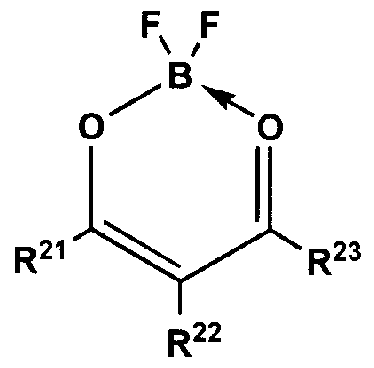
[0015] (式中、 Rz Rz はそれぞれ独立に水素原子または置換基を表し、少なくとも 1と R22、もしくは R22と R23が連結し環を形成してもよい。
8.前記 350〜440nmの間に吸収極大を有する色素が下記一般式 (4)で表されるこ とを特徴とする 2〜5のいずれカゝ 1項に記載の平版印刷版材料。
[0016] [化 3] 一般式 (4)

[0017] (式中、 Aは S原子または NRを表し、 Rは置換もしくは非置換のアルキル基または
1 1
置換もしくは非置換のァリール基を表し、 Zは隣接する A及び炭素原子と共同して色 素の塩基性核を形成する非金属原子団を表す。 X、 Xはそれぞれ独立に
1 2 一価の非 金属原子団を表し、 X X
1、 2は互いに結合して色素の酸性核を形成してもよい。 )
9.前記 350〜440nmの間に吸収極大を有する色素が下記一般式(5)で表されるこ とを特徴とする 2〜5のいずれカゝ 1項に記載の平版印刷版材料。
[0018] [化 4] 一般式 (5)
 [0019] (式中、 Rdlはアルキル基、ァリール基、ァルケ-ル基、シクロアルキル基、ァラルキル 基またはへテロ環基を表す。 R32は水素原子、アルキル基、ァリール基、アルケニル 基、シクロアルキル基、ァラルキル基またはへテロ環基を表す。 R33〜R35はそれぞれ 独立に水素原子、アルキル基、アルコキシ基、ァリールォキシ基、アルキルチオ基、 ァリールチオ基、ジアルキルアミノ基またはジァリールアミノ基を表す。 R31〜R35が表 す上記置換基は更に置換基を有してもよい。 )
10.前記感光層が、前記カチオン重合可能な基を少なくとも 1つ有する化合物として エポキシィ匕合物、ビニルエーテルィ匕合物またはォキセタンィ匕合物を含有することを特 徴とする 1〜9のいずれ力 1項に記載の平版印刷版材料。
11.前記感光層が、前記カチオン重合可能な基を少なくとも 1つ有する化合物として 、ォキセタン化合物並びに、エポキシ化合物およびビュルエーテル化合物の少なくと も一つを含有することを特徴とする 10に記載の平版印刷版材料。
12.前記感光層が、 350ηπ!〜 440nmの間に吸収極大を有する色素を感光層に対 して 0. 1質量%〜20質量%、前記カチオン重合可能な基を少なくとも 1つ有する化 合物を 20質量%〜80質量%、前記アルカリ可溶性高分子結合剤を 15質量%〜70 質量%含有し、さらに前記酸発生剤を、前記カチオン重合可能な基を少なくとも 1つ 有する化合物に対して 0. 1質量%〜20質量%含有することを特徴とする 2〜11のい ずれ力 1項に記載の平版印刷版材料。
13. 1〜 12のヽずれか 1項に記載の平版印刷版材料の感光層上にバイオレツト ·レ 一ザ光線を用いて画像を描画した後、アルカリ性現像液で未露光部を除去する工程 を有することを特徴とする画像形成方法。
発明の効果
[0020] 本発明によれば、高感度で、高湿度での保存性に優れ高湿度保存でのハイライト 部の再現が良 、単層の平版印刷版材料およびそれを用いた画像形成方法を提供 することができる。
発明を実施するための最良の形態
[0021] 以下、本発明を実施するための最良の形態について説明するが、本発明はこれら に限定されない。
[0022] (酸でカチオン重合可能な基を少なくとも 1つ有する化合物)
本発明に用いられる酸でカチオン重合可能な基を少なくとも 1つ有する化合物(以 下、単に、カチオン重合性モノマーともいう)としては、例えば、特開平 6— 9714号、 特開 2001— 31892号、特開 2001— 40068号、特開 2001— 55507号、特開 200 1— 310938号、特開 2001— 310937号、特開 2001— 220526号【こ f列示されて!/ヽ るエポキシィ匕合物、ビュルエーテルィ匕合物、ォキセタンィ匕合物などが挙げられる。 エポキシィ匕合物としては、芳香族エポキシド、脂環式エポキシド、脂肪族エポキシド がある。
[0023] 芳香族エポキシドとして好ましいものは、少なくとも 1個の芳香族核を有する多価フ ェノールあるいはそのアルキレンオキサイド付加体とェピクロルヒドリンとの反応によつ て製造されるジまたはポリグリシジルエーテルであり、例えばビスフエノール Aある!/ヽ はそのアルキレンオキサイド付加体のジまたはポリグリシジルエーテル、水素添加ビ スフェノール Aあるいはそのアルキレンオキサイド付カ卩体のジまたはポリグリシジルェ 一テル、ならびにノボラック型エポキシ榭脂等が挙げられる。ここでアルキレンォキサ イドとしては、エチレンオキサイドおよびプロピレンオキサイド等が挙げられる。
[0024] 脂環式エポキシドとしては、少なくとも 1個のシクロへキセンまたはシクロペンテン環 等のシクロアルカン環を有する化合物を、過酸化水素、過酸等の適当な酸化剤でェ ポキシィ匕することによって得られる、シクロへキセンオキサイドまたはシクロペンテンォ キサイド含有ィ匕合物が好まし 、。
[0025] 脂肪族エポキシドの好ま 、ものとしては、脂肪族多価アルコールあるいはそのァ ルキレンオキサイド付加体のジまたはポリグリシジルエーテル等があり、その代表例と しては、エチレングリコールのジグリシジルエーテル、プロピレングリコールのジグリシ ジルエーテルまたは 1 , 6—へキサンジオールのジグリシジルエーテル等のアルキレ ングリコールのジグリシジルエーテル、グリセリンあるいはそのアルキレンオキサイド付 加体のジまたはトリグリシジルエーテル等の多価アルコールのポリグリシジルエーテ ル、ポリエチレングリコールあるいはそのアルキレンオキサイド付カ卩体のジグリシジル エーテル、ポリプロピレングリコールあるいはそのアルキレンオキサイド付カ卩体のジグ リシジルエーテル等のポリアルキレングリコールのジグリシジルエーテル等が挙げら
れる。ここでアルキレンオキサイドとしては、エチレンオキサイドおよびプロピレンォキ サイド等が挙げられる。
[0026] これらのエポキシドのうち、高感度化を考慮すると、芳香族エポキシドおよび脂環式 エポキシドが好ましぐ特に脂環式エポキシドが好ましい。本発明では、上記エポキシ ドの 1種を単独で使用してもょ 、が、 2種以上を適宜組み合わせて使用してもょ 、。
[0027] ビュルエーテル化合物としては、例えばエチレングリコールジビュルエーテル、ジ エチレングリコーノレジビニノレエーテノレ、トリエチレングリコーノレジビニノレエーテノレ、プロ ピレングリコールジビニノレエーテル、ジプロピレングリコールジビニノレエーテル、ブタ ンジオールジビニルエーテル、へキサンジオールジビニルエーテル、シクロへキサン ジメタノールジビニルエーテル、トリメチロールプロパントリビニルエーテル等のジ又は トリビュルエーテル化合物、ェチルビ-ルエーテル、 n—ブチルビ-ルエーテル、イソ ブチルビ-ルエーテル、ォクタデシルビ-ルエーテル、シクロへキシルビニルエーテ ノレ、ヒドロキシブチノレビニノレエーテノレ、 2—ェチノレへキシノレビニノレエーテノレ、シクロへ キサンジメタノールモノビニルエーテル、 n—プロピルビニルエーテル、イソプロピルビ -ルエーテル、イソプロぺ-ルエーテル o プロピレンカーボネート、ドデシルビ- ルエーテル、ジエチレングリコールモノビュルエーテル、ォクタデシルビ-ルエーテ ル等のモノビュルエーテル化合物等が挙げられる。
[0028] これらのビニルエーテルィ匕合物のうち、ハイライト部の再現性を考慮すると、ジ又は トリビニルエーテルィ匕合物が好ましぐ特にジビニルエーテルィ匕合物が好ましい。本 発明では、上記ビニルエーテルィ匕合物の 1種を単独で使用してもよいが、 2種以上を 適宜組み合わせて使用してもょ 、。
[0029] ォキセタンィ匕合物は、ォキセタン環を有する化合物のことであり、特開 2001— 220 526号、特開 2001— 310937号に紹介されているような公知のあらゆるォキセタン 化合物を使用できる。
[0030] 本発明で使用するォキセタンィ匕合物は、ォキセタン環を 1〜4個有する化合物が好 ましい。ォキセタン環を 5個以上有する化合物を使用すると、ハイライト部の再現性が 十分でなくなってしまう。
[0031] 1個のォキセタン環を有する化合物としては、下記一般式(101)で示される化合物
等が挙げられる。
[0032] [化 5]
—般式 Π01)

[0033] 一般式(101)において、 R皿は、水素原子、メチル基、ェチル基、プロピル基或い はブチル基等の炭素数 1〜6個のアルキル基、炭素数 1〜6個のフルォロアルキル基 、ァリル基、ァリール基、フリル基又はチェニル基である。 R1G2は、メチル基、ェチル 基、プロピル基或いはブチル基等の炭素数 1〜6個のアルキル基、 1 プロべ-ル基 、 2—プロぺ-ル基、 2—メチルー 1 プロぺ-ル基、 2—メチルー 2—プロぺ-ル基、 1 ブテニル基、 2 ブテュル基或 、は 3 ブテュル基等の炭素数 2〜6個のァルケ -ル基、フエ-ル基、ベンジル基、フルォ口べンジル基、メトキシベンジル基或いはフ エノキシェチル基等の芳香環を有する基、ェチルカルボ-ル基、プロピルカルボ-ル 基或いはブチルカルボ-ル基等の炭素数 2〜6個のアルキルカルボ-ル基、ェトキ シカルボニル基、プロポキシカルボ-ル基或いはブトキシカルボ-ル基等の炭素数 2 〜6個のアルコキシカルボ-ル基、又はェチルカルバモイル基、プロピル力ルバモイ ル基、ブチルカルバモイル基或いはペンチルカルバモイル基等の炭素数 2〜6個の N アルキル力ルバモイル基等である。本発明で使用するォキセタンィ匕合物としては 、 1個のォキセタン環を有する化合物を使用することが、得られる組成物が粘着性に 優れ、低粘度で作業性に優れるため、特に好ましい。
[0034] つぎに、 2個のォキセタン環を有する化合物としては、下記一般式(102)で示され る化合物等が挙げられる。
[0035] [化 6]

[0036] 一般式(102)において、 R皿は、前記一般式(101)におけるものと同様の基である 。 R1 は、例えば、エチレン基、プロピレン基或いはブチレン基等の線状或いは分枝 状アルキレン基、ポリ(エチレンォキシ)基或いはポリ(プロピレンォキシ)基等の線状 或いは分枝状ポリ(アルキレンォキシ)基、プロべ-レン基、メチルプロべ-レン基或 いはブテニレン基等の線状或いは分枝状不飽和炭化水素基、カルボニル基、カル ボ-ル基を含むアルキレン基、カルボキシル基を含むアルキレン基、又は力ルバモイ ル基を含むアルキレン基等である。又、 R1 は、下記一般式(103)、(104)及び(10 5)で示される基から選択される 2価の基でもある。
[0037] [化 7] 一般式 (103)

[0038] 一般式(103)において、 R1U4は、水素原子、メチル基、ェチル基、プロピル基或い はブチル基等の炭素数 1〜4個のアルキル基、メトキシ基、エトキシ基、プロポキシ基 或いはブトキシ基等の炭素数 1〜4個のアルコキシ基、塩素原子或!、は臭素原子等 のハロゲン原子、ニトロ基、シァノ基、メルカプト基、低級アルコキシカルボ-ル基、力 ルボキシル基、又は力ルバモイル基である。
[0039] [化 8]
一般式 (104)

[0040] 一般式(104)において、 は、酸素原子、硫黄原子、メチレン基、 NH、 SO、 SO 、 C (CF )又は C (CH )である。
[0041] [化 9]
—般式 (105)

[0042] 一般式(105)にお 、て、 R1C)6は、メチル基、ェチル基、プロピル基或いはブチル基 等の炭素数 1〜4個のアルキル基、又はァリール基である。 nは、 0〜2000の整数で ある。 R1G7はメチル基、ェチル基、プロピル基或いはブチル基等の炭素数 1〜4個の アルキル基、又はァリール基である。 R1C)7は、下記一般式(106)で示される基でもあ る。
[0043] [化 10] 一般式 (106)
R
— O— (Si-O-V- S薩i-R108
R R
[0044] 一般式(106)にお 、て、 R1C)8は、メチル基、ェチル基、プロピル基及びブチル基等 の炭素数 1〜4個のアルキル基、又はァリール基である。 mは、 0〜100の整数である
2個のォキセタン環を有する化合物の具体例としては、下記ォキセタンィ匕合物 107 、 108等が挙げられる。
[0046] [化 11] 才キセタン化合物 107

[0047] ォキセタンィ匕合物 107は、一般式(102)において、 R皿がェチル基、 R1Udがカルボ ニル基である化合物である。
[0048] [化 12] 才キセタン化合物 108

[0049] ォキセタンィ匕合物 108は、一般式(102)において、 R皿がェチル基、 R1Udが一般 式(105)で R1G6及び R1G7がメチル基、 nが 1である化合物である。
[0050] 2個のォキセタン環を有する化合物において、上記した化合物以外の好ましい例と しては、下記一般式(109)で示される化合物がある。一般式(109)において、 R101 は、前記一般式(101)におけるものと同様の基である。
[0051] [化 13] 一般式 (109)

[0052] 3〜4個のォキセタン環を有する化合物としては、下記一般式(110)で示される化 合物等が挙げられる。
[0053] [化 14]
-般式 (110)

[0054] 一般式(110)において、 R1G1は、前記一般式(101)におけるものと同様の基である 。R1Q9は、例えば下記式(111)、 (112)、 (113)、 (114)または(115)で示される 3ま たは 4価の基等が挙げられる。 jは、 3又は 4である。
[0055] [化 15] 式 (111)

[0056] 式(111)にお 、て、 R はメチル基、ェチル基又はプロピル基等の低級アルキル 基である。
[0057] [化 16] 式 (112)
CH2-
— CH C—— CH2 -
CH,- 式 (113)
-CH2— CH2—CH— CH,一 CH— CH2— CH,—
[0058] [化 17]

[0059] 式(114)において、 1は 1〜10の整数である
[0060] [化 18] 式 (115)
CH, CH,
I — I
-CH,-CH-CH2-Si— 0— Si-CH,-CH-CH
I - I I I
[0061] 3〜4個のォキセタン環を有する化合物の具体例としては、下記ォキセタンィ匕合物 1
16等が挙げられる。
[0062] [化 19]

[0063] さらに、上記した以外の 1〜4個のォキセタン環を有する化合物の例としては、下記 一般式(117)で示される化合物がある。
[0064] [化 20]
一般式 (117)
R11

[0065] 一般式(117)において、 R1"8は式(106)におけるものと同様の基である。 R111はメ チル基、ェチル基、プロピル基又はブチル基等の炭素数 1〜4のアルキル基又はトリ アルキルシリル基であり、 R1G1は式(101)におけるものと同様の基である。 rは 1〜4で ある。
[0066] 本発明で使用するォキセタンィ匕合物の好ましい具体例としては、以下に示すォキ セタンィ匕 物 118、 119、 120力 Sある。
[0067] [化 21] 才キセタン化合物 118

[0069] 又、これら以外にも、分子量 1000〜5000程度の高分子量を有する、 1〜4個のォ キセタン環を有する化合物も挙げられる。これらの例として、例えば以下のォキセタン ィ匕 物 121、 122、 123力 S挙げられる ο
[0070] [化 22] 才キセタン化合物 121

[0071] ここで、 ρは 20〜200である
[0072] [化 23] 才キセタン化合物 122

[0073] ここで、 qは 15〜: LOOである
[0074] [化 24] 才キセタン化合物 123

[0075] ここで、 sは 20〜200である。
[0076] 本発明においては、感光層が、カチオン重合性モノマーとして少なくとも 1種のォキ セタンィ匕合物と、エポキシィ匕合物及びビニルエーテルィ匕合物力 選ばれる少なくとも 1種の化合物を含有することが好まし 、。
[0077] 感光層中のカチオン重合性モノマーの含有量は、感光層の全重量に対して、好ま しくは、 20— 80質量0 /0、更に好ましくは、 40— 70質量0 /0である。
[0078] (酸発生剤組成物)
本発明に係るバイオレット'レーザ光線の照射により酸を発生し得る酸発生剤組成 物について説明する。
[0079] 酸発生剤としては、例えば、化学増幅型フォトレジストや光力チオン重合に利用され る化合物が用いられる(有機エレクトロニクス材料研究会編、「イメージング用有機材 料」、ぶんしん出版(1993年)、 187〜192ページ参照)。本発明に好適な化合物の 例を以下に挙げる。
[0080] 第 1に、ジァゾユウム、アンモ-ゥム、ョードニゥム、スノレホニゥム、ホスホ-ゥムなど の芳香族ォニゥム化合物の B (C F )— , PF―, AsF―, SbF―, CF SO—塩を挙げるこ
6 5 4 6 6 6 3 3
とができる。対ァ-オンとしてボレートイ匕合物をもつものが酸発生能力が高く好ましい
。ォニゥム化合物の具体的な例を以下に示す。
[0081] [化 25]

[0082] 第 2に、スルホン酸を発生するスルホンィ匕物を挙げることができる。具体的な化合物 を以下に例示する。
[0083] [化 26]


[0084] 第 3に、ハロゲンィ匕水素を光発生するハロゲン化合物も用いることができる。本発明 では、このハロゲンィ匕合物が好ましく用いられる。
[0085] 本発明では、ハロゲンィ匕合物として、下記一般式(1)で表されるハロゲンィ匕合物が 好ましく用いられる。この中でもさらに、下記一般式(I )で表されるハロゲンィ匕合物 が特に、好ましく用いられる。
[0086] 一般式(1) R1— C (Y) —(C = 0)— R2
2
一般式(1)中、 R1は、水素原子、ハロゲン原子、アルキル基、ァリール基、ァシル基 、アルキルスルホ-ル基、ァリールスルホ -ル基またはシァノ基を表す。 R2は、水素ま たは一価の置換基を表す。 R1と R2が結合して環を形成してもよい。 Yはハロゲン原子
を表す。 R2によって表される一価の置換基は、置換または未置換のアルキル基、置 換または未置換のァリール基、置換または未置換の複素環基、置換または未置換の アルコキシ基、置換または未置換のァリールォキシ基、置換または未置換のアミノ基 、あるいは水酸基を表す。
[0087] 一般式(1' ) C (Y) - (C = 0) -X-R3
3
一般式(1' )中、 R3は、水素または一価の置換基を表す。 Xは、—O—または—N R4—を表す。 R4は、水素原子またはアルキル基を表す。 R3と R4が結合して環を形成 してもよい。 Yはハロゲン原子を表す。 R3によって表される一価の置換基は、置換ま たは未置換のアルキル基、置換または未置換のァリール基、あるいは、置換または 未置換の複素環基を表す。
[0088] 一般式(1)で表される構造の具体的として、 BR1から BR66の化合物が挙げられる 。尚、これらの化合物はハロゲン原子を臭素力 塩素に置き換えた化合物も本発明 においては好適に用いることができる。
[0089] [化 27]

[0090] [化 28]
BR13 BR14

BR19 B 20

BR21


BR26

B 27


BR36 BR37
 1]
1]

[0094] [化 32]
BR42

OAV

s9600
[0097]

[0098] [化 35]
-OCONHCOCC
[0100] 本発明に用いられる、鉄アレーン錯体化合物は、下記一般式 (a)で表される化合 物が好ましい。
[0101] 一般式(a) [A—Fe— B]+X—
式中 Aは、シクロペンタジェ-ル基、アルキル置換シクロペンタジェ -ル基を表す。 式中 Bはァレーンを表す。式中 ΧΊまァニオンを表す。
[0102] ァレーンは芳香族環を有する化合物を表し、具体例としてはベンゼン、トルエン、キ シレン、タメン、ナフタレン、 1ーメチルナフタレン、 2—メチルナフタレン、ビフエニル、 フルオレン等が挙げられる。 X—としては、 PF―
6、 BF―
4、 SbF― —等が挙 6、 A1F―
4、 CF SO
3 3 げられる。
[0103] 鉄アレーン錯体ィ匕合物としては、特開昭 59— 219307に記載される化合物等挙げ られる力 更に好ましい具体例としては、 7}—ベンゼン一( 7}—シクロペンタジェ-ル )鉄へキサフルォロホスフェート、 η—クメンー(ηーシクロペンタジェ -ル)鉄へキサ フルォロホスフェート、 7}—フルオレン一(7}—シクロペンタジェ -ル)鉄へキサフル ォロホスフェート、 —ナフタレン一( —シクロペンタジェ -ル)鉄へキサフルォロホ スフェート、 7}—キシレン一(7}—シクロペンタジェ -ル)鉄へキサフルォロホスフエ一 ト、 7}—ベンゼン一(7}—シクロペンタジェ -ル)鉄テトラフルォロボレート等が挙げら れる。 感光層中の酸発生剤の含有量は、カチオン重合性モノマーに対して好まし くは、 0. 1〜20質量%であり、より好ましくは 0. 1〜10質量%である。
[0104] (350ηπ!〜 440nmの間に吸収極大を有する色素)
本発明に係る 350〜440nmの間に吸収極大を有する色素としては、前記一般式( 2)で表される化合物が用いられる。
[0105] 式中、 RU〜R16は水素原子、アルキル基 (例えば、メチル基、ェチル基、プロピル 基、イソプロピル基、 tert—ブチル基、ペンチル基、へキシル基、ォクチル基、ドデシ ル基、トリデシル基、テトラデシル基、ペンタデシル基等)、シクロアルキル基 (例えば 、シクロペンチル基、シクロへキシル基等)、ァルケ-ル基 (例えば、ビュル基、ァリル 基等)、アルキニル基 (例えば、ェチニル基、プロパルギル基等)、ァリール基 (例えば 、フエ-ル基、ナフチル基等)、ヘテロァリール基 (例えば、フリル基、チェニル基、ピ リジル基、ピリダジル基、ピリミジル基、ビラジル基、トリアジル基、イミダゾリル基、ビラ
ゾリル基、チアゾリル基、ベンゾイミダゾリル基、ベンゾォキサゾリル基、キナゾリル基、 フタラジル基等)、ヘテロ環基 (例えば、ピロリジル基、イミダゾリジル基、モルホリル基 、ォキサゾリジル基等)、アルコキシ基 (例えば、メトキシ基、エトキシ基、プロピルォキ シ基、ペンチルォキシ基、へキシルォキシ基、ォクチルォキシ基、ドデシルォキシ基 等)、シクロアルコキシ基 (例えば、シクロペンチルォキシ基、シクロへキシルォキシ基 等)、ァリールォキシ基 (例えば、フエノキシ基、ナフチルォキシ基等)、アルキルチオ 基(例えば、メチルチオ基、ェチルチオ基、プロピルチオ基、ペンチルチオ基、へキ シルチオ基、ォクチルチオ基、ドデシルチオ基等)、シクロアルキルチオ基 (例えば、 シクロペンチルチオ基、シクロへキシルチオ基等)、ァリールチオ基 (例えば、フエ二 ルチオ基、ナフチルチオ基等)、アルコキシカルボ-ル基 (例えば、メチルォキシカル ボ-ル基、ェチルォキシカルボ-ル基、ブチルォキシカルボ-ル基、ォクチルォキシ カルボ-ル基、ドデシルォキシカルボ-ル基等)、ァリールォキシカルボ-ル基(例え ば、フエ-ルォキシカルボ-ル基、ナフチルォキシカルボ-ル基等)、スルファモイル 基(例えば、アミノスルホ -ル基、メチルアミノスルホ -ル基、ジメチルアミノスルホ -ル 基、ブチルアミノスルホ -ル基、へキシルアミノスルホ -ル基、シクロへキシルアミノス ルホ-ル基、ォクチルアミノスルホ -ル基、ドデシルアミノスルホ-ル基、フエ-ルアミ ノスルホ -ル基、ナフチルアミノスルホ -ル基、 2—ピリジルアミノスルホ -ル基等)、ァ シル基(例えば、ァセチル基、ェチルカルボ-ル基、プロピルカルボ-ル基、ペンチ ルカルボ-ル基、シクロへキシルカルボ-ル基、ォクチルカルポ-ル基、 2—ェチル へキシルカルボ-ル基、ドデシルカルポ-ル基、フヱ-ルカルボ-ル基、ナフチルカ ルポ二ル基、ピリジルカルボ-ル基等)、ァシルォキシ基 (例えば、ァセチルォキシ基 、ェチルカルボニルォキシ基、ブチルカルボニルォキシ基、ォクチルカルボ二ルォキ シ基、ドデシルカルボ-ルォキシ基、フエ-ルカルポニルォキシ基等)、アミド基 (例え ば、メチルカルボ-ルァミノ基、ェチルカルボ-ルァミノ基、ジメチルカルボ-ルァミノ 基、プロピルカルボ-ルァミノ基、ペンチルカルボ-ルァミノ基、シクロへキシルカル ボ-ルァミノ基、 2—ェチルへキシルカルボ-ルァミノ基、ォクチルカルボ-ルァミノ 基、ドデシルカルボ-ルァミノ基、フヱ-ルカルポ-ルァミノ基、ナフチルカルボ-ル アミノ基等)、力ルバモイル基 (例えば、ァミノカルボニル基、メチルァミノカルボ-ル
基、ジメチルァミノカルボ-ル基、プロピルアミノカルボ-ル基、ペンチルァミノカルボ
-ル基、シクロへキシルァミノカルボ-ル基、ォクチルァミノカルボ-ル基、 2—ェチル へキシルァミノカルボ-ル基、ドデシルァミノカルボ-ル基、フエ-ルァミノカルボ-ル 基、ナフチルァミノカルボニル基、 2—ピリジルァミノカルボ-ル基等)、ウレイド基 (例 えば、メチルウレイド基、ェチルウレイド基、ペンチルゥレイド基、シクロへキシルゥレイ ド基、ォクチルゥレイド基、ドデシルウレイド基、フ ニルウレイド基、ナフチルウレイド 基、 2—ピリジルアミノウレイド基等)、スルフィエル基 (例えば、メチルスルフィ-ル基、 ェチルスルフィ-ル基、ブチルスルフィ-ル基、シクロへキシルスルフィ-ル基、 2— ェチルへキシルスルフィ-ル基、ドデシルスルフィ-ル基、フエ-ルスルフィ-ル基、 ナフチルスルフィエル基、 2—ピリジルスルフィエル基等)、アルキルスルホ -ル基(例 えば、メチルスルホ -ル基、ェチルスルホ -ル基、ブチルスルホ -ル基、シクロへキシ ルスルホ-ル基、 2—ェチルへキシルスルホ -ル基、ドデシルスルホ -ル基等)、ァリ 一ルスルホ -ル基(フヱ-ルスルホ-ル基、ナフチルスルホ-ル基、 2—ピリジルスル ホ-ル基等)、アミノ基 (例えば、アミノ基、ェチルァミノ基、ジメチルァミノ基、ブチル アミノ基、シクロペンチルァミノ基、 2—ェチルへキシルァミノ基、ドデシルァミノ基、ァ 二リノ基、ナフチルァミノ基、 2—ピリジルァミノ基等)、ハロゲン原子 (例えば、フッ素 原子、塩素原子、臭素原子等)、シァノ基、ニトロ基、ヒドロキシル基等が挙げられる。 これらの置換基は上記の置換基によって更に置換されていてもよい。また、これらの 置換基は複数が互 、に結合して環を形成して 、てもよ 、。
[0106] この中で、特に好ましいのは R15にァミノ基、アルキルアミノ基、ジアルキルアミノ基、 ァリールアミノ基、ジァリールアミノ基、アルキルァリールアミノ基を有するクマリンであ る。この場合、ァミノ基に置換したアルキル基が R14、 R16の置換基と環を形成している ものも好ましく用いることができる。
[0107] 更に尺11、 R12のいずれ力、あるいは両方がアルキル基(例えば、メチル基、ェチル 基、プロピル基、イソプロピル基、 tert—ブチル基、ペンチル基、へキシル基、ォクチ ル基、ドデシル基、トリデシル基、テトラデシル基、ペンタデシル基等)、シクロアルキ ル基 (例えば、シクロペンチル基、シクロへキシル基等)、アルケニル基 (例えば、ビ- ル基、ァリル基等)、ァリール基 (例えば、フエ-ル基、ナフチル基等)、ヘテロァリー
ル基 (例えば、フリル基、チェニル基、ピリジル基、ピリダジル基、ピリミジル基、ピラジ ル基、トリアジル基、イミダゾリル基、ピラゾリル基、チアゾリル基、ベンゾイミダゾリル基 、ベンゾォキサゾリル基、キナゾリル基、フタラジル基等)、ヘテロ環基 (例えば、ピロリ ジル基、イミダゾリジル基、モルホリル基、ォキサゾリジル基等)、アルコキシカルボ- ル基(例えば、メチルォキシカルボ-ル基、ェチルォキシカルボ-ル基、ブチルォキ シカルボニル基、ォクチルォキシカルボ-ル基、ドデシルォキシカルボ-ル基等)、 ァリールォキシカルボ-ル基(例えば、フエ-ルォキシカルボ-ル基、ナフチルォキ シカルボ-ル基等)、ァシル基(例えば、ァセチル基、ェチルカルボ-ル基、プロピル カルボ-ル基、ペンチルカルボ-ル基、シクロへキシルカルボ-ル基、ォクチルカル ボ-ル基、 2—ェチルへキシルカルボ-ル基、ドデシルカルポ-ル基、フエニルカル ボニル基、ナフチルカルボ-ル基、ピリジルカルボ-ル基等)、ァシルォキシ基 (例え ば、ァセチルォキシ基、ェチルカルボ-ルォキシ基、ブチルカルボ-ルォキシ基、ォ クチルカルボ-ルォキシ基、ドデシルカルボ-ルォキシ基、フエ-ルカルポ-ルォキ シ基等)、力ルバモイル基 (例えば、ァミノカルボニル基、メチルァミノカルボ-ル基、 ジメチルァミノカルボ-ル基、プロピルアミノカルボ-ル基、ペンチルァミノカルボ-ル 基、シクロへキシルァミノカルボ-ル基、ォクチルァミノカルボ-ル基、 2—ェチルへキ シルァミノカルボ-ル基、ドデシルァミノカルボ-ル基、フエ-ルァミノカルボ-ル基、 ナフチルァミノカルボ-ル基、 2—ピリジルァミノカルボ-ル基等)、スルフィエル基( 例えば、メチルスルフィエル基、ェチルスルフィ-ル基、ブチルスルフィ-ル基、シク 口へキシルスルフィ-ル基、 2—ェチルへキシルスルフィ-ル基、ドデシルスルフィ- ル基、フヱニルスルフィ-ル基、ナフチルスルフィ-ル基、 2—ピリジルスルフィエル基 等)、アルキルスルホ -ル基(例えば、メチルスルホ -ル基、ェチルスルホ -ル基、ブ チルスルホ-ル基、シクロへキシルスルホ -ル基、 2—ェチルへキシルスルホ -ル基 、ドデシルスルホ -ル基等)、ァリールスルホ -ル基(例えば、フ -ルスルホ-ル基、 ナフチルスルホニル基、 2—ピリジルスルホ -ル基等)、ハロゲン原子(例えば、フッ素 原子、塩素原子、臭素原子等)、シァノ基、ニトロ基、ハロゲン化アルキル基 (例えば、 トリフルォロメチル基、トリブロモメチル基、トリクロロメチル基等)であると更に好ましい
[0108] 好ましい具体例として下記の化合物が挙げられる力 これに限定するものではない [0109] [化 36]

[0110] [化 37]
[8S^ ] [ΐΐΐθ]


[0112] [化 39]
ο


[0115] 本発明に係る前記一般式(2)で表される、 350〜440nmの間に吸収極大を有する 色素の感光層中への添加量は、記録光源波長における版面の反射濃度が、 0. 1か ら 1. 2の範囲となる量であることが好ましい。
[0116] 前記一般式(3)で表される、 350〜440nmの間に吸収極大を有する色素におい て、 R21、 R22、 R23はそれぞれ独立に水素原子または置換基を表し、少なくとも R21と R 2 もしくは R22と R23が連結し環を形成してもよい。 R21、 R22、 R23によって表される置換 基は、置換または未置換のアルキル基、置換または未置換のアルケニル基、置換ま たは未置換のァリール基、または置換または未置換の複素環基を表す。置換または 未置換のアルキル基、置換または未置換のアルケニル基、置換または未置換のァリ ール基、または置換または未置換の複素環基の具体例としては、メチル基、ェチル 基、プロピル基、ブチル基、イソプロピル基、イソブチル基、イソペンチル基、 tーブチ ル基、ビュル基、 2 プロべ-ル基、 3 ブテュル基、イソペンチル基、ネオペンチル 基、 1 メチルブチル基、イソへキシル基、フエ-ル基、ナフチル基、ピロール環基、 イミダゾール環基、ピラゾール環基、ォキサゾール環基、チアゾール環基、ォキサジ ァゾール環基、チアジアゾール環基、ベンズイミダゾール環基、ピリジン環基、フラン 環基、チオフヱン環基、クマロン環基、クマリン環基、ピロリドン環基、ピぺリジン環基、 モルフオリン環基、スルフォラン環基、テトラヒドロフラン環基、テトラヒドロピラン環基等 が挙げられる。
更には一般式 (6)の構造で表される化合物がより好ま 、。
[0117] [化 41]
-般式 (6) o o
R24
Rへ X
[0118] 式中、 R24は水素原子、置換または未置換のアルキル基、置換または未置換アルケ ニル基、置換または未置換のァリール基、置換または未置換の複素環基を表す。 R25 、 R26は連結し環を形成する置換基を表す。 X1、 X2はそれぞれ独立に— CR27R28—、 — O—、— S―、— NR29—を表す。 R27、 R28、 R29はそれぞれ独立に水素原子、置換 または未置換のアルキル基、置換または未置換アルケニル基、置換または未置換の ァリール基、置換または未置換の複素環基を表す。置換または未置換のアルキル基 、置換または未置換ァルケ-ル基、置換または未置換のァリール基、置換または未 置換の複素環基を表す。 R25、 R26は連結し環を形成する置換基を表す。 R24、 R27、 R 28、 R29によって表される置換または未置換のアルキル基、置換または未置換アルケ ニル基、置換または未置換のァリール基、置換または未置換の複素環基の具体例と しては、上記 1、 R22、 R23において述べたものと同じものが挙げられる。
[0119] 上記一般式 (3)、(6)で表される色素の代表例を以下に示すが、本発明は、これら に限定されるものではない。
[0120] [化 42]

[0121] 前記一般式 (4)で表される、 350〜440nmの間に吸収極大を有する色素は、更に 一般式 (4 1 )、(4 2)または (4 3)で表される色素がより好ま U、。
[0122] [化 43] 一般式 (4一 1 ) 一般式 (4一 2) —般式 (4一 3)

[0123] 一般式 (4 1)、 (4- 2) , (4 3)中、 A及び Zは一般式 (4)中と同義であり、 X、X
3 '
、 Wはそれぞれ独立に O原子、 S原子または NRを表し、 Rは置換もしくは非置換の
5 5
アルキル基または置換もしくは非置換のァリール基を表し、 Rは水素原子、置換もし
2
くは非置換のアルキル基、置換もしくは非置換のアルコキシ基、置換もしくは非置換
のァリールォキシ基、置換もしくは非置換のァリールカルボニル基、置換もしくは非置 換のァリールチオカルボ-ル基、置換もしくは非置換のアルキルチオ基、置換もしく は非置換のァリールチオ基、置換もしくは非置換のアルキルアミノ基または置換もしく は非置換のァリールアミノ基を表し、 Rは水素原子、置換もしくは非置換のアルキル
3
基、置換もしくは非置換のァリール基、置換もしくは非置換のへテロアリール基、置換 もしくは非置換のアルコキシ基、置換もしくは非置換のァリールォキシ基、置換もしく は非置換のアルキルチオ基、置換もしくは非置換のァリールチオ基、置換もしくは非 置換のアルキルアミノ基または置換もしくは非置換のァリールアミノ基を表し、 Rは水
4 素原子、置換もしくは非置換のアルキル基、置換もしくは非置換のァリール基または 置換もしくは非置換のへテロアリール基を表す。
[0124] 一般式 (4)、(4—1)、(4— 2)、(4— 3)について更に詳しく説明する。
[0125] Aは S原子または NRを表し、 Rは置換もしくは非置換のアルキル基または置換も
1 1
しくは非置換のァリール基を表し、 Zは Aと共同して塩基性核を形成する非金属原子 団を表す。次に Rの好ましい例について具体的に述べる。
1
[0126] 好ましいアルキル基の例としては、炭素原子数が 1から 20までの直鎖状、分岐状、 及び環状のアルキル基を挙げることができ、その具体例としては、メチル基、ェチル 基、プロピル基、ブチル基、ペンチル基、へキシル基、ヘプチル基、ォクチル基、ノニ ル基、デシル基、ゥンデシル基、ドデシル基、トリデシル基、へキサデシル基、ォクタ デシル基、エイコシル基、イソプロピル基、イソブチル基、 s ブチル基、 t ブチル基
、イソペンチル基、ネオペンチル基、 1 メチルブチル基、イソへキシル基、 2—ェチ ルへキシル基、 2—メチルへキシル基、シクロへキシル基、シクロペンチル基、 2—ノ ルボルニルを挙げることができる。これらの中では、炭素原子数 1から 12までの直鎖 状、炭素原子数 3から 12までの分岐状、並びに炭素原子数 5から 10までの環状のァ ルキル基がより好ましい。
[0127] 置換アルキル基の置換基としては、水素を除く一価の非金属原子団が用いられ、 好ましい例としては、ハロゲン原子(一 F、 一Br、 一Cl、 一1)、ヒドロキシル基、アルコ キシ基、ァリーロキシ基、メルカプト基、アルキルチオ基、ァリールチオ基、アルキルジ チォ基、ァリールジチォ基、アミノ基、 N アルキルアミノ基、 N, N—ジアルキルアミ
ノ基、 N ァリールアミノ基、 N, N ジァリールアミノ基、 N アルキル— N ァリー ルァミノ基、ァシルォキシ基、力ルバモイルォキシ基、 N アルキル力ルバモイルォキ シ基、 N ァリール力ルバモイルォキシ基、 N, N ジアルキル力ルバモイルォキシ 基、 N, N ジァリール力ルバモイルォキシ基、 N アルキル N ァリール力ルバ モイルォキシ基、アルキルスルホキシ基、ァリールスルホキシ基、ァシルチオ基、ァシ ルァミノ基、 N アルキルァシルァミノ基、 N ァリールァシルァミノ基、ウレイド基、 N アルキルウレイド基、 N' , N' —ジアルキルウレイド基、 N' —ァリールウレイド 基、 N' , N' —ジァリールウレイド基、 N' アルキル —ァリールウレイド基、 N アルキルウレイド基、 N ァリールウレイド基、 N' アルキル N アルキルゥ レイド基、 N' —アルキル— N ァリールウレイド基、 N' , N' —ジアルキル— N— アルキルウレイド基、 N' , N' —ジアルキル—N ァリールウレイド基、 N' —ァリー ルー N—アルキルウレイド基、 N' —ァリール—N ァリールウレイド基、 N' , N' ージァリール—N—アルキルウレイド基、 N' , N' —ジァリール—N ァリールウレ イド基、 N' —アルキル— —ァリール— N アルキルウレイド基、 N' —アルキル —N' —ァリール—N ァリールウレイド基、アルコキシカルボ-ルァミノ基、ァリ一口 キシカルボ-ルァミノ基、 N—アルキル—N—アルコキシカルボ-ルァミノ基、 N ァ ルキル N ァリーロキシカルボ-ルァミノ基、 N ァリール N アルコキシカルボ -ルァミノ基、 N ァリール— N ァリーロキシカルボ-ルァミノ基、ホルミル基、ァシ ル基、カルボキシル基、アルコキシカルボ-ル基、ァリーロキシカルボ-ル基、力ルバ モイル基、 N—アルキル力ルバモイル基、 N, N ジアルキル力ルバモイル基、 N— ァリール力ルバモイル基、 N, N ジァリール力ルバモイル基、 N—アルキル—N ァ リール力ルバモイル基、アルキルスルフィエル基、ァリールスルフィ-ル基、アルキル スルホニル基、ァリールスルホニル基、スルホ基(一 SO H)及びその共役塩基基(以
3
下、スルホナト基と称す)、アルコキシスルホ -ル基、ァリーロキシスルホ-ル基、スル フイナモイル基、 N—アルキルスルフイナモイル基、 N, N ジアルキルスルフイナモ ィル基、 N ァリールスルフイナモイル基、 N, N ジァリールスルフイナモイル基、 N —アルキル— N ァリールスルフイナモイル基、スルファモイル基、 N アルキルスル ファモイル基、 N, N ジアルキルスルファモイル基、 N ァリールスルファモイル基、
N, N ジァリールスルファモイル基、 N アルキル— N ァリールスルファモイル基 、ホスフオノ基(一 PO H )及びその共役塩基基 (以下、ホスフォナト基と称す)、ジァ
3 2
ルキルホスフオノ基(一PO (alkyl) )、ジァリールホスフオノ基(一 PO (aryl) )、アル
3 2 3 2 キルァリールホスフオノ基(一PO (alkyl) (aryl) )、モノアルキルホスフオノ基(一PO
3 3
H (alkyl) )及びその共役塩基基 (以後、アルキルホスフォナト基と称す)、モノアリー ルホスフオノ基(一 PO H (aryl) )及びその共役塩基基(以後、ァリールホスフォナト基
3
と称す)、ホスフオノォキシ基(一 OPO H )及びその共役塩基基 (以後、ホスフォナト
3 2
ォキシ基と称す)、ジアルキルホスフオノォキシ基(一 OPO (alkyl) )、ジァリールホス
3 2
フオノォキシ基(一 OPO (aryl) )、アルキルァリールホスフオノォキシ基(一OPO (al
3 2 3 kyl) (arvl) )、モノアルキルホスフオノォキシ基(一 OPO H (alkyl) )及びその共役塩
3
基基 (以後、アルキルホスフォナトォキシ基と称す)、モノアリールホスフオノォキシ基( OPO H (aryl) )及びその共役塩基基 (以後、ァリールフォスホナトォキシ基と称す
3
;)、シァノ基、ニトロ基、ァリール基、ヘテロァリール基、ァルケ-ル基、アルキ-ル基 が挙げられる。
[0128] これらの置換基におけるアルキル基の具体例としては、前述のアルキル基が挙げら れ、ァリール基の具体例としては、フ 二ル基、ビフヱ-ル基、ナフチル基、トリル基、 キシリル基、メシチル基、タメ-ル基、クロロフヱ-ル基、ブロモフヱ-ル基、クロロメチ ルフヱ-ル基、ヒドロキシフヱ-ル基、メトキシフエ-ル基、エトキシフヱ-ル基、フエノ キシフエ-ル基、ァセトキシフエ-ル基、ベンゾイロキシフエ-ル基、メチルチオフエ- ル基、フエ-ルチオフエ-ル基、メチルアミノフヱ-ル基、ジメチルアミノフヱ-ル基、 ァセチルァミノフエ-ル基、カルボキシフヱ-ル基、メトキシカルボ-ルフヱ-ル基、ェ トキシフヱ-ルカルポ-ル基、フヱノキシカルボ-ルフヱ-ル基、 N フヱ-ルカルバ モイルフヱ-ル基、フヱ -ル基、シァノフヱ-ル基、スルホフヱ-ル基、スルホナトフエ -ル基、ホスフオノフエ-ル基、ホスフォナトフエ-ル基等を挙げることができる。へテ ロアリール基としては、窒素、酸素、硫黄原子の少なくとも一つを含有する単環、もし くは多環芳香族環が用いられ、好ましくはフラン、ピロール、ピリジン等の 5員または 6 員環芳香族置換基が使用できる。
[0129] またァルケ-ル基の例としては、ビュル基、 1 プロべ-ル基、 1 ブテュル基、シ
ンナミル基、 2—クロロー 1ーェテュル基、等が挙げられ、アルキ-ル基の例としては 、ェチニル基、 1 プロピ-ル基、 1ーブチニル基、トリメチルシリルェチュル基等が 挙げられる。ァシル基(G CO )における Gとしては、水素、並びに上記のアルキル
1 1
基、ァリール基を挙げることができる。これら置換基の内、更により好ましいものとして はハロゲン原子(—F、— Br、— Cl、—1)、アルコキシ基、ァリーロキシ基、アルキルチ ォ基、ァリールチオ基、 N—アルキルアミノ基、 N, N ジアルキルアミノ基、ァシルォ キシ基、 N アルキル力ルバモイルォキシ基、 N ァリール力ルバモイルォキシ基、 ァシルァミノ基、ホルミル基、ァシル基、カルボキシル基、アルコキシカルボ-ル基、 ァリーロキシカルボ-ル基、力ルバモイル基、 N アルキル力ルバモイル基、 N, N— ジアルキル力ルバモイル基、 N ァリール力ルバモイル基、 N—アルキル—N ァリ 一ルカルバモイル基、スルホ基、スルホナト基、スルファモイル基、 N—アルキルスル ファモイル基、 N, N ジアルキルスルファモイル基、 N ァリールスルファモイル基、 N—アルキル—N ァリールスルファモイル基、ホスフオノ基、ホスフォナト基、ジアル キルホスフオノ基、ジァリールホスフオノ基、モノアルキルホスフオノ基、アルキルホス フォナト基、モノアリールホスフオノ基、ァリールホスフォナト基、ホスフオノォキシ基、 ホスフォナトォキシ基、ァリール基、アルケニル基が挙げられる。
[0130] 一方、置換アルキル基におけるアルキレン基としては、前述の炭素数 1から 20まで のアルキル基上の水素原子の 、ずれか 1つを除し、 2価の有機残基としたものを挙げ ることができ、好ましくは炭素原子数 1から 12までの直鎖状、炭素原子数 3から 12ま での分岐状並びに炭素原子数 5から 10までの環状のアルキレン基を挙げることがで きる。
[0131] 置換基とアルキレン基を組み合わせる事により得られる Rとして好ましい置換アル
1
キル基の具体例としては、クロロメチル基、ブロモメチル基、 2—クロ口ェチル基、トリフ ルォロメチル基、メトキシメチル基、メトキシェトキシェチル基、ァリルォキシメチル基、 フエノキシメチル基、メチルチオメチル基、トリルチオメチル基、ェチルアミノエチル基 、ジェチルァミノプロピル基、モルホリノプロピル基、ァセチルォキシメチル基、ベンゾ ィルォキシメチル基、 N シクロへキシルカルバモイルォキシェチル基、 N フエ- ルカルバモイルォキシェチル基、ァセチルアミノエチル基、 N メチルベンゾィルアミ
ノプロピル基、 2—ォキソェチル基、 2—ォキソプロピル基、カルボキシプロピル基、メ トキシカルボ-ルェチル基、ァリルォキシカルボ-ルブチル基、クロ口フエノキシカル ボ-ルメチル基、力ルバモイルメチル基、 N—メチルカルバモイルェチル基、 N, N— ジプロピル力ルバモイルメチル基、 N— (メトキシフエ-ル)力ルバモイルェチル基、 N ーメチルー N— (スルホフエ-ル)力ルバモイルメチル基、スルホブチル基、スルホナ トブチル基、スルファモイルブチル基、 N ェチルスルファモイルメチル基、 N, N— ジプロピルスルファモイルプロピル基、 N—トリルスルファモイルプロピル基、 N—メチ ルー N— (ホスフオノフエ-ル)スルファモイルォクチル基、ホスフオノブチル基、ホスフ ォナトへキシル基、ジェチルホスフオノブチル基、ジフエ-ルホスフオノプロピル基、メ チルホスフオノブチル基、メチルホスフォナトブチル基、トリルホスフオノへキシル基、ト リルホスフォナトへキシル基、ホスフオノォキシプロピル基、ホスフォナトォキシブチル 基、ベンジル基、フエネチル基、 ex メチルベンジル基、 1ーメチルー 1 フエ-ルェ チル基、 p メチルベンジル基、シンナミル基、ァリル基、 1—プロべ-ルメチル基、 2 ーブテュル基、 2—メチルァリル基、 2—メチルプロべ-ルメチル基、 2—プロピ-ル 基、 2 ブチュル基、 3—プチ二ル基等を挙げることができる。
[0132] Rとして好ましいァリール基の具体例としては、 1個から 3個のベンゼン環が縮合環
1
を形成したもの、ベンゼン環と 5員不飽和環が縮合環を形成したものを挙げることが でき、具体例としてはフエ-ル基、ナフチル基、アントリル基、フエナントリル基、インデ -ル基、ァセナフテュル基、フルォレニル基を挙げることができ、これらの中ではフエ -ル基、ナフチル基がより好ましい。
[0133] Rとして好ましい置換ァリール基の具体例としては、前述のァリール基の環形成炭
1
素原子上に置換基として、水素を除く一価の非金属原子団を有するものが用いられ る。好ましい置換基の例としては前述のアルキル基、置換アルキル基、並びに先に置 換アルキル基における置換基として示したものを挙げることができる。このような置換 ァリール基の好ましい具体例としては、ビフヱ-ル基、トリル基、キシリル基、メシチル 基、タメ-ル基、クロロフヱ-ル基、ブロモフエ-ル基、フルオロフヱ-ル基、クロロメチ ルフヱ-ル基、トリフルォロメチルフヱ-ル基、ヒドロキシフヱ-ル基、メトキシフエ-ル 基、メトキシェトキシフエ-ル基、ァリルォキシフエ-ル基、フエノキシフエ-ル基、メチ
ルチオフエ-ル基、トリルチオフエ-ル基、ェチルァミノフエ-ル基、ジェチルアミノフ ェ-ル基、モルホリノフエ-ル基、ァセチルォキシフエ-ル基、ベンゾィルォキシフエ ニル基、 N シクロへキシルカルバモイルォキシフエ-ル基、 N フエ-ルカルバモ ィルォキシフエ-ル基、ァセチルァミノフエ-ル基、 N—メチルベンゾィルァミノフエ- ル基、カルボキシフヱ-ル基、メトキシカルボ-ルフヱ-ル基、ァリルォキシカルボ- ルフヱ-ル基、クロロフヱノキシカルボ-ルフヱ-ル基、力ルバモイルフヱ-ル基、 N ーメチルカルバモイルフエ-ル基、 N, N ジプロピル力ルバモイルフエ-ル基、 N— (メトキシフヱ-ル)力ルバモイルフヱ-ル基、 N—メチルー N— (スルホフヱ-ル)カル バモイルフエ-ル基、スルホフヱ-ル基、スルホナトフヱ-ル基、スルファモイルフエ- ル基、 N ェチルスルファモイルフエ-ル基、 N, N ジプロピルスルファモイルフエ ニル基、 N トリルスルファモイルフエ-ル基、 N—メチル N— (ホスフオノフエ-ル) スルファモイルフエ-ル基、ホスフオノフエ-ル基、ホスフォナトフエ-ル基、ジェチル ホスフオノフエ-ル基、ジフエ-ルホスフオノフエ-ル基、メチルホスフオノフエ-ル基、 メチルホスフォナトフエ-ル基、トリルホスフオノフエ-ル基、トリルホスフォナトフエ-ル 基、ァリル基、 1 プロべ-ルメチル基、 2—ブテュル基、 2—メチルァリルフエ-ル基 、 2—メチルプロぺ-ルフエ-ル基、 2—プロピ-ルフエ-ル基、 2—ブチュルフエ- ル基、 3—ブチュルフエ-ル基等を挙げることができる。
[0134] 次に一般式 (4)における Zについて説明する。 Zは上述の Aと共同して複素環を形 成するのに必要な非金属原子団を表す。この様な複素環としては 5、 6、 7員の含窒 素、あるいは含硫黄複素環が挙げられ、好ましくは 5、 6員の複素環がよい。
[0135] 含窒素複素環の例としては、例えば、 L. G. Brooker et al. , J. Am. Chem. S oc. , 73, 5326— 5358 (1951)及び参考文献に記載されるメロシアニン色素類を 構成して ヽる塩基性核を挙げることができる。
[0136] 具体例としては、チアゾール類(例えば、チアゾール、 4ーメチルチアゾール、 4ーフ ェニルチアゾール、 5—メチルチアゾール、 5—フエ二ルチアゾール、 4, 5—ジメチル チアゾール、4, 5—ジフエ二ルチアゾール、 4, 5—ジ(p—メトキシフエ二ルチアゾー ル)、 4一(2 チェ-ル)チアゾール等)、ベンゾチアゾール類(例えば、ベンゾチアゾ 一ノレ. 4 クロ口べンゾチアゾーノレ、 5—クロ口べンゾチアゾーノレ、 6—クロ口べンゾチ
ァゾール、 7—クロ口べンゾチアゾール、 4ーメチノレべンゾチアゾール、 5—メチノレベン ゾチアゾーノレ、 6—メチルベンゾチアゾール、 5—ブロモベンゾチアゾール、 4 フエ ニルベンゾチアゾール、 5—フエニルベンゾチアゾール、 4ーメトキシベンゾチアゾー ル、 5—メトキシベンゾチアゾール、 6—メトキシベンゾチアゾール、 5—ョードベンゾチ ァゾール、 6—ョードベンゾチアゾール、 4 エトキシベンゾチアゾール、 5—エトキシ ベンゾチアゾール、テトラヒドロべンゾチアゾール、 5, 6—ジメトキシベンゾチアゾール 、 5, 6—ジォキシメチレンべンゾチアゾール、 5—ヒドロキシベンゾチアゾール、 6—ヒ ドロキシベンゾチアゾール、 6—ジメチルァミノべンゾチアゾール、 5—エトキシカルボ -ルベンゾチアゾール等)、ナフトチアゾール類(例えば、ナフト[1, 2]チアゾール、 ナフト [2, 1]チアゾール、 5—メトキシナフト [2, 1]チアゾール、 5 エトキシナフト [2 , 1]チアゾール、 8—メトキシナフト[1, 2]チアゾール、 7—メトキシナフト[1, 2]チア ゾール、等)、チアナフテノ— 7' , 6' , 4, 5—チアゾール類(例えば、 4' —メトキシ チアナフテノー 7' , 6' , 4, 5—チアゾール等)、ォキサゾール類(例えば、 4ーメチ ルォキサゾール、 5—メチルォキサゾール、 4 フエニルォキサゾール、 4, 5—ジフエ ニルォキサゾール、 4ーェチルォキサゾール、 4, 5—ジメチルォキサゾール、 5—フエ -ルォキサゾール等)、ベンゾォキサゾール類(例えば、ベンゾォキサゾール、 5—ク ロロべンゾォキサゾール、 5—メチノレべンゾォキサゾール、 5—フエ二ノレべンゾォキサ ゾーノレ、 6—メチルベンゾォキサゾール、 5, 6—ジメチルベンゾォキサゾール、 4, 6 ージメチルベンゾォキサゾール、 6—メトキシベンゾォキサゾール、 5—メトキシベンゾ ォキサゾール、 4 エトキシベンゾォキサゾール、 5—クロ口べンゾォキサゾール、 6— メトキシベンゾォキサゾール、 5—ヒドロキシベンゾォキサゾール、 6—ヒドロキシベンゾ ォキサゾール等)、ナフトォキサゾール類 (例えば、ナフト[1, 2]ォキサゾール、ナフト [2, 1]ォキサゾール等)、セレナゾール類(例えば、 4ーメチルセレナゾール、 4ーフ ェ-ルセレナゾール等)、ベンゾセレナゾール類(例えば、ベンゾセレナゾール、 5— クロ口べンゾセレナゾーノレ、 5—メトキシベンゾセレナゾーノレ、 5—ヒドロキシベンゾセレ ナゾール、テトラヒドロべンゾセレナゾール等)、ナフトセレナゾール類(例えば、ナフト [1, 2]セレナゾール、ナフト [2, 1]セレナゾール等)、チアゾリン類(例えば、チアゾリ ン、 4—メチルチアゾリン等)、 2 キノリン類 (例えば、キノリン、 3—メチルキノリン、 5
—メチルキノリン、 7—メチルキノリン、 8—メチルキノリン、 6—クロ口キノリン、 8—クロ口 キノリン、 6—メトキシキノリン、 6—エトキシキノリン、 6—ヒドロキシキノリン、 8—ヒドロキ シキノリン等)、 4 キノリン類 (例えば、キノリン、 6—メトキシキノリン、 7—メチルキノリ ン、 8—メチルキノリン等)、 1—イソキノリン類 (例えば、イソキノリン、 3, 4-ジヒドロイ ソキノリン等)、 3—イソキノリン類 (例えば、イソキノリン等)、ベンズイミダゾール類 (例 えば、 1, 3 ジェチルベンズイミダゾール、 1ーェチルー 3 フエ-ルペンズイミダゾ ール等)、 3, 3—ジアルキルインドレニン類(例えば、 3, 3—ジメチルインドレニン、 3 , 3, 5, トリメチルインドレニン、 3, 3, 7, ートリメチノレインドレニン等)、 2 ピリジン 類 (例えば、ピリジン、 5—メチルピリジン等)、 4 ピリジン (例えば、ピリジン等)等を 挙げることができる。
[0137] また含硫黄複素環の例としては、例えば、特開平 3— 296759号公報記載の色素 類におけるジチオール部分構造を挙げることができる。具体例としては、ベンゾジチ オール類(例えば、ベンゾジチオール、 5— t ブチルベンゾジチオール、 5—メチル ベンゾジチオール等)、ナフトジチオール類(例えば、ナフト[1, 2]ジチオール、ナフ ト [2, 1]ジチオール等)、ジチオール類(例えば、 4, 5 ジメチルジチオール類、 4 フエ-ルジチオール類、 4ーメトキシカルボ-ルジチオール類、 4, 5—ジメトキシカル ボ-ルベンゾジチオール類、 4, 5—ジトリフルォロメチルジチオール、 4, 5—ジシァノ ジチオール、 4ーメトキシカルボ二ルメチルジチオール、 4 カルボキシメチルジチォ ール等)等を挙げることができる。
[0138] 以上に述べた一般式 (4)、 (4- 1) , (4- 2) , (4 3)における、下記部分構造式( I)で表される、 Zが Aと共同して形成する含窒素あるいは含硫黄複素環として、下記 部分構造式 (I—A)で表される複素環を有する色素は、高い増感能を有する上、保 存安定性にも非常に優れた光重合性組成物を与えるため特に好ましい。
部分構造式 (I)
[0139] [化 44]
部分構造式 (I)
': f= 部分構造式 (I -A)

[0140] 部分構造式 (I— A)中、 Aは一般式 (4)中と同義であり、 X、 Xはそれぞれ独立に
5 6
置換もしくは非置換のアルキル基、置換もしくは非置換のァリール基または置換もしく は非置換のへテロアリール基を表し、 X、 Xが互いに結合して 5、 6もしくは 7員環を
5 6
形成してもよい。 X、 Xの具体例としては、先に Rの例として挙げた、置換もしくは非
5 6 1
置換のアルキル基、置換もしくは非置換のァリール基の例が挙げられる。
[0141] 次に一般式 (4)における X及び Xについて具体的に説明する。
1 2
[0142] X及び Xはそれぞれ独立して一価の非金属原子団、例えば、水素原子、ハロゲン
1 2
原子(― F、— Br、— Cl、—1)、ヒドロキシル基、アルコキシ基、ァリーロキシ基、メルカ ブト基、アルキルチオ基、ァリールチオ基、アルキルジチォ基、ァリールジチォ基、ァ ミノ基、 N アルキルアミノ基、 N, N ジアルキルアミノ基、 N ァリールアミノ基、 N, N ジァリールアミノ基、 N—アルキル—N ァリールアミノ基、ァシルォキシ基、カル バモイルォキシ基、 N アルキル力ルバモイルォキシ基、 N ァリール力ルバモイル ォキシ基、 N, N ジアルキル力ルバモイルォキシ基、 N, N ジァリール力ルバモイ ルォキシ基、 N—アルキル—N ァリール力ルバモイルォキシ基、アルキルスルホキ シ基、ァリールスルホキシ基、ァシルチオ基、ァシルァミノ基、 N—アルキルァシルァ ミノ基、 N ァリールァシルァミノ基、ウレイド基、 N' アルキルウレイド基、 Ν' , N ' ージアルキルウレイド基、 N' —ァリールウレイド基、 N' , N' —ジァリールゥレイ ド基、 N' アルキル N' —ァリールウレイド基、 N—アルキルウレイド基、 N ァリ ールウレイド基、 N' アルキル—N—アルキルウレイド基、 N' アルキル N— ァリールウレイド基、 N' , N' —ジアルキル—N—アルキルウレイド基、 N' , N' —
ジアルキル—N ァリールウレイド基、 N ァリール—N—アルキルウレイド基、 N' ーァリール—N ァリールウレイド基、 N' , N' —ジァリール—N—アルキルウレィ ド基、 N' , N' —ジァリール— N ァリールウレイド基、 N' —アルキル— —ァ リール—N—アルキルウレイド基、 N' アルキル —ァリール—N ァリールゥ レイド基、アルコキシカルボ-ルァミノ基、ァリーロキシカルボ-ルァミノ基、 N—アル キノレ N ァノレコキシカノレボニノレアミノ基、 N ァノレキノレ N ァリーロキシカノレボニ ルァミノ基、 N ァリール—N—アルコキシカルボ-ルァミノ基、 N ァリール N— ァリーロキシカルボ-ルァミノ基、ホルミル基、ァシル基、カルボキシル基、アルコキシ カルボ-ル基、ァリーロキシカルボ-ル基、力ルバモイル基、 N アルキルカルバモ ィル基、 N, N ジアルキル力ルバモイル基、 N ァリール力ルバモイル基、 N, N— ジァリール力ルバモイル基、 N アルキル N ァリール力ルバモイル基、アルキル スルフィエル基、ァリールスルフィ-ル基、アルキルスルホ-ル基、ァリールスルホ- ル基、スルホ基(一 SO H)及びその共役塩基基 (以下、スルホナト基と称す)、アルコ
3
キシスルホ-ル基、ァリーロキシスルホ-ル基、スルフイナモイル基、 N—アルキルス ルフイナモイル基、 N, N ジアルキルスルフイナモイル基、 N ァリールスルフイナ モイル基、 N, N ジァリールスルフイナモイル基、 N アルキル— N ァリールスル フイナモイル基、スルファモイル基、 N—アルキルスルファモイル基、 N, N ジアルキ ルスルファモイル基、 N ァリールスルファモイル基、 N, N ジァリールスルファモイ ル基、 N—アルキル—N ァリールスルファモイル基、ホスフオノ基( PO H )及び
3 2 その共役塩基基 (以下、ホスフォナト基と称す)、ジアルキルホスフオノ基(一 PO (alk
3 yl) )、ジァリールホスフオノ基(一PO (arvl) )、アルキルァリールホスフオノ基(一P
2 3 2
O (alkyl) (aryl) )、モノアルキルホスフオノ基( PO H (alkvl) )及びその共役塩基
3 3
基(以後、アルキルホスフォナト基と称す)、モノアリールホスフオノ基(一 PO H (aryl)
3
)及びその共役塩基基 (以後、ァリールホスフォナト基と称す)、ホスフオノォキシ基( OPO H )及びその共役塩基基 (以後、ホスフォナトォキシ基と称す)、ジアルキル
3 2
ホスフオノォキシ基(一OPO (alkyl) )、ジァリールホスフオノォキシ基(一OPO (ary
3 2 3
1) )、アルキルァリールホスフオノォキシ基(一OPO (alkyl) (aryl) )、モノアルキルホ
2 3
スフオノォキシ基(一 OPO H (alkyl) )及びその共役塩基基(以後、アルキルホスフォ
ナトォキシ基と称す)、モノアリールホスフオノォキシ基(一 OPO H (aryl) )及びその
3
共役塩基基 (以後、ァリールフォスホナトォキシ基と称す)、シァノ基、ニトロ基、置換 もしくは非置換のァリール基、ヘテロァリール基、アルケニル基、アルキ-ル基が挙げ られ、これらのより具体的な例は先の Rに関して説明したものである。
1
[0143] また Xと Xは互いに結合して、先述の L. G. Brooker et al. , J. Am. Chem. S
1 2
oc. , 73, 5326— 5358 (1951)及び参考文献【こ記載されるメロシ ニン色素類 ίこ おける酸性核を構成してもよ ヽ。
[0144] 酸性核の具体例としては、 1, 3 ジカルボ-ル核 (例えば、 1, 3—インダンジオン、 1, 3 シクロへキサンジオン、 5, 5 ジメチルシクロへキサンジオン、 1, 3 ジォキサ ン 4, 6 ジオン等)、ビラゾリノン核(例えば、 3—メチルー 1 フエ-ルー 2 ピラゾ リン一 5—オン、 1—フエ-ルー 2 ピラゾリン一 5—オン、 1— (2 ベンゾチアゾリル) —3—メチル 2 ピラゾリン一 5—オン等)、イソォキサゾリノン核 (例えば、 3 フエ ニル 2 イソォキサゾリン一 5 オン、 3 -メチル 2 イソォキサゾリン一 5 オン 等)、ォキシインドール核(例えば、 1—アルキル— 2, 3 ジヒドロ 2—ォキシインド ール等)、 2, 4, 6 トリオキソへキサヒドロピリミジン核(例えば、バルビツル酸または 2 チォバルビツル酸及びその Ν置換誘導体、例えば、 1, 3 ジェチルバルビツル酸 、 1, 3 ジェチル— 2 チォバルビツル酸、 1, 3 ジブチルバルビツル酸、 1, 3- ジブチルー 2 チォバルビツル酸、 1, 3 ジフエ-ルバルビツル酸、 1, 3 ジフエ- ルー 2 チォバルビツル酸、 1, 3 ジメトキシカルボ-ルメチルバルビツル酸、 1, 3 ジメトキシカルボ-ルメチル 2 チォバルビツル酸等)、 2 チォ 2, 4 チアゾ リジンジオン核 (例えば、ローダニン及びその Ν置換誘導体、例えば、 3—メチルロー ダニン、 3—ェチノレローダ-ン、 3—フエ-ルローダ-ン、 3—ァリルローダ-ン、 3— ベンジルローダ-ン、 3—カルボキシメチルローダ-ン、 3—カルボキシェチルローダ ニン、 3—メトキシカルボ-ルメチルローダニン、 3—ヒドロキシェチルローダニン、 3— モルフオリノエチルローダニン等)、 2 チォー 2, 4 ォキサゾリジンジオン核(即ち、 2 チォ 2, 4— (3Η, 4Η)—ォキサゾールジオン核、例えば、 2 ェチルー 2 チ ォ— 2, 4—ォキサゾリジンジオン等)、チアナフテノン核(例えば、 3 (2Η)—チアナフ テノン、 3 (2Η) チアナフテノン 1, 1ージオキサイド等)、 2 チォー 2, 5 チアゾ
リジンジオン核(例えば、 3 ェチルー 2 チォ 2, 5 チアゾリジンジオン等)、 2, 4 チアゾリジンジオン核(例えば、 2, 4 チアゾリジンジオン、 3 ェチルー 2, 4 チア ゾリジンジオン、 3 フエ-ルー 2, 4 チアゾリジンジオン等)、チアゾリジノン核(例え ば、 4 チアゾリジノン、 3 ェチル—4 チアゾリジノン、 2 ェチルメルカプト— 4— チゾリジノン、 2—メチルフエ-ルァミノ一 4 チゾリジノン等)、 2—イミノー 2—ォキサ ゾリン— 4—オン核 (即ち、擬ヒダントイン核)、 2, 4—イミダゾリジンジオン核 (即ち、ヒ ダントイン核、例えば、 2, 4 イミダゾリジンジオン、 3 ェチルー 2, 4 イミダゾリジ ンジオン、 1, 3 ジェチノレー 2, 4 イミダゾリジンジオン等)、 2 チォ 2, 4 イミダ ゾリジンジオン核 (即ち、チォヒダントイン核、例えば、 2 チォー 2, 4 イミダゾリジン ジオン、 3 ェチルー 2 チォー 2, 4 イミダゾリジンジオン、 1, 3 ジェチルー 2— チォー 2, 4 イミダゾリジンジオン等)、イミダゾリン 5 オン核 (例えば、 2 プロピ ルメルカプト一 2—イミダゾリン一 5—オン等)、フラン一 5—オン核、 4 ヒドロキシ一 2 (1H)—ピリジノン核(例えば、 N—メチル 4 ヒドロキシ一 2 (1H)—ピリジノン、 N —メチルー 4 ヒドロキシ一 2 (1H)—キノリノン、 N—ブチル 4 ヒドロキシ一 2 (1H )—キノリノン等)、 4 ヒドロキシ一 2H—ピラン一 2—オン核(例えば、 4 ヒドロキシク マリン等)、チォインドキシル核 (例えば、 5—メチルチオインドキシル等)等が挙げら れ、これらの酸性核は更に置換基を有してもよい。
[0145] 前記一般式 (4)において、下記部分構造式(Π)として、下記部分構造式 (Π— B)、
(II— C)、または (Π— D)を有する色素は、特に好ましい。
[0146] [化 45] 部分構造式 (II)
ノ X1 o
部分構造式 (II一 B) 部分構造式 (II一 C) 部分構造式 (II一 D)
 [0147] 部分構造式(Π— Β)、(11 及び(11 0)において、 X、 X、 W、 R、 R、及び R
3 4 2 3 4 は、前記一般式 (4—1)、(4 2)及び (4 3)の X、 X、 W、 R、 R、及び Rで述べ
3 4 2 3 4 られたものと同じである。この中でも部分構造式 (n-c)を有する色素がより好ましい。
[0148] 以下に本発明に係る色素の例をィ匕学構造式 E1〜E60で示す力 本発明は以下の 化学構造式によって制限を受けるものではない。
[0149] [化 46]
E1 E2 E3
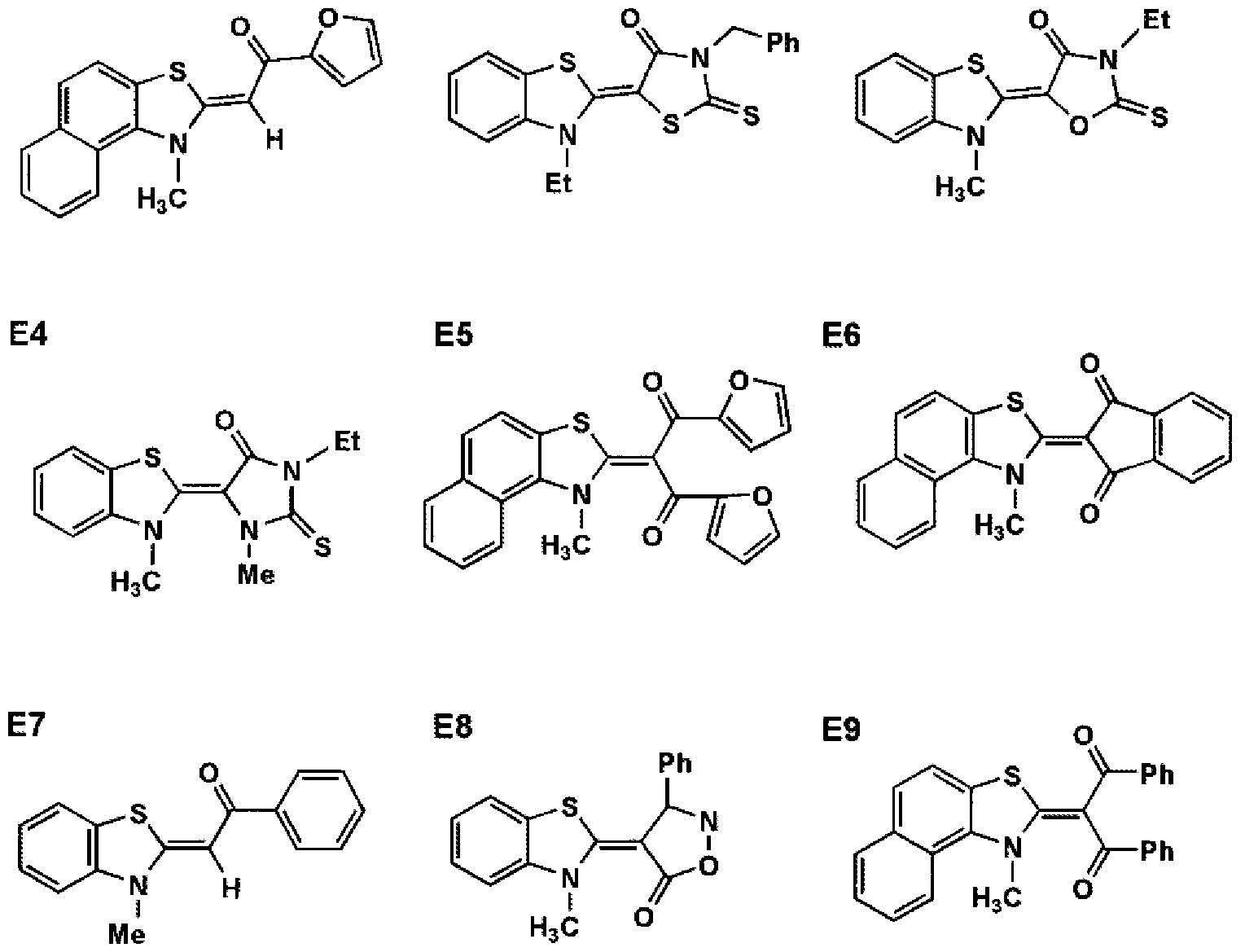
[0150] [化 47]

[0151] [化 48]

E22 E23


[0153] [化 50]


[0154] [化 51]


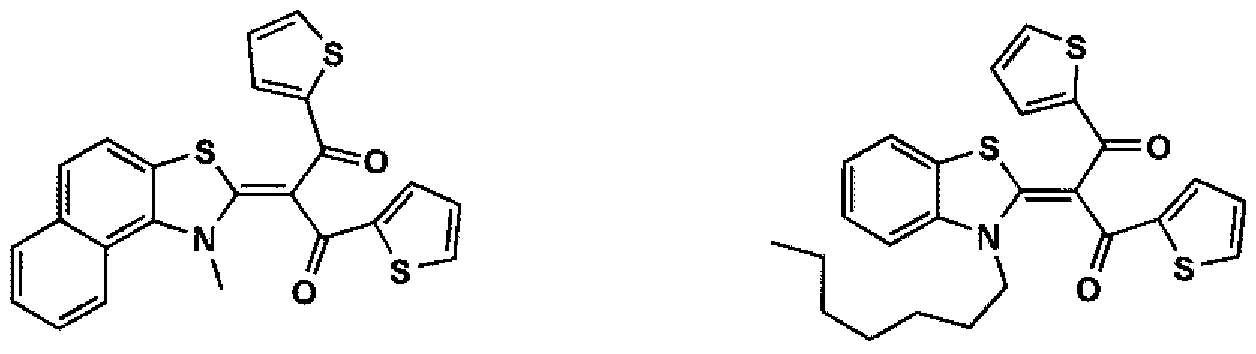

[0155] 本発明に係る一般式 (4 (4- 1) , (4- 2) , (4 3)で表される色素は、 F. M. イマ一ら著、「ザ'シァニン'ダイズ'アンド'リレイテッド'コンパウンズ」(F. M. Hamer et al. , fhe Cyanme Dyes and Related Compounds 51 ol 1964年)に記載された方法、 KAI ARNE JENSEN 及び LARS HENRIKSE Nらが ACTACHEMICA SCANDINAVICA、 22卷、 1107〜1128頁(1968年 )に記載した方法などを参照して合成することができる。
[0156] 前記一般式(5)で表される 350〜440nmの間に吸収極大を有する色素において
、 Rdlはアルキル基、ァリール基、ァルケ-ル基、シクロアルキル基、ァラルキル基ま たはへテロ環基を表す。 R32は水素原子、アルキル基、ァリール基、ァルケ-ル基、シ クロアルキル基、ァラルキル基またはへテロ環基を表す。 R31と R32は互いに連結して 環を形成してもよい。 R33〜R35はそれぞれ独立に水素原子、アルキル基、アルコキシ 基、ァリールォキシ基、アルキルチオ基、ァリールチオ基、ジアルキルアミノ基または ジァリールアミノ基を表す。 R31〜R35が表す上記置換基は更に置換基を有してもよ!ヽ 。具体的化合物を以下に示す。
[化 52]

[0159] 更にアルカリ水系現像液への処理適性を高めるために、親水性部位 (カルボキシ ル基並びにそのエステル、スルホン酸基並びにそのエステル、エチレンオキサイド基 等の酸基もしくは極性基)の導入が有効である。特にエステル型の親水性基は感光 層中では比較的疎水的構造を有するため相溶性に優れ、且つ現像液中では加水分 解により酸基を生成し、親水性が増大するという特徴を有する。
[0160] その他、例えば、感光層中での相溶性向上、結晶析出抑制のために適宜置換基を 導入することができる。例えば、ある種の感光系ではァリール基ゃァリル基等の不飽 和結合が相溶性向上に非常に有効である場合があり、また分岐アルキル構造導入 等の方法により、色素 π平面間の立体障害を導入することで結晶析出が著しく抑制 できる。またホスホン酸基やエポキシ基、トリアルコキシシリル基等の導入により、金属 や金属酸ィ匕物等の無機物への密着性を向上させることができる。その他、目的に応 じ増感色素のポリマー化等の方法も利用できる。
[0161] これらの色素の使用法に関しても、先述の付加重合性ィヒ合物同様、感材の性能設 計により任意に設定できる。例えば、色素を 2種以上併用することで感光層への相溶 性を高めることができる。色素の選択は感光性の他、使用する光源の発光波長での モル吸光係数が重要な因子である。モル吸光係数の大きな色素を使用することによ り、色素の添加量は比較的少なくできるので経済的であり、且つ感光層の膜物性の 点からも有利である。感光層の感光性、解像度や、露光膜の物性は光源波長での吸 光度に大きな影響を受けるので、これらを考慮して増感色素の添加量を適宜選択す る。例えば、吸光度が 0. 1以下の低い領域では感度が低下する。またハレーションの 影響により低解像度となる。但し、例えば、 5 m以上の厚い膜を硬化せしめる目的 に対しては、この様な低!、吸光度の方がかえって硬化度を挙げられる場合もある。
[0162] また吸光度が 3以上の様な高い領域では、感光層表面で大部分の光が吸収され、 より内部での硬化が阻害され、例えば、印刷版として使用した場合には膜強度、基板 密着性の不十分なものとなる。比較的薄!ヽ膜厚で使用する平版印刷版としての使用 に際しては、色素の添加量は感光層の吸光度が 0. 1から 1. 5の範囲、好ましくは 0. 25から 1の範囲となるように設定するのが好ま 、。 感光層中の色素の含有量は、
感光層の全重量に対して、通常 0. 05〜30質量%、好ましくは、 0. 1〜20質量%、 更に好ましくは、 0. 2〜10質量0 /0である。
[0163] (アルカリ可溶性高分子結合剤)
本発明の平版印刷版材料の感光層にはアルカリ可溶性高分子結合剤を用いる。
[0164] 本発明のアルカリ可溶性高分子結合剤としては、アクリル系重合体、ポリビニルブ チラール榭脂、ポリウレタン榭脂、ポリアミド榭脂、ポリエステル榭脂、エポキシ榭脂、 フエノール榭脂、ポリカーボネート榭脂、ポリビニルブチラール榭脂、ポリビュルホル マール榭脂、シェラック、その他の天然榭脂等が使用出来る。また、これらを 2種以上 併用してもかまわない。
[0165] 好ましくはアクリル系のモノマーの共重合によって得られるビュル系共重合が好まし い。さら〖こ、高分子結合剤の共重合組成として、(a)カルボキシル基含有モノマー、 ( b)メタクリル酸アルキルエステル、またはアクリル酸アルキルエステルの共重合体で あることが好ましい。
[0166] カルボキシル基含有モノマーの具体例としては、 α , j8—不飽和カルボン酸類、例 えばアクリル酸、メタクリル酸、マレイン酸、無水マレイン酸、ィタコン酸、無水ィタコン 酸等が挙げられる。その他、フタル酸と 2—ヒドロキシメタタリレートのハーフエステル 等のカルボン酸も好まし 、。
[0167] メタクリル酸アルキルエステル、アクリル酸アルキルエステルの具体例としては、メタ クリル酸メチル、メタクリル酸ェチル、メタクリル酸プロピル、メタクリル酸ブチル、メタク リル酸ァミル、メタクリル酸へキシル、メタクリル酸へプチル、メタクリル酸ォクチル、メタ クリル酸ノニル、メタクリル酸デシル、メタクリル酸ゥンデシル、メタクリル酸ドデシル、ァ クリル酸メチル、アクリル酸ェチル、アクリル酸プロピル、アクリル酸ブチル、アクリル酸 ァミル、アクリル酸へキシル、アクリル酸へプチル、アクリル酸ォクチル、アクリル酸ノ- ル、アクリル酸デシル、アクリル酸ゥンデシル、アクリル酸ドデシル等の無置換アルキ ルエステルの他、メタクリル酸シクロへキシル、アクリル酸シクロへキシル等の環状ァ ルキルエステルや、メタクリル酸ベンジル、メタクリル酸 2—クロロェチル、 N, N ジ メチルアミノエチルメタタリレート、グリシジルメタタリレート、アクリル酸ベンジル、アタリ ル酸ー2—クロロェチル、 N, N ジメチルアミノエチルアタリレート、グリシジルアタリ
レート等の置換アルキルエステルも挙げられる。
さらに、本発明の高分子結合剤は、他の共重合モノマーとして、下記 1)〜14)に記 載のモノマー等を用いる事が出来る。
1)芳香族水酸基を有するモノマー、例えば o—(又は p—, m—)ヒドロキシスチレン、 0 - (又は p— , m—)ヒドロキシフエ-ルアタリレート等。
2)脂肪族水酸基を有するモノマー、例えば 2—ヒドロキシェチルアタリレート、 2—ヒド ロキシェチルメタタリレート、 N—メチロールアクリルアミド、 N—メチロールメタクリルァ ミド、 4ーヒドロキシブチルメタタリレート、 5—ヒドロキシペンチルアタリレート、 5—ヒドロ キシペンチノレメタタリレート、 6—ヒドロキシへキシルアタリレート、 6—ヒドロキシへキシ ルメタタリレート、 N— (2—ヒドロキシェチル)アクリルアミド、 N— (2—ヒドロキシェチ ル)メタクリルアミド、ヒドロキシェチルビ-ルエーテル等。
3)アミノスルホ-ル基を有するモノマー、例えば m— (又は p—)アミノスルホユルフェ -ルメタタリレート、 m— (又は p—)アミノスルホユルフェ-ルアタリレート、 N— (ρ—ァ ミノスルホ-ルフエ-ル)メタクリルアミド、 N— (p—アミノスルホユルフェ-ル)アクリル アミド等。
4)スルホンアミド基を有するモノマー、例えば N— (p—トルエンスルホ -ル)アクリル アミド、 N— (p—トルエンスルホ -ル)メタクリルアミド等。
5)アクリルアミド又はメタクリルアミド類、例えばアクリルアミド、メタクリルアミド、 N—ェ チルアクリルアミド、 N—へキシルアクリルアミド、 N—シクロへキシルアクリルアミド、 N —フエ-ルアクリルアミド、 N— (4— -トロフエ-ル)アクリルアミド、 N—ェチル— N— フエ-ルアクリルアミド、 N— (4—ヒドロキシフエ-ル)アクリルアミド、 N— (4—ヒドロキ シフエ-ル)メタクリルアミド等。
6)弗化アルキル基を含有するモノマー、例えばトリフルォロェチルアタリレート、トリフ ルォロェチルメタタリレート、テトラフルォロプロピルメタタリレート、へキサフルォロプロ ピルメタタリレート、ォクタフルォロペンチルアタリレート、ォクタフルォロペンチルメタク リレート、ヘプタデカフルォロデシルメタタリレート、 N—ブチルー N— (2—アタリロキ シェチル)ヘプタデカフルォロォクチルスルホンアミド等。
7)ビュルエーテル類、例えば、ェチルビ-ルエーテル、 2—クロロェチルビ-ルエー
テノレ、プロピノレビニノレエーテノレ、ブチノレビニノレエーテノレ、オタチノレビニノレエーテノレ、 フエ-ルビ-ルエーテル等。
8)ビュルエステル類、例えばビュルアセテート、ビュルクロ口アセテート、ビュルブチ レート、安息香酸ビニル等。
9)スチレン類、例えばスチレン、メチルスチレン、クロロメチノレスチレン等。
10)ビ-ルケトン類、例えばメチルビ-ルケトン、ェチルビ-ルケトン、プロピルビュル ケトン、フエ-ルビ-ルケトン等。
11)ォレフィン類、例えばエチレン、プロピレン、 i—ブチレン、ブタジエン、イソプレン 等。
12) N—ビュルピロリドン、 N ビュルカルバゾール、 4 ビュルピリジン等。
13)シァノ基を有するモノマー、例えばアクリロニトリル、メタタリ口-トリル、 2 ペンテ ンニトリル、 2—メチル—3 ブテン二トリル、 2 シァノエチルアタリレート、 o— (又は m—, p )シァノスチレン等。
14)アミノ基を有するモノマー、例えば N, N—ジェチルアミノエチルメタタリレート、 N , N ジメチルアミノエチルアタリレート、 N, N ジメチルアミノエチルメタタリレート、 ポリブタジエンウレタンアタリレート、 N, N ジメチルァミノプロピルアクリルアミド、 N, N ジメチルアクリルアミド、アタリロイルモルホリン、 N— i—プロピルアクリルアミド、 N , N ジェチルアクリルアミド等。
[0169] さらにこれらのモノマーと共重合し得る他のモノマーを共重合してもよい。
[0170] 上記ビュル系重合体は、通常の溶液重合により製造することができる。また、塊状 重合または懸濁重合等によっても製造することができる。重合開始剤としては、特に 限定されないが、ァゾビス系のラジカル発生剤が挙げられ、例えば、 2, 2' ァゾビ スイソプチ口-トリル (AIBN)、 2, 2' ーァゾビス(2—メチルブチ口-トリル)等が挙げ られる。また、これらの重合開始剤の使用量は、共重合体を形成するのに使用される モノマー全体 100質量部に対し、通常 0. 05〜: LO. 0質量部(好ましくは 0. 1〜5質 量部)である。また、溶液重合を行う際に使用される溶媒としては、ケトン系、エステル 系、芳香族系の有機溶媒が挙げられ、なかでもトルエン、酢酸ェチル、ベンゼン、メ チルセ口ソルブ、ェチルセ口ソルブ、アセトン、メチルェチルケトン等の一般にアクリル
系ポリマーの良溶媒が挙げられ、なかでも沸点 60〜120°Cの溶媒が好ましい。溶液 重合の場合、上記溶媒を使用し、反応温度として通常 40〜120°C (好ましくは 60〜 110°C)、反応時間として通常 3〜: LO時間(好ましくは 5〜8時間)の条件で行うことが できる。反応終了後、溶媒を除去して共重合体を得る。また、溶媒を除去せずに引き 続き後記の二重結合の導入反応を行うこともできる。
[0171] 得られる共重合体の分子量は、使用される溶媒および反応温度を調整することによ つて調節することができる。目的とする分子量の共重合体を得るために使用される溶 媒および反応温度等は、使用されるモノマーによって適宜決定することができる。ま た、特定の溶媒を上記溶媒に混合することによつても得られる共重合体の分子量を 調節することができる。このような溶媒としては、例えば、メルカブタン系(例えば、 n- ォクチルメルカプタン、 n—ドデシルメルカプタン、 tードデシルメルカプタン、メルカプ トエタノール等)、四塩ィ匕炭素系(例えば、四塩化炭素、塩化プチル、塩化プロピレン 等)等が挙げられる。これらの溶媒を上記反応に使用する溶媒に混合する割合は、 反応に使用するモノマー、溶媒、反応条件等によって適宜決定することができる。
[0172] さらに、本発明のアルカリ可溶性高分子結合剤は、側鎖にカルボキシル基および 重合性二重結合を有するビニル系重合体であることが好ましい。例えば、上記ビニル 系共重合体の分子内に存在するカルボキシル基に、分子内に (メタ)アタリロイル基と エポキシ基を有する化合物を付加反応させる事によって得られる、不飽和結合含有 ビニル系共重合体も高分子結合剤として好ま 、。分子内に不飽和結合とエポキシ 基を共に含有する化合物としては、具体的にはグリシジルアタリレート、グリシジルメタ タリレート、特開平 11— 271969号に記載のあるエポキシ基含有不飽和化合物等が 挙げられる。また、上記ビニル系重合体の分子内に存在する水酸基に、分子内に (メ タ)アタリロイル基とイソシァネート基を有する化合物を付加反応させる事によって得ら れる、不飽和結合含有ビュル系共重合体も高分子結合剤として好ましい。分子内に 不飽和結合とイソシァネート基を共に有する化合物としては、ビニルイソシァネート、 ( メタ)アクリルイソシァネート、 2- (メタ)アタリロイルォキシェチルイソシァネート、 m— または p—イソプロべ-ルー α , α—ジメチルベンジルイソシァネートが好ましぐ(メ タ)アクリルイソシァネート、 2- (メタ)アタリロイルォキシェチルイソシァネート等が挙
げられる。
[0173] ビニル系共重合体の分子内に存在するカルボキシル基に、分子内に (メタ)アタリ口 ィル基とエポキシ基を有する化合物を付加反応させる方法は公知の方法で出来る。 例えば、反応温度として 20〜: LOO°C、好ましくは 40〜80°C、特に好ましくは使用す る溶媒の沸点下 (還流下)にて、反応時間として 2〜10時間、好ましくは 3〜6時間で 行うことができる。使用する溶媒としては、上記ビニル系共重合体の重合反応におい て使用する溶媒が挙げられる。また、重合反応後、溶媒を除去せずにその溶媒をそ のまま脂環式エポキシ基含有不飽和化合物の導入反応に使用することができる。ま た、反応は必要に応じて触媒および重合禁止剤の存在下で行うことができる。ここで 、触媒としてはァミン系または塩ィ匕アンモ-ゥム系の物質が好ましぐ具体的には、ァ ミン系の物質としては、トリェチルァミン、トリブチルァミン、ジメチルァミノエタノール、 ジェチルァミノエタノール、メチルァミン、ェチルァミン、 n—プロピルァミン、イソプロピ ノレアミン、 3—メトキシプロピルァミン、ブチノレアミン、ァリノレアミン、へキシルァミン、 2 ーェチルへキシルァミン、ベンジルァミン等が挙げられ、塩化アンモ-ゥム系の物質 としては、トリェチルベンジルアンモ -ゥムクロライド等が挙げられる。これらを触媒とし て使用する場合、使用する脂環式エポキシ基含有不飽和化合物に対して、 0. 01〜 20. 0質量%の範囲で添加すればよい。また、重合禁止剤としては、ハイドロキノン、 ハイドロキノンモノメチルエーテル、 2, 5 ジー t ブチルハイドロキノン、 2, 6 ジー t ブチルハイドロキノン、 2—メチルハイドロキノン、 2— t ブチルハイドロキノン等が 挙げられ、その使用量は、使用する脂環式エポキシ基含有不飽和化合物に対して、 0. 01〜5. 0質量%である。なお、なお、反応の進行状況は反応系の酸価を測定し 、所望の酸価になった時点で反応を停止させればょ ヽ。
[0174] ビニル系重合体の分子内に存在する水酸基に、分子内に (メタ)アタリロイル基とィ ソシァネート基を有する化合物を付加反応させる方法は公知の方法で出来る。例え ば、反応温度として通常 20〜: LOO°C、好ましくは 40〜80°C、特に好ましくは使用す る溶媒の沸点下 (還流下)にて、反応時間として通常 2〜10時間、好ましくは 3〜6時 間で行うことができる。使用する溶媒としては、上記高分子共重合体の重合反応にお いて使用する溶媒が挙げられる。また、重合反応後、溶媒を除去せずにその溶媒を
そのままイソシァネート基含有不飽和化合物の導入反応に使用することができる。ま た、反応は必要に応じて触媒および重合禁止剤の存在下で行うことができる。ここで 、触媒としてはスズ系またはァミン系の物質が好ましぐ具体的には、ジブチルスズラ ゥレート、トリエチルァミン等が挙げられる。触媒は使用する二重結合を有する化合物 に対して、 0. 01〜20. 0質量%の範囲で添加することが好ましい。また、重合禁止 剤としては、ハイドロキノン、ハイドロキノンモノメチルエーテル、 2, 5—ジー t—ブチル ハイドロキノン、 2, 6—ジー t—ブチルハイドロキノン 2—メチルハイドロキノン、 2— t— プチルノヽイド口キノンノヽ等が挙げられ、その使用量は、使用するイソシァネート基含 有不飽和化合物に対して、通常 0. 01〜5. 0質量%である。なお、反応の進行状況 は反応系のイソシアナト基の有無を赤外吸収スペクトル (IR)で判定し、吸収が無くな つた時点で反応を停止させればょ ヽ。
[0175] 上記した本発明に用いられる側鎖にカルボキシル基および重合性二重結合を有す るビニル系重合体は、全高分子結合剤において、 50〜: LOO質量%であることが好ま しぐ 100質量%であることがより好ましい。
[0176] 感光層として塗布し形成する感光性組成物中における高分子結合剤の含有量は、 10〜90質量%の範囲が好ましぐ 15〜70質量%の範囲が更に好ましぐ 20〜50 質量%の範囲で使用することが感度の面力も特に好ましい。
[0177] 本発明において、感光層の膜厚は、好ましくは 0. 4—4. OgZm2であり、更に好ま しくは 1. 0— 3. OgZm2である。
[0178] (アルミニウム支持体)
本発明において、アルミニウム支持体用のアルミニウム材料としては、純アルミニウム またはアルミニウム合金が用いられる。
[0179] 支持体のアルミニウム合金としては、種々のものが使用でき、例えば、珪素、銅、マ ンガン、マグネシウム、クロム、亜鉛、鉛、ビスマス、ニッケル、チタン、ナトリウム、鉄等 の金属とアルミニウムの合金が用いられる。又アルミニウム支持体は、保水性付与の ため、表面を粗面化したものが用いられる。
[0180] 本発明におけるアルミニウム支持体は、好ましくは、アルミニウム板を以下に記載さ れるような粗面化処理して得られるアルミニウム支持体である。アルミニウム板の粗面
化 (砂目立て処理)するに先立って表面の圧延油を除去するために脱脂処理を施す ことが好ましい。脱脂処理としては、トリクレン、シンナー等の溶剤を用いる脱脂処理、 ケシロン、トリエタノール等のェマルジヨンを用いたェマルジヨン脱脂処理等が用いら れる。又、脱脂処理には、苛性ソーダ等のアルカリの水溶液を用いることもできる。脱 脂処理に苛性ソーダ等のアルカリ水溶液を用いた場合、上記脱脂処理のみでは除 去できない汚れや酸ィ匕皮膜も除去することができる。脱脂処理に苛性ソーダ等のァ ルカリ水溶液を用いた場合、支持体の表面にはスマットが生成するので、この場合に は、燐酸、硝酸、硫酸、クロム酸等の酸、或いはそれらの混酸に浸漬しデスマット処 理を施すことが好ましい。 粗面化の方法としては、例えば、機械的方法、電解により エッチングする方法が挙げられる。用いられる機械的粗面化法は特に限定されるもの ではないが、ブラシ研磨法、ホーユング研磨法が好ましい。
[0181] 電気化学的粗面化法も特に限定されるものではないが、酸性電解液中で電気化学 的に粗面化を行う方法が好まし 、。
[0182] 上記の電気化学的粗面化法で粗面化した後、表面のアルミニウム屑等を取り除くた め、酸又はアルカリの水溶液に浸漬することが好ましい。酸としては、例えば、硫酸、 過硫酸、弗酸、燐酸、硝酸、塩酸等が用いられ、塩基としては、例えば、水酸化ナトリ ゥム、水酸ィ匕カリウム等が用いられる。これらの中でもアルカリの水溶液を用いるのが 好ましい。
[0183] 表面のアルミニウムの溶解量としては、 0. 5〜5g/m2が好ましい。又、アルカリの水 溶液で浸漬処理を行った後、燐酸、硝酸、硫酸、クロム酸等の酸或いはそれらの混 酸に浸漬し中和処理を施すことが好ましい。
[0184] 機械的粗面化処理法、電気化学的粗面化法はそれぞれ単独で用いて粗面化して もよいし、又、機械的粗面化処理法に次いで電気化学的粗面化法を行って粗面化し てもよい。
[0185] 粗面化処理の次には、陽極酸ィ匕処理を行うことができる。本発明において用いるこ とができる陽極酸ィ匕処理の方法には特に制限はなぐ公知の方法を用いることができ る。陽極酸化処理を行うことにより、支持体上には酸化皮膜が形成される。
[0186] 陽極酸化処理された支持体は、必要に応じ封孔処理を施してもよい。これら封孔処
理は、熱水処理、沸騰水処理、水蒸気処理、珪酸ソーダ処理、重クロム酸塩水溶液 処理、亜硝酸塩処理、酢酸アンモ-ゥム処理等公知の方法を用いて行うことができる
[0187] 更に、これらの処理を行った後に、水溶性の榭脂、例えばポリビニルホスホン酸、ス ルホン酸基を側鎖に有する重合体および共重合体、ポリアクリル酸、水溶性金属塩( 例えばホウ酸亜鉛)もしくは、黄色染料、アミン塩等を下塗りしたものも好適である。更 に、特開平 5— 304358号公報に開示されているようなラジカルによって付加反応を 起し得る官能基を共有結合させたゾル ゲル処理基板も好適に用 ヽられる。
[0188] (平版印刷版材料の作製)
本発明の平版印刷版材料は、上記感光層を構成する組成物を含む感光層塗布液 を、上記アルミニウム支持体上に塗布、乾燥し、支持体上に感光層を形成することに よって得られる。感光層塗布液に用いられる溶媒としては、例えば、アルコール類: se cーブタノール、イソブタノール、 n—へキサノール、ベンジルアルコール、ジエチレン グリコール、トリエチレングリコール、テトラエチレンダリコール、 1, 5 ペンタンジォー ル等;エーテノレ類:プロピレングリコールモノブチルエーテル、ジプロピレングリコール モノメチルエーテル、トリプロピレングリコールモノメチルエーテル等;ケトン類:ジァセ トンアルコール、メチルェチルケトン、シクロへキサノン、メチルシクロへキサノン等;ェ ステル類:乳酸ェチル、乳酸プチル、シユウ酸ジェチル、安息香酸メチル等;が好まし く挙げられる。
[0189] 調製された感光層塗布液は、従来公知の方法でアルミニウム支持体上に塗布し、 乾燥し、平版印刷版材料を作製することができる。塗布液の塗布方法としては、例え ばエアドクタコータ法、ブレードコータ法、ワイヤバー法、ナイフコータ法、ディップコ ータ法、リバースロールコータ法、グラビヤコータ法、キャストコーティング法、カーテ ンコータ法及び押し出しコータ法等を挙げることができる。乾燥温度は、好ましくは、 6 0〜160°C、より好ましくは、 80〜140°C、最も好ましくは、 90〜120°Cである。
[0190] (平版印刷版の作製)
本発明の平版印刷版材料は、後述されるように像様露光され、現像液を用いて現像 され、平版印刷版が作製される。
[0191] (画像露光)
本発明においては、画像露光は、バイオレット 'レーザ光線を用いて行われる。
[0192] (バイオレット 'レーザ光線)
本発明に用いられるバイオレット'レーザ光線は、 350nm〜440nmの波長を有す るレーザ光線を用いることが望まし 、。 350〜440nmに発光波長を有する入手可能 なレーザ光源としては例えば、導波型波長変換素子と AlGaAs、 InGaAs半導体の 組合わせ(380nm〜440nm)、 AlGaInN (350nm〜440nm)、その他にパルスレ 一ザとして XeF (351nm、パルス 10〜250¾[)等が挙げられる力 半導体レーザが 好ましく用いられる。
[0193] レーザ照射における走査方法としては、円筒外面走査、円筒内面走査、平面走査 などがある。円筒外面走査では、記録材料を外面に巻き付けたドラムを回転させなが らレーザ露光を行い、ドラムの回転を主走査としレーザ光の移動を副走査とする。円 筒内面走査では、ドラムの内面に記録材料を固定し、レーザビームを内側力も照射し 、光学系の一部又は全部を回転させることにより円周方向に主走査を行い、光学系 の一部又は全部をドラムの軸に平行に直線移動させることにより軸方向に副走査を 行う。平面走査では、ポリゴンミラーやガルバノミラーと f Θレンズ等を組み合わせてレ 一ザ光の主走査を行い、記録媒体の移動により副走査を行う。円筒外面走査及び円 筒内面走査の方が光学系の精度を高め易ぐ高密度記録には適している。
[0194] (アルカリ現像)
プレヒート
本発明においては、平版印刷版に画像を露光した後、現像処理する前または現像 処理しながら感光性平版印刷版材料を加熱処理することが好ま 、。この様に加熱 処理することで、感光層と支持体の接着性が向上し、本発明に係る発明の効果を向 上させることができる。
[0195] 本発明にお ヽてプレヒートは、例えば、感光性平版印刷版材料を現像処理する自 動現像装置にお!ヽて現像処理時に搬走される感光性平版印刷版を現像前に、電気 ヒーター等で所定の温度範囲にした温風を循環させたプレヒート室を設けて通過させ る方法や、所定の温度範隨こ加熱するプレヒートローラにより加熱する方法を挙げる
ことができる。例えば、プレヒートローラは、内部に加熱手段を有する少なくとも 1つの ローラを含む 1対のローラ力 なり、加熱手段を有するローラとしては、熱伝導率の高 い金属(例えば、アルミニウム、鉄等)からなる中空パイプの内部に発熱体として-ク ロム線等を埋設し、該金属パイプの外側面をポリエチレン、ポリスチレン、テフロン (登 録商標)等のプラスチックシートで被覆したものを使用することができる。また、こうした プレヒートローラの詳細については、特開昭 64— 80962号公報を参照することがで きる。
[0196] 本発明における当該プレヒートは、 70〜180°Cで、 3〜 120秒程度行うことが好まし い。
[0197] 現像液
画像露光した感光層は露光部が硬化する。これを本発明に係るアルカリ性現像液 で現像処理することにより、未露光部が除去され画像形成が可能となる。この様なァ ルカリ性現像液としては、従来より知られているアルカリ水溶液が使用できる。例えば ケィ酸ナトリウム、同カリウム、同アンモ-ゥム;第二燐酸ナトリウム、同カリウム、同アン モ-ゥム;重炭酸ナトリウム、同カリウム、同アンモ-ゥム;炭酸ナトリウム、同カリウム、 同アンモ-ゥム;炭酸水素ナトリウム、同カリウム、同アンモ-ゥム;ホウ酸ナトリウム、 同カリウム、同アンモニゥム;水酸化ナトリウム、同カリウム、同アンモニゥム及び同リチ ゥム等の無機アルカリ剤を使用するアルカリ性現像液が挙げられる。
[0198] また、モノメチルァミン、ジメチルァミン、トリメチルァミン、モノェチルァミン、ジェチ ノレアミン、トリエチノレアミン、モノ一 i—プロピルァミン、ジ一 i—プロピルァミン、トリ一 i— プロピルァミン、ブチルァミン、モノエタノールァミン、ジエタノールァミン、トリエタノー ルァミン、モノ一 i—プロパノールァミン、ジ一 i—プロパノールァミン、エチレンィミン、 エチレンジァミン、ピリジン等の有機アルカリ剤も用いることができる。
[0199] これらのアルカリ剤は、単独または 2種以上組合せて用いられる。また、該現像液に は、必要に応じてァ-オン性界面活性剤、両性活性剤やアルコール等の有機溶媒 をカロ免ることができる。
[0200] 本発明に係るアルカリ性現像液は、基本的に、 SiO換算でのケィ酸濃度が 1. 0質
2
量%で、 pH8. 5〜12. 5の範囲である水溶液が好ましぐ該水溶液は、他の添加剤
を含有していてもよい。また、当該水溶液に、更に界面活性剤を 0. 1質量%以上 5. 0質量%以下の範囲で含有する水溶液がより好ましい。また、該水溶液は、上記する 現像液の成分を含有することも好まし 、。
実施例
[0201] 以下、実施例を挙げて本発明を詳細に説明するが、本発明はこれらに限定されな い。なお、実施例中の"部"は、特に断りのない限り、質量部を表す。
[0202] 実施例 1
[平版印刷版材料の作製]
《支持体の作製》
厚さ 0. 3mmのアルミニウム板(材質 1050,調質 H16)を 65°Cに保たれた 5%水酸 化ナトリウム水溶液に浸漬し、 1分間の脱脂処理を行った後、水洗した。この脱脂ァ ルミ-ゥム板を、 25°Cに保たれた 10%硫酸水溶液中に 1分間浸漬して中和した後、 水洗した。次いで、このアルミニウム板を、塩酸濃度 llgZL、温度 25°C、周波数 50 Hz、 50AZdm2の交流電流において 20秒間電解粗面化処理を行った。電解粗面 化を行った後、水洗し、 50°Cに保たれた 1%水酸ィ匕ナトリウム水溶液中で 10秒間の デスマット処理を行い、水洗し、 50°Cに保たれた 30%硫酸中で 30秒間中和処理を 行い、水洗した。次いで、 30%硫酸溶液中で、 25°C、電流密度 30AZdm2、電圧 2 5Vの条件下に 30秒間陽極酸化処理を行い、水洗した。更に、 0. 44%のポリビニル ホスホン酸水溶液に、 75°C、 30秒間ディップ処理を行い、次いで蒸留水で水洗し、 2 5°Cの冷風で乾燥し、平版印刷版材料用支持体を得た。この時、表面の中心線平均 粗さ(Ra)は 0. 50 /z mであった。
[0203] 前記支持体に下記組成の感光性塗布液を乾燥後の膜厚が 2. OgZm2になるように 塗布し、 95°Cで 1分間乾燥し、平版印刷版材料 1〜8を得た。
[0204] 《感光性塗布液》
高分子結合剤 B— ^※ 30部
酸重合性化合物
1, 6—へキサンジオールジグリシジルエーテル 40部 ォキセタン化合物(例示化合物 18) 20部
酸発生剤 (表 1に記載) 6部
色素 (表 1に記載) 3部
クリスタルバイオレット 0. 5部
シリコン系界面活性剤(エダプラン LA411) 0. 5部
PGM (プロピレングリコールモノメチルエーテル) 700部
MEK (メチルェチルケトン) 200部
※ 1:高分子結合剤 B— 1は以下のようにして合成した。
[0205] (高分子結合剤 B— 1の合成)
窒素気流下の三ッロフラスコに、メチルメタタリレート 125部、ェチルメタタリレート 1 2部、メタクリル酸 63部、シクロへキサノン 240部、イソプロピルアルコール 160部及び α , α ' ーァゾビスイソブチ口-トリル 5部を入れ、窒素気流中 80°Cのオイルバスで 6 時間反応させて高分子重合体を得た。その後、該重合体に、トリェチルベンジルアン モ -ゥムクロライド 4部及びグリシジルメタタリレート 52部をカ卩えて、温度 25°Cで 3時間 反応させて高分子結合剤 B—1を得た。質量平均分子量は約 55, 000 (GPC :ポリス チレン換算)であった。
[0206] [露光、現像]
得られた平版印刷版材料を 2つに折半し、一方は 23°C55%RHの環境下、残りは 40°C80%RHの環境下でそれぞれ 3日間保存後、以下に示す方法で画像を形成し た。
[0207] 出力 200mWの波長 405nmバイオレットレーザを搭載したレーザ露光機を用いて 、感光層に画像様に露光を行った。なお比較例は出力 500mWで波長 830nm赤外 半導体レーザを搭載したレーザ露光機を用いた。露光した画像はベタ露光部と 1〜9 9%の網点画像とを含むものである。
[0208] 現像は以下の組成の現像液にて 30°C20秒処理した。
[0209] A珪酸カリ 116部
KOH水溶液 (45質量%) 27部
水 715部
その際、非画像部に相当する未露光部は、現像処理によって溶解され、明瞭な画
像が得られた。
[0210] ハイライト部の網点0 /0は、 1〜99%の網点出力画像部を Centerflux社製 ccDotメ 一ターにて網点%を測定し、測定値が 2%となる最小網点%部で示した。数値が小さ く保存での変動が小さ 、ほど再現性が良 、ことを示す。
[0211] 結果を表 1に示す。
[0212] [表 1]

[0213] 光酸発生剤 A: 7?—タメン一( 7?—シクロペンタジェ -ル)鉄へキサフルォロホスフエ ート
光酸発生剤 B:ジフエ-ルョードニゥムクロライド
[0214] [化 53]
A—

[0215] 表 1から、本発明の平版印刷版材料は高湿度での保存性に優れ、高湿度保存での ハイライト部の再現が優れて 、ることがわかる。
Claims
請求の範囲
[1] アルミニウム支持体上に、バイオレット 'レーザ光線の照射により酸を発生し得る酸発 生剤組成物、酸でカチオン重合可能な基を少なくとも 1つ有する化合物及びアルカリ 可溶性高分子結合剤を含有する感光層を有し、該感光層が最外層であることを特徴 とする平版印刷版材料。
[2] 前記バイオレット 'レーザ光線の照射により酸を発生し得る酸発生剤組成物が酸発生 剤および 350ηπ!〜 440nmの間に吸収極大を有する色素を含有することを特徴とす る請求の範囲第 1項に記載の平版印刷版材料。
[3] 前記酸発生剤が鉄アレーン錯体ィ匕合物であることを特徴とする請求の範囲第 1また は 2項に記載の平版印刷版材料。
[4] 前記酸発生剤が、下記一般式(1)で表されるハロゲンィ匕合物であることを特徴とする 請求の範囲第 2項に記載の平版印刷版材料。
一般式(1) Ri— C (Y) - (C = 0) -R2
2
(式中、 R1は、水素原子、ハロゲン原子、アルキル基、ァリール基、ァシル基、アルキ ルスルホニル基、ァリールスルホ -ル基またはシァノ基を表す。 R2は、一価の置換基 を表す。 R1と R2が結合して環を形成してもよい。 Yはハロゲン原子を表す。 )
[5] 前記一般式(1)で表されるハロゲンィ匕合物が下記一般式(1' )で表されるハロゲン 化合物であることを特徴とする請求の範囲第 4項に記載の平版印刷版材料。
一般式(1, ) C (Y) — (C = 0) _ X— R3
3
(式中、 R3は、一価の置換基を表す。 Xは、— O—または— NR4—を表す。 R4は、水 素原子またはアルキル基を表す。 R3と R4が結合して環を形成してもよい。 Yはハロゲ ン原子を表す。 )
[6] 前記 350〜440nmの間に吸収極大を有する色素が下記一般式(2)で表されること を特徴とする請求の範囲第 2〜5項のいずれか 1項に記載の平版印刷版材料。
[化 1]

(式中、 R 〜R はそれぞれ水素原子、アルキル基、シクロアルキル基、アルケニル 基、アルキニル基、ァリール基、ヘテロァリール基、ヘテロ環基、アルコキシ基、シクロ アルコキシ基、ァリールォキシ基、アルキルチオ基、シクロアルキルチオ基、ァリール チォ基、アルコキシカルボ-ル基、ァリールォキシカルボ-ル基、スルファモイル基、 ァシル基、ァシルォキシ基、アミド基、力ルバモイル基、ウレイド基、スルフィニル基、 アルキルスルホ-ル基、ァリールスルホ-ル基、アミノ基、ハロゲン原子、シァノ基、二 トロ基またはヒドロキシル基を表す。これらの置換基は上記の置換基によって更に置 換されていてもよい。また、これらの置換基は複数が互いに結合して環を形成してい てちよい。 )
前記 350〜440nmの間に吸収極大を有する色素が下記一般式(3)で表されること を特徴とする請求の範囲第 2〜5項のいずれか 1項に記載の平版印刷版材料。
[化 2] 一般式 (3)

(式中、 R21、 R22、 R23はそれぞれ独立に水素原子または置換基を表し、少なくとも R2 1と R22、もしくは R22と R23が連結し環を形成してもよい。
前記 350〜440nmの間に吸収極大を有する色素が下記一般式 (4)で表されること を特徴とする請求の範囲第 2〜5項のいずれか 1項に記載の平版印刷版材料。
[化 3]

(式中、 Aは S原子または NRを表し、 Rは置換もしくは非置換のアルキル基または
1 1
置換もしくは非置換のァリール基を表し、 Zは隣接する A及び炭素原子と共同して色 素の塩基性核を形成する非金属原子団を表す。 X、 Xはそれぞれ独立に一価の非
1 2
金属原子団を表し、 X、 Xは互いに結合して色素の酸性核を形成してもよい。 )
1 2
前記 350〜440nmの間に吸収極大を有する色素が下記一般式(5)で表されること を特徴とする請求の範囲第 2〜5項のいずれか 1項に記載の平版印刷版材料。
[化 4] 一般式 (5)

(式中、 Rdlはアルキル基、ァリール基、ァルケ-ル基、シクロアルキル基、ァラルキル 基またはへテロ環基を表す。 R32は水素原子、アルキル基、ァリール基、アルケニル 基、シクロアルキル基、ァラルキル基またはへテロ環基を表す。 R33〜R35はそれぞれ 独立に水素原子、アルキル基、アルコキシ基、ァリールォキシ基、アルキルチオ基、 ァリールチオ基、ジアルキルアミノ基またはジァリールアミノ基を表す。 R31〜R35が表 す上記置換基は更に置換基を有してもよい。 )
[10] 前記感光層が、前記カチオン重合可能な基を少なくとも 1つ有する化合物としてェポ キシィ匕合物、ビニルエーテルィ匕合物またはォキセタンィ匕合物を含有することを特徴と する請求の範囲第 1〜9項のいずれか 1項に記載の平版印刷版材料。
[11] 前記感光層が、前記カチオン重合可能な基を少なくとも 1つ有する化合物として、ォ キセタン化合物並びに、エポキシ化合物およびビュルエーテル化合物の少なくとも
一つを含有することを特徴とする請求の範囲第 10項に記載の平版印刷版材料。
[12] 前記感光層が、 350ηπ!〜 440nmの間に吸収極大を有する色素を感光層に対して 0. 1質量%〜20質量%、前記カチオン重合可能な基を少なくとも 1つ有する化合物 を 20質量%〜80質量%、前記アルカリ可溶性高分子結合剤を 15質量%〜70質量 %含有し、さらに前記酸発生剤を、前記カチオン重合可能な基を少なくとも 1つ有す る化合物に対して 0. 1質量%〜20質量%含有することを特徴とする請求の範囲第 2 〜11項の 、ずれか 1項に記載の平版印刷版材料。
[13] 請求の範囲第 1〜 12項の 、ずれか 1項に記載の平版印刷版材料の感光層上にバイ ォレット'レーザ光線を用いて画像を描画した後、アルカリ性現像液で未露光部を除 去する工程を有することを特徴とする画像形成方法。
Priority Applications (1)
| Application Number | Priority Date | Filing Date | Title |
|---|---|---|---|
| JP2007524590A JPWO2007007601A1 (ja) | 2005-07-11 | 2006-07-05 | 平版印刷版材料および画像形成方法 |
Applications Claiming Priority (2)
| Application Number | Priority Date | Filing Date | Title |
|---|---|---|---|
| JP2005-201387 | 2005-07-11 | ||
| JP2005201387 | 2005-07-11 |
Publications (1)
| Publication Number | Publication Date |
|---|---|
| WO2007007601A1 true WO2007007601A1 (ja) | 2007-01-18 |
Family
ID=37618678
Family Applications (1)
| Application Number | Title | Priority Date | Filing Date |
|---|---|---|---|
| PCT/JP2006/313368 Ceased WO2007007601A1 (ja) | 2005-07-11 | 2006-07-05 | 平版印刷版材料および画像形成方法 |
Country Status (3)
| Country | Link |
|---|---|
| US (1) | US20070009831A1 (ja) |
| JP (1) | JPWO2007007601A1 (ja) |
| WO (1) | WO2007007601A1 (ja) |
Cited By (1)
| Publication number | Priority date | Publication date | Assignee | Title |
|---|---|---|---|---|
| WO2015125554A1 (ja) * | 2014-02-21 | 2015-08-27 | 富士フイルム株式会社 | 感活性光線性又は感放射線性樹脂組成物、レジスト膜、及び、パターン形成方法、並びに、これらを用いた電子デバイスの製造方法、及び、電子デバイス |
Families Citing this family (1)
| Publication number | Priority date | Publication date | Assignee | Title |
|---|---|---|---|---|
| WO2008015878A1 (fr) * | 2006-08-03 | 2008-02-07 | Konica Minolta Medical & Graphic, Inc. | Matériau de plaque lithographique photosensible |
Citations (13)
| Publication number | Priority date | Publication date | Assignee | Title |
|---|---|---|---|---|
| JPH04181944A (ja) * | 1990-11-16 | 1992-06-29 | Toyo Ink Mfg Co Ltd | 可視光感光性組成物 |
| JPH09197668A (ja) * | 1996-01-11 | 1997-07-31 | Konica Corp | 感光性画像形成材料 |
| JP2000147763A (ja) * | 1998-09-09 | 2000-05-26 | Fuji Photo Film Co Ltd | 平版印刷版の製版方法および光重合性組成物 |
| JP2001133968A (ja) * | 1999-11-09 | 2001-05-18 | Fuji Photo Film Co Ltd | 感光性組成物 |
| JP2003233181A (ja) * | 2002-02-08 | 2003-08-22 | Konica Corp | 感光性組成物、感光性平版印刷版及びその記録方法 |
| JP2003315990A (ja) * | 2002-04-25 | 2003-11-06 | Mitsubishi Chemicals Corp | 画像形成材料及び画像形成方法 |
| JP2003330185A (ja) * | 2002-05-09 | 2003-11-19 | Mitsubishi Chemicals Corp | 光重合性組成物及び画像形成材料 |
| JP2004163918A (ja) * | 2002-10-23 | 2004-06-10 | Konica Minolta Holdings Inc | 感光性組成物及び感光性平版印刷版 |
| JP2004325876A (ja) * | 2003-04-25 | 2004-11-18 | Konica Minolta Medical & Graphic Inc | 感光性組成物および感光性平版印刷版 |
| JP2004361911A (ja) * | 2003-05-13 | 2004-12-24 | Konica Minolta Medical & Graphic Inc | 感光性組成物、感光性平版印刷版、及びその画像形成方法 |
| JP2005018012A (ja) * | 2003-06-03 | 2005-01-20 | Konica Minolta Medical & Graphic Inc | 感光性組成物、感光性平版印刷版、及び平版印刷版の作製方法 |
| JP2005024950A (ja) * | 2003-07-03 | 2005-01-27 | Konica Minolta Medical & Graphic Inc | 感光性平版印刷版の露光方法 |
| JP2005141130A (ja) * | 2003-11-10 | 2005-06-02 | Konica Minolta Medical & Graphic Inc | 光重合性感光性平版印刷版材料及び製版方法 |
Family Cites Families (1)
| Publication number | Priority date | Publication date | Assignee | Title |
|---|---|---|---|---|
| EP1413925A3 (en) * | 2002-10-23 | 2004-08-25 | Konica Minolta Holdings, Inc. | Photosensitive composition and photosensitive lithographic printing plate |
-
2006
- 2006-06-29 US US11/427,468 patent/US20070009831A1/en not_active Abandoned
- 2006-07-05 WO PCT/JP2006/313368 patent/WO2007007601A1/ja not_active Ceased
- 2006-07-05 JP JP2007524590A patent/JPWO2007007601A1/ja not_active Withdrawn
Patent Citations (13)
| Publication number | Priority date | Publication date | Assignee | Title |
|---|---|---|---|---|
| JPH04181944A (ja) * | 1990-11-16 | 1992-06-29 | Toyo Ink Mfg Co Ltd | 可視光感光性組成物 |
| JPH09197668A (ja) * | 1996-01-11 | 1997-07-31 | Konica Corp | 感光性画像形成材料 |
| JP2000147763A (ja) * | 1998-09-09 | 2000-05-26 | Fuji Photo Film Co Ltd | 平版印刷版の製版方法および光重合性組成物 |
| JP2001133968A (ja) * | 1999-11-09 | 2001-05-18 | Fuji Photo Film Co Ltd | 感光性組成物 |
| JP2003233181A (ja) * | 2002-02-08 | 2003-08-22 | Konica Corp | 感光性組成物、感光性平版印刷版及びその記録方法 |
| JP2003315990A (ja) * | 2002-04-25 | 2003-11-06 | Mitsubishi Chemicals Corp | 画像形成材料及び画像形成方法 |
| JP2003330185A (ja) * | 2002-05-09 | 2003-11-19 | Mitsubishi Chemicals Corp | 光重合性組成物及び画像形成材料 |
| JP2004163918A (ja) * | 2002-10-23 | 2004-06-10 | Konica Minolta Holdings Inc | 感光性組成物及び感光性平版印刷版 |
| JP2004325876A (ja) * | 2003-04-25 | 2004-11-18 | Konica Minolta Medical & Graphic Inc | 感光性組成物および感光性平版印刷版 |
| JP2004361911A (ja) * | 2003-05-13 | 2004-12-24 | Konica Minolta Medical & Graphic Inc | 感光性組成物、感光性平版印刷版、及びその画像形成方法 |
| JP2005018012A (ja) * | 2003-06-03 | 2005-01-20 | Konica Minolta Medical & Graphic Inc | 感光性組成物、感光性平版印刷版、及び平版印刷版の作製方法 |
| JP2005024950A (ja) * | 2003-07-03 | 2005-01-27 | Konica Minolta Medical & Graphic Inc | 感光性平版印刷版の露光方法 |
| JP2005141130A (ja) * | 2003-11-10 | 2005-06-02 | Konica Minolta Medical & Graphic Inc | 光重合性感光性平版印刷版材料及び製版方法 |
Cited By (2)
| Publication number | Priority date | Publication date | Assignee | Title |
|---|---|---|---|---|
| WO2015125554A1 (ja) * | 2014-02-21 | 2015-08-27 | 富士フイルム株式会社 | 感活性光線性又は感放射線性樹脂組成物、レジスト膜、及び、パターン形成方法、並びに、これらを用いた電子デバイスの製造方法、及び、電子デバイス |
| JP2015172727A (ja) * | 2014-02-21 | 2015-10-01 | 富士フイルム株式会社 | 感活性光線性又は感放射線性樹脂組成物、レジスト膜、及び、パターン形成方法、並びに、これらを用いた電子デバイスの製造方法、及び、電子デバイス |
Also Published As
| Publication number | Publication date |
|---|---|
| JPWO2007007601A1 (ja) | 2009-01-29 |
| US20070009831A1 (en) | 2007-01-11 |
Similar Documents
| Publication | Publication Date | Title |
|---|---|---|
| JP3223222B2 (ja) | 感光性印刷版 | |
| CN1751270B (zh) | 含噁唑衍生物的射线敏感组合物和基于它的可成象元件 | |
| JP3654422B2 (ja) | 感光性組成物および感光性平版印刷版材料 | |
| US20060128823A1 (en) | Radiation curable inkjet recording ink, and method of producing planographic printing plate using same, and ink composition, inkjet recording method, printed material, method of producing a planographic printing plate, and planographic printing plate | |
| JP4161858B2 (ja) | 感光性組成物、感光性平版印刷版、及び平版印刷版の作製方法 | |
| WO2004074929A2 (en) | Radiation-sensitive compositions and imageable elements based thereon | |
| JPH10260536A (ja) | 感光性平版印刷版 | |
| CN100428056C (zh) | 感光性平版印刷版前体及其处理方法 | |
| JP4161850B2 (ja) | 感光性組成物、感光性平版印刷版、及びその画像形成方法 | |
| JP4152597B2 (ja) | 感光性組成物 | |
| JP2000147763A (ja) | 平版印刷版の製版方法および光重合性組成物 | |
| USRE27925E (en) | Photopolymemzation using n-alkoxy heterocyclic initiators | |
| JPH11212252A (ja) | 平版印刷版 | |
| JPH11231535A (ja) | 平版印刷版 | |
| WO2007007601A1 (ja) | 平版印刷版材料および画像形成方法 | |
| JP2005351947A (ja) | 感光性平版印刷版の製版方法及び該製版方法により画像形成された平版印刷版 | |
| CN115666949A (zh) | 平版印刷版前体 | |
| JP5166016B2 (ja) | ネガ型感光性組成物 | |
| JP2002268239A (ja) | 印刷版の製版方法 | |
| WO2006022086A1 (ja) | ポジ型感光性組成物 | |
| JP2006243464A (ja) | 平版印刷版材料及び画像形成方法 | |
| JP2007065129A (ja) | 感光性組成物、感光性平版印刷版材料及び平版印刷版材料の画像形成方法 | |
| JP5074906B2 (ja) | 感光性平版印刷版 | |
| JP5117790B2 (ja) | ネガ型感光性組成物 | |
| JP2004061583A (ja) | 平版印刷版の製版方法 |
Legal Events
| Date | Code | Title | Description |
|---|---|---|---|
| 121 | Ep: the epo has been informed by wipo that ep was designated in this application | ||
| WWE | Wipo information: entry into national phase |
Ref document number: 2007524590 Country of ref document: JP |
|
| NENP | Non-entry into the national phase |
Ref country code: DE |
|
| 122 | Ep: pct application non-entry in european phase |
Ref document number: 06767874 Country of ref document: EP Kind code of ref document: A1 |