WO2006088170A1 - シアントナー及びシアントナーの製造方法 - Google Patents
シアントナー及びシアントナーの製造方法 Download PDFInfo
- Publication number
- WO2006088170A1 WO2006088170A1 PCT/JP2006/302907 JP2006302907W WO2006088170A1 WO 2006088170 A1 WO2006088170 A1 WO 2006088170A1 JP 2006302907 W JP2006302907 W JP 2006302907W WO 2006088170 A1 WO2006088170 A1 WO 2006088170A1
- Authority
- WO
- WIPO (PCT)
- Prior art keywords
- group
- cyan toner
- toner
- polymerizable monomer
- hydrogen atom
- Prior art date
- Legal status (The legal status is an assumption and is not a legal conclusion. Google has not performed a legal analysis and makes no representation as to the accuracy of the status listed.)
- Ceased
Links
Classifications
-
- C—CHEMISTRY; METALLURGY
- C09—DYES; PAINTS; POLISHES; NATURAL RESINS; ADHESIVES; COMPOSITIONS NOT OTHERWISE PROVIDED FOR; APPLICATIONS OF MATERIALS NOT OTHERWISE PROVIDED FOR
- C09B—ORGANIC DYES OR CLOSELY-RELATED COMPOUNDS FOR PRODUCING DYES, e.g. PIGMENTS; MORDANTS; LAKES
- C09B11/00—Diaryl- or thriarylmethane dyes
- C09B11/04—Diaryl- or thriarylmethane dyes derived from triarylmethanes, i.e. central C-atom is substituted by amino, cyano, alkyl
- C09B11/10—Amino derivatives of triarylmethanes
- C09B11/24—Phthaleins containing amino groups ; Phthalanes; Fluoranes; Phthalides; Rhodamine dyes; Phthaleins having heterocyclic aryl rings; Lactone or lactame forms of triarylmethane dyes
-
- C—CHEMISTRY; METALLURGY
- C09—DYES; PAINTS; POLISHES; NATURAL RESINS; ADHESIVES; COMPOSITIONS NOT OTHERWISE PROVIDED FOR; APPLICATIONS OF MATERIALS NOT OTHERWISE PROVIDED FOR
- C09B—ORGANIC DYES OR CLOSELY-RELATED COMPOUNDS FOR PRODUCING DYES, e.g. PIGMENTS; MORDANTS; LAKES
- C09B67/00—Influencing the physical, e.g. the dyeing or printing properties of dyestuffs without chemical reactions, e.g. by treating with solvents grinding or grinding assistants, coating of pigments or dyes; Process features in the making of dyestuff preparations; Dyestuff preparations of a special physical nature, e.g. tablets, films
- C09B67/0001—Post-treatment of organic pigments or dyes
- C09B67/0004—Coated particulate pigments or dyes
- C09B67/0008—Coated particulate pigments or dyes with organic coatings
- C09B67/0013—Coated particulate pigments or dyes with organic coatings with polymeric coatings
-
- G—PHYSICS
- G03—PHOTOGRAPHY; CINEMATOGRAPHY; ANALOGOUS TECHNIQUES USING WAVES OTHER THAN OPTICAL WAVES; ELECTROGRAPHY; HOLOGRAPHY
- G03G—ELECTROGRAPHY; ELECTROPHOTOGRAPHY; MAGNETOGRAPHY
- G03G9/00—Developers
- G03G9/08—Developers with toner particles
- G03G9/09—Colouring agents for toner particles
- G03G9/0906—Organic dyes
- G03G9/0912—Indigoid; Diaryl and Triaryl methane; Oxyketone dyes
Definitions
- the present invention relates to a cyan toner and a method for producing the cyan toner used in a full-color copying machine and a bright printer for developing an electrostatic image in electrophotography, electrostatic recording, electrostatic printing, and the like.
- Conventional methods for forming a visible image by developing an electrostatic latent image with a developer include an electrostatic printing method and an electrophotographic method. They form an electrostatic latent image on a photoconductor, then develop the electrostatic latent image with toner, transfer the toner image onto a transfer material such as paper, if necessary, and then heat, pressure It is a method of fixing by heating and pressing or solvent vapor to obtain a copy. In addition, the small amount remaining on the photosensitive member without being transferred is cleaned by various methods, and the above-described steps are repeated. In order to obtain a multicolored color image, the color image original is separated using B (blue), G (green), and R (red) color filters. After that, a latent image with a dot diameter of 20 to 70 ⁇ corresponding to the original image is converted into each color of ⁇ (yellow), ⁇ (magenta), C (cyan), ⁇ (black). It is developed using it.
- anthraquinone dyes and pigments see Japanese Patent Publication No. 07-043948
- zinc phthalocyanine see Japanese Patent Laid-Open No. 2003-302792
- triphenylmethane dyes and pigments specialty
- indophenol dyes see Japanese Patent Publication 06-027949
- anthraquinone dyes have excellent transparency, but they have low lightness due to absorption in the wavelength range of 400 nm to 500 nm, so that the reproducibility of the cyan and blue color gamuts is sufficient.
- Zinc phthalocyanine has a good cyan and blue color gamut, but is not sufficiently transparent. Disclosure of the invention.
- the object of the present invention is higher in brightness than the conventional cyan toner, and more
- an object of the present invention is to provide a cyan toner which can obtain a clear color and is excellent in power translucency.
- the present inventors have found that the object can be achieved by using the following cyan toner and method for producing the cyan toner. It was.
- R 4 each independently represents any one of a hydrogen atom, an optionally substituted alkyl group, an optionally substituted aryl group, and an optionally substituted aralkyl group
- R 5 and 16 each independently represent either a hydrogen atom or an alkyl group
- R 7 and R 8 are each independently a permanent atom, a sulfonic acid group, an amino group which may be substituted, or one SOsNRgRi.
- R 9 and R 10 may form a heterocyclic ring together with the nitrogen atom.
- 'N represents an integer of 1 to 3.
- both R 7 and R 8 above SOsNRgRi. If not, at least one of the Rr to R 4, one SOsNRgRi as a substituent.
- An alkyl group, an aryl group, or an aralkyl group having An stands for counterion, but when there is a force counteron in the molecule, An is not necessary.
- R 9 and. Each independently has a structure represented by J representing any one of a hydrogen atom, an alkyl group, an aryl group, and an aralkyl group.
- the cyan toner particles include at least a polymerizable monomer, the formula (1)
- Polymerized cyaner particles produced by granulating a polymerizable monomer composition having a dye compound having a structure represented by 'and a polymerization initiator in an aqueous medium and polymerizing the polymerizable monomer.
- R 4 to R 4 each independently represent a hydrogen atom, an optionally substituted alkyl group, an optionally substituted aryl group or an optionally substituted aralkyl group; 5 and 16 each independently represent either a hydrogen atom or an alkyl group.
- each of R 7 ⁇ Pi 1 8 independently hydrogen atom, a sulfonic acid group, an optionally substituted amino group, or whether Re Izu of _SO 2 NR 9 R 10 and Table pictmap, R 9 and.
- R 9 and R 10 may form a heterocyclic ring together with the nitrogen atom.
- N represents an integer of 1 to 3.
- both R 7 and R 8 are one SOsNRgRi. Otherwise, at least one of the above to R 4 is one SOzNRgRi as a substituent.
- An alkyl group, an aryl group, or an aralkyl group having An represents a counteranion, but An is not necessary when a counteranion exists in the molecule.
- a dye compound having a structure represented by the following formula and a polymerization initiator are mixed to prepare a polymerizable monomer composition
- a method for producing a cyan toner which is a polymerized cyan toner particle produced by polymerizing a polymerizable monomer in particles of a polymerizable monomer composition in the aqueous medium.
- Examples of the method for producing the toner of the present invention include the following methods. First, a binder resin, wax, a colorant such as a pigment or a dye, and if necessary, an additive such as a charge control agent are sufficiently mixed by a mixer such as a Henschel mixer or a ball mill. This mixture is melt-kneaded by using a heat kneader such as a heating roll, a knee or an extruder, and then the kneaded material is cooled, solidified, and then pulverized and classified to obtain toner particles (hereinafter referred to as “the toner particles”). Also referred to as grinding method).
- a mixer such as a Henschel mixer or a ball mill.
- This mixture is melt-kneaded by using a heat kneader such as a heating roll, a knee or an extruder, and then the kneaded material is cooled, solidified, and then pulverized and classified to obtain toner particles (her
- 'A suspension polymerization method is preferred as a method for producing the toner of the present invention. Further, a seed polymerization method in which a monomer is further adsorbed to the obtained polymer particles and then polymerized using a polymerization initiator is also a preferable production method. '
- styrene o-methylol styrene, m-methylol styrene, p-methyl / res styrene, p-methoxy styrene, p-ethyl styrene, and other styrenic monomers, methyl acrylate, ethyl acrylate, acrylic acid n —Ptyl, isoptyl acrylate, n-propyl acrylate, n-octyl acrylate, dodecyl acrylate, 2-ethyl hexyl acrylate, stearyl acrylate, 2-chloroethyl acrylate, phenyl acrylate, etc.
- polymerizable monomers may be used alone or in combination.
- styrene or a styrene derivative is preferably used alone or mixed with other polymerizable monomers from the viewpoint of the developing characteristics and durability of the toner.
- the polymerizable monomer in the present invention may be polymerized by adding a polymer or copolymer having a polar group.
- polar polymers and polar copolymers examples include the following. Polar polymers or polar copolymers, unsaturated or saturated polyesters using unsaturated carboxylic acids such as acrylic acid and methacrylic acid, other unsaturated dibasic acids, and unsaturated dibasic acid anhydrides.
- polar polymers or polar copolymers are preferably used in an amount of 1 to 35 parts by weight, more preferably 5 to 20 parts by weight, based on 10 parts by weight of the polymerizable monomer. It is below mass parts. When the polar polymer or polar copolymer exceeds 35 parts by mass, the viscosity of the polymer increases, and granulation may be difficult. '
- the toner of the present invention has at least the following formula (1) ′ as a colorant.
- R 4 to R 4 each independently represents a hydrogen atom, an alkyl group that may be substituted, an aryl group that may be substituted, or a T aralkyl group that may be substituted.
- R 5 and R 6 each independently represents either a hydrogen atom or an alkyl group.
- R 7 and R 8 each independently represents a hydrogen atom, a sulfonic acid group, an optionally substituted amino group, or one SO 2 NR 9 R 10 , and R 9 and 1 ⁇ .
- R 9 and 1 ⁇ May form a heterocyclic ring with a nitrogen atom.
- N represents an integer of 1 to 3.
- both R 7 and 18 above SOsNRgRi.
- at least one of the above 1 ⁇ to R 4 is an alkyl group, aryl group, or aralkyl group having one SO 2 NR 9 R 10 as a substituent.
- An represents a counteranion, but An is not necessary when a counteranion exists in the molecule.
- It has the pigment
- the dye compound having the structure represented by the above formula (1) can be obtained, for example, by the following method. '
- R 1 L to R 14 each independently represent a hydrogen atom, an optionally substituted alkyl group, an optionally substituted aryl group or an optionally substituted aralkyl group. represents, 15 ⁇ Pi 1 16 Hosorezore independently represent a hydrogen atom or an alkyl group.
- R i 7 and 8 each independently represent any one of a hydrogen atom, a sulfonic acid group, an amino group which may be substituted, and mono-SO 3 M.
- N represents an integer of 1 to 3.
- R 17 and R 18 when none of the above R 17 and R 18 is one S0 3 M, at least one of the above R NEEDto R 14 is an alkylene group, an arylene group or a group having _S0 3 M as a substituent, or M represents the counter force thione of the sulfonic acid group, An represents the counter anion, but An is not required when the counter anion is present in the molecule.
- a compound having a structure and thionyl halide are reacted in the presence of N, N-dimethylformamide and an organic solvent, and the following formula (4)
- — Represents any power of SO 3 X, and n represents an integer of 1 to 3.
- Ariren X represents a halogen atom, An represents a counter anion, but when a counter anion is present in the molecule, An is not necessary.
- a sulfonhalide compound having a structure represented by the above formula (4) and the following formula (5) are obtained.
- R 9 and R 10 each independently represents any of a hydrogen atom, an alkyl group, a, a reel group, and an aralkyl group.
- a dye compound having a structure represented by the above formula (1) can be obtained by a condensation reaction with amines having the structure represented by
- the alkyl group represented by to R 4 includes methyl group, ethyl group, n-propyl group, isopropyl group, n-butyl group, sec-butyl group, tert-butyl group, and n-pentyl group. Group, n-hexyl group and the like.
- the aryl group include a phenylol group, a 1-naphthyl group, and a 2-naphthyl group.
- examples of the aralkyl group include a benzyl group and a phenethyl group.
- R 4 may be the same or different, but in terms of color and raw material costs, the case where they are the same It is. Particularly preferred are or if all of the R 4 is Echiru group, and R 3 is a Echiru group, when it is R 2 and R 4 Gabe Njiru group, and R 4 is Echiru group, R 2 And R. Is a benzyl group
- the These functional groups include one as a substituent. . You may have. Incidentally, R 9 ⁇ Pi R 10 in an SO 2 NR 9 R 10 are identical to those shown by the above formula (1). ⁇
- Examples of the alkyl group in R 5 and R 6 in the above formula (1) include a methyl group, an ethyl group, an n-propyl group, and an isopropyl group.
- R 5 and R 6 are preferably a hydrogen atom or a methyl group.
- Examples of the amino group of R 7 and 18 in the above formula (1) include an alkyl group such as a methyl group and an ethyl group, a phenyl group, a methoxyphenyl group, an ethoxyphenyl group, and a benzene sulfonic acid group. It may be replaced. '
- alkyl group in are as follows. Methyl group, ethyl group, n-propyl group, isopropyl group, n-butylene group, sec-butyl group, tert-butyl group, n-pentyl group, n-hexyl group, n-heptyl group, n- Chain or cage alkyl groups such as octyl group, 2-ethylhexyl group, and hexyl group.
- aryl group include a phenyl group, a 1-naphthyl group, and a 2-naphthyl group.
- examples of the aralkyl / group include a benzyl group and a phenethyl group.
- R 9 and. May form a heterocyclic ring with a nitrogen atom.
- R 9 and R! From the viewpoint of compatibility with binder resin, R 9 and R! . It is more preferable that has a high fat solubility such as a long-chain alkyl group.
- phthalocyanine-based pigments are preferable as the colorant preferably used in combination with the dye compound having the structure represented by the above (1), and C. I. Pigment Blue 15 is more preferable: 3 is mentioned.
- C.I.Pigment Blue 15: 3 is excellent in reproducing the blue color gamut, and the dye compound having the structure represented by the above formula (1) reproduces the cyan and green color gamuts. Excellent color reproducibility can be obtained.
- the mass ratio of the dye compound having the structure represented by the formula (1) and the phthalocyanine pigment in the toner is It is preferably 1: 9 9 to 70:30, more preferably 20:80 to 60:40.
- the cyan toner according to the present invention may contain a charge control agent.
- negative charge control agents examples include metal-containing salicylic acid compounds, metal-containing monoazo dye compounds, styrene monoacrylic acid copolymers, imidazole derivatives, styrene-methacrylic acid copolymers (N, N, diarylurea derivatives), and caritas arrays. Or the like.
- Examples of the positive charge control agent include the following. Denatured products such as niguguchicin and fatty acid metal salts, guanidine compounds, imidazole compounds, tributylbenzammonium 1-hydroxy 4-naphthosulfonate, tetrabutylammonium tetrafluoroborate, etc. Grade ammonium salts, and their analog salts such as phosphoyuum salts and lake pigments thereof, triphenyl methane dyes and lake lake pigments.
- Denatured products such as niguguchicin and fatty acid metal salts, guanidine compounds, imidazole compounds, tributylbenzammonium 1-hydroxy 4-naphthosulfonate, tetrabutylammonium tetrafluoroborate, etc.
- Grade ammonium salts, and their analog salts such as phosphoyuum salts and lake pigments thereof, triphenyl methane dyes and lake lake pigments.
- the charge control agent is preferably not colored or does not affect the hue of the colorant used in the present invention.
- charge control agents are used in an amount of 0.001 part by mass or more with respect to 100 parts by mass of the resin component. .
- the thinner according to the present invention may contain a release agent.
- hydrocarbon waxes are preferred. Specifically, paraffin, polyolefin wax and modified products thereof, for example, oxide grafting, higher fatty acids, metal salts thereof, amide waxes and the like can be mentioned.
- the mold release agent include nonpolar materials such as paraffin wax.
- a nonpolar wax When a nonpolar wax is used, the wax is localized at the center of the toner particles and promotes localization of polar groups on the toner particle surface.
- the content of the release agent is 5% by mass or more and 30% by mass or less with respect to the toner. When the content is less than 5% by mass, the localization of the polar group on the toner particle surface is effective. Decrease. 'Also, when the content of the release agent is more than 30% by mass, the toner has inferior blocking resistance although it has a localization promoting effect.
- polymerization initiator used in the present invention examples include the following. 2,2,2'-azobis (2,4-dimethylvaleronitrile), 2,2, -azobisisobutyronitrile, 1,1'-azobis (cyclohexane-1-monophenyl), 2,2,1-azobis (4 —Methoxy-1,4-dimethylpareronitrile) and other azo or diazo polymerization initiators, benzoyl peroxide, methyl ethyl ketone peroxide, disopropyl peroxide carbonate, tamenhydrobenoleoxide, tert-butylhydro Penoleoxide, G-tert-Putinoleperoxide, Dicumylperoxide, 2,4-Dichloro-oral benzoylperoxide, Lauroyl peroxide, 2,2-bis (4,4-tert-butylper) Oxy.cicyclohexyl) Peroxide polymerization initiators such as propane
- a known crosslinking agent and chain transfer J may be added, and a preferable addition amount is 0.000 parts by mass with respect to 100 parts by mass of the polymerizable monomer. 1 to 15 parts by mass.
- a crosslinking agent preferably used.
- dispersion stabilizer examples include the following.
- inorganic compounds calcium phosphate, hydroxyapatite, magnesium phosphate, aluminum phosphate, zinc phosphate, carbonated calcium carbonate, magnesium carbonate, calcium hydroxide, magnesium hydroxide, aluminum hydride, metasilicate Calcium, calcium sulfate, barium sulfate, bentonite, silica, alumina, etc.
- organic compounds include polybulal alcohol, gelatin, methylcellulose, methylhydroxypropylcellulose, ethylcellulose, sodium salt of carboxymethylcellulose, polyacrylic acid and its salts, starch, and the like. These dispersion stabilizers are used by being dispersed in an aqueous medium.
- These dispersion stabilizers uniformly disperse in an aqueous medium and prevent aggregation of the polymerizable monomer composition particles existing as droplets, and evenly on the surface of these droplets. By adsorbing, the droplets are considered to be stable. These dispersion stabilizers are solubilized and separated from the toner particles through acid and alkali treatment, hot water washing, and the like after the completion of the polymerization reaction of the polymerizable monomer in the droplets.
- a dispersion stabilizer especially calcium phosphate salts can be easily removed from the toner particle surface only by acid treatment and water washing. Under these conditions, decomposition or elution of a colorant, a pigment dispersion aid, a charge control agent, etc. is also possible. It is effective because it does not occur and there is no need to consider thermal deformation.
- the calcium phosphate salts mentioned here are calcium phosphate, hydrogen phosphate strength, calcium dihydrogen phosphate, hydroxyapatite, etc., and a mixture of these, and the crystal size of these salts and the particle size of the crystal aggregates.
- hydroxyapatite and calcium phosphate salt are preferred, and hydroxyapatite is most preferred.
- These calcium phosphate salts are produced by using calcium phosphate salts in an aqueous medium from a phosphate aqueous solution and a calcium salt aqueous solution, so that aggregates are not generated and uniform fine crystal crystals are obtained. When used, it is most effective. When powdered calcium phosphate salts are used as they are, they tend to form strong agglomerates as powders, so the particle size is uneven as aggregates, and dispersion in the aqueous phase is quite difficult. Furthermore, the advantage of the method of producing calcium phosphate salts is that water-soluble neutral salts by-produced in calcium phosphate salts prevent the dissolution of the polymerizable monomer in water and increase the specific gravity of the aqueous medium. It is to have.
- toner external additives examples include the following. In addition to oxides such as alumina, titanium oxide, silica, zirconium oxide, and magnesium oxide, silicon carbide, silicon nitride, boron nitride, aluminum nitride, magnesium carbonate, and organic silicon compounds.
- oxides such as alumina, titanium oxide, silica, zirconium oxide, and magnesium oxide, silicon carbide, silicon nitride, boron nitride, aluminum nitride, magnesium carbonate, and organic silicon compounds.
- the above-mentioned fine powder is hydrophobized, and the toner charge amount temperature It is good for reducing environmental dependency such as humidity and humidity and for preventing separation from the toner surface.
- the hydrophobizing agent include force coupling agents such as silane coupling agents, titan coupling agents, and aluminum coupling agents, and oils such as silicone oils, fluorine-based oils, and various modified oils. .
- silica is more preferable because it can control the coalescence of the primary particles to some extent depending on the starting material or the acidity conditions such as temperature.
- vigorous silica is a so-called dry process produced by vapor phase acid of silicon halides or alkoxides, or a so-called wet silica produced from dry silica and alkoxides, fumed silica, water glass, etc. Both can be used, but dry silica with less silanol groups on the surface and inside the silica fine powder and less production residue is preferred.
- a composite fine powder of silica and other metal oxides can be obtained by using other metal halogen compounds such as salt ano-reminium and salt ⁇ titanium together with silicon halogen compounds in the production process. Is possible and includes them. '
- the amount of the external additive is 0.1 parts by mass or more with respect to 100 parts by mass of the toner in order to stabilize the charge of the toner, to stabilize the force and the density, and to stabilize the toner under high humidity. It is preferable to add less than part by mass, and these external additives can be used in combination of two or more kinds. In the following, external additives that are preferably used in combination are described.
- inorganic or organic fine particles with a primary particle size of 50 nm or more (preferably a specific surface area of less than 50 m 2 Z g).
- a primary particle size of 50 nm or more preferably a specific surface area of less than 50 m 2 Z g.
- spherical silica particles, spherical polymethylsilsesquioxane particles, spherical resin particles and the like are preferably used.
- a polyfluorinated titanium powder as a lubricant powder for example, a polyfluorinated titanium powder as a lubricant powder, a zinc stearate powder, a polyvinylidene fluoride powder as a lubricant powder, and a cerium oxide powder as a polishing agent within a range that does not have a substantial adverse effect.
- a small amount of fine particles and inorganic fine particles can be used as a development life improver. .
- the toner according to the production method of the present invention can be used for any developer as a one-component or two-component developer.
- a one-component developer there is a method in which a blade and a fur brush are used, and the toner is transported by forcibly tribocharging the developer sleeve and adhering toner onto the sleeve.
- a carrier when used as a two-component developer that is generally used, a carrier is used as a developer together with the toner of the present invention.
- the carrier used in the present invention is not particularly limited, but is mainly composed of a single and composite ferrite state composed of iron, copper, zinc, nickel, cobalt, manganese, and chromium elements. It is important to control the saturation magnetization and electrical resistance over a wide range.
- the carrier shape is also important. For example, select spherical, flat, irregular, etc., and also control the fine structure of the carrier surface state, such as surface irregularity. It is preferable to do.
- the inorganic oxide is baked and granulated in advance to form carrier core particles, which are then coated onto a resin.
- a method of obtaining a low-density dispersion carrier by kneading, pulverizing and classifying an inorganic oxide and a resin, and also directly suspending a kneaded product of an inorganic oxide and a monomer in an aqueous medium From the viewpoint of reducing the amount of water, a method of obtaining a low-density dispersion carrier by kneading, pulverizing and classifying an inorganic oxide and a resin, and also directly suspending a kneaded product of an inorganic oxide and a monomer in an aqueous medium.
- a method of obtaining a spherical dispersion carrier by polymerization can also be used.
- the toner hue was quantitatively measured based on the definition of the L * a * b * color system specified by the International Commission on Illumination (CIE). That is, L * (brightness), a *, b * (chromaticity indicating hue and saturation) were measured.
- the measuring instrument is a G re t ag Mac Sb S t e t r o lino (Gre t ag McCb e Th), the observation light source is a D65 light source, and the viewing angle is 10 °.
Landscapes
- Chemical & Material Sciences (AREA)
- Organic Chemistry (AREA)
- Chemical Kinetics & Catalysis (AREA)
- Physics & Mathematics (AREA)
- General Physics & Mathematics (AREA)
- Developing Agents For Electrophotography (AREA)
Description
シアントナー及ぴシァントナ一の製造方法 技術分野 .
本発明は、 電子写真、 静電記録及び静電印刷等における静電荷像を現像する ためのフルカラー複写機及びプ明リンタに用いる、 シアントナー及ぴ該シアント ナ一の製造方法に関する。
書
背景技術
静電潜像を現像剤により現像して可視画像を形成する方法として従来、 静電 印刷法あるいは電子写真法等がある。これらは、感光体上に静電潜像を形成し、 次いで該静電潜像をトナーを用いて現像し、必要に応じて紙等の転写材にトナ 一画像を転写した後、加熱、圧力、加熱加圧あるいは溶剤蒸気等により定着し、 複写物を得る方法である。 また、 感光体上に転.写せずに残った小ナ一は、 種々 の方法でクリーニングされ、 上記の工程が繰り返される。 また カラーの多色 像を得るためには色画像原稿を B (ブルー) · G (グリーン) · R (レツド) の 各色フィルターで色分解する。 その後、 オリジナル画像に対応した 2 0〜 7 0 μ πιのドット径からなる潜像を Υ (イェロー) · Μ (マゼンタ) · C (シアン) · Β (ブラック) の各色.トナーを減色混合作用を利用して現像される。
近年、 このような画像形成装置は、 事跨処理用複写機だけで,なぐ、 コンビュ ータの出力としてのプリンタあるいは個人向けのパーソナルコピーという分 野で使われている。 このようなプリンタに代表される分野以外にも、 基本ェン ジンを応用した普通紙ファックスへの展開も発展を遂げつつある。 そのため、 より小型、 より軽量、 そしてより高速、 より高信頼性、 より高画質が厳しく追 及されてきており、 機械は種々の点でよりシンプルな要素で構成されるように
なってきている。 その結果、, トナーに要求される性能はより高度になり、 トナ 一の性能向上がより強く求められている。
特に、 パーソナルコンピュータ用のフルカラープリンタ及ぴフルカラー複写 機においては、 インターネットゃパーソナルコンピュータ画面からの出力が増 大するために該分野における標準的な色空間である s RGBへの対応が良好 で、 さらに広い色再現が可能な画像形成システム及ぴトナーが求められている。 そのため、 シアントナーに用いられる着色剤として従来使用されてきた C. I . P i gme n t B l u e 15 : 3よりもさらに透明性や彩度を向上さ せた着色剤が求められている。 さらに、 シアントナーに用いられる着 剤とし ては、 ブルーの色域だけでなく、 シアン及びグリーンの色域での再現性を向上 させることも求められてきた。 .
これらの課題を解決するために、 着色剤としてアントラキノン系染顔料 (特 開平 07— 043948号公報参照) や亜鉛フタ口シァニン (特開 2003— 302792号公報参照)、 トリフエニルメタン系染顔料 (特開平 02— 07 3260号公報参照)、 インドフエノール系染料 (特公平 06— 027949 号公報参照) を用いることが提案されている。 しかしながら、 例えばアントラ キノン系染料は透明性に優れているが、 400n m〜 500 nmの波長域に吸 収を有しているために明度が低く、 そのためシアン及びブルーの色域の再現性 が十分ではない。 また、 亜鉛フタロシアニンは良好なシアン及ぴブルーの色域. を有しているが、 透明性が十分ではない。 発明の開示 . '
本発明の目的は、 上述のような課題を解決したシアントナーを提供するもの である。
すなわち本発明の目的は、 従来のシアントナーに比較して明度が高く、 より
G r e e n i s hな色相を有するシアント^ "一を提供することにある。
さらに本発明の目的は、 鮮明色が得られ、 力 透光性に優れたシアントナー を提供するものである。
本発明者らは、 上記目的を達成するために、 鋭意検討をおこなった結果、 以 下のシアントナーおょぴ該シアントナーの製造方法を使用することで、 その目 的を達成することを見出した。
(I) 少なくとも結着樹脂及び着色剤を有するトナー粒子を有するシアント ナ一であって、 該着色剤が、 下記式 .(1)
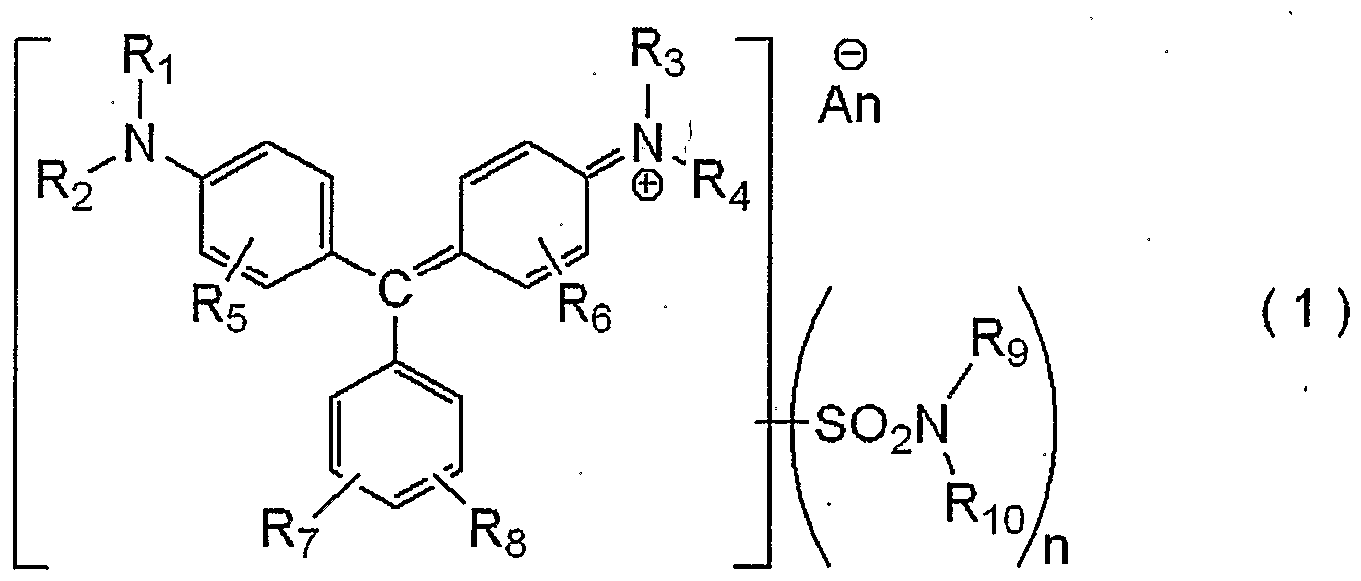
[式中、 1^乃至 R4はそれぞれ独立して、 水素原子、 置換されてもよいアルキ ル基、 置換されてもよいァリール基及び置換されてもよいァラルキル基のいず れかを表わし、 R5及ぴ1 6はそれぞれ独立して、水素原子及ぴアルキル基のい ずれかを表す。 また、 R7及び R 8はそれぞれ独立して、 永素原子、 スルホン酸 基、置換されてもよいアミノ基、 もしくは一SOsNRgRi。のいずれかを表わ し、 R 9及び 。はそれぞれ独立して、.水素原子、 アルキル基、 ァリール基及' ぴ Tラルキル基のいずれかを表わす。 ここで R9及び R10は、 窒素原子ととも に複素環を形成してもよい。 'また、 nは、 1乃至 3の整数を表わす。 さらに、 上記 R7及ぴ R8のいずれもが、 — SOsNRgRi。ではない場合には、 上記 Rr 乃至 R4のうち少なくとも 1つが、 置換基として一 SOsNRgRi。を有するァ ルキル基、 ァリール基、 もしくはァラルキル基である。 Anは、 カウンターァ 二オンを表わすが、 分子中に力ゥンターァユオンが存在するときは A nは不要 である。] で示される構造を有する色素化合物であること特徴とするシアント
ナ、
(I I) 前記色素化合物が、 下記式 (2)

[式中 R9及び 。はそれぞれ独立して、 水素原子、 アルキル甚、 _ァリール基 及びァラルキル基のいずれかを表わす J で示される構造を有すること 特徴 とする (I) に記載のシアントナー。
(I I I) 前記トナー粒子が、 さらにフタロシアニン顔料を することを特 徴とする (I) 又は (I I) に記載のシアントナー。
(IV) 前記式 (1) で示される構造を有する色素化合物と前記フタ口、 ァ ニン顔料との質量比 (式 (1) 示される構造を有する色素化合物の質量:フタ ロシアニン顔料の質量) 力 1 :'99乃至 70 : 30であることを特徴とする (I I I) に記載のシアントナー。
(V) 前記フタロシアニン顔料が、 C. I. P i gme n t B l u e 1 5: 3であることを特徴とする (I I I)又は(IV) に記載のシアントナー。
(V I) 前記シアントナー粒子は、 少なくとも重合性単量体、 前記式 (1)
' で示される構造を有する色素化合物及び重合開始剤を有する重合性単量体組 成物を水系媒体中で造粒し、 重合性単量体を重合して生成された重合シアンド ナー粒子である (I) 乃至 (V) のシナントナー。
, (VI I ) シアントナー粒子を有するシアントナーの製造方法であり、 該シアントナー粒子は、 少なくとも重合性単量体、 下記式 (1)

[式中、 乃至 R4はそれぞれ独立して、水素原子、 置換されてもよいアルキ ル基、 置換されてもよいァリール基及ぴ置換されてもよいァラルキル基のいず れかを表わし、 R5及ぴ1 6はそれぞれ独立して、水素原子及びアルキル基のい ずれかを表す。 また、 R7及ぴ1 8はそれぞれ独立して、 水素原子、 スルホン酸 基、置換されてもよいアミノ基、 もしくは_SO2NR9R10のぃずれかを表ゎ し、 R9及び 。はそれぞれ独立して、 水素原子、 アルキル基、 ァリール基及 ぴァラルキル基のいずれかを表わす。 ここで R9及び R10は、 窒素原子ととも に複素環を形成してもよい。 また、 nは、 1乃至 3の整数を表わす。 さらに、 上記 R 7及び R8のいずれもが、 一 SOsNRgRi。ではない場合には、 上記. 乃至 R4のうち少なくとも 1つが、 置換基として一SOzNRgRi。を有するァ ルキル基、 ァリール基、 もしくはァラルキル基である。 Anは、 カウンターァ 二オンを表わすが、 分子中にカウンターァニオンが存在するときは Anは不要 である。 ] で示される構造を有する色素化合物及ぴ重合開始剤を混合して重合 性単量体組成物を調整し、
該重合性単量体組成物を水系媒体中へ分散して重合性単量体組成物の粒子 を生成し、
.該水系媒体中で重合性単量体組成物の粒子中の重合性単量体を重合して生 成する重合シアントナー粒子であるシアントナーの製造方法。
(VI I I) 前記シアントナーが、 (I) 乃至 (V) のシアントナーである (V I I) のシアントナーの製造方法。
本発明によれば、 シアン及ぴグリーンの色域の再現性に優れ、 透光性に優れ たシアントナーを得ることができる。 発明を実施するための最良の形態
以下に好ましい実施の形態を挙げて、. 本発明をさらに詳細に説明する。 本発明のトナーの製造方法としては、 以下の方法が挙げられる。 まず、 結着 樹脂、 ワックス、 顔料や染料の如き着色剤、 必要に応じて荷電制御剤の如き添 加剤をヘンシェルミキサーまたはボールミルの如き混合器により十分混合す る。 この混合物を加熱ロール、 ニー^ーまたはェクストルーダーの如き熱混練 機を用いて溶融混練し、'この混練物を冷却し、 固化後、 粉砕及び分級をおこな つてトナー粒子を得る (以下、 粉砕法とも称する)。 他の方法としては、 ディ スク又は多流体ノズルを用いて溶融混練物を空気中に霧ィ匕し球形トナーを得 る方法や、懸濁重合法がある。 さらに、他の方法としては、単量体には可溶で、 得られる重合体が不溶な水系有機溶剤を用い直接トナーを生成する分散重合 法や、 水溶性極性重合開始剤存在下で直接重合しトナーを生成するソープフリ 一重合法に代表されるような乳化重合法などが挙げられる。
' 本発明のトナーの製造方法としては、 懸濁重合法が好ましい。 さらにー且得 られた重合粒子にさ に単量体を吸着せしめた後、 重合開始剤を用い重合せし めるシード重合方法も好適な製造方法である。 '
次に、 懸濁重合法を例に挙げて、 本発明のシアントナーの製造方法について 説明する。 まず、 少なくとも重合性単量体、 上記式 (1 ) で示される構造を有 する色素化合物及び重合開始剤を混合して重合性単量体組成物を調整し、 該重 合性単量体組成物を氷系媒体中へ分散して重合性単量体組成物の粒子を生成 し、 該水系媒体中で重合性単量体組成物の粒子中の重合性単量体を重合してシ ア^トナー粒子を生成することが好ましい。
上記トナー粒子の製造方法についてより具体的に説明すると、 重合性単量体
組成物として少なくとも重合性単量体、 色素化合物及ぴ重合開始剤、 必要に応 じてその他の添加剤 (荷電制御剤及び離型剤) 等を均一に分散又は溶解させ重 合性単量体組成物を生成する。 分散安定剤を含有する水系媒体中にホモジナイ ザ一等により、 上記重合性単量体組成物を分散させる。 好ましくは単量体液滴 が所望のトナー粒子のサイズ、 一般に 3 0 μ m以下の粒径を有するように攪拌 速度及び攪拌時間を調整し造粒する。 その後は分散安定剤の作用により重合性 単量体系の粒子状態は特定の異形性、 粒子表面性を有するよう安定に維持され、 且つ重合性単量体組成物の粒子の沈降が防止される程度の镜拌を行うことで 重合反応の進行に伴っての粒子凝集又は粒子合一もなく、 安定して重合される。 重合温度は 4 0 °C以上、 一般的には 5 0〜9 0 °Cの温度に設定して重合を行う。 また重合反応の後半に昇温してもよく、 更にトナー定着時の臭いの原因等とな る未反応重合性単量体、 副生物等を除去するために反応の後半又は終了時に一 部、 水系媒体を留去してもよい。 反応終了後、 生成したトナー粒子は分散安定 剤を除去し、 充分に水洗後トナー粒子を濾別して回収し、 乾燥及び必要に応じ て分級することによりシアン'トナー粒子を得る。
本発明に使用される重合性単量体組成物を構成する重合性単量体、.着色剤、 荷電制御剤、 離型剤、 重合開始剤及びその他添加剤としては以下のものが挙げ られる。 .
本発明に使用される重合性単量体としては、 以下のものが挙げられる。 スチ レン、 o—メチノレスチレン、 m—メチノレスチレン、 p—メチ/レスチレン、 p— メ トキシスチレン、 p—ェチルスチレン等のスチレン系単量体、 アクリル酸メ チル、 アクリル酸ェチル、 アクリル酸 n—プチル、 アクリル酸イソプチル、 ァ クリル酸 n—プロピル、 アクリル酸 n—ォクチル、 アクリル酸ドデシル、 ァク リル酸 2—ェチルへキシル、 アクリル酸ステアリル、 アクリル酸 2—クロルェ- チル、 アクリル酸フエニル等のアクリル酸エステル類、 メタクリル酸メチル、 メタクリル酸ェチル、 メタクリル酸 n—プロピル、 メタクリル酸 n—プチル、
メタクリル酸ィソプチル、メタクリル酸 n—オタチル、メタタリル酸ドデシル、 メタクリル酸 2—ェチルへキシル、 メタクリル酸ステアリル、 メタクリル酸フ ェニル、 メタタリル酸ジメチルァミノェチル、 メタタリル酸ジェチルァミノエ チル等のメタクリル酸エステル類その他ァクリロ二トリル、 メタタリロニトリ ル及びアクリルアミド。
これらの重合性単量体ほ単独または混合して使用してもよい。 上述の重合性 単量体の中でもスチレンまたはスチレン誘導体を単独で、 あるいは他の重合性 単量体と混合して使用することがトナーの現像特性及ぴ耐久性の点から好ま しい。
また、,本発明での重合性単量体には、 極性基を有する重合体、 共重合体を添 加して重合しても良い。
本発明に使用できる極性重合体及び極性共重合体としては、'以下のものが拳 げられる。 アクリル酸及ぴメタクリル酸の如き不飽和カルボン酸、 その他不飽 和二塩基酸、 不飽和二塩基酸無水物を用いた極性重合体又は極性共重合体、 不 飽和又は飽和ポリエステル。
これらの極性重合体ある 、は極性共重合体は、 重合性単量体 1 0 Ό質量部に 対し 1質量部以上 3 5質量部以下用いられることが好ましく、 より好ましくは 5質量部以上 2 0質量部以下である。 極性重合体あるいは極性共重合体が 3 5 質量部を超えると、 重合体の粘度が高くなるため、 造粒がしにくくなることが ある。 '
本発明のトナーは、 着色剤として少なくとも下記式 (1 ) '

[式中、 乃至 R4はそれぞれ独立して、 水素原子、 置換されてもよいアルキ ル基、 置換されてもよぃァリール基及ぴ置換されてもよい Tラルキル基のいず れかを表わし、 R5及び R6はそれぞれ独立して、 水素原子及びアルキル基のい ずれかを表す。 また、 R7及ぴ' R8はそれぞれ独立して、 水素原子、 スルホン酸 基、置換されてもよいアミノ基、 もしくは一 SO2NR9R10のいずれかを表わ し、 R 9及ぴ1^。はそれぞれ独立して、 水素原子、 アルキル基、 ァリール基及 ぴァラルキル基のいずれかを表わす。 ここで R9及ぴ1^。は、 窒素原子ととも に複素環を形成してもよい。 また、. nは、 1乃至 3の整数を表わす。 さらに、 上記 R7及ぴ1 8のいずれもが、 — SOsNRgRi。ではない場合には、 上記 1^ 乃至 R4のうち少なくとも 1つが、 置換基として一. SO2NR9R10を有するァ ルキル基、 ァリール基、 もしくはァラルキル基である。 Anは、 カウンターァ 二オンを表わすが、 分子中にカウンターァニオンが存在するときは Anは不要 である。] で示される構造を有する色素化合物を有する。
上記式 (1) で示される構造を有する色素化合物は、 例えば以下の方法によ つて得ることができる。 '
まず、 下記式 (3)

[式中、 R1]L乃至 R14はそれぞれ独立して、水素原子、置換されても良いアル キル基、 置換されても良いァリール基及ぴ置換されても良いァラルキル基のい ずれかを表わし、 15及ぴ1 16ほそれぞれ独立して、水素原子及びアルキル基 のいずれかを表す。 また、 R i 7及び 8はそれぞれ独立して、 水素原子、 スル ホン酸基、 置換されてもよいアミノ基及び一 SO 3Mのいずれかを表わす。 ま た、 nは 1乃至 3の整数を表わす。 さらに、上記 R17及ぴ R18のいずれもが一 S03Mではない場合には > 上記 R„乃至 R14のうち少なくとも 1つが、 置換 基として _S03Mを有するアルキレン基、 ァリーレン基、 もしくはァラルキ レン基である。 Mはスルホン酸基のカウンタ一力チオンを表し、 Anは、 カウ ンターァニオンを表わすが、 分子中にカウンターァニオンが存在するときは A nは不要である。] で示される構造を有する化合物とハ口ゲン化チォニルとを、 N, N—ジメチルホルムアミド及び有機溶剤の存在下反応させ、 下記式 (4)

[式中、 R 乃至 8はそれぞれ独立して、 水素原子、 置換されていても.よい アルキル基、 置換されていてもよいァリール基おょぴ置換きれていてもよいァ ラルキル基のいずれかを表わし、 1 15ぉょぴ1 16はそれぞれ独立して、水素原
子およびアルキル基のいずれかを表わす。 また、 1 17ぉょぴ1 18はそれぞれ独 立して、 水素原子、 スルホン酸基、 置換されていてもよいアミノ基、 若しくは
— SO3Xのいずれ力を表わし、 また、 nは、 1乃至 3の整数を表わす。 さら に、 上記 7および R18のいずれもが一 SO 3Xではない場合には、 上記' R„乃至 R14のうち少なくとも 1つが、 置換基として一 S〇3Xを有するアル キレン基、 ァリーレン基、 若しくはァラルキレン基である。 Xはハロゲン原子 を表わし、 Anは、 カウンターァニオンを表わすが、 '分子中にカウンターァニ オンが存在するときは Anは不要である。 ] で示される構造を有するスルホ二 ルハライド化合物を得る。 次いで上記式 (4) で示される構造を有するスルホ ニルハラィド化合物と下記式 ( 5 )
ノ 。
ヽ Z 〈5)
H
[式中、 R9および R10はそれぞれ独立して、 水素原子、 アルキル基、 ァ,リー ル基およぴァラルキル基のいずれかを表わす。 ] で示される構造を有するアミ ン類とを縮合反応させることで上記式 (1) で示される構造を有する色素化合 物を得ることができる。
前記式 (1) 中の 乃至 R4におけるアルキル基としては、 メチル基、 ェチ ル基、 n—プロピル基、 イソプロピル基、 n—プチル基、 s e c—プチル基、 t e r t—プチル基、 n—ペンチル基、 n—へキシル基等が挙げられる。また、 ァリール基としては、 フエ二ノレ基、 1—ナフチル基、 2—ナフチル基等が挙げ られる。 また、 ァラルキル基としては、 ベンジル基、 フエネチル基等が挙げら れる。 と!^ (もしくは と R4)、 R2と R4 (もしくは R2と R3) は同一 であっても異なっていてもよいが、 色調、 原料のコストの点で好ましいのは、 同一である場合である。 特に好ましいのは、 乃至 R4のすべてがェチル基で ある場合、 と R3がェチル基であり、 R2と R4がべンジル基である場合、 と R4がェチル基であり、 R2と R。がべンジル基である場合のいずれかであ
る。これらの官能基には、置換基として一
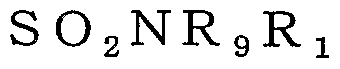 。を有していても良い。 なお、 一 SO2NR9R10における R9及ぴ R10は上記式 (1) で示されている ものと同一である。 ·
前記式 (1) 中の R5及び R6におけるアルキル基としては、 メチル基、 ェチ ル基、 n一プロピル基及びィソプロピル基等が挙げられる。 R5及び R6が水素 原子或いはメチル基であることが好ましい。
前記式 (1) 中の R7及ぴ1 8のアミノ基としては、 メチル基、 ェチル基等の アルキル基、 フエニル基、 メ トキシフエ二ル基、 エトキシフエニル基及ぴベン ゼンスルホン酸基等が置換しても良い。 '
前記式 (1) 中の R9及ぴ!^。におけるアルキル基としては、 以下のものが 挙げられる。 メチル基、 ェチル基、 n—プロピル基、 イソプロピル基、 n—プ チノレ基、 s e c—ブチル基、 t e r t—ブチル基、 n—ペンチル基、 n—へキ シル基、 n—へプチル基、 n—ォクチル基、 2—ェチルへキシル基、 及ぴ、 シ ク口へキシル基等の鎖状もしくは獰状アルキル基等。 また、 ァリール基として は、 フエニル基、 1一ナフチル基及び 2—ナフチル基等が挙げられる。,また、 ァラルキ^/基としては、 ベンジル基及びフヱネチレ基等が挙げられる。 また、 R 9及び 。は窒素原子とともに複素環を形成しても良く、 具体的には、 ピぺ リジノ基、 ピペラジノ基、 ピロール基、 インドール基、 カルバゾール基、 ビラ ゾール基、 ィンダゾール基、 ィミダゾール基、 ベンズィミダゾール基、 トリア ゾール基、 ベンゾトリアゾール基、 テトラゾール基等が挙げられる。 結着樹脂 との相溶性の観点から R 9及ぴ R!。は長鎖のアルキル基等の脂溶性が高 ヽもの の方が好ましい。
前記 (1) で示される構造を有する色素化合物の具体的化合物例を以下に 示すが、 本発明はこれらに限定されるものではない。

前記式 (1) で示される構造を有する色素化合物は着色剤として単独で又は 併用して使用することが可能である。 前記式.(1) で示される構造を有する色 素化合物と組み合わせて用いることが可能な青色系着色剤としては、 以下のも のが挙げられる。 アルミフタロシアニン、 ς. I. P i gme n t B l u e 15 : 1、 C. I. P i gme n t B l u e 15 : 3、 C. I. P i gme n t B l u e 15 : 4、 C. I . P i gme n t B l u e 1 6、 C. I . P i gme n t B l u e 60、. C. I . P i gme n t Gr e e n 7、 C. I . S o l v e n t B l u e 14、 C. I. S o l v e n t B l u e 25、 C. I. S o l v e n t B l u e 35、 C. I. S o l v e n t B l u e 36、 C. I. S o l v e n t B 1 u e 58、 C. I . S o l v e n t B l u e 59、 C. I . S o l v e n t B l u e 60等。
特に、 前記 (1) で示される構造を有する色素化合物と組み合わせて用い ることが好ましい着色剤としてはフタロシアニン系顔料が挙げられ、 更に好ま しくは C. I . P i gme n t B l u e 1 5 : 3が挙げられる。 C . I . P i gme n t B l u e 15 : 3はブルー色域の再現に優れており、 前記 式 (1) で示される構造を有する色素化合物がシアン及ぴグリーン色域の再現
に優れてレ、ることから、 優れた色再現性が得られる。
トナー中における、 前記式 (1 ) で示される構造を有する色素化合物とフタ ロシアニン系顔料との質量比 (前記式 (1 ) で示される構造を有する色素化合 物の質量:フタロシアニン顔料の質量) は 1 : 9 9乃至 7 0 : 3 0であること が好ましく、 より好ましくは 2 0 : 8 0乃至 6 0 : 4 0である。
本発明によるシアントナーは、 荷電制御剤を含有していても良い。
負荷電制御剤としては、 含金属サリチル酸系化合物、 含金属モノァゾ系染料 化合物、 スチレン一アクリル酸共重合体、 イミダゾール誘導体、 スチレンーメ タクリル酸共重合体 (N, N, ージァリール尿素誘導体)、 カリータスアレー ン等が挙げられる。
正荷電制御剤としては、 以下のものが挙げられる。 ニグ口シン及ぴ脂肪酸金 属塩等による変性物、 グァニジン化合物、 イミダゾール化合物、 トリブチルベ ンジルアンモニゥム一 1ーヒ ドロキシー 4—ナフトスルフォン酸塩、 テトラブ チルアンモユウムテトラフルォロボレート等の四級アンモニゥム塩、 及びこれ らの類似体であるホスホユウム塩等のォ-ゥム塩及びこれらのレーキ顔料、 ト リフエニ メタン染料及ぴこれらのレーキ顔料 (レーキ化剤としては、 燐タン ダステン酸、 燧モリプデン酸、 燐タングステンモリブデン酸、 タンニン酸、 ラ ゥリン酸、 没食子酸、 フェリシアン化物、 フエロシアン化物等)、 高級脂肪酸 の金属塩、 ジォルガノスズオキサイド類としてジプチルスズオキサイド、 ジォ クチルスズオキサイド、 ジシクロへキシルスズオキサイド、 ジオルガノスズボ レート類としてジブチルスズボレート、 ジォクチルスズポレート、 ジシク口へ キシルスズボレート。 また、 これらを単婢あるいは 2種類以上組み合わせて用 いてもよレヽ。 .
前記の荷電制御剤は、 着色していないか、 もしくは本発明で用いられる着色 剤の色相に影響を与えないものが望ましい。
これらの荷電制御剤は、 樹脂成分 1 0 0質量部に対して、 0 . 0 1質量部以
.
16 上 2 0質量部以下使用するのが好ましく、 より好ましくは 0 . 5質量部以上 1
0質量部以下である。
本発明によるシァントナ一は、 離型剤を含有していても良い。
本発明に使用される離型剤としては炭化水素系のワックス類が好ましレ、。 具 体的には、 パラフィン、 ポリオレフイン系ワックス及ぴこれらの変性物、 例え ば、 酸化物ゃグラフト処理の他、 高級脂肪酸、 及びその金属塩、 アミドヮック ス等が挙げられる。
離型剤として特に好ましくは、 パラフィンヮックス等の非極性のものが挙げ られる。 非極性のワックスを用いた場合、 ワックスはトナー粒子の中心部に局 在化するとともに、 極性基のトナー粒子表面への局在化を促進する。 離型剤の ' 含有量としては、 トナーに対して、 5質量%以上 3 0質量%以下であり、 5質 量%未満の場合、 極性基のトナー粒子表面への局在化促進の効果が減少する。 ' また、 離型剤の含有量が 3 0質量%より多い場合は、 局在化促進効果はあるも のの、 トナーの耐ブロッキング性が劣ってくる。
本発明に.使用される重合開始剤としては、以下のものが挙げられる。 2 , 2 ' ァゾビス一 (2, 4—ジメチルバレロニトリル)、 2 , 2, ーァゾビスイソ ブチロニトリル、 1, 1 'ーァゾビス(シクロへキサン一 1—力ルポ二トリル)、 2, 2, 一ァゾビス一 (4—メ トキシ一 2 , 4—ジメチルパレロニトリル) 等 のァゾ系又はジァゾ系重合開始剤、 ベンゾィルペルォキシド、 メチルェチルケ トンペルォキシド、 ジィソプロピルペルォキシカーボネート、 タメンヒドロべ ノレォキシド、 t e r t—ブチルヒドロぺノレオキシド、 ジー t e r t—プチノレぺ ルォキシド、 ジクミルペルォキシド、 2 , 4—ジク口口ベンゾィルペルォキシ ド、 ラゥロイルペルォキシド、 2 , 2—ビス (4 , 4— t e r t—ブチルペル オキ.シシクロへキシル) プロパン、 トリスー ( t e r t—プチルペルォキシ) トリァジン等の過酸化物系重合開始剤や過酸ィヒ物を側鎖に有する高分子重合 開台剤、 過硫酸カリウム、 過硫酸アンモニゥム等の過硫酸塩、 過酸化水素等。
重合開始剤は重合性単量体 1 0 0質量部に対し 0 . 5質量部以上 2 0質量部 以下の添加量が好ましく、 単独で又は、 併用してもよい。
また、 本発明では分子量をコントロールするために、 公知の架橋剤、 連鎖移 動 Jを添加してもよく、 好ましい添加量としては重合'性単量体 1 0 0質量部に 対し 0 . 0 0 1質量部以上 1 5質量部以下である。
好ましく用いられる架橋剤として、 以下のものが挙げられる。 ジビュルベン ゼン、 ジビュルナフタレン及ぴそれらの誘導体である芳香族ジビュル化合物、 その他エチレングリコールジメタタリレート、 ジエチレングリコールメタクリ レート、 トリエチレングリコールメタタリレート、 トリメチロールプロパント リアタリレート、 ァリルメタクリルレート、 t e r tーブチルァミノエチノレメ タクリレート、 テトラエチレングリコールジメタタリレート、 1 , 3—ブタン ジオールジメタタリレート等のジエチレン性カルボン酸エステル、 N, N—ジ ビュルァニリン、 ジビュルエーテノレ、 ジビエノレス/レフイ ド、 ジビニノレス/レホン 等全てのジビ-ルイヒ合物及び 3個以上のビュル基を持つ化合物等。 これら架橋 剤は単独で用いても、 混合して用いても良い。
本発明〖こ使用できる分散安定剤としては、 以下のものが挙げられる。 無機ィ匕 合物として、リン酸カルシウム、ヒドロキシァパタイト、リン酸マグネシウム、 リン酸アルミニゥム、 リン酸亜鉛、 炭酸力ルシゥム、 炭酸マグネシゥム、 水酸 化カルシウム、 水酸ィ匕マグネシウム、 水 化アルミニウム、 メタケイ酸カルシ ゥム、 硫酸カルシウム、 硫酸バリウム、 ベントナイト、 シリカ、 アルミナ等。 有機化合物としては、 ポリビュルアルコール、 ゼラチン、 メチルセルロース、 メチルヒドロキシプロピルセルロース、 ェチルセルロース、 カルボキシメチル セルロースのナトリウム塩、 ポリアクリル酸及ぴその塩、 デンプン等。 これら の分散安定剤は水系媒体中に分散させて使用される。
これら分散安定剤は、 水系媒体中で均一に分散して液滴として存在している 重合性単量体組成物粒子同士の凝集を防止し、 さらにこれら液滴表面に一様に
吸着することにより、 該液滴を安定ィヒしていると考えられる。 これらの分散安 定剤は、 液滴中の重合性単量体の重合反応終了後に酸、 アルカリ処理や、 熱水 洗浄等を通して可溶化され、 トナー粒子から分離される。
分散安定剤として、 特にリン酸カルシウム塩類は、 酸処理及び水洗浄のみで 容易にトナー粒子表面から除去することができ、 この条件下では着色剤、 顔料 分散助剤、 荷電制御剤等の分解または溶出も発生せず、 熱変形も考慮する必要 がないため有効である。
ここで述べるリン酸カルシウム塩類とは、 リン酸カルシウム、 リン酸水素力 ルシゥム、 リン酸二水素カルシウム、 ヒドロキシアパタイト等及びそれらの複 数の混合物であり、 これらの塩類の結晶の大きさ、 結晶凝集物の粒径、 酸に対 する溶解度等の効果を考慮すると、 ヒドロキシァパタイト及び.リン酸カルシゥ ム塩が好ましく、 そのなかでもヒドロキシアパタイトが最も好ましい。
これらのリン酸カルシウム塩類は、 リン酸塩水溶液とカルシウム塩水溶液と から、 水系媒体中でリン酸カルシウム塩類を生成させて使用する方法が、 凝集 物の発生がなく、 均一な微粒子結晶が得られるため分散剤として使用する場合、 最も効果がある。 粉末状のリン酸カルシウム塩類をそのまま用いる場合、 粉体 として強い凝集体となってしまいやすいため、凝集体と'して粒径が不均一であ り、 水相への分散はかなり難しい。 更にリン酸カルシウム塩類を生成させる方 去の利点としては、 リン酸カルシウム塩類に副生する水溶性の中性塩類が、 重 合性単量体の水中への溶解防止効果と水系媒体の比重を大きくする効果とを 有することである。
本発明に使用できるトナーの外添剤としては、 以下のものが挙げられる。 ァ ルミナ、 酸化チタン、 シリカ、 酸化ジルコニウム、 酸化マグネシウムのような 酸化物の他に、 炭化ケィ素、 チッ化ケィ素、 チッ化ホウ素、 チッ化アルミユウ ム、 炭酸マグネシウム、 有機ケィ素化合物等。
さらに、 上記微粉体は疎水化処理されていることが、 トナーの帯電量の温度
や湿度等の環境依存性を少なくするため及びトナー表面からの遊離を防止す るためによい。 この疎水化処理剤としては、 例えばシランカップリング剤、 チ タンカツプリ 'ング剤、'アルミニウムカツプリング剤のような力ップリング剤、 シリコーンオイル、 フッ素系オイル、 各種変性オイルのようなオイルが挙げら れる。
これら公知の外添剤のなかでは、 帯電安定性、 現像性、 流動性、 保存性向上 のためシリカ、 アルミナ、 チタニアあるいはその複酸化物等を選ぶことが好ま しい。 なかでも特にシリカが、 出発材料あるいは温度等の酸ィ匕条件により、 あ る程度任意に一次粒子の合一をコントロールできる点でより好ましい。 例えば、 力かるシリカは硅素ハロゲン化物やアルコキシドの蒸気相酸ィ匕により生成さ れたいわゆる乾式法又はヒュームドシリカと称される乾式シリカ及びアルコ キシド、 水ガラス等から製造されるいわゆる湿式シリカの両者が使用可能であ るが、 表面及びシリカ微粉体の内部にあるシラノール基が'少なく、 また製造残 滓の少ない乾式シリカの方が好まレぃ。 また乾式シリカにおいては、 製造工程 において例えば、 塩ィ匕ァノレミニゥム、 塩ィ匕チタン等他の金属ハロゲン化合物を 硅素ハロゲン化合物とともに用いることによって、.シリカと他の金属酸化物の 複合微粉体を得ることも可能でありそれらも包含する。 '
外添剤の添加量は、 トナー 1 0 0質量部に対して、 トナーの帯電安定化、 力、 さ密度安定化、 高湿下での放置安定性等のために 0 . 1質量部以上 3質量部以 下添加することが好ましく、 これら外添剤は複数種組み合わせて使用すること ' ができる。 以下に、 さらに別個に組み合わせて使用することが好ましい外添剤 について述べる。
転写性及び Z又はクリーニング性向上のために一次粒径 5 0 n m以上 (好ま ύくは比表面積が 5 0 m2Z g未満) の無機又は有機の球状に ¾い微粒子をさ らに添加することも好ましい形態の一つである。 例えば球状シリカ粒子、 球状 ポリメチルシルセスキォキサン粒子、 球状樹脂粒子等が好ましく用いられる。
本発明のトナーにおいては、 実質的な悪影響を与えない範囲内で更に他の添 加剤、例えば滑剤粉末としてポリフッ化工チレン粉末、ステアリン酸亜鉛粉末、 ポリフッ化ビニリデン粉末、研磨剤として、酸化セリゥム粉末、炭化硅素粉末、 チタン酸ストロンチウム粉末、 ケーキング防止剤として酸ィ匕チタン粉末、 酸化 アルミニウム粉末、 あるいは導電性付与剤としてカーボンブラック粉末、 酸ィヒ 亜鉛粉末、 酸化スズ粉末、 また、 逆極性の有機微粒子及び無機微粒子を現像十生 向上剤として少量用いることもできる。 .
本発明の製造方法によるトナーは、 通常一成分及び二成分系現像剤として、 いずれの現像剤にも使用できる。 例えば、 一成分系現像剤として用いる場合に は、 ブレード及ぴファーブラシを用い、 現像スリーブにて強制的に摩擦帯電し スリーブ上にトナーを付着することで搬送する方法がある。
- 一方、 一般的に利用されている二成分系現像剤として用いる場合には、 本発 明のトナーとともに、 キャリアを用い現像剤として使用する。 本発明に使用さ 'れるキャリアとしては特に限定されるものではないが、 主として、 鉄、 銅、 亜 鉛、 ニッケル、 コバルト、 マンガン、 クロム元素からなる単独及ぴ複合フェラ イト状態で構成される。 飽和磁化、 電気抵抗を広範囲にコントロールできる点 力^キャリア形状も重要であり、 例えば球状、 扁平、 不定形等を選択し、 更に キヤリァ表面状態の微細構造、 例えば表面凸凹性をもコント口ールすることが 好ましい。 一般的には、 上記無機酸化物を焼成、 造粒することにより、 あらか じめ、 キャリアコア粒子を生成した後、 樹脂にコーティングする方法が用いら れているが、 キャリアのトナーへの負荷を軽減する意味合いから、 無機酸化物 と樹脂を混練^、粉砕、分級して低密度分散キヤリァを得る方法や、さらには、 直接無機酸化物とモノマーとの混練物を水系媒体中にて懸濁重合して真球状 分散キヤリァを得る方法等も利用することが可能である。
本発明において、 上記キャリアの表面を樹脂等で被覆する系は、 特に好まし い。 その方法としては、 樹脂等の被覆材を溶剤中に溶解もしくは懸濁して塗布
しキヤリァに付着する方法、 単に粉体で混合する方法等、 従来公知の方法がい ずれも適用できる。
キヤリァ表面への固着物質としてはトナー材料により異なる力 例えばポリ テトラフルォロエチレン、 モノクロ口 トリフルォロエチレン重合体、 ポリフッ 化ビニリデン、 シリコーン樹脂、 ポリエステル樹脂、 ジターシヤーリーブチル. サリチル酸の金属化合物、 スチレン系樹脂、 アクリル系樹脂、 ポリアミド、 ポ リビ二/レブチラール、 ニグ口シン、 アミノアクリレート樹脂、 塩基性染料及び そのレーキ、 シリカ微粉末、 アルミナ微粉末等を単独あるいは複数で用いるの が適当であるが、 必ずしもこれらに制約されない。
上記化合物の処理量は、 一般には総量でキャリア 100質量部に対し 0. 1 質量部以上 30質量部以下、 好ましくは 0. 5質量部以上 20質量部以下であ る。 - これらキャリアの平均粒径は 1 O/zm以上 10 Ο μπι以下、 好ましくは 20 μιη以上 50 μπι以下を有することが好ましい。
特に好ましい態様としては、 Cu— Zn— F eの 3元系のフェライトであり、 その表面をフッ素系樹脂とスチレン系樹脂のような樹脂の組み合せ、 例えばポ リブッ化ビユリデンとスチレン一メチルメタタリレート樹脂;ポリテトラフル ォロエチレンとスチレンーメチレメタタリレート樹脂、 フッ素系共重合体とス チレン系共重合体;等を 90 : 10〜20 : 80、 好ましくは 70 : 30〜3 0 : 70の比率の混合物としたもので、 0. 01質量%以上 5質量0 /0以下、 好 ましくは 0. 1質量%以上 1質量%以下コーティングし、 250メッシュパス、 400メッシユオンのキヤリァ粒子が 70質量0 /0以上ある上記平均粒径を有. するコートフェライトキャリアであるものが拳げられる。 該フッ素系共重合体 としてはフッ化ビニリデンーテトラフルォロエチレン共重合体 (10 : 90〜 90 : 10) が例示され、 スチレン系共重合体としてはスチレン一アタリノレ酸 2—ェチノレへキシル (20 : 80 80 : 20)、 スチレン一ァクリノレ酸 2—
ェチルへキシルーメタクリル酸メチル (20〜60 : 5〜30 : 10— 50) が例示される。
上記コートフェライトキャリアは粒径分布がシャープであり、 本発明のトナ 一に対し好ましい摩擦帯電性が得られ、 さらに電子写真特性を向上させる効果 5 がある。
本発明におけるトナーと混合して二成分現像剤を調製する場合、 その混合比 率は現像剤中のトナー濃度として、 2質量%以上15質量%以下、 好ましくは 4質量%以上 13質量%以下にすると通常'良好な結果が得られる。 トナー濃度 が 2質量%未満では画像濃度が低く実用不可となり、 15質量%を超えると力 プリや機内飛散が増加して、 現像剤の耐用寿命を縮める。 , さらに、 該キャリアの磁性特性は以下のものがよレ、。 磁気的に飽和させた後 の 79. 58 k A/m (1000エルステッド) における磁ィ匕の強さは 30 e muZcm3以上 300 emu/cm3以下であることが必要である。 さらに高 画質ィ匕を達成するために、 好ましくは 100 emu/ cm3以上 250 emu ノ cm3以下であることがよい。 キャリアの上記した磁ィ匕の強さが 300 emu/cm3より大きい場合には、高画質なトナー画像が得られにくくなり、 . 30 emu/ cm3未満であると、 磁気的な拘束力も減少するためにキャリア 付着を生じやすい。
本発明における粒度分布測定について述べる。
. 測定装置としてはコールターカウンターマルチサイザ一 I I I (コールター " ' 社製) を用いる。 電解液は、 1級塩化ナトリゥムを用いて、 約 1 %N a C 1氷 溶液を調整する。 例えば I SOTON R— I Γ (コールターサイェンティフ イツクジャパン社製) が使用できる。 測定方法としては、 前記電解水溶液 10 0乃至 150 m 1中に分散剤として、 界面活性剤 (好ましくはアルキルべンゼ ンスルホン酸塩) を 0. 1乃至 5m 1を加え、 更に測定試料を 2乃至 2 Omg ' 加える。 試料を懸濁した電解液は、 超音波分散機で約 1乃至 3分間分散処理を
おこない、 前記測定装置により、 アパーチャ一として 1 00 アパーチャ一 を用いて、 トナー粒子の体積及ぴ個数を各チャンネルごとに測定して、 トナー の体積分布と個数分布とを算出する。 それから、 トナー粒子の体積分布から求 めた質量基準のトナーの重量平均粒径 (D4) を求める。
チャンネノレとしては、 2. 0ひ〜 2. 52 μπι; 2. 5 2〜 3. 1 7 μτη. ;
3. 1 7〜4. 00 πι; 4. 00〜5. 04 μ m; 5. 04〜6. 35 μ m; 6. 35〜 8. 00 ; 8. 00〜: 1 0. 08 / m ; 1 0. 08〜: 1 2. 7 0 μιη ; 1 2. 70〜: 1 6. 00 m; 1 6. 00〜20 20 μ m; 20. 20〜25. 40 μ m; 25. 40〜3 2. 00 μ m; 3 2. 00〜40. 3 0 inの' 1 3チャンネルを用いる。
後述する実施例における画像の評価方法は、 以下の通りである。
(1) 画質
得られた重合トナー粒子 1 00部に疎水化処理したシリカ微粉末 0. 5部を 外添し、 シアントナーとした。 このトナー 5部に対し、 アクリルコートされた フェライトキャリア 95部を混合し、 現像剤とした。 '
キヤノン製フルカラー複写機 C LC-500改造機を使用し、 上記現像剤を 角いて 22 °Cノ 6 6%の環境下 (常温/常湿下) において目視にて評価する。 ◎:非常に優れている , ' ' .
〇:優れている
△.:やや劣っている
X :劣っている
CLC-5 00改造機とは現像器及ぴ感光 、ラムの距離を 400 mとし、 現像スリーブと感光ドラムの周速比を 1. 3 : 1としたものである。 現像器に おいては、 現像極の磁場の強さ 1 000ェルステツド、 交番電界 2000 Vp p、 周波数 300 OH zであり、 現像スリーブと感光ドラムとの距離は 500 μ mとした。
(2) 透明性
OHPモードでベタ画像を OHPシート上にプリントし、 プロジェクターで 投影しベタ画像の透明性を観察した。
〇:透明性に問題なし
△ :やや透明性が悪い '
X :かなり濁っている
(3) 画像の色相測定
トナーの色相は国際照明委員会 (C I E) で規格された L* a *b*表色系の 定義に基づき、 定量的に測定した。 すなわち、 L* (明度)、 a*、 b* (色相と 彩度を示す色度) を測定した。 測定器には G r e t a g Ma c b e t h S p e c t r o l i n o (Gr e t a g Ma c b e t h社製) を用レ、、 観察光 源は D 65光源、 視野角は 10° とした。
〇:色相角 180° 以上 230° 未満
X :色相角 230° 以上 270°.未満
h (色相角) = t a n— 1 (b*Za*) 〔d e g r e e〕
実施 .
以下、 実施例及び比較例を挙げ本発明について詳しく説明するが、 本発明は これらの実施 に何ら限定されるものではない。 なお以下配合の部数にっ 、て の内容はすべて質量部数を表す。 なお、 以下の記載において、 Mwは重量平均 分子量、 Mw/Mnは分子量分布、 m. p. は融点を示す。
[実施例 1]
水系分散媒の調製 . イオン交換水 710部に 0. 1M—Na 3P04水溶液 450部を投入し、 6 0°Cに加温した後、 高速攪拌装置 TK—ホモミキサー (特殊機ィ匕工業社製) を 用いて 12000 r pmにて攪拌した。 次に 1. 0 M— C a C 12水溶液 68 部を添カ卩して反応させ、 Ca3 (Ρ.Ο4) '2の微粒子を含む水系分散媒を得た。
重合性単量体組成物の調製
スチレン単量体 160部 n—ブチルアタリレート単量体 40部 前記色素化合物 (6) 2. 0部 C. I. P i gme n t B l u e 15 : 3 8. 0部 スチレンーメタクリル酸一メタクリル酸メチル共重合体 . 15部
' (酸価 70 Mw50000 Mw/Mn = 2. 0)
ジ一t e r t—プチルサリチル酸金属化合物 2部 パラフィンワックス (m. p. = 70 °C) 50部 上記処方を 60°Cに加温し、 TK—ホモミキサーを用いて、 12000 r p mにて均一に溶解し、分散した。 これに、重合開始剤 2, 2, 一ァゾビス (2',
4—ジメチルパレロニトリル) 5部を溶解し、重合性単量体組成物を調製した。 前記水系媒体中に上記重合性単量体組成物を投入し、 60°C、 N2雰囲気下 において、 TK—ホモミキサ "にて 15000 r pmで 10分間攪拌し、 重合 性単量体組成物を造粒した。 その後、 パドル攪拌翼で攪拌しつつ、 70°Cに昇 温し、 10時間反応させた。 重合終了後、 減圧下で残存モノマーを留去し、 冷 却後塩酸を加えヒドロキシァパタイトを溶解させた後、 濾過、 水洗、 乾燥して 重合トナー粒子を得た。 この重合トナー粒子は重量平均粒径- 7. 29/x mで粒度分布は非常にシャ ープであった。
[実施例 2]
実施例 1の重合性単量体組成物を
スチレン単量体 · 160部 n—プチルアタリレート単量体 40部 前記色素化合物 (6) 4. 0部
C. I. P i gme n t B l u e 15 ,: 3 4. 0部
スチレンーメタクリル酸一メタクリル酸メチル共重合体 1 5部 (酸価 70 Mw50000 Mw/Mn=2. 0)
ジ一 t e r t—ブチルサリチル酸金属化合物 2部 パラフィンヮックス (m. p. = 70°C) 50部 に変更した以外は実施例 1と同様にして、 重合トナー粒子を得た。
径 = 7. 48 μ mで粒度分布は非常にシャープであった。
[実施例 3]
実施例 1の重合性単量体組成物を
'スチレン単量体 1 6 0部 n—ブチノレアクリレート単量体 40部 前記色素化合物 (6) 4. 5部
C. I . P i gme n t B l u e 1 5 : 3 3. 0部 スチレンーメタクリル酸一メタクリル酸メチル共重合体 1 5部 ' (酸価 70 Mw50000 Mw/Mn^ 2. 0)
ジー t e r t—ブチルサリチル酸金属化合物 、 2部 パラフィ ワックス (m. p. = 70。C) 50部 に変更した以外は実施例 1と同様にして、 重合トナー粒子を得た。 径 = 7. 1 7 μ mで粒度分布は非常にシャープであゥた。'
[実施例 4]

上記化合物 ( 1 ' 0 ) に変更した以外は実施例 1と同様にして重合トナー粒子
を得た。 重量平均径 =7. 2 Ο^πιで粒度分布は非常にシャープであった。
[実施例 5]
実施例 1の前記化合物 (6) を前記化合物 (7).に変更した以外は実施例 1 と同様にして、 重合トナー粒子を得た。 重量平均粒径 = 6. 79 mで粒度分 布は非常にシャープであった。
[実施例 6]
実施例 1の前記化合物 (6) を前記化合物 (8) に変更した以外は実施例 1 と同様にして、 重合トナー粒子を得た。 重量平均粒径 = 7. 33 ^ mで粒度分 布は非常にシャープであった。
[比較例 1]
実施例 1の重合性単量体組成物を
スチレン単量体 160部 n—ブチルアタリレート単量体 40部
C. I . P i gme n t B l u e 1 5 : 3 12部 スチ ン一メタクリル酸一メタクリル酸メチル共重合体 15部
(酸価 7 Q Mw50000 Mw/Mn = 2. 0)
ジー t e r t—ブチノレサリチル酸金属ィヒ合物 2部 . パラフィンワックス (m. p. = 70°C) 50部 に変更した以外は実施例 1と同様にして、 重合トナー粒子を得た。 重量平均粒 径 =7. 50 μπιで粒度分布は非常にシャープであった。
[比較例 2]
実施例 1の重合性単量体組成物を
スチレン単量体 160部
Ώ—プチルァクリレート単量体 40部 C. I. S o l v e n t B l u e 4 (下記化合物 (1 1)) 2. 0部 C . 丄. P i gme n t B l u e 5 : 3 7部
スチレンーメタクリル酸一メタクリル酸メチル共重合体 15部
(酸価 70 Mw 50000 Mw/Mn = 2. 0)
ジ— t e r t—プチルサリチル酸金属化合物 2部 パラフィンワックス (m. p. = 70°C) 50部 に変更した以外は実施例 1と同様にして、 重合トナーを製造しようとしたが 造粒過程で合一して粗粒が発生したために重合粒子を得ることができなかつ た。.

のリン 'ン酸塩
[比較例 3]
実施例 1の重合性単量体組成物を
スチレン単量体 160部 n—プチルァクリレート単量体 40部 C. I . S o l e n t B l u e 35 (下記化合物 (1 2)) 2. 0部 C. I . P i gme n t B l u e 15 : 3 7部 スチレン一メタクリル酸一メタクリル酸メチル共重合体 15部
(酸価 70 M 50000 Mw /Mn = 2. 0)
ジ— t e r t—ブチルサリチル酸金属化合物 2部 パラフィンヮ.ックス (m. p . = 70 °C) 50部 に変更した以外は実施例 1と同様にして、 重合トナー 子を得た。 重量平均粒
径 = 8. 1 1 μ mで粒度分布は非常にシャープであった c

[比較例 4] .
実施例 1の重合性単量体組成物を
160部
■ ri—プチルアタリレート単量体 40部
C. I. P i gme n t B l u e 16 12部 スチレンーメタクリル酸一メタクリル酸メチル共重合体 15部 (酸価 70 Mw 50000 Mw/Mn = 2. 0)
ジー t e r t—プチルサリチル酸金属化合物 2部 パラフィンワックス (m. p. = 70 °C) 50部 に変更した以外は実施例 1と同様にして、 重合トナー粒子を得た。 重量平均粒 径 = 6. 59 mで粒度分布は非常にシャープであった。 ·
[比較例 5]
実施例 1の重合性単量体組成物を
スチレン単量体 . 160部 n—プチルアタリレート単量体 40部 亜鉛フタロシアニン化合物 (下記化合物 (1 3)) 12部 スチレン一メタクリル酸一メタクリル酸メチル共重合体 1 5部 - (酸価 70 Mw 50000 Mw/Mn = 2. 0)
ジー t e r t—ブチルサリチル酸金属化合物 2部 パラフィンワックス (m. p. = 70 °C) 50部
に変更した以外は実施例 1と同様にして、 重合トナー粒子を得た。 重量平均粒 径= 6. 6 9 μ mで粒度分布は非常にシャープであった。


Claims
請 求 の 範 囲
. 少なぐとも結着樹脂及ぴ着色剤を有するトナー粒子を有するシアント であって、 該着色剤が、 下記式 (1-)
(1 )

[式中、 乃至 R4はそれぞれ独立して、 水素原子、 置換されてもよいアルキ ル基、 置換されてもよいァリール基及ぴ置換されてもよいァラルキル基のいず れかを表わし、 R5及ぴ R 6 ίまそれぞれ独立して、水素原子及びアルキル基のい ずれかを表す。 また、 R7及ぴ1 8はそれぞれ独立して、 水素原子、 スルホン酸 基、置換されてもよいアミノ基及ぴ一 SOsNRgRi。のいずれかを表わし、 R 9及ぴ1 10.はそれぞれ独立して、 水素原子、 アルキル基、 ァリール基及びァラ ルキル基のいずれかを表わす。 ここで R 9及ぴ1^。は、 窒素原子とともに複素 環を形成してもよい。 また、 nは、 1乃至 3の整数を表わす。 さらに、 上記 R 7及び R8のいずれもが、 一 SOsNRgRi。ではない場合には、 上記 乃至 R 4のうち少なくとも 1つが、 置換基として一 SO2NR9R10を有するアルキクレ ' 基、 ァリール基、 もしくはァラルキル基である。 Anは、 カウンターァニオン を表わすが、 分子中にカウンターァニオンが存在するときは Anは不要であ る。] で示される構造を有する色素化合物であること特徴とするシアン'トナー。
2. 前記色素化合物が、 下記式 (2)

[式中 R9及ぴ1^。はそれぞれ独立して、 水素原子、 アルキル基、 ァリール 基及ぴァラルキル基いずれかを表わす。] で示される構造を有することを特徴 とする請求項 1に記載のシアントナー。
3. 前記トナー粒子が、 さらにフタロシアニン顔料を有することを特徴と する 求項 1又は 2に記載のシアントナー。 -
4. 前記式 (1) で示される構造を有する色素化合物と前記フタロシア二 ン顔料との質量比 (式 (1) 示される構造 ¾有する色素化合物の質量:: 7タロ シァニン顔料の質量) 力 S、 1 :.99乃至 70 : 30であることを特徴とする請 求項 3に記載のシアントナー。
5. 前記フタロシアニン顔科が、 C. I . P .i gme n t B l u e 1 5 : 3であることを特徴とする請求項 3又は 4に記載のシアントナー。
6. 前記シアントナー粒子は、 少なくとも重合性単量体、 前記式 (1) で 示される構造を有する色素化合物及び重合開始剤を有する重合性単量体組成 物を水系媒体中で造粒し、 重合性単量体を重合して生成された重合シアントナ 一粒子である請求項 1乃至 5のいずれかに記載のシァントナー。
7. シアントナー粒子を有するシアントナーの製造方法であり、
該シアントナー粒子は、 少なくとも重合性単量体、 下記式 (1)

[式中、 乃至 R4はそれぞれ独立して、 水素原子、 置換されてもよいアルキ ル基、 置換されてもよいァリール基及ぴ置換されてもよいブラルキル基のレ、ず , れかを表わし、 R5及ぴ1 6はそれぞれ独立して、水素原子及びアルキル基のい 5 ずれかを表す。 また、 R7及び R 8はそれぞれ独立して、 水素原子、 スルホン酸 基、置換されてもよいアミノ基、 もしくは一 SO2NR9R10のいずれかを表わ し、 R 9及ぴ!^。はそれぞれ独立して、 水素原子、 アルキル基、 ァリール基及 ぴァラルキル基のいずれかを表わす。 ここで R9及び R10は、 窒素原子ととも . に複素環を形成してもよい。 また、. nは、 '1乃至 3の整数を表わす。 さらに、 10 上記 R7及び R8のいずれもが、 一 SO2NR9R10ではない場合には、 上記 1^ 乃至 R4のうち少なくとも 1つが、 置換基として一. SO2NR9R10を有するァ ルキル基、 ァリール基、 もしくはァラルキル基である。 Anは、 カウンターァ 二オンを表わすが、 分子中にカウンターァニオンが存在するときは Anは不要 である。 ] で示される構造を有する色素化合物及び重合開始剤を混合して重合 15 性単量体組成物を調整し、
該重合性単量体組成物を水系媒体中へ分散して重合性単量体組成物の粒子 を生成し、
. 該水系媒体中で重合性単量体組成物の粒子中の重合性単量体を重合して生 成する重合シアントナー粒チであるシアントナーの製造方法。 .
20. 8. 前記シアントナーが、 請求項 1乃至 5のいずれかに記載のシアントナー である請求項 7に記載のシァントナ.一の製造方法。
Priority Applications (3)
| Application Number | Priority Date | Filing Date | Title |
|---|---|---|---|
| JP2007503762A JP4804453B2 (ja) | 2005-02-15 | 2006-02-14 | シアントナー及びシアントナーの製造方法 |
| US11/433,690 US7264910B2 (en) | 2005-02-15 | 2006-05-15 | Cyan toner and method of producing cyan toner |
| US11/606,132 US7288357B2 (en) | 2005-02-15 | 2006-11-30 | Cyan toner and method of producing cyan toner |
Applications Claiming Priority (2)
| Application Number | Priority Date | Filing Date | Title |
|---|---|---|---|
| JP2005-037049 | 2005-02-15 | ||
| JP2005037049 | 2005-02-15 |
Related Child Applications (1)
| Application Number | Title | Priority Date | Filing Date |
|---|---|---|---|
| US11/433,690 Continuation US7264910B2 (en) | 2005-02-15 | 2006-05-15 | Cyan toner and method of producing cyan toner |
Publications (1)
| Publication Number | Publication Date |
|---|---|
| WO2006088170A1 true WO2006088170A1 (ja) | 2006-08-24 |
Family
ID=36916566
Family Applications (1)
| Application Number | Title | Priority Date | Filing Date |
|---|---|---|---|
| PCT/JP2006/302907 Ceased WO2006088170A1 (ja) | 2005-02-15 | 2006-02-14 | シアントナー及びシアントナーの製造方法 |
Country Status (3)
| Country | Link |
|---|---|
| US (2) | US7264910B2 (ja) |
| JP (1) | JP4804453B2 (ja) |
| WO (1) | WO2006088170A1 (ja) |
Cited By (4)
| Publication number | Priority date | Publication date | Assignee | Title |
|---|---|---|---|---|
| JP2006257410A (ja) * | 2005-02-15 | 2006-09-28 | Canon Inc | 着色液、インクジェット記録方式用着色液、インクタンク、記録ユニット、記録装置及び記録方法 |
| JP2011150335A (ja) * | 2010-01-19 | 2011-08-04 | Xerox Corp | トナー組成物 |
| JP2015083652A (ja) * | 2013-09-17 | 2015-04-30 | 富士フイルム株式会社 | 着色硬化性組成物、硬化膜、カラーフィルタ、カラーフィルタの製造方法、固体撮像素子、画像表示装置、およびトリアリールメタン化合物 |
| US10358567B2 (en) | 2016-02-29 | 2019-07-23 | Canon Kabushiki Kaisha | Compound, ink, ink cartridge and ink jet recording method |
Families Citing this family (34)
| Publication number | Priority date | Publication date | Assignee | Title |
|---|---|---|---|---|
| TWI282808B (en) * | 2003-05-16 | 2007-06-21 | Canon Kk | Coloring compound and ink-jet ink |
| WO2006088171A1 (en) * | 2005-02-15 | 2006-08-24 | Canon Kabushiki Kaisha | Novel colorant compound and method of manufacturing the same as well as blue resist composition for use in color filter containing the same |
| US7407540B2 (en) * | 2005-02-15 | 2008-08-05 | Canon Kabushiki Kaisha | Coloring liquid, ink tank, recording unit, recording apparatus and recording method |
| JP2009042550A (ja) * | 2007-08-09 | 2009-02-26 | Ricoh Co Ltd | 導電性部材、プロセスカートリッジ、及び、画像形成装置、並びに、プロセスカートリッジの製造方法 |
| US8697327B2 (en) | 2009-05-28 | 2014-04-15 | Canon Kabushiki Kaisha | Toner production process and toner |
| JP4999997B2 (ja) | 2010-08-27 | 2012-08-15 | キヤノン株式会社 | アゾ化合物、該アゾ化合物を含有する顔料分散剤、顔料組成物、顔料分散体及びトナー |
| EP2615142A4 (en) | 2010-09-07 | 2015-07-01 | Canon Kk | AZO COMPOUND AND PIGMENT DISPERSIBILITY, PIGMENT COMPOSITION, PIGMENT DISPERSION AND TONER WITH THE AZO COMPOUND |
| US8815484B2 (en) | 2011-10-12 | 2014-08-26 | Canon Kabushiki Kaisha | Toner including compound having bisazo skeleton |
| US8906587B2 (en) | 2011-11-02 | 2014-12-09 | Canon Kabushiki Kaisha | Colored resin powder and toner using the colored resin powder |
| US8940467B2 (en) | 2012-02-29 | 2015-01-27 | Canon Kabushiki Kaisha | Toner |
| JP5971985B2 (ja) | 2012-02-29 | 2016-08-17 | キヤノン株式会社 | トナーの製造方法 |
| US9244373B2 (en) | 2012-08-22 | 2016-01-26 | Canon Kabushiki Kaisha | Toner and method of producing toner |
| US8927185B2 (en) | 2012-08-22 | 2015-01-06 | Canon Kabushiki Kaisha | Toner and toner production method |
| JP6643111B2 (ja) | 2015-02-25 | 2020-02-12 | キヤノン株式会社 | トナー |
| JP6738183B2 (ja) | 2015-05-27 | 2020-08-12 | キヤノン株式会社 | トナー |
| US10151990B2 (en) | 2016-11-25 | 2018-12-11 | Canon Kabushiki Kaisha | Toner |
| US10216107B2 (en) | 2017-01-11 | 2019-02-26 | Canon Kabushiki Kaisha | Toner and method of producing toner |
| JP7150564B2 (ja) | 2018-10-30 | 2022-10-11 | キヤノン株式会社 | トナー及びトナーの製造方法 |
| US10948839B2 (en) | 2018-10-30 | 2021-03-16 | Canon Kabushiki Kaisha | Toner having a toner particle with a binder resin containing a copolymer of a styrenic polymerizable monomer, and at least one of an acrylic or methacrylic polymerizable monomer |
| US11249412B2 (en) | 2019-04-25 | 2022-02-15 | Canon Kabushiki Kaisha | Toner |
| JP7292951B2 (ja) | 2019-04-25 | 2023-06-19 | キヤノン株式会社 | トナー |
| JP7374745B2 (ja) | 2019-12-12 | 2023-11-07 | キヤノン株式会社 | トナー |
| JP7458915B2 (ja) | 2020-06-25 | 2024-04-01 | キヤノン株式会社 | トナー |
| JP7665311B2 (ja) | 2020-10-23 | 2025-04-21 | キヤノン株式会社 | トナー |
| JP7621769B2 (ja) | 2020-10-23 | 2025-01-27 | キヤノン株式会社 | トナー |
| JP7551449B2 (ja) | 2020-10-23 | 2024-09-17 | キヤノン株式会社 | トナー及びトナーの製造方法 |
| JP7618496B2 (ja) | 2021-04-28 | 2025-01-21 | キヤノン株式会社 | トナー |
| JP7837791B2 (ja) | 2021-04-28 | 2026-03-31 | キヤノン株式会社 | トナー |
| JP7646465B2 (ja) | 2021-06-08 | 2025-03-17 | キヤノン株式会社 | トナー |
| JP7699968B2 (ja) | 2021-06-08 | 2025-06-30 | キヤノン株式会社 | トナー |
| JP7699969B2 (ja) | 2021-06-08 | 2025-06-30 | キヤノン株式会社 | トナー |
| JP7799510B2 (ja) | 2022-02-28 | 2026-01-15 | キヤノン株式会社 | トナー |
| JP7791006B2 (ja) | 2022-02-28 | 2025-12-23 | キヤノン株式会社 | トナー |
| JP7844191B2 (ja) | 2022-02-28 | 2026-04-13 | キヤノン株式会社 | トナー |
Citations (3)
| Publication number | Priority date | Publication date | Assignee | Title |
|---|---|---|---|---|
| JP2004184720A (ja) * | 2002-12-04 | 2004-07-02 | Canon Inc | トナー及びトナーの製造方法 |
| JP2004323844A (ja) * | 2003-04-24 | 2004-11-18 | Xerox Corp | 着色剤組成物 |
| JP2005002328A (ja) * | 2003-05-16 | 2005-01-06 | Canon Inc | 新規色素化合物およびそれを用いた記録用材料 |
Family Cites Families (8)
| Publication number | Priority date | Publication date | Assignee | Title |
|---|---|---|---|---|
| CH460700A (de) * | 1966-05-17 | 1968-10-15 | Sandoz Ag | Verfahren zum Färben oder Bedrucken von Textilmaterial aus Polyacrylnitril mit basischen Farbstoffen |
| CA946910A (en) * | 1970-05-20 | 1974-05-07 | Vaidevutis C. Draugelis | Electrostatographic process and apparatus |
| DE69225934T2 (de) * | 1991-09-09 | 1998-12-24 | Canon K.K., Tokio/Tokyo | Verfahren zur Herstellung von Tonerteilchen |
| CN1133443A (zh) * | 1995-03-06 | 1996-10-16 | 三洋化成工业株式会社 | 用于静电复印色粉的树脂组合物 |
| US6025105A (en) * | 1998-02-18 | 2000-02-15 | Toshiba America Business Solutions, Inc. | Toner compositions and use |
| DE19927835A1 (de) * | 1999-06-18 | 2000-12-21 | Clariant Gmbh | Verwendung von verbesserten Cyanpigmenten in elektrophotographischen Tonern und Entwicklern, Pulverlacken und Ink-Jet-Tinten |
| JP3917033B2 (ja) * | 2002-07-23 | 2007-05-23 | 湖北工業株式会社 | 光通信用ファイバアレイおよびその製造方法 |
| TWI282808B (en) * | 2003-05-16 | 2007-06-21 | Canon Kk | Coloring compound and ink-jet ink |
-
2006
- 2006-02-14 WO PCT/JP2006/302907 patent/WO2006088170A1/ja not_active Ceased
- 2006-02-14 JP JP2007503762A patent/JP4804453B2/ja not_active Expired - Fee Related
- 2006-05-15 US US11/433,690 patent/US7264910B2/en not_active Expired - Fee Related
- 2006-11-30 US US11/606,132 patent/US7288357B2/en not_active Expired - Fee Related
Patent Citations (3)
| Publication number | Priority date | Publication date | Assignee | Title |
|---|---|---|---|---|
| JP2004184720A (ja) * | 2002-12-04 | 2004-07-02 | Canon Inc | トナー及びトナーの製造方法 |
| JP2004323844A (ja) * | 2003-04-24 | 2004-11-18 | Xerox Corp | 着色剤組成物 |
| JP2005002328A (ja) * | 2003-05-16 | 2005-01-06 | Canon Inc | 新規色素化合物およびそれを用いた記録用材料 |
Cited By (4)
| Publication number | Priority date | Publication date | Assignee | Title |
|---|---|---|---|---|
| JP2006257410A (ja) * | 2005-02-15 | 2006-09-28 | Canon Inc | 着色液、インクジェット記録方式用着色液、インクタンク、記録ユニット、記録装置及び記録方法 |
| JP2011150335A (ja) * | 2010-01-19 | 2011-08-04 | Xerox Corp | トナー組成物 |
| JP2015083652A (ja) * | 2013-09-17 | 2015-04-30 | 富士フイルム株式会社 | 着色硬化性組成物、硬化膜、カラーフィルタ、カラーフィルタの製造方法、固体撮像素子、画像表示装置、およびトリアリールメタン化合物 |
| US10358567B2 (en) | 2016-02-29 | 2019-07-23 | Canon Kabushiki Kaisha | Compound, ink, ink cartridge and ink jet recording method |
Also Published As
| Publication number | Publication date |
|---|---|
| JPWO2006088170A1 (ja) | 2008-07-03 |
| US7264910B2 (en) | 2007-09-04 |
| US7288357B2 (en) | 2007-10-30 |
| US20060234149A1 (en) | 2006-10-19 |
| US20070117036A1 (en) | 2007-05-24 |
| JP4804453B2 (ja) | 2011-11-02 |
Similar Documents
| Publication | Publication Date | Title |
|---|---|---|
| WO2006088170A1 (ja) | シアントナー及びシアントナーの製造方法 | |
| JP4612905B2 (ja) | マゼンタトナー及びマゼンタトナーの製造方法 | |
| JP5306217B2 (ja) | トナー | |
| CN1095097C (zh) | 用于显影静电图象的调色剂及生产该调色剂的方法 | |
| US8158322B2 (en) | Toner | |
| JP4248144B2 (ja) | 粒状組成物の製造方法 | |
| JP2012027179A (ja) | 静電荷像現像用トナー及びその製造方法 | |
| JP2007286148A (ja) | マゼンタトナー | |
| JP3984757B2 (ja) | イエロートナー、該トナーの製造方法及び画像形成方法 | |
| JP3256828B2 (ja) | 正電荷像現像用イエロートナー | |
| JP3854854B2 (ja) | トナー及びトナーの製造方法 | |
| KR20130012770A (ko) | 중합 토너 및 이의 제조 방법 | |
| JP4506669B2 (ja) | 静電荷像現像用トナー及びその製造方法 | |
| JP5344551B2 (ja) | マゼンタトナー | |
| JP4434988B2 (ja) | トナーの製造方法及びマゼンタトナー | |
| JP7127646B2 (ja) | マゼンタトナー | |
| JP7314948B2 (ja) | マゼンタトナー及びその製造方法 | |
| CN110945438A (zh) | 静电图像显影用调色剂 | |
| JP6862742B2 (ja) | 静電潜像現像用二成分現像剤、画像形成方法 | |
| JP4115495B2 (ja) | トナー及びトナーの製造方法 | |
| JP6988810B2 (ja) | イエロートナー | |
| US20090202933A1 (en) | Yellow toner | |
| JP5195361B2 (ja) | 二成分現像剤 | |
| JP2020134666A (ja) | 静電荷像現像用トナー及び画像形成方法 | |
| JP2018097251A (ja) | 静電荷像現像用トナーの製造方法 |
Legal Events
| Date | Code | Title | Description |
|---|---|---|---|
| WWE | Wipo information: entry into national phase |
Ref document number: 11433690 Country of ref document: US |
|
| 121 | Ep: the epo has been informed by wipo that ep was designated in this application | ||
| WWP | Wipo information: published in national office |
Ref document number: 11433690 Country of ref document: US |
|
| WWE | Wipo information: entry into national phase |
Ref document number: 2007503762 Country of ref document: JP |
|
| NENP | Non-entry into the national phase |
Ref country code: DE |
|
| 122 | Ep: pct application non-entry in european phase |
Ref document number: 06714048 Country of ref document: EP Kind code of ref document: A1 |