WO2006064622A1 - ポジ型レジスト組成物およびレジストパターン形成方法 - Google Patents

ポジ型レジスト組成物およびレジストパターン形成方法 Download PDF

Info

Publication number
WO2006064622A1
WO2006064622A1 PCT/JP2005/020419 JP2005020419W WO2006064622A1 WO 2006064622 A1 WO2006064622 A1 WO 2006064622A1 JP 2005020419 W JP2005020419 W JP 2005020419W WO 2006064622 A1 WO2006064622 A1 WO 2006064622A1
Authority
WO
WIPO (PCT)
Prior art keywords
group
component
alkyl group
acid
resist composition
Prior art date
Legal status (The legal status is an assumption and is not a legal conclusion. Google has not performed a legal analysis and makes no representation as to the accuracy of the status listed.)
Ceased
Application number
PCT/JP2005/020419
Other languages
English (en)
French (fr)
Inventor
Yusuke Nakagawa
Shinichi Hidesaka
Kazuhiko Nakayama
Ryotaro Hayashi
Current Assignee (The listed assignees may be inaccurate. Google has not performed a legal analysis and makes no representation or warranty as to the accuracy of the list.)
Tokyo Ohka Kogyo Co Ltd
Original Assignee
Tokyo Ohka Kogyo Co Ltd
Priority date (The priority date is an assumption and is not a legal conclusion. Google has not performed a legal analysis and makes no representation as to the accuracy of the date listed.)
Filing date
Publication date
Application filed by Tokyo Ohka Kogyo Co Ltd filed Critical Tokyo Ohka Kogyo Co Ltd
Publication of WO2006064622A1 publication Critical patent/WO2006064622A1/ja
Anticipated expiration legal-status Critical
Ceased legal-status Critical Current

Links

Classifications

    • GPHYSICS
    • G03PHOTOGRAPHY; CINEMATOGRAPHY; ANALOGOUS TECHNIQUES USING WAVES OTHER THAN OPTICAL WAVES; ELECTROGRAPHY; HOLOGRAPHY
    • G03FPHOTOMECHANICAL PRODUCTION OF TEXTURED OR PATTERNED SURFACES, e.g. FOR PRINTING, FOR PROCESSING OF SEMICONDUCTOR DEVICES; MATERIALS THEREFOR; ORIGINALS THEREFOR; APPARATUS SPECIALLY ADAPTED THEREFOR
    • G03F7/00Photomechanical, e.g. photolithographic, production of textured or patterned surfaces, e.g. printing surfaces; Materials therefor, e.g. comprising photoresists; Apparatus specially adapted therefor
    • G03F7/004Photosensitive materials
    • G03F7/0045Photosensitive materials with organic non-macromolecular light-sensitive compounds not otherwise provided for, e.g. dissolution inhibitors

Definitions

  • the present invention relates to a positive resist composition and a resist pattern forming method.
  • Such a resist for a short wavelength light source is required to have high resolution capable of reproducing a pattern with a fine dimension and high sensitivity to such a short wavelength light source.
  • a chemically amplified resist containing a base resin and an acid generator (PAG) that generates acid upon exposure is known.
  • PAG acid generator
  • Patent Document 1 Japanese Patent Laid-Open No. 2003-167347
  • the present invention has been made in view of the above circumstances, and an object thereof is to provide a positive resist composition and a resist pattern forming method capable of improving the EL margin and dimensional fidelity. .
  • the positive resist composition of the present invention comprises a resin component (A) whose alkali solubility is increased by the action of an acid, and an acid generator component (B which generates an acid upon exposure).
  • the component (B) is an onion salt acid generator (B1) having a cation moiety represented by the following general formula (b-1), and the following general formula: It is characterized by containing an oxime sulfonate acid generator (B2) having a structure represented by (b-2).
  • R 1 ′′ represents an alkyl group, an alkoxy group, a halogen atom, or a hydroxyl group
  • R ′′ ′ and R 3 ′′ each independently represent an aryl group or alkyl which may have a substituent.
  • R 1 represents an organic group, and represents a monovalent organic group or a cyano group.
  • the present invention also includes a step of forming a resist film on a substrate using the positive resist composition of the present invention, a step of exposing the resist film, and a step of developing the resist film to form a resist pattern.
  • a resist pattern forming method is provided.
  • a resist type resist composition and a method for forming a resist pattern that can improve the EL margin and dimensional fidelity of the resist pattern.
  • the component (A) is an alkali-insoluble resin having a so-called acid dissociable dissolution inhibiting group.
  • an acid is generated from the component (B) by exposure, the force and the acid release the acid dissociable dissolution inhibiting group. As a result, the component (A) becomes alkali-soluble.
  • the alkali solubility of the exposed portion increases and alkali development can be performed.
  • the component (A) is not particularly limited, and a resin that has been proposed as a base resin for a chemically amplified positive resist composition can be used.
  • the component (A) preferably has a structural unit (al) derived from an acrylate ester force having an acid dissociable, dissolution inhibiting group.
  • the “structural unit” represents a monomer unit constituting a polymer (resin).
  • “Acrylic acid-derived structural unit” means a structural unit formed by cleavage of an ethylenic double bond of acrylic acid.
  • the “structural unit derived from acrylate power” means a structural unit formed by cleavage of an ethylenic double bond of an acrylate ester.
  • ⁇ -position carbon atom at the position
  • the “structural unit derived from acrylic acid” is a structural unit in which a hydrogen atom bonded to a carbon atom at the ⁇ -position is substituted with another substituent such as a halogen atom, an alkyl group, or a halogenated alkyl group,
  • the concept includes a structural unit derived from an acrylic ester obtained by bonding a hydrogen atom to a carbon atom at the lower position.
  • alkyl group includes a linear, cyclic or branched aralkyl group unless otherwise specified.
  • the acid dissociable, dissolution inhibiting group in the structural unit (al) has an alkali dissolution inhibiting property that makes the entire resin component (A) insoluble before dissociation, and after dissociation, the entire resin component (A) As long as it can be changed to alkali-soluble, those that have been proposed as acid dissociable, dissolution inhibiting groups of base resins for chemically amplified resists can be used.
  • a carboxy group of (meth) acrylic acid and a group that forms a cyclic or chain tertiary alkyl ester or a group that forms a cyclic or chain alkoxyalkyl ester are widely known. Yes. More preferably, it is a group that forms a cyclic or chain tertiary alkyl ester with the carboxy group of (meth) acrylic acid.
  • (Meth) acrylic acid ester means one or both of acrylic acid ester and methacrylic acid ester.
  • the tertiary alkyl ester is an ester formed by substitution with a hydrogen atom of a carboxy group, an alkyl group or a cycloalkyl group, and the carbonyloxy group (_C ( ⁇ ) _o A structure in which the tertiary carbon atom of the alkyl group or cycloalkyl group is bonded to the oxygen atom at the terminal of-).
  • the bond is cut between the oxygen atom and the tertiary carbon atom.
  • the alkyl group or cycloalkyl group has a substituent. Moyore.
  • a group that becomes acid dissociable by constituting a carboxy group and a tertiary alkyl ester will be referred to as a “tertiary alkyl ester type acid dissociable, dissolution inhibiting group” for convenience.
  • a cyclic or chain alkoxyalkyl ester forms an ester by replacing the hydrogen atom of a carboxy group with an alkoxyalkyl group, and its force nonyloxy group (_C (O) -0-)
  • _C (O) -0 A structure in which the alkoxyalkyl group S is bonded to the oxygen atom at the terminal of In this alkoxyalkyl ester, when an acid acts, the bond is broken between the oxygen atom and the alkoxyalkyl group.
  • the structural unit (al) is selected from the group consisting of structural units represented by the following general formula (al_0_l) and structural units represented by the following general formula (al-0-2).
  • R represents a hydrogen atom, a fluorine atom, a lower alkyl group, or a fluorinated lower alkyl group
  • X 1 represents an acid dissociable, dissolution inhibiting group.
  • R is as defined above; X 2 represents an acid dissociable, dissolution inhibiting group; Y 2 represents an aliphatic cyclic group; Indicates. )
  • the lower alkyl group as R is an alkyl group having from 5 to 5 carbon atoms, and specifically includes a methylol group, an ethyl group, a propyl group, isopropyl And a lower linear or branched alkyl group such as n-butyl group, isobutyl group, tert_butyl group, pentyl group, isopentyl group, and neopentyl group.
  • the fluorinated lower alkyl group as R is an alkyl group having 1 to 5 carbon atoms, in which part or all of the hydrogen atoms of the alkyl group are substituted with fluorine atoms, and may be less than Are preferably fluorinated.
  • the fluorinated lower alkyl group having 1 to 5 carbon atoms is preferably a trifluoromethyl group such as a trifluoromethyl group, a hexafluoroethyl group, a heptafluoropropyl group, or a nonafluorobutyl group. More preferred.
  • X 1 is not particularly limited as long as it is an acid dissociable, dissolution inhibiting group, and examples thereof include an alkoxyalkyl group, a tertiary alkyl ester type acid dissociable, dissolution inhibiting group, and the like. Acid dissociable, dissolution inhibiting groups are preferred. Examples of the tertiary alkyl ester type acid dissociable, dissolution inhibiting group include aliphatic branched acid dissociable, dissolution inhibiting groups, and acid dissociable, dissolution inhibiting groups containing an aliphatic cyclic group.
  • aliphatic in the claims and the specification is a relative concept with respect to aromatics, and is defined to mean groups, compounds, and the like that do not have aromaticity.
  • the “aliphatic cyclic group” represents a monocyclic group or polycyclic group having no aromaticity.
  • the basic ring structure excluding the substituents of the “aliphatic cyclic group” is not limited to a group consisting of carbon and hydrogen (hydrocarbon group), but is a hydrocarbon group I prefer it. Further, the “hydrocarbon group” may be either saturated or unsaturated, but is usually preferably saturated. A polycyclic group is preferred.
  • aliphatic cyclic groups include, for example, lower alkyl groups, fluorine atoms Or one or more polycycloalkanes substituted with a fluorinated alkyl group, such as substituted, fluorinated, fluorinated alkyl groups, monocycloalkane, bicycloalkane, tricycloalkane, tetracycloalkane, etc.
  • fluorinated alkyl groups such as substituted, fluorinated, fluorinated alkyl groups, monocycloalkane, bicycloalkane, tricycloalkane, tetracycloalkane, etc.
  • Examples include a group excluding a hydrogen atom.
  • monocycloalkanes such as cyclopentane and cyclohexane
  • groups obtained by removing one or more hydrogen atoms from polycycloalkanes such as adamantane, norbornane, isobornane, tricyclodecane, and tetracyclododecane.
  • polycycloalkanes such as adamantane, norbornane, isobornane, tricyclodecane, and tetracyclododecane.
  • aliphatic branched acid dissociable, dissolution inhibiting group examples include a tert-butylol group and a tert-amyl group.
  • examples of the acid dissociable, dissolution inhibiting group containing an aliphatic cyclic group include a group having a tertiary carbon atom on the ring skeleton of the cycloalkyl group, specifically, 2-methyl.
  • examples include 2-adamantyl group and 2_ethyl_2-adamantyl group.
  • a group having an aliphatic cyclic group such as an adamantyl group and a branched alkylene group having a tertiary carbon atom bonded thereto is exemplified. It is done.
  • R is the same as described above, and R lb and R lb each represent an alkyl group (either linear or branched, preferably 1 to 5 carbon atoms). ]
  • the alkoxyalkyl group is preferably a group represented by the following general formula.
  • R 21 and R 22 are each independently an alkyl group or a hydrogen atom
  • R 23 is an alkyl group or a cycloalkyl group, or the ends of R 21 and R 23 are bonded to each other. To form a ring.
  • R 21, R 22, the carbon number of the alkyl group is preferably 1 to: a 15, linear, branched either Yogu Echiru group, is preferred instrument methyl group methyl group is most preferable.
  • one of R 21 and R 22 is preferably a hydrogen atom and the other is a katyl group.
  • R 23 is an alkyl group or a cycloalkyl group, and preferably has carbon number of:! To 15 and may be linear, branched or cyclic. In the case of straight chain or branched chain, R 23 preferably has 1 to 5 carbon atoms, more preferably a methyl group, and most preferably a ethyl group.
  • R 23 is cyclic, it is preferably 4 to 15 carbon atoms, more preferably 4 to 12 carbon atoms, and most preferably 5 to 10 carbon atoms.
  • R 23 is substituted with a fluorine atom or a fluorinated alkyl group, may or may not be, monocycloalkane, bicycloalkane, tricycloalkane. And groups obtained by removing one or more hydrogen atoms from a polycycloalkane such as tetracycloalkane.
  • monocycloalkanes such as cyclopentane and cyclohexane
  • groups obtained by removing one or more hydrogen atoms from polycycloalkanes such as adamantane, norbornane, isobornane, tricyclodecane, and tetracyclododecane. Is mentioned. Of these, groups in which one or more hydrogen atoms have been removed from adamantane are preferred.
  • R 21 and R 23 are each independently an alkylene group having 1 to 5 carbon atoms, and the end of R 23 and the end of R 21 may be bonded.
  • a cyclic group is formed by R 21 , R 23 , the oxygen atom to which R 23 is bonded, and the carbon atom to which the oxygen atom and R 21 are bonded.
  • a 4- to 7-membered ring is preferable, and a 4- to 6-membered ring is more preferable.
  • Specific examples of the cyclic group include a tetrahydropyrael group, a te And the like, and the like.
  • Y 2 is a divalent aliphatic cyclic group.
  • Y 2 is a divalent aliphatic cyclic group
  • aliphatic cyclic group in the description of the “aliphatic cyclic group” in the structural unit (al), a group in which two or more hydrogen atoms are removed is used. The same ones as described can be used.
  • X ′ represents a tertiary alkyl ester type acid dissociable, dissolution inhibiting group
  • Y represents a lower alkyl group of carbon number:! To 5 or an aliphatic cyclic group
  • n represents 0 or an integer of 1 to 3
  • m represents 0 or 1
  • R is the same as above
  • 1 ⁇ ′ and R 2 ′ are each independently a hydrogen atom or carbon number:! Represents a lower alkyl group.
  • At least one of R 1 'and R 2 ' is a hydrogen atom, more preferably both are water. It is an elementary atom. n is preferably 0 or 1.
  • X ' may be the same as the tertiary alkyl ester type acid dissociable, dissolution inhibiting group exemplified in X 1 above.
  • Examples of the aliphatic cyclic group for Y include the same groups as those exemplified in the description of the “aliphatic cyclic group” in the structural unit (al).
  • the structural unit (al) one type may be used alone, or two or more types may be used in combination.
  • the structural unit represented by the general formula (al_1) is preferred, and the structural unit represented by the general formula (al_l) or (al_3) is more preferable.
  • R represents a hydrogen atom or a lower alkyl group
  • R represents a lower alkyl group
  • h represents an integer of 1 to 3.
  • R is the same as described above.
  • the lower alkyl group for R ′′ is the same as the lower alkyl group represented by R, and is preferably a methyl group or an ethyl group.
  • R is the same as described above.
  • the lower alkyl group for R 12 is the same as the lower alkyl group represented by R, and is most preferably a methyl group or an ethyl group.
  • h is preferably 1 or 2, and most preferably 2.
  • the proportion of the structural unit (al) is the total structural unit constituting the resin component (A).
  • To 10 to 80 Monore 0/0 force S Preferably, preferably from 20 to 70 Monore 0/0 power S, more preferably 30 to 50 Monore 0/0 force S.
  • By setting it to the lower limit value or more a pattern can be obtained when the resist composition is used, and by setting the upper limit value or less, it is possible to balance with other structural units.
  • the resin component (A) preferably has, in addition to the structural unit (al), a structural unit (a2) derived from an acrylate ester having a latathone-containing monocyclic or polycyclic group.
  • the lathetone-containing monocyclic or polycyclic group of the structural unit (a2) can improve the adhesion of the resist film to the substrate or can be hydrophilic with the developer when the resin component (A) is used for forming a resist film. It is effective in enhancing the sex.
  • the ratatone-containing monocyclic or polycyclic group refers to a cyclic group containing one ring (lataton ring) containing a -o-c (o) -structure.
  • the rataton ring is counted as the first ring, and when only the rataton ring is present, it is called a monocyclic group, and when it has another ring structure, it is called a polycyclic group regardless of the structure.
  • any unit can be used without any particular limitation as long as it has both such a rataton structure (one O—C (O) —) and a cyclic group.
  • examples of the latatatone-containing monocyclic group include groups in which one hydrogen atom has been removed from ⁇ -petit-latatotone.
  • examples of the latathone-containing polycyclic group include groups in which one hydrogen atom has been removed from a bicycloalkane, tricycloalkane, or tetracycloalkane having a latathone ring.
  • a group obtained by removing one hydrogen atom from a latathone-containing tricycloalkane having the following structural formula is advantageous in that it is easily available industrially.
  • examples of the structural unit (a2) include structural units represented by the following general formulas (a2— :! to (a2-5).
  • R is the same as defined above, R ′ is a hydrogen atom, a lower alkyl group, or an alkoxy group having 1 to 5 carbon atoms, and m is an integer of 0 or 1.
  • R ' is preferably a hydrogen atom in view of industrial availability.
  • R ' is preferably a hydrogen atom in view of industrial availability.
  • resin component (A) as the structural unit (a2), one type may be used alone, or two or more types may be used in combination.
  • the resin component (A) is preferably a copolymer having both of these structural units (al) and (a2) because the effects of the present invention are excellent.
  • the resin component (A) is further an acrylate ester containing a polar group-containing aliphatic hydrocarbon group.
  • a structural unit ( a 3) By having the structural unit (a3), the hydrophilicity of the component (A) is increased, the affinity with the developer is increased, the alkali solubility in the exposed area is improved, and the resolution is improved. .
  • Examples of the polar group include a hydroxyl group, a cyano group, a carboxy group, and a hydroxyalkyl group substituted with a partial force S fluorine atom of an alkyl group, and a hydroxyl group is particularly preferred.
  • aliphatic hydrocarbon group examples include linear or branched hydrocarbon groups having 1 to 10 carbon atoms (preferably alkylene groups), and polycyclic aliphatic hydrocarbon groups (polycyclic groups). Can be mentioned.
  • polycyclic group for example, many resins proposed for resists for ArF excimer laser resist compositions can be appropriately selected and used.
  • the structural unit is more preferable.
  • the polycyclic group include groups in which one or more hydrogen atoms have been removed from bicycloalkane, tricycloalkane, tetracycloalkane, or the like.
  • Specific examples include groups in which one or more hydrogen atoms have been removed from a polycycloalkane such as adamantane, norbornane, isobornane, tricyclodecane or tetracyclododecane.
  • a polycycloalkane such as adamantane, norbornane, isobornane, tricyclodecane or tetracyclododecane.
  • Such polycyclic groups can be appropriately selected and used for the polymers (resin components) for resist compositions for ArF excimerizers, which have been proposed in large numbers.
  • a group obtained by removing two or more hydrogen atoms from adamantane a group obtained by removing two or more hydrogen atoms from norbornane, or a group obtained by removing two or more hydrogen atoms from tetracyclododecane. Is industrially preferred.
  • the hydrocarbon group in the polar group-containing aliphatic hydrocarbon group is a carbon group.
  • the hydroxyethyl ester force of acrylic acid is preferred as a structural unit to be derived.
  • the hydrocarbon group is a polycyclic group, Preferred are a structural unit represented by the formula (a3-1), a structural unit represented by (a3-2), and a structural unit represented by (a3-3).
  • j is preferably 1 or 2, and more preferably 1; When j is 2, it is preferable that the hydroxyl group is bonded to the 3rd and 5th positions of the adamantyl group. When j is 1, it is preferable that the hydroxyl group is bonded to the 3-position of the adamantyl group.
  • k is preferably 1.
  • the cyan group is preferably bonded to the 5th or 6th position of the norbornyl group.
  • t ′ is preferably 1.
  • 1 is preferably 1.
  • s is preferably 1.
  • These preferably have a 2-norbornyl group or a 3-norbornyl group bonded to the terminal of the carboxy group of acrylic acid.
  • the fluorinated alkyl alcohol is preferably bonded to the 5th or 6th position of the norbornyl group.
  • one type may be used alone, or two or more types may be used in combination. May be.
  • the proportion of the structural unit (a3) in the resin component (A) is 5 to 50 mol with respect to all the structural units constituting the resin component (A). %, More preferably 15 to 45 mol%, most preferably 15 to 35 mol%.
  • the resin component (A) may contain other structural units (a4) other than the structural units (al) to (a3) as long as the effects of the present invention are not impaired.
  • the structural unit (a4) is not classified into the structural units (al) to (a3) described above, and is not particularly limited as long as it is other structural units.
  • KrF excimer laser preferably ArF
  • resist resins such as excimer lasers.
  • the structural unit (a4) for example, a structural unit that contains a non-acid-dissociable aliphatic polycyclic group and is induced by the power of acrylate ester is preferable.
  • the polycyclic group are the same as those exemplified in the case of the structural unit (al), for ArF excimer laser, for KrF excimer laser (preferably for ArF excimer laser).
  • a number of hitherto known materials can be used for the resin component of the resist composition.
  • At least one selected from a tricyclodecanyl group, an adamantyl group, a tetracyclododecanyl group, an isobornyl group, and a norbornyl group is preferable in terms of industrial availability.
  • These polycyclic groups may be substituted with a linear or branched alkyl group having 1 to 5 carbon atoms.
  • the structural unit (a4) is not an essential component of the resin component (A), but when it is contained in the resin component (A), all the structural units constituting the resin component (A) the total of 1 to 30 moles the configuration unit (a4) 0/0, and preferably to 10 to 20 mole 0/0 contained preferably.
  • the resin component (A) is obtained by polymerizing a monomer that derives each structural unit by a known radical polymerization using a radical polymerization initiator such as azobisisobutyronitrile (AIBN).
  • AIBN azobisisobutyronitrile
  • the resin component (A) has a hydroxyl group bonded to a carbon atom at the polymer terminal, and the carbon atom at the top of the hydroxyl group has a terminal structure having at least one electron-withdrawing group. preferable.
  • Examples of the electron-withdrawing group include a halogen atom and a halogenialkyl group. I can get lost.
  • halogen atom examples include a fluorine atom and a chlorine atom.
  • a fluorine atom is preferred.
  • the halogen is the same as the halogen atom.
  • the alkyl group is preferably a lower alkyl group having, for example, about 1 to 3 carbon atoms, preferably a methyl group or an ethyl group, and most preferably a methyl group.
  • a force that includes a trifluoromethylino group, a difluoromethyl group, a monofluoromethyl group, a perfluoroethyl group, and the like, particularly a trifluoromethyl group is preferable.
  • the number of electron-withdrawing groups is 1 or 2, preferably 2.
  • R 1 and R 2 each independently represents an alkyl group, a halogen atom, or a halogenated alkyl group, at least one of which is an electron-withdrawing group selected from a halogen atom or a halogenated alkyl group Can be expressed as
  • the halogen atom or halogenated alkyl group here is the same as described above, and examples of the alkyl group include lower alkyl groups such as a methyl group, an ethyl group, and a propyl group.
  • the electron-withdrawing group is preferably a fluorine atom or a fluorinated alkyl group as described above, particularly when R 1 and R 2 are both fluorinated alkyl groups, particularly trifluoromethyl groups. It is also excellent in the effect of reducing LER (line edge roughness: uneven unevenness of the line side wall).
  • the structural unit (Ml) having a CI ⁇ I ⁇ OH group (hereinafter, this group may be referred to as a "terminal structure") bonded to the polymer terminal.
  • the proportion is 1 mol% or more (preferably 2 mol% or more) with respect to the total 100 mol% of the structural units other than the structural unit (Ml) among all the structural units constituting the resin component (A).
  • the total of the structural units other than the structural unit (Ml) includes, for example, structural units derived from known polymerization initiators such as azobisisoptyronitrile (AIBN) used in radical polymerization. Units derived from the monomer.
  • the upper limit value is not particularly limited, but it is practically 5 The mol% or less. In addition, by setting it to 1 mol% or more, the effect of reducing development defects and improving LER by introducing a terminal structure is excellent. Below this, these effects tend to be inferior.
  • the number of moles of the structural unit (Ml) is equal to the number of moles of the terminal structure and the number of moles of the hydroxyl group.
  • the terminal structure is introduced into one end of the polymer by adding a chain transfer agent having a -CI ⁇ R ⁇ H group, for example, when a polymer is produced by radical polymerization using a monomer and a polymerization initiator. can do.
  • the structural unit (Ml) having the terminal structure is a structural unit (Ml) derived from this chain transfer agent.
  • the chain transfer agent is represented by, for example, a general formula “X_R ′ ⁇ ⁇ ⁇ 2 0 ⁇ ”.
  • X represents a hydroxyl group or a thiol group
  • the chain transfer agent is bonded to the polymer terminal by elimination of a hydrogen atom of the hydroxyl group or thiol group. Therefore, in this case, the structural unit (Ml) is a unit obtained by removing a hydrogen atom from the hydroxyl group or thiol group of X in X_R'-CR ' ⁇ OHJ. From the point of reactivity, X is a thiol group. Is preferred.
  • R ′ in X—R′—CR′R′OHj is a divalent aliphatic hydrocarbon group (which may be linear, branched or cyclic) or a divalent aromatic hydrocarbon group, Of these, a linear or branched aliphatic hydrocarbon group is preferred.
  • Examples of the alicyclic group include a cyclohexylene group.
  • Examples of the aromatic hydrocarbon group include a p-phenylene group.
  • linear or branched aliphatic hydrocarbon group examples include a methylene group, an ethylene group, an n-propylene group, and an isopropylene group.
  • An ethylene group and an n-propylene group are preferable.
  • the general formula of the preferred chain transfer agent is SH_ (CH) -C (CF) _OH (m is 2
  • the preferred structural unit (Ml) is — S _ (CH) -C (CF)
  • the ratio of the terminal structure (the ratio of the structural unit (Ml)) can be adjusted by adjusting the amount of charged monomer and the amount of the chain transfer agent, or adjusting the timing of adding the chain transfer agent. By adjusting the mass average molecular weight of the resin for the dyst composition, it can be changed. Further, in the resin for resist composition after synthesis, the number of moles of the terminal structure (number of moles of the structural unit (Ml)) is measured by NMR (nuclear magnetic resonance spectrum) such as proton-NMR and carbon NMR. be able to.
  • NMR nuclear magnetic resonance spectrum
  • the mass average molecular weight (Mw) of the resin component (A) is not particularly limited, but 2000 to 50000 is preferable, and 3000 to 30000 force S. More preferably, 5000 to 20000 most preferred. If it is smaller than the upper limit of this range, it has sufficient solubility in a resist solvent to be used as a resist, and the dry etching resistance and resist pattern cross-sectional shape which are larger than the lower limit of this range are good.
  • the degree of dispersion (Mw / Mn) f is preferably 1.0 to 5.0, more preferably 1.0 to 3.0 force S, and most preferably 1.2 to 2.5.
  • the acid generator (B2) is used as an essential component.
  • R 1 ′′ represents an alkyl group, an alkoxy group, a halogen atom, or a hydroxyl group
  • n represents 0 or an integer of 1 to 3.
  • the plurality of R 1 ′′ may be the same as or different from each other.
  • the alkyl group as R 1 ′′ is most preferably a methyl group, an ethynole group, a propyl group, an n-butyl group or a tert-butyl group, preferably an alkyl group having 1 to 5 carbon atoms.
  • the alkoxy group as R 1 ′′ is most preferably a methoxy group or an ethoxy group, preferably an alkoxy group having 1 to 5 carbon atoms.
  • the halogen atom as R 1 ′′ is preferably a fluorine atom.
  • N is preferably 0 or 1, more preferably 0.
  • R 2 ′′ and R 3 ′′ each independently represents a reelyl group or an alkyl group, which may have a substituent.
  • the aryl group as R 2 "and R 3 " is not particularly limited, for example, an aryl group having 6 to 20 carbon atoms, and in the aryl group, part or all of the hydrogen atoms are alkyl groups, alkoxy groups. It may not be substituted with a group, a halogen atom, a hydroxyl group or the like.
  • an aryl group having 6 to 10 carbon atoms is preferable because it can be synthesized at a low cost. Specific examples include a phenyl group and a naphthyl group.
  • the alkyl group as the substituent is the same as the alkyl group as the R 1 ′′.
  • the alkoxy group as the substituent is the same as the alkoxy group as R 1 ′′.
  • the halogen atom as the substituent is the same as the halogen atom as R 1 ′′.
  • the alkyl group as “, R 3 ” is not particularly limited, and examples thereof include linear, branched or cyclic alkyl groups having 1 to 10 carbon atoms. From the viewpoint of excellent resolution, the number of carbon atoms is preferably 1 to 5. Specifically, methyl group, ethyl group, n-propyl group, isopropyl group, n-butyl group, isobutyl group, n-pentyl group, cyclopentyl group, hexyl group, cyclohexyl group, noninore group, decanyl group A methyl group is preferable because it is excellent in resolution and can be synthesized at low cost. Most preferably, R 2 ′′ and R 3 ′′ are both phenyl groups.
  • the anion part in the component (B1) is not particularly limited, and those known as the anion part of the onion salt-based acid generator can be appropriately used.
  • R 4 SO— (R 4 ”represents a linear, branched or cyclic alkyl group or fluorine.
  • R 4 SO _ "
  • R 4 represents a linear, branched or cyclic alkyl group.
  • Or represents a fluorinated alkyl group.
  • the alkyl group as R 4 ′′ has 1 to 10 carbon atoms, preferably 1 to 8 carbon atoms, more preferably 1 to 4 carbon atoms.
  • the cyclic alkyl group as R 4 ′′ is the cyclic group shown as the above “, R 3 ”, and preferably has 4 to 15 carbon atoms, preferably 4 to 10 carbon atoms. Is more preferably 6 to 10 carbon atoms.
  • the fluorinated alkyl group as R 4 ′′ preferably has 1 to 10 carbon atoms, preferably 1 to 10 carbon atoms, more preferably 1 to 4 carbon atoms, and most preferably 1 to 4 carbon atoms.
  • the fluorination rate of the alkyl fluoride group (ratio of fluorine atoms in the alkyl group) is preferably 10 to 100%, more preferably 50 to 100%, and in particular, all hydrogen atoms are fluorine atoms. Replaced by force This is preferable because the strength of the acid increases.
  • R 4 ′′ is most preferably a linear or cyclic alkyl group or a fluorinated alkyl group.
  • X is a linear or branched alkylene group in which at least one hydrogen atom is replaced with a fluorine atom, and the alkylene group has 2 carbon atoms. -6, preferably 3-5 carbon atoms, most preferably 3 carbon atoms.
  • Y ′′ and ⁇ ′′ are each independently a linear or branched alkyl group in which at least one hydrogen atom is substituted with a fluorine atom, and the number of carbon atoms of the alkyl group Is 1 to: 10, preferably 1 to 7 carbon atoms, more preferably 1 to 3 carbon atoms.
  • the carbon number of the alkylene group of X ′′ or the carbon number of the alkyl group of “ ⁇ ⁇ ⁇ ⁇ ” and “ ⁇ ” is preferably as small as possible within the range of the above-mentioned carbon number for reasons such as good solubility in a resist solvent.
  • the ratio of fluorine atoms, that is, the fluorination rate is preferably 70 to 100%, more preferably 90 to 100%, and most preferably perfluorocarbons in which all hydrogen atoms are replaced with fluorine atoms.
  • an anion part of the component (B1) an anion part represented by a general formula "R 4 " S0_ "
  • R 4 ′′ is a fluorinated alkyl group.
  • R 21 ′ represents an organic group
  • R 22 ′ represents a monovalent organic group or a cyano group
  • the organic group is a group containing a carbon atom, and an atom other than a carbon atom (for example, a hydrogen atom, an oxygen atom, a nitrogen atom, a sulfur atom, a halogen atom (fluorine atom, chlorine atom, etc.), etc.). You may have.
  • the organic group as R 21 ′ is preferably a linear, branched or cyclic alkyl group or aryl group. These alkyl groups and aryl groups may have a substituent.
  • the substituent is not particularly limited, and examples thereof include a fluorine atom and a linear, branched or cyclic alkyl group having 1 to 6 carbon atoms.
  • “having a substituent” means that part or all of the hydrogen atoms of the alkyl group or aryl group are substituted with a substituent.
  • carbon number 1 to 20 is preferable. Carbon number 10 is more preferable. Carbon number 1 to 8 is more preferable. Carbon number 1 to 6 is particularly preferable. Is most preferred.
  • a partially or completely halogenated alkyl group (hereinafter sometimes referred to as a halogenated alkyl group) is particularly preferable.
  • a partially halogenated alkyl group means an alkyl group in which some of the hydrogen atoms are replaced with halogen atoms, and a fully halogenated alkyl group means that all of the hydrogen atoms are An alkyl group substituted with a halogen atom.
  • the halogen atom include a fluorine atom, a chlorine atom, a bromine atom, and an iodine atom, and a fluorine atom is particularly preferable. That is, the halogenated alkyl group is preferably a fluorinated alkyl group.
  • the aryl group preferably has 4 to 20 carbon atoms, preferably 4 to 10 carbon atoms, and more preferably 6 to 10 carbon atoms.
  • a partially or completely halogenated aryl group is particularly preferable.
  • a partially halogenated aryl group means an aryl group in which a part of the hydrogen atom is replaced with a halogen atom, and a fully halogenated aryl group means that all the hydrogen atoms are halogenated.
  • R 21 ′ is particularly preferably an alkyl group having 1 to 4 carbon atoms having no substituent or a fluorinated alkyl group having 1 to 4 carbon atoms.
  • the organic group as R ⁇ ' is preferably a linear, branched or cyclic alkyl group, aryl group or cyano group.
  • Examples of the alkyl group and aryl group for R 22 ′ include the same alkyl groups and aryl groups as those described above for R 21 ′.
  • R 22 ′ is particularly preferably a cyano group, an alkyl group having 1 to 8 carbon atoms having no substituent, or a fluorinated alkyl group having 1 to 8 carbon atoms.
  • the component (B2) is more preferably a compound represented by the following general formula (B-2) or (B-3).
  • R dl represents a cyano group, an alkyl group having no substituent, or
  • R 32 is an aryl group.
  • R 33 is an alkyl group having no substituent or a halogenated alkyl group.
  • R d4 represents a cyano group, an alkyl group having no substituent, or a halogenated alkyl group.
  • R 35 is a divalent or trivalent aromatic hydrocarbon group.
  • R 36 is an alkyl group having no substituent or a halogenated alkyl group.
  • p is 2 or 3.
  • alkyl or halogenated alkyl group which includes no substituent R 31 is 1 to carbon atoms: preferably from 10 member carbon atoms 1-8 Is more preferred. Carbon number 1 to 6 is most preferred.
  • R 31 is more preferably a fluorinated alkyl group, preferably a halogenated alkyl group.
  • the fluorinated alkyl group in R dl preferably has 50% or more of the hydrogen atom of the alkyl group, more preferably 70% or more, and even more preferably 90% or more. .
  • the aryl group of R 32 is a hydrogen atom from an aromatic hydrocarbon ring such as a phenyl group, a biphenylyl group, a fluorenyl group, a naphthyl group, an anthracyl group, or a phenanthryl group. And a heteroaryl group in which a part of the carbon atoms constituting the ring of these groups is substituted with a heteroatom such as an oxygen atom, a sulfur atom or a nitrogen atom. Among these, a fluorenyl group is preferable.
  • the aryl group of R 32 may have a substituent such as an alkyl group having 1 to 10 carbon atoms, a halogenated alkyl group, or an alkoxy group.
  • the alkyl group or halogenated alkyl group in the substituent preferably has 1 to 4 carbon atoms, more preferably 1 to 4 carbon atoms.
  • the halogenated alkyl group is preferably a fluorinated alkyl group.
  • the alkyl group or halogenialkyl group having no substituent of R 33 has a carbon number of:
  • R 33 is preferably a fluorinated alkyl group, more preferably a halogenated alkyl group.
  • the fluorinated alkyl group for R 33 preferably has a hydrogen atom of the alkyl group of 50% or more, more preferably 70% or more, and still more preferably 90% or more. This is preferable because the strength of the generated acid is increased. Most preferably, it is a fully fluorinated alkyl group in which a hydrogen atom is 100% fluorine-substituted.
  • Examples of the divalent or trivalent aromatic hydrocarbon group for R 35 include groups obtained by further removing one or two hydrogen atoms from the aryl group for R 32 .
  • the alkyl group or Harogeni spoon alkyl group, et al include the same alkyl group or halogenated alkyl group which includes no substituent of the 3 It is.
  • p is preferably 2.
  • component (B2) examples include ⁇ - ( ⁇ -toluenesulfonyloxymino) -benzyl cyanide, H- ( ⁇ -chlorobenzenebenzenesulfonyloxymino) -benzylcyanide, H- (4- 2-trobenzenesulfonyloxymino) -benzylcyanide, H- (4-nitro-2-trifluoromethylbenzenesulfonyloxymino) -benzylcyanide, H- (benzenesulfonoxyximino) -4-chloro Methyl benzyl cyanide, bis- (benzenesulfonyloxyimino) -2,4-dichlorobenzyl cyanide, bis- (benzenesulfonyloxyximino) -2,6-dichlorobenzylcyanide, bis- (benzenesulfonyl) 4-methoxybenzyl cyanide,
  • CH3-C N-OS0 2- (CH2 ⁇ 3 CH3
  • Mass of content of component (Bl) and component (B2) in the positive resist composition of the present invention it (B1): ( ⁇ 2) ⁇ , 10: 90-90: 10 is preferred, 25: 75 to 75: 25 force S is more preferable, and 40: 60-60: 40 is more preferable.
  • mass ratio of the component (B1) to the component (2) is within the above range, the characteristics of the pattern shape, EL margin, and dimensional fidelity can be improved.
  • the content of the component (B1) in the positive resist composition of the present invention is preferably 1 to 10 parts by mass with respect to 100 parts by mass of the component (ii), more preferably 3 to 7 parts by mass. 5-7 parts by mass is preferable for the force.
  • a sufficient effect can be obtained by setting the content of the component (B1) to be not less than the lower limit of the above range.
  • the content of the component ( ⁇ 2) in the positive resist composition of the present invention is preferably 1 to 10 parts by mass with respect to 100 parts by mass of the component ( ⁇ ), and more preferably 2 to 8 parts by mass. 3 to 7 parts by mass is preferable.
  • a sufficient effect can be obtained by setting the content of the component (ii) above the lower limit of the above range.
  • the upper limit of the above range is preferable.
  • one or more acid generator components other than the component (B1) and the component ( ⁇ 2) may be contained.
  • the other acid generator component is particularly limited. It is not specified, and it is possible to use what has been proposed as an acid generator for chemically amplified resists.
  • onium salt-based acid generators such as sulfonium salt and jordonium salt, oxime sulfonate-based acid generators, bisalkyl or bisarylsulfonyldithione, which are not included in the components (B1) and (B2).
  • diazomethane acid generators such as azomethanes and poly (bissulfonyl) diazomethanes, nitrobenzil sulfonate acid generators, iminosulfonate acid generators, and disulfone acid generators are known. Yes.
  • the total content of the component (B) in the positive resist composition of the present invention is preferably 2 to 20 parts by mass with respect to 100 parts by mass of the component (A) 5 to 15 parts by mass is more preferable. 8 to 14 parts by mass is most preferable. By setting it within the above range, pattern formation is sufficiently performed and good characteristics can be obtained. Moreover, since a uniform solution is obtained and storage stability becomes favorable, it is preferable.
  • the proportion of the total of component (B1) and component (B2) is preferably 50% by mass or more, more preferably 75% by mass or more, and most preferably 100% by mass.
  • the positive resist composition of the present invention is further optional in order to improve the resist pattern shape, post exposure stability of the latent image formed by the pattern-wise exposure of the resist layer, etc. It is possible to add nitrogen-containing organic compound (D) as a component.
  • any known one may be used, but aliphatic amines, particularly secondary aliphatic amines and tertiary aliphatic amines are preferred. .
  • Aliphatic amines contain at least one hydrogen atom of ammonia NH and have 12 or more carbon atoms.
  • Examples include amines substituted with the lower alkyl group or hydroxyalkyl group (alkylamines or alkylalcoholamines). Specific examples thereof include Kishiruamin to n-, n- Hepuchiruamin, n- Otachinoreamin, n- Noniruamin, mono Arukiruamin such n- Deshiruamin; Jechiruamin, di _ n - Puropiruamin, di - n- Hepuchiruamin, di _n- Okuchiruamin, Dialkylamines such as dicyclohexylamine; trimethylamine , Triethylamine, tri-n-propylamine, tri-n-butylamine, tri-n-hexylamine, tri-n-pentylamine, tri-n-ptyluamine, tri-n-octylamine, tri-n-noeramine, tri-n-decanylamine, Trial
  • Component (D) is usually used in the range of 0.01 to 5.0 parts by mass per 100 parts by mass of component (A).
  • the positive resist composition of the present invention prevents the deterioration of sensitivity due to the blending of the component (D), and the resist pattern shape and stability over time (post exposure stability of the latent image formed oy the pattern-wise).
  • an organic carboxylic acid or phosphorus oxoacid or derivative thereof) (referred to as component (E) in this specification) can be added as an optional component.
  • the component (D) and the component (E) can be used in combination, or one type of restraining force can be used.
  • organic carboxylic acid for example, malonic acid, citrate, malic acid, succinic acid, benzoic acid, salicylic acid and the like are suitable.
  • Phosphoric acid or its derivatives include phosphoric acid, phosphoric acid di_n_butyl ester, phosphoric acid diphenyl ester and other phosphoric acid or derivatives such as those esters; phosphonic acid, phosphonic acid dimethyl ester, phosphonic acid Phosphonic acid such as n-butyl ester, phenyl phosphonic acid, diphenylenoestenole phosphonate, dibenenoreestenole phosphonate, and derivatives thereof; phosphines such as phosphinic acid and phenylphosphinic acid Derivatives such as acids and their esters are mentioned, among which phosphonic acid is particularly preferred.
  • Component (E) is used in a ratio of 0.01 to 5.0 parts by mass per 100 parts by mass of component (A).
  • the positive resist composition of the present invention can be produced by dissolving the material in an organic solvent.
  • organic solvent it is only necessary to dissolve each component to be used so that a uniform solution can be obtained. Two or more kinds can be appropriately selected and used.
  • latones such as ⁇ -butyrate rataton; ketones such as acetone, methyl ethyl ketone, cyclohexanone, methyl isoamyl ketone, 2_heptanone; ethylene glycol, ethylene glycol monoacetate, diethylene glycol, Polyethylene alcohols such as diethylene glycol monoacetate, propylene glycol, propylene glycol monoacetate, dipropylene glycol, or monomethyl ether, monoethyl ether, monopropyl ether, monobutyl ether or monophenyl ether of dipropylene glycol monoacetate and the like Derivatives; cyclic ethers such as dioxane; methyl lactate, ethyl lactate (EL), methyl acetate, ethyl acetate, butyl acetate, methyl pyruvate, pyrubi Examples thereof include esters such as ethyl acetate, methyl methoxypropionate,
  • organic solvents may be used alone or as a mixed solvent of two or more.
  • a mixed solvent obtained by mixing propylene glycol monomethyl ether acetate (PGMEA) and a polar solvent is preferable.
  • the mixing ratio may be appropriately determined in consideration of the compatibility between PGMEA and the polar solvent, preferably 1: 9 to 9: 1, more preferably 2: 8 to 8: 2. It is preferable to be within the range.
  • the mass ratio of PGMEA: EL is preferably 1: 9 to 9: 1, more preferably 2: 8 to 8: 2.
  • a mixed solvent of at least one selected from PGMEA and EL and ⁇ -petit-mouth rataton is also preferable.
  • the mixing ratio of the former and the latter is preferably 70:30 to 95: 5.
  • the amount of organic solvent used is not particularly limited.
  • the solid content concentration of the resist composition is generally 2 to 20% by mass, preferably 5 to 15% by mass.
  • the positive resist composition of the present invention may further contain, if desired, miscible additives such as an additional resin for improving the performance of the resist film, a surfactant for improving coatability, and a dissolution inhibitor.
  • miscible additives such as an additional resin for improving the performance of the resist film, a surfactant for improving coatability, and a dissolution inhibitor.
  • Plasticizers, stabilizers, colorants, antihalation agents, dyes, and the like can be appropriately added and contained.
  • the resist pattern forming method of the present invention can be performed, for example, as follows. That is, first, the positive resist composition is applied onto a substrate such as silicon wafer with a spinner or the like, and a pre-beta is applied for 40 to 120 seconds under a temperature condition of 80 to 150 ° C, preferably 60. Apply for ⁇ 90 seconds to form a resist film.
  • the resist film is selectively exposed with a single ArF excimer laser beam through a desired mask pattern using, for example, an ArF exposure apparatus or the like, and then subjected to PEB (after exposure at a temperature of 80 to 150 ° C. (Heating) is applied for 40 to 120 seconds, preferably 60 to 90 seconds.
  • alkali developing solution for example, 0. 1: developing is conducted using 10 weight 0/0 tetramethylammonium Niu arm hydrate port Kishido solution. If necessary, post-beta may be applied after development processing.
  • An organic or inorganic antireflection film may be provided between the substrate and the coating layer of the resist composition.
  • the wavelength used for the exposure is not particularly limited, ArF excimer laser, KrF excimer laser, F excimer laser, EUV (extreme ultraviolet), VUV (vacuum ultraviolet), EB (electron beam),
  • the positive resist composition which is effective in the present invention is particularly effective for an ArF excimer laser.
  • the EL margin and the dimensional fidelity can be improved.
  • the resist pattern is less likely to fall down, and the line edge roughness (LER) in which the surface of the side wall of the line pattern is not uniform is also improved.
  • the component (B1) has a substituent derived from naphthalene in the cation portion, and therefore, in the exposure wavelength band, compared to the acid generator component comprising a triphenylsulfonium-based onium salt. If the light absorption is suppressed and the exposure amount is the same, the acid generation amount per mole of the acid generator component is considered to be suppressed. In particular, it is speculated that the absorption of light is effectively suppressed in the wavelength band of the ArF excimer laser (especially the transparency of ArF excimer laser light is improved).
  • the combination of the component (B1) and the component (B2), which is an oxime sulfonate acid generator, simultaneously achieves the above-described plurality of good characteristics due to the synergistic effect of both. It is considered possible.
  • the component (B) is represented by 6.0 parts by mass of the compound represented by the chemical formula (bl-01) and the chemical formula (b2-01).
  • a positive resist composition having a solid content concentration of about 9% by mass was prepared.
  • an organic antireflection film composition “AR_46” (trade name, manufactured by Shipley Co., Ltd.) was applied onto an 8-inch silicon wafer using a spinner, and 225 ° C. on a hot plate. By baking for 60 seconds and drying, an organic antireflection film with a film thickness of 29 nm was formed. Then, the positive resist composition is applied onto an antireflection film using a spinner, pre-beta (PAB) at 105 ° C. for 60 seconds on a hot plate, and dried to form a resist layer having a thickness of 200 nm. Formed.
  • PAB pre-beta
  • l L / S pattern was formed using lOnm and 130nm line and space mask pattern, and MEF (mask error factor) value was calculated from the following equation.
  • CD and CD are 130nm and lOnm respectively.
  • the resist pattern width (nm) of the formed L & S pattern. MD and MD are the resist pattern width (nm) of the formed L & S pattern. MD and MD are the resist pattern width (nm) of the formed L & S pattern. MD and MD are the resist pattern width (nm) of the formed L & S pattern. MD and MD are the resist pattern width (nm) of the formed L & S pattern. MD and MD are the resist pattern width (nm) of the formed L & S pattern. MD and MD are
  • Example 1 the ( ⁇ ) component was changed to 6.0 parts by mass of the compound represented by the above chemical formula (b2-01) and 2.0 parts by mass of triphenylsulfonium nonafluorobutane sulfonate.
  • an L / S pattern was formed in the same manner as in Example 1 and the same evaluation was performed. The results are shown in Table 1 below.

Landscapes

  • Physics & Mathematics (AREA)
  • Spectroscopy & Molecular Physics (AREA)
  • General Physics & Mathematics (AREA)
  • Materials For Photolithography (AREA)
  • Exposure And Positioning Against Photoresist Photosensitive Materials (AREA)

Abstract

ELマージンおよび寸法忠実性(マスクリニアリティ)をを改善されたポジ型レジスト組成物が提供される。このポジ型レジスト組成物は、酸の作用によりアルカリ可溶性が増大する樹脂成分(A)と、露光により酸を発生する酸発生剤成分(B)とを含むポジ型レジスト組成物であって、前記(B)成分が、下記一般式(b-1)で表されるカチオン部を有するオニウム塩系酸発生剤(B1)、および下記一般式(b-2)で表される構造を有するオキシムスルホネート系酸発生剤(B2)を含有する。 (b-1) [式中、R1”はアルキル基、アルコキシ基、ハロゲン原子、または水酸基を表し、R2”、R3”はそれぞれ独立に、置換基を有していてもよいアリール基またはアルキル基を表し、nは0または1~3の整数を表す。] (b-2) [式中、R21’は有機基を表し、R22’は1価の有機基、またはシアノ基を表す。]  

Description

明 細 書
ポジ型レジスト組成物およびレジストパターン形成方法
技術分野
[0001] 本発明は、ポジ型レジスト組成物およびレジストパターン形成方法に関する。
本願 ίま、 2004年 12月 17曰 ίこ曰本国 (こ出願された特願 2004— 366584号 (こ基 づく優先権を主張し、その内容をここに援用する。
背景技術
[0002] 近年、半導体素子や液晶表示素子の製造においては、リソグラフィー技術の進歩 により急速に微細化が進んでいる。微細化の手法としては一般に露光光源の短波長 化が行われている。具体的には、従来は、 g線、 i線に代表される紫外線が用いられて いたが、現在では、 KrFエキシマレーザー(248nm)が量産の中心となり、さらに ArF エキシマレーザー(193nm)が量産で導入され始めている。
このような短波長の光源用のレジストには、微細な寸法のパターンを再現可能な高 解像性と、このような短波長の光源に対する感度の高さが求められている。このような 条件を満たすレジストの 1つとして、ベース樹脂と、露光により酸を発生する酸発生剤 (PAG)とを含有する化学増幅型レジストが知られており、化学増幅型レジストには、 露光部のアルカリ可溶性が増大するポジ型と、露光部のアルカリ可溶性が低下する ネガ型とがある。
[0003] 化学増幅型ポジ型レジスト組成物に用いる PAGとしてォニゥム塩があり、これまで 多種多様のものが提案されている。例えば下記特許文献 1にはトリフヱニルスルホニ ゥム系のォニゥム塩カもなる PAGが記載されており、中でも、トリフエニルスルホユウ ムノナフルォロブタンスルホネート(TPS— PFBS)等の、フッ素化アルキルスルホン 酸イオンをァニオン (酸)とするォニゥム塩系酸発生剤が最も一般的に用いられる。 特許文献 1 :特開 2003— 167347号公報
発明の開示
発明が解決しょうとする課題
[0004] ところで、微細な寸法のレジストパターンを実現するうえで、露光量が変化した際の パターンサイズの変動(ELマージン)を小さく抑えること、およびマスクサイズを変化さ せたときに、マスクサイズを忠実にレジストパターンに再現することができる寸法忠実 性 (マスクリニアリティ)が良好であることは重要な特性である力 これらを同時に達成 することは難しレ、。
[0005] 本発明は、上記事情に鑑みてなされたものであって、 ELマージンおよび寸法忠実 性を向上させることができるポジ型レジスト組成物およびレジストパターンの形成方法 を提供することを目的とする。
課題を解決するための手段
[0006] 上記の目的を達成するために、本発明のポジ型レジスト組成物は、酸の作用により アルカリ可溶性が増大する樹脂成分 (A)と、露光により酸を発生する酸発生剤成分( B)とを含むポジ型レジスト組成物であって、前記(B)成分が、下記一般式 (b— 1)で 表されるカチオン部を有するォニゥム塩系酸発生剤(B1)、および下記一般式 (b— 2 )で表される構造を有するォキシムスルホネート系酸発生剤(B2)を含有することを特 徴とする。
[0007] [化 1]
Figure imgf000004_0001
[0008] [式中、 R1"はアルキル基、アルコキシ基、ハロゲン原子、または水酸基を表し、 R"'、 R3"はそれぞれ独立に、置換基を有していてもよいァリール基またはアルキル基を表 し、 nは 0または 1〜3の整数を表す。 ]
[0009] [化 2]
Figure imgf000005_0001
[0010] [式中、 R 'は有機基を表し、 は 1価の有機基、またはシァノ基を表す。 ]
[0011] また本発明は、本発明のポジ型レジスト組成物を用いて基板上にレジスト膜を形成 する工程、前記レジスト膜を露光する工程、前記レジスト膜を現像しレジストパターン を形成する工程を含むレジストパターン形成方法を提供する。
発明の効果
[0012] 本発明によれば、レジストパターンの ELマージンおよび寸法忠実性を向上できるポ ジ型レジスト組成物およびレジストパターンの形成方法が提供される。 発明を実施するための最良の形態
[0013] <樹脂成分 (A) >
(A)成分は、いわゆる酸解離性溶解抑制基を有するアルカリ不溶性の樹脂であり、 露光により(B)成分から酸が発生すると、力、かる酸が前記酸解離性溶解抑制基を解 離させることにより、 (A)成分がアルカリ可溶性となる。
そのため、レジストパターンの形成において、基板上に塗布されたレジスト組成物に 対して選択的に露光すると、露光部のアルカリ可溶性が増大し、アルカリ現像するこ とができる。
(A)成分としては、特に限定されず、これまで、化学増幅型のポジ型レジスト組成物 用のベース樹脂として提案されている樹脂を使用することができる。
[0014] ·構成単位(al)
(A)成分は、酸解離性溶解抑制基を有するアクリル酸エステル力 誘導される構成 単位(al)を有することが好ましい。
なお、以下のポジ型レジスト組成物の例の説明において、用語の意義は以下の通 りである。 「構成単位」とは、重合体 (樹脂)を構成するモノマー単位を表す。
「アクリル酸力 誘導される構成単位」とは、アクリル酸のエチレン性二重結合が開 裂して構成される構成単位を意味する。 「アクリル酸エステル力 誘導される構成単位」とは、アクリル酸エステルのエチレン 性二重結合が開裂して構成される構成単位を意味する。
なお、「アクリル酸から誘導される構成単位」、「アクリル酸エステル力 誘導される 構成単位」において、「α位(ひ位の炭素原子)」という場合は、特に断りがない限り、 カルボキシ基が結合してレ、る炭素原子のことである。
また、「アクリル酸から誘導される構成単位」は、 α位の炭素原子に結合する水素原 子がハロゲン原子、アルキル基、ハロゲン化アルキル基等の他の置換基に置換され た構成単位や、 ひ位の炭素原子に水素原子が結合してレ、るアクリル酸エステルから 誘導される構成単位等も含む概念とする。
また、「アルキル基」は、特に断りがない限り、直鎖状、環状または分岐鎖状のァノレ キル基を包含するものとする。
[0015] 構成単位 (al)における酸解離性溶解抑制基は、解離前は樹脂成分 (A)全体をァ ルカリ不溶とするアルカリ溶解抑制性を有するとともに、解離後はこの樹脂成分 (A) 全体をアルカリ可溶性へ変化させるものであれば、これまで、化学増幅型レジスト用 のベース樹脂の酸解離性溶解抑制基として提案されているものを使用することがで きる。一般的には、(メタ)アクリル酸のカルボキシ基と、環状または鎖状の第 3級アル キルエステルを形成する基、または環状または鎖状のアルコキシアルキルエステルを 形成する基などが広く知られている。より好ましくは (メタ)アクリル酸のカルボキシ基と 、環状または鎖状の第 3級アルキルエステルを形成する基である。
なお、「(メタ)アクリル酸エステル」とは、アクリル酸エステルと、メタクリル酸エステル の一方あるいは両方を意味する。
[0016] ここで、第 3級アルキルエステルとは、カルボキシ基の水素原子力、アルキル基また はシクロアルキル基で置換されることによりエステルを形成しており、そのカルボニル ォキシ基(_C (〇) _o-)の末端の酸素原子に、前記アルキル基またはシクロアル キル基の第 3級炭素原子が結合してレ、る構造を示す。この第 3級アルキルエステル においては、酸が作用すると、酸素原子と第 3級炭素原子との間で結合が切断される なお、前記アルキル基またはシクロアルキル基は置換基を有してレ、てもよレ、。 以下、カルボキシ基と第 3級アルキルエステルを構成することにより、酸解離性とな つている基を、便宜上、「第 3級アルキルエステル型酸解離性溶解抑制基」という。 また、環状または鎖状のアルコキシアルキルエステルとは、カルボキシ基の水素原 子がアルコキシアルキル基で置換されることによりエステルを形成しており、その力ノレ ボニルォキシ基(_C (O) -0— )の末端の酸素原子に前記アルコキシアルキル基力 S 結合している構造を示す。このアルコキシアルキルエステルにおいては、酸が作用す ると、酸素原子とアルコキシアルキル基との間で結合が切断される。
[0017] 構成単位(al)としては、下記一般式 (al _0_ l)で表される構成単位と、下記一 般式 (al— 0— 2)で表される構成単位からなる群から選ばれる 1種以上を用いる事力 S 好ましい。
[0018] [化 3]
Figure imgf000007_0001
[0019] (式中、 Rは水素原子、フッ素原子、低級アルキル基、又はフッ素化低級アルキル基 を示し; X1は酸解離性溶解抑制基を示す。 )
[0020] [化 4]
Figure imgf000007_0002
[0021] (式中、 Rは前記と同じであり; X2は酸解離性溶解抑制基を示し; Y2は脂肪族環式基 を示す。 )
[0022] 一般式(al— 0— 1)において、 Rとしての低級アルキル基は、炭素原子数:!〜 5の アルキル基であり、具体的には、メチノレ基、ェチル基、プロピル基、イソプロピル基、 n —ブチル基、イソブチル基、 tert_ブチル基、ペンチル基、イソペンチル基、ネオペ ンチル基などの低級の直鎖状または分岐状のアルキル基が挙げられる。
Rとしてのフッ素化低級アルキル基は、炭素原子数 1〜 5のアルキル基であって、ァ ルキル基の一部または全部の水素原子がフッ素原子で置換されたものであって、レヽ ずれでもよいが、全部フッ素化されていることが好ましい。
炭素数 1〜5のフッ素化低級アルキル基としては、トリフルォロメチル基、へキサフル ォロェチル基、ヘプタフルォロプロピル基、ノナフルォロブチル基等が好ましぐトリフ ルォロメチル基であることがより好ましレ、。
X1は、酸解離性溶解抑制基であれば特に限定されることはなぐ例えばアルコキシ アルキル基、第 3級アルキルエステル型酸解離性溶解抑制基などを挙げることができ 、第 3級アルキルエステル型酸解離性溶解抑制基が好ましい。第 3級アルキルエステ ル型酸解離性溶解抑制基としては、脂肪族分岐鎖状酸解離性溶解抑制基、脂肪族 環式基を含有する酸解離性溶解抑制基が挙げられる。
[0023] ここで、本請求の範囲及び明細書における「脂肪族」とは、芳香族に対する相対的 な概念であって、芳香族性を持たない基、化合物等を意味するものと定義する。「脂 肪族環式基」は、芳香性を持たない単環式基または多環式基であることを表す。 構成単位(al)における「脂肪族環式基」は、置換基を有していてもよいし、有して いなくてもよい。置換基としては、炭素数 1〜5の低級アルキル基、フッ素原子、フッ 素原子で置換された炭素数 1〜5のフッ素化低級アルキル基、酸素原子( =〇)、等 が挙げられる。
「脂肪族環式基」の置換基を除レ、た基本の環の構造は、炭素および水素からなる 基 (炭化水素基)であることに限定はされなレ、が、炭化水素基であることが好ましレ、。 また、「炭化水素基」は飽和または不飽和のいずれでもよレ、が、通常は飽和であるこ とが好ましい。好ましくは多環式基である。
このような脂肪族環式基の具体例としては、例えば、低級アルキル基、フッ素原子 またはフッ素化アルキル基で置換されてレ、てもよレ、し、されてレ、なくてもょレ、モノシク ロアルカン、ビシクロアルカン、トリシクロアルカン、テトラシクロアルカンなどのポリシク ロアルカンから 1個以上の水素原子を除いた基などを例示できる。具体的には、シク 口ペンタン、シクロへキサン等のモノシクロアルカンや、ァダマンタン、ノルボルナン、 イソボルナン、トリシクロデカン、テトラシクロドデカンなどのポリシクロアルカンから 1個 以上の水素原子を除いた基などが挙げられる。
そして、脂肪族分岐鎖状酸解離性溶解抑制基としては、具体的には tert—プチノレ 基、 tert—ァミル基等が挙げられる。
また、脂肪族環式基を含有する酸解離性溶解抑制基としては、例えばシクロアルキ ル基の環骨格上に第 3級炭素原子を有する基を挙げることができ、具体的には 2—メ チル— 2—ァダマンチル基や、 2 _ェチル _ 2—ァダマンチル基等が挙げられる。あ るいは、下記一般式で示す構成単位の様に、ァダマンチル基の様な脂肪族環式基 と、これに結合する、第 3級炭素原子を有する分岐鎖状アルキレン基とを有する基が 挙げられる。
[0024] [化 5]
Figure imgf000009_0001
[0025] [式中、 Rは上記と同じであり、 Rlb、 Rlbはアルキル基(直鎖、分岐鎖状のいずれでも よぐ好ましくは炭素数 1〜 5である)を示す。 ]
[0026] また、前記アルコキシアルキル基としては、下記一般式で示される基が好ましい。
[0027] [化 6]
Figure imgf000010_0001
[0028] (式中、 R21、 R22はそれぞれ独立してアルキル基または水素原子であり、 R23はアルキ ル基又はシクロアルキル基である。または、 R21と R23の末端が結合して環を形成して レ、てちよレ、。 )
[0029] R21、 R22において、アルキル基の炭素数は好ましくは 1〜: 15であり、直鎖状、分岐 鎖状のいずれでもよぐェチル基、メチル基が好ましぐメチル基が最も好ましい。 特に R21、 R22の一方が水素原子で、他方カ チル基であることが好ましい。
R23はアルキル基又はシクロアルキル基であり、炭素数は好ましくは:!〜 15であり、 直鎖状、分岐鎖状又は環状のいずれでもよい。 R23は、直鎖状、分岐鎖状の場合は 炭素数 1〜5であることが好ましぐェチル基、メチル基がさらに好ましぐ特にェチル 基が最も好ましい。
R23が環状の場合は炭素数 4〜: 15であることが好ましぐ炭素数 4〜: 12であることが さらに好ましぐ炭素数 5〜: 10が最も好ましい。 R23としては、具体的にはフッ素原子ま たはフッ素化アルキル基で置換されてレ、てもよレ、し、されてレ、なくてもょレ、モノシクロ アルカン、ビシクロアルカン、トリシクロアルカン、テトラシクロアルカンなどのポリシクロ アルカンから 1個以上の水素原子を除いた基などを例示できる。具体的には、シクロ ペンタン、シクロへキサン等のモノシクロアルカンや、ァダマンタン、ノルボルナン、ィ ソボルナン、トリシクロデカン、テトラシクロドデカンなどのポリシクロアルカンから 1個以 上の水素原子を除いた基などが挙げられる。中でもァダマンタンから 1個以上の水素 原子を除いた基が好ましい。
また、上記式においては、 R21及び R23がそれぞれ独立に炭素数 1〜 5のアルキレン 基であって R23の末端と R21の末端とが結合してレ、てもよレ、。
この場合、 R21と R23と、 R23が結合した酸素原子と、該酸素原子および R21が結合し た炭素原子とにより環式基が形成されている。該環式基としては、 4〜7員環が好まし ぐ 4〜6員環がより好ましい。該環式基の具体例としては、テトラヒドロピラエル基、テ トラヒドロフラエル基等が挙げられる。
[0030] 一般式(al— 0— 2)において、 Rについては上記と同様である。 X2については、式
(al -0- l)中の X1と同様である。
Y2は 2価の脂肪族環式基である。
Y2は 2価の脂肪族環式基であるから、水素原子が 2個以上除かれた基が用いられ る以外は、前記構成単位(al)においての「脂肪族環式基」の説明において記載した ものと同様のものを用いることができる。
[0031] 構成単位(al)として、より具体的には、下記一般式 (al _ :!)〜(al _4)で表される 構成単位が挙げられる。
[0032] [化 7]
Figure imgf000011_0001
[0033] [上記式中、 X'は、第 3級アルキルエステル型酸解離性溶解抑制基を表し、 Yは炭 素数:!〜 5の低級アルキル基、または脂肪族環式基を表し; nは 0または 1〜3の整数 を表し; mは 0または 1を表し; Rは前記と同じであり、 1^ '、 R2'はそれぞれ独立して水 素原子または炭素数:!〜 5の低級アルキル基を表す。 ]
[0034] 前記 R1 '、 R2'は好ましくは少なくとも 1つが水素原子であり、より好ましくは共に水 素原子である。 nは好ましくは 0または 1である。
[0035] X'は前記 X1におレ、て例示した第 3級アルキルエステル型酸解離性溶解抑制基と 同様のものを例示することができる。
Yの脂肪族環式基については、上述の構成単位(al)における「脂肪族環式基」の 説明において例示したものと同様のものが挙げられる。
[0036] 以下に、上記一般式 (al—:!)〜(al— 4)で表される構成単位の具体例を示す。
[0037] [化 8]
Figure imgf000013_0001
Figure imgf000014_0001
(al-1~!7) Ca1-t-l8)
Figure imgf000014_0002
]
[ΐΐ^>] [0 00]
(
Figure imgf000015_0001
i o脚 df/iDd ^9^90900^ OAV
Figure imgf000016_0001
(a1~2-S)
[0041] [化 12]
[m [ oo]
Figure imgf000017_0001
6ll70Z0/S00Zdf/X3d 9 H9t90/900Z OAV
Figure imgf000018_0001
[0043] [化 14]
Figure imgf000019_0001
(«1-3-21} ia.1-3-22) (a1-3-t¾ («1-3-24)
Figure imgf000020_0001
vufcldiさ 6一
Figure imgf000021_0001
o 3TST ®TT 5 (gt了 s 37了
Figure imgf000022_0001
4-21) (al-4-22 (a1-4-f3) (81-4-24)
Figure imgf000022_0002
構成単位(al)としては、 1種を単独で用いてもよぐ 2種以上を組み合わせて用い てもよレ、。その中でも、一般式 (al_l)、(al_ 3)で表される構成単位が好ましぐ一 般式 (al _ 1)で表される構成単位がより好ましレ、。具体的には(al _ 1 _:!)〜(al _ 1-6)または(al _ 1 _ 35)〜(al _ 1—41)で表される構成単位から選ばれる少な くとも 1種を用いることがより好ましい。
さらに、構成単位 (al)としては、特に式 (al _ 1 _ 1)〜式 (al _ 1 _4)の構成単位 を包括する下記一般式(al_l_01)で表されるものや、式(al_l_36)、 (al-1 38)、(al— 1 39)及び(al— 1 41)の構成単位を包括する下記一般式(al— 1— 02)も好ましい。
[0048] [化 18]
Figure imgf000023_0001
' " ia1—ト
[0049] (式中、 Rは水素原子または低級アルキル基を示し、 R11は低級アルキル基を示す。 ) [0050] [化 19]
Figure imgf000023_0002
[0051] (式中、 Rは水素原子または低級アルキル基を示し、 R ま低級アルキル基を示す。 h は 1〜3の整数を表す)
[0052] 一般式(al _ l _01)において、 Rについては上記と同様である。 R"の低級アルキ ル基は Rが表す低級アルキル基と同様であり、メチル基又はェチル基が好ましい。
[0053] 一般式(al— 1— 02)において、 Rについては上記と同様である。 R12の低級アルキ ル基は Rが表す低級アルキル基と同様であり、メチル基又はェチル基が好ましぐェ チル基が最も好ましい。 hは 1又は 2が好ましぐ 2が最も好ましい。
[0054] 樹脂成分 (A)中、構成単位 (al)の割合は、樹脂成分 (A)を構成する全構成単位 に対し、 10〜80モノレ0 /0力 S好ましく、 20〜70モノレ0 /0力 Sより好ましく、 30〜50モノレ0 /0力 S さらに好ましい。下限値以上とすることによって、レジスト組成物とした際にパターンを 得ることができ、上限値以下とすることにより他の構成単位とのバランスをとることがで きる。
[0055] ·構成単位(a2)
樹脂成分 (A)は、前記構成単位 (al)の他に、ラタトン含有単環または多環式基を 有するアクリル酸エステル力 誘導される構成単位(a2)を有することが好ましレ、。 構成単位(a2)のラタトン含有単環または多環式基は、樹脂成分 (A)をレジスト膜の 形成に用いた場合に、レジスト膜の基板への密着性を高めたり、現像液との親水性 を高めたりするうえで有効なものである。
ここで、ラタトン含有単環または多環式基とは、 -o-c (o)—構造を含むひとつの 環 (ラタトン環)を含有する環式基を示す。ラタトン環をひとつの目の環として数え、ラ タトン環のみの場合は単環式基、さらに他の環構造を有する場合は、その構造に関 わらず多環式基と称する。
[0056] 構成単位(a2)としては、このようなラタトンの構造(一 O-C (O)—)と環基とを共に 持てば、特に限定されることなく任意のものが使用可能である。
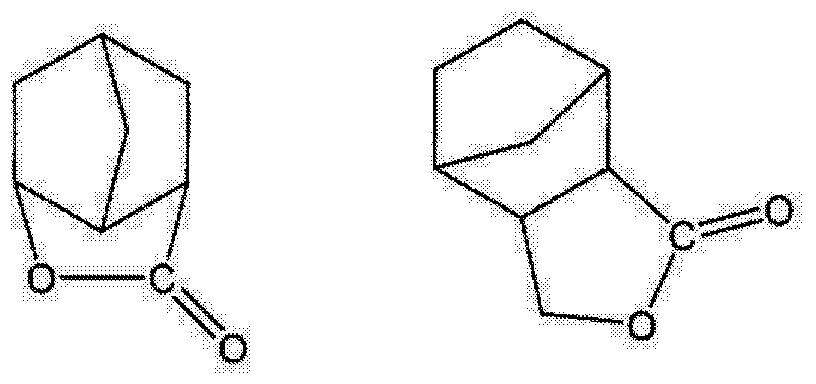
具体的には、ラタトン含有単環式基としては、 γ —プチ口ラタトンから水素原子 1つ を除いた基が挙げられる。また、ラタトン含有多環式基としては、ラタトン環を有するビ シクロアルカン、トリシクロアルカン、テトラシクロアルカンから水素原子一つを除いた 基が挙げられる。特に、以下のような構造式を有するラタトン含有トリシクロアルカンか ら水素原子を 1つを除いた基が、工業上入手し易いなどの点で有利である。
[0057] [化 20]
Figure imgf000024_0001
[0058] 構成単位(a2)の例として、より具体的には、下記一般式 (a2—:!)〜(a2— 5)で表 される構成単位が挙げられる。
[0059] [化 21]
Figure imgf000025_0001
{82-5}
[0060] [式中、 Rは前記と同じであり、 R'は水素原子、低級アルキル基、または炭素数 1〜5 のアルコキシ基であり、 mは 0または 1の整数である。 ]
[0061] 一般式(a2 _ :!)〜(a2 _ 5)における R'の低級アルキル基としては、前記構成単位
(al)における Rの低級アルキル基と同じである。
一般式 (a2 _ :!)〜(a2 _ 5)中、 R'は、工業上入手が容易であること等を考慮する と、水素原子が好ましい。
[0062] 前記一般式 (a2—:!)〜(a2— 5)の具体的な構成単位を例示する。
[0063] [化 22]
Figure imgf000026_0001
0
Figure imgf000026_0002
]
[9900]
Figure imgf000027_0001
Figure imgf000028_0001
6]
Figure imgf000029_0001
[0068] 一般式 (a2 _ :!)〜(a2 _ 5)中、 R'は、工業上入手が容易であること等を考慮する と、水素原子が好ましい。
これらの中でも、一般式 (a2—:!)〜(a2 _ 5)から選択される少なくとも 1種以上を用 レ、ることが好ましぐ一般式 (a2—:!)〜(a2— 3)から選択される少なくとも 1種以上を 用いることが好ましい。具体的には、化学式(a2— 1— 1)、 (a2— l— 2)、 (a2— 2— 1 )、(a2— 2— 2)、(a2— 3— 1)、 (a2— 3— 2)、(a2— 3— 9)及び(a2— 3— 10)から 選択される少なくとも 1種以上を用いることが好ましい。
[0069] 樹脂成分 (A)において、構成単位(a2)としては、 1種を単独で用いてもよぐ 2種以 上を組み合わせて用いてもよい。
樹脂成分 (A)中の構成単位 (a2)の割合は、樹脂成分 (A)を構成する全構成単位 の合計に対して、 5〜60モノレ0 /0力 S好ましく、 15〜50モノレ0 /0力 Sより好ましく、 25〜50 モル%がさらに好ましい。下限値以上とすることにより構成単位(a2)を含有させること による効果が充分に得られ、上限値以下とすることにより他の構成単位とのバランス をとることができる。
[0070] 本発明において、樹脂成分 (A)は、これらの構成単位(al)および(a2)の両方を有 する共重合体であることが、本発明の効果に優れることから好ましい。
[0071] ·構成単位(a3)
樹脂成分 (A)は、前記構成単位 (al)に加えて、または前記構成単位 (al)および( a2)に加えて、さらに極性基含有脂肪族炭化水素基を含有するアクリル酸エステル 力 誘導される構成単位(a3)を有してレ、てもよレ、。構成単位(a3)を有することにより 、(A)成分の親水性が高まり、現像液との親和性が高まって、露光部でのアルカリ溶 解性が向上し、解像性の向上に寄与する。
極性基としては、水酸基、シァノ基、カルボキシ基、アルキル基の水素原子の一部 力 Sフッ素原子で置換されたヒドロキシアルキル基等が挙げられ、特に水酸基が好まし レ、。
脂肪族炭化水素基としては、炭素数 1〜: 10の直鎖状または分岐状の炭化水素基( 好ましくはアルキレン基)や、多環式の脂肪族炭化水素基 (多環式基)力 S挙げられる。 該多環式基としては、例えば ArFエキシマレーザー用レジスト組成物用の樹脂にお レ、て、多数提案されてレ、るものの中力 適宜選択して用いることができる。
その中でも、水酸基、シァノ基、カルボキシ基、またはアルキル基の水素原子の一 部がフッ素原子で置換されたヒドロキシアルキル基を含有する脂肪族多環式基を含 み、かつアクリル酸エステル力 誘導される構成単位がより好ましい。該多環式基とし ては、ビシクロアルカン、トリシクロアルカン、テトラシクロアルカンなどから 1個以上の 水素原子を除いた基などを例示できる。具体的には、ァダマンタン、ノルボルナン、ィ ソボルナン、トリシクロデカン、テトラシクロドデカンなどのポリシクロアルカンから 1個以 上の水素原子を除いた基などが挙げられる。この様な多環式基は、 ArFエキシマレ 一ザ一用レジスト組成物用のポリマー(樹脂成分)において、多数提案されているも のの中力 適宜選択して用いることができる。これらの多環式基の中でも、ァダマンタ ンから 2個以上の水素原子を除いた基、ノルボルナンから 2個以上の水素原子を除 いた基、テトラシクロドデカンから 2個以上の水素原子を除いた基が工業上好ましい。
[0072] 構成単位 (a3)としては、極性基含有脂肪族炭化水素基における炭化水素基が炭 素数 1〜: 10の直鎖状または分岐状の炭化水素基のときは、アクリル酸のヒドロキシェ チルエステル力 誘導される構成単位が好ましぐ該炭化水素基が多環式基のとき は、下記式(a3— 1)で表される構成単位、 (a3— 2)で表される構成単位、(a3— 3) で表される構成単位が好ましいものとして挙げられる。
[0073] [化 27]
Figure imgf000031_0001
[0074] (式中、 Rは前記に同じであり、 jは:!〜 3の整数であり、 kは 1〜3の整数であり、 t'は 1 〜3の整数であり、 1は:!〜 5の整数であり、 sは:!〜 3の整数である。 )
[0075] 式(a3 _ l)中、 jは 1又は 2であることが好ましぐ 1であることがさらに好ましレ、。 jが 2 の場合は、水酸基がァダマンチル基の 3位と 5位に結合しているものが好ましい。 jが 1の場合は、水酸基がァダマンチル基の 3位に結合しているものが好ましい。
[0076] 式(a3 _ 2)中、 kは 1であることが好ましレ、。シァノ基はノルボルニル基の 5位または 6位に結合していることが好ましい。
[0077] 式(a3— 3)中、 t'は 1であることが好ましい。 1は 1であることが好ましい。 sは 1である ことが好ましい。これらはアクリル酸のカルボキシ基の末端に 2—ノルボルニル基また は 3—ノルボルニル基が結合していることが好ましい。フッ素化アルキルアルコール はノルボルニル基の 5又は 6位に結合していることが好ましい。
[0078] 構成単位(a3)としては、 1種を単独で用いてもよぐ 2種以上を組み合わせて用い てもよい。
樹脂成分 (A)が構成単位 (a3)を有する場合、樹脂成分 (A)中、構成単位 (a3)の 割合は、当該樹脂成分 (A)を構成する全構成単位に対し、 5〜50モル%であること が好ましぐさらに好ましくは 15〜45モル%、最も好ましくは 15〜35モル%である。
[0079] ·構成単位(a4)
樹脂成分 (A)は、本発明の効果を損なわない範囲で、上記構成単位 (al)〜(a3) 以外の他の構成単位(a4)を含んでレ、てもよレ、。
構成単位(a4)は、上述の構成単位(al )〜(a3)に分類されなレ、他の構成単位で あれば特に限定するものではなぐ ArFエキシマレーザー用、 KrFエキシマレーザー 用(好ましくは ArFエキシマレーザー用)等のレジスト用樹脂に用いられるものとして 従来から知られている多数のものが使用可能である。
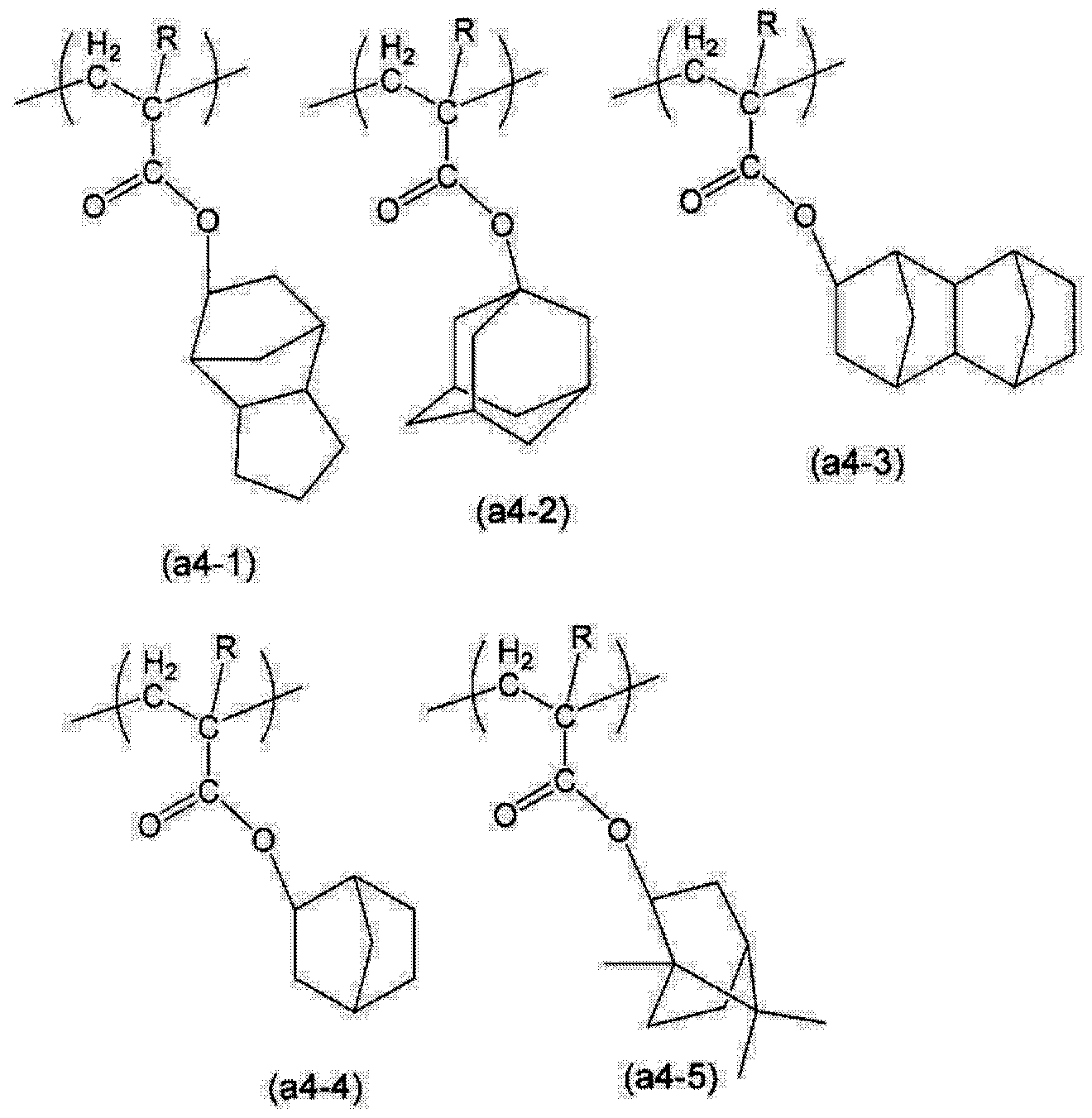
構成単位 (a4)としては、例えば酸非解離性の脂肪族多環式基を含み、かつアタリ ル酸エステル力 誘導される構成単位などが好ましい。該多環式基は、例えば、前 記の構成単位(al)の場合に例示したものと同様のものを例示することができ、 ArF エキシマレーザー用、 KrFエキシマレーザー用(好ましくは ArFエキシマレーザー用 )等のレジスト組成物の樹脂成分に用いられるものとして従来から知られている多数 のものが使用可能である。
特にトリシクロデカニル基、ァダマンチル基、テトラシクロドデカニル基、イソボル二 ル基、ノルボルニル基から選ばれる少なくとも 1種以上であると、工業上入手し易いな どの点で好ましい。これらの多環式基は、炭素数 1〜5の直鎖又は分岐状のアルキル 基で置換されていてもよい。
構成単位(a4)として、具体的には、下記一般式 (a4—:!)〜(a4_ 5)の構造のもの を列示すること力 Sできる。
[0080] [化 28]
Figure imgf000033_0001
[0081] (式中、 Rは前記と同じである。 )
[0082] かかる構成単位 (a4)は、樹脂成分 (A)の必須成分ではなレ、が、これを樹脂成分( A)に含有させる際には、樹脂成分 (A)を構成する全構成単位の合計に対して、構 成単位(a4)を 1〜30モル0 /0、好ましくは 10〜20モル0 /0含有させると好ましい。
[0083] 樹脂成分 (A)は、各構成単位を誘導するモノマーを、例えばァゾビスイソプチロニト リル (AIBN)のようなラジカル重合開始剤を用いた公知のラジカル重合等によって重 合させることによって得ることができる。
[0084] ·特定の末端構造を有する構成単位 (Ml)
また、樹脂成分 (A)は、ポリマー末端に炭素原子に結合した水酸基を有し、当該水 酸基のひ位の炭素原子が、少なくともひとつの電子吸引性基を有する末端構造を有 することが好ましい。
前記電子吸引性基としては、例えばハロゲン原子、ハロゲンィヒアルキル基等が挙 げられる。
ハロゲン原子としてはフッ素原子、塩素原子等が挙げられる力 フッ素原子が好ま しい。
ハロゲン化アルキル基において、ハロゲンは前記ハロゲン原子と同様である。アル キル基は炭素数、例えば 1〜3程度の低級アルキル基が望ましぐ好ましくはメチル 基またはェチル基、最も好ましくはメチル基である。具体的には、例えばトリフルォロ メチノレ基、ジフルォロメチル基、モノフルォロメチル基、パーフルォロェチル基等が挙 げられる力 特にトリフルォロメチル基が好ましい。
電子吸引性基の数は、 1または 2であり、好ましくは 2である。
[0085] 前記炭素原子に結合した水酸基を有し、当該水酸基のひ位の炭素原子が、少なく ともひとつの電子吸引性基を有するとは、より具体的かつ好適には、—CI^I^OH基 を有し、 R1及び R2は、それぞれ独立にアルキル基、ハロゲン原子、又はハロゲン化ァ ルキル基であり、その少なくともひとつはハロゲン原子又はハロゲン化アルキル基か ら選ばれる電子吸引性基であるものとして、表すことができる。
ここでのハロゲン原子、又はハロゲン化アルキル基とは前記したものと同様であり、 アルキル基としては、メチル基、ェチル基、プロピル基などの低級アルキル基が挙げ られる。そして、その電子吸引性基は、前記したようにフッ素原子又はフッ素化アルキ ル基が好ましぐ特には R1及び R2がともにフッ素化アルキル基、中でもトリフルォロメ チル基であるとき力 合成上、また LER (ラインエッジラフネス:ライン側壁の不均一な 凹凸)を小さくする効果に優れ好ましい。
[0086] 樹脂成分 (A)において、ポリマー末端に結合している— CI^I^OH基(以下、当該 基を「末端構造」とレ、う場合がある)を有する構成単位 (Ml)の割合が、樹脂成分 (A) を構成する全構成単位のうち、前記構成単位 (Ml)以外の構成単位の合計 100モ ル%に対して、 1モル%以上(好ましくは 2モル%以上)であることが好ましい。なお、 構成単位 (Ml)以外の構成単位の合計には、例えばラジカル重合で用いられるァゾ ビスイソプチロニトリル (AIBN)等の公知の重合開始剤から誘導される構成単位ゃ樹 脂の主成分たるモノマーから誘導される単位を含む。
上限値は特に限定する意義はないが、製造方法等に起因して実用的には例えば 5 モル%以下とされる。また、 1モル%以上とすることにより、末端構造を導入したことに よる現像欠陥の低減や LERの改善効果に優れる。これ以下だとこれらの効果に劣る 傾向がある。なお、当然であるが構成単位 (Ml)のモル数は、末端構造のモル数、 水酸基のモル数と等しレ、。
[0087] 該末端構造は、例えばモノマーと重合開始剤を用いたラジカル重合によってポリマ 一を生成する際に、—CI^R^H基を有する連鎖移動剤を添加することによりポリマ 一末端に導入することができる。この場合、当該末端構造を有する構成単位 (Ml)と は、この連鎖移動剤から誘導される構成単位 (Ml)である。
連鎖移動剤は、例えば一般式「X_R' - ^Ι 2〇Η」で示される。
当該式中、 Xは水酸基またはチオール基であり、当該連鎖移動剤は、水酸基また はチオール基の水素原子が脱離して、ポリマー末端に結合する。従って、この場合、 構成単位(Ml)とは、「X_R' - CR'^OHJにおける Xの水酸基またはチオール 基から水素原子を除いた単位となる。なお、反応性の点から、 Xはチオール基が好ま しい。
また、「X— R'— CR'R'OHjにおける R'は 2価の脂肪族炭化水素基(直鎖、分岐 鎖、環状のいずれでもよい)または 2価の芳香族炭化水素基であり、これらの内、直 鎖または分岐鎖状の脂肪族炭化水素基が好ましい。
脂環式基としては、例えばシクロへキシレン基等が挙げられる。芳香族炭化水素基 としては、例えば p—フエ二レン基等が挙げられる。
直鎖または分岐鎖状の脂肪族炭化水素基としては、例えばメチレン基、エチレン基 、 n—プロピレン基、イソプロピレン基等が挙げられる力 エチレン基、 n—プロピレン 基が好ましい。
好ましい連鎖移動剤の一般式は、 SH_ (CH ) -C (CF ) _〇H (mは 2
2 m 3 2 〜4の 整数)で表される。これにより、好ましい構成単位 (Ml)は— S _ (CH ) -C (CF )
2 m 3 2
_ OHで表される。
[0088] 末端構造の割合 (構成単位 (Ml)の割合)は、例えば仕込みのモノマーの量や前 記連鎖移動剤の量を調整したり、前記連鎖移動剤を添加するタイミングを調整してレ ジスト組成物用樹脂の質量平均分子量を調整することにより、変ィヒさせること力できる また、合成後のレジスト組成物用樹脂においては、末端構造のモル数 (構成単位( Ml)のモル数)は例えばプロトン— NMR、カーボン NMR等の NMR (核磁気共鳴ス ぺクトル)によって測定することができる。
[0089] 樹脂成分 (A)の質量平均分子量 (Mw) (ゲルパーミエーシヨンクロマトグラフィーに よるポリスチレン換算基準)は、特に限定するものではないが、 2000〜50000が好ま しく、 3000〜30000力 Sより好ましく、 5000〜20000カ最も好ましレヽ。この範囲の上 限よりも小さいと、レジストとして用いるのに充分なレジスト溶剤への溶解性があり、こ の範囲の下限よりも大きい、耐ドライエッチング性やレジストパターン断面形状が良好 である。
また分散度(Mw/Mn) fま 1. 0〜5. 0カ好ましく、 1. 0〜3. 0力 Sより好ましく、 1. 2 〜2. 5が最も好ましい。
[0090] <酸発生剤成分 (B) >
本発明においては、前記一般式 (b— 1)で表されるカチオン部を有するォニゥム塩 系酸発生剤(B1)、および前記一般式 (b— 2)で表される構造を有するォキシムスノレ ホネート系酸発生剤(B2)が必須の成分として用いられる。
•(B1)成分
前記一般式(b— l)において、 R1"はアルキル基、アルコキシ基、ハロゲン原子、ま たは水酸基を表し、 nは 0または 1〜3の整数を表す。 nが 2または 3であるとき、該複 数の R1"は互いに同じであってもよぐ異なっていてもよい。
前記 R1"としてのアルキル基は、炭素数 1〜5のアルキル基が好ましぐメチル基、ェ チノレ基、プロピル基、 n-ブチル基、 tert-ブチル基であることが最も好ましい。
前記 R1"としてのアルコキシ基は、炭素数 1〜5のアルコキシ基が好ましぐメトキシ 基、エトキシ基が最も好ましい。
前記 R1"としてのハロゲン原子は、フッ素原子であることが好ましい。
前記 nは好ましくは 0又は 1であり、より好ましくは 0である。
[0091] 前記一般式 (b_ l)において、 R2"、 R3"はそれぞれ独立に、置換基を有していても ょレヽァリール基またはアルキル基を表す。 R2"、 R3"としてのァリール基は、特に制限はなぐ例えば、炭素数 6〜20のァリール 基であって、該ァリール基は、その水素原子の一部または全部がアルキル基、アルコ キシ基、ハロゲン原子、水酸基等で置換されていてもよぐされていなくてもよい。ァリ ール基としては、安価に合成可能なことから、炭素数 6〜: 10のァリール基が好ましい 。具体的には、たとえばフエニル基、ナフチル基が挙げられる。
前記ァリール基の水素原子が置換されている場合の該置換基としてアルキル基は、 前記 R1"としてのアルキル基と同様である。
前記ァリール基の水素原子が置換されている場合の該置換基としてのアルコキシ基 は、前記 R1"としてのアルコキシ基と同様である。
前記ァリール基の水素原子が置換されている場合の該置換基としてのハロゲン原子 は、前記 R1"としてのハロゲン原子と同様である。
前記 "、 R3"としてのアルキル基は、特に制限はなぐ例えば炭素数 1〜: 10の直鎖 状、分岐状または環状のアルキル基等が挙げられる。解像性に優れる点から、炭素 数 1〜5であることが好ましい。具体的には、メチル基、ェチル基、 n—プロピル基、ィ ソプロピル基、 n—ブチル基、イソブチル基、 n—ペンチル基、シクロペンチル基、へ キシル基、シクロへキシル基、ノニノレ基、デカニル基等が挙げられ、解像性に優れ、 また安価に合成可能なことから好ましいものとして、メチル基を挙げることができる。 前記 R2"、R3"が両方ともフエニル基であることが最も好ましい。
[0092] (B1)成分におけるァニオン部は特に制限されず、ォニゥム塩系酸発生剤のァニォ ン部として知られているものを適宜用いることができる。
例えば、一般式「R4"SO— (R4"は、直鎖、分岐または環状のアルキル基またはフッ
3
素化アルキル基を表す。)」で表されるァニオン部、下記一般式 (b— 3)で表されるァ 二オン部、下記一般式 (b_4)で表されるァニオン部等を用いることができる。
[0093] [化 29]
Figure imgf000037_0001
[0094] [式中、 X"は、少なくとも 1つの水素原子がフッ素原子で置換された炭素数 2〜6のァ ルキレン基を表し; Υ"、 Ζ"は、それぞれ独立に、少なくとも 1つの水素原子がフッ素 原子で置換された炭素数:!〜 10のアルキル基を表す。 ]
[0095] 前記一般式「R4"SO _」において、 R4"は、直鎖、分岐または環状のアルキル基ま
3
たはフッ素化アルキル基を表す。
前記 R4"としてのアルキル基は、炭素数 1〜: 10であることが好ましぐ炭素数:!〜 8で あることがさらに好ましぐ炭素数 1〜4であることが最も好ましい。
前記 R4"としての環状のアルキル基は、前記 "、 R3"として示した環式基であって、 炭素数 4〜: 15であることが好ましぐ炭素数 4〜: 10であることがさらに好ましぐ炭素 数 6〜: 10であることが最も好ましい。
前記 R4"としてのフッ素化アルキル基は、炭素数 1〜: 10であることが好ましぐ炭素数 :!〜 8であることがさらに好ましぐ炭素数 1〜4であることが最も好ましい。また。該フッ 化アルキル基のフッ素化率(アルキル基中のフッ素原子の割合)は、好ましくは 10〜 100%、さらに好ましくは 50〜100%であり、特に水素原子をすベてフッ素原子で置 換したもの力 酸の強度が強くなるので好ましレ、。
R4"としては、直鎖または環状のアルキル基、またはフッ素化アルキル基であること が最も好ましい。
[0096] 前記一般式 (b— 3)において、 X"は、少なくとも 1つの水素原子がフッ素原子で置 換された直鎖状または分岐状のアルキレン基であり、該アルキレン基の炭素数は 2〜 6であり、好ましくは炭素数 3〜5、最も好ましくは炭素数 3である。
前記一般式 (b_4)において、 Y"、 Ζ"は、それぞれ独立に、少なくとも 1つの水素 原子がフッ素原子で置換された直鎖状または分岐状のアルキル基であり、該アルキ ル基の炭素数は 1〜: 10であり、好ましくは炭素数 1〜7、より好ましくは炭素数 1〜3で ある。
X"のアルキレン基の炭素数または Υ"、 Ζ"のアルキル基の炭素数は、上記炭素数 の範囲内において、レジスト溶媒への溶解性も良好である等の理由により、小さいほ ど好ましい。 また、 X"のアルキレン基または Y"、 Ζ"のアルキル基において、フッ素原子で置換さ れている水素原子の数が多いほど、酸の強度が強くなるため好ましい。該アルキレン 基またはアルキル基中のフッ素原子の割合、すなわちフッ素化率は、好ましくは 70 〜100%、さらに好ましくは 90〜100%であり、最も好ましくは、全ての水素原子がフ ッ素原子で置換されたパーフルォロアルキレン基またはパーフルォロアルキル基で ある。
[0097] (B1)成分のァニオン部として、中でも一般式「R4"S〇 _」で表されるァニオン部が
3
好ましぐ R4"がフッ素化アルキル基であるものがより好ましい。
[0098] (B1)成分の好ましい具体例を以下に挙げる。
[化 30]
Figure imgf000039_0001
[0099] これらの中でも、前記化学式 (bl— 01)〜(bl—06)力も選択される少なくとも 1種 を用いることが好ましい。 * (B2)成分
前記一般式 (b— 2)において、 R21 'は有機基を表し、 R22'は 1価の有機基、または シァノ基を表す。
本発明において、有機基は、炭素原子を含む基であり、炭素原子以外の原子(たと えば水素原子、酸素原子、窒素原子、硫黄原子、ハロゲン原子 (フッ素原子、塩素原 子等)等)を有していてもよい。
R21 'としての有機基は、直鎖、分岐または環状のアルキル基またはァリール基が好 ましレ、。これらのアルキル基、ァリール基は置換基を有していてもよレ、。該置換基とし ては、特に制限はなぐたとえばフッ素原子、炭素数 1〜6の直鎖、分岐または環状の アルキル基等が挙げられる。ここで、「置換基を有する」とは、アルキル基またはァリー ル基の水素原子の一部または全部が置換基で置換されていることを意味する。 アルキル基としては、炭素数 1〜20が好ましぐ炭素数 1〜: 10がより好ましぐ炭素 数 1〜8がさらに好ましぐ炭素数 1〜6が特に好ましぐ炭素数 1〜4が最も好ましい。 アルキル基としては、特に、部分的にまたは完全にハロゲンィ匕されたアルキル基(以 下、ハロゲン化アルキル基ということがある)が好ましい。なお、部分的にハロゲン化さ れたアルキル基とは、水素原子の一部がハロゲン原子で置換されたアルキル基を意 味し、完全にハロゲン化されたアルキル基とは、水素原子の全部がハロゲン原子で 置換されたアルキル基を意味する。ハロゲン原子としては、フッ素原子、塩素原子、 臭素原子、ヨウ素原子等が挙げられ、特にフッ素原子が好ましい。すなわち、ハロゲ ン化アルキル基は、フッ素化アルキル基であることが好ましレ、。
ァリール基は、炭素数 4〜20が好ましぐ炭素数 4〜: 10がより好ましぐ炭素数 6〜1 0が最も好ましい。ァリール基としては、特に、部分的にまたは完全にハロゲン化され たァリール基が好ましい。なお、部分的にハロゲン化されたァリール基とは、水素原 子の一部がハロゲン原子で置換されたァリール基を意味し、完全にハロゲン化され たァリール基とは、水素原子の全部がハロゲン原子で置換されたァリール基を意味 する。
R21 'としては、特に、置換基を有さない炭素数 1〜4のアルキル基、または炭素数 1 〜4のフッ素化アルキル基が好ましレ、。 [0101] R^'としての有機基は、直鎖、分岐または環状のアルキル基、ァリール基またはシ ァノ基が好ましい。 R22'のアルキル基、ァリール基としては、前記 R21 'で挙げたアル キル基、ァリール基と同様のものが挙げられる。
R22'としては、特に、シァノ基、置換基を有さない炭素数 1〜8のアルキル基、また は炭素数 1〜8のフッ素化アルキル基が好ましい。
[0102] (B2)成分として、さらに好ましいものとしては、下記一般式(B— 2)または(B— 3) で表される化合物が挙げられる。
[0103] [化 31]
Figure imgf000041_0001
[0104] [式(B— 2)中、 Rdlは、シァノ基、置換基を有さないアルキル基また
ルキル基である。 R32はァリール基である。 R33は置換基を有さないアルキル基または ハロゲン化アルキル基である。 ]
[0105] [化 32]
Figure imgf000041_0002
[0106] [式(B— 3)中、 Rd4はシァノ基、置換基を有さないアルキル基またはハロゲン化アル キル基である。 R35は 2または 3価の芳香族炭化水素基である。 R36は置換基を有さな いアルキル基またはハロゲン化アルキル基である。 pは 2または 3である。 ]
[0107] 前記一般式(B— 2)において、 R31の置換基を有さないアルキル基またはハロゲン 化アルキル基は、炭素数が 1〜: 10であることが好ましぐ炭素数 1〜8がより好ましぐ 炭素数 1〜6が最も好ましい。
R31としては、ハロゲン化アルキル基が好ましぐフッ素化アルキル基がより好ましい Rdlにおけるフッ素化アルキル基は、アルキル基の水素原子が 50%以上フッ素化さ れていることが好ましぐより好ましくは 70%以上、さらに好ましくは 90%以上フッ素 化されていることが好ましい。
[0108] R32のァリール基としては、フエニル基、ビフヱニル(biphenylyl)基、フルォレニル( fhiorenyl)基、ナフチル基、アントラセル(anthracyl)基、フエナントリル基等の、芳 香族炭化水素の環から水素原子を 1つ除いた基、およびこれらの基の環を構成する 炭素原子の一部が酸素原子、硫黄原子、窒素原子等のへテロ原子で置換されたへ テロアリール基等が挙げられる。これらのなかでも、フルォレニル基が好ましい。
R32のァリール基は、炭素数 1〜10のアルキル基、ハロゲン化アルキル基、アルコキ シ基等の置換基を有していても良レ、。該置換基におけるアルキル基またはハロゲン 化アルキル基は、炭素数が 1〜8であることが好ましぐ炭素数 1〜4がさらに好ましい 。また、該ハロゲン化アルキル基は、フッ素化アルキル基であることが好ましい。
[0109] R33の置換基を有さないアルキル基またはハロゲンィヒアルキル基は、炭素数が:!〜
10であることが好ましぐ炭素数 1〜8がより好ましぐ炭素数 1〜6が最も好ましい。
R33としては、ハロゲン化アルキル基が好ましぐフッ素化アルキル基がより好ましレヽ
R33におけるフッ素化アルキル基は、アルキル基の水素原子が 50%以上フッ素化さ れていることが好ましぐより好ましくは 70%以上、さらに好ましくは 90%以上フッ素 化されていることが、発生する酸の強度が高まるため好ましい。最も好ましくは、水素 原子が 100%フッ素置換された完全フッ素化アルキル基である。
[0110] 前記一般式(B_ 3)において、 R34の置換基を有さないアルキル基またはハロゲン 化アルキル基としては、上記 R31の置換基を有さなレ、アルキル基またはハロゲン化ァ ルキル基と同様のものが挙げられる。
R35の 2または 3価の芳香族炭化水素基としては、上記 R32のァリール基からさらに 1 または 2個の水素原子を除いた基が挙げられる。
R36の置換基を有さなレ、アルキル基またはハロゲンィ匕アルキル基としては、上記 3 の置換基を有さないアルキル基またはハロゲン化アルキル基と同様のものが挙げら れる。
pは好ましくは 2である。
(B2)成分の具体例としては、 α - (ρ-トルエンスルホニルォキシィミノ) -ベンジルシ アニド、 ひ- (ρ-クロ口ベンゼンスルホニルォキシィミノ) -ベンジルシアニド、 ひ - (4-二 トロベンゼンスルホニルォキシィミノ) -ベンジルシアニド、 ひ - (4-ニトロ- 2-トリフルォ ロメチルベンゼンスルホニルォキシィミノ) -ベンジルシアニド、 ひ - (ベンゼンスルホ二 ルォキシィミノ) -4-クロ口ベンジルシアニド、 ひ - (ベンゼンスルホニルォキシィミノ) -2 , 4-ジクロロベンジルシアニド、 ひ- (ベンゼンスルホニルォキシィミノ) -2, 6-ジクロロ ベンジルシアニド、 ひ - (ベンゼンスルホニルォキシィミノ) -4-メトキシベンジルシア二 ド、 ひ - (2-クロ口ベンゼンスルホニルォキシィミノ) -4-メトキシベンジルシアニド、 ひ - ( ベンゼンスルホニルォキシィミノ) -チェン- 2-ィルァセトニトリル、 a - (4-ドデシルペン ゼンスルホニルォキシィミノ) -ベンジルシアニド、 ひ - [ (p-トルエンスルホニルォキシ ィミノ) -4-メトキシフエニル]ァセトニトリル、 α - [ (ドデシルベンゼンスルホニルォキシ ィミノ) -4-メトキシフヱニル]ァセトニトリル、 a - (トシルォキシィミノ) -4-チェ二ルシア ニド、 α- (メチルスルホニルォキシィミノ) -1-シクロペンテ二ルァセトニトリル、 α- (メ チルスルホニルォキシィミノ)- 1-シクロへキセニルァセトニトリル、 a - (メチルスルホニ ルォキシィミノ)- 1-シクロヘプテュルァセトニトリル、 a - (メチルスルホニルォキシイミ ノ) -1-シクロォクテ二ルァセトニトリル、 a - (トリフルォロメチルスルホニルォキシィミノ ) -1-シクロペンテ二ルァセトニトリル、 a - (トリフルォロメチルスルホニルォキシィミノ) -シクロへキシルァセトニトリル、 a - (ェチルスルホニルォキシィミノ) -ェチルァセトニト リル、 α - (プロピルスルホニルォキシィミノ)-プロピルァセトニトリル、 α- (シクロへキ シルスルホニルォキシィミノ) -シクロペンチルァセトニトリル、 a - (シクロへキシルスル ホニルォキシィミノ) -シクロへキシルァセトニトリル、 a - (シクロへキシルスルホニルォ キシィミノ) -1-シクロペンテ二ルァセトニトリル、 ひ - (ェチルスルホニルォキシィミノ) - 1-シクロペンテ二ルァセトニトリル、 a - (イソプロピルスルホニルォキシィミノ) -1-シク 口ペンテ二ルァセトニトリル、 ひ - (n-ブチルスルホニルォキシィミノ) -1-シクロペンテ 二ルァセトニトリル、 a - (ェチルスルホニルォキシィミノ) -1-シクロへキセニルァセトニ トリル、 a - (イソプロピルスルホニルォキシィミノ) -1-シクロへキセニルァセトニトリル、 a - (n-ブチルスルホニルォキシィミノ) - 1 -シクロへキセニルァセトニトリル、 a (メチ ルスルホニルォキシィミノ) フエ二ルァセトニトリル、 a (メチルスルホニルォキシィ ミノ) p メトキシフエ二ルァセトニトリル、 a (トリフルォロメチルスルホニルォキシ ィミノ)—フエ二ルァセトニトリル、 a - (トリフルォロメチルスルホニルォキシィミノ) _p —メトキシフエ二ルァセトニトリル、 α - (ェチルスルホニルォキシィミノ) _ρ メトキシ フエ二ルァセトニトリル、 α - (プロピルスルホニルォキシィミノ) _p _メチルフエ二ノレ ァセトニトリル、 a - (メチルスルホニルォキシィミノ) _p _ブロモフエ二ルァセトニトリ ルなどが挙げられる。
また、下記化学式で表される化合物が挙げられる。
[化 33]
Figure imgf000045_0001
CH3-C=N-OS02-(CH2}3CH3
[0113] また、前記一般式 (B— 2)または(B_3)で表される化合物のうち、好ましい化合物 の例を下記に示す。
[0114] [化 34] [S ^ ] [9Π0]
Figure imgf000046_0001
Zdf/X3d iZ9^90/900r OM
Figure imgf000047_0001
[0116] 上記例示化合物の中でも、下記の 3つの化合物が好ましい [0117] [化 36] [0118] [化 37]
%~«i- os¾ (c 》 3
CH3-C«N-QS02-CCHg)3CM3
[0119] [化 38]
Figure imgf000048_0001
[0120] 本発明のポジ型レジスト組成物中における(Bl)成分と(B2)成分の含有量の質量 it (B1): (Β2) ίま、 10 : 90〜90 : 10カ好ましく、 25: 75〜75: 25力 Sより好ましく、 40 : 60-60: 40がさらに好ましい。 (B1)成分と(Β2)成分の質量比を上記の範囲内とす ると、パターン形状、 ELマージン、および寸法忠実性の各特性を向上させることがで きる。
本発明のポジ型レジスト組成物中における(B1)成分の含有量は、 (Α)成分の 100 質量部に対して 1〜: 10質量部が好ましぐ 3〜7質量部がより好ましぐ 5〜7質量部 力^らに好ましい。 (B1)成分の含有量を上記範囲の下限値以上とすることにより充 分な効果が得られる。一方、スカムの発生を抑えて良好な形状を得るためには上記 範囲の上限値以下とすることが好ましレ、。
本発明のポジ型レジスト組成物中における(Β2)成分の含有量は、(Α)成分の 100 質量部に対して 1〜: 10質量部が好ましぐ 2〜8質量部がより好ましぐ 3〜7質量部 力^らに好ましい。 (Β2)成分の含有量を上記範囲の下限値以上とすることにより充 分な効果が得られる。また本発明のポジ型レジスト組成物の良好な塗布性を得るた めには上記範囲の上限値以下とすることが好ましい。
[0121] 本発明において、(Β)成分として、前記(B1)成分および (Β2)成分以外の他の酸 発生剤成分を 1種または 2種以上含有させてもょレ、。該他の酸発生剤成分は特に限 定されず、これまで化学増幅型レジスト用の酸発生剤として提案されているものを使 用すること力 Sできる。例えば、前記(B1)成分および(B2)成分に含まれない、スルホ 二ゥム塩ゃョードニゥム塩などのォニゥム塩系酸発生剤、ォキシムスルホネート系酸 発生剤、ビスアルキルまたはビスァリールスルホニルジァゾメタン類、ポリ(ビススルホ ニル)ジァゾメタン類などのジァゾメタン系酸発生剤、ニトロべンジルスルホネート系酸 発生剤、イミノスルホネート系酸発生剤、ジスルホン系酸発生剤など多種のものが知 られている。
本発明のポジ型レジスト組成物における(B)成分の合計の含有量は、(A)成分 10 0質量部に対し、 2〜20質量部が好ましぐ 5〜: 15質量部がより好ましぐ 8〜: 14質量 部であることが最も好ましい。上記範囲内とすることでパターン形成が十分に行われ 、良好な特性が得られる。また、均一な溶液が得られ、保存安定性が良好となるため 好ましい。
(B)成分の合計のうち、前記 (B1)成分と (B2)成分の合計が占める割合は 50質量 %以上が好ましぐ 75質量%以上がより好ましぐ 100質量%が最も好ましい。
く含窒素有機化合物 (D) >
本発明のポジ型レジスト組成物には、レジストパターン形状、引き置き経時安定性( post exposure stability of the latent image formed by the pattern-wise exposure of t he resist layer)などを向上させるために、さらに任意の成分として、含窒素有機化合 物(D)を配合させること力 Sできる。
この(D)成分は、既に多種多様なものが提案されているので、公知のものから任意 に用いれば良いが、脂肪族ァミン、特に第 2級脂肪族アミンゃ第 3級脂肪族ァミンが 好ましい。
脂肪族ァミンとしては、アンモニア NHの水素原子の少なくとも 1つを、炭素数 12以
3
下のアルキル基またはヒドロキシアルキル基で置換したァミン(アルキルアミンまたは アルキルアルコールァミン)が挙げられる。その具体例としては、 n—へキシルァミン、 n—ヘプチルァミン、 n—オタチノレアミン、 n—ノニルァミン、 n—デシルァミン等のモノ アルキルァミン;ジェチルァミン、ジ _n—プロピルァミン、ジ— n—ヘプチルァミン、ジ _n—ォクチルァミン、ジシクロへキシルァミン等のジアルキルァミン;トリメチルァミン 、トリェチルァミン、トリ— n—プロピルァミン、トリ— n—ブチルァミン、トリ— n—へキシ ノレアミン、トリー n—ペンチルァミン、トリー n プチルァミン、トリー n—ォクチルアミ ン、トリ一 n—ノエルァミン、トリ一 n—デカニルァミン、トリ一 n—ドデシルァミン等のトリ アルキルァミン;ジエタノールァミン、トリエタノールァミン、ジイソプロパノールァミン、 トリイソプロパノールァミン、ジ _n_ォクタノールアミン、トリ一 n_ォクタノールアミン 等のアルキルアルコールァミン等が挙げられる。これらの中でも、アルキルアルコー ルァミン及びトリアルキルァミンが好ましぐアルキルアルコールァミンが最も好ましい 。アルキルアルコールァミンの中でもトリエタノールアミンゃトリイソプロパノールァミン が最も好ましい。
これらは単独で用いてもょレ、し、 2種以上を組み合わせて用いてもょレ、。
(D)成分は、(A)成分 100質量部に対して、通常 0. 01 5. 0質量部の範囲で用 いられる。
< (E)成分 >
また、本発明のポジ型レジスト組成物には、前記(D)成分の配合による感度劣化の 防止、またレジストパターン形状、引き置き経時安定性(post exposure stability of the latent image formed oy the pattern-wise exposure of the resist layer 等の向上の目 的で、さらに任意の成分として、有機カルボン酸又はリンのォキソ酸若しくはその誘導 体 )(本明細書では (E)成分という)を含有させることができる。なお、(D)成分と (E )成分は併用することもできるし、レ、ずれ力 1種を用いることもできる。
有機カルボン酸としては、例えば、マロン酸、クェン酸、リンゴ酸、コハク酸、安息香 酸、サリチル酸などが好適である。
リンのォキソ酸若しくはその誘導体としては、リン酸、リン酸ジ _n_ブチルエステル 、リン酸ジフエニルエステルなどのリン酸又はそれらのエステルのような誘導体;ホスホ ン酸、ホスホン酸ジメチルエステル、ホスホン酸一ジ一 n_ブチルエステル、フエニル ホスホン酸、ホスホン酸ジフエ二ノレエステノレ、ホスホン酸ジべンジノレエステノレなどのホ スホン酸及びそれらのエステルのような誘導体;ホスフィン酸、フエニルホスフィン酸な どのホスフィン酸及びそれらのエステルのような誘導体が挙げられ、これらの中で特 にホスホン酸が好ましい。 (E)成分は、(A)成分 100質量部当り 0· 01〜5· 0質量部の割合で用いられる。
[0124] <有機溶剤 >
本発明のポジ型レジスト組成物は、材料を有機溶剤に溶解させて製造することがで きる。
有機溶剤としては、使用する各成分を溶解し、均一な溶液とすることができるもので あればよぐ従来、化学増幅型レジストの溶剤として公知のものの中力、ら任意のものを 1種または 2種以上適宜選択して用いることができる。
例えば、 γ—ブチ口ラタトン等のラタトン類や;アセトン、メチルェチルケトン、シクロ へキサノン、メチルイソアミルケトン、 2_ヘプタノンなどのケトン類;エチレングリコー ノレ、エチレングリコーノレモノアセテート、ジエチレングリコーノレ、ジエチレングリコーノレ モノアセテート、プロピレングリコール、プロピレングリコールモノアセテート、ジプロピ レングリコール、またはジプロピレングリコールモノアセテートのモノメチルエーテル、 モノェチルエーテル、モノプロピルエーテル、モノブチルエーテルまたはモノフエニル エーテルなどの多価アルコール類およびその誘導体や;ジォキサンのような環式ェ 一テル類や;乳酸メチル、乳酸ェチル (EL)、酢酸メチル、酢酸ェチル、酢酸ブチル 、ピルビン酸メチル、ピルビン酸ェチル、メトキシプロピオン酸メチル、エトキシプロピ オン酸ェチルなどのエステル類などを挙げることができる。
[0125] これらの有機溶剤は単独で用いてもよぐ 2種以上の混合溶剤として用いてもよい。
また、プロピレングリコールモノメチルエーテルアセテート(PGMEA)と極性溶剤と を混合した混合溶媒は好ましい。その配合比(質量比)は、 PGMEAと極性溶剤との 相溶性等を考慮して適宜決定すればよいが、好ましくは 1 : 9〜9 : 1、より好ましくは 2 : 8〜8: 2の範囲内とすることが好ましい。
より具体的には、極性溶剤として ELを配合する場合は、 PGMEA: ELの質量比が 好ましくは 1: 9〜9: 1、より好ましくは 2: 8〜8: 2であると好ましレヽ。
また、有機溶剤として、その他には、 PGMEA及び ELの中から選ばれる少なくとも 1種と γ—プチ口ラタトンとの混合溶剤も好ましい。この場合、混合割合としては、前 者と後者の質量比が好ましくは 70 : 30〜95: 5とされる。
有機溶剤の使用量は特に限定しないが、基板等に塗布可能な濃度で、塗布膜厚 に応じて適宜設定されるものであるが、一般的にはレジスト組成物の固形分濃度 2〜 20質量%、好ましくは 5〜: 15質量%の範囲内となる様に用いられる。
[0126] ·その他の任意成分
本発明のポジ型レジスト組成物には、さらに所望により混和性のある添加剤、例え ばレジスト膜の性能を改良するための付加的樹脂、塗布性を向上させるための界面 活性剤、溶解抑制剤、可塑剤、安定剤、着色剤、ハレーション防止剤、染料などを適 宜、添加含有させることができる。
[0127] <レジストパターン形成方法 >
本発明のレジストパターン形成方法は例えば以下の様にして行うことができる。 すなわち、まずシリコンゥエーハのような基板上に、上記ポジ型レジスト組成物をス ピンナーなどで塗布し、 80〜: 150°Cの温度条件下、プレベータを 40〜120秒間、好 ましくは 60〜90秒間施してレジスト膜を形成する。
次いで該レジスト膜に対して、例えば ArF露光装置などにより、 ArFエキシマレーザ 一光を所望のマスクパターンを介して選択的に露光した後、 80〜: 150°Cの温度条件 下、 PEB (露光後加熱)を 40〜: 120秒間、好ましくは 60〜90秒間施す。
次いでこれをアルカリ現像液、例えば 0. 1〜: 10質量0 /0テトラメチルアンモニゥムヒド 口キシド水溶液を用いて現像処理する。必要に応じて現像処理後にポストベータを施 してもよい。
このようにして、マスクパターンに忠実なレジストパターンを得ることができる。
なお、基板とレジスト組成物の塗布層との間には、有機系または無機系の反射防止 膜を設けることもできる。
[0128] 露光に用いる波長は、特に限定されず、 ArFエキシマレーザー、 KrFエキシマレー ザ一、 Fエキシマレーザー、 EUV (極紫外線)、 VUV (真空紫外線)、 EB (電子線)、
2
X線、軟 X線などの放射線を用いて行うことができる。特に、本発明に力、かるポジ型レ ジスト組成物は、 ArFエキシマレーザーに対して特に有効である。
[0129] 本発明のポジ型レジスト組成物によれば、 ELマージンおよび寸法忠実性を改善さ せること力 Sできる。また、レジストパターンの倒れ難さ、およびラインパターン側壁表面 が不均一になるラインエッジラフネス (LER)も良好になる。 その理由は明らかでないが、 (B1)成分は、カチオン部にナフタレンに由来する置 換基を有するため、トリフエニルスルホニゥム系のォニゥム塩からなる酸発生剤成分 に比べて、露光波長帯における光吸収が抑えられ、露光量が同じであれば酸発生 剤成分の 1モル当たりの酸発生量が抑えられると考えられる。特に、 ArFエキシマレ 一ザ一の波長帯域において、光に対する吸収が効果的に抑制される(特に ArFェキ シマレーザー光に対して透明性が向上する)ためではなレ、かと推測している。
本発明にあっては、かかる(B1)成分と、ォキシムスルホネート系酸発生剤である(B 2)成分とを併用することにより、両者の相乗効果によって上記した複数の良好な特性 を同時に達成できると考えられる。
実施例
[0130] (合成例 1)
2—ェチルー 2—ァダマンチルメタタリレート、ノルボルナンラタトンメタタリレート、お よび 3—ヒドロキシ一 1—ァダマンチルメタタリレートの混合物 0. lmolを THF (テトラヒ ドロフラン) 150mlに溶解させ、 AIBN (前記モノマー 100モル0 /0に対して 4モル0 /0)を 用いて 70°Cでラジカル重合を開始し、重合の連鎖移動剤として下記化学式
[0131] [化 39]
Figure imgf000053_0001
[0132] で表される化合物を、前記仕込みのモノマーと、 AIBNの合計 100モル%に対して、
3モル%添加して重合反応を行った。重合反応終了後、反応液を n_ヘプタン 2000 mlに注加し、 25°Cで 30分間撹拌して析出した固体をろ取した。この固体を再度 TH F200mlに溶解した後 n—ヘプタン 2000mlに注加し、 25°Cで 30分間撹拌して析出 した固形物をろ取し、乾燥させて下記化学式で表される樹脂 Aを得た。下記化学式 におレ、て nZmZl=40/40Z20 (モル比)である。樹脂 Aの質量平均分子量は 60 00、分散度 (質量平均分子量/数平均分子量)は 1. 5であった。 [0133] [化 40]
Figure imgf000054_0001
[0134] (実施例 1)
合成例 1で得られた樹脂 Aの 100質量部に、(B)成分として、前記化学式 (bl— 01 )で表される化合物 6. 0質量部および前記化学式 (b2— 01)で表される化合物 6. 0 質量部、(D)成分としてトリエタノールァミン 0. 45質量部を、 γ—ブチロラタトン (GB L) 25質量部、およびプロピレングリコールモノメチルエーテルアセテート(ΡΜ)とメチ ルアミルケトン (ΜΑΚ)との混合物(質量比 8: 2)に溶解して、固形分濃度約 9質量% のポジ型レジスト組成物を調製した。
[0135] 次いで、有機系反射防止膜組成物「AR_46」(商品名、シプレー社製)を、スピン ナーを用いて 8インチシリコンゥヱーハ上に塗布し、ホットプレート上で 225°C、 60秒 間焼成して乾燥させることにより、膜厚 29nmの有機系反射防止膜を形成した。そし て、上記ポジ型レジスト組成物を、スピンナーを用いて反射防止膜上に塗布し、ホット プレート上で 105°C、 60秒間プレベータ(PAB)し、乾燥することにより、膜厚 200nm のレジスト層を形成した。
次いで、 ArF露光装置 NSR_S306 (ニコン社製; NA (開口数) =0. 78, 2/3輪 帯)により、 ArFエキシマレーザー(193nm)を、 6%ハーフトーンレクチルを介して選 択的に照射した。
そして、 110°C、 60秒間の条件で PEB処理し、さらに 23°Cにて 2. 38質量0 /0テトラ メチルアンモニゥムヒドロキシド水溶液で 60秒間現像した。その後 20秒間水洗して、 振り切り乾燥を行った。さらに、 100°Cで 60秒間加熱して乾燥させてラインアンドスぺ ースパターン (以下、 L/Sパターンとレ、う)を形成した。
以下の特性について評価した。
<感度 >
85nmのラインアンドスペース(ピッチが 180nm)が形成される最適露光量を感度( EOP)として mj/cm2 (エネルギー量)単位で測定した。結果は下記表 1に示す。 < ELマージン >
L/Sパターン力 パターンサイズ 85nm± 10%の範囲で得られる露光量の範囲に おいて、露光量 lmj当たりのパターンサイズの変化量で表される ELマージン(単位: nmZmJ)を測定した。結果は下記表 1に示す。
<マスクリニアリティ >
l lOnmおよび 130nmのラインアンドスペースのマスクパターンを用いて L/Sパタ ーンを形成し、以下の式から MEF (マスクエラーファクター)の値を求めた。
MEF= I CD -CD I / I MD MD |
130 110 130 110
上記式中、 CD 、 CD はそれぞれ 130nm、 l lOnmのマスクパターンを用いて
130 110
形成された L&Sパターンのレジストパターン幅(nm)であり、 MD 、 MD はそれ
130 110 ぞれマスクパターンの幅(nm)であり、 MD = 130、 MD = 110である。これは、
130 110
線幅の異なるマスクパターンを、同じ露光量で、どれだけ忠実に再現できるかを示す パラメーターであり、この MEFの値が 1に近いほど、マスクリニアリティが良好であるこ とを示す。結果は下記表 1に示した。
<パターン倒れ >
選択的露光における露光時間を長くしていき、それに伴いパターンの幅が次第に 細くなつていつたときに、どこでパターン倒れが生じるかを SEMにより観察した。結果 は下記表 1に示す。
< LER>
上記 EOPにおいて得られた 85nmLZSパターン(ピッチが 180nm)について、ライ ンパターン側壁表面が不均一になるラインエッジラフネス(LER)の評価として、 LER を示す尺度である 3 σを求めた。 3 σは、側長 SEM (日立製作所社製,商品名「S— 9220」)により、試料のレジストパターンの幅を 32箇所測定し、その結果から算出し た標準偏差( σ )の 3倍値(3 σ )である。この 3 σは、その値が小さいほどラフネスが小 さぐ均一幅のレジストパターンが得られたことを意味する。結果は下記表 1に示す。
[0137] (比較例 1)
上記実施例 1において、(Β)成分を、上記化学式 (b2— 01)で表される化合物 6. 0 質量部およびトリフエニルスルホニゥムノナフルォロブタンスルホネート 2. 0質量部に 変更した他は同様にしてポジ型レジスト組成物を調製したのち、上記実施例 1と同様 にして L/Sパターンを形成し、同様の評価を行った。その結果を下記表 1に示す。
[0138] [表 1]
Figure imgf000056_0001

Claims

請求の範囲 [1] 酸の作用によりアルカリ可溶性が増大する樹脂成分 (A)と、露光により酸を発生す る酸発生剤成分 (B)とを含むポジ型レジスト組成物であって、 前記 (B)成分が、下記一般式 (b— 1)
[化 1]
Figure imgf000057_0001
、2,,
[式中、 R1"はアルキル基、アルコキシ基、ハロゲン原子、または水酸基を表し、 R R3"はそれぞれ独立に、置換基を有していてもよいァリール基またはアルキル基を表 し、 nは 0または 1〜3の整数を表す。 ]で表されるカチオン部を有するォニゥム塩系酸 発生剤(B1)、および下記一般式 (b— 2)
[化 2]
Figure imgf000057_0002
[式中、 R21 'は有機基を表し、 は 1価の有機基、またはシァノ基を表す。 ]で表さ れる構造を有するォキシムスルホネート系酸発生剤(B2)を含有することを特徴とす るポジ型レジスト組成物。
[2] 前記(B1)成分の含有量と前記(B2)成分の含有量との質量比(B1): (B2)が 10 :
90〜90: 10である請求項 1記載のポジ型レジスト組成物。
[3] 前記 (A)成分が、ポリマー末端に炭素原子に結合した水酸基を有し、該水酸基の ひ位の炭素原子が、少なくとも 1つの電子吸引基を有する樹脂を含む請求項 1に記 載のポジ型レジスト組成物。
[4] 含窒素有機化合物(D)を含有する請求項 1に記載のポジ型レジスト組成物。 請求項 1〜4のいずれか一項に記載のポジ型レジスト組成物を用いて基板上にレ ジスト膜を形成する工程、前記レジスト膜を露光する工程、前記レジスト膜を現像しレ ジストパターンを形成する工程を含むレジストパターン形成方法。
PCT/JP2005/020419 2004-12-17 2005-11-08 ポジ型レジスト組成物およびレジストパターン形成方法 Ceased WO2006064622A1 (ja)

Applications Claiming Priority (2)

Application Number Priority Date Filing Date Title
JP2004-366584 2004-12-17
JP2004366584A JP4319136B2 (ja) 2004-12-17 2004-12-17 ポジ型レジスト組成物およびレジストパターン形成方法

Publications (1)

Publication Number Publication Date
WO2006064622A1 true WO2006064622A1 (ja) 2006-06-22

Family

ID=36587685

Family Applications (1)

Application Number Title Priority Date Filing Date
PCT/JP2005/020419 Ceased WO2006064622A1 (ja) 2004-12-17 2005-11-08 ポジ型レジスト組成物およびレジストパターン形成方法

Country Status (3)

Country Link
JP (1) JP4319136B2 (ja)
TW (1) TWI304153B (ja)
WO (1) WO2006064622A1 (ja)

Families Citing this family (9)

* Cited by examiner, † Cited by third party
Publication number Priority date Publication date Assignee Title
US7488568B2 (en) 2007-04-09 2009-02-10 Tokyo Ohka Kogyo Co., Ltd. Resist composition, method of forming resist pattern, compound and acid generator
JP5066405B2 (ja) 2007-08-02 2012-11-07 富士フイルム株式会社 電子線、x線又はeuv用レジスト組成物及び該組成物を用いたパターン形成方法
JP5422293B2 (ja) * 2008-08-01 2014-02-19 富士フイルム株式会社 ポジ型レジスト組成物及びそれを用いたパターン形成方法
JP5393325B2 (ja) * 2008-08-01 2014-01-22 富士フイルム株式会社 ポジ型レジスト組成物及びそれを用いたパターン形成方法
JP5548406B2 (ja) * 2008-08-22 2014-07-16 東京応化工業株式会社 ポジ型レジスト組成物、レジストパターン形成方法、高分子化合物
JP5470053B2 (ja) 2010-01-05 2014-04-16 東京応化工業株式会社 ポジ型レジスト組成物、レジストパターン形成方法
JP6002378B2 (ja) 2011-11-24 2016-10-05 東京応化工業株式会社 高分子化合物の製造方法
US8795947B2 (en) 2012-03-22 2014-08-05 Tokyo Ohka Kogyo Co., Ltd. Resist composition and method of forming resist pattern
US8795948B2 (en) 2012-03-22 2014-08-05 Tokyo Ohka Kogyo Co., Ltd. Resist composition, method of forming resist pattern and polymeric compound

Citations (4)

* Cited by examiner, † Cited by third party
Publication number Priority date Publication date Assignee Title
JPH11236416A (ja) * 1997-10-08 1999-08-31 Shin Etsu Chem Co Ltd ポリスチレン系高分子化合物及び化学増幅ポジ型レジスト材料並びにパターン形成方法
JP2004334060A (ja) * 2003-05-12 2004-11-25 Shin Etsu Chem Co Ltd 化学増幅型レジスト用光酸発生剤及びそれを含有するレジスト材料並びにパターン形成方法
JP2004341062A (ja) * 2003-05-13 2004-12-02 Fuji Photo Film Co Ltd ポジ型レジスト組成物
JP2004354954A (ja) * 2003-03-28 2004-12-16 Tokyo Ohka Kogyo Co Ltd ホトレジスト組成物及びそれを用いたレジストパターン形成方法

Patent Citations (4)

* Cited by examiner, † Cited by third party
Publication number Priority date Publication date Assignee Title
JPH11236416A (ja) * 1997-10-08 1999-08-31 Shin Etsu Chem Co Ltd ポリスチレン系高分子化合物及び化学増幅ポジ型レジスト材料並びにパターン形成方法
JP2004354954A (ja) * 2003-03-28 2004-12-16 Tokyo Ohka Kogyo Co Ltd ホトレジスト組成物及びそれを用いたレジストパターン形成方法
JP2004334060A (ja) * 2003-05-12 2004-11-25 Shin Etsu Chem Co Ltd 化学増幅型レジスト用光酸発生剤及びそれを含有するレジスト材料並びにパターン形成方法
JP2004341062A (ja) * 2003-05-13 2004-12-02 Fuji Photo Film Co Ltd ポジ型レジスト組成物

Also Published As

Publication number Publication date
JP4319136B2 (ja) 2009-08-26
TWI304153B (en) 2008-12-11
JP2006171568A (ja) 2006-06-29
TW200628979A (en) 2006-08-16

Similar Documents

Publication Publication Date Title
JP4566820B2 (ja) ネガ型レジスト組成物およびレジストパターン形成方法
JP2006045311A (ja) 高分子化合物、酸発生剤、ポジ型レジスト組成物、およびレジストパターン形成方法
WO2007138893A1 (ja) ポジ型レジスト組成物およびレジストパターン形成方法
JP4205061B2 (ja) ネガ型レジスト組成物およびレジストパターン形成方法
JP2007279493A (ja) ネガ型レジスト組成物およびレジストパターン形成方法
WO2006064622A1 (ja) ポジ型レジスト組成物およびレジストパターン形成方法
JP4754265B2 (ja) ポジ型レジスト組成物およびレジストパターン形成方法
JP4738803B2 (ja) 高分子化合物、ポジ型レジスト組成物、およびレジストパターン形成方法
WO2008007578A1 (en) Compound, acid generator, resist composition and method for forming resist pattern
JP4889950B2 (ja) 電子線またはeuv用ポジ型レジスト組成物およびレジストパターン形成方法
WO2007072702A1 (ja) レジスト組成物およびレジスト組成物の製造方法
WO2006003800A1 (ja) ポジ型レジスト組成物およびレジストパターン形成方法
JP4668048B2 (ja) ポジ型レジスト組成物およびレジストパターン形成方法
JP4969916B2 (ja) ポジ型レジスト組成物およびレジストパターン形成方法
JP4667945B2 (ja) ポジ型レジスト組成物およびレジストパターン形成方法
WO2006087865A1 (ja) ポジ型レジスト組成物およびレジストパターン形成方法
JP4536622B2 (ja) ポジ型レジスト組成物およびレジストパターン形成方法
JP2007079481A (ja) ネガ型レジスト組成物およびレジストパターン形成方法
WO2007037280A1 (ja) ポジ型レジスト組成物およびレジストパターン形成方法
WO2006137340A1 (ja) ネガ型レジスト組成物およびレジストパターン形成方法
WO2008001544A1 (en) Positive resist composition, and method for formation of resist pattern
JP4684740B2 (ja) ポジ型レジスト組成物およびレジストパターン形成方法
JP2007133208A (ja) ポジ型レジスト組成物およびレジストパターン形成方法
JP4191145B2 (ja) ポジ型レジスト組成物およびレジストパターン形成方法
WO2007148491A1 (ja) ポジ型レジスト組成物およびレジストパターン形成方法

Legal Events

Date Code Title Description
AK Designated states

Kind code of ref document: A1

Designated state(s): AE AG AL AM AT AU AZ BA BB BG BR BW BY BZ CA CH CN CO CR CU CZ DE DK DM DZ EC EE EG ES FI GB GD GE GH GM HR HU ID IL IN IS KE KG KM KN KP KR KZ LC LK LR LS LT LU LV LY MA MD MG MK MN MW MX MZ NA NG NI NO NZ OM PG PH PL PT RO RU SC SD SE SG SK SL SM SY TJ TM TN TR TT TZ UA UG US UZ VC VN YU ZA ZM ZW

AL Designated countries for regional patents

Kind code of ref document: A1

Designated state(s): BW GH GM KE LS MW MZ NA SD SL SZ TZ UG ZM ZW AM AZ BY KG KZ MD RU TJ TM AT BE BG CH CY CZ DE DK EE ES FI FR GB GR HU IE IS IT LT LU LV MC NL PL PT RO SE SI SK TR BF BJ CF CG CI CM GA GN GQ GW ML MR NE SN TD TG

121 Ep: the epo has been informed by wipo that ep was designated in this application
NENP Non-entry into the national phase

Ref country code: DE

122 Ep: pct application non-entry in european phase

Ref document number: 05806131

Country of ref document: EP

Kind code of ref document: A1