WO2005124458A1 - 無機粉体含有樹脂組成物、転写フィルムおよびプラズマディスプレイパネル用部材の製造方法 - Google Patents
無機粉体含有樹脂組成物、転写フィルムおよびプラズマディスプレイパネル用部材の製造方法 Download PDFInfo
- Publication number
- WO2005124458A1 WO2005124458A1 PCT/JP2005/011236 JP2005011236W WO2005124458A1 WO 2005124458 A1 WO2005124458 A1 WO 2005124458A1 JP 2005011236 W JP2005011236 W JP 2005011236W WO 2005124458 A1 WO2005124458 A1 WO 2005124458A1
- Authority
- WO
- WIPO (PCT)
- Prior art keywords
- inorganic powder
- resin composition
- transfer film
- resin layer
- resin
- Prior art date
- Legal status (The legal status is an assumption and is not a legal conclusion. Google has not performed a legal analysis and makes no representation as to the accuracy of the status listed.)
- Ceased
Links
Classifications
-
- G—PHYSICS
- G03—PHOTOGRAPHY; CINEMATOGRAPHY; ANALOGOUS TECHNIQUES USING WAVES OTHER THAN OPTICAL WAVES; ELECTROGRAPHY; HOLOGRAPHY
- G03F—PHOTOMECHANICAL PRODUCTION OF TEXTURED OR PATTERNED SURFACES, e.g. FOR PRINTING, FOR PROCESSING OF SEMICONDUCTOR DEVICES; MATERIALS THEREFOR; ORIGINALS THEREFOR; APPARATUS SPECIALLY ADAPTED THEREFOR
- G03F7/00—Photomechanical, e.g. photolithographic, production of textured or patterned surfaces, e.g. printing surfaces; Materials therefor, e.g. comprising photoresists; Apparatus specially adapted therefor
- G03F7/0005—Production of optical devices or components in so far as characterised by the lithographic processes or materials used therefor
- G03F7/0007—Filters, e.g. additive colour filters; Components for display devices
-
- C—CHEMISTRY; METALLURGY
- C08—ORGANIC MACROMOLECULAR COMPOUNDS; THEIR PREPARATION OR CHEMICAL WORKING-UP; COMPOSITIONS BASED THEREON
- C08F—MACROMOLECULAR COMPOUNDS OBTAINED BY REACTIONS ONLY INVOLVING CARBON-TO-CARBON UNSATURATED BONDS
- C08F2/00—Processes of polymerisation
- C08F2/44—Polymerisation in the presence of compounding ingredients, e.g. plasticisers, dyestuffs, fillers
-
- C—CHEMISTRY; METALLURGY
- C09—DYES; PAINTS; POLISHES; NATURAL RESINS; ADHESIVES; COMPOSITIONS NOT OTHERWISE PROVIDED FOR; APPLICATIONS OF MATERIALS NOT OTHERWISE PROVIDED FOR
- C09J—ADHESIVES; NON-MECHANICAL ASPECTS OF ADHESIVE PROCESSES IN GENERAL; ADHESIVE PROCESSES NOT PROVIDED FOR ELSEWHERE; USE OF MATERIALS AS ADHESIVES
- C09J4/00—Adhesives based on organic non-macromolecular compounds having at least one polymerisable carbon-to-carbon unsaturated bond ; adhesives, based on monomers of macromolecular compounds of groups C09J183/00 - C09J183/16
-
- G—PHYSICS
- G03—PHOTOGRAPHY; CINEMATOGRAPHY; ANALOGOUS TECHNIQUES USING WAVES OTHER THAN OPTICAL WAVES; ELECTROGRAPHY; HOLOGRAPHY
- G03F—PHOTOMECHANICAL PRODUCTION OF TEXTURED OR PATTERNED SURFACES, e.g. FOR PRINTING, FOR PROCESSING OF SEMICONDUCTOR DEVICES; MATERIALS THEREFOR; ORIGINALS THEREFOR; APPARATUS SPECIALLY ADAPTED THEREFOR
- G03F7/00—Photomechanical, e.g. photolithographic, production of textured or patterned surfaces, e.g. printing surfaces; Materials therefor, e.g. comprising photoresists; Apparatus specially adapted therefor
- G03F7/004—Photosensitive materials
- G03F7/0047—Photosensitive materials characterised by additives for obtaining a metallic or ceramic pattern, e.g. by firing
-
- H—ELECTRICITY
- H01—ELECTRIC ELEMENTS
- H01J—ELECTRIC DISCHARGE TUBES OR DISCHARGE LAMPS
- H01J2217/00—Gas-filled discharge tubes
- H01J2217/38—Cold-cathode tubes
- H01J2217/49—Display panels, e.g. not making use of alternating current
Definitions
- the present invention relates to a resin composition containing an inorganic powder suitable for producing a member for a plasma display panel, a transfer film obtained by the composition, and a method for producing the member for a plasma display panel using the transfer film. About.
- a plasma display panel (hereinafter, also referred to as "PDP") has attracted attention as a flat fluorescent display.
- the PDP forms a transparent electrode, fills an inert gas such as argon or neon between two adjacent glass plates, and causes plasma discharge to illuminate the gas, causing the phosphor to emit light and information. It is a display for displaying.
- FIG. 1 is a schematic diagram showing a cross-sectional shape of a conventionally known AC PDP.
- reference numerals 101 and 102 denote glass substrates opposed to each other, and reference numerals 103 and 111 denote partition walls. Cells are defined by the glass substrate 101, the glass substrate 102, the rear partition walls 103, and the front partition walls 111.
- 104 is a transparent electrode fixed on the glass substrate 101
- 105 is a bus electrode formed on the transparent electrode 104 for the purpose of lowering the resistance of the transparent electrode 104
- 106 is fixed on the glass substrate 102.
- Reference numeral 107 denotes a fluorescent material held in the cell
- reference numeral 108 denotes a dielectric layer formed on the surface of the glass substrate 101 so as to cover the transparent electrode 104 and bus electrode 105
- reference numeral 109 denotes an address.
- a dielectric layer formed on the surface of the glass substrate 102 so as to cover the electrode 106, and 110 is a protective film made of, for example, magnesium oxide.
- a color filter red / green / blue
- a black matrix may be provided between the glass substrate and the dielectric layer in order to obtain a high-contrast image.
- a photosensitive resin layer containing an inorganic powder is formed on a substrate. Then, the resin layer is developed by irradiating the resin layer with ultraviolet rays through a photomask. Photolithography, which has the process power to bake the pattern formed in
- a method for forming a photosensitive resin layer containing an inorganic powder on a substrate there is provided a method using a transfer film in which the resin layer is formed on a flexible support film.
- a method of transferring and forming a layer is suitably used.
- the transfer film by using the transfer film, a resin layer having excellent uniformity in thickness can be obtained, and work efficiency can be improved.
- Patent Document 1 JP-A-9-102273
- Patent Document 2 JP-A-11-144628
- Patent Document 3 JP-A-11-162339
- the present invention provides a resin composition containing an inorganic powder having excellent storage stability, a transfer film having a layer made of the resin composition, and a method for producing a PDP member using the transfer film.
- the purpose is to provide.
- R 1 is a hydrogen atom or a methyl group
- R 2 is an alkyl group having 1 to 5 carbon atoms
- m and n are integers of 1 to 5
- m ⁇ n A is an integer from 1 to: L00
- b is an integer from 0 to 100.
- a transfer film according to the present invention is characterized by having an inorganic powder-containing resin layer formed using the above-mentioned inorganic powder-containing resin composition.
- the method for producing a PDP member according to the present invention includes a step of transferring the inorganic powder-containing resin layer constituting the transfer film onto a substrate using the transfer film,
- the method includes a step of forming a latent image of a pattern by exposure processing, a step of forming a pattern by developing the resin layer containing inorganic powder, and a step of baking the pattern.
- a resin composition containing a resin composition containing an inorganic powder that can suppress an increase in viscosity due to gelling even when stored for a long time is obtained.
- the transfer film of the present invention having a photosensitive resin layer formed from the above resin composition has excellent transferability, and by using the transfer film, it is possible to form a PDP member having an excellent pattern shape. Can be.
- FIG. 1 is an explanatory sectional view showing a configuration of a general PDP.
- the resin composition containing an inorganic powder of the present invention comprises (A) an inorganic powder, (B) a polymer having a specific structural unit, (C) a polyfunctional (meth) acrylate, and (D) a photopolymerizable It is a paste-like composition containing an initiator.
- the inorganic powder (A) used in the inorganic powder-containing resin composition of the present invention is an inorganic powder containing a metal and Z or a metal oxide, each of which has a different force depending on the type of constituent members to be formed. .
- a glass powder can be mentioned as an inorganic powder used in a composition for forming a “dielectric layer” and a “partition” constituting a PDP.
- the glass powder preferably has a softening point in the range of 400 to 650 ° C.
- the firing step at the time of manufacturing the PDP member can be favorably performed.
- organic substances such as binding resin do not remain in the constituent members.
- the diffusion of the gas into the panel does not cause a reduction in the life of the phosphor and does not cause distortion of the glass substrate.
- the glass powder suitably used in the resin composition of the present invention includes:
- the above glass powder may be mixed with an inorganic oxide powder such as, for example, aluminum oxide, aluminum oxide chromium, and aluminum oxide manganese.
- an inorganic oxide powder such as, for example, aluminum oxide, aluminum oxide chromium, and aluminum oxide manganese.
- the glass powder may be contained (combined) in a composition for forming another constituent member, for example, an electrode, a resistor, a phosphor, a color filter, and a black matrix.
- a composition for forming another constituent member for example, an electrode, a resistor, a phosphor, a color filter, and a black matrix.
- the glass powder is generally used in an amount of 90% by mass or less based on the total amount of the inorganic powder. .
- the inorganic powder used in the composition for forming the “electrodes” constituting the PDP includes Ag, Au, Al , Ni, Ag-Pd alloy, Cu, Cr and the like.
- Examples of the inorganic powder used in the composition for forming the “resistor” constituting the PDP include an inorganic powder such as RuO.
- Examples of the inorganic powder used in the composition for forming the "phosphor" constituting the PDP include:
- BaMgAlO Mn LaPO: (Ce, Tb) Y (Al, Ga) O: Having composition such as Tb
- Green phosphor Green phosphor; Y SiO: Ce, BaMgAl O: Eu BaMgAl O: Eu (Ca, Sr
- the inorganic powder used in the composition for forming the “color filter” constituting the PDP a red substance such as Fe 2 O 3 Pb O, a green substance such as Cr 2 O, 2 (A1 Na
- Strong inorganic powders such as a blue substance such as Si 2 O 3) -Na S may be used.
- Examples of the inorganic powder used in the composition for forming the “black matrix” that constitutes the PDP include metal powders such as MnFeCr, which have high power.
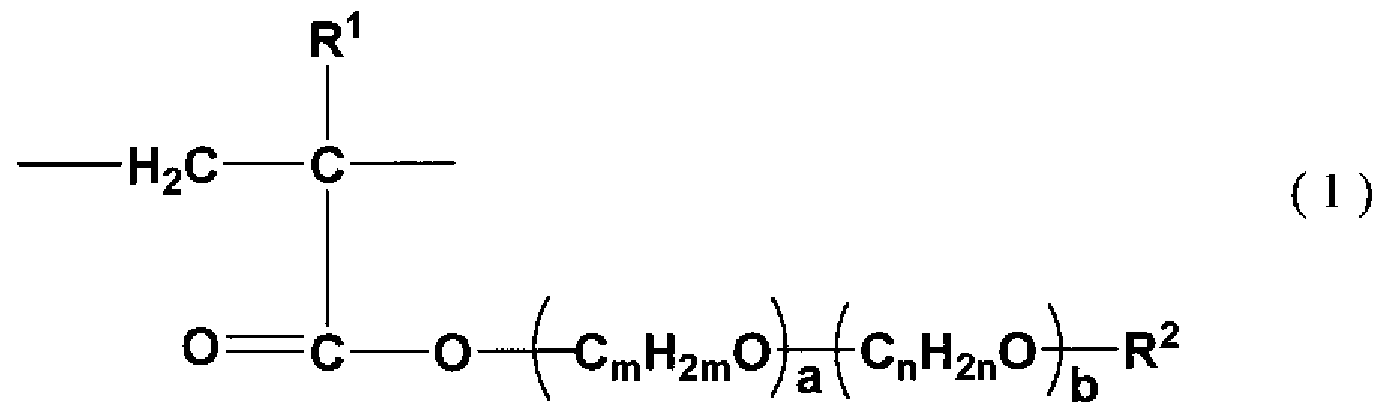
- the polymer (B) used in the present invention is a water-soluble polymer having a structural unit represented by the following formula (1) (hereinafter also referred to as “structural unit (1)”), and is used as a binder resin.
- structural unit (1) a structural unit represented by the following formula (1)
- the term "water-soluble” refers to a property having solubility to such an extent that a desired development process is performed in a developing step in a method for producing a PDP member of the present invention described later. .
- RR 11 is a hydrogen atom atom or a methitytyl group
- RR 22 is a carbon number of carbon atoms.
- An aralkyquill group of the formula 11 55 for example, methethylyl group, ethytyl group, nn propylopyryl group, ii ppropropyr group, nn—bubutych And a t-butyl group, and a methyl group is particularly preferable.
- n and n are integers of 1 to 5, preferably 1 to 3, and m ⁇ n, a is an integer of 1 to 100, preferably an integer of 1 to 20, b Is an integer of 0 to: L00, preferably an integer of 0 to 20.
- the content of the structural units (1) in the polymer) is not particularly limited, is preferably 20 to 99.9 mole 0/0, more preferably 25 to 90 mole 0/0, and particularly preferably 30 it is a 80 mole 0/0.
- the polymer (B) having the structural unit (1) can be obtained by (co) polymerizing a compound represented by the following formula (2).
- RR 11 is a hydrogen atom atom or a methitytyl group
- RR 22 is a carbon number of 11 to 55 is an aaralkylalkyl group of mm55
- mm and nn are integers from 11 to 5555, and, furthermore, mm ⁇ nn, and aa is 11- :: LLOOOO is an integer
- bb is 00-110,000.
- methoxypolyethylene glycol mono (meth) acrylate is particularly preferred.
- Examples of commercially available products of the above compounds include “Blemmer” series manufactured by NOF Corporation, particularly “Blemmer PME-100”, “PME-200”, and “PME-350”.
- Examples of other constituent monomers in the polymer (B) used in the present invention include 2-hydroxyethyl (meth) acrylate, 2-hydroxypropyl (meth) acrylate, and (meth) acrylic acid.
- Hydroxyl-containing monomers such as 3-hydroxypropyl acid; atalylates such as phenolic hydroxyl-containing monomers such as o-hydroxystyrene, m-hydroxystyrene, and p-hydroxystyrene;
- (meth) acrylamide, ⁇ , ⁇ -dimethyl Amide group-containing monomers such as acrylamide, ⁇ , ⁇ -dimethylaminopropyl acrylamide, ⁇ , ⁇ -getyl acrylamide, ⁇ -isopropylatarylamide, atariloylmorpholine, etc .
- hydroxyl group-containing monomers phenolic hydroxyl group-containing monomers and amide group-containing monomers are more preferable, and hydroxyl group-containing monomers and amide group-containing monomers are more preferable.
- the content of the constitutional unit derived from the other constituent monomers in the polymer) is not particularly restricted, preferably 0.1 to 70 mol 0/0, more preferably 5 to 65 mol 0/0, in particular, rather preferably is 10 to 60 mol 0/0.
- the content of the constituent unit derived from the monomer is preferably 40 mol% or less, more preferably 10 to 30 mol%.
- the content of the constituent unit derived from the monomer is preferably 50 mol% or less, more preferably 10 to 40 mol%.
- the content of the structural unit derived from the hydroxyl group-containing monomer and the content of the structural unit derived from the amide group-containing monomer are included.
- the molar ratio with the amount (hydroxyl group: amide group) is 1: 5 to 5: 1, preferably 1: 4 to 4: 1, particularly preferably 1: 3 to 3: 1.
- the weight average molecular weight (Mw) of the polymer (B) is preferably from 5,000 to 5,000,000, particularly preferably from 10,000 to 300,000.
- Mw force S is in the above range, the transfer film has excellent film forming properties and excellent pattern jungling properties.
- Mw is a weight average molecular weight in terms of polystyrene measured by GPC.
- the glass transition temperature (Tg) of the polymer (B) is preferably 0 to 70 ° C, more preferably 10 to 50 ° C.
- Tg is in such a range, the handleability, storage stability, and transferability to a substrate of a transfer film are improved.
- the content of the polymer (B) in the composition of the present invention is usually 1 to 50 parts by weight, preferably 10 to 45 parts by weight, particularly preferably 100 parts by weight of the inorganic powder. 20-40 parts by weight. When the content of the polymer (B) is within the above range, the effects of the present invention are sufficiently exhibited.
- a polymer other than the polymer (B) is used as a binder resin, as long as the effects of the present invention are not impaired and water development is possible when forming a PDP member. May be.
- the polyfunctional (meth) atalylate (c) constituting the composition of the present invention has a property that it is polymerized by exposure so that the exposed portion becomes insoluble or hardly soluble in a developer.
- the polyfunctional (meth) acrylates (C) used in the present invention include, for example, di (meth) atalylates of alkylene glycols such as ethylene glycol and propylene glycol; and poly (meth) acrylates such as polyethylene glycol and polypropylene glycol.
- Di (meth) atalylates of alkylene glycols di (meth) atalylates of hydroxyl-terminated polymers such as hydroxypolybutadiene at both ends, hydroxypolyisoprene at both ends, and hydroxypolyproprotatone at both ends; glycerin; 2,4 Butanetriol, trimethylolalkane, tetramethylolalkane, pentaerythritol, dipentaerythritol and other polyhydric alcohol poly (meth) atalylates; trihydric or higher polyhydric alcohol polyalkylene glycol Poly (meth) atalylates of cauldrons with coal; Poly (meth) atalylates of cyclic polyols such as 1,4-cyclohexanediol and 1,4 benzenediol; Polyester (meth) atalylate, epoxy Oligo (meth) acrylates such as (meth) acrylate, urethane
- the molecular weight of the polyfunctional (meth) acrylate (C) is preferably from 100 to 2,000.
- the content of the polyfunctional (meth) atalylate (C) in the composition of the present invention is usually 0.1 to 50 parts by weight, preferably 100 parts by weight of the inorganic powder (A). 1 to 40 parts by weight.
- Examples of the photopolymerization initiator (D) constituting the composition of the present invention include benzyl, benzoin, benzophenone, camphorquinone, 2-hydroxy-12-methyl-1-phenylpropane-1-one, and 1-hydroxycyclohexane.
- the photopolymerization initiator may be used alone or in combination of two or more.
- the content of the photopolymerization initiator (D) in the composition of the present invention is usually from 0.01 to: LOO parts by weight, preferably 100 parts by weight of the polyfunctional (meth) acrylate (C). 0.1 to 50 parts by weight.
- the composition of the present invention preferably contains a dissolution accelerator (E) for the purpose of exhibiting sufficient solubility in a developer described below.
- a dissolution accelerator (E) for the purpose of exhibiting sufficient solubility in a developer described below.
- a surfactant is preferably used as the dissolution promoter (E). Examples of such a surfactant include a fluorine-based surfactant, a silicone-based surfactant, and a non-one-based surfactant.
- fluorine-based surfactant examples include “BM-1000” and “BM-1100” manufactured by BM CHIMIE, and “MegaFac F142D” and “F172” manufactured by Dainippon Ink and Chemicals, Inc. , “F173” and “F183”, “FLORADE FC-135", “FC170C”, “FC-430”, “FC-431”, and “FC-431” manufactured by Sumitomo 3LM Limited, Asahi Glass Co., Ltd.
- silicone-based surfactant examples include “SH-28PA”, “SH-190”, “SH-193”, “SZ-6032”, and “SF” manufactured by Toray “Dowko Jung” Silicone Co., Ltd. — 8428 “ , “DC-57”, “DC-190”, “KP341” manufactured by Shin-Etsu-Danigaku Kogyo Co., Ltd., "F-Top EF301”, “EF303”, “EF352” manufactured by Shin-Akita Kasei Co., Ltd. And other commercially available products.
- nonionic surfactant examples include polyoxyethylene alkyl ethers such as polyoxyethylene lauryl ether, polyoxyethylene stearyl ether, and polyoxyethylene oleyl ether; and polyoxyethylene distyrenated phenol.
- Polyoxyethylene aryl ethers such as polyether, polyoxyethylene octylphenyl ether and polyoxyethylene nonyl ether; polyoxyethylene dialkyl esters such as polyoxyethylene dilate and polyoxyethylene distearate; And the like.
- non-ionic surfactants include, for example, Kao Corporation's "Emulgen A-60", “A-90”, “A-500”, “B-66", “PP-290” and "(meth) acrylic acid-based copolymer polyflow No. 57” and "No. 90” manufactured by Kyoeisha Chemical Co., Ltd. can be exemplified.
- non-ionic surfactants specifically, polyoxyethylene aryl ethers
- a compound represented by the following formula (i) is particularly preferred.
- R 3 is an alkyl group having 1 to 5 carbon atoms, preferably a methyl group
- p is an integer of 1 to 5
- s is an integer of 1 to 5
- t is an integer of 1 to 100, preferably an integer of 10 to 20.
- the content of the dissolution promoter (E) in the composition of the present invention is preferably 0.001 to 20 parts by weight, more preferably 0.01 to 15 parts by weight, per 100 parts by weight of the binder resin. Parts by weight, particularly preferably 0.1 to 10 parts by weight.
- the content of the dissolution accelerator (E) is in the above range, a composition having excellent solubility in a developer can be obtained.
- the composition of the present invention usually contains a solvent to impart appropriate fluidity or plasticity and good film-forming properties.
- the solvent used in the present invention has good affinity with inorganic powders and good solubility of the binder resin, can impart appropriate viscosity to the present composition, and is easily evaporated and removed by drying.
- U which is preferably a solvent that can.
- the solvent used in the present invention is not particularly limited as long as it has the above characteristics.
- examples thereof include ethers, esters, ether esters, ketones, ketone esters, amides, and amide esters. , Ratatams, ratatatones, sulfoxides, sulfones, hydrocarbons, halogenated hydrocarbons and the like.
- tetrahydrofuran, asol, dioxane ethylene glycol monoalkyl ethers, diethylene glycol dialkyl ethers, propylene glycol monoalkyl ethers, propylene glycol dialkyl ethers, acetates, hydroxyacetic acid Esters, alkoxyacetic esters, propionic esters, hydroxypropionic esters, alkoxypropionic esters, lactic acid esters, ethylene glycol monoalkyl ether acetates, propylene glycol monoalkyl ether acetates, alkoxyacetic esters , Cyclic ketones, acyclic ketones, acetoacetates, pyruvates, N, N-dialkylformamides, N, N-dialkyla Cetamides, N-alkylpyrrolidones, ⁇ -latatatones, dialkylsulfoxides, dialkylsulfones, terbineol,
- the content of the solvent in the composition of the present invention may be appropriately selected within a range where good film-forming properties (fluidity or plasticity) can be obtained.
- the composition of the present invention preferably further contains an ultraviolet absorber.
- an ultraviolet absorber since it does not remain in the fired member and does not deteriorate the member properties, even a material having an organic dye power is preferable, so that a high UV absorption coefficient in the wavelength range of 400 to 500 nm is preferred.
- Organic dyes are preferably used.
- azoi ligated compounds represented by 1-fuerazo 2 -naphthol, 1-fueru 3-methyl-4- (4-methylfeluazo) -5-oxypyrazole, and 1,4jia
- quinone ligations represented by millaminoanthraquinone and phenolic ligations represented by curcumin.
- the amount of the organic dye to be added is 0.1% based on the total content of the polymer (B), the polyfunctional (meth) ataryl resin HC) and the photopolymerization initiator (D). It is about 05 to 10% by weight, preferably about 0.5 to 5% by weight. If the amount is less than the above range, the effect of adding the ultraviolet absorber is too small. If the amount exceeds the above range, the properties of the obtained PDP member may be degraded.
- composition of the present invention may further contain optional components such as a dispersant, a plasticizer, a development accelerator, an adhesion promoter, an antihalation agent, a storage stabilizer, an antifoaming agent, an antioxidant, and a filler.
- a dispersant such as sodium bicarbonate, sodium bicarbonate, sodium bicarbonate, sodium bicarbonate, sodium bicarbonate, sodium bicarbonate, sodium bicarbonate, sodium bicarbonate, sodium bicarbonate, sodium bicarbonate, sodium bicarbonate, sodium bicarbonate, sodium bicarbonate, sodium bicarbonate, sodium bicarbonate, sodium bicarbonate, sodium bicarbonate, sodium bicarbonate, sodium bicarbonate, sodium bicarbonate, sodium bicarbonate, sodium bicarbonate, sodium bicarbonate, sodium bicarbonate, sodium bicarbonate, sodium bicarbonate, sodium bicarbonate, sodium bicarbonate, sodium bicarbonate, sodium bicarbonate, sodium bicarbonate, sodium bicarbonate, sodium bicarbonate, sodium sulfate, sodium bicarbonate, sodium sulf
- the transfer film of the present invention is obtained by forming a layer composed of the inorganic powder-containing resin composition of the present invention on a support film.
- the inorganic powder-containing resin layer (hereinafter, also simply referred to as “resin layer” or “photosensitive resin layer!”) Is formed by applying the composition to a support film to form a coating film. It is obtained by drying the coating film.
- the support film that constitutes the transfer film is preferably a resin film having heat resistance and solvent resistance and having flexibility. Since the support film has flexibility, the paste composition can be applied by a roll coater, and the inorganic powder-containing resin layer can be stored and supplied in a rolled state. it can.
- the thickness of the support film may be any value within a range suitable for use, for example, 20 to: LOO ⁇ m.
- the resin forming the support film includes, for example, fluorinated resins such as polyethylene terephthalate, polyester, polyethylene, polypropylene, polystyrene, polyimide, polyvinyl alcohol, polyvinyl chloride, and polyfluoroethylene, nylon, and cellulose. Is mentioned.
- the method of applying the composition of the present invention onto a support film is a method capable of efficiently forming a coating film having a large thickness (for example, 10 / zm or more) and excellent uniformity.
- a coating method using a roll coater a coating method using a doctor blade, a coating method using a curtain coater, a coating method using a die coater, and a coating method using a wire coater.
- the surface of the support film to which the composition of the present invention is applied has been subjected to a release treatment. Thereby, the peeling operation of the support film can be easily performed at the time of forming the PDP constituent member.
- the drying conditions of the coating film may be appropriately adjusted so that the residual ratio of the solvent after drying (solvent content in the resin layer) is within 2% by mass, for example, at 50 to 150 ° C.
- the drying temperature is about 0.5 to 30 minutes.
- the thickness of the resin layer formed on the support film as described above is, for example, 5 to 500 ⁇ m depending on the content or size of the inorganic powder.
- a protective film layer which may be provided on the surface of the resin layer, a polyethylene film, a polyvinyl alcohol-based film, or the like can be given.
- the production method of the present invention is preferably used for producing a PDP component.
- These components are formed by forming an inorganic powder-containing resin layer on a substrate using the inorganic powder-containing resin composition of the present invention or the transfer film of the present invention, and subjecting the resin layer to exposure treatment. It is formed by forming a latent image of a pattern, developing the resin layer to form a pattern layer, and baking the pattern layer.
- the inorganic powder-containing resin layer is applied to the substrate by applying the inorganic powder-containing resin composition of the present invention to the substrate.
- the inorganic powder-containing resin layer of the transfer film is transferred using the transfer film of the present invention. You It can be formed by:
- a resin layer having excellent thickness uniformity can be easily formed, and the thickness of a formed pattern can be made uniform.
- a laminate having an n-layer (n is an integer of 2 or more) resin layer may be formed.
- the laminate may be formed by batch-transferring a laminate of n resin layers onto a substrate using a transfer film formed on a support film.
- Examples of the method of applying the composition of the present invention onto a substrate include various methods such as a screen printing method, a roll coating method, a spin coating method, and a casting coating method. After applying the composition by such a method, the resin layer can be formed by drying the coating film. Note that the above process may be repeated n times to form a laminate including n layers.
- An example of a transfer step using a transfer film is as follows. After peeling off the protective film layer of the transfer film used as necessary, the transfer film was overlaid so that the surface of the resin layer was in contact with the surface of the substrate, and the transfer film was thermocompression-bonded with a heating roller or the like. Thereafter, the support film is peeled off from the resin layer. Thereby, the resin layer is transferred to the surface of the substrate and is brought into close contact therewith.
- the surface temperature of the heating roller is 40 to 140 ° C.
- the roll pressure by the heating roller is 0.1 to: LOkgZcm 2
- the moving speed of the heating roller is 0.1 to 10 mZ.
- the preheating temperature at which the substrate may be preheated is, for example, 40 to 140 ° C.
- the surface of the inorganic powder-containing resin layer is selectively irradiated (exposed) with radiation such as ultraviolet rays through an exposure mask to form a latent image of a pattern on the resin layer.
- the radiation irradiating apparatus used in the exposure is not particularly limited, but an ultraviolet irradiating apparatus generally used in a photolithography method, an exposure apparatus used in manufacturing a semiconductor or a liquid crystal display device. And the like.
- the exposure is performed in a state where the support film coated on the resin layer is not peeled off.
- the exposed resin layer is developed to form a resin layer pattern.
- the development method for example, immersion method, rocking method, shower method, spray method, paddle method, etc.
- development processing conditions for example, developer type 'composition' concentration, development time, development temperature, etc.
- the formed resin layer pattern is baked.
- the baking treatment conditions require that organic substances in the inorganic powder-containing resin layer (remaining portion) be burned off.
- the baking temperature is 400 to 600 ° C and the baking time is 10 to 90 minutes. is there.
- a PDP member such as a partition, an electrode, a resistor, a dielectric, a phosphor, a color filter, and a black matrix
- the manufacturing method of the present invention is preferable as a method of forming a partition, a dielectric, and an electrode, and is particularly preferable as a method of forming a front partition.
- the film thickness of the pattern obtained by the present invention varies depending on the use and the content of the inorganic powder, but is, for example, 1 to 200 ⁇ .
- the substrate material used in the present invention examples include a plate-like member having an insulating material such as glass, silicone, polycarbonate, polyester, aromatic amide, polyamide imide, and polyimide. If necessary, the surface of the plate-like member may be subjected to a chemical treatment with a silane coupling agent or the like; a plasma treatment; a thin film formation treatment by an ion plating method, a sputtering method, a gas phase reaction method, a vacuum evaporation method, or the like. It may be pre-treated.
- a chemical treatment with a silane coupling agent or the like a plasma treatment
- a thin film formation treatment by an ion plating method, a sputtering method, a gas phase reaction method, a vacuum evaporation method, or the like. It may be pre-treated.
- a glass substrate having heat resistance is preferably used as the substrate.
- An example of such a glass substrate is PD200 manufactured by Asahi Glass Co., Ltd.
- the exposure pattern of the exposure mask used in the exposure step in the production method of the present invention is a stripe having a force that varies depending on the material, generally a width of 10 to 500 m. (Developer)
- the developer used in the developing step in the production method of the present invention water, particularly ultrapure water, is suitably used. Since the inorganic powder contained in the inorganic powder-containing resin layer is uniformly dispersed in the binder resin, the polymer (B) constituting the binder resin is dissolved in the developer and washed. By doing so, the inorganic powder is also removed at the same time. Further, an alkaline developer may be used as the developer.
- Examples of the effective components of the alkali developer include lithium hydroxide, sodium hydroxide, potassium hydroxide, sodium hydrogen phosphate, diammonium hydrogen phosphate, dipotassium hydrogen phosphate, and hydrogen phosphate.
- Alkaline conjugates such as sodium silicate, potassium borate, and ammonium; tetramethylammonium-dimethylhydroxide, trimethylhydroxyamyl-dimethylhydroxide, monomethylamine, dimethylamine, trimethylamine, monoethylamine, getylamine, triethylamine, monoethylamine Isopropylamine, Jii Organic alkaline conjugates such as isopropylamine and ethanolamine are exemplified.
- the alkaline developer may contain additives such
- part means “parts by weight”
- Mw weight average molecular weight in terms of polystyrene measured by gel permeation chromatography (GPC) under the following conditions.
- GPC gel permeation chromatography
- GPC measuring device HLC-8220GPC manufactured by Tosoh Corporation
- GPC column TSKgelSuperHZN—M manufactured by Tosoh Corporation
- the viscosity of the composition immediately after preparation was measured at 25 ° C using a rotary viscometer (EMD-R type, manufactured by Tokyo Keiki), and this was defined as the initial viscosity.
- EMD-R type manufactured by Tokyo Keiki
- the viscosity was periodically measured, and the storage stability was evaluated based on the number of days until the viscosity increased by 50% from the initial viscosity.
- Copolymers [Resins (2) to (10)] were obtained in the same manner as in Synthesis Example 1 except that the monomer yarns in Synthesis Example 1 were changed to the monomer yarns shown in Table 1 below.
- HPMA is 2-hydroxypropyl methacrylate
- MMA is methyl methacrylate
- ACMO is acryloyl morpholine
- MAm is methacrylamide
- DMAA is N, N dimethyl acrylamide.
- ZnO-B O— SiO-based low melting glass frit (irregular, softening point 57
- the obtained inorganic powder-containing resin composition was applied to a PET film supporting film (width: 200 mm, length: 30 m, thickness: 38 ⁇ m) using a blade coater. After drying for 5 minutes to completely remove the solvent, an inorganic powder-containing photosensitive resin layer having an average film thickness of 46 ⁇ m was formed. Next, on the resin layer, a protective film made of a PET film pre-released is thermocompression-bonded to prepare a transfer film in which a support film, a photosensitive resin layer containing an inorganic powder and a protective film are laminated in this order. did.
- the transfer film After peeling off the protective film of the obtained transfer film, the transfer film is brought into contact with the dielectric layer (thickness: 20 m) formed on the surface of the glass substrate for 6-inch panel so that the surface of the resin layer is in contact with the dielectric layer.
- the transfer films were overlaid and thermocompressed with a heating roller.
- the pressing conditions at this time were as follows: the surface temperature of the heating roller was 90 ° C, the roll pressure was 2 kgZcm 2 , and the moving speed of the heating roller was 0.5 mZ.
- the photosensitive resin layer containing the inorganic powder was transferred to the surface of the glass substrate and brought into close contact therewith.
- the photosensitive resin layer formed as described above is irradiated with i-line (ultraviolet light with a wavelength of 365 nm) by an ultra-high pressure mercury lamp through an exposure mask (400 ⁇ m width stripe pattern). It was irradiated with lOOmiZcm 2.
- the support film was peeled off from the resin layer, and the exposed resin layer was developed by a shower method using ultrapure water (30 ° C.) as a developing solution. The treatment was performed for 40 seconds. This removes the uncured resin layer that has not been irradiated with ultraviolet light, A pattern of the resin layer containing the powder was formed.
- the glass substrate having the resin layer pattern formed on the dielectric layer was fired in a firing furnace at a temperature of 580 ° C. for 50 minutes.
- the cross-sectional shape of the partition wall in the obtained panel material was observed with a scanning electron microscope, and the bottom width and height of the cross-sectional shape were measured.
- the bottom width was 400 m and the height was 15 m.
- a sintering pattern of various shapes was obtained.
- a panel material in which partition walls were formed on the dielectric layer was obtained.
- a resin composition containing an inorganic powder was prepared in the same manner as in Example 1 except that the alkali-soluble resin (B) was changed to the one shown in Table 1, and the storage stability was evaluated. Then, a transfer film was produced using the composition, and a panel material was prepared and developed in the same manner as in Example 1 except that the development time was changed as shown in Table 1 using the transfer film. The properties and pattern shapes were evaluated. The results are shown in Table 1.
- the evaluation methods and evaluation criteria for the developability and the pattern shape are as follows.
- Evaluation method Water development was performed for 30 to 180 seconds by the shower method.
- Evaluation method The cross-sectional shape of the pattern was observed using an electron microscope.
- AA was good (a trapezoidal cross section, forward taper shape), and BB was a reverse taper shape with side edges.
Landscapes
- Chemical & Material Sciences (AREA)
- Organic Chemistry (AREA)
- Physics & Mathematics (AREA)
- General Physics & Mathematics (AREA)
- Polymers & Plastics (AREA)
- Medicinal Chemistry (AREA)
- Chemical Kinetics & Catalysis (AREA)
- Health & Medical Sciences (AREA)
- Engineering & Computer Science (AREA)
- Ceramic Engineering (AREA)
- Compositions Of Macromolecular Compounds (AREA)
- Optical Filters (AREA)
- Gas-Filled Discharge Tubes (AREA)
- Polymerisation Methods In General (AREA)
Abstract
Description


Claims
Applications Claiming Priority (2)
| Application Number | Priority Date | Filing Date | Title |
|---|---|---|---|
| JP2004-182831 | 2004-06-21 | ||
| JP2004182831 | 2004-06-21 |
Publications (1)
| Publication Number | Publication Date |
|---|---|
| WO2005124458A1 true WO2005124458A1 (ja) | 2005-12-29 |
Family
ID=35509859
Family Applications (1)
| Application Number | Title | Priority Date | Filing Date |
|---|---|---|---|
| PCT/JP2005/011236 Ceased WO2005124458A1 (ja) | 2004-06-21 | 2005-06-20 | 無機粉体含有樹脂組成物、転写フィルムおよびプラズマディスプレイパネル用部材の製造方法 |
Country Status (3)
| Country | Link |
|---|---|
| CN (1) | CN1969232A (ja) |
| TW (1) | TW200613911A (ja) |
| WO (1) | WO2005124458A1 (ja) |
Cited By (4)
| Publication number | Priority date | Publication date | Assignee | Title |
|---|---|---|---|---|
| JP2007181977A (ja) * | 2006-01-06 | 2007-07-19 | Jsr Corp | 転写フィルムおよびディスプレイパネル部材の製造方法 |
| JP2007292892A (ja) * | 2006-04-21 | 2007-11-08 | Jsr Corp | 無機粒子含有感光性樹脂組成物、感光性フィルムおよび無機パターン形成方法 |
| WO2008072582A1 (ja) * | 2006-12-07 | 2008-06-19 | Jsr Corporation | 無機粉体含有樹脂組成物、転写フィルムおよびフラットパネルディスプレ イ部材の製造方法 |
| WO2008149798A1 (ja) * | 2007-05-30 | 2008-12-11 | Jsr Corporation | 無機粉体含有樹脂組成物、パターン形成方法およびフラットパネルディスプレイ用電極の製造方法 |
Families Citing this family (3)
| Publication number | Priority date | Publication date | Assignee | Title |
|---|---|---|---|---|
| CN102144189B (zh) * | 2008-09-04 | 2015-06-10 | 旭化成电子材料株式会社 | 感光性树脂组合物、层压体、抗蚀图案形成方法以及导体图案、印刷电路板的制造方法 |
| JP7111186B2 (ja) * | 2019-11-18 | 2022-08-02 | 東レ株式会社 | 感光性樹脂組成物、感光性樹脂シート、中空構造体、硬化物、中空構造体の製造方法、電子部品、及び弾性波フィルター |
| CN114349903B (zh) * | 2021-12-20 | 2022-10-25 | 华南理工大学 | 一种不含双酚a结构的可流动性大块充填复合树脂及其制备与应用 |
Citations (8)
| Publication number | Priority date | Publication date | Assignee | Title |
|---|---|---|---|---|
| JPH1087769A (ja) * | 1996-09-11 | 1998-04-07 | Nippon Kayaku Co Ltd | 樹脂組成物、そのフィルム及びその硬化物 |
| JPH1184646A (ja) * | 1997-09-02 | 1999-03-26 | Tokyo Ohka Kogyo Co Ltd | 無機粉末含有感光性樹脂組成物およびパターンの形成方法 |
| JP2000275826A (ja) * | 1999-03-25 | 2000-10-06 | Murata Mfg Co Ltd | ペースト組成物及びそれを用いた回路基板 |
| JP2000347399A (ja) * | 1999-06-07 | 2000-12-15 | Toray Ind Inc | 感光性ペースト、それを用いたディスプレイ用部材ならびに電極およびプラズマディスプレイの製造方法 |
| JP2002131927A (ja) * | 2000-10-24 | 2002-05-09 | Nippon Kayaku Co Ltd | 無機粉体を感光性ペーストへ再利用する方法 |
| JP2003051250A (ja) * | 2001-08-07 | 2003-02-21 | Jsr Corp | プラズマディスプレイパネルの製造方法および転写フィルム |
| JP2005008514A (ja) * | 2003-05-23 | 2005-01-13 | Fujifilm Arch Co Ltd | 無機材料膜、無機材料膜構造物、およびその製造方法並びに転写フィルム |
| JP2005158519A (ja) * | 2003-11-26 | 2005-06-16 | Jsr Corp | プラズマディスプレイパネルの製造方法およびプラズマディスプレイパネル用感光性組成物 |
-
2005
- 2005-06-20 WO PCT/JP2005/011236 patent/WO2005124458A1/ja not_active Ceased
- 2005-06-20 CN CNA2005800199457A patent/CN1969232A/zh active Pending
- 2005-06-21 TW TW094120667A patent/TW200613911A/zh unknown
Patent Citations (8)
| Publication number | Priority date | Publication date | Assignee | Title |
|---|---|---|---|---|
| JPH1087769A (ja) * | 1996-09-11 | 1998-04-07 | Nippon Kayaku Co Ltd | 樹脂組成物、そのフィルム及びその硬化物 |
| JPH1184646A (ja) * | 1997-09-02 | 1999-03-26 | Tokyo Ohka Kogyo Co Ltd | 無機粉末含有感光性樹脂組成物およびパターンの形成方法 |
| JP2000275826A (ja) * | 1999-03-25 | 2000-10-06 | Murata Mfg Co Ltd | ペースト組成物及びそれを用いた回路基板 |
| JP2000347399A (ja) * | 1999-06-07 | 2000-12-15 | Toray Ind Inc | 感光性ペースト、それを用いたディスプレイ用部材ならびに電極およびプラズマディスプレイの製造方法 |
| JP2002131927A (ja) * | 2000-10-24 | 2002-05-09 | Nippon Kayaku Co Ltd | 無機粉体を感光性ペーストへ再利用する方法 |
| JP2003051250A (ja) * | 2001-08-07 | 2003-02-21 | Jsr Corp | プラズマディスプレイパネルの製造方法および転写フィルム |
| JP2005008514A (ja) * | 2003-05-23 | 2005-01-13 | Fujifilm Arch Co Ltd | 無機材料膜、無機材料膜構造物、およびその製造方法並びに転写フィルム |
| JP2005158519A (ja) * | 2003-11-26 | 2005-06-16 | Jsr Corp | プラズマディスプレイパネルの製造方法およびプラズマディスプレイパネル用感光性組成物 |
Cited By (5)
| Publication number | Priority date | Publication date | Assignee | Title |
|---|---|---|---|---|
| JP2007181977A (ja) * | 2006-01-06 | 2007-07-19 | Jsr Corp | 転写フィルムおよびディスプレイパネル部材の製造方法 |
| JP2007292892A (ja) * | 2006-04-21 | 2007-11-08 | Jsr Corp | 無機粒子含有感光性樹脂組成物、感光性フィルムおよび無機パターン形成方法 |
| WO2008072582A1 (ja) * | 2006-12-07 | 2008-06-19 | Jsr Corporation | 無機粉体含有樹脂組成物、転写フィルムおよびフラットパネルディスプレ イ部材の製造方法 |
| WO2008149798A1 (ja) * | 2007-05-30 | 2008-12-11 | Jsr Corporation | 無機粉体含有樹脂組成物、パターン形成方法およびフラットパネルディスプレイ用電極の製造方法 |
| JP2008297409A (ja) * | 2007-05-30 | 2008-12-11 | Jsr Corp | 無機粉体含有樹脂組成物、パターン形成方法およびフラットパネルディスプレイ用電極の製造方法 |
Also Published As
| Publication number | Publication date |
|---|---|
| TW200613911A (en) | 2006-05-01 |
| CN1969232A (zh) | 2007-05-23 |
Similar Documents
| Publication | Publication Date | Title |
|---|---|---|
| WO2008023712A1 (en) | Photosensitive resin composition, photosensitive film, and method for formation of pattern | |
| CN101059656B (zh) | 含无机颗粒的光敏性树脂组合物、光敏性薄膜和无机图案的形成方法 | |
| TWI231293B (en) | Transfer film | |
| JP4661388B2 (ja) | 無機粉体含有樹脂組成物、転写フィルムおよびプラズマディスプレイパネル用部材の製造方法 | |
| JP2008231376A (ja) | 無機粉体含有樹脂組成物、転写フィルムおよびフラットディスプレイパネルの製造方法 | |
| JP2007226018A (ja) | 無機粒子含有樹脂組成物、転写フィルムおよびディスプレイパネル用部材の製造方法 | |
| JP5050784B2 (ja) | 無機粒子含有感光性樹脂組成物、感光性フィルム、パターン形成方法、およびフラットパネルディスプレイの製造方法 | |
| JP3805438B2 (ja) | アルカリ現像型光硬化性ガラスペースト組成物及びそれを用いたプラズマディスプレイパネル隔壁の製造方法 | |
| JP2006268027A (ja) | プラズマディスプレイパネルの製造方法および転写フィルム | |
| CN1969232A (zh) | 含无机粉体的树脂组合物、转印膜以及等离子体显示板用构件的制造方法 | |
| JP4702062B2 (ja) | 転写フィルムおよびディスプレイパネル部材の製造方法 | |
| JP2006045270A (ja) | 無機粉体含有樹脂組成物、転写フィルムおよびプラズマディスプレイパネルの製造方法 | |
| KR20070031403A (ko) | 무기 분체 함유 수지 조성물, 전사 필름 및 플라즈마디스플레이 패널용 부재의 제조 방법 | |
| JP2005232366A (ja) | 無機粉体含有樹脂組成物、転写フィルムおよびディスプレイパネル用部材の製造方法 | |
| JP2005227607A (ja) | 無機粉体含有樹脂組成物、転写フィルムおよびディスプレイパネル用部材の製造方法 | |
| JPH11144628A (ja) | 隔壁形成用転写フィルムおよびそれを用いたプラズマディスプレイパネルの製造方法 | |
| JP2005264141A (ja) | 無機粉体含有樹脂組成物、転写フィルムおよびプラズマディスプレイパネルの製造方法 | |
| TW200537249A (en) | Composition containing inorganic powder, transfer film, and method of forming inorganic sinter | |
| JP2003316001A (ja) | アルカリ現像型光硬化性樹脂組成物 | |
| JP2007246568A (ja) | 無機粒子含有樹脂組成物、転写フィルムおよびディスプレイパネル用部材の製造方法 | |
| TW583509B (en) | Photopolymerizable composition | |
| JPH10120432A (ja) | 感光性ペーストおよびそれを用いたプラズマディスプレイの製造方法 | |
| JP2005209588A (ja) | プラズマディスプレイパネル部材の製造方法および転写フィルム | |
| JP2005209589A (ja) | プラズマディスプレイパネル部材の製造方法および転写フィルム | |
| JP2005216604A (ja) | プラズマディスプレイパネル部材の製造方法および転写フィルム |
Legal Events
| Date | Code | Title | Description |
|---|---|---|---|
| AK | Designated states |
Kind code of ref document: A1 Designated state(s): AE AG AL AM AT AU AZ BA BB BG BR BW BY BZ CA CH CN CO CR CU CZ DE DK DM DZ EC EE EG ES FI GB GD GE GH GM HR HU ID IL IN IS JP KE KG KM KP KR KZ LC LK LR LS LT LU LV MA MD MG MK MN MW MX MZ NA NG NI NO NZ OM PG PH PL PT RO RU SC SD SE SG SK SL SM SY TJ TM TN TR TT TZ UA UG US UZ VC VN YU ZA ZM ZW |
|
| AL | Designated countries for regional patents |
Kind code of ref document: A1 Designated state(s): BW GH GM KE LS MW MZ NA SD SL SZ TZ UG ZM ZW AM AZ BY KG KZ MD RU TJ TM AT BE BG CH CY CZ DE DK EE ES FI FR GB GR HU IE IS IT LT LU MC NL PL PT RO SE SI SK TR BF BJ CF CG CI CM GA GN GQ GW ML MR NE SN TD TG |
|
| 121 | Ep: the epo has been informed by wipo that ep was designated in this application | ||
| WWE | Wipo information: entry into national phase |
Ref document number: 200580019945.7 Country of ref document: CN |
|
| NENP | Non-entry into the national phase |
Ref country code: DE |
|
| WWW | Wipo information: withdrawn in national office |
Country of ref document: DE |
|
| WWE | Wipo information: entry into national phase |
Ref document number: 1020077001356 Country of ref document: KR |
|
| WWP | Wipo information: published in national office |
Ref document number: 1020077001356 Country of ref document: KR |
|
| 122 | Ep: pct application non-entry in european phase | ||
| NENP | Non-entry into the national phase |
Ref country code: JP |