WO2004106320A1 - 光学活性ラクトン類の製造方法 - Google Patents

光学活性ラクトン類の製造方法 Download PDF

Info

Publication number
WO2004106320A1
WO2004106320A1 PCT/JP2004/006919 JP2004006919W WO2004106320A1 WO 2004106320 A1 WO2004106320 A1 WO 2004106320A1 JP 2004006919 W JP2004006919 W JP 2004006919W WO 2004106320 A1 WO2004106320 A1 WO 2004106320A1
Authority
WO
WIPO (PCT)
Prior art keywords
formula
alcohol
represented
optically active
carbon atoms
Prior art date
Legal status (The legal status is an assumption and is not a legal conclusion. Google has not performed a legal analysis and makes no representation as to the accuracy of the status listed.)
Ceased
Application number
PCT/JP2004/006919
Other languages
English (en)
French (fr)
Inventor
Masahiro Endo
Yasuyuki Nakano
Toshiro Yamada
Current Assignee (The listed assignees may be inaccurate. Google has not performed a legal analysis and makes no representation or warranty as to the accuracy of the list.)
Zeon Corp
Original Assignee
Zeon Corp
Priority date (The priority date is an assumption and is not a legal conclusion. Google has not performed a legal analysis and makes no representation as to the accuracy of the date listed.)
Filing date
Publication date
Application filed by Zeon Corp filed Critical Zeon Corp
Priority to JP2005506468A priority Critical patent/JPWO2004106320A1/ja
Publication of WO2004106320A1 publication Critical patent/WO2004106320A1/ja
Anticipated expiration legal-status Critical
Ceased legal-status Critical Current

Links

Classifications

    • CCHEMISTRY; METALLURGY
    • C07ORGANIC CHEMISTRY
    • C07DHETEROCYCLIC COMPOUNDS
    • C07D307/00Heterocyclic compounds containing five-membered rings having one oxygen atom as the only ring hetero atom
    • C07D307/77Heterocyclic compounds containing five-membered rings having one oxygen atom as the only ring hetero atom ortho- or peri-condensed with carbocyclic rings or ring systems
    • C07D307/93Heterocyclic compounds containing five-membered rings having one oxygen atom as the only ring hetero atom ortho- or peri-condensed with carbocyclic rings or ring systems condensed with a ring other than six-membered
    • C07D307/935Not further condensed cyclopenta [b] furans or hydrogenated cyclopenta [b] furans
    • CCHEMISTRY; METALLURGY
    • C07ORGANIC CHEMISTRY
    • C07DHETEROCYCLIC COMPOUNDS
    • C07D309/00Heterocyclic compounds containing six-membered rings having one oxygen atom as the only ring hetero atom, not condensed with other rings
    • C07D309/16Heterocyclic compounds containing six-membered rings having one oxygen atom as the only ring hetero atom, not condensed with other rings having one double bond between ring members or between a ring member and a non-ring member
    • C07D309/28Heterocyclic compounds containing six-membered rings having one oxygen atom as the only ring hetero atom, not condensed with other rings having one double bond between ring members or between a ring member and a non-ring member with hetero atoms or with carbon atoms having three bonds to hetero atoms with at the most one bond to halogen, e.g. ester or nitrile radicals, directly attached to ring carbon atoms
    • C07D309/30Oxygen atoms, e.g. delta-lactones

Definitions

  • the present invention relates to a method for producing optically active ratatones. More specifically, the present invention relates to optically active ratatones that can efficiently obtain R- and S-forms of lactones useful as fragrances by separating racemic ratatones only by chemical means. A method for producing the same.
  • Ratatatones which are cyclic compounds having an ester bond in the ring, are widely found in foods as fragrance substances, and are used as useful materials for imparting fragrance.
  • ⁇ -latatatone with a five-membered ring structure and ⁇ -lactone with a six-membered ring structure have distinctive aromas.
  • a lactone having a side chain has an R-form and an S-form optical isomer because the carbon atom to which the side chain is bonded is an asymmetric carbon atom.
  • the two types of optical isomers have not only a structure, The odor intensity, aroma, and flavor are different.
  • Ratatatone which is naturally present in fruits, etc., is unevenly distributed in the R or S form, but chemically synthesized ratatone is a racemic mixture in which the R form and the S form are mixed by half. It has a different aroma and flavor from rattan that exists in nature.
  • ⁇ -dodecalactone having 12 carbon atoms is a fragrance having a strong lingering scent and a full tea and floral scent.
  • the optical purity of naturally occurring ⁇ -dodecalactone is as follows: fermented butter has R-form of 88% ee, fresh cream has R-form of 82% ee, and condensed milk has R-form of 92% ee. Lactone is biased to R-form.
  • ⁇ -dodecalactone is used for imparting aroma to foods. For example, as a confectionery yarn to which a milk thiocholate flavor has been added, ⁇ -decalataton and ⁇ -dodecalactone are each added at 0.05. Confectionery compositions containing up to 4 ppm have been proposed (Patent Document 1).
  • the present invention provides a method for producing optically active ratatones that can efficiently obtain R- and S-forms of ratatones useful as fragrances by dividing racemic ratatones only by chemical means. It was made for the purpose of providing.
  • the inventors of the present invention have conducted intensive studies to solve the above-mentioned problems, and as a result, the hydroxycarboxylic acid ester obtained by reacting racemic ratatatones with an alcohol has a substituent at 5 position.
  • a diastereomer mixture can be easily separated into each diastereomer, and the separated diastereomer is decomposed. It was found that lactones of R-form and S-form with high optical purity can be obtained efficiently by converting to hydroxycarboxylic acid ester and subjecting it to a ring-closing reaction.
  • the present invention was completed.
  • the present invention provides:
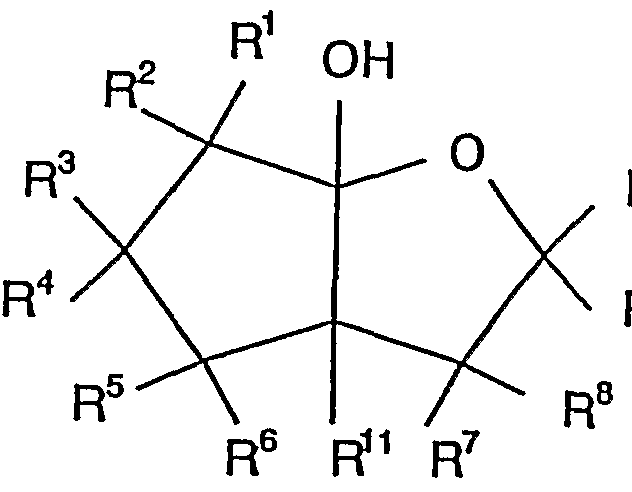
  • Hydroxycarbonate (A) obtained by reacting racemic ratatatones with an alcohol is converted to a monoalkoxybisic compound represented by the formula [1] [3. 3.0] 12-oxaoctane Reacting with 1-hydroxybicyclo mouth [3.3.0] _2-oxaoctane represented by the formula [2] or bicyclo [3.3.0] -2-oxa-11-otatene represented by the formula [3] ,
  • a diastereomer mixture (B) the diastereomer mixture (B) is separated into diastereomers, and at least one of the separated diastereomers is decomposed into a hydroxycarboxylic acid ester (C) to form the hydroxycarboxylic acid ester (C).
  • a method for producing an optically active ratatone wherein the compound (C) is subjected to a ring-closing reaction to obtain an R-form or S-form ratatone;
  • To 1 are each independently hydrogen or an alkyl group having 1 to 20 carbon atoms, and R 11 is an unsubstituted or substituted alkyl group having 1 to 20 carbon atoms.
  • R 11 is an unsubstituted or substituted alkyl group having 1 to 20 carbon atoms.
  • R 12 is an alkyl group having 1 to 6 carbon atoms. .
  • the hydroxycarboxylic acid ester (A) obtained by reacting a racemic ratatone with alcohol is converted to a monoalkoxybicyclo represented by the formula [1].
  • R 1 ⁇ ! 1D are each independently hydrogen or Anore kill group having a carbon number of 1-20
  • R 11 is alkyl Le group having 1 to 20 carbon atoms an unsubstituted or substituted group, the carbon having unsubstituted or substituted It is an alkenyl group having 2 to 20 carbon atoms or an unsubstituted or substituted aryl group having 6 to 20 carbon atoms
  • R 12 is an alkyl group having 1 to 6 carbon atoms.
  • the 1-hydroxybisic mouth [3.3.0] —2-oxaotatan represented by the formula [2] can be obtained.
  • 1-hydroxybicyclo [3. 3. 0] 2-oxaoctane represented by the formula [2] with an alcohol represented by R 12 OH, the compound represented by the formula [1] is obtained.
  • 1-Alkoxybicyclo mouth [3.3.0] _ 2-oxane can be obtained, and 1-hydroxybicyclo [3.3.0]-2-oxoxactan represented by the formula [2] is dehydrated.
  • bicyclo [3,3,0] -2-oxoctene represented by the formula [3] can be obtained.
  • Equation [4] to [7],! ⁇ ⁇ 1 are each independently hydrogen or an alkyl group having a carbon number 1 to 20, R 11 is an alkyl group having a carbon number of 1 to 20 with an unsubstituted or substituted group, 2 carbon atoms an unsubstituted or substituted group A alkenyl group having 20 or an unsubstituted or substituted aryl group having 6 to 2 carbon atoms, R 13 is an alkyl group having 1 to 6 carbon atoms, and R 14 to R 15 are each independently And the total number of carbon atoms is 2 to 19, and X is halogen.
  • the substituent at the 1-position and 5 When an addition reaction occurs at the double bond of the bicyclo [3.3.0] -2-oxoxacten represented by the formula [3] and a substituent is introduced at one position, the substituent at the 1-position and 5
  • the substituent at the —position generates a cis-form and a trans-form, but is preferably a cis-form.
  • the compound represented by the formula [1], the formula [2] and the formula [3] used in the method of the present invention has a substituent at the 1-position and a 5-position at the time when the substituent is introduced at the 1_ position. Substantially no substituent other than either cis or trans Is preferred.
  • Raicines used in the method of the present invention are not particularly limited, and examples thereof include “V-ratatone, ⁇ -lactone, ⁇ -ratatone, macrocyclic rataton, and the like. More specifically, y-valerolataton , ⁇ -hexarata ton, V-heptalactone, 7-otara lactone, y-nonarata ton, whiskey rataton, ⁇ -decalactone, ⁇ -din decalactone, ⁇ -dodecalactone, —jasmolata ton, jasmine rata ton, Cis jas mon ratatone, methinole 1 gamma-zacalactone, jasmolactone, mentalactone, 11-butylphthalide, ⁇ -hexalactone, 4, 6, 6 (4, 6, 6)-trimethyltetrahydropyran 1-one, ⁇ 1 Otara lactone, ⁇ -nonalactone, ⁇ -decalactone, 61-2-decen
  • ratatotones having 6 to 20 carbon atoms are exemplified.
  • Ratatones having 8 to 14 carbon atoms can be used more preferably, and ⁇ -dodecalactone can be used particularly preferably.
  • the alcohol to be reacted an alcohol having 3 to 20 carbon atoms is preferable, and an alcohol having 3 to 6 carbon atoms is particularly preferable.
  • Specific examples of the alcohol include, for example, propanol, isopropanol, arinorealanol, Propanoleginoreanolone, butanol, isoptanolone, sec-butanol, tert-butanol, 2-butene 1-one, 3-butene 2.-one, 1-pentano, 2-pentano, 3-pentano, 1,1 dimethino- 1-prono, 0- noren, 2, 2- Dimethino 1-prono, 1-prono, 1-techno 1-ptano-no, 1-hexano-
  • ⁇ -dodecalactone can be subjected to ring-opening esterification to give a racemic 5-hydroxyhydroxydecanoate ( ⁇ ).
  • Reaction formula [8] shows a typical example of this ring-opening esterification reaction.
  • the hydroxycarboxylic acid ester (A) obtained from the reaction fc of ratatatones with an alcohol is converted to a monoalkoxybicyclo [3.3.0] -2-oxoctane represented by the formula [1]: It is reacted with 1-hydroxybicyclo [3.3.0] -2-oxoctane represented by [2] or bicyclo [3.3.0] -2-oxa1-1-octene represented by the formula [3].
  • the diastereomer mixture (B) is obtained by subjecting the hydroxycarboxylic acid ester (A) to an 1-alkoxybicyclo [3.3.0] -2-oxaoctane represented by the formula [1] by an acetanole exchange reaction. Obtainable. An example of this acetal exchange reaction is shown in reaction equation [9].
  • the diastereomer mixture (B) is obtained by a dehydration reaction between the hydroxycarboxylic acid ester (A) and 1-hydroxybicyclo [3.3.0] -2-oxaotatan represented by the formula [2]. ) Can be obtained. An example of this dehydration reaction is shown in Reaction formula [10].
  • the diastereomer mixture (B) can be obtained by the addition reaction of An example of this addition reaction is shown in the reaction formula [11].
  • the length is 1 to! ⁇ 1 .
  • the reaction conditions of the above acetal exchange reaction, dehydration reaction and addition reaction are not particularly limited, and examples thereof include benzene, toluene, xylene, carbon tetrachloride, dioxane, acetone, dimethylinolesulfoxide, acetonitrile, and dimethyl.
  • an acid catalyst such as p-toluenesulfonic acid in an aprotic solvent such as formamide or hexamethylphosphoric acid triamide
  • the compound is represented by the formula [1] with hydroxycarboxylate (A).
  • 1 monoalkoxybicyclo [3.3.0]-2-oxaoctane represented by the formula [2] 1-hydroxybicyclo [3.3.0]-2-oxaoctane or the bicyclo represented by the formula [3] [3.3 . 0] _2—Oxa-1-one can be carried out by contact with 1-octene.
  • the alkyl group constituting the ester of the hydroxycarboxylic acid ester (A) preferably has 3 to 20 carbon atoms. When the number of carbon atoms is 1 or 2, the ring exchange reaction by dealcoholation proceeds along with the acetal exchange reaction, dehydration reaction or addition reaction.
  • ratatones may be by-produced, and the yield of the diastereomer mixture (B) may decrease.
  • the alkyl group or the aralkyl group of the hydroxycarboxylic acid ester (A) has 21 or more carbon atoms, it may be difficult to separate the diastereomer mixture (B) into the diastereomers.
  • the diastereomer mixture (B) is separated into individual diastereomers by optical resolution.
  • the method of separating each diastereomer includes distillation, recrystallization, and column chromatography.
  • Diastereomers have different chemical and physical properties and can be separated efficiently by choosing the appropriate method.
  • At least one of the separated diastereomers (that is, the diastereomer of 1- ( ⁇ -a-oxycarbonylalkyl) alkyloxybicyclo [3.3.0] -2-oxaoctane) is decomposed to give a hydroxy group.
  • the canolevonic acid ester (C) is subjected to a ring closure reaction to obtain R-form or S-form ratatones.
  • ratatones having optical purity that does not exist in nature can be produced with high purity, so that a fragrance having a novel aroma can be produced.
  • the compound represented by the formula [1], [2] or [3] used in the present invention can be optically resolved by reacting it with a racemic alcohol, an organic acid, or the like, so that an optically active alcohol-based fragrance can be obtained.
  • a fragrance intermediate can be easily obtained.
  • alcohol-based flavors include aliphatic alcohol-based flavors, terpene-based alcohol-based flavors, aromatic alcohol-based flavors, and phenol-based flavors, and more specifically, 3-methyl-1--1-pentano.
  • Examples of the musk-based fragrance include Musun, Phantolide, Musk, and Traceolide.
  • Examples of the acid-based flavor include 2-methylbutyric acid, 2-methylvaleric acid, 3-methylvaleric acid, 2-methylheptanoic acid, lactic acid, and valine.
  • the metametano-nodule produced by the reaction is added to the reaction system using a deionized stack. I pulled it out from the stake. .
  • the reaction solution was filtered, and the filtrate was concentrated and concentrated under reduced pressure to give 44 77 66 parts of residual residue. I hit. .
  • the remaining residue obtained is washed with
  • the isomer AA is dissolved and dissolved in chlorinated methethylenlene, and the resulting mixture is prepared by dissolving 22 parts, 2,000 000 parts by weight of methetatanol and a part of pp-tolueneensulluronic acid. After adding and adding 77 parts of pyrididininumum salt, the mixture was stirred at room temperature for 3300 minutes, and then reacted and mixed. The combined solution is washed and washed with a saturated aqueous solution of chlorinated sodium salt of sodium natotridium in water, and dried and dried using anhydrous carbon dioxide-carbonated real estate.
  • a reaction vessel equipped with a stirrer was charged with 396 parts of racemic ⁇ -dodecalactone and 1,200 parts of isopropanol, and 0.38 part of ⁇ -toluenesulfonic acid monohydrate was added. Stirred at room temperature for 20 hours. Then, add a 2% by weight aqueous sodium hydrogen carbonate solution Neutralized, distilling off isopropanol under reduced pressure, and filtering the precipitated salt.
  • a ring-opening esterification reaction of ⁇ -dodecalactone was carried out in the same manner as in Example 1 except that 920 parts of ethanol was used instead of 1,200 parts of isopropanol. 405 parts (yield 85.0%) of ethyl ester of droxide dodecanoate were obtained.
  • a reaction vessel equipped with a stirrer and reflux condenser was charged with 1,840 parts of anhydrous toluene, 244 parts of the above-mentioned 5-hydroxyethyldecanoate ethyl ester and 200 parts of Molecular Sheep MS-5A, and adsorbed methanol on the reflux condenser.
  • Molecular sieve MS-4A 4,000 parts. 200 parts of 1-methoxy-5- (2-propyl) bicyclo [3.3.0] -2-oxaoctane was added to the reaction vessel, heated with stirring, and reacted under reflux for 10 hours.
  • hydroxycarboxylic acid esters obtained by reacting racemic ratatones with alcohol are used to convert 1-alkoxybicyclo [3.3.0] -2-oxoxaoctane, -Hydroxybicyclo [3.3.0] 12-oxaoctane or bicyclo [3.3.0]-2-oxa-l-octathene, in high yield, in reaction with 11-otatene Bicyclo [3.3.0] —a diastereomeric mixture of 2-oxaoctane can be obtained, and after separating the diastereomeric mixture into diastereomers, the separated diastereomers are decomposed and ring-closed to give excellent perfume.
  • R-form and S-form lactones having excellent characteristics can be produced with high purity and high yield.

Landscapes

  • Chemical & Material Sciences (AREA)
  • Organic Chemistry (AREA)
  • Organic Low-Molecular-Weight Compounds And Preparation Thereof (AREA)
  • Pyrane Compounds (AREA)
  • Heterocyclic Carbon Compounds Containing A Hetero Ring Having Oxygen Or Sulfur (AREA)

Description

明細書 光学活性ラクトン類の製造方法
技術分野
本発明は、光学活性ラタトン類の製造方法に関する。 さらに詳しくは、本発明は 、 ラセミ体のラタトン類を化学的な手段のみにより分割して、香料として有用なラ クトン類の R体及ぴ S体を効率的に得ることができる光学活性ラタトン類の製造 方法に関する。
背景技術
環内にエステル結合を有する環状化合物であるラタトン類は、香気物質として食 品中に広く見いだされ、香りを与えるための有用素材として利用されている。例え ば、五員環構造の γ—ラタトンと、六員環構造の δ—ラクトンは特徴のある香気を 有している。側鎖を有するラクトンは、側鎖が結合した炭素原子が不斉炭素原子で あるために、 R体と S体の光学異性体が存在し、 2種類の光学異性体は、構造のみ ならず、 匂いの強さも、香気、 香味も異なる。 果物などに含まれる天然に存在する ラタトンは、 R体又は S体に偏って存在するが、 化学的に合成されたラタトンは、 R体と S体が半分ずつ混ざり合ったラセミ体であるために、自然界に存在するラタ トンとは、 香気、 香味が異なる。
δ—ラクトンの中で炭素数 1 2の δ—ドデカラクトンは、強い残香性を持つフル 一ティー、 フローラルな香りを有する香料である。天然に存在する δ—ドデカラク トンの光学純度は、 発酵バターが R体 8 8 % e e、 生クリームが R体 8 2 % e e、 コンデンスミルクが R体 9 2 % e eであり、天然の δ—ドデカラクトンは R体に偏 つている。 δ—ドデカラクトンは、 食品へ香りを付与するために利用されており'、 例えば、 ミルクチヨコレートフレーバが付与された菓子糸且成物として、 δーデカラ タトンと δ—ドデカラクトンをそれぞれ 0 . 0 5〜 4 p p m含む菓子組成物が提案 されている (特許文献 1 )。
光学活性な R体又は S体の δ—ドデカラクトンを、経済的に製造する試みがなさ れている。 例えば、香料素材として香気的に優れ、調合素材として応用できる安価 な光学活性 5—ラクトンの製造方法として、ラセミ体ラクトンに微生物起源のリパ ーゼを作用させることによりラセミ体ラタトンを光学分割し、得られるヒドロキシ カルボン酸を環化する方法が提案され、ラセミ体 δ—ドデカラクトンの分割が例示 されている (特許文献 2 )。 また、 安価で入手が容易な原料を使用して R体の δ— ラタトンを得る方法として、タリブトカリヤ マソィァ ベックの樹皮の精油から分 離された δ—ドデセノラクトンを還元して(R)—(+)— δ—ドデカラクトンを得 る方法が提案されている (特許文献 3 )。 し力 し、 微生物起源のリパーゼを利用す る反応には長時間を要し、天然物由来のタリプトカリヤ マソィァ ベックの樹皮の 精油は、 大量入手が困難である。 このために、 化学的な手段のみによって、 光学純 度の高いラクトン類を製造し得る方法が求められていた。
本発明は、 ラセミ体のラタトン類を化学的な手段のみにより分割して、香料とし て有用なラタトン類の R体及び S体を効率的に得ることができる光学活性ラタト ン類の製造方法を提供することを目的としてなされたものである。
【特許文献 1】
特開 2 0 0 1— 9 5 4 9 0号公報 (第 2頁)
【特許文献 2】
特開平 6— 3 1 9 5 8 9号公報 (第 2頁、 第 5頁)
【特許文献 3】
特開平 1 0— 1 5 8 2 5 7号公報 (第 1一 2頁)
発明の開示
本発明者らは、上記の課題を解決すべく鋭意研究を重ねた結果、 ラセミ体のラタ トン類とアルコールとの反応により得られるヒ ドロキシカルボン酸エステルを、 5 一位置に置換基を有する 1一アルコキシビシクロ [ 3 . 3 . 0 ]— 2—ォキサォクタ ンなどと反応させると、ジァステレオマー混合物となり、該ジァステレオマー混合 物は容易に各ジァステレオマーに分離することができ、分離されたジァステレオマ 一を分解してヒドロキシカルボン酸エステルとし、さらに閉環反応させることによ り、光学純度の高い R体及び S体のラクトン類が効率的に得られることを見いだし 、 この知見に基づいて本発.明を完成するに至った。
すなわち、 本発明は、 .
(1)ラセミ体のラタ トン類とアルコールとの反応により得られるヒドロキシカル ボン酸エステル(A)を、 式 [1] で表される 1一アルコキシビシク口 [3. 3.0] 一 2—ォキサオクタン、 式 [2] で表される 1ーヒ ドロキシビシク口 [3. 3.0] _ 2—ォキサオクタン又は式 [3]で表されるビシクロ [3. 3.0]— 2—ォキサ一 1一オタテンと反応させて、 ジァステレオマー混合物(B)とし、該ジァステレオマ 一混合物( B )を各ジァステレオマーに分離したのち、分離したジァステレオマーの 少なくとも一つを分解してヒドロキシカルボン酸エステル(C)とし、該ヒ ドロキシ カルボン酸エステル(C)を閉環反応させることにより、 R体又は S体のラタ トン類 とすることを特徴とする光学活性ラタトン類の製造方法、
Figure imgf000005_0001
Figure imgf000005_0002
Figure imgf000006_0001
(ただし、 式中、 !^〜 1。は、 それぞれ独立して水素又は炭素数 1〜 20のアル キル基であり、 R11は、 無置換若しくは置換基を有する炭素数 1〜20のアルキ ル基、無置換若しくは置換基を有する炭素数 2〜 20のアルケニル基又は無置換若 しくは置換基を有する炭素数 6〜20のァリール基であり、 R12は、 炭素数 1〜 6のアルキル基である。.)、
(2) ラクトン類が、炭素数 6〜 20のラクトン類である第 1項記載の光学活性ラ クトン類の製造方法、
(3) ラタ トン類が、 δ—ドデカラクトンである第 2項記載の光学活性ラクトン類 の製造方法、
(4) アルコールが、炭素数 3〜 20のアルコールである第 1項記載の光学活性ラ クトン類の製造方法、
(5) アルコール力 S、イソプロパノールである第 4項記載の光学活性ラタトン類の 製造方法、 及び
(6) アルコールが、ィソプロパノールである第 3項記載の光学活性ラタ トン類の 製造方法、
を提供するものである。
発明を実施するための最良の形態
本発明の光学活性ラタ トン類の製造方法においては、ラセミ体のラタ トン類とァ ルコールとの反応により得られるヒドロキシカルボン酸エステル(A)を、 式 [1] で表される 1一アルコキシビシクロ [3· 3.0]— 2—ォキサオクタン、 式 [2] で 表される 1—ヒ ドロキシビシクロ [3. 3.0]— 2—ォキサオクタン又は式 [3]で 表されるビシク口 [3. 3.0]— 2—ォキサ一 1—オタテンと反応させて、ジァステ レオマー混合物(B)とし、該ジァステレオマー混合物(B)を各ジァステレオマーに 分離したのも、分離したジァステレオマーの少なくとも一つを分解してヒドロキシ カルボン酸エステル(C)とし、該ヒ ドロキシカルボン酸エステル(C)を閉環反応さ せることにより、 R体又は S体のラクトン類とする。
Figure imgf000007_0001
ただし、 式中、 R1〜! 1Dは、 それぞれ独立して水素又は炭素数 1〜20のァノレ キル基であり、 R11は、 無置換若しくは置換基を有する炭素数 1〜20のアルキ ル基、無置換若しくは置換基を有する炭素数 2〜 20のアルケニル基又は無置換若 しくは置換基を有する炭素数 6〜20のァリール基であり、 R12は、 炭素数 1〜 6のアルキル基である。
本発明方法においては、 1 11が2_プロぺニル基、 フエニル基又はジフエエル メチル基である式 [1] 〜 [3] で表される化合物を好適に用いることができる。 本発明方法に用いる式 [1]で表される 1一アルコキシビシク口 [3. 3. 0]— 2 一ォキサオクタン、 式 [2] で表される 1.ーヒドロキシビシクロ [3. 3. 0]— 2— ォキサオクタン及ぴ式 [3]で表されるビシクロ [3. 3. 0]— 2—ォキサ一 1ーォ クテンの製造方法に特に制限はなく、 Tetrahedron Lett., 3 5, 7 78 5 (1 9 9 4)に記載の方法で得られる化合物から容易に誘導できる。 他の方法としては、 式 [4] で表されるシクロペンタノン誘導体と式 [5] で表されるカーボネートとを 反応させて式 [6] で表される 2 _置換シクロペンタノン誘導体とし、 式 [6] で 表される 2—置換シクロペンタノン誘導体とひ, α—ジハロカルボン酸とを反応さ せて式 [7] で表されるエステルとし、 式 [7] で表されるエステルをアル力リで 処理して式 [2]で表される 1—ヒドロキシビシク口 [3. 3. 0]— 2—ォキサオタ タンを得ることができる。 また、 式 [2] で表される 1—ヒドロキシビシクロ [3. 3. 0]— 2 _ォキサオクタンと R12OHで表されるアルコールとを反応させるこ とにより、 式 [1] で表される 1一アルコキシビシク口 [3. 3. 0]_ 2—ォキサ才 クタンを得ることができ、 式 [2] で表される 1—ヒドロキシビシクロ [3. 3. 0] - 2—ォキサォクタンを脱水反応することにより、 式 [3] で表されるビシクロ [ 3. ,3. 0]— 2—ォキサォクテンを得ることができる。
Figure imgf000008_0001
Figure imgf000008_0002
Figure imgf000009_0001
Figure imgf000009_0002
ただし、 式 [4] 〜 [7] において、 !^〜 1。は、 それぞれ独立して水素又は 炭素数 1〜20のアルキル基であり、 R 11は、 無置換若しくは置換基を有する炭 素数 1〜20のアルキル基、無置換若しくは置換基を有する炭素数 2〜 20のアル ケニル基又は無置換若しくは置換基を有する炭素数 6〜2◦のァリール基であり、 R13は、 炭素数 1〜6のアルキル基であり、 R14〜R15は、 それぞれ独立して水 素又はアルキル基であって、 その炭素数の合計が 2〜19であり、 Xは、ハロゲン である。
本発明方法に用いる式 [1]で表される 1—アルコキシビシク口 [3. 3.0]— 2 一ォキサオクタン及び式 [2]で表される 1—ヒドロキシビシクロ [3. 3.0]— 2 一ォキサオクタンの 1一位置の置換基と 5—位置の置換基は cis形と trans形とが ある。 好適には cis形である。 また、 式 [3] で表されるビシクロ [3. 3.0]- 2 —ォキサォクテンの二重結合に付加反応が起こって 1一位置に置換基が導入され たとき、 1—位置の置換基と 5—位置の置換基は cis形と trans形とが生成するが好 適には cis形である。 本発明方法に用いる式 [1]、 式 [2] および式 [3] で表わ される化合物は、 1_位置に置換基が導入されたときの 1一位置の置換基と 5—位 置の置換基が cis形または trans形のどちらか一方以外はほとんど存在しないこと が好ましい。
本発明方法に用いるラタトン類に特に制限はなく、 例えば、 "V—ラタ トン、 δ— ラクトン、 ε —ラタ トン、 大環状ラタ トンなどを挙げることができ、 より具体的に は、 y—バレロラタトン、 γ—へキサラタ トン、 V一ヘプタラク トン、 7一オタタ ラク トン、 y—ノナラタ トン、 ウィスキーラタトン、 γ—デカラクトン、 γ—ゥン デカラクトン、 γ—ドデカラク トン、 —ジャスモラタ トン、 ジャスミンラタ トン 、 シスジャスモンラタトン、 メチノレ一 γ一ザカラクトン、 ジャスモラク トン、 メン タラクトン、 11—ブチルフタリ ド、 δ —へキサラクトン、 4, 6, 6 ( 4 , 6 , 6 )—ト リメチルテトラヒ ドロピラン一 2—オン、 δ一オタタラク トン、 δ—ノナラク トン 、 δーデカラク トン、 6一 2—デセノラク トン、 δ—ゥンデカラク トン、 δ一ドデ カラクトン、 δ—トリデカラク トン、 シクロへキシルラクトン、 ε—デカラク トン 、 ε—ドデカラクトンなどを挙げることができる。 これらの中で、 炭素数 6〜 2 0 のラタトン類を好適に用いることができ、炭素数 8〜 1 4のラタ トン類をより好適 に用いることができ、 δ一ドデカラクトンを特に好適に用いることができる。 本発明方法において、 ラセミ体のラクトン類と反応させるアルコールとしては、 炭素数 3 〜 2 0のアルコールが好ましく、炭素数 3 〜 6のアルコールが特に好まし レ、。 アルコールの具体例としては、 例えば、 プロパノール、 イソプロパノール、 ァ リノレアノレコール、 プロパノレギノレアノレコーノレ、 ブタノール、 イソプタノーノレ、 sec— ブタノール、 tert—ブタノール、 2—ブテン一 1—ォーノレ、 3—プテン一 2.—ォー ノレ、 1一ペンタノ一ノレ、 2—ペンタノ一ノレ、 3—ペンタノ一ノレ、 1 , 1ージメチノレ — 1—プロノ、0ノーノレ、 2 , 2—ジメチノレ一 1ープロノ、。ノーノレ、 1—工チノレ一 1—プ タノ一ノレ、 1一へキサノーノレ、 2—へキサノーノレ、 3 _へキサノーノレ、 1ーメチ /レ 一 1 ーェチノレー 1一プロパノール、 1 , 1一ジメチルー 1ーブタノール、 2 , 2—ジ メチノレ一 1—プタノーノレ、 1ーェチノレ一 1—ブタノーノレ、 1ーメチルー 1一ペンタ ノール、 1—ヘプタノール、 ' 1—ォクタノール、 1ーデカノール、 ラウリルアルコ ール、 ミリスチルアルコール、 セチノレアルコール、 ステアリルァノレコーノレ、 エイコ シルアルコール、ベンジルアルコール、 フエネチルアルコールなどを挙げることが できる。 これらの中でも、 プロパノール、 イソプロパノール及ぴ sec—ブタノ一ル をより好適に用いることができ、イソプロパノールを特に好適に用いることができ る。
本究明方法においては、例えば、 ラセミ体の δ一ドデカラクトンとアルコールの 反応により、 δ一ドデカラクトンを開環エステル化して、 ラセミ体の 5—ヒ ドロキ シドデカン酸エステル(Α)とすることができる。 反応式 [8] は、 この開環エステ ノレ化反応の代表例を示すものである。
Figure imgf000011_0001
[8] 反応式 [8] において、 *は、 不斉炭素原子を示し、 R13は、 アルキル基であ る。
本発明方法においては、ラタトン類とアルコールとの反応 fcより得られるヒ ドロ キシカルボン酸エステル(A)を、 式 [1] で表される 1一アルコキシビシクロ [3. 3.0]— 2—ォキサオクタン、 式 [2] で表される 1ーヒドロキシビシクロ [3. 3.0 ]— 2—ォキサォクタン又は式 [3]で表されるビシクロ [3. 3.0]— 2—ォ キサ一 1—ォクテンと反応させる。
本発明方法においては、 ヒドロキシカルボン酸エステル(A)と式 [1] で表され る 1—アルコキシビシクロ [3. 3.0]— 2—ォキサオクタンとをァセターノレ交換 反応することにより、 ジァステレオマー混合物(B)を得ることができる。 このァセ タール交換反応の例を反応式 [9] に示した。 また、 ヒドロキシカルボン酸エステ ノレ (A)と式 [2]で表される 1ーヒ ドロキシビシクロ [3. 3. 0]— 2—ォキサオタ タンとを脱水反応することにより、ジァステレオマ一混合物(B )を得ることができ る。 この脱水反応の例を反応式 [10] に示した。 さらに、 ヒドロキシカルポン酸 エステル(A)と式 [3]で表されるビシクロ [3. 3.0]— 2—ォキサ一 1—ォクテ ンとを付加反応することにより、ジァステレオマー混合物(B)を得ることができる 。 この付加反応の例を反応式 [1 1] に示した。 なお、 反応式 [9] 〜 [: 1 1] に おいては、 簡略化のために、 尺1〜!^1。をすベて水素として示しているが、 1〜 R 1 °の一部又はすべてがアルキル基である化合物も同様に用いることができる。 また、 反応式 [9] 〜 [: L 1] においては、 簡略化のために、 ヒ ドロキシカノレボン 酸エステルとして、 5—ヒドロキシドデカン酸エステルを示し、 ジァステレオマー 混合物(B)、すなわち 1 _(ω—アルコキシカルボニルアルキル)アルキルォキシビ シクロ [3. 3.◦]_ 2—ォキサオクタンのジァステレオマー混合物として、 1一( 3—アルコキシカルボ-ルプロピノレ)ォクチルォキシビシクロ [3. 3.0]— 2—ォ キサオクタンを示しているが、 これに限定されない。 本発明においては、 例えば、 γ—ゥンデカラクトンなどの開環エステル化によって得られる 4—ヒドロキシゥ ンデカン酸エステルなどを用いて、 1一(2一アルコキシカルボニルェチル)オタチ ルォキシビシクロ [3. 3.0]— 2—ォキサオクタンなどを得ることもできる。
Figure imgf000012_0001
Figure imgf000013_0001
[11] 上記のァセタール交換反応、脱水反応及び付加反応は、その反応条件に特に制限 はなく、 例えば、 ベンゼン、 トルエン、 キシレン、 四塩化炭素、 ジォキサン、 ァセ トン、 ジメチノレスルホキシド、 ァセトニトリル、 ジメチルホルムアミ ド、 へキサメ チルリン酸トリアミ ドなどの非プロトン性溶媒中で、 p—トルエンスルホン酸など の酸触媒の存在下に、 ヒドロキシカルポン酸エステル(A)と式 [1] で表される 1 一アルコキシビシクロ [3. 3.0]— 2—ォキサオクタン、 式 [2] で表される 1一 ヒドロキシビシクロ [3. 3.0]— 2—ォキサオクタン又は式 [3]で表されるビシ クロ [3. 3. 0]_2—ォキサ一 1ーォクテンとを接触させることによって行うこ とができる。ヒ ドロキシカルボン酸エステル(A)のエステルを構成するアルキル基 の炭素数は 3〜20であることが好ましい。炭素数が 1又は 2であると、 ァセター ル交換反応、脱水反応又は付加反応とともに脱アルコールによる閉環反応が進行し てラタ トン類が副生し、ジァステレオ 混合物(B)の収率が低下するおそれがあ る。ヒ ドロキシカルボン酸エステル(A)のアルキル基又はァラルキル基の炭素数が 21以上であると、ジァステレオ 混合物(B)を各ジァステレオマーに分離する のが困難になるおそれがある。
本発明方法においては、ジァステレオ 混合物(B)を光学分割して各ジァステ レオマーに分離する。各ジァステレオマーに分離する方法に特に制限はなく、例え ば、 蒸留、 再結晶、 カラムクロマトグラフィーなどを挙げることができる。 ジァス テレオマーは、化学的性質及び物理的性質が異なるので、適切な方法を選ぶことに より、 効率的に分離することができる。
本発明方法においては、 分離されたジァステレオ (すなわち、 1— (ω—ァ コキシカルポニルアルキル)アルキルォキシビシクロ [3. 3.0]— 2—ォキサォ クタンのジァステレオマー)の少なくとも一つを分解してヒドロキシカノレボン酸ェ ステル(C)とし、 これを閉環反応することにより、 R体又は S体のラタ トン類を得 る。 1— (ω—アルコキシカルボニルアルキル)アルキルォキシビシク口 [ 3. 3.0] 一 2—ォキサオタタンのジァステレオマーの分解反応及び閉環反応は、 ρ—トルェ ンスルホン酸などの酸触媒の存在下に、 1一(ω—アルコキシカルボニルアルキル) アルキルォキシビシクロ [3. 3.0]_ 2—ォキサオクタンと過剰量のアルコール とを加熱して反応することにより行うことができる。 1一(3—アルコキシカルボ ニルプロピル)ォクチルォキシビシクロ [3. 3.0]— 2—ォキサオクタンの反応例 を、 反応式 [12] に示す。 R14OHで表されるアルコールは、 メタノール、 ェ タノール、 プロパノール、イソプロパノールなどの低級アルコールであることが好 ましい。 '
R1 1
Figure imgf000015_0001
[ 1 2] 本発明方法によれば、天然には存在しない光学純度のラタトン類をも高純度で製 造することができるので、 新規な香気を有する香料を製造することができる。 なお、 本発明で用いる式 [ 1 ]、 式 [ 2 ] または式 [ 3 ] で表される化合物は、 ラセミ体のアルコール、有機酸などと反応させると光学分割でき、光学活性なアル コール系香料または香料中間体を容易に得ることもできる。アルコール系香料とし ては、 例えば、脂肪族アルコール香料、 テルペン系アルコール香料、 芳香族アルコ ール香料、 フエノール系香料などを挙げることができ、 より具体的には、 3—メチ ノレ一 1—ペンタノ一ノレ、 2—へプタノーノレ、 3—ヘプタノ一ノレ、 2—才クタノーノレ 、 3—ォクタノール、 2—ェチルへキサノール、 2—ノナノール、 3, 5, 5—トリ メチ /レー 1—へキサノーノレ、 2—ゥンデカノーノレ、 1—ペンテン一 3—ォーノレ、 1 一オタテン一 3—ォーノレ、 1一ノネン一 3—ォーノレ、 4ーメチノレー 3—デセン一 5 一才一ノレ、 バクダノーノレ、 サンダローノレ、 一 tert—プチゾレシク口へキサノーノレ、 o—tert—ブチノレシク口へキサノール、 シクロメチレンシトロネロ一ノレ、 メチノレサ ンデフローノレ、 2, 2 , 6—トリメチノレシク口へキシノレ一 3一へキサノーノレ、シトロ ネ口一ノレ、 口ジノール、 ゲラニオール、 リナローノレ、 ジメチノレオクタノーノレ、 ムゴ 一ノレ、 ジヒドロミノレセノーノレ、 テトラヒドロミノレセノーノレ、 3 , 6—ジメチノレ一 3 一才クタノーノレ、 ラバンジュローノレ、 イソジヒドロラバンジュローノレ、 ヒドロキシ シトロネロール、 ノナディノレ、 ェチノレリナ口一ノレ、 イソプレゴーノレ、 メント一ノレ、 テノレピネロ一ノレ、 ジヒ ドロテノレピネロ一ノレ、 カノレぺォ一ノレ、 ジヒ ドロカノレぺォ一ノレ 、 ペリラアルコール、 4—ツヤノール、 3一ツヤノール、 ィソシクロゲラエォーノレ 、 ミノレテノーノレ、 ノポーノレ、 ピノカノレぺォ一ノレ、 フェンコ—ノレ、 ポノレネオ一ノレ、 ィ ソポノレネオ一ノレ、 カメコーノレ、 ジメチノレサイクロモノレ、 ィソカンフイノレシク口へキ サノーノレ、 ネロリ ドール、 a -ビサボローノレ、 ;3—力リオフィレンアルコール、 サ ンタローノレ、 ペチべローノレ、 セドローノレ、 セドレノーノレ、 ノ チユリアノレコーノレ、 フ ィ トーノレ、 イソフィ トール、 ゲラニノレリナローノレ、 スクラレオーノレ、 , ひージメ チノレべンジ/レアノレコール、 α—フエニノレエチノレアノレコーノレ、 ヒドラトロパァノレコー ル、 2—メ トキシフエエノレエチノレアノレコール、 α—プロピノレフェニノレエチノレアノレコ ール、イソブチルベンジルカルビノール、 3—メチノレ一 5—フエ二ノレペンタノ一ノレ ― 1、 デカヒドロー β—ナフトーノレ、 フロロール、 シンゲオールなどを挙げること ができる。
ムスク系香料としては、 例えば、 ムス ン、 ファントリ ド、 ムスク、 トラセオリ ドなどを挙げることができる。 酸系香料としては、 例えば、 2—メチル酪酸、 2— メチル吉草酸、 3—メチル吉草酸、 2—メチルヘプタン酸、 乳酸、 バリンなどを挙 げることができる。
実施例
以下に、実施例を挙げて本発明をさらに詳細に説明するが、本発明はこれらの実 施例によりなんら限定されるものではない。 なお、 特に断りが無い限り、 実施例中 の 「部」 は 「重量部」 を意味する。
製造例 1 ( 1—メ トキシー 5— ( 2—プロぺエル)ビシクロ [ 3 . 3 . 0 ]— 2 _ォキサ オクタンの製造と光学分割)
2—( 2—プロぺニルォキシ力ルポ二ノレ)シク口ペンタノン 5 0 0部と、酢酸 2— ョードエチル 6 3 6部をァセトン中で反応させることにより、 2—(2—プロぺニ ルォキシカルボニル)一 2—ァセトキシェチルシク口ペンタノン 6 7 9部を得た。 この 2—( 2—プロぺニルォキシカルボ二ノレ)一 2—ァセトキシェチノレシクロペン タノンに、酢酸パラジウムとトリフエ-ルホスフィンを加えて、テトラヒドロフラ ン中で還流することにより、 2— ( 2—プロぺュル)一 2—ァセトキシェチルシクロ ペンタノンとし、 さらに、 ρ— トルエンスルホン酸を触媒としてメタノール中で還 流することにより環化反応させて、 1ーメ トキシー 5— ( 2—プロぺニル)_ 2—ォ キキササビビシシククロロ [[ 33 .. 33 .. 00 ]]—— 22——ォォキキササオオククタタンンととししたた。。反反応応混混合合液液かからら過過剰剰ののメメタタ ノノーールルをを留留去去ししてて、、 11ーーメメ トトキキシシーー 55——(( 22——ププロロぺぺニニルル))一一 22一一ォォキキササビビシシクク口口 [[ 33 .. 33 .. 00 ]]—— 22——ォォキキササォォククタタンン 33 77 88部部をを得得たた。。
得得らられれたた 11ーーメメ トトキキシシ一一 55—— (( 22——ププロロべべ--ルル))一一 22——ォォキキササビビシシククロロ [[ 33 .. 33 .. 00 55 ]]ーー 22——ォォキキササオオククタタンン 33 00 00部部ととモモレレキキュュララーーシシーーブブ MM SS—— 55 AA 33 00 00部部をを含含むむ 無無水水トトルルェェンン 22,, 66 00 00部部溶溶液液にに、、 (((( 11 SS ))——エエンンドド))一一((一一))一一ボボルルネネオオーールル 22 55 44 部部をを室室温温でで加加ええたたののちち、、 11 11 00 °°CCでで 11 00時時間間撹撹拌拌ししたた。。 ここのの際際、、 反反応応にによよりり生生成成すす るるメメタタノノーールルをを、、デディィーーンンススタタッッククをを用用いいてて反反応応系系内内かからら抜抜きき出出ししたた。。反反応応液液ををろろ 過過しし、、 ろろ液液をを減減圧圧下下にに濃濃縮縮ししてて、、 残残留留物物 44 77 66部部をを得得たた。。 得得らられれたた残残留留物物ををシシリリカカ
1100 ゲゲルル力力ララムムククロロママトトググララフフィィーー (( nn ——へへキキササンン::ジジェェチチノノレレエエーーテテノノレレ == 44 00 :: 11 )) にに よよりり精精製製ししてて未未反反応応原原料料をを除除去去しし、、 目目的的ととすするるジジァァスステテレレオオママーー混混合合物物をを得得たた。。 ささ ららにに、、得得らられれたたジジァァスステテレレオオママーー混混合合物物ををシシリリカカゲゲルルククロロママトトググララフフィィーー((nn——へへ キキササンン::ジジイイソソププロロピピルルエエーーテテルル == 11 :: 44 00 )) にによよりりそそれれぞぞれれののジジァァスステテレレオオママーー にに分分離離ししたた。。 RR ii値値がが 00 .. 33 66ののジジァァスステテレレオオママーー ((異異性性体体 AAととすするる。。)) のの収収量量 11 99
1155 ◦◦部部 ((収収率率 33 88 %%))、、 RR ff値値がが 00 .. 22 88ののジジァァスステテレレオオママーー ((異異性性体体 BBととすするる。。)) のの 収収量量 22 11 00部部 ((収収率率 44 22 %%)) ででああっったた。。
異異性性体体 AAをを塩塩化化メメチチレレンンにに溶溶解解しし、、 メメタタノノーールル 22 ,, 00 00 00部部及及びび pp——トトルルェェンンスス ルルホホンン酸酸ののピピリリジジニニゥゥムム塩塩 11 .. 55 77部部をを添添加加ししてて、、 室室温温でで 33 00分分撹撹拌拌ししたたののちち、、 反反 応応混混合合液液をを飽飽和和塩塩化化ナナトトリリゥゥムム水水溶溶液液でで洗洗浄浄しし、、無無水水炭炭酸酸力力リリゥゥムムをを用用いいてて乾乾燥燥しし
2200 、、 ろろ過過ししたた。。 ろろ液液をを減減圧圧濃濃縮縮ししてて得得らられれたた残残留留物物をを、、 シシリリカカゲゲルルククロロママトトググララフフィィ 一一 ((nn——へへキキササンン::酢酢酸酸ェェチチルル == 11 99 :: 11 )) にによよりり精精製製しし、、 11——メメ トトキキシシーー 55——(( 22——ププロロぺぺニニルル))__ 22——ォォキキササビビシシククロロ [[ 33 .. 33 .. 00 ]]—— 22——
Figure imgf000017_0001
テレオマーを得た。この 1—メ トキシー 5— ( 2—プロぺ二/レ)一 2—ォキサビシク 口 [ 3 . 3 . 0 ]— 2—ォキサオタタンのジァステレオマーを、実施例 1において使用 した。
実施例 1
撹拌機を備えた反応容器に、ラセミ体の δ—ドデカラク トン 3 9 6部とイソプロ パノール 1, 2 0 0部を仕込み、 ρ—トルエンスルホン酸一水和物 0 . 3 8部を添加 し、 室温で 2 0時間撹拌した。 次いで、 2重量%炭酸水素ナトリウム水溶液を加え て中和し、減圧下にィソプロパノールを留去し、析出した塩をろ過することにより
、 5—ヒドロキシドデカン酸イソプロピルエステル 432部 (収率 83. 6%) を 得た。
撹拌機と還流冷却管を備えた反応容器に、 無水トルエン 1, 840部、 上記の 5 ーヒ ドロキシドデカン酸ィソプロピルエステル 258部及びモレキユラ一シーブ MS- 5 A200部を仕込み、還?巟冷却管にメタノールを吸着するモレキュラーシ ーブ MS— 4 A 4, 000部を充填した。反応容器に、 1—メトキシ一 5—(2—プ ロぺニル)ビシク口 [3. 3.0]— 2—ォキサオクタン 200部を加え、 撹拌しなが ら加熱して、還流下に 10時間反応させた。ガスクロマトグラフィーによる分析で は、 1一(3—イソプロポキシカルボニルプロピル)ォクチルォキシー 5—(2—プ ロぺニル)ビシク口 [ 3. 3.0]— 2—ォキサォクタンの反応収率は 85.0 %であ つた。
反応終了後、反応混合物をろ過し、 ろ液を減圧下に濃縮し、得られた残留物をシ リ力ゲルを充填剤、 n一へキサン Z酢酸ェチル 40/1 (容量比)を溶媒とするカラ ムクロマトグラフィーにより分離し、 2種類の 1一(3—イソプロポキシカルボ二 ルプロピル)オタチルォキシ一 5— (2一プロぺニル)ビシク口 [3. 3.0]— 2—ォ キサオクタンのジァステレオマーを得た。強吸着のジァステレオマーの収量 159 . 7部 (収率 39. 1%)、 弱吸着のジァステレオマーの収量 160. 6部 (収率 39 .4%) であった。
撹拌機と還流冷却管を備えた反応容器に、上記の強吸着のジァステレオマー 15 9. 7部とメタノーノレ 249. 6部を仕込み、 p—トルエンスルホン酸一水和物 0. 37部を加え、還流下に 2時間反応した。 反応終了後、 メタノールを留去し、 次い で減圧下に蒸留して(S)— (—)一 δ—ドデカラクトン 69.8部を得た。得られた( S)—(一)一 δ—ドデカラクトンの光学純度を HP LCで測定したところ、 95% e eであった。得られた(S)—(一) _ δ—ドデカラクトンは、甘いアプリコットの ようなフルーツ香を有していた。
実施例 2
ィソプロパノール 1, 200部の代わりに、 エタノール 920部を用いた以外は 、実施例 1と同様にして δ一ドデカラクトンの開環エステル化反応を行い、 5—ヒ ドロキシドデカン酸ェチルエステル 41 5部 (収率 85. 0%) を得た。
撹拌機と還流冷却管を備えた反応容器に、 無水トルエン 1, 840部、 上記の 5 ーヒ ドロキシドデカン酸ェチルエステル 244部及びモレキュラーシープ MS— 5 A200部を仕込み、還流冷却管にメタノールを吸着するモレキュラーシーブ M S— 4A4, 000部を充填した。反応容器に、 1ーメ トキシー 5— (2—プロぺュ ル)ビシクロ [3. 3.0]— 2—ォキサオクタン 200部を加え、 撹拌しながら加熱 して、 還流下に 10時間反応させた。 ガスクロマトグラフィーによる分析では、 1 一 ( 3ーェトキシカルボニルプロピル)オタチルォキシー 5—(2—プロべニル)ビ シクロ [3. 3.0]— 2—ォキサオクタン反応収率 55.0%であり、 5—ヒドロキ シドデカン酸ェチルエステルの 39.2モル0 /0が δ—ドデカラク トンになっていた 実施例 1及び 2の結果から、炭素数 3のイソプロピルアルコールから得られた 5 ーヒドロキシドデカン酸ィソプロピルエステルは、炭素数 2のエタノールから得ら れた 5—ヒ ドロキシドデカン酸ェチルエステルに比べ、 1ーメ トキシー 5—( 2— プロぺニル)ビシク口 [3. 3. 0]— 2—ォキサオクタンと反応して、高収率で 1一( 3ーィソプロポキシカノレポ二ノレプロピノレ)オタチノレオキシー 5一(2—プロぺニノレ) ビシクロ [3. 3.0]— 2—ォキサオクタンが得られることが分かる。
産業上の利用可能性
本発明の光学活性ラク トン類の製造方法によれば、ラセミ体のラタトン類とアル コールとの反応によって得られるヒドロキシカルボン酸エステルを、 1—アルコキ シビシクロ [3. 3.0]— 2 _ォキサオクタン、 1ーヒドロキシビシクロ [3. 3.0] 一 2—ォキサオクタン又はビシクロ [3. 3.0] — 2—ォキサ一 1一オタテンと反 応させて、高収率で 1一(ω—アルコキシカルボ-ルァルキノレ)アルキルォキシビシ クロ [3. 3. 0]— 2—ォキサオクタンのジァステレオマー混合物を得ることがで き、該ジァステレオマー混合物を各ジァステレオマーに分離したのち、分離された ジァステレオマーを分解反応及び閉環反応して、香料として優れた特徴を有する R 体及び S体のラク トン類を、 高純度かつ高収率で製造することができる。

Claims

請求の範囲
1. ラセミ体のラタ トン類とアルコールとの反応により得られるヒドロキシカル ボン酸エステル(A)を、 式 [1] で表される 1一アルコキシビシクロ [3. 3. 0] 一 2—ォキサオクタン、 式 [2] で表される 1ーヒドロキシビシクロ [3.3. 0] 一 2—ォキサオクタン又は式 [3]で表されるビシクロ [3. 3.0]— 2—ォキサ一
1—ォクテンと反応させて、 ジァステレオマー混合物(B)とし、該ジァステレオマ 一混合物(B )を各ジァステレオマーに分離したのち、分離したジァステレオマーの 少なくとも一つを分解してヒ ドロキシカルボン酸エステル(C)とし、該ヒドロキシ カルボン酸エステル(C)を閉環反応させることにより、 R体又は S体のラタトン類 とすることを特徴とする光学活性ラタトン類の製造方法。
Figure imgf000020_0001
(ただし、 式中、 尺1〜!^1。は、 それぞれ独立して水素又は炭素数 1〜20のアル キル基であり、 R11は、 無置換若しくは置換基を有する炭素数 1〜20のアルキ ル基、無置換若しくは置換基を有する炭素数 2〜 20のアルケニル基又は無置換若 しくは置換基を有する炭素数 6〜20のァリール基であり、 R12は、 炭素数 1〜 6のアルキル基である。)
2. ラクトン類が、炭素数 6〜 20のラク トン類である請求項 1記載の光学活性ラ ク トン類の製造方法。
3. ラタ トン類が、 δ—ドデカラク トンである請求項 2記載の光学活性ラク トン類 の製造方法。
4. アルコールが、炭素数 3~20のアルコールである請求項 1記載の光学活性ラ クトン類の製造方法。
5. アルコールが、イソプロパノールである請求項 4記載の光学活性ラクトン類の 製造方法。
6. アルコールが、 イソプロパノールである請求項 3記載の光学活性ラタトン類の 製造方法。
PCT/JP2004/006919 2003-05-28 2004-05-14 光学活性ラクトン類の製造方法 Ceased WO2004106320A1 (ja)

Priority Applications (1)

Application Number Priority Date Filing Date Title
JP2005506468A JPWO2004106320A1 (ja) 2003-05-28 2004-05-14 光学活性ラクトン類の製造方法

Applications Claiming Priority (2)

Application Number Priority Date Filing Date Title
JP2003151241 2003-05-28
JP2003-151241 2003-05-28

Publications (1)

Publication Number Publication Date
WO2004106320A1 true WO2004106320A1 (ja) 2004-12-09

Family

ID=33487214

Family Applications (1)

Application Number Title Priority Date Filing Date
PCT/JP2004/006919 Ceased WO2004106320A1 (ja) 2003-05-28 2004-05-14 光学活性ラクトン類の製造方法

Country Status (2)

Country Link
JP (1) JPWO2004106320A1 (ja)
WO (1) WO2004106320A1 (ja)

Cited By (3)

* Cited by examiner, † Cited by third party
Publication number Priority date Publication date Assignee Title
EP1719746A4 (en) * 2004-02-19 2009-04-15 Zeon Corp RAZEMATSPALTUNG AGENT, METHOD OF MAKING OPTICALLY ACTIVE ISOMER, AND 1.5-SUBSTITUTED BICYCL (3.3.0) -2-OXAOCTAN COMPOUND
JP2014080567A (ja) * 2012-09-25 2014-05-08 Sekisui Chem Co Ltd 硬化性樹脂組成物、封止材、上下導通材料、光電変換素子、色素増感太陽電池及び色素増感太陽電池モジュール
JP2015131773A (ja) * 2014-01-10 2015-07-23 長谷川香料株式会社 新規アルカン酸誘導体および該化合物を含有する香料組成物

Citations (7)

* Cited by examiner, † Cited by third party
Publication number Priority date Publication date Assignee Title
WO1994007887A1 (en) * 1992-09-29 1994-04-14 Givaudan-Roure (International) S.A. Optically active lactones
JPH06319589A (ja) * 1993-05-12 1994-11-22 Soda Koryo Kk 光学活性δ−ラクトンの製造法
JPH08182498A (ja) * 1994-12-28 1996-07-16 Yuji Inada 光学活性化合物の製造法
JPH10251244A (ja) * 1997-03-11 1998-09-22 Nippon Zeon Co Ltd ジアステレオマーヒドロキシカルボン酸アミド類の 製造方法と光学活性なδ−ラクトン類の製造方法
JP2001011063A (ja) * 1999-04-30 2001-01-16 Soda Aromatic Co Ltd 光学活性γ−ラクトンの製造法
WO2002072505A1 (en) * 2001-02-26 2002-09-19 Zeon Corporation Optical resolver and method of optically resolving alcohol with the same
JP2004085279A (ja) * 2002-08-23 2004-03-18 Techno Network Shikoku Co Ltd 光学活性体の絶対配置決定剤、その製造方法及びこれを用いる光学活性体の絶対配置決定方法

Patent Citations (7)

* Cited by examiner, † Cited by third party
Publication number Priority date Publication date Assignee Title
WO1994007887A1 (en) * 1992-09-29 1994-04-14 Givaudan-Roure (International) S.A. Optically active lactones
JPH06319589A (ja) * 1993-05-12 1994-11-22 Soda Koryo Kk 光学活性δ−ラクトンの製造法
JPH08182498A (ja) * 1994-12-28 1996-07-16 Yuji Inada 光学活性化合物の製造法
JPH10251244A (ja) * 1997-03-11 1998-09-22 Nippon Zeon Co Ltd ジアステレオマーヒドロキシカルボン酸アミド類の 製造方法と光学活性なδ−ラクトン類の製造方法
JP2001011063A (ja) * 1999-04-30 2001-01-16 Soda Aromatic Co Ltd 光学活性γ−ラクトンの製造法
WO2002072505A1 (en) * 2001-02-26 2002-09-19 Zeon Corporation Optical resolver and method of optically resolving alcohol with the same
JP2004085279A (ja) * 2002-08-23 2004-03-18 Techno Network Shikoku Co Ltd 光学活性体の絶対配置決定剤、その製造方法及びこれを用いる光学活性体の絶対配置決定方法

Cited By (3)

* Cited by examiner, † Cited by third party
Publication number Priority date Publication date Assignee Title
EP1719746A4 (en) * 2004-02-19 2009-04-15 Zeon Corp RAZEMATSPALTUNG AGENT, METHOD OF MAKING OPTICALLY ACTIVE ISOMER, AND 1.5-SUBSTITUTED BICYCL (3.3.0) -2-OXAOCTAN COMPOUND
JP2014080567A (ja) * 2012-09-25 2014-05-08 Sekisui Chem Co Ltd 硬化性樹脂組成物、封止材、上下導通材料、光電変換素子、色素増感太陽電池及び色素増感太陽電池モジュール
JP2015131773A (ja) * 2014-01-10 2015-07-23 長谷川香料株式会社 新規アルカン酸誘導体および該化合物を含有する香料組成物

Also Published As

Publication number Publication date
JPWO2004106320A1 (ja) 2006-07-20

Similar Documents

Publication Publication Date Title
FI95697C (fi) Laktidin valmistus dehydratoimalla sopivasti vesipitoista maitohapposyötettä
JP2009082129A (ja) キラル化合物の調製方法
RU2459816C2 (ru) Производные пирана, способ их получения и их применение в парфюмерии и для ароматизации
WO2004106320A1 (ja) 光学活性ラクトン類の製造方法
JP2006316025A (ja) 無水糖アルコール組成物の精製方法および製造方法ならびに精製製品
JP4376981B2 (ja) ジオキサシクロアルカン−8−オン
EP0694605A2 (fr) Diesters cycliques et leur utilisation à titre d'ingrédients parfumants
Fronza et al. Synthesis of enantiomerically pure forms of N-acyl derivatives of C-methyl analogs of the aminodeoxysugar L-acosamine from noncarbohydrate precursors
US9187709B2 (en) Synthesis of a novel odorant
US4980342A (en) Process for the preparation of α-alkyl lactones
JP2711893B2 (ja) ケトン類およびアルコール類
EP0761808B1 (de) Verwendung substituierter Lactone als Riechstoffe
JP3097143B2 (ja) 生理活性物質合成用光学活性化合物の製造法および光学活性中間体化合物
JPH11189783A (ja) 香気・香味・香喫味付与組成物およびそれを添加した飲食物、香水、化粧品およびたばこ
JPH05230048A (ja) (S)−γ−ラクトンの製造方法
JPH06503328A (ja) α−アルキルラクトンの調製方法
US10183923B2 (en) Method for synthesizing a precursor of a single dairy-lactone isomer
JP2794331B2 (ja) 3,7―デカジエン―5―オリド類
JPWO2019159871A1 (ja) シクロペンテノン誘導体の製造方法
Humpf et al. Absolute stereochemistry of natural 3, 4-dihydroxy-β-ionone glycosides by the CD exciton chirality method
JP2005002010A (ja) 光学活性ラクトンの製造方法
JP2007537211A (ja) p−メンタン−3−オールのアルキル化誘導体及びそれらの清涼剤としての使用
JPH10158257A (ja) 光学活性δ−ラクトンの製造方法および該δ−ラクトンを含有する香料
EP2079528B1 (fr) Utilisation en parfumerie et en aromatique et procede de preparation de la 5,5-dimethyl-3-ethyl-3, 4-dihydro-furan-2-one
JP2794333B2 (ja) ライラックアルコール誘導体

Legal Events

Date Code Title Description
AK Designated states

Kind code of ref document: A1

Designated state(s): AE AG AL AM AT AU AZ BA BB BG BR BW BY BZ CA CH CN CO CR CU CZ DE DK DM DZ EC EE EG ES FI GB GD GE GH GM HR HU ID IL IN IS JP KE KG KP KR KZ LC LK LR LS LT LU LV MA MD MG MK MN MW MX MZ NA NI NO NZ OM PG PH PL PT RO RU SC SD SE SG SK SL SY TJ TM TN TR TT TZ UA UG US UZ VC VN YU ZA ZM ZW

AL Designated countries for regional patents

Kind code of ref document: A1

Designated state(s): BW GH GM KE LS MW MZ NA SD SL SZ TZ UG ZM ZW AM AZ BY KG KZ MD RU TJ TM AT BE BG CH CY CZ DE DK EE ES FI FR GB GR HU IE IT LU MC NL PL PT RO SE SI SK TR BF BJ CF CG CI CM GA GN GQ GW ML MR NE SN TD TG

121 Ep: the epo has been informed by wipo that ep was designated in this application
WWE Wipo information: entry into national phase

Ref document number: 2005506468

Country of ref document: JP

122 Ep: pct application non-entry in european phase