EP0761808B1 - Verwendung substituierter Lactone als Riechstoffe - Google Patents
Verwendung substituierter Lactone als Riechstoffe Download PDFInfo
- Publication number
- EP0761808B1 EP0761808B1 EP96113290A EP96113290A EP0761808B1 EP 0761808 B1 EP0761808 B1 EP 0761808B1 EP 96113290 A EP96113290 A EP 96113290A EP 96113290 A EP96113290 A EP 96113290A EP 0761808 B1 EP0761808 B1 EP 0761808B1
- Authority
- EP
- European Patent Office
- Prior art keywords
- furan
- alkyl
- fruity
- methyl
- lactonic
- Prior art date
- Legal status (The legal status is an assumption and is not a legal conclusion. Google has not performed a legal analysis and makes no representation as to the accuracy of the status listed.)
- Expired - Lifetime
Links
- 0 *C(C1)C(*)(O)OC1=O Chemical compound *C(C1)C(*)(O)OC1=O 0.000 description 2
Classifications
-
- B—PERFORMING OPERATIONS; TRANSPORTING
- B01—PHYSICAL OR CHEMICAL PROCESSES OR APPARATUS IN GENERAL
- B01J—CHEMICAL OR PHYSICAL PROCESSES, e.g. CATALYSIS OR COLLOID CHEMISTRY; THEIR RELEVANT APPARATUS
- B01J19/00—Chemical, physical or physico-chemical processes in general; Their relevant apparatus
- B01J19/08—Processes employing the direct application of electric or wave energy, or particle radiation; Apparatus therefor
- B01J19/12—Processes employing the direct application of electric or wave energy, or particle radiation; Apparatus therefor employing electromagnetic waves
- B01J19/122—Incoherent waves
- B01J19/127—Sunlight; Visible light
-
- C—CHEMISTRY; METALLURGY
- C07—ORGANIC CHEMISTRY
- C07D—HETEROCYCLIC COMPOUNDS
- C07D307/00—Heterocyclic compounds containing five-membered rings having one oxygen atom as the only ring hetero atom
- C07D307/02—Heterocyclic compounds containing five-membered rings having one oxygen atom as the only ring hetero atom not condensed with other rings
- C07D307/26—Heterocyclic compounds containing five-membered rings having one oxygen atom as the only ring hetero atom not condensed with other rings having one double bond between ring members or between a ring member and a non-ring member
- C07D307/30—Heterocyclic compounds containing five-membered rings having one oxygen atom as the only ring hetero atom not condensed with other rings having one double bond between ring members or between a ring member and a non-ring member with hetero atoms or with carbon atoms having three bonds to hetero atoms with at the most one bond to halogen, e.g. ester or nitrile radicals, directly attached to ring carbon atoms
- C07D307/32—Oxygen atoms
-
- C—CHEMISTRY; METALLURGY
- C07—ORGANIC CHEMISTRY
- C07D—HETEROCYCLIC COMPOUNDS
- C07D307/00—Heterocyclic compounds containing five-membered rings having one oxygen atom as the only ring hetero atom
- C07D307/02—Heterocyclic compounds containing five-membered rings having one oxygen atom as the only ring hetero atom not condensed with other rings
- C07D307/34—Heterocyclic compounds containing five-membered rings having one oxygen atom as the only ring hetero atom not condensed with other rings having two or three double bonds between ring members or between ring members and non-ring members
- C07D307/56—Heterocyclic compounds containing five-membered rings having one oxygen atom as the only ring hetero atom not condensed with other rings having two or three double bonds between ring members or between ring members and non-ring members with hetero atoms or with carbon atoms having three bonds to hetero atoms with at the most one bond to halogen, e.g. ester or nitrile radicals, directly attached to ring carbon atoms
- C07D307/60—Two oxygen atoms, e.g. succinic anhydride
-
- C—CHEMISTRY; METALLURGY
- C07—ORGANIC CHEMISTRY
- C07D—HETEROCYCLIC COMPOUNDS
- C07D307/00—Heterocyclic compounds containing five-membered rings having one oxygen atom as the only ring hetero atom
- C07D307/77—Heterocyclic compounds containing five-membered rings having one oxygen atom as the only ring hetero atom ortho- or peri-condensed with carbocyclic rings or ring systems
- C07D307/78—Benzo [b] furans; Hydrogenated benzo [b] furans
- C07D307/82—Benzo [b] furans; Hydrogenated benzo [b] furans with hetero atoms or with carbon atoms having three bonds to hetero atoms with at the most one bond to halogen, e.g. ester or nitrile radicals, directly attached to carbon atoms of the hetero ring
- C07D307/83—Oxygen atoms
-
- C—CHEMISTRY; METALLURGY
- C07—ORGANIC CHEMISTRY
- C07D—HETEROCYCLIC COMPOUNDS
- C07D307/00—Heterocyclic compounds containing five-membered rings having one oxygen atom as the only ring hetero atom
- C07D307/77—Heterocyclic compounds containing five-membered rings having one oxygen atom as the only ring hetero atom ortho- or peri-condensed with carbocyclic rings or ring systems
- C07D307/87—Benzo [c] furans; Hydrogenated benzo [c] furans
- C07D307/89—Benzo [c] furans; Hydrogenated benzo [c] furans with two oxygen atoms directly attached in positions 1 and 3
Definitions
- Alkyl in the sense of the invention includes cycloalkyl.
- Furfural II can be converted into 5-hydroxy- (5H) -furan-2-one III using various oxidation processes.
- An elegant method is dye-sensitized photooxygenation, after which furfural, dissolved in organic solvent, is irradiated with light with a wavelength of 200 to 700, preferably 400 to 700 nm in the presence of a dye; GO Schenck, Liebigs Ann. Chem. 584 (1953), 156, DE-B 881 193 and 2 111 119, DE-A 43 44 163.
- Suitable dyes for photooxygenation include xanthene dyes such as Fluorescein, eosin, erythrosin B and rose bengal, phenothiazine dyes such as Methylene blue and porphyrins or porphins such as tetraphenylporphyrin, zinc, Tetraphenylporphin and chlorophyll.
- concentration of sensitizer depends essentially on the layer thickness of the irradiated solution at the irradiation window from; it is generally 100 ppm to 5% by weight, based on irradiated solution.
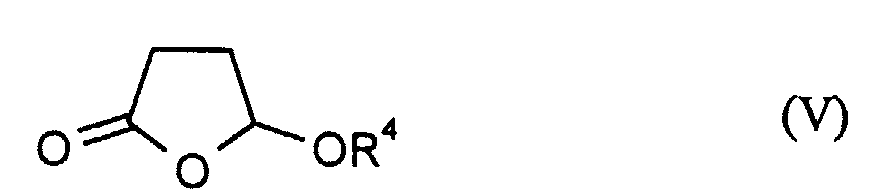
- the dihydrofuranones of the formula can be prepared by hydrogenation from the above furanones IV, for example analogously to that from GO Schenck in Liebigs Ann. Chem. 584 (1953), 156 described methods.
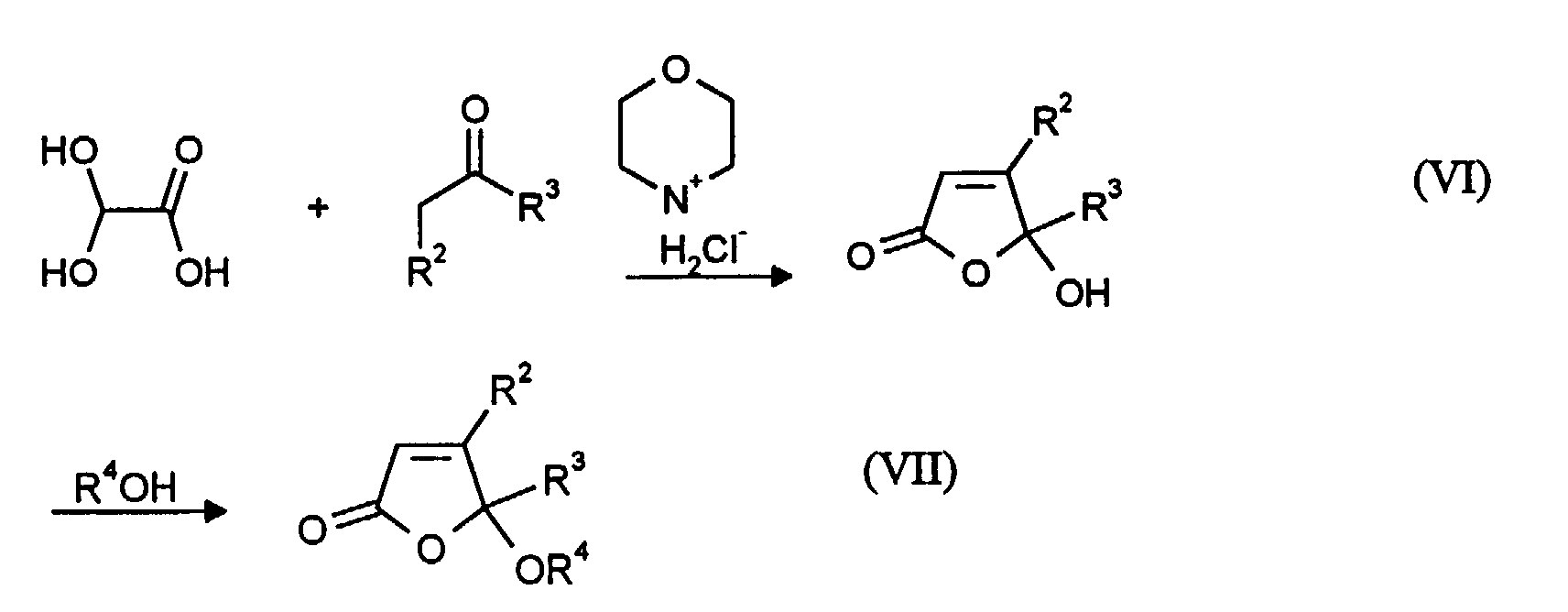
- 5-Alkoxy- (5H) -furan-2-one VIII substituted in the 4-position are very easily accessible via Mannich reaction from glyoxylic acid hydrate and the corresponding aldehydes, for example analogously to that of JJ Bourguignon et al. in J. Org. Chem. 46 , (1981), 4889 and by G. Pattenden et al. in J. Chem. Soc. (C) 1968 , 1984:
- Furanones can also be synthesized from cyclic ketones, for example from 5,6,7,7a-tetrahydro-7a-hydroxy-benzo (5) -furan-2-ones from cyclohexanone, cf. J. Schreiber et al., Bull. Soc. Chim. Fr. 1973 , 625, F. Bonadies et al., Gazz. Chim. Italian 113 (1983), 421.
- the corresponding ethers can be obtained by the etherification methods already mentioned.
- the Hydroxyisobenzofuranon VIII can for example according to the scheme are produced by methods known from the literature; see. GE Ficken et al., J. Chem. Soc. 1954, 3730; P. Canonne et al., Tetrahedron 44 (1988), 2903; DW Knight et al., J. Chem. Soc. Perkin Trans. I 1979 , 62. The etherification then gives the product IX.
- the compounds to be used according to the invention have interesting fragrance properties:
- a clay cane like the one used for ethoxy-, propoxy- or butoxy- (5H) -furan-2-one is pronounced, characterizes the furanones. Depending on the structural variation add further aspects or become dominant. So show the 4-methyl-5-alkoxyfuranone a strong additional lovage note, a trend that is, however continues finer to the 4-n-propyl-5-alkoxy-furanones.
- the influence of the 5-alkoxy group is particularly characteristic of the cis-hex-3-enyl radical that the both in furanone and in dihydrofuranone Tonkanote expanded with green, mushroom-like aspects.
- the fruitiness is one of the already named Tonka and green aspects another characteristic note of these fragrances that are found in the acyloxy compounds IV and for 5- (3-methylbutyloxy) - (5H) -furan-2-one, the 5-hexyloxy- (5H) -furan-2-one and is particularly pronounced in 5-hexyloxy-dihydro- (3H) -furan-2-one.
- the compounds I to be used according to the invention can be readily combined with others Fragrances in different, different proportions to new, combine interesting fragrance compositions, the amount 0.1 to 50 % By weight, preferably 0.5 to 10% by weight, based on the entire composition, is.
- compositions can be used to perfume Cosmetics such as creams, lotions, aerosols, toilet soaps, household products, such as cleaning and washing agents, fabric softeners, disinfectants and Textile treatment agents are used, the amount of fragrance composition 0.1 to 40% by weight, preferably 0.5 to 20% by weight, based on the entire product, is.
- Acetalization with n-propanol 100 g (1 mol) of 5-hydroxy- (5H) -furan-2-one and 60 g (1 mol) of n-propanol are dissolved in 500 ml of chloroform. After adding 0.1 g of p-toluenesulfonic acid, water is separated until the calculated amount of 18 ml is reached. After washing with aqueous sodium bicarbonate solution, the mixture is distilled (bp. 199 ° C./25 mbar). 112 g of n-propoxy- (5H) -furan-2-one (79% of theory) are obtained.
- a tubular reactor (volume 70 l) with a closed circuit, consisting of a swiveling parabolic mirror channel (height 4.5 m, area 7.3 m 2 , aluminum-steamed polytetrafluoroethylene, sealed on the back with polyester film), an absorber tube arranged in the focal line served as the reactor made of glass and a supply part containing a storage vessel, pump, heat exchanger, gas metering device and static mixer.
- the parabolic mirror channel was adjusted to the position of the sun.
- the reaction solution was pumped in a circle with the addition of oxygen and cooled before (re) entering the absorber tube.
- the mirror concentrated the solar radiation into the absorber tube on the factor 20th
- the reactor was in Spain (37.1 °, north latitude).
- a solution of 4.3 kg furfural and 2.3 g methylene blue in 30 l ethanol was pumped in a circle in the sunshine with continuous addition of oxygen. 2.8 g of methylene blue were added in the course of the reaction. After a reaction time of 12.6 hours, the conversion was 99%.
- the solvent was distilled off under reduced pressure at a water bath temperature of 70 ° C.
- the crude product thus obtained, a mixture of 5-hydroxy- and 5-ethoxy- (5H) -furan-2-one, is processed without further purification.
- Transetherification with n-hexanol 0.1 g of p-toluenesulfonic acid is added to 253 g of mixture of 5-hydroxy- and 5-ethoxy- (5H) -furan-2-one and 224 g of n-hexanol (equimole amount, based on the furanone content).
- Water / ethanol is distilled off under reduced pressure. After the expected amount of water / ethanol of 71 g has been distilled off, distillation is carried out under high vacuum.
- 320 g of 5-hexyloxy- (5H) -furan-2-one (bp. 84 ° C./0.07 mbar) are obtained, corresponding to a yield of 79%.
- Etherification The raw material is refluxed with four equivalents of n-propanol (200 g) in 500 ml of toluene with the addition of 0.2 g of p-toluenesulfonic acid. Fractional distillation gives 104 g (80% of theory over both stages) of 4-methyl-5-n-propoxy- (5H) -furan-2-one VIIb (bp. 120 ° C / 18 mbar).
- Double bond isomerization 200 g of cis-1,2,3,6-tetrahydrophthalic anhydride and 5 g of Pd / C (5%) are heated to 210 ° C. for 3 hours with stirring. After cooling, water is added and the mixture is boiled and the catalyst is suctioned off. The water is drawn off under reduced pressure. The remaining crystal mass is extracted repeatedly with n-hexane. 149 g of crude 3,4,5,6-tetrahydrophthalic anhydride are obtained.
- Etherification The 10 g of VIII are refluxed with eight equivalents of n-propanol (34 g) in 50 ml of toluene with the addition of 0.1 g of p-toluenesulfonic acid. After cooling, it is washed with a 5% aqueous sodium hydrogen carbonate solution. Drying and distillation give 8.5 g (43% of theory over the last two stages) of 4,5,6,7-tetrahydro-3-propoxy-1- (3H) -isobenzofuranone IX (bp. 150 ° C / 0.1 mbar). Description of smell: lovage, celery.
- compositions, application examples 1 to 6 are preferably suitable for fine perfuming and for the production of Cosmetics such as creams, lotions, aerosols and toilet soaps.
- The-5-propoxy- (5H) -furan-2-one underlines the tonka aspects in this composition. It has a pleasant harmonizing influence and contributes to a good fixation at.
- 5-hexyloxy-furan-2- (5H) -on supports the fruity one Bouquet and gives it a special fullness.
- Citrophoral supra Surname Parts by weight Citrophoral supra 60 Styrolylacetate 50 Tamarine base 80 1-methyl acetate 20th ⁇ -decalactone 60 ⁇ -undecalactone 20th Diethyl malonate 40 Peach base 60 Bucco leaf oil AI 5 Linalool oxide 20th Linalool 80 Dimethylbenzylcarbinylbutyrate 40 Benzyl acetate 50 ⁇ -hexyl cinnamaldehyde 100 ⁇ -amyl cinnamaldehyde 80 Agrumex 20th Cyclopentadecanolide supra 15 Tonalid 60 Chromanolide, 50% in ethanol 20th 5-hexyloxy- (3H) dihydrofuran-2-one 40 total 1000
Landscapes
- Chemical & Material Sciences (AREA)
- Organic Chemistry (AREA)
- Physics & Mathematics (AREA)
- Electromagnetism (AREA)
- Health & Medical Sciences (AREA)
- General Health & Medical Sciences (AREA)
- Toxicology (AREA)
- Chemical Kinetics & Catalysis (AREA)
- Fats And Perfumes (AREA)
- Cosmetics (AREA)
- Furan Compounds (AREA)
Description
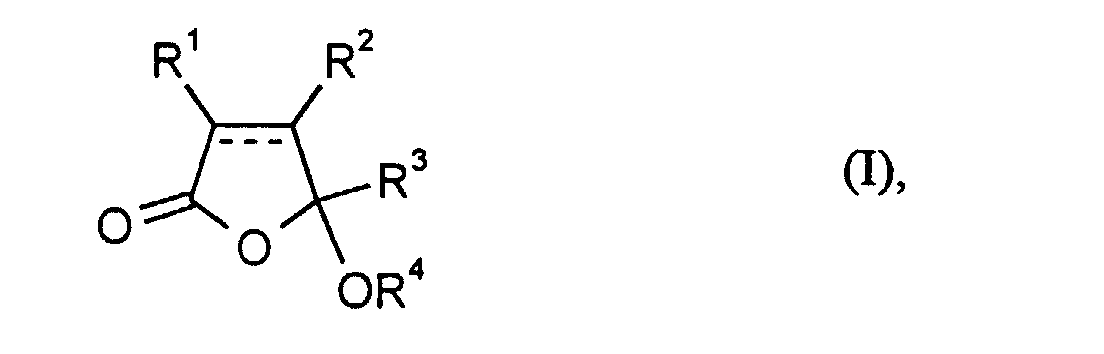
- R1 bis R3
- unabhängig voneinander Wasserstoff, C1-C10-Alkyl, C5-C10-Aryl oder
- R1 und R2
- zusammen oder R2 und R3 zusammen C1-C10-Alkylen und
- R4
- C1-C10-Alkyl, C5-C10-Aryl oder C1-C10-Acyl bedeuten,
- R1 bis R3
- die oben genannte Bedeutung besitzen und
- R4
- für C3-C10-Alkyl, insbesondere C4-C10-Alkyl, C5-C10-Aryl oder C1-C10-Acyl steht.
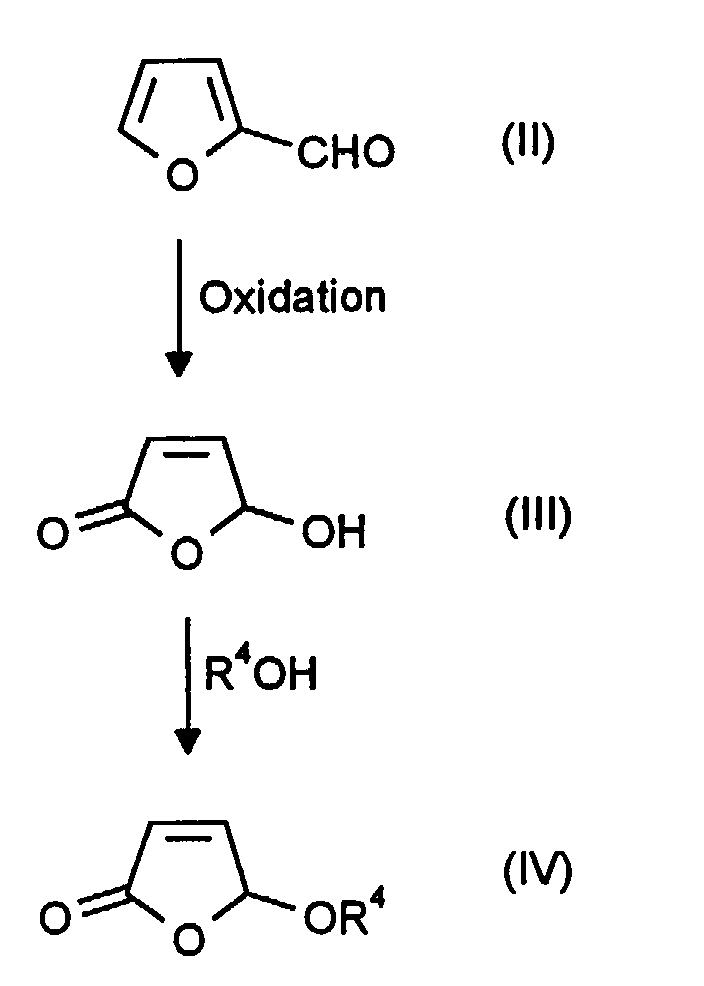

In einem 1 l Doppelwandgefäß mit Rührer und Gaseinleitung werden 1 mol Furfural in 1 Liter Ethanol unter Zusatz von 0,1 g Methylenblau eingefüllt. Es wird auf 20°C thermostatisiert, Sauerstoff durchgeleitet und von außen in 0,5 cm Abstand mit vier Lampen (Osram Siccatherm SL 250 W) über Nacht bis zum vollständigen Umsatz bestrahlt. Das Lösungsmittel wird unter reduziertem Druck bei einer Temperatur von nicht über 40°C abdestilliert. Das 5-Hydroxy-(5H)-furan-2-on wird im Kühlschrank auskristallisiert und mit kaltem Tetrachlorkohlenstoff ausgewaschen. Es resultieren 80 g (80 % der Theorie) an 5-Hydroxy-(5H)-furan-2-on.
100 g (1 mol) 5-Hydroxy-(5H)-furan-2-on und 60 g (1 mol) n-Propanol werden in 500 ml Chloroform gelöst. Nach Zugabe von 0,1 g p-Toluolsulfonsäure wird so lange Wasser abgeschieden, bis die berechnete Menge von 18 ml erreicht ist. Nach Waschen mit wäßriger Natriumhydrogencarbonatlösung wird destilliert (Kp. 199°C/25 mbar). Man erhält 112 g n-Propoxy-(5H)-furan-2-on (79 % d.Th.).
Als Reaktor diente ein Röhrenreaktor (Volumen 70 l) mit geschlossenem Kreislauf, bestehend aus einer schwenkbaren Parabolspiegelrinne (Höhe 4,5 m, Fläche 7,3 m2, Aluminium-bedampftes Polytetrafluorethylen, rückseitig mit Polyesterfolie versiegelt), einem in der Brennlinie angeordneten Absorberrohr aus Glas und einem Versorgungsteil enthaltend Vorratsgefäß, Pumpe, Wärmetauscher, Gasdosierungsvorrichtung und statischen Mischer. Die Parabolspiegelrinne wurde dem Sonnenstand nachgeführt. Die Reaktionslösung wurde unter Zuführung von Sauerstoff im Kreis gepumpt und vor dem (Wieder-)eintritt in das Absorberrohr gekühlt.
Eine Lösung von 4,3 kg Furfural und 2,3 g Methylenblau in 30 l Ethanol wurde bei Sonnenschein unter kontinuierlicher Sauerstoffzugabe im Kreis gepumpt. Im Laufe der Reaktion wurden 2,8 g Methylenblau nachdosiert. Nach 12,6 Stunden Reaktionszeit betrug der Umsatz 99 %. Das Lösungsmittel wurde unter reduziertem Druck bei einer Wasserbadtemperatur von 70°C abdestilliert. Das so erhaltene Rohprodukt, eine Mischung aus 5-Hydroxy- und 5-Ethoxy-(5H)-furan-2-on wird ohne weitere Reinigung weiterverarbeitet.
Zu 253 g Mischung aus 5-Hydroxy- und 5-Ethoxy-(5H)-furan-2-on und 224 g n-Hexanol (äquimole Menge, bezogen auf Gehalt an Furanon), gibt man 0,1 g p-Toluolsulfonsäure. Unter reduziertem Druck wird Wasser/Ethanol abdestilliert. Nach Abdestillation der erwarteten Wasser/Ethanol-Menge von 71 g wird im Hochvakuum destilliert. Man erhält 320 g 5-Hexyloxy-(5H)-furan-2-on (Kp. 84°C/0,07 mbar) entsprechend 79 % Ausbeute.
In einem 1 Liter Doppelwandgefäß mit Rührer und Gaseinleitung werden 1 mol Furfural in 1 l Ethanol unter Zusatz von 0,1 g Methylenblau eingefüllt. Es wird auf 20°C thermostatisiert, im geschlossenen System Sauerstoff eingeleitet und von außen in 0,5 cm Abstand mit vier Lampen (Osram Siccatherm SL 250 W) über Nacht bis zum vollständigen Umsatz bestrahlt. Nachfolgend wird der Sauerstoff durch Stickstoff verdrängt und die Reaktionslösung 8 h auf Rückfluß erhitzt. Abschließend wird fraktioniert destilliert. Man erhält 286 g 5-Methoxy-(5H)-furan-2-on (Kp. 102°C/26 mbar) entsprechend 75 % Ausbeute.
| Verbindungen IV hergestellt analog zu den Beispielen 1 bis 3 | |||
| Verbindung IV | R4 | Kp[°C/mbar] | Geruchsbeschreibung |
| a | Methyl | 102/26 | süß, lactonig, stechend, sauer |
| b | Ethyl | 101/13 | süß, lactonig, Cumarin |
| c | n-Propyl | 119/25 | Tonka, lactonig, fettig |
| d | iso-Propyl | 116/20 | süß, lactonig, stechend |
| e | n-Butyl | 128/19 | Tonka, lactonig, fettig |
| f | iso-Butyl | 121/20 | Tonka, fruchtig, Cocos |
| g | n-Pentyl | 65/0,05 | lactonig, fruchtig, süß, aldehydig |
| h | 1-Methylbutyl | 72/0,05 | würzig, grün, metallisch, sauer |
| i | 2-Methylbutyl | 137/25 | lactonig, fruchtig, frisch |
| j | 3-Methylbutyl | 128/20 | fruchtig, Banane, lactonig |
| k | 1,2-Dimethylpropyl | 110/10 | würzig, metallisch, frisch |
| l | cyclo-Pentyl | 76/0,34 | cumarinig, lactonig, würzig |
| m | n-Hexyl | 87/0,07 | fruchtig, lactonig, Pfirsich |
| n | cis-Hex-3-enyl | 84/0,07 | grasig, grün, Veilchen |
| o | cyclo-Hexyl | 122/5 | Tonka, süß, etherisch |
| p | n-Heptyl | 98/0,08 | fruchtig, lactonig, Pfirsich |
| q | Benzyl | 111/0,09 | schwach heliotrop |
| r | n-Octyl | 100/0,11 | fettig, frisch, metallisch |
| s | 2-Ethylhexyl | 97/0,22 | holzig, cedrig, gärig |
| t | n-Nonyl | 112/0,10 | fettig, Aldehyd, wässrig |
| u | 3,3,5-Trimethylcyclohexyl | 99/0,10 | camphrig, frisch |
| v | Phenylethyl | 123/0,06 | Rose, fruchtig, Pfirsisch |
| w | Furanmethyl |
50 g (0,5 mol) 5-Hydroxy-(5H)-furan-2-on und 65 g (0,5 mol) Propionsäureanhydrid werden mit einem Tropfen konzentrierter Schwefelsäure versetzt. Nach 2 h Erhitzen auf 100°C läßt man abkühlen und gießt auf Eiswasser. Es wird mit Essigsäureethylester extrahiert und mit 5%iger wäßriger Natriumhydrogencarbonatlösung gewaschen. Die fraktionierte Destillation liefert 67 g (43 %) 5-Propionyloxy-(5H)-furan-2-on IVc (Kp. 132°C/10 mbar).
| Verbindungen IV hergestellt analog zum Beispiel 4 | |||
| Verbindung IV | R4 | Kp[°C/mbar] | Geruchsbeschreibung |
| a | Formyl | 114/12 | kulinarisch, Tonka, stechend |
| b | Acetyl | 128/14 | fruchtig, Birne, grün, sauer |
| c | Propionyl | 132/10 | fruchtig, Apfel, buttrig |
276 g (1,5 mol) 5-Hexyloxy-(5H)-furan-2-on werden in 1000 ml iso-Propanol gelöst und unter Zusatz von 2 % Pd/C (5%ig) bei einem Wasserdruck von 5 bar und einer maximalen Temperatur von 40°C bis zur Beendigung der Wasserstoffaufnahme hydriert. Nach Abfiltrieren des Katalysators wird fraktioniert destilliert. Man erhält 265 g 5-Hydroxy-(3H)-dihydrofuran-2-on V g (Kp. 70°C/0,06 mbar) entsprechend 95 % Ausbeute.
| Verbindungen V hergestellt analog zu Beispiel 5 | |||
| Verbindung V | R4 | Kp[°C/mbar] | Geruchsbeschreibung |
| a | Ethyl | 106/28 | käsig, gärig |
| b | n-Propyl | 96/11 | Cumarin,lactonig |
| c | n-Butyl | 126/22 | lactonig, Cumarin, süß |
| d | iso-Butyl | 106/12 | fruchtig, lactonig, Cumarin |
| e | n-Pentyl | 69/0,33 | fruchtig, lactonig, prickelnd |
| f | 1-Methylbutyl | 65/0,07 | nussig, grün, etherisch |
| g | n-Hexyl | 70/0,06 | grün, fruchtig, lactonig |
| h | cis-Hex-3-enyl | 64/0,06 | grasig, grün, metallisch |
| i | n-Octyl | 87/0,06 | fruchtig, fettig, grün |
| j | n-Nonyl | 101/0,07 | fettig, aldehydig, metallisch |
| k | 3,3,5-Trimethylcyclohexyl | 92/0,08 | Honig, süß |
| l | Cyclopentyl | 73/0,08 | Cumarin, lactonig, sahnig süß |
| m | n-Heptyl | 90/0,04 | grün, fruchtig, lactonig |
| n | Phenylethyl |
102 g (0,83 mol) pulverisiertes Morpholiniumchlorid und 76,4 g (0,83 mol) Glyoxylsäurehydrat werden in 400 ml Dioxan und 60 ml Wasser suspendiert. Man rührt 30 Minuten. Danach werden 53 g (0,91 mol) Propionaldehyd zudosiert, 1 h bei Raumtemperatur gerührt und 24 h unter Rückfluß erhitzt. Das Dioxan zieht man ab und versetzt noch vor der Kristallisation zügig mit Wasser. Die wässrige Phase wird über Nacht mit Ether perforiert. Die nach Trocknen und Abdestillieren des Ethers erhaltene Rohware (98,2 g) wird ohne weitere Reinigung weiterverarbeitet.
Die Rohware wird mit vier Äquivalenten n-Propanol (200 g) in 500 ml Toluol unter Zusatz von 0,2 g p-Toluolsulfonsäure für 14 h unter Rückfluß erhitzt. Durch fraktionierte Destillation erhält man 104 g (80 % d.Th. über beide Stufen) 4-Methyl-5-n-propoxy-(5H)-furan-2-on VIIb (Kp. 120°C/18 mbar).
| Verbindungen VII hergestellt analog zu Beispiel 6 | |||||
| Verbindung VII | R2 | R3 | R4 | Kp [°C/mbar] | Geruchsbeschreibung |
| a | Methyl | H | Methyl | 101/19 | würzig, Liebstock, Cognac |
| b | Methyl | H | n-Propyl | 120/18 | würzig, Liebstock, Cumarin |
| c | Methyl | H | n-Hexyl | 90/0,1 | fruchtig, Apfel, Birne |
| d | Methyl | H | n-Octyl | 105/0,1 | metallisch, Rose, frisch |
| e | n-Propyl | H | Methyl | 87/0,66 | grün, sauer, jasminig, Käse |
| f | n-Propyl | H | n-Propyl | 112/0,7 | brandig, Kaffee, Käse |
| g | n-Propyl | H | n-Hexyl | 100/0,09 | fruchtig, bitter |
| h | -(CH2)4- | Methyl | 65/0,08 | süß, Heu, Cumarin | |
| i | -(CH2)4- | n-Propyl | 88/0,7 | süß, lactonig, Cumarin |
200 g cis-1,2,3,6-Tetrahydrophthalsäureanhydrid und 5 g Pd/C (5%ig) werden 3 h unter Rühren auf 210°C erhitzt. Nach Abkühlen wird mit Wasser versetzt und aufgekocht und der Katalysator abgesaugt. Unter reduziertem Druck wird das Wasser abgezogen. Die verbleibende Kristallmasse wird wiederholt mit n-Hexan extrahiert. Man erhält 149 g rohes 3,4,5,6-Tetrahydrophthalsäureanhydrid.
15,2 g (0,1 mol) rohes 3,4,5,6-Tetrahydrophthalsäureanhydrid werden unter Luftausschluß in 50 ml THF vorgelegt. Es wird auf -40°C abgekühlt und 100 ml einer 0,1 molaren Li(tBuO)3AlH-Lösung in THF zugetropft. Über Nacht rührt man bei Raumtemperatur nach. Der Reaktionslösung werden 100 ml einer THF/10%ige Salzsäure (1/1)-Mischung zugesetzt. Nach Phasentrennung, Extraktion der wässrigen Phase und Trocknen der vereinigten organischen Phasen wird eingeengt. 4,5,6,7-Tetrahydro-3-hydroxy-1-(3H)-isobenzfuranon VIII erhält man in einer Rohausbeute von 10 g.
Die 10 g VIII werden mit acht Äquivalenten n-Propanol (34 g) in 50 ml Toluol unter Zusatz von 0,1 g p-Toluolsulfonsäure für 14 h auf Rückfluß erhitzt. Nach Abkühlen wäscht man mit einer 5%igen wäßrigen Natriumhydrogencarbonatlösung. Aus Trocknung und Destillation erhält man 8,5 g (43 % d.Th. über die letzten beiden Stufen) 4,5,6,7-Tetrahydro-3-propoxy-1-(3H)-isobenzofuranon IX (Kp. 150°C/0,1 mbar). Geruchsbeschreibung: Liebstöckel, Sellerie.
| Name | Gew.-Teile |
| Isoananat | 10 |
| Bergamottöl | 50 |
| Dihydromyrcenol | 300 |
| Lilial | 50 |
| Linalool | 20 |
| Geraniumöl Bourbon | 15 |
| Methyldihydrojasmonat | 100 |
| Eugenol | 50 |
| Zimtrindenöl Ceylon | 2 |
| Cedernholzöl Chin. | 20 |
| Vertofix coeur | 100 |
| Hexahydroiraldein | 50 |
| 1,2,3,4,5,6,7,8-Octahydro-2,3,8,8-tetramethyl-2-acetonaphton | 150 |
| Evernyl | 10 |
| Ambroxid | 5 |
| Diethylphthalat | 58 |
| 5-Propoxy-(5H)-furan-2-on | 10 |
| Summe | 1000 |
| Name | Gew.-Teile |
| Bergamottöl | 200 |
| Dihydromyrcenol | 20 |
| Linalylacetat | 40 |
| Citronenöl | 50 |
| Lyral | 50 |
| Methyldihydrojasmonat | 15 |
| Isoamylsalicylat | 15 |
| Bayöl | 5 |
| Cumarin | 10 |
| Vertofix coeur | 120 |
| 1,2,3,4,5,6,7,8-Octahydro-2,3,8,8-tetramethyl-2-acetonaphton | 220 |
| Timberol | 20 |
| Patchouliöl | 15 |
| Sandel 80 | 10 |
| Tonalid | 100 |
| Chromanolid 50 % (in Ethanol) | 100 |
| 5-cis-Hex-3-enyloxy-(5H)-furan-2-on | 10 |
| Summe | 1000 |
| Name | Gew.-Teile |
| Liffarome | 5 |
| Allylamylglycolat | 5 |
| Bergamottöl | 90 |
| γ-Nonalacton | 5 |
| Lilial | 80 |
| Lyral | 80 |
| Linalool | 150 |
| Phenylethylalkohol | 50 |
| Citronellol | 20 |
| Benzylacetat | 25 |
| α-Hexylzimtaldehyd | 100 |
| cis-Hex-3-enylsalicylat | 30 |
| γ-Iraldein | 50 |
| Cedramber | 20 |
| 1,2,3,4,5,6,7,8-Octahydro-2,3,8,8-tetramethyl-2-acetonaphton | 30 |
| Sandalore | 40 |
| Mousse C abs., 50 % in Ethanol | 20 |
| Ethylenbrassylat | 50 |
| Cyclopentadecanolid supra | 30 |
| Chromanolid, 50 % in Ethanol | 100 |
| 5-Hexyloxy-(5H)-furan-2-on | 20 |
| Summe | 1000 |
| Name | Gew.-Teile |
| Citrophoral supra | 60 |
| Styrolylacetat | 50 |
| Tamarine Base | 80 |
| 1-Methylacetat | 20 |
| γ-Decalacton | 60 |
| γ-Undecalacton | 20 |
| Diethylmalonat | 40 |
| Pfirsich Base | 60 |
| Buccoblätteröl coeur | 5 |
| Linalooloxid | 20 |
| Linalool | 80 |
| Dimethylbenzylcarbinylbutyrat | 40 |
| Benzylacetat | 50 |
| α-Hexylzimtaldehyd | 100 |
| α-Amylzimtaldehyd | 80 |
| Agrumex | 20 |
| Cyclopentadecanolid supra | 15 |
| Tonalid | 60 |
| Chromanolid, 50 % in Ethanol | 20 |
| 5-Hexyloxy-(3H)-dihydrofuran-2-on | 40 |
| Summe | 1000 |
| Name | Gew.-Teile |
| Lavandinöl | 50 |
| γ-Nonalacton | 300 |
| γ-Decalacton | 10 |
| Diacetyl | 50 |
| Phenylethylalkohol | 90 |
| Heliotropin | 80 |
| Anisaldehyd | 5 |
| Zimtalkohol | 50 |
| Cumarin | 200 |
| Dipropylenglykol | 5 |
| Vanille-Base | 150 |
| 5-Cyclopentyloxy-(5H)-furan-2-on | 10 |
| Summe | 1000 |
| Name | Gew.-Teile |
| Liffarome | 2 |
| cis, trans-Hex-3-enylacetat | 2 |
| Phenylacetaldehydglycerinacetal | 30 |
| Styrolylacetat | 2 |
| Cyclamenaldehyd | 5 |
| Florol | 40 |
| Lyral | 300 |
| Hydroxycitronellal | 150 |
| Farnesol | 10 |
| Linalool | 20 |
| Phenylethylalkohol | 150 |
| Citrolellol | 20 |
| Geranylacetat | 5 |
| Methyldihydrojasmonat | 230 |
| Hexylbenzoat | 10 |
| Indol | 2 |
| Diethylphthalat | 12 |
| 5-cis-Hex-3-enyloxy-dihydro-(5H)-furan-2-on | 10 |
| Summe | 1000 |
Claims (5)
- Verwendung von Verbindungen der Formelworin die gepunktete Linie eine vorhandene oder nicht vorhandene Bindung und
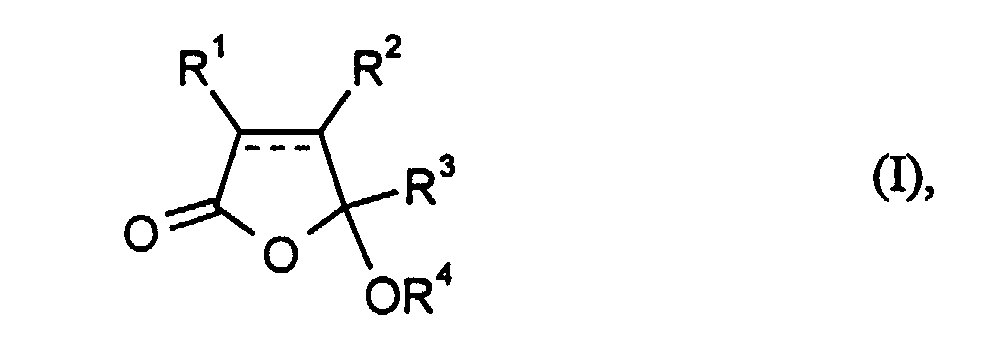
- R1 bis R3
- unabhängig voneinander Wasserstoff, C1-C10-Alkyl, C5-C10-Aryl oder
- R1 und R2
- zusammen oder R2 und R3 zusammen C1-C10-Alkylen und
- R4
- C1-C10-Alkyl, C5-C10-Aryl oder C1-C10-Acyl bedeuten,
- Verwendung nach Anspruch 1, wobei die gepunktete Linie eine Bindung bedeutet und R1 bis R3 für Wasserstoff und R4 für C1-C10-Alkyl stehen.
- Verwendung nach Anspruch 1, wobei die gepunktete Linie eine Bindung bedeutet und R1 bis R3 für Wasserstoff und R4 für C1-C10-Acyl stehen.
- Verwendung nach Anspruch 1, wobei die gepunktete Linie keine Bindung bedeutet und R1 bis R3 für Wasserstoff und R4 für C1-C10-Alkyl stehen.
- Verwendung nach Anspruch 1, wobei die gepunktete Linie eine Bindung bedeutet und R1 bis R3 für Wasserstoff, R2 für C1-C10-Alkyl (oder R2 und R3 zusammen für C1-C10-Alkylen) und R4 für C1-C10-Alkyl stehen.
Applications Claiming Priority (2)
| Application Number | Priority Date | Filing Date | Title |
|---|---|---|---|
| DE19532314A DE19532314A1 (de) | 1995-09-01 | 1995-09-01 | Verwendung substituierter Lactone als Riechstoffe |
| DE19532314 | 1995-09-01 |
Publications (3)
| Publication Number | Publication Date |
|---|---|
| EP0761808A2 EP0761808A2 (de) | 1997-03-12 |
| EP0761808A3 EP0761808A3 (de) | 1997-08-20 |
| EP0761808B1 true EP0761808B1 (de) | 1999-05-19 |
Family
ID=7771032
Family Applications (1)
| Application Number | Title | Priority Date | Filing Date |
|---|---|---|---|
| EP96113290A Expired - Lifetime EP0761808B1 (de) | 1995-09-01 | 1996-08-20 | Verwendung substituierter Lactone als Riechstoffe |
Country Status (3)
| Country | Link |
|---|---|
| EP (1) | EP0761808B1 (de) |
| JP (1) | JPH09118893A (de) |
| DE (2) | DE19532314A1 (de) |
Families Citing this family (5)
| Publication number | Priority date | Publication date | Assignee | Title |
|---|---|---|---|---|
| ATE243556T1 (de) * | 1998-04-17 | 2003-07-15 | Studiengesellschaft Kohle Mbh | Solar-photo- und solar-thermochemische synthesen mittels flachbett-sonnenlichtsammler/- solarreaktoren |
| US6399548B1 (en) † | 2000-09-22 | 2002-06-04 | Chevron Oronite Company Llc | Functional fluids |
| BR112019021821B1 (pt) * | 2017-05-05 | 2022-01-18 | Symrise Ag | Mistura de substâncias para melhorar o odor |
| WO2022253709A1 (en) * | 2021-06-01 | 2022-12-08 | Basf Se | Use of 5-methyl-5-(4-methyl-3-penten-1-yl)-2(5h)-furanone as aroma chemical |
| CN118791452B (zh) * | 2024-06-19 | 2025-10-21 | 西北工业大学 | 一种催化降解聚酯为环状酸酐的方法 |
Family Cites Families (4)
| Publication number | Priority date | Publication date | Assignee | Title |
|---|---|---|---|---|
| NL7216271A (de) * | 1972-11-30 | 1974-06-04 | ||
| CH582000A5 (de) * | 1974-03-07 | 1976-11-30 | Firmenich & Cie | |
| DE3031486A1 (de) * | 1980-08-21 | 1982-04-08 | Henkel KGaA, 4000 Düsseldorf | Neue (alpha) / (beta) -substituierte (gamma) -butyrolactone deren herstellung und verwendung als riechstoffe, sowie diese enthaltende riechstoffkompositionen |
| US5179077A (en) * | 1990-10-04 | 1993-01-12 | Givaudan Corporation | 4-methyl-3-pentyl-2(5h)-furanone |
-
1995
- 1995-09-01 DE DE19532314A patent/DE19532314A1/de not_active Withdrawn
-
1996
- 1996-08-20 DE DE59601933T patent/DE59601933D1/de not_active Expired - Fee Related
- 1996-08-20 EP EP96113290A patent/EP0761808B1/de not_active Expired - Lifetime
- 1996-08-28 JP JP8244054A patent/JPH09118893A/ja active Pending
Also Published As
| Publication number | Publication date |
|---|---|
| DE59601933D1 (de) | 1999-06-24 |
| EP0761808A2 (de) | 1997-03-12 |
| DE19532314A1 (de) | 1997-03-06 |
| JPH09118893A (ja) | 1997-05-06 |
| EP0761808A3 (de) | 1997-08-20 |
Similar Documents
| Publication | Publication Date | Title |
|---|---|---|
| EP0908455B1 (de) | Macrocyclen | |
| DE2455761C2 (de) | Verwendung von hydrierten Methyljononen und deren Derivaten als Riechstoffe, Verfahren zu ihrer Herstellung und neue hydrierte Methyljononderivate | |
| DE1617006A1 (de) | Riechstoffkompositionen | |
| DE69527045T2 (de) | Tetrahydrofurane und tetrahydropyrane | |
| EP0761808B1 (de) | Verwendung substituierter Lactone als Riechstoffe | |
| DE3004661A1 (de) | Verwendung alkylsubstituierter 1,3-dioxolane als riechstoffe, sowie diese enthaltende riechstoffkompositionen | |
| DE60009394T2 (de) | Cyclopentylalkylnitrile und die Verwendung von Cyclopentylalkyl-Derivaten als Duftstoffe | |
| DE2826302C2 (de) | Die Verwendung von 3-Oxa-tricyclo[6.2.1.0↑2↑↑,↑↑7↑]undecan-4-onen als Riechstoffkomponente sowie bestimmte 3-Oxa-9-oder 10-ethyl- bzw. ethyliden-tricyclo[6.2.1.0↑2↑↑,↑↑7↑]undecan-4-one | |
| DE2120413B2 (de) | Trans-a.'M-trimetliyl-l-crotonoylcyclohex-2-en-Verbindungen, Verfahren zu deren Herstellung und ihre Verwendung als Riech- bzw. Aromastoffe | |
| EP0278384B1 (de) | Alkohole und Ether mit Cyclododecyl- und Cyclododecenylgruppen, deren Herstellung und Verwendung als Duftstoffe | |
| DE2559957C2 (de) | 3,6,6-Trimethylcyclohexen-1 -carbonsäureester, Verfahren zu deren Herstellung und diese enthaltende Riechstoffkompositionen | |
| EP0826764B1 (de) | Riechstoffkompositionen enthaltend substituierte 2-Acetylbenzofurane | |
| DE2006388C3 (de) | Cycloalkylidenbutanale und diese enthaltende Riechstoffe | |
| DE2363535C2 (de) | 2,7-Dimethyl-5,7-octadien-2-ol, seinen Methyläther und seinen Essigsäureester, Verfahren zu ihrer Herstellung und ihre Verwendung | |
| US6225281B1 (en) | Cis-isoambrettolide and use thereof | |
| DE2141309B2 (de) | 5-Cyclohexadecen-l-on-Verfahren zu dessen Herstellung und seine Verwendung als Riechstoff | |
| DE2313017C3 (de) | Cyclopentene und Verfahren zu deren Herstellung | |
| DE3641236A1 (de) | Neue aliphatische alkohole und ester, deren herstellung und verwendung als riechstoffe | |
| DE2945812A1 (de) | 1,5-dimethyl-bicyclo eckige klammer auf 3,2,1 eckige klammer zu octan-derivate, verfahren zu ihrer herstellung und ihre verwendung | |
| DE3025187A1 (de) | Neue riechstoffe, deren herstellung sowie diese enthaltende riechstoffkompositionen | |
| EP0884315B1 (de) | Dioxacycloalkan-8-one | |
| EP1149820B1 (de) | 2-,5-,6-,7-,8-Substituierte Oct-2-en-4-one | |
| JPH06503328A (ja) | α−アルキルラクトンの調製方法 | |
| AU731928B2 (en) | Thiamacrolides | |
| DE3309169A1 (de) | Neues verfahren zur herstellung von verbindungen der 4-oxodamason-reihe sowie neue riechstoffe aus dieser verbindungsklasse |
Legal Events
| Date | Code | Title | Description |
|---|---|---|---|
| PUAI | Public reference made under article 153(3) epc to a published international application that has entered the european phase |
Free format text: ORIGINAL CODE: 0009012 |
|
| AK | Designated contracting states |
Kind code of ref document: A2 Designated state(s): CH DE FR GB IT LI NL |
|
| PUAL | Search report despatched |
Free format text: ORIGINAL CODE: 0009013 |
|
| AK | Designated contracting states |
Kind code of ref document: A3 Designated state(s): CH DE FR GB IT LI NL |
|
| 17P | Request for examination filed |
Effective date: 19980220 |
|
| GRAG | Despatch of communication of intention to grant |
Free format text: ORIGINAL CODE: EPIDOS AGRA |
|
| 17Q | First examination report despatched |
Effective date: 19980715 |
|
| GRAG | Despatch of communication of intention to grant |
Free format text: ORIGINAL CODE: EPIDOS AGRA |
|
| GRAH | Despatch of communication of intention to grant a patent |
Free format text: ORIGINAL CODE: EPIDOS IGRA |
|
| GRAH | Despatch of communication of intention to grant a patent |
Free format text: ORIGINAL CODE: EPIDOS IGRA |
|
| GRAA | (expected) grant |
Free format text: ORIGINAL CODE: 0009210 |
|
| AK | Designated contracting states |
Kind code of ref document: B1 Designated state(s): CH DE FR GB IT LI NL |
|
| REG | Reference to a national code |
Ref country code: CH Ref legal event code: NV Representative=s name: E. BLUM & CO. PATENTANWAELTE Ref country code: CH Ref legal event code: EP |
|
| REF | Corresponds to: |
Ref document number: 59601933 Country of ref document: DE Date of ref document: 19990624 |
|
| GBT | Gb: translation of ep patent filed (gb section 77(6)(a)/1977) |
Effective date: 19990621 |
|
| ET | Fr: translation filed | ||
| PLBE | No opposition filed within time limit |
Free format text: ORIGINAL CODE: 0009261 |
|
| STAA | Information on the status of an ep patent application or granted ep patent |
Free format text: STATUS: NO OPPOSITION FILED WITHIN TIME LIMIT |
|
| 26N | No opposition filed | ||
| REG | Reference to a national code |
Ref country code: GB Ref legal event code: IF02 |
|
| PGFP | Annual fee paid to national office [announced via postgrant information from national office to epo] |
Ref country code: CH Payment date: 20020731 Year of fee payment: 7 |
|
| PGFP | Annual fee paid to national office [announced via postgrant information from national office to epo] |
Ref country code: FR Payment date: 20020819 Year of fee payment: 7 |
|
| PGFP | Annual fee paid to national office [announced via postgrant information from national office to epo] |
Ref country code: NL Payment date: 20020830 Year of fee payment: 7 |
|
| PGFP | Annual fee paid to national office [announced via postgrant information from national office to epo] |
Ref country code: GB Payment date: 20030728 Year of fee payment: 8 |
|
| PG25 | Lapsed in a contracting state [announced via postgrant information from national office to epo] |
Ref country code: LI Free format text: LAPSE BECAUSE OF NON-PAYMENT OF DUE FEES Effective date: 20030831 Ref country code: CH Free format text: LAPSE BECAUSE OF NON-PAYMENT OF DUE FEES Effective date: 20030831 |
|
| PGFP | Annual fee paid to national office [announced via postgrant information from national office to epo] |
Ref country code: DE Payment date: 20030902 Year of fee payment: 8 |
|
| REG | Reference to a national code |
Ref country code: GB Ref legal event code: 732E |
|
| PG25 | Lapsed in a contracting state [announced via postgrant information from national office to epo] |
Ref country code: NL Free format text: LAPSE BECAUSE OF NON-PAYMENT OF DUE FEES Effective date: 20040301 |
|
| REG | Reference to a national code |
Ref country code: CH Ref legal event code: PL |
|
| PG25 | Lapsed in a contracting state [announced via postgrant information from national office to epo] |
Ref country code: FR Free format text: LAPSE BECAUSE OF NON-PAYMENT OF DUE FEES Effective date: 20040430 |
|
| NLV4 | Nl: lapsed or anulled due to non-payment of the annual fee |
Effective date: 20040301 |
|
| REG | Reference to a national code |
Ref country code: FR Ref legal event code: ST |
|
| PG25 | Lapsed in a contracting state [announced via postgrant information from national office to epo] |
Ref country code: GB Free format text: LAPSE BECAUSE OF NON-PAYMENT OF DUE FEES Effective date: 20040820 |
|
| PG25 | Lapsed in a contracting state [announced via postgrant information from national office to epo] |
Ref country code: DE Free format text: LAPSE BECAUSE OF NON-PAYMENT OF DUE FEES Effective date: 20050301 |
|
| GBPC | Gb: european patent ceased through non-payment of renewal fee |
Effective date: 20040820 |
|
| PG25 | Lapsed in a contracting state [announced via postgrant information from national office to epo] |
Ref country code: IT Free format text: LAPSE BECAUSE OF NON-PAYMENT OF DUE FEES Effective date: 20050820 |