WO2003103667A1 - 電子伝達系の複合体ii阻害剤 - Google Patents

電子伝達系の複合体ii阻害剤 Download PDF

Info

Publication number
WO2003103667A1
WO2003103667A1 PCT/JP2002/005727 JP0205727W WO03103667A1 WO 2003103667 A1 WO2003103667 A1 WO 2003103667A1 JP 0205727 W JP0205727 W JP 0205727W WO 03103667 A1 WO03103667 A1 WO 03103667A1
Authority
WO
WIPO (PCT)
Prior art keywords
complex
represented
inhibitor
inhibitory activity
formula
Prior art date
Legal status (The legal status is an assumption and is not a legal conclusion. Google has not performed a legal analysis and makes no representation as to the accuracy of the status listed.)
Ceased
Application number
PCT/JP2002/005727
Other languages
English (en)
French (fr)
Inventor
大村 智
塩見 和朗
洋 供田
碌郎 増間
潔 北
Current Assignee (The listed assignees may be inaccurate. Google has not performed a legal analysis and makes no representation or warranty as to the accuracy of the list.)
Kitasato Institute
Original Assignee
Kitasato Institute
Priority date (The priority date is an assumption and is not a legal conclusion. Google has not performed a legal analysis and makes no representation as to the accuracy of the date listed.)
Filing date
Publication date
Application filed by Kitasato Institute filed Critical Kitasato Institute
Priority to EP02733432A priority Critical patent/EP1512402B1/en
Priority to US10/489,964 priority patent/US7514455B2/en
Priority to JP2004510786A priority patent/JP4334472B2/ja
Priority to AU2002306342A priority patent/AU2002306342A1/en
Priority to DE60223290T priority patent/DE60223290D1/de
Priority to PCT/JP2002/005727 priority patent/WO2003103667A1/ja
Publication of WO2003103667A1 publication Critical patent/WO2003103667A1/ja
Anticipated expiration legal-status Critical
Ceased legal-status Critical Current

Links

Classifications

    • AHUMAN NECESSITIES
    • A61MEDICAL OR VETERINARY SCIENCE; HYGIENE
    • A61KPREPARATIONS FOR MEDICAL, DENTAL OR TOILETRY PURPOSES
    • A61K31/00Medicinal preparations containing organic active ingredients
    • A61K31/33Heterocyclic compounds
    • A61K31/395Heterocyclic compounds having nitrogen as a ring hetero atom, e.g. guanethidine or rifamycins
    • A61K31/435Heterocyclic compounds having nitrogen as a ring hetero atom, e.g. guanethidine or rifamycins having six-membered rings with one nitrogen as the only ring hetero atom
    • A61K31/44Non condensed pyridines; Hydrogenated derivatives thereof
    • AHUMAN NECESSITIES
    • A61MEDICAL OR VETERINARY SCIENCE; HYGIENE
    • A61PSPECIFIC THERAPEUTIC ACTIVITY OF CHEMICAL COMPOUNDS OR MEDICINAL PREPARATIONS
    • A61P43/00Drugs for specific purposes, not provided for in groups A61P1/00-A61P41/00
    • CCHEMISTRY; METALLURGY
    • C07ORGANIC CHEMISTRY
    • C07DHETEROCYCLIC COMPOUNDS
    • C07D213/00Heterocyclic compounds containing six-membered rings, not condensed with other rings, with one nitrogen atom as the only ring hetero atom and three or more double bonds between ring members or between ring members and non-ring members
    • C07D213/02Heterocyclic compounds containing six-membered rings, not condensed with other rings, with one nitrogen atom as the only ring hetero atom and three or more double bonds between ring members or between ring members and non-ring members having three double bonds between ring members or between ring members and non-ring members
    • C07D213/04Heterocyclic compounds containing six-membered rings, not condensed with other rings, with one nitrogen atom as the only ring hetero atom and three or more double bonds between ring members or between ring members and non-ring members having three double bonds between ring members or between ring members and non-ring members having no bond between the ring nitrogen atom and a non-ring member or having only hydrogen or carbon atoms directly attached to the ring nitrogen atom
    • C07D213/60Heterocyclic compounds containing six-membered rings, not condensed with other rings, with one nitrogen atom as the only ring hetero atom and three or more double bonds between ring members or between ring members and non-ring members having three double bonds between ring members or between ring members and non-ring members having no bond between the ring nitrogen atom and a non-ring member or having only hydrogen or carbon atoms directly attached to the ring nitrogen atom with hetero atoms or with carbon atoms having three bonds to hetero atoms with at the most one bond to halogen, e.g. ester or nitrile radicals, directly attached to ring carbon atoms
    • C07D213/62Oxygen or sulfur atoms
    • C07D213/69Two or more oxygen atoms
    • CCHEMISTRY; METALLURGY
    • C12BIOCHEMISTRY; BEER; SPIRITS; WINE; VINEGAR; MICROBIOLOGY; ENZYMOLOGY; MUTATION OR GENETIC ENGINEERING
    • C12NMICROORGANISMS OR ENZYMES; COMPOSITIONS THEREOF; PROPAGATING, PRESERVING, OR MAINTAINING MICROORGANISMS; MUTATION OR GENETIC ENGINEERING; CULTURE MEDIA
    • C12N1/00Microorganisms; Compositions thereof; Processes of propagating, maintaining or preserving microorganisms or compositions thereof; Processes of preparing or isolating a composition containing a microorganism; Culture media therefor
    • C12N1/14Fungi; Culture media therefor
    • C12N1/145Fungi isolates
    • CCHEMISTRY; METALLURGY
    • C12BIOCHEMISTRY; BEER; SPIRITS; WINE; VINEGAR; MICROBIOLOGY; ENZYMOLOGY; MUTATION OR GENETIC ENGINEERING
    • C12PFERMENTATION OR ENZYME-USING PROCESSES TO SYNTHESISE A DESIRED CHEMICAL COMPOUND OR COMPOSITION OR TO SEPARATE OPTICAL ISOMERS FROM A RACEMIC MIXTURE
    • C12P17/00Preparation of heterocyclic carbon compounds with only O, N, S, Se or Te as ring hetero atoms
    • C12P17/10Nitrogen as only ring hetero atom
    • C12P17/12Nitrogen as only ring hetero atom containing a six-membered hetero ring
    • CCHEMISTRY; METALLURGY
    • C12BIOCHEMISTRY; BEER; SPIRITS; WINE; VINEGAR; MICROBIOLOGY; ENZYMOLOGY; MUTATION OR GENETIC ENGINEERING
    • C12RINDEXING SCHEME ASSOCIATED WITH SUBCLASSES C12C - C12Q, RELATING TO MICROORGANISMS
    • C12R2001/00Microorganisms ; Processes using microorganisms
    • C12R2001/645Fungi ; Processes using fungi
    • C12R2001/80Penicillium

Definitions

  • the present invention relates to a protein complex involved in the electron transport system responsible for oxidative phosphorylation, for example, for synthesizing adenosine triphosphate (ATP) in mitochondria, and more particularly to complex I of the electron transport system (succinic acid). Acid-ubiquinone oxidoreductase) inhibitor.
  • complexes I, H, ⁇ , and Y The electron transport system responsible for oxidative phosphorylation for ATP synthesis in mitochondria mainly involves four types of protein complexes, which are called complexes I, H, ⁇ , and Y. ⁇ Supervised by Masayasu Inoue: New mitochondrial studies, 8-13, Takashi Kanamori and Shigeo Ota: Electron transfer and energy conversion system, Kyoritsu Shuppan, 2001). Of these complexes, complex I (NADH-ubiquinone oxidoreductase), complex II (ububiquinol-cytochrome c oxidoreductase), and complex W (cytochrome c oxidoreductase), respectively Excellent inhibitors are known and used in biochemical research, etc.
  • the present inventors have searched for an excellent inhibitor for the electron transport complex IE. As a result, it is surprisingly superior to the known antibiotics Atovenin A4, Atovenin A5, Atovenin B and Hadianopyridone, which are 2-pyridinol derivatives or their tautomeric 2-pyridone derivatives. [The inventors have found the inhibitory activity and have completed the present invention.
  • the present invention has been completed on the basis of the above-mentioned findings, and its purpose is to achieve an extremely high inhibitory activity as compared with tenyl trifluoroacetone-carboxin, which has been used as a complex I inhibitor.
  • the present invention provides a complex I inhibitor of an electron transport system that can be extremely useful for biochemical research and the like. That is, the present invention provides the following general formula (I)
  • R is an alkyl group which may have a substituent containing halogen
  • R is an alkyl group or an alkenyl group which may have a substituent containing a halogen
  • a compound containing a salt thereof as an active ingredient and a complex I inhibitor of the electron transport system.
  • alkyl group examples include methyl, ethyl, propyl, isopropyl, butyl, isobutyl, pentyl, isopentyl, 2-methylbutyl, hexyl, 2-methylpentyl, 3-methylpentyl, 4-methylpentyl, 2-ethylbutyl, and heptyl. And octyl.
  • alkenyl group examples include 1-proenyl, aryl, 1-butenyl, 2-butenyl, 1-pentenyl, 2-pentenyl, 3-pentenyl, 3-methyl-2-butenyl, geranyl and the like. No. The present invention also provides the following formula ( ⁇ )
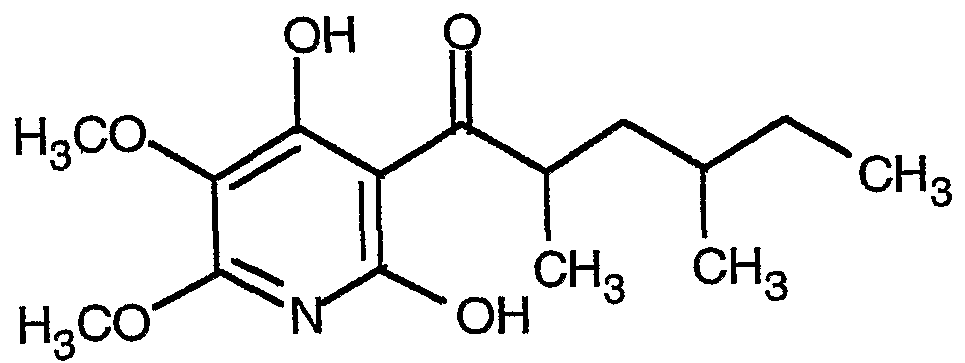
  • the complex of the electron transport system which is atodinin A4 represented by the following]] ::
  • the inhibitor is a complex of a pig heart complex II, a rat liver complex]!
  • the present invention relates to an electron transport complex inhibitor having an inhibitory activity on any of them.
  • the present invention also provides the following formula [ ⁇ ⁇
  • Electron transport system 0 complex which is atodinin A5 represented by: [In terms of the inhibitor, the inhibitor is a red heart complex ii, a rat liver complex] r, a Pseudoworm complex! [The present invention relates to an electron transport complex It inhibitor having an inhibitory activity against any of the above. The present invention also provides the following formula (V)
  • a complex of the electron transport system which is atodinin B represented by the formula:
  • the inhibitor may be any one of the pest heart complex I, the rat liver complex I, and the helminth complex II
  • the present invention relates to a complex I inhibitor of an electron transfer system having an inhibitory activity.
  • the present invention further provides the following formula (VI)
  • the present invention relates to a complex I inhibitor of an electron transport system having an inhibitory activity.
  • the present invention further provides a composite of an electron transfer system! Producing atvenin A4 represented by the above formula [dish] having an inhibitory activity against atbenin A5 represented by the formula [10], and atbenin B represented by the formula [V] Microbes, Penicillium sp.
  • Penicillium sp.) FO-125 (FERM BP-8048).
  • Atovenin A4, Atovenin A5, and Atovenin B among the inventors of the present invention, Satoshi Omura and Yoh Yododa were used by Penicillium Espi (Penici).
  • I lium s p.) An antifungal antibiotic for which a patent application was filed under the name of FO-125A4, A5, B after finding a substance with antifungal activity in the culture of the FO-125 strain (Japanese Unexamined Patent Publication No. Hei 11-95882).
  • this substance atodinin A4, A5, and B can be prepared according to the method described in JP-A-1-195882, or a modified method thereof, according to the method described in JP-A-1-195882. sp.) It can be obtained by culturing the FO-125 strain and purifying the culture solution. That is, the present strain is seed-cultured, then cultured in a jar armmenter, and the culture is centrifuged to obtain a supernatant. This is extracted with ethyl acetate, concentrated and subjected to silica gel column chromatography, and eluted with hexane monoethyl acetate.
  • the thus-obtained crude substance of each component of atovenin is subjected to Sephadex LH-20 column chromatography, and eluted with a chromatoform-methanol system to obtain single atodinins A4, A5, and B. be able to.
  • the crude substance of each of the above components of atbenin can be obtained by performing reverse-phase high-performance liquid chromatography using acetonitrile containing 1 OmM phosphate buffer (pH 3.0) once or repeatedly. You can get A4, A5, B.
  • the Penicillin 11i urnsp. FO-125 strain that produces the above-mentioned atodinins A4, A5, and B is a Buster's Convention on the International Recognition of Deposit of Microorganisms for Patent Procedure.
  • This strain grows relatively well on wort agar medium, potato-glucose agar medium, YPSs agar medium, etc., and has good conidia formation.
  • the colonies grown on the YpS s medium were observed under a microscope, the hyphae were transparent and had septum, and the conidiophores grew directly from the basal hyphae.
  • Penicillus is a two-wheeled symmetric body. The size varies widely and, in rare cases, single-wheeled organisms are also found. The size of the basal stroke is 15-20 X 3-4 m, and 3-5 colonies are formed. Strokes are pen tip-shaped and grow in groups of 3 to 6 and are 10 to 15 X 2 to 4 m in size. Initially, one conidia of the mouth-mouth type settles on the apex of the infarct, becoming a chain with the elapse of the culture time, and finally this chain reaches about 50 m. Observation with an electron microscope shows that the conidium is elliptical, measuring 2.2 to 3.1 x 1.6 to 2.0 mm, and its surface is smooth. (b) Properties on each medium
  • Table 1 below shows the results of macroscopic observation when cultured on various media at 27 ° C for 14 days.
  • Hypha does not spread, green is good ⁇ color none 64 mm velvet, white
  • the optimum growth conditions for this strain are pH 4-8 and temperature 22-33 ° C in YpsS medium.
  • the growth range of this strain is Y2S medium, pH2-9, temperature 15-39 ° C, and is aerobic.
  • the physicochemical properties of atodinin A4, atodinin A5 and atodinin B obtained from Penicillium sp.
  • F ⁇ -125 strain having the above-mentioned properties were in agreement with those described in the literature (S Omu ra, H. To—moda, K. ⁇ i mu ra, D. I Z. Zhen, H. Kumaga i, K. I garashi, N. I mamura, Y. Takaha shi, Y. T anaka and Y.
  • Harzi anopyr i done is described in the method of F. Tre ee 0 urt, M. Mallet, 0. Mong in and G. Que gu iner (J. He terocyclic Chem. 32, 1 1117-1124, 1995). That is, 6-bromo-1,2,3-dimethoxy-,-diisopropylcarbamate is obtained in four steps from 2,3-dimethoxypyridine and converted to pyridone, which is converted to (2- (trimethylsilyl) ethoxy) methyl. (S.EM) group.
  • this hagianopyridone was analyzed to be a chemical structure represented by the following formula [VI].
  • ubiquinone-12 manufactured by Sigma
  • DC IP 5 OmM phosphate buffer (pH 7.5) to a final concentration of 100 1M and 70M, respectively, and then After adding trifluoroacetone and further adding complex I, the reaction was started at 25 ° C. by adding potassium succinate having a final concentration of 1 OmM.
  • the reaction rate is reduced form of DC IP which receives electrons from succinate (emM- 1 1 cm- 1: 21 ) to generate speed of the measured change in absorbance of 600 nm.
  • the activity was expressed as the number of moles of DCIP reduced per minute.
  • potassium cyanide at a final concentration of 1 OmM was added to prevent terminal oxidase from leaking reducing power. The measurement results are as shown in Table 2.
  • Reference example 2 Reference example 2
  • mitochondria prepared by the same method as in Reference Example 1 were used for the human heart.
  • the succinate dehydrogenase activity of complex I was measured by measuring the rate of change of DC IP from the oxidized form to the reduced form by the addition of succinic acid as a change in the absorbance at the absorption maximum specific to the electron acceptor (DC IP). That is, ubiquinone-2 and DCIP were added to a final concentration of 100 // M and 70, respectively, in 5 OmM phosphate buffer (pH 7.5), carboxin was added, and complex I was further added. After the addition of, the reaction was started at 25 ° C by the addition of potassium succinate at a final concentration of 1 OmM.
  • mitochondria prepared in the same manner as in Reference Example 1 were used for the red heart.
  • the succinate dehydrogenase activity of complex H was measured by measuring the rate of change of DC IP from oxidized form to reduced form by the addition of succinic acid as a change in the absorbance at the absorption maximum specific to the electron acceptor (DC IP). That is, ubiquinone-2 and DCIP were added to a final concentration of 100 uM 70 M in 5 OmM phosphate buffer (pH 7.5), and atodinin A4 was added. After the addition of, the reaction was started at 25 ° C by addition of potassium succinate having a final concentration of 1 OmM.
  • the reaction rate is reduced form of DCIP which receives electrons from succinate ( ⁇ - 1 1 cm- 1: 21 ) the production rate of the measured absorbance change in 600 nm.
  • the activity was expressed as the number of moles of DC IP reduced per minute.
  • potassium cyanide at a final concentration of 1 OmM was added. The measurement results were as shown in Table 2.
  • mitochondria prepared in the same manner as in Reference Example 1 were used for rat liver.
  • the succinate dehydrogenase activity of the [complex]! Is measured by measuring the rate of change of DC IP from oxidized form to reduced form by addition of kono and succinic acid as a change in absorbance at the absorption maximum specific to electron acceptor (DC IP). did. That is, ubiquinone-2 and DC IP were added to a final concentration of 100 ⁇ M and 70 ⁇ M, respectively, in 5 OmM phosphate buffer (pH 7.5), and Atobenin A4 was added. Complex I was added Thereafter, the reaction was started at 25 ° C by addition of potassium succinate having a final concentration of 1 OmM.
  • DC generation rate of: (21 emM- 1 1 cm “ 1) was measured by the change in absorbance 600 nm activity which is reduced to 1 minute reaction rate, DC IP of reduced which receives electrons from succinate.
  • potassium cyanide at a final concentration of 1 OmM was added, and the measurement results were as shown in Table 2.
  • ubiquinone-12 and DCIP were added to a final concentration of 100 ⁇ M and 70 ⁇ M, respectively, in 5 OmM phosphate buffer (pH 7.5), and atodinin A4 was added. After addition of Form I, the reaction was started at 25 ° C by addition of potassium succinate at a final concentration of 1 OmM.
  • DC generation rate of: (21 emM- 1 1 cm “ 1) was measured by the change in absorbance 600 nm activity which is reduced to 1 minute reaction rate, DC IP of reduced which receives electrons from succinate.
  • a final concentration of 1 Cm of lithium cyanide was added, and the measurement results are shown in Table 2.
  • mitochondria prepared by the same method as in Reference Example 1 were used for the human heart.
  • the succinate dehydrogenase activity of complex JI was measured by measuring the rate of change of DC IP from oxidized form to reduced form by the addition of succinic acid as a change in absorbance at the absorption maximum specific to the electron acceptor (DC IP). That is, ubiquinone-2 and DC IP were added to 5 OmM phosphate buffer solution (pH 7.5) to a final concentration of 100 ⁇ M and 70 / M, respectively, and Atovenin A5 was added. After addition of body I, the reaction was started at 25 ° C by addition of potassium succinate at a final concentration of 1 OmM.
  • the reaction speed is, DC IP of reduced received electrons from succinate (smM- 1 1 cm- 1: 21 ) the production rate of the measured change in absorbance of 600 nm.
  • the activity was expressed as the number of moles of DC IP reduced per minute.
  • potassium cyanide at a final concentration of 1 OmM was added because it is necessary to inhibit terminal oxidase and prevent leakage of reducing power. The measurement results are as shown in Table 2.
  • mitochondria prepared by the same method as in Reference Example 1 were used for rat liver.
  • the succinate dehydrogenase activity was measured by measuring the rate of change of DC IP from the oxidized form to the reduced form due to the addition of succinic acid as a change in the absorbance at the absorption maximum specific to the electron acceptor (DC IP). That is, ubiquinone-2 and DC IP were added to a 5 OmM phosphate buffer solution (pH 7.5) to a final concentration of 100 ⁇ M and 70 zM, respectively, and atovenin A5 was added. After the addition of, the reaction was started at 25 ° C by adding potassium succinate at a final concentration of 1 OmM.
  • the production rate of 1) was measured by the change in absorbance at 600 nm. The activity was expressed as the number of moles of DCIP reduced per minute. Also, potassium cyanide at a final concentration of 1 OmM was added because it is necessary to inhibit terminal oxidase to prevent leakage of reducing power. The measurement results were as shown in Table 2.
  • mitochondria prepared in the same manner as in Reference Example 1 were used for rat liver.
  • the succinate dehydrogenase activity of the complex! was measured by measuring the rate of change of DC IP from oxidized form to reduced form by the addition of succinic acid as a change in the absorbance at the absorption maximum specific to the electron acceptor (DC IP).
  • DC IP electron acceptor
  • ubiquinone-12 and DCIP were added to a final concentration of 100 M and 70 M, respectively, in a 5 OmM phosphate buffer solution (pH 7.5), and Atovenin B was added. After the addition, the reaction was started at 25 ° C. by adding potassium succinate at a final concentration of 1 OmM.
  • the reaction speed is, DC IP of reduced which receives electrons from succinate: the rate of formation of ( ⁇ - 1 1 cm- 1 2 1 ) was measured by the change in absorbance 600 nm. The activity was expressed as the number of moles of DC IP reduced per minute. Also, potassium cyanide at a final concentration of 1 OmM was added because it is necessary to inhibit terminal oxidase and prevent leakage of reducing power. The measurement results are as shown in Table 2.
  • a purified complex I prepared in the same manner as in Example 3 was used.
  • the succinate dehydrogenase activity of complex I was measured by measuring the rate of change of DC IP from oxidized form to reduced form by the addition of succinic acid as a change in the absorbance at the absorption maximum specific to the electron acceptor (DC IP). That is, ubiquinone-12 and DCIP were added to 5 OmM phosphate buffer (pH 7.5) to a final concentration of 100 ⁇ M and 7O ⁇ M, respectively, and atobenine B was added. body! Then, the reaction was started at 25 ° C. by adding potassium succinate having a final concentration of 1 OmM.
  • the reaction rate is , DC IP of reduced received electrons from succinate (smM- 1 1 cm- 1: 21 ) the production rate of the measured change in absorbance of 600 nm.
  • the activity was expressed as the number of moles of DC IP reduced per minute.
  • potassium cyanide at a final concentration of 1 OmM was added to prevent terminal oxidase from leaking reducing power. The measurement results are as shown in Table 2.
  • mitochondria prepared in the same manner as in Reference Example 1 were used for the human heart.
  • the succinate dehydrogenase activity was measured by measuring the rate of change of DC IP from oxidized form to reduced form by the addition of succinic acid as a change in the absorbance at the absorption maximum specific to the electron acceptor (DC IP). That is, ubiquinone-2 and DCIP were added to 5 OmM phosphate buffer (pH 7.5) to a final concentration of 100 M and 70 ⁇ M, respectively, Hajianopyridone was added, and the complex was added. After that, the reaction was started at 25 ° C. by adding potassium succinate having a final concentration of 1 OmM.
  • Reaction rate is, DC IP of reduced received electrons from succinate (smM- 1 1 cm one 1: 2 1) the production rate of the measured change in absorbance of 600 nm. Activity was expressed as moles of DC IP reduced per minute. Also, potassium cyanide at a final concentration of 1 OmM was added to prevent terminal oxidase from preventing leakage of reducing power. The measurement results were as shown in Table 2.
  • Example 1 1
  • mitochondria prepared in the same manner as in Reference Example 1 were used for rat liver.
  • the succinate dehydrogenase activity of each complex was measured by measuring the rate of change of DC IP from the oxidized form to the reduced form due to the addition of succinic acid as a change in the absorbance at the absorption maximum specific to the electron acceptor (DC IP). That is, ubiquinone-12 and DCIP were each added to a final concentration of 100 ⁇ M in 5 OmM phosphate buffer (pH 7.5). The reaction was started at 25 ° C. by adding potassium succinate at a final concentration of 1 OmM.
  • the complex I a purified complex prepared by the same method as in Example 3 was used for Ascaris avium.
  • the succinate dehydrogenase activity of the [complex]! was measured by measuring the rate of change of DC IP from oxidized form to reduced form by addition of succinic acid as a change in the absorbance at the absorption maximum specific to the electron acceptor (DC IP). That is, ubiquinone-2 and DCIP were added to a final concentration of 100 ⁇ M and 70 / M, respectively, in 5 OmM phosphate buffer (H7.5), and hajianopyridone was added. After the addition of, the reaction was started at 25 ° C by adding potassium succinate at a final concentration of 1 OmM.
  • the reaction rate was determined by measuring the rate of formation of the reduced form of DC IP (smM-cm- 1 : 21) that received electrons from succinic acid by the change in absorbance at 600 nm.
  • the activity was expressed as the number of moles of DC IP reduced per minute.
  • potassium cyanide at a final concentration of 1 OmM was added because it is necessary to inhibit terminal oxidase to prevent leakage of reducing power.
  • the measurement results are as shown in Table 2.
  • the inhibitory activities in the above Reference Examples and Examples were as shown in Table 2 below, and were shown as the 50% inhibitory concentration (IC 50 , nM) of the complex.
  • 2-pyridinol derivatives or tautomeric 2-pyridone derivatives, or atvenins A4, A5, and B containing salts thereof, and hardanopyridone have nM order.
  • One heart complex I, rat liver complex! [Ya, the B. aragonite complex! And others were inhibited with strong activity. Therefore, the 2-pyridinol derivative of the present invention or a 2-pyridone derivative which is a tautomer thereof is expected to be useful as a complex H inhibitor of an electron transport system.

Landscapes

  • Chemical & Material Sciences (AREA)
  • Organic Chemistry (AREA)
  • Health & Medical Sciences (AREA)
  • Life Sciences & Earth Sciences (AREA)
  • Engineering & Computer Science (AREA)
  • Wood Science & Technology (AREA)
  • Zoology (AREA)
  • Bioinformatics & Cheminformatics (AREA)
  • General Health & Medical Sciences (AREA)
  • Biotechnology (AREA)
  • Genetics & Genomics (AREA)
  • Medicinal Chemistry (AREA)
  • General Engineering & Computer Science (AREA)
  • Microbiology (AREA)
  • Biochemistry (AREA)
  • Veterinary Medicine (AREA)
  • General Chemical & Material Sciences (AREA)
  • Chemical Kinetics & Catalysis (AREA)
  • Pharmacology & Pharmacy (AREA)
  • Animal Behavior & Ethology (AREA)
  • Public Health (AREA)
  • Biomedical Technology (AREA)
  • Epidemiology (AREA)
  • Botany (AREA)
  • Mycology (AREA)
  • Tropical Medicine & Parasitology (AREA)
  • Virology (AREA)
  • Nuclear Medicine, Radiotherapy & Molecular Imaging (AREA)
  • Pharmaceuticals Containing Other Organic And Inorganic Compounds (AREA)
  • Pyridine Compounds (AREA)
  • Micro-Organisms Or Cultivation Processes Thereof (AREA)
  • Preparation Of Compounds By Using Micro-Organisms (AREA)

Description

明 細 書 電子伝達系の複合体 I阻害剤 技術分野
本発明は、 例えばミ トコンドリアでアデノシン三リン酸 (ATP) を合成する ための酸化的リン酸化を司る電子伝達系に関与するタンパク質複合体に関し、 更 に詳しくは電子伝達系の複合体 I (コハク酸一ュビキノン酸化還元酵素) 阻害剤 に関する。 背景技術
ミ トコンドリアで ATPを合成するための酸化的リン酸化を司る電子伝達系に は主として 4種のタンパク質複合体が関与し、 複合体 I、 H、 Π及び] Yと呼ばれ ている (内海耕糙■井上正康監修:新ミ トコンドリァ学、 8 - 1 3頁、 金森崇 · 太田成男著:電子伝達とエネルギー転換系、 共立出版、 2001年) 。 この複合 体のうち、 複合体 I (NADH—ュビキノン酸化還元酵素) 、 複合体 II (ュビキ ノール—シトクロム c酸化還元酵素) 、 及び複合体 W (シトクロム c酸化還元酵 素) に対しては、 それぞれ優れた阻害剤が知られており、 生化学研究などにおい て用いられている (内海耕糙 ·井上正康:新ミ トコンドリア学、 424— 426 頁、 内海耕糙著: ミ トコンドリアのエネルギー転換研究に用いられる阻害剤一覧 、 共立出版、 2001年) 。 複合体 H (コハク酸一ュビキノン酸化還元酵素) 阻害剤としては、 テノィルト リフルォロアセトン (t henoy l t r~i f l uo r oa c e t on e) など がよく用いられていたが、 その阻害濃度は/ Mオーダという活性の弱いものであ つた (日本生化学会編:生化学実験講座 12エネルギー代謝と生体酸化 (上) 2 15— 255頁、 香川靖雄■浅野朗著: ミ トコンドリアおよびその構成成分の調 整法、 東京化学同人、 1 976年) 。 またカルボキシンがこれまで知られていた 複合体 II阻害剤としては最も強い阻害活性を示すと言われていたが (P. C. M
0 w e r y, B. A. C. A c k r e 1 1 , and T. P. S i nge r : B
1 o c h e m i c a 1 and B i ophys i c a l Re s e a r ch Commun i c a t i on s Vo l. 71. p 354 - 36 K 1 976 )
、 複合体 I阻害剤のロテノン (r o t enon e) や複合体 Π阻害剤のアンチマ ィシン等と比較するとかなり弱い活性であった (日本生化学会編:生化学実験講 座 1 2エネルギー代謝と生体酸化 (上) 21 5— 255頁、 香川靖雄 ·浅野朗著 : ミ トコンドリアおよびその構成成分の調整法、 東京化学同人、 1 976年) 。 発明の開示
そこで本発明者らは、 電子伝達系の複合体 IEに対する優れた阻害剤の探索を行 つた。 その結果、 2—ピリジノール誘導体もしくはその互変異性体の 2—ピリ ド ン誘導体である既知の抗生物質アトべニン A 4、 アトべニン A 5、 アトべニン B 及びハージァノピリ ドンに意外にも優れた複合体! [阻害活性を見出し、 本発明を 完成するに至った。
本発明は上記の知見に基づいて完成されたもので、 その目的とするところは複 合体 I阻害剤としてこれまでに用いられていたテノィルトリフルォロアセトンゃ カルボキシンに比べ極めて高い阻害活性を示し、 生化学研究などに用いて極めて 有益となり得る電子伝達系の複合体 I阻害剤を提供するものである。 すなわち、 本発明は、 下記一般式 〔I〕
〔I〕
Figure imgf000004_0001
(式中、 Rはハロゲンを含む置換基を有していてもよいアルキル基またはァルケ ニル基である) で表される 2—ピリジノ一ル誘導体もしくはその互変異性体であ る下記一般式 〔I〕
〔π〕
Figure imgf000005_0001
(式中、 Rはハロゲンを含む置換基を有していてもよいアルキル基またはァルケ ニル基である) で表される 2—ピリ ドン誘導体、 またはそれらの塩を含有する化 合物を有効成分とする電子伝達系の複合体 I阻害剤に関する。
アルキル基としては例えば、 メチル、 ェチル、 プロピル、 イソプロピル、 プチ ル、 イソブチル、 ペンチル、 イソペンチル、 2—メチルブチル、 へキシル、 2— メチルペンチル、 3—メチルペンチル、 4—メチルペンチル、 2—ェチルブチル 、 ヘプチル、 ォクチル等が挙げられ、 アルケニル基としては例えば、 1 —プロべ ニル、 ァリル、 1ーブテニル、 2—ブテニル、 1—ペンテニル、 2—ペンテニル 、 3—ペンテニル、 3 —メチルー 2 —プテニル、 ゲラニル等が挙げられる。 本発明はまた、 下記式 〔Μ〕
〔m〕
Figure imgf000005_0002
で表されるァトぺニン A 4である電子伝達系の複合体]]:阻害剤に関し、 該阻害剤 はゥシ心臓複合体 II、 ラッ ト肝臓複合体]!、 ブタ回虫複合体 Iのいずれかに対し て阻害活性を有する電子伝達系の複合体 阻害剤に関する。 本発明はまた、 下記式 〔Ι Π
Figure imgf000006_0001
で表されるァトぺニン A 5である電子伝達系 0複合体] [阻害剤に関し、 該阻害剤 はゥシ心臓複合体 ii、 ラッ ト肝臓複合体] r、 プ夕回虫複合体! [のいずれかに対し て阻害活性を有する電子伝達系の複合体 It阻害剤に関する。 本発明はまた、 下記式 〔V〕
〔V〕
Figure imgf000006_0002
で表されるァトぺニン Bである電子伝達系の複合体! [阻害剤に関し、 該阻害剤は ゥシ心臓複合体 I、 ラット肝臓複合体 I、 ブ夕回虫複合体 IIのいずれかに対して 阻害活性を有する電子伝達系の複合体 I阻害剤に関する。 本発明は更にまた、 下記式 〔VI〕
〔VI〕
Figure imgf000006_0003
で表されるハージァノピリ ドンである電子伝達系の複合体] I阻害剤に関し、 該阻 害剤はゥシ心臓複合体]!、 ラット肝臓複合体]!、 ブ夕回虫複合体 Iのいずれかに 対して阻害活性を有する電子伝達系の複合体 I阻害剤に関する。 本発明は更にまた、 電子伝達系の複合体! [に対して阻害活性を有する前記の式 〔皿〕 で表されるアトべニン A4、 式 〔10 で表されるアトべニン A5、 及び式 〔V〕 で表されるアトべニン Bを産生する微生物が、 ぺニシリウム エスピー (
Pen i c i l l i um s p. ) FO- 1 25 (FERM BP— 8 048 ) である微生物に関する。 本発明に用いた既知の抗生物質アトべニン A 4、 アトべニン A 5、 及びアトべ ニン Bは、 本発明の発明者らのうち、 大村智、 供田洋らがぺニシリウム エスピ (P e n i c i I l i um s p. ) FO— 1 25菌株の培養液中に抗真菌活性 を有する物質を見出し、 FO— 1 25A4、 A5、 Bと命名して特許出願を行つ た抗真菌抗生物質である (特開平 1一 1 99582号) 。 従って、 本物質ァトぺ ニン A 4、 A 5、 及び Bは、 特開平 1一 1 99582号に記載の方法、 あるいは その変法にしたがって、 ぺニシリウム エスピー e— n— i c i 1 1 i 1 urn s p. ) FO- 1 25菌株を培養し、 その培養液を精製することにより、 得るこ とができる。 すなわち、 本菌株を種培養後、 ジャーフアーメンターで培養し、 培養液を遠心 分離して上清を得る。 これを酢酸ェチルで抽出し、 濃縮後シリカゲルカラムクロ マトグラフィ一に供し、 へキサン一酢酸ェチル系で溶出する。 こうして得られた アトべニン各成分粗物質を、 セフアデックス LH— 20カラムクロマトグラフィ —に供し、 クロ口ホルム一メタノール系で溶出することにより、 単一なアトぺニ ン A4、 A5、 Bを得ることができる。 また、 上記アトべニン各成分粗物質は、 1 OmMリン酸緩衝液 (pH3. 0) を含んだァセトニトリルを用いた逆相高速 液体クロマトグラフィ一を 1回または繰り返し行うことによつても、 単一なァト ぺニン A 4、 A 5、 Bを得ることができる。 上記のァトぺニン A 4、 A 5、 Bを産生する P e n i c i 1 1 i urn s p. FO- 1 25菌株は、 特許手続上の微生物の寄託の国際的承認に関するブ夕ぺス ト条約に従い、 日本国茨城県つくば市東 1丁目 1番地 1 中央第 6 (郵便番号 3 05 - 8566 ) [A I ST Ts ukub a Cen t r a l 6, 1— 1 , H i g a s h i 1 - C h o m e Ts ukub a— s h i, I b a r a k i - ken 305- 8566 Jap an] に所在する独立行政法人産業技術総合 研究所 特許生物寄託センター [I n t e r na t i ona l Pa t en t Or gan i sm Depo s i t a r y Na t i ona l I n s t i t u t e o f Advan c e d I ndu s t r i a l Sc i e n c e an d Te c hno l o y] に平成 1 4年 (2002) 5月 22日に寄託され、 受託番号 FERM BP- 8048が付与された。 本菌株 P e n i c i 1 1 i urn s p. F 0— 1 25の菌学的性状については 特開平 1一 1 99582号に述べてあるが、 本菌株は再寄託のため、 以下にその 菌学的性状の概要を説明する。
( a ) 形態的性質
本菌株は、 麦芽汁寒天培地、 バレイショ ·ブドウ糖寒天培地、 Y p S s寒天培 地などで比較的良好に生育し、 分生子の着生も良好である。 YpS s培地に生育 したコロニーを顕微鏡で観察すると、 菌糸は透明で隔壁を有しており、 分生子柄 は基底菌糸より直生している。
ぺニシラスは複輪生一対称体である。 大きさは変化に富み、 まれに単輪生体も 認められる。 基底梗子の大きさは 1 5〜20 X 3〜4〃mで 3〜5個着生する。 梗子はペン先型で 3〜 6個群生し、 大きさは 1 0〜1 5 X 2〜 4 mである。 はじめはフィァ口型分生子が梗子の頂端に 1個着生し、 培養時間の経過ととも に連鎖状となり、 最終的にはこの連鎖はレ 50 m前後に達する。 電子顕微鏡で 観察すると、 分生子は楕円形で、 大きさは 2. 2〜3. 1 X 1. 6〜2. 0 mm であり、 その表面は平滑である。 ( b ) 各培地上での性状
各種培地上で 2 7 °C、 1 4日間培養した場合の肉眼的観察結果を下記の第 1表 に示す。
第 1表 培地 分生子
培地上の生育 コロニ一裏面 形成 色 可溶性 コロニ- 状態 の色調 の直径 麦芽汁寒天培地
良好、 周辺部;黄緑色 良好 黄緑色 なし 5 8 mm 菌糸は拡散せず、 中心部;喑赤褐色 〜緑色
ビロード状、 白色 f ·ブドウ糖寒天培地
良好、 黄緑色 良好 緑色 なし 6 0 mm 菌糸は拡散せず、
ビロード状、 白色 ッァぺック寒天培地
良好、 アイボリ 中程度 アイボリー なし 6 2 mm 菌糸は拡散せず、
フェルト状、 白色 サブ口—寒天培地
良好、 ベ一ジ 良好 淡青色 なし 6 1 mm 菌糸は拡散せず、
フェルト状、 白色 ォ—トミール寒天培地
良好、 黄色〜黄緑色 良好 深緑色 なし 65mm 菌糸は拡散して生育、
ビロード状、 白色 合成厶コール寒天培地
良好、 無色 僅かに 白色 なし 66mm 菌糸は長く拡散して生育、
羊毛状、 透明
Yp S s寒天培地
良好、 白色〜
菌糸は拡散せず、 緑色 良好 綠色 なし 64 mm ビロード状、 白色
( c ) 生理学的、 生態的性状
本菌株の最適生育条件は、 YpS s培地において pH4〜8、 温度 22〜33 °Cである。 本菌株の生育範囲は YpS s培地において pH2〜9、 温度 1 5〜3 9°Cであり、 好気性菌である。 前記の諸性状を有するぺニシリウ厶 エスピー F〇— 1 25菌株から得られ たァトぺニン A4、 ァトぺニン A5及びァトぺニン Bの理化学的性状は文献記載 値と一致した (S. Omu r a, H. To— mo da, K. Κ i mu r a, D. 一 Z. Z h e n, H. Kumaga i, K. I ga r a s h i, N. I m a m u r a , Y. Takaha s h i, Y. T a n a k a and Y. Iwa i、 J . An t i b i o t. 第 4 1巻、 1 769— 1 773頁、 1 988年、 および H. K u m a g a i , H. N i s h i d a , N. I m a m υ r a , H. T o m o d a and S. 〇mu r a、 J. An t i b i o t. 第 43巻、 1 553— 1 5
58頁、 1 990年) 。 .
本物質ァトぺニン A4、 A5及び Bの理化学的性状を要約すると以下のとおり である。
[ァ トぺニン A 4 ]
( 1 ) 性状 白色粉末
( 2 ) 分子量 33 1
( 3 ) 分子式 Ci5H22N05 C 1
( 4)紫外部吸収極大 (エタノール中) : 235 nm、 267n m、 320 η mに極大吸収を有する。
( 5 ) 赤外部吸収極大 (KBr錠) : 1 645、 1 600、 1 440、 1 32 0、 1 200、 1 1 60、 995 c m—1に極大吸収を有する。
(6) 'Η—プロトン核磁気共鳴スぺクトル:重クロ口ホルム中の化学シフト (p pm) 及び Jは結合定数 (Hz) : 54. 1 9 ( 3 H, s) 、 4. 1 8 (1
H, m)、 4. 1 4 (1 H, d q, J= 3. 1, 6. 7) 、 3. 80 ( 3 H, · s ) 、 1. 82 ( 1 H, m) 、 1. 76 ( 1 H, m)、 1. 53 ( 1 H, d d d, J= 6. 2, 6. 2, 1 2. 4)、 1. 45 ( 3 H, d, J= 6. 7) 、 1. 1 5 (3 H, d; J= 6. 8) 、 0. 96 ( 3 H, d, J = 6. 7) 。
(7) 13C核磁気共鳴スペクトル:重クロ口ホルム中の化学.シフト (ppm) : <521 0. 1、 1 7 1. 1、 1 6 1. 8、 1 55. 5、 1 21. 2、 1 00. 5、 63. 1、 6 1. 5、 57. 9、 39. 9、 37. 7、 37. 1、 22. 7
Figure imgf000011_0001
以上、 各種理化学的性状やスペク トル ir "夕から、 本アトべニン A4物質は下 記式 〔II〕 で表される化学構造と解析された。 〔IE〕
Figure imgf000012_0001
[ァトぺニン A 5 ]
( 1 ) 性状 白色粉末
( 2 ) 分子量 3 6 5
( 3 ) 分子式 Cl5H2,N05 C 12
(4) 紫外部吸収極大 (エタノール中) 2 3 7 nm、 2 7 2 nm、 3 2 0 η mに極大吸収を有する。
( 5 ) 赤外部吸収極大 (KB r錠) : 1 6 4 5、 1 6 0 0、 1 440、 1 3 2 0、 1 20 0、 1 1 6 0、 9 9 5 c m—1に極大吸収を有する。
(6) 1H—プロトン核磁気共鳴スぺクトル:重クロ口ホルム中の化学シフト (p pm) 及び Jは結合定数 (Hz) : δ A . 2 1 ( 3 H, s) 、 4. 2 1 ( 1
H, m) 、 4. 1 1 ( 1 H, d d d, J= 2. 6, 5. 9, 8. 5) 、 3. 77 (3H, s) 、 3. 7 1 ( 1 H, d d, J= 5. 9, 1 1. 2) 、 3. 6 2 ( 1 H, d d, J = 8. 5, 1 1. 2)、 2. 1 6 ( 1 H, m) . 1. 9 0 ( 1 H, d d d, J= 7. 1 , 8. 1, 1 3. 6) 、 1. 5 0 ( 1 H, d d d, J= 6. 5, 7. 3, 1 3. 6) 、 1. 1 5 ( 3 H, d, J= 6. 8) ·、 0. 9 2 ( 3 H , d, J= 6. 5) 。
(7) 13C核磁気共鳴スペクトル:重クロ口ホルム中の化学シフ ト (p pm) : 520 9. 8、 1 72. 5、 1 6 1. 9、 1 55. 2、 1 2 0. 9、 1 0 0. 8、 6 5. 4、 6 1. 6、 5 8. 3、 4 5. 9、 3 9. 3、 3 7. 5、 3 2. 5
Figure imgf000012_0002
以上、 各種理化学的性状やスペクトルデータから、 本アトべニン A5物質は下 記式 〔IV〕 で表される化学構造と解析された。 〔IV〕
Figure imgf000013_0001
[ァトぺニン B]
( 1 ) 性状 白色粉末
( 2 ) 分子量 29 7
( 3 ) 分子式
(4) 紫外部吸収極大 (エタノール中) : 2 37 nm、 270 nm, 3 1 8 nmに極大吸収を有する。
( 5 ) 赤外部吸収極大 (KBr錠) : 1 6 4 5、 1 6 0 0、 1 44 0、 1 3 2 0、 1 2 0 0、 1 1 6 0、 9 95 c m 1に極大吸収を有する。
( 6) —プロトン核磁気共鳴スペクトル:重ピリジン中の化学シフト (p pm) 及び Jは結合定数 (Hz) : 54. 3 0 ( 1 H, m)、 3. 7 8 ( 3 H, s)、 3. 7 1 (3H, s) 、 1. 7 1 ( 1 H, d d d, J = 5. 3, 5. 9, 1 2. 5 )、 1. 38 ( 1 H, m)、 1. 3 3 ( 1 H, m) . 1. 2 1 ( 1 H, m)、 1. 1 9 (3H, d, J= 6. 6)、 1. 0 6 ( 1 H, m)、 0. 7 1 ( 3H, d d, J = 7. 3, 7. 3) 、 0. 8 6 ( 3 H, d, J= 6. 4) 。
(7) 13C核磁気共鳴スペクトル:重ピリジン中の化学シフト (ppm) : δ 2 1 1. 7、 1 6 5. 8、 1 62. 6、 1 5 9. 9、 1 24. 9、 1 0 0. 6、 6 0. 6、 54. 3、 4 1. 9、 4 1. 1、 30. 6、 2 1. 0、 1 9. 1、 1 7. 1、 1 1. 7ο
以上、 各種理化学的性状やスペクトルデータから、 本アトべニン Β物質は下記 式 〔V〕 で表される化学構造と解析された。 〔V〕
Figure imgf000014_0001
[ハージァノピリ ドン]
ノヽ一ジァノピリ ドン (Ha r z i anopyr i done) は、 F. Tr e e 0 u r t , M. Ma l l e t, 0. Mong i n and G. Que gu i n e rの方法 (J. He t e r o c y c l i c Che m. 第 32巻、 1 1 1 7 - 1 1 24頁、 1 995年) にしたがって合成することができる。 すなわち、 2, 3—ジメ トキシピリジンより 4段階で 6 _ブロモ一 2, 3—ジメ トキシ— , —ジイソプロピルカーバメートを得て、 ピリ ドンに変換し、 これを (2— (トリ メチルシリル) エトキシ) メチル (S.EM) 基で保護する。 これにプチルリチウ ムを加え (4E) — 2—メチル一4—へキセナ一ルと反応させることで得られる アルコールを、 ピリジニゥムクロ口クロメートでケトンに酸化し、 次いでカーバ メートおよび S EMの脱保護を行うことでハ一ジァノピリ ドンを合成できる。 得 られたハージァノピリ ドンの理化学的性状は文献記載値と一致した (Ju l i a
M. D i ck i n s on, Jame s R. Han s on, an d Pe t e r B. Hi t c hc ock r J. C h e m. So c. Pe rk i n T r a n s. I、 1 885 - 1 887頁、 1 989年) 。
本ハージァノピリ ドン物質の理化学的性状を要約すると以下のとおりである。
( 1 ) 性状 : 白色粉末
( 2 ) 分子量: 28 1
(3) 分子式: C14H19N05
(4) 紫外部吸収極大 (エタノール中) 243請、 267請、 33 1 η mに極大吸収を有する。 ( 5 ) 赤外部吸収極大 (KB r錠) : 1 725、 1 6 5 0、 1 6 00、 7 2 0 cm— 1に極大吸収を有する。
( 6) !H—プロトン核磁気共鳴スぺクトル:重クロ口ホルム中の化学シフト (p pm) 及び Jは結合定数 (Hz) : 51 6. 4 ( 1 H, s) 、 1 2. 3 ( 1
H, b r . s ) 、 5. 4 2 ( 1 H, m) 、 5. 3 8 ( 1 H, m) 、 4. 1 7 (3
H, s) , 3. 9 5 ( 1 H, m) 、 3. 79 ( 3 H, s ) 、 2. 4 5 ( 1 H, d d d, J= 6. 0, 6. 0, 1 4. 5) 、 2. 0 5 ( 1 H, d d d, J= 6. 5 , 6. 5, 1 4. 5) 、 1. 6 5 ( 3 H, d, J= 6. 5) 、 1. 30 ( 3 H, d, J= 6. 5) o
(7) 13C核磁気共鳴スペクトル:重クロ口ホルム中の化学シフト (p pm) : (520 9. 8、 1 72. 9、 1 6 1. 8、 1 5 5. 7、 1 28. 7、 1 27.
I、 1 2 1. 6、 1 0 0. 6、 6 1. 5、 5 7. 6、 4 3. 1、 3 6. 1、 1 7 . 9、 1 6. 3。
以上、 各種理化学的性状やスぺクトルデータから、 本ハージァノピリ ドンは下 記式 〔VI〕 で表される化学構造と解析された。
〔VI〕
Figure imgf000015_0001
発明を実施するための最良の形態
次に、 参考例及び実施例を挙げて本発明を説明するが、 本発明はこれのみに 限定されるものではない。 参考例 1
テノィルトリフルォロアセトンのゥシ心臓複合体 Iに対する阻害活性 複合体 I (コハク酸ュビキノン酸化還元酵素) として、 ゥシ心臓については、 S. T a k am i y aらの方法 (D e v e 1 o pm e n t a 1 chang e s i n t he r e s p i r a t o r y c ha i n o f As c a r i s mi t ho chond r i a : B i o ch im. B i ophy s. Ac t a、 第 1 1 4 1巻、 65— 7 1頁、 1 993年) で調製したミ トコンドリアを用いた 。 複合体]!のコハク酸デヒドロゲナーゼ活性は、 コハク酸添加によるジクロロフ ヱノールインドフヱノール (DC I P、 シグマ社製) の酸化型から還元型への変 化速度を電子受容体 (DC I P) に特有な吸収極大の吸光度の変化として測定し た。
すななち、 5 OmMリン酸緩衝液 (pH 7. 5) 中にュビキノン一 2 (シグマ 社製) 、 DC I Pをそれぞれ終濃度 1 00〃M、 70 Mになるように加え、 テ ノィルトリフルォロアセトンを加え、 さらに複合体 Iを加えた後、 終濃度 1 Om Mのコハク酸カリウムの添加で 25°Cで反応を開始した。 反応速度は、 コハク酸 からの電子を受け取った DC I Pの還元型 (emM— 11 cm— 1 : 21) の生成速 度を 600 nmの吸光度変化で測定した。 活性は 1分間に還元された D C I Pの モル数で表した。 また末端酸化酵素を阻害して還元力の漏出を防ぐ必要から、 終 濃度 1 OmMのシアン化カリウムを加えた。 測定結果は第 2表に示す通りであつ た。 参考例 2
カルボキシンのゥシ心臓複合体 I [に対する阻害活性
複合体 IIとして、 ゥシ心臓については、 参考例 1と同様の方法で調製したミ ト コンドリアを用いた。 複合体 Iのコハク酸デヒドロゲナーゼ活性は、 コハク酸添 加による DC I Pの酸化型から還元型への変化速度を電子受容体 (DC I P) に 特有な吸収極大の吸光度の変化として測定した。 すななち、 5 OmMリン酸緩衝 液 (pH7. 5) 中にュビキノン— 2、 DC I Pをそれぞれ終濃度 1 00 //M、 70 になるように加え、 カルボキシンを加え、 さらに複合体 Iを加えた後、 終濃度 1 OmMのコハク酸カリウムの添加で 25°Cで反応を開始した。 反応速度 は、 コハク酸からの電子を受け取った DC I Pの還元型 (smNT11 cm— 1: 2 1 ) の生成速度を 600 nmの吸光度変化で測定した。 活性は 1分間に還元され た DC I Pのモノレ,数で表した。 また末端酸化酵素を阻害して還元力の漏出を防ぐ 必要から、 終濃度 1 OmMのシアン化カリウムを加えた。 測定結果は第 2表に示 す通りであった。 実施例 1
アトべニン A4のゥシ心臓複合体 Hに対する阻害活性
複合体 It (コハク酸ュビキノン酸化還元酵素) として、 ゥシ心臓については、 参考例 1と同様の方法で調製したミ トコンドリアを用いた。 複合体 Hのコハク酸 デヒドロゲナ一ゼ活性は、 コハク酸添加による DC I Pの酸化型から還元型への 変化速度を電子受容体 (DC I P) に特有な吸収極大の吸光度の変化として測定 した。 すなわち、 5 OmMリン酸緩衝液 (pH 7. 5 ) 中にュビキノ ン— 2、 D C I Pをそれぞれ終濃度 1 00 uM 70 Mになるように加え、 ァトぺニン A 4を加え、 さらに複合体 Iを加えた後、 終濃度 1 OmMのコハク酸カリウムの添 加で 25 °Cで反応を開始した。 反応速度は、 コハク酸からの電子を受け取った D C I Pの還元型 (επιΜ— 11 cm— 1 : 21) の生成速度を 600 nmの吸光度変 化で測定した。 活性は 1分間に還元された DC I Pのモル数で表した。 また末端 酸化酵素を阻害して還元力の漏出を防ぐ必要から、 終濃度 1 OmMのシアン化力 リウムを加えた。 測定結果は第 2表に示す通りであった。 実施例 2
アトべニン A4のラット肝臓複合体 Iに対する阻害活性
複合体]!として、 ラッ ト肝臓については、 参考例 1と同様の方法で調製したミ トコンドリアを用いた。 複合体]!のコハク酸デヒドロゲナ一ゼ活性は、 コノ、ク酸 添加による DC I Pの酸化型から還元型への変化速度を電子受容体 (DC I P) に特有な吸収極大の吸光度の変化として測定した。 すなわち、 5 OmMリン酸緩 衝液 (pH 7. 5) 中にュビキノ ン— 2、 DC I Pをそれぞれ終濃度 1 00〃M 、 70〃Mになるように加え、 アトべニン A 4を加え、 さらに複合体 Iを加えた 後、 終濃度 1 OmMのコハク酸カリウムの添加で 25 °Cで反応を開始した。 反応 速度は、 コハク酸からの電子を受け取った DC I Pの還元型 (emM— 11 cm"1 : 21) の生成速度を 600 nmの吸光度変化で測定した。 活性は 1分間に還元 された DC I Pのモル数で表した。 また末端酸化酵素を阻害して還元力の漏出を 防ぐ必要から、 終濃度 1 OmMのシアン化カリウムを加えた。 測定結果は第 2表 に示す通りであった。 実施例 3
アトべニン A 4のブ夕回虫複合体 Iに対する阻害活性
複合体: IIとして、 ブタ回虫については F. S a r υ t aらの方法 (S t ag e -s p e c i f i c I s o f o r m s o f Comp l ex I C S υ c c i na t e— Ub i qu i non e Ox i do r e du c t a s e) i n M i t ho c hon d r i a f r om t he Pa r a s i t i c N e m a t o d e, As c a r i s s u urn : J. B i o l. C h e m. 第 270巻、 928— 9 32頁、 1 9 95年) で調製した精製複合体 Iを用いた。 複合体 Iの コハク酸デヒドロゲナ一ゼ活性は、 コハク酸添加による DC I Pの酸化型から還 元型への変化速度を電子受容体 (DC I P) に特有な吸収極大の吸光度の変化と して測定した。
すなわち、 5 OmMリン酸緩衝液 (pH 7. 5 ) 中にュビキノン一 2、 D C I Pをそれぞれ終濃度 1 00〃M、 70〃Mになるように加え、 ァトぺニン A 4を 加え、 さらに複合体 Iを加えた後、 終濃度 1 OmMのコハク酸カリウムの添加で 25°Cで反応を開始した。 反応速度は、 コハク酸からの電子を受け取った DC I Pの還元型 (emM—11 cm"1 : 21 ) の生成速度を 600 nmの吸光度変化で 測定した。 活性は 1分間に還元された DC I Pのモル数で表した。 また末端酸化 酵素を阻害して還元力の漏出を防ぐ必要から、 終濃度 1 OmMのシアン化力リウ ムを加えた。 測定結果は第 2表に示す通りであった。 実施例 4
アトべニン A 5のゥシ心臓複合体 Hに対する阻害活性
複合体 IIとして、 ゥシ心臓については、 参考例 1と同様の方法で調製したミ ト コンドリアを用いた。 複合体 JIのコハク酸デヒドロゲナーゼ活性は、 コハク酸添 加による DC I Pの酸化型から還元型への変化速度を電子受容体 (DC I P) に 特有な吸収極大の吸光度の変化として測定した。 すなわち、 5 OmMリン酸緩衝 液 (pH 7. 5) 中にュビキノン— 2、 DC I Pをそれぞれ終濃度 1 00〃M、 70 /Mになるように加え、 アトべニン A 5を加え、 さらに複合体 Iを加えた後 、 終濃度 1 OmMのコハク酸カリウムの添加で 25 °Cで反応を開始した。 反応速 度は、 コハク酸からの電子を受け取った DC I Pの還元型 (smM— 11 cm— 1 : 21 ) の生成速度を 600 nmの吸光度変化で測定した。 活性は 1分間に還元さ れた DC I Pのモル数で表した。 また末端酸化酵素を阻害して還元力の漏出を防 ぐ必要から、 終濃度 1 OmMのシアン化カリウムを加えた。 測定結果は第 2表に 示す通りであった。 実施例 5
アトべニン A 5のラッ ト肝臓複合体 Iに対する阻害活性
複合体] Iとして、 ラッ ト肝臓については、 参考例 1と同様の方法で調製したミ トコンドリアを用いた。 複合体! [のコハク酸デヒドロゲナーゼ活性は、 コハク酸 添加による DC I Pの酸化型から還元型への変化速度を電子受容体 (DC I P) に特有な吸収極大の吸光度の変化として測定した。 すなわち、 5 OmMリン酸緩 衝液 (pH 7. 5) 中にュビキノンー 2、 DC I Pをそれぞれ終濃度 1 00〃M 、 70 zMになるように加え、 アトべニン A 5を加え、 さらに複合体 Hを加えた 後、 終濃度 1 OmMのコハク酸カリウムの添加で 25°Cで反応を開始した。 反応 速度は、 コハク酸からの電子を受け取った DC I Pの還元型 (emM— 11 cm一1 : 21) の生成速度を 600 nmの吸光度変化で測定した。 活性は 1分間に還元 された DC I Pのモル数で表した。 また末端酸化酵素を阻害して還元力の漏出を 防ぐ必要から、 終濃度 1 OmMのシアン化カリウムを加えた。 測定結果は第 2表 に示す通りであった。 実施例 6
アトべニン A 5のプタ回虫複合体 Iに対する阻害活性
複合体! [として、 ブタ回虫については、 実施例 3と同様の方法で調製した精製 複合体 Iを用いた。 複合体 Iのコハク酸デヒドロゲナーゼ活性は、 コハク酸添加 による DC I Pの酸化型から還元型への変化速度を電子受容体 (DC I P) に特 有な吸収極大の吸光度の変化として測定した。 すなわち、 5 OmMリン酸緩衝液
(pH 7. 5) 中にュビキノン一 2、 DC I Pをそれぞれ終濃度 1 00〃M、 7 0〃Mになるように加え、 アトべニン A 5を加え、 さらに複合体! [を加えた後、 終濃度 1 OmMのコハク酸カリウムの添加で 25°Cで反応を開始した。 反応速度 は、 コハク酸からの電子を受け取った DC I Pの還元型 (smM— 11 cm— 1: 2
1) の生成速度を 600 nmの吸光度変化で測定した。 活性は 1分間に還元され た DC I Pのモル数で表した。 また末端酸化酵素を阻害して還元力の漏出を防ぐ 必要から、 終濃度 1 OmMのシアン化カリウムを加えた。 測定結果は第 2表に示 す通りであった。 実施例 7
ァトぺニン Bのゥシ心臓複合体 Iに対する阻害活性
複合体! [として、 ゥシ心臓については、 参考例 1と同様の方法で調製したミ ト コンドリアを用いた。 複合体 Iのコハク酸デヒドロゲナーゼ活性は、 コハク酸添 加による DC I Pの酸化型から還元型への変化速度を電子受容体 (DC I P) に 特有な吸収極大の吸光度の変化として測定した。 すなわち、 5 OmMリン酸緩衝 液 (pH 7. 5) 中にュビキノン— 2、 DC I Pをそれぞれ終濃度 1 00 / M、
70 zMになるように加え、 アトべニン Bを加え、 さらに複合体 Iを加えた後、 終濃度 1 OmMのコハク酸カリウムの添加で 25°Cで反応を開始した。 反応速度 は、 コハク酸からの電子を受け取った DC I Pの還元型 (emM— 11 cm : 2
1) の生成速度を 600 nmの吸光度変化で測定した。 活性は 1分間に還元され た DC I Pのモル数で表した。 また末端酸化酵素を阻害して還元力の漏出を防ぐ 必要から、 終濃度 1 OmMのシアン化カリウムを加えた。 測定結果は第 2表に示 す通りであった。 実施例 8
アトべニン Bのラット肝臓複合体に対する阻害活性
複合体 Iとして、 ラット肝臓については、 参考例 1と同様の方法で調製したミ トコンドリアを用いた。 複合体! [のコハク酸デヒドロゲナ一ゼ活性は、 コハク酸 添加による DC I Pの酸化型から還元型への変化速度を電子受容体 (DC I P) に特有な吸収極大の吸光度の変化として測定した。 すなわち、 5 OmMリン酸緩 衝液 (pH7. 5) 中にュビキノン一 2、 DC I Pをそれぞれ終濃度 1 00 M 、 70 Mになるように加え、 アトべニン Bを加え、 さらに複合体! [を加えた後 、 終濃度 1 OmMのコハク酸カリウムの添加で 25°Cで反応を開始した。 反応速 度は、 コハク酸からの電子を受け取った DC I Pの還元型 (επΜ-11 cm— 1: 2 1 ) の生成速度を 600 nmの吸光度変化で測定した。 活性は 1分間に還元さ れた DC I Pのモル数で表した。 また末端酸化酵素を阻害して還元力の漏出を防 ぐ必要から、 終濃度 1 OmMのシアン化カリウムを加えた。 測定結果は第 2表に 示す通りであった。 実施例 9
了トぺニン Bのブタ回虫複合体! [に対する阻害活性
複合体! [として、 ブタ回虫については、 実施例 3と同様の方法で調製した精製 複合体 Iを用いた。 複合体 Iのコハク酸デヒドロゲナーゼ活性は、 コハク酸添加 による DC I Pの酸化型から還元型への変化速度を電子受容体 (DC I P) に特 有な吸収極大の吸光度の変化として測定した。 すなわち、 5 OmMリン酸緩衝液 (pH 7. 5) 中にュビキノン一 2、 DC I Pをそれぞれ終濃度 1 00〃M、 7 O ^Mになるように加え、 アトべニン Bを加え、 さらに複合体! [を加えた後、 終 濃度 1 OmMのコハク酸カリウムの添加で 25 °Cで反応を開始した。 反応速度は 、 コハク酸からの電子を受け取った DC I Pの還元型 (smM— 11 cm— 1 : 21 ) の生成速度を 600 nmの吸光度変化で測定した。 活性は 1分間に還元された DC I Pのモル数で表した。,また末端酸化酵素を阻害して還元力の漏出を防ぐ必 要から、 終濃度 1 OmMのシアン化カリウムを加えた。 測定結果は第 2表に示す 通りであった。 実施例 1 0
ハージァノピリ ドンのゥシ心臓複合体 Iに対する阻害活性
複合体! [として、 ゥシ心臓については、 参考例 1と同様の方法で調製したミ ト コンドリアを用いた。 複合体! [のコハク酸デヒドロゲナ一ゼ活性は、 コハク酸添 加による DC I Pの酸化型から還元型への変化速度を電子受容体 (DC I P) に 特有な吸収極大の吸光度の変化として測定した。 すなわち、 5 OmMリン酸緩衝 液 (pH7. 5) 中にュビキノン— 2、 DC I Pをそれぞれ終濃度 1 00 M、 70〃Mになるように加え、 ハージァノピリ ドンを加え、 さらに複合体]!を加え た後、 終濃度 1 OmMのコハク酸カリウムの添加で 25°Cで反応を開始した。 反 応速度は、 コハク酸からの電子を受け取った DC I Pの還元型 (smM—11 cm 一1 : 2 1 ) の生成速度を 600 nmの吸光度変化で測定した。 活性は 1分間に還 元された DC I Pのモル数で表した。 また末端酸化酵素を阻害して還元力の漏出 を防ぐ必要から、 終濃度 1 OmMのシアン化カリウムを加えた。 測定結果は第 2 表に示す通りであった。 実施例 1 1
ハージァノピリ ドンのラット肝臓複合体 Hに対する阻害活性
複合体]!として、 ラット肝臓については、 参考例 1と同様の方法で調製したミ トコンドリアを用いた。 複合体互のコハク酸デヒドロゲナーゼ活性は、 コハク酸 添加による DC I Pの酸化型から還元型への変化速度を電子受容体 (DC I P) に特有な吸収極大の吸光度の変化として測定した。 すなわち、 5 OmMリン酸緩 衝液 (pH 7. 5) 中にュビキノン一 2、 DC I Pをそれぞれ終濃度 1 00〃M 、 70 Mになるように加え、 ハージァノピリ ドンを加え、 さらに複合体丑を加 えた後、 終濃度 1 OmMのコハク酸カリウムの添加で 25°Cで反応を開始した。 反応速度は、 コハク酸からの電子を受け取った DC I Pの還元型 (smM— 11 c m一1 : 21) の生成速度を 600 nmの吸光度変化で測定した。 活性は 1分間に 還元された DC I Pのモル数で表した。 また末端酸化酵素を阻害して還元力の漏 出を防ぐ必要から、 終濃度 1 OmMのシアン化カリウムを加えた。 測定結果は第 2表に示す通りであった。 実施例 1 2
ハージァノピリ ドンのブ夕回虫複合体 Iに対する阻害活性
複合体 Iとして、 ブタ回虫については、 実施例 3と同様の方法で調製した精製 複合体]!を用いた。 複合体]!のコハク酸デヒドロゲナーゼ活性は、 コハク酸添加 による DC I Pの酸化型から還元型への変化速度を電子受容体 (DC I P) に特 有な吸収極大の吸光度の変化として測定した。 すなわち、 5 OmMリン酸緩衝液 ( H 7. 5) 中にュビキノン— 2、 DC I Pをそれぞれ終濃度 1 00〃M、 7 0 /Mになるように加え、 ハージァノピリ ドンを加え、 さらに複合体 Iを加えた 後、 終濃度 1 OmMのコハク酸カリウムの添加で 25°Cで反応を開始した。 反応 速度は、 コハク酸からの電子を受け取った DC I Pの還元型 (smM— cm一1 : 21) の生成速度を 600 nmの吸光度変化で測定した。 活性は 1分間に還元 された DC I Pのモル数で表した。 また末端酸化酵素を阻害して還元力の漏出を 防ぐ必要から、 終濃度 1 OmMのシアン化カリウムを加えた。 測定結果は第 2表 に示す通りであった。 以上の参考例および各実施例における阻害活性については、 下記第 2表に示す 通りであり、 複合体丑の 50%阻害濃度 ( I C50、 nM) として示した。 第 2表 阻害剤 合 体 I
ゥシ心臓 ラッ ト肝 n ブタ回虫 ァトぺニン A 4 1 1 24 220 アトべニン A 5 3. 3. 32 ァトぺニン B 1 0 20 50 ハ一ジァノピリ ドン 1 7 200 2000 テノィルトリフルォロアセトン 5800 NT NT カルボキシン 1 100 NT NT
NT: n o t t e s t
上記の測定結果から、 2—ピリジノール誘導体もしくは互変異性体の 2—ピリ ドン誘導体であるアトべニン A 4、 A 5、 Bゃハ一ジァノピリ ドンは、 ゥシ心臓 複合体]!、 ラット肝臓複合体 Iや、 ブ夕回虫複合体 IIに対して nMオーダ一の強 い阻害を示した。 また、 それらのゥシ心臓複合体] [に対する阻害活性を、 これま で報告されている複合体! [阻害剤のティノルトリフルォロアセトンゃカルボキシ ンと比較すると、 60〜1 600倍強い阻害活性を示した。 産業上の利用分野
以上に説明したように、 2—ピリジノール誘導体もしくはその互変異性体であ る 2—ピリ ドン誘導体、 またはそれらの塩を含有するアトべニン A4、 A5、 及 び Bやハージァノピリ ドンは、 nMオーダ一でゥシ心臓複合体 I、 ラッ ト肝臓複 合体! [や、 ブ夕回虫複合体! [などを強い活性で阻害した。 したがって、 本発明の 2 -ピリジノール誘導体もしくはその互変異性体である 2—ピリ ドン誘導体は、 電子伝達系の複合体 H阻害剤として有用であると期待される。

Claims

1 . 下記一般式 〔 I〕
〔I〕
Figure imgf000025_0001
(式中、 Rはハロゲンを含む置換基を有していてもよいアルキル基またはァルケ ニル基である) で表されるピリジノ一ル誘導体もしくはその互変異性体である下 囲
記一般式 〔I〕
〔π〕
Figure imgf000025_0002
(式中、 Rはハロゲンを含む置換基を有していてもよいアルキル基またはァルケ ニル基である) で表される 2—ピリ ドン誘導体、 またはそれらの塩を含有する化 合物を有効成分とする電子伝達系の複合体] [阻害剤。
2 . 前記の複合体 IT阻害剤が、 下記式 〔Π〕
〔m〕
Figure imgf000025_0003
で表されるァトぺニン A 4である請求の範囲 1記載の電子伝達系の複合体 II阻害 剤。
3 . 上記の式 〔ΠΙ〕 で表されるアトべニン A 4がゥシ心臓複合体]!に対し て阻害活性を有する請求の範囲 2記載の電子伝達系の複合体] [阻害剤。
4 . 上記の式 〔ΠΙ〕 で表されるアトべニン Α 4がラット肝臓複合体 IIに対 して阻害活性を有する請求の範囲 2記載の電子伝達系の複合体]]:阻害剤。
5 . 上記の式 〔ΠΠ で表されるアトべニン A 4がブ夕回虫複合体 Iに対し て阻害活性を有する請求の範囲 2記載の電子伝達系の複合体! [阻害剤。
6 . 前記の複合体]!阻害剤が、 下記式 〔Ι Π
… 〕
Figure imgf000026_0001
で表されるアトべニン A 5である請求の範囲 1記載の電子伝達系の複合体 E阻害 剤。
7 . 上記の式 〔W〕 で表されるアトべニン 5がゥシ心臓複合体 IEに対して 阻害活性を有する請求の範囲 6記載の電子伝達系の複合体]!阻害剤。
8 . 上記の式 〔1Y〕 で表されるアトべニン 5がラット肝臓複合体 Iに対し て阻害活性を有する請求の範囲 6記載の電子伝達系の複合体! [阻害剤。 ·
9 . 上記の式 〔I?〕 で表されるアトべニン 5がブタ回虫複合体 Iに対して 阻害活性を有する請求の範囲 6記載の電子伝達系の複合体 阻害剤。
1 0 . 前記の複合体 I阻害剤が、 下記式 〔V〕
〔V〕
Figure imgf000027_0001
で表されるァトぺニン Βである請求の範囲 1に記載の電子伝達系の複合体 I阻害 剤。
1 1 . 上記の式 〔V〕 で表されるアトべニン Βがゥシ心臓複合体]!に対して 阻害活性を有する請求の範囲 1 0記載の電子伝達系の複合体] I阻害剤。
1 2 . 上記の式 〔V〕 で表されるアトべニン Βがラット肝臓複合体 Iに対し て阻害活性を有する請求の範囲 1 0記載の電子伝達系の複合体 I阻害剤。
1 3 . 上記の式 〔V〕 で表されるアトべニン Βがブタ回虫複合体] [に対して 阻害活性を有する請求の範囲 1 0記載の電子伝達系の複合体! [阻害剤。
1 4 . 前記の複合体]!阻害剤が、 下記式 〔VI〕
〔VI〕
Figure imgf000027_0002
で表されるハージァノピリ ドンである請求の範囲 1記載の電子伝達系の複合体 I 阻害剤。
1 5 . 上記の式 〔 [〕 で表されるハージァノピリ ドンがゥシ心臓複合体]!に 対して阻害活性を有する請求の範囲 14記載の電子伝達系の複合体] [阻害剤。
1 6. 上記の式 〔VI〕 で表されるハージァノピリ ドンがラッ ト肝臓複合体 H に対して阻害活性を有する請求の範囲 14記載の電子伝達系の複合体 I阻害剤。
17. 上記の式 〔 Π で表されるハージァノピリ ドンがブ夕回虫複合体 Iに 対して阻害活性を有する請求の範囲 14記載の電子伝達系の複合体] [阻害剤。
1 8. 電子伝達系の複合体] [に対して阻害活性を有する前記の式 〔Π〕 で表 されるアトべニン A 4、 式 〔IV〕 で表ざれるアトべニン A 5および式 〔V〕 で表 されるァトぺニン Bを産生する微生物が、 ぺニシリウム エスピー (P e n i c i 1 1 i urn s p. ) FO- 125 (FERM BP— 8048)である微生 物。
PCT/JP2002/005727 2002-06-10 2002-06-10 電子伝達系の複合体ii阻害剤 Ceased WO2003103667A1 (ja)

Priority Applications (6)

Application Number Priority Date Filing Date Title
EP02733432A EP1512402B1 (en) 2002-06-10 2002-06-10 Inhibitors against complex ii of electron transport system
US10/489,964 US7514455B2 (en) 2002-06-10 2002-06-10 Inhibitors against complex II of electron transport system
JP2004510786A JP4334472B2 (ja) 2002-06-10 2002-06-10 電子伝達系の複合体ii阻害剤
AU2002306342A AU2002306342A1 (en) 2002-06-10 2002-06-10 Inhibitors against complex ii of electron transport system
DE60223290T DE60223290D1 (de) 2002-06-10 2002-06-10 Hemmer des komplex ii des elektronentransportsystems
PCT/JP2002/005727 WO2003103667A1 (ja) 2002-06-10 2002-06-10 電子伝達系の複合体ii阻害剤

Applications Claiming Priority (1)

Application Number Priority Date Filing Date Title
PCT/JP2002/005727 WO2003103667A1 (ja) 2002-06-10 2002-06-10 電子伝達系の複合体ii阻害剤

Publications (1)

Publication Number Publication Date
WO2003103667A1 true WO2003103667A1 (ja) 2003-12-18

Family

ID=29727331

Family Applications (1)

Application Number Title Priority Date Filing Date
PCT/JP2002/005727 Ceased WO2003103667A1 (ja) 2002-06-10 2002-06-10 電子伝達系の複合体ii阻害剤

Country Status (6)

Country Link
US (1) US7514455B2 (ja)
EP (1) EP1512402B1 (ja)
JP (1) JP4334472B2 (ja)
AU (1) AU2002306342A1 (ja)
DE (1) DE60223290D1 (ja)
WO (1) WO2003103667A1 (ja)

Cited By (2)

* Cited by examiner, † Cited by third party
Publication number Priority date Publication date Assignee Title
JP2016121072A (ja) * 2014-12-24 2016-07-07 学校法人北里研究所 種選択的な電子伝達系の複合体ii阻害活性を有する新規アトペニン類縁体
US10781177B2 (en) 2016-03-09 2020-09-22 Nippon Soda Co., Ltd. Pyridine compound and use thereof

Families Citing this family (2)

* Cited by examiner, † Cited by third party
Publication number Priority date Publication date Assignee Title
CA2663474C (en) * 2006-09-15 2017-06-27 Griffith University Pro-oxidant anti-cancer compounds
WO2010069495A1 (de) * 2008-12-18 2010-06-24 Bayer Cropscience Aktiengesellschaft Atpenine

Citations (2)

* Cited by examiner, † Cited by third party
Publication number Priority date Publication date Assignee Title
JPS50132183A (ja) * 1974-03-19 1975-10-20
JPH05339156A (ja) * 1992-06-08 1993-12-21 Kobe Steel Ltd ヒト腫瘍細胞に対する選択的細胞障害剤

Family Cites Families (2)

* Cited by examiner, † Cited by third party
Publication number Priority date Publication date Assignee Title
JPH01199582A (ja) * 1988-02-05 1989-08-10 Kitasato Inst:The 新規抗生物質fo−125a↓4、a↓5、bおよびそれらの製造法
US5313332A (en) * 1990-11-16 1994-05-17 Applied Magnetics Corporation Flexure suspension for two axis actuator

Patent Citations (2)

* Cited by examiner, † Cited by third party
Publication number Priority date Publication date Assignee Title
JPS50132183A (ja) * 1974-03-19 1975-10-20
JPH05339156A (ja) * 1992-06-08 1993-12-21 Kobe Steel Ltd ヒト腫瘍細胞に対する選択的細胞障害剤

Non-Patent Citations (4)

* Cited by examiner, † Cited by third party
Title
CUTLER H.G., JACYNO J.M.: "Biological activity of (-)-harzianopyridone isolated from trichoderma harzianum", AGRIC. BIOL. CHEM., vol. 55, no. 10, 1991, pages 2629 - 2631, XP002956364 *
KUMAGAI H. ET AL.: "The structures of atpenins A5, A5 and B, new antifungal antibiotics produced by penicillium sp.", J. ANTIBIOT., vol. 43, no. 12, 1990, pages 1553 - 1558, XP002956363 *
OSHINO K. ET AL.: "Mechanism of action of atpenin B on raji cells", J. ANTIBIOT., vol. 43, no. 9, 1990, pages 1064 - 1068, XP002956362 *
See also references of EP1512402A4 *

Cited By (2)

* Cited by examiner, † Cited by third party
Publication number Priority date Publication date Assignee Title
JP2016121072A (ja) * 2014-12-24 2016-07-07 学校法人北里研究所 種選択的な電子伝達系の複合体ii阻害活性を有する新規アトペニン類縁体
US10781177B2 (en) 2016-03-09 2020-09-22 Nippon Soda Co., Ltd. Pyridine compound and use thereof

Also Published As

Publication number Publication date
DE60223290D1 (de) 2007-12-13
JPWO2003103667A1 (ja) 2005-10-06
AU2002306342A1 (en) 2003-12-22
US7514455B2 (en) 2009-04-07
EP1512402A4 (en) 2005-07-13
EP1512402B1 (en) 2007-10-31
JP4334472B2 (ja) 2009-09-30
US20040266835A1 (en) 2004-12-30
EP1512402A1 (en) 2005-03-09

Similar Documents

Publication Publication Date Title
JP2719340B2 (ja) 発酵方法
CZ412997A3 (cs) Způsob selektivní redukce ketoskupin
EP4001420A2 (en) Method for preparing raspberry ketone using industrial fermentation
CN1675370A (zh) 制备内酯的方法
JP2017012117A (ja) 3−ヒドロキシ酪酸又はその塩の好気的生産方法
WO2015071861A2 (en) Fungus mediated stereo-selective bioreduction of keto intermediates of pharmaceutically active compounds to their corresponding hydroxy compounds
TWI287579B (en) Stereoselective reduction of substituted oxo-butanes
WO2003103667A1 (ja) 電子伝達系の複合体ii阻害剤
KR101275061B1 (ko) 거울상이성질체 선택적인 효소에 의한 케토 화합물의 환원방법
EP0599967B1 (en) Arylalkanoic acid resolution
JP2825645B2 (ja) 2―(4―ヒドロキシフェノキシ―)プロピオン酸の発酵による製造方法
US11332766B2 (en) Strain of Serratia liquefaciens and a method of producing heliotropin with the same strain
Onakunle et al. The formation and substrate specificity of bacterial lactonases capable of enantioselective resolution of racemic lactones
US7439225B2 (en) Substances K01-B0171 and process for producing the same
JPS633794A (ja) α,β−不飽和カルボニル化合物の還元方法
Kira et al. Microbial production of (S)-1-phenyl-1, 3-propanediol by stereospecific reduction of 3-hydroxy-1-phenylpropane-1-one
US20060154347A1 (en) Process for the manufacture of spiroketals
Yamada et al. Amide-transforming activity of Streptomyces: possible application to the formation of hydroxy amides and aminoalcohols
JPH0569512B2 (ja)
EP0481711A2 (en) Process for production of optically active 3-methyladipic acid
WO1999024439A1 (en) Novel substance ft-0554 and process for producing the same
WO2000023608A1 (en) Preparation of amino alcohols
JPS6221509B2 (ja)
JPH04248989A (ja) 8−ヒドロキシカルボスチリル及び/または8−ヒド            ロキシクマリンの製造方法
JP2005278525A (ja) 芳香族化合物の製造方法

Legal Events

Date Code Title Description
AK Designated states

Kind code of ref document: A1

Designated state(s): AE AG AL AM AT AU AZ BA BB BG BR BY BZ CA CH CN CO CR CU CZ DE DK DM DZ EC EE ES FI GB GD GE GH GM HR HU ID IL IN IS JP KE KG KP KR KZ LC LK LR LS LT LU LV MA MD MG MK MN MW MX MZ NO NZ PL PT RO RU SD SE SG SI SK SL TJ TM TR TT TZ UA UG US UZ VN YU ZA ZW

AL Designated countries for regional patents

Kind code of ref document: A1

Designated state(s): GH GM KE LS MW MZ SD SL SZ TZ UG ZM ZW AM AZ BY KG KZ MD RU TJ TM AT BE CH CY DE DK ES FI FR GB GR IE IT LU MC NL PT SE TR BF BJ CF CG CI CM GA GN GQ GW ML MR NE SN TD TG

DFPE Request for preliminary examination filed prior to expiration of 19th month from priority date (pct application filed before 20040101)
121 Ep: the epo has been informed by wipo that ep was designated in this application
WWE Wipo information: entry into national phase

Ref document number: 2004510786

Country of ref document: JP

WWE Wipo information: entry into national phase

Ref document number: 2002733432

Country of ref document: EP

WWE Wipo information: entry into national phase

Ref document number: 10489964

Country of ref document: US

WWP Wipo information: published in national office

Ref document number: 2002733432

Country of ref document: EP

WWG Wipo information: grant in national office

Ref document number: 2002733432

Country of ref document: EP