US9500877B2 - Lens driving unit, and lens apparatus and image pickup apparatus including the same - Google Patents
Lens driving unit, and lens apparatus and image pickup apparatus including the same Download PDFInfo
- Publication number
- US9500877B2 US9500877B2 US13/664,488 US201213664488A US9500877B2 US 9500877 B2 US9500877 B2 US 9500877B2 US 201213664488 A US201213664488 A US 201213664488A US 9500877 B2 US9500877 B2 US 9500877B2
- Authority
- US
- United States
- Prior art keywords
- movable
- lens
- movable member
- fixed
- driving unit
- Prior art date
- Legal status (The legal status is an assumption and is not a legal conclusion. Google has not performed a legal analysis and makes no representation as to the accuracy of the status listed.)
- Expired - Fee Related, expires
Links
Images




Classifications
-
- G—PHYSICS
- G02—OPTICS
- G02B—OPTICAL ELEMENTS, SYSTEMS OR APPARATUS
- G02B27/00—Optical systems or apparatus not provided for by any of the groups G02B1/00 - G02B26/00, G02B30/00
- G02B27/64—Imaging systems using optical elements for stabilisation of the lateral and angular position of the image
- G02B27/646—Imaging systems using optical elements for stabilisation of the lateral and angular position of the image compensating for small deviations, e.g. due to vibration or shake
-
- G—PHYSICS
- G03—PHOTOGRAPHY; CINEMATOGRAPHY; ANALOGOUS TECHNIQUES USING WAVES OTHER THAN OPTICAL WAVES; ELECTROGRAPHY; HOLOGRAPHY
- G03B—APPARATUS OR ARRANGEMENTS FOR TAKING PHOTOGRAPHS OR FOR PROJECTING OR VIEWING THEM; APPARATUS OR ARRANGEMENTS EMPLOYING ANALOGOUS TECHNIQUES USING WAVES OTHER THAN OPTICAL WAVES; ACCESSORIES THEREFOR
- G03B5/00—Adjustment of optical system relative to image or object surface other than for focusing
- G03B5/02—Lateral adjustment of lens
-
- G—PHYSICS
- G03—PHOTOGRAPHY; CINEMATOGRAPHY; ANALOGOUS TECHNIQUES USING WAVES OTHER THAN OPTICAL WAVES; ELECTROGRAPHY; HOLOGRAPHY
- G03B—APPARATUS OR ARRANGEMENTS FOR TAKING PHOTOGRAPHS OR FOR PROJECTING OR VIEWING THEM; APPARATUS OR ARRANGEMENTS EMPLOYING ANALOGOUS TECHNIQUES USING WAVES OTHER THAN OPTICAL WAVES; ACCESSORIES THEREFOR
- G03B2205/00—Adjustment of optical system relative to image or object surface other than for focusing
- G03B2205/0007—Movement of one or more optical elements for control of motion blur
- G03B2205/0015—Movement of one or more optical elements for control of motion blur by displacing one or more optical elements normal to the optical axis
-
- G—PHYSICS
- G03—PHOTOGRAPHY; CINEMATOGRAPHY; ANALOGOUS TECHNIQUES USING WAVES OTHER THAN OPTICAL WAVES; ELECTROGRAPHY; HOLOGRAPHY
- G03B—APPARATUS OR ARRANGEMENTS FOR TAKING PHOTOGRAPHS OR FOR PROJECTING OR VIEWING THEM; APPARATUS OR ARRANGEMENTS EMPLOYING ANALOGOUS TECHNIQUES USING WAVES OTHER THAN OPTICAL WAVES; ACCESSORIES THEREFOR
- G03B2205/00—Adjustment of optical system relative to image or object surface other than for focusing
- G03B2205/0053—Driving means for the movement of one or more optical element
Definitions
- the present invention relates to a lens driving unit including a driving unit.
- a lens apparatus including a correction lens that is moved in a translational movement in a plane perpendicular to an optical axis so as to suppress an image shake is well known, and an apparatus including a retention mechanism for restricting and fixing movement of a movable member including the correction lens when image stabilisation is not performed is also known.
- Japanese Patent No. 4,011,576 discloses an apparatus in which, when the image stabilisation is not performed, the movable member including the correction lens is rotated so that a locking element reception portion of a fixed member and a locking element of the movable member are engaged at a predetermined position, and hence the movable member is locked at a position matching an optical axis. In this position, the movable member is biased toward the locking element reception portion by a magnetic repulsion force, and hence the position is retained.
- Japanese Patent Application Laid-Open No. 2008-015349 discloses an apparatus in which the movable member is retained at a position by a magnetic attraction force in the state where the movable member including the correction lens is locked with the fixed member by the same method as disclosed in Japanese Patent No. 4,011,576.
- the present invention provides a lens driving unit capable of simplifying the shape of the component, positioning the correction lens accurately, and reducing the change in positioning accuracy of the correction lens with time in a long-term use.
- a lens driving unit for moving a lens in a lens apparatus in a direction perpendicular to an optical axis of the lens apparatus, the lens driving unit including: a fixed member; a movable member to which the lens is fixed; a spacer interposed between the fixed member and the movable member in a state where the fixed member and the movable member are movable relatively to each other in the direction perpendicular to the optical axis of the lens; a biasing unit for biasing the movable member toward the fixed member; a position detector for detecting a position of the movable member with respect to the fixed member in a plane perpendicular to the optical axis of the lens; a driving unit for driving the movable member with respect to the fixed member in the direction perpendicular to the optical axis; a controller for controlling the drive unit to drive the movable member based on the position of the movable member detected by the position detector; and a movable range
- the lens driving unit capable of further simplifying the shape of the component, positioning the correction lens accurately, and reducing the change in positioning accuracy of the correction lens with time in a long-term use.
- FIG. 1 is an exploded perspective view of a lens driving unit according to a first embodiment of the present invention.
- FIG. 2A is a front view of the lens driving unit when image stabilisation is performed according to the first embodiment.
- FIG. 2B is a front view of the lens driving unit when the image stabilisation is not performed according to the first embodiment.
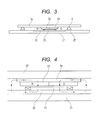
- FIG. 3 is a schematic top view of FIG. 2A .
- FIG. 4 is a partially enlarged view of a drive unit and the vicinity thereof according to the first embodiment.
- FIG. 5 is a flowchart to be performed when a movable unit is locked according to the first embodiment.
- FIG. 6A is a front view of a lens driving unit when the image stabilization is performed according to a second embodiment of the present invention.
- FIG. 6B is a front view of the lens driving unit when the image stabilization is not performed according to the second embodiment.
- FIG. 7 is a partially enlarged view of the drive unit and the vicinity thereof according to the second embodiment.
- FIGS. 1 to 5 a lens driving unit according to a first embodiment of the present invention is described in detail.
- FIG. 1 is an exploded perspective view of a lens driving unit according to the first embodiment.
- FIG. 2A is a front view of the lens driving unit when an image stabilising function is effective (hereinafter referred to as “image-stabilization state”).
- FIG. 2B is a front view of the lens driving unit when the image stabilization is not performed (hereinafter referred to as “no-image-stabilization state”).
- image-stabilization state an image stabilising function is effective
- FIG. 2B is a front view of the lens driving unit when the image stabilization is not performed (hereinafter referred to as “no-image-stabilization state”).
- FIGS. 2A and 2B in order to facilitate understanding of the structure, a fixed unit and balls described later are indicated by solid lines while a movable unit is indicated by broken lines.
- FIG. 3 is a schematic top view of FIG. 2A , for illustrating a structure of the drive unit and the vicinity thereof in a simplified manner.
- FIG. 4 is a partially enlarged view of
- a lens driving unit 1 includes a fixed unit (fixed member) 2 fixed integrally with a lens barrel or the like in a lens apparatus for imaging (not shown), a movable unit (movable member) 3 that includes a correction lens 31 and changes its relative position with respect to the fixed unit 2 , and three balls (spacers) 4 interposed between the movable unit 3 and the fixed unit 2 .
- the fixed unit 2 includes a retaining plate 21 as a reference member for the lens driving unit 1 , three attraction yokes 22 fixed to the retaining plate 21 at substantially every 120 degrees, and three driving coils 23 fixed to the attraction yokes 22 .
- the fixed unit 2 includes three position detectors 24 for detecting a position of the movable unit 3 , and ball reception portions 25 for receiving the three balls 4 disposed between the fixed unit 2 and the movable unit 3 .
- the retaining plate 21 includes a fitting portion 211 to which a protrusion 321 of a moving plate 32 of the movable unit 3 described later is fitted with a predetermined play when the image stabilization is not performed, and a fit release portion 212 for releasing the fit with the protrusion 321 of the moving plate 32 when the image stabilisation is performed.
- the fitting portion 211 , the fit release portion 212 , and the protrusion 321 of the fixed unit 2 and the movable unit 3 constitute a movable range defining unit, which defines a movable position having a large relative movable range in a plane perpendicular to the optical axis and a fixed position having a small relative movable range in the plane perpendicular to the optical axis based on a relative rotation position about the optical axis of the correction lens 31 retained by the moving plate 32 .
- the movable unit 3 includes the moving plate 32 made of a non-magnetic material and retaining the correction lens 31 for performing the image stabilization, the protrusions 321 disposed on the moving plate 32 , permanent magnets 33 , and back yokes 34 disposed on the permanent magnets 33 on the moving plate 32 side.
- the permanent magnet 33 is magnetized so as to have the north pole on one side and the south pole on the other side with respect to the center line as a boundary as illustrated in FIGS. 3 and 4 , and is interposed between the attraction yoke 22 and the back yoke 34 so as to form a closed magnetic circuit as illustrated in FIG. 4 .
- a belt-shaped position detecting scale 35 is disposed at a position opposed to the position detectors 24 .
- the position detecting scale 35 has a size which is large enough for the position detectors 24 of the fixed unit 2 to face the position defecting scale 35 even if the movable unit 3 moves in the maximum movable range.
- the attraction yoke 22 and the driving coil 23 of the fixed unit 2 , and the permanent magnet 33 and the back yoke 34 of the movable unit 3 are integrally referred to as a drive unit 5 .
- the movable unit 3 is attracted to the fixed unit 2 so that the permanent magnet 33 attracts the attraction yoke 22 made of a magnetic material.
- the three balls 4 are interposed between the retaining plats 21 and the moving plate 32 while being housed in holes of the ball reception portions 25 disposed in the retaining plate 21 .
- the ball 4 rotates in the hole of the ball reception portion 25 along with movement of the moving plate 32 so as to support the moving plate 32 with respect to the fixed unit 2 in a plane perpendicular to the optical axis in a movable state and to always maintain a constant distance between the moving plate 32 and the retaining plate 21 .
- the center of the driving coil 23 is on the center line of the permanent magnet 33 .
- the permanent magnet 33 exhibits a magnetic force illustrated by lines of a magnetic force as indicated by arrows in FIG. 4 .
- the driving coil 23 is applied with electric current, an electromagnetic force is generated.
- a direction and intensity of the generated force can be adjusted by a direction and quantity of the applied current.
- the electric current flowing in the clockwise direction causes a force for moving the movable unit 3 in a clockwise direction
- the electric current flowing in the counterclockwise direction causes a force for moving the movable unit 3 in a counterclockwise direction.
- a vibration amount is first input from a vibration detection sensor of a camera or lens body (not shown) to a CPU for the lens driving unit serving as a drive controller (not shown).
- the CPU calculates a drive amount of the correction lens necessary for stabilizing the image based on the input vibration amount and outputs the drive amount based on the calculated drive amount as electric current signal to the three drive units 5 .
- the drive unit 5 drives the moving plate 32 to move in translational movement in the plane perpendicular to the optical axis based on the electric current signal.
- Position information of the moving plate 32 is detected by reading the position detecting scale 35 by the three position detectors 24 , and the position information is fed back to the CPU.
- the CPU calculates the drive amount of the correction lens 31 based on the fed-back position information and a newly input vibration amount from the vibration detection sensor, and outputs the electric current signal based on the calculated drive amount to the drive unit 5 .
- the lens driving unit 1 continuously performs the image stabilisation.
- FIG. 5 is a flowchart illustrating a method of controlling the movable unit 3 to a locked state.
- the CPU calculates a drive amount necessary for adjusting the optical axis of the correction lens 31 coincident with the optical axis of the lens apparatus from optical axis center information of the lens apparatus recorded in advance and the position information of the moving plate 32 . After that, the calculated drive amount is converted into the current signal, and the electric current signal is output to each drive unit 5 (S 101 ). Each drive unit 5 drives the moving plate 32 to move in translational movement to a position where the optical axis of the correction lens 31 is coincident with the optical axis of the lens apparatus based on the electric current signal (S 102 and S 103 ).
- the moving plate 32 is rotated about the optical axis by a predetermined amount to a position (lock position) where a phase of the protrusion 321 of the movable unit 3 is coincident with a phase of the fitting portion 211 of the fixed unit 2 (S 104 ).
- the position detector 24 detects that the moving plate 32 has rotated to the lock position (S 105 )
- the CPU stops energization to the drive unit 5 (S 106 ).
- the permanent magnets 33 continuously attract the attraction yokes 22 so that the movable unit 3 maintains the state of causing the three balls 4 to be biased toward the holes of the ball reception portions 25 in the retaining plate 21 by a predetermined biasing force even when the energization is not performed.
- the posture of the movable unit 3 is maintained in the non-image-stabilisation state, and hence it is possible to retain the position of the optical axis of the correction lens 31 at the position coincident with the optical axis of the lens apparatus.
- the retaining plate 21 (fixed unit 2 ) includes the ball reception portions 25 in this case, but the same effect can be obtained also when the moving plats 32 (movable unit 3 ) includes the ball reception portions 25 .
- the position of the movable unit 3 can be retained without a significant deviation of the optical axis of the correction lens 31 from the optical axis of the lens apparatus (reference position). Note that, if a deviation of the position of the movable unit 3 occurs in a state where the lens apparatus is powered on, the CPU detects a change of an output value of the position detector and controls the drive unit 5 to move the movable unit 3 to a position where the optical axis of the correction lens 31 is coincident with the optical axis of the lens apparatus.
- the CPU calculates an amount of positional deviation (an amount of movement from the reference position including a direction and a distance) from a change of the output value of the position detector, and controls the drive unit 5 to move the movable unit 3 to the position where the optical axis of the correction lens 31 is coincident with the optical axis of the lens apparatus.
- the position of the movable unit 3 including the correction lens can be retained at a position where the optical axis of the correction lens 31 is coincident with the optical axis of the lens apparatus. Therefore, good optical performance can be obtained.
- the attraction yoke and the driving coil are disposed on the fixed unit while the permanent magnet and the back yoke are disposed on the movable unit in this embodiment, but the same effect can be obtained also when the permanent magnet and the back yoke are disposed on the fixed unit while the driving coil and the attraction yoke are disposed on the movable unit as a counterpart.
- the effect of the yoke can be obtained by using a magnetic material for the moving plate, the back yoke becomes unnecessary so that the number of components can further be reduced.
- the movable unit 3 is controlled to rotate to the lock position, but it is possible to simultaneously control the translational movement to the optical axis center of the correction lens 31 and the rotational movement to the lock position.
- FIGS. 6A, 6B, and 7 a second embodiment of the present invention is described in detail with reference to FIGS. 6A, 6B, and 7 .
- a drive unit has a structure different from that in the first embodiment.
- Other identical parts are denoted by the same reference numerals or symbols, and description thereof is omitted.
- a drive unit 8 of this embodiment includes three vibrational wave motors 63 fixed to a retaining plate 61 through an intermediation of leaf springs 62 substantially at every 120 degrees about the optical axis position of the correction lens 31 , and three attraction magnets 64 .
- a movable unit 7 of this embodiment includes a slider 72 which is held in contact with the vibrational wave motor 63 and is fixed to a moving plate 71 , and attraction plates 73 which are made of a magnetic material and are disposed at positions corresponding to the three attraction magnets 64 .
- the vibrational wave motor 63 includes a vibration portion 631 having an electromechanical energy conversion element, and a contact portion 632 formed integrally with the vibration portion 631 so as to come into contact with a portion to be driven.
- the vibration portion 631 generates a bending vibration and a stretching vibration through excitation, for example, and displacements caused by the individual vibrations are combined so that an ellipse or circle movement is generated at a tip of the contact portion 632 . Then, the vibration movement is transmitted to the slider 72 via a friction force of the contact portion 632 so that a drive force can be generated.
- the three balls 4 are interposed between the retaining plate 61 and the moving plate 71 , and the attraction magnet 64 attracts the attraction plate 73 .
- the movable unit 7 is supported in a relatively movable manner in a plane perpendicular to the optical axis while always maintaining a constant distance.
- FIG. 7 is a cross-sectional view of the vibrational wave motor 63 and the vicinity thereof.
- the vibrational wave motor 63 is held in contact with the slider 72 of the moving plate 71 in a state where the leaf springs 62 fixed to the retaining plate 61 are bent.
- the contact portion 632 always receives a biasing force from the leaf spring 62 in a direction A in FIG. 7 so as to be held in contact with the slider 72 , and a friction force always works on the contact surface.
- the vibrational wave motor 63 When the vibrational wave motor 63 performs the vibration movement, a drive force is transmitted to the slider 72 in a direction B so as to move the movable unit 7 .
- the three vibrational wave motors 63 respectively perform the above-mentioned vibration movement to move the moving plate 71 in translational movement and rotate in the plane perpendicular to the optical axis.
- a method of locking the movable unit 7 in the non-image-stabilization state the same control as in the first embodiment ( FIG. 5 ) is performed, in which the movable unit 7 is rotated by a predetermined amount to a position at which the movable unit 7 is fitted with the fixed unit 6 , and then the energization to the drive unit 8 is stopped so that the position of the correction lens 31 is retained.
- the contact portion 632 of the vibrational wave motor 63 is always held in contact with the slider 72 of the movable unit 7 even when the energization is stopped, and hence the sliding friction force working constantly between the contact portion 632 and the slider 72 works as a retaining force for retaining the posture of the movable unit 7 with respect to the fixed unit 6 .
- the retaining force by the sliding friction force of the contact portion 632 of the vibrational wave motor works constantly on the movable unit 7 even in the state without energization. Therefore, the optical axis of the movable unit 7 can be retained more securely at the position coincident with the optical axis of the lens apparatus.
- the lens driving unit of the present invention By applying the lens driving unit of the present invention to an image stabilizing mechanism of the lens apparatus, or by using an image pickup apparatus including the lens apparatus to which the lens driving unit of the present invention is applied, it is possible to realize the lens apparatus and the image pickup apparatus that can provide the effect of the present invention.
Landscapes
- Physics & Mathematics (AREA)
- General Physics & Mathematics (AREA)
- Optics & Photonics (AREA)
- Adjustment Of Camera Lenses (AREA)
- Studio Devices (AREA)
Applications Claiming Priority (2)
| Application Number | Priority Date | Filing Date | Title |
|---|---|---|---|
| JP2011-239907 | 2011-11-01 | ||
| JP2011239907A JP5932295B2 (ja) | 2011-11-01 | 2011-11-01 | レンズ駆動ユニットおよびそれを有するレンズ装置および撮像装置 |
Publications (2)
| Publication Number | Publication Date |
|---|---|
| US20130107380A1 US20130107380A1 (en) | 2013-05-02 |
| US9500877B2 true US9500877B2 (en) | 2016-11-22 |
Family
ID=47500859
Family Applications (1)
| Application Number | Title | Priority Date | Filing Date |
|---|---|---|---|
| US13/664,488 Expired - Fee Related US9500877B2 (en) | 2011-11-01 | 2012-10-31 | Lens driving unit, and lens apparatus and image pickup apparatus including the same |
Country Status (4)
| Country | Link |
|---|---|
| US (1) | US9500877B2 (OSRAM) |
| EP (1) | EP2590004A1 (OSRAM) |
| JP (1) | JP5932295B2 (OSRAM) |
| CN (1) | CN103091861B (OSRAM) |
Families Citing this family (7)
| Publication number | Priority date | Publication date | Assignee | Title |
|---|---|---|---|---|
| CN104020546B (zh) * | 2014-06-19 | 2017-04-26 | 深圳市世尊科技有限公司 | 一种可同时实现光学变焦和光学防抖的对焦马达 |
| KR102351098B1 (ko) * | 2015-01-16 | 2022-01-14 | 삼성전자주식회사 | 카메라 및 렌즈 모듈 |
| CN108135452B (zh) * | 2015-10-29 | 2020-06-16 | 奥林巴斯株式会社 | 摄像装置以及内窥镜系统 |
| JP2017116663A (ja) * | 2015-12-22 | 2017-06-29 | オリンパス株式会社 | ブレ補正装置 |
| CN107991827B (zh) * | 2016-10-26 | 2020-08-18 | Tdk株式会社 | 透镜驱动装置 |
| JP6883467B2 (ja) * | 2017-05-08 | 2021-06-09 | 日本電産サンキョー株式会社 | 振れ補正機能付き光学ユニット |
| JP6533821B2 (ja) * | 2017-11-06 | 2019-06-19 | 日本電産コパル株式会社 | レンズ駆動装置 |
Citations (14)
| Publication number | Priority date | Publication date | Assignee | Title |
|---|---|---|---|---|
| CN1094820A (zh) | 1993-03-30 | 1994-11-09 | 索尼公司 | 一种线性电磁驱动装置及其在透镜调整中的使用 |
| JP2001147458A (ja) | 1999-11-22 | 2001-05-29 | Minolta Co Ltd | 像振れ補正装置 |
| US20040022530A1 (en) | 2002-02-08 | 2004-02-05 | Nikon Corporation | Vibration preventing device and blur correcting device |
| US20060127074A1 (en) * | 2004-12-15 | 2006-06-15 | Takayoshi Noji | Actuator, and lens unit and camera with the same |
| JP2006163354A (ja) | 2004-11-11 | 2006-06-22 | Seiko Instruments Inc | 鏡筒駆動装置及びレンズ駆動モジュール及びカメラモジュール |
| CN101071250A (zh) | 2006-05-08 | 2007-11-14 | 株式会社腾龙 | 致动器及具备该致动器的镜头单元及照相机 |
| JP4011576B2 (ja) | 2004-10-20 | 2007-11-21 | 株式会社タムロン | アクチュエータ及びそれを備えたレンズユニット及びカメラ |
| US20080008463A1 (en) | 2006-07-07 | 2008-01-10 | Hiroshi Otsuka | Actuator, and lens unit camera with the same |
| JP2008287159A (ja) | 2007-05-21 | 2008-11-27 | Tamron Co Ltd | 像振れ防止用アクチュエータ、及びそれを備えたレンズユニット、カメラ |
| JP2008304532A (ja) | 2007-06-05 | 2008-12-18 | Tamron Co Ltd | アクチュエータ及びそれを備えたレンズユニット、カメラ |
| US20100053784A1 (en) * | 2008-09-01 | 2010-03-04 | Samsung Electro-Mechanics Co., Ltd. | Camera module |
| JP2010072562A (ja) | 2008-09-22 | 2010-04-02 | Canon Inc | 撮像装置 |
| CN101799612A (zh) | 2008-12-25 | 2010-08-11 | 株式会社腾龙 | 防振致动器以及具有该防振致动器的镜头单元、摄像装置 |
| US20110181740A1 (en) | 2008-09-30 | 2011-07-28 | Hiroyuki Watanabe | Image blur correction device, imaging lens unit, and camera unit |
Family Cites Families (3)
| Publication number | Priority date | Publication date | Assignee | Title |
|---|---|---|---|---|
| JPH0251536A (ja) | 1988-08-16 | 1990-02-21 | Asahi Chem Ind Co Ltd | 繊維補強熱可塑性樹脂シート |
| US8139291B2 (en) * | 2007-05-21 | 2012-03-20 | Tamron Co., Ltd. | Image blur prevention actuator and lens unit and camera equipped therewith |
| JP2011039350A (ja) * | 2009-08-14 | 2011-02-24 | Canon Inc | 像振れ補正装置を有するズームレンズ装置 |
-
2011
- 2011-11-01 JP JP2011239907A patent/JP5932295B2/ja not_active Expired - Fee Related
-
2012
- 2012-10-16 EP EP12007157.6A patent/EP2590004A1/en not_active Withdrawn
- 2012-10-29 CN CN201210419494.8A patent/CN103091861B/zh not_active Expired - Fee Related
- 2012-10-31 US US13/664,488 patent/US9500877B2/en not_active Expired - Fee Related
Patent Citations (20)
| Publication number | Priority date | Publication date | Assignee | Title |
|---|---|---|---|---|
| US5471100A (en) | 1993-03-30 | 1995-11-28 | Sony Corporation | Linear electromagnetic driving apparatus and use of same for lens adjustment |
| CN1094820A (zh) | 1993-03-30 | 1994-11-09 | 索尼公司 | 一种线性电磁驱动装置及其在透镜调整中的使用 |
| JP2001147458A (ja) | 1999-11-22 | 2001-05-29 | Minolta Co Ltd | 像振れ補正装置 |
| US6539174B1 (en) | 1999-11-22 | 2003-03-25 | Minolta Co., Ltd. | Light image shift correcting device and an optical device |
| US20040022530A1 (en) | 2002-02-08 | 2004-02-05 | Nikon Corporation | Vibration preventing device and blur correcting device |
| JP4011576B2 (ja) | 2004-10-20 | 2007-11-21 | 株式会社タムロン | アクチュエータ及びそれを備えたレンズユニット及びカメラ |
| JP2006163354A (ja) | 2004-11-11 | 2006-06-22 | Seiko Instruments Inc | 鏡筒駆動装置及びレンズ駆動モジュール及びカメラモジュール |
| US20060127074A1 (en) * | 2004-12-15 | 2006-06-15 | Takayoshi Noji | Actuator, and lens unit and camera with the same |
| US7720366B2 (en) | 2006-05-08 | 2010-05-18 | Tamron Co., Ltd | Actuator, and lens unit and camera with the same |
| CN101071250A (zh) | 2006-05-08 | 2007-11-14 | 株式会社腾龙 | 致动器及具备该致动器的镜头单元及照相机 |
| US20080008463A1 (en) | 2006-07-07 | 2008-01-10 | Hiroshi Otsuka | Actuator, and lens unit camera with the same |
| JP2008015349A (ja) | 2006-07-07 | 2008-01-24 | Tamron Co Ltd | アクチュエータ、及びそれを備えたレンズユニット、カメラ |
| JP2008287159A (ja) | 2007-05-21 | 2008-11-27 | Tamron Co Ltd | 像振れ防止用アクチュエータ、及びそれを備えたレンズユニット、カメラ |
| JP2008304532A (ja) | 2007-06-05 | 2008-12-18 | Tamron Co Ltd | アクチュエータ及びそれを備えたレンズユニット、カメラ |
| US20100053784A1 (en) * | 2008-09-01 | 2010-03-04 | Samsung Electro-Mechanics Co., Ltd. | Camera module |
| JP2010072562A (ja) | 2008-09-22 | 2010-04-02 | Canon Inc | 撮像装置 |
| US20110181740A1 (en) | 2008-09-30 | 2011-07-28 | Hiroyuki Watanabe | Image blur correction device, imaging lens unit, and camera unit |
| CN102165368A (zh) | 2008-09-30 | 2011-08-24 | 日本电产科宝株式会社 | 像抖动修正装置、摄像透镜单元和相机单元 |
| CN101799612A (zh) | 2008-12-25 | 2010-08-11 | 株式会社腾龙 | 防振致动器以及具有该防振致动器的镜头单元、摄像装置 |
| US8090248B2 (en) | 2008-12-25 | 2012-01-03 | Tamron Co., Ltd. | Anti-vibration actuator and lens unit/camera equipped therewith |
Non-Patent Citations (3)
| Title |
|---|
| Chinese office Action cited in Chinese counterpart application No. CN201210419494.8, dated Aug. 5, 2014. English translation provided. |
| Extended European Search Report issued Mar. 7, 2013 for corres. EP 12007157.6. |
| Japanese Office Action issued in Japanese counterpart application No. JP2011-239907, dated Sep. 3, 2015. |
Also Published As
| Publication number | Publication date |
|---|---|
| US20130107380A1 (en) | 2013-05-02 |
| EP2590004A1 (en) | 2013-05-08 |
| JP5932295B2 (ja) | 2016-06-08 |
| JP2013097168A (ja) | 2013-05-20 |
| CN103091861A (zh) | 2013-05-08 |
| CN103091861B (zh) | 2016-04-27 |
Similar Documents
| Publication | Publication Date | Title |
|---|---|---|
| US9500877B2 (en) | Lens driving unit, and lens apparatus and image pickup apparatus including the same | |
| JP5090410B2 (ja) | 像振れ補正装置、レンズ鏡筒、撮像装置および携帯情報端末 | |
| US9348150B2 (en) | Correcting optical device and image pickup apparatus | |
| KR101593999B1 (ko) | 카메라의 흔들림 보정장치 | |
| US8086097B2 (en) | Optical apparatus including an image stabilizing apparatus | |
| US8582205B2 (en) | Lens barrel and optical apparatus including the same | |
| JP6231045B2 (ja) | 傾斜防止電磁モーターおよびこれを用いるレンズ装置 | |
| US7652712B2 (en) | Lens shifting structure for image capturing apparatus | |
| US8737829B2 (en) | Correction optical device | |
| JP6141122B2 (ja) | 像振れ補正装置、レンズ鏡筒、光学機器、および撮像装置 | |
| US10564515B2 (en) | Blade driving device | |
| JP5961083B2 (ja) | 位置検出装置 | |
| US10809595B2 (en) | Blade driving device | |
| US8243147B2 (en) | Handshake correction apparatus | |
| JP5383743B2 (ja) | 振れ補正装置を有する光学機器 | |
| US9904071B2 (en) | Image blur correction device capable of preventing occurrence of image blur, lens barrel, and image pickup apparatus | |
| JP4602780B2 (ja) | 画像振れ防止装置 | |
| JP2006215122A5 (OSRAM) | ||
| JP2014191073A (ja) | 位置検出装置 | |
| JP5614577B2 (ja) | 像振れ補正装置、レンズ鏡筒、撮像装置および携帯情報端末 | |
| JP2013125228A (ja) | 像ブレ補正装置およびそれを備える光学機器、撮像装置 | |
| JP2013003417A (ja) | シフト機構および光学機器 | |
| JP4945787B2 (ja) | レンズ駆動装置 | |
| JP2013029565A (ja) | レンズ駆動ユニットおよびそれを有するレンズ装置 | |
| JP5744591B2 (ja) | 像ブレ補正装置、光学機器、及び撮像装置 |
Legal Events
| Date | Code | Title | Description |
|---|---|---|---|
| AS | Assignment |
Owner name: CANON KABUSHIKI KAISHA, JAPAN Free format text: ASSIGNMENT OF ASSIGNORS INTEREST;ASSIGNOR:MIURA, ATSUSHI;REEL/FRAME:029881/0392 Effective date: 20121001 |
|
| ZAAA | Notice of allowance and fees due |
Free format text: ORIGINAL CODE: NOA |
|
| ZAAB | Notice of allowance mailed |
Free format text: ORIGINAL CODE: MN/=. |
|
| STCF | Information on status: patent grant |
Free format text: PATENTED CASE |
|
| MAFP | Maintenance fee payment |
Free format text: PAYMENT OF MAINTENANCE FEE, 4TH YEAR, LARGE ENTITY (ORIGINAL EVENT CODE: M1551); ENTITY STATUS OF PATENT OWNER: LARGE ENTITY Year of fee payment: 4 |
|
| FEPP | Fee payment procedure |
Free format text: MAINTENANCE FEE REMINDER MAILED (ORIGINAL EVENT CODE: REM.); ENTITY STATUS OF PATENT OWNER: LARGE ENTITY |
|
| LAPS | Lapse for failure to pay maintenance fees |
Free format text: PATENT EXPIRED FOR FAILURE TO PAY MAINTENANCE FEES (ORIGINAL EVENT CODE: EXP.); ENTITY STATUS OF PATENT OWNER: LARGE ENTITY |
|
| STCH | Information on status: patent discontinuation |
Free format text: PATENT EXPIRED DUE TO NONPAYMENT OF MAINTENANCE FEES UNDER 37 CFR 1.362 |
|
| FP | Lapsed due to failure to pay maintenance fee |
Effective date: 20241122 |