US9443440B2 - Figure plate set - Google Patents
Figure plate set Download PDFInfo
- Publication number
- US9443440B2 US9443440B2 US14/656,715 US201514656715A US9443440B2 US 9443440 B2 US9443440 B2 US 9443440B2 US 201514656715 A US201514656715 A US 201514656715A US 9443440 B2 US9443440 B2 US 9443440B2
- Authority
- US
- United States
- Prior art keywords
- triangular
- plate
- triangular plate
- plates
- concave portion
- Prior art date
- Legal status (The legal status is an assumption and is not a legal conclusion. Google has not performed a legal analysis and makes no representation as to the accuracy of the status listed.)
- Active
Links
Images

Classifications
-
- G—PHYSICS
- G09—EDUCATION; CRYPTOGRAPHY; DISPLAY; ADVERTISING; SEALS
- G09B—EDUCATIONAL OR DEMONSTRATION APPLIANCES; APPLIANCES FOR TEACHING, OR COMMUNICATING WITH, THE BLIND, DEAF OR MUTE; MODELS; PLANETARIA; GLOBES; MAPS; DIAGRAMS
- G09B1/00—Manually or mechanically operated educational appliances using elements forming, or bearing, symbols, signs, pictures, or the like which are arranged or adapted to be arranged in one or more particular ways
- G09B1/32—Manually or mechanically operated educational appliances using elements forming, or bearing, symbols, signs, pictures, or the like which are arranged or adapted to be arranged in one or more particular ways comprising elements to be used without a special support
- G09B1/34—Manually or mechanically operated educational appliances using elements forming, or bearing, symbols, signs, pictures, or the like which are arranged or adapted to be arranged in one or more particular ways comprising elements to be used without a special support the elements to be placed loosely in adjacent relationship
-
- A—HUMAN NECESSITIES
- A63—SPORTS; GAMES; AMUSEMENTS
- A63F—CARD, BOARD, OR ROULETTE GAMES; INDOOR GAMES USING SMALL MOVING PLAYING BODIES; VIDEO GAMES; GAMES NOT OTHERWISE PROVIDED FOR
- A63F9/00—Games not otherwise provided for
- A63F9/06—Patience; Other games for self-amusement
- A63F9/0669—Tesselation
-
- G—PHYSICS
- G09—EDUCATION; CRYPTOGRAPHY; DISPLAY; ADVERTISING; SEALS
- G09B—EDUCATIONAL OR DEMONSTRATION APPLIANCES; APPLIANCES FOR TEACHING, OR COMMUNICATING WITH, THE BLIND, DEAF OR MUTE; MODELS; PLANETARIA; GLOBES; MAPS; DIAGRAMS
- G09B1/00—Manually or mechanically operated educational appliances using elements forming, or bearing, symbols, signs, pictures, or the like which are arranged or adapted to be arranged in one or more particular ways
- G09B1/02—Manually or mechanically operated educational appliances using elements forming, or bearing, symbols, signs, pictures, or the like which are arranged or adapted to be arranged in one or more particular ways and having a support carrying or adapted to carry the elements
- G09B1/30—Manually or mechanically operated educational appliances using elements forming, or bearing, symbols, signs, pictures, or the like which are arranged or adapted to be arranged in one or more particular ways and having a support carrying or adapted to carry the elements wherein the elements are adapted to be arranged in co-operation with the support to form symbols
-
- G—PHYSICS
- G09—EDUCATION; CRYPTOGRAPHY; DISPLAY; ADVERTISING; SEALS
- G09B—EDUCATIONAL OR DEMONSTRATION APPLIANCES; APPLIANCES FOR TEACHING, OR COMMUNICATING WITH, THE BLIND, DEAF OR MUTE; MODELS; PLANETARIA; GLOBES; MAPS; DIAGRAMS
- G09B19/00—Teaching not covered by other main groups of this subclass
-
- G—PHYSICS
- G09—EDUCATION; CRYPTOGRAPHY; DISPLAY; ADVERTISING; SEALS
- G09B—EDUCATIONAL OR DEMONSTRATION APPLIANCES; APPLIANCES FOR TEACHING, OR COMMUNICATING WITH, THE BLIND, DEAF OR MUTE; MODELS; PLANETARIA; GLOBES; MAPS; DIAGRAMS
- G09B23/00—Models for scientific, medical, or mathematical purposes, e.g. full-sized devices for demonstration purposes
- G09B23/02—Models for scientific, medical, or mathematical purposes, e.g. full-sized devices for demonstration purposes for mathematics
- G09B23/04—Models for scientific, medical, or mathematical purposes, e.g. full-sized devices for demonstration purposes for mathematics for geometry, trigonometry, projection or perspective
-
- A—HUMAN NECESSITIES
- A63—SPORTS; GAMES; AMUSEMENTS
- A63F—CARD, BOARD, OR ROULETTE GAMES; INDOOR GAMES USING SMALL MOVING PLAYING BODIES; VIDEO GAMES; GAMES NOT OTHERWISE PROVIDED FOR
- A63F9/00—Games not otherwise provided for
- A63F9/06—Patience; Other games for self-amusement
- A63F9/0669—Tesselation
- A63F2009/067—Tesselation using a particular shape of tile
- A63F2009/0694—Tesselation using a particular shape of tile triangular
-
- A—HUMAN NECESSITIES
- A63—SPORTS; GAMES; AMUSEMENTS
- A63F—CARD, BOARD, OR ROULETTE GAMES; INDOOR GAMES USING SMALL MOVING PLAYING BODIES; VIDEO GAMES; GAMES NOT OTHERWISE PROVIDED FOR
- A63F9/00—Games not otherwise provided for
- A63F9/06—Patience; Other games for self-amusement
- A63F9/0669—Tesselation
- A63F2009/0695—Tesselation using different types of tiles
- A63F2009/0697—Tesselation using different types of tiles of polygonal shapes
-
- A—HUMAN NECESSITIES
- A63—SPORTS; GAMES; AMUSEMENTS
- A63F—CARD, BOARD, OR ROULETTE GAMES; INDOOR GAMES USING SMALL MOVING PLAYING BODIES; VIDEO GAMES; GAMES NOT OTHERWISE PROVIDED FOR
- A63F9/00—Games not otherwise provided for
- A63F9/06—Patience; Other games for self-amusement
- A63F9/10—Two-dimensional jig-saw puzzles
- A63F9/1044—Display boards therefor
Definitions
- the present invention relates to a figure plate set for learning.
- Figure plates can be used as a learning material for understanding figures and geometry. If a plurality of figure plates is prepared and a combination of an arrangement of the figure plates is changed in a planar shape, various figures having different outer shapes can be formed. This helps a user to understand characteristics of the figures.
- a plurality of figure plates having a triangular shape is provided on the blackboard.
- a combination of an arrangement of the figure plates is arbitrarily changed, and an outer shape formed by the plurality of figure plates can be changed to various triangles, a rectangle, and a parallelogram. This helps the user to understand various basic figures and calculation method of an area of various figures.
- Patent Document 1 Japanese examined utility model application publication No. S48-15175.
- Patent Document 2 Japanese unexamined utility model application publication No. S55-34859.
- figure plates and the triangular cards described above can help the user to understand the basic shapes generally, they are not suitable for helping the user to deepen the understanding of geometric thinking related to the figure. Specifically, in order to deepen the understanding of geometric thinking related to a regular pentagon, it is not enough even if only an outer shape and an inner angle of the regular pentagon are understood. Even if five triangular plates made by equally dividing the regular pentagon are used, the understanding cannot be deepened.
- the present invention provides a figure plate set that helps the user to deepen the understanding of the geometric thinking related to the regular pentagon, which is a basic shape of the plane figures.
- the inventor of the present invention found that if two kinds of isosceles triangles to form the regular pentagon are prepared and the user combines the isosceles triangles, the user can deepen the understanding of a similarity relation and the understanding of a relation between angles of apexes and inner angles of the regular pentagon. Thus, the user can deepen the understanding of the geometric thinking related to the regular pentagon.
- the present invention discloses a figure plate set for learning, comprising: a first triangular plate that has an isosceles triangular shape having an apex angle of 108° and base angles of 36°; and a second triangular plate that has an isosceles triangular shape having an apex angle of 36° and base angles of 72°, wherein a length of isosceles sides of the first triangular plate is same as a length of isosceles sides or a bottom side of the second triangular plate, and a new triangular shape can be formed by combining the first triangular plate and the second triangular plate.
- an isosceles triangle having an apex angle of 36° and base angles of 72° can be newly formed by combining the first triangular plate and the second triangular plate, as shown in FIG. 2 .
- the newly formed isosceles triangle has a similar shape as the second triangular plate.
- an isosceles triangle having an apex angle of 108° and base angles of 36° can be newly formed by combining the first triangular plate and the second triangular plate, as shown in FIG. 3 .
- the newly formed isosceles triangle has a similar shape as the first triangular plate.
- the regular pentagon can be divided into two kinds of isosceles triangles: one is an isosceles triangle having an apex angle of 108° and base angles of 36°, and the other is an isosceles triangle having an apex angle of 36° and base angles of 72°.
- All the triangular plates included in the figure plate set of the present invention are isosceles triangles as a component of the regular pentagon.
- all triangular shapes formed by combining any two or more of the triangular plates are isosceles triangles as a component of the regular pentagon.
- the triangular shapes formed by combining any two or more of the triangular plates have a similar shape as any one of the triangular plates. From the above, the user combines the triangular plates, and the user can experientially deepen the understanding of the figure of the regular pentagon and increase ability of geometric thinking related to the regular pentagon.
- a regular decagon can be also divided into two kinds of isosceles triangles: one is an isosceles triangle having an apex angle of 108° and base angles of 36°, and the other is an isosceles triangle having an apex angle of 36° and base angles of 72°. Therefore, the figure plate set of the present invention can be useful for learning in relation to the regular decagon.
- a group of triangular plates including the first triangular plate and the second triangular plate are provided, and a regular pentagon or a regular decagon can be formed by combining the group of triangular plates.
- the user combines the triangular plates to form the regular pentagon or the regular decagon.
- the user can experientially deepen the understanding of the figures of the regular pentagon and the regular decagon, and improve the ability of geometric thinking related to the regular pentagon and the regular decagon.
- a plate member having a concave portion and a group of triangular plates including the first triangular plate and the second triangular plate are provided, and the group of triangular plates can be positioned so that sides or an apexes of the triangular plates are in contact with an inner peripheral wall of the concave portion.
- the triangular plates can be positioned, and therefore the triangular plates can be combined easily.
- the group of the triangular plates can be kept in an assembled state. Therefore, if a storage case is added, the figure plate set can be easily carried.
- a plate member having a circular concave portion and a group of triangular plates including the first triangular plate and the second triangular plate are provided, and a regular pentagon or a regular decagon inscribed in the circular concave portion can be formed by combining the group of triangular plates.
- the user forms the regular pentagon or the regular decagon by placing the triangular plates on the concave portion so that apexes of the triangular plates are in contact with an inner peripheral wall of the concave portion, which forms a circumscribed circle of the regular pentagon or the regular decagon. Therefore, the user can recognize a relation between the circumscribed circle of the regular pentagon or the regular pentagon and the triangular plates.
- the learning effect is improved.
- the regular pentagon or the regular decagon formed by the triangular plates can be rotated along the concave portion. Therefore, when the user places the triangular plates, the user easily considers that the formed regular pentagon or the regular decagon is inscribed in a circle. As a result, the user can experientially understand a relation between the circumscribed circle and the regular pentagon or a relation between the circumscribed circle and the regular decagon.
- the concave portion has a circular shape, a clearance is formed between the sides of the placed triangular plates and the inner peripheral wall of the concave portion. Because of the clearance, the user can easily remove the placed triangular plates. Therefore, a concave portion made especially for removal is not required.
- the triangular plates can be kept in a shape of the regular pentagon of the regular decagon by the concave portion. Therefore, if a storage case is added, for example, the figure plate set can be easily carried.
- a plate member having a concave portion of a regular decagon and a group of triangular plates including the first triangular plate and the second triangular plate are provided, and a regular pentagon inscribed in the concave portion of the regular decagon can be formed by combining the group of triangular plates.
- the user forms the regular pentagon by placing the triangular plates on the concave portion so that apexes of the triangular plates are in contact with an inner peripheral wall of the concave portion of the regular decagon. Therefore, the user can recognize a relation between the regular decagon and the regular pentagon that is inscribed in the regular decagon. Thus, the learning effect is improved.
- a plate member having a concave portion and a group of triangular plates including the first triangular plate and the second triangular plate are provided, a plurality of groups of triangular plates is provided, a regular pentagon or a regular decagon can be formed by combining one of the groups of triangular plates, and the plurality of groups of triangular plates can be stored by being stacked in the concave portion.
- the group of the triangular plates to be used can be selected. This can expand the range of learning.
- the triangular plates can be kept in a shape of the regular pentagon or the regular decagon by the concave portion. Therefore if a storage case is added, for example, the figure plate set can be easily carried.
- At least one of the regular pentagon or the regular decagon inscribed in the circular concave portion is indicated on the plate member.
- an indicator indicating a similar triangle or another indicator of a regular pentagon is indicated on at least one of the first triangular plate and the second triangular plate.
- the regular pentagon is formed as a hole having a regular pentagonal shape.
- the regular pentagon can be easily recognized. Therefore, the learning effect is further improved.
- a connection means such as a clip can be inserted into the holes to keep the first triangular plate and the second triangular plate together. Therefore, the figure plate set can be easily carried.
- another indicator indicating another similar triangle and another indicator indicating another regular pentagon are further indicated inside the regular pentagon.
- marks are indicated near apexes of the first triangular plate and the second triangular plate, and a number of the marks varies according to an angle of each of the apexes.
- At least a part of apexes of the first triangular plate and the second triangular plate is chamfered.
- a plurality of figure plates included in the figure plate set is classified by color according to a kind of a triangle.
- At least one of a plurality of figure plates included in the figure plate set is classified by color so that a similar triangle can be recognized by the one of the plurality of figure plates.
- the user can experientially deepen the understanding of the figure about the regular pentagon when the user combines the triangular plates.
- ability of geometric thinking related to the regular pentagon is increased.
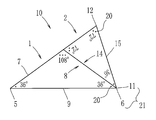
- FIG. 1 is a plan view showing a figure plate set concerning the first embodiment of the present invention.
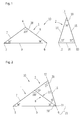
- FIG. 2 is a plan view showing a state that a triangular plate 1 and a triangular plate 2 of FIG. 1 are combined.
- FIG. 3 is a plan view showing another example of the figure plate set concerning the first embodiment of the present invention.
- FIG. 4 is a plan view showing another combination of the triangular plate 1 and the triangular plate 2 of FIG. 3 .
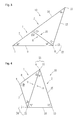
- FIG. 5 is a diagram explaining characteristics of the figure of a regular pentagon.
- FIG. 6 is a diagram explaining characteristics of the figure of a regular pentagon.
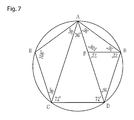
- FIG. 7 is a diagram explaining characteristics of the figure of a regular pentagon.
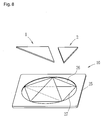
- FIG. 8 is an exploded perspective view showing the figure plate set concerning the second embodiment of the present invention.
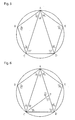
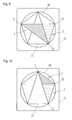
- FIG. 9 is a plan view showing a state that the triangular plate 1 and the triangular plate 2 are placed on a concave portion of a plate member 25 of FIG. 8 , as a first example.
- FIG. 10 is a plan view showing a state that the triangular plate 1 and the triangular plate 2 are placed on the concave portion of the plate member 25 of FIG. 8 , as a second example.
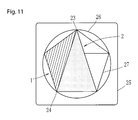
- FIG. 11 is a plan view showing a state that the triangular plate 1 and the triangular plate 2 are placed on the concave portion of the plate member 25 of FIG. 8 , as a third example.
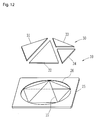
- FIG. 12 is an exploded perspective view showing a second example of the figure plate set concerning the second embodiment of the present invention.
- FIG. 13 is a plan view showing a state that a group of triangular plates 30 is placed on the concave portion of the plate member 25 of FIG. 12 .
- FIG. 14 is a plan view showing an example of the triangular plate on which various indicators are added in an embodiment of the present invention.
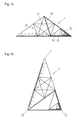
- FIG. 15 is a plan view showing another example of the triangular plate on which various indicators are added in an embodiment of the present invention.
- FIG. 16 is a plan view showing an example in which apexes of the triangular plate of FIG. 14 are chamfered.
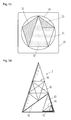
- FIG. 17 is a diagram showing an example of an exercise of geometric thinking about a regular pentagon.
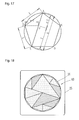
- FIG. 18 is a plan view showing an example in which the number of the triangular plates included in the figure plate set is increased in the second embodiment of the present invention.
- FIG. 19 is a plan view showing an example in which the number of the triangular plates included in the figure plate set is further increased in the second embodiment of the present invention.
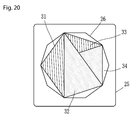
- FIG. 20 is a plan view showing an example in which the concave portion is formed to a regular decagon in the second embodiment of the present invention.
- FIG. 1 is a plan view showing a figure plate set 10 concerning the first embodiment of the present invention.
- the figure plate set 10 is comprised of a triangular plate 1 and a triangular plate 2 .
- the triangular plate 1 is an isosceles triangle having an apex angle of 108° at an apex 4 , and base angles of 36° at an apex 5 and an apex 6 .
- the triangular plate 2 is an isosceles triangle having an apex angle of 36° at an apex 11 , and base angles of 72° at an apex 12 and an apex 13 .
- angles are indicated on the apexes.
- marks 20 are indicated on the apexes.
- One of the marks 20 indicates an angle of 36°. Since the angle of the apex 4 is 108°, which is three times of 36°, three marks 20 are indicated on the apex 4 . Since the marks 20 are indicated, the user can visually recognize the angles. Therefore, the user can easily recognize a sum of the angles especially when the triangular plates are combined.
- the marks are indicated near the apexes of the first triangular plate and the second triangular plate, and the number of the marks varies according to an angle of each of the apexes.
- a length of a side 7 and a side 8 , which are isosceles sides of the triangular plate 1 is same as a length of a side 14 and a side 15 , which are isosceles sides of the triangular plate 2 . From the above, if the triangular plate 1 and the triangular plate 2 are combined, a new triangle can be formed.
- FIG. 2 shows a state that a new triangle is formed by combining the triangular plate 1 and the triangular plate 2 of FIG. 1 so that the side 8 of the triangular plate 1 and the side 14 of the triangular plate 2 are aligned.
- FIG. 3 shows another example of the figure plate set 10 .
- a length of the side 7 and the side 8 which are isosceles sides of the triangular plate 1 , is same as a length of a side 16 , which is a bottom side of the triangular plate 2 .
- a new triangle can be formed by combining the triangular plate and the triangular plate 2 so that the side 8 of the triangular plate 1 is aligned with the side 16 of the triangular plate 2 , as shown in FIG. 3 .
- the figure plate set for learning of the present invention is comprised of a first triangular plate that has an isosceles triangular shape having an apex angle of 108° and base angles of 36°, and a second triangular plate that has an isosceles triangular shape having an apex angle of 36° and base angles of 72°, wherein a length of isosceles sides of the first triangular plate is same as a length of isosceles sides or a bottom side of the second triangular plate, and a new triangular shape can be formed by combining the first triangular plate and the second triangular plate.
- the combined triangle shown in FIG. 3 is an isosceles triangle having an apex angle of 108°, which is a sum of 36° and 72°, at an apex 22 . Therefore, the length of the side 14 and the side 15 is same as the length of a side 9 .
- a quadrangle can be formed by aligning the side 14 of triangular plate 2 with the side 9 of triangular plate 1 . As explained later, the quadrangle formed here is related to the regular pentagon, as shown in FIGS. 7 and 11 .
- FIGS. 5 to 7 are diagrams explaining characteristics of the figure of the regular pentagon.
- the regular pentagon is divided into three triangles by adding a line AC and a line AD into the regular pentagon.
- the regular pentagon can be divided into two kinds of isosceles triangles: one is an isosceles triangle BCA and an isosceles triangle EAD, both having an apex angle of 108° and base angles of 36°, and the other is an isosceles triangle ACD having an apex angle of 36° and base angles of 72°.
- FIG. 6 is a diagram formed by adding a line CF into the diagram of FIG. 5 .
- the isosceles triangle ACD is divided into an isosceles triangle FAC having an apex angle of 108° and base angles of 36°, and an isosceles triangle CDF having an apex angle of 36° and base angles of 72°.
- the isosceles triangle FAC which is one of the triangles obtained by being divided, is a congruent triangle of the isosceles triangle BCA.
- the isosceles triangle CDF which is the other of the triangles obtained by being divided, is a similar triangle of the isosceles triangle ACD, which is a triangle before being divided.
- FIG. 7 is a diagram formed by adding a line EF into the diagram of FIG. 5 .
- the isosceles triangle EAD is divided into an isosceles triangle FEA having an apex angle of 108° and base angles of 36°, and an isosceles triangle DEF having an apex angle of 36° and base angles of 72°.
- the isosceles triangle FEA which is one of the triangles obtained by being divided, is a similar triangle of the isosceles triangle EAD, which is a triangle before being divided.
- the isosceles triangle DEF which is the other of the triangles obtained by being divided, is a similar triangle of the isosceles triangle ACD.
- the regular pentagon can be regarded as an assembly of two kinds of isosceles triangles: one is an isosceles triangle having an apex angle of 108° and base angles of 36°, and the other is an isosceles triangle having an apex angle of 36° and base angles of 72°.
- the dividing lines shown in FIGS. 6 and 7 are merely an example. If the divided lines are further added, isosceles triangles having a congruent shape or a similar shape as the isosceles triangles shown in FIGS. 5 to 7 can be further added.
- the user can realize that an inner angle of 108° is formed by a sum of three 36° at some apexes, and an inner angle of 108° is formed by a sum of 36° and 72° at the other apexes.
- the user can realize that the regular pentagon is geometrically related to two kinds of isosceles triangles: one is an isosceles triangle having an apex angle of 108° and base angles of 36°, and the other is an isosceles triangle having an apex angle of 36° and base angles of 72°. From the above, if two kinds of isosceles triangles, which are components of the regular pentagon as explained above, are prepared as a set of the triangular plates, the user can combine the triangular plates and experientially deepen the understanding of the figure of the regular pentagon. Thus, the ability of geometric thinking related to the regular pentagon can be increased.
- the figure plate set for learning of the present invention is comprised of a group of triangular plates that includes the first triangular plate and the second triangular plate, and the regular pentagon or the regular decagon can be formed by combining the triangular plates included in the group of triangular plates.
- the figure plate set 10 concerning the present embodiment is derived from the above described viewpoint.
- the combined triangle shown in FIG. 2 corresponds to the isosceles triangle ACD, which is formed by combining the isosceles triangle FAC and the isosceles triangle CDF shown in the regular pentagon of FIG. 6 .
- the combined triangle shown in FIG. 3 corresponds to the isosceles triangle EAD, which is formed by combining the isosceles triangle FEA and the isosceles triangle DEF shown in the regular pentagon of FIG. 7 .
- the combined polygon shown in FIG. 4 corresponds to the quadrangle, which is formed by combining the isosceles triangle BCA and the isosceles triangle ACD shown in the regular pentagon of FIG. 5 .
- a guide indicating a method of using the figure plate set 10 should be prepared in advance.
- Information useful for geometric thinking using the triangular plate 1 and the triangular plate 2 should be written in the guide.
- a relation between the triangular plate 1 or the triangular plate 2 and the regular pentagon, and a relation between the angles of the apexes of the triangular plate 1 or the triangular plate 2 and the inner angle of the regular pentagon can be written.
- a similarity relation between the newly formed triangle, which is formed by combining the triangular plate 1 and the triangular plate 2 , and the triangular plate 1 or the triangular plate 2 can be written, for example.
- the user can recognize that the triangular plate 1 and the triangular plate 2 are the components of the regular pentagon, and the user can experientially understand a relation between the angles of 36°, 72° or 108° and the regular pentagon. Similarly, the user can experientially understand a relation between the inner angle 108° of the regular pentagon and the angles of 36°, 72° or 108° by combining the triangular plate 1 and the triangular plate 2 .
- the user can experientially understand a similarity relation between the newly formed triangle, which is formed by combining the triangular plate 1 and the triangular plate 2 , and the triangular plate 1 or the triangular plate 2 .
- the user can increase the ability of geometric thinking related to the regular pentagon.
- a quadratic equation can be formed based on the understanding of the similarity relation.
- lengths of the sides of the newly formed triangle, which is formed by combining the triangular plate 1 and the triangular plate 2 can be calculated.
- the regular decagon can be also formed by combining the triangular plate 1 and the triangular plate 2 . Therefore, if the triangular plate 1 and the triangular plate 2 are regarded as components of the regular decagon, the learning related to the regular decagon is enabled by using the triangular plate 1 and the triangular plate 2 . This learning will be explained later using FIG. 18 .
- the triangular plate 1 and the triangular plate 2 can be easily turned over because they are plate-like members. From the above, fixed thinking about the shape of the triangle is prevented and flexible thinking is enabled.
- the figure plate set 10 can be rotated on a plane. This also helps the flexible thinking.
- the combined triangle shown in FIG. 2 is formed by a combination of the triangular plate 1 and the triangular plate 2 . Since the angles are indicated on the triangular plate 1 and the triangular plate 2 , the user can understand that an angle of the combined triangle at an apex 21 is 72°, which is a sum of 36° and 36°. In addition, the user can understand that the combined triangle is an isosceles triangle having an apex angle of 36° and base angles of 72°. In other words, the user can understand that the combined triangle is a similar triangle of the triangular plate 2 .
- the user can experientially understand characteristics of the figure about the triangle having angles of 36°, 72° and 108° by combining the triangular plate 1 and the triangular plate 2 .
- the triangle having angles of 36°, 72° and 108° is geometrically related to the regular pentagon. Therefore, the understanding obtained by combining the figure plates can also help the user to understand characteristics of the regular pentagon.
- the explanation is made by using an example of the figure plate set 10 shown in FIG. 2 .
- the figure plate set 10 shown in FIG. 3 is used, same effect of learning can be obtained.
- a quadrangle can be formed by combining the figure plate set 10 of FIG. 3 .
- the quadrangle shown in FIG. 4 corresponds to a quadrangle ABCD shown in FIG. 7 , and the quadrangle is geometrically related to the regular pentagon. Therefore, the learning effect can be obtained by using two kinds of combinations shown in FIGS. 3 and 4 .
- the marks 20 are indicated near the apexes, and a number of the marks varies according to an angle of each of the apexes.
- One of the marks 20 corresponds to an angle of 36°. Since the marks 20 are indicated, the user can visually recognize the angles. Thus, the learning effect is improved.
- the angle of 108° is an inner angle of the regular pentagon, and is three times of the angle of 36°.
- the angles of the apexes of the triangular plate 1 and the triangular plate 2 are 36°, 72° (two times of 36°) or 108° (three times of 36°, and the inner angle of the regular pentagon).
- the angles of the apexes are 36° or a multiple of 36°. From the above, one of the marks 20 is specified to correspond to the angle of 36°. Since the marks 20 are indicated, the user can visually recognize the angles of the apexes in association with the angle of 36°. Thus, the learning effect is improved.
- a new apex 21 is formed by a combination of the apex 6 and the apex 11 . Since two marks 20 are indicated near the apex 21 , the user can visually recognize that the angle of the apex 21 is two times of 36°, namely 72°. In FIG. 2 , the user can easily recognize that the number of the marks 20 at the apex 21 or the apex 12 is two, and the number of the marks 20 at the apex 5 is one. Therefore, the user can visually recognize that the combined triangle shown in FIG. 2 is an isosceles triangle having an apex angle of 36° and base angles of 72°.
- FIG. 8 is an exploded perspective view showing the figure plate set concerning the second embodiment of the present invention.
- the figure plate set 10 shown in FIG. 8 includes a plate member 25 , in addition to the triangular plate 1 and the triangular plate 2 .
- a concave portion 26 having a circular shape is formed on the plate member 25 .
- indicators 27 are indicated.
- the indicators 27 include a regular pentagon inscribed in a circumference of the concave portion 26 and various triangles.
- a regular decagon inscribed in a circumference of the concave portion 26 can be also indicated on the bottom surface of the concave portion 26 .
- the figure plate set for learning of the present invention is comprised of a plate member having a circular concave portion, and a group of triangular plates including the first triangular plate and the second triangular plate, wherein a regular pentagon or a regular decagon inscribed in the circular concave portion can be formed by combining the triangular plates included in the group of triangular plates.
- a regular pentagon or a regular decagon inscribed in the circular concave portion is indicated on the plate member.
- the explanation will be done by using an example of the concave portion 26 having a circular shape.
- the shape of the concave portion 26 is not limited to the circular shape as long as the triangular plates can be placed on the concave portion 26 .
- the concave portion 26 can be a regular pentagon or a regular decagon. Regarding this point, the explanation will be done later using FIG. 20 .
- the angles and the marks 20 can be indicated on the triangular plates similar to FIGS. 1 to 4 .
- the figure plate set for learning of the present invention is comprised of a plate member that has a concave portion having a regular decagonal shape, and a group of triangular plates including the first triangular plate and the second triangular plate, wherein a regular pentagon inscribed in the concave portion having the regular decagonal shape can be formed by combining the triangular plates included in the group of triangular plates.
- FIG. 9 is a plan view showing a state that the triangular plate 1 and the triangular plate 2 are placed on the concave portion 26 of the plate member 25 .
- the triangular plate 1 and the triangular plate 2 correspond to the triangular plates shown in FIGS. 1 and 2 .
- slashed lines are added to the triangular plate 1 and dots are added to the triangular plate 2 . This is also applied to FIGS. 10, 11, 13 and 18 .
- the figure plate set for learning of the present invention is comprised of a plate member having a concave portion, and a group of triangular plates including the first triangular plate and the second triangular plate, wherein the triangular plates included in the group of triangular plates can be positioned so that sides or apexes of the triangular plates are in contact with an inner peripheral wall of the concave portion.
- the triangular plate 1 and the triangular plate 2 can be classified by color so that the triangular plate 1 and the triangular plate 2 can be distinguished with each other.
- the user can visually deepen the understanding.
- the color and the angle can be considered in association with each other.
- the figure plates included in the triangular plate 1 or the triangular plate 2 can be classified by color so that similar triangles can be recognized.
- This configuration is effective especially when the indicator indicating a similar triangle is indicated on the triangular plate 1 or the triangular plate 2 as shown in FIGS. 14 to 16 explained later.
- the color can be classified into colored and colorless (transparent).
- the classification by color is also effective when using three or more triangular plates shown in FIGS. 12 to 13 and FIGS. 18 to 19 explained later.
- the triangular plates can be classified by color according to a kind of a triangle.
- the triangular plates are classified into either of two triangles: one is the triangle similar to the triangular plate 1 shown in FIG. 1 , and the other is the triangle similar to the triangular plate 2 shown in FIG. 2 .
- a plurality of the triangular plates included in the figure plate set are classified by color according to a kind of a triangle.
- at least one of the plurality of triangular plates may be classified by color so that the similar triangle can be recognized from the triangular plates.
- the inner peripheral wall of the concave portion 26 forms a circumscribed circle of the regular pentagon. Therefore, the user can recognize a relation between the circumscribed circle of the regular pentagon or the regular pentagon and the triangular plate 1 or the triangular plate 2 through the above described placement work. Thus, the learning effect is improved.
- FIG. 10 is a plan view showing a state that the triangular plate 1 and the triangular plate 2 are placed on the concave portion 26 of the plate member 25 , as another example.
- a newly formed triangle formed by the triangular plate 1 and the triangular plate 2 corresponds to the triangle shown in FIG. 3 .
- FIG. 11 is a plan view showing a state that the triangular plate 1 and the triangular plate 2 are placed on the concave portion 26 of the plate member 25 , as another example.
- a quadrangle formed by the triangular plate 1 and the triangular plate 2 corresponds to the quadrangle shown in FIG. 4 .
- the user can recognize a relation between the circumscribed circle of the regular pentagon or the regular pentagon and the triangular plate 1 or the triangular plate 2 through the above described placement work.
- the learning effect is improved.
- a regular pentagon can be formed by combining the four triangular plates.
- the figure plate set 10 shown in FIG. 12 includes a group of triangular plates 30 formed by four triangular plates 31 to 34 .
- a regular pentagon can be formed by the four triangular plates 31 to 34 .
- the figure plate set 10 shown in FIG. 12 includes a plate member 25 , which is same as the plate member 25 shown in FIG. 8 .
- the triangular plates 31 to 34 can be placed on the plate member 25 .
- FIG. 13 is a plan view showing a state that the triangular plates 31 to 34 are placed on the plate member 25 . Since the concave portion 26 has a circular shape, the apexes of the triangular plates 31 to 34 are in point-contact with the inner peripheral wall of the concave portion 26 in a state of FIG. 13 .
- the user completes the regular pentagon by placing the triangular plates 31 to 34 on the concave portion 26 so that the apexes of the triangular plates 31 to 34 are in contact with the inner peripheral wall of the concave portion 26 .
- the inner peripheral wall of the concave portion 26 forms the circumscribed circle of the regular pentagon. Therefore, the user can recognize a relation between the circumscribed circle of the regular pentagon and the triangular plates 31 to 34 and a relation between the regular pentagon and the triangular plates 31 to 34 through the above described placement work. Thus, the learning effect is improved.
- the sides of the triangular plates 31 to 34 are not in contact with the inner peripheral wall of the concave portion 26 because the concave portion 26 has a circular shape. Therefore, the apexes of the triangular plates 31 to 34 are in contact with the inner peripheral wall of the concave portion 26 .
- the regular pentagon formed by the triangular plates 31 to 34 are not completely fixed in position and can be rotated along the concave portion 26 . Therefore, the user easily recognizes that the regular pentagon inscribed in a circle is formed when the user places the triangular plates 31 to 34 . Thus, the user can experientially realize a relation between the circumscribed circle and the regular pentagon.
- the concave portion 26 has a circular shape, a clearance is formed between the sides of the placed triangular plates 31 to 34 and the inner peripheral wall of the concave portion 26 . Because of the clearance, the placed triangular plates 31 to 34 can be easily removed, and a concave portion made especially for removal is not required.
- the apexes of the regular pentagon formed by the triangular plates 31 to 34 are positioned on the inner peripheral wall of the concave portion 26 .
- the triangular plates 31 to 34 are kept by the concave portion 26 .
- the figure plate set 10 is organized and assembled. Therefore, if a storage case is added, for example, the figure plate set 10 can be easily carried.
- the group of triangular plates is formed by three or more of the triangular plates as shown in an example of FIG. 12 , at least one pair of triangular plates shown in FIGS. 2 and 3 should be included.
- the pair of triangular plates shown in FIGS. 2 and 3 does not have to be necessarily used.
- the triangular plates having the angles shown in FIG. 1 do not have to be necessarily used.
- the triangular plate 33 and the triangular plate 34 can be formed with each other.
- the triangular plate 31 and the triangular plate 32 can be further divided into smaller plates. In this case, the divided triangle does not have to have the same angles as the triangular plate shown in FIG. 1 .
- the triangular plates included in the figure plate set 10 are combined.
- the triangular plate can be independently used. Even if the triangular plate is independently used, sufficient learning effect can be obtained by adding various indicators to the triangular plate.
- FIG. 14 shows an example of the triangular plate 2 on which various indicators are added.
- An indicator 40 has an outer shape of regular pentagon.
- lines are added to connect the apexes of the regular pentagon. From the above, in the regular pentagon, the user can recognize similar triangles that are similar with the triangle of the triangular plate 2 . In addition, the user can also recognize similar triangles that are similar with the triangular plate 1 shown in FIG. 1 . Furthermore, the user can also recognize another regular pentagon 41 in the regular pentagon.
- an indicator indicating a similar triangle or another indicator of a regular pentagon is indicated on at least one of the first triangular plate and the second triangular plate. Furthermore, another indicator indicating another similar triangle and another indicator of another regular pentagon are further indicated in the regular pentagon.
- Indicators 42 to 45 are similar triangles that are similar with the triangular plate 2 .
- the indicator 43 is added in the indicator 42 .
- the indicator 44 is added in the indicator 43 .
- the indicator 45 is added in the indicator 44 . From the above, the user can sequentially recognize the similar triangles from a larger to a smaller size. In addition, the user can also recognize the similar triangle that is similar with the triangular plate 1 shown in FIG. 1 .
- the user can refer to the indicators 40 and 42 to 45 of the triangular plate 2 .
- the learning using only the triangular plate 2 can be enabled.
- both the indicator 40 and the indicators 42 to 45 are indicated in FIG. 14 , one of them can be omitted.
- a scale can be omitted.
- FIG. 15 shows an example the triangular plate 1 on which various indicators is added.
- An indicator 50 is same as the indicator 40 shown in FIG. 14 .
- Indicators 52 to 55 are same as the indicators 42 to 45 shown in FIG. 14 .
- the user can refer to the indicators 50 and 52 to 55 of the triangular plate 1 .
- the learning using only the triangular plate 1 can be enabled.
- one of the indicator 50 and the indicators 52 to 55 can be omitted, and a scale can be omitted.
- the regular pentagon 41 shown in FIG. 14 and the regular pentagon 51 shown in FIG. 15 can be formed as a hole.
- the user can easily recognize the regular pentagon.
- the learning effect is further improved.
- the figure plate set is formed by the triangular plate 2 shown in FIG. 14 and the triangular plate 1 shown in FIG. 15 , the hole of the regular pentagon 41 and the hole of the regular pentagon 51 can be overlapped. Then, if a connection means such as a clip is inserted into the overlapped holes, the first triangular plate and the second triangular plate can be kept together.
- the figure plate set can be easily carried.
- the regular pentagon is formed as a hole having a regular pentagonal shape.
- FIG. 16 shows another embodiment of the triangular plate.
- the apexes 11 to 13 of the triangular plate 2 shown in FIG. 14 are chamfered.
- the “chamfered” in the present embodiment means that the apexes (i.e. corners) are rounded.
- a sharp edge is not formed on the apexes 11 to 13 . Therefore, safety can be secured when the user touches the figure plate set.
- the explanation is made by using an example of the triangular plate 2 shown in FIG. 14 .
- all the triangular plates included in the figure plate set can be chamfered. Although all of three apexes can be chamfered, only the apex having an angle of 36°, which is the sharpest angle, can be chamfered.
- At least a part of apexes of the first triangular plate and the second triangular plate is chamfered.
- FIG. 17 is a diagram showing an example of an exercise of geometric thinking about the regular pentagon.
- a length of one side of the regular pentagon shown in FIG. 17 is 1.
- the example of the exercise is calculating a length x of a diagonal line AC through the geometric thinking. From given conditions, it can be directly derived that a length of a side AB and a side BC is 1 and an angle at an apex B is 108°, which is an inner angle of the regular pentagon. Therefore, the example of the exercise is same as calculating a length of a bottom side AC of an isosceles triangle BCA having an apex angle of 108°.
- the example of the exercise cannot be solved unless the user thinks of making a similar triangle that is similar with the isosceles triangle BCA in the isosceles triangle BCA.
- the auxiliary line BF is a part of a line that connects an apex B and an apex E of the regular pentagon.
- the isosceles triangle BCA corresponds to a newly formed triangle formed by combining the triangular plate 1 and the triangular plate 2 shown in FIG. 10 .
- the triangle FAB corresponds to a triangle of the triangular plate 1 shown in FIG. 10 .
- the user can think of drawing the auxiliary line BF in FIG. 17 because the user knows that a perpendicular line is formed in FIG. 10 by combining the triangular plate 1 and the triangular plate 2 .
- the learning effect of the figure plate set 10 is expected in the example of the exercise that requires the geometric thinking related to the regular pentagon shown in FIG. 17 .
- a quadratic equation can be formed about a length ratio of sides of both triangles. Then, the length of the diagonal line AC can be calculated by solving the quadratic equation.
- FIG. 18 shows an example in which the number of the triangular plates included in the figure plate set is increased.
- a group of triangular plates 60 is comprised of twelve triangular plates.
- the triangular plates are classified into two kinds: one is a triangular plate (shaded part) similar with the triangular plate 1 shown in FIG. 1 , and the other is a triangular plate (dotted part) similar with the triangular plate 2 shown in FIG. 2 . Since the number of the triangular plates is increased, the number of the apexes is increased compared to the regular pentagon and the regular decagon is formed in FIG. 18 . From the above, the range of learning using the figure plate set can be expanded.
- the user can easily imagine that the regular decagon is formed by using ten triangular plates 2 , the user can hardly imagine that the regular decagon is formed by combining the triangular plate 1 and the triangular plate 2 .
- the user can experientially understand that the angles of 72°, 108° and 144° are included in the regular decagon.
- the angles of 72°, 108° and 144° are multiples of the angle of 36°.
- the user can experientially understand that the multiples of the angle are formed by combining the triangular plate 1 and the triangular plate 2 .
- FIG. 19 shows an example in which the number of the triangular plates included in the figure plate set is further increased.
- the figure plate set shown in FIG. 19 includes both a group of triangular plates 30 and a group of triangular plates 60 .
- the group of triangular plates 30 can form the regular pentagon.
- the group of triangular plates 60 can form the regular decagon.
- the group of triangular plates to be used can be selected as necessary. This can expand the range of learning.
- the group of triangular plates 30 and the group of triangular plates 60 can be placed on the plate member 25 in two layers. Therefore, same as the configuration shown in FIG. 12 , the figure plate set 10 can be kept in an assembled state. Therefore, if a storage case is added, the figure plate set 10 can be easily carried.
- a plate member having a concave portion and a group of triangular plates including the first triangular plate and the second triangular plate are provided, a plurality of groups of triangular plates is provided, a regular pentagon or a regular decagon can be formed by combining one of the groups of triangular plates, and the plurality of groups of triangular plates can be stored by being stacked in the concave portion.
- the concave portion 26 of the plate member 25 has the circular shape.
- the shape of the concave portion 26 is not limited to the circular shape. If the concave portion 26 has a shape of the regular decagon, in addition to the combined plate having a shape of the regular decagon, the combined plate having a shape of the regular pentagon can be placed along the inner peripheral wall of the concave portion 26 .
- FIG. 20 is a plan view showing an example in which the concave portion 26 is formed to the regular decagon.
- the concave portion 26 shown in FIG. 13 is changed to a shape of the regular decagon.
- the apexes of the regular pentagon formed by the triangular plates 31 to 34 are in contact with the concave portion 26 .
- the triangular plates 31 to 34 are placed on the concave portion 26 and the regular pentagon is formed so that the apexes of the triangular plates 31 to 34 are in contact with the inner peripheral wall of the concave portion 26 having a shape of the regular decagon. Therefore, the user can recognize a relation between the regular decagon and the regular pentagon inscribed in the regular decagon through the above described placement work. Thus, the learning effect is improved.
- the concave portion 26 has a shape of the regular decagon and the combined plates placed on the concave portion 26 have a shape of the regular pentagon. Therefore, a clearance is formed between the sides of the placed triangular plates 31 to 34 and the inner peripheral wall of the concave portion 26 . Because of the clearance, the user can easily remove the placed triangular plates. Therefore, a concave portion made especially for removal is not required. Furthermore, the combined plates having a shape of the regular decagon and the combined plates having a shape of the regular pentagon can be placed on the concave portion 26 having a shape of the regular decagon in two layers. In other words, even if the shape of the concave portion 26 is changed to the regular decagon in the configuration of FIG. 19 , the group of triangular plates 60 formed in a shape of the regular decagon and the group of triangular plates 30 formed in a shape of the regular pentagon can be placed on the concave portion 26 in two layers.
- the triangular plates are fitted into the plate member 25 in the configuration having the plate member 25 shown in FIG. 8 .
- a protractor, a straight plate, a compass or other tools can be fitted into the plate member 25 at a position avoiding the triangular plates.
- Materials of the triangular plates are not particularly limited. Resin materials and paper materials can be used, for example.
- FIGS. 1 to 4 show an example of using indicators of both the angles and the marks 20 for indicating the angles. However, one of them or both of them can be omitted. Even if the angles are not indicated, the user can recognize the angles and learn the figures by simultaneously using the above described guide.
Landscapes
- Engineering & Computer Science (AREA)
- Physics & Mathematics (AREA)
- General Physics & Mathematics (AREA)
- Business, Economics & Management (AREA)
- Educational Administration (AREA)
- Educational Technology (AREA)
- Theoretical Computer Science (AREA)
- Mathematical Optimization (AREA)
- Computational Mathematics (AREA)
- Mathematical Analysis (AREA)
- Pure & Applied Mathematics (AREA)
- Mathematical Physics (AREA)
- Geometry (AREA)
- Algebra (AREA)
- Multimedia (AREA)
- Entrepreneurship & Innovation (AREA)
- Instructional Devices (AREA)
Applications Claiming Priority (3)
| Application Number | Priority Date | Filing Date | Title |
|---|---|---|---|
| JP2012229989A JP5614690B2 (ja) | 2012-10-17 | 2012-10-17 | 図形板セット |
| JP2012-229989 | 2012-10-17 | ||
| PCT/JP2013/077967 WO2014061660A1 (ja) | 2012-10-17 | 2013-10-15 | 図形板セット |
Related Parent Applications (1)
| Application Number | Title | Priority Date | Filing Date |
|---|---|---|---|
| PCT/JP2013/077967 Continuation WO2014061660A1 (ja) | 2012-10-17 | 2013-10-15 | 図形板セット |
Publications (2)
| Publication Number | Publication Date |
|---|---|
| US20150194061A1 US20150194061A1 (en) | 2015-07-09 |
| US9443440B2 true US9443440B2 (en) | 2016-09-13 |
Family
ID=50488221
Family Applications (1)
| Application Number | Title | Priority Date | Filing Date |
|---|---|---|---|
| US14/656,715 Active US9443440B2 (en) | 2012-10-17 | 2015-03-13 | Figure plate set |
Country Status (3)
| Country | Link |
|---|---|
| US (1) | US9443440B2 (enExample) |
| JP (1) | JP5614690B2 (enExample) |
| WO (1) | WO2014061660A1 (enExample) |
Cited By (2)
| Publication number | Priority date | Publication date | Assignee | Title |
|---|---|---|---|---|
| US20160284237A1 (en) * | 2015-03-23 | 2016-09-29 | Dong-sik CHA | Twelve-piece tangram puzzle set |
| US20180286281A1 (en) * | 2017-03-31 | 2018-10-04 | Carl Abdullah Islam Muhammad | Universal mathematical scale A1. and A2. set |
Families Citing this family (3)
| Publication number | Priority date | Publication date | Assignee | Title |
|---|---|---|---|---|
| US20160303472A1 (en) * | 2014-01-28 | 2016-10-20 | Rebecca Klemm | Polygon puzzle and related methods |
| CN104282199A (zh) * | 2014-10-17 | 2015-01-14 | 南丹县青少年学生校外活动中心 | 平移和旋转演示教具 |
| CN109147499A (zh) * | 2018-11-12 | 2019-01-04 | 扈少飞 | 几何拼接装置 |
Citations (25)
| Publication number | Priority date | Publication date | Assignee | Title |
|---|---|---|---|---|
| US143835A (en) * | 1873-10-21 | Improvement in toy blocks for object-teaching | ||
| US342651A (en) * | 1886-05-25 | Means for teaching fractions | ||
| US1173298A (en) * | 1913-03-18 | 1916-02-29 | Maria Montessori | Cut-out geometrical figure for didactical purposes. |
| US1261710A (en) * | 1917-05-12 | 1918-04-02 | John Henry Coyle | Right-triangle puzzle. |
| US2611193A (en) * | 1949-07-05 | 1952-09-23 | Kenneth V Davis | Arithmetic fraction trainer |
| US2885207A (en) * | 1951-12-11 | 1959-05-05 | Wormser Arthur | Geometrical puzzle game |
| US3614835A (en) * | 1969-09-02 | 1971-10-26 | Macon D Rice | Educational toy construction kit |
| US3637217A (en) * | 1970-02-13 | 1972-01-25 | Sherman Kent | Puzzle with pieces in the form of subdivided rhombuses |
| JPS4815175Y1 (enExample) | 1969-12-29 | 1973-04-26 | ||
| JPS5534859U (enExample) | 1978-08-29 | 1980-03-06 | ||
| US4343471A (en) * | 1981-06-22 | 1982-08-10 | Calvert Murray B | Pentagonal puzzle |
| US4723382A (en) * | 1986-08-15 | 1988-02-09 | Haresh Lalvani | Building structures based on polygonal members and icosahedral |
| US4913436A (en) * | 1988-11-25 | 1990-04-03 | Li Shuo Yen R | Puzzles and game based on geometric shapes |
| US5215467A (en) * | 1992-01-27 | 1993-06-01 | Brischke Donald A | Mathematical instruction board and method of use |
| US5281145A (en) * | 1989-10-02 | 1994-01-25 | Sidrak Fahim R | Pictorial image transforming manipulatives |
| JPH074660U (ja) | 1993-06-13 | 1995-01-24 | 節 宇治 | 複数の正多角形が構成可能な四角形の形状 |
| US5470234A (en) * | 1993-06-16 | 1995-11-28 | Sher; Louis Y. | Circular, piece-matching math educational aid |
| JPH09285642A (ja) | 1996-04-22 | 1997-11-04 | Kazuaki Tani | パズル |
| US5873729A (en) * | 1997-02-19 | 1999-02-23 | Aghevli; Behrouz B. | Mathematical triangle kit and method of use |
| USD429775S (en) * | 1999-08-02 | 2000-08-22 | Douglas Adelman | Scalene triangle puzzle |
| US6145837A (en) * | 1998-08-28 | 2000-11-14 | A. Daigger And Company, Inc. | Three-dimensional geometric puzzle |
| US6575755B2 (en) * | 2000-04-13 | 2003-06-10 | Ricardo Dreyfous | Fraction circle |
| US20060076732A1 (en) * | 2004-10-13 | 2006-04-13 | Jean-Hwa Chiou | Multi-functional geometric puzzle system |
| JP3149263U (ja) | 2009-01-06 | 2009-03-19 | 晋 奥村 | 形態把握演習器 |
| US8834167B2 (en) * | 2010-07-06 | 2014-09-16 | Barbara Spotts | Manipulative for modeling quantitative concepts |
-
2012
- 2012-10-17 JP JP2012229989A patent/JP5614690B2/ja active Active
-
2013
- 2013-10-15 WO PCT/JP2013/077967 patent/WO2014061660A1/ja not_active Ceased
-
2015
- 2015-03-13 US US14/656,715 patent/US9443440B2/en active Active
Patent Citations (25)
| Publication number | Priority date | Publication date | Assignee | Title |
|---|---|---|---|---|
| US143835A (en) * | 1873-10-21 | Improvement in toy blocks for object-teaching | ||
| US342651A (en) * | 1886-05-25 | Means for teaching fractions | ||
| US1173298A (en) * | 1913-03-18 | 1916-02-29 | Maria Montessori | Cut-out geometrical figure for didactical purposes. |
| US1261710A (en) * | 1917-05-12 | 1918-04-02 | John Henry Coyle | Right-triangle puzzle. |
| US2611193A (en) * | 1949-07-05 | 1952-09-23 | Kenneth V Davis | Arithmetic fraction trainer |
| US2885207A (en) * | 1951-12-11 | 1959-05-05 | Wormser Arthur | Geometrical puzzle game |
| US3614835A (en) * | 1969-09-02 | 1971-10-26 | Macon D Rice | Educational toy construction kit |
| JPS4815175Y1 (enExample) | 1969-12-29 | 1973-04-26 | ||
| US3637217A (en) * | 1970-02-13 | 1972-01-25 | Sherman Kent | Puzzle with pieces in the form of subdivided rhombuses |
| JPS5534859U (enExample) | 1978-08-29 | 1980-03-06 | ||
| US4343471A (en) * | 1981-06-22 | 1982-08-10 | Calvert Murray B | Pentagonal puzzle |
| US4723382A (en) * | 1986-08-15 | 1988-02-09 | Haresh Lalvani | Building structures based on polygonal members and icosahedral |
| US4913436A (en) * | 1988-11-25 | 1990-04-03 | Li Shuo Yen R | Puzzles and game based on geometric shapes |
| US5281145A (en) * | 1989-10-02 | 1994-01-25 | Sidrak Fahim R | Pictorial image transforming manipulatives |
| US5215467A (en) * | 1992-01-27 | 1993-06-01 | Brischke Donald A | Mathematical instruction board and method of use |
| JPH074660U (ja) | 1993-06-13 | 1995-01-24 | 節 宇治 | 複数の正多角形が構成可能な四角形の形状 |
| US5470234A (en) * | 1993-06-16 | 1995-11-28 | Sher; Louis Y. | Circular, piece-matching math educational aid |
| JPH09285642A (ja) | 1996-04-22 | 1997-11-04 | Kazuaki Tani | パズル |
| US5873729A (en) * | 1997-02-19 | 1999-02-23 | Aghevli; Behrouz B. | Mathematical triangle kit and method of use |
| US6145837A (en) * | 1998-08-28 | 2000-11-14 | A. Daigger And Company, Inc. | Three-dimensional geometric puzzle |
| USD429775S (en) * | 1999-08-02 | 2000-08-22 | Douglas Adelman | Scalene triangle puzzle |
| US6575755B2 (en) * | 2000-04-13 | 2003-06-10 | Ricardo Dreyfous | Fraction circle |
| US20060076732A1 (en) * | 2004-10-13 | 2006-04-13 | Jean-Hwa Chiou | Multi-functional geometric puzzle system |
| JP3149263U (ja) | 2009-01-06 | 2009-03-19 | 晋 奥村 | 形態把握演習器 |
| US8834167B2 (en) * | 2010-07-06 | 2014-09-16 | Barbara Spotts | Manipulative for modeling quantitative concepts |
Non-Patent Citations (4)
| Title |
|---|
| International Search Report for PCT/JP2013/077967 dated Jan. 21, 2014. |
| Kei Shindo, '8. Daigaku Nyushi Mondai Kenkyu Seijikkakukei', 'Kyomu Essay (Sansu)-Sansugaku Nyumon'. |
| Nozomu Tanaka, 'Enshukaku to Chushinkaku', 'Chugaku kara Sugaku Daisuki'. |
| PCT written openion dated Jan. 21, 2014. |
Cited By (3)
| Publication number | Priority date | Publication date | Assignee | Title |
|---|---|---|---|---|
| US20160284237A1 (en) * | 2015-03-23 | 2016-09-29 | Dong-sik CHA | Twelve-piece tangram puzzle set |
| US10078972B2 (en) * | 2015-03-23 | 2018-09-18 | Dong-sik CHA | Twelve-piece tangram puzzle set |
| US20180286281A1 (en) * | 2017-03-31 | 2018-10-04 | Carl Abdullah Islam Muhammad | Universal mathematical scale A1. and A2. set |
Also Published As
| Publication number | Publication date |
|---|---|
| US20150194061A1 (en) | 2015-07-09 |
| JP5614690B2 (ja) | 2014-10-29 |
| JP2014081530A (ja) | 2014-05-08 |
| WO2014061660A1 (ja) | 2014-04-24 |
Similar Documents
| Publication | Publication Date | Title |
|---|---|---|
| US9443440B2 (en) | Figure plate set | |
| US9443444B2 (en) | Figure plate set | |
| US11279167B2 (en) | Combinational template and scale ruler for drawing parallel 3-dimensions | |
| JP5409769B2 (ja) | プリズム状の型およびシート材を作るための精密ダイヤモンド旋削のピンベースの方法 | |
| US20150240400A1 (en) | Alignment tool | |
| US9443439B2 (en) | Figure plate set | |
| US7055259B2 (en) | Template set for drawing three-dimensional shapes | |
| CN213958366U (zh) | 多功能几何图形教学用具 | |
| JP5399670B2 (ja) | 立体構造体及びこれを用いた地球儀及び遊星儀 | |
| KR200491115Y1 (ko) | 입체형 학습 교구 | |
| US20210309043A1 (en) | Device for dividing an angle into a plurality of smaller equal angles | |
| JP6083095B2 (ja) | 図形板セット | |
| JP5437462B1 (ja) | パッチワーク用作業用具 | |
| KR20110103156A (ko) | 수학 학습용 교구 | |
| JP2012158040A (ja) | 図形学習用教具 | |
| AU2017101889A4 (en) | A space efficient template | |
| US20120058454A1 (en) | Sketching Devices having Improved Geometry | |
| US6024574A (en) | Visual aids for understanding characteristics of geometric figures | |
| CA1073660A (en) | Drafting template | |
| JP3228028U (ja) | 製図器具 | |
| Howard et al. | Flirting with Monsky. | |
| KR20170141382A (ko) | 수학 교육용 교구 | |
| CN210941093U (zh) | 多功能尺 | |
| JP4268618B2 (ja) | 仕切体 | |
| JPH0533502A (ja) | 工事現場仮囲用組立板 |
Legal Events
| Date | Code | Title | Description |
|---|---|---|---|
| AS | Assignment |
Owner name: PASCAL CO., LTD., JAPAN Free format text: ASSIGNMENT OF ASSIGNORS INTEREST;ASSIGNOR:MORIYASU, HIROKI;REEL/FRAME:035200/0633 Effective date: 20150225 |
|
| STCF | Information on status: patent grant |
Free format text: PATENTED CASE |
|
| MAFP | Maintenance fee payment |
Free format text: PAYMENT OF MAINTENANCE FEE, 4TH YEAR, MICRO ENTITY (ORIGINAL EVENT CODE: M3551); ENTITY STATUS OF PATENT OWNER: MICROENTITY Year of fee payment: 4 |
|
| MAFP | Maintenance fee payment |
Free format text: PAYMENT OF MAINTENANCE FEE, 8TH YEAR, MICRO ENTITY (ORIGINAL EVENT CODE: M3552); ENTITY STATUS OF PATENT OWNER: MICROENTITY Year of fee payment: 8 |