US9265852B2 - Deordorising compositions and deodorising products containing same - Google Patents
Deordorising compositions and deodorising products containing same Download PDFInfo
- Publication number
- US9265852B2 US9265852B2 US13/379,278 US201013379278A US9265852B2 US 9265852 B2 US9265852 B2 US 9265852B2 US 201013379278 A US201013379278 A US 201013379278A US 9265852 B2 US9265852 B2 US 9265852B2
- Authority
- US
- United States
- Prior art keywords
- formula
- propyn
- phenyl
- octyn
- furyl
- Prior art date
- Legal status (The legal status is an assumption and is not a legal conclusion. Google has not performed a legal analysis and makes no representation as to the accuracy of the status listed.)
- Active, expires
Links
Images

Classifications
-
- A—HUMAN NECESSITIES
- A61—MEDICAL OR VETERINARY SCIENCE; HYGIENE
- A61L—METHODS OR APPARATUS FOR STERILISING MATERIALS OR OBJECTS IN GENERAL; DISINFECTION, STERILISATION OR DEODORISATION OF AIR; CHEMICAL ASPECTS OF BANDAGES, DRESSINGS, ABSORBENT PADS OR SURGICAL ARTICLES; MATERIALS FOR BANDAGES, DRESSINGS, ABSORBENT PADS OR SURGICAL ARTICLES
- A61L9/00—Disinfection, sterilisation or deodorisation of air
- A61L9/01—Deodorant compositions
-
- A—HUMAN NECESSITIES
- A61—MEDICAL OR VETERINARY SCIENCE; HYGIENE
- A61K—PREPARATIONS FOR MEDICAL, DENTAL OR TOILETRY PURPOSES
- A61K8/00—Cosmetics or similar toiletry preparations
- A61K8/18—Cosmetics or similar toiletry preparations characterised by the composition
- A61K8/30—Cosmetics or similar toiletry preparations characterised by the composition containing organic compounds
- A61K8/33—Cosmetics or similar toiletry preparations characterised by the composition containing organic compounds containing oxygen
- A61K8/35—Ketones, e.g. benzophenone
-
- A—HUMAN NECESSITIES
- A61—MEDICAL OR VETERINARY SCIENCE; HYGIENE
- A61L—METHODS OR APPARATUS FOR STERILISING MATERIALS OR OBJECTS IN GENERAL; DISINFECTION, STERILISATION OR DEODORISATION OF AIR; CHEMICAL ASPECTS OF BANDAGES, DRESSINGS, ABSORBENT PADS OR SURGICAL ARTICLES; MATERIALS FOR BANDAGES, DRESSINGS, ABSORBENT PADS OR SURGICAL ARTICLES
- A61L2/00—Methods or apparatus for disinfecting or sterilising materials or objects other than foodstuffs or contact lenses; Accessories therefor
- A61L2/16—Methods or apparatus for disinfecting or sterilising materials or objects other than foodstuffs or contact lenses; Accessories therefor using chemical substances
- A61L2/18—Liquid substances or solutions comprising solids or dissolved gases
-
- A—HUMAN NECESSITIES
- A61—MEDICAL OR VETERINARY SCIENCE; HYGIENE
- A61L—METHODS OR APPARATUS FOR STERILISING MATERIALS OR OBJECTS IN GENERAL; DISINFECTION, STERILISATION OR DEODORISATION OF AIR; CHEMICAL ASPECTS OF BANDAGES, DRESSINGS, ABSORBENT PADS OR SURGICAL ARTICLES; MATERIALS FOR BANDAGES, DRESSINGS, ABSORBENT PADS OR SURGICAL ARTICLES
- A61L2/00—Methods or apparatus for disinfecting or sterilising materials or objects other than foodstuffs or contact lenses; Accessories therefor
- A61L2/16—Methods or apparatus for disinfecting or sterilising materials or objects other than foodstuffs or contact lenses; Accessories therefor using chemical substances
- A61L2/22—Phase substances, e.g. smokes, aerosols or sprayed or atomised substances
-
- A—HUMAN NECESSITIES
- A61—MEDICAL OR VETERINARY SCIENCE; HYGIENE
- A61L—METHODS OR APPARATUS FOR STERILISING MATERIALS OR OBJECTS IN GENERAL; DISINFECTION, STERILISATION OR DEODORISATION OF AIR; CHEMICAL ASPECTS OF BANDAGES, DRESSINGS, ABSORBENT PADS OR SURGICAL ARTICLES; MATERIALS FOR BANDAGES, DRESSINGS, ABSORBENT PADS OR SURGICAL ARTICLES
- A61L9/00—Disinfection, sterilisation or deodorisation of air
- A61L9/14—Disinfection, sterilisation or deodorisation of air using sprayed or atomised substances including air-liquid contact processes
-
- A—HUMAN NECESSITIES
- A61—MEDICAL OR VETERINARY SCIENCE; HYGIENE
- A61Q—SPECIFIC USE OF COSMETICS OR SIMILAR TOILETRY PREPARATIONS
- A61Q15/00—Anti-perspirants or body deodorants
-
- C—CHEMISTRY; METALLURGY
- C07—ORGANIC CHEMISTRY
- C07C—ACYCLIC OR CARBOCYCLIC COMPOUNDS
- C07C49/00—Ketones; Ketenes; Dimeric ketenes; Ketonic chelates
- C07C49/20—Unsaturated compounds containing keto groups bound to acyclic carbon atoms
- C07C49/207—Unsaturated compounds containing keto groups bound to acyclic carbon atoms with only carbon-to-carbon triple bonds as unsaturation
-
- C—CHEMISTRY; METALLURGY
- C07—ORGANIC CHEMISTRY
- C07C—ACYCLIC OR CARBOCYCLIC COMPOUNDS
- C07C49/00—Ketones; Ketenes; Dimeric ketenes; Ketonic chelates
- C07C49/20—Unsaturated compounds containing keto groups bound to acyclic carbon atoms
- C07C49/213—Unsaturated compounds containing keto groups bound to acyclic carbon atoms containing six-membered aromatic rings
- C07C49/217—Unsaturated compounds containing keto groups bound to acyclic carbon atoms containing six-membered aromatic rings having unsaturation outside the aromatic rings
-
- C—CHEMISTRY; METALLURGY
- C07—ORGANIC CHEMISTRY
- C07D—HETEROCYCLIC COMPOUNDS
- C07D307/00—Heterocyclic compounds containing five-membered rings having one oxygen atom as the only ring hetero atom
- C07D307/02—Heterocyclic compounds containing five-membered rings having one oxygen atom as the only ring hetero atom not condensed with other rings
- C07D307/34—Heterocyclic compounds containing five-membered rings having one oxygen atom as the only ring hetero atom not condensed with other rings having two or three double bonds between ring members or between ring members and non-ring members
- C07D307/38—Heterocyclic compounds containing five-membered rings having one oxygen atom as the only ring hetero atom not condensed with other rings having two or three double bonds between ring members or between ring members and non-ring members with substituted hydrocarbon radicals attached to ring carbon atoms
- C07D307/40—Radicals substituted by oxygen atoms
- C07D307/46—Doubly bound oxygen atoms, or two oxygen atoms singly bound to the same carbon atom
-
- A—HUMAN NECESSITIES
- A61—MEDICAL OR VETERINARY SCIENCE; HYGIENE
- A61L—METHODS OR APPARATUS FOR STERILISING MATERIALS OR OBJECTS IN GENERAL; DISINFECTION, STERILISATION OR DEODORISATION OF AIR; CHEMICAL ASPECTS OF BANDAGES, DRESSINGS, ABSORBENT PADS OR SURGICAL ARTICLES; MATERIALS FOR BANDAGES, DRESSINGS, ABSORBENT PADS OR SURGICAL ARTICLES
- A61L2/00—Methods or apparatus for disinfecting or sterilising materials or objects other than foodstuffs or contact lenses; Accessories therefor
- A61L2/16—Methods or apparatus for disinfecting or sterilising materials or objects other than foodstuffs or contact lenses; Accessories therefor using chemical substances
- A61L2/23—Solid substances, e.g. granules, powders, blocks, tablets
- A61L2/232—Solid substances, e.g. granules, powders, blocks, tablets layered or coated
-
- A61L2103/75—
-
- A—HUMAN NECESSITIES
- A61—MEDICAL OR VETERINARY SCIENCE; HYGIENE
- A61L—METHODS OR APPARATUS FOR STERILISING MATERIALS OR OBJECTS IN GENERAL; DISINFECTION, STERILISATION OR DEODORISATION OF AIR; CHEMICAL ASPECTS OF BANDAGES, DRESSINGS, ABSORBENT PADS OR SURGICAL ARTICLES; MATERIALS FOR BANDAGES, DRESSINGS, ABSORBENT PADS OR SURGICAL ARTICLES
- A61L2209/00—Aspects relating to disinfection, sterilisation or deodorisation of air
- A61L2209/20—Method-related aspects
- A61L2209/21—Use of chemical compounds for treating air or the like
Definitions
- the present Application relates to novel deodorant compositions containing at least one compound of the family of acetylenic ketones and the deodorant products containing them.
- deodorant composition refers to a composition the deodorant effect of which is linked to the properties of physical destruction of the malodorous molecules by the acetylenic ketones and not to any masking of the unpleasant odour.
- acetylenic ketone is used to denote chemical molecules comprising at least one keto- ⁇ -acetylenic chain formation (—CO—C ⁇ C— or —C ⁇ C—CO—).
- the first subject of the invention is a deodorant composition characterized in that it comprises at least one compound of the family of the ⁇ -acetylenic ketones corresponding to general formula 1 R—(CO) k —C ⁇ C-(A)-(C ⁇ C) m —(CO) n —R 1 (1)
- alkyl chain comprising from 1 to 9 carbon atoms is meant a methyl, ethyl, propyl, butyl, pentyl, hexyl, heptyl, octyl, nonyl radical, linear or branched, substituted or unsubstituted, in particular by one or more oxo group(s), however without the total carbon atoms in the molecule exceeding 18, preferentially 16.
- a cycloalkane comprising from 3 to 8 carbon atoms is meant a cyclopropyl, cyclobutyl, cyclopentyl, cyclohexyl, cycloheptyl, cyclooctyl, cyclopropylcarbonyl, cyclobutylcarbonyl, cyclopropylmethyl or also cyclobutylmethyl radical.
- an aromatic ring comprising from 6 to 8 carbon atoms is meant a radical chosen from phenyl, benzyl or phenethyl, optionally substituted by one or two substituents, identical or different, chosen from the methyl, dimethyl, methoxy, dimethoxy, hydroxy, acetyl, cyano substituents.
- the R and R 1 radicals can be simultaneously or independently substituted by one or more radicals chosen from the methyl, ethyl, propyl, butyl radicals or also a 2-oxopropyl radical.
- R and R1 can be preferentially an acetonyl, pentyl, hexyl, heptyl, cyclopropyl, cyclopentyl, cyclohexyl, furyl or phenyl, anisyl, dimethoxyphenyl, tolyl radical and R 1 can be a hydrogen atom.
- the compound of formula 1 can be present in the composition in a quantity comprised between 0.01% and 40%, preferentially between 0.1% and 15%, even more preferentially from 1% to 10% of the total weight of the composition.
- the composition can comprise one or more compounds corresponding to formula 1.
- compositions any combination of at least 2 of the compounds corresponding to formula 1, preferentially those previously listed and even more preferentially the pairs formed by 2 compounds chosen from the pairs:
- the compound of formula 1 can be present in the composition in a quantity comprised between 0.1% and 40%, preferentially between 0.1% and 10%, of the total weight of the composition.
- the compounds of formula 1 are known for their significant reactivity with the thiols and the amines.
- the deodorant composition can moreover comprise at least one aldehyde chosen from the acyclic and non-terpenic aliphatic aldehydes, the non-terpenic alicyclic aldehydes, the terpenic aldehydes, the aliphatic aldehydes substituted by an aromatic group, the bifunctional aldehydes, the aldehydes possessing a non-aromatic unsaturation borne by the carbon in the alpha position of the aldehyde function, the aldehydes possessing an unsaturation in the alpha position of the aldehyde function conjugated with an aromatic ring and the aldehydes the function of which is borne by an aromatic ring.
- the composition can comprise a mixture of two or more aldehydes.
- the deodorant composition can moreover comprise a mixture of at least one first aldehyde (aldehyde of class A) chosen from the acyclic and non-terpenic aliphatic aldehydes, the non-terpenic alicyclic aldehydes, the terpenic aldehydes, the aliphatic aldehydes substituted by an aromatic group and the bifunctional aldehydes and at least one second aldehyde (aldehyde of class B) chosen from the aldehydes possessing a non-aromatic unsaturation borne by the carbon in the alpha position of the aldehyde function, the aldehydes possessing an unsaturation in the alpha position of the aldehyde function conjugated with an aromatic ring and the aldehydes the function of which is borne by an aromatic ring.
- aldehyde of class A chosen from the acyclic and non-terpenic aliphatic aldehydes
- the composition can comprise a mixture of at least one first and at least one second aldehyde.
- first aldehyde can of course be a mixture of two or more aldehydes of class A and the second aldehyde can be a mixture of two or more aldehydes chosen from those of class B.
- the aldehydes of class A or B can be chosen from the natural or synthetic aldehydes, particularly from those classes which are not dangerous to the environment according to the European Dangerous Substances Directive, authorized in food (FEMA No.) and in perfumery by the IFRA.
- the acyclic and non-terpenic aliphatic aldehyde of class A can be chosen from
- non-terpenic alicyclic aldehyde of class A can be chosen from
- non-terpenic alicyclic aldehyde (AliNT) of class A can be chosen from
- the terpenic aldehyde (Terp) of class A can be chosen from
- the terpenic aldehyde can be chosen from
- the aliphatic aldehyde of class A substituted by an aromatic group can be chosen from
- the aliphatic aldehyde substituted by an aromatic group can be chosen from
- bifunctional aldehyde is meant according to the invention the aldehydes also possessing another function such as for example an ether-oxide or alcohol function.
- the bifunctional aldehyde can according to the invention be chosen from
- the bifunctional aldehyde can be any organic compound.
- the bifunctional aldehyde can be any organic compound.
- the aldehyde which possesses an unsaturation of non-aromatic type (class B) borne by the carbon in the alpha position of the aldehyde function can be chosen from
- the aldehyde which possesses an unsaturation of non-aromatic type (class B) borne by the carbon in the alpha position of the aldehyde function can be
- aldehyde (of class B) which possesses an ethylenic unsaturation in the alpha position, conjugated with an aromatic ring can be chosen from
- the aldehyde which possesses an ethylenic unsaturation in the alpha position, conjugated with an aromatic ring can be
- aldehyde borne by an aromatic ring itself optionally substituted moreover, can be chosen from
- the aldehyde borne by an aromatic ring can be chosen from
- the first aldehyde can be chosen preferably from the acyclic and non-terpenic aliphatic aldehydes, the non-terpenic alicyclic aldehydes, the terpenic aldehydes and the aliphatic aldehydes substituted by an aromatic group
- the second aldehyde can be chosen preferably from the aldehydes which possess an unsaturation of non-aromatic type borne by the alpha carbon.
- the first aldehyde can be chosen from the aliphatic or acyclic and non-terpenic aliphatic aldehydes and the second from the terpenic aldehydes possessing an unsaturation on the alpha carbon referred to above.
- Particularly useful pairs of aldehydes can be chosen in particular from the following pairs, without any limitation:
- the composition can comprise the aldehyde in a quantity comprised between 0.5% and 50% of the composition, preferentially in a quantity comprised between 1% and 20% of the composition.
- the composition can comprise the aldehydes of classes A and B in proportions relative to each other, in proportions from 80/20 to 20/80 in particular in proportions of 50/50 and in a total quantity of aldehydes comprised between 1% and 90% of the composition, preferentially in a quantity comprised between 10% and 30% of the composition.
- deodorant compositions according to the invention in addition to their remarkable deodorant properties, also themselves possess odiferous properties optionally capable of replacing unpleasant odours with their own odour.
- the deodorant compositions can moreover comprise a masking agent.
- compositions can therefore comprise at least one odoriferous agent such as those conventionally used in perfumery such as alcohols, essential oils, phenolic substances, esters.
- compositions according to the invention can also contain specific substances, such as for example bactericides.
- deodorant compositions are advantageously formulated according to the usual techniques.
- a subject of the invention is also the use of a compound of the family of acetylenic ketones corresponding to formula 1 in a deodorant composition, particularly in deodorant compositions comprising at least one aldehyde chosen from the acyclic and non-terpenic aliphatic aldehydes, the non-terpenic alicyclic aldehydes, the terpenic aldehydes, the aliphatic aldehydes substituted by an aromatic group, the bifunctional aldehydes, the aldehydes possessing a non-aromatic unsaturation borne by the carbon in the alpha position of the aldehyde function, the aldehydes possessing an unsaturation in the alpha position of the aldehyde function conjugated with an aromatic ring and the aldehydes the function of which is borne by an aromatic ring, and even more preferentially in a deodorant composition comprising a mixture of at least one first aldehyde (aldehyde
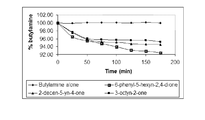
- FIG. 1 illustrates the degradation of butylamine under the effect of ⁇ -acetylenic ketones according to the invention.
- FIG. 2 illustrates the degradation of butylamine under the effect of a known neutralizing agent to which an ⁇ -acetylenic ketone according to the invention is added.
- a 1-liter reactor was loaded with 345 mL of diglyme (RN 111-96-6) and 17.2 g (748 mmoles) of sodium (RN 7440-23-5) cut into pieces. After heating to a temperature slightly above the melting point of sodium accompanied by thorough stirring, 71.7 g (745 mmoles) i.e. 97.5 mL of 1-heptyne (RN 628-71-7) in solution in 100 mL of diglyme is then added four times at hourly intervals. The medium thickens to form a beige suspension. Stirring is continued for another 2 hours 30 minutes at the same temperature. The mixture is cooled down to 25-30° C.
- 5-decyn-4-one, 3-octyn-2-one, 4-phenyl-3-butyn-2-one, 9-hexadecyn-8-one, 1-(2-furyl)-3-phenyl-2-propyne-1-one and 1-cyclopentyl-4-nonyn-3-one (non-limitative examples) are prepared analogously.
- a 500-mL reactor is loaded with 13.8 g (111 mmoles) of 4-nonyne (RN 20184-91-2), 175 mL of tert-butanol (RN 75-65-0), 770 mg (4.5 mmoles) of cupric chloride dihydrate (RN 10125-13-0), and 33.4 mL (244 mmoles) of 70% tert-butyl hydroperoxide (RN 75-91-2).
- the medium is heated to 60-65° C. At the end of three hours it is noted that the medium absorbs no more oxygen and has consumed the theoretical quantity.
- the medium is poured over ice and extracted three times with ether.
- the combined organic phases are washed four times with 5% saltwater. After drying and concentration approximately 40 g of a green liquid is obtained, which is fractionated by distillation under reduced pressure (20 mm Hg).
- a 750-mL reactor is loaded with 40.1 g (400 mmoles) i.e. 49.2 mL of hexanal (RN 66-25-1) and 400 mL of anhydrous tetrahydrofuran and 100 g of a suspension of 18% sodium acetylide (RN 1066-26-8) in xylene (375 mmoles) is added by portions accompanied by stirring. An exothermic reaction takes place. Stirring is then continued for another 2 hours at no particular temperature. After hydrolysis, extractions and concentration, fractionation is carried out under reduced pressure.
- a 1500-mL reactor is loaded with 25.24 g (200 mmoles) i.e. 29.1 mL of 1-octyn-3-ol, 600 mL of acetone and 90 mL of water.
- 25.24 g (200 mmoles) i.e. 29.1 mL of 1-octyn-3-ol, 600 mL of acetone and 90 mL of water.
- 29.4 g (100 mmoles) of potassium dichromate of (RN 7778-50-9) in 300 mL of water and 22 mL of sulphuric acid is added over 1 hour 30 minutes. The coloration changes from orange to green.
- stirring is continued for another 30 minutes then 1000 mL of water is added also over 30 minutes.
- 1-cyclohexyl-4-ethyl-1-hexyn-3-one, 7-tetradecyn-8-one, 2-nonyn-4-one, 9-hexadecyn-8-one and 1-(p-tolyl)-2-butyn-1-one are prepared analogously, using the salt of a substituted alkyne (Na—C ⁇ C—R).
- the olfactory test is carried out with a panel of 25 experts.
- the ⁇ -acetylenic ketones to be tested are prepared at a concentration of 1 mol/L in dipropylene glycol.
- the reference malodorous solution is also prepared at a concentration of 1 mol/L.
- a first pillbox contains 1 g of the reference malodorous solution.
- the unpleasant odour released by the first pillbox is assigned the reference 10 (reference malodorous solution).
- This test aims to show the potentiating effect of the ⁇ -acetylenic ketones on an already known deodorant, Neutral 1.
- An unpleasant cooking odour is prepared by mixing the following different compounds:
- the testing panel then evaluates the odour in each of the enclosures, according to the order defined by a Latin square and in comparison with the reference enclosure containing the unpleasant odour alone.
- Phenylacetaldehyde (A) 0.32% Hydroxycitronellal (A) 1.63% ⁇ -Hexylcinnamaldehyde (B) 19.09% Lilial (A) 7.91% DiPropyleneGlycol qsf 100
- An unpleasant tobacco odour is prepared from ash and cigarette ends. 20 g of this odour is deposited in a 3 m 3 odour chamber.
- Cloth towels are deposited in the enclosure and left for 24 hours in order to become impregnated with the tobacco odour.
- towels brought into contact with the tobacco odour are prepared and mixtures of anti-tobacco Neutral 2 and a small ⁇ -acetylenic ketone (in a proportion of 99/1) or a mixture of two small ⁇ -acetylenic ketones (in a proportion of 99/0.5/0.5) are sprayed on the towels.
- the panel then evaluates the quantity of unpleasant tobacco odour on the towels in comparison with towels which had received no treatment against the unpleasant odour.
- Neutral 2 The effectiveness of Neutral 2 is improved by the addition of at least one ⁇ -acetylenic ketone.
- An unpleasant toilet odour is prepared by mixing the following different compounds:
- 20 ⁇ L of this unpleasant odour is deposited in the water of a toilet bowl in a cubicle.
- 20 ⁇ L of unpleasant odour as well as 20 ⁇ L of a Neutral 3 which is active against the unpleasant toilet odour are deposited in another cubicle.
- the quantity of unpleasant toilet odour in each cubicle is then evaluated by the testing panel.
- Neutral 3 The effectiveness of Neutral 3 is improved by the addition of at least one ⁇ -acetylenic ketone.
- Parallel tests contribute to recording the reactivity of the keto-alkynes. They are carried out by a mole to mole reaction of a keto-alkyne with a substance responsible for an unpleasant odour. The reaction is carried out at ambient temperature in THF.
- a substrate, piperidine, is used to verify this reactivity.
- the reaction is carried out at ambient temperature in THF.
- butanethiol The reactivity with butanethiol is fairly similar to that of 2-phenylethanethiol.
- reaction with toluenethiol is very rapid with two targets and slower with the three other targets tested.
- Chromatographic analyses are carried out every 25 minutes in order to establish kinetics.
- the ⁇ -acetylenic ketones lead to a 4 to 8% reduction in the quantity of butylamine in less than 3 hours.
- Phenylacetaldehyde (A) 0.32% Hydroxycitronellal (A) 1.63% ⁇ -Hexylcinnamaldehyde (B) 19.09% Lilial (A) 7.91% 2,4-Dimethyl-3-cyclohexen-1-carboxaldehyde (A) 0.15% DPG Qsf 100
- the aldehydes can also be formulated in the form of acetals in order to reduce the intrinsic odour of the neutralizer and increase the duration of action. It is known that an acetal is hydrolyzed in acid medium releasing the corresponding aldehyde.
- acetals with a faint odour which can be used in a surface deodorant: propionaldehyde DEA, phenylacetaldehyde-methanol acetal, citral diethylacetal, hydroxycitronnellal dimethylacetal, benzaldehyde diethylacetal.
Landscapes
- Health & Medical Sciences (AREA)
- Chemical & Material Sciences (AREA)
- Organic Chemistry (AREA)
- Life Sciences & Earth Sciences (AREA)
- Animal Behavior & Ethology (AREA)
- General Health & Medical Sciences (AREA)
- Public Health (AREA)
- Veterinary Medicine (AREA)
- Epidemiology (AREA)
- Chemical Kinetics & Catalysis (AREA)
- General Chemical & Material Sciences (AREA)
- Emergency Medicine (AREA)
- Birds (AREA)
- Organic Low-Molecular-Weight Compounds And Preparation Thereof (AREA)
- Gas Separation By Absorption (AREA)
- Agricultural Chemicals And Associated Chemicals (AREA)
- Fats And Perfumes (AREA)
- Cosmetics (AREA)
- Disinfection, Sterilisation Or Deodorisation Of Air (AREA)
Applications Claiming Priority (4)
| Application Number | Priority Date | Filing Date | Title |
|---|---|---|---|
| FR0907987 | 2009-06-18 | ||
| FR09007987.2 | 2009-06-18 | ||
| EP09007987A EP2272491A1 (de) | 2009-06-18 | 2009-06-18 | Neue Deodorantzusammensetzungen und Deodorantprodukte, die sie enthalten |
| PCT/FR2010/000448 WO2010146258A2 (fr) | 2009-06-18 | 2010-06-17 | Nouvelles compositions désodorisantes et produits désodorisants les renfermant |
Publications (2)
| Publication Number | Publication Date |
|---|---|
| US20120201778A1 US20120201778A1 (en) | 2012-08-09 |
| US9265852B2 true US9265852B2 (en) | 2016-02-23 |
Family
ID=41256023
Family Applications (1)
| Application Number | Title | Priority Date | Filing Date |
|---|---|---|---|
| US13/379,278 Active 2033-06-12 US9265852B2 (en) | 2009-06-18 | 2010-06-17 | Deordorising compositions and deodorising products containing same |
Country Status (3)
| Country | Link |
|---|---|
| US (1) | US9265852B2 (de) |
| EP (2) | EP2272491A1 (de) |
| WO (1) | WO2010146258A2 (de) |
Families Citing this family (9)
| Publication number | Priority date | Publication date | Assignee | Title |
|---|---|---|---|---|
| US9126890B2 (en) * | 2011-10-20 | 2015-09-08 | International Flavors & Fragrances Inc. | Low volatile reactive malodor counteractives and methods of use thereof |
| JP4925488B1 (ja) * | 2011-07-15 | 2012-04-25 | 長谷川香料株式会社 | 酸味・酸臭抑制剤 |
| EP2849718B1 (de) | 2012-05-16 | 2017-02-01 | Symrise AG | Mischungen mit verbesserter kühlwirkung |
| EP2842428B1 (de) | 2013-08-27 | 2018-08-08 | Symrise AG | Orale Zubereitung |
| DE102013226602A1 (de) * | 2013-12-19 | 2015-06-25 | Henkel Ag & Co. Kgaa | Verwendung von CNGA2-Agonisten zur Verstärkung der olfaktorischen Wirkung eines Riechstoffs |
| DE102013226600A1 (de) * | 2013-12-19 | 2015-06-25 | Henkel Ag & Co. Kgaa | Luftpflege- und Reinigungsmittel enthaltend CNGA2-Antagonisten |
| US10226544B2 (en) | 2015-06-05 | 2019-03-12 | International Flavors & Fragrances Inc. | Malodor counteracting compositions |
| CN106283625B (zh) * | 2016-08-10 | 2018-06-05 | 佛山科学技术学院 | 一种用于纺织品的抗菌除臭喷剂 |
| WO2020249216A1 (en) | 2019-06-13 | 2020-12-17 | Symrise Ag | A cooling preparation |
Citations (11)
| Publication number | Priority date | Publication date | Assignee | Title |
|---|---|---|---|---|
| US3325367A (en) | 1964-01-29 | 1967-06-13 | Gillette Co | Antiperspirant composition |
| US3852355A (en) | 1971-08-31 | 1974-12-03 | Firmenich & Cie | Cycloaliphatic unsaturated ketones as odour- and taste-modifying agents |
| US3944621A (en) | 1975-03-10 | 1976-03-16 | International Flavors & Fragrances Inc. | Pi-tricyclene derivatives and process for preparing pi-tricyclene derivatives |
| NL8104274A (nl) | 1981-09-16 | 1983-04-18 | Naarden International Nv | Parfumcomposities en geparfumeerde produkten die alifatische ketonen als parfumgrondstof bevatten alsmede alifatisch keton geschikt voor gebruik als parfumgrondstof. |
| JPS6153238A (ja) | 1984-08-24 | 1986-03-17 | Kao Corp | 末端に2重結合を有する2−イナ−ル類及びそれを含有する香料組成物 |
| DE4417752A1 (de) | 1994-05-20 | 1995-11-23 | Bayer Ag | Mikrobizide Alkinderivate |
| US5795566A (en) * | 1989-05-29 | 1998-08-18 | Robertet S.A. | Deodorant compositions containing at least two aldehydes and the deodorant products containing them |
| US5968795A (en) | 1996-05-15 | 1999-10-19 | Bayer Corporation | Biaryl acetylenes as inhibitors of matrix metalloproteases |
| EP1224947A1 (de) | 2001-01-23 | 2002-07-24 | Sumitomo Chemical Co.,Ltd. | Desodorierende Zusammensetzung |
| WO2006076821A1 (en) | 2005-01-21 | 2006-07-27 | Givaudan Sa | 2 -c-substituted propane-1, 3 -dicarbonyl compounds and their use in neutralising malodour |
| WO2008149102A2 (en) | 2007-06-07 | 2008-12-11 | Dsm Food Specialities B.V. | Preservative |
Family Cites Families (5)
| Publication number | Priority date | Publication date | Assignee | Title |
|---|---|---|---|---|
| JPS6011882B2 (ja) * | 1980-03-04 | 1985-03-28 | 兼商株式会社 | 殺線虫剤 |
| JPS56154402A (en) * | 1980-05-01 | 1981-11-30 | Kanesho Kk | Soil fungicide |
| JPS60257202A (ja) * | 1984-06-02 | 1985-12-19 | 大日本除蟲菊株式会社 | 木材用防虫、防腐剤 |
| JP2588783B2 (ja) * | 1989-11-30 | 1997-03-12 | 長谷川香料株式会社 | アルキニルケトン誘導体の製法 |
| JP3766818B2 (ja) * | 2001-12-13 | 2006-04-19 | 阪本薬品工業株式会社 | 抗菌抗黴性組成物 |
-
2009
- 2009-06-18 EP EP09007987A patent/EP2272491A1/de not_active Withdrawn
-
2010
- 2010-06-17 US US13/379,278 patent/US9265852B2/en active Active
- 2010-06-17 WO PCT/FR2010/000448 patent/WO2010146258A2/fr not_active Ceased
- 2010-06-17 EP EP10734772.6A patent/EP2442783B1/de active Active
Patent Citations (11)
| Publication number | Priority date | Publication date | Assignee | Title |
|---|---|---|---|---|
| US3325367A (en) | 1964-01-29 | 1967-06-13 | Gillette Co | Antiperspirant composition |
| US3852355A (en) | 1971-08-31 | 1974-12-03 | Firmenich & Cie | Cycloaliphatic unsaturated ketones as odour- and taste-modifying agents |
| US3944621A (en) | 1975-03-10 | 1976-03-16 | International Flavors & Fragrances Inc. | Pi-tricyclene derivatives and process for preparing pi-tricyclene derivatives |
| NL8104274A (nl) | 1981-09-16 | 1983-04-18 | Naarden International Nv | Parfumcomposities en geparfumeerde produkten die alifatische ketonen als parfumgrondstof bevatten alsmede alifatisch keton geschikt voor gebruik als parfumgrondstof. |
| JPS6153238A (ja) | 1984-08-24 | 1986-03-17 | Kao Corp | 末端に2重結合を有する2−イナ−ル類及びそれを含有する香料組成物 |
| US5795566A (en) * | 1989-05-29 | 1998-08-18 | Robertet S.A. | Deodorant compositions containing at least two aldehydes and the deodorant products containing them |
| DE4417752A1 (de) | 1994-05-20 | 1995-11-23 | Bayer Ag | Mikrobizide Alkinderivate |
| US5968795A (en) | 1996-05-15 | 1999-10-19 | Bayer Corporation | Biaryl acetylenes as inhibitors of matrix metalloproteases |
| EP1224947A1 (de) | 2001-01-23 | 2002-07-24 | Sumitomo Chemical Co.,Ltd. | Desodorierende Zusammensetzung |
| WO2006076821A1 (en) | 2005-01-21 | 2006-07-27 | Givaudan Sa | 2 -c-substituted propane-1, 3 -dicarbonyl compounds and their use in neutralising malodour |
| WO2008149102A2 (en) | 2007-06-07 | 2008-12-11 | Dsm Food Specialities B.V. | Preservative |
Non-Patent Citations (15)
| Title |
|---|
| "Acetylene derivatives as nematocides", Jpn. Kokai Tokkyo Koho, 1982, 2 pages. |
| "Soil disindectant composition", Jpn. Kokai Tokkyo Koho, 1982, 2 pages. |
| Amaike, et al., "A1kynl-ketone(s) prepn. for fragrance intermediate-by reacting 1-alkyne with acid halogen in presence of acid halogen catalyst, useful for flavanol intermediate", Thomson Scientific, Jul. 24, 1991, 2 pages. |
| El-Sayed, et al., "Studies of nitrification inhibition with many acetylenic compounds in soils", Alexandria Science Exchange, 2003, 1 page, vol. 24, No. 3. |
| Gavrilov, et al., "Synthesis of diarylpropynones and their antibiotic activity", Khimiko-Farmatsevticheski Zhurnal, 1978, 4 pages, vol. 12, No. 9. |
| Glazunova, et al., "Antimicrobial activity of acetylene keto ethers", Khimiko-Farmatsevticheski Zhurnal, 1974, 4 pages, vol. 8, No. 4. |
| Hillers, et al., "Antibiotic activity of some acetylene derivatives of furan", Latvijas PSR Zinatnu Akademijas Vestis, 1967, 2 pages. |
| Hillers, et al., "Fungistatic and bacteriostatic activity of some acetylenic derivatives of pathogenic fungi", Khim Atsetilena, 1969, 2 pages. |
| Katsuta, "Preservation of wood", Jpn. Kokai Tokkyo Koho, 1986, 1 page. |
| Katsuta, :Pyrethrin insecticides, Jpn. Kokai Tokkyo Koho, 1974, 1 page. |
| Kawanami, et al., Perfume contg. formyl acetylene derivs with terminal double bond-prepd. from alkane-alpha, omega-di:halide, Thomson Scientific, 1986, 1 page. |
| Oshima, et al., "Capillin-containing odorless antibacterial and antifungal agents, and their compositions", Jpn. Kokai Tokkyo Koho, 2003, 5 pages. |
| Roe, et al., "A novel geminal diol as a highly specific and stable in vivo inhibitor of insect juvenile hormone esterase", Archives of Insect Biochemistry and Physiology, 1997, 1 page, vol. 36, No. 3. |
| Translation of NL8104274A, Feb. 2015. * |
| Yamada, et al., "Characteristic of Artemisia capillaris extract and development with", Fragrance Journal, 2006, 1 page, vol. 34, No. 4. |
Also Published As
| Publication number | Publication date |
|---|---|
| WO2010146258A3 (fr) | 2011-09-29 |
| US20120201778A1 (en) | 2012-08-09 |
| EP2442783A2 (de) | 2012-04-25 |
| EP2442783B1 (de) | 2017-08-09 |
| WO2010146258A2 (fr) | 2010-12-23 |
| WO2010146258A4 (fr) | 2011-12-08 |
| EP2272491A1 (de) | 2011-01-12 |
| WO2010146258A8 (fr) | 2012-02-02 |
Similar Documents
| Publication | Publication Date | Title |
|---|---|---|
| US9265852B2 (en) | Deordorising compositions and deodorising products containing same | |
| US4187251A (en) | Malodor counteractants | |
| US4622221A (en) | Method, compositions and compounds, useful in room fresheners employing cyclohexyl alcohol and ester derivatives | |
| US4719105A (en) | Method, compositions and compounds useful in room fresheners employing cyclohexyl alcohol and ester derivatives | |
| US20220218860A1 (en) | Indane derivatives for malodor counteraction | |
| EP2079487A1 (de) | Zusammensetzungen gegen schlechten geruch | |
| EP3697456B1 (de) | Geruchsbelästigung entgegenwirkende inhaltsstoffe | |
| EP1167362B1 (de) | Duft Vorläufer | |
| JP5866170B2 (ja) | 悪臭中和方法 | |
| US20100209378A1 (en) | Dimethylcyclohexyl Derivatives as Malodor Neutralizers | |
| JPS6058981B2 (ja) | 悪臭除去方法 | |
| JPS607495B2 (ja) | 悪臭除去方法 | |
| US20250066690A1 (en) | Spiro Compounds as Malodor Counteracting Ingredients | |
| CN106999619B (zh) | 作为恶臭抵消成分的大环酮 | |
| CA1107201A (en) | Malodor counteractants | |
| GB1590485A (en) | Malodor counteractants |
Legal Events
| Date | Code | Title | Description |
|---|---|---|---|
| AS | Assignment |
Owner name: ROBERTET S.A., FRANCE Free format text: ASSIGNMENT OF ASSIGNORS INTEREST;ASSIGNORS:CASAZZA, ANDRE;KERVERDO, RAYMOND;ZIEGLER, LYDIA;AND OTHERS;SIGNING DATES FROM 20120103 TO 20120110;REEL/FRAME:027558/0179 |
|
| STCF | Information on status: patent grant |
Free format text: PATENTED CASE |
|
| MAFP | Maintenance fee payment |
Free format text: PAYMENT OF MAINTENANCE FEE, 4TH YEAR, LARGE ENTITY (ORIGINAL EVENT CODE: M1551); ENTITY STATUS OF PATENT OWNER: LARGE ENTITY Year of fee payment: 4 |
|
| MAFP | Maintenance fee payment |
Free format text: PAYMENT OF MAINTENANCE FEE, 8TH YEAR, LARGE ENTITY (ORIGINAL EVENT CODE: M1552); ENTITY STATUS OF PATENT OWNER: LARGE ENTITY Year of fee payment: 8 |